Article

Analysis of the Impact of Heterogeneous Platoon for Mixed Traffic Flow: Stability and Safety
School of Transportation and Logistics, Southwest Jiaotong University, Chengdu 611756, China
*
Author to whom correspondence should be addressed.
Systems 2026, 14(3), 304; https://doi.org/10.3390/systems14030304
Submission received: 16 January 2026 / Revised: 8 February 2026 / Accepted: 11 March 2026 / Published: 13 March 2026

Abstract

To investigate the impact mechanism of different platoon control strategies on mixed traffic flow, this paper evaluates the overall performance of different heterogeneous platoon control strategies in smoothing small traffic disturbances and improving traffic safety. First, this paper derives the stability conditions for homogeneous and mixed traffic flow based on transfer function theory. Second, by simulating small disturbance experiments, the trend of speed under different traffic densities and the penetration rate of CAVs are analyzed. The characteristics of speed change coefficients under different platoon control strategies are comparatively analyzed based on the results in part 1. Finally, numerical simulation experiments were designed to analyze the safety performance of traffic flow under each strategy. The results show that (1) the combination of a variable time gap strategy with vehicle speed has the strongest ability to suppress disturbances. Among the combination spacing strategies, the combination of the variable time gap strategy with vehicle speed and the constant time gap strategy performs best in smoothing small disturbances. (2) At low penetration rates, incorporating CAVs may increase the instability of the traffic flow, while at high rates, CAVs effectively enhance the stability. These findings provide important guidance for selecting platoon control strategies in mixed traffic flow environments from the perspective of stability and safety.

1. Introduction

Autonomous vehicles can form platoons with close arrangements, demonstrating significant advantages in improving road capacity [1,2,3], maintaining system stability [4,5,6], and reducing fuel consumption [7,8,9]. Compared with traditional traffic flow, automated driving platoons can mitigate accident risks caused by human factors through vehicle coordination and control that reduces unnecessary disturbances [10,11,12].
Spacing control strategies are critical to realizing these advantages [13,14,15,16,17,18]. Common strategies include the constant spacing (CS) and constant time gap (CTG) [19], which ensure smooth platoon operation under varying traffic conditions by adjusting inter-vehicle distances. However, single spacing strategies involve trade-offs among road capacity, stability, and fuel efficiency [20,21,22].
To address these limitations, recent studies have examined synergies between heterogeneous platooning control paradigms and traffic flow dynamics [23,24]. These studies have focused on traffic throughput, fuel consumption, and emissions, yet failed to deeply explore the effects of disturbances and collision risks on stability and safety in practical applications. Notably, the “stop-and-go” phenomenon arising from traffic flow instability is a primary source of congestion and accidents [25,26]. Therefore, investigating the disturbance resistance and accident risk of combined spacing strategies is particularly important.
The choice of spacing control strategy directly affects platoon stability under disturbances and collision risk in emergencies [27,28]. Regarding stability, when control algorithms fail to maintain vehicle spacing, local speed fluctuations generate traffic waves through vehicle coupling, potentially triggering oscillations that degrade traffic efficiency and cause congestion [29,30]. The widely adopted transfer function method establishes quantitative relationships between control parameters and string stability by quantifying disturbance attenuation or amplification characteristics [31,32,33,34,35]. For safety assessment, indicators such as time-to-collision (TTC) and rear-end collision risk index (RCRI) quantify potential risks and evaluate strategy performance in emergencies [36,37,38]. However, existing studies typically analyze stability or safety separately [39,40,41], and most focus on single control strategies [42,43]. The comprehensive pe64rformance of multiple combined spacing strategies remains unevaluated [44].
To fill this gap, this paper aims to address the following research questions: (1) How do different combination spacing control strategies affect the string stability of heterogeneous platoons in mixed traffic flow? (2) What is the critical penetration rate of CAVs required for each strategy to maintain traffic flow stability? (3) How do these strategies perform in terms of traffic safety indicators (TET and TIT) under varying traffic densities? To address these questions, this paper evaluates the overall performance of different heterogeneous platoon control strategies on traffic stability and safety. The main contributions of this paper are twofold.
(1) Deriving stability conditions for heterogeneous platoons under different control strategies based on stability criteria for homogeneous and heterogeneous traffic flows.
(2) Evaluating traffic stability and safety of 10 combined control strategies across various scenarios (traffic density and CAV penetration rate) through numerical simulations.
The subsequent sections unfold as follows. Section 2 reviews the effects of spacing control strategies on traffic stability and safety. Section 3 derives stability conditions for homogeneous and mixed traffic flows. Section 4 investigates the effects of different combined spacing strategies on safety indicators through simulation experiments. Section 5 presents the conclusions and future work.

2. Literature Review

Recently, some studies have extensively explored the effects of spacing control strategies on mixed traffic flow in terms of stability and safety [45,46,47,48,49].
Traffic stability is usually based on string stability [46,47,50], i.e., when the traffic system is under an external disturbance, the vehicles in the platoon will make adjustments according to the distances between the vehicles. Different spacing control strategies have different stability performances when dealing with external disturbances. For example, Santhanakrishnan and Rajamani [35] introduced an “ideal” spacing strategy that models the inter-vehicle distance as a nonlinear function of speed. It was demonstrated that this strategy guarantees both string stability and traffic flow stability for the platoon while enhancing throughput within the speed range of 20–65 mi/h. They argued that, at the described maximum traffic flow rate, traffic flow stability entails string stability. On the other hand, Zhao et al. [21] introduced a safety spacing policy (SSP) that dynamically modulates inter-vehicle spacing and speed based on real-time vehicle state data and braking capabilities. Through traffic simulations under aggressive maneuvers—such as hard braking and rapid acceleration—they demonstrated that SSP effectively ensures platoon stability. Moreover, compared to the conventional constant time gap (CTG) strategy, SSP exhibits notable improvements in both traffic throughput and flow stability. However, most existing spacing strategies, including SSP, rely heavily on real-time relative motion information from the lead vehicle. Inconsistencies or delays in this information can compromise safety and potentially trigger rear-end collisions. To mitigate this vulnerability, Rödönyi [19] developed an adaptive spacing policy (ASP) leveraging a virtual lead vehicle framework. It was shown that the appropriate selection of control parameters within this framework guarantees stable acceleration profiles while minimizing control effort. Complementing these approaches, Besselink and Johansson [51] proposed a delay-based spacing control strategy capable of tracking a desired spacing profile while preserving stability under spatially varying reference speeds, thereby enhancing macroscopic traffic flow stability. Despite their effectiveness in maintaining string and flow stability, these strategies exhibit limitations in ensuring collision avoidance during high-risk scenarios. Addressing this gap, Lee et al. [34] formulated a spatio-temporal spacing strategy incorporating a safe speed reduction mechanism, accompanied by a formal stability analysis. Numerical examples confirmed that their approach not only prevents collisions in hazardous situations but also preserves platoon stability.
Quantitative safety assessment in traffic systems typically requires integrating the interplay between traffic flow dynamics and control strategies. To date, most microscopic safety evaluations have concentrated primarily on rear-end collision risk, with limited attention to lateral interactions [52,53,54]. The TTC, defined as the ratio of inter-vehicle spacing to relative speed, is widely employed as a baseline safety metric [55,56]. However, TTC alone is insufficient to capture the cumulative nature of risk in macroscopic traffic flow. To address this limitation, Minderhoud and Bovy [37] proposed two integral risk indicators: Time Exposed to TTC below a threshold TTC* (TET) and TIT, which differentiate safe from unsafe states based on a critical TTC threshold. While existing studies predominantly examine the impact of individual spacing policies on platoon stability or safety, comparative analyses remain limited. For instance, Dong et al. [54] evaluated constant time headway (CTH) against variable time headway (VTH) strategies in mixed traffic environments. Their findings indicate that at low automated vehicle penetration rates, VTH yields smaller reductions in TET and TIT compared to CTH; however, as penetration increases, VTH demonstrates superior performance in mitigating tailgating risk. In a related study, Eibaklish et al. [57] developed a variable time gap feedback control policy and demonstrated its robustness to disturbances. A follow-up study quantified its safety benefits by showing an 86.4% improvement in the lead vehicle’s TTC relative to the conventional constant time gap (CTG) policy, along with a 23.5% higher TTC growth rate compared to the variable time gap (VTG) approach [45].
In summary, the majority of existing research has concentrated on the effects of individual spacing control strategies on platoon stability and safety. In contrast, investigations into hybrid or combined strategies remain scarce. To the best of our knowledge, only Zheng et al. [39] have systematically evaluated the constant time gap–constant spacing (CTG–CS) combination strategy under two distinct disturbance scenarios, assessing both its stability and safety performance. Their experimental results demonstrate that the CTG–CS strategy yields the lowest values of TET and TIT compared to either the standalone CTG or CS strategies. These findings underscore the potential benefits of integrated spacing designs; however, a comprehensive understanding of how different combinations of spacing policies jointly influence stability and safety remains lacking. Consequently, further research is warranted to systematically evaluate the holistic performance of diverse combination spacing control strategies across a broader range of traffic conditions and risk metrics.

3. Methodology

In this study, the traffic system refers specifically to a single-lane mixed traffic flow consisting of HDVs and CAVs organized in platoons. The transfer function method is selected for stability analysis because (1) it provides a quantitative relationship between control parameters and string stability [39,46,51]; (2) it allows for analytical derivation of stability conditions for heterogeneous platoons; (3) it is widely validated in vehicle platooning studies [47,58]. For safety evaluation, TET and TIT are chosen as they can quantify accumulated collision risk in macro traffic flow, addressing the limitation of TTC in describing single events [37,49,59].

3.1. String Stability

Traffic flow stability encompasses several distinct notions, including local stability, convective string and flow stability, and (asymptotic) string and flow stability [60]. This study focuses specifically on string stability, which characterizes the propagation behavior of small perturbations within a vehicle platoon. Formally, a platoon is said to be string-stable if disturbances—such as minor speed or spacing deviations—do not amplify as they propagate upstream through the formation. In other words, even for a platoon of finite length, the traffic flow exhibits string stability provided that any localized disturbance decays (or remains bounded) at every vehicle downstream; otherwise, the system is deemed string-unstable.

3.1.1. Composition of Homogeneous Platoons

According to Wu et al. [23], the car-following models associated with the constant time gap (CTG), variable time gap 1 (VTG1), and variable time gap 2 (VTG2) strategies are functions of the ego vehicle’s speed, the relative spacing and speed difference with respect to the preceding vehicle, and the predecessor’s acceleration. The corresponding models for each strategy are given in Equations (1)–(3), respectively.
u i , C T G t = k e , 1 x i 1 t x i t L v i t h d 0 + k v , 1 v i 1 t v i t + k C a i 1 t ,
where a i t , v i t , and x i t are the acceleration, speed, and position of vehicle i at time t , respectively; L is the length of the vehicle; d 0 is the minimum safe spacing; h is a constant time gap; k e , 1 , k v , 2 , and k C are the control parameters under the CTG strategy.
u i , V T G 1 t = k e , 2 x i 1 t x i t L c 1 + μ v i t + μ v i 1 t d 0   + k v , 2 v i 1 t v i t + k V a i 1 t ,
where c 1 and μ are the calibrated coefficients, with c 1 = 0.6   s and μ = 0.1   s [61]; k e , 1 , k v , 2 , and k V are the control parameters under the VTG1 strategy.
u i , V T G 2 t = k e , 3 x i 1 t x i t d V exp v i t 2 m + k v , 3 v i 1 t v i t   + k V 2 a i 1 t ,
where d V is the calibrated coefficient, with d V 2 =   d 0 + L = 7   m [62]; m is the speed coefficient, with m = 8.83 m/s [62]; k e , 3 , k v , 3 , and k V 2 are the control parameters under the VTG2 strategy, respectively. Referring to [63], the control parameters for the three strategies, CTG, VTG1, and VTG2, are set as follows: k e = 0.1 , k v = 0.98 , and k = 0.7 .
To facilitate subsequent notation, a general form of the longitudinal control model for CAVs that incorporates the preceding vehicle’s acceleration is presented below:
(1)
CTG strategy
a i , C T G t = g C v i t , x i t , v i t + k C a i 1 t .
(2)
VTG1 strategy
a i , V T G 1 t = g V 1 v i t , x i t , v i t + k V 1 a i 1 t .
(3)
VTG2 strategy
a i , V T G 2 t = g V 2 v i t , x i t , v i t + k V 2 a i 1 t .
where x i and v i are the spacing and speed difference between vehicle i and its preceding vehicle i 1 ; g and k are the general expressions of the longitudinal control model and the acceleration feedback parameters under the * strategy, where * = {CTG, VTG1, VTG2}.
From the physical interpretation of the longitudinal control model, it follows that—starting from an initial equilibrium—if the preceding vehicle accelerates toward a new steady-state speed, the following vehicle must also accelerate to track this new equilibrium. Consequently, the control gains kk associated with the predecessor’s acceleration in the model must satisfy the non-negativity condition k 0 .
Similarly, the car-following model for HDVs can be expressed by Equation (7).
a i , H V t = f i v i t , x i t , v i t ,
where f is the general expression of the car-following model.

3.1.2. Homogeneous Traffic Flow

(1)
Stability conditions with different spacing control strategies
Referring to [63], the speed disturbance transfer function is
G i s = k s 2 + g v s + g x s 2 + g v g v s + g x ,
where s is the Laplace domain; k represents the feedback control coefficients; g v , g x , and g v are the general form of the longitudinal control model, which is expressed as the linear combination of the partial derivatives of the equilibrium state with respect to vehicle speed, inter-vehicle spacing, and relative speed, respectively.
g i v = g v i , x i , v i v i v e , x e , 0 g i x = g v i , x i , v i x i v e , x e , 0 . g i v = g v i , x i , v i v i v e , x e , 0
Based on the CAV longitudinal control models under different spacing control strategies, the three partial differential terms are calculated in order:
  • CTG strategy
g i , C T G v = h k e , 1 g i , C T G x = k e , 1 . g i , C T G v = k v , C
  • VTG1 strategy
g i , V T G 1 v = c 1 k e , V 1 g i , V T G 1 x = k e , V 1 . g i , V T G 1 v = μ k e , V 1 + k v , V 1
  • VTG2 strategy
g i , V T G 2 v = k e , V 2 d V 2 2 m e x p v i ( t ) 2 m g i , V T G 2 x = k e , V 2 . g i , V T G 2 v = k v , V 2
Wu et al. [23] derived the stability conditions based on the control theory, as shown in Equation (13).
0 k i , s 1 g i , s v 2 2 g i , s v g i , s v 2 1 k i , s g i , s x 0 ,
where g i , p x and k i , p are the partial derivatives of a certain strategy with respect to spacing and the feedback control coefficients, respectively; s = C T G ,   V T G 1 , V T G 2 .
(2)
Stability conditions for HDVs
This paper assumes that all HDVs follow the IDM with identical parameter values. Under this assumption, the stability condition for a homogeneous HDV traffic flow can be derived.
F i j ω = f i x + j ω f i v f i x ω 2 + j ω f i v f i v 1 ,
where f v , f x , and f v denote the partial derivatives of the general expression of the HDV car-following model at the equilibrium state regarding speed, spacing, and relative speed, respectively.
The three partial derivatives mentioned above can be calculated with the following equations:
f i v = f i v i , x i , v i v i v e , x e , 0 f i x = f i v i , x i , v i x i v e , x e , 0 , f i v = f i v i , x i , v i v i v e , x e , 0
Referring to Li et al. [24], the three partial differential terms can be calculated as
f i v = 4 a m a x v e 3 v f 4 2 a m a x T 1 v e 4 d 0 + v e T v f 4 f i x = 2 a m a x 1 v e / v f 4 1.5 d 0 + v e T , f i v = a m a x b v e T 1 v e 4 d 0 + v e T v f 4
It can be obtained by solving Equation (14):
f i v 2 2 f i v f i v 2 f i x 0 .

3.1.3. Heterogeneous Traffic Flow

For a heterogeneous traffic flow, the stability criterion is as follows when each of these three types of vehicles is the same [63]:
M j ω = G i , C A C C j ω P C A C C Y i , A C C j ω P A C C F i , H V j ω P H V 1 ,
where P C A C C , P A C C , and P H V denote the distribution probabilities of CACC vehicles, ACC vehicles, and HDVs, respectively; and Y j ω represents the speed disturbance transfer function when the speed disturbance propagates through the entire ACC homogeneous traffic flow.
The mixed traffic flow in this paper contains three types of vehicles: LV (the leading vehicle of the CAV platoon), PV (the following vehicle in the CAV platoon), and HDV. The LV, PV, and HDV are the same [23]. It should be noted that, based on the platoon size characteristics, the LV is further divided into LV1 and LV2. However, all the leading vehicles of the CAV platoons in the traffic flow use the same longitudinal control model, so there is no distinction here. Therefore, the stability criterion of this mixed traffic flow is as follows.
The heterogeneous traffic flow considered comprises three vehicle types: the leading vehicle of the CAV platoon (LV), the following vehicle within the platoon (PV), and human-driven vehicles (HDVs). Following Wu et al. [23], all three vehicle types share identical longitudinal dynamics. Although based on platoon size characteristics, the LV may be further categorized as LV1 or LV2 in certain contexts. All leading vehicles in the CAV platoons employ the same longitudinal control model; thus, no distinction is made between LV1 and LV2 in this analysis. Consequently, the stability criterion for the mixed traffic flow is given by
M j ω = G i , L V , s j ω P L V G i , P V , s j ω P P V F i , H V j ω P H V 1 ,
When both LV and PV use a longitudinal control model with the same parameters, Equation (19) can be further simplified as
M j ω = G i , C A V , s j ω P C A V F i , H V j ω P H V 1 .

3.2. Traffic Safety

Safety constitutes a critical dimension of traffic flow characteristics. This section comparatively evaluates the impact of various platoon control strategies on the safety performance of mixed traffic flow. Given that TTC is widely adopted as a fundamental metric in microscopic safety assessment, this study employs two TTC-based quantitative indicators, i.e., TET and TIT, to quantify safety outcomes. Following established practice [37], the critical TTC threshold, TTC*, is typically set within the range of 1 to 3 s; herein, a conservative value of TTC* = 3 s is adopted to capture a broader spectrum of potential risk scenarios.
TTC is defined as the time it would take for a rear-end collision to occur between vehicle i and its immediate predecessor, assuming their current speeds remain constant. The following vehicle is traveling faster than the leading one. Mathematically, TTC is expressed as follows:
T T C i t = x i 1 t x i t L v i t v i 1 t , v i t > v i 1 t .
TET is the sum of all the times (in the considered period) when the TTCs of all vehicles are lower than the TTC*, which can be calculated as shown in Equation (22). According to the definition, it can be known that the lower the TET is, the safer the traffic flow is. Here, τ s t e p is the simulation time step (s); T T is the total simulation time (s); N is the total vehicles (veh); δ is a 0–1 variable.
T E T = i = 1 N t = 0 T T δ i t τ s t e p , δ i t = 1 , 0 < T T C i t < T T C 0 , e l s e .
When all TTCs are less than TTC*, TET does not change, i.e., TET cannot evaluate this situation in detail. Therefore, the TIT indicator is shown in Equation (23). TIT is a kind of integral of TTC. The increase in its value indicates that the exposure time of unsafe TTC values is longer, and the traffic safety is reduced.
T I T = i = 1 N t = 0 T T T T C T T C i t × τ s t e p , T T C > T T C i t .

4. Numerical Simulation

This study employs numerical simulation methods. The input data and simulation parameters are detailed in Section 4.1.1 (Experiment Settings). No empirical field data from specific cities are used; instead, we adopt standardized parameters from established literature [36,62,63] to ensure reproducibility.

4.1. Traffic Stability Simulation with a Straight Highway

4.1.1. Experiment Settings

To investigate the effectiveness of various combined spacing strategies in mitigating small disturbances in traffic flow, this study implements a series of single-lane, straight highway segment simulations following the experimental framework proposed by Qin et al. [63].
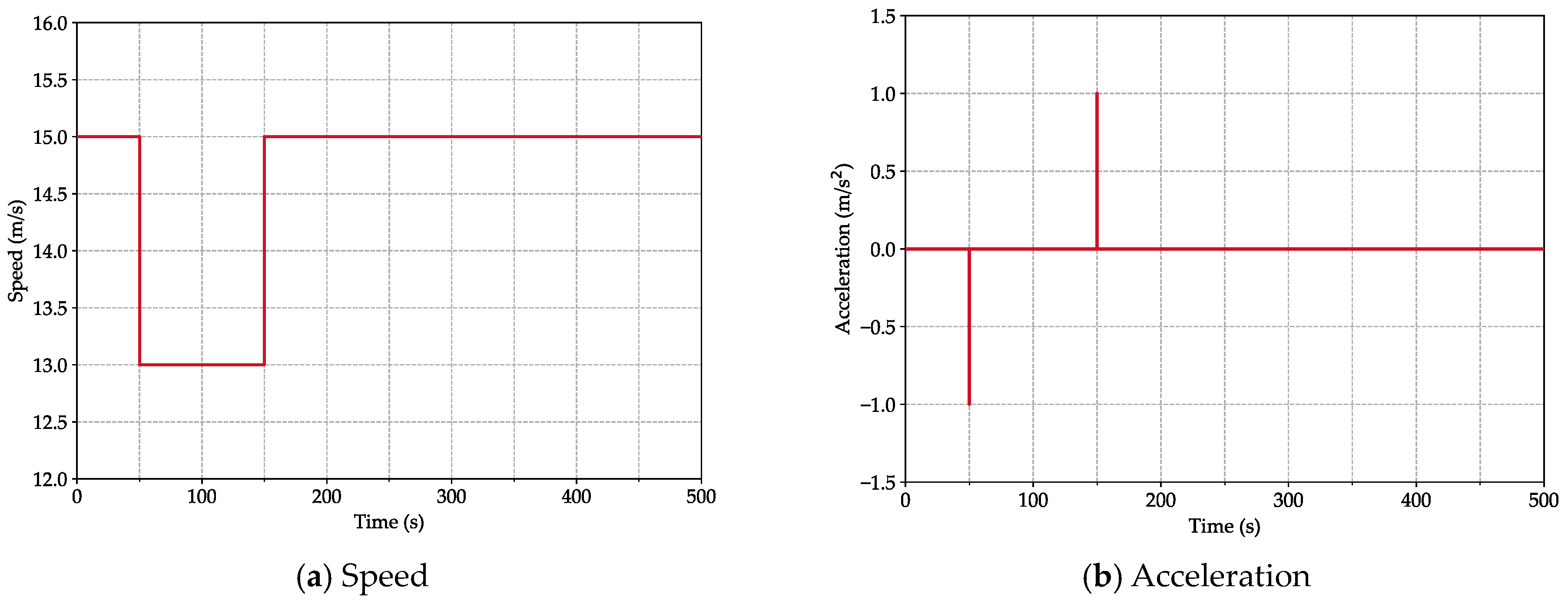
A single-lane straight road segment of sufficient length is set up, and the total number of simulated vehicles is 100; the penetration rate of CAVs determines the specific number of HDVs and CAVs p . The values of p are 0, 0.2, 0.4, 0.6, 0.8, and 1, in order. When p is greater than 0, there are CAVs on the road; all the CAVs form CAV platoons, and all the HDVs form HDV platoons. To show the results easily, the best vehicle platoon combination is used, i.e., the CAV platoon is placed in front of the HDV platoon [64]. This means that the leading vehicle of the vehicle platoon is set to be a CAV. The total simulation time and step are 500 and 0.1 s, respectively. In the initial state, the speed of each vehicle is 15 m/s, and the acceleration is 0 m / s 2 , and the headway is the corresponding equilibrium headway, i.e., the traffic flow has reached a steady state. The trajectory of the leading vehicle of the platoon is set to simulate a small disturbance in traffic: first, traveling at a speed of 15 m/s for 50 s at a constant speed, then decelerating uniformly to 13 m/s at an acceleration of −1 m / s 2 . The speed is maintained to continue moving forward for 100 s; then, the vehicle accelerates uniformly to the original speed at an acceleration of 1 m / s 2 , and finally maintains its original speed to perform a uniform movement until the simulation ends, as shown in Figure 1. The simulation is implemented in the MATLAB 2025 environment with predefined parameters [62,63].

4.1.2. Result Analysis

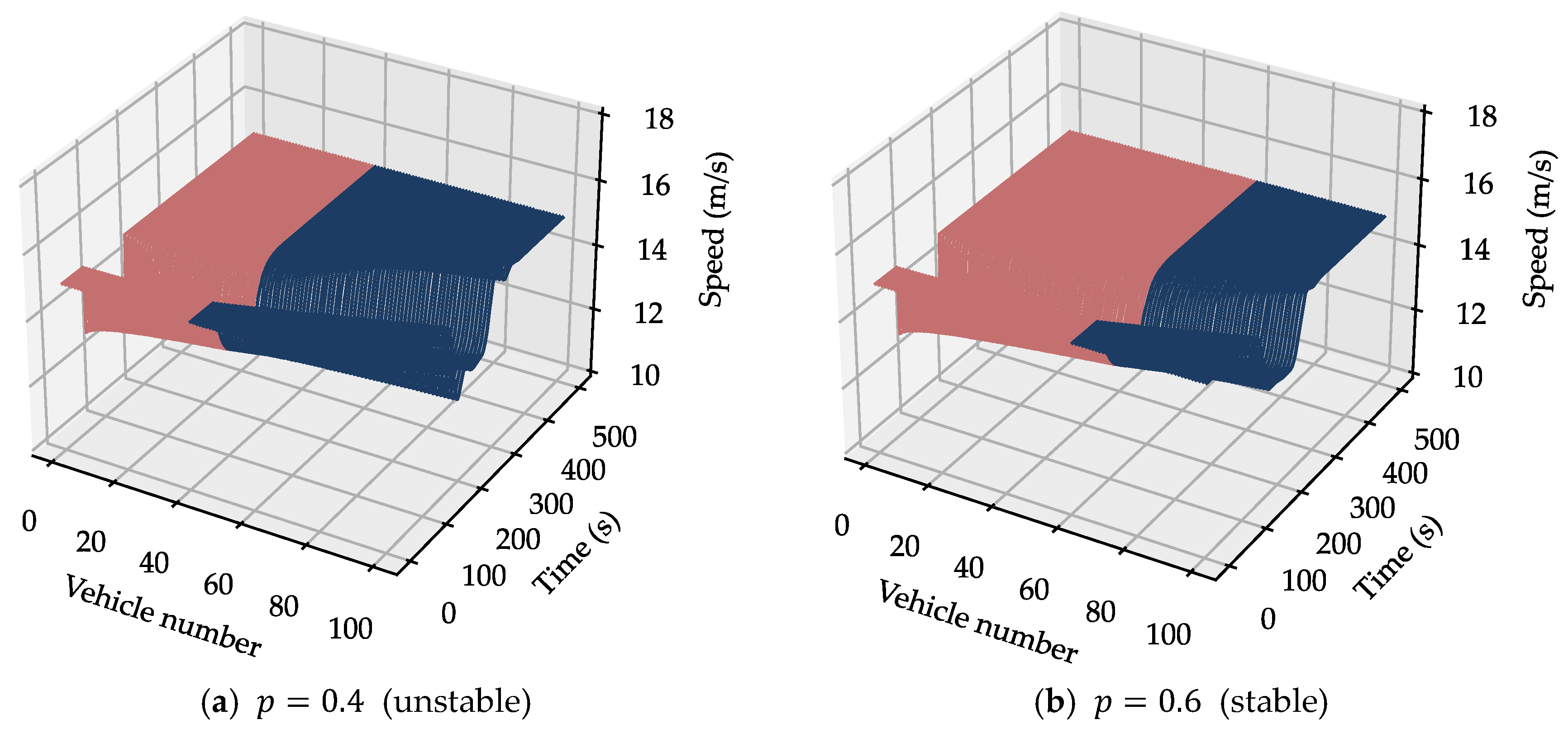
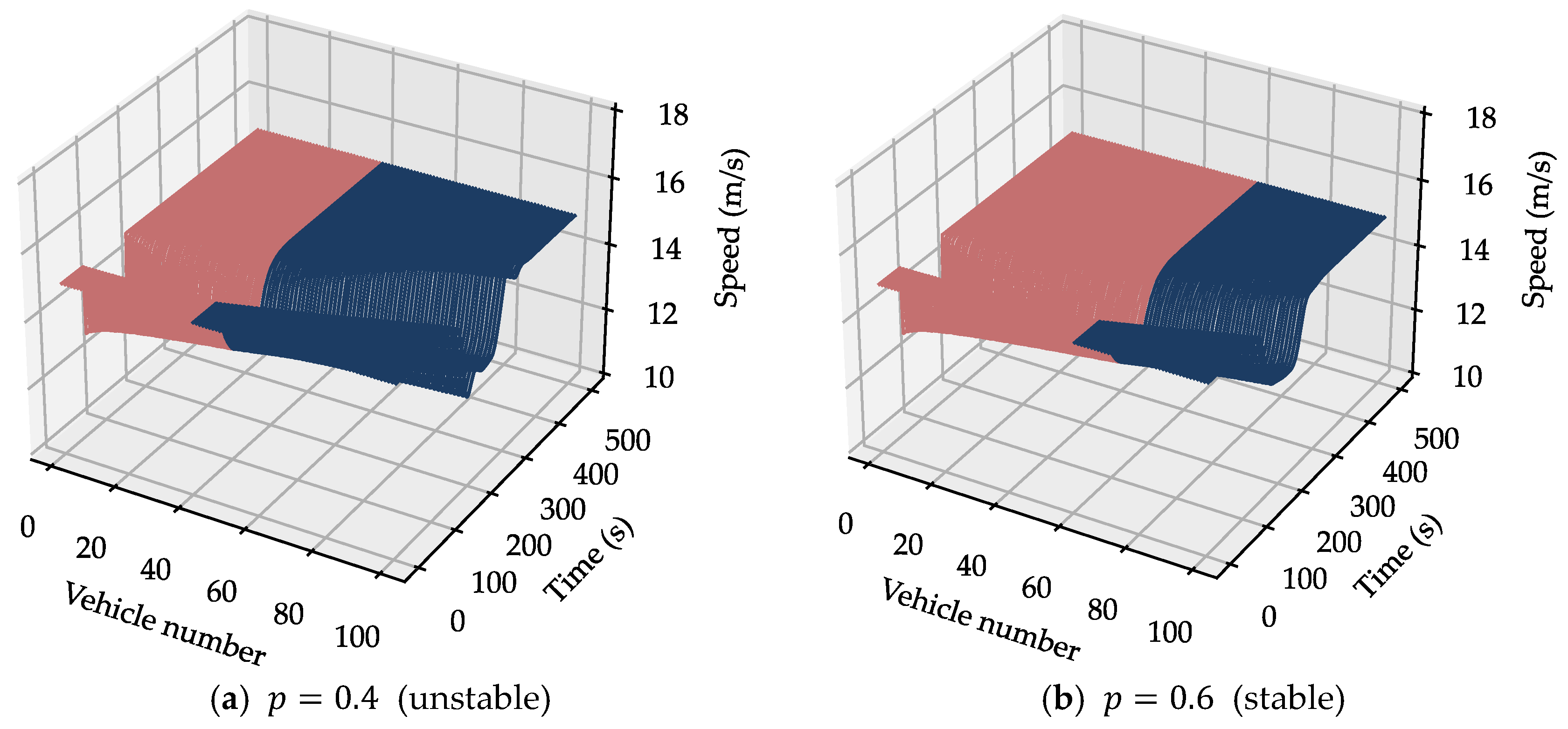
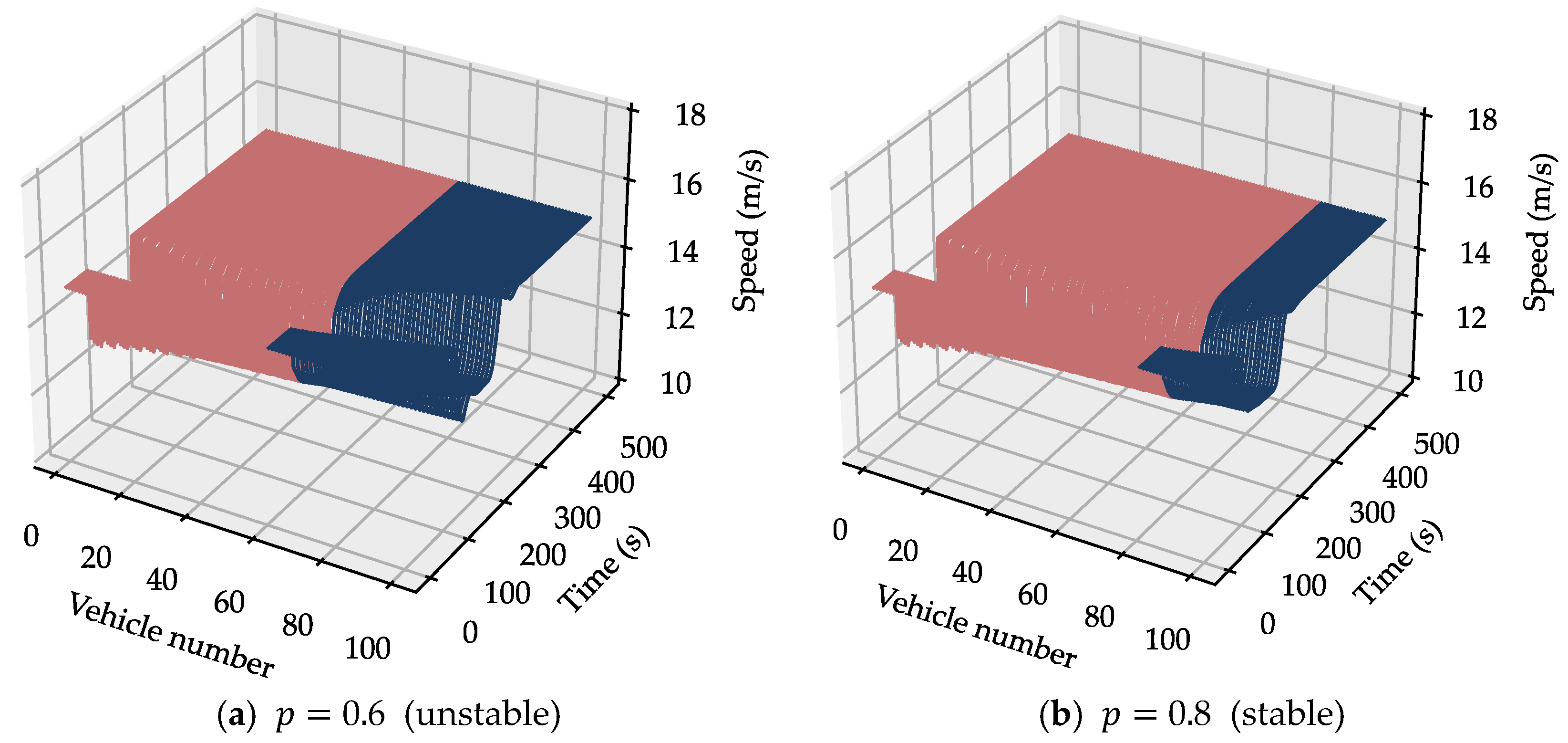
According to the vehicle trajectory in the numerical simulation, the curve diagram of its speed change with time is drawn for each vehicle under a small disturbance. The blue curve and the red curve indicate the speed change curves of the HDVs and CAVs, respectively. It can be judged whether the overall traffic flow is stable or not by observing if the speed disturbance is amplified in the propagation.
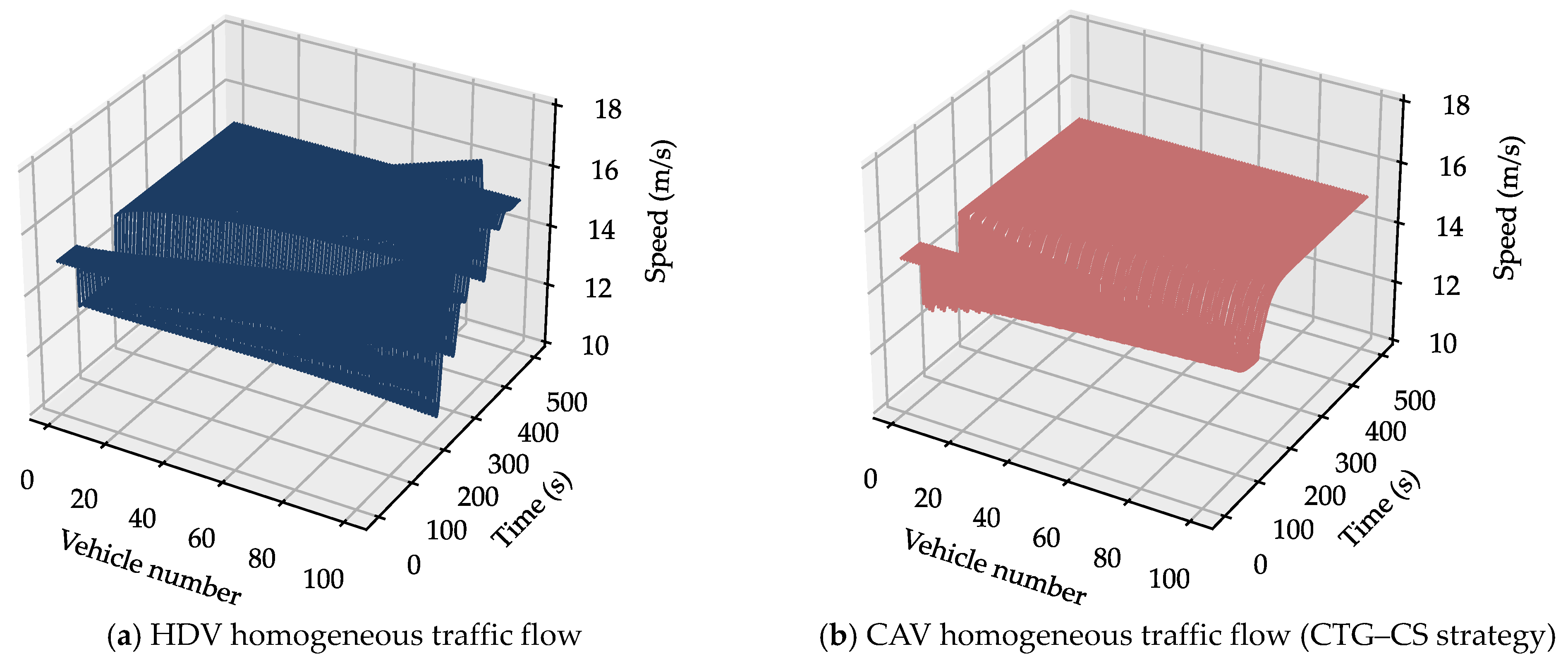
As shown in Figure 2, in homogeneous HDV traffic flow, upstream vehicles progressively amplify downstream speed disturbances, leading to string instability. In contrast, a homogeneous flow of CAVs effectively attenuates such disturbances, thereby promoting traffic stability. The attenuation performance of small disturbances under varying CAV penetration rates for each control strategy is analyzed below:
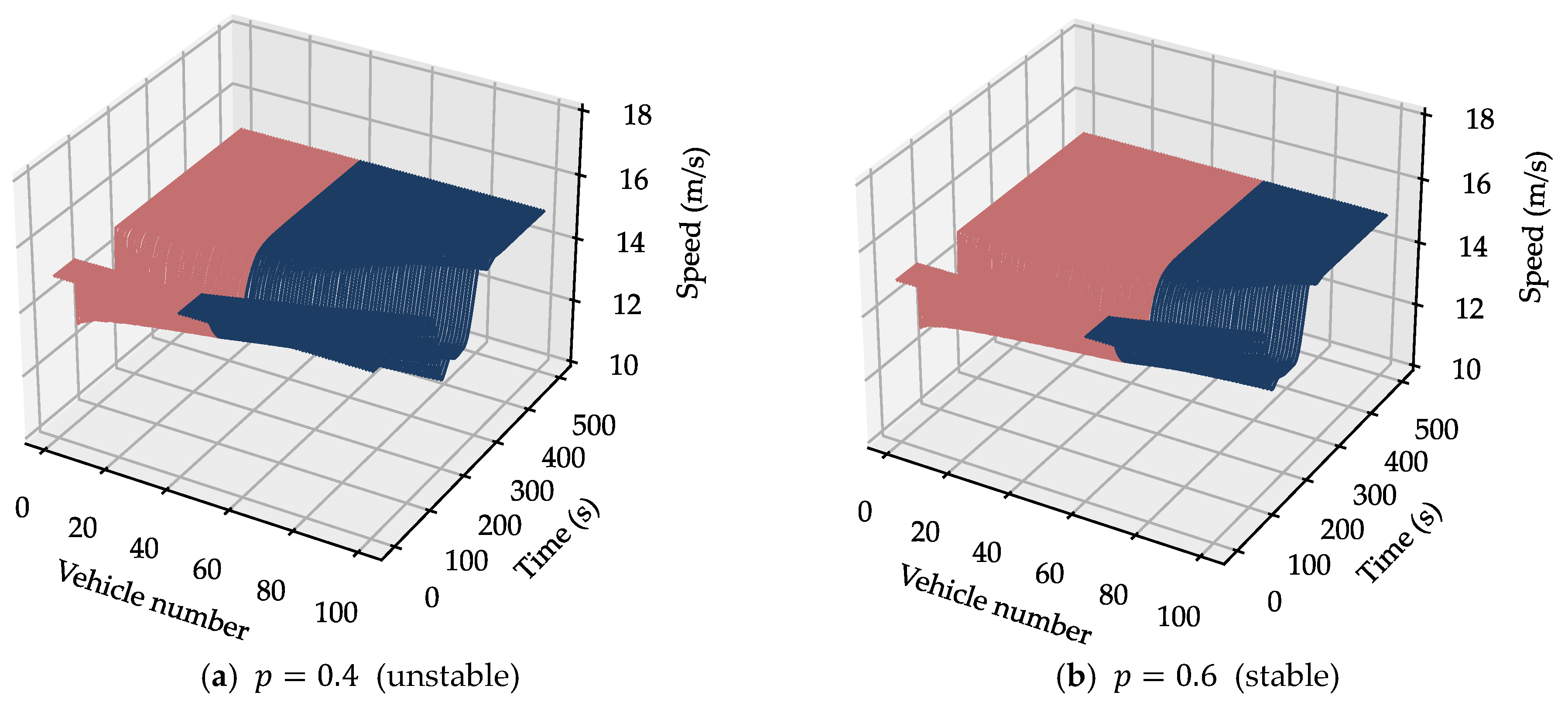
For the CTG–CTG strategy, Figure 3 illustrates that at a CAV penetration rate of 0.4, a small disturbance is amplified as it propagates upstream through the traffic flow, indicating overall instability. In contrast, when the penetration rate increases to 0.6, the same disturbance is attenuated during backward propagation, and the traffic flow remains stable.
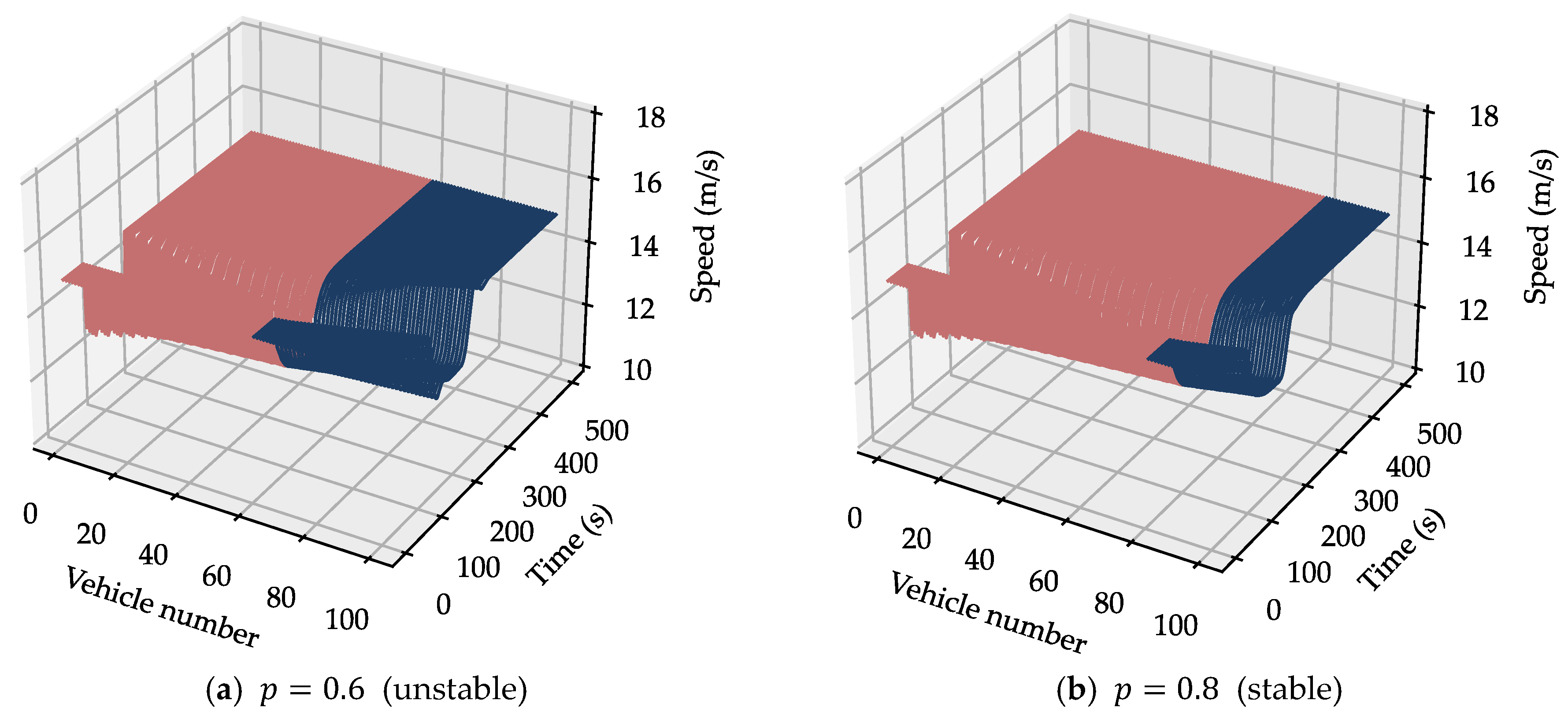
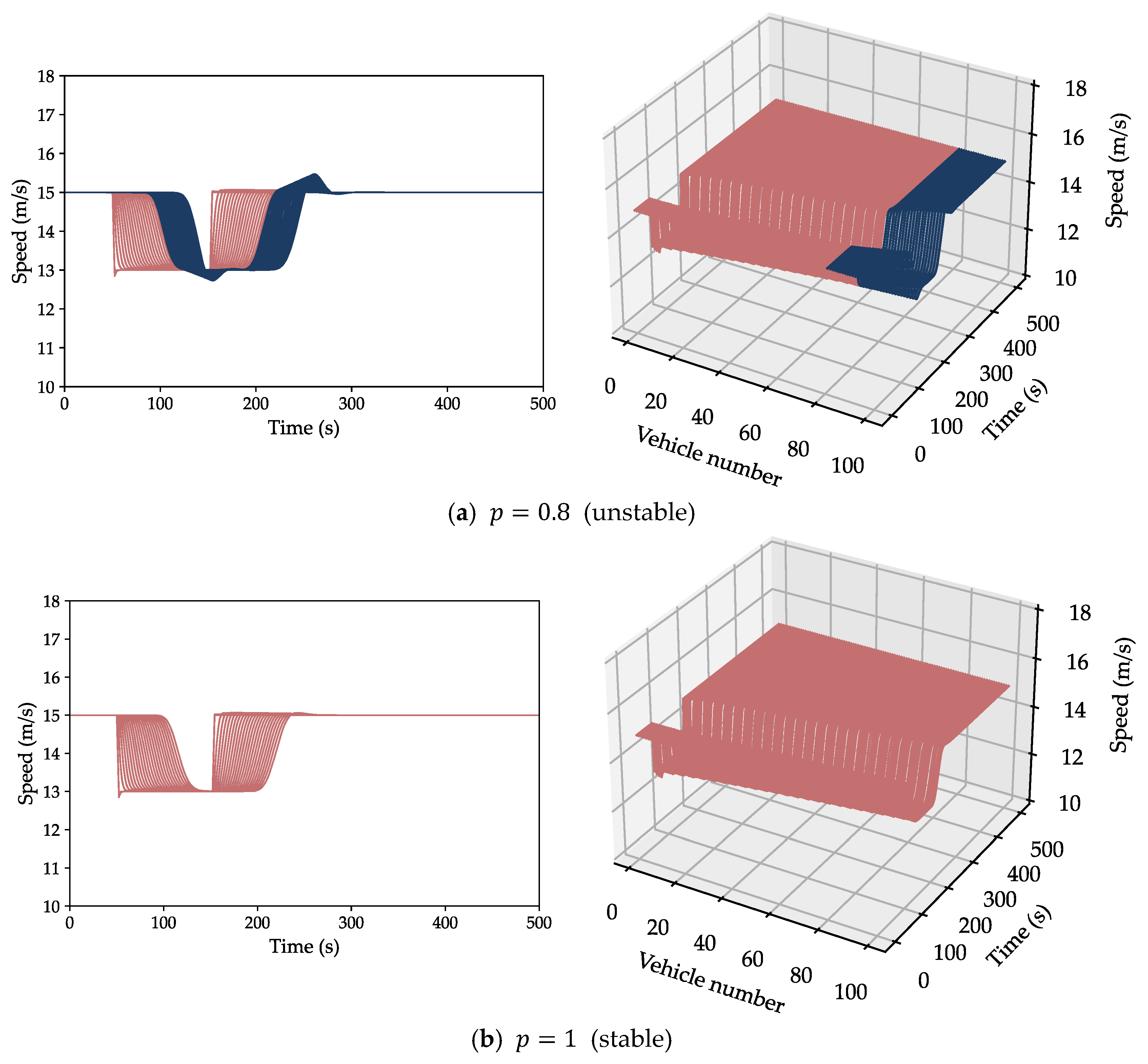
For the CTG–CS strategy, Figure 4 shows that at a CAV penetration rate of 0.6, speed disturbances are amplified as they propagate upstream through the human-driven vehicle (HDV) segment, rendering the mixed traffic flow unstable. In contrast, when the penetration rate increases to 0.8, the disturbances are progressively attenuated, and the overall traffic flow achieves a stable state.
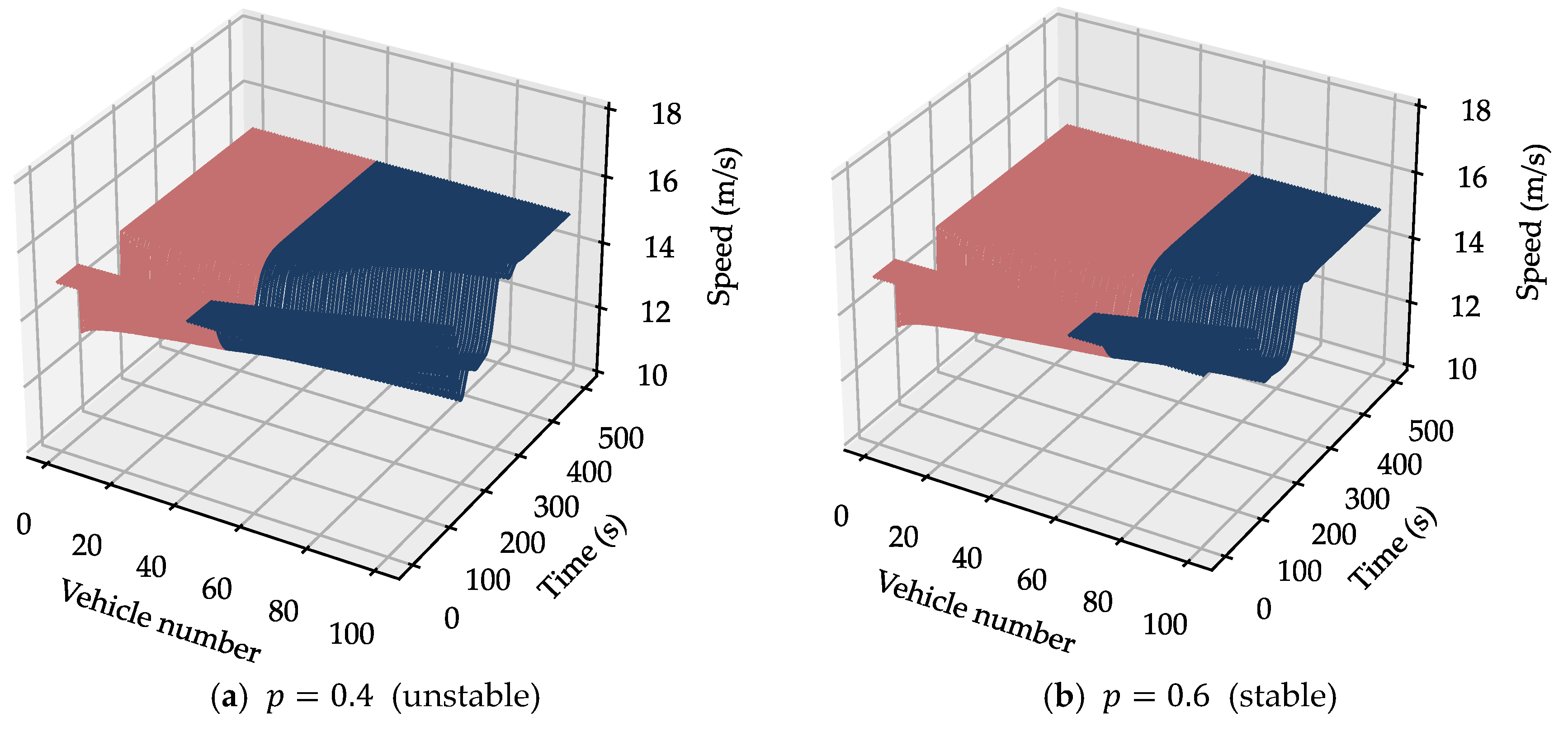
For the VTG1–VTG1 strategy, Figure 5 shows that at a CAV penetration rate of 0.4, small disturbances are amplified as they propagate upstream through the traffic stream. Moreover, the magnitude of this amplification is notably greater than that observed under the CTG–CTG strategy, indicating that VTG1–VTG1 is less effective in stabilizing mixed traffic flow. In contrast, when the penetration rate increases to 0.6, disturbances no longer grow during propagation, and the traffic flow remains stable.
For the VTG1–CTG strategy, Figure 6 shows that at a CAV penetration rate of 0.4, small disturbances are amplified during upstream propagation, with an amplification magnitude nearly identical to that observed under the VTG1–VTG1 strategy. However, when the penetration rate increases to 0.6, disturbances no longer grow, and the mixed traffic flow remains stable.
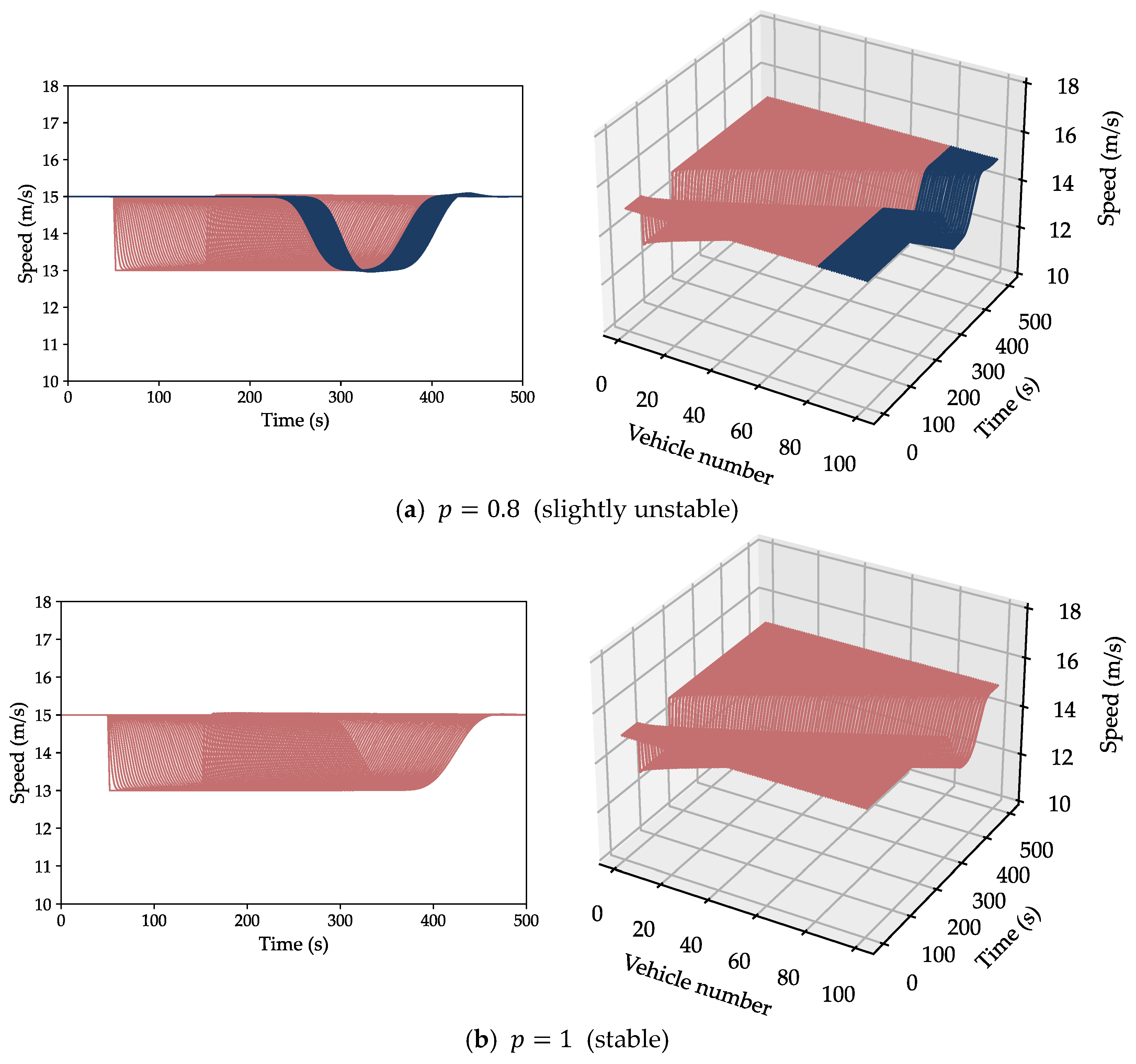
In contrast, for the VTG1–CS strategy (Figure 7), disturbance amplification persists in the upstream HDV segment even at a high penetration rate of 0.8, resulting in an unstable mixed flow. Only when the penetration rate reaches 1.0—i.e., in a fully automated traffic stream—does the system suppress disturbance growth and achieve stability.
For the VTG2–VTG2 strategy, Figure 8 shows that at a CAV penetration rate of 0.4, small disturbances undergo only mild amplification during upstream propagation. Although the mixed traffic flow remains unstable under this condition, the degree of instability is notably lower than that observed with the CTG–CTG strategy, indicating that VTG2–VTG2 offers superior stabilizing performance. When the penetration rate increases to 0.6, disturbances are progressively attenuated, and the traffic flow achieves stability.
In the case of the VTG2–CTG strategy (Figure 9), disturbance amplification occurs in the upstream HDV segment at p = 0.4, with an intermediate amplification magnitude between those of the CTG–CTG and VTG1–VTG1 strategies. Nevertheless, stability is restored at p = 0.6, as speed disturbances gradually decay during propagation.
For the VTG2–CS strategy, Figure 10 shows that at a CAV penetration rate of 0.6, small disturbances are amplified during upstream propagation, with an amplification magnitude greater than that observed under the CTG–CS strategy. This indicates that VTG2–CS provides inferior stabilizing performance compared to CTG–CS in mixed traffic. However, when the penetration rate increases to 0.8, disturbances are progressively attenuated, and the traffic flow transitions to a stable state.
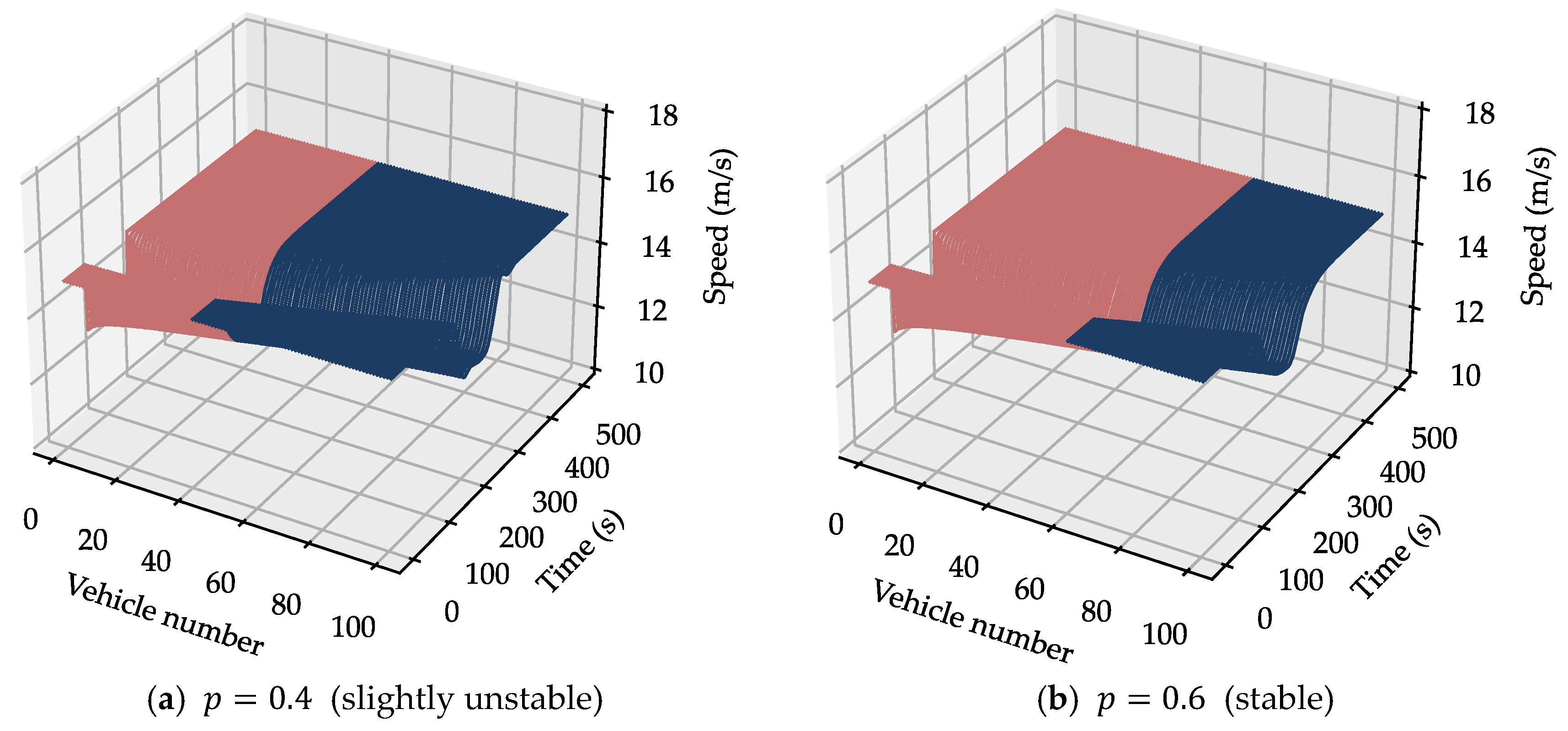
Regarding the BS–BS strategy (Figure 11), weak disturbance amplification occurs in the upstream HDV segment at p = 0.8, but the amplification level is lower than that of the VTG1–CS strategy. Full stability is achieved only when p = 1.0, at which point no amplification is observed throughout the platoon. Notably, the BS–BS strategy also exhibits the longest recovery time—among all strategies considered—for the entire traffic flow to return to its equilibrium state.
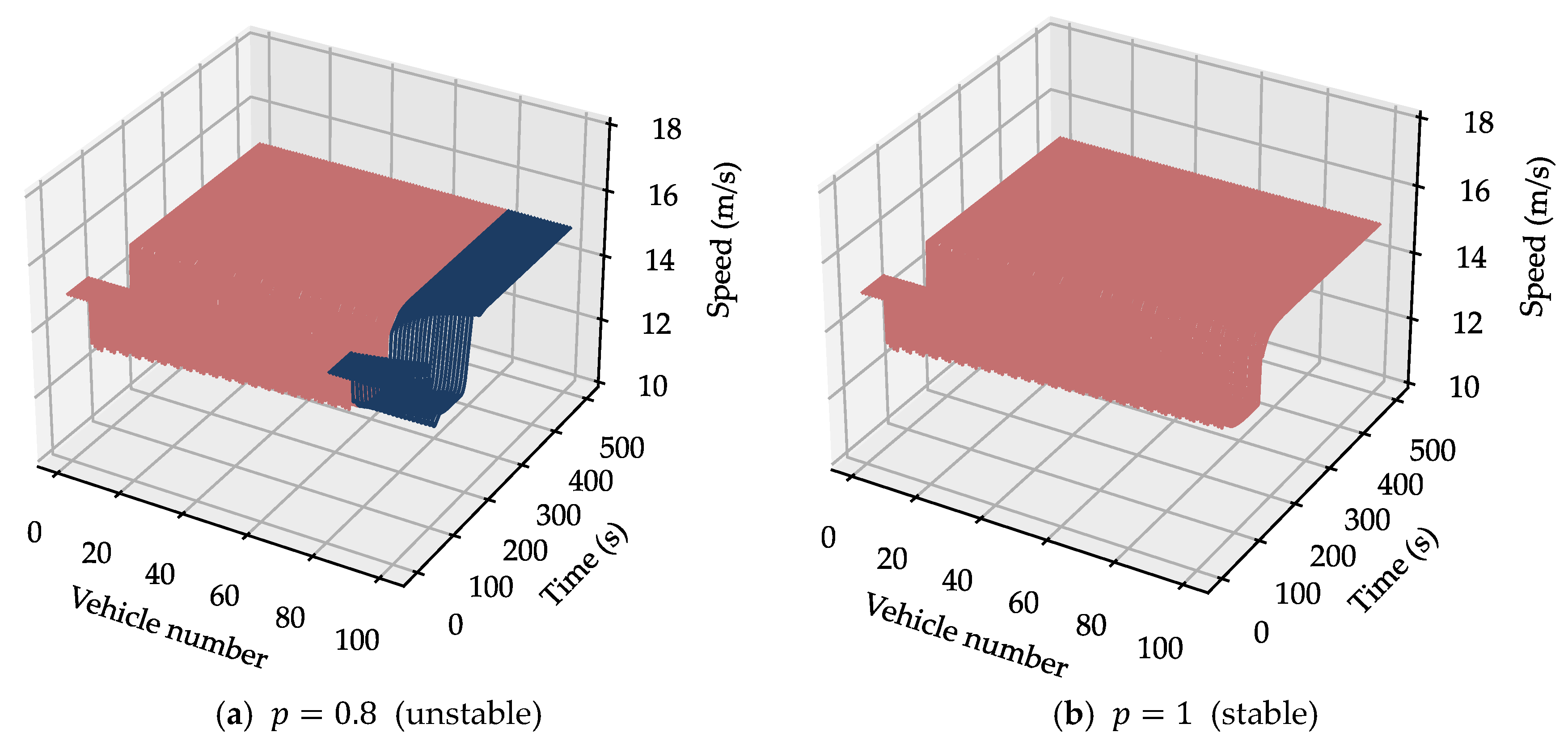
For the BS–CS strategy, Figure 12 shows that the mixed traffic flow remains unstable at a CAV penetration rate of 0.8 due to disturbance amplification, but achieves full stability when the penetration rate reaches 1.0.
In general, as the CAV penetration rate increases, the traffic flow transitions progressively from an unstable to a stable state. Notably, when p = 1.0—i.e., under fully automated conditions—the traffic flow is stable regardless of the longitudinal control strategy employed by the CAV platoon. Among the strategies examined, CTG–CTG, VTG1–VTG1, VTG1–CTG, VTG2–VTG2, and VTG2–CTG are capable of stabilizing mixed traffic at a relatively low penetration rate of p = 0.6. In contrast, the CTG–CS and VTG2–CS strategies require a higher penetration rate of p = 0.8 to effectively suppress disturbances. The VTG1–CS, BS–BS, and BS–CS strategies exhibit the weakest stabilizing capability, necessitating even higher automation levels—approaching full penetration—for robust stability.
A qualitative comparison of the disturbance-suppression capabilities of the various control strategies has been carried out based on the trajectory patterns shown in the figures. To enable a more quantitative and explicit comparison, Table 1 summarizes key speed metrics of the last vehicle in the traffic stream over the entire simulation period—namely, its maximum speed, minimum speed, and the resulting speed range (i.e., the difference between the two). In homogeneous HDV traffic, the speed range of the last vehicle reaches approximately 7.28 m/s, despite an initial speed perturbation of only 2 m/s—providing evidence of significant amplification of the disturbance. By contrast, the introduction of CAVs markedly reduces this speed range, demonstrating that CAVs effectively enhance the traffic flow’s ability to dampen small disturbances and thereby improve the stability of mixed traffic.
For the CTG–CTG, VTG1–VTG1, VTG1–CTG, VTG2–VTG2, and VTG2–CTG strategies at a CAV penetration rate of p = 0.4, the speed range (i.e., the difference between maximum and minimum speeds) of the last vehicle in the traffic stream is approximately 2.71 m/s, 3.26 m/s, 3.27 m/s, 2.11 m/s, and 2.95 m/s, respectively. As evidenced by the corresponding speed trajectories, a larger speed range correlates with weaker disturbance attenuation, indicating poorer stability performance. Among these five strategies, VTG2–VTG2 demonstrates the best stabilizing capability, while VTG1–VTG1 and VTG1–CTG exhibit the weakest performance. At p = 0.6, the CTG–CS and VTG2–CS strategies yield speed ranges of 2.67 m/s and 3.13 m/s, respectively, for the last vehicle. This confirms that CTG–CS outperforms VTG2–CS in enhancing mixed traffic stability. Finally, at p = 0.8, the VTG1–CS, BS–BS, and BS–CS strategies produce speed ranges of 2.55 m/s, 2.13 m/s, and 2.74 m/s, respectively. Consequently, BS–BS achieves the best performance among the three, whereas BS–CS performs the worst.
In all traffic scenarios that achieve a stable state, the speed range (i.e., the difference between maximum and minimum speeds) of the 100th vehicle is approximately 2 m/s. At a CAV penetration rate of p = 0.6, the mixed traffic flows under the CTG-CTG, VTG1–VTG1, VTG1–CTG, VTG2–VTG2, and VTG2–CTG strategies exhibit even smaller speed ranges—specifically, 1.98 m/s, 1.99 m/s, 1.99 m/s, 1.96 m/s, and 1.99 m/s, respectively. Similarly, at p = 0.8, the CTG–CS strategy yields a speed range below 2 m/s. These results indicate that these control strategies not only prevent the amplification of small disturbances but also slightly attenuate the magnitude of speed oscillations relative to the initial perturbation. In contrast, under the same penetration rate (i.e., p = 0.8), the VTG2–CS strategy produces a speed range exactly equal to 2 m/s, suggesting limited disturbance-suppression capability. When p = 1.0, the VTG1–CS strategy also results in a speed range of precisely 2 m/s, while the BS–BS and BS–CS strategies yield slightly larger values of 2.01 m/s and 2.06 m/s, respectively. However, this minor exceedance does not imply instability. As shown in Figure 11b and Figure 12b, the disturbance is not progressively amplified upstream (as in string-unstable systems); rather, it undergoes an instantaneous, localized amplification by a downstream vehicle without further propagation.
The superior performance of the VTG2–VTG2 strategy can be attributed to its exponential spacing policy that adapts more sensitively to speed changes, effectively dampening disturbance propagation. In contrast, the poor performance of the BS-CS strategy stems from the discontinuity between balanced spacing and constant spacing policies, creating instability at the platoon boundaries.
In summary, the ten control strategies can be classified into three performance tiers based on their effectiveness in suppressing small traffic disturbances:
Tier 1 (High Performance): VTG2–VTG2, CTG–CTG, VTG2–CTG, VTG1–VTG1, and VTG1–CTG. These strategies effectively stabilize mixed traffic flow at a CAV penetration rate of p = 0.6. Ranked by their disturbance-suppression capability, they perform in the following order: VTG2–VTG2 > CTG–CTG > VTG2–CTG > VTG1–VTG1 ≈ VTG1–CTG. This group represents the most robust platoon control strategies under moderate automation levels.
Tier 2 (Moderate Performance): CTG–CS and VTG2–CS. These strategies fail to stabilize traffic at p = 0.6 but achieve stability at p = 0.8, with CTG–CS outperforming VTG2–CS.
Tier 3 (Limited Performance): BS–BS, VTG1–CS, and BS–CS. Even at p = 0.8, these strategies exhibit persistent (though weak) upstream amplification of disturbances, indicating insufficient stabilization. Full or near-full CAV penetration (p ≥ 0.8, often p = 1.0) is required for stable operation. Their relative ranking is BS–BS > VTG1–CS > BS–CS.

4.2. Traffic Stability Simulation with a Ring Highway

4.2.1. Experiment Settings

The loop-based simulation setup in this study follows the experimental configuration of Wu et al. [23]. The simulated ring road has a total length of 1000 m, with simulations run for 3600 s using a time step of 0.1 s. Initially, vehicles are uniformly distributed along the loop, with both initial speed and acceleration set to zero. Traffic density varies from 5 to 100 veh/km in increments of 5 veh/km. Vehicle dynamics are constrained by a maximum speed of 33.3 m/s, a maximum acceleration of 1 m/s2, and a minimum (i.e., maximum deceleration) of −5 m/s2. The CAV penetration rate is examined across six levels: p = 0, 0.2, 0.4, 0.6, 0.8, and 1.0.

4.2.2. Result Analysis

The standard deviation (SD) of vehicle speeds is commonly employed to quantify speed dispersion and, by extension, assess traffic flow stability. In this study, normalized standard deviation (NSD) is selected over standard deviation because it normalizes the speed variation, eliminating the influence of the measurement scale and enabling an objective comparison across different traffic densities. NSD is computed as the ratio of the standard deviation to the mean speed, thereby normalizing the dispersion metric and eliminating the influence of measurement scale and dimensional differences. This enables an objective and dimensionless evaluation of stability in mixed traffic flows. A low NSD indicates minimal speed variation across vehicles, suggesting that most vehicles maintain consistent speeds and headways, resulting in stable car-following behavior. Conversely, a higher NSD reflects greater speed dispersion and increased heterogeneity in vehicle dynamics, signaling deteriorating traffic stability. In this study, NSD is defined and calculated as follows:
N S D = S D v ¯ S D = i = 1 N v i v ¯ 2 N
where v ¯ denotes the average speed.
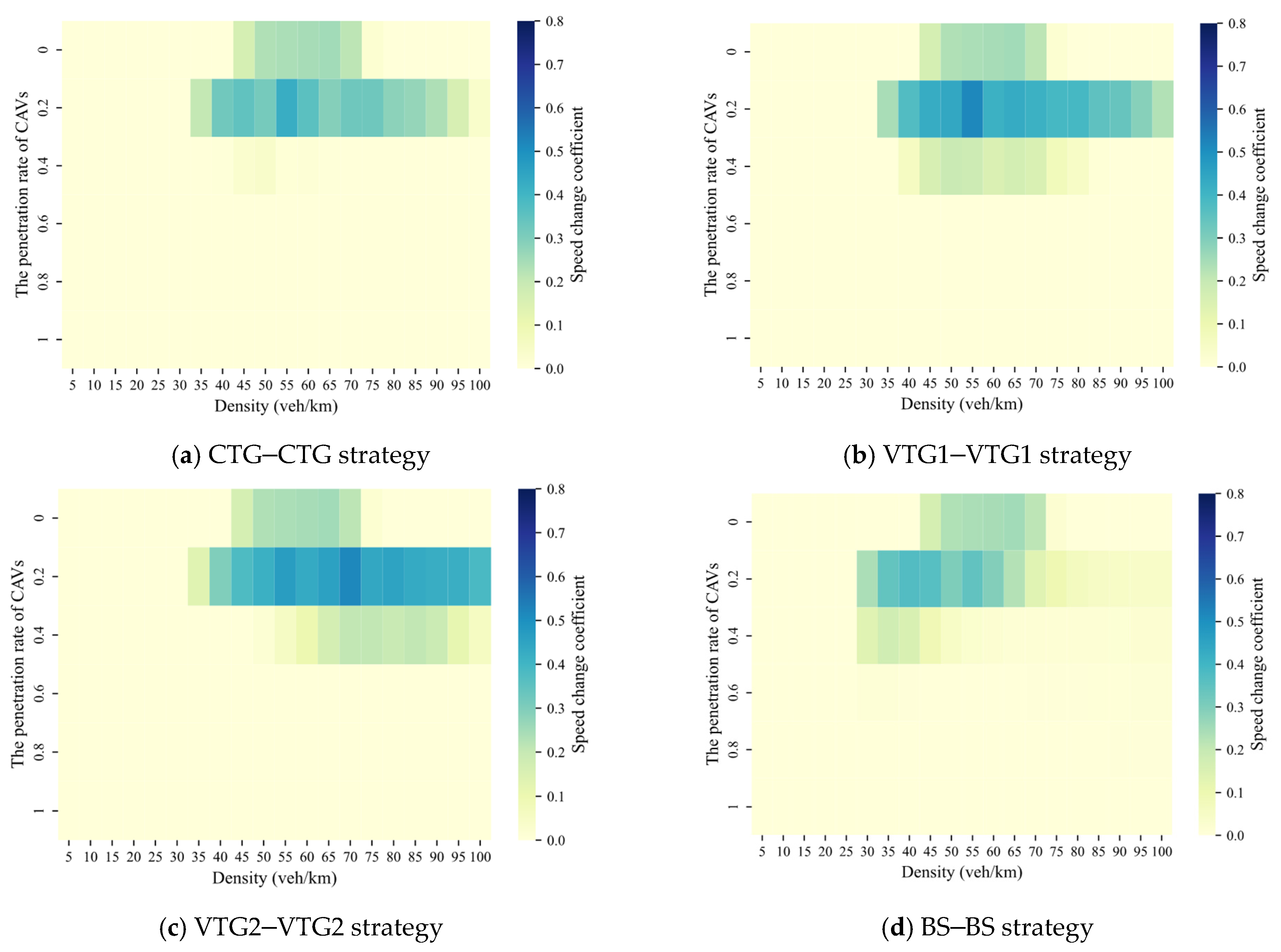
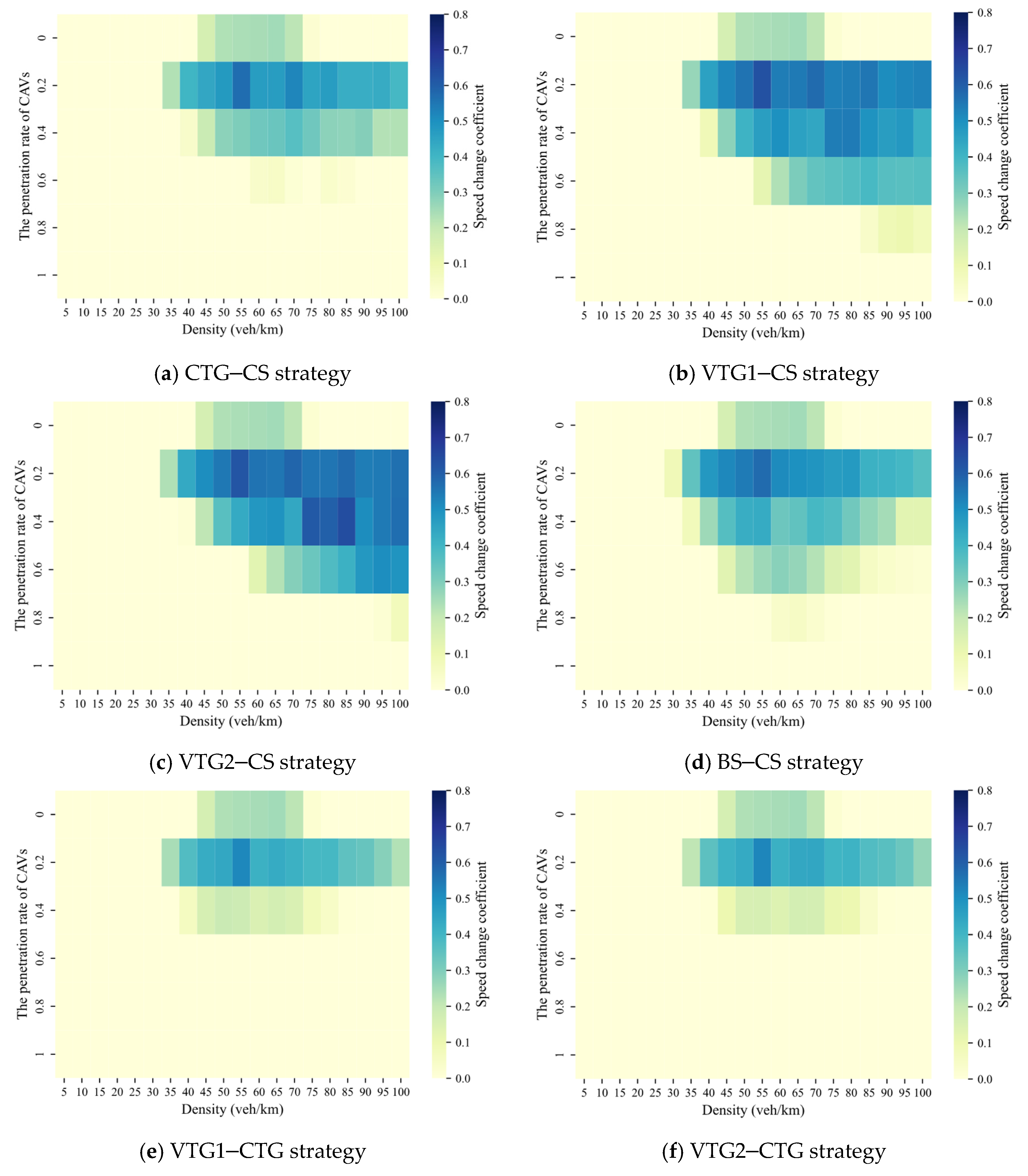
Using the traffic speed data from Wu et al. [23] recorded 30 min into the loop simulation, we compute the speed variation coefficient (defined as the normalized standard deviation, NSD) and generate heatmaps illustrating the relationship among the CAV penetration rate, traffic density, and NSD for various platoon control strategies. These results are presented in Figure 13 and Figure 14. The simulations reveal that the NSD consistently decreases toward zero as the CAV penetration rate increases, indicating a progressive enhancement in traffic flow stability. For the four homogeneous (single-policy) strategies—CTG–CTG, VTG1–VTG1, VTG2–VTG2, and BS–BS—NSD becomes insensitive to traffic density when the CAV penetration rate reaches or exceeds p = 0.6, suggesting robust stability across a wide range of densities. At p = 0.4, however, instability persists within specific density intervals:
  • CTG–CTG exhibits only mild speed fluctuations at densities of 45–50 veh/km;
  • VTG1–VTG1 shows noticeable disturbances over 40–80 veh/km;
  • VTG2–VTG2 becomes unstable in the higher-density range of 55–100 veh/km;
  • BS–BS displays instability primarily between 30 and 50 veh/km.
Figure 13. Speed change coefficient of traffic flow under single spacing strategy.
Systems 14 00304 g013
Figure 14. Speed change coefficient of traffic flow under the combination spacing strategy.
Systems 14 00304 g014
At a lower penetration rate (p = 0.2), the two variable time gap strategies (VTG1–VTG1 and VTG2–VTG2) exhibit broader ranges of speed fluctuations. In contrast, the BS–BS strategy maintains relatively better stability under high-density conditions. This behavior can be attributed to the BS policy’s tendency to reduce average vehicle speeds, thereby mitigating congestion-induced oscillations. Finally, in purely HDV traffic, instability arises at densities of 45–70 veh/km—a well-documented phenomenon linked to the inherent string instability of human car-following behavior within certain speed regimes.
Among the six hybrid spacing strategies, VTG1–CTG and VTG2–CTG exhibit a performance comparable to homogeneous (single-policy) strategies, effectively enhancing traffic flow stability. Significant speed fluctuations under these two strategies occur only at low CAV penetration rates (e.g., p < 0.6), and are largely suppressed as automation levels increase. In contrast, the four strategies incorporating the CS—particularly VTG1–CS, VTG2–CS, and BS–CS—demonstrate notably weaker stabilizing capabilities. These three strategies still exhibit pronounced speed oscillations at a penetration rate of p = 0.6. However, they approach a stable state when the penetration rate reaches p = 0.8, indicating that higher CAV deployment is required to compensate for the limited string stability inherent in CS-based coordination.
In summary, although CAVs are inherently more robust to disturbances than HDVs, their integration into traffic does not universally improve stability—particularly at low penetration rates. Under such conditions, CAVs can even exacerbate instability. This counterintuitive effect arises because CAVs typically operate with shorter equilibrium headways at a given density, which increases the overall traffic speed. However, HDVs exhibit string instability within certain speed ranges; thus, the speed elevation induced by CAVs may push the mixed flow into an unstable regime. At high CAV penetration levels (p ≥ 0.8), traffic stability is consistently achieved across all strategies. In contrast, at moderate penetration rates (p = 0.4–0.6), stability outcomes depend critically on the longitudinal control policy employed by CAVs:
  • High-performing strategies—including CTG–CTG, VTG1–VTG1, VTG2–VTG2, BS–BS, VTG1–CTG, and VTG2–CTG—effectively stabilize mixed traffic;
  • CTG–CS shows slightly degraded performance;
  • VTG1–CS, VTG2–CS, and BS–CS perform worst, exhibiting persistent speed oscillations even at p = 0.6.
These findings underscore that the stabilizing potential of CAVs is not guaranteed by their mere presence, but is strongly mediated by both penetration level and control strategy design.

4.3. Traffic Safety Simulation with a Straight Highway

4.3.1. Experiment Settings

It can be found that if the vehicle traveling data of the previous two simulation experiments are directly used for safety evaluation, the calculation results of TET and TIT will be constant at 0. This is because the vehicle acceleration and deceleration in these two experimental scenarios are smaller, so the impact on traffic safety is smaller. Therefore, another highway single-lane numerical simulation experiment is designed in this section to analyze the safety of mixed traffic flow. This experiment adopts open boundary conditions, and the specific scenarios are set as follows:
Setting up a long enough single-lane straight road section, the total number of simulated vehicles is 100, and the penetration rate of CAVs determines the specific number of HDVs and CAVs. The value of p and the distribution of vehicles are the same as those for the small disturbance experiment in Section 4.2.1. The total simulation time is 400 s, and the simulation step size is still 0.1 s. In the initial state, each vehicle stops at the beginning with 50 m intervals. As time passes, the first vehicle begins to move and gradually accelerates to the desired speed of 30 m/s with the maximum acceleration, and the following vehicles accelerate in turn. After the first vehicle has accelerated to the desired speed, it will maintain this speed for a short period. After that, it notices a traffic event or other reason to stop a short distance ahead, so the first vehicle begins to decelerate at a comfortable rate, and the following vehicles also decelerate until they stop.
A sufficiently long single-lane straight road segment is configured for the simulation, accommodating a total of 100 vehicles. The number of CAVs and HDVs is determined by the CAV penetration rate, with vehicle types and their spatial distribution identical to those used in the small disturbance experiment described in Section 4.2.1. The simulation runs for 400 s with a time step of 0.1 s. Initially, all vehicles are stationary, positioned at 50 m headways along the road. At t = 0, the lead vehicle begins to accelerate at its maximum allowable rate until it reaches the desired cruising speed of 30 m/s, after which it maintains this speed for a brief period. Subsequently, the lead vehicle detects an upstream traffic event (e.g., an obstacle or sudden stop) within a short distance ahead and initiates deceleration at a comfortable deceleration rate. The following vehicles respond in sequence, progressively braking until the entire platoon comes to a complete stop.

4.3.2. Result Analysis

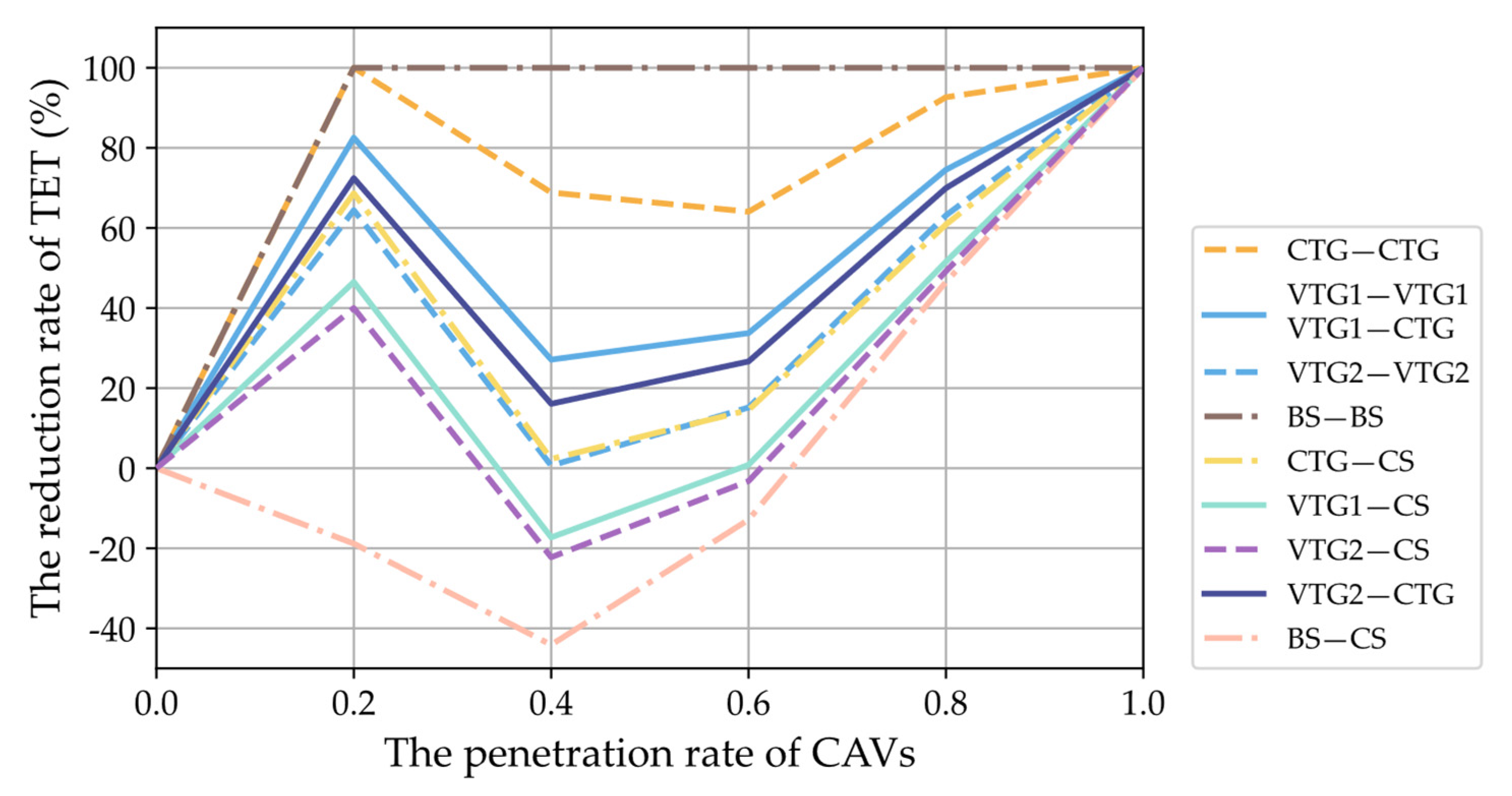
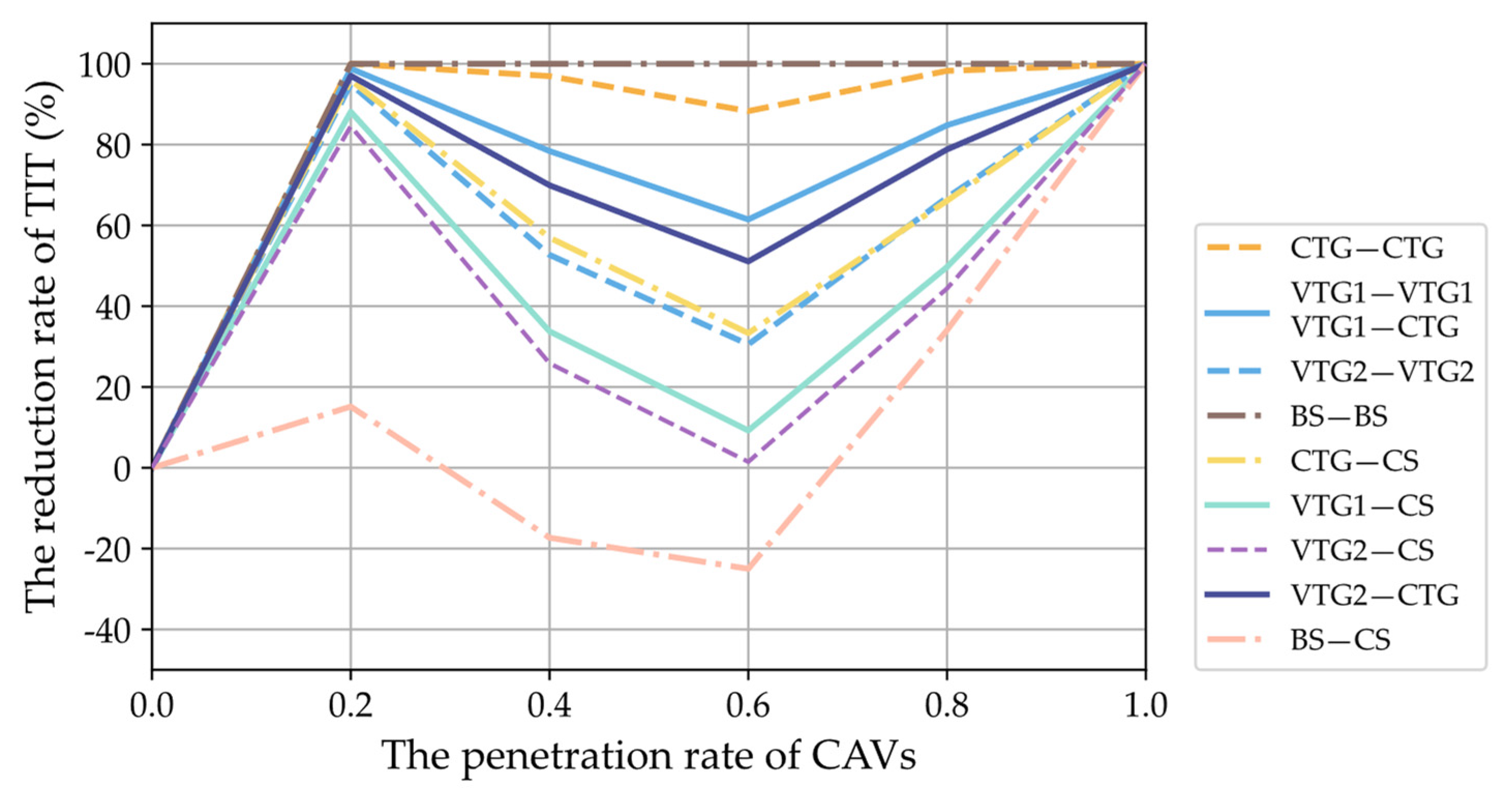
Based on the simulation results, the TET and TIT metrics—two widely used indicators of rear-end collision risk—are computed for each scenario. From these statistics, the reduction rates of TET and TIT relative to baseline human-driven traffic are plotted as functions of CAV penetration rate, as shown in Figure 15 and Figure 16, respectively. In both figures, curves of distinct colors correspond to different longitudinal control strategies employed by the CAV platoons.
(1)
Analysis of TET characteristics
As shown in Figure 15, the BS–CS strategy deteriorates traffic safety at low and medium CAV penetration rates, yielding a negative TET reduction rate—indicating a higher collision risk compared to baseline human-driven traffic. Only at high penetration levels (p = 0.8 or 1.0) does this strategy achieve a positive TET reduction, suggesting improved safety. Similarly, both VTG2-CS and VTG1-CS exacerbate safety risks at lower penetration rates; notably, at p = 0.4, both exhibit negative TET reduction rates. However, they transition to net safety benefits when p ≥ 0.8. Moreover, the TET reduction curve for VTG2–CS consistently lies below that of VTG1–CS, demonstrating that VTG1–CS provides superior safety performance under identical conditions. In contrast, the remaining seven strategies consistently reduce TET across all tested penetration rates, thereby enhancing traffic safety. Among them, BS–BS achieves the greatest risk reduction, followed closely by CTG–CTG. Notably, when p = 1.0 (i.e., fully automated traffic), the TET value drops to zero for all control strategies, confirming that a fully CAV-dominated flow eliminates rear-end collision exposure under the simulated scenario.
(2)
Analysis of TIT characteristics
As illustrated in the aforementioned figures, the BS–CS strategy yields a negative reduction rate in the TIT metric under medium CAV penetration rates (e.g., p = 0.4–0.6), indicating an increase—rather than a reduction—in rear-end collision risk compared to baseline human-driven traffic. In contrast, all nine other strategies achieve positive TIT reduction rates, signifying enhanced traffic safety across the tested scenarios. At a low penetration rate of p = 0.2, these nine strategies (excluding BS–CS) reduce TIT by more than 80%, demonstrating substantial early safety benefits even with limited CAV deployment. However, as the penetration rate increases from 0.2 to 0.6, the TIT reduction rate temporarily declines for most strategies—a trend likely attributable to transitional dynamics between human and automated driving behaviors. Notably, when p > 0.6, the TIT reduction rate recovers and further improves across all strategies, reflecting stronger safety gains at higher automation levels. Finally, at full CAV penetration (p = 1.0), TIT drops to zero for every control strategy, confirming that homogeneous CAV traffic eliminates integrated collision exposure under the simulated conditions and achieves optimal safety performance.
These findings align with those of Zheng et al. [39], who reported that combined spacing policies can outperform single strategies, but extend their work by demonstrating that not all combinations are beneficial—specifically, combinations involving CS strategy tend to require higher CAV penetration rates for stability.

5. Conclusions and Future Work

In this study, we derive the analytical stability conditions for both homogeneous and mixed traffic flows under ten distinct platoon control strategies based on established string stability theory. Subsequently, comprehensive simulation experiments are conducted to comparatively evaluate these strategies in terms of their effectiveness in attenuating small disturbances and enhancing traffic safety. The main findings are summarized as follows:
(1) The ten strategies can be ordered by their disturbance-suppression capability as follows: VTG2–VTG2 > CTG–CTG > VTG2–CTG > VTG1–VTG1 ≈ VTG1–CTG > CTG–CS > VTG2–CS > BS–BS > VTG1–CS > BS–CS. From a practical perspective, these results suggest that traffic management authorities should prioritize promoting VTG2-equipped CAVs, and manufacturers should avoid mixing CS strategy with other policies in heterogeneous platoons until CAV penetration reaches sufficient levels (>80%).
(2) At low-to-moderate CAV penetration rates (p ≤ 0.6), strategies incorporating the CS exhibit pronounced speed oscillations compared to those based on time gap policies (e.g., CTG, VTG) or homogeneous configurations. However, as the penetration rate increases, the coefficient of variation in vehicle speeds converges toward zero across all strategies, markedly improving overall flow stability. Importantly, even at identical penetration levels, the density ranges over which stability is maintained differ significantly among control strategies.
(3) Safety analysis using TET and TIT metrics reveals that BS–CS, VTG1–CS, and VTG2–CS may increase rear-end collision risk at low-to-medium penetration rates, with safety benefits only emerging at high automation levels (p ≥ 0.8). In contrast, the remaining seven strategies consistently reduce both TET and TIT across all tested penetration rates. Among them, BS–BS and CTG–CTG demonstrate the most robust and substantial safety improvements.
Several limitations of this study should be acknowledged. First, the simulation assumes ideal V2V communication without considering potential delays or packet loss, which may affect the stability results in real-world applications. Second, the IDM parameters for HDVs are fixed, not accounting for individual driver heterogeneity. Third, the study focuses on single-lane scenarios; multi-lane effects and lane-changing behaviors are not considered. Future studies should incorporate stochastic communication delays, heterogeneous driver behaviors, and multi-lane scenarios to enhance the practical applicability of the findings.

Author Contributions

D.T., writing—original draft, writing—review and editing. Y.W. (Yunxia Wu), writing—original draft, writing–review and editing. L.L., writing—original draft, methodology, visualization, writing—review and editing. Y.J., resources, software, project administration, supervision, writing—review and editing. Y.W. (Yi Wang), writing—review and editing. Z.Y., conceptualization, funding acquisition, writing—review and editing. All authors have read and agreed to the published version of the manuscript.

Funding

This work was supported in part by the Humanities and Social Science Foundation of the Ministry of Education in China 25YJCZH339, in part by the National Natural Science Foundation of China 72471200, in part by the Sichuan Science and Technology Program 2025NSFSC2000, and in part by the Fundamental Research Funds for the Central Universities 2682025GH023.

Institutional Review Board Statement

Not applicable.

Informed Consent Statement

Not applicable.

Data Availability Statement

The original contributions presented in this study are included in the article. Further inquiries can be directed to the corresponding author.

Conflicts of Interest

The authors declare no conflicts of interest.

Abbreviations

ASPadaptive spacing policy
ACCadaptive cruise control
BSbalanced spacing
CAVconnected and automated vehicle
CACCcooperative adaptive cruise control
CSconstant spacing
CSFconstant safety factor
CTGconstant time gap
CTHconstant time headway
HDVhuman-driven vehicle
IDMintelligent driver model
RCRIrear-end collision risk index
SDstandard deviation
SSPsafety spacing policy
TETtime exposed time-to-collision
TTCtime-to-crash
VTGvariable time gap strategy
VTG1VTG strategy with the relative speed of the preceding vehicle
VTG2VTG strategy with vehicle speed
VTHvariable time headway

References

  1. Wang, X.; Fu, H.; Lu, J.; Han, S. Study on Road Section Environmental Traffic Capacity Model and Algorithm under Double Constraints. Transp. Res. Part D Transp. Environ. 2016, 48, 14–19. [Google Scholar] [CrossRef]
  2. Talebpour, A.; Mahmassani, H.S. Influence of Connected and Autonomous Vehicles on Traffic Flow Stability and Throughput. Transp. Res. Part C Emerg. Technol. 2016, 71, 143–163. [Google Scholar] [CrossRef]
  3. Ren, X.; Bai, L.; Zheng, Y.; Han, Y.; Liu, P. Mixed Traffic Capacity Estimation of Autonomous Vehicles Impact Based on Empirical Data. Appl. Math. Model. 2024, 135, 193–211. [Google Scholar] [CrossRef]
  4. Zheng, F.; Menendez, M.; Li, X.; Guler, I.; van Zuylen, H. Modeling and Managing Mixed Traffic with Human-Driven and Automated Vehicles. Transp. Res. Part C Emerg. Technol. 2020, 121, 102825. [Google Scholar] [CrossRef]
  5. Zhou, J.; Zhu, F. Modeling the Fundamental Diagram of Mixed Human-Driven and Connected Automated Vehicles. Transp. Res. Part C Emerg. Technol. 2020, 115, 102614. [Google Scholar] [CrossRef]
  6. Li, Z.; Zhou, Y.; Zhang, Y.; Li, X. Enhancing Vehicular Platoon Stability in the Presence of Communication Cyberattacks: A Reliable Longitudinal Cooperative Control Strategy. Transp. Res. Part C Emerg. Technol. 2024, 163, 104660. [Google Scholar] [CrossRef]
  7. Vahidi, A.; Sciarretta, A. Energy Saving Potentials of Connected and Automated Vehicles. Transp. Res. Part C Emerg. Technol. 2018, 95, 822–843. [Google Scholar] [CrossRef]
  8. Brown, K.E.; Dodder, R. Energy and Emissions Implications of Automated Vehicles in the U.S. Energy System. Transp. Res. Part D Transp. Environ. 2019, 77, 132–147. [Google Scholar] [CrossRef]
  9. Moriarty, P.; Wang, S.J. Could Automated Vehicles Reduce Transport Energy? Energy Procedia 2017, 142, 2109–2113. [Google Scholar] [CrossRef]
  10. Yue, L.; Abdel-Aty, M.; Wu, Y.; Wang, L. Assessment of the Safety Benefits of Vehicles’ Advanced Driver Assistance, Connectivity and Low Level Automation Systems. Accid. Anal. Prev. 2018, 117, 55–64. [Google Scholar] [CrossRef]
  11. Singh, S. Critical Reasons for Crashes Investigated in the National Motor Vehicle Crash Causation Survey. Traffic Safety Fact—Crash Stats; DOT HS 812 115; National Center for Statistics and Analysis: Washington, DC, USA, 2015. [Google Scholar]
  12. Rahman, M.S.; Abdel-Aty, M.; Lee, J.; Rahman, M.H. Safety Benefits of Arterials’ Crash Risk under Connected and Automated Vehicles. Transp. Res. Part C Emerg. Technol. 2019, 100, 354–371. [Google Scholar] [CrossRef]
  13. Yi, Z.; Lu, W.; Qu, X.; Gan, J.; Li, L.; Ran, B. A Bidirectional Car-Following Model Considering Distance Balance between Adjacent Vehicles. Phys. A 2022, 603, 127606. [Google Scholar] [CrossRef]
  14. Ge, X.; Han, Q.-L.; Zhang, X.-M.; Ding, D. Communication Resource-Efficient Vehicle Platooning Control with Various Spacing Policies. IEEE CAA J. Autom. Sin. 2024, 11, 362–376. [Google Scholar] [CrossRef]
  15. Swaroop, D.; Hedrick, J.K. Constant Spacing Strategies for Platooning in Automated Highway Systems. J. Dyn. Syst. Meas. Control 1999, 121, 462–470. [Google Scholar] [CrossRef]
  16. Seiler, P.; Pant, A.; Hedrick, K. Disturbance Propagation in Vehicle Strings. IEEE Trans. Autom. Control 2004, 49, 1835–1842. [Google Scholar] [CrossRef]
  17. Dong, J.; Wang, J.; Chen, L.; Gao, Z.; Luo, D. Effect of Adaptive Cruise Control on Mixed Traffic Flow: A Comparison of Constant Time Gap Policy with Variable Time Gap Policy. J. Adv. Transp. 2021, 2021, 3745989. [Google Scholar] [CrossRef]
  18. Mahdinia, I.; Arvin, R.; Khattak, A.J.; Ghiasi, A. Safety, Energy, and Emissions Impacts of Adaptive Cruise Control and Cooperative Adaptive Cruise Control. Transp. Res. Rec. 2020, 2674, 253–267. [Google Scholar] [CrossRef]
  19. Rödönyi, G. An Adaptive Spacing Policy Guaranteeing String Stability in Multi-Brand Ad Hoc Platoons. IEEE Trans. Intell. Transp. Syst. 2018, 19, 1902–1912. [Google Scholar] [CrossRef]
  20. Bayar, B.; Sajadi-Alamdari, S.A.; Viti, F.; Voos, H. Impact of Different Spacing Policies for Adaptive Cruise Control on Traffic and Energy Consumption of Electric Vehicles. In Proceedings of the 2016 24th Mediterranean Conference on Control and Automation (MED), Athens, Greece, 21–24 June 2016; IEEE: New York, NY, USA, 2016; pp. 1349–1354. [Google Scholar]
  21. Zhao, J.; Oya, M.; El Kamel, A. A Safety Spacing Policy and Its Impact on Highway Traffic Flow. In Proceedings of the 2009 IEEE Intelligent Vehicles Symposium, Xi’an, China, 3–5 June 2009; IEEE: New York, NY, USA, 2009; pp. 960–965. [Google Scholar]
  22. Hung, N.V.; Luu, D.L.; Pham, Q.T.; Lupu, C. Comparative Analysis of Different Spacing Policies for Longitudinal Control in Vehicle Platooning. Proc. Inst. Mech. Eng. Part D J. Automob. Eng. 2024, 239, 4810–4825. [Google Scholar] [CrossRef]
  23. Wu, Y.; Li, L.; Yao, Z.; Wang, Y.; Li, G.; Jiang, Y. Analysis of the Impact of Heterogeneous Platoon for Mixed Traffic Flow: Control Strategy, Fuel Consumption and Emissions. Expert Syst. Appl. 2025, 272, 126802. [Google Scholar] [CrossRef]
  24. Li, L.; Wu, Y.; Zeng, Q.; Wang, Y.; Jiang, Y.; Yao, Z. Analysis of the Impact of Heterogeneous Platoon for Mixed Traffic Flow: A Fundamental Diagram Method. Phys. A Stat. Mech. Its Appl. 2025, 660, 130398. [Google Scholar] [CrossRef]
  25. Liu, J.; Yin, Y. Research on Simulation of Traffic Congestion Based on Cascade Failure. J. Transp. Eng. Inf. 2018, 16, 136–144. Available online: https://jtgc.cbpt.cnki.net/portal/journal/portal/client/paper/JTGC_e9056d9d-f6cc-4f57-ae4e-c419944c7d91 (accessed on 16 December 2025).
  26. Sun, S.; Song, G.; Sun, J.; Lei, X.; Zhu, R.; Fan, P. Short-Term Prediction of the Congestion Index Based on the Number of Vehicles on the Road Network. J. Transp. Eng. Inf. 2023, 21, 98–107. [Google Scholar] [CrossRef]
  27. Wang, J.; Lei, L.; Xiong, X.; Lin, W. Longitudinal Control of Intelligent Fleet Considering Communication Delay. J. Transp. Eng. Inf. 2024, 22, 37–51. [Google Scholar] [CrossRef]
  28. Zheng, Y.; Zhang, Y.; He, S. Control Strategy for Connected and Automated Vehicle Platoon Considering Information Synchronization under Time-Varying Delays of Multiple Sources. J. Transp. Eng. Inf. 2022, 20, 25–41. [Google Scholar] [CrossRef]
  29. Canudas de Wit, C.; Brogliato, B. Stability Issues for Vehicle Platooning in Automated Highway Systems. In Proceedings of the 1999 IEEE International Conference on Control Applications (Cat. No.99CH36328), Kohala Coast, HI, USA, 22–27 August 1999; IEEE: New York, NY, USA, 1999; Volume 2, pp. 1377–1382. [Google Scholar]
  30. Shaw, E.; Hedrick, J.K. String Stability Analysis for Heterogeneous Vehicle Strings. In Proceedings of the 2007 American Control Conference, New York, NY, USA, 11–13 July 2007; IEEE: New York, NY, USA, 2007; pp. 3118–3125. [Google Scholar]
  31. Peters, A.A.; Middleton, R.H.; Mason, O. Leader Tracking in Homogeneous Vehicle Platoons with Broadcast Delays. Automatica 2014, 50, 64–74. [Google Scholar] [CrossRef]
  32. Middleton, R.H.; Braslavsky, J.H. String Instability in Classes of Linear Time Invariant Formation Control with Limited Communication Range. IEEE Trans. Autom. Control 2010, 55, 1519–1530. [Google Scholar] [CrossRef]
  33. Corli, A.; Fan, H. String Stablity in Traffic Flows. Appl. Math. Comput. 2023, 443, 127775. [Google Scholar] [CrossRef]
  34. Lee, S.-H. A Spatiotemporal Spacing Policy and String Stability for Heterogeneous Vehicle Platooning. IEEE Trans. Veh. Technol. 2024, 73, 16328–16340. [Google Scholar] [CrossRef]
  35. Santhanakrishnan, K.; Rajamani, R. On Spacing Policies for Highway Vehicle Automation. IEEE Trans. Intell. Transp. Syst. 2003, 4, 198–204. [Google Scholar] [CrossRef]
  36. Ye, L.; Yamamoto, T. Evaluating the Impact of Connected and Autonomous Vehicles on Traffic Safety. Phys. A Stat. Mech. Its Appl. 2019, 526, 121009. [Google Scholar] [CrossRef]
  37. Minderhoud, M.M.; Bovy, P.H.L. Extended Time-to-Collision Measures for Road Traffic Safety Assessment. Accid. Anal. Prev. 2001, 33, 89–97. [Google Scholar] [CrossRef] [PubMed]
  38. Li, Y.; Tu, Y.; Fan, Q.; Dong, C.; Wang, W. Influence of Cyber-Attacks on Longitudinal Safety of Connected and Automated Vehicles. Accid. Anal. Prev. 2018, 121, 148–156. [Google Scholar] [CrossRef] [PubMed]
  39. Zheng, Y.; Xu, M.; Wu, S.; Wang, S. Development of Connected and Automated Vehicle Platoons with Combined Spacing Policy. IEEE Trans. Intell. Transp. Syst. 2023, 24, 596–614. [Google Scholar] [CrossRef]
  40. Guo, G.; Li, P.; Hao, L. Adaptive Fault-tolerant Control of Platoons with Guaranteed Traffic Flow Stability. IEEE Trans. Veh. Technol. 2020, 69, 6916–6927. [Google Scholar] [CrossRef]
  41. Guanetti, J.; Kim, Y.; Borrelli, F. Control of Connected and Automated Vehicles: State of the Art and Future Challenges. Annu. Rev. Control 2018, 45, 18–40. [Google Scholar] [CrossRef]
  42. Yao, Z.; Hu, R.; Jiang, Y.; Xu, T. Stability and Safety Evaluation of Mixed Traffic Flow with Connected Automated Vehicles on Expressways. J. Saf. Res. 2020, 75, 262–274. [Google Scholar] [CrossRef]
  43. Milanés, V.; Shladover, S.E.; Spring, J.; Nowakowski, C.; Kawazoe, H.; Nakamura, M. Cooperative Adaptive Cruise Control in Real Traffic Situations. IEEE Trans. Intell. Transp. Syst. 2014, 15, 296–305. [Google Scholar] [CrossRef]
  44. Zhang, X.; Huang, Y.; Guo, K.; Peng, T.; Sun, S.; Li, W. Integrated Spacing Policy Considering Micro- and Macroscopic Characteristics. Automot. Innov. 2019, 2, 102–109. [Google Scholar] [CrossRef]
  45. ElBaklish, S.; Kouvelas, A.; Makridis, M. A Variable Time Gap Feedback Policy for String Stable Adaptive Cruise Control. In Proceedings of the 24th Swiss Transport Research Conference (STRC 2024), Monte Verità, Switzerland, 15–17 May 2024; STRC: Monte Verità, Switzerland, 2024. [Google Scholar]
  46. Feng, S.; Zhang, Y.; Li, S.E.; Cao, Z.; Liu, H.X.; Li, L. String Stability for Vehicular Platoon Control: Definitions and Analysis Methods. Annu. Rev. Control 2019, 47, 81–97. [Google Scholar] [CrossRef]
  47. Zheng, Y.; Zhang, Y.; Qu, X.; Li, S.; Ran, B. Developing Platooning Systems of Connected and Automated Vehicles with Guaranteed Stability and Robustness against Degradation Due to Communication Disruption. Transp. Res. Part C Emerg. Technol. 2024, 168, 104768. [Google Scholar] [CrossRef]
  48. Ruan, T.; Chen, Y.; Li, X.; Wang, J.; Liu, Y.; Wang, H. Stability Analysis and Controller Design of the Cooperative Adaptive Cruise Control Platoon Considering a Rate-Free Time-Varying Communication Delay and Uncertainties. Transp. Res. Part C Emerg. Technol. 2025, 170, 104913. [Google Scholar] [CrossRef]
  49. Li, X. Trade-off between Safety, Mobility and Stability in Automated Vehicle Following Control: An Analytical Method. Transp. Res. Part B Methodol. 2022, 166, 1–18. [Google Scholar] [CrossRef]
  50. Xiao, L.; Gao, F. Practical String Stability of Platoon of Adaptive Cruise Control Vehicles. IEEE Trans. Intell. Transp. Syst. 2011, 12, 1184–1194. [Google Scholar] [CrossRef]
  51. Besselink, B.; Johansson, K.H. String Stability and a Delay-Based Spacing Policy for Vehicle Platoons Subject to Disturbances. IEEE Trans. Autom. Control 2017, 62, 4376–4391. [Google Scholar] [CrossRef]
  52. Zheng, Y.; Zhang, G.; Li, Y.; Li, Z. Optimal Jam-Absorption Driving Strategy for Mitigating Rear-End Collision Risks with Oscillations on Freeway Straight Segments. Accid. Anal. Prev. 2020, 135, 105367. [Google Scholar] [CrossRef]
  53. Cui, L.; Chen, Z.; Wang, A.; Hu, J.; Park, B.B. Development of a Robust Cooperative Adaptive Cruise Control with Dynamic Topology. IEEE Trans. Intell. Transp. Syst. 2022, 23, 4279–4290. [Google Scholar] [CrossRef]
  54. Dong, J.; Wang, J.; Gao, Z.; Luo, D. Performance Comparison of Adaptive Cruise Control in Mixed Traffic Flow Considering Different Time Headway Policies. In Proceedings of the 2021 6th International Conference on Transportation Information and Safety (ICTIS), Wuhan, China, 22–24 October 2021; IEEE: New York, NY, USA, 2021; pp. 130–135. [Google Scholar]
  55. Archer, J.; Kosonen, I. The Potential of Micro-Simulation Modelling in Relation to Traffic Safety Assessment. In Proceedings of the ESS Conference, Hamburg, Germany, 28–30 September 2000; Citeseer: University Park, PA, USA, 2000; pp. 427–443. [Google Scholar]
  56. Hayward, J.C. Near-Miss Determination Through Use of a Scale of Danger; Highway Research Record: Washington, DC, USA, 1972. [Google Scholar]
  57. El-Baklish, S.K.; Kouvelas, A.; Makridis, M.A. Driving Towards Stability and Efficiency: A Variable Time Gap Strategy for Adaptive Cruise Control. Transp. Res. Part C Emerg. Technol. 2024, 174, 105074. [Google Scholar] [CrossRef]
  58. Wang, H.; Qin, Y.; Wang, W.; Chen, J. Stability of CACC-Manual Heterogeneous Vehicular Flow with Partial CACC Performance Degrading. Transp. B Transp. Dyn. 2019, 7, 788–813. [Google Scholar] [CrossRef]
  59. Sha, H.; Singh, M.K.; Haouari, R.; Papazikou, E.; Quddus, M.; Quigley, C.; Chaudhry, A.; Thomas, P.; Weijermars, W.; Morris, A. Network-Wide Safety Impacts of Dedicated Lanes for Connected and Autonomous Vehicles. Accid. Anal. Prev. 2024, 195, 107424. [Google Scholar] [CrossRef]
  60. Treiber, M.; Kesting, A. Traffic Flow Dynamics: Data, Models and Simulation; Springer: Berlin/Heidelberg, Germany, 2013; ISBN 978-3-642-32459-8. [Google Scholar]
  61. Yu, X.; Guo, G. A General Variable Time Headway Policy in Platoon Control. Acta Autom. Sin. 2019, 45, 1335–1343. [Google Scholar] [CrossRef]
  62. Qin, Y.; Yang, J.; Li, S. Car-Following Model of Intelligent and Connected Vehicle Considering Variable Headway. J. Jiangsu Univ. 2022, 43, 381–385. [Google Scholar] [CrossRef]
  63. Qin, Y. Study on Analytical Method of Heterogeneous Traffic Flow Characteristics under Connected and Autonomous Environment. Ph.D. Thesis, Southeast University, Nanjing, China, 2019. [Google Scholar]
  64. Sharma, A.; Zheng, Z.; Kim, J.; Bhaskar, A.; Haque, M.M. Assessing Traffic Disturbance, Efficiency, and Safety of the Mixed Traffic Flow of Connected Vehicles and Traditional Vehicles by Considering Human Factors. Transp. Res. Part C Emerg. Technol. 2021, 124, 102934. [Google Scholar] [CrossRef]
Figure 1. Speed and acceleration of platoons (small disturbance experiment).
Systems 14 00304 g001
Figure 2. Vehicle speed change curves of homogeneous traffic flow.
Systems 14 00304 g002
Figure 3. Speed change curves of small disturbance simulation experiment (CTG–CTG strategy).
Systems 14 00304 g003
Figure 4. Speed change curves of small disturbance simulation experiment (CTG–CS strategy).
Systems 14 00304 g004
Figure 5. Speed change curves of small disturbance simulation experiment (VTG1–VTG1 strategy).
Systems 14 00304 g005
Figure 6. Speed change curves of small disturbance simulation experiment (VTG1–CTG strategy).
Systems 14 00304 g006
Figure 7. Speed change curves of small disturbance simulation experiment (VTG1–CS strategy).
Systems 14 00304 g007
Figure 8. Speed change curves of small disturbance simulation experiment (VTG2–VTG2 strategy).
Systems 14 00304 g008
Figure 9. Speed change curves of small disturbance simulation experiment (VTG2–CTG strategy).
Systems 14 00304 g009
Figure 10. Speed change curves of small disturbance simulation experiment (VTG2–CS strategy).
Systems 14 00304 g010
Figure 11. Speed change curves of small disturbance simulation experiment (BS–BS strategy).
Systems 14 00304 g011
Figure 12. Speed change curves of small disturbance simulation experiment (BS–CS strategy).
Systems 14 00304 g012
Figure 15. TET under different control strategies.
Systems 14 00304 g015
Figure 16. TIT under different control strategies.
Systems 14 00304 g016
Table 1. The speed data related to the 100th vehicle in the small disturbance simulation experiment (unit: m/s).
StrategyMaximum SpeedMinimum SpeedSpeed Difference
CTG–CTG p = 0 17.5410.267.28
p = 0.4 15.4012.692.71
p = 0.6 15.0013.021.98
CTG–CS p = 0.6 15.4412.772.67
p = 0.8 15.0013.011.99
VTG1–VTG1 p = 0.4 15.7012.443.26
p = 0.6 15.0013.011.99
VTG1–CTG p = 0.4 15.7112.443.27
p = 0.6 15.0013.011.99
VTG1–CS p = 0.8 15.4012.852.55
p = 1 15.0013.002.00
VTG2–VTG2 p = 0.4 15.0512.942.11
p = 0.6 15.0013.041.96
VTG2–CTG p = 0.4 15.5312.582.95
p = 0.6 15.0013.011.99
VTG2–CS p = 0.6 15.7012.573.13
p = 0.8 15.0013.002.00
BS–BS p = 0.6 15.3112.752.56
p = 0.8 15.0912.962.13
p = 1 15.0213.012.01
BS–CS p = 0.8 15.4712.732.74
p = 1 15.0613.002.06
Disclaimer/Publisher’s Note: The statements, opinions and data contained in all publications are solely those of the individual author(s) and contributor(s) and not of MDPI and/or the editor(s). MDPI and/or the editor(s) disclaim responsibility for any injury to people or property resulting from any ideas, methods, instructions or products referred to in the content.