


Article

Equity Incentives and Systemic Digital Innovation: Governance Mechanisms in Emerging Market Firms

by
Yingjie Bai
and
Junqi Zong
*,†
School of Business, Renmin University of China, Beijing 100872, China
*
Author to whom correspondence should be addressed.
These authors contributed equally to this work.
Systems 2026, 14(4), 421; https://doi.org/10.3390/systems14040421
Submission received: 9 March 2026 / Revised: 8 April 2026 / Accepted: 9 April 2026 / Published: 10 April 2026

Abstract

Systemic digital innovation plays a pivotal role in driving firms’ future growth. As key decision-makers in strategic planning, executives play a critical role in promoting digital innovation. Therefore, how to effectively motivate executives to engage in systemic digital innovation remains an important research question. Drawing on principal-agent theory, this study examines how equity incentives promote systemic digital innovation, a form of firm-level digital technological innovation embedded in organizational governance and resource allocation systems. Using the panel data from Chinese A-share listed firms over 2007–2024, we investigate the governance mechanisms in a major emerging market context. The results show that equity incentives significantly promote systemic digital innovation. Managerial risk-taking and long-term orientation partially mediate this relationship, indicating that incentive alignment reshapes executives’ behavioral orientations toward intertemporal decision-making. Moreover, executives’ IT background strengthens the positive effect of equity incentives, whereas financing constraints weaken it. These findings highlight equity incentives as a governance mechanism that facilitates sustained systemic digital innovation in emerging market firms.

1. Introduction

In this paper, systemic digital innovation refers to a combination of complex ideas that include different elements of digital innovation results and the processes that help bring about that digital innovation. It captures the process through which firms leverage digital technology elements—such as information, computing, communication, and connectivity—and recombine them to advance innovation in new product development, production process improvement, organizational form transformation, and business model innovation [1]. This definition underscores that the focal object of digital innovation is digital technology itself [2], and that the innovation process is characterized by reconfigurability and rapid iteration [3]. These properties facilitate the continual recombination and iterative upgrading of digital technology elements within multi-layered technical systems (e.g., devices, networks, platforms, and applications) [4] that are interconnected through standardized interfaces [5], thereby driving the ongoing evolution of digital technological capabilities and associated innovation outputs [6]. Research on systemic digital innovation has important practical implications and provides substantial value for theoretical development. Digital technological innovation not only supports firms in developing new digital products and services and improving process efficiency and quality [7], but also enables iterative updates to organizational structures and business models [8]. In turn, it enhances firms’ adaptability to environments and their capacity for long-term value creation [9], ultimately improving firm performance [10]. Accordingly, strengthening corporate digital innovation capabilities has become a critical challenge for firms seeking sustainable development in the digital economy [11].
Prior research has identified multiple antecedents of digital innovation. At the external environment level, institutional logics and legitimacy pressures shape corporate digital innovation [9], while components of the digital entrepreneurial ecosystem—such as digital infrastructure governance, digital markets, and user participation—create opportunity spaces and diffusion conditions for digital innovation [12]. At the organizational level, digital innovation depends on a firm’s digital infrastructure and capability [13]. In addition, a firm’s digital orientation and resource allocation serve as critical organizational conditions that facilitate the advancement of digital innovation [14,15]. At the executive level, digital innovation is shaped by CEO personality traits as well as top management team (TMT) background characteristics, such as heterogeneity and international diversity [16,17]. However, despite this growing body of research, existing studies have primarily focused on technological capabilities, organizational conditions, and executive attention, while largely overlooking the role of equity incentives as governance mechanisms that shape managerial behavior in the context of digital innovation.
Thus, we seek to answer the following research questions: Do equity incentives affect systemic digital innovation, and if so, through what governance mechanisms? Principal–agent theory provides a theoretical foundation for explaining the governance effects of equity incentives in addressing agency problems [18]. Managers in firms with separated ownership and control may become risk averse and myopic under short-term performance pressure [19]. Equity incentives encourage greater risk-taking [20], and align managerial and shareholder goals by linking managerial wealth to long-term firm value [21]. Existing studies have found that equity incentives, such as restricted stock, can promote corporate innovation [22]. However, few studies have thoroughly investigated the effects of equity incentives on digital innovation through multiple governance mechanisms, rather than focusing on a single mechanism. Moreover, digital innovation differs from general innovation in that it entails high uncertainty, substantial risk, and long payback periods [3]. This exposes executives to greater risk-aversion problems and temporal agency conflicts when making decisions on digital technology innovation, which can, in turn, reduce investment in digital innovation and negatively affect digital innovation outcomes.
At the same time, digital innovation is also affected by executive characteristics [23]. Executives with an IT background are better able to identify digital technology opportunities and facilitate cross-functional integration [24]. Therefore, it is necessary to further examine the moderating effect of executive characteristics, particularly IT background, on the relationship between equity incentives and digital innovation. In addition, firm-level factors, such as financing constraints, also affect the availability of financial resources required for firms’ innovation investment [25,26]. Thus, the moderating role of firm-level factors should also be taken into account.
Drawing on the principal-agent theory, this study examines the governance effects of equity incentives on corporate digital innovation using a sample of Chinese A-share listed companies over 2007–2024. The findings show that equity incentives significantly increase corporate digital innovation, primarily through two channels: greater risk-taking and stronger long-term orientation. In addition, executives with an IT background are more effective in translating equity incentives into digital innovation actions, whereas financing constraints weaken the positive effect of equity incentives on digital innovation. The theoretical contributions are threefold. First, this study extends research on the executive-level antecedents of digital innovation by incorporating equity incentives as a key governance mechanism. Second, this study contributes by unpacking the governance mechanisms underlying the effect of equity incentives on digital innovation, by simultaneously examining two key channels—managerial risk-taking and long-term orientation—rather than focusing on a single mechanism. Third, it enriches the understanding of the boundary conditions of the relationship between equity incentives and digital innovation from the perspectives of executive characteristics and firm conditions.
The remainder of the paper is structured as follows. Section 2 develops the theoretical framework and presents the research hypotheses. Section 3 describes the data, variable construction, and empirical models. Section 4 reports the empirical results and robustness tests. Section 5 discusses the theoretical contributions, managerial implications, and limitations of the study, as well as directions for future research. Finally, Section 6 concludes the paper.

2. Theory and Hypotheses

2.1. The Impact of Equity Incentives on Systemic Digital Innovation

Based on the principal-agent theory [21], equity incentives constitute a key contractual arrangement for reducing agency costs and aligning the objectives of shareholders and executives [18]. Because digital innovation requires substantial investment, involves high risk, and often yields returns only in the long term [3]. It is therefore particularly prone to principal–agent problems. For instance, given the high risks associated with digital innovation, risk-averse executives may reduce innovation investment. Meanwhile, the long payback period may induce managerial myopia, leading executives to cut long-term expenditures in pursuit of short-term performance.
First, equity incentives encourage executives to take on the risks associated with innovation failure, thereby fostering a supportive environment for digital innovation. Digital innovation is characterized by substantial uncertainty and failure risk, and its performance is difficult to observe and verify in real time [7,8]. Such characteristics exacerbate information asymmetry and make it difficult for shareholders to effectively monitor managerial behavior, thereby intensifying agency problems. Equity-based compensation reduces managers’ downside concerns associated with short-term performance fluctuations and encourages them to engage in more exploratory and uncertain projects [27,28]. By linking managerial wealth more closely to firm value, equity incentives can increase managers’ willingness to bear risk [29,30,31]. Higher levels of risk-taking are associated with greater acceptance of innovation, more proactive innovation attitudes, and stronger motivation to invest in research and development (R&D), thereby promoting innovation [32]. Increased managerial risk-taking, in turn, enables firms to undertake more uncertain and exploratory information technology innovation activities [24]. Moreover, it enhances experimentation with new digital technologies and ultimately promotes systemic digital innovation.
Second, equity incentives encourage executives to place greater emphasis on firms’ long-term development and increase long term investment in digital technology innovation. The value realization from digital innovation often involves time lags and path dependence, making short-term financial metrics an incomplete reflection of its longer-term benefits [5]. Under short-term performance evaluation and term-based incentive constraints, managers may adopt myopic decision-making, leading to underinvestment in long-term R&D [19,33]. Equity incentives—especially those with longer vesting horizons and long-term payout structures—extend managers’ time horizon [34], reduce excessive sensitivity to short-term performance, and encourage sustained resource allocation to long-term initiatives [35]. Through long-term incentive mechanism, equity incentives can encourage executives to adopt a stronger preference for long-term investment [36,37]. Executives’ temporal orientation influences their strategic decision-making [38], and greater managerial long-term orientation encourages stronger innovation investment [39,40]. Digital innovation strategies require anticipatory and persistent [6]. Therefore, by fostering a long-term orientation, equity incentives help increase sustained investment in digital technology innovation, such as digital technology R&D, data capability building, and platform investment, and support continued investment in digital technology innovation.
Overall, equity incentives mitigate agency problems and can enhance executives’ risk-taking [27,30,31] as well as their long-term orientation [36,37]. These mechanisms, in turn, support greater investment in information technology infrastructure [24]. Equity incentives also motivate firms to increase innovation investment, and influence firms’ strategic decisions regarding digital transformation [41]. Through influencing executives’ behavior, equity incentives encourage greater investment in digital infrastructure and digital technology R&D activities, thereby providing support for systemic digital innovation. Based on this, we propose the following hypothesis:
Hypothesis 1:
Equity incentives have a positive effect on systemic digital innovation.

2.2. The Mediating Effect of Risk-Taking

The development of digital technologies often comes with high uncertainty, substantial chances of failure [6,9], making it difficult for shareholders to monitor managerial decisions effectively. Under this information asymmetry and career concerns, executives may become cautious and avoid high-risk projects [18]. For example, executives can reduce investment in digital technology R&D and limit the firm’s overall innovation efforts. Strengthening managerial willingness to take calculated risks is therefore essential for supporting sustained digital innovation.
Equity incentives can mitigate these risk-averse agency problems and increase managers’ willingness to bear risk [28,31]. By linking managerial wealth more closely to firm value, equity incentives allow managers to share in the value gains from successful innovation [42], thereby increasing the propensity to pursue higher-risk, higher-return strategic actions [30]. Higher potential stock-based returns motivate executives to pursue projects with greater risk and higher expected payoffs [29], and prior research indicates that equity incentives and managerial share ownership systematically increase managerial risk-taking [43].
Greater risk-taking enables executives to pursue digital innovation more decisively by committing resources to digital technology R&D, technical experimentation, and new application exploration, thereby improving the likelihood that these activities translate into observable innovation outputs. Managers’ greater willingness to take risks allows firms to engage in more uncertain and exploratory information technology innovation activities [24]. Higher risk-taking among executives encourages acceptance of innovative ideas, drives proactive innovation efforts, and strengthens the drive to invest in R&D activities [32].
In sum, equity incentives encourage managerial risk-taking, which in turn enables managers to engage more fully in uncertain and exploratory activities [30]. Risk-taking also promotes firms’ active pursuit of information technology innovation initiatives [24]. Through this mechanism, equity incentives indirectly promote systemic digital innovation by fostering a greater willingness to undertake high-risk, high-reward projects. Based on this, we propose the following hypothesis:
Hypothesis 2:
Risk-taking exerts a positive mediating effect on the relationship between equity incentives and systemic digital innovation.

2.3. The Mediating Effect of Long-Term Orientation

Digital innovation typically requires high investment intensity and long return cycles, and its value is often not fully captured by short-term financial metrics [44]. Under short-term performance evaluation pressure, managers may prioritize projects that generate quick payoffs or stabilize current performance, cutting long-term R&D investment and developing managerial myopia [19]. This emphasis on immediate performance may limit long-term investment in digital innovation. Accordingly, cultivating a decision orientation toward long-term value creation is fundamental to advancing digital innovation.
Equity incentives can mitigate short-term agency problems by extending managers’ time horizon and reinforcing executive long-term orientation. By linking managerial compensation more closely to long-term firm value, equity incentives encourage attention to long-run stock price performance and future cash flows while reducing excessive sensitivity to short-term performance volatility [36]. Prior research shows that equity incentives, especially those with longer vesting horizons, shape managers’ intertemporal orientation [45], and that stronger long-term orientation supports long-term investment and innovation behavior [35].
Executive long-term orientation, in turn, motivates managers to allocate resources consistently to long-horizon initiatives such as digital technology R&D, data capability building, and platform investment. Executive long-term orientation helps firms maintain investment continuity and strategic patience [46], providing stable expectations for technology accumulation, organizational learning, and capability reconfiguration [47]. Moreover, managers with stronger long-term orientation are more likely to adopt comprehensive and creative decision processes [48] and to persist in long-term R&D and experimentation under uncertainty [40]. By fostering this sustained approach, executive long-term orientation enables digital innovation to progress from short-term exploration to continuous iteration, ultimately improving innovation outcomes.
In sum, equity incentives can shape managerial long-term orientation, which in turn influences strategic decisions related to digital transformation [41]. A stronger long-term orientation encourages sustained investment in innovation [39]. Accordingly, equity incentives promote corporate digital innovation by fostering managerial long-term orientation, which ensures continuous resource commitment to systemic digital innovation. Based on this, we propose the following hypothesis:
Hypothesis 3:
Long-term orientation exerts a positive mediating effect on the relationship between equity incentives and systemic digital innovation.

2.4. The Moderating Role of Managerial IT Experience

When executives possess an information technology (IT) background, their expertise and work experience help firms select more appropriate information system implementation teams, strengthen organization-wide support and commitment to informatization initiatives, and thereby improve the success of information technology and system implementation [49]. Executives with a stronger IT background are also better positioned to form accurate assessments of digital innovation in rapidly evolving technological environments, enabling them to translate the value-maximizing motivation induced by equity incentives into proactive support for digital innovation projects. As the role of information system leaders has shifted from technical administration toward strategic engagement, senior-level technical leadership has become increasingly critical for advancing organizational digital agendas [50]. Consistent with this view, when the chief information officer (CIO) joins the top management team and receives greater organizational attention, firms’ emphasis on and progress in digital innovation tend to increase [51]. Moreover, executives’ technical backgrounds shape their influence behaviors and resource mobilization capacity within the organization [52,53]. Accordingly, in teams with richer IT background, equity incentives are more likely to be directed toward appropriate digital innovation opportunities, thereby strengthening their positive effect on digital innovation.
In addition, an IT background can enhance executives’ capacity to evaluate, govern, and execute digital innovation projects, reducing information asymmetry and coordination frictions during implementation and increasing the likelihood that incentives translate into actionable innovation outputs. When a CIO’s background aligns with corporate strategy, capital markets respond more positively, suggesting that technology-oriented executives can improve the consistency of digital technology R&D investment [54]. Relatedly, IT-related human capital enhances executive decision quality in IT innovation and amplifies the effect of risk-taking incentives on digital innovation [24]. From a governance perspective, the strategic role of CIOs in IT controls affects control deficiencies and governance outcomes, implying that technology-oriented executives improve the controllability and execution effectiveness of digital systems [55] and shape corporate IT capabilities over the long term [56]. Taken together, these arguments suggest that executives’ IT background strengthens the positive effect of equity incentives on corporate digital innovation—that is, the promotional impact of equity incentives on digital innovation is stronger when executives have a stronger IT background. Based on this, we propose the following hypothesis:
Hypothesis 4:
Managerial IT Experience positively moderates the relationship between equity incentives and systemic digital innovation.

2.5. The Moderating Role of Financing Constraints

Financing constraints refer to firms’ limited ability to access external capital (e.g., bank loans, bonds, or equity financing), which can manifest as higher financing costs, tighter credit limits, or inadequate funding availability. Such constraints force firms to rely more heavily on internal cash flows to finance investment and innovation, increasing cash-flow sensitivity [57]. When financing constraints are severe, firms tend to invest more intermittently and conservatively, under allocating resources to highly uncertain innovation projects with long-term payoffs [58].
First, financing constraints directly restrict firms’ resource allocation and investment continuity for digital innovation, thereby weakening the governance effects of equity incentives. Because digital innovation is typically capital intensive, long cycle, and uncertain, it requires stable funding to translate managerial “intention” into action and innovation outputs even when equity incentives increase managers’ risk-taking and long-term orientation. By affecting the intertemporal allocation of investment, financing constraints increase the sensitivity of corporate spending to internal cash flows and create discontinuities in investment, particularly limiting long-horizon, high-uncertainty projects [59], and may also lead to resource misallocation and reductions in efficiency [25]. Tighter financing constraints make it more difficult for firms to maintain consistent investment in technological innovation investment [60]. Even though executives are motivated by equity incentives, limited access to financing resources can restrict sustained innovation efforts, thereby weakening the impact of equity incentives on digital innovation.
Second, financing constraints can intensify reliance on short-term cash flow and risk control by raising external financing costs and bankruptcy risk, thereby discouraging the sustained pursuit of high-risk digital innovation projects. Under constrained financing, debt-servicing and liquidity pressures increase the salience of financial stability, making high-uncertainty innovations more likely to be delayed or scaled back [61]. Consistent with this view, improved financing conditions can mitigate the inhibitory effect of financing constraints on innovation. Financial market integration can reshape how financing constraints affect innovation activities [25], and capital market liberalization may foster corporate innovation by improving the financing environment [26]. Policy instruments such as innovation subsidies can also partially alleviate firms’ financing constraints [62]. In the digital context, financing constraints similarly shape the progress and outcomes of corporate digital transformation, while digital financial development may improve capital access by easing such constraints [63]. In sum, when financing constraints are more severe, equity incentives are less effective in sustaining digital innovation investment, weakening their positive effect on digital innovation. Based on this, we propose the following hypothesis:
Hypothesis 5:
Financing Constraints negatively moderate the relationship between equity incentives and systemic digital innovation.
The theoretical framework of this study is presented in Figure 1.

3. Methods

3.1. Data and Sample

We test our hypotheses using data from Chinese A-share listed firms over the 2007–2024 period. Because the new accounting standards were adopted by Chinese listed firms in 2007, our sample period begins in that year and extends through 2024, the most recent year for which data are available. The sample consists of firms listed on the Shanghai and Shenzhen stock exchanges, which, as the two largest securities exchanges in China, provide a comprehensive and representative data source for our analysis. Data were obtained from the Giant Tide Information Network, the China Stock Market & Accounting Research (CSMAR) database, the Chinese Research Data Services (CNRDS) platform, and the WIND database. To construct the panel dataset, we excluded listed companies that were designated as Special Treatment (ST), had not undergone the split-share structure reform (S), or were delisted during the sample period, because these firms have unusual financial or trading conditions that could bias our empirical results. We further removed observations with missing values. After applying these screening criteria, the final panel dataset comprises 51,078 firm-year observations from 4937 firms. To mitigate the effects of outliers and extreme values, variables were Winsorized at the 1st and 99th percentiles.

3.2. Measures

Dependent variable: Systemic Digital Innovation (Digital). To measure enterprise-level digital innovation, we use patent-based indicators. Because patent applications are widely used to proxy firms’ technological innovation, prior studies measured digital innovation by using patents that intensely leverage digital technologies [8]. Following this approach, our primary measure is the number of digital patent applications, and we use digital patent grants as a robustness measure. We compile all invention and utility model patents associated with listed companies (design patents are rare in the digital economy context) and construct the measure in four steps. First, we assign each patent to an industry using its International Patent Classification (IPC) code. Specifically, we rely on the “Reference Table for International Patent Classification and National Economic Industry Classification (2018)” [64] issued by the China National Intellectual Property Administration (CNIPA) to map patent classification codes to national economic industry categories, and we determine a patent’s industry based on its primary IPC code. Second, we identify digital-economy-related patents by matching the industry categories obtained in step 1 to the “Statistical Classification of the Digital Economy and Its Core Industries” released by the National Bureau of Statistics (2021) [65]. Third, using the resulting set of digital-economy patents as the raw sample, we summarize their application and grant status by province/municipality and industry. Fourth, we link these digital-economy patent records to listed companies based on the names of the focal firm and its subsidiaries/affiliates, and we compute firm-level counts of digital-economy invention and utility model patent applications and grants.
Independent variable: Managerial Equity Incentive (Incentive). This measure assesses equity incentives by the proportion of shares held by executives, specifically the sum of shares held by executives relative to the total number of shares in the ownership structure. Given that corporate ownership tends to be relatively stable, this serves as a continuous and objective metric. Furthermore, executives’ shareholdings exhibit a stronger correlation with corporate strategy, making the proportion of shares held by executives a suitable proxy variable for equity incentives [66].
Mediator: Managerial Risk-taking (Risk-taking). We use firms’ strategic investment profiles to capture their level of risk-taking. Following prior research [67], we argue that R&D expenditure, capitalized expenditures, and long-term debt all reflect forward-looking, high-uncertainty commitments whose future discounted value is inherently uncertain. Specifically, we first scale R&D expenditure, capitalized expenditures, and long-term debt by total assets to obtain three intensity measures. Because each of these items is positively associated with firm risk exposure, we then conduct factor analysis on the three standardized indicators and extract a single latent factor. The resulting factor score is used as our proxy for firms’ strategic risk-taking level, with higher values indicating a greater willingness to undertake risky, long-horizon investments.
Mediator: Managerial Long-term orientation (Long-term). Managerial long-term orientation is measured using a text-based indicator derived from firms’ annual reports, following prior research [39]. Public annual reports not only summarize past performance but also outline future plans and strategic priorities, and their content is subject to external auditing, which enhances reliability.
We first collect the annual reports of firms in our sample from the Giant Tide Information Network and convert them into txt format. Only firms with complete annual report data are included, ensuring consistency with the sample described in Section 3.1. Next, we extract the “Management Discussion and Analysis” (MD&A) section and perform text cleaning using Python 3.11. Based on a continuous bag-of-words (CBOW) model trained on the cleaned corpus, we start from a set of seed terms related to long-term orientation and expand them to construct executives’ long-term orientation dictionary containing 56 words. Following recommended procedures for scale development and validation [48], we iteratively refine and validate this lexicon.
We then incorporate the finalized dictionary into the Jieba segmentation lexicon and calculate, for each firm-year, the frequency of long-term-oriented words in the MD&A, scaled by the total number of words in that section. To improve accuracy, we identify the firm as the subject of the long-term-oriented statements using Natural Language Processing (NLP) techniques, and remove negated expressions involving dictionary terms based on sensitivity tests. The resulting normalized word-frequency measure serves as our proxy for executives’ long-term orientation, with higher values indicating a stronger long-term focus in top managers’ discourse and strategic framing [48].
Moderator: Managerial IT Experience (Experience). Executives are classified as having an information technology (IT) background if they possess IT-related educational training or professional experience in information technology or enterprise informatization. We operationalize executive IT background as the proportion of executives with an IT background within the top management team, which serves as a proxy for firm-level IT expertise. Following the Ministry of Education’s 2012 “Undergraduate Major Catalog for General Higher Education Institutions” [68], IT-related education includes majors in electronic information, computer science, e-commerce, information and computational science, information management and information systems, and information resource management. IT-related work experience includes positions involving information technology, information management, information systems, informatization development, ERP implementation, software development, internet/web development, computer engineering, electronic engineering, systems engineering, system architecture, e-commerce and e-government, the Internet of Things (IoT), and cloud computing. Data on executives’ background are from the “executive profile documents” in CSMAR database, and we identified IT-related educational training and professional experience following the procedures described above.
Moderator: Financing Constraints (Constraints). Based on Whited and Wu [69], we construct a financing constraints (FC) index as follows:
FC   =   0.091   ×   CF     0.06   ×   DivPos   +   0.021   ×   Lev     0.044   ×   Size   +   0.102   ×   ISG     0.035   ×   SG
Here, CF is the cash flow-to-total assets ratio, calculated as net cash flow from operating activities divided by total assets; DivPos is an indicator variable equal to 1 if the firm pays a cash dividend in the current year and 0 otherwise; Lev is the ratio of long-term debt to total assets; Size is the natural logarithm of total assets; ISG is the industry-average sales growth rate, where industries are defined using the China Association for Public Companies’ industry classification (two-digit codes for manufacturing and one-digit codes for other industries); and SG is the firm’s sales revenue growth rate.
Control variables. Referring to existing studies, we include the following control variables. Financial leverage (Leverage) is measured by the ratio of total liabilities to total assets. Board size (Board) is measured as the natural logarithm of the total number of directors. The proportion of independent directors (Independent) is calculated as the number of independent directors divided by the total number of directors. Independent directors refer to board members who have no material relationship with the firm, its management, or major shareholders that could impair their independent judgment. In addition, institutional ownership (Institution) is measured as the proportion of shares held by institutional investors. Employee number (Employee) is measured as the natural logarithm of the total number of employees. To capture the effect of ownership structure, we control for ownership concentration (CR), defined as the percentage of the firm’s shares held by its largest shareholders, and for the separation between control rights and cash-flow rights (Separation), measured as the difference between the controlling shareholder’s voting rights and ownership rights. In Chinese corporates, general manager may also take the position of chairman, and we used a dummy variable, dual, to represent this phenomenon. Firm age (Age) is defined as the difference between the current year and the year in which the firm was founded. Finally, to control for time- and industry-specific shocks, we include year dummy variables (Year) and industry dummy variables (Industry), where industries are classified according to the Guidelines on Industry Classification of Listed Companies (2012) in China.

3.3. Empirical Model

To examine whether equity incentives serve as a governance mechanism to promote systemic digital innovation, as well as the underlying mechanisms and boundary conditions, we construct a series of fixed-effects regression models. The models are specified as follows.
To test Hypothesis 1, which predicts a positive effect of equity incentives on systemic digital innovation, we first estimate the following baseline model:
Digital it = α + β Incentives it + j γ j Control j , it + μ i + λ t + ε it  
where α is the intercept term; β is the coefficient on managerial equity incentives; γ denotes the coefficient on the control variable; μ and λ represent firm and year fixed effects, respectively; and ε is the error term. The control variables included in the regression model are all those discussed above.
To test Hypotheses 2 and 3 regarding the mediating effects of risk-taking and long-term orientation, we estimate separate mediation models for each mediator.
Risk-taking   it = α + β Incentives it + j γ j Control j , it + μ i + λ t + ε it
Digital it = α + β Incentives it + δ 1 Risk-taking it + j γ j Control j , it + μ i + λ t + ε it  
  Long-term   orientation it = α + β Incentives it + j γ j Control j , it + μ i + λ t + ε it
Digital it = α + β Incentives it + δ 2   Long-term   orientation it + j γ j Control j , it + μ i + λ t + ε it
where δ1 captures the effect of managerial risk-taking on systemic digital innovation, and δ2 captures the effect of managerial long-term orientation on systemic digital innovation.
To test Hypotheses 4 and 5 regarding the moderating effects of managerial IT experience and financing constraints, we estimate the following moderation models:
Digital it = α + β Incentives it + σ 1   Experience it + φ 1   Incentives   ×   Experience it + j γ j Control j , it + μ i + λ t + ε it
Digital it = α + β Incentives it + σ 2   Constraints it + φ 2   Incentives   ×   Constraints it + j γ j Control j , it + μ i + λ t + ε it
where σ1 and σ2 denote the coefficients on managerial IT experience and financing constraints, respectively, while φ1 and φ2 capture the moderating effects of managerial IT experience and financing constraints, respectively.

4. Results

4.1. Descriptive Statistics

Table 1 presents the descriptive statistics and Pearson correlation matrix. Digital innovation (Digital) has a mean of 1.431, which is based on log-transformed values. This relatively low mean indicates that, at present, publicly listed companies have applied for only a small number of digital technology patents. Equity incentives (Incentive) average 10.444, indicating that the average shareholding ratio of executives is around 10%, which is relatively low. Risk-taking shows a mean of −0.041, which is relatively low, suggesting that the risk-taking level of executives in some firms may be limited. Long-term orientation shows a mean of 4.264, indicating that the long-term strategic orientation of executives in certain companies may also be relatively low. IT experience (Experience) averages 0.054, indicating that the proportion of executives with an IT background is relatively low in most firms. Financing constraints (Constraints) have a mean of −0.802, indicating that listed firms generally face relatively low financing constraints. Digital innovation is positively correlated with equity incentives, risk-taking, long-term orientation, and IT experience, and negatively correlated with financing constraints. The largest absolute correlations among the covariates are moderate, suggesting that multicollinearity is unlikely to be a major concern.

4.2. Regression Results

Table 2 reports the fixed-effects panel regression results. Column (1) of Table 2 presents a regression of systemic digital innovation including only the control variables. This baseline specification allows us to examine the associations between firm-level and executive-level factors and systemic digital innovation. Financial leverage (Leverage) shows a negative relationship, indicating that highly leveraged firms may limit innovation investment. Board size (Board) shows a positive coefficient but is not statistically significant, indicating limited evidence that larger boards influence digital innovation in this specification. The proportion of independent directors (Independent) is positive but not significant, while institutional ownership (Institution) is strongly positive and significant, consistent with the idea that better-governed firms promote innovation. The number of employees (Employee) is positive and highly significant, reflecting that larger firms have more human resources to support complex innovation projects. Ownership concentration (CR) is negative and highly significant, suggesting that firms dominated by a single large shareholder may have less incentive to engage in systemic digital innovation. Ownership separation (Separation) is positive and significant, indicating that separating ownership and control may incentivize innovation. CEO-chair duality (Dual) is positive and significant, while firm age (Age) is positive and highly significant, implying that more mature firms also engage in digital innovation. These results provide a baseline reference for comparing subsequent columns, which incorporate the main explanatory variables and interaction terms. In column (2) of Table 2, Incentive is positively associated with digital innovation (β = 0.010, p < 0.01), supporting the main-effect hypothesis.
For the first mediator, column (3) of Table 2 shows that Incentive significantly increases Risk-taking (β = 0.004, p < 0.01). In column (4) of Table 2, Risk-taking is positively related to digital innovation (β = 0.591, p < 0.01), and the coefficient on Incentive remains positive and significant. For the second mediator, column (5) of Table 2 indicates that Incentive significantly increases long-term orientation (β = 0.005, p < 0.01). When long-term orientation is added to column (6) of Table 2, it is positively associated with digital innovation (β = 0.125, p < 0.01), while Incentive remains positive and significant.
Furthermore, Sobel tests and Bootstrap tests were conducted. As shown in the bottom of Table 2, the Sobel test results indicate that the mediation effects of risk-taking and long-term orientation account for 18.760% and 28.080% respectively, with the ratios of indirect to direct effects being 23.100% and 39.000%. This confirms that equity incentives indeed influence digital innovation through two mechanisms: enhancing risk-taking and shaping long-term orientation. Table 2 also presents Bootstrap test results, which reveal that both indirect and direct effects of the mediating variables are significantly positive. This indicates that these variables exert only partial mediating effects in the promotion of digital innovation by equity incentives, consistent with theoretical logic.
Columns (7), (8) and (9) of Table 2 report the moderating analyses. The interaction Incentive × Experience is positive and significant (β = 0.021, p < 0.01) in column (7) of Table 2, suggesting that the positive relationship between Incentive and digital innovation is stronger when Experience is higher. In contrast, Incentive × Constraints is negative and significant (β = −0.003, p < 0.05) in column (8) of Table 2, indicating that constraints weaken the relationship between equity incentives and digital innovation.

4.3. Robustness Tests

First, as a robustness test, we employ an instrumental-variable (IV) approach to mitigate endogeneity concerns in columns (1) and (2) of Table 3. Specifically, we construct IV1 by exploiting the 2016 revision of the Measures for the Administration of Equity Incentives of Listed Companies, issued by the China Securities Regulatory Commission, as a quasi-natural experiment. Based on this policy change, we create a difference-in-differences style instrument, defined as the interaction between a post-2016 dummy (equal to 1 for years ≥ 2016 and 0 otherwise) and an indicator for whether the firm implements an equity incentive plan. IV2 is defined as the one-period lag of executives’ ownership. From the theoretical perspective, the selection of these instruments satisfies two key requirements. First, relevance: the policy-based instrument and the lagged executive ownership are both closely related to the implementation of equity incentives. Second, exogeneity: the policy-based instrument represents an exogenous policy shock, and the one-period lag of executive ownership is, to a reasonable extent, independent of contemporaneous error terms, thereby satisfying the exogeneity requirement. The first-stage results in column (1) show that the instruments are strongly related to equity incentives. The second-stage estimates in column (2) remain consistent with our baseline conclusion. Importantly, the IV identification is supported by the standard battery of diagnostic tests. The underidentification test rejects the null that the model is unidentified, the weak-instrument test indicates that the instruments are sufficiently strong, and the overidentification test fails to reject the null that the instruments are valid. Taken together, these diagnostics suggest that the instruments satisfy the key requirements of relevance and exogeneity, and that the IV estimates are not driven by weak identification.
Second, we used Heckman two-stage estimation to address potential sample self-selection. In the first stage, we estimated a selection equation where a dummy variable indicating “high equity incentive” (whether executives’ ownership is above the industry-year mean) served as the dependent variable, and then computed the inverse Mills ratio (IMR). The first-stage results are reported in column (3) of Table 3. In the second stage, we added the IMR to the main fixed-effects regression of digital innovation on equity incentives. As shown in column (4) of Table 3, the IMR term is significant, confirming the presence of non-random selection, while the coefficient on equity incentives remains positive and significant, indicating that our main conclusion is robust after correcting for selection bias.
Third, to mitigate concerns about sample selection bias due to observable firm characteristics, we implemented Propensity Score Matching (PSM). We first classified firms into a treatment group (high equity incentives) and a control group (low equity incentives) based on whether executives’ ownership is above or below the industry-year mean, and then performed 1:1 nearest-neighbor matching. After matching, we re-estimated the fixed-effects model on the matched sample. The results in column (5) of Table 3 show that equity incentives still exert a significantly positive effect on digital innovation, suggesting that our findings are not driven by differences in observable firm characteristics.
Furthermore, to address potential bias arising from the censored nature of the dependent variable, the model is re-estimated using a Tobit model. Because some firms do not apply for digital patents in certain years, the dependent variable contains a number of zero observations. To obtain consistent estimates under such conditions, a left-censored Tobit model is employed. The results in column (6) of Table 3 show that the coefficient on equity incentives remains significantly positive, consistent with the baseline fixed-effects regression model.
Finally, to reduce concerns about reverse causality and to allow for delayed responses of innovation to incentives, we re-estimate the models using one-period and two-period lagged equity incentives in columns (7) and (8) of Table 3. The results remain qualitatively unchanged. In column (9) of Table 3, we replace the baseline measure with an alternative proxy for digital innovation (Grant), and the conclusion remains stable. Overall, the evidence from these complementary tests indicates that the positive effect of equity incentives on firms’ digital innovation is robust.

5. Discussion

5.1. Theoretical Contributions

First, we enrich the antecedents of digital innovation from an executive incentive perspective. Prior research on digital innovation largely explains why and how firms pursue digital innovation through external institutional environments, digital infrastructure and organizational capabilities, and top-level support and attention allocation [11,70,71]. In contrast, governance structures and incentive contract issues in digital innovation remain underexplored. This study shifts attention to corporate governance and executive incentive arrangements and shows how equity incentives, as a central governance instrument, shape corporate digital innovation decisions and outcomes by aligning interests and guiding managerial behavior. In doing so, it adds a governance-incentive pathway to the literature on digital innovation antecedents. This perspective extends theorizing on digital innovation and is consistent with an emerging shift from emphasizing “technology and capability” explanations toward “governance and organizational” explanations. By framing digital innovation as a systemic governance process rather than a purely technological activity, this study responds to recent calls for system-level perspectives on digital innovation.
Second, this study develops an integrative framework grounded in principal-agent theory by combining the governance mechanisms of risk-taking and long-term orientation in equity incentives, offering a coherent perspective on addressing multiple agency problems concurrently. Principal-agent theory posits that the divergence between ownership and control leads to agency problems [20,23]. Despite this, prior research has largely treated agency problems collectively or examined only one specific aspect, leaving an integrative perspective largely unexplored. For example, some studies examine the impact of equity incentives on digital transformation solely from the perspective of long-term orientation [44], while others focus only on risk-taking in relation to innovation investment [32]. The high uncertainty, extended payback periods, and low performance observability inherent in digital innovation activities create an appropriate setting for examining multiple agency problems concurrently. Due to the simultaneous presence of multiple agency problems, such as risk-sharing issues and time-orientation conflicts, executives may exhibit risk-averse and myopic behaviors when making digital innovation decisions. Building on this logic, we identify two main governance mechanisms linking equity incentives to digital innovation. First, equity incentives elevate managerial risk-taking by increasing managers’ tolerance for failure risk and performance volatility, which promotes exploratory investment in digital technologies. Second, equity incentives extend managers’ decision horizons and strengthen their focus on long-term value, thereby reinforcing managerial long-term orientation and enhancing the persistence and patience of digital innovation investment. Together, these arguments incorporate the pathway linking incentives to behavioral preferences—specifically risk-taking and long-term orientation—and ultimately to digital innovation outcomes. By explicitly linking equity incentives to systemic digital innovation through different governance mechanisms, this study offers a more integrated perspective that goes beyond the existing literature.
Finally, we identify several boundary conditions for the governance effects of equity incentives on digital innovation from the executive and firm level. This study further shows that the governance effects of equity incentives on digital innovation are not uniform but depend systematically on managerial capability structures and firm resource conditions. On one hand, domain-specific human capital shapes managers’ understanding of and responses to risky technology projects, creating complementarities between incentive arrangements and capability foundations that jointly affect digital innovation outcomes [26]. Because digital innovation typically requires cross-functional coordination and sustained momentum, executives’ IT background can provide a shared language and focal attention that improve organizational mobilization and implementation efficiency for digital innovation agendas [55]. On the other hand, digital innovation depends on continuous capital investment, and financing constraints can restrict resource allocation to long-horizon, high-uncertainty projects, thereby weakening the governance effectiveness of incentive mechanisms [27]. Accordingly, we incorporate executives’ IT background and financing constraints into a unified analytical framework to delineate when and for whom equity incentives are most effective in promoting digital innovation. This contextualized account enriches understanding of equity incentives in the digital innovation domain and provides a foundation for future research on governance mechanisms under varying capability and resource constraints.

5.2. Managerial Implications

First, this study reveals the role of equity incentives in systemic digital innovation, which helps firms place greater emphasis on equity incentives and thereby promotes their broader application. The findings suggest that the effectiveness of equity incentives can be enhanced when equity incentive contracts are designed with a strategic focus on digital innovation. Although the importance of equity incentives has been repeatedly confirmed in practice, many firms still implement standardized plans that are not well aligned with their specific circumstances or strategic objectives. The results indicate that designing incentive plans tailored to strategic goals—such as selecting core talent consistent with the firm’s development strategy, setting performance targets that reflect innovation objectives, and incorporating digital innovation criteria into vesting or exercise conditions—may better leverage the motivating effects of equity incentives.
Second, this study also reveals two governance mechanisms through which equity incentives operate, which helps firms better design equity incentive plans and formulate effective incentive provisions that balance risk-taking and long-term orientation. The findings suggest that, in the context of high-risk, long-horizon digital innovation, equity incentives that emphasize long-term orientation and include binding features—such as appropriately designed vesting periods and payout horizons—are associated with sustained managerial investment, greater tolerance for experimentation and failure, and reduced myopic decision-making. In addition, the results indicate that incentive designs offering higher potential rewards can stimulate executives’ risk-taking, further enhancing their engagement in strategic digital innovation projects. Embedding mid- to long-term digital innovation objectives into performance evaluation systems may reinforce these behavioral effects.
Finally, the findings help firms determine how to implement equity incentive plans based on actual conditions, enabling the effective use of equity incentives when facing different managerial characteristics and firm-specific circumstances. The results indicate that executives’ IT expertise enhances the motivational effects of equity incentives, and that higher digital knowledge density within the top management team, together with active involvement of CIOs or digital leaders in strategic decision-making and cross-functional coordination, is associated with a more effective translation of incentives into digital innovation actions. These findings suggest that firms may benefit from cultivating IT capabilities within management teams and engaging digital leaders in key innovation decisions to fully leverage equity incentives. In addition, the study finds that financing constraints can attenuate the impact of equity incentives, highlighting the practical importance of maintaining diversified funding channels, optimizing capital structures, and implementing structured project-level budgeting to sustain systemic digital innovation investment. At a broader level, maintaining proactive measures to ensure sufficient internal and external financing can help firms reduce financing frictions and sustain long-term digital innovation initiatives.

5.3. Limitations and Directions for Future Research

First, this study relies solely on a sample of Chinese firms, which may limit the generalizability of the findings. Although China represents a typical emerging market context, future research could extend the analysis to a broader set of countries in order to assess the robustness of the findings across diverse institutional environments. Several key constructs are operationalized using proxy variables due to data availability constraints, which may not fully capture the underlying theoretical concepts. For example, digital innovation is measured using patent-based indicators, which may overlook process-oriented forms of innovation; the proxy for risk-taking may partly reflect investment intensity rather than true managerial risk preferences; and the measure of long-term orientation derived from textual analysis may be subject to noise. Future research could employ richer and more diverse data sources to improve the measurement of these variables and explore potential non-linear relationships among them.
Second, this study only examines two main governance mechanisms—risk-taking and long-term orientation—that capture important behavioral foundations through which equity incentives shape digital innovation. Nevertheless, other governance and organizational mechanisms may remain unexamined. Future research could test additional mechanisms, such as managerial learning and attention allocation, cross-functional collaboration and digital governance structures, innovation tolerance and performance evaluation systems, and external partnerships and ecosystem embeddedness, to more comprehensively explain how equity incentives affect digital innovation.
Finally, this study considers boundary conditions at the executive level (e.g., IT background) and the firm level (e.g., financing constraints), but it does not fully incorporate broader external and industry context. Future research could examine institutional environments, industry technological paradigms, market competition intensity, regional digital infrastructure, and supply chain or platform ecosystem relationships to assess heterogeneity in, and boundary conditions of, the effect of equity incentives on digital innovation across different settings.

6. Conclusions

To address the question of how equity incentives influence systemic digital innovation and through which governance mechanisms they operate, this study empirically examines the effects of equity incentives on systemic digital innovation in emerging market firms. The results indicate that equity incentives are positively associated with systemic digital innovation and operate through two key governance mechanisms. On the one hand, risk-taking serves as a mediating mechanism. Equity incentives are linked to greater managerial tolerance for risk and increased willingness to experiment, encouraging firms to engage more actively in digital technology R&D, exploratory trials, and new application development, thereby improving digital innovation outputs. On the other hand, long-term orientation also serves as a mediating mechanism. By aligning managerial compensation with long-term value, equity incentives help curb myopic decision-making and strengthen strategic patience for sustained investment and capability building, which in turn improves the continuity and outcomes of digital innovation. In addition, executives’ IT expertise appears to strengthen the effectiveness of equity incentives by improving managers’ ability to identify digital technology opportunities, govern innovation projects, and coordinate cross-functional collaboration and resource integration, thereby facilitating the translation of incentives into innovation outcomes. Conversely, financing constraints are found to attenuate this relationship. When capital continuity is limited, firms may be unable to sustain innovation investments despite stronger managerial equity incentives, reducing the overall effectiveness of equity incentives.

Author Contributions

Conceptualization, Y.B. and J.Z.; methodology, Y.B.; software, Y.B.; validation, Y.B. and J.Z.; formal analysis, Y.B. and J.Z.; investigation, Y.B. and J.Z.; data curation, Y.B.; writing—original draft preparation, J.Z.; writing—review and editing, Y.B. and J.Z.; supervision, Y.B. and J.Z. All authors have read and agreed to the published version of the manuscript.

Funding

This research received no external funding.

Data Availability Statement

The data and materials used in this study are available on request from the corresponding author.

Conflicts of Interest

The authors declare no conflicts of interest.

References

  1. Bharadwaj, A.; El Sawy, O.A.; Pavlou, P.A.; Venkatraman, N.V. Digital business strategy: Toward a next generation of insights. MIS Q. 2013, 37, 471–482. [Google Scholar] [CrossRef]
  2. Yoo, Y.; Henfridsson, O.; Lyytinen, K. The new organizing logic of digital innovation: An agenda for information systems research. Inf. Syst. Res. 2010, 21, 724–735. [Google Scholar] [CrossRef]
  3. Ursic, D.; Cater, T. Digital innovation in management and business: A comprehensive review, multi-level framework, and future research agenda. J. Bus. Res. 2025, 197, 115475. [Google Scholar] [CrossRef]
  4. Vial, G. Understanding digital transformation: A review and a research agenda. J. Strateg. Inf. Syst. 2019, 28, 118–144. [Google Scholar] [CrossRef]
  5. Buttice, V.; Caviggioli, F.; Franzoni, C.; Scellato, G.; Stryszowski, P.; Thumm, N. Counterfeiting in digital technologies: An empirical analysis of the economic performance and innovative activities of affected companies. Res. Policy 2020, 49, 103959. [Google Scholar] [CrossRef]
  6. Guenduez, A.A.; Demircioglu, M.A.; Mueller, E.M.; Cinar, E. Digital innovation strategies in the public sector. Res. Policy 2025, 54, 105274. [Google Scholar] [CrossRef]
  7. von Briel, F.; Davidsson, P.; Recker, J. Digital technologies as external enablers of new venture creation in the IT hardware sector. Entrep. Theory Pract. 2018, 42, 47–69. [Google Scholar] [CrossRef]
  8. Wang, H.F.; Liu, W.S. Can digital innovation promote digital and non-digital financial performance? The role of knowledge search. J. Knowl. Manag. 2025, 29, 2873–2895. [Google Scholar] [CrossRef]
  9. Kohli, R.; Melville, N.P. Digital innovation: A review and synthesis. Inf. Syst. J. 2019, 29, 200–223. [Google Scholar] [CrossRef]
  10. Liu, Y.; Dong, J.; Mei, L.; Shen, R. Digital innovation and performance of manufacturing firms: An affordance perspective. Technovation 2023, 119, 102458. [Google Scholar] [CrossRef]
  11. Teece, D.J. Profiting from innovation in the digital economy: Enabling technologies, standards, and licensing models in the wireless world. Res. Policy 2018, 47, 1367–1387. [Google Scholar] [CrossRef]
  12. Sussan, F.; Acs, Z.J. The digital entrepreneurial ecosystem. Small Bus. Econ. 2017, 49, 55–73. [Google Scholar] [CrossRef]
  13. Zorina, A.; Dutton, W.H. Theorizing actor interactions shaping innovation in digital infrastructures: The case of residential internet development in Belarus. Organ. Sci. 2021, 32, 156–180. [Google Scholar] [CrossRef]
  14. Verhoef, P.C.; Broekhuizen, T.; Bart, Y.; Bhattacharya, A.; Dong, J.Q.; Fabian, N.; Haenlein, M. Digital transformation: A multidisciplinary reflection and research agenda. J. Bus. Res. 2021, 122, 889–901. [Google Scholar] [CrossRef]
  15. Zhang, X.; Wang, Z.; Luo, W.; Guo, F.; Wang, P. How digital orientation affects innovation performance? Exploring the role of digital capabilities and environmental dynamism. Systems 2025, 13, 346. [Google Scholar] [CrossRef]
  16. Lee, J.Y.; Wei, Y.Q.; Tang, R.W.; Choi, B.; Cooke, F.L. CEO narcissism, subsidiary top management team international diversity, and radical digital innovation in multinational enterprises. Res. Policy 2025, 54, 105242. [Google Scholar] [CrossRef]
  17. Guo, X.; Liu, Y. How Does TMT heterogeneity affect firm digital innovation resilience? Systems 2026, 14, 239. [Google Scholar] [CrossRef]
  18. Jensen, M.C.; Meckling, W.H. Theory of the firm: Managerial behavior, agency costs and ownership structure. J. Financ. Econ. 1976, 3, 305–360. [Google Scholar] [CrossRef]
  19. Tong, J.Y.; Zhang, F. Do capital markets punish managerial myopia? Evidence from myopic research and development cuts. J. Financ. Quant. Anal. 2024, 59, 596–625. [Google Scholar] [CrossRef]
  20. Hölmstrom, B. Moral hazard and observability. Bell J. Econ. 1979, 10, 74–91. [Google Scholar] [CrossRef]
  21. Eisenhardt, K.M. Agency theory: An assessment and review. Acad. Manag. Rev. 1989, 14, 57–74. [Google Scholar] [CrossRef]
  22. Li, Y.; You, J.X.; Chen, R. Can restricted stock incentives foster corporate innovation? Insights from core employees’ firm-specific knowledge investments. Asia Pac. J. Manag. 2025, 42, 1–28. [Google Scholar] [CrossRef]
  23. Firk, S.; Gehrke, Y.; Hanelt, A.; Wolff, M. Top management team characteristics and digital innovation: Exploring digital knowledge and TMT interfaces. Long Range Plan. 2022, 55, 102166. [Google Scholar] [CrossRef]
  24. Choi, I.; Chung, S.; Han, K.; Pinsonneault, A. CEO risk-taking incentives and IT innovation: The moderating role of a CEO’s IT-related human capital. MIS Q. 2021, 45, 2175–2192. [Google Scholar] [CrossRef]
  25. Heller, D. Financial market integration and the effects of financing constraints on innovation. Res. Policy 2024, 53, 104988. [Google Scholar] [CrossRef]
  26. Moshirian, F.; Tian, X.; Zhang, B.H.; Zhang, W.R. Stock market liberalization and innovation. J. Financ. Econ. 2021, 139, 985–1014. [Google Scholar] [CrossRef]
  27. Piccoli, G.; Grover, V.; Rodriguez, J. Digital transformation requires digital resource primacy: Clarification and future research directions. J. Strateg. Inf. Syst. 2024, 33, 101835. [Google Scholar] [CrossRef]
  28. Shue, K.; Townsend, R. How do quasi-random option grants affect CEO risk-taking? J. Financ. 2017, 72, 2551–2588. [Google Scholar] [CrossRef]
  29. Rajgopal, S.; Shevlin, T. Empirical evidence on the relation between stock option compensation and risk taking. J. Account. Econ. 2002, 33, 145–171. [Google Scholar] [CrossRef]
  30. Bendig, D.; Schulz, C.; Möhwald, M.; Pollok, P. Fear the loss or welcome the gains? How stock options influence CEO risk-taking in corporate cleantech investments. J. Bus. Ventur. 2025, 40, 106471. [Google Scholar] [CrossRef]
  31. Kubick, T.; Robinson, J.; Starks, L. CEO incentives for risk-taking and compensation duration. Account. Rev. 2020, 99, 247–270. [Google Scholar] [CrossRef]
  32. Liu, M.; Li, C.; Wang, S.; Li, Q. Digital transformation, risk-taking, and innovation: Evidence from data on listed enterprises in China. J. Innov. Knowledge. 2023, 8, 100332. [Google Scholar] [CrossRef]
  33. Laverty, K.J. Economic “short-termism”: The debate, the unresolved issues, and the implications for management practice and research. Acad. Manag. Rev. 1996, 21, 825–860. [Google Scholar] [CrossRef]
  34. Morck, R.; Shleifer, A.; Vishny, R.W. Management ownership and market valuation: An empirical analysis. J. Financ. Econ. 1988, 20, 293–315. [Google Scholar] [CrossRef]
  35. Flammer, C.; Bansal, P. Does a long-term orientation create value? Evidence from a regression discontinuity. Strateg. Manag. J. 2017, 38, 1827–1847. [Google Scholar] [CrossRef]
  36. Martin, G.P.; Wiseman, R.M.; Gomez-Mejia, L.R. Going short-term or long-term? CEO stock options and temporal orientation in the presence of slack. Strateg. Manag. J. 2016, 37, 2463–2480. [Google Scholar] [CrossRef]
  37. Banker, R.; Huang, R.; Natarajan, R. Equity incentives and long-term value created by SG&A expenditure. Contemp. Account. Res. 2011, 28, 794–830. [Google Scholar] [CrossRef]
  38. Lin, Y.; Shi, W.; Prescott, J.E.; Yang, H. In the eye of the beholder: Top managers’ long-term orientation, industry context, and decision-making processes. J. Manag. 2019, 45, 3114–3145. [Google Scholar] [CrossRef]
  39. Xu, N.; Zhang, D.; Bai, Y. Managerial long-termism and corporate innovation: Evidence from China through text mining approaches. Bus. Strategy Environ. 2024, 33, 2269–2286. [Google Scholar] [CrossRef]
  40. Zheng, W.; Shen, R.; Zhong, W.G.; Lu, J.Y. CEO values, firm long-term orientation, and firm innovation: Evidence from Chinese manufacturing firms. Manag. Organ. Rev. 2020, 16, 69–106. [Google Scholar] [CrossRef]
  41. Lyu, B.; Wang, H.; Zhou, Y.; Wang, C. Does executive equity incentive boost up enterprise digital transformation?—The moderating role of strategic decision-making situation. Asia Pac. J. Manag. 2025, 42, 1–36. [Google Scholar] [CrossRef]
  42. Faurel, L.; Li, Q.; Shanthikumar, D.; Teoh, S. Bringing innovation to fruition: Insights from new trademarks. J. Financ. Quant. Anal. 2024, 59, 474–520. [Google Scholar] [CrossRef]
  43. Benischke, M.; Martin, G.; Gomez-Mejia, L.; Ljubownikow, G. The effect of CEO incentives on deviations from institutional norms in foreign market expansion decisions: Behavioral agency and cross-border acquisitions. Hum. Resour. Manag. 2020, 59, 463–482. [Google Scholar] [CrossRef]
  44. Ciarli, T.; Kenney, M.; Massini, S.; Piscitello, L. Digital technologies, innovation, and skills: Emerging trajectories and challenges. Res. Policy 2021, 50, 104289. [Google Scholar] [CrossRef]
  45. Dou, J.S.; Su, E.; Wang, S. When does family ownership promote proactive environmental strategy? The role of the firm’s long-term orientation. J. Bus. Ethics 2019, 158, 81–95. [Google Scholar] [CrossRef]
  46. Chen, J.; Nadkarni, S. It’s about time! CEOs’ temporal dispositions, temporal leadership, and corporate entrepreneurship. Adm. Sci. Q. 2017, 62, 31–66. [Google Scholar] [CrossRef]
  47. Wang, T.; Bansal, P. Social responsibility in new ventures: Profiting from a long-term orientation. Strateg. Manag. J. 2012, 33, 1135–1153. [Google Scholar] [CrossRef]
  48. Bearden, W.O.; Money, R.B.; Nevins, J.L. A measure of long-term orientation: Development and validation. J. Acad. Mark. Sci. 2006, 34, 456–467. [Google Scholar] [CrossRef]
  49. Shan, B.A.; Liu, K.A.; Lu, X.F.; Liu, X.J. Artificial intelligence, knowledge coupling, and dynamic capabilities in China’s GEM listed enterprises: The role of human-AI collaboration. J. Knowl. Manag. 2025. Epub ahead of printing. [Google Scholar] [CrossRef]
  50. Applegate, L.M.; Elam, J.J. New information systems leaders: A changing role in a changing world. MIS Q. 1992, 16, 469–490. [Google Scholar] [CrossRef]
  51. Bendig, D.; Wagner, R.; Piening, E.P.; Foege, J.N. Attention to digital innovation: Exploring the impact of a chief information officer in the top management team. MIS Q. 2023, 47, 1487–1515. [Google Scholar] [CrossRef]
  52. Enns, H.G.; Huff, S.L.; Golden, B.R. CIO influence behaviors: The impact of technical background. Inf. Manag. 2003, 40, 467–485. [Google Scholar] [CrossRef]
  53. Milovich, M. Moving technology leaders up the influence curve. MIS Q. Exec. 2015, 14, 39–49. [Google Scholar]
  54. Banker, R.D.; Feng, C.; Pavlou, P.A. Businessperson or technologist: Stock market reaction to the alignment between CIO background and firm strategy. J. Manag. Inf. Syst. 2022, 39, 1006–1036. [Google Scholar] [CrossRef]
  55. Li, W.Y.; Phang, S.Y.; Choi, K.W.; Ho, S.Y. The strategic role of CIOs in IT controls: IT control weaknesses and CIO turnover. Inf. Manag. 2021, 58, 103429. [Google Scholar] [CrossRef]
  56. Lim, J.H.; Stratopoulos, T.C.; Wirjanto, T.S. Sustainability of a Firm’s Reputation for Information Technology Capability: The Role of Senior IT Executives. J. Manag. Inf. Syst. 2013, 30, 57–95. [Google Scholar] [CrossRef]
  57. Caggese, A. Testing financing constraints on firm investment using variable capital. J. Financ. Econ. 2007, 86, 683–723. [Google Scholar] [CrossRef]
  58. Attig, N. Relaxed financial constraints and corporate social responsibility. J. Bus. Ethics 2024, 189, 111–131. [Google Scholar] [CrossRef]
  59. Catherine, S.; Chaney, T.; Huang, Z.; Sraer, D.; Thesmar, D. Quantifying reduced-form evidence on collateral constraints. J. Financ. 2022, 77, 2143–2181. [Google Scholar] [CrossRef]
  60. Liu, Z.; Tan, A.; Dou, Z.; Wang, X. Does economic policy uncertainty promote enterprise technological innovation? Mediating role based on financing constraints and risk-taking behaviour. Electron. Commer. Res. 2025, 25, 1–34. [Google Scholar] [CrossRef]
  61. Bolton, P. Presidential address: Debt and money: Financial constraints and sovereign finance. J. Financ. 2016, 71, 1483–1509. [Google Scholar] [CrossRef]
  62. Chiappini, R.; Montmartin, B.; Pommet, S.; Demaria, S. Can direct innovation subsidies relax SMEs’ financial constraints? Res. Policy 2022, 51, 104493. [Google Scholar] [CrossRef]
  63. Li, C.M.; Wang, Y.L.; Zhou, Z.H.; Wang, Z.Y.; Mardani, A. Digital finance and enterprise financing constraints: Structural characteristics and mechanism identification. J. Bus. Res. 2023, 165, 114074. [Google Scholar] [CrossRef]
  64. China National Intellectual Property Administration. 2018. Available online: https://www.cnipa.gov.cn/art/2018/10/8/art_75_131968.html (accessed on 9 January 2026).
  65. National Bureau of Statistics of China. National Statistical Standards. 2021. Available online: https://www.stats.gov.cn/sj/tjbz/gjtjbz/202302/t20230213_1902784.html (accessed on 9 January 2026).
  66. Alessandri, T.M.; Tong, T.W.; Reuer, J.J. Firm heterogeneity in growth option value: The role of managerial incentives. Strateg. Manag. J. 2012, 33, 1557–1566. [Google Scholar] [CrossRef]
  67. Gomez-Mejia, L.R.; Neacsu, I.; Martin, G. CEO risk-taking and socioemotional wealth: The behavioral agency model, family control, and CEO option wealth. J. Manag. 2019, 45, 1713–1738. [Google Scholar] [CrossRef]
  68. Ministry of Education of the People’s Republic of China. Catalogue of Undergraduate Majors 2012. 2012. Available online: http://www.moe.gov.cn/srcsite/A08/moe_1034/s3882/201209/t20120918_143152.html (accessed on 9 January 2026).
  69. Whited, T.M.; Wu, G. Financial constraints risk. Rev. Financ. Stud. 2006, 19, 531–559. [Google Scholar] [CrossRef]
  70. Fitzgerald, M.; Kruschwitz, N.; Bonnet, D.; Welch, M. Embracing digital technology: A new strategic imperative. MIT Sloan Manag. Rev. 2014, 55, 1. [Google Scholar]
  71. Hinings, B.; Gegenhuber, T.; Greenwood, R. Digital innovation and transformation: An institutional perspective. Inf. Organ. 2018, 28, 52–61. [Google Scholar] [CrossRef]
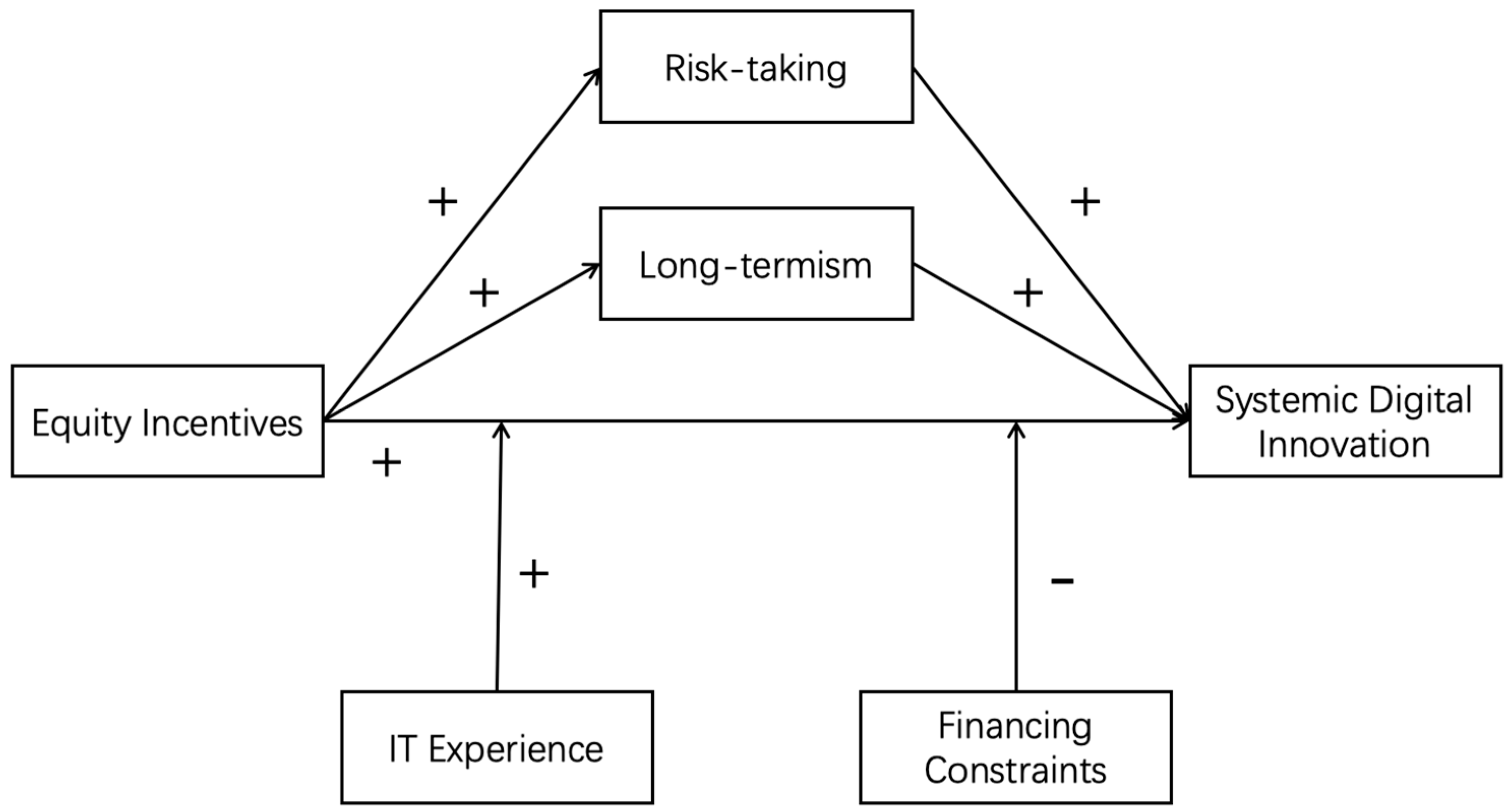
Figure 1. Theoretical Model.
Systems 14 00421 g001
Table 1. Descriptive statistics and Pearson correlation coefficient matrix of variables.
VariablesMeanStd.123456789101112131415
Digital1.4311.5991
Incentive10.4447.4290.147 ***1
Risk-taking−0.0410.3830.373 ***−0.034 ***1
Long-term4.2640.5970.280 ***0.301 ***0.182 ***1
Experience0.0540.1380.195 ***0.144 ***0.0010.177 ***1
Constraints−0.8020.418−0.102 ***0.062 ***−0.142 ***0.0020.069 ***1
Leverage0.4250.2140.051 ***−0.234 ***0.243 ***−0.136 ***−0.110 ***−0.153 ***1
Board2.2340.1800.003−0.141 ***0.101 ***−0.108 ***−0.086 ***−0.154 ***0.139 ***1
Independent0.3760.0550.058 ***0.043 ***0.067 ***0.076 ***0.053 ***0.038 ***−0.014 ***−0.527 ***1
Institution0.0440.0250.034 ***−0.447 ***0.242 ***−0.094 ***−0.124 ***−0.187 ***0.167 ***0.229 ***−0.065 ***1
Employee7.5651.3340.366 ***−0.027 ***0.454 ***0.126 ***−0.038 ***−0.274 ***0.297 ***0.225 ***−0.0040.312 ***1
CR0.0490.016−0.014 ***−0.134 ***0.147 ***0.011 ***−0.105 ***−0.062 ***−0.071 ***0.021 ***0.048 ***0.520 ***0.153 ***1
Separation0.0050.008−0.023 ***−0.155 ***−0.012 ***−0.031 ***−0.057 ***−0.021 ***0.032 ***0.032 ***−0.055 ***0.338 ***0.069 ***0.149 ***1
Dual0.2900.4540.029 ***0.311 ***−0.067 ***0.149 ***0.092 ***0.097 ***−0.155 ***−0.189 ***0.100 ***−0.197 ***−0.124 ***−0.013 ***−0.043 ***1
Age19.7456.7310.090 ***−0.042 ***0.138 ***0.154 ***0.040 ***0.096 ***0.133 ***−0.013 ***0.024 ***−0.015 ***0.082 ***−0.147 ***0.012 ***−0.080 ***1
Notes: *** p < 0.01.
Table 2. Results of panel regression analysis: Test for main, mediating and moderating effects.
VariablesDigitalRisk-TakingDigitalLong-TermDigital
(1)(2)(3)(4)(5)(6)(7)(8)(9)
Incentive 0.010 ***0.004 ***0.008 ***0.005 ***0.009 ***0.010 ***0.009 ***0.009 ***
(10.688)(14.994)(8.404)(13.335)(9.971)(10.967)(10.096)(10.379)
Risk-taking 0.591 ***
(34.337)
Long-term 0.125 ***
(11.474)
Experience 0.425 *** 0.424 ***
(9.439) (9.436)
Constraints −0.127 ***−0.127 ***
(−10.575)(−10.558)
Incentive * Experience 0.021 *** 0.021 ***
(3.885) (3.975)
Incentive * Constraints −0.003 **−0.004 ***
(−2.505)(−2.725)
Leverage−0.056 *−0.0370.090 ***−0.090 ***−0.153 ***−0.018−0.042−0.034−0.040
(−1.811)(−1.208)(10.908)(−2.964)(−11.569)(−0.590)(−1.371)(−1.111)(−1.285)
Board0.0590.042−0.038 ***0.0650.068 ***0.0340.0380.0330.029
(1.436)(1.015)(−3.461)(1.582)(3.842)(0.811)(0.926)(0.789)(0.701)
Independent 0.0880.082−0.0140.0910.0450.0760.0770.0730.068
(0.797)(0.748)(−0.495)(0.837)(0.952)(0.698)(0.701)(0.668)(0.620)
Institution1.504 ***1.957 ***0.775 ***1.500 ***0.850 ***1.851 ***1.950 ***1.841 ***1.834 ***
(3.716)(4.815)(7.128)(3.733)(4.889)(4.559)(4.802)(4.533)(4.522)
Employee0.298 ***0.289 ***0.065 ***0.251 ***0.101 ***0.277 ***0.288 ***0.281 ***0.279 ***
(47.405)(45.760)(38.562)(39.539)(37.512)(43.165)(45.531)(43.847)(43.647)
CR−2.971 ***−3.102 ***1.667 ***−4.088 ***2.533 ***−3.418 ***−2.658 ***−3.276 ***−2.831 ***
(−5.080)(−5.310)(10.677)(−7.076)(10.134)(−5.852)(−4.544)(−5.612)(−4.843)
Separation3.874 ***4.233 ***−0.1184.303 ***−1.085 ***4.369 ***4.254 ***4.166 ***4.186 ***
(4.557)(4.982)(−0.518)(5.128)(−2.985)(5.148)(5.013)(4.908)(4.939)
Dual0.029 **0.0120.0010.0120.0070.0120.0100.0140.012
(2.389)(1.021)(0.233)(0.997)(1.333)(0.951)(0.820)(1.156)(0.953)
Age0.061 ***0.060 ***0.017 ***0.050 ***0.076 ***0.051 ***0.059 ***0.065 ***0.064 ***
(39.555)(39.320)(41.811)(32.520)(115.060)(29.283)(38.279)(40.816)(39.816)
YearYesYesYesYesYesYesYesYesYes
IndustryYesYesYesYesYesYesYesYesYes
StockYesYesYesYesYesYesYesYesYes
Cons−2.520 ***−2.548 ***−0.951 ***−1.986 ***1.544 ***−2.741 ***−2.420 ***−2.384 ***−2.359 ***
(−15.891)(−16.083)(−22.466)(−12.625)(22.786)(−17.227)(−15.275)(−15.038)(−14.888)
F282.789281.166186.341300.391603.073279.932275.960275.962271.050
R20.30650.30820.22800.32550.48870.31020.31000.31000.3118
N51,07851,07851,07851,07851,07851,07851,07851,07851,078
Sobel tests 0.002 *** (z = 8.824)0.003 *** (z = 18.270)
Mediation effects 18.760% 28.080%
Indirect/Direct 23.100%39.000%
Bootstrap tests 95% Confidence Interval
direct effect 0.0020.0030.0020.003
indirect effect 0.0070.0100.0060.009
Notes: *** p < 0.01, ** p < 0.05, * p < 0.1. The R2 that the table reports is the within R2.
Table 3. Results of panel regression analysis: Robustness test.
VariablesIncentiveDigitalDummyDigitalGrant
(1)(2)(3)(4)(5)(6)(7)(8)(9)
Incentive 0.012 *** 0.010 ***0.010 ***0.017 ***0.008 ***0.006 ***0.008 ***
(8.262) (8.990)(9.409)(13.144)(8.969)(5.759)(10.460)
IV19.580 *** 1.570 ***
(172.097) (101.782)
IV24.835 ***
(25.849)
IMR 0.018 *
(0.931)
Leverage−2.682 ***−0.031−0.368 ***−0.039−0.021−0.116 **0.018−0.0380.070 **
(−21.751)(−0.985)(−11.005)(−1.263)(−0.591)(−2.553)(0.566)(−1.089)(2.556)
Board1.290 ***0.0460.544 ***0.0470.088 *0.460 ***0.0640.0710.011
(7.788)(1.098)(11.953)(1.128)(1.900)(8.176)(1.466)(1.513)(0.288)
Independent 0.788 *0.086−0.307 **0.0790.1851.171 ***0.0320.0240.099
(1.794)(0.772)(−2.174)(0.720)(1.489)(6.865)(0.279)(0.196)(1.018)
Institution−36.892 ***3.246 ***−18.610 ***1.804 ***1.596 ***5.844 ***3.950 ***3.780 ***1.499 ***
(−22.594)(7.800)(−46.539)(4.113)(3.654)(12.625)(8.895)(7.800)(4.142)
Employee0.381 ***0.287 ***0.082 ***0.290 ***0.307 ***0.687 ***0.283 ***0.285 ***0.253 ***
(15.054)(44.101)(14.809)(45.224)(41.347)(90.623)(41.993)(39.109)(44.844)
CR40.855 ***−4.267 ***5.722 ***−3.106 ***−3.029 ***−6.167 ***−3.349 ***−2.665 ***−4.510 ***
(17.304)(−7.184)(10.359)(−5.317)(−4.664)(−9.854)(−5.433)(−3.960)(−8.668)
Separation−19.934 ***4.121 ***−3.686 ***4.198 ***4.165 ***−5.833 ***4.117 ***4.510 ***2.947 ***
(−5.858)(4.758)(−4.219)(4.935)(4.249)(−5.267)(4.677)(4.815)(3.894)
Dual1.321 ***0.0080.412 ***0.0150.003−0.089 ***0.042 ***0.048 ***−0.003
(27.242)(0.628)(24.894)(1.206)(0.232)(−4.827)(3.314)(3.634)(−0.264)
Age−0.271 ***0.043 ***−0.046 ***0.060 ***0.060 ***−0.003 *0.056 ***0.053 ***0.087 ***
(−42.331)(19.504)(−42.369)(39.311)(34.138)(−1.934)(35.161)(30.586)(63.560)
YearYesYesNoYesYesYesYesYesYes
IndustryYesYesNoYesYesYesYesYesYes
StockYesYesNoYesYesYesYesYesYes
Cons6.445 *** −0.518 ***−2.577 ***−2.936 ***−9.773 ***−2.485 ***−2.399 ***−2.547 ***
(10.155) (−3.814)(−15.960)(−16.047)(−48.430)(−14.736)(−13.002)(−18.059)
F/LR492.988269.41222,370.26277.377224.82535,583.08235.437193.077334.229
R2/Pseudo R20.44190.28190.32950.30820.30490.20460.29340.27490.3462
N51,07851,07851,07851,07842,38351,07845,74040,86451,078
Underidentification test (LM)18,000 (p = 0.000)
Weak-instrument test (Cragg-Donald F)15,000 (Stock-Yogo 10% = 19.930)
Overidentification test (Sargan) 0.626 (p = 0.429)
Notes: *** p < 0.01, ** p < 0.05, * p < 0.1. The R2 that the table reports is the within R2, except R2 and F reported in column three and six are Pseudo R2 and LR.
Disclaimer/Publisher’s Note: The statements, opinions and data contained in all publications are solely those of the individual author(s) and contributor(s) and not of MDPI and/or the editor(s). MDPI and/or the editor(s) disclaim responsibility for any injury to people or property resulting from any ideas, methods, instructions or products referred to in the content.


