Article

Sensor Placement for Contamination Detection in Urban Water Distribution System Based on Multidimensional Resilience

School of Civil, Environmental and Infrastructure Engineering, Southern Illinois University, 1230 Lincoln Drive, Carbondale, IL 62901, USA
*
Author to whom correspondence should be addressed.
Systems 2026, 14(4), 422; https://doi.org/10.3390/systems14040422
Submission received: 25 February 2026 / Revised: 2 April 2026 / Accepted: 7 April 2026 / Published: 10 April 2026
(This article belongs to the Special Issue Management of Water Supply Systems Resilience and Reliability)

Abstract

Urban water distribution systems (WDSs) face increasing threats from accidental or intentional contaminant intrusion events. While contamination warning systems using water quality sensors enable early detection and rapid response to contamination events, traditional sensor placement approaches often rely on a single or limited performance metric, overlooking the multidimensional nature of system resilience. This study presents a multidimensional resilience-based framework for the optimal placement of water quality sensors in urban WDSs, integrating hydraulic and water quality simulations using the EPANET-MATLAB toolkit with a genetic algorithm (GA) optimization process. For Anytown Water Distribution Network, four distinct functionalities were formulated to capture different aspects of system performance during contamination events, and an integrated-multidimensional resilience metric was proposed as a collective measure. Results demonstrated that the optimal sensor configurations varied significantly depending on the selected functionality. However, the integrated multidimensional resilience-based approach yielded more balanced and effective sensor placements, simultaneously enhancing resilience levels for all individual functionalities. Furthermore, the findings indicated that adding more sensors beyond a certain number offers marginal improvements in system resilience, suggesting that sensor deployment should be guided by monitoring objectives (e.g., resilience) rather than simply increasing sensor numbers. The findings and discussion suggest practical insights for utilities to enhance water supply services with safe quality and system security against contamination threats in urban WDSs.

1. Introduction

Safe drinking water is an essential resource for public health and well-being. Water distribution systems (WDSs) have performed well delivering water of safe quality to the public with regular maintenance (e.g., pipe rehabilitation and replacement). Water utilities face challenges like pipe breakage, leakage, corrosion, contamination intrusion and cyber-physical attacks. In addition to these direct issues in WDSs, disasters like floods, droughts, and seismic events make the situation more challenging. WDSs can be easily exposed to accidental or deliberate contamination incidents due to their spatially distributed geography [1]. For example, authorities in the Democratic Republic of the Congo are looking into the deaths of at least 60 individuals in 2025 and believe that the water supply is contaminated. The WDS contamination event in Milwaukee (USA) in 1993 endangered 403,000 customers and, in turn, service consumers were hospitalized with an approximate hospital bill of USD 96.2 billion [2]. Other notable incidents include the spill of 4-methylcyclohexanemethanol (MCHM) in the Elk River in West Virginia in 2014 [3], lead contamination in the water supply of Hong Kong in 2016 and an E. coli outbreak in Long Beach in the year 2006 [4]. More than 350 people were impacted by a diarrheal outbreak at New RR Pet (Vijayawada). E. coli was found during investigations, which linked it to contamination in private RO (reverse osmosis) plants [5]. According to recent EPA data, more than 158 million Americans are currently exposed to PFAS “forever chemicals” in their drinking water [6]. These harmful substances, which have been connected to immune system damage and cancer, were found in more than 9000 water systems across the country. Tens of millions of people are dependent only on federal rules because many impacted localities do not have state-level protections. These incidents indicate that a failure to respond to the WDS contamination events—as the detection of the contaminant intrusion and presence in the WDS is delayed and the emergency actions are implemented untimely—can lead to significant impacts on human health and the environment [7].
In this context of critical infrastructure management, the concept of resilience has recently received substantial attention to address disruptive events and their uncertainties [8]. The term resilience means “bounce back”. Due to the uncertainties of systems’ disturbances and the possibilities of systems’ failures from uncertainties, the concept and strategies of resilience focus on the recovery of the disrupted systems during and after the disruptions. Thus, a resilient system can provide continued infrastructure services to customers by minimizing system losses and quickly recovering to the pre-disrupted conditions [9]. WDSs are a critical lifeline for urban infrastructure systems; however, due to large spatial scales with many possible contaminant sources, potential increases in intentional contamination intrusion by terrorism [10] and increasing threats to water quality due to cyber-physical attacks [11], they are exposed and vulnerable to a high uncertainty of contamination events. These threats have increased the uncertainty of failure within systems. Thus, in addition to being prepared to prevent disruptions in the systems when they happen, utilities are prioritizing ample planning and decision making to better strategize against failures, therefore enhancing the resilience of the systems and minimizing the consequences of the failures [12,13].
Furthermore, along with strategic planning and preparedness, utilities need to be warned about any type of intrusion within the system. This necessitates reliable and efficient monitoring of WDSs for contamination incidents [1]. When a contaminant is intruded to a WDS, the water quality monitoring systems warn the system manager about the presence of a contamination within the system and then provide ample time to prepare and initiate response actions against the events in a timely manner [14]. Thus, the monitoring system can help system managers handle contamination events resiliently. One of the monitoring approaches is the deployment of contaminant detection sensors in WDSs, which are connected to a central SCADA (supervisory control and data acquisition) system [15]. In case of water quality, the sensors detect the water parameters such as free chlorine, total organic carbon (TOC), turbidity, pH, dissolved oxygen, ammonia, and nitrate and these data are then sent to the SCADA for monitoring and detecting the alteration in the water quality parameters in near real time [16]. When the change in water quality parameters is recorded outside normal conditions, then the warning system is triggered by alarming the contaminant intrusion in the system.
For complete monitoring of WDSs, the water quality sensors can be installed at WDS nodes. However, due to the high costs of sensor installation and maintenance and limited accessibility to selected sensor locations, the number of sensors deployed in a WDS is limited, which requires a trade-off with water quality levels achieved [17,18]. These constraints consequently motivate a strategy to find optimal locations for the sensors in WDSs by minimizing the number of sensors and maximizing the performance of the monitoring (or early warning) systems [19,20]. Thus, designing a monitoring system to detect contamination incidents is a selection problem with a limited number of water quality sensors.
Over the last decade, numerous studies have been conducted to find the optimal locations of water quality sensors with respect to achieving various objectives within the limited number of sensors and maximizing the monitoring performance of the sensors. As a representative study in the water quality sensor placement, while various sensor placement strategies were proposed in the Battle of Water Sensor Network (BWSN) [21], BWSN concluded that the water quality sensor placement is a multi-objective problem and that no solutions could be deemed “optimal”. The following studies have focused on finding the optimal location for the sensors, given a limited number of sensors and considering their own specific objectives, including minimizing contamination risk [22], decreasing detection redundancy [23], identifying the minimum number of sensors for contamination detection [24], and enhancing the accuracy of leak detection [25]. Solving the optimization problems with the above-mentioned objectives (single or multi-objective formulations) and the constraints for the number of sensors (either due to accessibility of junctions or due to budget constraints) has been useful to identify optimal locations and configurations of the sensors in WDSs. However, despite several studies in this field, the final outcome is still inconclusive and open to different approaches and perspectives to better place the sensors while maintaining the efficient operation of the system.
In this context, this study aims to provide resilience-based sensor placement strategies so that a minimal number of sensors can be placed effectively to ensure maximum resilience of the system. While the concept of resilience has become a topic of increasing attention in recent years, it has scarcely been studied as an objective for water quality sensor placement. Recent studies such as Refs. [11,26] evaluated the resilience of various sensor layouts under sensor failures and cyber-physical attacks. Although these studies effectively employed resilience measures to assess their sensor placement performance under disruptions, they have seldom used the resilience concept directly as a primary objective for determining sensor locations. This study addresses this gap by presenting a resilience-based strategy to deploy the sensors in WDSs.
Furthermore, it should be noted that the optimal sensor locations can be varied with the definition of system functionality (performance of interest) in the resilience evaluation of the optimization processes. The optimization processes will find sensor locations that maximize a system’s resilience within constraints such as the number of sensors, budgets, or accessibility of nodes. Resilience evaluation of the optimization process considers the comprehensive functional response of the system in normal, disrupted and recovered states. Resilience levels evaluated in the optimization process can be determined by the variation of the functionality, which is characterized differently depending on its definition. The system’s functionality as a performance of interest in the resilience evaluation can be defined in diverse aspects by the system manager’s interests in the system’s goals. Thus, the optimization process with the resilience evaluation based on the different aspects of the functionalities can suggest the different optimal locations of water quality sensors.
In this regard, there is a need to incorporate the resilience evaluation using multiple functionalities in diverse aspects into the optimization process to find the best sensor locations that improve the system’s resilience to contamination events. The evaluation of system resilience has expanded beyond a simple assessment of system performance to become an important objective in the optimization of system monitoring, design, and control for the resilience management of a system. Recent studies such as Refs. [27,28] highlight the application of resilience-based evaluation to the optimization of system operation and restoration under complex hazards, emphasizing that resilience is an operational priority in infrastructure management. Hence, this study presents the approach of using the multidimensional resilience of a WDS to contaminant intrusion events to find optimal sensor locations that can increase the overall resilience in multiple functional dimensions. Ref. [29] introduced a multidimensional resilience evaluation framework for enhancing system resilience in multiple functional dimensions. Further details concerning the concept of multidimensional resilience can be found in the study by [29].
This study is motivated to provide the application of multidimensional resilience for the planning of water quality sensor placement strategies against contamination intrusion in WDSs. Within this motivation, this study explores the answers to the following research questions:
(1)
Are the optimal water quality sensor placements and their performances different for the different functionalities?
(2)
Do the sensor placement schemes based on multidimensional resilience give better performances in contamination detection and resilience compared with the schemes based on individual resilience?
The major contributions of this study are: (1) optimizing the water quality sensor location within WDSs based on single and multidimensional resilience; (2) understanding the differentiation between the different sensor placement strategies and providing ample insight on which approaches suggest better monitoring performance; and (3) providing insights into decision making on water quality sensor placement based on multidimensional resilience to WDS contamination events.

2. Materials and Methods

2.1. Integration of Multidimensional Resilience

This study evaluates the system’s resilience for the various aspects of functionalities of a WDS, i.e., the concept of multidimensional resilience [29]. To quantify multidimensional resilience, first, the functionality-based resilience evaluation approach is applied to evaluate resilience for individual functional dimensions. For a given functionality i , its individual resilience can be evaluated as the normalized area under the curve of the time-dependent variation of the functionality. A detailed description of the resilience measure is provided in [29]. This metric captures the system’s performance in normal, disrupted, recovery, and recovered states by comparing the functionality during a disruptive event against that under normal conditions. This metric provides a normalized value between 0 and 1, where a value of 1 indicates that the system is completely resilient to disruption. However, a system’s resilience is a comprehensive capability to cope with disruption in various perspectives of the system’s performance and requires satisfying multiple functional objectives. Thus, system resilience cannot be fully captured by a single metric alone. In this context, the individual resilience levels evaluated in multiple functional aspects are aggregated to represent the system’s resilience. Accordingly, the aggregation method is a weighted sum of the resilience levels in multiple functional dimensions, considering the relative importance of individual resilience in the dimensions. The mathematical representation of the integrated dimensional resilience is represented in Equation (1).
R I D = i = 1 N w i R i i = 1 N w i
where w i is the weight for the individual resilience in each functional dimension i , R i is the value of resilience corresponding to the functional dimension i , and N denotes the total number of functional dimensions that are considered in the resilience evaluation. Since the integrated dimensional resilience is the average of normalized values of multidimensional resilience, its value is also normalized between 0 and 1.
The weights ( w i ) represent the relative importance assigned to each functional dimension. In the absence of predefined priorities for these dimensions, equal weights can be adopted for individual resilience to ensure that the resilience evaluation and optimization process are not biased toward a specific functional dimension, which can help identify sensor configurations that offer balanced performances across all functional dimensions. The weights (relative importance) can be determined depending on the specific objectives and priorities of a system manager. The evaluation of integrated dimensional resilience (RID) with equal weights reflects a balanced management perspective where all identified system functionalities are considered equally important and supports decision making on sensor placement under multiple performance considerations.

2.2. Optimal Sensor Placement Based on Multidimensional Resilience

The placement of a specific number of sensors in a WDS is an optimization problem. Sensor locations serve as the decision variables, with the objective of maximizing system resilience subject to the constraints of the number of sensors [24,25]. Details of the optimization process and its parameters are illustrated below.
(1)
Objective Function
The optimal sensor location is selected based on the value of resilience that the given configuration of sensors provides. As mentioned earlier, multiple different functionalities are defined, based on which the resilience value is calculated. The maximization of different types of objective functions yields different configurations of sensors, which can cause a challenge for decision makers to decide between the available configurations. In this context, an additional simulation is performed using the integrated resilience value as the objective function that aggregates all the available functionality and offers a solution that works best in each context. Equation (2) represents the objective function where resilience R i for functionality i is maximized. This study assumes equal probability of contamination occurring in each node of the system and hence p k denotes the probability of occurrence of the contamination event at node k . Therefore, the final objective function becomes the average resilience of all the location-based resilience in a given functional dimension.
max i = 1 p k R i , k
max i = 1 p k R I D , k
(2)
Decision variable and constraints
The decision variable used in this study is the location of water quality sensors. In a real case scenario, not all nodes in a system are feasible to deploy the sensors, either because of their accessibility or due to economic restrictions. This study, however, takes all the demand nodes available in the network as potential candidates to place the sensor. Equation (4) represents the decision variable vector used in the optimization process, where the value for sensor node n k is equal to 1 if the sensor is placed in the node, else the value is 0.
n k = { 1 ,   i f   s e n s o r   i s   p l a c e d   i n   n o d e   k 0 ,   O t h e r w i s e
This optimization procedure is performed under two major constraints. The first constraint, given by Equation (5), explains that the sensor node should be limited to the nodes ( N ) available in the system. In this study, all the nodes are assumed to be accessible for sensor placement; this scenario can change based on the WDS and the preference of the utilities. In that case, the constraint will change to accessible nodes only. The second constraint given by Equation (6) is related to the restriction of the number of sensors. The sum of sensor nodes ( n k ) placed in the system should be equal to the assigned number of sensors ( N s ).
n k < N   k     N
k     N n k = N s
(3)
Optimization algorithms
Previous studies have employed various types of algorithms, such as particle swarm optimization, harmony search, deterministic linear programming, and machine learning and data-driven algorithms, to solve the optimization problem of sensor placement [18,30,31]. This study focuses on highlighting the use of the multidimensional resilience concept in optimal sensor placement and uses a genetic algorithm, GA [32,33], in conjunction with the EPANET model. GA has been extensively pursued in the past literature as an effective measure for a sensor placement optimization algorithm, and the procedures using GA in conjunction with the EPANET model are explained comprehensively in the past literature [25].

2.3. Case Study

The resilience evaluation requires performance evaluation metrics (functionalities), and the optimization algorithm requires network and contamination scenarios to obtain the objective of this study. For individual multidimensional resilience, this study has considered four different performance evaluation metrics, which are also referred to as functionalities. Table 1 shows the equation or mathematical relationship considered for these four dimensions of functionality. The former two functionalities represent the spatial coverage of the contaminants in the system and the total demand that is compromised by the contaminants. This means that the hydraulic feature of the distribution network such as demand and velocity plays the governing role in this instance and, thus, both these functionality metrics are grouped as a “hydraulic metric”. On the other hand, the latter two functionalities represent the average concentration of the biodegradable dissolved organic carbon (BDOC) and the contaminant within the system at the given time. This means that the concentration of the substance governs the functionality in this instance, and so these metrics are grouped as a “quality metric”.
Based on the multidimensional resilience illustrated in the section above, the integrated resilience values are calculated using the weighting factor method as described by Equation (1). It is to be noted that all the functionalities are assumed to have equal weights while computing the integrated resilience, i.e., the value for w i is taken as 0.25 for the values of   i   =   1 to 4 (since this study considers four functionalities).
This study applies the described optimal sensor placement method to the Anytown Water Distribution Network (AWDS), originally introduced by [34]. For the case study network heterotrophic plate count (HPC) bacteria with a growth medium are considered for the contaminant. The hydraulic and quality simulations were conducted using the EPANET-MATLAB Toolkit (version R2021a). In order to emulate the reality scenario, the normal condition included the concentration of growth medium, which was adopted from [35]. The result from the hydraulic and quality simulation was then used to calculate the resilience of the system for normal contaminated conditions with no sensors and for contaminated conditions with sensors.
To solve the optimization problem described in the section above, contamination scenarios need to be defined. The objective function, i.e., the value of resilience is calculated based on the contamination scenarios and the four functionalities. Every node in a WDS is exposed and vulnerable to contamination intrusion, either accidentally or deliberately. In this regard, a set of contamination scenarios was generated by considering every node within the AWDS as a potential contamination source, with individual simulations conducted for each node to model the spread of contaminants from every possible entry point. Other contamination event characteristics such as duration of contamination, contaminated mass and time of intrusion were assumed to be constant for the purpose of this study. Optimization was performed using the GA solver provided by the MATLAB Global Optimization Toolbox (version R2021a). To ensure a standardized optimization performance while maintaining the focus on the multidimensional resilience framework, the default GA parameters of the solver were applied. Key parameters included a population size of 200, a crossover fraction of 0.8, and a stall generation limit of 50 as a termination criterion.
In this study, the post-detection recovery time, tr, is assumed to be a fixed value across all contamination scenarios. While response and recovery time can be defined by various factors such as system operation rules and recovery resources availability, modeling these complexities is beyond the scope of this study. This assumption ensures that all the scenarios remain comparable and the investigation focuses on how sensor placement directly influences contamination detection performance and, in turn, resilience outcome, while minimizing the impacts of various response and recovery factors. In practical applications, the proposed framework in this study can be extended to incorporate heterogeneous or risk-informed contamination scenarios, which would depend on specific system vulnerabilities, varying demand patterns, and probabilistic contamination characterizations.
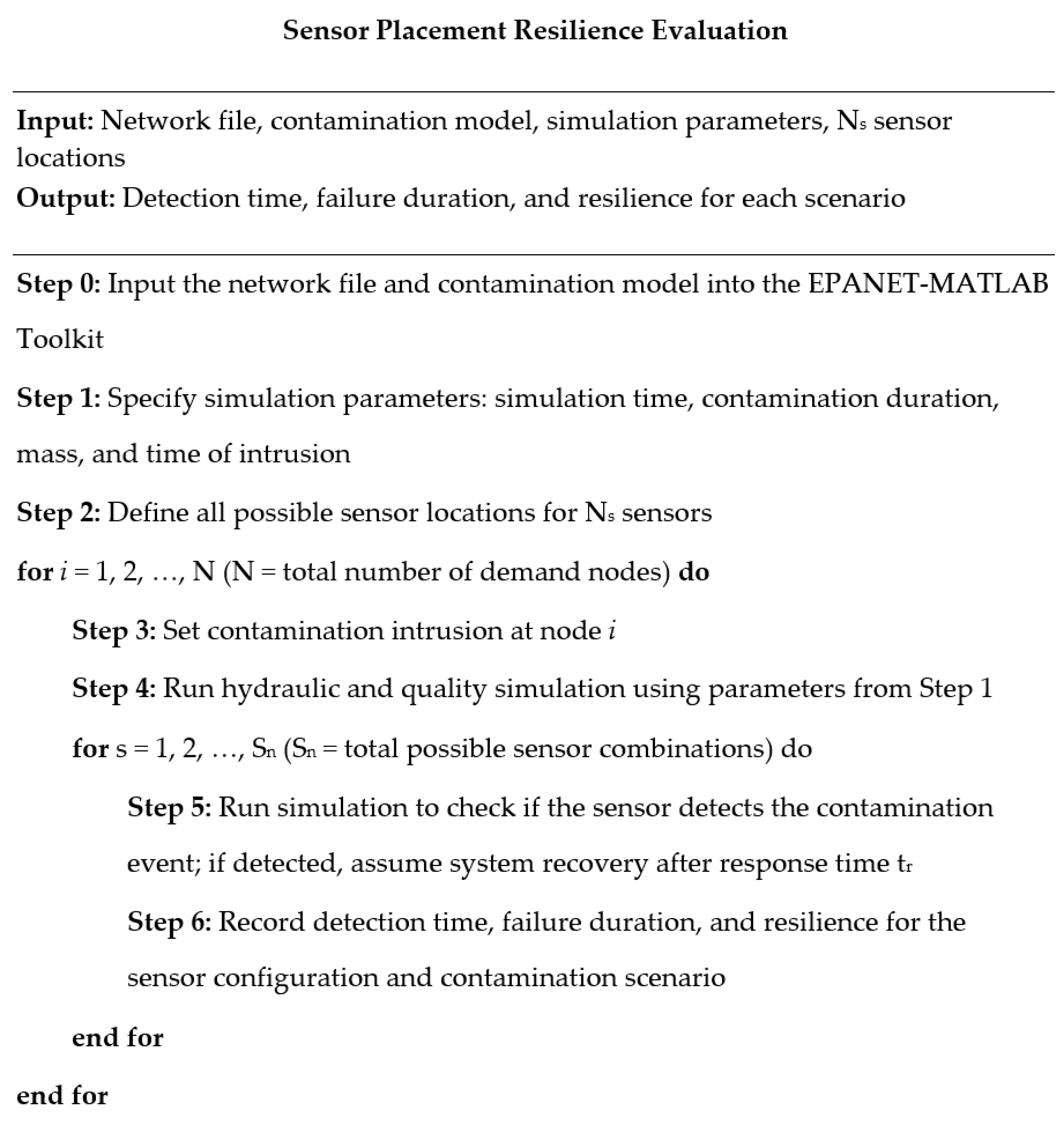
The brief algorithm for the simulation and optimization process used for this study is provided in Figure 1.

3. Results

This study investigated a multidimensional resilience-based method for the optimal placement of water quality sensors in urban WDSs, combining a GA optimization procedure with hydraulic and water quality simulations. The findings present different sensor placement configurations based on selected functionalities.

3.1. Sensor Network Configuration Based on Individual and Multidimensional Resilience

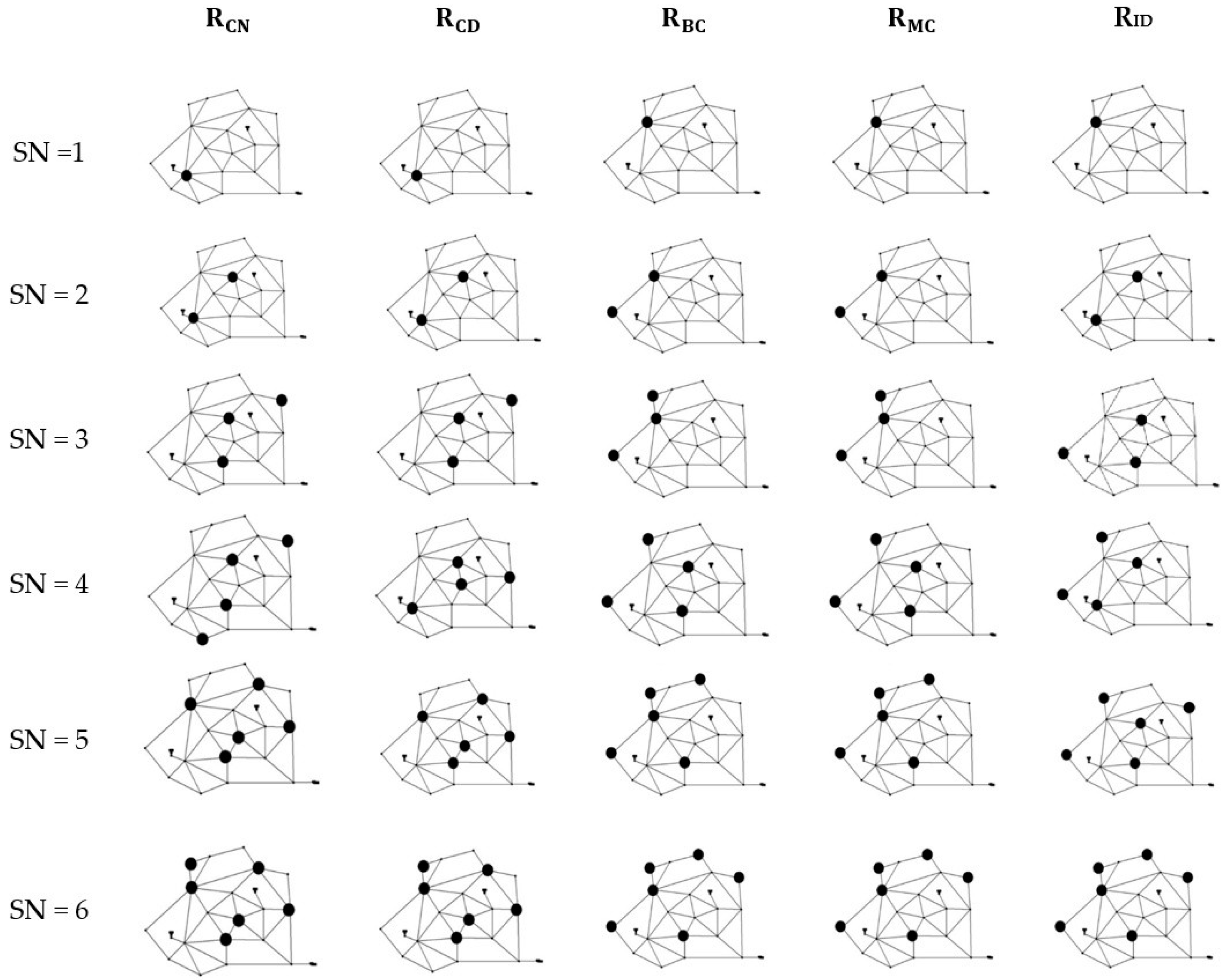
From the result of optimization, this study obtained the sensor configurations (nodes) based on individual multidimensional resilience, as illustrated in Figure 2 and Table 2. The result shows that the sensor configurations are similar for hydraulic measures (i.e., RCN and RCD) in most cases. The sensor nodes determined by individual resilience evaluation based on the quality-related functionalities remained consistent across all sensor counts. This indicates that, although the resilience values of RBC and RMC vary, they were highly correlated and, in turn, the sensor placement for maximizing these RBC and RMC is nearly similar. The results in Table 2 demonstrate that the optimal sensor placement can vary significantly depending on whether the resilience evaluation is based on hydraulic or water quality functionality metrics. In this regard, it becomes a challenge for the decision makers to choose between these configurations. Hence, as discussed earlier, this study proposed a measure to calculate the integrated system resilience and determined optimal sensor locations based on the integrated multidimensional resilience evaluation. Performing an optimization simulation with the maximization of integrated system resilience provided the optimal location presented in Table 2.

3.2. Comparison of Integrated Multidimensional Resilience with Individual Dimensional Resilience During Failure

The hypothesis that the integrated multidimensional resilience (RID) evaluation provides a superior sensor configuration compared with individual dimensional resilience was corroborated by analyzing the failure duration when the sensor placement is implemented. It captures the system recovery, performance loss, and ability to restore service during disruptions, which displays a comprehensive evaluation of the system under disruption [8,36].
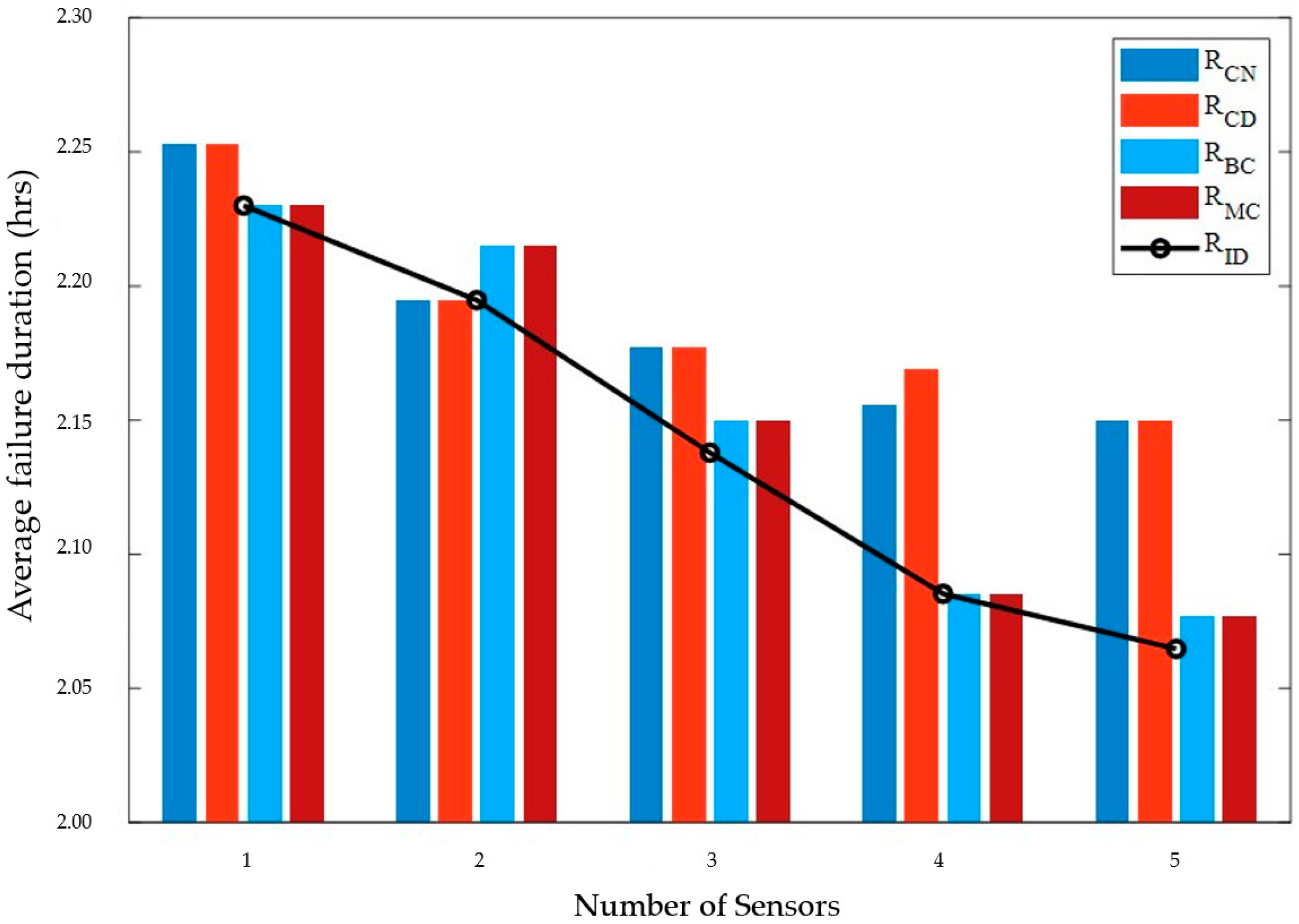
In this study, the failure duration was determined for sensor configurations optimized under both individual and integrated resilience evaluations. Figure 3 shows the failure duration for various numbers of sensors. The column plots represent the failure durations associated with sensor configurations determined by individual dimensional resilience evaluations, while the descending curve indicates the duration achieved through the integrated multidimensional resilience evaluation. As noted in Figure 3, when sensors were placed according to the integrated multidimensional resilience evaluation, the failure duration was either lower than or equal to the duration observed with individual resilience-based sensor placements. These findings confirm that the RID-based approach not only maintains the strengths of individual resilience evaluations in sensor placement but also enhances the overall performance of the system’s emergency response and recovery process.
Meanwhile, as expected, a declining trend in failure duration is observed in Figure 3 as the number of sensors increases. In addition, the RID-based sensor configuration suggests a more rapid decline in failure duration compared with individual resilience evaluations. This rapid reduction rate of failure duration highlights the superior efficiency of the integrated multidimensional resilience evaluation in identifying optimal sensor locations to improve system resilience against disruptions.

3.3. Resilience Variation Depending on the Number of Sensors

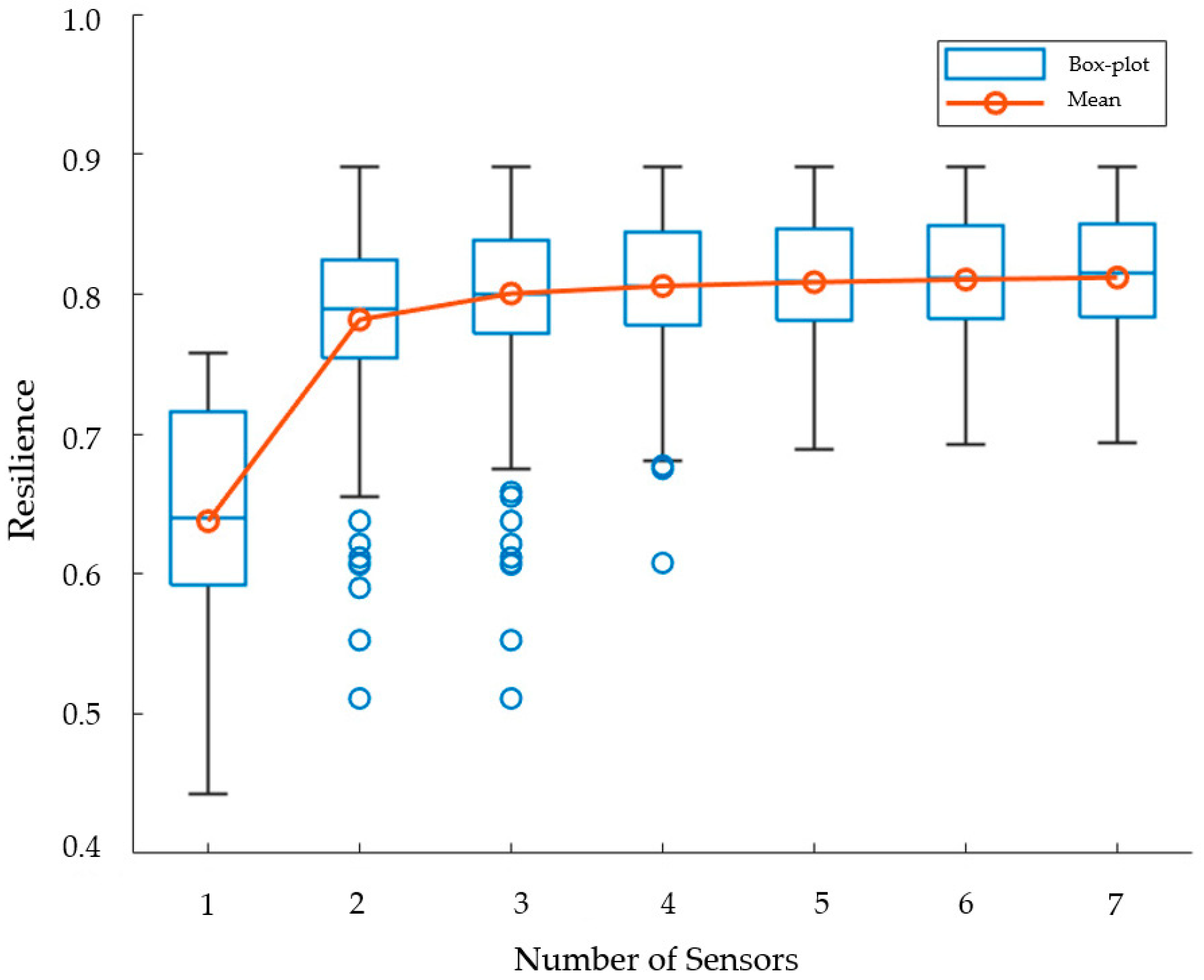
The major challenge with sensor deployment is the constraint regarding the number of sensors. Figure 4 shows a box plot of integrated multidimensional resilience ( R I D ) values for all the scenarios related to the number of sensors. This analysis aims to understand how an increase in the number of sensors influences overall system resilience. As seen in Figure 4, the relationship between resilience and the number of sensors was nonlinear. The graph depicts that improvements in resilience became insignificant after a certain threshold in the number of sensors; specifically, the maximum resilience values showed no significant improvement as more sensors were added beyond this point. This implies that adding more sensors suggests less benefit in preventing performance loss during disruptions once a certain number of sensors is reached. This finding concludes that near-maximum resilience can be achieved with a limited number of sensors if they are placed strategically. In this regard, deploying an even smaller number of sensors in optimal locations determined by an integrated multidimensional resilience evaluation can suggest more effective sensor placement than installing a larger number of sensors without careful consideration of resilience-based sensor placement.

4. Discussions

The results of this study provide critical insights into the effectiveness of the multidimensional resilience-based sensor placement strategy in WDSs. This study compared the performance of contamination intrusion detection for sensor configurations derived from individual functionality-based resilience metrics and the integrated multidimensional resilience evaluation. Building on these efforts extending prior studies such as [26], demonstrating that sensor placement performance depends not only on spatial coverage but also on system behaviors under failures. This study further investigated how the definition of system functionality and the consideration of multiple diverse functionalities in resilience-based design can affect optimal sensor placement and its monitoring performance.
The results shown in Figure 2 and Table 2 show that optimal sensor configurations can vary depending on the functionality used to evaluate system resilience. This indicates that sensor placement strategies optimized for a single functionality can provide effective monitoring for its corresponding system objective but may not perform consistently across multiple diverse operational objectives. This finding supports the first research question of this study regarding whether sensor configurations and their performances differ depending on the system functionalities. This finding is also aligned with previous studies such as Refs. [37,38], highlighting that optimal sensor placement is highly dependent on system functionality, including hydraulic behavior and contaminant transport dynamics. This study advances this understanding by explicitly integrating multiple functional objectives into a unified multidimensional resilience framework, enabling sensor placement for more effective contaminant intrusion monitoring.
The results shown in Figure 3 highlight the effectiveness of integrating multiple functionalities into a multidimensional resilience framework for sensor placement. Sensor configurations based on the multidimensional resilience approach consistently resulted in similar or shorter failure durations compared with configurations based on individual resilience metrics. This finding indicates that multidimensional resilience-based sensor placement, incorporating multiple system functionalities into the resilience evaluation, can address the limitations in system optimization derived from single functionality-based resilience evaluation, which is identified in previous studies such as [11], and provide effective monitoring performance to enhance system resilience against water quality and operational failures. This supports the second research question of this study regarding whether multidimensional resilience-based sensor placement provides superior monitoring performance compared with the one derived from the individual functionality-based resilience evaluation. In this context, the multidimensional resilience-based approach will help improve the capability of water utilities to detect contamination events and initiate emergency and response actions more rapidly under the system’s disrupted conditions.
Another finding of this study is the nonlinear relationship between system resilience and the number of sensors deployed. The results presented in Figure 4 show that resilience increases with the number of sensors; however, the marginal improvement diminishes as the number of sensors continues to increase. Adding more sensors does not necessarily guarantee proportional improvements in contamination detection and monitoring capability. This finding is consistently aligned with previous studies related to sensor placement optimization. For example, Ref. [39] showed that information gained from additional sensors decreased after a certain point, leading to near-optimal performance with a limited number of sensors. Similarly, Ref. [38] demonstrated that a small set of strategically placed sensors can achieve performance close to that of much larger networks. Therefore, strategic placement approaches with a limited number of sensors will contribute more to improving monitoring effectiveness without unnecessary redundancy, especially when installation and maintenance costs limit the number of deployable sensors.
Overall, this study demonstrated that a multidimensional resilience-based framework provides more effective sensor placement strategies for improving water quality monitoring and system resilience in WDSs. Despite these contributions, several limitations can be considered in interpreting the results. The sensor placement approach in this study assumed predefined contaminant intrusion scenarios for single node and system operating conditions, which may not fully represent the uncertainty of real contamination events. In addition, this study assumed a constant response and recovery time to focus on investigating the effectiveness of sensor placement, which can be affected by various response and recovery factors. Furthermore, this study focused mainly on system resilience and contamination detection performance, while economic factors such as installation costs, maintenance requirements, sensor location accessibility, and operational constraints were not incorporated into the optimization process to find optimal sensor configurations. The proposed multidimensional resilience-based sensor placement framework can be further enhanced for its applicability in more complex WDSs by integrating economic considerations, uncertainty analysis, and detailed modeling of various response and recovery processes.

5. Conclusions

Sensor placement strategies and optimization have been a popular topic for researchers and engineers. These strategies with resilience evaluation can suggest different optimal locations of water quality sensors. System resilience can be defined and quantified in various perspectives of functionality. However, there is a lack of understanding of multidimensional resilience evaluation to find the best sensor locations that improve the system’s resilience to contamination events. This study aims to provide an approach that uses the concept of multidimensional resilience to place sensors strategically in the system such that there will be a maximization of resilience in the system whilst deploying a minimum number of sensors. In this regard, this study performed hydraulic and quality simulation using the EPANET-MATLAB Toolkit, which also facilitated the calculation of resilience. This process of simulation and resilience evaluation served as a baseline platform, enabling the evaluation of diverse contamination scenarios and sensor configurations to identify the most resilient sensor placement locations.
The key findings of this study, as the answers to the questions described in the Introduction, summarize that sensor configuration based on the similar feature of functionalities—hydraulic metrics (FCN and FCD) and quality metrics (FBC and FMC)—resulted in similar sensor deployments. However, different features of the functionalities suggested different sensor deployment configurations. Thus, sensor deployment should consider resilience across multiple aspects of functionality rather than relying on a single performance feature. Overall, the sensor placement decisions based on integrated multidimensional resilience (RID) suggest superior sensor configurations for enhancing system resilience compared with those based on individual dimensional resilience. Furthermore, it is noted that near-maximum resilience can be achieved with a limited number of strategically placed sensors based on integrated multidimensional resilience evaluations.
The multidimensional resilience-based sensor placement framework presented in this study can be extended to other strategies other than sensor placement, such as valve closure, sectorization, disinfection and many others. Water utilities can work with different monitoring objectives such as rapid detection, demand coverage, and sensitive zones, while developing sensor placement strategies. This will also be relevant to large urban WDSs seeking to implement more robust and balanced sensor configurations. For example, hybrid supply networks with multiple demand patterns can benefit from the multidimensional resilience-based sensor placement across multiple operational scenarios.
The results also indicate that the number of sensors beyond a certain threshold does not contribute to a substantial gain in resilience. This enables the authorities to identify the optimal number of sensors for cost-effective applications.
Similarly, the outcomes prove that the integrated multidimensional resilience results in better performing sensor configurations. This can produce promising results on determining effective sensor configurations based on several scenarios, demand conditions and operational failure events. The proposed framework can be integrated into digital twin platforms for real-time system updates under several system conditions.
This study highlighted the superiority of the multidimensional optimization framework for enhancing system resilience. However, the analysis is based on a hydraulic model, and the real-world scenarios can be dynamic and uncertain. In addition, adaptive sensor placement approaches may result in improved resilience rather than static sensor placement. Therefore, further studies can include mobile sensor placement resilience evaluations. Furthermore, while equal weights in evaluating integrated multidimensional resilience were adopted in this study, a future study can investigate how varying weight settings affect the “multidimensionality” of the resilience-based decision making. For example, as a large weight is assigned to a single objective, the multidimensionality in system resilience evaluation will decrease, potentially leading to a less effective sensor configuration, as discussed in the previous section. Finally, although multiple resilience functionalities were evaluated in this study, diverse types of failure events such as cyber-physical attacks and physical pipe breaks can be considered simultaneously to enhance overall system resilience rather than focusing on limited aspects.

Author Contributions

Conceptualization, A.A. and S.S.; methodology, A.A. and S.S.; software, A.A.; validation, A.A., S.S., B.A.M. and A.B.G.; writing—original draft preparation, A.A.; writing—review and editing, A.A., A.B.G., B.A.M. and S.S.; supervision, S.S. All authors have read and agreed to the published version of the manuscript.

Funding

This research received no external funding.

Data Availability Statement

The data presented in this study are available upon request from the corresponding author.

Acknowledgments

This study is based on the author’s master’s thesis entitled “Multi-dimensional resilience of water distribution system for water quality sensor placement”, completed at Southern Illinois University.

Conflicts of Interest

The authors declare no conflicts of interest.

References

  1. Abhijith, G.R.; Salomons, E.; Ostfeld, A. Reliability of a Contamination-Detection Sensor Network in Water Distribution Systems during a Cyber-Physical Attack. Water 2022, 14, 3669. [Google Scholar] [CrossRef]
  2. Corso, P.S.; Kramer, M.H.; Blair, K.A.; Addiss, D.G.; Davis, J.P.; Haddix, A.C. Costs of Illness in the 1993 Waterborne Cryptosporidium Outbreak, Milwaukee, Wisconsin. Emerg. Infect. Dis. 2003, 9, 426. [Google Scholar] [CrossRef]
  3. Thomasson, E.D.; Scharman, E.; Fechter-Leggett, E.; Bixler, D.; Ibrahim, S.; Duncan, M.A.; Hsu, J.; Scott, M.; Wilson, S.; Haddy, L.; et al. Acute Health Effects After the Elk River Chemical Spill, West Virginia, January 2014. Public Health Rep. 2017, 132, 196–202. [Google Scholar] [CrossRef]
  4. McFadden, R.D. E. Coli Sickens 39 in New Jersey and New York. The New York Times, 5 December 2006.
  5. Kummara, S.K. VMC Attributes Diarrhea Outbreak in New RR Pet Colony to Contaminated Water from Private RO Plants. The Times of India, 8 October 2025.
  6. 158M Americans at Risk from PFAS—EWG Report. Available online: https://www.ewg.org/news-insights/news-release/2025/03/new-epa-data-shows-158m-people-exposed-forever-chemicals-us (accessed on 6 January 2026).
  7. Omalu, I.C.; Eze, G.C.; Olayemi, I.K.; Gbise, D.S.; Adeniran, A.I.; Ayanwale, V.A.; Mohammed, A.Z.; Chukwuemeka, V.I. Contamination of Sachet Water in Nigeria: Assessment and Health Impact. Online J. Health Allied Sci. 2010, 9, 15. [Google Scholar]
  8. Shin, S.; Lee, S.; Judi, D.; Parvania, M.; Goharian, E.; Mcpherson, T.; Burian, S. A Systematic Review of Quantitative Resilience Measures for Water Infrastructure Systems. Water 2018, 10, 164. [Google Scholar] [CrossRef]
  9. Bruneau, M.; Reinhorn, A. Overview of the Resilience Concept. In Proceedings of the 8th US National Conference on Earthquake Engineering; Earthquake Engineering Research Institute (EERI): San Francisco, CA, USA, 2006; Volume 2040, pp. 18–22. [Google Scholar]
  10. Bildirici, M.E.; Lousada, S.; Yılmaz Genç, S. Terrorism, Freshwater, and Environmental Pollution: Evidence of Afghanistan, Burkina Faso, Iraq, Arab Republic of Egypt, Cameroon, Mali, Mozambique, Niger, Nigeria, Somalia, Syrian Arab Republic, and Pakistan. Water 2022, 14, 2684. [Google Scholar] [CrossRef]
  11. Nikolopoulos, D.; Ostfeld, A.; Salomons, E.; Makropoulos, C. Resilience Assessment of Water Quality Sensor Designs under Cyber-Physical Attacks. Water 2021, 13, 647. [Google Scholar] [CrossRef]
  12. Klise, K.A.; Murray, R.; Haxton, T. An Overview of the Water Network Tool for Resilience (WNTR). In Proceedings of the 1st International WDSA/CCWI Joint Conference, Kingston, ON, Canada, 23–25 July 2018. [Google Scholar]
  13. Ale Magar, B.; Acharya, K.; Babu Ghimire, A.; Shin, S. Evaluating the Resilience of Hybrid Centralized and Decentralized Water Supply Systems. In Proceedings of the World Environmental and Water Resources Congress 2024; American Society of Civil Engineers: Milwaukee, WI, USA, 2024; pp. 1316–1325. [Google Scholar]
  14. Eslamian, S.; Amininezhad, S.M.; Amininejad, S.M. Contamination Warning System. In Urban Water Reuse Handbook; CRC Press: Boca Raton, FL, USA, 2015; pp. 481–488. [Google Scholar]
  15. Shahra, E.Q.; Wu, W. Water Contaminants Detection Using Sensor Placement Approach in Smart Water Networks. J. Ambient Intell. Humaniz. Comput. 2023, 14, 4971–4986. [Google Scholar] [CrossRef]
  16. López-Munoz, M.A.; Torrealba-Melendez, R.; Arriaga-Arriaga, C.A.; Tamariz-Flores, E.I.; López-López, M.; Quirino-Morales, F.; Munoz-Pacheco, J.M.; López-Marcos, F. Wireless Dynamic Sensor Network for Water Quality Monitoring Based on the IoT. Technologies 2024, 12, 211. [Google Scholar] [CrossRef]
  17. Giudicianni, C.; Herrera, M.; Di Nardo, A.; Greco, R.; Creaco, E.; Scala, A. Topological Placement of Quality Sensors in Water-Distribution Networks without the Recourse to Hydraulic Modeling. J. Water Resour. Plan. Manag. 2020, 146, 04020030. [Google Scholar] [CrossRef]
  18. Marlim, M.S.; Kang, D. Optimal Water Quality Sensor Placement by Accounting for Possible Contamination Events in Water Distribution Networks. Water 2021, 13, 1999. [Google Scholar] [CrossRef]
  19. Sankary, N.; Ostfeld, A. Incorporating Operational Uncertainty in Early Warning System Design Optimization for Water Distribution System Security. Procedia Eng. 2017, 186, 160–167. [Google Scholar] [CrossRef]
  20. Storey, M.V.; Van der Gaag, B.; Burns, B.P. Advances in On-Line Drinking Water Quality Monitoring and Early Warning Systems. Water Res. 2011, 45, 741–747. [Google Scholar] [CrossRef]
  21. Preis, A.; Ostfeld, A. Multiobjective Contaminant Sensor Network Design for Water Distribution Systems. J. Water Resour. Plan. Manag. 2008, 134, 366–377. [Google Scholar] [CrossRef]
  22. Weickgenannt, M.; Kapelan, Z.; Blokker, M.; Savic, D.A. Risk-Based Sensor Placement for Contaminant Detection in Water Distribution Systems. J. Water Resour. Plan. Manag. 2010, 136, 629–636. [Google Scholar] [CrossRef]
  23. Van Thienen, P. Alternative Strategies for Optimal Water Quality Sensor Placement in Drinking Water Distribution Networks. In Proceedings of the 11th International Conference on Hydroinformatics; CUNY Academic Works: New York City, NY, USA, 2014. [Google Scholar]
  24. Diao, K.; Emmerich, M.; Lan, J.; Yevseyeva, I.; Sitzenfrei, R. Sensor Placement in Water Distribution Networks Using Centrality-Guided Multi-Objective Optimisation. J. Hydroinform. 2023, 25, 2291–2303. [Google Scholar] [CrossRef]
  25. Shiddiqi, A.M.; Za’in, C.; Lathifah, A.; Ahmad, T.; Purwitasari, D. GA-Sense: Sensor Placement Strategy for Detecting Leaks in Water Distribution Networks Based on Time Series Flow and Genetic Algorithm. Methods X 2024, 12, 102612. [Google Scholar] [CrossRef]
  26. Zhang, Q.; Zheng, F.; Kapelan, Z.; Savic, D.; He, G.; Ma, Y. Assessing the Global Resilience of Water Quality Sensor Placement Strategies within Water Distribution Systems. Water Res. 2020, 172, 115527. [Google Scholar] [CrossRef]
  27. Zhang, C.; Liu, H.; Pei, S.; Zhao, M.; Zhou, H. Multi-Objective Operational Optimization toward Improved Resilience in Water Distribution Systems. AQUA Water Infrastruct. Ecosyst. Soc. 2022, 71, 593–607. [Google Scholar] [CrossRef]
  28. Wei, Y.; Cheng, Y.; Liao, H. Optimal Resilience-Based Restoration of a System Subject to Recurrent Dependent Hazards. Reliab. Eng. Syst. Saf. 2024, 247, 110137. [Google Scholar] [CrossRef]
  29. Acharya, A.; Liu, J.; Shin, S. Evaluating the Multi-Dimensional Resilience of Water Distribution Networks to Contamination Events. Water Supply 2023, 23, 1416–1433. [Google Scholar] [CrossRef]
  30. De Paola, F.; Pugliese, F.; Fontana, N.; Giugni, M. A New Digital Harmony Search Algorithm for Optimizing Pump Scheduling in Water Distribution Networks. Water Res. X 2025, 27, 100300. [Google Scholar] [CrossRef]
  31. Siadatpour, S.A.S.; Aghamolaei, Z.; Jafari-Asl, J.; Baniasadi Moghadam, A. A Single-Objective Optimization of Water Quality Sensors in Water Distribution Networks Using Advanced Metaheuristic Techniques. Water 2025, 17, 1221. [Google Scholar] [CrossRef]
  32. Goldberg, D.E. Genetic Algorithm in Search, Optimization and Machine Learning, Addison; Wesley Publishing Company: Reading, MA, USA, 1989; Volume 1, p. 9. [Google Scholar]
  33. Holland, J. Adaptation in Natural and Artificial Systems; University of Michigan Press: Ann Arbor, MI, USA, 1975; Volume 100, p. 33. [Google Scholar]
  34. Walski, T.M.; Brill, E.D., Jr.; Gessler, J.; Goulter, I.C.; Jeppson, R.M.; Lansey, K.; Lee, H.-L.; Liebman, J.C.; Mays, L.; Morgan, D.R.; et al. Battle of the Network Models: Epilogue. J. Water Resour. Plan. Manag. 1987, 113, 191–203. [Google Scholar] [CrossRef]
  35. Volk, C.J.; LeChevallier, M.W. Assessing Biodegradable Organic Matter. Am. Water Work. Assoc. 2000, 92, 64–76. [Google Scholar] [CrossRef]
  36. Roach, T.; Kapelan, Z.; Ledbetter, R. Resilience-Based Performance Metrics for Water Resources Management under Uncertainty. Adv. Water Resour. 2018, 116, 18–28. [Google Scholar] [CrossRef]
  37. Berry, J.; Fleischer, L.; Hart, W.; Phillips, C. Sensor Placement in Municipal Water Networks. J. Water Resour. Plan. Manag. 2005, 131, 237–243. [Google Scholar] [CrossRef]
  38. Ostfeld, A.; Uber, J.G.; Salomons, E.; Berry, J.W.; Hart, W.E.; Phillips, C.A.; Watson, J.-P.; Dorini, G.; Jonkergouw, P.; Kapelan, Z.; et al. The Battle of the Water Sensor Networks (BWSN): A Design Challenge for Engineers and Algorithms. J. Water Resour. Plan. Manag. 2008, 134, 556–568. [Google Scholar] [CrossRef]
  39. Krause, A.; Singh, A.; Guestrin, C. Near-Optimal Sensor Placements in Gaussian Processes: Theory, Efficient Algorithms and Empirical Studies. J. Mach. Learn. Res. 2008, 9, 235–284. [Google Scholar]
Figure 1. The algorithm for simulation-based sensor placement based on WDS resilience.
Systems 14 00422 g001
Figure 2. Optimal sensor placement for AWDS based on individual and integrated multidimensional resilience.
Systems 14 00422 g002
Figure 3. Comparison of sensor configurations based on failure duration.
Systems 14 00422 g003
Figure 4. Change in resilience value along with the number of sensors.
Systems 14 00422 g004
Table 1. Performance evaluation metric (functionalities) with their respective mathematical relation.
FunctionalityEquation
Hydraulic MetricSpatial Coverage ( F C N ) N o . o f c o n t a m i n a t e d   n o d e T o t a l   n u m b e r   o f   n o d e
Demand Supplied ( F C D ) C o n t a m i n a t e d   d e m a n d T o t a l   d e m a n d
Quality
Metric
BDOC concentration ( F B C ) B D O C   i n   n o r m a l   c o n d i t i o n B D O C   i n   i n t r u s i o n   s i t u t a i o n
Contaminant
consumption ( F M C )
C o n t a m i n a t e d   m a s s   i n   n o r m a l   c o n d i t i o n C o n t a m i n a t e d   m a s s   i n   i n t r u s i o n   s i t u a t i o n
Table 2. Sensor configuration (nodes) based on individual and integrated multidimensional resilience.
Number
of Sensors
R C N R C D R B C R M C RID
1[17][17][8][8][8]
2[15,17][15,17][8,9][8,9][15,17]
3[3,15,18][3,15,18][7,8,9][7,8,9][9,15,18]
4[3,11,15,18][2,15,17,19][7,9,15,18][7,9,15,18][7,9,15,17]
5[2,4,8,18,19][2,4,8,18,19][5,7,8,9,18][5,7,8,9,18][3,7,9,15,18]
6[2,4,7,8,18,19][2,4,7,8,18,19][3,5,7,8,9,18][3,5,7,8,9,18][3,5,7,8,9,18]
Disclaimer/Publisher’s Note: The statements, opinions and data contained in all publications are solely those of the individual author(s) and contributor(s) and not of MDPI and/or the editor(s). MDPI and/or the editor(s) disclaim responsibility for any injury to people or property resulting from any ideas, methods, instructions or products referred to in the content.