1. Introduction
Tourist flow acts as the connective link of the tourism system and serves as an important indicator for assessing the overall development level of tourism within a region [
1]. It refers to the collective spatial movement of tourists from their origins to destinations and between destinations within a region, driven by similarities in tourism demand [
2]. Such flows effectively reflect the spatiotemporal behavior patterns of visitors. Tourists’ spatial behaviors in urban destinations may involve multi-attraction travel [
3], exhibiting dynamic interconnections and spatial overlapping characteristics that collectively form a complex and evolving network system. Revealing the latent order governing ostensibly random spatial behavior patterns within tourist movement networks can provide novel perspectives for reconfiguring resource allocation strategies in destination management. More critically, this recognition of behavioral regularities overcomes the limitations inherent in single-destination analyses by expanding the research perspective to encompass cross-attraction visitation patterns and trans-regional multi-destination travel behaviors, providing a scientific basis for regional tourism collaborative planning. Despite growing interest in tourist spatial behavior [
4,
5], existing research has paid limited attention to the interconnected visitation patterns shaped by actual tourist mobility, particularly across administrative boundaries. In particular, few studies have systematically examined how administrative boundaries influence the mechanisms underlying tourists’ multi-attraction visitation behavior, especially with regard to the strength of co-visitation linkages and their variation across spatial scales. This limitation not only constrains our understanding of how regional tourism systems function as integrated spaces rather than isolated destinations but also reduces the practical value of existing findings for town-level and cross-township tourism planning, which increasingly depends on fine-grained evidence of tourist flow linkages across places.
Recent advances in big data, particularly location-based service (LBS) data [
6], have created new opportunities to capture tourist mobility with greater spatial precision and behavioral completeness. These data make it possible not only to detect tourist movement networks across attractions, but also to examine the underlying mechanisms that shape multi-attraction co-visitation patterns at a finer spatial scale. Nevertheless, the potential of such data has not yet been fully exploited to clarify how administrative boundaries shape the strength and spatial variation in tourist co-visitation linkages.
As China’s premier tourism “Golden Triangle”, the Chinese government is actively promoting integrated tourism development in the Yangtze River Delta region, aiming to establish a replicable model of collaborative innovation for regional tourism development. However, current understanding remains limited regarding the structure, patterns, and driving factors of cross-regional tourist flows. To bridge this research gap, this study proposes a novel analytical framework to uncover hidden patterns and driving factors in tourists’ stochastic behaviors. The Pilot Zone of the Yangtze River Delta Green and Integrated Ecological Development Demonstration Area (YDPZ) was chosen as a case study. This research seeks to address the following three questions: (1) What are the structural characteristics of tourist spatial behavior networks based on tourist flows? (2) What are the association rules characterizing tourists’ stochastic visitation patterns across multiple attractions at varying spatial scales? (3) What factors influence the strength of multi-attraction visitation associations among tourists across different spatial scales? The objective of this study is to decode the network-based association rules of tourist flows and to identify the key drivers of inter-town and intra-town interactions, thereby providing empirically grounded and operationally actionable recommendations for integrated tourism planning in the YDPZ.
2. Literature Review
Existing scholarship on tourist spatial behavior has developed along two main lines: the identification of tourists’ movement patterns and the exploration of the factors shaping such behaviors. To provide a clearer and more systematic overview,
Table 1 presents a summary of representative previous studies, including their research focus, spatial scale, main findings, and their differences from the research objectives of this paper.
Early studies mainly examined spatial movement patterns [
8], travel route trajectories [
11], spatial behavioral variations [
12,
15], and behavioral intentions [
16]. Among the various data sources used in this field, online travel diaries have offered early insights into multi-attraction visitation behavior [
9]. Nevertheless, their spatial analyses remain confined to municipal administrative boundaries, failing to capture behavioral patterns of cross-regional tourist flows, while the data itself suffers from geographically uneven coverage and unverified authenticity issues. Some studies have extended the analytical scope to broader spatial scales. For example, one study [
14] extended the cross-regional analytical perspective by employing a metacoupling framework to examine cultural ecosystem service flows across China’s interprovincial 5A-level tourist attractions and found that long-distance tourists tend to prefer indigenous cultural experiences. Although such studies provide valuable cross-regional insights, the coarse spatial resolution of their tourist flow data limits their usefulness for fine-grained tourism planning in smaller cross-boundary regions.
The rapid development of big data technologies has significantly improved researchers’ ability to capture tourist mobility patterns [
15]. Commonly used data sources include social media [
17], social media check-ins [
13], location-based service (LBS) data [
18], etc. Among these, LBS data, as a category of trajectory big data, are collected through various methods including cellular tower triangulation, GPS positioning, and Wi-Fi fingerprinting. These data can provide relatively high spatial accuracy, enable a more comprehensive capture of tourist flows, and facilitate the identification of complex spatial behavior patterns that were previously difficult to detect.
Existing studies have also examined the mechanisms underlying tourist co-visitation behavior. Research suggests that some attraction characteristics in an urban destination influence the pattern, spatial distribution, and probability of co-visitation [
10]. The spatial configuration of accommodations and attractions, along with the destination’s transportation infrastructure, significantly shapes tourists’ movement typologies. These movement patterns range from localized visits to nearby attractions to extensive, unconstrained mobility throughout the destination area [
7]. The spatial distribution of co-occurrence follows a distance–decay pattern, where the likelihood of simultaneous visits to attractions exhibits a negative correlation with their distance [
3]. In addition, individual and relational characteristics of the attractions (popularity, rating, category, distance) would affect the probability of co-occurrence. Attraction visitation probability is positively correlated with both popularity and ratings. Notably, tourists tend to visit both iconic landmarks and less well-known attractions [
10].
Nevertheless, prior studies have yet to comprehensively investigate how administrative boundaries influence the mechanisms governing tourists’ multi-attraction visitation behavior. In particular, limited attention has been paid to the factors affecting the strength of visitation association rules and their variation across spatial scales. The present study responds to this gap by examining tourist co-visitation patterns and their driving factors across inter-town and intra-town spatial scales.
3. Research Methods
3.1. Study Area
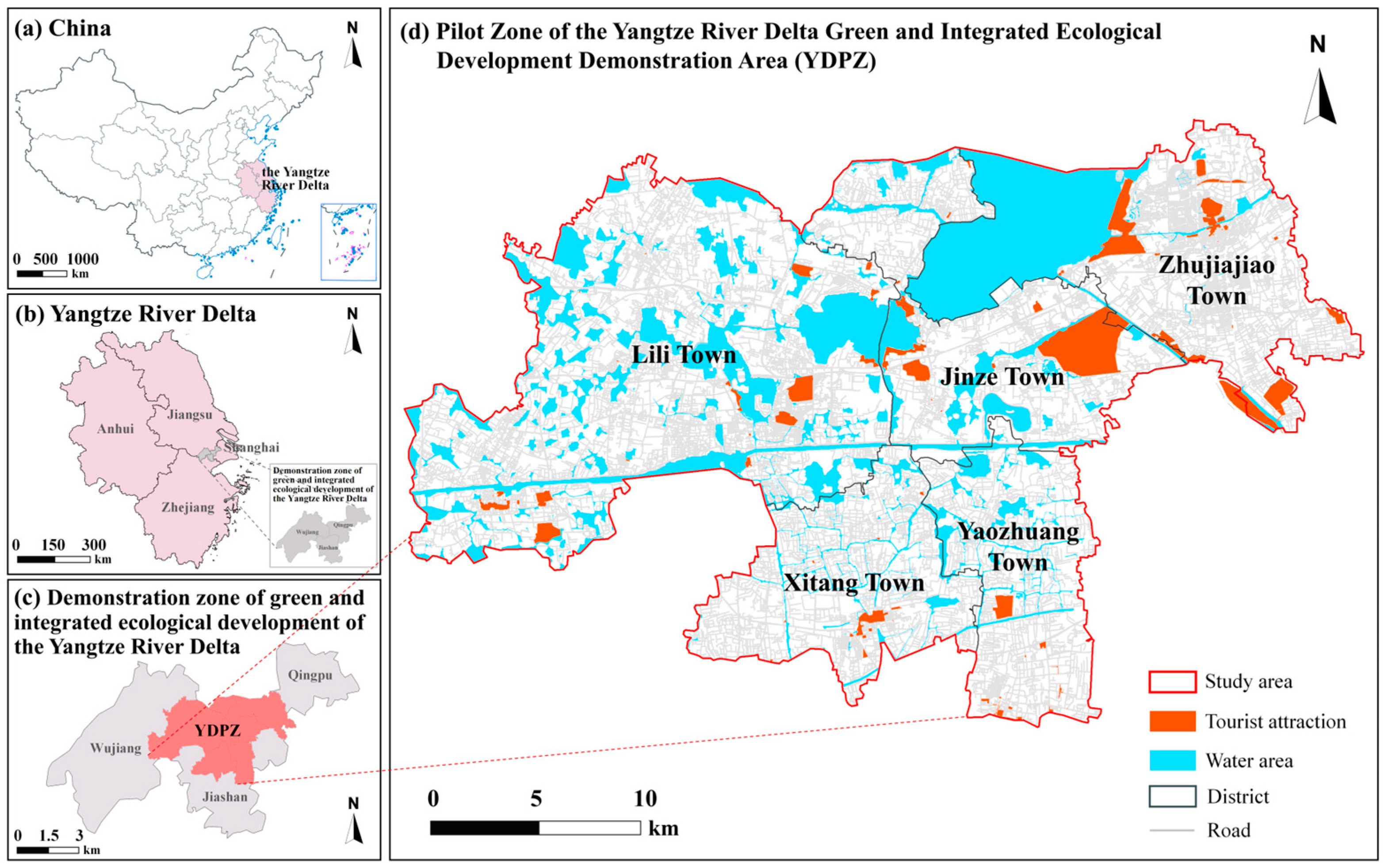
The Pilot Zone of the Yangtze River Delta Green and Integrated Ecological Development Demonstration Area (YDPZ) is located at the tri-junction of Shanghai, Jiangsu, and Zhejiang provinces in China. It encompasses five towns: Jinze and Zhujiajiao (Qingpu District, Shanghai); Xitang and Yaozhuang (Jiashan County, Zhejiang); and Lili (Wujiang District, Jiangsu), with a total area of 660 square kilometers (
Figure 1). Benefiting from distinctive Jiangnan watertown scenery, rich vegetation resources, developed economy, and time-honored cultural heritage, these five towns serve not only as strategic testing grounds for cross-regional coordinated development in the Yangtze River Delta, but also as popular tourist destinations. Since the 1980s, the number of tourism integration policies in the Yangtze River Delta has increased steadily, fostering closer regional collaboration and making tourism a key driver of high-quality economic growth in the area. During the 2023 Spring Festival holiday, tourism revenue in the Yangtze River Delta exceeded 77.8 billion yuan, accounting for over 20% of China’s total domestic tourism income [
19]. The tourism industry of YDPZ plays a pivotal role in the local economy and thus was chosen as a representative case to study the association rules and driving factors of tourist flows. The applied methods can be expanded to analyze any other regional tourism planning with similar data availability.
3.2. Data
This study utilized smartphone LBS data provided by a network technology company in China. The dataset contained the footprints of travelers who visited YDPZ during a one-week period (Monday, 18 November 2024–Sunday, 24 November). The dataset included activity start times, end times and locations, with exclusions applied to minimize interference: (1) local residents and scenic area staff, and (2) pedestrians exhibiting total dwell times below 10 min [
20]. All datasets were anonymized to ensure complete protection of personal privacy. The NDVI data were derived from the China Regional 30 m annual maximum NDVI dataset [
21], while water body data were obtained from OpenStreetMap (OSM). Additional geospatial datasets—including road networks, Points of Interest (POI), and Areas of Interest (AOI)—were acquired from the AMap Open Platform (
https://lbs.amap.com/, accessed on 1 March 2024). POI data were collected for the entire study area and screened to retain records relevant to tourism activities and destination services. Based on the original AMap classification system, seven POI categories relevant to this study were selected for analysis: transportation, cultural sites, landscapes, sports facilities, dining establishments, shopping facilities, and public services. Duplicate and invalid records were removed during preprocessing. AOI data supported the spatial delineation of 100 tourist attractions, with their official listings and boundaries referenced from official portals of cultural and tourism administrations and town-level governments. The AOI boundaries from AMap were cross-checked against official portal information to improve the accuracy of attraction delineation. These attractions encompassed urban parks, historical attractions, rural pastoral landscapes, recreational resorts, worship sites, and natural scenery.
3.3. Method
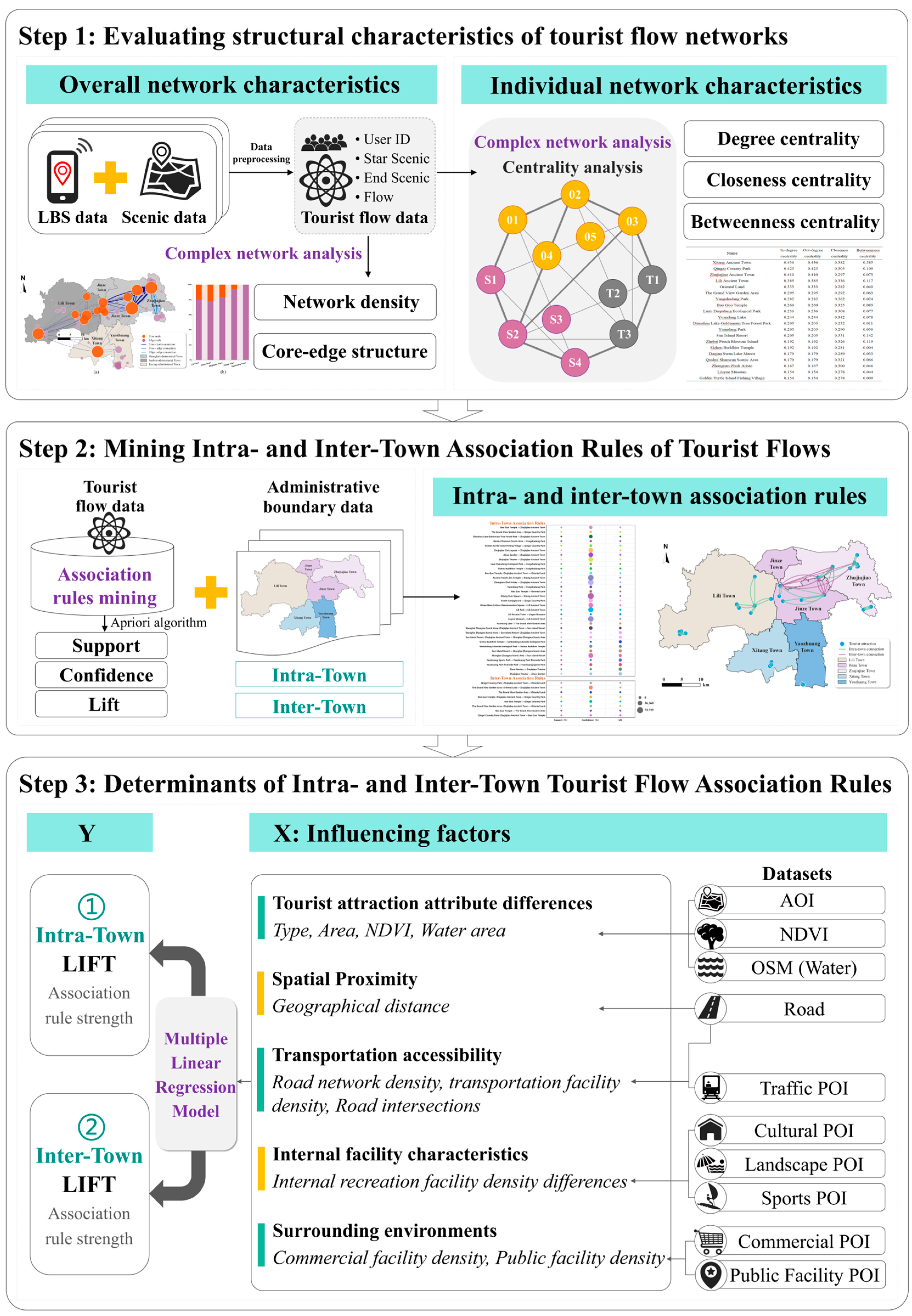
The workflow of this study is shown in
Figure 2, which mainly consists of three components:
(1) Location-Based Service (LBS) data and scenic data are integrated to analyze tourist flow patterns and assess the structural characteristics of tourist flow networks. (2) The Apriori algorithm is used to mine tourism flow association rules at both intra-town and inter-town scales. (3) The multiple linear regression model is employed to identify key determinants influencing the strength of tourism flow association rules across both inter-town and intra-town spatial scales.
3.3.1. Evaluating Structural Characteristics of Tourist Flow Networks
- (1)
Network density calculation
Network density measures the tightness of the nodes [
22]. It represents the density of connections among nodes by comparing the actual number of relationships to the maximum number of possible relationships within the network [
23].
- (2)
Core–edge structure identification
Core–edge structure analysis is employed to identify the positional hierarchy of attractions within tourist flow networks, distinguishing between core nodes and edge nodes [
24]. Core nodes occupy more central positions in the network topology and demonstrate significantly greater influence over other nodes.
- (3)
Centrality analysis
Centrality analysis in social network analysis is used to evaluate nodal centrality as well as the relative importance and structural position of nodes within networks. The centrality analysis of the network structure of tourist flows is carried out by utilizing relevant metrics: degree centrality, closeness centrality, betweenness centrality. Specifically, degree centrality reflects the number of direct connections of a node, closeness centrality indicates how close a node is to all other nodes, and betweenness centrality measures the extent to which a node acts as a bridge between other nodes [
9].
3.3.2. Association Rules Mining
Association rules mining is known to be a type of unsupervised learning technique for discovering relationships between variables in large databases [
25,
26]. It is widely applied in tourism research, for example, in mining tourist attraction visiting patterns [
27], in examining travel route suggestions [
28], and in tourism market analysis [
29]. This study employs association rule mining to explore intrinsic relationships between tourist flows across different attractions. The Apriori algorithm is utilized to implement association rule mining. Apriori is a classic algorithm for identifying frequent itemsets through candidate generation based on the anti-monotonicity principle, namely that if an itemset is not frequent, any of its supersets cannot be frequent. It first identifies itemsets satisfying the minimum support requirement and then derives association rules from these frequent itemsets [
30].
The form of an association rule is A ⇒ B and the itemsets A and B are called antecedent and consequent, respectively. Three measurements are commonly used to quantify and compare the association rules: support, confidence, and lift [
31]. Support measures the co-occurrence frequency of an itemset relative to all transactions in the tourism dataset. Confidence is a measure of the probability of its consequent (B) given its antecedent (A). Lift measures the strength of a rule, indicating whether the probability of B occurring under condition A exceeds the independent probability of B. A lift value greater than 1 indicates a positive association between A and B; less than 1 suggests no meaningful association; while equal to 1 implies statistical independence between their occurrences. The calculations of these indicators are presented in Equation (2):
In this equation, P(A) represents the percentage of tourist attraction selections that include itemset A.
3.3.3. Regression Analysis on Determinants of Tourist Flows’ Association Rules
- (1)
Influencing factors
Building on previous research and exploring potential variables affecting the strength of tourist flow association rules, this study selects five categories of independent variables: tourist attraction attribute differences, spatial proximity, transportation accessibility, internal facility characteristics, and surrounding environments (
Table 2).
- (2)
Multiple linear regression
Multiple regression analysis is a statistical technique for analyzing the relationship between a dependent variable and several predictor variables [
32]. Multiple linear regression (MLR), an extension of simple linear regression, assumes that the dependent variable is linearly related to the predictor variables. The general form of a MLR model is given in Equation (3). This study employs a MLR model to identify key determinants influencing the strength of tourism flow association rules across both inter-town and intra-town spatial scales. The MLR models were constructed with 11 predictors (listed in
Table 2) as independent variables and the association rule metric lift as the dependent variable [
33]. To ensure the statistical robustness of the regression results, multicollinearity was assessed using the variance inflation factor (VIF). The VIF values for all independent variables were below 10, indicating that multicollinearity does not significantly distort the coefficient estimates [
34].
In this equation, Ŷ is the model output variable, Xjs are the independent model input variables, and ajs are partial regression coefficients.
4. Results
4.1. Structural Characteristics of Tourist Flow Networks
4.1.1. Overall Network Characteristics
Higher network density corresponds to stronger connection between attractions [
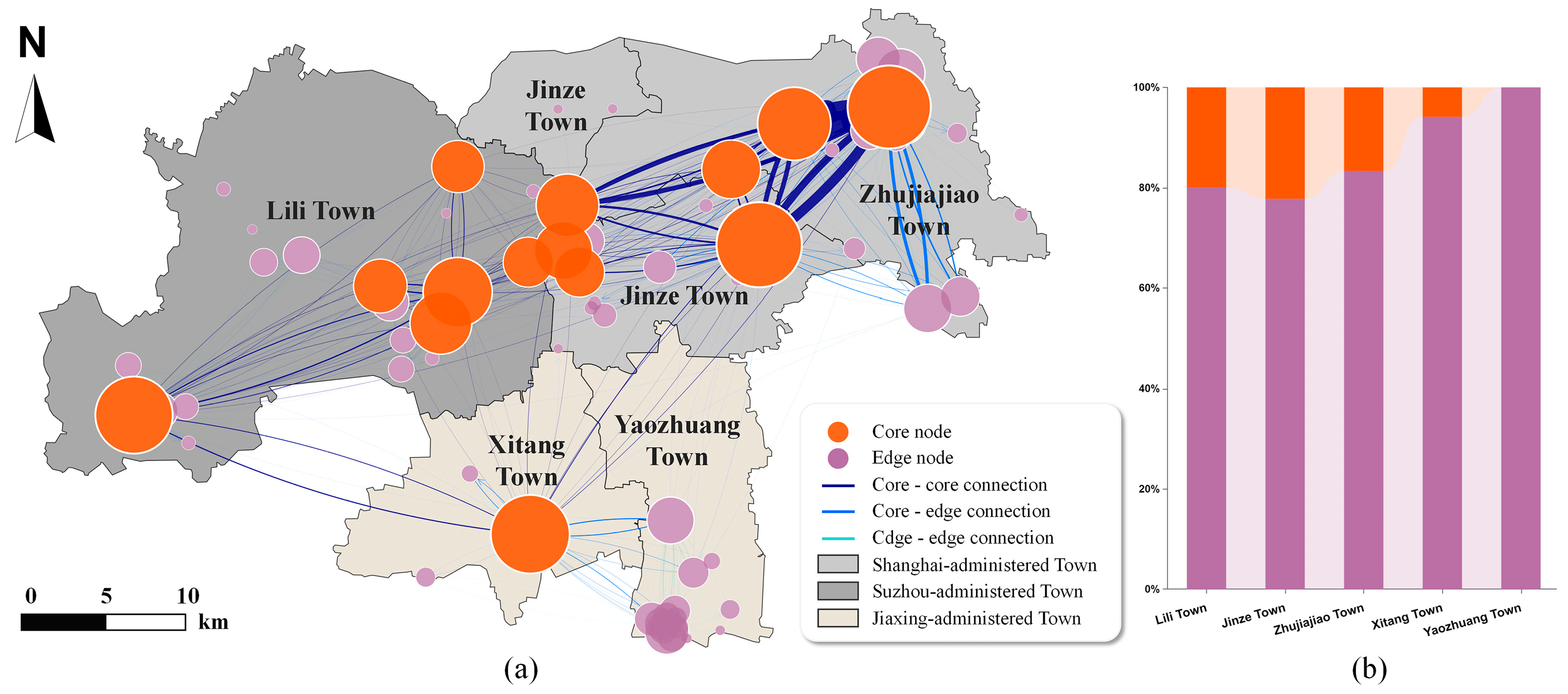
35]. Based on the quantitative results of core–edge metrics, the overall network exhibits an average density of 0.082. The connection densities demonstrate a progressively decreasing trend among different nodal categories: core–core (0.791), core–edge (0.252), and edge–edge (0.031). This indicates that the tourism flow network has significant hierarchical structural characteristics; among them, the connections between core nodes (14 nodes) are the closest, while the connections between edge nodes (86 nodes) are weak, and the links between core nodes and edge nodes need further improvement (
Figure 3a). From the spatial distribution of core–edge nodes, Jinze Town has the highest proportion of core nodes, followed by Lili Town, Zhujiajiao Town, and Xitang Town, while Yaozhuang Town has no core nodes (
Figure 3b). This demonstrates an imbalanced core node distribution across provincial administrative divisions: Shanghai-administered towns (Jinze, Zhujiajiao) and Jiangsu-administered towns (Lili) show higher density, whereas Zhejiang-administered towns (Xitang, Yaozhuang) display sparse distributions.
4.1.2. Individual Network Characteristics
To explore the interaction patterns of tourists among scenic spots within the tourism flow network, we calculated four centrality metrics: in-degree centrality, out-degree centrality, closeness centrality, and betweenness centrality. The results are presented in
Table 3. The distributions of in-degree centrality and out-degree centrality vary greatly among attractions, and the average values of both in-degree centrality and out-degree centrality of scenic spots are 0.108. A total of 31% of the attractions with in-degree centrality and out-degree centrality are above the average, including Xitang Ancient Town, Qingxi Country Park, Zhujiajiao Ancient Town, Lili Ancient Town, Oriental Land, The Grand View Garden Area, etc., indicating that high-A-level tourist attractions, suburban parks, popular historical attractions, and comprehensive parks have strong agglomeration and diffusion effects in the spatial pattern of tourist flows.
The closeness centrality reflects who are more reachable by other actors at shorter path lengths in a network [
36]. As shown in
Table 3, Xitang Ancient Town, Sun Island Resort, Yuandang Lake, Lili Ancient Town, and Zhebei Peach Blossom Island, with higher closeness centrality, possess favored locations and structural advantages in the network.
The average betweenness centrality of the tourism flow network of scenic spots is 0.030. A total of 22% of scenic spots have a betweenness centrality higher than the average, accounting for 84.44% of the total network’s betweenness centrality value, indicating significant polarization among attractions. Xitang Ancient Town, Sun Island Resort, Yaozhuang Civic Square, Zhebei Peach Blossom Island, Lili Ancient Town, and Qingxi Country Park have betweenness centrality values far above the average, which implies that high-A-level tourist attractions, recreational resorts, popular rural pastoral attractions, and historical attractions play crucial “bridge” roles in the network.
4.2. Association Rules Between Tourist Flows
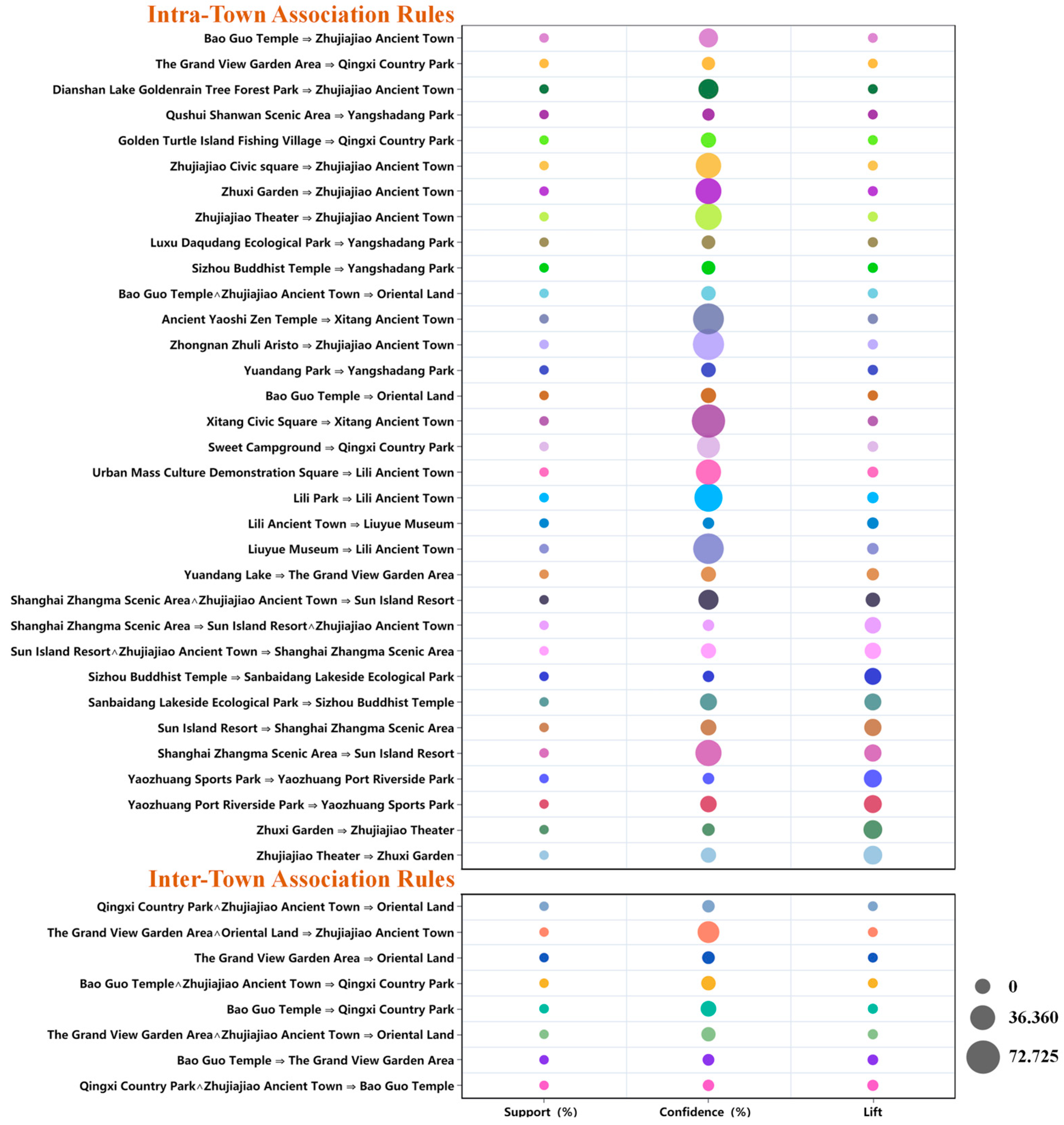
The Apriori algorithm was employed to explore association rules of co-visitation patterns in urban suburban recreational spaces. After several experiments to identify the optimal parameter combination, a total of 56 association rule records were obtained, among which 41 proved statistically significant (
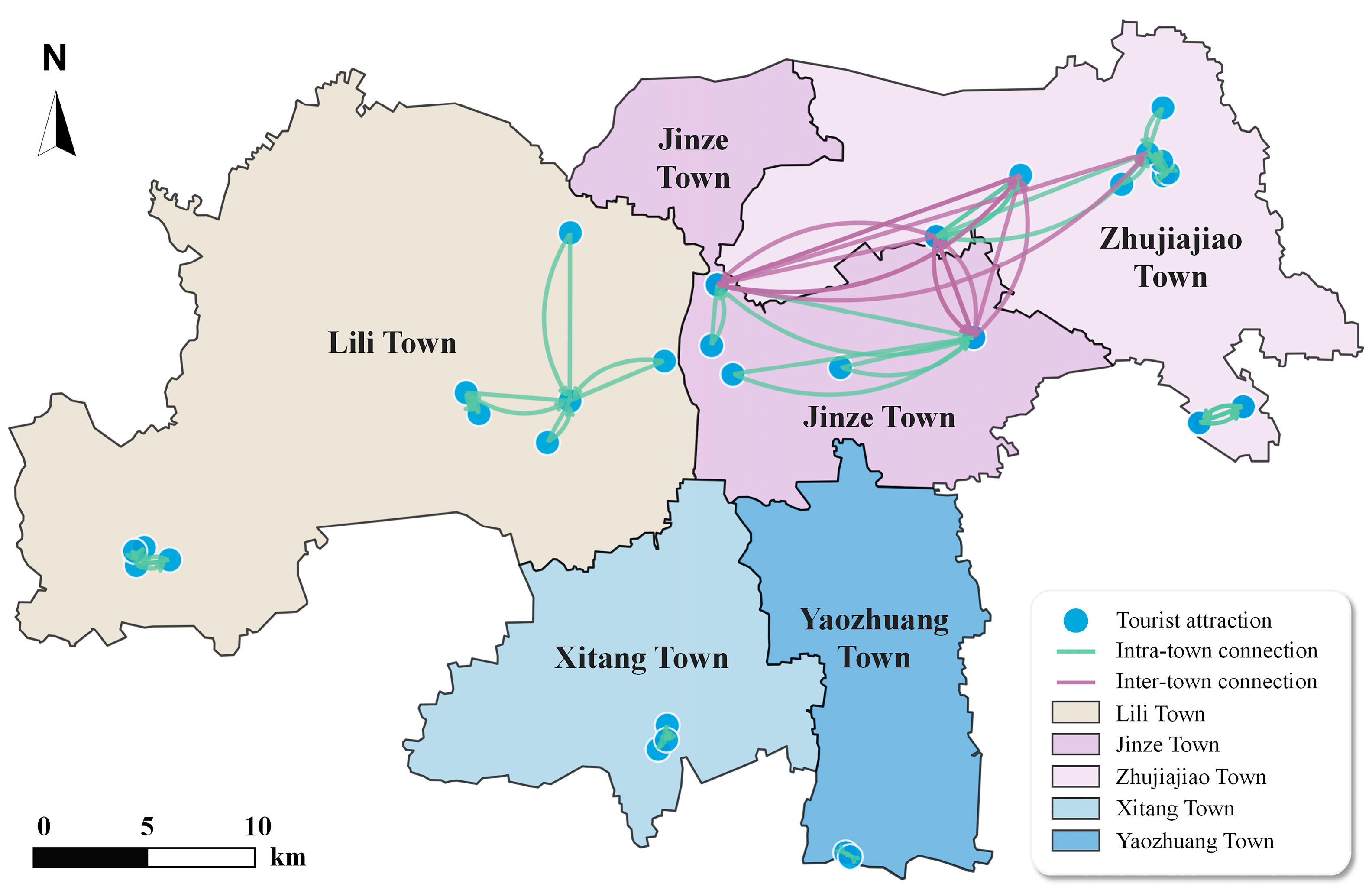
Figure 4). From a spatial distribution perspective, most of the notable association rules (80.49%) occur within single townships, while 19.51% of meaningful association rules cross township-level administrative boundaries (all occurring between Jinze Town and Zhujiajiao Town in Qingpu District, Shanghai). Overall, they still follow the principle of geographical distance (
Figure 5).
4.2.1. Intra-Town Scale
Figure 4 illustrates that the highest support is obtained when the antecedent of the association rule is either Liuyue Museum, Lili Ancient Town, Shanghai Zhangma Scenic Area, Sun Island Resort or Bao Guo Temple, indicating that historical attractions and leisure resorts represent the most popular categories in township-scale tourist flows. When the consequent of an association rule is Lili Ancient Town, Zhujiajiao Ancient Town, and Xitang Ancient Town, the support, confidence, and lift of the rule are all relatively high, indicating strong appeal and the potential to form powerful associations with the antecedent. Among these, locations exhibiting strong associations with Lili Ancient Town and Xitang Ancient Town are exclusively adjacent historical attractions and small- to medium-sized (community parks and pocket parks). For Zhujiajiao Ancient Town, apart from Bao Guo Temple, the attractions strongly associated with it are also mostly nearby types, including historical sites, pocket parks, resort leisure areas, and entertainment venues (
Figure 5).
4.2.2. Inter-Town Scale
As
Figure 5 shows, association rules for cross-town tourist flows are concentrated in Jinze Ancient Town and Zhujiajiao Ancient Town, both located within Shanghai Municipality. Analysis of cross-regional association rules shows that historical attractions, comprehensive parks, and suburban parks featuring pastoral landscapes and ecological scenery are typically the types of scenic spots chosen by tourists for cross-regional visits (
Figure 4), with high-A-level tourist attractions often serving as key nodes that enhance the probability of cross-regional visits (87.5% of association rules involving 4A-level scenic areas). For example, the confidence and lift of the association rules will be further improved if Zhujiajiao Ancient Town (4A) is added between the Grand View Garden Area and the Oriental Land.
4.3. Factors Influencing the Association Rules of Tourist Flows
Using the backward elimination method, a multiple linear regression model was constructed from the correlated variables, with the purpose of identifying key drivers of association rules in tourist flow patterns across intra-town and inter-town spatial scales.
4.3.1. The Influencing Factors of Intra-Town Scale Tourist Flows
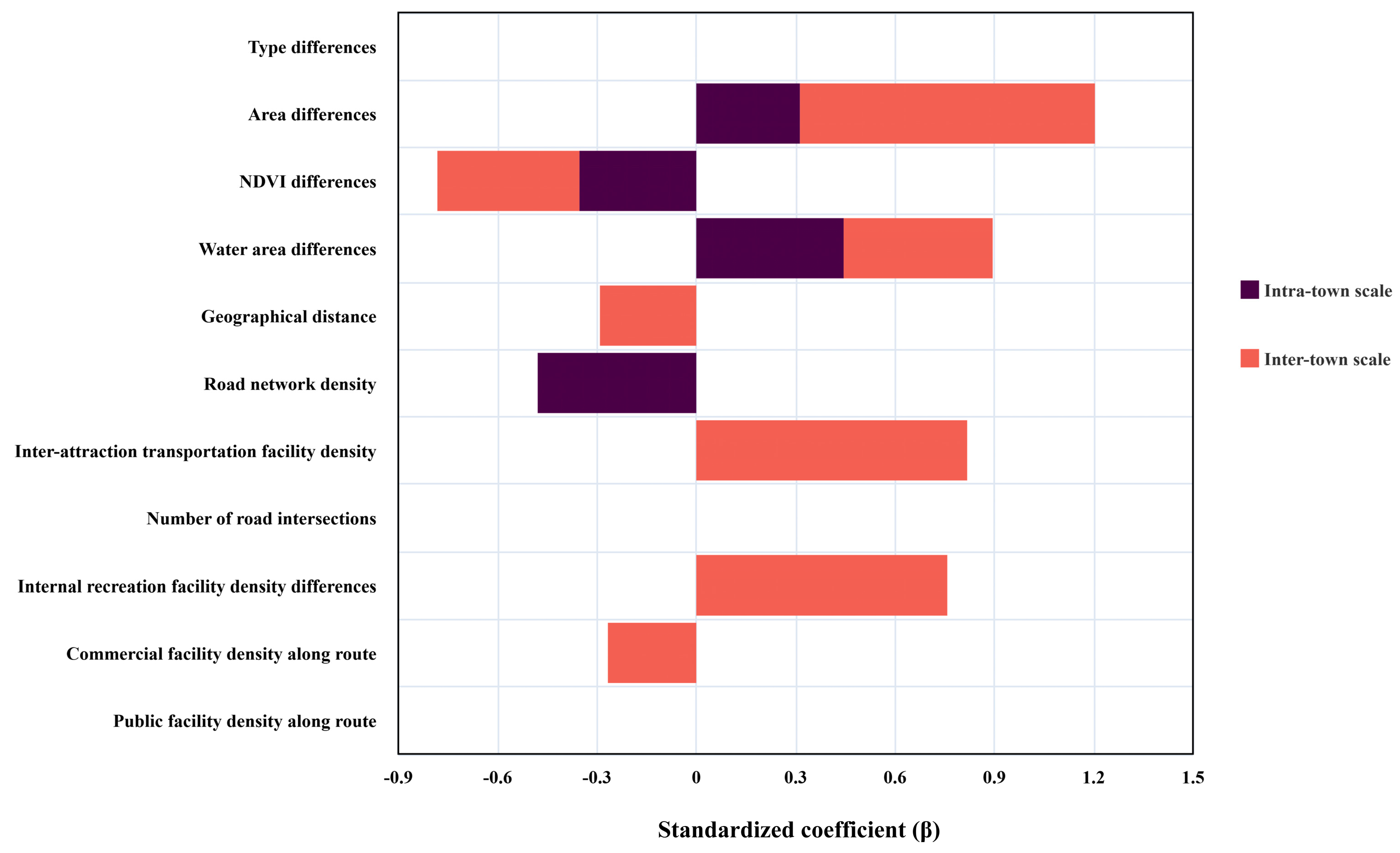
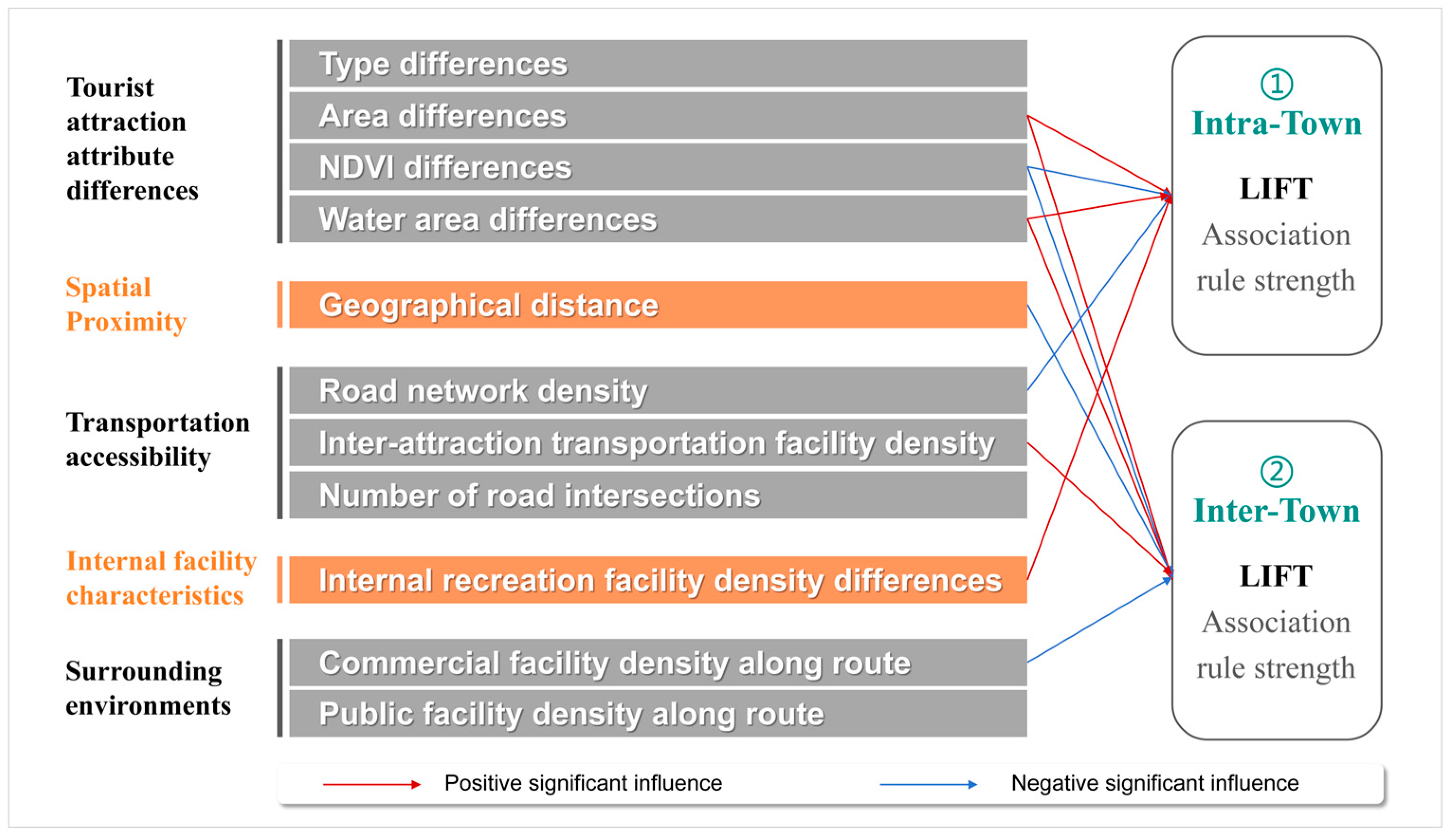
Table 4 shows that area differences (
p < 0.05) and water area differences (
p < 0.01) were significantly positively associated with lift values. NDVI differences and road network density showed negative associations with lift values (
p < 0.05). The strongest negative influence came from road network density (β = −0.479), while the strongest positive influence was from water area differences (β = 0.445). This indicates that within intra-town tourist flows, areas with less dense road networks exhibit a higher probability of tourists visiting multiple destinations simultaneously. This phenomenon occurs because lower road network density enhances the connectivity between attractions, strengthens tourists’ perception of co-located scenic spots, and consequently increases their willingness to visit clustered attractions. Greater disparities in water coverage ratios between attractions significantly enhance tourists’ co-visitation behavior. This finding substantiates that aquatic landscapes constitute a critical determinant in multi-destination visitation patterns.
4.3.2. The Influencing Factors of Inter-Town Scale Tourist Flows
The empirical results of this study demonstrate that among the examined influencing factors (
Table 4), scenic area disparities (β = 0.891,
p < 0.001) exerted the most significant positive effect on association rule strength, indicating that tourists tend to select attraction combinations with substantial differences in area scale when engaging in cross-regional multi-attraction visits. Additionally, water area differences (β = 0.450), inter-attraction transportation facility density (β = 0.818), and internal recreation facility density differences (β = 0.758) were also significant at the 1% statistical level and exhibited positive directional effects. These results demonstrate that in inter-town tourist flows, greater differences in water coverage ratio, higher inter-attraction transport facility density, and larger recreational facility density disparities significantly enhance tourists’ co-visitation behavior among attractions. Moreover, geographical distance, NDVI differences, and the commercial facility density along the route demonstrated significant negative effects on lift values, suggesting that shorter inter-attraction distances, reduced NDVI differences, and lower commercial facility density along the route are associated with stronger cross-destination co-visitation patterns.
4.3.3. Comparison of Influencing Factors Between Intra-Town and Inter-Town Tourist Flows
Figure 6 indicates that the influencing factors of tourist flow association rule strength exhibit both commonalities and variations across different spatial scales (inter- and intra-township). Specifically, the most significant factor influencing the strength of association rules within the township scope is water area differences, followed by road network density. In contrast, the primary factor affecting the strength of association rules across township boundaries is area differences, with inter-attraction transportation facility density being the second most influential. These findings indicate that tourist attraction attributes are the most critical consideration for tourists when associating visits to multiple attractions. However, the specific driving attributes vary across different spatial scales. At the township level, tourists pay more attention to differences in water landscapes between attractions, highlighting the unique charm of Jiangnan’s watertown scenery as a key attraction factor. On the other hand, at the cross-township level, tourists focus more on area differences, suggesting that the driving force behind cross-regional multi-attraction visits is primarily the scale differences between attractions, which are often related to the diversity and quality of services provided. Additionally, transportation accessibility is another major factor influencing the strength of association rules. Within townships, the strength is mainly affected by road network density, whereas across townships, it is driven by inter-attraction transportation facility density. Furthermore, cross-township association rule strength is affected by additional dimensions, including spatial proximity, internal facility characteristics, and surrounding environments, none of which show a statistically significant influence on intra-township association rules.
5. Discussion
5.1. Characteristics of Tourist Flow Networks and Cross-Regional Association Rules
This study reveals that the tourism flow network in the study area (YDPZ) exhibits a distinct hierarchical structure at the township scale, with core nodes predominantly located in the towns under the jurisdiction of Shanghai. This finding aligns with previous large-scale (provincial and municipal) research on the tourism flow network structure in the Yangtze River Delta [
37]. The tourism flow networks in China’s eastern coastal cities often display a “core-periphery” structure centered around economically strong cities [
38], further demonstrating the universality of tourism attraction network structures. Furthermore, this research investigated the locational position of tourist attractions and identified the key nodes within the tourism flow network by centrality analysis. The current network structure exhibits significant variations in the centrality of tourist attractions. Nodes with high centrality, such as Xitang Ancient Town, Qingxi Country Park, and Zhujiajiao Ancient Town, are predominantly high-profile scenic spots that serve dual roles as both “cores” and “hubs” in the network [
39].
The association rule mining analysis reveals that the majority of statistically significant co-visitation patterns (80.49%) occur within individual township boundaries, with only a limited proportion of associations spanning across townships—predominantly concentrated between two adjacent townships in Qingpu District, Shanghai. This suggests that regional tourism development is shaped by a mixture of competition and cooperation [
40], but that competition may currently play a more salient role. A possible reason is the homogeneity of scenic landscapes and tourism products across townships, which may weaken tourists’ willingness and actual behavior to engage in cross-township co-visitation. Furthermore, high-A-level tourist attractions often serve as key nodes that enhance the probability of cross-regional visits. This finding provides micro-scale insights into tourist flow patterns in the Yangtze River Delta region, offering empirical evidence to address administrative boundary effects that constrain tourism element mobility.
5.2. Determinants of Intra- and Inter-Town Tourist Flow Association Rules
This study employed a dual-scale (intra- and inter-township) analytical framework, revealing that the influencing factors of tourist flow association rule intensity differentiation exhibit both commonalities and heterogeneities across different spatial scales. Unlike previous studies focusing on factors affecting visitation volume at individual attractions [
41] or tourist flow networks [
23], this study examines the determinants of association rule strength in tourist co-visitation patterns (
Figure 7). In terms of commonalities, area differences, NDVI differences, and water area differences all demonstrated significant effects on tourist flow association rule intensity differentiation at both spatial scales, which means that tourists show a significant preference for differentiated attraction attributes when making co-visitation choices [
42]. In detail, attraction size disparity, vegetation coverage contrast (measured by NDVI difference), and water area difference all exerted significant positive effects on co-visitation probability.
Regarding heterogeneity, road network density only impacted association rule intensity within intra-town boundaries. At the inter-township scale, the transportation accessibility factor influencing tourist flow association rule strength is inter-attraction transportation facility density. This indicates that while road network density significantly influenced association rule strength within townships, this effect diminished across township boundaries. Instead, composite transportation infrastructure emerges as a more critical determinant of cross-township co-visitation patterns [
43,
44]. Efficient transportation infrastructure facilitates tourist mobility, effectively reducing perceived psychological distance and stimulating travel demand.
Furthermore, in inter-town scales, the factors influencing the association rules of tourist flows also include geographical distance, internal recreation facility density differences, and commercial facility density along the route. Some of the relational factors influencing the probability of tourist flow association rule intensity also confirm the results of previous studies. For example, the significant negative effect of geographical distance on association rule intensity empirically validates the classical distance–decay theory in tourist flow analysis [
10]. Greater disparity in recreational facility density between paired attractions significantly increases their co-visitation probability, as differentially distributed amenities represent diversified tourism experiences that enhance destination appeal [
45]. Existing studies have primarily focused on the correlation between commercial facility density around individual attractions and tourist flows, consistently demonstrating a significant positive relationship [
46]. This study extends the research scope to the paired-attraction level by analyzing co-visited attraction. Our findings reveal a negative moderating effect between inter-attraction commercial density and tourist flow association rule strength, possibly because excessive commercialization leads to overcrowding and cultural commodification, which in turn undermine the tourism experience [
47] and reduce tourists’ willingness to engage in cross-attraction co-visitation. This study contributes to both theoretical advancement and practical applications by (a) enhancing the understanding of tourist movement patterns, (b) extending the theoretical framework of spatial interaction in tourist flows, and (c) providing quantitative evidence to inform optimal commercial facility allocation for tourism management.
5.3. Suggestions for Regional Tourism Management and Development
The Yangtze River Delta region possesses substantial untapped potential for regional tourism development, necessitating top-down policies on tourism management and services to enhance coordinated regional growth. Based on our empirical findings, we propose the following recommendations.
Strengthen the radiating and agglomeration effects of core attractions and integrate tourism service resources around edge attractions to enhance overall destination appeal. The study reveals that the tourism flow network within the research area exhibits a distinct core–edge structure, dominated by high-grade scenic spots and popular tourist nodes, while edge tourist attractions remain relatively isolated [
48]. Core nodes demonstrate strong attractiveness to visitors and play a significant intermediary role in the overall network by agglomerating and diffusing tourist flows. Priority should therefore be given to promoting synergistic development and connectivity between these key nodes. Specifically, high-attraction core sites such as Oriental Land could be linked to peripheral rural nodes, such as Jinze Town’s agritourism and water-sport destinations, through shuttle bus services and bundled ticketing, thereby extending tourist itineraries and amplifying the spillover effects of core attractions. This approach not only strengthens the radiating effect of core attractions but also enhances the accessibility and appeal of edge nodes. Edge attractions exhibit relatively weak connectivity within the regional tourism network, necessitating comprehensive improvements in service quality, stronger functional integration with surrounding attractions and facilities, diversified tour route development, and the cultivation of distinctive experiential features to enhance their overall appeal and competitiveness as tourism destinations [
27].
Improve connectivity between scenic areas and optimizing infrastructure allocation with rational spatial planning. Based on our findings, notable association rules of tourist co-visitation patterns predominantly occur within individual township boundaries, while cross-township strong associations account for only a minor proportion, indicating insufficient regional tourism vitality. To promote regional tourism integration, planning efforts should move beyond general connectivity enhancement and focus on developing cross-township complementary routes based on differentiated tourism resources. For example, given the significant role of water bodies in guiding tourist flows, a water-bus route could be established to connect traditional ancient-town sightseeing in Zhujiajiao with ecological and waterfront leisure experiences around Yuandang Lake, complemented by themed shuttle services and integrated slow-mobility systems such as cycling greenways and pedestrian corridors. Concurrently, supporting infrastructure such as commercial facilities, accommodations, and lifestyle services around tourist attractions should be more strategically distributed along these cross-township routes and tailored to the functional profiles of different destinations, thereby enhancing visitor experiences and reinforcing regional tourism integration.
5.4. Limitations and Future Direction
This study advances tourist flow research, but limitations still exist. The current study investigates the association rules governing tourists’ random multi-destination visits at both intra-town and inter-town scales. However, these rules may also be influenced by tourists’ socioeconomic attributes (e.g., gender, educational background, occupation) and personal preferences [
49]. Incorporating these potential influencing factors into the analytical framework would help provide a more comprehensive understanding of tourist behavior.
In addition, the analysis is based on LBS data collected during a single week in a shoulder season and may not fully capture the spatial behavior patterns of tourists, especially long-distance travelers during peak holiday periods. Moreover, this study did not account for the impacts of seasonal and festival-related variations in activity patterns and landscape characteristics on tourism flow association rules. Therefore, the identified driving factors, such as the preference for water area differences, may fluctuate or remain stable across different seasons or major festivals such as the Spring Festival, which warrants further investigation. For instance, the attractiveness of destinations with distinct water landscapes may increase in summer or during holiday periods because of stronger demand for water-based leisure and recreational activities. Similarly, the influence of NDVI differences may also change across seasons as vegetation conditions and visual landscape quality vary over time. Future studies should extend this research using longer-term and multi-period data to more precisely uncover these association rules and their spatiotemporal heterogeneity.
6. Conclusions
Uncovering the hidden patterns of tourists’ stochastic visitation behaviors and effectively analyzing both explicit and implicit association rules of attraction co-visitation at different scales, along with their driving factors, is essential for optimizing regional tourism management and planning. Utilizing LBS trajectory data and combining complex network analysis with association rule mining, this study proposes a novel research framework to analyze the structure of tourist flow networks, along with inter-town and intra-town interactions and their driving factors. This study provides a comprehensive analysis of the characteristics and interactions of cross-regional tourist flows. It further applies the proposed framework to a case study in the YDPZ. The conclusions can be summarized as follows:
First, the overall network characteristics of tourist flows in the study area exhibit a distinct hierarchical structure, with tourism flows between core nodes, between core and peripheral nodes, and between peripheral nodes showing a gradual decline from dense to sparse connectivity. The spatial structure of tourist flows between nodes is unbalanced, being predominantly concentrated in Jinze Town and Zhujiajiao Town in Shanghai.
Second, in the tourist flow network structure, nodes with higher centrality mainly consist of high-A-level tourist attractions, suburban parks, popular historical attractions and recreational resorts with high transportation accessibility. These nodes demonstrate strong agglomeration and diffusion effects, possess locational advantages, and serve dual roles as both “centers” and “hubs” within the network.
Third, most of the notable association rules occur within single townships; all meaningful cross-town association rules occurred exclusively between Jinze Town and Zhujiajiao Town in Qingpu District, Shanghai, and they still follow the principle of geographical distance. The high-A-level tourist attractions often serve as key nodes that enhance the probability of cross-regional visits.
Finally, the association rules of tourist attraction selection behavior exhibit both commonalities and heterogeneities in response to influencing factors across different spatial scales, area differences, NDVI differences, and water area differences were common factors that influenced the association rules at both intra-town and inter-town spatial scales. The spatial heterogeneity of influencing factors manifests as follows: road network density exerts a significant effect on intra-town association rules, whereas inter-town association rules are predominantly driven by the combined effects of geographical distance, inter-attraction transportation facility density, internal recreation facility density differences, and commercial facility density along route. To conclude, the proposed framework proved feasible in the present case study and may offer a useful reference for similar studies in other locations.
Author Contributions
Conceptualization, Y.H. and Y.J.; methodology, Y.H.; software, Y.H.; validation, Y.H.; formal analysis, Y.H.; investigation, Y.H.; resources, Y.H. and Y.J.; data curation, Y.H.; writing—original draft preparation, Y.H.; writing—review and editing, Y.H. and Y.J.; visualization, Y.H.; supervision, Y.J.; project administration, Y.J.; funding acquisition, Y.J. All authors have read and agreed to the published version of the manuscript.
Funding
This research was funded by the National Natural Science Foundation of China (Grant No. 51978480).
Data Availability Statement
Data available on request from the authors.
Conflicts of Interest
The authors declare no conflicts of interest.
References
- Yunxia, Y.; Weihua, G.; Zaijun, L. An analysis of the temporal-spatial evolution of inbound tourist flow of Jiangsu Province and its influencing factors. Tour. Sci. 2016, 30, 52–62. [Google Scholar]
- Wang, J.; Yuan, Y.; Yang, H.; Shi, J.; Zhou, M.; Huang, X. Network structure characteristics and agglomeration-linkage patterns of ecotourist flow from urban to suburban areas:A case study of Beijing. Prog. Geogr. 2024, 43, 2052–2066. [Google Scholar]
- Caldeira, A.M.; Kastenholz, E. Tourists’ spatial behaviour in urban destinations: The effect of prior destination experience. J. Vacat. Mark. 2018, 24, 247–260. [Google Scholar] [CrossRef]
- Yu, H.; Chen, Q.J.; Hu, X.Y. Tourist interest areas and spatial movement patterns on the qinghai-Tibet plateau based on dynamic trajectory similarity. Habitat. Int. 2025, 163, 103500. [Google Scholar] [CrossRef]
- Pirolo, L.; Moscarelli, R. Integrating cycling tourism, e-mobility and local development: A spatial model to plan slow tourist paths for E-bikes. Reg. Sci. Policy Pr. 2025, 17, 100237. [Google Scholar] [CrossRef]
- Sun, Z.H.; Di, L.P.; Heo, G.; Zhang, C.; Fang, H.; Yue, P.; Jiang, L.L.; Tan, X.C.; Guo, L.Y.; Lin, L. GeoFairy: Towards a one-stop and location based Service for Geospatial Information Retrieval. Comput. Env. Urban. 2017, 62, 156–167. [Google Scholar] [CrossRef]
- Lew, A.; McKercher, B. Modeling tourist movements—A local destination analysis. Ann. Tour. Res. 2006, 33, 403–423. [Google Scholar] [CrossRef]
- Fu, Q.; Liu, D.; Hu, J.; Xie, S.; Gong, J.; Chen, X. Network Structure and Optimization Research on the Hubei Province Tourist Flow. Econ. Geogr. 2015, 35, 191–196. [Google Scholar]
- Mou, N.X.; Zheng, Y.H.; Makkonen, T.; Yang, T.F.; Tang, J.W.; Song, Y. Tourists’ digital footprint: The spatial patterns of tourist flows in Qingdao, China. Tour. Manag. 2020, 81, 104151. [Google Scholar] [CrossRef]
- Hernández, J.M.; Santana-Jiménez, Y.; González-Martel, C. Factors influencing the co-occurrence of visits to attractions: The case of Madrid, Spain. Tour. Manag. 2021, 83, 104236. [Google Scholar] [CrossRef]
- Zheng, W.M.; Li, M.L.; Lin, Z.B.; Zhang, Y.Y. Leveraging tourist trajectory data for effective destination planning and management: A new heuristic approach. Tour. Manag. 2022, 89, 104437. [Google Scholar] [CrossRef]
- Tajima, Y.; Hashimoto, S.; Dasgupta, R.; Takahashi, Y. Spatial characterization of cultural ecosystem services in the Ishigaki Island of Japan: A comparison between residents and tourists. Ecosyst. Serv. 2023, 60, 101520. [Google Scholar] [CrossRef]
- Li, L.J.; Du, Q.Y.; Ren, F.; Huang, L.; Voda, M.; Ning, P.F. Geolocated social media data for measuring park visitation in Shenzhen, China. Urban For. Urban Green. 2023, 88, 128069. [Google Scholar] [CrossRef]
- Liu, T.; Yu, L.; Liu, J.G.; Xu, Z.C.; Chen, X.; Wu, H.; Zheng, S.J.; Zhao, Q.; Gong, P. Unveiling interprovincial geographic patterns of 5A-level tourism cultural ecosystem service flows and tourist preferences in China’s metacoupled systems. Appl. Geogr. 2024, 172, 103432. [Google Scholar]
- Cheng, J.Y.; Xu, Y.; Jian, I.Y.; Ren, M.Y.; Park, S. Spatial concentration of intra-urban tourist activities and inter-group differences between Asian, European and North American travelers in Korean cities. Tour. Manag. 2025, 107, 105064. [Google Scholar] [CrossRef]
- Zhang, K.; Wang, J.Y.; Zhang, J.Y.; Wang, Y.; Zeng, Y.J. Exploring the impact of location-based augmented reality on tourists’ spatial behavior, experience, and intention through a field experiment. Tour. Manag. 2024, 102, 104886. [Google Scholar] [CrossRef]
- Li, J.; Zhao, P.J.; Zhang, M.Z.; Deng, Y.L.; Liu, Q.Y.; Cui, Y.Z.; Gong, Z.Y.; Liu, J.; Tan, W.C. Exploring collective activity space and its spatial heterogeneity using mobile phone signaling Data: A case of Shenzhen, China. Travel. Behav. Soc. 2025, 38, 100920. [Google Scholar]
- Wang, R.X.; Liu, S.H.; Li, W.Z.; Sun, T.Y. Exploring neighborhood daily activity patterns from the perspective of mobility using location-based services data: A case study of Shanghai. Appl. Geogr. 2025, 183, 103733. [Google Scholar] [CrossRef]
- Guo, X.; Li, J.; Yang, J. Tourism Collaborative Development in the Yangtze River Delta Region: A Cooperative Game Perspective. Tour. Trib. 2023, 38, 5–8. [Google Scholar]
- Liu, J.; Li, X.; Wang, S. Short- and Long-term Forecasting of Tourism “Space of Flows” Structure in Chengdu—An Analysis Based on the Steady-state Markov Chain Method. Tour. Trib. 2025, 40, 64–80. [Google Scholar]
- Dong, J.; Zhou, Y.; You, N.; Chen, C. China’s 30 m Annual Maximum NDVI Dataset (2000–2022); National Ecosystem Science Data Center: Beijing, China, 2021. [Google Scholar]
- Wang, Y.; Luo, Y.Y.; Lai, B. Spatial network analysis of tourism carbon efficiency: A study in Chinese prefecture-level cities. J. Clean. Prod. 2025, 491, 144847. [Google Scholar] [CrossRef]
- Liu, J.; Li, X.H.; Yang, Y.; Tan, Y.W.; Geng, T.H.; Wang, S.H. Short- and long-term prediction and determinant analysis of tourism flow networks: A novel steady-state Markov chain method. Tour. Manag. 2025, 109, 105139. [Google Scholar] [CrossRef]
- Dong, Z.; Li, X.; Li, C. Evolvement and Driving Mechanismof Tourism Economic Network Structure in Xinjiang. Areal Res. Dev. 2018, 37, 106–111. [Google Scholar]
- Sabri-Laghaie, K.; Momayezi, F.; Ghaleshakhani, N.; Maroufi, L. Association rule mining based approach to consider users’ preferences in the energy management of smart homes. J. Build. Eng. 2025, 104, 112361. [Google Scholar] [CrossRef]
- Versichele, M.; de Groote, L.; Bouuaert, M.C.; Neutens, T.; Moerman, I.; Van de Weghe, N. Pattern mining in tourist attraction visits through association rule learning on Bluetooth tracking data: A case study of Ghent, Belgium. Tour. Manag. 2014, 44, 67–81. [Google Scholar] [CrossRef]
- Wu, W.; Xue, Y.; Zhao, K.; Niu, X.; Dang, Y. Identification and Feature of Association Rules of Tourist Blocks in Gulangyu Islet based on Complex Net-work. J. Geo-Inf. Sci. 2024, 26, 440–459. [Google Scholar]
- Xi, Y.; Yuan, Q. Intelligent Recommendation Scheme of Scenic Spots Based on Association Rule Mining Algorithm. In Proceedings of the 2017 International Conference on Robots & Intelligent System (ICRIS), Huai An City, China, 15–16 October 2017; pp. 186–189. [Google Scholar]
- Pyo, S. Integrating tourist market segmentation, targeting, and positioning using association rules. Inf. Technol. Tour. 2015, 15, 253–281. [Google Scholar] [CrossRef]
- Wu, X.D.; Kumar, V.; Quinlan, J.R.; Ghosh, J.; Yang, Q.; Motoda, H.; McLachlan, G.J.; Ng, A.; Liu, B.; Yu, P.S.; et al. Top 10 algorithms in data mining. Knowl. Inf. Syst. 2008, 14, 1–37. [Google Scholar]
- Rahman, M.A.; Sun, X.D.; Sun, M.; Shan, D.H. Investigating characteristics of cellphone distraction with significance tests and association rule mining. IATSS Res. 2021, 45, 198–209. [Google Scholar] [CrossRef]
- Lin, L.; Jiang, W.; Chen, B.; Yu, J.; Zheng, C. Construction and Application of Cost Prediction Model Based on Multiple Linear Regression Analysis. Procedia Comput. Sci. 2024, 247, 617–623. [Google Scholar] [CrossRef]
- Zarei, M.; Bayati, M.R.; Ebrahimi-Nik, M.; Rohani, A.; Hejazi, B. Modelling the removal efficiency of hydrogen sulfide from biogas in a biofilter using multiple linear regression and support vector machines. J. Clean. Prod. 2023, 404, 136965. [Google Scholar] [CrossRef]
- Thongma, C.; Chang, C.L. Drivers of multi-destination tourism in APEC (2008–2023). Ann. Tour. Res. Empir. Insights 2025, 6, 100194. [Google Scholar] [CrossRef]
- Kang, S.; Lee, G.; Kim, J.; Park, D. Identifying the spatial structure of the tourist attraction system in South Korea using GIS and network analysis: An application of anchor-point theory. J. Destin. Mark. Manag. 2018, 9, 358–370. [Google Scholar] [CrossRef]
- Liu, B.; Huang, S.S.; Fu, H. An application of network analysis on tourist attractions: The case of Xinjiang, China. Tour. Manag. 2017, 58, 132–141. [Google Scholar] [CrossRef]
- Wu, P.P.; Zhu, X.C.; Feng, X.; Liu, H.M.; Dong, J.N. Network characteristics of inter-city tourist flows in the Yangtze River Delta of China: Case study of the May Day Holiday based on Tencent migration big data. Env. Dev. Sustain. 2025, 27, 10041–10058. [Google Scholar]
- Di, Q.; Jia, W.; Chen, X. Structure and driving factors of tourism information flow networks withinurban agglomerations: A case study of six major coastal urban agglomerations in eastern China. Resour. Sci. 2025, 47, 1125–1139. [Google Scholar]
- Mou, N.X.; Yuan, R.Z.; Yang, T.F.; Zhang, H.C.; Tang, J.W.; Makkonen, T. Exploring spatio-temporal changes of city inbound tourism flow: The case of Shanghai, China. Tour. Manag. 2020, 76, 103955. [Google Scholar] [CrossRef]
- Song, X.; Mo, Z.Y.; Liu, M.T.; Niu, B.; Huang, L. Cooperator or supporter: How can cross-boundary Macau-Zhuhai metropolis promote regional tourism together? Asia Pac. J. Mark. Logist. 2022, 34, 2207–2236. [Google Scholar] [CrossRef]
- Li, J.; Fu, J.; Gao, J.; Zhou, R.; Zhao, Z.Y.; Yang, P.P.; Yi, Y. How do urban green space attributes affect visitation and satisfaction? An empirical study based on multisource data. Cities 2025, 156, 105543. [Google Scholar] [CrossRef]
- Yang, Y. Understanding tourist attraction cooperation: An application of network analysis to the case of Shanghai, China. J. Destin. Mark. Manag. 2018, 8, 396–411. [Google Scholar] [CrossRef]
- Li, G.Q.; Pu, K.Y.; Long, M.H. High-speed rail connectivity, space-time distance compression, and trans-regional tourism flows: Evidence from China’s inbound tourism. J. Transp. Geogr. 2023, 109, 103592. [Google Scholar] [CrossRef]
- Wang, Q.; Yang, X.; Fang, Y. A Research on the Spatial Mismatch Evolution and InfluencingFactors of Tourism Resource Abundance and TourismNetwork Attention in Sichuan Province. Tour. Sci. 2023, 37, 43–58. [Google Scholar]
- Ma, L.; Liang, X. Spatial-Temporal Characteristics and Influencing Factors ofDomestic Tourist Flow Circulations Quality. Tour. Sci. 2025, 39, 22–41. [Google Scholar]
- Arici, H.E.; Köseoglu, M.A. What are the most influential drivers of tourism destination competitiveness? J. Destin. Mark. Manag. 2025, 36, 100990. [Google Scholar] [CrossRef]
- Cao, Q.; Zhang, J.J.; Li, C.X.; So, K.K.F. From tradition to transaction: The effect of commercialization on tourism experience in cultural heritage attractions. J. Hosp. Tour. Manag. 2025, 63, 98–111. [Google Scholar] [CrossRef]
- Yan, S.; Liang, Z.; Liu, G.; Chen, J. Spatial Distribution Characteristics of Red Tourist Flow Network: A Case Study of Jiangxi Province. Econ. Geogr. 2024, 44, 198–207. [Google Scholar]
- Zhang, X.; Rui, J.; Xia, G.Y.; Yang, J.Y.; Cai, C.F.; Zhao, W.J. Revealing disparities and driving factors in leisure activity segregation of residents and tourists: A data-driven analysis of smart phone data. Appl. Geogr. 2025, 176, 103513. [Google Scholar] [CrossRef]
| Disclaimer/Publisher’s Note: The statements, opinions and data contained in all publications are solely those of the individual author(s) and contributor(s) and not of MDPI and/or the editor(s). MDPI and/or the editor(s) disclaim responsibility for any injury to people or property resulting from any ideas, methods, instructions or products referred to in the content. |