Article

An Evolutionary Game Model for Digital Urban–Rural Sharing of Social Public Resources Based on System Dynamics


School of Management, Huazhong University of Science and Technology, Wuhan 430074, China
*
Author to whom correspondence should be addressed.
Systems 2026, 14(4), 411; https://doi.org/10.3390/systems14040411
Submission received: 5 January 2026 / Revised: 1 April 2026 / Accepted: 3 April 2026 / Published: 8 April 2026

Abstract

Digital urban–rural sharing of social public resources (SPRs) is important for improving resource allocation efficiency and narrowing urban–rural disparities. This study applies a tripartite evolutionary game framework to analyze the strategic interactions among the government sector, the sharing supply side, and the sharing demand side in the digital urban–rural SPR sharing process. A system dynamics (SD) model is further constructed to simulate the dynamic evolution of the system under different initial conditions and parameter settings. The results show that the system generally evolves along a path of government initiation, demand-side response, and supply-side follow-up. Higher collaborative benefits, lower resource transfer costs, stronger government credibility, and appropriately designed subsidies promote active sharing and accelerate convergence toward a high-sharing stable outcome. In contrast, high transfer costs, weak collaborative incentives, and insufficient regulatory credibility inhibit sharing behavior or delay convergence. In addition, different initial cooperation levels mainly affect the convergence speed and fluctuation pattern of the evolutionary process. This study extends the application of the tripartite evolutionary game framework to the digital urban–rural SPR sharing context and combines it with SD simulation to reveal the system’s dynamic evolution mechanism. The findings provide practical implications for promoting digital urban–rural SPR sharing through moderate subsidies, reduced transfer costs, enhanced regulatory credibility, and strengthened collaborative mechanisms.

1. Introduction

Currently, the rapid development and wide application of modern information technologies such as the Internet of Things, big data, cloud computing, artificial intelligence, and 5G have greatly promoted the process of social networking, digitization, and intelligence. Using digital network technology to promote digital sharing of social public resources (SPRs) is important for balancing the allocation of SPRs; promoting sustainable development of urban and rural areas; and improving people’s living standards, livelihood, and well-being [1]. Relying on digital media and integrating public resources such as healthcare, education, and government services, the government can give full play to the functions of a series of public service platforms such as telemedicine, online education, and e-government, so as to effectively solve the public’s difficulties in seeking medical care, schooling, and employment and address the negative impact of COVID-19 [2]. Digital urban–rural sharing of SPRs refers to the use of advanced digital technology to share public products or service resources that create value and wealth for the whole of society, such as education, science and technology, culture, medical care, and social security and services, among various subjects in urban and rural areas according to a certain organizational method [1,3]. This is a systematic project involving multiple subjects, mainly involving government departments, educational institutions, medical institutions, cultural organizations, platform enterprises, service organizations, etc. Due to the differences in interests of players, information asymmetry, and irrationality of individuals or groups, the degree and benefits of sharing depend on the strategy game of players. Therefore, it is of great practical importance to study their strategy choices in the digital urban–rural sharing system of SPRs and their dynamic adjustment rules and the influencing factors of strategy choices, to facilitate urban–rural sharing of SPRs, to realize a balanced allocation of urban–rural resources, and to promote integrated urban–rural economic and social development.
At present, scholars’ research on the digital urban–rural sharing of SPRs mainly focuses on the measurement of sharing level, sharing influence factors, and mechanisms for matching supply and demand [4,5,6]. For example, the distributed collaborative schedule (DCS) mechanism is used to solve the supply–demand matching problem of public resource sharing [7], the entropy-TOPSIS model is used to measure the urban–rural sharing level of SPRs in Chinese provinces and cities [1], and the measuring of the degree of matching between population aggregation and public resource allocation aims to optimize public resource supply [8]. Wang and Liu analyzed the dynamic evolution process of networks and proposed a network resource sharing mechanism based on evolutionary game theory and found that the benefits, costs, and risks of sharing would affect the outcome of the evolutionary game [9]. Chao analyzed the basic public service needs of the agricultural migrant population in urban integration and conducted a case study, pointing out that the planning of urban public facility services is conducive to urban–rural integration [6]. Zhang and Wang constructed two sets of game models based on evolutionary games to explore the respective strategies of the government, enterprises, and research institutes and the impact of their strategy choices on resource sharing of science and technology public service platforms [10]. Tian used the “three circles theory” framework of value, capacity, and support to explore its function mechanism in the sharing of public services [11].
Evolutionary game theory assumes that players make strategy choices under bounded rationality [12] and that the game evolves through repeated interactions across different states in which the players may remain the same or change [13]. In contrast, system dynamics (SD) is grounded in information feedback control theory and uses computer simulation to describe the structural, functional, and dynamic interactions among the core components of complex systems [14]. In addition, SD models provide a causal, structure-oriented representation that can reproduce the historical behavior of real systems and explain the factors shaping such behavior [15]. This approach is particularly suitable when precise data are not readily available, especially for complex, time-varying problems with nonlinear, multivariate, and high-order feedback mechanisms [16]. At present, many scholars have used SD to examine dynamic game processes among multiple actors and the evolution of equilibrium strategies [17,18,19,20]. For example, Liu pointed out that cooperation is a necessary condition for maintaining public resources and suggested that the level of cooperation among game players depends on the updating frequency of their payoff functions and strategies [21]. Shan used SD theory to analyze the “blockchain + government services” system in Beijing and found that effective cost control and flat management significantly affected the strategic evolution of the smart government system [22].
In practical terms, although the model is formulated in a generalized manner, it is intended to represent a broad class of digital urban–rural public resource-sharing problems characterized by (i) multi-actor participation, (ii) government-led coordination, (iii) sharing benefits with spillover effects, and (iv) non-negligible transfer and coordination costs. To improve the practical interpretability of the model, several representative application scenarios are provided. Specifically, this class of problems includes urban–rural education resource sharing (e.g., digital education platforms delivering courses, teacher training, and instructional support to rural schools), healthcare resource sharing (e.g., tertiary hospitals supporting county- or township-level clinics through telemedicine, remote diagnosis, and referral coordination), and public service and public data sharing (e.g., cross-level coordination of government service platforms and public data systems). Across these scenarios, the government typically serves as the rule setter and coordinator; the supply side provides relatively concentrated, high-quality resources; and the demand side comprises rural institutions or communities that need to access and absorb these resources under constraints related to capacity, cost, and inter-organizational coordination. These examples are illustrative rather than exhaustive. This contextualization clarifies the practical relevance of the tripartite evolutionary game structure adopted in this study.
Similar tripartite evolutionary game frameworks have been applied to a variety of multi-stakeholder governance contexts. Encarnação et al. [23] examined interactions among state, business, and civil sectors in the context of environmentally friendly policies and found that the public sector plays a pivotal role in initiating cooperative transitions, with interior equilibria emerging under certain parameter conditions. In the domain of AI governance, Alalawi et al. [24] modeled strategic interactions among users, AI creators, and regulators, demonstrating that incentivizing effective regulation and cultivating discerning user behavior are both necessary for achieving trustworthy AI adoption. Liu et al. [25] further applied evolutionary game theory to analyze behavioral strategies of private-sector participants in China’s green energy public–private partnership projects, showing that government subsidies and penalty mechanisms are key drivers of stable cooperation. These studies also suggest that multi-population evolutionary systems may exhibit richer equilibrium structures under different institutional settings and parameter assumptions.
In summary, most existing studies on the influence of participants’ strategy choices on the evolution of digital urban–rural SPR sharing systems either do not explicitly incorporate three or more stakeholders or focus on resource sharing in a specific sector, such as education or healthcare [26,27,28]. Therefore, based on evolutionary game theory and system dynamics simulation, this paper constructs a tripartite evolutionary game model involving the government sector, the sharing supply side, and the sharing demand side to analyze the strategic choices of actors in digital urban–rural SPR sharing and the evolutionary process and influencing factors of this sharing system. Using the system dynamics method, the simulation and analysis of strategic combinations among the three players provide a reference for the long-term and stable development of digital urban–rural SPR sharing.

2. Tripartite Evolutionary Game Model Construction

The digital urban–rural sharing system of SPR is composed of many subjects, including organizations and enterprises related to science and technology, education, culture, health care, social security, and services, as well as urban and rural community residents. To explore the behavioral decisions and interrelationships of the participating entities, this paper divides them into three main categories: the government sector, the sharing supply side, and the sharing demand side.
The government sector, mainly at the central and local levels, is responsible for supervising the resource-sharing behavior of all participants in the system and providing proper policy guidance and sufficient financial guarantees for the normal operation of the system. Its objective is to promote stable socio-economic development and enhance its credibility and performance. In this research, the “sharing supply side” and the “sharing demand side” are relative concepts defined by resource endowment, sharing capacity, and resource needs in a given scenario, rather than fixed identities mechanically corresponding to urban and rural actors. In practice, urban and rural participants may simultaneously possess the characteristics of both suppliers and demanders of social public resources. Therefore, the tripartite evolutionary game model is intended to capture the interactive and potentially two-way nature of digital urban–rural SPR sharing, rather than a simple one-way transfer process.
Generally, urban areas possess relatively richer SPR endowments in some domains; therefore, in the urban–rural sharing system, the sharing supply side mainly refers to enterprises and organizations in urban areas that hold relatively abundant public resources, while the sharing demand side mainly refers to enterprises and organizations in rural areas that seek access to such resources. However, this distinction is scenario-dependent rather than absolute. Both the sharing supply side and the sharing demand side may participate in digital SPR sharing to maximize their respective benefits. Under the guidance of government policy, both parties may choose active sharing strategies in order to obtain sharing benefits, synergy benefits, and government subsidies.
This can be illustrated by the case of medical resource sharing. Both urban and rural medical institutions accumulate valuable resources over time, such as medical technology, human resources, clinical experience, and case information. However, due to the lack of an effective resource-sharing mechanism, medical resources often remain fragmented across regions, resulting in substantial disparities in resource allocation. Because of differences in resource endowment and capability, urban and rural medical institutions may simultaneously act as both supply and demand subjects in the sharing process. Through sharing, rural medical institutions may obtain advanced medical technology and professional support from urban medical institutions to improve service quality and service capacity, while urban medical institutions may obtain doctor–patient case information and localized health data from rural institutions to enrich clinical knowledge and support further pharmaceutical R&D and medical technology innovation. In this sense, the urban–rural sharing system is driven not only by resource transfer but also by the pursuit of resource value realization, institutional capacity improvement, and social welfare maximization. This interpretation is also consistent with related studies on the self-organizing evolutionary process of digital urban–rural sharing systems [29].
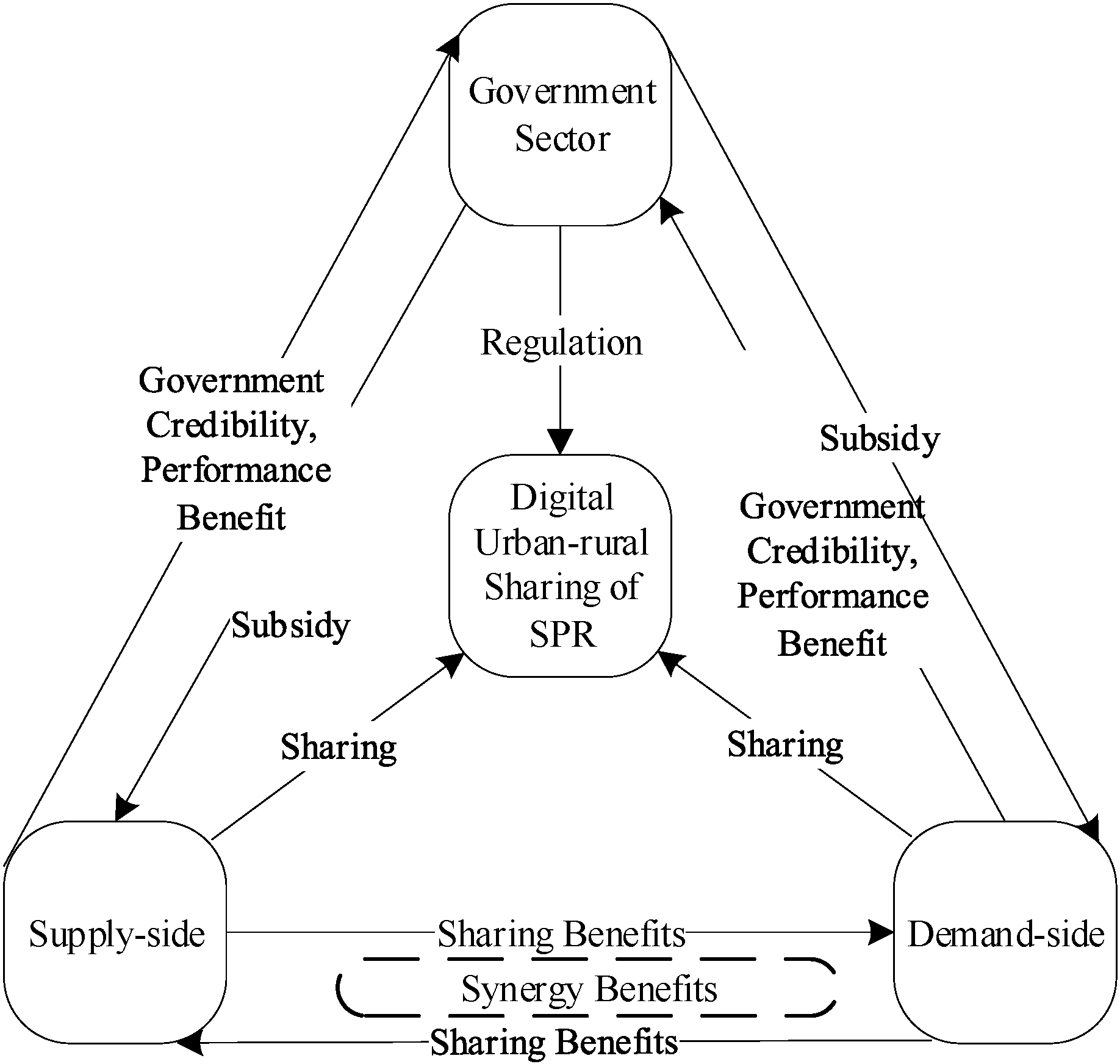
Based on the above analysis, the interaction structure among the participating players in the digital urban–rural SPR sharing system is constructed, as shown in Figure 1.

2.1. Basic Assumptions of the Game

Hypothesis 1.
The game players are the government sector ( G ), sharing supply side ( S ) and demand side ( D ), and all three players are finite rational economic agents. The strategy space of the government sector is {positive regulation  G P , negative regulation  G N }, the strategy space of the sharing supply side is {positive sharing  S P , negative sharing  S N }, and the strategy space of the sharing demand side is {positive sharing  D P , negative sharing  D N }. The probabilities of the government sector and sharing supply side and demand side choosing positive strategies are  p G , p S , p D , ( p G , p S , p D [ 0,1 ] ), respectively.
Hypothesis 2.
The cost of positive regulation by the government sector is  C G P  and the performance benefit is R (R > C G P ), and with positive government regulation, if both the sharing supply side and demand side adopt positive sharing strategies, the government credibility L P will increase.The cost of negative regulation by the government sector is  C G N  ( C G N  <  C G P ), and because the government fails to fulfill its regulatory responsibilities, it will lose some credibility  L N . Regardless of whether the government regulates or not, either the sharing supply side or demand side chooses a positive strategy, which will have a positive impact on the government and increase the government’s performance  μ i R (i = S,D), where  μ i is the resource-sharing coefficient, indicating the proportion of resources shared by the supply side or demand side.
Hypothesis 3.
The stock of resources owned by the sharing supply side and demand side is  π i , their resource benefit coefficient is  k i , the cost of positive sharing is  C i P , and the cost of negative sharing is  C i N  ( C i N  <  C i P ).When the positive strategy is adopted, the sharing supply side or demand side could receive government subsidies B from the government to encourage public resource sharing, while additional sharing costs are incurred due to resource spillover effects. The resource sharing cost is closely related to the respective resource sharing coefficient  μ i   and resource transfer cost coefficient  θ i , and thus it is  θ i μ i π i . When the other player adopts a positive strategy, there will be synergy benefits ω and sharing benefits δ i μ j π j (j = D,S), where δ i δi is its absorption capacity coefficient, indicating its ability to absorb the public resources provided by another side. μ j   and  π j  denote other’s resource sharing coefficient and resource stock, respectively. Based on the above analysis, the model parameters are shown in Table 1.

2.2. Evolutionary Game Model Construction

According to the above assumptions, the payoff matrix among the government sector and sharing supply side and demand side can be constructed, as shown in Table 2.
Let the expected benefit of positive regulation by the government sector be U G P , the expected benefit of negative regulation be U G N , and the average benefit be U G ¯ . According to the benefits matrix, the following is obtained:
U G P = R + ( p S μ S + p D μ D ) ( R B ) + p S p D L P C G P
U G N = R + ( p S μ S + p D μ D ) R L N C G N
U G ¯ = p G U G P + ( 1 p G ) U G N
Let the expected benefit of positive sharing of the sharing supply side be U S P , the expected benefit of negative sharing be U S N , and the average benefit be U S ¯ . According to the benefits matrix, we obtain the following:
U S P = k S π S θ S μ S π S + p D k S δ S μ D π D + p G μ S B p G C S P ( 1 p G ) C S N + p D ω
U S N = k S π S + p D k S δ S μ D π D p G C S P ( 1 p G ) C S N
U S ¯ = p S U S P + ( 1 p S ) U S N
Let the expected benefit of positive sharing of the sharing demand side be U D P , the expected benefit of negative sharing be U D N , and the average benefit be U D ¯ . According to the benefits matrix, the following is obtained:
U D P = k D π D θ D μ D π D + p S k D δ D μ S π S + p G μ D B p G C D P ( 1 p G ) C D N + p S ω
U D N = k D π D + p S k D δ D μ S π S p G C D P ( 1 p G ) C D N
U D ¯ = p D U D P + ( 1 p D ) U D N
According to the Malthusian equation, the replicator dynamics equation of the government sector can be constructed by combining Equations (1) and (3) as
H ( p G ) = d p G d t = p G ( U G P U G ¯ ) = p G ( 1 p G ) [ L N + p S p D L P ( C G P C G N ) ( p S μ S + p D μ D ) B ]
Similarly, the replicator dynamics equations for the sharing supply side and demand side can be constructed from Equations (4) and (6), (7) and (9), respectively, as
H ( p S ) = d p S d t = p S ( U S P U S ¯ ) = p S ( 1 p S ) ( p G μ S B + p D ω θ S μ S π S )
H ( p D ) = d p D d t = p D ( U D P U D ¯ ) = p D ( 1 p D ) ( p G μ D B + p S ω θ D μ D π D )
From the three replicator dynamics equations in Equations (10)–(12), a three-dimensional dynamic evolutionary system model for the government sector, the sharing supply side and demand side are obtained as follows:
{ H ( p G ) = p G ( 1 p G ) [ L N + p S p D L P ( C G P C G N ) ( p S μ S + p D μ D ) B ] H ( p S ) = p S ( 1 p S ) ( p G μ S B + p D ω θ S μ S π S ) H ( p D ) = p D ( 1 p D ) ( p G μ D B + p S ω θ D μ D π D )

3. Equilibrium Analysis of the Evolutionary Game

3.1. Strategy Evolutionary Path Analysis

To analyze the directional evolution of each player’s strategy, we consider the one-dimensional replicator dynamics of the government, the sharing supply side, and the sharing demand side separately, while treating the other players’ strategy probabilities as given. A boundary point is locally stable if the replicator dynamics equals zero at that point and the derivative of the dynamics with respect to the focal strategy is negative. That is, H ( p G ) p G < 0 , H ( p S ) p S < 0 , H ( p D ) p D < 0 .
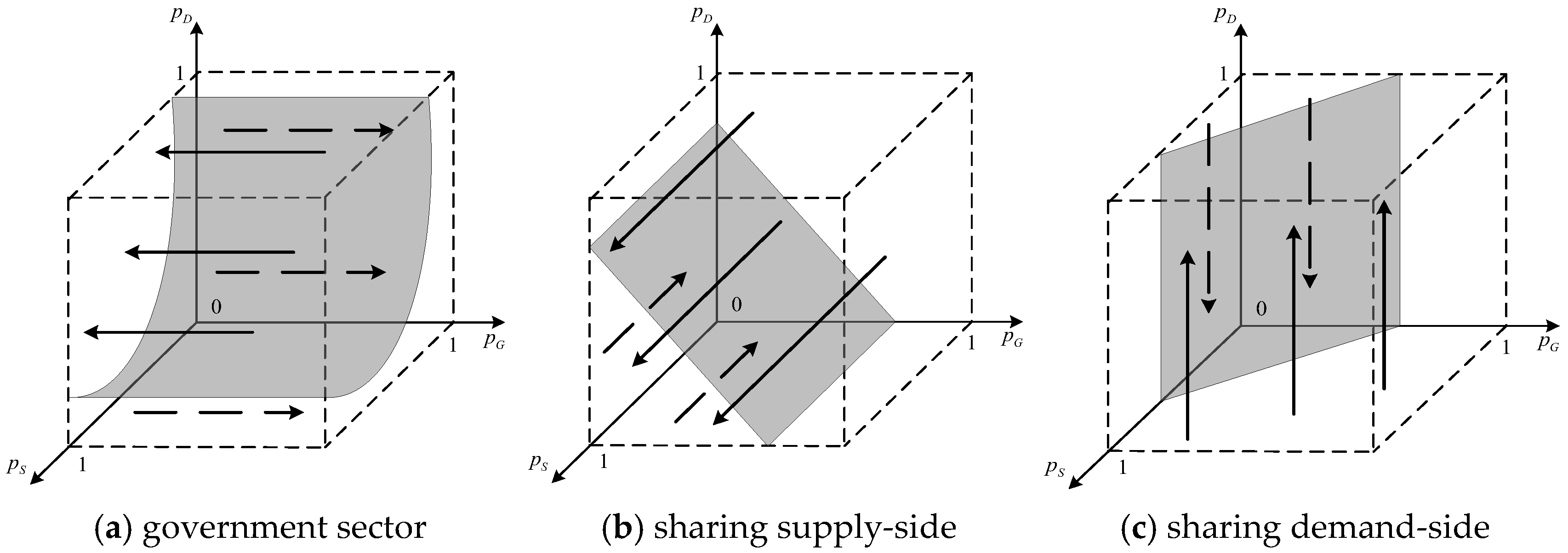
Based on these conditions, the evolutionary tendencies of the government, the sharing supply side, and the sharing demand side can be analyzed separately, and the corresponding replicator dynamics phase diagrams are shown in Figure 2.
For the government sector, its first-order derivative H ( p G ) p G = ( 1 2 p G ) [ L N + p S p D L P ( C G P C G N ) ( p S μ S + p D μ D ) B ] . Let Π ( G ) = L N + p S p D L P ( C G P C G N ) ( p S μ S + p D μ D ) B , then one has the following:
(1) When Π ( G ) = 0 , i.e., p S = ( C G P C G N ) + p D μ D B L N p D L P μ S B , then H ( p G )   p G 0 when all p G levels are stable strategies.
(2) When Π ( G ) < 0 , i.e., p S < ( C G P C G N ) + p D μ D B L N p D L P μ S B , if H ( p G )   p G < 0 is made, then the boundary point p G * = 0 is locally stable, at which time the government sector chooses the negative regulation strategy.
(3) When Π ( G ) > 0 , that is, p S > ( C G P C G N ) + p D μ D B L N p D L P μ S B , if H ( p G ) p G < 0 is made, then the boundary point p G * = 1 is locally stable, and the government sector chooses the positive regulation strategy.
According to the above conclusions, the dynamic trend and stability phase image of the government sector at different relationships between p S and p D are shown in Figure 2a. The shaded surface of Figure 2a indicates the critical state, the area in front of the shaded surface indicates the strategy space under the condition of Π ( G ) < 0 , and the area behind the shaded surface indicates the strategy space under the condition of Π ( G ) > 0 .
For the sharing supply side, its first-order derivative H ( p S ) p S = ( 1 2 p S ) ( p G μ S B + p D ω θ S μ S π S ) . Let Π ( S ) = p G μ S B + p D ω θ S μ S π S , then one has the following:
(1) When Π ( S ) = 0 , i.e., p G = θ S μ S π S p D ω μ S B , then   H ( p S )   p S 0 , when all p S levels are stable strategies.
(2) When Π ( S ) < 0 , i.e., p G < θ S μ S π S p D ω μ S B , if H ( p S ) p S < 0 is made, then the boundary point p S * = 0   is locally stable, and the sharing supply side will share negatively at this time.
(3) When Π ( S ) > 0 , i.e., p G > θ S μ S π S p D ω μ S B , if H ( p S ) p S < 0 is made, then the boundary point p S * = 1 is locally stable, and the sharing supply side will share actively at this time.
In accordance with the above conclusions, the dynamic trends and stability phase images of the shared supply side at different relationships between p G and p D are shown in Figure 2b. The shaded surface of Figure 2b indicates the critical state, the area below the shaded surface indicates the strategy space under the condition Π ( S ) < 0 , and the area above the shaded surface indicates the strategy space under the condition Π ( S ) > 0 .
For the sharing demand side, its first-order derivative H ( p D ) p D = ( 1 2 p D ) ( p G μ D B + p S ω θ D μ D π D ) . Let Π ( D ) = p G μ D B + p S ω θ D μ D π D , then one has the following:
(1) When Π ( D ) = 0 , i.e., p G = θ D μ D π D p S ω μ D B , then H ( p D ) p D 0 , and at this time all p D levels are stable strategies.
(2) When Π ( D ) < 0 , i.e., p G < θ D μ D π D p S ω μ D B , if H ( p D ) p D < 0 is made, then the boundary point p D * = 0   is locally stable, and the sharing demand side will adopt the negative sharing strategy.
(3) When Π ( D ) > 0 , i.e., p G > θ D μ D π D p S ω μ D B , if H ( p D ) p D < 0 is made, then the boundary point p D * = 1   is locally stable, and the sharing demand side will adopt the positive sharing strategy.
According to the above conclusions, the dynamic trends and stability phase images of the shared demand side at different relationships between p G and p S are shown in Figure 2c. The shaded surface of Figure 2c indicates the critical state, the area behind the shaded surface indicates the strategy space under the condition of Π ( D ) < 0 , and the area in front of the shaded surface indicates the strategy space under the condition of Π ( D ) > 0 .

3.2. Equilibrium Point Stability Analysis

Equilibrium points of an evolutionary system model refer to the points that make the replicator dynamics equations equal to 0, i.e., H ( p G ) = 0 ,   H ( p S ) = 0 ,   H ( p D ) = 0 . According to Equation (13), eight vertex equilibrium points of the system can be found: A ( 0,0 , 0 ) , B ( 0,0 , 1 ) , C ( 0,1 , 0 ) , D ( 1,0 , 0 ) , E ( 0,1 , 1 ) , F ( 1,0 , 1 ) , G ( 1,1 , 0 ) , and H ( 1,1 , 1 ) . In addition to these vertex equilibrium points, Equation (13) may also admit edge, face, and interior equilibrium candidates under certain algebraic conditions. Following Song et al. [30], non-vertex equilibrium points in asymmetric 2 × 2 × 2   games exist only when the corresponding ratio conditions of payoff differences lie in (0,1). In the present model, since all parameters are strictly positive, the payoff to the supply side from active sharing when the government is passive is θ S μ S π S   < 0 , and the marginal gain from the government subsidy is μ S B > 0 ; the existence condition for the corresponding edge equilibrium family reduces to θ S π S B ( 0 , 1 ) , i.e., B > θ S π S , which is not universally guaranteed by the model’s parameter constraints. Applying the same ratio-based admissibility criterion to the other edge and face equilibrium families leads to similar conditional restrictions; therefore, these non-vertex equilibrium candidates are not generically admissible under the present model setting. Under the present payoff structure and admissible parameter restrictions, we do not identify non-vertex equilibrium points that are both admissible and asymptotically stable. Therefore, under the analytical setting considered in this paper, the following analysis focuses on the local stability of the vertex equilibrium points.
The stability of each vertex equilibrium point can be derived from the Jacobian matrix analysis; when d e t ( J ) > 0 and   t r ( J ) < 0 hold at the same time, the vertex equilibrium point is asymptotically stable [31]. The sign of d e t ( J ) and t r ( J ) can be used to determine the asymptotic stability of each vertex equilibrium point. The Jacobian matrix of the evolutionary game system in this paper, which can be derived from Equation (13), is shown in Equation (14):
J = [ ( 1 2 p G ) Π ( G ) p G ( 1 p G ) ( p D L P μ S B ) p G ( 1 p G ) ( p S L P μ D B ) p S ( 1 p S ) μ S B ( 1 2 p S ) Π ( S ) p S ( 1 p S ) ω p D ( 1 p D ) μ D B p D ( 1 p D ) ω ( 1 2 p D ) Π ( D ) ]
According to the system equilibrium points and Jacobian matrix, the values of   d e t ( J ) and t r ( J ) of each equilibrium point are calculated to obtain the points’ local stability analysis, as shown in Table 3.
According to the analysis, it is clear that although evolutionary game analysis gives the stable state of the system under certain conditions, due to the large number of parameters involved and the values of d e t ( J ) and t r ( J ) depending on the magnitude of these parameter values, the sign conditions for the eight vertex equilibrium points cannot be determined analytically in general, and it remains difficult to identify which vertex constitutes a stable evolutionary equilibrium under arbitrary parameter values. In contrast, system dynamics can analyze the complex dynamic evolution of the evolutionary game model under conditions of finite rationality and information asymmetry [32]. Therefore, this paper will combine SD simulation tools to construct a tripartite dynamic evolutionary game model and analyze the effects of different initial values of parameters on the evolutionary process of the game.

4. SD Model Construction and Simulation Analysis

System dynamics (SD) is a quantitative modeling and simulation method specifically designed for complex socio-economic systems. By constructing causal feedback mechanisms and stock-flow topologies, SD can effectively analyze multidimensional dynamic coupling relationships and policy diffusion paths among multiple agents [33]. Using the Vensim simulation platform, SD can perform parameter sensitivity analysis, policy evolution tracking, and system stability testing, revealing the laws governing system changes [34]. Furthermore, SD focuses the behavior trend of the system as a whole and the influence of external environmental changes, which is relatively less demanding for the selection of parameter values [35,36,37].

4.1. SD Model Construction

4.1.1. Causal Loop Diagram

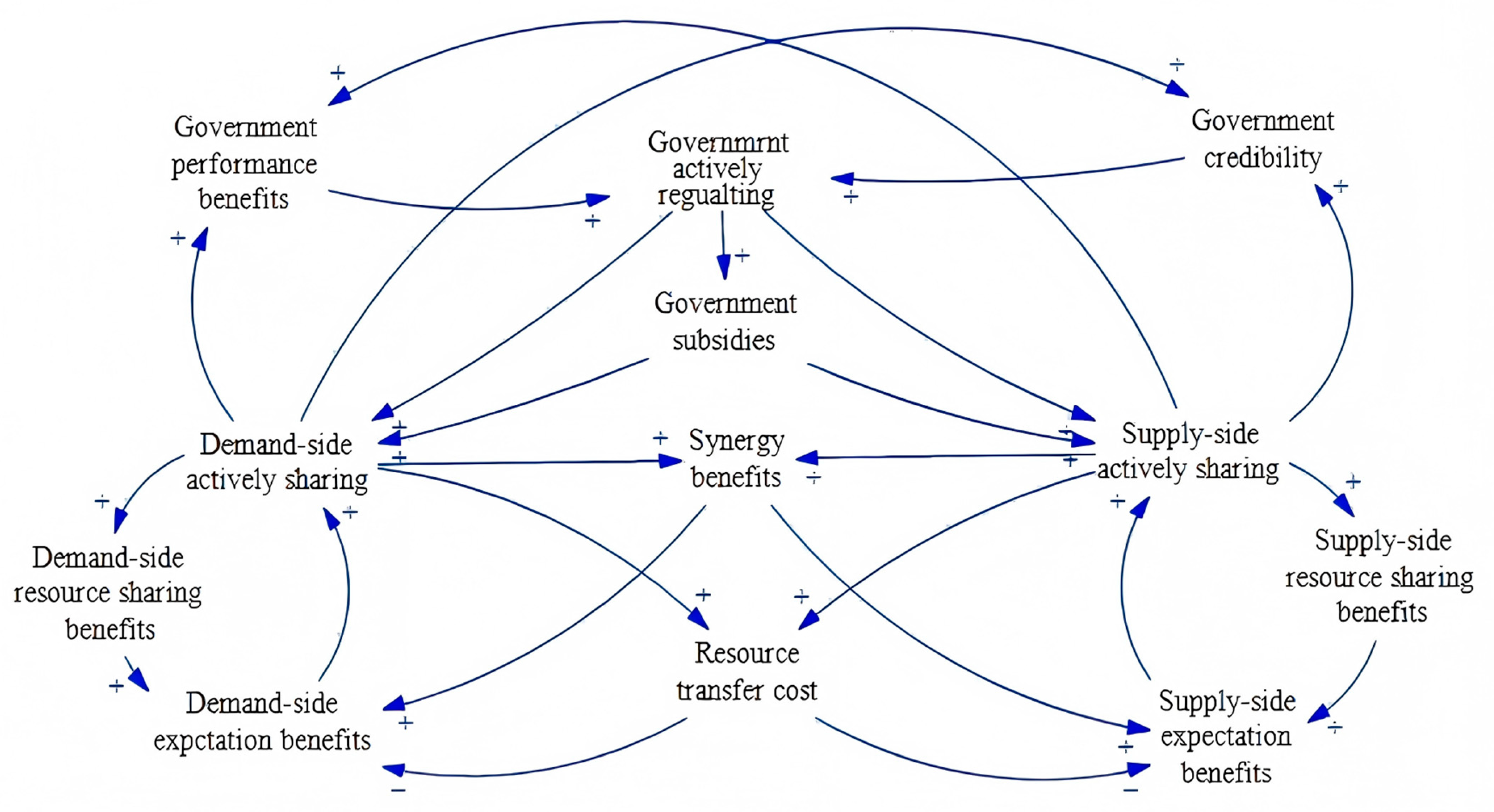
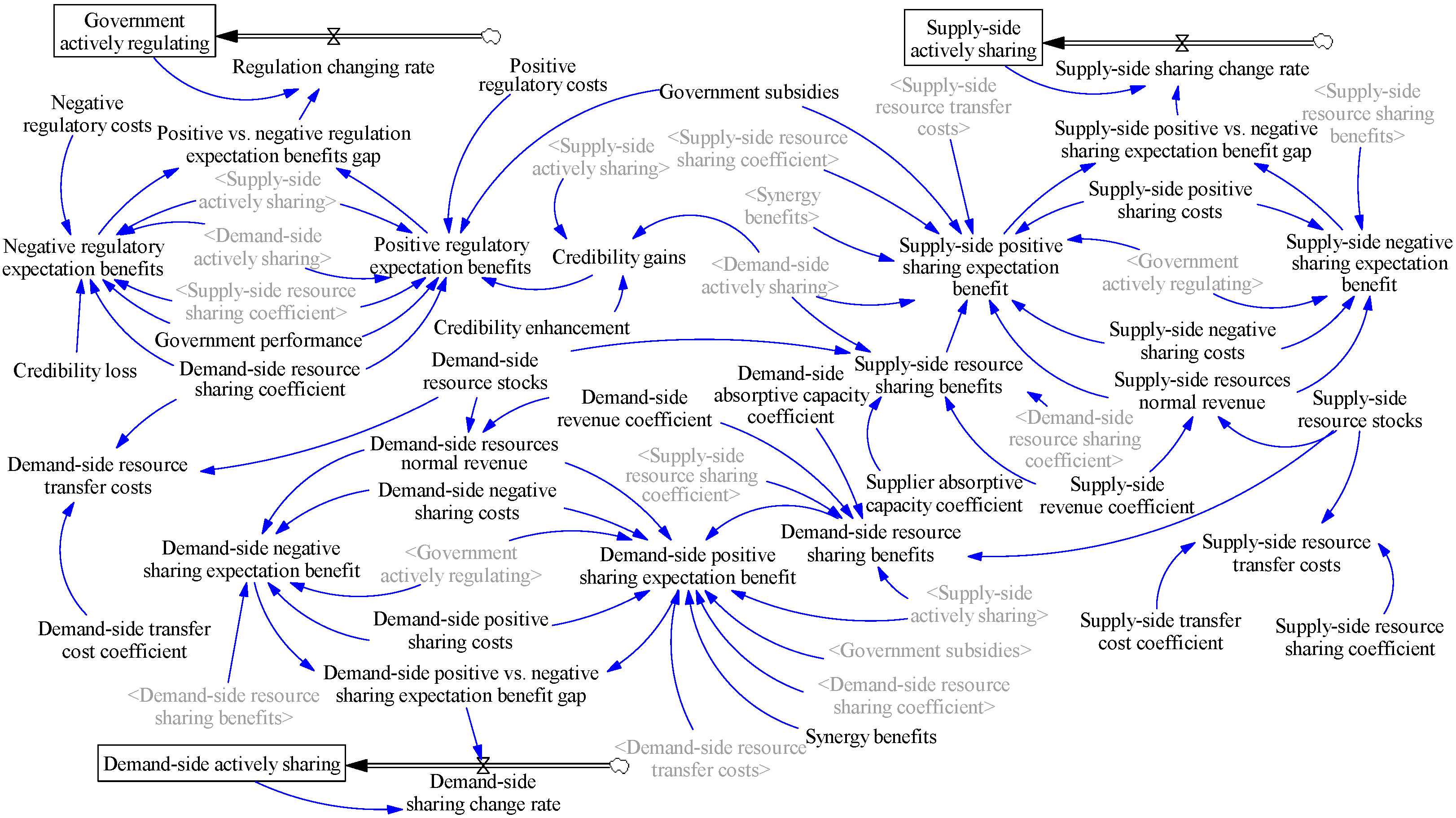
By mapping the causal relationships and feedback mechanisms among the government, supply side, and demand side in the evolutionary game of rural–urban public resource digital sharing, we construct a causal loop diagram of the tripartite interaction system, as illustrated in Figure 3. Arrows indicate the direction of causality among variables, while plus (+) and minus (−) signs represent positive and negative causal effects, respectively. The diagram reveals multiple reinforcing and balancing feedback loops embedded within the governance–sharing–benefit structure.
As shown in Figure 3, the core components of the system include government active regulation, government subsidies, supply-side active sharing, demand-side active sharing, synergy benefits, and resource transfer costs. Among these variables, synergy benefits serve as the central intermediary variable connecting the behaviors of the three stakeholders. Government active regulation and subsidy policies function as key external driving forces, while resource transfer cost acts as a primary constraint within the system.
Specifically, the key causal relationships can be summarized as follows: (1) Government active regulation positively influences both supply-side and demand-side active sharing (+), thereby enhancing synergy benefits (+). Increased synergy benefits improve resource-sharing benefits for both sides (+), which in turn further strengthen their willingness to adopt active sharing strategies (+). This forms a reinforcing feedback loop that promotes system-wide cooperation. Meanwhile, improved synergy benefits and enhanced public value may increase government performance benefits and credibility (+), further motivating sustained regulatory engagement (+). (2) Government subsidies directly enhance the expected benefits of active sharing for both supply and demand sides (+), reducing their strategic hesitation and accelerating participation in digital sharing. Higher participation further increases overall synergy benefits (+), reinforcing the effectiveness of government intervention and forming another positive feedback loop. (3) On the cost side, resource transfer cost is positively associated with the intensity of resource sharing (+) but negatively affects synergy benefits (−) and net sharing benefits for both sides (−). Rising costs weaken the incentives for active sharing (−), thereby forming a balancing feedback loop that restrains excessive expansion of sharing behavior. (4) There exists a mutual promotion mechanism between supply-side and demand-side active sharing (+). When one party increases its participation, the expected return of the other party improves, strengthening its strategic inclination toward active sharing. This bidirectional interaction enhances synergy benefits and generates a collaborative amplification effect within the system.
Overall, the causal loop diagram illustrates a dynamic structure characterized by “policy-driven reinforcement and cost-constrained balancing.” Government regulation and subsidies stimulate active sharing behaviors, synergy benefits amplify cooperative outcomes, and resource transfer costs impose structural constraints. The interaction of multiple reinforcing and balancing loops jointly determines the evolutionary trajectory of the rural–urban public resource digital sharing system, potentially guiding it toward either a high-level cooperative equilibrium or a low-level participation equilibrium depending on parameter conditions.

4.1.2. Stock-Flow Diagram

Subsequently, based on the fundamental principles of system dynamics (SD) modeling, we constructed an SD model of the tripartite evolutionary game among the government sector and sharing supply side and demand side and plotted the stock-flow diagram of this model. This model mainly consists of 3 stock variables, 3 rate variables, 21 exogenous variables, and 16 intermediate variables, as shown in Figure 4.
In terms of parameter settings, the exogenous variables are assigned according to expert recommendations and are combined with realistic situations. All the simulation parameters are set to mainly consider the sensitivity of the changes of each relevant factor to the players’ strategy choices and do not represent the payment or benefit values of each participant in the digital urban–rural sharing system of SPR. In this study, all exogenous variables are assumed to be positive, and the payoff values of each game player are guaranteed to be positive. Therefore, the initial values of exogenous variables are assigned, as shown in Table 4.

4.2. Overall Simulation Analysis of SD Model

The evolutionary game equilibrium analysis shows that there must be an evolutionary equilibrium in the tripartite game, but the reasons and processes for achieving it are not clear, and it is not clear whether the equilibrium is unique and stable. Moreover, even if the equilibrium is reached in a certain situation, the system may be affected by various uncertainties from various factors, which may break the equilibrium. To solve these problems, the dynamic game among three players is simulated using Vensim PLE. In the simulation, the simulation period is set to 10, INITIALTIME = 0, FINALTIME = 10, and TIMESTEP = 0.1.
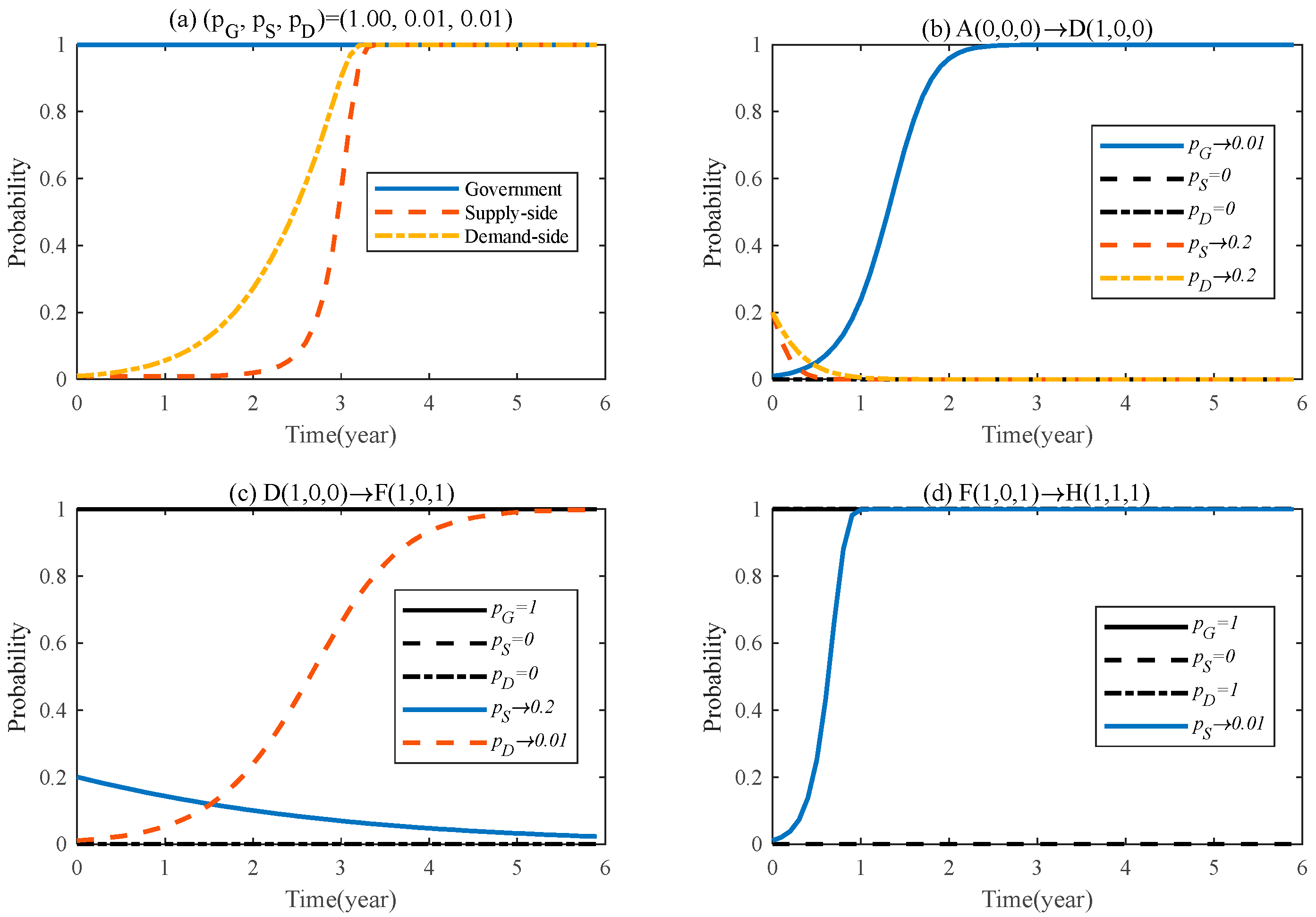
The simulation shows that when the game is played in the digital urban–rural sharing of SPR, the initial state of the game is a kind of pure strategy (the pure strategy of each player is chosen as 0 or 1), and no player in the system is willing to break the equilibrium. However, this does not mean that these equilibria are stable, and once one or more players spontaneously make a small change, the equilibrium may be broken. First, taking strategy D ( 1,0 , 0 ) as an example, the simulation result of this evolution process is shown in Figure 5a. When the government sector chooses the positive regulation strategy, the sharing supply side and demand side play with only 0.01 probability to actively share and the initial equilibrium is broken quickly, and the game players will choose a new strategy to reach a new equilibrium. If mutating with a higher probability, the sharing supply side and demand side will make a strategy choice in a shorter time, and the magnitude of the change is larger, which will eventually lead the system to a new equilibrium.
Simulations of other equilibrium strategies reveal the following: (1) When the government sector, the sharing supply side, and the demand side all share negatively, i.e., A ( 0,0 , 0 ) , a strategy mutation to 0.2 of both the sharing supply side and demand side will not change this stable state. Only when the government sector’s strategy changes abruptly from 0 to 0.01, the government sector tends to adopt a positive regulatory strategy and break the existing state, that is, evolving from A ( 0,0 , 0 ) to D ( 1,0 , 0 ) . The specific evolution is shown in Figure 5b, where the initial state is A ( 0,0 , 0 ) . (2) When the government sector actively regulates, the mutation of the supply-side strategy does not break the existing state. While the demand-side strategy mutates from 0 to 0.01, and the demand side eventually tends to actively share, thus reaching a new stable outcome, F ( 1,0 , 1 ) . That is, D ( 1,0 , 0 ) evolves to F ( 1,0 , 1 ) . The specific evolution is shown in Figure 5c, where the initial state is D ( 1,0 , 0 ) . (3) When the government sector actively regulates and demand side actively shares, the sharing supply side will eventually take a positive sharing strategy once a mutation occurs. That is, F ( 1,0 , 1 ) will evolve to H ( 1,1 , 1 ) . The specific evolution is shown in Figure 5d, where the initial state is F ( 1,0 , 1 ) with a supply-side strategy mutation of 0.01.
Through the simulation analysis of different strategies, it is known that the dynamic game strategy evolution path of the three players is A ( 0,0 , 0 ) D ( 1,0 , 0 ) F ( 1,0 , 1 )   H ( 1,1 , 1 ) . Initially, three players of the game within the digital urban–rural sharing system of SPR adopt negative strategies, and the system is in a low-level stable state A ( 0,0 , 0 ) . When the government sector’s strategy is perturbed upward by 0.01, the original stable state is disrupted, and the system gradually evolves toward a new stable outcome, D ( 1,0 , 0 ) . At this time, the government sector positively supervises the digital urban–rural sharing behavior of SPR. Then the demand side responds to the government’s call for a strategy mutation of 0.01, and the system further evolves to F ( 1,0 , 1 ) . Prompted by synergy benefits, government subsidies, and resource-sharing benefits, the supply side strategy mutates by 0.01, and the system gradually reaches the high-level stable outcome H ( 1,1 , 1 ) , where all players of the game adopt positive strategies.

4.3. Simulation Analysis of the Influence of External Variables on the Strategy

4.3.1. Impact Analysis of Initial Strategy Combinations

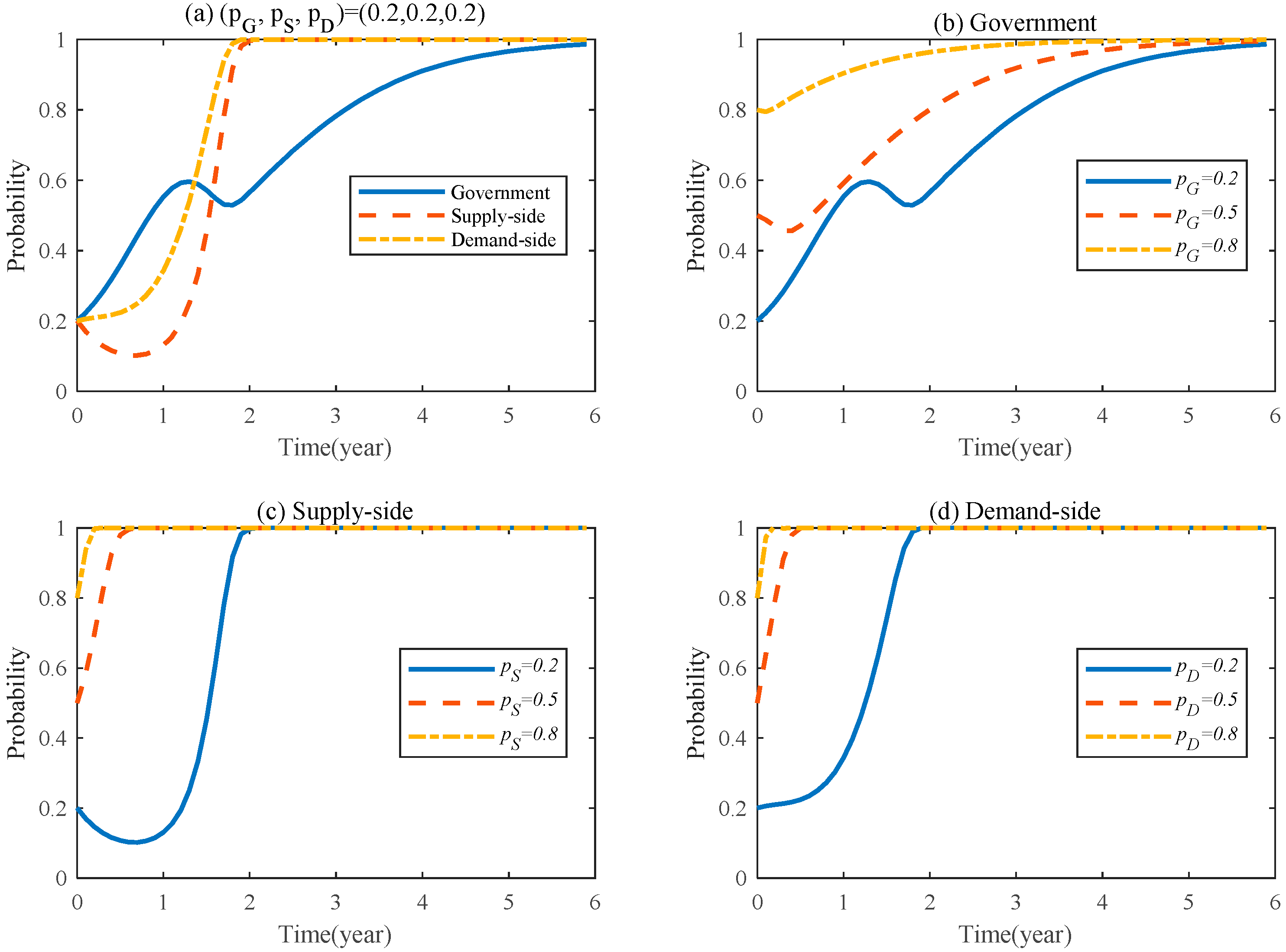
To examine the impact of different initial strategies on the three-party evolution path and system stability of digital sharing of urban and rural public resources, three initial strategy combinations of ( 0.2 , 0.2 , 0.2 ) , ( 0.5 , 0.5 , 0.5 ) , and ( 0.8 , 0.8 , 0.8 ) are simulated as shown in Figure 6. Numerical simulations were performed on the dynamic evolution of the probabilities of active government regulation ( p G ), active supply-side sharing ( p S ), and active demand-side sharing ( p D ).
Figure 6a shows the joint evolution path of the three parties at the initial low strategy level ( 0.2 , 0.2 , 0.2 ) . The government’s regulation probability fluctuates in stages during the medium-term evolution, the supply-side trajectory shows a temporary decline, and the time required for the system to converge to a stable outcome is significantly prolonged. This indicates that a lower initial willingness to cooperate increases the system’s adjustment costs and delays the formation of a collaborative mechanism. Figure 6b further analyzes the impact of the initial government regulation probability ( p G ) on the system evolution. The results show that regardless of the initial regulatory intensity of 0.2, 0.5, or 0.8, the government ultimately chooses an active regulatory strategy, but the higher the initial value, the faster the convergence speed. When the initial regulatory probability is low, the government’s strategy undergoes some adjustments and tentative fluctuations in the early stages, indicating that the government needs more time to form stable expectations in the process of weighing benefits and costs. Figure 6c,d reflect the impact of the initial sharing probability ( p S ) on the supply side and the initial sharing probability ( p D ) on the demand side, respectively. The evolution paths of the supply and demand sides are quite sensitive to the initial strategy. When the initial sharing level is low, i.e., 0.2, there is a clear strategy adjustment phase in the early stages of evolution, followed by a rapid leap to a fully shared state driven by synergistic benefits, while when the initial sharing level is high, i.e., 0.8, the system can quickly enter the stable range with almost no significant fluctuations. This indicates that there is a significant strategy mutual promotion mechanism between the supply and demand sides, where an increase in the sharing level of one side will enhance the benefit expectations of the other side, thus forming a positive synergistic amplification effect. Overall, the initial strategy has a significant impact on the evolutionary path of the three parties, especially on the supply and demand sides. A lower initial level of cooperation delays the convergence of the system to a stable outcome and leads to moderate fluctuations during the medium-term evolutionary process. Therefore, in the early stages of promoting urban and rural public resource digital sharing, it is necessary to strengthen policy guidance and incentive mechanisms to increase the initial participation willingness of all stakeholders, thereby shortening the system convergence time and accelerating the formation of a stable development pattern of “high regulation—high sharing—high sharing”.

4.3.2. Impact Analysis of Government Regulation Costs ( c G P , c G N ) and Credibility Benefit and Loss ( L P , L N )

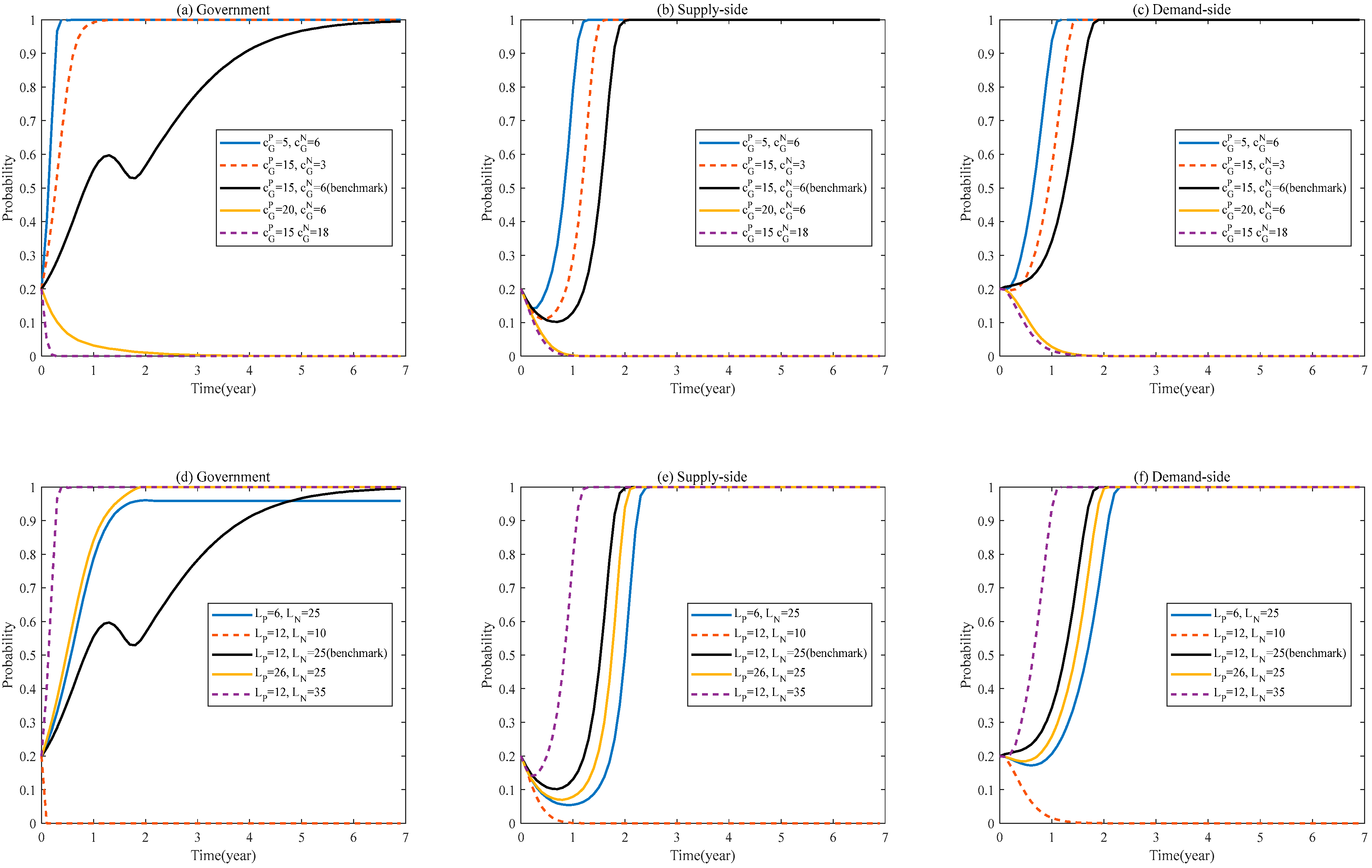
To examine how key government-side parameters shape the evolutionary trajectories of the three parties, the initial strategy probabilities of the government, the supply side, and the demand side are all set to 0.2. We then vary the parameters associated with government regulatory costs and with credibility-related reputational gains/losses. The three columns of Figure 7 report the evolutionary dynamics of the government strategy p G , the supply-side strategy p S , and the demand-side strategy p D . The two rows correspond to the sensitivity tests for the government’s active-regulation cost c G P and passive-regulation cost c G N , as well as the credibility benefit L P and credibility loss L N .
Figure 7 shows that both regulatory costs and reputational mechanisms are critical drivers of the government’s regulatory choice and the responses of the supply and demand sides. In general, increases in c G P and c G N reduce the net payoff of active regulation, thereby inducing the government to switch toward passive regulation (Figure 7a). Under this condition, both the supply and demand sides tend to adopt passive strategies; the system converges more slowly and may even shift from a positive stable state (probability approaching 1) to a negative stable state (probability approaching 0) (Figure 7b,c). By contrast, Figure 7d–f indicate that reputational mechanisms act as a stabilizer: increasing the credibility benefit from active regulation L P or the credibility loss from passive regulation L N strengthens the government’s commitment to sustained regulation, reduces mid-term fluctuations, and significantly shortens the time required to reach the stable state. It can accelerate the convergence of both sides toward a consistent active response. These results imply that lowering regulatory costs is not the only policy lever; enhancing government credibility by amplifying reputational rewards for active regulation and penalties for passive regulation is more effective in promoting faster convergence to a positive evolutionary equilibrium.

4.3.3. Impact Analysis of Resource Stocks π i , Resource-Sharing Coefficient μ i , and Transfer Cost Coefficient θ i of the Sharing Supply Side and Demand Side

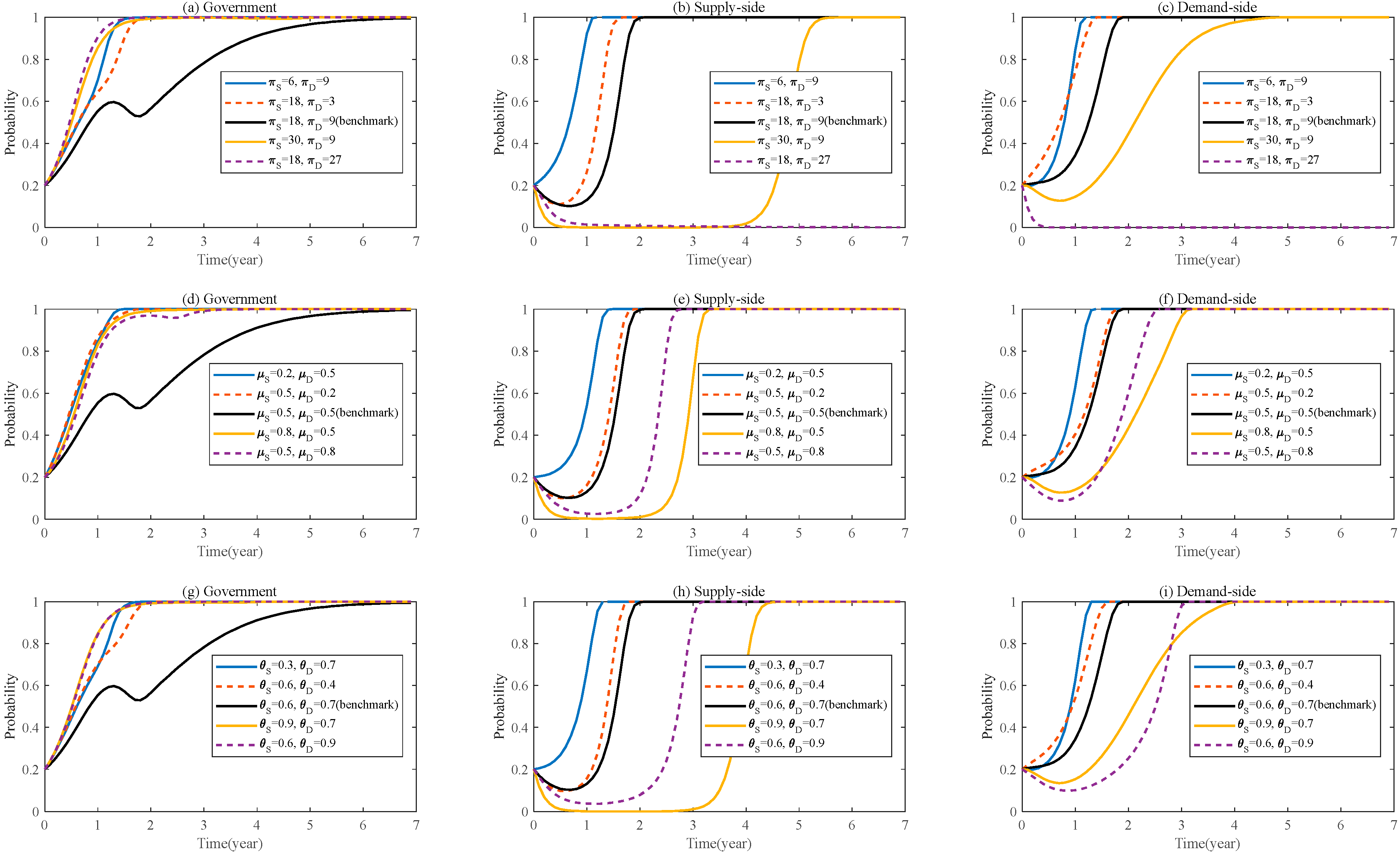
Figure 8 examines the effects of resource stocks π S , π D , resource-sharing coefficients μ S , μ D , and transfer-cost coefficients θ S , θ D on the system’s evolutionary trajectories. Given the model structure, these three parameters can be jointly interpreted as the resource transfer cost, i.e., θ S μ S π S and θ D μ D π D , which operates through their multiplicative term. Resource transfer cost increases simultaneously with larger resource scale, higher sharing intensity, and higher unit transfer cost.
The simulation results in Figure 8 indicate that higher transfer costs raise the threshold for adopting active strategies, shifting the trajectories to the right (later take-off and slower convergence). In some cases, strategies remain at low levels for an extended period or even converge to a passive stable state. More specifically, resource stocks reshape the marginal benefits and complementarity of sharing. When one side holds more abundant resources and the marginal benefit of sharing declines, its incentive to adopt an active strategy is more likely to be suppressed. As shown in Figure 8d–f, a higher sharing coefficient μ implies greater sharing intensity per unit input, making synergistic benefits more salient and thereby strengthening the governance performance returns to regulation. Accordingly, the government converges more rapidly to active regulation. For the supply and demand sides, although a higher μ represents stronger sharing, it also amplifies resource concession and coordination costs, which—absent sufficient compensation—can instead slow down the diffusion of active participation. The transfer cost coefficient θ is a major source of evolutionary delay and hindered take-off. As θ increases, the supply side’s take-off occurs later, and the plateau phase becomes substantially longer. Under high-cost scenarios, the supply side may remain at a low sharing probability for a prolonged period, indicating that the cost term can eliminate the relative advantage of active sharing (see Figure 8h). Figure 8i shows that the demand side is subject to similarly strong cost constraints. Consequently, high transfer costs can simultaneously suppress both sides, weakening the feedback from synergistic benefits and further delaying system convergence. These findings suggest that reducing resource transfer costs should be a central lever for improving system efficiency, achievable by lowering transfer frictions (institutional procedures, information matching, and transaction and enforcement costs), optimizing the design of sharing intensity, and strengthening complementary collaboration to accelerate convergence to a positive stable state.

4.3.4. Impact Analysis of Government Subsidies B and Synergy Benefit ω

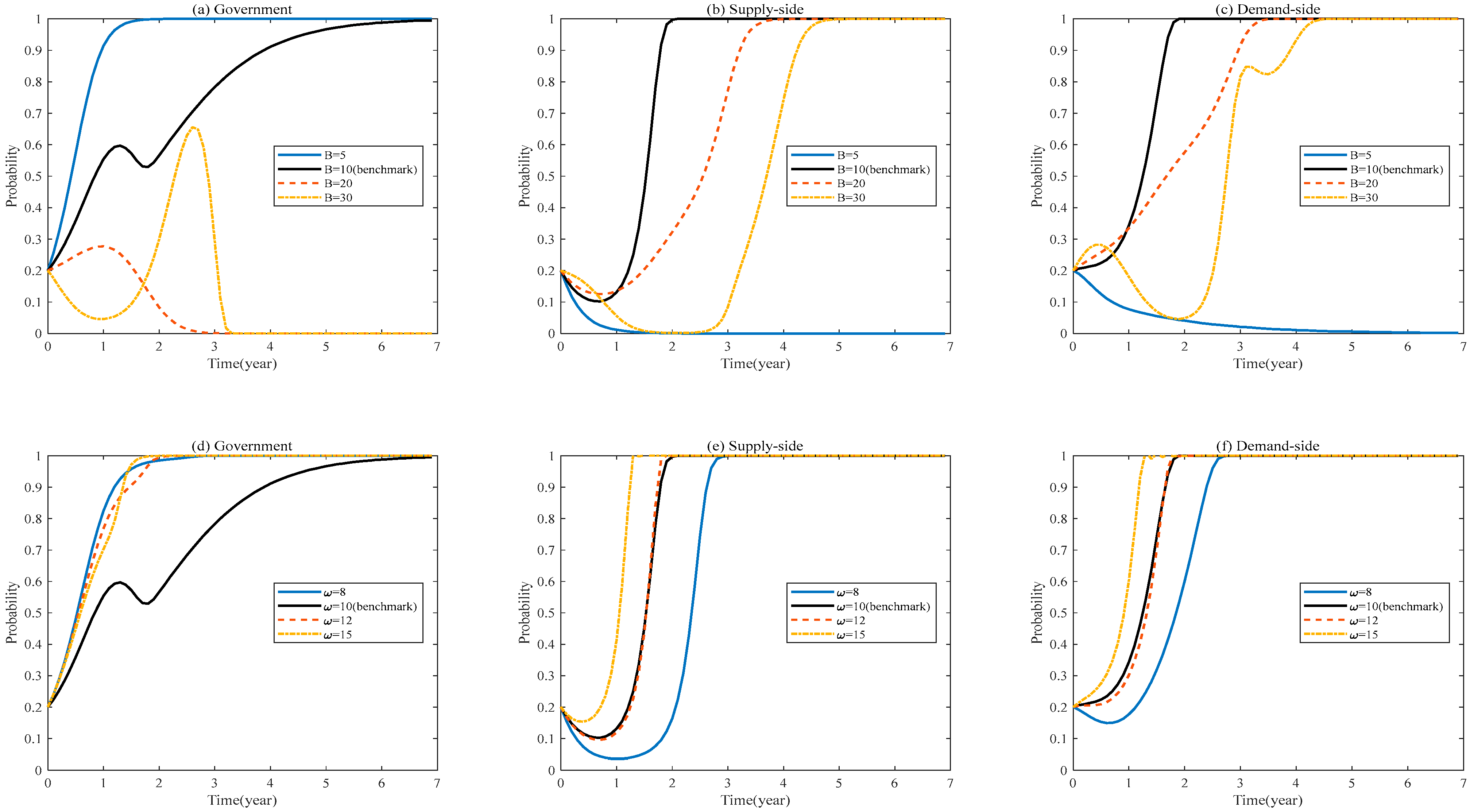
Figure 9 further employs system dynamics simulations to investigate how changes in exogenous government incentives and endogenous synergistic benefits affect the evolutionary strategies of the three parties. Given that the system is in an early promotion stage with relatively low execution efficiency, the initial probabilities are set to p G ( 0 ) = p S ( 0 ) = p D ( 0 ) = 0.2 . Holding all other parameters constant, we vary the government subsidy and synergistic benefits and compare the resulting evolutionary paths of the government, the supply side, and the demand side.
As shown in Figure 9a, the effect of the subsidy for active sharing B is nonlinear. When the subsidy is either too low or too high, the government tends to adopt passive regulation. When the subsidy is insufficient (e.g., B = 5 ), the strategy probabilities of both the supply and demand sides gradually decline and stabilize near 0, indicating that the incentive cannot offset the opportunity costs of sharing and transfer frictions. Consequently, players lack sustained motivation for active sharing, and the system fails to reach a positive stable state (Figure 9b,c). When the subsidy is excessive (e.g., B = 20,30 ), the supply and demand sides may still converge to 1, but convergence becomes markedly slower and exhibits stronger phase-wise fluctuations. Meanwhile, the government’s trajectory shows an initial increase followed by a decline, even approaching zero. It suggests that overly generous subsidies impose substantial fiscal burdens and generate expectations of policy unsustainability, prompting government withdrawal (or a shift toward weak/no incentives) in the mid-to-late stages, thereby inducing mid-term turbulence and delayed convergence.
In contrast to the nonlinear subsidy effect, increases in the synergistic benefit w exhibit a more monotonic, positive-promoting pattern. As shown in Figure 9d–f, as w rises from low to high levels, the trajectories of the government, the supply side, and the demand side shift leftward (earlier take-off and faster stabilization). In particular, when w is high, both sides complete the transition from low to high probabilities within a short period and stabilize near 1. Overall, achieving long-term stability hinges on the combination of “moderate short-term subsidies to overcome the initial threshold” and “enhanced medium-to-long-term synergistic benefits to form self-reinforcing incentives.” Accordingly, policy design should avoid an unsustainable high-subsidy path and instead improve w through technological collaboration, platform matching, standardization, and trust-building mechanisms, thereby delivering a more robust positive evolutionary outcome at lower policy cost.

5. Discussion

This study contributes to the literature on digital urban–rural public resource sharing by conceptualizing the system as a tripartite strategic interaction among the government sector, the sharing supply side, and the sharing demand side. The main theoretical implication is that the evolution of sharing behavior should be understood as a feedback-driven process: a policy-driven reinforcing mechanism (regulation, participation, and synergy gains) interacts with a cost-constrained balancing mechanism (transfer and coordination costs) to shape the speed, stability, and direction of system evolution. This perspective helps explain why similar policy interventions may lead to different outcomes under different initial conditions and cost structures and why the sequencing of strategy adjustment matters in moving the system from low-sharing to high-sharing states.
The study also advances the methodological discussion by clarifying the complementary roles of evolutionary game theory (EGT) and system dynamics (SD). EGT provides the analytical micro-foundation by specifying the actors, payoff structures, and replicator dynamics and by identifying the directional effects and local stability tendencies of key variables. SD then extends this analytical structure by representing the endogenous feedback relationships among the three core state variables and simulating how reinforcing and balancing loops generate path dependence, transitional fluctuations, and scenario-specific trajectories. In this sense, the two methods are not redundant but mutually reinforcing: EGT establishes the strategic logic and local equilibrium framework, while SD reveals dynamic features that are difficult to infer from local analysis alone. Their integration therefore strengthens both the theoretical rigor and the practical interpretability of the model.
These theoretical and methodological insights also yield clear governance implications. First, early-stage policy activation and sustained regulatory commitment are essential because low initial willingness to regulate or share can prolong convergence and increase mid-term volatility. Second, subsidies should be calibrated within a moderate and sustainable range: insufficient subsidies cannot offset participation and transfer costs, whereas excessive subsidies may create fiscal pressure and weaken the sustainability of government engagement. Third, reducing transfer and coordination costs should be treated as a core policy priority since these costs operate as a balancing force that can delay or suppress active sharing; in practice, this requires platform interoperability, process standardization, and institutional coordination. Fourth, policy design should strengthen synergy mechanisms such as shared standards, complementary service arrangements, and cross-organizational collaboration because synergy benefits are a major endogenous driver of long-term cooperative take-off. Finally, government credibility and accountability mechanisms should be regarded as part of the core governance architecture rather than peripheral institutional factors as they materially affect strategy stability and system convergence.

6. Conclusions

This study develops a framework for digital urban–rural SPR sharing and analyzes the co-evolution of strategies among the government sector, the sharing supply side, and the sharing demand side. By combining evolutionary game analysis with system dynamics simulation, the study not only identifies the strategic logic and local stability tendencies of the three actors but also reveals the feedback-driven dynamic pathways through which the system transitions between low- and high-sharing states.
The findings show that the system’s evolution is jointly shaped by a policy-driven reinforcing loop and a cost-constrained balancing loop. In general, the government acts as the initiating actor, followed by the demand side and then the supply side, gradually promoting the transition toward a high-sharing stable outcome. The simulations further demonstrate that initial strategy conditions, credibility mechanisms, transfer costs, synergy benefits, and subsidy levels all significantly influence convergence speed and stability, with transfer costs and synergy benefits playing especially important roles in determining whether active sharing can be sustained. Overall, the main contribution of this study lies in providing a feedback-based and mechanism-oriented explanation of digital urban–rural public resource sharing under government-led coordination. By combining evolutionary game theory with system dynamics, the paper strengthens both the analytical foundation and the policy relevance of the model.
The present study has several limitations. First, the analysis adopts a deterministic replicator-dynamics framework, which abstracts away from stochastic effects in finite populations; random drift can qualitatively alter equilibrium existence, stability, and transition behavior in ways that the current model does not capture. Second, the model parameters are assigned based on expert recommendations and illustrative calibration rather than empirical data from specific real-world cases, which limits the direct transferability of the quantitative results to particular policy contexts. Third, while the sensitivity analysis conducted in this study examines key parameters through a one-at-a-time approach, interactions among parameters and the stability properties of non-vertex equilibria under alternative parameter configurations are not fully explored.
Several promising directions remain for future research. Extending the present model to a stochastic evolutionary game setting would allow explicit analysis of finite-population effects and the potential emergence of interior equilibria that are absent in the deterministic limit. Case-based calibration using empirical data from specific urban–rural SPR sharing programs, such as regional telemedicine platforms or digital education initiatives, would further strengthen the practical grounding of the model and enable more context-specific policy recommendations. A more systematic examination of the stability properties of non-vertex equilibria under broader parameter ranges would also deepen the theoretical contribution of the framework.

Author Contributions

Conceptualization, Z.W. and W.L.; methodology, W.L.; validation, W.L.; formal analysis, W.L.; investigation, W.L.; resources, W.L.; data curation, W.L.; writing—original draft preparation, Z.W. and W.L.; writing—review and editing, Z.W. and W.L.; supervision, Z.W.; funding acquisition, Z.W. All authors have read and agreed to the published version of the manuscript.

Funding

This research was funded by the Fundamental Research Funds for the Central Universities (HUST: 2020WKYXZX008).

Data Availability Statement

Data is contained within the article.

Conflicts of Interest

The authors declare no financial conflicts of interest related to this research.

References

  1. Li, S.; Zhao, Z. Research on the Measurement of China’s Social Public Resources Networking Urban and Rural Sharing Level. World Surv. Res. 2020, 4, 32–37. [Google Scholar] [CrossRef]
  2. Wang, W.; Wu, Z. Research on digital economic development under the influence of COVID-19. Econ. Rev. J. 2020, 3, 16–22. [Google Scholar]
  3. Gao, X. Research on the Disparity and Fairness of the Digital Urban-Rural Sharing of Social Public Resources. Master’s Thesis, Jimei University, Xiamen, China, 2017. [Google Scholar]
  4. Kong, F.; Zhang, X.; Liu, J. Evaluation and Analysis of the Equalization Level of Basic Public Services in my country’s Urban and Rural Areas. World Surv. Res. 2015, 7, 9–12. [Google Scholar] [CrossRef]
  5. Cheng, L.; Wen, Y. Research on the Measurement and Influencing Factors of Equalization of Basic Public Services from Different Urbanization Perspectives. Econ. Manag. Rev. 2018, 34, 106–115. [Google Scholar] [CrossRef]
  6. Chao, Z. Planning and design of public supply services for urban integration. Open House Int. 2018, 43, 124–128. [Google Scholar] [CrossRef]
  7. Enata, T.; Sato, T.; Takahashi, Y.; Yano, K. Public Resource Supply-Demand Matching on Distributed Cooperative Scheduling. In Proceedings of the 7th IIAI International Congress on Advanced Applied Informatics (IIAI-AAI), Yonago, Japan, 8–13 July 2018; IEEE: New York, NY, USA, 2018; pp. 676–681. [Google Scholar] [CrossRef]
  8. Shen, H. Research on Optimal Allocation of Public Resources Based on Population Agglomeration; Zhejiang Provincial Party School of CPC: Hangzhou, China, 2018. [Google Scholar]
  9. Wang, L.; Liu, G.Z. Research on Information Sharing Mechanism of Network Organization Based on Evolutionary Game. In Proceedings of the 3rd International Conference on Advances in Energy Resources and Environment Engineering (ICAESEE), Harbin, China, 8–10 December 2018; IOP Publishing: Bristol, UK, 2017. [Google Scholar] [CrossRef]
  10. Zhang, N.; Wang, X.T. Research on Resource Sharing of Science and Technology Public Service Platform Based on Multi-Agent Game Theory. In Proceedings of the 13th International Conference on Innovation and Management (ICIM 2016), Kuala Lumpur, Malaysia, 28–30 November 2016; pp. 1189–1194. [Google Scholar]
  11. Tian, X. The construction and application of an analytical framework for the co-construction and sharing of public services from the perspective of the “Three Circles Theory”. J. Liaoning Adm. Inst. 2020, 48–53. [Google Scholar] [CrossRef]
  12. Hofbauer, J.; Sigmund, K. The Theory of Evolution and Dynamical Systems; London Mathematical Society Student Texts; Academic Subject Publishing: Cambridge, MA, USA, 1988; Volume 7. [Google Scholar]
  13. Vega-Redondo, F. Evolution, Games, and Economic Behaviour; OUP Oxford: Oxford, UK, 1996. [Google Scholar]
  14. Yang, H.; Hu, Y.; Qiao, H.; Wang, S.; Jiang, F. Conflicts between business and government in bike sharing system. Int. J. Confl. Manag. 2020, 31, 463–487. [Google Scholar] [CrossRef]
  15. Pedercini, M. Potential Contribution of Existing Computer-Based Models to Comparative Assessment of Development Options; Working Papers in System Dynamics, University of Bergen: Bergen, Norway, 2003. [Google Scholar]
  16. Xu, Y.; Zhao, G.; Zhang, B.; Jiao, J. SD Simulation Research on the Green Low-Carbon Development of Coal Enterprises. Complexity 2021, 2021, 5555075. [Google Scholar] [CrossRef]
  17. Shen, L.; Wang, Y. Research on the Collaboration Mechanism in Public Service Outsourcing: An Evolutionary Game Analysis. Manag. Rev. 2017, 29, 219–230. [Google Scholar] [CrossRef]
  18. Cheng, M.; Liu, Y.; Wang, H. Tripartite evolutionary game analysis of neighbor avoidance facilities PPP project based on system dynamics. Oper. Res. Manag. 2019, 28, 40–49. [Google Scholar]
  19. Hu, Q.; Qi, J. Digital currency diffusion evolution simulation research based on SD evolution game model. Syst. Eng. Theory Pract. 2021, 41, 1211–1228. [Google Scholar]
  20. Wang, W.; Zhang, Y.; Feng, L.; Wu, Y.J.; Dong, T. A system dynamics model for safety supervision of online car-hailing from an evolutionary game theory perspective. IEEE Access 2020, 8, 185045–185058. [Google Scholar] [CrossRef]
  21. Liu, A.; Zhang, Y.; Changyin, S. The Evolution of Cooperation in Games with Multiple Strategies Under Different Update Rules. In Proceedings of the 35th Chinese Control Conference 2016; Chen, J., Zhao, Q., Eds.; IEEE: New York, NY, USA, 2016; pp. 10375–10379. [Google Scholar]
  22. Shan, S.; Duan, X.; Zhang, Y.; Zhang, T.T.; Li, H. Research on collaborative governance of smart government based on blockchain technology: An evolutionary approach. Discret. Dyn. Nat. Soc. 2021, 2021, 6634386. [Google Scholar] [CrossRef]
  23. Encarnação, S.; Santos, F.P.; Santos, F.C.; Blass, V.; Pacheco, J.M.; Portugali, J. Paradigm shifts and the interplay between state, business and civil sectors. R. Soc. Open Sci. 2016, 3, 160753. [Google Scholar] [CrossRef]
  24. Alalawi, Z.; Bova, P.; Cimpeanu, T.; Di Stefano, A.; Duong, M.H.; Domingos, E.F.; Han, T.A.; Krellner, M.; Ogbo, N.B.; Powers, S.T. Trust AI regulation? Discerning users are vital to build trust and effective AI regulation. Appl. Math. Comput. 2026, 508, 129627. [Google Scholar] [CrossRef]
  25. Liu, J.; Yu, J.; Yin, Y.; Wei, Q. An evolutionary game approach for private sectors’ behavioral strategies in China’s green energy public–private partnership projects. Energy Rep. 2021, 7, 696–715. [Google Scholar] [CrossRef]
  26. Ji, H.; Huo, M. Evolutionary Game Analysis of Knowledge Sharing in University Faculty Teams. Inf. Sci. 2013, 31, 142–146. [Google Scholar] [CrossRef]
  27. Zhang, Q.; Wang, L.Y.; Liu, N.Y.; Pei, D.H.; Jiang, Z.B. The Research on Medical Information Sharing Between Hospitals Based on Evolutionary Game Theory. In 2017 13th IEEE Conference on Automation Science and Engineering (Case); IEEE: New York, NY, USA, 2017; pp. 1433–1438. [Google Scholar]
  28. Xing, H.; Gao, C.; Zhai, L.; Zhang, S. Research on the Dynamic Evolutionary Game Model of Data Resource Sharing among Big Data Alliance Members—Based on the Perspective of Sharing Initiative. Manag. Rev. 2020, 32, 155–165. [Google Scholar] [CrossRef]
  29. Li, S.; Jiang, F. A collaborative evolutionary model: The self-organizing evolutionary process of urban–rural digital sharing system of social public resources. J. Econ. Interact. Coord. 2022, 17, 1115–1137. [Google Scholar] [CrossRef]
  30. Song, S.; Pan, Q.; Gao, X.; He, M. Stability analysis of evolutionary dynamics of 2 × 2 × 2 asymmetric games. Proc. R. Soc. A Math. Phys. Eng. Sci. 2024, 480, 20230478. [Google Scholar] [CrossRef]
  31. Friedman, D. Evolutionary games in economics. Econom. J. Econom. Soc. 1991, 59, 637–666. [Google Scholar] [CrossRef]
  32. Kim, D.H.; Kim, D.H. A system dynamics model for a mixed-strategy game between police and driver. Syst. Dyn. Rev. J. Syst. Dyn. Soc. 1997, 13, 33–52. [Google Scholar] [CrossRef]
  33. Eghbali, M.-A.; Rasti-Barzoki, M.; Safarzadeh, S. A hybrid evolutionary game-theoretic and system dynamics approach for analysis of implementation strategies of green technological innovation under government intervention. Technol. Soc. 2022, 70, 102039. [Google Scholar] [CrossRef]
  34. Zhang, Y.; Wang, S.-X.; Yao, J.-T.; Tong, R.-P. The impact of behavior safety management system on coal mine work safety: A system dynamics model of quadripartite evolutionary game. Resour. Policy 2023, 82, 103497. [Google Scholar] [CrossRef]
  35. Wu, D.D.; Kefan, X.; Hua, L.; Shi, Z.; Olson, D.L. Modeling technological innovation risks of an entrepreneurial team using system dynamics: An agent-based perspective. Technol. Forecast. Soc. Change 2010, 77, 857–869. [Google Scholar] [CrossRef]
  36. Hu, Y.; Shen, Q. Research on System Dynamics of Hong Kong Housing Industry Development. Syst. Eng. Theory Pract. 2001, 27, 32–37+53. [Google Scholar]
  37. Sterman Zhu, Y. Business Dynamic Analysis Method: Systematic Thinking and Modeling of the Complex World; Tsinghua University Press: Beijing, China, 2008. [Google Scholar]
  38. Meng, R.; Fan, D.; Xu, X. Incentive Mechanisms for Information Collaboration in Agri-Food Supply Chains: An Evolutionary Game and System Dynamics Approach. Systems 2025, 13, 318. [Google Scholar] [CrossRef]
  39. Wang, J.; Peng, X.; Du, Y.; Wang, F. A tripartite evolutionary game research on information sharing of the subjects of agricultural product supply chain with a farmer cooperative as the core enterprise. Manag. Decis. Econ. 2022, 43, 159–177. [Google Scholar] [CrossRef]
Figure 1. The operating mechanism of the digital urban–rural sharing system of SPRs.
Systems 14 00411 g001
Figure 2. Replicator dynamics phase images of the players in the game.
Systems 14 00411 g002
Figure 3. Causal loop diagram of the tripartite evolutionary game systema. a Government refers to the government sector, supply-side refers to sharing supply side, and demand-side refers to sharing demand side.
Systems 14 00411 g003
Figure 4. SD simulation model of the tripartite evolutionary game systema. a Government refers to the government sector, supply-side refers to sharing supply side, and demand-side refers to sharing demand side.
Systems 14 00411 g004
Figure 5. Evolutionary path of the game system in different initial states with little mutation.
Systems 14 00411 g005
Figure 6. Impact of different initial strategy combinations on the evolutionary process.
Systems 14 00411 g006
Figure 7. Impact of different government regulation costs and credibility benefit and loss on the evolutionary process.
Systems 14 00411 g007
Figure 8. Impact of different resource stocks, resource-sharing coefficient, and transfer cost coefficient on the evolutionary process.
Systems 14 00411 g008
Figure 9. Impacts of different government subsidies and synergy benefits on the evolutionary process.
Systems 14 00411 g009
Table 1. Parameters in the tripartite evolutionary game.
ParameterDefinitionParameterDefinition
p G Probability of positive regulation by the government sector π i ,   i = S , D Resource stocks of the sharing supply side and demand side
p S Probability of positive regulation by the supply side μ i ,   i = S , D Resource-sharing coefficient
p D Probability of positive regulation by the demand side k i ,   i = S , D Resource benefit coefficient
L P Government credibility benefit δ i ,   i = S , D Resource absorption capacity coefficient
L N Government credibility loss θ i ,   i = S , D Resource transfer cost coefficient
R Performance benefit of positive regulation by the government sector C i P ,   i = S , D Cost of positive sharing by the supply side and demand side, respectively
B Government subsidies for positive regulation C i N ,   i = S , D Cost of negative sharing by the supply side and demand side, respectively
C G P ,   C G N Cost of positive regulation and negative regulation by the government sector, respectively ω Synergy benefit
Table 2. Payoff matrix of tripartite evolutionary game.
G S D
D P D N
G P S P ( 1 + μ S + μ D ) R ( μ S + μ D ) B C G P + L P ( 1 + μ S ) R μ S B C G P
k S ( π S + δ S μ D π D ) θ S μ S π S + μ S B C S P + ω k S π S θ S μ S π S + μ S B C S P
k D ( π D + δ D μ S π S ) θ D μ D π D + μ D B C D P + ω k D ( π D + δ D μ S π S ) C D P
S N ( 1 + μ D ) R μ D B C G P R C G P
k S ( π S + δ S μ D π D ) C S P k S π S C S P
k D π D θ D μ D π D + μ D B C D P k D π D C D P
G N S P ( 1 + μ S + μ D ) R C G N L N ( 1 + μ S ) R C G N L N
k S ( π S + δ S μ D π D ) θ S μ S π S C S N + ω k S π S θ S μ S π S C S N
k D ( π D + δ D μ S π S ) θ D μ D π D C D N + ω k D ( π D + δ D μ S π S ) C D N
S N ( 1 + μ D ) R C G N L N R C G N L N
k S ( π S + δ S μ D π D ) C S N k S π S C S N
k D π D θ D μ D π D C D N k D π D C D N
a The values of each parameter and variable are > 0 , and k i , μ i , θ i [ 0,1 ] , i = S , D .
Table 3.   d e t ( J ) and t r ( J ) values of Jacobian matrix for each vertex equilibrium point.
Equilibrium Point d e t ( J ) t r ( J )
A ( 0,0 , 0 ) [ L N ( C G P C G N ) ] θ S μ S π S θ D μ D π D L N ( C G P C G N ) θ S μ S π S θ D μ D π D
B ( 0,0 , 1 ) [ L N ( C G P C G N ) μ D B ] ( ω θ S μ S π S ) θ D μ D π D L N ( C G P C G N ) μ D B + ω θ S μ S π S + θ D μ D π D
C ( 0,1 , 0 ) [ L N ( C G P C G N ) μ S B ] θ S μ S π S ( ω θ D μ D π D ) L N ( C G P C G N ) μ S B + θ S μ S π S + ω θ D μ D π D
D ( 1,0 , 0 ) [ ( C G P C G N ) L N ] ( μ S B θ S μ S π S ) ( μ D B θ D μ D π D ) ( C G P C G N ) L N + μ S B θ S μ S π S + μ D B θ D μ D π D
E ( 0,1 , 1 ) [ L N + L P ( C G P C G N ) ( μ S + μ D ) B ] ( θ S μ S π S ω ) ( θ D μ D π D ω ) L N + L P ( C G P C G N ) ( μ S + μ D ) B + θ S μ S π S ω + θ D μ D π D ω
F ( 1,0 , 1 ) [ ( C G P C G N ) + μ D B L N ] ( μ S B + ω θ S μ S π S ) ( θ D μ D π D μ D B ) ( C G P C G N ) + μ D B L N + μ S B + ω θ S μ S π S + θ D μ D π D μ D B
G ( 1,1 , 0 ) [ ( C G P C G N ) + μ S B L N ] ( θ S μ S π S μ S B ) ( μ D B + ω θ D μ D π D ) ( C G P C G N ) + μ S B L N + θ S μ S π S μ S B + μ D B + ω θ D μ D π D
H ( 1,1 , 1 ) [ ( C G P C G N ) + ( μ S + μ D ) B L N L P ] ( θ S μ S π S μ S B ω ) ( θ D μ D π D μ D B ω ) ( C G P C G N ) + ( μ S + μ D ) B L N L P + θ S μ S π S μ S B ω + θ D μ D π D μ D B ω
Table 4. Exogenous variable parameter assignment table.
NameInitial ValuesReference SourceNameInitial ValuesReference Source
C G P 15[38] δ S 0.7Simulation setting
C G N 6Simulation setting θ S 0.6Simulation setting
R 50[39] C D P 15[39]
B 10[38] C D N 7Simulation setting
L P 12[38] π D 9Simulation setting
L N 25[38] k D 0.5[38]
C S P 18[39] μ D 0.5Simulation setting
C S N 9Simulation setting δ D 0.8Simulation setting
π S 18Simulation setting θ D 0.7Simulation setting
k S 0.5[38] ω 10[39]
μ S 0.5Simulation setting
Disclaimer/Publisher’s Note: The statements, opinions and data contained in all publications are solely those of the individual author(s) and contributor(s) and not of MDPI and/or the editor(s). MDPI and/or the editor(s) disclaim responsibility for any injury to people or property resulting from any ideas, methods, instructions or products referred to in the content.