Conceptualisation of Sustainable Development in the Context of SME Sector Enterprises



Abstract
1. Introduction
- The conceptual and methodological foundations of the research, including the identification of the research gap, the scientific problem, the objective of the study, as well as the scope of the research, the adopted methods and tools, and the formulated research questions;
- The theoretical-cognitive section, addressing the idea and conceptual foundations of sustainable socio-economic development;
- The research section, based on the literature, including findings from other authors concerning the characteristics, significance, and role of SMEs in the economy and society in the context of sustainable development;
- The conclusions.
2. Conceptual and Methodological Assumptions of the Scientific Study
- BazEkon: 0 publications;
- ScienceDirect: 0 publications
- Scopus: 8 publications;
- Web of Science: 50 articles.
- SO1: To develop the conceptual and methodological assumptions of the scientific study.
- SO2: To conduct a literature review concerning the idea and concept of sustainable socio-economic development and its linkages with the theory and paradigm of this development.
- SO3: To conduct a literature review concerning the characteristics and significance of SME enterprises for the economy and society.
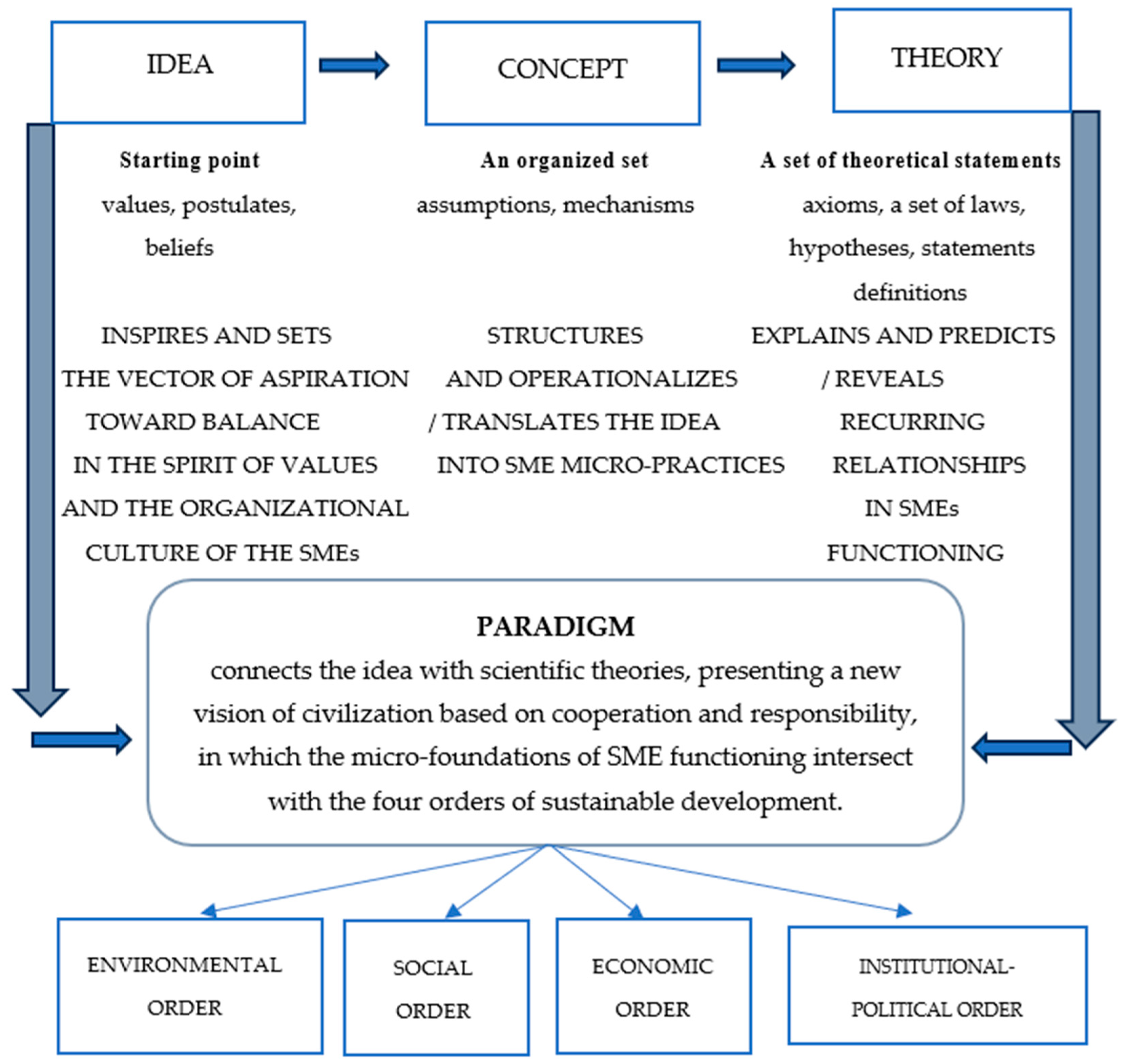
- SO4: To develop an original model of the relationship among the idea, concept, theory and paradigm of sustainable development and their linkages with the functioning of SMEs in the context of the four orders of this development.
- The idea and concept of sustainable socio-economic development.
- SME enterprises—their characteristics and significance for the economy and society.
- Institutional approaches, which explain the influence of norms, rules and the regulatory environment on enterprise functioning in the market;
- Resource-based view (RBV) perspectives, highlighting the importance of the specific resources and capabilities of SMEs in the process of implementing sustainable solutions;
- Network approaches, emphasizing the role of relationships, local cooperation and socio-spatial embeddedness;
- Evolutionary and processual perspectives, which allow sustainable development to be understood as a trajectory of organizational change shaped by adaptive and learning mechanisms.
- Peer-reviewed publications (including scholarly articles, monographs, and reports issued by research institutions).
- Content encompassing the following concepts: sustainable development, socio-economic development, SMEs, small business, organizational characteristics, and the sustainability paradigm.
- Works addressing the ideas, concepts, theories, or paradigms of sustainable development.
- Studies covering the four dimensions (domains) of sustainable development or their functional equivalents.
- Publications issued between 2000 and 2026, including seminal earlier literature (e.g., the Brundtland Report).
- Publications lacking a theoretical dimension (e.g., purely statistical reports without developmental or conceptual foundations).
- Works addressing only a single dimension of sustainability, without the possibility of theoretical integration with other domains.
- Studies focused exclusively on large enterprises, with no potential for conceptual or methodological adaptation to SMEs.
- Popular science or non-peer-reviewed articles.
- The identification of primary notions (idea, concept, theory, paradigm);
- The examination of the scope and content of these notions and their mutual relationships;
- The structuring of categories in accordance with their function in the theory-building process;
- The logical reconstruction of a model of socio-economic sustainable development for SMEs.
- The formulation of sets of keywords (e.g., SMEs, small business, sustainable development, socio-economic development, idea, concept, paradigm, theory);
- Database searches using the aforementioned tool;
- Screening titles, abstracts, and keywords for conceptual relevance;
- Applying inclusion criteria (thematic relevance, conceptual contribution, availability of full text);
- Applying exclusion criteria (purely technical or descriptive empirical studies lacking conceptual value);
- The use of complementary snowballing techniques (backward reference checking).
- Conceptual categories, such as idea–concept–theory–paradigm;
- Definitional categories, allowing for the clarification of terminology and the determination of the essence of socio-economic sustainable development;
- Descriptive categories, relating to the characteristics and micro-foundations of SME functioning;
- Structural categories, associated with the components of the four orders of sustainable development.
- RQ 1: What is the meaning of the terms “idea” and “concept”?
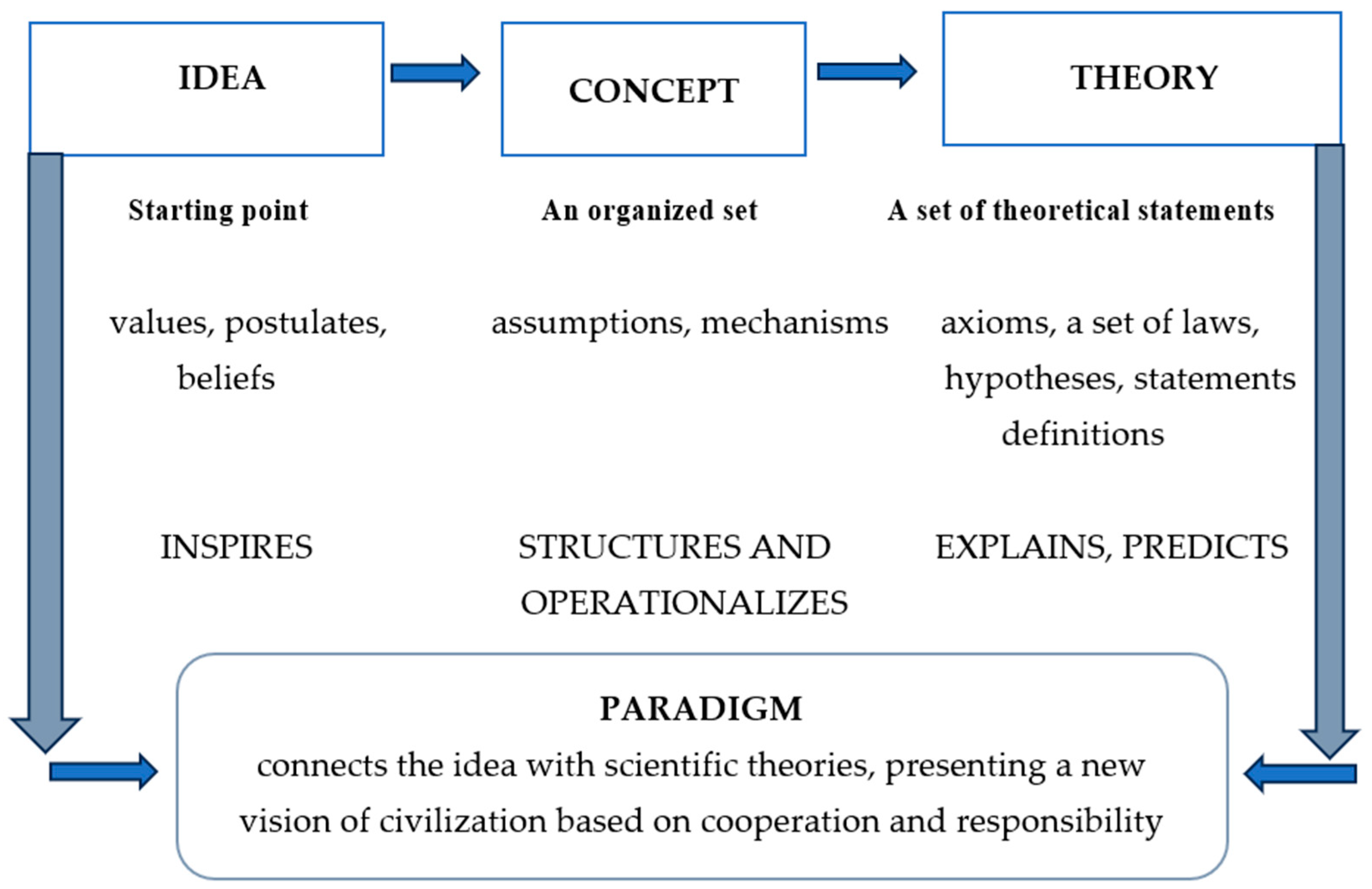
- RQ 2: How do the idea and the concept define and structure the transition toward the levels of theory and paradigm within the conceptual framework of socio-economic sustainable development?
- RQ 3: What constitutes “sustainability” in socio-economic development?
- RQ 4: What characteristics define enterprises in the SME sector?
- RQ 5: Why are SME enterprises considered important in the pursuit of sustainable socio-economic development?
- RQ 6: In what way do the proposed conceptual models account for the transition from normative-axiological perspectives to coherent and structured theoretical frameworks in the context of sustainable socio-economic development in SMEs?
- RQ 7: How does the interconnection among the levels of the cognitive structure—idea, concept, theory, and paradigm—fit within established theoretical traditions in science and support a coherent articulation of the theory of socio-economic sustainable development in SMEs?
- Limited access to older scientific publications (before 1990) and newer ones without electronic versions;
- The use of publications in languages other than Polish and English;
- Restricted access to scientific publication databases available via the above-mentioned Main Library platform;
- General analytical perspective without differentiating SMEs by size or type of activity, focusing instead on their shared elements, processes, and mechanisms of functioning. This approach followed from the adopted methodological orientation, which was conceptual and theory-oriented in nature, not empirical. The adoption of a general analytical perspective—methodologically justified in theory-oriented research—is directed toward the reconstruction of concepts, the identification of their mutual relationships, and the development of highly abstract conceptual models. In theoretical approaches of this kind, it is essential to isolate the constitutive features shared across the entire SME sector, as these elements form the core micro-foundations that determine the functioning of SMEs regardless of their size or industry.
3. Discussion
3.1. The Idea and Concept of Sustainable Socio-Economic Development
- Preserving the conditions necessary for life;
- Respecting the intrinsic value of nature;
- Upholding justice in both temporal and spatial dimensions.
- Prudent management of natural resources;
- Precaution in accordance with environmental protection principles;
- A long-term perspective;
- Consistency with socio-economic realities.
- Ontological: The human being occupies a unique position in the world, influencing natural and economic capital, which they transform and modify. Nevertheless, excessive or far-reaching alterations generate undesirable consequences, and in the case of natural capital—constituting the foundation of human existence on Earth—such changes become a threat to human survival.
- Epistemological: Knowledge of the socio-economic and natural world is complex, multidimensional, and interdependent; its acquisition requires the integration of diverse scientific perspectives and the recognition of the limited certainty of forecasts concerning developmental processes.
- Anthropological: The human being is a social entity whose full expression is realized within a group, through relationships established with others.
- Axiological: Among the dominant values, intergenerational solidarity is emphasized, expressed through cooperation and responsibility aimed at ensuring that the needs of the present generation can be met without diminishing the opportunities of future generations to satisfy their own needs.
- Historiosophical: Humanity is predisposed to development and progress, a tendency manifested throughout human history in the continuous process of self-improvement.
3.2. Orders of Socio-Economic Sustainable Development
- −
- Desires and needs (values, interests);
- −
- Perceptions and representations (models, symbols)
- −
- Aspirations and revendications (projects and decisions);
- −
- Ways of life (behaviours, practices).
- −
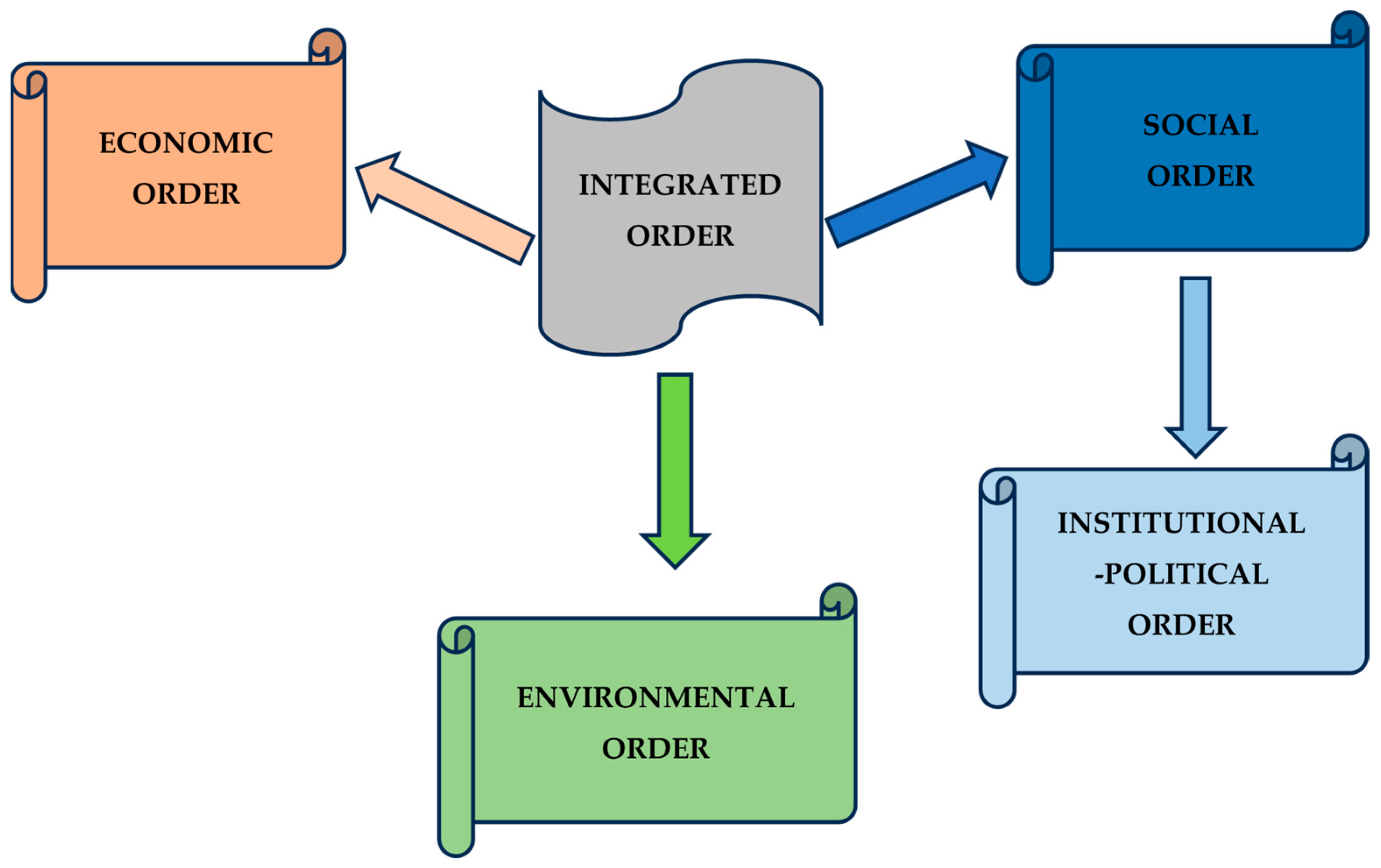
- The environmental order, within which the spatial order (spatial order can be defined as a state in which a spatial arrangement is established that takes into account and reflects the regularities governing the functioning of society, the economy, and the natural environment, while the overarching objective of spatial management is the public value and the public interest) is included;
- −
- The social order;
- −
- The economic order.
- −
- The institutional-political order (distinguished from within the social order).
3.3. SME Sector Enterprises—Characteristics and Importance for the Economy and Society
- Managerial function: In SMEs, owners (and in medium-sized enterprises also managers) typically perform managerial tasks, whereas in large enterprises management is carried out almost exclusively by professional managers;
- Managerial knowledge: In SMEs, managerial knowledge is often insufficient or moderate, while in large enterprises it tends to be well-established and robust;
- The role of planning: In SMEs it is frequently limited or indirect, whereas in large enterprises it plays a decisive role;
- Types of decisions: SMEs mainly make operational decisions, while large enterprises predominantly make strategic decisions;
- Group decision-making: Rare in SMEs, but common in large enterprises;
- Organizational and control linkages with other entities: Limited in SMEs, but frequent and extensive in large enterprises.
- Number of employees: Small or medium in SMEs, significant in large enterprises;
- Type of organizational structure: SMEs typically have simple and flexible structures, whereas large enterprises have diversified but often highly formalized structures;
- Organizational flexibility: High in SMEs, low in large enterprises;
- Degree of task formalization: Low in SMEs and high in large enterprises;
- Employee interactions: Frequent and direct in SMEs, whereas in large enterprises interactions usually occur only within designated work teams;
- Information flow: In SMEs communication is short and direct, while in large enterprises it follows long, formalized channels.
- Position in the procurement market: Weak for SMEs, strong for large enterprises;
- Materials procurement system: SMEs rely on purchase orders, whereas large enterprises employ long-term contracts with suppliers.
- Nature of production: Labour-intensive in SMEs, capital-intensive in large enterprises;
- Division of labour: Low in SMEs, high in large enterprises;
- Materials and equipment used: Often universal in SMEs, specialized in large enterprises;
- Cost reduction with increased production scale: Limited in SMEs, significant in large enterprises;
- Sales market: SMEs focus on individual customer needs, whereas large enterprises target mass markets;
- Market reach: local, regional, and less frequently national or international for SMEs; national and international for large enterprises.
- Dedicated R&D departments: Rare in SMEs, permanent in large enterprises;
- Conduct of scientific research: In SMEs, typically short-term and often basic in nature; in large enterprises, long-term and based on clearly defined strategies.
- Capital ownership: In SMEs, frequently held by a family or a narrow group of individuals; in large enterprises, ownership is dispersed;
- Capital linkages: Limited in SMEs, extensive in large enterprises;
- Access to the capital market: Restricted in SMEs, unrestricted in large enterprises.
- Absorbing emerging labour surplus (reducing unemployment);
- Fostering entrepreneurial attitudes and enabling self-employment;
- Stimulating activity within local and regional communities;
- Providing opportunities for success and social mobility;
- Supporting the creation of horizontal and vertical integration and cooperation linkages among enterprises;
- Stimulating initiative, creativity, and flexibility, and—especially important in the context of sustainable development—fostering responsibility.
- Environmental order—relates to the conditions and strategic objectives of environmental protection and sustainable management of natural resources;
- Social order—identifies strategic goals aimed at improving the quality of life of society;
- Economic order—defines strategic goals that generate effective socio-economic development;
- Institutional-political order—encompasses challenges related to global partnership and good governance.
3.4. Theoretical Model of Socio-Economic Sustainable Development in the SME Sector
- (a)
- Frugal resource efficiency supporting resilience and sustainable growth;
- (b)
- Local embeddedness and short information channels that reduce the costs of implementing pro-ESG practices;
- (c)
- A trajectory of formalization (from informal practices to simple organizational systems) that narrows the implementation gap between idea and action.
- Instead of an abstract notion of balance at the macroeconomic level, it emphasizes micro-foundations (owner-driven values, local networks, frugal innovation, and gradual formalization);
- It maps these micro-foundations onto the four orders of sustainable development (indicating possible pathways and modes of implementation);
- Thus it complements existing frameworks with the specific conditions of a small scale and resource constraints, explaining how SMEs arrive at sustainability in practice, rather than merely stating that they ought to do so.
4. Conclusions
Author Contributions
Funding
Data Availability Statement
Conflicts of Interest
Abbreviations
| SMEs | Small and Medium-sized Enterprises |
References
- Brundtland, C. Our Common Future: Report of the World Commission on Environment and Development; UN-Document A/42/427; Oxford University Press: Geneva, Switzerland, 1987. [Google Scholar]
- Meadows, D.; Randers, J.; Meadows, D. Limits to Growth: The 30-Year Update; Chelsea Green: White River Junction, VT, USA, 2004. [Google Scholar]
- Siedlecki, J. Równowaga a Wzrost Gospodarczy [The Relationship Between Economic Equilibrium and Economic Growth]; PWN: Warszawa, Poland, 2000. [Google Scholar]
- Babbie, E. Podstawy Badań Społecznych [Foundations of Social Research]; PWN: Warszawa, Poland, 2008. [Google Scholar]
- Nowak, S. Metodologia Badań Społecznych [Methodology of Social Research]; PWN: Warszawa, Poland, 2010. [Google Scholar]
- Yang, X.; Xu, Y.; Razzaq, A.; Wu, D.; Cao, J.; Ran, Q. Roadmap to achieving sustainable development: Does digital economy matter in industrial green transformation? Sustain. Dev. 2024, 32, 2583–2599. [Google Scholar] [CrossRef]
- Akinsemolu, A.A.; Onyeaka, H. The role of green education in achieving the sustainable development goals: A review. Renew. Sustain. Energy Rev. 2025, 210, 115239. [Google Scholar] [CrossRef]
- Al-Raeei, M. The smart future for sustainable development: Artificial intelligence solutions for sustainable urbanization. Sustain. Dev. 2025, 33, 508–517. [Google Scholar] [CrossRef]
- Patel, V.; Pauli, N.; Biggs, E.; Barbour, L.; Boruff, B. Why bees are critical for achieving sustainable development. Ambio 2021, 50, 49–59. [Google Scholar] [CrossRef]
- Zaman, M.; Tanewski, G.; Ekanayake, G. What does sustainability mean for small and medium enterprises: A systematic literature review. J. Clean. Prod. 2025, 492, 144830. [Google Scholar] [CrossRef]
- Alayón, C.L.; Säfsten, K.; Johansson, G. Barriers and enablers for the adoption of sustainable manufacturing by manufacturing SMEs. Sustainability 2022, 14, 2364. [Google Scholar] [CrossRef]
- Bartolacci, F.; Caputo, A.; Soverchia, M. Sustainability and financial performance of small and medium sized enterprises: A bibliometric and systematic literature review. Bus. Strat. Environ. 2020, 29, 1297–1309. [Google Scholar] [CrossRef]
- Crossley, R.M.; Elmagrhi, M.H.; Ntim, C.G. Sustainability and legitimacy theory: The case of sustainable social and environmental practices of small and medium-sized enterprises. Bus. Strat. Environ. 2021, 30, 3740–3762. [Google Scholar] [CrossRef]
- Klewitz, J.; Hansen, E.G. Sustainability-oriented innovation of SMEs: A systematic review. J. Clean. Prod. 2014, 65, 57–75. [Google Scholar] [CrossRef]
- Korsakienė, R.; Raišienė, A.G. Sustainability drivers of small and medium sized firms: A review and research agenda. Sci. Pap. Univ. Pardubic. Ser. D Fac. Econ. Adm. 2022, 30, 1–12. [Google Scholar] [CrossRef]
- Hull, Z. Ekofilozofia a filozofia zrównoważonego rozwoju [Eco-philosophy and the Philosophy of Sustainable Development]. Stud. Ecol. Bioethicae 2010, 1, 197–205. [Google Scholar] [CrossRef]
- Adamczyk, J. Zrównoważony rozwój jako paradygmat współczesnego zarządzania przedsiębiorstwem [Sustainable Development as a Paradigm of Contemporary Business Management]. Przegląd Organ. 2018, 12, 8–14. [Google Scholar] [CrossRef]
- Jeżowski, P. Rozwój zrównoważony i jego nowe wyzwania [Sustainable Development and Its New Challenges]. Kwart. Kol. Ekon.-Społecznego Stud. I Pr. 2012, 10, 99–124. [Google Scholar]
- Gilpin, A. Environmental Economics. A Critical Overview; Wiley & Sons Ltd.: Hoboken, NJ, USA, 2000; pp. 3–5+89–112. [Google Scholar]
- Fiedor, B. Nowa ekonomia instytucjonalna a zrównoważony rozwój [New Institutional Economics and Sustainable Development]. In Obszary Badań Nad Trwałym i Zrównoważonym Rozwojem; Poskrobko, B., Ed.; Wyd. Ekonomia i Środowisko: Białystok, Poland, 2007; pp. 158–160. [Google Scholar]
- Meyer, W. Evaluation, Design and Data Collection, Part III: Investigating Sustainability; Unpublished conference presentation; EASY-ECO Training: Bratislava, Slovakia, 2005. [Google Scholar]
- Wielka Encyklopedia PWN; PWN: Warszawa, Poland, 2002; p. 565.
- Witczak, H. Wstęp do naukowego statusu koncepcji zarządzania [An Introduction to the Scientific Status of Management Concepts]. Organ. I Kier. 2014, 162, 71–85. [Google Scholar]
- Papuziński, A. Filozofia zrównoważonego rozwoju jako subdyscyplina badań filozoficznych [The Philosophy of Sustainable Development as a Subdiscipline of Philosophical Inquiry]. Probl. Ekorozwoju 2007, 2, 27–40. [Google Scholar]
- Adamczyk, J. Koncepcja Zrównoważonego Rozwoju w Zarządzaniu Przedsiębiorstwem [The Concept of Sustainable Development in Enterprise Management]; AE w Krakowie: Kraków, Poland, 2001. [Google Scholar]
- Zboroń, H. Dyskurs metodologiczny we współczesnej ekonomii–próba dekonstrukcji podejścia modernistycznego [Methodological Discourse in Contemporary Economics: An Attempt at Deconstructing the Modernist Approach]. Stud. Ekon. 2013, LXXVI, 13–45. [Google Scholar]
- Siekierski, J.; Rutkowska, M. Zrównoważony rozwój jako koncepcja w naukach ekonomicznych [Sustainable Development as a Concept in Economic Sciences]. Stud. I Pr. Wydziału Nauk Ekon. I Zarządzania 2008, 8, 359–368. [Google Scholar]
- Von Bertalanffy, L. General System Theory: Foundations, Development, Applications; George Braziller: New York, NY, USA, 1968. [Google Scholar]
- Meadows, D. Thinking in Systems: A Primer; Chelsea Green Publishing: London, UK, 2015. [Google Scholar]
- Chombart de Lauwe, P.H. La Fin des Filles, Mythe ou Réalité; Calmann—Lévy: Paris, France, 1982. [Google Scholar]
- Fisher, J.; Arora, P.; Chen, S.; Rhee, S.; Blaine, T.; Simangan, D. Four propositions on integrated sustainability: Toward a theoretical framework to understand the environment, peace, and sustainability nexus. Sustain. Sci. 2021, 16, 1125–1145. [Google Scholar] [CrossRef] [PubMed]
- Borys, T. Sustainable Development–How to Recognize Integrated Order. Probl. Sustain. Dev. 2011, 6, 75–81. [Google Scholar]
- Golley, F.B. The ecosystem concept: A search for order. Ecol. Res. 1991, 6, 129–138. [Google Scholar] [CrossRef]
- Maglia, C.; Wilson Rowe, E. Ecosystems and Ordering: Exploring the Extent and Diversity of Ecosystem Governance. Glob. Stud. Q. 2023, 3, ksad028. [Google Scholar] [CrossRef]
- Abbott, A. Social Order and Process. In Processual Sociology; University of Chicago Press: Chicago, IL, USA, 2016. [Google Scholar]
- Kurawa, S.S. Social Order in Sociology: Its Reality and Elusiveness. Sociol. Mind 2012, 2, 34–40. [Google Scholar] [CrossRef][Green Version]
- Broyer, S. German Contemporary Analyses of Economic Order: Standard Ordnungstheorie, Ordoliberalism and Ordnungsökonomik in Perspective. In Institutional Economics in France and Germany. Studies in Economic Ethics and Philosophy; Labrousse, A., Weisz, J.D., Eds.; Springer: Berlin/Heidelberg, Germany, 2001. [Google Scholar]
- Kolev, S. When Liberty Presupposes Order: F. A. Hayek’s Contextual Ordoliberalism. J. Hist. Econ. Thought 2024, 46, 288–311. [Google Scholar] [CrossRef]
- March, J.G.; Olsen, J.P. The Institutional Dynamics of International Political Orders. Int. Organ. 1998, 52, 943–969. [Google Scholar] [CrossRef]
- Lieberman, R.C. Ideas, Institutions, and Political Order: Explaining Political Change. Am. Political Sci. Rev. 2002, 96, 697–712. [Google Scholar] [CrossRef]
- Dominiak, P. Sektor MSP we Współczesnej Gospodarce [The SME Sector in the Contemporary Economy]; PWN: Warszawa, Poland, 2005. [Google Scholar]
- Borowiecki, R.; Siuta-Tokarska, B.; Żmija, K. Rozwój małych i średnich przedsiębiorstw w Polsce wobec wyzwań gospodarki XXI wieku. In Kontekst Ekonomiczno-Zarządczy [The Development of Small and Medium-Sized Enterprises in Poland in the Face of the Challenges of the 21st-Century Economy: An Economic and Managerial Perspective]; KEiOP UEK: Kraków, Poland, 2018. [Google Scholar]
- Parkitna, A. Determinanty Efektywności Małego Przedsiębiorstwa [Determinants of Small Enterprise Effectiveness]; Oficyna Wydawnicza Politechniki Wrocławskiej: Wrocław, Poland, 2020. [Google Scholar]
- Poznańska, K.; Schulte-Zurhausen, M. Kryteria klasyfikacji małych i średnich przedsiębiorstw [Classification Criteria for Small and Medium-Sized Enterprises]. Przegląd Organ. 1994, 2, 24–27. [Google Scholar] [CrossRef]
- Drab-Kurowska, A.; Sokół, A. Małe i Średnie Przedsiębiorstwa Wobec Wyzwań Rozwoju Technologii XXI Wieku [Small and Medium-Sized Enterprises in the Face of the Challenges of 21st-Century Technological Development]; CeDeWu: Warszawa, Poland, 2010. [Google Scholar]
- Siuta-Tokarska, B.; Żmija, K.; Kruk, S.; Krzemiński, P.; Thier, A. Digital Transformation of Small and Medium-sized Enterprises in the Visegrad Countries. In Developmental Similarities and Differences; PWE: Warsaw, Poland, 2025. [Google Scholar]
- Bigliardi, B.; Colacino, P.; Dormio, A.I. Innovative Characteristics of Small and Medium Enterprises. J. Technol. Manag. Innov. 2011, 6, 83–93. [Google Scholar] [CrossRef]
- Marconatto, D.A.B.; Teixeira, E.G.; Santini, F.D.O.; Ladeira, W.J. Characteristics of owners and managers in different countries: A meta-analytical investigation of SMEs’ growth. J. Small Bus. Enterp. Dev. 2022, 29, 354–379. [Google Scholar] [CrossRef]
- Dwivedi, Y.K.; Papazafeiropoulo, A.; Supyuenyong, V.; Islam, N.; Kulkarni, U. Influence of SME characteristics on knowledge management processes: The case study of enterprise resource planning service providers. J. Enterp. Inf. Manag. 2009, 22, 63–80. [Google Scholar] [CrossRef]
- Bridge, S.; O’Neill, K.; Cromie, S. Understanding Enterprise, Entrepreneurship and Small Business, 2nd ed.; Palgrave Macmillan: New York, NY, USA, 2003. [Google Scholar]
- Cragg, P.B.; King, M. Organizational Characteristics and Small Firms’ Performance Revisited. Entrep. Theory Pract. 1988, 13, 49–64. [Google Scholar] [CrossRef]
- Pelham, A. Market orientation and other potential influences on performance in small and medium-sized manufacturing firms. J. Small Bus. Manag. 2000, 1, 48–67. [Google Scholar]
- Swierczek, F.W.; Ha, T.T. Entrepreneurial orientation, uncertainty avoidance and firm performance: An analysis of Thai and Vietnamese SMEs. Int. J. Entrep. Innov. 2003, 1, 46–58. [Google Scholar] [CrossRef]
- Wiklund, J.; Shepherd, D. Entrepreneurial Orientation and Small Business Performance: A Configurational Approach. J. Bus. Ventur. 2004, 20, 71–91. [Google Scholar] [CrossRef]
- Pullen, A.; De Weerd-Nederhof, P.; Groen, A.; Song, M.; Fisscher, O. Successful Patterns of Internal SME Characteristics Leading to High Overall Innovation Performance. Creat. Innov. Manag. 2009, 18, 209–223. [Google Scholar] [CrossRef]
- O’Regan, N.; Ghobadian, A.; Sims, M. Fast Tracking Innovation in Manufacturing SMEs. Technovation 2006, 26, 251–261. [Google Scholar] [CrossRef]
- Piasecki, B. (Ed.) Ekonomika i Zarządzanie Małą Firmą [Economics and Management of the Small Enterprise]; PWN: Warszawa, Poland, 1999. [Google Scholar]
- Wskaźniki Zrównoważonego Rozwoju Polski [Indicators of Sustainable Development in Poland]; GUS: Katowice, Poland, 2011.
- Poznańska, K.; Janiszewski, J.M. Zrównoważony rozwój a ekoinnowacyjność przedsiębiorstw w Polsce [Sustainable Development and Eco-Innovation in Enterprises in Poland]. Stud. I Pr. Kol. Zarządzania I Finans. SGH 2024, 197, 27–37. [Google Scholar]
- Tonis, R. SMEs Role in Achieving Sustainable Development. J. Econ. Dev. Environ. People 2015, 4, 41–49. [Google Scholar] [CrossRef]
- Gallardo-Vázquez, M.; Sánchez-Hernández, I. Structural analysis of the strategic orientation to environmental protection in SMEs. Bus. Res. Q. 2014, 17, 115–128. [Google Scholar] [CrossRef]
- Krisciunas, K.; Greblikaite, J. Entrepreneurship in Sustainable Development: SMEs Innovativeness in Lithuania. Eng. Econ. 2007, 4, 20–26. [Google Scholar]
- Shashi Cerchione, R.; Centobelli, P.; Shabani, A. Sustainability orientation, supply chain integration, and SMEs performance: A causal analysis. Benchmarking Int. J. 2018, 25, 3679–3701. [Google Scholar] [CrossRef]
- Zimmer, J.; Węglarz, M.; Ropuszyńska-Surma, E. Sustainable business models in SMEs: The customer’s perspective. Ekon.–Wroc. Econ. Rev. 2023, 29, 81–97. [Google Scholar] [CrossRef]
- Baggia, A.; Maletič, M.; Žnidaršič, A.; Brezavšček, A. Drivers and Outcomes of Green IS Adoption in Small and Medium-Sized Enterprises. Sustainability 2019, 11, 1575. [Google Scholar] [CrossRef]
- Wasiq, M.; Kamal, M.; Ali, N. Factors Influencing Green Innovation Adoption and Its Impact on the Sustainability Performance of Small- and Medium-Sized Enterprises in Saudi Arabia. Sustainability 2023, 15, 2447. [Google Scholar] [CrossRef]
- Muangmee, C.; Dacko-Pikiewicz, Z.; Meekaewkunchorn, N.; Kassakorn, N.; Khalid, B. Green Entrepreneurial Orientation and Green Innovation in Small and Medium-Sized Enterprises (SMEs). Soc. Sci. 2021, 10, 136. [Google Scholar] [CrossRef]
- Rustiarini, N.W.; Bhegawati, D.A.S.; Mendra, N.P.Y. Does Green Innovation Improve SME Performance? Economies 2022, 10, 316. [Google Scholar] [CrossRef]
- Sulaiman, M.A.B.A. Green Product Innovation as a Mediator Between Green Market Orientation and Sustainable Performance of SMEs. Sustainability 2025, 17, 1628. [Google Scholar] [CrossRef]
- López-Pérez, M.E.; Melero-Polo, I.; Vázquez-Carrasco, R.; Cambra-Fierro, J. Sustainability and Business Outcomes in the Context of SMEs: Comparing Family Firms vs. Non-Family Firms. Sustainability 2018, 10, 4080. [Google Scholar] [CrossRef]
- Johnson, M.P. Sustainability Management and Small and Medium Sized Enterprises: Managers’ Awareness and Implementation of Innovative Tools. Corp. Soc. Responsib. Environ. Manag. 2015, 2, 271–285. [Google Scholar] [CrossRef]
- Loučanová, E.; Nosáľová, M.; Olšiaková, M.; Štofková, Z.; Dumiter, F.C.; Nicoară, Ș.A.; Boiță, M. Innovation as a Tool for Sustainable Development in Small and Medium Size Enterprises in Slovakia. Sustainability 2023, 15, 15393. [Google Scholar] [CrossRef]
- Barney, J. Firm Resources and Sustained Competitive Advantage. J. Manag. 1991, 17, 99–120. [Google Scholar] [CrossRef]
- Nelson, R.R.; Winter, S.G. An Evolutionary Theory of Economic Change; Harvard University Press: Cambridge, MA, USA, 1982. [Google Scholar]
- Bos-Brouwers, H. Corporate sustainability and innovation in SMEs: Evidence of themes and activities in practice,” Business Strategy and the Environment. Wiley Blackwell 2010, 19, 417–435. [Google Scholar]
- Weyrauch, T.; Herstatt, C. What is frugal innovation? Three defining criteria. J. Frugal Innov. 2016, 2, 1. [Google Scholar] [CrossRef]
- Winkler, T.; Ulz, A.; Knöbl, W.; Lercher, H. Frugal innovation in developed markets–Adaption of a criteria-based evaluation model. J. Innov. Knowl. 2020, 5, 251–259. [Google Scholar] [CrossRef]
- Zeschky, M.; Widenmayer, B.; Gassmann, O. Frugal Innovation in Emerging Markets. Res.-Technol. Manag. 2011, 54, 38–45. [Google Scholar] [CrossRef]
- Belas, J.; Çera, G.; Dvorský, J.; Čepel, M. Corporate social responsibility and sustainability issues of small-and medium-sized enterprises. Corp. Soc. Responsib. Environ. Manag. 2021, 28, 721–730. [Google Scholar] [CrossRef]
- Boakye, D.J.; Tingbani, I.; Ahinful, G.; Damoah, I.; Tauringana, V. Sustainable environmental practices and financial performance: Evidence from listed small and medium-sized enterprise in the United Kingdom. Bus. Strat. Environ. 2020, 29, 2583–2602. [Google Scholar] [CrossRef]
- Chakraborty, A.; Lizarelli, F.L.; O’Loughlin, A.; Barton, A.; Kandra, H.S. Empirical evidence on circular economy adoption in Australian small and medium enterprises. J. Clean. Prod. 2024, 467, 142958. [Google Scholar] [CrossRef]



| ENVIRONMENTAL ORDER | SOCIAL ORDER |
| SMEs can implement simple ecological solutions, particularly within local communities. The motivation for adopting ecological innovations includes the desire to maintain a competitive position, enter new markets, and meet customer needs. However, SMEs face numerous barriers, including cost constraints as well as regulatory instability and complexity. These enterprises typically finance ecological innovations from their own resources; therefore, cost barriers may significantly limit the implementation of such innovations. SMEs support “green niches”—small-scale ecological services, processing activities, and local initiatives. Financial and organizational constraints hinder SMEs from implementing state-of-the-art environmental technologies and large-scale environmental investments. SMEs more frequently integrate environmental objectives into operational strategies rather than formal corporate strategies. Strategic ecological decisions tend to be adaptive and oriented toward cost reduction and building local reputation. Long-term green strategies are often lacking due to resource limitations and the absence of formalized strategic processes. | SMEs mitigate social tensions and absorb surplus labour, thereby reducing unemployment. They strengthen social cohesion through their rootedness in the local environment, direct interpersonal relationships, and short communication channels. They foster entrepreneurial attitudes, enable self-employment, and support social mobility by offering pathways for changing one’s social status. Their organizational flexibility and small scale of operation enable rapid responses to the needs of local communities. A limitation is the instability of employment and the relatively limited opportunities for employee development; nevertheless, their integrative role remains crucial for local development. Social strategies in SMEs focus primarily on relationship-building, personalisation of services, and maintaining the loyalty of employees and customers. In practice, social responsibility has an informal character and is rooted in the personal values of the owners, which shape both the strategic direction of the enterprise and its identity within the local market. |
| ECONOMIC ORDER | INSTITUTIONAL- POLITICAL ORDER |
| SMEs strengthen economic dynamism through flexibility, rapid responsiveness, and the ability to operate within market niches. They form the foundation of small local economies, stimulating entrepreneurial activity and influencing competitiveness. They constitute an important component of an economy built on diversity and resilience, dispersing economic risk due to the large number of entities. In the area of innovation activities, SMEs increasingly adopt approaches based on frugality and resource efficiency, focusing on cost minimization, essential functionality, inclusiveness, and the gradual improvement of solutions. Such an approach supports the development of simple, accessible, and locally adapted innovations that strengthen the competitiveness of enterprises despite their limited scale of operation. Their limited scale, reduced access to capital, and weaker bargaining position relative to large firms constrain their growth and investment potential. Nevertheless, their adaptability, customer proximity, and low operating costs make them essential to sustainable economic development. Strategic processes in SMEs rely to a significant extent on the owner’s knowledge and experience. Economic strategy is predominantly oriented toward survival, maintaining financial liquidity, and securing a position in the local market. However, in the context of globalization and the digitalization of economies, SMEs increasingly undertake actions that integrate elements of growth, diversification, and innovation strategies, which enhances their ability to create long-term economic value. | SMEs support the development of an institutional economic order through local cooperation networks, horizontal and vertical linkages, and participation in clusters. Their transparency, direct contact with stakeholders, and owner-driven accountability contribute to the creation of a culture of responsibility. They integrate local economic environments, supporting community development and strengthening local economic structures. Their capacity to influence public policies and shape more formal governance systems is limited. Nevertheless, their presence enhances the flexibility and adaptability of the institutional system at the local and regional levels. SMEs are capable of adjusting their strategies to changing institutional conditions quickly, though most often reactively. Limited resources restrict their influence on regulatory processes; however, strategic flexibility enables them to adapt effectively to new regulations, utilize local support instruments, and build strategies based on network cooperation. |
Disclaimer/Publisher’s Note: The statements, opinions and data contained in all publications are solely those of the individual author(s) and contributor(s) and not of MDPI and/or the editor(s). MDPI and/or the editor(s) disclaim responsibility for any injury to people or property resulting from any ideas, methods, instructions or products referred to in the content. |
© 2026 by the authors. Licensee MDPI, Basel, Switzerland. This article is an open access article distributed under the terms and conditions of the Creative Commons Attribution (CC BY) license.
Share and Cite
Siuta-Tokarska, B.; Adamczyk, J. Conceptualisation of Sustainable Development in the Context of SME Sector Enterprises. Systems 2026, 14, 398. https://doi.org/10.3390/systems14040398
Siuta-Tokarska B, Adamczyk J. Conceptualisation of Sustainable Development in the Context of SME Sector Enterprises. Systems. 2026; 14(4):398. https://doi.org/10.3390/systems14040398
Chicago/Turabian StyleSiuta-Tokarska, Barbara, and Jadwiga Adamczyk. 2026. "Conceptualisation of Sustainable Development in the Context of SME Sector Enterprises" Systems 14, no. 4: 398. https://doi.org/10.3390/systems14040398
APA StyleSiuta-Tokarska, B., & Adamczyk, J. (2026). Conceptualisation of Sustainable Development in the Context of SME Sector Enterprises. Systems, 14(4), 398. https://doi.org/10.3390/systems14040398