1. Introduction
Online ride-hailing platforms have become an essential component of modern urban mobility systems by enabling flexible and on-demand transportation services through digital matching between passengers and drivers. With the rapid development of mobile Internet technologies and location-based services, platforms such as Uber, Lyft, and Didi have significantly transformed traditional taxi markets and expanded the range of urban mobility options. These platforms operate as two-sided markets in which pricing mechanisms, order allocation algorithms, and incentive schemes are used to coordinate passenger demand and driver labor supply in real-time.
However, maintaining an efficient balance between supply and demand remains a central operational challenge for ride-hailing platforms. Passenger demand exhibits strong temporal and spatial variability and is highly sensitive to price changes and service quality. At the same time, the supply side of the platform, represented by the driver workforce, is characterized by substantial heterogeneity in working preferences, opportunity costs, and income expectations. Drivers can freely adjust their participation decisions and working hours according to perceived profitability and personal constraints. As a result, driver behavior is highly adaptive and may respond dynamically to platform incentive policies such as dynamic pricing, subsidies, and differentiated order dispatch mechanisms.
To address supply–demand imbalances, platforms increasingly rely on algorithmic incentive mechanisms including surge pricing, dynamic dispatching, and targeted subsidies. A large body of literature has investigated the effectiveness of these mechanisms in regulating platform markets. For example, dynamic pricing and surge mechanisms have been shown to improve real-time supply–demand matching and increase driver participation during peak demand periods [
1,
2]. Integrated pricing and subsidy schemes can further enhance platform performance and social welfare by coordinating incentives across both sides of the market [
3,
4,
5]. Empirical studies also demonstrate that price signals and compensation incentives significantly influence driver labor supply decisions, affecting both working hours and order acceptance rates [
6,
7].
Despite these advances, existing research faces two important limitations. First, many studies rely on static equilibrium models, such as Nash or Stackelberg games, which assume fully rational decision-makers and focus on one-shot equilibrium outcomes. While these approaches provide valuable insights into optimal pricing and subsidy strategies, they often fail to capture the adaptive and evolutionary nature of driver behavior observed in real markets. Empirical evidence suggests that drivers continuously adjust their working strategies based on realized income outcomes and expectations rather than solving static optimization problems [
8,
9,
10,
11,
12,
13]. Such adaptive decision-making processes may generate complex collective dynamics, including strategy switching, imitation behavior, and long-term evolutionary adjustments. Second, although evolutionary game theory has been increasingly applied to study behavioral dynamics in platform economies, most existing models treat platform policies as exogenous parameters. In practice, ride-hailing platforms play a strategic leadership role in shaping the incentive environment by adjusting pricing rules, dispatch algorithms, and subsidy schemes. The interaction between platform decision-making and the evolutionary adaptation of driver strategies therefore forms a hierarchical strategic process that cannot be fully explained by traditional single-layer models. Recent studies in 2023–2024 have advanced the analysis of dynamic pricing, platform competition, and algorithmic regulation in ride-hailing systems, but they still rarely integrate platform leadership, heterogeneous driver adaptation, and empirical calibration within one unified framework. This is precisely the gap addressed by the present study.
To address these limitations, this study developed a dual-layer Stackelberg–evolutionary game framework to analyze the co-evolution of platform incentives and driver working-hour strategies. In the proposed model, the ride-hailing platform acts as a Stackelberg leader that determines order allocation rates and pricing strategies to maximize platform revenue and regulate supply–demand matching. Drivers, acting as followers, adapt their working-hour strategies through evolutionary dynamics based on realized payoffs and cost considerations including fatigue costs associated with extended working hours.
Using large-scale operational data from the Ningbo ride-hailing market, the model parameters were empirically calibrated to reflect realistic demand elasticity, pricing conditions, and driver cost structures. The framework enables us to analyze how different incentive schemes influence the evolutionary fitness landscape of driver strategies and how the driver population converges toward stable working-hour distributions under various market conditions.
The study contributes to the literature in three aspects. First, it develops a data-driven Stackelberg–evolutionary game framework that integrates platform leadership with the adaptive evolution of heterogeneous driver strategies, providing a unified approach to analyze both platform decision-making and long-run behavioral dynamics. Second, the model reveals how fatigue-cost thresholds and differentiated incentives reshape the evolutionary fitness landscape of driver strategies, leading to regime transitions between strategy dominance and coexistence. Third, by calibrating the model using large-scale ride-hailing operational data from Ningbo, the study provides empirically grounded insights into how incentive design can stabilize driver supply structures and improve platform governance.
2. Literature Review
Pricing and subsidies are core tools for ride-hailing platforms to coordinate the two-sided market and regulate supply and demand. Scholars have studied their optimal strategies from various perspectives. Garg et al. [
14] showed that driver-side surge payment mechanisms affect drivers’ earnings expectations and strategic participation decisions, thereby influencing platforms’ ability to adjust supply in real-time. Hu Dongbo et al. [
15], through a simulation model, found that the target of platform subsidies shifts dynamically with changes in market supply and demand. When a regional market transitions from undersupply to oversupply, the focus of subsidies needs to shift from service providers to customers. Song Yanan et al. [
16] systematically compared the respective optimal market conditions for four strategies—no subsidy, subsidizing passengers only, subsidizing drivers only, and subsidizing both passengers and drivers—by constructing a Stackelberg game model. These studies collectively suggest that subsidy design is highly context-dependent and should be adjusted according to changing market conditions.
To address real-time supply–demand fluctuations, dynamic pricing has become a crucial tool for platforms. Related research covers path-based dynamic pricing [
17], real-time surge pricing strategies [
1,
2], and surge pricing combined with subsidies [
3,
4], which have been proven effective in balancing supply and demand [
5]. Recent studies have further extended this line of research to large-scale algorithmic pricing. For instance, Lei [
18] developed scalable reinforcement-learning approaches for dynamic pricing in ride-hailing systems, highlighting the increasing importance of algorithm-driven real-time regulation in platform operations. Scholars have further conducted comparative analyses of the performance of different surge pricing strategies. For instance, Hu et al. [
19] identified two types of equilibrium pricing strategies: “skimming surge pricing” and “penetration surge pricing”, and found that penetration pricing equilibria are generally superior when both exist. Concurrently, research on static pricing strategies also focuses on the influence of market participant characteristics. Examples include analyzing optimal pricing for coordinating impatient passengers and earnings-sensitive drivers by combining queuing and game models [
20], or investigating optimal pricing in a ride-pooling market considering differential pooling sizes and endogenous congestion effects [
21]. Service price and wage competition between platforms is another research focus. Some scholars have proposed three wage schemes to enhance platform profitability, with the choice depending on the intensity of competition on both supply and demand sides [
22]. Notably, some research has begun to incorporate evolutionary game theory and passenger heterogeneity to explore optimal pricing strategies [
23]. This aligns with our focus on behavioral heterogeneity, although their core research question pertains to pricing under different matching strategies.
Driver labor supply constitutes the micro-foundation of the platform’s supply side and exhibits substantial heterogeneity and adaptability. Liu et al. [
24] showed that threshold-based incentive programs could significantly reshape drivers’ working decisions and generate heterogeneous welfare effects across driver groups. Empirical studies, however, have not reached a unified conclusion on how wages or expected wages affect taxi drivers’ labor supply [
8,
9,
10,
11,
12,
13,
25]. In the ride-hailing context, dynamic pricing provides a more flexible setting for identifying such responses. The more flexible pricing mechanism of online ride-hailing provides a new research context. For example, Brodeur and Nield [
6], utilizing the dynamic pricing mechanism of ride-hailing platforms and a controlled experiment, verified the positive incentive effect of wages on labor supply. Miao et al. [
7] also found that dynamic pricing significantly increased drivers’ order acceptance rates and working hours during peak demand periods. More recent evidence also supports this line of inquiry. Using the introduction of Singapore’s JustGrab program as a quasi-natural experiment, Cheng [
26] showed that dynamic pricing significantly affects drivers’ behavior and labor-supply adjustment in platform-based transport markets. Furthermore, job flexibility, compensation level, and income stability have been identified as main factors attracting drivers to platforms [
27]. Recent international research has further shown that algorithmic assignment itself can reshape driver behavior and welfare. For example, Chen [
28] demonstrated that ride-hailing algorithms may impose a flexibility penalty on drivers, even when workers appear to retain schedule autonomy.
Order dispatch and pricing of online ride-hailing platforms, due to their involvement of multi-dimensional factors and market mechanisms, remain a focal point of operational strategy research. Beyond platform pricing decisions, strategic interactions among drivers may also affect the platform outcomes. Tripathy et al. [
29] showed that driver collusion in ride-hailing platforms can alter market prices and platform performance, thereby increasing the complexity of platform governance. Based on two-sided market theory, some scholars have studied the impact of user service quality preferences [
30] and cross-network externalities [
31] on platform pricing and their relationship with user affiliation structures. Pricing strategies are also significantly shaped by competitive market structures. Zhong et al. [
32] showed that ride-hailing platforms adopt different pricing decisions when competing with the traditional taxi industry under alternative regulatory environments. Related studies further indicate that the effects of regulation depend on the specific policy targets adopted. For instance, Yang et al. [
33] showed that different regulatory targets can significantly affect platform pricing decisions and market outcomes in the competition between taxi and ride-sharing services. More broadly, Vignon et al. [
34] argue that the governance of ride-hailing markets in the age of uberization requires parsimonious and effective regulation to improve social efficiency.
External regulation remains a key factor in the standardized development of ride-hailing markets. Yu et al. [
35] showed that regulating on-demand ride services requires balancing multiple competing objectives including innovation, employment creation, congestion mitigation, and the protection of incumbent industries. In addition, Sun et al. [
36] found that regulatory constraints on vehicle standards and driver qualifications could significantly influence the growth path of ride-hailing platforms.
In summary, while existing research has achieved abundant results in platform pricing, driver behavior, and policy regulation, a key limitation persists: most studies have adopted static or comparative static analytical frameworks [
4,
29,
32,
33,
34], treating drivers as homogeneous and fully rational decision-makers to solve for one-off equilibria, neglecting the heterogeneity and adaptability of driver behavior and the long-term dynamic evolution process of strategies. Although evolutionary game theory has begun to be applied to the ride-hailing market [
15], these studies typically treat platform strategies as exogenous parameters, mainly analyzing the evolutionarily stable strategy of the drivers under fixed policies. Recent international studies have also started to examine evolutionary adjustment in ride-hailing markets. For example, Cai [
37] analyzed dynamic competition and evolution in ride-hailing markets, indicating that evolutionary perspectives are increasingly relevant to platform-based transport systems. However, this line of research still does not fully address how a platform, as an endogenous strategic leader, reshapes the long-run fitness landscape of heterogeneous driver working-hour strategies through differentiated incentives. They fail to incorporate the platform as an active strategic leader into the evolutionary framework, overlooking the endogenous interaction where the platform can dynamically adjust its incentive strategies based on the outcomes of driver behavior evolution. Consequently, existing research struggles to systematically reveal how platforms, by designing differentiated incentive structures, proactively reshape the long-term fitness of driver strategies, thereby influencing the evolutionary trajectory and stability of the supply structure. This is precisely the core issue of a “platform leadership-driver evolution” co-evolutionary game process and the research gap this paper aims to fill.
3. Methodology and Model Framework
This study built a two-layer game model based on the interaction mechanism between online ride-hailing platforms and drivers and systematically describes the influence path of platform incentive policies on drivers’ strategic behavior. Considering that the platform has a market dominance, it first sets strategic variables such as price and order rate. As the responder, the driver decides whether to go online and chooses the working time based on his own costs and benefits. The overall model structure reflects the characteristics of a Stackelberg game. At the same time, in order to be closer to the actual situation, the “heterogeneous driver” setting is further introduced, and the evolutionary game simulation group strategy dynamic adjustment process is adopted.
3.1. Stackelberg Game Framework
The interaction between ride-hailing platforms and drivers over working-hour choices can be characterized as a typical Leader–Follower game. In this relationship, the platform acts as the leader by formulating order-allocation rules and operational policies, while drivers, as followers, make autonomous working-hour decisions under the platform’s incentive environment. The key advantage of the Stackelberg framework is that it can explicitly capture this hierarchical decision structure and the asymmetry of power between the two sides. In practice, although the platform cannot directly determine the drivers’ actual working hours, it can indirectly influence their hourly income by adjusting the average hourly dispatch rate, which in turn affects their labor-supply decisions.
In the present framework, the platform moves first by choosing its pricing and order-allocation strategy, and the driver side responds afterward by adjusting the distribution of working-hour strategies under the given incentive environment. It should be noted that this separation is defined in terms of update steps within the model rather than directly measured real-world time units. In other words, the platform strategy is treated as fixed over a sequence of driver-side adaptation steps within a decision period, and the driver-group distribution evolves under that policy until the system approaches a relatively stable state.
In the upper-level model, the platform, as the leader, occupies a dominant position in the game and can directly affect the driver’s revenue structure by adjusting the average hourly order distribution rate. This role positioning is in line with reality, that is, the platform has control over the supply and demand data and algorithms and can formulate order assignment strategies first, while the driver can only passively respond to the platform’s rules. In the Stackelberg game model, the upper-level model is a revenue model established by the platform based on the elastic relationship between online ride-hailing supply and order demand, and the decision variable is the average hourly order distribution rate. As a leader, the platform aims to maximize the profit by optimizing the order allocation strategy, which is to maximize the total order volume on the basis of meeting the supply and demand relationship. For this reason, the platform income function and constraints are as follows:
The lower-level model mainly describes the optimal working time decision of the driver under the conditions of the given order distribution rate
of the platform and the given order price
of the platform. As a follower, the driver maximizes his own profits by selecting the average working time
of the daily working time
based on the given order distribution rate
and the order price
of the platform. Drivers cannot directly affect the platform strategy, but they can be indirectly fed back to the platform’s supply and demand model by adjusting the work time. This timing relationship of “platform decision first, driver reaction later” perfectly fits the inverse inductive logic of Stackelberg’s game. Based on this, the decision variable is the driver’s average daily working time
, and the driver’s income function is as follows:
Here, the driver cost function is specified in quadratic form. This benchmark specification was adopted for both behavioral and analytical reasons. From a behavioral perspective, it captures the increasing marginal cost of longer working hours in a parsimonious way: as working time accumulates, fatigue, reduced rest time, and other work-related burdens tend to rise at an increasing rate rather than linearly. In practice, the first few hours of work may be relatively easy to sustain, whereas the additional burden of extending work near the upper range of daily labor supply becomes substantially greater. From a mathematical perspective, the quadratic form guarantees convexity, which helps ensure a unique optimal solution in the driver’s utility-maximization problem and keeps the lower-level optimization analytically tractable. More generally, when the true cost function is smooth and locally convex, the quadratic form can also be interpreted as a natural local approximation around the relevant equilibrium region.
In order to find the
when the driver’s profit is maximized, first find the first derivative of the income function
to obtain:
According to the first-order condition, when the return is maximized, the first-order derivative is 0, so when
, we obtain:
At this time, Formula (6) is the optimal Nash equilibrium solution for online ride-hailing drivers to choose their working hours. This indicates that given the platform order allocation rate and order price, the driver will determine the optimal working hours based on the average order price, cost coefficient, and order allocation rate to maximize profits. From this, we can obtain the equilibrium equation of the Stackelberg game:
3.2. Evolutionary Dynamics of Driver Strategies
To make the behavioral foundation of the evolutionary process more explicit, this study adopted several baseline assumptions. First, the model does not assume direct peer-to-peer learning or full-information observation among individual drivers. Drivers are not assumed to observe the complete strategy choices of all other drivers, nor the full strategy space of the platform. Instead, the evolutionary process is interpreted as a population-level adaptive adjustment in which the distribution of daily working-hour states changes in response to realized payoffs under the prevailing platform policy. Second, movement across the short-, medium-, and long-hour groups is not interpreted as permanent type switching. Since these groups represent daily working-hour states, the same driver may belong to different groups on different days. Accordingly, the baseline model abstracts from explicit switching costs and treats such transitions as day-to-day schedule adjustment rather than identity change. Third, driver-side strategy adjustment is modeled as boundedly rational and myopic. Drivers respond to realized payoff conditions under the given platform policy, rather than solving a fully forward-looking intertemporal optimization problem. These assumptions are intended to provide a tractable and behaviorally plausible interpretation of the aggregate evolutionary dynamics.
Based on the static Stackelberg two-layer game model, this paper uses evolutionary game theory to further build a game model between online ride-hailing drivers and platforms. First, it is assumed that there is a limited set of strategies in the driver group
, where drivers adjust their strategy distribution based on their own profits.
represents the proportion of drivers who adopt the strategy
in the group, and they must meet
and
.
represents the benefits obtained by drivers using
, and the driver’s utility is:
For this, the dynamic equation of the replicator is:
3.3. Incentive-Differentiated Evolutionary Game Model
In order to better meet the supply and demand relationship, the platform can also adopt differentiated order distribution rates for different driver groups such as increasing the hourly order distribution rate for drivers who choose long-term work strategies. Based on this, this paper describes the platform’s strategy to differentiate the order distribution rate by introducing the order distribution rate adjustment coefficient
. Formula (11) is a differentiated strategy, and the order distribution rate of the driver group is:
;
is the base order distribution rate; and
is the diffusion parameter that adjusts the response speed. When the driver chooses a long-term strategy,
, at this time,
,
, and long-term drivers are encouraged to obtain a higher order rate; when the driver chooses a short-term strategy,
, at this time,
,
, and short-term drivers are reduced in order rate, thus achieving the differentiation of platform order allocation rate.
Despite extensive research on pricing and dispatch strategies, existing studies predominantly rely on static equilibrium or representative-agent assumptions, which overlook the adaptive and heterogeneous nature of driver behavior. In reality, platform incentives continuously reshape drivers’ payoff structures, inducing strategy switching and collective evolution over time. This paper addresses this gap by embedding platform leadership into an evolutionary game framework, enabling the analysis of how incentive differentiation alters the long-run composition and stability of driver strategies. For clarity, the main variables and parameters used in the above model are summarized in
Table 1.
4. Data and Parameter Calibration
4.1. Data Source
The data required for this study relied on the Ningbo taxi service supervision platform to collect and organize the operation data of online ride-hailing in Ningbo City, and the data coverage period was October 2024. Among them, each record of online ride-hailing operation data corresponded to a complete order. The field information included eight variables: license plate, mileage (km), revenue (yuan), area, latitude and longitude of boarding, latitude and longitude of boarding, latitude and longitude of boarding, and time of boarding and departure time. An example of the initial data structure is shown in
Table 2.
4.2. Data Preprocessing
Prior to model calibration and simulation analysis, the raw platform data were subjected to a systematic cleaning and screening procedure. Since the dataset was obtained from real-world platform operations, some records may contain missing information, duplicated entries, or abnormal observations caused by GPS errors, data-uploading failures, or recording inconsistencies. To improve data reliability, these problematic records were removed before analysis. In addition, to maintain a consistent and representative spatial scope, the sample was restricted to the five main urban districts of Ningbo: Haishu, Jiangbei, Yinzhou, Zhenhai, and Beilun.
At the operational level, only trip records that could be successfully matched with driver information were retained. Observations with missing key variables, duplicate records, implausible fare or trip-distance values, and inconsistent pickup/drop-off times were excluded. Drivers without valid daily operating records were also removed. After these procedures, the final analytical sample comprised 28,422 valid drivers and approximately 8 million trip records, which served as the empirical basis for parameter calibration and subsequent model analysis
4.3. Parameter Calibration
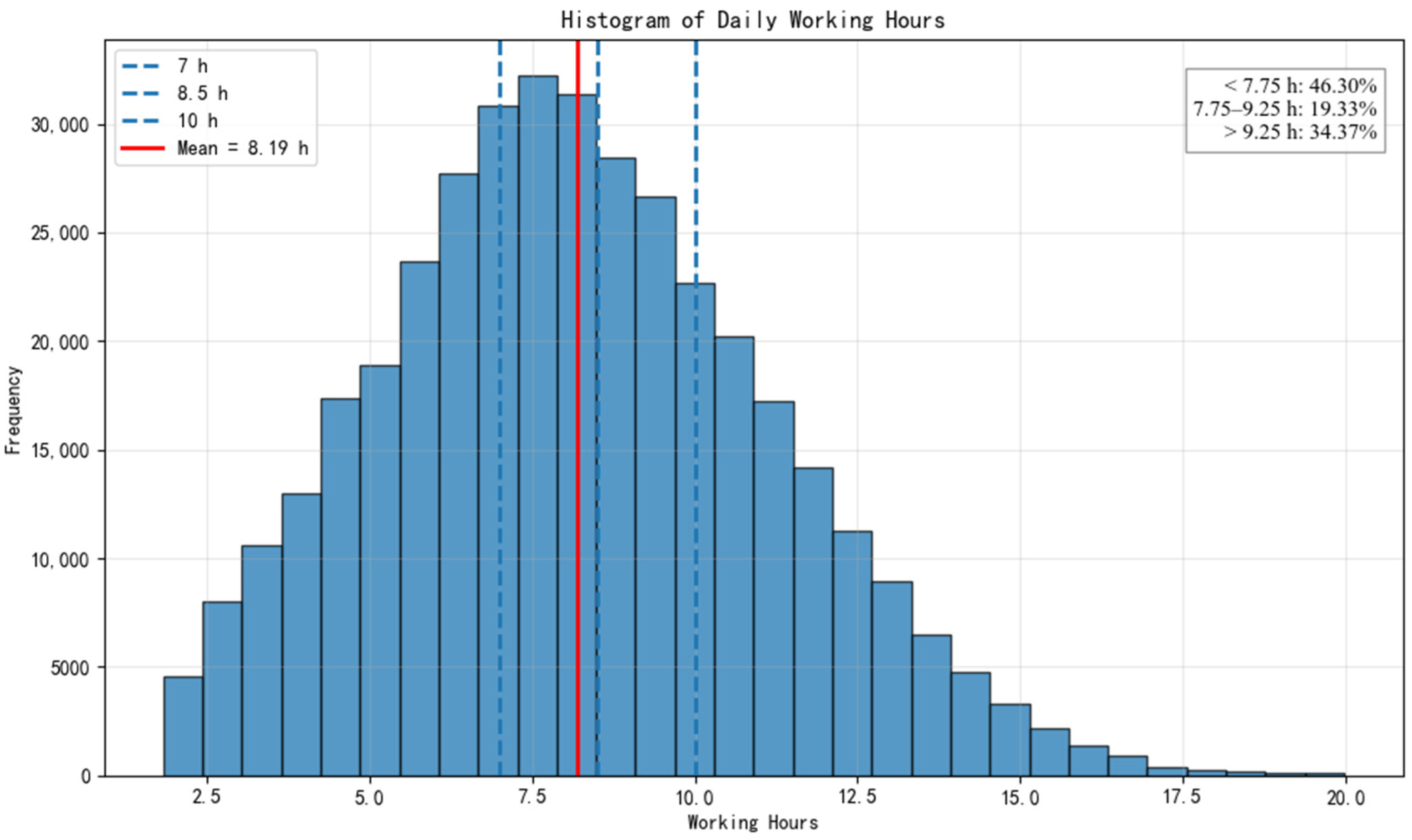
This study considered three discrete working-hour strategies, denoted as Strategy A (long working hours), Strategy B (medium working hours), and Strategy C (short working hours), corresponding to 10, 8.5, and 7 h, respectively. These strategy levels were selected with reference to the empirical distribution of drivers’ daily working hours in the Ningbo sample. Specifically, 8.5 h is close to the sample mean and was therefore used to represent the medium-hour strategy, while 7 and 10 h were chosen as representative lower and higher working-hour levels, respectively, to capture the contrast between short-hour and long-hour labor supply.
To further illustrate the empirical basis of this discrete strategy setting,
Figure 1 presents the histogram of daily working hours in the Ningbo sample and marks the three representative strategy levels. As shown in the figure, these three values were broadly consistent with the main concentration range of the observed working-hour distribution, providing direct empirical support for the use of the three discrete working-hour strategies in the subsequent evolutionary analysis.
It should also be emphasized that these groups were not interpreted as fixed and permanent driver types. The same driver may belong to the long-hour group on one day but to the short-hour group on another day, depending on the realized operating conditions and individual decisions. Therefore, the model does not classify drivers into immutable behavioral categories; rather, it tracks the aggregate distribution of daily working-hour states in the driver population. This interpretation further strengthens the empirical motivation of the strategy-space setting and improves the behavioral plausibility of the evolutionary dynamics.
The core parameters in the model of this paper (
Table 3) were all calibrated based on the operational data of real ride-hailing platforms and industry statistics to ensure that the model could reflect the real market environment. Among them, parameters such as the total number of drivers
, baseline demand
, and baseline service duration
were directly taken from the historical operational data of ride-hailing platforms; structural parameters such as the supply–demand adjustment factor
and demand price elasticity coefficient
were estimated by regression using the least squares method on the platform’s historical order and price data; and the baseline price
and the initial platform pricing
refer to the platform’s average pricing level and policy settings during the study period.
- (1)
Definition and Model of Market Demand
Since the platform decision variable is the “average hourly dispatch rate” while the driver behavior is described by “average daily working hours (hours/day)”, the market base demand
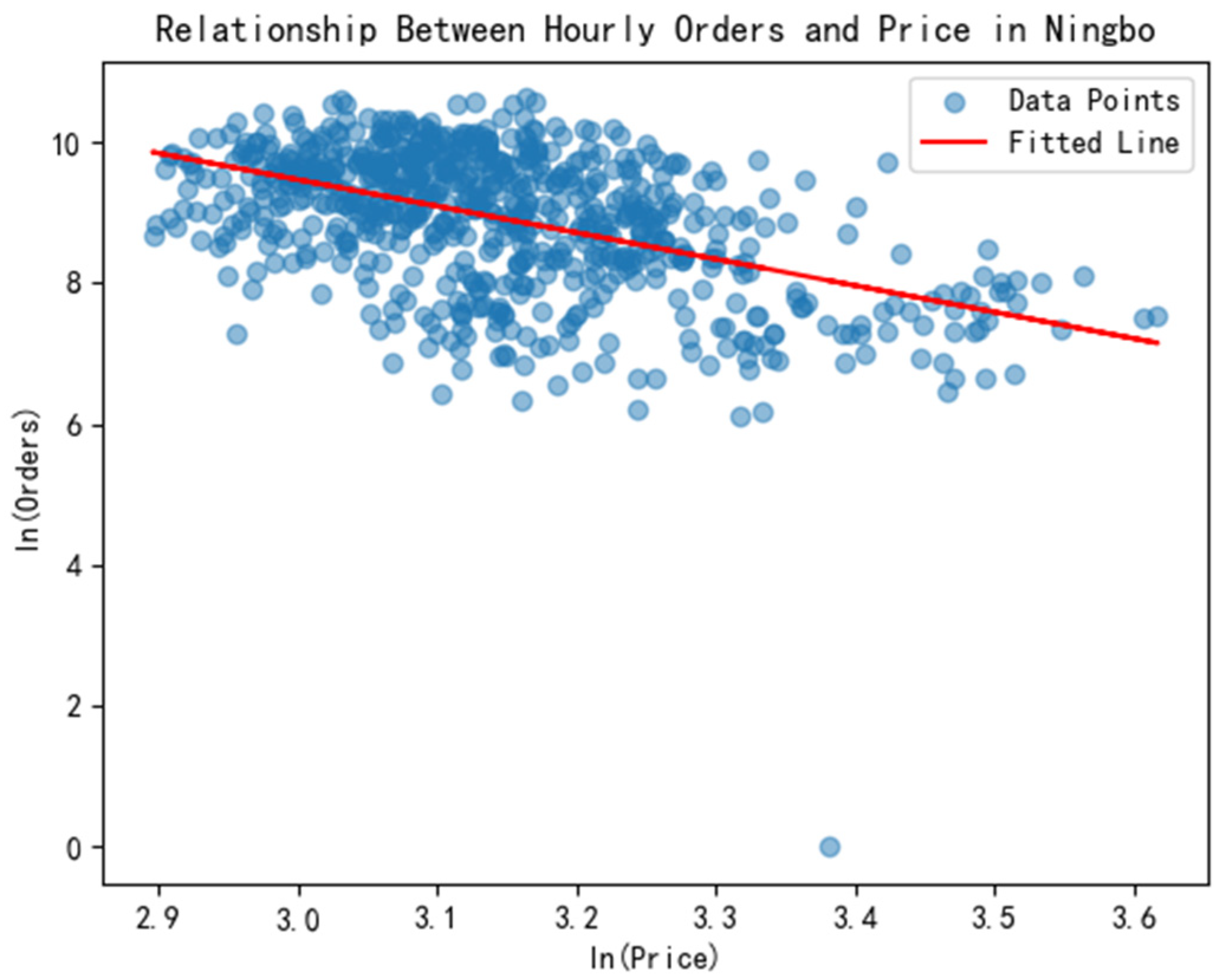
is defined as the hourly baseline demand (orders/hour). The relationship between hourly demand and price is expressed by the log-linear demand model:
where
denotes the number of completed trips per hour;
represents the average price;
is the baseline hourly demand; and b is the price elasticity of demand.
Taking logarithms gives:
where
is the disturbance term. The intercept
and the price elasticity
can be estimated using the ordinary least squares (OLS) regression method. The estimated parameter values are reported in
Table 4.
At the median price
CNY, the predicted hourly demand is:
The elasticity value implies that a increase in price results in a decrease in order volume, indicating a highly price-sensitive demand structure.
Figure 2 illustrates the scatter plot of the logarithmic relationship between hourly order volume and price, along with the fitted regression line. It can be observed that order volume and price exhibited a clear negative correlation, and the model showed a significant linear fitting effect, which is consistent with economic theory expectations.
5. Results and Analysis
5.1. Homogeneous Driver Scenario with Uniform Platform Incentives
In order to explore the native impact of fatigue costs on the system under the basic operation rules of the platform (unified decision-making), we first focused on the benchmark scenario of “homogeneous driver + platform unified order rate and price”. In this setting, the coefficient is defined not as a pure fatigue cost parameter in a narrow physiological sense, but as a broader labor cost coefficient that includes fatigue-related burdens and captures the overall increase in the cost of supplying longer working hours. This scenario strips away the interference of order distribution and price differentiation and can accurately characterize the underlying relationship between costs and strategy evolution and price dynamics, providing a “pure comparison” for subsequent heterogeneous scenario analysis. When all drivers’ costs follow the same rules and the platform adopts the simplest decision logic, it is possible to clearly observe how the cost coefficient drives the system toward the steady state. The specific simulation of different values is developed below.
- (1)
: Low cost scenario
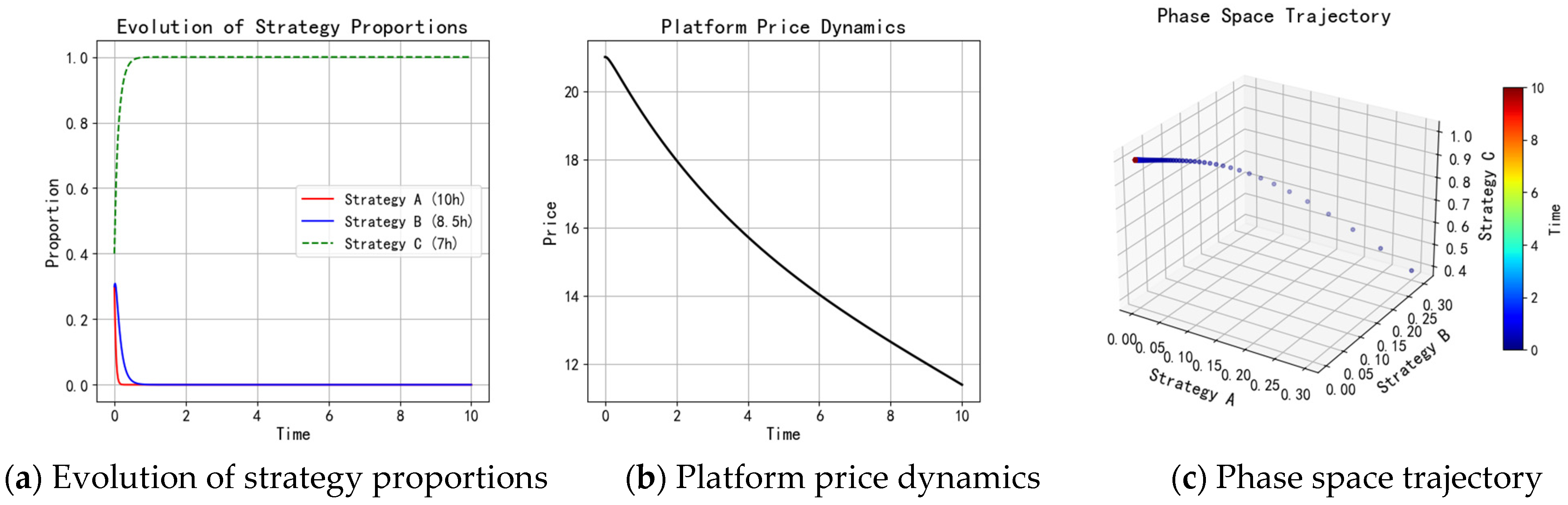
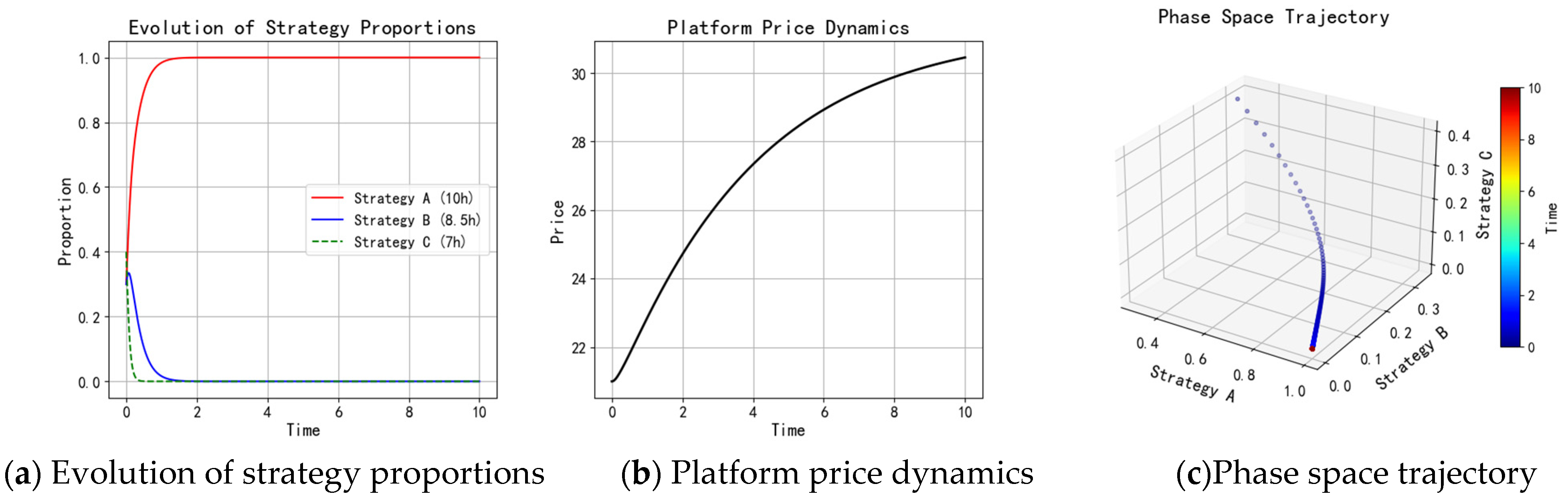
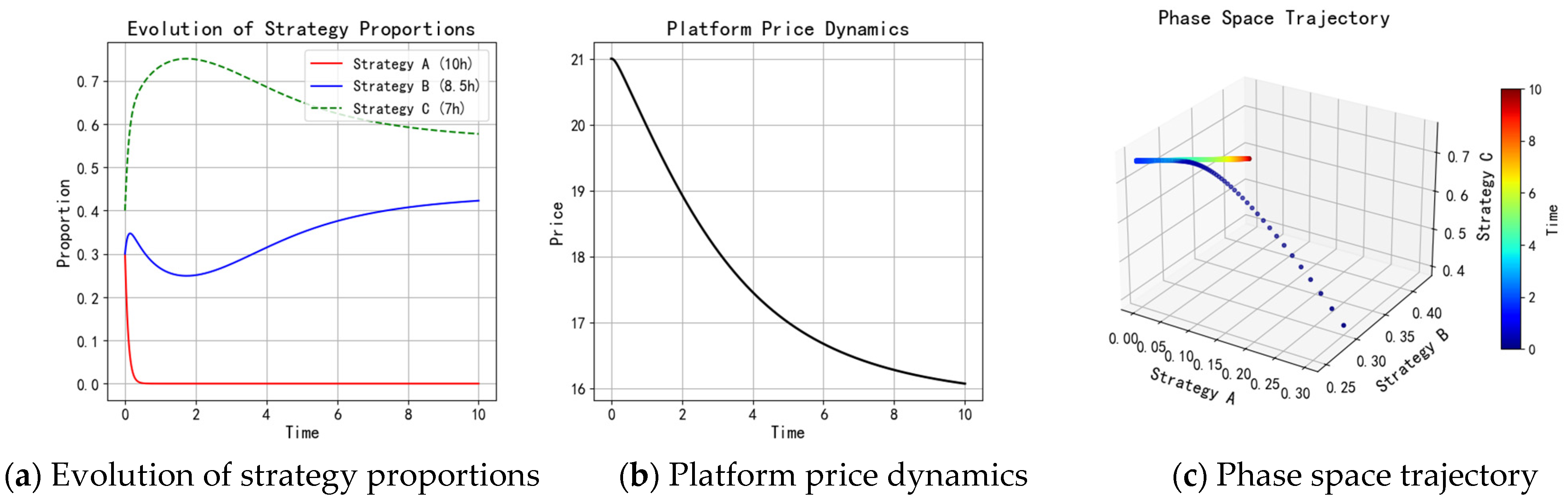
The evolutionary equilibrium results are shown in
Figure 3. When
, it can be observed from the evolutionary path of the proportion of each strategy that the proportion of Strategy A rose continuously from 0.4 and eventually converged to 1, while the proportions of Strategy B and Strategy C both declined to 0. This phenomenon indicates that when the cost coefficient
is low, the marginal benefit of working long hours is much higher than the increased costs such as fatigue, thus continuously attracting more drivers to adopt Strategy A and finally forming an equilibrium where all drivers work long hours. In other words, when drivers are less sensitive to work costs and lack alternative opportunities with higher returns externally, they are more inclined to increase their total income by extending working hours, leading to the “long working hours” strategy becoming dominant in the population.
- (2)
: Medium cost scenario
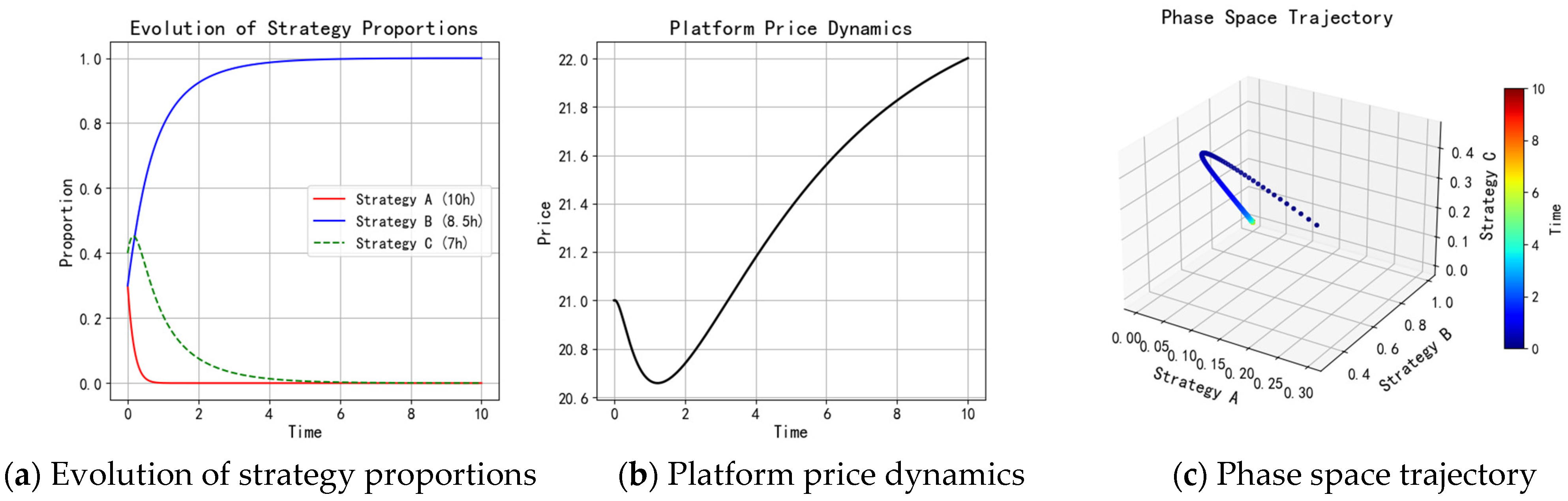
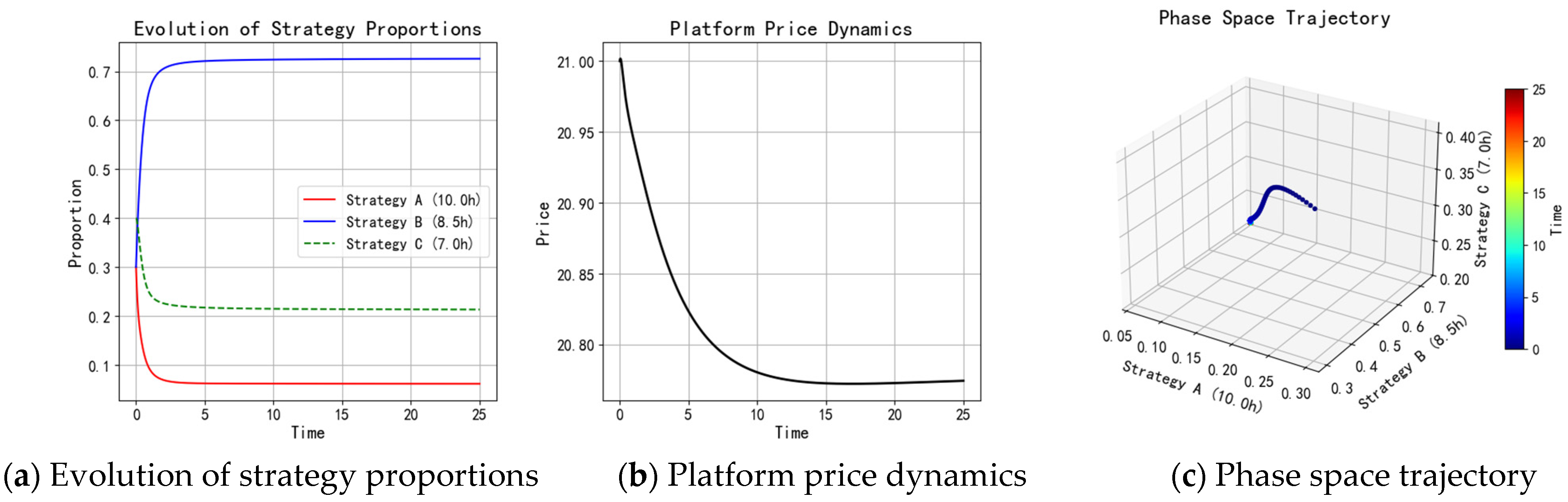
As shown in
Figure 4, when
, the evolutionary dynamics of the proportion of each strategy were as follows: the proportion of Strategy A gradually decreased from the initial value to 0, Strategy B rose steadily to 1, and Strategy C also declined to 0. This indicates that with the increase in the cost coefficient
, drivers become more sensitive to costs. Long working hours are not advantageous due to excessively high costs, and short working hours are unattractive because of insufficient income. In the trade-off between working income and costs such as fatigue, drivers tended to prefer Strategy B with medium working hours. This equilibrium reflects the phenomenon that drivers gradually stabilize at medium working hours when the external labor price and platform subsidies fail to significantly improve the returns of working longer. The result is basically consistent with the current situation, where online ride-hailing drivers in urban Ningbo generally choose a daily working duration of approximately 8.5 h, and thus can be regarded as a reasonable reflection of the cost coefficient level of drivers in the market.
- (3)
: High cost scenario
As shown in
Figure 5, when
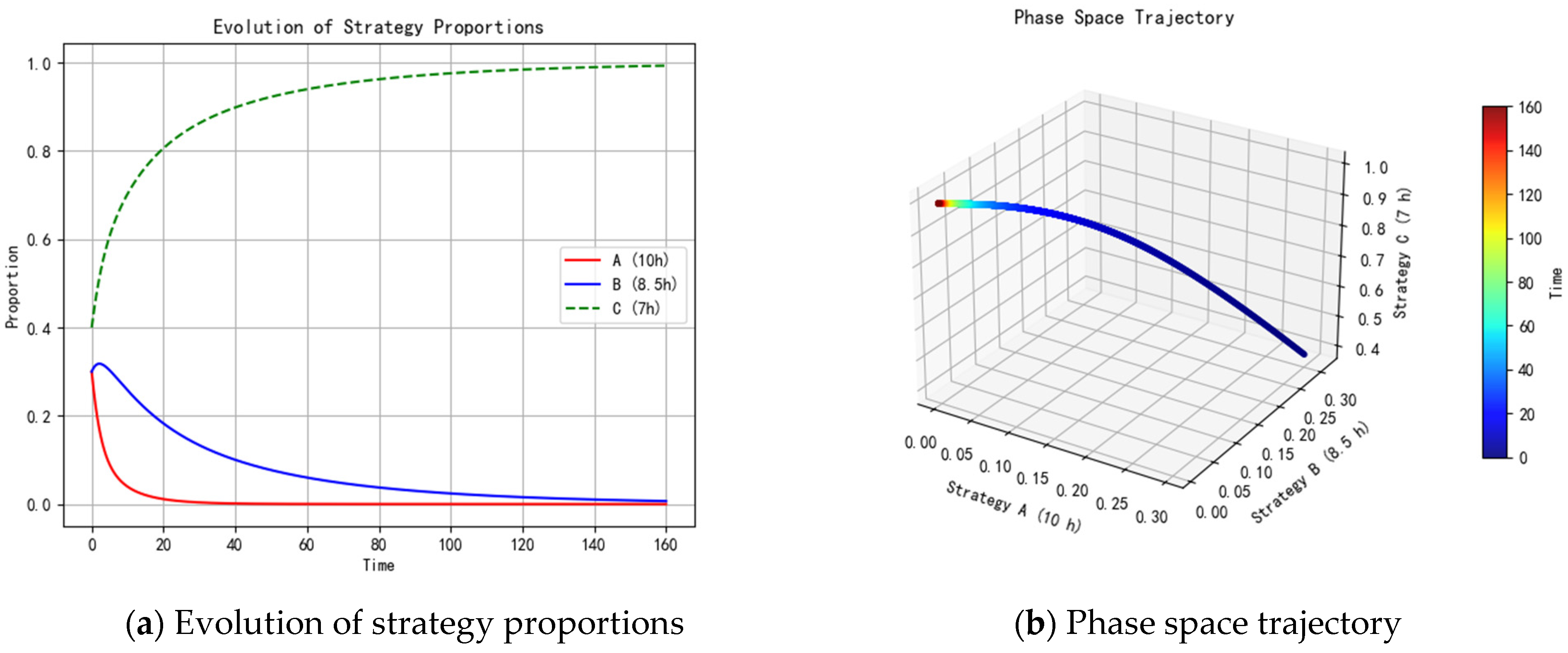
, the proportions of Strategy A and Strategy B both declined continuously and eventually converged to 0, while the proportion of Strategy C ross steadily to 1. This indicates that in an environment with increasing costs such as fatigue, drivers tend to choose short working hours to maximize the net benefits.
However, long-term reliance on short working hours will significantly reduce the drivers’ average daily order volume, which may lead to a mismatch between market supply and demand. For the platform, if it continues to adopt a fixed order dispatch rate based on the assumption of long working hours, a large backlog of orders is highly likely to occur, which not only impairs user experience but also reduces transport efficiency. In this case, the platform should adjust its pricing and subsidy strategies according to the drivers’ cost sensitivity and optimize the order dispatch algorithm, so as to balance drivers’ income stability and market supply–demand, thereby achieving efficient utilization of overall transport capacity and sustainable development of the market.
- (4)
: Strategy A and Strategy B balance scenarios
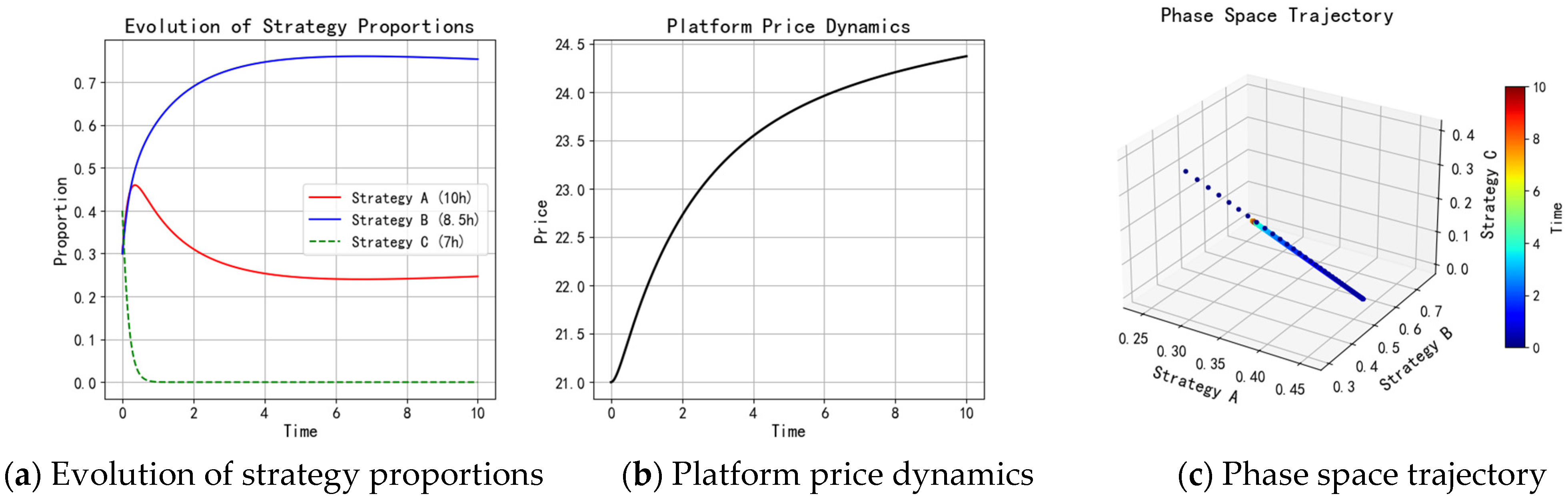
When
in
Figure 6, as time evolved, the proportions of Strategy A and Strategy B gradually converged, with Strategy A eventually stabilizing at approximately 0.75 and Strategy B at 0.25, while the proportion of Strategy C converged to 0. The three-dimensional phase space trajectory also indicates that at this value of
, the driver population will reach an equilibrium between the two strategies of “long working hours” and “medium working hours”. This reflects that when the cost coefficient is relatively high, the additional income from long working hours can no longer fully offset costs such as fatigue, so drivers tend to diverge between the two strategies.
- (5)
: Strategy B and Strategy C Balance scenario
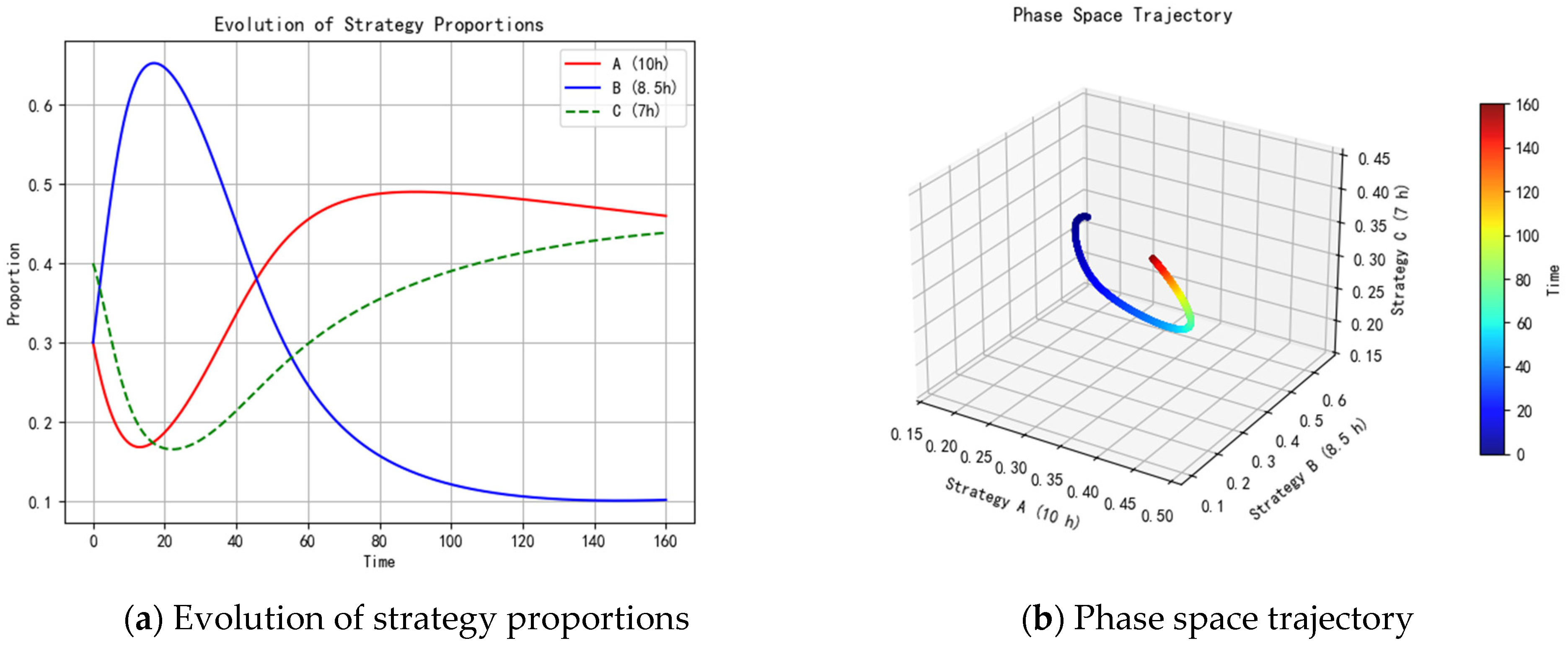
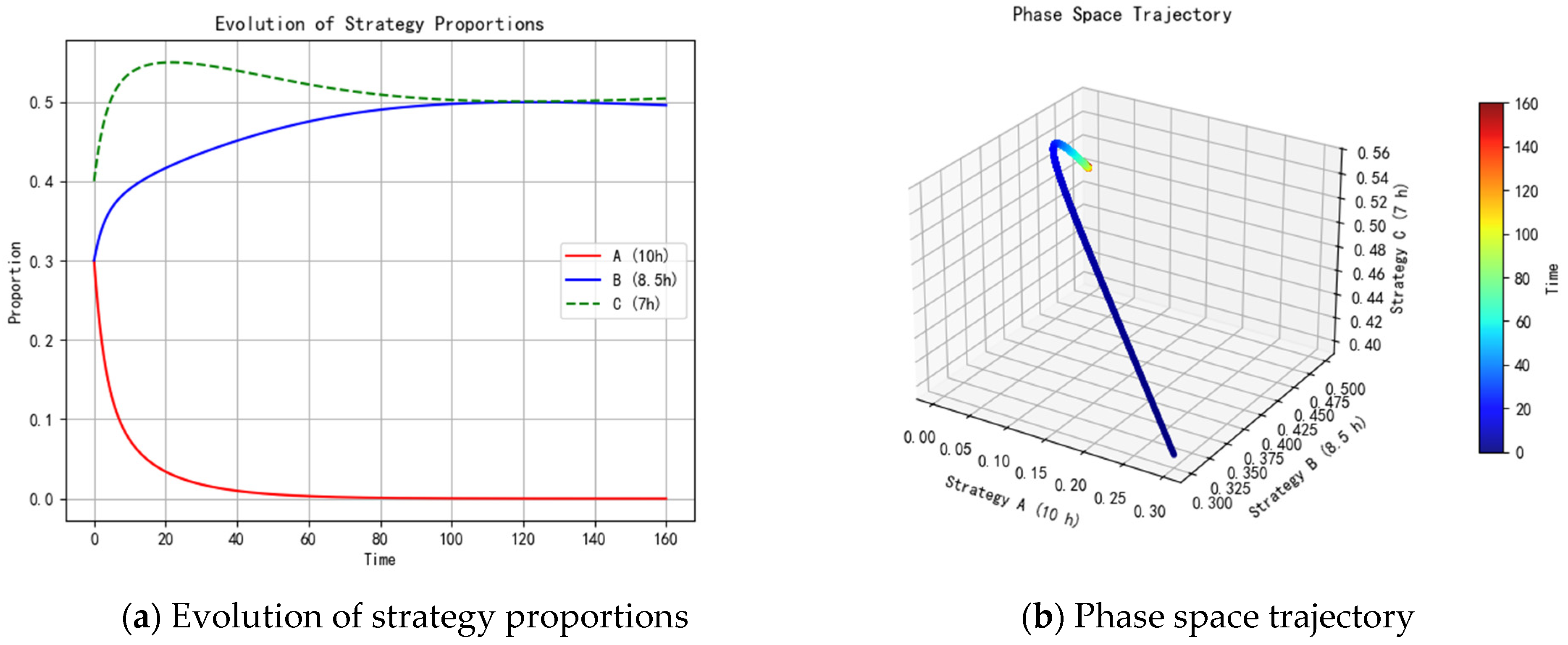
When
in
Figure 7, during the evolutionary process, the proportions of Strategy B and Strategy C gradually converged to 0.5, while Strategy A declined to 0. The three-dimensional phase space trajectory also showed that drivers will eventually allocate themselves between the “medium working hours” and “short working hours” strategies. This indicates that when the cost rises further to this level, sustained long working hours become excessively costly. Although short working hours yield relatively low income, they are more attractive in balancing costs and earnings. As a result, the “medium working hours” and “short working hours” strategies jointly dominate the market.
The above evolutionary results demonstrate that changes in drivers’ cost sensitivity will trigger a gradual shift in working-hour strategies: from “long hours” to “mixed long and medium hours”, then to “medium hours” and “mixed medium and short hours”, and finally to “short hours”. These critical thresholds not only characterize the watershed of group behavior under different cost levels, but also align well with the actual distribution of working hours among drivers in the Ningbo ride-hailing market, reflecting the impacts of market conditions and external incentives on drivers’ decision-making.
The findings suggest that to adapt to the dynamic evolution of cost sensitivity, the platform should adopt corresponding strategies at different stages, including increasing the order dispatch rates, implementing differentiated incentives, or adopting flexible pricing. In this way, the platform can maintain stable overall capacity and balanced market supply and demand, while safeguarding drivers’ income and work safety.
5.2. Heterogeneous Driver Scenario with Uniform Incentives
In the previous analysis, we assumed that all drivers had a homogeneous fatigue cost coefficient. Although this simplifies the model, it deviates from the reality that drivers exhibit significant individual differences. To more realistically characterize the heterogeneous characteristics of the driver group in the ride-hailing market, we extended the baseline model by setting each driver’s fatigue cost coefficient α to a random value around the key equilibrium points identified earlier, thereby simulating differences in the drivers’ sensitivity to costs. In the current paper, the heterogeneous coefficient was assumed to follow a uniform distribution over the identified transition interval [3.383, 4.3]. This assumption was adopted as a tractable benchmark to examine how heterogeneity near the equilibrium-switching region affects the long-run strategic pattern of the system, and does not imply that the true population distribution of labor-cost sensitivity is uniform. In reality, such heterogeneity may follow normal, log-normal, or other empirically grounded forms. A more data-driven identification of driver heterogeneity based on observed working-hour distributions is therefore left for future research. The core purpose of this setting is to more accurately reflect the variations in drivers’ sensitivity to work costs caused by various factors in the market, enhance the real-world explanatory power of the model conclusions, and explore the new characteristics of group-level strategy selection and market equilibrium that emerge under heterogeneous individual behaviors.
This scenario focuses on heterogeneous drivers (random distribution of individual cost coefficient ), unified order rate and price scenarios, and builds a multi-strategy evolution model. The competition process of three types of service strategies are then simulated. The core logic is that drivers dynamically adjust their strategy selection based on the principle of maximizing returns, the platform optimizes pricing through demand-price feedback, and finally, observes the law of convergence to steady state.
The individual cost of drivers is
, which simulates the heterogeneity of cost caused by differences in physical strength and working habits in reality. Calculate the reconciliation average cost:
At this time, it can be proven that:
The total supply equation is simplified to the same form as the homogeneous model of .
In the previous study of homogeneous airport scenes, the key equilibrium critical points of strategy evolution were identified through simulations:
and
. The essence of a heterogeneous airport scene is “discrete distribution of individual costs”, which requires the simulation of the cost heterogeneity caused by differences in the physical strength and working habits of drivers in reality. Select the uniform distribution of
so that the heterogeneous scene contains “critical characteristics of homogeneous scenes”. This design makes the heterogeneous scene a “collection of multiple homogeneous critical states”, providing a basis for studying the emergence of groups of strategic evolution. The corresponding simulation results are shown in
Figure 8.
The above evolutionary results show that the proportion of Strategy A dropped rapidly from the initial value and approached 0, the proportion of Strategy B rose quickly and stabilized at a high level, while the proportion of Strategy C remained low throughout. This indicates that even in an environment with heterogeneous costs, the medium-duration Strategy B remained the dominant strategy in the group. The long-hour Strategy A was gradually phased out due to excessive costs, and the short-hour Strategy C lacked appeal due to insufficient income.
This core evolutionary trend, when combined with assumptions that are more aligned with reality, strengthens the robustness of this conclusion. It demonstrates that regardless of individual differences in drivers’ sensitivity to costs, under the current structure of benefits and costs, choosing a medium working duration remains the rational decision for most drivers, which is also highly consistent with the actual situation in the Ningbo ride-hailing market.
5.3. Evolutionary Effects of Differentiated Dispatch Incentives
The above analysis shows that with drivers’ aversion to long working hours, a single fixed order dispatch rate can hardly accommodate the diverse working-hour preferences of the driver group. Against this practical background, continuing to adopt a unified order dispatch rule may lead to insufficient capacity supply due to the failure to match the drivers’ varying cost sensitivities or cause an imbalance in group strategies due to the lack of incentives, ultimately impairing the overall capacity utilization efficiency. Therefore, to precisely guide drivers’ working-hour strategy choices, avoid the risk of market capacity shortage, and promote the healthy development of the industry, this section introduces a differentiated order dispatch mechanism for systematic analysis, focusing on the impact of dispatch strategies with different regulatory intensities on the evolutionary equilibrium of the driver group.
Combined with the heterogeneous driver characteristics in the previous scenarios, this study set the range of the drivers’ cost coefficient as . This interval covers the key equilibrium critical points of strategy evolution in the homogeneous scenario and can simulate the cost heterogeneity among drivers in reality caused by individual differences through discrete random distribution. This ensures that the analytical conclusions of the differentiated order dispatch mechanism are consistent with the actual market environment and comparable with the benchmark model.
When
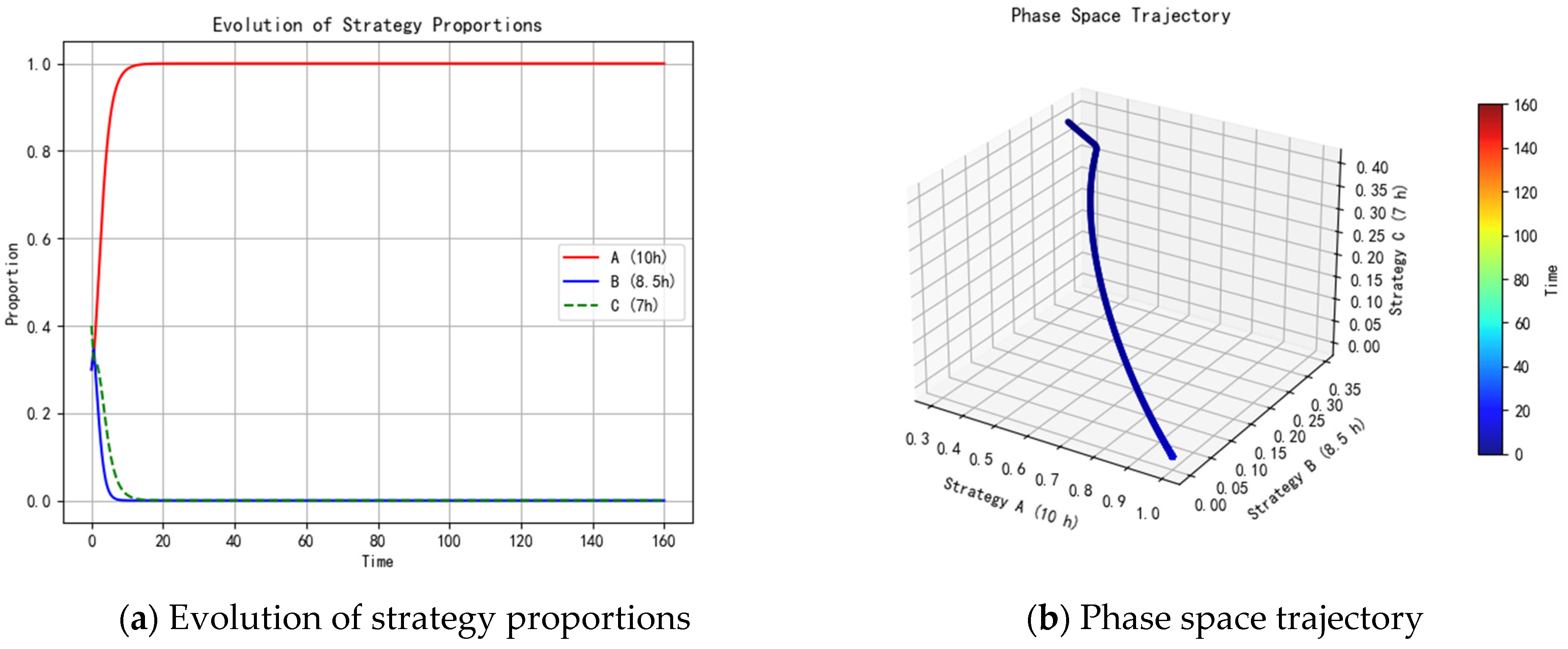
, the platform offers a high intensity of order dispatch incentives for the long-hour strategy. As shown in
Figure 9, the evolutionary results show that the proportion of long-hour Strategy A rose rapidly from the initial value to 1, while the proportions of medium-hour Strategy B and short-hour Strategy C declined quickly to 0. This indicates that under strong incentives, the additional income brought by the significantly higher order dispatch rate for drivers with the long-hour strategy fully offsets the cost, making the long-hour strategy the optimal choice for all drivers.
Under the high-intensity differentiated order dispatch incentive, the platform substantially increases the order allocation rate for drivers choosing the long-hour strategy. Such drivers can not only obtain a more stable and denser order flow and avoid the time cost of empty driving and waiting, but also further amplify the income advantage brought by the preferential dispatch by extending their working hours, resulting in a much higher marginal income per unit time than those of the medium-hour and short-hour strategies.
In addition, there is obvious strategy imitation and convergence behavior among drivers. Once some drivers take the lead in choosing the long-hour strategy and achieve higher earnings, other drivers will take the initiative to adjust their working-hour strategies to avoid falling behind in income, and gradually abandon the medium-hour and short-hour strategies. This ultimately drives the entire driver group to converge to the long-hour strategy as the only optimal choice in the market, which also verifies the strong guiding effect of the differentiated order dispatch mechanism on drivers’ strategy selection.
As shown in
Figure 10, when
decreases to 0.1, the platform’s differentiated order dispatch incentive is at a moderate intensity, and the system eventually converges to a mixed equilibrium where long-hour Strategy A and short-hour Strategy C coexist, with medium-hour Strategy B accounting for a very low proportion. Moderate dispatch incentives create a mutual balance between the revenue advantage of long-hour strategies and the cost advantage of short-hour strategies. From the decision-making logic of the driver group, although the platform’s dispatch preference improves the revenue level of long-hour strategies, this revenue increase cannot fully offset the implicit costs caused by long working hours, making it difficult for long-hour strategies to form absolute attractiveness. Meanwhile, although short-hour strategies yield limited income per unit time due to the relatively low dispatch rate, they effectively avoid fatigue loss by strictly controlling the working hours, and the stability of their net income is sufficient to maintain their survival in the market. Consequently, medium-hour strategies are eventually marginalized.
As shown in
Figure 11, when
decreases to 0.07, the platform’s differentiated order dispatch incentive enters a moderately weak range, and the system eventually presents an evolutionary outcome where medium-hour Strategy B becomes absolutely dominant, while both long-hour and short-hour strategies are marginalized.
The formation of this equilibrium stems from the consistent preference of the driver group for the medium-hour strategy, rooted in their rational trade-off between revenue and cost. At the current intensity of incentives, the platform’s dispatch preference for long-hour strategies is further weakened, and the resulting revenue increase can no longer compensate for the physical exertion within the high cost interval, making the pursuit of long working hours economically unreasonable. For short-hour strategies, although they can minimize fatigue loss to the greatest extent, the excessively low dispatch rate makes it difficult for their unit-time revenue to support a reasonable level of net income, failing to meet the drivers’ basic revenue expectations.
As shown in
Figure 12, when
decreases to 0.04, the platform’s differentiated order dispatch incentive falls into a weak range. Long-hour Strategy A is completely marginalized, while the proportions of Strategy B and Strategy C continuously converge and eventually stabilize at 0.5 each. This is because the dispatch incentive at this level renders the platform’s preferential order allocation for long working hours negligible, and the resulting revenue increment is entirely insufficient to offset the physical exertion within the high cost interval. Under such circumstances, the driver group makes differentiated choices between Strategy B and Strategy C based on their respective priorities of revenue and cost control.
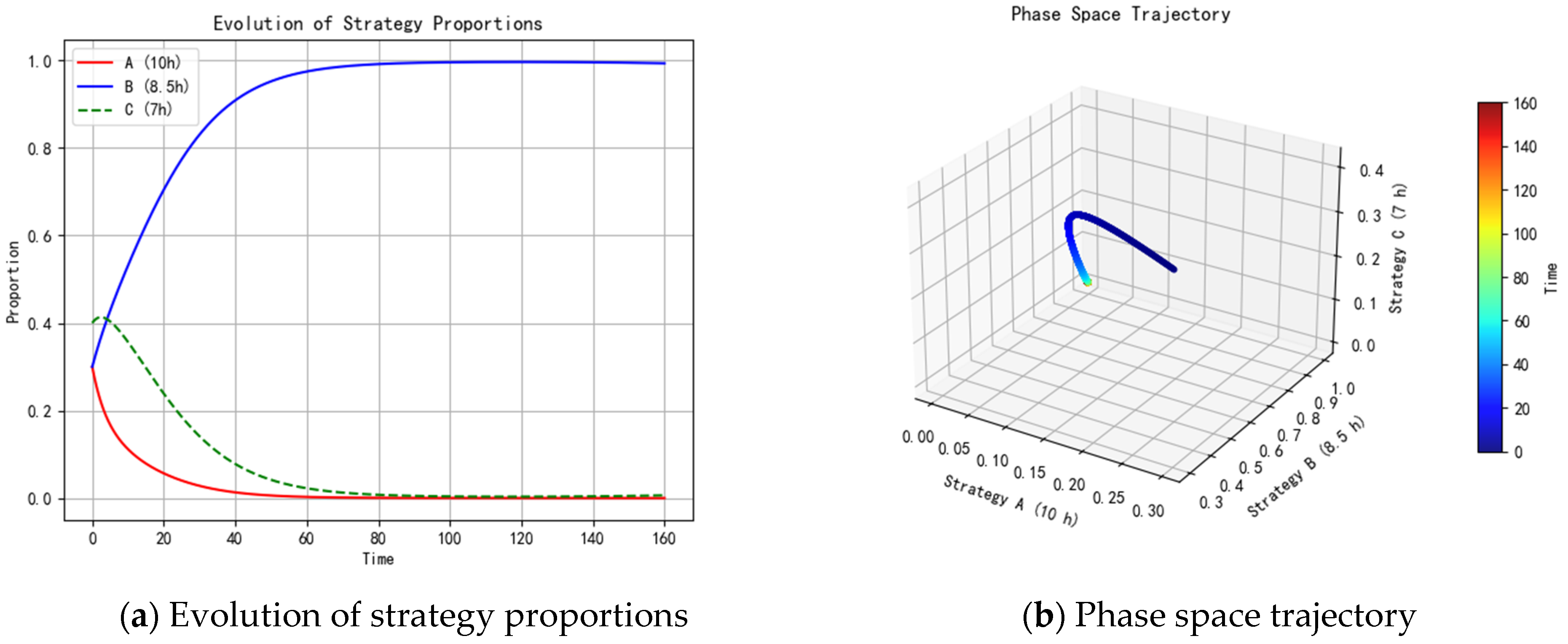
As shown in
Figure 13, when
decreases to 0.01, the platform’s order dispatch incentive approaches zero, resulting in a state where short-hour Strategy C becomes completely dominant. This is because the extremely weak incentive is utterly insufficient to offset the cost of long working hours, and the revenue advantage of the medium-hour strategy also ceases to exist. To avoid high costs, the driver group ultimately converges on the short-hour strategy, which maximizes the control of implicit losses.
This sensitivity analysis shows that the differentiated order dispatch coefficient exhibits strong regulatory sensitivity. Even gradual adjustments within a narrow range can trigger a structural shift in the working-hour strategies adopted by the driver group. Therefore, in practical applications, the platform should pay close attention to the regulatory thresholds and interval boundaries of this parameter. It is recommended to precisely control the intensity of order dispatch incentives through refined gradient adjustments rather than rough changes. Relying on this highly sensitive variable, the platform can flexibly guide drivers’ working hours, and ultimately achieve a dynamic matching between the capacity supply structure and market travel demand while protecting the drivers’ labor rights and interests.
5.4. Empirical Validation Using Ningbo Ride-Hailing Data
To further assess the empirical plausibility of the model, the equilibrium work-hour distributions generated under the five main dispatch-incentive scenarios ( = 0.22, 0.1, 0.07, 0.04, 0.01) were compared with the grouped distribution of observed daily working hours in the Ningbo sample. Because the model adopted three discrete working-hour strategies (10 h, 8.5 h, and 7 h), the empirical observations were grouped into long-, medium-, and short-hour categories using the midpoints between adjacent strategy levels (i.e., 9.25 h and 7.75 h). This grouping rule makes the empirical shares directly comparable with the model-implied equilibrium shares.
Table 5 reports the comparison results. The empirical grouped distribution was used as the benchmark, and the steady-state strategy proportions under the five representative dispatch-incentive scenarios are listed alongside it. To provide a more explicit measure of similarity, the root mean squared error (RMSE) between the simulated and empirical grouped shares was also calculated. The results show that the model is able to reproduce the broad structure of the observed work-hour distribution under representative dispatch-incentive settings. Among the reported cases, the scenario with
= 0.10 yielded the smallest RMSE and therefore provided the closest match to the empirical grouped distribution in the Ningbo sample. Although no single scenario matched the empirical distribution perfectly, the model-generated equilibrium patterns were broadly consistent with the actual work-hour structure in the sample, thereby supporting the empirical credibility of the proposed framework.
To complement the comparison, the root mean squared error (RMSE) of grouped shares is calculated as
where
,
,
denote the model-implied steady-state shares of the long-, medium-, and short-hour strategies, and
,
,
denote the corresponding empirical grouped shares, respectively.
6. Conclusions and Policy Implications
6.1. Key Findings
Based on the Stackelberg–evolutionary game two-layer model, this paper analyzed the dynamic response mechanism of drivers’ behavior and the regulatory effect of differentiated incentives under different scenarios. The main conclusions are as follows:
- (1)
Cost determines the basic pattern of driver strategy evolution. Under homogeneous conditions, the cost coefficient α exhibits a significant threshold effect: when (low cost), the system converges to a state dominated by long-hour strategies; when (medium cost), the system tends to coexist with medium-long or medium-short hour strategies; when (high cost), the system stabilizes with short-hour strategies as the dominant form. Cost is the core constraint in drivers’ decision-making.
- (2)
Driver heterogeneity promotes the stable dominance of medium-hour strategies. Under heterogeneous conditions (where individual costs are uniformly distributed within the critical interval), the medium-hour strategy (8.5 h per day) becomes the dominant choice of the group, with a stable proportion of approximately 0.6–0.8. The medium-hour strategy balances the benefits and costs and avoids extreme polarization of the supply structure. The harmonic mean cost can effectively aggregate heterogeneous drivers, providing a simplified analytical tool for practical applications.
- (3)
The differentiated order dispatch coefficient is highly sensitive to regulation. The sensitivity analysis showed that even a small adjustment of the differentiated order dispatch coefficient can trigger a structural shift in drivers’ working hour choices. Platforms can realize flexible guidance of drivers’ working hours by finely adjusting the intensity of the incentives.
6.2. Policy Implications
Based on the above conclusions, the following suggestions are proposed for ride-hailing platforms. A more specific managerial implication concerns the setting of the dispatch incentive coefficient. The calibrated results suggest that its main role is to regulate the degree of strategic differentiation in labor supply. If it is set too low, the platform may fail to provide sufficient incentives for active supply, thereby increasing the risk of short-hour concentration and capacity shortage. If it is set too high, the incentive mechanism may excessively reinforce long-hour strategies and increase the risk of supply polarization toward overwork-dominated equilibrium outcomes. Therefore, from a practical management perspective, this should be maintained within a moderate range that helps preserve strategic coexistence and reduce extreme supply concentration. Meanwhile, platforms should monitor driver-related cost signals in real-time through indicators such as order efficiency, cancellation rates, and complaint volumes, and flexibly adjust the intensity of differentiated incentives to balance service capacity and labor intensity. In addition, given the high price sensitivity of the market, blind price adjustments should be avoided. Pricing and dispatch incentives should be coordinated to better balance platform revenue, driver income, and passenger travel demand.
6.3. Limitations and Future Research
This study still has several limitations. First, the driver cost function is specified in a quadratic form, which may not fully capture the complex and multi-dimensional cost structure of the drivers’ labor supply in practice. Second, the analysis does not consider market competition among multiple platforms, and the evolutionary logic of driver behavior under an oligopolistic platform environment remains to be further explored. Third, because the empirical data are drawn only from Ningbo, the generalizability of the findings should be further examined using cross-regional data. In addition, although the present study models the interaction between the platform and drivers within a Stackelberg-type hierarchical framework, it does not explicitly consider a repeated dynamic adjustment process in which the platform continuously updates pricing or dispatch policies after observing newly evolved driver equilibria. Finally, the drivers’ working-hour choices are represented in a discrete-state framework, whereas actual labor-supply decisions are inherently continuous.
Future research may proceed in several directions. One possible extension is to incorporate a more flexible and multi-dimensional cost function to improve the realism of the model. Another is to construct a multi-platform evolutionary game model in order to analyze strategic interactions among competing platforms. It would also be valuable to conduct empirical studies using cross-city or cross-regional data to examine possible regional differences in the effectiveness of differentiated incentive mechanisms. In addition, the current framework may be extended to an intertemporal dynamic Stackelberg setting, in which the platform repeatedly adjusts its pricing or dispatch policies in response to newly formed driver equilibria. Finally, future studies may move beyond the current discrete-state framework and develop a continuous working-hour strategy model, so as to provide a more refined characterization of the drivers’ labor-supply adjustment. The introduction of artificial intelligence and big-data techniques may further help optimize the dynamic adjustment of platform incentives and improve the timeliness and accuracy of regulation.





 and
and