Article

Conceptualisation of Sustainable Development in the Context of SME Sector Enterprises

by
Barbara Siuta-Tokarska
* and
Jadwiga Adamczyk
Department of Economics and Enterprise Organization, Krakow University of Economics, 31-510 Krakow, Poland
*
Author to whom correspondence should be addressed.
Systems 2026, 14(4), 398; https://doi.org/10.3390/systems14040398
Submission received: 18 February 2026 / Revised: 29 March 2026 / Accepted: 1 April 2026 / Published: 4 April 2026

Abstract

The issue of sustainable socio-economic development in the context of SMEs fits within the broader stream of research on strategic management of organizations operating under conditions of dynamic environmental change. From the perspective of strategic management, this implies the necessity of adopting an approach that not only responds to current market needs, but also incorporates social responsibility, resource efficiency, and organizational resilience. Consequently, sustainable development becomes a key element shaping strategic decision-making in SMEs, strengthening their adaptability and capacity to create long-term value. This study is conceptual and theoretical in nature, focusing on the interpretation of notions and the specificity of sustainable socio-economic development in the context of enterprises in the SME sector. The conducted research has resulted in filling the identified research gap and solving the research problem, including the development of a theoretical model presented as a conceptual illustration entitled “From the Idea to the Paradigm of Sustainable Socio-Economic Development in the SMEs.” The study also led to the identification of four orders of sustainable socio-economic development—environmental, social, economic, and institutional-political—in the context of enterprises in the SME sector.

1. Introduction

The concept of sustainable socio-economic development in the context of SMEs should be situated within the broader theoretical discourse on strategic management in turbulent and structurally complex environments. In such conditions, organizational effectiveness increasingly depends on the ability to integrate short-term market responsiveness with long-term normative and developmental orientations. For SMEs, this necessitates strategic frameworks that embed principles of social responsibility, resource-efficiency and adaptive resilience as intrinsic components of decision-making processes. Accordingly, sustainable development functions not merely as an external requirement but as a foundational strategic logic that shapes the firm’s capacity for adaptive learning, trajectory-building and the generation of durable socio-economic value.
It is worth emphasizing that the original idea of sustainable development was grounded in the conviction that the economy, the environment, and society are mutually interdependent, which necessitates an integrated approach to environmental issues as well as to economic and social development [1]. Considering the importance and need for balance among the three dimensions—environmental, economic, and social—an extended perspective may be adopted, incorporating both social and economic components. The essence of the concept of sustainable socio-economic development lies in linking economic and social progress by ensuring access to renewable and non-renewable resources while enhancing the quality of life in a clean environment.
Sustainable socio-economic development—initially an idea and a new contextual condition—gradually evolved into a concept for conducting business activity. The fundamental determinant of sustainable socio-economic development should be the improvement of quality of life and well-being while maintaining intra- and intergenerational solidarity [2]. This equilibrium should not be understood as a single state of rest, but rather as a sequence of states over time—meaning a process of change in which the enterprise is capable of modifying certain characteristics and properties [3].
The set of features and attributes defining a system’s balance may evolve over time under the influence of both external and internal factors. This is particularly relevant for systems as specific as SMEs. The complex processes of interpreting notions, ideas, and concepts representing a research gap require conceptualization. Conceptualization is a process of scientific reflection, interpretation, and structuring of concepts in theory building and empirical verification [4,5].
The present study is a conceptual, theory-oriented work addressing the interpretation of key notions and the specific characteristics of socio-economic sustainable development in relation to SMEs.
The study incorporates the following components:
  • The conceptual and methodological foundations of the research, including the identification of the research gap, the scientific problem, the objective of the study, as well as the scope of the research, the adopted methods and tools, and the formulated research questions;
  • The theoretical-cognitive section, addressing the idea and conceptual foundations of sustainable socio-economic development;
  • The research section, based on the literature, including findings from other authors concerning the characteristics, significance, and role of SMEs in the economy and society in the context of sustainable development;
  • The conclusions.

2. Conceptual and Methodological Assumptions of the Scientific Study

In the preparatory bibliometric analysis, it was demonstrated that the number of publications devoted to the topic of sustainable development in SMEs is extensive, yet predominantly oriented toward empirical research.
The literature search procedure employed a multi-level selection of keywords, encompassing both highly specific phrases and commonly used international terminology related to SME sustainability, including “Sustainable Development SMEs,” “SME sustainability,” “CSR in SMEs,” and “Green Innovation in SMEs.”
This search strategy enabled the identification of a substantial empirical body of work in the areas of social responsibility, eco-innovation, and sustainability-oriented practices [6,7,8,9,10,11,12,13,14,15], while simultaneously revealing that the literature still lacks conceptual and theory-oriented studies, particularly those systematizing the relationships among the categories of idea–concept–theory–paradigm in the context of the specific operational characteristics of SMEs.
Based on a thematic search (titles of publications in the form of articles and monographs), relevant terms in abstracts, and keywords “Conceptualisation of Sustainable Development in SMEs” over the last 25 years, i.e., for the period 2000–2026 (as of 8 January 2026), across four well-known scientific publication databases (open access), the results were as follows:
  • BazEkon: 0 publications;
  • ScienceDirect: 0 publications
  • Scopus: 8 publications;
  • Web of Science: 50 articles.
The research gap identified in this study is therefore not quantitative in nature; rather, it concerns the absence of conceptual approaches that systematize the theoretical foundations of sustainable development in SMEs.
Consequently, it should be stated that the research gap manifests itself in the lack of coherent, theory-oriented analyses that would explain the relationships among the categories of “idea–concept–theory–paradigm” of sustainable development in relation to the specific characteristics of SMEs, and demonstrate how these relationships translate into the functioning mechanisms of SMEs within the four orders of sustainable development.
Taking into account the aforementioned research gap, the following research problem was formulated in the form of a research question:
What are the relationships among the “idea–concept–theory–paradigm” of socio-economic sustainable development in the context of the specific characteristics of SMEs, and how do these relationships explain their functioning mechanisms within the four orders of this development?
The main objective (MO) of the publication is to conduct an analysis and critical evaluation of the literature on the topic: conceptualisation of sustainable development in the context of SME sector enterprises.
The specific objectives were formulated as follows:
  • SO1: To develop the conceptual and methodological assumptions of the scientific study.
  • SO2: To conduct a literature review concerning the idea and concept of sustainable socio-economic development and its linkages with the theory and paradigm of this development.
  • SO3: To conduct a literature review concerning the characteristics and significance of SME enterprises for the economy and society.
  • SO4: To develop an original model of the relationship among the idea, concept, theory and paradigm of sustainable development and their linkages with the functioning of SMEs in the context of the four orders of this development.
The subject scope of the research covers two areas:
  • The idea and concept of sustainable socio-economic development.
  • SME enterprises—their characteristics and significance for the economy and society.
These theoretical-cognitive research components were integrated to enable the identification and presentation of relationships and interdependencies between them on a theoretical level.
The study adopts the assumption that the literature review should encompass the fundamental theoretical orientations, including the paradigmatic approach to sustainable development as well as systemic and ontological perspectives. In addition, it incorporates theoretical strands relevant to the structuring of the category of sustainable development in the SME sector. These include:
  • Institutional approaches, which explain the influence of norms, rules and the regulatory environment on enterprise functioning in the market;
  • Resource-based view (RBV) perspectives, highlighting the importance of the specific resources and capabilities of SMEs in the process of implementing sustainable solutions;
  • Network approaches, emphasizing the role of relationships, local cooperation and socio-spatial embeddedness;
  • Evolutionary and processual perspectives, which allow sustainable development to be understood as a trajectory of organizational change shaped by adaptive and learning mechanisms.
The inclusion of these theoretical directions strengthens the foundations for conceptualization and enables a multidimensional perspective on the mechanisms through which SMEs operate within the four orders of sustainable development.
The object scope of the research concerns SME enterprises, including micro-, small-, and medium-sized firms, often referred to in the literature as “small business.” Due to the absence of a uniform global definition of this sector and the substantial differences among enterprises (e.g., number of employees: up to 249 in the EU, up to 500 in the USA, and—depending on the industry—even up to 1000 in China), the SME sector in this publication is understood as the group of enterprises that largely limit their operations to local, regional, or national markets (only a minor portion operates internationally through export). These enterprises differ significantly from large corporations (this study adopts a framework-based approach in which the SME sector is treated as a set of entities characterized by specific constitutive features—such as resource constraints, high organizational flexibility, local embeddedness, and the predominance of owner-driven management forms—regardless of definitional differences applied across national economies; the adoption of this perspective is methodologically justified in theory-oriented research, whose objective is to identify cross-contextual micro-foundations that shape the functioning of SMEs) in terms of number of employees, revenues, organizational structure flexibility, legal forms, and other characteristics.
Due to the theoretical-cognitive nature of the publication (literature analysis), the time scope of the research was not restricted to any specific period, but instead to the availability of publications. It was assumed that the thematic relevance and usefulness of a publication for the literature review are more important than its publication date.
The study adopts the form of conceptual research, based on a semi-systematic literature review. It is based on a qualitative research method.
The research technique applied was thematic analysis, while the research tool consisted of the library resources available to university staff via the website of the Main Library of the Krakow University of Economics, including monographs, scientific articles, and research reports from various academic databases (https://bg.uek.krakow.pl/zasoby-online, accessed on 31 March 2026). These resources formed the basis for the literature search.
This study employed systematic criteria for the selection of the literature, encompassing both substantive and formal considerations.
Inclusion criteria:
  • Peer-reviewed publications (including scholarly articles, monographs, and reports issued by research institutions).
  • Content encompassing the following concepts: sustainable development, socio-economic development, SMEs, small business, organizational characteristics, and the sustainability paradigm.
  • Works addressing the ideas, concepts, theories, or paradigms of sustainable development.
  • Studies covering the four dimensions (domains) of sustainable development or their functional equivalents.
  • Publications issued between 2000 and 2026, including seminal earlier literature (e.g., the Brundtland Report).
Exclusion criteria:
  • Publications lacking a theoretical dimension (e.g., purely statistical reports without developmental or conceptual foundations).
  • Works addressing only a single dimension of sustainability, without the possibility of theoretical integration with other domains.
  • Studies focused exclusively on large enterprises, with no potential for conceptual or methodological adaptation to SMEs.
  • Popular science or non-peer-reviewed articles.
For procedural purposes, the study employed a conceptual analysis consisting of:
  • The identification of primary notions (idea, concept, theory, paradigm);
  • The examination of the scope and content of these notions and their mutual relationships;
  • The structuring of categories in accordance with their function in the theory-building process;
  • The logical reconstruction of a model of socio-economic sustainable development for SMEs.
This analysis was supplemented by a transparent, semi-systematic procedure for selecting the literature.
The review followed a semi-systematic search strategy involving:
  • The formulation of sets of keywords (e.g., SMEs, small business, sustainable development, socio-economic development, idea, concept, paradigm, theory);
  • Database searches using the aforementioned tool;
  • Screening titles, abstracts, and keywords for conceptual relevance;
  • Applying inclusion criteria (thematic relevance, conceptual contribution, availability of full text);
  • Applying exclusion criteria (purely technical or descriptive empirical studies lacking conceptual value);
  • The use of complementary snowballing techniques (backward reference checking).
This approach ensured the identification of the literature essential for understanding the conceptual evolution of sustainable socio-economic development and the specific characteristics of SMEs.
It should be emphasized that the adopted research method and analytical techniques enabled the extraction of distinct thematic categories:
  • Conceptual categories, such as idea–concept–theory–paradigm;
  • Definitional categories, allowing for the clarification of terminology and the determination of the essence of socio-economic sustainable development;
  • Descriptive categories, relating to the characteristics and micro-foundations of SME functioning;
  • Structural categories, associated with the components of the four orders of sustainable development.
As part of the research, the following research questions (RQs) were identified:
  • RQ 1: What is the meaning of the terms “idea” and “concept”?
  • RQ 2: How do the idea and the concept define and structure the transition toward the levels of theory and paradigm within the conceptual framework of socio-economic sustainable development?
  • RQ 3: What constitutes “sustainability” in socio-economic development?
  • RQ 4: What characteristics define enterprises in the SME sector?
  • RQ 5: Why are SME enterprises considered important in the pursuit of sustainable socio-economic development?
  • RQ 6: In what way do the proposed conceptual models account for the transition from normative-axiological perspectives to coherent and structured theoretical frameworks in the context of sustainable socio-economic development in SMEs?
  • RQ 7: How does the interconnection among the levels of the cognitive structure—idea, concept, theory, and paradigm—fit within established theoretical traditions in science and support a coherent articulation of the theory of socio-economic sustainable development in SMEs?
The limitations of the study are primarily related to:
  • Limited access to older scientific publications (before 1990) and newer ones without electronic versions;
  • The use of publications in languages other than Polish and English;
  • Restricted access to scientific publication databases available via the above-mentioned Main Library platform;
  • General analytical perspective without differentiating SMEs by size or type of activity, focusing instead on their shared elements, processes, and mechanisms of functioning. This approach followed from the adopted methodological orientation, which was conceptual and theory-oriented in nature, not empirical. The adoption of a general analytical perspective—methodologically justified in theory-oriented research—is directed toward the reconstruction of concepts, the identification of their mutual relationships, and the development of highly abstract conceptual models. In theoretical approaches of this kind, it is essential to isolate the constitutive features shared across the entire SME sector, as these elements form the core micro-foundations that determine the functioning of SMEs regardless of their size or industry.

3. Discussion

3.1. The Idea and Concept of Sustainable Socio-Economic Development

Within theoretical-cognitive research, there is a notable tendency to explore and understand the relationships between “human beings and the world,” to define and explain them, to experience and evaluate them, and to systematize them, as well as to identify the self-awareness of freedom, including the possibilities and necessity of action [16]. In this context, the notion of socio-economic development may be associated with processes involving the transformation of social structures and economic systems aimed at enhancing the quality of life, while increasing society’s adaptive capacity in response to changing environmental, technological, and cultural conditions. These changes are purposeful and value-oriented, and should be grounded in the common good, social justice, and the rational use of resources.
What unites scholars studying sustainable development is the recognition of the full spectrum of relationships between the natural environment and human beings who form a society functioning within specific frameworks, including economic frameworks [17]. These relationships are examined and interpreted, among others, from the perspective of their value, valuation, moral qualification, predictability, regulation, and design [17]. Sustainability—referring to natural, social, and economic capital—is understood as the need to ensure adequate space for the existence of each of these capitals, meaning that none should be diminished at the expense of another within the interdependencies and interactions that link them [18,19]. This does not imply mathematical equality among them but rather balance between their respective “spaces.” Sustainable development is also defined as a form of development that should possess long-term durability [20,21]. Sustainable socio-economic development can therefore be interpreted as a relatively stable arrangement of relationships between the analyzed entity and its environment, as well as within the entity itself.
Considering the conceptual categories used in this section—namely, “idea” and “concept”—it should be noted that neither term has a single, universally accepted definition. The term “idea” derives from the Greek idéa and is understood as that which is visible: a form, image, representation, figure, pattern, or conscious experience [22].
In the context of sustainable socio-economic development, the term “idea” is no longer merely a scientific notion formulated at the outset of academic discourse, characterized by a high degree of generality and subjectivity [23]. Rather, it currently manifests as a social and political idea. Thus, it is perceived from a holistic perspective. It should therefore be emphasized that at the current stage of its understanding, interpretation, and implementation, the idea of sustainable development does not have a narrower relationship to the concept in the way that a typical scientific idea might. It has already evolved into both a social and political idea [24].
Defined in this way, the idea of sustainable development is broad in scope and grounded in the ethics of responsibility and intergenerational justice. It acknowledges the long-term consequences of human actions, adopting as a categorical imperative the need to move away from an instrumental perception and treatment of development.
The idea of sustainable development constitutes a commitment, particularly to:
  • Preserving the conditions necessary for life;
  • Respecting the intrinsic value of nature;
  • Upholding justice in both temporal and spatial dimensions.
For these commitments to take on a real and actionable character, a holistic view of the relationships among the economy, society, and the environment is required—an approach embedded in the idea itself. Dialogue is also necessary to accommodate value pluralism.
In this sense, the idea of sustainable development serves as a paradigm—an intellectual model shaping thinking, scientific inquiry, and culture within a particular period, influencing how problems are perceived and interpreted. Accordingly, the idea of sustainable development may be described as a call for wisdom, which unites knowledge with responsibility, and for community, which views the world not as a “warehouse of resources,” but as a shared home.
Sustainable development as a concept—in light of the above idea—is a term denoting a conscious, creative mode of understanding phenomena, expressed in the form of a specific thought framework or model used to solve problems or achieve a desired goal. It also serves an explanatory function and is often formalized in structure [25]. Its purpose is to contribute to the understanding and discovery of truth about reality. As H. Zboroń observes, “in scientific cognition it is possible to reflect (discover) the properties of the world, which makes it possible for scientific judgments to have explanatory and predictive power, with their value confirmed indirectly by the technological effectiveness of applying research results in practice.” [26].
The literature indicates that the concept of sustainable socio-economic development is not unambiguous; indeed, its multidimensionality is widely recognized [27]. Nevertheless, it consistently includes certain common elements [27]:
  • Prudent management of natural resources;
  • Precaution in accordance with environmental protection principles;
  • A long-term perspective;
  • Consistency with socio-economic realities.
Sustainable development is therefore not static but dynamic—it changes over time and space. Consequently, its conceptualization is not fixed and evolves accordingly.
Philosophically, the roots of the concept trace back to Aristotle and Hippocrates, who emphasized that the whole is greater than the sum of its individual parts. Likewise, the human being—coordinating phenomena occurring in the environment—is more than a sum of cells and organs [27]. This enables a broader conceptual grounding by situating sustainable development within the philosophical tradition, while simultaneously leading to a systemic perspective in which sustainable development is founded on a worldview that emphasizes the unity of all things and is structured according to systems-based thinking [28,29]. However, as a normative concept, it also has an axiological, prescriptive, regulatory, and partly ideological character.
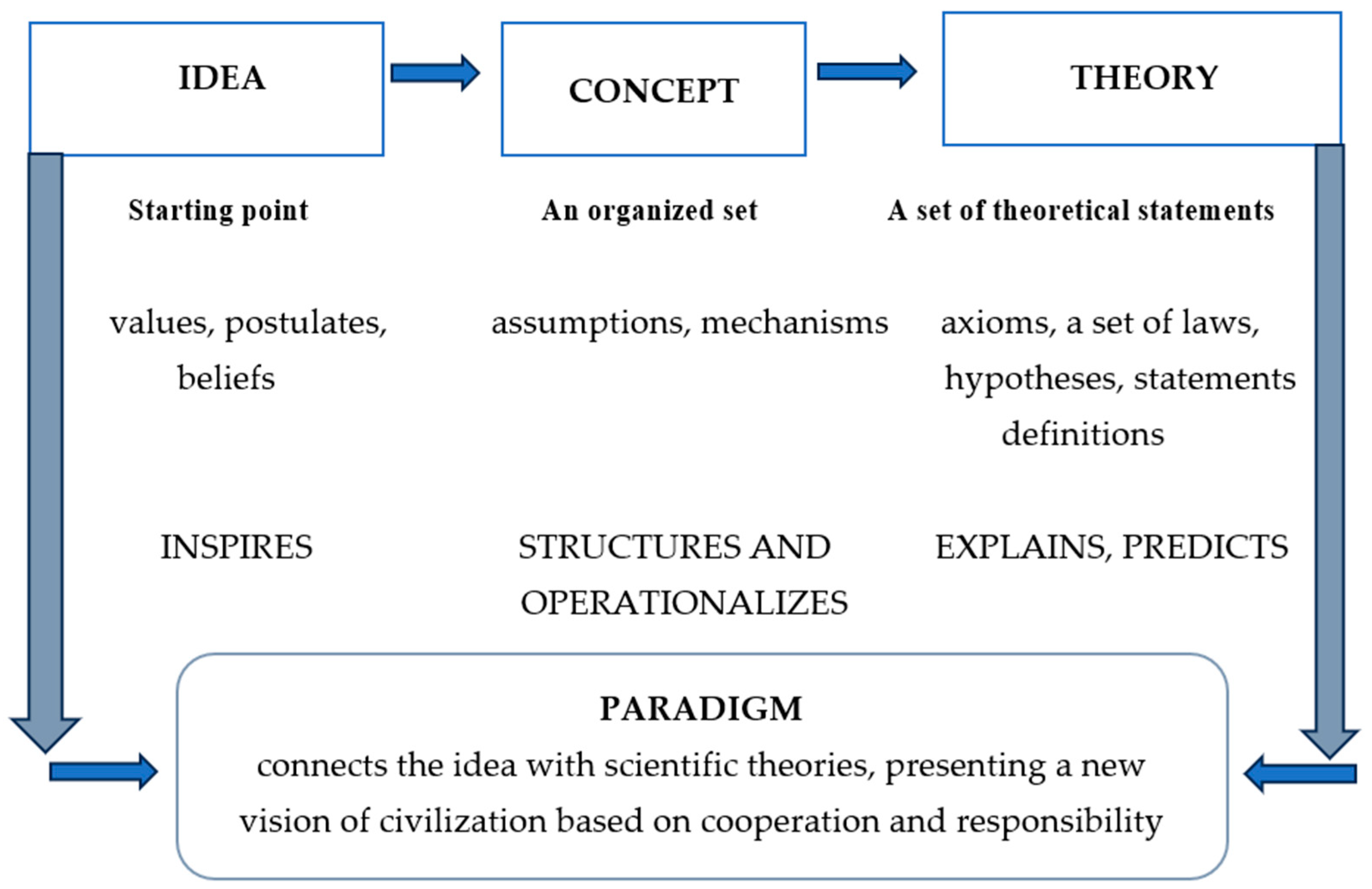
The relationship between the idea and the concept can thus be defined as follows: the idea sets the direction. It is the most general of the four fundamental notions shown in the figure below (idea, concept, theory, paradigm), and at the same time the most open to diverse interpretations, inspiring further inquiry and intellectual development. The idea therefore provides the impetus and orientation toward the concept, which constitutes a systematization of a set of assumptions, principles, and mechanisms.
If a concept is centred on a system of propositions derived from research and aspires to provide a relatively comprehensive solution to a given scientific problem, it then evolves into a scientific theory. A theory aims to explain the cause or system of causes, the conditions, and the circumstances underlying the emergence and specific course of a given phenomenon. However, for an explanation to qualify as a scientific theory, it must satisfy the empirical criterion of falsifiability. (The notion of “theory” is understood differently in the natural and exact sciences than it is in the humanities or the social sciences. Mathematical theories are often cited as examples approximating the ideal of theoretical rigour. In contrast, in the social sciences—of which economics and management are a part—the subject of inquiry concerns phenomena in which the human being is embedded as a unique individual, shaped by specific behaviours, attitudes, and value systems within socially and culturally diverse research contexts. As a consequence, scientific theories within the social sciences tend to be particular and flexible rather than fixed or universal.) Accordingly, theories should be understood as abstractions that reflect particular aspects of the empirical world and explain how and why a given empirical phenomenon has occurred.
The final element of the model presented below (Figure 1) is the paradigm, which links the idea with the theory by offering a new interpretative vision in which integration produces a connection between what is general (the idea) and what is systematically and scientifically structured (the theory).
In summarizing the interconnections and dependencies presented in the above model, it should be noted that: 1. the idea constitutes the initial inspirational impulse that opens the conceptual horizon and sets the broad direction of inquiry; 2. as the idea develops, it becomes a concept that organizes it into a preliminary structure of assumptions, categories, and mechanisms; 3. the concept then advances into a theory, transforming these structured elements into a coherent scientific system of propositions, definitions, and explanatory relationships; and 4. the paradigm integrates the idea, the concept, and the theory, forming a unified framework that guides further theoretical development.
In defining the idea of sustainable development—at the current stage of the evolution of thought and its application in economic reality—as a social and political idea, it becomes, in the light of scientific inquiry, a distinct paradigm of contemporary academic discourse—that is, a generally recognized scientific framework that offers specific solution proposals. A paradigm constitutes a widely accepted foundation for scientific research, within which the body of knowledge in a given discipline grows both cumulatively and, at times, revolutionarily—an evolution clearly observable in the field of sustainable socio-economic development. The paradigm of sustainable socio-economic development encompasses the following categories of assumptions [26]:
  • Ontological: The human being occupies a unique position in the world, influencing natural and economic capital, which they transform and modify. Nevertheless, excessive or far-reaching alterations generate undesirable consequences, and in the case of natural capital—constituting the foundation of human existence on Earth—such changes become a threat to human survival.
  • Epistemological: Knowledge of the socio-economic and natural world is complex, multidimensional, and interdependent; its acquisition requires the integration of diverse scientific perspectives and the recognition of the limited certainty of forecasts concerning developmental processes.
  • Anthropological: The human being is a social entity whose full expression is realized within a group, through relationships established with others.
  • Axiological: Among the dominant values, intergenerational solidarity is emphasized, expressed through cooperation and responsibility aimed at ensuring that the needs of the present generation can be met without diminishing the opportunities of future generations to satisfy their own needs.
  • Historiosophical: Humanity is predisposed to development and progress, a tendency manifested throughout human history in the continuous process of self-improvement.

3.2. Orders of Socio-Economic Sustainable Development

In the field of sustainable socio-economic development, the concept of order is employed. According to dictionary definitions, order refers to a specific state in which the phenomenon under consideration operates in accordance with defined rules, objects occupy their designated places, and events follow a predictable course. It is, therefore, associated with a certain degree of structure, harmony, proportionality, and the maintenance of equilibrium.
An order may also be understood as the organization of a system that enables its constituent elements to function coherently (harmoniously) in a manner that ensures the fulfilment of its purpose and the execution of the tasks for which the system was established. The criteria of order can be examined through the lens of two systems that shape human functioning within society: the biological system and the cultural system. Within this framework, at least four levels are distinguished [30]:
Desires and needs (values, interests);
Perceptions and representations (models, symbols)
Aspirations and revendications (projects and decisions);
Ways of life (behaviours, practices).
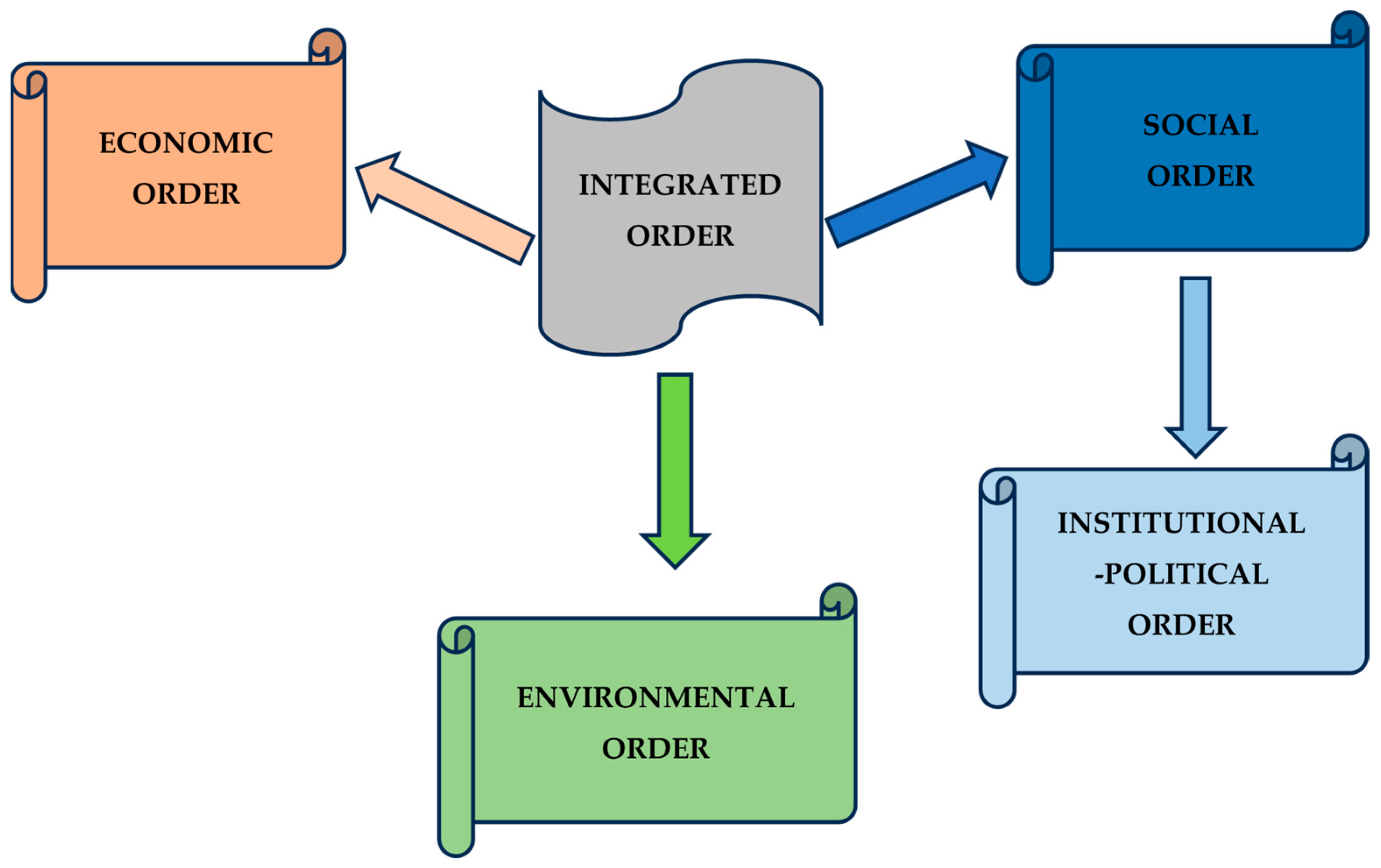
In the context of sustainable development, it should be noted that one of its defining features is the integration of environmental issues, including environmental protection, with social and economic considerations, as well as the creation of an appropriate institutional-political framework that provides the conditions for the long-term and coordinated implementation of environmental, social, and economic objectives, while taking into account stakeholder participation, transparency of decision-making processes, and mechanisms for monitoring and evaluating progress. Therefore, in practice, sustainable development is approached through the concept of an integrated order, which refers to a holistic conceptual framework in which the key dimensions of sustainable development are treated as interdependent components of a single, coherent system [31]. Within this approach, integrated order is composed of several partial orders (Figure 2):
The environmental order, within which the spatial order (spatial order can be defined as a state in which a spatial arrangement is established that takes into account and reflects the regularities governing the functioning of society, the economy, and the natural environment, while the overarching objective of spatial management is the public value and the public interest) is included;
The social order;
The economic order.
And to these three, a fourth is increasingly added, namely:
The institutional-political order (distinguished from within the social order).
Environmental order constitutes an ontologically primordial natural order in which natural systems persist in a state of dynamic equilibrium that enables their self-maintenance. Within the framework of the philosophy of nature, this order is understood as immanent, arising from the internal principles that govern the organization of the natural systems, encompassing both biotic and abiotic components of the environment. It manifests itself as a fundamental condition for the possibility of life and culture, and its disruption reveals the fragility of human existence when the boundaries of the natural world are transgressed [33,34].
Social order constitutes a normative-institutional framework of human coexistence, referring to a condition of relatively stable, balanced, and predictable collective life sustained by widely recognized norms, values, and patterns of behaviour that regulate interactions among individuals and social groups. While grounded in enduring philosophical and sociological conceptions of communal life, contemporary understandings of social order must additionally account for the challenges posed by increasing social heterogeneity, rising inequality, accelerated cultural change, and the transformative effects of digital communication and global mobility. In this sense, social order denotes a mode of organizing society in which mechanisms of social control, role distribution, legal and cultural systems, and institutional arrangements jointly produce a coherent, functional, and normatively legitimate framework for coexistence, cooperation, and the resolution of conflicts. It thus constitutes a shared world in which action is endowed with meaning and predictability, even amid the complexities and fragmentations of modern social life [35,36].
Economic order may be conceived as an axionormative framework governing exchange, production, and distribution, constituted by a set of principles that coordinate economic activity in a manner ensuring both efficiency and conformity with socially recognized values. Its philosophical foundations resonate with longstanding traditions in economic and ethical thought, yet contemporary approaches must additionally take into account the structural character of global inequalities, asymmetries in access to resources, and the growing concentration of capital. In this sense, economic order represents a form of rationalization of economic practice which, under present conditions, not only organizes economic processes but also delineates the normative boundaries for just redistribution, socio-economic inclusion, and the mitigation of systemic disparities—so that economic activity does not become a mechanism for reproducing disorder, but remains embedded within a structure of values and stable social relations [37,38].
Institutional-political order refers to a state in which a system of norms, procedures, and institutions establishes the legitimized framework for collective political action and organizes processes of public decision-making. Within the traditions of political philosophy, it has a foundational character, as it delineates the conditions for just co-governance and structures the relations between individuals, the community, and public authority. In the context of contemporary challenges, it also encompasses the capacity to maintain stability and public trust amid social complexity, polarization, and the digitalization of public life, thereby rendering politics a predictable sphere of action and the state a rationally organized entity capable of coordinating collective life [39,40].
The four orders of sustainable development—the environmental, social, economic, and institutional-political—constitute a mutually interconnected system in which each performs a distinct yet complementary function. The foundation is the environmental order, which defines the boundaries and conditions for the functioning of human society, the economy, and institutions; its disruption leads to a weakening of the long-term stability of socio-economic systems. Against this backdrop, the social order emerges, grounded in norms, values, and patterns of cooperation that stabilize interpersonal relations and enable the coordination of collective action. The economic order, based on formal and informal rules governing economic activity, structures the processes of production, exchange, and distribution, and its performance depends on both environmental stability and the social order, including trust and economic culture. These dimensions are integrated by the institutional-political order, which, through a system of law, institutions, and procedures, organizes decision-making processes, regulates the functioning of the economy and society, and provides the framework for protecting and maintaining the environmental order. Together, they form a coherent, integrated system that conditions the effectiveness of development.

3.3. SME Sector Enterprises—Characteristics and Importance for the Economy and Society

The term SME sector enterprises refers to micro-, small-, and medium-sized enterprises which, in comparison with entities in the large-enterprise sector (i.e., large, very large, and major corporations), are distinguished by a specific set of characteristics.
An analysis of the historical trajectory of SMEs—considered as a group or sector—provides an illustration of how the significance of enterprises of different sizes has evolved over time and across regions. This significance has changed under the influence of political, economic, socio-cultural, and technological conditions. Until the 1970s, the SME sector was generally marginalized within the global economy [41]. However, at the turn of the 20th and 21st centuries, a shift emerged in the understanding of the role played by enterprises of different sizes. SMEs gradually began to strengthen their position through an increase in their population, accompanied by a decline in the average size of business entities, a rise in SME employment as a share of total employment, and the emergence of innovative and internationalized SMEs [41].
As a result of these developments, the SME sector—including micro-, small-, and medium-sized enterprises commonly referred to as small businesses—has become the backbone of the global economy, playing a significant role in socio-economic development [42].
The literature emphasizes that the differences between SMEs and large enterprises pertain to at least the following areas of business activity: management, organizational structure, procurement and materials management, production, sales, research and development, and capital [43,44,45,46]. These areas are identified and discussed below [47,48,49,50,51,52,53,54,55,56].
Management
In the area of management, the following differences are observed:
  • Managerial function: In SMEs, owners (and in medium-sized enterprises also managers) typically perform managerial tasks, whereas in large enterprises management is carried out almost exclusively by professional managers;
  • Managerial knowledge: In SMEs, managerial knowledge is often insufficient or moderate, while in large enterprises it tends to be well-established and robust;
  • The role of planning: In SMEs it is frequently limited or indirect, whereas in large enterprises it plays a decisive role;
  • Types of decisions: SMEs mainly make operational decisions, while large enterprises predominantly make strategic decisions;
  • Group decision-making: Rare in SMEs, but common in large enterprises;
  • Organizational and control linkages with other entities: Limited in SMEs, but frequent and extensive in large enterprises.
Enterprise Organization
In terms of organizational structure, the differences between SMEs and large enterprises concern, among others:
  • Number of employees: Small or medium in SMEs, significant in large enterprises;
  • Type of organizational structure: SMEs typically have simple and flexible structures, whereas large enterprises have diversified but often highly formalized structures;
  • Organizational flexibility: High in SMEs, low in large enterprises;
  • Degree of task formalization: Low in SMEs and high in large enterprises;
  • Employee interactions: Frequent and direct in SMEs, whereas in large enterprises interactions usually occur only within designated work teams;
  • Information flow: In SMEs communication is short and direct, while in large enterprises it follows long, formalized channels.
Procurement and Materials Management
Differences between the two sectors include:
  • Position in the procurement market: Weak for SMEs, strong for large enterprises;
  • Materials procurement system: SMEs rely on purchase orders, whereas large enterprises employ long-term contracts with suppliers.
Production and Sales
Key differences concern:
  • Nature of production: Labour-intensive in SMEs, capital-intensive in large enterprises;
  • Division of labour: Low in SMEs, high in large enterprises;
  • Materials and equipment used: Often universal in SMEs, specialized in large enterprises;
  • Cost reduction with increased production scale: Limited in SMEs, significant in large enterprises;
  • Sales market: SMEs focus on individual customer needs, whereas large enterprises target mass markets;
  • Market reach: local, regional, and less frequently national or international for SMEs; national and international for large enterprises.
Research and Development (R&D)
The differences between the sectors are substantial:
  • Dedicated R&D departments: Rare in SMEs, permanent in large enterprises;
  • Conduct of scientific research: In SMEs, typically short-term and often basic in nature; in large enterprises, long-term and based on clearly defined strategies.
Capital
With respect to capital, the differences are as follows:
  • Capital ownership: In SMEs, frequently held by a family or a narrow group of individuals; in large enterprises, ownership is dispersed;
  • Capital linkages: Limited in SMEs, extensive in large enterprises;
  • Access to the capital market: Restricted in SMEs, unrestricted in large enterprises.
The identification of these characteristics highlights the common features of enterprises classified within the SME sector; however, it must be emphasized that the sector is not homogeneous, and internal differentiation is also observed. (The aim of this study was therefore not to develop a taxonomy of practices differentiated by enterprise size or sector, but to construct higher-level analytical frameworks that enable an understanding of the relationships among the idea, concept, theory, and paradigm of sustainable development and their implications for the characteristic properties of the SME sector as a whole. Such an approach makes it possible to capture the common mechanisms that the literature identifies as fundamental to the role of SMEs in socio-economic sustainable development. The adopted perspective provides the level of generality required in theory-oriented research, while at the same time preserving the potential for subsequent operationalization of these models in future stages of empirical investigation).
The presented characteristics demonstrate that the SME sector constitutes not only a relatively cohesive group of entities, but—above all—the foundation of the economic structure. Its functioning reflects adaptive, innovative, and developmental mechanisms. The specificity of SMEs cannot be analyzed solely through the lens of sectoral characteristics; rather, it also requires reference to their role within the economic system, including their capacity to shape competitiveness, generate employment, respond to environmental changes, and support sustainable development.
As noted by B. Piasecki, the role of SMEs is particularly associated with mitigating social tensions and reducing the high social costs of structural changes, including economic transformation. Their functions include, among others [57]:
  • Absorbing emerging labour surplus (reducing unemployment);
  • Fostering entrepreneurial attitudes and enabling self-employment;
  • Stimulating activity within local and regional communities;
  • Providing opportunities for success and social mobility;
  • Supporting the creation of horizontal and vertical integration and cooperation linkages among enterprises;
  • Stimulating initiative, creativity, and flexibility, and—especially important in the context of sustainable development—fostering responsibility.
When analyzing the characteristics and significance of SMEs in the context of sustainable development, it is possible to identify their features as well as strengths and weaknesses, in relation to the four dimensions (orders) of sustainable socio-economic development [58]:
  • Environmental order—relates to the conditions and strategic objectives of environmental protection and sustainable management of natural resources;
  • Social order—identifies strategic goals aimed at improving the quality of life of society;
  • Economic order—defines strategic goals that generate effective socio-economic development;
  • Institutional-political order—encompasses challenges related to global partnership and good governance.
Table 1 presents the characteristics and strengths and weaknesses of SMEs associated with each of the four orders of sustainable socio-economic development.
Table 1 presents the features of SMEs that most accurately reflect their functioning within each of the four orders of sustainable development. This allows for a synthetic classification of the characteristic strengths and weaknesses of SMEs within the corresponding dimensions of each order, thereby illustrating how the specific attributes of the sector translate into the achievement of environmental, social, economic, and institutional-political objectives of sustainable development.
It should be emphasized that the four orders are not treated as isolated spheres but as complementary analytical domains. Their distinction makes it possible to capture more precisely the mechanisms through which SMEs operate in the context of sustainable development.
Consequently, Table 1 serves not only as a synthetic compilation of SME characteristics but also as an analytical tool that organizes their diverse forms of impact across the four orders. This, in turn, enables a multidimensional characterization of the sector and provides a foundation for the further conceptualization developed in the subsequent part of the study.

3.4. Theoretical Model of Socio-Economic Sustainable Development in the SME Sector

Ideas and concepts are, by their very nature, innovations that evolve over time into principles and methods of management. An idea or concept, initially functioning as a philosophical notion, may gradually become a management principle—that is, a rule of conduct recognized as binding or a customary norm governing selected processes, such as management processes.
Sustainable socio-economic development, initially formulated as an idea and a new contextual condition, has over time become a concept guiding the functioning and development of enterprises in the SME sector. The concept of sustainable socio-economic development is increasingly regarded as a standard of business practice. This results from the volatility of the environment, which introduces uncertainty into enterprise functioning and contributes to a growing level of dynamics both within the enterprise and in its external environment. Under conditions of environmental variability and instability, adherence to ethical standards and the cultivation of strong relationships with stakeholders become fundamental to ensuring the operational security of enterprises, particularly SMEs. Today, enterprises seeking to achieve and maintain a competitive position must take into account the expectations and requirements imposed by the external environment. Consequently, an increasing number of enterprises not only reference sustainable development in their mission statements but also adopt its objectives and adhere to its principles.
The outcome of the conducted research is an emerging, original definition of sustainable development in SMEs, which captures “the long-term developmental trajectory of these enterprises. Within the realities of resource constraints, flexible and low-formalized organizational structures, and strong local embeddedness in the economic environment, this trajectory leads to the sustained integration of environmental, social, economic, and institutional-political objectives. This integration is achieved through predominantly low-cost, interactive, and network-based managerial practices, shaped by owner-driven values and the gradual formalization of activities”.
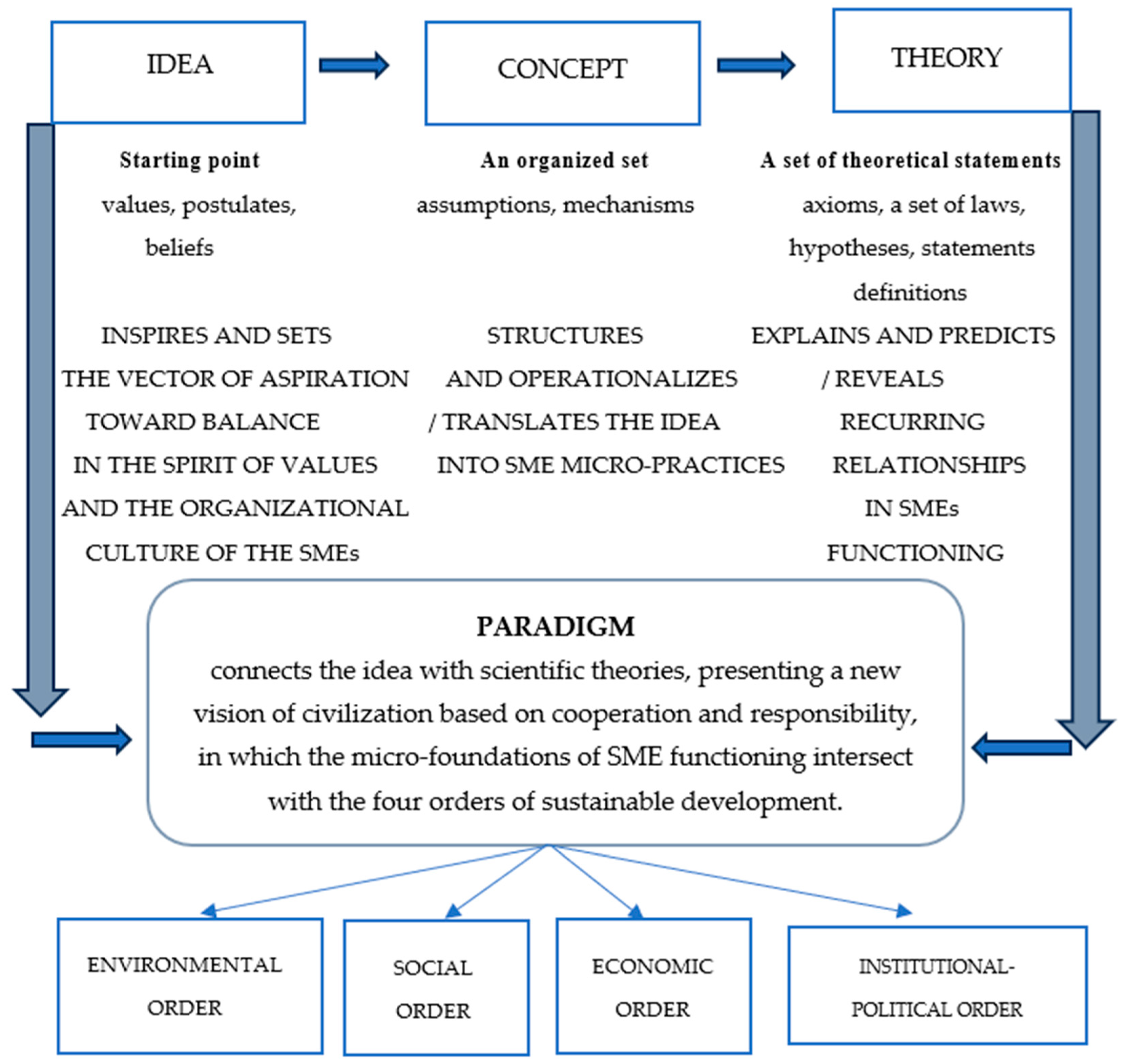
This definition situates the sustainability process within the four orders identified in the study (environmental, social, economic, and institutional-political) and within the characteristic features of SMEs (e.g., smallscale, short information flows, local relationships, and limited access to capital). As a result, it is possible to distinguish four modules of the theoretical model “From the Idea to the Paradigm of Socio-Economic Sustainable Development” in relation to the four orders of this development as manifested among SMEs, as described and presented below (Figure 3).
The theoretical model “From the Idea to the Paradigm of Socio-Economic Sustainable Development”, in relation to the four orders of sustainable development among SMEs, fills this gap by incorporating the following elements:
IDEA (normative-axiological dimension)—rooted in owner-driven values and intergenerational responsibility within SMEs, it sets the vector of aspiration toward achieving balance among the environmental, social, economic, and institutional-political orders. The primary causal mechanism at this level is local reputation and the personal responsibility of the owner.
CONCEPT (embedded in action schemes)—translates the idea into micro-level practices appropriate to the realities of SMEs (e.g., simple eco-innovations, relational HR approaches, network- and cluster-based collaboration), oriented toward frugal efficiency and adaptability.
THEORY (propositional level)—finds its expression in recurrent patterns of SME behaviour, such as:
(a)
Frugal resource efficiency supporting resilience and sustainable growth;
(b)
Local embeddedness and short information channels that reduce the costs of implementing pro-ESG practices;
(c)
A trajectory of formalization (from informal practices to simple organizational systems) that narrows the implementation gap between idea and action.
PARADIGM—a coherent framework linking the micro-foundations of SME functioning (values, learning, networks, frugal innovation) with the four orders of sustainable development, offering a basis for further theoretical inquiry within the SME sector.
In relation to general approaches to sustainable development, the proposed model introduces what may be termed “micro-anchoring” within the realities of SMEs:
  • Instead of an abstract notion of balance at the macroeconomic level, it emphasizes micro-foundations (owner-driven values, local networks, frugal innovation, and gradual formalization);
  • It maps these micro-foundations onto the four orders of sustainable development (indicating possible pathways and modes of implementation);
  • Thus it complements existing frameworks with the specific conditions of a small scale and resource constraints, explaining how SMEs arrive at sustainability in practice, rather than merely stating that they ought to do so.
It is also worth noting that the conceptual model presented above distinguishes itself from the dominant frameworks in the sustainability literature (such as the “triple bottom line,” the concepts of “strong” and “weak” sustainability, as well as contemporary digital or integrated models). In the existing literature, classical models of sustainable development adapted to SMEs tend to be synthetic and normative, yet operate at a high level of abstraction. Contemporary models focus primarily on the harmonization of standards, metrics, and top-down implementation processes, with a pronounced emphasis on reporting and financing.
Consequently, the literature lacks a model that captures the sustainable development trajectory of SMEs grounded in their micro-foundations. The developed model for SMEs introduces five elements of novelty: 1. micro-foundations of sustainability—the identification of the role of owner-driven values, team learning, local reputation, and collaborative networks as mechanisms enabling the transition from the idea to practice (level: IDEA → CONCEPT); 2. frugal ambidexterity—a theoretical conceptualization of the combination of exploration and exploitation under resource constraints, which is crucial for implementing sustainability in SMEs (level: CONCEPT → THEORY, where “theory” in the SME context is understood as explanation and recurrent patterns); 3. the trajectory of formalization—a model-based description of the pathway from informal actions to simple organizational systems (compliance/management structures) that reduces the implementation gap between idea and practice; 4. mapping the four orders onto micro-level processes—the systematic alignment of the environmental, social, economic, and institutional political orders with specific characteristics and micro-level processes in SMEs; and 5. a conceptual framework “from idea to paradigm” tailored to SMEs—the integration of the four levels with SME micro mechanisms, thereby clarifying how sustainability is achieved at small scale.

4. Conclusions

SME sector enterprises integrate sustainable development principles into their activities, including planning and decision-making processes, recognizing them as elements that strengthen organizational resilience and competitive advantage. Sustainable development thus becomes not merely an ethical postulate but also an important component of everyday business management. It enables SMEs to better exploit market opportunities, build lasting stakeholder relationships, and manage risk more effectively. As a result, SMEs that consciously integrate the goals of sustainable socio-economic development with their own business development objectives demonstrate an enhanced capacity to adapt to changing environmental conditions, associated expectations, norms, and rules, as well as an adequate potential to support stable, long-term growth.
It should therefore be emphasized that the literature review revealed an absence of theory-oriented studies that would explain the relationships between the idea and the concept of socio-economic sustainable development and the functioning of SMEs. Such studies are lacking not only in terms of interpreting these categories and tracing their evolution, but also in linking them to the micro-foundations of SME behaviour and to the four orders of sustainable development. The added value of this study lies in the reconstruction and systematization of the theoretical foundations, the identification of SME micro-foundations, the alignment of these micro-foundations with the four orders of sustainable development, and the development of two conceptual models.
The results of the conducted research made it possible to provide a concise yet comprehensive response to all of the research questions. It was demonstrated that the idea of sustainable development constitutes a broad, normative-axiological category that defines the general direction of reasoning, whereas the concept structures this idea, giving it a defined form and enabling the subsequent formulation of theoretical propositions.
Sustainability was identified as a long-term, dynamic process of balancing natural, social, and economic capital.
The study also established that SMEs are characterized by flexibility, local embeddedness, low levels of formalization, short communication channels, limited access to capital, and the dominant role of the owner—features that collectively constitute the micro-foundations of their functioning. The importance of SMEs for sustainable development arises from their capacity to mitigate social tensions, build social capital, stimulate entrepreneurship, and generate frugal innovations tailored to local needs.
The conceptual models developed in the study explain the transition from the level of values and norms to structured theoretical frameworks and modes of action, revealing the mechanisms through which the idea of sustainable development becomes operationalized within the realities of the SME sector. Furthermore, it was shown that the linkage between the levels of “idea–concept–theory–paradigm” aligns with established theoretical traditions and enables the construction of a coherent theory of socio-economic sustainable development in SMEs, forming a foundation for further research, including empirical studies.
As a result of the conducted research, the characteristics of SMEs were identified and systematized in relation to the four orders of socio-economic sustainable development. Within the environmental order, emphasis was placed on the ability of SMEs to implement simple, local, and low-cost ecological solutions, alongside the resource constraints that limit such activities. Within the social order, their role in building social capital, strengthening social cohesion, and absorbing surplus labour was highlighted. In the economic order, particular attention was given to their flexibility, niche-oriented functioning, frugality, and adaptability. Finally, within the institutional-political order, SMEs were shown to contribute to the creation of local cooperation networks, while simultaneously possessing limited capacity to influence public policies.
The synthesis of findings resulted in the development of the theoretical model “From the Idea to the Paradigm of Socio-Economic Sustainable Development,” which illustrates the logical progression from the inspiring role of the idea, through the structuring function of the concept and the explanatory role of the theory, to the paradigm that integrates these elements into a coherent interpretative framework. An extension of this approach is the model “From the Idea to the Paradigm of Socio-Economic Sustainable Development in SMEs,” which links the four analytical levels with the micro-foundations of SME functioning—such as owner-driven values, organizational learning, local networks, and frugal innovation—as well as with the four orders of sustainable development. Together, these elements clarify how, under conditions of resource constraints, operational flexibility, and local embeddedness, SMEs gradually implement the principles of sustainable development.
It is also worth noting that the relationships between the idea, the concept, the theory, and the paradigm form a logical, multi-level cognitive sequence that enables the transition from generality and axiology to structured theoretical propositions and their translation into patterns of action characteristic of the SME sector. Each level performs a distinct cognitive function, and their integration creates a coherent theoretical-cognitive whole.
In this way, the theory-oriented inquiry conducted in the study enabled the closure of the identified research gap, the resolution of the research problem, the attainment of all research objectives, and the development of a coherent, multi-level conceptual structure that constitutes a contribution to the advancement of scientific knowledge in the field of sustainable development of SMEs. Furthermore, the analysis also revealed potential avenues for future research, which may focus on the empirical verification of the proposed conceptual models across diverse contexts of SME functioning, as well as on an in-depth examination of sectoral heterogeneity, including differences between micro-, small- and medium-sized enterprises and across industries, in order to identify distinct pathways for implementing sustainable development. It is also advisable to undertake studies on the influence of institutional and regional conditions on the processes of implementing sustainable practices, as this would allow for further refinement of the applicability and scope of the theoretical framework presented in this study.

Author Contributions

Conceptualization: B.S.-T. and J.A.; Introduction: J.A.; Methodology: B.S.-T.; Discussion and formal analysis: B.S.-T.; Conclusion: J.A.; References: B.S.-T. All authors have read and agreed to the published version of the manuscript.

Funding

This research received no external funding. This publication is the result of research conducted within the framework of the “Potencjał” project at the Krakow University of Economics in 2026.

Data Availability Statement

Data is contained within the article.

Conflicts of Interest

The authors declare no conflicts of interest.

Abbreviations

The following abbreviations are used in this manuscript:
SMEsSmall and Medium-sized Enterprises

References

  1. Brundtland, C. Our Common Future: Report of the World Commission on Environment and Development; UN-Document A/42/427; Oxford University Press: Geneva, Switzerland, 1987. [Google Scholar]
  2. Meadows, D.; Randers, J.; Meadows, D. Limits to Growth: The 30-Year Update; Chelsea Green: White River Junction, VT, USA, 2004. [Google Scholar]
  3. Siedlecki, J. Równowaga a Wzrost Gospodarczy [The Relationship Between Economic Equilibrium and Economic Growth]; PWN: Warszawa, Poland, 2000. [Google Scholar]
  4. Babbie, E. Podstawy Badań Społecznych [Foundations of Social Research]; PWN: Warszawa, Poland, 2008. [Google Scholar]
  5. Nowak, S. Metodologia Badań Społecznych [Methodology of Social Research]; PWN: Warszawa, Poland, 2010. [Google Scholar]
  6. Yang, X.; Xu, Y.; Razzaq, A.; Wu, D.; Cao, J.; Ran, Q. Roadmap to achieving sustainable development: Does digital economy matter in industrial green transformation? Sustain. Dev. 2024, 32, 2583–2599. [Google Scholar] [CrossRef]
  7. Akinsemolu, A.A.; Onyeaka, H. The role of green education in achieving the sustainable development goals: A review. Renew. Sustain. Energy Rev. 2025, 210, 115239. [Google Scholar] [CrossRef]
  8. Al-Raeei, M. The smart future for sustainable development: Artificial intelligence solutions for sustainable urbanization. Sustain. Dev. 2025, 33, 508–517. [Google Scholar] [CrossRef]
  9. Patel, V.; Pauli, N.; Biggs, E.; Barbour, L.; Boruff, B. Why bees are critical for achieving sustainable development. Ambio 2021, 50, 49–59. [Google Scholar] [CrossRef]
  10. Zaman, M.; Tanewski, G.; Ekanayake, G. What does sustainability mean for small and medium enterprises: A systematic literature review. J. Clean. Prod. 2025, 492, 144830. [Google Scholar] [CrossRef]
  11. Alayón, C.L.; Säfsten, K.; Johansson, G. Barriers and enablers for the adoption of sustainable manufacturing by manufacturing SMEs. Sustainability 2022, 14, 2364. [Google Scholar] [CrossRef]
  12. Bartolacci, F.; Caputo, A.; Soverchia, M. Sustainability and financial performance of small and medium sized enterprises: A bibliometric and systematic literature review. Bus. Strat. Environ. 2020, 29, 1297–1309. [Google Scholar] [CrossRef]
  13. Crossley, R.M.; Elmagrhi, M.H.; Ntim, C.G. Sustainability and legitimacy theory: The case of sustainable social and environmental practices of small and medium-sized enterprises. Bus. Strat. Environ. 2021, 30, 3740–3762. [Google Scholar] [CrossRef]
  14. Klewitz, J.; Hansen, E.G. Sustainability-oriented innovation of SMEs: A systematic review. J. Clean. Prod. 2014, 65, 57–75. [Google Scholar] [CrossRef]
  15. Korsakienė, R.; Raišienė, A.G. Sustainability drivers of small and medium sized firms: A review and research agenda. Sci. Pap. Univ. Pardubic. Ser. D Fac. Econ. Adm. 2022, 30, 1–12. [Google Scholar] [CrossRef]
  16. Hull, Z. Ekofilozofia a filozofia zrównoważonego rozwoju [Eco-philosophy and the Philosophy of Sustainable Development]. Stud. Ecol. Bioethicae 2010, 1, 197–205. [Google Scholar] [CrossRef]
  17. Adamczyk, J. Zrównoważony rozwój jako paradygmat współczesnego zarządzania przedsiębiorstwem [Sustainable Development as a Paradigm of Contemporary Business Management]. Przegląd Organ. 2018, 12, 8–14. [Google Scholar] [CrossRef]
  18. Jeżowski, P. Rozwój zrównoważony i jego nowe wyzwania [Sustainable Development and Its New Challenges]. Kwart. Kol. Ekon.-Społecznego Stud. I Pr. 2012, 10, 99–124. [Google Scholar]
  19. Gilpin, A. Environmental Economics. A Critical Overview; Wiley & Sons Ltd.: Hoboken, NJ, USA, 2000; pp. 3–5+89–112. [Google Scholar]
  20. Fiedor, B. Nowa ekonomia instytucjonalna a zrównoważony rozwój [New Institutional Economics and Sustainable Development]. In Obszary Badań Nad Trwałym i Zrównoważonym Rozwojem; Poskrobko, B., Ed.; Wyd. Ekonomia i Środowisko: Białystok, Poland, 2007; pp. 158–160. [Google Scholar]
  21. Meyer, W. Evaluation, Design and Data Collection, Part III: Investigating Sustainability; Unpublished conference presentation; EASY-ECO Training: Bratislava, Slovakia, 2005. [Google Scholar]
  22. Wielka Encyklopedia PWN; PWN: Warszawa, Poland, 2002; p. 565.
  23. Witczak, H. Wstęp do naukowego statusu koncepcji zarządzania [An Introduction to the Scientific Status of Management Concepts]. Organ. I Kier. 2014, 162, 71–85. [Google Scholar]
  24. Papuziński, A. Filozofia zrównoważonego rozwoju jako subdyscyplina badań filozoficznych [The Philosophy of Sustainable Development as a Subdiscipline of Philosophical Inquiry]. Probl. Ekorozwoju 2007, 2, 27–40. [Google Scholar]
  25. Adamczyk, J. Koncepcja Zrównoważonego Rozwoju w Zarządzaniu Przedsiębiorstwem [The Concept of Sustainable Development in Enterprise Management]; AE w Krakowie: Kraków, Poland, 2001. [Google Scholar]
  26. Zboroń, H. Dyskurs metodologiczny we współczesnej ekonomii–próba dekonstrukcji podejścia modernistycznego [Methodological Discourse in Contemporary Economics: An Attempt at Deconstructing the Modernist Approach]. Stud. Ekon. 2013, LXXVI, 13–45. [Google Scholar]
  27. Siekierski, J.; Rutkowska, M. Zrównoważony rozwój jako koncepcja w naukach ekonomicznych [Sustainable Development as a Concept in Economic Sciences]. Stud. I Pr. Wydziału Nauk Ekon. I Zarządzania 2008, 8, 359–368. [Google Scholar]
  28. Von Bertalanffy, L. General System Theory: Foundations, Development, Applications; George Braziller: New York, NY, USA, 1968. [Google Scholar]
  29. Meadows, D. Thinking in Systems: A Primer; Chelsea Green Publishing: London, UK, 2015. [Google Scholar]
  30. Chombart de Lauwe, P.H. La Fin des Filles, Mythe ou Réalité; Calmann—Lévy: Paris, France, 1982. [Google Scholar]
  31. Fisher, J.; Arora, P.; Chen, S.; Rhee, S.; Blaine, T.; Simangan, D. Four propositions on integrated sustainability: Toward a theoretical framework to understand the environment, peace, and sustainability nexus. Sustain. Sci. 2021, 16, 1125–1145. [Google Scholar] [CrossRef] [PubMed]
  32. Borys, T. Sustainable Development–How to Recognize Integrated Order. Probl. Sustain. Dev. 2011, 6, 75–81. [Google Scholar]
  33. Golley, F.B. The ecosystem concept: A search for order. Ecol. Res. 1991, 6, 129–138. [Google Scholar] [CrossRef]
  34. Maglia, C.; Wilson Rowe, E. Ecosystems and Ordering: Exploring the Extent and Diversity of Ecosystem Governance. Glob. Stud. Q. 2023, 3, ksad028. [Google Scholar] [CrossRef]
  35. Abbott, A. Social Order and Process. In Processual Sociology; University of Chicago Press: Chicago, IL, USA, 2016. [Google Scholar]
  36. Kurawa, S.S. Social Order in Sociology: Its Reality and Elusiveness. Sociol. Mind 2012, 2, 34–40. [Google Scholar] [CrossRef][Green Version]
  37. Broyer, S. German Contemporary Analyses of Economic Order: Standard Ordnungstheorie, Ordoliberalism and Ordnungsökonomik in Perspective. In Institutional Economics in France and Germany. Studies in Economic Ethics and Philosophy; Labrousse, A., Weisz, J.D., Eds.; Springer: Berlin/Heidelberg, Germany, 2001. [Google Scholar]
  38. Kolev, S. When Liberty Presupposes Order: F. A. Hayek’s Contextual Ordoliberalism. J. Hist. Econ. Thought 2024, 46, 288–311. [Google Scholar] [CrossRef]
  39. March, J.G.; Olsen, J.P. The Institutional Dynamics of International Political Orders. Int. Organ. 1998, 52, 943–969. [Google Scholar] [CrossRef]
  40. Lieberman, R.C. Ideas, Institutions, and Political Order: Explaining Political Change. Am. Political Sci. Rev. 2002, 96, 697–712. [Google Scholar] [CrossRef]
  41. Dominiak, P. Sektor MSP we Współczesnej Gospodarce [The SME Sector in the Contemporary Economy]; PWN: Warszawa, Poland, 2005. [Google Scholar]
  42. Borowiecki, R.; Siuta-Tokarska, B.; Żmija, K. Rozwój małych i średnich przedsiębiorstw w Polsce wobec wyzwań gospodarki XXI wieku. In Kontekst Ekonomiczno-Zarządczy [The Development of Small and Medium-Sized Enterprises in Poland in the Face of the Challenges of the 21st-Century Economy: An Economic and Managerial Perspective]; KEiOP UEK: Kraków, Poland, 2018. [Google Scholar]
  43. Parkitna, A. Determinanty Efektywności Małego Przedsiębiorstwa [Determinants of Small Enterprise Effectiveness]; Oficyna Wydawnicza Politechniki Wrocławskiej: Wrocław, Poland, 2020. [Google Scholar]
  44. Poznańska, K.; Schulte-Zurhausen, M. Kryteria klasyfikacji małych i średnich przedsiębiorstw [Classification Criteria for Small and Medium-Sized Enterprises]. Przegląd Organ. 1994, 2, 24–27. [Google Scholar] [CrossRef]
  45. Drab-Kurowska, A.; Sokół, A. Małe i Średnie Przedsiębiorstwa Wobec Wyzwań Rozwoju Technologii XXI Wieku [Small and Medium-Sized Enterprises in the Face of the Challenges of 21st-Century Technological Development]; CeDeWu: Warszawa, Poland, 2010. [Google Scholar]
  46. Siuta-Tokarska, B.; Żmija, K.; Kruk, S.; Krzemiński, P.; Thier, A. Digital Transformation of Small and Medium-sized Enterprises in the Visegrad Countries. In Developmental Similarities and Differences; PWE: Warsaw, Poland, 2025. [Google Scholar]
  47. Bigliardi, B.; Colacino, P.; Dormio, A.I. Innovative Characteristics of Small and Medium Enterprises. J. Technol. Manag. Innov. 2011, 6, 83–93. [Google Scholar] [CrossRef]
  48. Marconatto, D.A.B.; Teixeira, E.G.; Santini, F.D.O.; Ladeira, W.J. Characteristics of owners and managers in different countries: A meta-analytical investigation of SMEs’ growth. J. Small Bus. Enterp. Dev. 2022, 29, 354–379. [Google Scholar] [CrossRef]
  49. Dwivedi, Y.K.; Papazafeiropoulo, A.; Supyuenyong, V.; Islam, N.; Kulkarni, U. Influence of SME characteristics on knowledge management processes: The case study of enterprise resource planning service providers. J. Enterp. Inf. Manag. 2009, 22, 63–80. [Google Scholar] [CrossRef]
  50. Bridge, S.; O’Neill, K.; Cromie, S. Understanding Enterprise, Entrepreneurship and Small Business, 2nd ed.; Palgrave Macmillan: New York, NY, USA, 2003. [Google Scholar]
  51. Cragg, P.B.; King, M. Organizational Characteristics and Small Firms’ Performance Revisited. Entrep. Theory Pract. 1988, 13, 49–64. [Google Scholar] [CrossRef]
  52. Pelham, A. Market orientation and other potential influences on performance in small and medium-sized manufacturing firms. J. Small Bus. Manag. 2000, 1, 48–67. [Google Scholar]
  53. Swierczek, F.W.; Ha, T.T. Entrepreneurial orientation, uncertainty avoidance and firm performance: An analysis of Thai and Vietnamese SMEs. Int. J. Entrep. Innov. 2003, 1, 46–58. [Google Scholar] [CrossRef]
  54. Wiklund, J.; Shepherd, D. Entrepreneurial Orientation and Small Business Performance: A Configurational Approach. J. Bus. Ventur. 2004, 20, 71–91. [Google Scholar] [CrossRef]
  55. Pullen, A.; De Weerd-Nederhof, P.; Groen, A.; Song, M.; Fisscher, O. Successful Patterns of Internal SME Characteristics Leading to High Overall Innovation Performance. Creat. Innov. Manag. 2009, 18, 209–223. [Google Scholar] [CrossRef]
  56. O’Regan, N.; Ghobadian, A.; Sims, M. Fast Tracking Innovation in Manufacturing SMEs. Technovation 2006, 26, 251–261. [Google Scholar] [CrossRef]
  57. Piasecki, B. (Ed.) Ekonomika i Zarządzanie Małą Firmą [Economics and Management of the Small Enterprise]; PWN: Warszawa, Poland, 1999. [Google Scholar]
  58. Wskaźniki Zrównoważonego Rozwoju Polski [Indicators of Sustainable Development in Poland]; GUS: Katowice, Poland, 2011.
  59. Poznańska, K.; Janiszewski, J.M. Zrównoważony rozwój a ekoinnowacyjność przedsiębiorstw w Polsce [Sustainable Development and Eco-Innovation in Enterprises in Poland]. Stud. I Pr. Kol. Zarządzania I Finans. SGH 2024, 197, 27–37. [Google Scholar]
  60. Tonis, R. SMEs Role in Achieving Sustainable Development. J. Econ. Dev. Environ. People 2015, 4, 41–49. [Google Scholar] [CrossRef]
  61. Gallardo-Vázquez, M.; Sánchez-Hernández, I. Structural analysis of the strategic orientation to environmental protection in SMEs. Bus. Res. Q. 2014, 17, 115–128. [Google Scholar] [CrossRef]
  62. Krisciunas, K.; Greblikaite, J. Entrepreneurship in Sustainable Development: SMEs Innovativeness in Lithuania. Eng. Econ. 2007, 4, 20–26. [Google Scholar]
  63. Shashi Cerchione, R.; Centobelli, P.; Shabani, A. Sustainability orientation, supply chain integration, and SMEs performance: A causal analysis. Benchmarking Int. J. 2018, 25, 3679–3701. [Google Scholar] [CrossRef]
  64. Zimmer, J.; Węglarz, M.; Ropuszyńska-Surma, E. Sustainable business models in SMEs: The customer’s perspective. Ekon.–Wroc. Econ. Rev. 2023, 29, 81–97. [Google Scholar] [CrossRef]
  65. Baggia, A.; Maletič, M.; Žnidaršič, A.; Brezavšček, A. Drivers and Outcomes of Green IS Adoption in Small and Medium-Sized Enterprises. Sustainability 2019, 11, 1575. [Google Scholar] [CrossRef]
  66. Wasiq, M.; Kamal, M.; Ali, N. Factors Influencing Green Innovation Adoption and Its Impact on the Sustainability Performance of Small- and Medium-Sized Enterprises in Saudi Arabia. Sustainability 2023, 15, 2447. [Google Scholar] [CrossRef]
  67. Muangmee, C.; Dacko-Pikiewicz, Z.; Meekaewkunchorn, N.; Kassakorn, N.; Khalid, B. Green Entrepreneurial Orientation and Green Innovation in Small and Medium-Sized Enterprises (SMEs). Soc. Sci. 2021, 10, 136. [Google Scholar] [CrossRef]
  68. Rustiarini, N.W.; Bhegawati, D.A.S.; Mendra, N.P.Y. Does Green Innovation Improve SME Performance? Economies 2022, 10, 316. [Google Scholar] [CrossRef]
  69. Sulaiman, M.A.B.A. Green Product Innovation as a Mediator Between Green Market Orientation and Sustainable Performance of SMEs. Sustainability 2025, 17, 1628. [Google Scholar] [CrossRef]
  70. López-Pérez, M.E.; Melero-Polo, I.; Vázquez-Carrasco, R.; Cambra-Fierro, J. Sustainability and Business Outcomes in the Context of SMEs: Comparing Family Firms vs. Non-Family Firms. Sustainability 2018, 10, 4080. [Google Scholar] [CrossRef]
  71. Johnson, M.P. Sustainability Management and Small and Medium Sized Enterprises: Managers’ Awareness and Implementation of Innovative Tools. Corp. Soc. Responsib. Environ. Manag. 2015, 2, 271–285. [Google Scholar] [CrossRef]
  72. Loučanová, E.; Nosáľová, M.; Olšiaková, M.; Štofková, Z.; Dumiter, F.C.; Nicoară, Ș.A.; Boiță, M. Innovation as a Tool for Sustainable Development in Small and Medium Size Enterprises in Slovakia. Sustainability 2023, 15, 15393. [Google Scholar] [CrossRef]
  73. Barney, J. Firm Resources and Sustained Competitive Advantage. J. Manag. 1991, 17, 99–120. [Google Scholar] [CrossRef]
  74. Nelson, R.R.; Winter, S.G. An Evolutionary Theory of Economic Change; Harvard University Press: Cambridge, MA, USA, 1982. [Google Scholar]
  75. Bos-Brouwers, H. Corporate sustainability and innovation in SMEs: Evidence of themes and activities in practice,” Business Strategy and the Environment. Wiley Blackwell 2010, 19, 417–435. [Google Scholar]
  76. Weyrauch, T.; Herstatt, C. What is frugal innovation? Three defining criteria. J. Frugal Innov. 2016, 2, 1. [Google Scholar] [CrossRef]
  77. Winkler, T.; Ulz, A.; Knöbl, W.; Lercher, H. Frugal innovation in developed markets–Adaption of a criteria-based evaluation model. J. Innov. Knowl. 2020, 5, 251–259. [Google Scholar] [CrossRef]
  78. Zeschky, M.; Widenmayer, B.; Gassmann, O. Frugal Innovation in Emerging Markets. Res.-Technol. Manag. 2011, 54, 38–45. [Google Scholar] [CrossRef]
  79. Belas, J.; Çera, G.; Dvorský, J.; Čepel, M. Corporate social responsibility and sustainability issues of small-and medium-sized enterprises. Corp. Soc. Responsib. Environ. Manag. 2021, 28, 721–730. [Google Scholar] [CrossRef]
  80. Boakye, D.J.; Tingbani, I.; Ahinful, G.; Damoah, I.; Tauringana, V. Sustainable environmental practices and financial performance: Evidence from listed small and medium-sized enterprise in the United Kingdom. Bus. Strat. Environ. 2020, 29, 2583–2602. [Google Scholar] [CrossRef]
  81. Chakraborty, A.; Lizarelli, F.L.; O’Loughlin, A.; Barton, A.; Kandra, H.S. Empirical evidence on circular economy adoption in Australian small and medium enterprises. J. Clean. Prod. 2024, 467, 142958. [Google Scholar] [CrossRef]
Figure 1. From the idea to the paradigm of sustainable socio-economic development. Source: Author’s own elaboration.
Systems 14 00398 g001
Figure 2. Integrated order and its partial orders. Source: Own elaboration based on [32].
Systems 14 00398 g002
Figure 3. From the idea to the paradigm of sustainable socio-economic development in SMEs. Source: Author’s own elaboration.
Systems 14 00398 g003
Table 1. SMEs and the orders of sustainable socio-economic development—identification of key characteristics.
ENVIRONMENTAL
ORDER
SOCIAL
ORDER
SMEs can implement simple ecological solutions, particularly within local communities. The motivation for adopting ecological innovations includes the desire to maintain a competitive position, enter new markets, and meet customer needs. However, SMEs face numerous barriers, including cost constraints as well as regulatory instability and complexity. These enterprises typically finance ecological innovations from their own resources; therefore, cost barriers may significantly limit the implementation of such innovations.
SMEs support “green niches”—small-scale ecological services, processing activities, and local initiatives.
Financial and organizational constraints hinder SMEs from implementing state-of-the-art environmental technologies and large-scale environmental investments.
SMEs more frequently integrate environmental objectives into operational strategies rather than formal corporate strategies. Strategic ecological decisions tend to be adaptive and oriented toward cost reduction and building local reputation. Long-term green strategies are often lacking due to resource limitations and the absence of formalized strategic processes.
SMEs mitigate social tensions and
absorb surplus labour, thereby
reducing unemployment.
They strengthen social cohesion
through their rootedness in the local
environment, direct interpersonal
relationships, and short communication channels.
They foster entrepreneurial attitudes, enable self-employment, and
support social mobility by offering
pathways for changing one’s social
status.
Their organizational flexibility and small scale of operation enable rapid
responses to the needs of local communities.
A limitation is the instability of employment and the relatively limited opportunities for employee development; nevertheless, their integrative role remains crucial for local development.
Social strategies in SMEs focus primarily on relationship-building, personalisation of services, and maintaining the loyalty of employees and
customers. In practice, social responsibility has an informal character and is rooted in the personal values of the owners, which shape both the strategic direction of the enterprise and its identity within the local market.
ECONOMIC ORDERINSTITUTIONAL-
POLITICAL ORDER
SMEs strengthen economic dynamism through flexibility, rapid responsiveness, and the ability to operate within market niches.
They form the foundation of small local economies, stimulating entrepreneurial activity and influencing competitiveness.
They constitute an important component of an economy built on diversity and resilience, dispersing economic risk due to the large number of entities.
In the area of innovation activities, SMEs increasingly adopt approaches based on frugality and resource efficiency, focusing on cost minimization, essential functionality, inclusiveness, and the gradual improvement of solutions. Such an approach supports the development of simple, accessible, and locally adapted innovations that strengthen the competitiveness of enterprises despite their limited scale of operation.
Their limited scale, reduced access to capital, and weaker bargaining position relative to large firms constrain their growth and investment potential. Nevertheless, their adaptability, customer proximity, and low operating costs make them essential to sustainable economic development.
Strategic processes in SMEs rely to a significant extent on the owner’s knowledge and experience. Economic strategy is predominantly oriented toward survival, maintaining financial liquidity, and securing a position in the local market. However, in the context of globalization and the digitalization of economies, SMEs increasingly undertake actions that integrate elements of growth, diversification, and innovation strategies, which enhances their ability to create long-term economic value.
SMEs support the development of an institutional economic order through local cooperation networks, horizontal and vertical linkages, and participation in clusters.
Their transparency, direct contact with stakeholders, and owner-driven accountability contribute to the creation of a culture of responsibility.
They integrate local economic environments, supporting community development and strengthening local economic structures.
Their capacity to influence public policies and shape more formal governance systems is limited. Nevertheless, their presence enhances the flexibility and adaptability of the institutional system at the local and regional levels.
SMEs are capable of adjusting their strategies to changing institutional conditions quickly, though most often reactively. Limited resources restrict their influence on regulatory processes; however, strategic flexibility enables them to adapt effectively to new regulations, utilize local support instruments, and build strategies based on network cooperation.
Source: Author’s own elaboration based on [59,60,61,62,63,64,65,66,67,68,69,70,71,72,73,74,75,76,77,78,79,80,81].
Disclaimer/Publisher’s Note: The statements, opinions and data contained in all publications are solely those of the individual author(s) and contributor(s) and not of MDPI and/or the editor(s). MDPI and/or the editor(s) disclaim responsibility for any injury to people or property resulting from any ideas, methods, instructions or products referred to in the content.