1. Introduction
The rapid diffusion of digital technologies in internal processes, customer interactions, and supply chains is prompting firms across industries to rethink how they create, deliver, and capture value. Digital transformation extends well beyond the implementation of information technology solutions. It refers to a broader process of socio-technical and systemic change, as organizations reevaluate their strategies, structures, and value-creation capabilities. In this sense, digital transformation can be understood as a reconfiguration of organizational architecture and firms’ positioning within broader digital ecosystems [
1,
2].
Digital transformation is of particular importance for enterprises with limited resources and capabilities, as the value of digital investments is contingent on factors that extend beyond the adoption of technology. Preliminary research has demonstrated that the generation of value through digital technologies is contingent upon the presence of complementary skills, organizational capabilities, and suitable operating conditions [
3,
4].
This line of argument bears a close resemblance to the existing literature on business model innovation (BMI). A growing body of research indicates that digital platforms, analytics, cloud-based systems, and artificial intelligence (AI) have the capacity to facilitate changes in value propositions, value delivery arrangements, and value-capture mechanisms [
5,
6]. Concurrently, the performance implications of digitalization vary across firms, sectors, and countries due to the disparate levels of development of digital ecosystems and complementary capabilities [
3,
7,
8].
Against this background, this study adopts a digital ecosystem perspective to examine enterprise productivity in the European Union. It investigates the relationship between the Digital Economy and Society Index (DESI) Integration of Digital Technology dimension and apparent labor productivity in EU enterprises. This study uses a balanced EU-27 country-year panel from 2017 to 2022 to investigate whether this relationship depends on complementary ecosystem conditions. These conditions include digital human capital, digital connectivity, and the broader level of economic development, as measured by GDP per capita. These factors are regarded as enabling conditions because they influence firms’ capacity to integrate digital tools into organizational processes and business model reconfiguration.
From this perspective, the DESI Integration of Digital Technology dimension should be interpreted as more than a measure of technology uptake. At the ecosystem level, it indicates the extent to which firms operate in an environment conducive to the integration of digital tools into organizational routines, customer interaction, and value creation. However, any productivity implications of these changes are unlikely to emerge instantaneously; rather, they are more likely to emerge gradually as organizations adjust their operations, learn from the integration of digital tools, redesign their processes, and develop new capabilities.
Table 1 summarizes the conceptual links between the main digital integration practices captured by DESI and the business model innovation dimensions they may support.
Table 1 presents a conceptual mapping between the DESI integration dimension and BMI-related mechanisms, rather than a formal empirical mediation structure.
For this reason, the relationship between digital integration and productivity may differ depending on whether one examines short-run within-country changes or more persistent cross-country differences in digital ecosystem maturity.
This study makes three contributions. First, it makes a methodological contribution by combining fixed-effects models with a correlated random-effects (CRE/Mundlak) specification. This approach enables the analysis of short-run within-country dynamics and persistent between-country differences. It is significant because it allows the analysis to discern whether digital integration is associated with annual productivity changes within countries or with more stable structural differences across countries. Second, the study makes a theoretical contribution by demonstrating that, at the ecosystem level, digital integration is more accurately conceptualized as an enabling condition for business model innovation rather than as an immediate driver of productivity growth. Third, the study extends ecosystem-level DESI research by showing that the association between digital integration and enterprise productivity depends on the temporal horizon, complementary conditions, and the structural maturity of the national digital ecosystem. The findings further suggest that policies promoting digital transformation are more likely to support enterprise performance when they are aligned with competencies, infrastructure, and organizational adaptation.
The novelty of this study lies in showing that the digital integration-productivity relationship is not uniform across analytical levels. The paper distinguishes two dimensions of this relationship. The analysis suggests that digital integration may be regarded as both a dynamic process (in the short run) and a structural ecosystem condition (in the longer run). The integration of fixed effects and CRE/Mundlak decomposition in the authors’ approach enables the analysis to address both theoretical and econometric questions concerning whether the observed relationship reflects temporal shifts within a country or persistent disparities across national digital ecosystems. Furthermore, by focusing on socio-technical adaptation, the paper treats digital integration not as a directly tested mediator of productivity, but as part of a theoretical framework used to interpret the digital integration–productivity relationship.
2. Literature Review
The literature on digital transformation and business model innovation (BMI) consistently shows that digital technologies do not improve performance automatically. The impact of digital tools on a firm’s operations is contingent upon its level of complementarity, its absorptive capacity, and the ecosystem within which it operates [
1,
3,
5,
6,
8]. This phenomenon, known as the digitalization paradox, underscores the need for firms to invest in learning, redesigning processes, fostering coordination among departments, and cultivating internal capabilities to effectively adopt new operating methods that maximize the benefits of these digital tools. Against this background, the following review focuses on four strands of literature that are most relevant to the present study: digital ecosystems, data-driven decision-making and data integration, customer-centric digital channels, and AI-enabled transformation.
2.1. Digital Ecosystems and Complementarities
Recent research has shifted from studying organizations in isolation to gaining insight into the relationships created by digital ecosystems. Digital ecosystems are built on platforms, standards, data, and interdependencies among actors that create new opportunities for innovation and influence business performance. Recent studies have shown that an organization’s ability to compete effectively in a digital ecosystem is largely dependent on its ability to execute dynamically, also known as “orchestration,” which means being able to sense opportunities, mobilize resources, and transform one’s activities in a social-tech network [
17]. Furthermore, organizations need to understand how to coordinate transformations on an ecosystem level [
18].
With this in mind, incorporating macro-level conditions into empirical models may serve as proxies for determining the maturity level of a digital ecosystem, such as infrastructure, skills, integration, and governance. Within the context of the European Union, the Digital Economy and Society Index (DESI) has developed a composite scale to measure the digital progress of EU member states up to 2022; the index provides the means to compare the digital development of EU member states, as well as to compare the digital development of EU member states with one another [
19]. From this perspective, ecosystem-level conditions, such as digital skills and connectivity, can be viewed as enabling factors for absorptive capacity, because they influence the extent to which firms can access, combine, and utilize external digital resources. Prior studies using DESI show that enterprises across Europe face different opportunities, constraints, and risks depending on national differences in digital development [
20].
The findings from these studies provide a justification for examining digital ecosystem conditions at the national level as a means of understanding differences in enterprise productivity across nations. The findings also suggest that the impact of digital integration on enterprise productivity is more evident when examining the differences in the level of maturity of the digital economy across countries, rather than merely looking at changes over time within a single country.
2.2. Data-Driven Decision-Making and Data Integration (ERP/Analytics)
The second strand of the literature concerns data-driven mechanisms and the use of integrated data and systems. Recent studies suggest that the utilization of data can result in enhanced efficiency and optimized decision-making processes. Therefore, the extent to which organizations can leverage data is contingent upon their capacity to integrate data and systems (e.g., utilizing ERP in conjunction with various data technologies) with the prevailing organizational capabilities necessary for effective data utilization, including competencies, governance practices, and a data-focused organizational culture [
21,
22].
In the absence of these elements, the concurrent implementation of numerous technologies and methodologies may engender supplementary expenses stemming from the necessity for coordination, with the potential for discordant outcomes. For instance, as literature points out, digitalization and data-driven decision-making are interdependent phenomena, meaning that a firm’s performance will depend on the extent to which it integrates technology into its existing practices and decision-making processes [
23]. These findings provide further support for the concept that digital transformation (DT) is best understood as a collection of interrelated capabilities rather than as a single investment, and that successful transformation requires the development and integration of the various capability bundles necessary to effectively manage transformation [
24]. In this sense, the literature is consistent with the digitalization paradox: technology adoption may precede measurable productivity gains when firms are still absorbing new systems and adapting internal processes [
1,
10,
13].
This strand of literature is particularly relevant to the present study because it provides the main conceptual basis for using the DESI Integration of Digital Technology dimension as the key explanatory variable. The findings of the study suggest that digital integration may influence enterprise productivity through improved coordination and decision-making. However, these effects are likely to be conditional and delayed, rather than immediate.
2.3. Customer-Centric Orientation and Digital Channels
The third strand of the literature concerns the digitalization of customer relationships, which ultimately redesigns the customer experience and strengthens customer-centricity. Recent studies indicate that emerging technologies support customer-centric processes, but value is created only when they are incorporated into the business as a whole rather than treated separately from front-office and back-office functions [
6,
25].
This stream of research has clear implications for BMI, as changing how customers perceive a channel or how we interact with them can create new value propositions and monetization opportunities. However, the impact of these technologies is contingent upon their integration into the overarching business model, as opposed to their implementation as discrete digital layers. The extant literature on digital customer interfaces and channel transformation thus helps explain how digital integration may support business model innovation and, indirectly, enterprise productivity.
This strand is pertinent to the present study because it suggests that productivity gains from digital integration may be achieved through business model reconfiguration rather than through an immediate mechanical effect of technology adoption.
2.4. AI as an Extension of Data-Driven Logic and Automation
Artificial intelligence is widely considered an extension of data-driven logic and the automation of business processes. It has the potential to create efficiencies, innovation, and personalization within enterprises. Recent studies have indicated that an enterprise’s capacity to adopt artificial intelligence is contingent upon the interaction between its digital capabilities and its degree of innovation. Relevant external factors include competitive pressures, support schemes, and regulatory frameworks. Nevertheless, such external conditions cannot replace the importance of internal capabilities, which Arroyabe et al. (2024) describe as resources, culture, and skills [
26].
Reviews of the literature on AI in enterprises suggest two broad conclusions. First, the empirical evidence on AI implementation in enterprises remains fragmented. Second, firms must create an organizational environment that allows AI technologies to be used effectively, including the relevant resources, culture, and skills. They must also operate within ecosystem-level conditions that affect AI deployment, such as regulation, infrastructure, and partnerships [
20,
27].
This literature reinforces two important points for the present study. Firstly, it is important to note that advanced digital technologies are embedded in broader sets of capabilities rather than functioning as standalone productivity drivers. Second, their benefits depend on both internal readiness and ecosystem-level conditions [
20,
27]. Accordingly, the relationship between digital integration and productivity is likely to be conditional, indirect, and gradual rather than immediate.
Taken together, these four strands of literature suggest that digital integration is unlikely to influence enterprise productivity through a simple and immediate channel. Instead, its effects are more likely to emerge through business model reconfiguration, enhanced coordination, stronger customer interfaces, and the gradual development of complementary organizational and ecosystem capabilities. This provides the conceptual basis for identifying INT as the primary explanatory variable, HC and CON as complementary enabling conditions, and GDP per capita as a relevant structural contextual factor in hypotheses H1–H5.
3. Conceptual Framework
Based on the four strands of literature discussed above, the conceptual framework translates theoretical insights into empirically testable relationships concerning digital integration, complementary ecosystem conditions, and enterprise productivity.
This study builds on the literature on digital transformation, business model innovation, and enterprise performance. It proposes that digital integration should not be viewed as a direct and immediate source of productivity gains. Rather, it is understood as an enabling condition for business model change, whose productivity effects depend on firms’ ability to embed digital tools into organizational processes and customer interactions [
3,
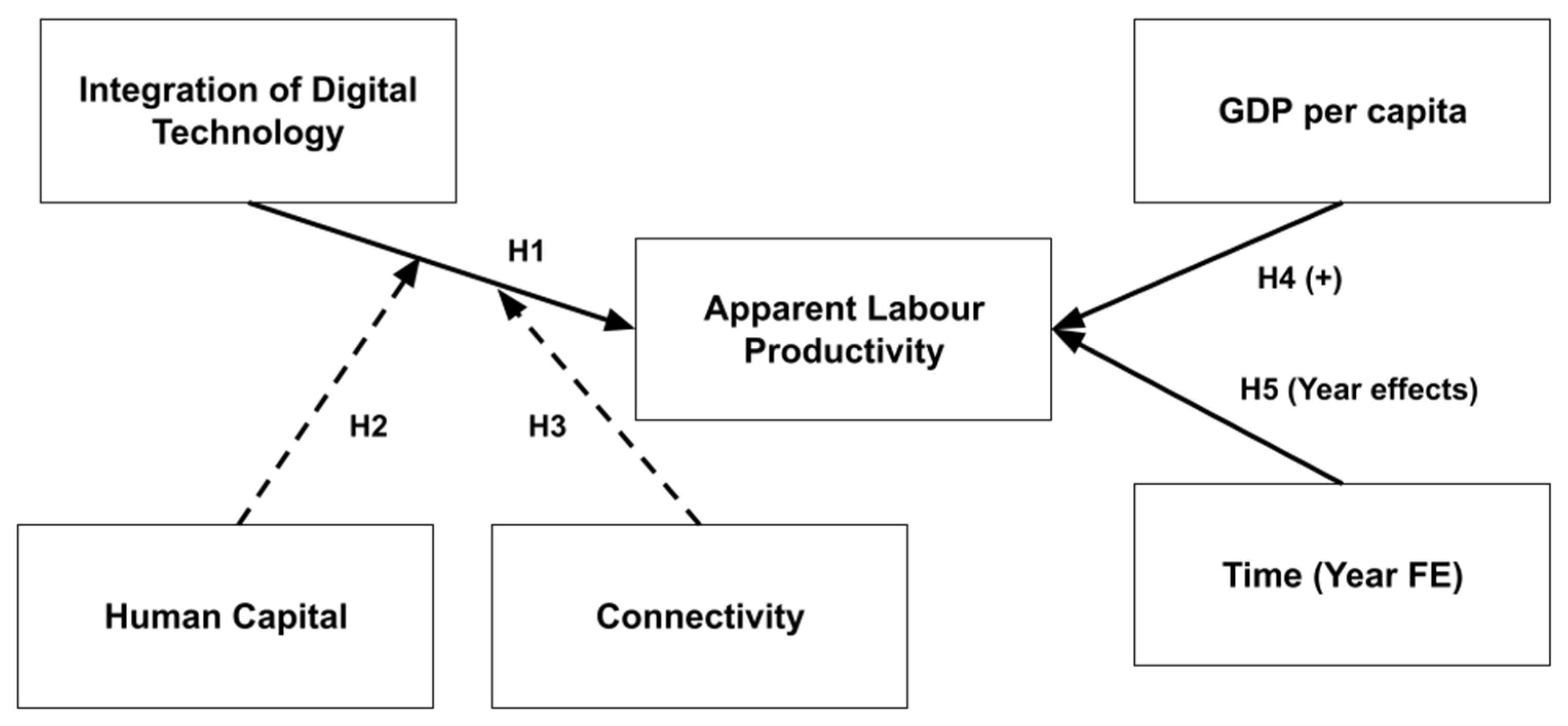
10]. Under these conditions, a positive relationship may emerge between digital technology integration and labor productivity, although this relationship may vary across countries and over time. This leads to Hypothesis 1 (H1).
In this framework, the DESI Integration of Digital Technology dimension (INT) is the main explanatory variable. It is interpreted as a country-level indicator of the extent to which digital tools are embedded in the business environment and can support business model reconfiguration.
In the operationalization of economic performance, LabProd, and digital technology integration, as defined by the DESI dimension “Integration of Digital Technology,” a positive association between digital integration and productivity is proposed. Evidence suggests that companies with effective digital capabilities and effective use of data generate greater economic value when these are combined with organizational change and innovation [
20,
28].
Accordingly, the conceptual framework suggests that there is a positive relationship between the integration of digital technologies into business processes and enterprise productivity, particularly where digital technologies are integrated with organizational transformation and innovation [
20,
28].
The academic literature consistently shows that the performance implications of digital transformation are heterogeneous and depend on the structural characteristics of an economy and on complementary capabilities. This study does not measure absorptive capacity directly at the firm level. A firm’s ability to absorb and leverage digital technologies depends on a number of aggregate factors. Specifically, digital human capital (HC) refers to the knowledge and skills necessary to use digital tools effectively. Connectivity (CON), in turn, reflects the availability and shareability of digital assets through digital infrastructure. While these indicators do not directly capture absorptive capacity at the organizational level, they provide country-level approximations of the complementary conditions that make digital integration more likely to generate business model changes and productivity gains. Therefore, the proposed conceptual model incorporates moderating variables that reflect a country’s capacity to benefit from digital integration.
Digital human capital, as measured by the DESI Human Capital dimension, is introduced as a moderator because it reflects part of the knowledge and skills base necessary for technology adoption and use. Organizations operating in environments with higher levels of digital skills are more likely to incorporate digital technologies into their processes and workflows. Therefore, higher levels of digital human capital may strengthen the relationship between digital integration and labor productivity (H2) [
3].
Connectivity represents the infrastructural dimension of the digital ecosystem and is introduced as a second enabling condition. Reliable and affordable digital infrastructure facilitates the circulation, integration, and scaling of digital resources across firms and systems. While connectivity does not inherently lead to an improvement in productivity, it does enhance the probability of successfully integrating digital processes and data exchanges into organizational practices. It may therefore strengthen the relationship between digital integration and labor productivity (H3) [
17].
Economic development, as measured by GDP per capita, is introduced as a structural contextual factor. It functions as a proxy for the financial and institutional resources that support investment in technology and digital transformation. Accordingly, economic development is expected to be positively associated with enterprise labor productivity (H4). This expectation is supported by recent empirical studies, which show that productivity gains from digital integration depend on technological complementarity and the level of economic activity [
20,
28].
The framework also includes a temporal dimension. Year effects are expected to capture common macro-level influences and broader changes in digital maturity across the EU over time. This leads to Hypothesis 5 (H5), according to which enterprise labor productivity varies significantly from year to year due to common time-related influences [
3,
10].
The study formulates five hypotheses based on the theoretical arguments developed above concerning the direct, moderating, and contextual relationships between digital technology integration and enterprise labor productivity.
Research hypotheses:
H1. Digital technology integration is positively associated with enterprise labor productivity.
H2. The relationship between digital technology integration and labor productivity is stronger at higher levels of digital human capital.
H3. The relationship between digital technology integration and labor productivity is stronger at higher levels of digital connectivity.
H4. Economic development is positively associated with enterprise labor productivity.
H5. Enterprise labor productivity varies significantly from year to year, reflecting common time-related influences.
H1, H2, and H3 identify the direct and moderating relationships that constitute the primary theoretical focus of the fixed-effects model and are interpreted primarily as short-run hypotheses at the country level. Conversely, H4 and H5 examine the impact of macroeconomic and temporal factors on enterprise productivity within the European Union (EU). At the same time, the literature and the correlated random-effects (CRE/Mundlak) design allow the analysis to consider whether more persistent cross-country differences in digital ecosystem maturity are also relevant for understanding productivity outcomes. The framework therefore distinguishes between short-run annual changes in national digital integration and persistent cross-country differences in digital ecosystem maturity. This distinction is central to the study’s empirical contribution.
Figure 1 illustrates the conceptual framework and the relationships underlying hypotheses H1–H5.
The variables used to operationalize these relationships and the corresponding econometric specifications are presented in the following section.
4. Methodology and Data
To test hypotheses H1–H5, panel regressions are estimated on country-year data with enterprise labor productivity (LabProd) as the dependent variable and INT as the primary independent variable. The econometric specifications are outlined in
Section 4.4 and include country and year fixed effects, clustered standard errors, and interaction terms representing moderation effects.
An overview of the variables used in the estimation process can be found in
Table 2. The table defines the name, source, statistical code, and analytic role of each variable. Enterprise productivity is calculated using the SBS indicator value V91110, while the digital dimensions are obtained from the DESI. Finally, economic development is measured using GDP per capita, retrieved from Eurostat (NAMA_10_PC).
This dependent variable measures apparent labor productivity (gross value added per person employed) (LabProd). It is the gross value added (GVA) divided by the number of persons employed and expressed in euros in thousands per employee. The data were obtained from Eurostat’s Structural Business Statistics (SBS) historical series (sbs_sc_sca_r2), covering the period from 2005 to 2020, as well as the updated SBS (sbs_sc_ovw) series, covering the period from 2021 to the present. The data were taken from the NACE Rev. 2 special aggregates and cover the total size class [TOTAL] by number of employees. This allowed us to construct a consistent series for 2017–2022 by combining the historical (to 2020) and post-2021 SBS releases. To reduce the skewness of the dependent variable and facilitate the interpretation of semi-elasticity, labor productivity was transformed into a logarithmic form (LN_LabProd) in the main estimations.
The independent explanatory variable in the model is the DESI dimension Integration of Digital Technologies (INT). This dimension captures the extent to which firms have integrated digital technologies. This includes the extent to which firms have adopted cloud computing and e-commerce capabilities and integrated digital technology data into business activities. The Integration of Digital Technologies index is used as a country-level proxy for the intensity of digital integration in the business environment, and is included in the models as both a main effect and an interaction term in the moderation specifications. INT is interpreted as a country-level proxy for digital integration conditions in the business environment, not as a direct firm-level measure of business model innovation. Accordingly, BMI is used in this study as a theoretical interpretive framework rather than as a directly measured mediating variable.
Based on the DESI Human Capital dimension, the HC index reflects both the level of digital skills in the population and the proportion of ICT specialists within it. In econometric analyses, the HC index is primarily used to moderate the relationship between the extent to which digital technologies are integrated into enterprises’ operations and their productivity through the application of relevant interaction terms.
The CON index is based on the DESI Connectivity dimension, which reflects the quality and affordability of broadband infrastructure. These are considered to be the foundation for using advanced digital applications. Similar to human capital, the CON index is primarily used as a moderator to determine whether digital infrastructure improves the impact of digital integration on enterprise labor productivity.
The LN_GDPpcEUR variable represents the level of economic development and is controlled for using Eurostat (NAMA_10_PC) data. This variable has been transformed using the log function to reduce the impact of heteroskedasticity and provide a relative interpretation of the associated coefficients. This variable captures broader differences in economic and institutional capacity across countries, which may be associated with differences in digital integration and enterprise productivity. In the moderation specification models, both the HC and CON indices, along with the relevant interaction terms, are included in the model. Further details regarding the complete model specification can be found in
Section 4.4.
4.1. Data Sources and Sample Construction
The analysis employs secondary data from official European sources to create a country-year panel dataset for EU Member States between 2017 and 2022 (EU-27). The digital indicators are derived from the Digital Economy and Society Index (DESI), a metric published by the European Commission. The data utilized in the Digital Decade DESI tool are compiled on an annual basis and are comparable across countries [
27,
33]. Data concerning the performance of enterprises is obtained from Eurostat’s Structural Business Statistics, while economic development is measured using GDP per capita [
29,
32]. The resulting dataset is a balanced EU-27 country-year panel for 2017–2022 (
N = 162). In order to ensure comparability, all variables were standardized to the same country-year identifier prior to conducting consistency checks on the series.
Using an ecosystem-level framework, this study examines whether the relationship between digital integration and enterprise productivity changes when interaction effects are taken into account. The analysis combines country-level DESI indicators with SBS labor productivity data for total enterprises, regardless of firm size or sector. Because the data are aggregated at the country-year level, the empirical design is intended to assess ecosystem-level relationships rather than identify internal firm-level mechanisms. Although firm-size and sector-specific analyses would be valuable, the present study is based on an aggregate country-year panel constructed to capture ecosystem-level relationships. Extending the analysis to disaggregated SBS structures would require a substantially different empirical design, and was therefore left for future research.
4.2. Dependent Variable (Enterprise Labor Performance)
The economic performance of enterprises is measured using apparent labor productivity (LabProd), which is defined as gross value added per person employed. This indicator is taken from Eurostat’s Structural Business Statistics (SBS) variable V91110, ‘Apparent labor productivity’, which is usually reported as thousands of euros per person employed [
29]. In line with the scope of the study, the analysis focuses on enterprise labor productivity (total size class), consistent with Eurostat’s size-band reporting. For the main estimations, the natural logarithm of apparent labor productivity (LN_LabProd) is used to reduce skewness and facilitate semi-elasticity interpretations.
4.3. Explanatory Variables (Digital Integration and Context)
This study uses the overall score of the DESI Integration of Digital Technology dimension. It does not analyze the DESI’s separate sub-indicators. The total score represents each country’s level of integration of digital technologies, such as cloud computing, e-commerce, and data integration, into its business environment. GDP per capita was included as a simple macro-level control variable. It reflects broader economic differences between countries, including differences in economic development, institutional capacity, and resource availability. These differences affect individuals’ and businesses’ ability to integrate digital technologies and increase productivity. This study uses GDP per capita as a broad structural control variable because the dataset only covers a short period of time, and model parsimony is necessary. Several related macroeconomic factors could be at play, such as the level of innovation, education level, and quality of institutions. However, these factors will not be considered in this study because doing so would not allow for an accurate assessment of the relationships found in this research. More detailed macro-control specifications are left for future research. Although country-level DESI indicators capture digital development at the national level, they do not directly measure technology use or adoption within firms, nor do they capture firm-level digital practices. Thus, this study is designed to assess the relationship between digital maturity and enterprise productivity at the ecosystem level rather than identify internal firm-level mechanisms or firm-level causal effects.
INT is the leading explanatory variable (the dimension of DESI that is ‘Integration of Digital Technology’), which indicates how thoroughly businesses in the economy have adopted digital technologies, establishing critical prerequisites for innovating business models within a digitalized economy [
27].
To control for the influence of structural factors on technology absorption capacities, the following additional variables are introduced:
HC (as a measure of digital skills and ICT specialist availability);
CON (as a measure of the quality and affordability of broadband infrastructure);
LN_GDPpcEUR (the natural logarithm of GDP per capita according to Eurostat—nama_10_pc), which serves as a proxy for the economic development level.
These variables were selected because previous research indicates that the effect of digital transformation on performance depends on macro-level context and complementary capabilities [
3,
10,
20].
4.4. Econometric Strategy and Regression Specifications
Fixed-effects regression models are used to estimate the relationship between digital integration and enterprise productivity at the country level [
34,
35]. By using country fixed effects, identification relies solely on within-country variation over time. This makes it possible to control for unobserved characteristics that remain constant over time, such as economic structure and institutional quality. In addition, year fixed effects (i.Year) are included to account for shocks that may affect all countries equally in a given year. Robust standard errors clustered at the country level are used to account for heteroskedasticity and serial correlation within panels (vce(cluster id)) [
36].
Fixed-effects estimation identifies short-run within-country dynamics, that is, whether changes in digital integration within a given country are associated with changes in productivity over time. The CRE/Mundlak specification contributes to advancing knowledge of the relationship between national variations in ecosystem digital integration and productivity by indicating whether the relationship reflects persistent differences between countries. Combining these two approaches provides a theoretical contribution that goes beyond improving econometric identification. The digital integration-productivity relationship varies depending on whether it is viewed as a short-run dynamic process or as a longer-run structural ecosystem condition. BMI provides a theoretical lens through which the productivity implications of digital integration can be interpreted. In this study, however, BMI is not treated as an empirically verified mediator. Accordingly, H1–H3 focus on direct and moderated relationships within the fixed-effects framework and are interpreted primarily as short-run hypotheses at the country level. By contrast, H4 and H5 capture broader macroeconomic and temporal influences on enterprise productivity across the European Union.
The baseline specification used to test the primary effect (H1) is:
where:
INT = integration of digital technology
GDP = gross domestic product per capita (GDP per capita)
= country fixed effects, year fixed effects, error term
Year fixed effects are particularly important in the present setting because the 2017–2022 period includes common shocks affecting all EU member states, such as the COVID-19 pandemic, EU-wide digital policy developments, and broader macroeconomic instability. By absorbing time-specific variation shared across countries, year fixed effects reduce the likelihood that the estimated associations reflect common external events rather than changes in the explanatory variables of interest.
To test conditional (moderation) effects, digital human capital (HC) and connectivity (CON) are introduced in the moderation specifications (Models 2–3) together with their interaction terms. Accordingly, HC and CON are not treated as standard control variables included in all models, but as moderators of the relationship between digital integration and productivity. The interpretation of the interaction terms relies on marginal effects estimated using margins-type procedures [
37].
To facilitate interpretation and to mitigate multicollinearity between main effects and interaction products, the DESI indicators used in the interaction terms were mean-centered. Therefore, the following centered variables are defined:
where
are the original DESI components, and
denote the corresponding sample means computed over the full dataset.
Mean-centering does not alter the estimated structural relationships between variables, but it allows the main-effect coefficients to be interpreted as the effect of the independent variable at the mean of the moderator [
38]. It also improves the interpretability of interaction terms and reduces multicollinearity between the variables that make up the interaction and their products.
The dependent variable, LN_LabProd, is the natural logarithm of apparent labor productivity across all enterprises. The control variable for the effects of differences in the level of economic development between different countries on LN_LabProd is economic development, measured by the natural logarithm of GDP per capita based on an exchange rate (LN_GDPpcEUR). The empirical models are specified as follows:
Model 2 (H2—Human Capital moderation):
Model 3 (H3—Connectivity moderation):
The following specifications operationalize hypotheses H1–H5. All models incorporate country and year fixed effects and use clustered standard errors at the country level .
The statistical significance of year fixed effects is assessed through a joint test of the coefficients associated with the year indicators (testparm i.Year), in order to examine common time-related influences (H5).
To distinguish short-run within-country dynamics from more persistent cross-country differences, the fixed-effects estimates are complemented with a correlated random-effects estimator (CRE/Mundlak). This approach is similar to the Chamberlain device, in that the means of the time-varying independent variables are added to the model as additional explanatory variables [
39,
40]. The benefits of the CRE/Mundlak framework are twofold: first, it provides an interpretable within-between decomposition; and second, it allows for the evaluation of whether average cross-country differences are different from annual changes within a country. Given that this is a complementary specification to fixed effects, the CRE/Mundlak specification may offer additional insights into the differences between the structural between-country component and the short-run within-country component of digital ecosystem maturity.
Unobserved country-level characteristics that correlate with regressors are controlled in the fixed-effects models. The Hausman specification test, a conventional method in this field, is employed to differentiate between the fixed-effects model and the standard random effects model. By contrast, the CRE/Mundlak approach enables a more precise decomposition of this relationship and presents less stringent assumptions about the independence of variables that constitute the design of the Random Effects Model [
41].
Although the empirical strategy reduces several important sources of bias, the estimated relationships should not be interpreted as strictly causal. Lagged specifications are included as robustness checks to partially address simultaneity. Country fixed effects account for time-invariant country characteristics, while year fixed effects capture shocks common to all countries in a given year, such as recessions, EU-wide policy changes, or pandemic-related disruptions. The CRE/Mundlak specification further helps distinguish short-run within-country variation from persistent cross-country differences.
Several steps were taken to reduce endogeneity concerns; however, reverse causation remains possible. More developed economies are generally better able to invest in digital technologies and the complementary capabilities needed to use them effectively. Furthermore, there are additional factors that vary over time and may impact the level of digital integration and its relationship to enterprise productivity. These factors may include differences in levels of innovation effort, institutional quality, sectoral composition, policy support, or labor market conditions. Consequently, the coefficients presented herein should be regarded as strong associations rather than definitive evidence of causation.
A variety of alternative methods for identifying relationships were considered; however, these methods were not found to be compatible with the current data set. Due to the limited number of countries and the restricted time span of the data set, methods such as Difference GMM and System GMM encounter challenges in producing stable estimates and managing the substantial number of instruments that would be required. Instrumental-variable estimation would require credible exogenous instruments that affect digital integration across EU member states while remaining comparable over time. Due to the unique characteristics of the DESI aggregate site level, the identification of credible instruments with a theoretical foundation presents significant challenges. Consequently, the present paper relies on an associational empirical strategy based on fixed effects, CRE/Mundlak decompositions, clustered inference, and lagged robustness checks.
4.5. Implementation and Reproducibility
All data preparation and econometric analyses were conducted in Stata/SE 14.2 using standard panel data commands, including xtset and xtreg, while marginal effects for the interaction specifications were computed using the margins command [
42]. The models were estimated with country and year fixed effects. Robust standard errors were clustered at the country level to account for heteroskedasticity and serial dependence within panels. A summary table of the variables, including their units of measurement and source data, is provided to ensure transparency and facilitate replication.
To assess the robustness of the main conclusions of this study, a series of robustness checks were conducted and are documented in
Appendix A. Specifically, these include the CRE/Mundlak decompositions, lagged specifications, correlation matrix analysis, multicollinearity analysis, estimation over different sub-periods, sensitivity analysis, and a quadratic specification for digital integration. In addition, an exploratory subgroup analysis by digital maturity tier was conducted to assess whether the baseline relationship between digital integration and enterprise productivity differs across groups. Interaction-based subgroup extensions were not implemented because the limited number of observations within each tier would reduce statistical power and the stability of the estimates. These checks are useful because they help distinguish short-run within-country dynamics from more persistent cross-country structural differences in digital ecosystem maturity.
As further robustness checks, the baseline and moderation models were re-estimated using one-, two-, and three-year lagged digital integration indicators. This made it possible to evaluate delayed effects on productivity and to partially address concerns about simultaneity and reverse causality. The corresponding results are presented in
Appendix A.2,
Table A2,
Appendix A.3,
Table A3, and
Appendix A.4,
Table A4.
In order to assess the plausibility of a nonlinear relationship between digital technology integration and enterprise labor productivity, an additional fixed-effects model was estimated. This model included both the centered digital integration variable and its squared term. The coefficient on cINT
2 was not statistically significant, providing no evidence of a nonlinear association in the present sample (
Appendix A.10,
Table A10).
Pairwise correlations indicate moderate to strong relationships among certain country-level structural variables, especially digital integration, digital human capital, and GDP per capita (
Appendix A.5,
Table A5). However, variance inflation factor diagnostics for the interaction specifications indicate significant collinearity, especially in the model that includes human capital (
Appendix A.6,
Table A6), while the connectivity model also shows elevated VIF values (
Appendix A.7,
Table A7). This pattern is substantively plausible in an EU country-level setting, where digital maturity, skills, and economic development tend to co-evolve. Mean-centering was retained because it improves the interpretability of interaction terms; however, the interaction results should be interpreted with caution.
Mean-centering was retained because it improves the interpretability of the interaction terms. However, this procedure does not eliminate substantial collinearity among the underlying macro-level regressors. As a result, the interaction terms may be associated with larger standard errors and reduced statistical power. Therefore, the absence of statistically significant interaction effects in the full-sample models does not necessarily imply the complete absence of complementarities. Rather, it may reflect the difficulty of estimating interaction effects precisely in the presence of highly correlated country-level variables. Orthogonalized interaction terms were also explored as a way to mitigate multicollinearity. However, given the strong correlation among country-level indicators of digital maturity, skills, infrastructure, and socio-economic development, the study retained the original specification and emphasized transparent diagnostics and cautious interpretation rather than alternative transformations that would mainly reduce collinearity mechanically.
An alternative complementarity test was also considered. However, approaches such as Levinsohn-Petrin are more naturally suited to production-function settings with detailed input-level microdata than to the present aggregate country-level panel. For this reason, the study retains interaction-based moderation analysis as the more coherent empirical strategy within the current design.
As a further robustness check, fixed-effects models were estimated separately for the pre-pandemic sub-period (2017–2019) and the pandemic sub-period (2020–2022). The corresponding estimates are reported in
Appendix A.8,
Table A8.
To further assess the robustness of the main fixed-effects results, the sensitivity of the primary results to potentially influential countries and/or years within the sample was analyzed. These potentially influential observations were identified based on Cook’s distance, which we derived from an auxiliary model combining country and year effects. Each year was represented by a separate indicator variable. The baseline fixed-effects model was then re-estimated after excluding those cases (
Appendix A.9,
Table A9). The results did not substantially alter the main findings. The coefficient for digital integration remained statistically insignificant, and GDP per capita continued to be a strong positive predictor of enterprise productivity. These results suggest that the main conclusions are not driven by a few extreme country-year observations.
4.6. Causal Inference Limitations
While empirical strategies aim to mitigate major sources of bias and provide estimates of relationships, it is imperative to refrain from interpreting these estimates as implying strict causal relationships. The present study is subject to limitations that preclude the establishment of causal relationships.
A key challenge in causal identification is the presence of endogeneity, which refers to the tendency for variables to be correlated with their own measurement errors. Endogeneity may result from reverse causation (e.g., more productive economies might also be in a position to invest in digital technologies and related capabilities). Additionally, omitted time-varying variables, such as innovation effort, institutional change, sectoral composition, policy support, and labor-market conditions, must be considered. These variables potentially affect both digital integration and enterprise productivity.
An important limitation is the use of aggregated country-level data. The DESI indicators of the digital ecosystem measure the level of digital development in countries, as opposed to the extent of individual firm adoption of digital technology or the redesign of business models. Consequently, the empirical approach enables identification of the level of association between the digital ecosystem and enterprise productivity. It does not allow for the identification of the internal methods and mechanisms through which digital integration influences productivity at the enterprise level. A formal mediation design was not implemented because the empirical dataset does not contain a direct measure of business model innovation. Accordingly, while the theoretical framework draws on BMI to interpret how digital integration may be associated with productivity, the study does not test a formal BMI mediation mechanism.
Additionally, the study does not employ random assignment, a quasi-experimental design, or an exogenously distributed instrumental variable to distinguish variation in digital technology integration across countries or over time. As a result, the analysis cannot establish causal effects in a strict sense.
Nonetheless, the empirical strategy helps reduce some of these limitations, although it does not eliminate them. Specifically, the fixed effects for countries in the current study mitigate potential bias arising from unobserved time-invariant differences across nations. Moreover, the year fixed effects are designed to account for the common shocks that affect all countries within a given year. The CRE/Mundlak specification underscores the distinction between persistent cross-country differences and less persistent within-country differences in the short run of the current analysis. It also accounts for the simultaneous relationship between digital technology adoption and productivity. Finally, while lagged specifications are estimated as part of the current analysis to reduce simultaneity, these strategies achieve some improvement in identifying the effects of digital technology on enterprise productivity. However, they do not entirely eliminate the risk of endogeneity.
Given these limitations, including the possibility that omitted time-varying factors such as national R&D effort, SME support policies, labor-market reforms, and structural sectoral change may affect both digital integration and enterprise productivity, the reported coefficients should be interpreted as robust and policy-relevant associations rather than as definitive causal effects.
5. Results
Table 3 reports the descriptive statistics for the analyzed variables, i.e., the number of country-year observations, the mean, the standard deviation, the minimum and maximum, and the shape of the distribution (skewness and kurtosis). The analysis uses 162 observations from a balanced panel of 27 EU Member States over 2017–2022.
Enterprise labor productivity (LabProd) and gross domestic product (GDP) per capita (GDPpcEUR) show substantial heterogeneity across countries, as indicated by the wide spread between the minimum and maximum values. Both variables also exhibit positive skewness, indicating the presence of a small number of relatively high observations.
To reduce right skewness, stabilize variance, and facilitate coefficient interpretation, natural logarithm transformations were applied to LabProd and GDPpcEUR, resulting in LN_LabProd and LN_GDPpcEUR.
Table 4 summarizes the findings of the panel fixed effects regression analysis conducted across the 27 EU member states from 2017 to 2022, which used 162 observations of enterprise labor productivity (LN_LabProd) per country-year as the dependent variable. The analysis, which was conducted using panel fixed effects, accounted for both country and year fixed effects, while providing standard errors that were clustered at the country level.
Model 1 tests Hypothesis H1 by estimating the within-country relationship between digital technology integration (Cint) and enterprise labor productivity (LN_LabProd), while controlling for economic development (LN_GDPpcEUR). The coefficient on Cint is small and not statistically significant. Thus, the fixed-effects estimates do not provide robust evidence that year-to-year changes in digital integration are associated with short-run changes in enterprise productivity within countries. By contrast, economic development (LN_GDPpcEUR) is positive and statistically significant.
Model 2 evaluates Hypothesis H2 by including human capital (Chc) and the interaction term (Cint × Chc). However, the full-sample fixed-effects model does not yield strong statistical evidence to support the moderating influence of human capital. Furthermore, the interaction term does not demonstrate statistical significance. The main effect of human capital is marginally positive at the 10% level. This finding suggests a modest positive relationship between digital human capital and enterprise labor productivity. However, it should be noted that this does not necessarily imply that human capital moderates (i.e., interacts with) the relationship.
These null interaction results should nevertheless be interpreted with caution. In the EU context, digital integration, digital human capital, and economic development are structurally related and tend to co-evolve. Mean-centering improves the interpretability of the interaction terms. Nevertheless, it is important to note that this process does not guarantee the elimination or mitigation of collinearity, the presence of which has been shown to reduce the precision associated with interaction effect estimates. Consequently, the absence of statistical significance for H2 and H3 should not be interpreted as evidence that complementarities are absent.
In order to test Hypothesis H3, Model 3 incorporates connectivity (Ccon) and the interaction term (Cint × Ccon). A thorough examination of the full-sample fixed-effects analysis revealed no robust evidence to support a moderation effect. Connectivity (Ccon) was not found to be statistically significant, nor was the interaction term (Cint × Ccon). Therefore, for the specified time period and within the countries examined, connectivity does not appear to have a moderating effect on the association between digital integration and enterprise productivity in the fixed-effects models.
Overall, the lack of significant interaction term coefficients for Models (1), (2) and (3) indicates that the combined models do not support Hypotheses H1 to H3, according to the fixed effects model results. However, the positive coefficient of economic development is supported by all three models, indicating that Hypothesis H4 is supported. Finally, the collective significance of the year fixed effects across the analysis period of 2017–2022 suggests the existence of common time-varying influences during this period, thereby supporting Hypothesis H5.
The lagged specifications do not significantly alter the overall findings. The one-year and two-year lagged effects of digital integration on productivity remain statistically insignificant for both the baseline and moderation models. The three-year lagged specifications provide only weak and non-robust evidence, which should be interpreted with caution given the reduced number of observations. Overall, there is no robust evidence that the effects of digital integration become clearly detectable within one-, two-, or three-year horizons. The corresponding lagged fixed-effects estimates are reported in
Appendix A.2,
Table A2,
Appendix A.3,
Table A3, and
Appendix A.4,
Table A4.
Taken together, the fixed-effects results suggest that short-run annual changes in digital integration are not associated with detectable within-country productivity gains in the full sample. The CRE/Mundlak results reported in
Appendix A.1 allow us to examine whether this conclusion differs once more persistent cross-country differences are taken into account, and this issue is discussed in the following section.
6. Discussion
The primary contribution of the study lies not only in the finding that the short-run fixed-effects estimates are statistically insignificant, but also in showing that the fixed-effects and CRE/Mundlak results jointly reveal a mismatch between annual within-country changes and persistent between-country differences in digital ecosystem maturity. In summary, the findings indicate that annual improvements in digital integration within countries are not directly associated with immediate productivity gains. By contrast, more persistent cross-country structural differences appear to be more important for explaining enterprise productivity. The study’s contribution lies in this distinction: at the ecosystem level, digital integration appears less as a yearly productivity shock and more as a structural enabling condition for business model innovation and longer-term performance differences.
This interpretation is consistent with the finding that gross domestic product per capita continues to serve as a reliable predictor of enterprise productivity. Additionally, the direct and moderating effects of digital integration appear weak in the short-run fixed-effects specifications. The CRE/Mundlak results further suggest that persistent differences among countries are more relevant than annual within-country variation for explaining productivity outcomes. In particular, the within-between decomposition indicates that economic development, and to a lesser extent, the interaction between digital integration and human capital, helps explain part of the observed cross-country heterogeneity. The corresponding CRE/Mundlak results are reported in
Appendix A.1,
Table A1.
There are several reasons why this study differs from some parts of the existing literature. First, many positive findings on digitalization and productivity are based on firm-level datasets. These datasets allow researchers to capture specific digital practices, technology adoption, and managerial changes when examining how firms implement digital technologies. Second, many studies use longer time horizons, which allow lagged performance effects to become visible. Third, researchers using firm-level data can better examine the effects of digital technologies on productivity by directly observing the internal processes of firms that use these technologies. In contrast, the present study uses aggregate, ecosystem-level measures, such as the Digital Economy and Society Index (DESI), to capture the broader national context and overall level of digital development within a country. These measures do not directly capture how firms implement digital technologies. Therefore, gradual improvements in business performance are consistent with the use of digital technologies in combination with organizational changes and the more effective use of internal capabilities to create value [
1,
5,
24].
These results can be interpreted at multiple levels of analysis. At the micro level, firms utilize digital technologies in specific business processes and functions. At the meso level, business model innovation pertains to the manner in which firms generate, deliver, and capture value through organizational design. At the macro level, DESI captures the broader ecosystem conditions in which firms operate, including infrastructure, skills, and policy support. In this setting, the results indicate that persistent differences in ecosystem maturity are more strongly associated with enterprise productivity than annual short-run fluctuations in digital integration.
From a business model innovation (BMI) perspective, this pattern shows that adopting digital technologies does not automatically increase productivity. Rather, digital technologies must be incorporated into broader changes in value proposition, value creation, value delivery, and value capture. Therefore, gradual improvements in business performance are consistent with using digital technologies in combination with organizational changes and using internal capabilities more effectively to create value [
1,
5,
24]. These findings are consistent with the view that digital integration functions as an enabler within the business model innovation ecosystem rather than merely as an input into production.
The robustness checks supported the original regression analysis results, with no substantial changes identified in the one-, two-, and three-year lagged specifications (
Appendix A.2,
Table A2;
Appendix A.3,
Table A3;
Appendix A.4,
Table A4). Across these robustness checks, the one-year lag of digital integration and its interactions with human capital and connectivity remained statistically insignificant. The sub-period analysis results also indicate that the baseline model did not yield statistically significant results in either the pre-pandemic or pandemic period (
Appendix A.8,
Table A8). However, the moderation models became significant during the 2020–2022 period. This suggests that the short-run relevance of digital integration may have increased during the pandemic, especially when supported by digital skills and connectivity. The sensitivity analysis reported in
Appendix A.9,
Table A9, showed no significant change in the overall conclusions.
An additional point concerns the sub-period results reported in
Appendix A.8. Although the baseline fixed-effects relationship between digital integration and productivity remains statistically insignificant in both sub-periods, the moderation models appear stronger during the pandemic period (2020–2022). One plausible interpretation is that the COVID-19 shock accelerated digital adoption and increased the practical relevance of complementary conditions, especially digital skills and connectivity. Under pandemic conditions, firms faced stronger pressures to reorganize operations, expand digital interfaces, and rely on remote coordination, which may have made complementarities more visible than in the pre-pandemic period. This pattern is also consistent with a business model innovation perspective, according to which external disruption may force firms to reorganize more rapidly. Under such conditions, enabling factors such as digital skills and connectivity may become more immediately relevant. These sub-period results should nevertheless be interpreted with caution, given the limited number of observations and the exploratory nature of the analysis.
The exploratory subgroup analysis by digital maturity also points in the same direction. These subgroup estimates are intended to assess whether the baseline association between digital integration and enterprise productivity differs across digital maturity tiers. A robust positive within-country effect of digital integration has not been identified in the low-, medium-, or high-maturity groups (
Appendix A.11,
Table A11). Because each digital maturity tier contains a limited number of observations, the moderation models were not re-estimated within subgroups, as this would reduce statistical power and the stability of interaction-based estimates. This finding is consistent with the interpretation that digital integration is more closely associated with structural differences in ecosystem maturity than with short-run annual fluctuations.
In summary, the findings do not contradict the economic relevance of digital integration. Rather, they suggest that the productivity effects of digital integration depend on broader organizational and ecosystem-level factors, emerge with a delay, and accumulate over time. Therefore, digital transformation is better understood as a gradual process shaped by ongoing structural development rather than an annual shock to organizations [
1,
8,
13].
6.1. Implications for Business Model Innovation
The fixed-effects results suggest that digital technology integration does not generate an immediate and measurable increase in enterprise productivity, once structural cross-country differences and common time effects are taken into account. This finding should not be interpreted as evidence that digital integration is economically irrelevant. Rather, it suggests that, at the ecosystem level, digital integration is more likely to create enabling conditions for business model innovation than to produce immediate productivity gains. This research does not directly measure business model innovation. Consequently, the present study did not provide definitive evidence to substantiate the hypothesis that BMI functions as a mediator. Instead, it supports the interpretation that organizational conditions associated with digital integration may help firms adapt the way they create, deliver, and capture value, with productivity gains becoming more visible over time.
This finding suggests that digital technologies should not be regarded as a universal or immediate catalyst for productivity enhancement. Instead, they function as enabling infrastructure for business model innovation. The potential for productivity gains may become more apparent when firms engage in organizational adaptation and reconfigure their processes for creating, delivering, and capturing value [
1,
8]. The full benefits of digital integration are unlikely to emerge immediately, because firms often need time for learning, process redesign, and the development of complementary organizational capabilities [
1,
8].
The implications of this phenomenon are of particular relevance to firms operating within the constraints of limited resources. For firms with limited resources, the productivity value of digital integration is contingent not only on the adoption of digital tools, but also on complementary factors such as employee skills, data governance, and organizational coherence. Therefore, it is more likely that productivity gains will be achieved when digital tools are integrated into a comprehensive set of organizational capabilities, as opposed to when they are applied in an isolated manner. This phenomenon underscores the notion that achieving higher levels of digital maturity within firms is more likely to result in productivity gains when there is a symbiotic integration of digital tools with supporting capabilities.
The present study finds support from extant research for this interpretation, including evidence that data-driven decision-making culture and digitalization may reinforce organizational performance [
22,
23].
At the same time, the broader digital ecosystem remains important. Higher levels of digital integration within an economy can create more favorable conditions for the emergence of new business models through stronger infrastructure, digital markets, platforms, and networks [
17,
18,
20]. In this sense, the present findings support a distinction between macro-level digital conditions and the organizational mechanisms through which these conditions are translated into productivity improvements [
5,
24].
6.2. Why Are Within-Country Short-Run Effects Insignificant?
The findings do not indicate any statistically significant short-run within-country effect of digital integration on enterprise labor productivity. This finding is not an anomaly; rather, it is consistent with a number of theoretical and empirical explanations.
First, digital integration often involves substantial adjustment costs. The adoption of digital technologies requires firms to invest in implementation, training, coordination, process redesign, and new governance arrangements. These adaptation costs may offset part of the immediate efficiency gains that digital tools are expected to generate. As a result, productivity improvements may not be observable in the short run, even when digital integration is increasing.
Second, productivity gains from digital integration depend on learning and organizational adaptation. As companies gain experience, develop new routines, align their processes, and incorporate digital tools into the organization’s overall structure, this process can take a significant amount of time. This is especially true when digital technologies affect multiple functions within the business at once, including operations, customer interaction, and internal coordination. Under such circumstances, the positive impact of digital technology on productivity is more likely to materialize over time than within a single year.
Third, the interpretation of the results must take into account the aggregated nature of the explanatory variables. The DESI Integration of Digital Technology indicator measures digital integration conditions at the aggregate country level rather than the internal digital practices of individual firms. The indicator reflects the broader ecosystem context in which firms operate. It does not exclusively reflect the innovation in business models or organizational changes at the level of individual firms. Accordingly, when averaged at the country level (as in the case of the panel estimates), the effects of heterogeneous firms may be smoothed out or diluted. This, in turn, creates a more challenging environment for the detection of short-run within-country effects.
Fourth, the findings are consistent with the digitalization paradox. In the early stages of digital transformation, the implementation of new technologies may be hindered by frictions, coordination burdens, and complementary investment needs, thereby neutralizing the immediate benefits of these technologies. The positive effects of these technologies may emerge later and unevenly, once firms have had sufficient time to absorb the technology, reorganize their processes, and develop the supporting capabilities required for effective use.
These explanations also help explain the differences between the fixed-effects results and the CRE/Mundlak results. The former focuses on identifying the annual within-country change, while the latter uses the between-country component of an ecosystem’s maturity level and skills to identify long-term/sustained structural changes as a result of digital integration. In summary, medium-term structural changes in digitally integrated ecosystems are more likely to be associated with productivity than short-run yearly fluctuations.
7. Conclusions and Policy Recommendations
This study examined the relationship between digital technology integration and enterprise labor productivity in the EU-27 from 2017 to 2022 using a balanced country-year panel. The main conclusion is not that digital integration is unimportant, but that, at the ecosystem level, its effects do not appear as simple annual within-country productivity gains. Instead, the results suggest that digital integration is more strongly reflected in persistent structural differences across countries than in short-run year-to-year variation. In the fixed-effects specifications, year-to-year increases in digital integration within countries are not associated with statistically significant short-run productivity gains, while GDP per capita remains strongly associated with enterprise productivity. The CRE/Mundlak decomposition further indicates that persistent cross-country differences are more important than annual within-country variation in explaining the relationship between DESI and enterprise productivity.
These results also have important implications for how digital integration should be understood. The absence of statistically significant short-run within-country effects does not imply that digital integration is irrelevant; rather, it suggests that productivity improvements may be more closely linked to organizational change, business model adaptation, skill development, and learning than to immediate annual increases in digital integration alone.
The findings also support an ecosystem view of digital transformation. Differences in digital maturity across countries, and in the productivity of their enterprises, reflect long-term structural elements of national digital ecosystems rather than changes occurring over only a one-year period. Digital transformation should therefore be understood as a cumulative and context-dependent process.
These findings suggest that public policy should move beyond narrow technology-adoption targets and support the broader organizational and ecosystem conditions through which digital tools may be translated into productivity gains. In practice, this includes digital skills, broadband connectivity, interoperable systems, organizational redesign, and support for process transformation. European digital transformation policies are therefore likely to be most effective when aligned with broader efforts to strengthen productive capacity and the institutional frameworks that support it.
The present study is subject to several limitations. First, the country-based analysis of DESI indicators and Eurostat SBS productivity data across all enterprises provides an aggregate perspective of the digital ecosystem. However, it is not able to demonstrate potential variations across sectors or firm-size groups, for instance, SMEs versus large corporations, nor can it identify the firm-level mechanisms through which digital integration may affect productivity. Second, the observation period is relatively short, as the 2017–2022 window may not fully capture the long-term structural effects of digital transformation. This is because productivity gains associated with experience-based learning, workflow redesign, and the accumulation of complementary resources may take longer than six years to become visible. Third, the study is also subject to limitations regarding causal interpretation. Although the empirical strategy includes country and year fixed effects, CRE/Mundlak decompositions, and lagged specifications, these approaches do not fully resolve endogeneity concerns. While lagged models mitigate some concerns related to simultaneity, they do not address endogeneity. The possibility of reverse causality persists, as more productive economies may also be better positioned to allocate resources towards investments in digital technologies and related capabilities. In addition, omitted time-varying factors such as innovation effort, institutional change, SME support policies, labor-market conditions, and changes in sectoral composition may affect both digital integration and enterprise productivity. Moreover, the study does not rely on an exogenous identification strategy, since no external instrument or quasi-experimental design is available to isolate exogenous variation in digital integration across countries and over the years. Accordingly, the findings should be interpreted as robust and policy-relevant associations rather than definitive causal effects. Finally, interactions among several macro-level variables are often highly correlated. While the application of mean-centering to the data facilitates enhanced interpretation of the results, it does not entirely eliminate the impact of collinearity on the relationships between the various macroeconomic variables. Consequently, the estimated moderation effects may be measured with reduced precision because of substantial collinearity.
The subgroup analysis by digital maturity (
Appendix A.11,
Table A11) should be interpreted cautiously because each category includes a limited number of countries, which reduces statistical precision and the reliability of clustered inference. The results are therefore exploratory and intended to illustrate possible heterogeneity patterns rather than provide definitive subgroup-specific conclusions.
To extend current research on productivity growth resulting from digital technologies, researchers should use a longer time frame, disaggregate their data by sector and firm size whenever feasible, and examine additional ways in which digital technologies may enhance productivity beyond direct productivity gains. These additional pathways include innovation, technology investments, management practices, and interactions across firms and sectors. The findings suggest that the productivity benefits of digital transformation may be substantial, but they remain conditional on two factors. First, a delayed response may follow the implementation of initial digital transformations. Second, the interactions between organizational and ecosystem-level variables must be taken into account.
This study contributes to the existing DESI-based literature by offering a novel distinction between annual within-country dynamics and persistent structural differences in digital ecosystem maturity. This distinction helps clarify why digital integration may matter for productivity at the ecosystem level, even when short-run within-country effects are not statistically detectable.
Differentiated Policy Implications Across EU Digital Maturity Groups
The findings suggest that policy implications should be differentiated according to the digital maturity of EU member states. This differentiation is also consistent with the exploratory subgroup analysis by digital maturity reported in
Appendix A.11,
Table A11. For the majority of Central and Eastern European Countries (CEECs) and countries with lower levels of the Digital Economy and Society Index (DESI), policymakers should prioritize enhancing the foundational conditions for digital transformation. These conditions encompass factors such as connectivity, ICT skills, managerial capability, and the absorption capacity of small and medium enterprises (SMEs). In such contexts, the productivity effects of digital integration are likely to remain limited unless these enabling conditions are improved first. Accordingly, the policy approach in these countries differs from that in higher-DESI Western and Nordic economies, where digital infrastructure and baseline capabilities are typically more advanced. In higher-DESI Western Europe and the Nordic region, policymakers can place greater emphasis on organizational redesign, business model innovation, data-driven management, and the strategic use of more advanced digital technologies. Consequently, the overarching objective of the Digital Single Market initiative should reflect the divergent implementation logics of the respective EU member states, contingent upon their levels of digital maturity.
More broadly, the effectiveness of digital policy depends on the stage of digital maturity at which it is implemented. In lower-DESI contexts, policy should prioritize closing fundamental infrastructure and skills gaps. In more advanced digital ecosystems, policy should focus more strongly on organizational redesign, data-driven management, and innovation in business models.