Article

Examining the Relationship Between Organizational Ambidexterity and Firm Performance in New Technology-Based Firms

by
Julio César Acosta-Prado
1,*,
Elías Aburto-Camacllanqui
2,
José Ever Castellanos Narciso
3 and
Ricardo Mora Pabón
3
1
Engineering Department, Pontificia Universidad Católica del Perú, Lima 15088, Peru
2
Faculty of Psychology, Universidad Nacional Mayor de San Marcos, Lima 15081, Peru
3
School of Administrative, Accounting, Economic, and Business Sciences, Universidad Nacional Abierta y a Distancia—UNAD, Bogota 111511, Colombia
*
Author to whom correspondence should be addressed.
Systems 2026, 14(3), 309; https://doi.org/10.3390/systems14030309
Submission received: 14 November 2025 / Revised: 4 December 2025 / Accepted: 9 March 2026 / Published: 16 March 2026

Abstract

Organizational ambidexterity is an essential topic in management research. A growing number of studies argue that organizational ambidexterity is increasingly critical to the sustained competitive advantage of firms. However, there is less research on ambidexterity in new technology-based firms, despite the significant impact it has on local and national economies. The study examined the relationship between organizational ambidexterity and firm performance (non-economic and economic). The sample consists of 102 Colombian new technology-based firms. A latent variable design or structural equation modeling was followed. The statistical method was Partial Least Squares Structural Equation Modelling (PLS-SEM). According to the results, organizational ambidexterity is positively related to both non-economic and economic performance. Organizational ambidexterity explained 10% of the variance of the economic performance and 56% of the variance of the non-economic performance. These findings highlight the importance of organizational ambidexterity to obtain better firm performance, especially non-economic performance related to customer perception, employee satisfaction, and improvement in the quality of products and services in new technology-based firms.

1. Introduction

In an increasingly globalized world such as the current one, the presence of new markets, new business models, and new approaches that transform the reality of organizations is frequent, where knowledge is the primary source for this development process, which has an impact on obtaining business results [1]. Changes in the business environment, and in general within societies, have led to the learning processes being a topic of interest, not only for academia but also for managers, executives, entrepreneurs, and decision-makers [2,3]. The preceding has been reflected in the increase in studies that indicate learning processes as a necessary asset to obtain good returns [4].
The dynamics of current markets require that firms respond with agility and effectiveness to the changes that continuously arise, as well as growth and retention strategies, which allow a better balance of their resources considering the demands of people, guaranteeing not only the sustainability of firms over time but also their relevance and impact within society. In this way, firms must invest in improving their innovation resources at the technology and capabilities level [5]. Regarding innovation within firms, two processes converge: exploration, which seeks to successfully develop innovation, and exploitation, which aims to improve what already exists [6,7]. Although fundamental for innovation, these two processes compete for limited resources, leading to a search for a balance between them [8,9].
Additionally, collaboration and knowledge management investments shape how firms innovate their processes. Empirical evidence in knowledge-intensive business services shows that collaboration with existing users mainly supports incremental process innovation, whereas collaboration with prospective users is critical for radical process innovation and demands stronger knowledge management practices to enable effective knowledge flows across and within firms [10,11].
This implies that organizational ambidexterity influences innovation processes [12,13,14,15], based on the capacity and importance of combining practices that facilitate learning and knowledge transfer while simultaneously enabling radical and incremental innovation [16,17], or the efforts generated to achieve these types of innovations [18,19]. All of this aims to achieve tangible results for firms in terms of revenue, profits, and productivity growth relative to competitors.
Empirical literature has shown that organizational ambidexterity has a positive and significant relationship with firm performance [11,12,13,14], specifically if this relationship is linked to both organizational and financial performance [20,21,22,23,24,25,26,27,28,29,30,31]. For this study, organizational and financial performance are considered as economic and non-economic performance, respectively.
Organizational ambidexterity, which balances exploration and exploitation, is vital for enhancing both the economic and non-economic performance of technology-based companies [18,32,33]. It acts as a dynamic capability that enables companies to adapt, integrate, and reconfigure their resource base and organizational skills, allowing them to function in changing environments and develop new methods of generating results [21,28,34,35,36,37].
The literature review shows that the relationship between organizational ambidexterity and firms’ performance has indirect effects [5,38,39]. This is due to environmental and organizational factors that precede or moderate the relationship, for example national culture and firm size [40,41]. Moreover, there needs to be more research on organizational ambidexterity in new technology-based firms, even though these are the ones that have the most significant participation in the national and local economy [41].
On the other hand, most studies on organizational ambidexterity and performance have focused on developed economies, with less emphasis on developing economies such as those in Latin America. This has created a gap in research on these constructs [42]. Some studies highlight the importance of innovation for improving productivity, applying technological advances to promote a more efficient use of productive resources, and transforming new ideas into economic solutions [43].
Existing literature identifies characteristics that differentiate innovation practices in Latin America from those in developed countries. These include informality in the innovation process, limited incentives for creating and consolidating new technology-based firms, a focus on imitation and technology acquisition rather than on R&D, fewer resources dedicated to innovation activities, and fragmented information flows within national innovation systems [42,43,44].
These differing practices, along with the fact that innovation returns tend to increase more rapidly in developed economies, justify a more detailed examination of organizational ambidexterity in Latin America [45]. Crespi and Zúñiga [43] also report that the determinants of innovation vary across countries, reflecting diverse innovation behaviors. Exploitation activities, associated with process innovation, are more common than exploration activities, linked to product innovation, due to the predominant investment in capital goods and machinery.
It is also important to note that environments in Latin America differ significantly across countries. For example, nations such as Argentina, Chile, and Uruguay, which have active innovation policies, achieve better innovation outcomes than others in the region.
In emerging economies, firms adapt their strategies to dynamic external environments to remain competitive, balancing exploration and exploitation activities [42].
Consequently, the following inquiry surfaces: How does organizational ambidexterity relate to the non-economic and economic performance of Colombian technology-based firms?
Therefore, the study examined the relationship between organizational ambidexterity and non-economic and economic performance in Colombian new technology-based firms.
This study presents theoretical, practical, and methodological contributions. At the theoretical level, it extends the literature on the study of the effect of organizational ambidexterity on the economic and non-economic performance of new technology-based firms. At the practical level, it helps entrepreneurs consider organizational ambidexterity on economic or non-economic performance and make decisions based on these results. At the methodological level, studies were found that used techniques such as CB-SEM, Fuzzy Set, and regression; this study uses PLS-SEM, an alternative that enriches the literature.
This study is divided into six sections. Section 1 introduces the topic and outlines the research problem it seeks to address. Section 2 presents the theoretical framework related to the study’s main constructs. The procedure used to collect and analyze the data is described in Section 3, while the findings are presented in Section 4. Based on previous studies and the working hypotheses, the results are interpreted in Section 5. Finally, Section 6 summarizes the key findings, highlights the study’s contributions, and offers directions for future research.

2. Literature Review

2.1. Firm Performance

Firm performance is a set of indicators that organizations consider essential for achieving their strategic objectives [46]. Because the goals of firms are different, the indicators may differ. However, an evolutionary pattern has been observed over time in the selection of firm performance indicators. Initially, economic indicators were considered [47]. Then, non-economic indicators were included [5]. Currently, some organizations consider social and environmental indicators [48]. This study mainly considers economic indicators (sales growth, net profit growth, profitability, productivity, and production cost improvement) and non-economic indicators (customer satisfaction and increase, satisfaction of organizational members, quality and continuous improvement of products and services, alliances with other firms, firm recognition, and support from research and development centers) of firm performance due to their prevalence in organizations in emerging economies [49]. According to the literature, the determinants of firm performance are multiple, for example Human Capital [50] and Market Orientation [51], among others. This study mainly considers the influence of organizational ambidexterity due to its cross-cutting nature that affects most organizational processes [38].
From this perspective, ambidexterity is directly linked to both economic and non-economic performance. In economic terms, the literature shows that organizations capable of balancing exploration and exploitation achieve better financial results, greater sales growth, and a higher probability of survival because they combine efficiency in exploiting current resources with innovation that drives new revenue streams [46,47]. For new technology-based firms, this duality is crucial: exploitation allows for cost optimization, accelerated time-to-market, and revenue stabilization, while exploration enables the capture of disruptive technological opportunities, essential in dynamic sectors.
Regarding non-economic performance, ambidexterity also explains improvements in learning capacity, innovative reputation, technological quality, stakeholder satisfaction, and knowledge transfer capacity—elements especially relevant in young technology companies that depend on legitimacy, strategic alliances, and building trust within innovative ecosystems [50,51]. Exploration fosters the generation of advanced knowledge and the creation of social and technological value; exploitation contributes to efficiency, organizational quality, and reliability—factors that strengthen non-financial performance.
Taken together, ambidexterity provides a comprehensive theoretical framework for understanding how new technology-based firms achieve both economic and non-economic results, demonstrating that sustainable competitiveness in highly complex technological environments depends on the ability to combine continuous innovation with operational discipline.

2.2. Organizational Ambidexterity

Organizations develop exploitation and exploration activities as learning strategies to gain competitive advantages [7]. Exploration refers to research, experimentation, and search processes, while exploitation focuses on improving productivity and efficiency, improving processes within the firm [7]. The optimal balance between exploration and exploitation is called organizational ambidexterity, an essential concept for understanding the survival and success of firms [36].
An organization is considered ambidextrous when it can simultaneously compete in mature markets—where cost efficiency and incremental innovation are essential—while also developing new products and services for emerging markets, which require experimentation, speed, and flexibility [10,52,53]. Firms that can manage these simultaneous processes of exploration and exploitation tend to achieve their performance [23,54].
It is not enough for firms to be efficient in managing business demands. Still, it is also necessary to have a high degree of flexibility to adapt to changes due to the dynamic, uncertain, and volatile environment in which these firms develop their activities [55]. The knowledge that exists in the firm and the actions of its members, where that knowledge and those actions are the input and output of conversion flows and change in knowledge stocks from learning processes [56,57]. This reflection leads to a new approach or perspective of innovation capability and conceives it as the dynamic potential of creation, assimilation, diffusion, and use of learning processes through flows that make possible the formation and evaluation of knowledge stocks, which enable the organization and the people that integrate it to act in changing environments [58].
Although surviving and succeeding in a goal shared by all organizations, the mechanisms used to achieve this goal vary among organizations. Kassotaki’s [41] review suggests a typology of organizational ambidexterity based on two dimensions: space and time. The space dimension describes whether exploitation and exploration occur in the same unit or are distributed among different units of the organization. The time dimension considers whether exploitation and exploration are carried out simultaneously or sequentially. Four types of ambidexterity are identified from these two dimensions: harmonic or contextual (within the same unit and simultaneously), partitional or structural (between units and simultaneously), cyclic or punctuated (within the same unit and sequentially), and reciprocal (between units and sequentially). In technology-related firms, contextual ambidexterity has excellent utility due to the predominantly changing and competitive environment [41]. Furthermore, within this sector, small technology firms have the advantage of being more agile than large firms because they can adapt their work system to simultaneously support their customers’ requirements and develop new technology products [59].
In the Latin American context, where resources within firms are limited and access to external resources is difficult, it is even more necessary to find a balance between exploration and exploitation processes, considering the dynamic reconfiguration of resources. According to this perspective, it is also implicit that the degree of organizational ambidexterity will depend on the levels of exploration and exploitation the firm manages [60].

2.3. Organizational Ambidexterity and Firm Performance

The valuation of the business results consists of evaluating whether the innovation capability, through organizational ambidexterity, constitutes a valid means of obtaining superior results [61]. Based on the previous arguments, organizational ambidexterity plays an essential role through its dynamic function [62]. The latter is responsible for supporting its financial activity and providing the firm with the resources and routines to generate value directly in primary activities and indirectly ensuring the reliability and competitiveness of products and services [16]. The adequate management of the processes associated with organizational ambidexterity could directly favor obtaining non-economic and economic results [63].
Previous studies that linked organizational ambidexterity and firm performance show contradictory results [5,38,39]. On the one hand, positive relationships [2,13,64]; on the other hand, negative relationships [65,66]; and in other studies, the relationship was not statistically significant [67]. This variety in the results can be explained by the presence of environmental, organizational, and moderating factors that affect the relationship between them and were not considered [40,41]. For example, the result of the meta-analysis of 44 studies shows that national culture’s characteristics moderate the relationship between both variables [38]. Mainly, it was identified that there was a greater positive and significant relationship in cultures characterized by low levels of institutional collectivism, high levels of in-group collectivism, low levels of future orientation, low levels of performance orientation, and low levels of uncertainty orientation [38]. On the other hand, there is evidence that firm size can have a moderating role in the relationship between organizational ambidexterity and performance. In small and medium-sized firms, the relationship is more significant than when they are large firms [38]. Moreover, it is known that in the life course of technology-based firms, small firms have greater flexibility and a tendency to take risks than large firms [59,68]. Consequently, the development of ambidexterity in new technology-based firms determines their survival and success. In addition, the review by Meisinger and Moldaschl [39] identifies that the study of the relationship between organizational ambidexterity and firm performance has mainly considered economic outcomes (sales, cash flow, etc.) and ignored the more immediate outcome: non-economic outcomes (product and process improvement, etc.).
Wei et al. [16] indicated that ambidexterity and a firm’s performance may vary with a firm’s strategic orientation (e.g., technological orientation), changing resource allocation. Additionally, O’Reilly and Tushman [22], as well as Markides [69], recommended a comprehensive investigation into the contextual factors that support organizational ambidexterity, such as culture, values, vision, incentives, and processes. However, literature has offered little insight into the contingent role of technological strategic orientation and its influence on economic and non-economic performance.
For López et al. [70], ambidexterity, in a broad sense, seeks to align exploration and exploitation processes; however, the context significantly shapes how the concept is understood in practice. That said, in emerging economies where the environment is characterized by high uncertainty and resource availability of resources, often limited, the authors call this scenario contextual ambidexterity, defined as the ability to demonstrate alignment (exploitation) and adaptability (exploration) across an entire business unit, which must be considered. This type of ambidexterity is achieved by building a series of processes or systems that enable and drive individuals to judge for themselves how best to divide their time and resources between exploration and exploitation activities. It becomes a capability that manifests itself in the individuals, rather than in the structure. A similar effect occurs in new technology-based firms due to their size and the way they instill values and create culture through their learning processes, which are determined by the strategic orientation of ownership and the understanding of market opportunities [21,71].
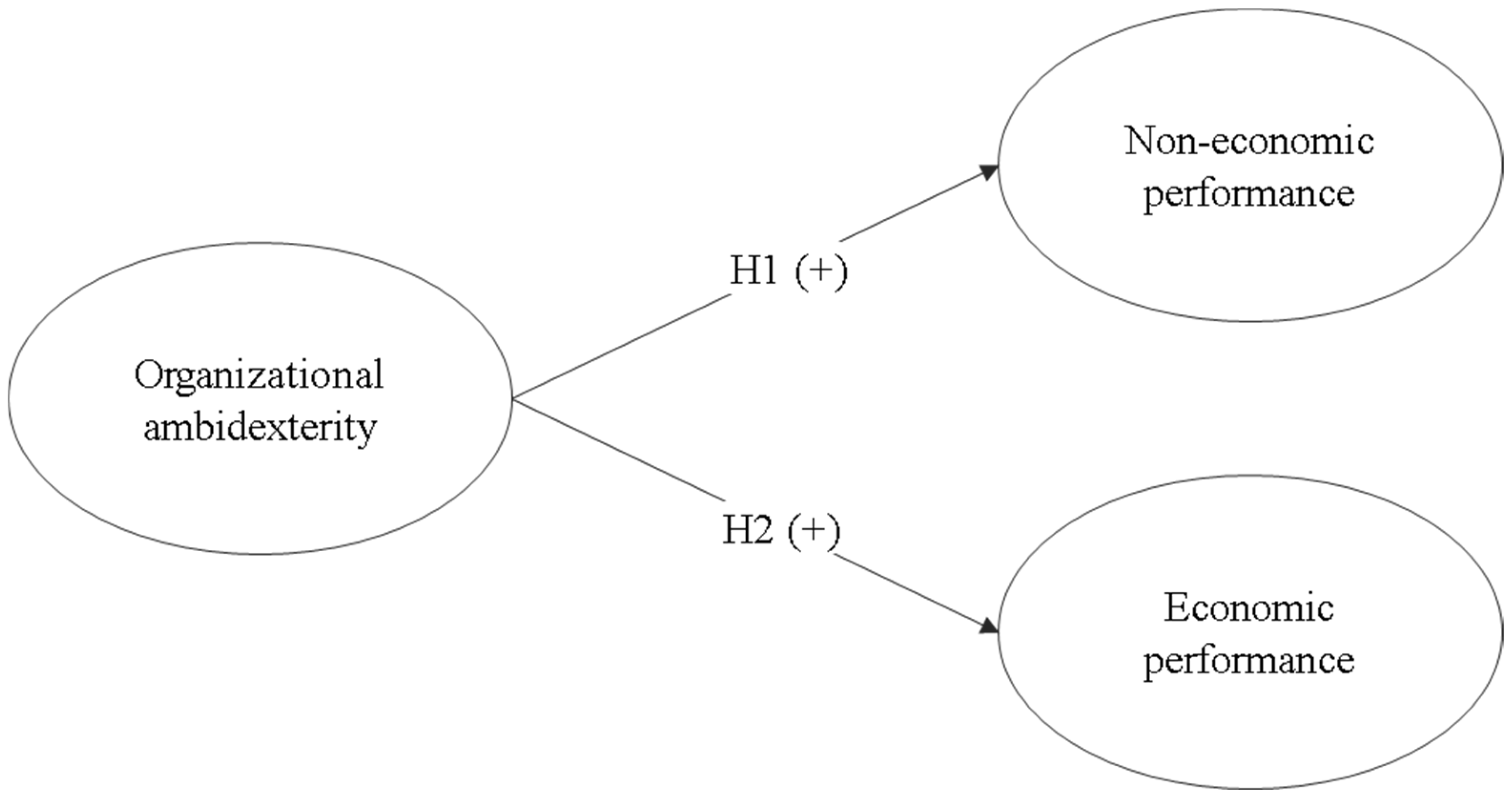
Considering the current literature, this study was carried out in a Colombian context where the national culture is characterized by low levels of institutional collectivism, low levels of performance orientation, low levels of future orientation, and high levels of group collectivism [72], which could explain why the organizational ambidexterity developed in their organizations could have a significant impact on firm performance. In addition, new technology-based firms were considered as a target group due to their agility and impact on the national and local economy [41]. To fill the research gap, economic and non-economic performance indicators were considered, as suggested by previous research [39]. The following hypotheses are presented for the empirical contrast (Figure 1):
H1. 
Organizational ambidexterity has a positive relationship with non-economic performance.
H2. 
Organizational ambidexterity has a positive relationship with economic performance.

3. Materials and Methods

The study employed a quantitative methodology with an associative strategy. This approach is appropriate for the research question as it allows for the empirical testing of the relationship between organizational ambidexterity and firm performance indicators across a representative sample of firms. Furthermore, a quantitative approach enables the measurement of the strength and significance of these relationships, facilitating the generalization of findings within the context of Colombian new technology-based firms. Finally, latent variables design (LVD, or structural equation modelling (SEM) was used, where the statistical technique to test the proposed model was the variance-based SEM or partial least squares, PLS-SEM using SmartPLS 4 software version 4.1.0.9 [73].
Non-probability sampling was used. The study was conducted using a convenience sample of 102 Colombian new technology-based firms. These firms are characterized by being based on the exploitation of an invention or a technological innovation and by being made up of few employees, considering two types: micro-enterprises (made up of less than 10 workers) and small enterprises (made up of less than 50 workers). Likewise, these firms were in Colombian cities such as Bogota, Cali, Medellin, Manizales, Pereira, Quindio, Rionegro, and Valledupar. Finally, most of the firms that participated in this study were from the ICT and electronics sector (n = 65); the others were from the Environment and renewable energies, Biological and Health Sciences, Biotechnology and Chemistry, Nanotechnology, and the creative industry. All of them were founded between 2006 and 2018.
To measure the study variables, the scale designed by Acosta-Prado et al. [49] was used (Table A1). This scale was constructed under a five-point Likert response format, where all items are written in a direct sense. Organizational ambidexterity was measured through six items, with response options between 1 (never) and 5 (very often). The non-economic performance was measured through five items, where the response alternatives ranged from 1 (never reaches) to 5 (very frequently reaches). Finally, economic performance was measured through five items, and the response options represented the degree of the economic evolution of the firm compared to the previous year. In this sense, the response scale ranged from 1 (very negative evolution, from −10 to −20%) to 5 (very positive evolution, from 10 to 20%).
The measurement scale was developed from the explanatory model proposed by Acosta Prado and Fischer [74] and has been used in previous research, presenting adequate psychometric properties, that is, good levels of reliability, evidence of content-based validity by expert judgment, internal structure by confirmatory factor analysis, and relationships with other variables [49].
Data concerning Colombian new technology-based firms was derived from the registers maintained in business incubator directories and the technology parks associated with the Colombian Network of Technology Parks, Incubators, and Innovation Zones. The measurement scale was presented in an electronic format developed through Google Forms. The above made it possible to access a sample with more varied characteristics and automatically generate a database with the answers.
The instrument was sent by email to founder-promoter associates of 316 new technology-based firms, with the preceding consent of the executives overseeing business incubators and science and technology parks. 102 responses were obtained from different firms; that is, 32% of the scales sent were answered. In addition to the measurement scale, the electronic form had an informed consent section where the research objectives were presented, and the anonymity and confidentiality of the answers were assured. The participation of the firms was voluntary, agreeing with the informed consent, and without any economic retribution for their collaboration with the study.
PLS-SEM was selected over Covariance-Based SEM (CB-SEM) for three primary reasons: First, PLS-SEM demonstrates superior statistical power with smaller sample sizes (n = 102) compared to the requirements of CB-SEM [75]. Second, the data presented non-normal distributions (as seen in Table 1), and PLS-SEM is a non-parametric method robust to such deviations [76]. Third, the study’s objective includes assessing the predictive relevance of the exogenous constructs (Q2), a core strength of the PLS-SEM approach compared to the explanatory focus of CB-SEM. SmartPLS 4.0.9.5 software was used to run the analyses [77].
In PLS-SEM, the estimated model comprises a measurement model (outer model) and a structural model (inner model). For the evaluation of both models, a systematic validation process is followed that allows the interpretation of the results obtained [76,78,79].
Regarding the reflective measurement model, item evaluation was based on their outer loadings, with values above 0.708 expected. The reliability by internal consistency was assessed by three coefficients: alpha coefficient (α), rho_A coefficient (ρA), and composite reliability (CR), with adequate values above 0.70. The convergent validity evidence was collected from the average variance extracted (AVE), considering values greater than 0.50 as acceptable. The discriminant validity evidence was obtained using the Fornell-Larcker criteria, expecting that the square root of the AVE of the latent variables is greater than the correlations between the variables, and using the heterotrait-monotrait ratio (HTMT ratio), considering values below 0.85.
Regarding the evaluation of the structural model, collinearity was evaluated through the variance inflation factor (VIF), where values less than 5 are adequate. The statistical significance and the magnitude of the path coefficients were considered, considering values close to zero as those with little relevance. Likewise, the explained variance of the endogenous variables was evaluated using the determination coefficient (R2), where values between 0.10 and 0.25 indicate little explanatory power, between 0.25 and 0.45 moderate explanatory power, and values between 0.50 and 0.75 are considered very high explanatory power. The effect size was measured through the f2 coefficient, considering values of 0.02, 0.15, and 0.35 as small, moderate, and large effects, respectively [80]. Additionally, the predictive relevance of the model (Q2predict) was evaluated, taking values of 0.10, 0.25, and 0.50 as evaluation criteria, as small, medium, and high predictive relevance levels, respectively.
Finally, an importance–performance map analysis (IPMA) was carried out at the level of variables and indicators [81]. The bootstrapping procedure was performed with 10,000 samples for estimates where statistical significance was required.

4. Results

4.1. Measurement Model Evaluation

Table 1 shows the descriptive statistics of the measurement used. The mean of the items ranged from 3.510 (CER_6) to 4.706 (NON_3), indicating that most of those evaluated chose the highest response options for each item on the scale. On the other hand, the standard deviation of the items indicated a low variability of the responses, ranging from 0.470 (NON_6) to 1.150 (CER_6). Regarding the levels of skewness and kurtosis of the items, the majority were found outside the range of −1.50 and 1.50, especially in the items corresponding to non-economic performance, indicating that those evaluated tended to mark the answer options higher, and their frequency was high, supporting what was found through the mean and standard deviation. Regarding the evaluation of the items (Table 1), all outer loadings were higher than 0.708, ranging from 0.747 (CER_2) to 0.920 (ECO_4). Likewise, all outer loadings were statistically significant (p < 0.001). The above represents the adequate functioning of the items individually.
The reliability of the scores was estimated through the internal consistency method to establish the degree of relationship between the items that measure each of the variables studied. The three coefficients used for this purpose presented levels higher than 0.90 (Table 2), where the values of the economic performance variable were the highest. From these results, it can be concluded that the scores obtained from applying the measurement instrument are reliable. On the other hand, the convergent validity evidence, evaluated through the AVE, presented values above 0.50 for the three study variables (Table 2). Also, the discriminant validity evidence, assessed using the Fornell-Larcker criterion and the HTMT ratio, showed adequate values (Table 2). In this sense, the square root of the AVE of each variable was greater than the correlations between the latent variables, and the HTMT ratios were below 0.85. These results indicate no problems with convergent and discriminant validity evidence for the three variables. Considering the findings obtained, it can be concluded that the measurement model is valid.

4.2. Structural Model Evaluation

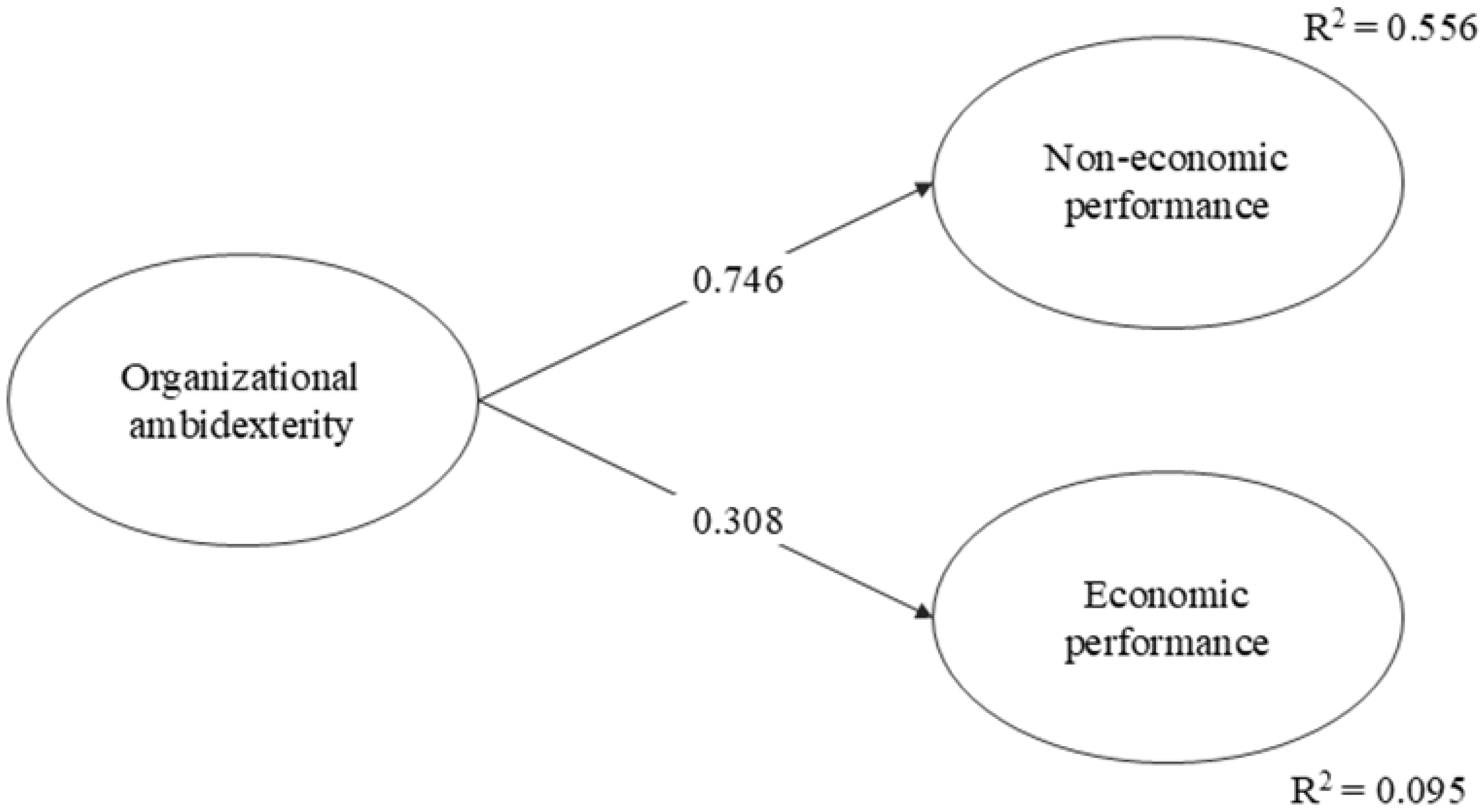
The variables included in the model did not present collinearity problems (VIF < 5). The path coefficients estimated for the hypothesized relationships included in this study were 0.746 and 0.308 for non-economic and economic performance, respectively, both being statistically significant (p < 0.001) (Table 3). The relevance of the path coefficients was analyzed using the effect size f2, where the first path coefficient presented a large relationship (f2 > 0.35) and the second path had a small relevance (f2 > 0.02). Regarding the proportion of variance explained by organizational ambidexterity, this variable showed a very high explanatory power for non-economic performance (56%) and low explanatory power for economic performance (10%). These results indicate the greater relative importance of organizational ambidexterity on non-economic performance than on economic performance (Figure 2).

4.3. Predictive Performance

At the level of latent variables (Table 3), the predictive relevance of organizational ambidexterity was high with non-economic performance. However, the predictive relevance of economic performance was null or trivial. At the level of the indicators (Table 1), organizational ambidexterity presented a significant relevance for NON_2 (Expansion of the number of customers), a medium relevance for NON_3, NON_4, and NON_6, and a small relevance for NON_1 and ECO_5.

4.4. Importance–Performance Map Analysis (IPMA)

According to the results obtained, at the level of latent variables, organizational ambidexterity presents the same performance in predicting non-economic and economic performance. Still, it presents higher importance for non-economic performance (Table 4). At the indicator level, CET_1 and CET_6 are the indicators to consider for improvement actions in the organizational sector since it has relative importance for predicting non-economic and economic performance, but they have lower performance than other indicators (Table 4).

5. Discussion

This study aimed to investigate the relationship between organizational ambidexterity and the performance, both non-economic and economic, of new technology-based companies in Colombia. The results obtained from the PLS-SEM allow us to conclude that organizational ambidexterity has a positive relationship with economic and non-economic performance (p < 0.001). In this way, the two hypotheses raised were empirically contrasted. The results link the existing theory on the relationship between organizational ambidexterity and firm performance with the empirical evidence in Colombian new technology-based firms, thus achieving a contribution to the knowledge of the variables studied in the Latin American context. Findings agree with several previous studies [2,13,16,30,63,64]. Additionally, some factors could explain the results obtained in this research. For example, the national culture and the size of the firms [38]. On the one hand, a national culture that has lower levels of institutional collectivism and higher levels of in-group collectivism, such as the Colombian culture, is characterized by tolerating intergroup differences and allowing the free association of individuals within organizations and families [72], which could facilitate the impact of organizational ambidexterity on firm performance [38]. On the other hand, new technology-based firms are characterized by their ability to adapt to their competitive and dynamic environment to survive and grow [59,68]. Therefore, they tend to perform contextual ambidexterity activities, which combine exploitation and exploration activities in the same unit [41]. Due to the cultural similarity shared with other Latin American countries, it is expected to obtain positive and significant results in other Latin American contexts. Therefore, it is recommended that future research corroborate this hypothesis.
Another contribution of this research is that it analyses the direct effect of organizational ambidexterity on non-economic and economic performance. Although there was a direct and positive effect in both, it is observed that there was a greater direct effect on non-economic performance than on economic performance. This is probably because organizational ambidexterity includes both the exploitation and exploration components. As they are new companies, most of them would be in the exploration phase, which requires considerable economic investment, translating into non-economic results, not immediate economic results, but later ones. The longitudinal study and an identification of the type of organizational ambidexterity, considering the two dimensions: time (if they are performed simultaneously or continuously) and space (if they are performed in a single unit of the firm or all units), would help to explain more precisely the long-term effect and its real cause [41]. Another possible explanation is the “two-step process” approach to organizational ambidexterity, which suggests that the effect of ambidexterity is first on innovation performance (non-economic performance) at time t + 1 and then on economic performance at time t + 2 [39]. The results of this research would support the latter explanation. Being a cross-sectional study in new firms, it would capture mostly the effect on non-economic performance at time t + 1.

5.1. Theoretical and Practical Implications

Regarding the practical implications, the findings obtained are of practical use for the various agents involved in the management of new technology-based firms. First, at present, it is not only important for a firm to generate good economic returns, where the only beneficiaries are the owners of the firm, who receive the highest income. It is necessary to focus on non-economic results, which will indirectly favour the economic firm’s performance, which involve the perception of customers, employee satisfaction, and improvement in the quality of the products and services offered [82]. As mentioned above, efforts to achieve a balance between exploration and exploitation will have a positive impact on obtaining non-economic results, even with greater intensity concerning economic results. Additionally, to achieve this purpose, new technology-based firms could develop organizational ambidexterity through an appropriate management style and work environment [59]. Second, the Colombian government could take advantage of the favourable national culture to develop organizational ambidexterity in new technology-based enterprises through mentoring and financing programs. The survival and success of these firms will generate increased employment and economic income in the country in the short and long term [83].
Regarding the practical implications, analyzing organizational ambidexterity in Colombian new technology-based firms allows us to extend the theory to emerging contexts, demonstrating that this capability is not only relevant in developed economies but also in environments where institutional, financial, and technological uncertainty is high. In these scenarios, ambidexterity functions as an adaptive response that allows organizations to simultaneously manage demands for innovation and efficiency, confirming the postulates that this capability is essential for competitiveness in turbulent environments [23].
On the other hand, organizational ambidexterity is articulated as a dynamic capability that allows organizations to integrate, reconfigure, and renew their resources and competencies in response to changes in the competitive environment [21,84]. This understanding is particularly relevant in Colombian new technology-based firms, where financial constraints and a lack of consolidated structures demand high levels of organizational adaptation. This contributes to contextualizing the theory of dynamic capabilities in Latin American scenarios, which are traditionally less represented in the literature.
The study of the performance of new technology-based firms in Colombia highlights the need to understand it from a broader perspective. Evidence shows that ambidexterity is not only associated with financial metrics but also with non-economic performance, such as legitimacy, technological reputation, organizational learning, and the formation of strategic networks [27,30]. Given that NTBFs need to build trust among investors, universities, public partners, and the market, these non-financial dimensions become critical factors for survival and scalability.
Finally, applying the concept of ambidexterity to new technology-based firms challenges sequential models of the organizational life cycle. In Colombian NTBFs, exploration and exploitation must be developed simultaneously from early stages, even with limited resources. This behavior supports research suggesting that ambidexterity is a phenomenon that can manifest itself even in small and growing firms [25], contributing a novel perspective to the literature on new technology-based firms.

5.2. Limitations

In Colombia, the availability of reliable data on NEBT is limited and is usually concentrated in the records of incubators, accelerators, or government programs. This restricts the possibility of obtaining large and representative samples, affecting the generalizability of the results and the external validity of the study.
There is no single, widely accepted definition of “new technology-based firm” in Colombia. The diversity in classification criteria (age, level of innovation, technological intensity, size) makes it difficult to compare studies and can introduce uncontrolled heterogeneity into the samples.
Most empirical research uses questionnaires administered to founders or managers, which introduces potential biases such as perception bias, social desirability bias, and overestimation of the actual level of ambidexterity or economic and non-economic performance. This affects the accuracy of the estimated relationships.
Using a cross-sectional design makes it difficult to establish strong causal relationships. In the case of NEBTs—which evolve rapidly—this type of design may not capture key longitudinal dynamics, such as changes in exploration, exploitation, and performance throughout the business lifecycle.
The performance of Colombian NTBFs is heavily influenced by external factors—access to capital, support networks, public policies, and the regulatory environment—which can act as confounding variables. Statistically controlling for these effects is complex and limits the accuracy in identifying the true impact of organizational ambidexterity.
Empirical literature on ambidexterity in NTBF in Latin America, and specifically in Colombia, is still in its early stages. This limits the ability to establish theoretical comparisons, replicate results, and build cumulative knowledge.
Future research could use a mixed methodology and explore other ways of measuring ambidexterity and firm performance. Financial reports that include longitudinal information could be used to assess economic performance. To measure ambidexterity and non-economic performance, in-depth qualitative studies could be conducted using techniques such as participant observation, interviews, and single- and comparative case studies. In this way, the mechanism through which ambidexterity operates in small technology-based firms, especially in situations marked by limited resources and group collectivism, could be better pinpointed.

6. Conclusions

This study examined the relationship between organizational ambidexterity and non-economic and economic performance in Colombian new technology-based firms. The statistical method was Partial Least Squares Structural Equation Modelling (PLS-SEM). The results show that organizational ambidexterity is positively related to both non-economic and economic performance. Organizational ambidexterity explained 10% of the variance of the economic performance and 56% of the variance of the non-economic performance.
This study offers a theoretical contribution to the literature on new technology-based firms within the Latin American context. It explores the positive association between organizational ambidexterity and firm performance, extending the analysis beyond previously examined economic dimensions [20] to include non-economic or organizational aspects. The findings suggest that effectively managing and balancing innovation processes in new technology-based companies enhances overall performance, especially in non-economic outcomes such as customer satisfaction.
The practical implications suggest that managers of new technology-based firms develop learning processes that materialize in organizational ambidexterity that allow them to perceive the need for change and, at the same time, manage the development of the actions necessary to respond to opportunities and threats that arise in a context of high uncertainty [59,85]. On the other hand, the government could develop mentoring and financing programs to build organizational ambidexterity for new technology-based firms, generating short and long-term benefits for the local and national economy [83].
From this study, new research topics emerge, given that the effect of organizational ambidexterity on economic performance would be greater in a longitudinal study because the results of exploration activities are long-term, while the results of exploitation activities are short-term [7]. Therefore, it is advisable to conduct a longitudinal study to capture, in its real magnitude, the effect of organizational ambidexterity on business performance in the short and long term [41].
Future studies could assess the extent to which organizational ambidexterity has a positive and statistically significant effect on non-economic and economic performance through a longitudinal study that captures the short and long-term effects on business performance.
Additionally, an international study of new technology-based firms in Latin American countries could be developed and the moderating role of national culture assessed. This is because not all Latin American countries are homogeneous in terms of their technological and innovation development, which may be affected by state policies, the relationship between universities and firms, the perception of citizens regarding the role that the private sector fulfils, among other factors that can be studied as moderating variables [38].
It is also relevant to replicate this study in other business sectors where technology and innovation are less prominent than in technology-based firms to determine whether the volume of information managed within organizations influences the achievement of meaningful business results.
The novelty of this research lies in its focus on new technology-based firms—an organizational type that has received limited attention in ambidexterity studies, which have traditionally concentrated on large, mature, or multinational companies. Examining new technology-based firms thus provides valuable insights into how ambidexterity emerges during the early stages of the organizational life cycle, addressing a gap identified in the existing literature.
Finally, this study is distinctive in that it offers potential practical and public policy implications for Colombia. Its findings can inform the design of programs aimed at business strengthening, incubation, and scaling, grounded in the promotion of ambidextrous capabilities—both exploration and exploitation. In a context where new technology-based firms play a crucial role in fostering productive diversification and national competitiveness, this perspective provides a valuable applied contribution.

Author Contributions

Conceptualization, J.C.A.-P. and E.A.-C.; methodology, J.C.A.-P. and E.A.-C.; software, J.C.A.-P. and E.A.-C.; validation, J.C.A.-P. and E.A.-C.; formal analysis, J.C.A.-P. and E.A.-C.; investigation, J.C.A.-P. and E.A.-C.; resources, J.C.A.-P. and E.A.-C.; data curation, J.C.A.-P. and E.A.-C.; writing—original draft preparation, J.C.A.-P. and E.A.-C.; writing—review and editing, J.C.A.-P., E.A.-C., J.E.C.N. and R.M.P.; visualization, J.C.A.-P., E.A.-C., J.E.C.N. and R.M.P.; supervision, J.C.A.-P. All authors have read and agreed to the published version of the manuscript.

Funding

This research received no external funding.

Institutional Review Board Statement

Not applicable.

Informed Consent Statement

Not applicable.

Data Availability Statement

The original contributions presented in this study are included in the article. Further inquiries can be directed to the corresponding author.

Acknowledgments

The authors are grateful to the 102 Colombian NTBFs for their voluntary participation during the research.

Conflicts of Interest

The authors declare no conflicts of interest.

Appendix A

Table A1. Measurement scale items to measure organizational ambidexterity, non-economic, and economic performance.
CodeItem
Organizational Ambidexterity (OA = CER + CET)
CER_1The firm uses the technological knowledge obtained from its relations with other firms
CER_2The firm acquires knowledge through the qualified personnel hired
CER_3The firm uses technological knowledge from databases, patents, technical reports, scientific publications, etc.
CER_4The firm has the required hardware and software capability to store the required technological knowledge
CER_5The firm has the means required to codify the technological knowledge required (manuals, formulas, etc.)
CER_6The firm obtains support from research and development centres (universities, public or private research entities, etc.)
CET_1The firm combines interdependent resources (technologies, people, etc.) to produce the required technological knowledge
CET_2The firm invests in the acquisition of the knowledge used in its specified field(s) of action
CET_3The technological knowledge acquired involves a high degree of novelty for the firm
CET_4The firm uses its knowledge to develop technological products and services
CET_5The firm’s knowledge is used to develop innovative products and services
CET_6The firm has alliances with other firms to develop new products and services
Non-economic performance (NON)
NON_1Customer satisfaction (reduced number of complaints and claims, etc.)
NON_2Expansion of the number of customers
NON_3Employee satisfaction
NON_4Increase in the quality level of products and services (lower error rate, improvement in service speed, etc.)
NON_5Offer of an exclusive product and service
NON_6Continuous improvement of products and services
NON_7Recognition and notoriety of the firm in the market
NON_8Ease of obtaining public administration financing (national, regional or local)
Economic performance (ECO)
ECO_1Sales
ECO_2Net profit
ECO_3Cost-effectiveness
ECO_4Productivity
ECO_5Improvement in production costs
Source: Acosta-Prado et al. [49]. Note: OA = capability of exploration (CER) and capability of exploitation (CET), NON = non-economic performance, ECO = economic performance.

References

  1. Iyer, P.; Davari, A.; Zolfagharian, M.; Paswan, A. Organizational ambidexterity, brand management capability and brand performance. J. Bus. Ind. Mark. 2021, 36, 946–961. [Google Scholar] [CrossRef]
  2. Mardi, M.; Arief, M.; Furinto, A.; Kumaradjaja, R. Sustaining Organizational Performance Through Organizational Ambidexterity by Adapting Social Technology. J. Knowl. Econ. 2016, 9, 1049–1066. [Google Scholar] [CrossRef]
  3. Shafique, I.; Kalyar, M.N.; Mehwish, N. Organizational ambidexterity, green entrepreneurial orientation, and environmental performance in SMEs context: Examining the moderating role of perceived CSR. Corp. Soc. Responsib. Environ. Manag. 2021, 28, 446–456. [Google Scholar] [CrossRef]
  4. Zhou, J.; Xue, Q.-Z. Organizational Learning, Ambidexterity, and Firm Performance. In The 19th International Conference on Industrial Engineering and Engineering Management; Qi, E., Shen, J., Dou, R., Eds.; Springer: Berlin/Heidelberg, Germany, 2013; pp. 537–546. [Google Scholar]
  5. Alamayreh, E.A.; Sweis, R.; Obeidat, B. The relationship among innovation, organisational ambidexterity and organisational performance. Int. J. Bus. Innov. Res. 2019, 19, 554–579. [Google Scholar]
  6. Silveira-Martins, E.; Rossetto, C.R.; Añaña, E.D.S. Ambidestria, exploração ou explotação e seus efeitos no desempenho organizacional de vinícolas brasileiras. Rev. Agronegócio Meio Ambiente 2014, 7, 707–732. [Google Scholar]
  7. March, J.G. Exploration and Exploitation in Organizational Learning. Organ. Sci. 1991, 2, 71–87. [Google Scholar] [CrossRef]
  8. Chams-Anturi, O.; Moreno-Luzon, M.D.; Escorcia-Caballero, J.P. Linking organizational trust and performance through ambidexterity. Pers. Rev. 2020, 49, 956–973. [Google Scholar] [CrossRef]
  9. Kerry, M.J.; DeSimone, J.A. Learning organizational ambidexterity. Learn. Organ. 2019, 26, 352–380. [Google Scholar] [CrossRef]
  10. Ashok, M.; Narula, R.; Martinez-Noya, A. How do collaboration and investments in knowledge management affect process innovation in services? J. Knowl. Manag. 2016, 20, 1004–1024. [Google Scholar] [CrossRef]
  11. Tian, H.; Dogbe, C.S.K.; Pomegbe, W.W.K.; Sarsah, S.A.; Otoo, C.O.A. Organizational learning ambidexterity and openness, as determinants of SMEs’ innovation performance. Eur. J. Innov. Manag. 2021, 24, 414–438. [Google Scholar] [CrossRef]
  12. Mihalache, M.; Mihalache, O.R. Organizational ambidexterity and sustained performance in the tourism industry. Ann. Tour. Res. 2016, 56, 142–144. [Google Scholar] [CrossRef]
  13. Severgnini, E.; Vieira, V.A.; Cardoza Galdamez, E.V. The indirect effects of performance measurement system and organizational ambidexterity on performance. Bus. Process Manag. J. 2018, 24, 1176–1199. [Google Scholar] [CrossRef]
  14. Popadić, M.; Černe, M.; Milohnić, I. Organizational ambidexterity, exploration, exploitation and firms innovation performance. Organ. Revijamanag. Inform. Kadre 2015, 48, 112–119. [Google Scholar] [CrossRef]
  15. Lin, H.E.; McDonough, E.F., III; Lin, S.J.; Lin, C.Y.Y. Managing the exploitation/exploration paradox: The role of a learning capability and innovation ambidexterity. J. Prod. Innov. Manag. 2013, 30, 262–278. [Google Scholar] [CrossRef]
  16. Wei, Z.; Zhao, J.; Zhang, C. Organizational ambidexterity, market orientation, and firm performance. J. Eng. Technol. Manag. 2014, 33, 134–153. [Google Scholar] [CrossRef]
  17. Kortmann, S. The mediating role of strategic orientations on the relationship between ambidexterity-oriented decisions and innovative ambidexterity. J. Prod. Innov. Manag. 2015, 32, 666–684. [Google Scholar] [CrossRef]
  18. Hughes, M. Organisational ambidexterity and firm performance: Burning research questions for marketing scholars. J. Mark. Manag. 2018, 34, 178–229. [Google Scholar] [CrossRef]
  19. Ardito, L.; Peruffo, E.; Natalicchio, A. The relationships between the internationalization of alliance portfolio diversity, individual incentives, and innovation ambidexterity: A microfoundational approach. Technol. Forecast. Soc. Change 2019, 148, 119714. [Google Scholar] [CrossRef]
  20. O’Reilly, C.A., III; Tushman, M.L. The ambidextrous organization. Harv. Bus. Rev. 2004, 82, 74–83. [Google Scholar]
  21. O’Reilly, C.A., III; Tushman, M.L. Ambidexterity as a dynamic capability: Resolving the innovator’s dilemma. Res. Organ. Behav. 2008, 28, 185–206. [Google Scholar] [CrossRef]
  22. O’Reilly, C.A., III; Tushman, M.L. Organizational ambidexterity in action: How managers explore and exploit. Calif. Manag. Rev. 2011, 53, 5–22. [Google Scholar] [CrossRef]
  23. O’Reilly, C.A., III; Tushman, M.L. Organizational ambidexterity: Past, present, and future. Acad. Manag. Perspect. 2013, 27, 324–338. [Google Scholar] [CrossRef]
  24. He, Z.L.; Wong, P.K. Exploration vs. exploitation: An empirical test of the ambidexterity hypothesis. Organ. Sci. 2004, 15, 481–494. [Google Scholar] [CrossRef]
  25. Jansen, J.J.; Van den Bosch, F.A.; Volberda, H.W. Exploratory innovation, exploitative innovation, and ambidexterity: The impact of environmental and organizational antecedents. Schmalenbach Bus. Rev. 2005, 57, 351–363. [Google Scholar] [CrossRef]
  26. Jansen, J.J.; Tempelaar, M.P.; Van den Bosch, F.A.; Volberda, H.W. Structural differentiation and ambidexterity: The mediating role of integration mechanisms. Organ. Sci. 2009, 20, 797–811. [Google Scholar] [CrossRef]
  27. Gibson, C.B.; Birkinshaw, J. The antecedents, consequences and mediating role of organizational ambidexterity. Acad. Manag. J. 2004, 47, 209–226. [Google Scholar] [CrossRef]
  28. Benner, M.J.; Tushman, M.L. Exploitation, exploration, and process management: The productivity dilemma revisited. Acad. Manag. Rev. 2003, 28, 238–256. [Google Scholar] [CrossRef]
  29. Benner, M.J.; Tushman, M.L. Reflections on the 2013 decade award—“Exploitation, exploration, and process management: The productivity dilemma revisited” ten years later. Acad. Manag. Rev. 2015, 40, 497–514. [Google Scholar] [CrossRef]
  30. Junni, P.; Sarala, R.M.; Taras, V.; Tarba, S.Y. Organizational ambidexterity and performance: A meta-analysis. Acad. Manag. Perspect. 2013, 27, 299–312. [Google Scholar] [CrossRef]
  31. Cao, Q.; Gedajlovic, E.; Zhang, H. Unpacking organizational ambidexterity: Dimensions, contingencies, and synergistic effects. Organ. Sci. 2009, 20, 781–796. [Google Scholar] [CrossRef]
  32. Rojas, D.E. La Contribución de la Ambidestreza en la Generación de Innovación Desde la Perspectiva de la Trayectoria Tecnológica (Incremental y Radical) en Empresas de Base Tecnológica en Caldas, Colombia. Master’s Thesis, Universidad Nacional de Colombia, Manizales, Colombia, 2023. [Google Scholar]
  33. Acevedo, J.; Díaz-Molina, I. Exploration and exploitation in Latin American firms: The Determinants of organizational ambidexterity and the country effect. J. Technol. Manag. Innov. 2019, 14, 6–16. [Google Scholar] [CrossRef]
  34. Madan, R.; Ashok, M. AI adoption and diffusion in public administration: A systematic literature review and future research agenda. Gov. Inf. Q. 2023, 40, 101774. [Google Scholar] [CrossRef]
  35. Shaibu, B.; Ogbo, A.; Agbaeze, E.; Ukpere, W. An assessment of the effect of organisational ambidexterity on performance of selected global system for mobile communication operators in Enugu State, Nigeria. Int. J. Bus. Innov. Res. 2019, 19, 413–434. [Google Scholar] [CrossRef]
  36. Teece, D.J. Dynamic Capabilities and Strategic Management: Organizing for Innovation and Growth; Oxford University Press: Oxford, UK, 2009. [Google Scholar]
  37. Teece, D.J.; Pisano, G.; Shuen, A. Dynamic capabilities and strategic management. Strateg. Manag. J. 1997, 18, 509–533. [Google Scholar] [CrossRef]
  38. Lim, E.; António, N.S. National culture as a moderator in ambidexterity-performance relationships: A meta-analysis. Int. J. Bus. Innov. Res. 2020, 21, 128–149. [Google Scholar] [CrossRef]
  39. Meisinger, N.; Moldaschl, M. Reduced to the max: Firm performance and organizational ambidexterity research. J. Strategy Manag. 2021, 14, 96–106. [Google Scholar] [CrossRef]
  40. Raisch, S.; Birkinshaw, J. Organizational Ambidexterity: Antecedents, Outcomes, and Moderators. J. Manag. 2008, 34, 375–409. [Google Scholar] [CrossRef]
  41. Kassotaki, O. Review of Organizational Ambidexterity Research. SAGE Open 2022, 12, 21582440221082127. [Google Scholar] [CrossRef]
  42. Heredia Pérez, J.; Geldes, C.; Kunc, M.; Flores, A. New approach to the innovation process in emerging economies: The manufacturing sector case in Chile and Peru. Technovation 2019, 79, 35–55. [Google Scholar] [CrossRef]
  43. Crespi, G.; Zuñiga, P. Innovation and Productivity: Evidence from Six Latin American Countries. World Dev. 2012, 40, 273–290. [Google Scholar] [CrossRef]
  44. Geldes, C.; Felzensztein, C.; Palacios-Fenech, J. Technological and non-technological innovations, performance and propensity to innovate across industries: The case of an emerging economy. Ind. Mark. Manag. 2017, 61, 55–66. [Google Scholar] [CrossRef]
  45. Lee, R.P.; Özsomer, A.; Zhou, K.Z. Introduction to the special issue on “innovation in and from emerging economies”. Ind. Mark. Manag. 2015, 50, 16–17. [Google Scholar] [CrossRef]
  46. Lebas, M.; Euske, K. A conceptual and operational delineation of performance. In Business Performance Measurement: Theory and Practice; Neely, A., Ed.; Cambridge University Press: Cambridge, UK, 2004. [Google Scholar]
  47. Capon, N.; Farley, J.U.; Hoenig, S. Determinants of Financial Performance: A Meta-Analysis. Manag. Sci. 1990, 36, 1143–1159. [Google Scholar] [CrossRef]
  48. Yu, J.; Zhu, L. Corporate ambidexterity: Uncovering the antecedents of enduring sustainable performance. J. Clean. Prod. 2022, 365, 132740. [Google Scholar] [CrossRef]
  49. Acosta-Prado, J.C.; Romero Severiche, A.K.; Tafur-Mendoza, A.A. Conditions of knowledge management, innovation capability and firm performance in Colombian NTBFs. VINE J. Inf. Knowl. Manag. Syst. 2020, 51, 218–235. [Google Scholar] [CrossRef]
  50. Crook, T.R.; Todd, S.Y.; Combs, J.G.; Woehr, D.J.; Ketchen, D.J., Jr. Does human capital matter? A meta-analysis of the relationship between human capital and firm performance. J. Appl. Psychol. 2011, 96, 443–456. [Google Scholar] [CrossRef] [PubMed]
  51. Ellis, P.D. Market Orientation and Performance: A Meta-Analysis and Cross-National Comparisons. J. Manag. Stud. 2006, 43, 1089–1107. [Google Scholar] [CrossRef]
  52. Duncan, R. The ambidextrous organization: Designing dual structures for innovation. In The Management of Organization; Killman, R.H., Pondy, L.R., Sleven, D., Eds.; North Holland: New York, NY, USA, 1976; pp. 167–188. [Google Scholar]
  53. Tushman, M.L.; O’Reilly, C.A. Ambidextrous Organizations: Managing Evolutionary and Revolutionary Change. Calif. Manag. Rev. 1996, 38, 8–29. [Google Scholar] [CrossRef]
  54. Fu, N.; Ma, Q.; Bosak, J.; Flood, P. Exploring the relationships between HPWS, organizational ambidexterity and firm performance in Chinese professional service firms. J. Chin. Hum. Resour. Manag. 2015, 6, 52–70. [Google Scholar] [CrossRef]
  55. Simsek, Z.; Heavey, C.; Veiga, J.F.; Souder, D.A. Typology for Aligning Organizational Ambidexterity’s Conceptualizations, Antecedents, and Outcomes. J. Manag. Stud. 2009, 46, 864–894. [Google Scholar] [CrossRef]
  56. Raisch, S.; Birkinshaw, J.; Probst, G.; Tushman, M.L. Organizational ambidexterity: Balancing exploitation and exploration for sustained performance. Organ. Sci. 2009, 20, 685–695. [Google Scholar] [CrossRef]
  57. Rothaermel, F.T.; Alexandre, M.T. Ambidexterity in Technology Sourcing: The Moderating Role of Absorptive Capacity. Organ. Sci. 2009, 20, 759–780. [Google Scholar] [CrossRef]
  58. Dranev, Y.; Izosimova, A.; Meissner, D. Organizational Ambidexterity and Performance: Assessment Approaches and Empirical Evidence. J. Knowl. Econ. 2020, 11, 676–691. [Google Scholar] [CrossRef]
  59. Schreuders, J.; Legesse, A. Organizational Ambidexterity: How Small Technology Firms Balance Innovation and Support. Technol. Innov. Manag. Rev. 2012, 2, 17–21. [Google Scholar] [CrossRef][Green Version]
  60. Peng, M.Y.-P.; Lin, K.-H.; Peng, D.L.; Chen, P. Linking Organizational Ambidexterity and Performance: The Drivers of Sustainability in High-Tech Firms. Sustainability 2019, 11, 3931. [Google Scholar] [CrossRef]
  61. Lubatkin, M.H.; Simsek, Z.; Ling, Y.; Veiga, J.F. Ambidexterity and Performance in Small-to Medium-Sized Firms: The Pivotal Role of Top Management Team Behavioral Integration. J. Manag. 2006, 32, 646–672. [Google Scholar] [CrossRef]
  62. Úbeda-García, M.; Claver-Cortés, E.; Marco-Lajara, B.; Zaragoza-Sáez, P. Human resource flexibility and performance in the hotel industry. Pers. Rev. 2017, 46, 824–846. [Google Scholar] [CrossRef]
  63. Stubner, S.; Blarr, W.H.; Brands, C.; Wulf, T. Organizational Ambidexterity and Family Firm Performance. J. Small Bus. Entrep. 2012, 25, 217–229. [Google Scholar] [CrossRef]
  64. Chandrasekaran, A.; Linderman, K.; Schroeder, R. Antecedents to ambidexterity competency in high technology organizations. J. Oper. Manag. 2011, 30, 134–151. [Google Scholar] [CrossRef]
  65. Atuahene-Gima, K. Resolving the Capability–Rigidity Paradox in New Product Innovation. J. Mark. 2005, 69, 61–83. [Google Scholar] [CrossRef]
  66. Lavie, D.; Kang, J.; Rosenkopf, L. Balance Within and Across Domains: The Performance Implications of Exploration and Exploitation in Alliances. Organ. Sci. 2011, 22, 1517–1538. [Google Scholar] [CrossRef]
  67. Parida, V.; Lahti, T.; Wincent, J. Exploration and exploitation and firm performance variability: A study of ambidexterity in entrepreneurial firms. Int. Entrep. Manag. J. 2016, 12, 1147–1164. [Google Scholar] [CrossRef]
  68. Candi, M.; Kitagawa, F. Performance implications of business model centrality over technology-based firms’ life courses. Technovation 2022, 118, 102626. [Google Scholar] [CrossRef]
  69. Markides, C.C. Business model innovation: What can the ambidexterity literature teach us? Acad. Manag. Perspect. 2013, 27, 313–323. [Google Scholar] [CrossRef]
  70. López Zapata, E.; García Muñía, F.E.; García Moreno, S.M. De la organización que aprende a la organización ambidiestra: Evolución teórica del aprendizaje organizativo. Cuad. Adm. 2012, 25, 11–37. [Google Scholar]
  71. Andriopoulos, C.; Lewis, M.W. Exploitation-exploration tensions and organizational ambidexterity: Managing paradoxes of innovation. Organ. Sci. 2009, 20, 696–717. [Google Scholar] [CrossRef]
  72. Castillo-Palacio, M.; Canino, R.M.B.; Zuñiga-Collazos, A. The cultural practices that Influence on the entrepreneurial activity: An empirical study from the Globe Project cultural dimensions. Sci. Ann. Econ. Bus. 2020, 67, 517–532. [Google Scholar] [CrossRef]
  73. Ato, M.; López, J.J.; Benavente, A. Un sistema de clasificación de los diseños de investigación en Psicología. An. Psicol. 2013, 29, 1038–1059. [Google Scholar] [CrossRef]
  74. Acosta Prado, J.C.; Fischer, A.L. Condiciones de la gestión del conocimiento, capacidad de innovación y resultados empresariales. Un modelo explicativo. Rev. Pensam. Gestión 2013, 35, 25–63. [Google Scholar]
  75. Rigdon, E.E. Rethinking partial least squares path modeling: Breaking chains and forging ahead. Long Range Plan. 2014, 47, 161–167. [Google Scholar] [CrossRef]
  76. Hair, J.F.; Hult, G.T.M.; Ringle, C.M.; Sarstedt, M. A Primer on Partial Least Squares Structural Equation Modeling (PLS-SEM); SAGE: Thousand Oaks, CA, USA, 2022. [Google Scholar]
  77. Ringle, C.M.; Wende, S.; Becker, J.-M. SmartPLS 4; SmartPLS GmbH: Oststeinbek, Germany, 2022. [Google Scholar]
  78. Hair, J.F.; Risher, J.J.; Sarstedt, M.; Ringle, C.M. When to use and how to report the results of PLS-SEM. Eur. Bus. Rev. 2019, 31, 2–24. [Google Scholar] [CrossRef]
  79. Henseler, J.; Ringle, C.M.; Sarstedt, M. A new criterion for assessing discriminant validity in variance-based structural equation modeling. J. Acad. Mark. Sci. 2015, 43, 115–135. [Google Scholar] [CrossRef]
  80. Cohen, J. Statistical Power Analysis for the Behavioral Sciences; Routledge: Abingdon, UK, 1988. [Google Scholar]
  81. Höck, C.; Ringle, C.; Sarstedt, M. Management of multi-purpose stadiums: Importance and performance measurement of service interfaces. Int. J. Serv. Technol. Manag. 2010, 14, 188–207. [Google Scholar] [CrossRef]
  82. Venkatraman, N.; Ramanujam, V. Measurement of Business Performance in Strategy Research: A Comparison of Approaches. Acad. Manag. Rev. 1986, 11, 801–814. [Google Scholar] [CrossRef]
  83. Acs, Z.J. Public policies to support new technology-based firms (NTBFs). Sci. Public Policy 1999, 26, 247–257. [Google Scholar] [CrossRef]
  84. Teece, D.J. Explicating dynamic capabilities: The nature and microfoundations of (sustainable) enterprise performance. Strateg. Manag. J. 2007, 28, 1319–1350. [Google Scholar] [CrossRef]
  85. Pertusa-Ortega, E.M.; Tarí, J.J.; Pereira-Moliner, J.; Molina-Azorín, J.F.; López-Gamero, M.D. Developing ambidexterity through quality management and their effects on performance. Int. J. Hosp. Manag. 2021, 92, 102720. [Google Scholar] [CrossRef]
Figure 1. Conceptual Model and Hypotheses.
Systems 14 00309 g001
Figure 2. Latent variable model of the relationship between organizational ambidexterity and non-economic and economic performance.
Systems 14 00309 g002
Table 1. Descriptive statistics, measurement model, and predictive performance.
VariableMSDSkKuOuter LoadingsOuter WeightsQ2Predict
Organizational ambidexterity (OA = CER + CET)
CER_14.1570.876−1.1251.3260.8440.195
CER_24.4020.761−1.3782.6800.7470.206
CER_33.8530.948−0.7660.4340.8110.187
CER_63.5101.150−0.383−0.4050.8290.177
CET_14.1960.879−1.1100.7490.8280.214
CET_63.8731.149−1.0640.5530.8460.243
Non-economic performance (NON)
NON_14.6270.716−2.1094.1840.8650.1940.235
NON_24.4800.829−1.6361.9950.8940.2740.531
NON_34.7060.556−1.7612.1890.8840.2350.386
NON_44.6470.574−1.4011.0140.8370.2560.463
NON_64.7650.470−1.8332.5890.8150.2030.273
Economic performance (ECO)
ECO_14.1670.746−0.8661.0290.8360.2030.042
ECO_23.9500.672−0.7551.5230.9060.2020.033
ECO_33.9220.640−0.8562.0120.9100.2210.049
ECO_43.9800.660−0.6121.2640.9200.1980.031
ECO_54.1470.695−0.5670.4970.9060.2920.100
Note: M = mean; SD = standard deviation; Sk = Skewness; Ku = Kurtosis; Q2predict = predictive performance. OA = capability of exploration (CER) and capability of exploitation (CET), NON = non-economic performance, ECO = economic performance.
Table 2. Reliability, convergent, and discriminant validity.
VariableαρACRAVEOANONECO
OA0.9010.9060.9240.6690.818 *0.804
[0.715; 0.873]
0.317
[0.183; 0.457]
NON0.9120.9220.9340.7390.7460.860 *0.492
[0.298; 640]
ECO0.9390.9590.9530.8030.3080.4670.896 *
Note: α = alpha coefficient; ρA = rho_A coefficient; CR = composite reliability; AVE = average variance extracted; OA = organizational ambidexterity; NON = non-economic performance; ECO = economic performance. Values on the diagonal marked with an asterisk (*) represent the square root of the AVE; values below the diagonal are the inter-construct correlations (Fornell-Larcker criterion); values above the diagonal represent the heterotrait-monotrait ratio (HTMT). Numbers in brackets [ ] represent the 95% bias-corrected and accelerated (BCa) confidence intervals derived from bootstrapping with 10,000 samples.
Table 3. Structural model evaluation and predictive performance.
HypothesisPath
Coefficient
t-Statisticp-Value95% CI BCaf2R2Q2predict
H1: OA → NON0.74617.8430.000 ***[0.662; 0.803]1.2530.5560.533
H2: OA → ECO0.3083.6130.000 ***[0.160; 0.429]0.1050.0950.067
Note: OA = organizational ambidexterity; NON = non-economic performance; ECO = economic performance; 95% CI BCa = 95% bias-corrected and accelerated confidence intervals derived from bootstrapping with 10,000 samples; f2 = effect size; R2 = explained variance; Q2predict = predictive performance. *** p < 0.001.
Table 4. Summary of importance–performance map analysis (IPMA) data.
Non-Economic PerformanceEconomic Performance
VariableImportancePerformanceImportancePerformance
Organizational ambidexterity0.74674.9020.30874.902
CER_10.14678.9220.06078.922
CER_20.15485.0490.06385.049
CER_30.14071.3240.05871.324
CER_60.13262.7450.05462.745
CET_10.16073.2030.06673.203
CET_60.18171.8140.07571.814
Disclaimer/Publisher’s Note: The statements, opinions and data contained in all publications are solely those of the individual author(s) and contributor(s) and not of MDPI and/or the editor(s). MDPI and/or the editor(s) disclaim responsibility for any injury to people or property resulting from any ideas, methods, instructions or products referred to in the content.