Article

Enhancing Student Systems Thinking in Generative Artificial Intelligence-Supported Logistics Management Education in China: An Integrated Model with PLS-SEM and FsQCA

College of Management Science, Chengdu University of Technology, Chengdu 610059, China
*
Author to whom correspondence should be addressed.
Systems 2026, 14(3), 311; https://doi.org/10.3390/systems14030311
Submission received: 15 February 2026 / Revised: 8 March 2026 / Accepted: 10 March 2026 / Published: 16 March 2026
(This article belongs to the Section Systems Practice in Social Science)

Abstract

Systems thinking is a core competence in logistics management, as decisions across transportation, warehousing, and delivery functions are highly interconnected and often generate delayed, trade-off, or system-wide consequences. Despite the increasing integration of generative artificial intelligence (GenAI) tools into logistics education, limited research has examined how to enhance systems thinking in such contexts. Drawing on triadic reciprocal determinism, this study conceptualizes systems thinking enhancement as an emergent outcome of interactions among behavioral regulation, cognitive conditions, and environmental scaffolding. Using survey data from 236 logistics management students in Chinese universities, we integrate Partial Least Squares Structural Equation Modeling (PLS-SEM) and fuzzy-set Qualitative Comparative Analysis (fsQCA) to examine both net effects and configurational mechanisms. Results show that self-regulated learning exhibits the strongest positive association with systems thinking, while germane cognitive load is positively associated and extraneous cognitive load is negatively associated with systems thinking. Teacher GenAI scaffolding is linked to more favorable cognitive load allocation. fsQCA findings further reveal that high-level systems thinking emerges from specific combinations where self-regulated learning and germane cognitive load are fundamental conditions, whereas the absence of self-regulated learning consistently leads to low-level systems thinking. These findings provide guidance for the design of GenAI-supported curricula and scaffolding strategies.

1. Introduction

Logistics management education deals with systems that are complex and changing [1,2]. Decisions about transportation, warehousing, and inventory are closely connected, and choices made in one stage of the logistics process often significantly affect other stages [3,4]. Because of these connections, delays, and trade-offs, students cannot rely on simple reasoning and linear thinking when analyzing logistics problems [5,6]. Thus, cultivating systems thinking becomes a central goal of logistics management education [1,7].
Systems thinking refers to the paradigm for observing and understanding things from a holistic, interconnected, and dynamic perspective [8,9]. It focuses on the interactions between parts and how these interactions produce an overall effect. For logistics practices, this competence is essential for analyzing system-wide consequences of operational decisions and for managing complex supply chain relationships [1,2,5,8].
With the rapid diffusion of generative artificial intelligence (GenAI), these tools are increasingly embedded into logistics education [10]. However, exposure to advanced technology does not automatically lead to the development of higher-order cognitive abilities such as systems thinking [11]. When learners treat GenAI outputs as ready-made answers, learning becomes fragmented and disconnected from deeper systemic understanding [7,12]. This suggests that the existence of GenAI may act as a double-edged sword. While offering immense data affordances, it may inadvertently undermine the active mental modeling capabilities required for systems thinking.
Despite the growing body of research on GenAI-supported learning, existing studies have primarily focused on issues such as technology adoption, general learning performance, or user perceptions [10,13,14,15,16]. Limited attention has been paid to the cognitive and behavioral mechanisms through which higher-order thinking skills could be developed in the GenAI-supported learning context [17]. Furthermore, most existing studies employ a linear analytical framework, directly treating technology use as an antecedent variable of learning outcomes [18,19], overlooking the nonlinear interactions between the environment, behavior, and cognitive processing [20].
To bridge this gap, this study aims to explore how students behave in a GenAI-supported context to enhance their higher-order abilities [10,21,22]. Self-Regulated Learning (SRL) theory offers a useful theoretical perspective for explaining this process [23]. It emphasizes students’ active goal setting, monitoring of comprehension, and strategy adjustment throughout the task. These conscious regulatory behaviors increase the likelihood that students will develop systematic reasoning abilities when faced with complex or uncertain logistics problems [24,25,26].
Furthermore, participating in complex logistics systems requires coordinating multiple interacting variables, feedback mechanisms, and delayed consequences. These demands place enormous stress on limited cognitive resources [5,27]. Cognitive Load Theory (CLT) provides a framework for understanding the allocation of these cognitive resources during learning [12]. Learning processes supported by GenAI might contribute to systems thinking development if cognitive resources are allocated toward germane processing rather than toward managing extraneous cognitive load [22,28].
Accordingly, this study explores the underlying mechanisms of students’ systems thinking development within a logistics management learning environment supported by GenAI. We construct an analytical framework based on SRL, CLT, and the triadic reciprocal determinism configuration. First, we explore the influence of environmental conditions, behavioral regulation, and cognitive processes on cultivating students’ systems thinking, revealing potential mediating effects. Furthermore, we emphasize the interactions among these factors, providing a configuration explanation for the development of systems thinking. Within this framework, self-regulated learning is conceptualized as a central behavioral factor enacted by students in GenAI-supported settings, which captures goal setting, ongoing process monitoring, and reflective adjustment. Cognitive load is considered a personal-level cognitive factor used to characterize the allocation of students’ limited cognitive resources across different processing activities. Teacher GenAI scaffolding is introduced as a learning environment factor to characterize the role of instructional support in shaping cognitive processing. We argue that systems thinking is a higher-order learning outcome that emerges under specific conditions with combinations of behavioral regulation, cognitive processing and teacher scaffolding. Specifically, this study aims to answer the following overarching research question:
How do behavioral, cognitive, and environmental factors shape the development of students’ systems thinking in GenAI-supported logistics management education?
Building on the overarching research question, this study further addresses the following specific research questions:
Research Question 1: How does self-regulated learning influence systems thinking?
Research Question 2: How do extraneous and germane cognitive loads differently affect systems thinking?
Research Question 3: How does self-regulated learning shape the cognitive load allocation (extraneous vs. germane)?
Research Question 4: How does teacher GenAI-supported scaffolding influence students’ cognitive load allocation (extraneous vs. germane)?
Research Question 5: What combinations of these factors lead to high-level systems thinking?
With respect to the methodology, this study employs a hybrid analysis approach, integrating Partial Least Squares Structural Equation Modeling (PLS-SEM) and Fuzzy Set Qualitative Comparative Analysis (fsQCA). PLS-SEM is used to estimate the net effect between key constructs and assess the proposed structural relationships. fsQCA is used to reveal combinations of conditions associated with high- and low-level systems thinking, identifying multiple adequate configurations that may lead to the same outcome. The integration of these two methods contributes to a more comprehensive understanding of the phenomena studied, revealing the interactions between environmental, behavioral, and cognitive factors in GenAI-supported learning environments.
This study contributes to the existing literature in three ways. First, this study advances research on GenAI-supported learning by unpacking the cognitive and behavioral mechanisms underlying higher-order thinking development. The existing studies have typically viewed the use of GenAI as a direct antecedent of learning outcomes [13,14,15,21]. Limited research has examined the interactions among behavioral regulation, cognitive conditions, and instructional guidance during the learning process. In GenAI-supported learning environments, where information is generated rapidly and learning processes become more self-regulated, learning outcomes largely depend on self-regulation and cognitive load allocation. In this research, we integrate SRL and CLT, providing detailed explanations of how self-regulated learning processes, different types of cognitive load, and teacher scaffolding jointly influence the development of high-order abilities in GenAI-supported learning environments.
Second, we expand the scope of research on GenAI-supported learning by examining systems thinking as a key educational outcome. Existing research has explored the pedagogical potential and general academic performance of GenAI [10,13,15], with limited empirical evidence of how it promotes the development of higher-order cognitive skills such as systems thinking. As systems thinking is crucial for understanding complex and dynamic decision-making in logistics management, this study empirically uncovers the key factors and pathways that promote systems thinking in GenAI-supported learning environments, offering new insights for logistics management education.
Third, we adopt a configurational perspective, while most prior GenAI education studies rely on net-effect models that assume symmetric and linear relationships between learning factors and outcomes. We indicate that systems thinking enhancement stems from a combination of multiple conditions, emphasizing the heterogeneity of developmental paths rather than focusing on a stand-alone average effect. The findings offer important references for course design and instructional guidance in GenAI-supported logistics management education.

2. Theoretical Background and Hypothesis Development

2.1. Systems Thinking in Logistics Management Education

Systems thinking refers to the ability to understand and reason about complex systems by recognizing interdependencies, feedback mechanisms, and dynamic patterns that evolve over time [5,8,9,29]. In logistics management, systems thinking is a fundamental skill because logistics systems contain highly interdependent functions such as procurement, transportation, warehousing, and inventory, interconnected through the flow of materials, capital, and information [6]. A typical manifestation of a lack of systems thinking is the bullwhip effect, where localized inventory decisions based on isolated information amplify fluctuations in upstream demand, ultimately leading to system inefficiency [3,4]. Furthermore, systems thinking is crucial for balancing the inherent trade-offs between costs and service levels; for example, reducing transportation costs by switching to slower modes of transport may increase inventory holding costs or harm customer satisfaction due to longer delivery cycles [30]. Therefore, cultivating systems thinking ability can enable logistics students to move beyond local optimization and towards holistic reasoning, ensuring that operational decisions do not lead to unintentional systemic deterioration [1,2].

2.2. Self-Regulated Learning Theory

Self-regulated learning theory describes learning as an actively cyclical process in which students engage in proactive and goal-oriented activities, consciously adjusting their behavior according to different tasks and situations [24,31]. This study adopts Zimmerman’s three-phase framework, focusing on the specific regulatory behaviors that enter our model: planning, monitoring, and reflection [32,33]. In the planning phase, learners analyze task requirements, set goals, and develop strategies. They activate motivational beliefs such as self-efficacy and perceived task value, which guide subsequent learning activities [24]. In the monitoring phase, learners regulate their attention and effort while assessing their progress in achieving pre-set goals [25]. Continuous monitoring allows them to identify discrepancies between expected and actual performance. In the reflection phase, learners evaluate the results, attribute successes or failures, and adjust their strategies for the next round of learning accordingly [24].

2.3. Cognition Load Theory

Cognitive Load Theory posits that learning effectiveness depends on how limited working memory resources are allocated during information processing [27]. This theory distinguishes three forms of cognitive load: intrinsic cognitive load (ICL), extraneous cognitive load (ECL) and germane cognitive load (GCL) [12,34]. In GenAI-supported logistics education environments, ICL refers to the inherent complexity of the logistics task itself, ECL stems from ineffective GenAI interactions or irrelevant information (e.g., GenAI hallucinations), and GCL represents the intentional mental effort learners devote to constructing complex schemas. Instead of altering task-inherent complexity (ICL), GenAI affects how information is presented and processed, resulting in heterogeneous ECL and GCL [28,34,35]. Previous research has shown that learning outcomes depend more on how to manage cognitive load allocation between ECL and GCL [27,34]. Thus, we focus on ECL and GCL as key mechanisms to explain the differences in the development of systems thinking under GenAI support.

2.4. Hypotheses Development

2.4.1. The Effect of Self-Regulated Learning

SRL functions as a critical engine that enables students to navigate the complexity and nonlinearity of logistics systems within GenAI-supported learning environments. Through the three phases of SRL, students regulate their learning behaviors and may develop higher-order abilities [23,33,36]. First, purposeful planning could enable students to clearly define system-level objectives, break down logistics subtasks, and connect with their existing knowledge base [24,37], which helps build a structural blueprint before detailed analysis [32]. Second, by monitoring the quality of GenAI contents and refining follow-up prompts, students can correct biased mental models, reduce AI hallucinations, and refine causal reasoning, which could further enhance their systems thinking [11,24,38,39]. Third, reflective adjustment can enhance students’ ability to recalibrate mental representations, effectively utilize feedback, and transfer insights across contexts, which are crucial for developing systems thinking [22,33,40]. Therefore, this study proposes the following hypothesis:
H1. 
Self-regulated learning is positively associated with students’ systems thinking in GenAI-supported logistics management education.

2.4.2. The Effect of Extraneous and Germane Cognitive Load

According to CLT, working memory capacity is limited. The key lies in how to allocate the limited cognitive resources [41,42]. ECL, arising from suboptimal information presentation, redundancy and repetition, or complex GenAI noise, consumes cognitive resources without contributing to schema construction. It crowds out the resources for meaningful integration and higher-order reasoning [12,42]. ECL can also distract attention, create unnecessary memory demands, and lead to fragmentation of working memory, which interferes with the students’ ability to form coherent flow [42]. From a systems thinking perspective, systems-oriented reasoning requires sustained working memory and abundant cognitive resources, while ECL consumes these resources and impairs students’ ability to deduce system-level relationships [12,34]. Thus, we propose:
H2. 
Extraneous cognitive load is negatively associated with students’ systems thinking in GenAI-supported logistics management education.
In contrast to ECL, GCL represents a student’s active effort in organizing information, identifying potential structural connections, and integrating new knowledge with existing cognitive schemas [42]. From the systems thinking perspective, systems thinking skills are expected to improve when students’ cognitive resources are primarily invested in GCL. Systems thinking heavily relies on students’ ability to coordinate multiple representations and maintain key information in working memory during long-term reasoning [2,5], which requires abundant cognitive resources. By allocating cognitive resources to GCL, students are better able to integrate interacting variables, identify causal structures, abstract system prototypes, reason at the systems level, and reflect on potential contradictions in system benefits [2,11]. This integrative processing helps build coherent and transferable systems schemas, thereby enhancing systems thinking skills [8]. Therefore, we propose the following hypothesis:
H3. 
Germane cognitive load is positively associated with students’ systems thinking in GenAI-supported logistics management education.

2.4.3. Cognition Load and Self-Regulated Learning

From a cognitive resource perspective, SRL functions as an active control that constrains unnecessary consumption of cognitive resources [28,42,43]. GenAI outputs may contain redundant, inaccurate, or poorly structured information. Learners often need to expend additional cognitive resources to assess and integrate this information, which can increase unnecessary cognitive burden and lead to higher ECL [44]. Learners who actively engage in SRL are better able to filter out irrelevant information, correct biases in a timely manner, and conserve cognitive resources [7]. Specifically, in the planning phase, learners define the scope of GenAI assistance based on clear task objectives [26]. Prior goal setting narrows the attention span and reduces exposure to irrelevant output. In the monitoring phase, learners evaluate the consistency between GenAI’s response and the learning objectives, correcting and improving deviations on time to avoid accumulating fragmented or distracting information [37]. The reflection phase further reinforces this regulatory cycle. After completing the task, learners identify ineffective usage patterns and adjust and improve subsequent strategies to reduce unnecessary cognitive resource expenditure in future tasks. Therefore, we propose:
H4. 
Self-regulated learning is negatively associated with extraneous cognitive load.
Regarding GCL, we argue that SRL helps allocate cognitive resources to meaningful cognitive engagement activities in its three phases [24]. During the planning phase, students can define their goals and activate prior knowledge [26]. Clear goals help learners identify noise, filtering out task-irrelevant processing and freeing up physical cognitive space. Since GCL refers to the process of integrating new information into a long-term memory schema, purposeful planning prompts learners to retrieve existing knowledge graphs, providing a foundation for integrating new and old knowledge [42,43]. During the monitoring phase, learners need to continuously evaluate the value of GenAI answers, which helps prevent shallow processing and maintain integrative reasoning [22,37]. During the reflection phase, learners self-evaluate and attribute their results after completing the task [26,33], which could prompt them to refine and reinforce the schemas they have just established [43]. This consolidation process enhances schema coherence and supports cross-contextual transfer [28,42]. Although reflection increases immediate cognitive input, this input can promote long-term schema integration, which is consistent with the GCL scope [42]. Therefore, we propose:
H5. 
Self-Regulated Learning is Positively Associated with Germane Cognitive Load.

2.4.4. External Support from the Teacher GenAI Scaffolding (TAS)

According to CLT, higher ECL could stem from inadequate instructional design, disorganized information presentation, or mental processing irrelevant to learning objectives. In GenAI-supported learning environments, students often need to process repetitive output from different sources, loosely organized interpretations, and repeated prompting modifications. These activities often require significant additional cognitive effort unrelated to key concept understanding [10,21,34,43,45]. TAS could provide external support to reduce unnecessary cognitive resource waste [12,42,46]. On the one hand, teachers can directly guide students’ attention to key elements through prompts or cues, freeing up limited working memory [22]. On the other hand, by providing structured task templates, clear content formats, phased mode, and verification checklists, teachers can guide students to avoid using GenAI blindly, thereby leading to lower ECL [12,28,47,48]. Thus, we propose:
H6. 
Teacher GenAI scaffolding is negatively associated with extraneous cognitive load.
Based on existing research [42,49], this study further derivates the relationship of TAS and GCL through three paths. First, teacher scaffolding, such as providing templates, clear instructions, and pre-learning task sheets, can reduce wasted cognitive resources [12,28]. With the total capacity remaining constant, the freed-up cognitive resources can be reallocated to schema construction, i.e., an increase in germane cognitive load [42]. Second, teachers anchor learners’ attention from surface features to structural features through prompts and cues [8,22]. This targeted attentional guidance reduces the difficulty of information processing while encouraging students to find connections between new knowledge and old schemas in long-term memory [42,43]. Third, experienced teachers use generative scaffolding to allow students to self-interpret, such as asking students to explain in their own words, compare two cases, or create mind maps [48]. This self-explanation is one of the behaviors that most induces germane cognitive load, as it requires the brain to invest a great deal of mental effort in higher-order thinking activities to reorganize and integrate information [42,50]. Therefore, we propose:
H7. 
Teacher GenAI scaffolding is positively associated with germane cognitive load.

2.5. The Triadic Reciprocal Determinism Perspective

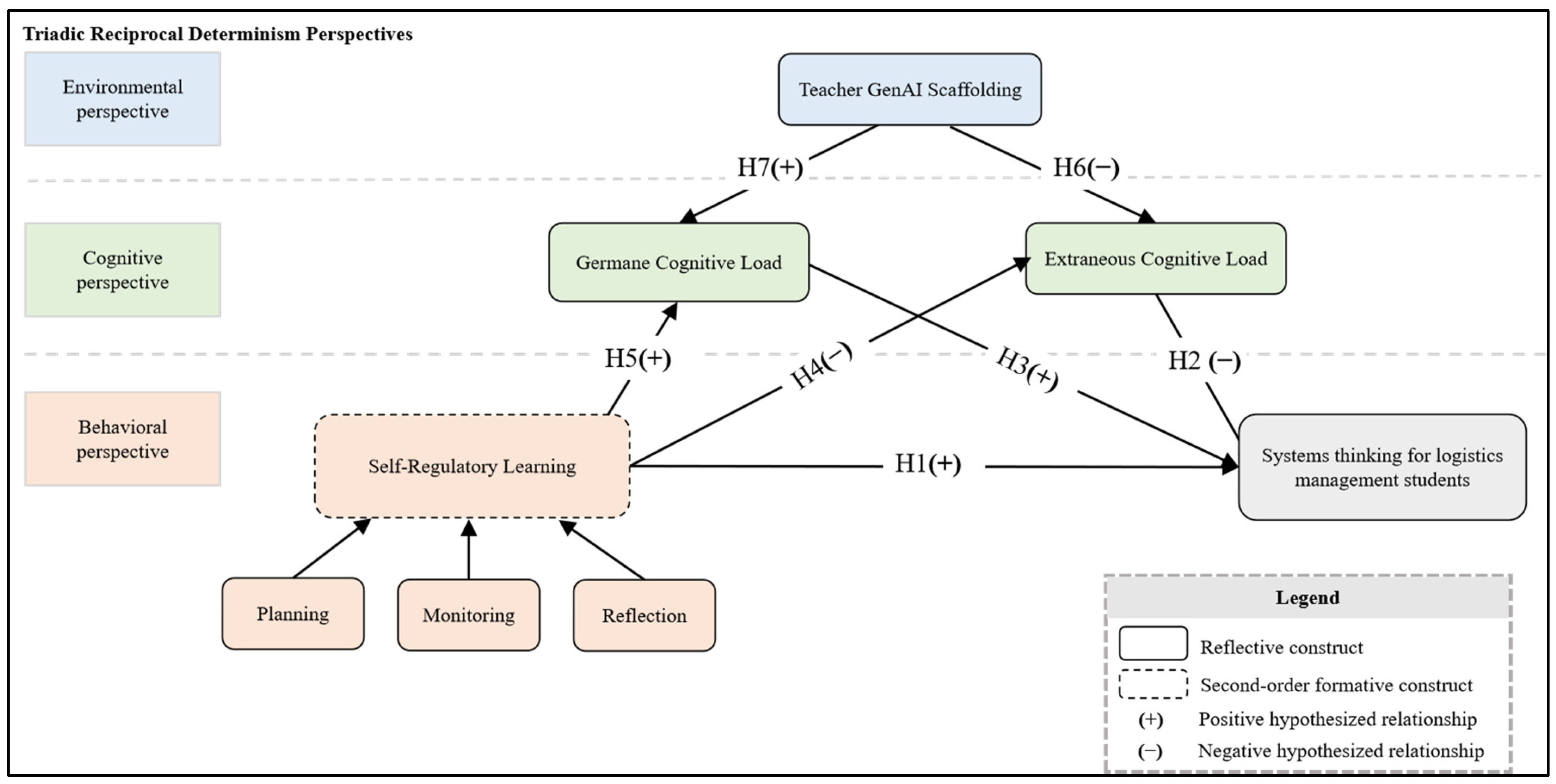
Drawing on Bandura’s triadic reciprocal determinism [51], we conceptualize systems thinking as an emergent outcome of the interaction between behavioral regulation, cognitive processing conditions, and environmental scaffolding, rather than being treated as a direct consequence of technology use [52]. Specifically, we propose the following three interdependent pathways:
Behavioral-Regulatory Pathway: Self-regulated learning.
Cognitive-Structural Pathway: Cognitive load configuration, focusing on extraneous and germane cognitive load allocation.
Environmental-Scaffolding Pathway: Teacher GenAI scaffolding.
Within this framework, SRL functions as the behavioral regulatory pathway that shapes how learners interact with GenAI tools, determining whether GenAI-generated information is simply received or reorganized into coherent and integrated thinking [53]. At the cognitive level, the development of systems thinking depends on how limited working memory resources are allocated among different types of cognitive loads [12,42]. The environmental scaffolding pathway manifests as how teacher GenAI scaffolding shapes the environment conducive to the allocation of cognitive load. Therefore, we predict that the enhancement of systems thinking is an integration and mutual promotion among self-regulated learning, cognitive load structure, and teacher scaffolding. Table 1 summarizes the research questions, theoretical basis, and hypotheses. Figure 1 illustrates the proposed research model and hypotheses.

3. Research Methodology

This study adopts a quantitative mixed-analytical research design to investigate how systems thinking develops in logistics management education under GenAI-supported learning. Data were collected through a questionnaire survey and analyzed using PLS-SEM and fsQCA. These two analytical approaches serve complementary purposes. While PLS-SEM is employed to identify average net effects across the sample [54], fsQCA captures the configurational and asymmetric mechanisms through which different combinations of learning conditions give rise to similar levels of systems thinking [20]. Their combined use provides a more comprehensive understanding of how SRL and cognitive load dynamics jointly shape systems thinking in logistics management learning within a GenAI-supported instructional context.
First, PLS-SEM was employed to assess the structural relationships among the latent constructs specified in the proposed model. As a variance-based structural equation modeling technique, PLS-SEM is well suited for prediction-oriented research, theory building, and models that incorporate multiple mediators or hierarchical component structures [55]. In addition, this approach is robust to deviations from normality and performs adequately with moderate sample sizes, which makes it appropriate for survey-based educational studies [56]. The analysis was conducted in two stages. The measurement model was evaluated to confirm internal consistency reliability, convergent validity, and discriminant validity. After establishing satisfactory measurement properties, the structural model was examined. Bootstrapping procedures were applied to test the statistical significance of the hypothesized paths, thereby providing empirical evidence to address research questions RQ1 to RQ4.
Second, fsQCA was conducted to complement the linear and net-effect logic of PLS-SEM by examining configurational pathways leading to high levels of systems thinking. Rooted in set-theoretic reasoning, fsQCA is well suited for identifying multiple sufficient combinations of conditions that jointly produce the same outcome [20]. In contrast to regression-based approaches, fsQCA is designed to capture causal asymmetry and equifinality. It recognizes that multiple causal configurations can produce comparable outcomes rather than assuming a single net effect [57]. In the present study, teacher GenAI scaffolding, self-regulated learning, germane cognitive load, extraneous cognitive load, and systems thinking were calibrated as fuzzy sets in accordance with established guidelines [20]. Configuration analysis was then performed to identify distinct combinations associated with high systems thinking, thereby addressing RQ5.

3.1. Survey Instrument Design

All constructs in this study were measured using multi-item Likert-type scales. Items were rated on a five-point Likert scale ranging from 1 (“strongly disagree”) to 5 (“strongly agree”). To ensure content validity, the measurement items were derived from previously validated scales reported in the literature and adapted to the context of GenAI-supported logistics management learning. Consistent with prior research, most constructs in this study were specified as reflective measurement models, as the observed indicators were assumed to represent manifestations of their underlying latent variables [56,58]. For example, TAS has been adapted to capture the instructional guidance provided by instructors in the use of GenAI (e.g., “Instructors provide clear guidance on appropriate GenAI use at different learning stages”); GCL reflects the extent to which learners actively invest mental effort in understanding logistics concepts when interacting with GenAI (e.g., “When using GenAI, I invest substantial mental effort in analyzing underlying structures and relationships among logistics variables.”).
SRL was modeled as a second-order formative construct comprising three first-order dimensions: planning, monitoring, and reflection. This specification reflects the conceptualization that SRL stems from the combined action of distinct but complementary self-regulatory processes [24,26]. Each first-order dimension was operationalized reflectively using multiple items, while the second-order SRL construct was formed by these dimensions [58].
The scale items were translated from English into Chinese by two researchers familiar with the research topic. Then, an independent bilingual researcher performed a back-translation from Chinese into English to ensure semantic equivalence between the original and translated versions. Any discrepancies between the two versions were discussed and resolved through joint review.
We conducted an expert validation procedure to further refine the instruments. To enhance content validity, four experts with substantial experience in logistics management education were invited to evaluate the questionnaire. The panel included a professor of logistics management who also serves as a college dean and has extensive experience in undergraduate instruction. The second expert was the chair of the Department of Logistics and Supply Chain Management, bringing in depth knowledge of industry practices and disciplinary development. The third expert, an associate professor of logistics management, specializes in scale development and validation. The fourth expert was a faculty member with extensive teaching experience in logistics management. These review experts came from different levels of organizations, and each evaluated the questionnaire items in terms of relevance, clarity, and representativeness to determine their suitability for measuring constructs in the field of logistics management. Based on their evaluations, we revised items that were vaguely worded or lacked precise concepts.
Based on the expert-reviewed questionnaire, we conducted a pre-test of understanding with 14 master’s students majoring in Logistics Engineering and Management. The purpose of the test is to examine the clarity and comprehensibility of the questionnaire from the students’ perspective. These students first completed a draft questionnaire and then provided detailed feedback on the wording, potential ambiguities, and whether each question could reflect their actual learning experience. We focused on checking whether core concepts were consistently understood and whether scale items conformed to their expected theoretical definitions. Based on their feedback, we revised overly technical terminology and vaguely defined statements. The complete list of measurement items for all constructs is provided in Appendix A.
Following the adjusted scale, we conducted a pilot study with 52 anonymous respondents from the logistics management major. We assessed indicator performance using Cronbach’s alpha, composite reliability, factor loadings and cross-loadings. The pilot results demonstrated satisfactory internal consistency and acceptable factor loadings across all constructs, providing initial support for the scale quality and justifying its use in the subsequent full-sample analysis.

3.2. Data Collection

We collect empirical data through Wenjuanxing (https://www.wjx.cn/ (accessed on 14 February 2026)), which is a widely used online survey platform in questionnaire survey research. To align with the research context, we used the platform’s paid customized distribution service to send questionnaires to students registered on the platform and tagged as Logistics Management majors. We also added a “What is your major?” item to the questionnaire for double confirmation. The final sample included respondents from eastern, central, western, and northeastern China. Participants were informed that the data would be used solely for academic research, all answers would be anonymous, and there were no right or wrong answers, encouraging them to answer based on the real learning experiences and perspectives.
The online survey had three parts. The first part included screening and identification questions, checking whether the participant had ever used GenAI in logistics management learning and when they first started to use it. These items are applied to confirm that participants had relevant experience in GenAI-supported learning and are not used as constructs in the analysis model. The second part collected demographic information, including age, gender, and geographic region. The third part included the main measurement items for the key constructs.
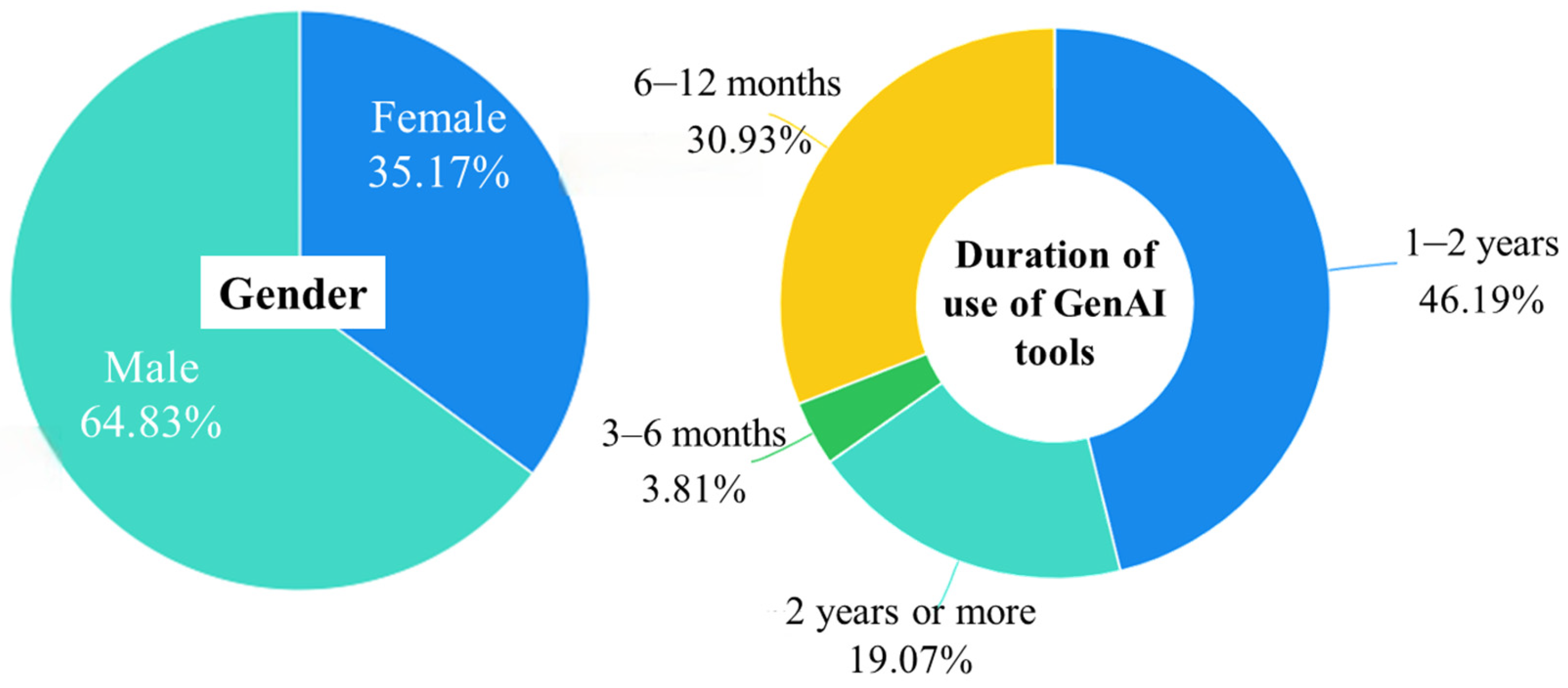
We apply several methods to ensure the quality of the collection. First, we set a minimum time limit for each page of the online questionnaire response. Participants who did not complete the questionnaire in this time were not allowed to continue. After collection, we checked and removed 28 responses that included duplicates, missing data, and invalid answers. Moreover, two attention check questions were placed randomly in the survey to evaluate respondent attentiveness. Thirty-one responses that failed attention checks were further excluded, resulting in 236 valid responses. We also calculated the required sample size for SEM analysis, using an online statistical power analysis tool (https://www.danielsoper.com/statcalc/calculator.aspx?id=89 (accessed on 14 February 2026)). The inputs included 35 observed variables, 7 latent constructs, an expected medium effect size of 0.30, a significance level of 0.05 for a 95 percent confidence level, and a target statistical power of 0.85. The calculation showed that at least 187 cases were needed to test the proposed relationships with enough reliability. Our final sample included 236 responses, which is higher than the minimum size. Figure 2 and Table 2 illustrate the basic information of the respondents and their experience using GenAI. Regarding the geography, the largest group came from the eastern region, including Beijing, Shanghai, Zhejiang, and Guangdong. Other students came from the western region, such as Chongqing and Sichuan, and the central region, such as Hunan and Hubei.

4. Analysis Results

4.1. Common Method Bias

This study employed measures to mitigate concerns about common method bias. First, the questionnaire underwent expert review and small-sample pretesting to improve scale clarity. Second, respondents were informed that their answers were anonymous and confidential. The questionnaire instructions also explicitly stated that there were no right or wrong answers. These measures aimed to reduce evaluation bias and social expectation bias, encouraging respondents to answer truthfully [59]. Third, we conducted Harman’s single-factor test, including all measures in an unrotated exploratory factor analysis. The first factor explained 27.2% of the total variance, well below the commonly used threshold of 40%, indicating that no single factor dominated and common method bias was not a serious problem in this study. Fourth, we also calculated variance inflation factors (VIFs) for all latent constructs to test possible multicollinearity. All VIF values were below 3.0, lowering the strict threshold of 5 [54], indicating that multicollinearity is not a concern and further reducing the possibility that common method bias distorts the estimated relationships among the constructs [60].

4.2. Measurement Model Assessment

The study tested reliability and convergent validity of the measurement model by following the guidelines of Hair et al. (2019) [55]. The results are shown in Table 3. All constructs show good internal consistency. Cronbach’s alpha values range from 0.805 to 0.879, which are higher than the threshold of 0.70. Composite reliability values range from 0.873 to 0.916, further confirming strong reliability across the constructs.
We also tested convergent validity and the results are listed in Table 3. The average variance extracted for each construct ranges from 0.608 to 0.734, which is higher than 0.50. This shows that each construct explains more than half of the variance of its indicators on average. Table 3 shows adequate internal consistency and convergent validity of the measurement model, supporting the suitability of the model for subsequent structural analysis.
Discriminant validity was assessed using a dual approach: the heterotrait–monotrait ratio (HTMT) and the Fornell–Larcker criterion (Table 4 and Table 5). First, the HTMT results indicate that most values fall below the common threshold of 0.90, demonstrating sufficient distinction among the reflective constructs [61]. Although HTMT values for the higher-order SRL construct and its three dimensions exceed this threshold, this is theoretically expected, as SRL is conceptualized as a higher-order formative construct composed of these components. Second, as shown in Table 5, the Fornell–Larcker criterion was satisfied across all first-order constructs [62]. These results provide robust empirical support for the discriminant validity of the measurement model.

4.3. Structural Model Assessment

The structural model was analyzed using partial least squares structural equation modeling (PLS-SEM) with SmartPLS 4 to examine the hypothesized relationships among the study constructs. The analysis used the full sample of 236 valid responses. To test the significance and robustness of the path coefficients, the study used a nonparametric bootstrapping method with 5000 resamples. The study did not include control variables in the structural model because the main goal was to test the direct effects among the key theoretical constructs rather than to estimate net demographic influences. Table 6 reports the results of the path analysis for the main effects specified in the proposed model.
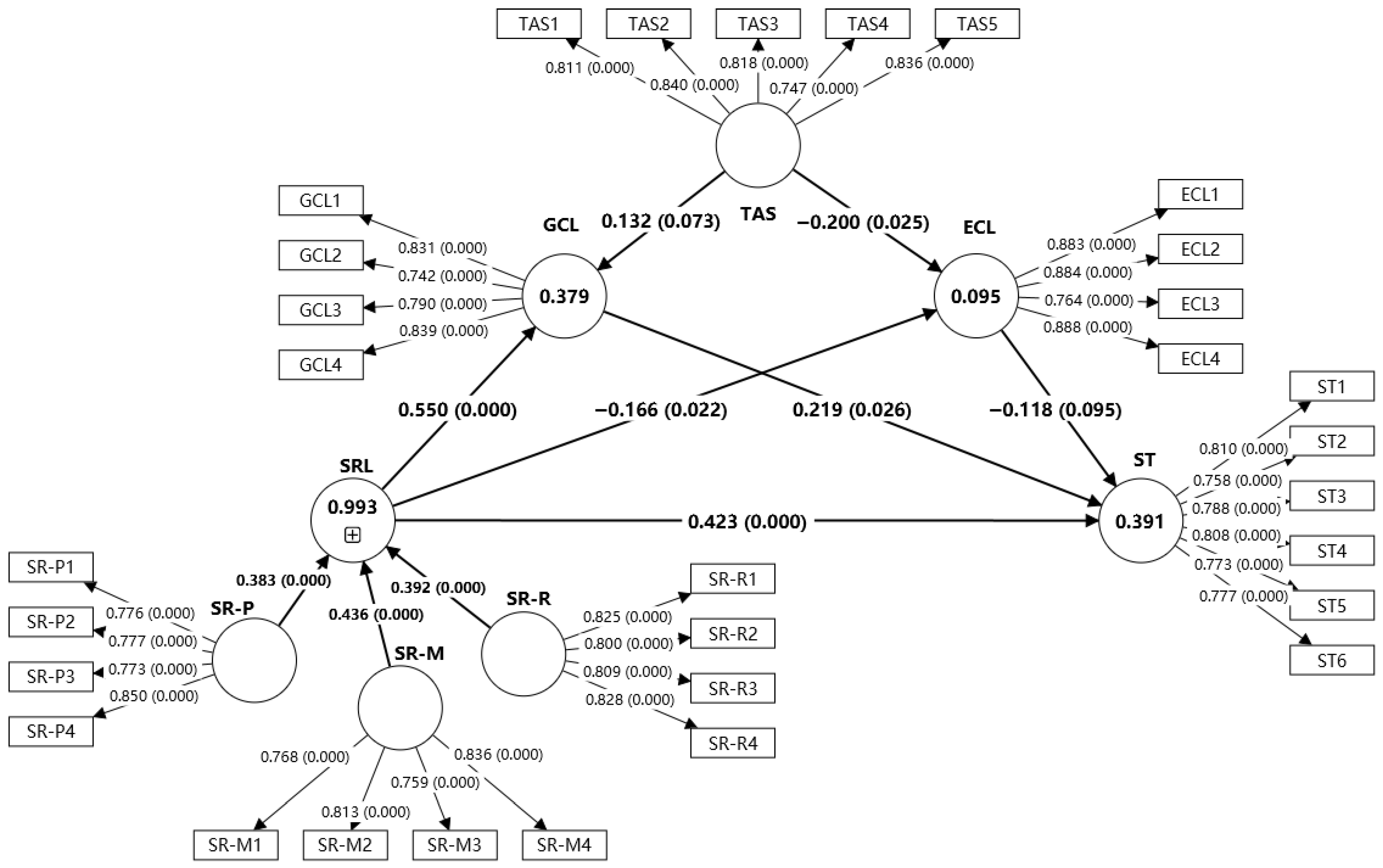
As shown in Table 6, SRL has a significant and positive effect on ST (β = 0.423, p < 0.001), indicating that higher self-regulated learning is linked to higher levels of systems thinking ability. The magnitude of this effect is relatively large, suggesting that SRL plays a central role in promoting ST, which supports H1.
For cognitive load effects, ECL has a negative relationship with ST (β = −0.118, p = 0.095). Although the magnitude of this effect is relatively small, its direction aligns with theoretical expectations. Accordingly, H2 receives marginal empirical support. In contrast, GCL has a positive and significant effect on ST (β = 0.219, p = 0.026), indicating that meaningful cognitive engagement enhances systems thinking and therefore supports H3.
SRL has a negative relationship with ECL (β = −0.166, p = 0.022), showing that students with stronger self-regulation are better able to reduce unnecessary or distracting cognitive effort. In contrast, SRL has a strong positive effect on GCL (β = 0.550, p < 0.001), indicating the key role of SRL in increasing meaningful cognitive effort. Thus, H4 and H5 are supported.
TAS has a significant negative effect on ECL (β = −0.200, p = 0.025). This result shows that effective teacher GenAI scaffolding reduces extraneous cognitive load, supporting H6. TAS also has a positive but weak effect on GCL (β = 0.132, p = 0.073). Although the effect size is modest and reaches only marginal significance, its positive direction suggests that teacher GenAI scaffolding may facilitate germane cognitive processing. Therefore, H7 receives marginal support.
The effect size analysis further reveals the relative contribution of each predictor to the endogenous constructs. SRL has a large effect on GCL (f2 = 0.407) and a moderate effect on ST (f2 = 0.185), while its effect on ECL is small (f2 = 0.025). Other relationships, including GCL → ST (f2 = 0.049) and ECL → ST (f2 = 0.021), show small effect sizes.
We assessed the coefficient of determination (R2) and predictive relevance (Q2) of constructs, as shown in Table 7. The results indicate that the model demonstrates satisfactory explanatory and predictive power. Specifically, the R2 values show that the model explains 39.1% of the variance in ST and 37.9% in GCL, suggesting moderate explanatory power, as well as a weak 9.5% in ECL. We further conducted the blindfolding procedure with an omission distance of 7. All Q2 values are greater than zero, indicating that the structural model has adequate predictive relevance.
Table 8 shows the bootstrap results of the mediation analysis. The indirect effect of SRL on ST via GCL was positive and significant (β = 0.120, p = 0.020), and the 95% confidence interval did not include zero. This result indicates that SRL could enhance systems thinking by promoting relevant cognitive processing and sustained cognitive engagement, supporting the mediating effect of GCL. Conversely, the indirect effect of SRL on ST via ECL was not significant (β = 0.020, p = 0.202). Although the indirect effect is positive, its small magnitude and lack of statistical significance suggest that reductions in extraneous cognitive load do not constitute a stable transmission mechanism linking SRL to ST. Similarly, neither GCL nor ECL mediates the relationship between the TAS and ST. The indirect effects of GCL and ECL on TAS and ST relationship are both non-significant.
To further explore the internal mechanisms of SRL, chain mediation effects involving different SRL stages were examined. The results indicate that the ECL-based chain mediation effects are not supported across all SRL stages. In contrast, all chain mediation paths through GCL are positive and statistically significant, indicating robust support for GCL-based mediation mechanisms. The indirect effects of SR-M → SRL → GCL → ST (β = 0.052, p = 0.021), SR-P → SRL → GCL → ST (β = 0.046, p = 0.020), and SR-R → SRL → GCL → ST (β = 0.047, p = 0.022) are all significant, with confidence intervals excluding zero. These positive indirect effects suggest that each SRL stage contributes to enhanced ST by increasing learners’ investment in germane cognitive processing. Accordingly, the GCL-based chain mediation effects are supported for SR-M, SR-P, and SR-R.
Taken together, the mediation results demonstrate a clear asymmetry between the two cognitive load pathways. While reductions in ECL do not form a significant mediating mechanism, increases in GCL constitute the primary cognitive pathway through which SRL and its constituent stages exert positive indirect effects on ST. Figure 3 presents the final structural model, with R2 values displayed inside the circles and the P values shown in parentheses.

4.4. Configurations Analysis: FsQCA Results

To complement the identification of net effects obtained from the PLS-SEM analysis, this study further employed fsQCA to uncover multiple equifinal configurations leading to high levels of systems thinking and to examine potential asymmetry [20]. In the fsQCA setting, ST was specified as the outcome condition. Separate sufficiency analyses were conducted for high ST (fST) and low ST (~fST) in order to assess possible asymmetry. The analytical models were specified as f S T   =   f ( f T A S ,   f S R L ,   f G C L ,   f E C L ) for the high-outcome analysis and ~ f S T   =   f ( f T A S ,   f S R L ,   f G C L ,   f E C L ) for the low-outcome analysis. All continuous variables were converted into fuzzy-set membership scores from 0 to 1 by using the direct calibration method. Based on earlier studies, the 5th percentile was set as full non-membership, the 50th percentile was set as the crossover point, and the 95th percentile was set as full membership. This method maps the original scores to fuzzy-set values in a smooth way and keeps the relative order of the cases. The calibrated data were then used in the necessity and sufficiency analyses.
Table 9 shows the necessity analysis results for high systems thinking (ST) and low systems thinking (~ST). Using the conventional threshold of 0.90 [20], the results show that none of the stay-alone conditions, including SRL, GCL, ECL, and TAS, reach this level. Their opposite forms also do not reach this level for either high ST or low ST. This result demonstrates that the emergence of high- or low-level systems thinking cannot be attributed to any isolated factor. We should turn to a configurational setting, examining how combinations of conditions collectively produce results.
Then, we built a truth table and tested sufficiency using the Quine–McCluskey algorithm. This study refines the truth table with a frequency threshold of 3 and a consistency threshold of 0.80 to improve the robustness and interpretability of the results. These standards were set according to our sample size. We also removed solutions with PRI consistency below 0.50 to reduce contradictory patterns.
Table 10 shows the fsQCA solution and it finds two paths that lead to high ST. The overall coverage is 0.756 and the consistency is 0.821. These results show that the two paths are sufficient and reliable for explaining high ST. We can see that SRL and GCL appear in both paths, highlighting their function as shared foundational conditions in the development of high ST. The first configuration (S1: TAS + SRL + GCL) can be understood as a scaffolding–regulation–processing pathway. In this path, teacher GenAI support strengthens the positive effects of high SRL and high GCL, leading to high ST. This configuration demonstrates substantial explanatory relevance, with a raw coverage of 0.684 and a unique coverage of 0.179. The second path (S2: SRL + GCL + ECL) can be seen as a regulation-based compensation path, with a raw coverage of 0.577 and a unique coverage of 0.072. This path indicates that high ST can still develop even when high extraneous cognitive load is present, and this happens when students also show strong self-regulation and high germane cognitive effort.
Table 11 shows the fsQCA results for low systems thinking (~ST). Two equifinal configurations are identified, with an overall coverage of 0.587 and a consistency of 0.915. The absence of self-regulated learning (~SRL) appears in both paths, indicating that weak self-regulation is a basic condition for low ST. The two pathways leading to low ST do not represent simple inversions of those associated with high ST, indicating the presence of pathway asymmetry. The first path (S1: ECL + ~GCL + ~SRL) shows that low ST is more likely in poor cognitive conditions. In this path, a high extraneous load appears together with low germane processing and weak self-regulation. This configuration has a raw coverage of 0.499 and a unique coverage of 0.276. The second path (S2: ~ECL + ~SRL + GCL + TAS) also shows the key role of self-regulation. Even when extraneous load is low, and germane effort and teacher GenAI support are present, low ST can still occur if SRL is absent.

5. Discussion

5.1. Net-Effect Analysis of PLS-SEM (RQ1–RQ4)

The PLS-SEM results show the linear mechanisms behind the development of systems thinking in GenAI-supported logistics management education. The findings show that GenAI does not directly improve higher-order thinking. It works through the joint effect of SRL, cognitive processing conditions, and teacher scaffolding.
First, SRL is identified as the most influential factor of systems thinking enhancement. This result supports the SRL theory, which argues that higher-order skills do not develop automatically when students are exposed to abundant information, but rather require clear goal setting, continuous monitoring, and careful reflection and adjustment to gradually form [22,24,26]. Our results further show that access to GenAI may even hurt system thinking without effective SRL.
Second, the findings show a clear asymmetric influence between germane cognitive load and extraneous cognitive load. External load can limit learning output, but simply reducing external load cannot significantly improve systems thinking ability. Moreover, increasing germane load is a more crucial path to improving systems thinking. This result was obtained from previous literature [2,8,12,34,42]. In learning environments supported by GenAI, students with high GCL can tolerate a certain degree of information redundancy, and the systems thinking is derived from activating deep cognitive processing, rather than simply simplifying cognitive needs.
Third, SRL can also shape the cognitive load structure. We find that SRL is positively related to GCL and negatively related to ECL, indicating that higher SRL allows students to better allocate cognitive resources to meaningful information processing while effectively dealing with unnecessary cognitive distractions. This echoes the existing research [43]. In GenAI-supported environments, outputs are often large, iterative, and occasionally ambiguous. The ability to plan, monitor, and evaluate feedback is crucial in this context. Through consciously regulatory behaviors, GenAI interactions can be transformed into efficient learning processes rather than sources of cognitive overload.
Fourth, we find that the main contribution of teacher GenAI scaffolding to the development of systems thinking lies in reducing extraneous cognitive load, which is consistent with previous studies [22,49]. However, scaffolded instruction alone does not seem sufficient to stimulate germane cognitive engagement. In GenAI interaction learning, teacher guidance and support can create a favorable environment and reduce irrelevant information, but they cannot replace the role of self-regulated learning in enhancing systems thinking. Even with GenAI carefully integrated into instructional design, students must actively participate in the regulatory process to translate teacher guidance and support into meaningful cognitive engagement. From this perspective, the role of instructional scaffolding is more like a boundary regulator shaping cognitive conditions than a direct catalyst for systems thinking.
Last, mediation analysis reinforces the asymmetric explanation of different cognitive loads. Indirect effects analysis indicates that increased germane load constitutes the main transmission path connecting regulatory behavior and systems thinking, while reducing extraneous load does not form an effective mediation mechanism. Our findings suggest that the cultivation of higher-order abilities in GenAI-assisted learning does not solely rely on eliminating cognitive barriers, but rather stems from active cognitive engagement. Regulatory processes, including planning, monitoring, and reflection, would converge on the same channel of enhanced relevant cognitive processing, thereby improving systems thinking ability.

5.2. Configurational Pathways for Developing Systems Thinking (RQ5)

5.2.1. Scaffolding–Regulation–Processing Pathway: TAS × SRL × GCL

The first configuration path to high-level ST shows that high-level systems thinking exists when teacher GenAI support works together with strong self-regulation and high meaningful cognitive effort. In this path, TAS provides explicit instructional guidance to facilitate a more strategic use of GenAI, SRL enables learners to consciously plan, monitor, and improve their learning activities, and GCL represents the purposeful allocation of cognitive resources for building knowledge structures and connecting system ideas. These conditions work together as a scaffolding–regulation–processing mechanism. External support can help foster systems thinking abilities, but it works well only when it fits students’ self-regulation and deep cognitive effort.

5.2.2. Regulation-Based Compensatory Pathway: SRL × GCL × ECL

The second path to high-level systems thinking suggests that even when students are faced with complex and redundant information, systems thinking can still be enhanced by activating self-regulated learning and germane cognitive engagement. These results show that ECL does not always limit systems thinking. Its effects depend on how it works with other conditions. This pattern can be seen as a regulation-based compensation process in which students with strong SRL can cope with high ECL and maintain their GCL, indicating that self-regulating behavior drives the ability to process large amounts of information in depth, in turn promoting the improvement of systems thinking skills.

5.2.3. Shared Foundations of High ST Configurations

Although the two configurations of higher ST differ structurally, they share a common foundation: SRL and GCL. This indicates that the emergence of higher systemic competence depends on a stable regulatory and cognitive engagement. In GenAI-supported environments, students can easily access analytical frameworks and presentations using GenAI tools. But these resources become real system knowledge only when students set goals, check their understanding, and rebuild their ideas through reflection. The sustained role of GCL further suggests that the enhancement of higher-order thinking skills relies on deep cognitive processing, rather than passively accessing information. Thus, the development of systems thinking competence is achieved through the combined effect of active self-regulation and sustained cognitive engagement.

5.3. Configurations Leading to Low ST and Pathway Asymmetry

The patterns explaining low systems thinking exhibit path asymmetry. The paths leading to low ST are not simply inversions of the high ST paths. In both low systems-thinking configurations, the absence of self-regulated learning is consistently a core element, suggesting that insufficient regulatory capacity is a major trigger of weak systems thinking. The first path shows a cognitively inefficient configuration with high ECL and low GCL, in which students cannot effectively regulate their learning behavior, filter information, or allocate cognitive resources, leading to low levels of systems thinking. In the second path, although ECL is absent and TAS and GCL are present, the absence of SRL still leads to low systems thinking. This indicates that, even with favorable external scaffolding and cognitive engagement, the development of systems thinking cannot be guaranteed if students cannot regulate their own learning processes.
A comparative analysis of high and low ST configurations reveals the asymmetric logic underlying the development of systems thinking. High ST stems from the coordination of multiple contributing conditions, while low ST is primarily related to the absence of the key factor SRL. This asymmetry further confirms that capability development in GenAI-supported environments follows a configurational and nonlinear pattern that cannot be fully explained by a linear model.

6. Theoretical and Practical Implications

6.1. Theoretical Implications

First, this study expands the theoretical boundaries of higher-order competence development in GenAI-supported learning environments. Existing research on GenAI in education largely focuses on outcomes such as motivation, engagement, and performance, while empirical studies on its impact on higher-order competence remain limited [10,63,64]. Previous studies indicate that simply relying on GenAI use cannot improve higher-order competence [21]. This study applies systems thinking as a core dependent variable, examining how behavioral, cognitive, and environmental pathways interact to influence systems thinking for logistics management students, providing new evidence for the cultivation of higher-order competence in a GenAI learning context.
Moreover, this study expands the explanatory power of SRL and CLT in GenAI-supported education. On the one hand, cognitive processing exhibits asymmetric effects. The positive driving force of deep processing willingness (i.e., GCL) outweighs the hindering effect of external cognitive load. This indicates that in GenAI-assisted learning, enhancing learners’ germane cognition is more crucial for the formation of systems thinking than simply simplifying the interface or task (i.e., ECL). On the other hand, this study finds that SRL is a core driving force for the development of systems thinking. Learners’ goal-setting, monitoring, and reflection determine whether the outputs of GenAI can be transformed into effective cognitive schemas.
Last, this study provides configuration insights through fsQCA. These nonlinear paths explain the diversity of antecedent combinations for learning outcomes, replenishing the single-variable determinism in previous studies. We find that even under the adverse condition of ECL, high SRL can also compensate for developing systems thinking by activating GCL, i.e., the compensatory effect. The comparative analysis from low systems thinking configuration further shows that its antecedents are not simply the reverse of those of high systems thinking. In particular, high-level teacher-assisted instructions and weak self-regulated learning are associated with low systems thinking, which indicates that instructional scaffolding may even limit the development of higher-order abilities if it cannot stimulate students’ self-regulation behaviors.

6.2. Practical Implications

From a practical perspective, these findings offer guidance for cultivating student systems thinking in GenAI-supported higher education. First, SRL is the most critical factor in enhancing systems thinking, and interaction with GenAI may even impair it in its absence. Therefore, teachers should shift the focus from the GenAI-generated solution to the regulation process of student–GenAI collaboration. For example, in the logistics case study assignment, teachers could require students to submit a Self-regulation Log as part of their final report. In this log, students must record: (1) the initial task breakdown (planning); (2) how they improved their prompts when GenAI provided false or unnecessary information (monitoring); and (3) how the GenAI output changed their final assessment of their cognitive model of the logistics system (reflection). This could prompt students to shift from passive acceptance to active regulating learning.
Second, this study finds that reducing ECL is insufficient to enhance systems thinking, and the key lies in activating GCL. Instructors should use GenAI to expose students to system-wide tensions rather than providing optimal answers. For example, mini-scenarios of trade-offs can be designed, requiring students to use the GenAI tools to generate strategies with conflicting objectives. Students must identify feedback loops and trade-offs between multiple objectives, forcing them to engage in deep processing and schema-building rather than seeking off-the-shelf solutions.
Third, the primary role of teacher scaffolding is to reduce interference, but it cannot replace students’ own efforts in promoting GCL. Therefore, teachers should focus on how to use scaffolding to help students filter out the illusory or noisy information generated by GenAI, creating a clean and efficient digital exploration environment. Following this line, teachers could design a task on GenAI-Output Verification and System Mapping. When students use GenAI to analyze a complex logistics network, the teacher could provide a set of criteria or a checklist specifically designed to help students identify common GenAI hallucinations regarding regional infrastructure, international regulations or specific maritime regulations. Moreover, teachers could require students to iteratively rewrite and evolve their prompts based on the quality of GenAI feedback, guiding them to incorporate specific systemic constraints into the revised prompt, such as lead-time volatility or cost–service trade-offs. This process encourages students to engage in in-depth mental modeling and active reflection toward the task objectives.
Finally, tiered interventions can be designed for different student groups. For students with weak SRL, it is essential to prioritize addressing their SRL weaknesses. For example, teachers could require students to write down the intention and logic behind the prompt before inputting it; to draw or create mind maps online while interacting with the GenAI; and to compare their initial questions with their final satisfactory questions to analyze why earlier questions failed to elicit in-depth answers. For students with high SRL, a moderate level of complexity can be tolerated in the targeted instructional scaffolding design. Even if the information output by GenAI is slightly redundant or complex, these students can transform it into learning motivation through the “compensation effect”. In these ways, teaching scaffolding design focuses on guiding students with different levels of SRL to engage in deep cognitive input, thus achieving a high level of systems thinking.

7. Conclusions

This study explores how to enhance systems thinking in GenAI-supported logistics management education. The integration of PLS-SEM and fsQCA provides a comprehensive understanding of these mechanisms. The PLS-SEM results reveal the linear relationships among key variables, indicating that self-regulated learning and germane cognitive load promote systems thinking, while extraneous cognitive load constrains it. In addition, teacher GenAI scaffolding helps reduce extraneous cognitive load. fsQCA findings complement the linear models by showing how the key variables identified in PLS-SEM combine into multiple pathways. Among them, stronger self-regulated learning and deeper cognitive engagement are fundamental conditions across multiple pathways, leading to high systems thinking. In contrast, the absence of self-regulated learning consistently leads to low systems thinking, even when instructional support or favorable cognitive conditions are present.
This study has some limitations that may guide future research. First, while the combined application of PLS-SEM and fsQCA enhances the explanatory power of the analysis, the lack of a time dimension in the cross-sectional survey data limits causal inferences. Future research could employ longitudinal or experimental designs to examine the causal mechanisms between factors. Second, this study used a self-report scale, which may introduce potential bias when assessing complex competencies such as systems thinking. Future research could incorporate objective behavioral data to improve the objectivity of the measurement. Third, this study focuses on enhancing systems thinking in logistics management. Whether similar configuration patterns could exist among disciplines with different knowledge structures warrants further investigation. Finally, the fsQCA model include a limited number of variables, and future research could incorporate more variables such as individual differences, task complexity characteristics, or different GenAI interaction patterns to construct a more comprehensive capability-development configuration model.


Author Contributions

Conceptualization: J.L.; methodology, J.L. and H.X.; software, J.L.; validation, J.L. and Y.L.; formal analysis, J.L.; data curation, J.L., Y.Z., H.X., M.Z. and Y.L.; writing—original draft preparation, J.L.; writing—review and editing, J.L., Y.Z., H.X., M.Z. and Y.L.; funding acquisition, J.L., Y.Z. and Y.L. All authors have read and agreed to the published version of the manuscript.

Funding

This research was funded by the 2024 National Logistics Education Reform and Research Projects for Universities, Colleges, and Vocational Institutions (Grant no. JZW2024094), 2025 National Logistics Education Reform and Research Projects for Universities, Colleges, and Vocational Institutions (Grant no. JZW2025143), the Artificial Intelligence Research Fund of Chengdu University of Technology (Grant no. 2025AI034; 2025AI009), the Chengdu University of Technology Higher Education Talent Training Quality and Teaching Reform Project (Grant no. JG2430077; JG2430084; JG2430074), the Sichuan Provincial Higher Education Talent Cultivation Quality and Teaching Reform Project (Grant no. JG2024-0586), the Project of the Research Center for Ideological and Political Education of College Students in Sichuan Province (Grant no. CSZ24013), and the 2025 Key Project on Artificial Intelligence Empowering University Teaching Management and Reform of Sichuan Association of Higher Education (Grant No. CXZD-20).

Institutional Review Board Statement

The study was conducted in accordance with the Declaration of Helsink, and approved by the Ethics Review Form for Studies at College of Management Science, Chengdu University of Technology (protocol code 2026013001 and date of approval 30 January 2026).

Informed Consent Statement

Informed consent was obtained from all individual participants included in the study.

Data Availability Statement

The raw data supporting the conclusions of this article are openly available in Figshare at https://doi.org/10.6084/m9.figshare.31362049.

Conflicts of Interest

The authors declare no conflicts of interest.

Appendix A. Construct Scale

ConstructItemsReferences
Systems Thinking (ST)
ST1I am able to view logistics problems as integrated systems with interdependent elements.[5,8,9]
ST2I am able to consider how decisions in one part of the logistics system affect other functions.
ST3I emphasize overall system performance rather than optimizing individual logistics activities in isolation.
ST4I am able to anticipate both short-term and long-term consequences of logistics decisions.
ST5I am able to balance trade-offs when facing competing logistics objectives.
ST6I am able to evaluate logistics solutions from a system-wide perspective.
Extraneous Cognitive Load (ECL)
ECL1GenAI responses often include irrelevant information that obscures key points.[12,28,42]
ECL2GenAI explanations are often poorly structured, making them difficult to understand.
ECL3The presentation format of GenAI responses often requires unnecessary mental effort to process.
ECL4The need to check and correct inaccurate GenAI outputs imposes additional mental effort unrelated to core learning tasks.
Teacher GenAI-Scaffolding (TAS)
TAS1Instructors provide clear guidance on appropriate GenAI use at different learning stages.[65,66]
TAS2Instructors guide me in evaluating the reliability and applicability of GenAI outputs.
TAS3Instructors emphasize my thinking process over the final answer when I use GenAI for logistics-related assignments.
TAS4Instructors encourage independent thinking and caution against over-reliance on GenAI.
TAS5Instructors provide guidance on responsible and ethical use of GenAI as part of learning support.
Germane Cognitive Load (GCL)
GCL1In the study of logistics management, I integrate GenAI outputs into my existing knowledge.[28,34,42]
GCL2When using GenAI, I invest substantial mental effort in analyzing underlying structures and relationships among logistics variables.
GCL3I compare GenAI outputs with professional materials to refine the understanding.
GCL4When learning with GenAI, I integrate information from multiple sources to understand logistics issues comprehensively.
Self-Regulation Learning: Planning
SR-P1Before using GenAI, I clearly identify which tasks require GenAI assistance and which I should complete independently.[24,25,67]
SR-P2Before using GenAI, I adjust prompts based on my learning objectives.
SR-P3Before using GenAI, I clearly define the learning problem I want to address.
SR-P4Before using GenAI, I clearly define the learning objectives I want it to support.
Self-Regulation Learning: Monitoring
SR-M1During interactions with GenAI, I continuously assess whether its responses align with my learning needs.[24,25,66,68]
SR-M2When GenAI responses are unsatisfactory, I actively revise or refine my prompts.
SR-M3I remain cautious about initial GenAI responses and ask follow-up questions.
SR-M4When GenAI responses deviate from my learning task, I can identify the issue and adjust the prompts.
Self-Regulation Learning: Reflection
SR-R1After using GenAI, I reflect on whether it actually improved my understanding of the learning content.[24,68,69]
SR-R2I evaluate the quality of GenAI responses rather than accepting them at face value.
SR-R3Based on reflection on GenAI outputs, I adjust my subsequent learning strategies.
SR-R4I summarize effective ways of using GenAI for my learning
Notes: SRL is a second-order formative construct comprising three first-order dimensions: planning, monitoring, and reflection.

References

  1. Moon, S.A.; Kim, D.J. Systems thinking ability for supply chain management. Supply Chain Manag. Int. J. 2005, 10, 394–401. [Google Scholar] [CrossRef]
  2. Wilden, D.; Hopkins, J.; Sadler, I. The prevalence of systems thinking in supply chain management: A systematic literature review. Syst. Pract. Action Res. 2022, 35, 491–526. [Google Scholar] [CrossRef]
  3. Lee, H.L.; Padmanabhan, V.; Whang, S. Information distortion in a supply chain: The bullwhip effect. Manag. Sci. 1997, 43, 546–558. [Google Scholar] [CrossRef]
  4. Liang, J.; Yang, S.; Huang, X.; Zhu, J. Forward or backward: The impact of vertical integration direction on the bullwhip effect. Int. J. Prod. Res. 2022, 60, 6923–6944. [Google Scholar] [CrossRef]
  5. Sterman, J.D. Business Dynamics: Systems Thinking and Modeling for a Complex World; McGraw-Hill: New York, NY, USA, 2000. [Google Scholar]
  6. Wu, D.Y.; Katok, E. Learning, communication, and the bullwhip effect. J. Oper. Manag. 2006, 24, 839–850. [Google Scholar] [CrossRef]
  7. Reich, Y. Learning to Use Generative AI and Using It to Improve Learning: A Systems Engineering Research Seminar Case Study. Systems 2025, 13, 1006. [Google Scholar] [CrossRef]
  8. Arnold, R.D.; Wade, J.P. A definition of systems thinking: A systems approach. Procedia Comput. Sci. 2015, 44, 669–678. [Google Scholar] [CrossRef]
  9. Meadows, D. Thinking in Systems; Chelsea Green Publishing: White River Junction, VT, USA, 2008. [Google Scholar]
  10. Kasneci, E.; Seßler, K.; Küchemann, S.; Bannert, M.; Dementieva, D.; Fischer, F.; Gasser, U.; Groh, G.; Günnemann, S.; Hüllermeier, E. ChatGPT for good? On opportunities and challenges of large language models for education. Learn. Individ. Differ. 2023, 103, 102274. [Google Scholar] [CrossRef]
  11. Sweeney, L.B.; Sterman, J.D. Bathtub dynamics: Initial results of a systems thinking inventory. Syst. Dyn. Rev. 2000, 16, 249–286. [Google Scholar] [CrossRef]
  12. Van Merriënboer, J.J.; Sweller, J. Cognitive load theory in health professional education: Design principles and strategies. Med. Educ. 2010, 44, 85–93. [Google Scholar] [CrossRef]
  13. Zuo, Z.; Luo, Y.; Yan, S.; Jiang, L. From perception to practice: Artificial intelligence as a pathway to enhancing digital literacy in higher education teaching. Systems 2025, 13, 664. [Google Scholar] [CrossRef]
  14. Mollick, E.R.; Mollick, L. Using AI to implement effective teaching strategies in classrooms: Five strategies, including prompts. Wharton Sch. Res. Pap. 2023. [Google Scholar] [CrossRef]
  15. Liang, J.; Wang, L.; Luo, J.; Yan, Y.; Fan, C. The relationship between student interaction with generative artificial intelligence and learning achievement: Serial mediating roles of self-efficacy and cognitive engagement. Front. Psychol. 2023, 14, 1285392. [Google Scholar] [CrossRef] [PubMed]
  16. Li, Y.; Wang, S.; Khaskheli, M.B. Integrating Artificial Intelligence into Service Innovation, Business Development, and Legal Compliance: Insights from the Hainan Free Trade Port Era. Systems 2024, 12, 463. [Google Scholar] [CrossRef]
  17. Luckin, R.; Holmes, W.; Griffiths, M.; Forcier, L.B. Intelligence Unleashed: An Argument for AI in Education; Pearson: London, UK, 2016. [Google Scholar]
  18. Venkatesh, V.; Morris, M.G.; Davis, G.B.; Davis, F.D. User acceptance of information technology: Toward a unified view. Manag. Inf. Syst. Q. 2003, 27, 425–478. [Google Scholar] [CrossRef]
  19. Teo, T. Factors influencing teachers’ intention to use technology: Model development and test. Comput. Educ. 2011, 57, 2432–2440. [Google Scholar] [CrossRef]
  20. Ragin, C.C. Redesigning Social Inquiry: Fuzzy Sets and Beyond; University of Chicago Press: Chicago, IL, USA, 2008. [Google Scholar]
  21. Wang, J.; Fan, W. The effect of ChatGPT on students’ learning performance, learning perception, and higher-order thinking: Insights from a meta-analysis. Humanit. Soc. Sci. Commun. 2025, 12, 621. [Google Scholar] [CrossRef]
  22. Chi, M.T. Active-constructive-interactive: A conceptual framework for differentiating learning activities. Top. Cogn. Sci. 2009, 1, 73–105. [Google Scholar] [CrossRef]
  23. Greene, J.A.; Azevedo, R. A macro-level analysis of SRL processes and their relations to the acquisition of a sophisticated mental model of a complex system. Contemp. Educ. Psychol. 2009, 34, 18–29. [Google Scholar] [CrossRef]
  24. Zimmerman, B.J. Self-efficacy: An essential motive to learn. Contemp. Educ. Psychol. 2000, 25, 82–91. [Google Scholar] [CrossRef]
  25. Pintrich, P.R. A conceptual framework for assessing motivation and self-regulated learning in college students. Educ. Psychol. Rev. 2004, 16, 385–407. [Google Scholar] [CrossRef]
  26. Zimmerman, B.J.; Moylan, A.R. Self-regulation: Where metacognition and motivation intersect. In Handbook of Metacognition in Education; Routledge: New York, NY, USA, 2009. [Google Scholar]
  27. Sweller, J.; Van Merriënboer, J.J.; Paas, F. Cognitive architecture and instructional design: 20 years later. Educ. Psychol. Rev. 2019, 31, 261–292. [Google Scholar] [CrossRef]
  28. Paas, F.; Renkl, A.; Sweller, J. Cognitive load theory and instructional design: Recent developments. Educ. Psychol. 2003, 38, 1–4. [Google Scholar] [CrossRef]
  29. Gregory, A.; Miller, S. Using systems thinking to educate for sustainability in a business school. Systems 2014, 2, 313–327. [Google Scholar] [CrossRef]
  30. Harrison, A.; Van Hoek, R.; Skipworth, H.; Aitken, J. Logistics Management and Strategy; Pearson: London, UK, 2019. [Google Scholar]
  31. Zimmerman, B.J.; Schunk, D.H. Self-regulated learning and performance: An introduction and an overview. In Handbook of Self-Regulation of Learning and Performance; Routledge: New York, NY, USA, 2011; pp. 15–26. [Google Scholar]
  32. Dinsmore, D.L.; Fryer, L.K. Critical thinking and its relation to strategic processing. Educ. Psychol. Rev. 2023, 35, 36. [Google Scholar] [CrossRef]
  33. Panadero, E. A review of self-regulated learning: Six models and four directions for research. Front. Psychol. 2017, 8, 422. [Google Scholar] [CrossRef]
  34. Kalyuga, S. Cognitive load theory: How many types of load does it really need? Educ. Psychol. Rev. 2011, 23, 1–19. [Google Scholar] [CrossRef]
  35. Mayer, R.E. Multimedia Learning, 2nd ed.; Cambridge University Press: Cambridge, UK, 2009. [Google Scholar]
  36. Jansen, R.S.; Van Leeuwen, A.; Janssen, J.; Jak, S.; Kester, L. Self-regulated learning partially mediates the effect of self-regulated learning interventions on achievement in higher education: A meta-analysis. Educ. Res. Rev. 2019, 28, 100292. [Google Scholar] [CrossRef]
  37. Azevedo, R.; Cromley, J.G. Does training on self-regulated learning facilitate students’ learning with hypermedia? J. Educ. Psychol. 2004, 96, 523. [Google Scholar] [CrossRef]
  38. Cassidy, S. Self-regulated learning in higher education: Identifying key component processes. Stud. High. Educ. 2011, 36, 989–1000. [Google Scholar] [CrossRef]
  39. Russell, J.M.; Baik, C.; Ryan, A.T.; Molloy, E. Fostering self-regulated learning in higher education: Making self-regulation visible. Act. Learn. High. Educ. 2022, 23, 97–113. [Google Scholar] [CrossRef]
  40. Hadwin, A.; Järvelä, S.; Miller, M. Self-regulation, co-regulation, and shared regulation in collaborative learning environments. In Handbook of Self-Regulation of Learning and Performance; Schunk, D.H., Greene, J.A., Eds.; Routledge: New York, NY, USA, 2017. [Google Scholar]
  41. Sweller, J. Cognitive load during problem solving: Effects on learning. Cogn. Sci. 1988, 12, 257–285. [Google Scholar] [CrossRef]
  42. Sweller, J. Cognitive load theory. In Psychology of Learning and Motivation; Mestre, J.P., Ross, B.H., Eds.; Elsevier: Oxford, UK, 2011. [Google Scholar]
  43. De Bruin, A.B.; Roelle, J.; Carpenter, S.K.; Baars, M.; EFG-MRE. Synthesizing cognitive load and self-regulation theory: A theoretical framework and research agenda. Educ. Psychol. Rev. 2020, 32, 903–915. [Google Scholar] [CrossRef]
  44. Tarng, W.; Tseng, Y.-C.; Ou, K.-L. Application of augmented reality for learning material structures and chemical equilibrium in high school chemistry. Systems 2022, 10, 141. [Google Scholar] [CrossRef]
  45. Martin, A.J.; Collie, R.J.; Kennett, R.; Liu, D.; Ginns, P.; Sudimantara, L.B.; Dewi, E.W.; Rüschenpöhler, L.G. Integrating generative AI and load reduction instruction to individualize and optimize students’ learning. Learn. Individ. Differ. 2025, 121, 102723. [Google Scholar] [CrossRef]
  46. De Jong, T. Cognitive load theory, educational research, and instructional design: Some food for thought. Instr. Sci. 2010, 38, 105–134. [Google Scholar] [CrossRef]
  47. Jiang, C.; Huang, S.; Shen, T. Guiding the Unseen: A Systems Model of Prompt-Driven Agency Dynamics in Generative AI-Enabled VR Serious Game Design. Systems 2025, 13, 576. [Google Scholar] [CrossRef]
  48. Yi, X.; Feng, W.; He, Y.; Wang, F. How to harness LLMs in project-based learning: Empirical evidence for individual autonomy and moderate constraints in engineering education. Systems 2025, 13, 1112. [Google Scholar] [CrossRef]
  49. Yan, L.; Pammer-Schindler, V.; Mills, C.; Nguyen, A.; Gašević, D. Beyond efficiency: Empirical insights on generative AI’s impact on cognition, metacognition and epistemic agency in learning. Br. J. Educ. Technol. 2025, 56, 1675–1685. [Google Scholar] [CrossRef]
  50. Chi, M.T.; De Leeuw, N.; Chiu, M.; LaVancher, C. Eliciting self-explanations improves understanding. Cogn. Sci. 1994, 18, 439–477. [Google Scholar] [CrossRef]
  51. Bandura, A. Social cognitive theory: An agentic perspective. Annu. Rev. Psychol. 2001, 52, 1–26. [Google Scholar] [CrossRef]
  52. Zhang, Y.; Guo, J.; Wang, Y.; Li, S.; Yang, Q.; Zhang, J.; Lu, Z. Understanding Trust and Willingness to Use GenAI Tools in Higher Education: A SEM-ANN Approach Based on the SOR Framework. Systems 2025, 13, 855. [Google Scholar] [CrossRef]
  53. Wu, Z.; Pownall, R.; Shih, Y.-C.; Wang, Y. Industry effects of corporate environmental and social scandals: Evidence from China. Int. Rev. Financ. Anal. 2024, 95, 103504. [Google Scholar] [CrossRef]
  54. Hair, J.; Hollingsworth, C.L.; Randolph, A.B.; Chong, A.Y.L. An updated and expanded assessment of PLS-SEM in information systems research. Ind. Manag. Data Syst. 2017, 117, 442–458. [Google Scholar] [CrossRef]
  55. Hair, J.F.; Risher, J.J.; Sarstedt, M.; Ringle, C.M. When to use and how to report the results of PLS-SEM. Eur. Bus. Rev. 2019, 31, 2–24. [Google Scholar] [CrossRef]
  56. Sarstedt, M.; Hair, J.F.; Pick, M.; Ringle, C.M.; Sarstedt, M. Progress in partial least squares structural equation modeling use in marketing research in the last decade. Psychol. Mark. 2022, 39, 1035–1064. [Google Scholar] [CrossRef]
  57. Fiss, P.C. Building better causal theories: A fuzzy set approach to typologies in organization research. Acad. Manag. J. 2011, 54, 393–420. [Google Scholar] [CrossRef]
  58. Jarvis, C.B.; MacKenzie, S.B.; Podsakoff, P.M. A critical review of construct indicators and measurement model misspecification in marketing and consumer research. J. Consum. Res. 2003, 30, 199–218. [Google Scholar] [CrossRef]
  59. Podsakoff, P.M.; MacKenzie, S.B.; Lee, J.-Y.; Podsakoff, N.P. Common method biases in behavioral research: A critical review of the literature and recommended remedies. J. Appl. Psychol. 2003, 88, 879–903. [Google Scholar] [CrossRef]
  60. Kock, N. Common method bias in PLS-SEM: A full collinearity assessment approach. Int. J. e-Collab. 2015, 11, 1–10. [Google Scholar] [CrossRef]
  61. Henseler, J.; Ringle, C.M.; Sarstedt, M. A new criterion for assessing discriminant validity in variance-based structural equation modeling. J. Acad. Mark. Sci. 2015, 43, 115–135. [Google Scholar] [CrossRef]
  62. Fornell, C.; Larcker, D.F. Evaluating structural equation models with unobservable variables and measurement error. J. Mark. Res. 1981, 18, 39–50. [Google Scholar] [CrossRef]
  63. Xia, Q.; Chiu, T.K.; Lee, M.; Sanusi, I.T.; Dai, Y.; Chai, C.S. A self-determination theory (SDT) design approach for inclusive and diverse artificial intelligence (AI) education. Comput. Educ. 2022, 189, 104582. [Google Scholar] [CrossRef]
  64. Heung, Y.M.E.; Chiu, T.K. How ChatGPT impacts student engagement from a systematic review and meta-analysis study. Comput. Educ. Artif. Intell. 2025, 8, 100361. [Google Scholar] [CrossRef]
  65. Van de Pol, J.; Volman, M.; Beishuizen, J. Scaffolding in teacher–student interaction: A decade of research. Educ. Psychol. Rev. 2010, 22, 271–296. [Google Scholar] [CrossRef]
  66. Azevedo, R.; Hadwin, A.F. Scaffolding self-regulated learning and metacognition—Implications for the design of computer-based scaffolds. Instr. Sci. 2005, 33, 367–379. [Google Scholar] [CrossRef]
  67. Wolters, C.A. Regulation of motivation: Evaluating an underemphasized aspect of self-regulated learning. Educ. Psychol. 2003, 38, 189–205. [Google Scholar] [CrossRef]
  68. Panadero, E.; Broadbent, J.; Boud, D.; Lodge, J.M. Using formative assessment to influence self-and co-regulated learning: The role of evaluative judgement. Eur. J. Psychol. Educ. 2019, 34, 535–557. [Google Scholar] [CrossRef]
  69. Barnard, L.; Lan, W.Y.; To, Y.M.; Paton, V.O.; Lai, S.-L. Measuring self-regulation in online and blended learning environments. Internet High. Educ. 2009, 12, 1–6. [Google Scholar] [CrossRef]
Figure 1. Framework of the hypotheses.
Systems 14 00311 g001
Figure 2. Gender Distribution and GenAI Usage Experience of the Sample.
Systems 14 00311 g002
Figure 3. Structural model results.
Systems 14 00311 g003
Table 1. Research questions.
Research QuestionTheoretical ComponentIndependent Variable(s)Dependent Variable(s)Linked Hypothesis/Method
RQ1: How does self-regulated learning influence systems thinking?SRLSRLSTH1
RQ2: How do extraneous and germane cognitive loads differently affect systems thinking?CLTECL, GCLSTH2, H3
RQ3: How does self-regulated learning shape the cognitive load allocation?SRL + CLT SRLECL, GCL H4, H5
RQ4: How does teacher GenAI-supported scaffolding influence students’ cognitive load allocation?CLTTASECL, GCLH6, H7
RQ5: What combinations of these factors lead to high-level systems thinking?Triadic Reciprocal DeterminismAll above variables jointlySTfsQCA
Analysis
Table 2. Sample characteristics of the respondents.
CategorySubcategoryFrequencyPercentage (%)
GenderFemale8335.17
Male15364.83
Age18~192510.59
20~2112352.12
22~236728.39
24~25114.66
Over 25104.24
Duration of use of GenAI tools3–6 months93.81
6–12 months7330.93
1–2 years10946.19
2 years or more4519.07
RegionEastern region11749.58
Central region3414.41
Western region7732.63
Northeastern region83.39
Note: Regions are grouped following the standard economic classification of China.
Table 3. Reliability and convergent validity.
ConstructMeanSDFactor LoadingCronbach’s αCRAVE
Systems Thinking (ST) 0.8760.9060.618
ST14.2370.5410.811
ST24.2250.6160.759
ST34.1990.5970.787
ST44.1610.6180.808
ST54.2630.6110.773
ST64.1860.5600.776
Extraneous Cognitive Load (ECL) 0.8790.9160.734
ECL12.2160.6780.883
ECL22.2330.6970.885
ECL32.1691.0420.762
ECL42.2200.7510.889
Teacher GenAI-Scaffolding (TAS) 0.8690.9060.658
TAS13.9750.6520.811
TAS24.0170.6840.840
TAS34.0550.6200.818
TAS44.0930.5300.747
TAS54.1310.6010.836
Germane Cognitive Load (GCL) 0.8130.8770.642
GCL14.1230.6500.830
GCL24.0640.5610.744
GCL34.0510.5960.789
GCL44.1530.6410.840
Self-Regulation Learning: Planning 0.8390.8860.608
SR-P14.1740.5050.775
SR-P24.0470.5240.777
SR-P34.1570.4850.772
SR-P44.1950.5940.851
Self-Regulation Learning: Monitoring 0.8050.8730.632
SR-M14.2750.5950.785
SR-M24.2580.6160.774
SR-M34.1860.6110.796
SR-M44.1950.5800.764
Self-Regulation Learning: Reflection 0.8320.8880.665
SR-R14.1190.6140.827
SR-R24.0970.5330.798
SR-R34.0970.5490.809
SR-R44.1860.6040.828
Table 4. HTMT ratios evaluation.
ECLGCLSR-MSR-PSR-RSRLSTTAS
ECL
GCL0.327
SR-M0.2520.616
SR-P0.2060.5990.713
SR-R0.2590.6050.5490.629
SRL0.2760.7080.9850.9880.912
ST0.3150.5960.5570.5560.5620.656
TAS0.3020.4230.3770.3030.4940.4570.254
Table 5. Fornell–Larcker criterion.
ECLGCLSR-MSR-PSR-RSRLSTTAS
ECL0.857
GCL−0.2740.801
SR-M−0.210.4990.795
SR-P−0.1790.4840.5760.795
SR-R−0.2250.4970.4520.5170.815
SRL−0.2470.6030.8330.8370.7870.657
ST−0.2820.5060.4700.4700.4840.5840.786
TAS−0.2680.3550.3190.2580.4190.4050.2250.811
Table 6. Path analysis results for main effects.
HypothesisPathβSDf22.50%97.50%p-ValueDecision
H1SRL → ST0.4230.1070.1850.2220.6340.000Accepted
H2ECL → ST−0.1180.0710.021−0.2530.0230.095Accepted
H3GCL → ST0.2190.0980.0490.0280.4000.026Accepted
H4SRL → ECL−0.1660.0730.025−0.306−0.0240.022Accepted
H5SRL → GCL0.5500.0850.4070.3840.7130.000Accepted
H6TAS → ECL−0.2000.0900.037−0.375−0.0250.025Accepted
H7TAS → GCL0.1320.0740.024−0.0220.2710.073Accepted
Table 7. Coefficient of determination and predictive relevance of constructs.
ConstructR2Q2
ST0.3910.235
GCL0.3790.239
ECL0.0950.062
Table 8. Path analysis results for the indirect effects.
PathβSDT-Value2.50%97.50%p-Value
# Simple mediation effects
SRL → GCL → ST0.1200.0522.3280.0160.2150.020
SRL → ECL → ST0.0200.0151.277−0.0050.0540.202
TAS → GCL → ST0.0290.0241.225−0.0040.0870.221
TAS → ECL → ST0.0240.0181.283−0.0070.0660.200
# Mediation effects of SRL dimensions
SR-P → SRL → ECL → ST0.0080.0061.289−0.0020.0210.008
SR-P → SRL → GCL → ST0.0460.022.3320.0060.0830.046
SR-M → SRL → ECL → ST0.0090.0071.29−0.0020.0230.197
SR-M → SRL → GCL → ST0.0520.0232.3060.0070.0950.021
SR-R → SRL → ECL → ST0.0080.0061.256−0.0020.0220.209
SR-R → SRL → GCL → ST0.0470.0212.2960.0060.0860.022
Table 9. Analysis of necessary conditions.
Condition VariableST~ST
ConsistencyCoverageConsistencyCoverage
SRL0.850.760.50.575
~SRL0.5250.4490.7910.872
GCL0.8770.6620.6090.592
~GCL0.4590.4770.6530.873
ECL0.7140.550.7760.77
~ECL0.7010.7090.5460.711
TAS0.7620.5980.6250.631
~TAS0.530.5230.6020.765
Notes: The symbol “~” denotes the negation (absence) of a condition.
Table 10. Configurational pathways for achieving high systems thinking.
ConditionsSolutions for High ST
S1S2
TAS
SRL
GCL
ECL
Consistency0.8380.837
Raw coverage0.6840.577
Unique coverage0.1790.072
Solution coverage0.756
Solution consistency0.821
Notes: ● indicates the presence of a condition; blank cells denote “don’t care” conditions.
Table 11. Configurational pathways for achieving low systems thinking.
ConditionsSolutions for Low ST
S1S2
TAS
SRL
GCL
ECL
Consistency0.9300.933
Raw coverage0.4990.311
Unique coverage0.2760.088
Solution coverage0.587
Solution consistency0.915
Notes: ● indicates the presence of a condition; ⊗ indicates the absence (negation) of a condition; blank cells denote “don’t care” conditions.
Disclaimer/Publisher’s Note: The statements, opinions and data contained in all publications are solely those of the individual author(s) and contributor(s) and not of MDPI and/or the editor(s). MDPI and/or the editor(s) disclaim responsibility for any injury to people or property resulting from any ideas, methods, instructions or products referred to in the content.