Examining the Relationship Between Organizational Ambidexterity and Firm Performance in New Technology-Based Firms
 ,
,  ,
,
Abstract
1. Introduction
2. Literature Review
2.1. Firm Performance
2.2. Organizational Ambidexterity
2.3. Organizational Ambidexterity and Firm Performance
3. Materials and Methods
4. Results
4.1. Measurement Model Evaluation
4.2. Structural Model Evaluation
4.3. Predictive Performance
4.4. Importance–Performance Map Analysis (IPMA)
5. Discussion
5.1. Theoretical and Practical Implications
5.2. Limitations
6. Conclusions
Author Contributions
Funding
Institutional Review Board Statement
Informed Consent Statement
Data Availability Statement
Acknowledgments
Conflicts of Interest
Appendix A

| Code | Item |
|---|---|
| Organizational Ambidexterity (OA = CER + CET) | |
| CER_1 | The firm uses the technological knowledge obtained from its relations with other firms |
| CER_2 | The firm acquires knowledge through the qualified personnel hired |
| CER_3 | The firm uses technological knowledge from databases, patents, technical reports, scientific publications, etc. |
| CER_4 | The firm has the required hardware and software capability to store the required technological knowledge |
| CER_5 | The firm has the means required to codify the technological knowledge required (manuals, formulas, etc.) |
| CER_6 | The firm obtains support from research and development centres (universities, public or private research entities, etc.) |
| CET_1 | The firm combines interdependent resources (technologies, people, etc.) to produce the required technological knowledge |
| CET_2 | The firm invests in the acquisition of the knowledge used in its specified field(s) of action |
| CET_3 | The technological knowledge acquired involves a high degree of novelty for the firm |
| CET_4 | The firm uses its knowledge to develop technological products and services |
| CET_5 | The firm’s knowledge is used to develop innovative products and services |
| CET_6 | The firm has alliances with other firms to develop new products and services |
| Non-economic performance (NON) | |
| NON_1 | Customer satisfaction (reduced number of complaints and claims, etc.) |
| NON_2 | Expansion of the number of customers |
| NON_3 | Employee satisfaction |
| NON_4 | Increase in the quality level of products and services (lower error rate, improvement in service speed, etc.) |
| NON_5 | Offer of an exclusive product and service |
| NON_6 | Continuous improvement of products and services |
| NON_7 | Recognition and notoriety of the firm in the market |
| NON_8 | Ease of obtaining public administration financing (national, regional or local) |
| Economic performance (ECO) | |
| ECO_1 | Sales |
| ECO_2 | Net profit |
| ECO_3 | Cost-effectiveness |
| ECO_4 | Productivity |
| ECO_5 | Improvement in production costs |
References
- Iyer, P.; Davari, A.; Zolfagharian, M.; Paswan, A. Organizational ambidexterity, brand management capability and brand performance. J. Bus. Ind. Mark. 2021, 36, 946–961. [Google Scholar] [CrossRef]
- Mardi, M.; Arief, M.; Furinto, A.; Kumaradjaja, R. Sustaining Organizational Performance Through Organizational Ambidexterity by Adapting Social Technology. J. Knowl. Econ. 2016, 9, 1049–1066. [Google Scholar] [CrossRef]
- Shafique, I.; Kalyar, M.N.; Mehwish, N. Organizational ambidexterity, green entrepreneurial orientation, and environmental performance in SMEs context: Examining the moderating role of perceived CSR. Corp. Soc. Responsib. Environ. Manag. 2021, 28, 446–456. [Google Scholar] [CrossRef]
- Zhou, J.; Xue, Q.-Z. Organizational Learning, Ambidexterity, and Firm Performance. In The 19th International Conference on Industrial Engineering and Engineering Management; Qi, E., Shen, J., Dou, R., Eds.; Springer: Berlin/Heidelberg, Germany, 2013; pp. 537–546. [Google Scholar]
- Alamayreh, E.A.; Sweis, R.; Obeidat, B. The relationship among innovation, organisational ambidexterity and organisational performance. Int. J. Bus. Innov. Res. 2019, 19, 554–579. [Google Scholar]
- Silveira-Martins, E.; Rossetto, C.R.; Añaña, E.D.S. Ambidestria, exploração ou explotação e seus efeitos no desempenho organizacional de vinícolas brasileiras. Rev. Agronegócio Meio Ambiente 2014, 7, 707–732. [Google Scholar]
- March, J.G. Exploration and Exploitation in Organizational Learning. Organ. Sci. 1991, 2, 71–87. [Google Scholar] [CrossRef]
- Chams-Anturi, O.; Moreno-Luzon, M.D.; Escorcia-Caballero, J.P. Linking organizational trust and performance through ambidexterity. Pers. Rev. 2020, 49, 956–973. [Google Scholar] [CrossRef]
- Kerry, M.J.; DeSimone, J.A. Learning organizational ambidexterity. Learn. Organ. 2019, 26, 352–380. [Google Scholar] [CrossRef]
- Ashok, M.; Narula, R.; Martinez-Noya, A. How do collaboration and investments in knowledge management affect process innovation in services? J. Knowl. Manag. 2016, 20, 1004–1024. [Google Scholar] [CrossRef]
- Tian, H.; Dogbe, C.S.K.; Pomegbe, W.W.K.; Sarsah, S.A.; Otoo, C.O.A. Organizational learning ambidexterity and openness, as determinants of SMEs’ innovation performance. Eur. J. Innov. Manag. 2021, 24, 414–438. [Google Scholar] [CrossRef]
- Mihalache, M.; Mihalache, O.R. Organizational ambidexterity and sustained performance in the tourism industry. Ann. Tour. Res. 2016, 56, 142–144. [Google Scholar] [CrossRef]
- Severgnini, E.; Vieira, V.A.; Cardoza Galdamez, E.V. The indirect effects of performance measurement system and organizational ambidexterity on performance. Bus. Process Manag. J. 2018, 24, 1176–1199. [Google Scholar] [CrossRef]
- Popadić, M.; Černe, M.; Milohnić, I. Organizational ambidexterity, exploration, exploitation and firms innovation performance. Organ. Revijamanag. Inform. Kadre 2015, 48, 112–119. [Google Scholar] [CrossRef]
- Lin, H.E.; McDonough, E.F., III; Lin, S.J.; Lin, C.Y.Y. Managing the exploitation/exploration paradox: The role of a learning capability and innovation ambidexterity. J. Prod. Innov. Manag. 2013, 30, 262–278. [Google Scholar] [CrossRef]
- Wei, Z.; Zhao, J.; Zhang, C. Organizational ambidexterity, market orientation, and firm performance. J. Eng. Technol. Manag. 2014, 33, 134–153. [Google Scholar] [CrossRef]
- Kortmann, S. The mediating role of strategic orientations on the relationship between ambidexterity-oriented decisions and innovative ambidexterity. J. Prod. Innov. Manag. 2015, 32, 666–684. [Google Scholar] [CrossRef]
- Hughes, M. Organisational ambidexterity and firm performance: Burning research questions for marketing scholars. J. Mark. Manag. 2018, 34, 178–229. [Google Scholar] [CrossRef]
- Ardito, L.; Peruffo, E.; Natalicchio, A. The relationships between the internationalization of alliance portfolio diversity, individual incentives, and innovation ambidexterity: A microfoundational approach. Technol. Forecast. Soc. Change 2019, 148, 119714. [Google Scholar] [CrossRef]
- O’Reilly, C.A., III; Tushman, M.L. The ambidextrous organization. Harv. Bus. Rev. 2004, 82, 74–83. [Google Scholar]
- O’Reilly, C.A., III; Tushman, M.L. Ambidexterity as a dynamic capability: Resolving the innovator’s dilemma. Res. Organ. Behav. 2008, 28, 185–206. [Google Scholar] [CrossRef]
- O’Reilly, C.A., III; Tushman, M.L. Organizational ambidexterity in action: How managers explore and exploit. Calif. Manag. Rev. 2011, 53, 5–22. [Google Scholar] [CrossRef]
- O’Reilly, C.A., III; Tushman, M.L. Organizational ambidexterity: Past, present, and future. Acad. Manag. Perspect. 2013, 27, 324–338. [Google Scholar] [CrossRef]
- He, Z.L.; Wong, P.K. Exploration vs. exploitation: An empirical test of the ambidexterity hypothesis. Organ. Sci. 2004, 15, 481–494. [Google Scholar] [CrossRef]
- Jansen, J.J.; Van den Bosch, F.A.; Volberda, H.W. Exploratory innovation, exploitative innovation, and ambidexterity: The impact of environmental and organizational antecedents. Schmalenbach Bus. Rev. 2005, 57, 351–363. [Google Scholar] [CrossRef]
- Jansen, J.J.; Tempelaar, M.P.; Van den Bosch, F.A.; Volberda, H.W. Structural differentiation and ambidexterity: The mediating role of integration mechanisms. Organ. Sci. 2009, 20, 797–811. [Google Scholar] [CrossRef]
- Gibson, C.B.; Birkinshaw, J. The antecedents, consequences and mediating role of organizational ambidexterity. Acad. Manag. J. 2004, 47, 209–226. [Google Scholar] [CrossRef]
- Benner, M.J.; Tushman, M.L. Exploitation, exploration, and process management: The productivity dilemma revisited. Acad. Manag. Rev. 2003, 28, 238–256. [Google Scholar] [CrossRef]
- Benner, M.J.; Tushman, M.L. Reflections on the 2013 decade award—“Exploitation, exploration, and process management: The productivity dilemma revisited” ten years later. Acad. Manag. Rev. 2015, 40, 497–514. [Google Scholar] [CrossRef]
- Junni, P.; Sarala, R.M.; Taras, V.; Tarba, S.Y. Organizational ambidexterity and performance: A meta-analysis. Acad. Manag. Perspect. 2013, 27, 299–312. [Google Scholar] [CrossRef]
- Cao, Q.; Gedajlovic, E.; Zhang, H. Unpacking organizational ambidexterity: Dimensions, contingencies, and synergistic effects. Organ. Sci. 2009, 20, 781–796. [Google Scholar] [CrossRef]
- Rojas, D.E. La Contribución de la Ambidestreza en la Generación de Innovación Desde la Perspectiva de la Trayectoria Tecnológica (Incremental y Radical) en Empresas de Base Tecnológica en Caldas, Colombia. Master’s Thesis, Universidad Nacional de Colombia, Manizales, Colombia, 2023. [Google Scholar]
- Acevedo, J.; Díaz-Molina, I. Exploration and exploitation in Latin American firms: The Determinants of organizational ambidexterity and the country effect. J. Technol. Manag. Innov. 2019, 14, 6–16. [Google Scholar] [CrossRef]
- Madan, R.; Ashok, M. AI adoption and diffusion in public administration: A systematic literature review and future research agenda. Gov. Inf. Q. 2023, 40, 101774. [Google Scholar] [CrossRef]
- Shaibu, B.; Ogbo, A.; Agbaeze, E.; Ukpere, W. An assessment of the effect of organisational ambidexterity on performance of selected global system for mobile communication operators in Enugu State, Nigeria. Int. J. Bus. Innov. Res. 2019, 19, 413–434. [Google Scholar] [CrossRef]
- Teece, D.J. Dynamic Capabilities and Strategic Management: Organizing for Innovation and Growth; Oxford University Press: Oxford, UK, 2009. [Google Scholar]
- Teece, D.J.; Pisano, G.; Shuen, A. Dynamic capabilities and strategic management. Strateg. Manag. J. 1997, 18, 509–533. [Google Scholar] [CrossRef]
- Lim, E.; António, N.S. National culture as a moderator in ambidexterity-performance relationships: A meta-analysis. Int. J. Bus. Innov. Res. 2020, 21, 128–149. [Google Scholar] [CrossRef]
- Meisinger, N.; Moldaschl, M. Reduced to the max: Firm performance and organizational ambidexterity research. J. Strategy Manag. 2021, 14, 96–106. [Google Scholar] [CrossRef]
- Raisch, S.; Birkinshaw, J. Organizational Ambidexterity: Antecedents, Outcomes, and Moderators. J. Manag. 2008, 34, 375–409. [Google Scholar] [CrossRef]
- Kassotaki, O. Review of Organizational Ambidexterity Research. SAGE Open 2022, 12, 21582440221082127. [Google Scholar] [CrossRef]
- Heredia Pérez, J.; Geldes, C.; Kunc, M.; Flores, A. New approach to the innovation process in emerging economies: The manufacturing sector case in Chile and Peru. Technovation 2019, 79, 35–55. [Google Scholar] [CrossRef]
- Crespi, G.; Zuñiga, P. Innovation and Productivity: Evidence from Six Latin American Countries. World Dev. 2012, 40, 273–290. [Google Scholar] [CrossRef]
- Geldes, C.; Felzensztein, C.; Palacios-Fenech, J. Technological and non-technological innovations, performance and propensity to innovate across industries: The case of an emerging economy. Ind. Mark. Manag. 2017, 61, 55–66. [Google Scholar] [CrossRef]
- Lee, R.P.; Özsomer, A.; Zhou, K.Z. Introduction to the special issue on “innovation in and from emerging economies”. Ind. Mark. Manag. 2015, 50, 16–17. [Google Scholar] [CrossRef]
- Lebas, M.; Euske, K. A conceptual and operational delineation of performance. In Business Performance Measurement: Theory and Practice; Neely, A., Ed.; Cambridge University Press: Cambridge, UK, 2004. [Google Scholar]
- Capon, N.; Farley, J.U.; Hoenig, S. Determinants of Financial Performance: A Meta-Analysis. Manag. Sci. 1990, 36, 1143–1159. [Google Scholar] [CrossRef]
- Yu, J.; Zhu, L. Corporate ambidexterity: Uncovering the antecedents of enduring sustainable performance. J. Clean. Prod. 2022, 365, 132740. [Google Scholar] [CrossRef]
- Acosta-Prado, J.C.; Romero Severiche, A.K.; Tafur-Mendoza, A.A. Conditions of knowledge management, innovation capability and firm performance in Colombian NTBFs. VINE J. Inf. Knowl. Manag. Syst. 2020, 51, 218–235. [Google Scholar] [CrossRef]
- Crook, T.R.; Todd, S.Y.; Combs, J.G.; Woehr, D.J.; Ketchen, D.J., Jr. Does human capital matter? A meta-analysis of the relationship between human capital and firm performance. J. Appl. Psychol. 2011, 96, 443–456. [Google Scholar] [CrossRef] [PubMed]
- Ellis, P.D. Market Orientation and Performance: A Meta-Analysis and Cross-National Comparisons. J. Manag. Stud. 2006, 43, 1089–1107. [Google Scholar] [CrossRef]
- Duncan, R. The ambidextrous organization: Designing dual structures for innovation. In The Management of Organization; Killman, R.H., Pondy, L.R., Sleven, D., Eds.; North Holland: New York, NY, USA, 1976; pp. 167–188. [Google Scholar]
- Tushman, M.L.; O’Reilly, C.A. Ambidextrous Organizations: Managing Evolutionary and Revolutionary Change. Calif. Manag. Rev. 1996, 38, 8–29. [Google Scholar] [CrossRef]
- Fu, N.; Ma, Q.; Bosak, J.; Flood, P. Exploring the relationships between HPWS, organizational ambidexterity and firm performance in Chinese professional service firms. J. Chin. Hum. Resour. Manag. 2015, 6, 52–70. [Google Scholar] [CrossRef]
- Simsek, Z.; Heavey, C.; Veiga, J.F.; Souder, D.A. Typology for Aligning Organizational Ambidexterity’s Conceptualizations, Antecedents, and Outcomes. J. Manag. Stud. 2009, 46, 864–894. [Google Scholar] [CrossRef]
- Raisch, S.; Birkinshaw, J.; Probst, G.; Tushman, M.L. Organizational ambidexterity: Balancing exploitation and exploration for sustained performance. Organ. Sci. 2009, 20, 685–695. [Google Scholar] [CrossRef]
- Rothaermel, F.T.; Alexandre, M.T. Ambidexterity in Technology Sourcing: The Moderating Role of Absorptive Capacity. Organ. Sci. 2009, 20, 759–780. [Google Scholar] [CrossRef]
- Dranev, Y.; Izosimova, A.; Meissner, D. Organizational Ambidexterity and Performance: Assessment Approaches and Empirical Evidence. J. Knowl. Econ. 2020, 11, 676–691. [Google Scholar] [CrossRef]
- Schreuders, J.; Legesse, A. Organizational Ambidexterity: How Small Technology Firms Balance Innovation and Support. Technol. Innov. Manag. Rev. 2012, 2, 17–21. [Google Scholar] [CrossRef][Green Version]
- Peng, M.Y.-P.; Lin, K.-H.; Peng, D.L.; Chen, P. Linking Organizational Ambidexterity and Performance: The Drivers of Sustainability in High-Tech Firms. Sustainability 2019, 11, 3931. [Google Scholar] [CrossRef]
- Lubatkin, M.H.; Simsek, Z.; Ling, Y.; Veiga, J.F. Ambidexterity and Performance in Small-to Medium-Sized Firms: The Pivotal Role of Top Management Team Behavioral Integration. J. Manag. 2006, 32, 646–672. [Google Scholar] [CrossRef]
- Úbeda-García, M.; Claver-Cortés, E.; Marco-Lajara, B.; Zaragoza-Sáez, P. Human resource flexibility and performance in the hotel industry. Pers. Rev. 2017, 46, 824–846. [Google Scholar] [CrossRef]
- Stubner, S.; Blarr, W.H.; Brands, C.; Wulf, T. Organizational Ambidexterity and Family Firm Performance. J. Small Bus. Entrep. 2012, 25, 217–229. [Google Scholar] [CrossRef]
- Chandrasekaran, A.; Linderman, K.; Schroeder, R. Antecedents to ambidexterity competency in high technology organizations. J. Oper. Manag. 2011, 30, 134–151. [Google Scholar] [CrossRef]
- Atuahene-Gima, K. Resolving the Capability–Rigidity Paradox in New Product Innovation. J. Mark. 2005, 69, 61–83. [Google Scholar] [CrossRef]
- Lavie, D.; Kang, J.; Rosenkopf, L. Balance Within and Across Domains: The Performance Implications of Exploration and Exploitation in Alliances. Organ. Sci. 2011, 22, 1517–1538. [Google Scholar] [CrossRef]
- Parida, V.; Lahti, T.; Wincent, J. Exploration and exploitation and firm performance variability: A study of ambidexterity in entrepreneurial firms. Int. Entrep. Manag. J. 2016, 12, 1147–1164. [Google Scholar] [CrossRef]
- Candi, M.; Kitagawa, F. Performance implications of business model centrality over technology-based firms’ life courses. Technovation 2022, 118, 102626. [Google Scholar] [CrossRef]
- Markides, C.C. Business model innovation: What can the ambidexterity literature teach us? Acad. Manag. Perspect. 2013, 27, 313–323. [Google Scholar] [CrossRef]
- López Zapata, E.; García Muñía, F.E.; García Moreno, S.M. De la organización que aprende a la organización ambidiestra: Evolución teórica del aprendizaje organizativo. Cuad. Adm. 2012, 25, 11–37. [Google Scholar]
- Andriopoulos, C.; Lewis, M.W. Exploitation-exploration tensions and organizational ambidexterity: Managing paradoxes of innovation. Organ. Sci. 2009, 20, 696–717. [Google Scholar] [CrossRef]
- Castillo-Palacio, M.; Canino, R.M.B.; Zuñiga-Collazos, A. The cultural practices that Influence on the entrepreneurial activity: An empirical study from the Globe Project cultural dimensions. Sci. Ann. Econ. Bus. 2020, 67, 517–532. [Google Scholar] [CrossRef]
- Ato, M.; López, J.J.; Benavente, A. Un sistema de clasificación de los diseños de investigación en Psicología. An. Psicol. 2013, 29, 1038–1059. [Google Scholar] [CrossRef]
- Acosta Prado, J.C.; Fischer, A.L. Condiciones de la gestión del conocimiento, capacidad de innovación y resultados empresariales. Un modelo explicativo. Rev. Pensam. Gestión 2013, 35, 25–63. [Google Scholar]
- Rigdon, E.E. Rethinking partial least squares path modeling: Breaking chains and forging ahead. Long Range Plan. 2014, 47, 161–167. [Google Scholar] [CrossRef]
- Hair, J.F.; Hult, G.T.M.; Ringle, C.M.; Sarstedt, M. A Primer on Partial Least Squares Structural Equation Modeling (PLS-SEM); SAGE: Thousand Oaks, CA, USA, 2022. [Google Scholar]
- Ringle, C.M.; Wende, S.; Becker, J.-M. SmartPLS 4; SmartPLS GmbH: Oststeinbek, Germany, 2022. [Google Scholar]
- Hair, J.F.; Risher, J.J.; Sarstedt, M.; Ringle, C.M. When to use and how to report the results of PLS-SEM. Eur. Bus. Rev. 2019, 31, 2–24. [Google Scholar] [CrossRef]
- Henseler, J.; Ringle, C.M.; Sarstedt, M. A new criterion for assessing discriminant validity in variance-based structural equation modeling. J. Acad. Mark. Sci. 2015, 43, 115–135. [Google Scholar] [CrossRef]
- Cohen, J. Statistical Power Analysis for the Behavioral Sciences; Routledge: Abingdon, UK, 1988. [Google Scholar]
- Höck, C.; Ringle, C.; Sarstedt, M. Management of multi-purpose stadiums: Importance and performance measurement of service interfaces. Int. J. Serv. Technol. Manag. 2010, 14, 188–207. [Google Scholar] [CrossRef]
- Venkatraman, N.; Ramanujam, V. Measurement of Business Performance in Strategy Research: A Comparison of Approaches. Acad. Manag. Rev. 1986, 11, 801–814. [Google Scholar] [CrossRef]
- Acs, Z.J. Public policies to support new technology-based firms (NTBFs). Sci. Public Policy 1999, 26, 247–257. [Google Scholar] [CrossRef]
- Teece, D.J. Explicating dynamic capabilities: The nature and microfoundations of (sustainable) enterprise performance. Strateg. Manag. J. 2007, 28, 1319–1350. [Google Scholar] [CrossRef]
- Pertusa-Ortega, E.M.; Tarí, J.J.; Pereira-Moliner, J.; Molina-Azorín, J.F.; López-Gamero, M.D. Developing ambidexterity through quality management and their effects on performance. Int. J. Hosp. Manag. 2021, 92, 102720. [Google Scholar] [CrossRef]


| Variable | M | SD | Sk | Ku | Outer Loadings | Outer Weights | Q2Predict |
|---|---|---|---|---|---|---|---|
| Organizational ambidexterity (OA = CER + CET) | |||||||
| CER_1 | 4.157 | 0.876 | −1.125 | 1.326 | 0.844 | 0.195 | |
| CER_2 | 4.402 | 0.761 | −1.378 | 2.680 | 0.747 | 0.206 | |
| CER_3 | 3.853 | 0.948 | −0.766 | 0.434 | 0.811 | 0.187 | |
| CER_6 | 3.510 | 1.150 | −0.383 | −0.405 | 0.829 | 0.177 | |
| CET_1 | 4.196 | 0.879 | −1.110 | 0.749 | 0.828 | 0.214 | |
| CET_6 | 3.873 | 1.149 | −1.064 | 0.553 | 0.846 | 0.243 | |
| Non-economic performance (NON) | |||||||
| NON_1 | 4.627 | 0.716 | −2.109 | 4.184 | 0.865 | 0.194 | 0.235 |
| NON_2 | 4.480 | 0.829 | −1.636 | 1.995 | 0.894 | 0.274 | 0.531 |
| NON_3 | 4.706 | 0.556 | −1.761 | 2.189 | 0.884 | 0.235 | 0.386 |
| NON_4 | 4.647 | 0.574 | −1.401 | 1.014 | 0.837 | 0.256 | 0.463 |
| NON_6 | 4.765 | 0.470 | −1.833 | 2.589 | 0.815 | 0.203 | 0.273 |
| Economic performance (ECO) | |||||||
| ECO_1 | 4.167 | 0.746 | −0.866 | 1.029 | 0.836 | 0.203 | 0.042 |
| ECO_2 | 3.950 | 0.672 | −0.755 | 1.523 | 0.906 | 0.202 | 0.033 |
| ECO_3 | 3.922 | 0.640 | −0.856 | 2.012 | 0.910 | 0.221 | 0.049 |
| ECO_4 | 3.980 | 0.660 | −0.612 | 1.264 | 0.920 | 0.198 | 0.031 |
| ECO_5 | 4.147 | 0.695 | −0.567 | 0.497 | 0.906 | 0.292 | 0.100 |
| Variable | α | ρA | CR | AVE | OA | NON | ECO |
|---|---|---|---|---|---|---|---|
| OA | 0.901 | 0.906 | 0.924 | 0.669 | 0.818 * | 0.804 [0.715; 0.873] | 0.317 [0.183; 0.457] |
| NON | 0.912 | 0.922 | 0.934 | 0.739 | 0.746 | 0.860 * | 0.492 [0.298; 640] |
| ECO | 0.939 | 0.959 | 0.953 | 0.803 | 0.308 | 0.467 | 0.896 * |
| Hypothesis | Path Coefficient | t-Statistic | p-Value | 95% CI BCa | f2 | R2 | Q2predict |
|---|---|---|---|---|---|---|---|
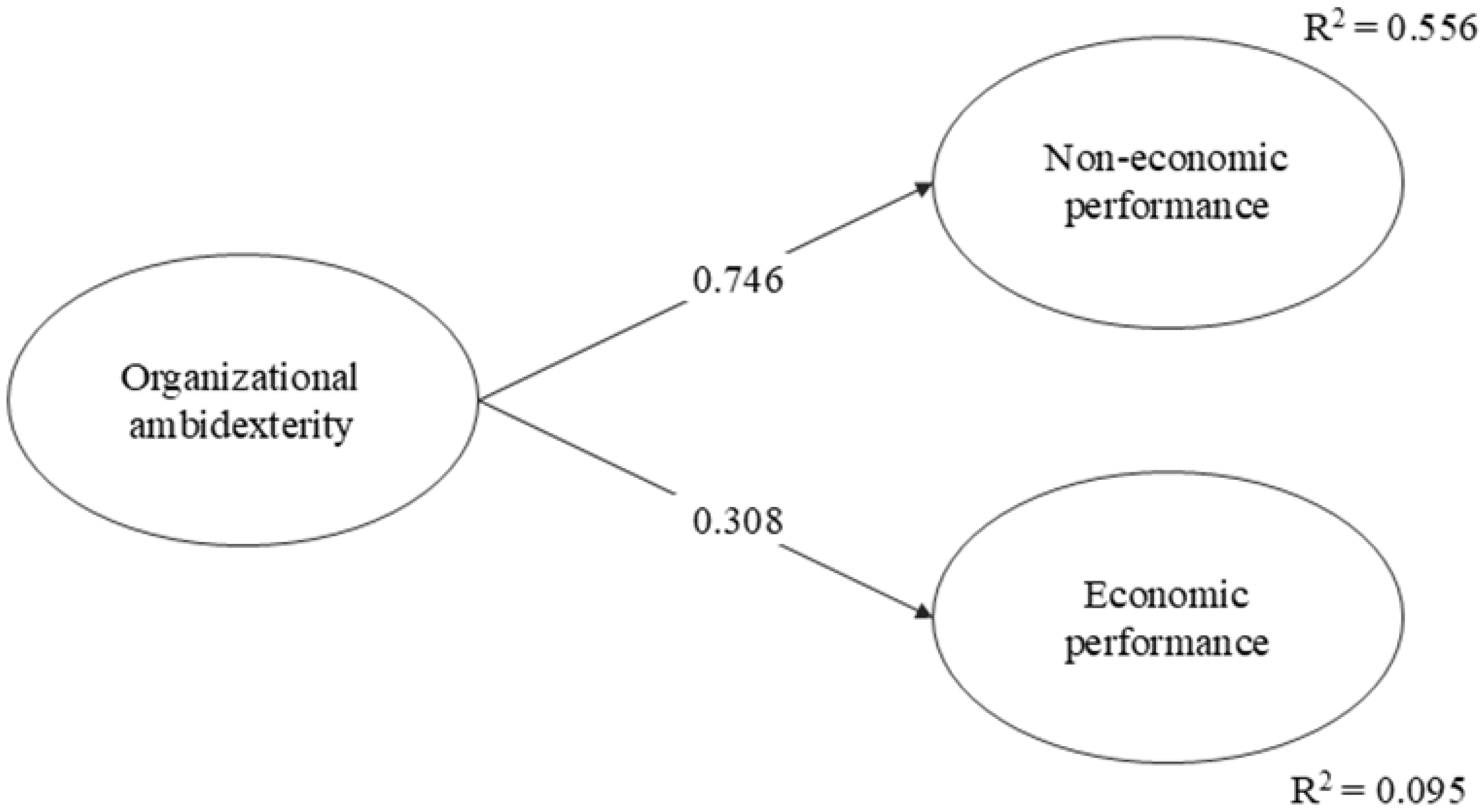
| H1: OA → NON | 0.746 | 17.843 | 0.000 *** | [0.662; 0.803] | 1.253 | 0.556 | 0.533 |
| H2: OA → ECO | 0.308 | 3.613 | 0.000 *** | [0.160; 0.429] | 0.105 | 0.095 | 0.067 |
| Non-Economic Performance | Economic Performance | |||
|---|---|---|---|---|
| Variable | Importance | Performance | Importance | Performance |
| Organizational ambidexterity | 0.746 | 74.902 | 0.308 | 74.902 |
| CER_1 | 0.146 | 78.922 | 0.060 | 78.922 |
| CER_2 | 0.154 | 85.049 | 0.063 | 85.049 |
| CER_3 | 0.140 | 71.324 | 0.058 | 71.324 |
| CER_6 | 0.132 | 62.745 | 0.054 | 62.745 |
| CET_1 | 0.160 | 73.203 | 0.066 | 73.203 |
| CET_6 | 0.181 | 71.814 | 0.075 | 71.814 |
Disclaimer/Publisher’s Note: The statements, opinions and data contained in all publications are solely those of the individual author(s) and contributor(s) and not of MDPI and/or the editor(s). MDPI and/or the editor(s) disclaim responsibility for any injury to people or property resulting from any ideas, methods, instructions or products referred to in the content. |
© 2026 by the authors. Licensee MDPI, Basel, Switzerland. This article is an open access article distributed under the terms and conditions of the Creative Commons Attribution (CC BY) license.
Share and Cite
Acosta-Prado, J.C.; Aburto-Camacllanqui, E.; Castellanos Narciso, J.E.; Mora Pabón, R. Examining the Relationship Between Organizational Ambidexterity and Firm Performance in New Technology-Based Firms. Systems 2026, 14, 309. https://doi.org/10.3390/systems14030309
Acosta-Prado JC, Aburto-Camacllanqui E, Castellanos Narciso JE, Mora Pabón R. Examining the Relationship Between Organizational Ambidexterity and Firm Performance in New Technology-Based Firms. Systems. 2026; 14(3):309. https://doi.org/10.3390/systems14030309
Chicago/Turabian StyleAcosta-Prado, Julio César, Elías Aburto-Camacllanqui, José Ever Castellanos Narciso, and Ricardo Mora Pabón. 2026. "Examining the Relationship Between Organizational Ambidexterity and Firm Performance in New Technology-Based Firms" Systems 14, no. 3: 309. https://doi.org/10.3390/systems14030309
APA StyleAcosta-Prado, J. C., Aburto-Camacllanqui, E., Castellanos Narciso, J. E., & Mora Pabón, R. (2026). Examining the Relationship Between Organizational Ambidexterity and Firm Performance in New Technology-Based Firms. Systems, 14(3), 309. https://doi.org/10.3390/systems14030309