How Platform Participants Drive Digital Innovation? A Configuration Analysis Based on the TOE Framework

Abstract
1. Introduction
2. Literature Review and Framework Construction
2.1. Literature Review
2.1.1. Enterprises Participating in Industrial Internet Platforms
2.1.2. Enterprise Digital Innovation
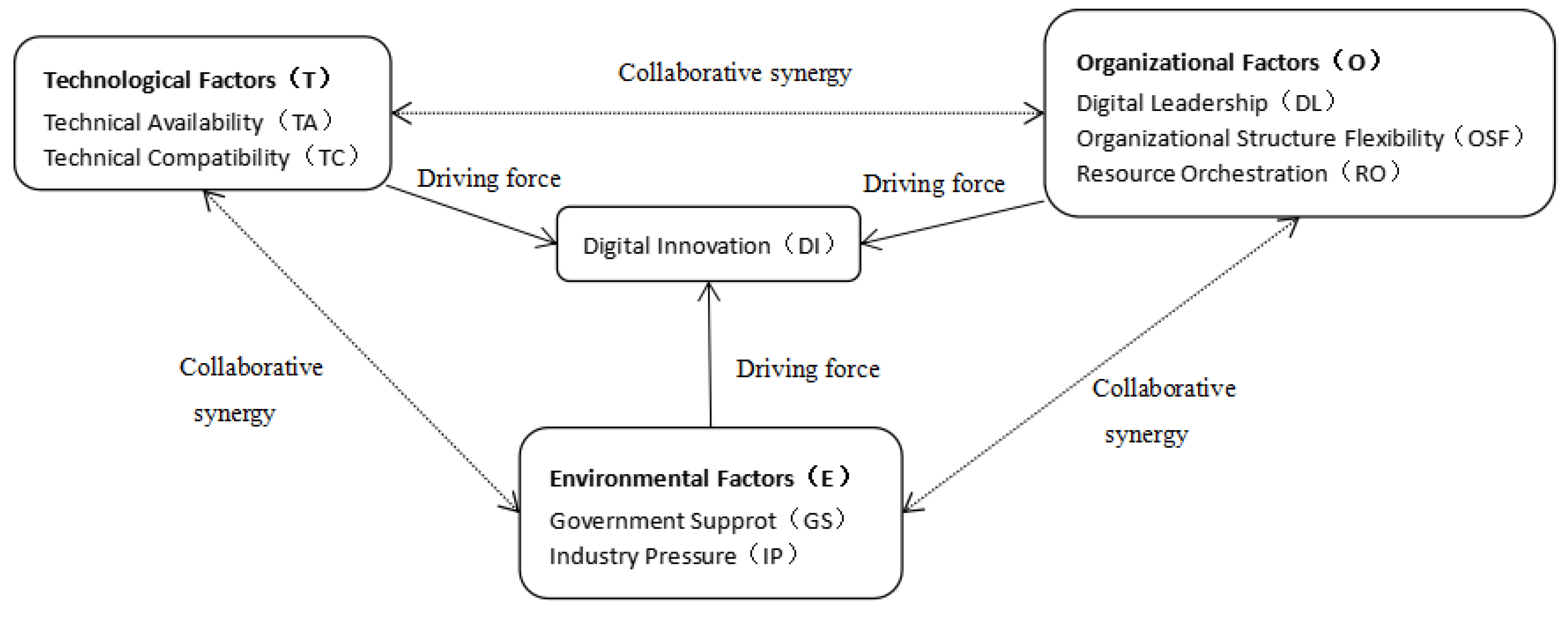
2.2. TOE Theoretical Analysis Framework
2.3. Influence of TOE Factors on Digital Innovation in Manufacturing Enterprises from the Perspective of Platform Participation
2.3.1. Technological Factors
2.3.2. Organizational Factors
2.3.3. Environmental Factors
3. Research Design
3.1. Research Methodology
3.2. Sample Data
3.3. Variable Measurement
3.4. Variable Calibration
4. Empirical Analysis
4.1. Necessity Analysis of Single Conditions
4.2. Sufficiency Analysis of Configuration Conditions
4.2.1. Analysis of High Digital Innovation Pathways
4.2.2. Analysis of Non-High Digital Innovation Pathways
4.3. Robustness Testing
5. Conclusions and Outlook
5.1. Research Findings
5.2. Research Contributions
5.3. Management Implications
5.4. Limitations and Outlook
Author Contributions
Funding
Institutional Review Board Statement
Informed Consent Statement
Data Availability Statement
Conflicts of Interest
References
- Liu, Y.; Dong, J.Y.; Wei, J. Digital Innovation Management: Theoretical Framework and Future Research. Manag. World 2020, 36, 198–217. [Google Scholar]
- Cao, X.; Ouyang, T.H.; Huang, J.M. Research on How Smart Connected Products Reshape Enterprise Boundaries: The Case of Xiaomi. Manag. World 2022, 38, 125–142. [Google Scholar]
- Yoo, Y.; Henfridsson, O.; Kallinikos, J.; Gregory, R.; Burtch, G.; Chatterjee, S.; Sarker, S. The Next Frontiers of Digital Innovation Research. Inf. Syst. Res. 2024, 35, 1507–1523. [Google Scholar] [CrossRef] [Scilit]
- Xu, H.; Yu, C.; Wang, Y.J. Research on the Mechanism of Platform Organization Value Creation from the Perspective of Modularity and Openness: The Case of Inspur and Neusoft. Sci. Sci. Manag. Sci. Technol. 2021, 42, 77–95. [Google Scholar]
- Zhang, X.; Liu, R.Z.; Wu, X.L.; Sun, R.C. Meta-Empowerment: Industrial Internet Platform Drives the Building of Business Model Innovation Capability in Enterprises. J. Manag. World 2024, 40, 26–45+83+46. [Google Scholar] [CrossRef]
- Nambisan, S.; Lyytinen, K.; Majchrzak, A.; Song, M. Digital Innovation Management: Reinventing Innovation Management Research in a Digital World. MIS Q. 2017, 41, 223–238. [Google Scholar] [CrossRef] [Scilit]
- Liu, Y.; Dong, J.Y.; Mei, L. Digital Innovation and Performance of Manufacturing Firms: An Affordance Perspective. Technovation 2023, 44, 102458. [Google Scholar] [CrossRef] [Scilit]
- Yoo, Y.; Henfridsson, O.; Lyytinen, K. The New Organizing Logic of Digital Innovation: An Agenda for Information Systems Research. Inf. Syst. Res. 2010, 21, 724–735. [Google Scholar] [CrossRef] [Scilit]
- Kohli, R.; Melville, N.P. Digital Innovation: A Review and Synthesis. Inf. Syst. J. 2019, 29, 200–223. [Google Scholar] [CrossRef] [Scilit]
- Wang, X.C.; Li, Y. CIO, CEO and Digital Innovation. Sci. Technol. Prog. Policy 2022, 39, 83–93. [Google Scholar]
- Wang, Y.R.; Duan, Y.T.; Zhuo, S.F. Effects of Industrial IoT on Enterprise Digital Innovation: A PSM-DID Approach. Sci. Technol. Prog. Policy 2022, 39, 89–98. [Google Scholar]
- Troilo, G.; De Luca, L.M.; Guenzi, P. Linking Data-Rich Environments with Service Innovation in Incumbent Firms: A Conceptual Framework and Research Propositions. J. Prod. Innov. Manag. 2017, 34, 617–639. [Google Scholar] [CrossRef] [Scilit]
- Zhang, M. How do Platform-dependent Enterprises Get Rid of Innovation Inertia? Configuration Research from the Perspective of Actor Network. Foreign Econ. Manag. 2023, 45, 101–117. [Google Scholar]
- Tian, H.M.; Li, H.L.; Zhou, W.H.; Zhang, L.P. Research on the Influence of Artificial Intelligence Application Degree on Enterprise Digital Technology Innovation. Contemp. Financ. Econ. 2025, 6, 85–98. [Google Scholar]
- Zhang, C.; Chen, K.H.; Mu, R.P. The Digital Innovation Ecosystems: Theory Building and a Research Agenda. Sci. Res. Manag. 2021, 42, 1–11. [Google Scholar]
- Beltagui, A.; Rosli, A.; Candi, M. Exaptation in a Digital Innovation Ecosystem: The Disruptive Impacts of 3D Printing. Res. Policy 2020, 49, 103833. [Google Scholar] [CrossRef] [Scilit]
- Gupta, R.; Mejia, C.; Kajikawa, Y. Business, Innovation and Digital Ecosystems Landscape Survey and Knowledge Cross Sharing. Technol. Forecast. Soc. Change 2019, 147, 100–109. [Google Scholar] [CrossRef] [Scilit]
- Antonopoulou, K.; Begkos, C. Strategizing for Digital Innovations: Value Propositions for Transcending Market Boundaries. Technol. Forecast. Soc. Change 2020, 156, 120042. [Google Scholar] [CrossRef] [Scilit]
- Tornatzky, L.G.; Fleischer, M.; Chakrabarti, A.K. The Processes of Technological Innovation; Lexington Books: Lanham, MD, USA, 1990. [Google Scholar]
- Tam, C.K.Y. Factors Affecting the Adoption of Open Systems: An Exploratory Study. MIS Q. 1997, 21, 1–24. [Google Scholar] [CrossRef] [Scilit]
- Wang, R.L.; Zheng, X.Q.; Sun, J.P. Technological Complexity and the Impact on Organizational Structure. Stud. Sci. Sci. 2001, 3, 29–33. [Google Scholar] [CrossRef]
- Walker, R.M. Internal and External Antecedents of Process Innovation: A Review and Extension. Public Manag. Rev. 2014, 16, 21–44. [Google Scholar] [CrossRef] [Scilit]
- Oliveira, T.; Martins, M.F. Literature Review of Information Technology Adoption Models at Firm Level. Electron. J. Inf. Syst. Eval. 2011, 1, 312–323. [Google Scholar]
- Awa, H.O.; Ojiabo, O.U. A Model of Adoption Determinants of ERP Within T-O-E Framework. Inf. Technol. People 2016, 29, 901–930. [Google Scholar] [CrossRef] [Scilit]
- Liu, Z.; Kuang, H.S.; Zuo, Y.H.; Zhang, Y. Research on the Impact of Smart Supply Chain Construction on the Digital Innovation of Enterprises. Sci. Res. Manag. 2025, 46, 100–111. [Google Scholar] [CrossRef]
- Cai, C.W.; Qi, Y.D. The Empowerment Path of Industry Internet to China’s Manufacturing Industry. Contemp. Econ. Manag. 2021, 43, 40–48. [Google Scholar]
- Helfat, C.E.; Raubitschek, R.S. Dynamic and Integrative Capabilities for Profiting From Innovation in Digital Platform-Based Ecosystems. Res. Policy 2018, 47, 1391–1399. [Google Scholar] [CrossRef] [Scilit]
- Lu, F.C.; Chen, H. Industrial Internet, Enterprise Growth and Enterprise Value Creation. Econ. Manag. J. 2023, 45, 5–24. [Google Scholar]
- Ma, Y.K.; Li, S.M.; Pan, J.M. Value Co-creation Model for Industrial IoT. Manag. World 2020, 36, 211–222. [Google Scholar]
- Leonardi, P.M. When Does Technology Use Enable Network Change in Organizations? A Comparative Study of Feature Use and Shared Affordances. MIS Q. 2013, 37, 749–775. [Google Scholar] [CrossRef] [Scilit]
- Majchrzak, A.; Markus, M.L. Technology Affordances and Constraints in Management Information Systems. In Encyclopedia of Management Theory; Sage Publications: Thousand Oaks, CA, USA, 2013. [Google Scholar]
- Huang, J.; Henfridsson, O.; Liu, M.J.; Newell, S. Growing on Steroids: Rapidly Scaling The User Base of Digital Ventures Through Digital Innovaton. MIS Q. 2017, 41, 301–314. [Google Scholar] [CrossRef] [Scilit]
- Liu, X.; Li, J.B. Technological Complementarity and Collaborative Innovation in the Artificial Intelligence Innovation Ecosystem. Sci. Technol. Prog. Policy 2025, 42, 14–26. [Google Scholar]
- Teece, D.J. Explicating Dynamic Capabilities: The Nature and Microfoundations of (Sustainable) Enterprise Performance. Strateg. Manag. J. 2007, 28, 1319–1350. [Google Scholar] [CrossRef] [Scilit]
- El Sawy, O.A.; Kræmmergaard, P.; Amsinck, H.; Vinther, A.L. How LEGO Built the Foundations and Enterprise Capabilities for Digital Leadership. Mis Q. Exec. 2016, 15, 141–166. [Google Scholar]
- Warner, K.S.R.; Wäge, M. Building Dynamic Capabilities for Digital Transformation: An Ongoing Process of Strategic Renewal. Long Range Plan. 2019, 52, 326–349. [Google Scholar] [CrossRef] [Scilit]
- Solberg, E.; Traavik, L.E.; Wong, S.I. Digital Mindsets: Recognizing and Leveraging Individual Beliefs for Digital Transformation. Calif. Manag. Rev. 2020, 62, 105–124. [Google Scholar] [CrossRef] [Scilit]
- Bharadwaj, A.; El Sawy, O.A.; Pavlou, P.A.; Venkatraman, N. Digital Business Strategy: Toward a Next Generation of Insights. MIS Q. 2013, 37, 471–482. [Google Scholar] [CrossRef] [Scilit]
- Sirmon, D.G.; Hitt, M.A.; Ireland, R.D.; Gilbert, B.A. Resource Orchestration to Create Competitive Advantage: Breadth, Depth, and Life Cycle Effects. J. Manag. 2011, 37, 1390–1412. [Google Scholar] [CrossRef] [Scilit]
- DiMaggio, P.J.; Powell, W.W. The Iron Cage Revisited: Institutional Isomorphism and Collective Rationality in Organizational Fields. Am. Sociol. Rev. 1983, 48, 147–160. [Google Scholar] [CrossRef] [Scilit]
- Kang, Z.Y.; Liu, X. Interaction Effect of Government Support and Market Competition on Corporate Innovation Performance. Res. Dev. Manag. 2020, 32, 66–77. [Google Scholar]
- Miller, D. Configurations of Strategy and Structure: Towards a Synthesis. Strateg. Manag. J. 2010, 7, 233–249. [Google Scholar] [CrossRef] [Scilit]
- Berg-Schlosser, D.; De Meur, G.; Rihoux, B.; Ragin, C.C. Qualitative Comparative Analysis (QCA) as an Approach. In Configurational Comparative Methods; Sage: Thousand Oaks, CA, USA, 2009. [Google Scholar] [CrossRef] [Scilit]
- Misangyi, V.F.; Greckhamer, T.; Furnari, S.; Fiss, P.C.; Crilly, D.; Aguilera, R. Embracing Causal Complexity: The Emergence of a Neo-configurational Perspective. J. Manag. 2017, 43, 255–282. [Google Scholar] [CrossRef] [Scilit]
- Chatterjee, S.; Moody, G.; Lowry, P.B. Information Technology and Organizational Innovation: Harmonious Information Technology Affordance and Courage-Based Actualization. J. Strateg. Inf. Syst. 2020, 29, 101596. [Google Scholar] [CrossRef] [Scilit]
- Cheng, C.; Miao, Z.F.; Yan, L.L.; Chen, F. Research on the relationship between digital technology affordance and digital innovation value of enterprises. Stud. Sci. Sci. 2022, 40, 915–926. [Google Scholar]
- Lin, T.C.; Huang, C.C. Understanding Knowledge Management System Usage Antecedents: An Integration of Social Cognitive Theory and Task Technology Fit. Inf. Manag. 2008, 45, 410–417. [Google Scholar] [CrossRef] [Scilit]
- Benitez, J.; Arenas, A.; Castillo, A.; Esteves, J. Impact of Digital Leadership Capability on Innovation Performance: The Role of Platform Digitization Capability. Inf. Manag. 2022, 59, 103590. [Google Scholar] [CrossRef] [Scilit]
- Li, Y.P.; Miao, L. The Structural Dimensions of Enterprise Digital Leadership And Its Impact A Study of Grounded Theory in the Chinese Context. Wuhan Univ. J. (Philos. Soc. Sci.) 2020, 73, 125–136. [Google Scholar]
- Bag, S.; Pretorius, J.H.C.; Gupta, S.; Dwivedi, Y.K. Role of Institutional Pressures and Resources in the Adoption of Big Data Analytics Powered Artificial Intelligence, Sustainable Manufacturing Practices and Circular Economy Capabilities. Technol. Forecast. Soc. Change 2021, 163, 120420. [Google Scholar] [CrossRef] [Scilit]
- Li, H.Y.; Atuahene-Gima, K. Product Innovation Strategy and the Performance of New Technology Ventures in China. Acad. Manag. J. 2001, 44, 1123–1134. [Google Scholar] [CrossRef] [Scilit]
- Delmas, M.; Toffel, M.W. Stakeholders and Environmental Management Practices: An Institutional Framework. Bus. Strategy Environ. 2004, 13, 209–222. [Google Scholar] [CrossRef] [Scilit]
- Henfridsson, O.; Nandhakumar, J.; Scarbrough, H.; Panourgias, N. Recombination in the open-ended value landscape of digital innovation. Inf. Organ. 2018, 28, 89–100. [Google Scholar] [CrossRef] [Scilit]
- Jansen, J.J.P.; Van Den Bosch, F.A.; Volberda, H.W. Exploratory Innovation, Exploitative Innovation, and Performance: Effects of Organizational Antecedents and Environmental Moderators. Manag. Sci. 2006, 52, 1661–1674. [Google Scholar] [CrossRef] [Scilit]
- Podsakoff, P.M.; MacKenzie, S.B.; Lee, J.-Y.; Podsakoff, N.P. Common method biases in behavioral research: A critical review of the literature and recommended remedies. J. Appl. Psychol. 2003, 88, 879–903. [Google Scholar] [CrossRef] [Scilit]
- Fiss, P.C. Building Better Causal Theories: A Fuzzy Set Approach to Typologies in Organization Research. Acad. Manag. J. 2011, 54, 393–420. [Google Scholar] [CrossRef] [Scilit]
- Ragin, C.C. Redesigning Social Inquiry: Fuzzy Sets and Beyond; University of Chicago Press: Chicago, IL, USA, 2008. [Google Scholar]
- Garcia-Castro, R.; Francoeur, C. When more is not better: Complementarities, costs and contingencies in stakeholder management. Strateg. Manag. J. 2014, 37, 406–424. [Google Scholar] [CrossRef] [Scilit]
- Ragin, C.C.; Rihoux, B. Qualitative Comparative Analysis (QCA):State of the Art and Prospects. Qual. Methods 2004, 2, 3–13. [Google Scholar]
- Schneider, C.Q.; Wagemann, C. Set-Theoretic Methods for the Social Sciences: A Guide to Qualitative Comparative Analysis; Cambridge University Press: Cambridge, UK, 2012. [Google Scholar]
- Du, Y.Z.; Ma, H.J. Research on Innovation and Entrepreneurship in the Context of Complexity: Based on the QCA Method. RD Manag. 2022, 34, 1–9. [Google Scholar]
- Du, Y.Z.; Jia, L.D. Configuration Perspective and Qualitative Comparative Analysis (QCA): A New Way of Management Research. Manag. World 2017, 6, 155–167. [Google Scholar]
- Mai, B.T.; Van Nguyen, P.; Vo, N.T.T.; Ahmed, Z.U.; Stokes, P. Government policy, IT infrastructure, business model innovation, digital transformation, and dynamic capability: Catalysts for firm performance enhancement. Dyn. Relatsh. Manag. J. 2024, 13, 17–36. [Google Scholar] [CrossRef] [Scilit]
- Ballerini, J.; Herhausen, D.; Ferraris, A. How commitment and platform adoption drive the e-commerce performance of SMEs: A mixed-method inquiry into e-commerce affordances. Int. J. Inf. Manag. 2023, 72, 102649. [Google Scholar] [CrossRef] [Scilit]
- Fan, Y.N.; Liu, Y.; Yun, L.X. Internal Mechanism of the Construction of Core Enterprise Digital Innovation Ecosystem: Based on the Perspective of Meaning Construction and Resource Arrangement. Sci. Technol. Manag. Res. 2024, 44, 128–138. [Google Scholar]
- Wang, Y.; Li, M.Q.; Jia, C.X.; Guo, J. How AI Applications Promote Corporate Ambidextrous Digital Innovation: A Perspective form Resource Orchestration Theory. Sci. Technol. Prog. Policy 2025, 42, 24–34. [Google Scholar]
- Iden, J.; Bygstad, B. The ‘How’ of Digital Transformation: Understanding the Micro-Processes of Digital Transformation Strategising and Internal Platformisation Coevolution. Inf. Syst. Front. 2025, 27, 2651–2676. [Google Scholar] [CrossRef] [Scilit]
- Chen, D.; Fu, M.; Wang, L. Study on the symbiosis evolution mechanism of the digital innovation ecosystem: Considering government regulation. Kybernetes 2025, 54, 3023–3039. [Google Scholar] [CrossRef] [Scilit]
- Schneider, C.Q.; Wagemann, C. Standards of Good Practice in Qualitative Comparative Analysis (QCA) and Fuzzy-Sets. Comp. Sociol. 2010, 9, 397–418. [Google Scholar] [CrossRef] [Scilit]
- Neumeyer, X.; Santos, S.C.; Liguori, E.; Walsh, S.T.; Mahto, R.V. The ever-evolving relationship between technology, innovation, and entrepreneurship: Current state and future research needs. Technol. Forecast. Soc. Change 2025, 215, 124059. [Google Scholar] [CrossRef] [Scilit]
- Jahanbakht, M.; Ahmadi, F. Empirical assessment of external enablers on new venture creation: The effect of technologies and non-technological change in Iran digital entrepreneurship. J. Entrep. Emerg. Econ. 2025, 17, 819–850. [Google Scholar] [CrossRef] [Scilit]


| Variable | Category | Quantity | Percentage (%) |
|---|---|---|---|
| Company Age | 5 years or less | 31 | 18.3 |
| 6–10 years | 38 | 22.5 | |
| 11–15 years | 58 | 34.3 | |
| 16 years and above | 42 | 24.9 | |
| Enterprise Nature | State-owned enterprise | 39 | 23.1 |
| Private enterprise | 92 | 54.4 | |
| Joint-stock enterprises | 19 | 11.3 | |
| Sino-foreign joint ventures | 11 | 6.5 | |
| Other | 8 | 4.7 | |
| Company Size | 30 or fewer employees | 3 | 1.8 |
| 30–300 employees | 47 | 27.8 | |
| 301–1000 employees | 62 | 36.7 | |
| 1001–2000 employees | 35 | 20.7 | |
| 2001 employees and above | 22 | 13.0 | |
| Industry Type | Transportation Equipment Manufacturing | 21 | 12.4 |
| Food and Beverage Manufacturing | 11 | 6.5 | |
| Textiles and Apparel Manufacturing | 28 | 16.6 | |
| Pharmaceutical Manufacturing | 12 | 5.7 | |
| Chemical Manufacturing | 8 | 7.1 | |
| Iron, Steel, Machinery, and Equipment Manufacturing | 35 | 20.7 | |
| Metal Products Industry | 16 | 9.5 | |
| Cement, Glass, Ceramics, and Other Non-metallic Mineral Products Manufacturing | 27 | 16.0 | |
| Other | 11 | 6.5 |
| Condition | Item | Factor Loadings | AVE | CR | CTTC | Cronbach’s α |
|---|---|---|---|---|---|---|
| Technical Availability (TA) | Enterprises can analyze business data from R&D design, production manufacturing, and other processes through the platform | 0.786 | 0.614 | 0.918 | 0.745 | 0.917 |
| Enterprises can access and reuse historical business data through the platform | 0.765 | 0.73 | ||||
| Enterprises can store, archive, retrieve, and share business data through the platform | 0.781 | 0.751 | ||||
| Enterprises can enhance the informatization level of customer relationship management through the platform. | 0.834 | 0.79 | ||||
| Enterprises can comprehensively promote digital design, production, and management through the platform | 0.806 | 0.761 | ||||
| Enterprises can achieve production process coordination and implement collaborative plans through the platform | 0.763 | 0.726 | ||||
| Enterprises can enable effective collaboration among organizational members through the platform | 0.749 | 0.713 | ||||
| Technical Compatibility (TC) | In corporate digital transformation, the technology provided by industrial internet platforms meets the needs of enterprises | 0.853 | 0.677 | 0.893 | 0.797 | 0.893 |
| Industrial internet platform systems can meet enterprise requirements | 0.829 | 0.757 | ||||
| For specific work tasks, enterprises can quickly locate required information | 0.814 | 0.753 | ||||
| Industrial internet platform systems are suitable for enterprises | 0.793 | 0.747 | ||||
| Digital Leadership (DL) | Enterprise leaders demonstrate strong strategic digital thinking capabilities | 0.76 | 0.61 | 0.886 | 0.704 | 0.886 |
| The ability of enterprise leaders to effectively respond to the technological development environment and technological policy environment is very strong | 0.761 | 0.714 | ||||
| Strong capability of enterprise leaders to develop digital talent | 0.779 | 0.714 | ||||
| Strong capability of corporate leaders to initiate and support digital organizational transformation | 0.791 | 0.741 | ||||
| Strong digital communication and social skills among corporate leaders | 0.811 | 0.75 | ||||
| Organizational Structure Flexibility (OSF) | Organizational systems and design encourage innovation autonomy | 0.81 | 0.627 | 0.91 | 0.764 | 0.909 |
| Has independent teams for innovation activities | 0.698 | 0.669 | ||||
| The organizational system can swiftly address issues and allocate resources in response to environmental changes | 0.757 | 0.725 | ||||
| Innovation incentive mechanisms have been established within the organization and R&D teams | 0.853 | 0.788 | ||||
| Communication channels for exchanging perspectives, decisions, and knowledge between senior management, departments, and R&D teams are open and clear | 0.833 | 0.786 | ||||
| The company encourages the development and application of new technologies | 0.791 | 0.757 | ||||
| Resource Orchestration (RO) | Enterprises can effectively obtain various resources from industrial internet platforms | 0.763 | 0.597 | 0.93 | 0.738 | 0.93 |
| Various resources gradually accumulated within the enterprise | 0.753 | 0.72 | ||||
| The enterprise can divest resources under its control | 0.768 | 0.734 | ||||
| Enterprises can gradually enhance their current capabilities | 0.771 | 0.738 | ||||
| Enterprises can enrich and expand their current capabilities | 0.813 | 0.779 | ||||
| Enterprises generate new capabilities to adapt to environmental competition | 0.753 | 0.723 | ||||
| Companies can optimize their market development capabilities | 0.817 | 0.784 | ||||
| Enterprises enhance capabilities through resource integration | 0.744 | 0.716 | ||||
| Enterprises can leverage the resource advantages of industrial internet platforms to optimize capabilities | 0.768 | 0.739 | ||||
| Government Support (GS) | Government and relevant departments can provide necessary information and technical support to this enterprise | 0.826 | 0.663 | 0.887 | 0.75 | 0.887 |
| The government and relevant departments have played a crucial role in providing funding to enterprises | 0.802 | 0.752 | ||||
| The government and relevant departments assist enterprises in obtaining various permits, such as for technology introduction | 0.808 | 0.741 | ||||
| Government and relevant departments rarely interfere in business operations | 0.821 | 0.77 | ||||
| Industry Pressure (IP) | Major competitors have adopted more advanced digital technologies | 0.777 | 0.644 | 0.878 | 0.693 | 0.875 |
| Competition requires enterprises to adopt more advanced digital technologies | 0.757 | 0.714 | ||||
| Without digital technology, it is difficult to maintain a competitive edge | 0.849 | 0.778 | ||||
| Feeling significant competitive pressure from rivals in digital technology capabilities | 0.824 | 0.763 | ||||
| Digital Innovation (DI) | We have enhanced corporate efficiency through our platform, including production efficiency, R&D efficiency, and communication efficiency | 0.766 | 0.627 | 0.938 | 0.75 | 0.938 |
| We have reduced corporate costs through our platform, including operational expenses across R&D, production, and sales | 0.815 | 0.784 | ||||
| We have reduced information asymmetry through our platform, including achieving system connectivity and data sharing by building a digital platform | 0.782 | 0.75 | ||||
| We have enabled novel design and knowledge creation through our platform | 0.812 | 0.784 | ||||
| We have developed intelligent new products and services through the platform | 0.799 | 0.767 | ||||
| We have expanded new application scenarios for smart products through the platform | 0.807 | 0.793 | ||||
| We have enabled data-driven enterprise development through our platform | 0.806 | 0.765 | ||||
| We have developed more competitive digital business models through our platform | 0.727 | 0.704 | ||||
| We have achieved co-creation of value with users, suppliers, and other stakeholders through our platform | 0.808 | 0.776 |
| Variable | TA | TC | DL | OSF | RO | GS | IP | TA |
|---|---|---|---|---|---|---|---|---|
| TA | 0.784 | |||||||
| TC | 0.516 | 0.823 | ||||||
| DL | 0.384 | 0.299 | 0.781 | |||||
| OSF | 0.406 | 0.361 | 0.369 | 0.792 | ||||
| RO | 0.326 | 0.266 | 0.27 | 0.33 | 0.772 | |||
| GS | 0.496 | 0.478 | 0.387 | 0.444 | 0.276 | 0.814 | ||
| IP | 0.489 | 0.515 | 0.31 | 0.506 | 0.412 | 0.408 | 0.802 | |
| DI | 0.635 | 0.585 | 0.516 | 0.574 | 0.455 | 0.588 | 0.606 | 0.792 |
| Fitting Model | Variable Combination | χ2/df | RMSEA | CFI | TLI | SRMR |
|---|---|---|---|---|---|---|
| Eight Factors | TA,TC,DL,FOS,RO,RS,IP,DI | 1.439 | 0.051 | 0.919 | 0.914 | 0.054 |
| Seven Factors | TA+TC,DL,FOS,RO,RS,IP,DI | 1.683 | 0.064 | 0.874 | 0.866 | 0.064 |
| Six Factors | TA+TC,DL+FOS,RO,RS,IP,DI | 2.007 | 0.077 | 0.813 | 0.802 | 0.082 |
| Five Factors | TA+TC,DL+FOS,RO+RS,IP,DI | 2.367 | 0.09 | 0.745 | 0.731 | 0.125 |
| Four Factors | TA+TC,DL+FOS+RO,RS+IP,DI | 2.808 | 0.104 | 0.661 | 0.644 | 0.127 |
| Three Factors | TA+TC+DL,FOS+RO+RS+IP,DI | 3.036 | 0.118 | 0.618 | 0.599 | 0.113 |
| Two Factors | TA+TC+DL+FOS,RO+RS+IP+DI | 3.333 | 0.118 | 0.561 | 0.541 | 0.113 |
| Single Factor | TA+TC+DL+FOS+RO+RS+IP+DI | 3.483 | 0.122 | 0.532 | 0.512 | 0.116 |
| Category | Name | Anchor | Descriptive Analysis | |||||
|---|---|---|---|---|---|---|---|---|
| Complete Subordination (90%) | Intersection (50%) | No Affiliation (10%) | Mean | Variance | Minimum | Maximum | ||
| Condition | TA | 4.74 | 3.86 | 2.14 | 3.605 | 0.998 | 1.143 | 5 |
| TC | 5 | 3.87 | 2 | 3.609 | 1.106 | 1.000 | 5 | |
| DL | 4.8 | 3.8 | 2 | 3.608 | 1.029 | 1.200 | 5 | |
| OSF | 4.83 | 3.83 | 2.13 | 3.629 | 1.056 | 1.333 | 5 | |
| RO | 4.89 | 3.89 | 2.11 | 3.652 | 0.975 | 1.222 | 5 | |
| GS | 4.75 | 3.75 | 1.75 | 3.485 | 1.176 | 1.250 | 5 | |
| IP | 4.75 | 3.75 | 2 | 3.578 | 1.05 | 1.500 | 5 | |
| Result | DI | 4.89 | 4 | 2.2 | 3.680 | 1.021 | 1.556 | 5 |
| Condition | High Digital Innovation | Non-High Digital Innovation | ||
|---|---|---|---|---|
| Consistency | Coverage | Consistency | Coverage | |
| TA | 0.795 | 0.769 | 0.435 | 0.436 |
| ~TA | 0.417 | 0.416 | 0.769 | 0.796 |
| TC | 0.780 | 0.737 | 0.491 | 0.482 |
| ~TC | 0.451 | 0.461 | 0.732 | 0.776 |
| DL | 0.764 | 0.726 | 0.478 | 0.471 |
| ~DL | 0.443 | 0.450 | 0.722 | 0.760 |
| OSF | 0.777 | 0.737 | 0.469 | 0.461 |
| ~OSF | 0.431 | 0.439 | 0.732 | 0.773 |
| RO | 0.738 | 0.725 | 0.471 | 0.480 |
| ~RO | 0.470 | 0.461 | 0.730 | 0.743 |
| GS | 0.775 | 0.742 | 0.473 | 0.470 |
| ~GS | 0.446 | 0.450 | 0.740 | 0.773 |
| IP | 0.797 | 0.748 | 0.473 | 0.460 |
| ~IP | 0.425 | 0.437 | 0.741 | 0.791 |
| Prerequisite Conditions | High Digital Innovation | ||||||
|---|---|---|---|---|---|---|---|
| H1a | H1b | H2a | H2b | H3a | H3b | ||
| Technical Availability (TA) | • | ||||||
| Technical Compatibility (TC) | |||||||
| Digital Leadership (ES) | • | • | |||||
| Organizational Structural Flexibility (OSF) | • | ||||||
| Resource Orchestration (RO) | |||||||
| Government Support (GS) | • | • | • | ||||
| Industry Pressure (IP) | • | • | |||||
| Original Coverage | • | ||||||
| Unique Coverage | 0.016 | 0.029 | 0.016 | 0.054 | 0.067 | 0.022 | |
| Consistency | 0.948 | 0.974 | 0.965 | 0.942 | 0.949 | 0.954 | |
| Coverage of Solution | 0.629 | ||||||
| Solution consistency | 0.915 | ||||||
| Prerequisite Conditions | Non-High Digital Innovation | ||||
|---|---|---|---|---|---|
| N1a | N1b | N2a | N2b | N3 | |
| Technology Available (TA) | |||||
| Technical Compatibility (TC) | |||||
| Digital Leadership (DL) | |||||
| Organizational Structural Flexibility (FOS) | |||||
| Resource Orchestration (RO) | • | ||||
| Government Support (PS) | |||||
| Industry Pressure (IP) | • | ||||
| Original Coverage | 0.405 | 0.399 | 0.413 | 0.182 | 0.352 |
| Unique Coverage | 0.016 | 0.030 | 0.048 | 0.030 | 0.027 |
| Consistency | 0.971 | 0.961 | 0.989 | 0.932 | 0.990 |
| Coverage of Solution | 0.562 | ||||
| Solution consistency | 0.943 | ||||
Disclaimer/Publisher’s Note: The statements, opinions and data contained in all publications are solely those of the individual author(s) and contributor(s) and not of MDPI and/or the editor(s). MDPI and/or the editor(s) disclaim responsibility for any injury to people or property resulting from any ideas, methods, instructions or products referred to in the content. |
© 2026 by the authors. Licensee MDPI, Basel, Switzerland. This article is an open access article distributed under the terms and conditions of the Creative Commons Attribution (CC BY) license.
Share and Cite
Liu, J.; Ren, K.; Lv, J.; Yang, J. How Platform Participants Drive Digital Innovation? A Configuration Analysis Based on the TOE Framework. Systems 2026, 14, 296. https://doi.org/10.3390/systems14030296
Liu J, Ren K, Lv J, Yang J. How Platform Participants Drive Digital Innovation? A Configuration Analysis Based on the TOE Framework. Systems. 2026; 14(3):296. https://doi.org/10.3390/systems14030296
Chicago/Turabian StyleLiu, Jun, Kang Ren, Jing Lv, and Jing Yang. 2026. "How Platform Participants Drive Digital Innovation? A Configuration Analysis Based on the TOE Framework" Systems 14, no. 3: 296. https://doi.org/10.3390/systems14030296
APA StyleLiu, J., Ren, K., Lv, J., & Yang, J. (2026). How Platform Participants Drive Digital Innovation? A Configuration Analysis Based on the TOE Framework. Systems, 14(3), 296. https://doi.org/10.3390/systems14030296