
Article

A Sustainable Workforce Scheduling System for County-Level Logistics Centers Under Uncertain Demand: Integrating Human-Centered Objectives and Change Management Perspectives

1
School of Transportation Engineering, East China Jiaotong University, Nanchang 330013, China
2
School of Transportation, Beijing Jiaotong University, Beijing 100044, China
3
Jiangxi Key Laboratory of Comprehensive Stereoscopic Traffic Information Perception and Fusion, East China Jiaotong University, Nanchang 330013, China
*
Author to whom correspondence should be addressed.
Systems 2026, 14(3), 295; https://doi.org/10.3390/systems14030295
Submission received: 30 January 2026 / Revised: 4 March 2026 / Accepted: 7 March 2026 / Published: 10 March 2026

Abstract

For logistics facilities at the county level, workforce scheduling is a basic operational concern. Although these facilities are developing rapidly, they still mostly rely on human and semi-automated work. Significant differences in employee productivity and skill levels, along with regular changes in demand, exacerbate this challenge. This study proposes a sustainability-oriented dual-objective optimization model to coordinate operational cost control with employee well-being enhancement. To address this issue, we designed an improved Genetic Algorithm that combines heuristic initialization with specialized repair operators, forming a systematic optimization framework. The effectiveness of the proposed system design and algorithm has been validated through real-world case studies. Experimental results demonstrate that this model not only achieves a balance between cost and employee satisfaction under uncertain demand conditions but also provides county-level logistics centers with sustainable scheduling solutions adaptable to business changes. Management recommendations based on the experimental results are proposed, such as implementing differentiated scheduling strategies, easing restrictions on maximum working hour variations, establishing a progressive optimization mechanism, and optimizing staffing and employee structure in accordance with corporate characteristics. This study provides scientific decision support for county-level logistics systems to achieve sustainable operations and human resource management transformation.

1. Introduction

With the advancement of national strategies like the Industrial Internet and Smart Manufacturing, the logistics industry, as a fundamental and pioneering sector of the economy, is entering a key period of opportunity to transform toward greater intelligence and a stronger human focus. Promoting new smart manufacturing models based on “human-machine collaboration” and “human-centered approaches” is specifically called for in the “14th Five-Year Plan for Smart Manufacturing Development.” It highlights that initiatives must concentrate on improving staff skills, protecting labor welfare, and bolstering organizational resilience in addition to utilizing technology empowerment [1]. This policy direction sets the path for management optimization in the logistics sector by reflecting the equal treatment of human development and technical advancement at the national level.
Meanwhile, the concept of Industry 5.0 has reinforced the importance of “human-centered” principles in operational management. Instead of treating automation as an ultimate goal, Industry 5.0 focuses on collaboration between humans and machines, the improvement in skills, and the well-being of employees. It makes use of technology to develop human capabilities, increase productivity, and provide a better working environment [2,3]. This strategy has made it imperative to transform “human-centered” concepts into workable and effective scheduling techniques. New developments in the study of logistics operations management are being driven by this demand.
The ambitious policy framework, however, stands in stark contrast to the actual situation on the ground. At the county level, relatively low labor costs coexist with the substantial investment needed for automated equipment. The great majority of county-level logistics centers continue to rely mostly on human processes with relatively little automation [4,5]. Against this backdrop, operational management must prioritize human elements. However, conventional and frequently extensive management approaches are posing serious problems. This is especially true for scheduling models that lack human-centered design and scientific integrity. These models result in unpredictable and high-intensity work schedules, which lower employee satisfaction and cause consistently high turnover rates [6,7,8]. In county-level logistics centers, the problem of personnel mobility is particularly acute. For example, the turnover rate for express delivery workers in Ningyang County is higher than 20%. Labor costs increase by an average of 12% each year as a result of frequent retraining brought on by this turnover [9]. An industry-wide pattern is revealed by supporting data. According to the Logistics Industry Human Capital Index, over 75% of employees put in more than five hours of overtime each week. The annual voluntary turnover rate for some entry-level positions might be as high as 40% [10]. Employee satisfaction and turnover are significantly correlated negatively, according to research [11]. High turnover has obvious business repercussions in the logistics industry. In addition to increasing the incidence of operational failures, it also raises recruitment and training costs. The industry’s already slim profit margins are further eroded by these combined consequences [12]. In contrast, after implementing an intelligent scheduling system, a national supermarket chain reduced the time spent on scheduling per employee from 4 h per week to just 15 min. Customer wait times during peak hours decreased by 40%, employee satisfaction increased by 32%, and monthly labor costs were cut by over 180,000 yuan [13]. This demonstrates the significant potential of scientific scheduling in optimizing workforce management.
County-level logistics centers are under intense pressure because to the fast expansion of business [14] and the slow pace of automation. These facilities have to deal with a variety of personnel arrangements and frequent order variations. Optimizing manual scheduling becomes crucial for improving operational efficiency and reducing labor expenses in this environment. Workforce scheduling studies have changed dramatically in the modern era. It now emphasizes a sophisticated decision-making process rather than static cost optimization. This new paradigm necessitates systematic balancing of different objectives and dynamic responses to uncertainty [15,16]. Using hierarchical modeling to manage complexity is the fundamental reasoning behind this strategy. Advanced techniques like resilient optimization and stochastic programming are used to deal with resource and demand uncertainty. At the same time, the range of optimization goals has expanded. Instead of focusing on cost control in isolation, it looks for Pareto improvements that also improve operational efficiency [17,18].
Nevertheless, prior research has not given significant consideration to the unique setting of county-level logistics centers. Numerous difficulties are introduced by the particular operational setting. These include skill gaps and training requirements brought on by high employee turnover [9,10], unpredictability brought on by tidal swings in order volume [19], and serious worries about cumulative exhaustion from physically demanding jobs. Therefore, a scheduling system that can do multi-objective optimization is obviously needed. Practical limitations like skill disparities, training timetables, and fatigue management procedures must also be incorporated into this structure.
The goal of this project is to create a dual-objective scheduling optimization model with a focus on county-level logistics centers. In order to represent operational realities at the county level, the model strikes a balance between “cost control” and “employee satisfaction”. Logistics centers would be able to more effectively allocate workers with varying degrees of efficiency and respond more flexibly to order volatility with the help of such a model. Moreover, the approach aims to raise workers’ skill levels and job satisfaction through the scientific design of work durations, shift rotations, and training mechanisms. This strategy maintains control over personnel expenses while supporting the dual objectives of enhancing organizational stability and operational resilience.
The following research questions are put forth in this study, which focuses on the labor scheduling optimization challenge in logistics warehousing centers:
  • How to implement refined human-centered management in scheduling?
  • How to formulate a scheduling plan that accurately responds to uncertain logistics demand?
  • How can tactical-level scheduling incorporate strategic training to create a synergy between development and operations?
In conclusion, this study tackles a key issue in county-level logistics center: the conflict between a heavy reliance on labor and quick company expansion. It focuses on the issue of worker scheduling at logistics facilities at the county level. The ultimate goal is to improve both the operational efficiency and the employee’s satisfaction of county-level logistics centers through a human-centered scheduling approach.
The structure of this paper is as follows: Section 2 reviews the literature on human-centered management concepts, workforce scheduling research, and uncertain planning methods; Section 3 discusses the description and uncertainty theory research on workforce scheduling issues in county-level logistics centers; Section 4 constructs a dual-objective optimization model aiming to minimize both Cost and employee comfort penalties; Section 5 designs improved Genetic Algorithm for solution; Section 6 analyzes the experimental results and conducts a sensitivity analysis, and provides management recommendations; finally, Section 7 summarizes the research findings and offers directional recommendations for future studies.

2. Literature Review

To address these research questions, the following literature review will systematically examine three interrelated streams: (1) the evolution of human-centered management in operations, (2) workforce scheduling models under uncertainty, and (3) the integration of employee well-being into optimization frameworks.

2.1. The Role of Human-Centered Management Philosophy in Corporate Operations

With the rise of Industry 5.0, the focus of manufacturing has shifted from technology-centric approaches to a human-centered value orientation. The three pillars of Industry 5.0 are resilience, sustainability, and human-centered design [20]. While human-centered management stresses putting human needs, values, and well-being at the heart of business decision-making, traditional management theories have mostly concentrated on efficiency and profit maximization. According to Nasir et al. (2025) [20], Industry 5.0’s human-centered ethos represents a significant departure from Industry 4.0’s technology-driven paradigm. Through technology empowerment rather than human replacement, this worldview seeks to foster synergistic progress between humans and robots. The significance of “humanistic culture” for long-term business performance was originally suggested by Black and La Venture (2015) [21], who emphasized that management should pay attention to the social, psychological, and physiological requirements of employees. The term “human-centered design” was first used in management discourse by Giacomin (2014) [22], who promoted an ethical, inclusive system that takes into account a variety of stakeholders, such as suppliers, customers, and employees. The “ethical business model,” put forth by Spiller (2000) [23], emphasizes that businesses should prioritize social responsibility, supply chain ethics, and employee wellbeing in addition to pursuing financial gains. According to Ghobakhloo et al. (2023) [24], technology interventions like virtualization and technical support can reduce employees’ physical workload and increase their involvement in decision-making. The use of AI in human resource management is seen by Black and van Esch (2020) [25] and Chen (2023) [26] as a crucial instrument for improving employee capabilities and satisfaction.

2.2. Workforce Scheduling Research

Workforce scheduling is a significant topic in operations research and management science, aiming to develop efficient, equitable, and constraint-compliant employee work schedules for organizations. Since the 21st century, with advances in computational power and the development of artificial intelligence, scheduling research has gradually shifted toward intelligent optimization and hybrid methods. Nasirian et al. (2024) [27] focus on strategic-level multi-skill human resource allocation, employing two-stage stochastic programming and logical Benders decomposition to address demand uncertainty, with an emphasis on resolving the long-term decision of “who to hire and what skills to train.” Cabrera et al. (2024) [28] delve into real-time scheduling and path planning at the operational level, introducing a novel “stop-and-go” operation mode. They employ precise solutions based on the branch-and-bound pricing cutting algorithm and pulse algorithm to simultaneously determine “team formation, task allocation, and vehicle-Apedestrian hybrid paths.” Hu et al. (2024) [29] focused on the dynamic scheduling problem for nucleic acid sampling personnel during the pandemic. They constructed a multi-objective robust optimization model and designed an improved NSGA-II-HC algorithm, specifically addressing demand uncertainty and multi-rescue-point coordination issues. Park and Ko (2022) [30] developed a linear programming model incorporating absenteeism rates to optimize labor costs in Korea’s construction industry under adjusted working hour policies and irregular employee absences. They evaluated the stability of scheduling schemes through simulation. Bocewicz et al. (2023) [31] investigated the job rotation scheduling problem for multi-skilled employees, employing a constrained programming approach to maximize robustness against employee absences while ensuring skill retention. Chen et al. (2022) [32] focused on matching employee skill proficiency with production cycle times for pulsed assembly lines, employing an improved Genetic Algorithm for optimization. Mystakidis et al. (2024) [33] addressed the complex issue of oncology nursing scheduling by employing integer programming to achieve equitable and efficient resource allocation.

2.3. Uncertain Programming Method and Applications

In the field of operations management and scheduling, demand uncertainty is one of the core challenges. To address this challenge, scholars have developed various modeling and optimization approaches. Stochastic programming was pioneered by Dantzig (1955) and others. Liu Baodeng proposed the theory of uncertainty, establishing an axiomatic mathematical system for handling uncertainty based on credibility rather than frequency. Regarding human resource scheduling challenges, existing research has proposed multiple approaches to address uncertainty. Wang et al. (2023) developed a two-stage stochastic programming and data-driven distribution robust optimization model to tackle the dual randomness of demand and service duration in home care services [34]. Gong et al. (2025) developed an efficient decomposition algorithm in their operating room scheduling study, simultaneously accounting for the randomness of surgery duration and emergency demand [35]. In retail workforce scheduling, Porto et al. (2025) constructed a two-stage stochastic model to integrate multiple labor flexibility strategies for explicitly handling demand fluctuations [36]. Bogataj et al. (2025) addressed the dual shortage of human resources and housing construction in long-term care services by employing fuzzy evaluation and target planning for dynamic resource allocation [37]. Regarding shift design under task-oriented requirements, Wu et al. (2023) proposed a probabilistic model with constraints and a corresponding heuristic solution algorithm [38].
Table 1 compares the differences between the existing literature and this paper. The existing literature on workforce scheduling has made significant progress in terms of modeling techniques, solution algorithms, and application domains. But current research in logistics scheduling rarely deeply integrates uncertain demand, human-centered objectives, employee heterogeneity. Meanwhile, existing scheduling models predominantly focus on sectors such as healthcare, aviation, and retail, lacking targeted exploration of the complex scenarios inherent in county-level logistics operations. Moreover, despite the widespread acceptance of the “people-centered” philosophy, it lacks a quantifiable operational framework. To this end, the study focuses on county-level logistics centers. By converting uncertain demand into a deterministic equivalent form using confidence levels and inverse uncertainty distributions, and by defining “employee comfort” as a quantifiable objective that can be co-optimized with cost. It fills a research gap in county-level logistics centers regarding complex scheduling and human-centered objective quantification methods. This gap motivates the development of a tailored scheduling model, which will be formally defined in the next section.

3. Problem Statement

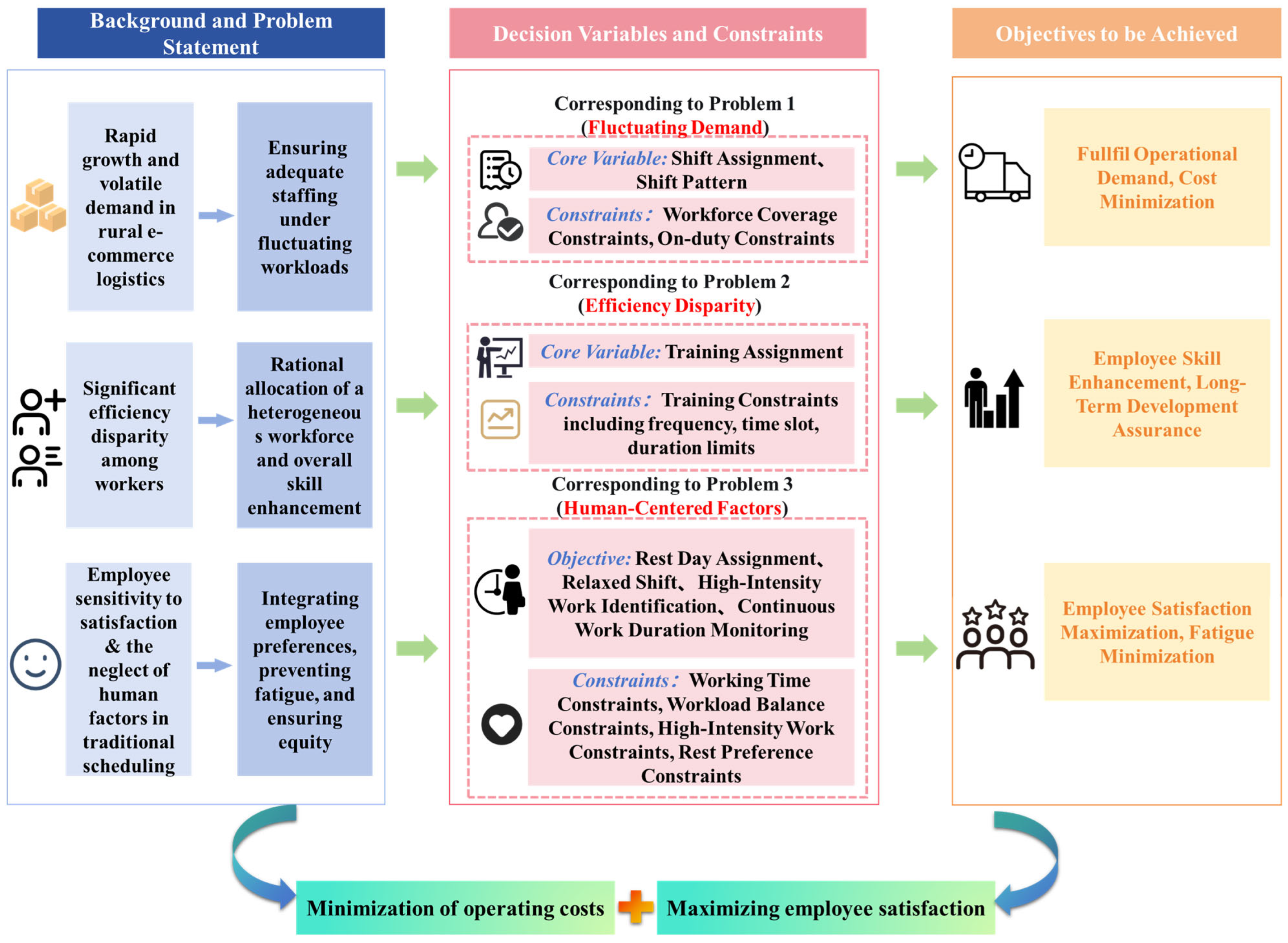
As order volumes rapidly grow within county-level logistics centers, a heavy reliance on manual labor has made workforce scheduling a core operational challenge. Order pickers and fork-lift workers, whose skill levels and productivity vary greatly, make up the diverse workforce employed by these facilities. Optimizing staff shift assignments across a weekly planning horizon is the main goal of this scheduling problem. There are several time periods in each day. The main difficulty is striking a balance between two competing goals: increasing employee satisfaction and reducing operating expenses. Daily variations in demand are one of the problem’s main features. Additionally, it requires the incorporation of human-centered considerations. These factors include training needs, personal preferences for relaxation, and making sure that employees’ workloads are distributed fairly. The research topic, the scheduling cycle, and the distribution of time slots are the main components of the issue. The following subsections will elaborate on each level in detail according to the structure shown in Figure 1.

3.1. Research Subject

This subsection elaborates on the “Decision Variables and Constraints” layer in Figure 1. In this section, we primarily outline the class schedules and training arrangements; other constraints will be formally defined in Section 4.
Order Pickers. During the receiving process, order pickers deal with loose items. Based on their efficiency, these workers are divided into two different subsets: high-efficiency pickers and low-efficiency pickers. Superior productivity is exhibited by pickers with high efficiency. As a result, they are usually given shifts during times of high demand. To avoid undue weariness, their shifts must be carefully planned. Low-efficiency pickers have lower productivity and require regular skill-enhancement training during off-peak hours. Training is mandatory and must not conflict with work shifts.
Forklift Operators. Forklift operators are responsible for handling full pallet shipments during the receiving process. It is assumed they possess uniform efficiency, meaning all are highly efficient. Forklift operators do not participate in training.

3.2. Shift Scheduling Cycle and Time Slot Allocation

This section corresponds to the time-related elements and core constraints within the “Background and Problem Statement” layer of Figure 1.
The scheduling plan is formulated on a weekly basis. The daily work schedule is divided into six consecutive shifts, each lasting two hours, covering the period from 8:00 a.m. to 8:00 p.m. The period from 4:00 p.m. to 6:00 p.m. is designated as the peak hours. The receiving window is divided into morning and afternoon sessions. The morning receiving window opens at 8:00 a.m. All loose items and palletized shipments received during this period must be processed by 2:00 p.m. Therefore, sufficient staff must be allocated throughout the morning and lunch periods to handle the total volume of morning deliveries. Afternoon window restocking hours are from 2:00 p.m. to 8:00 p.m. Tasks generated during this period must be completed by 8:00 p.m. the same day. Afternoon demand fluctuates across three time periods, with peak demand occurring during the highest demand period. Low-efficiency employees required to attend each training session must complete exactly Umin sessions per week, and training periods must not overlap with work shifts. Training periods are scheduled during predefined off-peak hours.
The model seeks to minimize a weighted total of normalized costs and comfort penalties, as shown in the “Objectives to Achieve” layer in Figure 1. Both base salaries and hourly pay are included in the model’s cost component. Employee satisfaction encompasses multiple dimensions. To quantify the impact of scheduling decisions on employee well-being, this paper defines the “Comfort Penalty” metric as an inverse measure of employee satisfaction. This penalty takes into consideration a number of criteria, including inconsistent shift assignments, deviations from desired rest intervals, and violations of continuous work hour restrictions. Therefore, minimizing the comfort penalty contributes to enhancing overall employee satisfaction with work schedules.
To sum up, this study tackles a dual-objective, multi-constraint optimization issue. An improved Genetic Algorithm is employed to locate solutions. This strategy seeks to achieve a balance between operational effectiveness and human-centered management principles. The ultimate objective is to encourage sustainable growth at logistics centers at the county level.

4. Model Construction

4.1. Model Assumptions

To construct the mathematical model, the following core assumptions are proposed:
  • Assumption 1. Forklift operations and picking are separate jobs. Operational efficiency is a known constant that is unaffected by working hours, tiredness levels, or learning effects, and each employee is given a single job type every shift. While forklift operators maintain constant efficiency, pickers are classified as high-efficiency or low-efficiency based on performance.
  • Assumption 2. The scheduling cycle is one week. Daily working hours are divided into equal-length periods. Employee status is categorized only as “working” or “non-working,” disregarding task interruptions or pauses within periods. Daily periods and their attributes (e.g., peak vs. off-peak periods) are predefined and fixed.
  • Assumption 3. Training targets only low-performing pickers to enhance their operational skills, scheduled during predefined off-peak periods. Employees do not participate in actual tasks during training, and the number of training sessions must meet minimum requirements.
  • Assumption 4. Each employee’s preference for vacation days varies individually and remains relatively stable throughout the scheduling cycle.
  • Assumption 5. Supporting resources such as equipment, facilities, and information systems are sufficiently available and do not constitute bottlenecks for workforce scheduling.

4.2. Symbols and Parameters

The symbol system used in the model is shown in Table 2.

4.3. Model Objectives and Constraints

4.3.1. Objective Function Analysis

The model pursues two mutually balancing objectives.
(1) Objective 1: Minimize Total Operating Costs
The total cost consists of a fixed weekly base salary and variable pay based on actual hours worked, as can be seen in Function (1).
Cost = e E B e + e E t T d D c e · Δ · x e , t , d
(2) Objective 2: Minimize Total Comfort Penalty
Comfort penalty quantifies the negative impact of scheduling on employees’ work experience, including:
Continuous Work Penalty (Pcont): Penalizes exceeding the daily continuous work duration threshold.
Penalty for Schedule Changes (Pshift): Penalizes frequent changes in work patterns between adjacent workdays.
Rest Preference Penalty (Ppref): Penalizes failure to accommodate employees’ preferences for rest on specific dates.
This can be seen in Function (2).
Comfort   penalty = P cont + P shift + P pref
Among these, P cont = e E d D max ( 0 , longest   cont e , d L cont ) , P shift = e E d = 1 6 s S | x e , t , d x e , t , d 1 | , P pref = e E d D pref e , d · ( 1 y e , d ) .
(3) Comprehensive Objective Function
The weighted sum method is employed, normalized using the theoretical maximum values C max and P max to eliminate dimensional effects and enable managers to express differing preferences for cost and comfort through the weights α and β , as can be seen in Function (3).
M i n i m i z e Z = min α · Cost C max + β · Comfort   penalty P max

4.3.2. Model Constraints

(1) Human Resource Coverage Constraints
Morning Shift Staffing Coverage. For each date d, the total processing capacity of all employees during the morning shift (8:00 a.m. to 12:00 p.m.) must be sufficient to handle at least the total number of items received during the morning delivery. Where Pe denotes the number of items processed per hour by picker e, fe denotes the number of tasks completed per hour by forklift operator, Ipick1 represents the total number of loose goods received in the morning, Itank2 represents the total number of full pallets received in the morning, Δ denotes the time period length, and xe,t,d indicates whether the employee is working, as can be seen in Functions (4) and (5).
e E p p e · t T window 1 Δ · x e , t , d I pick 1 d D
e E f f e · t T window 1 Δ · x e , t , d I tank 1 d D
Afternoon Shift Staffing Coverage. For each date d and each time slot t between 2:00 p.m. and 8:00 p.m., the total processing capacity of all pickers must at least meet the picking demand Ipick2t for that time slot. Afternoon demand distribution corresponds to three time periods. Constraints ensure that goods are processed promptly during each afternoon period, as can be seen in Functions (6) and (7).
e E p p e · Δ · x e , t , d I pick 2 t d D ,   T T window 2
e E f f e · Δ · x e , t , d I tank 2 t d D ,   T T window 2
(2) On-the-job Constraints
For each time slot t and date d, at least one picker is on duty. This constraint prevents unattended time slots, as can be seen in Functions (8) and (9).
e E p x e , t , d 1
e E f x e , t , d 1
(3) Training Constraints
Weekly Training Requirements. Each inefficient picker must receive exactly Umin training sessions per week. Training is conducted only during off-peak hours Ttrain, and these sessions cannot overlap with their working shifts. The constraint ensures the required number of training sessions is met, as can be seen in Function (10).
d D t T train u e , t , d = U min e E p l
Work during Training Periods. Employees cannot work during training periods. That is, xe,t,d = 0. Restrictions ensure employees do not participate in work during training, thereby avoiding conflicts, as can be seen in Function (11).
x e , t , d = 0 e E p l E f l , t T train , d D
Training Duration Restrictions. Each employee may receive training no more than once per day, meaning a maximum of one training session. This restriction prevents training from becoming overly concentrated and interfering with work, as can be seen in Function (12).
t T u e , t , d 1 e E p l E f l , d D
(4) Time Constraints
Daily Working Hours Limit. The total working hours for employees on date d must not exceed the maximum daily working hours Lmax, as can be seen in Function (13).
t T x e , t , d L max · ( 1 y e , d ) e E , d D
Weekly Rest Requirements. ye,d indicates whether an employee is on rest. M is a sufficiently large constant to ensure that when ye,d = 1, the working hours must be 0. Each employee must have at least Rmin days of rest per week. This constraint safeguards employees’ basic rest rights, as can be seen in Functions (14) and (15).
t T x e , t , d M · ( 1 y e , d ) e E , d D
d D y e , d R min e E
Continuous Operation Limit. Employees shall not work continuously for more than Lcont hours during their work period. This constraint prevents excessive continuous work hours and reduces fatigue, as can be seen in Function (16).
k = t t + L cont / 2 x e , k , d L cont e E , t T , d D
Minimum Working Hours Requirement. Each employee’s total weekly working hours must be at least Lmin hours. This constraint ensures employees have sufficient workload, as can be seen in Function (17).
t T d D Δ · x e , t , d L min e E
(5) Equilibrium Constraints
Weekly Total Engineering Time Variance. Calculate the weekly total working hours We for each employee, where the difference between the longest and shortest working hours must not exceed δ hours. This constraint ensures a fair distribution of workload, as can be seen in Function (18).
W e = d D t T 2 · x e , t , d , W max W min δ e E
Fairness in Work Assignments. Each employee’s work times may not exceed Hmax times during peak hours (4:00 p.m. to 6:00 p.m.) within a week. This constraint prevents certain employees from being overburdened with high-intensity work, as can be seen in Function (19).
H e = d D t T peak x e , t , d ,   H e H max e E
(6) High-intensity work constraints
Definition of High-Intensity Work. Define whether an employee performed high-intensity work on date d. If an employee works during peak hours, or works for more than 4 consecutive hours, or works for more than 8 h in total, then HighIntensitye,d is 1. Restrictions help identify high-intensity workdays for scheduling lighter shifts afterward. A value of 4 indicates the maximum continuous operating time Lcont = 4 h; 8 indicates the maximum total daily operating time Lmax = 8 h; M is a large constant, as can be seen in Function (20).
HighIntensity e , d = min 1 , t T pack x e , t , d + max 0 , longest c ont e , d 4 M + max 0 , t T x e , t , d · Δ 8 M e E , d D
Definition of Easy Schedule. Define whether an employee is scheduled for an easy shift on date d. If an employee does not work during peak hours and their continuous working time does not exceed 4 h, then Relaxe,d is 1. A value of 4 indicates the maximum continuous operating time limit Lcont = 4 h; 6 indicates the maximum operating time for light duty shifts 6 h; M is a large constant, as can be seen in Function (21).
Relax e , d = min 1 , max 0 , 1 t T p e a k x e , t , d max 0 , longest c ont e , d 4 M max 0 , t T x e , t , d · Δ 6 M e E , d D

4.4. Model Conversion

This section employs the uncertainty theory proposed by Liu [39] for model transformation; the relevant theoretical knowledge and proofs are summarized in Appendix B.

4.4.1. Modeling Uncertain Requirements

(1) Demand Uncertainty Indicates
In this study, we treat order picking and forklift operations during each daily time period as mutually independent linear uncertain variables, as can be seen in Formula (22).
ξ t pick ~ L ( d t low , d t high ) , ξ t fork ~ L ( d t low , d t high )
where d t low = d t base   ×   ( 1     δ ) ,   d t high = d t base   ×   ( 1   +   δ ) , with d t base representing the base demand for the period and δ denoting the demand volatility.
(2) Parameter Determination and Confidence Level
Based on historical data or experience, we determine the baseline demand for each time period. We set the confidence level τ = 0.9 to ensure that the scheduling plan meets demand in 90% cases.
By applying inverse uncertainty distribution, uncertain demand can be converted into a definite value, as shown in Formula (23).
d t deterministic = Φ t 1 ( τ ) = ( 1 τ ) · d t low + τ · d t high

4.4.2. Uncertain Planning Model Construction

Workforce scheduling problems are fundamentally dual-objective optimization problems requiring a balance between two conflicting goals. To simplify the solution, we employ the weighted sum method to transform the dual objectives into a single objective. By setting weight coefficients α ,   β   >   0 such that α   +   β   =   1 , the composite objective function is expressed as shown in Formula (24).
min α · Cost ( x , ξ deterministic ) + β · Comfort   penalty ( x )
In an uncertain environment, economic costs are directly related to workforce working hours, while labor demand is influenced by the uncertain demand ξ . The economic cost function is shown in Formula (25).
Cost ( x , ξ deterministic ) = e E B e + e E t T d D C e · Δ · x e , t , d
To ensure that demand is satisfied at confidence level αk, an opportunity constraint is introduced, as shown in Formula (26).
M e E p p e · Δ · x e , t , d ξ t pick τ ,   M e E f f e · Δ · x e , t , d ξ t fork τ ,   t T ,   d D
At the same time, workforce coverage constraints must also be considered, as shown in Formula (27).
M e E p x e , t , d 1 τ ,   M e E f x e , t , d 1 τ ,   t T ,   d D
In summary, the uncertain scheduling model can be expressed as Formula (28).
{ min λ 1 · Cost ( x , ξ deterministic   ) + λ 2 ·   Comfort penalty   ( x ) s . t .   M { e E p p e · Δ · x e , t , d ξ t } τ , t T , d D M { e E f f e · Δ · x e , t , d ξ t } τ , t T , d D M { e E p x e , t , d 1 } τ , t T , d D M { e E f x e , t , d 1 } τ , t T , d D M { g k ( x , ξ ) 0 } α k , k = 1 , , m x X
Among these, g k represents other resources and institutional constraints, α k denotes the confidence level for each constraint, and X denotes the feasible region for decision variables.
According to Liu’s uncertainty theory [39], if the objective function and constraint functions are monotonic with respect to the uncertain variables and the uncertain variables are mutually independent, the aforementioned uncertain programming model can be equivalently transformed into a deterministic programming model.
In our workforce scheduling context, we argue that the primary constraints (e.g., Formulas (12)–(15)) satisfy the monotonicity condition. Specifically, as the uncertain demand I ˜ pick 1 increases, the required total processing capacity e E p P e · Δ · x e , t , d must be non-decreasing to maintain feasibility. This implies that the constraint function is monotone increasing with respect to the demand variable. Similarly, the cost objective function (Formula (9)) is linear and additive, thus monotonic in the number of working hours, which is indirectly determined by demand.
Based on this logical verification of monotonicity, and assuming mutual independence of demand variables across different periods, the uncertain model can be transformed into its deterministic equivalent. The transformed deterministic model is shown in Formula (29).
{ min x λ 1 C econ   ( x , ξ deterministic ) + λ 2 C comfort   ( x )   s . t .   e E p p e · Δ · x e , t , d Φ t 1 ( τ ) , t T , d D e E f f e · Δ · x e , t , d Φ t 1 ( τ ) , t T , d D e E p x e , t , d 1 , t T , d D e E f x e , t , d 1 , t T , d D g k ( x ) 0 , k = 1 , , m x X
where ξ deterministic = ( Φ 1 1 ( τ ) ,   Φ 2 1 ( τ ) , ,   Φ n 1 ( τ ) ) is the deterministic demand vector for each time period, and g k ( x )     0 represents the other constraints converted to deterministic form.
Given the NP-hard nature of this problem and the complexity of its constraints, an exact solution method is impractical. Therefore, an improved Genetic Algorithm is developed in the next section to efficiently solve the model.

5. Algorithm Design

5.1. Algorithm Framework

Workforce scheduling at county-level logistics centers is a classic combinatorial optimization problem, characterized by large scale, multiple constraints. The solution space expands exponentially with increases in staff count, scheduling cycle length, and time slot granularity. This growth, coupled with diverse and complex human resource and operational constraints, renders the problem NP-hard. Traditional exact solution methods often prove impractical for such large-scale real-world problems due to prohibitive computational time.
Genetic Algorithms, meta-heuristics inspired by natural selection and genetics, are widely applied to problems like workforce scheduling and job dispatching. These techniques provide a number of desirable benefits. They show great global search capabilities and minimal reliance on problem-specific structures. Additionally, they are ideally suited for parallel processing and can readily handle complicated restrictions. When investigating discrete, high-dimensional solution spaces, the population-based evolutionary technique works very well. Furthermore, it naturally integrates a variety of goals and limitations through the fitness function’s design.
In order to solve the developed dual-objective scheduling model, this research suggests an improved genetic method. The creation of effective heuristic initialization processes and specialist repair operators are important advancements. Both elements are adapted to the particular limitations of the issue, speeding up convergence while preserving the viability and quality of the solution.
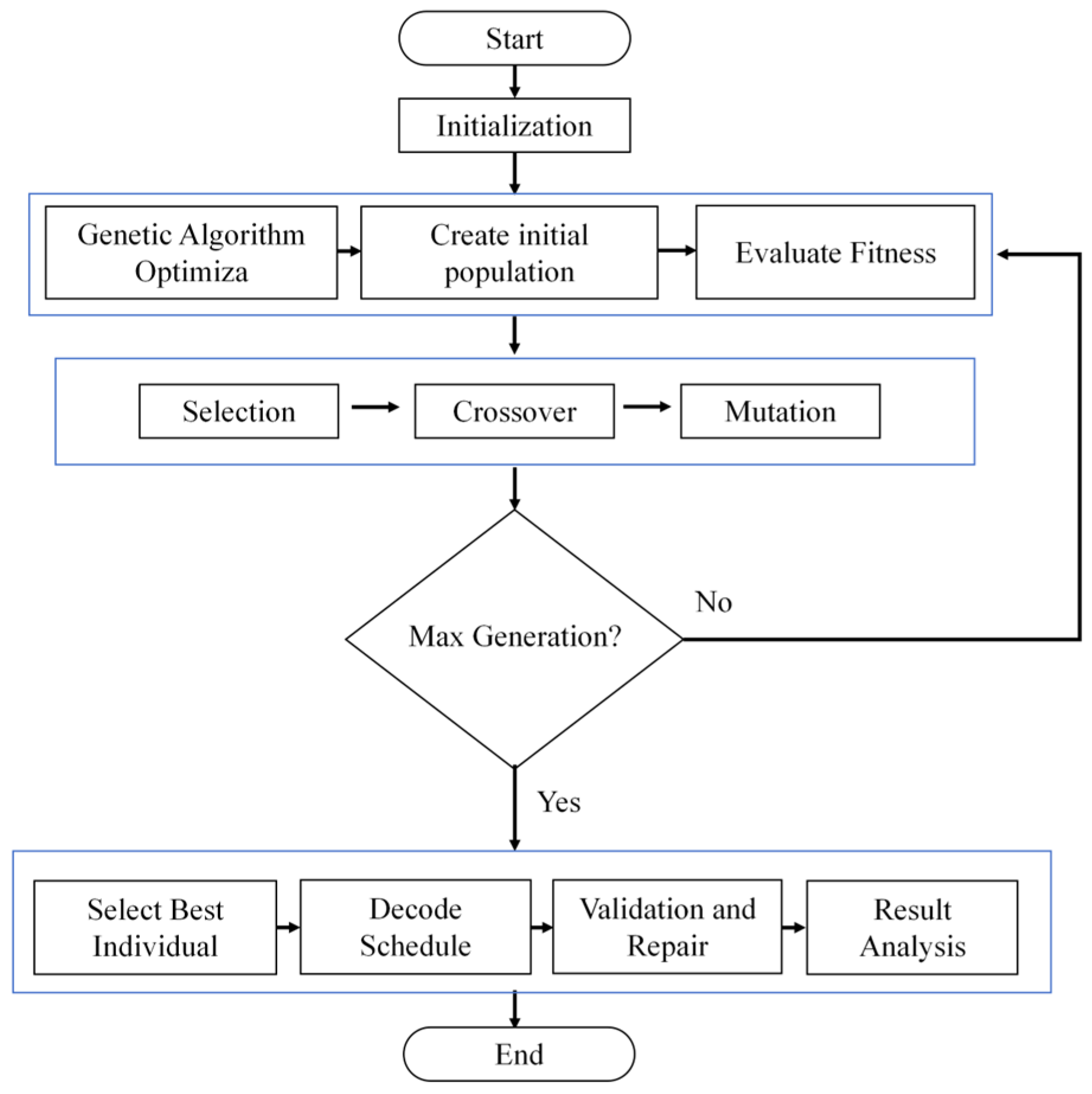
The general method adheres to a Genetic Algorithm’s typical evolutionary architecture. Nevertheless, important improvements have been made to the evolutionary procedures, constraint-handling systems, and startup phase. These adjustments deal with the particular difficulties that this scheduling issue presents. The primary algorithm flow is shown in Figure 2; more information is given below. For the pseudo-code of the Genetic Algorithm, see Table A1 in Appendix A.
First, a somewhat large starting population is created using a heuristic approach. This significantly speeds up the search by injecting high-quality genetic material. A fitness function with dynamic penalty terms is used to assess each generation’s individual fitness. Superior parent persons are then chosen through a tournament selection process. To encourage comprehensive exploration of the solution space, then execute bitwise mutation with a lower probability and two-point crossover operations with a greater likelihood. After each genetic surgery, a number of targeted repair activities are immediately triggered, which is the main improvement. By quickly resolving any constraint violations, these remedies guarantee children’s survival. The algorithm uses an appropriately large maximum number of generations and has an elite retention strategy. The final schedule is determined by selecting the best solution found across five different runs, which increases the stability and robustness of the result.

5.2. Encoding and Initialization

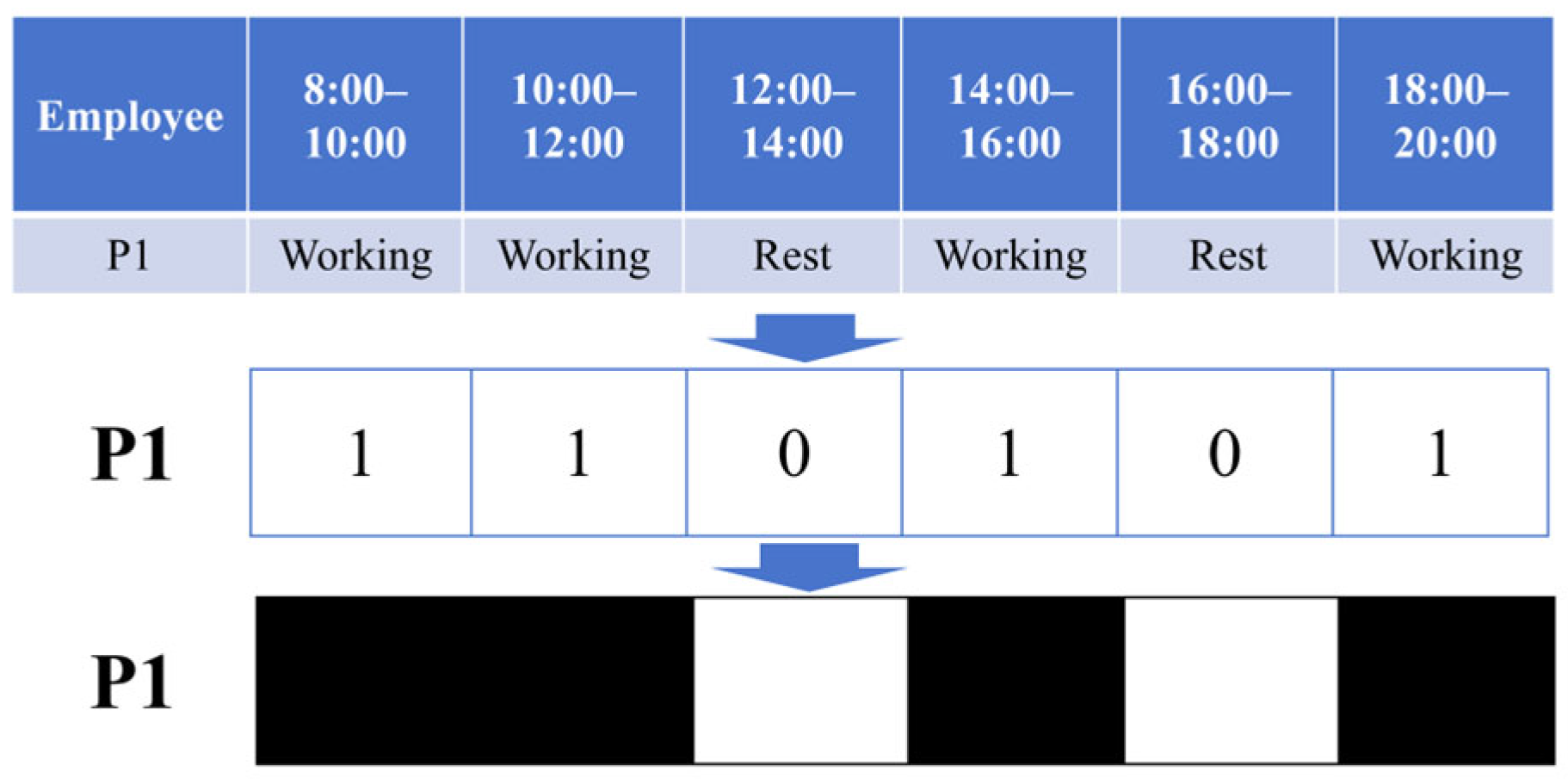
The encoding method used is binary, as shown in Figure 3. Each chromosome encodes a complete weekly shift schedule. The chromosome length is |E|·|D|·|T|. Each gene position, denoted as gene(e,d,t), corresponds to a binary decision variable x{e,t,d}. A value of 1 indicates that employee e works during time slot t on date d, while 0 indicates they do not work. Training arrangements for inefficient pickers are recorded in a separate list, ‘employee_training_slots’, and are not directly encoded in the chromosome. ‘employee_training_slots’ is a dictionary where keys represent inefficient picker IDs and values are the set of training slots scheduled for that employee within a week. Each slot is uniquely identified by its date and time index. Nonetheless, these training sessions are synchronized during decoding and repair.
To improve initial population quality and avoid the many infeasible solutions typical of purely random initialization, a heuristic procedure generates each initial individual. First, based on operational needs, prioritize assigning highly efficient employees to ensure that baseline staffing requirements are met during all shifts. Meanwhile, pre-randomly schedule a specified number of training sessions for inefficient pickers and lock their corresponding gene positions on the chromosome. Finally, a lightweight repair function corrects obvious constraint violations in the generated schedule. This strategy yields an initial population balancing diversity and feasibility, providing a solid foundation for subsequent evolution. Pseudo-code for Algorithm Initialization See Appendix A, Table A2.

5.3. Fitness Function

The fitness value of an individual directly corresponds to the value of the objective function Z. Since Genetic Algorithms typically handle minimization problems, a smaller fitness value indicates a better individual.
Constraint handling employs a strategy combining the dynamic penalty function method with a feasible solution priority rule. The fitness calculation can be seen as formulation (30).
Fitness = Z + λ · i w i · V i
Here, Vi represents the degree of violation for constraint class i, wi denotes the penalty weight for that constraint class, and λ is a coefficient that dynamically increases with the evolutionary generation number to impose stricter penalties on infeasible solutions during later evolutionary stages.

5.4. Genetic Manipulation and Repair Mechanisms

The algorithm’s genetic operators are selection, crossover, and mutation. In each selection event, k individuals are randomly chosen from the population. The fittest among these enters the mating pool. The crossover operator applies two-point crossover. Two crossover points are randomly selected. The gene segments between these points are then exchanged between two parents to produce two offspring. For mutation, a custom bitwise mutation scheme is used. This scheme flips a randomly chosen gene with a given probability. To minimize disruption, the repair process is initiated immediately after mutation.
After crossover and mutation, offspring may occasionally violate certain constraints. Repair functions are used to promptly correct these issues. This helps ensure that every solution remains valid. These functions run in sequence and may repeat as needed until all requirements are satisfied. The specific steps include the following.
(1) Training Constraint Repair Operator: Adjust the frequency and scheduling of training sessions for inefficient pickers, ensuring that the weekly training frequency precisely meets Umin and occurs during off-peak hours.
(2) Peak Work Frequency Repair Operator: Randomly removes excess peak-period work assignments to limit an employee’s weekly peak-period work frequency to within Hmax.
(3) The Rest Day Constraint Repair Operator: Ensures weekly rest days are no fewer than Rmin.
(4) High-Intensity Shift Recovery Operator: For high-intensity workdays, automatically assign a light-duty shift the following day.
(5) Minimum Working Hours Guarantee Operator: Randomly assign work to idle periods until the employee’s weekly total working hours reach Hmin.
(6) Continuous Work Repair Operator: Ensures daily continuous work duration does not exceed Lcont by interrupting continuous work sequences.
(7) Uniqueness Guarantee Operator: Normalizes gene values to prevent duplicate scheduling of the same employee during the same time period.
From the algorithm flow described above, the time complexity of the proposed algorithm mainly depends on the population size N , the maximum number of generations G , and the decoding and fitness evaluation process of each individual. Since each individual corresponds to a three-dimensional binary matrix, fitness evaluation requires traversing all time units and checking various constraints, resulting in a time complexity of O ( E · D · T ) . Therefore, the overall time complexity of the algorithm is O(G·N·∣E∣·∣D∣·∣T∣).

6. Case Study

6.1. Experimental Data and Parameter Settings

6.1.1. Experimental Data

The experimental data in this study originate from the actual operations of a county-level logistics center. These data are augmented with statistical figures from relevant research reports and reasonable assumptions. All parameters are maintained at a constant baseline level to guarantee scientific rigor and experimental comparability.
The China Federation of Logistics & Purchasing and JD.com jointly produce a logistics index from which demand data is derived. Logistics operational features at the county level are used to establish foundational demand parameters. Actual pay levels in county regions are used to calculate labor expenses. varying employment classifications are subject to varying salary rules.
The following essential traits are included in the data:
Order volumes exhibit notable variations with respect to the distribution of order time. Delivery periods in the morning and afternoon coincide with two processing peaks. The daily demand peak is between 4:00 and 6:00 p.m. A “high–medium–high” pattern is used to describe the distribution of afternoon demand. This mimics the wave-like features seen in real-world operations.
In terms of the number and makeup of the workforce, the center has eighteen employees. This workforce comprises 9 order pickers (7 high-efficiency and 2 low-efficiency) and 9 Forklift Operators, all of whom are high-efficiency. Employee efficiency varies considerably. High-efficiency order pickers process 180 items per hour, whereas low-efficiency order pickers handle 120 items per hour. Each employee has their own preferred day off. Employees’ preferences for rest days are detailed in Table A3 of Appendix C.
To reflect the inherent uncertainty in county-level logistics orders, baseline demand is set to fluctuate within a percentage range around a reference value. This variability is subsequently converted into a deterministic value at a specified confidence level, applying uncertainty theory. The experimental baseline data are shown in Table 3. The experiments were conducted on a computer with an Intel Core i7-12700H processor (Intel Corporation, Santa Clara, CA, USA), 32 GB of memory, and the Windows 11 operating system. The algorithm was implemented in Python 3.9 and developed using the DEAP framework (see Figure A1 in Appendix A).
Based on the preferences observed in the surveyed real-world enterprises, we set the weights to α = 0.7 and β = 0.3. Different companies have different preferences, and the model can be configured with weights based on the company’s actual circumstances.

6.1.2. Algorithm Parameter Settings

The parameter settings for the improved Genetic Algorithm were determined with reference to the parameter selection approaches used by Wang et al. [40] and Jiang et al. [41]. These settings were subsequently fine-tuned based on the actual operational performance in the case study to achieve optimal scheduling outcomes. The optimal parameters are summarized in Table 4. Comfort penalty settings are shown in Table 5.
Field interviews with managers and frontline staff at county-level logistics centers revealed that continuous work is the primary source of fatigue. There is a dose–response link between extended working hours and health deficits, according to empirical data from the literature. Further, it has been demonstrated that prolonged work results in worse performance the next day. These results inform the model’s design, which penalizes ongoing work more severely. This strategy places a high priority on reducing the cumulative consequences of weariness [42,43,44,45].
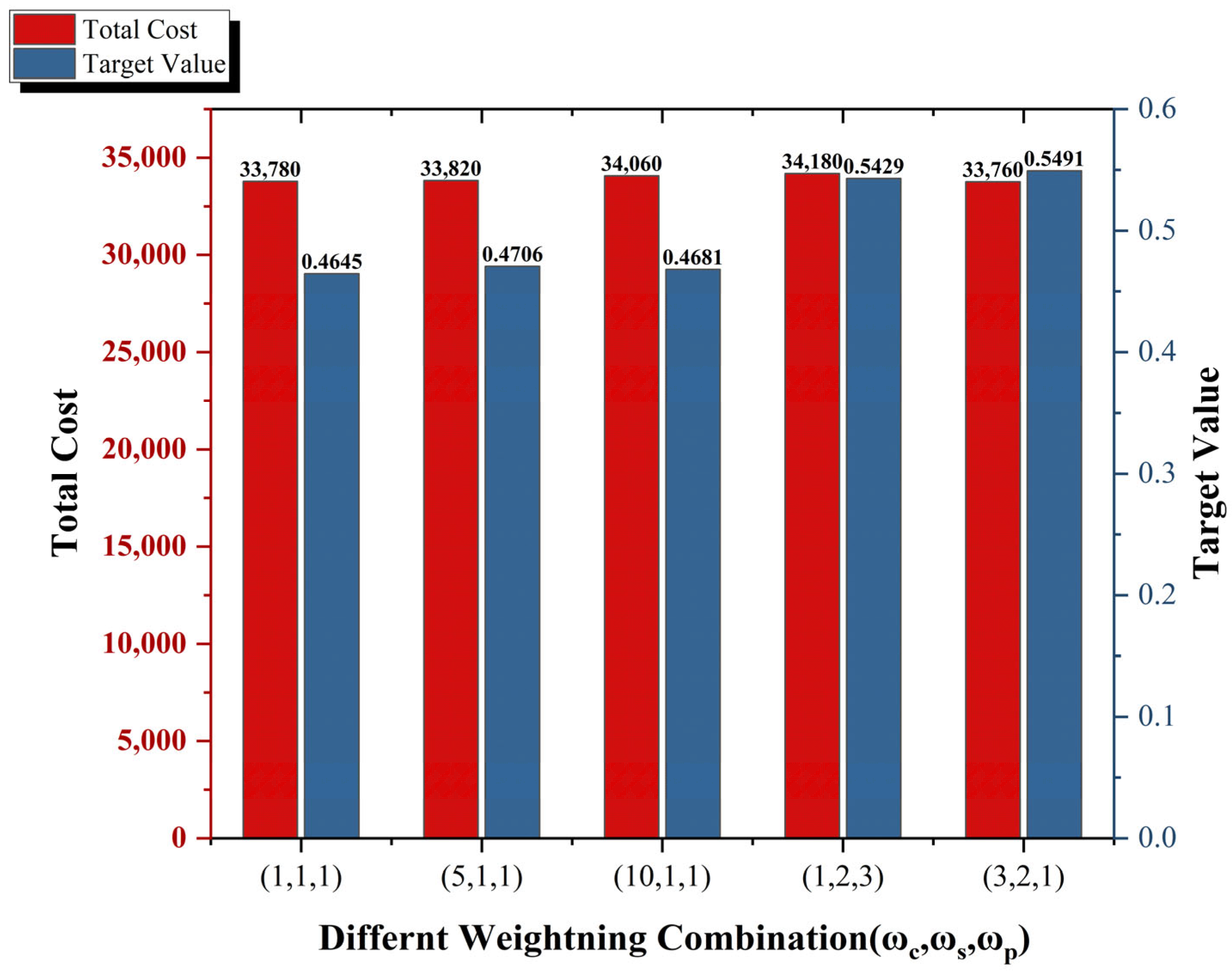
Furthermore, to validate the model’s effectiveness across different scenarios, we established multiple weight combinations for comparative analysis. The results are presented in Figure 4.
It can be seen that under different weighting combinations, the total cost and the overall target value exhibit differences. This also reflects that while enterprises consider different comfort preferences, they simultaneously impact both the total cost and the target value.

6.1.3. Algorithm Performance Comparison

To validate the effectiveness of the improved Genetic Algorithm, this study conducted comparative experiments with the traditional Genetic Algorithm and Particle Swarm Optimization Algorithm. The results are shown in Table 6. The improved Genetic Algorithm demonstrated the best performance across metrics including average optimal objective value, computational time, and convergence iterations. This demonstrates that the improved strategy significantly enhances the algorithm’s solution quality and efficiency under limited computational resources.

6.2. Overall Result Analysis

To verify the practicality and reliability of the proposed GA enhancements, this section performs a systematic validation focusing on two aspects: algorithm performance and constraint satisfaction. All tests utilize the benchmark parameters defined in Section 6.1.
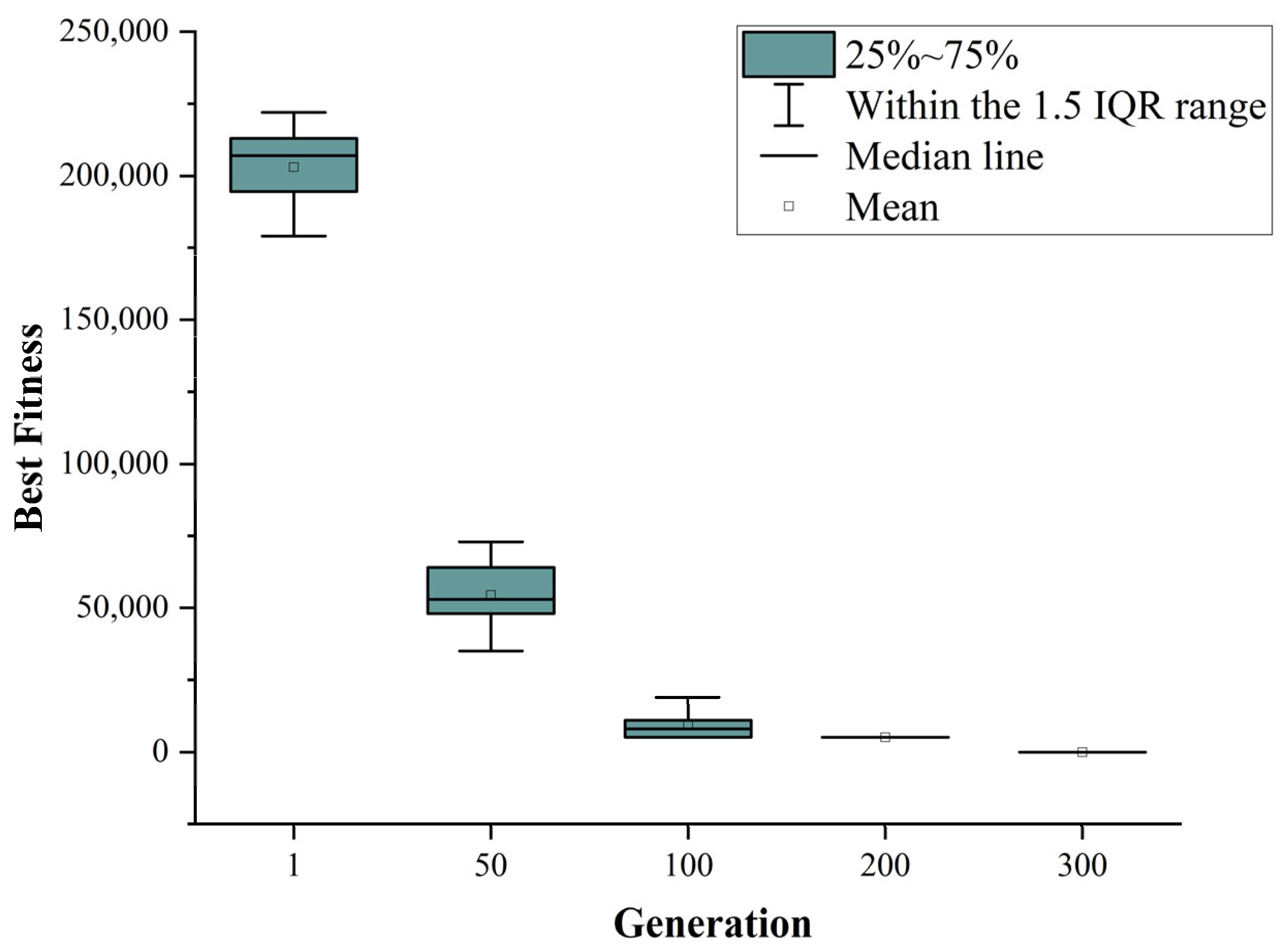
We employed a Bernoulli repeated experiment approach, running the improved genetic algorithm independently 20 times. Figure 5 displays the distribution of optimal fitness values from generation 0 to generation 300. The box width steadily narrows as the generations go on, and the median and mean of the greatest fitness values often decline. This implies that the algorithm retains population variety and has robust global search capabilities in the early stages, allowing it to rapidly converge toward the ideal area. Later on, it moves into a more focused search phase. The method becomes closer to convergence, the solution distribution gets more concentrated, and its stability greatly increases. The quality of the solution stays excellent even as the pace of convergence slows down later. All things considered, this suggests that the algorithm strikes a healthy balance between local exploitation and worldwide exploration.
All formal restrictions are satisfied by the final timetable. A single run takes 159 s of CPU time. This demonstrates that the algorithm’s computational cost is acceptable for practical applications. Workloads are balanced and resources are distributed logically.
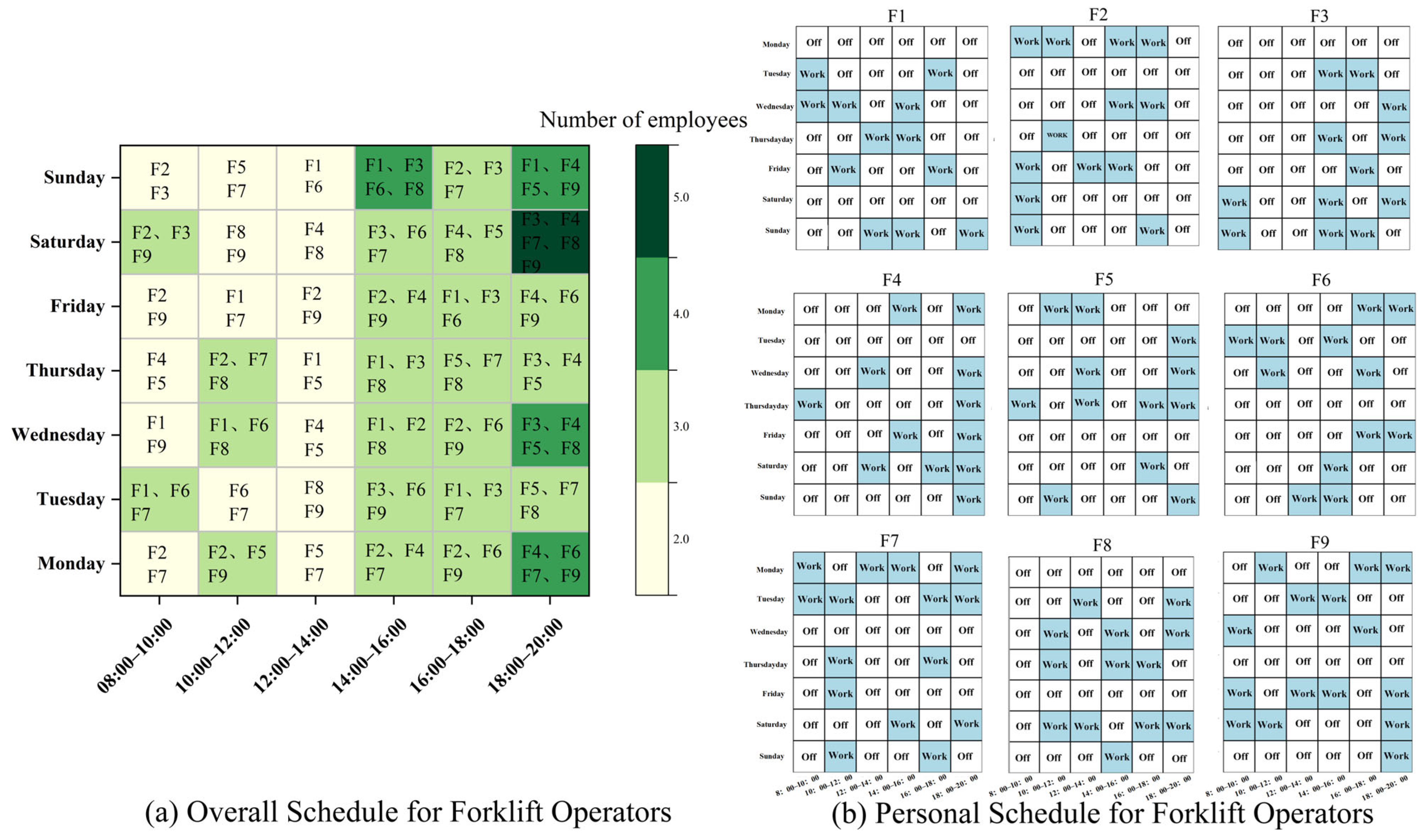
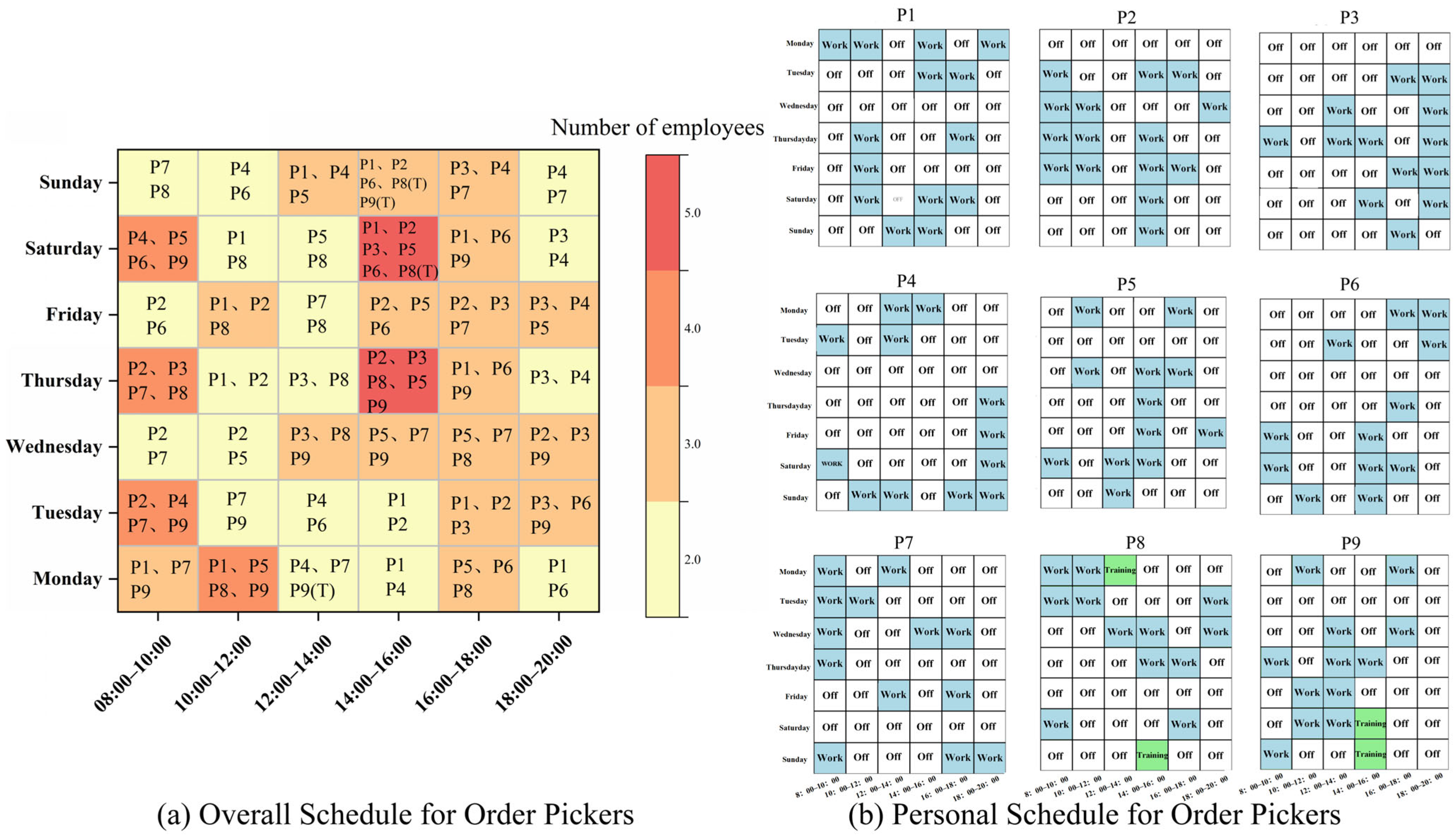
The suggested strategy produces notable gains in cost, comfort, and overall objective value as compared to conventional scheduling techniques. Thus, it gives county-level logistics centers a scientific decision-support tool. The ideal timetable is further demonstrated by the heatmaps in Figure 6 and Figure 7. (a) displays the overall schedule, which shows the general shift arrangements for all order pickers or forklift operators, while (b) presents individual schedules, detailing each employee’s specific shift assignments. They verify the rationale and balance of the schedule by offering a visual depiction of shift distributions for each order picker and forklift operator.
An intelligent scheduling system was successfully created and verified in this study. The system combines a multi-objective evolutionary algorithm with uncertainty theory. The technology produces excellent scheduling solutions in dynamic, simulated business contexts. These solutions prioritize human-centered experience and are economical, compliant, and dependable. The findings show that this approach accomplishes multi-objective optimization in intricate constraint networks while also successfully addressing demand uncertainty. The approach effectively strikes a compromise between human-centered comfort and cost objectives. It has great potential for wider use and strong practical value. Table 7 summarizes the results of the investigation. Individual workload and comfort penalty metrics for each employee are listed in Table A4 of Appendix C.
The cost structure is still in balance. Forklift operators are responsible for about 60% of total cost. This percentage is in line with their higher hourly salaries, the makeup of the workforce today, and the type of job they are given. Meanwhile, even when adjusting to erratic variations in demand, the scheduling system maintains total expenses within a reasonable range.
Overall comfort penalties are kept to a minimum. This shows that a number of elements, such as consecutive working hours, daily shift variances, and individual preferences for rest days, are properly taken into consideration by the scheduling plan.
We conducted a comparative analysis to validate the model’s effectiveness under a benchmark requirement of two to three times the baseline, specifically for a workforce size of 30 to 50 employees. The results, as shown in Table 8, demonstrate that our model maintains a certain degree of applicability across different scaling requirements.

6.3. Sensitivity Analysis

6.3.1. Uncertainty Parameter

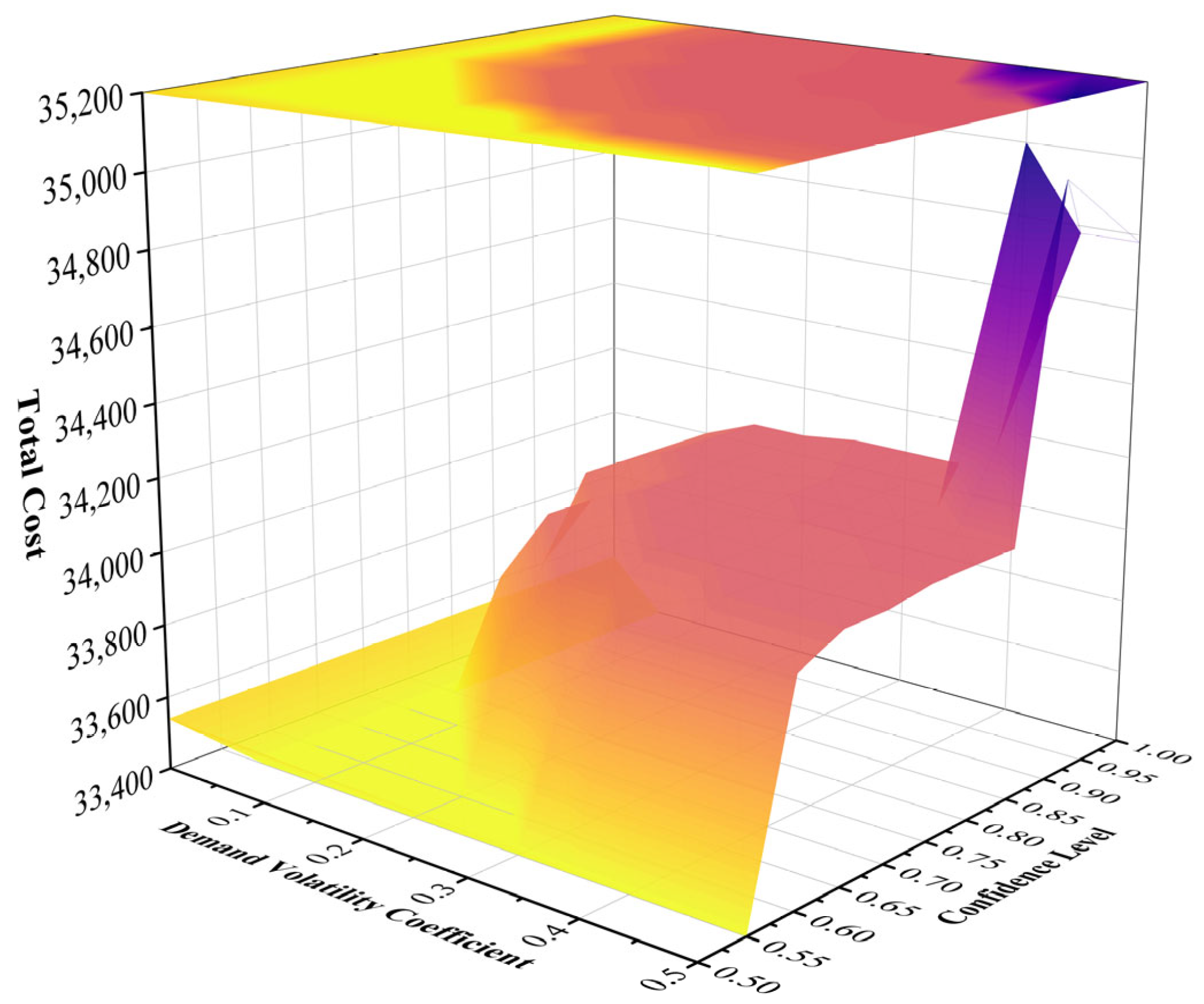
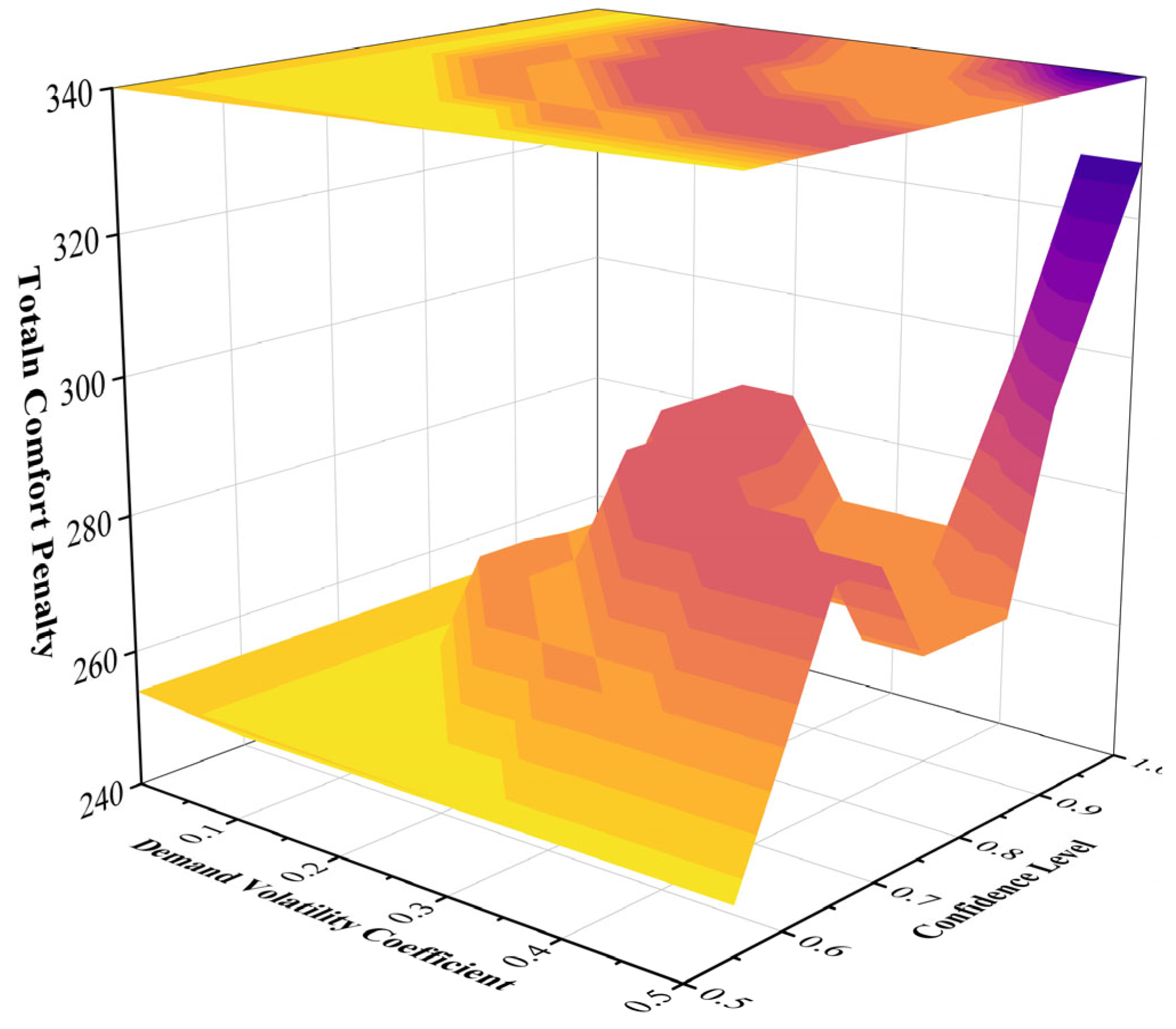
A two-dimensional parametric analysis grid was built in order to assess the impact of demand uncertainty on scheduling performance. This grid examines the combined impacts on total cost and total comfort penalty of the confidence level (ranging from 0.5 to 1.0) and the demand fluctuation coefficient (ranging from 0.1 to 0.5). Figure 8 and Figure 9 present the findings.
As shown in Figure 8, total cost are comparatively low when demand variations fall between 0.1 and 0.3 and the confidence level is less than 0.6. Cost increase is very mild when confidence varies between 0.7 and 0.9. However, total costs increase dramatically when demand volatility surpasses 0.4 and greater confidence levels (beyond 0.9) are needed.
As shown in Figure 9, when both the demand fluctuation coefficient and the confidence level are low, the overall comfort penalty remains mild. Minor adjustments to these parameters do not cause significant fluctuations in the comfort penalty. As the confidence level increases from 0.7 to 0.9, the overall comfort penalty decreases. Yet, once the confidence level exceeds the 0.9 threshold, the overall comfort penalty increases sharply.

6.3.2. Staffing Strategy

Staffing plays a key role in shaping the operational performance of county-level logistics centers. This study examines two dimensions: the number of experienced order pickers and the overall workforce composition. The goal is to determine what type of staffing strategy is best suited to different operational contexts.
(1) Variations in the Quantity of Experienced Order Pickers
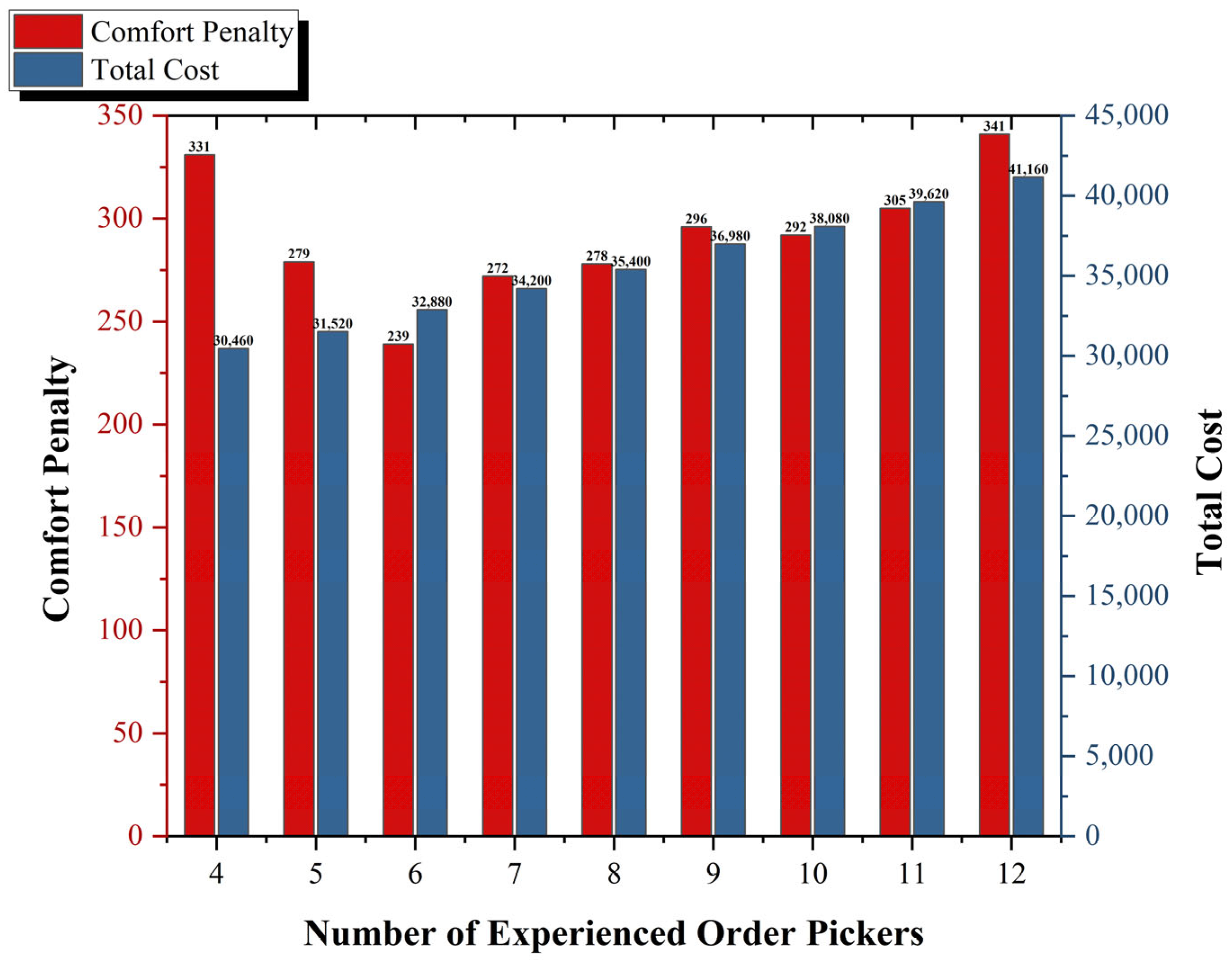
The experiment assessed how varying the number of pickers between 4 and 11 influenced both comfort penalties and operational costs. The corresponding results are presented in Figure 10.
When the number of skilled pickers increased from 4 to 6, the comfort penalty decreased significantly from 331 to 239. However, when the number of skilled pickers decreased to 4, it could not meet the picking demand. As the number of pickers increased from 6 to 12, the loss in comfort gradually recovered to 341. Furthermore, costs continued to rise as the number of skilled pickers increased.
(2) Changes in Order Pickers Type Structure
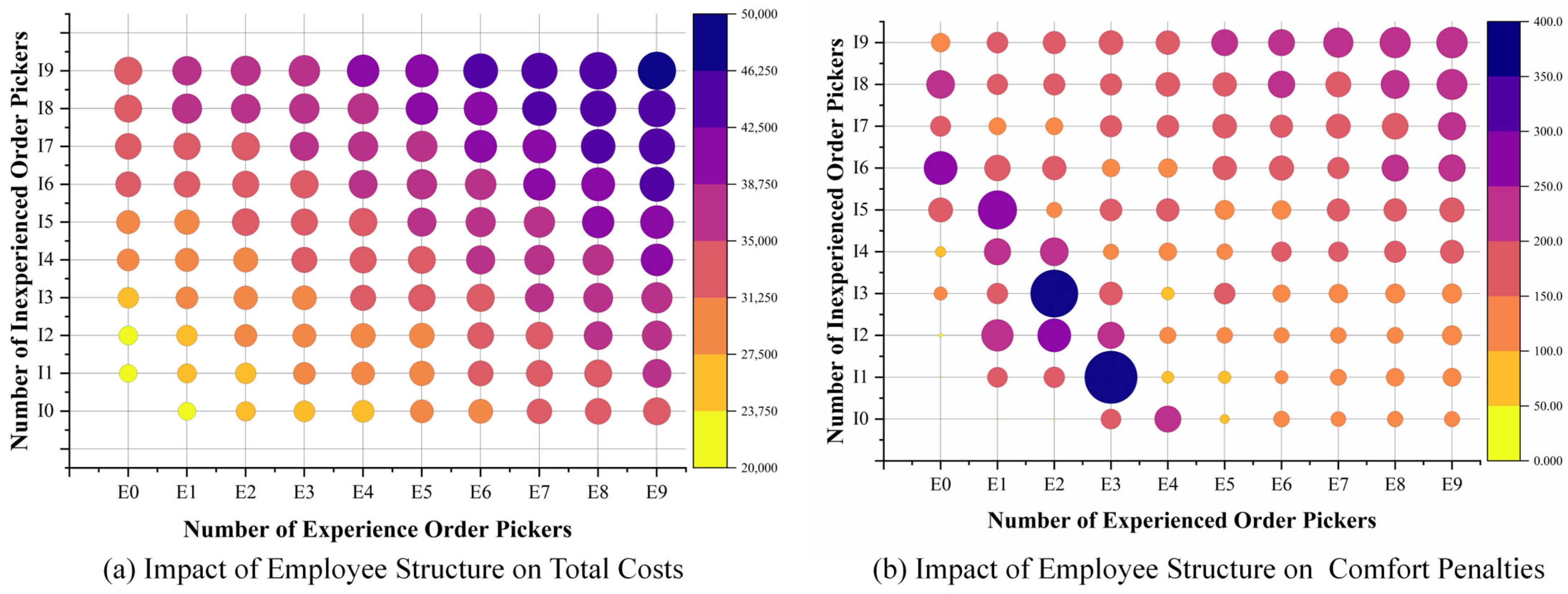
The experiment investigates the impact of different combinations of experienced and inexperienced pickers on total cost and total comfort penalty. The horizontal axis represents the number of experienced pickers, while the vertical axis represents the number of inexperienced pickers (0–9), as shown in Figure 11.
In the chart, the horizontal coordinate “E0” represents zero skilled pickers, while “I0” represents zero unskilled pickers. The point (S0, I0) indicates that both skilled and unskilled pickers are absent. Therefore, both the cost and comfort penalty at this point are zero. Experimental data indicates that when the total number of pickers falls below six, no adjustment to the ratio of skilled to unskilled workers can meet production demands.
As shown in Figure 11a, total costs exhibit a consistent upward trend as the number of pickers increases. As shown in Figure 11b, when the number of skilled pickers or unskilled pickers is low, the fluctuation range of employee comfort penalties increases significantly. As the number of pickers increases, the comfort penalty gradually stabilizes and remains at a low-to-moderate level. It is worth noting that the comfort penalties for the three points (E0, I1), (E1, I0), and (E2, I0) are close to zero. This benefit results from fewer staff being involved, which makes it easier to accommodate employee preferences and maintain scheduling continuity. However, comfort penalties increase dramatically at sites (E3, I1) and (E2, I3). This is because it is challenging to foster productive teamwork in such a workforce structure, which can then result in serious workload imbalances and other operational problems.

6.3.3. Comparison and Evaluation of Scheduling Strategies

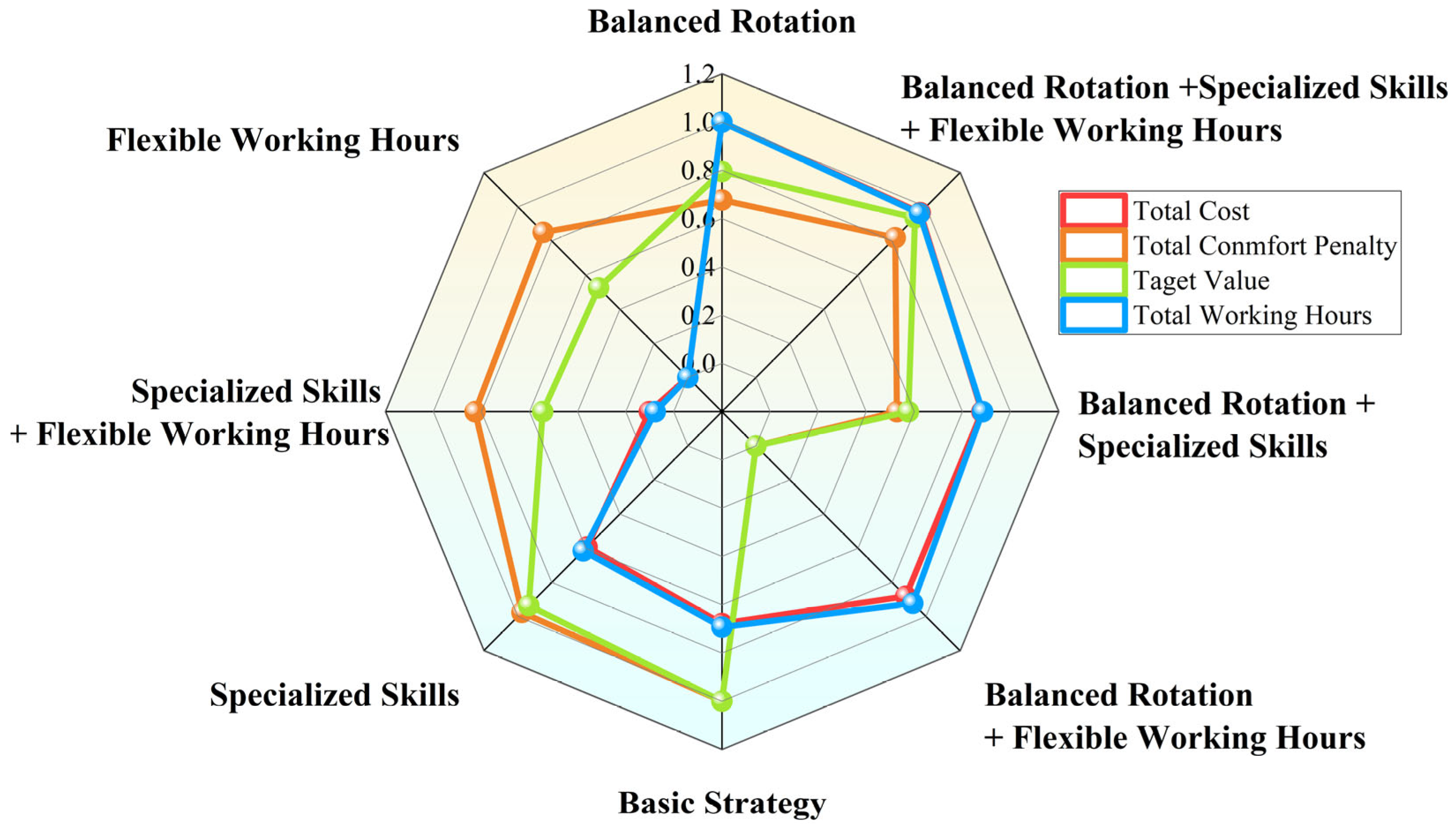
To comprehensively evaluate the performance differences among various scheduling strategies, this study proposes three core scheduling strategies based on the baseline approach. These strategies were subsequently combined in pairs and in three simultaneous combinations, ultimately yielding eight distinct scheduling schemes. The proposals were quantitatively evaluated using four metrics: cost, comfort penalty, overall objectives, and working hours. To allow for comparison, we applied inverse normalization to all metrics. Each original value x was transformed into a normalized value x’ using the formula x   =   ( max x ) / ( max min ) , where max and min are the maximum and minimum values for that metric. After this transformation, a higher x’ indicates better performance. The normalized results are presented in a radar chart, as shown in Figure 12.
The following will elaborate on the definitions of the three proposed strategies:
(1) Balanced Rotation
The Balanced Rotation aims to support workers’ work–life balance. Its fundamental idea is to provide sufficient sleep and avoid burnout by requiring rest days and allocating work hours in a sensible manner. This policy requires at least two non-consecutive days off per week for each employee. It also limits average daily working hours on weekdays to six hours. Even if an employee is permitted to work eight hours on a given day, the average daily working hours for the week must be kept below six hours. A key rule is that rest days cannot be consecutive. This prevents employees from working intensive extended periods right after a long break.
(2) Specialized Skills
The Specialized Skills strategy is a scheduling model that assigns roles based on employees’ specific competencies and expertise. Its core principle is to maximize overall operational efficiency by scientifically distributing tasks to fully utilize each employee’s strengths and efficiency advantages. This strategy requires high-efficiency order pickers to cover at least 60% of peak-period work. Low-efficiency pickers are exempt from peak duties during their training. Forklift Operators are specialized into heavy-duty and light-duty groups based on cargo type. Where possible, the same operator handles the same cargo type consecutively to minimize skill-switching costs.
(3) Flexible Working Hours
The Flexible Working Hours strategy is a scheduling model that grants employees greater work schedule autonomy. The core principle is to enhance both employee satisfaction and productivity. This is achieved by increasing flexibility in working hours. Finally, this approach aims to accommodate the personalized time requirements of employees. This policy allows employees to indicate preferred and avoided work periods. While ensuring weekly total working hours meet requirements, daily working hours can flexibly fluctuate between 4 and 8 h. Employees may request time off on particular dates using this method. It also creates an account system for flexible working hours. Employees can use this method to convert overtime worked in one week into paid time off the next week.
The value 1.0 in the chart represents the maximum score. The closer the value is to 1.0, the better the strategy performs in that aspect.
Experimental results indicate that the balanced shift strategy demonstrates the most optimal performance in terms of cost. But considerable comfort is sacrificed in order to obtain this cost benefit. It indicates that although strict rest schedules can lower labor costs, they adversely affect the employee experience. When it comes to striking a balance between comfort penalties and overall target values, the baseline technique works well. This method ranked fifth with a total cost score of 0.678. It achieves a good balance between expense and worker comfort.
The Balancing Rotation + Specialized Skills + Flexible Working Hours has shown to be highly beneficial. Its overall objective score of 0.936 is ranked second, its comfort penalty score of 0.817 is ranked fifth, and its total cost score of 0.966 is ranked second. On the other hand, the combination of flexible working hours and balanced shifts fared badly, placing last in total objective values and suffering the largest comfort penalty.
In terms of comfort, the Specialized Skills strategy did remarkably well, coming in third. The plan with Flexible Working Hours is the most expensive and performs the worst overall. This finding suggests that fully flexible arrangements result in greater management and coordination costs within the existing organizational setting. The anticipated reduction in employee comfort penalties did not materialize. Even if it costs a little more than the basic strategy, it is still within a reasonable range. This illustrates how specialized division of labor may increase productivity without having a major negative effect on worker satisfaction.

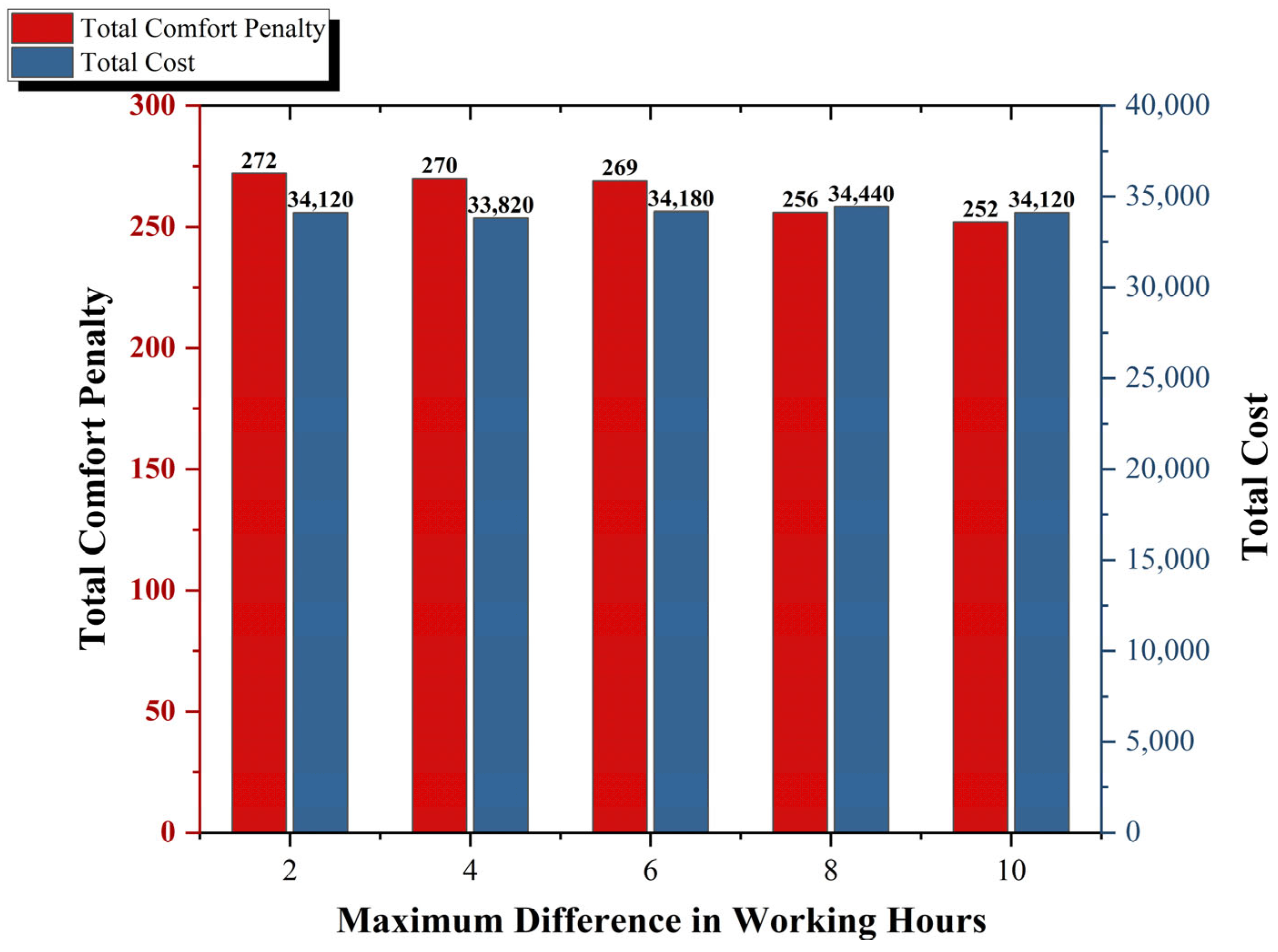
6.3.4. Maximum Working Time Difference

This experiment looked at how cost and comfort levels were affected by variations in maximum working hours. Maximum disparities in working hours between two and ten were found.
Figure 13 illustrates the negative link between the total comfort penalty and the variation in weekly working hours among employees. In particular, the total comfort penalty exhibits a declining tendency as the top limit of this gap rises.

6.4. Management Insights and Recommendations

The sensitivity analysis above provides practitioners with actionable insights. On the basis of these findings, we offer tailored management recommendations for different enterprises.
(1) Choose Scheduling Solutions Under Various Demand Fluctuation Coefficients and Confidence Levels Based on the Enterprise’s Characteristics
Demand fluctuation coefficients are usually low for established industrial businesses with reliable operations and precise forecasting. For effective scheduling, a rather low confidence level is advised. Demand volatility is particularly noticeable for companies in industries like retail, e-commerce, and logistics that see large seasonal swings. Using dynamic confidence level methods is essential to good management. To balance expenses and team stability, keep your confidence level between 0.7 and 0.8 during off-peak or steady seasons. In order to guarantee service capacity during expected peak seasons or significant promotional periods, proactively raise the confidence level to 0.85–0.95 and augment with a flexible personnel pool.
(2) Optimize Employee Structure and Staffing Numbers to Strike a Balance between Comfort and Cost
It is advised that businesses keep their personnel within acceptable bounds. Make sure there are enough qualified pickers on duty to fulfill operational needs when planning daily shifts.
The fundamental reasoning behind staffing for organizations that prioritize employee comfort is to maximize team skill density. Data unequivocally demonstrates that the team’s total comfort penalty decreases as the percentage of high-efficiency workers increases. High-efficiency workers’ job traits are the main cause of this. A team’s overall workflow improves when these people are in charge. There are less operational delays or burdens brought on by less productive personnel. As a result, the team’s general pain and accumulated weariness are reduced. Building a lean, highly talented staff should thus be the main goal.
For cost-conscious enterprises, the core of staffing lies in identifying and maintaining the “minimum effective combination of working hours that meets operational requirements.” It is recommended to determine the critical threshold for the proportion of high-efficiency employees, which was approximately 50% in our experiments.
Finding a wide selection of the best value for money is the aim for companies looking to strike a balance between comfort and affordability. This range usually corresponds to staffing setups in which order pickers with high efficiency make up 60% to 80% of the workforce. Through the core dominance of high-efficiency personnel, these designs balance effort and efficiency while acknowledging the reality of heterogeneous teams.
(3) Choose and Integrate Scheduling Strategies to Support Business Management Goals
The study suggests using different approaches for various businesses. At the same time, we incorporate the perspectives of employers, employees, customers, and a comprehensive view. Employers primarily focus on cost and operational efficiency, employees care about comfort and work–life balance, while customers value service efficiency and quality. A holistic perspective emphasizes balancing cost and comfort. Table 9 outlines the main ideas for strategy advice and execution.
(4) Moderately Relax Working Hour Variation Management to Enhance Individual Adaptability among Employees
The experimental results indicate that appropriately easing the upper limit on weekly working hour variations among employees can effectively reduce the overall comfort penalty. By reducing this comfort penalty, employee satisfaction is correspondingly enhanced. Rigid, one-size-fits-all management techniques are discouraged. Businesses should allow for a modest variance in working hours while making sure operations are impacted. Schedules are better matched to the demands and work habits of individual employees as a result.
(5) Establish a Progressive Optimization Mechanism and Support System
Whichever approach is used, a pilot-first strategy with a gradual rollout is advised. Cost, efficiency, and comfort penalty are examples of parameters that need to be routinely assessed. Establishing clear lines of communication, skill-training initiatives, and data-driven scheduling support systems is also necessary for successful deployment. Business strategy, business culture, and people needs must all be taken into account when choosing a final plan. The ongoing and dynamic optimization of human resource management is made possible by this alignment.

7. Conclusions

This study makes three major contributions to the field of workforce scheduling in county-level logistics systems:
(1) The study converts the concept of “human-centered management” into quantifiable objectives and specific scheduling guidelines.
(2) The study provides a useful tool for decision-making for logistics managers in county-level centers. Managers just input basic data and execute the enhanced algorithm in day-to-day operations. It generates a weekly calendar in a matter of minutes, balancing expenses and penalties associated with comfort.
(3) The results are very applicable outside of this particular instance. Despite the fact that the data in this paper originates from a specific county-level logistics center, the characteristics identified, including worker differences, demand fluctuations, and the coordination between training and scheduling, are common in many similar settings. Therefore, the modeling framework and optimization method presented in this paper can be applied to other labor-intensive logistics nodes at the county level. This offers useful insights for lean human resource management in similar logistics systems.
Nevertheless, this study includes several shortcomings that suggest areas for further research. First, since the model was validated only on small-to-medium-sized datasets, the generalizability of its results is limited. Future research should incorporate larger-scale scenarios to evaluate the model. Second, the model assumed that skill acquisition is a binary process and that uncertain demand follows a uniform distribution in order to simplify the problem. Future studies should investigate different kinds of demand distributions and present more accurate learning curve models that show how skills improve gradually over time. Third, the goal of this study was to offer a single compromise option that strikes a balance between employee comfort penalty and cost. This illustrates the fact that managers frequently have distinct priorities. The existing model can be expanded in further work if managers want to investigate every possible trade-off. For example, the whole Pareto front might be generated using an evolutionary multi-objective algorithm like NSGA-II. This would provide more choices to aid in making strategic decisions. Fourth, the weighting of relevant indicators in this study was determined based on corporate preferences identified through actual surveys. In the future, we will explore more scientifically grounded weighting methods and investigate their impact on optimization outcomes. Finally, this paper exhibits relatively limited innovation at the algorithmic level, lacks systematic parameter tuning, and suffers from slow runtime performance, indicating room for improvement in computational efficiency. Moving forward, we will adopt advanced methods such as Bayesian optimization to achieve automatic optimization of key parameters. We will also explore hybrid algorithm designs while developing more compact encoding schemes to reduce the search space and enhance computational efficiency in large-scale scenarios.

Author Contributions

Conceptualization, Y.W. and J.M.; methodology, Y.W.; software, Y.W.; validation, Y.W., Y.G. (Yuhan Gong) and Z.H.; formal analysis, Y.G. (Yuhan Gong); investigation, Z.H.; resources, Y.G. (Yiwen Gao); data curation, Y.G. (Yiwen Gao); writing—original draft preparation, Y.W.; writing—review and editing, J.M.; visualization, Y.W. and Y.G. (Yuhan Gong); supervision, J.M.; project administration, J.M.; funding acquisition, J.M. All authors have read and agreed to the published version of the manuscript.

Funding

This research was funded by “Jiangxi Province Career Early Youth Science and Technology Talent Program (20244BCE52148)” and “East China Jiaotong University Ph.D. Start Program (2003424033)”.

Data Availability Statement

Data are contained within the article.

Acknowledgments

The authors extend gratitude to the management and staff of the county-level logistics center for their support in data collection and operational insights. We also acknowledge the technical support provided by the Logistics Laboratory of East China Jiaotong University.

Conflicts of Interest

The authors declare no conflicts of interest.

Appendix A. Algorithm Pseudo-Code and Implementation Framework

Table A1. Pseudo-code for the improved Genetic Algorithms.
Input:
  Problem Parameters: Employee Set E, Date Set D, Time Slot Set T, Demand Parameters, etc.
  Algorithm Parameters: N = 500, G = 300, Pc = 0.85, Pm = 0.05, E = 10, k = 3
Output:
  best_ind, best_fitness
begin
  P ← ∅
  for i = 1 to N do
    ind_i ← HEURISTIC_INITIALIZATION()
    P ← P ∪ {ind_i}
  end for
  best_ind ← null
  best_fitness ← ∞
  for gen = 1 to G do
    for each ind in P do
      fitness(ind) ← CALCULATE_FITNESS(ind, gen)
      if fitness(ind) < best_fitness then
        best_fitness ← fitness(ind)
        best_ind ← ind
      end if
    end for
    mating_pool ← ∅
    for j = 1 to N do
      candidates
      winner ← argmin_{cand ∈ candidates} fitness(cand)
      mating_pool ← mating_pool ∪ {winner}
    end for
    offspring ← ∅
    for j = 1 to N/2 do
      p1, p2 ← Randomly select two parents from the mating pool.
      if random(0,1) < Pc then
        crossover_points ← Randomly select two intersection points
        (c1, c2) ← TWO_POINT_CROSSOVER(p1, p2, crossover_points)
      else
        c1 ← p1, c2 ← p2
      end if
      offspring ← offspring ∪ {c1, c2}
    end for
    for each ind in offspring do
      for each gene in ind do
        if random(0,1) < Pm then
          FLIP_GENE(gene)
        end if
      end for
      REPAIR_INDIVIDUAL(ind)
    end for
    elite ← Select the E individuals with the highest fitness from P.
    P ← offspring ∪ elite
  end for
  return best_ind, best_fitness
end
Table A2. Pseudo-code for the heuristic initialization.
Input: Employee set E, Days D, Time slots T, Demand matrices (deterministic equivalents) I_pick(d,t), I_fork(d,t)
Output: Initial chromosome ind (binary array of length |E|·|D|·|T|), training list employee_training_slots

Initialize an empty schedule S as a 3D array [|E|][|D|][|T|] filled with 0.
Initialize employee_training_slots ← empty dictionary mapping employee indices to list of (day, slot) pairs.
Let L_low ← indices of inefficient pickers (type=‘pick’ and efficiency = low).

// --- Step 1: Pre-assign training slots for inefficient pickers ---
for each emp_idx in L_low do
    training_slots ← empty list
    randomly select U_min distinct days from D (without replacement)
    for each selected day do
        randomly select a slot t from T_train (non-peak slots)
        append (day, t) to training_slots
        set S[emp_idx][day][t] ← 0      // ensure no work during training
    end for
    employee_training_slots[emp_idx] ← training_slots
end for

// --- Step 2: Demand-driven assignment for each day and slot ---
for each day in D do
    for each slot in T do
        // Assign pickers to meet picking demand
        remaining_pick ← I_pick[day][slot]
        sort pickers by descending efficiency (only those not in training at this (day,slot))
        for each emp_idx in sorted pickers do
            if remaining_pick ≤ 0 then break
            if S[emp_idx][day][slot] == 0 and working here does not exceed consecutive hours limit then
                set S[emp_idx][day][slot] ← 1
                remaining_pick ← remaining_pick - efficiency[emp_idx] × 2
            end if
        end for

        // Assign forklifts to meet forklift demand
        remaining_fork ← I_fork[day][slot]
        for each forklift index emp_idx (all forklifts are efficient) do
            if remaining_fork ≤ 0 then break
            if S[emp_idx][day][slot] == 0 and consecutive hours limit satisfied then
                set S[emp_idx][day][slot] ← 1
                remaining_fork ← remaining_fork - efficiency[emp_idx] × 2
            end if
        end for

        // Ensure at least one picker and one forklift are on duty
        if no picker working at (day,slot) then
            randomly select an available picker (not in training) and set S[emp_idx][day][slot] ← 1
        end if
        if no forklift working at (day,slot) then
            randomly select an available forklift and set S[emp_idx][day][slot] ← 1
        end if
    end for
end for

// --- Step 3: Apply constraint repair operators ---
S ← repair_weekly_rest(S)
S ← repair_peak_work_count(S)
S ← repair_minimum_hours(S)
S ← repair_intensity_relaxation(S)   // ensures a relaxed shift after a high-intensity day
S ← repair_consecutive_hours(S)
S ← repair_training(S)                // correct training counts and conflicts
S ← ensure_uniqueness(S)              // no duplicate assignments per employee per slot

// --- Step 4: Flatten schedule into chromosome ---
ind ← empty list
for each emp_idx in E do
    for each day in D do
        for each slot in T do
            append S[emp_idx][day][slot] to ind
        end for
    end for
end for

return ind, employee_training_slots
Figure A1. DEAP Core Modules and Implemented Functions.
Systems 14 00295 g0a1

Appendix B. Preliminaries on Uncertain Theory

Appendix B.1. Axioms and Definitions

Demand is often vulnerable to several sources of uncertainty in real-world logistics and labor scheduling, including seasonal variations, daily order swings, and unforeseen disruptive occurrences. As a result, it is frequently challenging to make accurate predictions using fixed numbers. Such intrinsic uncertainties are beyond the capabilities of traditional deterministic optimization methods. In order to build a workforce scheduling model based on unpredictable demand, this paper introduces uncertainty theory.
The theory of uncertainty, proposed by Liu, provides a complete axiomatic framework for handling uncertain information lacking historical data or relying on expert experience [39]. Its core is the measure of uncertainty, which satisfies the following four axioms:
Axiom A1 (Regularity Axiom).
M { Γ } = 1
Here, Γ denotes the universal set, indicating that the measure of a certain event occurring is 1.
Axiom A2 (Duality Axiom).
For any event Λ, we have Formula (A2).
M { Λ } + M { Λ c } = 1
Axiom A3 (Additivity Axiom).
For any countable sequence of events  Λ i , Formula (A3) holds.
M i = 1 Λ i i = 1 M { Λ i }
Axiom A4 (Product Axiom).
Let  Γ , L , M  denote the uncertainty space, then the product uncertainty measure M satisfies Formula (A4).
M k = 1 Λ k = Λ k = 1 M k { Λ k }
 where   Λ k   L k .
Definition A1 (Uncertain Variable).
Let  Γ , L , M  denote the uncertainty space. If a function  ξ : Γ R  satisfies that for any Borel set  B R , the set  { γ Γ ξ ( γ ) B } L  is in L, then  ξ  is called an uncertain variable.
Definition A2 (Uncertainty Distribution).
The uncertainty distribution  Φ : R    [0, 1] of the uncertain variable  ξ  is defined as shown in Formula (A5).
Φ ( x ) = M { ξ x }
Definition A3 (Regular Uncertainty Distribution).
An uncertainty distribution  Φ ( x )  is said to be regular if it is continuous and strictly increasing with respect to  x  wherever  0 < Φ ( x ) < 1 , and satisfies, as shown in Formula (A6).
lim x Φ ( x ) = 0 , lim x + Φ ( x ) = 1
Definition A4 (Independence of Uncertain Variables).
Uncertain variables  ξ 1 , ξ 2 , , ξ n  are said to be independent if for any Borel sets  B 1 ,   B 2 , ,   B n , as shown in Formula (A7).
M i = 1 n ( ξ i B i ) = Λ i = 1 n M { ξ i B i } .
Definition A5 (Linear Uncertain Variables).
If the variable  ξ  is not assumed to follow a linear uncertainty distribution, then as shown in Formula (A8).
Φ ( x ) = 0 , x < a x a b a , a x < b 1 , x b
Then  ξ  is referred to as a linear uncertain variable, denoted as  L a , b , where  a < b .
Definition A6 (Inverse Uncertainty Distribution).
For an uncertain variable  ξ  with a regular uncertainty distribution  Φ ( x ) , its inverse uncertainty distribution  Φ 1 : ( 0 , 1 ) R  is defined as a function satisfying the following conditions, as shown in Formula (A9).
Φ 1 ( α ) = inf { x Φ ( x ) α }
For the linear uncertain variable  L a , b , its inverse uncertainty distribution is given by Formula (A8).
Φ 1 ( α ) = ( 1 α ) a + α b , α ( 0 , 1 )

Appendix B.2. Theorems and Proofs

The following theorems are fundamental for converting an uncertain programming model with monotone functions into an equivalent deterministic form. They are due to Liu [39] and form the theoretical basis for the model conversion in Section 4.4.
Theorem A1 (Expected Value of Monotone Function).
Let  ξ 1 , ξ 2 , , ξ n  be independent uncertain variables with regular uncertainty distributions  Φ 1 , Φ 2 , , Φ n , respectively. Suppose the function  f ( x , ξ 1 , ξ 2 , , ξ n )  is continuous, strictly increasing with respect to  ξ 1 , ξ 2 , , ξ m  and strictly decreasing with respect to  ξ m + 1 , ξ m + 2 , , ξ n . Then the expected value of  f ( x , ξ 1 , ξ 2 , , ξ n )  is given by Formula (A11).
E [ f ( x , ξ 1 , ξ 2 , , ξ n ) ] = 0 1 f x , Φ 1 1 ( α ) , , Φ m 1 ( α ) , Φ m + 1 1 ( 1 α ) , , Φ n 1 ( 1 α ) d α
Proof of Theorem A1.
Since ξ 1 , , ξ n  are independent and regular, the inverse uncertainty distribution of f ( x , ξ 1 , , ξ n ) is shown in Formula (A12), by the operational law for monotone functions. (Theorem 3.20 in Liu [39])
Ψ 1 ( α ) = f x , Φ 1 1 ( α ) , , Φ m 1 ( α ) , Φ m + 1 1 ( 1 α ) , , Φ n 1 ( 1 α )
According to Theorem 3.26 in Liu [39], the expected value of an uncertain variable with inverse distribution Ψ 1 ( α ) is given by 0 1 Ψ 1 ( α ) d α . Substituting the expression for Ψ 1 ( α ) yields (41). □
Theorem A2 (Chance Constraint Transformation).
Let  ξ 1 , ξ 2 , , ξ n  be independent uncertain variables with regular uncertainty distributions  Φ 1 , Φ 2 , , Φ n    respectively. Suppose the constraint function  g ( x , ξ 1 , ξ 2 , , ξ n )  is continuous, strictly increasing with respect to  ξ 1 , ξ 2 , , ξ k  and strictly decreasing with respect to  ξ k + 1 , ξ k + 2 , , ξ n . Then for a given confidence level  α     ( 0 , 1 ) , the chance constraint is shown in Formula (A13).
M { g ( x , ξ 1 , ξ 2 , , ξ n ) 0 } α
If and only if Equation (A14) holds.
g x , Φ 1 1 ( α ) , , Φ k 1 ( α ) , Φ k + 1 1 ( 1 α ) , , Φ n 1 ( 1 α ) 0 .
Proof of Theorem A2.
By the operational law, the inverse uncertainty distribution of g ( x , ξ 1 , , ξ n ) is shown in Formula (A15).
Υ 1 ( α ) = g x , Φ 1 1 ( α ) , , Φ k 1 ( α ) , Φ k + 1 1 ( 1 α ) , , Φ n 1 ( 1 α )
For an uncertain variable η with inverse distribution Υ 1 , the inequality M { η 0 } α is equivalent to Υ 1 α 0 . Applying this equivalence to η = g ( x , ξ 1 , , ξ n ) , we obtain that condition (43) holds if and only if condition (44) holds. □
Theorem A3 (Equivalent Crisp Formulation).
Consider an uncertain programming model, as shown in Formula (A16).
min x E [ f ( x , ξ 1 , ξ 2 , , ξ n ) ] subject   to : M { g j ( x , ξ 1 , ξ 2 , , ξ n ) 0 } α j , j = 1 , 2 , , p ,
where  ξ 1 , ξ 2 , , ξ n  are independent uncertain variables with regular uncertainty distributions  Φ 1 , Φ 2 , , Φ n . Assume that  f ( x , ξ 1 , ξ 2 , , ξ n )  is continuous, strictly increasing with respect to  ξ 1 , ξ 2 , , ξ m  and strictly decreasing with respect to  ξ m + 1 , ξ m + 2 , , ξ n ; For each   j ,  g j ( x , ξ 1 , ξ 2 , , ξ n )  is continuous, strictly increasing with respect to  ξ 1 , ξ 2 , , ξ k j  and strictly decreasing with respect to  ξ k j + 1 , ξ k j + 2 , , ξ n .
Then the uncertain programming model (46) is equivalent to the following Formula (A17):
min x 0 1 f x , Φ 1 1 ( α ) , , Φ m 1 ( α ) , Φ m + 1 1 ( 1 α ) , , Φ n 1 ( 1 α ) d α subject   to : g j x , Φ 1 1 ( α j ) , , Φ k j 1 ( α j ) , Φ k j + 1 1 ( 1 α j ) , , Φ n 1 ( 1 α j ) 0 , j = 1 , 2 , , p .
Proof of Theorem A3.
Theorem A3 follows directly by applying Theorem A1 to transform the objective function and Theorem A2 to transform each chance constraint in (46). The resulting expressions are exactly those in (47). □

Appendix C. Individual Employee Metrics

Table A3. Employee Preferences.
Employee IDMondayTuesdayWednesdayThursdayFridaySaturdaySunday
P10000010
P20000100
P30001000
P40010000
P50100000
P61000000
P70010000
P80001000
P90000100
F10000001
F20000010
F30001001
F40010000
F50100000
F61000010
F70000100
F80001000
F91000000
Table A4. Employee Individual Workload and Comfort Penalty Metrics.
Employee IDWorking Hours (Hours/Week)Cost (RMB)Total Comfort Penalty
P1281560.0015.0
P2301600.0014.0
P3261520.0016.0
P4241480.0010.0
P5241480.0013.0
P6241480.0013.0
P7261520.0016.0
P8241480.0014.0
P9241480.0014.0
F1242220.0018.0
F2262280.0017.0
F3242220.0017.0
F4242220.0014.0
F5242220.0015.0
F6242220.0018.0
F7302400.0019.0
F8262280.0020.0
F9302400.0021.0

References

  1. The 14th Five-Year Plan for Smart Manufacturing Development. Available online: https://www.gov.cn/2021-12/28/content_5664996.htm (accessed on 21 January 2026).
  2. Wang, M.; Kumar, M.; Tsolakis, N. Exploring the Role of Job Satisfaction in Enhancing Logistics Performance in the Era of Industry 5.0. Int. J. Logist. Res. Appl. 2025; Early access. [Google Scholar] [CrossRef]
  3. Pasparakis, A.; De Vries, J.; De Koster, R. Assessing the Impact of Human–Robot Collaborative Order Picking Systems on Warehouse Workers. Int. J. Prod. Res. 2023, 61, 7776–7790. [Google Scholar] [CrossRef]
  4. Li, Y.; Lin, X.H.; Chen, J.X. Analysis of the Current Situation and Approaches for the Construction of County-Township-Village Three-Level Express Delivery Logistics System. Jiazhi Gongcheng 2022, 41, 42–44. [Google Scholar]
  5. Zhou, H.M. Digital Technology Empowers the Development of County Logistics Industry. Dangdai Xianyu Jingji 2024, 10, 88–89. [Google Scholar]
  6. Odunayo, H.; Abe, I. The Relationship between Employee Satisfaction and Organizational Efficiency: A Case Study of Selected Nigerian Retail Chains. NIU J. Soc. Sci. 2023, 9, 187–197. [Google Scholar] [CrossRef]
  7. Junaidi Amrin, M.; Abadi, F. The Effect of Work Flexibility on Employee Performance and Job Satisfaction as Mediation in a Logistics Company. Media Bina Ilm. 2024, 18, 1491–1502. [Google Scholar] [CrossRef]
  8. Sitorus, T.H.; Siagian, H.L. Beban Kerja Dan Fleksibilitas Kerja Terhadap Kepuasan Kerja Dengan Motivasi Sebagai Pemediasi. J. Manag. Bussines (JOMB) 2023, 5, 1182–1194. [Google Scholar] [CrossRef]
  9. Investigation Report on the Development Status of the Express Delivery Industry in Ningyang County. Available online: http://www.ny.gov.cn/art/2025/10/16/art_228261_10358435.html (accessed on 16 January 2026).
  10. Release of the 2023 Guangzhou Human Capital Index (Logistics Industry). Available online: https://baijiahao.baidu.com/s?id=1782786745747947322 (accessed on 16 January 2026).
  11. Li, J. Study on the Relationship between Job Happiness and Turnover Intention—Based on the Mediating Role of Employees’ Self-Efficacy. China Manag. Inform. 2025, 28, 188–190. [Google Scholar]
  12. Gu, F.; Ding, J. Analysis of Countermeasures for Talent Loss in Logistics Enterprises. Logist. Technol. 2019, 38, 31–34. [Google Scholar]
  13. NetEase Smart Scheduling System: A New Engine for AI-Driven Digital Transformation in Human Resources. Available online: https://www.163.com/dy/article/JV23JPJ205382F02.html?spss=dy_author (accessed on 21 February 2026).
  14. Yu, Y.; Yu, C.; Xu, G.; Zhong, R.Y.; Huang, G.Q. An Operation Synchronization Model for Distribution Center in E-Commerce Logistics Service. Adv. Eng. Inform. 2020, 43, 101014. [Google Scholar] [CrossRef]
  15. Marchesi, J.F.; Hamacher, S.; Peres, I.T. Stochastic Model for Physician Staffing and Scheduling in Emergency Departments with Multiple Treatment Stages. Eur. J. Oper. Res. 2025, 324, 492–505. [Google Scholar] [CrossRef]
  16. Naderi, B.; Begen, M.A.; Zaric, G.S.; Roshanaei, V. A Novel and Efficient Exact Technique for Integrated Staffing, Assignment, Routing, and Scheduling of Home Care Services under Uncertainty. Omega 2023, 116, 102805. [Google Scholar] [CrossRef]
  17. Jafry, M.A.; Jenny, A.M.; Lubinga, S.J.; Larsen-Cooper, E.; Crawford, J.; Matemba, C.; Babigumira, J.B. Examination of Patient Flow in a Rural Health Center in Malawi. BMC Res. Notes 2016, 9, 2347. [Google Scholar] [CrossRef] [PubMed]
  18. Lin, M.M.; Shu, Y.-C.; Lu, B.-Z.; Fang, P.-S. Solving Nurse Scheduling Problem via PyQUBO. Ann. Math. Sci. Appl. 2025, 10, 149–168. [Google Scholar] [CrossRef]
  19. Ma, H.; Wang, S.; Gu, X. Research on Staff Scheduling in Sorting Centers Based on SARIMA-CEEMD-LSTM Model and Two-Stage Optimization Model. IEEE Access 2025, 13, 179419–179437. [Google Scholar] [CrossRef]
  20. Nasir, V.; Hosseini, A.; Binfield, L.; Hasani, N.; Ghotb, S.; Diederichs, V.; Fox, G.O.; McCann, A.J.; Riggio, M.; Chandler, K.D.; et al. Human-Centric Industry 5.0 Manufacturing: A Multi-Level Framework from Design to Consumption within Society 5.0. Int. J. Sustain. Eng. 2025, 18, 2551000. [Google Scholar] [CrossRef]
  21. Black, J.; La Venture, K. The Human Factor to Profitability: Leveraging People-Centered Cultures as Meaningful Organizations. Public Integr. 2017, 20, 444–458. [Google Scholar] [CrossRef]
  22. Giacomin, J. What Is Human Centred Design? Des. J. 2015, 17, 606–623. [Google Scholar] [CrossRef]
  23. Spiller, R. Ethical Business and Investment: A Model for Business and Society. J. Bus. Ethics 2000, 27, 149–160. [Google Scholar] [CrossRef]
  24. Ghobakhloo, M.; Iranmanesh, M.; Tseng, M.-L.; Grybauskas, A.; Stefanini, A.; Amran, A. Behind the Definition of Industry 5.0: A Systematic Review of Technologies, Principles, Components, and Values. J. Ind. Prod. Eng. 2023, 40, 432–447. [Google Scholar] [CrossRef]
  25. Black, J.S.; van Esch, P. AI-Enabled Recruiting: What Is It and How Should a Manager Use It? Bus. Horiz. 2020, 63, 215–226. [Google Scholar] [CrossRef]
  26. Chen, Z. Artificial Intelligence-Virtual Trainer: Innovative Didactics Aimed at Personalized Training Needs. J. Knowl. Econ. 2022, 14, 2007–2025. [Google Scholar] [CrossRef]
  27. Nasirian, A.; Zhang, L.; Costa, A.M.; Abbasi, B. Multiskilled Workforce Staffing and Scheduling: A Logic-Based Benders’ Decomposition Approach. Eur. J. Oper. Res. 2024, 323, 20–33. [Google Scholar] [CrossRef]
  28. Cabrera, N.; Cordeau, J.; Mendoza, J.E. The Workforce Scheduling and Routing Problem with Park-And-Loop. Networks 2024, 85, 38–60. [Google Scholar] [CrossRef]
  29. Hu, Y.; Liu, Q.; Li, S.; Wu, W. Multi-Objective Robust Optimization of Staff Scheduling for Emergency under Stochastic Demand. Expert Syst. Appl. 2024, 254, 124214. [Google Scholar] [CrossRef]
  30. Park, C.H.; Ko, Y.D. A Practical Staff Scheduling Strategy Considering Various Types of Employment in the Construction Industry. Algorithms 2022, 15, 321. [Google Scholar] [CrossRef]
  31. Bocewicz, G.; Smutnicki, C.; Jasiulewicz-Kaczmarek, M.; Wójcik, R.; Banaszak, Z. Competence-Based Robust Scheduling of Cyclic Workforce Relocation. IFAC-PapersOnLine 2023, 56, 132–137. [Google Scholar] [CrossRef]
  32. Chen, S.; Zhang, N.; Wang, A. Pulsating Assembly Production Personnel Scheduling Technology Based on Improved Genetic Algorithm. In Proceedings of the 2022 IEEE International Conference on Mechatronics and Automation (ICMA), ELECTR NETWORK, Guilin, China, 7–10 August 2022; pp. 1346–1351. [Google Scholar] [CrossRef]
  33. Mystakidis, A.; Koukaras, C.; Koukaras, P.; Kaparis, K.; Stavrinides, S.G.; Tjortjis, C. Optimizing Nurse Rostering: A Case Study Using Integer Programming to Enhance Operational Efficiency and Care Quality. Healthcare 2024, 12, 2545. [Google Scholar] [CrossRef]
  34. Wang, R.; Shehadeh, K.S.; Xie, X.; Li, L. Data-Driven Integrated Home Service Staffing and Capacity Planning: Stochastic Optimization Approaches. Comput. Oper. Res. 2023, 159, 106348. [Google Scholar] [CrossRef]
  35. Gong, X.; Wang, J.-J.; Miao, H.; Yu, L.; Liu, Z. A Stochastic Optimization Model and Decomposition Techniques for Surgery Scheduling with Duration and Emergency Demand Uncertainty. Comput. Ind. Eng. 2025, 204, 111096. [Google Scholar] [CrossRef]
  36. Porto, A.F.; Lusa, A.; Herazo, S.; Henao, C.A. Improving the Robustness of Retail Workforce Management with a Labor Flexibility Strategy and Consideration of Demand Uncertainty. Oper. Res. Perspect. 2025, 15, 100345. [Google Scholar] [CrossRef]
  37. Bogataj, M.; Bogataj, D.; Drobne, S. The Dynamics of Specialised Housing Construction in a Time of Human Resource Shortages in Long-Term Care Services. Int. J. Prod. Econ. 2025, 287, 109670. [Google Scholar] [CrossRef]
  38. Wu, Z.; Chen, Q.; Mao, N.; Xu, G. Two Scenario-Based Heuristics for Stochastic Shift Design Problem with Task-Based Demand. Appl. Sci. 2023, 13, 10070. [Google Scholar] [CrossRef]
  39. Liu, B. Uncertainty Theory; Springer: New York, NY, USA, 2016; ISBN 9783662499887. [Google Scholar]
  40. Wang, Q.B.; Liang, Y.H.; Zheng, J.F. Route Optimization of Northeast Asia-Europe Multimodal Transport Considering Time Uncertainty. J. Transp. Syst. Eng. Inf. Technol. 2026. in press. Available online: https://link.cnki.net/urlid/11.4520.U.20251210.1722.011 (accessed on 24 February 2026).
  41. Jiang, G.T.; Ji, J.Y.; Dong, J.W. Multi-type Vehicle Dynamic Route Optimization for Green Logistics Distribution. Syst. Eng. Theory Pract. 2024, 44, 2362–2380. [Google Scholar]
  42. Zheng, H.; Vatsa, P.; Ma, W.; Zhou, X. Working Hours and Job Satisfaction in China: A Threshold Analysis. China Econ. Rev. 2023, 77, 101902. [Google Scholar] [CrossRef]
  43. ten Brummelhuis, L.L.; Calderwood, C.; Rosen, C.; Gabriel, A. Peaking Today, Taking It Easy Tomorrow: Daily Performance Dynamics of Working Long Hours. J. Organ. Behav. 2024, 46, 530–547. [Google Scholar] [CrossRef]
  44. Lee, Y.; Seo, E.-H.; Lee, W.C. Long Working Hours and the Risk of Glucose Intolerance: A Cohort Study. Int. J. Environ. Res. Public Health 2022, 19, 11831. [Google Scholar] [CrossRef] [PubMed]
  45. Ma, X. Impact of Long Working Hours on Mental Health: Evidence from China. Int. J. Environ. Res. Public Health 2023, 20, 1641. [Google Scholar] [CrossRef]
Figure 1. Problem Statement.
Systems 14 00295 g001
Figure 2. Flowchart of the improved Genetic Algorithm.
Systems 14 00295 g002
Figure 3. Encoding.
Figure 3. Encoding.
Systems 14 00295 g003
Figure 4. Comparative Analysis of Different Weightings.
Systems 14 00295 g004
Figure 5. Boxplot distribution of the optimal fitness value over 300 generations.
Systems 14 00295 g005
Figure 6. Order Pickers’ Schedule.
Systems 14 00295 g006
Figure 7. Forklift Operators’ Schedule.
Systems 14 00295 g007
Figure 8. Impact of Demand Volatility Coefficient and Confidence Level on Costs.
Systems 14 00295 g008
Figure 9. The Effect of Demand Variability Coefficient and Confidence Level on Comfort Penalty.
Systems 14 00295 g009
Figure 10. The Effect of Demand Variability Confidence Level on Comfort Penalty.
Systems 14 00295 g010
Figure 11. Impact of Employee Structure on Total Costs and Comfort Penalties.
Systems 14 00295 g011
Figure 12. Radar chart comparison of eight scheduling strategies across four normalized performance metrics.
Systems 14 00295 g012
Figure 13. Impact of Maximum Operating Duration Differences on Cost and Comfort.
Systems 14 00295 g013
Table 1. Literature Comparison.
Refs.Model ObjectiveDecision VariablesEmployee ComfortUncertain DemandModeling MethodSolution Approach
Nasirian et al. [27]CostRecruitment plan + Training plan + Employee scheduling plan×Two-stage stochastic integer programming Logic-based Benders decomposition + Customized analytical cutting
Park & Ko [30] CostEmployee scheduling plan ×Linear programmingCPLEX
Bocewicz et al. [31] Robustness to employee absenceEmployee scheduling plan +
Substitute assignments in case of absence
×Declarative modelingConstraint programming (IBM ILOG CP)
Mystakidis et al. [33] Weighted shift allocationEmployee scheduling plan×MILPCPLEX + Java (branch and bound method)
Hu et al. [29]Service distance and shortage loss & Satisfaction rateRescue point dispatch plan to sampling point×Multi-objective robust optimization modelImproved NSGA-II-HC algorithm
Chen et al. [32]Maximum completion timeProcess execution plan×Proficiency-based Scheduling ModelImproved Genetic Algorithm
Cabrera et al.
[28]
CostEmployee scheduling plan + Driving directions××Arc-based integer programming models and path-based modelsBranch-and-price cutting algorithm + Pulse algorithm
Our StudyCost & ComfortEmployee scheduling plan + Training planDual objective uncertain programmingImproved Genetic Algorithm
Table 2. Symbol Legend.
SetDefinition
EThe set of Staff, eE, Including order pickers and forklift operators
EpThe set of Order Pickers, EpE, {P1, P2, P3, P4, P5, P6, P7, P8, P9}
EphThe set of High-Efficiency order pickers, {P1, P2, P3, P4, P5, P6, P7}
EplThe set of Inefficient order pickers, {P8, P9}
EfThe set of Forklift Operators, EfE, {F1, F2, F3, F4, F5, F6, F7, F8, F9}
TThe set of Time Intervals, tT, Each segment lasts 2 h, From 8:00 a.m. to 8:00 p.m., A total of 6 time slots
TpeakThe set of Peak hours: 4:00 p.m. to 6:00 p.m.
TtrainThe set of training sessions, during off-peak hours.
DThe set of Date, dD, 7 days a week
ParametersDefinition
CeEmployee e’s unit time cost (CNY)
LmaxMaximum daily working hours
LcontMaximum continuous operating time
LminMinimum weekly working hours
αCost Weighting Factor
βComfort Weighting Factor
δMaximum permissible variation in weekly working hours
γBuffer days for light shifts following high-intensity work
HmaxMaximum number of peak-period workdays allowed within a week
UminNumber of training sessions per week
CmaxTotal cost when all employees work maximum hours without considering comfort (theoretical maximum)
PmaxPenalty value under the worst-case comfort scenario, such as all employees Working 8 consecutive hours daily, daily shift changes, and all rest preferences being violated (theoretical maximum)
WeEmployee weekly total working hours
HeNumber of peak-period workdays per employee within one week
Ipick1Total number of loose items requiring handling by pickers for morning deliveries (unit)
Ipick2Total number of loose items requiring handling by pickers for afternoon restocking (unit)
Itank1Number of full pallet shipments requiring forklift operators to handle during morning restocking (pallet)
Itank2Number of full pallet shipments requiring forklift operators to handle during afternoon restocking (pallet)
Ipick2tAfternoon picking demand distribution by time slot: [x1, x2, x1] pieces
Itank2tAfternoon forklift demand distribution by time slot: [x3, x4, x3] palletized cargo tasks
peNumber of loose items processed per hour by pickers (unit/h)
P1–P7: P1 items/hour, P8–P9: P2 items/hour
feNumber of full pallet tasks handled per hour by forklift operators (pallet/h)
phighNumber of loose items handled by high-efficiency pickers (unit)
plowNumber of loose items handled by inefficient pickers (unit)
fhighNumber of palletized cargo handling tasks completed by high-efficiency forklift operators (pallet)
ΔThe duration of each time slot is 2 h.
prefe,d~Employee e’s preference intensity for rest on date d
BeEmployee E’s weekly base salary: Picker: B1 CNY/week Forklift operator: B2 CNY/week
Twindow1Morning processing window after goods arrival: 8:00 a.m. to 2:00 p.m.
Twindow2Afternoon processing window following inventory replenishment: 2:00 p.m. to 8:00 p.m.
RminNumber of rest days per week
LrelaxMaximum working hours for light-duty shifts
Relaxe,dEmployee e was scheduled for an easy shift on date d
HighIntensitye,dEmployee e’s high-intensity work on date d
longest_conte,dThe longest continuous working hours for employee e on date d
κDemand volatility coefficient
τConfidence level
Decision VariablesDefinition
xe,t,dEmployee e worked on date d during period t (0–1 variable)
ye,dEmployee e is off on date d (0–1 variable)
ue,t,dEmployee e at time period t date d whether training was received (0–1 variable, only for underperforming employees)
Table 3. Experimental Baseline Data.
Parameter CategoryParameter NameReference ValueNote
StaffingEph7Number of high-efficiency pickers (efficiency pe = 180 pieces/h)
Epl2Number of low-efficiency pickers (efficiency pe = 120 pieces/h, require training)
Ef9Number of forklift operators (efficiency fe = 40 pallets/h)
Cost ParametersBe1000/1500 yuan/weekBase weekly salary: 1000 yuan for pickers, 1500 yuan for forklift operators
Ce20/30 yuan/hHourly wage: 20 yuan for pickers, 30 yuan for forklift operators
Requirement ParametersIpick11300 piecesTotal inbound loose goods volume during morning window (8:00–14:00)
Ipick2t[600, 800, 600] piecesInbound loose goods volume for each afternoon time slot (14:00–16:00, 16:00–18:00, 18:00–20:00)
Itask1320 palletsTotal inbound full pallet volume during morning window (8:00–14:00)
Itask2t[150, 200, 150] palletsInbound full pallet volume for each afternoon time slot
Operational ConstraintsLmax8 hMaximum daily working hours
Lcont4 hMaximum continuous operating time
Rmin1 dayMinimum weekly rest days
Hmin24 hMinimum weekly working hours
δ 6 hMaximum permissible variation in weekly working hours among employees
Hmax3 daysMaximum number of peak-period workdays allowed within a week
γ 1 dayBuffer days requiring a light shift following a high-intensity workday
Umin2 sessionsNumber of training sessions per week for low-efficiency pickers
Table 4. Parameter settings for the improved Genetic Algorithm.
Parameter SymbolParameter NameValueBasis and Explanation for Settings
NPopulation size500Balancing search breadth and computational efficiency. A scale that is too small may lead to premature convergence, while one that is too large may result in slow convergence.
GMaximum Evolutionary Generation300Ensure the algorithm has sufficient iterations to converge to a stable solution.
PcCross-probability0.85A higher probability of promoting the combination and dissemination of superior gene segments.
PmProbability of mutation0.05A lower probability is maintained to preserve population diversity and avoid disrupting valuable genetic traits.
ENumber of Elite Retained10Retain the most superior individuals from each generation to prevent the loss of valuable genetic traits.
kTournament Selection Scale3Balancing individual selection pressures with the preservation of diversity.
λ0Initial Dynamic Penalty Coefficient100The dynamic penalty function λ = λ0 × (1 + gen/G) initially permits slight infeasibility to expand the search space, then strengthens the penalty to force convergence toward the feasible region.
Table 5. Comfort Penalty Internal Weighting Coefficient.
Penalty ItemsSymbolWeight ValueReason for Setting
Continuous Work Penaltyωc10Continuous overtime work significantly impacts fatigue levels, resulting in higher penalties per unit.
Penalty for Schedule Changesωs1The baseline penalty is one unit of inconvenience for each shift change.
Rest Preference Penaltyωp1Individual requirements are respected when preference intensity values are directly used as punishments.
Table 6. Algorithm Comparison Across 10 Independent Runs.
AlgorithmAverage Optimal Target ValueCPU Time (s)Convergence Gen
Traditional GA0.48305774168296.4
PSO0.472875771743861.8
Improved GA
(Our Algorithm)
0.46324206159293
Table 7. Summary of Experimental Results.
Indicator CategorySpecific IndicatorsNumerical Value
Work Time AnalysisTotal Working Hours (h)462
Total Working Hours for Pickers (h)230
Total Forklift Operator Hours (h)232
Cost AnalysisTotal Cost of Pickers (CNY)13,600
Total Cost of Forklift Operator (CNY)20,460
Total Cost (CNY)34,060
Comfort AnalysisPicker Comfort Penalty125
Forklift Operator Comfort Penalty159
Overall Comfort Penalty284
Overall AnalysisTarget value0.4681
Table 8. Solution results on different scenarios.
DemandNumber of EmployeesNumber of Experienced Order PickersNumber of Inexperienced Order PickersNumber of Forklift OperatorsWorking HoursTotal Comfort PenaltyTotal CostTarget Value
Double demand301231583850558,5000.4828
5019625124083693,5200.4656
Three times demand5019625129087894,6800.4742
Table 9. Shift Scheduling Strategy Recommendations.
Business Management OrientationRecommended Scheduling StrategyCore Competitive AdvantagesImplementation Guidelines
Cost Control takes Priority
(Employer Perspective—Cost First)
Balanced Rotation StrategyReduce total cost while successfully managing overtime and overstaffing.
  • Clearly stipulate at least two non-consecutive rest days per week and the maximum average daily working hours.
  • Maintain transparent communication to explain cost savings and business needs.
  • Introduce moderate flexibility during off-peak periods to mitigate employee resistance.
Employee Comfort comes first
(Employee Perspective)
Basic Strategy or Specialized Skills StrategyExcellent overall balance with little compromise on comfort; skill specialization improves professional competence without sacrificing comfort.
  • Basic Strategy: Maintain existing scheduling logic, prioritizing shift continuity and load balancing.
  • Skill Specialization: Establish skill grouping and certification mechanisms to ensure high-performing employees cover peak periods.
  • Complementary Employee Care Measures and Career Development Pathways.
Balancing Cost and Comfort
(Comprehensive Perspective)
Basic Strategy or Balanced rotation + Specialized Skills + Flexible Working Hours strategyThe basic strategy ranked first overall; the portfolio strategy achieved a good balance between cost and comfort.
  • Begin with fundamental techniques and progressively add limited flexibility or skill grouping.
  • If a combination approach is chosen, a coordination mechanism must be set up and it must first go through pilot testing and verification.
  • Evaluate cost and comfort penalty indicators on a regular basis.
Prioritize Efficiency and Quality
(Customer Perspective)
Specialized Skills StrategySpecialized division of labor enhances operational efficiency and quality, delivering excellent comfort performance.
  • Work teams should be arranged according to skill level or cargo category.
  • To reduce switching costs, schedule related tasks consecutively.
  • Create a system for training and monitoring quality.
Intend to implement Flexible Work Schedules
(Employer Perspective—Flexibility First)
Avoid purely Flexible Working Hours; adopt a Balanced rotation + Specialized Skills + Flexible Working Hours strategyDelivering flexibility while controlling costs and maintaining operational order, with overall satisfactory performance
  • Set flexible guidelines, such as preferred time slot declarations and daily working hour ranges.
  • Combining job assignments based on skill grouping with the remaining needs of balanced shift rotation.
  • Make use of information technology to facilitate time tracking and scheduling coordination.
Disclaimer/Publisher’s Note: The statements, opinions and data contained in all publications are solely those of the individual author(s) and contributor(s) and not of MDPI and/or the editor(s). MDPI and/or the editor(s) disclaim responsibility for any injury to people or property resulting from any ideas, methods, instructions or products referred to in the content.