1. Introduction
According to Hudáková and Míka [
1], decision-making can be defined as a coherent system of relationships, activities, or objects. The fundamental components of such a system include the subject, the object, the goal, the decision-maker, the decision problem, the decision situation, global context, criteria, and solution alternatives.
The decision-making subject is an individual or a group of individuals responsible for solving a given problem. Most commonly, this is a managerial employee, a manager, or a team entrusted with decision-making authority. This subject bears responsibility for the entire decision-making process, including problem analysis, the selection of an appropriate alternative, and the implementation of the decision. In addition to professional knowledge and experience, the subject must possess the ability to assess risks, anticipate consequences, and make responsible decisions [
2]. The object of decision-making is the system or area about which the decision is made. It represents a specific known phenomenon, process, or entity that can be analyzed, modified, or influenced through a decision. The object may take various forms, such as economic (e.g., an investment project), organizational (e.g., organizational structure), technical (e.g., technology selection), or social (e.g., personnel decisions) [
3]. The goal of decision-making is to achieve a certain outcome that represents a compromise between the preferences of the decision-making subject and the real capabilities of the system. The goal is often formulated as a desired state that should result from the decision-making process. In practice, the goal may change depending on organizational conditions or priorities. It may include a primary objective (e.g., profit maximization) as well as secondary objectives (e.g., cost reduction, improvement of quality, or work efficiency) [
4]. A decision problem arises when there is a discrepancy between the current (initial) state and the state that should be achieved. This is a situation that requires intervention or change through a decision. Solving a decision problem requires adherence to certain criteria, such as financial, time-related, or quality-related criteria. In practice, decision problems often occur in ambiguous or complex forms, placing increased demands on analysis and the development of solution alternatives [
5]. The decision-making situation represents the context in which the decision-making process takes place. It expresses the relationship between the decision problem and the conditions of the internal and external environment. These conditions may include available resources, market circumstances, legislation, and technological capabilities, as well as social or political factors. Understanding the decision-making situation is essential for selecting an appropriate strategy and minimizing the risk of an incorrect decision [
6]. Global context refers to possible future situations that may arise as a result of external or internal changes. It represents alternative scenarios of environmental development that may affect the success of the adopted decision. These may include favorable, unfavorable, or risky states. Anticipating and analyzing these states enables managers to prepare for uncertainty and adopt flexible measures [
7]. Criteria for evaluating solution alternatives represent a set of measures used to assess individual variants of problem solutions. These criteria should be defined with regard to the goals of decision-making, the interests of stakeholders, and available resources. They may be quantitative (e.g., costs, revenues, time) or qualitative (e.g., customer satisfaction, service quality). The appropriate selection of criteria ensures objective comparison of alternatives and the choice of the optimal solution [
8]. Solution alternatives represent different options that may lead to resolving the decision problem. Each alternative has its advantages, disadvantages, costs, and risks. The decision-maker’s task is to assess them according to the established criteria and select the option that best meets the decision-making objectives. The quality of a decision therefore depends on how thoroughly the alternatives are developed and analyzed [
9].
Business modeling represents an intermediate layer between strategy and operations. Strategy defines where and why firms compete in a given market, whereas the business model describes how this competition actually functions in the day-to-day economic reality of the firm. Modeling is often conducted using visual frameworks that enable the rapid identification of hypotheses and interdependencies between individual blocks (e.g., how a change in distribution channels affects costs, or how a change in customer segment alters the pricing model). Systematic reviews show that business modelling and related frameworks are also used in more complex contexts precisely because they help structure decision-making and iterative processes. Salwin et al. [
10] demonstrated in his research that 13.3% of firms used the Business Model Canvas (BMC) for activities related to infrastructure and value propositions, 55% of firms incorporated customer-related activities, and 31.7% of firms used the BMC to integrate infrastructure, value propositions, customers, and financial aspects simultaneously. Sustainable Business Model (SBM) is a business model designed to intentionally create not only economic value but also environmental and social value (the so-called “triple bottom line”), while being able to deliver and capture this value through revenues and cost savings without shifting negative impacts to the supply chain or into the future. SBM is often understood as an extension of the classical value proposition—value creation/delivery—value capture framework by incorporating value for multiple stakeholders, such as customers, employees, and communities, as well as by explicitly addressing external costs (e.g., emissions, waste, and working conditions) [
11]. Lunawat et al. [
12] further adds that an SBM incorporates Environmental, Social, and Governance (ESG) criteria, which relate to the non-financial aspects of a firm and are intended to support environmental impact management, social responsibility, and corporate governance practices.
Abdelkafi et al. [
13] found that, based on a sample of 74 German firms in the power transmission engineering sector, SBM can deliver consistent performance through business model innovation (BMI). Hernández et al. [
14] confirms through empirical research that Corporate Social Responsibility (CSR) elements implemented within the business model positively influence a firm’s economic performance (N = 278; R
2 = 0.626). Yu and Yan [
15], using a sample of 965 publicly listed Chinese companies, demonstrate that technological innovation has a strong direct effect on firm growth (β = 0.438,
p < 0.01), while business model innovation (BMI) exhibits a weaker but still significant effect (β = 0.099,
p < 0.01). The key finding, however, is the significant interaction effect of both types of innovation (β = 0.112,
p < 0.01), with the integrated model explaining up to 58.6% of the variance in firm growth.
A sustainable value proposition addresses customer needs while simultaneously reducing negative impacts (e.g., lower carbon footprint, reduced material inputs, or fair labor conditions). In SBM, value is not defined solely in terms of price and utility, but also through measurable impacts and benefits [
11].
Sustainable value capture is based on the firm’s ability to generate revenue (or savings) through reduced resource consumption, longer product lifecycles, recurring revenues (e.g., subscriptions or services), or a premium willingness to pay for responsible offerings. Empirical studies identify a relationship between business model innovation and various dimensions of corporate sustainability [
16].
SBMs are increasingly framed as a strategic response to escalating environmental and social pressures. However, recent research emphasizes that their implementation remains conceptually and managerially complex. Contemporary sustainability scholarship stresses that SBMs operate within systems of competing stakeholder interests, regulatory uncertainty, and long-term societal expectations, which fundamentally complicates managerial decision-making and accountability [
17].
A growing body of literature highlights that sustainability-oriented strategies are exposed to structural governance challenges and legitimacy risks. Almeida et al. [
18] argue that firms increasingly face sustainability paradoxes, where competing ESG objectives and fragmented responsibility structures make it difficult to balance economic performance with societal value creation. In this context, ESG integration improves more comprehensive, consistent, and accurate disclosure of information, which directly enhances corporate transparency, market reputation, and investor confidence, yet it simultaneously increases the risk of symbolic adoption and greenwashing when sustainability commitments are decoupled from substantive organizational change [
19,
20].
Recent empirical studies confirm that greenwashing remains a persistent risk in sustainability-driven business models, particularly when ESG metrics are used primarily for signaling rather than for guiding operational decisions. Quantitative assessments of ESG-washing practices reveal systematic discrepancies between portrayed and actual ESG performance, which can mislead stakeholders and weaken transparency [
21]. Systematic literature reviews further highlight the pervasiveness of selective and exaggerated ESG disclosures that undermine the credibility of sustainability reporting, emphasizing the importance of stronger verification mechanisms and governance safeguards to counter greenwashing risks [
22,
23]. Artificial Intelligence (AI) refers to computational systems designed to perform generally applicable cognitive and perceptual functions, such as image and speech recognition, audio and video generation, pattern detection, question answering, translation, and other related tasks. These systems are intended to operate across multiple contexts and can be integrated into a variety of other AI applications, demonstrating adaptability and versatility in performing human-like reasoning or perception [
24]. Artificial Intelligence empowers SBM by transforming ESG assessment into intelligent, adaptive decision frameworks and embedding sustainability into automated, process-aware organizational systems [
25].
While AI-supported systems enable the processing of large volumes of ESG-related data and support more data-driven managerial decisions, they also introduce new concerns regarding accountability, liability, and ethical responsibility. Recent research emphasizes that when AI systems influence or partially automate sustainability-related decisions, such as ESG risk assessment, supplier selection, or investment prioritization, the allocation of responsibility between managers, organizations, and algorithmic systems becomes increasingly opaque [
26,
27].
Although prior literature has examined artificial intelligence in sustainability contexts, existing review studies typically focus either on AI applications in ESG reporting, AI governance and ethics, or on sustainability-oriented business model innovation more broadly. Current reviews rarely integrate these streams into a decision-making perspective that explicitly connects AI-supported models with managerial decision processes within sustainable business models (SBMs) and systematically maps their contributions across detailed ESG subcategories.
This study addresses this gap by providing a structured and comparative synthesis of AI-driven decision-support approaches that are directly linked to managerial decision-making in SBMs and explicitly grounded in Environmental, Social, and Governance (ESG) criteria. By aligning AI model types with ESG subdimensions and decision-support functions, the paper offers a more granular and managerially oriented understanding of how AI contributes to sustainability-oriented business models.
The aim of this article is to provide a systematic examination and synthesis of AI-supported decision-making approaches applied in sustainable business models, with particular attention to how these approaches reshape managerial decision-making frameworks through the incorporation of Environmental, Social, and Governance (ESG) criteria, and to evaluate their benefits, limitations, and implementation conditions in the context of long-term organizational sustainability.
2. Materials and Methods
The research is designed as a theoretical review study focused on synthesizing existing knowledge on managerial decision-making and artificial intelligence in the context of sustainable business models (SBM). The methodological framework is based on meta-analytic principles aimed at the critical evaluation, comparison, and integration of existing theoretical and conceptual approaches to AI adoption in enterprises.
During the literature review process, secondary scientific sources were systematically analyzed to identify relevant studies. The research material consisted primarily of articles published in international peer-reviewed journals, scientific monographs, and systematic review studies. The selection of literature was focused on thematic areas such as managerial decision-making, sustainable business models (SBMs), the integration of environmental, social, and governance (ESG) criteria into corporate processes, and the application of artificial intelligence in decision-making and decision support systems.
To retrieve relevant literature, several academic digital databases were selected based on expert recommendations and prior systematic reviews. The bibliographic databases used in this study included Scopus, Web of Science (WoS), SpringerLink, IEEE Xplore.
The search strategy was based on a predefined set of keywords structured using Boolean operators as follows: “artificial intelligence” AND “managerial decision-making” AND “sustainable business models” OR “ESG”. This query was applied across academic databases and the selected search engine to retrieve relevant literature. To ensure the relevance and currency of the analyzed content, particular emphasis was placed on studies published from 2021 onwards. The process of selecting relevant articles (screening) is presented in
Table 1.
The article identification and preliminary selection process was conducted in two stages, represented by the categories “initially retrieved” and “initially selected”. The “initially retrieved” records comprise the full set of publications returned by each database as a result of the systematic search process and therefore represent the raw output of the literature search without any assessment of topical relevance. “Initially selected” set was obtained through a first-level screening aimed at increasing the relevance and quality of the dataset. During this step, duplicate records were removed [
28].
Screening I was conducted based on the titles of the retrieved articles. At this stage, publications were selected if their titles indicated relevance to the researched topic, specifically focusing on sustainable models and the application of artificial intelligence. Articles whose titles did not clearly address these themes were excluded from further analysis [
28].
In the second screening stage, the abstracts and keywords of the selected publications were reviewed to obtain a deeper understanding of their relevance to the research topic, namely the role of artificial intelligence in decision-making within sustainable business models. This screening aimed to identify studies that explicitly address the integration of AI into sustainability-oriented decision-making processes, frameworks, or models in business contexts [
28].
The inclusion criteria for this stage comprised studies that:
focus on the application of artificial intelligence to support or enhance decision-making in sustainable or circular business models;
propose, develop, apply, or evaluate conceptual frameworks, models, or approaches linking AI with sustainability-related business decisions (or with ESG criteria);
examine AI-driven decision-making in organizational, managerial, or strategic sustainability contexts;
are published as journal articles, conference papers, theses, dissertations, book chapters, or research reports;
are written in English and published after 2020.
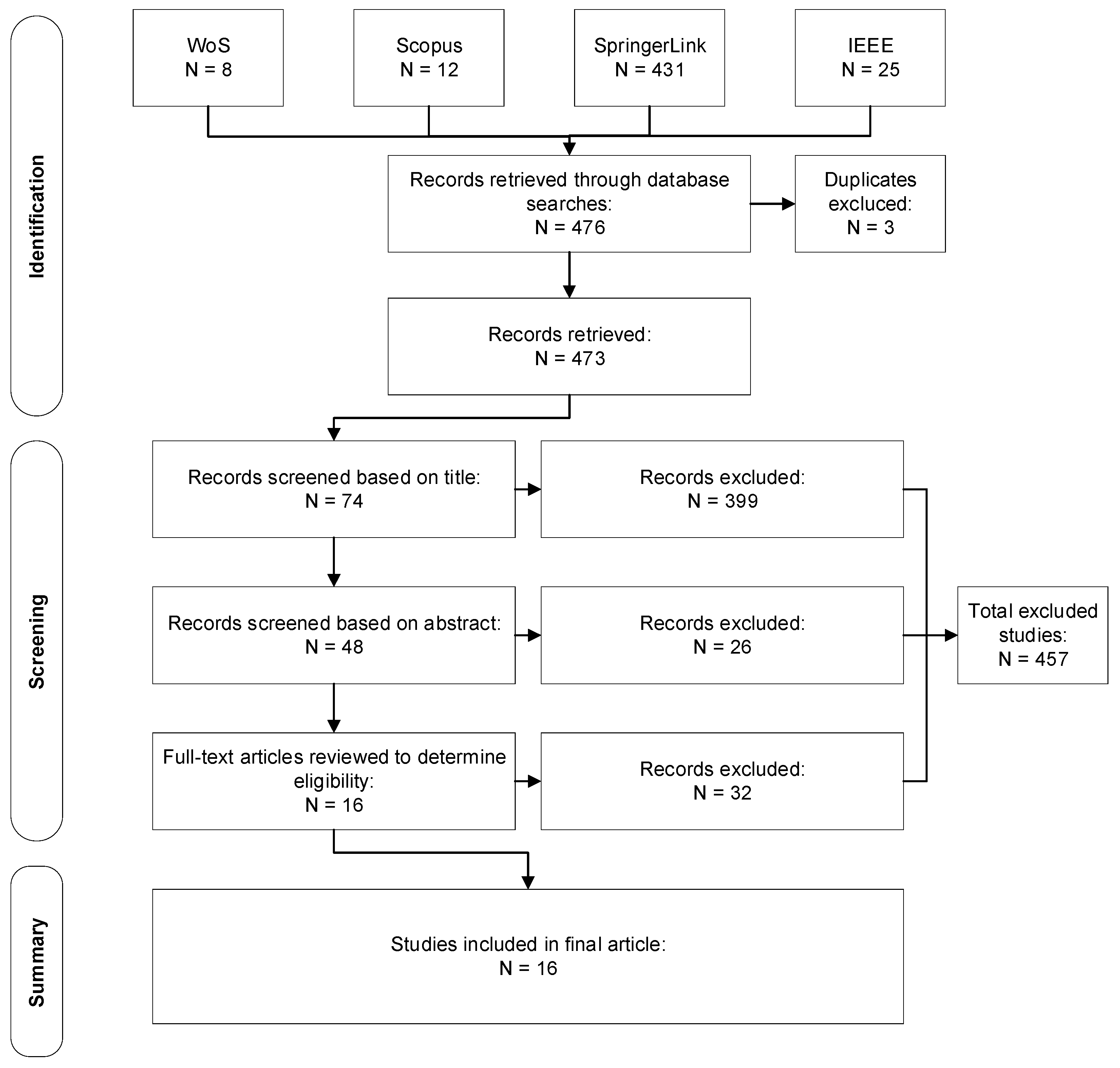
Relevant data were obtained through a systematic literature review and document analysis. To visualize the process of identifying and selecting the relevant literature, a PRISMA flow diagram, seen in
Figure 1, was developed. All
supplementary material from PRISMA model can be downloaded from the
Supplementary Materials.
To avoid the exclusion of potentially valuable contributions, all types of publications were retained. Following this screening stage, a total of 16 studies met the inclusion criteria, as summarized in
Table 2,
Table 3 and
Table 4. These studies were subsequently subjected to a third screening phase involving full-text analysis for quality appraisal and final selection.
Another condition for the selection of AI models within sustainable business models was that these models include at least one ESG criterion as defined in the study by Lou et al. [
30] when selecting sustainable suppliers. ESG criteria are presented in
Table 2,
Table 3 and
Table 4.
Production performance reflects the environmental impact generated directly by production activities and the environmental characteristics of products. It includes greenhouse gas emissions and gas emission intensity, which capture both total emissions and emissions per unit of output. Material type and efficiency describe the use of direct and indirect materials, while the carbon footprint measures the carbon emissions of finished products across three categories. Waste gas emissions and wastewater emissions reflect the treatment methods applied and the resulting emissions. The pollutant subcategory reflects the types, treatment methods, and quantities of pollutants released. Finally, the product subcategory reflects the environmental friendliness of products across their entire life cycle. Resources management evaluates how efficiently and responsibly natural resources are used in production. Resource efficiency measures the consumption of each type of resource per unit of output. Energy reflects the structure, categories, and level of energy consumption. Water reflects water resource consumption and management, while land reflects the utilization and management of land resources. Production management captures how environmental risks arising from production are controlled. Waste management reflects waste categories and how they are managed. Hazardous substance management reflects the categorization and handling of hazardous materials. Chemical substance management reflects the categorization and management of chemical substances, and recycling management reflects the status and effectiveness of material recycling. Environmental management system reflects the institutional and organizational framework for environmental governance. It includes environmental management policies, organizational structures, and internal control mechanisms. Environmental certification and licenses reflect whether the firm meets recognized environmental standards and regulatory requirements. Environmental due diligence reflects the supervision and investigation of environmental behavior. Environmental performance reflects the actual environmental outcomes and risks associated with corporate activities. Environmental incident records capture the occurrence of environmental events. Environmental compliance evaluates whether the company violates environmental regulations. Climate change and protection reflect both positive and negative impacts on climate change. Air quality impact reflects positive and negative impacts on air quality, and biodiversity reflects positive and negative impacts on ecosystems and species [
30].
Employee Right reflects how occupational health and safety policies and behaviors protect employees from workplace risks. It covers whether wages and benefits are fair and competitive, and whether employees’ rights to freedom of association and collective negotiation are respected. It also evaluates the strength of corporate human rights policies and the effectiveness of employee grievance channels and handling procedures. In addition, Employee Right reflects opportunities for career development, training, and professional growth, as well as the quality and fairness of human resources management policies. Employment Performance examines whether child labor or forced labor exists and whether any form of discrimination occurs in the workplace. It evaluates compliance with regulations on working hours and reviews pay structures, including differences between genders and between CEOs and employees. This factor also reflects the level of employee diversity and the inclusiveness of the workforce. Furthermore, it assesses how friendly, safe, and supportive the working environment is, and it analyzes employee age structure and turnover as subcategories of workforce stability. Employment Condition focuses on the structure and stability of the workforce. It examines employee turnover rates, the gender ratio of employees, and the balance between different age groups. It also evaluates the ratio of temporary workers to regular employees to determine whether employment arrangements are fair, stable, and supportive of long-term workforce sustainability. Supply Chain evaluates whether the use of minerals and raw materials involves risks related to human rights. It examines supply chain audit data and the social conduct of suppliers to determine whether ethical and labor standards are being followed. This factor also reflects how social behavior is managed across the supply chain and how well suppliers are monitored. In addition, Supply Chain examines local procurement practices and assesses whether purchasing decisions support responsible and fair sourcing. Corporate reflects responsible business conduct toward consumers and society. It evaluates product responsibility, including safety and ethical behavior, and examines how consumer privacy is protected from infringement or misuse. It also requires transparency in the disclosure of social violations and assesses whether any form of support is given to illegal armed forces, which must not occur. Community reflects the impact of business activities on society and local populations. It examines whether companies support community development and social initiatives. It also evaluates whether business practices respect local community rights and whether any activities infringe upon the interests, resources, or well-being of local communities [
30].
Governance Compliance reflects the quality and integrity of corporate governance. It examines the gender diversity of the board and the proportion of independent directors to assess balance and oversight. It reflects how well intellectual property is protected and whether any infringement occurs. This factor also evaluates whether corruption or bribery exists and whether business ethics are respected or violated. Compliance with laws is assessed by examining whether any illegal cases are present, while money laundering controls are evaluated by identifying whether any such activities occur. Management Behavior reflects how responsibly and transparently management operates. It reviews data and information policies and evaluates whether incentive and compensation systems encourage sustainable behavior. This factor examines whether a supplier code of conduct exists and is applied, and whether appropriate systems for disclosure are in place. It also reflects how management systems and accountability mechanisms are structured and applied. In addition, Management Behavior evaluates how stakeholder risks and returns are managed and whether conflicts of interest are properly disclosed. Information Governance reflects how information is handled, protected, and disclosed. It examines whether conflicts of interest are properly reported and whether information disclosure complies with relevant standards and regulations. This factor reflects how information security is protected against misuse, leaks, or cyber risks. It also evaluates how personal privacy is protected, both for customers and internal stakeholders, and how business information is safeguarded from unauthorized access or misuse. Market Behavior reflects the fairness and integrity of market activities. It examines whether competition and transactions are conducted fairly and whether any illegitimate or unfair gains occur. This factor also determines whether appropriate external supervision exists and whether any operational behavior violates market regulations. Through these elements, Market Behavior assesses whether business conduct supports a healthy, transparent, and competitive market environment. Sustainability Project reflects how sustainability commitments are verified and communicated. It includes external assurance of sustainability matters, ensuring that sustainability claims are independently reviewed. This factor also evaluates whether sustainability reporting is carried out regularly and whether information on sustainability performance is transparently disclosed. Together, these elements show the credibility and reliability of sustainability-related communication. Risk Management reflects how effectively key risks are identified, monitored, and controlled. It examines how import and export control risks are managed to ensure compliance with trade regulations. It also evaluates how risks related to artificial intelligence are governed, including ethical, legal, and operational impacts. This factor indicates how well emerging and regulatory risks are integrated into overall risk management frameworks [
30].
3. Results
Table 5 provides an overview of AI-based sustainable models and their use in decision-making related to sustainable business models (SBMs) and ESG integration. It summarizes the types of models, their authors, the form of AI representation, their contribution to decision-making, and the corresponding ESG subcategories.
The AI-driven decision-making models presented in
Table 5 were selected through a structured and multi-stage screening process aligned with the objectives of this study. The selection was limited to peer-reviewed academic publications published between 2021 and 2025 to ensure the relevance and currency of the analyzed approaches.
In the first stage, studies were identified through a systematic literature search conducted in the Scopus, Web of Science, SpringerLink, and IEEE Xplore databases using combinations of the keywords “artificial intelligence”, “decision-making”, “sustainable business models”, “ESG”, and “sustainability”. Only studies explicitly addressing the application of AI-based methods in managerial or organizational decision-making contexts were retained.
In the second stage, the identified studies were screened based on their conceptual relevance to sustainable business models. Publications were included only if they explicitly linked AI-supported decision-making to at least one sustainability dimension (Environmental, Social, or Governance) and addressed decision-making processes beyond purely technical optimization tasks.
In the third stage, an ESG relevance filter was applied. Only models that incorporated at least one ESG subcategory, as defined in
Table 2,
Table 3 and
Table 4, were selected. This ensured consistency between the ESG framework used in this study and the decision-making contributions reported in the analyzed models.
In the final stage, the remaining studies were assessed for their managerial decision-support contribution. Models were included in
Table 5 only if they demonstrated a clear role in supporting, informing, or partially automating managerial decisions, such as project selection, resource optimization, sustainability performance assessment, risk evaluation, or strategic planning. Purely methodological or algorithmic studies without an explicit decision-making implication were excluded.
As a result of this selection process,
Table 5 presents a curated set of representative AI-driven decision-making models that illustrate how artificial intelligence is currently applied to support sustainability-oriented managerial decisions within sustainable business models.
Park et al. [
31] investigated the applicability of additional information in crowdfunding projects through ESG criteria. When ESG was not taken into account, the predictive AI model predicted the success of campaigns in approximately 81–83% of cases with the best algorithms (XGBoost, LightGBM, CatBoost). After adding environmental information, the accuracy increased to 89–90% (e.g., LightGBM: from 82.9% to 89.7%). This means that every tenth decision was wrong without ESG, but with ESG only about every twentieth. The study analyzed 3196 crowdfunding campaigns from three Korean platforms (Wadiz, Tumblbug, and Crowdy) and used a binary indicator, Success, as the dependent variable (1 = the campaign achieved its goal, 0 = it failed). The mean value of the success variable in the dataset was 0.56, indicating that 56% of the campaigns were successful.
Prasetya et al. [
32] found that, at the operational level, AI shifts sustainable business models (SBMs) from reactive toward proactive and optimization-oriented management. In energy- and environmentally intensive industries, a systematic review shows that the combination of descriptive, predictive, and prescriptive analytics enables reductions in energy consumption, emissions, and process losses in real time. Reported cases—such as an 18% reduction in energy consumption of compression systems and a 64% improvement in methane leak detection—demonstrate that AI-driven decision-making has a direct environmental impact.
Słoniec et al. [
33] proposed and tested a machine learning-based classification framework that is able to indirectly infer whether a firm applies energy-responsible IT/AI governance based on five indicators of digital maturity and AI adoption, without directly measuring energy consumption. Five classification algorithms are reported in the Abstract—support vector machines (SVM), logistic regression, decision trees, neural networks, and k-nearest neighbors (KNN). The best-performing model was SVM, achieving 90% accuracy on the test dataset and an F1 score of 89.8%. In practical terms, this means that the SVM model was able to correctly classify approximately 9 out of 10 cases in previously unseen companies.
Experimental results reported by Leblebici et al. [
34] show that SEAL-ESG significantly outperformed DeepLinker-ESG across all tested datasets, achieving an accuracy of 0.90, an Area Under the Curve (AUC) of 0.96, and a low cross-entropy loss of approximately 0.31 in predicting missing links in software models. These statistical results demonstrate that graph neural network-based link prediction models significantly increase the accuracy of system design, thereby reducing the number of errors, rework, and additional modifications in later stages of development.
Pomè et al. [
35] demonstrated that an intelligent Building Management System (BMS) integrated with the Internet of Things (IoT) and AI led to an approximately 15% reduction in energy consumption across 14 commercial buildings after one year of operation, while also enabling predictive maintenance, which is not feasible without AI and continuous data collection.
Abdelfattah et al. [
36] analyzed the use of artificial intelligence in predicting firms’ ESG performance using a large sample of 19,476 observations from 53 countries over the period 2010–2018. Ten machine learning models were applied, including linear regression, neural networks, and tree-based methods, with the aim of identifying the model with the highest predictive accuracy while also analyzing which factors most strongly influence ESG scores. The best-performing AI model was the random forest regressor, which achieved a coefficient of determination of R
2 = 0.30, MAE = 1.52, and RMSE = 1.89, representing a substantial improvement over classical multiple linear regression (R
2 = 0.14; MAE = 1.70). The results confirm that the relationships between ESG performance and input variables are non-linear, making tree-based algorithms more suitable than traditional statistical approaches.
According to González-Mohíno et al. [
37], the results clearly confirm that artificial intelligence and robotic digitalization play a significant role in improving firm performance, particularly through increased operational efficiency, improved process management, and enhanced trust in technology. The examined study was conducted on a sample of 10 companies, with the dataset comprising 10 managers (engineers in managerial positions) and 108 employees who worked directly with robots or AI solutions. The impact of digitalization through robots and AI on operational performance was positive and statistically significant (β = 0.228;
p < 0.05), while trust in AI and robots showed an even stronger effect (β = 0.384;
p < 0.001). This suggests that the technological benefits of AI are fully realized only when supported by organizational trust and acceptance.
Barba et al. [
38] report that web scraping enables the automated collection of large-scale online data, while AI models allow for (1) the improvement of the scraping process itself—such as estimating information relevance, adapting to dynamic websites, and filtering redundancy—and (2) deeper analysis of unstructured data (e.g., text mining, Natural language processing, sentiment analysis), thereby increasing the speed and accuracy of decision-making in a competitive environment.
Intelligent Management System for Ecological Innovative Enterprises should enable managers to assess the current state of an enterprise, predict future development, and make optimal decisions when implementing eco-innovations. The system is divided into six subsystems, namely diagnostics (SS1), evaluation and prediction (SS2), decision support (SS3), selection of interventions (SS4), simulation (SS5), and decision implementation (SS6). In the experimental section is reported testing the tool on 100 enterprises from Western Ukraine (real case studies) and also present an illustrative “virtual” example of the distribution of sustainability states prior to the implementation of eco-innovations- 30 enterprises in S1, 40 in S2, 15 in S3, 10 in S4, and 5 in S5. These are converted into initial probabilities P1 = 0.30, P2 = 0.40, P3 = 0.15, P4 = 0.10, and P5 = 0.05. Subsequently, after solving the system dynamics (numerically using the fourth-order Runge–Kutta method) and statics (a linear system solved using Gauss’s method), Analysis show that in the long-term steady state the most probable outcome is the best state S5, with stationary probabilities P5 = 0.9342, P4 = 0.0467, P3 = 0.0093, P2 = 0.0092, and P1 = 0.0006. Thus, the model implies that under the implementation of eco-innovations (in their simulated scenario), the system “concentrates” in a state of high environmental sustainability. Odrekhivskyi et al. [
39] interpret this as evidence that their mathematical tool and software are suitable for the evaluation, prediction, and support of environmental decision-making within the IMS EIE framework.
Sharma et al. [
40] identifies a three-level model of AI impact that has a direct effect on sustainability. At the “supporting level”, AI increases the efficiency of existing processes, primarily through the optimization of energy and material consumption and improved quality control. At the “enabling level”, AI transforms processes and value propositions themselves, for example through accurate demand forecasting or personalized services. At the “disruptive level”, AI redefines entire industries, such as autonomous mobility or intelligent energy systems, thereby directly linking technological innovation with environmental and social sustainability.
Aljohani [
41] applies Fuzzy TOPSIS and Fuzzy AHP to rank seven AI-enabled ESG strategies in sustainable manufacturing. Results identify renewable energy integration as the highest-ranked strategy, followed closely by AI-powered predictive analytics and sustainable supply-chain optimization, highlighting the central role of data intelligence in ESG decision-making. The framework addresses uncertainty in expert judgment and demonstrates that AI-based multi-criteria decision-making tools improve transparency, robustness, and strategic prioritization of ESG investments. The study confirms that AI-driven decision-support systems enable firms to align sustainability strategies with operational efficiency and long-term environmental performance.
Censi et al. [
42] develop a BPMN-based AI framework combining process mining, machine learning, robotic process automation, and web scraping to assess ESG risks in construction management. A simulated case study of 100 construction projects shows that AI-driven risk classification improves consistency and traceability of ESG risk identification compared to static reporting approaches. Quantitative benchmarks include cement emissions of 0.85–0.95 kg CO
2/kg, steel emissions of 1.8–2.0 kg CO
2/kg, and 2.5–3.0 occupational incidents per 10,000 work hours. The framework demonstrates how AI supports proactive ESG decision-making by transforming fragmented data into predictive, process-oriented sustainability insights.
Ahmad and Ahmed [
43] propose an explainable AI (XAI) ESG framework combining XGBoost models, SHAP (SHapley Additive exPlanations) explainability, bias-mitigation techniques, and human-in-the-loop validation. Using ESG data from 18 firms across banking, aviation, and chemical sectors (2021–2023), the framework achieves an average 12.4% improvement in ESG score consistency and a 9% reduction in inter-sector variance compared to traditional ESG assessments. Fairness metrics (Disparate Impact Ratio = 0.81–0.86) indicate improved cross-sector alignment. The study demonstrates that explainable AI strengthens regulatory compliance (EU AI Act) and supports trustworthy, governance-oriented ESG decision-making.
Khaddam and Alzghoul [
44], based on a systematic review of 65 peer-reviewed studies, find that AI-driven business intelligence (BI) systems are shifting corporate energy and ESG management from retrospective, compliance-based reporting toward continuous, predictive, and strategically embedded decision-making. Their synthesis indicates that AI enhances ESG reporting efficiency and credibility through automated data extraction, anomaly detection, and assurance mechanisms, including documented cases of fully automated verification of renewable energy certificates and AI-based detection of greenwashing patterns. In operational energy management, real-time dashboards are associated with typical energy savings of 5–15%, while AI-integrated building energy management systems report up to 37% HVAC (heating, ventilation, and air conditioning) energy reductions, demonstrating measurable efficiency gains. At the sectoral level, evidence across 16 industrial sectors shows that AI and automation adoption significantly reduce energy intensity by simultaneously increasing output and lowering energy consumption. In predictive analytics, advanced machine learning and deep learning models outperform traditional statistical approaches in CO
2 forecasting, with optimized energy prediction systems achieving errors below 1.3% and generating measurable reductions in fuel use alongside annual financial gains.
Elhady and Shohieb [
45] analyze 43 peer-reviewed studies and 23 institutional reports to compare machine-learning-based ESG scoring models with traditional rule-based systems. Their findings show that AI-enhanced ESG models—particularly ensemble learning and NLP-based sentiment analysis—outperform rule-based approaches in predicting sustainable investment performance, especially in climate-linked portfolios. The authors introduce the ESG–AI Maturity Index, evaluating institutional readiness across data quality, model transparency, and portfolio integration. Results indicate that organizations with higher AI maturity demonstrate superior ESG forecasting accuracy but still face challenges related to algorithmic bias, regional data gaps, and interpretability, highlighting governance as a critical condition for scalable AI-driven sustainability decisions.
Hao and Demir [
46] demonstrate, through a PRISMA-based systematic review of 605–629 peer-reviewed studies, that artificial intelligence measurably improves environmental, social, and governance (ESG) performance in supply-chain decision-making by enhancing the scope, speed, and accuracy of managerial decisions. From an environmental perspective, the reviewed studies most frequently report AI-enabled reductions in product waste, greenhouse gas emissions, and resource consumption. In particular, demand forecasting, inventory optimization, and logistics routing models are associated with approximately 10–30% reductions in excess inventory and material waste, while AI-supported transport and production planning contributes to 8–20% reductions in emission-intensive activities. Energy and resource-efficiency improvements of around 5–15% are also commonly reported in energy-intensive supply chains due to predictive maintenance and process optimization systems. Social ESG improvements are reported less frequently but remain substantial, appearing in roughly 35–45% of the analyzed studies, especially in safety-critical and consumer-facing industries. AI-based quality inspection and anomaly detection systems reduce product defect rates by approximately 20–40% compared to manual inspection processes, thereby improving product safety and consumer protection. In operational contexts, AI-supported monitoring and predictive maintenance contribute to 15–25% reductions in workplace incidents, while AI-driven supplier monitoring systems increase the detection of labor and safety-related non-compliance by 30–50%, enabling faster corrective actions and more effective social governance across supply chains. From a governance perspective, more than half of the reviewed studies report improvements in transparency, risk management, and decision consistency resulting from AI adoption. AI-based multi-criteria decision-support systems improve supplier ESG ranking accuracy by approximately 15–25% relative to expert-only assessments and enable earlier identification of ESG-related risks, shortening response times by 20–40% compared to periodic manual audits. These governance enhancements are often accompanied by operational cost reductions of around 5–12%, particularly where AI supports lean practices and circular economy strategies.
Synthesis of Theoretical and Empirical Knowledge
Taken together, these studies provide a coherent synthesis demonstrating that artificial intelligence significantly enhances ESG-oriented decision-making across strategic, operational, and governance levels of sustainable business models, while also revealing important boundary conditions. At the strategic level, evidence from Park et al. [
31] shows that integrating ESG information into AI-based decision models materially improves predictive accuracy: in crowdfunding decision-making, the inclusion of environmental criteria increases campaign success prediction accuracy from approximately 81–83% to nearly 90%, effectively halving the rate of incorrect decisions. This quantitatively illustrates that ESG data, when processed through advanced machine-learning algorithms, is not merely normative but economically and decision-relevant. Complementing this, Abdelfattah et al. [
36] confirms on a global scale that ESG performance is characterized by complex, non-linear relationships that are more accurately captured by tree-based AI models than by classical regression, reinforcing the suitability of AI for large-scale ESG assessment and strategic planning, despite moderate explanatory power and reliance on aggregated ESG scores.
At the operational level, multiple studies converge on the finding that AI shifts sustainable business models from reactive compliance toward proactive optimization. Prasetya et al. [
32] documents direct environmental impacts of AI-driven analytics, reporting concrete reductions such as an 18% decrease in energy consumption in industrial compression systems and a 64% improvement in methane leak detection, demonstrating that AI-enabled descriptive, predictive, and prescriptive analytics translate into real-time environmental performance gains. Similar operational benefits are observed by Pomè et al. [
35], who reports an average 15% reduction in energy consumption across 14 commercial buildings following the implementation of AI-integrated building management systems, and by Khaddam and Alzghoul [
44], whose synthesis shows typical energy savings of 5–15% and HVAC reductions of up to 37% through AI-enabled energy management. These findings collectively indicate that AI enhances the environmental pillar of ESG by transforming continuous data flows into actionable, efficiency-oriented decisions.
From a governance and organizational perspective, the literature highlights both enabling mechanisms and critical constraints. Słoniec et al. [
33] demonstrates that machine-learning classifiers, particularly SVM models with around 90% accuracy, can reliably infer responsible IT and AI governance practices, suggesting that AI itself can be used as a meta-governance tool to assess digital sustainability maturity. Ahmad and Ahmed [
43] further strengthen this governance dimension by showing that explainable AI frameworks improve ESG score consistency by 12.4% and reduce inter-sector variance by 9%, addressing transparency, fairness, and regulatory compliance concerns. At the same time, González-Mohíno et al. [
37] show that the performance benefits of AI are strongly mediated by social and organizational factors: while AI and robotic digitalization positively affect operational performance (β = 0.228), trust in AI exerts an even stronger influence (β = 0.384), underscoring that technological capability alone is insufficient without organizational acceptance and governance structures.
System-level and integrative approaches further reinforce the strategic relevance of AI for sustainable business models. Odrekhivskyi et al. [
39] demonstrates through system dynamics modeling that AI-supported eco-innovation management can drive enterprises toward a high-sustainability equilibrium state, while Sharma et al. [
40] conceptually situates these empirical findings within a three-level framework in which AI acts as a supporting, enabling, and ultimately disruptive force for sustainability. Decision-support and prioritization tools such as those proposed by Aljohani [
41] and Censi et al. [
42] show that AI-based multi-criteria decision-making and process mining improve transparency, consistency, and traceability of ESG decisions, particularly in complex and high-risk environments like manufacturing and construction.
Overall, the synthesis indicates that AI substantially improves ESG decision-making by increasing predictive accuracy, enabling real-time optimization, and strengthening governance and transparency. However, across studies, limitations persist, including data quality issues, partial coverage of social dimensions, reliance on simulated or sector-specific cases, and the need for robust governance and explainability frameworks. Consequently, the contribution of AI to sustainable business models is strongest when AI technologies are embedded within trustworthy organizational contexts and complemented by responsible governance structures that ensure ESG objectives are not only optimized but also legitimately and transparently pursued.
4. Discussion
This article contributes to the literature by providing a structured and integrative synthesis of artificial intelligence (AI) model types used to support managerial decision-making within sustainable business models (SBMs), with explicit attention to Environmental, Social, and Governance (ESG) criteria. A key contribution lies in bridging the gap between technical AI capabilities and managerial sustainability requirements. The study demonstrates that AI is not merely an efficiency-enhancing technology, but a decision-enabling mechanism that reshapes how managers interpret ESG information, prioritize sustainability trade-offs, and govern complex, data-intensive systems.
The results of this study indicate that artificial intelligence supports sustainability-oriented managerial decision-making through heterogeneous model architectures, each aligned with different ESG decision contexts and data characteristics. To clarify these distinctions,
Table 6 presents a comparative overview of AI model types identified in another reviewed studies, their primary areas of application in ESG and CSR contexts, and their associated advantages and limitations. This comparison enables a more nuanced interpretation of how AI contributes to sustainable business models.
Ozkan [
47] emphasize that NLP-based AI models play a critical role in ESG analysis by enabling large-scale processing of unstructured textual data, including sustainability reports, regulatory filings, and media content. NLP techniques allow firms to extract qualitative information related to governance practices, social responsibility narratives, and environmental commitments that are typically inaccessible through traditional quantitative models. From an ESG perspective, NLP significantly enhances transparency and coverage, as it enables continuous monitoring of corporate disclosures and external stakeholder signals. This is particularly relevant for governance and social dimensions, where narratives, tone, and framing often carry more information than numerical indicators. NLP contributes to improved information transparency, which acts as a key mediating mechanism between AI adoption and enhanced corporate sustainability performance. However, Ozkan [
47] also highlights substantial cons. NLP models are highly sensitive to reporting bias and greenwashing, as they rely primarily on communicated rather than verified ESG information. Consequently, NLP-based ESG assessments may reflect corporate communication strategies more than actual sustainability outcomes. Moreover, deep language models often suffer from low transparency and explainability, which constrains their use in governance-sensitive contexts where auditability and regulatory compliance are essential.
Empirical evidence from Pagkalou et al. [
48] demonstrates that ANNs are particularly effective in modeling complex, non-linear relationships between ESG variables and financial and non-financial performance indicators. Their study shows that deep learning models outperform traditional econometric approaches and several classical ML techniques when predicting CSR and ESG performance across large firms. In the ESG context, ANNs are especially valuable for performance prediction and pattern discovery, enabling firms and investors to identify key drivers of sustainability outcomes that are not linearly observable. This strengthens strategic planning and supports data-driven sustainability management within sustainable business models (SBMs). Nevertheless, a recurring concern is the black-box nature of ANNs. Despite their high predictive accuracy, ANNs provide limited insight into the causal mechanisms underlying ESG outcomes, which undermines their suitability for governance applications. Weak explainability reduces managerial trust and limits the usefulness of ANNs for regulatory reporting and stakeholder communication, where transparency is as important as performance.
Tree-based ML models are frequently applied in ESG risk classification and CSR adoption prediction due to their robustness to noisy and heterogeneous data. These models effectively capture non-linear interactions among ESG variables and demonstrate strong performance even when datasets contain missing or imperfect information. In ESG applications, tree-based models support risk-oriented decision-making, particularly in environmental and compliance-related domains. Their ability to rank feature importance provides partial interpretability, which is advantageous compared to neural networks. Gradient-boosted trees often achieve competitive or superior predictive accuracy in ESG-related tasks. On the other side, tree-based models struggle with unstructured textual data, limiting their ability to capture qualitative governance and social signals unless combined with NLP. Additionally, these models are typically trained on historical data and thus exhibit limited adaptability to dynamic ESG standards and evolving regulatory environments. From an SBM perspective, this static orientation may reinforce compliance-driven ESG optimization rather than long-term sustainability transformation [
49].
The study by Lachuer and Ben Jabeur [
50] highlights the growing importance of XAI approaches in ESG and CSR analysis, particularly in governance-sensitive contexts. By integrating explainability techniques with ML models, XAI enables the identification of threshold effects, non-linearities, and decision rules that govern the relationship between CSR performance and financial outcomes. In ESG decision-making, XAI directly addresses the need for trust, accountability, and auditability. This makes XAI especially suitable for regulatory compliance, investor communication, and board-level decision-making. Lachuer and Ben Jabeur [
50] also show that explainable models improve interpretability without fully sacrificing analytical rigor, thereby strengthening the governance pillar of ESG. The main trade-off identified in the literature is reduced predictive performance and higher implementation complexity compared to deep learning models. XAI frameworks often require additional computational resources and expert oversight, which may limit their scalability across large, heterogeneous ESG datasets.
Hybrid AI systems, discussed extensively by Wang et al. [
51], represent the most comprehensive approach to ESG-oriented decision support. By combining NLP-based qualitative analysis with quantitative ML models, hybrid systems integrate diverse ESG data sources into end-to-end ESG intelligence platforms. From an SBM perspective, hybrid AI systems enable firms to align strategic, operational, and reporting-level sustainability decisions. They support holistic ESG assessment by capturing both narrative disclosures and performance metrics, thereby overcoming the siloed limitations of single-model approaches. However, hybrid systems introduce high implementation costs, governance complexity, and integration risks. Effective deployment requires mature data governance structures, skilled personnel, and clear accountability frameworks. Without these conditions, hybrid AI systems risk becoming technically sophisticated but organizationally ineffective tools.
The technological approaches discussed above naturally raise the question of how these AI tools are legally and institutionally governed within sustainable business models. While different AI models (NLP, ANN, tree-based models, XAI, and hybrid systems) offer distinct advantages and limitations for ESG decision-making, their effectiveness depends on a broader risk-based AI governance and regulatory lifecycle framework. This framework embeds AI deployment within a structured policy process that aligns decision-making with transparency, accountability, fairness, and long-term sustainability objectives. In this context, technical features such as predictive accuracy, explainability, or data integration capacity must be assessed alongside regulatory requirements for risk assessment, documentation, human oversight, and post-deployment monitoring. AI-enabled ESG decision-making therefore operates not merely as a technological optimization tool, but as part of a legally and institutionally structured governance process that shapes how firms design, implement, and control AI within sustainable business models [
52].
A suitable law and policy framework for analyzing AI-enabled decision-making in sustainable business models is the risk-based AI governance and regulatory lifecycle framework, most clearly articulated by Almeida et al. [
52] and further supported by Ferrell et al. [
53]. This framework conceptualizes AI regulation not as a single legal intervention, but as a process-oriented governance system that aligns AI decision-making with long-term societal values, sustainability objectives, and ESG principles.
According to Almeida et al. [
52], AI regulation should be understood as a multi-stage policy process covering the entire lifecycle of AI systems, from design to post-deployment monitoring. This approach is explicitly grounded in public policy theory and sustainability governance, aiming to ensure that AI-driven decisions remain compatible with social welfare, environmental protection, and democratic accountability. Rather than focusing solely on technical compliance, the framework embeds AI decision-making within broader legal and institutional contexts that shape how firms design, deploy, and govern AI in business models. From this perspective, AI-enabled decision-making in sustainable business models follows a legally and institutionally structured process.
First, policy goal setting and normative anchoring establish the legal and societal objectives that AI systems are expected to serve. Almeida et al. [
52] emphasize that regulatory frameworks for AI are grounded in fundamental values such as fairness, transparency, accountability, and long-term sustainability. In the context of sustainable business models, this stage ensures that AI decision-making is aligned with ESG objectives and public-interest goals before technological implementation begins.
Second, ex ante risk assessment and system design regulation guide how AI systems are developed. Legal and policy instruments require organizations to assess potential risks related to discrimination, environmental harm, opacity, or loss of human oversight. Almeida et al. [
52] argue that many sustainability and legitimacy problems associated with AI originate at the design stage, making early regulatory intervention essential. This step constrains business decision-making by requiring firms to integrate legal safeguards and sustainability considerations directly into AI architectures.
Third, deployment governance and procedural accountability regulate how AI-driven decisions are used in organizational practice. At this stage, legal frameworks impose requirements related to explainability, documentation, and human oversight. Ferrell et al. [
53] complement this view by arguing that ethical and legal governance mechanisms function as filters that determine whether AI-generated decisions are acceptable within organizational and societal norms. For sustainable business models, this ensures that AI decisions affecting environmental or social outcomes remain subject to managerial and legal responsibility.
Fourth, post-deployment monitoring, enforcement, and adaptation form a critical component of the policy framework. Almeida et al. [
52] highlight that AI regulation must be dynamic, allowing for continuous learning, auditing, and regulatory adjustment as AI systems evolve. This is particularly important for sustainable business models, where long-term environmental and social impacts may only become visible over time. Legal monitoring mechanisms therefore reinforce legitimacy by enabling corrective action when AI-driven decisions produce unintended or unsustainable outcomes.
Building on prior research on artificial intelligence (AI) in sustainability and decision-making, a set of propositions is advanced to clarify how AI can be employed in sustainable business models (SBMs) in a manner that is effective, efficient, and legitimate [
46,
51,
52,
53,
54,
55]:
AI enhances decision effectiveness in sustainable business models when AI systems are explicitly aligned with environmental, social, and governance (ESG) objectives rather than purely economic performance metrics.
AI improves the efficiency of sustainable business model decision-making when deployed as a decision-support system that complements, rather than substitutes, human managerial judgment.
The legitimacy of AI-enabled decision-making in sustainable business models is positively associated with the transparency, explainability, and governance of AI systems.
AI contributes to sustainable business model innovation when conceptualized as a dynamic capability that enables continuous adaptation to environmental and social complexity.
Limitations and future work
Despite the growing relevance of artificial intelligence (AI) in supporting decision-making within sustainable business models, this study is subject to several limitations that should be acknowledged when interpreting its findings. From a methodological perspective, the research is constrained by the rapid pace of technological development in AI systems. Many AI-driven decision-support tools evolve faster than academic research cycles, which limits the ability to comprehensively capture the full spectrum of available solutions and their real-time capabilities. A systematic review by Greif et al. [
56] highlights that the rapidly evolving nature of AI applications in sustainability research challenges the frequency and depth of academic reviews, creating an urgent need for more dynamic and up-to-date analyses to keep pace with innovation.
Another limitation according to Mustafa et al. [
57] concerns data availability and quality. Sustainable decision-making supported by AI is highly dependent on access to reliable, high-quality, and interoperable data across environmental, social, and economic dimensions. In practice, many organizations face fragmented data infrastructures and inconsistent sustainability metrics, which may bias AI-supported decisions or reduce their strategic relevance. This limitation aligns with concerns raised by recent research, which highlights persistent challenges in data accuracy, transparency, and integration when applying AI to sustainability and ESG reporting contexts.
The implementation of AI-based decision-making systems also introduces organizational and ethical constraints. According to Chatjuthamard et al. [
58] a high degree of automation may reduce managerial oversight and weaken the role of human judgment, especially in complex sustainability trade-offs that require normative or value-based reasoning. Recent research highlights that the rapid adoption of AI across organizational contexts necessitates responsible governance frameworks that ensure meaningful human involvement, accountability, and bias mitigation, since AI systems can inadvertently reinforce embedded biases in data and algorithms and thus pose risks for ethical and responsible decision-making in sustainability-oriented strategies.
Internal validity is another limitation of this study. Observed decision-making improvements cannot be unequivocally attributed to AI capabilities alone, as outcomes are influenced by contextual factors such as organizational culture, digital maturity, and managerial competencies. Differences in AI adoption readiness across firms and industries may lead to heterogeneous results, limiting the generalizability and reproducibility of the findings. This matter needs more cooperation activities [
59]. Matthew et al. [
60] highlights that the lack of transparency and interpretability in complex AI models further complicates causal attribution, particularly when AI outputs are integrated into strategic sustainability decisions.
From a future research perspective, several promising directions emerge. Further studies should focus on longitudinal analyses of AI-supported sustainable business models to better assess long-term impacts on environmental and social performance. There is also a need to explore explainable and transparent AI approaches that enhance trust, accountability, and human–AI collaboration in sustainability-driven decision-making. Additionally, future research could examine sector-specific applications of AI in sustainable business models, as sustainability priorities and data structures vary significantly across industries.
Integrating AI decision-making with established sustainability frameworks, such as circular economy models or ESG performance systems, represents an important avenue for future work. Such integration could improve both the practical applicability and theoretical robustness of AI-driven sustainable business models, contributing to more resilient and responsible corporate strategies in the long term.
5. Conclusions
The main contribution of this study was to systematically examine how artificial intelligence-supported decision-making methods transform managerial decision-making processes within sustainable business models (SBMs), with a specific focus on their ability to integrate Environmental, Social, and Governance (ESG) criteria into strategic and operational decisions. To address this aim, the paper conducted a structured review and comparative analysis of recent AI-based decision-making approaches applied in sustainability-oriented business contexts.
The results indicate that AI-supported decision-making methods deliver the most tangible benefits in SBMs when applied to data-intensive and dynamic decision contexts where traditional managerial approaches face clear limitations. Across the analyzed studies, machine learning-based models demonstrated a strong capacity to process heterogeneous ESG data and to improve decision accuracy in areas such as sustainability performance prediction, investment selection, and risk assessment. Predictive models incorporating ESG variables achieved significantly higher accuracy compared to models relying solely on financial or operational indicators, confirming that ESG information represents decision-relevant input rather than purely normative or reporting-oriented data.
At the operational level, the findings show that AI enables measurable sustainability improvements through real-time monitoring and optimization of processes. AI-driven analytics and predictive maintenance systems were shown to reduce energy consumption, emissions, and material losses in energy- and resource-intensive environments. These results demonstrate that AI supports a shift from reactive sustainability management toward proactive and optimization-oriented decision-making, allowing sustainability objectives to be embedded directly into everyday managerial decisions.
At the strategic level, AI-supported models such as system dynamics, simulation-based decision support, and multi-agent systems provide managers with tools to evaluate long-term sustainability trajectories and complex trade-offs inherent in SBMs. The reviewed models illustrate how AI enables scenario analysis and forecasting under uncertainty, supporting strategic decisions related to eco-innovation, business model adaptation, and long-term resource allocation. Importantly, these approaches align well with the systemic nature of SBMs, where sustainability outcomes emerge from interactions across multiple organizational and environmental subsystems.
The synthesis of these studies clearly demonstrates that artificial intelligence (AI) significantly enhances ESG-oriented decision-making across strategic, operational, and governance levels of sustainable business models. AI improves predictive accuracy, optimizes environmental performance, and strengthens governance structures. At the strategic level, decision-making accuracy is enhanced, particularly through the integration of ESG factors, while at the operational level, AI delivers real-time environmental gains, such as reduced energy consumption. Governance is also reinforced by AI’s ability to increase transparency, fairness, and consistency, especially through explainable AI frameworks. Despite these advancements, challenges remain regarding data quality, coverage of social dimensions, and the need for effective governance. Ultimately, the true value of AI in sustainable business models is realized when it is integrated with robust organizational structures and transparent governance practices.
However, the results also highlight important limitations that condition the effectiveness of AI in sustainable business models. The performance of AI-supported decision systems remains strongly dependent on the availability, quality, and consistency of ESG data. In several reviewed studies, sustainability impacts were inferred indirectly rather than measured explicitly, introducing uncertainty into decision outcomes. In addition, the limited explainability of complex AI models poses challenges for managerial trust, accountability, and ethical governance, particularly when AI outputs influence strategic sustainability decisions with long-term societal consequences.
The findings of this study demonstrate that AI contributes to sustainable business models not merely as an efficiency-enhancing technology, but as a decision-enabling mechanism that expands managerial capabilities in dealing with complexity, uncertainty, and multidimensional sustainability goals. AI-supported decision-making is most effective when ESG criteria are embedded directly into model objectives and decision logic, and when AI systems are implemented as complementary tools within well-defined managerial and governance frameworks.