1. Introduction
This article aims to expand the application of the system’s approach to analyzing processes in living systems. At the outset of the article, to elucidate the distinctive characteristics of living systems in contrast to the general notion of a “system,” we first define the meaning of a living system within the proposed model [
1]. Living systems are fundamentally distinct from all other (non-living) systems. The primary difference lies in their capacity to function by dissipating external energy and continuously reducing their internal entropy [
2,
3]. Living systems draw upon low-entropy objects as resources, degrading them and extracting a portion of their stored energy—this mechanism allows them to counteract the increase in their own entropy [
4] and thereby diminishes the likelihood of systemic disintegration. Some authors have critiqued formulations such as “drawing negative entropy,” yet no compelling alternative has been advanced to date [
5].
The majority of complex living systems utilize other living systems as low-entropy resources, destroying them in the process. Nevertheless, there must exist living systems that operate solely on the basis of non-living sources of low entropy. This is feasible due to the availability of natural sources capable of providing negative entropy. The most significant among these is solar radiation [
6,
7,
8]. The Sun is conventionally regarded as the primary source of low entropy for terrestrial life. Equally essential are the materials and elements of the Earth itself [
9,
10].
Consequently, living systems are sustained by continuous flows of resources originating from solar energy and terrestrial matter, which are channeled through them to maintain their vital processes.
Entropy is inversely related to the concept of information, which inevitably links living systems to information, since their existence requires the preservation of certain information [
11]. Living systems are frequently characterized by the property of being “autopoietic” [
12]. However, given that the term “autopoietic” currently lacks a sufficiently precise definition [
13,
14,
15], we will refrain from employing it to define living systems in this work. Instead, we highlight the core and broadly enduring aspect of the autopoietic concept—namely, the regeneration of structure.
In place of “autopoietic,” the present article adopts the more neutral characterization of “reproduction of structure.” This formulation better accommodates the full range of living systems, encompassing not only individual organisms but also groups of organisms and even more complex structures based on such groups. Groups of organisms possess their own distinct resources, separate from those of their constituent individuals. Moreover, groups of living systems often exhibit interaction processes with their resources that, due to emergent properties, cannot be reduced to the processes of the participating entities. Consequently, such groups constitute distinct systems in their own right.
Since these groups are composed of living systems, they themselves must be regarded as living. For this reason, the term “living system” as used in this article extends beyond individual organisms to include higher-level entities. This broader conceptualization aligns with established conventions in contemporary living systems theory [
16].
It is worthwhile to consider the definition of life used by NASA: “Life is a self-sustaining chemical system capable of Darwinian evolution” [
17]. In the present definition, the capacity for evolution may reasonably be extended to include the ability to copy structure, since without such copying, subsequent selection among variant copies of a living system would be impossible. Beyond the more evident reproduction through the creation of new copies, living organisms can also reproduce structure within a single instance by replacing one material substrate with another. Prominent examples include the shedding of skin in snakes, the continuous turnover of cells in multicellular organisms (including humans) [
18,
19], or the generational replacement within human populations, even in relatively closed communities.
All these processes can be characterized as the transfer of structure—and thus its reproduction—accompanied by the concomitant removal of structure from the original material substrate. Regeneration of damaged or lost parts in living systems can be regarded as functionally analogous. While these processes cannot be directly classified as mechanisms of evolution, they are necessarily linked to the dynamic nature of living system structure. Such phenomena may appropriately be termed self-sustaining.
Thus, the concept of structural “reproduction” encompasses both the replication of a system’s structure in new copies and the sequential transfer of the core structure of an individual living system from one material substrate to another. This broader understanding aligns closely with most established definitions of the term “autopoietic.”
This also implies that the reproduction of structure in living systems requires matter as a substrate onto which the system’s structure can be transferred. Thus, in addition to energy—manifested as relatively low entropy with respect to the living system itself, and embodied in the degraded structures that are consumed—the system also utilizes matter that previously constituted external structures. The matter serving as a carrier of the system’s information can be employed regardless of its relative entropy level, since its primary function is to temporarily act as a repository for the reproduced structure without undergoing significant degradation. Consequently, living systems are characterized by continuous flows of both energy and matter.
It is noteworthy that the previously cited NASA definition of “life” likely refers not to all living systems, but specifically to living organisms. To extend the concept of a “chemical system” more broadly to encompass all living systems—including groups of organisms and social systems such as states [
16,
20,
21]—it is convenient to replace it with the more general notion of “structure” or simply “the presence of information.”
Drawing on the foregoing discussion, the present article adopts the definition of living systems as self-reproducing information—that is, information structures capable of autonomously reproducing themselves. For the purposes of this study, we deliberately exclude consideration of the necessary prerequisites pertaining to the elemental composition or functional organization of living systems, as these aspects have already been sufficiently elaborated in the literature [
10,
11,
22]. All of the information reproduced by a system we will consider a component of that system. If there are losses or distortions and the system does not reproduce all the information that it carries, but the remaining information is capable of self-reproduction, then the living system can continue to exist.
We will distinguish between independent reproduction and autonomous existence. As mentioned above, to reproduce themselves, living systems often use matter and energy obtained from other systems, but they can also use other living systems that are part of a larger living system as repositories of information. According to the proposed definition, a living system will be considered such if it is capable of independently imparting to external matter the structure inherited by the given system.
If a system requires external infrastructure to fully transform matter into the required structure for reproduction, then such a system is considered part of another living system. Accordingly, if any part of a living system’s structure is excluded from reproduction, then it ceases to be part of the living system, even if the structure is still preserved in some matter. For instance, an isolated group of animals that have passed reproductive age ceases to constitute a biological living system. While they remain alive in the general sense of the term, and certain aspects of their structure continue to be reproduced, they can no longer be regarded as a biological living system—that is, as a system participating in the reproduction of information pertaining to their biological species. Naturally, this does not imply that they are no longer a system in the broader sense; however, their status as a biological living system, defined by active involvement in species-level information perpetuation, is no longer applicable.
Another example is that after the decline of the Western Roman Empire, numerous technological achievements, although they remained in use, ceased to exist as industries, that is, as technological systems, since they could not be reproduced at that time [
23].
At the same time, classical agricultural plants and animals—including those no longer found in the wild—can be regarded as living systems independent of humans. This assertion is justified by the fact that such organisms are capable of autonomously transmitting their complete informational content. While transmission frequently involves losses, these are of a normal stochastic nature, governed by natural selection and resource availability. Therefore, they can be considered as living systems that reciprocally influence humans and use them as important, but optional resources and carriers [
24,
25]. The same is true for zoo animals, including those that are on the verge of extinction and are preserved only through human efforts. Information transmitted by people through both non-living and living objects forms part of human social living systems.
It is also worth emphasizing that the self-reproduction of information is equivalent to the self-reproducing patterns in resource flows. Since each time a structure is imparted to new matter through new energy, which requires a constant supply of both types of resources, this implies that a certain flow of these resources must be available to the system. Such a process requires that the flows of both types of resources intersect in the area where the system operates. At the same time, the imparted structure will be reproduced each time in the main part, which corresponds to the repetition of patterns in the area of intersection of such resource flows. Such a specification of living systems, when applied to social systems, aligns closely with Wallerstein’s duality of historical (social) systems in world-systems analysis, according to which these systems simultaneously preserve enduring structural patterns and undergo continuous transformation [
26].
Thus, the maintenance of such regularities—that is, the transfer of information across different material substrates—requires several distinct resource flows: namely, matter of all those types capable of bearing the system’s information, and low-entropy energy in forms that the system can assimilate. Here, energy is understood as the driving force that redistributes matter, thereby imposing the system’s structure and generating its informational content.
In simple living organisms, these resource requirements are relatively straightforward. However, social systems demand further clarification. In groups of organisms, the organisms themselves constitute the driving force: it is they who redistribute the remaining matter within such collective living systems. Accordingly, the infrastructure created and utilized by the participants of a social system serves as the material substrate for that system. Consequently, social living systems require a certain social collective that functions as the source of energetic drive. In turn, as material resources, they necessitate materials, equipment, plants, productive livestock, and other elements that this collective is capable of appropriating and utilizing.
These constitute the core propositions defining living systems within the framework of the present article. We now proceed to examine in greater detail the principles governing the functioning of living systems. Henceforth, the term “living systems” will, where appropriate, be abbreviated simply to “systems”.
As von Neumann’s example of the required complexity in living systems [
22] demonstrates, even the definition of living systems itself is already sufficient to infer some of their properties or principles of functioning. Many properties of living systems are described in the classic book on living systems by von Miller [
16]. To advance existing approaches to the study of living systems, in this article, we present hypotheses about three additional possible principles of living systems functioning, based on considering them as self-reproducing information, or, in other words, as repeating patterns in resource flows.
2. Resources of Living Systems
Within the model of living systems based on the proposed definition, each living system can be considered a system in which two resource flows interact reciprocally, influencing each other. Along with this, one of the resources must correspond to a relatively less stable matter, which predominantly serves as a source of negentropy for structuring other matter. Such unstable matter can be designated as energy. In this article, we will also use the term “unstable matter” as a synonym. Such matter itself is less involved in the process of structure formation, but the structure is formed using the energy obtained from its partial or complete decay. Its negentropy is partially or completely expended in the process of destruction of its structure, and this expenditure is used to change the structure of other matter (including energy reserves, that is, other relatively unstable matter, but already incorporated within the structure of the system itself).
Thus, the second resource should be matter with a relatively slowly dissipating structure and a relatively low contribution to the entropy reduction of other matter in the system. For conciseness, let us designate such matter as “stable”, or simply as matter, in contrast to the energy described above. Consequently, such matter already contains some existing structure, which then forms part of this living system’s structure. Unstable matter, after undergoing partial destruction and an increase in its entropy, is typically utilized by the system. At the same time, stable matter has a formed stable structure, which, after being redistributed by external energy, becomes part of the structure of the living system. That is, despite its smaller contribution to the decrease in the entropy in a living system, stable matter maintains its low entropy due to the lowest entropy (or information) preserved in it, which, along with the matter itself, remains within the structure of the living system.
It is important to note that the classification of resources as either matter or energy is not an inherent property of the resources themselves. The same structures may be utilized in different living systems either as energy through their degradation, or in an almost unaltered form as matter. The assignment to one category or the other is therefore relative and depends solely on how the resources are employed within the specific living system under consideration.
To evaluate a living system’s strategy toward resource sources, it is necessary to identify the parameters of these sources that are most relevant within the proposed model. The key parameters are the value of the sources (denoted as H) and the probability of their occurrence (denoted as F). Since the analysis of the system as a whole is primarily concerned with averaged parameters of resource sources rather than specific forms of matter or energy, the symbols H and F will hereafter denote the mean characteristics of sources of one resource type—either matter or energy. In the proposed model, the average value of resource sources is assessed relative to the quantity of resources required to complete one full operating cycle of the system. Accordingly, the conditional unit of value H for individual resource source types is defined as the amount necessary for one complete cycle. The interaction frequency F with resource sources is likewise measured relative to the duration of one operating cycle, i.e., it represents the number of interactions occurring during one cycle. For convenience, the duration of one operating cycle is taken to be the time interval between two consecutive interactions with the scarcest resource form in the system. This choice is justified by the fact that the absence of this scarcest resource precludes the full execution of the system’s processes. The type of the scarcest resource—whether it pertains to matter or to energy—is irrelevant. The average characteristics of matter or energy sources may take any magnitude, even when they include the scarcest resource form in a particular case. It should be clarified that the term “resource types” refers to the distinction between matter and energy, whereas “resource forms” denotes the diverse specific manifestations in which matter or energy enters the system.
For example, sources of a given resource may be relatively abundant in the system’s environment and at the same time highly valuable—that is, each source may provide the system with a substantial quantity of energy or matter. In such cases, there is little basis for adopting a specialized strategy toward these sources. Consequently, the system’s expenditures on resources will primarily depend on the parameters of the second type of sources.
A different situation arises when sources are both highly valuable and relatively rare. Here, it becomes rational for the system to minimize the probability of missing such sources. In effect, the system should seek to reduce the likelihood of Type I errors—that is, the failure to respond appropriately to the presence of a valuable resource. At the same time, the system’s expenditures on false activations are justified by the high reward obtained upon successful acquisition of the resource. Here, “activation” refers to the efforts undertaken by the living system to secure the resource upon detection of its indicators. In reality, however, information is never perfectly accurate; it reflects only a certain probability of the resource’s presence. Thus, information may be false, and any actions taken by the system in pursuit of a nonexistent source will be expended in vain. Consequently, such expenditures represent wasted effort.
Conversely, when sources are relatively abundant but of low value, the system’s strategy toward them is expected to be the opposite. The system will seek to avoid excessive responses to false indicators—that is, to minimize Type II errors. In this case, missing an occasional source does not constitute a significant loss. It is therefore rational for the system to respond only in cases of the highest reliability, which is reasonable given the high baseline probability of encountering such sources.
Resources of any type—whether matter or energy—are most conveniently evaluated in terms of their frequency or value relative to the second type of sources, since resources of the second type are primarily invested in interactions with sources of the first type.
The examples above illustrate how a living system’s strategy toward resource sources varies depending on their relative characteristics. Let us create a diagram illustrating the relative characteristics of the system’s resource sources. For general analysis, we will mark the points that correspond to the average relative characteristics of all energy and the average relative characteristics of all matter in a hypothetical individual living system. Matter and energy are conventionally denoted by indices n and k, without assigning either index to a specific resource type (matter or energy). This conditional and impersonal notation does not influence subsequent reasoning, as all relative evaluations and their effects on system strategies remain fully symmetric and interdependent with respect to sources of matter and energy. The lack of fixed index assignment enables uniform designation of parameters for both resource types throughout the analysis. In such cases, notation with index n relative to k will refer to the resource type under consideration (matter or energy), while the parameters of the second resource type will implicitly correspond to those of k relative to n. Moreover, the second resource may subsequently likewise be denoted by index n relative to k; this convention is adopted deliberately to prevent undue focus on the indices at the expense of the parameters themselves.
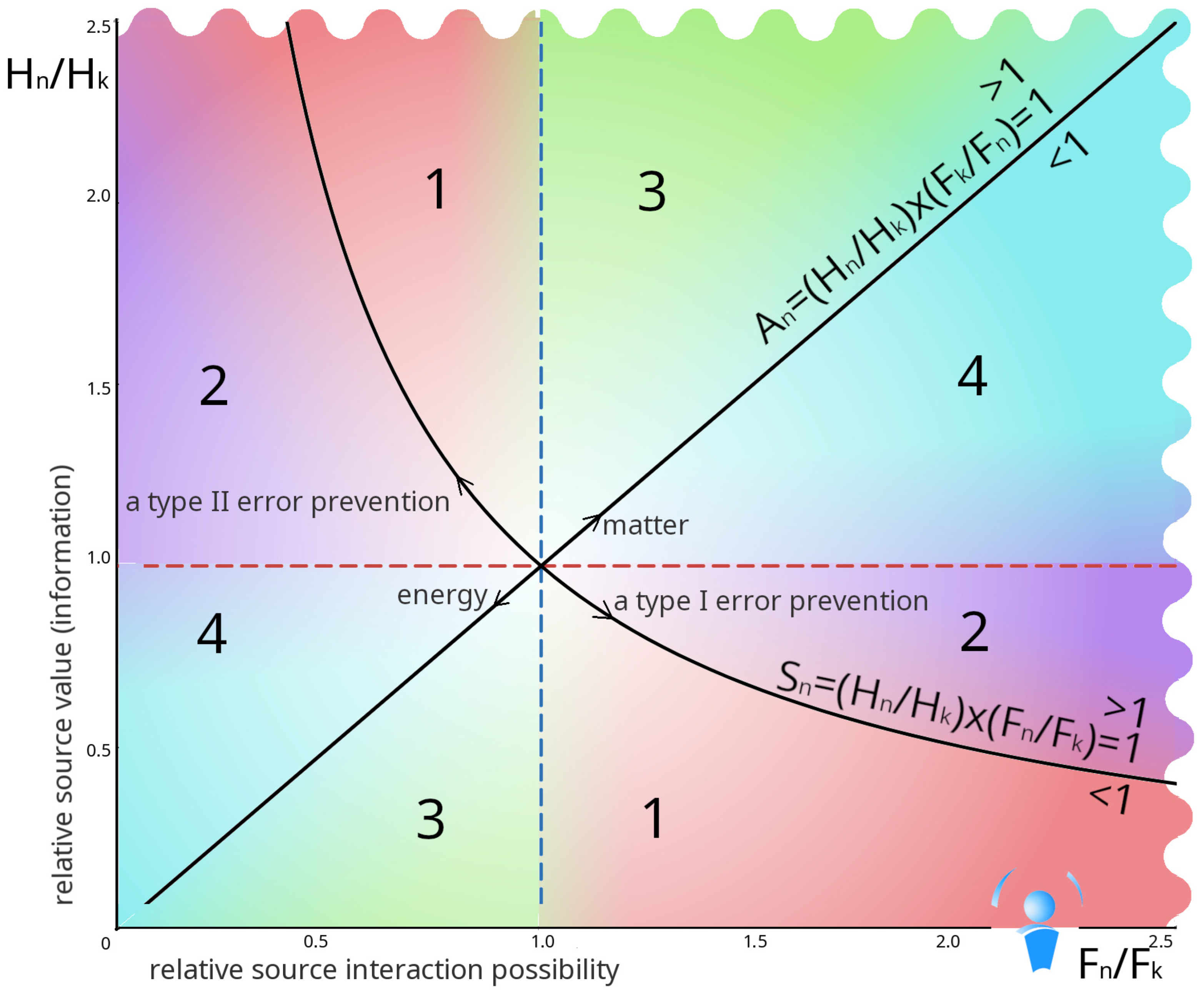
On the graph, one axis will represent the relative value of negentropy (or information) received by the system from the sources of both resource flows interacting in the system—Hn/Hk, and the other axis will represent the relative probability of interaction with the sources of both resources—Fn/Fk. These relative quantities could be denoted by a single symbol; however, in subsequent formulas within the article, the numerator and denominator will occasionally be separated for the sake of clarity. To maintain consistency, we therefore retain this form for the relative characteristics without introducing additional notation.
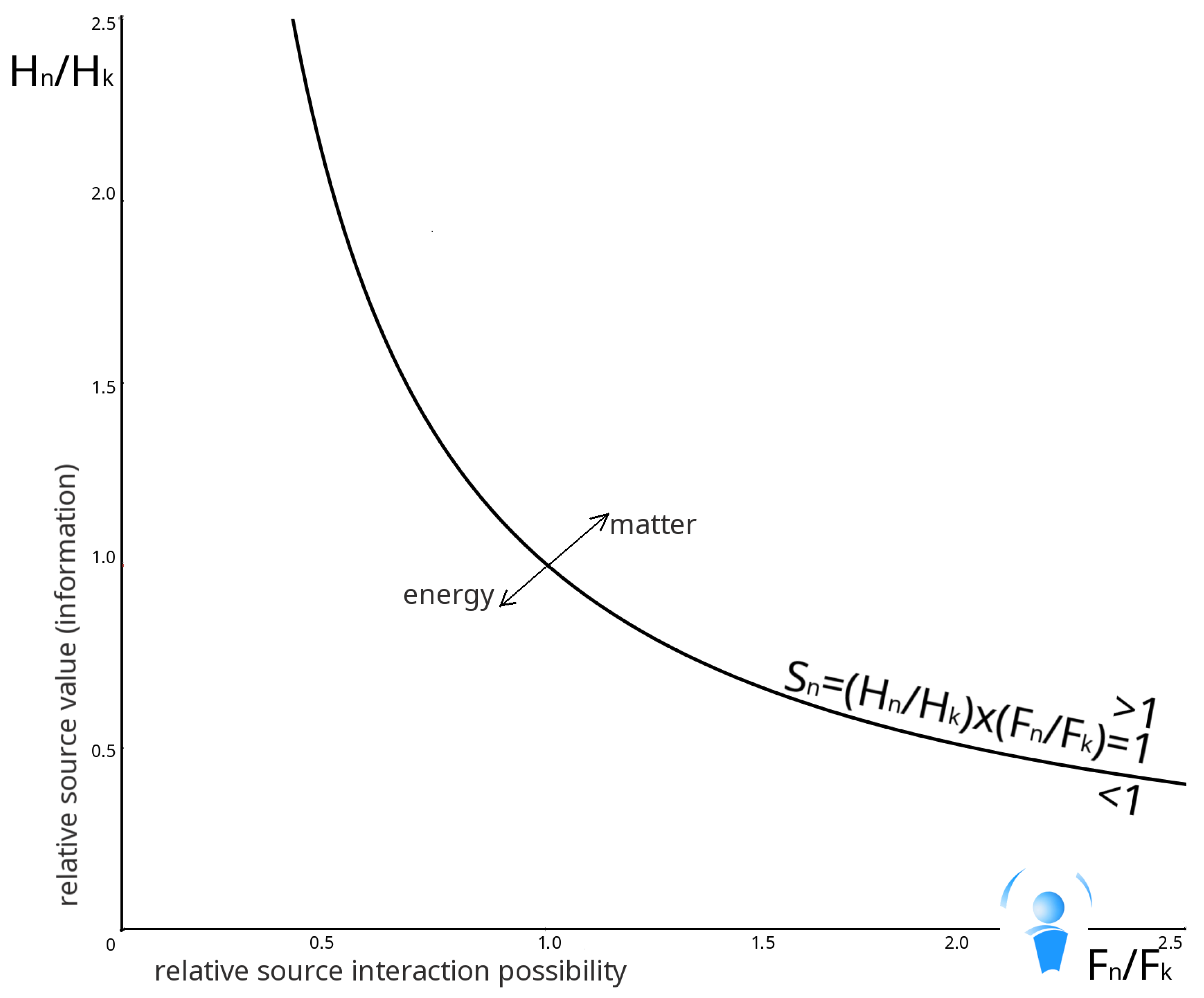
Then it is possible to draw a line on the graph that represents the relative value of negentropy obtained from resource flows, the relative «substantiality» of resources, equal to one: S
n = H
n × F
n/H
k × Fk = (H
n/H
k) × (F
n/F
k) = 1. On such a graph (
Figure 1), resources that correspond more closely to sources of matter will be characterized by the relative parameter S
n > 1. That is, the point representing their relative properties will lie to the right of the line S
n = 1. Whereas resources that correspond more closely to energy will lie in the region S
n < 1. The relative positions of the two points on the graph, representing the flows of resources every living system consists of (
Figure 1), namely energy and matter, will always be symmetrical with respect to the intersection point of the lines H
n/H
k = 1, F
n/F
k = 1, S
n = 1. And, since the probability of two completely identical resource sources with respect to any given parameter is minimal, in reality, their presence on any of these lines is, in fact, equal to zero. These are the main constraints on the positioning of such points in different regions of the graph.
It is worth specifying that in our model, each system always consists of only two interacting complex resource flows. In reality, the sources of each resource can be complex, simultaneously consisting of many elements of matter and carrying energy, for example, living organisms consumed by living systems as resources. Moreover, the sources of a system’s resources can be of several types simultaneously, as in the case of matter sources for plants or many bacteria, which use different individual mineral substances from the environment, for which these materials constitute a single resource flow. It would be incorrect to examine interactions with each component of such complex or diverse resources separately within the general model proposed in this article, since such individual components are not separate living systems, but only form part of the system, incapable of self-reproduction. Thus, if we consider ants, they use external resources for food and for building an anthill. However, they need food resources primarily as independent living systems, that is, as individual organisms, whereas they need materials mainly for the living system of an anthill, in which the individual ants themselves serve as a resource. Nevertheless, often any individual component of the complex resources of a living system can also be considered within a separate subsystem of the living system for which this component is the primary resource. In the case of an anthill, examples of such subsystems could be individual ants or their separate groups.
It is also worth clarifying that any living systems exist only as long as their corresponding resource flows remain. Regardless of how long-lived the resource flow is, if the system is capable of reproducing within it for at least one cycle, then for that cycle it constitutes a living system. It does not matter whether we are referring to a biosphere that has existed for millions of years, a bacterium that lives for less than an hour, or a group of people formed for a day under particular circumstances and capable of changing its members.
The main sources of resources apparently emerged because, although the most widely accepted theory states that the entropy of the Universe is increasing, this increase is uneven [
27,
28]. As a result, local sources of negentropy emerge in different places, for example, the Sun and the Earth [
6,
29]. They are the primary sources of most resources for many plants, bacteria, fungi, or their symbiotic groups, as well as for humans, who in turn constitute part of the resource base for other, often more complex, living systems. There are short-term resource flows derived from them in which living systems can emerge [
30,
31,
32,
33]. Moreover, after the emergence of the simplest living systems, more complex ones may emerge over time on their resource base. And further, on the basis of increasingly complex living systems, using them as resources, derivative living systems of particularly high complexity may emerge. For example, some human communities—social systems, including short-term ones, which are able to exist, for example, due to short-term marketing demand for some product. Thus, resources can be extremely diverse, as well as their properties, while maintaining components corresponding to matter and energy (
Figure 2).
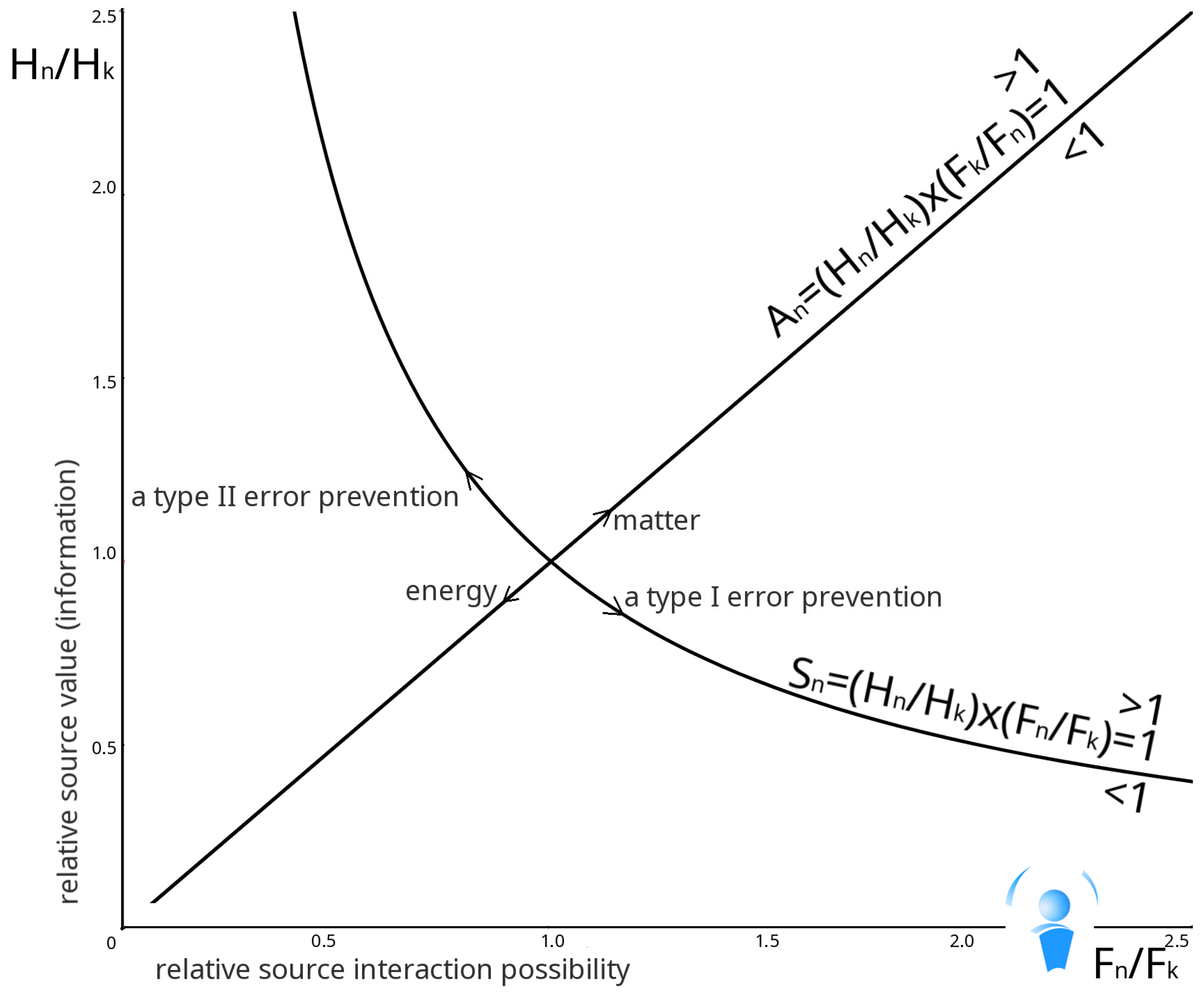
Let us now consider, on the previously mentioned graph, the line of relative resource “redundancy” A
n = (H
n/F
n):(H
k/F
k) = (H
n/H
k) × (F
k/F
n) = 1, indicating for which resource the frequency of interaction with sources makes a relatively greater contribution than their intensity (
Figure 2). With a relatively more concentrated distribution of the resource, when A
n > 1, the resource flow indicates a relatively greater need for its accumulation for subsequent interactions with the counter-resource.
Accordingly, the main “body” of the system predominantly consists of those resources for which An > 1, regardless of whether they are stable matter or energy stored in relatively unstable matter. Then the second resource, which requires less accumulation, will be invested relatively quickly into the new structure of the system, using reserves of the second resource that enable rapid use. It can be said that for resources with a relative characteristic An > 1, it is more important not to miss sources of relatively less abundant resources when they appear, that is, to avoid committing a statistical error of the type I error. In this case, it is not so important that some other resources will be spent on erroneous actions by the system. In other words, there is a priority on gaining benefits with greater tolerance for potential losses. Then, for resources with a relative characteristic An < 1, it is more important to avoid wasting other resources without obtaining this relatively redundant resource. In this case, it is more important to avoid committing a statistical type II error. Still, it is not so important if some resource sources with a relative characteristic An < 1 are also missed. In other words, there is a priority on reducing losses rather than on gaining potential benefits.
As an illustrative analogy demonstrating the differences across octants, consider the institution of scientific publishing, which can also be regarded as a living system. In such a system, authors serve as the analogue of energy, while the organizational structure for evaluating and publishing works functions as the analogue of matter. Although authors do not directly participate in organizing the “matter” of these systems, they constitute the target audience for which these systems exist.
If we consider the subsystem—the social system responsible for facilitating publication—the employees of publishing organizations would then represent the energy component. However, for the purposes of this example, we focus on the broader systems of scientific publishing institutions themselves, rather than on the technical support infrastructure.
The lines Hn/Hk = 1 and Fn/Fk = 1, as shown in the graph, conditionally separate areas characterized by greater or lesser distance from the lines Sn = 1 and An = 1.
For systems with low substantiality (Sn), matter sources are located in octants where Hn/Hk < 1 or Fn/Fk < 1, while energy sources exhibit the opposite relationship. These pairs of octants are labeled 1 or 2. Such configurations indicate relatively low complexity in terms of interactions with resource sources. Close analogies include scientific journals. In contrast, systems with higher relative substantiality and deeper connections to resource sources are better represented by institutions publishing dissertations or technical patents.
Octants characterized by greater relative energy redundancy (An), specifically octant 2, correspond in the case of scientific journals to thematic areas in popular fields, where authors with limited engagement in the field tend to submit work. Here, we are not addressing desirable qualifications but rather the actual situation. Low relative energy redundancy, as in octant 1, is exemplified by publications in narrowly specialized technical domains.
Systems with high substantiality (Sn) interact with matter sources whose parameters correspond to octants where Hn/Hk > 1 or Fn/Fk > 1. Accordingly, their available energy sources exhibit inverse relationships. These pairs of octants are designated as 3 or 4.
Among the previously discussed analogies, those exhibiting greater energy redundancy in the direction of high substantiality (octants 4) can be exemplified by technical patents, where even minor differences may serve as grounds for a new publication. Lower relative energy redundancy, in contrast, characterizes doctoral dissertations, which traditionally require extensive exposition with substantial scientific novelty.
For popular scientific journals (corresponding to octants 2), energy in the form of authors is relatively abundant, while matter in the form of publishing houses is relatively scarce. Such social systems exhibit relatively low substantiality, corresponding to a comparatively weak connection with publications. This does not imply that the connection is inherently weak; the characteristic is merely relative. By comparison, systems evaluating dissertations and patents demonstrate a relatively stronger linkage between the structure of publishing organizations and the texts themselves.
The strategies of systems akin to popular scientific journals prioritize minimizing Type II statistical errors with respect to authors. With regard to the selection of publishing houses, the priority is to avoid Type I errors. This manifests as a strict filtering of texts in terms of reliability: the system normally seeks to prevent the publication of works that are not rigorously verified. Publishers, conversely, are subject to relatively lenient filtering; the priority is to avoid missing the opportunity to establish a potentially high-quality journal. This approach, however, entails substantial societal resource costs on “predatory” or low-quality journals.
Such strategies can be justified intuitively. The large volume of publications in popular domains makes it both possible and necessary to adopt a more selective approach toward them. However, this selectivity reduces the likelihood of publishing marginal ideas. As a consequence, good, innovative ideas that deviate from the mainstream are rarely published. This represents a loss for the system—a failure to respond appropriately to a potentially valuable event (a scientific work). Conversely, the high demand from authors for publication opportunities makes it both possible and necessary for a large number of journals to emerge in this domain. At the same time, this enables the existence of numerous predatory organizations. The system’s losses from false positives in this case consist of good works being published in low-impact outlets, resulting in reduced citation rates.
The opposite situation applies to systems publishing scientific works in narrow technical fields (octants 1). In such cases, novel ideas are normally required, yet the capacity to thoroughly verify them is often limited. The priority with respect to energy sources is therefore to minimize Type I errors—i.e., failure to publish worthwhile ideas. A consequence is the publication of many works in dead-end research directions. Material infrastructure (publishers) is filtered more rigorously.
Publication systems corresponding to octants 3 and 4 exhibit resource parameters relatively closer to the line An = 1. As a result, the minimization of Type I and Type II statistical errors is less pronounced in their strategies. Due to the relatively greater distance from Sn = 1, adaptation of the structure of one resource type to the other is more evident. For example, in systems publishing technical patents (octants 3), strict requirements regarding the structure of texts and publication procedures are clearly present. The structure of the publishing organizations themselves is a complex, multi-level formal system. This implies that the energy component—the authors—adapts to the complex material structure of the publishing organization.
The opposite situation characterizes dissertation publication systems (octants 4). Such works are normally published within collectives of practicing scientists at the “cutting edge” of research. The structure of dissertation evaluation and publication adapts to the practical requirements of science. Of course, this pertains to the criteria of evaluation. The evaluation procedure itself is governed by a complex system with rather stringent formal requirements. It should be noted, however, that researchers actively engaged in science, despite expending considerable effort, face low chances of failing to complete publication successfully. Consequently, the material structure responsible for publishing adapts to the requirements of the authors, who constitute the energy component of this system.
3. Strategies of Living Systems
As described above, depending on the relative characteristics of the sources of the two resource flows interacting in the system, either matter or energy requires accumulation. This fact already leads to two fundamentally different strategies. The resource that is accumulated, regardless of whether it is matter or energy, is directed toward increasing the frequency of interaction with the sources of the counter-resource. If it is energy, it is used to react more quickly to matter sources, increasing the probability of obtaining it. If it is matter, then the structure of interactions with energy sources is expanded to incorporate a larger number of them. The resource opposite to the accumulated resource, in turn, is directed toward increasing the intensity of interactions with the sources of the accumulated resource. If it is energy, it is immediately directed to existing matter sources to enable more intense and rapid creation of a new structure. Whereas matter, if it requires less accumulation, is almost immediately used to increase energy reserves, which enhances the energy capacity of the system, and therefore, the intensity of energy flows through it.
Each of the two strategy types described has two conditional subsets, depending on which resource source has a higher relative intensity or relative frequency in the corresponding octants. To illustrate the latter criterion on the graph, the lines Hn/Hk = 1 and Fn/Fk = 1 are used. Together with the lines Sn = 1 and An = 1, these form the eight sectors, or octants, of our graph.
The first of these two lines, Hn/Hk = 1, reflects the importance of energy accumulation as a less abundant resource. For example, if energy is relatively less abundant (below the line) and the intensity of its sources is lower than that of matter sources, then energy can be accumulated only in quantities sufficient for the most essential processes. In the case when the energy sources are relatively more intense (above the line), it becomes possible to accumulate enough energy to sustain most processes in the system.
The Fn/Fk = 1 line represents the need for matter accumulation when it represents the less abundant resource. For example, if matter is relatively less abundant, but the relative frequency of interaction with its resource sources is higher than with energy sources (above the line), then the need for accumulation is insignificant, allowing the system to accumulate only the most essential components. In the opposite case (below the line), the system must accumulate the maximum amount of matter.
Therefore, systems with smaller relative volumes of accumulated resources are less resilient to external changes in flows of such resources, but at the same time have a greater capacity to adapt to such possible changes.
The line Hn/Hk = 1 allows us to estimate the relative need for accumulation for a pair of resource flows corresponding to octants 2 and 4; the line Fn/Fk = 1 is important for a pair of resource flows corresponding to octants 1 and 3. The difference between these pairs of octants precisely lies in which of the resources, matter or energy, is relatively more in need of accumulation, Hn/Hk > 1 and Fn/Fk < 1, and vice versa.
4. Growth of Living Systems
The next principle we propose for the functioning of living systems is the rate of growth in the intensity of resource flows that constitute the system, which is necessary for system development. For the purposes of further discussion, we introduce the concept of a system’s development cycle. By “cycle”, we mean the time between two interactions with the system’s most scarce resource, regardless of whether it is energy or matter, and regardless of whether it is being accumulated.
As mentioned above, each of the two counterflows of resources that compose a system is directed toward developing interactions with the resource flow of the other type. In other words, each of the two resource flows is directed toward increasing the counterflow. However, the effect of resource investment cannot occur immediately. New infrastructure created in the current cycle will generate an additional resource flow only in the next cycle. Ideally, the new structure will be integrated with the existing one and increase the previously established flow of counter-resources through the system. It can also be assumed that the growth of each resource is proportional to the investment of the counter-resource, since if a certain exchange ratio was established in the previous cycle, then it is reasonable to expect that it will be approximately maintained in the future, at least in the coming cycles.
If we define the total value of resources received by a living system E from each flow n and k through the intensity and frequency of resource sources as E
n = H
n × F
n and E
k = H
k × F
k, then the total maximum value of resources flowing through it E in the cycle i will be:
Thus, in the next cycle, the maximum possible resource flow through the system will equal the sum of the resource flows through it from the two previous cycles. This rate corresponds to the Fibonacci sequence, as well as the Lucas sequence, which, except for the first two terms, follows a growth principle similar to that of the Fibonacci sequence. Examples of both sequences in nature are too numerous to be considered coincidental [
20,
34,
35,
36].
However, the case discussed above describes the maximum growth rate of living systems only under ideal conditions. In reality, such a pattern is rarely observed; otherwise, we would see far more examples of the Fibonacci sequence in nature than the relatively few simple cases that exist, such as the growth of certain parts of some organisms under conditions of relatively abundant resources. In practice, the existence of living systems is accompanied by resource losses during their use, and the more complex the living system, the greater the proportion of resource losses during its functioning. These losses inevitably slow the growth of systems compared to the ideal sequence. However, cases of faster growth than the mentioned sequence are possible, but only due to external influence from systems with a suitable structure, and in such cases, these are no longer separate systems, but parts of larger ones.
Losses exist even at the basic level, as structural errors accumulate in all cells of organisms over their lifespans [
37,
38]. Thus, even bacteria accumulate structural errors during the process of cell division, ultimately leading to a decline in reproductive ability [
39]. It can be assumed that the aging process of sufficiently complex organisms is one of the mechanisms for protecting the population and its resources [
40,
41] from being spent on individuals whose lifespan is long enough for the probability of critical errors to become significant for their effective existence.
Social systems, composed of multiple living organisms—primarily humans—likewise incur a substantial proportion of losses due to the excessively broad range of possible actions available to their members. The greater the number of behavioral options, the higher the probability of error. Even at the molecular level, a wider assortment of possible components results in a broader range of potential outcomes [
42].
Accordingly, it is reasonable to expect that an increase in the diversity of participants within social systems will lead to a greater variety of actions—and, consequently, to a higher incidence of unsuccessful actions that result in resource losses. Such losses entail a reduction in the volume of information reproduced within the system, that is, the loss of certain structural elements of the social system. Hence, deviations from the maximum growth rate are greater in social systems than in many other living systems. However, a wide range of possible actions also enables faster adaptation and, consequently, more intensive development in those social systems that are successful in choosing the right responses to external events.
Moreover, living systems often direct their resources not toward increasing the flow of other resources, but toward reducing the probability of significant losses from external threats. Functionally, this is similar, but due to the probability factor, a significant share of resources is wasted when the events they are intended to counteract do not occur. Examples include the defense mechanisms of living organisms and social systems, insurance premiums in socio-economic systems, and the simultaneous maintenance of infrastructure to obtain multiple interchangeable types of resources.
Another significant source of resource loss for living systems is external threats themselves, and other living systems that use them as resources. Normally, for each individual type of living system, the greater the diversity of the surrounding and other living systems and the longer they coexist, the higher the probability that one of these other living systems will learn to utilize this type of living system as a resource. However, similar patterns help reduce losses for the entire biosphere as a living system, since consumers may eventually emerge to utilize the waste generated by the existence of various living systems. For example, dead trees were once not consumed, which led to their conversion into substances such as coal [
43,
44]. However, today they have already become sources of resources for other organisms. Moreover, active competition for these resources has developed among such organisms [
45].
In general, the more complex a living system or its environment, the lower the probability that it will achieve the maximum growth rate defined by the Fibonacci sequence. Moreover, losses and strategies for avoiding them, like resources, can also be plotted on a graph similar to the one previously discussed for resources. However, this is beyond the scope of this article, so we will simply note this possibility.
If we take into account the losses of resources P, then the total maximum value of resources E passing through the system in cycle i will be:
In most cases, dividing total losses into losses of individual resources does not make sense, since losses most commonly occur within the complex structure of a living system, where resources from both streams are invested in proportions that correspond to the overall process of resource exchange within the system.
This section is proposed within our model as a hypothesis derived from theoretical reasoning, and the authors currently lack the means to verify it empirically. Nevertheless, if the hypothesis proves correct, it demonstrates that the growth of living systems without an external resource donor is subject to a strict boundary. Consequently, any losses or additional expenditures not directed toward new structural development represent not merely a lack of investment in growth, but an actual deceleration of the system’s development relative to its normal pace.
Although this idea may appear intuitively evident, we consider it important to articulate it in this formalized, calculable form for greater clarity. Moreover, this limitation plays a key role in the final conclusions of the present article.
5. Sequence of Changing Strategies
Above, we briefly described four types of living system strategies, depending on the relative characteristics of the resource flows available to the system. If the relative characteristics of resource flows change, the system will inevitably shift its strategy for interacting with those resources. Moreover, there is typically a sequence of changes in the relative characteristics of resources, and accordingly, in system strategies, determined by the most characteristic life cycle of the system and thus inherent to most of them. Let us describe it:
1. The most likely conditions for the formation of living systems are relatively abundant and rare sources of matter and frequent but relatively small sources of energy. This is due to the fact that a naturally formed system cannot initially possess sufficiently developed infrastructure to exploit relatively large volumes of energy. At the same time, it is likely that the system will have within its access the amount of matter necessary for multiple interactions with available portions of energy. In this case, the system will be forced to adopt a strategy for interacting with resource sources corresponding to the octants labeled by the number 1 in the previously shown graph. With this strategy, matter accumulates within the system’s structure, increasing the probability of obtaining energy, which, once received, is immediately directed toward increasing the amount of accumulated matter. An example of such a strategy can be found in the first simple living organisms, including those at the stage of RNA chains. Given accumulated knowledge, the simplest societies also follow this pattern, which will be discussed in the following sections.
It should be clarified that expressions such as “the system learns…”, “the system develops…”, and similar statements are used here to denote the natural effect of altered external conditions on the existing stable systems within them. In other words, those systems will “develop” that, through natural selection, undergo changes most adaptive to the new environment and thereby persist under the altered conditions.
2. Furthermore, if resources permit, the system will gradually increase its complexity, including by increasing the diversity of matter types with different properties. Then the relative characteristics of the system’s resources will have to shift, due to the fact that many types of matter are relatively rare, but with high probability are not required in significant quantities. In this case, relatively large energy reserves will be required to respond more rapidly to the emergence of relatively rarer types of matter. We can say that the system is shifting toward analyzing the properties of matter, rather than simply accumulating the types available to it. Therefore, it is most likely that after the first shift in strategies, they will correspond to the octants labeled by the number 2. Moreover, the shift in octants occurs through the center of the graph, bypassing octants 3 and 4, since the closest third octant corresponds to a situation in which there is a relative increase in matter or energy without a change in the relative accumulation requirement between matter and energy.
3. Over time, the system will achieve a relatively stable diversity of matter types. Then, the system will be able to utilize not only the various characteristics of the available matter types, but also those properties that depend on the system’s interactions with the sources of such matter, that is, their functional properties. Sources of matter with functional properties are quite complex and, in most cases, represent other living systems. Such sources of matter are significantly rarer, but at the same time, significantly more intense in both the quantity and variety of matter they provide. Thus, the matter they provide requires accumulation. Relatively little energy is required for functional effects, and therefore, this stage can be achieved without additional energy sources. Consequently, in this case, energy sources in living systems will often become relatively rare and less intense compared to new sources of matter. This relationship between resource flow characteristics corresponds to octants 3. Matter accumulation often occurs through investments in the external structure of systems, which later allows them to maintain and enhance interaction with energy sources. Examples of such accumulation include stockpiles of materials or products in social systems, food reserves stored by rodents or certain predators, such as wolves, or the placement of larvae in a nutrient medium by many insects, for example, by some moths in corn.
4. Then, if a living system’s environment contains a significant number of other living systems that are simpler but already sufficiently developed, the system will need to predict their behavior to extract resources from them or use them directly. However, in this case, the role of energy increases, since it is no longer the relatively permanent properties of external resource sources that are being utilized, but the temporary ones. And utilizing the temporary properties, and thus the states of other systems, requires a faster response. This means that when the right moment arrives, energy must be expended quickly to obtain the system’s required resources, primarily material ones. Such strategies are possible when the relative characteristics of the system’s resource sources are opposite to those in the previous stage and correspond to octants 4. At this stage, energy sources will likely change their relative characteristics to being relatively small and frequent. Meanwhile, the frequency of interaction with energy sources is more likely to make a relatively larger contribution than their intensity, compared to matter sources. The latter is due to the fact that for rare, accumulative resources with low source intensity, the total resource flow changes significantly even with a small change in interaction frequency.
Thus, in the normal developmental sequence, the system alternates among all four types of strategies. However, thus far, we have considered only resource sources that are independent of external subjects. By “subjects” in our model, we mean systems, not only living ones, whose structure is at least as complex as that of the system under consideration. In this case, the patterns of influence of subjects on the resources of the system under consideration have a complexity comparable to or higher than the complexity of interaction with these resources of the system itself. By “complexity”, we mean the number of possible actions influencing the intensity and quantity of resource sources available to the system, or the resources already stored within it. Thus, the term “subject” is relative in our model. Simply put, for grass, herbivores are considered subjects, whereas other plants usually are not. For herbivores, predators more often act as subjects than vice versa. Grass is an object for them. For predators, subjects are other relatively large predators, competitors, and humans. Herbivores are typically objects for them. In cases of symbiosis between scavenging birds and predators, both are likely to be mutual subjects. Aphids serve as objects for ants, while ants act as subjects to aphids.
For humans, the primary subjects are other humans and, sometimes, complex equipment. However, in the early stages of human development, most of nature acted as a subject relative to them. Among other factors, this is one of the causes of totemism, that is, the perception of nature as a subject. As the proportion of the surrounding world that is relatively more complex than the production process decreases, totemism gives way to smaller pantheons, consisting mostly of gods of a rather general nature, connected to social phenomena. Over time, nature, including human nature itself, became relatively understandable and, in essence, became an object. However, the natural structure of society remained complex compared to the technological and scientific sophistication of human knowledge. Then, only the structure of society began to be perceived as a subject, which can be considered one of the reasons for the emergence of a single, socially oriented god, replacing pantheons. Now, it can be said that there are no subjects external to humanity, and therefore, in general, there are no phenomena that can be perceived as subjects other than people and social groups themselves, which is why the influence of religions has declined. This, of course, does not exclude the possibility of a personal need for such external subjects to conditionally delegate a certain degree of responsibility for one’s life to an external entity.
5. With sufficiently abundant and stable resource flows, the number and diversity of living systems inevitably increase, which over time leads to the exhaustion of free resource flows and competition among living systems. If some living systems have reached the fourth stage of strategies, then competition between them will be most complex. Such competition can lead systems to adapt the basic behavioral pattern of competing living systems and subjects.
A system’s interaction with subjects differs significantly from its interaction with simple objects and other living systems that are not subjects relative to that system. Subjects are relatively less predictable, and therefore adaptation to their time-varying properties is often not particularly effective. However, the influence of subjects’ time-varying properties is also relatively greater, maintaining the need for such adaptation. Overall, at this stage of development, the relative parameters of matter and energy sources for systems remain unchanged. Therefore, despite significant changes in interactions with resource sources, strategies will remain in octants 4.
6. Later, as competition among subjects increases further, the system will be forced to go through stages of recognizing subjects as resource sources or as factors on which resources depend. By observing the temporary properties of subjects, the system learns to generalize them and extract relatively permanent functional dependencies from these properties. In this way, the system learns to influence other living systems that are its subjects. This will enable the system to increase its resources at the expense of other subjects. Accordingly, by analogy with objects, these correspond to octants 3.
Moreover, the sequence of development of strategies for interacting with objects described above occurs if the surrounding resource sources allow it due to their sufficiency. Meanwhile, the recognition of subjects occurs when competing living systems, through the process of competition, force the system to develop ways of interacting with them as subjects. This development occurs not for the sake of increasing efficiency, but to mitigate its decline. Unlike the development of interactions with objects, which aims to increase the efficiency of interactions with resources, new methods of interaction with subjects are often associated with diminishing benefits and increasing costs. However, without a change in strategy, in the context of growing competition among subjects, stagnant systems will experience significantly greater losses.
7. After defining the functional properties of subjects, increasing competition will force the system to adopt more general approaches and adapt to the global, relatively more independent properties of groups of subjects. Understanding the possible properties and states of groups of subjects can then be used to interact with them, for example, through association, cooperation with certain subjects, and joint competition with other groups of subjects. This shift, as with objects, corresponds to octants 2.
8. Finally, in the case of the most intense competition, the system will be forced to form its own group of subjects, based primarily on their relatively constant properties. This will enable the most beneficial cooperation with some of the surrounding subjects. This transition will generate the greatest relative increase in the intensity of matter sources, and consequently, strategies will correspond to octants 1.
6. Additional Clarifications
As mentioned, living systems independently strive to progress through the first four stages, developing from strategies corresponding to octants 1 to strategies of octants 4. In contrast, the next four stages, from strategies characterized by octants 4 to strategies of interaction with resource sources described by octants 1, systems are forced to proceed under conditions of competition. Thus, the fourth stage of system strategy development, the first of those corresponding to octants 4, is a kind of analogue of a potential pit, in which the system strives to remain as long as possible. With high probability, it is at this stage that the system’s exchanged resources will be characterized by minimal losses relative to the maximum growth rate. This can also be attributed to the fact that the resource sources with which the system interacts at this stage most closely resemble the structure of the living system itself. Moreover, in cases where a living system has not shifted to strategies corresponding to octants 4, interaction with other subjects cannot be developed to the required level, as there are insufficient grounds for their analysis. In such a case, the system will be unable to fully compete and will remain an object for most of its surrounding subjects.
Thus, we have described three main relative characteristics of system resources:
accumulated/expended;
adapted to the system stable matter/energy (unstable matter), applied to matter;
sources of resources available individually, objects (let us define them as “object resources”)/available within the framework of supersystem interactions with subjects, or dependent on such interactions (let us designate them as “subject resources”).
Each octant shift is associated with a qualitative transition between resource types available to the system. The transition between stable resource types (matter) is necessarily linked to the transition between unstable resource types (energy) suitable for them. Thus, some types of matter require accumulation (with a greater contribution of intensity than frequency), which corresponds to energy with a greater contribution of frequency than intensity, and vice versa. In addition, from a system perspective, as resources evolve, the complexity of their attributes or variable properties used by the system initially increases, and then the system learns to adapt to those it cannot influence. After this, the system develops the ability to recognize new groups of resource attributes, learning first to manipulate them and then to adapt to those it cannot influence.
It is also important to clarify that the relative characteristics of individual types of matter or energy sources may differ from the general characteristics of all sources of such resources with which the system interacts. However, in this article, we focus on the average characteristics of the entire complex of resource sources of an individual system. That is, a shift in the strategy of living systems can occur when not all, but approximately more than half, of resources are obtained from new sources. Cycles between which there is no significant increase in the number of new resource sources will not lead to a shift in interaction strategies.
A system can simultaneously utilize resources with different relative characteristics, including those corresponding to previous stages of development as well as those from several subsequent stages. This is because the system cannot switch between them instantly. It can be assumed that, under normal circumstances, the threshold for transitioning between resource interaction strategies may be resource growth corresponding to the Fibonacci sequence. Of course, this applies to the cases where the system already utilizes resources associated with the next interaction strategy, and new infrastructure is being created specifically for them.
7. Social Living Systems
Let us now consider social living systems separately. By these, we mean living systems in which humans are participating. However, it is important to further clarify which specific social structures we classify as living systems. Continuing with the definition of living systems provided in the introduction, we note that an individual human, like any individual living organism, can be considered a living system from an anatomical perspective, as it transfers its structure to new matter through tissue renewal. The resource flows within which it exists include those endowed at birth to it as the original organism.
However, an individual human can hardly be considered a living system from a biological perspective, as a human is incapable of reproducing, that is, independently replicating themselves in their entirety. A traditional family can already be considered a living system from a biological perspective. Such living systems are subsystems of a larger population, which also have their own supersystems, ultimately expanding to humanity as a species and, beyond that, to the biosphere. However, these are all systems that retain only the biological structure of the organisms themselves, but they do not extend into the realm of matter external to the organisms of the collective living system. Of course, many such systems retain algorithms for structuring external matter, such as using or controlling other species of living beings or creating inanimate infrastructure like anthill construction. Nevertheless, they do not participate in the transfer of information, and therefore organisms can be removed from one environment and placed in another with life-sustaining characteristics, without significant losses in the transmitted biological information.
In this article, we define social living systems as those that also transmit information about the environment external to the biological species of living organisms, using a structure external to them. There are numerous examples of social learning in nature [
46,
47,
48]. In nature, examples of such behavior can be found both in traditionally trainable animals like monkeys [
49] and in less obvious cases, such as insects [
50], including the confirmed ability of bumblebees to learn [
51]. In this article, all such examples will be regarded as social systems. In such cases, information about the possibility of influencing certain objects in the world external to the group of animals is transmitted between the organisms that form the social system. However, if these animals are placed in an environment lacking such objects, after a few generations the information will be lost, since the objects used in learning are no longer available. A classic example of this loss of socially acquired information can be found in birds [
52]. In the case of instrumental behavior, the tools themselves and the objects they act upon are considered part of such social living systems. The transfer of information from one generation of animals to the next, that is, from one organism to another, occurs through social interaction, which is not instinctive but developed through the collaborative activity of a group of organisms.
Similarly, individual animal species regarded as social cannot be considered unified social systems as a whole. However, individual groups of animals, such as specific anthills/hives or flocks/herds, can often be considered social systems, as they retain non-instinctive information, such as the structure of a particular anthill/hive and its surroundings, or the location of water bodies and food sources within the habitats of flocks/herds.
This logic can be extended to human social living systems, which we will further consider and, therefore, understand by the phrase “social living systems” or simply “social systems”. To distinguish other social systems that are not necessarily considered living in the context of this article, we will use the term “social structures”.
The minimal social structure is the individual human, not as an organism, but as a personality, as a psychological system. Humans, as individuals, also have the ability to transmit non-hereditary information from one external matter to another. This includes transmitting information to themselves, for example, by using notes as reminders for later use. In the case of an individual personality, a psychological system, the energy obtained through introverted adaptation to resource sources is expended on extroverted structuring of external matter, including other subjects [
1]. However, the focus of this article is on larger social systems. Although an individual is not an independent living system, they can be considered an independent social structure during their lifetime.
Social structures that are not degenerate to a single individual also possess certain essential characteristics. As with other living systems, in this article we classify social structures as living systems when they independently transfer their structure to new matter. However, as with individual organs of an organism, we will not consider social structures that are incapable of independent self-reproduction as living systems, but only as parts of them. Examples of such non-living social structures include an individual residential building and its residents, each store in a large retail chain, and individual components of state systems, such as legal institutions and government agencies. At the same time, legal science or individual work collectives can be considered living systems, as their existence and reproduction are generally autonomous, except for their dependence on resource sources.
Since social systems, as defined in this article, are systems that reproduce information about objects external to humans, their sources of matter will also be objects other than humans. Examples of such objects include production materials, information carriers, means of production, and forms of human activity and organization. The latter are also conditionally external objects to people, although not physical in the direct sense, but informational. Then, obviously, humans themselves will serve as the sources of energy for such systems, since social systems structure matter using human energy.
8. National Food Systems
As an example of social living systems, let us consider the field of food security. We will examine the possible stages of development of social food systems. We will determine that in such systems, as in most other social systems, people serve as the energy source, while other objects involved in the creation and distribution of food serve as matter. Accordingly, by developing the structure of human organization or material infrastructure, food systems can change the characteristics of the resource sources they use and, consequently, the strategies for interacting with them, that is the food strategies.
It is important to note that material infrastructure and structure of human organization are completely interdependent and develop simultaneously. Otherwise, the social system would not be able to function. For this reason, it would be incorrect, for example, to accept Karl Marx’s assumption that state social systems are based on a “base” or “substructure” corresponding to the economic structure of production, and a secondary “superstructure” corresponding to political, legal, and philosophical views and institutions [
53,
54], since neither can be regarded as secondary. Of course, in this statement, we draw an analogy between the “base” and the material infrastructure of social systems, as well as between the “superstructure” and the structure of human organization within them. To be concise, we will not provide evidence supporting this parallel in this article, but will simply outline it as a theory.
At the same time, it is possible to consider food systems at various scales. The largest of these is the global human food system, which can be assessed based on the average characteristics of its resource sources. Among the smaller yet still large food systems, the most interesting are national food systems. However, unlike the global food system, national systems are not isolated but instead interact with one another. Accordingly, they can be subjects or objects in relation to one another, that is they can both influence the resource sources of other national food systems and also serve as sources of resources for them. In this case, the term “national” refers not to the subject making the choice in system strategies, but rather to the scale of the regional food systems we have chosen for consideration. It is also convenient to consider them due to their relatively high degree of isolation and the presence of at least formal boundaries.
As in other cases, the relationship between such systems depends on their relative complexity. If a system is not large enough or its resource sources are relatively low in intensity, it will not be able to develop resource interaction strategies to the point where it can interact with external subjects, that is, with other, more complex, national food systems. However, systems that have not reached the fifth stage of resource interaction strategies can still be subjects within relatively simpler systems. Developing strategies beyond the fourth stage allows effective influence over external subjects effectively, rather than treating them as simple external phenomena.
In cases where a system has not developed strategies for interacting with external subjects, the latter merely serve as factors influencing the characteristics of resource sources. Likewise, relatively simpler systems are more likely to act as resource sources for more complex systems when interacting with them.
Thus, when examining national food systems, as with most other social systems, it is permissible to consider them as isolated from other systems with respect to most internal processes. External systems can then be regarded either as resource sources or as factors taken into account when assessing the characteristics of resource sources they influence. Additionally, external systems can be considered resource sources in two cases: when they are so relatively simple that their subjectivity is irrelevant, or when they are subjects with which the national system under consideration interacts to obtain resources during the subjective stages of strategy development.
In food systems, the infrastructure of food production will be considered the matter that maintains the main structure of systems. This infrastructure includes not only the crop and livestock farms themselves, but also tools, processing equipment, fertilizers, crop protection products, food processing equipment, and so forth, as well as the infrastructure for creating and maintaining these means of production. This infrastructure is located not only within the region under consideration, that is, within the food system itself, but also outside it, operating by obtaining resources from other regions. Thus, for the energy source, we will consider all workers employed in the food sector within both the region under consideration and the regions used by the system as resources, along with their administrative structure and working conditions. In this regard, the infrastructure that supports the production of means of production but is not directly involved is excluded from the scoop of food systems, as it is already part of broader production systems. Although, of course, they are inextricably linked, just as all branches of industry are, in general, connected to national systems.
As previously noted in our model, the frequency of interactions with resource sources is represented as an integral relative indicator encompassing the entire set of matter or energy sources. Similarly, the relative value of resource sources is treated as a composite measure. For entities such as national food systems, it is impossible to determine these indicators with high precision. Nevertheless, it is feasible to provide an approximate characterization of such relationships based on a substantial degree of subjective assessment. Generally, the lower the proportion of social evaluation involved, the more accurate the characterization is likely to be.
Building on the assumptions outlined above, it is now possible to propose a typology of living systems according to the developmental stages of their resource strategies.
Analogous to living systems in general, food systems can be classified into types based on their stage of development. Different developmental stages of food systems influence all processes within them, including, of course, the provisioning of food to populations. The more complex the system’s structure, the more advanced are the matter and energy sources it utilizes. In food systems, as in other social systems, energy corresponds to labor resources (workers). In our model, workers serve as the direct analogue of the driving force responsible for the spatial redistribution of energy utilized by the system. On this basis, it can be argued that more complex material infrastructure in food systems is capable of supporting more highly qualified labor resources under normal conditions. The inverse relationship also holds: more developed human resources can sustain more advanced material infrastructure. In turn, advanced material infrastructure—beyond the production of means of production and raw materials—can also support more sophisticated production and delivery of consumer goods.
Numerous studies already exist on the typology of national food systems. Many existing approaches to classifying national food systems focus primarily on criteria that are consequences of food system development and correlate strongly with GDP per capita [
55]. Some typologies target specific aspects of systems, such as spatial distribution [
56]. There are also recommendations for assessing national food systems that emphasize external manifestations of system structure, while importantly advocating that food systems be viewed as complex entities interconnected with external factors [
57].
In certain studies of food systems, concepts closely aligned with our model are employed, such as “social metabolism” or “food regimes” at the national level [
58]. The notion of food regimes bears considerable resemblance to the possible developmental stages of food systems in our model, which will be described below, though it involves fewer stages. Moreover, existing food regimes concepts are described primarily at the level of external manifestations rather than at a fundamental theoretical level. In contrast, the present article attempts to outline, on the basis of our living systems model, the developmental stages of food systems specifically.
We now proceed to examine the stages of development of national food systems. The subsequent discussion of possible stages in national food systems will rely heavily on subjective analogies, which, as is well known, are inherently imperfect. Nevertheless, presenting the description in this format appears sufficiently justified, as it is the most illustrative and concise approach, which is convenient for the purposes of this article. The authors propose the following description of the development and typology of national food systems as a hypothesis intended to demonstrate the application of our living systems model.
9. National Food Systems Strategies
1. At the very beginning of development, when the signs of society are just beginning to emerge (although examples can be found in developed societies as well), it can be assumed that there is a single, relatively large source of food—the entire surrounding natural environment and a relatively large number of individuals who act as gatherers of any available food, comprising the majority in society [
59]. At the same time, it is generally unimportant how food is obtained: whether by hunting, gathering, taking food from neighboring groups, or even using members of neighboring groups themselves as food. At this stage, all methods can be considered roughly equivalent, since it can be assumed that the availability of food is more important than its properties. This state of society, in terms of its food strategies, can be attributed to octants 1 of
Figure 3. At this stage, it is more important to gain benefits from the environment than to minimize the loss of human resources.
Although the stage of development described above is considered the very first, such food strategies can also be employed by rather modern social systems that exist on the periphery of significantly more developed social systems, and for which these more developed systems are used only as part of the resources of the environment. A good example would be the nomads on the periphery of the ancient Roman and Chinese empires [
60] or the Vikings [
61].
2. In the first stage, the system accumulates material resources, adapting the external environment to human needs. However, upon reaching a certain threshold, which the environment can support with simple foraging, which is the threshold of the development of the material component, a stage inevitably comes when the skills for food acquisition must become more advanced. This involves the accumulation of human resources, increasing the complexity of the information they possess. Or, in other words, it is no longer matter that must be adapted to humans, but rather humans who must adapt to changing material conditions. Then, with further development, primarily in agriculture and mining, an initial division of labor emerges with separate, relatively unified groups of providers. Accordingly, the primary food sources become limited to those utilized by these groups. It can be assumed that food sources generally decrease in diversity and average intensity, but become relatively stable, predictable, and more numerous in terms of uniform sources. Therefore, food sources remain relatively abundant in relation to the population. At this time, simple agriculture and resource exchange with neighbors likely emerge, both developing at around the same period [
62,
63]. However, such exchange occurs not between subjects, but rather with sources of resources. Accordingly, such a relationship between the characteristics of matter and energy, which develops with the growth of specialization and the number of people, corresponds to octants 2. At the same time, as in other living systems, greater complexity makes social systems less resilient to significant environmental changes, as was the case, for example, in the Roman Empire. At this stage, it is more important to reduce the loss of human effort in obtaining food resources, since otherwise, with low production intensity, the efforts invested in it will not provide adequate returns. Historically, in many cases, this led to the widespread use of slave labor or its analogues, as was the case, for example, in ancient Rome [
64] and possibly in China [
65].
3. The desire to conserve human resources ultimately leads to a significant increase in agricultural productivity through its development, and therefore, its complexity. Thus, new tools for modifying the environment to better suit human needs are emerging. Thus, the next significant shift in food systems as a whole can be considered the transition to more technologically advanced production with developed multi-field systems, the utilization of natural forces such as water or wind, various processed products, and other technologies that require tasks not directly related to fieldwork. In this case, food sources will be relatively more diverse and, on average, more intensive. Workers, due to increased labor productivity, become less individually valuable, as they can be more easily replaced by labor resources not engaged in food production but sustained by its surplus. Ultimately, as a result of the more complex production process and the emergence of large-scale secondary industries, demands on workers also increase, and thus the need for greater worker autonomy grows compared to the previous stage. Historically, this has been achieved through the widespread use of non-economic forced labor, which implied a greater degree of freedom than simple slavery, such as systems primarily tied to the land [
66,
67] or through similar but more centralized methods of exploitation that were widely used in Asia [
68,
69]. Some researchers believe that non-economic coercion is still used today in those regions and areas where demand for relatively simple labor remains high compared to labor market supply [
70,
71]. That is, the energy sources of food social systems become relatively more numerous and less intensive at this stage. The priority again shifts toward increasing production profitability at the expense of reducing human resource losses, albeit to a lesser extent than in the first stage. This relationship between resource characteristics and associated strategies corresponds to octants 3.
4. Then, as the capacity for standardizing food production increases, the efficiency of large-scale production improves. Those production units that were relatively fragmented in the previous stage are consolidated into larger, more efficient enterprises that play a significant role in overall food production. This, in turn, results in the material resources of food systems remaining highly intensive, increase their relative productivity in terms of the frequency of obtaining benefits. Such development makes it unnecessary to strive to reduce these losses, but, on the contrary, it allows for not saving them, but to strive to increase profits by saving on the costs of human resources. Thus, food production proceeds with a priority on reducing the energy costs of systems and labor resources, adapting the latter to the requirements of the material component. Such strategies lead to the formation of large-scale mass production in the food industry, the introduction of conveyor and other technologies that reduce overall labor costs. As a result, human resources adapt to such material conditions. Historically, this has often been accompanied by the widespread use of economic motivation for workers rather than non-economic coercion. Such strategies, in turn, can lead to growth in the size of companies, including related industries [
72,
73]. This relationship between the properties of food system resource sources relates to octants 4, with their corresponding strategies.
5. In the process of increasing efficiency, large companies most often expand beyond their national systems. For them, international activity may involve, for example, relocating some simple production processes, expanding the geographical range of raw material sources, or broadening the geography of product sales markets, examples of which have been numerous since the 19th century [
74,
75,
76]. In such cases, companies are initially forced to adapt to the conditions of external national systems and their food or industrial subsystems. Trade agreements are also often used to facilitate interaction, helping to establish the necessary import and export structure, typically with more technologically advanced products being exported [
77]. This type of exchange, in which the most technically complex and knowledge-intensive segments of the production chain remain at the core of the food system, while only relatively simple sub-sectors are outsourced, is primarily related to the fact that the infrastructure at the system’s core is generally more developed. At the same time, new peripheral regions are given the opportunity to acquire equipment, fertilizers, or other means to increase the productivity of their food industry. The market for their products also grows. In return, the relatively more technologically advanced regions gain sales markets for their equipment, fertilizers, or other more technologically complex products, and also receive cheaper products supplied by less technologically advanced sub-sectors.
Such a change in the strategy of the national food system is tantamount to exploiting the time-varying properties of external national food systems, which act as subjects in this context. Let us recall that a shift in strategy occurs when more than half of the resources are acquired from new sources. This means that the aforementioned international activities, of course, exist in the previous stages as well, but they are not prioritized.
At the same time, despite the qualitative shift in strategies due to the transition to the first subject stage, there are often few changes in resource sources, as in general they remain the same, shifting only slightly due to the inclusion of new regions of activity. Therefore, it is expected that the relative characteristics of food systems with such a change in strategies will continue to correspond to octants 4.
6. Further consolidation of food companies will lead to a need for greater integration with external food systems to obtain resources from them more intensively. To achieve this, the food system must develop ways to influence external subjects and to utilize their functional properties, which, in the case of the national food systems, will primarily occur through aggressive marketing and informal influence on local decision-makers. Notable examples of such influence can be found in the early 20th century [
78,
79,
80,
81]. This enables, for example, larger-scale production and more predictable logistics for all segments of the food system. In cases where regions that are significantly behind technologically interact with a national food system at the “subject” stages, the influence of the system’s core is not subjective, but an external factor that cannot be fully influenced, and the lagging region itself is not a subject, but a resource. Since more technologically advanced regions possess a more developed material infrastructure, they are generally more resilient and therefore contribute more to preserving the living system’s information, exerting a subjective influence on other regions. In the case of bilateral interaction between two systems as subjects, even at different subjective levels of development, their unification also effectively forms a single food supersystem, a group of subjects, but there is no single core for such a system.
In the described interaction scenario, the system must exert some influence on other food subsystems of external national systems, regarding them as subjects. With such strategy development, companies emerge that are relatively rare but also serve as relatively intensive sources of material resources. In fact, they become distinct social structures at the regional or even larger scale. Consequently, preserving their infrastructure is a strategic priority, while conserving human resources is no longer a primary objective. On the contrary, material resources are conserved by means of stricter personnel selection. In other words, such food systems, through a certain market monopoly, can afford to select the most valuable human resources and provide them with good compensation, which applies both to direct employees and to workers from other systems who lobby for their interests. Such strategies correspond to the next stage in the development of strategies for interacting with resource sources, that is, a return to octant 3, but now at the level of subject-to-subject interaction.
7. With high competition among regional food systems, the costs of maintaining such competition increase. To reduce these costs, some systems will unite in alliances to improve their effectiveness in competing with systems outside these alliances. Thus, systems within such alliances or those planning to join them, rather than relying on the functional properties of individual surrounding systems, must learn to adapt specifically to the more predictable group properties characteristic of the participants in various alliances. Of course, if we are referring to large food systems within such alliances that have developed mechanisms for subject-to-subject interaction, they can also influence the rules for forming such alliances, although they do not impose them entirely. Less developed food systems will be forced to join such alliances with a greater degree of adaptation to external conditions.
In such a case, the relative intensity of the system’s material resource sources can be expected to decrease, although not as significantly as if the system existed in a highly competitive environment outside the alliances. At the same time, their relative number would increase, as sources from external food systems would be added to their own resource sources, since most alliances between national food systems involve broad commitments to opening markets to imports. In such a situation, energy sources, that is, workers, increase in relative intensity but decrease in their relative number. This occurs due to the fact that, under conditions of high international competition and the lack of opportunity for significant extensive expansion of production, a greater contribution to development is made by increasing labor efficiency, and therefore the requirements for the qualifications and productivity of employees. This shift in the relative characteristics of resources corresponds to octants 2.
8. Continuing the previous logic, it is expected that further development of national food systems under the competitive conditions described above will also take place within the framework of international alliances. As competition between national food systems intensifies further, significant contradictions will also emerge within alliances. Then, the food systems with the most advanced in terms of interaction with resource sources will begin to form their own alliances, with a greater emphasis on specific needs. Such alliances are more likely to emerge within existing alliances. To achieve this, the system will need to utilize the common properties of national systems that are most similar in their characteristics. Such alliances should be more beneficial to the systems than broader alliances formed by other, more distant systems. In addition, such alliances do not necessarily provide the greatest benefit to the system that initiated them, as the primary purpose of a narrower alliance is to provide greater benefits than other alliances, not to serve individual preferences. More often, such alliances allow systems to strengthen their areas of production specialization and develop new ones. As a result, matter sources significantly increase their relative intensity, approaching the maximum. At the same time, it is highly likely that workers in the industry will become less valuable and less scarce, as the labor market for each industry in such alliances generally expands. Accordingly, the strategies characteristic of this stage of development correspond to octants 1.
Further qualitative development of these strategies is unlikely, as we have already described their entire possible range. From this point, systems are more likely to continue developing the strategies described above or to evolve according to this algorithm as a unified, broader international food system.
The path for developing strategies for national food production systems considered in this article is, of course, not the only possible one. However, the option we have presented, in our view, is the most probable as it presents a sufficiently sequential progression of stages, each naturally based on the previous ones. Moreover, as already noted, the first four steps in this sequence are beneficial to the system itself under conditions of relative resource abundance, as they increase the flow of resources through the system. In contrast, the other four steps are necessary for the system under conditions of increasing competition for resources, as they reduce losses in resource flows through the system.
10. Clarifications on National Food System Strategies
As previously mentioned, the fundamental components of social systems are humans. However, their interconnections are significantly weaker than those among the elements of many simpler living systems. As a result, processes in social systems tend to spread relatively slowly and have high inertia, which can lead to a temporary mismatch between a system’s strategies and the resources available to it. This primarily manifests in the fact that, even when resources with relative characteristics corresponding to the next stage of strategy development are available, social systems, in most of their subsystems, continue to use less beneficial previous strategies for a prolonged period. However, the opposite situations are also possible, where a system’s resources are diminishing, yet the system continues to employ previous strategies.
As mentioned earlier, there are two resource flows in every system. If the one that is not accumulated is suddenly reduced, there will not be enough resources to create a new system structure. Consequently, due to the need for forced saving, the system will use the existing structure instead of creating a new one. If such a situation persists, the mechanisms for creating new accumulation structures will atrophy. Consequently, under conditions of limitation of once relatively less valuable resources, the system partially or completely ceases to function as a living system, as components incapable of reproduction disappear.
A good example is an experiment in which a certain number of rats were confined in a sufficiently large but limited cage [
82]. Over time, the rats reproduced to the point where the previously abundant space became insufficient. Under these conditions, the adult rats completely outcompeted the newborns, which eventually led to a situation where only rats past their reproductive age remained. As a result, even when the space shortage was resolved by the death of some rats, reproduction did not resume, and thus the rat population in the cage ceased to be a living system.
A similar situation occurs when there is a sharp decline in demand for a particular infrastructure. In such cases, the existing infrastructure is sufficient to meet demand, which leads to a halt in its reproduction and, over time, to the disappearance of the very possibility of creating such infrastructure. Most often, such situations occur when certain technologies become obsolete. However, there are also cases in which, due to competition between social systems, some resources are transferred from one system to another. The latter is possible even when the system that has lost resources has a more efficient infrastructure but a less effective strategy. In such cases, the ability to reproduce may be lost even in more advanced infrastructure. Examples include the decline of industry, including in the agri-food sector, in the territories of the Western Roman Empire and the USSR after their collapse.
In the case of a sharp limitation of accumulated resources, the consequences will not have the same long-term effect as in the aforementioned case of a shortage of non-accumulated resources. In such a situation, the system will simply reduce the flows of counter-resources, but will retain the potential for their further increase for a long time.
Thus, assessing the relative characteristics of resource flows in national food systems and their current strategies for interacting with resource sources makes it possible not only to evaluate their efficiency, but also to predict their further development.
11. Conclusions
In this article, we have identified several patterns that are characteristic of living systems in general, including social living systems. We extended the division of resources into matter and energy to social living systems, drawing an analogy between this distinction and the classification of resources into infrastructural and human types. Although this assertion is, of course, quite intuitive, we hope to have developed it with greater formal rigor. Then, we described the conditions under which each of these resources can be accumulated, while the other is expended to maintain the reserves of the first. At this point, it may seem surprising that infrastructure is not always a cumulative resource, but in some cases is adapted to workers who are, on average, more unique. The main part of the article focused on how social living systems interact with the external world. It was suggested that, in many cases, the communication between them cannot always be formally described as interaction between two subjects, but sometimes the difference in the resource-based complexity of the systems obstruct such communication. In such cases, communication technically corresponds to an interaction between an object and a subject, or between a subject and an external predetermined factor. This mode of interaction between countries corresponds closely to the core–periphery relationship in world-systems analysis [
83].
Furthermore, we have approximately illustrated the quantitative dynamics of system expansion, following a Fibonacci-like sequence. This dynamic reveals the extent to which resources must increase through the establishment of new institutions in order for them to become dominant within the system’s strategy.
This limitation demonstrates, among other things, that short-term improvements in both the accessibility and quality of food for the population are feasible. However, when system resources are constrained and insufficient to support the desired level of food provisioning due to a low stage of development, any increase in food accessibility for workers beyond the natural equilibrium level can be detrimental. Raising the quantity and quality of food available to the population above this natural threshold will lead to greater resource losses. As a result, the volume of resources available for investment in new directions will decrease, thereby reducing the probability of long-term further development—given the demonstrated existence of growth boundaries.
In other words, any elevation of food accessibility and quality above the “natural” level can only be temporary and will ultimately result in a diminished capacity to sustain or enhance food accessibility and quality in the long term.
Finally, we described eight sequential main stages of development of living systems in general and for national food systems in particular. According to all the patterns described in this article and the outlined sequence of stages of development, it should be evident that not every national food system is capable of quickly becoming an independent subject on the international stage. Unfortunately, many of them still have a long way to go. Of course, this process can be accelerated by bringing in the necessary volume of resources from external sources, rather than through their natural gradual increase, and such examples are well documented throughout history. However, the reasons for such positive external influence are quite unique and largely accidental, and therefore not accessible to most.
For this reason, this article is of limited value in expanding the possibilities of achieving the desired social systems strategy. The primary value of the present article lies in its potential to develop a framework for broadly identifying the most appropriate strategy under given conditions. Additionally, it enables an approximate assessment of the most promising future strategy, thereby helping to avoid wasteful resource expenditure on pursuing unattainable approaches.
Furthermore, the article aims to facilitate an approximate understanding of the underlying reasons behind the strategies adopted by external counterparties—namely, national food social systems—and to delineate optimal pathways for interaction with them.