
Resource Endowments, Value Cognition, and Strategic Risk-Taking: Explaining Carbon-Reduction Investments in Port Enterprises


Abstract
1. Introduction
2. Literature Review
2.1. Conservation of Resources (COR) Theory
2.2. Behavioral Decision Theory (BDT)
3. Identification of Resource Types in Port Enterprises
3.1. Collection and Preparation of Qualitative Data
3.2. Data Coding and Analysis
4. Model Development and Hypothesis Formulation
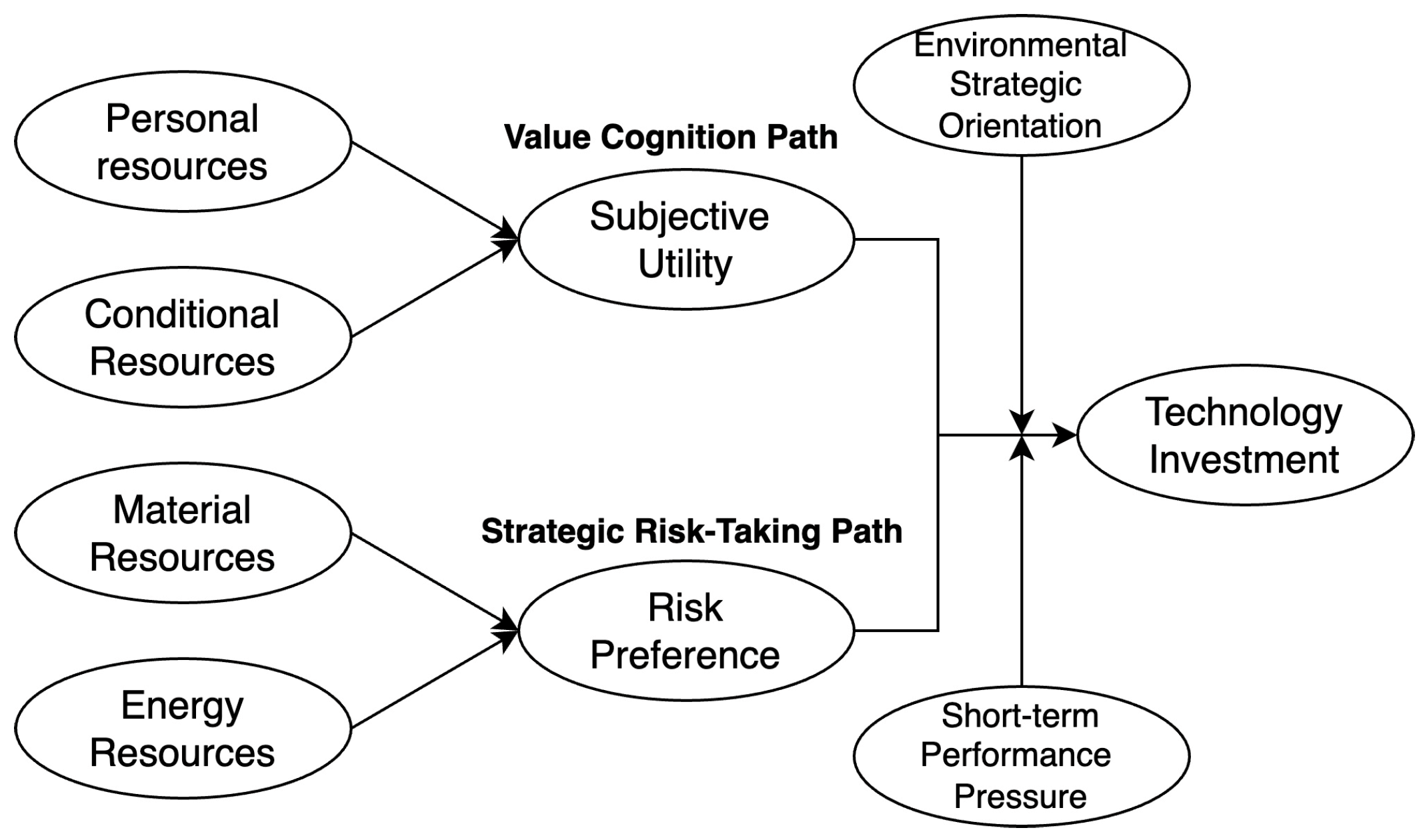
4.1. Model Development
4.2. Hypothesis Development
4.2.1. The Value Cognition Pathway
4.2.2. The Strategic Risk-Taking Pathway
5. Research Methodology and Procedure
5.1. Questionnaire Design
5.2. Research Participants and Data Collection
5.3. Analytical Strategy and Control Variables
6. Results
6.1. Sample Characteristics and Common Method Bias (CMB) Test
6.2. Reliability and Validity Assessment of the Measurement Model
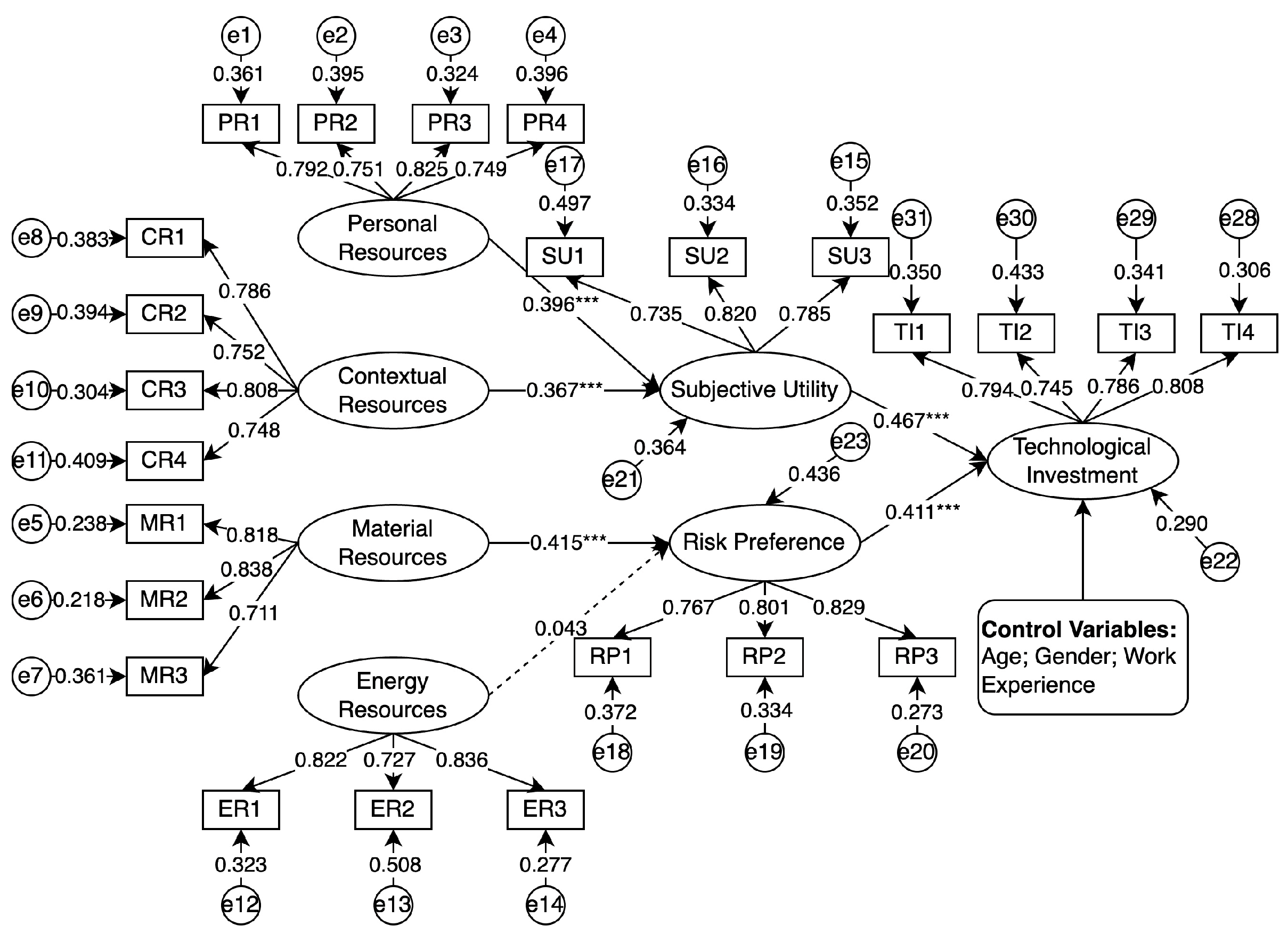
6.3. SEM Path Analysis
6.4. Configurational Analysis Based on fsQCA
6.4.1. Data Set Calibration and Membership Assignment
6.4.2. Data Set Calibration and Membership Assignment
6.4.3. Sufficiency Analysis
7. Discussion
7.1. Theoretical Implications
7.2. Managerial Implications
7.3. Limitations and Future Research Directions
8. Conclusions
Author Contributions
Funding
Institutional Review Board Statement
Informed Consent Statement
Data Availability Statement
Conflicts of Interest
Abbreviations
| COR | Conservation of Resources |
| BDT | Behavioral Decision Theory |
| PR | Personal resources |
| MR | Material resources |
| CR | Condition resources |
| ER | Energy resources |
| SU | Subjective utility |
| RP | Risk preference |
| ESO | Environmental strategic orientation |
| SPP | Short-term performance pressure |
| TI | Technology investment |
| CFA | Confirmatory factor analysis |
| SEM | Structural equation modeling |
| fsQCA | fuzzy-set Qualitative Comparative Analysis |
Appendix A

| Representative Raw Data | Initial Concepts | Subcategories | Core Categories |
|---|---|---|---|
| There are now many types of green technologies, and we still need to continuously learn about the specific principles of technologies such as shore power, energy consumption monitoring, and electrified equipment. | Green technology awareness | a1 Professional Capability | A1 Personal Resources |
| Environmental policies are updated very quickly, especially carbon emission requirements for ports. We must clearly understand the policies before deciding whether to invest. | Understanding of environmental policies | ||
| When designing technical solutions, I have to carefully calculate costs, efficiency, and returns, which requires certain evaluation capabilities. | Technological evaluation capability | ||
| All technology investments involve uncertainty. We have to bear a certain level of risk and cannot avoid pressure altogether. | Tolerance for uncertainty | a2 Psychological Resilience | |
| Port transformation is a long-term process. Personally, I have confidence in the low-carbon direction; otherwise, projects would be difficult to advance. | Confidence in low-carbon transformation | ||
| Some internal procedures are overly complicated and significantly delay the approval of technology projects. It would be better if the processes were clearer. | Clarity of organizational processes | a3 Institutional Supportiveness | A2 Condition Resources |
| The government has explicit requirements regarding shore power usage and carbon emissions, and we must comply with these regulations. | Regulatory compliance environment | ||
| If emission reduction targets could be linked to performance evaluation, we would be more motivated to implement projects. | Alignment of incentive systems | ||
| Information on many low-carbon technologies is not transparent, making it difficult for us to understand their actual effectiveness. | Transparency of technological information | a4 Information Accessibility | |
| Sometimes we need to consult external experts, such as equipment suppliers or third-party institutions. | Access to external consulting channels | ||
| The infrastructure for shore power systems is not sufficiently developed, which makes additional investment more difficult. | Shore power infrastructure base | a5 Low-Carbon Infrastructure Base | A3 Material Resources |
| The charging and dispatching conditions for electrified equipment are inadequate, which constrains the application of these technologies. | Conditions for electrified equipment | ||
| Our annual budget for technology investment is limited and needs to be adjusted flexibly according to circumstances. | Flexibility of investment budgets | a6 Financial Investment Capacity | |
| If funds could be flexibly reallocated across projects, we could implement low-carbon pilot projects more quickly. | Flexibility in capital utilization | ||
| Some old equipment can still be retrofitted; it is not always necessary to replace everything with new equipment. | Retrofit adaptability of existing assets | a7 Asset Retrofitability | |
| When carrying out technological upgrades, we need to coordinate resources from multiple parties, and this capability is crucial. | Capability for implementing technological upgrades | ||
| Our team has been in very good overall condition recently, with high energy levels, which has improved efficiency when advancing tasks. | Level of energy and vitality | a8 Personal Vitality | A4 Energy Resources |
| At present, we are concentrating most of our efforts on low-carbon projects, so progress has been relatively smooth. | Degree of energy focus | ||
| Whether departments can cooperate smoothly directly determines the speed of project implementation. | Cross-departmental coordination capability | a9 Organizational Momentum | |
| If top management shows strong commitment, projects move forward quickly; otherwise, they tend to be delayed. | Top management commitment | ||
| Whether our team has strong execution capability is the key to successfully implementing low-carbon projects. | Team execution vitality |
| Variable | Measurement Items | Source | |
|---|---|---|---|
| Personal Resources (PR) | PR1 | I am capable of assessing the feasibility and applicability of different carbon-reduction technologies. | Güler and Çetin [110] Contreras et al. [111] |
| PR2 | I am confident in promoting the implementation of green technologies in this port. | ||
| PR3 | When facing difficulties in green technology investment, I am able to identify effective solutions. | ||
| PR4 | I possess the professional knowledge required to understand and evaluate carbon emission issues in ports. | ||
| Material Resources(MR) | MR1 | The port has sufficient budgetary resources to support investments in carbon-reduction technologies. | Li et al. [45] |
| MR2 | Existing equipment and infrastructure are adequate to meet the requirements for implementing green technologies. | ||
| MR3 | The port’s existing equipment has retrofit potential and can be adapted to emission-reduction technologies without full replacement. | ||
| Condition Resources(CR) | CR1 | Top management of the port clearly supports investments in carbon-reduction technologies. | Alkandi et al. [112] Li et al. [45] |
| CR2 | The current policy environment (e.g., regulations and subsidies) facilitates the adoption of green technologies. | ||
| CR3 | We are able to obtain professional support from external technical institutions or suppliers. | ||
| CR4 | The port has the necessary human and time resources to advance green technology projects. | ||
| Energy Resources (ER) | ER1 | I am generally energetic when dealing with decisions related to carbon-reduction technologies. | Szilvassy and Širok [113] Abuzaid et al. [114] |
| ER2 | I am able to maintain a high level of focus when evaluating green technology solutions. | ||
| ER3 | Active support from top management motivates us to advance low-carbon projects more effectively. | ||
| Subjective Utility (SU) | SU1 | I believe that adopting carbon-reduction technologies will significantly enhance the port’s long-term competitive advantage. | An et al. [115] Hu et al. [45] |
| SU2 | I believe that green technologies can improve port operational efficiency and generate potential benefits. | ||
| SU3 | I believe that implementing carbon-reduction technologies will have a clearly positive effect on the port’s social reputation. | ||
| Risk Preference (RP) | RP1 | When facing new green technologies, I am willing to accept a certain degree of uncertainty. | Zhang et al. [116] Setiawan et al. [117] |
| RP2 | Even when implementation risks exist, I am inclined to try new carbon-reduction technology solutions. | ||
| RP3 | I am willing to bear higher initial risks for green technologies with greater potential returns. | ||
| Environmental Strategic Orientation (ESO) | ESO1 | The port regards green development as an important strategic objective. | Tseng et al. [118] Larabi [119] |
| ESO2 | Environmental protection occupies a central position in the port’s medium- and long-term strategy. | ||
| ESO3 | The port encourages the adoption of innovative technologies that contribute to emission reduction and environmental protection. | ||
| ESO4 | In decision making, the port tends to prioritize options with lower environmental impact. | ||
| Short-Term Performance Pressure (SPP) | SPP1 | Due to short-term performance assessment requirements, it is difficult for us to allocate resources to green technology projects. | Mitchell et al. [120] |
| SPP2 | Short-term operational pressure constrains our ability to invest in carbon-reduction technologies. | ||
| SPP3 | Under short-term performance pressure, I tend to prioritize tasks with immediate results rather than green technology initiatives. | ||
| Technology Investment (TI) | TI1 | We have a clear intention to increase investment in carbon-reduction technologies in the future. | Li et al. [44] Hu et al. [45] |
| TI2 | I am willing to promote greater resource allocation to green technologies within the port. | ||
| TI3 | We plan to gradually expand the application of green technologies over the next few years. | ||
| TI4 | If new green technologies emerge, we will actively consider their adoption. | ||
References
- Bo, Q.; Gao, X.; Pan, Y.; Liu, Y. The Mechanism of Low-Carbon Development’s Effect on Employment Quality in Chinese Cities—Based on the Government Perspective. Sustainability 2025, 17, 9374. [Google Scholar] [CrossRef] [Scilit]
- Fan, S.; Lu, Z. Research on the peak carbon dioxide emission strategy of Chinese port based on carbon emission estimation. Front. Environ. Sci. 2022, 9, 789970. [Google Scholar] [CrossRef] [Scilit]
- Wang, Y.; Guo, C.H.; Chen, X.J.; Jia, L.Q.; Guo, X.N.; Chen, R.S.; Zhang, M.S.; Chen, Z.Y.; Wang, H.D. Carbon peak and carbon neutrality in China: Goals, implementation path and prospects. China Geol. 2021, 4, 720–746. [Google Scholar] [CrossRef] [Scilit]
- Zou, Y.; Wang, X.; Zhang, Q. Evolution and quantitative evaluation of China’s green port policies: Evidence from text mining and text analysis. Front. Mar. Sci. 2025, 12, 1546755. [Google Scholar] [CrossRef] [Scilit]
- Wang, S.; Luo, Y.; Liu, Z.; Lu, B. Analysis on Energy Conservation and Emission Reduction Efficiency and Influencing Factors for Ports around Bohai in China under the Low Carbon Target. Sustainability 2022, 14, 14765. [Google Scholar] [CrossRef] [Scilit]
- Fujian Daily. Building Green Ports in Fujian! 2024. Available online: https://jtyst.fj.gov.cn/fjgh/ghzxxxgk/ghzxywdt/202406/t20240611_6464873.html (accessed on 13 August 2025).
- People’s Daily Online. Port Shore Power Facilities Should Not Only Be Well Built, But Also Well Utilized. 2023. Available online: https://paper.people.com.cn/zgnyb/html/2023-04/10/content_25976182.htm?utm_source=chatgpt.com (accessed on 14 August 2025).
- Zhang, J.Q.; Woo, S.H. Factors influencing the low carbon efficiency of container ports: A spatial analysis. Transp. Policy 2025, 171, 256–269. [Google Scholar] [CrossRef] [Scilit]
- Qi, G.; Jia, Y.; Zou, H. Is institutional pressure the mother of green innovation? Examining the moderating effect of absorptive capacity. J. Clean. Prod. 2021, 278, 123957. [Google Scholar] [CrossRef] [Scilit]
- Xi, B.; Jia, W. Research on the impact of carbon trading on enterprises’ green technology innovation. Energy Policy 2025, 197, 114436. [Google Scholar] [CrossRef] [Scilit]
- Yu, H.; Fang, Q.; Fang, Z.; Xu, L.; Liu, J. Carbon footprints: Uncovering spatiotemporal dynamics of global container ship emissions during 2015–2021. Mar. Pollut. Bull. 2024, 209, 117165. [Google Scholar] [CrossRef] [Scilit] [PubMed]
- Chemmanur, T.J.; Cheng, B.; Wang, Z.T.; Yu, Q. State Ownership, Environmental Regulation, and Corporate Green Investment: Evidence from China’s 2015 Environmental Protection Law Changes: State Ownership, Environmental Regulation, and Green Investment. J. Bus. Ethics 2025, 200, 393–416. [Google Scholar] [CrossRef] [Scilit]
- Schoeneberger, C.; Dunn, J.B.; Masanet, E. Technical, environmental, and economic analysis comparing low-carbon industrial process heat options in US Poly (vinyl chloride) and ethylene manufacturing facilities. Environ. Sci. Technol. 2024, 58, 4957–4967. [Google Scholar] [CrossRef] [Scilit]
- Reznicek, E.P.; Koleva, M.N.; King, J.; Kotarbinski, M.; Grant, E.; Vijayshankar, S.; Brunik, K.; Thomas, J.; Gupta, A.; Hammond, S.; et al. Techno-economic analysis of low-carbon hydrogen production pathways for decarbonizing steel and ammonia production. Cell Rep. Sustain. 2025, 2, 100338. [Google Scholar] [CrossRef] [Scilit]
- Bindeeba, D.S.; Tukamushaba, E.K.; Bakashaba, R. Toward a holistic model of sustainable investment decision-making in SMEs: A structural approach in a developing economy. Future Bus. J. 2025, 11, 176. [Google Scholar] [CrossRef] [Scilit]
- Ampomah, W.; Morgan, A.; Koranteng, D.O.; Nyamekye, W.I. CCUS perspectives: Assessing historical contexts, current realities, and future prospects. Energies 2024, 17, 4248. [Google Scholar] [CrossRef] [Scilit]
- Tsagkaris, P.; Moschovou, T.P. The Impact of Automation on the Efficiency of Port Container Terminals. Future Transp. 2025, 5, 155. [Google Scholar] [CrossRef] [Scilit]
- Lawer, E.T.; Herbeck, J.; Flitner, M. Selective adoption: How port authorities in Europe and West Africa Engage with the globalizing ‘Green Port’ idea. Sustainability 2019, 11, 5119. [Google Scholar] [CrossRef] [Scilit]
- Liu, Y.; Chao, Y.; Xie, S.; Wang, G.; Wang, L.; Xue, C.Y. Green innovation in ports: Drivers, domains, and challenges. Front. Mar. Sci. 2025, 12, 1664611. [Google Scholar] [CrossRef] [Scilit]
- Hobfoll, S.E.; Halbesleben, J.; Neveu, J.P.; Westman, M. Conservation of resources in the organizational context: The reality of resources and their consequences. Annu. Rev. Organ. Psych. 2018, 5, 103–128. [Google Scholar] [CrossRef] [Scilit]
- Montello, D.R. Handbook of Behavioral and Cognitive Geography; Edward Elgar Publishing: Cheltenham, UK, 2018. [Google Scholar]
- Hobfoll, S.E. Conservation of resources: A new attempt at conceptualizing stress. Am. Psychol. 1989, 44, 513–524. [Google Scholar] [CrossRef]
- Hobfoll, S.E.; Lilly, R.S. Resource conservation as a strategy for community psychology. J. Community Psychol. 1993, 21, 128–148. [Google Scholar] [CrossRef] [Scilit]
- Liu, H.; Song, Z.; Xu, Y.; Xu, X.A.; Li, J. Exploring explanatory mechanisms of adjustment-specific resources underlying the relationship between leader–member exchange and work engagement: A lens of conservation of resources theory. Sustainability 2023, 15, 1561. [Google Scholar] [CrossRef] [Scilit]
- Hutchings, K.; Michailova, S.; Wilkinson, A. A Guide to Key Theories for Human Resource Management Research; Edward Elgar Publishing: Cheltenham, UK, 2024. [Google Scholar]
- Teng, R.; Zhou, S.; Zheng, W.; Ma, C. Artificial intelligence (AI) awareness and work withdrawal: Evaluating chained mediation through negative work-related rumination and emotional exhaustion. Int. J. Contemp. Hosp. Manag. 2024, 36, 2311–2326. [Google Scholar] [CrossRef] [Scilit]
- Niazi, A.; Qureshi, M.I.; Iftikhar, M.; Obaid, A. The impact of GHRM practices on employee workplace outcomes and organizational pride: A conservation of resource theory perspective. Empl. Relat. Int. J. 2024, 46, 383–407. [Google Scholar] [CrossRef] [Scilit]
- Tu, H.; Zhong, W.; Gu, Y.; Zhou, W. The cost of dancing with the government: A conservation of resources theory of political networking and CEO burnout. J. Manag. Stud. 2025, 62, 2969–3004. [Google Scholar] [CrossRef] [Scilit]
- Piwowar-Sulej, K.; Iqbal, Q. Sustainability-focused leadership and pro-environmental behavior in SMEs: Through the lens of conservation of resources theory. Cent. Eur. Manag. J. 2025, 1–17. [Google Scholar] [CrossRef] [Scilit]
- Splendiani, S.; Dini, M.; Rivetti, F.; Pencarelli, T. Exploring usage, expected benefits and perceived usefulness of social media in travel agencies: An empirical investigation in Italy. TQM J. 2023, 35, 83–106. [Google Scholar] [CrossRef] [Scilit]
- Edwards, W. The theory of decision making. Psychol. Bull. 1954, 51, 380. [Google Scholar] [CrossRef] [Scilit]
- Tversky, A.; Kahneman, D. Judgment under Uncertainty: Heuristics and Biases: Biases in judgments reveal some heuristics of thinking under uncertainty. Science 1974, 185, 1124–1131. [Google Scholar] [CrossRef] [Scilit] [PubMed]
- Kai-Ineman, D.; Tversky, A. Prospect theory: An analysis of decision under risk. Econometrica 1979, 47, 363–391. [Google Scholar] [CrossRef] [Scilit]
- Einhorn, H.J.; Hogarth, R.M. Behavioral decision theory: Processes of judgement and choice. Annu. Rev. Psychol. 1981, 32, 53–88. [Google Scholar] [CrossRef] [Scilit]
- Fishburn, P. Utility Theory for Decision Making; Wiley & Sons: New York, NY, USA, 1970. [Google Scholar]
- Simon, H.A. Rational decision making in business organizations. Am. Econ. Rev. 1979, 69, 493–513. [Google Scholar]
- Cyert, R.; March, J. Behavioral Theory of the Frm; Routledge: London, UK, 2015. [Google Scholar]
- Zhou, X.; Wang, Y.; Zhang, X.; Li, L. The Influence of Decision-Making Logic on Employees’ Innovative Behaviour: The Mediating Role of Positive Error Orientation and the Moderating Role of Environmental Dynamics. Psychol. Res. Behav. Manag. 2023, 16, 2297–2313. [Google Scholar] [CrossRef] [Scilit] [PubMed]
- Dobryagina, N. Agricultural entrepreneurship fostering from behavioral decision theory perspective. Celebrity branding impact on financial and non-financial motivation. Eur. J. Financ. 2023, 29, 1538–1554. [Google Scholar] [CrossRef] [Scilit]
- Suomala, J. The consumer contextual decision-making model. Front. Psychol. 2020, 11, 570430. [Google Scholar] [CrossRef] [Scilit]
- Hu, M.; Chang, R.; Sui, X.; Gao, M. Attention biases the process of risky decision-making: Evidence from eye-tracking. PsyCh J. 2024, 13, 157–165. [Google Scholar] [CrossRef] [Scilit]
- Noh, H.H.; Rim, H.B.; Lee, B.K. Risk preferences in decision-making: A construal level perspective. Acta Psychol. 2025, 252, 104675. [Google Scholar] [CrossRef] [Scilit] [PubMed]
- Ahmed, S.; Haag, M. Entering the Field: Decisions of an Early Career Researcher Adopting Classic Grounded Theory. Grounded Theory Rev. 2016, 15, 76–92. [Google Scholar]
- Li, Y.; Ding, N.; Zhao, T.; Chen, M. What Drives or Hinders the Adoption of Sustainable Smart Logistics in Rural Areas?—A Mixed-Methods Analysis. Sustainability 2025, 17, 6626. [Google Scholar] [CrossRef] [Scilit]
- Hu, L.; Chen, M.; Ding, N. Factors influencing digital media designers’ subscription to premium versions of AI drawing tools through a mixed methods study. Sci. Rep. 2025, 15, 15994. [Google Scholar] [CrossRef] [Scilit]
- Whiteside, M.; Mills, J.; McCalman, J. Using secondary data for grounded theory analysis. Aust. Soc. Work 2012, 65, 504–516. [Google Scholar] [CrossRef] [Scilit]
- Strauss, A.; Corbin, J. Basics of Qualitative Research; Sage Publications: Thousand Oaks, CA, USA, 1990. [Google Scholar]
- Smelser, N.J.; Baltes, P.B. International Encyclopedia of the Social and Behavioral Sciences; Elsevier: Amsterdam, The Netherlands, 2001. [Google Scholar]
- Liu, B.; Li, N.; Liao, C. Effects of social capital on the adoption of green production technologies by rice farmers: Moderation effects based on risk preferences. Sustainability 2024, 16, 8879. [Google Scholar] [CrossRef] [Scilit]
- Mamun, M. Green HRM and green innovation: Do environmental strategies and green culture matter? J. Innov. Knowl. 2026, 12, 100897. [Google Scholar] [CrossRef] [Scilit]
- Asif, M.U.; Bakar, L.J.A. Green strategic orientation and sustainable performance of SMEs: Moderating role of environmental turbulence. J. Knowl. Econ. 2025, 16, 17517–17545. [Google Scholar] [CrossRef] [Scilit]
- Chipimo, M.L.; Bwalya, J.; Kanyanga, J.K. The Green Dilemma: When Environmental Good Depletes Financial Good in Emerging Economies. SEISENSE J. Manag. 2025, 8, 162–180. [Google Scholar] [CrossRef] [Scilit]
- Liu, L.; Liu, P. How do controlling shareholder pledges affect corporate green innovation: Evidence from China. S. Afr. J. Econ. Manag. Sci. 2025, 28, 6286. [Google Scholar] [CrossRef] [Scilit]
- Chahal, J.; Rani, N. Exploring the acceptance for e-learning among higher education students in India: Combining technology acceptance model with external variables. J. Comput. High. Educ. 2022, 34, 844–867. [Google Scholar] [CrossRef] [Scilit]
- Zhao, Z.; An, Q.; Liu, J. Exploring AI tool adoption in higher education: Evidence from a PLS-SEM model integrating multimodal literacy, self-efficacy, and university support. Front. Psychol. 2025, 16, 1619391. [Google Scholar] [CrossRef] [Scilit] [PubMed]
- Kwon, S.H.; Bang, M.; Kim, Y.K. The Influence of Positive Psychological Capital, Perceived Value of Work, and Nurse Practice Environment on Retention Intention in Small-Medium Sized Hospital Nurses. J. Korean Acad. Nurs. Adm. 2024, 30, 189–200. [Google Scholar] [CrossRef] [Scilit]
- Belew, A.; Ketemaw, A.; Sitotaw, G.; Alganeh, H.; Wogayehu, B.; Ayenew, T.; Damtew, A. Acceptance of e-learning and associated factors among postgraduate medical and health science students at first generation universities in Amhara region, 2023: Using modified technology acceptance model. BMC Med. Educ. 2024, 24, 838. [Google Scholar] [CrossRef] [Scilit]
- Ebadi, S.; Raygan, A. Investigating the facilitating conditions, perceived ease of use and usefulness of mobile-assisted language learning. Smart Learn. Environ. 2023, 10, 30. [Google Scholar] [CrossRef] [Scilit]
- Jeilani, A.; Abubakar, S. Perceived institutional support and its effects on student perceptions of AI learning in higher education: The role of mediating perceived learning outcomes and moderating technology self-efficacy. Front. Educ. 2025, 10, 1548900. [Google Scholar] [CrossRef] [Scilit]
- Song, Y.; Qiu, X.; Liu, J. The impact of artificial intelligence adoption on organizational decision-making: An empirical study based on the technology acceptance model in business management. Systems 2025, 13, 683. [Google Scholar] [CrossRef] [Scilit]
- Gao, S. Digital marketing tools and digital transformation capability as a factor in enhancing business performance in China and Kazakhstan. Sci. Rep. 2025, 15, 36929. [Google Scholar] [CrossRef] [Scilit]
- Yin, S.; Yu, Y.; Zhang, N. The effect of digital green strategic orientation on digital green innovation performance: From the perspective of digital green business model innovation. Sage Open 2024, 14, 21582440241261130. [Google Scholar] [CrossRef] [Scilit]
- Čater, T.; Uršič, D.; Čater, B.; Žabkar, V. The nexus of technological innovation, green product/process innovation and environmental strategy: The path towards sustainability-based competitive advantage. Technol. Anal. Strateg. Manag. 2025, 1–15. [Google Scholar] [CrossRef] [Scilit]
- Guo, Y.; Wang, L. Environmental entrepreneurial orientation and firm performance: The role of environmental innovation and stakeholder pressure. Sage Open 2022, 12, 21582440211061354. [Google Scholar] [CrossRef] [Scilit]
- Anwar, S.U.; Xu, J.; Yuan, P.Z.; Su, K.; Ur Rehman, S.; Hameed, M.; Wen, M.; Li, F. Green entrepreneurial orientation and environmental performance a moderated mediation perspective of perceived environmental innovation and stakeholder pressure. Sci. Rep. 2024, 14, 30266. [Google Scholar] [CrossRef] [Scilit]
- Alipour, A.; Yaprak, A. Indulgence and risk-taking behavior of firms: Direct and interactive influences. J. Int. Manag. 2022, 28, 100945. [Google Scholar] [CrossRef] [Scilit]
- Bagh, T.; Khan, M.A.; Naseer, M.M.; Iftikhar, K. Does financial flexibility drive firm’s risk-taking in emerging markets? The moderating role of investment efficiency. Manag. Decis. Econ. 2024, 45, 5541–5561. [Google Scholar] [CrossRef] [Scilit]
- Bagh, T.; Hunjra, A.I.; Ntim, C.G.; Naseer, M.M. Capitalizing on risk: How corporate financial flexibility, investment efficiency, and institutional ownership shape risk-taking dynamics. Int. Rev. Econ. Financ. 2025, 99, 104068. [Google Scholar] [CrossRef] [Scilit]
- Hobfoll, S.E.; Shirom, A. Conservation of resources theory: Applications to stress and management in the workplace. Handb. Organ. Behav. 2000, 2, 57–81. [Google Scholar]
- Sekścińska, K.; Jaworska, D.; Rudzińska-Wojciechowska, J. Personal sense of power predicts financial risk-taking propensity: But only when risk-related decisions are made without cognitive load. Q. J. Exp. Psychol. 2025, 78, 1649–1660. [Google Scholar] [CrossRef] [Scilit]
- Jia, H.; Lin, C.J.; Wang, E.M.Y. Effects of mental fatigue on risk preference and feedback processing in risk decision-making. Sci. Rep. 2022, 12, 10695. [Google Scholar] [CrossRef] [Scilit]
- de Jong, A.; Zacharias, N.A.; Nijssen, E.J. How young companies can effectively manage their slack resources over time to ensure sales growth: The contingent role of value-based selling. J. Acad. Market. Sci. 2021, 49, 304–326. [Google Scholar] [CrossRef] [Scilit]
- Molina-García, A.; Cisneros-Ruiz, A.J.; López-Subires, M.D.; Diéguez-Soto, J. How does financial literacy influence undergraduates’ risk-taking propensity? Int. J. Manag. Educ. 2023, 21, 100840. [Google Scholar] [CrossRef] [Scilit]
- Qi, Y.; Dong, S.; Lyu, S.; Yang, S. Economic policy uncertainty and family firm innovation: Evidence from listed companies in China. Front. Psychol. 2022, 13, 901051. [Google Scholar] [CrossRef] [Scilit]
- Caliendo, M.; Cobb-Clark, D.A.; Pfeifer, H.; Uhlendorff, A.; Wehner, C. Managers’ risk preferences and firm training investments. Eur. Econ. Rev. 2024, 161, 104616. [Google Scholar] [CrossRef] [Scilit]
- Zhang, D. Corporate innovativeness and risk management of small firms–evidences from start-ups. Financ. Res. Lett. 2021, 42, 102374. [Google Scholar] [CrossRef] [Scilit]
- Fossen, F.M.; König, J.; Schröder, C. Risk preference and entrepreneurial investment at the top of the wealth distribution. Empir. Econ. 2024, 66, 735–761. [Google Scholar] [CrossRef] [Scilit]
- Wang, L.; Yang, Z.; Chen, T.; Xu, T.; Xiao, B. The Mechanism of Green Transition of Energy Enterprises Applying Noncooperative–Cooperative Biform Game Model. Systems 2025, 13, 942. [Google Scholar] [CrossRef] [Scilit]
- Marginson, D.; McAulay, L. Exploring the debate on short-termism: A theoretical and empirical analysis. Strateg. Manag. J. 2008, 29, 273–292. [Google Scholar] [CrossRef] [Scilit]
- Li, J.; Tang, Y.I. CEO hubris and firm risk taking in China: The moderating role of managerial discretion. Acad. Manag. J. 2010, 53, 45–68. [Google Scholar] [CrossRef] [Scilit]
- Le, Q.A.; Lee, C.Y. Earnings pressure and R&D cut: The moderating effects of family control and debt. Manag. Res. Rev. 2021, 44, 568–587. [Google Scholar] [CrossRef] [Scilit]
- Brislin, R.W. Back-translation for cross-cultural research. J. Cross Cult. Psychol. 1970, 1, 185–216. [Google Scholar] [CrossRef] [Scilit]
- Cha, E.S.; Kim, K.H.; Erlen, J.A. Translation of scales in cross-cultural research: Issues and techniques. J. Adv. Nurs. 2007, 58, 386–395. [Google Scholar] [CrossRef] [Scilit] [PubMed]
- Revilla, M.A.; Saris, W.E.; Krosnick, J.A. Choosing the number of categories in agree–disagree scales. Sociol. Methods Res. 2014, 43, 73–97. [Google Scholar] [CrossRef] [Scilit]
- Hair, J.F.; Black, W.C.; Babin, B.J.; Anderson, R.E.; Tatham, R.L. Multivariate Data Analysis: A Global Perspective, 7th ed.; Pearson Prentice Hall: Upper Saddle River, NJ, USA, 2010. [Google Scholar]
- Hair, J.F., Jr.; Hult, G.T.M.; Ringle, C.M.; Sarstedt, M.; Danks, N.P.; Ray, S. Partial Least Squares Structural Equation Modeling (PLS-SEM) Using R: A Workbook; Springer Nature: Berlin/Heidelberg, Germany, 2021. [Google Scholar]
- Ding, N.; Chen, M.; Hu, L. The impact of personality traits and AI literacy on the adoption intentions of AI among design faculty in Chinese higher education. Acta Psychol. 2025, 260, 105709. [Google Scholar] [CrossRef] [Scilit]
- Kumar, S.; Sahoo, S.; Lim, W.M.; Kraus, S.; Bamel, U. Fuzzy-set qualitative comparative analysis (fsQCA) in business and management research: A contemporary overview. Technol. Forecast. Soc. Change 2022, 178, 121599. [Google Scholar] [CrossRef] [Scilit]
- Zhang, G.; Wang, T.; Wang, Y.; Zhang, S.; Lin, W.; Dou, Z.; Du, H. Study on the influencing factors of digital transformation of construction enterprises from the perspective of dual effects—A hybrid approach based on PLS-SEM and fsQCA. Sustainability 2023, 15, 6317. [Google Scholar] [CrossRef] [Scilit]
- Zhou, H.; Zhou, B.; Nie, Z.; Zheng, L. Identifying Key Success Factors for Industry 4.0 Implementation: An Empirical Analysis Using SEM and fsQCA. Appl. Sci. 2024, 14, 5244. [Google Scholar] [CrossRef] [Scilit]
- Renz, S.; Kalimeris, J.; Hofreiter, S.; Spörrle, M. Me, myself and AI: How gender, personality and emotions determine willingness to use Strong AI for self-improvement. Technol. Forecast. Soc. 2024, 209, 123760. [Google Scholar] [CrossRef] [Scilit]
- Podsakoff, P.M.; MacKenzie, S.B.; Lee, J.Y.; Podsakoff, N.P. Common method biases in behavioral research: A critical review of the literature and recommended remedies. J. Appl. Psychol. 2003, 88, 879–903. [Google Scholar] [CrossRef] [Scilit]
- Fornell, C.; Larcker, D.F. Evaluating structural equation models with unobservable variables and measurement error. J. Mark. Res. 1981, 18, 39–50. [Google Scholar] [CrossRef] [Scilit]
- Zhou, C.; Liu, X.; Yu, C.; Tao, Y.; Shao, Y. Trust in AI-augmented design: Applying structural equation modeling to AI-augmented design acceptance. Heliyon 2024, 10, e23305. [Google Scholar] [CrossRef] [Scilit]
- Lindell, M.K.; Whitney, D.J. Accounting for common method variance in cross-sectional research designs. J. Appl. Psychol. 2001, 86, 114–121. [Google Scholar] [CrossRef] [Scilit] [PubMed]
- Richardson, H.A.; Simmering, M.J.; Sturman, M.C. A tale of three perspectives: Examining post hoc statistical techniques for detection and correction of common method variance. Organ. Res. Methods 2009, 12, 762–800. [Google Scholar] [CrossRef] [Scilit]
- Hayes, A.F. Beyond Baron and Kenny: Statistical mediation analysis in the new millennium. Commun. Monogr. 2009, 76, 408–420. [Google Scholar] [CrossRef] [Scilit]
- Chen, S.; Ye, J. Understanding consumers’ intentions to purchase smart clothing using PLS-SEM and fsQCA. PLoS ONE 2023, 18, e0291870. [Google Scholar] [CrossRef] [Scilit] [PubMed]
- Ragin, C.C. Redesigning Social Inquiry: Fuzzy Sets and Beyond; University of Chicago Press: Chicago, IL, USA, 2009. [Google Scholar]
- Fiss, P.C. Building better causal theories: A fuzzy set approach to typologies in organization research. Acad. Manag. J. 2011, 54, 393–420. [Google Scholar] [CrossRef] [Scilit]
- Dul, J. Identifying single necessary conditions with NCA and fsQCA. J. Bus. Res. 2016, 69, 1516–1523. [Google Scholar] [CrossRef] [Scilit]
- Pappas, I.O.; Woodside, A.G. Fuzzy-set Qualitative Comparative Analysis (fsQCA): Guidelines for research practice in Information Systems and marketing. Int. J. Inform. Manag. 2021, 58, 102310. [Google Scholar] [CrossRef] [Scilit]
- Iris, Ç.; Lam, J.S.L. A review of energy efficiency in ports: Operational strategies, technologies and energy management systems. Renew. Sust. Energ. Rev. 2019, 112, 170–182. [Google Scholar] [CrossRef] [Scilit]
- Huang, L.; Lei, Z. How environmental regulation affect corporate green investment: Evidence from China. J. Clean. Prod. 2021, 279, 123560. [Google Scholar] [CrossRef] [Scilit]
- Yu, H.; Wu, W.; Zhang, X.; Fang, Z.; Fu, X.; Xu, L.; Liu, J. Optimization-based global liquefied natural gas shipping network management for emission reduction. Ocean Eng. 2025, 321, 120366. [Google Scholar] [CrossRef] [Scilit]
- Yu, H.; Jiang, C.; Fang, Q.; Wei, T.; Xu, L. Deep learning driven spatiotemporal prediction of global carbon emissions from container shipping. Transp. Res. D-Transp. Environ. 2026, 151, 105169. [Google Scholar] [CrossRef] [Scilit]
- Sooprayen, K.; Van de Kaa, G.; Pruyn, J.F. Factors for innovation adoption by ports: A systematic literature review. J. Ocean Eng. Mar. Energy 2024, 10, 953–962. [Google Scholar] [CrossRef] [Scilit]
- Maslaric, M.; Bojic, S.; Mircetic, D.; Nikolicic, S.; Medenica Todorovic, R. Sustainable urban mobility planning in the port areas: A case study. Sustainability 2024, 16, 514. [Google Scholar] [CrossRef] [Scilit]
- Wang, X.; Han, Y. Performance Management Evaluation of Port Enterprises in a Low-Carbon Environment. J. Coast. Res. 2020, 106, 334–337. [Google Scholar] [CrossRef] [Scilit]
- Güler, M.; Çetin, F. The relationship between personal resources and well-being: The role of resource-threatening and resource-consuming factors. Manag. Res. Rev. 2019, 42, 199–214. [Google Scholar] [CrossRef] [Scilit]
- Contreras, F.; Espinosa, J.C.; Esguerra, G.A. Could personal resources influence work engagement and burnout? A study in a group of nursing staff. Sage Open 2020, 10, 2158244019900563. [Google Scholar] [CrossRef] [Scilit]
- Alkandi, I.G.; Khan, M.A.; Fallatah, M.; Alabdulhadi, A.; Alanizan, S.; Alharbi, J. The impact of incentive and reward systems on employee performance in the Saudi primary, secondary, and tertiary industrial sectors: A mediating influence of employee job satisfaction. Sustainability 2023, 15, 3415. [Google Scholar] [CrossRef] [Scilit]
- Szilvassy, P.; Širok, K. Importance of work engagement in primary healthcare. BMC Health Serv. Res. 2022, 22, 1044. [Google Scholar] [CrossRef] [Scilit]
- Abuzaid, A.N.; Alateeq, M.; Baqleh, L.; Madadha, S.; Haraisa, Y.A. The moderating effect of strategic momentum on the relationship between big data analytics capabilities and lean supply chain practices. Uncertain Supply Chain Manag. 2023, 11, 1085–1098. [Google Scholar] [CrossRef] [Scilit]
- An, S.; Eck, T.; Yim, H. Understanding consumers’ acceptance intention to use mobile food delivery applications through an extended technology acceptance model. Sustainability 2023, 15, 832. [Google Scholar] [CrossRef] [Scilit]
- Zhang, Y.; Luan, H.; Shao, W.; Xu, Y. Managerial risk preference and its influencing factors: Analysis of large state-owned enterprises management personnel in China. Risk Manag. 2016, 18, 135–158. [Google Scholar] [CrossRef] [Scilit]
- Setiawan, A.E.; Musyifah, R.; Noviarita, H. The Effect of Financial Literacy, Risk Preference and Religiosity on Generation Z’s Investment Interest in the Islamic Capital Market. J. Islam. Bus. Econ. Rev. 2021, 4, 57–65. [Google Scholar]
- Tseng, C.H.; Chang, K.H.; Chen, H.W. Strategic orientation, environmental innovation capability, and environmental sustainability performance: The case of Taiwanese suppliers. Sustainability 2019, 11, 1127. [Google Scholar] [CrossRef] [Scilit]
- Larabi, C. Linking Innovation Capability, Strategic Orientation, and Strategic Renewal to Sustainable Performance: A Dynamic Capabilities Perspective in Saudi Small and Medium Enterprises. Bus. Strateg. Environ. 2025, 35, 1255–1271. [Google Scholar] [CrossRef] [Scilit]
- Mitchell, M.S.; Greenbaum, R.L.; Vogel, R.M.; Mawritz, M.B.; Keating, D.J. Can you handle the pressure? The effect of performance pressure on stress appraisals, self-regulation, and behavior. Acad. Manag. J. 2019, 62, 531–552. [Google Scholar] [CrossRef] [Scilit]


| Category | Item | Frequency |
|---|---|---|
| Gender Composition | Male | 12 |
| Female | 11 | |
| Age Distribution (years) | 18–30 | 2 |
| 31–40 | 6 | |
| 41–50 | 11 | |
| Above 50 | 4 | |
| Educational Background | Associate degree or Below | 3 |
| Bachelor’s Degree | 11 | |
| Master’s Degree or Above | 9 | |
| Functional Department Category | Operations Management | 4 |
| Safety and Environmental Protection | 4 | |
| Strategy and Planning | 6 | |
| Investment and Financial Decision-Making | 6 | |
| Technology and Engineering Management | 3 | |
| Interview Duration (minutes) | 20–25 | 6 |
| 26–30 | 9 | |
| 31–35 | 8 |
| Category | Item | Frequency | % |
|---|---|---|---|
| Gender Composition | Male | 193 | 51.9 |
| Female | 179 | 48.1 | |
| Age Distribution (years) | 18–30 | 16 | 4.3 |
| 31–40 | 133 | 35.8 | |
| 41–50 | 187 | 50.3 | |
| Above 50 | 36 | 9.7 | |
| Educational Background | Associate Degree or Below | 113 | 30.4 |
| Bachelor’s Degree | 192 | 51.6 | |
| Postgraduate Degree or Above | 67 | 18.0 | |
| Functional Department Category | Operations Management | 83 | 22.3 |
| Safety and Environmental Protection | 61 | 16.4 | |
| Strategy and Planning | 74 | 19.9 | |
| Investment and Financial Decision-Making | 58 | 15.6 | |
| Technology and Engineering Management | 76 | 20.4 | |
| Others | 20 | 5.4 | |
| Work Experience (years) | 1–5 | 8 | 2.2 |
| 6–10 | 112 | 30.1 | |
| 11–20 | 131 | 35.2 | |
| 21–30 | 103 | 27.7 | |
| Above 30 | 18 | 4.8 |
| Variable | Item | Mean | SD | Factor Loadings | α | AVE | CR |
|---|---|---|---|---|---|---|---|
| PR | PR1 | 3.35 | 0.984 | 0.792 | 0.861 | 0.608 | 0.861 |
| PR2 | 3.34 | 0.975 | 0.751 | ||||
| PR3 | 3.35 | 1.000 | 0.825 | ||||
| PR4 | 3.33 | 0.940 | 0.749 | ||||
| MR | MR1 | 3.52 | 0.832 | 0.818 | 0.831 | 0.626 | 0.833 |
| MR2 | 3.52 | 0.870 | 0.838 | ||||
| MR3 | 3.48 | 0.861 | 0.711 | ||||
| CR | CR1 | 3.32 | 0.995 | 0.786 | 0.856 | 0.599 | 0.856 |
| CR2 | 3.30 | 0.957 | 0.752 | ||||
| CR3 | 3.27 | 0.966 | 0.808 | ||||
| CR4 | 3.28 | 0.946 | 0.748 | ||||
| ER | ER1 | 3.32 | 1.003 | 0.822 | 0.835 | 0.634 | 0.838 |
| ER2 | 3.34 | 1.037 | 0.727 | ||||
| ER3 | 3.30 | 0.960 | 0.836 | ||||
| SU | SU1 | 3.42 | 1.031 | 0.735 | 0.822 | 0.610 | 0.824 |
| SU2 | 3.39 | 0.999 | 0.820 | ||||
| SU3 | 3.40 | 0.964 | 0.785 | ||||
| RP | RP1 | 3.59 | 0.952 | 0.767 | 0.842 | 0.639 | 0.841 |
| RP2 | 3.63 | 0.967 | 0.801 | ||||
| RP3 | 3.60 | 0.927 | 0.829 | ||||
| ESO | ESO1 | 3.39 | 1.031 | 0.822 | 0.856 | 0.600 | 0.857 |
| ESO2 | 3.43 | 1.006 | 0.714 | ||||
| ESO3 | 3.38 | 0.981 | 0.753 | ||||
| ESO4 | 3.33 | 1.017 | 0.805 | ||||
| SPP | SPP1 | 3.59 | 1.006 | 0.867 | 0.871 | 0.693 | 0.871 |
| SPP2 | 3.56 | 1.043 | 0.806 | ||||
| SPP3 | 3.55 | 1.038 | 0.824 | ||||
| TI | TI1 | 3.43 | 0.973 | 0.794 | 0.863 | 0.614 | 0.864 |
| TI2 | 3.39 | 0.989 | 0.745 | ||||
| TI3 | 3.44 | 0.954 | 0.786 | ||||
| TI4 | 3.38 | 0.932 | 0.808 |
| TI | SPP | ESO | RP | SU | ER | CR | MR | PR | |
|---|---|---|---|---|---|---|---|---|---|
| TI | 0.784 | ||||||||
| SPP | 0.173 | 0.832 | |||||||
| ESO | 0.218 | 0.141 | 0.775 | ||||||
| RP | 0.548 | 0.159 | 0.223 | 0.799 | |||||
| SU | 0.594 | 0.148 | 0.114 | 0.441 | 0.781 | ||||
| ER | 0.266 | 0.054 | 0.189 | 0.123 | 0.267 | 0.796 | |||
| CR | 0.412 | 0.077 | 0.200 | 0.349 | 0.517 | 0.235 | 0.774 | ||
| MR | 0.462 | 0.159 | 0.156 | 0.413 | 0.516 | 0.259 | 0.361 | 0.791 | |
| PR | 0.465 | 0.062 | 0.167 | 0.352 | 0.525 | 0.209 | 0.556 | 0.401 | 0.780 |
| Indices | Recommended Threshold | CFA Mdel (9-Factor) | ULMF Test (9-Factor + Method Factor) | SEM Model |
|---|---|---|---|---|
| χ2/df | <3 | 1.317 | 1.236 | 1.734 |
| GFI | >0.8 | 0.919 | 0.929 | 0.883 |
| RMSEA | <0.08 | 0.029 | 0.025 | 0.044 |
| IFI | >0.9 | 0.978 | 0.985 | 0.946 |
| CFI | >0.9 | 0.977 | 0.985 | 0.945 |
| TLI | >0.9 | 0.974 | 0.980 | 0.940 |
| Hypothesis | Path Direction | B | β | C.R. | p | Result |
|---|---|---|---|---|---|---|
| H1 | PR → SU | 0.365 | 0.396 | 6.593 | *** | Supported |
| H2 | CR → SU | 0.338 | 0.367 | 6.150 | *** | Supported |
| H3 | SU → TI | 0.451 | 0.467 | 7.721 | *** | Supported |
| H6 | MR → RP | 0.449 | 0.415 | 6.617 | *** | Supported |
| H7 | ER → RP | 0.038 | 0.043 | 0.752 | 0.452 | Rejected |
| H8 | RP → TI | 0.391 | 0.411 | 7.095 | *** | Supported |
| Path | Effect Type | Effect | S.E. | 95% CI | Type of Mediation | |
|---|---|---|---|---|---|---|
| LLCI | ULCI | |||||
| A1: PR→SU→TI | Total Effect | 0.3971 | 0.051 | 0.295 | 0.496 | Partial Mediation |
| Indirect Effect | 0.1788 | 0.0316 | 0.1201 | 0.2447 | ||
| Direct Effect | 0.2183 | 0.0542 | 0.1121 | 0.3236 | ||
| A2: CR→SU→TI | Total Effect | 0.3577 | 0.055 | 0.246 | 0.466 | Partial Mediation |
| Indirect Effect | 0.1887 | 0.0320 | 0.1286 | 0.2522 | ||
| Direct Effect | 0.1691 | 0.0576 | 0.0569 | 0.2843 | ||
| A3: MR→RP→TI | Total Effect | 0.4262 | 0.053 | 0.319 | 0.530 | Partial Mediation |
| Indirect Effect | 0.1409 | 0.0310 | 0.0831 | 0.2055 | ||
| Direct Effect | 0.2852 | 0.0554 | 0.1765 | 0.3935 | ||
| A3: ER→RP→TI | Total Effect | 0.2013 | 0.060 | 0.089 | 0.322 | Reject |
| Indirect Effect | 0.0376 | 0.0275 | −0.0144 | 0.0950 | ||
| Direct Effect | 0.1638 | 0.0511 | 0.0655 | 0.2699 | ||
| Original Variables | Fuzzy-Set Calibration Thresholds | Calibrated Variables | Descriptive Statistics | |||||
|---|---|---|---|---|---|---|---|---|
| Full Membership | Crossover Point | Full Non-Membership | Mean | SD | Min | Max | ||
| PR | 4.750 | 3.250 | 2.000 | FPR | 0.519 | 0.303 | 0.001 | 0.971 |
| CR | 4.667 | 3.667 | 2.333 | FCR | 0.388 | 0.300 | 0.001 | 0.981 |
| MR | 4.613 | 3.250 | 2.000 | FMR | 0.589 | 0.293 | 0.021 | 0.981 |
| ER | 4.667 | 3.333 | 1.667 | FER | 0.524 | 0.292 | 0.011 | 0.981 |
| TI | 4.750 | 3.500 | 2.000 | FTI | 0.492 | 0.305 | 0.011 | 0.971 |
| Condition Variables | Consistency | Coverage |
|---|---|---|
| FPR | 0.766 | 0.725 |
| ~FPR | 0.556 | 0.569 |
| FCR | 0.613 | 0.777 |
| ~FCR | 0.684 | 0.549 |
| FMR | 0.826 | 0.690 |
| ~FMR | 0.491 | 0.587 |
| FER | 0.750 | 0.704 |
| ~FER | 0.583 | 0.602 |
| Variables | Configurational Pathways | ||
|---|---|---|---|
| S1 | S2 | S3 | |
| FPR | ● | ||
| FCR | ● | ● | |
| FMR | △ | ||
| FER | △ | ● | |
| Consistency | 0.816 | 0.832 | 0.803 |
| Raw Coverage | 0.395 | 0.350 | 0.617 |
| Unique Coverage | 0.054 | 0.008 | 0.268 |
| Solution Consistency | 0.777 | ||
| Solution Coverage | 0.730 | ||
Disclaimer/Publisher’s Note: The statements, opinions and data contained in all publications are solely those of the individual author(s) and contributor(s) and not of MDPI and/or the editor(s). MDPI and/or the editor(s) disclaim responsibility for any injury to people or property resulting from any ideas, methods, instructions or products referred to in the content. |
© 2026 by the authors. Licensee MDPI, Basel, Switzerland. This article is an open access article distributed under the terms and conditions of the Creative Commons Attribution (CC BY) license.
Share and Cite
Zhao, T.; Ding, N.; Gu, J.; Chen, M. Resource Endowments, Value Cognition, and Strategic Risk-Taking: Explaining Carbon-Reduction Investments in Port Enterprises. Systems 2026, 14, 203. https://doi.org/10.3390/systems14020203
Zhao T, Ding N, Gu J, Chen M. Resource Endowments, Value Cognition, and Strategic Risk-Taking: Explaining Carbon-Reduction Investments in Port Enterprises. Systems. 2026; 14(2):203. https://doi.org/10.3390/systems14020203
Chicago/Turabian StyleZhao, Tingting, Ning Ding, Jing Gu, and Maowei Chen. 2026. "Resource Endowments, Value Cognition, and Strategic Risk-Taking: Explaining Carbon-Reduction Investments in Port Enterprises" Systems 14, no. 2: 203. https://doi.org/10.3390/systems14020203
APA StyleZhao, T., Ding, N., Gu, J., & Chen, M. (2026). Resource Endowments, Value Cognition, and Strategic Risk-Taking: Explaining Carbon-Reduction Investments in Port Enterprises. Systems, 14(2), 203. https://doi.org/10.3390/systems14020203