
Article

Supply Chain Digitalization and Its Resilience: A Systematic Framework and Empirical Evidence

School of Economics, Xihua University, Chengdu 610039, China
*
Author to whom correspondence should be addressed.
Systems 2026, 14(2), 194; https://doi.org/10.3390/systems14020194
Submission received: 26 January 2026 / Revised: 8 February 2026 / Accepted: 10 February 2026 / Published: 11 February 2026

Abstract

The supply chain is a complex system formed by the interactive coupling of multiple agents and multiple levels. To investigate the impact of its digitalization on resilience in depth, this study uses a sample of A-share listed companies in China from 2011 to 2024, employs text analysis to measure the level of digitalization covering the five core supply chain links, and constructs a comprehensive index of supply chain resilience from the dual dimensions of resistance and recovery capability. The empirical results show that supply chain digitalization significantly enhances supply chain resilience. The mechanism analysis reveals that supply chain digitalization enhances its resilience through three channels. At the information level, supply chain digitalization improves information transparency, thereby building a stronger foundation for risk warning and coordinated decision-making among supply chain firms. At the collaboration level, it reduces collaboration costs and enhances collaboration efficiency across different entities in the supply chain. At the resource level, it increases resource flexibility, providing a buffer space for rapid reconfiguration and dynamic adjustment of the supply chain system after disruptions. Heterogeneity analysis further indicates that this facilitating effect is stronger for firms in highly marketized regions, non-state-owned firms, and high-tech industries. From a complex system perspective, this study elucidates how supply chain digitalization strengthens its resilience through multi-level mechanisms, offering empirical evidence for advancing systematic supply chain digitalization.

1. Introduction

As a vital link sustaining economic activities, the supply chain is essentially a complex system formed by the interactive coupling of multiple agents, hierarchical levels, and operational processes [1]. In dynamic environments, the overall effectiveness of this system depends not only on its operational efficiency under normal conditions but also on its resilience to sustain core functions when confronting external shocks [2]. In particular, under the converging pressures of global value chain restructuring, geopolitical volatility, and technological paradigm shifts, enhancing supply chain resilience has become a crucial strategy for ensuring the survival and development of firms as well as national economic security [3]. Meanwhile, the Fourth Industrial Revolution, anchored in digital technologies, is profoundly reshaping the organizational architectures and operational principles of business systems [4]. Against this backdrop, examining how the digital transformation of supply chains reshapes and bolsters resilience from a complex systems perspective offers both critical theoretical insights and substantial practical relevance.
While supply chain resilience has garnered considerable attention in recent research, there remains a lack of comprehensive understanding regarding how supply chain digitalization systematically facilitates its enhancement. In terms of research perspective, most studies either analyze the impact of a firm’s overall digitalization level on supply chain resilience [5] or focus on the isolated application of specific technologies, such as the role of blockchain in traceability scenarios [6]. These approaches fail to define supply chain digitalization as a systematic transformation spanning the entire production and distribution chain, resulting in a lack of precise measurement and targeted investigation grounded in this perspective. Regarding the mechanisms of action, while existing studies generally acknowledge that digitalization enhances supply chain resilience by improving information transparency or operational efficiency [4,7], constrained by data availability, their conclusions are primarily grounded in theoretical reasoning or small-scale empirical studies.
To address the aforementioned research gap, we construct our research framework along two dimensions based on complex systems theory. First, we define supply chain digitalization as a systematic transformation process spanning multiple stages, including planning, procurement, production, delivery, and service. This process is not a partial improvement driven by a single technology or led by a single entity; rather, it represents a holistic transformation jointly participated in and advanced by multiple stakeholders across the upstream and downstream of the supply chain, exhibiting prominent systemic characteristics. Second, from the perspective of complex systems, supply chain resilience does not stem from the accumulation of singular capabilities but rather from the dynamic reconfiguration of interaction structures. Accordingly, we examine how this systemic transformation reshapes the behavioral patterns and interaction relationships among multiple actors within the supply chain, with a particular focus on how digitalization dismantles information barriers across actors, enhances collaborative efficiency, and strengthens the system’s dynamic adaptive capacity, thereby systematically elevating the overall resilience of the supply chain.
Specifically, drawing on the national standard of the Supply Chain Digitalization Management Guidelines [8] and relevant studies [9,10,11], we constructed a dedicated dictionary for supply chain digitalization using a large language model, covering the five core stages of planning, procurement, production, delivery, and service. Using this dictionary, we conduct text analysis on the Management Discussion and Analysis (MD&A) sections of annual reports of Chinese A-share listed companies (2011–2024) to measure the level of supply chain digital transformation for each firm. In parallel, by employing the entropy method, we develop a comprehensive supply chain resilience index based on the dual dimensions of resistance and recovery capability.
Through empirical testing, we find that supply chain digitalization exerts a significant and robust positive impact on supply chain resilience. Benchmark regression results show that after controlling for several variables, an increase in the level of supply chain digitalization can effectively enhance supply chain resilience. This conclusion remains valid following robustness tests with multiple alternative metrics and endogeneity treatments using the instrumental variable approach, thus confirming a robust causal link between supply chain digitalization and its resilience.
Further mechanism analysis systematically reveals three core channels through which digitalization systematically enhances supply chain resilience. First, at the information level, supply chain digitalization significantly improves information transparency by facilitating internal information coordination, enhancing the comprehensiveness of information disclosure, and increasing the forward-looking information content. This provides an information foundation for risk warning and collaborative decision-making among supply chain partners. Second, at the collaboration level, supply chain digitalization effectively reduces the sales and administrative expense ratio, promoting operational collaboration and supply chain efficiency. Third, at the resource level, supply chain digitalization strengthens the adaptability and reconfigurability of the supply chain system at the resource level by optimizing the asset structure and diversifying the product portfolio. These three channels support each other, collectively constructing the mechanism through which supply chain digitalization systematically enhances its resilience.
Having elucidated the core mechanisms, we further investigate the boundary conditions of this positive effect through heterogeneity analysis grounded in the Technology–Organization–Environment framework. The results indicate that the positive effect of supply chain digitalization on its resilience is contingent upon both external institutional environments and internal heterogeneity. Specifically, this effect is more substantial for firms located in highly marketized regions, non-state-owned firms, and firms operating in high-technology sectors.
Based on our findings, we suggest that managers adopt a systematic mindset to drive the digital transformation of the entire supply chain by enhancing information transparency, enhancing collaborative efficiency, and increasing resource flexibility, thereby establishing a more resilient supply chain network. Simultaneously, we recommend that policymakers fully consider the heterogeneous characteristics of firms when designing relevant policies and adopt differentiated policy tools to implement classified guidance and tiered support.
In summary, the contributions of our research are primarily reflected in three aspects. First, by employing large language models and text analysis, we propose an operationalized approach to measuring supply chain digitalization. Second, grounded in complex systems theory, we examine how digitalization reshapes information perception, collaborative efficiency, and resource allocation among multiple actors. By systematically demonstrating its impact and underlying mechanisms, our study enriches the understanding of how digitalization enhances supply chain resilience. Third, through heterogeneity analysis, we explore the boundary conditions under which external institutional environments and internal heterogeneity influence the digitalization–resilience linkage. This provides a differentiated perspective for future research and offers targeted insights for firm managers and policymakers.

2. Literature Review and Research Hypotheses

2.1. Conceptual Evolution and Measurement of Supply Chain Resilience

The concept of resilience originated in ecology, specifically referring to a system’s capacity to absorb shocks, maintain its core functions, and achieve recovery through reorganization when subjected to external disturbances [12]. As an extension of this concept in the field of management, the theoretical framework of supply chain resilience has gradually evolved with the deepening of academic research, forming a research system centered on two basic dimensions and supplemented by multi-dimensional expansions.
Early studies mainly focused on the resistance of supply chains, emphasizing the use of redundancy designs such as safety stocks and alternative suppliers to resist and buffer against known risks, so as to maintain operational stability [13]. With the intensification of external environmental uncertainty, scholars have recognized that resistance alone is insufficient to cope with sudden disruptions, thus elevating recovery capability, which refers to the ability to quickly return to the original or even better operational state after a disruption, to an equally important position [14]. Since then, the theory of supply chain resilience has generally been defined as an integrated construct with two core dimensions: resistance and recovery capability. The former safeguards the system against severe deviations, while the latter ensures that the system can efficiently return to the right track after a deviation occurs.
Based on the two-dimensional framework, subsequent research has further expanded the dimensional boundaries. Some scholars have incorporated adaptability into the theoretical system, arguing that this capability enables supply chains to achieve more resilient dynamic alignment and self-renewal through proactive adjustments to structures, processes, and strategies [15]. In addition, four-dimensional and five-dimensional frameworks based on specific scenarios also exist in academic circles. These frameworks mostly decompose the connotation of resilience at the operational level. For instance, Ali et al. incorporated innovativeness into the system for technology-intensive industries, developing a four-dimensional framework consisting of resistance, recovery capability, adaptability, and innovativeness, which highlights the driving role of technological innovation in supply chain resilience [16]. Tukamuhabwa et al. further established redundancy and flexibility as two independent core dimensions on the basis of resistance, recovery capability, and adaptability [17]. Redundancy focuses on resource reserves and backup design, while flexibility emphasizes the rapid adjustment of processes and production capacity. The introduction of these two dimensions further refines the specific operational paths corresponding to the resistance and recovery dimensions in the traditional two-dimensional framework.
It should be clarified that regardless of whether it is a three-dimensional, four-dimensional, or five-dimensional framework, its core logic revolves around the resistance and recovery capability of the supply chain, and the refined decomposition of multiple dimensions often relies on micro-survey data. Therefore, based on practical considerations of empirical feasibility and data availability, we follow the mature and operable two-dimensional framework in academic research, taking resistance and recovery capability as the analytical framework for measuring supply chain resilience.
In terms of measurement methods, early studies mostly adopted single operational or financial indicators, such as the inventory turnover rate that reflects inventory management efficiency and liquidity [18], or the cash conversion cycle that comprehensively reflects the capital turnover efficiency of the entire procurement, production, and sales processes [19]. To fully capture its multi-dimensional characteristics, the composite index method has been increasingly widely adopted, with common approaches including principal component analysis [20] and entropy weight method [21]. These methods construct a comprehensive resilience index by integrating multiple indicators reflecting stability (e.g., customer concentration), efficiency (e.g., supply-demand matching degree), and recovery speed (e.g., performance rebound time).
Based on the above literature, we decided to select proxy indicators from the dimensions of resistance and recovery capability and employ the entropy weight method to construct a composite index.

2.2. Connotation and Measurement of Supply Chain Digitalization

Supply chain digitalization entails the systemic transformation and optimization of end-to-end supply chain activities through digital technologies, such as big data and artificial intelligence [7]. It is characterized by data-driven operations, real-time connectivity, and intelligent decision-making, with the goal of establishing a supply chain system that exhibits greater visibility, agility, and adaptability [22].
However, at the measurement level, most of the existing literature tends to gauge the level of digital transformation from the holistic perspective of firms. For instance, indicators are constructed by counting the frequency of key terms related to digital technologies in annual reports [9], or the level of digital transformation is measured by the number of relevant software programs or patents [23]. While this holistic measurement approach can capture the macro-level digital strategic orientation of firms, it fails to accurately reflect the penetration depth and practical application characteristics of digitalization in supply chain management.
It is worth noting that in recent years, some scholars have begun to attempt more targeted measurement of supply chain digitalization. For example, existing studies have constructed supply chain digitalization indicators by identifying keywords related to such areas as “intelligent logistics” and “Internet of Things “ in annual reports [24]. Such exploratory research provides valuable methodological references for our study.
However, a closer examination reveals three aspects in existing research that warrant further development. First, the measurement framework lacks systematicity. Some studies merely use localized applications of digitalization in the supply chain (such as the Internet of Things) as proxies [7]. They fail to construct a systematic measurement system based on the complete functional architecture of supply chain management (e.g., planning, procurement, production, delivery, and service), resulting in insufficient indicator coverage and making it difficult to comprehensively capture the overall level of supply chain digitalization. Second, sample sizes are often limited. Some studies rely on questionnaire-based methods to measure the level of supply chain digitalization. While this approach can yield relatively accurate primary data, the generalizability and broader applicability of the findings remain constrained due to restrictions in sample size and coverage [10,11]. Finally, measurement accuracy requires improvement. In studies that employ dictionary-based methods to identify supply chain digitalization, the handling of natural language complexities (such as polysemy and synonymous expressions of the same concept in practice) remains inadequate, which may introduce measurement bias and compromise the validity of the assessment [24].
To address these gaps, we systematically review the existing literature, draw on the framework of the nationally issued Guidelines for Digital Supply Chain Management [8], and employ large language models to construct a keyword dictionary covering the five core supply chain processes: planning, procurement, production, delivery, and service. We then apply this dictionary to identify and measure the level of supply chain digitalization within the MD&A texts of listed companies. The details of the measurement process are provided in Section 3.2.2.

2.3. Supply Chain Digitalization and Supply Chain Resilience

Current studies demonstrate the positive impact of supply chain digitalization on its resilience from various perspectives.
In terms of predictability, Ivanov et al. [7] argue that digital technologies (e.g., the Internet of Things and blockchain) enable real-time data collection and transparent sharing across the entire supply chain. This enhances a firm’s ability to foresee potential risks and disruptions, thereby providing time to implement buffering strategies. In addition to predictability, digitalization can significantly enhance the recovery capability and adaptability of supply chains. Dubey et al. [25] argue that digital-enabled flexible manufacturing systems, intelligent warehousing, and logistics networks allow firms to swiftly adjust production plans and reconfigure logistics routes, thereby strengthening the recovery capability of supply chains in the aftermath of disruptions. Zamani et al. [26] suggest that predictive analytics and intelligent decision-making systems based on big data and artificial intelligence enable firms to assess risks more accurately and simulate various response strategies, thus enhancing their long-term adaptability to dynamic environments.
Considering the existing literature, research generally acknowledges the positive enabling effect of supply chain digitalization on its resilience. Based on this consensus, we propose the following hypothesis:
Hypothesis 1.
The level of supply chain digitalization has a significant positive impact on supply chain resilience.
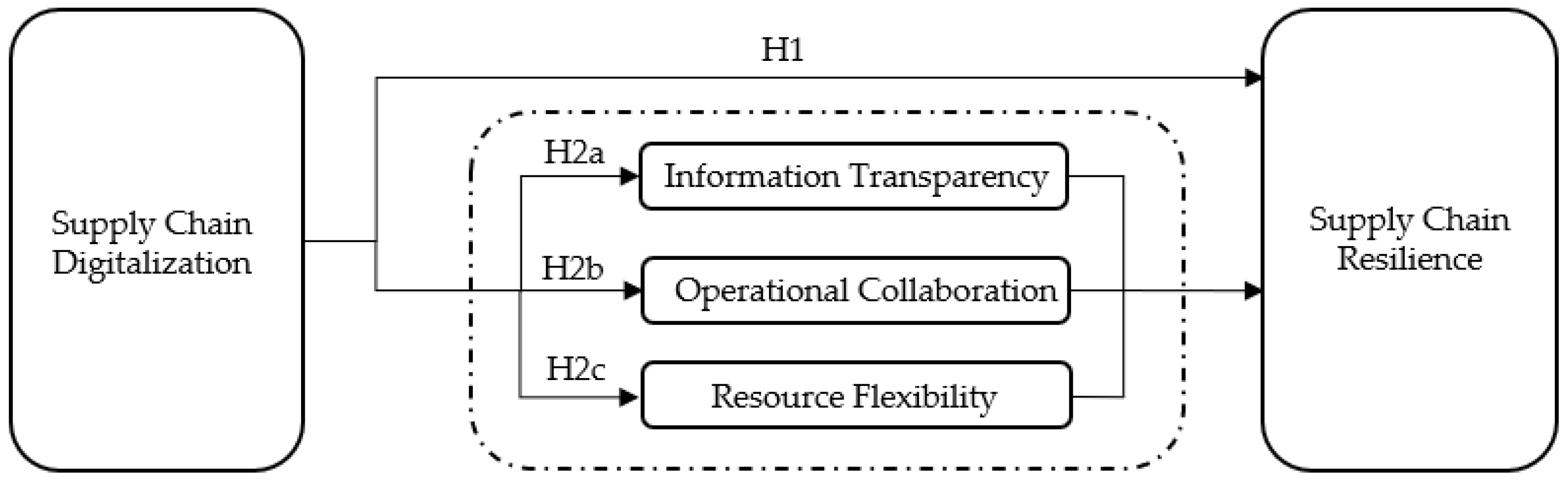
Based on complex systems theory, the supply chain is viewed as a complex system composed of multiple actors, multiple levels, and multiple feedback loops. Its overall performance is not a simple aggregation of individual node behaviors but rather the result of dynamic interactions and co-evolution among these actors. Therefore, we select the three dimensions of information transparency, operational collaboration, and resource flexibility to systematically elucidate the intrinsic mechanisms through which supply chain digitalization enhances its resilience. Among these, information transparency forms the foundation of digital empowerment. Operational collaboration represents the core manifestation of digital capabilities at the process and organizational levels. Resource flexibility provides a tangible basis for the system to recover and reconfigure in response to disruptions. The three are interdependent and dynamically coupled, jointly constituting a complete resilience enhancement mechanism that progresses from information visualization to operational linkage, and further to resource reconfiguration.
At the information level, supply chain digitalization leverages technologies such as the Internet of Things, blockchain, and big data platforms to achieve real-time data collection and integration across the entire process, from procurement and production to logistics and sales. A core outcome of this process is the revolutionary deconstruction of the traditional “information black box” in supply chains, resulting in a significant improvement in information transparency. Theoretical research has demonstrated that higher information transparency can effectively mitigate the “bullwhip effect” caused by the distortion of demand signals [27], thereby laying a more accurate basis for demand forecasting and inventory decision-making by upstream and downstream supply chain firms [28]. In the face of external shocks, a transparent information environment enables firms to identify the sources of risks earlier, assess the scope of impact more precisely, and facilitate more efficient cross-organizational collaborative responses [29]. Therefore, information transparency forms the primary cognitive foundation for enhancing supply chain resilience through digitalization. By addressing the issue of poor visibility, it improves overall system visibility and predictability, thereby laying a robust foundation for enhancing decision-making quality.
Building on the analysis above, the following hypothesis is proposed.
Hypothesis 2a.
Information transparency plays a positive mediating role between supply chain digitalization and supply chain resilience.
Information transparency addresses the cognitive challenge of “lack of visibility” in supply chains, yet the value of supply chain digitalization extends further. Its more fundamental role lies in the systematic upgrading and optimization of traditional operational models, translating the data advantages gained from enhanced information transparency into tangible collaborative actions and efficiency gains. Specifically, by deploying enterprise resource planning (ERP), supply chain management (SCM) software, and collaborative platforms, digital technologies can deeply restructure cross-organizational business processes from procurement and production to sales and service. Theoretical research suggests that process collaboration based on digital systems can effectively reduce transaction and collaboration costs between organizations [30] and enable more precise supply-demand matching and faster market responsiveness [31]. In the face of supply disruptions or demand fluctuations, a highly collaborative supply chain can achieve systemic buffering and recovery through swift order reallocation, production schedule adjustments, and other such measures [32]. Therefore, operational collaboration serves as the efficiency cornerstone for digitalization to enhance supply chain resilience: it transforms static information awareness into dynamic collaborative execution capacity, thereby strengthening the overall agility and recovery efficiency of the supply chain.
Building on the analysis above, the following hypothesis is proposed.
Hypothesis 2b.
Operational collaboration plays a positive mediating role between supply chain digitalization and supply chain resilience.
While the analysis of information transparency (information level) and operational collaboration (collaboration level) deepens our understanding of how supply chain digitization enhances resilience, its ultimate realization still relies on resource allocation capabilities at the physical level—namely, resource flexibility. Resource flexibility refers to a firm’s ability to rapidly and cost-effectively allocate and reconfigure resources in changing circumstances to maintain operations [33]. The ultimate test of resilience lies in translating digital advantages into the dynamic allocation and reconfiguration of physical assets [7]. Existing empirical studies have confirmed that resource flexibility, as a critical pathway, effectively strengthens a supply chain’s ability to cope with sudden shocks and maintain operational continuity [34]. In other words, when shocks exceed the coping capacity based on information and collaboration, the system ultimately relies on resource flexibility to execute reconfiguration. This represents the ultimate physical manifestation of resilience, constituting the core link that digitization must address. Accordingly, we examine whether supply chain digitization promotes resource flexibility, thereby completing the logical chain from information and collaboration to resource reconfiguration.
Building on the analysis above, the following hypothesis is proposed.
Hypothesis 2c.
Resource flexibility plays a positive mediating role between supply chain digitalization and supply chain resilience.
Figure 1 presents our theoretical framework, illustrating the hypothesized relationships.

3. Variable Definitions and Model Specification

3.1. Sample and Data Sources

The initial research sample consists of Chinese A-share listed companies spanning the period 2011–2024. In line with the approaches of Zhou et al. [23] and Wu et al. [24], the sample is processed according to the following criteria: (1) Exclusion of financial firms; (2) Exclusion of ST and *ST companies; (3) Exclusion of samples with missing variables; (4) Winsorization of the sample observations at the 1% level to alleviate the bias caused by outliers. Based on these criteria, we obtain a total of 46,460 valid samples. The relevant annual report data are sourced from the official websites of the Shenzhen Stock Exchange and the Shanghai Stock Exchange, while financial data are obtained from the China Stock Market and Accounting Research Database.

3.2. Variable Definition and Calculation Process

3.2.1. Supply Chain Resilience

Supply chain resilience denotes a supply chain’s capability to sustain operations, adapt to changes, and recover swiftly from internal and external shocks. Drawing on the research frameworks of Gölgeci and Kuivalainen [21] as well as Negri et al. [35], we construct a resilience evaluation system from two dimensions: resistance and recovery capability.
Specifically, supply chain resistance captures the operational stability of a supply chain, reflecting its ability to withstand shocks and avoid disruptions when faced with external disturbances. From an operational process perspective, we follow Gölgeci and Kuivalainen [21] and adopt the cash conversion cycle (CCC) as a proxy for supply chain resistance. The CCC captures the efficiency of capital turnover across procurement, production, and sales. A shorter CCC provides a stronger financial buffer during external shocks, reduces the risk of operational disruption from cash flow constraints, and thereby fortifies supply chain resistance. To ensure that the CCC indicator aligns with the economic meaning of the final constructed supply chain resilience index, where a higher value indicates stronger resilience, we performed a positive transformation of the original CCC values according to the following formula.
C C C _ P o s i t i v e i , t = 1 l n C C C i , t + 1
From a collaborative relationship perspective, supply chain resistance is evidenced by the stability of inter-firm transactions. Following the methodology of Xu et al. [36], we construct two indicators: Core Supplier Stability (CSS) and Core Customer Stability (CCS). These are measured as the proportion of a firm’s top five suppliers (or customers) that remain consistently within the top five ranking across consecutive observation periods. A higher value of these indicators reflects more stable cooperative relationships between the firm and its core supply chain partners, indicating stronger resistance of the supply chain to market shocks.
Supply chain recovery capability reflects the ability of a supply chain system to quickly return to its original state or achieve a new stable state after being subjected to shocks. From a dynamic supply–demand matching perspective, when an external shock occurs, the inherent production and demand rhythms of a supply chain are disrupted, leading to short-term imbalances. A supply chain with high recovery capability can swiftly adjust its production pace, synchronizing its output fluctuations with demand fluctuations, thereby reducing efficiency losses caused by supply–demand mismatch. Drawing on the approach of Tang and Tomlin [37] for measuring supply–demand coordination, we construct Supply–Demand Matching (SDM) as a proxy variable for assessing supply chain recovery capability. The calculation is specified by the following equation:
S D M i , t = V a r P r o d u c t i o n i , t V a r D e m a n d i , t
where S D M i , t represents the supply–demand deviation index for firm i in period t. P r o d u c t i o n i , t denotes the output of firm i in year t, while D e m a n d i , t represents the demand of firm i in year t, measured by the cost of sales. The relationship is defined as P r o d u c t i o n i , t = D e m a n d i , t + I n v e n t o r y i , t , where I n v e n t o r y i , t indicates the net change in inventory. V a r ( ) is computed over a rolling time window (three years) to capture fluctuation characteristics.
The SDM value being closer to 1 indicates that the firm’s production adjustments closely track demand fluctuations, reflecting stronger supply–demand coordination and higher supply chain recovery capability. To ensure that the SDM indicator aligns with the economic meaning of the supply chain resilience index (a higher value indicates stronger resilience), we processed the original SDM values according to the following formula, resulting in the adjusted SDM indicator (SDM_Adjusted).
S D M _ A d j u s t e d i , t = 1 S D M i , t 1 + 1
Moreover, from an economic perspective, when a supply chain is subjected to external shocks, firm performance tends to deviate from its expected trajectory and gradually adjusts toward a new equilibrium [38]. To examine this dynamic recovery capability, we draw on the performance-based adjustment approach proposed by DesJardine et al. [39] and construct an econometric model to capture the supply chain’s ability to recover after performance diversion.
First, we employ quarterly financial data and estimate the long-term expected trajectory of firm performance using the fixed-effects model, as specified by the following equation:
R O E i , t = β X i , t + μ i + v t + ε i , t
where R O E i , t denotes the return on equity for firm i in period t, and the vector of control variables X i , t includes firm size, financial leverage, revenue growth rate, R&D investment, and firm age. μ i and v t control for industry fixed effects and time fixed effects, respectively.
The fitted value from the regression, denoted as R O E i , t ^ , represents the firm’s expected performance after controlling for all individual and time-specific heterogeneity. The residual, ε i , t ^ = R O E i , t R O E i , t ^ , reflects the unexpected shock-induced deviation in performance during year t.
To extract a resilience indicator from the residual series, we employ a rolling-window autoregressive approach. At each annual cutoff point, we select the residual series from the most recent three years (comprising a total of 12 quarterly observations) and estimate the parameters based on a first-order autoregressive model specified as follows:
ε i , τ ^ = ρ i , t ε i , τ 1 ^ + u i , τ , τ = t 10 , , t
Based on the estimated autoregressive coefficient ( ρ i , t ^ ) corresponding to the window ending in year t, we define Recovery Speed (RS) as:
R S i , t = 1 ρ i , t ^
where ρ i , t ^ captures the degree of persistence of the shock. A larger value of R S i , t indicates that firm performance recovers more rapidly toward its long-term trend, reflecting stronger supply chain recovery capability.
Following the construction of the above indicators, we apply the entropy weight method to objectively assign weights to all five indicators and construct a composite index. This approach enables a systematic evaluation of supply chain resilience while mitigating the bias inherent in subjective weighting. Table 1 reports the final weights of the five indicators and details the calculation of the composite index.

3.2.2. Supply Chain Digitalization

Drawing on the extant literature, we employ the prevailing text analysis method and take the MD&A section of annual reports as the text corpus to measure the level of supply chain digitalization. The core of this approach involves building a specialized keyword dictionary capable of systematically and accurately identifying expressions associated with supply chain digitalization. To this end, we follow a three-step procedure for the systematic construction and dynamic optimization of the dictionary.
Specifically, given the complexity of supply chain systems, in order to comprehensively measure the level of digitalization covering each segment of the supply chain, we first adopt the framework of the Supply Chain Digitalization Management Guidelines issued by the State Administration for Market Regulation and the Standardization Administration of China [8], which categorizes supply chain management into five modules: planning, procurement, production, delivery, and service. Simultaneously, by reviewing the relevant literature on supply chain digitalization keywords [9,10,11], we establish an initial seed dictionary.
Subsequently, following the industry classification standard of the China Securities Regulatory Commission, we select the annual reports of the top five listed companies by market capitalization in each industry between 2021 and 2024 as our sample. This process yields a domain-specific corpus comprising over ten million characters. Leveraging the ERNIE 3.0 model (ERNIE 3.0 is a knowledge-enhanced pre-trained language model developed by Baidu; by integrating large-scale knowledge graphs, it has been widely applied in research such as text recognition and phrase semantic understanding), we perform semantic encoding of the entire corpus and identify synonyms as well as technical expression variants related to the concept of supply chain digitalization from the annual reports by calculating their high-dimensional semantic similarity to the seed word vectors. For example, starting from the seed term “digital procurement”, we expand to include practical terms such as “intelligent procurement” and “collaborative procurement”.
Finally, we filter the expanded keywords based on their semantic similarity. In line with widely adopted threshold-setting practices in text analysis research [40,41], we select terms for inclusion in the final dictionary whose average cosine similarity to the seed keywords exceeds 0.70 within the ERNIE semantic space.
Based on the constructed supply chain digitalization dictionary, we conduct keyword matching on the MD&A content of listed companies. Specifically, we count the keyword frequencies in five modules: planning, procurement, production, delivery, and service. The total frequency, obtained by summing the frequencies across all modules, serves as a proxy indicator for the level of supply chain digitalization.
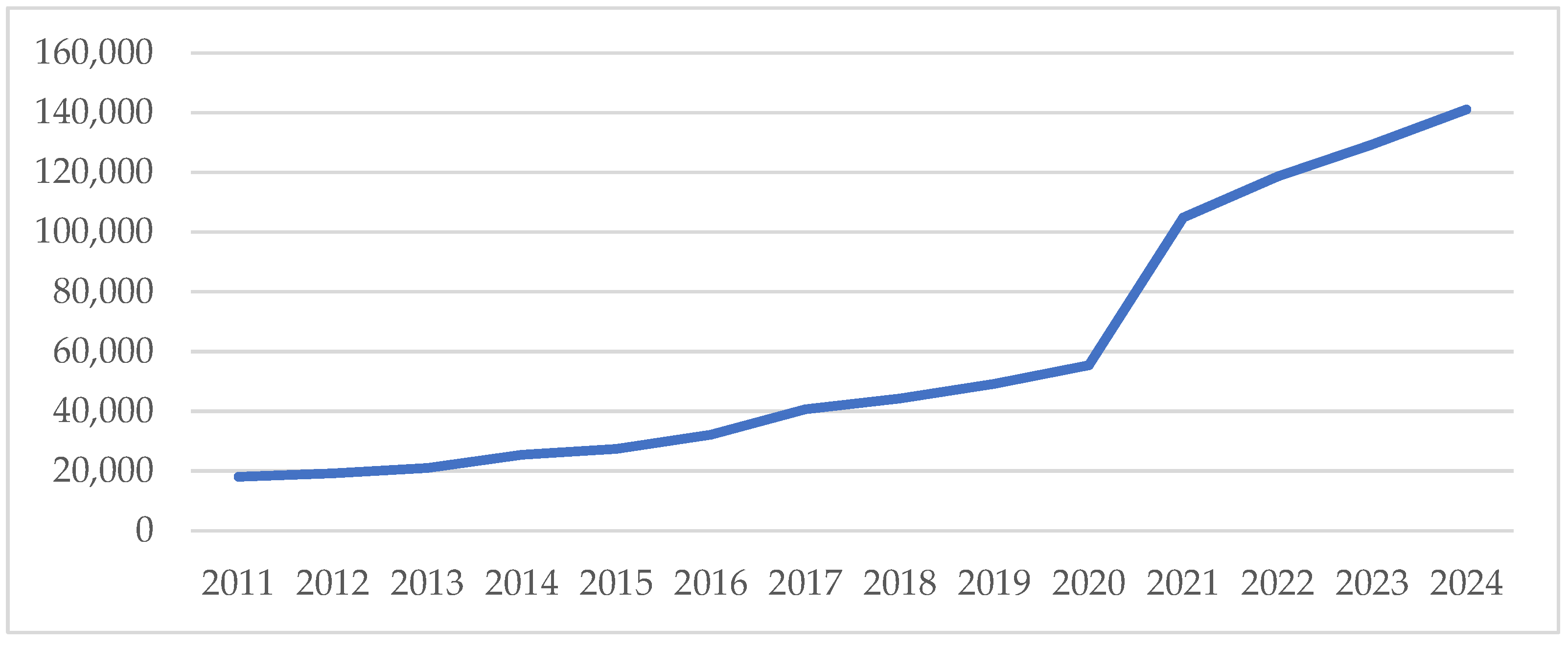
Figure 2 illustrates the annual variation in the frequency of supply chain digitalization keywords in the sample from 2011 to 2024. It can be seen that the level of supply chain digitalization among Chinese A-share listed companies exhibits a significant and continuous upward trend throughout the observation period, with the growth curve becoming notably steeper after 2016. This trend corresponds to the global wave of industrial digitalization and intelligent transformation, while also aligning with China’s policy direction of promoting the deep integration of the digital economy and the real economy.
Table 2 presents the five most frequently occurring keywords in each module of supply chain digitalization among the sample firms. These high-frequency keywords directly reflect the focal points and mainstream practices of the sample firms in advancing supply chain digital transformation.
Based on the keyword frequency statistics, to mitigate potential right-skewness in the distribution, we apply a natural logarithmic transformation to the total frequency. The specific calculation is given by Equation (7):
D i g i t a l i , t = l n 1 + k K F r e q u e n c y k , i , t
where D i g i t a l i , t reflects the supply chain digitalization level of firm i in year t; F r e q u e n c y k , i , t denotes the frequency of keyword k in the MD&A text of firm i in year t; and K represents the complete set of supply chain digitalization keywords.

3.3. Baseline Regression Model Specification

To examine the impact of supply chain digitalization on supply chain resilience, we construct the following fixed-effects panel model:
S C R i , t = α + β 1 D i g i t a l i , t 1 + γ C o n t r o l s i , t + μ i + v t + ε i , t
where S C R i , t denotes the level of supply chain resilience for firm i in year t. D i g i t a l i , t 1 represents the level of supply chain digitalization for firm i in year t−1. The one-period lag is employed for two main reasons: (1) Digital investment and transformation require time to exert material effects on supply chain operations and organizational processes; (2) the lagged specification helps alleviate potential reverse causality arising from the possibility that more resilient firms are more likely to undertake digital investments.
Referring to Zhou et al. [23] and Li et al. [42], we select the following control variables: firm size (Size), financial leverage (Lev), return on equity (ROE), liquidity ratio (Liquid), research and development investment (R&D), board size (Board), CEO–Chair duality (Dual), and listing age (ListAge). The terms μ i and v t control for industry fixed effects and time fixed effects, respectively. Table 3 illustrates the construction process of the aforementioned variables.

4. Baseline Analysis

4.1. Descriptive Statistics

Table 4 presents the descriptive statistics of the main variables. The sample consists of 46,460 observations. The mean value of the Supply Chain Resilience (SCR) is 0.353, with a standard deviation of 0.352, indicating significant variation in supply chain resilience levels among different firms. The mean value of Supply Chain Digitalization (Digital) is 2.635, with a standard deviation of 0.715, suggesting a relatively concentrated distribution. In terms of financial characteristics, the mean value of firm size (Size) is 22.197, and the average debt-to-asset ratio (Lev) is 40.9%, which falls within a reasonable range overall. Regarding profitability and liquidity, the mean return on equity (ROE) is 5.6%, and the mean liquidity ratio (Liquid) is 2.721, both with large standard deviations, reflecting notable differentiation in profitability and short-term solvency among firms. The mean value of innovation investment (R&D) is 7.788, with a median of 7.796, indicating a relatively symmetric distribution. In terms of governance structure, the mean board size (Board) is 2.107, approximately 31% of firms have CEO duality (Dual), and the mean listing age (ListAge) is 2.033.

4.2. Main Regression Results

To examine the impact of supply chain digitalization (Digital) on supply chain resilience (SCR), we conducted a regression analysis on panel data based on the fixed effects model specified in Equation (8). The regression results are presented in Table 5.
Table 5 presents the baseline regression results of supply chain digitalization on supply chain resilience. In column (1), which includes only the core explanatory variable Digital, the regression coefficient is 0.044 and is significantly positive at the 1% level, providing preliminary evidence that supply chain digitalization enhances its resilience. In column (2), after further incorporating control variables such as financial and governance characteristics, the coefficient of Digital remains 0.042 and is still significant at the 1% level, indicating that this positive relationship remains significant after controlling for firm heterogeneity. In column (3), industry and year fixed effects are further controlled to mitigate omitted variable bias. The coefficient of Digital decreases to 0.027 but remains statistically significant at the 1% level. These empirical results demonstrate that, after systematically controlling for firm characteristics as well as industry and time factors, supply chain digitalization continues to exhibit a significant positive effect on supply chain resilience.
From the regression results of the control variables, the coefficient of firm size (Size) is significantly negative at the 1% level (−0.009), indicating that, after controlling for other factors, larger firms exhibit relatively lower levels of supply chain resilience. This may stem from the complex structure and insufficient adjustment flexibility of large firms’ supply chains. Financial leverage (Lev) is also significantly negative (−0.038), suggesting that a high debt ratio weakens a firm’s financial buffer capacity to cope with supply chain shocks. The positive coefficient of profitability (ROE) (0.046) shows that firms with stronger profitability can allocate more resources to building supply chain resilience, thereby enhancing their ability to withstand risks and recover. Notably, the coefficient of R&D is significantly positive (0.015), indicating that innovation activities can effectively enhance the resistance and recovery capacity of the supply chain through technological advancements, providing an important pathway for improving supply chain resilience. In terms of firm governance, the coefficient of board size (Board) is significantly negative (−0.022), implying that larger boards may hinder rapid response capabilities during supply chain crises due to lower decision-making efficiency and higher collaboration costs. The coefficient of listing age (ListAge) is significantly positive (0.029), suggesting that firms with longer listing histories have accumulated richer market experience and more stable cooperative networks, thereby demonstrating stronger supply chain resilience. Taken together, the baseline regression results provide empirical support for Hypothesis H1.

4.3. Robustness Tests

4.3.1. Replacing Core Explanatory Variables

To test the sensitivity of the baseline findings to variable measurement approaches and mitigate potential biases caused by measurement errors, we employ the following two methods to remeasure the level of supply chain digitalization (Digital).
First, we refine the keyword selection criteria. Building on the original keyword-matching approach, we introduce a document-coverage filter, retaining only those supply chain digitalization keywords that appear in the MD&A texts of at least three distinct companies. This step aims to eliminate technical terms that appear only sporadically in the annual reports of very few firms and do not reflect industry-wide practices. It ensures that the keywords included in the analysis represent digitalization concepts with a certain degree of dissemination and practical foundation across the sample firms, thereby improving the universality and representativeness of the measurement. Based on the filtered keyword set, we recalculate the keyword frequency for each module, sum them, and take the natural logarithm to obtain the optimized supply chain digitalization indicator (Digital_Opt).
Second, we apply the Term Frequency–Inverse Document Frequency (TF-IDF) method to weight the raw keyword frequencies. Considering that simple frequency counts may obscure cross-firm differences due to the repeated occurrence of common terms, we use TF-IDF to construct weights, thereby more precisely capturing the specificity of each firm’s disclosure regarding supply chain digitalization [43].
Specifically, for firm i’s MD&A document in year t, the TF-IDF weight for keyword k is calculated as follows:
F r e q u e n c y _ T F I D F k , i , t = F r e q u e n c y k , i , t × l n N D F k
Here, F r e q u e n c y k , i , t represents the frequency of keyword k in the MD&A text of firm i in year t; N denotes the total number of documents in the full sample; and D F k indicates the number of documents containing keyword k.
On this basis, the supply chain digitalization level of firm i in year t is derived by summing the TF-IDF weights of all keywords and then taking the natural logarithm:
D i g i t a l _ T F I D F i , t = l n 1 + k K F r e q u e n c y _ T F I D F k , i , t
The two newly constructed indicators were respectively incorporated into the baseline regression model (8) for estimation, as shown in Table 6. Whether using the optimized keyword frequency measure (Digital_Opt) or the TF-IDF weighted indicator (Digital_TFIDF), their regression coefficients remain significantly positive at the 1% level, and the magnitude of the coefficients is similar to that in the baseline regression results. This indicates that after mitigating measurement errors through different measurement approaches, the positive promoting effect of supply chain digitalization on supply chain resilience remains robust. The findings demonstrate good adaptability to alternative variable measurement methods, further confirming the robustness of the positive relationship posited in Hypothesis H1 and enhancing the credibility of the empirical results.

4.3.2. Disaggregated Regression Analysis of Supply Chain Resilience

Since we employ the entropy weight method to synthesize multi-dimensional data reflecting supply chain resilience into a composite index, to ensure the validity of this synthesis approach and to verify the impact of supply chain digitalization on different resilience dimensions, this section conducts regression analyses based on the five underlying indicators presented in Table 1, thereby testing the robustness of the benchmark regression results. Specifically, we use Cash Conversion Cycle (CCC_Positive), Core Customer Stability (CCS), Core Supplier Stability (CSS), Supply–Demand Matching (SDM_Adjusted), and Recovery Speed (RS) as the dependent variables, and perform regression analyses according to the baseline regression model (8).
The regression results in Table 7 show that supply chain digitalization (Digital) has a statistically significant positive impact on all five sub-dimensions of resilience (significant at the 1% level), providing robust multi-dimensional evidence supporting Hypothesis H1. Furthermore, a weighted calculation based on the coefficients from Table 7 and the corresponding weights from Table 1 yields an approximate value of 0.0267, which closely aligns with the composite index regression coefficient of 0.027 reported in Table 5. This methodological cross-validation confirms both the rationality of the composite index construction and the robustness of the baseline regression results.
In addition, further observation reveals clear differences in the strength of digitalization’s impact across dimensions: its promoting effect on supply–demand matching (SDM_Adjusted) is the strongest (coefficient: 0.041), followed by its influence on recovery speed (RS) and cash conversion efficiency (CCC_Positive), while its impact on core customer and supplier stability (CCS, CSS) is relatively weakest. This indicates that the most direct function of digital technologies in enhancing supply chain resilience, such as ERP, advanced planning and scheduling, and demand forecasting algorithms, lies in significantly improving the dynamic coordination and efficiency of the supply chain. This finding also suggests that dynamic coordination capability may be a key pathway for enhancing supply chain resilience, providing an important basis for our subsequent in-depth exploration of the mechanisms through which digitalization enables resilience.

4.3.3. Instrumental Variable Approach

Although the baseline regression lags the core explanatory variable Digital by one period, which largely mitigates reverse causality due to simultaneity, potential endogeneity bias may still arise from omitted variables or residual two-way causality. To more rigorously identify the causal effect, we further employ an instrumental variable approach and conduct two-stage least squares (2SLS) estimation.
Following existing research [44], we select the internet penetration rate in the city where the firm is registered (IV_Internet) as an instrumental variable. This variable measures the level of regional digital infrastructure, providing external support for corporate supply chain digitalization and satisfying the relevance requirement; as a macro-environmental variable, its impact on an individual firm’s supply chain resilience should primarily operate through the firm’s own supply chain digitalization practices, meeting the exclusion restriction. Using this instrumental variable, we construct the following two-stage least squares model:
D i g i t a l i , t = π 0 + π 1 I V _ I n t e r n e t i , t + π C C o n t r o l s i , t + η i + λ t + ε i , t
S C R i , t = α + β 1 D i g i t a l i , t 1 ^ + γ C o n t r o l s i , t + μ i + v t + ε i , t
Table 8 reports the regression results of the instrumental variable approach. The first-stage regression shows that IV_Internet has a significant positive effect on the level of supply chain digitalization (the regression coefficient is 0.372, significant at the 1% level), satisfying the relevance requirement of the instrumental variable. In addition, the Cragg-Donald Wald F statistic (85.913) substantially exceeds the Stock-Yogo critical value of 16.38 for a 10% maximal IV bias threshold, effectively ruling out concerns regarding weak instruments.
D i g i t a l ^ The second-stage result shows that the estimated effect of Digital on SCR remains positive and statistically significant at the 1% level. This result is consistent in both magnitude and significance with the baseline finding, reinforcing the robustness of the core conclusion that supply chain digitalization enhances resilience.

5. Mechanism Tests

The baseline regression and robustness tests conducted earlier have confirmed that supply chain digitalization exerts a significant positive effect on its resilience. To further uncover the underlying transmission mechanisms of this impact, guided by the theoretical hypotheses proposed in Section 2.3, we construct corresponding mediating variables from three dimensions: information transparency, operational collaboration, and resource flexibility. We then establish a fixed effects model to examine the effect of supply chain digitalization on each mechanism proxy variable, as specified in Equation (13).
M e c h i , t = α + β 1 D i g i t a l i , t 1 + γ C o n t r o l s i , t + μ i + v t + ε i , t
where M e c h i , t represents the proxy variable for a given mechanism of firm i in year t, and the vector C o n t r o l s i , t contains the same set of control variables as in the baseline regression model.

5.1. Information Transparency Channels

To empirically examine the impact of supply chain digitalization on information transparency, we constructed and tested three theoretically grounded proxy variables based on the dimensions (internal-external) and qualitative depth of information flow.
First, in the dimension of internal information coordination and drawing on Devaraj et al. [45], we constructed the Internal Information Coordination (IIC) indicator by counting the frequency of keywords related to internal collaboration (such as “information sharing”, “system integration”, and “data interface”) in the MD&A section of listed firms’ annual reports. This indicator aims to capture organizations’ proactive efforts in leveraging digital tools to break down internal information silos and enhance process coordination [46], reflecting how information transparency manifests in internal operations.
Second, to capture the breadth of external information disclosure, we employ Disclosure Detail (DD) as a proxy variable, measured by the total character count (in natural logarithm) of the MD&A text. More detailed disclosures typically encompass richer information on corporate operations, risks, and strategies. This directly increases the information volume available to external investors, clients, and suppliers, thereby constituting an enhancement in information transparency [47].
Finally, regarding the forward-looking dimension of information disclosure, we construct the Forward-Looking Information Content (FLIC) indicator, measured by calculating the proportion of forward-looking sentences containing terms such as “will”, “expect”, “plan” and “target” relative to the total number of sentences in the MD&A text. Forward-looking information reflects management’s judgments and plans for future operations based on data analysis and insights, which can significantly reduce information asymmetry among external stakeholders, representing a qualitative deepening and an enhancement in the strategic value of information transparency [48].
The regression results presented in Table 9 demonstrate that supply chain digitalization exerts a significantly positive effect on all three proxy variables for the information transparency channel. Specifically, digitalization strengthens internal coordination (coefficient = 0.089), encourages more detailed external disclosure (coefficient = 0.127), and increases forward-looking information in the MD&A section (coefficient = 0.045). These results confirm that digital tools help break down information silos, enhance data sharing with partners, and support more strategic, data-driven planning.
The above empirical results confirm that supply chain digitalization significantly enhances information transparency, supporting the validity of Hypothesis H2a. Specifically, digitalization strengthens information transparency by improving internal information coordination, expanding the breadth of information disclosure, and increasing forward-looking information content. This enhancement not only optimizes internal process integration [31] but also reduces information asymmetry [44] and supports forward-looking planning among supply chain partners [46]. Therefore, information transparency serves as a key mediating mechanism between supply chain digitalization and its resilience, validating Hypothesis H2a.

5.2. Operational Collaboration Channels

To empirically test whether supply chain digitalization can effectively enhance operational collaboration, we construct proxy variables from the two dimensions of sales collaboration and management collaboration.
In terms of sales collaboration, we select the Sales Expense Ratio (SER) as the proxy variable, which is calculated as sales expenses divided by operating revenue. Digital collaboration tools, such as customer relationship management systems and collaborative marketing platforms, can enhance channel management efficiency and marketing precision, thereby potentially reducing the sales expenditure required to generate a unit of revenue [49].
In terms of management collaboration, we use the Administrative Expense Ratio (AER) as the proxy indicator, defined as administrative expenses divided by operating revenue. Digital platforms can optimize cross-firm approval, communication, and shared service processes, thus potentially reducing administrative and collaboration costs both within and across organizations [30].
Based on Model (13), separate regressions were conducted using the two variables as dependent variables. The regression results in Table 10 indicate that supply chain digitalization has a significant negative impact on both proxy variables of operational collaboration. Specifically, for every one-unit increase in the level of supply chain digitalization (Digital), the Sales Expense Ratio (SER) and Administrative Expense Ratio (AER) decrease significantly by approximately 11.5% and 7.8%, respectively. These findings confirm that supply chain digitalization can effectively enhance collaborative efficiency between firms and their supply chain partners, significantly reducing the collaborative cost required per unit of revenue.
According to established theory, the decline in these two expense ratios reflects not only improved internal management efficiency but also a systematic reduction in transaction costs and collaboration friction across organizations [50]. Therefore, we argue that supply chain digitalization enhances operational collaboration within the supply chain, thereby establishing another core channel through which its resilience is strengthened. These findings empirically validate Hypothesis H2b.

5.3. Resource Flexibility Channel

We construct proxy variables for resource flexibility from three dimensions: static asset structure flexibility, dynamic asset structure flexibility, and output flexibility.
At the level of static asset structure flexibility, we select the Intangible Asset Ratio (IAR) as a proxy, calculated as the ratio of intangible assets to fixed assets. Intangible assets are characterized by non-exclusivity and ease of replication, enabling firms to quickly adjust business processes and resource deployment. Therefore, this ratio effectively captures the underlying adjustability and adaptability of a firm’s fundamental asset structure [51].
At the level of dynamic asset structure flexibility, we construct the Capital Expenditure Intensity (CEI) indicator, calculated as the ratio of the annual increase in fixed assets to operating revenue. A lower value suggests that the firm requires less internal investment in physical assets to generate each unit of revenue, typically indicating an asset-light strategy through industrial-chain collaboration or servitization outsourcing [52]. Such a strategy reduces fixed costs and enhances the ability to adjust swiftly amid market fluctuations or supply chain disruptions [53].
Regarding output flexibility, we use Product Diversity (PD) as the proxy variable, measured by the natural logarithm of the number of primary business product categories disclosed in a company’s annual financial report. The richness of product variety directly reflects the production system’s ability to flexibly respond to changes in market demand [54].
Based on Model (13), we regressed the three variables as the dependent variables. The regression results in Table 11 indicate that supply chain digitalization significantly enhances the resource flexibility of firms. Specifically, for each unit increase in the level of supply chain digitalization, the proportion of intangible assets increases significantly by 0.105 (Column 1), suggesting a shift in the asset structure toward more adaptable and reconfigurable intangible assets; capital expenditure intensity decreases significantly by 0.082 (Column 2), implying reduced investment in new fixed assets required per unit of revenue, which reflects a deepening of asset-light operations and external collaboration strategies; moreover, product diversity increases significantly by 0.092 (Column 3), indicating that the production system is better able to respond flexibly to changes in market demand. These results collectively confirm that supply chain digitalization effectively enhances a firm’s resource flexibility at the static, dynamic, and output levels by optimizing asset structure, reducing reliance on fixed assets, and increasing output diversity, thereby establishing a solid resource foundation for supply chain resilience. Thus, Hypothesis H2c is supported.
Overall, our systematic examination of the mechanisms in the preceding sections has empirically validated three core transmission channels through which supply chain digitalization enhances resilience. Together, these channels (information transparency, operational collaboration, and resource flexibility) complement one another and provide an integrated explanation of how digitalization systematically strengthens the supply chain’s ability to respond to uncertainties.

6. Heterogeneity Analysis

The preceding baseline regression and mechanism tests reveal the overall effect of supply chain digitalization on enhancing supply chain resilience and its transmission channels. However, the Technology–Organization–Environment (TOE) framework posits that the effectiveness of technology adoption and implementation is moderated by the external institutional environment and the organization’s internal endowments [55]. This theoretical perspective implies that the impact of supply chain digitalization is unlikely to be uniform. Therefore, to uncover the boundary conditions of this relationship, we employ the TOE framework to further investigate how the effects vary with differences in external institutional environments and internal heterogeneity.
Regarding heterogeneity in the external institutional environment, Liu et al. [56] find that the institutional context in which a firm operates affects its ability to adopt and coordinate technologies. In regions with higher marketization, well-developed market mechanisms and a robust legal framework may enhance the effectiveness of digital tools in facilitating collaboration within supply chain networks. To examine whether such differences exist, we measure regional institutional environments using the marketization index from the China Market Index Database. Based on the annual marketization index of each firm’s registered location, the full sample is divided into two groups: regions with high marketization levels and those with low marketization levels.
Turning to the internal heterogeneity, prior research suggests that non-state-owned enterprises (non-SOEs), with their more flexible governance and profit-driven focus, can more rapidly convert digital investments into operational gains [57]. To test this view, we classify firms into SOEs and non-SOEs based on the nature of their ultimate controller for subgroup analysis.
Simultaneously, leveraging their advantages in innovation capabilities and IT infrastructure, firms in high-tech industries may be better equipped to integrate digital technologies into supply chain management at a deeper level [58]. Accordingly, based on the Classification of High-Tech Industries (Manufacturing) (2017) issued by China’s National Bureau of Statistics, we categorize the sample firms into high-tech and non-high-tech industry groups.
The regression results in Table 12 reveal clear heterogeneity in the effect of supply chain digitalization on its resilience enhancement. Specifically, in terms of regional marketization levels, the promoting effect is significantly stronger in high-marketization regions (regression coefficient = 0.031) compared to low-marketization regions (regression coefficient = 0.022), with an inter-group p-value difference of 0.038. This indicates that a well-developed institutional environment provides more favorable support for the application and collaboration of digital technologies, thereby amplifying their resilience benefits.
In terms of ownership structure, the heterogeneity is even more pronounced. The enhancement of supply chain resilience through digitalization is significantly stronger in non-state-owned firms (0.034) compared to state-owned firms (0.016), with the inter-group difference being statistically significant at the 1% level (p-value = 0.007). This result suggests that market-oriented operational mechanisms, clear profit-driven objectives, and fewer principal–agent issues enable firms to leverage supply chain digital technologies more effectively in improving supply chain resilience.
In terms of technological intensity, the promotional effect of supply chain digitalization on resilience also exhibits systematic differences. In high-tech industries, the enhancing effect (0.033) is significantly stronger than in non-high-tech industries (0.021), with an inter-group p-value difference of 0.029. This indicates that technology-intensive industries are better positioned to reap significant resilience benefits from supply chain digital transformation.

7. Conclusions

7.1. Main Findings and Research Implications

Based on a complex systems perspective and using a sample of China’s A-share listed companies from 2011 to 2024, we comprehensively examine the impact of supply chain digitalization on supply chain resilience, its underlying transmission mechanisms, and heterogeneous characteristics. Through empirical analysis, we draw the following main conclusions.
First, supply chain digitalization significantly enhances supply chain resilience. The baseline regression results show that the level of supply chain digitalization has a statistically significant positive effect on the comprehensive index of supply chain resilience. This conclusion remains robust after conducting robustness tests by replacing the core explanatory variable and addressing endogeneity concerns via an instrumental variables approach.
Second, supply chain digitalization systematically enhances supply chain resilience through three core channels: information transparency, operational collaboration, and resource flexibility. The mechanism tests reveal that: (1) Supply chain digitalization strengthens information transparency by enhancing internal information coordination and increasing the breadth and forward-looking nature of external disclosure. This heightened transparency improves information visibility and risk foresight among supply chain partners. (2) By reducing the sales expense ratio and administrative expense ratio, supply chain digitalization optimizes inter-organizational collaboration processes, converting information advantages into collaborative operational efficiency, thereby strengthening supply chain agility and buffering capacity. (3) Supply chain digitalization strengthens a firm’s capacity for dynamic resource adjustment and reconfiguration by optimizing asset structure and diversifying output capabilities, providing a buffer space to withstand shocks. These three channels systematically form a complete action pathway, revealing the multidimensional mechanism through which supply chain digitalization builds its resilience.
Finally, the resilience-enhancing effect of supply chain digitalization is moderated by both external institutional environments and internal heterogeneity. Heterogeneity analysis reveals that the positive impact of digital transformation on resilience is more pronounced for firms in regions with higher marketization levels, non-state-owned firms, and high-tech industries.
Based on our findings, we recommend that firm managers, in advancing the digital transformation of supply chains, prioritize information transparency, operational collaboration, and resource flexibility as key drivers to systematically enhance supply chain resilience. At the same time, we recommend that policymakers, in addition to formulating general policies to promote the digital transformation of supply chains, fully consider the heterogeneity among enterprises and implement differentiated support strategies. For instance, for enterprises in regions with a lower degree of marketization, the focus could be on improving digital infrastructure and institutional environments; for state-owned enterprises, efforts could be directed toward refining governance and incentive mechanisms to enhance their responsiveness to digital transformation; and for enterprises in non-high-tech industries, pilot demonstrations and technical support could be provided to narrow their digital capability gaps.

7.2. Theoretical Contributions

The theoretical contributions of this study are primarily reflected in the following three aspects.
First, this study contributes to the literature by developing a comprehensive and process-oriented measure of supply chain digitalization. Existing studies often rely on narrow proxies that capture specific digital technologies or general digital investment, which may inadequately reflect the systemic nature of supply chain digitalization. Drawing on authoritative policy documents and leveraging large language models to expand digitalization-related terminology, this study constructs a keyword-based measurement that captures digital transformation across core supply chain processes. This approach improves the granularity of digitalization measurement in empirical research and provides a replicable methodological foundation for future studies on supply chain digitalization and resilience.
Second, this study advances the theoretical framework of digitalization-enabled supply chain resilience from a complex systems perspective. Existing research has largely focused on the impact of individual technologies or a firm’s overall digitalization level on supply chain resilience, often overlooking the supply chain’s inherent nature as a complex system of dynamic interactions among multiple actors. Drawing on complex systems theory, this study conceptualizes supply chain digitalization as a transformation spanning core processes such as planning, procurement, production, delivery, and service. Using a mechanism analysis based on the progressive logic of information visibility, operational integration, and resource reconfiguration, this study illustrates how digitalization reshapes interactions among actors within the supply chain and the system’s overall evolutionary trajectory, thereby offering a new theoretical perspective to the literature.
Third, this study advances the understanding of contextual boundaries in the digitalization–resilience relationship through heterogeneity analysis. Guided by the Technology–Organization–Environment framework, we systematically examine how external institutional environments (marketization level) and internal heterogeneity (ownership and industry technological intensity) shape the effect of digitalization on resilience. This provides a differentiated perspective for future research and offers targeted insights for firm managers and policymakers.

7.3. Limitations and Future Research Directions

Despite our efforts to ensure rigor, this study has several limitations that also point to avenues for future research.
First, the measurement of variables in this study has certain limitations. The assessment of supply chain digitalization relies on keyword frequency in MD&A texts. While we enhanced the dictionary with large language models and performed robustness checks, this approach primarily captures the disclosure intensity of digital initiatives, which may not fully correspond to the actual implementation depth, integration maturity, or operational effectiveness of such technologies, thus raising concerns regarding construct validity. Future research could strengthen validity by incorporating cross-validation with alternative indicators such as digital investment, patent portfolios, or field survey data. Similarly, although our supply chain resilience index integrates multiple indicators of resistance and recovery capability, it remains an outcome-based proxy. Future studies could employ high-frequency operational data to measure resilience dynamics more directly and accurately.
Second, the study’s depth can be extended. Our research primarily focuses on the linear impact of supply chain digitalization on its resilience. Future studies could delve deeper into potential nonlinear relationships (e.g., threshold effects, inverted U-shaped curves) or investigate the differential impacts of specific digital technologies (e.g., artificial intelligence, blockchain, and the Internet of Things) on supply chain resilience.
Finally, the research context could be enriched. Our empirical analysis is based on data from China’s A-share listed companies, and the generalizability of the findings awaits examination in other markets or economies. Future research could conduct cross-country comparisons to explore both the commonalities and specificities of how supply chain digitalization enhances its resilience under different national institutions and cultural contexts.

Author Contributions

Conceptualization, J.H. and J.M.; methodology, J.H.; software, J.H.; validation, J.H. and J.M.; formal analysis, J.M.; investigation, J.H.; resources, J.H.; data curation, J.H.; writing—original draft preparation, J.H.; writing—review and editing, J.M.; visualization, J.M.; supervision, J.H.; project administration, J.H.; funding acquisition, J.H. All authors have read and agreed to the published version of the manuscript.

Funding

This research received no external funding.

Data Availability Statement

The raw data supporting the conclusions of this article will be made available by the authors upon request.

Conflicts of Interest

The authors declare no conflicts of interest.

References

  1. Choi, T.Y.; Dooley, K.J.; Rungtusanatham, M. Supply Networks and Complex Adaptive Systems: Control versus Emergence. J. Oper. Manag. 2001, 19, 351–366. [Google Scholar] [CrossRef]
  2. Surana, A.; Kumara, S.; Greaves, M.; Raghavan, U.N. Supply-Chain Networks: A Complex Adaptive Systems Perspective. Int. J. Prod. Res. 2005, 43, 4235–4265. [Google Scholar] [CrossRef]
  3. Ivanov, D. Predicting the Impacts of Epidemic Outbreaks on Global Supply Chains: A Simulation-Based Analysis on the Coronavirus Outbreak (COVID-19/SARS-CoV-2) Case. Transp. Res. 2020, 136, 101922. [Google Scholar] [CrossRef] [PubMed]
  4. Nadkarni, S.; Prügl, R. Digital Transformation: A Review, Synthesis and Opportunities for Future Research. Manag. Rev. Q. 2021, 71, 233–341. [Google Scholar] [CrossRef]
  5. Li, L.; Lin, J.B. Digital Transformation for the Sustainable Development of Firms: The Role of Green Capability and Green Culture. Sustain. Dev. 2024, 32, 1861–1875. [Google Scholar] [CrossRef]
  6. Saberi, S.; Kouhizadeh, M.; Sarkis, J.; Shen, L. Blockchain Technology and its Relationships to Sustainable Supply Chain Management. Int. J. Prod. Res. 2019, 57, 2117–2135. [Google Scholar] [CrossRef]
  7. Ivanov, D.; Dolgui, A.; Sokolov, B. The Impact of Digital Technology and Industry 4.0 on the Ripple Effect and Supply Chain Risk Analytics. Int. J. Prod. Res. 2019, 57, 829–846. [Google Scholar] [CrossRef]
  8. GB/T 23050-2022; Integration of Informatization and Industrialization Management Systems—Guide for Digital Management of Supply Chain. State Administration for Market Regulation: Beijing, China; Standardization Administration of the People’s Republic of China: Beijing, China, 2022.
  9. Pyun, J.; Rha, J.S. Review of Research on Digital Supply Chain Management Using Network Text Analysis. Sustainability 2021, 13, 9929. [Google Scholar] [CrossRef]
  10. Ho, W.R.; Tsolakis, N.; Dawes, T.; Dora, M.; Kumar, M. A Digital Strategy Development Framework for Supply Chains. IEEE Trans. Eng. Manag. 2023, 70, 2493–2506. [Google Scholar] [CrossRef]
  11. Zhou, H.; Wang, Y.; Li, J. Supply Chain Digitalization and Performance Improvement: A Moderated Mediation Model. Supply Chain Manag. 2023, 28, 993–1008. [Google Scholar] [CrossRef]
  12. Holling, C.S. Resilience and Stability of Ecological Systems. Annu. Rev. Ecol. Syst. 1973, 4, 1–23. [Google Scholar] [CrossRef]
  13. van Kampen, T.J.; van Donk, D.P.; van der Zee, D.J. Safety Stock or Safety Lead Time: Coping with Unreliability in Demand and Supply. Int. J. Prod. Res. 2010, 4824, 7463–7481. [Google Scholar] [CrossRef]
  14. Wieland, A.; Wallenburg, C.M. The Influence of Relational Competencies on Supply Chain Resilience: A Relational View. Int. J. Phys. Distrib. Logist. Manag. 2013, 43, 300–320. [Google Scholar] [CrossRef]
  15. Christopher, M.; Peck, H. Building the Resilient Supply Chain. Int. J. Logist. Manag. 2004, 15, 1–14. [Google Scholar] [CrossRef]
  16. Ali, I.; Golgeci, I.; Arslan, A. Achieving Resilience through Knowledge Management Practices and Risk Management Culture in Agri-Food Supply Chains. Supply Chain Manag. 2021, 28, 284–299. [Google Scholar] [CrossRef]
  17. Tukamuhabwa, B.R.; Stevenson, M.; Busby, J.; Zorzini, M. Supply Chain Resilience: Definition, Review and Theoretical Foundations for Further Study. Int. J. Prod. Res. 2015, 53, 5592–5623. [Google Scholar] [CrossRef]
  18. Brandon-Jones, E.; Squire, B.; Autry, C.W.; Petersen, K.J. A Contingent Resource-Based Perspective of Supply Chain Resilience and Robustness. J. Supply Chain Manag. 2014, 50, 55–73. [Google Scholar] [CrossRef]
  19. Brusset, X.; Teller, C. Supply Chain Capabilities, Risks, and Resilience. Int. J. Prod. Econ. 2017, 184, 59–68. [Google Scholar] [CrossRef]
  20. Pettit, T.J.; Croxton, K.L.; Fiksel, J. The Evolution of Resilience in Supply Chain Management: A Retrospective. J. Bus. Logist. 2013, 34, 56–65. [Google Scholar] [CrossRef]
  21. Gölgeci, I.; Kuivalainen, O. Does Social Capital Matter for Supply Chain Resilience? The Role of Absorptive Capacity and Marketing-Supply Chain Management Alignment. Ind. Mark. Manag. 2020, 84, 63–74. [Google Scholar] [CrossRef]
  22. Ralston, P.; Blackhurst, J. Industry 4.0 and Resilience in the Supply Chain: A Driver of Capability Enhancement or Capability Loss? Int. J. Prod. Res. 2020, 58, 5006–5019. [Google Scholar] [CrossRef]
  23. Zhou, H.; Wang, R.; Zhang, X.; Chang, M. The Impact of Digital Technology Adoption on Corporate Supply Chain Concentration: Evidence from Patent Analysis. Financ. Res. Lett. 2024, 64, 105413. [Google Scholar] [CrossRef]
  24. Wu, Y.; Wang, J.; Yang, P. How Supply Chain Digitalization Investment Affects Firm’s Financial and Non-Financial Performance: Evidence from Listed Companies in China. Int. Rev. Financ. Anal. 2024, 96, 103639. [Google Scholar] [CrossRef]
  25. Dubey, R.; Gunasekaran, A.; Childe, S.J.; Blome, C.; Papadopoulos, T. Big Data and Predictive Analytics and Manufacturing Performance: Integrating Institutional Theory, Resource-Based View and Big Data Culture. Br. J. Manag. 2019, 30, 341–361. [Google Scholar] [CrossRef]
  26. Zamani, E.D.; Smyth, C.; Gupta, S.; Dennehy, D. Artificial Intelligence and Big Data Analytics for Supply Chain Resilience: A Systematic Literature Review. Ann. Oper. Res. 2023, 327, 605–632. [Google Scholar] [CrossRef]
  27. Lee, H.L.; Padmanabhan, V.; Whang, S. Information Distortion in a Supply Chain: The Bullwhip Effect. Manag. Sci. 1997, 43, 546–558. [Google Scholar] [CrossRef]
  28. Cachon, G.P.; Fisher, M. Supply Chain Inventory Management and the Value of Shared Information. Manag. Sci. 2000, 46, 1032–1048. [Google Scholar] [CrossRef]
  29. Ivanov, D.; Dolgui, A. A Digital Supply Chain Twin for Managing the Disruption Risks and Resilience in the Era of Industry 4.0. Prod. Plan. Control 2021, 32, 775–788. [Google Scholar] [CrossRef]
  30. Brynjolfsson, E.; Hitt, L.M. Beyond Computation: Information Technology, Organizational Transformation and Business Performance. J. Econ. Perspect. 2000, 14, 23–48. [Google Scholar] [CrossRef]
  31. Rai, A.; Patnayakuni, R.; Seth, N. Firm Performance Impacts of Digitally Enabled Supply Chain Integration Capabilities. MIS Q. 2006, 30, 225–246. [Google Scholar] [CrossRef]
  32. Scholten, K.; Schilder, S. The Role of Collaboration in Supply Chain Resilience. Supply Chain Manag. 2015, 20, 471–484. [Google Scholar] [CrossRef]
  33. Kazancoglu, I.; Ozbiltekin-Pala, M.; Mangla, S.K.; Kazancoglu, Y.; Jabeen, F. Role of Flexibility, Agility and Responsiveness for Sustainable Supply Chain Resilience during COVID-19. J. Clean. Prod. 2022, 362, 132431. [Google Scholar] [CrossRef]
  34. Cheng, J.; Shan, P. Configuring Supply Chain Resilience Under Natural Disaster Risk. Sustainability 2025, 17, 6346. [Google Scholar] [CrossRef]
  35. Negri, M.; Cagno, E.; Colicchia, C.; Sarkis, J. Integrating Sustainability and Resilience in the Supply Chain: A Systematic Literature Review and a Research Agenda. Bus. Strat. Environ. 2021, 30, 2858–2886. [Google Scholar] [CrossRef]
  36. Xu, Y.; Yu, H.; Qiu, R.; Yu, L. How Does Artificial Intelligence Shape Supply Chain Resilience? The Moderating Role of the CEOs’ Sports Experience. Systems 2025, 13, 190. [Google Scholar] [CrossRef]
  37. Tang, C.S.; Tomlin, B. The Power of Flexibility for Mitigating Supply Chain Risks. Int. J. Prod. Econ. 2008, 116, 12–27. [Google Scholar] [CrossRef]
  38. Branzei, O.; Abdelnour, S. Another Day, Another Dollar: Enterprise Resilience Under Terrorism in Developing Countries. J. Int. Bus. Stud. 2010, 41, 804–825. [Google Scholar] [CrossRef]
  39. DesJardine, M.; Bansal, P.; Yang, Y. Bouncing Back: Building Resilience Through Social and Environmental Practices in the Context of the 2008 Global Financial Crisis. J. Manag. 2019, 45, 1434–1460. [Google Scholar] [CrossRef]
  40. Hoberg, G.; Phillips, G. Text-Based Network Industries and Endogenous Product Differentiation. J. Polit. Econ. 2016, 124, 1423–1465. [Google Scholar] [CrossRef]
  41. Li, K.; Mai, F.; Shen, R.; Yan, X. Measuring Corporate Culture Using Machine Learning. Rev. Financ. Stud. 2020, 34, 3265–3315. [Google Scholar] [CrossRef]
  42. Li, Q.; Tian, W.; Zhang, H. Digital Transformation for Sustainability in Industry 4.0: Alleviating the Corporate Digital Divide and Enhancing Supply Chain Collaboration. Systems 2025, 13, 123. [Google Scholar] [CrossRef]
  43. Gentzkow, M.; Kelly, B.; Taddy, M. Text as Data. J. Econ. Lit. 2019, 57, 535–574. [Google Scholar] [CrossRef]
  44. Cao, S.; Nie, L.; Sun, H.; Sun, W.; Taghizadeh-Hesary, F. Digital Finance, Green Technological Innovation and Energy-Environmental Performance: Evidence from China’s Regional Economies. J. Clean. Prod. 2021, 327, 129458. [Google Scholar] [CrossRef]
  45. Devaraj, S.; Krajewski, L.; Wei, J.C. Impact of eBusiness Technologies on Operational Performance: The Role of Production Information Integration in the Supply Chain. J. Oper. Manag. 2007, 25, 1199–1216. [Google Scholar] [CrossRef]
  46. Shi, Y.; Zheng, X.; Venkatesh, V.; Humdan, E.A.; Paul, S.K. The Impact of Digitalization on Supply Chain Resilience: An Empirical Study of the Chinese Manufacturing Industry. J. Bus. Ind. Mark. 2023, 38, 1–11. [Google Scholar] [CrossRef]
  47. Li, F. Annual Report Readability, Current Earnings, and Earnings Persistence. J. Account. Econ. 2008, 45, 221–247. [Google Scholar] [CrossRef]
  48. Li, F. The Information Content of Forward-Looking Statements in Corporate Filings—A Naïve Bayesian Machine Learning Approach. J. Account. Res. 2010, 48, 1049–1102. [Google Scholar] [CrossRef]
  49. Aral, S.; Weill, P. IT Assets, Organizational Capabilities, and Firm Performance: How Resource Allocations and Organizational Differences Explain Performance Variation. Organ. Sci. 2007, 18, 763–780. [Google Scholar] [CrossRef]
  50. Um, K.H.; Kim, S.M. The Effects of Supply Chain Collaboration on Performance and Transaction Cost Advantage: The Moderation and Nonlinear Effects of Governance Mechanisms. Int. J. Prod. Econ. 2019, 217, 97–111. [Google Scholar] [CrossRef]
  51. Berk, J.B.; Stanton, R.; Zechner, J. Human Capital, Bankruptcy, and Capital Structure. J. Financ. 2010, 65, 891–926. [Google Scholar] [CrossRef]
  52. Tatarczak, A.; Grzegorz, G. A Coalition Formation Framework for Horizontal Supply Chain Collaboration. Logforum 2024, 20, 357–372. [Google Scholar] [CrossRef]
  53. Brynjolfsson, E.; Hofmann, P.; Jordan, J. Cloud Computing and Electricity: Beyond the Utility Model. Commun. ACM 2010, 53, 32–34. [Google Scholar] [CrossRef]
  54. Brynjolfsson, E.; Hu, Y.; Simester, D. Goodbye Pareto Principle, Hello Long Tail: The Effect of Search Costs on the Concentration of Product Sales. Manag. Sci. 2011, 57, 1373–1386. [Google Scholar] [CrossRef]
  55. Zhu, K.; Kraemer, K.L. Post-Adoption Variations in Usage and Value of E-Business by Organizations: Cross-Country Evidence from the Retail Industry. Inf. Syst. Res. 2005, 16, 61–84. [Google Scholar] [CrossRef]
  56. Liu, H.; Ke, W.; Wei, K.K.; Gu, J.; Chen, H. The Role of Institutional Pressures and Organizational Culture in the Firm’s Intention to Adopt Internet-Enabled Supply Chain Management Systems. J. Oper. Manag. 2010, 28, 372–384. [Google Scholar] [CrossRef]
  57. DeWenter, K.L.; Malatesta, P.H. State-Owned and Privately Owned Firms: An Empirical Analysis of Profitability, Leverage, and Labor Intensity. Am. Econ. Rev. 2001, 91, 320–334. [Google Scholar] [CrossRef]
  58. Alyasein, O.I.Y.; Ojha, D.; Sadeghi, K.R. Supply Chain Digitalization, Innovation Capability, and Organizational Agility: The Moderating Role of Institutionalization and Supply Chain Integration. Ind. Mark. Manag. 2025, 125, 215–225. [Google Scholar] [CrossRef]
Figure 1. Theoretical framework.
Systems 14 00194 g001
Figure 2. Annual trend of supply chain digitalization keyword frequency.
Systems 14 00194 g002
Table 1. Measurement indicator system for the supply chain resilience index.
DimensionIndicator NameCalculation MethodWeight
ResistanceCash Conversion CyclePositively transformed cash conversion cycle, see Equation (1) for details0.123
Core Customer StabilityProportion of top-five customers that remain consistently among the top five across observation periods0.106
Core Supplier StabilityProportion of top-five suppliers that remain consistently among the top five across observation periods0.098
Recovery CapabilitySupply–Demand MatchingDegree of matching between supply and demand fluctuations, see Equations (2)–(3) for details0.452
Recovery SpeedRecovery speed after performance deviation, see Equations (4)–(6) for details0.221
Table 2. High-frequency keyword statistics.
ModuleKeywords
PlanningResource
Optimization
Digital
Twin
Concurrent
Planning
ERP
System
Scheduling
System
(12,553)(6746)(6552)(4787)(4595)
ProcurementProcurement
Cloud
Sourcing
Management
Supplier
Management
Procurement
Platform
Electronic
Bidding
(49,972)(12,200)(6543)(5513)(5326)
ProductionSmart
Manufacturing
Industrial
Cloud
Cloud
Manufacturing
Automated
Line
Smart
Factory
(57,363)(18,861)(18,321)(16,602)(15,606)
DeliveryE-commerceNew RetailLogistics CloudOnline RetailSmart Logistics
(23,081)(20,593)(18,733)(12,310)(7321)
ServiceMobile
Application
Member
Management
Precision
Marketing
Vehicle
Networking
Remote
Maintenance
(18,809)(13,219)(8006)(5231)(4873)
Note: Figures in parentheses indicate the frequency of each keyword.
Table 3. Variable definitions and measurement.
VariableMeasurement
SCRSupply chain resilience index. For measurement details, see Section 3.2.1.
DigitalSupply chain digitalization level. For measurement details, see Section 3.2.2.
SizeFirm size, measured as the natural logarithm of total assets at year-end.
LevFinancial leverage, measured as the debt-to-asset ratio at year-end.
ROEReturn on equity, calculated as net profit divided by average net assets.
LiquidLiquidity ratio, calculated as current assets divided by current liabilities.
R&DInnovation input, measured as the percentage of R&D expenditure to operating revenue.
BoardBoard size, measured as the natural logarithm of the total number of board members.
DualA dummy variable indicating CEO–Chair duality (1 if same person, 0 otherwise).
ListAgeListing age, measured as the natural logarithm of (years since the firm’s IPO + 1).
Table 4. Descriptive statistics.
VariableMeanSDMinMedMaxN
SCR0.3530.3520.0100.1530.97746,460
Digital2.6350.7151.0992.5654.59546,460
Size22.1971.30119.85121.99126.27846,460
Lev0.4090.2060.0500.3980.89646,460
ROE0.0560.135−0.6550.0690.35146,460
Liquid2.7212.8370.3331.77718.10546,460
R&D7.7880.7362.2967.7969.66446,460
Board2.1070.1971.6092.1972.63946,460
Dual0.3100.4620.0000.0001.00046,460
ListAge2.0330.9550.0002.1973.40146,460
Table 5. Baseline regression results.
(1)(2)(3)
SCRSCRSCR
Digital0.044 ***0.042 ***0.027 ***
(0.002)(0.002)(0.003)
Size −0.009 ***−0.009 ***
(0.002)(0.002)
Lev −0.095 ***−0.038 ***
(0.012)(0.012)
ROE 0.101 ***0.046 ***
(0.013)(0.013)
Liquid −0.003 ***−0.003 ***
(0.001)(0.001)
R&D 0.019 ***0.015 ***
(0.002)(0.002)
Board −0.060 ***−0.022 **
(0.009)(0.009)
Dual 0.007 *−0.003
(0.004)(0.004)
ListAge 0.032 ***0.029 ***
(0.002)(0.002)
Constant0.237 ***0.397 ***0.337 ***
(0.006)(0.034)(0.036)
Industry FENONOYES
Year FENONOYES
N46,46046,46046,460
Adj. R20.2180.3740.559
Note: Robust standard errors clustered at the firm level are reported in parentheses; *, **, and *** denote significance at the 10%, 5%, and 1% levels, respectively.
Table 6. Robustness check: Alternative measures of supply chain digitalization.
(1)(2)
SCRSCR
Digital_Opt0.028 ***
(0.004)
Digital_TFIDF 0.024 ***
(0.003)
Size−0.010 ***−0.009 ***
(0.002)(0.002)
Lev−0.037 ***−0.037 ***
(0.011)(0.011)
ROE0.048 ***0.047 ***
(0.014)(0.013)
Liquid−0.003 ***−0.003 ***
(0.001)(0.001)
R&D0.015 ***0.016 ***
(0.002)(0.002)
Board−0.021 **−0.023 **
(0.009)(0.009)
Dual−0.003−0.003
(0.004)(0.004)
ListAge0.030 ***0.029 ***
(0.003)(0.002)
Industry FEYESYES
Year FEYESYES
Constant0.371 ***0.369 ***
(0.041)(0.037)
N46,46046,460
Adj. R20.5420.533
Note: Robust standard errors clustered at the firm level are reported in parentheses; ** and *** denote significance at the 5% and 1% levels, respectively.
Table 7. Impact of supply chain digitalization on disaggregated resilience dimensions.
(1)(2)(3)(4)(5)
CCC_PositiveCCSCSSSDM_AdjustedRS
Digital0.012 ***0.009 ***0.007 ***0.041 ***0.022 ***
(0.003)(0.002)(0.002)(0.006)(0.003)
Size−0.011 ***−0.010 ***−0.011 ***−0.010 ***−0.011 ***
(0.002)(0.002)(0.002)(0.002)(0.002)
Lev−0.035 ***−0.034 ***−0.036 ***−0.037 ***−0.035 ***
(0.010)(0.009)(0.010)(0.011)(0.010)
ROE0.047 ***0.044 ***0.046 ***0.045 ***0.044 ***
(0.013)(0.012)(0.012)(0.012)(0.013)
Liquid−0.003 ***−0.003 ***−0.003 ***−0.003 ***−0.003 ***
(0.001)(0.001)(0.001)(0.001)(0.001)
R&D0.014 ***0.017 ***0.016 ***0.015 ***0.015 **
(0.002)(0.002)(0.001)(0.002)(0.002)
Board−0.023 **−0.018 **−0.020 **−0.022 **−0.023 **
(0.010)(0.008)(0.009)(0.010)(0.010)
Dual−0.003−0.003−0.003−0.003−0.003
(0.003)(0.004)(0.003)(0.004)(0.004)
ListAge0.033 ***0.029 ***0.031 ***0.030 ***0.031 ***
(0.004)(0.002)(0.003)(0.003)(0.004)
Constant0.317 ***0.265 ***0.241 ***0.376 ***0.354 ***
(0.055)(0.048)(0.047)(0.045)(0.038)
Industry FEYESYESYESYESYES
Year FEYESYESYESYESYES
N46,46046,46046,46046,46046,460
Adj. R20.5120.4850.4790.5960.467
Note: Robust standard errors clustered at the firm level are reported in parentheses; ** and *** denote significance at the 5% and 1% levels, respectively.
Table 8. IV-2SLS estimation results.
First StageSecond Stage
DigitalSCR
IV_Internet0.372 ***
(0.009)
D i g i t a l ^ 0.021 ***
(0.003)
Size0.049 ***−0.010 ***
(0.003)(0.002)
Lev−0.092 ***−0.036 ***
(0.019)(0.012)
ROE0.050 **0.047 ***
(0.021)(0.013)
Liquid−0.014 ***−0.003 ***
(0.001)(0.001)
R&D0.034 ***0.015 ***
(0.004)(0.003)
Board−0.022 *−0.021 **
(0.013)(0.009)
Dual0.059 ***−0.005
(0.006)(0.004)
ListAge−0.060 ***0.031 ***
(0.003)(0.002)
Industry FEYESYES
Year FEYESYES
Kleibergen-Paap rk LM125.631 ***
Cragg-Donald Wald F85.913
Constant0.844 ***0.308 ***
(0.056)(0.043)
N46,46046,460
Adj. R20.4790.502
Note: Robust standard errors clustered at the firm level are reported in parentheses; *, **, and *** denote significance at the 10%, 5%, and 1% levels, respectively.
Table 9. Impact of supply chain digitalization on information transparency.
(1)(2)(3)
IICDDFLIC
Digital0.089 ***0.127 ***0.045 ***
(0.003)(0.005)(0.008)
Size0.059 ***0.153 ***0.132 ***
(0.004)(0.012)(0.014)
Lev0.037 ***0.107 ***0.088 ***
(0.008)(0.007)(0.012)
ROE0.213 **0.155 ***0.147 ***
(0.013)(0.015)(0.017)
Liquid0.003 **0.052 **0.027 ***
(0.001)(0.026)(0.009)
R&D0.105 ***0.215 ***0.113 ***
(0.006)(0.012)(0.027)
Board−0.027 *−0.051 **−0.027 **
(0.015)(0.025)(0.013)
Dual0.023 *0.0040.006
(0.014)(0.003)(0.004)
ListAge0.151 ***0.271 ***0.098 ***
(0.038)(0.009)(0.016)
Industry FEYESYESYES
Year FEYESYESYES
Constant0.521 ***0.459 ***0.417 ***
(0.056)(0.061)(0.036)
N46,46046,46046,460
Adj. R20.5980.6120.521
Note: Robust standard errors clustered at the firm level are reported in parentheses; *, **, and *** denote significance at the 10%, 5%, and 1% levels, respectively.
Table 10. Impact of supply chain digitalization on operational collaboration.
(1)(2)
SERAER
Digital−0.115 ***−0.078 ***
(0.004)(0.002)
Size0.078 ***0.066 ***
(0.002)(0.003)
Lev0.159 ***0.143 ***
(0.011)(0.009)
ROE−0.178 ***−0.167 ***
(0.013)(0.011)
Liquid−0.151 ***−0.197 ***
(0.011)(0.015)
R&D−0.073 ***0.136 ***
(0.007)(0.015)
Board0.0080.054 ***
(0.006)(0.014)
Dual0.0170.028
(0.014)(0.018)
ListAge0.098 ***0.113 ***
(0.013)(0.009)
Industry FEYESYES
Year FEYESYES
Constant0.431 ***0.547 ***
(0.051)(0.087)
N46,46046,460
Adj. R20.4230.385
Note: Robust standard errors clustered at the firm level are reported in parentheses; *** denote significance at the 1% levels, respectively.
Table 11. Impact of supply chain digitalization on resource flexibility.
(1)(2)(3)
IARCEIPD
Digital0.105 ***−0.082 ***0.092 ***
(0.002)(0.003)(0.004)
Size0.121 ***0.217 ***0.066 ***
(0.025)(0.013)(0.008)
Lev−0.136 **0.162 ***0.125 ***
(0.060)(0.011)(0.009)
ROE0.117 ***−0.238 ***0.216 ***
(0.009)(0.024)(0.015)
Liquid0.087 ***−0.211 ***0.021 **
(0.008)(0.014)(0.010)
R&D0.132 ***−0.136 ***0.323 ***
(0.014)(0.012)(0.009)
Board0.0070.0120.030
(0.005)(0.009)(0.020)
Dual0.0160.0210.011
(0.011)(0.017)(0.008)
ListAge0.054 **0.076 ***0.199 ***
(0.021)(0.011)(0.024)
Industry FEYESYESYES
Year FEYESYESYES
Constant0.513 ***0.326 ***0.485 ***
(0.061)(0.046)(0.065)
N46,46046,46046,460
Adj. R20.5230.4080.587
Note: Robust standard errors clustered at the firm level are reported in parentheses; ** and *** denote significance at the 5%,and 1% levels, respectively.
Table 12. Heterogeneity analysis of the impact of supply chain digitalization on supply chain resilience.
MarketizationOwnershipTechnological Intensity
HighLowSOEsNon-SOEsHigh-TechNon-High-Tech
SCRSCRSCRSCRSCRSCR
Digital0.033 ***0.029 ***0.016 **0.034 ***0.033 ***0.021 ***
(0.006)(0.005)(0.009)(0.003)(0.005)(0.004)
Size−0.010 ***−0.009 ***−0.011 ***−0.010 ***−0.011 ***−0.010 ***
(0.002)(0.002)(0.002)(0.002)(0.002)(0.002)
Lev−0.037 ***−0.036 ***−0.037 ***−0.036 ***−0.036 ***−0.037 ***
(0.011)(0.011)(0.011)(0.010)(0.010)(0.011)
ROE0.048 ***0.047 ***0.047 ***0.045 ***0.045 ***0.047 ***
(0.012)(0.013)(0.012)(0.012)(0.013)(0.014)
Liquid−0.003 ***−0.003 ***−0.003 ***−0.003 ***−0.003 ***−0.003 ***
(0.001)(0.001)(0.001)(0.001)(0.001)(0.001)
R&D0.015 ***0.016 ***0.015 ***0.017 ***0.015 ***0.017 ***
(0.002)(0.002)(0.002)(0.002)(0.002)(0.002)
Board−0.021 **−0.020 **−0.021 **−0.024 **−0.021 **−0.022 **
(0.009)(0.009)(0.009)(0.010)(0.009)(0.010)
Dual−0.003−0.003−0.003−0.003−0.003−0.003
(0.004)(0.004)(0.004)(0.004)(0.004)(0.004)
ListAge0.031 ***0.029 ***0.029 ***0.029 ***0.029 ***0.031 ***
(0.003)(0.002)(0.004)(0.002)(0.003)(0.003)
Industry FEYESYESYESYESYESYES
Year FEYESYESYESYESYESYES
N29,15117,30911,61234,84818,14728,313
Adj. R20.5800.5350.5210.5720.5680.551
p-value (Diff.)0.038 0.007 0.029
Note: Robust standard errors clustered at the firm level are reported in parentheses; ** and *** denote significance at the 5% and 1% levels, respectively. p-values for between-group differences are obtained from seemingly unrelated regression tests.
Disclaimer/Publisher’s Note: The statements, opinions and data contained in all publications are solely those of the individual author(s) and contributor(s) and not of MDPI and/or the editor(s). MDPI and/or the editor(s) disclaim responsibility for any injury to people or property resulting from any ideas, methods, instructions or products referred to in the content.