Article

Food Supply Chain Resilience in the Digital Era: The Roles of Supply Chain Security Strategy, Organizational Digital Adaptability, and Industry 4.0 Implementation

by
Sabah Abdullah Al-Somali
1,2
1
Management Information System Department, Faculty of Economics and Administration, King Abdulaziz University, Jeddah 21589, Saudi Arabia
2
The Management of Digital Transformation and Innovation Systems in Organization Research Group, King Abdulaziz University, Jeddah 21589, Saudi Arabia
Systems 2026, 14(3), 303; https://doi.org/10.3390/systems14030303
Submission received: 23 January 2026 / Revised: 9 March 2026 / Accepted: 11 March 2026 / Published: 13 March 2026

Abstract

In response to escalating global volatility, organizations are prioritizing the adoption of Digital Industry 4.0 Technologies (DI4Ts) to improve efficiency and enhance decision-making capabilities. Refining Organizational Adaptation Theory (OAT), this research examines the factors influencing DI4Ts implementation success and their impact on organizational performance and resilience within Saudi Arabia’s food logistics firms. Using data from 191 managerial respondents processed through Partial Least Squares Structural Equation Modeling, the findings indicate that dynamic digital capability and effective digital leadership significantly promote the implementation of DI4Ts. Additionally, supply chain security and anti-counterfeiting strategies were shown to exert a stronger influence on operational outcomes and organizational resilience than technology adoption alone. In an institutional environment characterized by a high food import reliance and strict traceability mandates, government policies moderate the relationship between organizational digital adaptability and implementation success. Our research outcomes establish a comprehensive framework for the incorporation of DI4Ts where supply chain security functions as a foundational capability predicating digital effectiveness.

1. Introduction

Digital Industry 4.0 Technologies (DI4Ts) have become increasingly essential as they are being incorporated into logistics networks and food supply chains (FSCs) [1]. However, while DI4Ts can support resilience and sustainability [2,3], their impact is not automatic and depends on complementary strategies such as supply chain security and anti-counterfeiting measures to mitigate risks like cyber vulnerabilities and fraud [4]. Herein, a supply chain security strategy is conceptually defined as a proactive framework of policies, protocols, and cultural norms designed to protect digital and physical supply chain assets from malicious interference. Rather than being an automatic outcome of technology implementation, resilience is a capability dependent on specific organizational configurations [5]. Recent scholarship suggests that without complementary organizational mechanisms, such as data-driven culture and learning or robust risk management, digital investments may fail to yield performance returns [4,6]. The integration of DI4Ts introduces new vulnerabilities, including cybersecurity threats and data integrity issues, which can negate resilience benefits if not managed through a robust Supply Chain Security Strategy.
For the food sector, these technologies come with various challenges, including the necessity for substantial investment in infrastructure and training, alongside opportunities such as increased supply chain efficiency and improved food safety [7,8,9]. Growing climate pressures necessitate transparency, efficiency, and innovation in global food management [10]. DI4Ts enable organizations to optimize real-time decision-making and streamline food system operations. They enhance an organization’s absorptive capacity by enabling early detection of disruptions through real-time analytics, adaptive capacity by facilitating rapid resource reconfiguration, and restorative capacity by supporting accelerated recovery processes after shocks. To achieve these outcomes, firms should prioritize organizational dynamic digital capability and digital leadership, where the former pertains to the structural and procedural flexibility to continuously readjust resources in response to technological shifts and the latter encompasses the strategic intent and vision-setting capacity that fosters digital transformation.

1.1. Challenges and Barriers in DI4Ts Implementation

While DI4Ts offer substantial advantages, the FSC remains vulnerable to major disruptions, including climate change, population growth, and increased demand for certified products [11,12,13]. Integrating DI4Ts requires overcoming significant technological, financial, and organizational barriers [14]. Traditional FSC models must evolve to meet rapid technological advancement, where resilience management plays a pivotal role in integrating advanced digital systems to enhance food stability and security [15]. Specifically, factors such as insufficient expertise and data privacy concerns act as unavoidable barriers to DI4Ts adoption within the FSC [16]. Addressing the fragility of conventional FSCs requires diversified and localized approaches supported by DI4Ts [17]. Yet, successful implementation requires more than technical readiness; it demands innovation-oriented cultural capabilities and a proactive orientation toward risks such as counterfeiting [18]. Ultimately, DI4Ts enable organizations to get access to consumer data, enhance FSC flexibility, and respond to uncertain challenges related to logistics and food security [19,20].

1.2. Research Rationale and Objectives

The Saudi context presents a unique institutional landscape that deeply affects the adoption and implementation of novel technological solutions. The urgency of this research is underscored by recent disruptions in Saudi Arabia’s FSC, such as the 2022 grain import delays due to global trade instability and increasing counterfeiting concerns in perishable goods. Critically important given Vision 2030 goals regarding national food security and the reliance on food imports exceeding 80% for main commodities, these challenges highlight the pressing need for DI4Ts to enhance food security and supply chain resilience. Moreover, the Saudi Food and Drug Authority’s traceability regulations, Halal certification requirements, and other regulatory frameworks are beginning to approach technology adoption less as a competitive differentiator and more as a mandatory operational standard. Although previous studies have provided substantial insights into the impact of DI4Ts on resilience [21,22], most have focused on performance outcomes while largely overlooking the pre-implementation factors essential for successful integration. Furthermore, the existing literature has rarely examined how the implementation of DI4Ts enhances operational and resilience performance, particularly in the face of challenges like counterfeiting threats and supply chain security. This gap is significant, as operational performance directly affects food safety and national food security, making the DI4Ts implementation decision highly urgent.
Rather than simply replicating Organizational Adaptation Theory (OAT) and the Dynamic Capability View (DCV), this study contributes to the literature by refining them. Namely, the goal is to extend prior models by demonstrating that in highly regulated, import-dependent emerging economies, external institutional pressures and foundational supply chain security strategies represent essential prerequisites that predicate the success of DI4T implementation.
To address the gaps in existing literature and fulfil its objectives, this study develops a comprehensive framework to evaluate how pre-implementation factors drive DI4Ts adoption in Saudi food enterprises. Moreover, it examines the implications of DI4Ts implementation on both operational and resilience performance in the Saudi food industry, considering the influences of counterfeiting risk orientation and supply chain security measures. Specifically, this study addresses the following central research question: How do organizational adaptability and security strategies interact to drive DI4T effectiveness in a developing economy? This investigation provides empirical evidence regarding the implementation of DI4Ts in FSCs, enhancing the understanding of operational and resilience performance within a specific national context and serving as a reference for other nations. Based on the preceding discussion, this study aims to achieve the following research objectives:
  • Objective 1: To critically evaluate critical factors that influence DI4Ts adoption within Saudi Arabia’s food manufacturing sector, as well as food wholesale, distribution, and logistics firms within the country
  • Objective 2: To examine the implications of DI4Ts implementation on operational and resilience performance in the Saudi food industry
  • Objective 3: To develop a comprehensive framework to understand the adoption of DI4Ts in the Saudi food industry.
Building on the presented background, the following sections delve into a detailed examination of the theoretical framework, the conceptual model, and the hypotheses drawn from existing literature. Subsequently, the Methods section outlines the measurement of constructs and data collection procedures adopted for this research. While the Results section presents the outcomes of data analysis and hypothesis testing, the Discussion section addresses managerial implications, study limitations, and directions for future research.

2. Literature Review and Theoretical Background

2.1. Resilience and Sustainability in Food Supply Chain Management (FSCM) and Logistics

Encompassing smart sensors, IoT, and blockchain, DI4Ts are transformative tools with profound implications for the food sector. Industry 4.0 integrates technology into production and logistics by leveraging the IoT and Services specifically for industrial operations [23], influencing value creation, reshaping business models, streamlining service delivery, and reorganizing workflows.
The food sector is characterized by complicated relationships between suppliers, processors, distributors, and retailers, where transparency, security, traceability, and sustainability are challenged by the increasing global demand, climate change, and health concerns [24]. Gómez and Lee [25] contend that the food and beverage sector is perceived as an inefficient marketplace attributable to its restricted transparency, insufficient transaction supervision, and vulnerability to fraudulent activities. According to Kamalahmadi and Parast [24], blockchain technology is considered to enhance data security and facilitate information sharing, thereby fostering trust, transparency, and the protection of data privacy among supply chain participants. Furthermore, Ivanova [26] emphasizes the IoT’s capability for real-time monitoring of environmental conditions, inventory, and logistical movements, yielding prompt operational advantages. Khan et al. [27] highlighted that the adoption of smart technologies played a crucial role in sustaining supply chain performance and mitigating supply chain disruptions during the pandemic. Engelseth [28] explores how local food suppliers can enhance customer responsiveness by adopting supply chain practices that ensure collaboration, improve service delivery, and influence consumers’ trust.
Achieving resilience and sustainable operations in FSCs and logistics has emerged at the forefront of the business agenda in the aftermath of the pandemic, revealing the shortcomings of traditional FSCs. It is noteworthy that the concepts of resilience, sustainability, and operational performance are intricately linked; however, each fulfills unique strategic and operational roles. Resilience in the supply chain is associated with risk management, and it pertains to the capacity of a supply chain to foresee, prepare for, react to, and recuperate from disturbances, thereby ensuring operational continuity and stability [29,30]. This concept emphasizes the critical importance of adaptive capacity when faced with unexpected events, encompassing, but not restricted to, environmental disasters, epidemic outbreaks, or technological interruptions. On the other hand, sustainability is concerned with the management of supply chain operations in a manner that fulfills current requirements while considering the needs of future generations by reducing negative environmental effects and fostering social equity in conjunction with economic efficiency [31,32]. Furthermore, operational performance evaluates the present efficiency and effectiveness of supply chain processes, often serving as a timely metric of organizational success [33].
Collaboration among diverse stakeholders, including local councils, social businesses, merchants, and charities, is essential for fostering resilience and sustainability in the FSC, particularly for addressing food security and waste issues. The research conducted by Rashid et al. [34] reveals that supplier trust and the implementation of emerging technologies such as blockchain, artificial intelligence, and advanced analytics augment an organization’s ability to effectively respond to disruptions and increase its sensing capacities and crisis management. This collaboration enhances adaptive and responsive capabilities to achieve sustainability and a resilient FSC [35]. Basit et al. [36] found that leadership competence, knowledge sharing capability, and strategic management capability influence the performance of sustainable supply chains during the COVID-19 pandemic. Finally, DI4Ts play a critical role in FSCM by facilitating the continuity of operations, building more resilient and sustainable supply chains, and equipping managers with the tools to utilize data-driven insights for effective risk prediction and mitigation [37].

2.2. Theoretical Background

Food supply chains face several challenges that stem from both internal dynamics and external pressures. This study adopts the OAT, which serves as a pivotal framework for evaluating an organization’s ability to make internal changes in response to an exogenous change in the external environment or to improve performance [38]. Organizational adaptation is the process through which organizations implement internal changes by modifying or altering their structures, resources, processes, and strategies in response to exogenous changes in the external environment or due to a firm’s pursuit of performance improvements [39]. Moreover, organizational adaptation is a dynamic process that entails replacing outdated strategies and structures with more appropriate alternatives to align more effectively with the new environment [40]. Cozzolino & Verona [41] assert the OAT is notably proficient in addressing radical changes, such as those brought by digital transformation, customer pressure, or market changes requiring firms’ significant adaptation to customer expectations, regulation, or business models.
Within the OAT framework, the DCV provides a critical lens for understanding the mechanisms of adaptation. Digital transformation often requires organizations to engage in dynamic adaptation, effectively balancing the exploitation of existing capabilities alongside the exploration of new opportunities to enhance their alertness and responsive capacity [42]. According to Rodrigues et al. [43], dynamic capabilities are the firm’s ability to integrate, build, and reconfigure internal and external competencies to address rapidly changing environments. Capabilities are defined as the ability to adapt to evolving environmental demands by integrating relevant technologies and resources to achieve a persistent competitive edge and sustained organizational performance [44]. When firms seek to adapt to changes in their external environments by relying on dynamic capabilities, they may do so poorly or well.
With the advent of DI4Ts, organizations are required to engage in dynamic adaptation—modifying existing capabilities and aligning internal processes with external digital trends. Such adaptation is essential to remain competitive, especially in sectors like food supply chains, where disruptions such as the recent pandemic have exposed vulnerabilities and accelerated the need for digital transformation. This study uses organizational adaptation theory to understand how food supply chain organizations might recognize digital opportunities and swiftly incorporate new technologies to better increase resilience and sustainability. Thus, OAT provides a robust theoretical foundation for understanding the dynamic changes required to respond swiftly to external changes and capitalize on digital transformation in FSCM effectively. To synthesize the theoretical framework guiding this study, Table 1 delineates the alignment between the foundational theories, their underlying mechanisms, and the proposed hypotheses.

2.3. Conceptual Model and Hypotheses Development

In this section, we elaborate on the employed conceptual framework and outline the study’s hypotheses. Figure 1 presents an overview of the proposed model. The constructs are modeled using a reflective specification, as the indicators are considered manifestations of the underlying latent capabilities. To address potential redundancy in constructs exhibiting exceptionally high AVE and factor loadings, indicators were scrutinized to ensure they capture unique facets of organizational capabilities within the highly standardized Saudi food safety environment. While interrelated, the model’s primary antecedents include organizational digital adaptability, digital leadership, and competitive priority, which are conceptualized as distinct drivers of DI4T implementation. Specifically, digital leadership represents the strategic intent and vision-setting capacity that initiates and promotes technological change. Competitive priority defines the market-facing goal that guides the application of these technologies. Finally, organizational digital adaptability reflects the firm’s underlying structural and procedural capability to effectively execute the intended changes and reconfigure resources. Thus, the model distinguishes between the strategic intent (leadership), the market target (priority), and the execution capacity (adaptability) required for successful digital transformation.

2.3.1. Organizational Dynamic Digital Adaptability & Capability

Organizational dynamic digital adaptability and capability are crucial for the implementation of DI4Ts in FSCs as they improve organizational efficiency and decision-making [45,46]. Digital adaptability equips organizations to handle disruptions with greater agility and responsiveness, fostering resilience in fluctuating supply chains [47,48]. This relationship is driven by the reduction in structural inertia; adaptability enables firms to rapidly reconfigure internal resources to match external technological requirements, a core mechanism of dynamic capabilities [43]. Moreover, studies suggest that adaptability improves communication within supply chain networks and stimulates innovation, which is critical for DI4Ts’ implementation [49,50]. Additionally, growing consumer demand for sustainable products promotes eco-friendly practices, further accelerating the implementation of DI4Ts [51,52]. Researchers argued that dynamic digital adaptability and capability positively influence the implementation of DI4Ts in the supply chain [53]. Evidence from previous studies shows that organizations with advanced digital capabilities are better equipped to implement DI4Ts effectively within supply chains. Accordingly, the following hypothesis is proposed:
H1. 
Organizational dynamic digital adaptability and capability have a positive influence on the implementation of DI4Ts in food supply chains.

2.3.2. Digital Leadership

Leadership in digital innovation plays a critical role in integrating complex technologies, particularly within FSCs, which face significant challenges related to food safety, security, and operational efficiency [54,55]. Studies reveal that digital leadership drives organizational progress by fostering a culture of innovation that supports the implementation of DI4Ts [56,57]. Digital leaders facilitate this process by championing a data-driven culture, which reduces resistance to change and accelerates the assimilation of new digital tools [18]. Additionally, researchers highlight the importance of advanced technologies, such as IoT, big data analytics, and blockchain, in enhancing supply chain coordination, ultimately boosting resilience and performance [58,59]. Li et al. [60] contend that the digital leadership exhibited by middle managers is crucial and plays an influential role in fostering employee engagement and commitment, especially in the context of progressively digitalized workplace settings. Furthermore, the significance of leadership and knowledge-sharing competencies, as articulated in the research by Basit et al. [61], is essential for organizations to effectively manage the complexities of maintaining supply chain performance during crises. In the FSC context, effective digital leadership ensures seamless integration of innovative technologies, thereby reducing transaction costs and enhancing overall organizational efficiency [49,55]. Therefore, strong digital leadership is beneficial for DI4Ts implementation, which improves FSC sustainability and competitiveness. Based on these findings, the research posits that digital leadership significantly influences the successful implementation of DI4Ts in FSCs. Accordingly, the following hypothesis is proposed:
H2. 
Digital leadership has a positive influence on the implementation of DI4Ts in food supply chains.

2.3.3. Competitive Priority and Orientation

Competitive priority and orientation denote the strategic management choices and organizational focus directed towards utilizing advancements in supply chain management to improve corporate performance, adapt to market exigencies, and cultivate a competitive position within the industry. Competitive priority and orientation may steer organizational initiatives towards quality, adaptability, or reliability in delivery to secure and sustain a competitive advantage in the market [62]. Porter’s [63,64] competitive strategy paradigm underscores the notion that competitive orientation is realized through processes of differentiation and the provision of unique value propositions.
The investigation undertaken by Barney et al. [65] highlights the proposition that resources and capabilities, including organizational routines, knowledge, and cultural characteristics, pose significant obstacles for competitors to replicate them. In fact, competitive orientation enables organizations to integrate advanced technologies that have a crucial role in tracing and improving transparency in the supply chain [50,58,66]. In addition, researchers highlight that firms’ adoption of blockchain, IoT, and other technologies is influenced by their competitive advantage and normative pressure in the industry [67]. Furthermore, competitive orientation facilitates supply chain collaboration, which positively influences the implementation of DI4Ts [68,69].
Conversely, Carr [70,71] posited that information technology (IT) has the capacity to function as a strategic differentiator, thus redirecting the focus toward operational excellence and risk management in lieu of distinct or sustainable advantages. In a comparable context, Seddon [72] posits that although Enterprise Resource Planning (ERP) systems possess the capacity to augment an organization’s efficiency through the optimization of operations and the minimization of costs, they do not inherently confer upon firms a competitive advantage. Moreover, Porter [64] underscores that competitive priority is intrinsically linked to the concept of differentiation, which requires the establishment of a distinctive value proposition that sets an organization apart from its competitors. Specifically, in markets driven by compliance and security concerns, organizations may view technology as a survival necessity rather than a competitive differentiator [6]. Based on the above discussion, the following hypothesis is proposed:
H3. 
Competitive priority and orientation have a positive influence on the implementation of DI4Ts in food supply chains.

2.3.4. The Implementation of Digital Industry 4.0 Technologies in FSC and Operational and Resilience Performance

The implementation of Digital Industry 4.0 Technologies significantly influences FSC resilience and performance by enabling real-time monitoring to enhance efficiency. Previous research indicates that DI4Ts improve collaboration, decision-making, and cost efficiency, facilitating seamless communication between supply chain partners [68,73,74]. Operational performance, defined as the optimization of cost, quality, and adaptability [33], is directly enhanced by DI4Ts through improved visibility and responsiveness [75]. By enabling real-time data collection and automated analysis, DI4Ts function as a sensing mechanism that allows firms to reconfigure resources swiftly during disruptions [43]. Moreover, past studies have proved that the implementation of DI4Ts in FSCs enables organizations to predict market changes, design swift responses, and enhance resilience during disruptions [76,77]. Research further demonstrates that advanced technologies are indispensable for strengthening an organization’s ability to handle supply chain disruptions [58,78,79]. By addressing traditional barriers, DI4Ts not only enhance operational performance but also bolster organizational resilience [11,80]. Within the FSCs, digitalization supports the development of risk management strategies, strengthening resilience in the face of disruptions [76,81]. Consequently, when supported by adaptive organizational configurations, the deployment of DI4Ts within FSC operations is widely regarded as a key driver of enhanced resilience and operational performance. Accordingly, the following hypotheses are proposed:
H4. 
The implementation of DI4Ts in food supply chains has a positive influence on operational performance.
H5. 
The implementation of DI4Ts in food supply chains has a positive influence on resilience performance.

2.3.5. Supply Chain Security Strategies and Operational and Resilience Performance

Developing a robust supply chain security strategy is crucial for enhancing operational performance, as integrating advanced technologies enhances both visibility and performance within supply chains. In developing markets, where privacy and security concerns are prevalent [82], security strategies act as a foundational capability that ensures the integrity of data feeding into DI4T systems, thereby preventing decision errors during crises. In this context, Asamoah et al. [83] contended that a positive organizational security culture is a vital precursor that facilitates the implementation of effective supply chain security measures. Moreover, Saglam et al. [84] underscore the importance of cultivating a risk-aware culture and promoting collaboration with suppliers to improve risk mitigation strategies in Turkish firms. A well-embedded culture not only reduces risks but also supports the successful implementation of DI4Ts within supply chains. Similarly, Kusrini and Hanim’s [85] findings indicate that supply chain security strategy is crucial to protect supply chain assets and maintain operational efficiency.
A well-formulated supply chain security strategy also strengthens an organization’s ability to build resilience. Researchers posit that a strong supply chain security strategy enhances organizational capability to adapt and overcome the challenges of FSCs during disruptions such as food security and unforeseen environmental events [19,86]. Therefore, a well-formulated supply chain security strategy is an effective enabler that stabilizes operations, allowing the organization to maintain functionality despite external threats. Based on previous findings, it is assumed that strong supply chain security strategy significantly influences operational and resilience performance. Accordingly, the following hypotheses are proposed:
H6. 
Supply chain security strategy has a significant influence on operational performance.
H7. 
Supply chain security strategy has a significant influence on resilience performance.

2.3.6. Counterfeiting Risk Orientation and Operational and Resilience Performance

Counterfeiting and fraud in the food business is very prevalent, which requires proper mitigation strategies. Counterfeiting Risk Orientation (CRO) represents a proactive organizational stance towards identifying and mitigating illicit activities, which is critical in maintaining the integrity of global FSCs [87]. The implementation of DI4Ts enhances organizational capabilities of monitoring and data sharing, which improves operational performance. Research indicates that robust CRO improves the effectiveness of DI4Ts and ensures food integrity [88,89]. CRO plays a critical role in fostering resilience and mitigating supply chain threats posed by counterfeit products. In the context of the Saudi food sector, where import reliance is high, CRO serves as a necessary condition for DI4Ts to function effectively; without a strategic orientation towards risk, digital tools cannot effectively filter fraudulent data or products [4]. Based on the obtained evidence, it is assumed that strong CRO significantly influences operational and resilience performances. Accordingly, the following hypotheses are proposed:
H8. 
Counterfeiting risk orientation has a significant influence on operational performance.
H9. 
Counterfeiting risk orientation has a significant influence on resilience performance.

2.3.7. Moderating Effects of Government Policies and Audits on the Relationship Between Organizational Dynamic Digital Adaptability and the Implementation of DI4Ts in FSCs

Government interventions, through incentives, regulations, and support programs, can substantially improve an organization’s capacity to adapt to changing market dynamics and technological requirements [90]. This study conceptualizes ‘Government policies and audits’ as a critical environmental constraint within the OAT framework that forces internal structural change [91]. In line with Institutional Theory, such government interventions are particularly potent in emerging economies, as they create coercive pressures that compel firms to adopt new technologies not just for efficiency, but to secure legitimacy and maintain their social license to operate. Moreover, government audits ensure a mechanism within organizations that facilitates the process of technology adoption. In general, government policies facilitate a proactive stance among organizations, enabling them to not only adapt but also excel in a progressively digital marketplace [92]. Based on previous findings, it is assumed that government policies and audits can enhance an organization’s adaptability, thereby facilitating the implementation of DI4Ts. Accordingly, the following hypothesis is proposed:
H10. 
Government policies and audits significantly moderate the relationship between organizational dynamic digital adaptability and the implementation of DI4Ts in food supply chains.

3. Research Methodology

This study investigated the key factors driving the implementation of Digital Industry 4.0 Technologies within food enterprises in Saudi Arabia. In fact, Saudi Arabia is leading a substantial digital transformation agenda, characterized by ambitious initiatives outlined in its Vision 2030 framework. This vision seeks to diversify the economy and establish Saudi Arabia as a leader in technological innovation in the region.
The research adopted a quantitative methodology, employing a cross-sectional survey design. The survey targeted decision-making managers within Saudi food enterprises, as they yield essential insights into diverse organizational dimensions and phenomena. Managers were recruited through professional networks, referrals, direct communication, and food industry databases in Saudi Arabia, using customized messaging that highlighted the study’s significance to enhance engagement.
The required sample size was calculated utilizing G*Power version 3, a widely preferred tool for power analysis in business and social science research [93,94]. Based on the prevalent guidelines for social and business science research [95], with an effect size of 0.15, α set at 0.05, and power at 0.80, G*Power calculated that the minimum sample size necessary for the proposed model was 170. Moreover, with a power specification of 0.95, G*Power calculated that the minimum sample size necessary for the simple model was 472.
A convenience sampling method was employed to select an initial pool of 500 managers from Saudi food manufacturing, wholesaling, distribution, and logistics firms. It is worth noting that, despite the limitations of convenience sampling such as potential sampling bias and skew toward accessible logistics firms, this method is widely adopted in social research and is particularly recommended for exploratory studies [96,97]. Importantly, this skew toward digitally mature logistics and distribution firms, representing 72.8% of the final sample, acted as a de facto control variable that homogenizes the variance related to subsector differences and digital maturity levels that might otherwise confound the results. To mitigate risks associated with this sampling approach, we increased participation rates through multiple data collection channels, targeted diverse managerial levels, and ensured data quality by implementing confidentiality measures to encourage honest responses. While cluster sampling was considered, it was ultimately decided not to employ this method. The rationale for this decision was twofold: first, cluster sampling would have required a more complex sampling frame to effectively identify and stratify the diverse categories of food enterprises [98]. Given the time constraints and logistical challenges inherent in identifying and accessing these clusters, we opted for convenience sampling, which allowed for a more straightforward and timely collection of data.
Data collection for the study was conducted through an online questionnaire shared via email, internal corporate channels, industry-specific forums, and social media platforms, including WhatsApp and LinkedIn. The survey was designed to collect relevant demographic information and evaluate the specified constructs. To ensure its reliability and validity, we conducted a pilot test involving 30 participants, which helped identify potential concerns regarding question clarity, response options, and overall survey structure. Cronbach’s alpha results further confirmed a high degree of internal consistency.
The initial data collection phase commenced on 10 August 2024, and concluded on 20 September 2024. We initially received 220 responses, issuing several reminders to encourage voluntary completion. Because certain items were not mandatory, some respondents chose not to answer all questions. We intentionally allowed non-obligatory items to capture a broader range of perspectives, even if not all responses were fully detailed. Subsequently, we excluded submissions with any missing data to maintain high-quality findings and arrived at 191 complete managerial responses. To mitigate the impact of Common Method Variance (CMV) in the design of surveys, we implemented a range of critical strategies. First, we ensured the anonymity of participants to encourage honest responses. Secondly, clear instructions were provided to ensure that participants fully understood each question within its specific context. The integration of these measures aimed to enhance the reliability and validity of the survey findings, thus yielding more accurate insights into the research topic.

Survey Instruments

Measurement scales for all constructs were derived from well-established academic sources to maintain methodological rigor and contextual relevance [99]. Specifically, four items each were utilized to evaluate ‘Organizational Dynamic Digital Adaptability & Capability’ and ‘Digital Leadership,’ adapted from Liu et al. [100] and Kusuma et al. [101], respectively. ‘Competitive Priority’ was measured using three items informed by Pozzi et al. [102] and Kusuma et al. [101]. Similarly, three items assessing ‘Government Policies & Audits’ were sourced from Dubey et al. [2] and Kumar et al. [77], treating regulatory compliance and financial incentives as a composite measure of institutional support. The construct ‘Implementation of Digital Industry 4.0 Technologies’ employed three items adapted from Tortorella et al. [103], Queiroz et al. [14] and Ivanov et al. [104]. Metrics for ‘Operational Performance’ and ‘Resilience Performance’ were based on Koçoğlu et al. [105] and Dubey et al. [2], along with Brandon-Jones et al. [106], respectively. Lastly, ‘Supply Chain Security Strategy’ and ‘Counterfeiting Risk Orientation’ were measured with three items each, drawing from Whipple et al. [107] and Kros et al. [108]. Constructs were assessed on a 5-point Likert scale, ranging from 1 (strongly disagree) to 5 (strongly agree), with additional details provided in Appendix A.

4. Results

4.1. Demographic Information

The demographic profile provides critical insights regarding the participant sample involved in this investigation. As illustrated in Table 2, the distribution of gender was markedly skewed towards males, with male participants comprising 64.9% of the total respondents, while females accounted for 35.1%.
Among the participants, 39.3% held a master’s degree and 15.7% held a doctorate, reflecting a highly educated sample. The roles represented reveal a diverse managerial landscape, with operation managers making up 42.9% and supply chain project managers at 18.3%, suggesting a pronounced focus on operational efficiency in the industry. The years of experience among respondents are varied, with a notable percentage (38.74%) having 4–5 years of experience, thereby emphasizing the presence of a relatively youthful workforce. A predominant majority are involved in food wholesaling, distribution, and logistics (72.8%), reflecting a significant concentration on supply chain dynamics within the sector. Finally, a considerable fraction of respondents reported the use of Industry 4.0 technologies, with smart devices and Internet of Things accounting for 46.1% of reported usage. Reflecting significant engagement with digital transformation, the demographic data points to the participants’ qualifications and professional experience, while providing a solid basis for analyzing advancements in modern technologies within the supply chain sector.

4.2. Measurement Model Assessment

Partial Least Squares Structural Equation Modeling was employed to evaluate the constructs’ validity and reliability. This approach included assessments of convergent validity, discriminant validity, and reliability. Convergent validity was examined using factor loadings above 0.70, average variance extracted (AVE) values greater than 0.50, and reliability indices such as Cronbach’s alpha and composite reliability, which are expected to exceed the 0.70 benchmark [109,110]. These criteria confirm the constructs’ internal consistency and robustness, strengthening the reliability of the measurement model. Convergent validity ensures that all items measure the same construct effectively [111]. As per Hair et al. [109], outer loadings above 0.7 are adequate for establishing convergent validity, a threshold met by all items in this dataset. However, we acknowledge the exceptionally high AVE values for constructs such as Resilience Performance (>0.90), which, while statistically robust, may reflect the high degree of protocol standardization among Saudi food safety managers. Additionally, Table 2 shows that all factor loadings exceed the 0.70 threshold, while AVE values meet the minimum requirement of 0.50 [99].
Together, these findings demonstrate the model’s robustness and support the credibility of the analysis. Moreover, consistent with [112] PLS-SEM evaluation methodologies, we assessed Common Method Variance (CMV) utilizing the variance inflation factor (VIF). The findings, with values spanning from 1.294 to 2.974, are below the 3.3 threshold, signifying that CMV is not a pervasive artifact in the data, though we acknowledge the inherent limitations of single-source self-reported surveys, as demonstrated in Table 3.

4.3. Discriminant Validity Assessment

Discriminant validity was thoroughly evaluated to confirm that each construct uniquely measures its intended concept. This research employed the heterotrait–monotrait ratio of correlations (HTMT) to assess discriminant validity [110]. The HTMT criterion functions as a substantial alternative to the traditional Fornell-Larcker criterion [111]. We utilized HTMT to evaluate the interrelations among constructs to determine their distinctiveness and unidimensionality. According to the extant literature, an HTMT value of 0.85 or less denotes sufficient discriminant validity, signifying that the constructs are empirically distinct [110]. This research analyzed HTMT values to validate the distinct representation of each construct, thereby reinforcing the validity of the research outcomes. The utilization of HTMT provides a more rigorous assessment of discriminant validity, consequently augmenting confidence in the study’s conclusions. Table 4 presents the HTMT results for this study. The HTMT results validate the distinctiveness of the constructs, as each construct exhibits an HTMT value with respect to other constructs that is less than or equal to 0.85.

4.4. Model Fitness

The results derived from the model fit evaluation elucidate the resilience of the proposed conceptual framework. Model adequacy was assessed using the Standardized Root Mean Square Residual (SRMR), a key metric in structural equation modeling. The current study recorded an SRMR value of 0.075. Hu & Bentler [113] propose that SRMR values near 0.08 signify an acceptable correspondence between the model and the observed data. The SRMR value of 0.075 indicates a satisfactory fit for our model, wherein the differences between the predicted and observed correlations are relatively negligible. Moreover, findings indicated that the independent variables collectively explained 62.7% of the variance in the implementation of DI4Ts. Cohen [114] established criteria for the interpretation of R2 in which R2 values that are approximately 0.01 are deemed small, around 0.09 are regarded as medium, and approximately 0.25 or higher are classified as large. Consequently, an R2 of 0.679 signifies considerable explanatory power, indicating that the independent variables significantly affect the implementation of DI4Ts. Additionally, the combined effects of IMP, SEC, and COR explained 64.4% of the variance in OPP and 72.6% in RPF. These findings, summarized in Table 5, validate the model’s predictive strength and its capacity to capture a large proportion of the factors influencing the implementation of DI4Ts in FSCs.

4.5. Structural Model Assessment

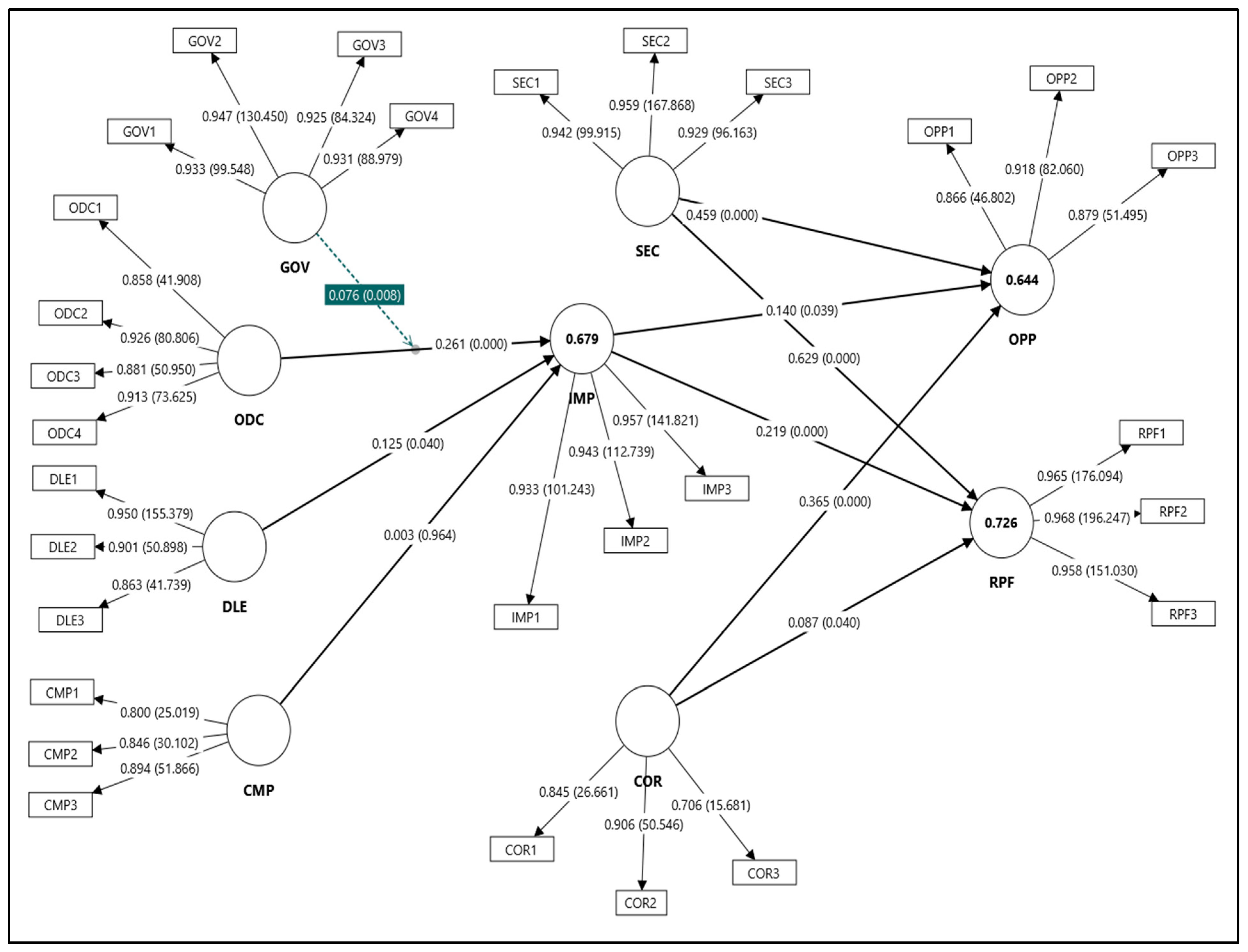
This study applied the bootstrapping method to evaluate the parameters of the structural model and explore the interrelations among the constructs. Bootstrapping, a widely used resampling technique, aids in assessing the robustness and dependability of parameter estimates derived from model analysis [109]. The analysis employed a 5% significance level, corresponding to a 95% confidence interval. To establish statistical significance, p-values were required to remain below 0.05, while t-values needed to exceed 1.96, signifying the strength of the relationships between the variables. Table 6 outlines the hypothesis testing results, whereas Figure 2 illustrates the structural equation model.
The results confirm that H1 establishes a significant positive relationship between ODC and the implementation of DI4Ts (β = 0.261, t = 5.059, p < 0.001). Likewise, H2 reveals that DLE positively influences IMP (β = 0.125, t = 2.056, p = 0.040). Conversely, H3 indicates that CMP does not have a notable effect on IMP (β = 0.003, t = 0.045, p = 0.964). On the other hand, the implementation of DI4Ts significantly enhances both operational performance (H4: β = 0.140, t = 2.063, p = 0.039) and resilience performance (H5: β = 0.219, t = 3.536, p < 0.001). Notably, Supply Chain Security Strategy emerged as the most dominant driver of resilience, exhibiting a substantially stronger influence than technology implementation alone (H6: β = 0.459, t = 6.094, p < 0.001); H8: β = 0.365, t = 7.219, p < 0.001; and resilience performance (H7: β = 0.629, t = 10.569, p < 0.001; H9: β = 0.087, t = 2.052, p = 0.040). The absence of multicollinearity was verified, as indicated by all variance inflation factor values being below 3.3 [115,116]. Finally, hypothesis H10, which examines the influence of government policies on the relationship between adaptability and the implementation of DI4Ts, appears to be statistically significant. The values (β = 0.076, t = 2.633, p = 0.008) substantiate this significant effect.

5. Discussion

This research highlights the significant relationship between organizational adaptability and dynamic digital capabilities, underlining their critical importance in successfully adopting Industry 4.0. Specifically, this study found that adaptability is a critical enabler for effective DI4Ts adoption, supporting OAT’s core premise that successful adaptation arises from an organization’s ability to align internal structures with external technological and environmental shifts. Our finding aligns with prior research [68,69] that emphasizes the imperative for organizations to develop dynamic capabilities to adeptly address the rapid demands of the digital environment.
While competitive orientation has been traditionally regarded as a key driver for technological adoption, this research suggests that Competitive Priority does not serve as a significant predictor of DI4Ts implementation in FSCs. This counterintuitive finding can be explained by the specific institutional context of the Saudi food sector. In a market heavily driven by national food security mandates and strict import regulations, technology adoption often functions as compliance and a baseline requirement for institutional legitimacy rather than a discretionary tool for competitive differentiation. Furthermore, consistent with the negative aspects of data-driven culture identified by Ayoub and Sopuru [6], the resource intensity required for strict regulatory compliance may constrain the strategic flexibility typically associated with competitive priority, forcing firms to prioritize stability over differentiation. Consequently, in highly regulated environments, the theoretical distinction between competitive priority and regulatory compliance becomes blurred, potentially leading to construct overlap where managers view adaptability through the lens of mandatory operational standardization driven by the pressures imposed by the Saudi Food and Drug Authority.
The study found that supportive governmental policies, encompassing financial incentives for digital transformation, can incentivize enterprises to allocate resources towards transformative technological advancements. Such external policy efforts validate the OAT concept of environmental pressure acting as a catalyst for internal structural change. The modest effect size of this moderation suggests that while government policies act as enablers, the ultimate success of implementation remains contingent on the firm’s internal dynamic capabilities. In developing economies like Egypt and Saudi Arabia, government support systems are not merely helpful but are essential structural antecedents for building absorptive capacity [91]. Consistent with Li et al. [60], our results underscore the significance of digital leadership in the adoption of DI4Ts and supply chain optimization. Digital leaders foster an innovative ecosystem through strategic investment in digital skills development, facilitating experimentation, and promoting knowledge-sharing culture. This is particularly pertinent in the Saudi context, where the Human Capability Development Program necessitates that leaders actively bridge the gap between local labor market skills and the advanced technical demands of Industry 4.0.
Finally, a critical finding of this study is that Supply Chain Security Strategy and CRO exerted a stronger influence on performance than DI4T implementation itself. In line with OAT, this suggests that organizations must continually recalibrate their processes in response to security threats for the sake of achieving sustained resilience. Given Saudi Arabia’s extensive reliance on food imports, the integrity of the supply chain is paramount; digital tools are effective only when underpinned by a robust security culture capable of managing the risks associated with global logistics, product authenticity, and the preservation of Halal integrity [4]. It is also important to acknowledge the potential for reciprocal causality. While this study models adaptability and security as drivers of DI4T adoption and performance, it is plausible that more resilient organizations are better positioned to successfully implement complex digital technologies, creating a virtuous cycle.

5.1. Theoretical Implication

This study represents a comprehensive refinement of OAT and DCV by demonstrating that in emerging, import-reliant economies, external institutional and environmental pressures exert a more decisive moderating influence on digital adaptation than internal strategic orientations. By integrating empirical evidence from Saudi Arabia’s food sector, the research validates the applicability of OAT in non-Western contexts, demonstrating that regulatory alignment is a structural prerequisite for digital transformation. Furthermore, this study identifies ‘Supply Chain Security’ and ‘Counterfeiting Risk Orientation’ as specific adaptive mechanisms through which organizations absorb environmental shocks, extending the theory beyond generic capabilities. Finally, in contrast to static models, OAT elucidates how organizations actively modify their strategies, structures, and cultures to leverage digital opportunities and mitigate related risks.

5.2. Practical and Societal Implications

The findings of this research present meaningful implications for stakeholders tasked with implementing Industry 4.0 technologies in FSCs. Specifically, for Saudi food enterprises, the non-significance of competitive priority suggests that digital adoption should be framed around ‘license to operate’ and regulatory compliance. Organizations are recommended to focus on building a robust framework for digital leadership that aligns internal capabilities with national mandates, such as the Saudi Food and Drug Authority’s track-and-trace requirements [117]. For policymakers, the strong moderating role of government policies indicates that financial incentives alone are insufficient; establishing supportive regulatory frameworks and instituting routine evaluations are critical for achieving successful outcomes [118]. In bridging theory and practice, this study’s empirical evidence underscores how OAT-based strategies can effectively translate into concrete steps for digital transformation across diverse market conditions.
Furthermore, given that supply chain security was found to be a stronger driver of performance than technology itself, managers must prioritize security as a foundational capability. The implementation of cybersecurity measures and protocols can enhance traceability and reduce the risks associated with cyberattacks. Investments in advanced analytics must be paired with robust physical and digital security protocols to prevent the downsides of data vulnerability [6].
Finally, the incorporation of DI4Ts within the FSC presents substantial opportunities for enhancing national food security. This study elucidates that augmented operational efficacy driven by security and adaptability can bolster product integrity, specifically Halal certification compliance, and consumer safety. As policymakers and industry stakeholders engage in collaborative efforts to formulate conducive structures for the proliferation of DI4Ts, the broader community stands to gain from a more robust and secure FSC. This aligns with Saudi Vision 2030’s goal of ensuring food security in an arid environment through technological innovation [119].

5.3. Limitations and Future Research Directions

Despite its notable theoretical and managerial implications, the study is prone to certain limitations which may be addressed in subsequent research endeavors. Convenience sampling can produce biased outcomes because it depends on easily accessible participants. Specifically, the sample was skewed toward logistics and distribution firms (72.8%) and digitally mature organizations, potentially limiting the generalizability of findings to upstream food producers or smaller enterprises with lower digital readiness, and possibly inflating the observed success rates of DI4T implementation due to the exclusion of less digitally mature firms. Future research should utilize cluster sampling to enhance representativeness and ensure diverse sample characteristics. The cohort comprising 191 managers from food enterprises in Saudi Arabia may not adequately encapsulate the region’s heterogeneity. The unique socio-economic, cultural, and regulatory landscapes of other GCC member states can significantly influence the deployment of DI4Ts. Therefore, further scholarly inquiry is necessitated to enhance our understanding of regional significance.
Methodologically, the primary limitation of our cross-sectional investigation resides in its ability to definitively ascertain causal relationships. While this study positions adaptability and security as drivers of performance, it is plausible that high-performing, resilient firms are simply more capable of adopting DI4Ts, suggesting potential reverse causality. Future research could benefit from employing longitudinal investigations to track the sequence of occurrences. Furthermore, while CMV was assessed using VIF < 3.3, the lack of a marker variable means that CMV cannot be fully ruled out. The exceptionally high factor loadings and AVE values in constructs like Resilience Performance suggest potential item redundancy; however, this reflective specification is justified by the high degree of protocol standardization and uniform safety mandates among Saudi food managers, in turn tightening indicator variance.
Regarding measurement, all performance outcomes were perceptual; future studies should incorporate objective operational metrics such as lead time reduction and waste reduction, to validate these findings. While statistical controls for firm size or sub-sector were not explicitly modeled, the significant homogeneity of the convenience sample serves as a contextual boundary that stabilizes sub-sector variance. Future studies should nonetheless incorporate these as formal controls to expand generalizability. Finally, the ‘Government policies’ construct aggregated incentives, regulation, and monitoring; future research should disentangle these dimensions to isolate their specific theoretical effects.
More importantly, future research might examine the implementation of digital Industry 4.0 technologies by integrating organizational adaptation theory and other frameworks, such as the Technology-Organization-Environment (TOE) framework, to examine the impact of contextual determinants like technology characteristics, social factors and leadership styles.

6. Conclusions

This research refines the application of OAT and DCV by examining the approaches Saudi food companies use to adopt DI4Ts, the types of Industry 4.0 solutions integrated into their operations, and the factors influencing successful implementation. The results demonstrate that organizations with high adaptability effectively translate strategic intent into operational DI4T implementation. Moreover, the study showed that adaptability improves the capability of responding swiftly to fluctuations in demand and supply, thus enabling operational continuity and resilience. As such, it refines OAT by framing supply chain security not merely as an operational strategy but as a core adaptive mechanism essential for resilience in import-reliant economies. Additionally, digital leadership was found to be an effective driving force for DI4T adoption in FSCs. Government policies and audits are the structural door openers to implementing DI4Ts in FSC and logistics by facilitating compliance, traceability, and operation resilience.
This study challenges the techno-centric view of resilience by demonstrating that Supply Chain Security Strategy and CRO are stronger drivers of performance than technology adoption alone. In the Saudi context, characterized by high regulatory pressure and SFDA oversight, digital tools function effectively only when underpinned by robust security protocols. The research offers significant insights for enterprises, policymakers, and researchers aiming to address the intricacies of digital transformation within the FSC. By articulating how DI4Ts interact with security strategies to contribute to absorptive, adaptive, and restorative capacities, the study also offers a framework for enhancing supply chain robustness against both predictable and emergent threats in developing economies.

Funding

The research work was funded by the Institutional Fund Projects under grant no. (IPP: 860-245-2025). The authors gratefully acknowledge the technical and financial support provided by the Ministry of Education and King Abdulaziz University, DSR, Jeddah, Saudi Arabia.

Institutional Review Board Statement

This research was conducted under the auspices of the Faculty of Economics and Administration at King Abdulaziz University. The Research Ethics Committee (REC) evaluated and sanctioned the research (reference number: REC 1/6; approval date: 25 April 2024).

Informed Consent Statement

Informed consent was obtained from all participants prior to their involvement. Participants were clearly informed of the study’s objectives and procedures. They consented to the use of their responses for research purposes and publication in academic journals. Participants were assured of their right to withdraw from the study at any time without any repercussions. All data collected from participants were kept confidential and anonymized to maintain privacy.

Data Availability Statement

The data supporting the study’s findings are available from the corresponding author and will be provided in a de-identified format to maintain participant confidentiality.

Acknowledgments

I express my sincere appreciation to all participants in this study for their invaluable insights and readiness to share their experiences, which significantly enhanced this research. Their time and effort were pivotal in actualizing this study.

Conflicts of Interest

The author declares no conflicts of interest.

Abbreviations

DI4TsDigital Industry 4.0 Technologies
FSCsFood Supply Chains
IoTInternet of Things
AIArtificial Intelligence
FSCMFood Supply Chain Management
GLMGreen Logistic Management
OATOrganizational Adaptation Theory
CROCounterfeiting Risk Orientation
CMVCommon Method Variance
PLS-SEMPartial Least Squares Structural Equation Modeling
SRMRStandardized Root Mean Square Residual

Appendix A. Measurement of Research Variables

VariableItems
Organizational Dynamic Digital Adaptability & Capability
Adapted from:
Liu et al. [100]
ODC1There are technical infrastructure facilities in the company
ODC2The organization’s governance policies support the use of digital industry 4.0 technologies in Supply chain.
ODC3The culture of the organization supports the use of digital industry 4.0 technologies in Supply chain
ODC4Digital Industry 4.0 technologies in the food supply chain are commensurate with the capabilities of the organization’s human resources.
Digital Leadership
Adapted from:
Kuuma et al. [101]
DLE1The executives of our company are coordinating digital information and can provide guidance.
DLE2Our company leaders always create ambitious goals to convert ideas into solutions.
DLE3The executives of our company possess extensive expertise in digital transformation.
DLE4The executives of our company have considerable expertise in information synthesis for decision-making.
Competitive priority
Adapted from:
Kusuma et al. [101] & Pozzi et al. [102]
CMP1In our organization, understanding customer need is a competitive advantage
CMP2We ensure accuracy in our food supply chain.
CMP3In our organization, we handle variations in customer delivery schedule
Government policies & audits
Adapted from:
Dubey et al. [2] & Kumar et al. [77]
GOV1The government provides financial support to implement digital Industry 4.0 technologies in the food supply chain.
GOV2The national banks offered soft loans to invest in digital capabilities to tackle the national digital transformation
GOV3Government agencies/regulators provide clear guidelines and references on the implementation of digital Industry 4.0 technologies in the food supply chain.
GOV4The government has sufficient digitalization policies that promote the implementation of Industry 4.0 technologies in the food supply chain.
Implementation of digital technology
Adapted from:
Queiroz et al. [14], Tortorella et al. [103], & Ivanov et al. [104]
IMP1To compete with major competitors, digital Industry 4.0 technologies are used in our supply chain.
IMP2To satisfy our customers, digital technologies have been introduced.
IMP3Digital Industry 4.0 technologies will be introduced in the future in the food supply chain.
Operational performance
Adapted from:
Koçoğlu et al. [105]
OPP1Operating efficiency has been increased
OPP2Operation costs have been reduced
OPP3The profit of the company has increased
Resilience performance
Adapted from:
Dubey et al. [2] & Brandon-Jones et al. [106]
RPF1Our organization can modify its production capacity in response to abrupt changes in demand patterns.
RPF2Our organization can swiftly address supply chain disruptions.
RPF3We established contingency plans to address potential demand or supply risks arising from sudden changes in government policies.
RPF4Our organization always comprehends market fluctuations precisely.
Supply chain security strategy
Adapted from: Whipple et al. [107]
SEC1Our company considers supply chain security essential for safeguarding our brand and image.
SEC2Our company has a senior management role dedicated to security, such as director of security or chief security officer.
SEC3Our company’s senior management perceives supply chain security as a strategic advantage.
Counterfeiting Risk Orientation
Adapted from:
Kros et al. [108].
COR1We acknowledge that the risk of counterfeiting in the supply chain is always present.
COR2We extensively consider methods to prevent counterfeiting inside our supply chain.
COR3Counterfeiting is an increasingly significant concern in the food sector

References

  1. Roy, V.; Schoenherr, T.; Jayaram, J. Digital enabled agility: Industry 4.0 unlocking real-time information processing, traceability, and visibility to unleash the next extent of agility. Int. J. Prod. Res. 2024, 62, 5127–5148. [Google Scholar] [CrossRef] [Scilit]
  2. Dubey, R.; Bryde, D.J.; Dwivedi, Y.K.; Graham, G.; Foropon, C.; Papadopoulos, T. Dynamic digital capabilities and supply chain resilience: The role of government effectiveness. Int. J. Prod. Econ. 2023, 258, 108790. [Google Scholar] [CrossRef] [Scilit]
  3. Sarfraz, M.; Khawaja, K.F.; Han, H.; Ariza-Montes, A.; Arjona-Fuentes, J.M. Sustainable supply chain, digital transformation, and blockchain technology adoption in the tourism sector. Humanit. Soc. Sci. Commun. 2023, 10, 557. [Google Scholar] [CrossRef] [Scilit]
  4. Al-Nuimat, S.S.; Al-Zu’bi, Z.M.F.; Abdallah, A.B. How Does Big Data Analytics Drive Supply Chain Resilience in Pharmaceuticals? Exploring the Roles of Supply Chain Risk and Ambidexterity. Logistics 2026, 10, 14. [Google Scholar] [CrossRef] [Scilit]
  5. Annarelli, A.; Battistella, C.; Nonino, F. A framework to evaluate the effects of organizational resilience on service quality. Sustainability 2020, 12, 958. [Google Scholar] [CrossRef] [Scilit]
  6. Ayoub, H.S.; Sopuru, J.C. Reconfiguring Strategic Capabilities in the Digital Era: How AI-Enabled Dynamic Capability, Data-Driven Culture, and Organizational Learning Shape Firm Performance. Sustainability 2026, 18, 1157. [Google Scholar] [CrossRef] [Scilit]
  7. Logeswaran, K.; Savitha, S.; Suresh, P.; Kumar, K.R.P.; Gunasekar, M.; Rajadevi, R.; Dharani, M.K.; Jayasurya, A.S. Unifying Technologies in Industry 4.0: Harnessing the Synergy of Internet of Things, Big Data, Augmented Reality/Virtual Reality, and Blockchain Technologies. Top. Artif. Intell. Appl. Ind. 2024, 4, 127–147. [Google Scholar]
  8. Trivellas, P.; Malindretos, G.; Reklitis, P. Implications of green logistics management on sustainable business and supply chain performance: Evidence from a survey in the greek agri-food sector. Sustainability 2020, 12, 10515. [Google Scholar] [CrossRef] [Scilit]
  9. Yadav, V.S.; Singh, A.R.; Raut, R.D.; Mangla, S.K.; Luthra, S.; Kumar, A. Exploring the application of Industry 4.0 technologies in the agricultural food supply chain: A systematic literature review. Comput. Ind. Eng. 2022, 169, 108304. [Google Scholar] [CrossRef] [Scilit]
  10. Godde, C.M.; Mason-D’Croz, D.; Mayberry, D.E.; Thornton, P.K.; Herrero, M. Impacts of climate change on the livestock food supply chain; a review of the evidence. Glob. Food Secur. 2021, 28, 100488. [Google Scholar] [CrossRef] [Scilit]
  11. Ali, I.; Aboelmaged, M.G.S. Implementation of supply chain 4.0 in the food and beverage industry: Perceived drivers and barriers. Int. J. Prod. Perform. Manag. 2022, 71, 1426–1443. [Google Scholar] [CrossRef] [Scilit]
  12. Kayikci, Y.; Subramanian, N.; Dora, M.; Bhatia, M.S. Food supply chain in the era of Industry 4.0: Blockchain technology implementation opportunities and impediments from the perspective of people, process, performance, and technology. Prod. Plan. Control 2022, 33, 301–321. [Google Scholar] [CrossRef] [Scilit]
  13. Lee, J.; Gereffi, G.; Beauvais, J. Global value chains and agrifood standards: Challenges and possibilities for smallholders in developing countries. Proc. Natl. Acad. Sci. USA 2012, 109, 12326–12331. [Google Scholar] [CrossRef] [Scilit]
  14. Queiroz, M.M.; Pereira, S.C.F.; Telles, R.; Machado, M.C. Industry 4.0 and digital supply chain capabilities: A framework for understanding digitalisation challenges and opportunities. Benchmarking Int. J. 2021, 28, 1761–1782. [Google Scholar] [CrossRef] [Scilit]
  15. Mu, W.; van Asselt, E.; van Wagenberg, C.; van der Fels-Klerx, H. Building a resilient pork supply chain to Salmonella spp. Risk Anal. 2024, 44, 12–23. [Google Scholar] [CrossRef] [Scilit]
  16. Kumar, M.; Raut, R.D.; Jagtap, S.; Choubey, V.K. Circular economy adoption challenges in the food supply chain for sustainable development. Bus. Strategy Environ. 2023, 32, 1334–1356. [Google Scholar] [CrossRef] [Scilit]
  17. Nordhagen, S.; Igbeka, U.; Rowlands, H.; Shine, R.S.; Heneghan, E.; Tench, J. COVID-19 and small enterprises in the food supply chain: Early impacts and implications for longer-term food system resilience in low-and middle-income countries. World Dev. 2021, 141, 105405. [Google Scholar] [CrossRef] [Scilit] [PubMed]
  18. Chen, X.; Zheng, H.; Yang, S. How Does AI Innovation Affect Urban Employment in China? A Mechanistic Analysis Based on Economic Density and Governmental Digital Attention. Systems 2026, 14, 189. [Google Scholar] [CrossRef] [Scilit]
  19. Alabi, M.O.; Ngwenyama, O. Food security and disruptions of the global food supply chains during COVID-19: Building smarter food supply chains for post COVID-19 era. Br. Food J. 2023, 125, 167–185. [Google Scholar] [CrossRef] [Scilit]
  20. Mahroof, K.; Omar, A.; Kucukaltan, B. Sustainable food supply chains: Overcoming key challenges through digital technologies. Int. J. Prod. Perform. Manag. 2022, 71, 981–1003. [Google Scholar] [CrossRef] [Scilit]
  21. Wamba, S.F.; Gunasekaran, A.; Akter, S.; Ren, S.J.F.; Dubey, R.; Childe, S.J. Big data analytics and firm performance: Effects of dynamic capabilities. J. Bus. Res. 2017, 70, 356–365. [Google Scholar] [CrossRef] [Scilit]
  22. Ivanov, D.; Dolgui, A. A digital supply chain twin for managing the disruption risks and resilience in the era of Industry 4.0. Prod. Plan. Control 2021, 32, 775–788. [Google Scholar] [CrossRef] [Scilit]
  23. Kocabasoglu-Hillmer, C.; Roden, S.; Vanpoucke, E.; Son, B.G.; Lewis, M.W. Radical innovations as supply chain disruptions? A paradox between change and stability. J. Supply Chain Manag. 2023, 59, 3–19. [Google Scholar] [CrossRef] [Scilit]
  24. Kamalahmadi, M.; Parast, M.M. A review of supply chain resilience: Towards a theory of resilience. Int. J. Prod. Res. 2016, 54, 2154–2176. [Google Scholar]
  25. Gómez, M.I.; Lee, D. Transforming food supply chains for sustainability. J. Supply Chain Manag. 2023, 59, 79–92. [Google Scholar] [CrossRef] [Scilit]
  26. Ivanova, M. Evaluation of risks to Russian food supply chains during the COVID-19. Manag. Sci. Bus. Decis. 2022, 2, 40–47. [Google Scholar] [CrossRef] [Scilit]
  27. Khan, S.A.R.; Waqas, M.; Honggang, X.; Ahmad, N.; Yu, Z. Adoption of innovative strategies to mitigate supply chain disruption: COVID-19 pandemic. Oper. Manag. Res. 2022, 15, 1115–1133. [Google Scholar] [CrossRef] [Scilit]
  28. Engelseth, P. Customer-responsive supply of local foods. Oper. Supply Chain Manag. Int. J. 2015, 8, 111–119. [Google Scholar] [CrossRef] [Scilit]
  29. Ponomarov, S.Y.; Holcomb, M.C. Understanding the concept of supply chain resilience. Int. J. Logist. Manag. 2009, 20, 124–143. [Google Scholar] [CrossRef] [Scilit]
  30. Spieske, A.; Birkel, H. Improving supply chain resilience through industry 4.0: A systematic literature review under the impressions of the COVID-19 pandemic. Comput. Ind. Eng. 2021, 158, 107452. [Google Scholar] [CrossRef] [Scilit]
  31. Sawyerr, E.A.; Bourlakis, M.; Conrad, D.; Wagstaff, C. Impact pathways: Unravelling the hybrid food supply chain—Identifying the relationships and processes to drive change. Int. J. Oper. Prod. Manag. 2024, 44, 1310–1323. [Google Scholar] [CrossRef] [Scilit]
  32. Seuring, S.; Müller, M. From a literature review to a conceptual framework for sustainable supply chain management. J. Clean Prod. 2008, 16, 1699–1710. [Google Scholar] [CrossRef] [Scilit]
  33. Gunasekaran, A.; Patel, C.; McGaughey, R.E. A framework for supply chain performance measurement. Int. J. Prod. Econ. 2004, 87, 333–347. [Google Scholar] [CrossRef] [Scilit]
  34. Rashid, A.; Rasheed, R.; Rahi, S.; Amirah, N.A. Impact of supplier trust and integrated technology on supply chain resilience for sustainable supply chain in FMCG sector. J. Sci. Technol. Policy Manag. 2025, ahead-of-print. [Google Scholar] [CrossRef] [Scilit]
  35. Basit, A.; Wang, L.; Javed, A.; Shoaib, M.; Aslam, M.U. Impact of digital technologies on manufacturing firm resilience during COVID-19 pandemic: A PLS-SEM and artificial neural network analysis. J. Manuf. Technol. Manag. 2024, 36, 358–384. [Google Scholar] [CrossRef] [Scilit]
  36. Basit, A.; Javed, A.; Ejaz, S.; Nasir, A.; Ridwan, A.R.; Ahmed, S. Social media usage and sustainable performance in manufacturing supply chains: Exploring dynamic capabilities. Discov. Sustain. 2024, 5, 294. [Google Scholar] [CrossRef] [Scilit]
  37. Lezoche, M.; Hernandez, J.E.; Díaz, M.d.M.E.A.; Panetto, H.; Kacprzyk, J. Agri-food 4.0: A survey of the supply chains and technologies for the future agriculture. Comput. Ind. 2020, 117, 103187. [Google Scholar] [CrossRef] [Scilit]
  38. Sarta, A.; Durand, R.; Vergne, J.P. Organizational adaptation. J. Manag. 2021, 47, 43–75. [Google Scholar] [CrossRef] [Scilit]
  39. Cristofaro, M.; Helfat, C.E.; Teece, D.J. Adapting, Shaping, Evolving: Refocusing on the Dynamic Capabilities–Environment Nexus. Acad. Manag. Collect. 2025, 4, 20–46. [Google Scholar] [CrossRef] [Scilit]
  40. Chakravarthy, B. Adaptation: A promising metaphor for strategic management. Acad. Manag. Rev. 1982, 7, 35–44. [Google Scholar] [CrossRef] [Scilit]
  41. Cozzolino, A.; Verona, G. Decision tree for adaptation after radical changes: Linking dynamic capabilities, ambidexterity, and strategic alliances. J. Manag. Gov. 2024, 28, 745–769. [Google Scholar] [CrossRef] [Scilit]
  42. Daniel, A.U.; Onuoha, B.C. Organizational Ambidexterity and Agility of Food and Beverage Firms in Abia State, Nigeria. Int. Acad. J. Bus. Sch. Res. 2024, 8, 105. [Google Scholar]
  43. Rodrigues, M.; Franco, M.; Silva, R.; Oliveira, C. Success factors of SMEs: Empirical study guided by dynamic capabilities and resources-based view. Sustainability 2021, 13, 12301. [Google Scholar] [CrossRef] [Scilit]
  44. Helfat, C.E.; Finkelstein, S.; Mitchell, W.; Peteraf, M.; Singh, H.; Teece, D.; Winter, S.G. Dynamic Capabilities: Understanding Strategic Change in Organisations; Blackwell Publishing: Oxford, UK, 2007. [Google Scholar]
  45. Adama, H.E.; Okeke, C.D. Digital transformation as a catalyst for business model innovation: A critical review of impact and implementation strategies. Magna Sci. Adv. Res. Rev. 2024, 10, 256–264. [Google Scholar] [CrossRef] [Scilit]
  46. Qiao, W.; Ju, Y.; Dong, P.; Tiong, R.L. How to realize value creation of digital transformation? A system dynamics model. Expert. Syst. Appl. 2024, 244, 122667. [Google Scholar] [CrossRef] [Scilit]
  47. Reddy, V.M.; Nalla, L.N. Optimizing E-Commerce Supply Chains Through Predictive Big Data Analytics: A Path to Agility and Efficiency. Int. J. Mach. Learn. Res. Cybersecur. Artif. Intell. 2024, 15, 555–585. [Google Scholar]
  48. Salamah, E.; Alzubi, A.; Yinal, A. Unveiling the Impact of Digitalization on Supply Chain Performance in the Post-COVID-19 Era: The Mediating Role of Supply Chain Integration and Efficiency. Sustainability 2023, 16, 304. [Google Scholar] [CrossRef] [Scilit]
  49. Javed, A.; Li, Q.; Basit, A. Enhancing ambidextrous green innovation: The role of green supply chain integration, knowledge capabilities and technology dynamism in manufacturing. J. Manuf. Technol. Manag. 2024, 36, 431–454. [Google Scholar] [CrossRef] [Scilit]
  50. Shahadat, M.M.H.; Chowdhury, A.H.M.Y.; Nathan, R.J.; Fekete-Farkas, M. Digital technologies for firms? competitive advantage and improved supply chain performance. J. Risk Financ. Manag. 2023, 16, 94. [Google Scholar] [CrossRef] [Scilit]
  51. Joshi, S.; Sharma, M. Impact of sustainable supply chain management on performance of SMEs amidst COVID-19 pandemic: An Indian perspective. Int. J. Logist. Econ. Glob. 2022, 9, 248–276. [Google Scholar] [CrossRef] [Scilit]
  52. Le, T.T.; Kieu, X.H.; Behl, A.; Pereira, V. Building up more sustainable food supply chains: Implications for sustainable development. J. Clean Prod. 2022, 378, 134650. [Google Scholar] [CrossRef] [Scilit]
  53. Felsberger, A.; Qaiser, F.H.; Choudhary, A.; Reiner, G. The impact of Industry 4.0 on the reconciliation of dynamic capabilities: Evidence from the European manufacturing industries. Prod. Plan. Control 2022, 33, 277–300. [Google Scholar] [CrossRef] [Scilit]
  54. Dadi, V.; Nikhil, S.R.; Mor, R.S.; Agarwal, T.; Arora, S. Agri-food 4.0 and innovations: Revamping the supply chain operations. Prod. Eng. Arch. 2021, 27, 75–89. [Google Scholar] [CrossRef] [Scilit]
  55. Tian, S.; Zhao, H.; Xu, X.; Mu, R.; Ma, Q. Knowledge chain integration of design structure matrix? based project team: An integration model. Syst. Res. Behav. Sci. 2022, 39, 462–473. [Google Scholar] [CrossRef] [Scilit]
  56. Ning, L.; Yao, D. The Impact of digital transformation on supply chain capabilities and supply chain competitive performance. Sustainability 2023, 15, 10107. [Google Scholar] [CrossRef] [Scilit]
  57. Pandey, J.; Majumdarr, S.; Hassan, Y.; Benuyenah, V. Role of digital leadership capability in shaping IT innovation: A digital agility perspective. J. Glob. Inf. Manag. (JGIM) 2023, 31, 1–20. [Google Scholar] [CrossRef] [Scilit]
  58. Pyun, J.; Rha, J.S. Review of research on digital supply chain management using network text analysis. Sustainability 2021, 13, 9929. [Google Scholar] [CrossRef] [Scilit]
  59. Yuan, F.; Khan, M.S. Investigating the impact of digital leadership on innovation performance of public universities in Yunnan, China. J. Infrastruct. Policy Dev. 2024, 8, 7663. [Google Scholar] [CrossRef] [Scilit]
  60. Li, W.; Waris, I.; Bhutto, M.Y. Understanding the nexus among big data analytics capabilities, green dynamic capabilities, supply chain agility and green competitive advantage. J. Manuf. Technol. Manag. 2024, 35, 119–140. [Google Scholar] [CrossRef] [Scilit]
  61. Basit, A.; Javed, A.; Perez, J.A.E.; Ejaz, F.; Hossain, B. Navigating COVID-19 pandemic: Empowering sustainable supply chains performance through leadership capability, knowledge sharing capability, and strategic management capability amid COVID-19 disruptions. Cogent. Bus. Manag. 2024, 11, 2371989. [Google Scholar] [CrossRef] [Scilit]
  62. Li, S.; Ragu-Nathan, B.; Ragu-Nathan, T.; Rao, S.S. The impact of supply chain management practices on competitive advantage and organizational performance. Omega 2006, 34, 107–124. [Google Scholar] [CrossRef] [Scilit]
  63. Porter, M.E. Competitive Advantage: Creating and Sustaining Superior Performance; Simon and Schuster: New York, NY, USA, 1985. [Google Scholar]
  64. Porter, M.E. What is strategy? Harv. Bus Rev. 1996, 74, 61–78. [Google Scholar]
  65. Barney, J.; Wright, M.; Ketchen, D.J. The resource-based view of the firm: Ten years after 1991. J. Manag. 2001, 27, 625–641. [Google Scholar] [CrossRef]
  66. Gupta, R.; Shankar, R.; Lai, K.-H.; Kumar, A. Risk profiling of food security impediments using decision maker’s behavioural preference towards operational risk management. Ann. Oper. Res. 2023, 348, 937–972. [Google Scholar] [CrossRef] [Scilit]
  67. Annosi, M.C.; Brunetta, F.; Bimbo, F.; Kostoula, M. Digitalization within food supply chains to prevent food waste. Drivers, barriers and collaboration practices. Ind. Mark. Manag. 2021, 93, 208–220. [Google Scholar] [CrossRef] [Scilit]
  68. Aamer, A.M.; Al-Awlaqi, M.A.; Affia, I.; Arumsari, S.; Mandahawi, N. The internet of things in the food supply chain: Adoption challenges. Benchmarking Int. J. 2021, 28, 2521–2541. [Google Scholar] [CrossRef] [Scilit]
  69. Emmanouilidis, C.; Bakalis, S. Digital Technology enablers for resilient and customer driven food value chains. In IFIP Advances in Information and Communication Technology; Springer: Cham, Switzerland, 2020. [Google Scholar]
  70. Carr, N.G. IT doesn’t matter. Harv. Bus. Rev. 2003, 81, 41–49. [Google Scholar] [CrossRef] [Scilit] [PubMed]
  71. Carr, N.G. Does IT Matter? Harvard Business School Press: Boston, MA, USA, 2004. [Google Scholar]
  72. Seddon, P.B. Are ERP systems a source of competitive advantage? Strateg. Chang. 2005, 14, 283–293. [Google Scholar]
  73. Dev, N.K.; Shankar, R.; Qaiser, F.H. Industry 4.0 and circular economy: Operational excellence for sustainable reverse supply chain performance. Resour. Conserv. Recycl. 2020, 153, 104583. [Google Scholar] [CrossRef] [Scilit]
  74. Lu, S.; Cheng, G.; Li, T.; Xue, L.; Liu, X.; Huang, J.; Liu, G. Quantifying supply chain food loss in China with primary data: A large-scale, field-survey based analysis for staple food, vegetables, and fruits. Resour. Conserv. Recycl. 2022, 177, 106006. [Google Scholar] [CrossRef] [Scilit]
  75. Javed, A.; Basit, A.; Ejaz, F.; Hameed, A.; Fodor, Z.J.; Hossain, B. The role of advanced technologies and supply chain collaboration: During COVID-19 on sustainable supply chain performance. Discov. Sustain. 2024, 5, 46. [Google Scholar] [CrossRef] [Scilit]
  76. Belhadi, A.; Kamble, S.; Subramanian, N.; Singh, R.K.; Venkatesh, M. Digital capabilities to manage agri-food supply chain uncertainties and build supply chain resilience during compounding geopolitical disruptions. Int. J. Oper. Prod. Manag. 2024, 44, 1914–1950. [Google Scholar] [CrossRef] [Scilit]
  77. Sharma, M.; Joshi, S.; Luthra, S.; Kumar, A. Managing disruptions and risks amidst COVID-19 outbreaks: Role of blockchain technology in developing resilient food supply chains. Oper. Manag. Res. 2022, 15, 268–281. [Google Scholar] [CrossRef] [Scilit]
  78. Ellahi, R.M.; Wood, L.C.; Bekhit, A.E.-D.A. Blockchain-based frameworks for food traceability: A systematic review. Foods 2023, 12, 3026. [Google Scholar] [CrossRef] [Scilit]
  79. Kaur, A.; Singh, G.; Kukreja, V.; Sharma, S.; Singh, S.; Yoon, B. Adaptation of IoT with blockchain in Food Supply Chain Management: An analysis-based review in development, benefits and potential applications. Sensors 2022, 22, 8174. [Google Scholar] [CrossRef] [Scilit]
  80. Maharjan, R.; Kato, H. Logistics and supply chain resilience of Japanese companies: Perspectives from impacts of the COVID-19 pandemic. Logistics 2023, 7, 27. [Google Scholar] [CrossRef] [Scilit]
  81. Michel-Villarreal, R.; Vilalta-Perdomo, E.L.; Canavari, M.; Hingley, M. Resilience and digitalization in short food supply chains: A case study approach. Sustainability 2021, 13, 5913. [Google Scholar] [CrossRef] [Scilit]
  82. Zailani, S.H.; Karthigesu, S.S.; Mohammad, I.; Rizaimy, S.M. The impact of supply chain security practices on security operational performance among logistics service providers in an emerging economy: Security culture as moderator. Int. J. Phys. Distrib. Logist. Manag. 2015, 45, 652–673. [Google Scholar] [CrossRef] [Scilit]
  83. Asamoah, D.; Nuertey, D.; Agyei-Owusu, B.; Acquah, I.N. Antecedents and outcomes of supply chain security practices: The role of organizational security culture and supply chain disruption occurrence. Int. J. Qual. Reliab. Manag. 2022, 39, 1059–1082. [Google Scholar] [CrossRef] [Scilit]
  84. Saglam, Y.C.; Çankaya, S.Y.; Sezen, B. Proactive risk mitigation strategies and supply chain risk management performance: An empirical analysis for manufacturing firms in Turkey. J. Manuf. Technol. Manag. 2021, 32, 1224–1244. [Google Scholar] [CrossRef] [Scilit]
  85. Kusrini, E.; Hanim, K. Analysis of compliance and supply chain security risks based on ISO 28001 in a logistic service provider in Indonesia. Int. J. Saf. Secur. Eng. 2021, 11, 135–142. [Google Scholar] [CrossRef] [Scilit]
  86. Mishra, R.; Singh, R.K.; Subramanian, N. Impact of disruptions in agri-food supply chain due to COVID-19 pandemic: Contextualised resilience framework to achieve operational excellence. Int. J. Logist. Manag. 2022, 33, 926–954. [Google Scholar] [CrossRef] [Scilit]
  87. Duan, K.; Onyeaka, H.; Pang, G. Leveraging blockchain to tackle food fraud: Innovations and obstacles. J. Agric. Food Res. 2024, 18, 101429. [Google Scholar] [CrossRef] [Scilit]
  88. Lestari, F.; Mas’aRi, A.; Meilani, S.; Riandika, I.N.; Hamid, A.B.A. Risk mitigation via integrating house of risk and probability impact matrix in halal food supply chain. J. Tek. Ind. 2021, 22, 138–154. [Google Scholar] [CrossRef] [Scilit]
  89. Petratos, P.N.; Faccia, A. Fake news, misinformation, disinformation and supply chain risks and disruptions: Risk management and resilience using blockchain. Ann. Oper. Res. 2023, 327, 735–762. [Google Scholar] [CrossRef] [Scilit] [PubMed]
  90. Patanakul, P.; Pinto, J.K. Examining the roles of government policy on innovation. J. High Technol. Manag. Res. 2014, 25, 97–107. [Google Scholar] [CrossRef] [Scilit]
  91. Barakat, M.; Jialin, S.W.; Nicoleta, T. Empowering clusters: How dynamic capabilities drive sustainable supply chain clusters in Egypt. Sustainability 2023, 15, 16787. [Google Scholar] [CrossRef] [Scilit]
  92. Yigitcanlar, T.; Kamruzzaman, M.; Foth, M.; Sabatini-Marques, J.; Da-Costa, E.; Ioppolo, G. Can cities become smart without being sustainable? A systematic review of the literature. Sustain. Cities Soc. 2019, 45, 348–365. [Google Scholar] [CrossRef] [Scilit]
  93. Faul, F.; Erdfelder, E.; Buchner, A.; Lang, A.G. Statistical power analyses using G* Power 3.1: Tests for correlation and regression analyses. Behav. Res. Methods 2009, 41, 1149–1160. [Google Scholar] [CrossRef] [Scilit]
  94. Faul, F.; Erdfelder, E.; Lang, A.G.; Buchner, A. G* Power 3: A flexible statistical power analysis program for the social, behavioral, and biomedical sciences. Behav. Res. Methods 2007, 39, 175–191. [Google Scholar] [CrossRef] [Scilit]
  95. Hair, J.F.; Hult, G.T.M.; Ringle, C.M.; Sarstedt, M. A Primer on Partial Least Squares Structural Equation Modeling (PLS-SEM), 2nd ed; Sage: Thousand Oaks, CA, USA, 2017. [Google Scholar]
  96. Alexandru, V.A.; Bolisani, E.; Cegarra-Navarro, J.G. Knowledge management approaches of small and medium-sized firms: A cluster analysis. Kybernetes 2020, 49, 73–87. [Google Scholar] [CrossRef] [Scilit]
  97. Leiner, D.J. Our research’s breadth lives on convenience samples a case study of the online respondent Pool “SoSciPanel”. SCM Stud. Commun. Media 2017, 5, 367–396. [Google Scholar] [CrossRef] [Scilit]
  98. Cochran, W.G. Sampling Techniques, 3rd ed.; John Wiley & Sons: New York, NY, USA, 1977. [Google Scholar]
  99. Hair, J.F., Jr.; Howard, M.C.; Nitzl, C. Assessing measurement model quality in PLS-SEM using confirmatory composite analysis. J. Bus. Res. 2020, 109, 101–110. [Google Scholar] [CrossRef] [Scilit]
  100. Liu, L.; Cui, L.; Han, Q.; Zhang, C. The impact of digital capabilities and dynamic capabilities on business model innovation: The moderating effect of organizational inertia. Humanit. Soc. Sci. Commun. 2024, 11, 420. [Google Scholar] [CrossRef] [Scilit]
  101. Kusuma, A.R.; Syarief, R.; Sukmawati, A.; Ekananta, A. Factors influencing the digital transformation of sales organizations in Indonesia. Heliyon 2024, 10, e27017. [Google Scholar] [CrossRef] [Scilit] [PubMed]
  102. Pozzi, R.; Rossi, T.; Secchi, R. Industry 4.0 technologies: Critical success factors for implementation and improvements in manufacturing companies. Prod. Plan. Control 2023, 34, 139–158. [Google Scholar] [CrossRef] [Scilit]
  103. Tortorella, G.; Kurnia, S.; Trentin, M.; Oliveira, G.A.; Setti, D. Industry 4.0: What is the relationship between manufacturing strategies, critical success factors and technology adoption? J. Manuf. Technol. Manag. 2022, 33, 1407–1428. [Google Scholar] [CrossRef] [Scilit]
  104. Ivanov, D.; Dolgui, A.; Sokolov, B. The impact of digital technology and Industry 4.0 on the ripple effect and supply chain risk analytics. Int. J. Prod. Res. 2019, 57, 829–846. [Google Scholar] [CrossRef] [Scilit]
  105. Koçoğlu, İ.; İmamoğlu, S.Z.; İnce, H.; Keskin, H. The effect of supply chain integration on information sharing: Enhancing the supply chain performance. Procedia. Soc. Behav. Sci. 2011, 24, 1630–1649. [Google Scholar] [CrossRef] [Scilit]
  106. Brandon-Jones, E.; Squire, B.; Autry, C.W.; Petersen, K.J. A contingent resource-based perspective of supply chain resilience and robustness. J. Supply Chain Manag. 2014, 50, 55–73. [Google Scholar] [CrossRef] [Scilit]
  107. Whipple, J.M.; Voss, M.D.; Closs, D.J. Supply chain security practices in the food industry: Do firms operating globally and domestically differ? Int. J. Phys. Distrib. Logist. Manag. 2009, 39, 574–594. [Google Scholar] [CrossRef] [Scilit]
  108. Kros, J.F.; Falasca, M.; Dellana, S.; Rowe, W.J. Mitigating counterfeit risk in the supply chain: An empirical study. TQM J. 2020, 32, 983–1002. [Google Scholar] [CrossRef] [Scilit]
  109. Hair, J.F.; Risher, J.J.; Sarstedt, M.; Ringle, C.M. When to use and how to report the results of PLS-SEM. Eur. Bus. Rev. 2019, 31, 2–24. [Google Scholar] [CrossRef] [Scilit]
  110. Henseler, J.; Ringle, C.M.; Sarstedt, M. A new criterion for assessing discriminant validity in variance-based structural equation modeling. J. Acad. Mark. Sci. 2015, 43, 115–135. [Google Scholar] [CrossRef] [Scilit]
  111. Ab Hamid, M.; Sami, W.; Sidek, M.M. Discriminant validity assessment: Use of Fornell & Larcker criterion versus HTMT criterion. J. Phys. Conf. Ser. 2017, 890, 12163. [Google Scholar]
  112. Kock, N. Common method bias in PLS-SEM: A full collinearity assessment approach. Int. J. e-Collab. 2015, 11, 1–10. [Google Scholar] [CrossRef] [Scilit]
  113. Hu, L.T.; Bentler, P.M. Cutoff criteria for fit indexes in covariance structure analysis: Conventional criteria versus new alternatives. Struct. Equ. Model. 1999, 6, 1–55. [Google Scholar] [CrossRef] [Scilit]
  114. Cohen, J. Statistical Power Analysis for the Behavioral Sciences, 2nd ed.; Lawrence Erlbaum: Hillsdale, NJ, USA, 1988. [Google Scholar]
  115. Hair, J.F.; Astrachan, C.B.; Moisescu, O.I.; Radomir, L.; Sarstedt, M.; Vaithilingam, S.; Ringle, C.M. Executing and interpreting applications of PLS-SEM: Updates for family business researchers. J. Fam. Bus. Strategy 2021, 12, 100392. [Google Scholar] [CrossRef] [Scilit]
  116. Miles, J. R-squared, adjusted R-squared. In Encyclopedia of Statistics in Behavioral Science; John Wiley & Sons, Inc.: Hoboken, NJ, USA, 2005. [Google Scholar]
  117. Haddad, H.; Jum’a, L.; Alkalha, Z.; Madanat, H. AI-Powered Tools for Supply Chain Resilience: A Dynamic Capabilities Perspective from Jordanian Manufacturing Firms. Logistics 2026, 10, 24. [Google Scholar] [CrossRef] [Scilit]
  118. Teece, D.; Margaret, P.; Sohvi, L. Dynamic capabilities and organizational agility: Risk, uncertainty, and strategy in the innovation economy. Calif. Manag. Rev. 2016, 58, 13–35. [Google Scholar] [CrossRef] [Scilit]
  119. Fores, B. Beyond gathering the ‘low-hanging fruit’ of green technology for improved environmental performance: An empirical examination of the moderating effects of proactive environmental management and business strategies. Sustainability 2019, 11, 6299. [Google Scholar] [CrossRef] [Scilit]
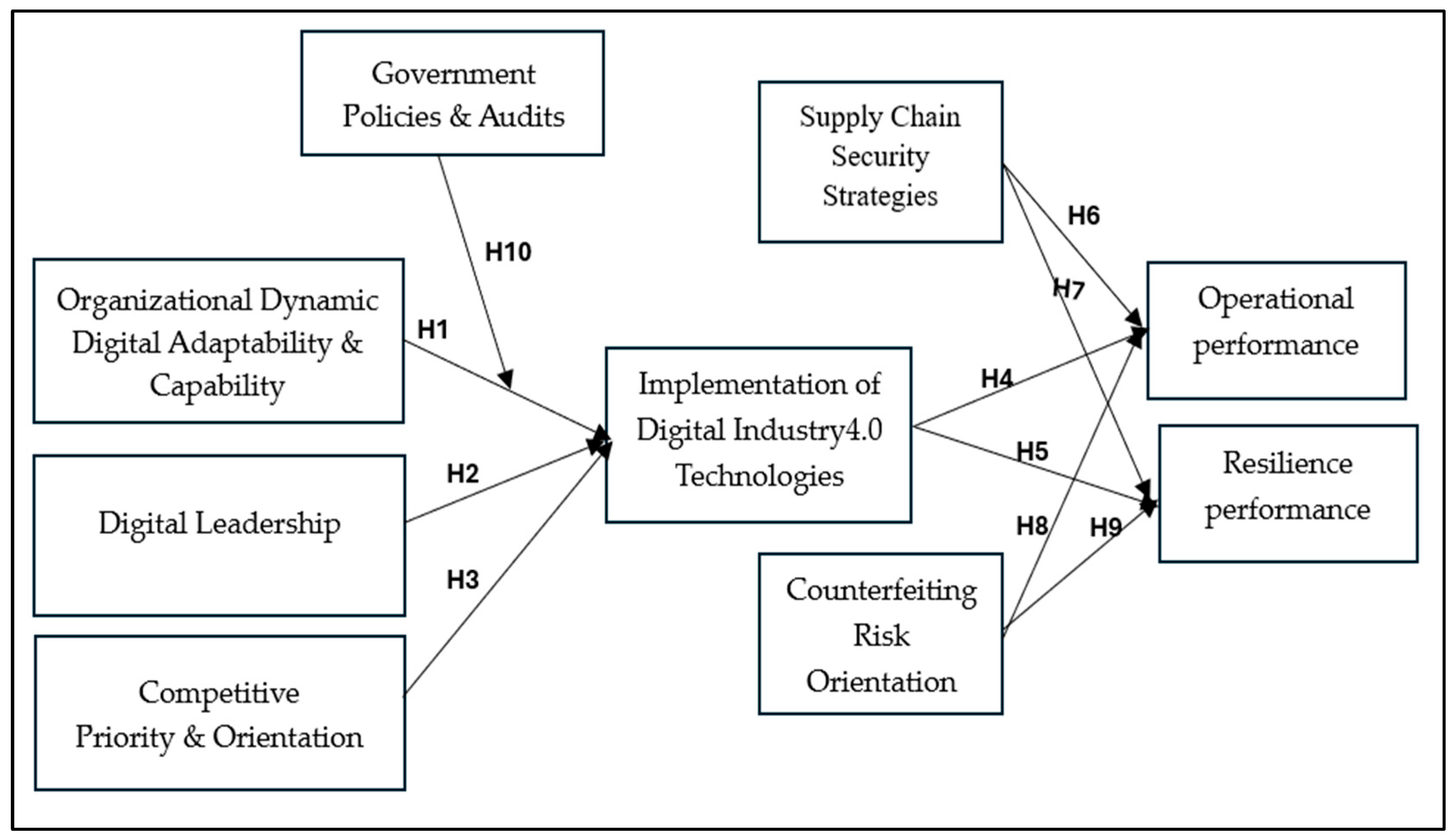
Figure 1. Research Model.
Systems 14 00303 g001
Figure 2. PLS Structural Model.
Systems 14 00303 g002
Table 1. Theory-to-Construct Mapping.
Theoretical LensMain MechanismAssociated Construct(s)Hypotheses
DCVSensing and seizing digital opportunities through strategic intent and flexible resource structures.Organizational Dynamic Digital Adaptability & Capability; Digital LeadershipH1, H2
OATStrategic reconfiguration of operational processes to achieve efficiency and absorptive capacity.Implementation of DI4TsH4, H5
OATEnvironmental calibration and recalibration of security protocols in response to external risks.Supply Chain Security Strategy; Counterfeiting Risk OrientationH6, H7, H8, H9
Institutional Theory/OATCoercive and normative pressures driving compliance and technology integration.Government Policies and Audits; Competitive PriorityH3, H10
Table 2. Demographic Profile.
VariablesCategoriesFrequencyPercentValid PercentCumulative Percent
GenderMale12464.964.964.9
Female6735.135.1100.0
EducationDiploma2513.113.113.1
Bachelor’s Degree3920.420.433.5
Master7539.339.372.8
Doctorate3015.715.788.5
Other2211.511.5100.0
Role/PositionIT manager2111.011.011.0
Supply chain project manager3518.318.329.3
Operation manager8242.942.972.3
manager/Director3216.816.889.0
Supply chain analyst2111.011.0100.0
Years of experience2–4 years5026.1726.1726.17
4–5 years7438.7438.7464.92
6–10 years4724.6024.6089.52
11–15 years2010.4710.47100
ScopeManufacturing178.98.98.9
Grocery/food service retailer3518.318.327.2
Food wholesalers/distributor/Logistics13972.872.8100.0
Industry 4.0 technologies and solutionsCloud computing189.49.49.4
Cybersecurity2915.215.224.6
Smart devices and Internet of Things8846.146.170.7
Big data analytics4020.920.991.6
Digital twins168.48.4100.0
Table 3. Convergent validity and reliability metrics.
ConstructItemsFactor Loadings
>0.7
VIFCronbach’s Alpha (CA)
>0.7
Composite Reliability (CR)
>0.7
Average Variance Extracted (AVE)
>0.5
Organizational Dynamic Digital Adaptability & Capability (ODC)ODC10.858 2.4110.9170.9180.801
ODC20.926 2.354
ODC30.881 2.851
ODC40.913 2.184
Digital Leadership (DLE)DLE10.950 2.9500.8900.9090.820
DLE20.901 2.974
DLE30.863 2.229
Competitive priority (CMP)CMP10.800 1.451 0.8030.8150.718
CMP20.846 2.064
CMP30.894 2.204
Government policies & audits (GOV)GOV10.933 2.3840.9510.9520.873
GOV20.947 2.483
GOV30.925 2.021
GOV40.931 2.518
Implementation of digital industry 4.0 technologies (IMP)IMP10.9330.933 0.9390.9400.891
IMP20.9430.943
IMP30.9570.957
Operational performance (OPP).OPP10.866 1.9800.8660.8720.788
OPP20.918 2.811
OPP30.879 2.368
Resilience performance (RPF)RPF10.965 2.5220.9620.9620.929
RPF20.968 2.219
RPF30.958 2.695
Supply chain security strategy (SEC)SEC10.942 1.6970.9380.9400.890
SEC20.959 1.636
SEC30.929 1.407
Counterfeiting Risk Orientation (COR)COR10.845 2.2140.7550.7630.678
COR20.906 2.578
COR30.706 1.294
Table 4. Discriminant Validity using heterotrait–monotrait ratio of correlations (HTMT).
CMPCORDLEGOVIMPODCOPPRPFSEC
CMP
COR 0.442
DLE 0.755 0.637
GOV 0.587 0.458 0.738
IMP 0.540 0.502 0.668 0.827
ODC 0.415 0.411 0.437 0.545 0.631
OPP 0.630 0.755 0.749 0.776 0.722 0.595
RPF 0.618 0.515 0.698 0.687 0.785 0.705 0.771
SEC 0.539 0.482 0.702 0.7790.832 0.540 0.793 0.807
Table 5. Model Fit results.
R-Square (R2)Standardized Root Mean Square Residual (SRMR)—Estimated Model
Implementation of DI4Ts in food supply chain (IMP).0.6790.075
Operational performance (OPP)0.644
Resilience performance (RPF).0.726
Table 6. Direct and moderating effects with hypotheses validations.
HypothesesDirect/Indirect PathBeta Value (β)t-Valuep ValueHypothesis Validation
H1ODC → IMP0.2615.059<0.001Supported
H2DLE → IMP0.1252.0560.040Supported
H3CMP → IMP0.0030.0450.964Not supported
H4IMP → OPP0.1402.0630.039Supported
H5IMP → RPF0.2193.536<0.001Supported
H6SEC → OPP0.4596.094<0.001Supported
H7SEC → RPF0.62910.569<0.001Supported
H8COR → OPP0.3657.219<0.001Supported
H9COR → RPF0.0872.0520.040Supported
H10GOV × ODC → IMP0.0762.6330.008Supported
Note: CMP = Competitive priority; COR = Counterfeiting Risk Orientation; DLE = Digital Leadership; GOV = Government policies & audits; IMP = Implementation of DI4Ts; ODC = Organizational Dynamic Digital Adaptability & Capability; OPP = Operational performance; RPF = Resilience performance; SEC = Supply chain security strategy.
Disclaimer/Publisher’s Note: The statements, opinions and data contained in all publications are solely those of the individual author(s) and contributor(s) and not of MDPI and/or the editor(s). MDPI and/or the editor(s) disclaim responsibility for any injury to people or property resulting from any ideas, methods, instructions or products referred to in the content.