
Article

Green Supply Chain Decisions Considering Carbon Tax and Carbon Tariff Policies
School of Management, Shanghai University, Shanghai 200444, China
*
Author to whom correspondence should be addressed.
Systems 2026, 14(1), 66; https://doi.org/10.3390/systems14010066
Submission received: 10 December 2025 / Revised: 31 December 2025 / Accepted: 7 January 2026 / Published: 8 January 2026
(This article belongs to the Section Supply Chain Management)

Abstract

In the context of global climate change and carbon-neutrality goals, carbon taxes and carbon tariffs have become key policy tools for regulating corporate emissions. However, most existing studies examine these policies in isolation and overlook firms’ behavioral responses under their joint implementation, especially with product heterogeneity. This study analyzes production and emission-reduction decisions of two-country manufacturers under carbon taxation and further investigates corporate behavior and social welfare outcomes when both carbon taxes and carbon tariffs are imposed. The results show that carbon taxes enhance emission-reduction efforts, though with diminishing marginal effects. Moderate carbon tariffs further motivate exporting firms to reduce emissions, while overly high tariffs may induce market exit, particularly for high-quality manufacturers. Consumer preferences also interact with policy effects: stronger preferences for high-quality products encourage firms to expand domestic markets and increase green investments, whereas weaker preferences shift focus toward exports. Social welfare responds asymmetrically, moderate tariffs improve environmental performance, while excessive tariffs lead to trade distortions and welfare losses. Overall, this study highlights nonlinear and heterogeneous firm responses under combined carbon policies, offering insights for policy design and corporate strategy.

1. Introduction

In contemporary society, with the rapid development of heavy industry and the deepening of globalization, greenhouse gas emissions from human activities have continued to rise, causing drastic changes in the global climate system [1]. These changes manifest as an intensified greenhouse effect, frequent extreme weather events, and a sharp decline in biodiversity. This not only threatens natural ecosystems but also poses severe challenges to the stable operation of the global economy and the sustainable development goals of nations worldwide. Against this backdrop, achieving a green and low-carbon transition while sustaining economic growth has emerged as a central issue within the global governance framework.
As a crucial policy tool for addressing climate change, carbon taxes and carbon tariffs have garnered increasing attention from countries worldwide in recent years [2]. Carbon taxes, as a policy mechanism that explicitly prices carbon emissions, aim to guide enterprises toward adopting clean technologies and reducing carbon emissions by raising the cost of carbon. Compared to carbon trading systems, carbon taxes offer advantages in terms of institutional transparency, policy stability, and administrative feasibility. Since the 1990s, Nordic countries like Sweden, Denmark, and Norway pioneered carbon taxation, followed by France, the United Kingdom, Germany, Canada, Singapore, South Africa, and others [3,4]. Significant variations exist in carbon tax design across nations For instance, Sweden’s rate can reach EUR 134 per ton by 2025 [5], while some developing countries such as Malaysia remain in pilot phases [6]. Globally, however, carbon taxes are gaining prominence as effective economic tools for regulating corporate behavior and driving energy transition. Policy designs are progressively evolving toward sector-specific differentiation and dynamic adjustment mechanisms.
While the two largest global economies, the United States and China, have yet to implement substantive national carbon tax policies [7], relevant policy proposals in both nations are currently in the developmental and pilot stages. This is primarily because carbon taxation serves as a fundamental mechanism for internalizing the costs of carbon emissions [8]. For instance, the H.R. 3966 proposal of the 116th U.S. Congress suggested an initial tax rate of $40 per metric ton of CO2, with a mandated annual increase of 2.5% and dynamic adjustments based on inflation [8]. As the world’s leading carbon emitter, China is also proactively addressing the climate change challenges induced by carbon emissions. During the Third Plenary Session of the 18th Central Committee of the Communist Party of China in November 2013, issues regarding carbon and environmental taxes were formally deliberated. Currently, a significant body of scholarly research explores various carbon tax schemes tailored to the Chinese context [9,10].
In contrast, carbon tariffs—also known as the Carbon Border Adjustment Mechanism (CBAM)—represent a cross-border carbon adjustment tool that levies additional charges on imported goods based on their carbon intensity. The primary objective is to mitigate “carbon leakage,” a phenomenon where carbon-intensive industries relocate to jurisdictions with less stringent environmental regulations [11,12]. This mechanism addresses the reality that the price and coverage of carbon pricing instruments vary from country to country; without such measures, nations enforcing more rigorous unilateral emission reductions would suffer a decline in international competitiveness due to lower tax rates in other regions. In recent years, developed entities such as the European Union and the United States have been actively advancing the formulation of carbon tariff frameworks, enacting legislation to impose duties on high-carbon products [13,14]. This signifies the progressive global adoption of carbon tariffs, establishing them as a cornerstone of international green trade regulations.
However, the advancement of carbon tariffs has sparked controversy, as developing countries worry they may become tools of green protectionism, restricting exports and widening the North–South development gap [15]. Against the backdrop of U.S.–China trade tensions and global supply chain restructuring, carbon tariffs have acquired strategic significance, affecting not only environmental outcomes but also industrial competition and market influence [16]. While prior research has examined carbon taxes and tariffs separately, few studies analyze how these instruments jointly shape multinational manufacturers’ production, market allocation, and emission-reduction decisions, or how these responses affect social welfare across countries. Understanding these mechanisms is crucial for informing global climate governance and pathways to a low-carbon transition.
This paper addresses this gap by developing a unified theoretical framework in which heterogeneous multinational enterprises adjust production, pricing, market allocation, and technology investment under the combined constraints of domestic carbon taxes and foreign carbon tariffs. Unlike conventional analyses that treat tariffs as exogenous trade costs, our model endogenizes firms’ emission intensities and strategic responses, revealing nontrivial interaction mechanisms: asymmetric welfare effects, non-monotonic (U-shaped) welfare responses, and strategic feedback loops that emerge only when policy instruments and firm behavior are considered within a system.
Adopting a systems perspective is therefore essential. Carbon taxes and tariffs do not operate in isolation; their effects propagate through interdependent channels, cost structures, cross-border competition, consumer preferences, and environmental outcomes, creating feedback loops that can amplify or dampen policy impacts. By integrating these elements, this study provides both theoretical contributions, clarifying the mechanism-level effects of dual carbon policies, and practical insights for coordinated policy design, helping policymakers and firms navigate the trade-offs between emission reduction, competitiveness, and social welfare.
Specifically, the paper will address the following three aspects:
(1)
Manufacturer decision-making mechanisms under a pure carbon tax policy: First, we examine how manufacturers allocate production capacity between domestic and export markets, set prices, and determine carbon reduction investment intensity based on differing carbon pricing levels across countries under the constraint of a carbon tax alone. This reveals the interplay between product preferences, tax rate differentials, and abatement costs.
(2)
Competitive equilibrium analysis under combined carbon tax and carbon tariff policies: Building upon a single carbon tax model, this study incorporates a carbon tariff mechanism to construct a two-country manufacturer game model. It systematically depicts changes in production decisions, carbon reduction strategies, and market positioning under dual policy influences, revealing the potential role of these policy tools in curbing carbon leakage and reshaping competitive landscapes.
(3)
Comprehensive evaluation of social welfare and policy outcomes: Through numerical simulations, analyze trends in manufacturer profits, government revenues, consumer surplus, and environmental costs under various carbon tax-tariff combinations. Explore optimal policy design pathways to achieve the triple objectives of environmental protection, efficiency, and equity.
This study not only enriches the theoretical framework of green policy interaction mechanisms but also offers the following insights for practical policy design and corporate strategy: (1) For enterprises: This paper provides quantitative references for product pricing, technological investment, and international market strategy adjustments under carbon tax or carbon tariff environments, helping businesses find the equilibrium point between profit and environmental goals amid multiple policy constraints. (2) For governments: This study provides theoretical support for designing coordinated carbon tax and carbon tariff policies, particularly in contexts where carbon leakage, industrial hollowing-out, and trade friction risks coexist. It proposes pathways to achieve a win-win outcome for emission reduction targets and industrial security.
In summary, this study focuses on core issues within the green policy framework. By constructing a game model and welfare analysis framework, it seeks to address two key questions: “How should manufacturers adjust their market strategies under the dual constraints of carbon taxes and carbon tariffs?” and “How do these policies influence transnational competition and global emission reduction efficiency?” It aims to provide practical policy and theoretical support for global climate governance and green transition.

2. Literature Review

Driven by global carbon neutrality objectives, carbon taxes and carbon tariffs have emerged as two pivotal policy instruments for regulating emissions and facilitating low-carbon transitions. This section systematically reviews the existing literature from three perspectives. Section 2.1 and Section 2.2 delineate the research streams concerning carbon tax policies and carbon tariff policies, respectively. Section 2.3 further explores the Interaction between these two policy tools. Finally, we identify research gaps and summarize the primary contributions of this study. A comparative analysis, synthesized in Table 1, highlights the distinctions between this work and prior studies, thereby underscoring the academic and practical significance of our research.

2.1. Carbon Tax Policies

The conceptual foundation of the carbon tax dates back to the early 20th century, pioneered by economist Arthur Pigou, who proposed price-based mechanisms to internalize external costs by assigning a direct price to emissions [17]. Due to its administrative simplicity and independence from government budgets, the carbon tax has emerged as a preferred policy instrument for nations seeking to mitigate carbon footprints. However, practical implementation often encounters significant hurdles, such as public resistance and skepticism regarding its actual efficacy in achieving deep decarbonization [18]. Consequently, extensive research has evaluated the performance of established carbon taxes while investigating optimal frameworks for prospective adopters. Regarding ex-post assessments, Murray and Rivers [19] demonstrate that British Columbia’s revenue-neutral approach successfully decoupled emissions from economic growth, achieving a 5–15% reduction with minimal impact on the aggregate economy. In contrast, Green [20] argues that, in light of the Paris Agreement’s objectives, carbon tax policies have shown limited efficacy in lowering global emissions. Recent empirical studies further suggest that policy outcomes are highly contingent upon institutional contexts; for instance, Akram et al. [21] found that corporate resource dependence and underdeveloped financial systems in G7 nations can weaken tax effectiveness, while Liu et al. [22] emphasized that environmental taxes only improve air quality when supported by sound governance. Focusing on the Chinese context, Xu et al. [23] compared carbon trading and carbon tax policies across the Yangtze River Delta and Beijing-Tianjin-Hebei regions, finding that while carbon taxes yield superior emission reductions, carbon trading is more conducive to regional economic development. This is echoed by Bai and Ru [24], whose global data analysis suggests that while increasing tax rates improves efficacy, it may fail to catalyze the transition to renewable energy. For nations like China that are still refining their regulatory frameworks, Bellalah et al. [10] constructed a dynamic stochastic general equilibrium model to advocate for a responsive carbon tax trajectory that evolves alongside economic development to mitigate distortions while pursuing long-term net-zero goals.
As research shifted from macro-level evaluations to micro-level operational management, game theory became the primary lens for quantifying the strategic interactions between regulators and firms. Early contributions by Yang and Chen [25] identified that the mere existence of a carbon tax incentivizes manufacturers to invest in low-carbon technologies, though the equilibrium tax rate is significantly influenced by the level of manufacturer-retailer cooperation. By 2022, the literature began to incorporate behavioral and multi-policy factors into these games. Shi and Liu [26] explored the impact of carbon taxes on supply chain coordination by accounting for the irrational risk-aversion of manufacturers, finding that high risk-aversion significantly suppresses investment incentives. Simultaneously, Wu et al. [27] examined the interplay between carbon taxes and government subsidies, identifying a unique Nash equilibrium in a non-cooperative game and emphasizing that governments must balance tax burdens with subsidies to maintain corporate viability. In 2023, the focus expanded to industry-specific transitions, with Meng and Xu [28] validating that the combined implementation of renewable portfolio standards and carbon taxes is effective for the power industry, recommending a phased approach that prioritizes quota targets before progressively raising carbon prices.
The complexity of these strategic models increased in 2024 as researchers integrated financial constraints and comparative policy analyses. Zhang et al. [29] incorporated carbon taxes into a competitive supply chain system with capital-constrained retailers, discovering that tax policies significantly alter financing decisions and that insufficient tax levels can lead to a “Prisoner’s Dilemma” where neither party invests in green technology. During the same period, Eslamipoo and Sepehriyar [30] utilized game theory to compare no-policy, carbon tax, carbon cap, and carbon trading scenarios, delineating the specific boundary conditions under which carbon taxes remain the most effective tool. By 2025, the literature has begun to address the intersection of decarbonization with digitalization and sector-specific logistics. Sun et al. [31] investigated digital technology investment under carbon taxes through a four-stage sequential game, revealing a nonlinear relationship between optimal digitalization and tax rates. In the transport and maritime sectors, Wu et al. [32] employed evolutionary games to show that carbon taxes drive electric vehicle diffusion once a specific threshold is reached, while Zhang et al. [33] demonstrated that high carbon taxes, coupled with shore power subsidies, are essential for shifting shipping companies toward sustainable port operations. Finally, Khodoomi et al. [34] analyzed closed-loop supply chains for batteries, noting that while carbon taxes provide a strong regulatory signal, they may be less profitable for firms than carbon trading policies under hierarchical cost-sharing contracts. Collectively, these studies illustrate a transition from simple deterministic models to complex, multi-variable games that reflect the intricate realities of modern supply chain operations.

2.2. Carbon Tariff Policies

The implementation of carbon pricing instruments, such as carbon taxes and Emissions Trading Systems (ETSs), has become the efforts of various regions to mitigate greenhouse gas emissions. However, the inherent heterogeneity in carbon pricing standards across different regions results in carbon leakage [35,36,37], which means that carbon-intensive production shifts to countries with looser regulations to avoid higher tax and eventually offsets the reduction efforts of stricter regions [38,39]. Therefore, carbon tariff has emerged as a critical policy tool to address the issue of carbon leakage by imposing tariffs on imported goods based on their embedded carbon emission. This policy aims to neutralize the competitive advantage of “free-riding” exporters, prevent local industries, and contribute to decarbonization [40].
However, whether the implementation of carbon tariffs can really achieve the envisioned goal sparks intense discussions, evolving from early concerns over trade protectionism to sophisticated assessments of global welfare. Initial studies conducted by Tang et al. [41] and Chen and Guo [42] scrutinized the risk of carbon tariffs being utilized as a form of disguised protectionism, which could potentially destabilize international trade relations. Larch and Wanner [40] developed a multi-sector, multi-factor structural gravity model and concluded that while carbon tariffs are effective in reducing global emissions, they disproportionately diminish the social welfare of developing nations. Wang et al. [43] used a game theory model to illustrate similar conclusion that both total carbon emissions and global social welfare are reduced in the presence of carbon tariffs. This complex effect of carbon tariffs was further emphasized by Drake [39], who demonstrated that carbon tariffs cannot entirely eliminate leakage and may even adversely affect the profits of certain domestic firms, thereby challenging the traditional view of tariffs as purely beneficial to protect domestic firms. Nevertheless, carbon tariffs also yield positive externalities. Despite the significant burdens on high-emission nations, such external pressure incentivizes these countries to adopt differentiated carbon mitigation strategies to mitigate tariff-induced losses [44,45], ultimately facilitating a collective transition toward global decarbonization targets.
With the practical rollout of carbon tariffs and the deep theoretical explorations, the multi-dimensional impacts of carbon tariffs have gradually come to the fore. Consequently, the focus of current research has shifted toward how to design the better carbon tariff policy. Specifically, considering cross-border enterprises, Fang et al. [12] pointed out that making carbon tariff policy needs to account for the capacity constraints of these firms because when they serve both domestic and international markets simultaneously, carbon tariffs may fail to reduce total global emissions. Furthermore, Deng et al. [46] emphasized that developed economies tend to gain a competitive advantage in energy-intensive sectors regarding industry output, market price, and trade balance under carbon tariff implementation. Therefore, developing nations should actively participate in the negotiation and discussion of international conventions to design mutually beneficial carbon tariff rules and avoid developmental disparities.
Beyond macro-economic shifts, the strategic strategies and reactions of firms under carbon tariff policies constitute a crucial link that cannot be ignored. Accordingly, numerous scholars have utilized game-theoretic methods to explore responses such as government subsidies and corporate green investment under carbon tariff regimes, ultimately providing valuable insights for designing more effective carbon policies. Chen [47] utilized evolutionary dynamic games to show that the initial competitive advantage granted to local firms by carbon tariffs is often unsustainable in the long run. These firms still need continued subsidies from the governments. Furthermore, the tension between tariff pressure and technological investment might deplete the capital that foreign manufacturers would allocate to green technology innovation. While green finance can mitigate this financial strain, the overall social welfare often remains depressed under high-tariff scenarios. In contrast, Zhou et al. [48] constructed a global supply chain with carbon tariff considering competition between countries with asymmetric carbon regulations, and revealed that the social welfare of a high-regulation country may fail to improve if the low-regulation country does not adopt response measures. Therefore, policymakers must exercise strategic foresight, meticulously accounting for the potential responses of taxed entities when designing the carbon tariff. Li et al. [49] warned that these benefits might be superficial if firms simply pass the tariff costs onto consumers through price adjustments, which fails to incentivize genuine low-carbon investment by original equipment manufacturers. Interestingly, Wu et al. [50] identified a counter-intuitive phenomenon that the adoption of carbon tariffs by one country may actually incentivize the other countries to implement more lenient environmental taxes or industry standards compared to those under a free-trade scenario. Most recently, Hua et al. [51] characterized carbon tariffs as a “double-edged sword” that simultaneously stimulates domestic green investment while suppressing it abroad. They summarized that an optimized structure, like the EU’s 2026 CBAM plan [52], is essential for balancing market protection, emission abatement, and global social welfare.

2.3. Carbon Tax and Tariff Interaction Studies

Section 2.1 and Section 2.2 have, respectively, provided a systematic review of the policy implications and corresponding research of carbon taxes and carbon tariffs, establishing their roles as core tools for the global low-carbon transition. However, carbon taxes and carbon tariffs do not operate independently. The former focuses on the internalization of domestic emission responsibilities and the stimulation of local mitigation incentives, while the latter aims at balancing cross-border carbon costs and promoting international mitigation cooperation. Both policies are deeply intertwined to achieve the same objective of “zero-carbon” emission. On this basis, this subsection reviews relevant studies that incorporate the dual dimensions of both carbon taxes and carbon tariffs. Van der Ploeg [53] argued that carbon taxes and tariffs are fundamentally inseparable. In a unilateral framework, a domestic carbon tax naturally provides the same protection as a tariff, while the tariff rate itself fluctuates in response to the timing of tax implementation to prevent carbon leakage. Larch and Wanner [40] further underscored that only implementing a domestic carbon tax without a corresponding carbon tariff, the regulating nation’s industries will face a critical loss of competitiveness.
In addition to establishing the fundamental necessity of both policy, the recent literature has shifted its focus toward the complex interaction mechanisms between them. Zhang et al. [44] proved that simply synchronizing domestic carbon tax with that of the trading partner is insufficient to alleviate the economic pressures imposed by external carbon tariffs. Rather, they posited that only through precise, differentiated pricing can a country sustain domestic mitigation goals while effectively absorbing the economic shocks of foreign tariffs. Building on this, Huang et al. [54] highlighted the inherent uncertainty of carbon tax prices. They argued that while carbon tariffs effectively curb capacity offshoring, their performance is significantly modulated by the volatility of carbon tax prices. Consequently, their findings alert policymakers that the successful implementation of carbon tariffs is deeply contingent upon the stability and predictability of domestic carbon pricing mechanisms. Beyond the impact of the carbon tax’s own stability, the existence or absence of a carbon tax and its tax rate level also influence the policy effectiveness of carbon tariffs. Brunel and Levinson [55] warned that carbon tariffs may perversely provide an implicit subsidy to domestic polluters if the domestic carbon tax is not implemented. In the context of international policy interactions, Wu et al. [50] pointed out that an increase in carbon taxes in exporting countries would lead to a reduction in carbon taxes in importing countries. From the perspective of coordination, Li et al. [49] similarly confirmed the importance of their alignment. They found that if the carbon tariff rate is significantly higher than the domestic carbon tax rate, it will substantially squeeze the survival space of the entire chain. Therefore, they suggested that the two rates must be perfectly aligned to balance profit and social welfare. Similarly, Caratti et al. [56] proposed that a simple combination of the carbon tax and tariff is insufficient to ensure a stable low-carbon transition because of financial risks. They appealed the government must integrate macroprudential tools, such as taxing “brown” loans or subsidizing “green” investments, to address cross-sectoral spillover effects. Li et al. [57] extended the perspective to the environment element constraints and explained that the combination of carbon taxes and tariffs is the superior mechanism for achieving emission reductions in high-quota, low-pricing environments, outperforming traditional carbon trading or restrictive systems.
After reviewing the relevant literature, several research gaps remain. First, as evidenced by Table 1, which compares our paper with prior studies, most research overlooks the impact of physical operational constraints, specifically capacity limitations, within the context of transnational competition. Such a simplification diminishes the theoretical relevance for real-world manufacturing and fails to offer robust insights for policy design. For multinational corporations, carbon taxes and tariffs function as a dual mechanism, imposing both regulatory compliance costs and strategic protectionist barriers. Consequently, the interplay of these policy instruments fundamentally reshapes product allocation strategies across different regions. Second, building on the consideration of capacity constraints, we further examine the differences between manufacturers, focusing on product heterogeneity and specific consumer preferences. As consumers become more environmentally conscious, these differences are increasingly reflected in carbon emission levels. Thus, how firms coordinate their emission reduction investments and pricing strategies becomes a critical issue. Finally, we incorporate both carbon taxes and tariffs to analyze the evolution of corporate decision-making under dual policies, aiming to provide valuable references for policymakers.
Therefore, by developing a comprehensive modeling framework that integrates capacity constraints, product heterogeneity, and dual policy tools, this paper not only fills a theoretical gap but also offers practical guidance. The significance of this study lies first in improving the precision of policy-making. By revealing the marginal effects and synergy of combined policies, this research provides a theoretical basis for governments to calibrate “policy intensity” during the decarbonization of global supply chains. This helps avoid industrial loss caused by over-regulation or “carbon leakage” risks resulting from under-regulation. Furthermore, for multinational firms undergoing a green transition, the introduction of capacity limits provides a more realistic decision-making template. It clarifies how firms should balance product differentiation and carbon footprint reduction under limited resources, turning environmental pressure into a competitive advantage. Ultimately, this systematic analysis offers a panoramic insight into achieving a balance between supply chain decarbonization and social welfare in a complex international environment.
Table 1. Comparison of the previous literature and our study.
LiteratureCarbon TaxCarbon TariffCapacity LimitationHeterogeneous Products
Wu et al. [32]
Zhang et al. [33]
Khodoomi et al. [34]
Drake [39]
Wang et al. [43]
Zhou et al. [48]
Li et al. [49]
Hua et al. [51]
Li et al. [57]
Our paper

3. Model Framework and Assumptions

3.1. Model Framework

Consider a symmetric two-country economy consisting of Country A and Country B, each hosting a single manufacturer that produces high-quality and low-quality substitutable goods. In the context of the global push toward carbon neutrality, carbon taxes and carbon tariffs have become key policy instruments for regulating corporate emissions reduction and promoting green production. To systematically analyze firms’ strategic responses in transnational competition under alternative low-carbon policy regimes, this study develops a two-country, two-manufacturer game-theoretic model in which manufacturers can sell both domestically and in the foreign market. Consumers in each country make purchasing decisions based on product quality, prices, and heterogeneous preferences, leading to demand functions that depend jointly on price and quality. Subject to capacity constraints, manufacturers must optimally allocate production between domestic and export markets while simultaneously deciding on emissions-reduction investments to maximize profits under different combinations of carbon taxes and carbon tariffs.
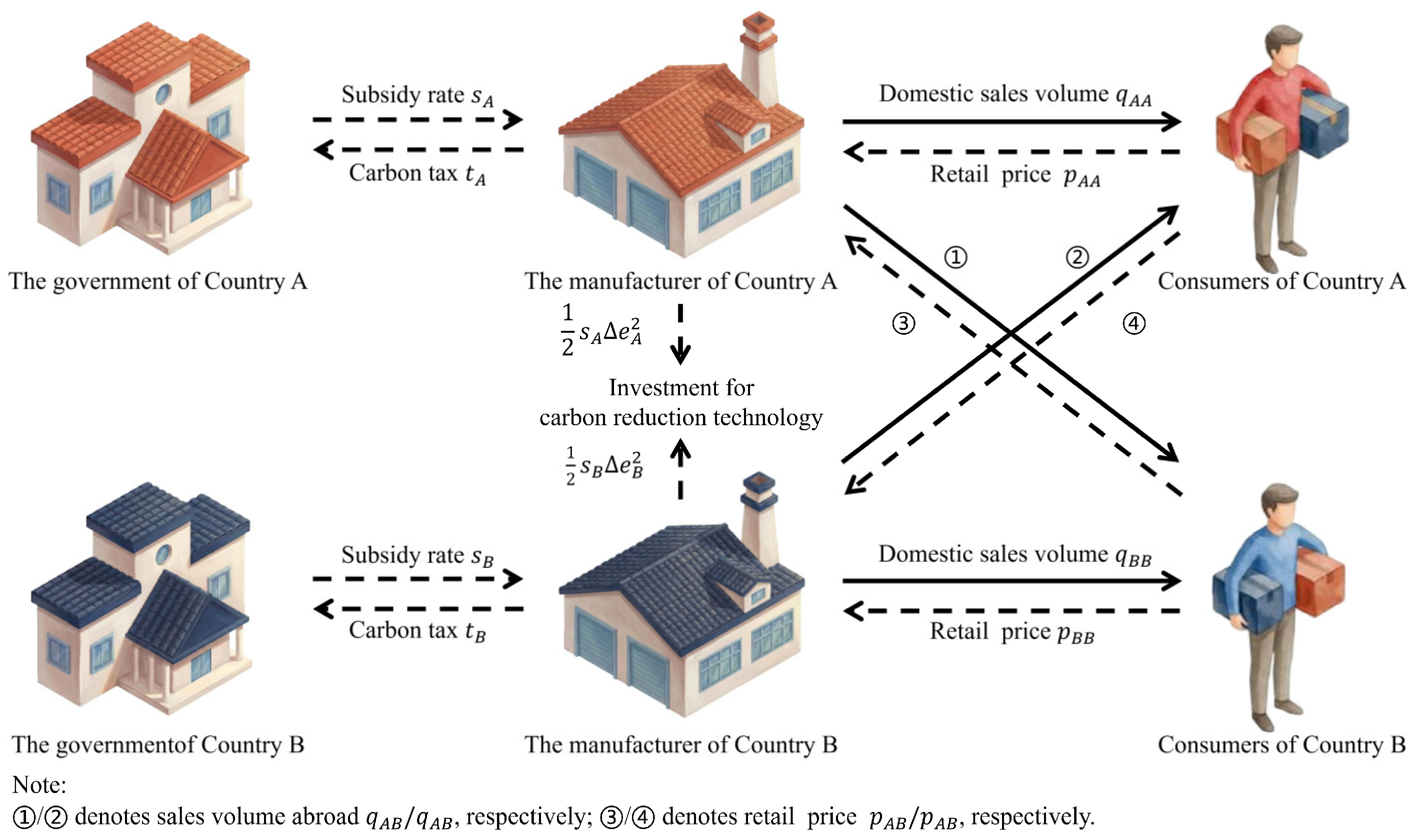
In the base model, only a domestic carbon tax and a subsidy for emission reduction investments are implemented, with no additional carbon costs imposed on exports. This setup allows for analyzing manufacturer behavior under a single carbon tax policy. The carbon tax, applied per unit of carbon emissions, raises the marginal cost of production. Manufacturers can offset this cost by investing in carbon intensity reduction technologies. To encourage such green upgrades, the government offers linear subsidies for emission reduction investments. Within this framework, manufacturers must balance carbon tax expenses, subsidy benefits, consumer preferences, and capacity allocation to optimize production and emission reduction strategies. To show practical relevance, consider the chemical industry in Scandinavian countries, where domestic carbon taxes are coupled with investment subsidies. Manufacturers in this sector respond by increasing low-carbon technology investments, balancing cost increases against subsidy incentives, which aligns closely with the behavior predicted by the baseline model. This case demonstrates how a domestic carbon tax can effectively guide firms’ emission reduction strategies without additional cross-border constraints. The model structure is shown in Figure 1. For the clarity of Figure 1, we employ solid lines to denote product flows and dashed lines to represent monetary payment flows. Specifically, manufacturers in Countries A and B produce and distribute goods directly to consumers in both markets, establishing a product trajectory from manufacturers to end-users. Conversely, the corresponding sales payments flow from consumers back to the manufacturers. During the production stage, manufacturers are required to pay carbon taxes for the emissions generated during the production process. To alleviate these tax burdens and align with green development objectives, manufacturers may allocate capital toward carbon abatement technologies. Moreover, to incentivize these efforts, the government provides subsidies at a specific rate based on the scale of the investment.
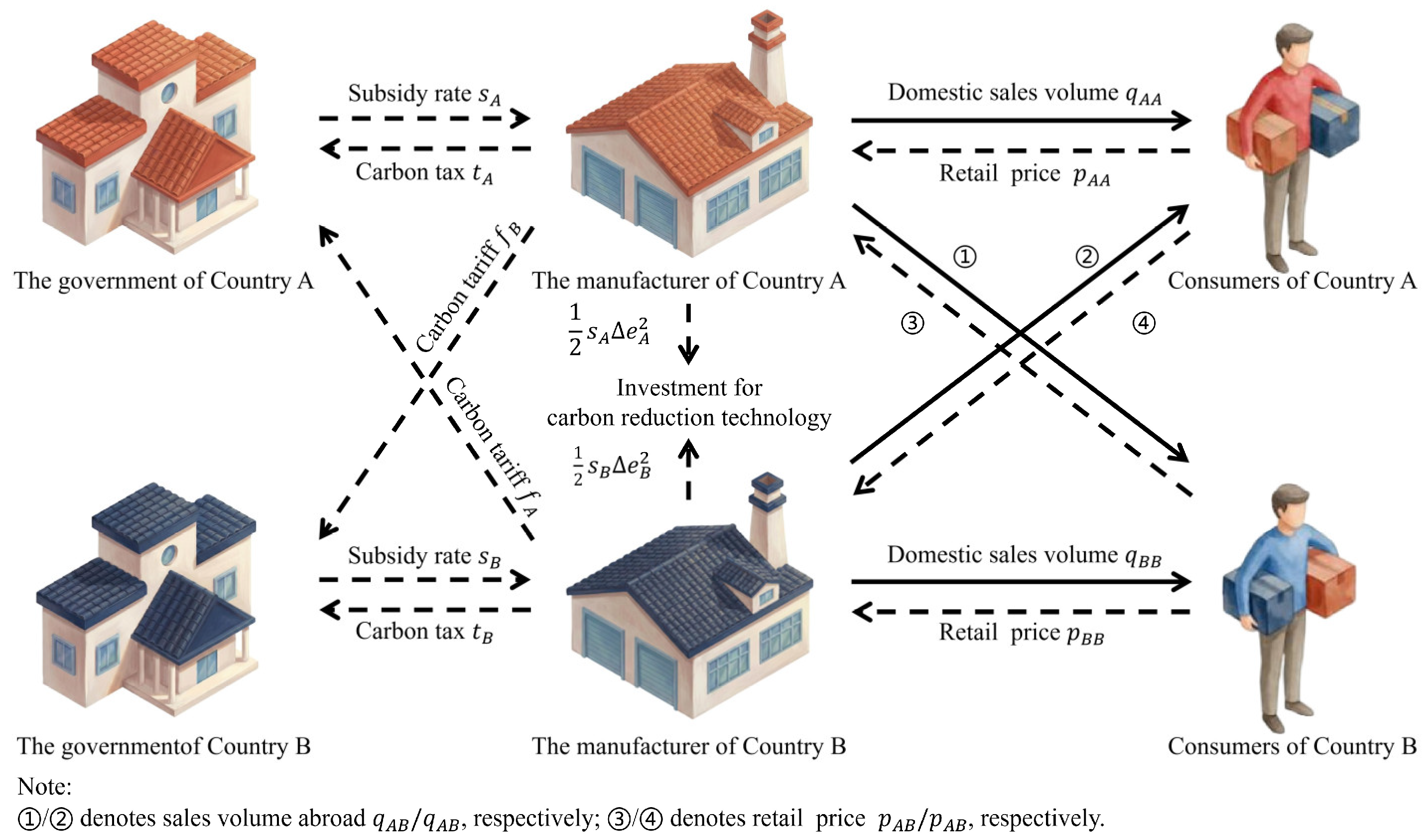
The extended model introduces a carbon tariff mechanism into the baseline framework. This extension simulates progressively implemented border carbon adjustment policies, such as the EU’s CBAM. In this scenario, exporters pay carbon tariffs based on the unit carbon emissions assessed by the importing country and are exempt from domestic carbon taxes, reflecting the cross-border policy heterogeneity for exported goods. The carbon tariff raises the marginal tax burden on high-carbon-intensity exports, compelling manufacturers to reassess their emission reduction investments and market positioning strategies for the export market. In this case, the EU’s Carbon Border Adjustment Mechanism (CBAM) provides a re-al-world parallel. Steel exporters facing CBAM tariffs adjust their emission reduction investments and export strategies to minimize carbon costs while maintaining competitiveness. Similarly, high-carbon-intensity chemical exports are incentivized to adopt cleaner technologies to avoid elevated border tariffs. These empirical cases il-lustrate how cross-border carbon pricing, as simulated in the extended model, affects manufacturers’ strategic allocation between domestic and export markets. The model structure is detailed in Figure 2. The primary distinction from Figure 1 lies in carbon tariff. Manufacturers in Country A (or B) are now subject to carbon tariffs determined by the carbon emissions associated with his/her products sold in Country B (or A). Aside from this specific adjustment to the cross-border tax mechanism, all other configurations remain identical to those presented in Figure 1.
This study assumes that output equals sales volume, disregarding inventory and dynamic supply-demand adjustments to ensure the clarity and solvability of the equilibrium analysis. Carbon taxes and carbon tariffs are measured against the same carbon emission metric, namely the carbon emission level per unit of product during the usage phase. The relevant parameters and decision variables involved in this study are shown in Table 2.

3.2. Model Assumptions

This section establishes the behavioral assumptions underlying the model one by one, examining market structure, consumer preferences, government policy interventions, and carbon reduction behaviors.
Assumption 1.
The output of both products equals their sales volume [36].
Assumption 1 indicates that the total planned output of export products and domestic sales products by enterprises in both countries can be fully purchased by consumers. This avoids the intervention of other factors that could render the model unnecessarily complex.
Assumption 2.
Without loss of generality, we assume that Product B enjoys lower market recognition than Product A in both countries. Following [49,58], consumers’ expected valuation is normalized to v for Product Aand ρ v for Product B, where < ρ < 1 captures the relative disadvantage of Product Bin market recognition.
To analyze competition among products of the same type but differing quality in cross-border markets, in Assumption 2, this study introduces the consumer preference coefficient ρ to quantify how variations in market recognition influence consumer choices and corporate production decisions within the model. Particularly within the core context of carbon reduction, consumer preferences for product quality may significantly influence purchasing decisions and, to some extent, diminish consumer sensitivity to product carbon emissions. Here, ρ represents the market recognition of Product B relative to Product A. A higher value of ρ indicates greater market acceptance of Product B.
Assumption 3.
Referring to [36,49,58], the market demand functions for price and quantity in Countries A and B are, respectively,
p A A = α A q A A ρ q B A ,
p B A = ρ α A q A A q B A ,
p A B = α B q A B ρ q B B ,
p B B = ρ α B q A B q B B ,
where q A A , q B B are decision variables and the remaining variables are exogenous.
In Assumption 3, consumer utilities for two qualitatively differentiated products A and B are modeled as U A = v p A A and U B = ρ v p B A . The point of consumer indifference, where U A = U B , defines the critical valuation: v = p A A p B A 1 ρ . Consequently, the consumer surplus from purchasing Product A and Product B can be formulated as the following integrals, which, respectively, represent the utility sums for consumers who prefer Product A and Product B: ( p A A p B A ) / ( 1 ρ ) α A ( v p A A ) , p B A / ρ ( p A A p B A ) / ( 1 ρ ) ( ρ v p B A ) . This further allows us to derive the market demand functions for price and quantity in both markets A and B.
Assumption 4.
Referring to [49], we assume that the carbon reduction costs for the two countries’ manufacturers are expressed as 1 2 e A 2 and 1 2 β e B 2 , respectively, where e A , e B are decision variables.
Assumption 4 reflects the increasing nature of carbon reduction technology development costs, meaning that the greater the carbon reduction, the faster the cost of technology development increases. This aligns with the diminishing marginal returns effect in technology development.
Assumption 5.
Referring to [49], we assume that during the green transition of manufacturers in Country A and Country B, governments provide incentives through subsidies, with subsidy rates set at 1 2 s A e A 2 and 1 2 β s B e B 2 respectively.
Assumption 5 indicates that government subsidy amounts increase with rising carbon emission reductions. However, due to diminishing marginal returns, the actual incentive effect gradually weakens. This subsidy mechanism reflects the marginal characteristics of government incentives for carbon reduction behavior. Additionally, β represents the carbon reduction cost coefficient for Country B manufacturers relative to Country A manufacturers, meaning subsidy intensity adjusts based on differences in emission reduction investment efficiency between manufacturers in the two countries.
Assumption 6.
The carbon tax paid by manufacturers in both countries is based on the carbon emissions generated during the use of their products, rather than emissions from the production process [59,60].
This assumption is grounded in the characteristics of Energy-related Products (ErP), such as electronic appliances, machinery, and transportation equipment. For these manufactured goods, the use-phase emissions often represent the most significant portion—frequently exceeding 80%—of their total life-cycle carbon footprint [59]. Consequently, while production-side emissions are important, the strategic focus of manufacturers in these sectors shifts toward product-driven innovation to reduce usage-stage carbon intensity. By focusing on the use-phase, our model captures the manufacturer’s incentive to invest in ‘design-for-environment’ technologies, which is consistent with the principles of Extended Producer Responsibility (EPR) [60]. This approach allows us to isolate the impact of energy-efficiency R&D on international trade and competitive advantage, abstracting from localized production process improvements that are often subject to different domestic regulatory regimes.

3.3. Decision Sequence

Under the carbon tax scenario, Country A and Country B first determine the carbon tax levels for manufacturers within their respective countries. Afterward, manufacturers decide the sales volumes to Country A and Country B, taking into account the domestic carbon taxes and market conditions.
Under the carbon tax and tariff scenario, Country A and Country B first set the carbon tax levels for their domestic manufacturers and simultaneously determine the carbon tariffs applied to imports from the other country. Manufacturers then decide the sales volumes to both countries, considering the combined effects of domestic carbon taxes and foreign carbon tariffs.

4. Model and Equilibrium Analysis

In this section, we provide a structured analysis of manufacturers’ strategic behavior and social welfare outcomes under different low-carbon policy settings. Specifically, we examine three related but distinct analytical settings. Together, these analyses offer a comparative perspective on how different policy environments shape firm behavior, market outcomes, and welfare performance. All proofs of the propositions are provided in Appendix A.

4.1. Market Allocation and Technology Investment Under Carbon Tax

This part analyzes the optimal production and emission reduction strategies for manufacturers in two countries under given government policies. With carbon taxes t A and t B in place, manufacturer in Country A invest in producing Product A, while manufacturer in Country B invest in producing Product B. Each manufacturer chooses to sell its product in its home market and in the foreign market.

4.1.1. Model and Equilibrium Result

When making decisions, manufacturers in both countries must comprehensively weigh the following factors: First, government-provided carbon tax and subsidy policies. To promote the green transformation of domestic manufacturers, governments incentivize manufacturers to invest in carbon reduction technologies through carbon taxes while simultaneously lowering the cost of such investments via subsidies. Second, manufacturers in both countries must also consider their own production capacity constraints. Given fixed production capacities, to maximize capacity utilization, the total sales volume in both domestic and export markets must equal their production capacities, i.e., K A = q A A + q A B   ,   K B = q B A + q B B . Based on these factors, manufacturers in both countries aim to maximize profits and make their respective optimal decisions. The profit functions for manufacturers in both countries are expressed as
π A q A A , e A = p A A q A A + p A B q A B t A q A A e A 0 e A 1 2 e A 2 + 1 2 s A e A 2 ,
π B q B B , e B = p B A q B A + p B B q B B t B q B B e B 0 e B 1 2 β e B 2 + 1 2 β s B e B 2 ,  
where p A A q A A + p A B q A B represents the profit earned by manufacturer in Country A from producing Product A. t A q A A e A 0 e A denotes the carbon tax payable for selling Product A in Country A’s market, 1 2 e A 2 represents the cost incurred by manufacturer of Country A in investing in carbon reduction technology, 1 2 s A e A 2 denotes the government subsidy issued by Country A’s government based on the carbon reduction technology adopted by manufacturer of Country A. The profit function for the manufacturer in Country B is constructed similarly with its respective parameters.
Proposition 1.
When the parameters satisfy the following constraints:
4 1 s A t A 2 0 ,
4 ρ β 1 s B t B 2 0 ,
The profit functions of the two manufacturers are concave functions with respect to q A A ,   e A ,   q B B ,   e B , thereby ensuring the existence and uniqueness of the optimal solution.
Proposition 1 suggests that an appropriate balance between carbon tax policies and government subsidies is crucial for effective emissions reduction. Subsidies s A and s B exhibit diminishing returns in their capacity to promote corporate emissions abatement. Governments cannot rely solely on continually increasing subsidy levels to achieve environmental targets, as excessively high subsidies may crowd out firms’ intrinsic incentives to invest in their own emission-reduction technologies. Such overreliance can undermine the stability and efficiency of the overall policy framework, reflecting the phenomenon of “excessive subsidy distortion” widely discussed in public economics.
To be effective, subsidies should be strategically calibrated to complement carbon taxes, taking into account factors such as consumer preferences and country-specific differences in the cost of emissions-reduction investments. For example, in the EU, the combination of the Emissions Trading System (ETS) with targeted green innovation subsidies has been shown to stimulate corporate investment in low-carbon technologies without reducing firms’ own abatement efforts. Similarly, China’s differentiated subsidy schemes for clean energy and industrial emissions reduction illustrate that appropriately sized incentives, rather than blanket high subsidies, can motivate companies to internalize emissions costs while maintaining market efficiency. By aligning subsidy design with carbon pricing and market conditions, governments can enhance the effectiveness of climate policies and foster sustainable corporate investment in green technologies.
Proposition 2.
Under the carbon tax policy, the original unit carbon emissions of products will affect the equilibrium states of manufacturers in both countries, namely,
(1) 
when μ 1 e A 0 and μ 2 e B 0 , manufacturers in both countries achieve zero carbon emissions. At this point, the equilibrium solution is
e A = e A 0 , e B = e B 0 ,   q A A = 4 K A + 2 α A 2 α B ρ K A ρ α A + ρ α B 2 ρ 4 , q B B = 4 K B α A + α B ρ K B 2 ρ 4 .
(2) 
when μ 1 e A 0 and 0 μ 2 e B 0 , manufacturer of Country A achieves zero carbon emissions. At this point, the equilibrium solution is
e A = e A 0 , e B = 2 e B 0 t B 2 + K B ρ ρ 4 t B + ρ α A α B t B 2 t B 2 + β ρ ρ 4 1 s B , q A A = α A α B M 1 + 2 K A t B 2 + β ρ ρ 4 1 s B ρ K B t B 2 + 2 β ρ e B 0 t B ( 1 s B 2 β ρ s B α A ρ 4 t B 2 + β ρ ρ 4 1 s B , q B B = K B β ρ 2 ρ 4 1 s B + β ρ α A α B 1 s B + 2 β e B 0 t B 1 s B 2 t B 2 + β ρ ρ 4 1 s B .
(3) 
when 0 μ 1 e A 0 and μ 2 e B 0 , manufacturer of Country B achieves zero carbon emissions. At this point, the equilibrium solution is
e A = α A α B t A 2 ρ + K A t A ρ 4 + 2 e A 0 t A 2 2 t A 2 + ρ 4 1 s A , e B = e B 0 , q A A = α A α B s A 1 2 ρ + K A ρ 4 1 s A + 2 e A 0 t A 1 s A 2 t A 2 + ρ 4 1 s A , q B B = α A α B 2 1 s A t A 2 + 2 K B t A 2 + ρ 4 1 s A K A t A 2 + 2 e A 0 t A 1 s A 4 t A 2 + ρ 4 1 s A .
(4)
when 0 μ 1 e A 0 and 0 μ 2 e B 0   , manufacturers in neither country achieve zero carbon emissions. At this point, the equilibrium solution is
e A = t A ( M 2 ( α A + 2 K A ρ K B α B t A e A 0 ) 1 s A + 2 ρ β M 3 1 s A 1 s B ) ( 1 s A ) ( 4 1 s A t A 2 ) M 2 4 ρ 2 β ( 1 s A ) ( 1 s B ) ) , e B = t B M 2 M 6 4 ρ 2 β 1 s A 1 s B M 4 1 s B + 2 ρ β M 2 M 5 1 s B 1 s A + 2 ρ 1 s A M 4 1 s B 4 ρ β 1 s B 4 1 s A t A 2 M 2 4 ρ 2 β 1 s A 1 s B β 1 s B , q A A = M 2 M 4 1 s A + 2 ρ M 4 1 s A 1 s B M 2 M 6 4 ρ 2 β 1 s A 1 s B , q B B = M 4 1 s B M 2 M 6 4 ρ 2 β 1 s A 1 s B + 2 ρ β M 2 M 5 1 s B 1 s A + 2 ρ 1 s A ρ M 4 t B e B 0 1 s B M 2 M 2 M 6 4 ρ 2 β 1 s A 1 s B ,
where
μ 1 = t A 4 ρ K A + 2 ρ α A α B 2 1 s A 4 ρ , μ 2 = t B 4 ρ K B + α B α A 2 β 1 s B 4 ρ , M 1 = t B 2 + 2 β ρ ρ 2 2 s B , M 2 = 4 ρ β 1 s B t B 2 , M 3 = ρ α B + 2 K B K A α A t B e B 0 , M 4 = β ρ α B + 2 K B K A α A t B e B 0 , M 5 = α A α B + 2 K A ρ K B t A e A 0 , M 6 = 4 1 s A t A 2 .
Proposition 2 indicates that whether manufacturers in both countries choose to achieve zero carbon emissions through carbon reduction technologies depends on the trade-off between their carbon tax burden and emission reduction costs. Specifically, when t A [ 4 ρ K A + 2 ρ α A α B ] 2 ( 1 s A ) ( 4 ρ ) e A 0 , manufacturer in Country A will invest in technology to achieve fully zero-carbon emissions for its products. Conversely, they will opt for partial emissions reduction. When t B [ 4 ρ K B + α B α A ] 2 β 1 s B ( 4 ρ ) e B 0 , manufacturer in Country B will achieve complete zero-carbon emissions through technological investment. Otherwise, they will choose partial emissions reduction. The critical conditions for achieving zero carbon emissions are jointly determined by a country’s carbon tax burden, consumer preferences, market scale, and emission reduction subsidies. When the net tax burden per unit of carbon emissions exceeds the original per-unit carbon emission level, manufacturers are more inclined to pursue full emission reductions to avoid costs; conversely, they opt for partial reductions. Furthermore, this proposition indicates that achieving a “green transition” does not stem solely from internal corporate motivation. In the absence of effective incentives, even manufacturers with emission reduction capabilities may opt for conservative strategies due to insufficient cost–benefit ratios. Simultaneously, this finding reveals a “nonlinear jump” in corporate strategy: near the critical threshold, minor adjustments to tax rates or subsidies can trigger a sudden shift from conservative to aggressive behavior, explaining the divergent responses to low-carbon policies observed in real-world corporate practice.
Under a single carbon tax policy, manufacturers’ optimal decisions are constrained not only by the carbon tax itself but also by the combined effects of market and policy factors such as consumer preferences and government subsidies. Since achieving full emissions reduction often entails high marginal costs, the intermediate state where neither manufacturer achieves zero carbon emissions holds greater practical relevance and research value. Given the complexity of solving models and the highly coupled variable relationships in this scenario, this study employs numerical simulation to systematically analyze how key parameters, such as consumer preference coefficients and carbon tax rates, influence domestic sales volumes and emission reduction decisions. This approach reveals the dynamic response characteristics between carbon policy mechanisms and corporate market behavior.

4.1.2. Effects of Carbon Tax Policies on Market Positioning and Emission Incentives

To reveal the response characteristics of manufacturers’ market preferences under varying carbon tax levels, this study employs numerical simulations with specific parameters   ( K A = K B = 1 ,   α A = α B = 1 , s A = s B = 0.3 , e A 0 = e B 0 = 0.7 , β = 1.5 ) . The parameter values used in the simulation are selected to satisfy the feasibility conditions of the model and to ensure economically meaningful interior solutions. They are not calibrated from specific industry data, as the purpose of the numerical analysis is to illustrate the equilibrium mechanisms and comparative statics of the model rather than to provide precise quantitative predictions. We have verified that the main qualitative results are robust to alternative parameter settings within reasonable ranges. It examines how manufacturers’ optimal sales strategies adapt to shifts in consumer preferences under different carbon tax rates, thereby analyzing the interdependent regulatory effects of carbon tax policies on manufacturers’ market positioning and emission reduction incentives. In numerical experiments, the values of all parameters must simultaneously satisfy the following constraints:
0 μ 1 e A 0 0 μ 2 e B 0 0 e A e A O 0 e B e B O 0 4 1 s A t A 2 0 4 ρ β 1 s A t B 2 .
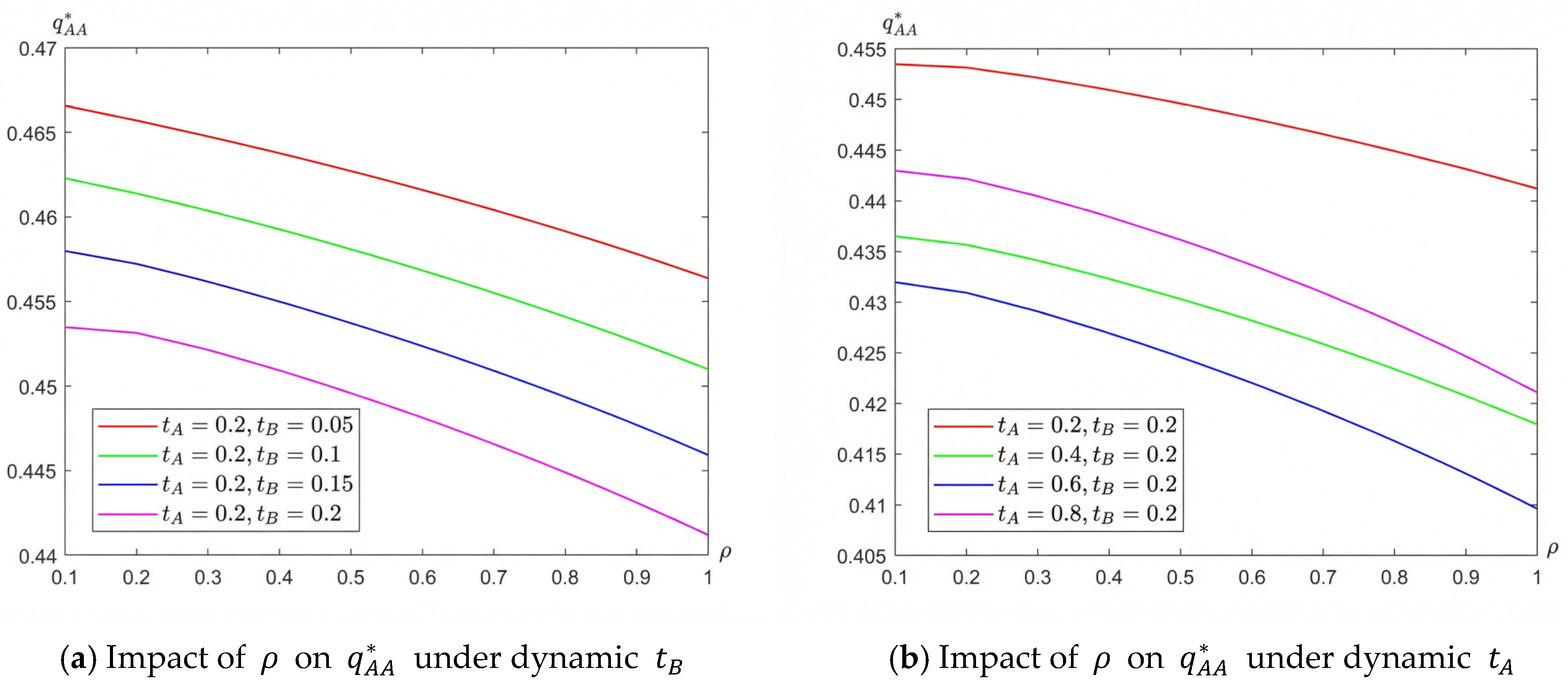
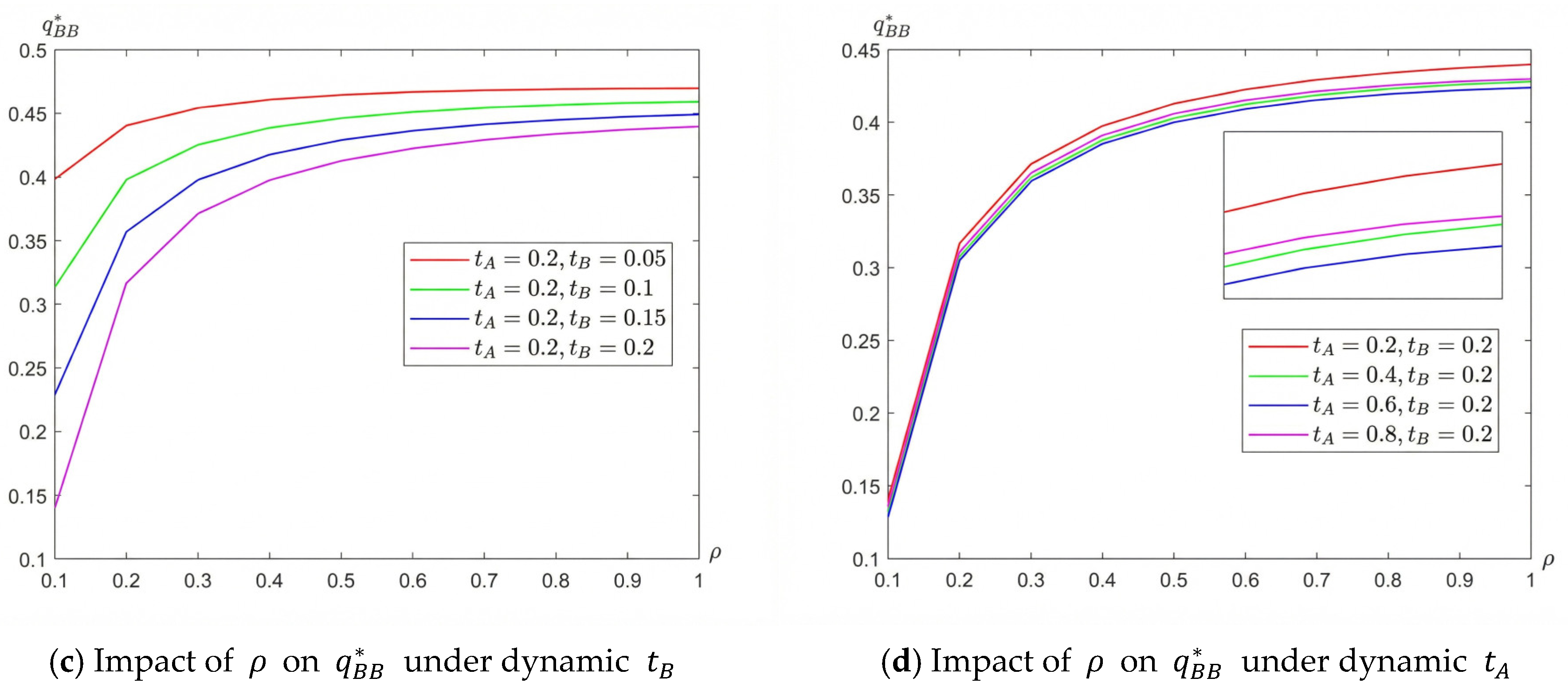
Figure 3 illustrates how shifts in consumer preferences affect domestic sales of manufacturers in Countries A and B under two scenarios: a fixed carbon tax in one country with a variable carbon tax in the other. The horizontal axis, ρ , measures relative preference for Country B’s products (0 = strong preference for Country A, 1 = neutrality or preference for Country B). The vertical axes, q A A and q B B , denote optimal domestic sales quantities. Higher values indicate greater domestic retention, while lower values imply more exports. As preference for Country B’s products rises, high-quality manufacturers tend to export to mitigate domestic carbon tax burdens, whereas low-quality manufacturers focus on domestic sales due to stronger local demand and sufficient profit margins.
Furthermore, comparing Figure 3a–d reveals that carbon taxes influence corporate decision-making through dual pathways: the “cost effect” and the “competitiveness effect.” When a country raises its domestic carbon tax, the direct cost pressure compresses corporate profits, compelling manufacturers to shift toward exports to avoid the tax burden, manifesting as a significant “direct constraint.” Conversely, when trading partners raise their carbon taxes, this weakens their competitiveness, creating export opportunities for domestic manufacturers, a phenomenon termed the “indirect protection effect” of carbon taxes. Comprehensive analysis indicates that domestic carbon tax policies exert a stronger dominant influence on corporate behavior, while changes in foreign tax systems function as secondary external variables, exerting indirect regulatory effects through market competition dynamics.
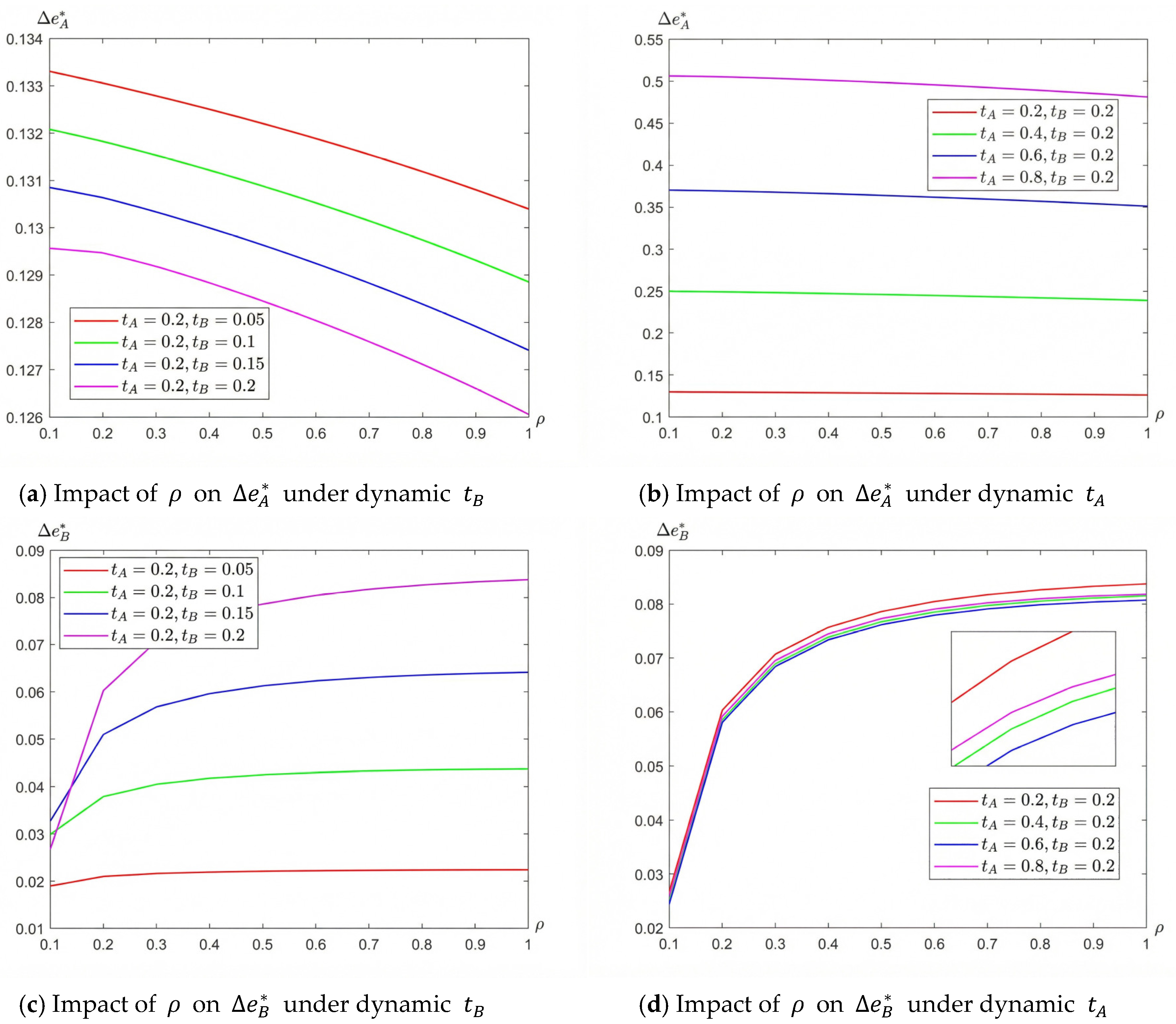
Figure 4 shows how shifts in consumer preferences affect manufacturers’ investments in carbon reduction technologies in Countries A and B under two scenarios of fixed and variable carbon taxes. The vertical axes, e A and e B , indicate unit carbon reduction per product. Carbon taxes influence emissions reduction via two pathways: the cost effect and the competitiveness effect. For Country A, domestic carbon taxes directly increase reduction investments, while foreign taxes affect incentives indirectly through market competition. For Country B, stronger consumer preference ( ρ ) significantly boosts investments, particularly at low ρ (0.1–0.4), driven by brand and market share considerations; at higher ρ (>0.4), reductions plateau due to technological limits. Domestic taxes provide stronger direct incentives than foreign taxes, with Country A’s tax generating notable spillover effects. Country B manufacturers, benefiting from market preferences and technological accumulation, achieve higher reduction efficiency under comparable policies.
This finding suggests that achieving sustained emission reduction targets requires establishing a differentiated policy framework: for manufacturers in the technology catch-up phase, a combination of policy tools such as technology subsidies and carbon markets should be employed; for manufacturers with technological advantages, a tiered carbon tax should be implemented to strengthen their incentive to reduce emissions. Concurrently, attention must be paid to preventing potential market monopoly risks arising from the combination of high tax burdens and strong preferences, thereby ensuring the long-term effectiveness and market fairness of emission reduction policies.

4.2. Market Allocation and Technology Investment Under Carbon Tax and Tariff

4.2.1. Model and Equilibrium Result

In the previous benchmark model, manufacturers faced only domestic carbon taxes and emission reduction subsidies, with exported goods bearing no additional carbon costs. However, with the global rise in border carbon adjustment mechanisms, exporting manufacturers now encounter additional carbon pricing constraints when entering foreign markets. To better capture the impact of this policy reality on manufacturer strategic behavior, this study incorporates a carbon tariff mechanism into the original framework, constructing a profit function under dual policy scenarios of carbon taxes and carbon tariffs. Under fixed production capacity constraints, to maximize capacity utilization, the total sales volume in both the domestic and export markets remain equal to production capacity: K A = q A A + q A B and K B = q B A + q B B . Therefore, after introducing the carbon tariff policy, the profit functions for manufacturers in both countries are expressed as
π A q A A , e A = p A A q A A + p A B q A B t A q A A e A 0 e A f B q A B e A 0 e A 1 2 e A 2 + 1 2 s A e A 2 , π B q B B , e B = p B A q B A + p B B q B B t B q B B e B 0 e B f A q B A e B 0 e B 1 2 β e B 2 + 1 2 β s B e B 2 ,
where p A A q A A + p A B q A B represents the profit earned by manufacturer in Country A from producing Product A. t A q A A e A 0 e A denotes the carbon tax payable for selling Product A in Country A’s market, f B q A B e A 0 e A represents the carbon tariff that the manufacturer of Country A must pay when exporting Product A to Country B’s market, 1 2 e A 2 represents the cost incurred by manufacturer of Country A in investing in carbon reduction technology, 1 2 s A e A 2 denotes the government subsidy issued by Country A’s government based on the carbon reduction technology adopted by manufacturer of Country A. The profit function for the manufacturer in Country B is constructed similarly with its respective parameters.
Proposition 3.
When the parameters satisfy the following constraints:
4 ρ β 1 s B ( t B f A ) 2 0 ,
4 1 s A ( t A f B ) 2 0 ,
the profit functions of the two manufacturers are concave functions with respect to q A A ,   e A , q B B ,   e B , thereby ensuring the existence and uniqueness of the optimal solution.
Proposition 3 indicates that when carbon tariff policies are introduced, an appropriate balance must be maintained between carbon taxes, carbon tariff policies, and government subsidies. Subsidies s A and s B must be less than the relative difference between the domestic carbon tax and the export carbon tariff. If the emissions reduction subsidies granted to domestic manufacturers exceed the net tax burden difference they bear between the domestic carbon tax and the export carbon tariff, manufacturers may resort to arbitrage strategies to evade genuine emissions reductions, thereby undermining the achievement of policy objectives. This inequality constraint underscores that subsidies should reasonably offset emission reduction costs rather than completely neutralize carbon pricing signals. Otherwise, manufacturers may maintain high carbon intensity, misuse subsidy resources, or even favor exporting high-emission products to evade domestic cost pressures.
Proposition 4.
Under dual carbon tax and carbon tariff policies, the original unit carbon emissions of products will affect the equilibrium states of manufacturers in both countries, specifically as follows:
(1) 
when σ 1 e A 0  and σ 2 e B 0 , manufacturers in both countries achieve zero carbon emissions. At this point, the equilibrium solution is:
e A = e A 0 , e B = e B 0 , q A A = 4 K A + 2 α A 2 α B ρ K A ρ α A + ρ α B 2 ρ 4 , q B B = ( 4 K B α A + α B ρ K B ) 2 ( ρ 4 ) .
(2) 
when σ 1 e A 0 and 0   σ 2 e B 0 , manufacturer of Country A achieves zero carbon emissions. At this point, the equilibrium solution is:
e A = e A 0 , e B = 2 e B 0 f A 2 + t B 2 + K B ρ ρ 4 f A + t B + ρ α A α B t B f A 4 e B 0 f A t B 2 f A t B 2 + β ρ ρ 4 1 s B , q A A = α A α B f A t B 2 + 2 β ρ ρ 2 2 s B + 2 K A M 7 + ρ K B f A 2 t B 2 4 M 7 + + 2 β ρ e B 0 t B ( 1 s B 2 β ρ s B ( e B 0 f A + α A ρ ) 4 M 7 , q B B = K B ρ 2 f A f A t B + β ρ ρ 4 1 s B + β ρ α A α B 1 s B + 2 β e B 0 t B f A 1 s B 2 M 7
(3) 
when 0 σ 1 e A 0 and σ 2 e B 0 , manufacturer of Country B achieves zero carbon emissions. At this point, the equilibrium solution is:
e A = α A α B f B t A 2 ρ + K A f B + t A ρ 4 + 2 e A 0 f B t A 2 2 f B t A 2 + ρ 4 1 s A , e B = e B 0 , q A A = α A α B s A 1 2 ρ + K A 2 f B f B t A + ρ 4 1 s A + 2 e A 0 f B t A s A 1 2 f B t A 2 + ρ 4 1 s A , q B B = α A α B 2 1 s A f B t A 2 + 2 K B f B t A 2 + ρ 4 1 s A + K A f B 2 t A 2 4 f B t A 2 + ρ 4 1 s A + + 2 e A 0 f B t A s A 1 4 f B t A 2 + ρ 4 1 s A .
(4) 
When 0 σ 1 e A 0 and 0   σ 2 e B 0 , manufacturers in neither country achieve zero carbon emissions. At this point, the equilibrium solution is:
e A = f B K A 1 s A + t A f B M 8 M 9 1 s A + t A f B f B K A + 2 ρ 1 s A M 4 + β f A e B 0 1 s B + t B f A f A K B 1 s A 4 1 s A t A f B 2 M 8 4 ρ 2 β 1 s A 1 s B , e B = t B f A M 8 M 9 4 ρ 2 β M 10 M 4 + f A e B 0 1 s B + t B f A f A K B + 2 ρ β M 8 M 10 M 5 + f B e A 0 + t A f B f B K A M 8 4 1 s A t A f B 2 M 8 4 ρ 2 β 1 s A 1 s B β 1 s B                       + f B K A β 1 s B + + 2 ρ M 10 ( D + f A e B 0 + t B f A f A K B ) ) M 8 4 1 s A t A f B 2 M 8 4 ρ 2 β 1 s A 1 s B β 1 s B , q A A = M 8 M 5 + f B e A 0 1 s A + t A f B f B K A + 2 ρ 1 s A M 4 + β f A e B 0 1 s B + t B f A f A K B M 8 M 9 4 ρ 2 β 1 s A 1 s B , q B B = M 8 M 9 4 ρ 2 β M 10 D + f A e B 0 1 s B + t B f A f A K B + 2 ρ β M 8 M 10 E + f B e A 0 + t A f B f B K A M 8 M 8 M 9 4 ρ 2 β M 10                       + 2 ρ M 10 ( D + f A e B 0 + t B f A f A K B ) ) M 8 M 8 M 9 4 ρ 2 β M 10
where
σ 1 = t A f B 4 ρ K A + 2 ρ α A α B 2 f B K A 4 ρ 2 4 ρ 1 s A , σ 2 = t B f A 4 ρ K B + α B α A f A K B 4 ρ 2 β 4 ρ 1 s B , M 7 = f A t B 2 + β ρ ρ 4 1 s B , M 8 = 4 ρ β 1 s B t B f A 2 , M 9 = 4 1 s A t A f B 2 , M 10 = 1 s A 1 s B .
Proposition 4 indicates that after the introduction of a carbon tariff, whether manufacturers in both countries choose to achieve net-zero emissions through carbon reduction technologies still depends on the trade-off between their carbon tax burden and the cost of emissions reduction. Specifically, when t A f B 4 ρ K A + 2 ρ α A α B 2 f B K A 4 ρ 2 4 ρ ( 1 s A ) e A 0 , the manufacturer of Country A will invest in technology to achieve completely zero-carbon emissions for their products. Conversely, the manufacturer of Country A will opt for partial emissions reduction. When t B f A 4 ρ K B + α B α A f A K B 4 ρ 2 β 4 ρ 1 s B e B 0 , the manufacturer of Country B will achieve fully zero-carbon emissions through technological investment. Otherwise, the manufacturer of Country B will opt for partial emissions reduction. Compared to the pure carbon tax model, introducing carbon tariffs shifts manufacturers’ incentive structure beyond domestic tax burdens alone. It incorporates external effects from export cost changes, reflecting a more complex trade-off between marginal emissions reduction benefits and costs. The sufficient condition for manufacturer of Country A to achieve zero carbon emissions incorporates not only domestic carbon taxes but also carbon tariffs imposed by export destinations. Together, these factors determine the “net carbon cost” per unit of output. The negative term 2 f B K A 4 ρ explicitly reflects how increased export costs erode manufacturers’ carbon tax incentive space. Similarly, Country B’s conditions reflect the squeeze effect of Country A’s carbon tariffs on its export profits. However, due to lower consumer preference for its products in Country A’s market and limited dependence on export markets, the incentive effect of Country A’s carbon tariffs is relatively weak. Consequently, the manufacturer of Country B relies more heavily on its domestic carbon tax policies to drive emissions reduction behavior.

4.2.2. Market Size and Preference Effects Under Net-Zero Emission Scenarios

This part examines how potential market size and consumer preferences shape manufacturers’ production, sales, and emission reduction investment decisions under different net-zero emission scenarios.
Proposition 5.
When a country’s manufacture achieves net-zero carbon emissions, the potential market size influences production, sales, and emissions reduction investment decisions as follows:
(1) 
when the manufacturer of Country A achieves net-zero emissions, if  f A > t B + β ρ 4 ρ 1 s B , e B    decreases as  α A  increases and increases as  α B  increases; When  f A < t B β ρ 4 ρ 1 s B , e B  increases with increasing  α A  and decreases with increasing  α B .
(2) 
when the manufacturer of Country B achieves net-zero emission, e A α A = f B t A 2 ρ 2 f B t A 2 + ( ρ 4 ) 1 s A , e A α B = f B t A 2 ρ 2 f B t A 2 + ( ρ 4 ) 1 s A , if f B > t A + ρ 4 1 s A ,  e A  decreases as  α B  increases and increases as  α A  increases; When  f B < t A ρ 4 1 s A e A  increases with increasing  α B  and decreases with increasing  α A .
Proposition 5 reveals that when the manufacturer in Country A achieves zero carbon emissions for Product A, and Country A’s potential market expands under f A > t B , conventional intuition would suggest that the manufacturer in Country B should strengthen its investment in carbon reduction technologies. Such investments would help mitigate the burden of carbon tariffs and enable Country B’s products to remain competitive in Country A’s market.
However, a closer examination uncovers a non-monotonic and counterintuitive effect. When Country A’s carbon tariff becomes sufficiently large relative to Country B’s carbon tax (i.e., f A t B ), the anticipated incentive for emissions reduction in Country B not only diminishes but may reverse. Although market expansion in Country A increases potential demand, excessively high tariffs substantially erode the competitiveness of Country B’s products. At the same time, zero-emission production grants Country A’s manufacturer an absolute competitive advantage through tariff exemption and local production, thereby significantly raising entry barriers. Under such conditions, marginal improvements in emissions intensity achieved through costly green investments are unlikely to yield meaningful market gains, reducing the perceived return on investment.
As a result, manufacturers in Country B may rationally redirect resources toward markets with lower regulatory costs, such as their domestic market or alternative international destinations. This mechanism explains why, under f A t B , the optimal emissions reduction level of Country B’s manufacturer ( e B ) responds more strongly to the expansion of Country B’s own market size ( α B ) than to growth in Country A’s market ( α A ). A similar dual constraint applies to manufacturers in Country A. Overall, emissions reduction decisions are jointly shaped by market potential and carbon policy asymmetries, and under extremely high carbon tariffs, declining investment returns may ultimately suppress incentives for green technology adoption.
Proposition 6.
When neither country’s manufacturers implement net-zero emissions, the original unit carbon emissions of a product influence the production and sales decisions of enterprises in both countries, as shown in  Table 3, where
a 1 = 2 M 11 + t A t B 2 2 t B t A 2 + t A 3 + 4 ρ β t A s B 1 t A t B 2 + 4 ρ β s B 1 , a 2 = 2 M 11 + t A t B 2 2 t B t A 2 + t A 3 + 4 ρ β t A s B 1 t A t B 2 + 4 ρ β s B 1 , a 3 = 2 s A 1 t B + f B 2 t B f B t A t B + M 12 f B 2 t A f B + 2 s A 1 , a 4 = 2 s A 1 t B + f B 2 t B f B t A t B M 12 f B 2 t A f B + 2 s A 1 , a 5 = ( β s A 1 f A t B 2 + 4 ρ β s B 1 M 13 + β t A f A t B 2 + 4 ρ β 2 s B 1 β f A t B 2 + 4 ρ β 2 s B 1 , a 6 = ( β s A 1 f A t B 2 + 4 ρ β s B 1 M 13 + β t A f A t B 2 + 4 ρ β 2 s B 1 β f A t B 2 + 4 ρ β 2 s B 1 , M 11 = ( s A 1 t A t B 2 + 4 ρ β s B 1 β ρ 2 1 s B + t A t B 2 + 4 ρ β s B 1 , M 12 = 2 ρ β ( 1 s B ) ( f B 2 t A f B + 2 s A 2 ) ( 2 f B 2 2 t A f B + ( ρ 4 ) ( 1 s A ) ) , M 13 = 2 ( 2 β f A t B 2 + ( 8 ρ β 2 2 β ρ 2 ρ ( f A + t B ) ) s B 1
From Proposition 6, in the context of transnational competition under dual policy constraints, namely carbon taxes and carbon tariffs, the allocation of manufacturers’ products between domestic and foreign markets is jointly shaped by intrinsic product characteristics and institutional incentive mechanisms. In particular, when carbon emissions have not yet reached net-zero, a product’s original unit carbon emissions affect not only the manufacturer’s marginal tax or tariff burden but also indirectly determine its optimal sales structure. Within the model, manufacturers invest in emissions reduction but do not achieve fully clean production, implying that residual carbon costs remain unavoidable. By examining the sign of the partial derivative of domestic sales volume with respect to original unit emissions, it becomes evident that, under different combinations of policy parameters and market conditions, original emission intensity functions as a critical factor that either promotes or suppresses domestic market allocation.
Consumer preference parameters further moderate this mechanism and generate pronounced asymmetries across countries. Owing to stronger consumer preference for Country A’s products, its domestic sales structure exhibits substantially lower sensitivity to emissions attributes than that of Country B. As original emissions increase, the domestic competitiveness of Country B’s products deteriorates rapidly, whereas manufacturers in Country A can sustain relatively stable domestic sales through brand or quality advantages despite higher carbon-related costs. This asymmetric transmission effect highlights a substitution relationship between product quality and original emission intensity: high-quality products can absorb higher emission taxes, while lower-quality products must rely on low emissions to preserve cost competitiveness. From an institutional perspective, the joint intensity of carbon taxes, tariffs, and subsidies determines the inflection point at which the derivative changes sign. As reflected in the table, most boundary conditions are defined by comparisons among t A , t B , f A , f B , and their associated critical value functions. The presence of multiple boundary regimes indicates that, at critical thresholds, market competition and policy incentives become misaligned, with original emission intensity emerging as a pivotal boundary variable in domestic sales decisions. Moreover, under carbon tariff regimes, export markets function not only as sources of profit but also as strategic buffers through which manufacturers reallocate and absorb emission-related costs.

4.2.3. Analysis of Carbon Tariff Effects Under Non-Net-Zero Scenarios

Compared with a standalone carbon tax, carbon tariffs affect not only the carbon costs of imports but also firms’ production allocation, market strategies, and emissions-reduction decisions through transnational competition. Firms’ optimal responses therefore depend on the interaction of domestic policies, international demand, and competitors’ strategies. This section uses numerical simulations to examine how carbon tariff levels influence bilateral trade volumes and emissions-reduction investments when neither country achieves net-zero emissions. All numerical experiments are conducted in MATLAB R2019b with the following parameter settings: β = 0.8 , α A = α B = 30 ,   K A = K B = 5 ,   e A 0 = 10 , e B 0 = 8 , s A = 0.2 , s B = 0.3 ,   t A = t B = 0.8 , ρ = 0.6 [49]. Let f A ,   f B 0,1 , In numerical experiments, the values of all parameters must simultaneously satisfy the following constraints:
0 σ 1 e A 0 , 0 σ 2 e B 0 , 0 e A e A 0 , 0 e B e B 0 , 0 4 1 s A ( t A f B ) 2 , 0 4 ρ β 1 s A ( t B f A ) 2 .
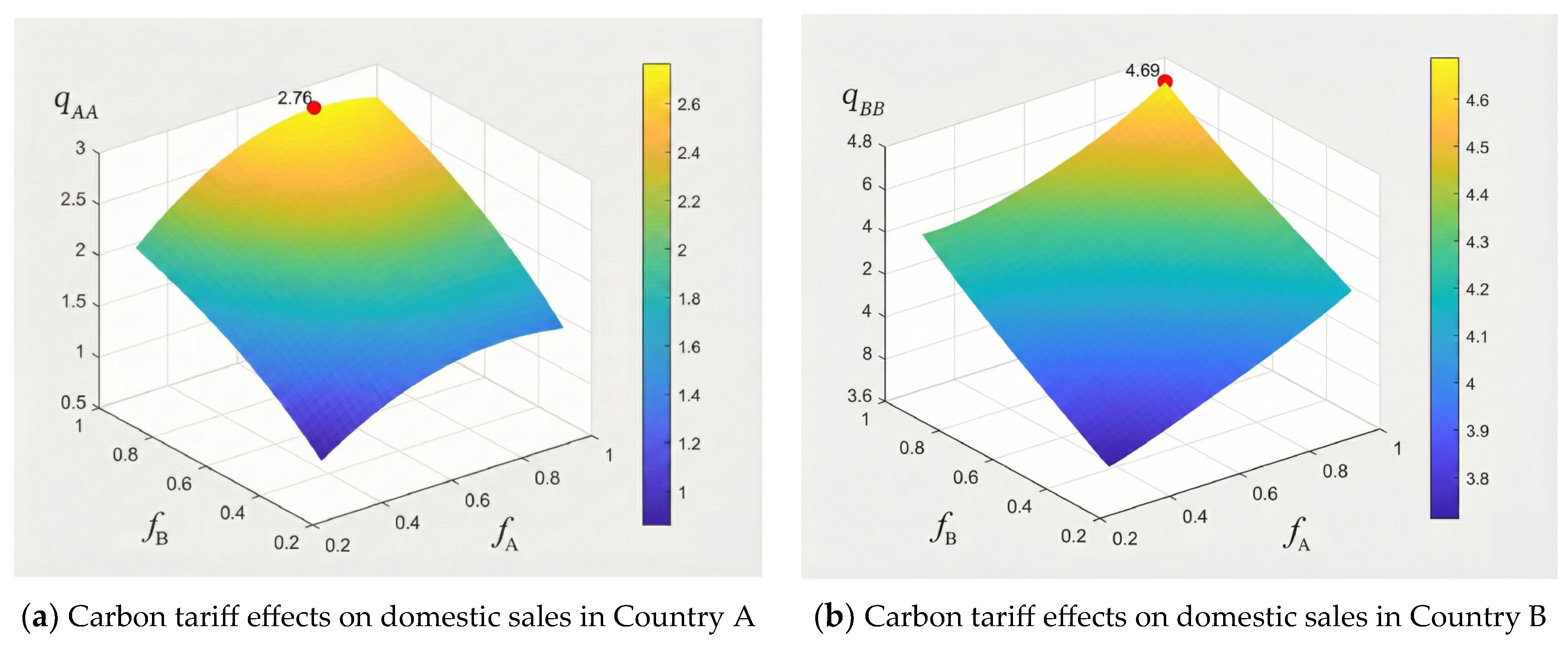
Figure 5 indicates the pathway through which carbon tariffs f A and f B influence domestic sales volumes q A A for manufacturer of Country A and q B B for manufacturer of Country B. The horizontal and vertical axes represent the carbon tariff rates f A and f B levied by Countries A and B, respectively, with the vertical height denoting the optimal domestic sales volume for manufacturers. This set of three-dimensional numerical simulations provides an intuitive illustration of how carbon tariffs interactively regulate manufacturers’ production and sales arrangements within a multi-country competitive environment, alongside the complex dynamic characteristics of market responses. Figure 5a shows that the domestic sales volume q A A of manufacturer A generally increases with higher carbon tariffs f A and f B , but with diminishing marginal returns, not peaking at their maximum values. This indicates a nonlinear response, where moderate tariffs shield the domestic market and reduce export appeal, yet high tariffs diminish the marginal benefit of full domestic allocation due to market contraction and cost pressures. In contrast, Figure 5b reveals a largely symmetric yet more linear and monotonic increase in q B B for manufacturer B, reaching its maximum at the highest tariff levels. Due to B’s lower consumer preference and export reliance, tariffs f A and f B effectively suppress B’s export prospects and strengthen domestic market protection, making the sales allocation more directly and positively influenced by policy intensity. From a surface morphology perspective, the steeper slope of Figure 5b in the higher tariff range compared to Figure 5a indicates that manufacturers in country B exhibit higher sensitivity to changes in carbon tariffs. This phenomenon may stem from underlying factors such as market size, manufacturer scale, and capacity constraints, and highlights the importance of accounting for cross-country asymmetry in policy design.
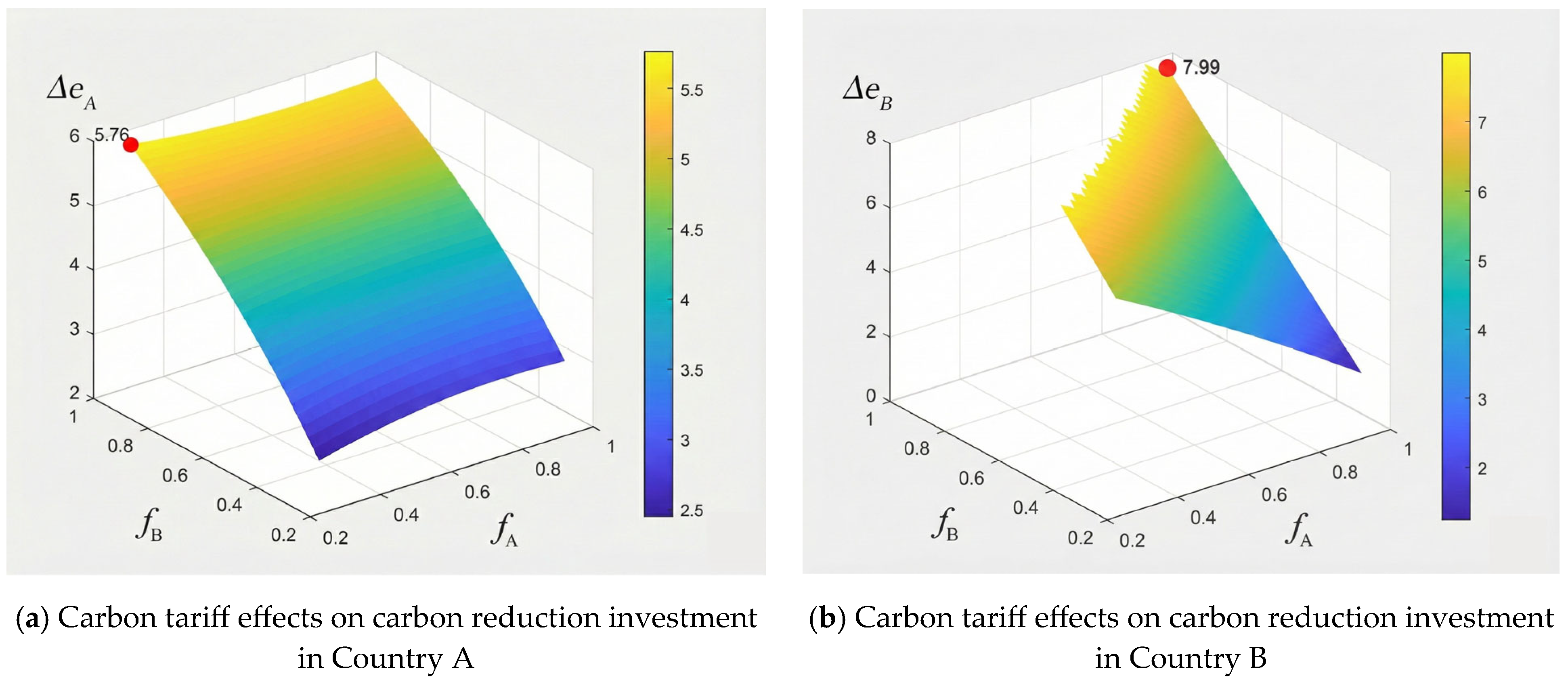
Based on the analysis of both figures, the carbon emission reductions ( e A and e B ) of manufacturers in Countries A and B exhibit distinct responses to carbon tariffs. In Figure 6a, e A increases significantly with higher f B but shows a non-monotonic response to f A , peaking when f B is high and f A is relatively low. This suggests that emission reductions by manufacturers in Country A are primarily driven by foreign carbon tariffs, while domestic tariffs exert limited indirect influence. In contrast, Figure 6b shows that e B rises markedly with increasing f B and responds strongly to f A depending on the level of f B , reaching its maximum when both tariffs are at their highest. This indicates that manufacturers in Country B are more directly incentivized by domestic carbon tariffs, while foreign tariffs influence their reduction efforts through competitiveness channels. Notably, the steeper slope of the surface in Figure 6b at high f B levels highlights a stronger marginal effect of carbon tariffs on manufacturers in Country B compared to those in Country A, whose response is relatively moderate. This asymmetry in sensitivity may stem from structural differences such as industrial composition, market scale, or cost flexibility between the two countries. The findings underscore the role of carbon tariffs as a cost lever that raises the marginal cost of high-carbon products, compelling manufacturers to invest in emission reductions. Moreover, the competitive effect is evident: high tariffs in one country drive domestic manufacturers to reduce emissions, while low tariffs in a competitor’s market may weaken export-oriented manufacturers’ incentives for carbon abatement. In summary, while carbon tariffs effectively promote emission reductions in both countries, their impacts vary significantly depending on the source and intensity of the policy, as well as underlying national economic conditions.

4.3. Analysis of Social Welfare Under Alternative Carbon Tax Combinations

Based on the game-theoretic model established above, we derive the optimal production, export, and emissions-reduction technology investment decisions for manufacturers in both countries under the scenario where net-zero emissions have not yet been achieved. Against the backdrop of increasing global pressure for decarbonization, dynamic carbon tariffs emerge as a flexible and adaptive policy instrument. Governments can adjust these tariffs in response to evolving market conditions, manufacturers’ abatement behaviors, and changes in the international trade environment. This approach allows policymakers to better balance environmental objectives with economic growth, thereby achieving more desirable policy outcomes. In this setting, social welfare is endogenously determined through the interaction between government policies, firms’ strategic decisions, and market demand. Changes in subsidy schemes reshape firms’ behavior, which subsequently affects market outcomes and consumer surplus, leading to different welfare implications across policy regimes.

4.3.1. Model and Equilibrium Result

This part shall examine how the configuration of a dynamic carbon tariff impacts a nation’s overall social welfare. The social welfare objective function comprehensively considers domestic corporate profits, government tax revenues, subsidy expenditures, consumer surplus, and environmental damage costs. Consequently, the social welfare functions for countries A and B may be expressed as follows:
ω A = π A + t A q A A e A 0 e A   +   f A q B A e B 0 e B 1 2 s A e A 2   +   C S A T A ,
ω B = π B   +   t B q B B e B 0 e B   +   f B q A B e A 0 e A 1 2 β s B e B 2   +   C S B T B ,
where ω A denotes the social welfare of Country A, π A denotes the total profits earned by the manufacturer of Country A, t A q A A e A 0 e A   +   f A q B A e B 0 e B represents the carbon tax and carbon tariff revenue of Country A’s government, 1 2 s A e A 2 denotes the carbon emission reduction subsidy expenditure of Country A’s government, Consumer surplus is given by C S A = 1 2 α A 2 α A p A A   +   p A A p B A 2 2 1 ρ   +   p B A 2 2 ρ , and environmental damage cost is expressed as T A = 1 2 φ ( q A A e A 0 e A   +   q B A e B 0 e B ) 2 . The social welfare function for Country B is constructed similarly with its respective parameters.

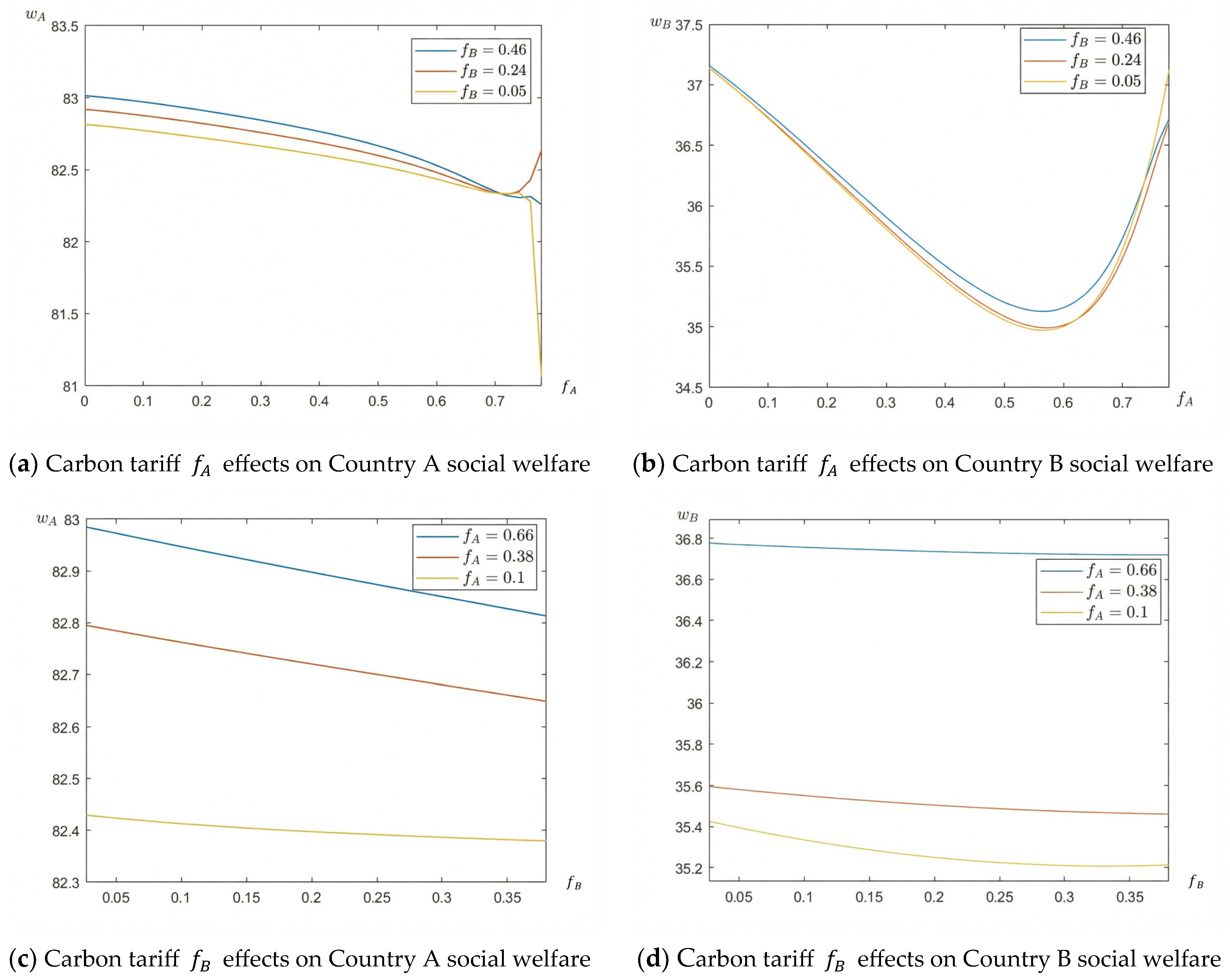
4.3.2. Analysis of Dynamic Carbon Tariff Effects on Social Welfare

To gain a more intuitive and effective understanding of the impact of dynamic carbon tariffs on the social welfare of both countries, numerical analysis was conducted using MATLAB based on the analytical results. The following parameters were assumed: ρ = 0.5 ,   β = 0.8 ,   K A = 0.85 ,   K B = 0.78 ,     s A = 0.68 ,   s B = 0.62 ,   φ = 0.1 ,   α A = α B = 100 ,   e A O = e B O = 1 ,   t A = t B = 0.2 ,   L e t   f A ,   f B 0,1 To ensure both manufacturers make optimal decisions while neither achieves zero carbon emissions, all parameter values in the numerical experiments must simultaneously satisfy the following constraints:
0 σ 1 e A 0 , 0 σ 2 e B 0 , 0 e A e A 0 , 0 e B e B 0 , 0 4 1 s A ( t A f B ) 2 , 0 4 ρ β 1 s A ( t B f A ) 2 .
Figure 7a illustrates the impact of carbon tariff f A imposed on imports from Country B on the social welfare ω A of Country A, under varying levels of Country B’s carbon tariff f B ( 0.05 , 0.24 ,     0.46 ) . The simulations reveal pronounced heterogeneity and nonlinear effects. When f B = 0.24 , ω A follows a U-shaped trajectory: in the low tariff range, social welfare declines due to reduced imports, lower consumer surplus, and higher environmental costs; beyond a critical threshold, domestic manufacturers gain market dominance and intensify emission reductions, resulting in a rapid rebound. This pattern is supported by real-world case studies of cross-border carbon policies, such as the EU’s Carbon Border Adjustment Mechanism (CBAM), which demonstrates initial trade friction followed by industrial adaptation and emission reductions. At an extremely low foreign tariff ( f B = 0.05 ), domestic manufacturers face minimal export pressure. Further raising f A exhausts import supply, causing domestic shortages, a sharp decline in consumer surplus, and rising environmental costs, ultimately leading to a steep drop in social welfare, a scenario indicative of “dual market-environmental failure.” Similar vulnerabilities have been observed in developing countries implementing unilateral carbon tariffs, where small export-dependent industries face production constraints and consumer cost shocks. Conversely, under a high foreign tariff ( f B = 0.46 ), social welfare declines steadily, consistent with the “diminishing marginal utility trap.” Historical trade disputes suggest that high protectionist measures can suppress both trade and environmental improvements, validating the model’s predictions.
Figure 7b shows that Country B’s social welfare responds to increases in Country A’s carbon tariff f A in a U-shaped manner under different levels of Country B’s own carbon tariff f B . When f A is low, higher export costs reduce manufacturers’ profits without inducing substantial emissions reduction, so environmental damages remain high and social welfare declines. Once f A exceeds a critical threshold, manufacturers accelerate emissions-reduction investments to mitigate tariff pressures, leading to lower environmental costs and a recovery in profits, and hence a rebound in social welfare. Although this pattern holds across all f B levels, the recovery is more pronounced when f B is high (e.g., f B = 0.46), as manufacturers are better prepared technologically and face less import competition, whereas a low f B (e.g., f B = 0.05 ) leaves firms more vulnerable to external tariff shocks, resulting in persistently lower welfare.
A comparison of Figure 7a,d shows that, under identical carbon tariff levels, Country A consistently attains higher social welfare than Country B. This disparity mainly stems from weaker consumer preference for Country B’s products, which limits its export opportunities and domestic substitution effects, together with relatively rigid environmental costs, placing Country B’s manufacturer under simultaneous pressure on profits and emissions performance. Although Country B may adjust its own carbon tariff f B to raise fiscal revenue or promote emissions reduction, such actions do not fundamentally reduce the high sensitivity of its welfare to changes in Country A’s tariff f A . By contrast, when f A is high, increases in f B exert a pronounced negative impact on Country A’s welfare, as shown in Figure 7c,d. In this regime, bilateral trade approaches a bottleneck, and higher tariffs on both sides restrict market access, compress export profits, and force domestic production expansion in Country A. If production remains carbon intensive, environmental costs rise sharply, potentially triggering a strategic negative feedback loop characterized by declining profits, reduced emissions-reduction investment, and worsening welfare. While such effects are partially mitigated when f A is low, they intensify under high-tariff conditions as policy flexibility diminishes, highlighting that unilateral carbon tariffs may curb imported emissions but also risk amplifying economic and environmental distortions through retaliatory trade responses.
In summary, Figure 7 illustrates the dual role and dynamic effects of carbon tariffs in international trade and environmental regulation. In the short term, carbon tariffs primarily function as trade instruments that raise import costs, which may reduce consumer surplus and induce domestic expansion of high-carbon production, thereby causing a temporary decline in social welfare. Once a critical threshold is exceeded, however, sufficiently strong tariffs compel firms to accelerate emissions-reduction efforts, generating an environment–economy synergy characterized by lower environmental damage and recovering profits. These effects are asymmetric across countries: Country A, benefiting from stronger consumer preference and market dominance, is better able to absorb tariff shocks, whereas Country B faces a dual “profit–environment” dilemma due to export contraction and limited emissions-reduction capacity, highlighting the importance of market structure in shaping policy outcomes.
More importantly, carbon tariff policies entail non-negligible trade war risks when implemented unilaterally. Escalating tariffs can trigger strategic retaliation, leading to prisoner’s-dilemma outcomes and self-reinforcing feedback loops of declining profits, reduced green investment, and worsening welfare on both sides. As illustrated in Figure 7, high and uncoordinated tariffs may amplify market distortions rather than internalize environmental externalities. By contrast, moderately calibrated and reciprocally coordinated carbon tariffs are more likely to mitigate trade conflict while aligning trade adjustment with emissions reduction. Experiences from policies such as the EU’s CBAM, US–China trade frictions in the solar panel industry, and carbon pricing regimes in Scandinavian countries suggest that dynamic and cooperative policy design is essential to contain trade war risks and achieve long-term gains in both environmental protection and economic welfare.

5. Discussion and Policy Implications

This section discusses the broader policy implications derived from the analytical and numerical results. The findings indicate that the effectiveness of carbon tax and carbon tariff policies depends not only on their individual stringency, but, more importantly, on their coordination, adaptability, and consistency across industries and countries. In highly integrated global supply chains, unilateral carbon policies may induce market distortions, industrial relocation, or carbon leakage. Therefore, a coordinated and flexible policy framework is essential for balancing environmental objectives with international competitiveness.

5.1. Policy Synergy Mechanism

The analytical and numerical results reveal pronounced interaction effects between carbon taxes and carbon tariffs, suggesting that these two policy instruments should be designed and implemented in a coordinated manner. Carbon taxes primarily operate through internalizing environmental externalities and directly influencing firms’ emission reduction and technology investment decisions. Carbon tariffs, by contrast, function as external regulatory tools that adjust cross-border competitive conditions and mitigate carbon leakage arising from asymmetric climate policies. When deployed independently, each instrument may generate limited effectiveness or even welfare losses; however, when properly aligned, they can jointly stabilize market outcomes and reinforce long-term abatement incentives.
A key implication is that the design of carbon taxes should extend beyond rate setting and explicitly consider revenue recycling mechanisms. Excessively rigid tax increases may exacerbate financial pressure on firms facing technological bottlenecks, discouraging sustained investment in emission reduction. In contrast, partially returning carbon tax revenues to firms in the form of targeted subsidies for green technology R&D or low-carbon process upgrading can enhance dynamic efficiency. Empirical experience from Scandinavian carbon tax systems demonstrates that revenue recycling has played a critical role in sustaining long-term emission reductions while preserving industrial competitiveness, particularly in energy-intensive manufacturing sectors.
Similarly, carbon tariffs should be calibrated at moderate levels to bridge carbon cost differentials without triggering excessive trade frictions. Evidence from the EU’s Carbon Border Adjustment Mechanism (CBAM) pilot indicates that moderate tariffs, combined with transparent carbon accounting, can effectively reduce carbon leakage while maintaining trade stability. These findings underscore the importance of viewing carbon taxes and tariffs as complementary components of an integrated policy mix rather than isolated regulatory instruments.

5.2. Industry Heterogeneity and Multi-Industry Policy Design

The results further emphasize the critical role of industry heterogeneity in shaping firms’ responses to carbon pricing policies. Differences in abatement costs, technological maturity, energy dependence, and market structure lead to heterogeneous adjustment paths across industries. Uniform carbon tax or tariff policies may therefore impose disproportionate burdens on certain sectors, particularly energy-intensive industries or those at early stages of technological transition, potentially undermining their long-term willingness to invest in emission reduction.
From a policy perspective, these findings support the adoption of differentiated or multi-tiered carbon pricing designs that account for industry-specific characteristics. Transitional tax relief, sector-specific benchmarks, or targeted support programs can help smooth adjustment costs while preserving policy credibility. For example, Germany’s experience with energy-intensive industries under EU climate policies illustrates how targeted subsidies and technical guidance have enabled firms to maintain international competitiveness while achieving meaningful emission reductions. Such measures reduce resistance to carbon regulation and enhance overall policy acceptability.
Moreover, the model results suggest that firms producing higher-quality or differentiated products typically possess greater pricing power, allowing them to pass through part of the carbon cost to consumers. In contrast, low-margin or price-competitive firms face tighter constraints and may experience stronger adverse impacts. Ignoring this structural asymmetry may lead to uneven incentive effects across industries and countries. Accordingly, carbon pricing policies should be complemented by demand-side measures, such as green labeling, carbon footprint disclosure, and consumer awareness initiatives, to reinforce market-based incentives and encourage low-carbon innovation across diverse sectors.

5.3. International Coordination of Carbon Tariffs and Unified Carbon Pricing

At the international level, the analysis highlights the limitations of unilateral carbon tariff strategies in a globally interconnected economic environment. Excessively high carbon tariffs, particularly when implemented without clear emission benchmarks or transition pathways, may trigger retaliatory trade measures, induce industrial relocation, and ultimately weaken both environmental and welfare outcomes. These risks underscore the necessity of international coordination in the design and implementation of carbon pricing instruments.
One promising direction is the establishment of an international carbon tariff coordination platform based on unified carbon accounting standards and transparent emission measurement. Such a framework would reduce informational asymmetries, lower compliance costs, and improve policy predictability for multinational firms. The EU CBAM provides an initial institutional reference, demonstrating how standardized reporting requirements and phased implementation can enhance policy credibility and international acceptance. Over time, harmonizing carbon accounting methodologies across countries could facilitate broader coordination and reduce carbon arbitrage opportunities.
In the longer term, progress toward interoperable or partially unified carbon pricing mechanisms could further align international incentives. Past trade disputes in renewable energy sectors, such as US–China solar panel adjustments, illustrate the economic and environmental costs of fragmented climate and trade policies. By contrast, coordinated carbon pricing frameworks offer the potential to balance environmental effectiveness with trade fairness, thereby supporting a stable global transition toward low-carbon production systems.

6. Conclusions

This paper investigates how carbon taxes and carbon tariffs influence manufacturers’ emission reduction decisions, market strategies, and social welfare in a two-country, two-manufacturer framework. The study constructs a baseline symmetric game model and an extended model incorporating consumer preference heterogeneity, and employs numerical simulations to analyze the mechanisms and outcomes of policy combinations. The aim is to elucidate how coordinated carbon pricing policies can support multinational green transitions while balancing economic efficiency and environmental objectives.

6.1. Main Findings and Contributions

This study provides a comprehensive analysis of carbon pricing policies through a symmetric two-country, two-manufacturer game-theoretic framework combined with numerical simulations. Firstly, the findings show that carbon taxes and targeted subsidies form an effective incentive mechanism for manufacturers to reduce emissions when carbon tariffs are absent, with corporate achievement of net-zero emissions dependent on policy intensity, industry-specific cost structures, and market capacity.
Secondly, the introduction of carbon tariffs substantially reshapes manufacturers’ export strategies and emission reduction incentives. Moderate tariffs enhance green competitiveness and reduce carbon leakage by encouraging firms to invest in emission-reducing technologies, whereas excessively high tariffs can induce efficiency losses, corporate relocation, and market distortions. These results demonstrate the nonlinear and potentially perverse effects of policy combinations.
Thirdly, the analysis reveals heterogeneous firm responses due to differences in consumer preferences and market positioning. High-quality product manufacturers are better able to pass through part of the carbon cost to consumers, maintaining competitiveness while increasing emission reduction efforts. Conversely, smaller or lower-quality firms are more sensitive to policy intensity, highlighting the asymmetric incentive characteristics of carbon pricing instruments. Fourth, at the societal level, rational coordination of carbon taxes and carbon tariffs can achieve multiple objectives, including enhancing emission reduction levels, fiscal capacity, and consumer welfare. However, uncoordinated or excessively stringent policies may trigger a “policy backlash” effect, reducing overall welfare and creating economic and environmental inefficiencies. Fifth, methodologically, this study contributes by linking micro-level firm behavior with macro-level policy outcomes, incorporating consumer preference heterogeneity, and analyzing the nonlinear and asymmetric effects of carbon pricing policies, providing a foundation for designing more effective and adaptive environmental instruments.

6.2. Managerial and Policy Insights

The findings provide several important insights for policymakers and corporate managers. First, carbon tariffs should be integrated with domestic carbon tax revenues, with a portion of the revenue reinvested in domestic green technology development, industrial upgrading, or targeted subsidies. Such an approach can reduce compliance costs for firms while reinforcing long-term emission reduction incentives. Case studies from the EU’s Carbon Border Adjustment Mechanism (CBAM) illustrate that revenue recycling helps maintain domestic industrial competitiveness and mitigates carbon leakage.
Second, carbon pricing instruments should incorporate dynamic adjustment mechanisms to respond to changes in global carbon price differentials, technological progress, and firms’ emission performance. Flexibly adjusting tariffs and tax rates can reduce trade frictions, prevent corporate relocation, and allow firms to plan long-term investments in low-carbon technologies. Implementing such mechanisms in policy design and model extensions addresses the limitations of static analyses and improves the robustness of conclusions.
Third, policy design must consider heterogeneity across industries and firms. Differentiated carbon tax rates and transitional support for small and medium-sized enterprises or energy-intensive sectors can mitigate adaptation costs and stimulate autonomous investment in emission reduction technologies. Experiences from Scandinavian carbon pricing programs show that targeted subsidies and partial revenue returns can sustain long-term emission reduction incentives and encourage corporate innovation.
Fourth, carbon pricing policies should be complemented by demand-side measures, such as green labeling, carbon footprint disclosure, and consumer education. These initiatives can guide consumer behavior, reduce over-reliance on high-quality firms’ market advantages, and create opportunities for lower-quality firms to innovate through low-carbon practices. Fifth, international coordination is crucial: harmonized carbon accounting standards, multilateral consultations, and policy alignment can reduce trade frictions, prevent carbon leakage, and enhance the effectiveness of environmental policies, as evidenced by EU–US renewable energy trade adjustments and CBAM pilot programs. Together, these insights emphasize the importance of synergistic, flexible, and internationally coordinated carbon pricing mechanisms for guiding government policy and corporate strategy while achieving environmental and economic objectives.

6.3. Limitations and Future Research Directions

This study has several limitations that should be acknowledged. First, the model assumes symmetric corporate structures and simplified market interactions, which allows for the clear identification of policy effects, but does not fully capture differences in firm size, technological capability, or internationalization. Second, the analysis relies on a static game-theoretic framework, limiting its ability to reflect dynamic adjustments, phased policy implementation, and anticipatory responses by manufacturers. In particular, the absence of an explicit dynamic adjustment mechanism restricts understanding of long-term effects and feedback loops. Finally, the study is based on theoretical modeling and numerical simulations without empirical validation, leaving its applicability to real-world scenarios partially untested.
Future research can address these limitations to enhance both theoretical insight and practical relevance. First, incorporating heterogeneous manufacturers, dynamic entry–exit mechanisms, and more complex market structures would improve the external validity of the model. Second, extending the framework with dynamic game theory or optimal control, including explicit mechanisms for adjusting carbon taxes and tariffs over time, would provide deeper insights into long-term emission reduction strategies, investment timing, and strategic interactions under evolving policy environments. Third, multi-government game models could be developed to investigate international policy coordination, competition, and systemic feedbacks in transnational carbon governance. Fourth, empirical validation using firm-level data, trade statistics, or case studies, such as the EU CBAM pilot or US-China trade adjustments, would strengthen predictive power and applicability. Finally, integrating industry-specific and behavioral factors, including firms’ responses to consumer preferences, market competition, and technological progress, could provide more realistic guidance for designing adaptive, effective, and globally coordinated carbon pricing policies.

Author Contributions

Conceptualization, X.Z., Z.Z., H.C. and Y.-W.L.; methodology, X.Z. and Z.Z.; software, H.C.; validation, X.Z., H.C. and Y.-W.L.; formal analysis, Z.Z. and H.C.; investigation, X.Z., Z.Z. and H.C.; resources, X.Z. and Y.-W.L.; data curation, X.Z., H.C. and Y.-W.L.; writing—original draft preparation, X.Z., Z.Z. and Y.-W.L.; writing—review and editing, X.Z., Z.Z., H.C. and Y.-W.L.; visualization, X.Z. and Z.Z.; supervision, X.Z. and Y.-W.L.; project administration, X.Z., H.C. and Y.-W.L.; funding acquisition, Y.-W.L. All authors have read and agreed to the published version of the manuscript.

Funding

This research was funded in part by the National Natural Science Foundation of China under Grant [72501169], the China Postdoctoral Science Foundation under Grant [2024M761920], and the Postdoctoral Fellowship Program of CPSF under Grant [GZC20250524].

Data Availability Statement

Data sharing is not applicable to this article as no new data were created or analyzed in this study.

Acknowledgments

The author appreciates all the participants and anonymous reviewers for their valuable comments.

Conflicts of Interest

The authors declare no conflicts of interest.

Appendix A

Proof of Proposition 1.
The price-quantity demand functions in Country A’s market are given as
p A A = α A q A A ρ q B A ,   p B A = ρ α A q A A q B A .
In Country B’s market, the corresponding functions are:
p A B = α B q A B ρ q B B ,   p B B = ρ α B q A B q B B .
The output of manufacturers in both countries is constrained by their production capacities:
q A A + q A B = K A ,   q B A + q B B = K B .
The profit function of the manufacturer in Country A can be simplified as
π A = 2 q A A 2 + α A + 2 K A + 2 ρ q B B ρ K B α B t A e A 0 q A A 1 2 1 s A Δ e A 2 + t A q A A Δ e A + α B K A ρ q B B K A ,
The Hessian matrix of this function is
H 1 = 4 t A t A 1 s A ,
Concavity can be determined by the eigenvalues of this matrix. The first leading principal minor is 4 < 0 . If the second leading principal minor satisfies 4 ( 1 s A ) t A 2 0 , the function is concave and an equilibrium solution exists.
Similarly, the profit function of the manufacturer in Country B is
π B = 2 ρ q B B 2 + ρ α B K A + q A A ρ α A q A A 2 K B t B e B 0 q B B 1 2 1 s B β Δ e B 2 + t B q B B Δ e B + ρ α A q A A K B K B ,
The Hessian matrix of this function is
H 2 = 4 ρ t B t B β 1 s B ,
The first leading principal minor is 4 ρ < 0 . If 4 ρ β 1 s B t B 2 0 , the function is concave and an equilibrium solution exists.
Therefore, for both manufacturers to have equilibrium solutions, the following conditions must be simultaneously satisfied: 4 1 s A t A 2 0 and 4 ρ β 1 s B t B 2 0 . □
Proof of Proposition 2.
Let π A e A = 0 and π B e B = 0 . Given that the unit emission reduction achieved by the manufacturers in both countries through carbon reduction technology is less than the original unit carbon emissions of their products, then when t A q A A 1 s A e A 0 and t B q B B β 1 s B e B 0 hold, Δ e A = e A 0 , Δ e B = e B 0 maximize m a x π A , m a x π B , respectively. Substituting these into π A and π B , and setting π A q A A = 0 and π B q B B = 0 , the values of e A , Δ e B , q A A , q B B can be solved simultaneously. Substituting these results yields the boundary conditions:
μ 1 = t A [ 4 ρ K A + 2 ρ α A α B ] 2 ( 1 s A ) ( 4 ρ ) , μ 2 = t B [ 4 ρ K B + α B α A ] 2 β 1 s B ( 4 ρ ) .
When t A q A A 1 s A e A 0 , 0 t B q B B β 1 s B e B 0 , we obtain the optimal emission reduction levels Δ e A = e A 0 , Δ e B = t B q B B β 1 s B maximize m a x π A and m a x π B , respectively. Substituting these into π A and π B , and setting π A q A A = 0 and π B q B B = 0 , the values of e A , Δ e B , q A A , q B B can be solved simultaneously.
When 0 t A q A A 1 s A e A 0 , t B q B B β 1 s B e B 0 , we obtain the optimal emission reduction levels Δ e A = t A q A A 1 s A , Δ e B = e B 0 maximize m a x π A and m a x π B , respectively. Substituting these into π A and π B and setting π A q A A = 0 and π B q B B = 0 , the values of e A , Δ e B , q A A , q B B can be solved simultaneously.
When 0 t A q A A 1 s A e A 0 , 0 t B q B B β 1 s B e B 0 , we getthe optimal emission reduction levels Δ e A = t A q A A 1 s A , Δ e B = t B q B B β 1 s B maximize m a x π A and m a x π B , respectively. Substituting these into π A and π B , and setting π A q A A = 0 and π B q B B = 0 , the values of e A , Δ e B , q A A , q B B can be solved simultaneously. □
Proof of Proposition 3.
Following a similar approach to Proposition 1, the profit function of the manufacturer in Country A after introducing carbon tariffs can be simplified as
π A = 2 q A A 2 + α A + 2 K A + 2 ρ q B B ρ K B α B t A e A 0 + f B e A 0 q A A 1 2 1 s A Δ e A A 2 + f B K A Δ e A + t A f B q A A Δ e A + α B K A ρ q B B f B e A 0 K A ,  
The Hessian matrix of this function is
H 3 = 4 t A f B t A f B 1 s A
The concavity of the function can be verified by examining the eigenvalues of this matrix. The first leading principal minor is 4 < 0 . If the second leading principal minor satisfies 4 1 s A ( t A f B ) 2 0 , the function is concave and an equilibrium solution exists.
Similarly, the profit function of the manufacturer in Country B can be simplified as
π B = 2 ρ q B B 2 + ρ α B K A + q A A ρ α A q A A 2 K B t B e B 0 + f A e B 0 q B B 1 2 1 s B β Δ e B 2 + f A K B Δ e B + t B f A q B B Δ e B + ρ α A q A A K B f A e B 0 K B ,
The Hessian matrix of this function is
H 4 = 4 ρ t B f A t B f A β 1 s B ,
The first leading principal minor is 4 ρ < 0 . If 4 ρ β ( 1 s B ) ( t B f A ) 2 0 , the function is concave and an equilibrium solution exists.
Therefore, for both manufacturers to have equilibrium solutions, the following conditions must be simultaneously satisfied: 4 1 s A ( t A f B ) 2 0 and 4 ρ β 1 s B ( t B f A ) 2 0 . □
Proof of Proposition 4.
Let π A Δ e A = 0 and π B Δ e B = 0 . Given that the unit carbon emission reduction achieved by manufacturers in both countries through emission reduction technology is less than the original unit carbon emissions of their products, then when the following conditions are satisfied:
f B K A + ( t A f B ) q A A 1 s A e A 0 , f A K B + t B f A q B B β 1 s B e B 0
the optimal emission reductions are Δ e A = e A 0 ,   Δ e B = e B 0 , maximizing m a x π A   and m a x π B , respectively. Substituting these into π A and π B , and setting π A q A A = 0 , π B q B B = 0 , we obtain the following response functions:
q A A = α A + 2 K A + 2 ρ q B B ρ K B α B t A e A 0 + f B e A 0 + t A f B Δ e A 4 , q B B = ρ α B K A + q A A ρ α A q A A 2 K B t B e B 0 + f A e B 0 + t B f A Δ e B 4 ρ , σ 1 = f B K A + t A f B q A A 1 s A = t A f B 4 ρ K A + 2 ρ α A α B 2 f B K A 4 ρ 2 4 ρ 1 s A , σ 2 = f A K B + t B f A q B B β 1 s B = t B f A 4 ρ K B + α B α A f A K B 4 ρ 2 β 4 ρ 1 s B .
When σ 1 e A 0 ,   0 σ 2 e B 0 , we obtain the optimal emission reduction levels Δ e A = e A 0 ,   Δ e B = f A K B + t B f A q B B β 1 s B maximize m a x π A   and m a x π B , respectively. Substituting these into π A a n d   π B , and setting π A q A A = 0 and π B q B B = 0 , the values of e A , Δ e B , q A A , q B B can be solved simultaneously.
When 0 σ 1 e A 0 , σ 2 e B 0 , we obtain the optimal emission reduction levels Δ e A = f B K A + t A f B q A A 1 s A ,   Δ e B = e B 0 maximize m a x π A and m a x π B , respectively. Substituting these into π A and π B , and setting π A q A A = 0 and π B q B B = 0 , the values of e A , Δ e B , q A A , q B B can be solved simultaneously.
When 0 σ 1 e A 0 , 0 σ 2 e B 0 hold, we obtain the optimal emission reduction levels Δ e A = f B K A + t A f B q A A 1 s A , Δ e B = f A K B + t B f A q B B β 1 s B maximize m a x π A   and m a x π B respectively. Substituting these into π A and π B , and setting π A q A A = 0 and π B q B B = 0 , the values of e A , Δ e B , q A A , q B B can be solved simultaneously. □
Proof of Proposition 5.
When the manufacturer in Country A achieves net-zero carbon emissions while the manufacturer in Country B does not, the optimal emission reduction for Country B, based on Proposition 4, is
e B = 2 e B 0 f A 2 + t B 2 + K B ρ ρ 4 f A + t B + ρ α A α B t B f A 4 e B 0 f A t B 2 f A t B 2 + β ρ ρ 4 1 s B .
Taking the partial derivatives with respect to the potential market sizes α A and α B yields
e B α A = ρ ( f A t B ) 2 ( f A t B ) 2 2 β ρ ( 4 ρ ) ( 1 s B ) , e B α B = ρ ( f A t B ) 2 ( f A t B ) 2 2 β ρ ( 4 ρ ) ( 1 s B ) .
When f A > t B + β ρ ( 4 ρ ) ( 1 s B ) , the denominator 2 ( f A t B ) 2 2 β ρ 4 ρ 1 s B > 0 , ρ f A t B < 0 ,   ρ ( f A t B ) > 0 , and the signs of the numerators imply e B α A < 0 , e B α B > 0 . Conversely, when f A < t B + β ρ ( 4 ρ ) ( 1 s B ) , the inequalities reverse, resulting in e B α A > 0 , e B α B < 0 .
When the manufacturer in Country A achieves net-zero carbon emissions while the manufacturer in Country B does not, the optimal emission reduction for Country A is
e A = α A α B f B t A 2 ρ + K A f B + t A ρ 4 + 2 e A 0 f B t A 2 2 f B t A 2 + ρ 4 1 s A ,
Taking the partial derivatives with respect to the potential market sizes α_A and α_B yields
e A α A = f B t A 2 ρ 2 f B t A 2 + ( ρ 4 ) 1 s A , e A α B = f B t A 2 ρ 2 f B t A 2 + ( ρ 4 ) 1 s A .
When f B > t A + ( ρ 4 ) 1 s A , the denominator 2 f B t A 2 + ( ρ 4 ) 1 s A > 0 ,   f B t A 2 ρ > 0 , and the signs of the numerators imply e B α A > 0 , e B α B < 0 . Conversely, when f B < t A + ( ρ 4 ) 1 s A , the inequalities reverse, resulting in e A α A < 0 , e A α B > 0 . □
Proof of Proposition 6.
Taking the first row of Table 2 as an example, when
t A t B 2 + 4 ρ β s B 1 4 s A 1 + f B t A 2 < 4 β ρ 2 s A 1 s B 1 , f B < t A ,
or
t A t B 2 + 4 ρ β s B 1 4 s A 1 + f B t A 2 > 4 β ρ 2 s A 1 s B 1 , f B > t A ,
then q A A e A 0 > 0 , meaning the original unit carbon emission of Product A has a positive effect on the sales volume of Product A in Country A.
When
t A t B 2 + 4 ρ β s B 1 4 s A 1 + f B t A 2 < 4 β ρ 2 s A 1 s B 1 , f B > t A
or
t A t B 2 + 4 ρ β s B 1 4 s A 1 + f B t A 2 > 4 β ρ 2 s A 1 s B 1 , f B > t A ,
then q A A e A 0 > 0 , meaning the original unit carbon emission of Product A has a negative effect on the sales volume of Product A in Country A.
Further analysis shows that when t A t B 2 + 4 ρ β s B 1 < 0 , if
f B < m i n 2 M 11 + t A t B 2 2 t B t A 2 + t A 3 + 4 ρ β t A s B 1 t A t B 2 + 4 ρ β s B 1 , 2 M 11 + t A t B 2 2 t B t A 2 + t A 3 + 4 ρ β t A s B 1 t A t B 2 + 4 ρ β s B 1
or
f B > m a x 2 M 11 + t A t B 2 2 t B t A 2 + t A 3 + 4 ρ β t A s B 1 t A t B 2 + 4 ρ β s B 1 , 2 M 11 + t A t B 2 2 t B t A 2 + t A 3 + 4 ρ β t A s B 1 t A t B 2 + 4 ρ β s B 1
then if f B < t A , q A A e A 0 > 0 ; if f B > t A , q A A e A 0 < 0 .
When
m i n 2 M 11 + t A t B 2 2 t B t A 2 + t A 3 + 4 ρ β t A s B 1 t A t B 2 + 4 ρ β s B 1 , 2 M 11 + t A t B 2 2 t B t A 2 + t A 3 + 4 ρ β t A s B 1 t A t B 2 + 4 ρ β s B 1 < f B < m a x 2 M 11 + t A t B 2 2 t B t A 2 + t A 3 + 4 ρ β t A s B 1 t A t B 2 + 4 ρ β s B 1 , 2 M 11 + t A t B 2 2 t B t A 2 + t A 3 + 4 ρ β t A s B 1 t A t B 2 + 4 ρ β s B 1
then if f B > t A , q A A e A 0 > 0 ; if f B < t A , q A A e A 0 < 0 . □
The proofs for the other rows follow a similar logic and are omitted here.

References

  1. Stott, P.A.; Christidis, N.; Otto, F.E.; Sun, Y.; Vanderlinden, J.P.; Van Oldenborgh, G.J.; Vautard, R.; Storch, H.V.; Walton, P.; Yiou, P.; et al. Attribution of extreme weather and climate-related events. Wiley Interdiscip. Rev. Clim. Change 2016, 7, 23–41. [Google Scholar] [CrossRef]
  2. Zhao, X.; Yao, J.; Sun, C.; Pan, W. Impacts of carbon tax and tradable permits on wind power investment in China. Renew. Energy 2019, 135, 1386–1399. [Google Scholar] [CrossRef]
  3. Köppl, A.; Schratzenstaller, M. Carbon taxation: A review of the empirical literature. J. Econ. Surv. 2023, 37, 1353–1388. [Google Scholar] [CrossRef]
  4. Strand, R. Global sustainability frontrunners: Lessons from the Nordics. Calif. Manag. Rev. 2024, 66, 5–26. [Google Scholar] [CrossRef]
  5. Sweden’s Carbon Tax. Available online: https://www.government.se/government-policy/taxes-and-tariffs/swedens-carbon-tax/ (accessed on 27 December 2025).
  6. Malaysia to Introduce Carbon Tax for Select Industries by 2026—PM. Available online: https://theedgemalaysia.com/node/730766 (accessed on 27 December 2025).
  7. Which Countries Have a Carbon Tax? Available online: https://ourworldindata.org/grapher/carbon-tax-instruments (accessed on 27 December 2025).
  8. Pan, J.; Cross, J.L.; Zou, X.; Zhang, B. To tax or to trade? A global review of carbon emissions reduction strategies. Energy Strategy Rev. 2024, 55, 101508. [Google Scholar] [CrossRef]
  9. Liu, Y.; Lu, Y. The economic impact of different carbon tax revenue recycling schemes in China: A model-based scenario analysis. Appl. Energy 2015, 141, 96–105. [Google Scholar] [CrossRef]
  10. Bellalah, M.; Chen, P.; Zhang, D.; Zhang, J. On optimal carbon tax in China: Implications for net-zero emissions and development. Ann. Oper. Res. 2025; Online. [Google Scholar] [CrossRef]
  11. Antoci, A.; Borghesi, S.; Iannucci, G.; Sodini, M. Should I stay or should I go? Carbon leakage and ETS in an evolutionary model. Energy Econ. 2021, 103, 105561. [Google Scholar] [CrossRef]
  12. Fang, Y.; Yu, Y.; Shi, Y.; Liu, J. The effect of carbon tariffs on global emission control: A global supply chain model. Transp. Res. Part E Logist. Transp. Rev. 2020, 133, 101818. [Google Scholar] [CrossRef]
  13. European Commission Issues CBAM Operational Rules and Proposes Downstream Extension of the CBAM Scope. Available online: https://www.mayerbrown.com/en/insights/publications/2025/12/european-commission-issues-cbam-operational-rules-and-proposes-downstream-extension-of-the-cbam-scope (accessed on 27 December 2025).
  14. S.3422—Clean Competition Act. Available online: https://www.congress.gov/bill/118th-congress/senate-bill/3422/text (accessed on 27 December 2025).
  15. Nordhaus, W. Climate clubs: Overcoming free-riding in international climate policy. Am. Econ. Rev. 2015, 105, 1339–1370. [Google Scholar] [CrossRef]
  16. Sheng, Y.; Wang, Q. Influence of carbon tariffs on China’s export trade. Environ. Sci. Pollut. Res. 2022, 29, 24651–24659. [Google Scholar] [CrossRef]
  17. Xu, Q.; Liu, K. Hero or Devil: A comparison of different carbon tax policies for China. Energy 2024, 306, 132340. [Google Scholar] [CrossRef]
  18. Carattini, S.; Carvalho, M.; Fankhauser, S. Overcoming public resistance to carbon taxes. Wiley Interdiscip. Rev. Clim. Change 2018, 9, e531. [Google Scholar] [CrossRef]
  19. Murray, B.; Rivers, N. British Columbia’s revenue-neutral carbon tax: A review of the latest “grand experiment” in environmental policy. Energy Policy 2015, 86, 674–683. [Google Scholar] [CrossRef]
  20. Green, J.F. Does carbon pricing reduce emissions? A review of ex-post analyses. Environ. Res. Lett. 2021, 16, 043004. [Google Scholar] [CrossRef]
  21. Akram, R.; Ibrahim, R.L.; Wang, Z.; Adebayo, T.S.; Irfan, M. Neutralizing the surging emissions amidst natural resource dependence, eco-innovation, and green energy in G7 countries: Insights for global environmental sustainability. J. Environ. Manag. 2023, 344, 118560. [Google Scholar] [CrossRef]
  22. Liu, H.; Zafar, M.W.; Sinha, A.; Khan, I. The path to sustainable environment: Do environmental taxes and governance matter? Sustain. Dev. 2023, 31, 2278–2290. [Google Scholar] [CrossRef]
  23. Xu, H.; Pan, X.; Li, J.; Feng, S.; Guo, S. Comparing the impacts of carbon tax and carbon emission trading, which regulation is more effective? J. Environ. Manag. 2023, 330, 117156. [Google Scholar] [CrossRef] [PubMed]
  24. Bai, J.; Ru, H. Carbon emissions trading and environmental protection: International evidence. Manag. Sci. 2024, 70, 4593–4603. [Google Scholar] [CrossRef]
  25. Yang, H.; Chen, W. Retailer-driven carbon emission abatement with consumer environmental awareness and carbon tax: Revenue-sharing versus cost-sharing. Omega 2018, 78, 179–191. [Google Scholar] [CrossRef]
  26. Shi, S.; Liu, G. Pricing and Coordination Decisions in a Low-Carbon Supply Chain with Risk Aversion Under a Carbon Tax. Math. Probl. Eng. 2022, 2022, 7690136. [Google Scholar] [CrossRef]
  27. Wu, H.; Sun, Y.; Su, Y.; Chen, M.; Zhao, H.; Li, Q. Which is the best supply chain policy: Carbon tax, or a low-carbon subsidy? Sustainability 2022, 14, 6312. [Google Scholar] [CrossRef]
  28. Meng, X.; Yu, Y. Can renewable energy portfolio standards and carbon tax policies promote carbon emission reduction in China? J. Clean. Prod. 2023, 417, 138038. [Google Scholar]
  29. Zhang, C.; Xiao, G.; Xu, L. Manufacturers’ emission-reduction investments in competing supply chains with Prisoner’s Dilemma: The economic and environmental impacts of Retailer (s) capital Constraint (s). Transp. Res. Part E Logist. Transp. Rev. 2024, 187, 103602. [Google Scholar] [CrossRef]
  30. Eslamipoor, R.; Sepehriyar, A. Promoting green supply chain under carbon tax, carbon cap and carbon trading policies. Bus. Strategy Environ. 2024, 33, 4901–4912. [Google Scholar] [CrossRef]
  31. Sun, C.; Chen, J.; He, B.; Liu, J. Digitalization and carbon emission reduction technology R&D in a Stackelberg model. Appl. Econ. Lett. 2025, 32, 1881–1886. [Google Scholar]
  32. Wu, Y.E.; Yin, A.; Zheng, Y.; Wang, X.; Zhang, S. Research on the diffusion of electric vehicles based on dynamic games under the influence of environmental regulations. Energy Econ. 2025, 146, 108502. [Google Scholar] [CrossRef]
  33. Zhang, X.; Zhang, L.; Xi, H.; Shao, Z.; Bell, M.G. Shore power adoption strategies of shipping companies and pricing decisions of the port under subsidies and carbon taxes: A game theoretical analysis. Transp. Res. Part E Logist. Transp. Rev. 2026, 205, 104490. [Google Scholar] [CrossRef]
  34. Khodoomi, M.R.; Tosarkani, B.M.; Li, E.P.H. Sustainable life cycle management of batteries in a closed-loop supply chain under hierarchical cost-sharing contracts and carbon policies. Int. J. Prod. Econ. 2025, 290, 109799. [Google Scholar] [CrossRef]
  35. Felder, S.; Rutherford, T.F. Unilateral CO2 reductions and carbon leakage: The consequences of international trade in oil and basic materials. J. Environ. Econ. Manag. 1993, 25, 162–176. [Google Scholar] [CrossRef]
  36. Thivierge, V. Downstream carbon leakage from upstream carbon tariffs: Evidence from trade tariffs. J. Environ. Econ. Manag. 2025, 134, 103220. [Google Scholar] [CrossRef]
  37. Jia, Z.; Wu, R.; Liu, Y.; Wen, S.; Lin, B. Can carbon tariffs based on domestic embedded carbon emissions reduce more carbon leakages? Ecol. Econ. 2024, 220, 108163. [Google Scholar] [CrossRef]
  38. Fowlie, M.L.; Reguant, M. Mitigating emissions leakage in incomplete carbon markets. J. Assoc. Environ. Resour. Econ. 2022, 9, 307–343. [Google Scholar] [CrossRef]
  39. Drake, D.F. Carbon tariffs: Effects in settings with technology choice and foreign production cost advantage. Manuf. Serv. Oper. Manag. 2018, 20, 667–686. [Google Scholar] [CrossRef]
  40. Larch, M.; Wanner, J. Carbon tariffs: An analysis of the trade, welfare, and emission effects. J. Int. Econ. 2017, 109, 195–213. [Google Scholar] [CrossRef]
  41. Tang, L.; Bao, Q.; Zhang, Z.; Wang, S. Carbon-based border tax adjustments and China’s international trade: Analysis based on a dynamic computable general equilibrium model. Environ. Econ. Policy Stud. 2015, 17, 329–360. [Google Scholar] [CrossRef]
  42. Chen, W.; Guo, Q. Assessing the effect of carbon tariffs on international trade and emission reduction of China’s industrial products under the background of global climate governance. Sustainability 2017, 9, 1028. [Google Scholar] [CrossRef]
  43. Wang, M.; Liu, J.; Chan, H.L.; Choi, T.M.; Yue, X. Effects of carbon tariffs trading policy on duopoly market entry decisions and price competition: Insights from textile firms of developing countries. Int. J. Prod. Econ. 2016, 181, 470–484. [Google Scholar] [CrossRef]
  44. Zhang, L.; Jiang, D.; Imran, M. Feasibility analysis of China’s carbon taxation policy responding to the carbon tariff scheme of USA. Carbon Lett. 2019, 29, 99–107. [Google Scholar] [CrossRef]
  45. Zhu, N.; Qian, L.; Jiang, D.; Mbroh, N. A simulation study of China’s imposing carbon tax against American carbon tariffs. J. Clean. Prod. 2020, 243, 118467. [Google Scholar] [CrossRef]
  46. Deng, Y.; Yin, M.; Xu, X.; Yu, L.; Gao, G.; Ma, L. How to develop global energy-intensive sectors in the presence of carbon tariffs? J. Int. Financ. Mark. Inst. Money 2024, 91, 101930. [Google Scholar] [CrossRef]
  47. Chen, G. Impact of carbon border adjustment mechanism on China’s manufacturing sector: A dynamic recursive CGE model based on an evolutionary game. J. Environ. Manag. 2023, 347, 119029. [Google Scholar] [CrossRef]
  48. Zhou, X.; Zhu, Q.; Xu, L.; Wang, K.; Yin, X.; Mangla, S.K. The effect of carbon tariffs and the associated coping strategies: A global supply chain perspective. Omega 2024, 122, 102960. [Google Scholar] [CrossRef]
  49. Li, W.; Wang, P.; Cheng, W.; Nie, K. Transnational remanufacturing decisions under carbon taxes and tariffs. Eur. J. Oper. Res. 2024, 312, 150–163. [Google Scholar] [CrossRef]
  50. Wu, T.C.; Lin, C.H.; Chang, C.J. Carbon tariffs and environmental policy: Taxes versus standards. Int. J. Econ. Theory 2024, 20, 269–302. [Google Scholar] [CrossRef]
  51. Hua, J.; Lin, J.; Wang, K.; Qian, Y. Levying carbon tariffs considering foreign competition and technology choice. Omega 2025, 135, 103321. [Google Scholar] [CrossRef]
  52. Towards a WTO-Compatible EU Carbon Border Adjustment Mechanism. Available online: https://www.europarl.europa.eu/doceo/document/TA-9-2021-0071_EN.html (accessed on 27 December 2025).
  53. Van der Ploeg, F. Second-best carbon taxation in the global economy: The green paradox and carbon leakage revisited. J. Environ. Econ. Manag. 2016, 78, 85–105. [Google Scholar] [CrossRef]
  54. Huang, X.; Tan, T.; Toktay, L.B. Carbon leakage: The impact of asymmetric regulation on carbon-emitting production. Prod. Oper. Manag. 2021, 30, 1886–1903. [Google Scholar] [CrossRef]
  55. Brunel, C.; Levinson, A. Carbon Tariffs 101. NBER. 2024. Working Paper No. w33024. Available online: https://www.nber.org/system/files/working_papers/w33024/w33024.pdf (accessed on 27 December 2025).
  56. Carattini, S.; Kim, G.; Melkadze, G.; Pommeret, A. Carbon taxes and tariffs, financial frictions, and international spillovers. Eur. Econ. Rev. 2024, 170, 104883. [Google Scholar] [CrossRef]
  57. Li, W.; Kang, J.; Sun, H.; Pang, G. Impact of Carbon Abatement Policies on Cross-Border Supply Chain Remanufacturing: The Role of Import Quotas. IEEE Trans. Eng. Manag. 2025, 72, 1281–1296. [Google Scholar] [CrossRef]
  58. Li, W.; Sun, H.; Dong, H.; Gan, Y.; Koh, L. Outsourcing decision-making in global remanufacturing supply chains: The impact of tax and tariff regulations. Eur. J. Oper. Res. 2023, 304, 997–1010. [Google Scholar] [CrossRef]
  59. Lenzen, M.; Murray, J.; Sack, F.; Wiedmann, T. Shared producer and consumer responsibility—Theory and practice. Ecol. Econ. 2007, 61, 27–42. [Google Scholar] [CrossRef]
  60. Lifset, R.; Lindhqvist, T. Producer responsibility at a turning point? J. Ind. Ecol. 2008, 12, 144–147. [Google Scholar] [CrossRef]
Figure 1. Framework of multinational competitors under carbon tax.
Systems 14 00066 g001
Figure 2. Framework of multinational competitors under carbon tax and tariff.
Systems 14 00066 g002
Figure 3. Impact of consumer preferences on domestic sales under carbon tax scenarios..
Systems 14 00066 g003aSystems 14 00066 g003b
Figure 4. Consumer preference effects on investment under carbon tax scenarios..
Systems 14 00066 g004
Figure 5. Carbon tariff effects on market allocation in both countries.
Systems 14 00066 g005
Figure 6. Carbon tariff effects on unit carbon emissions reduction in both countries.
Systems 14 00066 g006
Figure 7. Carbon tariff effects on unit carbon emissions reduction in both countries.
Systems 14 00066 g007
Table 2. Symbols of model parameters and decision variables.
Decision VariablesDescription
q A A , q B B The sales volume of Product A/B in Country A/B (tons)
e A , e B Reduction in unit carbon emissions for Product A/B after adopting carbon reduction technology (tons)
ParametersDescription
p i j The unit retailer price of Product i   ( i = A / B ) in Country j   ( j = A , B ) (USD)
q A B , q B A The sales volume of Product A / B in Country B / A (tons)
t A , t B The unit carbon tax paid by Product A/B
f A , f B The unit carbon tariff on Product B/A imported into Country A/B
e A 0 , e B 0 The original unit carbon emissions of Product A/B (tons)
s A , s B The government of Country A/B issues subsidies based on the reduction in carbon emissions per unit of Product A/B ( 0 < s A < 1,0 < s B < 1 )
K A , K B The production constraints for Product A/B
β The carbon emission reduction technology investment cost coefficient of Product B relative to Product A ( β > 0)
α A , α B The potential market for this product type in Country A/B
ρ The consumer preference coefficient for Product A relative to Product B (0 < ρ < 1)
π A , π B The total profit of manufacturers in Country A/B
ω A , ω B The social welfare in Country A/B
Table 3. Marginal effects of unit carbon emissions on production and sales.
ConditionsValueSufficient Condition
q A A e A 0 > 0 f B < t A   ,   f B < m i n a 1 , a 2
f B < t A   , f B > m a x a 1 , a 2
f B > t A   , m i n a 1 , a 2 < f B < m a x a 1 , a 2
< 0 f B < t A   ,   m i n a 1 , a 2 < f B < m a x a 1 , a 2
f B > t A   ,   f B < m i n a 1 , a 2
f B > t A   , f B > m a x a 1 , a 2
q B B e A 0 > 0 f B < t A , m i n a 3 , a 4 < f A < m a x a 3 , a 4
f B > t A ,   f A > m a x a 3 , a 4
f B > t A ,   f A < m i n a 3 , a 4
< 0 f B < t A , f A > m a x a 3 , a 4
f B < t A , f A < m i n a 3 , a 4
f B > t A , m i n a 3 , a 4 < f A < m a x a 3 , a 4
q A A e B 0 > 0 f B < t A   ,   f B < m i n a 1 , a 2
f B < t A   , f B > m a x a 1 , a 2
f B > t A   , m i n a 1 , a 2 < f B < m a x a 1 , a 2
< 0 f B < t A   ,   m i n a 1 , a 2 < f B < m a x a 1 , a 2
f B > t A   ,   f B < m i n a 1 , a 2
f B > t A   , f B > m a x a 1 , a 2
q B B e B 0 > 0 m i n a 3 , a 4 < f A < m a x a 3 , a 4
m i n a 5 , a 6 < f B < m a x a 5 , a 6
< 0 m i n a 3 , a 4 < f A < m a x a 3 , a 4
f B < m i n a 5 , a 6
m i n a 3 , a 4 < f A < m a x a 3 , a 4
f B > m a x a 5 , a 6
f A > m a x a 3 , a 4
f A < m i n a 3 , a 4
Disclaimer/Publisher’s Note: The statements, opinions and data contained in all publications are solely those of the individual author(s) and contributor(s) and not of MDPI and/or the editor(s). MDPI and/or the editor(s) disclaim responsibility for any injury to people or property resulting from any ideas, methods, instructions or products referred to in the content.