Digitalization and Sustainability Integration: The Impact of Digital Sustainability Orientation on Responsible Innovation in Emerging Technology Enterprises

Abstract
1. Introduction
2. Theoretical Analysis and Research Hypotheses
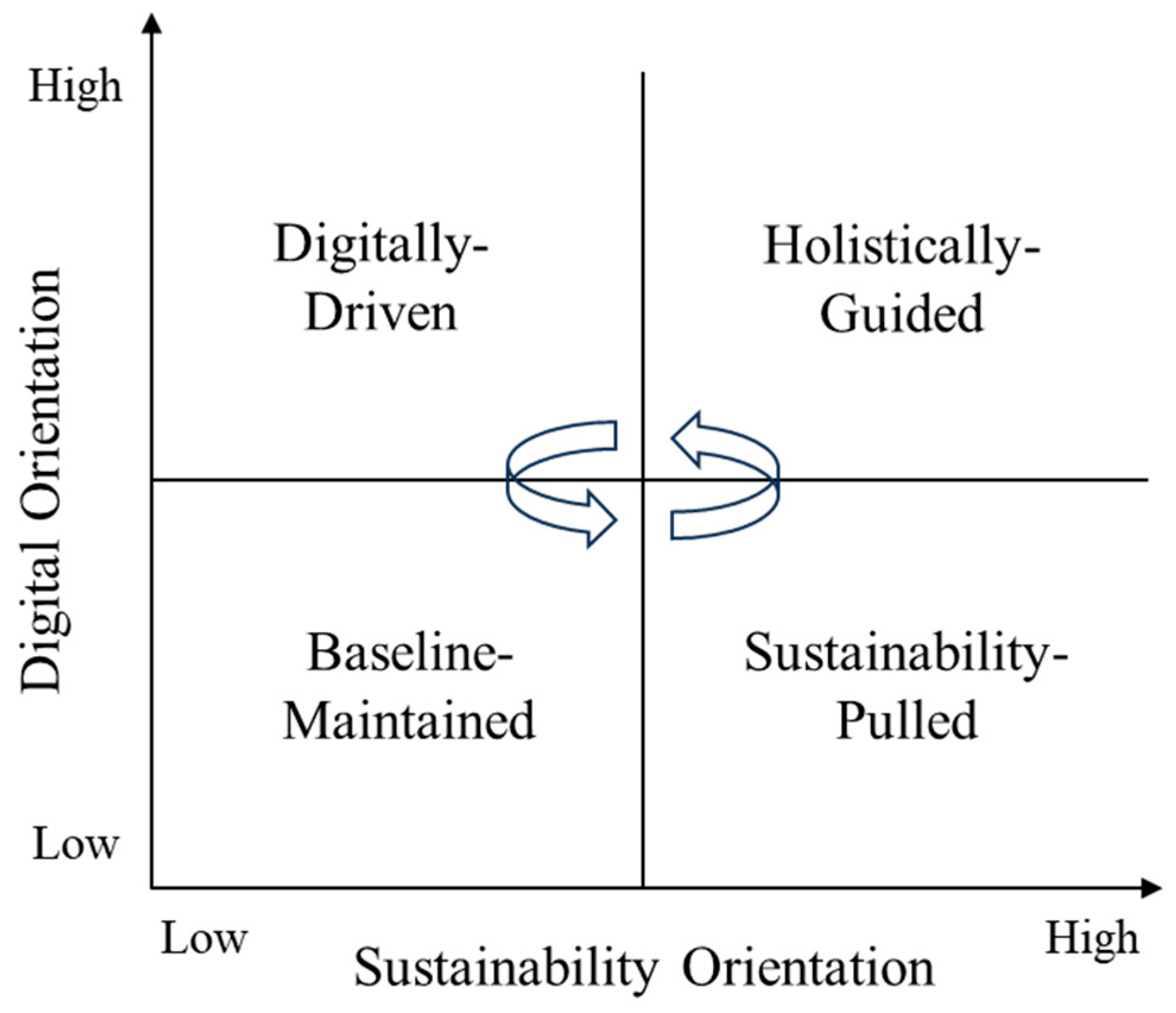
2.1. Digital Sustainability Orientation
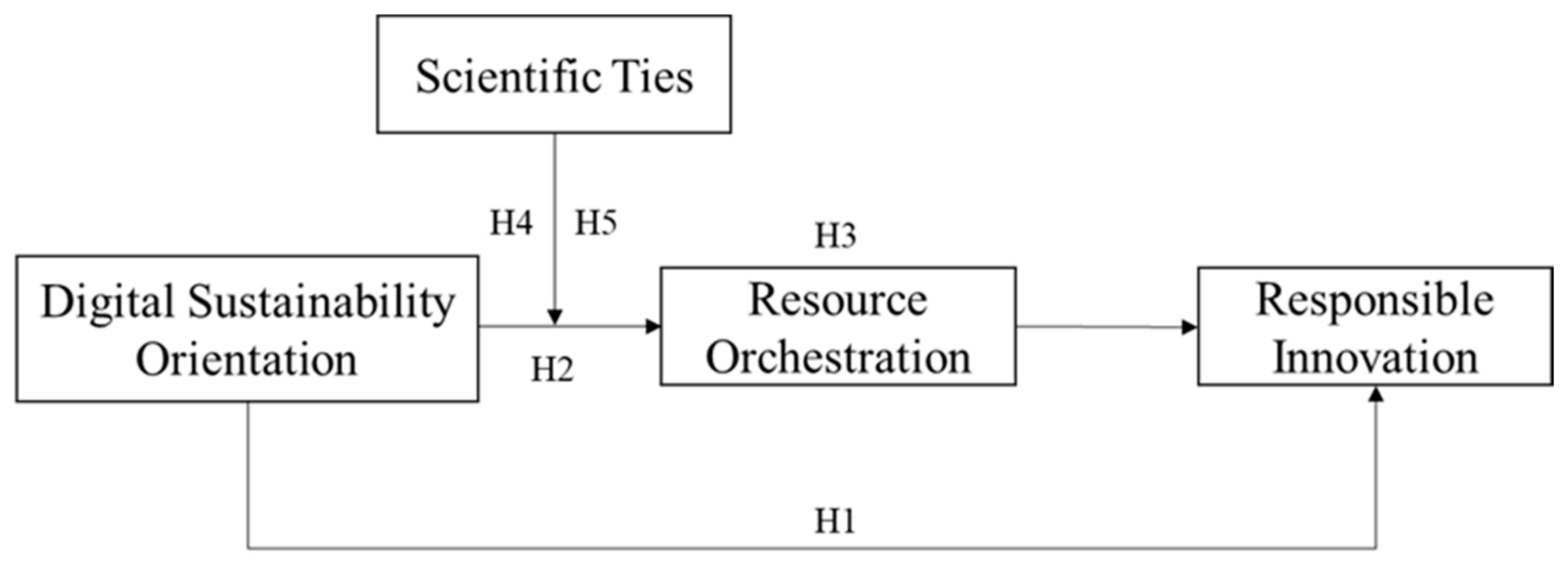
2.2. The Impact of Digital Sustainability Orientation on Responsible Innovation
2.3. The Mediating Role of Resource Orchestration
2.4. The Moderating Role of Scientific Ties
3. Research Design
3.1. Research Sample and Data Collection
3.2. Variable Measurement
4. Empirical Analysis
4.1. Common Method Bias Test
4.2. Confirmatory Factor Analysis
4.3. Descriptive Statistics and Correlation Analysis
4.4. Cluster Analysis
4.5. Hypothesis Testing
4.5.1. Direct Effect Test
4.5.2. Mediation Effect Test
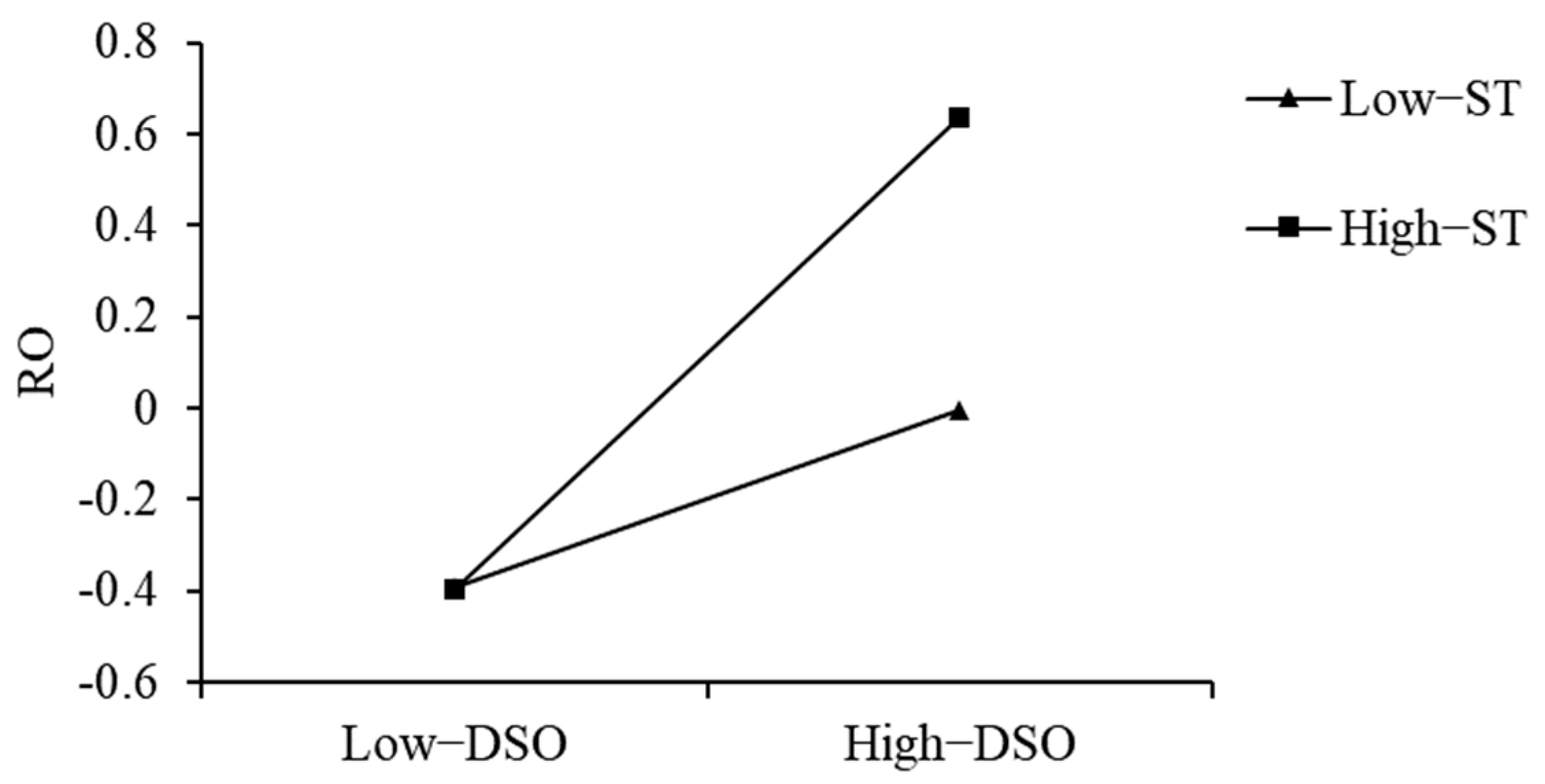
4.5.3. Moderation Effect Test
4.5.4. Test of Moderated Mediation Effect
4.6. Heterogeneity Test
5. Research Conclusions and Implications
5.1. Research Conclusions
5.2. Theoretical Contributions
5.3. Practical Implications
5.4. Limitations and Future Research Directions
Author Contributions
Funding
Data Availability Statement
Conflicts of Interest
References
- Owen, R.; Stilgoe, J.; Macnaghten, P.; Gorman, M.; Fisher, E.; Guston, D. A Framework for Responsible Innovation. In Responsible Innovation; Owen, R., Bessant, J., Heintz, M., Eds.; Wiley: Hoboken, NJ, USA, 2013; pp. 27–50. ISBN 978-1-119-96636-4. [Google Scholar]
- Mazzoni, L.; Sedita, S.R. Unpacking the Drivers of the Socio-Environmental Sustainability of New Ventures: Insights from Innovative Digital Start-Ups in Italy. Int. Entrep. Manag. J. 2025, 21, 16. [Google Scholar] [CrossRef]
- Voegtlin, C.; Scherer, A.G.; Stahl, G.K.; Hawn, O. Grand Societal Challenges and Responsible Innovation. J. Manag. Stud. 2022, 59, 1–28. [Google Scholar] [CrossRef]
- Chesbrough, H.W. Open Innovation: The New Imperative for Creating and Profiting from Technology; Harvard Business School Press: Boston, MA, USA, 2003. [Google Scholar]
- Stilgoe, J.; Owen, R.; Macnaghten, P. Developing a Framework for Responsible Innovation. Res. Policy 2013, 42, 1568–1580. [Google Scholar] [CrossRef]
- Owen, R.; Macnaghten, P.; Stilgoe, J. Responsible Research and Innovation: From Science in Society to Science for Society, with Society. Sci. Public Policy 2012, 39, 751–760. [Google Scholar] [CrossRef]
- Memon, K.R.; Ooi, S.K. Identifying Digital Leadership’s Role in Fostering Competitive Advantage through Responsible Innovation: A SEM-Neural Network Approach. Technol. Soc. 2023, 75, 102399. [Google Scholar] [CrossRef]
- Adomako, S.; Nguyen, N.P. Green Creativity, Responsible Innovation, and Product Innovation Performance: A Study of Entrepreneurial Firms in an Emerging Economy. Bus. Strategy Environ. 2023, 32, 4413–4425. [Google Scholar] [CrossRef]
- Guandalini, I. Sustainability through Digital Transformation: A Systematic Literature Review for Research Guidance. J. Bus. Res. 2022, 148, 456–471. [Google Scholar] [CrossRef]
- Zhu, Y.; Li, C. Research on the Impact of Digital and Green Transformation on Corporate Sustainability Performance from a Synergistic Perspective. Systems 2025, 13, 820. [Google Scholar] [CrossRef]
- George, G.; Merrill, R.K.; Schillebeeckx, S.J.D. Digital Sustainability and Entrepreneurship: How Digital Innovations Are Helping Tackle Climate Change and Sustainable Development. Entrep. Theory Pract. 2021, 45, 999–1027. [Google Scholar] [CrossRef]
- Ologeanu-Taddei, R.; Hönigsberg, S.; Weritz, P.; Wache, H.; Mittermeier, F.; Tana, S.; Dang, D.; Hautala-Kankaanpää, T.; Pekkola, S. The Relationship of Digital Transformation and Corporate Sustainability: Synergies and Tensions. Technol. Forecast. Soc. Chang. 2025, 210, 123809. [Google Scholar] [CrossRef]
- Chen, D.; Wang, J.; Li, B.; Luo, H.; Hou, G. The Impact of Digital–Green Synergy on Total Factor Productivity: Evidence from Chinese Listed Companies. Sustainability 2025, 17, 2200. [Google Scholar] [CrossRef]
- Palmié, M.; Aebersold, A.; Oghazi, P.; Pashkevich, N.; Gassmann, O. Digital-sustainable Business Models: Definition, Systematic Literature Review, Integrative Framework and Research Agenda from a Strategic Management Perspective. Int. J. Manag. Rev. 2024, 27, 346–374. [Google Scholar] [CrossRef]
- Gregori, P.; Holzmann, P. Digital Sustainable Entrepreneurship: A Business Model Perspective on Embedding Digital Technologies for Social and Environmental Value Creation. J. Clean. Prod. 2020, 272, 122817. [Google Scholar] [CrossRef]
- Wang, Y.; Yu, Y.; Khan, A. Digital Sustainability: Dimension Exploration and Scale Development. Acta Psychol. 2025, 256, 105028. [Google Scholar] [CrossRef] [PubMed]
- Xu, G.; Zhang, J.; Wang, S. How Digitalization and Sustainability Promote Digital Green Innovation for Industry 5.0 Through Capability Reconfiguration: Strategically Oriented Insights. Systems 2024, 12, 341. [Google Scholar] [CrossRef]
- Falcke, L.; Zobel, A.-K.; Yoo, Y.; Tucci, C. Digital Sustainability Strategies: Digitally Enabled and Digital-First Innovation for Net Zero. Acad. Manag. Perspect. 2024, 38, 415–436. [Google Scholar] [CrossRef]
- Wu, G.; Zeng, Z.; Yang, D.; Wang, H.; Niu, X. Does Regional Integration Enhance Green Development Efficiency? Evidence from the Yangtze River Delta Region in China. Systems 2025, 13, 904. [Google Scholar] [CrossRef]
- Grabski-Walls, T.; Ambos, T.C. The Choices We Collectively Make: Orchestrating Hybridity to Tackle Grand Challenges. J. Manag. Stud. 2024, 62, 2329–2357. [Google Scholar] [CrossRef]
- Sirmon, D.G.; Hitt, M.A.; Ireland, R.D. Managing Firm Resources in Dynamic Environments to Create Value: Looking Inside the Black Box. Acad. Manag. Rev. 2007, 32, 273–292. [Google Scholar] [CrossRef]
- Civera, C.; Cortese, D.; Mosca, F.; Murdock, A. Paradoxes and Strategies in Social Enterprises’ Dual Logics Enactment: A csQCA between Italy and the United Kingdom. J. Bus. Res. 2020, 115, 334–347. [Google Scholar] [CrossRef]
- Lounsbury, M.; Glynn, M.A. Cultural Entrepreneurship: Stories, Legitimacy, and the Acquisition of Resources. Strateg. Manag. J. 2001, 22, 545–564. [Google Scholar] [CrossRef]
- Zhang, X.; Teng, X.; Le, Y.; Li, Y. Strategic Orientations and Responsible Innovation in SMEs: The Moderating Effects of Environmental Turbulence. Bus. Strategy Environ. 2023, 32, 2522–2539. [Google Scholar] [CrossRef]
- Adomako, S.; Tran, M.D. Environmental Collaboration, Responsible Innovation, and Firm Performance: The Moderating Role of Stakeholder Pressure. Bus. Strategy Environ. 2022, 31, 1695–1704. [Google Scholar] [CrossRef]
- Zhou, K.Z.; Wu, F. Technological Capability, Strategic Flexibility, and Product Innovation. Strateg. Manag. J. 2010, 31, 547–561. [Google Scholar] [CrossRef]
- Kun, D.; Chunyang, Z. Research on the Impact of Ties with Scientific Partners on the Growth of Technology-Based SMEs. Stud. Sci. Sci. 2024, 42, 2161–2171. [Google Scholar]
- Yang, Z.; Yun, C.; Ruoyu, L. Scientific Connection and Overcoming the “Dual Dilemma” for Emerging Technology Startups. Stud. Sci. Sci. 2025, 43, 823–833. [Google Scholar]
- Xie, X.; Wang, H. How Can Open Innovation Ecosystem Modes Push Product Innovation Forward? An fsQCA Analysis. J. Bus. Res. 2020, 108, 29–41. [Google Scholar] [CrossRef]
- Claudy, M.C.; Peterson, M.; Pagell, M. The Roles of Sustainability Orientation and Market Knowledge Competence in New Product Development Success. J. Prod. Innov. Manag. 2016, 33, 72–85. [Google Scholar] [CrossRef]
- Kindermann, B.; Beutel, S.; De Lomana, G.G.; Strese, S.; Bendig, D.; Brettel, M. Digital Orientation: Conceptualization and Operationalization of a New Strategic Orientation. Eur. Manag. J. 2021, 39, 645–657. [Google Scholar] [CrossRef]
- Ahmadova, G.; Delgado-Márquez, B.L.; Pedauga, L.E.; La Hiz, D.I.L.-d. Too Good to Be True: The Inverted U-Shaped Relationship between Home-Country Digitalization and Environmental Performance. Ecol. Econ. 2022, 196, 107393. [Google Scholar] [CrossRef]
- Hakala, H. Strategic Orientations in Management Literature: Three Approaches to Understanding the Interaction between Market, Technology, Entrepreneurial and Learning Orientations: Orientations in Management Literature. Int. J. Manag. Rev. 2011, 13, 199–217. [Google Scholar] [CrossRef]
- Cadogan, J.W. International Marketing, Strategic Orientations and Business Success: Reflections on the Path Ahead. Int. Mark. Rev. 2012, 29, 340–348. [Google Scholar] [CrossRef]
- Feroz, A.K.; Zo, H.; Eom, J.; Chiravuri, A. Identifying Organizations’ Dynamic Capabilities for Sustainable Digital Transformation: A Mixed Methods Study. Technol. Soc. 2023, 73, 102257. [Google Scholar] [CrossRef]
- Bansal, P. Evolving Sustainably: A Longitudinal Study of Corporate Sustainable Development. Strateg. Manag. J. 2005, 26, 197–218. [Google Scholar] [CrossRef]
- Galvani, S.; Carloni, E.; Bocconcelli, R.; Pagano, A. When Digitalization Meets Sustainability: Exploring Interactions Within a Manufacturing Firm. J. Bus. Ind. Mark. 2025, 40, 30–46. [Google Scholar] [CrossRef]
- Covucci, C.; Confetto, M.G.; Ključnikov, A.; Panait, M. Unrevealing the Nexus between Digital Sustainability and Corporate Digital Responsibility: A Dual-Track Systematic Literature Review towards a Framework of Corporate Digital Sustainability. Technol. Soc. 2024, 79, 102743. [Google Scholar] [CrossRef]
- Xie, Y.; Xia, Q.; Song, J.; Hu, S. Can Sustainability Orientation Make Firms More Resilient? Exploring the Role of Digital Business Model Innovation, Digital Orientation, and Environmental Dynamism. Sustain. Dev. 2025, 33, 364–378. [Google Scholar] [CrossRef]
- Gritsenko, D. Advancing UN Digital Cooperation: Lessons from Environmental Policy and Governance. World Dev. 2024, 173, 106392. [Google Scholar] [CrossRef]
- Von Schomberg, R. Towards Responsible Research and Innovation in the Information and Communication Technologies and Security Technologies Fields; EU Publications: Luxembourg, 2011. [Google Scholar]
- Owen, R.; Bessant, J.; Heintz, M. (Eds.) Responsible Innovation: Managing the Responsible Emergence of Science and Innovation in Society; John Wiley & Sons: West Sussex, UK, 2013. [Google Scholar]
- De Saille, S. Innovating Innovation Policy: The Emergence of ‘Responsible Research and Innovation’. J. Responsible Innov. 2015, 2, 152–168. [Google Scholar] [CrossRef]
- Torrent-Sellens, J.; Enache-Zegheru, M.; Ficapal-Cusí, P. Promoting the European Sustainable Firm: How Economic, Social, and Green Innovation and the AI-Based Technologies Create Pathways of Social and Environmental Sustainability. Bus. Strategy Environ. 2025, 34, 9093–9119. [Google Scholar] [CrossRef]
- Khizar, H.M.U.; Iqbal, M.J.; Rasheed, M.I. Business Orientation and Sustainable Development: A Systematic Review of Sustainability Orientation Literature and Future Research Avenues. Sustain. Dev. 2021, 29, 1001–1017. [Google Scholar] [CrossRef]
- Wang, J.; Xue, Y.; Yang, J. Boundary-spanning Search and Firms’ Green Innovation: The Moderating Role of Resource Orchestration Capability. Bus. Strategy Environ. 2020, 29, 361–374. [Google Scholar] [CrossRef]
- Centobelli, P.; Cerchione, R.; Vecchio, P.D.; Oropallo, E.; Secundo, G. Blockchain Technology for Bridging Trust, Traceability and Transparency in Circular Supply Chain. Inf. Manag. 2022, 59, 103508. [Google Scholar] [CrossRef]
- Sirmon, D.G.; Hitt, M.A.; Ireland, R.D.; Gilbert, B.A. Resource Orchestration to Create Competitive Advantage: Breadth, Depth, and Life Cycle Effects. J. Manag. 2011, 37, 1390–1412. [Google Scholar] [CrossRef]
- Kristoffersen, E.; Mikalef, P.; Blomsma, F.; Li, J. The Effects of Business Analytics Capability on Circular Economy Implementation, Resource Orchestration Capability, and Firm Performance. Int. J. Prod. Econ. 2021, 239, 108205. [Google Scholar] [CrossRef]
- Li, F. The Digital Transformation of Business Models in the Creative Industries: A Holistic Framework and Emerging Trends. Technovation 2020, 92–93, 102012. [Google Scholar] [CrossRef]
- Pache, A.-C.; Battilana, J.; Spencer, C. An Integrative Model of Hybrid Governance: The Role of Boards in Helping Sustain Organizational Hybridity. Acad. Manag. J. 2024, 67, 437–467. [Google Scholar] [CrossRef]
- Miroshnychenko, I.; Strobl, A.; Matzler, K.; De Massis, A. Absorptive Capacity, Strategic Flexibility, and Business Model Innovation: Empirical Evidence from Italian SMEs. J. Bus. Res. 2021, 130, 670–682. [Google Scholar] [CrossRef]
- Xin, X.; Miao, X.; Cui, R. Enhancing Sustainable Development: Innovation Ecosystem Coopetition, Environmental Resource Orchestration, and Disruptive Green Innovation. Bus. Strategy Environ. 2023, 32, 1388–1402. [Google Scholar] [CrossRef]
- Chang, S.J.; Hong, J. Economic performance of group-affiliated companies in Korea: Intragroup-resource sharing and internal business transactions. Acad. Manag. J. 2000, 43, 429–448. [Google Scholar] [CrossRef]
- Li, H.; Liu, J.; Xia, B.; Hong, Y. Surfing With the Tides: How Does Dual Strategic Orientation Enhance Organizational Resilience Through Resource Orchestration? A Moderated Mediation Model. IEEE Trans. Eng. Manag. 2025, 72, 252–266. [Google Scholar] [CrossRef]
- Mehrizi, M.H.R.; Lashkarbolouki, M. Unlearning Troubled Business Models: From Realization to Marginalization. Long Range Plan. 2016, 49, 298–323. [Google Scholar] [CrossRef]
- Mao, H.; Liu, S.; Gong, Y. Balancing Structural IT Capabilities for Organizational Agility in Digital Transformation: A Resource Orchestration View. Int. J. Oper. Prod. Manag. 2024, 44, 315–344. [Google Scholar] [CrossRef]
- Guo, R.; Cai, L.; Zhang, W. Effectuation and Causation in New Internet Venture Growth: The Mediating Effect of Resource Bundling Strategy. Internet Res. 2016, 26, 460–483. [Google Scholar] [CrossRef]
- Zhu, X.; Dong, M.C.; Gu, J.; Dou, W. How Do Informal Ties Drive Open Innovation? The Contingency Role of Market Dynamism. IEEE Trans. Eng. Manag. 2017, 64, 208–219. [Google Scholar] [CrossRef]
- Zhou, J.; Wu, R.; Li, J. More Ties the Merrier? Different Social Ties and Firm Innovation Performance. Asia Pac. J. Manag. 2019, 36, 445–471. [Google Scholar] [CrossRef]
- Arias-Pérez, J.; Vélez-Jaramillo, J. Ignoring the Three-Way Interaction of Digital Orientation, Not-Invented-Here Syndrome and Employee’s Artificial Intelligence Awareness in Digital Innovation Performance: A Recipe for Failure. Technol. Forecast. Soc. Chang. 2022, 174, 121305. [Google Scholar] [CrossRef]
- Muñoz, P.; Dimov, D. The Call of the Whole in Understanding the Development of Sustainable Ventures. J. Bus. Ventur. 2015, 30, 632–654. [Google Scholar] [CrossRef]
- Lin, R.; Lu, Y.; Zhou, C.; Li, B. Rethinking Individual Technological Innovation: Cooperation Network Stability and the Contingent Effect of Knowledge Network Attributes. J. Bus. Res. 2022, 144, 366–376. [Google Scholar] [CrossRef]
- Reijonen, H.; Laukkanen, T.; Komppula, R.; Tuominen, S. Are Growing SMEs More Market-Oriented and Brand-Oriented? J. Small Bus. Manag. 2012, 50, 699–716. [Google Scholar] [CrossRef]
- Jain, A.K. Data Clustering: 50 Years beyond K-Means. Pattern Recognit. Lett. 2010, 31, 651–666. [Google Scholar] [CrossRef]
- Anees-ur-Rehman, M.; Saraniemi, S.; Ulkuniemi, P.; Hurmelinna-laukkanen, P. The Strategic Hybrid Orientation and Brand Performance of B2B SMEs. J. Small Bus. Enterp. Dev. 2017, 24, 585–606. [Google Scholar] [CrossRef]
- Soobaroyen, T.; Ramdhony, D.; Rashid, A.; Gow, J. The Evolution and Determinants of Corporate Social Responsibility (CSR) Disclosure in a Developing Country: Extent and Quality. J. Account. Emerg. Econ. 2023, 13, 300–330. [Google Scholar] [CrossRef]
- Li, H.; Li, Z.; Zhu, P. Digital Platforms as Enablers of Circular Economy Practices: Insights from a Chinese Province? Technol. Soc. 2026, 84, 103075. [Google Scholar] [CrossRef]
- Zou, H.; Zhang, L.; Qi, G. How Institutional Pressures on Green Innovation Are Perceived by Firms? The Role of Board Social Ties. Bus. Strategy Dev. 2024, 7, e400. [Google Scholar] [CrossRef]



| Indicator | Category | Percentage (%) | Cumulative Percentage (%) |
|---|---|---|---|
| Enterprise Ownership Nature (NE) | State-owned enterprises | 19.16 | 19.16 |
| Private enterprises | 68.64 | 87.80 | |
| Foreign-funded enterprises | 3.83 | 91.63 | |
| Others | 8.37 | 100.00 | |
| Enterprise Age (AGE) | 3 years or less | 4.88 | 4.88 |
| 3–5 years | 7.32 | 12.20 | |
| 6–10 years | 32.06 | 44.25 | |
| 11–15 years | 36.24 | 80.49 | |
| Over 15 years | 19.51 | 100.00 | |
| Enterprise Size (SIZE) | 10 employees or less | 3.83 | 3.83 |
| 11–50 employees | 9.41 | 13.24 | |
| 51–100 employees | 45.99 | 59.23 | |
| 101–500 employees | 32.06 | 91.29 | |
| Over 500 employees | 8.71 | 100.00 | |
| Enterprise Location (AER) | Eastern region (Beijing, Tianjin, Hebei, Shanghai, Jiangsu, Zhejiang, Fujian, Shandong, Guangdong, Hainan, and Liaoning) | 68.99 | 68.99 |
| Non-Eastern regions | 31.01 | 100.00 | |
| Industry Category (IND) | IT and Information | 21.60 | 21.60 |
| Biomedicine | 10.80 | 32.40 | |
| High-end equipment manufacturing | 13.59 | 45.99 | |
| New materials and New energy | 38.33 | 84.32 | |
| Energy saving and environmental protection | 6.97 | 91.29 | |
| Others | 8.71 | 100.00 |
| Variable | Specific Measurement Items | Factor Loading | Related Metrics |
|---|---|---|---|
| Digital Orientation (DO) | Our firm has a clear vision of how emerging digital technologies can enhance business value. | 0.731 | KMO: 0.901 Cronbach α: 0.920 CR: 0.923 AVE: 0.631 |
| Our firm is committed to using digital technologies to empower its business strategy. | 0.784 | ||
| Our firm’s management and various functional departments understand the investment value of digital technologies. | 0.802 | ||
| Our firm can keep pace with cutting-edge digital technologies. | 0.791 | ||
| Our firm has the capability and will to experiment with new digital technologies when necessary. | 0.730 | ||
| Our firm fosters an environment that supports experimenting with new digital technologies. | 0.832 | ||
| Our firm continuously seeks new methods to improve the effectiveness of digital technology application. | 0.880 | ||
| Sustainability Orientation (SO) | I believe our firm has the capability to help solve many of the problems our society faces. | 0.791 | KMO: 0.928 Cronbach α: 0.944 CR: 0.945 AVE: 0.743 |
| Our firm’s obligations to society extend beyond just making profits. | 0.895 | ||
| Our firm must give back to society because its profits come from society. | 0.870 | ||
| Regardless of the nature of our business, our firm must deal fairly with customers and suppliers. | 0.870 | ||
| Regardless of the nature of our business, our firm must use natural resources responsibly. | 0.843 | ||
| When choosing between different business concepts, our firm always selects the one that helps build a better society. | 0.898 | ||
| Resource Orchestration (RO) | Our firm is capable of absorbing diverse resources. | 0.834 | KMO: 0.732 Cronbach α: 0.852 CR: 0.853 AVE: 0.659 |
| Our firm is capable of integrating diverse resources. | 0.801 | ||
| Our firm is capable of leveraging diverse resources. | 0.800 | ||
| Science Ties (ST) | Our firm maintains sound collaborative relationships with multiple universities and scientists (experts and scholars). | 0.772 | KMO: 0.869 Cronbach α: 0.868 CR: 0.869 AVE: 0.570 |
| Our firm maintains sound collaborative relationships with multiple research institutions. | 0.785 | ||
| Our firm frequently conducts in-depth collaborations with universities, research institutions, and scientists on activities such as technological innovation/upgrading and new product development | 0.754 | ||
| Our firm frequently obtains cutting-edge knowledge and information about new technologies and products from universities, research institutions, and scientists. | 0.746 | ||
| Collaboration with universities, research institutions, and scientists generates significant value for our firm. | 0.717 | ||
| Responsible Innovation (RI) | Our firm involves diverse stakeholders in the early stages of innovation. | 0.835 | KMO: 0.858 Cronbach α: 0.922 CR: 0.923 AVE: 0.747 |
| In the initial phase of innovation activities, our firm conducts prospective analysis on their future impacts, thereby guiding them towards morally acceptable and socially desirable outcomes and ensuring controllable risks. | 0.873 | ||
| During the innovation process, our firm continuously reflects on the assumptions, requirements, objectives, implementation process, and outcomes of the innovation itself. | 0.858 | ||
| The actors and governance models in our firm’s innovation activities are established through interactive, sustainable, and adaptive processes, enabling proper guidance and real-time correction of the innovation process. | 0.894 |
| Model | Factor Combination | χ2/df | IFI | TLI | CFI | SRMR | RMSEA |
|---|---|---|---|---|---|---|---|
| Five-Factor | DO, SO, RO, ST, RI | 1.558 | 0.971 | 0.967 | 0.971 | 0.046 | 0.044 |
| Four-Factor | DO + SO, RO, ST, RI | 6.290 | 0.721 | 0.686 | 0.719 | 0.174 | 0.136 |
| Three-Factor | DO + SO, RO + ST, RI | 7.813 | 0.636 | 0.596 | 0.634 | 0.205 | 0.154 |
| Two-Factor | DO + SO + RO + ST, RI | 9.615 | 0.536 | 0.489 | 0.534 | 0.203 | 0.174 |
| Single-Factor | DO + SO + RO + ST + RI | 11.978 | 0.404 | 0.349 | 0.401 | 0.230 | 0.196 |
| Mean | SD | DO | SO | RO | ST | RI | |
|---|---|---|---|---|---|---|---|
| DO | 4.534 | 1.366 | 0.794 | ||||
| SO | 4.721 | 1.386 | 0.163 ** | 0.862 | |||
| RO | 5.578 | 1.029 | 0.357 *** | 0.365 *** | 0.812 | ||
| ST | 5.783 | 0.930 | 0.198 *** | 0.207 *** | 0.170 ** | 0.754 | |
| RI | 4.601 | 1.230 | 0.348 *** | 0.560 *** | 0.512 *** | 0.274 *** | 0.864 |
| Dimension | Low DO-Low SO Cluster (n = 50) | High DO-Low SO Cluster (n = 70) | Low DO-High SO Cluster (n = 73) | High DO-High SO Cluster (n = 94) |
|---|---|---|---|---|
| DO | 2.811 | 5.376 | 3.456 | 5.660 |
| SO | 3.333 | 3.371 | 5.580 | 5.798 |
| Variable | RI | RO | |||||
|---|---|---|---|---|---|---|---|
| M1 | M2 | M3 | M4 | M5 | M6 | M7 | |
| Constant | 0.002 | 0.112 | 0.051 | 0.080 | 0.159 | 0.212 | 0.137 |
| (0.006) | (0.370) | (0.183) | (0.232) | (0.490) | (0.654) | (0.426) | |
| NE | 0.401 ** | 0.118 | 0.023 | 0.450 ** | 0.246 | 0.218 | 0.188 |
| (2.664) | (0.869) | (0.188) | (2.980) | (1.689) | (1.493) | (1.300) | |
| AGE | −0.095 | −0.061 | −0.056 | −0.038 | −0.013 | −0.021 | −0.030 |
| (−1.497) | (−1.091) | (−1.096) | (−0.592) | (−0.220) | (−0.346) | (−0.509) | |
| SIZE | −0.022 | 0.023 | 0.029 | −0.050 | −0.018 | −0.016 | −0.006 |
| (−0.303) | (0.353) | (0.506) | (−0.689) | (−0.263) | (−0.239) | (−0.084) | |
| AER | 0.036 | 0.138 | −0.002 | 0.290 * | 0.364 ** | 0.374 ** | 0.386 ** |
| (0.277) | (1.217) | (−0.016) | (2.247) | (2.984) | (3.077) | (3.222) | |
| IND | Control | Control | Control | Control | Control | Control | Control |
| DSO | 0.510 *** | 0.369 *** | 0.367 *** | 0.347 *** | 0.355 *** | ||
| (9.132) | (6.791) | (6.122) | (5.710) | (5.934) | |||
| ST | 0.104 | 0.159 ** | |||||
| (1.789) | (2.654) | ||||||
| DSO × ST | 0.178 ** | ||||||
| (3.083) | |||||||
| RO | 0.385 *** | ||||||
| (7.519) | |||||||
| R2 | 0.059 | 0.278 | 0.401 | 0.055 | 0.168 | 0.178 | 0.205 |
| adjR2 | 0.278 | 0.251 | 0.377 | 0.024 | 0.138 | 0.145 | 0.170 |
| F | 1.943 * | 10.608 *** | 16.723 *** | 1.797 | 5.579 *** | 5.403 *** | 5.898 *** |
| Mediator | Moderator | Indirect Effect | SE | 95%CI | |
|---|---|---|---|---|---|
| LL | UL | ||||
| RO | Low ST | 0.075 | 0.031 | 0.019 | 0.137 |
| Medium ST | 0.137 | 0.034 | 0.077 | 0.207 | |
| High ST | 0.199 | 0.047 | 0.116 | 0.298 | |
| Low DO-Low SO (n = 50) | High DO-Low SO (n = 70) | Low DO-High SO (n = 73) | High DO-High SO (n = 94) | |
|---|---|---|---|---|
| Mean | 3.515 | 4.114 | 4.846 | 5.351 |
| SD | 1.097 | 1.138 | 0.989 | 0.933 |
| (I) Group | (J) Group | Mean Difference (I-J) | Std. Error | Sig. | 95% Confidence Interval | |
|---|---|---|---|---|---|---|
| Lower | Upper | |||||
| Low DO-Low SO | Low DO-High SO | −1.331 *** | 0.189 | 0.000 | −1.703 | −0.959 |
| High DO-High SO | −1.836 *** | 0.180 | 0.000 | −2.191 | −1.482 | |
| High DO-Low SO | −0.599 ** | 0.191 | 0.002 | −0.974 | −0.224 | |
| High DO-Low SO | Low DO-High SO | −0.732 *** | 0.172 | 0.000 | −1.070 | −0.393 |
| High DO-High SO | −1.237 *** | 0.162 | 0.000 | −1.557 | −0.917 | |
| Low DO-Low SO | 0.599 ** | 0.191 | 0.002 | 0.224 | 0.974 | |
| Low DO-High SO | High DO-High SO | −0.505 ** | 0.161 | 0.002 | −0.821 | −0.189 |
| Low DO-Low SO | 1.331 *** | 0.189 | 0.000 | 0.959 | 1.703 | |
| High DO-Low SO | 0.732 *** | 0.172 | 0.000 | 0.393 | 1.070 | |
| High DO-High SO | Low DO-High SO | 0.505 ** | 0.161 | 0.002 | 0.189 | 0.821 |
| Low DO-Low SO | 1.836 *** | 0.180 | 0.000 | 1.482 | 2.191 | |
| High DO-Low SO | 1.237 *** | 0.162 | 0.000 | 0.917 | 1.557 | |
Disclaimer/Publisher’s Note: The statements, opinions and data contained in all publications are solely those of the individual author(s) and contributor(s) and not of MDPI and/or the editor(s). MDPI and/or the editor(s) disclaim responsibility for any injury to people or property resulting from any ideas, methods, instructions or products referred to in the content. |
© 2026 by the authors. Licensee MDPI, Basel, Switzerland. This article is an open access article distributed under the terms and conditions of the Creative Commons Attribution (CC BY) license.
Share and Cite
Li, B.; Guan, S.; Wang, J.; Hou, G. Digitalization and Sustainability Integration: The Impact of Digital Sustainability Orientation on Responsible Innovation in Emerging Technology Enterprises. Systems 2026, 14, 68. https://doi.org/10.3390/systems14010068
Li B, Guan S, Wang J, Hou G. Digitalization and Sustainability Integration: The Impact of Digital Sustainability Orientation on Responsible Innovation in Emerging Technology Enterprises. Systems. 2026; 14(1):68. https://doi.org/10.3390/systems14010068
Chicago/Turabian StyleLi, Bin, Shanshan Guan, Junpeng Wang, and Guangming Hou. 2026. "Digitalization and Sustainability Integration: The Impact of Digital Sustainability Orientation on Responsible Innovation in Emerging Technology Enterprises" Systems 14, no. 1: 68. https://doi.org/10.3390/systems14010068
APA StyleLi, B., Guan, S., Wang, J., & Hou, G. (2026). Digitalization and Sustainability Integration: The Impact of Digital Sustainability Orientation on Responsible Innovation in Emerging Technology Enterprises. Systems, 14(1), 68. https://doi.org/10.3390/systems14010068