Abstract
To enhance the strength of the marine economy, safeguard marine rights and interests, and promote the sustainable development of marine resources, China is actively building an innovation ecosystem in the marine engineering equipment manufacturing industry. Currently, the main challenge facing China’s marine engineering equipment manufacturing industry innovation ecosystem is a lack of driving forces. Therefore, this paper focuses on the driving mechanism of China’s marine engineering equipment manufacturing industry innovation ecosystem. Through a literature-coding analysis and interpretive structural modeling (ISM), 17 driving factors of the innovation ecosystem in China’s marine engineering equipment manufacturing industry were identified, and an analytical model was constructed to explore the relationships among these driving factors. Combining data from industry experts, the paper reveals the driving mechanism of China’s marine engineering equipment manufacturing industry innovation ecosystem. The results show that the management level, the risk-resilience capability of marine engineering equipment manufacturing enterprises, and the guidance capacity of universities and research institutions are key driving factors of the innovation ecosystem in China’s marine engineering equipment manufacturing industry. Strengthening these driving factors can enhance the system’s overall driving force, contributing to the high-quality development of China’s marine engineering equipment manufacturing industry. The significance of this study lies in providing a theoretical basis for optimizing the allocation of driving factors in China’s marine engineering equipment manufacturing industry innovation ecosystem and offering important pathways for innovation in and the development of the global marine engineering equipment manufacturing industry.
1. Introduction
Since 2016, China’s production and transaction volumes of marine engineering equipment have remained the largest in the world, marking China as a significant player in global marine engineering equipment manufacturing [1]. Despite the remarkable achievements, it still faces several challenges. First, the advanced technologies in the global marine engineering equipment market are primarily controlled by developed countries [2]. As a result, Chinese companies are forced to import a large number of key core equipment, such as engines and DP systems. Second, the global marine engineering equipment industry chain is highly complex, with Chinese marine engineering equipment manufacturing enterprises generally positioned at the lower end of the global value chain [3,4]. As a result, they are unable to effectively capture high-added-value market shares and face significant risks of being locked into low-end markets. Third, China has made massive investments in the marine engineering equipment industry, but the industry as a whole faces the dilemma of being “large but not strong” [5]. These challenges will not only limit the further development of China’s marine engineering equipment manufacturing industry in global industrial competition but also impact the technological innovation process in the global market, resulting in a clear divergence in technological levels and market share within the global marine engineering equipment industry.
Vigorously promoting technological innovation in the marine engineering equipment manufacturing sector is key to enhancing the core competitiveness of the industry [6,7]. However, technological innovation in this field often comes with high investment, high risk, and long cycles, making it difficult for a single enterprise to shoulder this responsibility alone [8,9]. Especially against the backdrop of global competition and technological blockades facing the marine engineering equipment manufacturing industry, the complexity and high costs of innovation have further slowed the industry’s development, making it difficult to effectively stimulate innovation driving force [10]. In this regard, an increasing number of scholars suggest promoting the development of the marine engineering equipment manufacturing industry through multi-entity cooperation [11,12,13]. In this context, innovation ecosystems have emerged as a key means to drive continuous innovation in the industry [14]. Theoretically, an innovation ecosystem, through collaborative cooperation among different entities, can accelerate technological innovation and knowledge transfer, thereby achieving the goal of integrating various resources, improving innovation efficiency, and lowering innovation barriers [15,16]. Therefore, in the field of marine engineering equipment manufacturing, which heavily relies on technological innovation, the innovation ecosystem is expected to play a crucial role.
Currently, the construction of innovation ecosystems is widely recognized as an effective means to promote technological innovation. However, in practice, the advantages of the innovation ecosystem in China’s marine engineering equipment manufacturing industry have not been fully realized [17]. The reason for this is the insufficient internal driving force within the innovation ecosystem of the marine engineering equipment manufacturing industry [18]. Specifically, the innovation resources within the innovation ecosystem have not been efficiently allocated, leading to a lack of effective interaction and communication among innovation entities [19,20]. As a result, the synergy among multiple entities and the mobility of innovation resources are relatively low, and the conversion and application of innovation achievements are restricted [20,21]. In light of this, it is particularly urgent to study and optimize the driving mechanism of the innovation ecosystem in the marine engineering equipment manufacturing industry.
To address the above issues, the Chinese government has made significant efforts to promote innovation in the marine engineering equipment manufacturing industry [22]. Specifically, the Chinese government has actively promoted technological innovation and narrowed the technological gap with developed countries by implementing a series of policies such as “Made in China 2025” and the “14th Five-Year Plan”, while striving to achieve independent and controllable key core technologies [23,24,25]. Furthermore, the Chinese government has increased investment in basic research and original innovation and established several national-level laboratories and engineering research centers aimed at solving major technological problems and supporting the leapfrog development of the marine engineering equipment manufacturing industry [26,27,28]. Despite continuous policy and financial support, the overall innovation driving force in China’s marine engineering equipment manufacturing industry has not yet been fully stimulated. According to data released by the Chinese Shipbuilding Industry Association, the downward trend in indicators such as the industrial output, export value, and main business revenue of marine engineering equipment manufacturing enterprises has slowed, but the unfavorable situation has not been reversed. This indicates that the efforts of the Chinese government have not yielded substantial results, and the issue of an insufficient driving force within the marine engineering equipment manufacturing industry innovation ecosystem has not been eradicated. Therefore, it is essential to study the driving mechanism of China’s marine engineering equipment manufacturing industry innovation ecosystem.
Currently, there is no research on the innovation of the marine engineering equipment manufacturing industry from the perspective of the ecosystem. This paper fills the gap in this research area by focusing on the driving mechanism of China’s marine engineering equipment manufacturing industry innovation ecosystem, systematically analyzing the interactions among the driving factors within the innovation ecosystem. The aim is to provide a theoretical basis for policy optimization and industrial upgrading. Through a literature-coding analysis method, the driving factors of China’s marine engineering equipment manufacturing innovation ecosystem are identified. Using the interpretive structural modeling (ISM) method, a model for analyzing the relationships among these driving factors is constructed, revealing the driving mechanism of the innovation ecosystem in this industry. This study provides a new perspective on innovation in the marine engineering equipment manufacturing industry, expanding the application boundaries of innovation ecosystem theory. At the same time, the study findings offer valuable insights for other developing economies and contribute to promoting global innovation cooperation and technological progress in the marine engineering equipment manufacturing industry.
2. Theoretical Background
2.1. Marine Engineering Equipment Manufacturing Industry Innovation Ecosystem
The concept of a marine engineering equipment manufacturing industry innovation ecosystem originates from the integration of the concepts of the marine engineering equipment manufacturing industry and an innovation ecosystem [29]. Specifically, the industry refers to the design, processing, and construction of large engineering equipment and auxiliary equipment used for marine resource exploration, extraction, processing, storage, transportation, management, and logistics services. According to the internationally recognized classification method, the marine engineering equipment manufacturing industry is divided into three main categories: offshore oil and gas resource extraction equipment manufacturing, other marine resource extraction equipment manufacturing, and marine floating structure equipment manufacturing. The concept of an innovation ecosystem is derived from natural ecosystems [30]. From a macro-perspective, an innovation ecosystem refers to a social network within a specific geographical area or technological field, where various entities collectively drive innovation and economic development [31]. From a micro-perspective, it is a complex system formed by the collaborative and symbiotic relationships [32]. These relationships are characterized by the transmission of material flows, energy flows, and information flows among different entities, which interact with the external environment. Based on the above, the marine engineering equipment manufacturing industry innovation ecosystem can be seen as a dynamic network structure. It is composed of marine engineering equipment manufacturing enterprises, other entities, and the external environment.
The ecosystem, as a new perspective in the study of innovation in the marine engineering equipment manufacturing industry, has gradually gained attention in this field of research. This is because the study of the marine engineering equipment manufacturing industry innovation ecosystem is not limited to innovation within a single enterprise but rather emphasizes the interactions and collaboration among various entities (such as enterprises, governments, research institutions, etc.). This perspective emphasizes the importance of the aggregation and integration of innovation resources as well as the symbiotic relationships among multiple entities in driving technological and product innovation [33]. By establishing a dynamic innovation ecosystem, the marine engineering equipment manufacturing industry can better cope with complex challenges, promoting technological advancement and industrial upgrading. Furthermore, the innovation ecosystem can drive the sustainable development of the industry through continuous interaction with external factors, such as market demand and policy frameworks, while also supporting the stable output of innovation results [34]. Studying the marine engineering equipment manufacturing industry innovation ecosystem deepens the understanding of its innovation mechanisms, providing theoretical support for policymakers, industry participants, and the academic community while fostering a better development environment for the marine equipment manufacturing sector. On this basis, further exploration of the driving mechanism of the marine engineering equipment manufacturing industry innovation ecosystem is not only of significant theoretical value but also has profound practical implications for promoting industry innovation and enhancing the competitiveness of the industry.
2.2. Driving Mechanism of Innovation Ecosystem in Marine Engineering Equipment Manufacturing Industry

The driving force of the innovation ecosystem in the marine engineering equipment manufacturing industry refers to the forces that propel the operation of the innovation ecosystem [35]. These forces are essential for achieving high-quality development in the industry. The driving factors of the innovation ecosystem refer to the conditions that promote the system’s operation [36]. These factors arise from both the internal entities of the innovation ecosystem and the external environment. The driving mechanism of the innovation ecosystem refers to the interactive effects among various driving factors [37]. These interactions promote changes in the behavior of entities within the innovation ecosystem, leading to technological innovation in the marine engineering equipment manufacturing industry. These three elements are interrelated: the driving force of the innovation ecosystem in the marine engineering equipment manufacturing industry is the result of the interaction of multiple driving factors, and the driving mechanism of the innovation ecosystem in the marine engineering equipment manufacturing industry reveals the patterns of interaction among these driving factors and their role in driving the system operation.
There are two main theoretical approaches to studying the driving mechanism of the marine engineering equipment manufacturing industry innovation ecosystem. One approach starts from the driving force of innovation ecosystem, exploring the modes of action of the innovation ecosystem’s driving mechanism; the other starts from driving factors, revealing the formation logic of the innovation ecosystem’s driving mechanism. Since the driving force of the marine engineering equipment manufacturing industry innovation ecosystem results from the combined action of multiple factors, directly studying the driving force itself cannot reveal the inherent laws and processes of its generation and functioning. In contrast, analyzing from the perspective of driving factors can systematically reveal the sources, attributes, modes of action, and interaction patterns of the driving force, providing scientific support for optimizing the configuration of driving factors and improving the system efficiency. Therefore, studying the driving mechanism essentially involves exploring the driving factors and their interrelationships in depth.
Some studies have explored how individual driving factors within the marine engineering equipment manufacturing industry innovation ecosystem promote the system’s operation. For example, based on the innovation spiral theory, technological innovation and market demand are considered key driving factors [38]; from the perspective of industrial internationalization, the internationalization of products and enterprises, the support for industrial internationalization, and the conditions for the internationalization of technological innovation are seen as important driving factors [39]; and from the perspective of the cultivation of high-end elements and the construction of collaborative mechanisms, factors such as marine higher education, R&D investment, and talent development are considered important drivers of the innovation ecosystem [40]. These studies suggest that identifying and analyzing the driving factors and their interrelationships can effectively promote the operation and high-quality development of the innovation ecosystem. Therefore, it can be inferred that clarifying the relationships between the various driving factors is key to revealing the dynamic mechanism of the innovation ecosystem in the offshore equipment manufacturing industry.
3. Materials and Methods
3.1. Identification of Driving Factors Based on Literature-Coding Analysis
3.1.1. Data Sources
Research on the innovation ecosystem of China’s marine engineering equipment manufacturing industry typically focuses on specific perspectives, which makes it difficult for a single study to identify all the driving factors comprehensively. This indirectly leads to a gap in systematically analyzing the relationships among these driving factors in the academic field. To address this deficiency, this paper introduced the literature-coding analysis method, which is based on the coding and refinement principles of grounded theory [41,42], using studies related to the driving factors of innovation ecosystem in China’s marine engineering equipment manufacturing industry as samples to identify the driving factors. Compared to methods such as surveys, interviews, and case studies, it offers higher objectivity and comprehensiveness [43]. In addition, this method consolidates a large amount of relevant research and integrates perspectives from different research viewpoints and field experts, thereby compensating for the limitations of a single research perspective and ensuring that no key driving factors are overlooked in the identification process [44]. Therefore, the literature-coding analysis method was suitable for comprehensively identifying the driving factors of innovation ecosystem in China’s marine engineering equipment manufacturing industry.
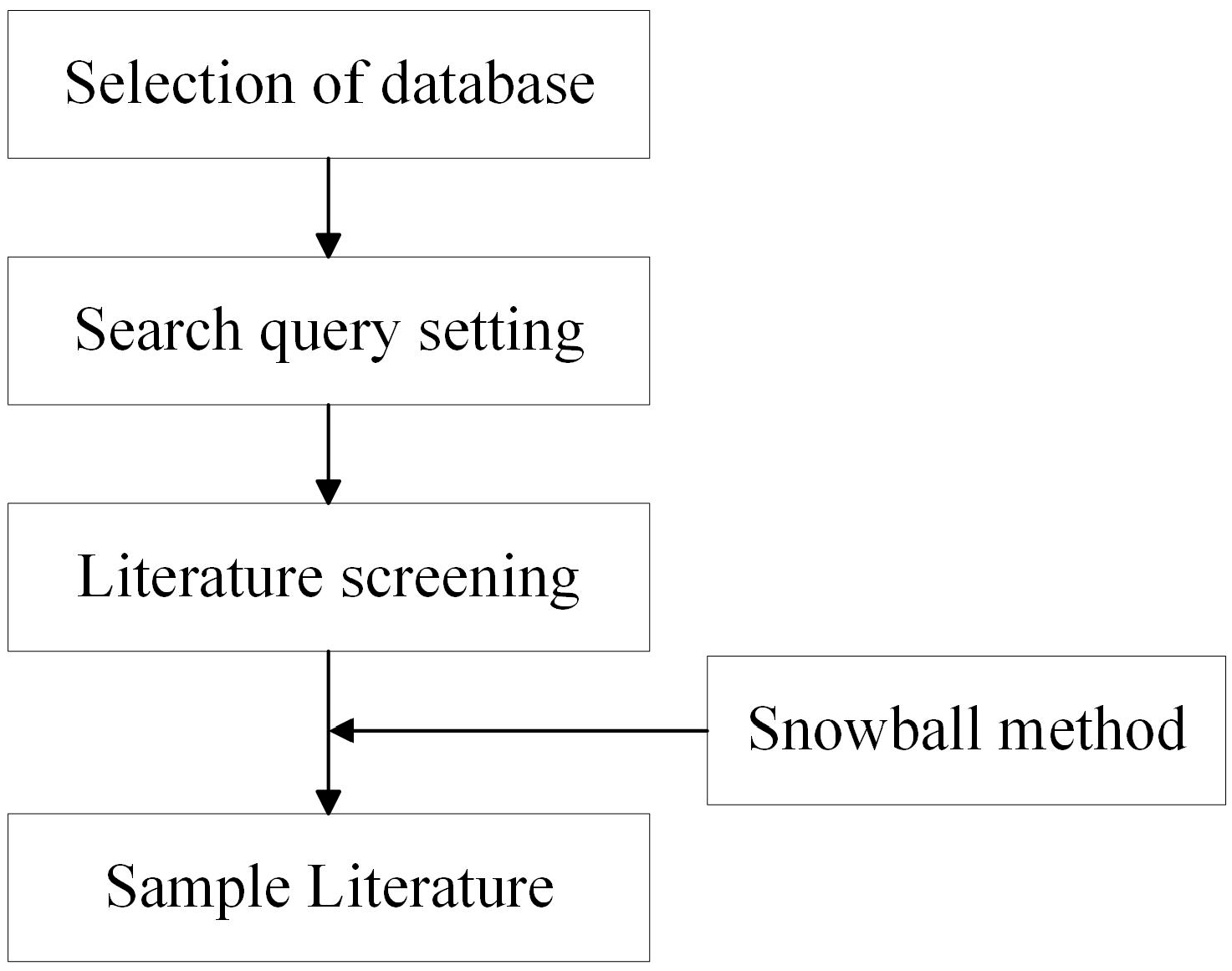
In this paper, CNKI (China National Knowledge Infrastructure) was chosen as the literature database. On one hand, this choice is based on the fact that the research subject is innovation ecosystem of China’s marine engineering equipment manufacturing industry, which focuses on the system’s driving factors, while foreign literature on this field is relatively scarce. On the other hand, CNKI is the largest literature database in China, containing rich academic resources and the viewpoints of domain experts. Considering that technological innovation is the focus of China’s marine engineering equipment manufacturing industry, the retrieval formula was set as FT = ‘marine engineering equipment manufacturing industry’ AND FT = ‘technological innovation’. The retrieval deadline was set for 2024; the literature type was set to journal, with the source from CSSCI, CSCD, and core journals. Based on the above criteria, a preliminary search yielded 113 relevant articles. Based on this, we reviewed the abstracts and texts of the 113 articles, excluding those unrelated to the driving factors of China’s marine engineering equipment manufacturing industry innovation ecosystem. This left 39 relevant articles. The snowball method was then used, starting with these 39 papers, and by tracing their references and cited papers, additional papers closely related to the driving factors of the innovation ecosystem were identified until no new papers were found. Ultimately, 41 relevant papers were obtained, which formed the literature-coding sample for this study (Table A1). The data collection process is shown in Figure 1.
Figure 1.
The process of sample literature collection.
3.1.2. Process of Identifying Driving Factors
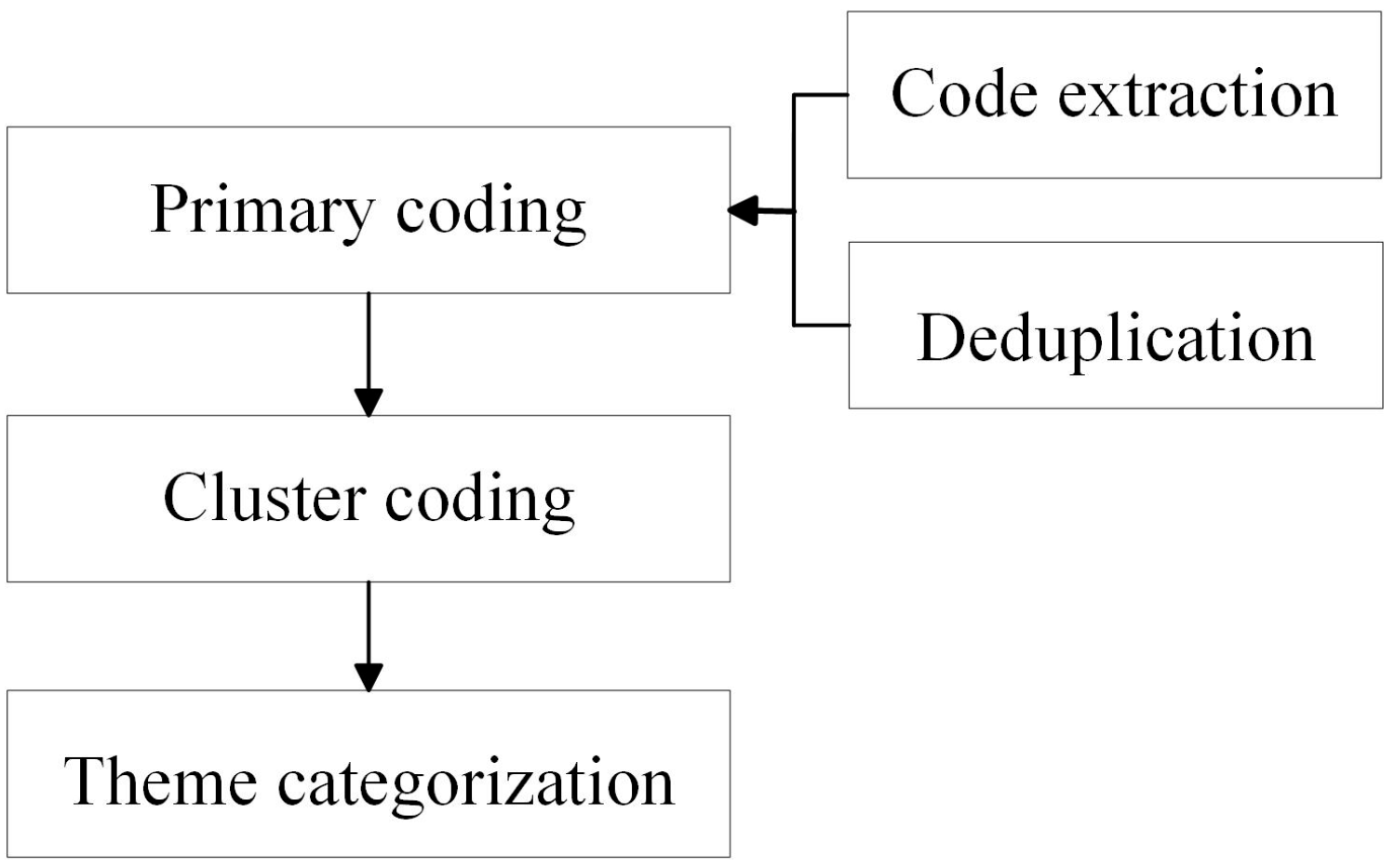
This paper used literature-coding analysis to perform hierarchical coding on the sample literature. Additionally, the sample literature was randomly ordered. Information such as the author, publication time, and source was then organized for easy retrieval and verification. The specific steps for identifying the driving factors of China’s marine engineering equipment manufacturing industry innovation ecosystem are as follows (Figure 2):
Figure 2.
The process of identifying driving factors.
Step 1: The sample literature was carefully read, and we performed primary coding for the driving factors of China’s marine engineering equipment manufacturing industry innovation ecosystem mentioned in the literature. Specifically, for empirical research papers, core driving factors affecting the operation of the innovation ecosystem were extracted and coded; for theoretical research papers, driving factors affecting the operation of the innovation ecosystem were extracted from the research hypotheses and conclusions and coded. To fully express the original meaning of the literature, primary coding used the phrases or words from the literature. Using this method, 256 primary codes were obtained. Then, similar or related codes were merged and unified, resulting in 96 primary codes.
Step 2: The primary codes were categorize based on their meanings and affiliations. For codes with unclear meanings and affiliations, the original text was traced, and combined with descriptions and explanations in the text, their meanings were clarified for judgment. After categorization, 17 clustered codes were formed, which are as follows: tangible assets of marine engineering equipment manufacturing enterprises, intangible assets of marine engineering equipment manufacturing enterprises, core competitiveness of marine engineering equipment manufacturing enterprises, management level of marine engineering equipment manufacturing enterprises, risk resilience ability of marine engineering equipment manufacturing enterprises, willingness of marine engineering equipment manufacturing enterprises to cooperate, technical support and service capabilities of supporting enterprises, guidance capability of universities and research institutions, government support and incentive measures, market demand and user feedback, financial institutions and intermediary service capabilities, willingness of partnering entities to cooperate, natural resource endowment, global economic situation, market competition level, government policy adjustments and revisions of laws and regulations, and multi-stakeholder collaborative innovation atmosphere.
Step 3: The supporting enterprises, universities, research institutions, government, users, financial institutions, and intermediaries were collectively referred to as other innovation entities. According to the differences in the sources of clustered codes, they can be divided into three themes: driving factors of marine engineering equipment manufacturing enterprises, driving factors of other innovation entities, and environmental driving factors.
3.2. Construction of the Driving Factor Relationship Analysis Model
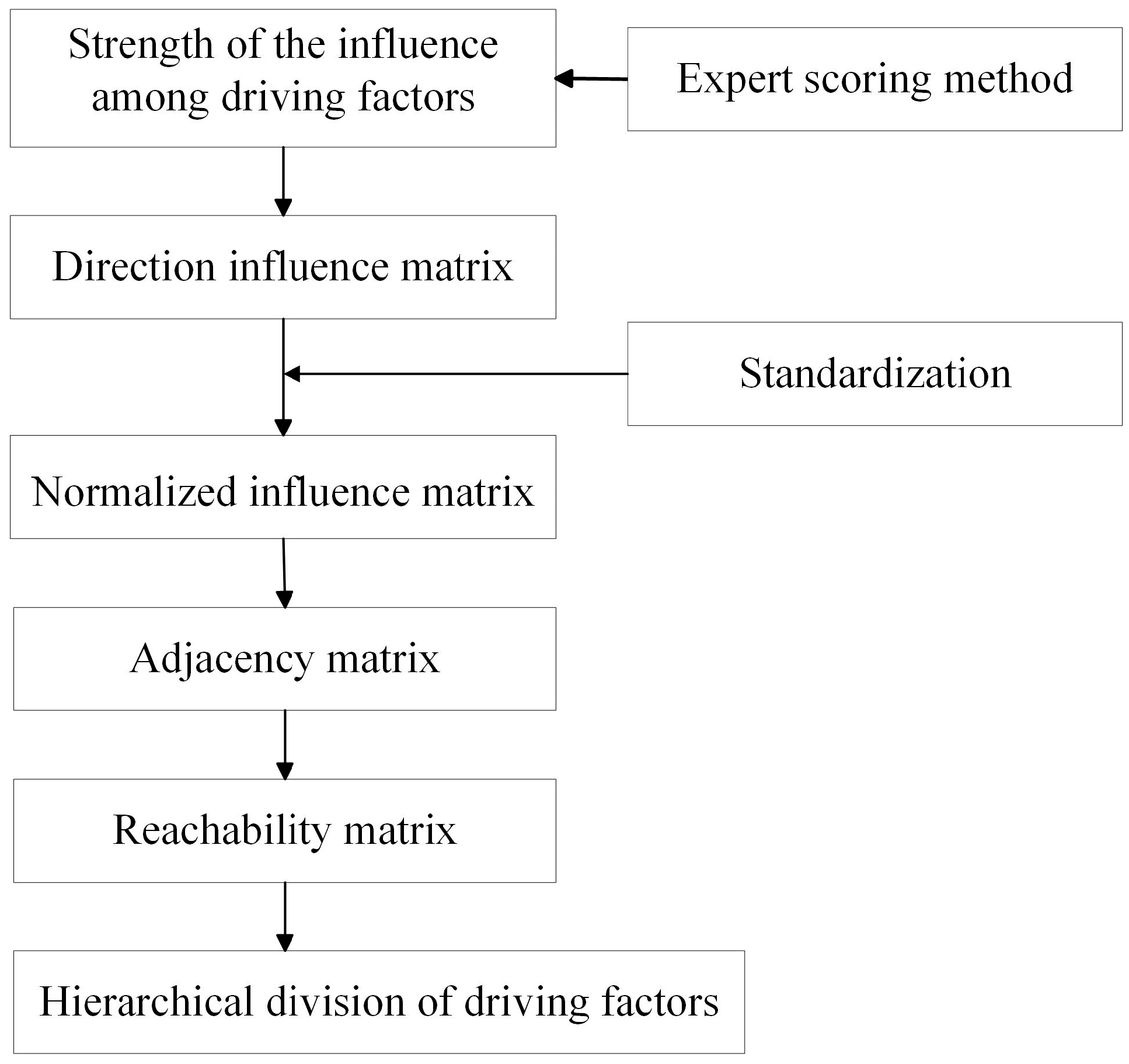
Based on the identified driving factors and combined with interpretive structural modeling (ISM) [45], an analysis model of the relationships among the driving factors of China’s marine engineering equipment manufacturing industry innovation ecosystem was constructed. The specific steps are as follows (Figure 3):
Figure 3.
The process of constructing a relationship analysis model for driving factors.
Step 1: Using the expert scoring method, determine the strength of influence among the driving factors of China’s marine engineering equipment manufacturing industry innovation ecosystem, and establish the direct influence matrix A:
Step 2: Solve the normalized direct influence matrix E:
Step 3: Introduce a threshold λ∈[0,1], simplify matrix E, and obtain the adjacency matrix G:
where uij represents the mean of matrix E and vij represents the standard deviation of matrix E.
Step 4: Solve for the reachability matrix H:
where I represents the identity matrix.
Step 5: Define the set of factors where the values in the row of matrix H corresponding to Fi are 1 as the reachable set Q(Fi) and the set of factors where the values in the column of matrix H corresponding to Fi are 1 as the predecessor set T(Fi). When T(Fi) = Q(Fi)∩T(Fi), Fi constitutes the first-level driving factor set L1. Delete the row and column corresponding to Fi, and iterate the above operations until the hierarchical division of driving factors in China’s marine engineering equipment manufacturing industry innovation ecosystem is complete.
4. Results
4.1. Identification of Driving Factors
This paper identifies seventeen driving factors in China’s marine engineering equipment manufacturing industry innovation ecosystem and classifies them into three dimensions, as shown in Table 1. The specific details are as follows:
Table 1.
Identification of driving factors by literature coding.
- Tangible assets of marine engineering equipment manufacturing enterprises (F1).
The tangible assets of marine engineering equipment manufacturing enterprises refer to physical assets used in the production, operation, and innovation of these enterprises. These assets include monetary funds, raw materials, inventory, land, buildings, and various equipment. Among them, monetary funds ensure that marine engineering equipment manufacturing enterprises can maintain normal production and operational status; raw materials and inventory help reduce the likelihood of production interruptions and delayed deliveries; land and buildings provide space and resources for constructing research and development laboratories, innovation centers, and technology incubators; and equipment offers excellent technical support and experimental conditions. Therefore, it can be seen that tangible assets can directly or indirectly stimulate the external cooperative behavior of marine engineering equipment manufacturing enterprises.
- 2.
- Intangible assets of marine engineering equipment manufacturing enterprises (F2).
The intangible assets of marine engineering equipment manufacturing enterprises refer to identifiable non-monetary assets that do not have a physical form but are owned or controlled by the enterprises. These include market assets, intellectual property assets, talent assets, and infrastructural assets. Market assets help reduce the risk of unsold new products; intellectual property assets increase the sales profit of new products; talent assets provide new ideas and open up new directions for the enterprises; and technological infrastructure assets offer support and security for the external cooperation of marine engineering equipment manufacturing enterprises.
- 3.
- The core competitiveness of marine engineering equipment manufacturing enterprises (F3).
The core competitiveness of marine engineering equipment manufacturing enterprises refers to the unique advantages these enterprises have over their competitors in the field of marine engineering equipment manufacturing. It helps create competitive barriers, ensuring that China’s marine engineering equipment manufacturing enterprises maintain a strong position in the market and achieve sustainable operations. Since external cooperation is the primary path for the formation of core competitiveness, China’s marine engineering equipment manufacturing enterprises [46] are willing to engage in technological collaborative innovation and product joint-development projects. For enterprises with strong core competitiveness, continuous external cooperation helps solidify their dominant position and prevents them from being overtaken by competitors.
- 4.
- The management level of marine engineering equipment manufacturing enterprises (F4).
The management level of marine engineering equipment manufacturing enterprises is primarily reflected in three aspects: internal organization and coordination ability, knowledge learning and cultural openness, and risk management capabilities [47]. Organizational and coordination ability ensures smooth communication between the enterprise and its partners, with proper responsibility allocation. Knowledge learning and cultural openness motivate marine engineering equipment manufacturing enterprises to actively engage in external cooperation. Risk management ability reduces the failure rate of external cooperation and enhances the motivation of enterprises for collaboration.
- 5.
- The risk resilience capacity of marine engineering equipment manufacturing enterprises (F5).
The risk resilience capacity of marine engineering equipment manufacturing enterprises enables them to maintain a relatively stable operating state and continue external cooperation projects as usual when facing unexpected challenges and risks. Additionally, this capacity emphasizes that marine engineering equipment manufacturing enterprises can respond flexibly to market changes, adjust external cooperation strategies in a timely manner, reduce uncertainties in the external cooperation process, and strengthen the symbiotic relationship between themselves and external entities.
- 6.
- The willingness of marine engineering equipment manufacturing enterprises to cooperate (F6).
The cooperation willingness of marine engineering equipment manufacturing enterprises directly impacts the enterprises themselves, driving them to actively seek external cooperation opportunities and promoting the operation of the innovation ecosystem within China’s marine engineering equipment manufacturing industry. On one hand, the cooperation willingness reflects the enterprises’ recognition of collaborative innovation methods, encouraging them to share their resources, technologies, knowledge, and experience with external entities. On the other hand, it indirectly reflects the enterprises’ confidence in technological collaborative innovation and joint product research and development, fostering a high level of trust in external entities and a willingness to engage in deep cooperation.
- 7.
- The technical support and service capabilities of supporting enterprises (F7).
The technical support and service capabilities of supporting enterprises are primarily reflected in three aspects: the provision of components, technical consulting, and maintenance services [48]. The provision of components ensures that technological innovation and product development in marine engineering equipment manufacturing enterprises proceed smoothly; technical consulting helps solve various problems encountered during technological innovation and product development; and the maintenance services improve the operational efficiency and safety of new technologies and products, promoting the sustainable development of China’s marine engineering equipment manufacturing industry innovation ecosystem. Additionally, the flexible technical support and service capabilities of supporting enterprises enable marine engineering equipment manufacturing enterprises to quickly adjust their technological innovation and product development directions according to market demands, facilitating the innovation and upgrading of China’s marine engineering equipment manufacturing industry innovation ecosystem.
- 8.
- Guidance capability of universities and research institutions (F8).
The guiding ability of universities and research institutions is mainly reflected in their provision of forward-looking technical guidance, experience in transforming research outcomes, and professional talent to marine engineering equipment manufacturing enterprises. Specifically, the provision of forward-looking technological guidance supports marine engineering equipment manufacturing enterprises in carrying out technological innovation and product development activities; the sharing of experience in technology transfer and research outcome transformation helps marine engineering equipment manufacturing enterprises mass produce experimental results; and the supply of professional talent assists marine engineering equipment manufacturing enterprises in better unleashing their creative potential. Therefore, the guidance capability of universities and research institutions is conducive to establishing collaborative relationships among the industry, universities, and research institutions.
- 9.
- Government support and incentive measures (F9).
Government support and incentive measures refer to a series of actions taken by the government to achieve the high-level development of China’s marine engineering equipment manufacturing industry, including financial support, tax incentives, and the establishment of innovation platforms [49]. Financial support can reduce the investment for technological innovation and product development in marine engineering equipment manufacturing enterprises; tax incentives can alleviate the economic burden on these enterprises; and the establishment of innovation platforms facilitates resource sharing and information exchange among marine engineering equipment manufacturing enterprises, universities, research institutions, and other entities, promoting collaboration among multiple stakeholders within the innovation ecosystem. The first two measures can create synergistic effects, fully motivating marine engineering equipment manufacturing enterprises to actively engage in external cooperation.
- 10.
- Market demand and user feedback (F10).
Market demand determines the level of returns from technological innovation and product development for marine engineering equipment manufacturing enterprises [50]. A decline in return levels can discourage these enterprises from engaging in external cooperation, leading to a contraction in China’s marine engineering equipment manufacturing industry innovation ecosystem. Conversely, an increase in return levels boosts the enthusiasm of marine engineering equipment manufacturing enterprises for external cooperation, expanding the scale of China’s marine engineering equipment manufacturing industry innovation ecosystem. User feedback provides further optimization ideas for the new technologies and products of these enterprises. Listening to user feedback helps improve user loyalty, stabilize market demand, and drive external cooperation by marine engineering equipment manufacturing enterprises.
- 11.
- Financial institutions’ and intermediaries’ service capability (F11).
Financial institutions can effectively address the funding shortages for technological innovation and product development in marine engineering equipment manufacturing enterprises by providing loans and financing services. By offering risk management services, financial institutions can also encourage enterprises to undertake technological innovation and product development activities. Intermediaries, by providing real-time market information and industry development trends, can help enterprises identify user needs and market opportunities.
- 12.
- The willingness of partnering entities to cooperate (F12).
The cooperation willingness of partners reflects the recognition of collaborative innovation methods by entities other than marine engineering equipment manufacturing enterprises and promotes these entities’ willingness to share their resources, technologies, knowledge, and experience with external parties, thereby forming a stable network for technological innovation and product development collaboration [51]. Moreover, the willingness of partners to collaborate demonstrates the confidence of entities within the innovation ecosystem, other than marine engineering equipment manufacturing enterprises, in technological collaborative innovation and joint product development. This fosters a high level of trust between relevant entities and external parties, encouraging deep cooperation with external partners and driving the operation of the innovation ecosystem within China’s offshore engineering equipment manufacturing industry.
- 13.
- Natural resource endowment (F13).
Natural resource endowment help accelerate the development of the marine engineering equipment manufacturing industry, giving rise to new technologies and products in the field. Since external cooperation is an important avenue for the emergence of new technologies and products in this sector, natural resource endowments have a positive effect on external cooperation by marine engineering equipment manufacturing enterprises, driving the operation of China’s marine engineering equipment manufacturing industry innovation ecosystem. Furthermore, natural resource endowment can provide experimental and testing scenarios for new technologies and products in the marine engineering equipment manufacturing field, offering a basis for optimizing their performance and providing opportunities for external cooperation by marine engineering equipment manufacturing enterprises.
- 14.
- The global economic situation (F14).
Global economic prosperity will lead to increased demand in the marine engineering equipment market, boosting the enthusiasm of marine engineering equipment manufacturing enterprises for external cooperation. It will create a more favorable investment and financing environment, making it easier for marine equipment manufacturing enterprises to obtain financial support from financial institutions. Additionally, it will improve the government fiscal situation, facilitating stronger government support for marine engineering equipment manufacturing enterprises. Conversely, a global economic recession will result in reduced demand in the marine engineering equipment market, lowering the enthusiasm of marine engineering equipment manufacturing enterprises for external cooperation. It will create tight financing conditions, causing marine engineering equipment manufacturing enterprises to delay external cooperation due to a lack of funds and will lead to reduced opportunities for technological innovation and product development, resulting in weaker collaboration between marine engineering equipment manufacturing enterprises and universities.
- 15.
- The market competition level (F15).
Under intense market competition, marine engineering equipment manufacturing enterprises are more willing to listen to user feedback, actively discuss new directions for technological innovation and product development with universities and research institutions, and make corresponding adjustments. This change will alter the content and methods of cooperation among supporting enterprises, governments, financial institutions, intermediaries, and marine engineering equipment manufacturing enterprises, impacting the operation of China’s marine engineering equipment manufacturing industry innovation ecosystem. In a more stable market competition environment, the project content and methods of external cooperation by marine engineering equipment manufacturing enterprises are less likely to change easily [52]. This is because the current project content and methods of external cooperation provide stable and relatively high levels of profit for the enterprises.
- 16.
- Government policy adjustment and the revision of laws and regulations (F16).
Government policy refers to the guiding and regulatory measures taken by the government to achieve specific goals and solve particular problems [53]. When China’s marine engineering equipment manufacturing industry urgently needs development, the Chinese government supports and guides marine engineering equipment manufacturing enterprises in external cooperation by formulating industrial development plans, technological innovation support programs, and other initiatives. Laws and regulations are norms with universal applicability and mandatory force, and they can exert a certain degree of constraint on social behavior and organizational activities. To complement the implementation of government policies, the Chinese government continuously revises laws and regulations related to the marine engineering equipment manufacturing industry, such as entry requirements, technical standards, and intellectual property protection. The combination of both creates an external environment conducive to the development of China’s marine engineering equipment manufacturing industry and jointly promotes the stable operation of the innovation ecosystem within this sector.
- 17.
- A multi-stakeholder collaborative innovation atmosphere (F17).
A multi-stakeholder collaborative innovation atmosphere can promote the sharing of resources, technologies, knowledge, and experience among the entities within China’s marine engineering equipment manufacturing industry innovation ecosystem. This enhances the efficiency of technological innovation and product development in the industry, increasing the economic value of new technologies and products in the marine engineering equipment manufacturing sector. This increase in economic value will ultimately be translated into higher income levels for the various entities within the innovation ecosystem, attracting more external entities to actively participate and injecting continuous momentum into the development and growth of China’s marine equipment manufacturing industry innovation ecosystem.
4.2. Analysis of the Relationship Among Driving Factors
4.2.1. Hierarchical Classification of Driving Factors
To ensure the scientific and authoritative nature of the scoring for the impact strength of the driving factors in China’s marine engineering equipment manufacturing industry innovation ecosystem, this paper invited eleven experts from enterprises, universities, and government departments to provide the scores. Among them, four enterprise experts are from China’s marine engineering equipment manufacturing enterprises and have extensive experience in innovation management and technical practice; four scholars from top-tier universities in China have long been engaged in innovation management and marine engineering equipment research; and three government experts are familiar with industry operation patterns and ecosystem characteristics. A 0–4 scoring system was adopted, where 0, 1, 2, 3, and 4 represent “not important”, “weakly important”, “moderately important”, “strongly important”, and “very important”, respectively. Finally, the scoring results were averaged to obtain the direct influence matrix A of the driving factors in China’s marine engineering equipment manufacturing industry innovation ecosystem. Subsequently, using the driving factor relationship analysis model for China’s marine engineering equipment manufacturing industry innovation ecosystem, the hierarchy of the innovation ecosystem driving factors was determined.
Based on the obtained matrix A, the normalized direct influence matrix E of the driving factors in China’s marine engineering equipment manufacturing industry innovation ecosystem is calculated using Formula (2).
Based on the obtained matrix, matrix E, the mean value uij = 0.039 and standard deviation vij = 0.025 are calculated. Using Formula (3), the threshold λ = 0.064 for the normalized direct influence matrix of the driving factors in China’s marine engineering equipment manufacturing industry innovation ecosystem is further determined. Subsequently, using Formula (4), matrix E is simplified to obtain the adjacency matrix G of the driving factors in China’s marine engineering equipment manufacturing industry innovation ecosystem.
Based on the obtained matrix, matrix G, reachability matrix H of the driving factors in China’s marine engineering equipment manufacturing industry innovation ecosystem is calculated using Formula (6), where n = 79.
Based on the definitions of the reachable set and predecessor set, Q(Fi), T(Fi), and Q(Fi)∩T(Fi) are determined. Meanwhile, the first-layer driving factor set of China’s marine engineering equipment manufacturing industry innovation ecosystem, L1 = {F6, F12}, is obtained, as shown in Table 2.
Table 2.
The first level of driving factors of China’s marine engineering equipment manufacturing industry innovation ecosystem.
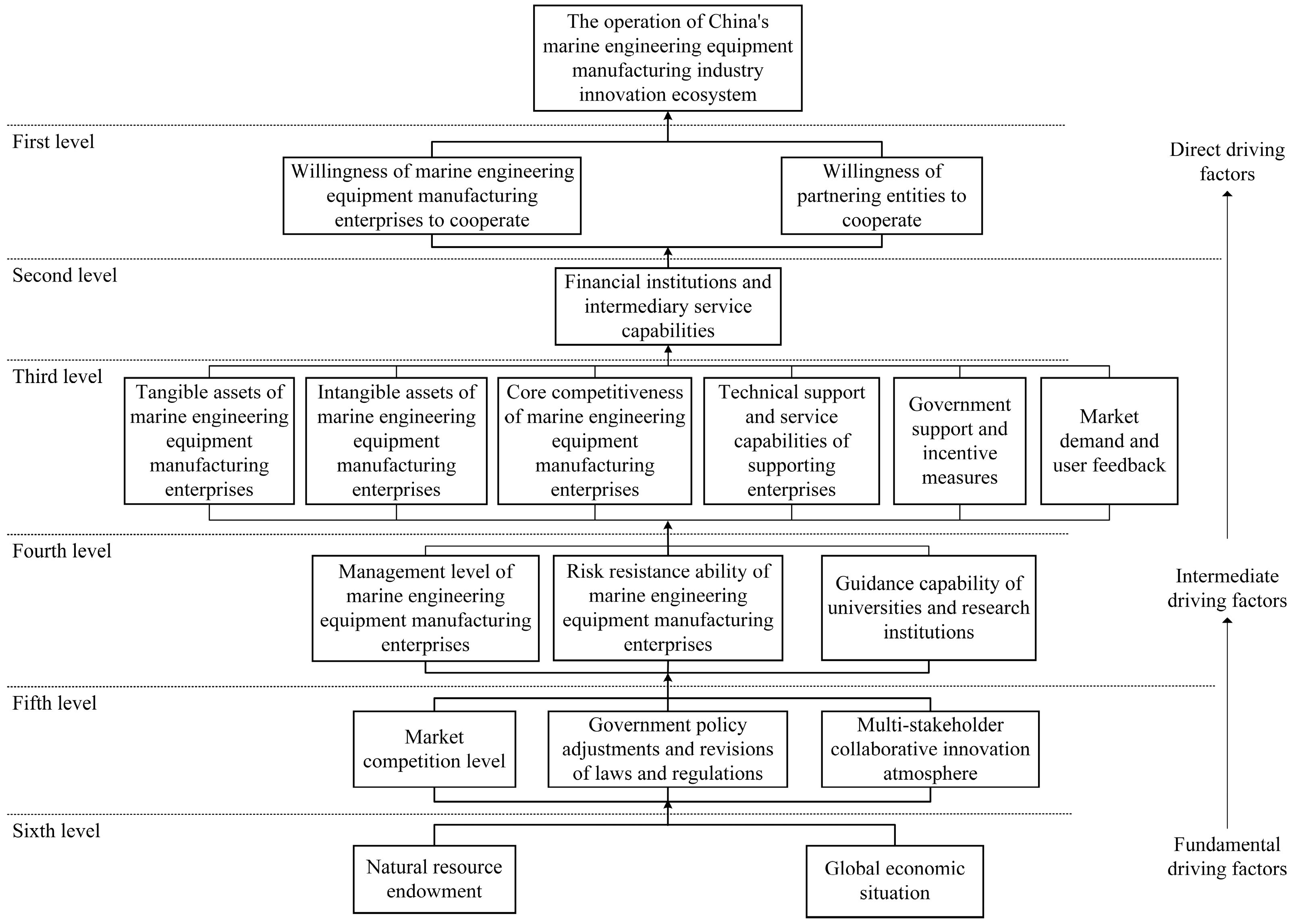
Based on the iterative calculation rules, the second-, third-, fourth-, fifth-, and sixth-level driving factor sets of China’s marine engineering equipment manufacturing industry innovation ecosystem are further determined, as shown in Table 3, Table 4, Table 5, Table 6, and Table 7, respectively. Thereinto, L2 = {F11}, L3 = {F1, F2, F3, F7, F9, F10}, L4 = {F4, F5, F8}, L5 = {F15, F16, F17}, and L6 = {F13, F14}.
Table 3.
The second level of driving factors of China’s marine engineering equipment manufacturing industry innovation ecosystem.
Table 4.
The third level of driving factors of China’s marine engineering equipment manufacturing industry innovation ecosystem.
Table 5.
The fourth level of driving factors of China’s marine engineering equipment manufacturing industry innovation ecosystem.
Table 6.
The fifth level of driving factors of China’s marine engineering equipment manufacturing industry innovation ecosystem.
Table 7.
The sixth level of driving factors of China’s marine engineering equipment manufacturing industry innovation ecosystem.
Through the above analysis, the multi-level hierarchical structure of driving factors in China’s marine engineering equipment manufacturing industry innovation ecosystem is obtained, as shown in Figure 4.
Figure 4.
Multi-level hierarchical structure of driving factors in China’s marine engineering equipment manufacturing industry innovation ecosystem.
4.2.2. Analysis of the Multi-Level Hierarchical Structure of Driving Factors
As shown in Figure 1, the multi-level hierarchical structure of driving factors in China’s marine engineering equipment manufacturing industry innovation ecosystem consists of six levels and three stages. The first level represents the direct driving factors of the innovation ecosystem, while the second, third, fourth, and fifth levels are the intermediate driving factors. The sixth level represents the foundational driving factors of the innovation ecosystem. The interaction relationships between each level are as follows:
The sixth level includes natural resource endowment and global economic situation, which are the foundational driving factors of China’s marine engineering equipment manufacturing industry innovation ecosystem. These factors directly influence the driving factors in the previous level. The changes in the global economic situation and their impact on international market demand and marine equipment technology standards have driven the improvement of China’s marine engineering equipment manufacturing industry’s competitiveness. Specifically, natural resource endowment and global economic situation can improve market competition and the atmosphere for multi-stakeholder collaborative innovation by affecting the potential market size for new technologies and products in the marine engineering equipment manufacturing sector. Additionally, natural resource endowment can drive government policy adjustments and revisions of laws and regulations by influencing the direction of technological innovation and product development. Meanwhile, changes in the global economic situation can lead to more frequent government policy adjustment and revision of laws and regulations by altering the government’s focus on the innovation and development of the marine equipment manufacturing industry [54].
The fifth level includes the market competition level, government policy adjustments and revisions of laws and regulations, and the multi-stakeholder collaborative innovation atmosphere. These are the intermediate driving factors of China’s marine engineering equipment manufacturing industry innovation ecosystem and can directly influence the driving factors in the previous level. In recent years, the government has gradually increased its focus on the marine engineering equipment manufacturing industry, with policies to promote industrial upgrading and technological innovation being introduced progressively. Meanwhile, the global competitive environment has imposed higher market demands on marine engineering equipment manufacturers, compelling them to enhance their management standards and technological innovation capabilities. Specifically, changes in the market competition level can alter the revenue of marine engineering equipment manufacturing enterprises, prompting these enterprises to improve their management level and risk resilience capabilities. Universities and research institutions are motivated to enhance their guidance capabilities, providing better technological guidance, research result transformation experience, and professional talent to enterprises. Government policy adjustments and revisions of laws and regulations can promote improvements in the management level and risk resilience of marine engineering equipment manufacturing enterprises as well as in the guidance capabilities of universities and research institutions. Changes in collaborative innovation atmosphere among stakeholders can influence the structure of the marine engineering equipment manufacturing industry, thereby affecting the management level and risk resilience of marine engineering equipment manufacturing enterprises and the guidance capabilities of universities and research institutions.
The fourth level includes the management level and risk resilience of marine engineering equipment manufacturing enterprises and the guidance capability of universities and research institutions. These are the intermediate driving factors of China’s marine engineering equipment manufacturing industry innovation ecosystem and can directly influence the driving factors in the previous level. Specifically, improving the management levels and risk resilience of marine engineering equipment manufacturing enterprises and the guidance capability of universities and research institutions can enhance the business performance of marine engineering equipment manufacturing enterprises, thereby expanding the scale of their tangible and intangible assets and accelerating the formation of their core competitiveness. Additionally, improving the management level of marine engineering equipment manufacturing enterprises can promote closer cooperation between these enterprises and supporting enterprises, strengthening the technical support and service capabilities of supporting enterprises. Enhancing the risk resilience of marine engineering equipment manufacturing enterprises can ensure stable returns from technological collaborative innovation and joint product development projects, thereby positively influencing the technical support and service capabilities of supporting enterprises as well as government support and incentive measures. Improving the guidance capability of universities and research institutions can enable marine engineering equipment manufacturing enterprises to develop technologies and products that satisfy user needs, thus having a positive influence on market demand and user feedback.
The third level includes the tangible assets, intangible assets, and core competitiveness of marine engineering equipment manufacturing enterprises, technical support and service capabilities of supporting enterprises, government support and incentive measures, and market demand and user feedback. These are intermediate driving factors in China’s marine engineering equipment manufacturing industry innovation ecosystem, which can directly influence the driving factors of the previous level. Specifically, the tangible assets and core competitiveness of marine engineering equipment manufacturing enterprises can maintain the normal production and operation of the business, providing support and assurance for their external collaboration. The technical support and service capabilities of supporting enterprises, along with government support and incentive measures, can safeguard the technological innovation and product development of marine engineering equipment manufacturing enterprises. Market demand and user feedback can influence the potential market size for new technologies and products in the marine engineering equipment manufacturing sector. The above driving factors all have an impact to some extent on the service capabilities of financial institutions and intermediaries.
The second level includes financial institutions and intermediary service capabilities, while the first level includes the cooperation willingness of marine engineering equipment manufacturing enterprises and their potential partners. The first level represents the direct driving factors of China’s marine engineering equipment manufacturing industry innovation ecosystem, which are influenced by the driving factors in the second level. Specifically, improving financial institutions and intermediary services capabilities can alleviate the initial funding pressures for technological innovation and product development in marine engineering equipment manufacturing enterprises. It can also guide these enterprises toward higher-return technological innovations and product development directions, thus stimulating their willingness to cooperate. Additionally, enhancing financial institutions and intermediary services capabilities can help potential partners better understand the status of marine engineering equipment manufacturing enterprises, cooperate with these enterprises to implement technological innovation and product development projects, and profit from them, thereby stimulating the willingness of partners to cooperate. As the cooperation willingness of marine engineering equipment manufacturing companies and their partners continues to increase, the innovation ecosystem of China’s marine engineering equipment manufacturing industry will be able to operate more stably.
In conclusion, natural resource endowment and the global economic situation are the foundational driving factors of China’s marine engineering equipment manufacturing industry innovation ecosystem, providing the fundamental conditions for the operation of the ecosystem. Theoretically, by optimizing the resource allocation of these two factors, the overall operational efficiency of China’s marine engineering equipment manufacturing industry innovation ecosystem can be improved. However, since these two factors are environmental driving factors with relative uncontrollability, the management level and risk resilience of marine engineering equipment manufacturing enterprises and the guidance capability of universities and research institutions are naturally identified as the key driving factors in the innovation ecosystem. Therefore, in practice, optimizing the resource allocation of these three driving factors is the best strategy for enhancing the overall operational driving force of China’s marine engineering equipment manufacturing industry innovation ecosystem.
5. Conclusions
This paper identifies 17 driving factors of China’s marine engineering equipment manufacturing industry innovation ecosystem through a literature-coding analysis and constructs a driving factor relationship analysis model using the interpretive structural modeling method to analyze the interactions among these factors. The conclusions show the following:
- The driving factors of China’s marine engineering equipment manufacturing industry innovation ecosystem can be divided into driving factors of marine engineering equipment manufacturing enterprises, driving factors of other innovation entities, and environmental driving factors. Each factor plays a different role in the innovation ecosystem.
- The driving factors of China’s marine engineering equipment manufacturing industry innovation ecosystem can be categorized into multiple levels and hierarchies. This helps reveal the transmission effects among the driving factors, assisting scholars and policymakers in understanding how the innovation ecosystem drives innovation and development in the marine engineering equipment manufacturing industry through the interaction of multiple levels and factors.
- Global economic situation and natural resource endowment play a foundational driving role in China’s marine engineering equipment manufacturing industry innovation ecosystem. These factors indirectly shape the framework for industry development by influencing market demand, industry competition patterns, and technological R&D directions. Meanwhile, organizational-level factors (such as management level, risk resilience, and core competitiveness) determine how entities respond to these external conditions and continue to drive technological innovation and market expansion. Government policies and the formation of a collaborative innovation atmosphere among multiple stakeholders provide enterprises with policy support and cooperation opportunities, thereby promoting the stable operation of the entire ecosystem.
- Core competitiveness, management level, and risk resilience of marine engineering equipment manufacturing enterprises are key driving factors in the innovation ecosystem. To enhance the innovation capacity and international competitiveness of China’s marine engineering equipment manufacturing industry, improving resource allocation is crucial. By strengthening the management level and risk resilience of enterprises and promoting the guidance capability of universities and research institutions, the core competitiveness of enterprises can be effectively enhanced, thus driving the continuous development of technological innovation. Meanwhile, optimizing market demand response, financial institution support, and technical services of supporting enterprises can provide marine engineering equipment manufacturing enterprises with more opportunities for technological collaboration, thereby stimulating the innovative vitality of enterprises.
To further enhance the innovation capability and international competitiveness of China’s marine engineering equipment manufacturing industry, policymakers should increase fiscal subsidies and tax incentives for R&D investment; strengthen collaborative innovation between the government, enterprises, universities, and research institutions; provide training and resource support to enterprises; and actively guide financial institutions to offer more flexible financing products to ease the financial pressures on businesses. At the same time, efforts should be made to train more technical talent to address the industry’s talent shortage. Through these measures, the healthy development of the marine engineering equipment manufacturing innovation ecosystem can be promoted, improving its international competitiveness and driving the growth of China’s marine engineering equipment manufacturing industry in the global market.
This study provides a new perspective and a driving mechanism model for the academic community while also offering theoretical support for policymakers and business managers to optimize innovation ecosystems. However, there are some limitations in the research. First, the limited data sample may affect the generalizability of the findings. Second, the current study has not fully considered the impact of driving factors on the driving mechanism. Future research will focus on overcoming these limitations; further exploring more complex driving mechanisms; and, in the context of increasingly fierce global competition in the offshore equipment manufacturing industry, expanding to comparative studies across more countries and regions. This will help reveal the differences in development paths and strategies in innovation ecosystems across different countries and regions, providing valuable international experience and references for global policymaking and industry development.
Author Contributions
Conceptualization, T.L. and X.Z.; methodology, X.Z.; software, X.Z.; validation, T.L.; formal analysis, X.Z.; investigation, X.Z.; resources, X.Z.; data curation, X.Z.; writing—original draft preparation, X.Z.; writing—review and editing, T.L. and X.Z.; visualization, X.Z.; supervision, X.Z.; project administration, X.Z.; funding acquisition, X.Z. All authors have read and agreed to the published version of the manuscript.
Funding
This study was funded by the National Social Science Foundation of China, grant number 24BTQ006.
Data Availability Statement
All data are presented in the paper.
Conflicts of Interest
The authors declare no conflicts of interest.
Appendix A
Table A1.
Sample literature.
Table A1.
Sample literature.
| No. | Author | Publication Time | Title |
|---|---|---|---|
| 1 | Zhao, Y.H. | 2011 | Research on Strategies for Cultivating the High-End Equipment Manufacturing Industry |
| 2 | Song, L.X. | 2011 | Research on the Development Strategy for Promoting Emerging Industries in Nantong’s Shipbuilding, Offshore, and Supporting Industries |
| 3 | Liu, K., Han, L.M. | 2012 | Research on the Formation Mechanism of Strategic Emerging Marine Industries |
| 4 | Hu, J.B., Ni, Y. et al. | 2013 | Research on Fiscal and Tax Policies to Promote the Development of Strategic Emerging Industries in China |
| 5 | Ma, Z.R., Su, L.H. | 2013 | Issues and Countermeasures for the Development of Strategic Emerging Marine Industries in Guangdong |
| 6 | Li, J., Jing, C.R. | 2013 | Research on Fiscal and Tax Policies Promoting the Development of High-End Equipment Manufacturing Industry |
| 7 | Zhong, W.W. | 2013 | Research on Fiscal and Tax Policies Promoting the Development of High-End Equipment Manufacturing Industry |
| 8 | Pan, W., Zhang, J.J. | 2013 | Research on the Technical Capability Evaluation of Offshore Oil Platform Construction Enterprises |
| 9 | Zhang, K. | 2013 | Developing Deep-Sea Oil and Gas with Independent Equipment |
| 10 | Pan, W., Zhang, J.J. | 2013 | Empirical Research on the Construction of Technological Innovation System in Offshore Equipment Manufacturing Enterprises |
| 11 | Wu, X.D., Huang, J.F. | 2013 | Analysis of Relevant Factors and Development Strategies for the Marine Engineering Equipment Industry—Based on the “Diamond Model” and Grey Relational Analysis |
| 12 | Ning, L., Wang, G.H. | 2013 | Theoretical Research Review on the Cultivation of Marine Strategic Emerging Industries |
| 13 | Zhang, Y., Wang, X. | 2013 | Research on the Impact of ODI on the Independent Innovation Capability of China’s High-End Equipment Manufacturing Industry—A Case Study of the Aerospace Equipment Manufacturing Industry |
| 14 | Yang, F.H. | 2014 | Current Situation and Countermeasures for the Development of Marine Strategic Emerging Industries in Jiangsu Province |
| 15 | Xu, W.B. | 2014 | Research and Development of the Deepwater Pipelay Crane Vessel “Ocean Oil 201” |
| 16 | Zhao, J.L., Xu, X.L. | 2014 | Research on the Development Issues of China’s Marine Engineering Equipment Manufacturing Industry |
| 17 | Yu, H.J., Li, D.H. et al. | 2014 | Research on the Layout Optimization of China’s Marine Strategic Emerging Industries |
| 18 | Du, Z.F., Zhou, Q.J. et al. | 2014 | Research on Emerging Technologies in China’s Marine Floating Platform Field—Based on Patent Analysis |
| 19 | Jia, X.X., Zhang, X.L. | 2014 | Research on the Impact of Network Embeddedness and Organizational Learning on Corporate Technological Innovation Performance—Based on a Survey of Marine Equipment Manufacturing Enterprises |
| 20 | Wu, X.D., Huang, J.F. et al. | 2015 | Analysis of the Interrelationships of Marine Engineering Equipment Industry Development Issues Based on Integrated DEMATEL/ISM |
| 21 | Yu, H.J. | 2015 | Research on the Development Path of the Modern Marine Industry System—From the Perspective of Industrial Structure Evolution |
| 22 | Tang, S.L., Xiao, Z.H. et al. | 2015 | Network Embeddedness, Cluster Imitation, and University-derived Enterprise Knowledge Spillover—An Empirical Study Based on the Three Major Marine Engineering Equipment Manufacturing Clusters in China |
| 23 | Huang, S. | 2015 | Optimization of Marine Industry Structure under Resource and Environmental Constraints |
| 24 | Lin S., Wu, Z.G. et al. | 2015 | Key Points and Countermeasures for Promoting Cross-Strait Marine Emerging Industry Cooperation |
| 25 | Bai, F.C., Xu, L. | 2015 | Research on Development Policies for High-End Marine Industries in China |
| 26 | Lou, C.W., Wu, B. et al. | 2016 | Challenges and Countermeasures Facing China’s Marine Engineering Equipment Manufacturing Industry |
| 27 | Zhang, S., Quan, X.J. | 2016 | Bottlenecks and Upgrading Paths for the Development of China’s Marine Engineering Equipment Manufacturing Industry |
| 28 | Li, Y., Song, Y.Q. et al. | 2016 | Patent Competitiveness Analysis of Domestic and Foreign Marine Engineering Equipment Industries—Based on an Ecosystem Perspective |
| 29 | Wu, B., Yang, Y.M. et al. | 2017 | Comprehensive Quantitative Research on Policy Literature of China’s Marine Engineering Equipment Manufacturing Industry |
| 30 | Liu, K., Chen, M.B. et al. | 2017 | Comprehensive Quantitative Research on Policy Literature of China’s Marine Engineering Equipment Manufacturing Industry |
| 31 | He, P., Huang, F.P. et al. | 2017 | Exploration of Innovative Experimental Teaching Mode Based on Marine Equipment Technology |
| 32 | Liu, H.C., Liu, H. | 2018 | Research on the Cultivation Model and Development Path of Strategic Marine Emerging Industries from the Perspective of the Innovation Double Helix—A Case Study of Jiangsu Province |
| 33 | Mao, W., Ju, Z.J. | 2018 | Evaluation of the Internationalization Development of China’s Strategic Emerging Marine Industries |
| 34 | Gao, T.Y., Chang, F. et al. | 2018 | Research on the Structural Transformation and Upgrading of Qingdao’s Marine Economy Industry—Based on the Analysis and Evaluation of Technological Innovation Efficiency |
| 35 | Qiao, L., Ding, Y.Y. | 2019 | The Impact of Inter-Company Cooperation Behavior on Cooperation Performance in Supply Chain Enterprises |
| 36 | Li, N., Lin, R.H. et al. | 2020 | Research on the Impact Mechanism of Exploratory Innovation in Enterprises under Multiple Network Embeddedness |
| 37 | Chen, R.Q. | 2020 | Current Status and Prospects of Intelligent Manufacturing Development for Marine Oil and Gas Production Equipment |
| 38 | Sheng, C.X., Ren, J.Q. et al. | 2021 | Research on the Ideas and Countermeasures for Building a Sound Modern Marine Industry System |
| 39 | Du, Z.F., Chen, X.Y. et al. | 2021 | Identification of Marine Engineering and Technology Hotspots and Development Trends Based on Literature and Patent Analysis |
| 40 | Lin, K.Y. | 2022 | The Development Process, Experience, and Suggestions for Marine Science and Technology Innovation in China |
| 41 | Jia, H.Y., Yi, P. et al. | 2023 | Current Status of Intelligent Manufacturing Application Development in Marine Engineering Equipment Manufacturing Industry |
References
- Zhang, H.; Wang, Q.W.; Huang, J.B. China’s policy for the marine engineering equipment industry and potential challenges: An appraisal of the new developments under the 14th five-year plans. Front. Mar. Sci. 2022, 9, 1014959. [Google Scholar] [CrossRef]
- Wang, Q.W.; Zhang, H.; Huang, J.B. China’s law and policy for the marine engineering equipment industry: A critical review. Reg. Stud. Mar. Sci. 2023, 61, 102902. [Google Scholar] [CrossRef]
- Ren, J.J.; Ge, S.L. TEXT Analysis on Ocean Engineering Equipment Industry Policies in China between 2010 and 2020. Symmetry 2022, 14, 1115. [Google Scholar] [CrossRef]
- Jeong, K.; Cha, J.; Kim, Y. SCRM Awareness in the Shipbuilding and Marine Equipment Market: Empirical Evidence from South Korea, China, and Singapore. Sustainability 2020, 12, 125115. [Google Scholar] [CrossRef]
- Zhang, X.F.; Fan, D.C. Research on the influence mechanism of heterogeneous environmental regulation on the manufacturing equipment industry in Asia-Pacific countries. Clean. Technol. Environ. 2023, 25, 1737–1752. [Google Scholar] [CrossRef]
- Wang, J.Y.; Shi, X.; Du, Y.W. Exploring the relationship among marine science and technology innovation, marine finance, and marine higher education using a coupling analysis: A case study of China’s coastal areas. Mar. Policy 2021, 132, 104706. [Google Scholar] [CrossRef]
- Liu, S.S.; Liang, X.; Zhang, K. Motivational mechanism of advanced equipment manufacturing industry technological innovation based on evolutionary game. Dyna 2023, 98, 602–611. [Google Scholar] [CrossRef]
- Guo, Y.T.; Zheng, G. Recombinant Capabilities, R&D Collaboration, and Innovation Performance of Emerging Market Firms in High-Technology Industry. IEEE T Eng. Manag. 2021, 70, 2431–2446. [Google Scholar] [CrossRef]
- Li, H.Y.; Xu, W.; Zhang, Y.Y.; Wu, T.T. Evaluation of Factors Influencing the Sustainable Development of the Marine Equipment Manufacturing Industry Cluster. J. Coast. Res. 2020, 106, 440–444. [Google Scholar] [CrossRef]
- Liu, T.; Yang, X.; Guo, Y. Research on Influencing Factors of Technological Independent Innovation of Equipment Manufacturing Enterprises from the Perspective of Iceberg Theory. Complexity 2021, 2021, 2551680. [Google Scholar] [CrossRef]
- Ma, J.; Guo, M.S. Technology Innovation Driven Upgrade Strategy Evaluation Model: A Case of Marine Equipment Industry. J. Coast. Res. 2019, 94, 842–845. [Google Scholar] [CrossRef]
- Li, Y.F.; Li, H.; Tan, J.S. Technological catch-up and innovations of China’s offshore oil and gas equipment-manufacturing industry: The role of the supply chain and government policy. J. Clean. Prod. 2022, 365, 132681. [Google Scholar] [CrossRef]
- Qiao, N.; Niu, L.X. The Impact of the Industrial Innovation Ecosystem on Innovation Performance-Using the Equipment Manufacturing Industry as an Example. Systems 2024, 12, 578. [Google Scholar] [CrossRef]
- Kristiansen, M.; Aas, T.H. Gaining acceptance for digital servitization: The role of legitimacy in the development of a smart service in established manufacturing ecosystems. J. Bus. Ind. Mark. 2024, 39, 2497–2518. [Google Scholar] [CrossRef]
- Chen, W.M.; Wang, S.Y.; Wu, X.L. Concept Refinement, Factor Symbiosis, and Innovation Activity Efficiency Analysis of Innovation Ecosystem. Math. Probl. Eng. 2022, 2022, 1942026. [Google Scholar] [CrossRef]
- Yin, D.; Ming, X.G.; Zhang, X.Y. Sustainable and smart product innovation ecosystem: An integrative status review and future perspectives. J. Clean. Prod. 2020, 274, 123005. [Google Scholar] [CrossRef]
- Yuan, F.; Li, M.S.; Sun, X.H.; Zhai, Y. The impact of demand-pull and supply-push policies on technological innovation: Does the type of policy matter? Int. J. Technol. Manag. 2023, 92, 269–287. [Google Scholar] [CrossRef]
- Yang, L.; Hou, G.S. Study on the Strategic Innovation and Industrial Development Effect of Marine Industry. J. Coast. Res. 2019, 94, 581–584. [Google Scholar] [CrossRef]
- Zhang, X.L. Financial Risk Assessment of Listed Enterprises in Marine Engineering Equipment Manufacturing Industry. J. Coast. Res. 2019, 98, 155–158. [Google Scholar] [CrossRef]
- Xu, L.; Zhu, X.Y. Detection model for key nodes of manufacturing industry chain stability under complex networks: A naval architecture and marine engineering equipment industry chain example. Kybernetes 2024, 54, 2892–2915. [Google Scholar] [CrossRef]
- Dong, S.S.; Sun, Y.L. Upgrading Path and Value Chain Upgrading Strategy of China’s Marine Equipment Manufacturing Industry. J. Coast. Res. 2020, 107, 157–160. [Google Scholar] [CrossRef]
- Chung, Y.; Dai, S.T. The Fourth Industrial Revolution and China’s Defense Innovation in Intelligent Systems. Korean J. Def. Anal. 2022, 34, 249–273. [Google Scholar] [CrossRef]
- Xu, L.X. Towards Green Innovation by China’s Industrial Policy: Evidence From Made in China 2025. Front. Environ. Sci. 2022, 10, 924250. [Google Scholar] [CrossRef]
- Wang, J.; Wu, H.Q.; Chen, Y. Made in China 2025 and manufacturing strategy decisions with reverse QFD. Int. J. Prod. Econ. 2020, 224, 107539. [Google Scholar] [CrossRef]
- Pollpeter, K. Upward and Onward: Technological Innovation and Organizational Change in China’s Space Industry. J. Strateg. Stud. 2011, 34, 405–423. [Google Scholar] [CrossRef]
- Marigo, N. The Chinese silicon photovoltaic industry and market: A critical review of trends and outlook. Prog. Photovolt. 2007, 15, 143–162. [Google Scholar] [CrossRef][Green Version]
- Sun, Y.B. The achievement, significance and future prospect of China’s renewable energy initiative. Int. J. Energ. Res. 2020, 44, 12209–12244. [Google Scholar] [CrossRef]
- Yang, Y.; Husain, L.; Huang, Y.M. China’s position and competitiveness in the global antibiotic value chain: Implications for global health. Glob. Health 2024, 20, 87. [Google Scholar] [CrossRef]
- Uyan, E.; Atlar, M.; Ölçer, A.I. Improving the energy efficiency of lighting systems for a marine equipment manufacturing plant through retrofitting, daylighting, and behaviour change. J. Clean. Prod. 2023, 413, 137216. [Google Scholar] [CrossRef]
- Ghazinoory, S.; Phillips, F.; Afshari-Mofrad, M.; Bigdelou, N. Innovation lives in ecotones, not ecosystems. J. Bus. Res. 2021, 135, 572–580. [Google Scholar] [CrossRef]
- Zhang, Y.L.; Wang, D.T.; Xiao, X. Network Characteristics of Innovation Ecosystem: Knowledge Collaboration and Enterprise Innovation. Sci. Technol. Soc. 2023, 28, 488–510. [Google Scholar] [CrossRef]
- Shaw, R.D.; Allen, T. Studying innovation ecosystems using ecology theory. Technol. Forecast. Soc. 2023, 136, 88–102. [Google Scholar] [CrossRef]
- Duan, P.; Dong, X.K.; Sun, Q.Q.; Wang, X.Y.; Chen, Y.H. Optimal resource allocation and adaptive robust control of technology innovation ecosystems based on cooperative game theory. J. Frankin I 2023, 360, 3879–3913. [Google Scholar] [CrossRef]
- Dawson, G.S.; Denford, J.S.; Desouza, K.C. Governing innovation in US state government: An ecosystem perspective. J. Strateg. Inf. Syst. 2016, 25, 299–318. [Google Scholar] [CrossRef]
- Tan, Y.X.; Yan, Q.M.; Xie, T.T.; Chen, Y.B. Spatial evolution and driving force of green technological innovation in China: The perspective of innovation ecosystem. Int. J. Technol. Manag. 2024, 96, 94–126. [Google Scholar] [CrossRef]
- Bao, Z.M.H.; Lin, Z.S.; Jin, T.T.; Lv, K. Regional Breakthrough Innovation Change Strategies, Ecological Location Suitability of High-Tech Industry Innovation Ecosystems, and Green Energy. Energies 2024, 17, 3938. [Google Scholar] [CrossRef]
- Xiao, Z.L.; Liu, R.; Gao, Y.H.; Yang, Q.Y.; Chen, J.L. Spatiotemporal variation characteristics of ecosystem health and its driving mechanism in the mountains of southwest China. J. Clean. Prod. 2022, 345, 131138. [Google Scholar] [CrossRef]
- Liu, H.C.; Liu, H. Research on Cultivation Mode and Development Path of Strategic Marine Emerging Industry from the Perspective of Innovation Double Spiral: A Case Study of Jiangsu Province. Sci. Technol. Manag. Res. 2018, 14, 131–139. [Google Scholar] [CrossRef]
- Bao, Y.; Cao, G.C. Evaluation of the Internationalization Development Level of China’s Strategic Emerging Industries. J. Northeast. Univ. Financ. Econ. 2017, 110, 33–38. [Google Scholar] [CrossRef]
- Sheng, C.X.; Ren, J.Q.; Xu, J.W. Research on Thoughts and Countermeasures of Constructing and Perfecting Modern Marine Industry System. Econ. Horiz. 2021, 4, 71–78. [Google Scholar] [CrossRef]
- Thistoll, T.; Hooper, V.; Pauleen, D.J. Acquiring and developing theoretical sensitivity through undertaking a grounded preliminary literature review. Qual. Quant. 2016, 50, 619–636. [Google Scholar] [CrossRef]
- Connor, J.; Flenady, T.; Massey, D.; Dwyer, T. Classical grounded theory: Identifying the main concern. Res. Nurs. Health 2024, 47, 277–288. [Google Scholar] [CrossRef] [PubMed]
- French, R.; Williamson, K. Conceptualising welfare workers as information bricoleurs: Theory building using literature analysis, organisational ethnography and grounded theory analysis. In Proceedings of the ISIC—The Information Behaviour Conference, Univ Zadar, Zadar, Croatia, 20–23 September 2016. [Google Scholar]
- Walker, D.; Myrick, F. Grounded theory: An exploration of process and procedure. Qual. Health Res. 2006, 16, 547–559. [Google Scholar] [CrossRef] [PubMed]
- Zhao, G.Q.; Hormazabal, J.H.; Elgueta, S.; Manzur, J.P.; Liu, S.F.; Chen, H.L.; Lopez, C.; Kasturiratne, D.; Chen, X.N. The impact of knowledge governance mechanisms on supply chain performance: Empirical evidence from the agri-food industry. Prod. Plan Control 2021, 32, 1313–1336. [Google Scholar] [CrossRef]
- Yikai, L.; Shuangjun, D.; Kunpeng, Y.; Bopeng, Z. Development Status and Suggestions for China’s Offshore Engineering Equipment Manufacturing Industry. China Offshore Oil Gas 2024, 36, 190–198. Available online: https://kns.cnki.net/kcms2/article/abstract?v=0iq8nzQYh5RS56p66rVqRExc-KklBS2dLsrSt6UcSYBffDjf-mHlQ-pc6_jEqEwQriDlwA-a4UuzKGqBa-lWqqACl4dP5YvkhCB3pkw1xbzyJheLmQwoTY2Lo1PJXD8kO33wdni4Rgrqmf08I8esFqdNPpU9mer3nFjXAt-yy7ZK5JQHUI-vOY9_NBRsJkLl&uniplatform=NZKPT&language=CHS (accessed on 7 August 2024).
- Xiaoxia, J. Study on the Offshore Equipment Building Business Transition of COSCO SHIPYARD Based on Network Embedding. J. Manag. Case Stud. 2015, 8, 525–538. [Google Scholar] [CrossRef]
- Mingjie, T.; Minfeng, W. The Performance Gap of China’s Marine Engineering Enterprise Internationalization and Recommendations for Improvement. China Offshore Oil Gas 2013, 25, 86–88. [Google Scholar]
- Jie, Z.; Fan, Y.; Junmin, Z.; Cungen, L.; Xinyue, W.; Yingfu, Z. Development Status and Prospect of Marine Nuclear Power Equipment in China and Abroad. Chin. Eng. Sci. 2023, 25, 62–73. [Google Scholar] [CrossRef]
- Aydin, A.; Parker, R.P. Innovation and technology diffusion in competitive supply chains. Eur. J. Oper. Res. 2018, 265, 1102–1114. [Google Scholar] [CrossRef]
- Cheng, Y.; Jia, X.; Chen, W. Research on Multi-agent Intelligent Game Simulation of Shipbuilding Industry under Regulation. Ship Eng. 2014, 36, 113–117. [Google Scholar] [CrossRef]
- Zhang, J.; Jiang, X.; Zhou, H. Research on Partner Selection for Technological Innovation Alliances in Strategic Emerging Industries—Empirical Analysis Based on the PLS-SEM Model. Macroecon. Study 2016, 5, 79–86. [Google Scholar] [CrossRef]
- Bertot, J.C.; Jaeger, P.T.; Hansen, D. The impact of polices on government social media usage: Issues, challenges, and recommendations. Gov. Inf. Q. 2012, 29, 30–40. [Google Scholar] [CrossRef]
- Luo, C.Y.; Zhang, J. China Trade Policy Review: A Political Economy Approach. World Econ. 2010, 33, 1390–1413. [Google Scholar] [CrossRef]
Disclaimer/Publisher’s Note: The statements, opinions and data contained in all publications are solely those of the individual author(s) and contributor(s) and not of MDPI and/or the editor(s). MDPI and/or the editor(s) disclaim responsibility for any injury to people or property resulting from any ideas, methods, instructions or products referred to in the content. |
© 2025 by the authors. Licensee MDPI, Basel, Switzerland. This article is an open access article distributed under the terms and conditions of the Creative Commons Attribution (CC BY) license (https://creativecommons.org/licenses/by/4.0/).