Article

Thermophysiology and Locomotor Performance of the Andean Lizard Phymaturus williamsi: Vulnerable to Rising Temperatures?


by
Ana E. Victorica Erostarbe
1,*,
Franco Valdez Ovallez
1,2,
José M. Sánchez
3,
Yamila Méndez Osorio
1,2 and
Rodrigo Gómez Alés
1,2,*
1
Gabinete DIBIOVA (Diversidad y Biología de Vertebrados del Árido), Departamento de Biología, Facultad de Ciencias Exactas, Físicas y Naturales, Universidad Nacional de San Juan, Av. Ignacio de la Roza 590 (O), Complejo Universitario “Islas Malvinas”, Rivadavia, San Juan J5402DCS, Argentina
2
CONICET (Consejo Nacional de Investigaciones Científicas y Técnicas), Av. Ignacio de la Roza 590 (O), Complejo Universitario “Islas Malvinas”, Rivadavia, San Juan J5402DCS, Argentina
3
Instituto de Diversidad y Ecología Animal (IDEA), Consejo Nacional de Investigaciones Científicas y Técnicas (CONICET), Rondeau 798 (Parque de la Biodiversidad), Capital, Córdoba 5000, Argentina
*
Authors to whom correspondence should be addressed.
Biology 2026, 15(9), 729; https://doi.org/10.3390/biology15090729
Submission received: 24 March 2026 / Revised: 23 April 2026 / Accepted: 29 April 2026 / Published: 5 May 2026

Simple Summary

Some animals, such as lizards, rely on ambient temperature to function properly, so understanding how they respond to changes in temperature is key to anticipating the effects of climate change. In this study, we analyzed how a species of lizard from the Argentine Andes (Phymaturus williamsi) regulates its temperature and how this influences its ability to move. We measured its body temperature in the wild and the temperatures available in the environment. In the laboratory, we assessed which body temperatures they prefer, how much they tolerate, and how their movement performance changes at different body temperatures. We found that these lizards prefer higher body temperatures than those they experience in their environment, but they still manage to regulate themselves efficiently using their behavior. We also observed that they can tolerate a wide range of temperatures and that their best movement performance occurs at lower body temperatures than they prefer. Taken together, these results indicate that the species has a good capacity to cope with thermal changes. This is important because it suggests that it could withstand the effects of global warming in its natural environment relatively well.

Abstract

Ambient temperature strongly influences the physiology and performance of ectotherms, making it essential to understand their responses to thermal variation under climate change. We evaluated locomotor performance and thermal vulnerability in a population of Phymaturus williamsi from the Argentine Andes. Field measurements included body (Tb) and operative temperatures (Te), while laboratory analyses assessed preferred temperature (Tpref), thermoregulatory effectiveness, critical thermal limits, and thermal sensitivity of locomotion (endurance, sprint, and long runs). P. williamsi exhibited a preferred temperature higher than field body temperatures, together with high thermoregulatory effectiveness (E = 0.83) and a broad thermal tolerance range (TT = 35.41 °C). Optimal temperatures for locomotor performance were lower than Tpref, providing no support for the thermal coadaptation hypothesis. Despite low environmental thermal quality, individuals maintained body temperatures close to performance optima through effective behavioral thermoregulation. Thermal vulnerability indices indicated relatively high tolerance to projected warming scenarios. However, our results suggest that vulnerability to climate change is constrained more by the availability of suitable thermal microhabitats than by intrinsic physiological limits. We conclude that P. williamsi is a eurythermic and effective thermoregulator with thermally sensitive locomotor performance, whose persistence will depend on habitat structure and thermal heterogeneity.

1. Introduction

Numerous studies have attempted to predict the vulnerability of organisms to global warming, taking into account future projections [1,2,3,4,5,6,7]. For example, Sinervo et al. [3] predicted that 39% of lizard populations worldwide and 20% of lizard species globally could become extinct by 2080, assuming limited plastic and evolutionary responses to a warming world and continued inaction to reduce greenhouse gas emissions. Ectotherms are particularly vulnerable to changes in environmental thermal conditions because they rely on external heat sources to regulate their body temperature [8,9,10]. In this context, understanding how these organisms cope with thermal variation is essential to predict their ecological and evolutionary responses, as well as to assess their risk of extinction [2,11].
Lizards rely on behavioral thermoregulation, such as basking and microhabitat selection, to attain optimal body temperatures. However, these strategies may become insufficient when maximum environmental temperatures exceed physiological performance limits [12,13]. For these organisms, the physiological benefits of thermoregulation inevitably entail costs, including increased energetic expenditure associated with moving between warm and cool microhabitats and greater exposure to predators [14]. For example, species inhabiting desert environments must balance overheating avoidance with water conservation through microhabitat selection and temporal shifts in activity [15,16,17]. Moreover, time allocated to thermoregulation cannot be devoted to other essential activities such as reproduction, foraging, social interactions, and territorial defense [14,18,19]. Consequently, the ability of species to buffer the effects of warming through behavioral adjustments depends on the availability of suitable thermal microhabitats, habitat heterogeneity, and inherent physiological constraints [6,20,21,22]. In particular, endemic species—especially those inhabiting cold mountainous regions—are considered to face a higher extinction risk than widely distributed species [23,24]. In this context, global warming represents a significant threat to the biodiversity of these reptiles, particularly for species with restricted distributions and specific thermal requirements [3,10]. Experimental and field studies further show that increasing temperatures are already limiting daily activity and promoting greater use of thermal refuges in lizards from temperate regions [20,25,26].
A widely used approach to evaluate the ecological effects of increasing temperatures is to examine how body temperature influences individual performance, including traits such as locomotion [10,27,28,29,30]. In reptiles, locomotion represents a key temperature-dependent functional trait because it underlies numerous ecologically relevant activities, such as prey capture, reproductive behavior, and predator avoidance [31]. The relationship between temperature and locomotor performance is commonly described by a thermal performance curve (TPC), which allows the estimation of both the optimal temperature for maximal performance (To) and the breadth of thermal tolerance, for example B80 [27,32]. Within this framework, the thermal coadaptation hypothesis predicts that the optimal temperature (T) of thermal performance curves should coevolve with preferred body temperature (Tpref), such that maximal performance occurs at body temperatures most frequently selected under natural conditions [9,33,34,35]. In addition, indices such as the thermal safety margin (TSM) and warming tolerance (WT) provide integrative metrics to estimate thermal vulnerability, reflecting the capacity of species to maintain physiological performance under increasing environmental temperatures [2,36].
The genus Phymaturus (Liolaemidae) currently comprises more than 52 recognized species distributed across the southwestern region of South America [37,38] and is considered a life-history conservative genus [39,40]. All species of Phymaturus are herbivorous, saxicolous, and viviparous, inhabiting cold and harsh environments of the Andes in Argentina and Chile [41,42,43]. In addition, species of Phymaturus exhibit low reproductive output: females have biennial reproductive cycles and small litter sizes [44,45,46]. Individuals also require between 7 and 9 years to reach sexual maturity [47,48,49]. These species are characterized by limited dispersal capacity and confinement to specialized habitats within restricted distribution ranges [50]. Such biological traits, together with their relatively conserved thermal physiology [51], make this genus particularly susceptible to the effects of climate change [3,11,40,52]. In particular, Phymaturus williamsi is a lizard endemic to Andean environments of the Calingasta Department in San Juan Province, Argentina [53]. Its restricted spatial use and reproductive adjustments associated with high-altitude environments may increase its sensitivity to climate change [19,44]. Despite this, and despite the overall vulnerability of the genus [50], P. williamsi is currently categorized as a species of “Least Concern” on the IUCN Red List, and therefore receives relatively low conservation priority [54].
Thermal vulnerability shows marked interspecific variation within the genus Phymaturus. For example, Phymaturus calcogaster exhibits broad thermal safety margins and high warming tolerance [55], whereas Phymaturus palluma displays high thermal sensitivity and potential reductions in its distribution under warming scenarios [18,40]. Likewise, comparative studies in the central Andes indicate that syntopic species of Phymaturus and Liolaemus differ in their thermoregulatory strategies, reflecting strong thermal niche segregation [32,56,57]. Recent assessments of Phymaturus tenebrosus and Phymaturus verdugo suggest that, although some species may benefit from moderate temperature increases, both intra- and interspecific variation may limit their capacity to adjust to climate change [27,38]. Nevertheless, the available information for P. williamsi remains scarce, and its potential physiological and ecological responses to global warming remain largely unexplored.
In this study, we propose that: (1) the preferred body temperature of Phymaturus williamsi (Tpref) will be associated with its optimal locomotor performance temperature (T), consistent with the thermal coadaptation hypothesis [33,58]; (2) the species is able to maintain efficient thermoregulation, which may partially buffer the effects of environmental warming; and (3) the projected temperature increase of 3–3.5 °C [27,59] may reduce its thermal safety margins (TSM) and warming tolerance (WT), thereby increasing its physiological and ecological vulnerability. Although recent studies have characterized aspects of field thermoregulation in P. williamsi, including body temperatures and thermal preferences, its critical thermal limits, optimal locomotor performance temperature, and integrative indices of thermal vulnerability (TSM and WT) remain unknown. To evaluate whether P. williamsi is indeed vulnerable to increasing temperatures, we experimentally examined its thermal biology and locomotor performance in an Andean population from Calingasta (San Juan, Argentina). Specifically, we estimated field body temperatures, thermal preferences, critical thermal limits, optimal performance temperature (T), and thermoregulatory efficiency, and calculated TSM and WT. In doing so, we integrate thermal physiology and functional performance to determine the degree of exposure and sensitivity of this species to global warming, providing an integrative assessment of its potential vulnerability to climate change.

2. Materials and Methods

2.1. Fieldwork

Fieldwork was conducted at Quebrada La Puerta, Calingasta Department (32°31.31′ S; 69°42.02′ W; 2878 m a.s.l.), in the Andean Cordillera of San Juan Province, Argentina. This area belongs to the Puna phytogeographic province, located between 2300 and 3100 m a.s.l. [60], in the Andean highlands of Argentina on the western slope of the Iglesia–Calingasta–Uspallata Valley, which extends in a north–south direction. The climate is cold and dry, with a mean annual temperature below 8 °C, and is characterized by large daily temperature fluctuations, with nighttime temperatures dropping below 0 °C and daytime temperatures exceeding 30 °C [61,62].
We captured individuals of Phymaturus williamsi (n = 16) by hand and using nooses during October–November 2014. For each individual, we recorded field body temperature (Tb) using thermocouples (TES TP-K01, TES Electrical Electronic Corp., Taipei, Taiwan; 1.62 mm diameter), snout–vent length (SVL; measured with a vernier caliper ± 0.02 mm), and body mass (BM; Pesola spring scale Pesola AG; Baar; Switzerland; ± 0.05 g). Sex was determined based on the presence of precloacal pores and hemipenal eversion in males, and by examining coloration and the presence of embryos or follicles in females. Considering the vulnerable conservation status and life-history traits of the genus Phymaturus [50], we aimed to work with the smallest possible sample size. Species in this genus are characterized by highly specialized biology, delayed sexual maturity, low reproductive output, and restricted distributions, which often result in small and sparse populations [50]. In addition, pregnant females were excluded from the study. Reproductive condition was determined by abdominal palpation following procedures previously applied in other Phymaturus species [27,63]. The experimental design was also structured to minimize time in captivity and reduce handling-induced stress in the studied individuals [27].
We recorded operative temperatures (Te, sensu Hertz et al. [64]), which represent the body temperatures that an individual would experience in the absence of behavioral thermoregulation, integrating both biotic and abiotic factors that influence Tb. Operative temperatures were measured using six polyvinyl chloride (PVC) biophysical models placed in the microhabitats most commonly used by P. williamsi (bare soil, over and under rocks, crevices, and over and under bushes). Models were connected to data loggers (HOBO© ProV2; Onset Computer Corporation; Bourne, MA, USA), and temperatures were recorded every 5 min during the daily activity period (11:00–18:00 h) for four consecutive days. Sampling was conducted under typical seasonal weather conditions. This sampling design allowed us to characterize the operative thermal environment experienced by active individuals across representative microhabitats. Te values were obtained by averaging the readings from all models. For this study, we used models previously calibrated for P. extrilidus, as this species closely resembles P. williamsi in body size and morphology (e.g., similar snout–vent length and overall body shape) [64,65]. Importantly, these models have been previously validated for Phymaturus species of comparable size and shape, showing a strong correlation between model temperatures and live animal body temperatures (R = 0.98; [27,65,66]). Although using models calibrated for a different species may introduce some uncertainty, the high morphological similarity among species and prior validation suggests that any potential bias in Te estimates is likely minimal and does not affect the general interpretation of the thermal environment.

2.2. Laboratory Experiments

Captured lizards were individually transported in cloth bags to the laboratory at the Departamento de Biología, Universidad Nacional de San Juan (San Juan, Argentina). Upon arrival, each individual was housed separately in a terrarium (30 × 25 × 20 cm) to avoid contact between individuals and minimize stress. Each terrarium was equipped with a shelter, maintained under a natural photoperiod, and kept at a controlled ambient temperature of 24 °C to facilitate thermoregulation while preventing unintended acclimation [17,67]. Water was provided ad libitum, and terraria were cleaned regularly to ensure proper hygiene conditions. No signs of dehydration or abnormal behavior were observed. Lizards were not fed during the experimental period, following standard protocols for short-term physiological trials [28,58,68]. Individuals were maintained under these conditions for 8 days, a period considered sufficient to estimate thermal and locomotor performance traits.
All individuals underwent the following laboratory trials in the same sequence: preferred body temperature, locomotor performance (sprint and endurance), and critical thermal limits. We adhered to the guidelines for the management of amphibians and reptiles in field and laboratory research [69], as well as the regulations detailed in Argentine National Law no. 14346. This research was authorized by the Secretaría de Medio Ambiente, Dirección de Conservación y Áreas Protegidas, Province of San Juan (exp. no. 13004047, J.C.A.).

2.2.1. Preferred Body Temperature

Thermoregulatory experiments were conducted 3–4 days after capture. Lizards were placed individually in terraria (150 × 45 × 80 cm). A thermal gradient (17–45 °C) was generated using infrared lamps of different wattages positioned at varying heights to create a linear gradient encompassing the natural thermal range observed in the field. Experiments were conducted during the species’ activity period (11:00–18:00 h), and body temperatures were recorded every 5 min for 3 h [66,70]. Body temperature was measured using ultrafine thermocouples (1 mm) inserted into the cloaca and secured with hypoallergenic adhesive tape. Thermocouples were connected to a TC-08 USB data logger (OMEGA®; Omega Engineering Inc., Stamford, CT, USA), allowing continuous monitoring without handling the animals. For each individual, we calculated the mean preferred body temperature (Tpref). The lower (TsetLo) and upper (TsetUp) limits of the set-point range were estimated using the interquartile range (25–75%) of the recorded temperatures following Hertz et al. [64].

2.2.2. Locomotor Performance

Sprint speed was measured using a linear racetrack (0.08 m wide × 1.2 m long) equipped with infrared sensors placed at 0.15 m intervals and connected to a computer that calculated speed across each segment. Two types of locomotor performance were evaluated: sprint runs (SR), time between the first and second sensors (0.15 m), simulating a predator-escape response; long runs (LR), time between the first and last sensors (1.05 m), representing sustained locomotor performance relevant to activities such as foraging and territorial defense (sensu Cabezas-Cartes et al. [71]).
Lizards were induced to run by gently tapping the base of the tail with light, continuous stimuli, taking care not to interfere with running performance [9,72]. Each lizard was tested at five randomly ordered temperatures within its thermal tolerance range (18, 21, 27, 32, and 35 °C). At each temperature, three consecutive runs were recorded, and the highest speed was taken as the maximum performance (Vmax) for both SR and LR. Only one temperature treatment was tested per day, with a 24-h rest period between trials. At the end of the experiment, the initial temperature treatment was repeated to assess potential fatigue effects [9,68]. Before each trial, lizards were allowed to equilibrate at the target temperature. From these trials, we calculated for each individual: individual maximum speed (Vmax,i), species-level maximum speed (Vmax), optimal temperature for performance (To), thermal performance breadth (B80), defined as the range of temperatures at which performance was ≥80% of Vmax (Hertz et al. [73]; see statistical analyses).
Endurance capacity was assessed using a motorized treadmill following the methodology of Angilletta et al. [9] and Gómez Alés et al. [32]. Trials were conducted at three randomly assigned temperatures (27, 32, and 35 °C), selected to represent body temperatures experienced by the species in the field, including temperatures within the preferred range and values approaching the upper thermal conditions of the environment. Individuals were allowed to equilibrate at each test temperature for 30 min before trials. Lizards were then placed on the treadmill and gently stimulated on the hind legs to induce running. Endurance was quantified as the time (in seconds) each individual ran before reaching exhaustion at a constant speed of 0.15 m s−1. Individuals were considered fatigued when they were unable to right themselves after being placed on their backs [68,74].

2.2.3. Critical Thermal Limits

We estimated minimum (CTmin) and maximum (CTmax) critical temperatures following the methodology of Gómez Alés et al. [75]. To determine CTmin, individuals were placed separately in plastic terraria inside a refrigerator set at a constant temperature (−15 °C). Cooling rates were continuously monitored throughout the trials based on sequential body temperature measurements. Body temperature and righting response (assessed by placing the lizard in a supine position) were recorded at 60-s intervals. Handling was performed rapidly using gloves to minimize thermal disturbance. To determine CTmax, individuals were placed in a cylindrical container (25 cm diameter × 35 cm height) with sterile sand as substrate. A 150-W incandescent bulb was positioned 50 cm above the sand surface. Body temperature was measured every 30 s, and individuals were gently inverted at the same intervals to assess the righting response. CTmax was defined as the body temperature at which an individual lost the righting response when inverted. The onset of muscular spasms was used as an additional confirmatory cue [51,76]. We acknowledge that frequent inversion to assess the righting response may influence the accuracy of CTmax estimates, and that the onset of muscular spasms does not necessarily coincide with the loss of the righting response [77,78]. However, both criteria were used here to provide a conservative and standardized estimate of upper thermal limits, consistent with previous studies in Phymaturus and other lizard taxa that rely on loss of righting response as an endpoint [27,28,32,55,79]. This approach allows for direct comparison with existing literature on thermal tolerance in the genus. In both CTmin and CTmax trials, individuals began at an initial body temperature of 20 °C, and heating and cooling rates were maintained at approximately 1 °C min−1 to ensure accurate estimation of critical thermal limits [17,51,72].

2.3. Thermoregulatory Efficiency and Thermal Vulnerability Indices

To estimate thermoregulatory efficiency (E) in the field, we calculated the average deviation between body temperature and the set-point range (db = deviation of Tb from Tset), and habitat thermal quality (de = deviation of operative temperature, Te, from Tset) for each individual. Using the mean values of db and de, thermoregulatory efficiency was calculated following Hertz et al. [64]: E = 1 − (db/de). Values of E approaching 1 indicate highly effective thermoregulation, values near 0.5 indicate moderate thermoregulation, and values approaching 0 indicate thermoconformity [64].
We calculated the thermal safety margin sensu Deutsch et al. [2] (TSMD), which indicates how close an organism’s thermal optimum is to the current climatic temperature in its environment, as the difference between To and mean Te. We also calculated the thermal safety margin (TSM) following Gómez Alés et al. [32], defined as the difference between To and CTmax. Finally, we estimated warming tolerance (WT), which represents how much environmental warming an ectotherm can tolerate before reaching lethal temperatures, calculated as the difference between CTmax and mean Te [2,80]. Thus, TSMD reflects the proximity of performance optima to current environmental temperatures, TSM represents the distance between optimal and upper critical limits, and WT quantifies the buffer between environmental temperatures and lethal thresholds.

2.4. Statistical Analyses

Thermal performance curves (TPCs) were estimated for each locomotor performance metric (long runs, sprint runs, and endurance). Because TPCs typically show an asymmetric shape, with a gradual increase in performance and a rapid decline above the optimal temperature, we modeled these relationships using Generalized Additive Mixed Models (GAMMs). GAMMs were fitted using the gamm function in the mgcv package in R [81]. Body temperature was included as a smoothing term, and individual identity was incorporated as a random effect to account for repeated measurements of the same individuals across temperatures. Snout–vent length (SVL) was included as a covariate to control for size-related variation in locomotor performance. To account for potential temporal autocorrelation among repeated measurements, alternative correlation structures were evaluated, including first-order autoregressive (corAR1), continuous-time autoregressive (corCAR1), and autoregressive moving average (corARMA) processes [82,83]. The best-fitting model for each locomotor trait was selected using the Akaike Information Criterion (AIC). From the fitted TPCs, we estimated the thermal optimum for performance (To), defined as the body temperature at which locomotor performance was maximal, and the performance breadth (B80), defined as the temperature range at which performance was ≥80% of the maximum value. The critical thermal limits (CTmin and CTmax) were included to anchor the extremes of the TPCs [84,85], setting performance to zero at these boundaries.
To quantify the magnitude of differences between temperature treatments beyond statistical significance, we calculated standardized effect sizes (Cohen’s d) for all pairwise post hoc comparisons [86]. Following Cohen, [87], we interpreted d = 0.2 as a small effect, d = 0.5 as a medium effect, and d = 0.8 as a large effect. For repeated measures designs, Cohen’s d was approximated as d = t × √(2/n), where t is the t-ratio from the post hoc Tukey test and n is the sample size [86].
Relationships between physiological and morphological variables were evaluated using simple and multiple linear regressions. Comparisons between means were performed using paired or unpaired t-tests, and one-way repeated-measures ANOVA when appropriate, followed by post hoc tests. Normality and homoscedasticity assumptions were evaluated using Shapiro–Wilk and Kolmogorov–Smirnov tests. Results are presented as means ± standard error (SE) or medians when appropriate. Statistical significance was set at α = 0.05. All analyses were conducted in R version 3.6; R Foundation for Statistical Computing: Vienna, Austria [88].

3. Results

3.1. Thermal Biology

The mean body temperature (Tb) of P. williamsi was 32.20 ± 3.24 °C (n = 16) and was not significantly related to snout–vent length (SVL) or body mass (multiple linear regression: F2,14 = 0.40, p > 0.05). Preferred body temperature (Tpref) was significantly higher than Tb (Wilcoxon signed-rank test: T = 16, p < 0.01). Summary statistics for Tpref and set-point range are presented in Table 1.
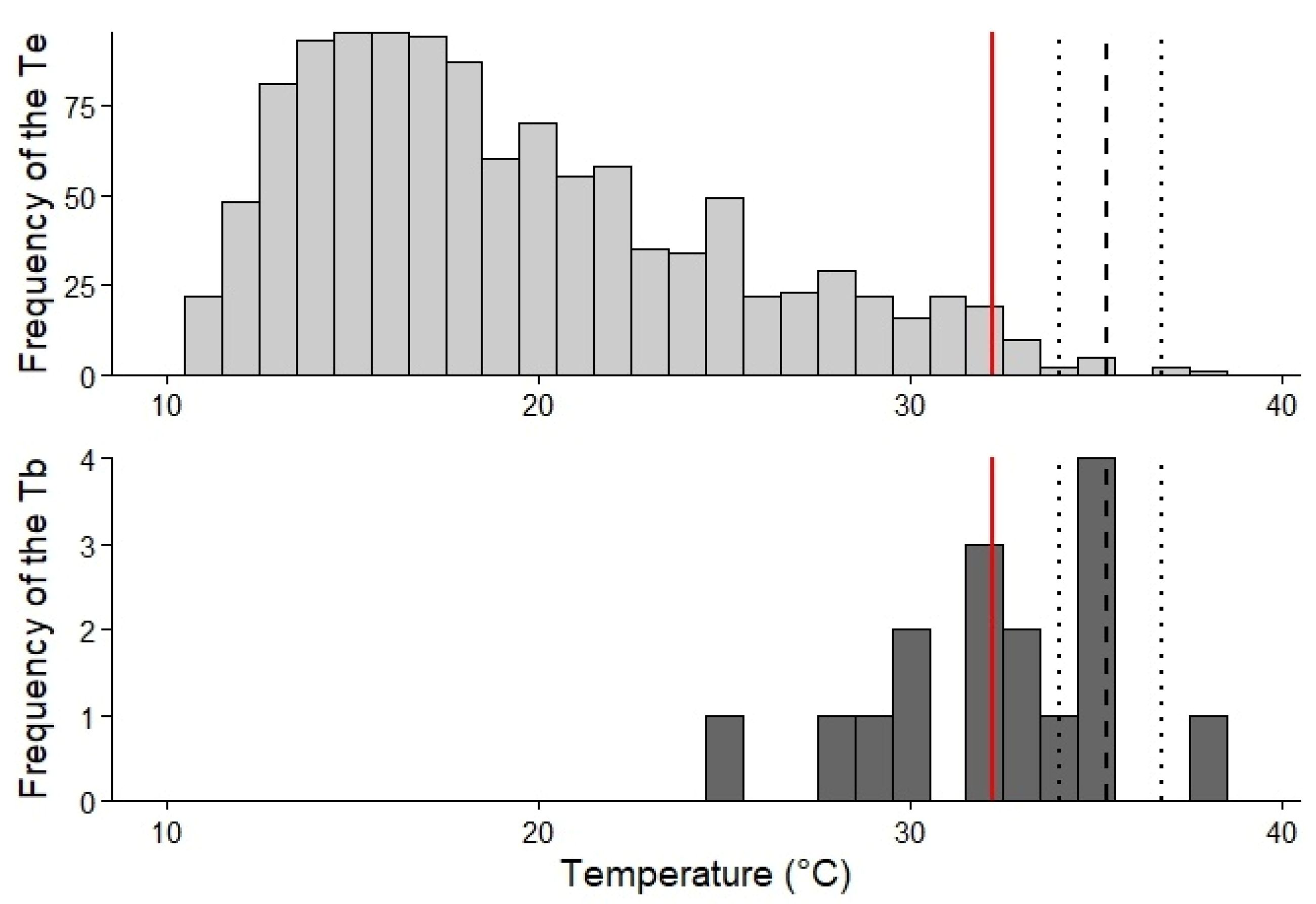
Most Tb values (81.25%) were below the lower limit of the preferred temperature range (Tset), whereas 12.5% fell within this range and 6.25% exceeded it (Figure 1). Thermoregulatory precision was db = 2.85, whereas habitat thermal quality was de = 16.82. Thermoregulatory effectiveness was high (E = 0.83), indicating that Tb values were relatively close to Tpref despite low environmental temperatures (mean Te = 18.05 ± 6.35 °C, n = 2735; Figure 1). For P. williamsi, 99.21% of operative temperature (Te) records were below the set-point range (Figure 1). Only 0.61% of Te values fell within this range, whereas 0.18% exceeded its upper boundary. Moreover, 97.57% of Te records were below the mean Tb, and only 2.43% were equal to or higher than Tb (Figure 1).

3.2. Effect of Temperature on Locomotor Performance

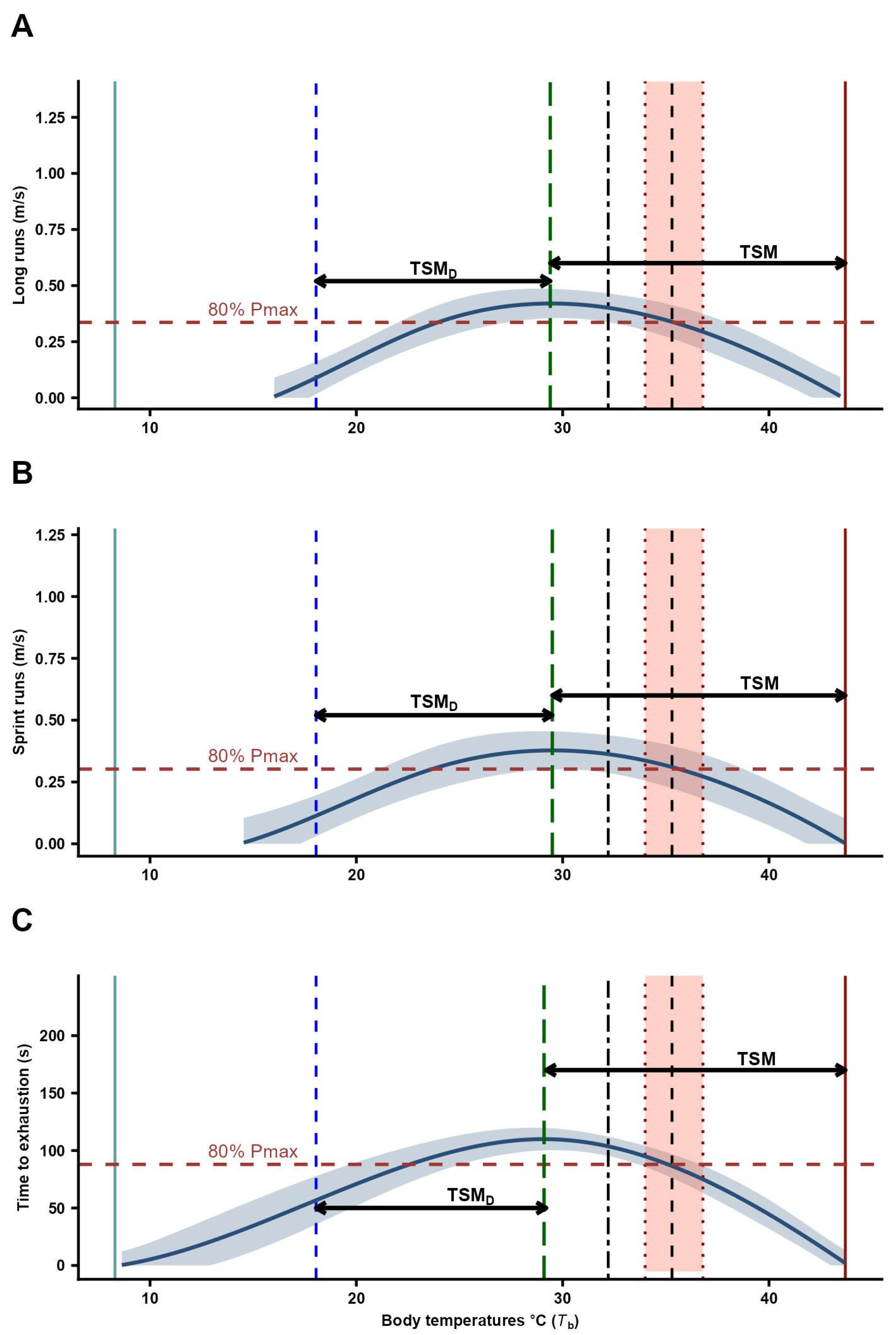
Locomotor performance increased with temperature for both long runs (LR) and sprint runs (SR), reaching peak values at intermediate temperatures (27–32 °C) and declining at 35 °C (Figure 2). Significant differences among temperature treatments were detected for LR (ANOVA on ranks: F4,60 = 5.77, p < 0.01). Individuals at 27, 32, and 35 °C exhibited significantly higher speeds than those at 18 °C, which showed the lowest performance (Table 2; Tukey post hoc: p < 0.01). Performance at 21 °C did not differ from 18 °C but was significantly lower than at 27 and 32 °C. No significant differences were detected between 27 and 32 °C, which exhibited the highest performance values. A similar pattern was observed for SR (F4,60 = 3.31, p < 0.05). The highest speeds occurred at 27 and 32 °C, both significantly higher than at 18 and 21 °C (Table 2; Tukey: p < 0.05). Performance at 21 °C did not differ from 18 °C, whereas values at 35 °C overlapped statistically with the remaining treatments.
Effect sizes (Cohen’s d) revealed large biological effects for both sprint and long-run performance (Table S1, Supplementary Material). For long-run performance (Figure S1, Supplementary Material), the largest effects were observed between extreme temperatures: 18 °C vs. 27 °C (d = −0.94, p < 0.001) and 18 °C vs. 32 °C (d = −0.95, p < 0.001). Moderate to large effects were found for 21 °C vs. 27 °C (d = −0.73, p < 0.001) and 21 °C vs. 32 °C (d = −0.73, p < 0.001). For sprint performance (Figure S2, Supplementary Material), medium to large effects were observed for 18 °C vs. 27 °C (d = −0.68, p < 0.05) and 18 °C vs. 32 °C (d = −0.68, p < 0.01), with moderate effects for 21 °C vs. 27 °C (d = −0.53, p < 0.01) and 21 °C vs. 32 °C (d = −0.52, p < 0.05). In contrast to the running performance metrics, stamina showed no significant differences among temperature treatments (27 °C, 32 °C, and 35 °C; all p > 0.05; Figure S3, Supplementary Material). Effect sizes were correspondingly small to trivial: 27 °C vs. 32 °C (d = 0.31, p = 0.361), 27 °C vs. 35 °C (d = 0.25, p = 0.500), and 32 °C vs. 35 °C (d = −0.05, p = 0.976).
Values of optimal temperature (To) and maximum performance (Vmax) are presented in Table 1. For LR, individual maximum speed (Vmax,i) was not significantly related to body temperature (linear regression: F1,14 = 4.72, p > 0.05) or body mass. However, Vmax,i showed a positive and significant relationship with SVL (multiple linear regression: t13 = 6.22, p < 0.05), while body mass was not significant. Similarly, for SR, Vmax,i was not significantly associated with Tb (F1,14 = 1.74, p > 0.05) or body mass. In contrast, SVL showed a positive and significant relationship with Vmax,i (t13 = 4.05, p < 0.01).
Endurance capacity did not vary significantly among temperatures (repeated-measures ANOVA on ranks: F2,30 = 1.42, p > 0.05), although the highest mean value was observed at 35 °C (Table 2, Figure 2). Maximum endurance (Table 1) was not significantly related to body temperature (F1,14 = 0.31, p > 0.05), nor to SVL or body mass (multiple regression: p > 0.05).

3.3. Thermal Tolerance and Thermal Vulnerability Indices

Mean critical thermal minimum (CTmin) was 8.25 ± 1.71 °C and mean critical thermal maximum (CTmax) was 43.66 ± 0.71 °C, resulting in a thermal tolerance range of 35.41 °C.
The thermal safety margin (TSMD; sensu Deutsch et al. [2]) was 12.4 °C for LR, 12.5 °C for SR, and 13.2 °C for endurance. The thermal safety margin (TSM; sensu Gómez Alés et al. [32]) was 14.3 °C for LR, 14.2 °C for SR, and 14.6 °C for endurance. Warming tolerance (WT) for P. williamsi was 25.63 °C, indicating high thermal tolerance to warming.

4. Discussion

Consistent with the thermal coadaptation hypothesis, optimal temperatures (T) of fitness-related thermal performance curves (TPCs) are expected to correlate with preferred body temperature (Tpref) [9,33,34,35]. Under this framework, To values of fitness-related TPCs are expected to correlate with Tpref. However, this prediction was not supported in P. williamsi, as the estimated To values for the different performance traits were consistently lower than the observed Tpref (Table 2). Therefore, in terms of locomotor performance, our results do not support the thermal coadaptation hypothesis in this species. It is important to note, however, that our sample size was relatively small (n = 16), which may limit the statistical power to detect subtle associations among thermal traits. Therefore, non-significant relationships should be interpreted with caution.
Alternatively, the preferred body temperature (Tpref) of P. williamsi may be under selection to optimize other physiological processes, such as reproduction, digestion, or growth [35,89,90]. This interpretation is supported by the observation that this species is able to reach maximal locomotor performance at body temperatures commonly experienced during its daily activity period (Table 2). In addition, field body temperatures (Tb) were higher than the mean operative environmental temperature (Te = 18.05 °C), indicating that despite a limited availability of thermally suitable microhabitats, individuals can behaviorally thermoregulate to attain temperatures close to their performance optima. However, body temperatures near or above the optimal temperature (To) for a given physiological process generally result in sharper declines in performance compared to temperatures below To [3,26,28,34]. In this context, the high thermoregulatory effectiveness of P. williamsi may help buffer this trade-off between environmental temperatures and the thermal optima associated with locomotor performance [28]. In this context, the high thermoregulatory effectiveness of P. williamsi may help buffer this trade-off between environmental temperatures and the thermal optima associated with locomotor performance [28]. It is important to note that the variables compared here derive from different contexts: Tb and Te reflect field conditions integrating environmental heterogeneity and behavioral thermoregulation, whereas Tpref and To are obtained under controlled laboratory conditions. As a result, direct comparisons among these variables should be interpreted with caution, as mismatches may arise not only from biological processes but also from differences in measurement context.
Environmental constraints imposed by the topography of Puna and high-Andean environments [57,66,91] may explain the mismatch observed between Tb and Tpref in P. williamsi. Although Gómez Alés et al. [29] suggested that local features of the study area—such as the north–south orientation of the valley and intermediate vegetation cover—reduce wind exposure and its cooling effects, other factors may still limit the attainment of higher body temperatures. For instance, variation in solar radiation and the shading produced by slopes can expose individuals to either higher or lower temperatures, respectively, thereby constraining Tb and reducing opportunities for effective thermoregulation [26,52,79,92,93]. Consistent with this, a previous study conducted in the same area reported low thermal quality of the environment for P. williamsi at Quebrada La Puerta [57]. In our study, nearly 100% of operative temperature (Te) records fell below the set-point range (Tset), while more than 80% of Tb values were also below this range. These results highlight the strong thermal constraints imposed by the environment, which likely limit the ability of P. williamsi to attain body temperatures close to its preferred temperature.
Despite the low operative temperatures recorded, P. williamsi attained relatively high body temperatures, likely as a result of its high thermoregulatory effectiveness (E = 0.83), thus supporting Prediction 2 of this study. However, our results differ from those previously reported for the same population (E = 0.50; Laspiur et al. [57]). These discrepancies may be explained by methodological differences between studies. On the one hand, we used PVC models to estimate operative temperatures, whereas Laspiur et al. [57] employed copper models. On the other hand, the thermoregulatory effectiveness (E) estimated in this study is based solely on data collected during October–November (spring), while the value reported by Laspiur et al. [57] integrates records from October (spring), December (summer), and April (autumn). These methodological differences may obscure the effects of seasonal thermal variation characteristic of the Puna region [57,66,75,79,91,94], as well as potential differences in heat transfer properties between the materials used in the biophysical models to estimate Te. Therefore, caution is needed when comparing thermoregulatory indices across studies that differ in temporal scale and methodological approaches. In this sense, our results should be interpreted within the seasonal context in which data were collected, as thermal biology and performance traits in Andean lizards may vary across seasons [71,95,96]. Future studies incorporating broader temporal sampling would help to evaluate the consistency of these patterns throughout the annual cycle.
Locomotor performance in sprint trials increased with temperature up to an optimal value and declined thereafter (Figure 2). This pattern, characterized by relatively high performance across a broad range of temperatures, has been reported as an adaptive trait in several lizard species inhabiting cold and temperate environments of the Andes and Patagonia [6,18,27,28,29,32,55,97,98,99,100]. The ability to maintain high locomotor performance over a wide thermal range has been primarily linked to habitat characteristics and ecological demands, including predator escape, social interactions, and foraging [32,100]. In contrast, endurance capacity has been associated with diet and microhabitat use [32,101]. In this context, the herbivorous diet of P. williamsi suggests that high endurance capacity may not be essential, as individuals likely move short distances between food resources within rocky habitats. This interpretation is consistent with the relatively small home range reported for the species [19,102]. This combination of broad thermal performance and reduced reliance on endurance may reflect an ecological strategy prioritizing short, rapid movements over sustained activity.
In contrast to previous studies in liolaemid lizards [32,97,98,103], we found a positive relationship between Vmax for both locomotor modes and SVL, whereas body mass showed no significant effect. This pattern suggests that locomotor performance in P. williamsi may be more closely associated with linear body dimensions than with overall body mass, potentially reflecting biomechanical factors such as stride length or limb proportions. While this could be related to biomechanical factors such as stride length or limb proportions, our data do not allow us to directly test these mechanisms. Similarly, variation in muscle composition may also influence performance, but this was not evaluated in the present study [104,105]. Therefore, these interpretations should be considered with caution. Alternatively, the observed pattern may be consistent with functional and ecological factors associated with escape behavior. In this context, predation pressure from birds [106], together with the documented escape responses of this species [107], could favor traits related to rapid acceleration and sprint performance. Interestingly, previous work has suggested that a weak or absent relationship between body size and speed may reduce trade-offs between energy acquisition and escape capacity [32]. In this sense, P. williamsi may represent a useful model to further explore the links between locomotor performance, morphology, and its herbivorous lifestyle. Notably, maximum locomotor performance showed limited sensitivity to temperature, suggesting that this species may maintain relatively stable sprint capacity across a range of ecologically relevant body temperatures. Additionally, although no significant differences between sexes have been reported for some thermal traits in Phymaturus [57,66], sexual variation has been documented in other liolaemid lizards [72,75,95]. Therefore, the potential influence of sex on locomotor and thermal traits cannot be ruled out and should be explicitly addressed in future studies with larger sample sizes.
Contrary to our Prediction 3, P. williamsi exhibited relatively high values of thermal vulnerability indices (Figure 2), suggesting that the species may be able to buffer the projected increases in environmental temperature (~2–3.5 °C) for the Central Andes region [27,59,108]. In particular, the relatively high TSMD values indicate that current operative temperatures are below the thermal optima for locomotor performance, suggesting that environmental warming could initially bring body temperatures closer to optimal conditions. Similarly, the high TSM values reflect a substantial distance between optimal performance temperatures and critical thermal maxima, indicating a broad physiological buffer before reaching upper thermal limits. In addition, the high WT values suggest that environmental temperatures remain far from lethal thresholds, reinforcing the idea of a relatively low immediate risk from direct thermal stress. In general, lizards inhabiting temperate and cold environments of the Andes and Patagonia tend to behave as thermal generalists and exhibit relatively high thermal safety margins and warming tolerance, consistent with our estimates [6,18,26,27,28,29,32,51,57,66,97,99,100,109,110]. However, these relatively high tolerance values should not be interpreted as an absence of vulnerability. Even moderate increases in environmental temperature could alter the availability and temporal distribution of suitable operative temperatures, potentially constraining activity times and increasing exposure to suboptimal or stressful thermal conditions [3,4,30]. In highly seasonal and thermally variable environments such as the Andean highlands, small shifts in temperature regimes may also disrupt the balance between thermoregulation, foraging, and predator avoidance [29,40,107]. Moreover, because P. williamsi relies on specific microhabitats (e.g., rocky substrates and crevices) for thermoregulation [19], its capacity to buffer climate warming will likely depend not only on physiological tolerance but also on the availability of thermal refuges. Thus, habitat structure and microhabitat heterogeneity may play a critical role in mediating the effects of climate change on this species.
Taken together, our results suggest that the vulnerability of P. williamsi to climate warming may not be primarily driven by its physiological limits, but rather by ecological constraints on the availability of suitable thermal conditions. In this sense, climate change may impact this species indirectly by altering the thermal landscape and restricting opportunities for effective thermoregulation and activity.

5. Conclusions

In conclusion, P. williamsi is a eurythermic species that exhibits thermal sensitivity in locomotor performance and behaves as an effective thermoregulator. Despite showing an ecophysiological capacity to tolerate the moderate warming projected for the Central Andes [2,80,108,111], its persistence may ultimately depend on the availability of suitable microhabitats that buffer environmental temperature extremes. This study contributes to improving our understanding of the thermal ecophysiology and climate vulnerability of this species, complementing previous findings [57] and expanding current knowledge on its thermal tolerance and locomotor performance. Nevertheless, future studies should incorporate seasonal variation and microhabitat thermal heterogeneity to more comprehensively assess its persistence in the Puna region of the Andean highlands.

Supplementary Materials

The following supporting information can be downloaded at: https://www.mdpi.com/article/10.3390/biology15090729/s1. Figure S1: Effect sizes (Cohen’s d) for pairwise temperature comparisons in sprint performance (SR) of Phymaturus williamsi. Bars represent standardized differences between temperature treatments, with colors indicating statistical significance: dark blue (p < 0.05) and gray (non-significant). Values above bars are Cohen’s d coefficients. Dashed reference lines indicate interpretation of thresholds: d = 0.2 (small effect), d = 0.5 (medium effect), and d = 0.8 (large effect). Negative d values indicate higher performance at the warmer temperature of each pair. The largest effects were observed between extreme temperatures (18 °C vs. 27 °C and 18 °C vs. 32 °C: d = −0.68), representing medium-to-large biological effects. Horizontal bar plot orientation facilitates comparison of effect magnitudes across temperature pairs. Figure S2: Effect sizes (Cohen’s d) for pairwise temperature comparisons in long-run performance (LR) of Phymaturus williamsi. Bars represent standardized differences between temperature treatments, with colors indicating statistical significance: dark blue (p < 0.05) and gray (non-significant). Values above bars are Cohen’s d coefficients. Dashed reference lines indicate interpretation of thresholds: d = 0.2 (small effect), d = 0.5 (medium effect), and d = 0.8 (large effect). Negative d values indicate higher performance at the warmer temperature of each pair. The largest effects were observed between extreme temperatures (18 °C vs. 27 °C: d = −0.94; 18 °C vs. 32 °C: d = −0.95), representing large biological effects. Horizontal bar plot orientation facilitates comparison of effect magnitudes across temperature pairs. Figure S3: Effect sizes (Cohen’s d) for pairwise temperature comparisons in stamina (time to exhaustion, seconds) of Phymaturus williamsi. Bars represent standardized differences between temperature treatments, with colors indicating statistical significance: dark blue (p < 0.05) and gray (non-significant). Values above bars are Cohen’s d coefficients. Dashed reference lines indicate interpretation of thresholds: d = 0.2 (small effect), d = 0.5 (medium effect), and d = 0.8 (large effect) following Cohen [87]. All comparisons were non-significant (p > 0.05), with effect sizes ranging from small to trivial (d = 0.31 for 27 °C vs. 32 °C; d = 0.25 for 27 °C vs. 35 °C; d = −0.05 for 32 °C vs. 35 °C). This indicates that stamina is less sensitive to temperature variation within the tested range (27–35 °C) compared to sprint and long-run performance. Table S1: Effect sizes (Cohen’s d) for pairwise temperature comparisons in sprint performance (SR), long-run performance (LR), and stamina of Phymaturus williamsi.

Author Contributions

Conceptualization: R.G.A. and A.E.V.E.; Methodology: A.E.V.E., R.G.A., F.V.O., Y.M.O. and J.M.S.; Software: R.G.A. and J.M.S.; Validation: A.E.V.E.; Formal Analysis: R.G.A. and J.M.S.; Investigation: R.G.A., A.E.V.E., F.V.O. and Y.M.O.; Resources: R.G.A., A.E.V.E., F.V.O. and Y.M.O.; Data Curation: R.G.A. and J.M.S.; Writing—Original Draft: R.G.A., A.E.V.E. and F.V.O.; Writing—Review & Editing: A.E.V.E., F.V.O. and Y.M.O.; Visualization: R.G.A., A.E.V.E. and F.V.O.; Supervision: R.G.A.; Project Administration: R.G.A.; Funding Acquisition: R.G.A. and A.E.V.E. All authors have read and agreed to the published version of the manuscript.

Funding

This research was partially supported by the National University of San Juan and the National Council for Scientific and Technical Research (postdoctoral scholarship CONICET, Res. 2020-134-APN-DIR, RGA, and Res. 2022-788-APN-DIR, AEVE).

Institutional Review Board Statement

Ethical approval was obtained from the Universidad Nacional de San Juan (Act No. 44, exp. No. 02-0800-m-21).

Informed Consent Statement

Not applicable.

Data Availability Statement

The raw data supporting the conclusions of this article will be made available by the authors on request.

Acknowledgments

We thank the Secretaría de Medio Ambiente, Dirección de Conservación y Áreas Protegidas, Provincia de San Juan, for collection permission. This work is dedicated to our colleague Juan Carlos Acosta, with whom we initiated the design of this project and who sadly passed away before its completion.

Conflicts of Interest

The authors declare no competing or financial interests.

References

  1. IPCC. Chapter 12: Climate Change Information for Regional Impact and for Risk Assessment|Climate Change 2021: The Physical Science Basis. In Climate Change 2021: The Physical Science Basis. Contribution of Working Group I to the Sixth Assessment Report of the Intergovernmental Panel on Climate Change; Cambridge University Press: Cambridge, UK, 2021; Available online: https://www.ipcc.ch/report/ar6/wg1/chapter/chapter-12/ (accessed on 18 April 2026).
  2. Deutsch, C.A.; Tewksbury, J.J.; Huey, R.B. Impacts of climate warming on terrestrial ectotherms across latitude. Proc. Natl. Acad. Sci. USA 2008, 105, 6668–6672. [Google Scholar] [CrossRef]
  3. Sinervo, B.; Mendez-De-La-Cruz, F.; Miles, D.B.; Heulin, B.; Bastiaans, E.; Villagrán-Santa Cruz, M.; Lara-Reséndiz, R.; Martínez-Méndez, N.; Calderón-Espinosa, M.L.; Meza-Lázaro, R.N.; et al. Erosion of lizard diversity by climate change and altered thermal niches. Science 2010, 328, 894–899. [Google Scholar] [CrossRef] [PubMed]
  4. Lara-Reséndiz, R.A.; Ayala, F.A.; Felix, C.M.; Perez-Delgadillo, A.G.; Álvarez-Yépiz, J.C. Ecophysiological vulnerability and thermal niche shifts of an extremophile lizard under climate change in the Sonoran Desert using hybrid mechanistic–correlative SDM. J. Therm. Biol. 2026, 126, 104402. [Google Scholar] [CrossRef] [PubMed]
  5. Diele-Viegas, L.M.; Figueroa, R.T.; Vilela, B.; Rocha, C.F.D. Are reptiles toast? A worldwide evaluation of Lepidosauria vulnerability to climate change. Clim. Change 2020, 159, 581–599. [Google Scholar]
  6. Kubisch, E.L.; Fernández, J.B.; Ibargüengoytía, N.R. Vulnerability to climate warming of Liolaemus pictus (Squamata, Liolaemidae), a lizard from the cold temperate climate in Patagonia, Argentina. J. Comp. Physiol. B 2016, 186, 243–253. [Google Scholar]
  7. Cosendey, B.N.; Rocha, C.F.D.; Menezes, V.A. Climate change, lizard populations, and species vulnerability/persistence: Trends in ecological and predictive climate studies. Environ. Dev. Sustain. 2023, 25, 8929–8950. [Google Scholar]
  8. Huey, R.B.; Kingsolver, J.G. Evolution of thermal sensitivity of ectotherm performance. Trends Ecol. Evol. 1989, 4, 131–135. [Google Scholar] [CrossRef]
  9. Angilletta, M.J.; Hill, T.; Robson, M.A. Is physiological performance optimized by thermoregulatory behavior? A case study of the eastern fence lizard, Sceloporus undulatus. J. Therm. Biol. 2002, 27, 199–204. [Google Scholar] [CrossRef]
  10. Brizio, M.V.; Cabezas-Cartés, F.; Fernández, J.B.; Gómez Alés, R.; Avila, L.J. Vulnerability to global warming of a critically endangered lizard from the Monte Desert, Patagonia Argentina. Can. J. Zool. 2021, 99, 773–782. [Google Scholar]
  11. Bozinovic, F.; Calosi, P.; Spicer, J.I. Physiological correlates of geographic range in animals. Annu. Rev. Ecol. Evol. Syst. 2011, 42, 155–179. [Google Scholar] [CrossRef]
  12. Gunderson, A.R.; Leal, M. A conceptual framework for understanding thermal constraints on ectotherm activity with implications for predicting responses to global change. Ecol. Lett. 2016, 19, 111–120. [Google Scholar] [PubMed]
  13. Kearney, M. Activity restriction and the mechanistic basis for extinctions under climate warming. Ecol. Lett. 2013, 16, 1470–1479. [Google Scholar] [CrossRef]
  14. Huey, R.B. Temperature, physiology, and the ecology of reptiles. In Biology of Reptilia, 13th ed.; Gans, C., Pough, F.H., Eds.; Academic Press: London, UK, 1982; pp. 25–91. [Google Scholar]
  15. Labra, A.; Soto-Gamboa, M.; Bozinovic, F. Behavioral and physiological thermoregulation of Atacama desert-dwelling Liolaemus lizards. Ecoscience 2001, 8, 174–413. [Google Scholar]
  16. Li, X.; Wang, Y.; Lu, S.; Li, M.; Men, S.; Bai, Y.; Tang, X.; Chen, Q. The cold hardiness of Phrynocephalus erythrurus, the lizard living at highest altitude in the world. CryoLetters 2017, 38, 216–227. [Google Scholar]
  17. Gómez Alés, R.; Valdez Ovallez, F.; Osorio, Y.; Carretero, M.; Stellatelli, O. Interplay between thermal and hydric traits in psammophilous Liolaemus lizards of the Monte Desert, Argentina. J. Exp. Biol. 2026, 229, jeb250936. [Google Scholar] [CrossRef]
  18. Vicenzi, N.; Kubisch, E.; Ibargüengoytía, N.; Corbalán, V. Thermal sensitivity of performance of Phymaturus palluma (Liolaemidae) in the highlands of Aconcagua: Vulnerability to global warming in the Andes. Amphibia-Reptilia 2019, 40, 207–218. [Google Scholar] [CrossRef]
  19. Victorica-Erostarbe, A.E.; Fava, G.A.; Acosta, J.C. Restricted use of space in an endemic lizard of the Andes: Addressing the effects of intrinsic and environmental factors. Behav. Ecol. Sociobiol. 2022, 76, 15. [Google Scholar] [CrossRef]
  20. Kearney, M.; Shine, R.; Porter, W.P. The potential for behavioral thermoregulation to buffer “cold-blooded” animals against climate warming. Proc. Natl. Acad. Sci. USA 2009, 106, 3835–3840. [Google Scholar]
  21. Sears, M.W.; Raskin, E.; Angilletta, M.J. The world is not flat: Defining relevant thermal landscapes in the context of climate change. Integr. Comp. Biol. 2011, 51, 666–675. [Google Scholar] [CrossRef]
  22. Sears, M.W.; Angilletta, M.J. Costs and benefits of thermoregulation revisited: Both the heterogeneity and spatial structure of temperature drive energetic costs. Am. Nat. 2015, 185, E94–E102. [Google Scholar] [CrossRef]
  23. Parmesan, C. Ecological and evolutionary responses to recent climate change. Annu. Rev. Ecol. Evol. Syst. 2006, 37, 637–669. [Google Scholar] [CrossRef]
  24. Wang, Z.; Ma, L.; Shao, M. Are viviparous lizards more vulnerable to climate warming because they have evolved reduced body temperature and heat tolerance? Oecologia 2017, 185, 573–582. [Google Scholar] [CrossRef] [PubMed]
  25. Medina, M.; Ibargüengoytía, N.R.; Sinervo, B. Thermal and hydric constraints on activity in a lizard from the high Andes of Argentina. J. Therm. Biol. 2016, 60, 74–82. [Google Scholar]
  26. Laspiur, A.; Santos, J.C.; Medina, S.M.; Pizarro, J.E.; Sanabria, E.A.; Sinervo, B.; Ibargüengoytía, N.R. Vulnerability to climate change of a microendemic lizard species from the central Andes. Sci. Rep. 2021, 11, 11653. [Google Scholar] [CrossRef]
  27. Cabezas-Cartes, F.; Fernández, J.B.; Duran, F.; Kubisch, E.L. Potential benefits from global warming to the thermal biology and locomotor performance of an endangered Patagonian lizard. PeerJ 2019, 7, e7437. [Google Scholar] [CrossRef]
  28. Cabezas-Cartes, F.; Kubisch, E.L.; Duran, F.; Boretto, J.M. Comparative thermal sensitivity of locomotor performance and vulnerability to global warming of two sympatric Phymaturus lizards from Patagonia (Argentina). Biol. J. Linn. Soc. 2023, 140, 261–276. [Google Scholar] [CrossRef]
  29. Gómez Alés, R.; Acosta, J.C.; Valdez, F.; Martínez, T.A.; Acosta, R.; Muñoz, M.J.R.; Corrales, L. Comparative thermal ecophysiology in Pristidactylus scapulatus populations from the Puna region of Argentina. Zoology 2021, 145, 125903. [Google Scholar] [CrossRef]
  30. Lara-Reséndiz, R.A.; Sánchez, J.M.; Paez, R.S.; Muniz-Leão, S.; Colli, G.R.; Miles, D.B.; Sinervo, B.; Pelegrin, N. Hot, dry, and salty: The present and future of an extremophile model lizard from Argentina. J. Therm. Biol. 2024, 123, 103917. [Google Scholar] [CrossRef]
  31. Pinch, F.; Claussen, D. Effect of temperature and slope on the sprint speed and stamina of the eastern fence lizard, Sceloporus undulatus. J. Herpetol. 2003, 37, 671–679. [Google Scholar] [CrossRef]
  32. Gómez Alés, R.; Acosta, J.C.; Astudillo, V.; Córdoba, M.; Blanco, G.M.; Miles, D. Effect of temperature on locomotor performance in a lizard assemblage in the Puna region of Argentina. J. Comp. Physiol. B 2018, 188, 977–990. [Google Scholar] [CrossRef]
  33. Huey, R.B.; Bennett, A.F. Phylogenetic studies of coadaptation: Preferred temperatures versus optimal performance temperatures of lizards. Evolution 1987, 41, 1098–1115. [Google Scholar]
  34. Martin, T.L.; Huey, R.B. Why “suboptimal” is optimal: Jensen’s inequality and ectotherm thermal preferences. Am. Nat. 2008, 171, E102–E118. [Google Scholar] [CrossRef]
  35. Patterson, L.D.; Darveau, C.A.; Blouin-Demers, G. Support for the thermal coadaptation hypothesis from the growth rates of Sceloporus jarrovii lizards. J. Therm. Biol. 2017, 70, 86–96. [Google Scholar] [CrossRef]
  36. Huey, R.B.; Deutsch, C.A.; Tewksbury, J.J.; Vitt, L.J.; Hertz, P.E.; Álvarez, H.J.; Garland, T. Why tropical forest lizards are vulnerable to climate warming. Proc. R. Soc. B Biol. Sci. 2009, 276, 1939–1948. [Google Scholar] [CrossRef] [PubMed]
  37. Lobo, F.; Barrasso, D.; Valdecantos, S.; Giraudo, A.; Omar, D.; Pietro, D.; Basso, N. Exploring the morphological diversity of Patagonian clades of Phymaturus (Iguania: Liolaemidae). Integrative study and the description of two new species. Cuad. Herpetol. 2022, 36, 197–231. [Google Scholar]
  38. Moreno-Azócar, D.; Vicenzi, N.; Corbalán, V.; Literas, S. Thermal biology of the endemic lizard Phymaturus verdugo: Is it as conservative as we think? Biol. J. Linn. Soc. 2024, 143, blae104. [Google Scholar] [CrossRef]
  39. Corbalán, V.; Debandi, G. Basking behavior in two sympatric herbivorous lizards (Liolaemidae: Phymaturus) from the Payunia volcanic region of Argentina. J. Nat. Hist. 2013, 47, 1365–1378. [Google Scholar] [CrossRef]
  40. Vicenzi, N.; Corbalán, V.E.; Miles, D.B.; Sinervo, B.; Ibargüengoytía, N.R. Range expansion or contraction? Predicting potential changes in the distribution of the high-Andean lizard Phymaturus palluma under climate warming. Biol. Conserv. 2017, 206, 151–167. [Google Scholar] [CrossRef]
  41. Cruz, F.B.; Belver, L.; Acosta, J.C. Thermal biology of Phymaturus lizards: Evolutionary constraints or lack of environmental variation? Zoology 2009, 112, 425–432. [Google Scholar] [CrossRef]
  42. Lobo, F.; Barrasso, D.; Hibbard, T.; Basso, N. On the evolution and diversification of an Andean clade of reptiles: Combining morphology and DNA sequences of the palluma group (Liolaemidae: Phymaturus). Zool. J. Linn. Soc. 2015, 176, 648–673. [Google Scholar] [CrossRef]
  43. Valdecantos, S.; Lobo, F.; Perotti, M.; Moreno-Azócar, D.; Cruz, F. Sexual size dimorphism, allometry and fecundity in a lineage of South American viviparous lizards (Liolaemidae: Phymaturus). Zool. Anz. 2019, 279, 152–163. [Google Scholar] [CrossRef]
  44. Castro, S.; Boretto, J.; Blanco, G.; Acosta, J. Adjustment of the Reproductive Activity of vulnerable lizard Phymaturus williamsi at high Altitudes. Herpetol. Conserv. Biol. 2018, 13, 283–293. [Google Scholar]
  45. Pizarro, J.; Laspiur, A.; Acosta, J.; Blanco, G.; Boretto, J. High reproductive effort in a vulnerable lizard from high altitudes in Argentina: Reproductive biology and sexual dimorphism in Phymaturus extrilidus. An. Acad. Bras. Ciências 2022, 94, e20210179. [Google Scholar] [CrossRef]
  46. Valdez Ovallez, F.M.; Blanco, G.; Castro, S.; Acosta, J.C.; Fernández, R.; Corrales, L.; Acosta, R. Reproductive Biology and Sexual Dimorphism of the Viviparous Lizard Phymaturus cf. palluma (Iguania: Liolaemidae) from the Pre-Andes Region in Central Western Argentina. S. Am. J. Herpetol. 2024, 31, 1–11. [Google Scholar] [CrossRef]
  47. Piantoni, C.; Ibargüengoytía, N.R.; Cussac, V.E. Age and growth of the Patagonian lizard Phymaturus patagonicus. Amphibia-Reptilia 2006, 27, 385–392. [Google Scholar] [CrossRef]
  48. Boretto, J.M.; Cabezas-Cartes, F.; Ibargüengoytía, N.R. Energy allocation to growth and reproduction in a viviparous lizard endemic to the highlands of the Andes, Argentina. J. Zool. 2015, 297, 77–86. [Google Scholar] [CrossRef]
  49. Cabezas-Cartes, F.; Boretto, J.; Ibargüengoytía, N. Age, growth and life-history parameters of an endemic vulnerable lizard from Patagonia, Argentina. Herpetol. J. 2015, 25, 215–224. [Google Scholar]
  50. Abdala, C.S.; Acosta, J.L.; Acosta, J.C.; Álvarez, B.B.; Arias, F.; Avila, L.J.; Blanco, G.M.; Bonino, M.; Boretto, J.M.; Brancatelli, G.; et al. Categorización del estado de conservación de las lagartijas y anfisbenas de la República Argentina. Cuad. Herpetol. 2012, 26, 215–248. [Google Scholar]
  51. Cruz, F.B.; Fitzgerald, L.A.; Espinoza, R.E.; Schulte, J.A. The importance of phylogenetic scale in tests of Bergmann’s and Rapoport’s rules: Lessons from a clade of South American lizards. J. Evol. Biol. 2005, 18, 1559–1574. [Google Scholar] [CrossRef]
  52. Ibargüengoytía, N.R.; Medina, M.; Laspiur, A.; Qu, Y.F.; Peralta, C.A.R.; Sinervo, B.; Miles, D.B. Looking at the past to infer into the future: Thermal traits track environmental change in Liolaemidae. Evolution 2021, 75, 2348–2370. [Google Scholar] [CrossRef]
  53. Lobo, F.; Laspiur, A.; Acosta, J.C. Description of new Andean species of the genus Phymaturus (Iguania: Liolaemidae) from Northwestern Argentina. Zootaxa 2013, 3683, 117–132. [Google Scholar] [CrossRef]
  54. Abdala, S. Phymaturus williamsi  . In The IUCN Red List of Threatened Species; IUCN: Gland, Switzerland, 2016. [Google Scholar] [CrossRef]
  55. Obregón, R.L.; Scolaro, J.A.; Ibargüengoytía, N.R.; Medina, M. Thermal biology and locomotor performance in Phymaturus calcogaster: Are Patagonian lizards vulnerable to climate change? Integr. Zool. 2021, 16, 53–66. [Google Scholar] [CrossRef] [PubMed]
  56. Carothers, J.H.; Marquet, P.A.; Jaksic, F.M. Ecología térmica de una comunidad de lagartos Liolaemus a lo largo de un gradiente altitudinal andino en Chile. Rev. Chil. Hist. Nat. 1998, 71, 39–48. [Google Scholar]
  57. Laspiur, A.; Medina, M.; Ausas, M.S.; Acosta, J.C.; Krenz, J.D.; Ibargueengoytia, N.R. Thermal niches and activity periods in syntopic Phymaturus and Liolaemus lizards from the Andes, Argentina. An. Acad. Bras. Ciências 2024, 96, e20191190. [Google Scholar] [CrossRef]
  58. Angilletta, M.J. Estimating and comparing thermal performance curves. J. Therm. Biol. 2006, 31, 541–545. [Google Scholar] [CrossRef]
  59. Araya-Osses, D.; Casanueva, A.; Román-Figueroa, C.; Uribe, J.M.; Paneque, M. Climate change projections of temperature and precipitation in Chile based on statistical downscaling. Clim. Dyn. 2020, 54, 4309–4330. [Google Scholar] [CrossRef]
  60. Márquez, J.; Martínez Carretero, E.; Dalmasso, A. Provincias Fitogeográficas de San Juan. In Los Reptiles de San Juan; Acosta, J.C., Blanco, G.M., Eds.; Editorial Brujas: Córdoba, Argentina, 2017; pp. 15–18. [Google Scholar]
  61. Roig Juñent, S.; Flores, G.E.; Mattoni, C. Consideraciones biogeográficas de la Precordillera (Argentina), con base en artrópodos epigeos. In Una Perspectiva Latinoamericana de la Biogeografía; Morrone, J.J., Llorente Bousquets, J., Eds.; Universidad Nacional de México: Mexico D.F., Mexico, 2003; pp. 275–288. [Google Scholar]
  62. Roig, F.; Martínez Carretero, E. La vegetación puneña de la provincia de Mendoza, Argentina. Phytocoenologia 1998, 28, 565–608. [Google Scholar] [CrossRef]
  63. Ibargüengoytía, N.; Cabezas-Cartes, F.; Boretto, J.; Piantoni, C.; Kubisch, E.; Fernández, M.; Lara-Resendiz, R.; Méndez-de-la-Cruz, F.; Scolaro, A.; Sinervo, B. Volcanic ash from Puyehue-Cordón Caulle eruptions affects running performance and body condition of Phymaturus lizards in Patagonia, Argentina. Biol. J. Linn. Soc. 2016, 118, 842–851. [Google Scholar] [CrossRef]
  64. Hertz, P.E.; Huey, R.B.; Stevenson, R.D. Evaluating temperature regulation by field-active ectotherms: The fallacy of the inappropriate question. Am. Nat. 1993, 142, 796–818. [Google Scholar] [CrossRef]
  65. Abdala, C.S.; Laspiur, A.; Scrocchi, G.; Semhan, R.V.; Lobo, F.; Valladares, P. Sistemática, Distribución e Historia Natural de una de las Familias de Vertebrados más Diversas del Cono Sur de Sudamérica; RIL Editores: Santiago, Chile, 2021. [Google Scholar]
  66. Gómez Alés, R.; Acosta, J.C.; Laspiur, A. Thermal biology in two syntopic lizards, Phymaturus extrilidus and Liolaemus parvus in the Puna region of Argentina. J. Therm. Biol. 2017, 68, 73–82. [Google Scholar] [CrossRef]
  67. Camacho, A.; Rusch, T.W. Methods and pitfalls of measuring thermal preference and tolerance in lizards. J. Therm. Biol. 2017, 68, 63–72. [Google Scholar] [CrossRef]
  68. Huey, R.B.; Dunham, A.E.; Overall, K.L. Variation in locomotor performance in demographically known populations of the lizard Sceloporus merriami. Physiol. Zool. 1990, 63, 845–872. [Google Scholar] [CrossRef]
  69. Beaupre, S.B.; Jacobson, E.R.; Lillywhite, H.B.; Zamudio, K. Guidelines for Use of Live Amphibians and Reptiles in Field and Laboratory Research; Herpetological Animal Care and Use Committee (HACC), American Society of Ichthyologists and Herpetologists: Lawrence, KS, USA, 2004. [Google Scholar]
  70. Gutiérrez, J.A.; Krenz, J.D.; Ibargüengoytía, N.R. Effect of altitude on thermal responses of Liolaemus pictus argentinus in Argentina. J. Therm. Biol. 2010, 35, 332–337. [Google Scholar] [CrossRef]
  71. Cabezas-Cartes, F.; Kubisch, E.; Ibargüengoytía, N. Consequences of volcanic ash deposition on the locomotor performance of the Phymaturus spectabilis lizard from Patagonia, Argentina. J. Exp. Zool. A 2014, 321, 164–172. [Google Scholar] [CrossRef] [PubMed]
  72. Stellatelli, O.A.; Bonavita, M.I.; Victorel, C.; Gómez Alés, R.; Moreno Azócar, D.L.; Block, C.; Cruz, F.B. Thermo-physiological changes and reproductive investment in a liolaemid lizard at the extreme of the slow–fast continuum. J. Exp. Biol. 2024, 227, jeb247506. [Google Scholar] [CrossRef]
  73. Hertz, P.E.; Huey, R.B.; Nevo, E. Homage to Santa Anita: Thermal sensitivity of sprint speed in agamid lizards. Evolution 1983, 37, 1075–1084. [Google Scholar] [CrossRef]
  74. Robson, M.A.; Miles, D.B. Locomotor performance and dominance in male tree lizards, Urosaurus ornatus. Funct. Ecol. 2000, 14, 338–344. [Google Scholar] [CrossRef]
  75. Gómez Alés, R.; Acosta, J.C.; Astudillo, V.; Córdoba, M. Season-sex interaction induces changes in ecophysiological traits of a lizard in a high altitude cold desert, Puna region. J. Therm. Biol. 2022, 103, 103152. [Google Scholar] [CrossRef]
  76. Taylor, E.N.; Diele-Viegas, L.M.; Gangloff, E.J.; Hall, J.M.; Halpern, B.; Massey, M.D.; Rödder, D.; Rollinson, N.; Spears, S.; Sun, B. The thermal ecology and physiology of reptiles and amphibians: A user’s guide. J. Exp. Zool. A 2021, 335, 13–44. [Google Scholar] [CrossRef]
  77. Lutterschmidt, W.I.; Hutchison, V.H. The critical thermal maximum: Data to support the onset of spasms as the definitive end point. Can. J. Zool. 1997, 75, 1553–1560. [Google Scholar] [CrossRef]
  78. Markham, S.; Marlowe, L.J.; Doan, T.M. Upper thermal limits in the exotic gecko Hemidactylus mabouia from Florida. J. N. Am. Herpetol. 2025, 2025, 27–31. [Google Scholar]
  79. Vicenzi, N.P.; Ibarguengoytía, N.; Corbalán, V.E. Activity patterns and thermoregulatory behavior of the viviparous lizard Phymaturus palluma in Aconcagua Provincial Park, Argentine Andes. Herpetol. Conserv. Biol. 2019, 14, 337–348. [Google Scholar]
  80. Logan, M.L.; Huynh, R.K.; Precious, R.A.; Calsbeek, R.G. The impact of climate change measured at relevant spatial scales: New hope for tropical lizards. Glob. Change Biol. 2013, 19, 3093–3102. [Google Scholar] [CrossRef] [PubMed]
  81. Zajitschek, S.R.; Zajitschek, F.; Miles, D.B.; Clobert, J. The effect of coloration and temperature on sprint performance in male and female wall lizards. Biol. J. Linn. Soc. 2012, 107, 573–582. [Google Scholar] [CrossRef]
  82. Diele-Viegas, L.M.; Vitt, L.J.; Sinervo, B.; Colli, G.R.; Werneck, F.P.; Miles, D.B. Thermal physiology of amazonian lizards. PLoS ONE 2018, 13, e0192834. [Google Scholar] [CrossRef]
  83. Caetano, G.H.O.; Santos, J.C.; Godinho, L.B.; Cavalcante, V.H.G.L.; Diele-Viegas, L.M.; Campelo, P.H.; Martins, L.F.; Oliveira, A.F.S.; Alvarenga, J.M.; Wiederhecker, H.C.; et al. Time of activity is a better predictor. Oikos 2020, 129, 953–963. [Google Scholar] [CrossRef]
  84. Gilbert, A.L.; Miles, D.B. Natural selection on thermal preference, critical thermal maxima and locomotor performance. Proc. R. Soc. B 2017, 284, 20170536. [Google Scholar] [CrossRef]
  85. Méndez-Galeano, M.A.; Paternina-Cruz, R.F.; Calderón-Espinosa, M.L. The highest kingdom of Anolis: Thermal biology of the Andean lizard Anolis heterodermus (Squamata: Dactyloidae) over an elevational gradient in the Eastern Cordillera of Colombia. J. Therm. Biol. 2020, 89, 102498. [Google Scholar] [CrossRef]
  86. Lakens, D. Calculating and reporting effect sizes to facilitate cumulative science: A practical primer for t-tests and ANOVAs. Front. Psychol. 2013, 4, 62627. [Google Scholar]
  87. Cohen, J. Statistical Power Analysis for the Behavioral Sciences, 2nd ed.; Lawrence Erlbaum Associates: Hillsdale, NJ, USA, 1988. [Google Scholar]
  88. R Core Team. R: A Language and Environment for Statistical Computing; R Foundation for Statistical Computing: Vienna, Austria, 2023; Available online: https://www.R-project.org/ (accessed on 14 July 2025).
  89. Angilletta, M.J. Thermal Adaptation: A Theoretical and Empirical Synthesis; Oxford University Press: Oxford, UK, 2009. [Google Scholar]
  90. Beal, M.S.; Lattanzio, M.S.; Miles, D.B. Differences in the thermal physiology of adult Yarrow’s spiny lizards (Sceloporus jarrovii) in relation to sex and body size. Ecol. Evol. 2014, 4, 4220–4229. [Google Scholar] [CrossRef]
  91. Valdecantos, S.; Martínez, V.; Lobo, F.; Cruz, F.B. Thermal biology of Liolaemus lizards from the high Andes: Being efficient despite adversity. J. Therm. Biol. 2013, 38, 126–134. [Google Scholar] [CrossRef]
  92. Duran, F.; Kubisch, E.L.; Boretto, J.M. Thermal physiology of three sympatric Liolaemidae lizards in Patagonia (Argentina). J. Comp. Physiol. B 2018, 188, 141–152. [Google Scholar] [PubMed]
  93. Vicenzi, N.P.; Massarelli, R.; Ibargüengoytía, N.; Corbalan, V. Basking and retreat site selection of Phymaturus palluma, a rock-dwelling lizard in the Highlands of Aconcagua. An. Acad. Bras. Ciências 2021, 93, e20190662. [Google Scholar]
  94. Valdez Ovallez, F.M.; Gómez Alés, R.; Nieva Cocilio, R.; Martinez, T.; Acosta, J.C.; Villavicencio, J.; Blanco, G. On the oviposition of Homonota aff. darwinii in the Puna region of the Central Andes of Argentina. Turk. J. Zool. 2024, 48, 98–103. [Google Scholar] [CrossRef]
  95. Stellatelli, O.A.; Villalba, A.; Block, C.; Vega, L.E.; Dajil, J.E.; Cruz, F.B. Seasonal shifts in the thermal biology of the lizard Liolaemus tandiliensis (Squamata, Liolaemidae). J. Therm. Biol. 2018, 73, 61–70. [Google Scholar] [CrossRef]
  96. Salva, A.G.; Robles, C.I.; Tulli, M.J. Thermal biology of Liolaemus scapularis (Iguania: Liolaemidae) from Argentinean northwest. J. Therm. Biol. 2021, 98, 102924. [Google Scholar] [PubMed]
  97. Bonino, M.F.; Azócar, D.L.M.; Tulli, M.J.; Abdala, C.S.; Perotti, M.G.; Cruz, F.B. Running in cold weather: Morphology, thermal biology, and performance in the southernmost lizard clade in the world (Liolaemus lineomaculatus section: Liolaemini: Iguania). J. Exp. Zool. A 2011, 315, 495–503. [Google Scholar]
  98. Kubisch, E.L.; Fernández, J.B.; Ibargüengoytía, N.R. Is locomotor performance optimised at preferred body temperature? A study of Liolaemus pictus argentinus from northern Patagonia, Argentina. J. Therm. Biol. 2011, 36, 328–333. [Google Scholar] [CrossRef]
  99. Kubisch, E.L.; Fernández, J.B.; Ibargüengoytía, N.R. Thermophysiological plasticity could buffer the effects of global warming on a Patagonian lizard. J. Exp. Zool. A 2023, 339, 590–601. [Google Scholar]
  100. Valdez Ovallez, F.M.; Gómez Alés, R.; Astudillo, V.; Córdoba, M.; Fava, G.; Acosta, R.; Acosta, J.C. Thermal biology and locomotor performance of the Andean lizard Liolaemus fitzgeraldi (Liolaemidae) in Argentina. Acta Zool. 2023, 104, 561–574. [Google Scholar] [CrossRef]
  101. Huey, R.B.; Bennett, A.F.; John-Alder, H.; Nagy, K.A. Locomotor capacity and foraging behaviour of Kalahari lacertid lizards. Anim. Behav. 1984, 32, 41–50. [Google Scholar] [CrossRef]
  102. Castro, S.A.; Laspiur, A.; Acosta, J.C. Variación anual e intrapoblacional de la dieta de Phymaturus cf. palluma (Iguania: Liolaemidae) de los Andes centrales en Argentina. Rev. Mex. Biodivers. 2013, 84, 1258–1265. [Google Scholar] [CrossRef]
  103. Fernández, J.B.; Smith, J.; Scolaro, A.; Ibargüengoytía, N.R. Performance and thermal sensitivity of the southernmost lizards in the world, Liolaemus sarmientoi and L. magellanicus. J. Therm. Biol. 2011, 36, 15–22. [Google Scholar] [CrossRef]
  104. Hill, R.W.; Wyse, G.A. Fisiología Animal, 3rd ed.; Editorial Médica Panamericana: Madrid, Spain, 2006; p. 776. [Google Scholar]
  105. Scales, J.A.; King, A.A.; Butler, M.A. Running for your life or running for your dinner: What drives fiber-type evolution in lizard locomotor muscles? Am. Nat. 2009, 173, 543–553. [Google Scholar] [CrossRef] [PubMed]
  106. Fava, G.A.; Acosta, J.C.; Victorica-Erostarbe, A.E.; Martínez, T.A.; Rodríguez-Muñoz, M.J. Phymaturus williamsi: Predator-prey interaction. Herpetol. Rev. 2018, 49, 331–332. [Google Scholar]
  107. Fava, G.A.; Acosta, J.C. Escape distance and escape latency following simulated rapid bird attacks in an Andean lizard, Phymaturus williamsi. Behaviour 2018, 155, 861–881. [Google Scholar] [CrossRef]
  108. Barros, V.R.; Boninsegna, J.A.; Camilloni, I.A.; Chidiak, M.; Magrín, G.O.; Rusticucci, M. Climate change in Argentina: Trends, projections, impacts and adaptation. Wiley Interdiscip. Rev. Clim. Change 2015, 6, 151–169. [Google Scholar]
  109. Bonino, M.F.; Azócar, D.L.M.; Schulte, J.A.; Abdala, C.S.; Cruz, F.B. Thermal sensitivity of cold climate lizards and the importance of distributional ranges. Zoology 2015, 118, 281–290. [Google Scholar] [CrossRef]
  110. Vidal, M.A.; Barraza-Acuña, F.; Cifuentes, V.; Collado, G.A.; Torres-Díaz, C.; Chandía, P. The survival challenge of the lizard Phymaturus vociferator in central Chile. Amphibia-Reptilia 2025, 46, 317–333. [Google Scholar] [CrossRef]
  111. Vento, B.; Rivera, J.; Ontivero, M. Climate influence on future suitability of high-altitude wetlands in two natural protected areas from the Central Andes of Argentina. Perspect. Ecol. Conserv. 2024, 22, 240–249. [Google Scholar] [CrossRef]
Figure 1. Frequency distributions of operative temperatures (Te; upper panel) and field body temperatures (Tb; lower panel) of Phymaturus williamsi. The red solid line indicates mean Tb, the black dashed line represents mean preferred temperature (Tpref), and dotted lines show the setpoint temperature range. The comparison between environmental thermal availability (Te) and body temperatures (Tb) illustrates the degree of thermoregulatory adjustment relative to the species’ preferred thermal range.
Biology 15 00729 g001
Figure 2. Thermal performance curves (TPC) describing the relationship between body temperature treatments and performance metrics in Phymaturus williamsi. (A) Long-run performance (LR, m s−1) at 18, 21, 27, 32, and 35 °C. (B) Sprint performance (SR, m s−1) at 18, 21, 27, 32, and 35 °C; (C) stamina (Time to exhaustion, s) at 27, 32, and 35 °C. Solid blue curves represent GAM-predicted performance, fitted using individual size as a covariate, with semi-transparent blue shaded bands indicating the 95% confidence intervals (CI) around the predictions. Green long-dashed vertical lines indicate optimal temperatures (LR: To = 29.4 °C; SR: To = 29.5 °C; Stamina: To = 29.1 °C). Red dashed horizontal lines represent the performance threshold corresponding to 80% of maximum performance (B80). Salmon shaded areas and red dotted vertical lines denote the selected temperature range (Tset = 34–36.8 °C), while black dashed vertical lines mark the mean selected temperature (Tpref = 35.3 °C). Solid light-blue and dark-red vertical lines indicate the critical thermal minimum (CTmin = 8.3 °C) and maximum (CTmax = 43.7 °C), respectively. Blue dashed vertical lines represent the mean operative environmental temperature (Te = 18.05 °C). Black dash–dot vertical lines indicate the mean field body temperature (Tb = 32.21 °C). Horizontal double-headed arrows illustrate the thermal safety margins: TSM (between To and CTmax) and TSMD (between Te and To).
Biology 15 00729 g002
Table 1. Mean values (±standard deviation) of morphological, thermal, and locomotor performance traits for Phymaturus williamsi (n = 16). Variables include snout–vent length (SVL), body mass (BM), preferred body temperature (Tpref), and the lower (TsetLo) and upper (TsetUp) limits of the set-point range. Locomotor performance metrics are presented separately for sprint runs (SR), long runs (LR), and endurance, including optimal temperature for performance (To), thermal performance breadth (B80) maximum speed (Vmax) for SR and LR, and maximum endurance capacity (s).
VariableMean ± SDRange
SVL (mm)100.06 ± 3.87
BM (g)35.09 ± 5.20
Tpref (°C)35.28 ± 1.76
TsetLo (°C)34.01 ± 3.13
TsetUp (°C)36.78 ± 1.09
To (SR) (°C)29.50 ± 3.26
B80 (SR) (°C)23.67–35.64
Vmax (SR) (m s−1)0.37 ± 0.08
To (LR) (°C)29.40 ± 3.11
B80 (LR) (°C)23.95–35.39
Vmax (LR) (m s−1)0.42 ± 0.09
To (Endurance) (°C)29.10 ± 3.35
B80 (Endurance) (°C)22.59–35.10
Endurance109.92 ± 34.56
Table 2. Mean values (±standard deviation) of sprint runs (SR, long-run speed (LR), and endurance capacity of Phymaturus williamsi (n = 16) across experimental temperature treatments. Sprint and long-run speeds are expressed in m s−1, and endurance as time to exhaustion (s). Endurance trials were conducted only at 27, 32, and 35 °C.
TraitsTemperature Treatments
18 °C21 °C27 °C32 °C35 °C
Sprint runs 0.09 ± 0.070.17 ± 0.060.42 ± 0.070.40 ± 0.060.28 ± 0.06
Long runs0.05 ± 0.050.16 ± 0.050.47 ± 0.050.45 ± 0.050.29 ± 0.05
Endurance--110.2 ± 8.2695.90 ± 7.7798.00 ± 8.25
Disclaimer/Publisher’s Note: The statements, opinions and data contained in all publications are solely those of the individual author(s) and contributor(s) and not of MDPI and/or the editor(s). MDPI and/or the editor(s) disclaim responsibility for any injury to people or property resulting from any ideas, methods, instructions or products referred to in the content.