Profiling the Athletes’ Gut Microbiome: A Critical Methodological Perspective on 16S Metabarcoding and Shotgun Metagenomics

 ,
,  ,
,  , and
, and 
Simple Summary
Abstract
1. Introduction
2. High-Throughput Sequencing Technologies
3. Sequencing Methodologies in Sports Medicine
3.1. 16S Metabarcoding
3.2. Shotgun Metagenomic Sequencing
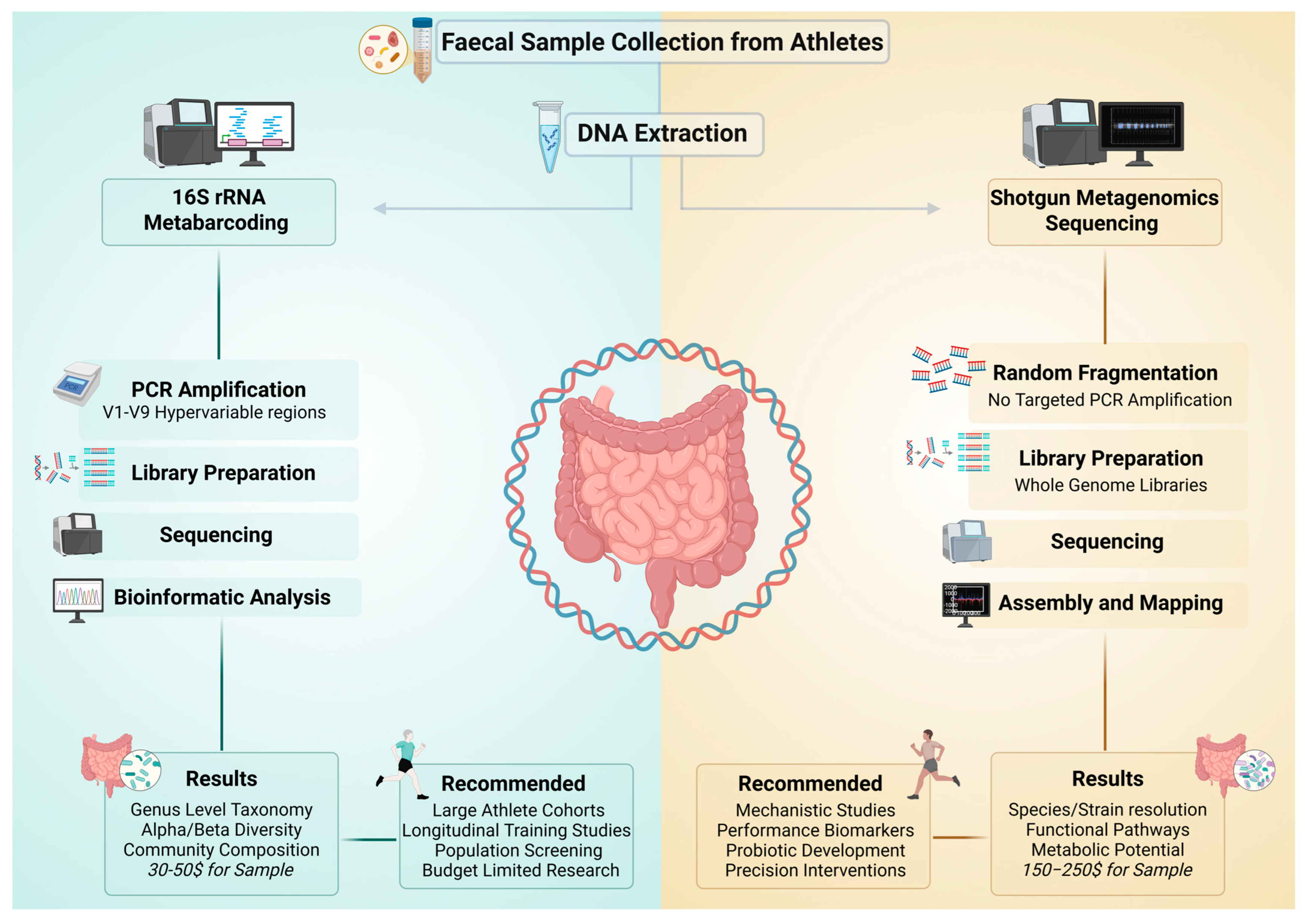
4. Comparison Between 16S Metabarcoding and Shotgun Metagenomics Sequencing
4.1. Microbial Diversity and Performance Taxa Identification
4.2. Result Reproducibility
4.3. Cost-Effectiveness Analysis
5. Technical Methods and Methodological Biases
5.1. Sample Collection and Preservation Protocols
5.2. DNA Extraction and Sequencing Protocols
5.3. Bioinformatic Pipelines and Analytical Approaches
5.4. Athlete-Specific Confounding Variables
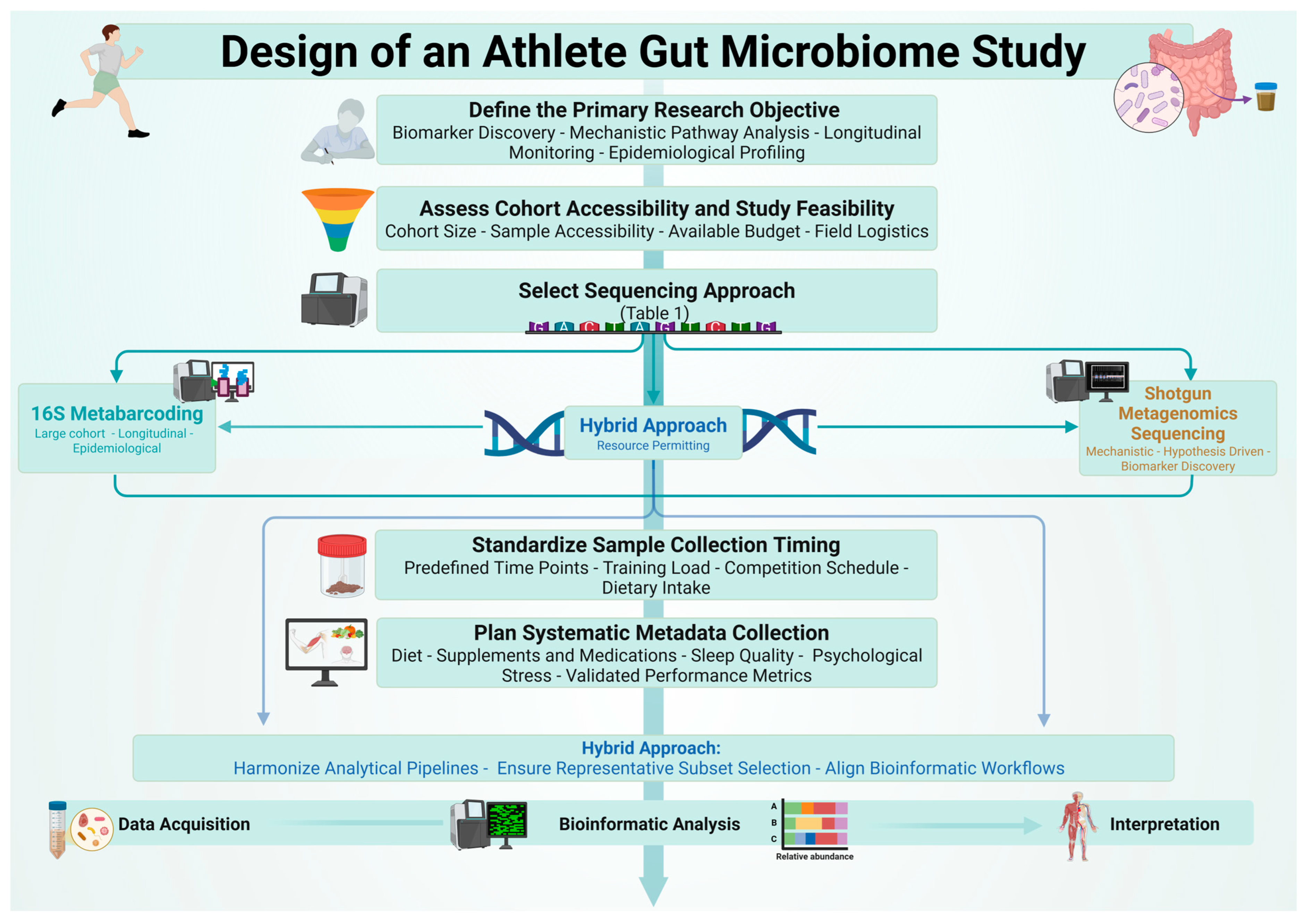
6. New Frontiers in Athlete Microbiota Sequencing
7. Conclusions
Author Contributions
Funding
Institutional Review Board Statement
Informed Consent Statement
Data Availability Statement
Conflicts of Interest
Abbreviations
References
- Mach, N.; Fuster-Botella, D. Endurance exercise and gut microbiota: A review. J. Sport Health Sci. 2017, 6, 179–197. [Google Scholar] [CrossRef] [Scilit]
- Cronin, O.; Molloy, M.G.; Shanahan, F. Exercise, fitness, and the gut. Curr. Opin. Gastroenterol. 2016, 32, 67–73. [Google Scholar] [CrossRef] [Scilit] [PubMed]
- Mohr, A.E.; Jäger, R.; Carpenter, K.C.; Kerksick, C.M.; Purpura, M.; Townsend, J.R.; West, N.P.; Black, K.; Gleeson, M.; Pyne, D.B.; et al. The athletic gut microbiota. J. Int. Soc. Sports Nutr. 2020, 17, 24. [Google Scholar] [CrossRef] [Scilit] [PubMed]
- Carlone, J.; Parisi, A.; Fasano, A. The performance gut: A key to optimizing performance in high-level athletes: A systematic scoping review. Front. Sports Act. Living 2025, 7, 1641923. [Google Scholar] [CrossRef] [Scilit] [PubMed]
- Carlone, J.; Giampaoli, S.; Alladio, E.; Rosellini, G.; Barni, F.; Salata, E.; Parisi, A.; Fasano, A.; Tessitore, A. Dynamic stability of gut microbiota in elite volleyball athletes: Microbial adaptations during training, competition and recovery. Front. Sports Act. Living 2025, 7, 1662964. [Google Scholar] [CrossRef] [Scilit]
- Murtaza, N.; Burke, L.M.; Vlahovich, N.; Charlesson, B.; O’ Neill, H.; Ross, M.L.; Campbell, K.L.; Krause, L.; Morrison, M. The Effects of Dietary Pattern during Intensified Training on Stool Microbiota of Elite Race Walkers. Nutrients 2019, 11, 261. [Google Scholar] [CrossRef] [Scilit]
- Hughes, R.L. A Review of the Role of the Gut Microbiome in Personalized Sports Nutrition. Front. Nutr. 2020, 6, 191. [Google Scholar] [CrossRef] [Scilit]
- da Rocha, A.L.; Pinto, A.P.; Kohama, E.B.; Pauli, J.R.; de Moura, L.P.; Cintra, D.E.; Ropelle, E.R.; da Silva, A.S.R. The proinflammatory effects of chronic excessive exercise. Cytokine 2019, 119, 57–61. [Google Scholar] [CrossRef] [Scilit]
- Carlone, J.; Rossi, C.; Bianco, A.; Drid, P.; Parisi, A.; Fasano, A. Exploring the Gut Microbiome in Combat Sports: A Systematic Scoping Review. Sports 2026, 14, 19. [Google Scholar] [CrossRef] [Scilit]
- Fasano, A. Zonulin, regulation of tight junctions, and autoimmune diseases. Ann. N. Y. Acad. Sci. 2012, 1258, 25–33. [Google Scholar] [CrossRef] [Scilit]
- Fasano, A. Intestinal permeability and its regulation by zonulin: Diagnostic and therapeutic implications. Clin. Gastroenterol. Hepatol. 2012, 10, 1096–1100. [Google Scholar] [CrossRef] [Scilit] [PubMed]
- Carlone, J.; Lista, M.; Romagnoli, R.; Sgrò, P.; Piacentini, M.F.; Di Luigi, L. The role of the hormonal profile of constitutional biotypes in the training process. Med. Sport 2023, 76, 343–352. [Google Scholar] [CrossRef] [Scilit]
- Przewłócka, K.; Folwarski, M.; Kaźmierczak-Siedlecka, K.; Skonieczna-Żydecka, K.; Kaczor, J.J. Gut-Muscle Axis Exists and May Affect Skeletal Muscle Adaptation to Training. Nutrients 2020, 12, 1451. [Google Scholar] [CrossRef] [Scilit] [PubMed]
- Knight, R.; Vrbanac, A.; Taylor, B.C.; Aksenov, A.; Callewaert, C.; Debelius, J.; Gonzalez, A.; Kosciolek, T.; McCall, L.I.; McDonald, D.; et al. Best practices for analysing microbiomes. Nat. Rev. Microbiol. 2018, 16, 410–422. [Google Scholar] [CrossRef] [Scilit]
- Fontana, F.; Longhi, G.; Tarracchini, C.; Mancabelli, L.; Lugli, G.A.; Alessandri, G.; Turroni, F.; Milani, C.; Ventura, M. The human gut microbiome of athletes: Metagenomic and metabolic insights. Microbiome 2023, 11, 27. [Google Scholar] [CrossRef] [Scilit]
- Wetterstrand, K.A. The Cost of Sequencing a Human Genome. 1 November 2021. Available online: https://www.Genome.gov (accessed on 27 November 2025).
- Mancin, L.; Paoli, A.; Berry, S.; Gonzalez, J.T.; Collins, A.J.; Lizarraga, M.A.; Mota, J.F.; Nicola, S.; Rollo, I. Standardization of gut microbiome analysis in sports. Cell Rep. Med. 2024, 5, 101759. [Google Scholar] [CrossRef] [Scilit]
- Giampaoli, S.; Chillemi, G.; Valeriani, F.; Lazzaro, D.; Borro, M.; Gentile, G.; Simmaco, M.; Zanni, G.; Berti, A.; Romano Spica, V. The SNPs in the human genetic blueprint era. New Biotechnol. 2013, 30, 475–484. [Google Scholar] [CrossRef] [Scilit]
- Heather, J.M.; Chain, B. The sequence of sequencers: The history of sequencing DNA. Genomics 2016, 107, 1–8. [Google Scholar] [CrossRef] [Scilit]
- Stoler, N.; Nekrutenko, A. Sequencing error profiles of Illumina sequencing instruments. NAR Genom. Bioinform. 2021, 3, lqab019. [Google Scholar] [CrossRef] [Scilit]
- Liu, L.; Li, Y.; Li, S.; Hu, N.; He, Y.; Pong, R.; Lin, D.; Lu, L.; Law, M. Comparison of next-generation sequencing systems. BioMed Res. Int. 2012, 2012, 251364. [Google Scholar] [CrossRef] [Scilit]
- Ion Torrent. Ion GeneStudio S5 Series: Specification Sheet [Internet]. Thermo Fisher Scientific. 2018. Available online: https://documents.thermofisher.com/TFS-Assets/CSD/Specification-Sheets/PG1720-PJT2769-COL22253-P-on-GeneStudio-S5-Spec-Sheet-Global-FLR.pdf (accessed on 3 February 2025).
- Rhoads, A.; Au, K.F. PacBio Sequencing and Its Applications. Genom. Proteom. Bioinform. 2015, 13, 278–289. [Google Scholar] [CrossRef] [Scilit] [PubMed]
- Wenger, A.M.; Peluso, P.; Rowell, W.J.; Chang, P.C.; Hall, R.J.; Concepcion, G.T.; Ebler, J.; Fungtammasan, A.; Kolesnikov, A.; Olson, N.D.; et al. Accurate circular consensus long-read sequencing improves variant detection and assembly of a human genome. Nat. Biotechnol. 2019, 37, 1155–1162. [Google Scholar] [CrossRef] [Scilit]
- Wang, Y.; Zhao, Y.; Bollas, A.; Wang, Y.; Au, K.F. Nanopore sequencing technology, bioinformatics and applications. Nat. Biotechnol. 2021, 39, 1348–1365. [Google Scholar] [CrossRef] [Scilit] [PubMed]
- Delahaye, C.; Nicolas, J. Sequencing DNA with nanopores: Troubles and biases. PLoS ONE 2021, 16, e0257521. [Google Scholar] [CrossRef] [Scilit] [PubMed]
- Bejaoui, S.; Nielsen, S.H.; Rasmussen, A.; Coia, J.E.; Andersen, D.T.; Pedersen, T.B.; Møller, M.V.; Kusk Nielsen, M.T.; Frees, D.; Persson, S. Comparison of Illumina and Oxford Nanopore sequencing data quality for Clostridioides difficile genome analysis and their application for epidemiological surveillance. BMC Genom. 2025, 26, 92. [Google Scholar] [CrossRef] [Scilit]
- Cottingham, H.; Judd, L.M.; Harshegyi-Hand, T.; Wisniewski, J.A.; Blakeway, L.V.; Hong, T.; Parker, M.H.; Peleg, A.Y.; Holt, K.E.; Hawkey, J.; et al. Nanopore sequencing enables highly accurate genotyping and identification of resistance determinants in key nosocomial pathogens. medRxiv 2025. [Google Scholar] [CrossRef] [Scilit]
- Regueira-Iglesias, A.; Balsa-Castro, C.; Blanco-Pintos, T.; Tomás, I. Critical review of 16S rRNA gene sequencing workflow in microbiome studies: From primer selection to advanced data analysis. Mol. Oral Microbiol. 2023, 38, 347–399. [Google Scholar] [CrossRef] [Scilit]
- Yang, M.Q.; Wang, Z.J.; Zhai, C.B.; Chen, L.Q. Research progress on the application of 16S rRNA gene sequencing and machine learning in forensic microbiome individual identification. Front. Microbiol. 2024, 15, 1360457. [Google Scholar] [CrossRef] [Scilit]
- Clarke, S.F.; Murphy, E.F.; O’Sullivan, O.; Lucey, A.J.; Humphreys, M.; Hogan, A.; Hayes, P.; O’Reilly, M.; Jeffery, I.B.; Wood-Martin, R.; et al. Exercise and associated dietary extremes impact on gut microbial diversity. Gut 2014, 63, 1913–1920. [Google Scholar] [CrossRef] [Scilit]
- Petersen, L.M.; Bautista, E.J.; Nguyen, H.; Hanson, B.M.; Chen, L.; Lek, S.H.; Sodergren, E.; Weinstock, G.M. Community characteristics of the gut microbiomes of competitive cyclists. Microbiome 2017, 5, 98. [Google Scholar] [CrossRef] [Scilit]
- Pollock, J.; Glendinning, L.; Wisedchanwet, T.; Watson, M. The Madness of Microbiome: Attempting To Find Consensus “Best Practice” for 16S Microbiome Studies. Appl. Environ. Microbiol. 2018, 84, e02627-17. [Google Scholar] [CrossRef] [Scilit]
- Durazzi, F.; Sala, C.; Castellani, G.; Manfreda, G.; Remondini, D.; De Cesare, A. Comparison between 16S rRNA and shotgun sequencing data for the taxonomic characterization of the gut microbiota. Sci. Rep. 2021, 11, 3030. [Google Scholar] [CrossRef] [Scilit]
- Quince, C.; Walker, A.W.; Simpson, J.T.; Loman, N.J.; Segata, N. Shotgun metagenomics, from sampling to analysis. Nat. Biotechnol. 2017, 35, 833–844, Correction in Nat. Biotechnol. 2017, 35, 1211. https://doi.org/10.1038/nbt1217-1211b. [Google Scholar] [CrossRef] [Scilit] [PubMed]
- Fouhy, F.; Clooney, A.G.; Stanton, C.; Claesson, M.J.; Cotter, P.D. 16S rRNA gene sequencing of mock microbial populations- impact of DNA extraction method, primer choice and sequencing platform. BMC Microbiol. 2016, 16, 123. [Google Scholar] [CrossRef] [Scilit] [PubMed]
- Scheiman, J.; Luber, J.M.; Chavkin, T.A.; MacDonald, T.; Tung, A.; Pham, L.D.; Wibowo, M.C.; Wurth, R.C.; Punthambaker, S.; Tierney, B.T.; et al. Meta-omics analysis of elite athletes identifies a performance-enhancing microbe that functions via lactate metabolism. Nat. Med. 2019, 25, 1104–1109. [Google Scholar] [CrossRef] [Scilit] [PubMed]
- Hillmann, B.; Al-Ghalith, G.A.; Shields-Cutler, R.R.; Zhu, Q.; Gohl, D.M.; Beckman, K.B.; Knight, R.; Knights, D. Evaluating the information content of shallow shotgun metagenomics. mSystems 2018, 3, e00069-18. [Google Scholar] [CrossRef] [Scilit]
- Zaheer, R.; Noyes, N.; Ortega Polo, R.; Cook, S.R.; Marinier, E.; Van Domselaar, G.; Belk, K.E.; Morley, P.S.; McAllister, T.A. Impact of sequencing depth on the characterization of the microbiome and resistome. Sci. Rep. 2018, 8, 5890. [Google Scholar] [CrossRef] [Scilit]
- Tessler, M.; Neumann, J.S.; Afshinnekoo, E.; Pineda, M.; Hersch, R.; Velho, L.F.M.; Segovia, B.T.; Lansac-Toha, F.A.; Lemke, M.; DeSalle, R.; et al. Large-scale differences in microbial biodiversity discovery between 16S amplicon and shotgun sequencing. Sci. Rep. 2017, 7, 6589. [Google Scholar] [CrossRef] [Scilit]
- Vandeputte, D.; Tito, R.Y.; Vanleeuwen, R.; Falony, G.; Raes, J. Practical considerations for large-scale gut microbiome studies. FEMS Microbiol. Rev. 2017, 41, S154–S167. [Google Scholar] [CrossRef] [Scilit]
- Charlesson, B.; Jones, J.; Abbiss, C.; Peeling, P.; Watts, S.; Christophersen, C.T. Training load influences gut microbiome of highly trained rowing athletes. J. Int. Soc. Sports Nutr. 2025, 22, 2507952. [Google Scholar] [CrossRef] [Scilit]
- Henningsen, K.; Gaskell, S.K.; Young, P.; Mika, A.; Henry, R.; Costa, R.J.S. The Impact of Ultra-Marathon Running on the Gut Microbiota as Determined by Faecal Bacterial Profiling, and Its Relationship with Exercise-Associated Gastrointestinal Symptoms: An Exploratory Investigation. Nutrients 2025, 17, 3275. [Google Scholar] [CrossRef] [Scilit]
- Martin, D.; Bonneau, M.; Orfila, L.; Horeau, M.; Hazon, M.; Demay, R.; Lecommandeur, E.; Boumpoutou, R.; Guillotel, A.; Guillemot, P.; et al. Atypical gut microbial ecosystem from athletes with very high exercise capacity improves insulin sensitivity and muscle glycogen store in mice. Cell Rep. 2025, 44, 115448. [Google Scholar] [CrossRef] [Scilit] [PubMed]
- Aya, V.; Pardo-Rodriguez, D.; Vega, L.C.; Cala, M.P.; Ramírez, J.D. Integrating metagenomics and metabolomics to study the gut microbiome and host relationships in sports across different energy systems. Sci. Rep. 2025, 15, 15356. [Google Scholar] [CrossRef] [Scilit] [PubMed]
- Wosinska, L.; Walsh, L.H.; Walsh, C.J.; Cotter, P.D.; Guinane, C.M.; O’Sullivan, O. Cataloging metagenome-assembled genomes and microbial genes from the athlete gut microbiome. Microbiome Res. Rep. 2024, 3, 41. [Google Scholar] [CrossRef] [Scilit] [PubMed]
- Fu, P.; Wang, C.; Zheng, S.; Qiao, L.; Gao, W.; Gong, L. Connection of pre-competition anxiety with gut microbiota and metabolites in wrestlers with varying sports performances based on brain-gut axis theory. BMC Microbiol. 2024, 24, 147. [Google Scholar] [CrossRef] [Scilit]
- Akazawa, N.; Nakamura, M.; Eda, N.; Murakami, H.; Nakagata, T.; Nanri, H.; Park, J.; Hosomi, K.; Mizuguchi, K.; Kunisawa, J.; et al. Gut microbiota alternation with training periodization and physical fitness in Japanese elite athletes. Front. Sports Act. Living 2023, 5, 1219345. [Google Scholar] [CrossRef] [Scilit]
- Oliveira, C.B.; Marques, C.; Abreu, R.; Figueiredo, P.; Calhau, C.; Brito, J.; Sousa, M. Gut microbiota of elite female football players is not altered during an official international tournament. Scand. J. Med. Sci. Sports 2022, 32, 62–72. [Google Scholar] [CrossRef] [Scilit]
- O’Donovan, C.M.; Madigan, S.M.; Garcia-Perez, I.; Rankin, A.; O’ Sullivan, O.; Cotter, P.D. Distinct microbiome composition and metabolome exists across subgroups of elite Irish athletes. J. Sci. Med. Sport 2020, 23, 63–68. [Google Scholar] [CrossRef] [Scilit]
- Jang, L.G.; Choi, G.; Kim, S.W.; Kim, B.Y.; Lee, S.; Park, H. The combination of sport and sport-specific diet is associated with characteristics of gut microbiota: An observational study. J. Int. Soc. Sports Nutr. 2019, 16, 21. [Google Scholar] [CrossRef] [Scilit]
- Liang, R.; Zhang, S.; Peng, X.; Yang, W.; Xu, Y.; Wu, P.; Chen, J.; Cai, Y.; Zhou, J. Characteristics of the gut microbiota in professional martial arts athletes: A comparison between different competition levels. PLoS ONE 2019, 14, e0226240. [Google Scholar] [CrossRef] [Scilit]
- Keohane, D.M.; Woods, T.; O’Connor, P.; Underwood, S.; Cronin, O.; Whiston, R.; O’Sullivan, O.; Cotter, P.; Shanahan, F.; Molloy, M.G.M. Four men in a boat: Ultra-endurance exercise alters the gut microbiome. J. Sci. Med. Sport 2019, 22, 1059–1064. [Google Scholar] [CrossRef] [Scilit]
- Zhao, X.; Zhang, Z.; Hu, B.; Huang, W.; Yuan, C.; Zou, L. Response of Gut Microbiota to Metabolite Changes Induced by Endurance Exercise. Front. Microbiol. 2018, 9, 765. [Google Scholar] [CrossRef] [Scilit]
- Barton, W.; Penney, N.C.; Cronin, O.; Garcia-Perez, I.; Molloy, M.G.; Holmes, E.; Shanahan, F.; Cotter, P.D.; O’Sullivan, O. The microbiome of professional athletes differs from that of more sedentary subjects in composition and particularly at the functional metabolic level. Gut 2018, 67, 625–633. [Google Scholar] [CrossRef] [Scilit] [PubMed]
- Bars-Cortina, D.; Ramon, E.; Rius-Sansalvador, B.; Guinó, E.; Garcia-Serrano, A.; Mach, N.; Khannous-Lleiffe, O.; Saus, E.; Gabaldón, T.; Ibáñez-Sanz, G.; et al. Comparison between 16S rRNA and shotgun sequencing in colorectal cancer, advanced colorectal lesions, and healthy human gut microbiota. BMC Genom. 2024, 25, 730. [Google Scholar] [CrossRef] [Scilit] [PubMed]
- Stoddard, S.F.; Smith, B.J.; Hein, R.; Roller, B.R.; Schmidt, T.M. rrnDB: Improved tools for interpreting rRNA gene abundance in bacteria and archaea and a new foundation for future development. Nucleic Acids Res. 2015, 43, D593–D598. [Google Scholar] [CrossRef] [Scilit] [PubMed]
- Louca, S.; Doebeli, M.; Parfrey, L.W. Correcting for 16S rRNA gene copy numbers in microbiome surveys remains an unsolved problem. Microbiome 2018, 6, 41. [Google Scholar] [CrossRef] [Scilit]
- Laudadio, I.; Fulci, V.; Palone, F.; Stronati, L.; Cucchiara, S.; Carissimi, C. Quantitative Assessment of Shotgun Metagenomics and 16S rDNA Amplicon Sequencing in the Study of Human Gut Microbiome. OMICS J. Integr. Biol. 2018, 22, 248–254. [Google Scholar] [CrossRef] [Scilit]
- Nayfach, S.; Pollard, K.S. Toward Accurate and Quantitative Comparative Metagenomics. Cell 2016, 166, 1103–1116. [Google Scholar] [CrossRef] [Scilit]
- Rausch, P.; Rühlemann, M.; Hermes, B.M.; Doms, S.; Dagan, T.; Dierking, K.; Domin, H.; Fraune, S.; von Frieling, J.; Hentschel, U.; et al. Comparative analysis of amplicon and metagenomic sequencing methods reveals key features in the evolution of animal metaorganisms. Microbiome 2019, 7, 133. [Google Scholar] [CrossRef] [Scilit]
- Neufer, P.D.; Young, A.J.; Sawka, M.N. Gastric emptying during walking and running: Effects of varied exercise intensity. Eur. J. Appl. Physiol. Occup. Physiol. 1989, 58, 440–445. [Google Scholar] [CrossRef] [Scilit]
- Costa, R.J.S.; Snipe, R.M.J.; Kitic, C.M.; Gibson, P.R. Systematic review: Exercise-induced gastrointestinal syndrome-implications for health and intestinal disease. Aliment. Pharmacol. Ther. 2017, 46, 246–265. [Google Scholar] [CrossRef] [Scilit]
- Hickl, O.; Heintz-Buschart, A.; Trautwein-Schult, A.; Hercog, R.; Bork, P.; Wilmes, P.; Becher, D. Sample Preservation and Storage Significantly Impact Taxonomic and Functional Profiles in Metaproteomics Studies of the Human Gut Microbiome. Microorganisms 2019, 7, 367. [Google Scholar] [CrossRef] [Scilit]
- Bahl, M.I.; Bergström, A.; Licht, T.R. Freezing fecal samples prior to DNA extraction affects the Firmicutes to Bacteroidetes ratio determined by downstream quantitative PCR analysis. FEMS Microbiol. Lett. 2012, 329, 193–197. [Google Scholar] [CrossRef] [Scilit]
- Teng, F.; Darveekaran Nair, S.S.; Zhu, P.; Li, S.; Huang, S.; Li, X.; Xu, J.; Yang, F. Impact of DNA extraction method and targeted 16S-rRNA hypervariable region on oral microbiota profiling. Sci. Rep. 2018, 8, 16321. [Google Scholar] [CrossRef] [Scilit] [PubMed]
- Pribyl, A.L.; Parks, D.H.; Angel, N.Z.; Boyd, J.A.; Hasson, A.G.; Fang, L.; MacDonald, S.L.; Wills, B.A.; Wood, D.L.A.; Krause, L.; et al. Critical evaluation of faecal microbiome preservation using metagenomic analysis. ISME Commun. 2021, 1, 14. [Google Scholar] [CrossRef] [Scilit] [PubMed]
- Menke, S.; Gillingham, M.A.; Wilhelm, K.; Sommer, S. Home-Made Cost Effective Preservation Buffer Is a Better Alternative to Commercial Preservation Methods for Microbiome Research. Front. Microbiol. 2017, 8, 102. [Google Scholar] [CrossRef] [Scilit] [PubMed]
- Camacho-Sanchez, M.; Burraco, P.; Gomez-Mestre, I.; Leonard, J.A. Preservation of RNA and DNA from mammal samples under field conditions. Mol. Ecol. Resour. 2013, 13, 663–673. [Google Scholar] [CrossRef] [Scilit]
- Hua, H.; Meydan, C.; Afshin, E.E.; Lili, L.N.; D’Adamo, C.R.; Rickard, N.; Dudley, J.T.; Price, N.D.; Zhang, B.; Mason, C.E. A Wipe-Based Stool Collection and Preservation Kit for Microbiome Community Profiling. Front. Immunol. 2022, 13, 889702. [Google Scholar] [CrossRef] [Scilit]
- Song, E.J.; Lee, E.S.; Nam, Y.D. Progress of analytical tools and techniques for human gut microbiome research. J. Microbiol. 2018, 56, 693–705. [Google Scholar] [CrossRef] [Scilit]
- Costea, P.I.; Zeller, G.; Sunagawa, S.; Pelletier, E.; Alberti, A.; Levenez, F.; Tramontano, M.; Driessen, M.; Hercog, R.; Jung, F.E.; et al. Towards standards for human fecal sample processing in metagenomic studies. Nat. Biotechnol. 2017, 35, 1069–1076. [Google Scholar] [CrossRef] [Scilit]
- Lim, M.Y.; Park, Y.S.; Kim, J.H.; Nam, Y.D. Evaluation of fecal DNA extraction protocols for human gut microbiome studies. BMC Microbiol. 2020, 20, 212. [Google Scholar] [CrossRef] [Scilit] [PubMed]
- Gall-David, S.L.; Boudry, G.; Buffet-Bataillon, S. Comparison of four DNA extraction kits efficiency for 16SrDNA microbiota profiling of diverse human samples. Future Sci. OA 2023, 9, FSO837. [Google Scholar] [CrossRef] [Scilit]
- Claassen, S.; du Toit, E.; Kaba, M.; Moodley, C.; Zar, H.J.; Nicol, M.P. A comparison of the efficiency of five different commercial DNA extraction kits for extraction of DNA from faecal samples. J. Microbiol. Methods 2013, 94, 103–110. [Google Scholar] [CrossRef] [Scilit] [PubMed]
- Tourlousse, D.M.; Narita, K.; Miura, T.; Sakamoto, M.; Ohashi, A.; Shiina, K.; Matsuda, M.; Miura, D.; Shimamura, M.; Ohyama, Y.; et al. Validation and standardization of DNA extraction and library construction methods for metagenomics-based human fecal microbiome measurements. Microbiome 2021, 9, 95. [Google Scholar] [CrossRef] [Scilit] [PubMed]
- Zhang, B.; Brock, M.; Arana, C.; Dende, C.; van Oers, N.S.; Hooper, L.V.; Raj, P. Impact of Bead-Beating Intensity on the Genus- and Species-Level Characterization of the Gut Microbiome Using Amplicon and Complete 16S rRNA Gene Sequencing. Front. Cell. Infect. Microbiol. 2021, 11, 678522. [Google Scholar] [CrossRef] [Scilit]
- De Boer, R.; Peters, R.; Gierveld, S.; Schuurman, T.; Kooistra-Smid, M.; Savelkoul, P. Improved detection of microbial DNA after bead-beating before DNA isolation. J. Microbiol. Methods 2010, 80, 209–211. [Google Scholar] [CrossRef] [Scilit]
- Walker, S.P.; Barrett, M.; Hogan, G.; Flores Bueso, Y.; Claesson, M.J.; Tangney, M. Non-specific amplification of human DNA is a major challenge for 16S rRNA gene sequence analysis. Sci. Rep. 2020, 10, 16356. [Google Scholar] [CrossRef] [Scilit]
- Pereira-Marques, J.; Hout, A.; Ferreira, R.M.; Weber, M.; Pinto-Ribeiro, I.; van Doorn, L.J.; Knetsch, C.W.; Figueiredo, C. Impact of Host DNA and Sequencing Depth on the Taxonomic Resolution of Whole Metagenome Sequencing for Microbiome Analysis. Front. Microbiol. 2019, 10, 1277. [Google Scholar] [CrossRef] [Scilit]
- Salter, S.J.; Cox, M.J.; Turek, E.M.; Calus, S.T.; Cookson, W.O.; Moffatt, M.F.; Turner, P.; Parkhill, J.; Loman, N.J.; Walker, A.W. Reagent and laboratory contamination can critically impact sequence-based microbiome analyses. BMC Biol. 2014, 12, 87. [Google Scholar] [CrossRef] [Scilit]
- Nelson, M.T.; Pope, C.E.; Marsh, R.L.; Wolter, D.J.; Weiss, E.J.; Hager, K.R.; Vo, A.T.; Brittnacher, M.J.; Radey, M.C.; Hayden, H.S.; et al. Human and Extracellular DNA Depletion for Metagenomic Analysis of Complex Clinical Infection Samples Yields Optimized Viable Microbiome Profiles. Cell Rep. 2019, 26, 2227–2240.e5. [Google Scholar] [CrossRef] [Scilit]
- Smith, R.H.; Glendinning, L.; Walker, A.W.; Watson, M. Investigating the impact of database choice on the accuracy of metagenomic read classification for the rumen microbiome. Anim. Microbiome 2022, 4, 57. [Google Scholar] [CrossRef] [Scilit] [PubMed]
- Caporaso, J.G.; Kuczynski, J.; Stombaugh, J.; Bittinger, K.; Bushman, F.D.; Costello, E.K.; Fierer, N.; Peña, A.G.; Goodrich, J.K.; Gordon, J.I.; et al. QIIME allows analysis of high-throughput community sequencing data. Nat. Methods 2010, 7, 335–336. [Google Scholar] [CrossRef] [Scilit] [PubMed]
- Callahan, B.J.; McMurdie, P.J.; Rosen, M.J.; Han, A.W.; Johnson, A.J.; Holmes, S.P. DADA2: High-resolution sample inference from Illumina amplicon data. Nat. Methods 2016, 13, 581–583. [Google Scholar] [CrossRef] [Scilit] [PubMed]
- Truong, D.T.; Franzosa, E.A.; Tickle, T.L.; Scholz, M.; Weingart, G.; Pasolli, E.; Tett, A.; Huttenhower, C.; Segata, N. MetaPhlAn2 for enhanced metagenomic taxonomic profiling. Nat. Methods 2015, 12, 902–903, Correction in Nat. Methods 2016, 13, 101. [Google Scholar] [CrossRef] [Scilit]
- Breitwieser, F.P.; Lu, J.; Salzberg, S.L. A review of methods and databases for metagenomic classification and assembly. Brief. Bioinform. 2019, 20, 1125–1136. [Google Scholar] [CrossRef] [Scilit]
- Bebawy, A.S.; Saad, B.T.; Saad, M.T.; Mosaad, G.S.; Gomaa, F.A.M.; Alshahrani, M.Y.; Aboshanab, K.M. Evaluation of the taxonomic classification tools and visualizers for metagenomic analysis using the Oxford nanopore sequence database. J. Appl. Genet. 2025, 66, 753–762. [Google Scholar] [CrossRef] [Scilit]
- Zhang, T.; Li, H.; Ma, S.; Cao, J.; Liao, H.; Huang, Q.; Chen, W. The newest Oxford Nanopore R10.4.1 full-length 16S rRNA sequencing enables the accurate resolution of species-level microbial community profiling. Appl. Environ. Microbiol. 2023, 89, e0060523. [Google Scholar] [CrossRef] [Scilit]
- Sereika, M.; Kirkegaard, R.H.; Karst, S.M.; Michaelsen, T.Y.; Sørensen, E.A.; Wollenberg, R.D.; Albertsen, M. Oxford Nanopore R10.4 long-read sequencing enables the generation of near-finished bacterial genomes from pure cultures and metagenomes without short-read or reference polishing. Nat. Methods 2022, 19, 823–826. [Google Scholar] [CrossRef] [Scilit]
- Suzuki, Y.; Nishijima, S.; Furuta, Y.; Yoshimura, J.; Suda, W.; Oshima, K.; Hattori, M.; Morishita, S. Long-read metagenomic exploration of extrachromosomal mobile genetic elements in the human gut. Microbiome 2019, 7, 119. [Google Scholar] [CrossRef] [Scilit]
- Sabater, C.; Iglesias-Gutiérrez, E.; Ruiz, L.; Margolles, A. Next-generation sequencing of the athletic gut microbiota: A systematic review. Microbiome Res. Rep. 2023, 2, 5. [Google Scholar] [CrossRef] [Scilit]
- Kang, D.W.; Adams, J.B.; Gregory, A.C.; Borody, T.; Chittick, L.; Fasano, A.; Khoruts, A.; Geis, E.; Maldonado, J.; McDonough-Means, S.; et al. Microbiota Transfer Therapy alters gut ecosystem and improves gastrointestinal and autism symptoms: An open-label study. Microbiome 2017, 5, 10. [Google Scholar] [CrossRef] [Scilit]
- Chen, Y.; Yang, K.; Xu, M.; Zhang, Y.; Weng, X.; Luo, J.; Li, Y.; Mao, Y.H. Dietary Patterns, Gut Microbiota and Sports Performance in Athletes: A Narrative Review. Nutrients 2024, 16, 1634. [Google Scholar] [CrossRef] [Scilit]
- Clauss, M.; Gérard, P.; Mosca, A.; Leclerc, M. Interplay Between Exercise and Gut Microbiome in the Context of Human Health and Performance. Front. Nutr. 2021, 8, 637010. [Google Scholar] [CrossRef] [Scilit]
- Carlone, J.; Giampaoli, S.; Brancucci, A. Interactions between gut microbiota and brain: Possible effects on sport performance. J. Sci. Sport Exerc. 2025, 1–23. [Google Scholar] [CrossRef] [Scilit]



| Study | Population | Sample Size | Sequencing Technology |
|---|---|---|---|
| Carlone et al. (2025) [5] | Elite Volleyball Players (Four timepoints) | 7 | 16S ribosomal RNA amplicon sequencing (V2–V9, Ion GeneStudio S5, Ion AmpliSeq) |
| Charlesson et al. (2025) [42] | High-Level Rowers | 23 | 16S ribosomal RNA amplicon sequencing (V4, Illumina MiSeq) and targeted fecal SCFA analysis |
| Henningsen et al. (2025) [43] | High-Level Ultra-Marathon Runners | 13 | 16S ribosomal RNA amplicon sequencing (V3–V4, Illumina MiSeq) |
| Martin et al. (2025) [44] | Elite Soccer Players, Elite Cyclists and Non-Athletes | 50 | Shotgun metagenomics (MGI DNBseq-G400) and targeted fecal metabolomics |
| Aya et al. (2025) [45] | Elite Weightlifters versus Elite Cyclists | 29 | Shotgun metagenomics (Illumina HiSeq 2500), metabolomics and lipidomics |
| Wosinska et al. (2024) [46] | Elite Athletes across Multiple Sports, Moderate Athletes and Sedentary Controls | 682 | Shotgun metagenomics (re-analysis of publicly available datasets, short-read taxonomic profiling and metagenome-assembled genome recovery) |
| Fu et al. (2024) [47] | Elite Wrestlers (High versus Low-Performance) | 12 | 16S ribosomal RNA amplicon sequencing (V3–V4, Illumina NovaSeq 6000) and untargeted metabolomics of fecal and urine |
| Fontana et al. (2023) [15] | Elite Athletes across Multiple Sports, Moderate Athletes and Sedentary Controls | 418 | Shotgun metagenomics (Re-analysis of publicly available datasets, METAnnotatorX2 pipeline) |
| Akazawa et al. (2023) [48] | Elite Athletes across Multiple Sports (Transition versus Preparation Phase) | 94 | 16S ribosomal RNA amplicon sequencing (V3–V4, Illumina MiSeq) |
| Oliveira et al. (2022) [49] | Elite Football Players (Pre versus Post-tournament) | 17 | 16S ribosomal RNA amplicon sequencing (V3–V4, Ion Torrent PGM) |
| O’Donovan et al. (2020) [50] | Elite Athletes across Multiple Sports | 37 | Shotgun metagenomics (Illumina NextSeq) and Metabolomics |
| Scheiman et al. (2019) [37] | Marathon Runners and Sedentary Controls; Elite Ultra-Marathoners and Olympic Trial Rowers | 112 | 16S ribosomal RNA amplicon sequencing (V4, Illumina MiSeq) and shotgun metagenomics (Illumina HiSeq 2500) |
| Jang et al. (2019) [51] | Bodybuilders, Elite Runners, and Sedentary Controls | 45 | 16S ribosomal RNA amplicon sequencing (V3–V4, Illumina MiSeq) |
| Liang et al. (2019) [52] | Professional Martial Arts Athletes (Higher versus Lower-Level) | 28 | 16S ribosomal RNA amplicon sequencing (V3–V4, Illumina HiSeq 2500) |
| Murtaza et al. (2019) [6] | Elite Race Walkers (Baseline versus Post Dietary Interventions) | 21 | 16S ribosomal RNA amplicon sequencing (V6–V8, Illumina MiSeq) |
| Keohane et al. (2019) [53] | Elite Rowers (Transatlantic Rowing Race, 33 days) | 4 | Shotgun metagenomics (Illumina NextSeq 550) |
| Zhao et al. (2018) [54] | Recreational Half-Marathon Runners (Pre- and Post-Race) | 20 | 16S ribosomal RNA amplicon sequencing (V3–V4, Illumina HiSeq) and untargeted fecal metabolomics |
| Barton et al. (2018) [55] | Elite Rugby Players versus Sedentary Controls | 86 | Shotgun metagenomics (Illumina HiSeq 2500) and metabolomics |
| Petersen et al. (2017) [32] | Professional versus Amateur Competitive Cyclists | 33 | Shotgun metagenomics and metatranscriptomics (Illumina NextSeq/HiSeq); 16S ribosomal RNA amplicon sequencing (V1–V3, Illumina MiSeq) |
| Clarke et al. (2014) [31] | Elite Rugby Players versus Sedentary Controls | 86 | 16S ribosomal RNA (V4, Roche 454 GS FLX pyrosequencing) |
| Parameter | 16S rRNA Metabarcoding | Shotgun Metagenomics Sequencing |
|---|---|---|
| Cost for sample | $30–50 | $150–250 |
| Taxonomic resolution | Genus level | Species and strain level |
| Functional information | Limited (inferred) | Direct pathway analysis |
| PCR amplification bias | Present | Absent |
| Host DNA contamination | Scarcely affected | Highly affected |
| Sample throughput capacity | High (large cohorts) | Limited (smaller cohorts) |
| Computational requirements | Standard pipelines | Intensive computing |
| Novel taxa detection | Limited to existing databases | Comprehensive discovery |
| Data storage requirements | Low (GB) | High (TB) |
| Expertise required | Moderate | Advanced bioinformatics |
| Performance biomarkers | Genus-level associations | Mechanistic insights |
| Recommended Applications | ||
| Epidemiological studies | Suitable but limited to genus level | Limited by cost |
| Longitudinal monitoring | Suitable | Limited by cost |
| Mechanistic studies | Limited resolution | Suitable |
| Probiotic development | Limited | Suitable |
| Clinical translation | Population studies | Precision medicine |
| Recommended Use | Large-scale epidemiological studies; Longitudinal monitoring across training seasons; Initial taxonomic screening; Repeated-measures designs in field conditions | In-depth characterization of performance-related microbial biomarkers; Functional metabolic pathway analysis; Discovery of athlete-specific probiotic candidates; Mechanistic investigations; Multi-omics integration |
Disclaimer/Publisher’s Note: The statements, opinions and data contained in all publications are solely those of the individual author(s) and contributor(s) and not of MDPI and/or the editor(s). MDPI and/or the editor(s) disclaim responsibility for any injury to people or property resulting from any ideas, methods, instructions or products referred to in the content. |
© 2026 by the authors. Licensee MDPI, Basel, Switzerland. This article is an open access article distributed under the terms and conditions of the Creative Commons Attribution (CC BY) license.
Share and Cite
Carlone, J.; Ribeiro, Á.C.d.S.; Parisi, A.; Giampaoli, S.; Fasano, A. Profiling the Athletes’ Gut Microbiome: A Critical Methodological Perspective on 16S Metabarcoding and Shotgun Metagenomics. Biology 2026, 15, 600. https://doi.org/10.3390/biology15080600
Carlone J, Ribeiro ÁCdS, Parisi A, Giampaoli S, Fasano A. Profiling the Athletes’ Gut Microbiome: A Critical Methodological Perspective on 16S Metabarcoding and Shotgun Metagenomics. Biology. 2026; 15(8):600. https://doi.org/10.3390/biology15080600
Chicago/Turabian StyleCarlone, Junior, Ághata Cardoso da Silva Ribeiro, Attilio Parisi, Saverio Giampaoli, and Alessio Fasano. 2026. "Profiling the Athletes’ Gut Microbiome: A Critical Methodological Perspective on 16S Metabarcoding and Shotgun Metagenomics" Biology 15, no. 8: 600. https://doi.org/10.3390/biology15080600
APA StyleCarlone, J., Ribeiro, Á. C. d. S., Parisi, A., Giampaoli, S., & Fasano, A. (2026). Profiling the Athletes’ Gut Microbiome: A Critical Methodological Perspective on 16S Metabarcoding and Shotgun Metagenomics. Biology, 15(8), 600. https://doi.org/10.3390/biology15080600