1. Introduction
We previously characterized internal ventral abdominal temperatures and heat resistance in adult wetsalts tiger beetles,
Cicindelidia hemorrhagica (LeConte), in Yellowstone National Park (YNP) [
1]. Adults in YNP are associated exclusively with hot springs, and individuals reflect more heat from the ventral surface of their abdomens and behave differently than
C. hemorrhagica adults living in non-hot springs environments in Idaho. Although
C. hemorrhagica is a warm-adapted tiger beetle [
2], the population in YNP seem to have evolved increased heat reflectance on the ventral portions of their abdomens. This increased heat reflectance seems to be caused by a heatshield-like physical feature which is part of the exoskeleton’s ventral abdominal plate; this is consistent with the fact that they experience bottom-up heat from the geothermal springs [
1,
3,
4,
5,
6].
This discovery leads to additional questions about variation in ventral heat reflectance and absorbance among tiger beetle species occupying diverse environments. The ability to tolerate and resist hot environments, including those with high insolation and high surface temperatures, has led some tiger beetle species to exhibit very high lethal temperature maxima compared to other insects [
1,
2,
7,
8].
The ability to withstand high temperature is a key feature for cicindelid biology, as many species occupy high-temperature niches. The ability to forage and survive at high surface temperatures opens ecological opportunities for adapted beetles. In particular, success in predation and scavenging will increase as potential prey items are stunned by high temperature. Such foraging on stunned prey seems to be a key strategy for the success of
C. hemorrhagica in geothermal springs [
1].
In this study, we address the following questions: Does YNP C. hemorrhagica reflect the most heat from its abdomen compared to several other species? Do species that have adapted to these warmer environments and have resided in them for multiple generations have lower internal body temperatures in the face of high ambient temperatures compared to species which are not adapted to warmer temperatures, or which have not been found present in warmer environments for longer than the length of one generation? If so, are there morphological attributes, including abdomen color, that distinguish warm-adapted species from non-warm-adapted species?
2. Materials and Methods
We collected five species for internal-temperature comparison experiments (
Table 1). The species were chosen based on availability and on exhibition of variation in adult temperature and in habitat preference. Two species are considered warm-adapted, one species is considered non-warm-adapted, and two are considered warm-resilient [
2] (
Table 1). Although these terms are not objective or well defined, warm-adapted means that the species prefers hot temperatures, often spending considerable time in full sun. Warm-resilient means that the species can spend time in hot, dry conditions but has more diversity in its habitats than a warm-adapted species. Non-warm-adapted means that the species avoids hot, dry conditions (
Table 1).
The putatively warm-adapted C. hemorrhagica were obtained from three separate populations. Adults were collected from Yellowstone National Park (YNP) at Dragon Spring and Rabbit Creek (coordinates not publicly available, per NPS-YNP research permit conditions). Adults were also collected from a salt flat located approximately 26 km south of Mountain Home, Idaho (42.9354, −115.7504). All specimens were collected using 38 cm aerial sweep nets (Gemplers, Janesville, WI, USA) through “sneak and pounce” netting techniques. Once collected, individuals were placed in small plastic containers containing damp paper towels to prevent desiccation before freezing. A total of 16 specimens were collected from both YNP locations; these were collectively named “Park” to enable YNP and Idaho C. hemorrhagica populations to be distinguished. Specimens were collected in the months of July and August from 2019 to 2021.
Similar methods were used to collect the putatively warm-resilient species
Cicindela oregona (Dejean) [
2] in Glen Lake Rotary Park in Bozeman, Montana (45.7051, −111.0387). Specimens were collected in June and July of 2019 and 2020. Beetles were found along the northern public beach area of this location, and they were only present when conditions of minimal wind and direct sunlight on the sand were met.
Cicindela longilabris (Say) (a non-warm-adapted species) [
2] specimens were collected directly on the Olsen Creek Road Jeep Trail approximately 23 km northeast of Bozeman, Montana (45.8272, −110.7405). Members of this putatively non-warm-adapted species [
2] were located directly on the trail in full sun under canopy cover and collected sporadically from May through August of 2020.
Specimens of the putatively warm-adapted
Cicindelidia sedecimpunctata (Klug) [
2] were collected near Portal, Arizona (31.8806, −109.2036) on collection trips during July 2020 by lab associates and brought back to Montana State University (MSU) using the same methodology previously described. The putatively warm-resilient
Cicindela repanda [
2] were collected during September 2021 near Rock Island, Illinois (41.5449, −90.4199) and shipped directly from associates at Augustana College and frozen upon arrival at MSU. Summaries of collected specimens are listed in
Table 2.
To obtain a better understanding of the internal temperatures experienced by multiple species of the same genus that live in a variety of environments, we conducted a series of laboratory experiments focused on exposing each species to the same regulated environment. Approximately 16 specimens of C. haemorrhagica from YNP, 16 specimens of C. haemorrhagica from Idaho, 24 specimens of C. oregona from Glen Lake Rotary Park in Bozeman, MT, 10 specimens of C. sedecimpunctata from Illinois, 10 specimens of C. repanda from Portal, AZ, and 5 specimens of C. longilabris from Olson Creek Trail were collected for experimentation. All specimens were frozen upon arrival at MSU and stored in a −20 °C freezer. Dry weights were recorded for each beetle after each experiment.
The methods for the experimental assay were nearly identical to those we presented in [
1]. We prepared a heated water bath by filling a 12 L sous vide tub (Rubbermaid, Wooster, OH, USA) with approximately 8 L of water, and placed a Bluetooth Joule-branded sous vide (ChefSteps, Seattle, WA, USA) device inside the bath to regulate temperature. Thermocouples were produced using 24-American Wire Gauge thermocouple wire and T-type thermocouple connector plugs (OMEGA, Norwalk, CT, USA). Framework was made from 6 mm diameter plastic restaurant straws that were cut to 10 cm increments to keep the thermocouple wire straight. Wires threaded through the framework were suspended above the water bath at approximately 2 mm using a 2.5 cm thick × 5.1 cm wide wooden plank with notches carved 2.5 cm deep into the side of the board to hold the reinforced thermocouple wire [
1]. The exposed thermocouple wires were bent at a 90° angle above the water bath to simulate beetle body length and height above the water bath perpendicular to the water’s surface. Any recorded temperatures were logged using the SD-947 thermometer/SD card data logger 4-channel model (REED, Wilmington, NC, USA). Using methodology that exhibited previous experimental success [
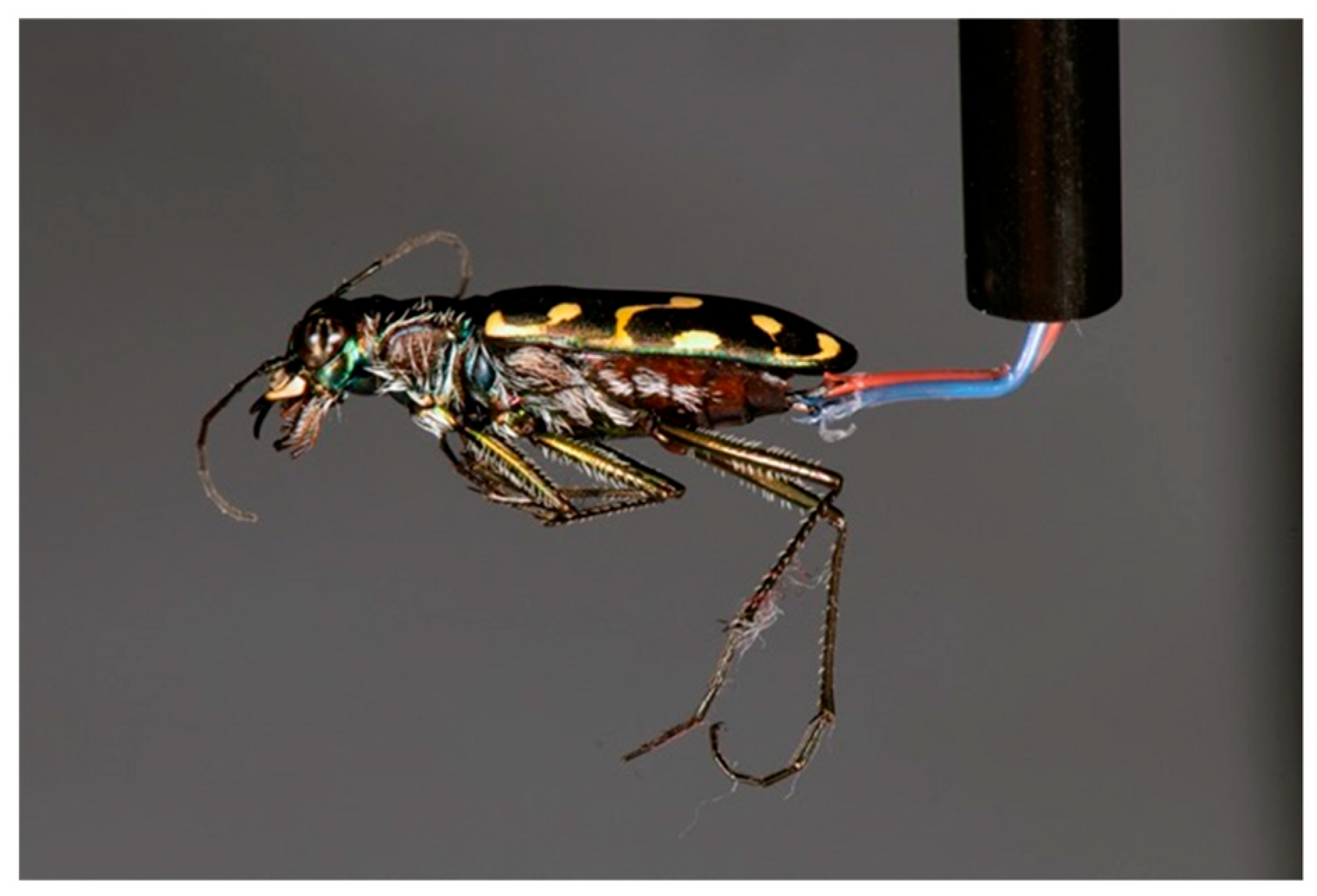
1], we inserted the exposed end of the thermocouple wire into each beetle through the genital opening. The wire extended up the length of each beetle abdomen without compromising the structure of the exoskeleton or penetrating the thorax (
Figure 1). Each wire was positioned at the approximate midline between the ventral and dorsal portions of the abdomen in each beetle. Later replicates of the experiment were conducted with legs removed from each individual to ensure the thermocouples were not exposed to any accumulating water that may travel up the legs and into the abdominal cavity where the thermocouple was recording temperature readings.
Beetles from each species were subject to multiple water-bath experiments at different temperatures.
Cicindelidia oregona,
C. longilabris,
C. sedecimpunctata, and
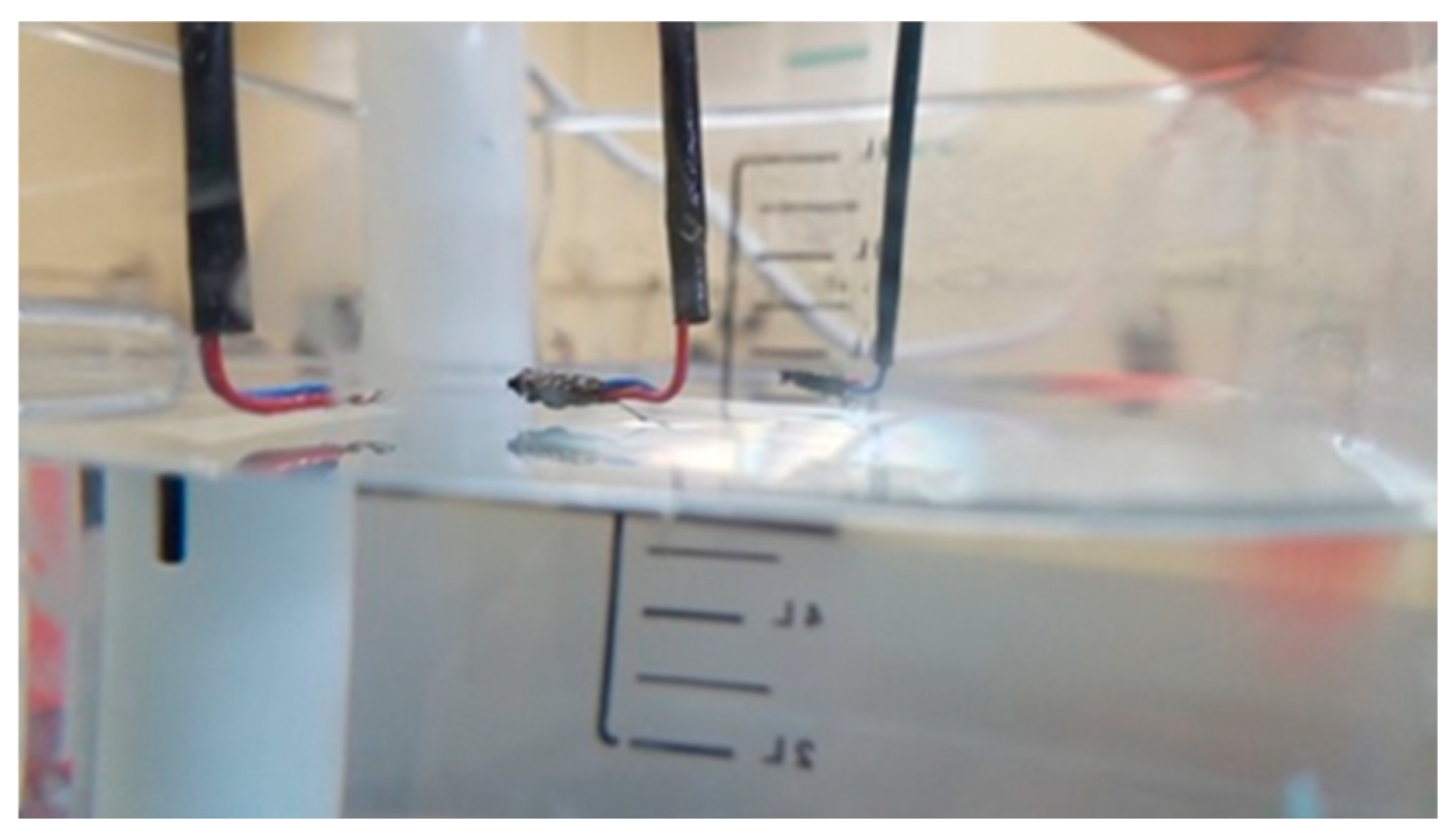
C. repanda were exposed to water bath temperatures of 50 °C, 55 °C, and 60 °C. Each replicate of the experiment consisted of one beetle-loaded thermocouple and one bare thermocouple suspended above the heated water bath using the wooden plank and framework material (
Figure 2). Thermocouples were allowed 2 min to equilibrate before we began recording temperatures. Each replicate of the experiment had a recording period of 10 min, with recording of the temperature reading of each thermocouple taking place at 1 min intervals. The water bath temperatures for testing
C. hemorrhagica from YNP and Idaho consisted of one beetle-loaded thermocouple from each population with a third bare thermocouple to continue to act as the control variable. The procedure for preparing these experiments was the same, but beetles were exposed to water bath temperatures of 45 °C, 50 °C, and 55 °C. Therefore, we were only able to use this species when comparing the results of the 50 °C and 55 °C experiments.
Because not every thermocouple displayed the same temperature measurement as the bare thermocouple control when measuring the ambient air temperature, we had to calibrate the thermocouples [
1]. The control and the thermocouples used for adult beetles only differed by a maximum of 0.2 °C, so thermocouples were calibrated ±0.2 °C to account for the difference in measured temperature between the thermocouples and the bare thermocouple that was used as the control. Each thermocouple was measured against the control before recording for this reason.
Data Analysis
We performed initial data visualizations and
t-tests for each group using Microsoft Excel. The temperature values for each thermocouple-paired treatment with a beetle attached to it were directly compared to the bare thermocouple temperature reading for each minute of recording using the following equation:
where ∆
T is the difference in temperature between the bare thermocouple and the thermocouple with the beetle. This value expresses the difference between the temperature readings for the thermocouple exposed to the open air of the heated water bath environment and the layer of reflective protection provided by the abdominal cavity. The ∆
T values of each pairing were totaled and averaged according to the temperature of the water bath to produce one average ∆
T per temperature per beetle. These average values were grouped together by species and used to calculate the standard deviation and standard error. All calculations were used to produce preliminary figures used in data visualization.
The data were reformatted for compatibility with RStudio (version 2026.01.1+403 for Windows) by grouping individual results by species, collection site, and then water bath temperatures with their respective ∆
T values. Initial linear models produced in RStudio used ∆
T as the variable measured against the confounding variables of location, dry weight of the individual, legs attached, sex, and air temperature. We determined that this model was inadequate to use in the analysis because each individual was subjected to multiple replicates of the experiment at different temperatures. Therefore, we produced a linear mixed effects model using the lme4 package in RStudio [
9].
Results of this initial model suggested that weight and sex were not influential on internal temperatures experienced by the beetle-loaded thermocouples (
p-values 0.7716 and 0.3591, respectively). Therefore, an additional model was produced excluding these variables. Leg presence was also excluded from this revised model because we had insufficient data to compare leg presence for each species (only
C. hemorrhagica and
C. oregona).
Our final model only measured the effects of species (labeled by collection location) on internal temperatures experienced by individuals subject to multiple water-bath experiments to simulate a hazardous environment heated from below by thermal waters (
Table 3).
3. Results and Discussion
The mean ∆
T values suggest that
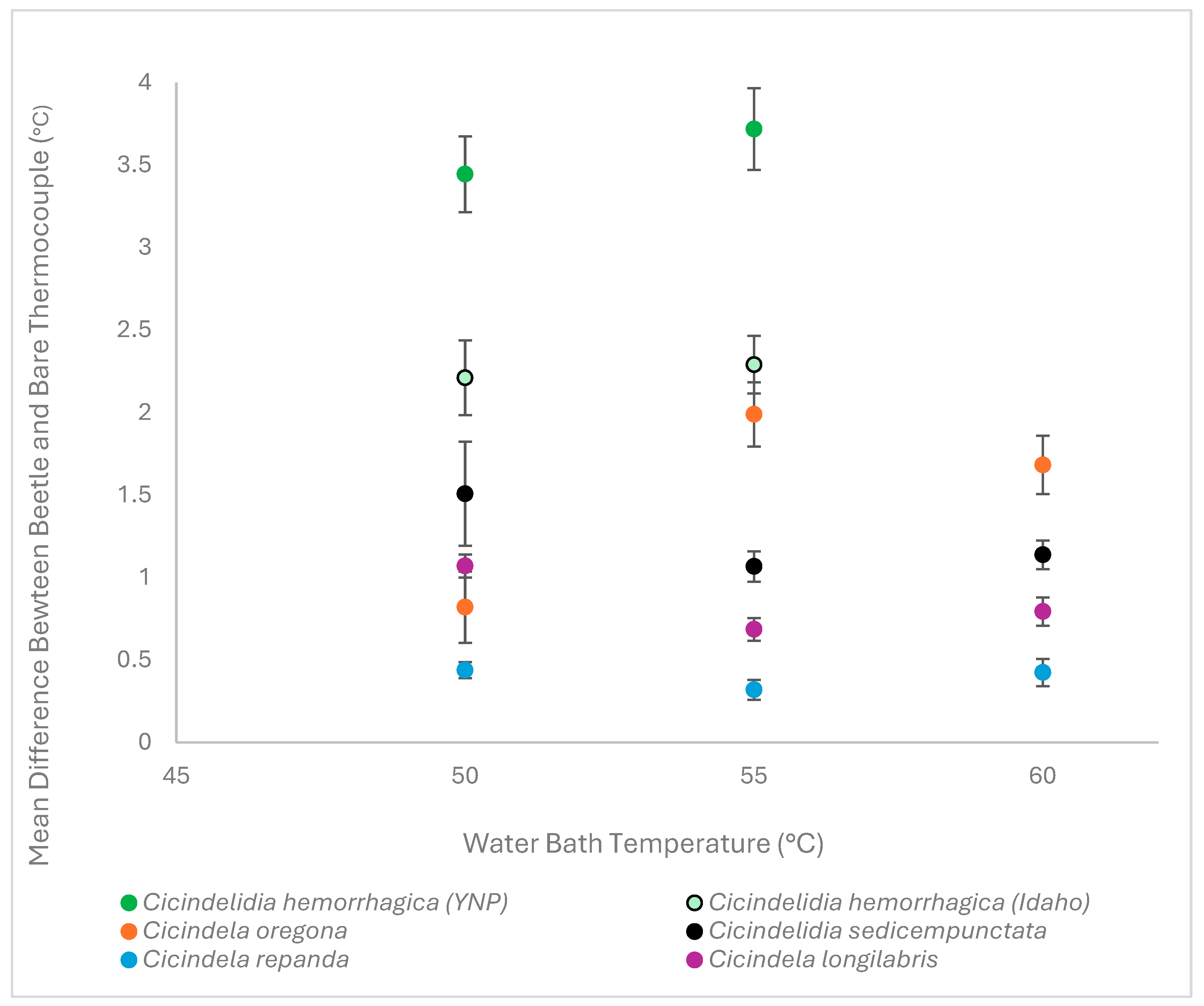
C. hemorrhagica exhibited the greatest difference in internal temperatures compared to the bare thermocouple (
Table 1,
Figure 3). This means that
C. hemorrhagica had the lowest internal abdominal temperatures compared to the other species. Conversely,
C. repanda had the smallest difference over all water bath temperatures, and therefore it exhibited the highest internal temperatures (
Table 4 and
Table 5,
Figure 3). However, for the other species the mean difference between internal beetle temperature and the bare thermocouple depended on water bath temperature (
Table 5,
Figure 3).
Cicindelidia sedecimpunctata is a warm-adapted desert species, closely related to
C. hemorrhagica, and also has a bright red-to-orange abdomen. However, and surprisingly,
C. sedecimpunctata was not the next species in order of greatest difference in internal temperatures compared to the thermocouple (
Figure 3). This suggests that the bright-colored abdomen did not reflect more heat greater compared to the darker abdomens of other species.
Interestingly, the
C. oregona measured in this study had navy blue to dark green abdomens yet had low internal temperatures (i.e., large differences between internal temperatures and bare thermocouple) (
Figure 3), further suggesting that abdomen color is likely a poor predictor of internal temperature, heat absorbance, or heat reflectance.
The non-warm-adapted species,
C. longilabris, had the second smallest difference between internal temperatures and the bare thermocouple (
Figure 3). Specimens measured in this study had dark blue-green abdomens. The
C. repanda measured in this study had the smallest difference between internal temperatures and the bare thermocouple and had blue-green abdomens (i.e., the highest internal temperatures).
Cicindela repanda (warm-resilient) and
C. longilabris (non-warm-adapted) consistently had higher internal temperatures compared to
C. hemorrhagica and
C. sedecimpunctata, the species that are found in hot springs and in desert-like or high sun exposure environments (
Table 1). Specimens frozen for preservation in preparation for experimentation may have influenced internal temperature readings by the thawing of viscera or altering internal structures (but see [
1]). However, these experiments were focused on measuring the structural reflectivity in the abdomen of each species. Therefore, the desiccation of each specimen before testing was essential to ensure that the thermocouples inserted into each beetle experienced similar microclimates.
We previously showed that
C. hemorrhagica from YNP hot springs had statistically greater differences in internal temperatures compared to
C. hemorrhagica from a non-hot springs environment in Idaho (
Figure 3) [
1]. Here,
C. hemorrhagica (regardless of location) had the lowest internal temperatures compared to all other species evaluated.
Therefore,
C. hemorrhagica may be preadapted to reflect more heat from its ventral surface than the other species we evaluated. This study is not unique in analyzing microstructures that result in reduced experienced temperatures on individual insect specimens. Thermotolerant species such as the Saharan silver ant,
Cataglyphis bombycina (Hymenoptera: Formicidae),
Neoceramyx gigas (Coleoptera: Cerambycidae), and
Goliathus goliatus (Coleoptera: Scarabaeidae) all possess differing physical structures that aid in heat reflectance to make them more tolerant of extreme environmental conditions [
10,
11,
12]. This hypothesis is supported by the observation that individuals of the Idaho
C. hemorrhagica species that is not associated with hot springs had significantly lower internal temperatures in the presence of bottom-up heating compared to all other species evaluated (
Figure 3). Consequently, this preadaptation may have been selected for by YNP geothermal springs environments, resulting in the behavioral and morphological adaptations observed in
C. hemorrhagica in YNP [
1,
4,
5,
6].
4. Conclusions
Across all manipulated temperatures measured, C. hemorrhagica exhibited the greatest ΔT values, indicating the lowest internal temperatures relative to the thermal environment stress. Conversely, the warm-resilient Cicindela repanda and non-warm-adapted C. longilabris had the smallest ΔT values, indicating the highest internal temperatures. Ventral abdominal coloration, from bright red (C. sedecimpunctata) to dark blue-green (C. oregona), did not correlate with internal temperatures, suggesting that coloration may be a poor predictor of heat absorbance or reflectance from bottom-up heat exposure. These results indicate that C. hemorrhagica is effective at limiting internal heat gain from surface heating stress and may possess a preadaptive morphological mechanism facilitating thermal resistance in geothermal habitats.
Because we used a water bath with bottom-up heat in our experiments, we can only draw conclusions about internal temperatures based on surface heating. It is possible that some of the cicindelid species which do not experience high surface heat may be adapted more to top-down heat from insolation. In this case, future research is needed that evaluates internal temperatures from top-down “dry” heat.