Contrasting Range Shifts of an Endangered Orchid Changnienia amoena and Its Obligate Pollinator Under Climate Change in China


Simple Summary
Abstract
1. Introduction
2. Materials and Methods
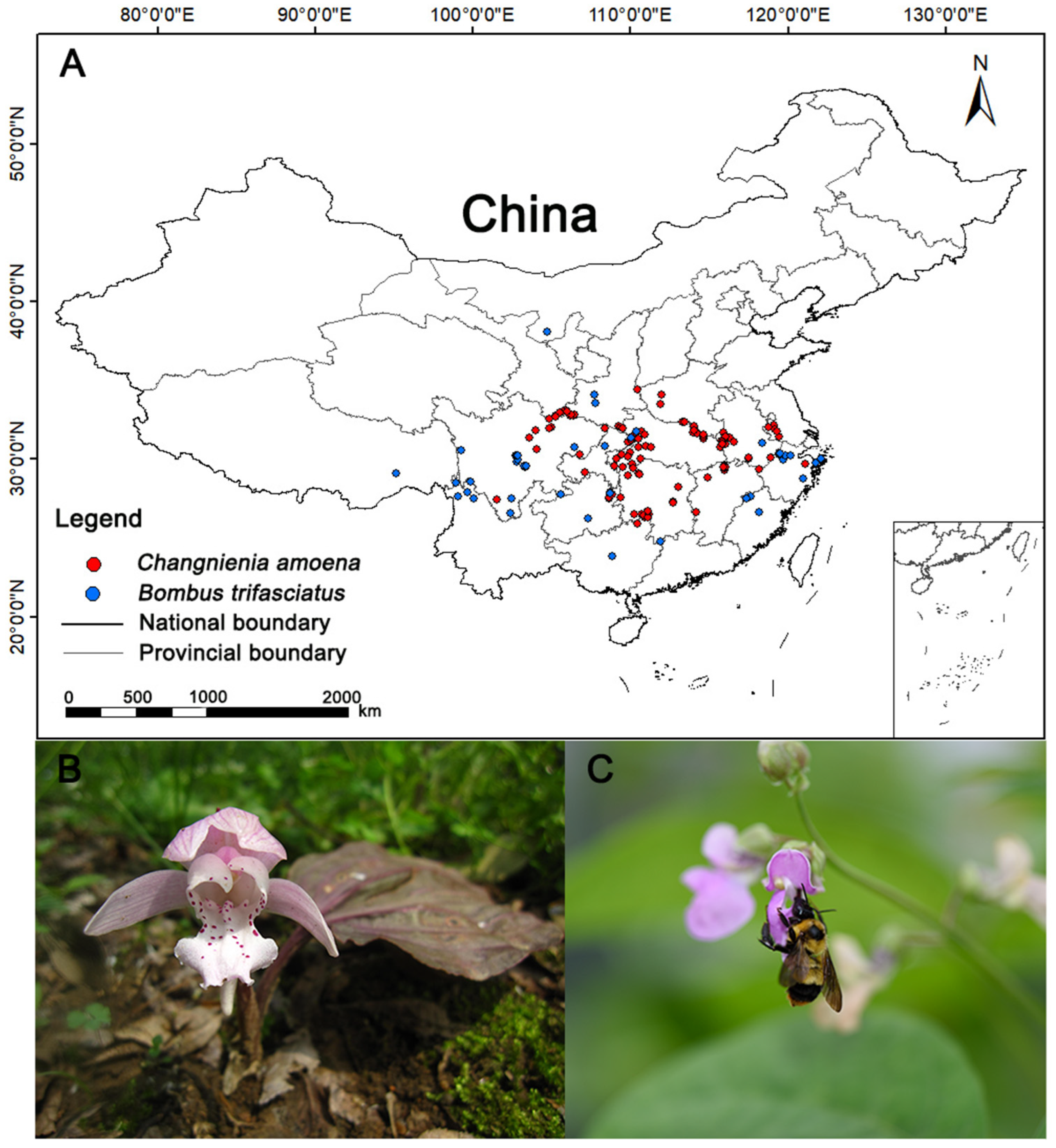
2.1. Species Occurrence Records
2.2. Environmental Variables
- (1)
- Climatic variables: 19 bioclimatic variables were obtained from WorldClim for current and future periods (i.e., 2041–2060, 2061–2080, 2081–2100). Current climate data were sourced from WorldClim version 2.1 at 30 arc-second resolution (~1 km), while future climate projections were based on the Beijing Climate Center Climate System Model version 2 with Medium Resolution (BCC-CSM2-MR) global climate model (CMIP6), which performs well in Asia, especially China [42,43]. Three Shared Socioeconomic Pathways (SSP1-2.6, SSP2-4.5, and SSP5-8.5) were selected, representing optimistic, moderate, and pessimistic scenarios, respectively-.
- (2)
- Topographic variables: Elevation and aspect data were obtained from WorldClim (https://www.worldclim.org/, accessed on 15 November 2025), and slope was derived from a Digital Elevation Model (DEM) (http://www.tuxingis.com, accessed on 15 November 2025).
- (3)
- Anthropogenic variables: The global Human Influence Index dataset from NASA’s Socioeconomic Data and Applications Center (SEDAC) (https://sedac.ciesin.columbia.edu, sources accessed on 15 November 2025) was used. The Human Influence index is a composite metric derived from nine integrated data layers: population density, built-up areas, nighttime lights, land use/cover, and transportation networks (roads, railways, coastlines, and navigable rivers) [44].
2.3. Modeling Process
2.4. Geospatial Data Analysis
2.5. Niche Overlap Metrics
3. Results
3.1. Model Performance
3.2. Contribution of Environmental Variables
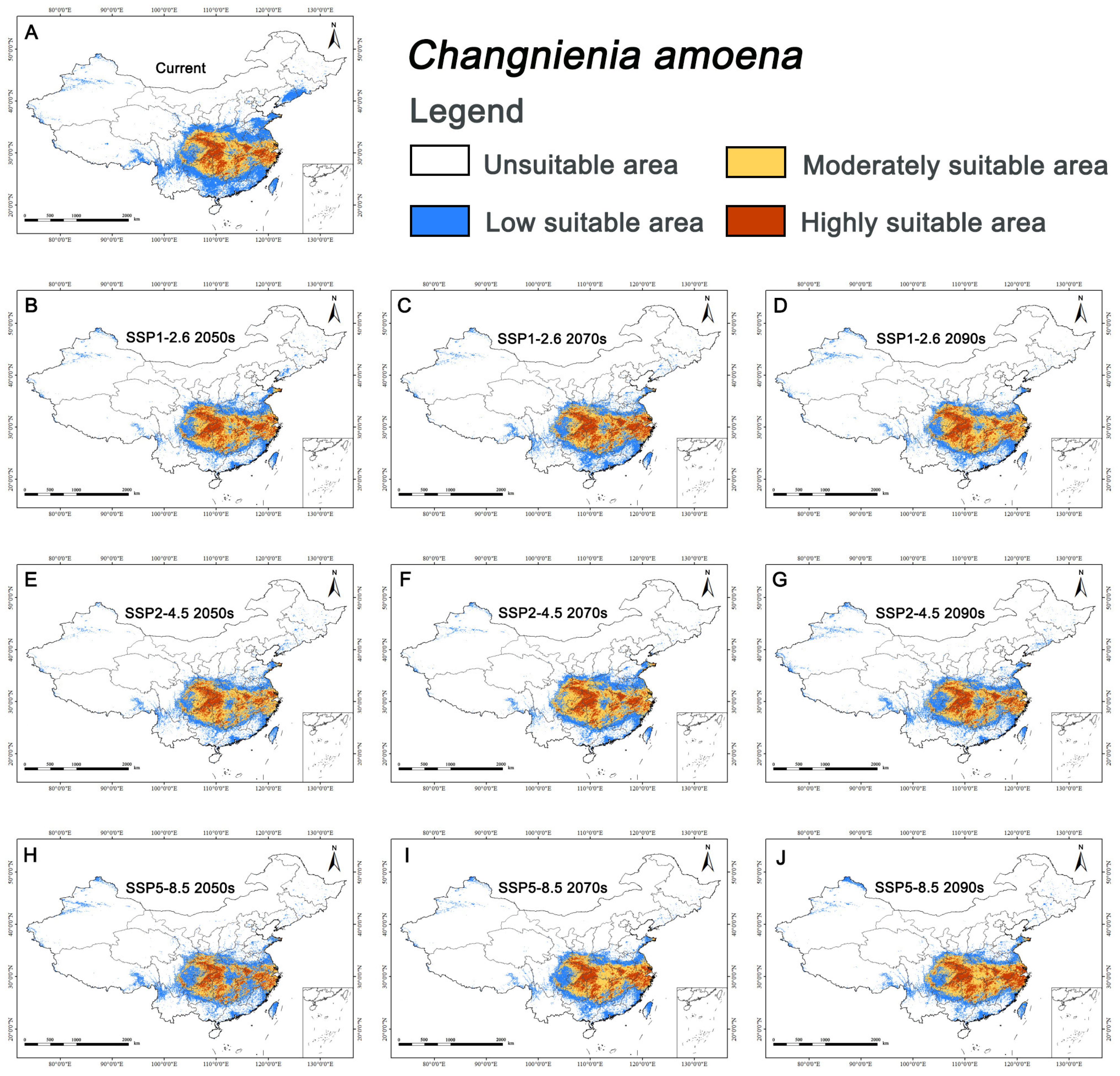
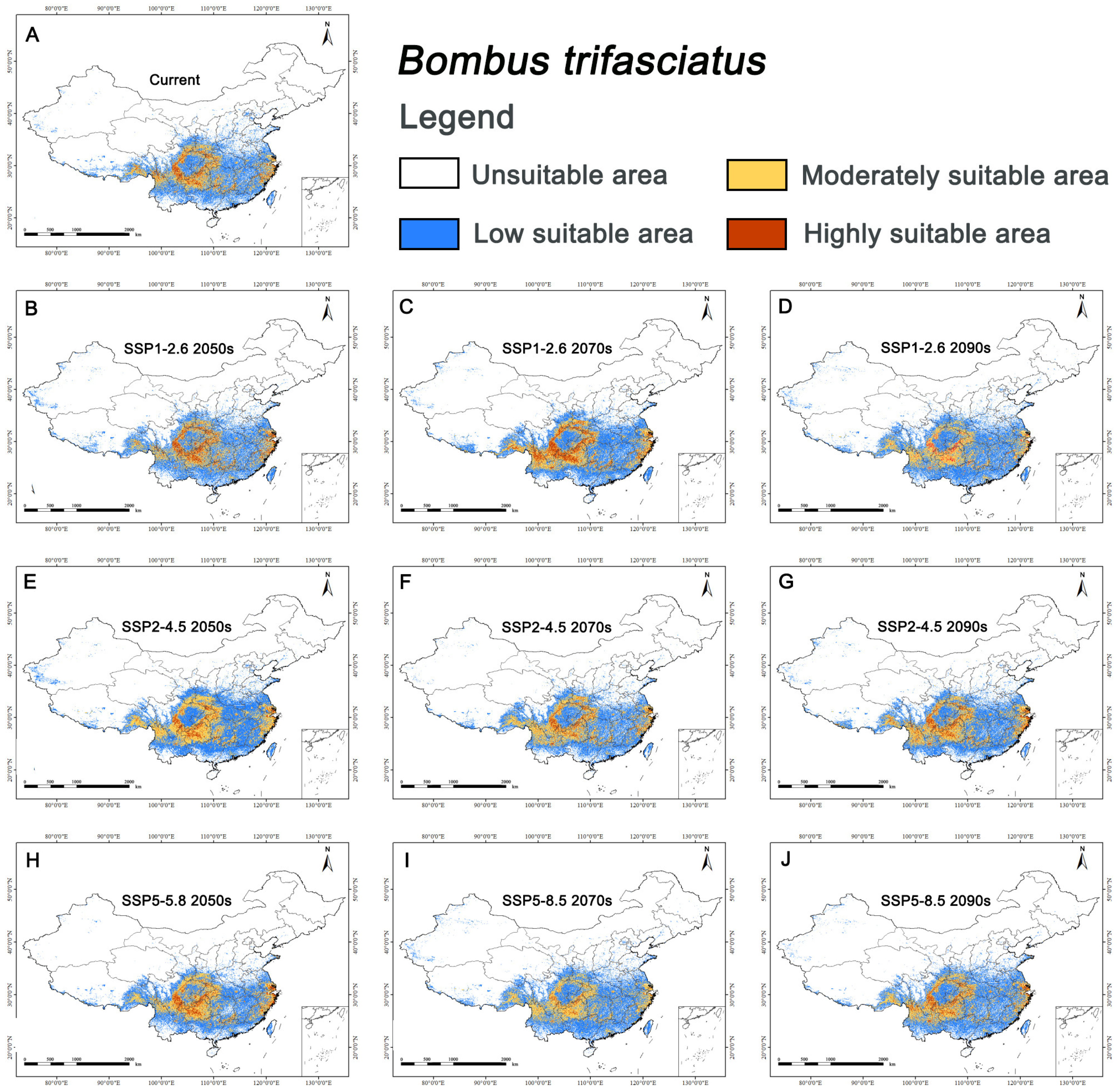
3.3. Current Potential Suitable Distribution of C. amoena and Its Pollinator
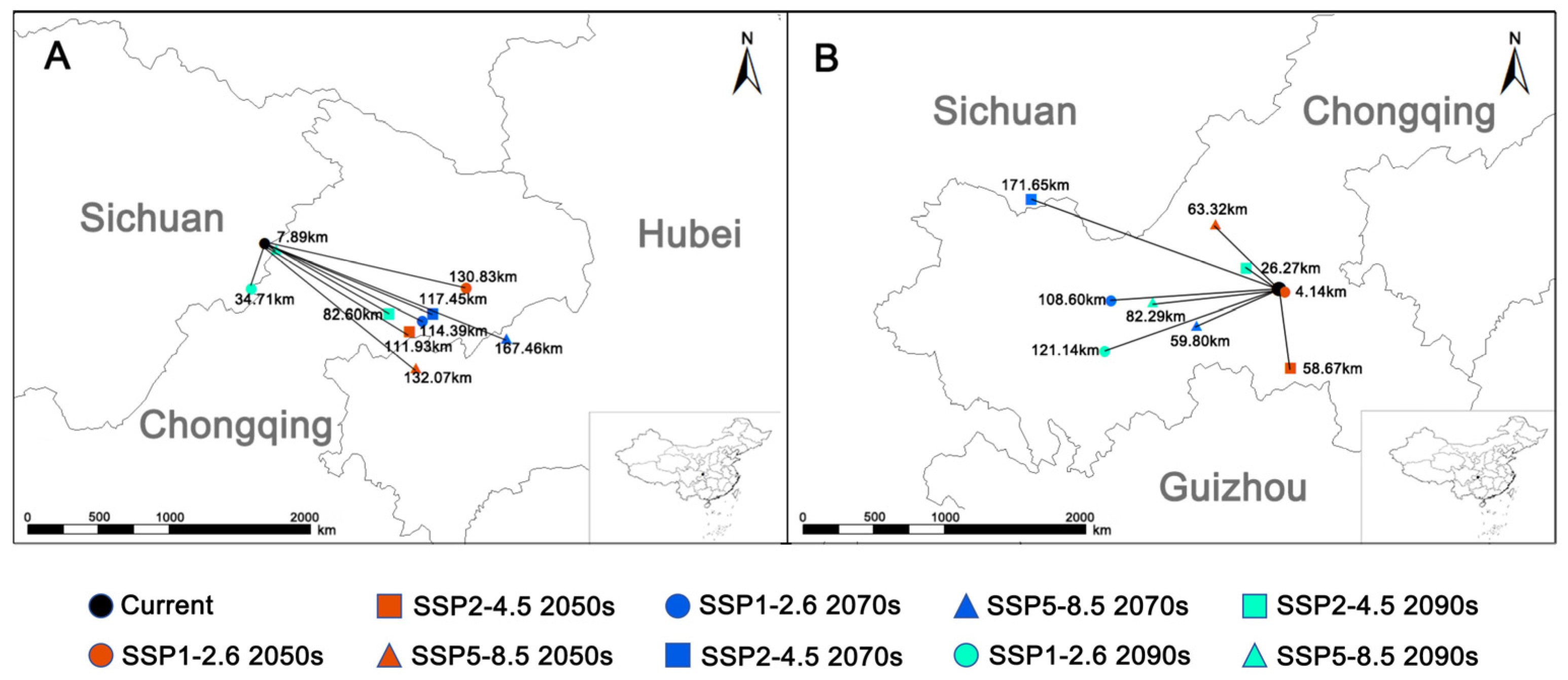
3.4. Future Distribution of C. amoena and Its Pollinator
3.5. Niche Overlap Between C. amoena and Its Pollinator
4. Discussion
4.1. Ensemble Model Assessment and Key Environmental Factors
4.2. Suitable Distribution and Future Changes for C. amoena and Its Pollinator
- (1)
- Model algorithm: Ensemble modeling can generate more reliable projections than single-algorithm methods [34]. In this study, we used the Biomod2 platform to construct ensemble models for each species, thus improving prediction reliability. In contrast, Liu et al. [22] used only MaxEnt. Although they further applied Geographically and Temporally Weighted Regression (GTWR), we contend that this approach does not fully leverage the complementary strengths of multiple modeling algorithms.
- (2)
- Sampling representativeness: After spatial rarefaction, our analysis used 123 occurrence points for C. amoena and 43 for B. trifasciatus, ensuring better data coverage. By contrast, Liu et al. [22] included only 69 and 34 records for the two species, and Liu et al. [32] used merely 48 points for C. amoena, representing relatively limited samples. Take the occurrence points of the orchid as an example. Our dataset added more distribution records from northwestern, southern, and central China, which significantly improved the spatial representativeness of the samples. Such geographical sampling bias can lead to sampling selection bias, potentially causing models to overestimate suitability in sampled regions and underestimate potential in unsampled areas [33].
- (3)
- Environmental variables: There are considerable differences in the selection of environmental variables for C. amoena when modeling. Some variables have weak ecological relevance to their distribution and cannot effectively reflect their habitat requirements. For example, Liu et al. [22] included wind speed in MaxEnt modeling. However, as a typical understory herb, C. amoena lives in microhabitats where wind effects are strongly moderated by the forest canopy, which raises doubts about the ecological rationality of including wind-related variables in its modeling.
- (4)
- Habitat suitability classification: The MaxSSS method applied in our study, recognized for its high sensitivity, has been widely adopted in modeling endangered plant species [35]. In contrast, the natural breaks method used in previous studies may fail to optimally balance prediction deviations, potentially resulting in bias in suitable range estimation [51].
4.3. Declining Niche Overlap and Its Implications for Obligate Pollination Systems
4.4. Conservation Implications for C. amoena
5. Conclusions
Supplementary Materials
Author Contributions
Funding
Institutional Review Board Statement
Informed Consent Statement
Data Availability Statement
Acknowledgments
Conflicts of Interest
References
- Lim, C.; Kang, J.H.; Bayartogtokh, B.; Bae, Y.J. Climate change will lead to range shifts and genetic diversity losses of dung beetles in the Gobi Desert and Mongolian Steppe. Sci. Rep. 2024, 14, 15639. [Google Scholar] [CrossRef] [Scilit]
- Kelly, A.E.; Goulden, M.L. Rapid shifts in plant distribution with recent climate change. Proc. Natl. Acad. Sci. USA 2008, 105, 11823. [Google Scholar] [CrossRef] [Scilit] [PubMed]
- Hu, C.; Wu, H.; Zhang, G. Evaluating habitat suitability for the endangered Sinojackia xylocarpa (Styracaceae) in China under climate change based on ensemble modeling and gap analysis. Biology 2025, 14, 304. [Google Scholar] [CrossRef] [Scilit]
- Wang, S.; Wu, J. Research progress on the changing trends in geographical distributions of plant species under future climate change scenarios in China. Guihaia 2025, 45, 500–516. [Google Scholar]
- Wang, C.; Liu, C.; Wan, J.; Zhang, Z. Climate change may threaten habitat suitability of threatened plant species within Chinese nature reserves. PeerJ 2016, 4, e2091. [Google Scholar] [CrossRef] [Scilit] [PubMed]
- Kang, Y.; Lin, F.; Yin, J.; Han, Y.; Zhu, M.; Guo, Y.; Tang, F.; Li, Y. Projected distribution patterns of Alpinia officinarum in China under future climate scenarios: Insights from optimized Maxent and Biomod2 models. Front. Plant Sci. 2025, 16, 1517060. [Google Scholar] [CrossRef] [Scilit]
- Gravendeel, B.; Smithson, A.; Slik, F.J.W.; Schuiteman, A. Epiphytism and pollinator specialization: Drivers for orchid diversity? Philos. Trans. R. Soc. Lond. B Biol. Sci. 2004, 359, 1523–1535. [Google Scholar] [CrossRef] [Scilit]
- McCormick, M.K.; Jacquemyn, H. What constrains the distribution of orchid populations? New Phytol. 2014, 202, 392–400. [Google Scholar] [CrossRef] [Scilit]
- Yudaputra, A.; Munawaroh, E.; Usmadi, D.; Purnomo, D.W.; Astuti, I.P.; Puspitaningtyas, D.M.; Handayani, T.; Garvita, R.V.; Aprilianti, P.; Wawangningrum, H.; et al. Vulnerability of lowland and upland orchids in their spatially response to climate change and land cover change. Ecol. Inform. 2024, 80, 102534. [Google Scholar] [CrossRef] [Scilit]
- Hu, H.; Wei, Y.; Wang, W.; Suonan, J.; Wang, S.; Chen, Z.; Guan, J.; Deng, Y. Richness and distribution of endangered orchid species under different climate scenarios on the Qinghai-Tibetan Plateau. Front. Plant Sci. 2022, 13, 948189. [Google Scholar] [CrossRef] [Scilit]
- Qin, H.; Zhao, L.; Yu, S.; Liu, H.; Liu, B.; Xia, N.; Peng, H.; Li, Z.; Zhang, Z.; He, X.; et al. Evaluating the endangerment status of China’s angiosperms through the red list assessment. Biodivers. Sci. 2017, 25, 745–757. [Google Scholar] [CrossRef] [Scilit]
- Filazzola, A.; Matter, S.F.; MacIvor, J.S. The direct and indirect effects of extreme climate events on insects. Sci. Total Environ. 2021, 769, 145161. [Google Scholar] [CrossRef] [Scilit] [PubMed]
- Saunders, M.E.; Kendall, L.K.; Lanuza, J.B.; Hall, M.A.; Rader, R.; Stavert, J.R. Climate mediates roles of pollinator species in plant–pollinator networks. Glob. Ecol. Biogeogr. 2023, 32, 511–518. [Google Scholar] [CrossRef] [Scilit]
- Feng, T.; Wang, H. Complex dynamics in plant-pollinator-parasite interactions: Facultative versus obligate behaviors and novel bifurcations. Math. Biol. 2025, 90, 46. [Google Scholar] [CrossRef] [Scilit] [PubMed]
- Tiusanen, M.; Norberg, A.; Laine, A.L. Shifts in phenology influence synchrony of flowering plants and their pollinators along an elevation gradient. Oikos 2026, e11738. [Google Scholar] [CrossRef] [Scilit]
- Hegland, S.J.; Nielsen, A.; Lázaro, A.; Bjerknes, A.L.; Totland, Ø. How does climate warming affect plant-pollinator interactions? Ecol. Lett. 2009, 12, 184–195. [Google Scholar] [CrossRef] [Scilit]
- Schiestl, F.P. On the success of a swindle: Pollination by deception in orchids. Naturwissenschaften 2005, 92, 255–264. [Google Scholar] [CrossRef] [Scilit]
- Jersáková, J.; Johnson, S.D.; Kindlmann, P. Mechanisms and evolution of deceptive pollination in orchids. Biol. Rev. 2006, 81, 219–235. [Google Scholar] [CrossRef] [Scilit]
- Ren, Z.; Wang, H.; Luo, Y. Deceptive pollination of orchids. Biodivers. Sci. 2012, 20, 270–279. [Google Scholar] [CrossRef] [Scilit]
- Tsiftsis, S.; Djordjević, V. Modelling sexually deceptive orchid species distributions under future climates: The importance of plant–pollinator interactions. Sci. Rep. 2020, 10, 10623. [Google Scholar] [CrossRef] [Scilit]
- Kolanowska, M.; Michalska, E. The effect of global warming on the Australian endemic orchid Cryptostylis leptochila and its pollinator. PLoS ONE 2023, 18, e0280922. [Google Scholar] [CrossRef] [Scilit]
- Liu, M.; Wang, X.; Yang, C. Exploring the potential distribution areas of Changnienia amoena and its pollinators in China based on MaxEnt and GTWR models. J. Nat. Conserv. 2025, 86, 126946. [Google Scholar] [CrossRef] [Scilit]
- Liu, T.; Cai, H.; Zhang, G. Assessment of climate change impacts on the distribution of endangered and endemic Changnienia amoena (Orchidaceae) using ensemble modeling and gap analysis in China. Ecol. Evol. 2024, 14, e70636. [Google Scholar] [CrossRef] [Scilit] [PubMed]
- Sun, H.; Luo, Y.; Alexandersson, R.; Ge, S. Pollination biology of the deceptive orchid Changnienia amoena. Bot. J. Linn. Soc. 2006, 150, 165–175. [Google Scholar] [CrossRef] [Scilit]
- Li, A.; Ge, S. Genetic variation and conservation of Changnienia amoena, an endangered orchid endemic to China. Plant Syst. Evol. 2006, 258, 251–260. [Google Scholar] [CrossRef] [Scilit]
- Li, G.Y.; Ding, B.Y. Flora of Zhejiang, 2nd ed.; Zhejiang Science and Technology Press: Hangzhou, China, 2021; Volume 10. [Google Scholar]
- Sun, H.; Luo, Y.; Ge, S. A preliminary study on pollination biology of an endangered orchid, Changnienia amoena, in Shennongjia. Acta Bot. Sin. 2003, 45, 1019–1023. [Google Scholar]
- Su, Q.; Du, Z.; Zhou, B.; Liao, Y.; Wang, C.; Xiao, Y. Potential distribution of Impatiens davidii and its pollinator in China. Chin. J. Plant Ecol. 2022, 46, 785–796. [Google Scholar] [CrossRef] [Scilit]
- Sousa-Silva, R.; Alves, P.; Honrado, J.; Lomba, A. Improving the assessment and reporting on rare and endangered species through species distribution models. Glob. Ecol. Conserv. 2014, 2, 226–237. [Google Scholar] [CrossRef] [Scilit]
- Cai, H.; Zhang, G. Predicting the potential distribution of rare and endangered Emmenopterys henryi in China under climate change. Ecol. Evol. 2024, 14, e70403. [Google Scholar] [CrossRef] [Scilit]
- Liu, Y.; Zhang, X.; Zong, S. Prediction of the potential distribution of Teinopalpus aureus Mell, 1923 (Lepidoptera, Papilionidae) in China using habitat suitability models. Forests 2024, 15, 828. [Google Scholar] [CrossRef] [Scilit]
- Liu, X.; Sun, Q.; Li, T.; Wang, S.; Shen, J.; Sun, Y.; Li, M. Predicting current and future potential distribution of Changnienia amoena in China under global climate change. Sci. Rep. 2025, 15, 17640. [Google Scholar] [CrossRef] [Scilit] [PubMed]
- Hughes, A.C.; Orr, M.C.; Ma, K.; Costello, M.J.; Waller, J.; Provoost, P.; Yang, Q.; Zhu, C.; Qiao, H. Sampling biases shape our view of the natural world. Ecography 2021, 44, 1259–1269. [Google Scholar] [CrossRef] [Scilit]
- Liu, C.; White, M.; Newell, G.; Pearson, R. Selecting thresholds for the prediction of species occurrence with presence-only data. J. Biogeogr. 2013, 40, 778–789. [Google Scholar] [CrossRef] [Scilit]
- Hang, W.; Yan, G.; Zhang, G. Population-level ecological niche models to assess the impact of climate change on endangered and relict tree species: A case study of Parrotia subaequalis in China. Trees For. People 2025, 22, 101049. [Google Scholar] [CrossRef] [Scilit]
- Zhou, Y.; Lu, X.; Zhang, G. Potentially differential impacts on niche overlap between Chinese endangered Zelkova schneideriana and its associated tree species under climate change. Front. Ecol. Evol. 2023, 11, 1218149. [Google Scholar] [CrossRef] [Scilit]
- Yang, H.; Li, P.; Dai, H. Quantitative assessment for priority conservation of the wild protected plants in Ji-gong Mountain Nature Preserve. Cent. South For. Inventory Plan. 2010, 29, 55. [Google Scholar] [CrossRef]
- Ju, Y.; Liu, G.; Ha, D.; Liu, D.; Yue, W.; Cai, D. The phenology, reproduction and community characteristics of Changnienia amoena, a rare species in Jigongshan Nature Reserve. Anhui Agric. Sci. 2019, 47, 139–140, 143. [Google Scholar] [CrossRef]
- Brown, J.L. SDMtoolbox: A python-based GIS toolkit for landscape genetic, biogeographic and species distribution model analyses. Methods Ecol. Evol. 2014, 5, 694–700. [Google Scholar] [CrossRef] [Scilit]
- Wang, X.M.; Peng, P.H.; Bai, M.Y.; Bai, W.Q.; Zhang, S.Q.; Feng, Y.; Wang, J.; Tang, Y. Impacts of physiological characteristics and human activities on the species distribution models of orchids taking the Hengduan Mountains as a case. Ecol. Evol. 2023, 13, e10566. [Google Scholar] [CrossRef] [Scilit]
- Lawlor, J.A.; Comte, L.; Grenouillet, G.; Lenoir, J.; Baecher, J.A.; Bandara, R.M.W.J.; Bertrand, R.; Chen, I.C.; Diamond, S.E.; Lancaster, L.T.; et al. Mechanisms, detection and impacts of species redistributions under climate change. Nat. Rev. Earth Environ. 2024, 5, 351–368. [Google Scholar] [CrossRef] [Scilit]
- Yang, H.; Jiang, Z.; Li, L. Biases and improvements in three dynamical downscaling climate simulations over China. Clim. Dyn. 2016, 47, 3235–3251. [Google Scholar] [CrossRef] [Scilit]
- Shi, X.; Chen, X.; Dai, Y.; Hu, G. Climate sensitivity and feedbacks of BCC-CSM to idealized CO2 forcing from CMIP5 to CMIP6. J. Meteorol. Res. 2020, 34, 865–878. [Google Scholar] [CrossRef] [Scilit]
- Liao, D.; Zhou, B.; Xiao, H.; Zhang, Y.; Zhang, S.; Su, Q.; Yan, X. MaxEnt modeling of the impacts of human activities and climate change on the potential distribution of Plantago in China. Biology 2025, 14, 14050564. [Google Scholar] [CrossRef] [Scilit]
- Rathore, M.K.; Sharma, L.K. Efficacy of species distribution models (SDMs) for ecological realms to ascertain biological conservation and practices. Biodivers. Conserv. 2023, 32, 3053–3087. [Google Scholar] [CrossRef] [Scilit]
- Phillips, S.J.; Dudík, M. Modeling of species distributions with Maxent: New extensions and a comprehensive evaluation. Ecography 2008, 31, 161–175. [Google Scholar] [CrossRef] [Scilit]
- Allouche, O.; Tsoar, A.; Kadmon, R. Assessing the accuracy of species distribution models: Prevalence, kappa and the true skill statistic (TSS). J. Appl. Ecol. 2006, 43, 1223–1232. [Google Scholar] [CrossRef] [Scilit]
- Wen, J.; Chen, C.; Liu, Q.; Zhang, T.; Gu, Y.; Han, Y.; Feng, W.; Shi, B.; He, Y. Environmental drivers of Leonurus japonicus habitat suitability: An ensemble model approach. Ind. Crops Prod. 2025, 234, 121562. [Google Scholar] [CrossRef] [Scilit]
- Wang, Z.; Zhuo, Z.; Liu, B.; Peng, Y.; Xu, D. Predicting the future geographic distribution of the traditional Chinese medicinal plant Epimedium acuminatum Franch. in China using ensemble models based on Biomod2. Plants 2025, 14, 1065. [Google Scholar] [CrossRef] [Scilit]
- Huang, E.; Chen, Y.; Yu, S. Climate factors drive plant distributions at higher taxonomic scales and larger spatial scales. Front. Ecol. Evol. 2024, 11, 1233936. [Google Scholar] [CrossRef] [Scilit]
- Lan, Z.; Zhang, G. Range shifts of the endangered Luehdorfia chinensis chinensis (Lepidoptera, Papilionidae) and its specific hosts in China under climate change. Ecol. Evol. 2025, 15, e72057. [Google Scholar] [CrossRef] [Scilit]
- Radosavljević, A.; Anderson, R.P. Making better Maxent models of species distributions: Complexity, overfitting and evaluation. J. Biogeogr. 2014, 41, 629–643. [Google Scholar] [CrossRef] [Scilit]
- Yates, K.L.; Bouchet, P.J.; Caley, M.J.; Mengersen, K.; Randin, C.F.; Parnell, S.; Fielding, A.H.; Bamford, A.J.; Ban, S.; Barbosa, A.M.; et al. Outstanding challenges in the transferability of ecological models. Trends Ecol. Evol. 2018, 33, 790–802. [Google Scholar] [CrossRef] [Scilit]
- Wang, H.; Zhi, F.; Zhang, G. Predicting impacts of climate change on suitable distribution of critically endangered tree species Yulania zenii (W. C. Cheng) D. L. Fu in China. Forests 2024, 15, 883. [Google Scholar] [CrossRef] [Scilit]
- Guillera-Arroita, G.; Lahoz-Monfort, J.J.; Elith, J.; Gordon, A.; Kujala, H.; Lentini, P.E.; McCarthy, M.A.; Tingley, R.; Wintle, B.A. Is my species distribution model fit for purpose? Matching data and models to applications. Glob. Ecol. Biogeogr. 2015, 24, 276–292. [Google Scholar] [CrossRef] [Scilit]
- Wen, X.; Fang, G.; Chai, S.; He, C.; Sun, S.; Zhao, G.; Lin, X. Can ecological niche models be used to accurately predict the distribution of invasive insects? A case study of Hyphantria cunea in China. Ecol. Evol. 2024, 14, e11159. [Google Scholar] [CrossRef] [Scilit] [PubMed]
- Lu, X.; Jiang, R.; Zhang, G. Predicting the potential distribution of four endangered holoparasites and their primary hosts in China under climate change. Front. Plant Sci. 2022, 13, 942448. [Google Scholar] [CrossRef] [Scilit] [PubMed]
- Warren, D.L.; Glor, R.E.; Turelli, M. Environmental niche equivalency versus conservatism: Quantitative approaches to niche evolution. Evolution 2008, 62, 2868–2883. [Google Scholar] [CrossRef] [Scilit]
- Broennimann, O.; Fitzpatrick, M.C.; Pearman, P.B.; Petitpierre, B.; Pellissier, L.; Yoccoz, N.G.; Thuiller, W.; Fortin, M.-J.; Randin, C.; Zimmermann, N.E.; et al. Measuring ecological niche overlap from occurrence and spatial environmental data. Glob. Ecol. Biogeogr. 2012, 21, 481–497. [Google Scholar] [CrossRef] [Scilit]
- Rödder, D.; Engler, J.O. Quantitative metrics of overlaps in Grinnellian niches: Advances and possible drawbacks. Glob. Ecol. Biogeogr. 2011, 20, 915–927. [Google Scholar] [CrossRef] [Scilit]
- Schoener, T.W. Nonsynchronous spatial overlap of lizards in patchy habitats. Ecology 1970, 51, 408–418. [Google Scholar] [CrossRef] [Scilit]
- Elith, J.; Leathwick, J.R. Species distribution models: Ecological explanation and prediction across space and time. Annu. Rev. Ecol. Evol. Syst. 2009, 40, 677–697. [Google Scholar] [CrossRef] [Scilit]
- Xu, Y.; Huang, Y.; Zhao, H.; Yang, M.; Zhuang, Y.; Ye, X. Modelling the effects of climate change on the distribution of endangered Cypripedium japonicum in China. Forests 2021, 12, 429. [Google Scholar] [CrossRef] [Scilit]
- van der Veen, B.; O’Hara, R.B.; Hui, F.K.C.; Hovstad, K.A. Predicting niche overlap with model-based ordination. Ecography 2024, 2024, e06938. [Google Scholar] [CrossRef] [Scilit]
- Pauw, A.; Bond, W.J. Mutualisms matter: Pollination rate limits the distribution of oil-secreting orchids. Oikos 2011, 120, 1531–1538. [Google Scholar] [CrossRef] [Scilit]
- Littlefield, T.R.; Kosieniak, S.; Zettler, L.W. Functional redundancy in invertebrate pollinator-predator networks supports conservation of a threatened North American orchid: A case study of Platanthera integrilabia. Biodivers. Conserv. 2026, 35, 30. [Google Scholar] [CrossRef] [Scilit]
- Lu, R.S.; Hu, K.; Liu, Y.; Sun, X.Q.; Liu, X.J. Genome skimming reveals plastome conservation, phylogenetic structure, and novel molecular markers in valuable orchid Changnienia amoena. Genes 2025, 16, 723. [Google Scholar] [CrossRef] [Scilit] [PubMed]



| Category | Variable | Description | Unit |
|---|---|---|---|
| Bioclimate | Bio1 | Annual mean temperature | °C |
| Bio2 | Mean diurnal range (mean of monthly (max temp–min temp)) | °C | |
| Bio3 | Isothermality ((Bio2/Bio7) × 100) | % | |
| Bio4 | Temperature seasonality (standard deviation × 100) | - | |
| Bio5 | Max temperature of warmest month | °C | |
| Bio6 | Min temperature of coldest month | °C | |
| Bio7 | Temperature annual range (Bio5–Bio6) | °C | |
| Bio8 | Mean temperature of wettest quarter | °C | |
| Bio9 | Mean temperature of driest quarter | °C | |
| Bio10 | Mean temperature of warmest quarter | °C | |
| Bio11 | Mean temperature of coldest quarter | °C | |
| Bio12 | Annual precipitation | mm | |
| Bio13 | Precipitation of wettest month | mm | |
| Bio14 | Precipitation of driest month | mm | |
| Bio15 | Precipitation seasonality (coefficient of variation) | - | |
| Bio16 | Precipitation of wettest quarter | mm | |
| Bio17 | Precipitation of driest quarter | mm | |
| Bio18 | Precipitation of warmest quarter | mm | |
| Bio19 | Precipitation of coldest quarter | mm | |
| Terrain | Elevation | - | m |
| Slope | - | ° | |
| Aspect | - | ° | |
| Anthropogenic factor | HI | Human influence | - |
| Orchid: Changnienia amoena | Pollinator: Bombus trifasciatus | |||
|---|---|---|---|---|
| Model | AUC | TSS | AUC | TSS |
| ANN | 0.765 | 0.530 | 0.678 | 0.344 |
| CTA | 0.944 | 0.865 | 0.842 | 0.672 |
| FDA | 0.922 | 0.777 | 0.895 | 0.680 |
| GAM | 0.926 | 0.783 | 0.902 | 0.713 |
| GBM | 0.981 | 0.905 | 0.972 | 0.851 |
| GLM | 0.978 | 0.914 | 0.938 | 0.782 |
| MARS | 0.976 | 0.901 | 0.963 | 0.842 |
| MAXENT | 0.975 | 0.879 | 0.920 | 0.754 |
| RF | 1.000 | 1.000 | 1.000 | 1.000 |
| SRE | 0.734 | 0.468 | 0.657 | 0.314 |
| Ensemble model | 0.978 | 0.885 | 0.958 | 0.807 |
| Species | No. | Variable | Percent Contribution (%) |
|---|---|---|---|
| Orchid: Changnienia amoena | 1 | Bio12 | 40.92 |
| 2 | Bio06 | 26.61 | |
| 3 | Bio04 | 13.52 | |
| 4 | Slope | 10.28 | |
| Pollinator: Bombus trifasciatus | 1 | Bio17 | 40.23 |
| 2 | Bio06 | 15.85 | |
| 3 | Slope | 14.70 | |
| 4 | Bio07 | 11.01 |
| Scenarios | Low Suitable Area | Moderately Suitable Area | Highly Suitable Area | Suitable Area | ||||
|---|---|---|---|---|---|---|---|---|
| Area | Trend | Area | Trend | Area | Trend | Area | Trend | |
| (×104 km2) | (%) | (×104 km2) | (%) | (×104 km2) | (%) | (×104 km2) | (%) | |
| Changnienia amoena | ||||||||
| Current | 132.22 | - | 68.81 | - | 39.26 | - | 108.06 | - |
| SSP1-2.6 | ||||||||
| 2041–2060 | 78.50 | ↓40.63 | 66.00 | ↓4.09 | 40.57 | ↑3.36 | 106.57 | ↓1.38 |
| 2061–2080 | 88.79 | ↓32.85 | 62.54 | ↓9.10 | 43.43 | ↑10.64 | 105.97 | ↓1.93 |
| 2081–2100 | 77.33 | ↓41.52 | 68.23 | ↓0.83 | 38.57 | ↓1.73 | 106.81 | ↓1.16 |
| Average | 81.54 | ↓38.33 | 65.59 | ↓4.67 | 40.86 | ↑4.09 | 106.45 | ↓1.49 |
| SSP2-4.5 | ||||||||
| 2041–2060 | 79.77 | ↓39.67 | 69.19 | ↑0.55 | 33.02 | ↓15.87 | 102.21 | ↓5.42 |
| 2061–2080 | 79.31 | ↓40.02 | 72.72 | ↑5.68 | 38.11 | ↓2.91 | 110.83 | ↑2.56 |
| 2081–2100 | 91.59 | ↓30.73 | 62.27 | ↓9.50 | 34.82 | ↓11.29 | 97.10 | ↓10.15 |
| Average | 83.56 | ↓36.80 | 68.06 | ↓1.09 | 35.32 | ↓10.02 | 103.38 | ↓4.34 |
| SSP5-8.5 | ||||||||
| 2041–2060 | 98.34 | ↓25.62 | 59.81 | ↓13.08 | 32.63 | ↓16.89 | 92.43 | ↓14.46 |
| 2061–2080 | 80.59 | ↓39.05 | 63.04 | ↓8.39 | 38.23 | ↓2.60 | 101.27 | ↓6.28 |
| 2081–2100 | 78.72 | ↓40.46 | 67.01 | ↓2.61 | 44.33 | ↑12.93 | 111.34 | ↑3.04 |
| Average | 85.88 | ↓35.04 | 63.29 | ↓8.03 | 38.40 | ↓2.18 | 101.68 | ↓5.90 |
| Mean future climate scenario value | 83.66 | ↓36.73 | 65.65 | ↓4.60 | 38.19 | ↓2.71 | 103.84 | ↓3.91 |
| Bombus trifasciatus | ||||||||
| Current | 143.16 | - | 72.92 | - | 15.95 | - | 232.02 | - |
| SSP1-2.6 | ||||||||
| 2041–2060 | 148.40 | ↑3.66 | 75.62 | ↑3.70 | 20.41 | ↑27.99 | 244.43 | ↑5.35 |
| 2061–2080 | 150.95 | ↑5.44 | 78.85 | ↑8.14 | 25.89 | ↑62.35 | 255.69 | ↑10.20 |
| 2081–2100 | 132.08 | ↓7.74 | 70.40 | ↓3.46 | 17.69 | ↑10.94 | 220.17 | ↓5.11 |
| Average | 143.81 | ↑0.45 | 74.96 | ↑2.80 | 21.33 | ↑33.76 | 240.10 | ↑3.48 |
| SSP2-4.5 | ||||||||
| 2041–2060 | 156.86 | ↑9.57 | 92.82 | ↑27.30 | 13.62 | ↓14.60 | 263.29 | ↑13.48 |
| 2061–2080 | 138.83 | ↓3.02 | 79.22 | ↑8.64 | 14.19 | ↓11.00 | 232.24 | ↑0.09 |
| 2081–2100 | 143.30 | ↑0.10 | 81.60 | ↑11.91 | 17.73 | ↑11.20 | 242.63 | ↑4.57 |
| Average | 146.33 | ↑2.21 | 84.55 | ↑15.95 | 15.18 | ↓4.80 | 246.05 | ↑6.05 |
| SSP5-8.5 | ||||||||
| 2041–2060 | 132.31 | ↓7.58 | 79.43 | ↑8.93 | 17.33 | ↑8.70 | 229.07 | ↓1.27 |
| 2061–2080 | 161.89 | ↑13.08 | 84.58 | ↑15.99 | 6.63 | ↓58.43 | 253.10 | ↑9.08 |
| 2081–2100 | 151.28 | ↑5.67 | 80.96 | ↑11.04 | 15.91 | ↓0.20 | 248.16 | ↑6.95 |
| Average | 148.49 | ↑3.73 | 81.66 | ↑11.99 | 13.29 | ↓16.64 | 243.44 | ↑4.92 |
| Mean future climate scenario value | 146.21 | ↑2.13 | 80.39 | ↑10.24 | 16.60 | ↑4.11 | 243.20 | ↑11.17 |
| Climate Scenarios | Changnienia amoena vs. Bombus trifasciatus | ||
|---|---|---|---|
| D | I | ||
| Current | 0.712 | 0.899 | |
| 2041–2060 | SSP1-2.6 | 0.660↓ | 0.885↓ |
| SSP2-4.5 | 0.688↓ | 0.909↑ | |
| SSP5-8.5 | 0.711↓ | 0.916↑ | |
| 2061–2080 | SSP1-2.6 | 0.661↓ | 0.889↓ |
| SSP2-4.5 | 0.659↓ | 0.884↓ | |
| SSP5-8.5 | 0.652↓ | 0.887↓ | |
| 2081–2100 | SSP1-2.6 | 0.658↓ | 0.884↓ |
| SSP2-4.5 | 0.683↓ | 0.906↑ | |
| SSP5-8.5 | 0.674↓ | 0.900↑ | |
| Mean ± SD | 0.672 ± 0.019 | 0.896 ± 0.012 | |
Disclaimer/Publisher’s Note: The statements, opinions and data contained in all publications are solely those of the individual author(s) and contributor(s) and not of MDPI and/or the editor(s). MDPI and/or the editor(s) disclaim responsibility for any injury to people or property resulting from any ideas, methods, instructions or products referred to in the content. |
© 2026 by the authors. Licensee MDPI, Basel, Switzerland. This article is an open access article distributed under the terms and conditions of the Creative Commons Attribution (CC BY) license.
Share and Cite
Wang, Y.; Guo, S.; Zhou, J.; Zhang, G. Contrasting Range Shifts of an Endangered Orchid Changnienia amoena and Its Obligate Pollinator Under Climate Change in China. Biology 2026, 15, 485. https://doi.org/10.3390/biology15060485
Wang Y, Guo S, Zhou J, Zhang G. Contrasting Range Shifts of an Endangered Orchid Changnienia amoena and Its Obligate Pollinator Under Climate Change in China. Biology. 2026; 15(6):485. https://doi.org/10.3390/biology15060485
Chicago/Turabian StyleWang, Yue, Songwen Guo, Jingxin Zhou, and Guangfu Zhang. 2026. "Contrasting Range Shifts of an Endangered Orchid Changnienia amoena and Its Obligate Pollinator Under Climate Change in China" Biology 15, no. 6: 485. https://doi.org/10.3390/biology15060485
APA StyleWang, Y., Guo, S., Zhou, J., & Zhang, G. (2026). Contrasting Range Shifts of an Endangered Orchid Changnienia amoena and Its Obligate Pollinator Under Climate Change in China. Biology, 15(6), 485. https://doi.org/10.3390/biology15060485