Interannual Regime Shifts and Driver Thresholds of Terrestrial Ecosystem Vulnerability in Northwestern Sichuan of China Based on an XGBoost-SHAP Model

Simple Summary
Abstract
1. Introduction
2. Materials and Methods
2.1. Study Area
2.2. Methods
2.2.1. Data Sources and Preprocessing
2.2.2. Vulnerability Assessment Model
2.2.3. Analysis of Interannual Variation in Vulnerability
2.2.4. Analysis of Factors Influencing Interannual Variability in Vulnerability
3. Results
3.1. Interannual Variation in Vulnerability
3.2. Analysis of Factors Influencing the Interannual Variation in Vulnerability in the TENS
3.3. Comparative Analysis of Factors Influencing Interannual Variability in Vulnerability Across Ecosystem Types
4. Discussion
4.1. Non-Linear Evolution of Vulnerability
4.2. Coupling Driving Mechanisms and Threshold Effects of “Human Disturbance–Soil Moisture–Atmospheric Water Demand”
4.3. Differential Response Mechanisms Across Different Ecosystem Types
4.4. Research Limitations and Prospects
- (1)
- Vegetation responses to climate variability may involve time-lag and cumulative effects. However, lagged responses were not explicitly incorporated in the present framework, which may lead to under- or over-estimation of vulnerability in some areas, especially in ecosystems with delayed recovery.
- (2)
- The VI relies primarily on NDVI as the core spatial input. Although all variables were resampled to a common 1 km grid for spatial alignment, the effective spatial detail of the NDVI-based VI remains constrained by the original 8 km NDVI resolution. This scale mismatch may introduce mixed-pixel effects and smooth fine-scale ecological heterogeneity, which is particularly relevant in complex mountainous terrain and mosaic landscapes. Therefore, the spatial interpretation is most robust at regional rather than micro-topographic scales.
- (3)
- Ecosystem-wise analyses were performed for the five ecosystem types as defined by the original CLCD classes, and only within pixels whose ecosystem class remained unchanged during 1985–2020. This strategy reduces confounding from land–cover conversions, but it also means that our ecosystem-specific results primarily represent vulnerability dynamics within persistent ecosystem backgrounds. Areas experiencing ecosystem transitions were excluded, and the coupled effects of land–cover change and vulnerability trajectories were not quantified.
- (4)
- The study is largely based on remote sensing and gridded datasets, and independent ground-based validation was not available. Exclusive reliance on remote observations can introduce interpretation errors when remotely sensed signals do not fully reflect on-the-ground ecosystem conditions. Future work should incorporate targeted field monitoring (e.g., permanent plots) with stratified sampling across ecosystem types and VI trend categories, prioritizing locations near identified threshold ranges, and measuring vegetation structure/cover/biomass, soil moisture, and disturbance indicators to strengthen ecological interpretations and support management-oriented applications.
5. Conclusions
- (1)
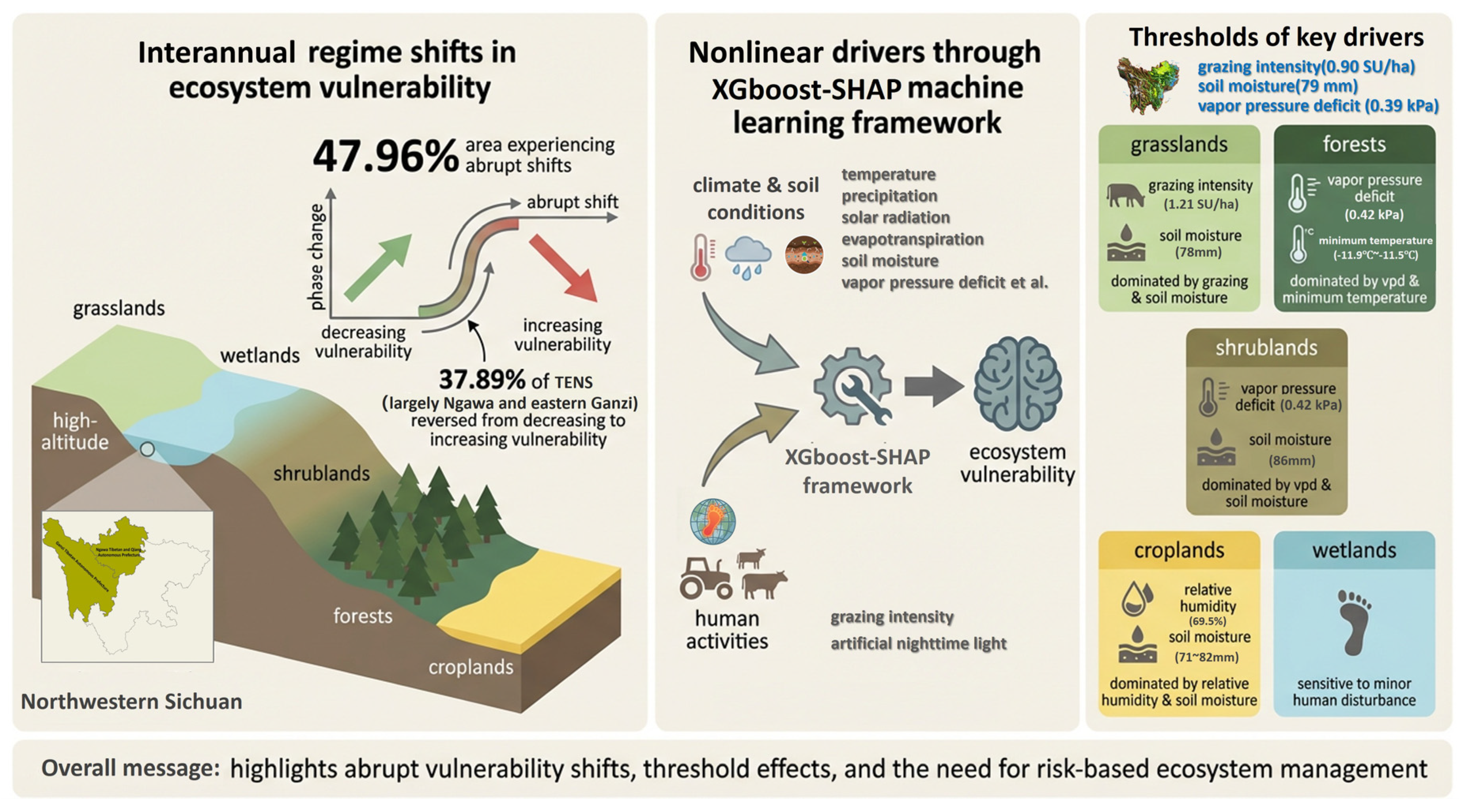
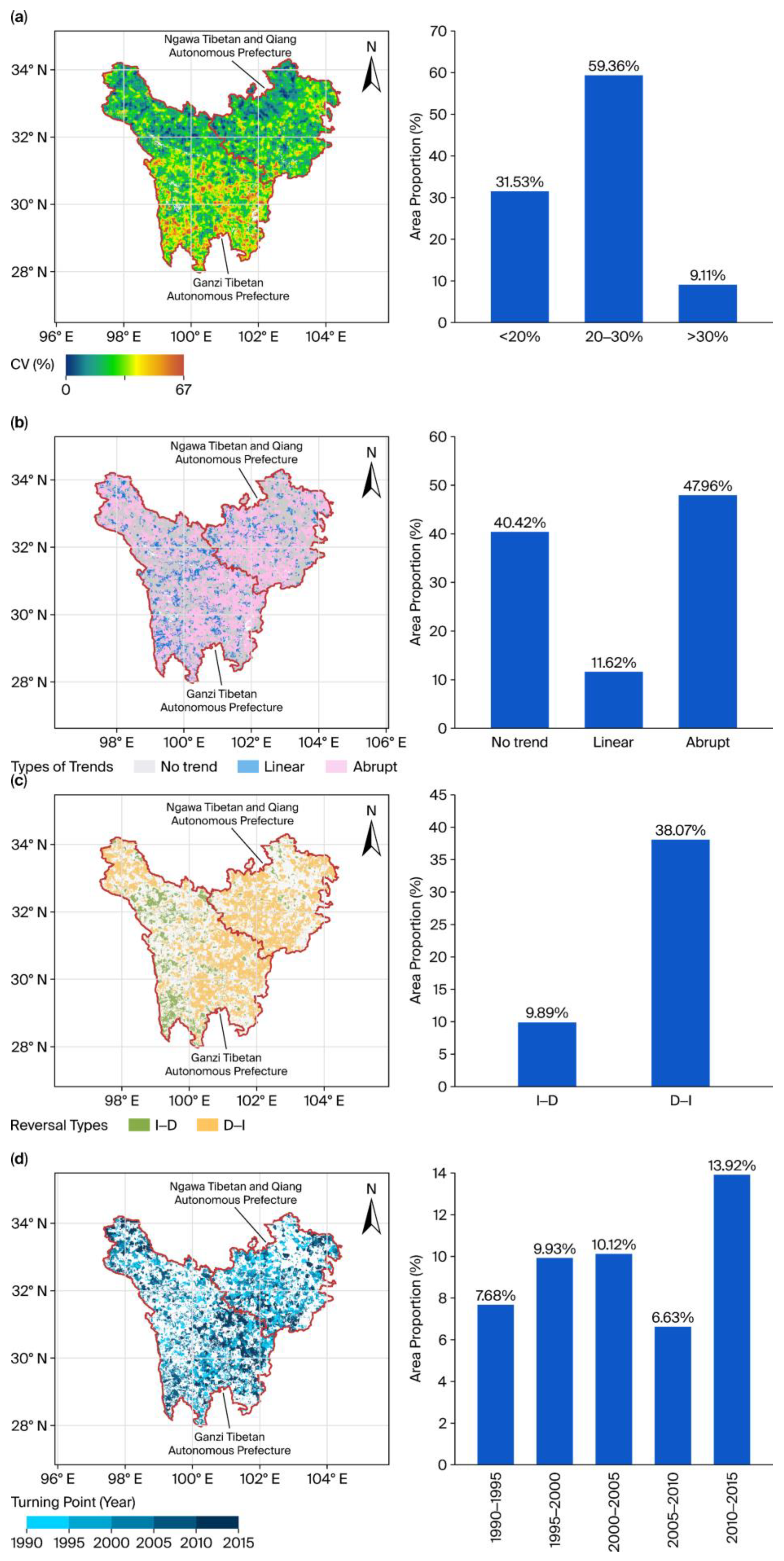
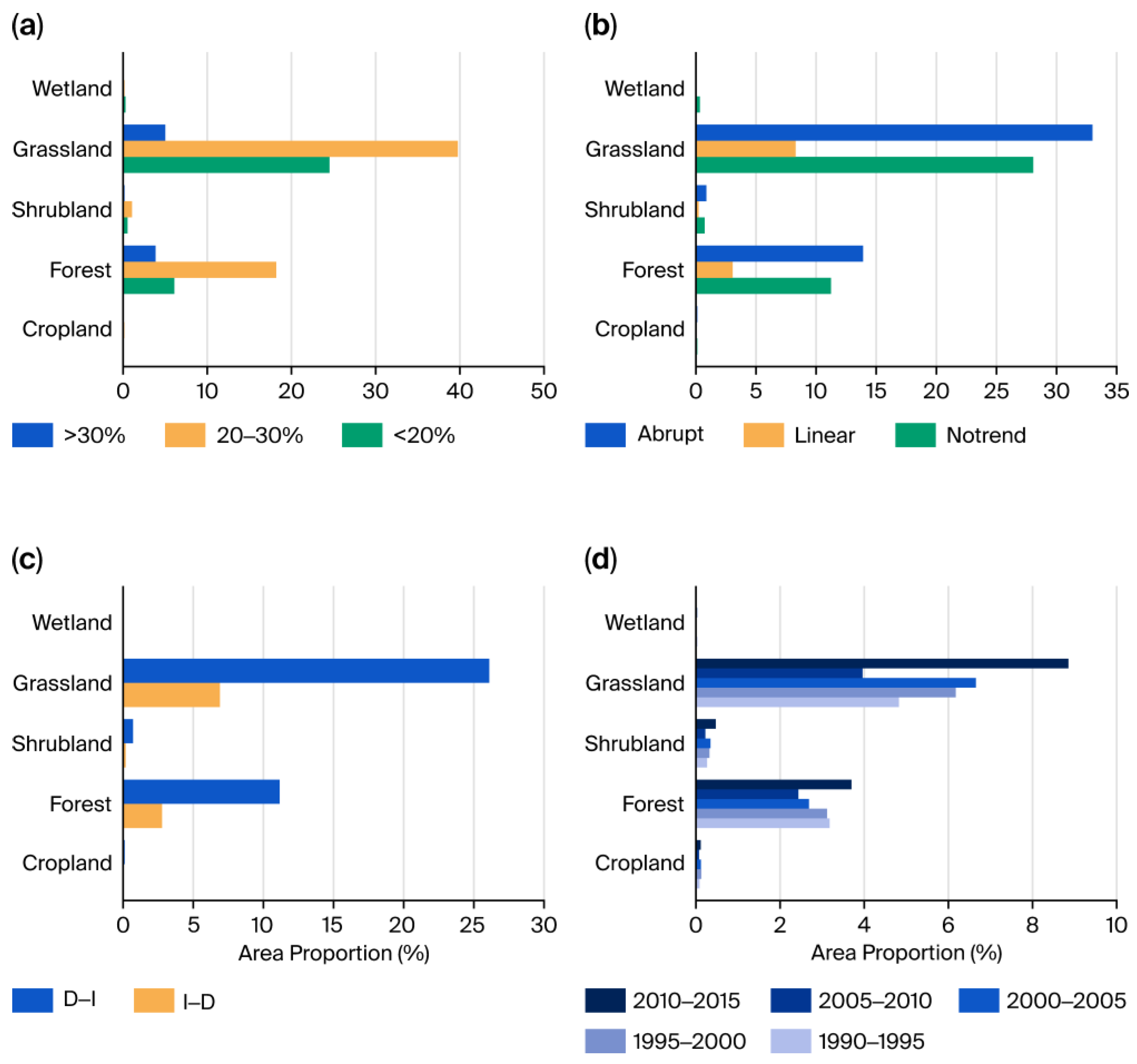
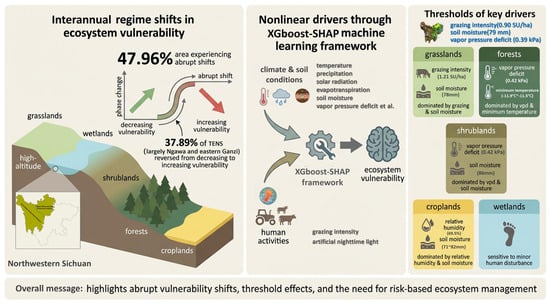
- The evolution of TENS vulnerability is not linear but instead shows pronounced phase transitions and spatial heterogeneity. Nearly half of the regions (47.96%) experienced nonlinear, abrupt changes in vulnerability between 1985 and 2020. The interval 2010–2015 constitutes a critical window for shifts in the state of the ecosystems. Notably, about 37.89% of the regions—primarily in eastern Ngawa Prefecture and Ganzi Prefecture—shifted from “decreasing vulnerability” to “increasing vulnerability” (D–I type). This pattern suggests that the gains from earlier ecological restoration efforts may have plateaued. Due to climate variability and accumulated human pressures, the sustainability of regional ecological restoration is therefore at serious risk, and the ecological security barrier may be vulnerable to secondary degradation.
- (2)
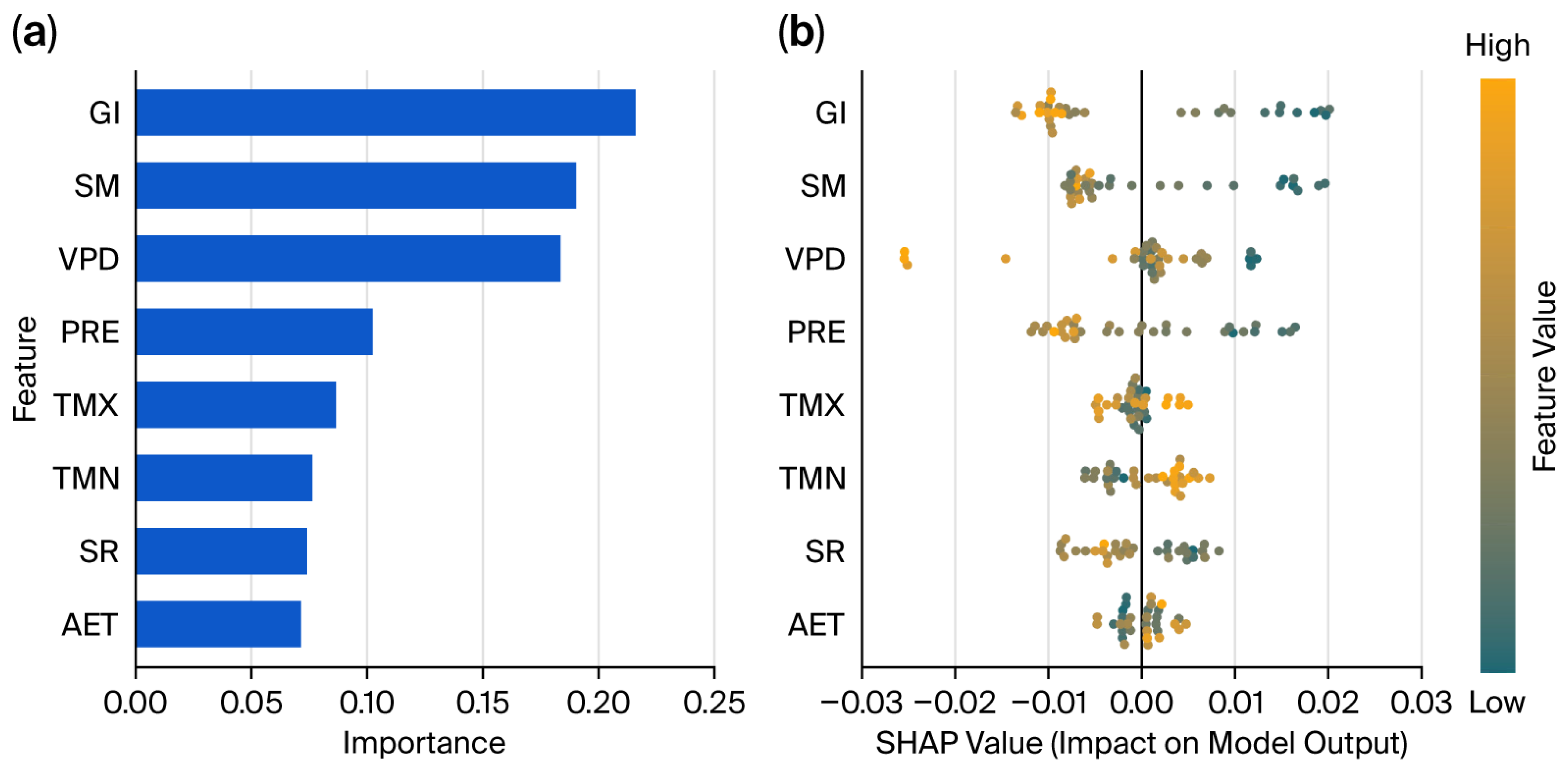
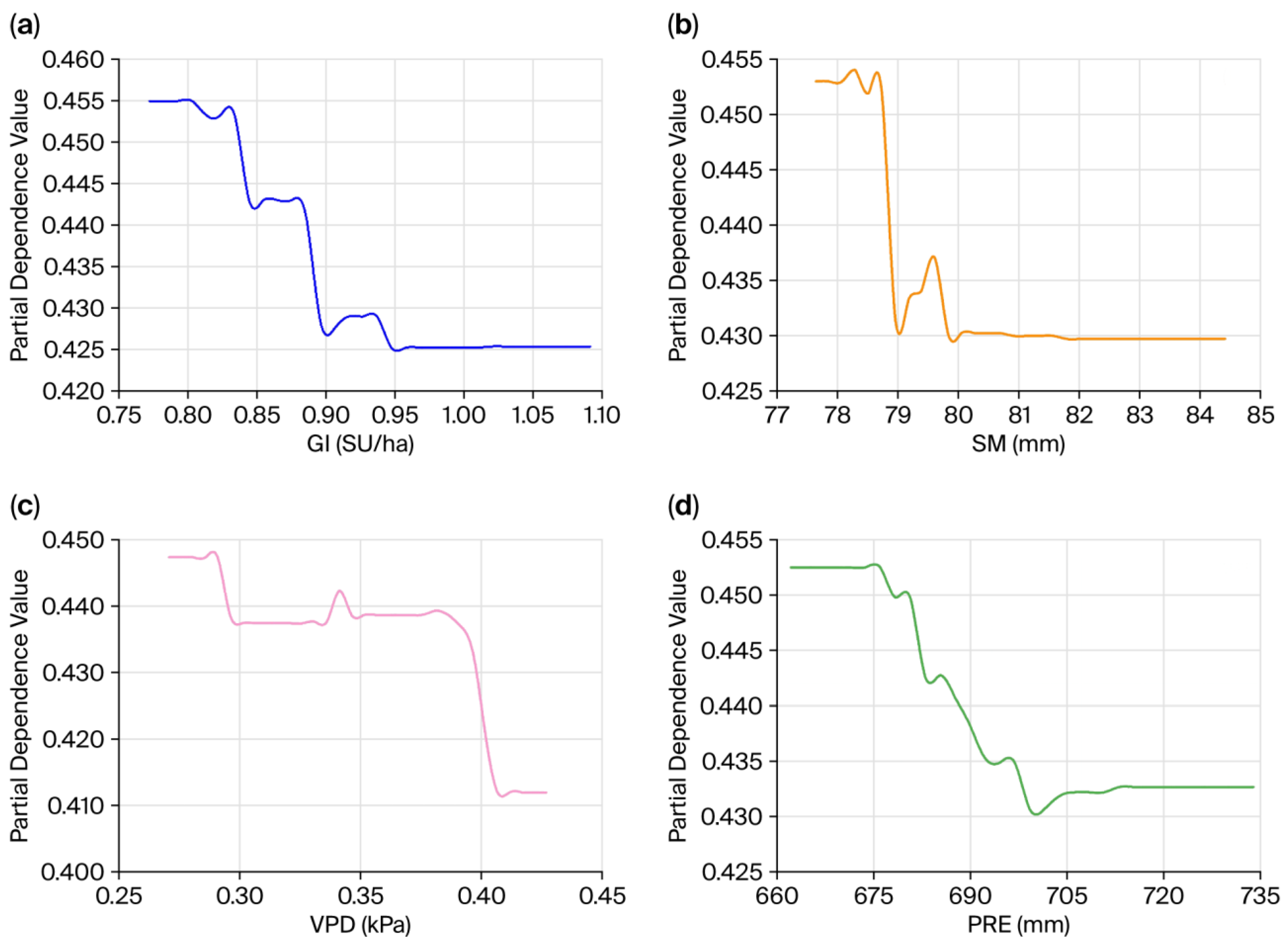
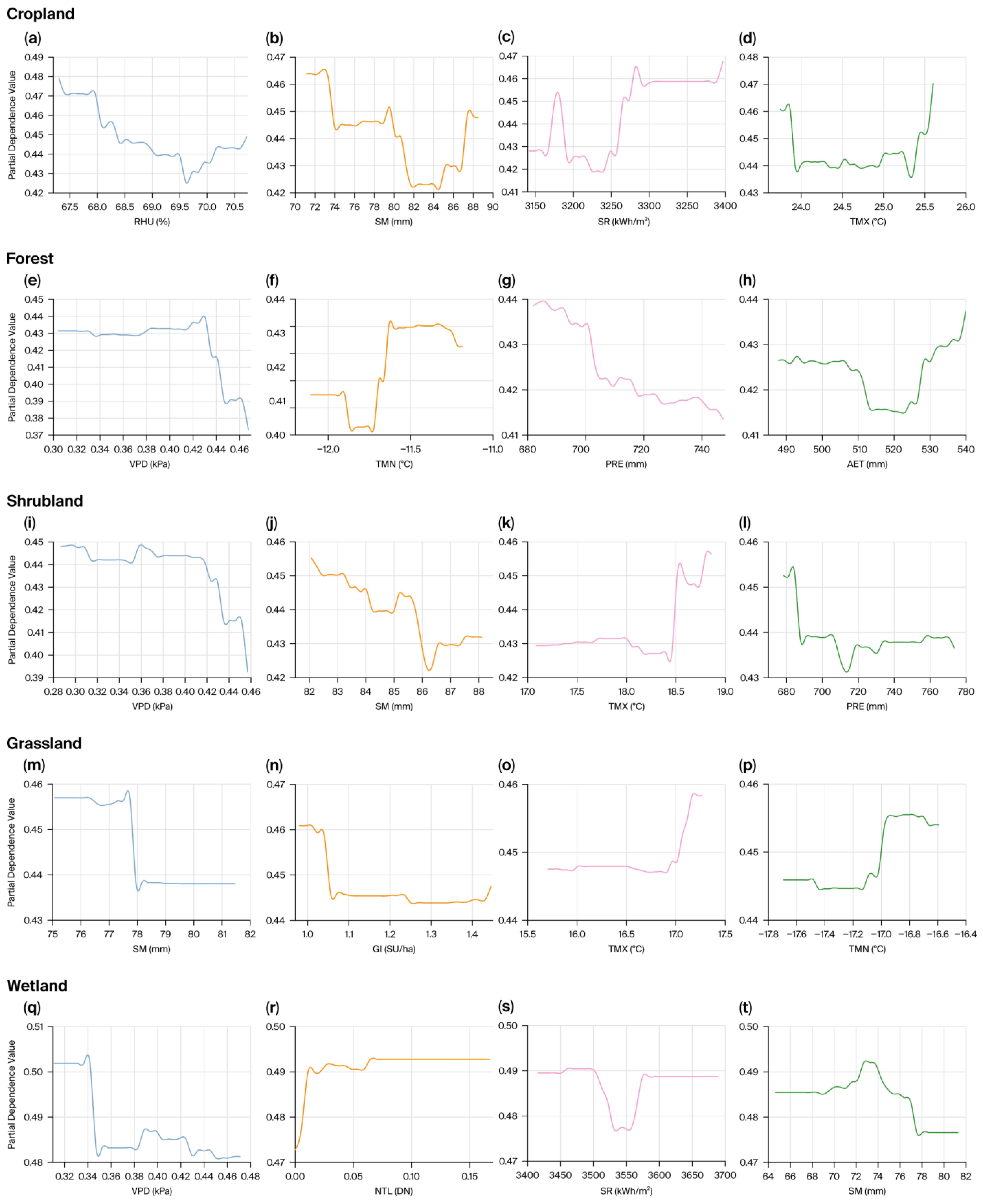
- TENS vulnerability is driven by the coupled effects of multiple factors, notably human disturbance, soil moisture, and atmospheric water demand. Each driver shapes vulnerability through a distinct nonlinear threshold. GI, SM, and VPD collectively dominate the interannual variability of TENS vulnerability. This study quantified the critical ecological thresholds for these drivers. GI values below 0.90 SU/ha produced a “moderate disturbance” effect, lowering vulnerability. Beyond this threshold, GI becomes a stressor. SM exhibited a clear inflection point at 79 mm, indicating that water deficit is the primary bottleneck to ecological stability in this region. In addition, this study challenges the traditional understanding that VPD acts solely as a stress factor in arid zones. We found that high VPD within a specific range (<0.39 kPa) enhanced ecosystem resilience. This occurs because high VPD within this range indicates favorable hydrothermal coordination conditions.
- (3)
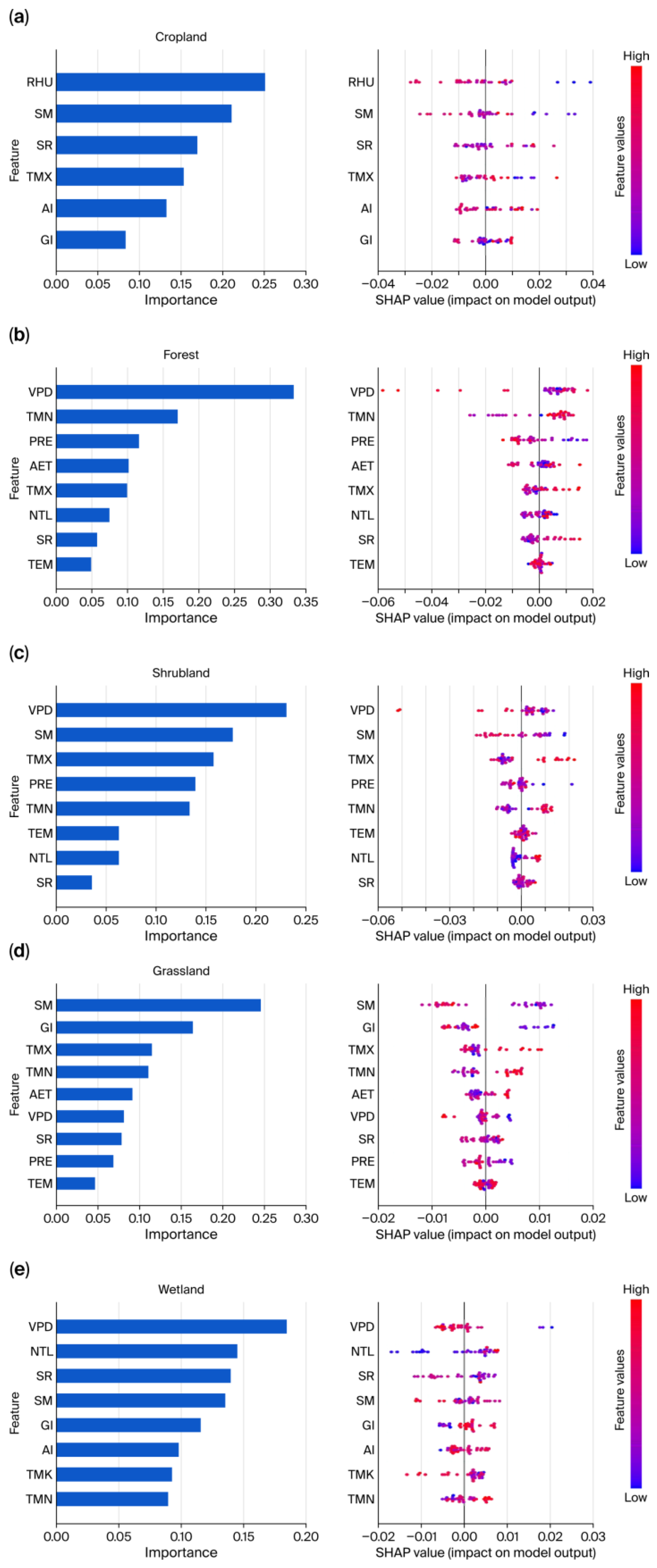
- Different ecosystem types show distinct mechanisms driving vulnerability. These mechanisms depend strongly on habitat conditions and differ in their strategic patterns. Grassland ecosystems are constrained by the shallow soil water supply and grazing pressure. They are therefore extremely sensitive to water–human interactions. Forest and shrubland ecosystems depend more on the balance between atmospheric water demand and thermal conditions, with complex responses to climatic warming and drying. Narrow water threshold ranges govern cropland ecosystems. Wetland ecosystems are highly sensitive to human activities; even minor anthropogenic disturbance can trigger a sharp increase in vulnerability.
Supplementary Materials
Author Contributions
Funding
Data Availability Statement
Acknowledgments
Conflicts of Interest
Abbreviations
| TENS | Terrestrial Ecosystem of Northwestern Sichuan |
| VI | Ecological Vulnerability Index |
| EI | Exposure Index |
| SI | Sensitivity Index |
| RI | Resilience Index |
| NDVI | Normalized Difference Vegetation Index |
| CV | Coefficient of Variation |
| PRE | Total precipitation |
| TEM | Mean temperature |
| TMN | Minimum temperature |
| TMX | Maximum temperature |
| SR | Total solar radiation |
| PET | Potential evapotranspiration |
| AET | Actual evapotranspiration |
| VPD | Vapor pressure deficit |
| SM | Soil moisture |
| AI | Aridity index |
| RHU | Relative humidity |
| GI | Grazing intensity |
| NTL | Artificial nighttime light |
| AIC | Akaike Information Criterion |
| VIF | Variance inflation factor |
| XGBoost | eXtreme Gradient Boosting |
| SHAP | Shapley Additive exPlanation |
| PDP | Partial Dependence Plot |
| GBDT | Gradient Boosting Decision Trees |
| MSE | Mean squared error |
| RMSE | Root mean squared error |
| MAE | Mean absolute error |
References
- Zhu, Z.; Piao, S.; Myneni, R.B.; Huang, M.; Zeng, Z.; Canadell, J.G.; Ciais, P.; Sitch, S.; Friedlingstein, P.; Arneth, A.; et al. Greening of the Earth and its drivers. Nat. Clim. Change 2016, 6, 791–795. [Google Scholar] [CrossRef]
- Nolan, C.; Overpeck, J.T.; Allen, J.R.M.; Anderson, P.M.; Betancourt, J.L.; Binney, H.A.; Brewer, S.; Bush, M.B.; Chase, B.M.; Cheddadi, R.; et al. Past and future global transformation of terrestrial ecosystems under climate change. Science 2018, 361, 920–923. [Google Scholar] [CrossRef]
- Xu, K.; Wang, X.P.; Jiang, C.; Sun, O.J.X. Assessing the vulnerability of ecosystems to climate change based on climate exposure, vegetation stability and productivity. For. Ecosyst. 2020, 7, 23. [Google Scholar] [CrossRef]
- Gonzalez, P.; Neilson, R.P.; Lenihan, J.M.; Drapek, R.J. Global patterns in the vulnerability of ecosystems to vegetation shifts due to climate change. Glob. Ecol. Biogeogr. 2010, 19, 755–768. [Google Scholar] [CrossRef]
- Yao, T.; Wu, C.; Yeh, P.J.F.; Hu, B.X.; Jiao, Y. Assessing the response lag and vulnerability of terrestrial vegetation to various compound climate events in mainland China under different vegetation types. Stoch. Environ. Res. Risk Assess. 2025, 39, 2231–2250. [Google Scholar] [CrossRef]
- Kamran, M.; Yamamoto, K. Evolution and use of remote sensing in ecological vulnerability assessment: A review. Ecol. Indic. 2023, 148, 110099. [Google Scholar] [CrossRef]
- Fang, W.; Huang, S.Z.; Huang, Q.; Huang, G.H.; Wang, H.; Leng, G.Y.; Wang, L.; Guo, Y. Probabilistic assessment of remote sensing-based terrestrial vegetation vulnerability to drought stress of the Loess Plateau in China. Remote Sens. Environ. 2019, 232, 111290. [Google Scholar] [CrossRef]
- Zhang, Q.; Yuan, R.Y.; Singh, V.P.; Xu, C.Y.; Fan, K.K.; Shen, Z.X.; Wang, G.; Zhao, J.Q. Dynamic vulnerability of ecological systems to climate changes across the Qinghai-Tibet Plateau, China. Ecol. Indic. 2022, 134, 108483. [Google Scholar] [CrossRef]
- Zhang, Q.; Wang, G.; Yuan, R.; Singh, V.P.; Wu, W.; Wang, D. Dynamic responses of ecological vulnerability to land cover shifts over the Yellow river Basin, China. Ecol. Indic. 2022, 144, 109554. [Google Scholar] [CrossRef]
- Chen, Y.Y.; Duo, L.H.; Zhao, D.X.; Zeng, Y.; Guo, X.F. The response of ecosystem vulnerability to climate change and human activities in the Poyang lake city group, China. Environ. Res. 2023, 233, 116473. [Google Scholar] [CrossRef]
- Li, M.; Zhang, X.; He, Y.; Niu, B.; Wu, J. Assessment of the vulnerability of alpine grasslands on the Qinghai-Tibetan Plateau. PeerJ 2020, 8, e8513. [Google Scholar] [CrossRef] [PubMed]
- Weng, C.; Bai, Y.; Chen, B.; Hu, Y.; Shu, J.; Chen, Q.; Wang, P. Assessing the vulnerability to climate change of a semi-arid pastoral social–ecological system: A case study in Hulunbuir, China. Ecol. Inf. 2023, 76, 102139. [Google Scholar] [CrossRef]
- Yin, M.J.; Yin, Y.H.; Zong, X.Z.; Deng, H.Y. Global vegetation vulnerability to drought is underestimated due to the lagged effect. Agric. For. Meteorol. 2025, 364, 110451. [Google Scholar] [CrossRef]
- Jiao, C.C.; Yi, X.B.; Luo, J.; Wang, Y.; Deng, Y.J.; Gou, J.T.; Luo, D.T. Spatiotemporal Dynamics of Ecological Vulnerability to Climate Change in Northwestern Sichuan’s Terrestrial Ecosystems of China: Conservation Implications. Biology 2025, 14, 1625. [Google Scholar] [CrossRef]
- Li, M.; Sen, C.; Zhu, Z.; Wang, Z.; Myneni, R.; Piao, S. Spatiotemporally consistent global dataset of the GIMMS Normalized Difference Vegetation Index (PKU GIMMS NDVI) from 1982 to 2022. Earth Syst. Sci. Data 2023, 15, 4181–4203. [Google Scholar] [CrossRef]
- Yang, J.; Huang, X. The 30 m annual land cover datasets and its dynamics in China from 1985 to 2023. Earth Syst. Sci. Data 2024, 13, 3907–3925. [Google Scholar] [CrossRef]
- Peng, S.; Ding, Y.; Liu, W.; Li, Z. 1 km monthly temperature and precipitation dataset for China from 1901 to 2017. Earth Syst. Sci. Data 2019, 11, 1931–1946. [Google Scholar] [CrossRef]
- Abatzoglou, J.T.; Dobrowski, S.Z.; Parks, S.A.; Hegewisch, K.C. TerraClimate, a high-resolution global dataset of monthly climate and climatic water balance from 1958–2015. Sci. Data 2018, 5, 170191. [Google Scholar] [CrossRef]
- Zhang, L.; Li, X.; Zheng, D.; Zhang, K.; Ma, Q.; Zhao, Y.; Ge, Y. Merging multiple satellite-based precipitation products and gauge observations using a novel double machine learning approach. J. Hydrol. 2021, 594, 125969. [Google Scholar] [CrossRef]
- Hu, Y.; Zhang, L. Added value of merging techniques in precipitation estimates relative to gauge-interpolation algorithms of varying complexity. J. Hydrol. 2024, 645, 132214. [Google Scholar] [CrossRef]
- Zhang, L.; Hu, Y.; Zhao, Y.; Che, T. A High-Resolution Multi-Element Meteorological Driving Dataset for China via Multi-Source Data Fusion. National Cryosphere Desert Data Center (http://www.ncdc.ac.cn). 2025. Available online: https://cstr.cn/CSTR:11738.11.NCDC.NIEER.DB6722.2025 (accessed on 15 January 2025).
- Peng, S.; Ding, Y.; Wen, Z.; Chen, Y.; Cao, Y.; Ren, J. Spatiotemporal change and trend analysis of potential evapotranspiration over the Loess Plateau of China during 2011–2100. Agric. For. Meteorol 2017, 233, 183–194. [Google Scholar] [CrossRef]
- Ding, Y.; Peng, S. Spatiotemporal Trends and Attribution of Drought across China from 1901–2100. Sustainability 2020, 12, 477. [Google Scholar] [CrossRef]
- Ding, Y.; Peng, S. Spatiotemporal change and attribution of potential evapotranspiration over China from 1901 to 2100. Theor. Appl. Clim. 2021, 145, 79–94. [Google Scholar] [CrossRef]
- Wang, D.; Peng, Q.; Li, X.; Zhang, W.; Xia, X.; Qin, Z.; Ren, P.; Liang, S.; Yuan, W. A long-term high-resolution dataset of grasslands grazing intensity in China. Sci. Data 2024, 11, 1194. [Google Scholar] [CrossRef]
- Zhang, L.; Ren, Z.; Chen, B.; Gong, P.; Fu, H.; Xu, B. A Prolonged Artificial Nighttime-Light Dataset of China (1984–2020). National Tibetan Plateau/Third Pole Environment Data Center. 2021. Available online: http://data.tpdc.ac.cn/ (accessed on 15 January 2025). [CrossRef]
- Zhang, L.; Ren, Z.; Chen, B.; Gong, P.; Xu, B.; Fu, H. A Prolonged Artificial Nighttime-light Dataset of China (1984–2020). Sci. Data 2024, 11, 414. [Google Scholar] [CrossRef]
- Jiao, W.; Wang, L.; Smith, W.K.; Chang, Q.; Wang, H.; D’Odorico, P. Observed increasing water constraint on vegetation growth over the last three decades. Nat. Commun. 2021, 12, 3777. [Google Scholar] [CrossRef]
- He, B.; Huang, L.; Chen, Z.; Wang, H. Weakening sensitivity of global vegetation to long-term droughts. Sci. China Earth Sci. 2018, 61, 60–70. [Google Scholar] [CrossRef]
- Yao, Y.; Liu, Y.; Fu, F.; Song, J.; Wang, Y.; Han, Y.; Wu, T.; Fu, B. Declined terrestrial ecosystem resilience. Glob. Change Biol. 2024, 30, e17291. [Google Scholar] [CrossRef] [PubMed]
- The Intergovernmental Panel on Climate Change (IPCC). Climate Change 2021: The Physical Science Basis; IPCC Sixth Assessment Report; IPCC: Geneva, Switzerland, 2021. [Google Scholar]
- The Intergovernmental Panel on Climate Change (IPCC). Climate Change 2022: Impacts, Adaptation and Vulnerability; IPCC Sixth Assessment Report; IPCC: Geneva, Switzerland, 2022. [Google Scholar]
- Loarie, S.R.; Duffy, P.B.; Hamilton, H.; Asner, G.P.; Field, C.B.; Ackerly, D.D. The velocity of climate change. Nature 2009, 462, 1052–1055. [Google Scholar] [CrossRef]
- Seddon, A.W.R.; Macias-Fauria, M.; Long, P.R.; Benz, D.; Willis, K.J. Sensitivity of global terrestrial ecosystems to climate variability. Nature 2016, 531, 229–232. [Google Scholar] [CrossRef] [PubMed]
- Zhang, X.; Zheng, Y.; Yang, Y.; Ren, H.; Liu, J. Spatiotemporal evolution of ecological vulnerability on the Loess Plateau. Ecol. Indic. 2025, 170, 113060. [Google Scholar] [CrossRef]
- Turner, B.L.; Kasperson, R.E.; Matson, P.A.; McCarthy, J.J.; Corell, R.W.; Christensen, L.; Eckley, N.; Kasperson, J.X.; Luers, A.; Martello, M.L.; et al. A framework for vulnerability analysis in sustainability science. Proc. Natl. Acad. Sci. USA 2003, 100, 8074–8079. [Google Scholar] [CrossRef]
- Li, D.; Wu, S.; Liu, L.; Zhang, Y.; Li, S. Vulnerability of the global terrestrial ecosystems to climate change. Glob. Change Biol. 2018, 24, 4095–4106. [Google Scholar] [CrossRef]
- Zhu, H.L.; Liu, H.Z.; Zhou, Q.M.; Cui, A.H. A XGBoost-Based Downscaling-Calibration Scheme for Extreme Precipitation Events. IEEE Trans. Geosci. Remote Sens. 2023, 61, 4103512. [Google Scholar] [CrossRef]
- Suganthan, P.N.; Kong, L.P.; Snásel, V.; Ojha, V.; Aly, H. Euclidean and Poincaré space ensemble Xgboost. Inf. Fusion. 2025, 115, 102746. [Google Scholar] [CrossRef]
- Lundberg, S.M.; Lee, S.I. A unified approach to interpreting model predictions. In Proceedings of the 31st International Conference on Neural Information Processing Systems, Long Beach, CA, USA, 4–9 December 2017. [Google Scholar]
- R Core Team. R: A Language and Environment for Statistical Computing, Version 4.4.1.; R Foundation for Statistical Computing: Vienna, Austria, 2024. Available online: https://www.r-project.org/ (accessed on 20 June 2025).
- Esri. ArcGIS Desktop, Release 10.8; Environmental Systems Research Institute: Redlands, CA, USA, 2020. Available online: https://www.esri.com/en-us/arcgis/products/arcgis-desktop/overview (accessed on 20 June 2025).
- Cai, X.; Li, Z.; Liang, Y. Tempo-spatial changes of ecological vulnerability in the arid area based on ordered weighted average model. Ecol. Indic. 2021, 133, 108398. [Google Scholar] [CrossRef]
- Lu, Q.; Zhang, Y.; Sun, W.; Wei, J.; Xu, K. From Mountains to Basins: Asymmetric Ecosystem Vulnerability and Adaptation to Extreme Climate Events in Southwestern China. Remote Sens. 2025, 17, 392. [Google Scholar] [CrossRef]
- Xu, B.; Li, J.; Luo, Z.; Wu, J.; Liu, Y.; Yang, H.; Pei, X. Analyzing the Spatiotemporal Vegetation Dynamics and Their Responses to Climate Change along the Ya’an-Linzhi Section of the Sichuan-Tibet Railway. Remote Sens. 2022, 14, 3584. [Google Scholar] [CrossRef]
- Qu, S.; Wang, L.; Lin, A.; Zhu, H.; Yuan, M. What drives the vegetation restoration in Yangtze River basin, China: Climate change or anthropogenic factors? Ecol. Indic. 2018, 90, 438–450. [Google Scholar] [CrossRef]
- Hua, T.; Zhao, W.W.; Cherubini, F.; Hu, X.P.; Pereira, P. Sensitivity and future exposure of ecosystem services to climate change on the Tibetan Plateau of China. Landsc. Ecol. 2021, 36, 3451–3471. [Google Scholar] [CrossRef] [PubMed]
- Yan, W.; Chen, H.; Wang, S.; Li, Z.; Wang, Y.; Li, S.; Sun, R. The construction and control policy of the ecological spatial pattern of the provincial sub-regions: A case study of Northwestern Sichuan. Shanghai Urban Plan. Rev. 2021, 3, 8–17. (In Chinese) [Google Scholar]
- Feng, X.; Fu, B.; Piao, S.; Wang, S.; Ciais, P.; Zeng, Z.; Lü, Y.; Zeng, Y.; Li, Y.; Jiang, X.; et al. Revegetation in China’s Loess Plateau is approaching sustainable water resource limits. Nat. Clim. Change 2016, 6, 1019–1022. [Google Scholar] [CrossRef]
- Meng, J.; Fang, H.; Scavia, D. Application of ecosystem stability and regime shift theories in ecosystem assessment-calculation variable and practical performance. Ecol. Indic. 2021, 125, 107529. [Google Scholar] [CrossRef]
- Hu, T.; Peng, W.; Ren, Y.; Zhang, P. Regime shifts of vegetation ecosystems driven by human activities and climate change: A review. Acta Ecol. Sin. 2025, 45, 4120–4130. (In Chinese) [Google Scholar]
- Kéfi, S.; Holmgren, M.; Scheffer, M. When can positive interactions cause alternative stable states in ecosystems? Funct. Ecol. 2016, 30, 88–97. [Google Scholar] [CrossRef]
- Huang, M.T.; Zhai, P.M. Impact of extreme seasonal drought on ecosystem carbon-water coupling across China. Adv. Clim. Change Res. 2024, 15, 914–923. [Google Scholar] [CrossRef]
- Gartzia, M.; Pérez-Cabello, F.; Bueno, C.G.; Alados, C.L. Physiognomic and physiologic changes in mountain grasslands in response to environmental and anthropogenic factors. Appl. Geogr. 2016, 66, 1–11. [Google Scholar] [CrossRef]
- Hao, Y.Q.; He, Z.W. Effects of grazing patterns on grassland biomass and soil environments in China: A meta-analysis. PLoS ONE 2019, 14, e0215223. [Google Scholar] [CrossRef]
- Moi, D.A.; García-Ríos, R.; Hong, Z.; Daquila, B.V.; Mormul, R.P. Intermediate disturbance hypothesis in ecology: A literature review. Ann. Zool. Fenn. 2020, 57, 67–78. [Google Scholar] [CrossRef]
- Sun, S.N.; Zhao, Y.; Dong, Q.M.; Yang, X.X.; Liu, Y.Z.; Liu, W.T.; Shi, G.; Liu, W.T.; Zhang, C.P.; Yu, Y. Symbiotic diazotrophs in response to yak grazing and Tibetan sheep grazing in Qinghai-Tibetan plateau grassland soils. Front. Microbiol. 2023, 14, 1257521. [Google Scholar] [CrossRef]
- Zhu, Q.A.; Chen, H.; Peng, C.H.; Liu, J.X.; Piao, S.L.; He, J.S.; Wang, S.P.; Zhao, X.Q.; Zhang, J.; Fang, X.Q.; et al. An early warning signal for grassland degradation on the Qinghai-Tibetan Plateau. Nat. Commun. 2023, 14, 6406. [Google Scholar] [CrossRef]
- Guo, Q.; Li, S.; Hu, Z.; Zhao, W.; Yu, G.; Sun, X.; Li, L.; Liang, N.; Bai, W. Responses of gross primary productivity to different sizes of precipitation events in a temperate grassland ecosystem in Inner Mongolia, China. J. Arid. Land. 2016, 8, 36–46. [Google Scholar] [CrossRef]
- Fu, Z.; Ciais, P.; Wigneron, J.-P.; Gentine, P.; Feldman, A.F.; Makowski, D.; Viovy, N.; Kemanian, A.R.; Goll, D.S.; Stoy, P.C.; et al. Global critical soil moisture thresholds of plant water stress. Nat. Commun. 2024, 15, 4826. [Google Scholar] [CrossRef] [PubMed]
- Jurado, S.; Matthes, J. Increasing Large Precipitation Events and Low Available Water Holding Capacity Create the Conditions for Dry Land-Atmosphere Feedbacks in the Northeastern United States. Water Resour. Res. 2025, 61, e2024WR038600. [Google Scholar]
- Novick, K.A.; Ficklin, D.L.; Stoy, P.C.; Williams, C.A.; Bohrer, G.; Oishi, A.C.; Papuga, S.A.; Blanken, P.D.; Noormets, A.; Sulman, B.N.; et al. The increasing importance of atmospheric demand for ecosystem water and carbon fluxes. Nat. Clim. Change 2016, 6, 1023–1027. [Google Scholar]
- Yuan, W.; Zheng, Y.; Piao, S.; Ciais, P.; Lombardozzi, D.; Wang, Y.; Ryu, Y.; Chen, G.; Dong, W.; Hu, Z.; et al. Increased atmospheric vapor pressure deficit reduces global vegetation growth. Sci. Adv. 2019, 5, eaax1396. [Google Scholar] [CrossRef]
- Grossiord, C.; Buckley, T.N.; Cernusak, L.A.; Novick, K.A.; Poulter, B.; Siegwolf, R.T.W.; Sperry, J.S.; McDowell, N.G. Plant responses to rising vapor pressure deficit. New Phytol. 2020, 226, 1550–1566. [Google Scholar] [CrossRef]
- Tian, Y.; Zhang, W.; Xu, X.; Zhou, B.; Cao, X.; Qiao, B. Response of Water-Use Efficiency (WUE) in Alpine Grasslands to Hydrothermal and Radiative Factors Across Elevation Gradients. Land 2025, 14, 1173. [Google Scholar] [CrossRef]
- Xing, Y.; Chen, M.; Dao, J.; Lin, L.; Chen, C.; Chen, Y.; Wang, Z. Fine-root morphology of woody and herbaceous plants responds differently to altered precipitation: A meta-analysis. For. Ecol. Manag. 2024, 552, 121570. [Google Scholar] [CrossRef]
- Xue, Y.; Liang, H.; Ma, Y.; Xue, G.; He, J. The Impacts of Climate and Human Activities on Grassland Productivity Variation in China. Remote Sens. 2023, 15, 3864. [Google Scholar]
- Yang, G.S.; Huang, L.; Shi, Y.F. Magnitude and determinants of plant root hydraulic redistribution: A global synthesis analysis. Front. Plant Sci. 2022, 13, 918585. [Google Scholar] [CrossRef]
- Shi, C.; Schneider, L.; Hu, Y.; Shen, M.; Sun, C.; Xia, J.; Forbes, B.C.; Shi, P.; Zhang, Y.; Ciais, P. Warming-induced unprecedented high-elevation forest growth over the monsoonal Tibetan Plateau. Environ. Res. Lett. 2020, 15, 054011. [Google Scholar]
- Zhou, S.; Wu, S.; Gao, J.; Liu, L.; Li, D.; Yan, R.; Wang, J. Increased stress from compound drought and heat events on vegetation. Sci. Total Environ. 2024, 949, 175113. [Google Scholar] [PubMed]
- Feng, X.; Liu, R.; Li, C.; Zhang, H.; Slot, M. Contrasting responses of two C4 desert shrubs to drought but consistent decoupling of photosynthesis and stomatal conductance at high temperature. Environ. Exp. Bot. 2023, 209, 105295. [Google Scholar] [CrossRef]
- Rasheed, M.W.; Tang, J.; Sarwar, A.; Shah, S.; Saddique, N.; Khan, M.U.; Imran Khan, M.; Nawaz, S.; Shamshiri, R.R.; Aziz, M.; et al. Soil Moisture Measuring Techniques and Factors Affecting the Moisture Dynamics: A Comprehensive Review. Sustainability 2022, 14, 11538. [Google Scholar] [CrossRef]
- Chen, L.; Deng, X.; Duan, H.; Tan, X.; Xie, X.; Pan, X.; Guo, L.; Luo, T.; Chen, X.; Gao, H.; et al. Canopy humidity and irrigation regimes interactively affect rice physiology, grain filling and yield during grain filling period. Agric. Water Manag. 2025, 307, 109143. [Google Scholar] [CrossRef]
- Gao, C.; Knorr, K.-H.; Chen, H.; He, Y. Editorial: Disturbance, resilience, and restoration of wetlands. Front. Ecol. Evol. 2023, 11, 1166223. [Google Scholar] [CrossRef]
- Eresanya, O.I.; Babaniyi, B.R.; Ojo, O.T.; Olorunfemi, K.O. Future Challenges and Opportunities for Wetland Preservation. In Wetland Ecosystems: Conservation Strategies, Policy Management and Applications; Babaniyi, B.R., Aransiola, S.A., Babaniyi, E.E., Maddela, N.R., Eds.; Springer Nature: Cham, Switzerland, 2025. [Google Scholar]
- Tang, J.; Niu, B.; Fu, G.; Peng, J.; Hu, Z.; Zhang, X. Shifted trend in drought sensitivity of vegetation productivity from 1982 to 2020. Agric. For. Meteorol. 2025, 362, 110388. [Google Scholar] [CrossRef]
- Ippolito, A.; Sala, S.; Faber, J.H.; Vighi, M. Ecological vulnerability analysis: A river basin case study. Sci. Total Environ. 2010, 408, 3880–3890. [Google Scholar]
- De Keersmaecker, W.; Lhermitte, S.; Tits, L.; Honnay, O.; Somers, B.; Coppin, P. A model quantifying global vegetation resistance and resilience to short-term climate anomalies and their relationship with vegetation cover. Glob. Ecol. Biogeogr. 2015, 24, 539–548. [Google Scholar]
- Simoniello, T.; Lanfredi, M.; Liberti, M.; Coppola, R.; Macchiato, M. Estimation of vegetation cover resilience from satellite time series. Hydrol. Earth Syst. Sci. Discuss. 2008, 12, 1053–1064. [Google Scholar] [CrossRef]
- Carpenter, S.R.; Cole, J.J.; Pace, M.L.; Batt, R.; Brock, W.A.; Cline, T.; Coloso, J.; Hodgson, J.R.; Kitchell, J.F.; Seekell, D.A.; et al. Early warnings of regime shifts: A whole-ecosystem experiment. Science 2011, 332, 1079–1082. [Google Scholar] [CrossRef] [PubMed]
- Kling, M.M.; Auer, S.L.; Comer, P.J.; Ackerly, D.D.; Hamilton, H. Multiple axes of ecological vulnerability to climate change. Glob. Change Biol. 2020, 26, 2798–2813. [Google Scholar] [CrossRef] [PubMed]



| Name (Abbreviation) | Unit | Spatial Resolution | Temporal Resolution | Temporal Scale | |
|---|---|---|---|---|---|
| 1 | NDVI | — | 8 km | Half-month | 1983–2022 |
| 2 | CLCD | — | 30 m | Annul | 1985, 1990–2022 |
| 3 | TEM | °C | 1 km | Monthly | 1983–2022 |
| 4 | TMX | °C | 1 km | Monthly | 1983–2022 |
| 5 | TMN | °C | 1 km | Monthly | 1983–2022 |
| 6 | PRE | mm | 1 km | Monthly | 1983–2022 |
| 7 | SR | kWh/m2 | 1 km | Monthly | 1983–2022 |
| 8 | PET | mm | 4 km | Monthly | 1983–2022 |
| 9 | AET | mm | 4 km | Monthly | 1983–2022 |
| 10 | SM | mm | 4 km | Monthly | 1983–2022 |
| 11 | VPD | kPa | 4 km | Monthly | 1983–2022 |
| 12 | RHU | % | 1 km | Annual | 1983–2022 |
| 13 | AI | — | 1 km | Annual | 1983–2022 |
| 14 | GI | SU/ha | 1980–2000: 0.1°; 2001–2024: 0.0025°; | Annual | 1983–2022 |
| 15 | NTL | DN (Digital Number, dimensionless) | 1 km | Annual | 1984–2020 |
Disclaimer/Publisher’s Note: The statements, opinions and data contained in all publications are solely those of the individual author(s) and contributor(s) and not of MDPI and/or the editor(s). MDPI and/or the editor(s) disclaim responsibility for any injury to people or property resulting from any ideas, methods, instructions or products referred to in the content. |
© 2026 by the authors. Licensee MDPI, Basel, Switzerland. This article is an open access article distributed under the terms and conditions of the Creative Commons Attribution (CC BY) license.
Share and Cite
Jiao, C.; He, Z.; Xu, J.; Yi, X.; Luo, J.; Huang, P. Interannual Regime Shifts and Driver Thresholds of Terrestrial Ecosystem Vulnerability in Northwestern Sichuan of China Based on an XGBoost-SHAP Model. Biology 2026, 15, 303. https://doi.org/10.3390/biology15040303
Jiao C, He Z, Xu J, Yi X, Luo J, Huang P. Interannual Regime Shifts and Driver Thresholds of Terrestrial Ecosystem Vulnerability in Northwestern Sichuan of China Based on an XGBoost-SHAP Model. Biology. 2026; 15(4):303. https://doi.org/10.3390/biology15040303
Chicago/Turabian StyleJiao, Cuicui, Zonggui He, Juan Xu, Xiaobo Yi, Ji Luo, and Ping Huang. 2026. "Interannual Regime Shifts and Driver Thresholds of Terrestrial Ecosystem Vulnerability in Northwestern Sichuan of China Based on an XGBoost-SHAP Model" Biology 15, no. 4: 303. https://doi.org/10.3390/biology15040303
APA StyleJiao, C., He, Z., Xu, J., Yi, X., Luo, J., & Huang, P. (2026). Interannual Regime Shifts and Driver Thresholds of Terrestrial Ecosystem Vulnerability in Northwestern Sichuan of China Based on an XGBoost-SHAP Model. Biology, 15(4), 303. https://doi.org/10.3390/biology15040303