Effect of Dry–Wet Cycling on Methanotrophs in Wetland Soils

Simple Summary
Abstract
1. Introduction
2. Hydrological Controls on CH4 Release and Oxidation Pathways
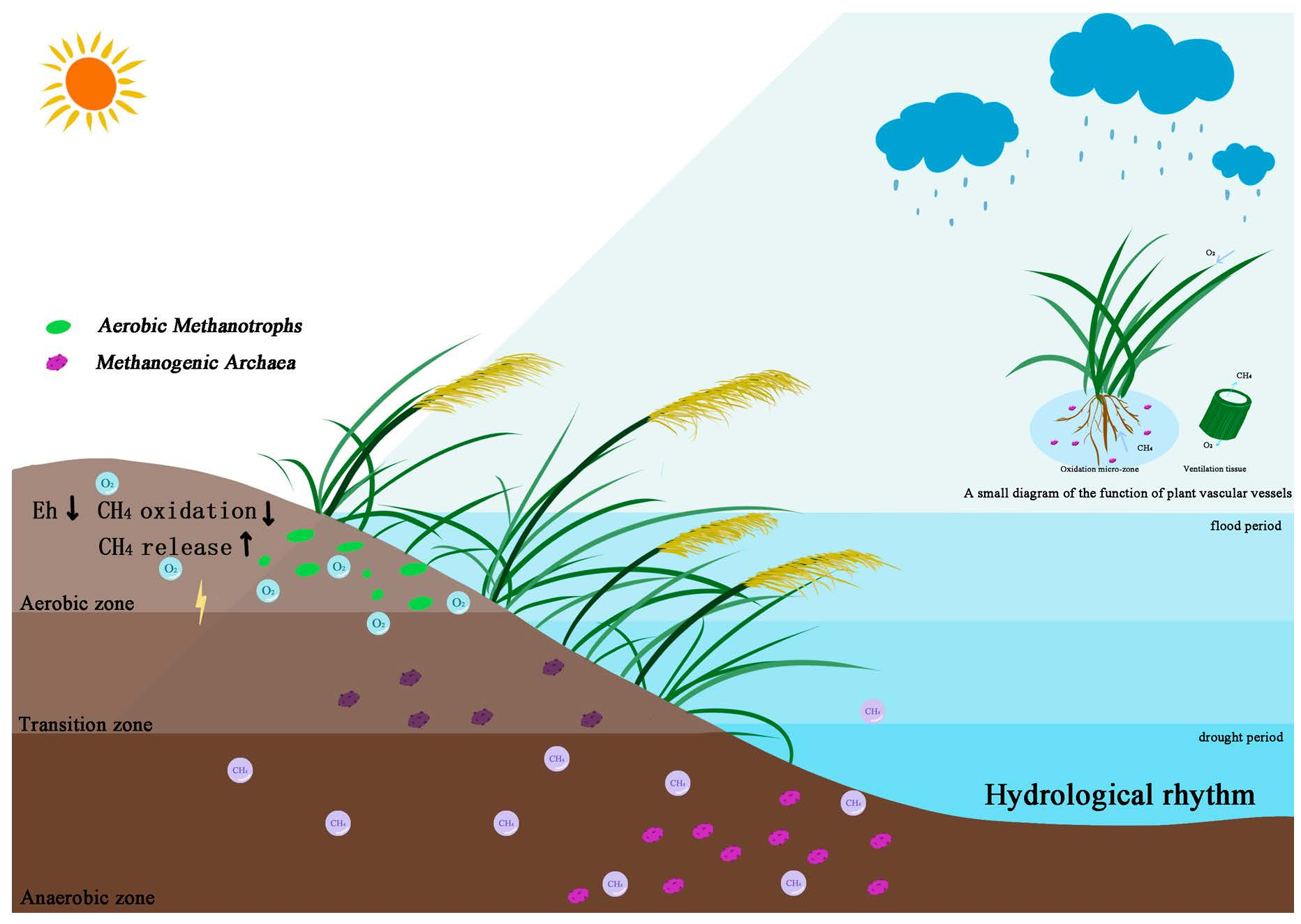
2.1. Release and Oxidation of CH4 in Wetland Soils
2.2. From Tropics to Poles: CH4 Responses to Altered Hydrological Rhythms
2.3. Seasonal vs. Event-Scale Hydrological Pulses
3. Plant–Soil–Nitrogen Cascades Regulating CH4 Cycling
3.1. Effects of Vegetation Cover on CH4 Emissions from Wetlands
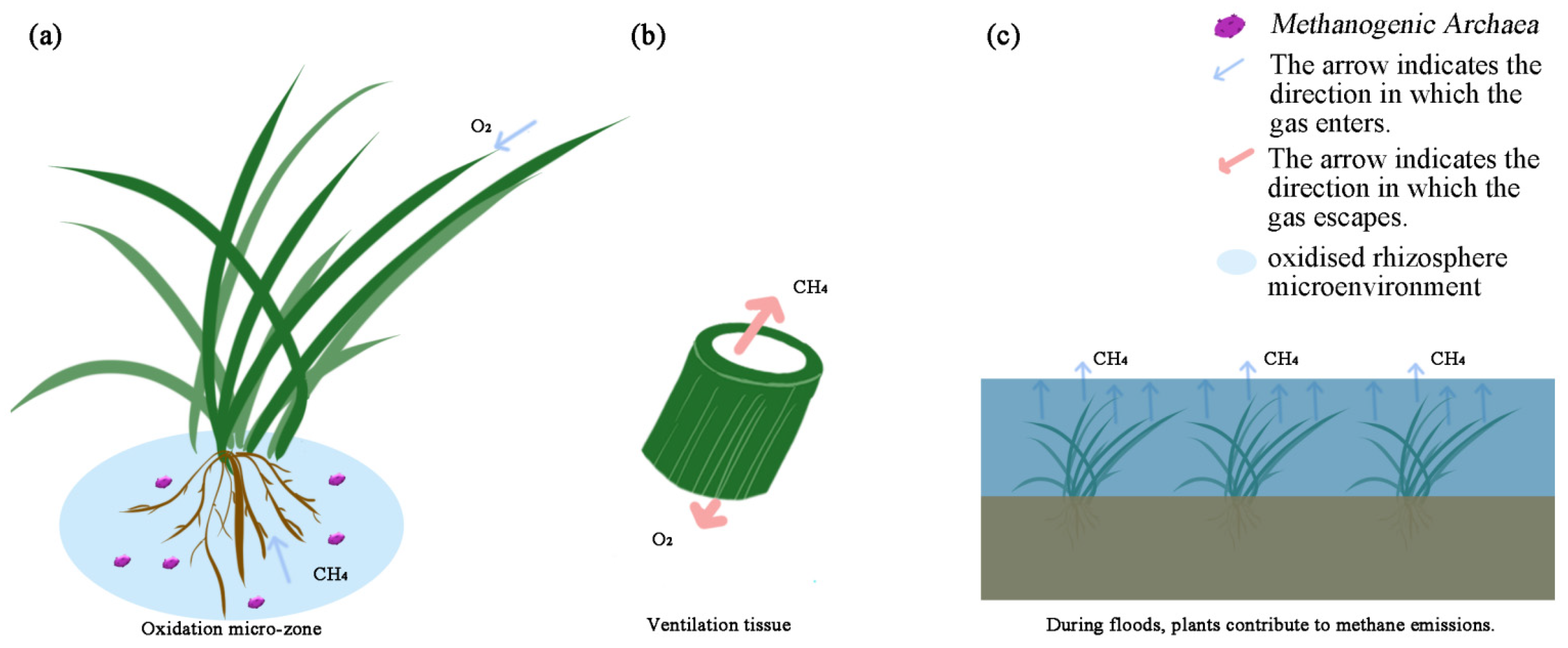
3.1.1. Rhizosphere Oxidation: The Plant-Mediated CH4 Sink
3.1.2. Vascular Transport: The Plant-Mediated CH4 Conduit
3.1.3. Net Regulatory Effect: Balancing Oxidation and Transport
3.2. Influence of Nitrogen on CH4 Emissions from Wetlands
3.3. Key Soil Drivers of CH4 Emissions in Wetlands
3.4. Summary and Perspectives
4. Methodological Advances in Linking Community Dynamics to CH4 Fluxes
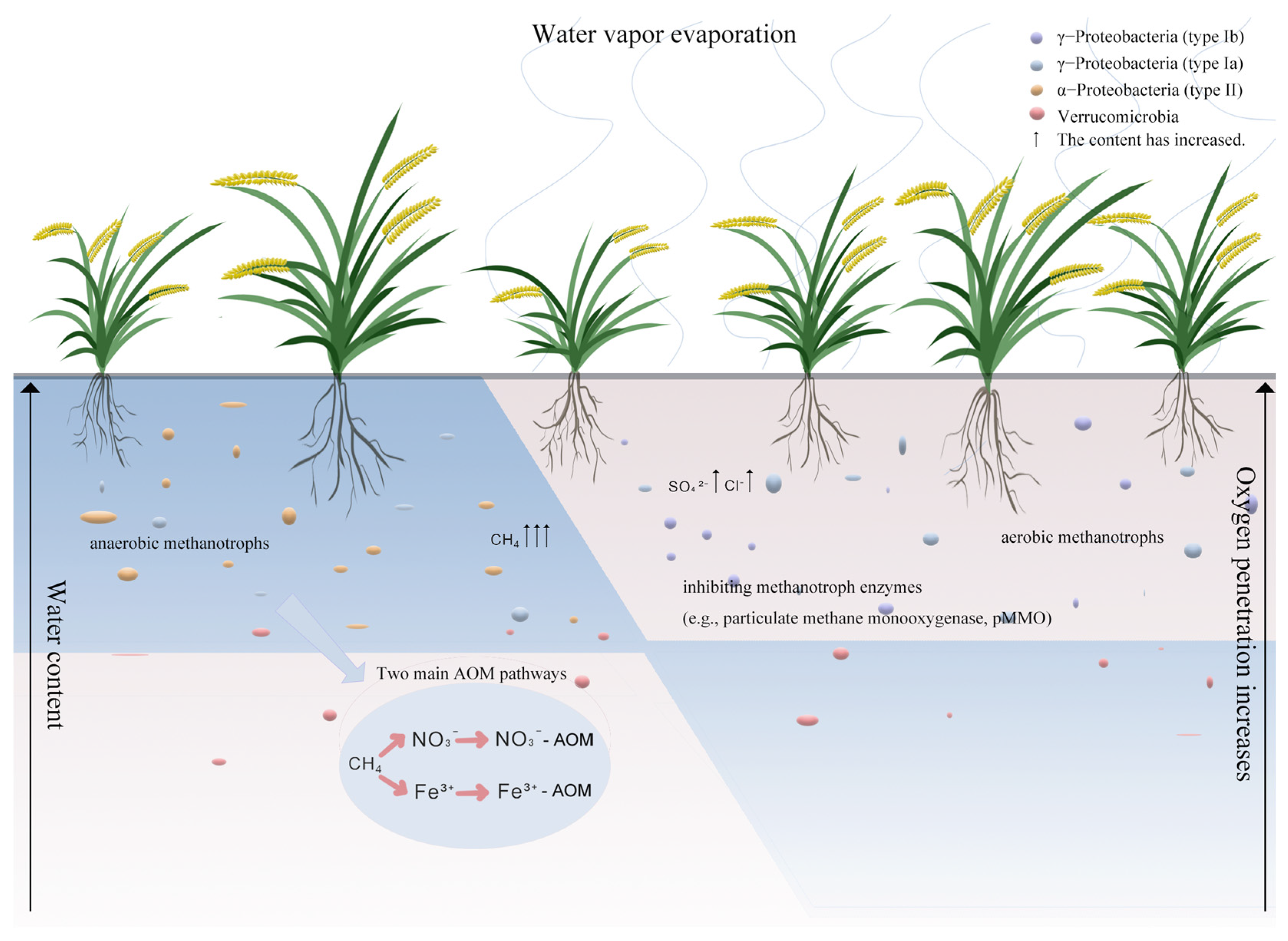
4.1. Dry–Wet Cycling Altering the Characteristics of Methanotrophs
4.2. Changes in the Characteristics of Methanotrophic Species Under Dry–Wet Cycling
4.3. Difference Between Oxygen Tolerance and Tolerance and Their Influence, as Well as the Role of Oxidation Micro-Zones
4.4. Influence of the Combined Effect of Temperature and Humidity
5. Future CH4 Management in a Changing Climate
6. Conclusions
- Mechanistic resolution of how key functional genes (pMMO, mcrA) respond to wet–dry alternations across minute-to-seasonal timescales.
- A distributed, multi-scale in-situ network—such as the proposed Global Wetland Methane Observatory (GDWN)—to capture spatial and temporal heterogeneity worldwide.
- Next-generation models that explicitly couple hydrological modules with microbial functional traits.
Author Contributions
Funding
Institutional Review Board Statement
Informed Consent Statement
Data Availability Statement
Conflicts of Interest
References
- IPCC. Climate Change 2021: The Physical Science Basis; Masson-Delmotte, V., Zhai, P., Pirani, A., Connors, S.L., Péan, C., Berger, S., Caud, N., Chen, Y., Goldfarb, L., Gomis, M.I., et al., Eds.; Cambridge University Press: Cambridge, UK; New York, NY, USA, 2021; 2391p. [Google Scholar] [CrossRef] [Scilit]
- Gxokwe, S.; Dube, T.; Mazvimavi, D. Multispectral Remote Sensing of Wetlands in Semi-Arid and Arid Areas: A Review on Applications; Challenges and Possible Future Research Directions. Remote Sens. 2020, 12, 4190. [Google Scholar] [CrossRef] [Scilit]
- Deng, Y.; Jiang, W.; Wu, Z.; Peng, K.; Ling, Z.; Li, Z.; Wang, X. Assessing and Characterizing Carbon Storage in Wetlands of the Guangdong–Hong Kong–Macau Greater Bay Area, China, During 1995–2020. IEEE J. Sel. Top. Appl. Earth Obs. Remote Sens. 2022, 15, 6110–6120. [Google Scholar] [CrossRef] [Scilit]
- Raimi, A.R.; Ezeokoli, O.T.; Adeleke, R.A. Soil nutrient management influences diversity, community association and functional structure of rhizosphere bacteriome under vegetable crop production. Front. Microbiol. 2023, 14, 1229873. [Google Scholar] [CrossRef] [Scilit] [PubMed]
- Hu, Y.; Cheng, H. The urgency of assessing the greenhouse gas budgets of hydroelectric reservoirs in China. Nat. Clim. Change 2013, 3, 708–712. [Google Scholar] [CrossRef] [Scilit]
- Guo, J.; Jiang, X.; Zhou, X.; Meng, Y.; Jia, Z. Impact of periodical flooding-drying on nitrification and ammonia oxidizers in hydro-fluctuation belt of the Three Gorges Reservoir. Acta Microbiol. Sin. 2016, 56, 983–999. [Google Scholar] [CrossRef]
- Hao, Q.; Chen, S.; Ni, X.; Li, X.; He, X.; Jiang, C. Methane and nitrous oxide emissions from the drawdown areas of the Three Gorges Reservoir. Sci. Total Environ. 2019, 660, 567–576. [Google Scholar] [CrossRef] [Scilit]
- Bodelier, P.L.; Bar-Gilissen, M.J.; Meima-Franke, M.; Hordijk, K. Structural and functional response of methane-consuming microbial communities to different flooding regimes in riparian soils. Ecol. Evol. 2012, 2, 106–127. [Google Scholar] [CrossRef] [Scilit]
- Saunois, M.; Rasmussen, B.; Martinez, A.; Poulter, B.; Zhang, Z.; Raymond, P.A.; Zeng, X. Global Methane Budget 2000–2020. Earth Syst. Sci. Data 2025, 17, 1873–1958. [Google Scholar] [CrossRef] [Scilit]
- Villalobos, Y.; Canadell, J.G.; Keller, E.D.; Briggs, P.R.; Ford, P.; Harman, I.N.; Hilton, T.W.; Hogikyan, A.; Lauerwald, R.; Maher, D.T.; et al. Methane and nitrous oxide budgets for Australasia: A regional assessment of natural and anthropogenic sources and sinks. Glob. Biogeochem. Cycles 2025, 39, e2024GB008484. [Google Scholar] [CrossRef] [Scilit]
- Ma, K.; Conrad, R.; Lu, Y. Dry/Wet Cycles Change the Activity and Population Dynamics of Methanotrophs in Rice Field Soil. Appl. Environ. Microbiol. 2013, 79, 4932–4939. [Google Scholar] [CrossRef] [Scilit]
- Zhang, L.; Sun, X.; Wang, L.; Zhang, H.; Chu, H.; Li, Y. Soil edaphic factors and climate seasonality explain the turnover of methanotrophic communities in riparian wetlands. Environ. Res. 2023, 233, 116447. [Google Scholar] [CrossRef] [Scilit] [PubMed]
- Ho, A.; Van Den Brink, E.; Reim, A.; Krause, S.M.; Bodelier, P.L. Recurrence and Frequency of Disturbance have Cumulative Effect on Methanotrophic Activity, Abundance, and Community Structure. Front. Microbiol. 2015, 6, 1493. [Google Scholar] [CrossRef] [Scilit]
- Crevecoeur, S.; Ruiz-González, C.; Prairie, Y.T.; Del Giorgio, P.A. Large-scale biogeography and environmental regulation of methanotrophic bacteria across boreal inland waters. Mol. Ecol. 2019, 28, 4181–4196. [Google Scholar] [CrossRef] [Scilit] [PubMed]
- Mayr, M.J.; Zimmermann, M.; Guggenheim, C.; Brand, A.; Burgmann, H. Niche partitioning of methane-oxidizing bacteria along the oxygen-methane counter gradient of stratified lakes. ISME J. 2020, 14, 274–287. [Google Scholar] [CrossRef] [Scilit]
- Yang, H.F.; Yang, S.L.; Li, B.C.; Wang, Y.P.; Wang, J.Z.; Zhang, Z.L.; Xu, K.H.; Huang, Y.G.; Shi, B.W.; Zhang, W.X. Different fates of the Yangtze and Mississippi deltaic wetlands under similar riverine sediment decline and sea-level rise. Geomorphology 2021, 381, 107646. [Google Scholar] [CrossRef] [Scilit]
- de Araújo, K.R.; Sawakuchi, H.O.; Bertassoli, D.J.; Bastviken, D.; Pereira, T.S.; Sawakuchi, A.O. Operational effects on aquatic carbon dioxide and methane emissions from the Belo Monte hydropower plant in the Xingu River, eastern Amazonia. Sci. Total Environ. 2024, 946, 174100. [Google Scholar] [CrossRef] [Scilit]
- Tian, W.; Wang, H.; Xiang, X.; Loni, P.C.; Qiu, X.; Wang, R.; Huang, X.; Tuovinen, O.H. Water table level controls methanogenic and methanotrophic communities and methane emissions in a Sphagnum-dominated peatland. Microbiol. Spectr. 2023, 11, e01992-23. [Google Scholar] [CrossRef] [Scilit]
- Rößger, N.; Sachs, T.; Wille, C.; Boike, J.; Kutzbach, L. Seasonal increase of methane emissions linked to warming in Siberian tundra. Nat. Clim. Change 2022, 12, 1031–1036. [Google Scholar] [CrossRef] [Scilit]
- Zhang, W.; Hu, Z.; Audet, J.; Davidson, T.A.; Kang, E.; Kang, X.; Li, Y.; Zhang, X.; Wang, J. Effects of water table level and nitrogen deposition on methane and nitrous oxide emissions in an alpine peatland. Biogeosciences 2022, 19, 5187–5197. [Google Scholar] [CrossRef] [Scilit]
- Amorim, M.; dos Santos, M.A.; de Camargo, J.M.R. Methane diffusive fluxes from sediment exposed in a Brazilian tropical reservoir drawdown zone. J. S. Am. Earth Sci. 2019, 90, 463–470. [Google Scholar] [CrossRef] [Scilit]
- Mao, Y.; He, R.; Li, H.; Yang, S.; Yu, W.; Ye, K.; Lin, T.; Bai, X.; He, Q. Advances in methane emissions from tributaries of the Three Gorges Reservoir. J. Lake Sci. 2024, 36, 17–33. [Google Scholar]
- Wang, R.; Zhang, S.; Chu, Y.; Li, X.; Chen, X.; Wang, F. Greenhouse gas emissions from hydropower reservoirs over a 100-year life cycle: Impacts of reservoir hydrological attributes. Aquat. Sci. 2025, 87, 59. [Google Scholar] [CrossRef] [Scilit]
- Zhou, X.; Zhang, M.; Krause, S.M.B.; Bu, X.; Gu, X.; Guo, Z.; Jia, Z.; Zhou, X.; Wang, X.; Chen, X.; et al. Soil aeration rather than methanotrophic community drives methane uptake under drought in a subtropical forest. Sci. Total Environ. 2021, 792, 148292. [Google Scholar] [CrossRef] [Scilit]
- Zhang, L.; Adams, J.M.; Dumont, M.G.; Li, Y.; Shi, Y.; He, D.; He, J.-S.; Chu, H. Distinct methanotrophic communities exist in habitats with different soil water contents. Soil Biol. Biochem. 2019, 132, 143–152. [Google Scholar] [CrossRef] [Scilit]
- Bradley, R.S.; Diaz, H.F. Late Quaternary Abrupt Climate Change in the Tropics and Sub-Tropics: The Continental Signal of Tropical Hydroclimatic Events (THEs). Rev. Geophys. 2021, 59, e2020RG000732. [Google Scholar] [CrossRef] [Scilit]
- Mitsch, W.J.; Nahlik, A.; Wolski, P.; Bernal, B.; Zhang, L.; Ramberg, L. Tropical wetlands: Seasonal hydrologic pulsing, carbon sequestration, and methane emissions. Wetl. Ecol. Manag. 2010, 18, 573–586. [Google Scholar] [CrossRef] [Scilit]
- Nisbe, E.G. Climate feedback on methane from wetlands. Nat. Clim. Change 2023, 13, 421–422. [Google Scholar] [CrossRef] [Scilit]
- Maietta, C.E.; Hondula, K.L.; Jones, C.N.; Palmer, M.A. Hydrological Conditions Influence Soil and Methane-Cycling Microbial Populations in Seasonally Saturated Wetlands. Front. Environ. Sci. 2020, 8, 593942. [Google Scholar] [CrossRef] [Scilit]
- Voigt, C.; Marushchak, M.E.; Mastepanov, M.; Lamprecht, R.E.; Christensen, T.R.; Dorodnikov, M.; Jackowicz-Korczyński, M.; Lindgren, A.; Lohila, A.; Nykänen, H.; et al. Ecosystem carbon response of an Arctic peatland to simulated permafrost thaw. Glob. Change Biol. 2019, 25, 1746–1764. [Google Scholar] [CrossRef] [Scilit] [PubMed]
- Tian, P.; Li, X.; Xu, Z.; Wu, L.; Huang, Y.; Zhang, Z.; Chen, M.; Zhang, S.; Cai, H.; Xu, M.; et al. Temporal Variations in Methane Emissions from a Restored Mangrove Ecosystem in Southern China. Forests 2024, 15, 1487. [Google Scholar] [CrossRef] [Scilit]
- Siljanen, H.M.P.; Saari, A.; Bodrossy, L.; Martikainen, P.J. Seasonal variation in the function and diversity of methanotrophs in the littoral wetland of a boreal eutrophic lake. FEMS Microbiol. Ecol. 2012, 80, 548–555. [Google Scholar] [CrossRef] [Scilit]
- Roy Chowdhury, T.; Mitsch, W.J.; Dick, R.P. Seasonal methanotrophy across a hydrological gradient in a freshwater wetland. Ecol. Eng. 2014, 72, 116–124. [Google Scholar] [CrossRef] [Scilit]
- Ejiri, M.; Fukao, T.; Miyashita, T.; Shiono, K. A barrier to radial oxygen loss helps the root system cope with waterlogging-induced hypoxia. Breed. Sci. 2021, 71, 40–50. [Google Scholar] [CrossRef] [Scilit]
- Wang, F.; Zhang, S.; Hu, X.; Lv, X.; Liu, M.; Ma, Y.; Manirakiza, B. Floating plants reduced methane fluxes from wetlands by creating a habitat conducive to methane oxidation. J. Environ. Sci. 2024, 135, 149–160. [Google Scholar] [CrossRef] [Scilit]
- Ding, H.; Jiang, Y.; Cao, C. Deep rice root systems reduce methane emissions in rice paddies. Plant Soil 2021, 468, 337–352. [Google Scholar] [CrossRef] [Scilit]
- Villa, J.A.; Ju, Y.; Vines, C.; Rey-Sanchez, C.; Morin, T.H.; Wrighton, K.C.; Bohrer, G. Relationships Between Methane and Carbon Dioxide Fluxes in a Temperate Cattail-Dominated Freshwater Wetland. J. Geophys. Res. Biogeosci. 2019, 124, 2076–2089. [Google Scholar] [CrossRef] [Scilit]
- Qi, Z.; Guan, S.; Zhang, Z.; Du, S.; Li, S.; Xu, D. Effect and Mechanism of Root Characteristics of Different Rice Varieties on Methane Emissions. Agronomy 2024, 14, 595. [Google Scholar] [CrossRef] [Scilit]
- Guan, S.; Qi, Z.; Li, S.; Du, S.; Xu, D. Effects of Rice Root Development and Rhizosphere Soil on Methane Emission in Paddy Fields. Plants 2024, 13, 3223. [Google Scholar] [CrossRef] [Scilit]
- Li, L.; Huang, Z.; Mu, Y.; Song, S.; Zhang, Y.; Tao, Y.; Nie, L. Alternate wetting and drying maintains rice yield and reduces global warming potential: A global meta-analysis. Field Crops Res. 2024, 318, 109603. [Google Scholar] [CrossRef] [Scilit]
- Lin, L.; Wang, F.; Cao, W. Nitrate-Dependent Anaerobic Methane Oxidation in Subtropical Mangrove Soils and Environmental Implication. Wetlands 2023, 43, 61. [Google Scholar] [CrossRef] [Scilit]
- Wang, J.; Yao, X.; Jia, Z.; Zhu, L.; Zheng, P.; Kartal, B.; Hu, B. Nitrogen input promotes denitrifying methanotrophs’ abundance and contribution to methane emission reduction in coastal wetland and paddy soil. Environ. Pollut. 2022, 302, 119090. [Google Scholar] [CrossRef] [Scilit]
- Dou, B.-K.; Wang, Y.-D.; Xue, D.-M.; Wang, Z.-L. Research advancement in the processes and mechanisms of transporting methane by emerged herbaceous plants and hygrophytes. Chin. J. Plant Ecol. 2017, 41, 1208. [Google Scholar] [CrossRef] [Scilit]
- Yao, X.; Wang, J.; He, M.; Liu, Z.; Zhao, Y.; Li, Y.; Chi, T.; Zhu, L.; Zheng, P.; Jetten, M.S.M.; et al. Methane-dependent complete denitrification by a single Methylomirabilis bacterium. Nat. Microbiol. 2024, 9, 464–476. [Google Scholar] [CrossRef] [Scilit]
- Tang, J.; Qian, H.; Zhu, X.; Liu, Z.; Kuzyakov, Y.; Zou, J.; Wang, J.; Xu, Q.; Li, G.; Liu, Z.; et al. Soil pH Determines Nitrogen Effects on Methane Emissions from Rice Paddies. Glob. Change Biol. 2024, 30, e17577. [Google Scholar] [CrossRef] [Scilit] [PubMed]
- Kong, D.; Li, S.; Jin, Y.; Wu, S.; Chen, J.; Hu, T.; Wang, H.; Liu, S.; Zou, J. Linking methane emissions to methanogenic and methanotrophic communities under different fertilization strategies in rice paddies. Geoderma 2019, 347, 233–243. [Google Scholar] [CrossRef] [Scilit]
- Lafuente, A.; Bowker, M.A.; Delgado-Baquerizo, M.; Durán, J.; Singh, B.K.; Maestre, F.T. Global drivers of methane oxidation and denitrifying gene distribution in drylands. Glob. Ecol. Biogeogr. 2019, 28, 1230–1243. [Google Scholar] [CrossRef] [Scilit]
- Nazaries, L.; Karunaratne, S.B.; Delgado-Baquerizo, M.; Campbell, C.D.; Singh, B.K. Environmental drivers of the geographical distribution of methanotrophs: Insights from a national survey. Soil Biol. Biochem. 2018, 127, 264–279. [Google Scholar] [CrossRef] [Scilit]
- Pawlak, W.; Fortuniak, K.; Siedlecki, M. The redox potential of soil as an additional factor describing the variability of methane fluxes from a wetland during dry conditions: A case study for Biebrza National Park, Poland. Meteorol. Z. 2025, 33, 365–380. [Google Scholar] [CrossRef] [Scilit]
- Xu, J.; Bu, F.; Zhu, W.; Luo, G.; Xie, L. Microbial Consortiums of Hydrogenotrophic Methanogenic Mixed Cultures in Lab-Scale Ex-Situ Biogas Upgrading Systems under Different Conditions of Temperature, pH and CO. Microorganisms 2020, 8, 772. [Google Scholar] [CrossRef] [Scilit]
- Li, Y.; Li, L.; Sun, Y.; Yuan, Z. Bioaugmentation strategy for enhancing anaerobic digestion of high C/N ratio feedstock with methanogenic enrichment culture. Bioresour. Technol. 2018, 261, 188–195. [Google Scholar] [CrossRef] [Scilit]
- Delwiche, K.B.; Knox, S.H.; Malhotra, A.; Fluet-Chouinard, E.; McNicol, G.; Feron, S.; Ouyang, Z.; Papale, D.; Trotta, C.; Canfora, E.; et al. FLUXNET-CH4: A global, multi-ecosystem dataset and analysis of methane seasonality from freshwater wetlands. Earth Syst. Sci. Data 2021, 13, 3607–3689. [Google Scholar] [CrossRef] [Scilit]
- Zhang, W.; Kang, X.; Kang, E.; Audet, J.; Davidson, T.A.; Zhang, X.; Yan, L.; Li, Y.; Yan, Z.; Zhang, K.; et al. Soilwater content, carbon, and nitrogen determine the abundances of methanogens, methanotrophs, and methane emission in the Zoige alpine wetland. J. Soils Sediments 2022, 22, 470–481. [Google Scholar] [CrossRef] [Scilit]
- Reis, P.C.J.; Thottathil, S.D.; Ruiz-Gonzalez, C.; Prairie, Y.T. Niche separation within aerobic methanotrophic bacteria across lakes and its link to methane oxidation rates. Environ. Microbiol. 2020, 22, 738–751. [Google Scholar] [CrossRef] [Scilit]
- Deng, Y.; Che, R.; Wang, F.; Conrad, R.; Dumont, M.; Yun, J.; Wu, Y.; Hu, A.; Fang, J.; Xu, Z.; et al. Upland Soil Cluster Gamma dominates methanotrophic communities in upland grassland soils. Sci. Total Environ. 2019, 670, 826–836. [Google Scholar] [CrossRef] [Scilit]
- Angel, R.; Kammann, C.; Claus, P.; Conrad, R. Effect of long-term free-air CO2 enrichment on the diversity and activity of soil methanogens in a periodically waterlogged grassland. Soil Biol. Biochem. 2012, 51, 96–103. [Google Scholar] [CrossRef] [Scilit]
- Hu, S.; He, Q.; Liu, Y.; Cheng, C. Denitrifying anaerobic methane oxidation in a northern peatland: The interaction between CH4, nitrate/nitrite and ferric iron. Front. Microbiol. 2014, 5, 720. [Google Scholar] [CrossRef] [Scilit]
- Wang, C.; Guo, Z.; Niu, D. Influence of the Fiber Volume Content on the Durability-Related Properties of Polypropylene-Fiber-Reinforced Concrete. Sustainability 2020, 12, 549. [Google Scholar] [CrossRef] [Scilit]
- Yun, J.; Wang, Y.; Zhang, H. Ecology of aerobic methane oxidizing bacteria (methanotrophs). Acta Ecol. Sin. 2013, 33, 6774–6785. [Google Scholar] [CrossRef] [Scilit]
- Fisk, M.C.; Ruether, K.F.; Yavitt, J.B. Microbial activity and functional composition among northern peatland ecosystems. Soil Biol. Biochem. 2003, 35, 591–602. [Google Scholar] [CrossRef] [Scilit]
- Shiau, Y.-J.; Cai, Y.; Jia, Z.; Chen, C.-L.; Chiu, C.-Y. Phylogenetically distinct methanotrophs modulate methane oxidation in rice paddies across Taiwan. Soil Biol. Biochem. 2018, 124, 59–69. [Google Scholar] [CrossRef] [Scilit]
- Oswald, K.; Jegge, C.; Tischer, J.; Berg, J.; Brand, A.; Miracle, M.R.; Soria, X.; Vicente, E.; Lehmann, M.F.; Zopfi, J.; et al. Methanotrophy under versatile conditions in the water column of the ferruginous meromictic Lake La Cruz (Spain). Front. Microbiol. 2016, 7, 1762. [Google Scholar] [CrossRef] [Scilit]
- Szafranek-Nakonieczna, A.; Wolinska, A.; Zielenkiewicz, U.; Kowalczyk, A.; Stepniewska, Z.; Blaszczyk, M. Activity and identification of methanotrophic bacteria in arable and no-tillage soils from Lublin region (Poland). Microb. Ecol. 2019, 77, 701–712. [Google Scholar] [CrossRef] [Scilit]
- Cicerone, R.J.; Oremland, R.S. Biogeochemical aspects of atmospheric methane. Glob. Biogeochem. Cycles 1988, 2, 299–327. [Google Scholar] [CrossRef] [Scilit]
- Ruff, S.E.; Felden, J.; Gruber-Vodicka, H.R.; Marcon, Y.; Knittel, K.; Ramette, A.; Boetius, A. In situ development of a methanotrophic microbiome in deep-sea sediments. ISME J. 2019, 13, 197–213. [Google Scholar] [CrossRef] [Scilit]
- Roslev, P.; King, G.M. Survival and recovery of methanotrophic bacteria starved under oxic and anoxic conditions. Appl. Environ. Microbiol. 1994, 60, 2602–2608. [Google Scholar] [CrossRef] [Scilit] [PubMed]
- Sultana, N.; Zhao, J.; Zheng, Y.; Cai, Y.; Faheem, M.; Peng, X.; Wang, W.; Jia, Z. Stable isotope probing of active methane oxidizers in rice field soils from cold regions. Biol. Fertil. Soils 2019, 55, 243–250. [Google Scholar] [CrossRef] [Scilit]
- Knief, C. Diversity and habitat preferences of cultivated and uncultivated aerobic methanotrophic bacteria evaluated based on pmoA as molecular marker. Front. Microbiol. 2015, 6, 1346. [Google Scholar] [CrossRef] [Scilit] [PubMed]
- Alcantara-Hernandez, J.C.; Valenzuela-Encinas, C.; Quiñones-Guerrero, G. Nitrate/nitrite-dependent anaerobic oxidation of methane (N-AOM) as a technology platform for greenhouse gas abatement in wastewater treatment plants: State-of-the-art and challenges. J. Environ. Manag. 2022, 319, 115671. [Google Scholar] [CrossRef] [Scilit]
- Zhou, X.; Jin, F.; Lu, C.; Baoyin, T.; Jia, Z. Shifts in the community composition of methane-cycling microorganisms during lake shrinkage. Geoderma 2018, 311, 9–14. [Google Scholar] [CrossRef] [Scilit]
- Krause, S.; Meima-Franke, M.; Hefting, M.M.; Bodelier, P.L. Spatial patterns of methanotrophic communities along a hydrological gradient in a riparian wetland. FEMS Microbiol. Ecol. 2013, 86, 59–70. [Google Scholar] [CrossRef] [Scilit]
- Cai, C.; Leu, A.O.; Xie, G.-J.; Guo, J.; Feng, Y.; Zhao, J.-X.; Tyson, G.W.; Yuan, Z.; Hu, S. A methanotrophic archaeon couples anaerobic oxidation of methane to Fe(III) reduction. ISME J. 2018, 12, 1929–1939. [Google Scholar] [CrossRef] [Scilit]
- Grande, E.; Arora, B.; Visser, A.; Montalvo, M.; Braswell, A.; Seybold, E.; Tatariw, C.; Beheshti, K.; Zimmer, M. Tidal frequencies and quasiperiodic subsurface water level variations dominate redox dynamics in a salt marsh system. Hydrol. Process. 2022, 36, e14587. [Google Scholar] [CrossRef] [Scilit]
- Rissanen, A.J.; Saarenheimo, J.; Tiirola, M.; Peura, S.; Aalto, S.L.; Karvinen, A.; Nykänen, H. Gammaproteobacterial methanotrophs dominate methanotrophy in aerobic and anaerobic layers of boreal lake waters. Aquat. Microb. Ecol. 2018, 81, 257–276. [Google Scholar] [CrossRef] [Scilit]
- Kalyuzhnaya, M.G.; Yang, S.; Rozova, O.N.; Smalley, N.E.; Clubb, J.; Lamb, A.; Gowda, G.A.N.; Raftery, D.; Fu, Y.; Bringel, F.; et al. Highly efficient methane biocatalysis revealed in a methanotrophic bacterium. Nat. Commun. 2013, 4, 2785. [Google Scholar] [CrossRef] [Scilit]
- Liu, F.; Zhang, Y.; Liang, H.; Gao, D. Resilience of methane cycle and microbial functional genes to drought and flood in an alkaline wetland: A metagenomic analysis. Chemosphere 2021, 265, 129034. [Google Scholar] [CrossRef] [Scilit]
- Pfeifer, F. Distribution, formation and regulation of gas vesicles. Nat. Rev. Microbiol. 2012, 10, 705–715. [Google Scholar] [CrossRef] [Scilit]
- Omelchenko, M.V.; Vasilyeva, L.V.; Zavarzin, G.A. Psychrophilic methanotroph from tundra soil. Curr. Microbiol. 1993, 27, 255–259. [Google Scholar] [CrossRef] [Scilit]
- Deng, Y.; Liu, P.; Conrad, R. Effect of temperature on the microbial community responsible for methane production in alkaline NamCo wetland soil. Soil Biol. Biochem. 2019, 132, 69–79. [Google Scholar] [CrossRef] [Scilit]
- Xu, M.; Zhang, J.; Zhang, Z.; Wang, M.; Chen, H.; Peng, C.; Yu, D.; Zhan, H.; Zhu, Q. Global responses of wetland methane emissions to extreme temperature and precipitation. Environ. Res. 2024, 252, 118907. [Google Scholar] [CrossRef] [Scilit] [PubMed]
- Wang, Y.; He, L.; Liu, J.; Arndt, K.A.; Mazza Rodrigues, J.L.; Zona, D.; Lipson, D.A.; Oechel, W.C.; Ricciuto, D.M.; Wullschleger, S.D.; et al. Intensified Positive Arctic–Methane Feedback under IPCC Climate Scenarios in the 21st Century. Ecosyst. Health Sustain. 2024, 10, 0185. [Google Scholar] [CrossRef] [Scilit]
- Rahalkar, M.C.; Khatri, K.; Pandit, P.; Bahulikar, R.A.; Mohite, J.A. Cultivation of Important Methanotrophs from Indian Rice Fields. Front. Microbiol. 2021, 12, 669244. [Google Scholar] [CrossRef] [Scilit]
- Rahalkar, M.C.; Khatri, K.; Pandit, P.S.; Dhakephalkar, P.K. A putative novel Methylobacter member (KRF1) from the globally important Methylobacter clade 2: Cultivation and salient draft genome features. Antonie Leeuwenhoek 2019, 112, 1399–1408. [Google Scholar] [CrossRef] [Scilit] [PubMed]
- Rahalkar, M.C.; Khatri, K.; Mohite, J.; Pandit, P.S.; Bahulikar, R.A. A novel Type I methanotroph Methylolobus aquaticus gen. nov. sp. nov. isolated from a tropical wetland. Antonie Van Leeuwenhoek 2020, 113, 959–971. [Google Scholar] [CrossRef] [Scilit] [PubMed]
- Mohite, J.A.; Manvi, S.S.; Pardhi, K.; Bahulikar, R.A.; Deshpande, S.; Patange, S.; Joshi, M.; Kulkarni, S.; Rahalkar, M.C. Diverse type I and type II methanotrophs cultivated from an Indian freshwater wetland habitat. Int. Microbiol. 2024, 27, 607–614. [Google Scholar] [CrossRef] [Scilit] [PubMed]



| Ecosystem | Characteristics of Water Level Fluctuation | Magnitude of Methane Emissions | Key Controlling Factors |
|---|---|---|---|
| Floodplains | Natural, pulsed; large seasonal variation (ranging from meters to tens of meters). | Moderate emissions with high spatial heterogeneity. | Flood duration and the influx of fresh organic matter from flood pulses. |
| Mires | Relatively stable with high-frequency, low-amplitude fluctuations. | Consistently high methane source. | Permanently high water table, high organic matter content, abundant substrates for methanogens, and aerenchymatous plants (e.g., sedges). |
| Tundras | Unique dynamics dominated by seasonal freezing and thawing. | Currently low-to-moderate, but exhibits extremely high climate sensitivity. | Low temperatures limit microbial activity; climate warming threatens to unlock vast carbon stores, potentially transforming it into a strong source. |
| rice paddies | Intensively human-managed with drastic, regular fluctuations (oscillating between 0 cm and 5–10 cm during the growing season). | Moderate-to-high emissions with distinct seasonal peaks; manageable through practices. | Frequent alternate wetting and drying cycles, and the role of rice plants as conduits via aerenchyma. |
| reservoir drawdown zones | Artificially regulated, undergoing extreme seasonal changes (e.g., up to 30 m variation in the Three Gorges Reservoir). | Highly variable; acts as a “hotspot” for pulsed emissions. | Repeated anaerobic decomposition and aerobic mineralization of sediment organic matter due to drastic water level changes. |
| Parameters | Type I Methanotrophs | Type II Methanotrophs | ANME Consortia |
|---|---|---|---|
| CH4 affinity (Km) | 1–5 μM | 0.1–1 μM | 10–50 μM |
| O2 optimum | 15–21% | 2–8% | <0.1% |
| Recovery post-drought | Slow (7–14 d) | Rapid (2–5 d) | >30 d |
| Wetland Type | Specific Habitat Geographic Location | Isolated Methanotroph Species | Key Features/Strain Designation | Strain |
|---|---|---|---|---|
| Tropical Paddy Fields | Western Indian rice field soil | Methylobacter sp. KRF1 (Type I) | First cultured tropical member of globally important Methylobacter clade 2; contains molybdenum–iron and vanadium–iron nitrogenase genes | KRF1 |
| Western Indian rice field soil | Methylocucumis oryzae (Type I) | Large-sized, oblong-shaped cells forming pale pink colonies; isolated from stone quarries in wetland patches | Sn10-6 | |
| Tropical Freshwater Wetlands | Western Indian freshwater ponds and quarry lakes | Methylomonas koyamae (Type I) | Thermotolerant strain; originally described from rice fields, now isolated from wetland sediments | MgM2 |
| Western Indian freshwater ponds | Methylosinus sporium (Type II) | Purple non-sulfur methanotroph; forms cysts and rosettes | VLS4 | |
| Tropical Mangrove Wetlands | Mumbai and Alibag mangroves, India | Methylocaldum gracile (Type I) | Thermotolerant and halotolerant; dominates hot and humid coastal habitats | MgM4/MgD2/MgN2 |
Disclaimer/Publisher’s Note: The statements, opinions and data contained in all publications are solely those of the individual author(s) and contributor(s) and not of MDPI and/or the editor(s). MDPI and/or the editor(s) disclaim responsibility for any injury to people or property resulting from any ideas, methods, instructions or products referred to in the content. |
© 2026 by the authors. Licensee MDPI, Basel, Switzerland. This article is an open access article distributed under the terms and conditions of the Creative Commons Attribution (CC BY) license.
Share and Cite
Zhu, X.; Zhang, Z.; Du, A.; Liu, B. Effect of Dry–Wet Cycling on Methanotrophs in Wetland Soils. Biology 2026, 15, 279. https://doi.org/10.3390/biology15030279
Zhu X, Zhang Z, Du A, Liu B. Effect of Dry–Wet Cycling on Methanotrophs in Wetland Soils. Biology. 2026; 15(3):279. https://doi.org/10.3390/biology15030279
Chicago/Turabian StyleZhu, Xi, Zhihao Zhang, Anan Du, and Bingru Liu. 2026. "Effect of Dry–Wet Cycling on Methanotrophs in Wetland Soils" Biology 15, no. 3: 279. https://doi.org/10.3390/biology15030279
APA StyleZhu, X., Zhang, Z., Du, A., & Liu, B. (2026). Effect of Dry–Wet Cycling on Methanotrophs in Wetland Soils. Biology, 15(3), 279. https://doi.org/10.3390/biology15030279