Cloning and Characterization of GDSL Esterases from Bacillus paralicheniformis T7


Simple Summary
Abstract
1. Introduction
2. Materials and Methods
2.1. Reagents, Media, and Enzymes
2.2. Strains, Vectors, and Oligonucleotides
2.3. Cloning of Esterase Genes into Vectors
2.4. Esterase Expression and Purification of Recombinant Proteins
2.5. SDS-PAGE
2.6. Protein Concentration Measurements
2.7. Enzyme Activity Assays
2.8. Effect of Temperature and pH on Enzyme Activity and Stability of Recombinant Esterases
2.9. Effect of Metal Ions and Detergents on Esterase Activity
2.10. Substrate Specificity of Recombinant Esterases
2.11. Kinetic Parameters and Specific Activity of Recombinant Esterases
2.12. Effect of Culture Media on Esterase Activity
2.13. Effect of Fermentation on Esterase Activity
2.14. Sequence Analysis
2.15. Software Tools, Bioinformatics, and Statistical Analysis
3. Results
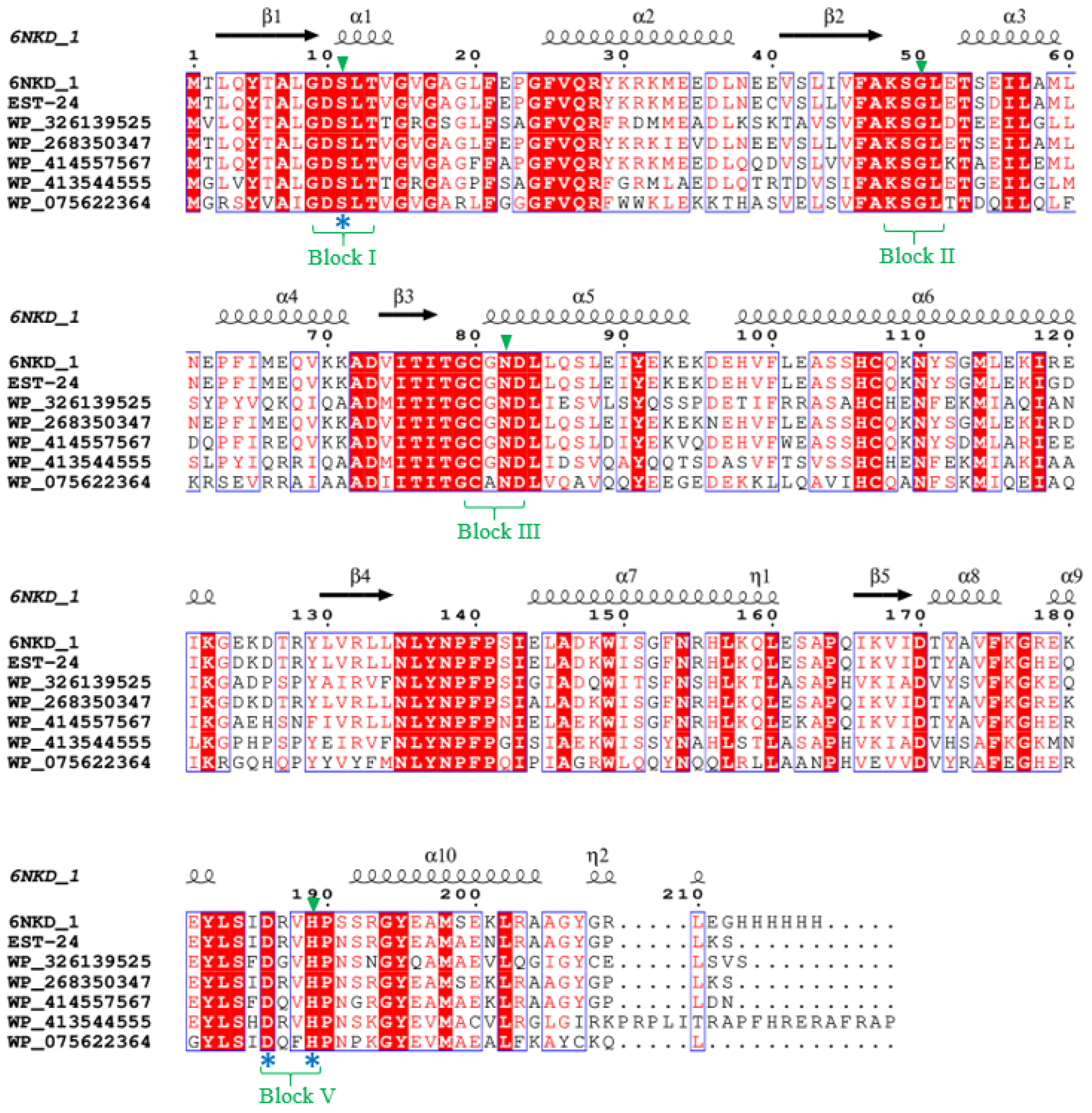
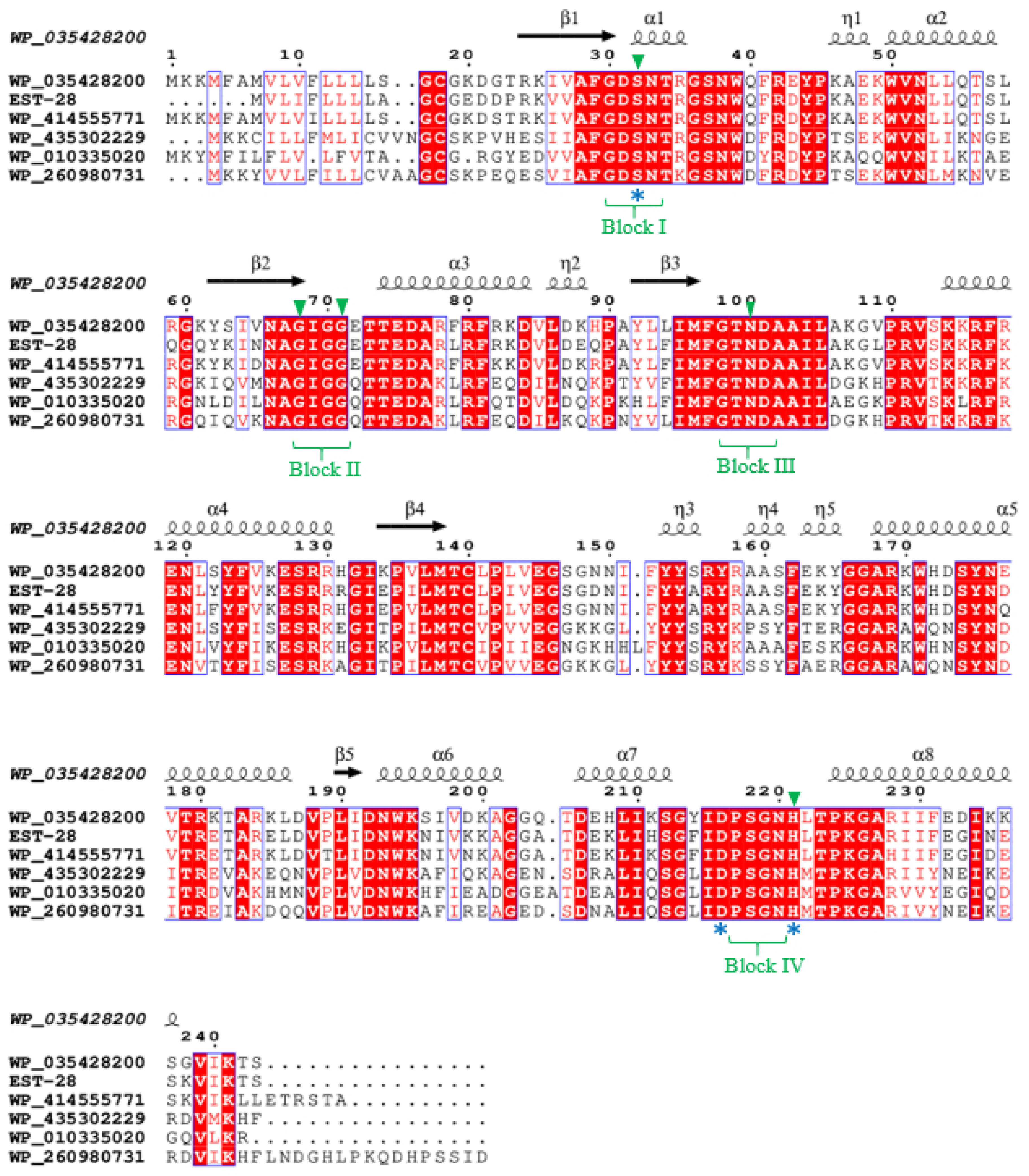
3.1. Cloning of Esterases est-24 and est-28 from Bacillus paralicheniformis T7
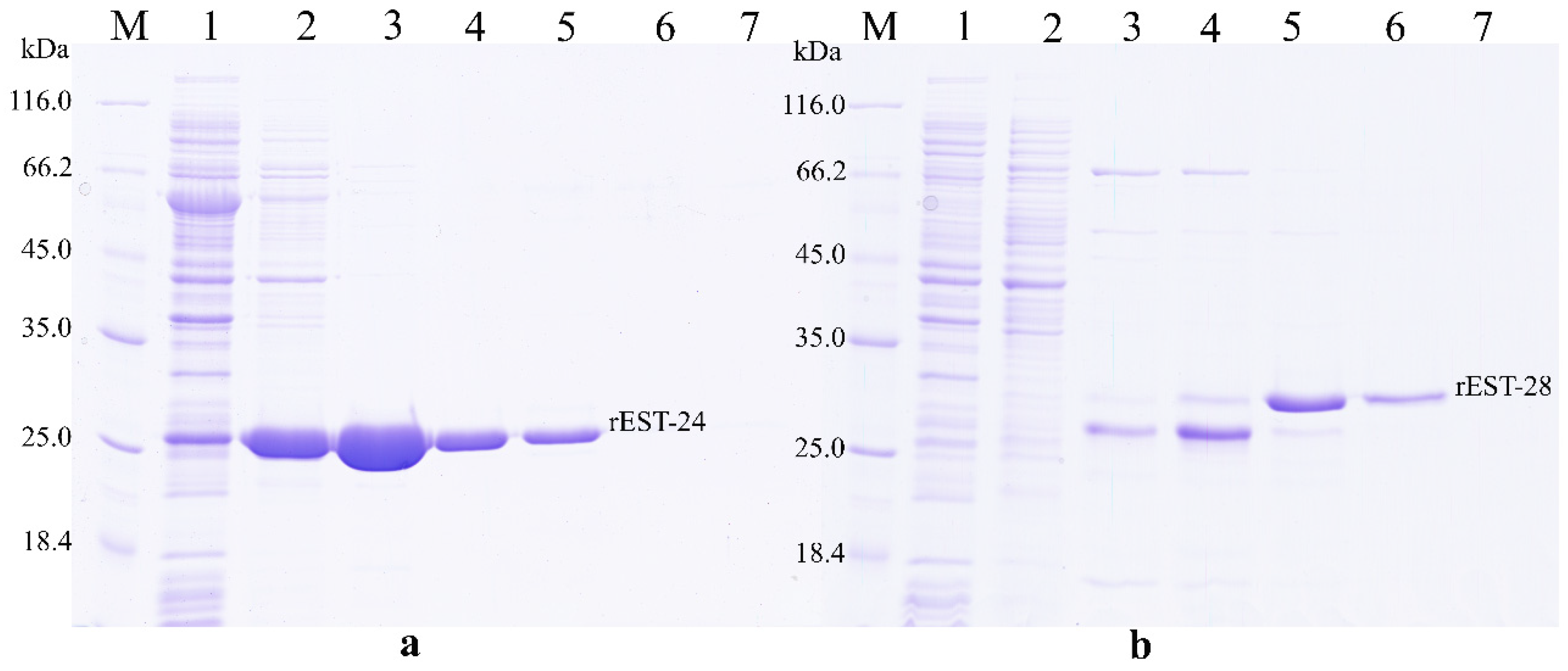
3.2. Purification of rEST-24 and rEST-28 Esterases
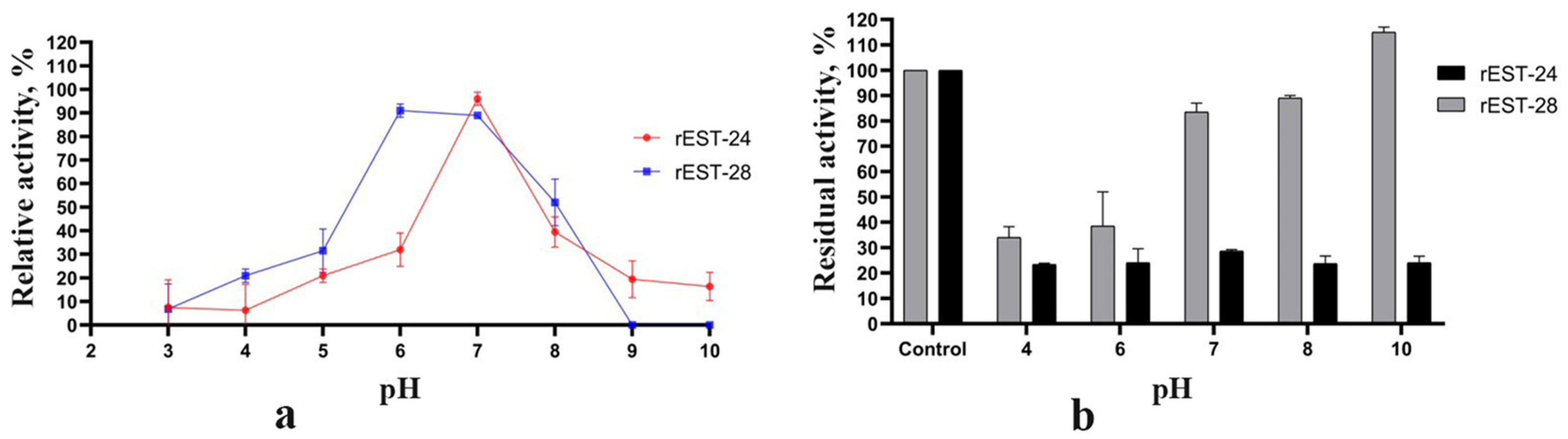
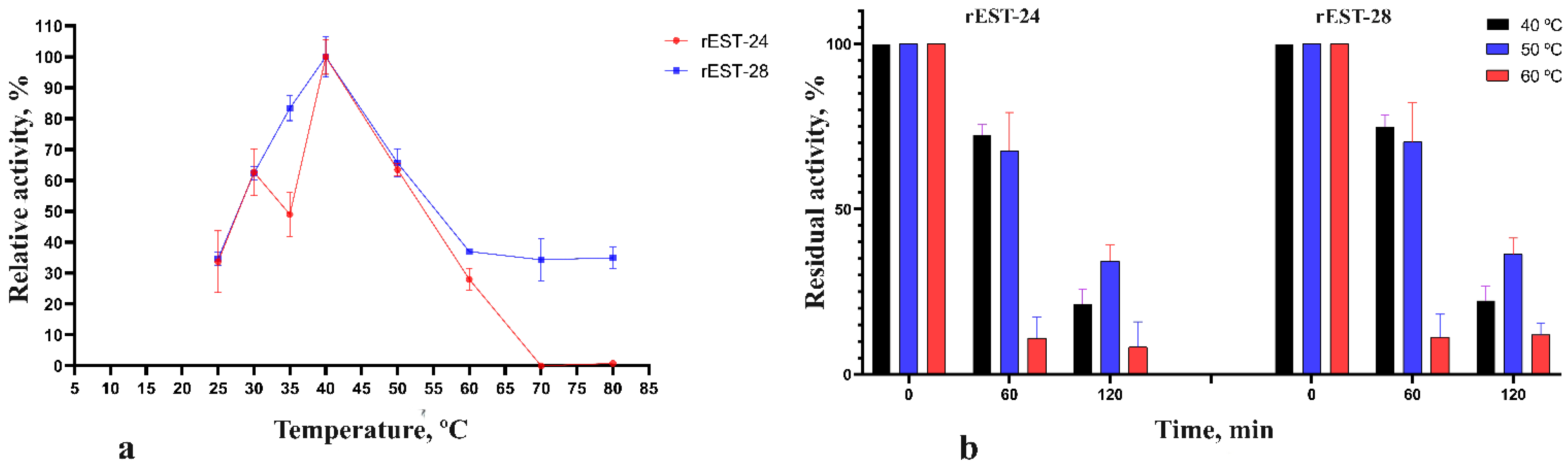
3.3. Effects of pH and Temperature on the Enzymatic Activity of rEST-24 and rEST-28
3.4. Effects of Metal Ions, Detergents, Reducing Agents, and Inhibitors on Stability of rEST-24 and rEST-28
3.5. Substrate Specificity and Kinetic Characteristics
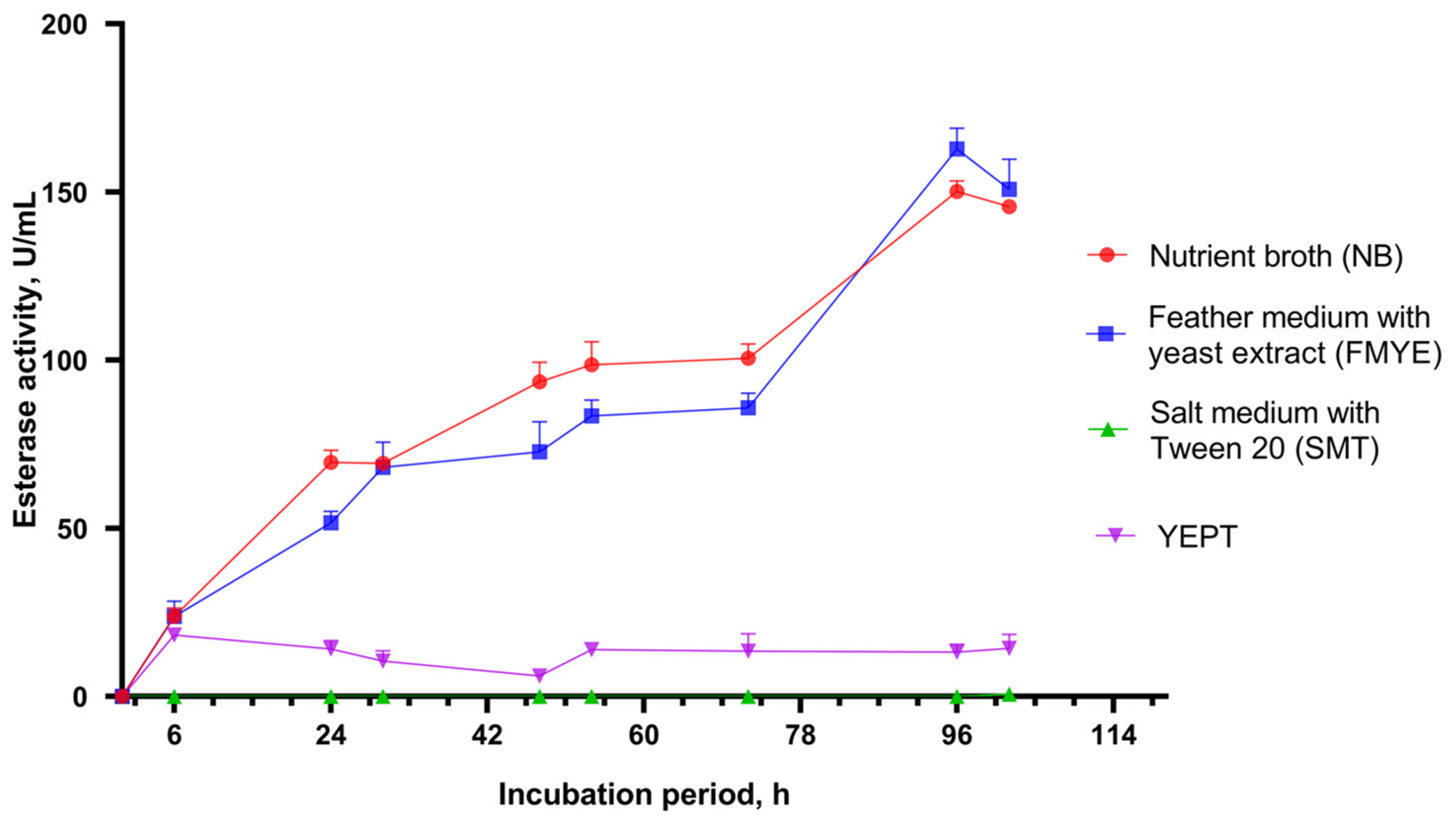
3.6. Effect of Culture Media and Fermentation on Esterase Activity
4. Discussion
5. Conclusions
Author Contributions
Funding
Institutional Review Board Statement
Informed Consent Statement
Data Availability Statement
Conflicts of Interest
Abbreviations
| YEPT | yeast extract peptone medium |
| LB | Luria–Bertani |
| Ni-NTA | nickel-nitrilotriacetic acid |
| SDS | sodium dodecyl sulfate |
| PAGE | polyacrylamide gel electrophoresis |
| pNP | 4-nitrophenol |
| DTT | dithiothreitol |
| EDTA | ethylenediaminetetraacetic acid |
| Km | Michaelis constant |
| Vmax | maximum velocity |
| SD | standard deviation |
References
- Castro, F.F.; Pinheiro, A.B.P.; Gerhardt, E.C.M.; Oliveira, M.A.S.; Barbosa-Tessmann, I.P. Production, purification, and characterization of a novel serine-esterase from Aspergillus westerdijkiae. J. Basic Microbiol. 2018, 58, 131–143. [Google Scholar] [CrossRef] [PubMed]
- Mussakhmetov, A.; Silayev, D. Esterases: Mechanisms of action, biological functions, and application prospects. Appl. Microbiol. 2025, 5, 139. [Google Scholar] [CrossRef]
- Seok-Jae, W.; Han Byeol, J.; Kim, H.K. Characterization of novel salt-tolerant esterase isolated from the marine bacterium Alteromonas sp. 39-G1. J. Microbiol. Biotechnol. 2020, 30, 216–225. [Google Scholar] [CrossRef]
- Nardini, M.; Dijkstra, B.W. Alpha/beta hydrolase fold enzymes: The family keeps growing. Curr. Opin. Struct. Biol. 1999, 9, 732–737. [Google Scholar] [CrossRef] [PubMed]
- Soumya, P.; Kochupurackal, J. An esterase with increased acetone tolerance from Bacillus subtilis E9 over expressed in E. coli BL21 using pTac Bs-est vector. Mol. Biotechnol. 2022, 64, 814–824. [Google Scholar] [CrossRef]
- Chahinian, H.; Sarda, L. Distinction between esterases and lipases: Comparative biochemical properties of sequence-related carboxylesterases. Protein Pept. Lett. 2009, 16, 1149–1161. [Google Scholar] [CrossRef]
- Kumar, A.; Dhar, K.; Kanwar, S.S.; Arora, P.K. Lipase catalysis in organic solvents: Advantages and applications. Biol. Proced. Online 2016, 18, 2. [Google Scholar] [CrossRef]
- Ng, A.M.J.; Zhang, H.; Nguyen, G.K.T. Zymography for picogram detection of lipase and esterase activities. Molecules 2021, 26, 1542. [Google Scholar] [CrossRef]
- Zhang, M.; Lai, W.; Zhu, Y.; Chen, S.; Zhou, K.; Ao, X.; He, L.; Yang, Y.; Zou, L.; Liu, A.; et al. Purification and characterization of a novel cypermethrin-hydrolyzing esterase from Bacillus licheniformis B-1. J. Food Sci. 2021, 86, 1475–1487. [Google Scholar] [CrossRef]
- Yu, N.; Yang, J.-C.; Yin, G.-T.; Li, R.-S.; Zou, W.-T.; He, C. Identification and characterization of a novel esterase from Thauera sp. Biotechnol. Appl. Biochem. 2018, 65, 748–755. [Google Scholar] [CrossRef]
- Noby, N.; Hussein, A.; Saeed, H.; Embaby, A.M. Recombinant cold-adapted halotolerant, organic solvent-stable esterase (estHIJ) from Bacillus halodurans. Anal. Biochem. 2020, 591, 113554. [Google Scholar] [CrossRef] [PubMed]
- Gall, M.G.; Nobili, A.; Pavlidis, I.V.; Bornscheuer, U.T. Improved thermostability of a Bacillus subtilis esterase by domain exchange. Appl. Microbiol. Biotechnol. 2014, 98, 1719–1726. [Google Scholar] [CrossRef] [PubMed]
- Huang, J.; Zhang, Y.; Hu, Y. Functional characterization of a marine Bacillus esterase and its utilization in the stereo-selective production of D-methyl lactate. Appl. Biochem. Biotechnol. 2016, 180, 1467–1481. [Google Scholar] [CrossRef] [PubMed]
- Barzkar, N.; Sohail, M.; Tamadoni Jahromi, S.; Gozari, M.; Poormozaffar, S.; Nahavandi, R.; Hafezieh, M. Marine bacterial esterases: Emerging biocatalysts for industrial applications. Appl. Biochem. Biotechnol. 2021, 193, 1187–1214. [Google Scholar] [CrossRef]
- Ameri, A.; Shakibaie, M.; Faramarzi, M.A.; Ameri, A.; Amirpour-Rostami, S.; Rahimi, H.R.; Forootanfar, H. Thermoalkalophilic lipase from an extremely halophilic bacterial strain Bacillus atrophaeus FSHM2: Purification, biochemical characterization and application. Biocatal. Biotransform. 2017, 35, 151–160. [Google Scholar] [CrossRef]
- Akoh, C.C.; Lee, G.-C.; Liaw, Y.-C.; Huang, T.-H.; Shaw, J.-F. GDSL family of serine esterases/lipases. Prog. Lipid Res. 2004, 43, 534–552. [Google Scholar] [CrossRef]
- Ding, J.; Yu, T.; Liang, L.; Xie, Z.; Yang, Y.; Zhou, J.; Xu, B.; Li, J.; Huang, Z. Biochemical Characterization of a GDSL-motif esterase from Bacillus sp. K91 with a new putative catalytic mechanism. J. Microbiol. Biotechnol. 2014, 24, 1551–1558. [Google Scholar] [CrossRef]
- Sánchez-Barrionuevo, L.; Mateos, J.; Fernández-Puente, P.; Begines, P.; Fernández-Bolaños, J.G.; Gutiérrez, G.; Cánovas, D.; Mellado, E. Identification of an acetyl esterase in the supernatant of the environmental strain Bacillus sp. HR21-6. Biochimie 2022, 198, 48–59. [Google Scholar] [CrossRef]
- Aktayeva, S.; Khassenov, B. High keratinase and other types of hydrolase activity of the new strain of Bacillus paralicheniformis. PLoS ONE 2024, 19, e0312679. [Google Scholar] [CrossRef]
- Mussakhmetov, A.; Aktayeva, S.; Sarsen, A.; Daniyarov, A.; Khassenov, B.; Kairov, U. Whole-Genome Sequence and Assembly of the Sporogenic Bacillus paralicheniformis T7 Strain with High Proteolytic and Amylolytic Activities. Front. Genet. 2026, 17, 1720096. [Google Scholar] [CrossRef]
- Aktayeva, S.; Khassenov, B. New Bacillus paralicheniformis strain with high proteolytic and keratinolytic activity. Sci. Rep. 2024, 14, 22621. [Google Scholar] [CrossRef] [PubMed]
- Sanger, F.; Nicklen, S.; Coulson, A.R. DNA sequencing with chain-terminating inhibitors. Proc. Natl. Acad. Sci. USA 1977, 74, 5463–5467. [Google Scholar] [CrossRef] [PubMed]
- Laemmli, U.K. Cleavage of structural proteins during the assembly of the head of bacteriophage T4. Nature 1970, 227, 680–685. [Google Scholar] [CrossRef] [PubMed]
- Bradford, M.M. A rapid and sensitive method for the quantitation of microgram quantities of protein utilizing the principle of protein-dye binding. Anal. Biochem. 1976, 72, 248–254. [Google Scholar] [CrossRef]
- Zhao, J.; Ma, M.; Yan, X.; Zhang, G.; Xia, J.; Zeng, G.; Tian, W.; Bao, X.; Zeng, Z.; Yu, P.; et al. Expression and characterization of a novel lipase from Bacillus licheniformis NCU CS-5 for application in enhancing fatty acids flavor release for low-fat cheeses. Food Chem. 2022, 368, 130868. [Google Scholar] [CrossRef]
- Doran, P.M. Chapter 12—Homogeneous Reactions. In Bioprocess Engineering Principles, 2nd ed.; Doran, P.M., Ed.; Academic Press: London, UK, 2013; pp. 599–703. [Google Scholar]
- Akishev, Z.; Kiribayeva, A.; Mussakhmetov, A.; Baltin, K.; Ramankulov, Y.; Khassenov, B. Constitutive expression of Camelus bactrianus prochymosin B in Pichia pastoris. Heliyon 2021, 7, e07137. [Google Scholar] [CrossRef]
- Katsimpouras, C.; Stephanopoulos, G. Enzymes in biotechnology: Critical platform technologies for bioprocess development. Curr. Opin. Biotechnol. 2021, 69, 91–102. [Google Scholar] [CrossRef]
- Chandra, P.; Enespa; Singh, R.; Arora, P.K. Microbial lipases and their industrial applications: A comprehensive review. Microb. Cell Factories 2020, 19, 169. [Google Scholar] [CrossRef]
- Bornscheuer, U.T. Microbial carboxyl esterases: Classification, properties and application in biocatalysis. FEMS Microbiol. Rev. 2002, 26, 73–81. [Google Scholar] [CrossRef]
- Kovacic, F.; Babic, N.; Krauss, U.; Jaeger, K.-E. Classification of Lipolytic Enzymes from Bacteria. In Aerobic Utilization of Hydrocarbons, Oils, and Lipids; Rojo, F., Ed.; Springer International Publishing: Cham, Switzerland, 2019; pp. 255–289. [Google Scholar]
- Yu, T.; Ding, J.; Zheng, Q.; Han, N.; Yu, J.; Yang, Y.; Li, J.; Mu, Y.; Wu, Q.; Huang, Z. Identification and characterization of a new alkaline SGNH hydrolase from a thermophilic bacterium Bacillus sp. K91. J. Microbiol. Biotechnol. 2016, 26, 730–738. [Google Scholar] [CrossRef]
- Zhang, W.; Xu, H.; Wu, Y.; Zeng, J.; Guo, Z.; Wang, L.; Shen, C.; Qiao, D.; Cao, Y. A new cold-adapted, alkali-stable and highly salt-tolerant esterase from Bacillus licheniformis. Int. J. Biol. Macromol. 2018, 111, 1183–1193. [Google Scholar] [CrossRef]
- Zheng, J.Y.; Wang, J.; Zhou, S.S.; Li, X.J.; Ying, X.X.; Wang, Z. A stereoselective esterase from Bacillus megaterium: Purification, gene cloning, expression and catalytic properties. Protein Expr. Purif. 2017, 136, 66–72. [Google Scholar] [CrossRef] [PubMed]
- Ding, J.; Wang, C.; Xie, Z.; Li, J.; Yang, Y.; Mu, Y.; Tang, X.; Xu, B.; Zhou, J.; Huang, Z. Properties of a newly identified esterase from Bacillus sp. K91 and its novel function in diisobutyl phthalate degradation. PLoS ONE 2015, 10, e0119216. [Google Scholar] [CrossRef]
- Schmidt, M.; Henke, E.; Heinze, B.; Kourist, R.; Hidalgo, A.; Bornscheuer, U.T. A versatile esterase from Bacillus subtilis: Cloning, expression, characterization, and its application in biocatalysis. Biotechnol. J. 2007, 2, 249–253. [Google Scholar] [CrossRef] [PubMed]
- D’Auria, S.; Herman, P.; Lakowicz, J.R.; Tanfani, F.; Bertoli, E.; Manco, G.; Rossi, M. The esterase from the thermophilic eubacterium Bacillus acidocaldarius: Structural-functional relationship and comparison with the esterase from the hyperthermophilic archaeon Archaeoglobus fulgidus. Proteins 2000, 40, 473–481. [Google Scholar] [CrossRef]
- Manco, G.; Adinolfi, E.; Pisani, F.M.; Ottolina, G.; Carrea, G.; Rossi, M. Overexpression and properties of a new thermophilic and thermostable esterase from Bacillus acidocaldarius with sequence similarity to hormone-sensitive lipase subfamily. Biochem. J. 1998, 332, 203–212. [Google Scholar] [CrossRef]
- Ribera, J.; Estupiñán, M.; Fuentes, A.; Fillat, A.; Martínez, J.; Diaz, P. Bacillus sp. JR3 esterase LipJ: A new mesophilic enzyme showing traces of a thermophilic past. PLoS ONE 2017, 12, e0181029. [Google Scholar] [CrossRef]
- Soumya, P.; Kochupurackal, J. Pineapple peel extract as an effective substrate for esterase production from Bacillus subtilis E9. Curr. Microbiol. 2020, 77, 3024–3034. [Google Scholar] [CrossRef]
- Zheng, J.; Lan, X.; Huang, L.; Zhang, Y.; Wang, Z. Kinetic resolution of N-acetyl-DL-alanine methyl ester using immobilized Escherichia coli cells bearing recombinant esterase from Bacillus cereus. Chirality 2018, 30, 907–912. [Google Scholar] [CrossRef]
- Ateşlier, Z.B.B.; Metin, K. Production and partial characterization of a novel thermostable esterase from a thermophilic Bacillus sp. Enzym. Microb. Technol. 2006, 38, 628–635. [Google Scholar] [CrossRef]
- Charoenpanich, J.; Soongrung, T.; Chinnasri, S.; Suebchuea, N.; Suppoontong, M.; Thiemsawait, S. A novel broad-temperature active and solvent stable esterase from a newly isolated Bacillus aerophilus. Biocatal. Agric. Biotechnol. 2018, 13, 116–122. [Google Scholar] [CrossRef]
- Meghji, K.; Ward, O.P.; Araujo, A. Production, purification, and properties of extracellular carboxyl esterases from Bacillus subtilis NRRL 365. Appl. Environ. Microbiol. 1990, 56, 3735–3740. [Google Scholar] [CrossRef] [PubMed]
- Liang, W.; Xiong, T.; Wang, X.; Deng, H.; Bai, Y.; Fan, T.P.; Zheng, X.; Cai, Y. A novel feruloyl esterase with high rosmarinic acid hydrolysis activity from Bacillus pumilus W3. Int. J. Biol. Macromol. 2020, 161, 525–530. [Google Scholar] [CrossRef] [PubMed]
- Asoodeh, A.; Ghanbari, T. Characterization of an extracellular thermophilic alkaline esterase produced by Bacillus subtilis DR8806. J. Mol. Catal. B Enzym. 2013, 85–86, 49–55. [Google Scholar] [CrossRef]
- Huang, L.; Meng, D.; Tian, Q.; Yang, S.; Deng, H.; Guan, Z.; Cai, Y.; Liao, X. Characterization of a novel carboxylesterase from Bacillus velezensis SYBC H47 and its application in degradation of phthalate esters. J. Biosci. Bioeng. 2020, 129, 588–594. [Google Scholar] [CrossRef]
- Sharma, T.; Kanwar, S.; Sharma, A. Purification and characterization of an extracellular high molecular mass esterase from Bacillus pumilus. J. Adv. Biotechnol. Bioeng. 2016, 4, 9–16. [Google Scholar] [CrossRef]
- Liu, P.; Guo, J.; Miao, L.; Liu, H. Enhancing the secretion of a feruloyl esterase in Bacillus subtilis by signal peptide screening and rational design. Protein Expr. Purif. 2022, 200, 106165. [Google Scholar] [CrossRef]
- Zhu, Y.; Zheng, W.; Ni, H.; Liu, H.; Xiao, A.; Cai, H. Molecular cloning and characterization of a new and highly thermostable esterase from Geobacillus sp. JM6. J. Basic Microbiol. 2015, 55, 1219–1231. [Google Scholar] [CrossRef]
- Jo, E.; Kim, J.; Lee, A.; Moon, K.; Cha, J. Identification and characterization of a novel thermostable GDSL-type lipase from Geobacillus thermocatenulatus. J. Microbiol. Biotechnol. 2021, 31, 483–491. [Google Scholar] [CrossRef]



| Name | Sequence in 5′–3′ Direction |
|---|---|
| EST-24fw | GGGAATTCCATATGTGCGGAGAGGACGATCCC |
| EST-24rv | CGCGGATCCTCAAGAAGTTTTTATAACTTTACTTTCAT |
| EST-28fw | GGGAATTCCATATGTGCGGAGAGGACGATCCC |
| EST-28rv | CGCGGATCCTCAAGAAGTTTTTATAACTTTACTTTCAT |
| T7fw | TAATACGACTCACTATAGGG |
| T7rv | GCTAGTTATTGCTCAGCGG |
| Metal Ion | Concentration | Residual Activity, % | |
|---|---|---|---|
| rEST-24 | rEST-28 | ||
| Control | 10 mM | 100 ± 5 | 100 ± 1 |
| Ca2+ | 10 mM | 52 ± 6 | 14 ± 1 |
| Mg2+ | 10 mM | 102 ± 3 | 52.3 ± 0.5 |
| Mn2+ | 10 mM | 126 ± 5 | 37.7 ± 0.6 |
| Cu2+ | 10 mM | 0 | 32.7 ± 0.5 |
| Zn2+ | 10 mM | 23 ± 4 | 33 ± 3 |
| Fe2+ | 10 mM | 0 | 34 ± 3 |
| EDTA | 10 mM | 78 ± 2 | 54.5 ± 0.7 |
| DTT | 10 mM | 12 ± 1 | 0 |
| β-Mercaptoethanol | 10 mM | 37 ± 1 | 0 |
| Tween-20 | 0.1% | 54 ± 1 | 80.0 ± 0.6 |
| Tween-80 | 0.1% | 64 ± 2 | 74 ± 0.6 |
| Triton X-100 | 0.1% | 90 ± 5 | 46 ± 2 |
| SDS | 0.1% | 30 ± 2 | 89 ± 3 |
| Substrate | Abbreviation | Specific Activity, U/mg | |
|---|---|---|---|
| rEST-24 | rEST-28 | ||
| 4-Nitrophenyl acetate (C2) | pNPA | 16 ± 1 | 250.3 ± 0.1 |
| 4-Nitrophenyl butyrate (C4) | pNPB | 39 ± 2 | 47.8 ± 0.2 |
| 4-Nitrophenyl hexanoate (C6) | pNPH | 39 ± 2 | 93 ± 1 |
| 4-Nitrophenyl octanoate (C8) | pNPO | 44 ± 2 | 24.4 ± 0.2 |
| 4-Nitrophenyl decanoate (C10) | pNPD | 60 ± 2 | 31.1 ± 0.2 |
| 4-Nitrophenyl dodecanoate (C12) | pNPL | 52 ± 1 | 42.3 ± 0.2 |
| 4-Nitrophenyl myristate (C14) | pNPM | 51 ± 1 | 15.6 ± 0.2 |
| 4-Nitrophenyl palmitate (C16) | pNPP | 45 ± 4 | 11.1 ± 0.1 |
| 4-Nitrophenyl stearate (C18) | pNPS | 31 ± 16 | 32.2 ± 0.4 |
| Enzyme | Source | Weight, kDa | Specific Activity, U/mg | Optimal pH | Optimal Temperature, °C | Reference |
|---|---|---|---|---|---|---|
| rEST-28 | Bacillus paralicheniformis T7 | 27.9 | 193 | 7.0 | 40 | this study |
| rEST-24 | Bacillus paralicheniformis T7 | 26.1 | 250 | 6.0–7.0 | 40 | this study |
| Est700 | Bacillus licheniformis | 25 | no data | 8.0 | 30 | [33] |
| Est8 | Bacillus sp. K91 | 24.5 | no data | 9.0 | 50 | [17] |
| EST | Bacillus megaterium WZ009 | 55 | 135.3 | 11.5 | 25 | [34] |
| BaCEs04 | Bacillus velezensis SYBC H47 | 31.9 (monomer), 63.8 (dimer) | 0.55 | 7.5 | 60 | [47] |
| Esterase | Bacillus pumilus | 17 (monomer), 170 (oligomer) | 67.7 | 8.0 | 37 | [48] |
| CarEW | Bacillus sp. K91 | 54 | no data | 4.5 | 45 | [35] |
| AE6L | Bacillus sp. HR21-6 | 26 | 39.64 | 7.3 | 37 | [18] |
| BS2 | Bacillus subtilis DSM402 | 54 | 218 | 8.0–9.0 | 50 | [36] |
| EST2 | Bacillus acidocaldarius | 34 | 1278 | 7.1 | 65 | [37,38] |
| LipJ | Bacillus sp. JR3 | 46 | 0.05 | 7.0 | 30 | [39] |
| EstE9 | Bacillus subtilis E9 | 45 | 384 | 7.0 | 40 | [40] |
| Esterase | Bacillus cereus WZZ001 | 55 | no data | 7.0 | 40 | [41] |
| Esterase | Bacillus sp. 4 | no data | 833.33 | 6.0 | 65 | [42] |
| Esterase | Bacillus aerophilus | 28 | 238 | 8.0 | 37 | [43] |
| Esterase I | Bacillus subtilis NRRL 365 | 36 | 80 | 8.0 | 30 | [44] |
| Esterase II | Bacillus subtilis NRRL 365 | 57 and 48 (monomer), 105 (dimer) | 520 | 8.0 | 30 | [44] |
| BpFae12 | Bacillus pumilus W3 | 35 | 12.8 | 8.0 | 50 | [45] |
| Esterase | Bacillus subtilis DR8806 | 60.3 | 369 | 8.0 | 50 | [46] |
| Esterase | Vmax, U/mg | Km, mM | Substrate | Reference |
|---|---|---|---|---|
| EST-24 from Bacillus paralicheniformis T7 | 23.2 | 11.5 | pNP decanoate (C10) | this study |
| EST-28 from Bacillus paralicheniformis T7 | 52.4 | 26.2 | pNP acetate (C2) | this study |
| Esterase from Bacillus subtilis DR8806 | 151 | 4.2 | pNP acetate (C2) | [46] |
| Esterase from Bacillus pumilus | 49.02 | 3.94 | pNP acetate (C2) | [48] |
| Est700 from Bacillus licheniformis | 63.04 | 2.11 | pNP acetate (C2) | [33] |
| Est19 from Bacillus sp. K91 | 277.78 | 0.42 | pNP acetate (C2) | [32] |
| BaCEs04 from Bacillus velezensis SYBC H47 | 2.63 | 0.68 | pNP acetate (C2) | [47] |
| AE6L from Bacillus sp. HR21-6 | 13.6 | 1.7 | pNP acetate (C2) | [18] |
| Esterase from B. subtilis DSM402 (BS2) | 1449 | 119 | pNP acetate (C2) | [36] |
| Esterase from Bacillus sp. 4 | 833.33 | 0.063 | pNP butyrate (C4) | [42] |
| Est700 from Bacillus licheniformis | 22.76 | 1.38 | pNP butyrate (C4) | [33] |
| Est19 from Bacillus sp. K91 | 17.86 | 0.48 | pNP butyrate (C4) | [32] |
| BaCEs04 from Bacillus velezensis SYBC H47 | 6.87 | 0.73 | pNP butyrate (C4) | [47] |
| LipJ from Bacillus sp. JR3 | 0.22 | 1.7 | pNP butyrate (C4) | [39] |
| BaCEs04 from Bacillus velezensis SYBC H47 | 1.88 | 0.55 | pNP hexanoate (C6) | [47] |
Disclaimer/Publisher’s Note: The statements, opinions and data contained in all publications are solely those of the individual author(s) and contributor(s) and not of MDPI and/or the editor(s). MDPI and/or the editor(s) disclaim responsibility for any injury to people or property resulting from any ideas, methods, instructions or products referred to in the content. |
© 2026 by the authors. Licensee MDPI, Basel, Switzerland. This article is an open access article distributed under the terms and conditions of the Creative Commons Attribution (CC BY) license.
Share and Cite
Mussakhmetov, A.; Astrakhanov, M.; Silayev, D.; Khassenov, B. Cloning and Characterization of GDSL Esterases from Bacillus paralicheniformis T7. Biology 2026, 15, 276. https://doi.org/10.3390/biology15030276
Mussakhmetov A, Astrakhanov M, Silayev D, Khassenov B. Cloning and Characterization of GDSL Esterases from Bacillus paralicheniformis T7. Biology. 2026; 15(3):276. https://doi.org/10.3390/biology15030276
Chicago/Turabian StyleMussakhmetov, Arman, Magzhan Astrakhanov, Dmitriy Silayev, and Bekbolat Khassenov. 2026. "Cloning and Characterization of GDSL Esterases from Bacillus paralicheniformis T7" Biology 15, no. 3: 276. https://doi.org/10.3390/biology15030276
APA StyleMussakhmetov, A., Astrakhanov, M., Silayev, D., & Khassenov, B. (2026). Cloning and Characterization of GDSL Esterases from Bacillus paralicheniformis T7. Biology, 15(3), 276. https://doi.org/10.3390/biology15030276