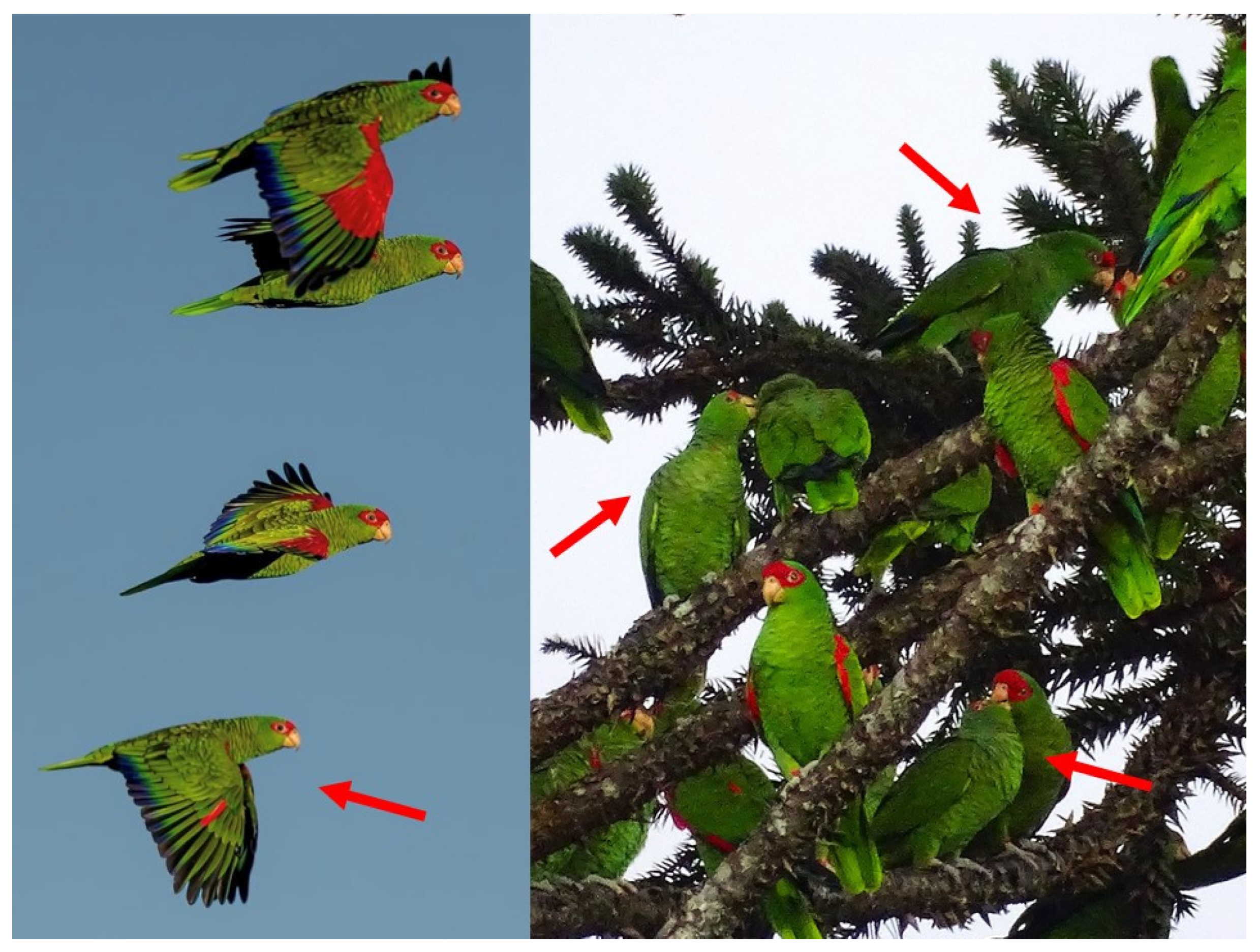
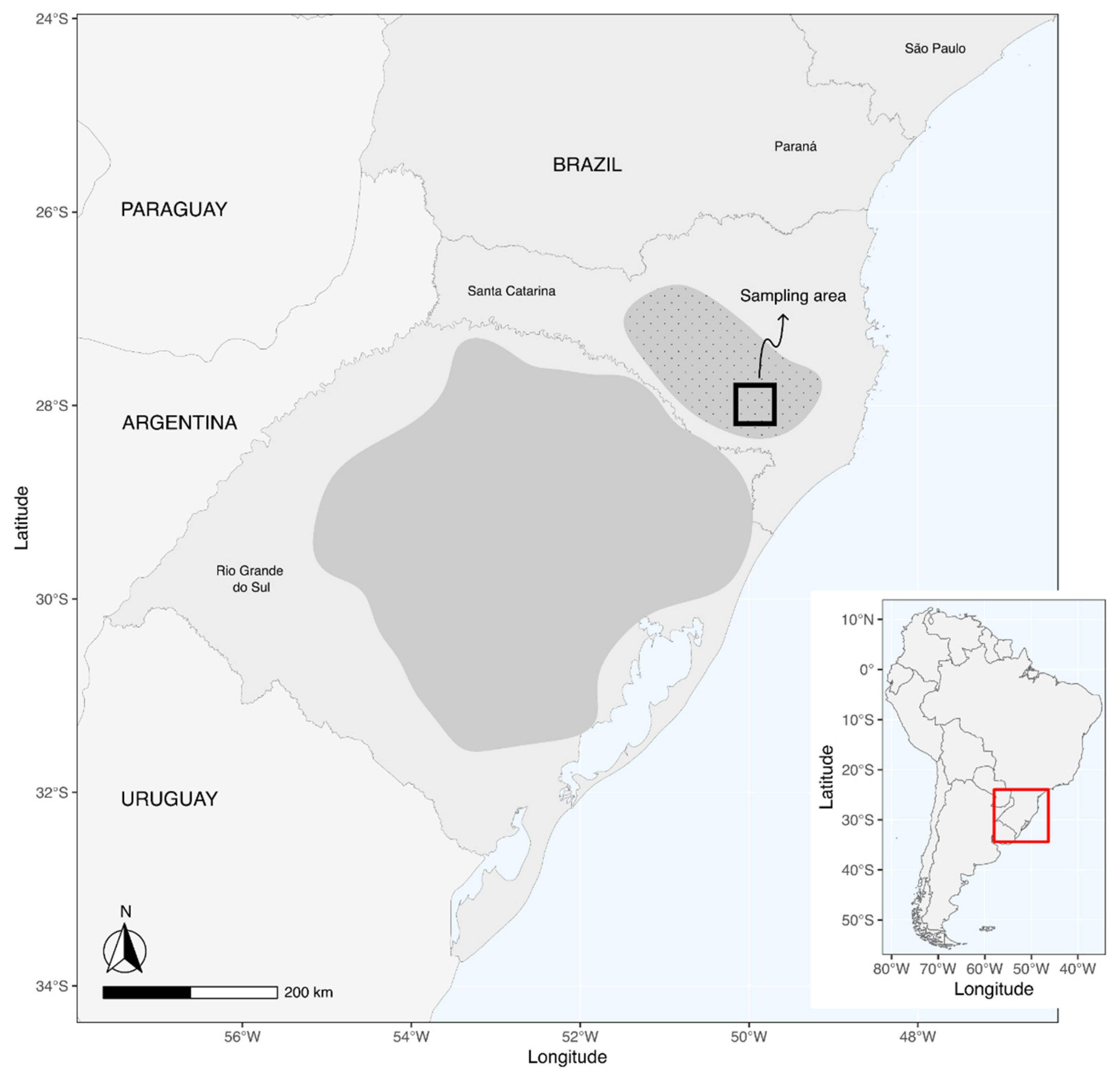
Applying a Method to Estimate the Breeding and Non-Breeding Population Fractions of the Globally Threatened Red-Spectacled Amazon

 ,
,  , , , and
Simple Summary
Abstract
1. Introduction
2. Materials and Methods
2.1. Study Species and Study Area
2.2. Field Surveys
2.3. Data Analysis
3. Results
4. Discussion
5. Conclusions
Author Contributions
Funding
Institutional Review Board Statement
Data Availability Statement
Acknowledgments
Conflicts of Interest
References
- IUCN. The IUCN Red List of Threatened Species. 2025. Version 2025-2. Available online: https://www.iucnredlist.org (accessed on 24 November 2025).
- Penteriani, V.; Ferrer, M.; Delgado, M.M. Floater strategies and dynamics in birds, and their importance in conservation biology: Towards an understanding of nonbreeders in avian populations. Anim. Conserv. 2011, 14, 233–241. [Google Scholar] [CrossRef]
- Tanferna, A.; López-Jiménez, L.; Blas, J.; Hiraldo, F.; Sergio, F. Habitat selection by Black kite breeders and floaters: Implications for conservation management of raptor floaters. Biol. Conserv. 2013, 160, 1–9. [Google Scholar] [CrossRef]
- Tella, J.L.; Rojas, A.; Carrete, M.; Hiraldo, F. Simple assessments of age and spatial population structure can aid conservation of poorly known species. Biol. Conserv. 2013, 167, 425–434. [Google Scholar] [CrossRef]
- Oro, D.; Margalida, A.; Carrete, M.; Heredia, R.; Donázar, J.A. Testing the goodness of supplementary feeding to enhance population viability in an endangered vulture. PLoS ONE 2008, 3, e4084. [Google Scholar] [CrossRef]
- Sergio, F.; Tavecchia, G.; Blas, J.; Tanferna, A.; Hiraldo, F. Demographic modeling to fine-tune conservation targets: Importance of pre-adults for the decline of an endangered raptor. Ecol. Appl. 2021, 31, e2266. [Google Scholar] [CrossRef]
- Mace, G.M.; Collar, N.J.; Gaston, K.J.; Hilton-Taylor, C.; Akcakaya, H.R.; Leader-Williams, N.; Milner-Gulland, E.J.; Stuart, S.M. Quantification of extinction risk: IUCN’s system for classifying threatened species. Conserv. Biol. 2008, 22, 1424–1442. [Google Scholar] [CrossRef]
- IUCN. Guidelines for Using the IUCN Red List Categories and Criteria. 2024. Version 16. Available online: www.iucnredlist.org/documents/RedListGuidelines.pdf (accessed on 24 November 2025).
- Katzner, T.E.; Ivy, J.A.R.; Bragin, E.A.; Milner-Gulland, E.J.; DeWoody, J.A. Conservation implications of inaccurate estimation of cryptic population size. Anim. Conserv. 2011, 14, 328–332. [Google Scholar] [CrossRef]
- Negro, J.J. The ghost fraction of populations: A taxon-dependent problem. Anim. Conserv. 2011, 14, 338–339. [Google Scholar] [CrossRef]
- Margalida, A.; Oro, D.; Cortés-Avizanda, A.; Heredia, R.; Donázar, J.A. Misleading population estimates: Biases and consistency of visual surveys and matrix modelling in the endangered bearded vulture. PLoS ONE 2011, 6, e26784. [Google Scholar] [CrossRef]
- Margalida, A.; Jiménez, J.; Martínez, J.M.; Sesé, J.A.; García-Ferré, D.; Llamas, A.; Razin, M.; Colomer, M.; Arroyo, B. An assessment of population size and demographic drivers of the Bearded Vulture using integrated population models. Ecol. Monogr. 2020, 90, e01414. [Google Scholar] [CrossRef]
- Rudnick, J.A.; Katzner, T.E.; Bragin, E.A.; DeWoody, J.A. A non-invasive genetic evaluation of population size, natal philopatry, and roosting behavior of non-breeding eastern imperial eagles (Aquila heliaca) in central Asia. Conserv. Gen. 2008, 9, 667–676. [Google Scholar] [CrossRef]
- Young, A.M.; Hobson, E.A.; Lackey, L.B.; Wright, T.E. Survival on the ark: Life-history trends in captive parrots. Anim. Conserv. 2012, 15, 28–43. [Google Scholar] [CrossRef] [PubMed]
- Pacífico, E.C.; Barbosa, E.A.; Filadelfo, T.; Oliveira, K.G.; Silveira, L.F.; Tella, J.L. Breeding to non-breeding population ratio and breeding performance of the globally endangered Lear’s Macaw (Anodorhynchus leari): Conservation and monitoring implications. Bird Conserv. Int. 2014, 24, 466–476. [Google Scholar] [CrossRef]
- Lera, D.N.; Cozzani, N.; Tella, J.L.; Zalba, S. Population size, non-breeding fraction, and productivity in a large urban population of Burrowing Parrots (Cyanoliseus patagonus). Diversity 2023, 15, 1207. [Google Scholar] [CrossRef]
- Olah, G.; Butchart, S.H.M.; Symes, A.; Guzmán, I.M.; Cunningham, R.; Brightsmith, D.J.; Heinsohn, R. Ecological and socio-economic factors affecting extinction risk in parrots. Biodivers. Conserv. 2016, 25, 205–223. [Google Scholar] [CrossRef]
- McClure, C.J.; Rolek, B.W. Relative conservation status of bird orders with special attention to raptors. Front. Ecol. Evol. 2020, 8, 420. [Google Scholar] [CrossRef]
- Marsden, S.J.; Royle, K. Abundance and abundance change in the world’s parrots. Int. J. Avian Sci. 2015, 157, 219–229. [Google Scholar] [CrossRef]
- BirdLife International. Amazona pretrei. The IUCN Red List of Threatened Species 2022: E.T22686251A210018258. Available online: https://www.iucnredlist.org/species/22686251/210018258 (accessed on 24 November 2025).
- Silveira, L.F.; Lima, D.M.; Dias, F.F.; Ubaid, F.K.; Bencke, G.A.; Repenning, M.; Somenzari, M.; Cerqueira, P.V.; Dias, R.A.; Alquezar, R.D.; et al. Amazona pretrei. Sistema de Avaliação do Risco de Extinção da Bio-Diversidade-SALVE–2023; Instituto Chico Mendes de Conservação da Biodiversidade-ICMBio: Brasília, Brazil, 2023. Available online: https://salve.icmbio.gov.br (accessed on 4 December 2025).
- Zulian, V.; Miller, D.A.W.; Ferraz, G. Endemic and threatened Amazona parrots of the Atlantic forest: An overview of their geographic range and population size. Diversity 2021, 13, 416. [Google Scholar] [CrossRef]
- Martinez, J.; Prestes, N.P. Ecologia e Conservação do papagaio-charão (Amazona pretrei). In Ecologia e Conservação de Psitacídeos no Brasil; Galetti, M., Pizo, M.A., Eds.; Melopsittacus Publicações Científicas: Belo Horizonte, Brazil, 2002; pp. 173–193. [Google Scholar]
- Prestes, N.P.; Martinez, J.; da Rosa, A.V. Dieta alimentar do papagaio-charão (Amazona pretrei). In Biologia da Conservação: Um Estudo de Caso do Papagaio-Charão e de Outros Papagaios Brasileiros; UPF Editora: Passo Fundo, Brazil, 2008; pp. 88–104. [Google Scholar]
- Thomas, P. Araucaria angustifolia. The IUCN Red List of Threatened Species 2013: E.T32975A2829141. Available online: https://www.iucnredlist.org/species/32975/2829141 (accessed on 24 November 2025).
- Tella, J.L.; Dénes, F.V.; Zulian, V.; Prestes, N.P.; Martínez, J.; Blanco, G.; Hiraldo, F. Endangered plant-parrot mutualisms: Seed tolerance to predation makes parrots pervasive dispersers of the Parana pine. Sci. Rep. 2016, 6, 31709. [Google Scholar] [CrossRef]
- Dénes, F.V.; Tella, J.L.; Zulian, V.; Prestes, N.P.; Martínez, J.; Hiraldo, F. Combined impacts of multiple non-native mammals on two life stages of a critically endangered Neotropical tree. Biol. Invas. 2018, 20, 3055–3068. [Google Scholar] [CrossRef]
- Marini, M.Â.; Barbet-Massin, M.; Martinez, J.; Prestes, N.P.; Jiguet, F. Applying ecological niche modelling to plan conservation actions for the Red-spectacled Amazon (Amazona pretrei). Biol. Conserv. 2010, 143, 102–112. [Google Scholar] [CrossRef]
- Forshaw, J.M. Parrots of the World; Christopher Helm: London, UK, 2020. [Google Scholar]
- Prestes, N.P.; Martinez, J.; Meyrer, P.A.; Hansen, L.H.; de Negri Xavier, M. Nest characteristics of the Red-spectacled Amazon Amazona pretrei Temminck, 1830 (Psittacidae). Ararajuba 1997, 5, 151–158. [Google Scholar]
- Martinez, J.; Prestes, N.P. Tamanho populacional, tamanho médio de bando e outros aspectos demográficos do papagaio-charão (Amazona pretrei). In Biologia da Conservação-Estudo de Caso com o Papagaio-Charão e Outros Papagaios Brasileiros; UPF Editora: Passo Fundo, Brazil, 2008; pp. 178–206. [Google Scholar]
- Dénes, F.; Tella, J.L.; Beissinger, S.R. Revisiting methods for estimating parrot abundance and population size. Emu 2018, 118, 67–79. [Google Scholar] [CrossRef]
- Tella, J.L.; Romero-Vidal, P.; Dénes, F.V.; Hiraldo, F.; Toledo-González, B.; Rossetto, F.; Blanco, G.; Hernández-Brito, D.; Pacífico, E.; Díaz, J.A.; et al. Roadside car surveys: Methodological constraints and solutions for estimating parrot abundances across the world. Diversity 2021, 13, 300. [Google Scholar] [CrossRef]
- Prestes, N.P.; Martinez, J.; Rezende, E. Biologia reprodutiva do papagaio-charão (Amazona pretrei). In Biologia da Conservação: Um Estudo de Caso do Papagaio-Charão e de Outros Papagaios Brasileiros; UPF Editora: Passo Fundo, Brazil, 2008; pp. 139–155. [Google Scholar]
- Bibby, C.J.; Burgess, N.D. Bird Census Techniques; Academic Press Limited: London, UK, 1993. [Google Scholar]
- Renton, K.; Salinas-Melgoza, A.; De Labra-Hernández, M.Á.; de la Parra-Martínez, S.M. Resource requirements of parrots: Nest site selectivity and dietary plasticity of Psittaciformes. J. Ornithol. 2015, 156, 73–90. [Google Scholar] [CrossRef]
- Seixas, G.H.; Mourão, G.M. The availability of Blue-fronted Amazon nesting cavities is at risk in west-central Brazil. J. Field Ornithol. 2025, 29, 4. [Google Scholar] [CrossRef]
- Kilpp, J.C.; Prestes, N.P.; Martinez, J.; Rezende, É.; Batistella, T. Instalação de caixas-ninho como estratégia para a conservação do papagaio-charão (Amazona pretrei). Ornithologia 2013, 6, 128–135. [Google Scholar]
- Zulian, V.; Müller, E.S.; Cockle, K.L.; Lesterhuis, A.; Júnior, R.T.; Prestes, N.P.; Martinez, J.; Kéry, M.; Ferraz, G. Addressing multiple sources of uncertainty in the estimation of global parrot abundance from roost counts: A case study with the Vinaceous-breasted Parrot (Amazona vinacea). Biol. Conserv. 2020, 248, 108672. [Google Scholar] [CrossRef]



| Productivity | Average = 1.63 | Lower 95% = 1.23 | Upper 95% = 2.02 |
|---|---|---|---|
| 2015 | |||
| Global population | 15,685 | ||
| Population sampled | 1097 | ||
| % Juveniles | 13.58 (11.56–15.61) | ||
| % Adults | 86.42 (84.39–88.44) | ||
| % Non-breeding adults | 80.71 (77.30–83.97) | 74.41 (69.93–78.75) | 84.45 (80.19–87.05) |
| % Breeding adults | 19.28 (16.03–22.69) | 25.58 (21.25–30.07) | 15.55 (12.95–19.81) |
| Number of breeding pairs | 1307 (1112–1502) | 1732 (1474–1990) | 1054 (898–1212) |
| 2017 | |||
| Global population | 20,128 | ||
| Population sampled | 918 | ||
| % Juveniles | 14.49 (12.21–16.76) | ||
| % Adults | 85.51 (83.24–87.79) | ||
| % Non-breeding adults | 79.21 (74.11–82.93) | 72.45 (65.70–77.40) | 82.23 (79.11–86.24 |
| % Breeding adults | 20.79 (17.07–25.89) | 27.55 (22.60–34.30) | 16.77 (13.76–22.89) |
| Number of breeding pairs | 1789 (1508–2070) | 2371 (1997–2742) | 1443 (1216–1670) |
Disclaimer/Publisher’s Note: The statements, opinions and data contained in all publications are solely those of the individual author(s) and contributor(s) and not of MDPI and/or the editor(s). MDPI and/or the editor(s) disclaim responsibility for any injury to people or property resulting from any ideas, methods, instructions or products referred to in the content. |
© 2026 by the authors. Licensee MDPI, Basel, Switzerland. This article is an open access article distributed under the terms and conditions of the Creative Commons Attribution (CC BY) license.
Share and Cite
Tella, J.L.; Martínez, J.; Dénes, F.V.; Zulian, V.; Hiraldo, F.; Prestes, N.P. Applying a Method to Estimate the Breeding and Non-Breeding Population Fractions of the Globally Threatened Red-Spectacled Amazon. Biology 2026, 15, 190. https://doi.org/10.3390/biology15020190
Tella JL, Martínez J, Dénes FV, Zulian V, Hiraldo F, Prestes NP. Applying a Method to Estimate the Breeding and Non-Breeding Population Fractions of the Globally Threatened Red-Spectacled Amazon. Biology. 2026; 15(2):190. https://doi.org/10.3390/biology15020190
Chicago/Turabian StyleTella, José L., Jaime Martínez, Francisco V. Dénes, Viviane Zulian, Fernando Hiraldo, and Nêmora P. Prestes. 2026. "Applying a Method to Estimate the Breeding and Non-Breeding Population Fractions of the Globally Threatened Red-Spectacled Amazon" Biology 15, no. 2: 190. https://doi.org/10.3390/biology15020190
APA StyleTella, J. L., Martínez, J., Dénes, F. V., Zulian, V., Hiraldo, F., & Prestes, N. P. (2026). Applying a Method to Estimate the Breeding and Non-Breeding Population Fractions of the Globally Threatened Red-Spectacled Amazon. Biology, 15(2), 190. https://doi.org/10.3390/biology15020190