

Spatio-Temporal Evolution of Ecological Network Resilience in the Poyang Lake Eco-Economic Zone from the Perspective of Complex Network Analysis

Simple Summary
Abstract
1. Introduction
2. Materials and Methods
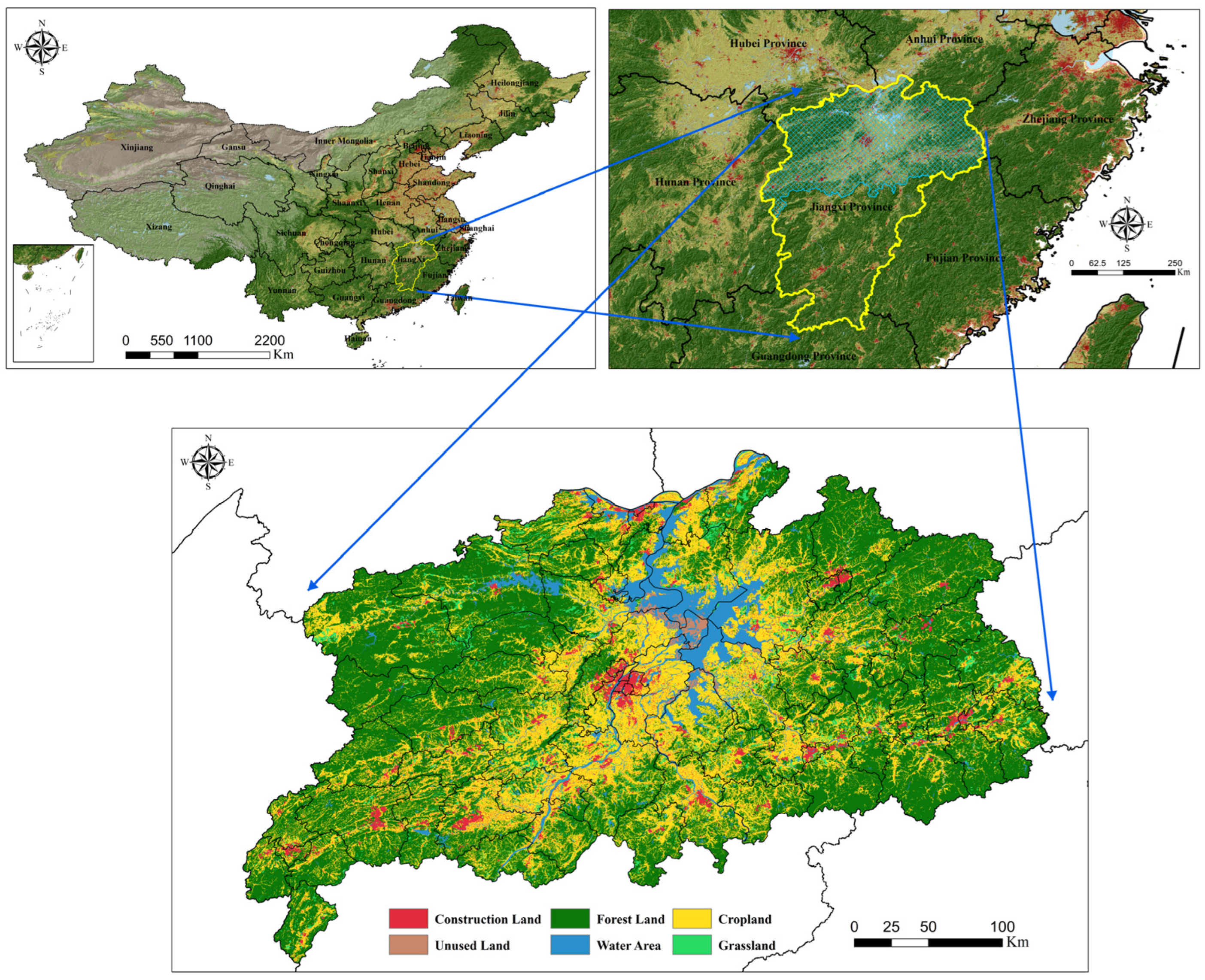
2.1. Study Area
2.2. Data Sources and Preprocessing
2.3. Land-Use Classification Accuracy Assessment
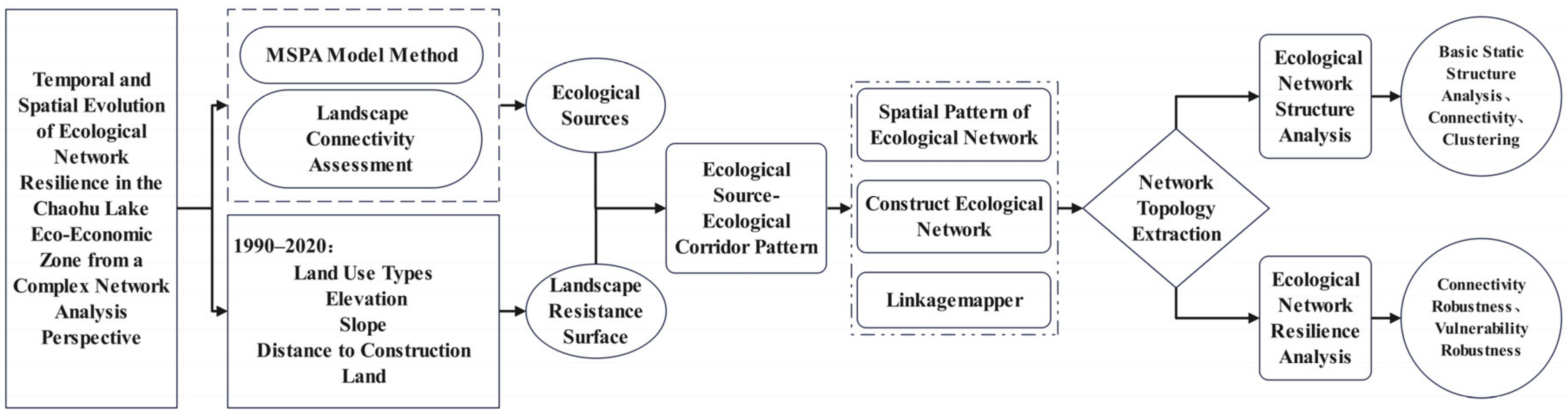
2.4. Research Framework
2.5. Research Methods
2.5.1. Ecological Network Identification
2.5.2. Analysis of Ecological Network Topological Structure
2.5.3. Analysis of Ecological Network Resilience
3. Results
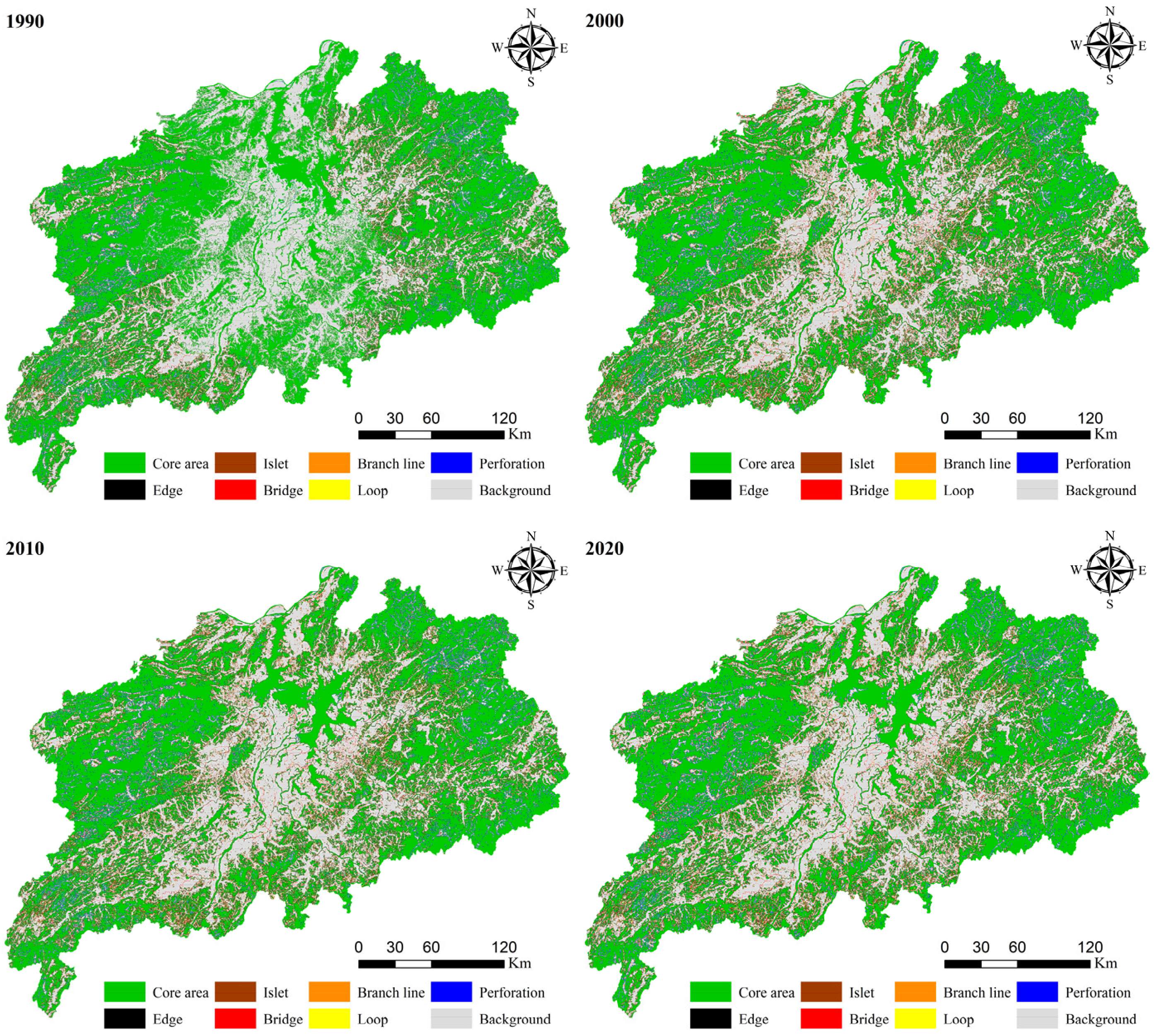
3.1. Landscape Pattern Based on MSPA Method
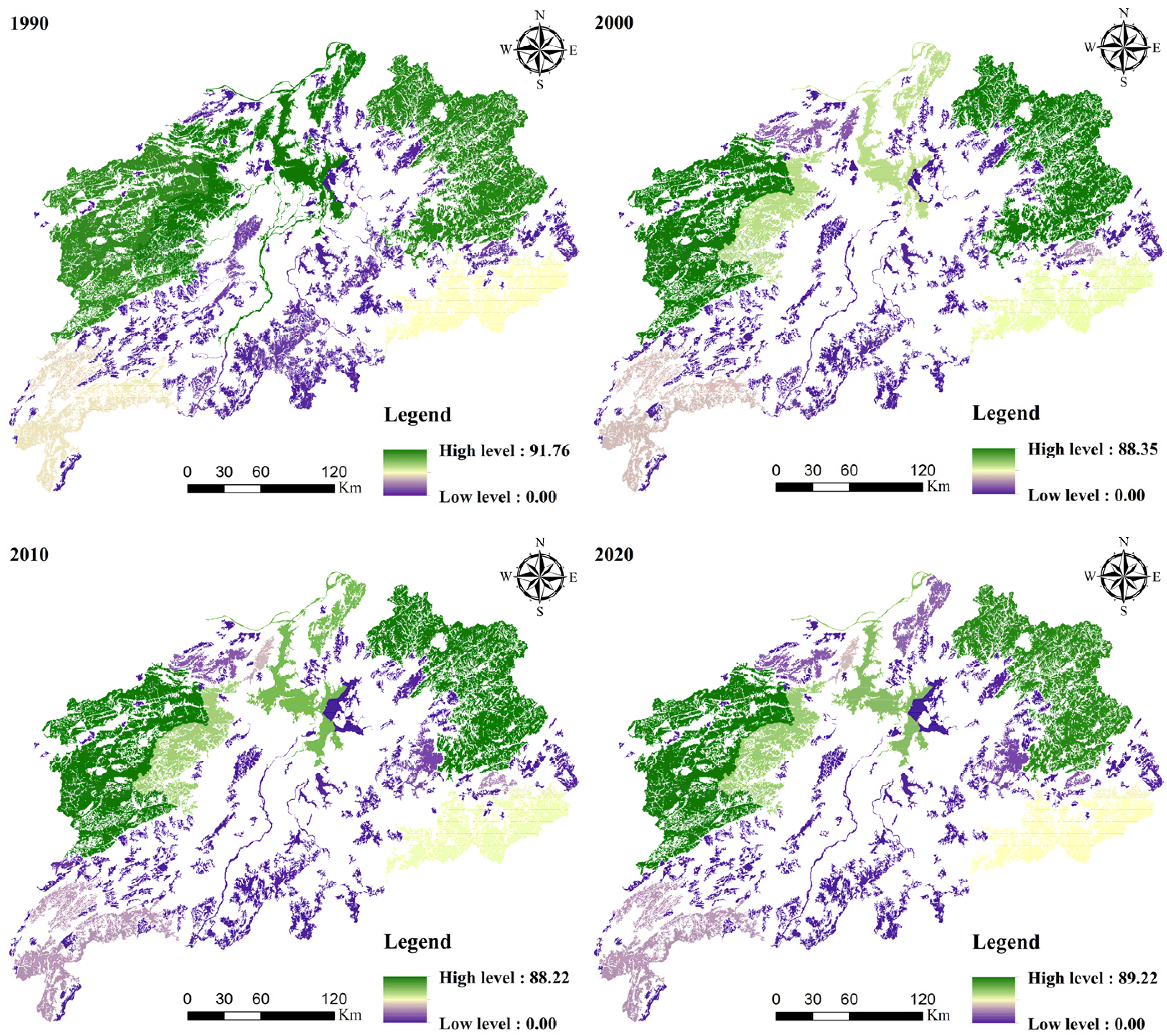
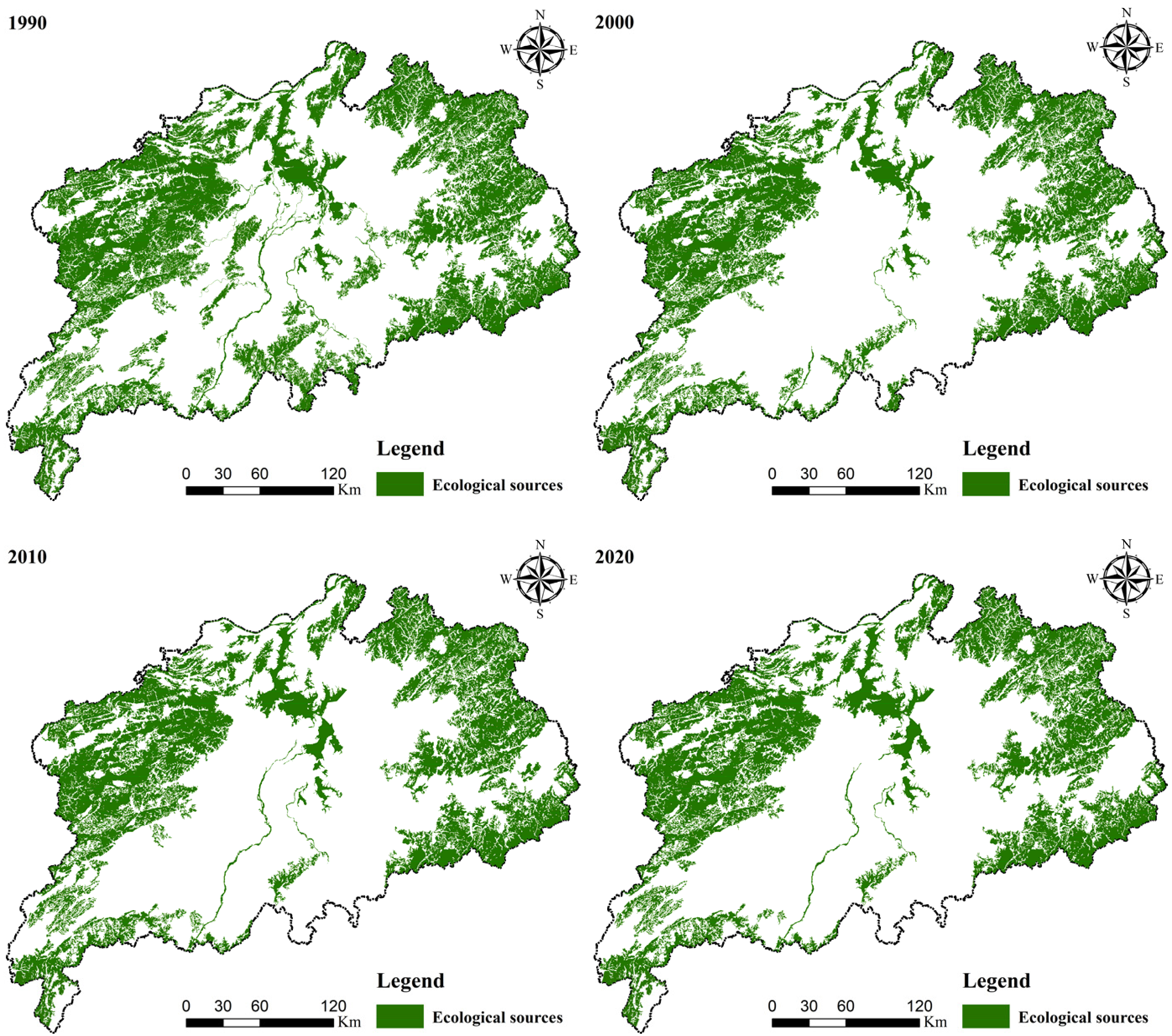
3.2. Selection of Important Ecological Source Patches
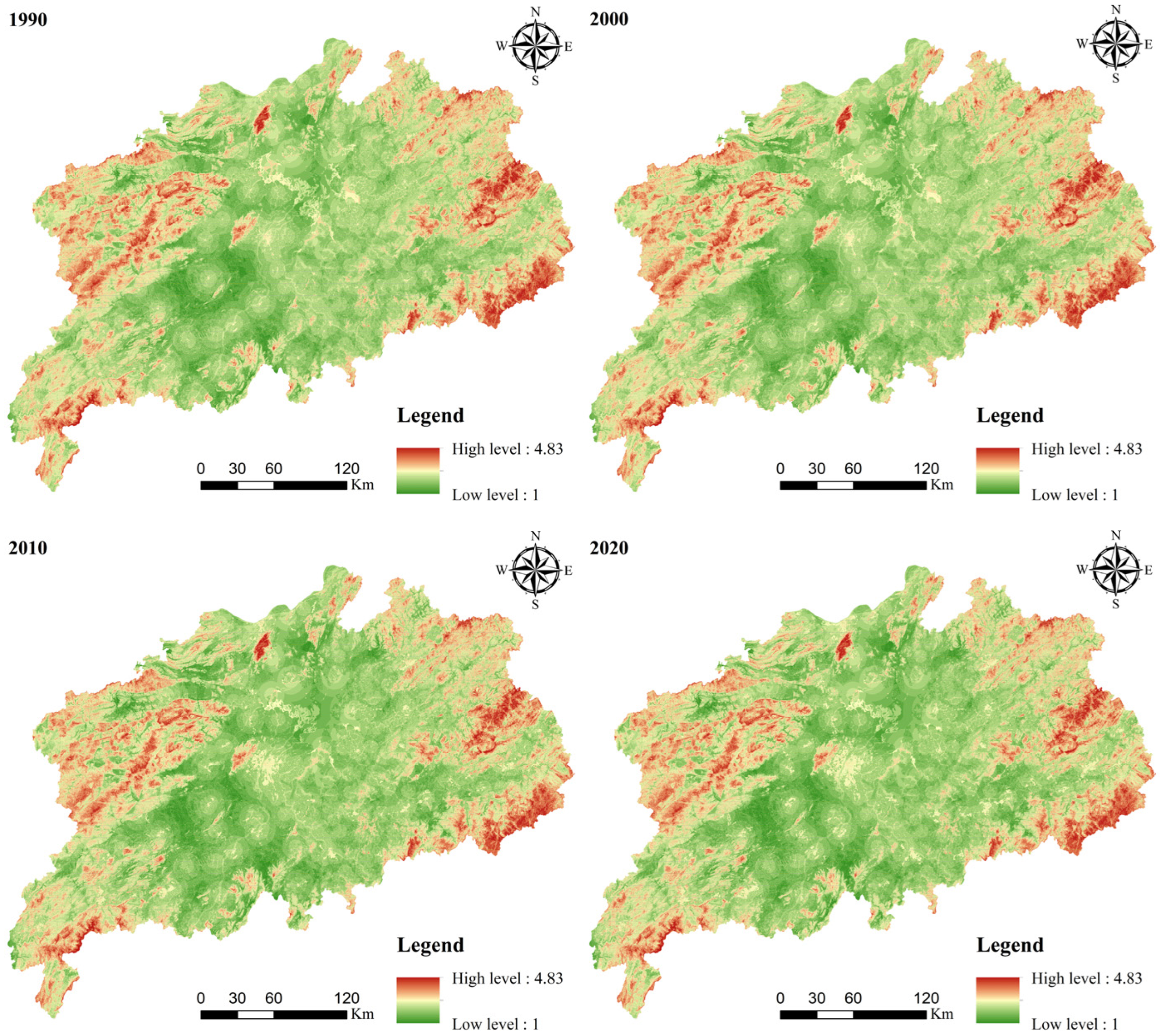
3.3. Spatio-Temporal Evolution Characteristics of Ecological Resistance Surface
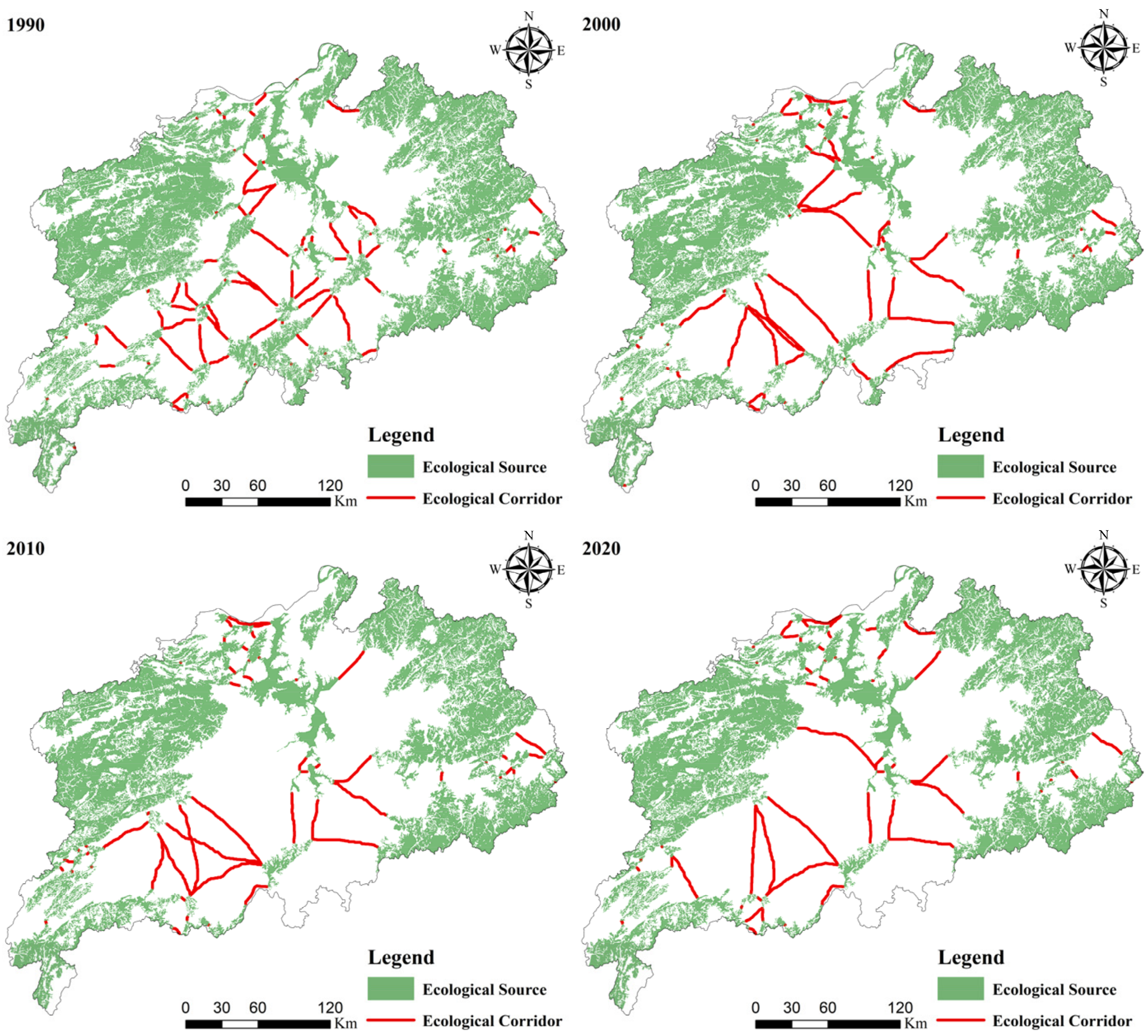
3.4. Analysis of the Spatio-Temporal Evolution of the Ecological Network
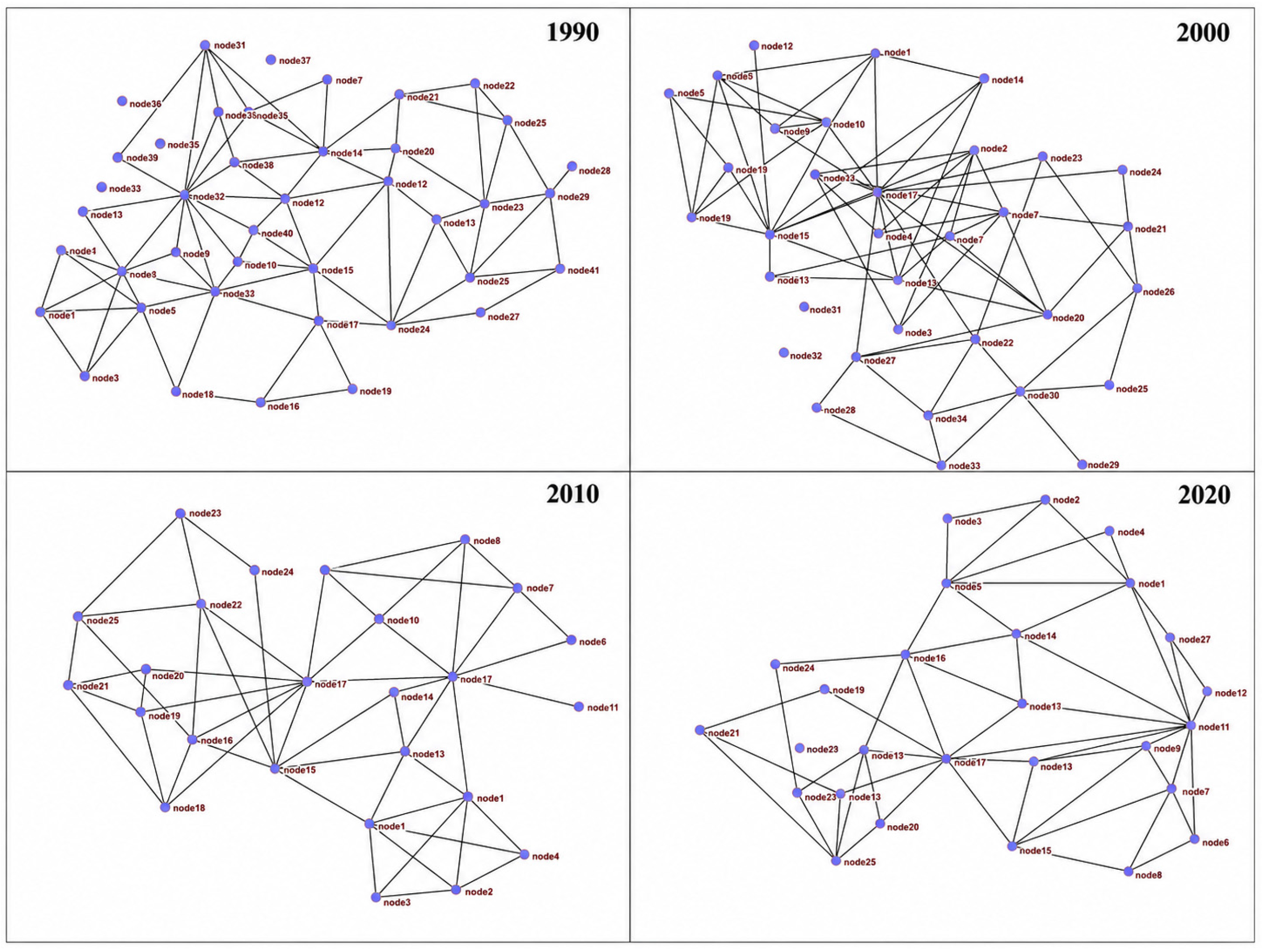
3.5. Analysis of Ecological Network Topological Characteristics
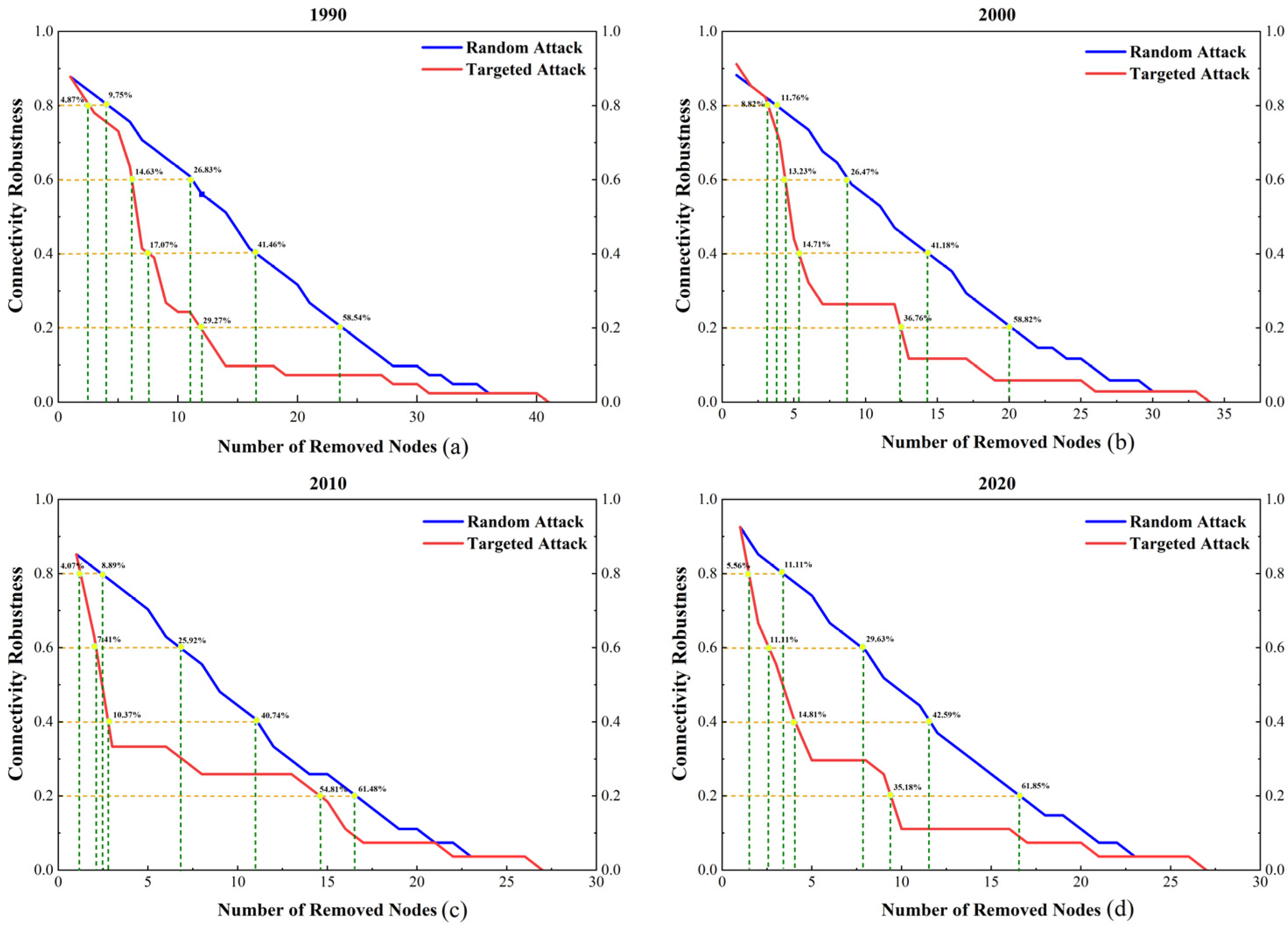
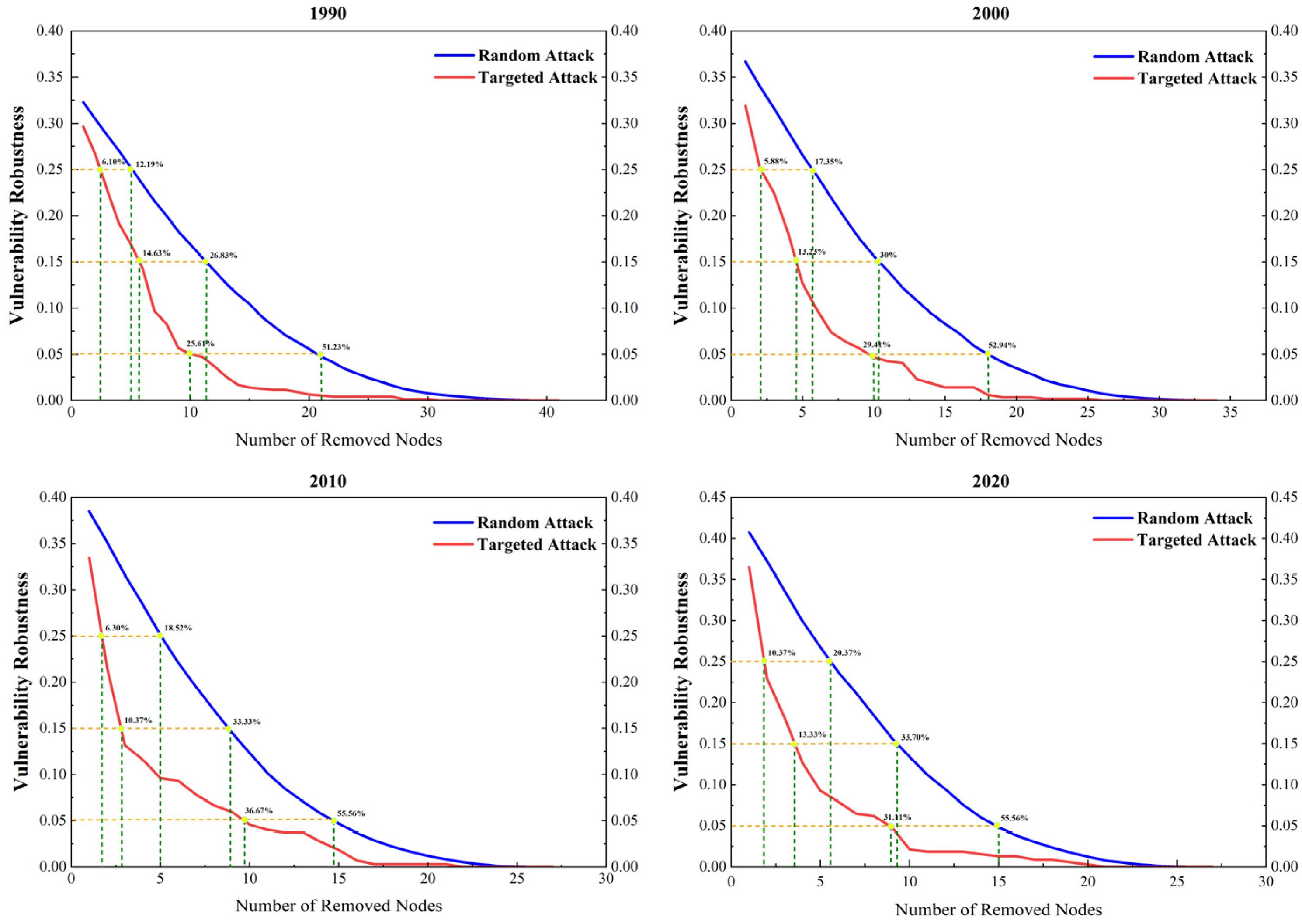
3.6. Resilience of the Ecological Network in the Poyang Lake Eco-Economic Zone
3.6.1. Connectivity Robustness
3.6.2. Vulnerability Robustness
4. Discussion
4.1. Methodological Considerations and Uncertainties
4.2. Comparison of the Main Findings with Recent Landscape-Ecology Studies
4.3. International Relevance and Transferability of the Study
4.4. Limitations and Future Research Directions
5. Conclusions
Author Contributions
Funding
Institutional Review Board Statement
Informed Consent Statement
Data Availability Statement
Conflicts of Interest
References
- McDonald, M. Ecological Security: Climate Change and the Construction of Security; Cambridge University Press: Cambridge, UK, 2021; pp. 94–122. [Google Scholar]
- Kong, F.H.; Yin, H.W. Developing green space ecological networks in Jinan City. Acta Ecol. Sin. 2008, 28, 1711–1719. [Google Scholar]
- Chen, H.L.; Yang, X.K.; Yuan, M.; Wang, Z.B. The distribution characteristics and equity of green space in Chang-Zhu-Tan metropolitan area. Acta Ecol. Sin. 2025, 45, 2255–2267. [Google Scholar]
- Liu, X.Q.; He, P.F.; Han, J.C.; Xiao, H.; Wang, Y.N. Evolution of ecological security pattern of Yangtze River Economic Belt and its multi-scenario simulation. Econ. Geogr. 2023, 43, 192–203. [Google Scholar]
- He, A.P.; Ren, Y.B. From the “Two Mountains” concept to “green productive forces”: Innovative development and practical orientation of Xi Jinping thought on ecological civilization. J. Humanit. 2025, 2025, 1–11. [Google Scholar] [CrossRef] [Scilit]
- Fu, Y.J.; Shi, X.Y.; He, J.; Yuan, Y.; Qu, L.L. Identification and optimization strategy of county ecological security pattern: A case study in the Loess Plateau, China. Ecol. Indic. 2020, 112, 106030. [Google Scholar] [CrossRef] [Scilit]
- Chen, X.; Peng, J.; Liu, Y.X.; Yang, Y.; Li, G.C. Constructing ecological security patterns in Yunfu City based on the framework of importance-sensitivity-connectivity. Geogr. Res. 2017, 36, 471–484. [Google Scholar]
- Liu, S.L.; Hou, X.Y.; Yin, Y.J.; Chen, F.Y.; Zhang, Y.Q.; Dong, S.K. Research progress on landscape ecological networks. Acta Ecol. Sin. 2017, 37, 3947–3956. [Google Scholar] [CrossRef] [Scilit]
- Vitousek, P.M. Beyond global warming: Ecology and global change. Ecology 1994, 75, 1861–1876. [Google Scholar] [CrossRef] [Scilit]
- Hou, L.S.; Cai, Y.L. An essential analysis and review on land use/cover change research. Prog. Geogr. 2004, 23, 96–104. [Google Scholar]
- Tansley, A.G. The use and abuse of vegetational concepts and terms. Ecology 1935, 16, 284–307. [Google Scholar] [CrossRef] [Scilit]
- Wang, R.; Li, F.; Hu, D.; Li, B.L. Understanding eco-complexity: Social-Economic-Natural Complex Ecosystem approach. Ecol. Complex. 2011, 8, 15–29. [Google Scholar] [CrossRef] [Scilit]
- Bodini, A.; Bondavalli, C. Towards a sustainable use of water resources: A whole-ecosystem approach using network analysis. Int. J. Environ. Pollut. 2002, 18, 463–485. [Google Scholar] [CrossRef] [Scilit]
- Barberán, A.; Bates, S.T.; Casamayor, E.O.; Fierer, N. Using network analysis to explore co-occurrence patterns in soil microbial communities. ISME J. 2012, 6, 343–351. [Google Scholar] [PubMed]
- Bowers, K.; McKnight, M. Reestablishing a healthy and resilient North America: Linking ecological restoration with continental habitat connectivity. Ecol. Restor. 2012, 30, 267–270. [Google Scholar] [CrossRef] [Scilit]
- Creamer, R.E.; Hannula, S.E.; Van Leeuwen, J.P.; Stone, D.; Rutgers, M.; Schmelz, R.M.; de Ruiter, P.C.; Bohse Hendriksen, N.; Bolger, T.; Bouffaud, M.L.; et al. Ecological network analysis reveals the inter-connection between soil biodiversity and ecosystem function as affected by land use across Europe. Appl. Soil Ecol. 2016, 97, 112–124. [Google Scholar] [CrossRef] [Scilit]
- Peng, J.; Guo, X.N.; Hu, Y.N.; Liu, Y.X. Constructing ecological security patterns in mountain areas based on geological disaster sensitivity: A case study in Yuxi City, Yunnan Province, China. Chin. J. Appl. Ecol. 2017, 28, 627–635. [Google Scholar]
- Gu, F.; Huang, Y.X.; Chen, C.M.; Cheng, D.L.; Guo, J.L. Construction and optimization of ecological network for nature reserves in Fujian Province, China. Chin. J. Appl. Ecol. 2017, 28, 1013–1020. [Google Scholar]
- Säterberg, T.; Sellman, S.; Ebenman, B. High frequency of functional extinctions in ecological networks. Nature 2013, 499, 468–470. [Google Scholar] [CrossRef] [Scilit] [PubMed]
- Huang, X.F.; Wu, C.F.; You, H.Y.; Xiao, W.; Zhong, S.Q. Construction of rural landscape ecological corridor in water network plain area based on MCR model. Trans. Chin. Soc. Agric. Eng. 2019, 35, 243–251. [Google Scholar]
- Newman, M.E.J. The structure and function of complex networks. SIAM Rev. 2003, 45, 167–256. [Google Scholar] [CrossRef] [Scilit]
- Saura, S.; Vogt, P.; Velázquez, J.; Hernando, A.; Tejera, R. Key structural forest connectors can be identified by combining landscape spatial pattern and network analyses. For. Ecol. Manag. 2011, 262, 150–160. [Google Scholar] [CrossRef] [Scilit]
- Wang, F.; Gao, H.; Liu, J.T.; Fu, T.G.; Qi, F.; Gao, Y.; Zhao, L. Study on the characteristics of ecological network and critical areas of ecological restoration in Hebei–Tianjin Coastal Wetlands. Wetlands 2024, 44, 24. [Google Scholar] [CrossRef] [Scilit]
- Zhao, Y.X.; Zhang, M.; Zhao, D.X.; Duo, L.H.; Lu, C.Y. Optimizing the ecological network of resource-based cities to enhance the resilience of regional ecological networks. Environ. Sci. Pollut. Res. 2024, 31, 17182–17205. [Google Scholar] [CrossRef] [Scilit]
- Liang, K.Y.; Jin, X.B.; Song, J.P.; Qi, Z.; Li, Q.Q.; Zhang, X.L.; Ying, S.C.; Zhou, Y.K. Construction of ecological security patterns coupling supply and demand of ecosystem services: A case study of Southern Jiangsu Province. Acta Ecol. Sin. 2024, 44, 3880–3896. [Google Scholar]
- Wang, Y.C. The connectivity evaluation of Shanghai urban landscape eco-network. Geogr. Res. 2009, 28, 284–292. [Google Scholar]
- Luque, S.S.; Lathrop, R.G.; Bognar, J.A. Temporal and spatial changes in an area of the New Jersey Pine Barrens landscape. Landsc. Ecol. 1994, 9, 287–300. [Google Scholar] [CrossRef] [Scilit]
- Holling, C.S. Resilience and stability of ecological systems. Annu. Rev. Ecol. Syst. 1973, 4, 1–23. [Google Scholar] [CrossRef] [Scilit]
- Walker, B.; Holling, C.S.; Carpenter, S.R.; Kinzig, A. Resilience, adaptability and transformability in social–ecological systems. Ecol. Soc. 2004, 9, 5. [Google Scholar] [CrossRef] [Scilit]
- Wang, T.; Li, H.B.; Huang, Y. The complex ecological network’s resilience of the Wuhan metropolitan area. Ecol. Indic. 2021, 130, 108101. [Google Scholar] [CrossRef] [Scilit]
- Bascompte, J.; Jordano, P.; Melián, C.J.; Olesen, J.M. The nested assembly of plant–animal mutualistic networks. Proc. Natl. Acad. Sci. USA 2003, 100, 9383–9387. [Google Scholar] [CrossRef] [Scilit] [PubMed]
- Estrada, E.; Hatano, N. Statistical-mechanical approach to subgraph centrality in complex networks. Chem. Phys. Lett. 2007, 439, 247–251. [Google Scholar] [CrossRef] [Scilit]
- Wang, Z.; Shi, Z.; Huo, J.; Zhu, W.; Yan, Y.; Ding, N. Construction and optimization of an ecological network in Funiu Mountain Area based on MSPA and MCR models, China. Land 2023, 12, 1529. [Google Scholar] [CrossRef] [Scilit]
- Saura, S.; Pascual-Hortal, L. A new habitat availability index to integrate connectivity in landscape conservation planning: Comparison with existing indices and application to a case study. Landsc. Urban Plan. 2007, 83, 91–103. [Google Scholar] [CrossRef] [Scilit]
- Saura, S.; Torné, J. Conefor Sensinode 2.2: A software package for quantifying the importance of habitat patches for landscape connectivity. Environ. Model. Softw. 2009, 24, 135–139. [Google Scholar] [CrossRef] [Scilit]
- Na, Y.; Hong, Z.; Ren, S.; Huang, K. Optimizing the construction of ecological networks in Beijing using a morphological spatial pattern analysis–minimal cumulative resistance model. Front. Environ. Sci. 2024, 12, 1325880. [Google Scholar] [CrossRef] [Scilit]
- Luo, Y.; Zhou, Y.; Li, B.; Li, P.; Zhang, L.; Ning, S. Constructing a future green space ecological network based on multi-scenario urban expansion: A case study of Chengdu, Sichuan, China. Forests 2024, 15, 1818. [Google Scholar] [CrossRef] [Scilit]
- Chen, X.; Xu, L.; Zhu, R.; Ma, Q.; Shi, Y.; Lu, Z. Changes and characteristics of green infrastructure network based on spatio-temporal priority. Land 2022, 11, 901. [Google Scholar] [CrossRef] [Scilit]
- Qin, J.Z.; Dai, J.P.; Li, S.H.; Zhang, J.Z.; Peng, J.S. Construction of ecological network in Qujing city based on MSPA and MCR models. Sci. Rep. 2024, 14, 9800. [Google Scholar] [CrossRef] [Scilit] [PubMed]
- An, Y.; Liu, S.; Sun, Y.; Shi, F.; Beazley, R. Construction and optimization of an ecological network based on morphological spatial pattern analysis and circuit theory. Landsc. Ecol. 2021, 36, 2059–2076. [Google Scholar]
- Zhai, T.; Wang, J.; Fang, Y.; Qin, Y.; Huang, L.; Chen, Y. Linking MSPA and circuit theory to identify the spatial range of ecological networks and its priority areas for conservation and restoration in urban agglomeration. Front. Ecol. Evol. 2022, 10, 828979. [Google Scholar] [CrossRef] [Scilit]
- Hong, W.; Guo, R.; Li, X.; Liao, C. Measuring urban ecological network resilience: A disturbance scenario simulation method. Cities 2022, 131, 104057. [Google Scholar] [CrossRef] [Scilit]
- Li, J.; Nie, W.; Zhang, M.; Wang, L.; Dong, H.; Xu, B. Assessment and optimization of urban ecological network resilience based on disturbance scenario simulations: A case study of Nanjing city. J. Clean. Prod. 2024, 438, 140812. [Google Scholar] [CrossRef] [Scilit]
- Wu, Z.; Cheng, S.; Xu, K.; Qian, Y. Ecological network resilience evaluation and ecological strategic space identification based on complex network theory: A case study of Nanjing city. Ecol. Indic. 2024, 158, 111604. [Google Scholar] [CrossRef] [Scilit]
- Huang, L.; Wang, J.; Cheng, H. Spatiotemporal changes in ecological network resilience in the Shandong Peninsula urban agglomeration. J. Clean. Prod. 2022, 339, 130681. [Google Scholar] [CrossRef] [Scilit]



| Year | Correct/Total Samples | Farmland PA/UA (%) | Woodland PA/UA (%) | Built-Up Land PA/UA (%) | Grassland PA/UA (%) | Water Bodies PA/UA (%) | Other Land PA/UA (%) | Overall Accuracy (%) | Kappa Coefficient |
|---|---|---|---|---|---|---|---|---|---|
| 1990 | 457/600 | 82.12/79.43 | 91.12/88.56 | 85.12/89.23 | 84.67/74.56 | 85.21/83.06 | 78.01/75.63 | 76.17 | 0.72 |
| 2000 | 512/600 | 94.60/90.46 | 80.78/86.12 | 98.99/100.00 | 80.03/79.94 | 99.21/100.00 | 85.23/82.89 | 85.33 | 0.82 |
| 2010 | 501/600 | 90.67/95.00 | 97.08/93.26 | 97.64/94.35 | 85.63/87.75 | 88.34/98.91 | 88.45/83.23 | 83.50 | 0.81 |
| 2020 | 519/600 | 88.89/95.34 | 98.55/92.70 | 99.53/90.31 | 90.26/88.45 | 100.00/97.12 | 90.56/87.45 | 86.50 | 0.83 |
| Resistance Factor | Weight | Classification Index | Resistance Value |
|---|---|---|---|
| Land-use type | 0.24 | Construction land | 5 |
| Other land | 4 | ||
| Farmland and Garden plot | 3 | ||
| Water body and Grassland | 2 | ||
| Woodland | 1 | ||
| Elevation/m | 0.3 | >694 | 5 |
| >412~694 | 4 | ||
| >188~412 | 3 | ||
| 58~188 | 2 | ||
| <58 | 1 | ||
| Slope/(°) | 0.29 | >20 | 5 |
| >12~20 | 4 | ||
| >6~12 | 3 | ||
| 2~6 | 2 | ||
| <2 | 1 | ||
| Distance from the construction land | 0.17 | <3000 | 5 |
| 3000~6000 | 4 | ||
| 6000~12,000 | 3 | ||
| 12,000~20,000 | 2 | ||
| >20,000 | 1 |
| Goal | Index | Method | Formula | Definition |
|---|---|---|---|---|
| Network topology | Complex Network Structural Characteristics | Average Degree | N represents the total number of ecological network nodes; M represents the total number of ecological corridors; ku represents the degree of node u; auv represents the element of the binary adjacency matrix; and represents the average degree of the network. | |
| Network Density | ρ represents the ecological network density; N represents the total number of ecological source nodes in the network; M represents the total number of corridors connecting ecological sources. | |||
| Average Path Length | where ℓ denotes the average path length; duv is the unweighted shortest path distance between node u and node v; represents the set of all reachable node pairs, and is the total number of reachable node pairs within the network. | |||
| Network Robustness | Largest Connected Component | C(G) represents the set of all connected components in network G; S represents any connected component; V(S) represents the set of nodes contained in connected component S; represents the number of nodes in this connected component; max indicates the maximum number of nodes among all connected components. | ||
| Network Efficiency | Eglob represents the global efficiency of the ecological network; duv represents the unweighted shortest-path distance between nodes u and; N represents the total number of nodes in the network; and the summation range u < v indicates that all unordered node pairs are traversed without repetition. | |||
| Average Clustering Coefficient | where eu denotes the actual number of edges between neighbor nodes of node u, and ku represents the degree of node u. If ku < 2, the local clustering coefficient of node u is set to zero. The average clustering coefficient quantifies the local clustering level of the ecological network. |
| Landscape Type | 1990 | 2000 | 2010 | 2020 | ||||
|---|---|---|---|---|---|---|---|---|
| Area /km2 | The Proportion of the Total Area | Area /km2 | The Proportion of the Total Area | Area /km2 | The Proportion of the Total Area | Area /km2 | The Proportion of the Total Area | |
| Core area | 47,284.60 | 51.23% | 42,464.63 | 46.01% | 42,380.43 | 45.92% | 41,941.72 | 45.44% |
| Branch line | 1072.41 | 1.16% | 2303.82 | 2.50% | 2392.79 | 2.59% | 2449.54 | 2.65% |
| Edge | 7001.53 | 7.59% | 9022.76 | 9.78% | 8768.06 | 9.50% | 8671.94 | 9.40% |
| Perforation | 2682.21 | 2.91% | 2750.19 | 2.98% | 2839.50 | 3.08% | 2834.22 | 3.07% |
| Islet | 114.13 | 0.12% | 478.06 | 0.52% | 481.38 | 0.52% | 491.45 | 0.53% |
| Bridge | 639.15 | 0.69% | 1441.26 | 1.56% | 1458.39 | 1.58% | 1479.33 | 1.60% |
| Loop | 291.44 | 0.32% | 611.88 | 0.66% | 583.67 | 0.63% | 598.43 | 0.65% |
| Background | 33,209.84 | 35.98% | 33,222.71 | 36.00% | 33,391.09 | 36.18% | 33,826.68 | 36.65% |
| Ecological Source | 1990 | 2000 | 2010 | 2020 | ||||
|---|---|---|---|---|---|---|---|---|
| Area /km2 | The Proportion of the Total Area | Area /km2 | The Proportion of the Total Area | Area /km2 | The Proportion Of The Total Area | Area /km2 | The Proportion of the Total Area | |
| 36,889.86 | 39.97% | 31,526.06 | 34.16% | 31,174.29 | 33.78% | 30,589.04 | 33.14% | |
| Year | Number of Nodes | Number of Edges | Average Degree | Network Density | Average Path Length | Largest Connected Component | Network Efficiency | Average Clustering Coefficient |
|---|---|---|---|---|---|---|---|---|
| 1990 | 41 | 82 | 4 | 0.1 | 3.04 | 37 | 0.34 | 0.46 |
| 2000 | 34 | 69 | 4.06 | 0.12 | 2.79 | 32 | 0.4 | 0.44 |
| 2010 | 27 | 54 | 4 | 0.15 | 2.47 | 25 | 0.42 | 0.47 |
| 2020 | 27 | 54 | 4 | 0.15 | 2.53 | 26 | 0.45 | 0.47 |
Disclaimer/Publisher’s Note: The statements, opinions and data contained in all publications are solely those of the individual author(s) and contributor(s) and not of MDPI and/or the editor(s). MDPI and/or the editor(s) disclaim responsibility for any injury to people or property resulting from any ideas, methods, instructions or products referred to in the content. |
© 2026 by the authors. Licensee MDPI, Basel, Switzerland. This article is an open access article distributed under the terms and conditions of the Creative Commons Attribution (CC BY) license.
Share and Cite
Huang, X.; Wei, S.; Ding, W.; Xiao, Y.; Su, Q. Spatio-Temporal Evolution of Ecological Network Resilience in the Poyang Lake Eco-Economic Zone from the Perspective of Complex Network Analysis. Biology 2026, 15, 1136. https://doi.org/10.3390/biology15141136
Huang X, Wei S, Ding W, Xiao Y, Su Q. Spatio-Temporal Evolution of Ecological Network Resilience in the Poyang Lake Eco-Economic Zone from the Perspective of Complex Network Analysis. Biology. 2026; 15(14):1136. https://doi.org/10.3390/biology15141136
Chicago/Turabian StyleHuang, Xinyi, Sichen Wei, Wenkai Ding, Yian Xiao, and Qitao Su. 2026. "Spatio-Temporal Evolution of Ecological Network Resilience in the Poyang Lake Eco-Economic Zone from the Perspective of Complex Network Analysis" Biology 15, no. 14: 1136. https://doi.org/10.3390/biology15141136
APA StyleHuang, X., Wei, S., Ding, W., Xiao, Y., & Su, Q. (2026). Spatio-Temporal Evolution of Ecological Network Resilience in the Poyang Lake Eco-Economic Zone from the Perspective of Complex Network Analysis. Biology, 15(14), 1136. https://doi.org/10.3390/biology15141136