Evaluation of Dry Feed Formulations for Culturing the Commercial Fairy Shrimp Streptocephalus sirindhornae

Simple Summary
Abstract
1. Introduction
2. Materials and Methods
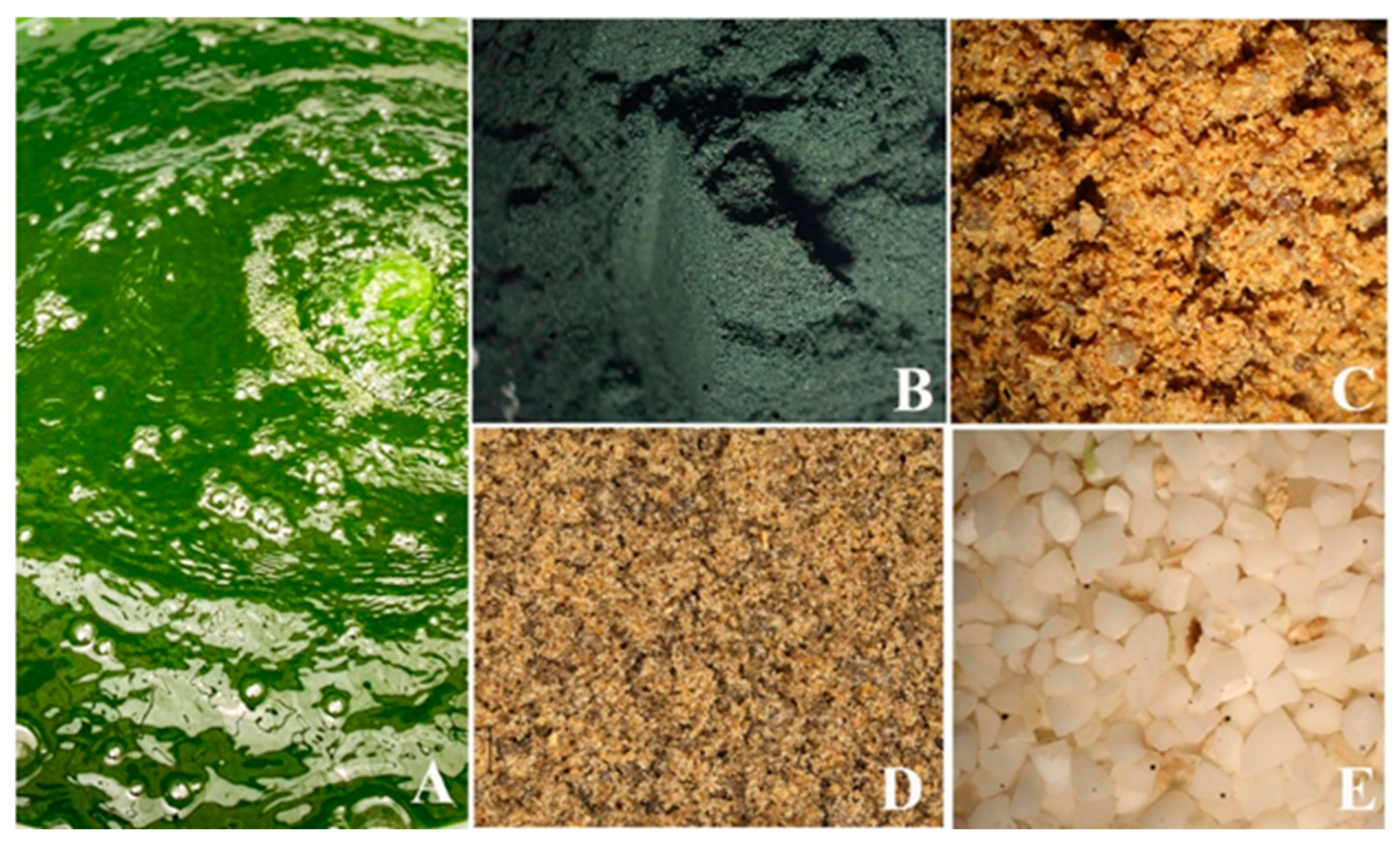
2.1. Experimental Diets
2.2. Experimental Design and Cultivation of Fairy Shrimp
2.3. Feeding Regime
2.4. Water Quality Measurement
2.5. Proximate Composition, Amino Acid, and Carotenoid Analyses
2.6. Statistical Analysis
3. Results
3.1. Growth Performance and Survival
3.2. Proximate Composition, Carotenoids, and Amino Acid Profile
3.3. Water Quality
4. Discussion
5. Conclusions
Author Contributions
Funding
Institutional Review Board Statement
Informed Consent Statement
Data Availability Statement
Acknowledgments
Conflicts of Interest
References
- Pennak, R.W. Fresh-Water Invertebrates of the United States, 3rd ed.; John Wiley and Sons: New York, NY, USA, 1989. [Google Scholar]
- Pinceel, T.; Vanschoenwinkel, B.; Waterkeyn, A.; Vanhove, M.P.M.; Pinder, A.; Timms, B.V.; Brendonck, L. Fairy shrimps in distress: A molecular taxonomic review of the diverse fairy shrimp genus Branchinella (Anostraca: Thamnocephalidae) in Australia in the light of ongoing environmental change. Hydrobiologia 2013, 700, 313–327. [Google Scholar] [CrossRef]
- Rogers, D.C.; Thaimuangphol, W.; Saengphan, N.; Sanoamuang, L.O. Current knowledge of the South East Asian large branchiopod Crustacea (Anostraca Notostraca Laevicaudata Spinicaudata Cyclestherida). J. Limnol. 2013, 72, 5. [Google Scholar] [CrossRef]
- Broch, E.S. Mechanism of Adaptation of the Fairy Shrimp Chirocephalopsis bundyi Forbes to the Temporary Pond (No. 392); Cornell University Agriculture Experimental Station: Ithaca, NY, USA, 1965; 48p. [Google Scholar]
- Thaimuangphol, W.; Sanoamuang, L. Optimal egg viability storage conditions in two commercial fairy shrimps (Crustacea: Branchiopoda: Anostraca) from Thailand. Aquac. Res. 2017, 48, 5029–5040. [Google Scholar] [CrossRef]
- Dararat, W.; Starkweather, P.L.; Sanoamuang, L. Life history of three fairy shrimp (Branchiopoda: Anostraca) from Thailand. J. Crustac. Biol. 2011, 31, 623–629. [Google Scholar] [CrossRef]
- Dumont, H.J.; Munuswamy, N. The potential of freshwater Anostraca for technical applications. Hydrobiologia 1997, 358, 193–197. [Google Scholar] [CrossRef]
- Saengphan, N.; Shiel, R.J.; Sanoamuang, L. The cyst hatching pattern of the Thai fairy shrimp, Branchinella thailandensis Sanoamuang, Saengphan and Murugan, 2002 (Anostraca: Crustacea). Crustaceana 2005, 78, 513–523. [Google Scholar] [CrossRef]
- Sriputhorn, K.; Sanoamuang, L. Fairy shrimp (Streptocephalus sirindhornae) as live feed to improve growth and carotenoid contents of giant freshwater prawns Macrobrachium rosenbergii. Int. J. Zool. Res. 2011, 7, 138–146. [Google Scholar] [CrossRef]
- Pratama, I.; Albasri, H.; Abinawanto. Potential development of fairy shrimp Streptocephalus spp. as aquaculture live feed in Indonesia. IOP Conf. Ser. Earth Environ. Sci. 2020, 521, 012026. [Google Scholar] [CrossRef]
- Namin, I.; Arshad, J.M.; Ramezanpoor, Z. Mass culture of fairy shrimp Streptocephalus proboscideus (Crustacea—Anostraca) and its use in larviculture of the Persian sturgeon, Acipenser persicus. Aquac. Res. 2007, 38, 1088–1092. [Google Scholar] [CrossRef]
- Dararat, W.; Lomthaisong, K.; Sanoamuang, L. Biochemical composition of three fairy shrimp (Branchiopoda: Anostraca) from Thailand. J. Crustac. Biol. 2012, 32, 81–87. [Google Scholar] [CrossRef]
- Daltro, L.A.; de Lima, R.L.; de Oliveira, J.A.; Lemos, D. Dietary carotenoids and lipid interactions in aquatic organisms: Implications for pigmentation and antioxidant capacity. Aquac. Rep. 2021, 20, 100708. [Google Scholar] [CrossRef]
- Arbeláez-Rojas, G.A.; Gama Melão, M.G. Production performance and nutritional quality of the fairy shrimp Dendrocephalus brasiliensis Pesta, 1921 (Crustacea, Anostraca) cultured with fish effluent in a recirculation system. Aquaculture 2022, 548, 737692. [Google Scholar] [CrossRef]
- Thaimuangphol, W.; Sanoamuang, L.; Wangkahart, E. The immune response of fairy shrimp Streptocephalus sirindhornae against bacterial black disease by de novo transcriptome analysis. Fish. Shellfish. Immunol. 2022, 121, 108–115. [Google Scholar] [CrossRef]
- Chaoruangrit, L.; Tapaneeyaworawong, P.; Powtongsook, S.; Sanoamuang, L. Alternative microalgal diets for cultivation of the fairy shrimp Branchinella thailandensis (Branchiopoda: Anostraca). Aquac. Int. 2017, 26, 37–47. [Google Scholar] [CrossRef]
- Thaimuangphol, W.; Sanoamuang, L. Food compositions of two commercial fairy shrimps, Branchinella thailandensis and Streptocephalus sirindhornae (Crustacea Branchiopoda: Anostraca). Int. J. Zool. Res. 2020, 16, 12–19. [Google Scholar] [CrossRef]
- Sornsupharp, S.; Dahms, H.U.; Sanoamuang, L. Nutritional composition of fairy shrimp Streptocephalus sirindhornae nauplii as live food and growth performance of giant freshwater prawn postlarvae. Aquac. Nutr. 2013, 19, 349–359. [Google Scholar] [CrossRef]
- Sornsupharp, B.; Lomthaisong, K.; Dahms, H.U.; Sanoamuang, L. Effects of dried fairy shrimp Streptocephalus sirindhornae meal on pigmentation and carotenoid deposition in flowerhorn cichlid (Amphilophus citrinellus x Cichlasoma trimaculatum). Aquac. Res. 2015, 46, 173–184. [Google Scholar] [CrossRef]
- Pormehr, Y.N.; Beladjal, L.; Agh, N.; Atashbar, B.; Van, S.G. Mass culture of fairy shrimp Branchinecta orientalis (G. O. Sars 1901) (Crustacea: Anostraca) using effluent of rainbow trout Oncorhynchus mykiss (Walbaum 1792) ponds. Aquac. Res. 2017, 48, 5455–5462. [Google Scholar] [CrossRef]
- Plodsomboon, S.; Maeda-Martínez, A.M.; Obregón-Barboza, H.; Sanoamuang, L. Reproductive Cycle and Genitalia of the fairy shrimp Branchinella thailandensis (Branchiopoda, Anostraca). J. Crustac. Biol. 2012, 32, 711–726. [Google Scholar] [CrossRef]
- Plodsomboon, S.; Sanoamuang, L. Effects of Pediastrum boryanum and dried Chlorella as feeds on the growth performance and carotenoid content of the fairy shrimp Branchinella thailandensis (Branchiopoda, Anostraca). Trop. Nat. Hist. 2023, 23, 73–81. [Google Scholar] [CrossRef]
- Vander, W.J.B.; Mikulicz, J.D.; Boysen, M.R.; Hashemi, N.; Kalgren, P.; Nauman, L.M.; Baetzold, S.J.; Powell, G.G.; He, Q.; Hashemi, N.N. Characterization of Chlorella vulgaris and Chlorella protothecoides using multi-pixel photon counters in a 3D focusing optofluidic system. RSC Adv. 2017, 7, 4402–4408. [Google Scholar] [CrossRef]
- Thanakiattiwibun, C.; Srisakultieaw, P.; Athibai, S.; Saengphan, N.; Sanoamuang, L. Comparative reproductive study of two Streptocephalus sirindhornae (Branchiopoda: Anostraca) populations and F1 hybrids: A laboratory study. Hydrobiologia 2017, 801, 71–80. [Google Scholar] [CrossRef]
- Saejung, C.; Chaiyarat, A.; Sanoamuang, L. Optimization of three anoxygenic photosynthetic bacteria as feed to enhance growth, survival, and water quality in fairy shrimp (Streptocephalus sirindhornae) cultivation. Aquaculture 2021, 534, 736288. [Google Scholar] [CrossRef]
- Saengphan, N.; Sriputhorn, K.; Sanoamuang, L. Cultures of Fairy Shrimp in Thailand; Klangnanatham Publishers: Khon Kaen, Thailand, 2006; p. 85. [Google Scholar]
- Panaite, T.D.; Cornescu, G.M.; Predescu, N.C.; Cismileanu, A.; Turcu, R.P.; Saracila, M.; Soica, C. Microalgae (Chlorella vulgaris and Spirulina platensis) as a protein alternative and their effects on productive performances, blood parameters, protein digestibility, and nutritional value of laying hens’ egg. Appl. Sci. 2023, 13, 10451. [Google Scholar] [CrossRef]
- Boonmak, P.; Sanoamuang, L. The effect of wet and dry periods on egg hatchability of Streptocephalus sirindhornae Sanoamuang, Murugan, Weekers & Dumont, 2000. KKU Res. J. (Grad. Stud.) 2005, 5, 47–52. (In Thai) [Google Scholar]
- American Public Health Association (APHA). Standard Methods for the Examination of Water and Wastewater, 15th ed.; APHA: Washington, DC, USA, 1981. [Google Scholar]
- AOAC. Official Method of Analytical Chemists, 17th ed.; Association of Analytical Communities: Rockville, MD, USA, 2000. [Google Scholar]
- Rodriguez-Amaya, D.B.; Kimura, M. Harvestplus Handbook for Carotenoid Analysis; HarvestPlus Technical Monograph 2; International Food Policy Research Institute (IFPRI): Washington, DC, USA; International Center for Tropical Agriculture (CIAT): Cali, Colombia, 2004; 58p. [Google Scholar]
- Tacon, A.G.J.; Metian, M.; Hasan, M.R. Feed Ingredients and Fertilizers for Farmed Aquatic Animals: Sources and Composition; FAO Fisheries and Aquaculture Technical Paper No. 540; FAO: Rome, Italy, 2009. [Google Scholar]


| Developmental Stage | Feed Formula | Body Length (mm) | Wet Body Weight (mg) | Survival Rate (%) |
|---|---|---|---|---|
| 1–5 days | FF1 | 9.80 ± 0.76 a | 0.40 ± 0.01 a | 66.90 ± 2.89 a |
| FF2 | 9.85 ± 1.24 a | 0.40 ± 0.02 a | 63.60 ± 2.74 a | |
| FF3 | 9.42 ± 0.51 ab | 0.30 ± 0.08 bc | 45.90 ± 12.60 ab | |
| FF4 | 9.36 ± 0.20 ab | 0.30 ± 0.11 bc | 45.33 ± 11.52 ab | |
| FF5 | 9.29 ± 0.46 ab | 0.20 ± 0.03 c | 37.20 ± 29.00 bc | |
| FF6 | 9.44 ± 0.25 ab | 0.30 ± 0.04 ab | 37.00 ± 20.10 bc | |
| FF7 | 8.24 ± 0.25 b | 0.20 ± 0.03 c | 30.96 ± 12.00 c | |
| 6–10 days | FF1 | 12.54 ± 0.31 abc | 19.6 ± 3.9 a | 65.75 ± 5.25 a |
| FF2 | 14.06 ± 1.22 a | 23.0 ± 5.2 a | 69.55 ± 9.35 a | |
| FF3 | 13.06 ± 0.75 abc | 19.4 ± 4.7 a | 69.10 ± 4.50 a | |
| FF4 | 13.46 ± 1.01 ab | 16.7 ± 12.6 a | 68.45 ± 13.45 a | |
| FF5 | 12.73 ± 0.61 abc | 24.1 ± 5.6 a | 65.75 ± 15.85 a | |
| FF6 | 11.93 ± 1.33 bc | 15.5 ± 12.0 a | 67.15 ± 15.85 a | |
| FF7 | 11.46 ± 0.98 c | 19.8 ± 1.1 a | 62.65 ± 3.25 a | |
| 11–20 days | FF1 | 18.40 ± 1.38 a | 87.0 ± 14.4 a | 61.85 ± 4.25 a |
| FF2 | 18.53 ± 0.70 a | 87.5 ± 8.1 a | 62.45 ± 5.28 a | |
| FF3 | 18.20 ± 0.80 a | 86.0 ± 6.5 a | 44.45 ± 4.55 b | |
| FF4 | 17.83 ± 0.94 a | 80.3 ± 1.1 a | 42.25 ± 2.75 b | |
| FF5 | 17.60 ± 1.11 a | 67.0 ± 13.0 a | 40.65 ± 4.15 b | |
| FF6 | 17.93 ± 0.11 a | 77.7 ± 5.6 a | 41.78 ± 6.95 b | |
| FF7 | 17.66 ± 0.64 a | 73.3 ± 13.6 a | 38.66 ± 5.53 b |
| Component | S. sirindhornae | Unit | |
|---|---|---|---|
| Fed with Chlorella sp. | Fed with FF2 | ||
| Proximate composition | |||
| Ash | 0.47 | 0.54 | g/100 g |
| Energy | 17.21 | 24.29 | kcal/100 g |
| Moisture | 95.64 | 94.10 | g/100 g |
| Protein (N × 6.25) | 3.18 | 4.73 | g/100 g |
| Total carbohydrate | 0.38 | 0.06 | g/100 g |
| Total lipid | 0.33 | 0.57 | g/100 g |
| Carotenoids | 25.20 | 37.79 | µg g−1 dry weight |
| Amino acid composition | |||
| Essential amino acids (EAA) | |||
| Histidine | 182.32 | 372.36 | mg/100 g |
| Isoleucine | 199.32 | 262.89 | mg/100 g |
| Leucine | 372.58 | 545.88 | mg/100 g |
| Lysine | 679.02 | 1144.00 | mg/100 g |
| Methionine | 60.11 | 85.31 | mg/100 g |
| Phenylalanine | 333.86 | 445.94 | mg/100 g |
| Threonine | 24.09 | 52.23 | mg/100 g |
| Tryptophan | 26.55 | 55.23 | mg/100 g |
| Valine | 137.82 | 181.33 | mg/100 g |
| Total EAA | 2015.67 | 3145.17 | mg/100 g |
| Non-essential amino acids (N-EAA) | |||
| Alanine | 109.21 | 137.74 | mg/100 g |
| Aspartic acid | 70.87 | 166.40 | mg/100 g |
| Cystine | 26.43 | 61.65 | mg/100 g |
| Glutamic acid | 251.09 | 454.37 | mg/100 g |
| Glycine | 71.50 | 95.02 | mg/100 g |
| Proline | 79.56 | 107.38 | mg/100 g |
| Serine | 13.29 | 33.03 | mg/100 g |
| Tyrosine | 233.19 | 368.48 | mg/100 g |
| Total N-EAA | 855.14 | 1424.07 | mg/100 g |
| EAA:N-EAA ratio | 2.36 | 2.21 | — |
| Other/conditionally essential amino acids | |||
| Arginine | <5.00 | <0.50 | mg/100 g |
| Hydroxylysine | <0.50 | <0.50 | mg/100 g |
| Hydroxyproline | 9.11 | 10.19 | mg/100 g |
| Water Quality Parameters | 1–5 Days | 6–10 Days | 11–20 Days |
|---|---|---|---|
| pH | 7.500 ± 1.013 a | 7.100 ± 0.489 a | 6.920 ± 0.493 a |
| Nitrite (mg L−1) | 0.160 ± 0.183 a | 0.100 ± 0.194 a | 0.110 ± 0.144 a |
| Ammonia (mg L−1) | 0.540 ± 0.271 a | 0.330 ± 0.188 a | 0.340 ± 0.320 a |
| Alkalinity (mg L−1 as CaCO3) | 44.000 ± 11.73 a | 44.000 ± 14.29 a | 34.000 ± 9.660 a |
| Hardness (mg L−1 as CaCO3) | 60.000 ± 21.080 a | 65.000 ± 24.150 a | 55.000 ± 15.810 a |
| Dissolved oxygen (mg L−1) | 9.900 ± 1.370 a | 10.100 ± 1.646 a | 11.500 ± 3.415 a |
Disclaimer/Publisher’s Note: The statements, opinions and data contained in all publications are solely those of the individual author(s) and contributor(s) and not of MDPI and/or the editor(s). MDPI and/or the editor(s) disclaim responsibility for any injury to people or property resulting from any ideas, methods, instructions or products referred to in the content. |
© 2026 by the authors. Licensee MDPI, Basel, Switzerland. This article is an open access article distributed under the terms and conditions of the Creative Commons Attribution (CC BY) license.
Share and Cite
Sriphuthorn, K.; Dabseepai, P.; Senasri, N. Evaluation of Dry Feed Formulations for Culturing the Commercial Fairy Shrimp Streptocephalus sirindhornae. Biology 2026, 15, 893. https://doi.org/10.3390/biology15110893
Sriphuthorn K, Dabseepai P, Senasri N. Evaluation of Dry Feed Formulations for Culturing the Commercial Fairy Shrimp Streptocephalus sirindhornae. Biology. 2026; 15(11):893. https://doi.org/10.3390/biology15110893
Chicago/Turabian StyleSriphuthorn, Kosit, Prapatsorn Dabseepai, and Naiyana Senasri. 2026. "Evaluation of Dry Feed Formulations for Culturing the Commercial Fairy Shrimp Streptocephalus sirindhornae" Biology 15, no. 11: 893. https://doi.org/10.3390/biology15110893
APA StyleSriphuthorn, K., Dabseepai, P., & Senasri, N. (2026). Evaluation of Dry Feed Formulations for Culturing the Commercial Fairy Shrimp Streptocephalus sirindhornae. Biology, 15(11), 893. https://doi.org/10.3390/biology15110893