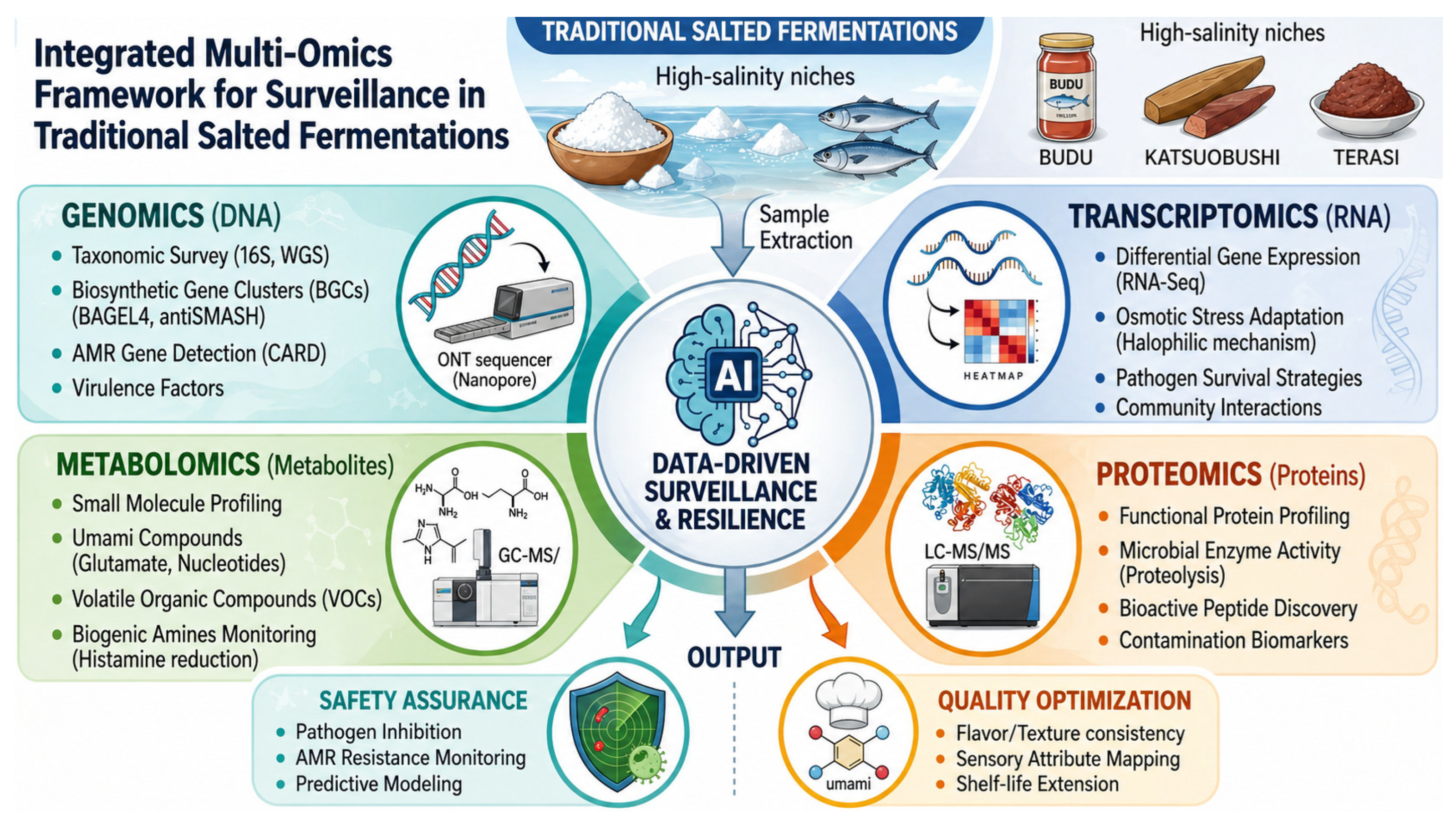
Mechanistic Systems Biology of High-Salinity Fermented Seafood: Multi-Omics Integration for Microbial Safety and Quality Prediction

 , , ,
, , ,
Simple Summary
Abstract
1. Introduction: Food Safety and Microbial Ecology of High-Salinity Fermented Seafood
1.1. The Microbial Landscape and Environmental Selection
1.2. Transitioning from Descriptive to Predictive Frameworks
2. Ecological Diversity and Environmental Selection in High-Salinity Food Matrices
2.1. Diversity Across Physical Fermentation Niches
2.2. Osmotic Stress and Microbial Adaptation Strategies
2.3. A Unified Framework for Functional Succession
3. Genomic Landscapes: Decoding Microbial Potential, Safety Risks and Adaptive Traits
3.1. Decoding Genomic Adaptations to Osmotic Stress
3.2. Metagenomic Surveillance: Identifying Hazards and AMR Determinants
3.3. Functional Genome Mining for Natural Biopreservatives
4. Transcriptional Dynamics: Mechanisms of Microbial Survival Under Osmotic Stress
4.1. Quantifying the Adaptive Response to Environmental Filters
4.2. Survival Strategies and Pathogen Persistence
4.3. Moving from Descriptive to Functional Synthesis
5. Functional Proteomics: Profiling Enzymatic Activity and Safety Biomarkers
5.1. Enzymatic Activity and Protein-Level Salt Adaptation
5.2. Discovery of Functional Safety and Quality Biomarkers
5.3. Integrated Proteogenomics: Linking Genetic Potential to Protein Function
6. Metabolomic Signatures: Mapping Chemical Indicators of Quality and Safety
6.1. Mapping Umami and Aromatic Flux
6.2. Quantitative Safety Thresholds and Biogenic Amines
6.3. Toward Predictive Surveillance and Process Optimization
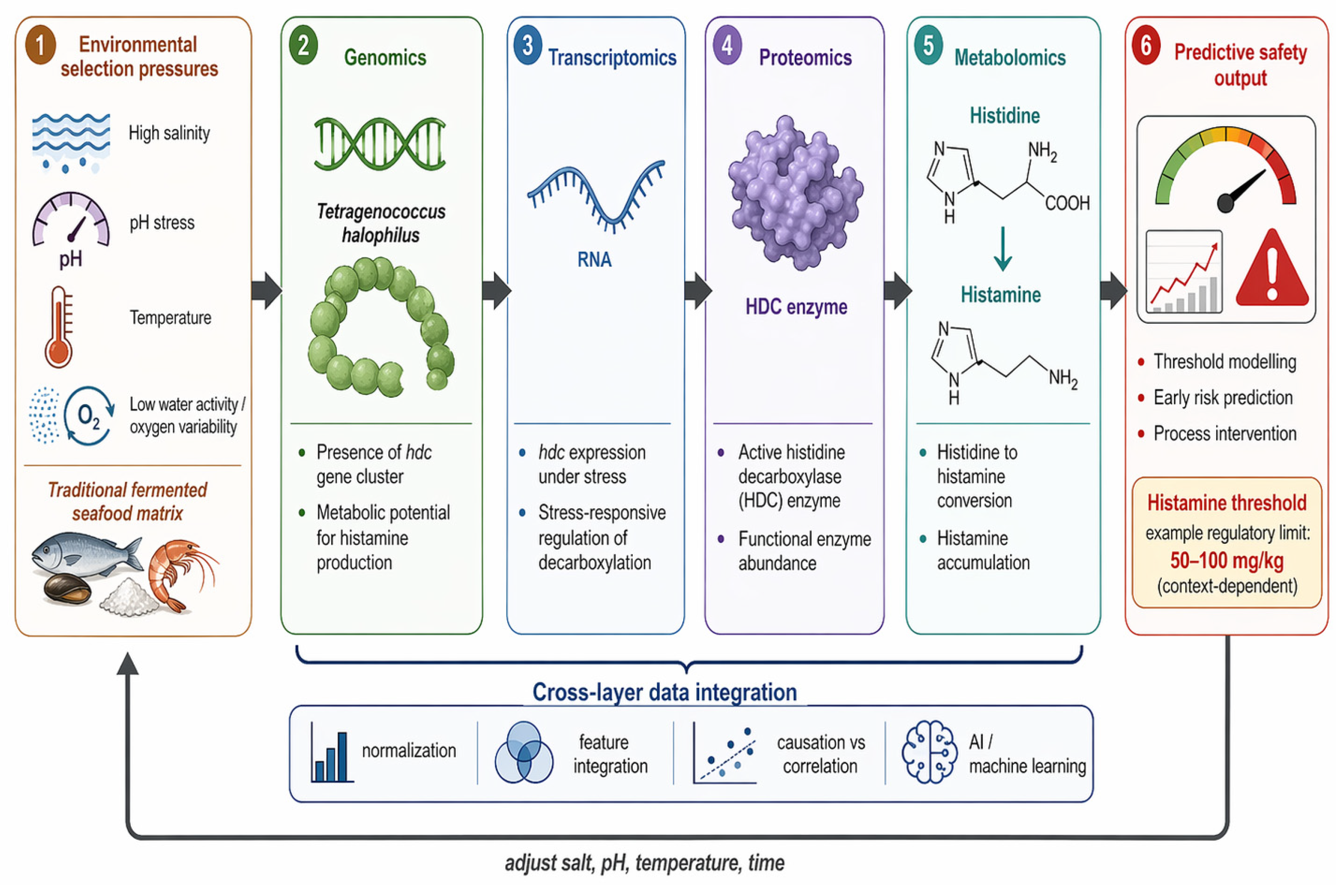
7. Conceptual Systems Biology Framework for Deciphering Histamine Flux in Tetragenococcus halophilus
7.1. From Genetic Potential to Functional Risk
7.2. Transcriptional and Proteomic Regulation of Histamine Formation
7.3. Metabolomic Readout and Predictive Safety Modelling
8. Technical Challenges in Multi-Omics Data Integration
8.1. Normalization and Cross-Platform Variability
8.2. Distinguishing Correlation from Causation
8.3. AI-Driven Integration and Predictive Modeling
9. Future Perspectives: From Single-Cell Resolution to Digital Traceability
9.1. High-Resolution Omics: Single-Cell and Spatial Analysis
9.2. Artificial Intelligence and the “Digital Twin” Concept
9.3. Data Standardization and Global Traceability
10. Conclusions
Supplementary Materials
Author Contributions
Funding
Institutional Review Board Statement
Informed Consent Statement
Data Availability Statement
Conflicts of Interest
References
- Hussain, M.A.; Dawson, C.O. Economic Impact of Food Safety Outbreaks on Food Businesses. Foods 2013, 2, 585–589. [Google Scholar] [CrossRef]
- World Health Organization. WHO Estimates of the Global Burden of Foodborne Diseases: Foodborne Disease Burden Epidemiology Reference Group 2007–2015; World Health Organization: Geneva, Switzerland, 2015. [Google Scholar]
- World Health Organization. Burden of Foodborne Diseases in the South-East Asia Region; World Health Organization: Geneva, Switzerland, 2016. [Google Scholar]
- Cuamatzin-García, L.; Rodríguez-Rugarcía, P.; El-Kassis, E.G.; Galicia, G.; Meza-Jiménez, M.d.L.; Baños-Lara, M.d.R.; Zaragoza-Maldonado, D.S.; Pérez-Armendáriz, B. Traditional Fermented Foods and Beverages from around the World and Their Health Benefits. Microorganisms 2022, 10, 1151. [Google Scholar] [CrossRef]
- Tamang, J.P.; Cotter, P.D.; Endo, A.; Han, N.S.; Kort, R.; Liu, S.Q.; Mayo, B.; Westerik, N.; Hutkins, R. Fermented foods in a global age: East meets West. Compr. Rev. Food Sci. Food Saf. 2020, 19, 184–217. [Google Scholar] [CrossRef]
- Narzary, Y.; Das, S.; Goyal, A.K.; Lam, S.S.; Sarma, H.; Sharma, D. Fermented fish products in South and Southeast Asian cuisine: Indigenous technology processes, nutrient composition, and cultural significance. J. Ethn. Foods 2021, 8, 33. [Google Scholar] [CrossRef]
- Ibrahim, S.A.; Ayivi, R.D.; Zimmerman, T.; Siddiqui, S.A.; Altemimi, A.B.; Fidan, H.; Esatbeyoglu, T.; Bakhshayesh, R.V. Lactic Acid Bacteria as Antimicrobial Agents: Food Safety and Microbial Food Spoilage Prevention. Foods 2021, 10, 3131. [Google Scholar] [CrossRef]
- Zapaśnik, A.; Sokołowska, B.; Bryła, M. Role of Lactic Acid Bacteria in Food Preservation and Safety. Foods 2022, 11, 1283. [Google Scholar] [CrossRef]
- Kothe, C.I.; Bolotin, A.; Kraiem, B.F.; Dridi, B.; Food Microbiome Team; Renault, P. Unraveling the world of halophilic and halotolerant bacteria in cheese by combining cultural, genomic and metagenomic approaches. Int. J. Food Microbiol. 2021, 358, 109312. [Google Scholar] [CrossRef] [PubMed]
- Chan, S.X.Y.; Fitri, N.; Mio Asni, N.S.; Sayuti, N.H.; Azlan, U.K.; Qadi, W.S.M.; Dawoud, E.A.D.; Kamal, N.; Sarian, M.N.; Mohd Lazaldin, M.A.; et al. A Comprehensive Review with Future Insights on the Processing and Safety of Fermented Fish and the Associated Changes. Foods 2023, 12, 558. [Google Scholar] [CrossRef] [PubMed]
- Rodpai, R.; Sanpool, O.; Thanchomnang, T.; Wangwiwatsin, A.; Sadaow, L.; Phupiewkham, W.; Boonroumkaew, P.; Intapan, P.M.; Maleewong, W. Investigating the microbiota of fermented fish products (Pla-ra) from different communities of northeastern Thailand. PLoS ONE 2021, 16, e0245227. [Google Scholar] [CrossRef]
- Song, E.J.; Lee, E.S.; Park, S.L.; Choi, H.J.; Roh, S.W.; Nam, Y.D. Bacterial community analysis in three types of the fermented seafood, jeotgal, produced in South Korea. Biosci. Biotechnol. Biochem. 2018, 82, 1444–1454. [Google Scholar] [CrossRef] [PubMed]
- Helmi, H.; Astuti, D.I.; Putri, S.P.; Sato, A.; Laviña, W.A.; Fukusaki, E.; Aditiawati, P. Dynamic Changes in the Bacterial Community and Metabolic Profile during Fermentation of Low-Salt Shrimp Paste (Terasi). Metabolites 2022, 12, 118. [Google Scholar] [CrossRef]
- Mizusawa, N.; Ouchi, D.; Nishimura, K.; Yasumoto, K.; Jimbo, M.; Ueki, N.; Matsuoka, Y.; Wan, J.; Yokoyama, T.; Watabe, S. Changes in Metabolite Concentrations and Bacterial Community of Salted and Fermented Squid Shiokara During Processing. ACS Food Sci. Technol. 2024, 5, 480–491. [Google Scholar] [CrossRef]
- Umeki, Y.; Hayabuchi, H.; Hisano, M.; Kuroda, M.; Honda, M.; Ando, B.; Ohta, M.; Ikeda, M. The Effect of the Dried-Bonito Broth on Blood Pressure, 8-Hydroxydeoxyguanosine (8-OHdG), an Oxidative Stress Marker, and Emotional States in Elderly Subjects. J. Clin. Biochem. Nutr. 2008, 43, 175–184. [Google Scholar] [CrossRef][Green Version]
- Giyatmi, G.; Irianto, H.E. Indonesian Traditional Fermented Fish Ikan Peda. In Encyclopedia of Marine Biotechnology; John Wiley & Sons Ltd.: Hoboken, NJ, USA, 2020. [Google Scholar]
- Marlida, Y.; Susalam, M.K.; Harnentis, H.; Jamsari, J.; Huda, N.; Noordin, W.N.M.; Anggraini, L.; Ardani, L.R. Metagenomic analysis and biodiversity of bacteria in traditional fermented fish or Budu from West Sumatera, Indonesia. J. Adv. Vet. Anim. Res. 2023, 10, 801–808. [Google Scholar] [CrossRef] [PubMed]
- Nghia, N.D.; Trung, T.S.; Dat, P. “Nuoc Mam” Fish sauce in Vietnam: A long history from popular seasoning to health benefit bioactive peptides. Ann. Food Process Preserv. 2017, 2, 1017. [Google Scholar]
- Widyastuti, P.; Riyadi, P.H.; Ibrahim, R. Mutu kecap ikan yang terbuat dari isi perut ikan manyung (Arius thalassinus) dengan konsentrasi garam yang berbeda. J. Saintek Perikan. 2014, 9, 18–23. [Google Scholar]
- Wongkhalaung, C. Industrialization of Thai fish sauce (Nam pla). In Industrialization of Indigenous Fermented Foods; Marcel Dekker Inc.: New York, NY, USA, 2004. [Google Scholar]
- Prihanto, A.A.; Muyasyaroh, H. The Indonesian fermented food product terasi: History and potential bioactivities. Syst. Rev. Pharm. 2021, 12, 378–384. [Google Scholar]
- Krusong, W. Production of Thai fermented fish: Plara, pla-som, som-fak. In Industrialization of Indigenous Fermented Foods; Marcel Dekker Inc.: New York, NY, USA, 2004. [Google Scholar]
- Murwani, R.; Anggraeni, R.; Setiawan, G.N.A.; Astari, P.D.; Cahyani, N.K.D.; Sibero, M.T.; Ambariyanto, A. Lactic acid bacteria isolates and the microbiome of Cincalok, Tempoyak, and Mandai: A traditional fermented food from Kalimantan Island, Indonesia. Int. J. Food Sci. 2024, 2024, 6589766. [Google Scholar] [CrossRef]
- Das, P.; Chatterjee, S.; Behera, B.K.; Dangar, T.K.; Das, B.K.; Mohapatra, T. Isolation and characterization of marine bacteria from East Coast of India: Functional screening for salt stress tolerance. Heliyon 2019, 5, e01869. [Google Scholar] [CrossRef]
- Gunde-Cimerman, N.; Plemenitaš, A.; Oren, A. Strategies of adaptation of microorganisms of the three domains of life to high salt concentrations. FEMS Microbiol. Rev. 2018, 42, 353–375. [Google Scholar] [CrossRef]
- Ly, D.; Mayrhofer, S.; Agung Yogeswara, I.B.; Nguyen, T.H.; Domig, K.J. Identification, Classification and Screening for gamma-Amino-butyric Acid Production in Lactic Acid Bacteria from Cambodian Fermented Foods. Biomolecules 2019, 9, 768. [Google Scholar] [CrossRef]
- Mohd Isa, M.H.; Shamsudin, N.H.; Al-Shorgani, N.K.N.; Alsharjabi, F.A.; Kalil, M.S. Evaluation of antibacterial potential of biosurfactant produced by surfactin-producing Bacillus isolated from selected Malaysian fermented foods. Food Biotechnol. 2020, 34, 1–24. [Google Scholar] [CrossRef]
- Schirone, M.; Esposito, L.; D’Onofrio, F.; Visciano, P.; Martuscelli, M.; Mastrocola, D.; Paparella, A. Biogenic Amines in Meat and Meat Products: A Review of the Science and Future Perspectives. Foods 2022, 11, 788. [Google Scholar] [CrossRef]
- Satam, H.; Joshi, K.; Mangrolia, U.; Waghoo, S.; Zaidi, G.; Rawool, S.; Thakare, R.P.; Banday, S.; Mishra, A.K.; Das, G.; et al. Next-Generation Sequencing Technology: Current Trends and Advancements. Biology 2023, 12, 997. [Google Scholar] [CrossRef]
- Antelmann, H.; Sapolsky, R.; Miller, B.; Ferrari, E.; Chotani, G.; Weyler, W.; Gaertner, A.; Hecker, M. Quantitative proteome profiling during the fermentation process of pleiotropic Bacillus subtilis mutants. Proteomics 2004, 4, 2408–2424. [Google Scholar] [CrossRef]
- Gao, Y.; Hou, L.; Gao, J.; Li, D.; Tian, Z.; Fan, B.; Wang, F.; Li, S. Metabolomics Approaches for the Comprehensive Evaluation of Fermented Foods: A Review. Foods 2021, 10, 2294. [Google Scholar] [CrossRef]
- Utpott, M.; Rodrigues, E.; Rios, A.O.; Mercali, G.D.; Flôres, S.H. Metabolomics: An analytical technique for food processing evaluation. Food Chem. 2022, 366, 130685. [Google Scholar] [CrossRef]
- Allard, M.W.; Bell, R.; Ferreira, C.M.; Gonzalez-Escalona, N.; Hoffmann, M.; Muruvanda, T.; Ottesen, A.; Ramachandran, P.; Reed, E.; Sharma, S.; et al. Genomics of foodborne pathogens for microbial food safety. Curr. Opin. Biotechnol. 2018, 49, 224–229. [Google Scholar] [CrossRef] [PubMed]
- NicAogáin, K.; O’Byrne, C.P. The Role of Stress and Stress Adaptations in Determining the Fate of the Bacterial Pathogen Listeria monocytogenes in the Food Chain. Front. Microbiol. 2016, 7, 1865. [Google Scholar] [CrossRef] [PubMed]
- Meng, F.; Lyu, F.; Bie, X.; Lu, Y.; Lu, Z. Advances in transcriptomic analysis of Salmonella biofilms and their correlation with food safety. Curr. Opin. Food Sci. 2024, 55, 101110. [Google Scholar] [CrossRef]
- Vieira, K.C.O.; Silva, H.; Rocha, I.P.M.; Barboza, E.; Eller, L.K.W. Foodborne pathogens in the omics era. Crit. Rev. Food Sci. Nutr. 2022, 62, 6726–6741. [Google Scholar] [CrossRef]
- Roberts, M.F. Organic compatible solutes of halotolerant and halophilic microorganisms. Saline Syst. 2005, 1, 5. [Google Scholar] [CrossRef]
- McArthur, A.G.; Waglechner, N.; Nizam, F.; Yan, A.; Azad, M.A.; Baylay, A.J.; Bhullar, K.; Canova, M.J.; De Pascale, G.; Ejim, L.; et al. The comprehensive antibiotic resistance database. Antimicrob. Agents Chemother. 2013, 57, 3348–3357. [Google Scholar] [CrossRef]
- Seemann, T. Prokka: Rapid prokaryotic genome annotation. Bioinformatics 2014, 30, 2068–2069. [Google Scholar] [CrossRef] [PubMed]
- van Heel, A.J.; de Jong, A.; Song, C.; Viel, J.H.; Kok, J.; Kuipers, O.P. BAGEL4: A user-friendly web server to thoroughly mine RiPPs and bacteriocins. Nucleic Acids Res. 2018, 46, W278–W281. [Google Scholar] [CrossRef] [PubMed]
- Blin, K.; Shaw, S.; Vader, L.; Szenei, J.; Reitz, Z.L.; Augustijn, H.E.; Cediel-Becerra, J.D.D.; de Crécy-Lagard, V.; Koetsier, R.A.; Williams, S.E.; et al. antiSMASH 8.0: Extended gene cluster detection capabilities and analyses of chemistry, enzymology, and regulation. Nucleic Acids Res. 2025, 53, W32–W38. [Google Scholar] [CrossRef]
- Hammami, R.; Zouhir, A.; Le Lay, C.; Ben Hamida, J.; Fliss, I. BACTIBASE second release: A database and tool platform for bacteriocin characterization. BMC Microbiol. 2010, 10, 22. [Google Scholar] [CrossRef]
- Shekhawat, K.; Patterton, H.; Bauer, F.F.; Setati, M.E. RNA-seq based transcriptional analysis of Saccharomyces cerevisiae and Lachancea thermotolerans in mixed-culture fermentations under anaerobic conditions. BMC Genom. 2019, 20, 145. [Google Scholar] [CrossRef]
- Srivastava, A.K.; Srivastava, R.; Sharma, A.; Bharati, A.P.; Yadav, J.; Singh, A.K.; Tiwari, P.K.; Srivatava, A.K.; Chakdar, H.; Kashyap, P.L.; et al. Transcriptome Analysis to Understand Salt Stress Regulation Mechanism of Chromohalobacter salexigens ANJ207. Front. Microbiol. 2022, 13, 909276. [Google Scholar] [CrossRef]
- Srikumar, S.; Cao, Y.; Yan, Q.; Van Hoorde, K.; Nguyen, S.; Cooney, S.; Gopinath, G.R.; Tall, B.D.; Sivasankaran, S.K.; Lehner, A.; et al. RNA Sequencing-Based Transcriptional Overview of Xerotolerance in Cronobacter sakazakii SP291. Appl. Environ. Microbiol. 2019, 85, e01993-18. [Google Scholar] [CrossRef]
- Yang, H.; He, Y.; Liao, J.; Li, X.; Zhang, J.; Liebl, W.; Chen, F. RNA-Seq transcriptomic analysis reveals gene expression profiles of acetic acid bacteria under high-acidity submerged industrial fermentation process. Front. Microbiol. 2022, 13, 956729. [Google Scholar] [CrossRef]
- Lee, J.J.; Choi, Y.J.; Lee, M.J.; Park, S.J.; Oh, S.J.; Yun, Y.R.; Min, S.G.; Seo, H.Y.; Park, S.H.; Lee, M.A. Effects of combining two lactic acid bacteria as a starter culture on model kimchi fermentation. Food Res. Int. 2020, 136, 109591. [Google Scholar] [CrossRef] [PubMed]
- Jung, J.Y.; Lee, S.H.; Jin, H.M.; Hahn, Y.; Madsen, E.L.; Jeon, C.O. Metatranscriptomic analysis of lactic acid bacterial gene expression during kimchi fermentation. Int. J. Food Microbiol. 2013, 163, 171–179. [Google Scholar] [CrossRef]
- Liu, J.; Mai, R.; Liu, P.; Guo, S.; Yang, J.; Bai, W. Flavor Formation in Dry-Cured Fish: Regulation by Microbial Communities and Endogenous Enzymes. Foods 2023, 12, 3020. [Google Scholar] [CrossRef]
- Aguiar-Pulido, V.; Huang, W.; Suarez-Ulloa, V.; Cickovski, T.; Mathee, K.; Narasimhan, G. Metagenomics, Metatranscriptomics, and Metabolomics Approaches for Microbiome Analysis. Evol. Bioinform. 2016, 12, 5–16. [Google Scholar] [CrossRef] [PubMed]
- Hibbing, M.E.; Fuqua, C.; Parsek, M.R.; Peterson, S.B. Bacterial competition: Surviving and thriving in the microbial jungle. Nat. Rev. Microbiol. 2010, 8, 15–25. [Google Scholar] [CrossRef]
- Sharma, R.; Garg, P.; Kumar, P.; Bhatia, S.K.; Kulshrestha, S. Microbial fermentation and its role in quality improvement of fermented foods. Fermentation 2020, 6, 106. [Google Scholar] [CrossRef]
- Siragusa, S.; De Angelis, M.; Calasso, M.; Campanella, D.; Minervini, F.; Di Cagno, R.; Gobbetti, M. Fermentation and proteome profiles of Lactobacillus plantarum strains during growth under food-like conditions. J. Proteom. 2014, 96, 366–380. [Google Scholar] [CrossRef]
- Malik, A.K.; Blasco, C.; Picó, Y. Liquid chromatography–mass spectrometry in food safety. J. Chromatogr. A 2010, 1217, 4018–4040. [Google Scholar] [CrossRef] [PubMed]
- Shukla, H.D. Proteomic analysis of acidic chaperones, and stress proteins in extreme halophile Halobacterium NRC-1: A comparative proteomic approach to study heat shock response. Proteome Sci. 2006, 4, 6. [Google Scholar] [CrossRef]
- Rubiano-Labrador, C.; Bland, C.; Miotello, G.; Armengaud, J.; Baena, S. Salt Stress Induced Changes in the Exoproteome of the Halotolerant Bacterium Tistlia consotensis Deciphered by Proteogenomics. PLoS ONE 2015, 10, e0135065. [Google Scholar] [CrossRef][Green Version]
- Fourie, K.R.; Wilson, H.L. Understanding GroEL and DnaK Stress Response Proteins as Antigens for Bacterial Diseases. Vaccines 2020, 8, 773. [Google Scholar] [CrossRef]
- Savaiano, D.A.; Hutkins, R.W. Yogurt, cultured fermented milk, and health: A systematic review. Nutr. Rev. 2021, 79, 599–614. [Google Scholar] [CrossRef]
- Lopez-Pedrouso, M.; Lorenzo, J.M.; Gagaoua, M.; Franco, D. Current Trends in Proteomic Advances for Food Allergen Analysis. Biology 2020, 9, 247. [Google Scholar] [CrossRef]
- Zhao, D.; Chong, Y.; Hu, J.; Zhou, X.; Xiao, C.; Chen, W. Proteomics and metagenomics reveal the relationship between microbial metabolism and protein hydrolysis in dried fermented grass carp using a lactic acid bacteria starter culture. Curr. Res. Food Sci. 2022, 5, 2316–2328. [Google Scholar] [CrossRef]
- Ang, M.Y.; Low, T.Y.; Lee, P.Y.; Wan Mohamad Nazarie, W.F.; Guryev, V.; Jamal, R. Proteogenomics: From next-generation sequencing (NGS) and mass spectrometry-based proteomics to precision medicine. Clin. Chim. Acta 2019, 498, 38–46. [Google Scholar] [CrossRef]
- Pessione, E.; Cirrincione, S. Bioactive Molecules Released in Food by Lactic Acid Bacteria: Encrypted Peptides and Biogenic Amines. Front. Microbiol. 2016, 7, 876. [Google Scholar] [CrossRef] [PubMed]
- Belleggia, L.; Milanović, V.; Cardinali, F.; Garofalo, C.; Clementi, F.; Aquilanti, L.; Osimani, A. Prevalence of Histidine Decarboxylase Genes of Gram-Positive Bacteria in Surströmming as Revealed by qPCR. Indian J. Microbiol. 2021, 61, 96–99. [Google Scholar] [CrossRef] [PubMed]
- Walsh, A.M.; Leech, J.; Huttenhower, C.; Delhomme-Nguyen, H.; Crispie, F.; Chervaux, C.; Cotter, P.D. Integrated molecular approaches for fermented food microbiome research. FEMS Microbiol. Rev. 2023, 47, fuad001. [Google Scholar] [CrossRef]
- Hatzakis, E. Nuclear Magnetic Resonance (NMR) Spectroscopy in Food Science: A Comprehensive Review. Compr. Rev. Food Sci. Food Saf. 2019, 18, 189–220. [Google Scholar] [CrossRef] [PubMed]
- Wang, W.; Zhou, X.; Liu, Y. Characterization and evaluation of umami taste: A review. TrAC Trends Anal. Chem. 2020, 127, 115876. [Google Scholar] [CrossRef]
- Reese, K.L.; Rasley, A.; Avila, J.R.; Jones, A.D.; Frank, M. Metabolic Profiling of Volatile Organic Compounds (VOCs) Emitted by the Pathogens Francisella tularensis and Bacillus anthracis in Liquid Culture. Sci. Rep. 2020, 10, 9333. [Google Scholar] [CrossRef]
- Silva, M.S.; Cordeiro, C. New findings in metabolomics in food mycology. Curr. Opin. Food Sci. 2024, 57, 101175. [Google Scholar] [CrossRef]
- Visciano, P.; Schirone, M.; Tofalo, R.; Suzzi, G. Histamine poisoning and control measures in fish and fishery products. Front. Microbiol. 2014, 5, 500. [Google Scholar] [CrossRef]
- U.S. Food and Drug Administration. CPG Sec. 540.525 Scombrotoxin (Histamine)-forming Fish and Fishery Products—Decomposition and Histamine (CPG 7108.24); U.S. Food and Drug Administration: Silver Spring, MD, USA, 2024.
- CXS 302-2011; Standard for Fish Sauce. Codex Alimentarius: Rome, Italy, 2011.
- Viant, M.R.; Ebbels, T.M.D.; Beger, R.D.; Ekman, D.R.; Epps, D.J.T.; Kamp, H.; Leonards, P.E.G.; Loizou, G.D.; MacRae, J.I.; van Ravenzwaay, B.; et al. Use cases, best practice and reporting standards for metabolomics in regulatory toxicology. Nat. Commun. 2019, 10, 3041. [Google Scholar] [CrossRef]
- Saha Turna, N.; Chung, R.; McIntyre, L. A review of biogenic amines in fermented foods: Occurrence and health effects. Heliyon 2024, 10, e24501. [Google Scholar] [CrossRef]
- Takahashi, H.; Kimura, B.; Yoshikawa, M.; Fujii, T. Cloning and sequencing of the histidine decarboxylase genes of gram-negative, histamine-producing bacteria and their application in detection and identification of these organisms in fish. Appl. Environ. Microbiol. 2003, 69, 2568–2579. [Google Scholar] [CrossRef]
- Keneally, C.; Gaget, V.; Chilton, D.; Dornan, T.N.; Hensel, J.; Keneally, A.E.; Kidd, S.P.; Brookes, J.D. Extreme Salinity Change Governs Microbial Community Assembly and Interactions. Environ. Microbiol. Rep. 2026, 18, e70301. [Google Scholar] [CrossRef]
- Atasoy, M.; Ordóñez, A.Á.; Cenian, A.; Djukić-Vuković, A.; Lund, P.A.; Ozogul, F.; Trček, J.; Ziv, C.; De Biase, D. Exploitation of microbial activities at low pH to enhance planetary health. FEMS Microbiol. Rev. 2024, 48, fuad062. [Google Scholar] [CrossRef]
- Webster, M.W.; Weixlbaumer, A. The intricate relationship between transcription and translation. Proc. Natl. Acad. Sci. USA 2021, 118, e2106284118. [Google Scholar] [CrossRef]
- Chen, Z.; Jiang, S. Chemical Signaling and Metabolomic Crosstalk in Endophytic Fungi–Medicinal Plant Symbioses for Natural Product Discovery and Sustainable Bioproduction. Metabolites 2026, 16, 164. [Google Scholar] [CrossRef]
- Clarke, R.; Ressom, H.W.; Wang, A.; Xuan, J.; Liu, M.C.; Gehan, E.A.; Wang, Y. The properties of high-dimensional data spaces: Implications for exploring gene and protein expression data. Nat. Rev. Cancer 2008, 8, 37–49. [Google Scholar] [CrossRef]
- Yan, C. A review on spectral data preprocessing techniques for machine learning and quantitative analysis. iScience 2025, 28, 112759. [Google Scholar] [CrossRef]
- Yu, Y.; Mai, Y.; Zheng, Y.; Shi, L. Assessing and mitigating batch effects in large-scale omics studies. Genome Biol. 2024, 25, 254. [Google Scholar] [CrossRef]
- O’Donnell, S.T.; Ross, R.P.; Stanton, C. The Progress of Multi-Omics Technologies: Determining Function in Lactic Acid Bacteria Using a Systems Level Approach. Front. Microbiol. 2019, 10, 3084. [Google Scholar] [CrossRef]
- Sherwani, M.K.; Ruuskanen, M.O.; Feldner-Busztin, D.; Nisantzis Firbas, P.; Boza, G.; Móréh, Á.; Borman, T.; Putu Erawijantari, P.; Scheuring, I.; Gopalakrishnan, S.; et al. Multi-omics time-series analysis in microbiome research: A systematic review. Brief. Bioinform. 2025, 26, bbaf502. [Google Scholar] [CrossRef]
- Li, P.; Luo, H.; Ji, B.; Nielsen, J. Machine learning for data integration in human gut microbiome. Microb. Cell Fact. 2022, 21, 241. [Google Scholar] [CrossRef]
- Jiang, Y.; Luo, J.; Huang, D.; Liu, Y.; Li, D.D. Machine Learning Advances in Microbiology: A Review of Methods and Applications. Front. Microbiol. 2022, 13, 925454. [Google Scholar] [CrossRef]
- Su, G.; Yu, C.; Liang, S.; Wang, W.; Wang, H. Multi-omics in food safety and authenticity in terms of food components. Food Chem. 2024, 437, 137943. [Google Scholar] [CrossRef]
- Lloréns-Rico, V.; Simcock, J.A.; Huys, G.R.B.; Raes, J. Single-cell approaches in human microbiome research. Cell 2022, 185, 2725–2738. [Google Scholar] [CrossRef]
- Kong, S.; Li, R.; Tian, Y.; Zhang, Y.; Lu, Y.; Ou, Q.; Gao, P.; Li, K.; Zhang, Y. Single-cell omics: A new direction for functional genetic research in human diseases and animal models. Front. Genet. 2022, 13, 1100016. [Google Scholar] [CrossRef]
- Liu, L.; Zhang, W.; Wang, C.; Ge, X.; Cao, Y.; Zhang, Q. Study on the spatial distribution characteristics of microbial communities and their environmental driving factors in Bing’an Reservoir after initial impoundment. Front. Microbiol. 2026, 17, 1768906. [Google Scholar] [CrossRef]
- Ahmed, Z.; Wan, S.; Zhang, F.; Zhong, W. Artificial intelligence for omics data analysis. BMC Methods 2024, 1, 4. [Google Scholar] [CrossRef]
- Reel, P.S.; Reel, S.; Pearson, E.; Trucco, E.; Jefferson, E. Using machine learning approaches for multi-omics data analysis: A review. Biotechnol. Adv. 2021, 49, 107739. [Google Scholar] [CrossRef]
- Alsalloum, G.A.; Al Sawaftah, N.M.; Percival, K.M.; Husseini, G.A. Digital Twins of Biological Systems: A Narrative Review. IEEE Open J. Eng. Med. Biol. 2024, 5, 670–677. [Google Scholar] [CrossRef]
- Healy, M.J.; Tong, W.; Ostroff, S.; Eichler, H.G.; Patak, A.; Neuspiel, M.; Deluyker, H.; Slikker, W., Jr. Regulatory bioinformatics for food and drug safety. Regul. Toxicol. Pharmacol. 2016, 80, 342–347. [Google Scholar] [CrossRef]
- Middleton, A.; Adams, A.; Aidid, H.; Atutornu, J.; Boraschi, D.; Borra, J.; Bircan, T.; Burch, C.; Costa, A.; Dickinson, A.; et al. Public engagement with genomics. Wellcome Open Res. 2023, 8, 310. [Google Scholar] [CrossRef]
- Bankevich, A.; Nurk, S.; Antipov, D.; Gurevich, A.A.; Dvorkin, M.; Kulikov, A.S.; Lesin, V.M.; Nikolenko, S.I.; Pham, S.; Prjibelski, A.D.; et al. SPAdes: A new genome assembly algorithm and its applications to single-cell sequencing. J. Comput. Biol. 2012, 19, 455–477. [Google Scholar] [CrossRef]
- Gurevich, A.; Saveliev, V.; Vyahhi, N.; Tesler, G. QUAST: Quality assessment tool for genome assemblies. Bioinformatics 2013, 29, 1072–1075. [Google Scholar] [CrossRef]
- Li, D.; Liu, C.M.; Luo, R.; Sadakane, K.; Lam, T.W. MEGAHIT: An ultra-fast single-node solution for large and complex metagenomics assembly via succinct de Bruijn graph. Bioinformatics 2015, 31, 1674–1676. [Google Scholar] [CrossRef]
- Argimon, S.; Yeats, C.A.; Goater, R.J.; Abudahab, K.; Taylor, B.; Underwood, A.; Sanchez-Buso, L.; Wong, V.K.; Dyson, Z.A.; Nair, S.; et al. A global resource for genomic predictions of antimicrobial resistance and surveillance of Salmonella Typhi at pathogenwatch. Nat. Commun. 2021, 12, 2879. [Google Scholar] [CrossRef]
- Jolley, K.A.; Bray, J.E.; Maiden, M.C.J. Open-access bacterial population genomics: BIGSdb software, the PubMLST.org website and their applications. Wellcome Open Res. 2018, 3, 124. [Google Scholar] [CrossRef]
- Page, A.J.; Cummins, C.A.; Hunt, M.; Wong, V.K.; Reuter, S.; Holden, M.T.; Fookes, M.; Falush, D.; Keane, J.A.; Parkhill, J. Roary: Rapid large-scale prokaryote pan genome analysis. Bioinformatics 2015, 31, 3691–3693. [Google Scholar] [CrossRef]
- Laing, C.; Buchanan, C.; Taboada, E.N.; Zhang, Y.; Kropinski, A.; Villegas, A.; Thomas, J.E.; Gannon, V.P. Pan-genome sequence analysis using Panseq: An online tool for the rapid analysis of core and accessory genomic regions. BMC Bioinform. 2010, 11, 461. [Google Scholar] [CrossRef]
- Love, M.I.; Huber, W.; Anders, S. Moderated estimation of fold change and dispersion for RNA-seq data with DESeq2. Genome Biol. 2014, 15, 550. [Google Scholar] [CrossRef]
- Patro, R.; Duggal, G.; Love, M.I.; Irizarry, R.A.; Kingsford, C. Salmon provides fast and bias-aware quantification of transcript expression. Nat. Methods 2017, 14, 417–419. [Google Scholar] [CrossRef] [PubMed]
- McClure, R.; Balasubramanian, D.; Sun, Y.; Bobrovskyy, M.; Sumby, P.; Genco, C.A.; Vanderpool, C.K.; Tjaden, B. Computational analysis of bacterial RNA-Seq data. Nucleic Acids Res. 2013, 41, e140. [Google Scholar] [CrossRef]
- Trapnell, C.; Roberts, A.; Goff, L.; Pertea, G.; Kim, D.; Kelley, D.R.; Pimentel, H.; Salzberg, S.L.; Rinn, J.L.; Pachter, L. Differential gene and transcript expression analysis of RNA-seq experiments with TopHat and Cufflinks. Nat. Protoc. 2012, 7, 562–578. [Google Scholar] [CrossRef] [PubMed]
- Ge, S.X.; Son, E.W.; Yao, R. iDEP: An integrated web application for differential expression and pathway analysis of RNA-Seq data. BMC Bioinform. 2018, 19, 534. [Google Scholar] [CrossRef]
- von Mering, C.; Huynen, M.; Jaeggi, D.; Schmidt, S.; Bork, P.; Snel, B. STRING: A database of predicted functional associations between proteins. Nucleic Acids Res. 2003, 31, 258–261. [Google Scholar] [CrossRef] [PubMed]
- Li, B.; Dewey, C.N. RSEM: Accurate transcript quantification from RNA-Seq data with or without a reference genome. BMC Bioinform. 2011, 12, 323. [Google Scholar] [CrossRef] [PubMed]
- Frazee, A.C.; Pertea, G.; Jaffe, A.E.; Langmead, B.; Salzberg, S.L.; Leek, J.T. Ballgown bridges the gap between transcriptome assembly and expression analysis. Nat. Biotechnol. 2015, 33, 243–246. [Google Scholar] [CrossRef]
- Trapnell, C.; Pachter, L.; Salzberg, S.L. TopHat: Discovering splice junctions with RNA-Seq. Bioinformatics 2009, 25, 1105–1111. [Google Scholar] [CrossRef]
- Kearse, M.; Moir, R.; Wilson, A.; Stones-Havas, S.; Cheung, M.; Sturrock, S.; Buxton, S.; Cooper, A.; Markowitz, S.; Duran, C.; et al. Geneious Basic: An integrated and extendable desktop software platform for the organization and analysis of sequence data. Bioinformatics 2012, 28, 1647–1649. [Google Scholar] [CrossRef]
- Hirosawa, M.; Hoshida, M.; Ishikawa, M.; Toya, T. MASCOT: Multiple alignment system for protein sequences based on three-way dynamic programming. Comput. Appl. Biosci. 1993, 9, 161–167. [Google Scholar] [CrossRef]
- Cox, J.; Mann, M. MaxQuant enables high peptide identification rates, individualized p.p.b.-range mass accuracies and proteome-wide protein quantification. Nat. Biotechnol. 2008, 26, 1367–1372. [Google Scholar] [CrossRef] [PubMed]
- Orsburn, B.C. Proteome Discoverer-A Community Enhanced Data Processing Suite for Protein Informatics. Proteomes 2021, 9, 15. [Google Scholar] [CrossRef]
- Desiere, F.; Deutsch, E.W.; King, N.L.; Nesvizhskii, A.I.; Mallick, P.; Eng, J.; Chen, S.; Eddes, J.; Loevenich, S.N.; Aebersold, R. The PeptideAtlas project. Nucleic Acids Res. 2006, 34, D655–D658. [Google Scholar] [CrossRef]
- Anjo, S.I.; Santa, C.; Manadas, B. SWATH-MS as a tool for biomarker discovery: From basic research to clinical applications. Proteomics 2017, 17, 278. [Google Scholar] [CrossRef]
- Bjornson, R.D.; Carriero, N.J.; Colangelo, C.; Shifman, M.; Cheung, K.H.; Miller, P.L.; Williams, K. X!!Tandem, an improved method for running X!tandem in parallel on collections of commodity computers. J. Proteome Res. 2008, 7, 293–299. [Google Scholar] [CrossRef] [PubMed]
- Searle, B.C. Scaffold: A bioinformatic tool for validating MS/MS-based proteomic studies. Proteomics 2010, 10, 1265–1269. [Google Scholar] [CrossRef]
- Rost, H.L.; Sachsenberg, T.; Aiche, S.; Bielow, C.; Weisser, H.; Aicheler, F.; Andreotti, S.; Ehrlich, H.C.; Gutenbrunner, P.; Kenar, E.; et al. OpenMS: A flexible open-source software platform for mass spectrometry data analysis. Nat. Methods 2016, 13, 741–748. [Google Scholar] [CrossRef]
- MacLean, B.; Tomazela, D.M.; Shulman, N.; Chambers, M.; Finney, G.L.; Frewen, B.; Kern, R.; Tabb, D.L.; Liebler, D.C.; MacCoss, M.J. Skyline: An open source document editor for creating and analyzing targeted proteomics experiments. Bioinformatics 2010, 26, 966–968. [Google Scholar] [CrossRef] [PubMed]
- Yu, F.; Teo, G.C.; Kong, A.T.; Frohlich, K.; Li, G.X.; Demichev, V.; Nesvizhskii, A.I. Analysis of DIA proteomics data using MSFragger-DIA and FragPipe computational platform. Nat. Commun. 2023, 14, 4154. [Google Scholar] [CrossRef]
- Xia, J.; Psychogios, N.; Young, N.; Wishart, D.S. MetaboAnalyst: A web server for metabolomic data analysis and interpretation. Nucleic Acids Res. 2009, 37, W652–W660. [Google Scholar] [CrossRef]
- Tautenhahn, R.; Patti, G.J.; Rinehart, D.; Siuzdak, G. XCMS Online: A web-based platform to process untargeted metabolomic data. Anal. Chem. 2012, 84, 5035–5039. [Google Scholar] [CrossRef]
- Katajamaa, M.; Miettinen, J.; Oresic, M. MZmine: Toolbox for processing and visualization of mass spectrometry based molecular profile data. Bioinformatics 2006, 22, 634–636. [Google Scholar] [CrossRef]
- Haimi, P.; Chaithanya, K.; Kainu, V.; Hermansson, M.; Somerharju, P. Instrument-independent software tools for the analysis of MS-MS and LC-MS lipidomics data. Methods Mol. Biol. 2009, 580, 285–294. [Google Scholar] [CrossRef] [PubMed]
- Ravanbakhsh, S.; Liu, P.; Bjorndahl, T.C.; Mandal, R.; Grant, J.R.; Wilson, M.; Eisner, R.; Sinelnikov, I.; Hu, X.; Luchinat, C.; et al. Accurate, fully-automated NMR spectral profiling for metabolomics. PLoS ONE 2015, 10, e0124219. [Google Scholar] [CrossRef]
- Honour, J.W. Gas chromatography-mass spectrometry. Methods Mol. Biol. 2006, 324, 53–74. [Google Scholar] [CrossRef] [PubMed]
- Wolf, S.; Schmidt, S.; Muller-Hannemann, M.; Neumann, S. In silico fragmentation for computer assisted identification of metabolite mass spectra. BMC Bioinform. 2010, 11, 148. [Google Scholar] [CrossRef]
- Horai, H.; Arita, M.; Kanaya, S.; Nihei, Y.; Ikeda, T.; Suwa, K.; Ojima, Y.; Tanaka, K.; Tanaka, S.; Aoshima, K.; et al. MassBank: A public repository for sharing mass spectral data for life sciences. J. Mass. Spectrom. 2010, 45, 703–714. [Google Scholar] [CrossRef]
- Steinbeck, C.; Kuhn, S. NMRShiftDB—compound identification and structure elucidation support through a free community-built web database. Phytochemistry 2004, 65, 2711–2717. [Google Scholar] [CrossRef]
- Hao, L.; Wang, J.; Page, D.; Asthana, S.; Zetterberg, H.; Carlsson, C.; Okonkwo, O.C.; Li, L. Comparative Evaluation of MS-based Metabolomics Software and Its Application to Preclinical Alzheimer’s Disease. Sci. Rep. 2018, 8, 9291. [Google Scholar] [CrossRef]
- Fisch, K.M.; Meissner, T.; Gioia, L.; Ducom, J.C.; Carland, T.M.; Loguercio, S.; Su, A.I. Omics Pipe: A community-based framework for reproducible multi-omics data analysis. Bioinformatics 2015, 31, 1724–1728. [Google Scholar] [CrossRef]
- Zhou, Y.; Zhou, B.; Pache, L.; Chang, M.; Khodabakhshi, A.H.; Tanaseichuk, O.; Benner, C.; Chanda, S.K. Metascape provides a biologist-oriented resource for the analysis of systems-level datasets. Nat. Commun. 2019, 10, 1523. [Google Scholar] [CrossRef]
- Shannon, P.; Markiel, A.; Ozier, O.; Baliga, N.S.; Wang, J.T.; Ramage, D.; Amin, N.; Schwikowski, B.; Ideker, T. Cytoscape: A software environment for integrated models of biomolecular interaction networks. Genome Res. 2003, 13, 2498–2504. [Google Scholar] [CrossRef]
- Arkin, A.P.; Cottingham, R.W.; Henry, C.S.; Harris, N.L.; Stevens, R.L.; Maslov, S.; Dehal, P.; Ware, D.; Perez, F.; Canon, S.; et al. KBase: The United States Department of Energy Systems Biology Knowledgebase. Nat. Biotechnol. 2018, 36, 566–569. [Google Scholar] [CrossRef]
- Bolyen, E.; Rideout, J.R.; Dillon, M.R.; Bokulich, N.A.; Abnet, C.C.; Al-Ghalith, G.A.; Alexander, H.; Alm, E.J.; Arumugam, M.; Asnicar, F.; et al. Reproducible, interactive, scalable and extensible microbiome data science using QIIME 2. Nat. Biotechnol. 2019, 37, 852–857. [Google Scholar] [CrossRef]
- McMurdie, P.J.; Holmes, S. Phyloseq: A bioconductor package for handling and analysis of high-throughput phylogenetic sequence data. Biocomputing 2012, 235–246. [Google Scholar] [CrossRef]
- Sheynkman, G.M.; Johnson, J.E.; Jagtap, P.D.; Shortreed, M.R.; Onsongo, G.; Frey, B.L.; Griffin, T.J.; Smith, L.M. Using Galaxy-P to leverage RNA-Seq for the discovery of novel protein variations. BMC Genom. 2014, 15, 703. [Google Scholar] [CrossRef]
- Niranjan, V.; Uttarkar, A.; Kaul, A.; Varghese, M. A Machine Learning-Based Approach Using Multi-omics Data to Predict Metabolic Pathways. Methods Mol. Biol. 2023, 2553, 441–452. [Google Scholar] [CrossRef]
- Shen, R.; Olshen, A.B.; Ladanyi, M. Integrative clustering of multiple genomic data types using a joint latent variable model with application to breast and lung cancer subtype analysis. Bioinformatics 2009, 25, 2906–2912. [Google Scholar] [CrossRef]
- Zoppi, J.; Guillaume, J.F.; Neunlist, M.; Chaffron, S. MiBiOmics: An interactive web application for multi-omics data exploration and integration. BMC Bioinform. 2021, 22, 6. [Google Scholar] [CrossRef]



| Microbial Group | Representative Taxa | Functional Role in High-Salinity Fermentation | Key Constituents or Metabolites | Safety and Quality Relevance | References |
|---|---|---|---|---|---|
| Halotolerant lactic acid bacteria (LAB) | Tetragenococcus halophilus, Lactobacillus spp. | Acid tolerance, amino acid metabolism, microbial stabilization | Organic acids, amino acid derivatives, bacteriocin-like compounds, biogenic amines | Contributes to flavor development and microbial stability, but some strains may participate in histamine formation | [7,8,11,14,23,26,28] |
| Coagulase-negative staphylococci (CNS) | Staphylococcus spp. | Proteolysis, lipolysis, aroma development | Peptides, free amino acids, aldehydes, alcohols, esters | Supports sensory maturation, but strain-level safety assessment is needed because some species may carry virulence or resistance traits | [9,12,17,29] |
| Bacillus species | Bacillus subtilis, Bacillus spp. | Enzyme production, peptide release, substrate degradation | Proteases, lipases, bioactive peptides, surfactin-like compounds | May contribute to flavor and biopreservation, but uncontrolled growth may cause spoilage or safety concerns | [13,27,30] |
| Halophilic archaea | Halobacterium, Halococcus spp. | Adaptation to extreme salt, pigment production, late-stage succession | Carotenoids, compatible solutes, volatile compounds | May influence color, aroma, and late-stage microbial ecology in highly salted matrices | [9,12] |
| Spoilage-associated bacteria | Clostridium, Pseudomonas, some enterobacteria | Protein degradation, off-odor formation, toxin or amine production | Cadaverine, putrescine, ammonia, sulfur compounds | Associated with spoilage, undesirable sensory changes, and safety risk | [10,17,28,31,32] |
| Foodborne pathogens or opportunistic contaminants | Listeria monocytogenes, Salmonella spp., pathogenic Staphylococcus spp. | Stress survival, biofilm formation, persistence under processing conditions | Virulence markers, toxins, antimicrobial resistance determinants | Important targets for surveillance, risk assessment, and process control | [10,29,33,34,35,36] |
| Omics Layer | Biological Question | Mechanistic Readout | Example in High-Salinity Fermentation | Predictive Value | References |
|---|---|---|---|---|---|
| Genomics/Metagenomics | Which organisms and genes are present? | Taxonomic composition, hdc genes, AMR genes, bacteriocin gene clusters | Detection of Tetragenococcus halophilus, Staphylococcus spp., AMR determinants, or histidine decarboxylase genes | Identifies microbial potential and possible safety hazards | [11,17,29,33,38,39,40,41,42] |
| Transcriptomics/Metatranscriptomics | Which genes are actively expressed under stress? | Expression of osmotic stress genes, acid-resistance genes, decarboxylase genes, biofilm-related genes | Upregulation of compatible solute transporters or hdc expression under salt and pH stress | Indicates active microbial response rather than passive gene presence | [34,35,36,43,44,45,46,48,49,50,51,52] |
| Proteomics/Metaproteomics | Which enzymes and proteins are functionally active? | Abundance of proteases, lipases, chaperones, histidine decarboxylase, antimicrobial peptides | Detection of stress proteins, active HDC enzyme, or proteolytic enzymes during fermentation | Links gene expression to functional biochemical activity | [30,53,54,55,56,59,60,61,64] |
| Metabolomics | What chemical products accumulate? | Amino acids, organic acids, VOCs, histamine, tyramine, cadaverine | Monitoring histidine depletion, histamine accumulation, and aroma-related metabolites | Provides direct evidence of safety, spoilage, and sensory outcome | [13,14,28,31,32,65,66,67,72] |
| Integrated Multi-Omics | How do molecular layers interact? | Cross-layer associations, causal networks, flux models, predictive risk trajectories | Linking hdc gene presence, hdc expression, HDC abundance, and histamine accumulation | Supports early warning systems and process intervention | [64,82,84,85,86] |
Disclaimer/Publisher’s Note: The statements, opinions and data contained in all publications are solely those of the individual author(s) and contributor(s) and not of MDPI and/or the editor(s). MDPI and/or the editor(s) disclaim responsibility for any injury to people or property resulting from any ideas, methods, instructions or products referred to in the content. |
© 2026 by the authors. Licensee MDPI, Basel, Switzerland. This article is an open access article distributed under the terms and conditions of the Creative Commons Attribution (CC BY) license.
Share and Cite
Ang, M.Y.; Li, C.; Pramono, H.; Low, T.Y.; Feisal, N.A.S.; Wong, G.J.; Choo, S.W. Mechanistic Systems Biology of High-Salinity Fermented Seafood: Multi-Omics Integration for Microbial Safety and Quality Prediction. Biology 2026, 15, 772. https://doi.org/10.3390/biology15100772
Ang MY, Li C, Pramono H, Low TY, Feisal NAS, Wong GJ, Choo SW. Mechanistic Systems Biology of High-Salinity Fermented Seafood: Multi-Omics Integration for Microbial Safety and Quality Prediction. Biology. 2026; 15(10):772. https://doi.org/10.3390/biology15100772
Chicago/Turabian StyleAng, Mia Yang, Chen Li, Heru Pramono, Teck Yew Low, Nur Azalina Suzianti Feisal, Guat Jah Wong, and Siew Woh Choo. 2026. "Mechanistic Systems Biology of High-Salinity Fermented Seafood: Multi-Omics Integration for Microbial Safety and Quality Prediction" Biology 15, no. 10: 772. https://doi.org/10.3390/biology15100772
APA StyleAng, M. Y., Li, C., Pramono, H., Low, T. Y., Feisal, N. A. S., Wong, G. J., & Choo, S. W. (2026). Mechanistic Systems Biology of High-Salinity Fermented Seafood: Multi-Omics Integration for Microbial Safety and Quality Prediction. Biology, 15(10), 772. https://doi.org/10.3390/biology15100772