Exercise Ameliorates Immunosenescence: From Mechanisms to Interventions

Simple Summary
Abstract
1. Overview of Immunosenescence and Exercise as a Modifiable Factor
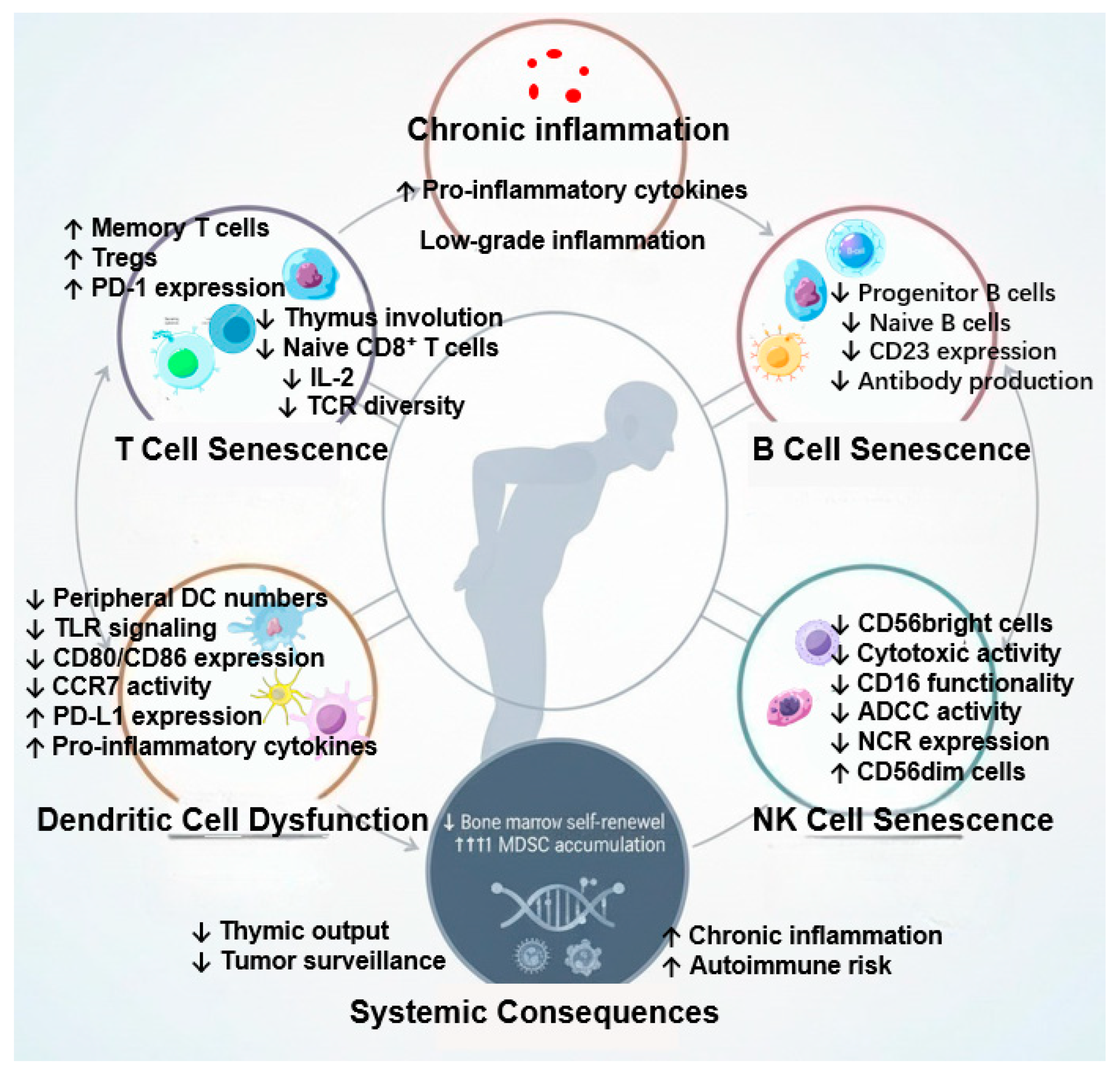
2. Cellular and Molecular Alterations in the Aging Immune System
2.1. T-Cell Exhaustion and Thymic Involution
2.2. B-Cell Dysregulation and Age-Associated B Cells (ABCs)
2.3. Remodeling of Innate Immunity and Antigen Presentation
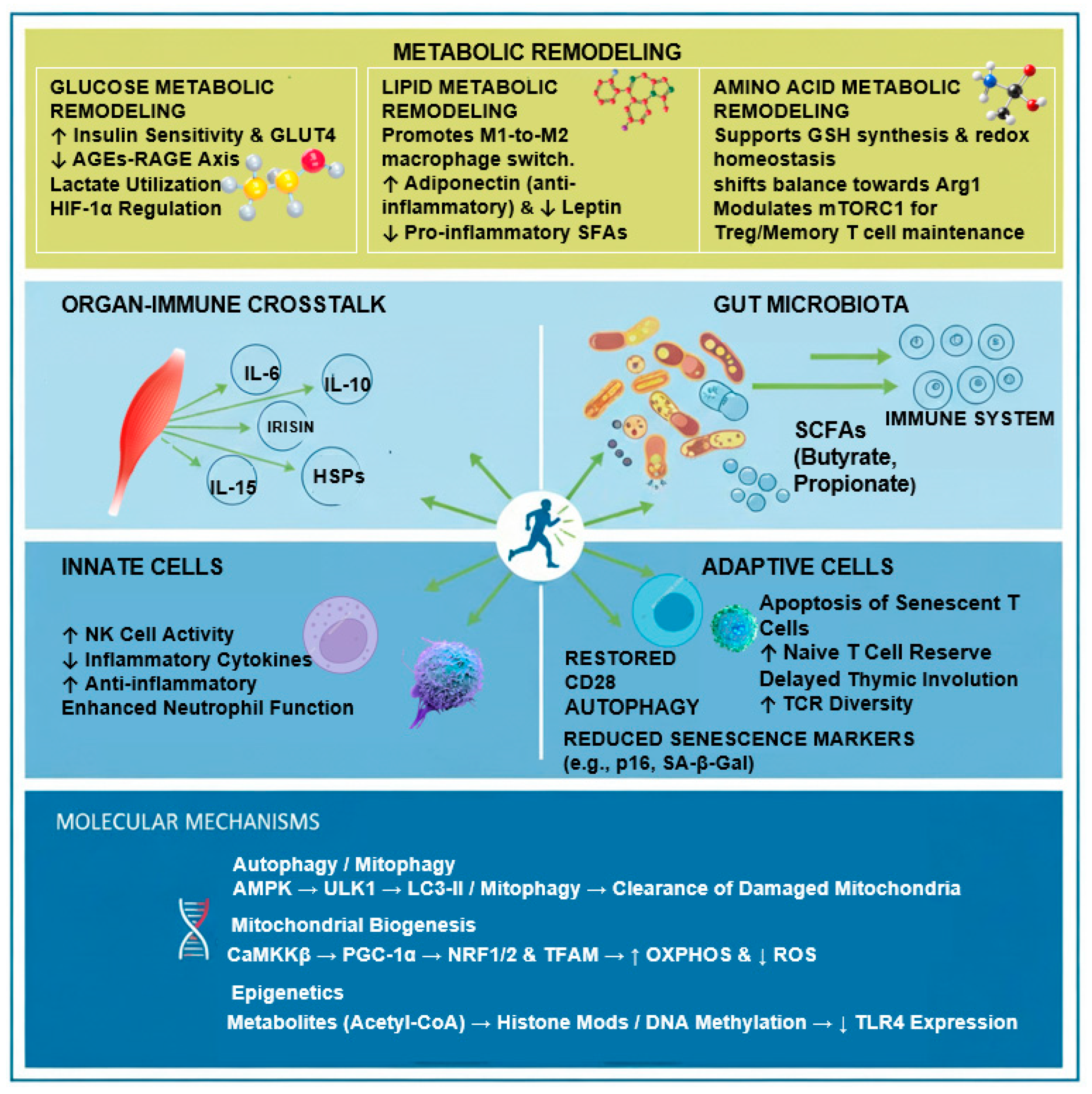
3. Mechanisms of Exercise in Ameliorating Immunosenescence
3.1. Exercise-Induced Metabolic Remodeling
3.1.1. Glucose Metabolic Reprogramming
3.1.2. Lipid Metabolic Optimization
3.1.3. Amino Acid Metabolic Regulation
3.2. Bidirectional Organ–Immune Crosstalk Networks
3.2.1. The Muscle–Immune Axis
3.2.2. The Gut Microbiota–Immune Axis
3.3. Remodeling of Innate and Adaptive Immune Cells
3.3.1. Modulation of Innate Immune Cells
3.3.2. Mitigation of Conventional T-Cell Senescence
3.3.3. Mechanisms of Exercise-Induced Apoptosis in Terminally Differentiated Senescent T Cells
3.3.4. Remodeling of Innate-like Unconventional T Cells
3.4. Molecular and Epigenetic Mechanisms
3.4.1. Circulating Mitochondrial DNA and Inflammatory Attenuation
3.4.2. Autophagy-Mediated Restoration of Immune Cell Function
3.4.3. Mitochondrial Optimization and Immunometabolic Reprogramming
3.4.4. Epigenetic Reprogramming in Immunosenescence
4. Dose–Response Relationship Between Different Exercise Modalities and Attenuation of Immunosenescence in Older Adults
5. Clinical Implications, Public Health Value, and Future Research Directions
6. Conclusions
Author Contributions
Funding
Institutional Review Board Statement
Informed Consent Statement
Data Availability Statement
Conflicts of Interest
References
- Fu, Y.; Wang, B.; Alu, A.; Hong, W.; Lei, H.; He, X.; Shi, H.; Cheng, P.; Yang, X. Immunosenescence: Signaling pathways, diseases and therapeutic targets. Signal Target. Ther. 2025, 10, 250. [Google Scholar] [CrossRef] [Scilit]
- Nguyen, T.Q.T.; Cho, K.A. Targeting immunosenescence and inflammaging: Advancing longevity research. Exp. Mol. Med. 2025, 57, 1881–1892. [Google Scholar] [CrossRef] [Scilit] [PubMed]
- Chen, Z.; Mao, Z.; Tang, W.; Shi, Y.; Liu, J.; You, Y. Immunosenescence in aging and neurodegenerative diseases: Evidence, key hallmarks, and therapeutic implications. Transl. Neurodegener. 2025, 14, 60. [Google Scholar] [CrossRef] [Scilit] [PubMed]
- Liu, Z.; Liang, Q.; Ren, Y.; Guo, C.; Ge, X.; Wang, L.; Cheng, Q.; Luo, P.; Zhang, Y.; Han, X. Immunosenescence: Molecular mechanisms and diseases. Signal Target. Ther. 2023, 8, 200. [Google Scholar] [CrossRef] [Scilit]
- Müller, L.; Di Benedetto, S.; Müller, V. Neuroimmune dynamics and brain aging: Mechanisms and consequences. Front. Aging Neurosci. 2025, 17, 1715045. [Google Scholar] [CrossRef] [Scilit]
- Liu, Q.; Li, J.; Sun, X.; Lin, J.; Yu, Z.; Xiao, Y.; Li, D.; Sun, B.; Bao, H.; Liu, Y. Immunosenescence and cancer: Molecular hallmarks, tumor microenvironment remodeling, and age-specific immunotherapy challenges. J. Hematol. Oncol. 2025, 18, 81. [Google Scholar] [CrossRef] [Scilit]
- Gao, D.; Kan, P.; He, Y.; Sun, S.; Tang, L.; Yang, F. Senescent immune cells in the tumor microenvironment: Emerging insights into cancer immunotherapy resistance. Front. Immunol. 2025, 16, 1656733. [Google Scholar] [CrossRef] [Scilit]
- Chen, L.; Shao, C.; Li, J.; Zhu, F. Impact of Immunosenescence on Vaccine Immune Responses and Countermeasures. Vaccines 2024, 12, 1289. [Google Scholar] [CrossRef] [Scilit]
- Quiros-Roldan, E.; Sottini, A.; Natali, P.G.; Imberti, L. The Impact of Immune System Aging on Infectious Diseases. Microorganisms 2024, 12, 775. [Google Scholar] [CrossRef] [Scilit]
- Müller, L.; Di Benedetto, S. Inflammaging, immunosenescence, and cardiovascular aging: Insights into long COVID implications. Front. Cardiovasc. Med. 2024, 11, 1384996. [Google Scholar] [CrossRef] [Scilit] [PubMed]
- Zaccardi, F.; Rowlands, A.V.; Dempsey, P.C.; Razieh, C.; Henson, J.; Goldney, J.; Maylor, B.D.; Bhattacharjee, A.; Chudasama, Y.; Edwardson, C.; et al. Interplay between physical activity volume and intensity with modeled life expectancy in women and men: A prospective cohort analysis. J. Sport Health Sci. 2025, 14, 100970. [Google Scholar] [CrossRef] [Scilit]
- Albini, A.; La Vecchia, C.; Magnoni, F.; Garrone, O.; Morelli, D.; Janssens, J.P.; Maskens, A.; Rennert, G.; Galimberti, V.; Corso, G. Physical activity and exercise health benefits: Cancer prevention, interception, and survival. Eur. J. Cancer Prev. Off. J. Eur. Cancer Prev. Organ. 2025, 34, 24–39. [Google Scholar] [CrossRef] [Scilit]
- Rodrigues, K.B.; Weng, Z.; Graham, Z.A.; Lavin, K.; McAdam, J.; Tuggle, S.C.; Peoples, B.; Seay, R.; Yang, S.; Bamman, M.M.; et al. Exercise intensity and training alter the innate immune cell type and chromosomal origins of circulating cell-free DNA in humans. Proc. Natl. Acad. Sci. USA 2025, 122, e2406954122. [Google Scholar] [CrossRef] [Scilit] [PubMed]
- Tari, A.R.; Walker, T.L.; Huuha, A.M.; Sando, S.B.; Wisloff, U. Neuroprotective mechanisms of exercise and the importance of fitness for healthy brain ageing. Lancet 2025, 405, 1093–1118. [Google Scholar] [CrossRef] [Scilit]
- Shi, X.; Hu, L.; Nieman, D.C.; Li, F.; Chen, P.; Shi, H.; Shi, Y. Exercise workload: A key determinant of immune health—A narrative review. Front. Immunol. 2025, 16, 1617261. [Google Scholar] [CrossRef] [Scilit]
- Magni, O.; Arnaoutis, G.; Panagiotakos, D. The impact of exercise on chronic systemic inflammation: A systematic review and meta—Meta-analysis. Sport Sci. Health 2025, 21, 1405–1417. [Google Scholar] [CrossRef] [Scilit]
- Xue, J.; Han, X.; Zheng, Y.; Zhang, Q.; Kong, L. Effectiveness of resistance training in modulating inflammatory biomarkers among Asian patients with sarcopenia: A systematic review and meta-analysis of randomized controlled trials. Front. Immunol. 2024, 15, 1385902. [Google Scholar] [CrossRef] [Scilit]
- Malheiro, L.F.L.; Oliveira, C.A.; Portela, F.S.; Mercês, É.A.B.; Benedictis, L.M.D.; Benedictis, J.M.D.; Andrade, E.N.D.; Magalhães, A.C.M.; Melo, F.F.D.; Oliveira, P.D.S.; et al. High-intensity interval training alleviates liver inflammation by regulating the TLR4/NF-κB signaling pathway and M1/M2 macrophage balance in female rats with cisplatin hepatotoxicity. Biochem. Bioph. Res. Commun. 2024, 733, 150712. [Google Scholar] [CrossRef] [Scilit]
- Yu, X.; Pei, W.; Li, B.; Sun, S.; Li, W.; Wu, Q. Immunosenescence, Physical Exercise, and their Implications in Tumor Immunity and Immunotherapy. Int. J. Biol. Sci. 2025, 21, 910–939. [Google Scholar] [CrossRef] [Scilit] [PubMed]
- Dong, G.; He, X.; He, J.; Bao, D.; Gao, Q.; Zhou, J. Impact of aerobic exercise on immune components across healthy and diseased populations: A systematic review and meta-analysis of randomized controlled trials. J. Exerc. Sci. Fit. 2025, 23, 435–450. [Google Scholar] [CrossRef] [Scilit] [PubMed]
- Sun, C.; Li, J.; Xu, H.; Du, J.; Muthusamy, P.; Liu, K.; Wei, S.; Zhang, L. “Immunopause” no more: Exercise to counter immunosenescence in aging. Immun. Ageing 2025. [Google Scholar] [CrossRef] [Scilit]
- Ara, I.; Gómez-Cabrera, M.C.; Garatachea, N. Exercise as a Therapy for Successful Aging. Scand. J. Med. Sci. Sports 2025, 35, e70133. [Google Scholar] [CrossRef] [Scilit]
- Salimans, L.; Liberman, K.; Njemini, R.; Kortekaas Krohn, I.; Gutermuth, J.; Bautmans, I. The effect of resistance exercise on the immune cell function in humans: A systematic review. Exp. Gerontol. 2022, 164, 111822. [Google Scholar] [CrossRef] [Scilit]
- Sever, E.; Yılmaz, S.; Koz, M. Acute and Chronic Immunological Responses to Different Exercise Modalities: A Narrative Review. Healthcare 2025, 13, 2244. [Google Scholar] [CrossRef] [Scilit]
- Ajoolabady, A.; Pratico, D.; Tang, D.; Zhou, S.; Franceschi, C.; Ren, J. Immunosenescence and inflammaging: Mechanisms and role in diseases. Ageing Res. Rev. 2024, 101, 102540. [Google Scholar] [CrossRef] [Scilit]
- Wrona, M.V.; Ghosh, R.; Coll, K.; Chun, C.; Yousefzadeh, M.J. The 3 I’s of immunity and aging: Immunosenescence, inflammaging, and immune resilience. Front. Aging 2024, 5, 1490302. [Google Scholar] [CrossRef] [Scilit] [PubMed]
- Pawelec, G. Hallmarks of human “immunosenescence”: Adaptation or dysregulation? Immun. Ageing 2012, 9, 15. [Google Scholar] [CrossRef] [Scilit] [PubMed]
- Bektas, A.; Schurman, S.H.; Sen, R.; Ferrucci, L. Human T cell immunosenescence and inflammation in aging. J. Leukoc. Biol. 2017, 102, 977–988. [Google Scholar] [CrossRef] [Scilit] [PubMed]
- Zheng, S.G.; Wang, J.H.; Gray, J.D.; Soucier, H.; Horwitz, D.A. Natural and induced CD4+CD25+ cells educate CD4+CD25- cells to develop suppressive activity: The role of IL-2, TGF-beta, and IL-10. J. Immunol. 2004, 172, 5213–5221. [Google Scholar] [CrossRef] [Scilit]
- Luo, L.; Lechuga-Vieco, A.V.; Sattentau, C.; Borsa, M.; Simon, A.K. Dysfunctional mitochondria in ageing T cells: A perspective on mitochondrial quality control mechanisms. Embo. Rep. 2025, 26, 4402–4418. [Google Scholar] [CrossRef] [Scilit]
- Li, F.; Feng, Y.; Yin, Z.; Wang, Y. Mitochondrial Metabolism in T-Cell Exhaustion. Int. J. Mol. Sci. 2025, 26, 7400. [Google Scholar] [CrossRef] [Scilit]
- Bevilacqua, A.; Ho, P.; Franco, F. Metabolic reprogramming in inflammaging and aging in T cells. Life Metab. 2023, 2, load028. [Google Scholar] [CrossRef] [Scilit]
- Shimada, Y.; Hayashi, M.; Nagasaka, Y.; Ohno-Iwashita, Y.; Inomata, M. Age-associated up-regulation of a negative co-stimulatory receptor PD-1 in mouse CD4+ T cells. Exp. Gerontol. 2009, 44, 517–522. [Google Scholar] [CrossRef] [Scilit]
- van den Brom, R.R.H.; van der Geest, K.S.M.; Brouwer, E.; Hospers, G.A.P.; Boots, A.M.H. Enhanced expression of PD-1 and other activation markers by CD4+ T cells of young but not old patients with metastatic melanoma. Cancer Immunol. Immun. 2018, 67, 925–933. [Google Scholar] [CrossRef] [Scilit]
- Goronzy, J.J.; Weyand, C.M. Aging, autoimmunity and arthritis: T-cell senescence and contraction of T-cell repertoire diversity—Catalysts of autoimmunity and chronic inflammation. Arthrit. Res. Ther. 2003, 5, 225–234. [Google Scholar] [CrossRef] [Scilit]
- Xie, G.; Chen, X.; Gao, Y.; Yang, M.; Zhou, S.; Lu, L.; Wu, H.; Lu, Q. Age-Associated B Cells in Autoimmune Diseases: Pathogenesis and Clinical Implications. Clin. Rev. Allergy Immunol. 2025, 68, 18. [Google Scholar] [CrossRef] [Scilit]
- Yam-Puc, J.C.; Hosseini, Z.; Horner, E.C.; Gerber, P.P.; Beristain-Covarrubias, N.; Hughes, R.; Lulla, A.; Rust, M.; Boston, R.; Ali, M.; et al. Age-associated B cells predict impaired humoral immunity after COVID-19 vaccination in patients receiving immune checkpoint blockade. Nat. Commun. 2023, 14, 3292. [Google Scholar] [CrossRef] [Scilit]
- Kim, J.G.; Kim, M.; Hong, B.; Choe, Y.; Kim, J.; Lee, N.; You, S.; Lee, S.; Kim, W. Circulatory age-associated B cells: Their distinct transcriptomic characteristics and clinical significance in drug-naïve patients with rheumatoid arthritis. Clin. Immunol. 2025, 271, 110425. [Google Scholar] [CrossRef] [Scilit] [PubMed]
- Avivi, I.; Zisman-Rozen, S.; Naor, S.; Dai, I.; Benhamou, D.; Shahaf, G.; Tabibian-Keissar, H.; Rosenthal, N.; Rakovsky, A.; Hanna, A.; et al. Depletion of B cells rejuvenates the peripheral B-cell compartment but is insufficient to restore immune competence in aging. Aging Cell 2019, 18, e12959. [Google Scholar] [CrossRef] [Scilit] [PubMed]
- Agrawal, A.; Agrawal, S.; Gupta, S. Dendritic cells in human aging. Exp. Gerontol. 2007, 42, 421–426. [Google Scholar] [CrossRef] [Scilit] [PubMed]
- Reed, R.G.; Al-Attar, A.; Presnell, S.R.; Lutz, C.T.; Segerstrom, S.C. A longitudinal study of the stability, variability, and interdependencies among late-differentiated T and NK cell subsets in older adults. Exp. Gerontol. 2019, 121, 46–54. [Google Scholar] [CrossRef] [Scilit]
- Kong, J.; Xie, Y.; Fan, R.; Wang, Q.; Luo, Y.; Dong, P. Exercise orchestrates systemic metabolic and neuroimmune homeostasis via the brain-muscle-liver axis to slow down aging and neurodegeneration: A narrative review. Eur. J. Med. Res. 2025, 30, 475. [Google Scholar] [CrossRef] [Scilit]
- Penugurti, V.; Manne, R.K.; Bai, L.; Kant, R.; Lin, H. AMPK: The energy sensor at the crossroads of aging and cancer. Semin. Cancer Biol. 2024, 106–107, 15–27. [Google Scholar] [CrossRef] [Scilit]
- Farhan, A.; Hassan, G.; Ali, S.H.L.; Yousaf, Z.; Shafique, K.; Faisal, A.; Younis, B.B.; Mirza, S. Spontaneous NETosis in diabetes: A role of hyperglycemia mediated ROS and autophagy. Front. Med. 2023, 10, 1076690. [Google Scholar] [CrossRef] [Scilit]
- Al-Rashed, F.; Sindhu, S.; Arefanian, H.; Al Madhoun, A.; Kochumon, S.; Thomas, R.; Al-Kandari, S.; Alghaith, A.; Jacob, T.; Al-Mulla, F.; et al. Repetitive Intermittent Hyperglycemia Drives the M1 Polarization and Inflammatory Responses in THP-1 Macrophages Through the Mechanism Involving the TLR4-IRF5 Pathway. Cells 2020, 9, 1892. [Google Scholar] [CrossRef] [Scilit] [PubMed]
- Yamagishi, S.; Matsui, T.; Fukami, K. Role of receptor for advanced glycation end products (RAGE) and its ligands in cancer risk. Rejuv. Res. 2015, 18, 48–56. [Google Scholar] [CrossRef] [Scilit] [PubMed]
- Dong, H.; Zhang, Y.; Huang, Y.; Deng, H. Pathophysiology of RAGE in inflammatory diseases. Front. Immunol. 2022, 13, 931473. [Google Scholar] [CrossRef] [Scilit] [PubMed]
- Hooshiar, S.H.; Esmaili, H.; Taherian, A.; Jafarnejad, S. Exercise, advanced glycation end products, and their effects on cardiovascular disorders: A narrative review. Heart Mind 2022, 6, 139–150. [Google Scholar] [CrossRef] [Scilit]
- Rodrigues, K.L.; Borges, J.P.; Lopes, G.D.O.; Pereira, E.N.G.D.; Mediano, M.F.F.; Farinatti, P.; Tibirica, E.; Daliry, A. Influence of Physical Exercise on Advanced Glycation End Products Levels in Patients Living With the Human Immunodeficiency Virus. Front. Physiol. 2018, 9, 1641. [Google Scholar] [CrossRef] [Scilit]
- Bartlett, D.B.; Slentz, C.A.; Willis, L.H.; Hoselton, A.; Huebner, J.L.; Kraus, V.B.; Moss, J.; Muehlbauer, M.J.; Spielmann, G.; Muoio, D.M.; et al. Rejuvenation of Neutrophil Functions in Association With Reduced Diabetes Risk Following Ten Weeks of Low-Volume High Intensity Interval Walking in Older Adults With Prediabetes—A Pilot Study. Front. Immunol. 2020, 11, 729. [Google Scholar] [CrossRef] [Scilit]
- Silveira, L.S.; Antunes, B.D.M.M.; Minari, A.L.A.; Dos Santos, R.V.T.; Neto, J.C.R.; Lira, F.S. Macrophage Polarization: Implications on Metabolic Diseases and the Role of Exercise. Crit. Rev. Eukaryot. Gene 2016, 26, 115–132. [Google Scholar] [CrossRef] [Scilit]
- Xue, X.; Liu, B.; Hu, J.; Bian, X.; Lou, S. The potential mechanisms of lactate in mediating exercise-enhanced cognitive function: A dual role as an energy supply substrate and a signaling molecule. Nutr. Metab. 2022, 19, 52. [Google Scholar] [CrossRef] [Scilit]
- Colucci, A.C.M.; Tassinari, I.D.; Loss, E.D.S.; de Fraga, L.S. History and Function of the Lactate Receptor GPR81/HCAR1 in the Brain: A Putative Therapeutic Target for the Treatment of Cerebral Ischemia. Neuroscience 2023, 526, 144–163. [Google Scholar] [CrossRef] [Scilit]
- Certo, M.; Llibre, A.; Lee, W.; Mauro, C. Understanding lactate sensing and signalling. Trends Endocrinol. Met. 2022, 33, 722–735. [Google Scholar] [CrossRef] [Scilit] [PubMed]
- Llibre, A.; Kucuk, S.; Gope, A.; Certo, M.; Mauro, C. Lactate: A key regulator of the immune response. Immunity 2025, 58, 535–554. [Google Scholar] [CrossRef] [Scilit] [PubMed]
- Noe, J.T.; Rendon, B.E.; Geller, A.E.; Conroy, L.R.; Morrissey, S.M.; Young, L.E.A.; Bruntz, R.C.; Kim, E.J.; Wise-Mitchell, A.; Barbosa De Souza Rizzo, M.; et al. Lactate supports a metabolic-epigenetic link in macrophage polarization. Sci. Adv. 2021, 7, eabi8602. [Google Scholar] [CrossRef] [Scilit]
- Lu, Z.; Zheng, X.; Shi, M.; Yin, Y.; Liang, Y.; Zou, Z.; Ding, C.; He, Y.; Zhou, Y.; Li, X. Lactylation: The emerging frontier in post-translational modification. Front. Genet. 2024, 15, 1423213. [Google Scholar] [CrossRef] [Scilit]
- Multhoff, G.; Vaupel, P. Lactate-avid regulatory T cells: Metabolic plasticity controls immunosuppression in tumour microenvironment. Signal Target. Ther. 2021, 6, 171. [Google Scholar] [CrossRef] [Scilit]
- Zhou, J.; Gu, J.; Qian, Q.; Zhang, Y.; Huang, T.; Li, X.; Liu, Z.; Shao, Q.; Liang, Y.; Qiao, L.; et al. Lactate supports Treg function and immune balance via MGAT1 effects on N-glycosylation in the mitochondria. J. Clin. Investig. 2024, 134, e175897. [Google Scholar] [CrossRef] [Scilit]
- Kjobsted, R.; Hingst, J.R.; Fentz, J.; Foretz, M.; Sanz, M.; Pehmoller, C.; Shum, M.; Marette, A.; Mounier, R.; Treebak, J.T.; et al. AMPK in skeletal muscle function and metabolism. FASEB J. 2018, 32, 1741–1777. [Google Scholar] [CrossRef] [Scilit] [PubMed]
- Agostini, D.; Natalucci, V.; Baldelli, G.; De Santi, M.; Donati Zeppa, S.; Vallorani, L.; Annibalini, G.; Lucertini, F.; Federici, A.; Izzo, R.; et al. New Insights into the Role of Exercise in Inhibiting mTOR Signaling in Triple-Negative Breast Cancer. Oxid. Med. Cell. Longev. 2018, 2018, 5896786. [Google Scholar] [CrossRef] [Scilit]
- Saxton, R.A.; Sabatini, D.M. mTOR Signaling in Growth, Metabolism, and Disease. Cell 2017, 168, 960–976. [Google Scholar] [CrossRef] [Scilit] [PubMed]
- Collins, S.L.; Oh, M.; Sun, I.; Chan-Li, Y.; Zhao, L.; Powell, J.D.; Horton, M.R. mTORC1 Signaling Regulates Proinflammatory Macrophage Function and Metabolism. J. Immunol. 2021, 207, 913–922. [Google Scholar] [CrossRef] [Scilit] [PubMed]
- Zhang, J.; Yuan, Z.; Li, X.; Wang, F.; Wei, X.; Kang, Y.; Mo, C.; Jiang, J.; Liang, H.; Ye, L. Activation of the JNK/COX-2/HIF-1alpha axis promotes M1 macrophage via glycolytic shift in HIV-1 infection. Life Sci. Alliance 2023, 6, e202302148. [Google Scholar] [CrossRef] [Scilit]
- Dang, E.V.; Barbi, J.; Yang, H.; Jinasena, D.; Yu, H.; Zheng, Y.; Bordman, Z.; Fu, J.; Kim, Y.; Yen, H. Control of TH17/Treg balance by hypoxia-inducible factor 1. Cell 2011, 146, 772–784. [Google Scholar] [CrossRef] [Scilit] [PubMed]
- Zhang, J.; Hao, L.; Li, S.; He, Y.; Zhang, Y.; Li, N.; Hu, X. mTOR/HIF-1alpha pathway-mediated glucose reprogramming and macrophage polarization by Sini decoction plus ginseng soup in ALF. Phytomedicine 2025, 137, 156374. [Google Scholar] [CrossRef] [Scilit]
- Guo, Q.; Li, N.; Shi, H.; Gan, Y.; Wang, W.; Jia, J.; Zhou, Y. Aerobic Exercise Prevents High-Fat-Diet-Induced Adipose Tissue Dysfunction in Male Mice. Nutrients 2024, 16, 3451. [Google Scholar] [CrossRef] [Scilit]
- Baek, K.; Lee, D.; Jeong, M.; Kang, S.A.; Choe, Y.; Yoo, J.; Yu, H.S.; Kim, J. Effects of lifelong spontaneous exercise on the M1/M2 macrophage polarization ratio and gene expression in adipose tissue of super-aged mice. Exp. Gerontol. 2020, 141, 111091. [Google Scholar] [CrossRef] [Scilit]
- Li, J.; Quan, C.; He, Y.; Cao, Y.; Chen, Y.; Wang, Y.; Wu, L. Autophagy regulated by the HIF/REDD1/mTORC1 signaling is progressively increased during erythroid differentiation under hypoxia. Front. Cell Dev. Biol. 2022, 10, 896893. [Google Scholar] [CrossRef] [Scilit]
- Belapurkar, R.; Pfisterer, M.; Dreute, J.; Werner, S.; Zukunft, S.; Fleming, I.; Kracht, M.; Schmitz, M.L. A transient increase of HIF-1alpha during the G1 phase (G1-HIF) ensures cell survival under nutritional stress. Cell Death Dis. 2023, 14, 477. [Google Scholar] [CrossRef] [Scilit]
- Huang, Z.; Teng, W.; Yao, L.; Xie, K.; Hang, S.; He, R.; Li, Y. mTOR signaling pathway regulation HIF-1 alpha effects on LPS induced intestinal mucosal epithelial model damage. BMC Mol. Cell Biol. 2024, 25, 13. [Google Scholar] [CrossRef] [Scilit]
- Song, Y.; Xing, H.; Luo, Y.; Li, B.; Li, Y.; Dong, Z. Adipose immune microenvironment: Catalyst of age-related adipose tissue dysfunction. Immun. Ageing 2025, 22, 53. [Google Scholar] [CrossRef] [Scilit]
- Shimi, G.; Sohouli, M.H.; Ghorbani, A.; Shakery, A.; Zand, H. The interplay between obesity, immunosenescence, and insulin resistance. Immun. Ageing 2024, 21, 13. [Google Scholar] [CrossRef] [Scilit] [PubMed]
- Li, X.; Ren, Y.; Chang, K.; Wu, W.; Griffiths, H.R.; Lu, S.; Gao, D. Adipose tissue macrophages as potential targets for obesity and metabolic diseases. Front. Immunol. 2023, 14, 1153915. [Google Scholar] [CrossRef] [Scilit]
- Kunz, H.E.; Hart, C.R.; Gries, K.J.; Parvizi, M.; Laurenti, M.; Dalla Man, C.; Moore, N.; Zhang, X.; Ryan, Z.; Polley, E.C.; et al. Adipose tissue macrophage populations and inflammation are associated with systemic inflammation and insulin resistance in obesity. Am. J. Physiol. Endocrinol. Metab. 2021, 321, E105–E121. [Google Scholar] [CrossRef] [Scilit]
- Zatterale, F.; Longo, M.; Naderi, J.; Raciti, G.A.; Desiderio, A.; Miele, C.; Beguinot, F. Chronic Adipose Tissue Inflammation Linking Obesity to Insulin Resistance and Type 2 Diabetes. Front. Physiol. 2019, 10, 1607. [Google Scholar] [CrossRef] [Scilit]
- Lehmann, S.; Retschlag, U.; Oberbach, A.; Morgenroth, R.; Linder, N.; Schaudinn, A.; Garnov, N.; Busse, H.; Solty, K.; Prettin, C.; et al. Visceral fat mass dynamics in a 2-year randomized STrength versus ENdurance training trial in people with obesity. Diabetes Obes. Metab. 2024, 26, 4087–4099. [Google Scholar] [CrossRef] [Scilit] [PubMed]
- Da Costa Fernandes, C.J.; Da Cruz Rodrigues, K.C.; de Melo, D.G.; de Campos, T.D.P.; Dos Santos Canciglieri, R.; Simabuco, F.M.; Da Silva, A.S.R.; Cintra, D.E.; Ropelle, E.R.; Pauli, J.R.; et al. Short-term strength exercise reduces the macrophage M1/M2 ratio in white adipose tissue of obese animals. Life Sci. 2023, 329, 121916. [Google Scholar] [CrossRef] [Scilit]
- Kawanishi, N.; Yano, H.; Yokogawa, Y.; Suzuki, K. Exercise training inhibits inflammation in adipose tissue via both suppression of macrophage infiltration and acceleration of phenotypic switching from M1 to M2 macrophages in high-fat-diet-induced obese mice. Exerc. Immunol. Rev. 2010, 16, 105–118. [Google Scholar] [PubMed]
- Auerbach, P.; Nordby, P.; Bendtsen, L.Q.; Mehlsen, J.L.; Basnet, S.K.; Vestergaard, H.; Ploug, T.; Stallknecht, B. Differential effects of endurance training and weight loss on plasma adiponectin multimers and adipose tissue macrophages in younger, moderately overweight men. Integr. Comp. Physiol. 2013, 305, R490–R498. [Google Scholar] [CrossRef] [Scilit]
- Babaei, P.; Hoseini, R. Exercise training modulates adipokine dysregulations in metabolic syndrome. Sports Med. Health Sci. 2022, 4, 18–28. [Google Scholar] [CrossRef] [Scilit]
- Lashkari, M.; Taghian, F. The Effect of 12 Weeks of Tai Chi Exercise on IL-6 and CRP of Obese and Lean Middle-Aged Women. Spec. J. Sport Sci. 2019, 4, 7–13. [Google Scholar]
- Jung, H.N.; Jung, C.H. The Role of Anti-Inflammatory Adipokines in Cardiometabolic Disorders: Moving beyond Adiponectin. Int. J. Mol. Sci. 2021, 22, 13529. [Google Scholar] [CrossRef] [Scilit]
- Becic, T.; Studenik, C.; Hoffmann, G. Exercise Increases Adiponectin and Reduces Leptin Levels in Prediabetic and Diabetic Individuals: Systematic Review and Meta-Analysis of Randomized Controlled Trials. Med. Sci. 2018, 6, 97. [Google Scholar] [CrossRef] [Scilit]
- Lovren, F.; Pan, Y.; Quan, A.; Szmitko, P.E.; Singh, K.K.; Shukla, P.C.; Gupta, M.; Chan, L.; Al-Omran, M.; Teoh, H.; et al. Adiponectin primes human monocytes into alternative anti-inflammatory M2 macrophages. Am. J. Physiol. Heart Circ. Physiol. 2010, 299, H656–H663. [Google Scholar] [CrossRef] [Scilit]
- Wilk, S.; Scheibenbogen, C.; Bauer, S.; Jenke, A.; Rother, M.; Guerreiro, M.; Kudernatsch, R.; Goerner, N.; Poller, W.; Elligsen-Merkel, D.; et al. Adiponectin is a negative regulator of antigen-activated T cells. Eur. J. Immunol. 2011, 41, 2323–2332. [Google Scholar] [CrossRef] [Scilit] [PubMed]
- Fernandez-Riejos, P.; Najib, S.; Santos-Alvarez, J.; Martin-Romero, C.; Perez-Perez, A.; Gonzalez-Yanes, C.; Sanchez-Margalet, V. Role of leptin in the activation of immune cells. Mediat. Inflamm. 2010, 2010, 568343. [Google Scholar] [CrossRef] [Scilit] [PubMed]
- Lin, D.; Sturgeon, K.M.; Gordon, B.R.; Brown, J.C.; Sears, D.D.; Sarwer, D.B.; Schmitz, K.H. WISER Survivor Trial: Combined Effect of Exercise and Weight Loss Interventions on Adiponectin and Leptin Levels in Breast Cancer Survivors with Overweight or Obesity. Nutrients 2023, 15, 3453. [Google Scholar] [CrossRef] [Scilit]
- Akbarpour, M. The effect of aerobic training on serum adiponectin and leptin levels and inflammatory markers of coronary heart disease in obese men. Biol. Sport 2013, 30, 21–27. [Google Scholar] [CrossRef] [Scilit] [PubMed]
- Macpherson, M.E.; Skarpengland, T.; Hov, J.R.; Ranheim, T.; Vestad, B.; Dahl, T.B.; Fraz, M.S.A.; Michelsen, A.E.; Holven, K.B.; Fevang, B.; et al. Increased Plasma Levels of Triglyceride-Enriched Lipoproteins Associate with Systemic Inflammation, Lipopolysaccharides, and Gut Dysbiosis in Common Variable Immunodeficiency. J. Clin. Immunol. 2023, 43, 1229–1240. [Google Scholar] [CrossRef] [Scilit]
- Bonacina, F.; Pirillo, A.; Catapano, A.L.; Norata, G.D. HDL in Immune-Inflammatory Responses: Implications beyond Cardiovascular Diseases. Cells 2021, 10, 1061. [Google Scholar] [CrossRef] [Scilit]
- Kotlyarov, S.; Kotlyarova, A. Involvement of Fatty Acids and Their Metabolites in the Development of Inflammation in Atherosclerosis. Int. J. Mol. Sci. 2022, 23, 1308. [Google Scholar] [CrossRef] [Scilit]
- Ravaut, G.; Legiot, A.; Bergeron, K.; Mounier, C. Monounsaturated Fatty Acids in Obesity-Related Inflammation. Int. J. Mol. Sci. 2020, 22, 330. [Google Scholar] [CrossRef] [Scilit]
- Muscella, A.; Stefano, E.; Lunetti, P.; Capobianco, L.; Marsigliante, S. The Regulation of Fat Metabolism During Aerobic Exercise. Biomolecules 2020, 10, 1699. [Google Scholar] [CrossRef] [Scilit] [PubMed]
- Anderson, K.C.; Liu, J.; Liu, Z. Interplay of fatty acids, insulin and exercise in vascular health. Lipids Health Dis. 2025, 24, 4. [Google Scholar] [CrossRef] [Scilit] [PubMed]
- Grao-Cruces, E.; Lopez-Enriquez, S.; Martin, M.E.; Montserrat-de La Paz, S. High-density lipoproteins and immune response: A review. Int. J. Biol. Macromol. 2022, 195, 117–123. [Google Scholar] [CrossRef] [Scilit]
- Madan, K.; Sawhney, J. Exercise and lipids. Indian Heart J. 2024, 76, S73–S74. [Google Scholar] [CrossRef] [Scilit]
- Ruiz-Ramie, J.J.; Barber, J.L.; Sarzynski, M.A. Effects of exercise on HDL functionality. Curr. Opin. Lipidol. 2019, 30, 16–23. [Google Scholar] [CrossRef] [Scilit]
- Franczyk, B.; Gluba-Brzozka, A.; Cialkowska-Rysz, A.; Lawinski, J.; Rysz, J. The Impact of Aerobic Exercise on HDL Quantity and Quality: A Narrative Review. Int. J. Mol. Sci. 2023, 24, 4653. [Google Scholar] [CrossRef] [Scilit] [PubMed]
- Syed, M.; Parmar, C.; Pouwels, S. The effects of exercise therapy on immune cells and function in patients with overweight or obesity: A systematic review. Brain Behav. Immun. Integr. 2024, 8, 100093. [Google Scholar] [CrossRef] [Scilit]
- Yang, L.; Chu, Z.; Liu, M.; Zou, Q.; Li, J.; Liu, Q.; Wang, Y.; Wang, T.; Xiang, J.; Wang, B. Amino acid metabolism in immune cells: Essential regulators of the effector functions, and promising opportunities to enhance cancer immunotherapy. J. Hematol. Oncol. 2023, 16, 59. [Google Scholar] [CrossRef] [Scilit] [PubMed]
- Wang, W.; Zou, W. Amino Acids and Their Transporters in T Cell Immunity and Cancer Therapy. Mol. Cell 2020, 80, 384–395. [Google Scholar] [CrossRef] [Scilit]
- Ren, W.; Liu, G.; Yin, J.; Tan, B.; Wu, G.; Bazer, F.W.; Peng, Y.; Yin, Y. Amino-acid transporters in T-cell activation and differentiation. Cell Death Dis. 2017, 8, e2655. [Google Scholar] [CrossRef] [Scilit]
- Cruzat, V.; Macedo Rogero, M.; Noel Keane, K.; Curi, R.; Newsholme, P. Glutamine: Metabolism and Immune Function, Supplementation and Clinical Translation. Nutrients 2018, 10, 1564. [Google Scholar] [CrossRef] [Scilit] [PubMed]
- Newsholme, P.; Diniz, V.L.S.; Dodd, G.T.; Cruzat, V. Glutamine metabolism and optimal immune and CNS function. Proc. Nutr. Soc. 2023, 82, 22–31. [Google Scholar] [CrossRef] [Scilit]
- Yoo, H.C.; Yu, Y.C.; Sung, Y.; Han, J.M. Glutamine reliance in cell metabolism. Exp. Mol. Med. 2020, 52, 1496–1516. [Google Scholar] [CrossRef] [Scilit]
- Hiscock, N.; Pedersen, B.K. Exercise-induced immunodepression- plasma glutamine is not the link. J. Appl. Physiol. 2002, 93, 813–822. [Google Scholar] [CrossRef] [Scilit]
- Zuhl, M.; Specht, J.; Beatty, S.; Mermier, C. Glutamine Supplementation: A Possible Strategy to Help Mitigate Health Risks of Heat-Related Illness. J. Nutr. Metab. 2024, 2024, 1638244. [Google Scholar] [CrossRef] [Scilit] [PubMed]
- Lu, T.; Zheng, A.; Suzuki, K.; Lu, C.; Wang, C.; Fang, S. Supplementation of L-glutamine enhanced mucosal immunity and improved hormonal status of combat-sport athletes. J. Int. Soc. Sport Nutr. 2024, 21, 2300259. [Google Scholar] [CrossRef] [Scilit]
- Zhang, K.; Mishra, A.; Jagannath, C. New insight into arginine and tryptophan metabolism in macrophage activation during tuberculosis. Front. Immunol. 2024, 15, 1363938. [Google Scholar] [CrossRef] [Scilit]
- Mizuno, N.; Shiga, S.; Tanaka, Y.; Kimura, T.; Yanagawa, Y. CDK8/19 inhibitor enhances arginase-1 expression in macrophages via STAT6 and p38 MAPK activation. Eur. J. Pharmacol. 2024, 979, 176852. [Google Scholar] [CrossRef] [Scilit] [PubMed]
- Menjivar, R.E.; Nwosu, Z.C.; Du, W.; Donahue, K.L.; Hong, H.S.; Espinoza, C.; Brown, K.; Velez-Delgado, A.; Yan, W.; Lima, F.; et al. Arginase 1 is a key driver of immune suppression in pancreatic cancer. elife 2023, 12, e80721. [Google Scholar] [CrossRef] [Scilit]
- Allen, J.; Sun, Y.; Woods, J.A. Exercise and the Regulation of Inflammatory Responses. Prog. Mol. Biol. Transl. 2015, 135, 337–354. [Google Scholar] [CrossRef] [Scilit]
- Karadima, E.; Chavakis, T.; Alexaki, V.I. Arginine metabolism in myeloid cells in health and disease. Semin. Immunopathol. 2025, 47, 11. [Google Scholar] [CrossRef] [Scilit]
- Yan, H.; Liu, Y.; Li, X.; Yu, B.; He, J.; Mao, X.; Yu, J.; Huang, Z.; Luo, Y.; Luo, J.; et al. Leucine alleviates cytokine storm syndrome by regulating macrophage polarization via the mTORC1/LXRalpha signaling pathway. elife 2024, 12, RP89750. [Google Scholar] [CrossRef]
- Zeng, H.; Cohen, S.; Guy, C.; Shrestha, S.; Neale, G.; Brown, S.A.; Cloer, C.; Kishton, R.J.; Gao, X.; Youngblood, B.; et al. mTORC1 and mTORC2 Kinase Signaling and Glucose Metabolism Drive Follicular Helper T Cell Differentiation. Immunity 2016, 45, 540–554. [Google Scholar] [CrossRef] [Scilit]
- Lu, M.; Luo, D.; Zhang, Z.; Ouyang, F.; Shi, Y.; Hu, C.; Su, H.; Li, Y.; Zhang, J.; Gui, Q.; et al. Branched-chain amino acid catabolism promotes M2 macrophage polarization. Front. Immunol. 2024, 15, 1469163. [Google Scholar] [CrossRef] [Scilit]
- Choi, B.H.; Hyun, S.; Koo, S. The role of BCAA metabolism in metabolic health and disease. Exp. Mol. Med. 2024, 56, 1552–1559. [Google Scholar] [CrossRef] [Scilit]
- Lu, Z.; Wang, Z.; Zhang, X.; Ning, K. Myokines May Be the Answer to the Beneficial Immunomodulation of Tailored Exercise-A Narrative Review. Biomolecules 2024, 14, 1205. [Google Scholar] [CrossRef] [Scilit]
- Xue, M.; Liao, C.; Liu, Y.; Tian, W.; Liao, L. Myokines in Aging: A Multi-Organ Network Perspective. Aging Dis. 2025. [Google Scholar] [CrossRef] [Scilit]
- Zhang, N.; Zhai, L.; Wong, R.M.Y.; Cui, C.; Law, S.; Chow, S.K.; Goodman, S.B.; Cheung, W. Harnessing immunomodulation to combat sarcopenia: Current insights and possible approaches. Immun. Ageing 2024, 21, 55. [Google Scholar] [CrossRef] [Scilit] [PubMed]
- Puntschart, A.; Vogt, M.; Widmer, H.R.; Hoppeler, H.; Billeter, R. Hsp70 expression in human skeletal muscle after exercise. Acta Physiol. Scand. 1996, 157, 411–417. [Google Scholar] [CrossRef] [Scilit]
- Vardar, S.A.; Doganlar, Z.B.; Kaya, O.; Tayfur, P.; Sut, N.; Doganlar, O. Different responses of apoptotic, inflammatory and heat shock protein gene expression to a single bout of high-intensity interval exercise between physically active and inactive men. Appl. Physiol. Nutr. Metab. 2021, 46, 743–752. [Google Scholar] [CrossRef] [Scilit] [PubMed]
- de Lemos Muller, C.H.; Schroeder, H.T.; Rodrigues-Krause, J.; Krause, M. Extra and intra cellular HSP70 levels in adults with and without metabolic disorders: A systematic review and meta-analysis. Cell Stress Chaperones 2023, 28, 761–771. [Google Scholar] [CrossRef] [Scilit]
- Muralidharan, S.; Mandrekar, P. Cellular stress response and innate immune signaling: Integrating pathways in host defense and inflammation. J. Leukoc. Biol. 2013, 94, 1167–1184. [Google Scholar] [CrossRef] [Scilit]
- Taha, E.A.; Ono, K.; Eguchi, T. Roles of Extracellular HSPs as Biomarkers in Immune Surveillance and Immune Evasion. Int. J. Mol. Sci. 2019, 20, 4588. [Google Scholar] [CrossRef] [Scilit]
- Zhou, L.; Fang, L.; Tamm, M.; Stolz, D.; Roth, M. Extracellular Heat Shock Protein 70 Increases the Glucocorticoid Receptor and Dual-Specificity Phosphatase 1 via Toll-like Receptor 4 and Attenuates Inflammation in Airway Epithelial Cells. Int. J. Mol. Sci. 2023, 24, 11700. [Google Scholar] [CrossRef] [Scilit]
- Krause, M.; Heck, T.G.; Bittencourt, A.; Scomazzon, S.P.; Newsholme, P.; Curi, R.; Homem De Bittencourt, P.I.J. The chaperone balance hypothesis: The importance of the extracellular to intracellular HSP70 ratio to inflammation-driven type 2 diabetes, the effect of exercise, and the implications for clinical management. Mediat. Inflamm. 2015, 2015, 249205. [Google Scholar] [CrossRef] [Scilit]
- Langston, P.K.; Mathis, D. Immunological regulation of skeletal muscle adaptation to exercise. Cell Metab. 2024, 36, 1175–1183. [Google Scholar] [CrossRef] [Scilit] [PubMed]
- Noble, E.G.; Shen, G.X. Impact of exercise and metabolic disorders on heat shock proteins and vascular inflammation. Autoimmun. Dis. 2012, 2012, 836519. [Google Scholar] [CrossRef] [Scilit]
- Belaya, I.; Suwa, M.; Chen, T.; Giniatullin, R.; Kanninen, K.M.; Atalay, M.; Kumagai, S. Long-Term Exercise Protects against Cellular Stresses in Aged Mice. Oxid. Med. Cell. Longev. 2018, 2018, 2894247. [Google Scholar] [CrossRef] [Scilit] [PubMed]
- Pérez-Regalado, S.; Leon, J.; Padial, P.; Benavente, C.; Almeida, F.; Bonitch-Gongora, J.; Feriche, B. New insights into the integrative effects of resistance training at moderate altitude on systemic inflammation. Eur. J. Appl. Physiol. 2025, 125, 3311–3321. [Google Scholar] [CrossRef] [Scilit]
- Lin, W.; Song, H.; Shen, J.; Wang, J.; Yang, Y.; Yang, Y.; Cao, J.; Xue, L.; Zhao, F.; Xiao, T.; et al. Functional role of skeletal muscle-derived interleukin-6 and its effects on lipid metabolism. Front. Physiol. 2023, 14, 1110926. [Google Scholar] [CrossRef] [Scilit]
- Docherty, S.; Harley, R.; McAuley, J.J.; Crowe, L.A.N.; Pedret, C.; Kirwan, P.D.; Siebert, S.; Millar, N.L. The effect of exercise on cytokines: Implications for musculoskeletal health: A narrative review. BMC Sports Sci. Med. Rehabil. 2022, 14, 5. [Google Scholar] [CrossRef] [Scilit]
- Farley, M.J.; Bartlett, D.B.; Skinner, T.L.; Schaumberg, M.A.; Jenkins, D.G. Immunomodulatory Function of Interleukin-15 and Its Role in Exercise, Immunotherapy, and Cancer Outcomes. Med. Sci. Sport Exerc. 2023, 55, 558–568. [Google Scholar] [CrossRef] [Scilit]
- Vahidi, S.; Zabeti Touchaei, A.; Samadani, A.A. IL-15 as a key regulator in NK cell-mediated immunotherapy for cancer: From bench to bedside. Int. Immunopharmacol. 2024, 133, 112156. [Google Scholar] [CrossRef] [Scilit] [PubMed]
- Tu, Y.; Liu, J.; Kong, D.; Guo, X.; Li, J.; Long, Z.; Peng, J.; Wang, Z.; Wu, H.; Liu, P.; et al. Irisin drives macrophage anti-inflammatory differentiation via JAK2-STAT6-dependent activation of PPARgamma and Nrf2 signaling. Free Radical. Bio. Med. 2023, 201, 98–110. [Google Scholar] [CrossRef] [Scilit] [PubMed]
- Yu, Y.; He, J.; Li, S.; Song, L.; Guo, X.; Yao, W.; Zou, D.; Gao, X.; Liu, Y.; Bai, F.; et al. Fibroblast growth factor 21 (FGF21) inhibits macrophage-mediated inflammation by activating Nrf2 and suppressing the NF-kappaB signaling pathway. Int. Immunopharmacol. 2016, 38, 144–152. [Google Scholar] [CrossRef] [Scilit]
- Charlton, T.; Prowse, N.; McFee, A.; Heiratifar, N.; Fortin, T.; Paquette, C.; Hayley, S. Brain-derived neurotrophic factor (BDNF) has direct anti-inflammatory effects on microglia. Front. Cell Neurosci. 2023, 17, 1188672. [Google Scholar] [CrossRef] [Scilit]
- Thevaranjan, N.; Puchta, A.; Schulz, C.; Naidoo, A.; Szamosi, J.C.; Verschoor, C.P.; Loukov, D.; Schenck, L.P.; Jury, J.; Foley, K.P.; et al. Age-Associated Microbial Dysbiosis Promotes Intestinal Permeability, Systemic Inflammation, and Macrophage Dysfunction. Cell Host Microbe 2017, 21, 455–466. [Google Scholar] [CrossRef] [Scilit]
- Sovran, B.; Hugenholtz, F.; Elderman, M.; Van Beek, A.A.; Graversen, K.; Huijskes, M.; Boekschoten, M.V.; Savelkoul, H.F.J.; De Vos, P.; Dekker, J.; et al. Age-associated Impairment of the Mucus Barrier Function is Associated with Profound Changes in Microbiota and Immunity. Sci. Rep. 2019, 9, 1437. [Google Scholar] [CrossRef] [Scilit]
- Hung, C.; Chang, C.; Huang, C.; Nouchi, R.; Cheng, C. Gut microbiota in patients with Alzheimer’s disease spectrum: A systematic review and meta-analysis. Aging 2022, 14, 477–496. [Google Scholar] [CrossRef] [Scilit]
- Choi, V.M.; Herrou, J.; Hecht, A.L.; Teoh, W.P.; Turner, J.R.; Crosson, S.; Bubeck Wardenburg, J. Activation of Bacteroides fragilis toxin by a novel bacterial protease contributes to anaerobic sepsis in mice. Nat. Med. 2016, 22, 563–567. [Google Scholar] [CrossRef] [Scilit]
- Konig, J.; Wells, J.; Cani, P.D.; Garcia-Rodenas, C.L.; MacDonald, T.; Mercenier, A.; Whyte, J.; Troost, F.; Brummer, R. Human Intestinal Barrier Function in Health and Disease. Clin. Transl. Gastroenterol. 2016, 7, e196. [Google Scholar] [CrossRef] [Scilit]
- Sun, Y.; Sommerville, N.R.; Liu, J.Y.H.; Ngan, M.P.; Poon, D.; Ponomarev, E.D.; Lu, Z.; Kung, J.S.C.; Rudd, J.A. Intra-gastrointestinal amyloid-beta1-42 oligomers perturb enteric function and induce Alzheimer’s disease pathology. J. Physiol. 2020, 598, 4209–4223. [Google Scholar] [CrossRef] [Scilit] [PubMed]
- Leblhuber, F.; Geisler, S.; Steiner, K.; Fuchs, D.; Schutz, B. Elevated fecal calprotectin in patients with Alzheimer’s dementia indicates leaky gut. J. Neural. Transm. 2015, 122, 1319–1322. [Google Scholar] [CrossRef] [Scilit] [PubMed]
- Erny, D.; Hrabe De Angelis, A.L.; Jaitin, D.; Wieghofer, P.; Staszewski, O.; David, E.; Keren-Shaul, H.; Mahlakoiv, T.; Jakobshagen, K.; Buch, T.; et al. Host microbiota constantly control maturation and function of microglia in the CNS. Nat. Neurosci. 2015, 18, 965–977. [Google Scholar] [CrossRef] [Scilit]
- Wu, S.; Cao, Z.; Chang, K.; Juang, J. Intestinal microbial dysbiosis aggravates the progression of Alzheimer’s disease in Drosophila. Nat. Commun. 2017, 8, 24. [Google Scholar] [CrossRef] [Scilit]
- Caldarelli, M.; Rio, P.; Marrone, A.; Giambra, V.; Gasbarrini, A.; Gambassi, G.; Cianci, R. Inflammaging: The Next Challenge-Exploring the Role of Gut Microbiota, Environmental Factors, and Sex Differences. Biomedicines 2024, 12, 1716. [Google Scholar] [CrossRef] [Scilit]
- Ullah, H.; Arbab, S.; Tian, Y.; Chen, Y.; Liu, C.; Li, Q.; Li, K. Crosstalk between gut microbiota and host immune system and its response to traumatic injury. Front. Immunol. 2024, 15, 1413485. [Google Scholar] [CrossRef] [Scilit] [PubMed]
- Pellon, A.; Palacios, A.; Abecia, L.; Rodríguez, H.; Anguita, J. Friends to remember: Innate immune memory regulation by the microbiota. Trends Microbiol. 2025, 33, 510–520. [Google Scholar] [CrossRef] [Scilit] [PubMed]
- Wang, J.; He, M.; Yang, M.; Ai, X. Gut microbiota as a key regulator of intestinal mucosal immunity. Life Sci. 2024, 345, 122612. [Google Scholar] [CrossRef] [Scilit]
- Sharma, A.; Sharma, G.; Im, S. Gut microbiota in regulatory T cell generation and function: Mechanisms and health implications. Gut Microbes 2025, 17, 2516702. [Google Scholar] [CrossRef] [Scilit] [PubMed]
- Tang, Y.; Fu, A.; Wang, L.; Ge, Q. Microbiota-dependent metabolites—New engine for T cell warriors. Gut Microbes 2025, 17, 2523815. [Google Scholar] [CrossRef] [Scilit]
- Wichmann, C.; Wirthgen, E.; Nowosad, C.R.; Däbritz, J. B cell academy of the gut: An update on gut associated germinal centre B cell dynamics. Mol. Cell. Pediatr. 2024, 11, 7. [Google Scholar] [CrossRef] [Scilit]
- Brown, J.A.; Bashir, H.; Zeng, M.Y. Lifelong partners: Gut microbiota-immune cell interactions from infancy to old age. Mucosal. Immunol. 2025, 18, 509–523. [Google Scholar] [CrossRef] [Scilit]
- Bharath, L.P.; Agrawal, M.; McCambridge, G.; Nicholas, D.A.; Hasturk, H.; Liu, J.; Jiang, K.; Liu, R.; Guo, Z.; Deeney, J.; et al. Metformin Enhances Autophagy and Normalizes Mitochondrial Function to Alleviate Aging-Associated Inflammation. Cell Metab. 2020, 32, 44–55. [Google Scholar] [CrossRef] [Scilit] [PubMed]
- Nighot, P.; Al-Sadi, R.; Rawat, M.; Guo, S.; Watterson, D.M.; Ma, T. Matrix metalloproteinase 9-induced increase in intestinal epithelial tight junction permeability contributes to the severity of experimental DSS colitis. Am. J. Physiol. Gastrointest. Liver Physiol. 2015, 309, G988–G997. [Google Scholar] [CrossRef] [Scilit]
- Bosco, N.; Noti, M. The aging gut microbiome and its impact on host immunity. Genes Immun. 2021, 22, 289–303. [Google Scholar] [CrossRef] [Scilit]
- Mohr, A.E.; Jäger, R.; Carpenter, K.C.; Kerksick, C.M.; Purpura, M.; Townsend, J.R.; West, N.P.; Black, K.; Gleeson, M.; Pyne, D.B.; et al. The athletic gut microbiota. J. Int. Soc. Sport Nutr. 2020, 17, 24. [Google Scholar] [CrossRef] [Scilit]
- Rosa, J.M.; Pazini, F.L.; Camargo, A.; Wolin, I.A.V.; Olescowicz, G.; Eslabao, L.B.; Romero, O.B.; Winkelmann-Duarte, E.C.; S Rodrigues, A.L. Prophylactic effect of physical exercise on Abeta(1-40)-induced depressive-like behavior and gut dysfunction in mice. Behav. Brain Res. 2020, 393, 112791. [Google Scholar] [CrossRef] [Scilit]
- Wang, G.; Zhou, H.; Luo, L.; Qin, L.; Yin, J.; Yu, Z.; Zhang, L.; Wan, Z. Voluntary wheel running is capable of improving cognitive function only in the young but not the middle-aged male APPSwe/PS1De9 mice. Neurochem. Int. 2021, 145, 105010. [Google Scholar] [CrossRef] [Scilit]
- Cook, M.D.; Martin, S.A.; Williams, C.; Whitlock, K.; Wallig, M.A.; Pence, B.D.; Woods, J.A. Forced treadmill exercise training exacerbates inflammation and causes mortality while voluntary wheel training is protective in a mouse model of colitis. Brain Behav. Immun. 2013, 33, 46–56. [Google Scholar] [CrossRef] [Scilit]
- Saxena, A.; Fletcher, E.; Larsen, B.; Baliga, M.S.; Durstine, J.L.; Fayad, R. Effect of exercise on chemically-induced colitis in adiponectin deficient mice. J. Inflamm. 2012, 9, 30. [Google Scholar] [CrossRef] [Scilit]
- Bilski, J.; Mazur-Bialy, A.I.; Brzozowski, B.; Magierowski, M.; Jasnos, K.; Krzysiek-Maczka, G.; Urbanczyk, K.; Ptak-Belowska, A.; Zwolinska-Wcislo, M.; Mach, T.; et al. Moderate exercise training attenuates the severity of experimental rodent colitis: The importance of crosstalk between adipose tissue and skeletal muscles. Mediat. Inflamm. 2015, 2015, 605071. [Google Scholar] [CrossRef] [Scilit] [PubMed]
- Luo, B.; Xiang, D.; Nieman, D.C.; Chen, P. The effects of moderate exercise on chronic stress-induced intestinal barrier dysfunction and antimicrobial defense. Brain Behav. Immun. 2014, 39, 99–106. [Google Scholar] [CrossRef] [Scilit] [PubMed]
- Shin, H.E.; Kwak, S.E.; Zhang, D.D.; Lee, J.; Yoon, K.J.; Cho, H.S.; Moon, H.Y.; Song, W. Effects of treadmill exercise on the regulation of tight junction proteins in aged mice. Exp. Gerontol. 2020, 141, 111077. [Google Scholar] [CrossRef] [Scilit] [PubMed]
- Ellingsgaard, H.; Hauselmann, I.; Schuler, B.; Habib, A.M.; Baggio, L.L.; Meier, D.T.; Eppler, E.; Bouzakri, K.; Wueest, S.; Muller, Y.D.; et al. Interleukin-6 enhances insulin secretion by increasing glucagon-like peptide-1 secretion from L cells and alpha cells. Nat. Med. 2011, 17, 1481–1489. [Google Scholar] [CrossRef] [Scilit]
- Hoffman-Goetz, L.; Spagnuolo, P.A.; Guan, J. Repeated exercise in mice alters expression of IL-10 and TNF-alpha in intestinal lymphocytes. Brain Behav. Immun. 2008, 22, 195–199. [Google Scholar] [CrossRef] [Scilit]
- Cervenka, I.; Agudelo, L.Z.; Ruas, J.L. Kynurenines: Tryptophan’s metabolites in exercise, inflammation, and mental health. Science 2017, 357, eaaf9794. [Google Scholar] [CrossRef] [Scilit]
- DiNatale, B.C.; Murray, I.A.; Schroeder, J.C.; Flaveny, C.A.; Lahoti, T.S.; Laurenzana, E.M.; Omiecinski, C.J.; Perdew, G.H. Kynurenic acid is a potent endogenous aryl hydrocarbon receptor ligand that synergistically induces interleukin-6 in the presence of inflammatory signaling. Toxicol. Sci. 2010, 115, 89–97. [Google Scholar] [CrossRef] [Scilit]
- Agudelo, L.Z.; Femenia, T.; Orhan, F.; Porsmyr-Palmertz, M.; Goiny, M.; Martinez-Redondo, V.; Correia, J.C.; Izadi, M.; Bhat, M.; Schuppe-Koistinen, I.; et al. Skeletal muscle PGC-1alpha1 modulates kynurenine metabolism and mediates resilience to stress-induced depression. Cell 2014, 159, 33–45. [Google Scholar] [CrossRef] [Scilit]
- Allen, J.M.; Mailing, L.J.; Cohrs, J.; Salmonson, C.; Fryer, J.D.; Nehra, V.; Hale, V.L.; Kashyap, P.; White, B.A.; Woods, J.A. Exercise training-induced modification of the gut microbiota persists after microbiota colonization and attenuates the response to chemically-induced colitis in gnotobiotic mice. Gut Microbes 2018, 9, 115–130. [Google Scholar] [CrossRef] [Scilit]
- Barton, W.; Penney, N.C.; Cronin, O.; Garcia-Perez, I.; Molloy, M.G.; Holmes, E.; Shanahan, F.; Cotter, P.D.; O’Sullivan, O. The microbiome of professional athletes differs from that of more sedentary subjects in composition and particularly at the functional metabolic level. Gut 2018, 67, 625–633. [Google Scholar] [CrossRef] [Scilit]
- Fielding, R.A.; Guralnik, J.M.; King, A.C.; Pahor, M.; McDermott, M.M.; Tudor-Locke, C.; Manini, T.M.; Glynn, N.W.; Marsh, A.P.; Axtell, R.S.; et al. Dose of physical activity, physical functioning and disability risk in mobility-limited older adults: Results from the LIFE study randomized trial. PLoS ONE 2017, 12, e0182155. [Google Scholar] [CrossRef] [Scilit]
- Carbajo-Pescador, S.; Porras, D.; Garcia-Mediavilla, M.V.; Martinez-Florez, S.; Juarez-Fernandez, M.; Cuevas, M.J.; Mauriz, J.L.; Gonzalez-Gallego, J.; Nistal, E.; Sanchez-Campos, S. Beneficial effects of exercise on gut microbiota functionality and barrier integrity, and gut-liver crosstalk in an in vivo model of early obesity and non-alcoholic fatty liver disease. Dis. Models Mech. 2019, 12, dmm039206. [Google Scholar] [CrossRef] [Scilit]
- Zhang, N.; Mao, X.; Li, R.W.; Hou, E.; Wang, Y.; Xue, C.; Tang, Q. Neoagarotetraose protects mice against intense exercise-induced fatigue damage by modulating gut microbial composition and function. Mol. Nutr. Food Res. 2017, 61, 1600585. [Google Scholar] [CrossRef] [Scilit] [PubMed]
- Viloria, M.; Lara-Padilla, E.; Campos-Rodriguez, R.; Jarillo-Luna, A.; Reyna-Garfias, H.; Lopez-Sanchez, P.; Rivera-Aguilar, V.; Salas-Casas, A.; Berral De La Rosa, F.J.; Garcia-Latorre, E. Effect of moderate exercise on IgA levels and lymphocyte count in mouse intestine. Immunol. Investig. 2011, 40, 640–656. [Google Scholar] [CrossRef] [Scilit] [PubMed]
- Macpherson, A.J.; Koller, Y.; McCoy, K.D. The bilateral responsiveness between intestinal microbes and IgA. Trends Immunol. 2015, 36, 460–470. [Google Scholar] [CrossRef] [Scilit] [PubMed]
- Xia, W.; Xu, M.; Yu, X.; Du, M.; Li, X.; Yang, T.; Li, L.; Li, Y.; Kang, K.B.; Su, Q.; et al. Antihypertensive effects of exercise involve reshaping of gut microbiota and improvement of gut-brain axis in spontaneously hypertensive rat. Gut Microbes 2021, 13, 1–24. [Google Scholar] [CrossRef] [Scilit]
- Ranadive, S.M.; Cook, M.; Kappus, R.M.; Yan, H.; Lane, A.D.; Woods, J.A.; Wilund, K.R.; Iwamoto, G.; Vanar, V.; Tandon, R.; et al. Effect of acute aerobic exercise on vaccine efficacy in older adults. Med. Sci. Sport Exerc. 2014, 46, 455–461. [Google Scholar] [CrossRef] [Scilit] [PubMed]
- Zheng, C.; Chen, X.; Zhou, Y. Acute glutamine ingestion modulates lymphocytic responses to exhaustive exercise in the heat. Appl. Physiol. Nutr. Metab. 2018, 43, 213–220. [Google Scholar] [CrossRef] [Scilit]
- Yoon, J.; Ha, G.; Ko, K.; Kang, S. Effects of exercise type on estrogen, tumor markers, immune function, antioxidant function, and physical fitness in postmenopausal obese women. J. Exerc. Rehabil. 2018, 14, 1032–1040. [Google Scholar] [CrossRef] [Scilit] [PubMed]
- Sellami, M.; Gasmi, M.; Denham, J.; Hayes, L.D.; Stratton, D.; Padulo, J.; Bragazzi, N. Effects of Acute and Chronic Exercise on Immunological Parameters in the Elderly Aged: Can Physical Activity Counteract the Effects of Aging? Front. Immunol. 2018, 9, 2187. [Google Scholar] [CrossRef] [Scilit]
- McFarlin, B.K.; Flynn, M.G.; Phillips, M.D.; Stewart, L.K.; Timmerman, K.L. Chronic resistance exercise training improves natural killer cell activity in older women. J. Gerontol. A-Biol. 2005, 60, 1315–1318. [Google Scholar] [CrossRef] [Scilit]
- Kawada, S.; Kobayashi, K.; Ohtani, M.; Fukusaki, C. Cystine and theanine supplementation restores high-intensity resistance exercise-induced attenuation of natural killer cell activity in well-trained men. J. Strength Cond. Res. 2010, 24, 846–851. [Google Scholar] [CrossRef] [Scilit] [PubMed]
- Brunelli, D.T.; Boldrini, V.O.; Bonfante, I.L.P.; Duft, R.G.; Mateus, K.; Costa, L.; Chacon-Mikahil, M.P.T.; Teixeira, A.M.; Farias, A.S.; Cavaglieri, C.R. Obesity Increases Gene Expression of Markers Associated with Immunosenescence in Obese Middle-Aged Individuals. Front. Immunol. 2021, 12, 806400. [Google Scholar] [CrossRef] [Scilit]
- de Lourdes Nahhas Rodacki, C.; Rodacki, A.L.F.; Coelho, I.; Pequito, D.; Krause, M.; Bonatto, S.; Naliwaiko, K.; Fernandes, L.C. Influence of fish oil supplementation and strength training on some functional aspects of immune cells in healthy elderly women. Brit. J. Nutr. 2015, 114, 43–52. [Google Scholar] [CrossRef] [Scilit]
- Lin, Y.; Kim, J.; Metter, E.J.; Nguyen, H.; Truong, T.; Lustig, A.; Ferrucci, L.; Weng, N. Changes in blood lymphocyte numbers with age in vivo and their association with the levels of cytokines/cytokine receptors. Immun. Ageing 2016, 13, 24. [Google Scholar] [CrossRef] [Scilit]
- Duggal, N.A.; Pollock, R.D.; Lazarus, N.R.; Harridge, S.; Lord, J.M. Major features of immunesenescence, including reduced thymic output, are ameliorated by high levels of physical activity in adulthood. Aging Cell 2018, 17, e12750. [Google Scholar] [CrossRef] [Scilit]
- Spielmann, G.; McFarlin, B.K.; O’Connor, D.P.; Smith, P.J.W.; Pircher, H.; Simpson, R.J. Aerobic fitness is associated with lower proportions of senescent blood T-cells in man. Brain Behav. Immun. 2011, 25, 1521–1529. [Google Scholar] [CrossRef] [Scilit] [PubMed]
- Minuzzi, L.G.; Rama, L.; Chupel, M.U.; Rosado, F.; Dos Santos, J.V.; Simpson, R.; Martinho, A.; Paiva, A.; Teixeira, A.M. Effects of lifelong training on senescence and mobilization of T lymphocytes in response to acute exercise. Exerc. Immunol. Rev. 2018, 24, 72–84. [Google Scholar]
- de Araujo, A.L.; Silva, L.C.R.; Fernandes, J.R.; Matias, M.D.S.T.; Boas, L.S.; Machado, C.M.; Garcez-Leme, L.E.; Benard, G. Elderly men with moderate and intense training lifestyle present sustained higher antibody responses to influenza vaccine. Age 2015, 37, 105. [Google Scholar] [CrossRef] [Scilit] [PubMed]
- Yang, Y.; Verkuilen, J.; Rosengren, K.S.; Mariani, R.A.; Reed, M.; Grubisich, S.A.; Woods, J.A. Effects of a Taiji and Qigong intervention on the antibody response to influenza vaccine in older adults. Am. J. Chin. Med. 2007, 35, 597–607. [Google Scholar] [CrossRef] [Scilit]
- Simpson, R.J.; Bigley, A.B.; Agha, N.; Hanley, P.J.; Bollard, C.M. Mobilizing Immune Cells with Exercise for Cancer Immunotherapy. Exerc. Sport Sci. Rev. 2017, 45, 163–172. [Google Scholar] [CrossRef] [Scilit]
- Simpson, R.J.; Kunz, H.; Agha, N.; Graff, R. Exercise and the Regulation of Immune Functions. Prog. Mol. Biol. Transl. 2015, 135, 355–380. [Google Scholar] [CrossRef] [Scilit]
- Bartlett, D.B.; Fox, O.; McNulty, C.L.; Greenwood, H.L.; Murphy, L.; Sapey, E.; Goodman, M.; Crabtree, N.; Thøgersen-Ntoumani, C.; Fisher, J.P.; et al. Habitual physical activity is associated with the maintenance of neutrophil migratory dynamics in healthy older adults. Brain Behav. Immun. 2016, 56, 12–20. [Google Scholar] [CrossRef] [Scilit]
- Papp, G.; Szabo, K.; Jambor, I.; Mile, M.; Berki, A.R.; Arany, A.C.; Makra, G.; Szodoray, P.; Csiki, Z.; Balogh, L. Regular Exercise May Restore Certain Age-Related Alterations of Adaptive Immunity and Rebalance Immune Regulation. Front. Immunol. 2021, 12, 639308. [Google Scholar] [CrossRef] [Scilit]
- Hutnick, N.A.; Williams, N.I.; Kraemer, W.J.; Orsega-Smith, E.; Dixon, R.H.; Bleznak, A.D.; Mastro, A.M. Exercise and lymphocyte activation following chemotherapy for breast cancer. Med. Sci. Sport Exerc. 2005, 37, 1827–1835. [Google Scholar] [CrossRef] [Scilit] [PubMed]
- Kunz, H.E.; Spielmann, G.; Agha, N.H.; O’Connor, D.P.; Bollard, C.M.; Simpson, R.J. A single exercise bout augments adenovirus-specific T-cell mobilization and function. Physiol. Behav. 2018, 194, 56–65. [Google Scholar] [CrossRef] [Scilit]
- LaVoy, E.C.; Hussain, M.; Reed, J.; Kunz, H.; Pistillo, M.; Bigley, A.B.; Simpson, R.J. T-cell redeployment and intracellular cytokine expression following exercise: Effects of exercise intensity and cytomegalovirus infection. Physiol. Rep. 2017, 5, e13070. [Google Scholar] [CrossRef] [Scilit]
- LaVoy, E.C.P.; Bollard, C.M.; Hanley, P.J.; Blaney, J.W.; O’Connor, D.P.; Bosch, J.A.; Simpson, R.J. A single bout of dynamic exercise enhances the expansion of MAGE-A4 and PRAME-specific cytotoxic T-cells from healthy adults. Exerc. Immunol. Rev. 2015, 21, 144–153. [Google Scholar]
- Baker, F.L.; Smith, K.A.; Zuniga, T.M.; Batatinha, H.; Niemiro, G.M.; Pedlar, C.R.; Burgess, S.C.; Katsanis, E.; Simpson, R.J. Acute exercise increases immune responses to SARS CoV-2 in a previously infected man. Brain Behav. Immun. Health 2021, 18, 100343. [Google Scholar] [CrossRef] [Scilit]
- Duggal, N.A.; Niemiro, G.; Harridge, S.D.R.; Simpson, R.J.; Lord, J.M. Can physical activity ameliorate immunosenescence and thereby reduce age-related multi-morbidity? Nat. Rev. Immunol. 2019, 19, 563–572. [Google Scholar] [CrossRef] [Scilit]
- Hensen, L.; Illing, P.T.; Rowntree, L.C.; Davies, J.; Miller, A.; Tong, S.Y.C.; Habel, J.R.; van de Sandt, C.E.; Flanagan, K.L.; Purcell, A.W.; et al. T Cell Epitope Discovery in the Context of Distinct and Unique Indigenous HLA Profiles. Front. Immunol. 2022, 13, 812393. [Google Scholar] [CrossRef] [Scilit] [PubMed]
- Turner, J.E. Is immunosenescence influenced by our lifetime “dose” of exercise? Biogerontology 2016, 17, 581–602. [Google Scholar] [CrossRef] [Scilit]
- Kruger, K.; Alack, K.; Ringseis, R.; Mink, L.; Pfeifer, E.; Schinle, M.; Gindler, K.; Kimmelmann, L.; Walscheid, R.; Muders, K.; et al. Apoptosis of T-Cell Subsets after Acute High-Intensity Interval Exercise. Med. Sci. Sports Exerc. 2016, 48, 2021–2029. [Google Scholar] [CrossRef] [Scilit] [PubMed]
- Pedersen, B.K.; Hoffman-Goetz, L. Exercise and the immune system: Regulation, integration, and adaptation. Physiol. Rev. 2000, 80, 1055–1081. [Google Scholar] [CrossRef] [Scilit] [PubMed]
- Krüger, K.; Lechtermann, A.; Fobker, M.; Völker, K.; Mooren, F.C. Exercise-induced redistribution of T lymphocytes is regulated by adrenergic mechanisms. Brain Behav. Immun. 2008, 22, 324–338. [Google Scholar] [CrossRef] [Scilit]
- Kurioka, A.; Klenerman, P. Aging unconventionally: γδ T cells, iNKT cells, and MAIT cells in aging. Semin. Immunol. 2023, 69, 101816. [Google Scholar] [CrossRef] [Scilit]
- Baker, F.L.; Smith, K.A.; Mylabathula, P.L.; Zúñiga, T.M.; Diak, D.M.; Batatinha, H.; Niemiro, G.M.; Seckeler, M.D.; Pedlar, C.R.; O’Connor, D.P.; et al. Exercise-induced β2-adrenergic Receptor Activation Enhances the Antileukemic Activity of Expanded γδ T-Cells via DNAM-1 Upregulation and PVR/Nectin-2 Recognition. Cancer Res. Commun. 2024, 4, 1253–1267. [Google Scholar] [CrossRef] [Scilit]
- Hanson, E.D.; Bates, L.C.; Harrell, E.P.; Bartlett, D.B.; Lee, J.T.; Wagoner, C.W.; Alzer, M.S.; Amatuli, D.J.; Jensen, B.C.; Deal, A.M.; et al. Exercise training partially rescues impaired mucosal associated invariant t-cell mobilization in breast cancer survivors compared to healthy older women. Exp. Gerontol. 2021, 152, 111454. [Google Scholar] [CrossRef] [Scilit]
- Nasi, M.; Cristani, A.; Pinti, M.; Lamberti, I.; Gibellini, L.; De Biasi, S.; Guazzaloca, A.; Trenti, T.; Cossarizza, A. Decreased Circulating mtDNA Levels in Professional Male Volleyball Players. Int. J. Sport Physiol. 2016, 11, 116–121. [Google Scholar] [CrossRef] [Scilit]
- Shockett, P.E.; Khanal, J.; Sitaula, A.; Oglesby, C.; Meachum, W.A.; Castracane, V.D.; Kraemer, R.R. Plasma cell-free mitochondrial DNA declines in response to prolonged moderate aerobic exercise. Physiol. Rep. 2016, 4, e12672. [Google Scholar] [CrossRef] [Scilit]
- Liu, D.; Wang, R.; Grant, A.R.; Zhang, J.; Gordon, P.M.; Wei, Y.; Chen, P. Immune adaptation to chronic intense exercise training: New microarray evidence. BMC Genom. 2017, 18, 29. [Google Scholar] [CrossRef] [Scilit] [PubMed]
- Iyalomhe, O.; Chen, Y.; Allard, J.; Ntekim, O.; Johnson, S.; Bond, V.; Goerlitz, D.; Li, J.; Obisesan, T.O. A standardized randomized 6-month aerobic exercise-training down-regulated pro-inflammatory genes, but up-regulated anti-inflammatory, neuron survival and axon growth-related genes. Exp. Gerontol. 2015, 69, 159–169. [Google Scholar] [CrossRef] [Scilit] [PubMed]
- Gleeson, M.; Bishop, N.C.; Stensel, D.J.; Lindley, M.R.; Mastana, S.S.; Nimmo, M.A. The anti-inflammatory effects of exercise: Mechanisms and implications for the prevention and treatment of disease. Nat. Rev. Immunol. 2011, 11, 607–615. [Google Scholar] [CrossRef] [Scilit]
- Frodermann, V.; Rohde, D.; Courties, G.; Severe, N.; Schloss, M.J.; Amatullah, H.; McAlpine, C.S.; Cremer, S.; Hoyer, F.F.; Ji, F.; et al. Exercise reduces inflammatory cell production and cardiovascular inflammation via instruction of hematopoietic progenitor cells. Nat. Med. 2019, 25, 1761–1771. [Google Scholar] [CrossRef] [Scilit] [PubMed]
- Tuan, T.; Hsu, T.; Fong, M.; Hsu, C.; Tsai, K.K.C.; Lee, C.; Kong, C. Deleterious effects of short-term, high-intensity exercise on immune function: Evidence from leucocyte mitochondrial alterations and apoptosis. Brit. J. Sport Med. 2008, 42, 11–15. [Google Scholar] [CrossRef] [Scilit]
- Brandt, N.; Gunnarsson, T.P.; Bangsbo, J.; Pilegaard, H. Exercise and exercise training-induced increase in autophagy markers in human skeletal muscle. Physiol. Rep. 2018, 6, e13651. [Google Scholar] [CrossRef] [Scilit]
- Moberg, M.; Hendo, G.; Jakobsson, M.; Mattsson, C.M.; Ekblom-Bak, E.; Flockhart, M.; Ponten, M.; Soderlund, K.; Ekblom, B. Increased autophagy signaling but not proteasome activity in human skeletal muscle after prolonged low-intensity exercise with negative energy balance. Physiol. Rep. 2017, 5, e13518. [Google Scholar] [CrossRef] [Scilit]
- Machado, O.A.S.; Diniz, V.L.S.; Passos, M.E.P.; de Oliveira, H.H.; Santos-Oliveira, L.C.; Alecrim, A.L.; Bertola Lobato, T.; Manoel, R.; Correa, I.; Silva, E.B.; et al. Physical exercise increases global and gene-specific (interleukin-17 and interferon-gamma) DNA methylation in lymphocytes from aged women. Exp. Physiol. 2021, 106, 1878–1885. [Google Scholar] [CrossRef] [Scilit] [PubMed]
- Gurd, B.J.; Menezes, E.S.; Arhen, B.B.; Islam, H. Impacts of altered exercise volume, intensity, and duration on the activation of AMPK and CaMKII and increases in PGC-1alpha mRNA. Semin. Cell Dev. Biol. 2023, 143, 17–27. [Google Scholar] [CrossRef] [Scilit]
- Jornayvaz, F.R.; Shulman, G.I. Regulation of mitochondrial biogenesis. Essays Biochem. 2010, 47, 69–84. [Google Scholar] [CrossRef] [Scilit]
- Murugathasan, M.; Jafari, A.; Amandeep, A.; Hassan, S.A.; Chihata, M.; Abdul-Sater, A.A. Moderate exercise induces trained immunity in macrophages. Am. J. Physiol. Cell Physiol. 2023, 325, C429–C442. [Google Scholar] [CrossRef] [Scilit]
- Halling, J.F.; Jessen, H.; Nohr-Meldgaard, J.; Buch, B.T.; Christensen, N.M.; Gudiksen, A.; Ringholm, S.; Neufer, P.D.; Prats, C.; Pilegaard, H. PGC-1alpha regulates mitochondrial properties beyond biogenesis with aging and exercise training. Am. J. Physiol. Endoc. Metab. 2019, 317, E513–E525. [Google Scholar] [CrossRef] [Scilit] [PubMed]
- Kwon, I.; Song, W.; Jang, Y.; Choi, M.D.; Vinci, D.M.; Lee, Y. Elevation of hepatic autophagy and antioxidative capacity by endurance exercise is associated with suppression of apoptosis in mice. Ann. Hepatol. 2020, 19, 69–78. [Google Scholar] [CrossRef] [Scilit] [PubMed]
- Lv, J.; Hao, P.; Zhou, Y.; Liu, T.; Wang, L.; Song, C.; Wang, Z.; Liu, Z.; Liu, Y. Role of the intestinal flora-immunity axis in the pathogenesis of rheumatoid arthritis-mechanisms regulating short-chain fatty acids and Th17/Treg homeostasis. Mol. Biol. Rep. 2025, 52, 617. [Google Scholar] [CrossRef] [Scilit]
- Hunter, D.J.; James, L.; Hussey, B.; Wadley, A.J.; Lindley, M.R.; Mastana, S.S. Impact of aerobic exercise and fatty acid supplementation on global and gene-specific DNA methylation. Epigenetics 2019, 14, 294–309. [Google Scholar] [CrossRef] [Scilit]
- Sellami, M.; Bragazzi, N.; Prince, M.S.; Denham, J.; Elrayess, M. Regular, Intense Exercise Training as a Healthy Aging Lifestyle Strategy: Preventing DNA Damage, Telomere Shortening and Adverse DNA Methylation Changes Over a Lifetime. Front. Genet. 2021, 12, 652497. [Google Scholar] [CrossRef] [Scilit]
- Liguori, G.; American, C.O.S.M. ACSM’s Guidelines for Exercise Testing and Prescription; Lippincott Williams & Wilkins: Philadelphia, PA, USA, 2020; ISBN 197515021X. [Google Scholar]
- Garber, C.E.; Blissmer, B.; Deschenes, M.R.; Franklin, B.A.; Lamonte, M.J.; Lee, I.; Nieman, D.C.; Swain, D.P.; American, C.O.S.M. American College of Sports Medicine position stand. Quantity and quality of exercise for developing and maintaining cardiorespiratory, musculoskeletal, and neuromotor fitness in apparently healthy adults: Guidance for prescribing exercise. Med. Sci. Sports Exerc. 2011, 43, 1334–1359. [Google Scholar] [CrossRef] [Scilit]
- Lan, C.; Chen, S.; Lai, J.; Wong, A.M. Tai chi chuan in medicine and health promotion. Evid. Based Complement. Altern. Med. 2013, 2013, 502131. [Google Scholar] [CrossRef] [Scilit]
- Fragala, M.S.; Cadore, E.L.; Dorgo, S.; Izquierdo, M.; Kraemer, W.J.; Peterson, M.D.; Ryan, E.D. Resistance Training for Older Adults: Position Statement from the National Strength and Conditioning Association. J. Strength Cond. Res. 2019, 33, 2019–2052. [Google Scholar] [CrossRef] [Scilit]
- Woods, J.A.; Keylock, K.T.; Lowder, T.; Vieira, V.J.; Zelkovich, W.; Dumich, S.; Colantuano, K.; Lyons, K.; Leifheit, K.; Cook, M.; et al. Cardiovascular exercise training extends influenza vaccine seroprotection in sedentary older adults: The immune function intervention trial. J. Am. Geriatr. Soc. 2009, 57, 2183–2191. [Google Scholar] [CrossRef] [Scilit] [PubMed]
- Kohut, M.L.; Arntson, B.A.; Lee, W.; Rozeboom, K.; Yoon, K.; Cunnick, J.E.; McElhaney, J. Moderate exercise improves antibody response to influenza immunization in older adults. Vaccine 2004, 22, 2298–2306. [Google Scholar] [CrossRef]
- Tayebi, S.M.; Poorhabibi, H.; Heidary, D.; Amini, M.A.; Sadeghi, A. Impact of aerobic exercise on chronic inflammation in older adults: A systematic review and meta-analysis. BMC Sports Sci. Med. Rehabil. 2025, 17, 229. [Google Scholar] [CrossRef] [Scilit] [PubMed]
- Kim, S.; Yeun, Y. Effects of Resistance Training on C-Reactive Protein and Inflammatory Cytokines in Elderly Adults: A Systematic Review and Meta-Analysis of Randomized Controlled Trials. Int. J. Environ. Res. Public Health 2022, 19, 3434. [Google Scholar] [CrossRef] [Scilit] [PubMed]
- Tylutka, A.; Morawin, B.; Gramacki, A.; Zembron-Lacny, A. Lifestyle exercise attenuates immunosenescence; flow cytometry analysis. BMC Geriatr. 2021, 21, 200. [Google Scholar] [CrossRef] [Scilit]
- Khalafi, M.; Akbari, A.; Symonds, M.E.; Pourvaghar, M.J.; Rosenkranz, S.K.; Tabari, E. Influence of different modes of exercise training on inflammatory markers in older adults with and without chronic diseases: A systematic review and meta-analysis. Cytokine 2023, 169, 156303. [Google Scholar] [CrossRef] [Scilit]
- Chastin, S.F.M.; Abaraogu, U.; Bourgois, J.G.; Dall, P.M.; Darnborough, J.; Duncan, E.; Dumortier, J.; Pavon, D.J.; McParland, J.; Roberts, N.J.; et al. Effects of Regular Physical Activity on the Immune System, Vaccination and Risk of Community-Acquired Infectious Disease in the General Population: Systematic Review and Meta-Analysis. Sports Med. 2021, 51, 1673–1686. [Google Scholar] [CrossRef] [Scilit]
- Oh, B.; Bae, K.; Lamoury, G.; Eade, T.; Boyle, F.; Corless, B.; Clarke, S.; Yeung, A.; Rosenthal, D.; Schapira, L.; et al. The Effects of Tai Chi and Qigong on Immune Responses: A Systematic Review and Meta-Analysis. Medicines 2020, 7, 39. [Google Scholar] [CrossRef] [Scilit] [PubMed]
- Sellami, M.; Bragazzi, N.L.; Aboghaba, B.; Elrayess, M.A. The Impact of Acute and Chronic Exercise on Immunoglobulins and Cytokines in Elderly: Insights from a Critical Review of the Literature. Front. Immunol. 2021, 12, 631873. [Google Scholar] [CrossRef] [Scilit]
- Baker, C.; Kim, M.; Benayoun, B.A. A researcher’s guide to studying sex differences in immune aging. Trends Mol. Med. 2025, 31, 702–717. [Google Scholar] [CrossRef] [Scilit]
- Karpuzoglu, E.; Holladay, S.D.; Gogal, R.M. Inflammaging: Triggers, molecular mechanisms, immunological consequences, sex differences, and cutaneous manifestations. Front. Immunol. 2025, 16, 1704203. [Google Scholar] [CrossRef] [Scilit]
- Gillum, T.L.; Kuennen, M.R.; Schneider, S.; Moseley, P. A review of sex differences in immune function after aerobic exercise. Exerc. Immunol. Rev. 2011, 17, 104–121. [Google Scholar]
- Milan-Mattos, J.C.; Anibal, F.F.; Perseguini, N.M.; Minatel, V.; Rehder-Santos, P.; Castro, C.A.; Vasilceac, F.A.; Mattiello, S.M.; Faccioli, L.H.; Catai, A.M. Effects of natural aging and gender on pro-inflammatory markers. Braz. J. Med. Biol. Res. Rev. Bras. Pesqui. Medicas Biol. 2019, 52, e8392. [Google Scholar] [CrossRef] [Scilit] [PubMed]
- Li, X.; Li, C.; Zhang, W.; Wang, Y.; Qian, P.; Huang, H. Inflammation and aging: Signaling pathways and intervention therapies. Signal Target. Ther. 2023, 8, 239. [Google Scholar] [CrossRef] [Scilit] [PubMed]



| Exercise Modality | Main Immune Outcomes | Representative Immune Markers | Proposed Mechanisms |
|---|---|---|---|
| Aerobic exercise [236,237,238] | Prolonged duration of vaccine-induced protection; enhanced antibody responses to influenza vaccination; reduction in systemic low-grade inflammation | Improved influenza vaccine antibody titers and seroprotection after ~10 months of training; reductions in CRP, TNF-α, and IL-6; favorable changes in T-cell subset distribution | Moderate-intensity cardiovascular training enhances humoral responses to vaccination and downregulates chronic systemic inflammation, thereby counteracting aspects of immunosenescence |
| Resistance training [23,239] | Improved immune cell function; reduction in pro-inflammatory markers; potential reduction in infection susceptibility | Decreased CRP with a moderate effect size; significant reductions in IL-10 and TNF-α; trend towards lower IL-6; improvements in functional indices of immune cells | Increases muscle mass and improves metabolic status, which, in turn, modulate inflammatory cytokines and immune cell function, contributing to attenuation of age-related chronic inflammation |
| Combined aerobic and resistance training/high lifestyle physical activity [206,240] | Attenuation of immunosenescence-related phenotypes; optimization of CD4/CD8 ratio; improvement in naïve vs. senescent T-cell balance | Higher prevalence of CD4/CD8 ratio within the healthy range in active vs. sedentary older adults; increased proportion of naïve T cells; reduced frequencies of senescence-associated T-cell subsets | Long-term, higher-volume lifestyle physical activity promotes “immune rejuvenation” by maintaining a more youthful T-cell profile and mitigating age-related immune remodeling |
| Tai Chi and Qigong [194,243] | Improved vaccine responses; enhancement of multiple immune parameters; potential modulation of immunosenescence | Increased influenza vaccine antibody responses after a 5-month moderate-intensity Taiji–Qigong program in older adults; improvements across several immune indices in systematic reviews | Mind–body exercise combining moderate-intensity physical activity, breathing regulation, and relaxation exerts systemic effects on neuroendocrine–immune interactions, enhancing vaccine responsiveness and overall immune regulation |
| Exercise Dosage Parameter | Recommended Protocol | Improvements in Specific Immune Markers | Effects on Immune Function | Dose–Response Relationship |
|---|---|---|---|---|
| Exercise intensity | ||||
| Moderate intensity [236,237,240] | • Most commonly recommended • Suitable for the majority of older adults • Highest safety profile | Humoral immunity: • Increased mean fold rise in influenza vaccine antibodies • Ten-month training prolongs antibody protection Cellular immunity: • Optimized CD4/CD8 ratio • >50% of physically active individuals with ratios within the healthy range Cytokines: • TNF-α and CRP significantly reduced • IL-6 reduced in older adults with chronic diseases | • Ten months of moderate-intensity aerobic exercise improves antibody responses • Moderate intensity is more appropriate than high intensity for older adults • Marked effect in attenuating immunosenescence | Moderate intensity is positively associated with improvements in immune function; multiple RCTs and meta-analyses support it as the optimal intensity |
| Resistance training intensity [23,239] | • Tailored to individual status • Tolerance should be evaluated • Professional supervision recommended | Cytokines: • CRP reduced with a moderate effect size • Meta-analysis of 18 RCTs shows significant reductions in TNF-α and IL-10 • IL-6 shows a downward trend Cellular immunity: • Improved immune cell function • Reduced infection risk | • Systematic review confirms broad benefits for immune cell function • Decreases susceptibility to infection • Improves vaccine effectiveness | Dose of resistance training is inversely associated with inflammatory markers, indicating a dose–response relationship |
| Exercise frequency and duration | ||||
| 10-month long-term training [236,237] | • Cardiovascular exercise • Moderate intensity • Regular weekly training | Humoral immunity: • Prolonged seroprotection following influenza vaccination • Significantly improved antibody responses • Protective effect maintained for 10 months Systemic effects: • Marked immune improvements in sedentary older adults | • RCTs confirm that 10-month training extends vaccine protection • Particularly effective in previously sedentary older adults • Continuous, regular exercise is key | Long-term training (10 months) yields more sustained immune protection than short-term interventions |
| 5-month Taiji–Qigong program [194] | • Several sessions per week • Moderate-intensity practice • Traditional exercise modality | Humoral immunity: • Improved influenza vaccine antibody responses • Significantly enhanced immune reaction | • As little as 5 months of practice can improve vaccine responses • Gentle modality well suited to older adults • High safety and adherence | Five months of moderate-intensity Taiji–Qigong leads to significant improvements in vaccine responses |
| Combined effects of different exercise modalities [241,242] | • Aerobic, resistance, and combined training • Individualized selection • Long-term adherence | Inflammatory markers (meta-analysis): • TNF-α and CRP significantly reduced • IL-6 significantly reduced in older adults with chronic diseases • Magnitude of TNF-α reduction: aerobic > combined > resistance • Small-to-moderate effect sizes | • All exercise modalities are beneficial for inflammatory markers • Aerobic exercise shows the strongest effect on TNF-α • Older adults with chronic diseases derive greater benefits • Approximately 31% reduction in infection risk | Exercise training shows a dose–response relationship with improvements in inflammatory markers; high levels of physical activity are associated with a 31% reduction in infection risk |
| Lifestyle physical activity (long-term, regular) [206,240] | • Lifetime “dose” of exercise • Regular physical activity • Gradual, progressive approach | Immunosenescence: • Normalization of CD4/CD8 ratio • Increased percentage of naïve T lymphocytes • Reduced senescence-associated T cells Telomere length: • Longer telomeres in highly active individuals | • Attenuates immunosenescence and “rejuvenates” the immune system • May delay onset or reduce severity of immunosenescence • Lifetime exercise “dose” has long-term impact | Lifetime exercise “dose” is negatively associated with the degree of immunosenescence; lifestyle physical activity may delay the onset of immunosenescence or lessen its severity |
| Acute vs. chronic exercise [244] | • Distinguish short-term effects • Emphasize long-term adaptations • Understand systemic responses | Immunoglobulins and cytokines: • Acute endurance exercise: increased secretory salivary IgA • Short-term chronic training: reduced systemic inflammatory markers • Changes in immunoglobulin and cytokine levels • Adaptive responses of the aging immune system | • Acute exercise induces transient immune activation • Chronic regular exercise produces lasting immune improvements • The aging immune system exhibits distinct responses to exercise | Acute exercise elicits immediate effects, whereas chronic regular exercise induces long-term immune adaptation and improvement |
| Physical activity level and infection risk [242] | • High, regular activity levels • Maintain over time • Emphasis on prevention | Epidemiological evidence: • Individuals with high physical activity levels • 31% reduction in risk of community-acquired infections (HR = 0.69, 95% CI [0.61–0.78]) | • Regular physical activity significantly reduces risk of infectious diseases • Prevents community-acquired infections • Major public health implications | Physical activity level is inversely associated with infection risk in a dose–response manner |
Disclaimer/Publisher’s Note: The statements, opinions and data contained in all publications are solely those of the individual author(s) and contributor(s) and not of MDPI and/or the editor(s). MDPI and/or the editor(s) disclaim responsibility for any injury to people or property resulting from any ideas, methods, instructions or products referred to in the content. |
© 2025 by the authors. Licensee MDPI, Basel, Switzerland. This article is an open access article distributed under the terms and conditions of the Creative Commons Attribution (CC BY) license.
Share and Cite
Xiao, H.; Ren, J. Exercise Ameliorates Immunosenescence: From Mechanisms to Interventions. Biology 2026, 15, 58. https://doi.org/10.3390/biology15010058
Xiao H, Ren J. Exercise Ameliorates Immunosenescence: From Mechanisms to Interventions. Biology. 2026; 15(1):58. https://doi.org/10.3390/biology15010058
Chicago/Turabian StyleXiao, Haili, and Jianchang Ren. 2026. "Exercise Ameliorates Immunosenescence: From Mechanisms to Interventions" Biology 15, no. 1: 58. https://doi.org/10.3390/biology15010058
APA StyleXiao, H., & Ren, J. (2026). Exercise Ameliorates Immunosenescence: From Mechanisms to Interventions. Biology, 15(1), 58. https://doi.org/10.3390/biology15010058