Article

Genome-Wide Identification of the OPR Gene Family in Soybean and Its Expression Pattern Under Salt Stress

1
Faculty of Agronomy, Jilin Agricultural University, Changchun 130118, China
2
Soybean Research Institute, Jilin Academy of Agricultural Sciences (Northeast Agricultural Research Center of China), Changchun 130033, China
3
Crop Research Institute, Xinjiang Academy of Agricultural and Reclamation Sciences, Shihezi 832000, China
*
Authors to whom correspondence should be addressed.
Biology 2026, 15(1), 32; https://doi.org/10.3390/biology15010032
Submission received: 12 November 2025 / Revised: 15 December 2025 / Accepted: 22 December 2025 / Published: 25 December 2025
(This article belongs to the Special Issue Research Progress on Salt Stress in Plants)

Simple Summary

Soybean (Glycine max (L.) Merr.) is an important oilseed crop in the world, but its yield is severely affected by salt stress. Jasmonic acid is a hormone closely related to plant growth, development, and response to adversity, and the 12-oxo-phytodienoic acid reductase (OPR) is a key enzyme in the jasmonic acid synthesis pathway. In order to characterize the OPR gene family in soybean and screen for key response genes under salt stress, members of the OPR gene family were identified and analyzed in three wild soybean accessions, nine local accessions, and sixteen cultivated accessions. We also investigated the response pattern of the GmOPR gene family under salt stress, and the results showed that the GmOPR gene family widely responded to salt stress, and GmOPR3, GmOPR8, GmOPR9, GmOPR10, and GmOPR11 were strongly up-regulated in both roots and leaves under salt stress. This study provides a theoretical basis for further understanding of the structure and function of the GmOPR gene family and provides candidate genes with application value for soybean stress tolerance breeding.

Abstract

12-oxo-phytodienoic acid reductase (OPR) is a core component of the jasmonic acid (JA) biosynthetic pathway and participates in JA synthesis by catalyzing the reduction in the precursor 12-oxo-phytodienoic acid (OPDA), as well as broadly regulating plant development, stress response, and hormone signaling networks. This study analyzed the OPR gene family using 28 soybean genomes. A total of 15 OPR gene family members in soybean were identified, including 14 core genes and one variable gene. Analysis of gene duplication types showed that whole-genome duplication (WGD)/segmental duplication was the main mode of duplication in GmOPRs. The phylogenetic tree constructed from multiple species showed that the OPRs in subgroup VII were functionally important OPR genes and that the OPRs underwent Leguminosae and Cruciferae divergence, and large-scale duplication occurred in Leguminosae. Analysis of natural selection pressures on 28 soybean accessions indicated that the overall evolutionary pressures on GmOPRs were dominated by purifying selection, but there were also potential positive selection signals. Analysis of cis-acting elements revealed a large number of light- and hormone-responsive cis-acting elements in the GmOPRs. Some specific cis-acting elements were only present in a few genes or accessions. The protein interaction network consisted of 12 GmOPR proteins, 4 allene oxide synthase (AOS) proteins, and 6 allene oxide cyclase (AOC) proteins, where AOCs interact with GmOPRs and AOSs. Tissue transcriptome expression profiling showed that GmOPR3, GmOPR7, and GmOPR15 were specifically expressed in roots, whereas GmOPR2, GmOPR10, and GmOPR14 were specifically expressed in leaves, suggesting that these genes play an important role in the growth and development of the tissues. Moreover, GmOPRs usually responded to salt stress, and GmOPR3, GmOPR8, GmOPR9, GmOPR10, and GmOPR11 were significantly up-regulated in roots and leaves under salt stress. This suggests that these genes may be involved in biological processes such as osmoregulation, ion homeostasis, and scavenging of reactive oxygen species, thus helping soybeans to resist salt stress. This study comprehensively analyzed the OPR gene family in soybean based on the 28 soybean accessions and clarified the salt stress response pattern, which provides a new and more effective and reliable way to analyze the soybean gene family.

1. Introduction

Jasmonic acid (JA) and its derivatives are an important class of lipid hormones ubiquitously present in plants and are directly involved in the regulation of plant growth and development, such as root elongation [1,2,3], anther dehiscence [4,5], fruit ripening [6,7], and leaf senescence [8,9]. In addition, JA can be used as a signaling molecule for long-distance transport in plants. It participates in responses to biotic stresses, such as pathogen defense [10] and insect pest resistance [11], as well as abiotic stresses, such as cold and freezing tolerance [12,13], heat tolerance [14], drought tolerance [15], and salt tolerance [16]. During these processes, JA usually acts synergistically or antagonistically with other hormones [13,14,17,18].
The biosynthesis of jasmonic acid begins with the degradation of membrane lipids in chloroplasts and the release of α-linolenic acid (α-LeA, 18:3) and hexadecatrienoic acid (HTA, 16:3) by phospholipase [19]. In the successive action of lipoxygenase (LOX), allene oxide synthase (AOS), and allene oxide cyclase (AOC), 12-oxo-phytodienoic acid (OPDA) and its 16-carbon analog, 2,3-dinor-12-oxo-10,15(Z)-phytodienoic acid (dnOPDA), are, respectively, generated [20]. OPDA and dnOPDA are subsequently translocated to the peroxisome, where OPDA is reduced by the OPDA reductase 3 (OPR 3) to 8-(3-oxo-2-(pent-2-enyl)cyclopentyl)octanoic acid (OPC-8) and undergoes three rounds of β-oxidation to produce 6-(3-oxo2-(pent-2-enyl)cyclopentyl)hexanoic acid (OPC-6), 4-(3-oxo-2(pent-2-enyl)cyclopentyl)butanoic acid (OPC-4), and finally JA [21]. This α-LeA -OPDA-JA pathway catalyzed by OPR 3 is considered the primary JA synthesis pathway. However, there also exists an OPR 3-independent pathway for JA biosynthesis in plants, where OPDA can produce dnOPDA through β-oxidation. dnOPDA can generate tnOPDA and 4,5-ddh-JA through two rounds of β-oxidation, which is then reduced to JA by OPR 2 [22]. In addition, dnOPDA and tnOPDA can also generate OPC-6 and OPC-4 by OPR 3, followed by β-oxidation to JA [19]. And JA can be catalyzed by jasmonoyl amino acid conjugate synthase (JAR1), which directly binds to isoleucine to generate jasmonic acid-isoleucine conjugate (JA-Ile), which is translocated to the nucleus, where it binds to the F-box protein COI1 to form a ubiquitin ligase complex, which degrades the jasmonate ZIM-domain (JAZ) repressor proteins, thereby activating the expression of JA-responsive genes such as defense-related genes [23]. Similarly, JA can be chemically modified and metabolized into different compounds such as methyl-JA (MeJA), jasmonyl-ACC (JA-ACC), and 12-O-glucopyranosyl-jasmonic acid (12-O-Glc-JA) [24,25].
OPR belongs to the old yellow enzyme (OYE) family, which is a flavin mononucleotide (FMN)-dependent oxidoreductase [26]. As a core enzyme for jasmonic acid (JA) biosynthesis, OPR participates in JA synthesis by catalyzing the reduction of the precursor OPDA and also broadly regulates plant development, stress response, and hormone signaling networks. Its loss of function leads to severe developmental defects in both haploid and polyploid crops, with the OPR7/OPR8 double mutant in maize exhibiting male sterility, abnormal flowering, delayed leaf senescence, and increased susceptibility to insect pest pathogens [27], and OsOPR7 knockdown in rice similarly triggering sterility and flowering disorders [28,29]. In the regulation of salt tolerance, OPR members function independently of the JA pathway through abscisic acid (ABA)-dependent pathways, and TaOPR1 in wheat [30], ZmOPR1 in maize [31], and AhOPR6 in peanut [32] were induced by salt stress and overexpressed in Arabidopsis thaliana to enhance their salt tolerance, and the mechanism of which may rely on the activation of the ABA signaling pathway, and thus enhance the ability of reactive oxygen species (ROS) scavenging [30]. In addition, the monocot-specific OPRIII subfamily (e.g., wheat) regulates root plasticity through a dose effect. Loss-of-function mutations lengthen the primary root to enhance drought adaptation, whereas overexpression promotes early lateral root emergence and accumulation of JA, which directly correlates with yield under water stress [33]. In summary, OPR genes cross-interact with ABA signaling through the main pathway of JA synthesis to synergistically regulate development, stress tolerance, and defense networks, and their functions show significant differentiation among species. Although OPR genes have been intensively studied in a variety of plants, there is a paucity of research in soybeans.
Intergenomic comparisons have demonstrated extensive genetic diversity between wild and cultivated soybeans and among cultivated soybeans from different geographic regions [34,35]. Gene family analysis of multiple varieties within a species offers significant advantages in the study of genetics and serves as a powerful method to comprehensively resolve the full genetic diversity of a species. It breaks through the limitations of a single reference genome by integrating genomic data from multiple individuals or varieties to fully reflect the genetic diversity of a population. The legume genus Glycine is divided into two subgenera, Soja and Glycine, and the subgenus Soja contains two annual species of wild soybean (Glycine soja Siebold & Zucc.) and cultivated soybean (Glycine max (L.) Merr.) [36]. With the construction of genome resource libraries of subgenus Soja covering different types of wild, farmed, and cultivated species based on structural variation maps from 2898 material genomes and RNA-seq data from 26 representative materials [37], it provides a good platform for in-depth study of functional genomics in soybean and enables genome-wide analysis of gene families from multiple species in the soja subgroup.
In this study, members of the OPR gene family were characterized in three wild soybean accessions, nine local accessions, and sixteen cultivated accessions. The members were systematically identified and optimized to ensure the accuracy of the gene family analysis. The analysis encompassed 14 core genes and one variable gene, including a novel gene previously undetected using single-reference genome approaches. We investigated the presence/absence variation (PAV) of GmOPRs in different soybean accessions, GmOPRs localization and distribution patterns, syntenic relationships, and gene duplication events; constructed a phylogenetic tree of OPR genes in Glycine max, Oryza sativa, Arabidopsis thaliana, and Medicago truncatula; and analyzed the evolutionary relationships; and also analyzed the gene structures, conserved motifs, and the natural selection pressures among soybean accessions. We further predicted and analyzed the cis-acting elements of GmOPRs in 28 soybean accessions, the protein interaction network of GmOPRs, and the transcriptome expression profiles of GmOPR family members. The expression patterns of 15 GmOPRs in roots and leaves of soybean under salt stress were detected by quantitative real-time PCR (qRT-PCR), and the GmOPRs related to salt stress were screened out in order to understand the potential functions of GmOPRs in the JA-dependent salt-responsive pathway and to provide a new idea for the analysis of the soybean gene family in a more effective and reliable way.

2. Materials and Methods

2.1. Identification of OPR Genes in the 28 Soybean Accessions

The genomic sequences of 26 soybean accessions and the ZH13.v2 accession were downloaded from the SoyOmics database (https://ngdc.cncb.ac.cn/soyomics/, accessed on 21 December 2025) [37], while Oryza sativa (Oryza sativa v7.0), Glycine max (Glycine max Wm82.a4.v1), Arabidopsis thaliana (Arabidopsis thaliana Araport11), and Medicago truncatula (Medicago truncatula Mt4.0v1) genomes were obtained from the Phytozome Plants database (https://phytozome-next.jgi.doe.gov/, accessed on 21 December 2025) [38]. The OPR family HMM profile (PF00724) was retrieved from the PFAM database (http://pfam-legacy.xfam.org/, accessed on 21 December 2025) [39] and used for screening candidate OPR proteins with the HMMER software (version 3.2.1), with a threshold of e < 1 × 10⁻⁵. The re-annotation of gene deletions and protein sequences that contain evident errors is achieved by the interception of the upper and lower 10 kb of chromosomal homologous regions using Softberry (http://www.softberry.com/berry.phtml?topic=fgenesh&group=programs&subgroup=gfind, accessed on 21 December 2025) [40]. The NCBI Batch Web CD-Search Tool (https://www.ncbi.nlm.nih.gov/Structure/bwrpsb/bwrpsb.cgi, accessed on 21 December 2025) [41,42,43] was used to further confirm the reliability of the OPR domain prediction in each candidate protein sequence. The presence and absence of OPR genes across the 28 accessions were visualized using TBtools software (version 2.119) [44].

2.2. Synteny Relationship and Gene Duplication Analysis

The OPR gene duplication types and syntenic relationships were analyzed with MCScanX [45], and the gene density and GC ratio for each chromosome were calculated and Circos plotted by TBtools software (version 2.119) [44]. The pie chart of gene duplication events was created by OriginPro 2024 (version 10.1.0.178).

2.3. Gene Structures and Motif Patterns

The gene structures were depicted by TBtools software (version 2.119) [44] with the GFF3 file of the ZH13 genome. The conserved motifs scanning of GmOPR proteins was conducted by MEME v5.5.7 (https://meme-suite.org/meme/tools/meme, accessed on 21 December 2025) [46], with 10 MEME motifs shown in the result. The visualization of the MEME motifs was created by TBtools software (version 2.119) [44].

2.4. Phylogenetic Analysis

The OPR family HMM profile (PF00724) was retrieved from the PFAM database (http://pfam-legacy.xfam.org/, accessed on 21 December 2025) [39]. And by HMMER software (version 3.2.1) with a threshold of e < 1 × 10⁻⁵ in Oryza sativa (Oryza sativa v7.0), Arabidopsis thaliana (Arabidopsis thaliana Araport11), and Medicago truncatula (Medicago truncatula Mt4.0v1) genomes to screen for candidate OPR proteins. The NCBI Batch Web CD-Search Tool (https://www.ncbi.nlm.nih.gov/Structure/bwrpsb/bwrpsb.cgi, accessed on 21 December 2025) [41,42,43] was used to further confirm the reliability of the OPR domain prediction in each candidate protein sequence of each species. Multiple sequence alignments of OPR protein sequences from Glycine max, Arabidopsis thaliana, Oryza sativa, and Medicago truncatula were carried out using MUSCLE [47]. Following this, a maximum likelihood (ML) phylogenetic tree was constructed using MEGA 11 software [48] with the JTT substitution model and refined using the iTOL online tool (https://itol.embl.de, accessed on 21 December 2025) [49]. A total of 1000 bootstrap replications were performed to evaluate node support. The GmOPRs intraspecific evolutionary tree was constructed using the same method.

2.5. Ka/Ks Calculation

The protein and coding sequences (CDS) of GmOPR genes in 28 soybean genomes were compared, and Ka/Ks values were calculated using the Ka/Ks Calculator in TBtools software (version 2.119) [44]. The OriginPro 2024 (version 10.1.0.178) was used to create the column line plot of Ka/Ks values. The heatmap of Ka/Ks values for different accessions was plotted using TBtools software (version 2.119) [44].

2.6. Analysis of Cis-Acting Elements

The promoter regions of the OPR genes were obtained by extracting 2000 bp of genomic sequence upstream of the OPR genes in 28 soybean accessions. The cis-acting elements within these promoters were analyzed using PlantCARE (https://bioinformatics.psb.ugent.be/webtools/plantcare/html/, accessed on 21 December 2025) [50]. They were visualized using R software (version 4.3.1) and OriginPro 2024 (version 10.1.0.178).

2.7. Protein Interaction Network Analysis

The OPR protein sequences of ZH13 were entered into the STRING database (https://cn.string-db.org/, accessed on 21 December 2025) [51] for the construction of a protein interaction network, and the minimum required interaction score was set to high confidence (0.85), with the maximum number of interactors to show set to no more than 5 interactors for both the 1st and 2nd shells.

2.8. Analysis of Tissue-Specific Expression Patterns

Tissue transcriptome data for the OPR genes of 28 soybean accessions were downloaded from the SoyOmics database (https://ngdc.cncb.ac.cn/soyomics/transcriptome/tissues, accessed on 21 December 2025) [37], including stem, leaf, flower, seed, and root. A representative set of tissue transcriptome data was selected for each GmOPR gene and used to plot an expression pattern heatmap with TBtools software (version 2.119) [44].

2.9. Expression Patterns of GmOPRs Under Salt Stress

The soybean reference variety Williams 82 was used to analyze expression patterns at different time periods under salt stress. Seeds were placed on filter paper soaked in sterile water and incubated in the dark until seed germination in an incubator at a constant temperature of 26 °C and 65% relative humidity. Then they were transferred to sterilized vermiculite and irrigated with 1/4 Hoagland nutrient solution under the incubation conditions of 26 °C constant temperature, 65% relative humidity, and 14 h of light per day. When the growth reached the V1 developmental period, the control group was kept irrigated with 1/4 Hoagland nutrient solution, while the treatment group was added with 1/4 Hoagland nutrient solution containing 200 mM NaCl for 6, 12, and 24 h. Roots and leaves of plants under 0, 6, 12, and 24 h salt stress treatments were taken, each containing three biological replicates.
All samples were immediately snap-frozen in liquid nitrogen for subsequent RNA extraction using the EasyPure Plant RNA Kit (Cwbio, Beijing, China). Reverse transcription was performed using the TransScript All-in-One First-Strand cDNA Synthesis SuperMix for qPCR (Trans, Beijing, China). qRT-PCR was performed using the 2 × SYBR Green qPCR Mix kit (Trans, Beijing, China) based on the QuantStudio 6 Pro Real-Time PCR System (Thermo Fisher Scientific, Hercules, CA, USA) to detect the expression levels of GmOPRs. qRT-PCR was performed using the following reaction programs: 95 °C for 30 s, 40 cycles of 95 °C for 15 s to 60 °C for 1 min, 95 °C for 15 s, 60 °C for 1 min, and 95 °C for 1 s. Cons4 (BU578186) was used as an internal reference gene, and all the primer sequences used in the experiments are attached in Table S9. The relative expression levels were calculated using the 2−ΔΔCT method [52].
GraphPad Prism 10 (version 10.1.2) was used to analyze and graph qRT-PCR data. Standard deviation and one-way ANOVA were employed to assess significant differences between treatments. Significant differences between control and treatment groups were evaluated using Student’s t-test. The result of p < 0.05 was used as the significance threshold.

3. Results

3.1. Distribution, Synteny, and Duplication Events of GmOPRs in the 28 Soybean Accessions

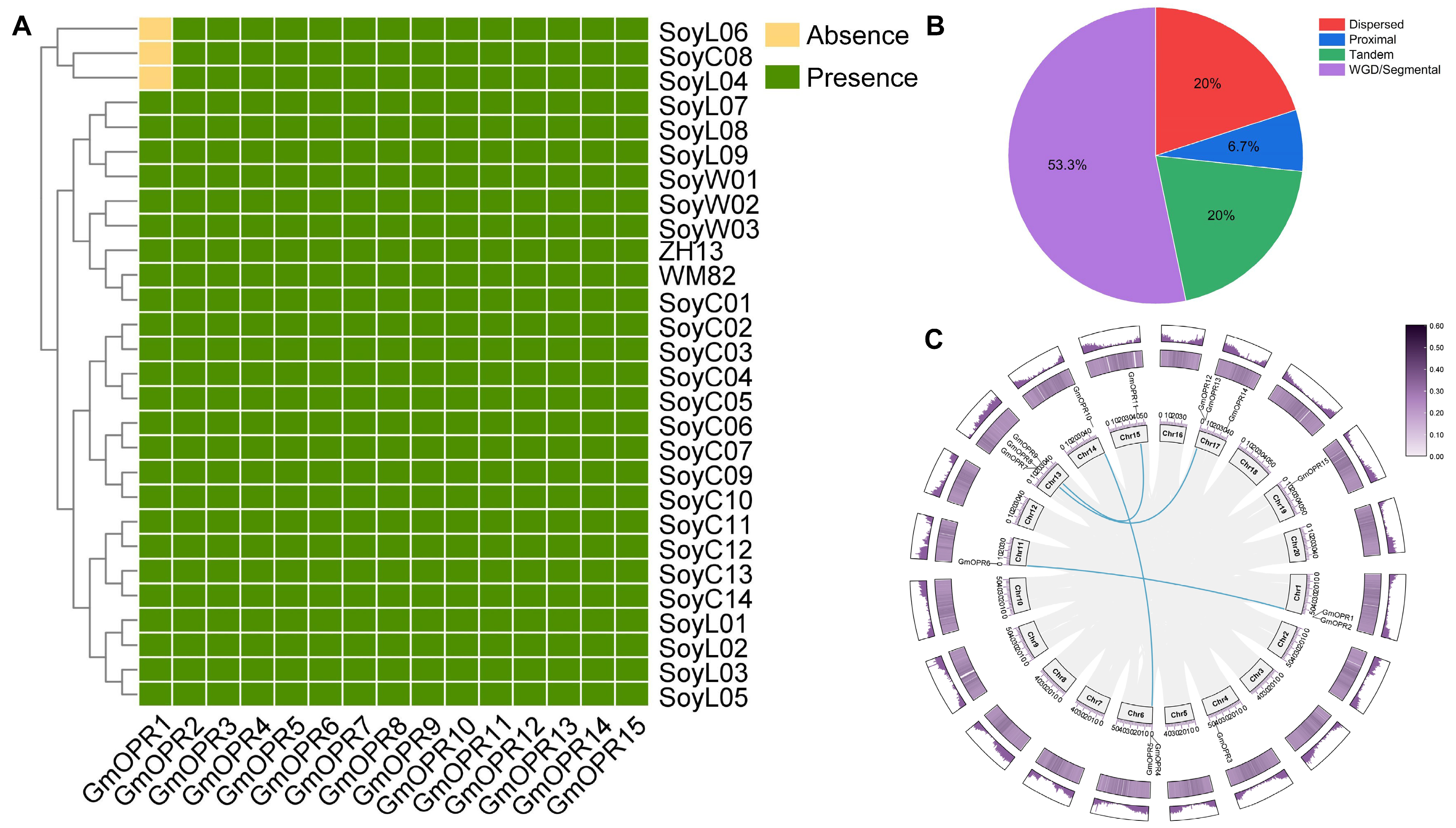
To identify OPR genes in the 28 soybean accessions, candidate genes were identified in 28 soybean genomes using the OPR domain (PF00724), and the top and bottom 10 kb of the homology region were intercepted and re-annotated for the genes that were not identified and genes that had obvious errors in the protein structure in different accessions. A total of 105 genes were corrected, including 69 unannotated genes in the 28 soybean accessions, and 36 misannotated genes were re-annotated. Fifteen OPR genes were identified in the whole soybean genome; the proteins had lengths between 62 and 459 amino acids (Table S1). Following the criteria proposed in a previous study [53], based on their level of conservation, 14 OPR genes were present in 28 accessions and recognized as core genes. The absence of GmOPR1 in SoyC08, SoyL04, and SoyL06 was identified as a variable gene, and the presence/absence variants (PAV) profile of GmOPRs in different soybean accessions indicated that the OPR gene family is conserved in soybean (Figure 1A). Notably, GmOPR6 and GmOPR9 were translocated in W02, with GmOPR6 moving to a different position on the same chromosome and GmOPR9 moving from chromosome 13 to chromosome 11 (Table S1). Except for GmOPR6 and GmOPR9 in W02, the same OPR genes in different accessions are located in the same region of the chromosome. Most OPRs are distributed at both ends of the chromosome in a region with high gene density and moderate GC ratio (Figure 1C). In addition, four pairs of genes belonging to the GmOPR gene family were found to be in syntenic relationships. The analysis of gene duplication types can deepen the understanding of the evolutionary pattern of GmOPRs. WGD/segmental duplication is the main duplication mode of GmOPRs. GmOPR5, GmOPR8, and GmOPR13 are tandem duplications; GmOPR3, GmOPR14, and GmOPR15 are dispersed duplications; and only GmOPR2 is a proximal duplication (Figure 1B and Table S2).

3.2. Gene Structure, Conserved Motifs, and Phylogenetic Analysis

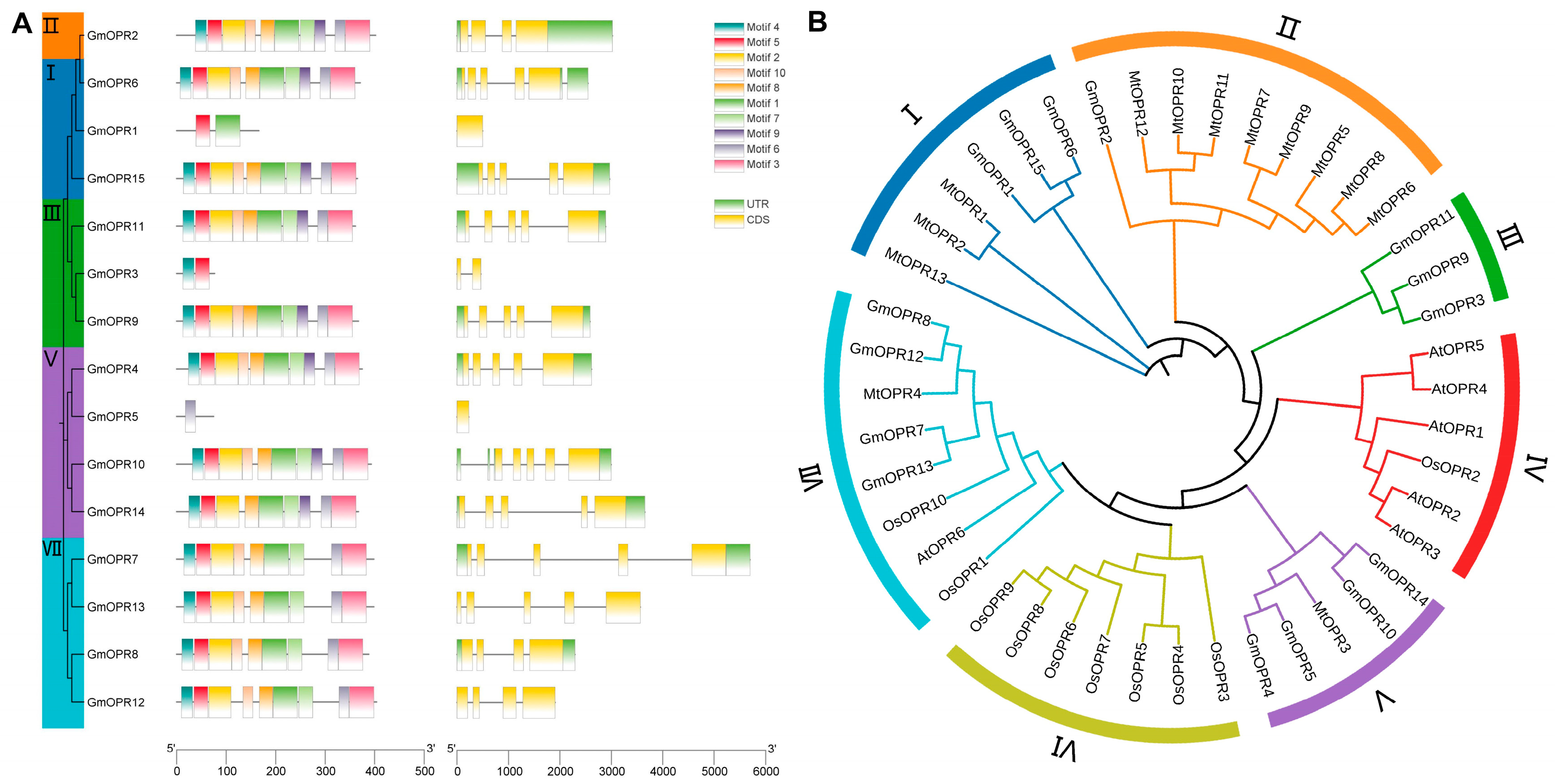
The analysis of the GmOPR gene structure and conserved motifs can provide a deeper understanding of the genetic conservation and functional diversity of the GmOPR gene family. Based on a maximum likelihood phylogenetic tree consisting of 15 GmOPR protein sequences constructed with the JTT model and using 1000 bootstraps, the gene structure and motif patterns of the GmOPRs were visualized and analyzed using TBtools software. Ten motifs of GmOPRs were identified by the MEME online tool, whose length ranged from 21 to 50 amino acids (Table S3). Motif5 was the most predominant motif, contained in 93% of GmOPR proteins, whereas Motif9 was the least predominant motif, contained in only 53% of GmOPR proteins, and Motif9 was generally missing in subgroup VII with a conserved composition, which may be related to the functional differences in GmOPRs. The number of exons in GmOPRs varied from 1 to 5 (Figure 2A).
To reveal the evolutionary relationship and functional evolution of OPR genes, a phylogenetic tree was constructed using the maximum likelihood method with the JTT model and using 1000 bootstraps, based on 15 GmOPR protein sequences, 13 MtOPR protein sequences, 6 AtOPR protein sequences, and 10 OsOPR protein sequences, and categorized them into subgroups I–VII (Figure 2B and Table S4). Subgroup VII included OPR genes from four species, indicating that these OPR genes are evolutionarily conserved and play important roles in plant growth and development. Moreover, subgroup VII contains the identified OPR3 genes of Arabidopsis thaliana [54,55] and rice [56], and GmOPR7, GmOPR8, GmOPR12, and GmOPR13 in the same group may be the OPR3 genes of soybean. The OPR genes of rice and soybean formed independent branches, subgroup III and subgroup VI, which may be due to the fact that both underwent an ancient polyploidization event. Most of the MtOPRs and GmOPRs were concentrated in the same subgroup and were significantly more numerous than AtOPRs, suggesting that the OPR genes may have undergone legume and cruciferous differentiation and large-scale duplication in the legume.

3.3. Selective Pressure Analysis of GmOPRs in the 28 Soybean Accessions

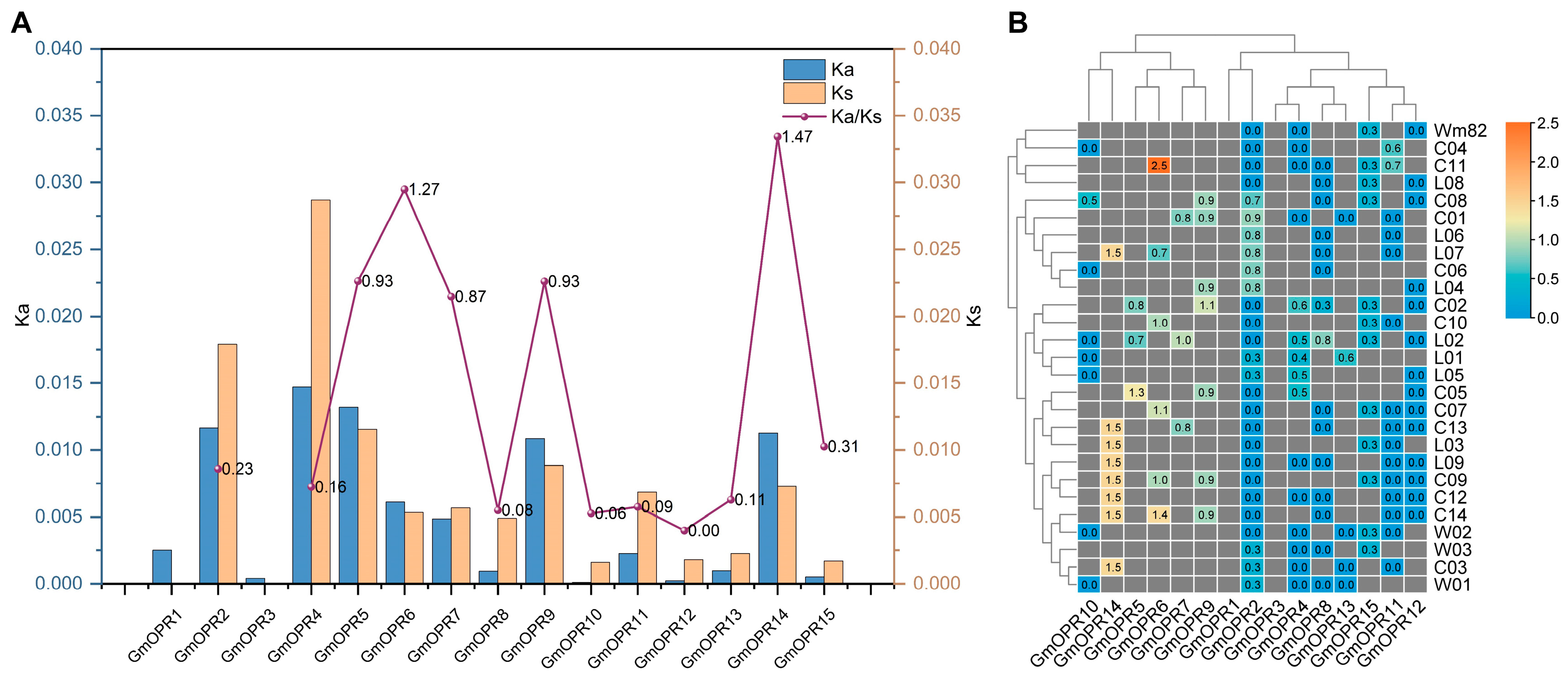
To assess the natural selection pressure on OPR genes in soybean, the OPRs of ZH13 were compared with those of 27 other soybean genomes. This comparison was used to calculate the values of non-synonymous substitutions (Ka), synonymous substitutions (Ks), and Ka/Ks. The range of mean Ka values (0.0001–0.0147) was lower than the range of mean Ks values (0–0.0287). Most Ka and Ks values below 0.02 were lower overall (Figure 3A and Table S5). GmOPR2 and GmOPR4 had higher Ka and Ks values, and the expression of these genes had higher mutation rates, possibly due to the experience of lenient natural selection. The average Ka/Ks values ranged from 0 to 1.47, with 86.7% of the Ka/Ks values in the 28 soybean accessions being less than 1, indicating that the overall evolutionary pressure on GmOPRs was dominated by purifying selection, but that there were potential positive selection signals as well. The Ka/Ks values of GmOPR5 in C05, GmOPR7 in L02, and GmOPR9 in C02 were higher than 1 (Figure 3B), suggesting that these genes have experienced strong selection only in certain soybean accessions that experienced strong positive selection pressure. In contrast, GmOPR6 and GmOPR14 exhibited Ka/Ks values greater than 1 in several soybean accessions, suggesting that these genes may have been subjected to strong positive selection pressure during soybean evolution. It suggests that these genes may be undergoing adaptive evolution, and further experiments are needed to verify whether this is related to biological function.

3.4. Cis-Acting Elements Analysis of GmOPRs in the 28 Soybean Accessions

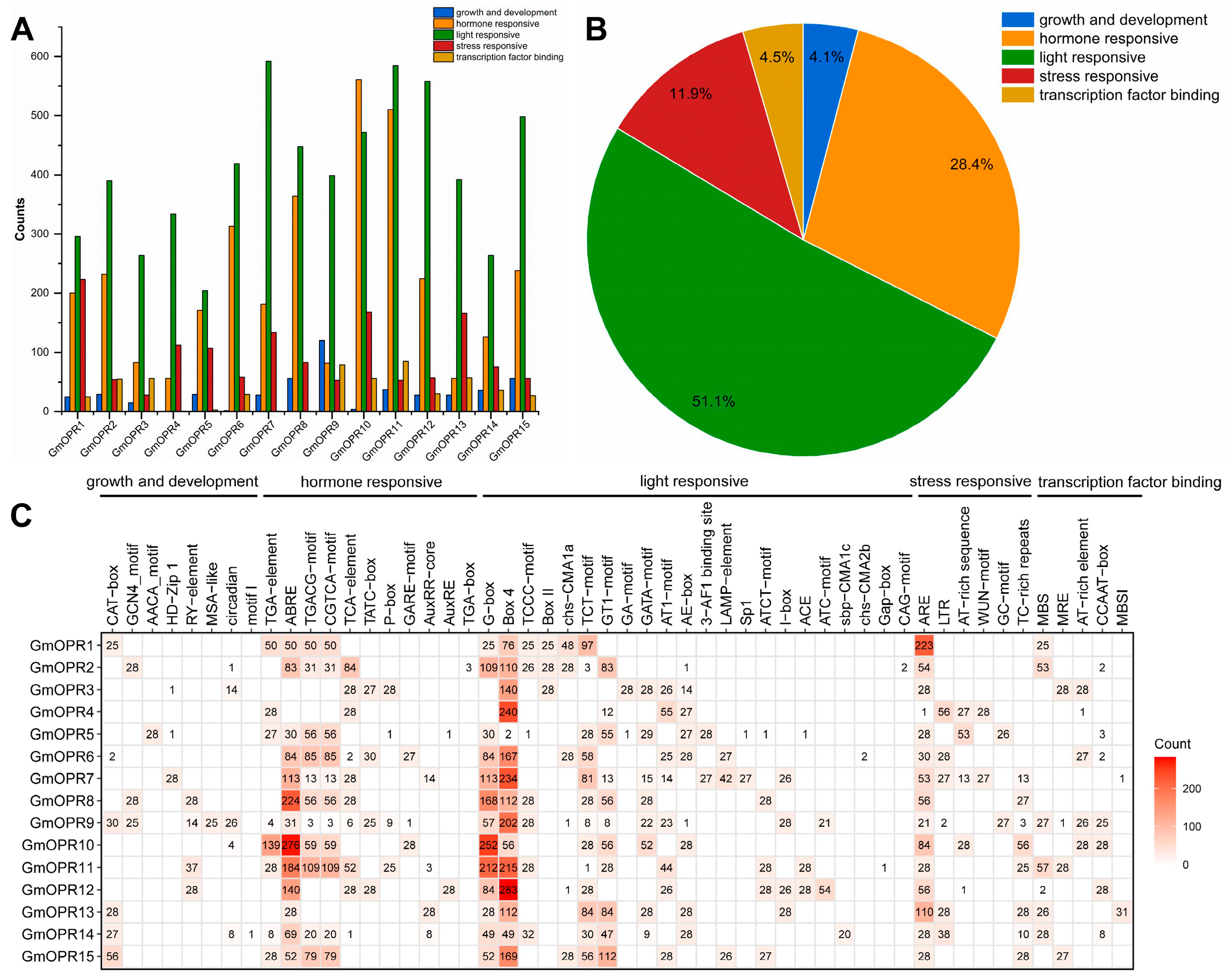
To further study the expression regulation mode of GmOPRs, cis-acting elements 2000 kb upstream of OPRs in 28 soybean genomes were predicted, analyzed, and compared, and a total of 52 species with 11,972 cis-acting elements were identified, with an average of 428 cis-acting elements in each species (Table S6), which were classified into growth and development. The cis-acting elements were categorized as growth and development, hormone responsive, light responsive, stress responsive, and transcription factor binding.
Light-responsive was the most abundant element in GmOPRs, accounting for 51.1% of the total; hormone-responsive was the next most abundant, and growth and development accounted for the least, 4.1% (Figure 4B). The same pattern and some differences in the types and numbers of cis-acting elements existed in different GmOPRs (Figure 4A), with GmOPR10 having the highest number of cis-acting elements, and GmOPRs having the highest number of light-responsive elements, except for hormone-responsive elements that were more abundant than light-responsive elements in GmOPR10. A relatively large number of growth and development elements were present in GmOPR9, and the proportion of stress-responsive genes was larger in GmOPR1, GmOPR4, and GmOPR13, where these genes may exhibit different expression patterns due to the different proportions of cis-acting elements. Anaerobic response elements (AREs) were enriched in GmOPR1, abscisic acid response elements (ABREs) were enriched in GmOPR8 and GmOPR10, and MBSI elements associated with flavonoid biosynthetic gene regulation were heavily enriched in GmOPR13 (Figure 4C). The AACA motif element associated with endosperm-specific negative expression was only present in GmOPR5, and the MSA-like element associated with cell cycle regulation was only present in GmOPR9. The prevalence of specific cis-acting elements numbering less than 10 in GmOPRs suggests that these cis-acting elements are only present in a small proportion of varieties, which may be related to the evolution of varietal adaptation. The cis-acting element types of GmOPR1, GmOPR8, GmOPR13, and GmOPR15 are conserved, and the absence of specific elements suggests that these genes may be critical for the GmOPRs to exercise important functions in gene regulatory networks.

3.5. Protein Interaction Network Prediction and Tissue Expression Pattern Analysis

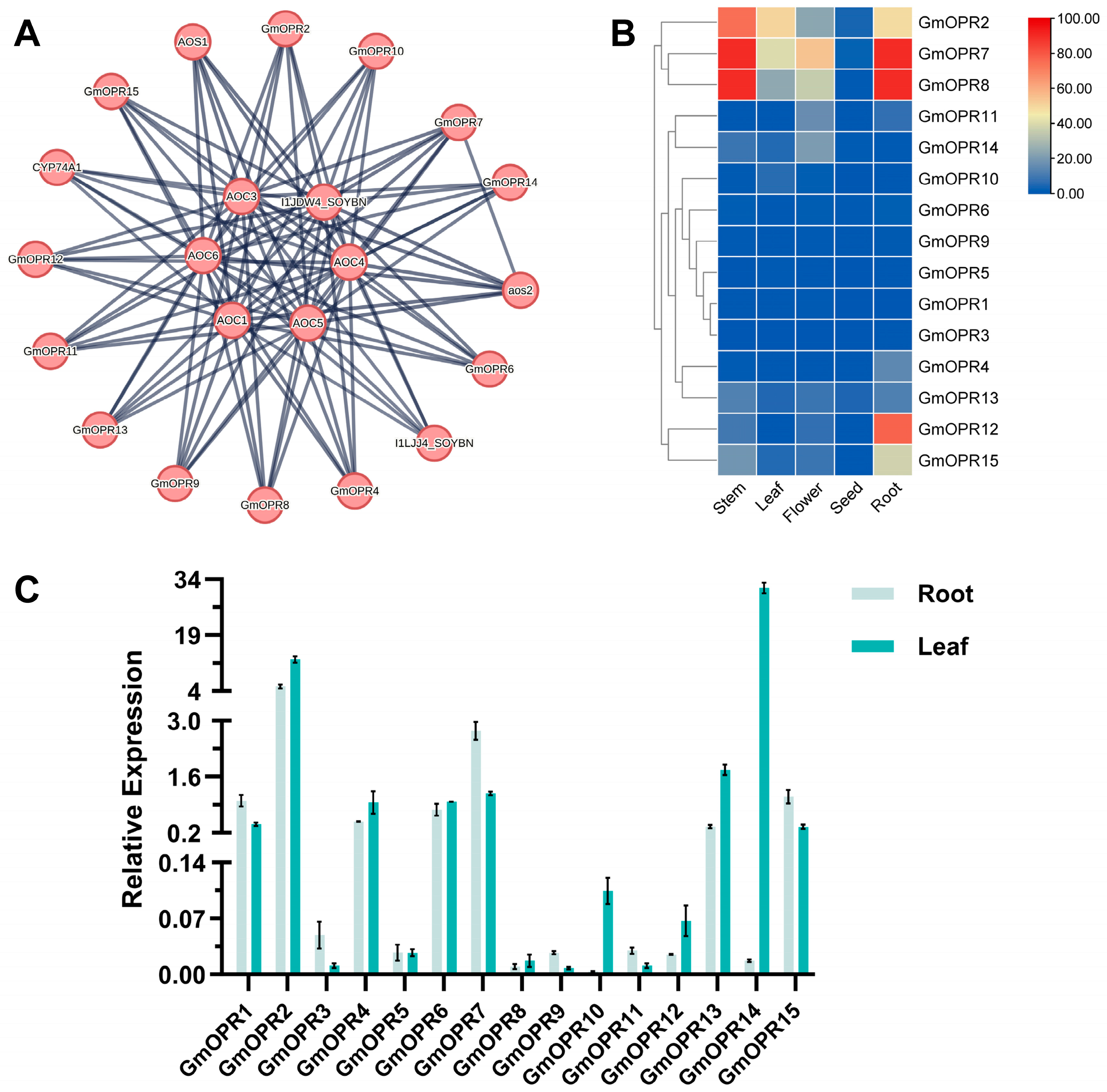
Protein interaction networks can be used to predict functional homologs in sequence homology groups, which is important for studying gene interactions and regulatory relationships. The OPR protein sequence in the ZH13 genome was used as representative input for the STRING database to predict protein interaction networks. I1JDW4_SOYBN had an Allene_ox_cyc domain to judge it as an AOC protein, and CYP74A1 and I1LJJ4_SOYBN have p450 domains; then they may be AOS proteins. The protein interaction network consisted of 22 proteins, including 12 GmOPR proteins, 4 AOS proteins, and 6 AOC proteins (Figure 5A). In the protein interaction network, AOCs are located upstream of GmOPRs, downstream of AOSs, and interact with both GmOPRs and AOSs. Twelve GmOPR proteins participate in protein interaction networks, indicating that these GmOPRs may be crucial members within the GmOPR gene family. It is noteworthy that GmOPR7 is not only associated with AOCs but also with AOS2, suggesting that it may play a more important role in the network.
In order to gain a deeper understanding of the expression patterns of different OPR genes in soybean tissues. The transcriptome data of different tissues of soybean were retrieved from the SoyOmics database, and the expression profiles of GmOPR gene family members in these tissues were subsequently mapped using TBtools software (Figure 5B, Tables S7 and S8). GmOPR1, GmOPR3, GmOPR5, GmOPR6, and GmOPR9 were hardly expressed in various tissues of soybean, and all the GmOPRs were expressed at low levels in seeds. GmOPR7 and GmOPR8 existed in a similar expression pattern and were highly expressed in the stem and root, followed by the flower and leaf. GmOPR2 was highly expressed in root, stem, and leaf, while GmOPR12 and GmOPR15 were highly expressed in root.
To verify the accuracy of the transcriptome database, qRT-PCR experiments were conducted on roots and leaves for 15 genes within the GmOPR gene family (Table S10). Results showed that GmOPR3, GmOPR7, GmOPR9, GmOPR11, and GmOPR15 exhibited significantly higher expression levels in roots than in leaves, while GmOPR2, GmOPR10, and GmOPR14 showed significantly higher expression in leaves than in roots (Figure 5C). These findings were consistent with the trends observed in the transcriptome database.

3.6. Analysis of GmOPRs Expression Patterns Under Salt Stress

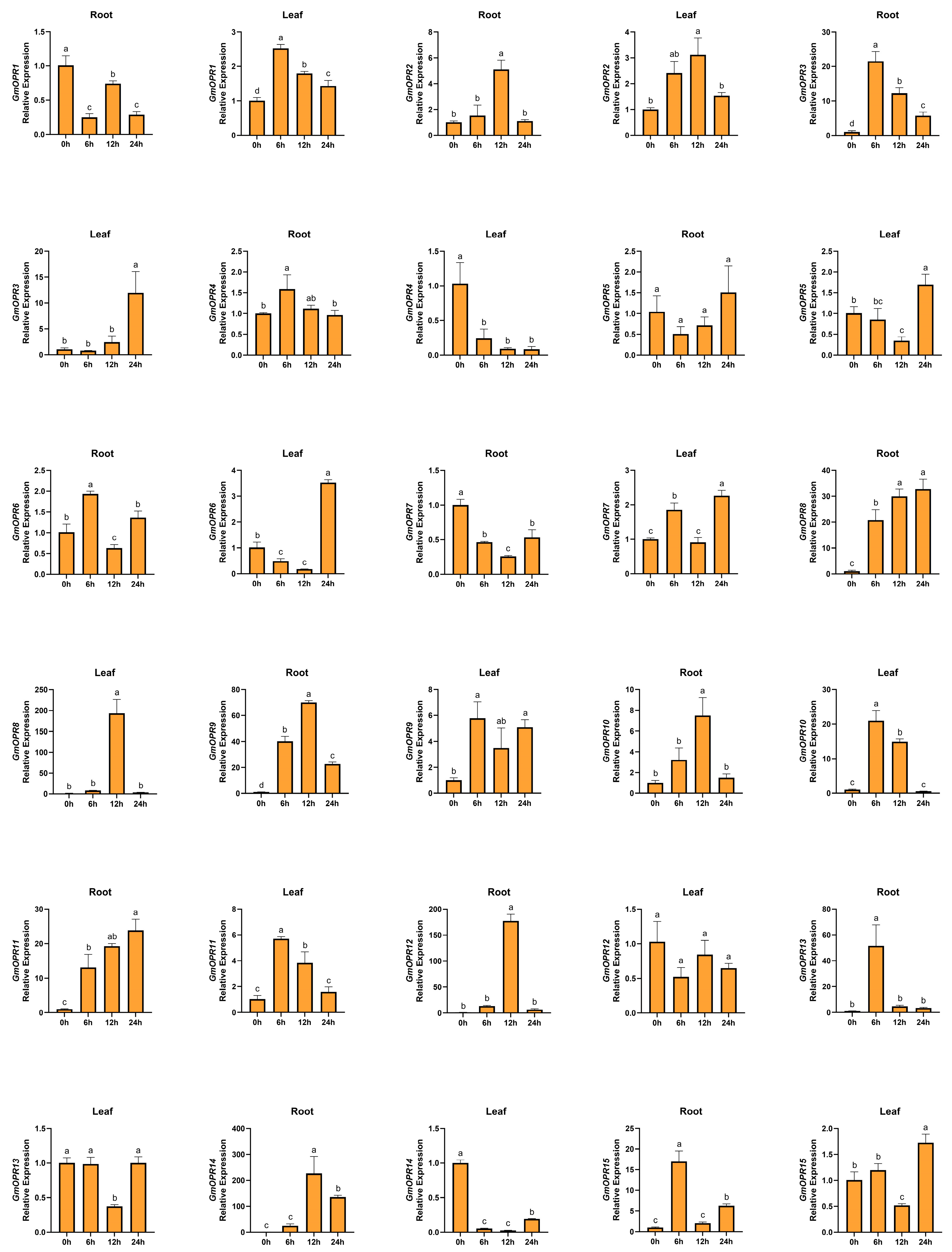
Using the 0-hour treatment as the control, RNA was extracted from roots and leaves at different time points for qRT-PCR analysis and significance testing. In roots subjected to 6-hour salt stress, GmOPR3, GmOPR6, GmOPR13, and GmOPR15 showed significant upregulation, while in leaves, GmOPR1, GmOPR10, and GmOPR11 exhibited significant upregulation (Figure 6 and Table S10). In roots subjected to 12-hour salt stress, GmOPR2, GmOPR3, GmOPR9, GmOPR10, GmOPR12, and GmOPR14 were significantly upregulated, while GmOPR2 and GmOPR8 were significantly upregulated in leaves. In roots subjected to 24-hour salt stress, GmOPR8 and GmOPR11 were significantly upregulated, while in leaves, GmOPR3, GmOPR5, GmOPR6, GmOPR7, GmOPR9, and GmOPR15 were significantly upregulated. GmOPR9 expression increased in both roots and leaves across all three time points following salt stress. GmOPR8 and GmOPR11 expression in roots increased across all three time points after salt stress. GmOPR1 and GmOPR7 in roots, along with GmOPR4 and GmOPR14 in leaves, showed decreased expression across all three time points after salt stress. In summary, GmOPR2, GmOPR3, GmOPR6, GmOPR8, GmOPR9, GmOPR10, GmOPR11, GmOPR12, GmOPR13, GmOPR14, and GmOPR15 in roots were upregulated in response to salt stress. In leaves, GmOPR1, GmOPR2, GmOPR3, GmOPR5, GmOPR6, GmOPR7, GmOPR8, GmOPR9, GmOPR10, GmOPR11, and GmOPR15 were up-regulated in response to salt stress. Except for GmOPR4, the expression levels of the remaining 14 GmOPRs were induced by salt stress in different tissues. This indicates that the GmOPR gene family generally responds to salt stress. GmOPR2, GmOPR3, GmOPR6, GmOPR8, GmOPR9, GmOPR10, GmOPR11, and GmOPR15 were up-regulated in both roots and leaves in response to salt stress, indicating their crucial roles in soybean salt stress responses. Notably, GmOPR1, GmOPR7, and GmOPR14 exhibited opposite expression patterns in roots and leaves, suggesting tissue-specific functions for these genes.

4. Discussion

Soybean is an important grain and oil crop in the world, and salt stress is one of the main abiotic factors affecting soybean yield, while the area of saline land is increasing year by year, and improving the salt tolerance of soybean can effectively enhance the total soybean yield and soil utilization [57]. Long-term selection of a few high-yielding genotypes during modern breeding has resulted in the loss of a large amount of genetic variation for salt tolerance in cultivated soybeans. Traditional studies based on a single reference genome (e.g., Williams 82) have identified some salt tolerance genes (e.g., GmSALT3) [58]. However, there is a systematic omission of germplasm-specific salt tolerance gene members and their allelic diversity, such as important salt tolerance-enhancing genes like GsWRKY40 and GsERD15B, which are not included in the reference genome in wild soybean [59,60], as well as rare protective allelic variants in cultivars. JA is considered an endogenous regulator that plays an important role in plant adversity response, growth, and development, and other life processes [61]. OPR is a crucial enzyme in the jasmonate synthesis pathway. The identification and analysis of OPR genes have been extensively studied in many plants, such as Arabidopsis thaliana [54,62], rice [63], and maize [64]. However, analysis of the soybean gene family based on multiple varieties has rarely been reported, and research on OPR genes in soybean remains relatively scarce.
This study aims to provide a novel approach for soybean gene family analysis by conducting OPR family analysis on 28 soybean genomes constructed from three wild soybean accessions, nine local accessions, and sixteen cultivated accessions. It overcomes the limitations of a single reference genome to comprehensively elucidate the composition, genetic diversity, and functional evolution of the OPR gene family in soybean, demonstrating the feasibility and superiority of gene family analysis based on soybean multiple genomes. We identified OPR genes from 28 soybean genomes and recalibrated their annotations. In total, there were 69 unannotated genes discovered and 36 erroneous genes corrected. By comparing the OPR members in multiple genomes and then re-annotating them, the accuracy and reliability of the OPR gene members in the multiple genomes were ensured, and a new gene was identified using this method, which was not possible in the previous single-genome gene family analysis. 15 OPR genes were identified in the soybean multiple genomes, containing 14 core genes and 1 variable gene, of which four pairs of genes were syntenically related. Only GmOPR1 was missing in soybean L06, C08, and L04, and the rest of the genes were present in all genomes. The conserved members of the soybean OPR gene family indicate that they carry the core biological functions indispensable for species survival. In the analysis of OPR gene duplication types, it was shown that WGD/segmental duplication was the main force driving the evolution of the soybean OPR family.
OPR3 is an important gene in the OPR gene family, and 12-oxophytodienoate reductase 3 is a crucial rate-limiting enzyme in the plant JA biosynthetic pathway [5], which has been identified and studied in Arabidopsis thaliana [54,55] and rice [56]. Soybean has the largest number of OPR genes among all species in the phylogenetic tree. By grouping OPR genes and analyzing their evolutionary relationships, subgroup VII may be an important subgroup that contains several identified OPR3 genes, and 4 soybean OPR3 candidate genes were selected, which can be used for a subsequent in-depth study of their functions. Phylogenetic analysis revealed that the number of OPRs increased significantly in soybean. Most MtOPRs and GmOPRs were found in the same subgroup, and there were significantly more of them than AtOPRs. This suggests that OPR genes differentiated between the Leguminosae and Cruciferae families and that large-scale duplications occurred in the Leguminosae family.
Selection pressure analyses revealed that the overall evolutionary pressure on OPRs was dominated by purifying selection, but there were also signals of potential positive selection. GmOPR2 and GmOPR4 may be experiencing lenient natural selection, and GmOPR5, GmOPR7, and GmOPR9 are experiencing strong natural selection only in certain soybean varieties that experienced strong positive selection pressure. In contrast, GmOPR6 and GmOPR14 exhibited Ka/Ks values greater than 1 in several soybean accessions, suggesting that these genes may have been subjected to strong positive selection pressure during soybean evolution. It suggests that these genes may be undergoing adaptive evolution, and further experiments are needed to verify whether they are related to biological functions. The use of multiple genomes provides a more comprehensive assessment of selection pressures within soybean species, whereas single-genome analysis for interspecies selection pressures does not provide feedback on subtle evolutionary trends in soybean populations. Moreover, the large sample size of multiple genomes can reconcile the significant heterogeneity of selection pressures among individual species, making the results more valid and reliable.
In cis-acting element prediction analysis, traditional analysis relies on the reference genome of a single line, which will miss gene family members and their regulatory sequences that do not exist in that line. The 28 soybean accessions integrate wild type, cultivar, and local species, presenting all genes of the gene family and the 2000 bp region upstream of their promoters, avoiding incomplete analysis of regulatory elements due to the absence of the reference genome. Moreover, by comparing the same gene in the OPR gene family of different accessions, it is possible to identify the conserved core cis-acting elements common to all accessions and to discover the variable cis-acting elements that exist only in some accessions. Many variable cis-acting elements, such as chs-CMA2b, TGA-box, etc., are only found in specific varieties and may be linked to varietal trait differences. In contrast, the cis-acting element types in GmOPR1, GmOPR8, GmOPR13, and GmOPR15 were conserved, and no specific elements appeared, suggesting that these genes may be important and exercise important functions in gene regulatory networks. In addition, GmOPR10 has a large number of hormone-responsive elements and stress-responsive elements, and its expression was significantly up-regulated in roots and leaves under salt stress, suggesting that GmOPR10 may enhance the salt tolerance of soybean through various hormone signaling pathways.
Protein interaction network predictions revealed an AOS-AOC-GmOPR regulatory module, which is consistent with existing studies on the jasmonate synthesis pathway [65]. Not only were 12 more important GmOPRs selected, but one particular gene analyzed was GmOPR7, which was also linked to AOS2 compared to other GmOPRs, suggesting that it may play a more unique role in the network and could be functionally investigated by subsequent experiments.
The expression pattern of GmOPRs in various tissues showed that some of the GmOPRs were hardly expressed in various tissues of soybean, and GmOPRs as a whole were hardly expressed in seeds. It is noteworthy that GmOPR7 and GmOPR8 showed similar expression patterns, with high expression in stems and roots, followed by flowers and leaves, and these two genes may perform similar functions in soybean and are widely involved in soybean growth and development. GmOPR12 and GmOPR15 were specifically and highly expressed in roots, suggesting that these genes are essential for root development and physiological functions. Most GmOPRs were validated by qRT-PCR to align with the trends observed in transcriptomic data.
The association between OPR gene families and plant salt tolerance has been established in multiple plant species, such as TaOPR1 in wheat [30], ZmOPR1 in maize [31], and AhOPR6 in peanut [32], with mechanisms often linked to the ABA signaling pathway. However, studies on OPR genes in salt stress-related research in soybeans remain scarce. This study focused on 15 OPR genes identified in the 28 soybean accessions, investigating their expression patterns under salt stress at 0, 6, 12, and 24 h. All 15 GmOPRs exhibited altered expression levels in response to salt stress. Except for GmOPR4, which showed downregulation in leaves under salt stress but no response in roots, the remaining 14 genes were upregulated in at least one tissue. This indicates the broad involvement of the GmOPR gene family in salt stress responses. Notably, GmOPR1, GmOPR7, and GmOPR14 exhibited both up- and down-regulation in different tissues, suggesting these genes may perform distinct functions in roots and leaves. Furthermore, GmOPR3, GmOPR8, GmOPR9, GmOPR10, and GmOPR11 showed highly significant up-regulated expression in both roots and leaves under salt stress, indicating a stronger functional association with salt stress responses. Subsequent experiments focusing on the in-depth molecular mechanism analysis of these genes will provide theoretical support for developing salt-tolerant soybean accessions. The situation discussed in this study is a neutral salt represented by NaCl, but real saline environments also contain alkaline salts dominated by Na2CO3/NaHCO3 [66]. And the response mechanisms of plant coping under different salt stresses are also different. In neutral salt stress, the core of the plant response mechanism lies in the activation of the SOS signaling pathway for Na+ efflux from the roots and enhancement of salt tolerance in the stem tissues, as well as the enhancement of the reactive oxygen species scavenging system [67]. Alkaline salt stress is resisted by enhancing photosynthetic carbon assimilation and promoting the synthesis of organic acid metabolic modules [68]. Future studies should continue to explore the performance of these genes, whose expression was significantly up-regulated under neutral salt stress, in mixed salinity. This will better assist the actual breeding of soybeans for salinity tolerance.

5. Conclusions

This study conducted a systematic bioinformatics analysis of the soybean OPR gene family based on the 28 soybean accessions, including gene family members, genomic distribution, duplication events, and synteny, gene structure, conserved motifs, phylogenetic evolutionary relationships, selection pressure, cis-acting regulatory elements, protein–protein interaction networks, and tissue-specific expression patterns. Provides a theoretical basis for a deeper understanding of the structure and function of the GmOPR gene family. In addition, further analysis of the expression patterns of the GmOPR gene family under salt stress revealed that GmOPRs are broadly involved in salt stress responses, with some exhibiting tissue specificity. The relative expression levels of GmOPR3, GmOPR8, GmOPR9, GmOPR10, and GmOPR11 were significantly up-regulated in roots and leaves under salt stress. Furthermore, among the GmOPRs, GmOPR10 has a large number of stress-responsive elements and the most hormone-responsive elements, suggesting that GmOPR10 may be a key gene that plays a central regulatory role in plant salt stress resistance. This study provides important candidate genes for breeding salt-tolerant soybean varieties. Subsequent experiments can verify its role in salt stress by gene overexpression and CRISPR/Cas9. And observe its role in mixed salt. Thus, the genetic improvement of salinity tolerance in soybean varieties can be realized. Future studies should also focus on the specific mechanism of action so that more genes related to soybean salt stress resistance can be screened and applied to improve soybean salt tolerance. In summary, these findings ensure the accuracy of gene family analysis and reflect the genetic diversity of different soybean accessions, providing a new idea for soybean gene family analysis that should be widely promoted.

Supplementary Materials

The following supporting information can be downloaded at: https://www.mdpi.com/article/10.3390/biology15010032/s1, Table S1: List of GmOPR genes identified in the 28 soybean accessions and their related information; Table S2: Representative GmOPR gene duplication events; Table S3: The GmOPR motifs in MEME websites; Table S4: Oryza sativa, Arabidopsis thaliana, Medicago truncatula and Glycine max OPR genes in phylogenetic analysis; Table S5: One-to-one orthologous relationships between the OPR gene members in ZH13 and 27 soybean genomes; Table S6: Cis-element analyses of the GmOPR gene promoter regions; Table S7: Expression profiles of GmOPR genes in multiple tissues throughout various developmental stages; Table S8: Expression profiles of representative GmOPR genes in multiple tissues throughout various developmental stages; Table S9: Primers used in this study for qRT-PCR. Table S10: Analyzed qRT-PCR data under salt-treated conditions.

Author Contributions

Conceptualization, Z.H. and C.Z.; methodology, Z.H. and C.Z.; validation, X.Z., Y.S., and C.L.; formal analysis, X.D. and H.Y.; writing—original draft preparation, Z.H.; writing—review and editing, C.Z. and Y.Z. All authors have read and agreed to the published version of the manuscript.

Funding

This research was funded by the Science and Technology Program of XPCC (2025AB003), the earmarked Fund for China Agriculture Research System (CARS-04), and the Jilin Province Agricultural Science and Technology Innovation Project (CXGC2024RCY038).

Institutional Review Board Statement

Not applicable.

Informed Consent Statement

Not applicable.

Data Availability Statement

The original contributions presented in this study are included in the article/Supplementary Material. Further inquiries can be directed to the corresponding authors.

Conflicts of Interest

The authors declare no conflicts of interest.

References

  1. Han, X.; Kui, M.; He, K.; Yang, M.; Du, J.; Jiang, Y.; Hu, Y. Jasmonate-regulated root growth inhibition and root hair elongation. J. Exp. Bot. 2022, 74, 1176–1185. [Google Scholar] [CrossRef]
  2. Huang, Y.; Wang, S.; Shi, L.; Xu, F. JASMONATE RESISTANT 1 negatively regulates root growth under boron deficiency in Arabidopsis. J. Exp. Bot. 2021, 72, 3108–3121. [Google Scholar] [CrossRef]
  3. Wang, Z.; Liu, L.; Su, H.; Guo, L.; Zhang, J.; Li, Y.; Xu, J.; Zhang, X.; Guo, Y.D.; Zhang, N. Jasmonate and aluminum crosstalk in tomato: Identification and expression analysis of WRKYs and ALMTs during JA/Al-regulated root growth. Plant Physiol. Biochem. 2020, 154, 409–418. [Google Scholar] [CrossRef]
  4. Khan, A.H.; Ma, Y.; Wu, Y.; Akbar, A.; Shaban, M.; Ullah, A.; Deng, J.; Khan, A.S.; Chi, H.; Zhu, L.; et al. High-temperature stress suppresses allene oxide cyclase 2 and causes male sterility in cotton by disrupting jasmonic acid signaling. Crop J. 2023, 11, 33–45. [Google Scholar] [CrossRef]
  5. Cheng, H.; Hao, M.; Sang, S.; Wen, Y.; Cai, Y.; Wang, H.; Wang, W.; Mei, D.; Hu, Q. Establishment of new convenient two-line system for hybrid production by targeting mutation of OPR3 in allopolyploid Brassica napus. Hortic. Res. 2023, 10, uhad218. [Google Scholar] [CrossRef]
  6. Garrido-Bigotes, A.; Figueroa, P.M.; Figueroa, C.R. Jasmonate metabolism and its relationship with abscisic acid during strawberry fruit development and ripening. J. Plant Growth Regul. 2018, 37, 101–113. [Google Scholar] [CrossRef]
  7. Kou, X.; Feng, Y.; Yuan, S.; Zhao, X.; Wu, C.; Wang, C.; Xue, Z. Different regulatory mechanisms of plant hormones in the ripening of climacteric and non-climacteric fruits: A review. Plant Mol. Biol. 2021, 107, 477–497. [Google Scholar] [CrossRef]
  8. Tan, X.L.; Fan, Z.Q.; Shan, W.; Yin, X.R.; Kuang, J.F.; Lu, W.J.; Chen, J.Y. Association of BrERF72 with methyl jasmonate-induced leaf senescence of Chinese flowering cabbage through activating JA biosynthesis-related genes. Hortic. Res. 2018, 5, 22. [Google Scholar] [CrossRef]
  9. Zhang, Z.; Xu, M.; Guo, Y. Ring/U-Box protein AtUSR1 functions in promoting leaf senescence through JA signaling pathway in Arabidopsis. Front. Plant Sci. 2020, 11, 608589. [Google Scholar] [CrossRef]
  10. Yuan, H.M.; Liu, W.C.; Lu, Y.T. CATALASE2 coordinates SA-mediated repression of both auxin accumulation and JA biosynthesis in plant defenses. Cell Host Microbe 2017, 21, 143–155. [Google Scholar] [CrossRef]
  11. Huang, P.C.; Grunseich, J.M.; Berg-Falloure, K.M.; Tolley, J.P.; Koiwa, H.; Bernal, J.S.; Kolomiets, M.V. Maize OPR2 and LOX10 mediate defense against fall armyworm and western corn rootworm by tissue-specific regulation of jasmonic acid and ketol metabolism. Genes 2023, 14, 1732. [Google Scholar] [CrossRef]
  12. Hu, Y.; Jiang, L.; Wang, F.; Yu, D. Jasmonate regulates the inducer of cbf expression-C-repeat binding factor/DRE binding factor1 cascade and freezing tolerance in Arabidopsis. Plant Cell 2013, 25, 2907–2924. [Google Scholar] [CrossRef]
  13. Du, H.; Liu, H.; Xiong, L. Endogenous auxin and jasmonic acid levels are differentially modulated by abiotic stresses in rice. Front. Plant Sci. 2013, 4, 397. [Google Scholar] [CrossRef]
  14. Clarke, S.M.; Cristescu, S.M.; Miersch, O.; Harren, F.J.M.; Wasternack, C.; Mur, L.A.J. Jasmonates act with salicylic acid to confer basal thermotolerance in Arabidopsis thaliana. New Phytol. 2009, 182, 175–187. [Google Scholar] [CrossRef]
  15. Seo, J.S.; Joo, J.; Kim, M.J.; Kim, Y.K.; Nahm, B.H.; Song, S.I.; Cheong, J.J.; Lee, J.S.; Kim, J.K.; Choi, Y.D. OsbHLH148, a basic helix-loop-helix protein, interacts with OsJAZ proteins in a jasmonate signaling pathway leading to drought tolerance in rice. Plant J. 2011, 65, 907–921. [Google Scholar] [CrossRef]
  16. Zhao, Y.; Dong, W.; Zhang, N.; Ai, X.; Wang, M.; Huang, Z.; Xiao, L.; Xia, G. A wheat allene oxide cyclase gene enhances salinity tolerance via jasmonate signaling. Plant Physiol. 2014, 164, 1068–1076. [Google Scholar] [CrossRef]
  17. Varshney, V.; Majee, M. JA shakes hands with ABA to delay seed germination. Trends Plant Sci. 2021, 26, 764–766. [Google Scholar] [CrossRef]
  18. Zhang, N.; Zhou, S.; Yang, D.; Fan, Z. Revealing shared and distinct genes responding to JA and SA signaling in Arabidopsis by meta-analysis. Front. Plant Sci. 2020, 11, 908. [Google Scholar] [CrossRef]
  19. Wan, S.; Xin, X.F. Regulation and integration of plant jasmonate signaling: A comparative view of monocot and dicot. J. Genet. Genom. 2022, 49, 704–714. [Google Scholar] [CrossRef]
  20. Schaller, A.; Stintzi, A. Enzymes in jasmonate biosynthesis—Structure, function, regulation. Phytochemistry 2009, 70, 1532–1538. [Google Scholar] [CrossRef]
  21. Schilmiller, A.L.; Koo, A.J.K.; Howe, G.A. Functional diversification of acyl-coenzyme A oxidases in jasmonic acid biosynthesis and action. Plant Physiol. 2007, 143, 812–824. [Google Scholar] [CrossRef] [PubMed]
  22. Chini, A.; Monte, I.; Zamarreño, A.M.; Hamberg, M.; Lassueur, S.; Reymond, P.; Weiss, S.; Stintzi, A.; Schaller, A.; Porzel, A.; et al. An OPR3-independent pathway uses 4,5-didehydrojasmonate for jasmonate synthesis. Nat. Chem. Biol. 2018, 14, 171–178. [Google Scholar] [CrossRef] [PubMed]
  23. Howe, G.A.; Major, I.T.; Koo, A.J. Modularity in jasmonate signaling for multistress resilience. Annu. Rev. Plant Biol. 2018, 69, 387–415. [Google Scholar] [CrossRef] [PubMed]
  24. Seo, H.S.; Song, J.T.; Cheong, J.J.; Lee, Y.H.; Lee, Y.W.; Hwang, I.; Lee, J.S.; Choi, Y.D. Jasmonic acid carboxyl methyltransferase: A key enzyme for jasmonate-regulated plant responses. Proc. Natl. Acad. Sci. USA 2001, 98, 4788–4793. [Google Scholar] [CrossRef]
  25. Balbi, V.; Devoto, A. Jasmonate signalling network in Arabidopsis thaliana: Crucial regulatory nodes and new physiological scenarios. New Phytol. 2008, 177, 301–318. [Google Scholar] [CrossRef]
  26. Li, W.; Liu, B.; Yu, L.; Feng, D.; Wang, H.; Wang, J. Phylogenetic analysis, structural evolution and functional divergence of the 12-oxo-phytodienoate acid reductase gene family in plants. BMC Evol. Biol. 2009, 9, 90. [Google Scholar] [CrossRef]
  27. Yan, Y.; Christensen, S.; Isakeit, T.; Engelberth, J.; Meeley, R.; Hayward, A.; Emery, R.J.; Kolomiets, M.V. Disruption of OPR7 and OPR8 reveals the versatile functions of jasmonic acid in maize development and defense. Plant Cell 2012, 24, 1420–1436. [Google Scholar] [CrossRef]
  28. Tani, T.; Sobajima, H.; Okada, K.; Chujo, T.; Arimura, S.I.; Tsutsumi, N.; Nishimura, M.; Seto, H.; Nojiri, H.; Yamane, H. Identification of the OsOPR7 gene encoding 12-oxophytodienoate reductase involved in the biosynthesis of jasmonic acid in rice. Planta 2008, 227, 517–526. [Google Scholar] [CrossRef]
  29. Pak, H.; Wang, H.; Kim, Y.; Song, U.; Tu, M.; Wu, D.; Jiang, L. Creation of male-sterile lines that can be restored to fertility by exogenous methyl jasmonate for the establishment of a two-line system for the hybrid production of rice (Oryza sativa L.). Plant Biotechnol. J. 2021, 19, 365–374. [Google Scholar] [CrossRef]
  30. Dong, W.; Wang, M.; Xu, F.; Quan, T.; Peng, K.; Xiao, L.; Xia, G. Wheat oxophytodienoate reductase gene TaOPR1 confers salinity tolerance via enhancement of abscisic acid signaling and reactive oxygen species scavenging. Plant Physiol. 2013, 161, 1217–1228. [Google Scholar] [CrossRef]
  31. Gu, D.; Liu, X.; Wang, M.; Zheng, J.; Hou, W.; Wang, G.; Wang, J. Overexpression of ZmOPR1 in Arabidopsis enhanced the tolerance to osmotic and salt stress during seed germination. Plant Sci. 2008, 174, 124–130. [Google Scholar] [CrossRef]
  32. Mou, Y.; Sun, Q.; Miao, H.; Wang, J.; Wang, Q.; Wang, Q.; Yan, C.; Yuan, C.; Zhao, X.; Li, C.; et al. Genome-wide analysis of the 12-oxo-phytodienoic acid reductase gene family in peanut and functional characterization of AhOPR6 in salt stress. Plants 2025, 14, 1408. [Google Scholar] [CrossRef]
  33. Gabay, G.; Wang, H.; Zhang, J.; Moriconi, J.I.; Burguener, G.F.; Gualano, L.D.; Howell, T.; Lukaszewski, A.; Staskawicz, B.; Cho, M.J.; et al. Dosage differences in 12-OXOPHYTODIENOATE REDUCTASE genes modulate wheat root growth. Nat. Commun. 2023, 14, 539. [Google Scholar] [CrossRef]
  34. Xie, M.; Chung, C.Y.L.; Li, M.W.; Wong, F.L.; Wang, X.; Liu, A.; Wang, Z.; Leung, A.K.Y.; Wong, T.H.; Tong, S.W.; et al. A reference-grade wild soybean genome. Nat. Commun. 2019, 10, 1216. [Google Scholar] [CrossRef] [PubMed]
  35. Bandillo, N.; Jarquin, D.; Song, Q.; Nelson, R.; Cregan, P.; Specht, J.; Lorenz, A. A population structure and genome-wide association analysis on the USDA soybean germplasm collection. Plant Genome 2015, 8, plantgenome2015.2004.0024. [Google Scholar] [CrossRef] [PubMed]
  36. Zhuang, Y.; Wang, X.; Li, X.; Hu, J.; Fan, L.; Landis, J.B.; Cannon, S.B.; Grimwood, J.; Schmutz, J.; Jackson, S.A.; et al. Phylogenomics of the genus Glycine sheds light on polyploid evolution and life-strategy transition. Nat. Plants 2022, 8, 233–244. [Google Scholar] [CrossRef] [PubMed]
  37. Liu, Y.; Du, H.; Li, P.; Shen, Y.; Peng, H.; Liu, S.; Zhou, G.A.; Zhang, H.; Liu, Z.; Shi, M.; et al. Pan-genome of wild and cultivated soybeans. Cell 2020, 182, 162–176.e13. [Google Scholar] [CrossRef]
  38. Goodstein, D.M.; Shu, S.; Howson, R.; Neupane, R.; Hayes, R.D.; Fazo, J.; Mitros, T.; Dirks, W.; Hellsten, U.; Putnam, N.; et al. Phytozome: A comparative platform for green plant genomics. Nucleic Acids Res. 2012, 40, D1178–D1186. [Google Scholar] [CrossRef]
  39. Mistry, J.; Chuguransky, S.; Williams, L.; Qureshi, M.; Salazar, G.A.; Sonnhammer, E.L.L.; Tosatto, S.C.E.; Paladin, L.; Raj, S.; Richardson, L.J.; et al. Pfam: The protein families database in 2021. Nucleic Acids Res. 2021, 49, D412–D419. [Google Scholar] [CrossRef]
  40. Solovyev, V.; Kosarev, P.; Seledsov, I.; Vorobyev, D. Automatic annotation of eukaryotic genes, pseudogenes and promoters. Genome Biol. 2006, 7, S10. [Google Scholar] [CrossRef]
  41. Wang, J.; Chitsaz, F.; Derbyshire, M.K.; Gonzales, N.R.; Gwadz, M.; Lu, S.; Marchler, G.H.; Song, J.S.; Thanki, N.; Yamashita, R.A.; et al. The conserved domain database in 2023. Nucleic Acids Res. 2023, 51, D384–D388. [Google Scholar] [CrossRef]
  42. Lu, S.; Wang, J.; Chitsaz, F.; Derbyshire, M.K.; Geer, R.C.; Gonzales, N.R.; Gwadz, M.; Hurwitz, D.I.; Marchler, G.H.; Song, J.S.; et al. CDD/SPARCLE: The conserved domain database in 2020. Nucleic Acids Res. 2020, 48, D265–D268. [Google Scholar] [CrossRef]
  43. Marchler-Bauer, A.; Bo, Y.; Han, L.; He, J.; Lanczycki, C.J.; Lu, S.; Chitsaz, F.; Derbyshire, M.K.; Geer, R.C.; Gonzales, N.R.; et al. CDD/SPARCLE: Functional classification of proteins via subfamily domain architectures. Nucleic Acids Res. 2017, 45, D200–D203. [Google Scholar] [CrossRef]
  44. Chen, C.; Wu, Y.; Li, J.; Wang, X.; Zeng, Z.; Xu, J.; Liu, Y.; Feng, J.; Chen, H.; He, Y.; et al. TBtools-II: A “one for all, all for one” bioinformatics platform for biological big-data mining. Mol. Plant 2023, 16, 1733–1742. [Google Scholar] [CrossRef]
  45. Wang, Y.; Tang, H.; Debarry, J.D.; Tan, X.; Li, J.; Wang, X.; Lee, T.H.; Jin, H.; Marler, B.; Guo, H.; et al. MCScanX: A toolkit for detection and evolutionary analysis of gene synteny and collinearity. Nucleic Acids Res. 2012, 40, e49. [Google Scholar] [CrossRef]
  46. Bailey, T.L.; Williams, N.; Misleh, C.; Li, W.W. MEME: Discovering and analyzing DNA and protein sequence motifs. Nucleic Acids Res. 2006, 34, W369–W373. [Google Scholar] [CrossRef]
  47. Edgar, R.C. MUSCLE: Multiple sequence alignment with high accuracy and high throughput. Nucleic Acids Res. 2004, 32, 1792–1797. [Google Scholar] [CrossRef] [PubMed]
  48. Tamura, K.; Stecher, G.; Kumar, S. MEGA11: Molecular evolutionary genetics analysis version 11. Mol. Biol. Evol. 2021, 38, 3022–3027. [Google Scholar] [CrossRef] [PubMed]
  49. Letunic, I.; Bork, P. Interactive Tree of Life (iTOL) v6: Recent updates to the phylogenetic tree display and annotation tool. Nucleic Acids Res. 2024, 52, W78–W82. [Google Scholar] [CrossRef] [PubMed]
  50. Lescot, M.; Déhais, P.; Thijs, G.; Marchal, K.; Moreau, Y.; Van de Peer, Y.; Rouzé, P.; Rombauts, S. PlantCARE, a database of plant cis-acting regulatory elements and a portal to tools for in silico analysis of promoter sequences. Nucleic Acids Res. 2002, 30, 325–327. [Google Scholar] [CrossRef]
  51. Szklarczyk, D.; Kirsch, R.; Koutrouli, M.; Nastou, K.; Mehryary, F.; Hachilif, R.; Gable, A.L.; Fang, T.; Doncheva, N.T.; Pyysalo, S.; et al. The STRING database in 2023: Protein-protein association networks and functional enrichment analyses for any sequenced genome of interest. Nucleic Acids Res. 2023, 51, D638–D646. [Google Scholar] [CrossRef]
  52. Livak, K.J.; Schmittgen, T.D. Analysis of Relative Gene Expression Data Using Real-Time Quantitative PCR and the 2−ΔΔCT Method. Methods 2001, 25, 402–408. [Google Scholar] [CrossRef]
  53. Bayer, P.E.; Golicz, A.A.; Scheben, A.; Batley, J.; Edwards, D. Plant pan-genomes are the new reference. Nat. Plants 2020, 6, 914–920. [Google Scholar] [CrossRef] [PubMed]
  54. Schaller, F.; Biesgen, C.; Müssig, C.; Altmann, T.; Weiler, E.W. 12-Oxophytodienoate reductase 3 (OPR3) is the isoenzyme involved in jasmonate biosynthesis. Planta 2000, 210, 979–984. [Google Scholar] [CrossRef] [PubMed]
  55. Stintzi, A.; Browse, J. The Arabidopsis male-sterile mutant, opr3, lacks the 12-oxophytodienoic acid reductase required for jasmonate synthesis. Proc. Natl. Acad. Sci. USA 2000, 97, 10625–10630. [Google Scholar] [CrossRef]
  56. Guo, H.M.; Sun, S.C.; Zhang, F.M.; Miao, X.X. Identification of genes potentially related to herbivore resistance in OPR3 overexpression rice by microarray analysis. Physiol. Mol. Plant Pathol. 2015, 92, 166–174. [Google Scholar] [CrossRef]
  57. He, J.; Chen, Y.; Zhang, M.; Qiu, Y.; Zhou, H.; Li, M. Current perspectives on improving soybean performance on saline-alkaline lands. New Crops 2026, 3, 100079. [Google Scholar] [CrossRef]
  58. Qu, Y.; Guan, R.; Bose, J.; Henderson, S.W.; Wege, S.; Qiu, L.; Gilliham, M. Soybean CHX-type ion transport protein GmSALT3 confers leaf Na+ exclusion via a root derived mechanism, and Cl− exclusion via a shoot derived process. Plant Cell Environ. 2021, 44, 856–869. [Google Scholar] [CrossRef] [PubMed]
  59. Li, M.; Xue, M.; Ma, H.; Feng, P.; Chen, T.; Sun, X.; Li, Q.; Ding, X.; Zhang, S.; Xiao, J. Wild soybean (Glycine soja) transcription factor GsWRKY40 plays positive roles in plant salt tolerance. Crop J. 2024, 12, 766–775. [Google Scholar] [CrossRef]
  60. Jin, T.; Sun, Y.; Shan, Z.; He, J.; Wang, N.; Gai, J.; Li, Y. Natural variation in the promoter of GsERD15B affects salt tolerance in soybean. Plant Biotechnol. J. 2021, 19, 1155–1169. [Google Scholar] [CrossRef]
  61. Qiu, Z.; Guo, J.; Zhu, A.; Zhang, L.; Zhang, M. Exogenous jasmonic acid can enhance tolerance of wheat seedlings to salt stress. Ecotoxicol. Environ. Saf. 2014, 104, 202–208. [Google Scholar] [CrossRef]
  62. Biesgen, C.; Weiler, E.W. Structure and regulation of OPR1 and OPR2, two closely related genes encoding 12-oxophytodienoic acid-10,11-reductases from Arabidopsis thaliana. Planta 1999, 208, 155–165. [Google Scholar] [CrossRef] [PubMed]
  63. Li, W.; Zhou, F.; Liu, B.; Feng, D.; He, Y.; Qi, K.; Wang, H.; Wang, J. Comparative characterization, expression pattern and function analysis of the 12-oxo-phytodienoic acid reductase gene family in rice. Plant Cell Rep. 2011, 30, 981–995. [Google Scholar] [CrossRef] [PubMed]
  64. Zhang, J.; Simmons, C.; Yalpani, N.; Crane, V.; Wilkinson, H.; Kolomiets, M. Genomic Analysis of the 12-oxo-phytodienoic Acid Reductase gene family of Zea mays. Plant Mol. Biol. 2005, 59, 323–343. [Google Scholar] [CrossRef]
  65. Wasternack, C.; Song, S. Jasmonates: Biosynthesis, metabolism, and signaling by proteins activating and repressing transcription. J. Exp. Bot. 2017, 68, 1303–1321. [Google Scholar] [CrossRef]
  66. Wang, C.; Wei, X.; Wang, Y.; Wu, C.; Jiao, P.; Jiang, Z.; Liu, S.; Ma, Y.; Guan, S. Metabolomics and transcriptomic analysis revealed the response mechanism of maize to saline-alkali stress. Plant Biotechnol. J. 2025, 23, 5397–5416. [Google Scholar] [CrossRef] [PubMed]
  67. Zhang, H.; Yu, C.; Zhang, Q.; Qiu, Z.; Zhang, X.; Hou, Y.; Zang, J. Salinity survival: Molecular mechanisms and adaptive strategies in plants. Front. Plant Sci. 2025, 16, 1527952. [Google Scholar] [CrossRef]
  68. Sun, Y.; Shu, H.; Lu, D.; Zhang, T.; Li, M.; Guo, J.; Shi, L. Wild soybean cotyledons at the emergence stage tolerate alkali stress by maintaining carbon and nitrogen metabolism, and accumulating organic acids. Physiol. Plant. 2025, 177, e70117. [Google Scholar] [CrossRef]
Figure 1. GmOPRs in the 28 soybean accessions: presence/absence variants, duplication events, and synteny. (A) Presence/absence variants of GmOPRs across 28 accessions. (B) Distribution of duplication events within GmOPRs. (C) Synteny analysis and chromosomal distribution of GmOPRs. The blue line represents colinear gene pairs within GmOPRs. The inner heatmap shows GC ratio, while the outer bar chart indicates gene density.
Biology 15 00032 g001
Figure 2. Gene structure, conserved motifs, and phylogenetic tree of the GmOPR gene family. (A) Gene structure and conserved motifs of the GmOPR gene family. The maximum likelihood phylogenetic tree comprising 15 GmOPR protein sequences constructed using the JTT model and 1000 bootstraps. Different colors classify different subgroups. (B) A phylogenetic tree constructed from the OPRs of Glycine max, Oryza sativa, Arabidopsis thaliana, and Medicago truncatula. The tree was constructed using the maximum likelihood method with the JTT model and 1000 bootstraps. Different colors classify the branches of the phylogenetic tree.
Biology 15 00032 g002
Figure 3. Analysis of natural selection pressures in the 28 soybean accessions. (A) Comparison of Ka, KS, and Ka/Ks values across different GmOPRs. Ka, KS, and Ka/Ks values for each gene represent the average. (B) Comparison of Ka/Ks values for GmOPRs across 28 accessions.
Biology 15 00032 g003
Figure 4. Analysis of cis-acting elements in GmOPRs across the 28 soybean accessions. (A) Distribution of cis-acting elements among different GmOPRs in the 28 soybean accessions. (B) Distribution of cis-acting elements within the GmOPR gene family across the 28 soybean accessions. (C) Number of cis-acting elements in different GmOPRs across the 28 soybean accessions.
Biology 15 00032 g004
Figure 5. GmOPRs protein interaction network and tissue expression patterns. (A) GmOPRs protein interaction network. (B) Heatmap of GmOPRs expression in different tissues. Standardized FPKM values are shown in the upper right corner. (C) Relative expression levels of GmOPRs in roots and leaves detected by qRT-PCR experiments. Standard deviations are represented by error bars.
Biology 15 00032 g005
Figure 6. Expression patterns of the GmOPR gene family under salt stress. The relative expression levels of 15 GmOPRs were detected by qRT-PCR at 0, 6, 12, and 24 h of salt stress treatment. All samples were normalized to the average expression of the Cons4 reference gene. Standard deviations are indicated by error bars, and different letters denote significant differences.
Biology 15 00032 g006
Disclaimer/Publisher’s Note: The statements, opinions and data contained in all publications are solely those of the individual author(s) and contributor(s) and not of MDPI and/or the editor(s). MDPI and/or the editor(s) disclaim responsibility for any injury to people or property resulting from any ideas, methods, instructions or products referred to in the content.