Evaluation of the Effectiveness of Boron Neutron Capture Therapy with Iodophenyl-Conjugated closo-Dodecaborate on a Rat Brain Tumor Model
by
 , , , , , , , and
Yoshiki Fujikawa
1,† ,
,
Yusuke Fukuo
1,†,
Kai Nishimura
2,
Kohei Tsujino
1,
Hideki Kashiwagi
1,
Ryo Hiramatsu
1,
Naosuke Nonoguchi
1,
Motomasa Furuse
1,
Toshihiro Takami
1,
Naonori Hu
3,
Shin-Ichi Miyatake
3,
Takushi Takata
4,
Hiroki Tanaka
4,
Tsubasa Watanabe
4,
Minoru Suzuki
4,
Shinji Kawabata
1,* ,
,
Hiroyuki Nakamura
2 and
Masahiko Wanibuchi
1 1
Department of Neurosurgery, Osaka Medical and Pharmaceutical University, Osaka 569-8686, Japan
2
Laboratory for Chemistry and Life Science, Institute of Innovative Research, Tokyo Institute of Technology, Yokohama 226-8503, Japan
3
Kansai BNCT Medical Center, Osaka Medical and Pharmaceutical University, Osaka 569-8686, Japan
4
Institute for Integrated Radiation and Nuclear Science, Kyoto University, Osaka 590-0494, Japan
*
Author to whom correspondence should be addressed.
†
These authors contributed equally to this work.
Biology 2023, 12(9), 1240; https://doi.org/10.3390/biology12091240
Submission received: 8 August 2023
/
Revised: 12 September 2023
/
Accepted: 13 September 2023
/
Published: 15 September 2023
(This article belongs to the Topic Advances in Anti-Cancer Drugs)
Simple Summary
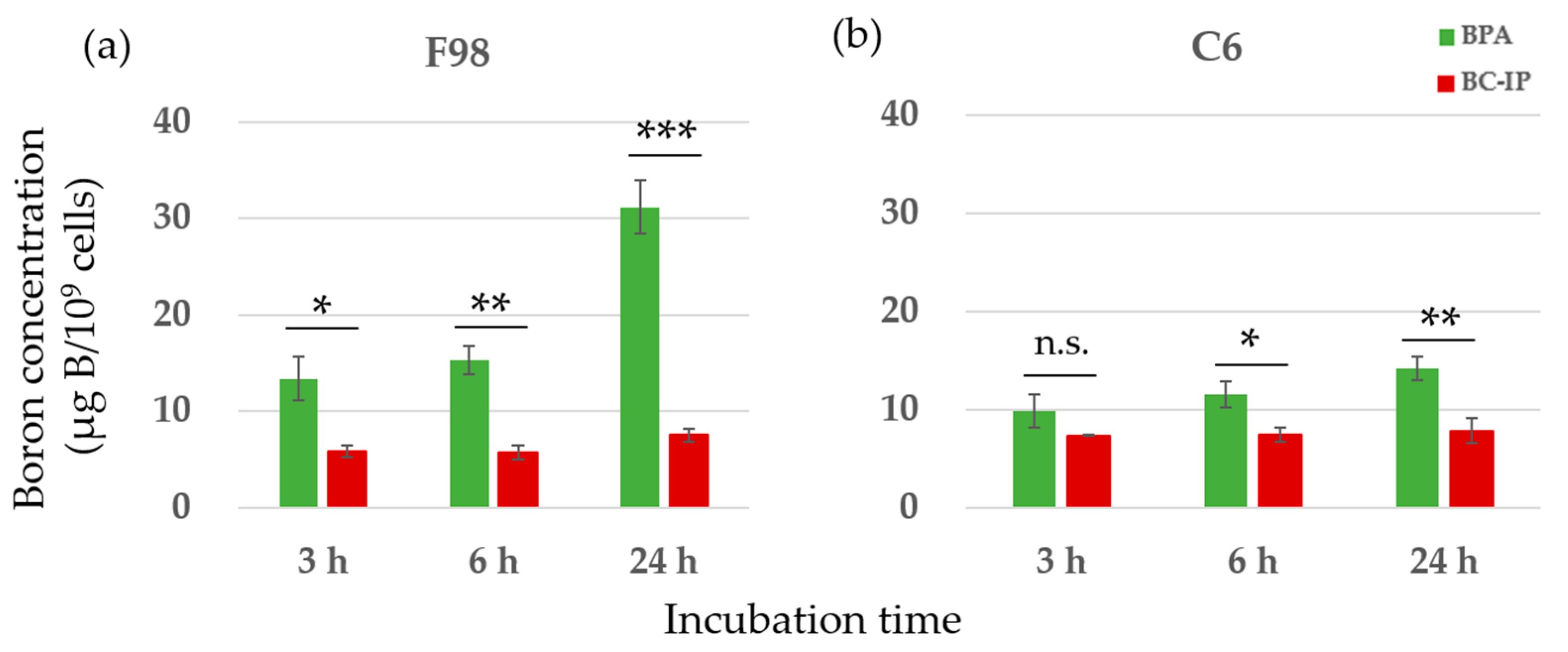
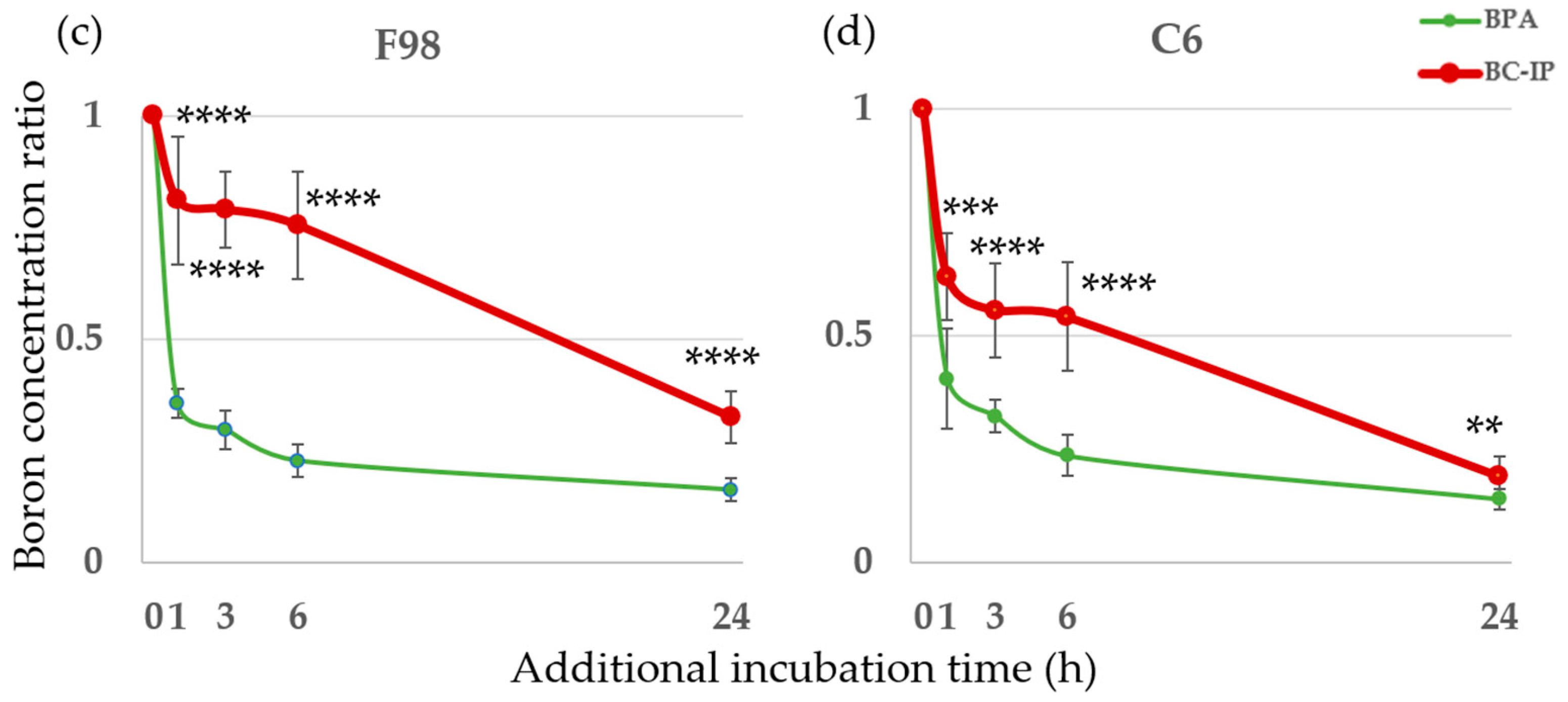
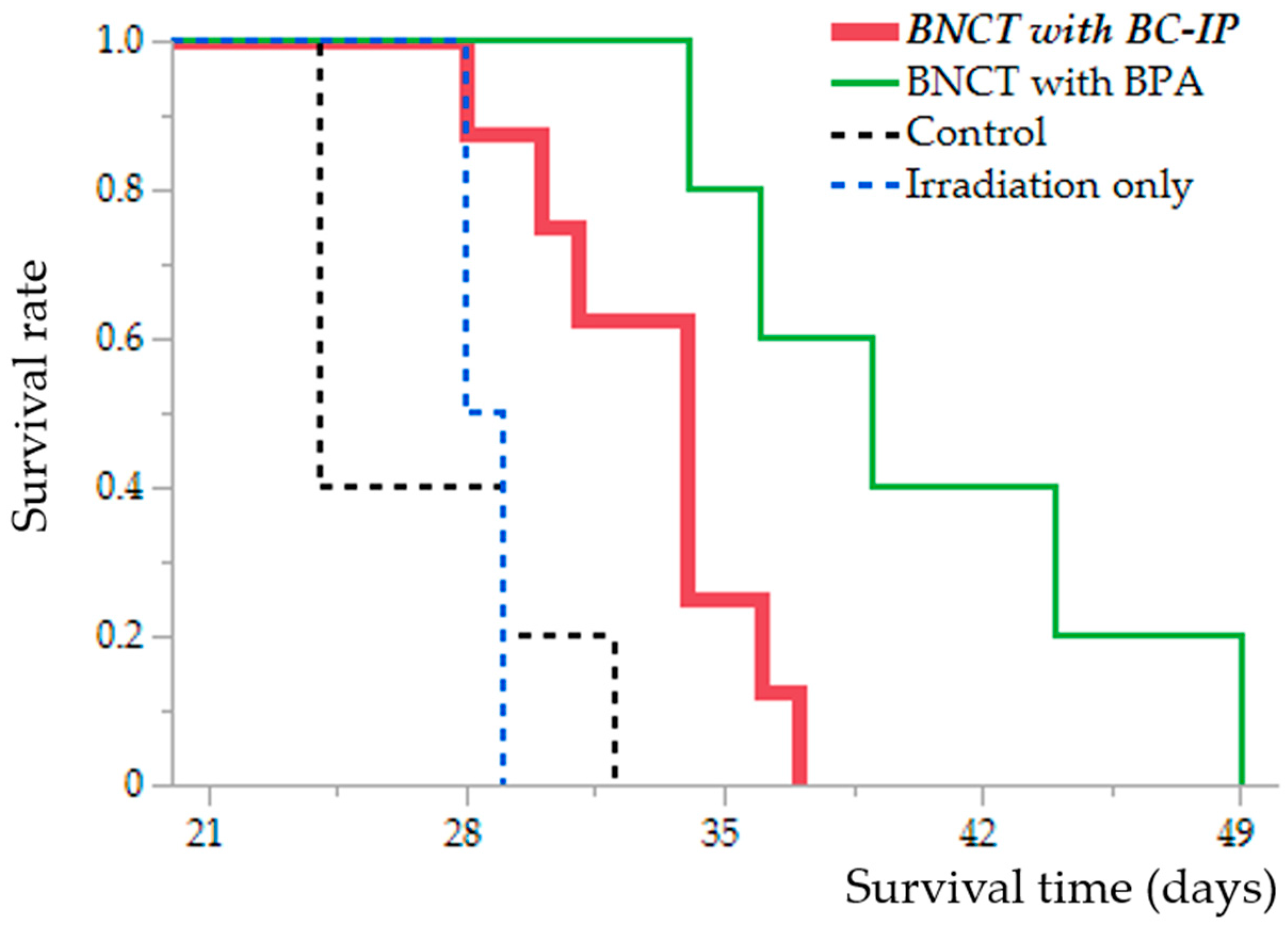
In this study, we explored new methods for treating aggressive brain tumors and, particularly, high-grade gliomas. These types of tumors are notoriously difficult to treat effectively; therefore, we focused on a procedure called boron neutron capture therapy (BNCT). BNCT is a particle beam therapy that can selectively destroy tumor cells. However, boronophenylalanine (BPA), a boron compound currently used in this therapy, has limitations. We tested a new compound, boron-conjugated 4-iodophenylbutanamide (BC-IP) and found that even though it does not carry as much boron into the cells as BPA, it remains in the cells longer, which is beneficial for treatment. We also tested BNCT mediated by BC-IP in rats with gliomas and found that it prolonged survival compared to controls (not treated animals and neutrons only). Our work could potentially improve the treatment options for patients with high-grade gliomas. However, further research is required to understand how to best use this new compound for patient benefits.
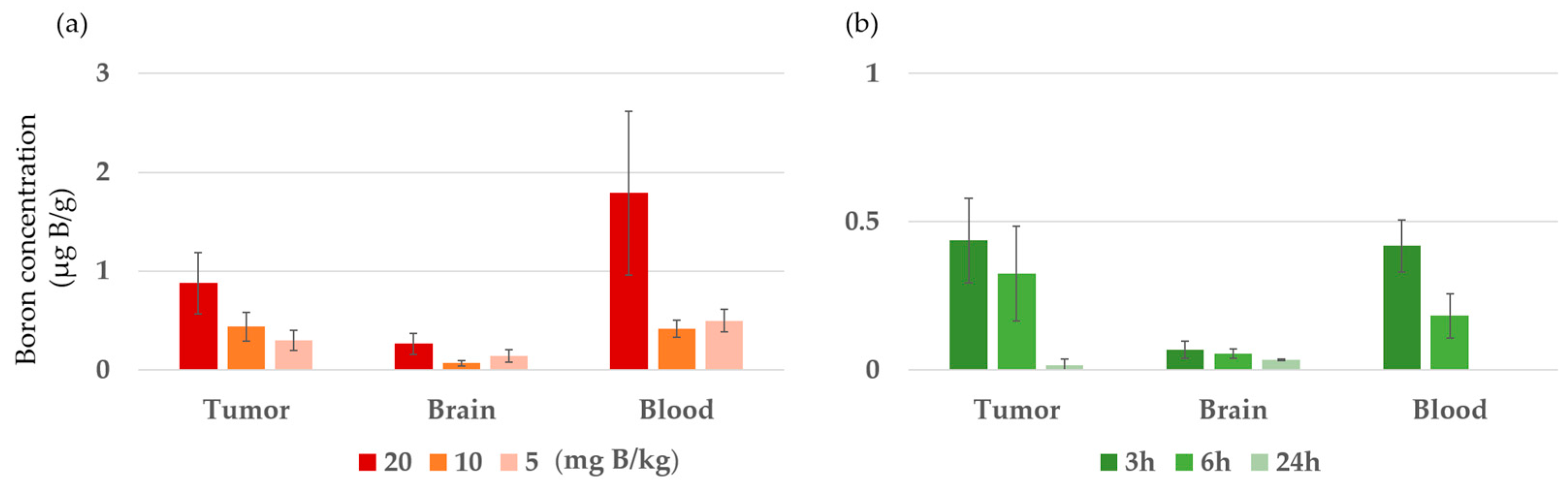
Abstract
High-grade gliomas present a significant challenge in neuro-oncology because of their aggressive nature and resistance to current therapies. Boron neutron capture therapy (BNCT) is a potential treatment method; however, the boron used by the carrier compounds—such as 4-borono-L-phenylalanine (L-BPA)—have limitations. This study evaluated the use of boron-conjugated 4-iodophenylbutanamide (BC-IP), a novel boron compound in BNCT, for the treatment of glioma. Using in vitro drug exposure experiments and in vivo studies, we compared BC-IP and BPA, with a focus on boron uptake and retention characteristics. The results showed that although BC-IP had a lower boron uptake than BPA, it exhibited superior retention. Furthermore, despite lower boron accumulation in tumors, BNCT mediated by BC-IP showed significant survival improvement in glioma-bearing rats compared to controls (not treated animals and neutrons only). These results suggest that BC-IP, with its unique properties, may be an alternative boron carrier for BNCT. Further research is required to optimize this potential treatment modality, which could significantly contribute to advancing the treatment of high-grade gliomas.