Review

Dynamics of Exploding Solitons in Mode-Locked Fiber Lasers

by
Mário F. S. Ferreira
* and
Sofia C. V. Latas
I3N-Institute of Nanostructures, Nanomodelling and Nanofabrication, Department of Physics, University of Aveiro, 3810-193 Aveiro, Portugal
*
Author to whom correspondence should be addressed.
Fibers 2026, 14(6), 64; https://doi.org/10.3390/fib14060064
Submission received: 31 December 2025 / Revised: 20 April 2026 / Accepted: 24 April 2026 / Published: 28 May 2026

Abstract

Many non-equilibrium phenomena and nonlinear dissipative systems can be described by the complex Ginzburg–Landau equation (CGLE). So far, several types of solutions to the cubic–quintic CGLE have been obtained, which can be mainly classified into two categories: stationary solutions and pulsating solutions. One of the most striking forms of pulsating solutions is the exploding soliton, which belongs to the class of chaotic solutions. In this paper, we review the main properties of exploding solitons, considering the case of passively mode-locked fiber lasers described by the CGLE. The impact of the filter’s spectral response and the possibility of converting exploding solitons into fixed-shape pulses by using a proper combination of some higher-order effects are illustrated. An overview of recent experimental observations concerning exploding solitons in different laser configurations is also provided.

1. Introduction

The term “soliton” was first introduced in 1965 to reflect the remarkable nature of solitary waves that remain intact even after mutual collisions, as happens with common particles [1]. These waves are localized solutions of integrable equations such as the Korteweg de Vries and nonlinear Schrödinger equations. Given these circumstances, solitons were initially attributed only to integrable systems. Such solutions have been discovered and investigated in various branches of physics. such as Bose–Einstein condensates [2], hydrodynamics [3], astronomy [4], and optics [5]. The existence of solitons in optical fibers was predicted as early as 1973 by Hasegawa and Tappert [6], whereas their first experimental demonstration was achieved in 1980 by Mollenauer et al. [7].
A dramatic turning point occurred when it was found that solitary wave solutions also existed in a wide range of nonintegrable dissipative systems. Self-organized solutions in nonlinear systems far from equilibrium were termed dissipative solitons or auto-solitons [8,9,10]. In contrast to conventional conservative solitons, which result from a balance between nonlinearity and dispersion, dissipative solitons require a continuous exchange of energy with an external source in order to satisfy an additional balance between gain and loss. Such dissipative solitons have many unique properties that differ from those of their conservative counterparts. They can exist indefinitely in time, as long as these parameters stay constant. However, they cease to exist when their source of energy is switched off, or if the parameters of the system move outside the range that allows for their existence.
A wide range of phenomena in various branches of physics, chemistry and biology can be described by the complex Ginzburg–Landau equation (CGLE) [11,12]. In the field of nonlinear optics, the CGLE can describe various systems, namely optical parametric oscillators, passively mode-locked lasers and all-optical long-haul soliton transmission lines [13,14,15,16,17,18,19,20,21,22,23,24,25]. In all these systems, there are dispersive elements, linear and nonlinear gain, as well as losses.
Soliton solutions to the CGLE have been investigated using different approaches. Exact solutions have been found [24,25,26,27,28,29], but they can be explicitly presented only for certain relations between the parameters of the equation. Furthermore, so far, only stationary solutions of the CGLE are known in analytical form. For small values of the CGLE parameters, one can use an approach based on the soliton perturbation theory [18,29]. For arbitrary values of such parameters, an approximate solution can be obtained by applying the method of moments [30] or Lagrangian techniques [31,32,33,34].
A numerical approach must be used to fully explore the CGLE. Both localized fixed-shape solutions and localized pulsating solutions have been found in this way [34,35]. As examples of localized fixed-shape solutions, we can mention stable plain pulses, flat-top pulses, composite pulses and moving pulses [28]. Among the localized pulsating solutions, we may refer to plain, pulsating, and creeping solitons, as well as exploding solitons, which belong to the class of chaotic solutions [36,37].
Actually, exploding solitons represent one of the most striking and fascinating nonlinear dissipative phenomena in soliton dynamics, which has recently attracted significant research interest. In this regime, a dissipative soliton undergoes a sudden structural collapse upon propagation, breaking down into multiple pieces. Remarkably, the exploded dissipative soliton can return to its original state even though it experiences strong energy dissipation [37]. The process repeats forever, although the distance between eruptions fluctuates, and in each of them, the pulse splits into different pieces. Earlier numerical studies identified soliton explosions as a class of chaotic localized solutions of the CGLE in the anomalous dispersion regime, emphasizing that high-order nonlinear terms are crucial to make a soliton explode. Later on, several numerical investigations were carried out to try to better understand the intrinsic mechanisms involved in soliton explosions and subsequent revivals of the soliton [38,39,40,41,42,43,44]. Among the reported features is the stable existence of symmetric and asymmetric localized explosive states over a wide range of parameters. Such localized states conserve an almost identical shape after each explosion cycle, and the times between explosions appear to be randomly distributed. The influence of some higher-order effects, namely third-order dispersion (TOD), self-steepening (SS) and intrapulse Raman scattering (IRS), has also been studied by some authors [41,42,45,46,47,48]. It has been shown that under the influence of such higher-order effects, the explosions can be drastically reduced and even eliminated, the exploding solitons being then transformed into fixed-shape pulses [41,47,48,49,50].
The existence of the exploding solitons has been experimentally confirmed in a passively mode-locked Ti:sapphire [51]. Later on, with the help of a novel, powerful real-time spectra measurement technique called dispersive Fourier transformation (DFT) [52,53], soliton explosions were also found experimentally in a mode-locked fiber laser [54]. The convenient access to the regime of soliton explosions via DFT has boosted the experimental investigations of such exotic dynamics in mode-locked fiber lasers, including successive soliton explosions [55], vector incoherent soliton explosions [56], duration-tunable soliton explosions [57], spectral periodicity in soliton explosions [58], mutually ignited soliton explosions [59], etc.
In this paper, we review the main characteristics of exploding solitons in passively mode-locked fiber lasers. In Section 2, we describe the common configuration of a passively mode-locked fiber laser, whereas in Section 3, we discuss the modeling of such a laser based on the cubic–quintic complex Ginzburg–Landau equation (CGLE). In the same section, we present a dynamical model to find approximate CGLE soliton solutions based on the method of moments. A numerical approach is used in Section 4 to solve the cubic–quintic CGLE in order to illustrate the main characteristics of exploding solitons. Section 5 provides an overview of recent experimental observations of exploding solitons in different laser conditions. Finally, the main conclusions are summarized in Section 6.

2. Passively Mode-Locked Fiber Lasers

An optical fiber laser can assume different cavity configurations. In a linear configuration, high-reflecting mirrors can be butt-coupled to the ends of a doped fiber in order to provide optical feedback. However, increased cavity losses can arise in such cases due to alignment problems. Another solution consists of depositing adequate dielectric coatings directly onto the polished ends of the fiber [60]. One problem with this solution concerns the possibility of damage to the dielectric coatings when high-power pump light is coupled into the fiber. In order to avoid this problem, one can use fiber Bragg gratings (FBGs) as mirrors at the ends of the doped fiber [61]. FBGs can be designed such that, besides acting as high-reflectivity mirrors for the laser light, they are also transparent to the pump light. Moreover, FBGs can also be used for dispersion and spectral control in fiber lasers. Another possibility to provide optical feedback in fiber lasers consists of using fiber-loop mirrors [62].
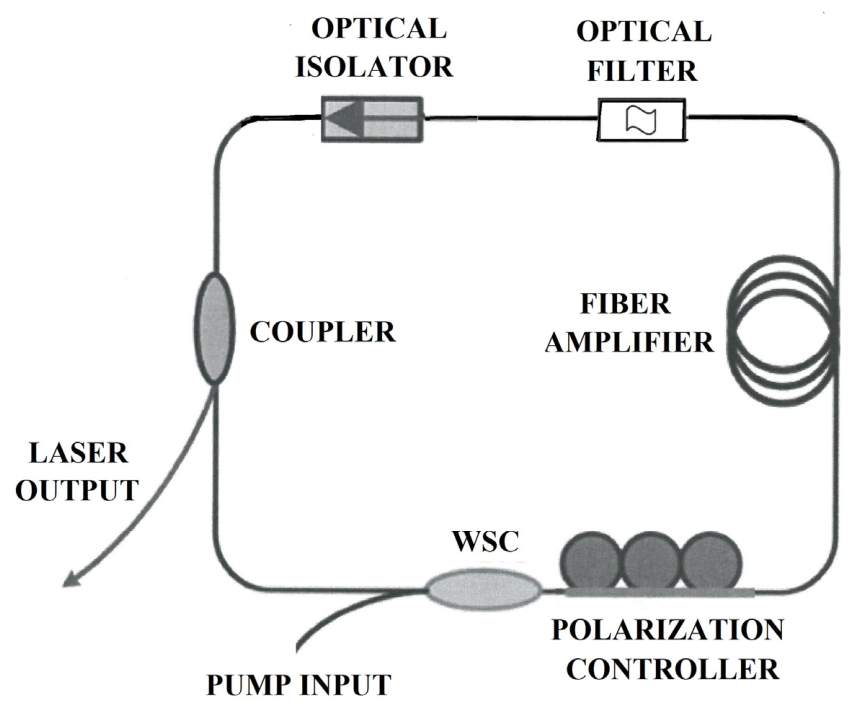
Figure 1 shows the case of an all-fiber laser with a ring configuration. This laser configuration can be realized simply by connecting two ports of a wavelength-selective coupler. Unidirectional operation is achieved with the inclusion of an isolator. Using an optical filter provides the possibility of tuning the laser wavelength.
Short pulses can be generated in fiber lasers using either the Q-switching or the mode locking techniques: [63,64,65]. The Q-switching technique provides relatively broad optical pulses (~100 ns), whereas the mode locking technique can generate pulses with much shorter durations.
The phase-locking of several longitudinal modes of the laser can be achieved using an adequate active or a passive element in the laser cavity. This provides a train of short pulses, spaced by the cavity round-trip time. L i N b O 3 modulators are commonly used in active mode-locking fiber lasers, mainly due to the following reasons: their insertion losses within the laser cavity are relatively low, and they can be modulated at speeds of some tens of GHz [66].
Passive mode-locking does not require any externally modulated media or devices [67,68,69] but only makes use of a nonlinear device whose response depends on the intensity of the input pulse. A fast saturable absorber (FSA) is used for pulse generation and shortening. In the presence of an FSA, an optical pulse experiences more loss than its central part, which is intense enough to saturate the absorber. As a consequence, the exiting pulse is narrower than the input pulse. A fast saturable can be realized using a semiconductor absorbing medium [70,71,72,73,74,75,76], carbon nanotubes [77,78,79,80,81,82,83,84,85,86], graphene [87,88,89,90,91,92,93,94,95,96,97,98,99], black phosphorus [100,101,102,103,104,105,106,107,108,109], and other graphene-like two-dimensional materials [110,111,112,113]. An all-fiber FSA function can also be implemented using a nonlinear optical loop mirror (NOLM) [114,115,116], a nonlinear amplifying loop mirror (NALM) [117], nonlinear polarization rotation (NPR) [118], or nonlinear multimodal interference [119].

3. Modeling the Fiber Laser

Pulse generation in passively mode-locked fiber lasers can be described by the cubic–quintic complex Ginzburg–Landau equation (CGLE). Currently, this equation constitutes a general model for dissipative systems, describing a wide variety of nonlinear phenomena in physics [8,9,10,11,12]. In one of the forms used in nonlinear optics, the CGLE can be written in the following normalized form [8,9,10]:
i q Z + D 2 2 q T 2 + | q | 2 q = i δ q + i β 2 q T 2 + i ε | q | 2 q + i μ | q | 4 q υ | q | 4 q ,
where D is the dispersion parameter, with D > 0 in the anomalous regime and D < 0 in the normal regime, β stands for the normalized filtering strength, δ is the linear excess gain, ε accounts for nonlinear gain-absorption processes, μ represents a higher-order correction to the nonlinear gain-absorption, and υ is a higher-order correction term to the nonlinear refractive index.
If D = 1 and the right-hand side is set to zero, Equation (1) is reduced to the nonlinear Schrödinger equation (NLSE). In the anomalous dispersion regime (D > 0) and for small values of the parameters, one can use the soliton perturbation theory [10]. It can be shown that stable soliton propagation is achieved if the following conditions are satisfied [10]:
δ < 0   ,   μ < 0   ,   ε > β / 2 ,   15 δ > 8 μ η s 4
where η s is the stationary value for the soliton amplitude.
Exact analytical solutions of Equation (1) can be found only for specific relations between the equation parameters. Approximate expressions for some localized solutions can be derived for arbitrary values of the CGLE parameters by applying the method of moments [30], or Lagrangian techniques [31,32,33,34].
The CGLE takes into account all the main physical effects that can be observed in a real mode-locked fiber laser. For example, linear loss and nonlinear gain account for the required saturable absorber effect. On the other hand, even if the correction to the nonlinear refractive index is not imposed by most laser materials under common operation conditions, it can be justified by the discrete nature of the laser cavity [120]. An explicit relation between the CGLE coefficients and the real physical parameters has been obtained for the case of a fiber ring laser using a mode-locking mechanism based on nonlinear polarization rotation [121].
Using a distributed model, as given by Equation (1), to describe a fiber laser presents several advantages. Namely, it allows, to some extent, an analytic study of the laser system. However, the cubic–quintic CGLE given by Equation (1) can also be used when the discrete nature of the laser cavity must be taken into account. In this case, the various parameters vary periodically with Z, the period corresponding to a cavity round-trip.
Several single and multiple-pulse phenomena that have been observed in mode-locked lasers have been explained based on the CGLE framework. Such studies have also been of fundamental importance in the development of the concepts of dissipative soliton [5,122] and dissipative soliton resonance [123,124,125].
Both stationary and pulsating solitons can be found numerically by solving the cubic–quintic CGLE. In experiments, the changes in pump power and other components of a setup correspond to adjustments of the coefficients in numerical simulations, to some extent. However, not all pulsating dynamics predicted theoretically can be easily observed in an experiment. In practice, the laser parameters must be carefully adjusted within very narrow ranges in order to observe stable soliton pulses.

3.1. Polarization Effects

In the case of mode-locked lasers using standard optical fibers, the polarization evolution must be taken into account [126,127,128,129]. Currently, such fibers do not preserve polarization, and the state of polarization may change from pulse to pulse.
Mode-locked lasers using weakly birefringent fibers can be described by the following coupled complex Ginzburg–Landau equations:
U x Z + β 1 x U x t + i 2 β 2 x 2 U x t 2 = i γ ( | U x | 2 + 2 3 | U y | 2 ) U x + · · · · · · + i γ 3 U x * U y 2 e x p [ 2 i ( β 0 x β 0 y ) z ] + g 2 U x + g 2 Ω g 2 2 U x t 2
U y Z + β 1 y U y t + i 2 β 2 y 2 U y t 2 = i γ ( | U y | 2 + 2 3 | U x | 2 ) U y + · · · · · · + i γ 3 U y * U x 2 e x p [ 2 i ( β 0 x β 0 y ) z ] + g 2 U y + g 2 Ω g 2 2 U y t 2
where Uj ( j = x, y) are the slowly varying amplitudes along the slow and the fast axes, γ is the nonlinear coefficient, β 0 j (j = x, y) represent the propagation constants of the two orthogonal linearly polarized waves, β 1 j = d β j / d ω | ω = ω 0 , and β 2 j = d 2 β j / d ω 2 | ω = ω 0 . The first, second, and third terms on the right-hand side of these equations correspond to the self-phase modulation, cross-phase modulation, and four-wave mixing effects, respectively. In the fourth and fifth terms of Equations (3) and (4), g is the laser gain, and Ω g represents its bandwidth.
Equations (3) and (4) are commonly used to study vector soliton formation in passively mode-locked fiber lasers. The experimental generation of such vector solitons has been investigated by several groups in recent years [130,131,132,133,134,135,136,137,138,139,140,141]. To generate vector solitons, all the fibers and passive components of the mode-locked fiber lasers have to be polarization-insensitive. In particular, an appropriate saturable absorber (SA) must be used. Semiconductor saturable absorber mirrors (SESAMs), carbon nanotubes, graphene and graphene-like 2D materials are attractive for this purpose, since they provide polarization-independent saturable absorption. Vector solitons have been observed in passively mode-locked fiber lasers using carbon nanotubes [134] and graphene [135,136].
Coherent energy exchange between vector solitons has been observed in cavities using fibers with weak linear birefringence [130]. In general, vector solitons can be classified as polarization-locked vector solitons (PLVS) [126,127,132,134], polarization rotation vector solitons (PRVS) [132,133,138], group-velocity-locked vector solitons (GVLVS) [131], dark–bright vector solitons [141], and so on.

3.2. The Method of Moments

Unlike the integrable nonlinear Schrodinger equation, in the case of the CGLE, there is no accurate soliton solution obtained by the inverse scattering method. Moreover, since the CGLE is characterized by several parameters, it is difficult to find a correspondence between different regions in the parameter space and various types of dissipative solitons. The solution to this problem usually requires massive numerical simulations with different sets of parameters and initial conditions. This extensive work can be avoided if we are able to find simplified models for the existence of dissipative solitons. Such simplified models can be obtained using the method of moments [30] or the variational method [31,32,33,34]. The main idea in these two methods is to reduce the complete evolution problem with an infinite number of degrees of freedom to the evolution of a finite set of pulse characteristics, thus providing approximate expressions for localized solutions in advance. Through these two methods, the stability of the pulse can be analytically related to the system parameters, thus providing a simple model for understanding soliton pulsation and the emergence of soliton explosions.
In the section, we pay special attention to the method of moments, which was developed initially by Maimisov [142]. Afterwards, this method is applied to various problems described by the cubic–quintic CGLE [30,143,144,145,146].
Two main quantities used by the method of moments are the energy, E, and the momentum, M, given by
E = | q | 2 d T
M = 1 2 ( q q * T q * q T ) d T
The following higher-order generalized moments are also used:
I 1 = + T | q | 2 d T
I 2 = + ( T T 0 ) 2 | q | 2 d T
I 3 = + ( T T 0 ) ( q * q T q q T * ) d T
where T 0 = I 1 / E .
The energy and the momentum, as well as the above three higher-order moments, are conserved quantities of the nonlinear Schrödinger equation. For the cubic–quintic CGLE, they are not conserved but are governed by the following first-order differential equations [142]:
d E d Z = i + ( q R * q * R ) d T
d M d Z = i + ( q T R * q T * R ) d T
d I 1 d Z = i M + i + T ( q R * q * R ) d T
d I 2 d Z = i I 3 + i + ( T T 0 ) 2 ( q R * q * R ) d T
d I 3 d Z = 2 M d T 0 d z + i + ( 2 | q T | 2 | q | 4 ) d T + 2 i + ( T T 0 ) ( q T R * q T * R ) d T + i + ( q R * q * R ) d T
where q T represents the derivative of q relative to T, q * is the complex conjugate of q and
R = i δ q + i β 2 q T 2 + i ε | q | 2 q + i μ | q | 4 q υ | q | 4 q
Let us consider a sech ansatz, given by
q ( Z , T ) = B ( Z , T ) e x p ( i θ ( Z ) )
where θ ( Z ) gives the phase evolution, whereas B ( Z , T ) is the complex amplitude, given by
B ( Z , T ) = A s e c h ( T w ( Z ) ) e x p ( i C ( Z ) T 2 )
In Equation (17), A ( Z ) , w ( Z ) , and C ( Z ) are the pulse amplitude, width, and chirp parameter, respectively. In this case, the pulse energy is
E = 2 A 2 w
and its evolution equation is found to be given by
d E d Z = 2 E [ δ β ( 1 3 w 2 + π 2 3 C 2 w 2 ) + ε 3 E w + 2 μ 15 E 2 w 2 ]
On the other hand, the evolution equations for the pulse width, chirp parameter, and phase become
d w d Z = 2 C w + β ( 8 π 2 w 16 π 2 15 C 2 w 3 ) 2 ε π 2 E μ π 2 C 2 w
d C d Z = 2 ( 1 π 2 w 4 C 2 ) + 1 π 2 E w 3 4 ( 1 3 + 1 π 2 ) β C w 2 + 8 υ 15 π 2 E 2 w 4
d θ d Z = 1 3 w 2 + β C ( 1 3 + π 2 9 ) 5 12 E w 8 υ 45 E 2 w 2
Currently, a system of ODEs for soliton parameters similar to those in Equations (19)–(22) can be derived using a variational approach, assuming the same ansatz [10]. Both the method of moments and the variational method can qualitatively predict the correct dynamics for a wide range of system parameters. These forms also provide rough estimates for the bifurcation boundaries between stationary and pulsating solitons, including exploding solitons.
Both fixed points and limit cycles can be found by performing an analysis of Equations (19)–(22). Fixed points correspond to stationary solitons, whereas limit cycles correspond to pulsating solitons. A stationary soliton can be transformed into a pulsating soliton, which corresponds to a Hopf bifurcation in the reduced dynamical system [30]. The main characteristics of a periodic exploding soliton have been explained based on a sequence of period-halving and period-doubling bifurcations.

4. Exploding Solitons

Equation (1) presents different types of localized solutions with periodically or quasi-periodically varying amplitude, width, and energy. Among the pulsating solutions, we find plain, pulsating, and creeping solitons, as well as exploding solitons, which belong to the class of chaotic solutions [10].
In some cases, it was found that the pulse energy oscillates in a single period during transmission; therefore, this pulsation structure is called single-period pulsation. Corresponding to this energy oscillation, both the temporal structure and the spectral structure of the pulse exhibit a property like breath. Under specific parameter conditions, pulsation possesses extremely high energy ratios, which are related to periodic soliton explosion.
Soliton explosions were found for the first time numerically by Soto-Crespo et al. [36] and represent one of the most fascinating phenomena in a nonlinear optical system. The soliton explosion manifests itself as a chaotic and quasi-periodic process, through which the pulse experiences drastic collapse before being restored to its original state. Several numerical investigations have been performed by different groups in order to understand the fundamental mechanisms involved in the soliton explosion process [37,38,39,40,41,42,43,44].
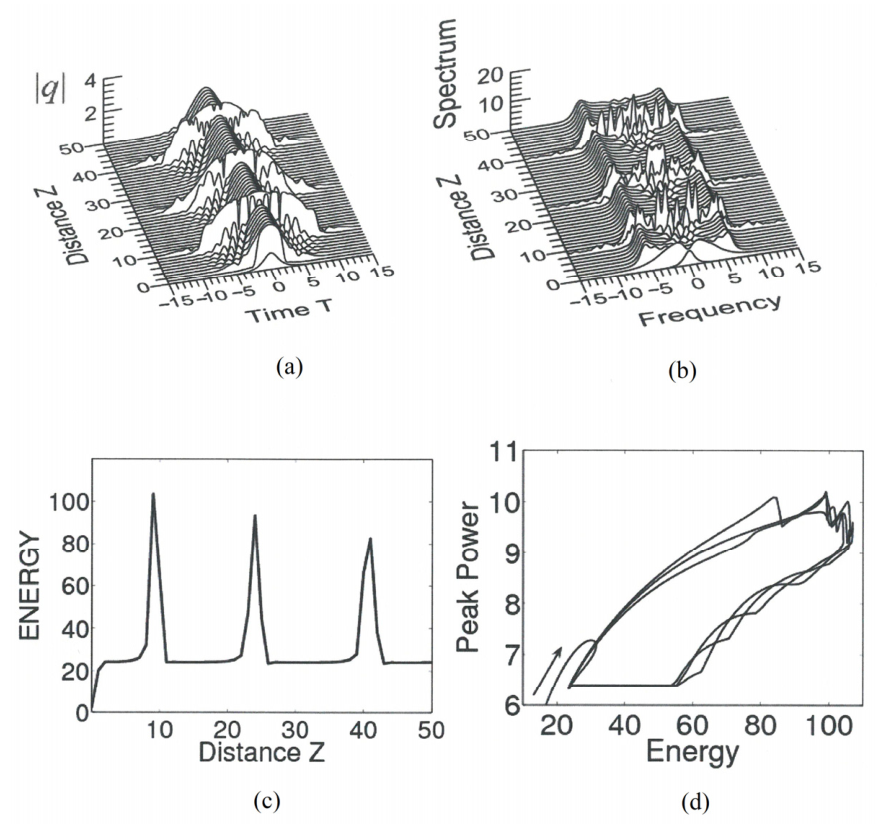
Figure 2 shows the main features of an exploding soliton, considering the following set of parameters: for δ = −0.1, β = 0.125, ε = 1.0, μ = −0.1, and ν = −0.6. The evolution of the pulse in Figure 2a starts from an initial pulse with a unitary sech profile, which has a perfect spectral profile. After a while, the spectrum experiences a sharp shrink followed by a dramatic expansion, and very soon, cracks into pieces like an explosion. However, these completely chaotic, but well-localized spectral structures evolve in order to restore the original, relatively stable mode-locked profile. The pulse spectrum exhibits a dual peak power profile, which evolves as illustrated in Figure 2b. Some perturbations appear at the central spectral region, well separated from each of the two main peaks. These perturbations tend to extend over the entire spectrum just before explosions occur.
The exploding soliton solution is an example of a chaotic solution. Actually, none of the explosions is truly equal to the previous one and the exploding process is not exactly periodic, as can be seen from Figure 2c,d. In particular, it is found that the trajectory in the plane defined by the pulse energy and the pulse peak power is slightly different from one explosion to another.
The behavior of an exploding soliton can be understood using a linear stability analysis [38]. Let us consider a stationary solution given by q ( Z , T ) = q 0 e i k Z , where q 0 ( T ) is a complex function of T with exponentially decaying tails and k is the propagation constant, which is assumed to be real. In the vicinity of the stationary solution, one can write an expression of the type
q ( Z , T ) = q 0 ( T ) + f ( T ) e λ Z + g ( T ) e λ * Z e i k Z
where f ( T ) and g ( T ) are small perturbation functions and λ is the associated perturbation growth rate. It can be shown that the full spectrum of an exploding soliton consists of two complex conjugate eigenvalues with positive real parts. It also includes a continuous spectrum of complex conjugate eigenvalues, all with negative real parts [38]. It is found that eigenfunctions corresponding to eigenvalues with positive real parts are mainly non-zero in the wings of the soliton. Such positive real parts determine the increase in any small perturbations appearing in an initial stationary solution. When the amplitude of the perturbations becomes similar to the soliton amplitude, the dynamics becomes strongly nonlinear and chaotic. However, the solution remains localized, both in amplitude and in width. The total width in the frequency domain remains finite, assuming that the β is positive. On the other hand, the maximum amplitude is limited if parameter μ is negative. Finally, all radiative waves are suppressed since they have eigenvalues with negative real parts. As a result, this evolution returns to the state of a stationary soliton with a small perturbation, which has an eigenvalue with a positive real part. This means that instability will develop again later, thus repeating the whole process.
The management of the system parameters, namely the fiber dispersion, filtering, and nonlinear gain characteristics, provides the possibility of controlling the soliton explosions [147]. Using rapid and strong variations in nonlinearity is another technique able to stabilize the soliton [148].
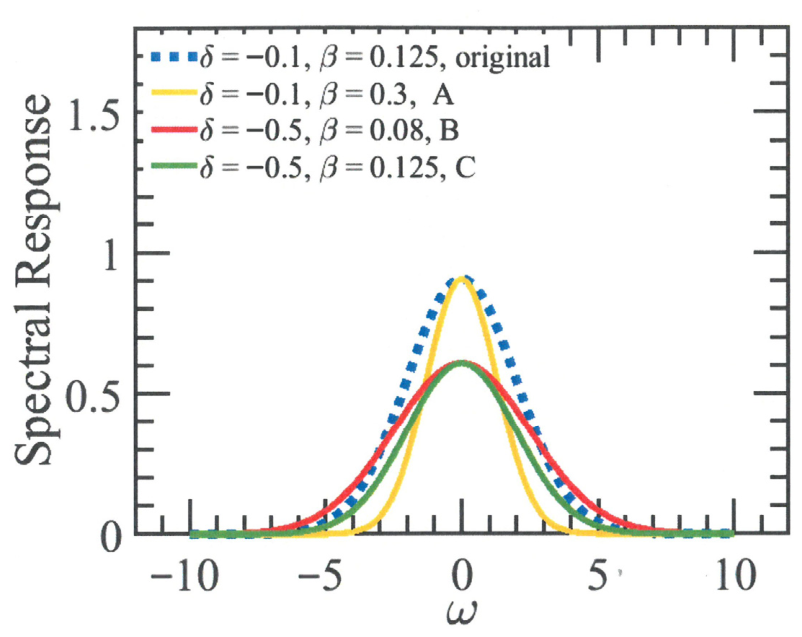
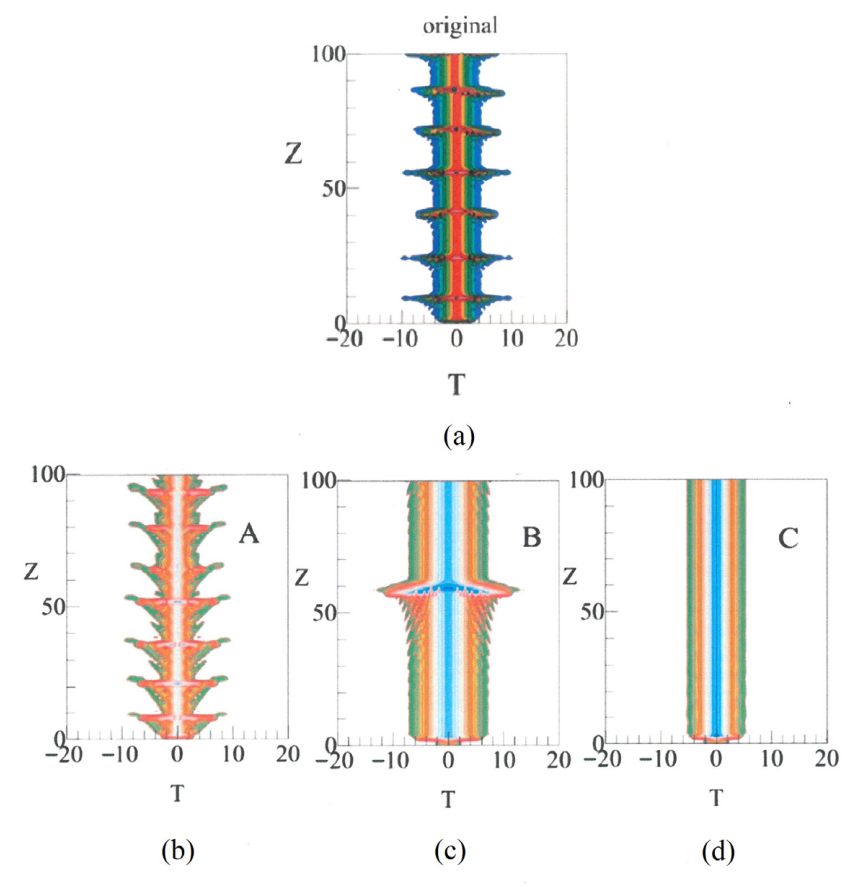
Figure 3 shows the filter spectral response, T(ω) = exp(δβω2), considering the parameters used in Figure 2 (δ = −0.1, β = 0.125) and three other cases: A (δ = −0.1, β = 0.3), B (δ = −0.5, β = 0.08), and C (δ = −0.5, β= 0.125), respectively. It can be seen that the peak of the filter response curve decreases when the magnitude of the loss parameter, δ, increases. On the other hand, the width of the curve becomes smaller when the filtering effect, represented by the parameter β, becomes stronger.
Figure 4 illustrates the impact of changing the filter’s spectral response according to the cases considered in Figure 3. Comparing later examples to the original case, as illustrated in Figure 4a,b, shows that the extension of the laminar stage is reduced by increasing the filter strength β, whereas the number of explosions remains practically the same. On the other hand, Figure 4c,d show that such explosions can be reduced or even eliminated by increasing the magnitude of the loss parameter, δ.
Equation (1) cannot be used, as it stands, to describe the behavior of femtosecond optical pulses. For such ultrashort pulses, some higher-order nonlinear and dispersive effects must be taken into account, namely intrapulse Raman scattering, self-steepening and third-order dispersion [10,29]. Such higher-order effects (H.O.E.) are represented by the following terms, to be added to the right-hand side of Equation (1) [10,29,41,42]:
H . O . E . = i δ 3 3 q T 3 i s ( | q | 2 q ) T + τ R q | q | 2 T
The parameters δ 3 , s, and τ R , govern, respectively, the effects of third-order dispersion (TOD), self-steepening (SST), and intrapulse Raman scattering (IRS), and are given by
δ 3 = β 3 6 | β 2 | t 0 ,   s = 1 ω 0 t 0 ,   τ R = t R t 0
where
β j = ( d j β d ω j ) ω = ω 0
and β is the propagation constant, ω 0 is the carrier frequency, and t 0 is the initial pulse width. The three parameters given by Equation (25) are inversely proportional to the initial pulse width t 0 . Assuming a value t 0 = 30 fs for pulses propagating at 1550 nm in a standard silica fiber, we have δ 3 0.03 , s 0.03 , τ R 0.1 . Actually, the IRS effect is often the most relevant among the higher-order effects.
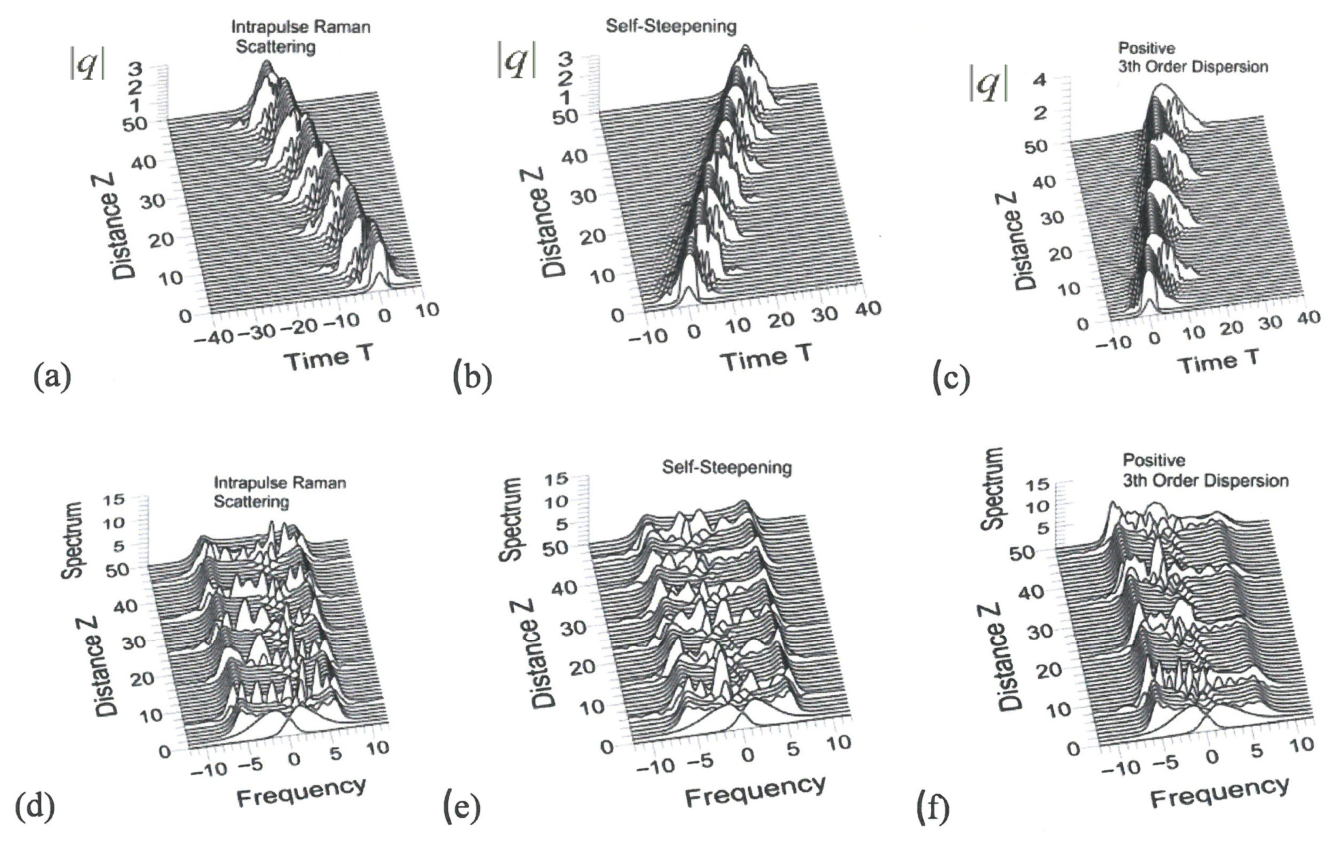
The influence of different HOEs on the exploding solitons in the CQGLE was studied numerically in [41,42,45,46,47,48,49,50]. It was found that higher-order effects can, in different ways, filter the spectral perturbations that feed the ripples’ growth, determining the pulse explosions. Figure 5 illustrates the impact of each higher-order effect on the dynamics of the erupting soliton. The upper row shows the amplitude evolution, whereas the lower row shows the spectrum for an erupting pulse, in the presence of (a, d) IRS (τR =0.2), (b, e) SST (s = 0.08), and (c, f) positive TOD ( δ 3 = +0.1), respectively. The other parameter values and the initial condition are the same as for Figure 2.
Figure 5a shows that, under the effect of IRS, the pulse moves to the left and only cracks on the leading edge, when compared with the pulse evolution in Figure 2a. On the other hand, in the presence of SST or of positive TOD, the pulse moves to the right, and the explosions only occur on the trailing edge, as observed in Figure 5b,c, respectively. In these three cases, the pulse moves at a constant velocity, and the number of explosions increases in comparison to Figure 2a. A dual pulse spectrum is yet observed in the three cases, but it becomes asymmetric, with one of the peaks higher than the other. In the case of Figure 5d, the spectral perturbations just grow in the high-frequency region of the spectrum, while explosions occur at the pulse’s left-hand side, in the time domain. The reverse occurs in Figure 5e,f. Initially, the spectral perturbations appear at the central frequency, but afterwards they spread to the entire spectrum. When they reach a given magnitude, the explosion occurs. After that, the process repeats itself.
It was shown by Latas et al. that the stabilization of an exploding soliton can be achieved by appropriately combining the three HOEs [41,42,47,48,49]. A subcritical bifurcation controlled by the SST parameter was used to characterize the conversion of an exploding soliton into a fixed shape solution [149]. On the other hand, the main characteristics of a periodic exploding solution were explained based on a sequence of period-halving and period-doubling bifurcations controlled by the IRS parameter [46].
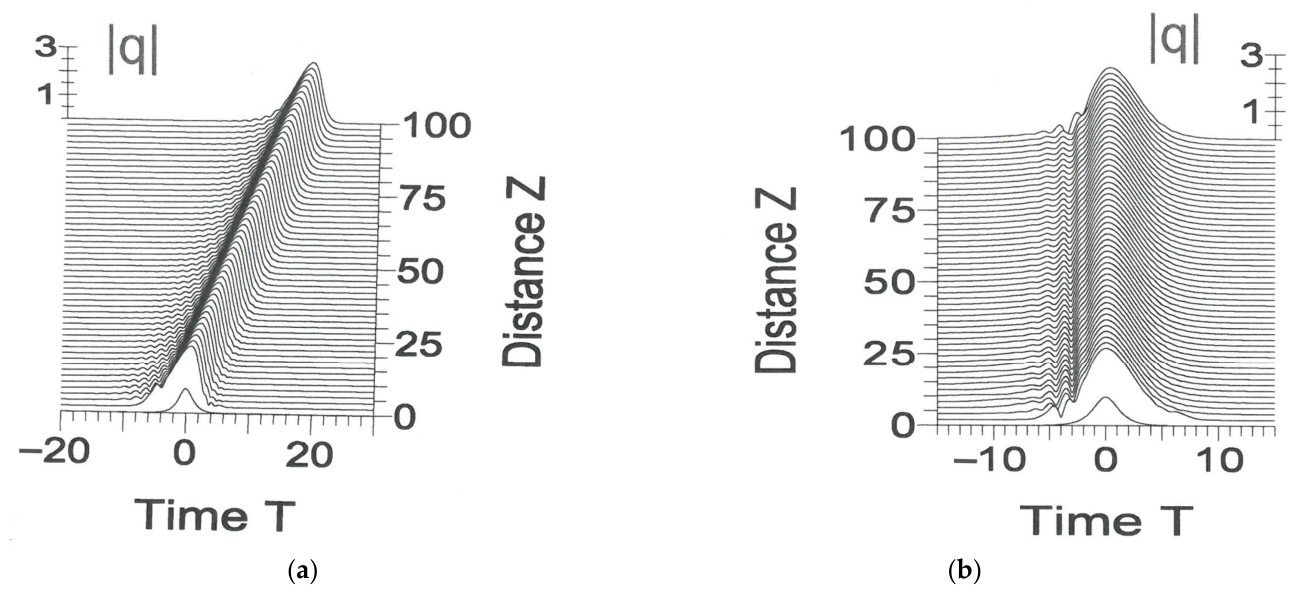
Figure 6 illustrates the propagation of the exploding soliton shown in Figure 2, in the presence of IRS (τR =0.25), together with (a) negative TOD ( δ 3 = −0.125) and SST (s = 0.125), and (b) positive TOD ( δ 3 = +0.1) and SST (s = 0.005). In the case of Figure 6a, it can be seen that the pulse achieves a fixed shape and moves to the right at a nonzero velocity. However, the pulse shape is not symmetric, with a trailing edge steeper than the leading edge. In the case of Figure 6b, the soliton also achieves a fixed shape, but moves at almost zero velocity. The pulse shape is also asymmetric, with several small peaks in the leading edge. From Figure 6, we conclude that the soliton explosions can be completely eliminated under the simultaneous influence of the three higher-order effects by a proper choice of parameter values.

5. Experimental Observations

The first experimental observation of soliton explosions was reported in a Ti:sapphire mode-locked laser, in which the explosion signature was observed by utilizing a diffraction grating and an array of six detectors [51]. However, insufficient resolution and response time precluded the acquisition of a detailed explosive process. This limitation has been broken recently through the development of a novel, powerful, real-time spectrum measurement technique called dispersive Fourier transform (DFT) [52,53]. This relatively simple but powerful technique has been extensively used in revealing the sophisticated dynamics in ultrafast lasers. In experiments, the changes in pump power, polarization settings, and other components in the setup correspond to the adjustments of the coefficients in theoretical simulations to some extent. However, not all pulsating dynamics predicted theoretically can be easily observed in experiments, as the experimental parameters cannot be flexibly adjusted.

5.1. The DFT Technique

The DFT is a photonic technique that maps the optical spectrum of a broadband ultrashort pulse into a time-stretched temporal waveform using chromatic dispersion. This process, also known as the time-stretch transform or photonic time-stretch, enables ultrafast, real-time, single-shot measurements of rapidly changing phenomena that are too fast for conventional electronic instruments.
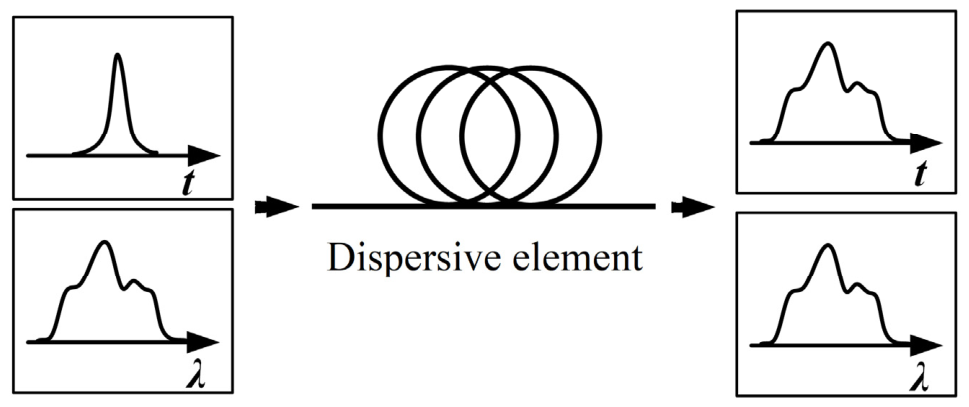
The DFT relies on a fundamental time–space duality, which is an analogy between spatial diffraction and temporal dispersion. The input broadband optical pulse is sent through a highly dispersive medium, like a long optical fiber or a chirped fiber Bragg grating. The chromatic dispersion causes different spectral components of the pulse to travel at different group velocities, resulting in a time delay that is proportional to their original frequency. If there is sufficient dispersion, the stretched optical pulse will have an intensity envelope that mimics the optical power spectrum of the original optical pulse.
The dispersion stretching effect can be used to explain the DFT principle. The input pulse experiences a frequency-dependent linear time delay induced by the chromatic dispersion. The spectral components of such an input pulse are separated in time if the dispersion is sufficiently strong, thus performing a unique mapping from the frequency domain to the time domain. This is illustrated in Figure 7. Due to the dispersion of the fiber, the pulses are significantly stretched and can be captured by a single, high-speed photodetector and a real-time electronic digitizer (oscilloscope). The temporal profile of the stretched pulse directly corresponds to its spectral shape. Since an oscilloscope measurement is intrinsically single-shot, the DFT setup can be considered as an ultrafast, single-shot-resolved optical spectrum analyzer. The temporal signal can afterward be easily remapped to the wavelength domain by knowing the dispersion of the used stretching fiber.

5.2. Soliton Explosions

Soliton explosions were first found experimentally using the DFT technique in 2015 in an all-normal dispersion, all-polarization-maintaining passively mode-locked Yb-doped fiber laser [54]. The observation of such soliton explosions was reported in a transition zone between stable mode-locking [150] and noise-like emission [151,152], generally accompanied by stimulated Raman scattering. Numerical simulations based on an envelope function approach were able to describe successfully the experimental results [153]. A relation was established between this pulse propagation model and the CGLE with additional higher-order nonlinear and dispersive effects [154].
Experimental work concerning soliton explosions in mode-locked fiber lasers was recently considerably increased by the use of the DFT technique [55,56,57,58,59,155,156,157,158,159,160,161]. Simultaneously, the physical mechanisms responsible for such explosions were explored by several research groups. Different cavity configurations and gain levels were considered in [155]. It was found, for example, that the pump power determines the probability with which explosions occur and that the position of the output coupler in the cavity has a strong impact on the explosion characteristics. By adjusting only the pump power level, it was possible to observe in detail the evolution of soliton dynamics from a steady state to huge soliton explosions [55].
The first experimental observation of soliton explosions in an ultrafast fiber laser mode-locked by nonlinear polarization evolution was reported by Wang et al. in 2017 [57]. The soliton explosions occurred in a transition state between stable mode-locking and noise-like pulse regimes, and their duration was dramatically influenced by all the parameters of the effective saturable absorbers, as well as the spectral filtering. Using a fiber laser passively mode-locked by a nonlinear polarization mechanism, it was possible to observe periodic spectrum changes due to soliton explosions [58]. These explosions were observed in a transition between two different mode-locking states.
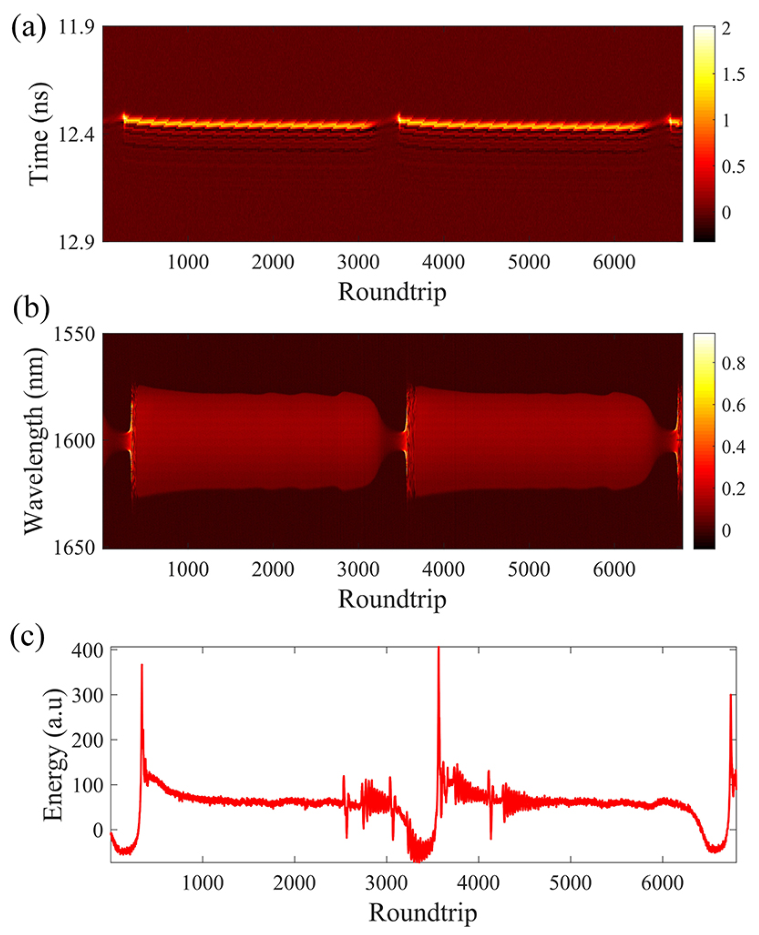
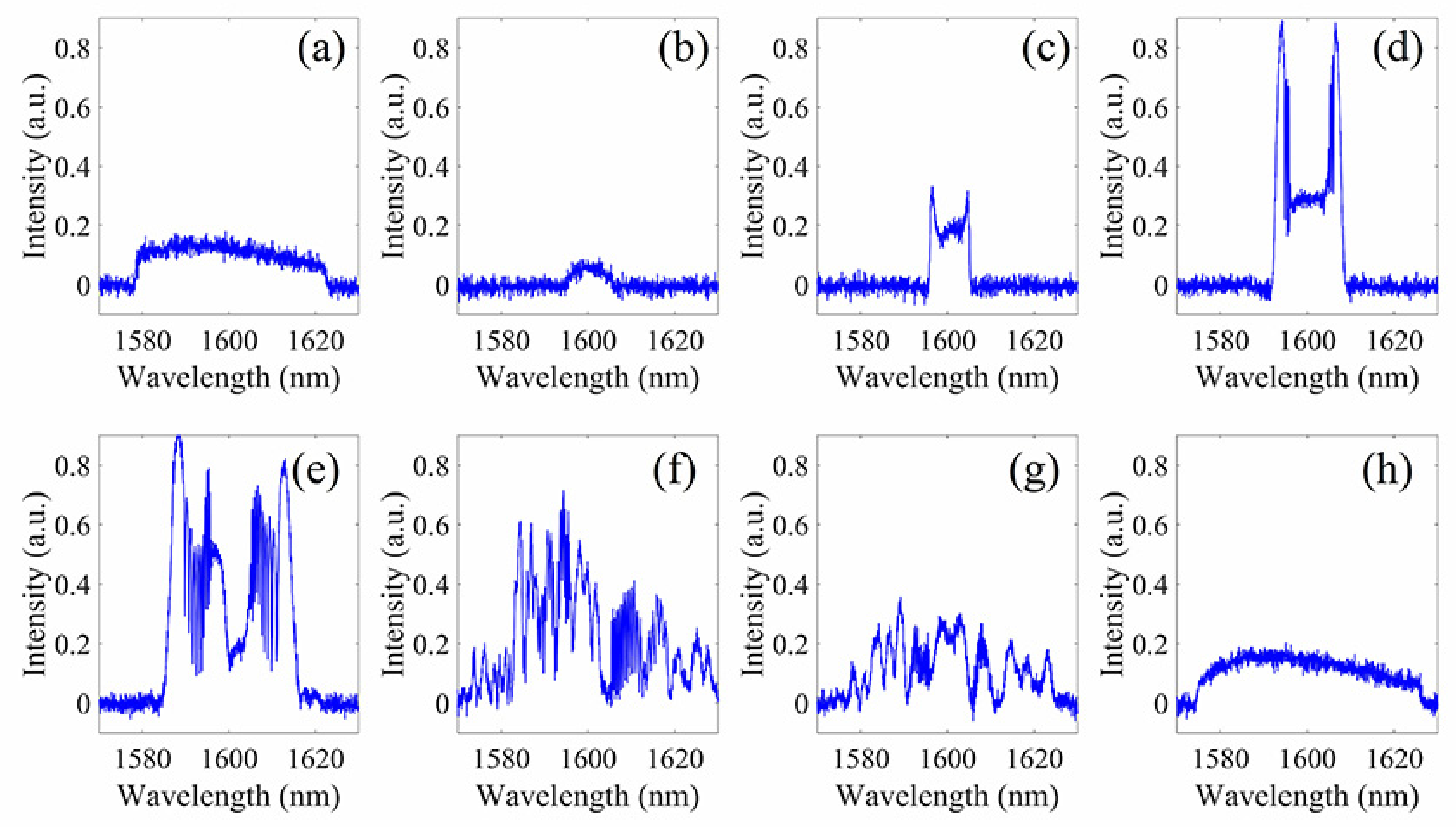
By varying the parameter settings, both pure soliton pulsations and soliton explosions were observed in the same L-band normal dispersion mode-locked fiber laser by Wang et al. in a 2019 experiment [162]. Actually, three typical types of soliton pulsations were observed: a single-periodic pulsating soliton, a double-periodic pulsating soliton, and a soliton explosion. Figure 8 summarizes the main characteristics of the observed soliton explosion. Figure 8a shows the spatio-temporal dynamics within 6800 round-trips. The corresponding spectral evolution and energy evolution are shown in Figure 8b,c, respectively. A relatively stationary localized solution with a perfect spectral profile was initially observed. Afterwards, that spectrum exhibited a sharp shrink followed by a dramatic expansion. Finally, it cracked into pieces, as in a typical explosion, with the resulting spectral structures seeming completely chaotic. However, such spectral structures remained well localized, and the original profile was restored after about 160 RTs. This restoration phase is similar to the “cooling process” in real explosions.
It can be seen that the experimental features observed in Figure 9a–c are in qualitative agreement with the simulation results displayed in Figure 2a–c, respectively. Actually, the parameter values used in the simulation were not adjusted to the experimental conditions. However, the almost periodic explosion dynamics are clearly observed both in the spatio-temporal and in the spatio-spectral domains, as well as concerning the evolution of the pulse energy.
The typical spectra over an explosion period are presented in Figure 9. The explosion’s evolution was observed to be similar to that of the pure pulsating process. However, the amplitude of the pulse energy oscillation in the exploding case is much larger than that of pure pulsation. Correspondingly, the spectral modulation peaks caused by spectral phase disturbance are also stronger. In the later stage of energy growth, the overdriven nonlinear effect leads to an abrupt spectral collapse, as shown in Figure 9e. Eventually, the spectral fragments of the burst gradually return to a smooth profile with the dissipation of energy, approaching its pre-explosion state.
Up to seven nonlinear regimes were observed successively in a mode-locked fiber laser by increasing the pump power [158]. The successive regimes included the single-pulse mode-locking, standard soliton explosions, noise-like mode locking, stable double pulsing, soliton collision-induced explosions, soliton molecules, and double-pulse noise-like mode locking.
Weak-to-strong explosive behaviors in pulsating solitons, as well as rogue wave (RW) generation during explosions, were observed in 1919 by Chen et al. [156]. Rogue waves were also generated during a breathing dissipative soliton explosion in a carbon nanotube mode-locked bidirectional ultrafast fiber [163]. The amplitude of RWs was significantly enhanced by the collision of bidirectional breathing solitons.
Soliton explosions in the multi-soliton regime of an ultrafast fiber laser were first reported by Yu et al. in 2018 [59]. It was shown that the soliton interactions mediated by the transient gain response of an erbium-doped fiber were responsible for the explosion of one soliton induced by another. The observation of RWs generation induced by single and multi-soliton explosions in a passively mode-locked fiber laser was also reported by Luo et al. in a 2022 experiment [164]. The ratio between the highest recorded amplitudes and significant wave heights of DRWs was found to be higher in the case of multi-soliton explosions compared with that of a single-soliton explosion.
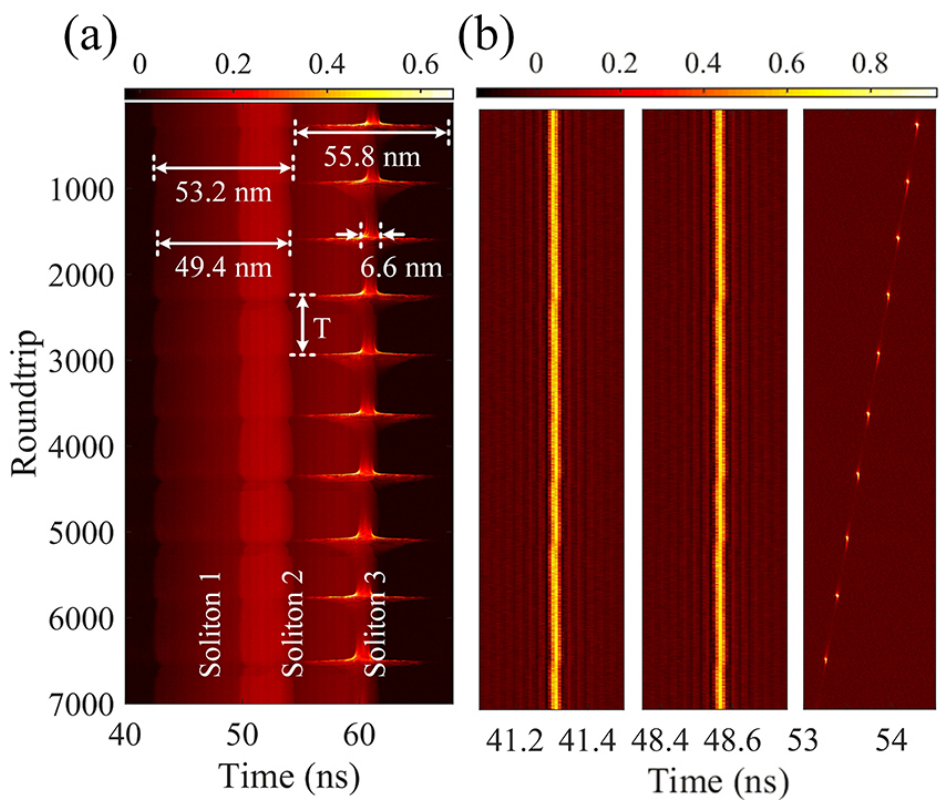
Multi-soliton asynchronous pulsation containing periodic soliton explosions was experimentally observed by Wang et al. in 2020 [165]. Figure 10a,b show the real-time spectra and the corresponding temporal evolution of this pulsating solution. Three dissipative solitons evolve simultaneously but asynchronously in the cavity, following two different periodic solutions, including a periodic explosion solution. The three solitons exhibit the same period of ~660 RTs. The evolutions of Solitons 1 and 2 follow a pure pulsation solution, whereas the evolution of Soliton 3 conforms to the criterion of soliton explosion. A metastable state with a narrow spectral bandwidth is the starting point for the erupting process. After a while, one observes a huge expansion in the spectrum, followed by an explosion during which the spectrum cracks into pieces. Finally, the spectral fragments return to a smooth profile after ~50 RTs, and the spectrum eventually approaches its pre-explosion state.
A single-soliton pulsation and explosion, dual-soliton synchronous and asynchronous pulsation, and a dual-soliton asynchronous explosion were reported by Fu et al. in 2024 in an all-normal dispersion ytterbium-doped fiber laser [166]. The dual-soliton asynchronous explosion was regarded as the asynchronously triggered transient solitons containing periodic explosion through the gain-mediated soliton interactions.
In a 2022 experiment, the dynamics of soliton explosions in a transient chaotic state between a single and double pulsating state, as well as periodic explosions induced by soliton collisions, were observed by Zeng et al. in a thulium-doped linear fiber laser with net anomalous dispersion [167]. The explosions were characterized with real-time measurements based on a modified DFT technique relying on second-harmonic generation. Actually, thulium-based mode-locked fiber laser sources operating in the 2 μm regime are an important light source for various significant applications. However, due to the lack of appropriate dispersive components at the 2 μm band, the investigation of ultrafast soliton dynamical phenomena in these fiber lasers is still limited. Direct real-time observation of soliton explosion and pulsation phenomena at the 2 μm band was demonstrated by Sun et al. [168] in 2024, by using specially designed linearly chirped fiber Bragg gratings as a dispersive component. Both slight explosions and drastic explosions were observed and characterized in real time, where the explosions occurred in the process of soliton pulsation.
Soliton explosions induced by intracavity soliton collisions in a dual-wavelength mode-locked Yb-doped fiber laser were reported by Liu et al. in 2020 [165]. Owing to the different group velocities of the two wavelengths, mode-locked solitons centered at different wavelengths would periodically collide, inducing soliton explosions. Exotic explosion phenomena were also experimentally observed in a 2024 experiment in a dual-wavelength mode-locked Er-doped fiber laser during the collisions between optical soliton molecules and single solitons [169].
The collision of vector dissipative solitons in a polarization-multiplexed ultrafast fiber laser was also shown to induce soliton explosions [170]. Opposite temporal shifts were observed during the explosive processes in the output pulse trains along the two orthogonal polarization directions. It was verified that the vector soliton collisions could trigger soliton explosions through cross-phase modulation.
The exploding dynamics of dissipative solitons in a mode-locked fiber laser can be manipulated by dynamically engineering the cavity dispersion [171]. The influence of third-order dispersion (TOD) on the soliton dynamics was experimentally investigated by Luo et al. in 2024 [172]. In particular, it was found that, by increasing the TOD values, an initially stable dissipative soliton can split into two pulses, enter the soliton explosion regime, and finally reach a chaotic state. By introducing negative fourth-order dispersion (FOD) to balance with positive Kerr nonlinearity, pure-quartic solitons have also been reported experimentally [173,174]. Exploding solitons were observed in a pure-quartic soliton laser by Han et al. [175].

6. Conclusions

One of the most striking forms of pulsating solutions is the exploding soliton, which belongs to the class of chaotic solutions. In this paper, we reviewed the main properties of the exploding solitons, considering the particular case of passively mode-locked fiber lasers described by the complex Ginzburg–Landau equation. A dynamical model for dissipative solitons based on the method of moments was presented. The impact of the filter spectral response and the possibility of suppressing soliton explosions under higher-order effects were described. An overview of recent experimental observations concerning exploding solitons in different laser configurations was also provided.
Vector solitons are characterized by richer behaviors than their scalar counterparts. Currently, the dynamics of soliton explosions induced by the collision of vector dissipative solitons in polarization-multiplexed fiber lasers is an important topic of research. The exploding dynamics in pure-quartic, dual-wavelength, and bidirectional soliton fiber lasers are also interesting topics to be investigated in the near future. Another main challenge will be the exploration of high-dimensional exploding soliton dynamics in spatiotemporal mode-locked fiber lasers.

Author Contributions

Both M.F.S.F. and S.C.V.L. contributed to this article. All authors have read and agreed to the published version of the manuscript.

Funding

This research was funded by Fundação para a Ciência e a Tecnologia (FCT) (Project UID/CTM/50025/2013).

Data Availability Statement

No new data were created or analyzed in this study.

Acknowledgments

We thank Manuel Barroso for computational support.

Conflicts of Interest

The authors declare no conflict of interest.

References

  1. Zabusky, N.J.; Kruskal, M.D. Interacttion of “solitons” in a collisionless plasma and the recorrence of initial states. Phys. Rev. Lett. 1965, 15, 240. [Google Scholar] [CrossRef] [Scilit]
  2. Kartashov, Y.V.; Konotop, V.V. Solitons in Bose-Einstein Condensates with Helicoidal Spin-Orbit Coupling. Phys. Rev. Lett. 2017, 118, 190401. [Google Scholar] [CrossRef] [Scilit]
  3. Wu, J.; Keolian, R.; Rudnick, I. Observation of a Nonpropagating Hydrodynamic Soliton. Phys. Rev. Lett. 1984, 52, 1421. [Google Scholar] [CrossRef] [Scilit]
  4. Antipov, S.V.; Nezlin, M.V.; Snezhkin, E.N.; Trubnikov, A.S. Rossby autosoliton and stationary model of the jovian Great Red Spot. Nature 1986, 323, 238. [Google Scholar] [CrossRef] [Scilit]
  5. Grelu, P.; Akhmediev, N. Dissipative solitons for mode-locked lasers. Nat. Photon. 2012, 6, 84. [Google Scholar] [CrossRef] [Scilit]
  6. Hasegawa, A.A.; Tapper, F. Transmission of stationary nonlinear optical pulses in dispersive dielectric fibers. I. Anomalous dispersion. Appl. Phys. Lett. 1973, 23, 142. [Google Scholar] [CrossRef] [Scilit]
  7. Mollenauer, L.F.; Stolen, R.H.; Gordon, J.P. Experimental observation of picosecond pulse narrowing and solitons in optical fibers. Phys. Rev. Lett. 1980, 45, 1095. [Google Scholar] [CrossRef] [Scilit]
  8. Akhmediev, N.N.; Ankiewicz, A.A. (Eds.) Dissipative Solitons; Springer: Berlin/Heidelberg, Germany, 2005. [Google Scholar]
  9. Ferreira, M. (Ed.) Dissipative Optical Solitons; Springer: Cham, Switzerland, 2022. [Google Scholar]
  10. Ferreira, M. Solitons in Optical Fiber Systems; John Wiley & Sons: Hoboken, NJ, USA, 2022. [Google Scholar]
  11. Normand, C.; Pomeau, Y. Convective instability: A physicist’s approach. Rev. Mod. Phys. 1977, 49, 581. [Google Scholar] [CrossRef] [Scilit]
  12. Graham, R. Fluctuations, Instabilities and Phase Transictions; Springer: Berlin/Heidelberg, Germany, 1975. [Google Scholar]
  13. Staliunas, K. Laser Ginzburg-Landau equation and laser hydrodynamics. Phys. Rev. A 1993, 48, 1573. [Google Scholar] [CrossRef] [Scilit]
  14. Jian, P.; Torruellas, W.; Haelterman, M.; Trillo, S.; Peschel, U.; Lederer, F. Solitons of singly resonant optical parametric oscillators. Opt. Lett. 1999, 24, 400. [Google Scholar] [CrossRef] [Scilit]
  15. Dunlop, A.; Wright, E.; Firth, W. Spatial soliton laser. Opt. Commun. 1998, 147, 393. [Google Scholar] [CrossRef] [Scilit]
  16. Ng, C.; Bhattacharjee, A. Ginzburg-Landau model and single-mode operation of a free-electron laser oscillator. Phys. Rev. Lett. 1999, 82, 2665. [Google Scholar] [CrossRef] [Scilit]
  17. Akhmediev, N.; Rodrigues, A.; Townes, G. Interaction of dual-frequency pulses in passively mode-locked lasers. Opt. Commun. 2001, 187, 419. [Google Scholar] [CrossRef] [Scilit]
  18. Ferreira, M.; Facão, M.; Latas, S. Stable Soliton Propagation in a System with Spectral Filtering and Nonlinear Gain. Fiber Integr. Opt. 2000, 19, 31. [Google Scholar] [CrossRef] [Scilit]
  19. Ferreira, M.; Facão, M.; Latas, S.; Sousa, M. Optical Solitons in Fibers for Communication System. Fiber Integr. Opt. 2005, 24, 287. [Google Scholar] [CrossRef] [Scilit]
  20. Ferreira, M.; Facão, M.; Latas, S. Ultrashort soliton propagation in a distributed fiber amplifier. Phot. Optoelect. 1999, 5, 147. [Google Scholar]
  21. Matsumoto, M.; Ikeda, H.; Uda, T.; Hasegawa, A.J. Stable soliton transmission in the system with nonlinear gain. Light. Technol. 1995, 13, 658. [Google Scholar] [CrossRef] [Scilit]
  22. Latas, S.; Ferreira, M. Soliton stability and compression in a system with nonlinear gain. SPIE Proc. 1999, 3899, 396. [Google Scholar]
  23. Akhmediev, N.; Ankiewicz, A.; Soto-Crespo, J. Stable soliton pairs in optical transmission lines and fiber lasers. J. Opt. Soc. Am. B 1998, 15, 515. [Google Scholar] [CrossRef] [Scilit]
  24. Akhmediev, N.; Afanasjev, V.; Soto-Crespo, J. Singularities and special soliton solutions of the cubic-quintic complex Ginzburg-Landau equation. Phys. Rev. E 1996, 53, 1190. [Google Scholar] [CrossRef] [Scilit]
  25. Soto-Crespo, J.; Akhmediev, N.; Afanasjev, V. Stability of the pulselike solutions of the quintic complex Ginzburg–Landau equation. J. Opt. Soc. Am. B 1996, 13, 1439. [Google Scholar] [CrossRef] [Scilit]
  26. Pereira, N.; Stenflo, L. Nonlinear Schrödinger Equation including Growth and Damping. Phys. Fluids 1997, 20, 1733. [Google Scholar]
  27. Nozaki, K.; Bekki, N. Exact Solutions of the Generalized Ginzburg-Landau Equation. Phys. Soc. Jpn. 1984, 53, 1581. [Google Scholar] [CrossRef] [Scilit]
  28. Akhmediev, N.; Ankiewicz, A. Solitons, Nonlinear Pulses and Beams; Chapman & Hall: London, UK, 1997. [Google Scholar]
  29. Ferreira, M. Nonlinear Effects in Optical Fibers; John Wiley & Sons: Hoboken, NJ, USA, 2011. [Google Scholar]
  30. Tsoy, E.; Ankiewicz, A.; Akhmediev, N. Dynamical models for dissipative localized waves of the complex Ginzburg–Landau equation. Phys. Rev. E. 2006, 73, 036621. [Google Scholar] [CrossRef] [Scilit]
  31. Manousakis, M.; Papagiannis, P.; Moshonas, N.; Hizanidis, K. Propagation of Pereira-Stenflo type pulses in a dispersion varying link: Variational approach. Opt. Commun. 2001, 198, 351. [Google Scholar] [CrossRef] [Scilit]
  32. Ankiewicz, A.; Akhmediev, N.; Devine, N. Dissipative solitons with a Lagrangian approach. Opt. Fib. Technol. 2007, 13, 91. [Google Scholar] [CrossRef] [Scilit]
  33. Mancas, S.; Choudhury, S. A novel variational approach to pulsating solitons in the cubic-quintic Ginzburg-Landau equation. Theor. Math. Phys. 2007, 152, 1160. [Google Scholar] [CrossRef] [Scilit]
  34. Ferreira, M. Variational approach to stationary and pulsating dissipative optical solitons. IET Optoelectron. 2018, 12, 122. [Google Scholar] [CrossRef] [Scilit]
  35. Chang, W.; Ankiewicz, A.; Akhmediev, N.; Soto-Crespo, J. Creeping solitons in dissipative systems and their bifurcations. Phys. Rev. E 2007, 76, 016607. [Google Scholar] [CrossRef] [Scilit]
  36. Soto-Crespo, J.; Akhmediev, N.; Ankiewicz, A. Pulsating, Creeping, and Erupting Solitons in Dissipative Systems. Phys. Rev. Lett. 2000, 85, 2937. [Google Scholar] [CrossRef] [Scilit]
  37. Akhmediev, N.; Soto-Crespo, J.; Town, G. Pulsating Solitons, Chaotic Solitons, Period Doubling, and Pulse Coexistence in Mode-Locked Lasers. Phys. Rev. E 2001, 63, 056602. [Google Scholar] [CrossRef] [Scilit] [PubMed]
  38. Akhmediev, N.; Soto-Crespo, J. Exploding solitons and Shil’nikov’s theorem. Phys. Lett. A 2003, 317, 287. [Google Scholar] [CrossRef] [Scilit]
  39. Akhmediev, N.; Soto-Crespo, J. Strongly asymmetric soliton explosions. Phys. Rev. E 2004, 70, 036613. [Google Scholar] [CrossRef] [Scilit] [PubMed]
  40. Soto-Crespo, J.; Akhmediev, N. Exploding soliton and front solutions of the complex cubic–quintic Ginzburg–Landau equation. Math. Comput. Simul. 2005, 69, 526. [Google Scholar] [CrossRef] [Scilit]
  41. Latas, S.; Ferreira, M. Soliton explosion control by higher-order effects. Opt. Lett. 2010, 35, 1777. [Google Scholar] [CrossRef] [Scilit] [PubMed]
  42. Latas, S.; Ferreira, M. Why can soliton explosions be controlled by higher-order effects? Opt. Lett. 2011, 36, 3085. [Google Scholar] [CrossRef] [Scilit]
  43. Cartes, C.; Descalzi, O.; Brand, H. Noise can induce explosions for dissipative solitons. Phys. Rev. E 2012, 85, 015205. [Google Scholar] [CrossRef] [Scilit]
  44. Chang, W.; Akhmediev, N. Exploding solitons vs rogue waves in laser cavities. In Advanced Photon; NM3A.6; Optical Society of America: Barcelona, Spain, 2014. [Google Scholar]
  45. Song, L.; Li, L.; Li, Z.; Zhou, G. Effect of third-order dispersion on pulsating, erupting and creeping solitons. Opt. Commun. 2005, 249, 301. [Google Scholar] [CrossRef] [Scilit]
  46. Cartes, C.; Descalzi, O. Periodic and Chaotic Exploding Dissipative Solitons. Fiber Integr. Opt. 2015, 34, 14. [Google Scholar] [CrossRef] [Scilit]
  47. Latas, S.; Facão, M.; Ferreira, M. Impact of higher-order effects on pulsating, erupting and creeping solitons. Appl. Phys. B 2011, 104, 131. [Google Scholar] [CrossRef] [Scilit]
  48. Latas, S.; Ferreira, M. Emerging fixed-shape solutions from a pulsating chaotic soliton. Opt. Lett. 2012, 37, 3897. [Google Scholar] [CrossRef] [Scilit]
  49. Latas, S.; Ferreira, M.; Facão, M. Characteristics of fixed-shape pulses emerging from pulsating, erupting, and creeping solitons. Appl. Phys. B 2013, 116, 279. [Google Scholar] [CrossRef] [Scilit]
  50. Tian, H.; Li, Z.; Tian, J.; Zhou, G.; Zi, J. Effect of nonlinear gradient terms on pulsating, erupting and creeping solitons. Appl. Phys. B 2004, 78, 199. [Google Scholar] [CrossRef] [Scilit]
  51. Cundiff, S.; Soto-Crespo, J.; Akhmediev, N. Experimental Evidence for Soliton Explosions. Phys. Rev. Lett. 2002, 88, 073903. [Google Scholar] [CrossRef] [Scilit]
  52. Goda, K.; Jalali, B. Dispersive Fourier transformation for fast continuous single-shot measurements. Nat. Photon. 2013, 7, 102. [Google Scholar] [CrossRef] [Scilit]
  53. Mahjoubfar, A.; Churkin, D.V.; Barland, S.; Broderick, N.; Turitsyn, S.K.; Jalali, B. Time stretch and its applications. Nat. Photon. 2017, 11, 341. [Google Scholar] [CrossRef] [Scilit]
  54. Runge, A.; Broderick, N.; Erkintalo, M. Observation of soliton explosions in a passively mode-locked fiber laser. Optica 2015, 2, 36. [Google Scholar] [CrossRef] [Scilit]
  55. Liu, M.; Luo, A.P.; Yan, Y.R.; Hu, S.; Liu, Y.C.; Cui, H.; Luo, Z.C.; Xu, W. C Successive soliton explosions in an ultrafast fiber laser. Opt. Lett. 2016, 41, 1181. [Google Scholar] [CrossRef] [Scilit] [PubMed]
  56. Rupa, K.; Nithyanandan, K.; Grelu, P. Vector dynamics of incoherent dissipative optical solitons. Optica 2017, 4, 1239. [Google Scholar] [CrossRef] [Scilit]
  57. Wang, P.; Xiao, X.; Zhao, H.; Yang, C. Observation of duration-tunable soliton explosion in passively mode-locked fiber laser. IEEE Photon. J. 2017, 9, 1507008. [Google Scholar] [CrossRef] [Scilit]
  58. Suzuki, M.; Boyraz, O.; Asghari, H.; Trinh, P.; Kuroda, H.; Jalali, B. Spectral periodicity in soliton explosions on a broadband mode-locked Yb fiber laser using time-stretch spectroscopy. Opt. Lett. 2018, 43, 1862. [Google Scholar] [CrossRef] [Scilit]
  59. Yu, Y.; Luo, Z.C.; Kang, J.Q.; Wong, K.K.Y. Mutually ignited soliton explosions in a fiber laser. Opt. Lett. 2018, 43, 4132. [Google Scholar] [CrossRef] [Scilit]
  60. Shimizu, M.; Suda, H.; Horiguchi, M. High-efficiency Nd-doped fibre lasers using direct-coated dielectric mirrors. Electron. Lett. 1987, 23, 768. [Google Scholar] [CrossRef] [Scilit]
  61. Ball, G.; Morey, W.; Glenn, W. Standing wave monomode erbium fibre laser. IEEE Photon. Technol. Lett. 1991, 3, 613. [Google Scholar] [CrossRef] [Scilit]
  62. Mortimore, D. Fiber loop reflectors. J. Light. Technol. 1988, 6, 1217. [Google Scholar] [CrossRef] [Scilit]
  63. Siegman, A.E. Lasers; University Science Books: Mill Valley, CA, USA, 1986. [Google Scholar]
  64. Silfvast, W.T. Laser Fundamentals; Cambridge University Press: New York, NY, USA, 1996. [Google Scholar]
  65. Svelto, O. Principles of Lasers, 4th ed.; Plenum: New York, NY, USA, 1998. [Google Scholar]
  66. Noguchi, K.; Mitomi, O.; Miyazawa, H. Multimeter-wave Ti: LiNbO3 optical modulators. J. Light. Technol. 1998, 16, 615. [Google Scholar] [CrossRef] [Scilit]
  67. Clobes, A.; Brienza, M. Passive mode-locking of a pulsed Nd:YAG Laser. Appl. Phys. Lett. 1969, 14, 287. [Google Scholar] [CrossRef] [Scilit]
  68. Wood, O.; Schwarz, S. Passive mode-locking of a CO2 laser. Appl. Phys. Lett. 1968, 12, 263. [Google Scholar] [CrossRef] [Scilit]
  69. Bulushev, A.; Dianov, E.; Okhotnikov, O. Passive mode locking of a laser with a nonlinear fiber reflector. Opt. Lett. 1990, 15, 968. [Google Scholar] [CrossRef] [Scilit]
  70. Loh, W.H.; Atkinson, D.; Morkel, P.R.; Hopkinson, M.; Rivers, A.; Seeds, A.J.; Payne, D.N. All-solid-state subpicosecond passively mode locked erbium-doped fiber laser. Appl. Phys. Lett. 1993, 63, 4. [Google Scholar] [CrossRef] [Scilit]
  71. Barnett, B.; Rahman, L.; Islam, M.; Chen, Y.; Bhattacharya, P.; Riha, W.; Reddy, K.; Howe, A.; Stair, K.; Iwamura, H.; et al. High-power erbium-doped fiber laser mode locked by a semiconductor saturable absorber. Opt. Lett. 1995, 20, 471. [Google Scholar] [CrossRef] [Scilit]
  72. Keller, U.; Weingarten, K.; Kartner, F.; Kopf, D.; Braun, B.; Jung, I.; Fluck, R.; Honninger, C.; Matuschek, N.; Aus der Au, J. Semiconductor saturable absorber mirrors (SESAM’s) for femtosecond to nanosecond pulse generation in solid-state lasers. IEEE J. Sel. Top. Quantum Electron. 1996, 2, 435. [Google Scholar] [CrossRef] [Scilit]
  73. Collings, B.; Bergman, K.; Cundiff, S.; Tsuda, S.; Kutz, J.; Cunningham, J.; Jan, W.; Koch, M.; Knox, W. Short cavity erbium/ytterbium fiber lasers mode-locked with a saturable Bragg reflector. IEEE J. Sel. Top. Quantum Electron. 1997, 3, 1065. [Google Scholar] [CrossRef] [Scilit]
  74. Hofer, M.; Fermann, M.; Goldberg, L. High-power side- pumped passively mode-locked Er-Yb fiber laser. IEEE Photon. Technol. Lett. 1998, 10, 1247. [Google Scholar] [CrossRef] [Scilit]
  75. Jiang, M.; Sucha, G.; Fermann, M.; Jimenez, J.; Harter, D.; Dagenais, M.; Fox, S.; Hu, Y. Nonlinearly limited saturable-absorber mode locking of an erbium fiber laser. Opt. Lett. 1999, 24, 1074. [Google Scholar] [CrossRef] [Scilit]
  76. Haus, J.W.; Hapduk, M.; Kaechele, W.; Shaulov, G.; Theimer, J.; Teegarden, K.; Wicks, G. A mode-locked fiber laser with a chirped grating mirror. Opt. Commun. 2000, 174, 204. [Google Scholar] [CrossRef] [Scilit]
  77. Yamashita, S.; Inoue, Y.; Maruyama, S.; Murakami, Y.; Yaguchi, H.; Jablonski, M.; Set, S. Saturable absorbers incorporating carbon nanotubes directly synthesized onto substrates and fibers and their application to mode-locked fiber lasers. Opt. Lett. 2004, 29, 1581. [Google Scholar] [CrossRef] [Scilit]
  78. Song, Y.; Set, S.; Goh, C.; Kotake, T. 1300-nm pulsed fiber lasers mode-locked by purified carbon nanotubes. IEEE Photon. Technol. Lett. 2005, 17, 1623. [Google Scholar] [CrossRef] [Scilit]
  79. Song, Y.; Yamashita, S.; Einarsson, E.; Maruyama, S. All-fiber pulsed lasers passively mode locked by transferable vertically aligned carbon nanotube film. Opt. Lett. 2007, 32, 1399. [Google Scholar] [CrossRef] [Scilit]
  80. Sun, Z.; Rozhin, A.; Wang, F.; Scardaci, V.; Milne, W.; White, I.; Hennrich, F.; Ferrari, A. L-band ultrafast fiber laser mode locked by carbon nanotubes. Appl. Phys. Lett. 2008, 93, 061114. [Google Scholar] [CrossRef] [Scilit]
  81. Nicholson, J.; DiGiovanni, D. High-repetition-frequency low-noise fiber ring lasers mode-locked with carbon nanotubes. IEEE Photon. Technol. Lett. 2008, 20, 2123. [Google Scholar] [CrossRef] [Scilit]
  82. Solodyankin, M.; Obraztsova, E.; Lobach, A.; Chernov, A.; Tausenev, A.; Konov, V.; Dianov, E. Mode-locked 1.93 μm thulium fiber laser with a carbon nanotube absorber. Opt. Lett. 2008, 33, 1336. [Google Scholar] [CrossRef] [Scilit]
  83. Choi, S.; Rotermund, F.; Jung, H.; Oh, K.; Yeom, D. Femtosecond mode-locked fiber laser employing a hollow optical fiber filled with carbon nanotube dispersion as saturable absorber. Opt. Express 2009, 17, 21788. [Google Scholar] [CrossRef] [Scilit]
  84. Ouyang, C.; Shum, P.; Wang, H.; Wong, J.; Wu, K.; Fu, S.; Li, R.; Kelleher, E.; Chernov, A.; Obraztsova, E. Observation of timing jitter reduction induced by spectral filtering in a fiber laser mode locked with a carbon nanotube-based saturable absorber. Opt. Lett. 2010, 35, 2320. [Google Scholar] [CrossRef] [Scilit]
  85. Jiang, K.; Fu, S.; Shum, P.; Lin, C. A wavelength-switchable passively harmonically mode-locked fiber laser with low pumping threshold using single-walled carbon nanotubes. IEEE Photon. Technol. Lett. 2010, 22, 754. [Google Scholar] [CrossRef] [Scilit]
  86. Kieu, K.; Jones, R.; Peyghambarian, N. Generation of few-cycle pulses from an amplified carbon nanotube mode-locked fiber laser system. IEEE Photon. Technol. Lett. 2010, 22, 1521. [Google Scholar] [CrossRef] [Scilit]
  87. Zhang, H.; Bao, Q.; Tang, D.; Zhao, L.; Loh, K. Large energy soliton erbium-doped fiber laser with a graphene-polymer composite mode locker. Appl. Phys. Lett. 2009, 95, 141103. [Google Scholar] [CrossRef] [Scilit]
  88. Zhao, L.; Tang, D.; Zhang, H.; Wu, X.; Bao, Q.; Loh, K. Dissipative soliton operation of an ytterbium-doped fiber laser mode locked with atomic multilayer graphene. Opt. Lett. 2010, 35, 3622. [Google Scholar] [CrossRef] [Scilit]
  89. Xu, J.; Wu, S.; Li, H.; Liu, J.; Sun, R.; Tan, F.; Yang, Q.; Wang, P. Dissipative soliton generation from a graphene oxide mode-locked Er-doped fiber laser. Opt. Express 2012, 20, 23653. [Google Scholar] [CrossRef] [Scilit]
  90. Sotor, J.; Sobon, G.; Abramski, K. Scalar soliton generation in all-polarization-maintaining, graphene mode-locked fiber laser. Opt. Lett. 2012, 37, 2166. [Google Scholar] [CrossRef] [Scilit]
  91. Ismail, M.; Ahmad, H.; Harun, S. Soliton mode-locked erbium-doped fiber laser using non-conductive graphene oxide paper. IEEE J. Quantum Electron. 2014, 50, 85. [Google Scholar] [CrossRef] [Scilit]
  92. He, X.; Chen, T.; Wang, D. He-Ne laser treatment improves the photosynthetic efficiency of wheat exposed to enhanced UV-B radiation. Laser Phys. 2014, 24, 085109. [Google Scholar] [CrossRef] [Scilit]
  93. Cui, Y.; Liu, X.; Zeng, C. Conventional and dissipative solitons in a CBFG-based fiber laser mode-locked with a graphene nanotube mixrue. Laser Phys. Lett. 2014, 11, 055106. [Google Scholar] [CrossRef] [Scilit]
  94. Cheng, Z.; Li, H.; Shi, H.; Ren, J.; Yang, Q.; Wang, P. Dissipative soliton resonance and reverse saturable absorption in graphene oxide mode-locked all-normal-dispersion Yb-doped fiber laser. Opt. Express 2015, 23, 7000. [Google Scholar] [CrossRef] [Scilit]
  95. Jeong, H.; Choi, S.; Kim, M.; Rotermund, F.; Cha, Y.; Jeong, D.; Lee, S.; Lee, K.; Yeom, D. All-fiber Tm-doped soliton laser oscillator with 6 nJ pulse energy based on evanescent field interaction with monoloayer graphene saturable absorber. Opt. Express 2016, 24, 14152. [Google Scholar] [CrossRef] [Scilit]
  96. Song, Y.; Liang, Z.; Zhang, H.; Zhang, Q.; Zhao, L.; Shen, D.; Tang, D. Period-doubling and quadrupling bifurcation of vector soliton bunches in a graphene mode locked fiber laser. IEEE Photon. J. 2017, 9, 4502308. [Google Scholar] [CrossRef] [Scilit]
  97. Gui, L.; Yang, C. Soliton Molecules with, and Phase Differences in a Graphene-Based Mode-Locked Erbium-Doped Fiber Laser. IEEE Photon. J. 2018, 10, 1502609. [Google Scholar] [CrossRef] [Scilit]
  98. Wang, Z.; Wang, Z.; Liu, Y.; He, R.; Wang, G.; Yang, G.; Han, S. The simultaneous generation of soliton bunches and Q-switched-like pulses in a partially mode-locked fiber laser with a graphene saturable absorber. Laser Phys. Lett. 2018, 15, 055101. [Google Scholar] [CrossRef] [Scilit]
  99. Yang, G.; Liu, Y.; Wang, Z.; Wang, G.; Wang, X. Dual-wavelength mode-locked Tm3+-doped fiber laser at 2 μm region with controllable soliton pulse number by employing graphene on microfiber. Opt. Laser Technol. 2018, 105, 76. [Google Scholar] [CrossRef] [Scilit]
  100. Sotor, J.; Sobon, G.; Kowalczyk, M.; Macherzynski, W.; Paletko, P.; Abramski, K. Ultrafast thulium-doped fiber laser mode locked with black phosphorus. Opt. Lett. 2015, 40, 3885. [Google Scholar] [CrossRef] [Scilit]
  101. Chen, Y.; Chen, S.; Liu, J.; Gao, Y.; Zhang, W. Sub-300 femtosecond soliton tunable fiber laser with all-anomalous dispersion passively mode locked by black phosphorus. Opt. Express 2016, 24, 13316. [Google Scholar] [CrossRef] [Scilit]
  102. Song, Y.; Chen, S.; Zhang, Q.; Li, L.; Zhao, L.; Zhang, H.; Tang, D. Vector soliton fiber laser passively mode locked by few layer black phosphorus-based optical saturable absorber. Opt. Express 2016, 24, 25933. [Google Scholar] [CrossRef] [Scilit]
  103. Hisyam, M.; Rusdi, M.; Latiff, A.; Harun, S. Generation of Mode-Locked Ytterbium Doped Fiber Ring Laser Using Few-Layer Black Phosphorus as a Saturable Absorber. IEEE J. Sel. Top. Quantum Electron. 2017, 23, 1100205. [Google Scholar] [CrossRef] [Scilit]
  104. Song, H.; Wang, Q.; Zhang, Y.; Li, L. Mode-locked ytterbium-doped all-fiber lasers based on few-layer black phosphorus saturable absorbers. Opt. Commun. 2017, 394, 157. [Google Scholar] [CrossRef] [Scilit]
  105. Gao, B.; Ma, C.; Huo, J.; Guo, Y.; Wu, G. Influence of gain fiber on dissipative soliton pairs in passively mode-locked fiber laser based on BP as a saturable absorber. Opt. Commun. 2018, 410, 191. [Google Scholar] [CrossRef] [Scilit]
  106. Jin, X.; Hu, G.; Zhang, M.; Hu, Y.; Albrow-Owen, T.; Howe, R.; Wu, T.; Wu, Q.; Zheng, Z.; Hasan, T. 102 fs pulse generation from a long-term stable, inkjet-printed black phosphorus-mode-locked fiber laser. Opt. Express 2018, 26, 12506. [Google Scholar] [CrossRef] [Scilit]
  107. Wu, K.; Chen, B.; Zhang, X.; Zhang, S.; Guo, C.; Li, C.; Xiao, P.; Wang, J.; Zhou, L.; Zou, W.; et al. High-performance mode-locked and Q-switched fiber lasers based on novel 2D materials of topological insulators, transition metal dichalcogenides and black phosphorus. Opt. Commun. 2018, 406, 214. [Google Scholar] [CrossRef] [Scilit]
  108. Gao, B.; Guo, W.; Huo, J.; Wu, G.; Wang, J. Dissipative solitons characteristics in passively mode-locked Er-doped fiber laser based on black phosphorus as a new saturable absorber. Opt. Commun. 2018, 406, 192. [Google Scholar] [CrossRef] [Scilit]
  109. Ma, C.; Tian, X.; Gao, B.; Wu, G. Dynamic evolution of the dissipative soliton in passively mode-locked fiber laser based on black phosphorus as a new saturable absorber. Opt. Commun. 2018, 406, 177. [Google Scholar] [CrossRef] [Scilit]
  110. Wang, Y.; Mao, D.; Gan, X.; Han, L.; Ma, C.; Xi, T.; Zhang, Y.; Shang, W.; Hua, S.; Zhao, J. Harmonic mode locking of bound-state solitons fiber laser based on MoS2 saturable absorber. Opt. Express 2015, 23, 205. [Google Scholar] [CrossRef] [Scilit] [PubMed]
  111. Jiang, Z.; Chen, H.; Li, J.; Yin, J.; Wang, J.; Yan, P. 256 fs, 2 nJ soliton pulse generation from MoS2 mode-locked fiber laser. Appl. Phys. Express 2017, 10, 122702. [Google Scholar] [CrossRef] [Scilit]
  112. Wang, Z.; He, R.; Liu, Y.; Zhang, H.; Han, S.; Li, H.; Wang, G.; Yang, G.; Wang, Z. Generation of trapezoidal envelope pulses and soliton rains from passively mode-locked fiber laser with MoS2 saturable absorber on microfiber. Appl. Phys. Express 2018, 11, 072504. [Google Scholar] [CrossRef] [Scilit]
  113. Wang, P.; Zhao, K.; Gui, L.; Xiao, X.; Yang, C. Self-Organized Structures of Soliton Molecules in 2- m Fiber Laser Based on MoS2 Saturable Absorber. IEEE Photon. Technol. Lett. 2018, 30, 1210. [Google Scholar] [CrossRef] [Scilit]
  114. Doran, N.; Wood, D. Nonlinear-optical loop mirror. Opt. Lett. 1988, 13, 56. [Google Scholar] [CrossRef] [Scilit] [PubMed]
  115. Fermann, M.; Haberl, F.; Hofer, M.; Hochreiter, H. Nonlinear amplifying loop mirror. Opt. Lett. 1990, 15, 752. [Google Scholar] [CrossRef] [Scilit] [PubMed]
  116. Michalska, M.; Swiderski, J. All-fiber thulium-doped mode-locked fiber laser and amplifier based on nonlinear fiber loop mirror. Opt. Laser Tech. 2019, 118, 121. [Google Scholar] [CrossRef] [Scilit]
  117. Wu, Y.; Tian, J.; Dong, Z.; Liang, C.; Song, Y. Generation of Two Dissipative Soliton Resonance Pulses in an All-Anomalous-Dispersion Regime Thulium-Doped Fiber Laser. IEEE Photon. J. 2019, 11, 1505308. [Google Scholar] [CrossRef] [Scilit]
  118. Stolen, R.; Botineau, J.; Ashkin, A. Intensity discrimination of optical pulses with birefringent fibers. Opt. Lett. 1982, 7, 512. [Google Scholar] [CrossRef] [Scilit]
  119. Wu, C.; Yao, Y.; Wu, Q.; Yang, Y.; Wu, Z.; Yang, Y.; Tian, J.; Xu, K. Different types of noise-like pulse in a nonlinear multimodal interference based mode-locked fiber laser. Opt. Laser Tech. 2022, 147, 107681. [Google Scholar] [CrossRef] [Scilit]
  120. Ding, E.; Kutz, J.N. Operating regimes, split-step modeling, and the Haus master mode-locking model. J. Opt. Soc. Am. B 2009, 26, 2290. [Google Scholar] [CrossRef] [Scilit]
  121. Komarov, A.; Leblond, H.; Sanchez, F. Quintic complex Ginzburg-Landau model for ring fiber lasers. Phys. Rev. E 2005, 72, 025604R. [Google Scholar] [CrossRef] [Scilit] [PubMed]
  122. Akhmediev, N.; Ankiewicz, A. (Eds.) Dissipative Solitons: From Optics to Biology and Medicine; Springer: Berlin/Heidelberg, Germany, 2008. [Google Scholar]
  123. Akhmediev, N.; Soto-Crespo, J.; Grelu, P. Roadmap to ultra-short record high-energy pulses out of laser systems. Phys. Lett. A 2008, 372, 3124. [Google Scholar] [CrossRef] [Scilit]
  124. Grelu, P.; Chang, W.; Ankiewicz, A.; Soto-Crespo, J.; Akhmediev, N. Dissipative soliton resonance as a guideline for high-energy pulse laser oscillators. J. Opt. Soc. Am. B 2010, 27, 2336. [Google Scholar] [CrossRef] [Scilit]
  125. Du, W.; Li, H.; Li, J.; Wang, Z.; Wang, P.; Zhang, Z.; Liu, Y. Polarization dynamics of dissipative-soliton-resonance pulses in passively mode-locked fiber lasers. Opt. Express 2019, 27, 8059. [Google Scholar] [CrossRef] [Scilit] [PubMed]
  126. Cundiff, S.; Collings, B.; Knox, W. Polarization locking in an isotropic, modelocked soliton Er/Yb fiber laser. Opt. Express 1997, 1, 12. [Google Scholar] [CrossRef] [Scilit]
  127. Cundiff, S.; Collings, B.; Akhmediev, N.; Soto-Crespo, J.; Bergman, K.; Knox, W. Observation of Polarization-Locked Vector Solitons in an Optical Fiber. Phys. Rev. Lett. 1999, 82, 3988. [Google Scholar] [CrossRef] [Scilit]
  128. Collings, B.; Cundiff, S.; Akhmediev, N.; Soto-Crespo, J.; Bergman, K.; Knox, W. Polarization-locked temporal vector solitons in a fiber laser: Experiment. J. Opt. Soc. Am. B 2000, 17, 354. [Google Scholar] [CrossRef] [Scilit]
  129. Soto-Crespo, J.; Akhmediev, N.; Collings, B.; Cundiff, S.; Bergman, K.; Knox, W. Polarization-locked temporal vector solitons in a fiber laser: Theory. J. Opt. Soc. Am. B 2000, 17, 366. [Google Scholar] [CrossRef] [Scilit]
  130. Zhang, H.; Tang, D.; Zhao, L.; Xiang, N. Coherent energy exchange between components of a vector soliton in fiber lasers. Opt. Express 2008, 16, 12618. [Google Scholar] [CrossRef] [Scilit]
  131. Zhao, L.M.; Tang, D.Y.; Zhang, H.; Wu, X.; Xiang, N. Soliton trapping in fiber lasers. Opt. Express 2008, 16, 9528. [Google Scholar] [CrossRef] [Scilit]
  132. Zhao, L.; Tang, D.; Zhang, H.; Wu, X. Polarization rotation locking of vector solitons in a fiber ring laser. Opt. Express 2008, 16, 10053. [Google Scholar] [CrossRef] [Scilit]
  133. Zhao, L.; Tang, D.; Wu, X.; Zhang, H.; Tam, H. Coexistence of polarization-locked and polarization-rotating vector solitons in a fiber laser with SESAM. Opt. Lett. 2009, 34, 3059. [Google Scholar] [CrossRef] [Scilit] [PubMed]
  134. Mou, C.; Sergeyev, S.; Rozhin, A.; Turistyn, S. All-fiber polarization locked vector soliton laser using carbon nanotubes. Opt. Lett. 2011, 36, 3831. [Google Scholar] [CrossRef] [Scilit] [PubMed]
  135. Song, Y.; Li, L.; Zhang, H.; Shen, D.; Tang, D.; Loh, K. Vector multi-soliton operation and interaction in a graphene mode-locked fiber laser. Opt. Express 2013, 21, 10010. [Google Scholar] [CrossRef] [Scilit] [PubMed]
  136. Song, Y.; Zhang, H.; Zhao, L.; Shen, D.; Tang, D. Coexistence and interaction of vector and bound vector solitons in a dispersion-managed fiber laser mode locked by graphene. Opt. Express 2016, 24, 1814. [Google Scholar] [CrossRef] [Scilit] [PubMed]
  137. Luo, Y.; Li, L.; Liu, D.; Sun, Q.; Wu, Z.; Xu, Z.; Tang, D.; Fu, S.; Zhao, L. Group velocity locked vector dissipative solitons in a high repetition rate fiber laser. Opt. Express 2016, 24, 18718. [Google Scholar] [CrossRef] [Scilit]
  138. Liu, M.; Luo, A.; Luo, Z.; Xu, W. Dynamic trapping of a polarization rotation vector soliton in a fiber laser. Opt. Lett. 2017, 42, 330. [Google Scholar] [CrossRef] [Scilit]
  139. Akosman, A.; Zeng, J.; Samolis, P.; Sander, M. Polarization Rotation Dynamics in Harmonically Mode-Locked Vector Soliton Fiber Lasers. IEEE J. Sel. Top. Quantum Electron. 2018, 24, 1101107. [Google Scholar] [CrossRef] [Scilit]
  140. Li, D.; Shen, D.; Li, L.; Tang, D.; Su, L.; Zhao, L. Internal polarization dynamics of vector dissipative-soliton-resonance pulses in normal dispersion fiber lasers. Opt. Lett. 2018, 43, 1222. [Google Scholar] [CrossRef] [Scilit]
  141. Ma, J.; Shao, G.; Song, Y.; Zhao, L.; Xiang, Y.; Shen, D.; Richardson, M.; Tang, D. Observation of dark-bright vector solitons in fiber lasers. Opt. Lett. 2019, 44, 2185. [Google Scholar] [CrossRef] [Scilit]
  142. Maimistov, A. Evolution of solitary waves which are approximately solitons of a nonlinear Schrödinger equation. J. Exp. Theor. Phys. 1993, 77, 727. [Google Scholar]
  143. Zhuravlev, M.N.; Ostrovskaya, N.V. Dynamics of NLS solitons described by the cubic-quintic Ginzburg-Landau equation. J. Exp. Theor. Phys. 2004, 99, 427. [Google Scholar] [CrossRef] [Scilit]
  144. Tsoy, E.; Akhmediev, N. Bifurcations from stationary to pulsating solitons in the cubic–quintic complex Ginzburg–Landau equation. Phys. Lett. A 2005, 343, 417. [Google Scholar] [CrossRef] [Scilit]
  145. Tsoy, E.; de Sterke, C.M. Propagation of nonlinear pulses in chirped fiber gratings. Phys. Rev. E 2000, 62, 2882. [Google Scholar] [CrossRef] [Scilit]
  146. Abdullaev, F.; Navotny, D.; Baizakov, B. Optical pulse propagation in fibers with random dispersion. Phys. D Nonlinear Phenom. 2004, 192, 83. [Google Scholar] [CrossRef] [Scilit]
  147. Latas, S.; Ferreira, M. Controlling the Soliton Explosions in Fiber Lasers with Parameter Management. Fiber Integr. Opt. 2020, 39, 273. [Google Scholar] [CrossRef] [Scilit]
  148. Abdullaev, F.; Tadjimuratov, S.; Abdumalikov, A. Nonlinearity managed dissipative solitons. Optik 2021, 228, 166213. [Google Scholar] [CrossRef] [Scilit]
  149. Cartes, C.; Descalzi, O. Exploding dissipative solitons in the cubic-quintic complex Ginzburg-Landau equation in one and two spatial dimensions. Eur. Phys. J. Spec. Top. 2014, 223, 91. [Google Scholar] [CrossRef] [Scilit]
  150. Erkintalo, M.; Aguergaray, C.; Runge, A.; Broderick, N. Environmentally stable all-PM all-fiber giant chirp oscillator. Opt. Express 2012, 20, 22669. [Google Scholar] [CrossRef] [Scilit] [PubMed]
  151. Aguergaray, C.; Runge, A.; Erkintalo, M.; Broderick, N. Raman-driven destabilization of mode-locked long cavity fiber lasers: Fundamental limitations to energy scalability. Opt. Lett. 2013, 38, 2644. [Google Scholar] [CrossRef] [Scilit]
  152. Runge, A.; Aguergaray, C.; Broderick, N.; Erkintalo, M. Raman rogue waves in a partially mode-locked fiber laser. Opt. Lett. 2014, 39, 319. [Google Scholar] [CrossRef] [Scilit]
  153. Runge, A.; Aguergaray, C.; Provo, R.; Erkintalo, M.; Broderick, N. All-normal dispersion fiber lasers mode-locked with a nonlinear amplifying loop mirror. Opt. Fiber Technol. 2014, 20, 657. [Google Scholar] [CrossRef] [Scilit]
  154. Cartes, C.; Descalzi, O. Periodic exploding dissipative solitons. Phys. Rev. A 2016, 93, 031801. [Google Scholar] [CrossRef] [Scilit]
  155. Runge, A.; Broderick, N.; Erkinatalo, M.J. Dynamics of soliton explosions in passively mode-locked fiber lasers. Opt. Soc. Am. B 2016, 33, 46. [Google Scholar] [CrossRef] [Scilit]
  156. Chen, H.; Tan, Y.; Long, J.; Chen, W.; Hong, W.; Cui, H.; Luo, A.; Luo, Z.; Xu, W. Dynamical diversity of pulsating solitons in a fiber laser. Opt. Express 2019, 27, 28507. [Google Scholar] [CrossRef] [Scilit]
  157. Wei, Z.; Liu, M.; Ming, S.; Cui, H.; Luo, A.; Xu, W.; Luo, Z. Exploding soliton in an anomalous-dispersion fiber laser. Opt. Lett. 2019, 45, 531. [Google Scholar] [CrossRef] [Scilit]
  158. Peng, J.; Zeng, H. Soliton collision induced explosions in a mode-locked fibre laser. Commun. Phys. 2019, 2, 34. [Google Scholar] [CrossRef] [Scilit]
  159. Liu, M.; Li, T.; Luo, A.; Xu, W.; Luo, Z. “Periodic” soliton explosions in a dual-wavelength mode-locked Yb-doped fiber laser. Photon. Res. 2020, 8, 246. [Google Scholar] [CrossRef] [Scilit]
  160. Zhao, K.; Gao, C.; Xiao, X.; Yang, C. Real-time collision dynamics of vector solitons in a fiber laser. Photon. Res. 2021, 9, 289. [Google Scholar] [CrossRef] [Scilit]
  161. Wang, Y.; Wang, C.; Zhang, F.; Guo, J.; Ma, C.; Huang, W.; Song, Y.; Ge, Y.; Liu, J.; Zhang, H. Recent advances in real-time spectrum measurement of soliton dynamics by dispersive Fourier transformation. Rep. Prog. Phys. 2020, 83, 116401. [Google Scholar] [CrossRef] [Scilit]
  162. Wang, X.; Liu, Y.; Wang, Z.; Yue, Y.; He, J.; Mao, B.; He, R.; Hu, J. Transient behaviors of pure soliton pulsations and soliton explosion in an L-band normal-dispersion mode-locked fiber laser. Opt. Express 2019, 13, 17729. [Google Scholar] [CrossRef] [Scilit]
  163. Zhou, Y.; Ren, Y.; Shi, J.; Wong, K. Breathing dissipative soliton explosions in a bidirectional ultrafast fiber laser. Photon. Res. 2020, 8, 1566. [Google Scholar] [CrossRef] [Scilit]
  164. Luo, M.; Zhang, Z.; Liu, M.; Luo, A.; Xu, W.; Luo, Z. Dissipative rogue waves generated by multi-soliton explosions in an ultrafast fiber laser. Opt. Express 2022, 30, 22143. [Google Scholar] [CrossRef] [Scilit]
  165. Wang, X.; He, J.; Shi, H.; Mao, B.; Feng, M.; Wang, Z.; Yue, Y.; Liu, Y. Real-time observation of multi-soliton asynchronous pulsations in an L-band dissipative soliton fiber laser. Opt. Lett. 2020, 45, 4782. [Google Scholar] [CrossRef] [Scilit]
  166. Fu, M.; Wang, X.; Fan, Y.; Lu, M.; Li, K.; Li, S. Real-time observation of soliton pulsation and explosion in an Yb-doped fiber laser. Laser Phys. 2024, 34, 055102. [Google Scholar] [CrossRef] [Scilit]
  167. Zeng, J.; Sander, M. Real-time observation of chaotic and periodic explosions in a mode-locked Tm-doped fiber laser. Opt. Express 2022, 30, 7894. [Google Scholar] [CrossRef] [Scilit]
  168. Sun, S.; Shi, Z.; Wang, Q.; Wang, Z.; Liu, Y.; Xiang, D.; Wang, P. Real-time characterizations of soliton explosions and pulsations in a Tm-doped fiber laser. Opt. Fiber Tech. 2024, 84, 103753. [Google Scholar] [CrossRef] [Scilit]
  169. Liu, R.; Zou, D.; Song, Y.; Hu, M. Collision dynamics between soliton molecules and a single soliton: Exploding soliton pair and periodic soliton explosions. Opt. Lett. 2024, 49, 1985. [Google Scholar] [CrossRef] [Scilit]
  170. Li, H.; Wang, Z.; Zhang, S.; Zhang, Z.; Liu, Y. Dynamics of soliton explosions in a polarization-multiplexed ultrafast fiber laser. Results Phys. 2023, 49, 106503. [Google Scholar] [CrossRef] [Scilit]
  171. Luo, M.; Zhang, Z.; Chen, N.; Liu, M.; Luo, A.P.; Xu, W.C.; Luo, Z.C. Manipulating Explosion Dynamics of Dissipative Soliton in an Ultrafast Fiber Laser with Dynamic Dispersion Engineering. Adv. Phys. Res. 2023, 33, 2200103. [Google Scholar] [CrossRef] [Scilit]
  172. Luo, M.; Chen, N.M.; Liu, M.; Zhang, Z.X.; Liu, J.H.; Wu, D.X.; Luo, A.P.; Xu, W.C.; Luo, Z. Impact of third-order dispersion on the dynamics of dissipative solitons in an ultrafast fiber laser. Opt. Express 2024, 32, 10059. [Google Scholar] [CrossRef] [Scilit]
  173. Redondo, A.; Sterke, C.; Sipe, J.; Krauss, T.; Eggleton, B.; Husko, C. Pure-quartic solitons. Nat. Commun. 2016, 7, 10427. [Google Scholar] [CrossRef] [Scilit]
  174. Runge, A.; Hudson, D.; Tam, K.; Sterke, C.; Redondo, A. The pure-quartic soliton laser. Nat. Phhton. 2020, 14, 492. [Google Scholar] [CrossRef] [Scilit]
  175. Han, Y.; Gao, B.; Hu, G.; Huo, J.; Wen, H.; Li, Y.; Liu, L.; Ma, C. Creeping and erupting dynamics in a pure-quartic soliton fiber laser. Opt. Express 2023, 31, 1787. [Google Scholar] [CrossRef] [Scilit]
Figure 1. Schematic of a ring fiber laser. WSC: wavelength selective coupler.
Fibers 14 00064 g001
Figure 2. (a) Amplitude, (b) spectrum, (c) energy evolution, and (d) peak power against pulse energy of an erupting soliton, for δ = −0.1, β = 0.125, ε = 1.0, μ = −0.1, and ν =−0.6.
Fibers 14 00064 g002
Figure 3. Spectral filter profiles corresponding to the original case (dashed curve, δ = −0.1, β = 0.125), and three other cases: A (δ = −0.1, β = 0.3), B (δ = −0.5, β = 0.08) and C (δ = −0.5, β= 0.125).
Fibers 14 00064 g003
Figure 4. Amplitude contour plot of an erupting soliton corresponding to (a) the original case (δ = −0.1, β = 0.125) and three other filter profiles: (b) (δ = −0.1, β = 0.3), (c) (δ = −0.5, β = 0.08), and (d) (δ = −0.5, β= 0.125).
Fibers 14 00064 g004
Figure 5. Amplitude and spectrum for an erupting pulse in the presence of (a,d) IRS (τR =0.2), (b,e) SST (s = 0.08), and (c,f) positive TOD ( δ 3 = +0.1). The other parameter values are the same as for Figure 2.
Fibers 14 00064 g005
Figure 6. Amplitude evolution for an erupting soliton, in the presence of IRS (τR = 0.25), together with (a) negative TOD ( δ 3 = −0.125) and SST (s = 0.125), and (b) positive TOD ( δ 3 = 0.1) and SST (s = 0.005). The other parameter values are the same as for Figure 2.
Fibers 14 00064 g006
Figure 7. Principle of the dispersive Fourier transform technique.
Fibers 14 00064 g007
Figure 8. The periodic soliton explosion. (a) Spatio-temporal dynamics. (b) Spatio-spectral dynamics. (c) Pulse energy evolution. After [162].
Fibers 14 00064 g008
Figure 9. Typical spectra over an explosion period. (a) 3000th RT. (b) 3400th RT. (c) 3520th RT. (d) 3550th RT. (e) 3560th RT. (f) 3570th RT. (g) 3600th RT. (h) 3700th RT. After [162].
Fibers 14 00064 g009
Figure 10. Characteristics of multi-soliton asynchronous pulsation containing periodic soliton explosions. (a) Spatio-spectral dynamics. (b) Spatio-temporal dynamics. After [165].
Fibers 14 00064 g010
Disclaimer/Publisher’s Note: The statements, opinions and data contained in all publications are solely those of the individual author(s) and contributor(s) and not of MDPI and/or the editor(s). MDPI and/or the editor(s) disclaim responsibility for any injury to people or property resulting from any ideas, methods, instructions or products referred to in the content.