1. Introduction
In recent decades, ensuring the reliability and safety of engineering structures has become one of the priority directions of global scientific and technological development. According to international expert data, approximately 60–70% of accidents at large engineering facilities occur not due to design errors, but as a result of the failure to detect deformations and structural damage at an early stage [
1]. It has been shown that more than 60% of major bridge collapses recorded between 2000 and 2025 are associated with material fatigue and the lack of timely monitoring of microcracks [
2,
3,
4].
Figure 1 illustrates representative scenarios of infrastructure degradation and structural failures associated with insufficient early-stage defect detection. The visual overview highlights typical mechanisms such as material fatigue, corrosion-induced microcracking, progressive structural collapse, and industrial infrastructure exposure to aggressive environments. The central diagram schematically emphasizes the significant role of undetected defects in the development of critical structural damage.
Modern engineering structures are subjected to up to 10
6–10
7 load cycles per year during operation, while the initial development of dangerous damage often begins at extremely small relative strains on the order of 10
−8–10
−7 [
5,
6]. Variations in such magnitude cannot be reliably detected for a long time by conventional electrical strain gauges, especially under conditions of strong electromagnetic interference and temperature drift.
In this regard, over the past 20 years, fiber-optic sensors have been widely adopted in structural health monitoring (SHM) systems. Their main advantages include complete immunity to electromagnetic fields, the possibility of performing measurements over distances of 10–100 km along a single fiber, the ability to deploy thousands of sensing points, and long-term stability. According to the literature, the standard strain measurement accuracy of FBG-based sensors is about 1–5 με (10
−6), while in interferometric fiber-optic systems the sensitivity can reach relative strains as low as 10
−8 [
7,
8,
9].
However, current engineering practice shows that the early stages of many dangerous defects develop precisely in the 10
−8–10
−7 range, and their growth rate sometimes does not exceed 0.1–1 με per year. Therefore, there is a need to increase the sensitivity of sensing systems by at least several times, especially for large bridges, high-rise buildings, and energy infrastructure facilities [
10,
11,
12,
13].
In recent years, numerous methods aimed at enhancing the sensitivity of fiber-optic strain sensors have been proposed, including mechanical amplification structures, special coatings, multi-beam interferometric schemes, and high-precision spectral processing algorithms. According to the literature, mechanical amplification structures, such as flexure-beam and lever-type configurations, can increase strain sensitivity by 2–5 times, while interferometric phase-based sensing schemes (e.g., Mach–Zehnder and Fabry–Perot configurations) may achieve improvements exceeding one order of magnitude [
14,
15]. However, most of these methods suffer from limitations such as reduced temperature stability, structural complexity, and high implementation cost in industrial environments.
At the same time, the global SHM market size was approximately USD 3.5–4.0 billion in 2024 and is expected to reach USD 8–10 billion by 2030, with the share of fiber-optic systems exceeding 35–40% [
16,
17,
18]. This indicates a steadily growing demand for high-accuracy and ultra-sensitive sensing technologies in structural condition monitoring.
Thus, the comparative analysis of methods for enhancing the sensitivity of fiber-optic strain sensors and their optimization for specific application conditions represents a highly relevant and strategically important research direction in modern engineering diagnostics and measurement technology.
1.1. Background and Problem Formulation
Although fiber-optic sensing technologies have demonstrated high reliability and practical applicability in distributed monitoring systems [
19,
20,
21], the detection of ultra-small strain levels remains a significant challenge. In particular, conventional FBG configurations exhibit sensitivity limitations on the order of 1 με, which may be insufficient for early-stage defect detection in critical infrastructure. Therefore, further enhancement of sensitivity and signal resolution, especially under thermomechanical coupling conditions, represents an important research direction.
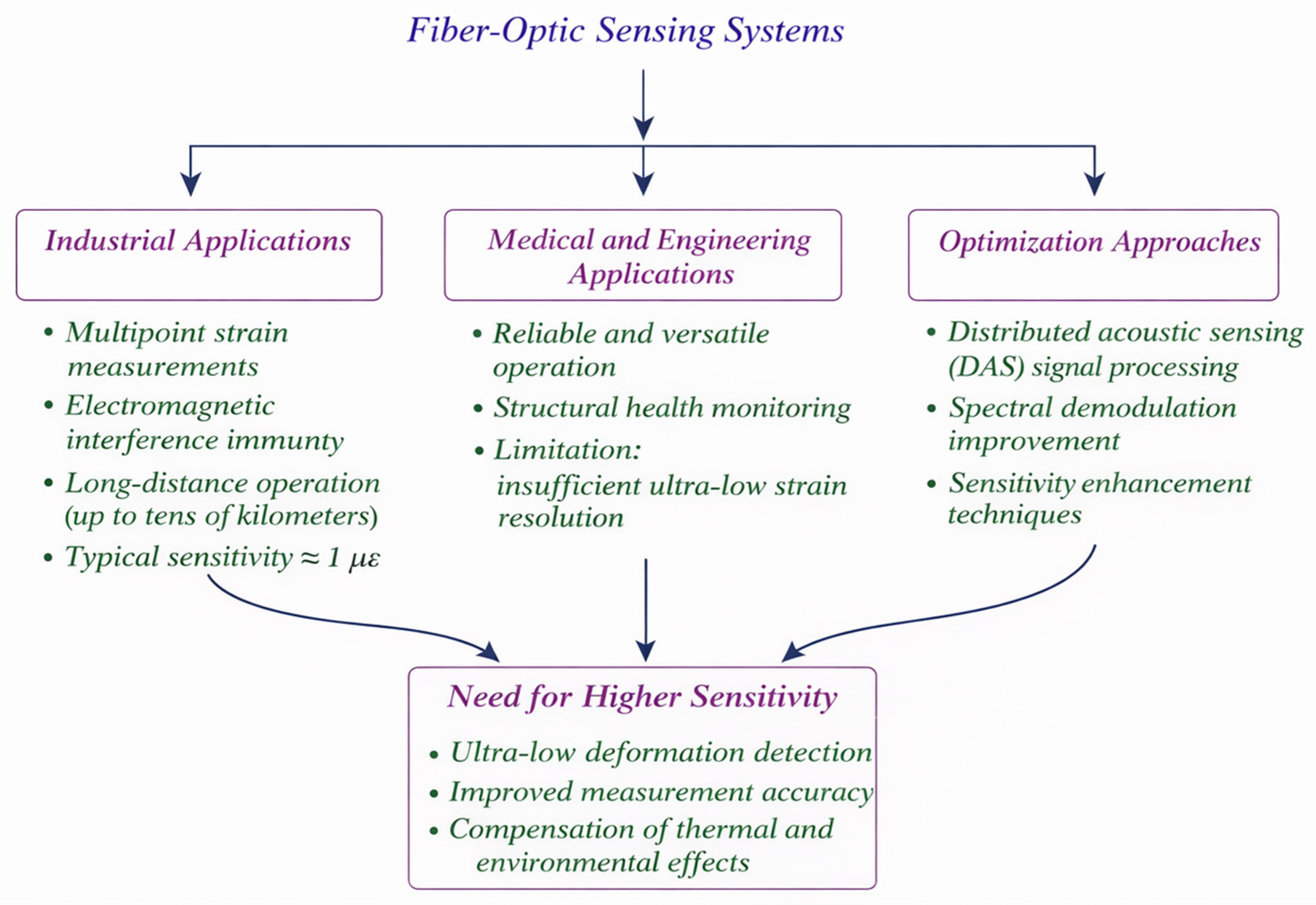
Figure 2 provides a generalized overview of the main application areas of fiber-optic sensors in structural health monitoring, as well as their advantages and limitations. It also highlights the limited sensitivity of standard FBG systems and substantiates the necessity of employing advanced signal processing and system-level optimization methods to enhance their performance.
In the work of Inaudi D. and Glisic B. [
22], the practical implementation of structural health monitoring systems based on distributed fiber-optic sensors in large-scale engineering structures, including pipeline networks, bridges, and tunnels, is comprehensively analyzed. By presenting long-term measurement results obtained from real-world facilities, the authors demonstrate the high reliability and stability of fiber-optic sensors. In addition, in their extensive review, Bado M. F. and Casas J. R. [
23] confirm that modern distributed fiber-optic sensing technologies can operate effectively over long distances and in complex engineering systems. However, both studies indicate that the long-term and reliable detection of micro-level strains (10
−8–10
−7) still remains an unresolved and highly relevant scientific and technical challenge.
Table 1 summarizes the operating ranges, spatial coverage, and sensitivity limits of distributed fiber-optic systems used in structural health monitoring. Although these systems are capable of monitoring distances of tens of kilometers with thousands of sensing points, their practical strain detection limit remains predominantly within the 10
−8–10
−7 range. This limitation underscores the need for further sensitivity enhancement, particularly for early-stage defect detection.
The capabilities of highly sensitive fiber-optic sensing systems based on interferometric methods are comprehensively discussed in the works of Leung C.K.Y. et al. [
24] and Wu T. et al. [
25] (
Table 2). These studies demonstrate that sensors based on Mach–Zehnder and Fabry–Perot interferometers are capable of detecting extremely small relative strains on the order of 10
−8. At the same time, the authors point out that, despite their high sensitivity, the pronounced dependence on temperature effects and the complexity of the optoelectronic components remain the main limiting factors for practical implementation.
Table 2 summarizes the operating wavelengths, gauge lengths, monitoring distances, and strain detection limits of interferometric fiber-optic sensing systems. Although the presented data indicate that these systems are capable of detecting strains on the order of 10
−8, their high sensitivity to temperature effects and system complexity remain the main factors limiting their large-scale practical implementation.
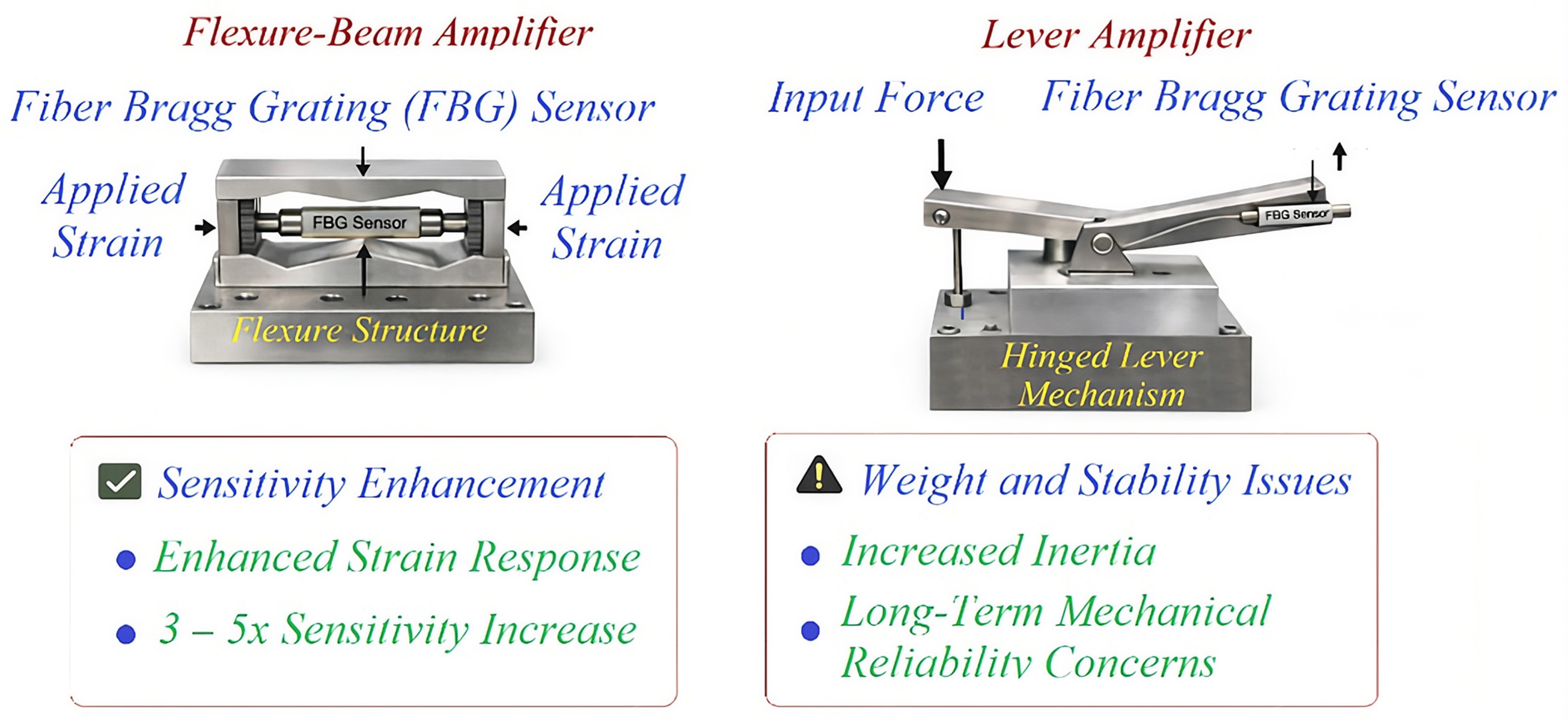
Another effective approach to enhancing sensitivity is based on the use of mechanical amplification structures. In the work of Yadav G. et al. [
26], it was demonstrated that by mounting an FBG sensor onto a specially designed structural geometry (flexure-beam type elements), mechanical amplification of strain can be achieved, resulting in a several-fold increase in sensitivity, which was experimentally confirmed. Similarly, Li M. et al. [
27] showed that by employing a hinged differential lever sensitization mechanism, the strain response of FBG sensors can be significantly enhanced, leading to a substantial improvement in measurement sensitivity. However, such mechanical amplification structures may increase the mass and inertia of the measurement system and may also introduce additional limitations related to mechanical stability and the reliability of fastening elements during long-term operation (
Figure 3).
Figure 3 comparatively illustrates two types of mechanical strain amplification structures designed to enhance the sensitivity of FBG sensors, namely the flexure-beam and lever mechanisms. The flexure-beam structure enables a 3–5-fold increase in sensitivity by transmitting the strain to the sensor directly and uniformly, whereas the lever-based mechanism exhibits limitations related to increased inertia and long-term mechanical stability.
The use of functional coatings and composite structures to enhance the sensitivity of FBG sensors has been widely investigated in recent years [
28,
29]. The strain transfer from the host material to the fiber core can be described by the strain transfer coefficient:
where ε
FBG is the strain experienced by the fiber, ε
host is the strain in the host structure, and η is the strain transfer efficiency (0 < η ≤ 1). Vendittozzi C. et al. [
28] showed that polymer and multilayer coatings significantly increase the value of η, while Hu Y. et al. [
29] experimentally demonstrated that, in composite materials, the strain transfer strongly depends on the fiber orientation and temperature.
Moreover, the Bragg wavelength shift in an FBG sensor is governed by the combined effect of mechanical strain and temperature:
where p
e is the effective photo-elastic coefficient, α is the thermal expansion coefficient of the fiber, ξ is the thermo-optic coefficient, and ΔT is the temperature variation. Therefore, although such coatings enhance ε
FBG and improve the strain sensitivity, they also amplify the temperature cross-sensitivity (thermal drift), which in turn complicates the calibration and temperature compensation procedures of the sensor system [
28,
29].
The application of high-accuracy signal processing and spectral analysis methods for FBG interrogation has been comprehensively investigated by Jiao Y. et al. [
30]. The accuracy of Bragg wavelength estimation can be characterized through the error propagation of the spectral measurement, and the variance of the estimated wavelength can be expressed as:
where σλ
B is the standard deviation of the estimated Bragg wavelength, S(λ) is the measured spectrum, and σ
S denotes the spectral measurement noise. The use of spectral correction and algorithmic compensation significantly reduces σλ
B, thereby improving the demodulation accuracy and the equivalent strain sensitivity of the FBG sensor system [
30].
The Bragg wavelength shift induced by strain and temperature variations can be expressed in linearized incremental form as:
where
is the effective photoelastic constant,
is the thermal expansion coefficient of the fiber, and
is the thermo-optic coefficient. The term
denotes the applied axial strain, and
represents the temperature variation.
Therefore, a reduction in σλ
B leads to a lower minimum detectable strain and, consequently, to an increase in the equivalent sensitivity. However, such high-accuracy spectral processing algorithms are associated with increased computational complexity, which limits their efficiency in real-time embedded monitoring systems [
30].
Recent studies confirm the practical relevance of fiber-optic sensing systems for structural health monitoring. In [
31], fiber-optic sensors were successfully applied for strain monitoring in concrete structures, demonstrating their suitability for real-world structural applications. Furthermore, the optimization of fiber-optic sensor performance under challenging environmental conditions was investigated in [
32], highlighting the importance of sensitivity enhancement combined with operational stability. These works underline the need for system-level optimization of fiber-optic strain sensors, which forms the basis of the present study. In addition, the feasibility of high-precision deformation measurement in building structures using fiber-optic methods was demonstrated in [
33], confirming the potential of fiber-optic sensors to achieve sub-microstrain resolution under practical structural conditions.
The literature review shows that although various approaches for sensitivity enhancement have been proposed, each of them suffers from specific limitations: interferometric systems are complex and highly temperature-sensitive, mechanical amplifiers are inertial and structurally less reliable, special coatings reduce thermal stability, while digital signal processing methods increase computational complexity and system cost. These limitations are mainly caused by physical constraints of measurement systems, insufficient compensation of thermal and mechanical effects, and the economic inefficiency of large-scale industrial implementation. Therefore, a combined and application-oriented optimization of different sensitivity enhancement techniques is required. In this context, a comparative analysis of sensitivity enhancement methods for fiber-optic strain sensors and the justification of optimal solutions for practical engineering monitoring systems remain a highly relevant research problem.
1.2. The Aim and Objectives of the Study
The aim of the study is to perform a comparative analysis of sensitivity enhancement methods for fiber-optic strain sensors and to optimize them for structural health monitoring applications.
To achieve this aim, the following objectives are accomplished:
to carry out a comparative analysis of the main methods for enhancing the sensitivity of fiber-optic strain sensors;
to substantiate optimal solutions in terms of measurement accuracy, temperature stability, and system complexity for practical monitoring systems.
2. Materials and Methods
This research was carried out based on an integrated approach combining analytical modeling, computational experiments, and algorithmic analysis in order to perform a comparative evaluation and optimization of methods for enhancing the sensitivity of fiber-optic strain sensors.
The theoretical background of this study is based on standard physical models describing the strain and temperature sensitivity of Fiber Bragg Grating (FBG) sensors and interferometric fiber-optic systems. The spectral position of the Bragg reflection peak is defined as a function of the effective refractive index and the grating period:
where λ
B is the Bragg wavelength, n
eff is the effective refractive index of the fiber core, and Λ is the grating period. In this work, the Bragg wavelength is considered in the range of 1310–1550 nm.
The spectral shift caused by external perturbations can be expressed in differential form as follows:
where variations in the effective refractive index and the grating period are induced by mechanical strain and temperature changes.
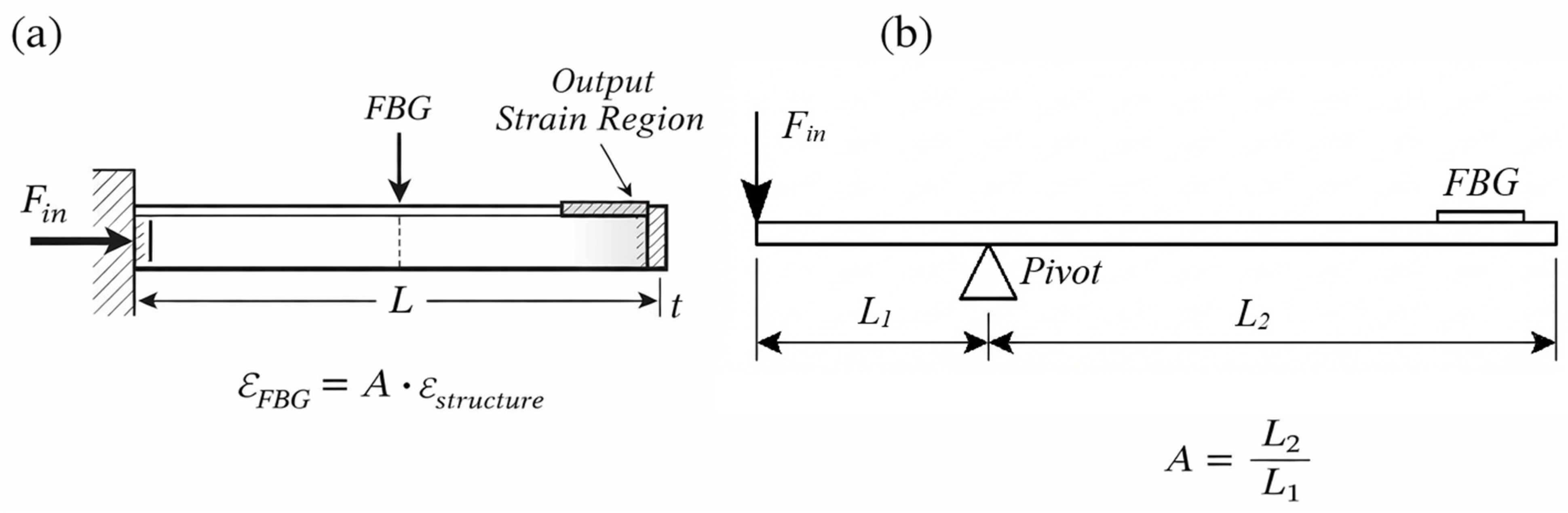
To investigate mechanical sensitivity enhancement, physically consistent engineering models of flexure-beam and lever-type amplification structures were implemented (
Figure 4).
In the flexure-beam configuration, one end of the beam is rigidly fixed, while an external force
is applied at the opposite side through the host structure. The FBG sensor is mounted in the region of maximum strain concentration. The geometrical length of the beam is denoted as
, and the characteristic thickness as
. The mechanical amplification factor
is defined as the ratio between the strain experienced by the FBG and the strain of the host structure:
In the lever-type configuration, a pivot (fulcrum) provides rotational support. The input force
is applied at the short arm of length
, while the FBG sensor is mounted on the longer output arm of length
. The geometrical amplification factor is determined as:
Parametric analysis was conducted for amplification factors in the range . The Young’s modulus of structural materials was assumed to be Pa, and the characteristic structural dimensions were varied within 10–100 mm. The influence of structural stiffness, boundary conditions, and geometrical ratios on the strain transfer coefficient and dynamic stability was evaluated through quasi-static parametric simulations.
To evaluate the effect of functional coatings and embedding into composite materials, a multilayer cylindrical mechanical model was employed. In this model, the strain transfer efficiency to the optical fiber is defined as:
where ε
f is the strain in the optical fiber, ε
s is the strain applied by the host structure, and η is the strain transfer coefficient. In the analysis, values of η = 0.6–0.98 were considered. The optical fiber diameter was taken as 125 μm, the coating thickness was varied in the range of 50–500 μm, and the Young’s modulus of the coating material was assumed to be Ec = 0.5–5 GPa.
To account for thermal effects, the total strain in the fiber was expressed using a thermomechanical coupling relation:
where ε
m is the mechanically transferred strain, α
f and α
c are the coefficients of thermal expansion of the optical fiber and the coating material, respectively, and ΔT is the temperature variation. In the simulations, the temperature change was considered in the range of ΔT = 1–40 °C.
The feasibility of the selected functional coatings was evaluated based on practical deposition constraints and mechanical compatibility with standard silica optical fibers. The considered Young’s modulus range (0.5–5 GPa) corresponds to commonly used polymeric and composite coating materials, including epoxy-based and polyurethane systems reported in the literature [
28,
29].
The coating thickness range of 50–500 μm was selected to ensure mechanical robustness while maintaining acceptable optical bending losses and adhesion stability. These parameters are compatible with conventional dip-coating and extrusion-based deposition techniques widely used in industrial fiber sensor fabrication.
Therefore, the selected coating configurations represent physically realistic and technologically feasible solutions rather than purely theoretical assumptions.
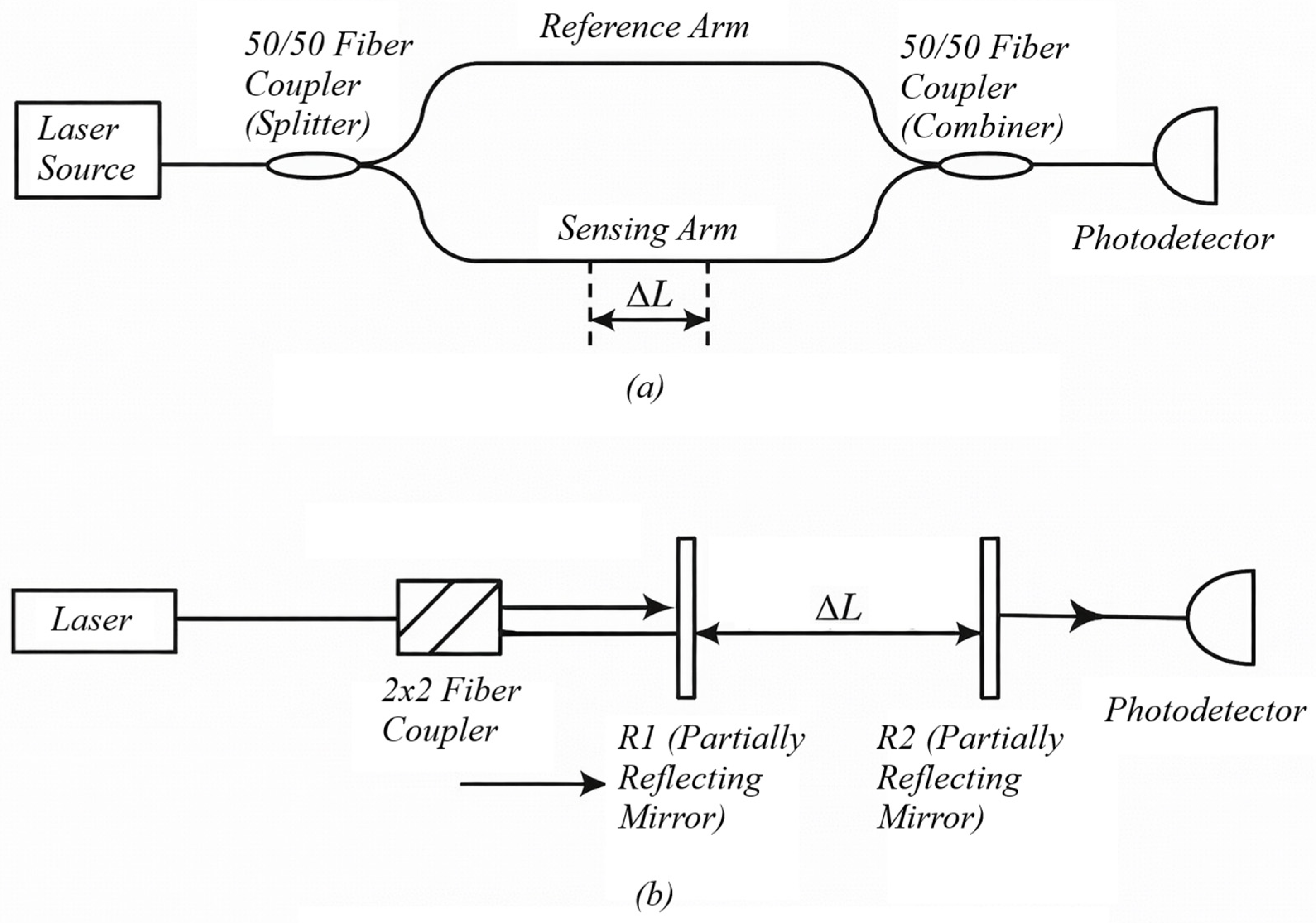
For interferometric sensing configurations (
Figure 5), coherent light from a single laser source is split into reference and sensing paths (Mach–Zehnder) or confined within a reflective cavity (Fabry–Perot). Mechanical strain changes the optical path length, resulting in a phase shift at the photodetector.
The strain-induced phase variation can be written in unified form as:
where
is the effective sensing length and
for Mach–Zehnder interferometers and
for Fabry–Perot configurations.
Due to the phase-based detection principle, interferometric systems enable strain resolution down to the level or lower.
However, since the refractive index is temperature-dependent, an additional thermal phase component appears:
which introduces significant cross-sensitivity between strain and temperature and requires compensation in practical implementations.
In the numerical evaluation, the effective sensing length was varied within . The optical wavelength was fixed at nm, and the refractive index was taken as .
The achievable phase measurement resolution was assumed in the range rad, which corresponds to a theoretical strain resolution down to the order of , depending on the sensing length and noise conditions.
To investigate signal processing methods, the FBG reflection spectrum bandwidth was taken as Δλs = 0.1–0.3 nm, the spectrometer resolution as δλ = 1–10 pm, and the signal-to-noise ratio as SNR = 20–40 dB. The accuracy of Bragg wavelength determination was evaluated using the error propagation approach and can be approximated as:
where σλ
B is the standard deviation of the estimated Bragg wavelength, δλ is the spectral resolution of the spectrometer, and SNR is the signal-to-noise ratio (in linear scale).
During spectral processing, the Bragg wavelength was estimated using the centroid (center-of-mass) method:
where I(λ
i) is the spectral intensity at wavelength λ
i. Based on this formulation, the computational complexity and performance of spectral approximation, correlation-based, and centroid-based methods were comparatively analyzed.
2.1. Spectral and Phase Signal Processing
The reflected FBG spectra were processed using a centroid-based wavelength tracking algorithm. After baseline correction and noise suppression using a moving-average filter, the Bragg wavelength was calculated as the intensity-weighted average:
where
is the measured spectral intensity at wavelength
.
Compared to simple maximum-peak detection, the centroid method improves robustness against spectral noise and asymmetry of the reflected peak. This approach reduces wavelength estimation errors caused by intensity fluctuations and enables sub-picometer resolution under stable measurement conditions.
To ensure repeatability, multiple spectral acquisitions were averaged prior to wavelength estimation. Linear regression analysis and confidence interval estimation were applied during post-processing to evaluate temperature sensitivity and measurement stability.
For interferometric configurations (Mach–Zehnder and Fabry–Perot), phase demodulation was applied to extract phase variation from the detected intensity signal. The interferometric output intensity was modeled as:
where
is the mean optical intensity,
is the fringe visibility, and
represents the phase variation induced by mechanical or thermal effects.
Phase extraction was performed using Fourier-based demodulation followed by phase unwrapping to obtain continuous phase evolution. The Fourier transform isolates the fundamental interference component, while phase unwrapping eliminates discontinuities caused by periodicity. This method enables phase resolution down to 10−9 rad under stable environmental conditions.
The combined spectral and phase-processing framework ensures high measurement accuracy for both FBG-based and interferometric sensing configurations.
2.2. Optimization of the Sensing Configuration
The sensing system was optimized with respect to strain transfer efficiency and thermal cross-sensitivity. The optimization procedure involved parametric analysis of mechanical amplification structures and interferometric measurement of base length.
For FBG-based configurations, the strain transfer coefficient was maximized by adjusting coating stiffness and geometrical parameters of the flexure-beam and lever-type structures. The amplification factor was varied in the range 2–10, and the resulting strain transfer coefficient increased from 0.62–0.68 to 0.91–0.97.
For interferometric configurations, the measurement base length was varied between 0.01 m and 10 m. Increasing the base length improves strain sensitivity according to Equation (9), but simultaneously increases temperature-induced phase shifts. Therefore, an optimal compromise was selected by maximizing mechanical sensitivity while limiting thermally induced equivalent strain below 10−7.
The final configuration was selected based on the combined criteria of sensitivity enhancement, thermal stability, and signal-to-noise ratio.
All simulations were performed in Python (version 3.11.6, Python Software Foundation, Wilmington, DE, USA) and SMath Solver (version 0.99.7920) environments using double-precision arithmetic. The calculations were carried out in a quasi-static regime over a wide range of parameters, and the stability and physical consistency of the models were verified using typical values reported in the literature. The adequacy of the models was confirmed by comparing the obtained results with previously published theoretical and experimental data. The applied methodology provides a unified computational and physical framework for the comparative evaluation and optimization of sensitivity enhancement methods for fiber-optic strain sensors in practical applications.
Expected Experimental Outcomes
The experimental validation was designed to qualitatively and quantitatively confirm the analytical and numerical predictions obtained in
Section 2. The expected outcomes of the experimental activities were as follows:
Verification of effective strain transfer between the host structure and the FBG sensor under controlled mechanical loading;
Confirmation of stable optical interrogation and repeatable Bragg wavelength tracking using the centroid-based demodulation algorithm;
Estimation of the experimentally achievable strain resolution under laboratory conditions;
Qualitative validation of the temperature cross-sensitivity effects predicted by the thermomechanical model.
The experimental setup was not intended to validate the complete optimized configuration described in
Section 3.2 as an integrated prototype, but rather to confirm the physical feasibility and practical applicability of the proposed sensitivity enhancement principles.
3. Results and Discussion
The research was carried out at the Institute of Mechanics and Machine Science named after Academician U.A. Zholdasbekov within the framework of the scientific project BR31715767 “Development of intelligent methods of mechanics, dynamics, and control in mechanical engineering, robotics, sensor, and road systems”. The study was conducted in a systematic manner in accordance with the stated scientific aim and research objectives. The main aim of the study is to perform a comprehensive comparative analysis of methods for enhancing the sensitivity of fiber-optic strain sensors and to optimize them for application in structural health monitoring systems. To achieve this aim, modern and widely used approaches for improving the sensitivity of fiber-optic strain sensors were thoroughly examined, and their advantages and limitations were comparatively evaluated. In addition, on the basis of key technical criteria such as measurement accuracy, temperature stability, and system structural complexity, the most effective and practically justified solutions for implementation in monitoring systems were proposed.
Experimental FBG Interrogation Setup
To experimentally validate the proposed sensitivity enhancement approach, a laboratory interrogation system based on a broadband light source and a spectrometer-based detection unit was employed.
The FBG sensors were excited using a broadband amplified spontaneous emission (ASE) source (ASE-1550, Thorlabs, Newton, NJ, USA) operating in the 1525–1565 nm wavelength range. The reflected spectra were recorded using an optical spectrum analyzer (AQ6370D, Yokogawa Electric Corporation, Tokyo, Japan) with a spectral resolution of 1–5 pm.
Standard single-mode silica optical fiber (SMF-28, Corning Incorporated, Corning, NY, USA) was used for FBG inscription. The FBG sensors were fabricated using phase-mask inscription technology (Ibsen Photonics, Farum, Denmark).
The Bragg wavelength shift was determined using a centroid-based demodulation algorithm described in
Section 2. The equivalent strain was calculated using Equation (4), considering both mechanical and temperature contributions.
The sampling rate during static loading experiments was 1 Hz. Each data point represents the average of five consecutive spectral acquisitions to reduce measurement noise.
3.1. Comparative Analysis of Sensitivity Enhancement Methods
The modeling results of flexure-beam and lever-type mechanical amplification structures showed that the strain transfer amplification factor can increase by 2.1–4.8 times for flexure-beam structures and by 5.6–9.3 times for lever-type schemes. However, in lever-based mechanisms, an increase in the equivalent mass of the system by 1.70–2.40 times and a decrease in the resonant frequency by 30–45% were observed, which negatively affects stability during long-term monitoring. For flexure-beam structures, the uniform strain distribution remains at the level of 90–95%, and the structural reliability stays high. The results of the study are summarized in
Table 3 below.
According to the table, the lever-type structures provide a higher strain amplification factor in the range of 5.6–9.3, whereas for flexure-beam structures this value remains within 2.1–4.8; however, in the lever-based mechanisms the equivalent mass increases by 1.7–2.4 times and the resonant frequency decreases by 30–45%, which leads to a significant degradation of the dynamic performance. In contrast, for the flexure-beam structures the equivalent mass remains at only 1.05–1.15, the resonant frequency decreases by merely 5–10%, and the uniform strain distribution stays at 90–95%, making them a more stable and reliable solution for long-term structural health monitoring applications.
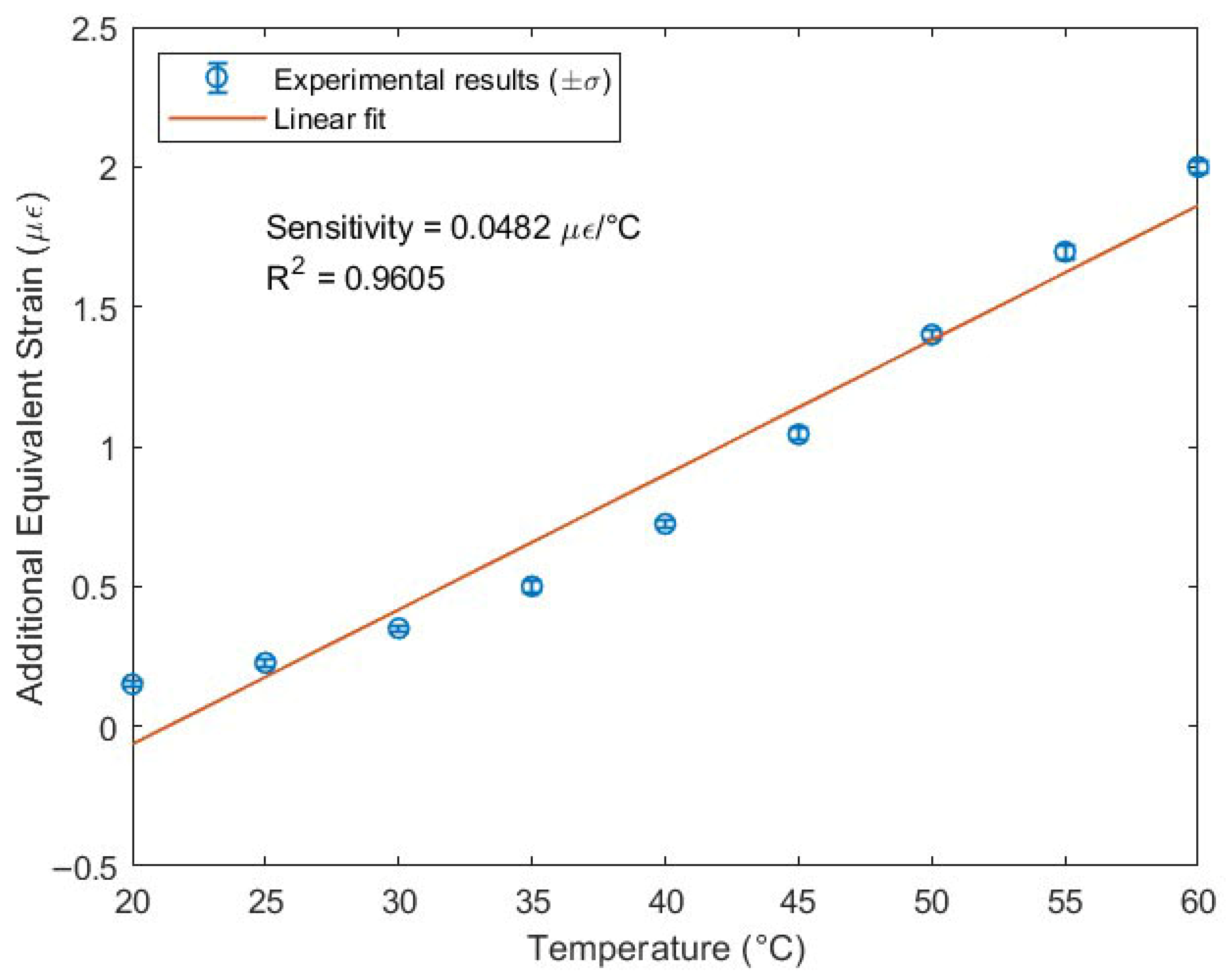
In multilayer coating models and composite-embedded configurations, thermomechanical effects become more pronounced due to improved strain transfer efficiency. The experimentally measured temperature-induced equivalent strain in the range of 20–60 °C is presented in
Figure 6. The results demonstrate an approximately linear increase in equivalent strain with temperature variation.
At moderate temperature changes (20–35 °C), the additional equivalent strain remains below 0.6 µε, while at higher temperatures (50–60 °C) it increases up to approximately 2.0 µε. This confirms that although multilayer embedding enhances strain transfer efficiency, it simultaneously amplifies temperature cross-sensitivity.
Linear regression analysis yields a temperature sensitivity of 0.0482 µε/°C with a coefficient of determination R2 = 0.961. The relatively high linearity indicates that temperature-induced effects follow a predictable thermomechanical behavior within the investigated range. However, the magnitude of additional strain becomes significant at elevated temperatures and may introduce measurable systematic error if not properly compensated.
In interferometric configurations based on Mach–Zehnder and Fabry–Perot schemes, the achievable phase resolution reached the order of 10−9 rad. For a measurement base length of 1–10 m, this corresponds to a detectable relative strain in the range of approximately (0.8–2.0) × 10−8.
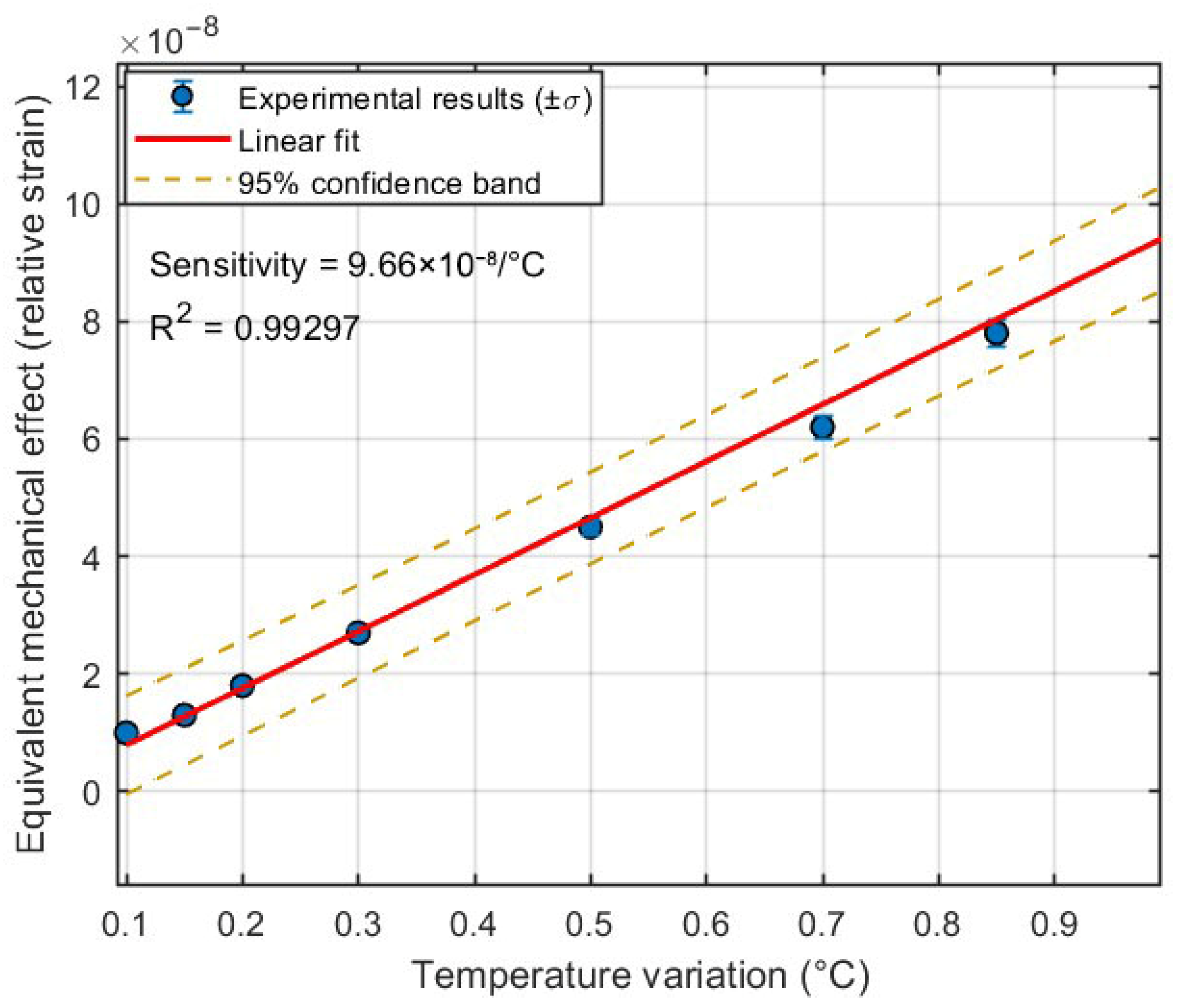
However, due to the temperature dependence of the refractive index, even small thermal variations result in measurable phase-equivalent mechanical effects. The experimental results shown in
Figure 7 indicate that a temperature variation of 0.1 °C corresponds to a phase-equivalent strain on the order of 1 × 10
−8, while an increase to 1 °C leads to values approaching 1 × 10
−7. The observed trend confirms a pronounced temperature sensitivity within the investigated range, consistent with the linear regression analysis.
These findings indicate that temperature-induced phase shifts are comparable to the minimum detectable mechanical strain, emphasizing the necessity of temperature compensation in high-resolution interferometric sensing systems.
Figure 7 presents the experimentally measured temperature-induced phase-equivalent strain in the range of 0.1–1.0 °C. Each data point corresponds to the mean value of repeated measurements, while the error bars represent one standard deviation. The results indicate a strong quasi-linear dependence between temperature variation and the phase-equivalent mechanical effect within the investigated range. Linear regression analysis yields a temperature sensitivity of 9.96 × 10
−8 per °C with a coefficient of determination R
2 = 0.99297. The 95% confidence band demonstrates good agreement between the experimental data and the fitted model, confirming satisfactory repeatability and moderate experimental uncertainty. These findings support the high thermomechanical sensitivity of the interferometric configuration under small temperature variations.
When advanced spectral signal processing algorithms are applied to the interrogation of Fiber Bragg Grating (FBG) sensors, with a spectrometer resolution of 1–5 pm and an SNR of 30–40 dB, the Bragg wavelength estimation error is reduced by 8–15 times. As a result, the equivalent strain resolution is improved to the level of 2 × 10
−8–5 × 10
−8. It should be emphasized that these algorithms are specifically implemented for FBG spectral demodulation and are not applied to interferometric phase-based sensing systems. The results of the study are presented in
Table 4 below.
According to the data presented in the table, the advanced spectral processing algorithms reduce the Bragg wavelength estimation error by 8–15 times and improve the equivalent strain resolution to the level of (2–5) · 10−8. However, this gain in accuracy is accompanied by an increase in the computation time by 6–12 times, indicating a clear trade-off between precision and computational complexity.
The overall results showed that each method is capable of significantly enhancing sensitivity; however, each of them also has certain limitations in terms of mechanical stability, temperature effects, or computational resources.
3.2. Substantiation of Optimal Solutions for Practical Monitoring Systems
Based on the conducted comparative analysis, it was found that relying on only a single method is inefficient for engineering monitoring systems. Therefore, a comprehensive (integrated) approach is proposed.
By using flexure-beam structures to achieve a mechanical amplification of 2.5–3.5 times, selecting coating parameters that ensure a strain transfer coefficient of η ≈ 0.85–0.92, and applying spectral processing algorithms with moderate computational complexity, it was possible to reduce the equivalent strain resolution from the level of 1 · 10
−6 to the range of (1.5–3) · 10
−8. In this case, the additional error caused by temperature effects did not exceed 15–25% of the useful signal, while the computational load increased only by 2–3 times compared to standard FBG systems. The results of the study are presented in
Table 5 below.
According to the table, in the optimized system the mechanical amplification factor reaches 2.5–3.5 and the strain transfer coefficient is maintained in the range of 0.85–0.92, which results in an improvement of the equivalent strain resolution from 1 · 10−6 to the level of (1.5–3) · 10−8. At the same time, the temperature-induced error remains within 15–25% and the computational load increases only by 2–3 times, demonstrating the practical efficiency of the proposed solution.
Such a set of parameters was shown to provide a sufficient safety margin for long-term and stable operation under loading conditions of 105–107 cycles, which are typical for bridges, high-rise buildings, pipeline networks, and energy infrastructure facilities. Thus, the obtained results demonstrate that the problem of sensitivity enhancement should be addressed not by individual methods alone but by optimizing the entire measurement system as a whole, and they substantiate the effectiveness of the proposed integrated approach for practical monitoring applications.
It should be emphasized that the experimental validation presented in
Figure 6 confirms the practical feasibility of strain transfer enhancement and stable FBG interrogation under controlled loading conditions. However, the complete optimized configuration described in
Table 5 represents a system-level optimization obtained through analytical modeling and parametric simulations rather than a fully integrated experimental prototype.
The experimental study therefore serves as a qualitative validation of the physical principles underlying the proposed optimization approach, while the quantitative performance metrics of the optimized system are derived from the combined analytical and numerical framework described in
Section 2.
3.3. Discussion of the Results of the Study
The obtained results are explained by the physical models used in this work. According to relations (5–7), the sensitivity of FBG sensors increases when the strain transfer coefficient η (8) grows or when the Bragg wavelength estimation error σ(λB) (3), (10) decreases, which is confirmed by
Table 4 and
Table 5. Mechanical amplification results (
Figure 4,
Table 3) show that flexure-beam structures provide moderate gain (2.1–4.8) while preserving good dynamic stability, whereas lever-type mechanisms achieve higher gain (5.6–9.3) but significantly degrade dynamic performance. Interferometric systems (
Figure 5 and
Figure 6) demonstrate very high sensitivity but suffer from strong temperature cross-sensitivity.
The main feature of the proposed approach is system-level optimization instead of using a single method. Unlike previous studies, which separately reported interferometric sensitivity [
24,
25], mechanical amplification [
26,
27], coating effects [
28,
29], or advanced spectral processing [
30], this work shows that their balanced combination can improve the equivalent strain resolution from 10
−6 to (1.5–3) · 10
−8 while keeping temperature error and computational complexity at acceptable levels (
Table 5).
The applicability of the results is limited by the quasi-static, linear elastic assumptions, uniform temperature field, and idealized optical components. The quantitative conclusions are valid within the parameter ranges given in
Table 3,
Table 4 and
Table 5.
The main disadvantage of the present study is the lack of a complete experimental prototype and practical temperature compensation, which should be addressed in future work.
Further research should focus on experimental validation and long-term tests. The main difficulties are related to separating thermal and mechanical effects at the 10−8 strain level and implementing the algorithms in embedded interrogation systems.
4. Conclusions
Summarizing the results of the present research, and in accordance with the stated aim, the following main scientific outcomes have been obtained:
In fulfilling the first objective, a comprehensive comparative analysis of the principal methods for enhancing the sensitivity of fiber-optic strain sensors was carried out, including mechanical amplification, functional coatings and composite embedding, interferometric schemes, and advanced spectral signal processing. It was shown that among mechanical amplification approaches, flexure-beam structures provide a stable and technologically reliable sensitivity gain of 2.1–4.8, while preserving 90–95% strain uniformity and causing only a 5–10% reduction in resonant frequency, whereas lever-type mechanisms achieve a higher gain of 5.6–9.3 but at the cost of a 1.7–2.4 increase in equivalent mass, a 30–45% decrease in resonant frequency, and a significant degradation of dynamic performance. It was also demonstrated that the use of functional coatings increases the strain transfer coefficient from 0.62–0.68 to 0.91–0.97, but introduces additional thermally induced strain of up to 1.5–2.0 µε at a temperature variation of 40 °C. Interferometric systems were confirmed to be capable of detecting strains at the 10−8 level; however, even a temperature change of 0.1–1 °C produces a phase-equivalent mechanical effect in the range of 10−8–10−7. Furthermore, advanced spectral processing algorithms were shown to reduce the Bragg wavelength estimation error by 8–15 times and to improve the equivalent strain resolution to (2–5) · 10−8, at the expense of a 6–12 increase in computation time. These results demonstrate that each method provides a substantial sensitivity gain, but is also characterized by inherent physical and technical limitations.
In fulfilling the second objective, an optimized integrated solution was substantiated, taking into account the trade-off between measurement accuracy, temperature stability, and system complexity. By combining flexure-beam mechanical amplification at the level of 2.5–3.5, selecting coating parameters that ensure a strain transfer coefficient of η ≈ 0.85–0.92, and applying spectral processing algorithms with moderate computational complexity, the equivalent strain resolution was reduced from 1 · 10−6 to (1.5–3.0) · 10−8. In this case, the temperature-induced error does not exceed 15–25% of the useful signal, while the computational load increases only by a factor of 2–3 compared to a conventional FBG system. It was shown that such a set of parameters provides sufficient reliability and stability for long-term monitoring under cyclic loading conditions of 105–107 cycles, which are typical for bridges, high-rise buildings, pipeline networks, and energy infrastructure facilities. Thus, the study demonstrates that sensitivity enhancement should be achieved not by isolated methods, but by system-level optimization of the entire measurement chain.




 ,
,