
Numerical Simulation of the Behavior of Reinforced UHPFRC Ties Considering Effects of Tension Stiffening and Shrinkage


Highlights
- The developed non-linear finite element model (NLFEM) enables reliable prediction of shrinkage strain range in reinforced UHPFRC ties.
- The NLFEM reliably reproduces the tension-stiffening behavior of reinforced UHPFRC ties using average parameters derived from a simplified four-point-inverse analysis (4P-IA) method.
- This study aims to develop a reliable and direct design procedure for UHPFRC, ensuring consistency from material characterization to structural application.
- Shrinkage effects are crucial and must be addressed in the design of reinforced UHPFRC elements under serviceability conditions.
Abstract
1. Introduction and Objectives
2. Experimental Program
2.1. Reinforced Tensile Bar Mechanical Test
2.2. Material Characterization
3. Numerical Model
4. Numerical Simulation and Discussion
4.1. Tensile Test Phase Calibration
4.2. Tension Stiffening Analysis
5. Concluding Remarks
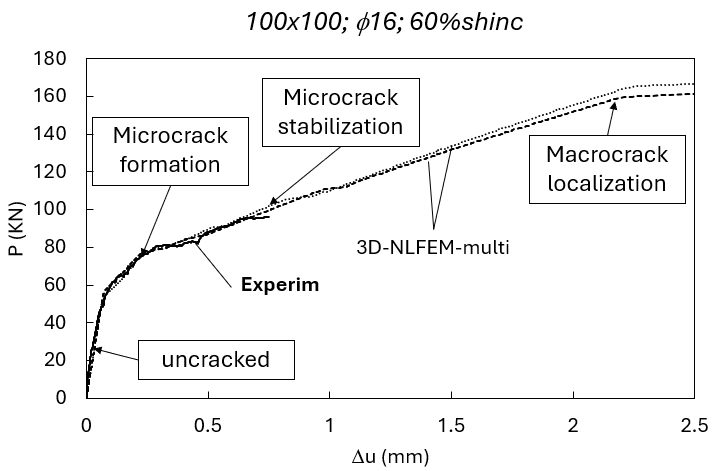
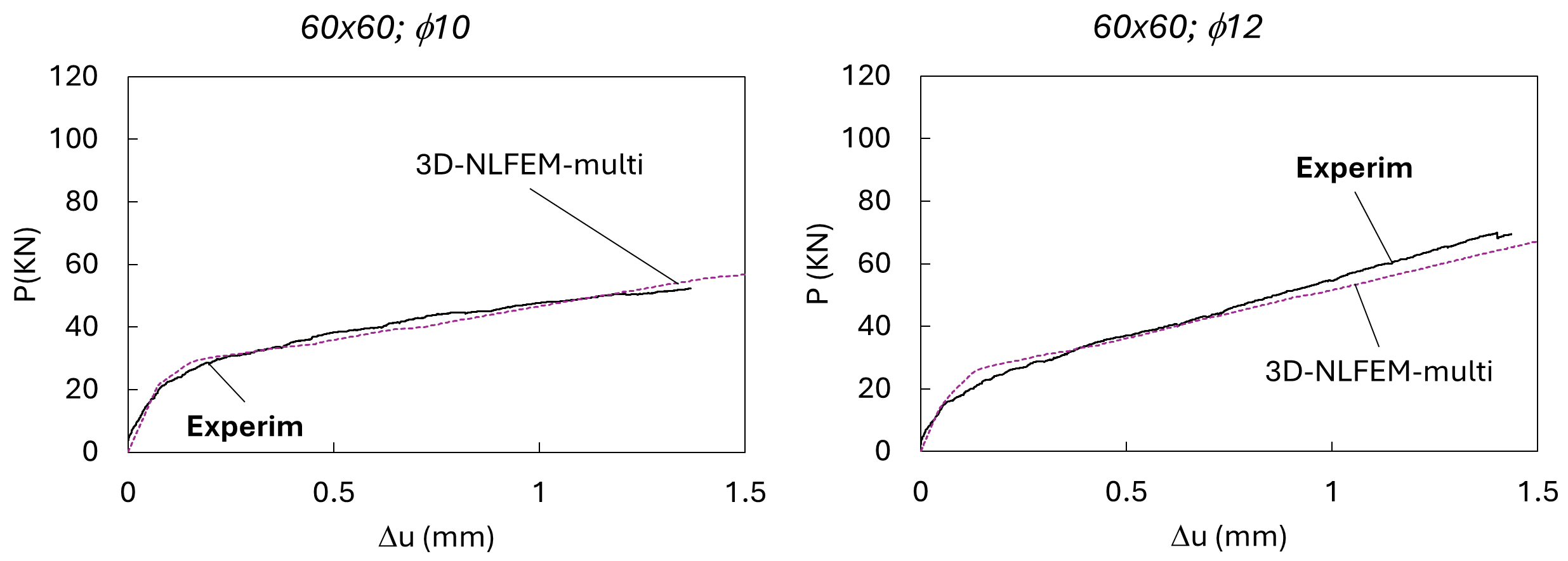
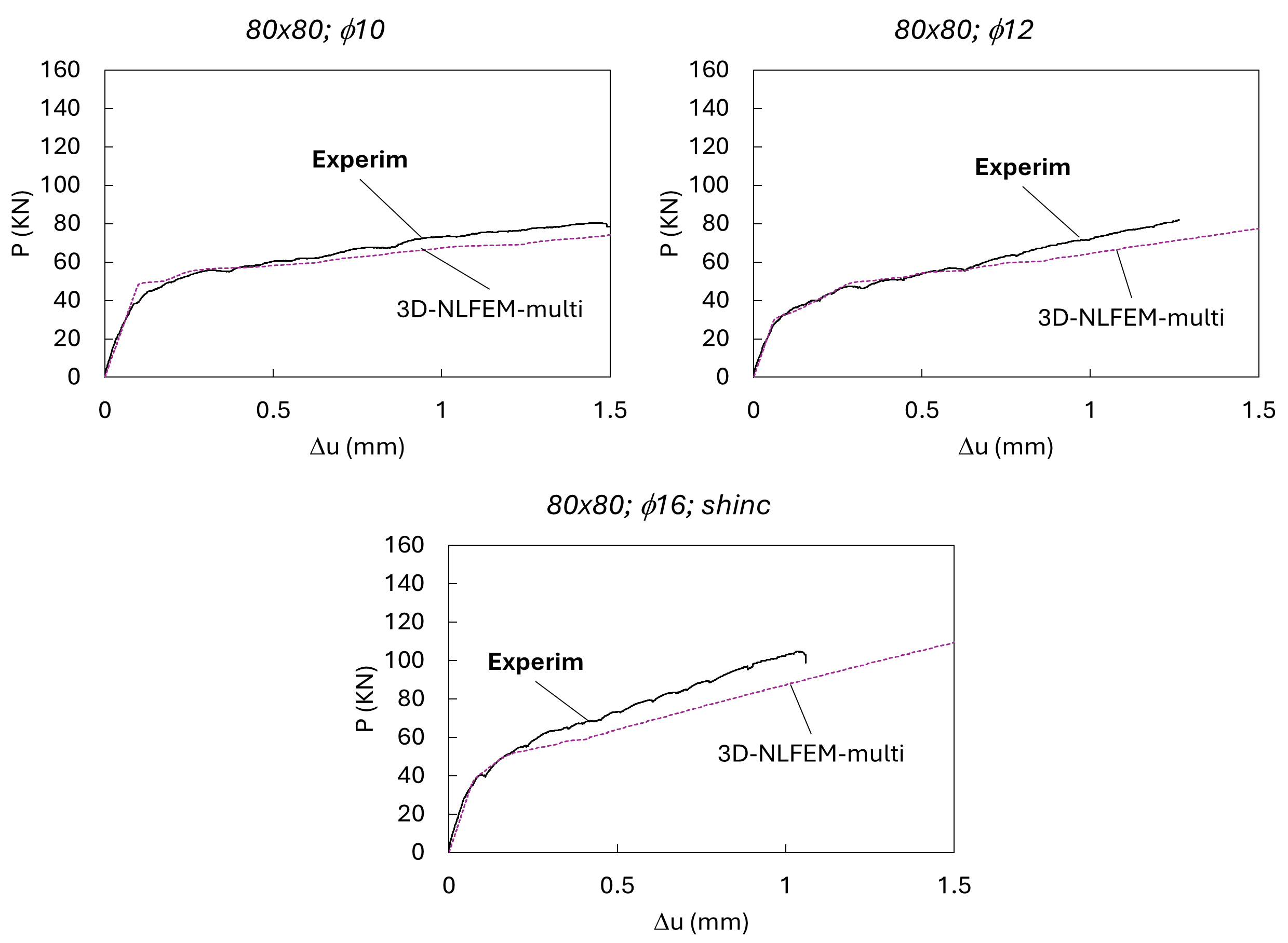
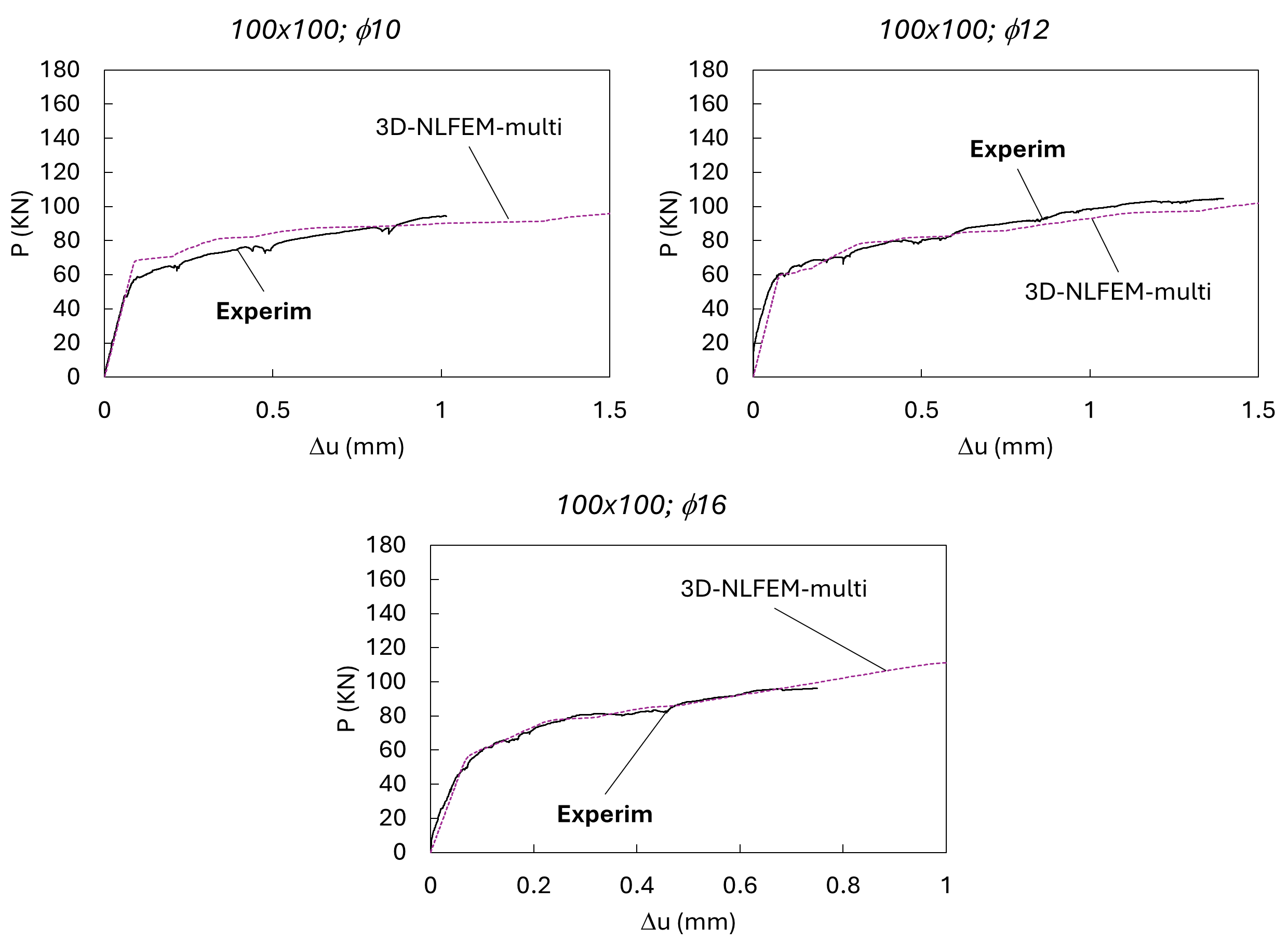
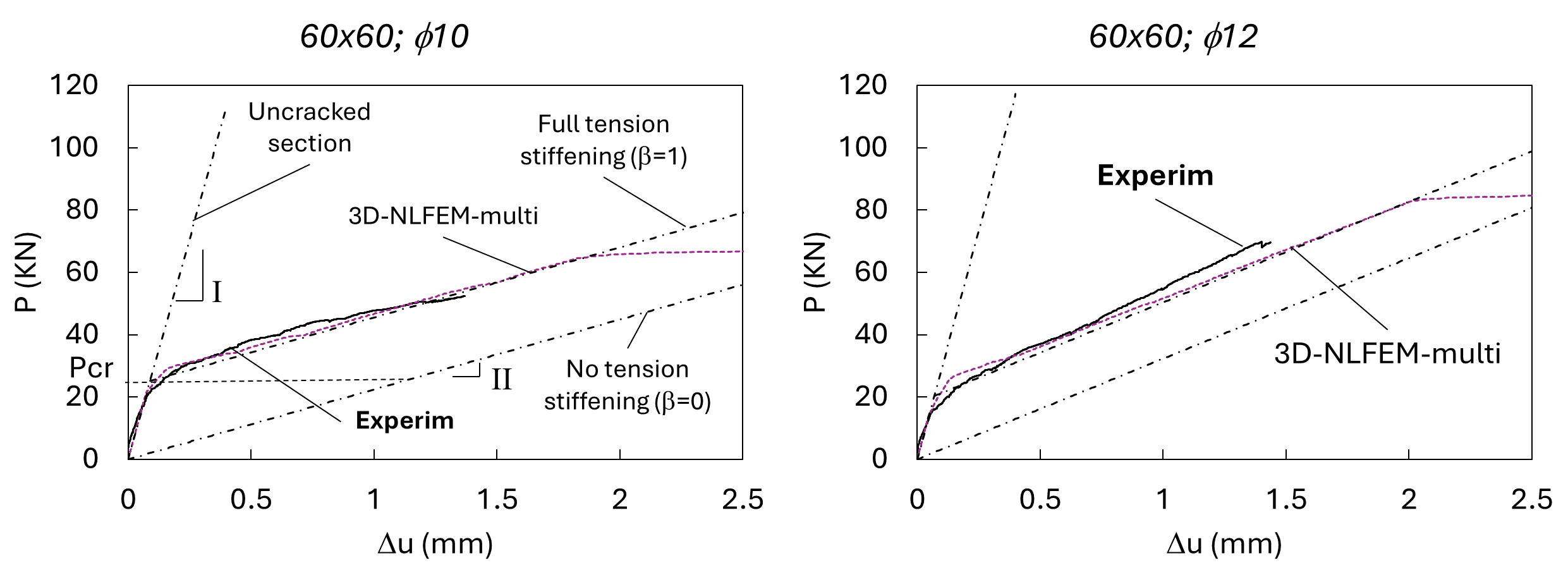
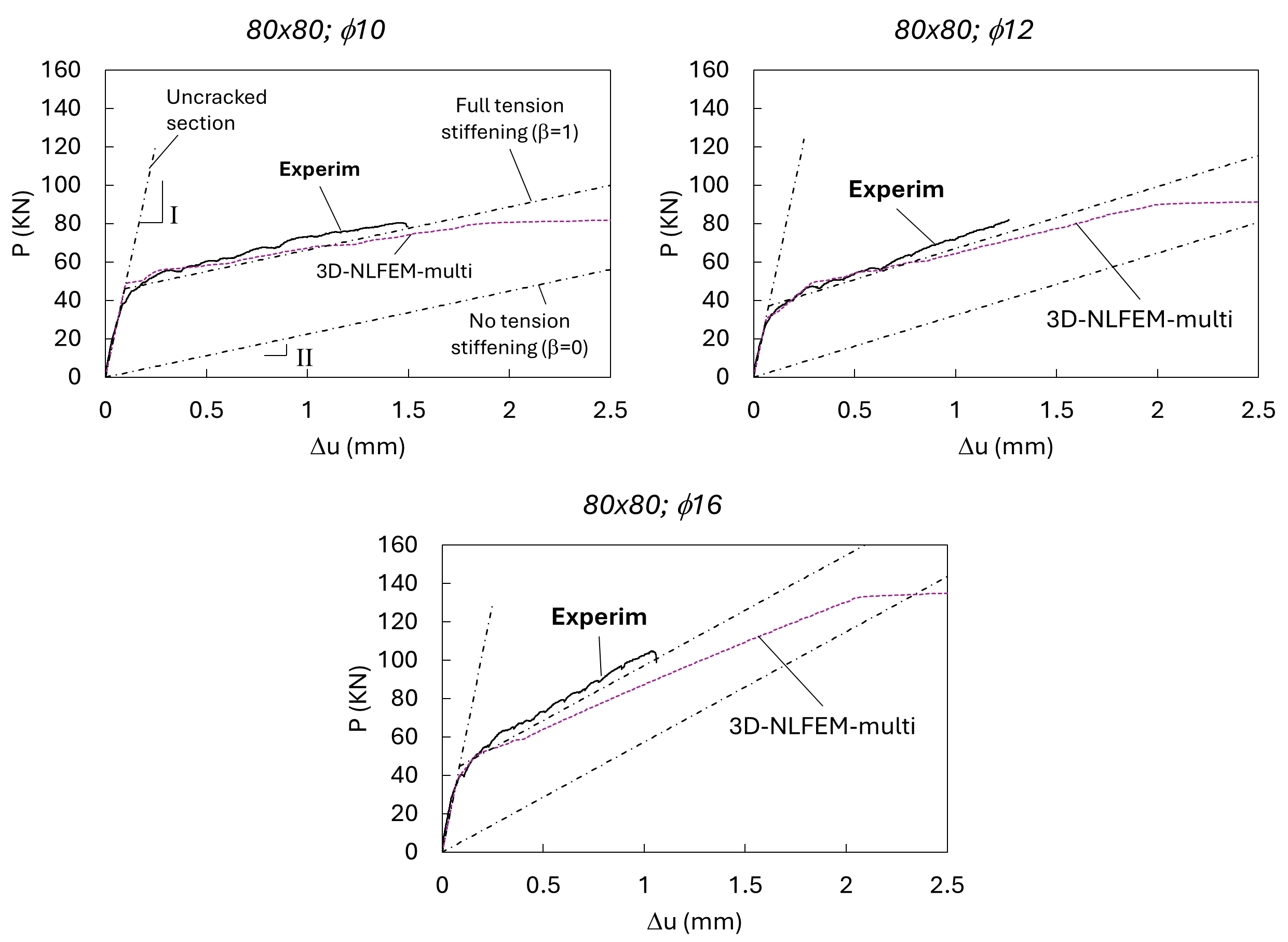
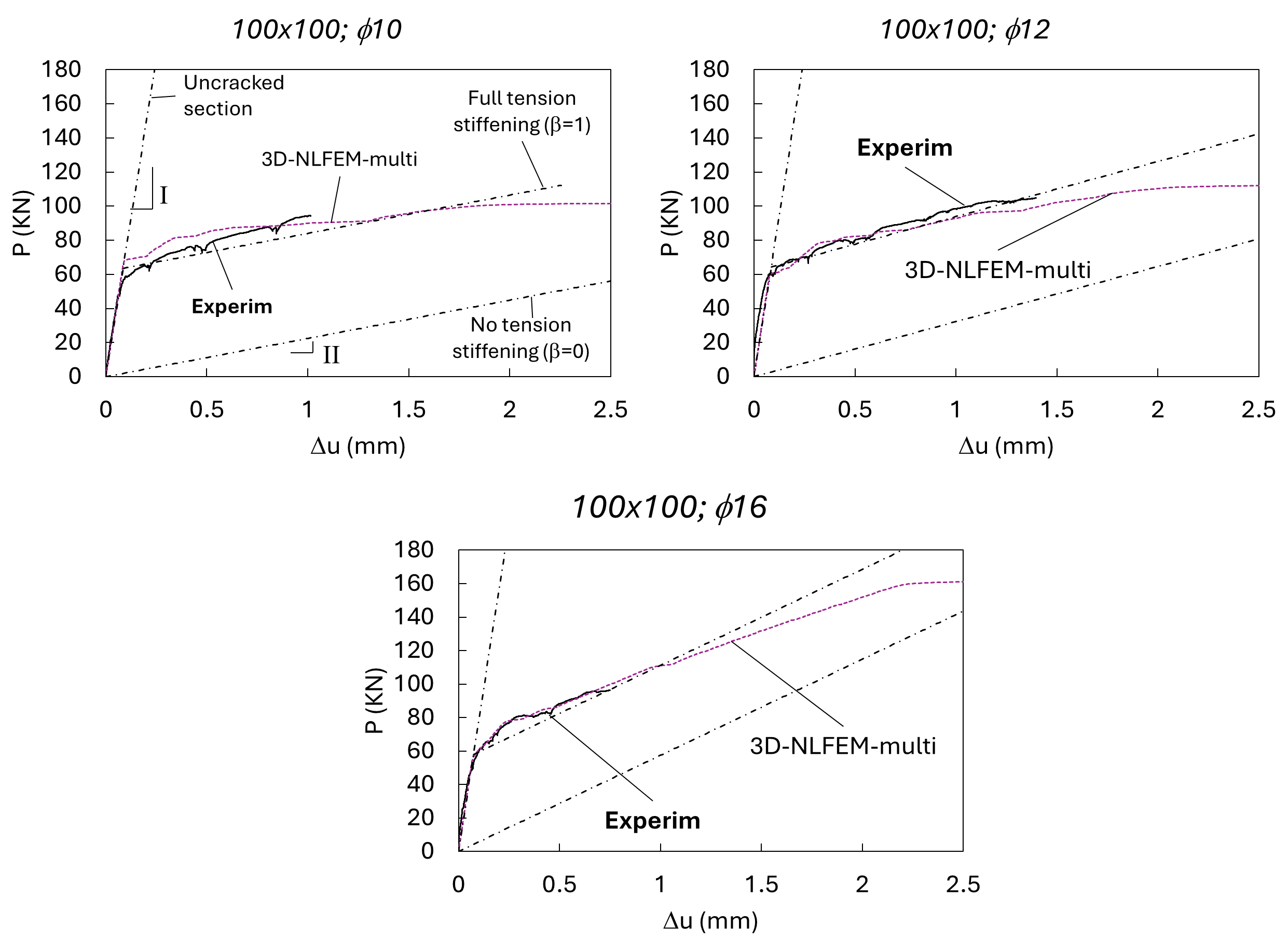
- The model showed strong agreement with experimental tensile test results. It reliably predicted shrinkage strain and its influence on stiffness loss during microcrack initiation and stabilization, where tension-stiffening behavior becomes significant.
- The 3D-NLFEM-multicrack model reproduced the experimental load–displacement response when using the average UHPFRC tensile parameters from four-point bending tests, confirming both its accuracy and the consistency of the concrete characterization process.
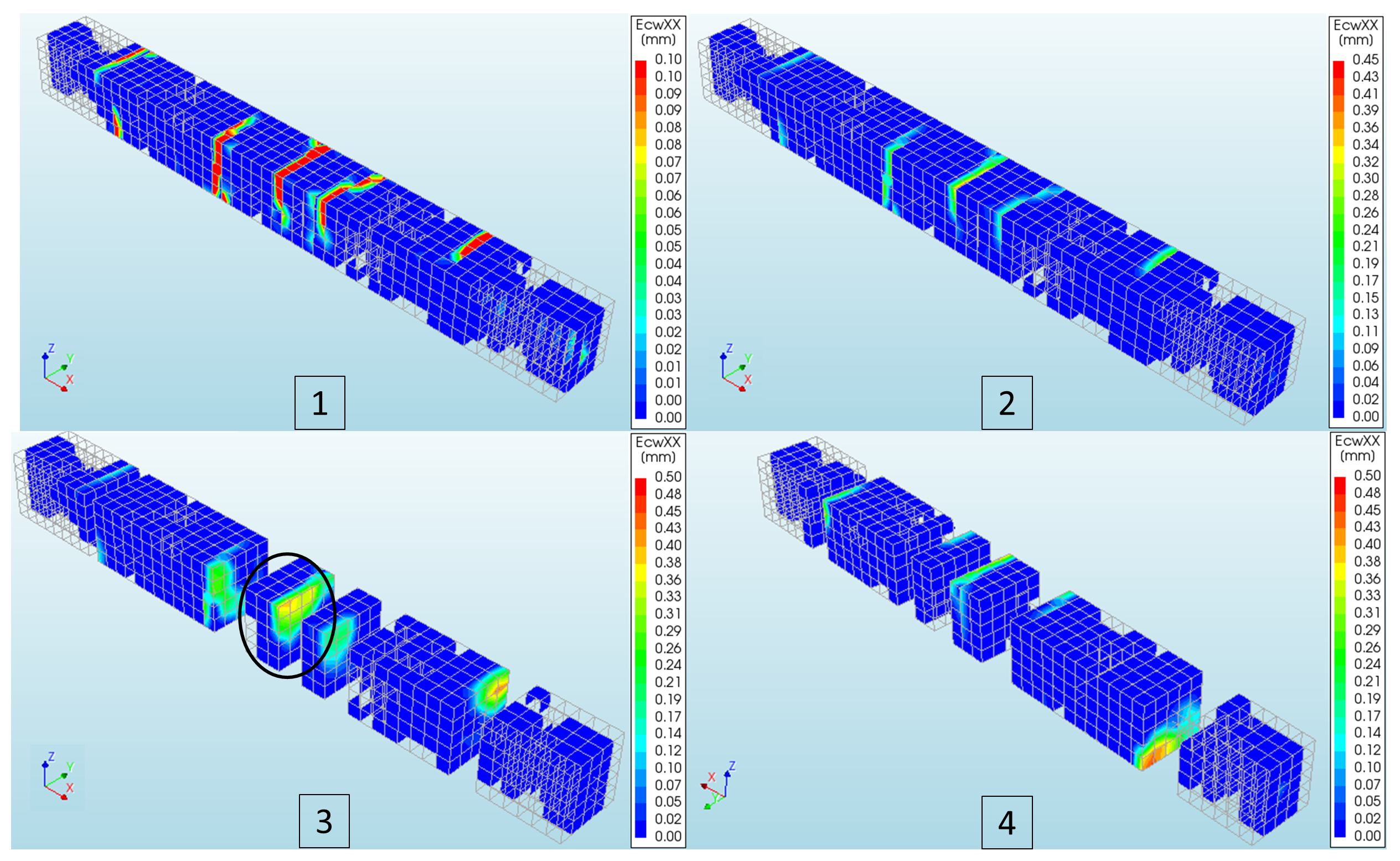
- Macrocracks resulted from the coalescence of microcracks. The model captured the tension-stiffening effect, which preserved stiffness during microcrack stabilization, considering both the tensile strength between cracks and the residual strength provided by fiber bridging.
- The predicted UHPFRC shrinkage strain ranged from 0.37 to 0.73 mm/m, aligning with literature values (0.60–0.90 mm/m). As post-cracking shrinkage was conservatively assumed to be equal to free shrinkage, without accounting for creep and relaxation, the predicted strain value represents an upper bound.
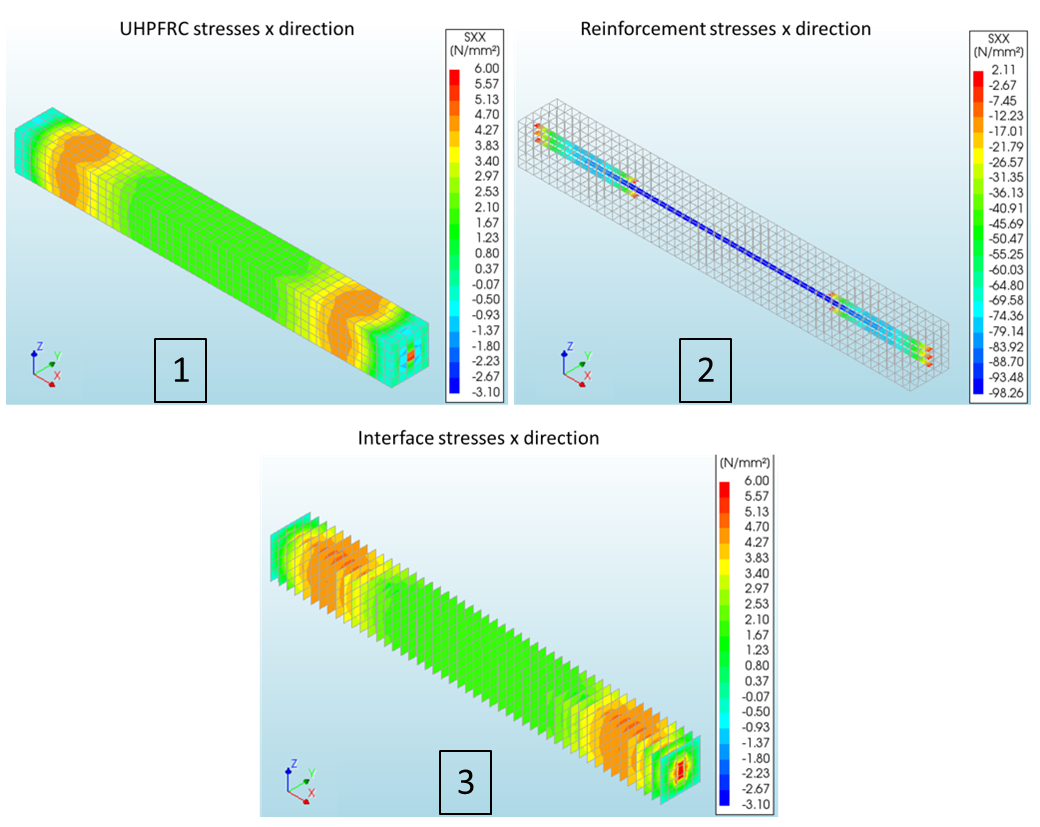
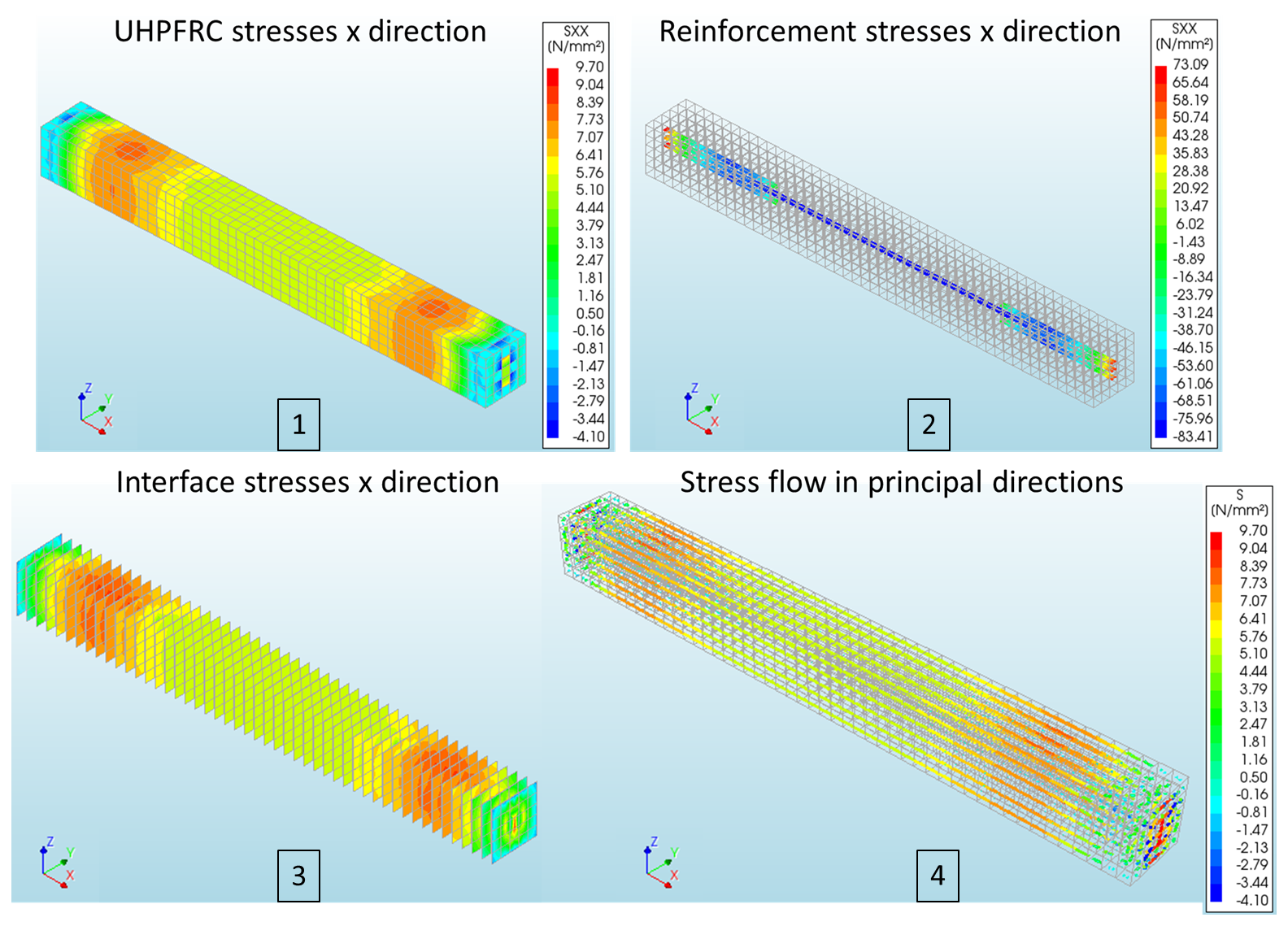
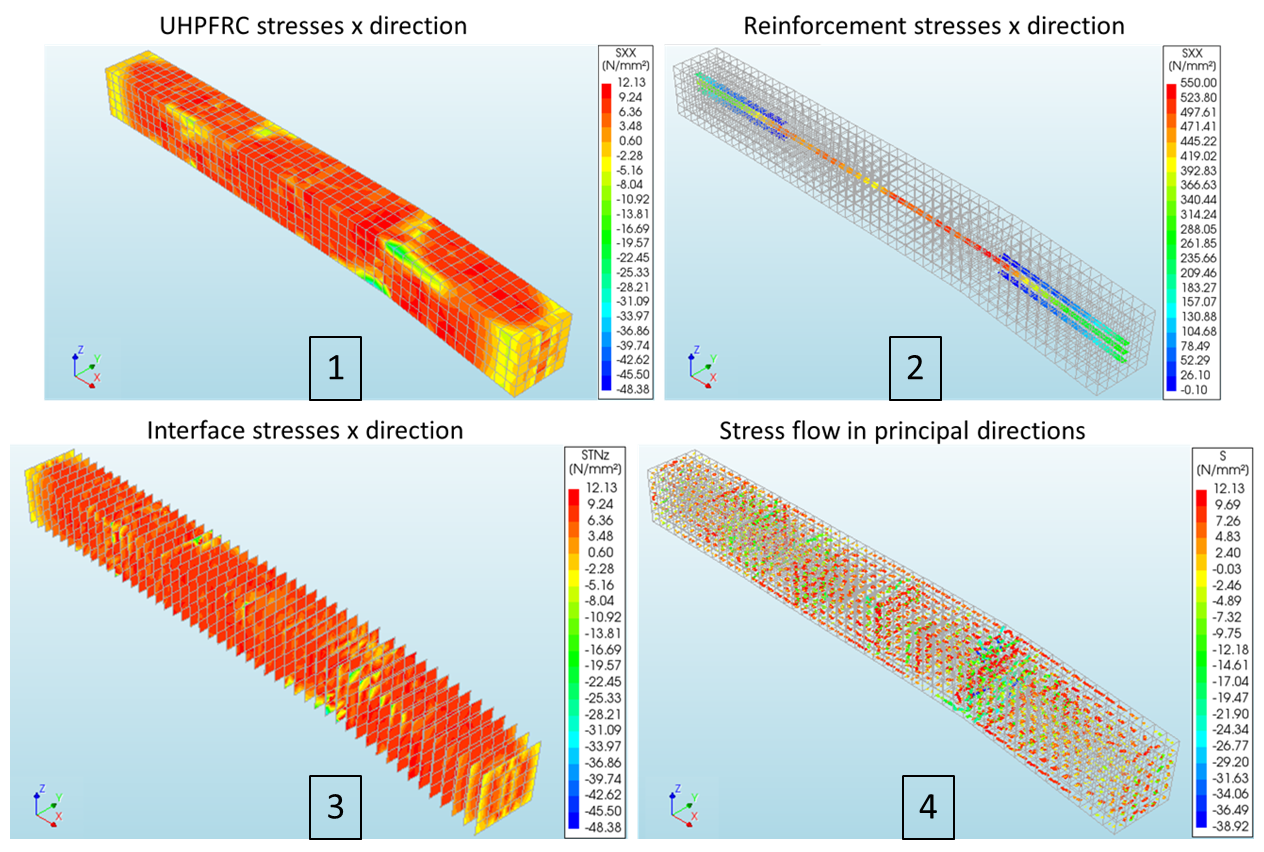
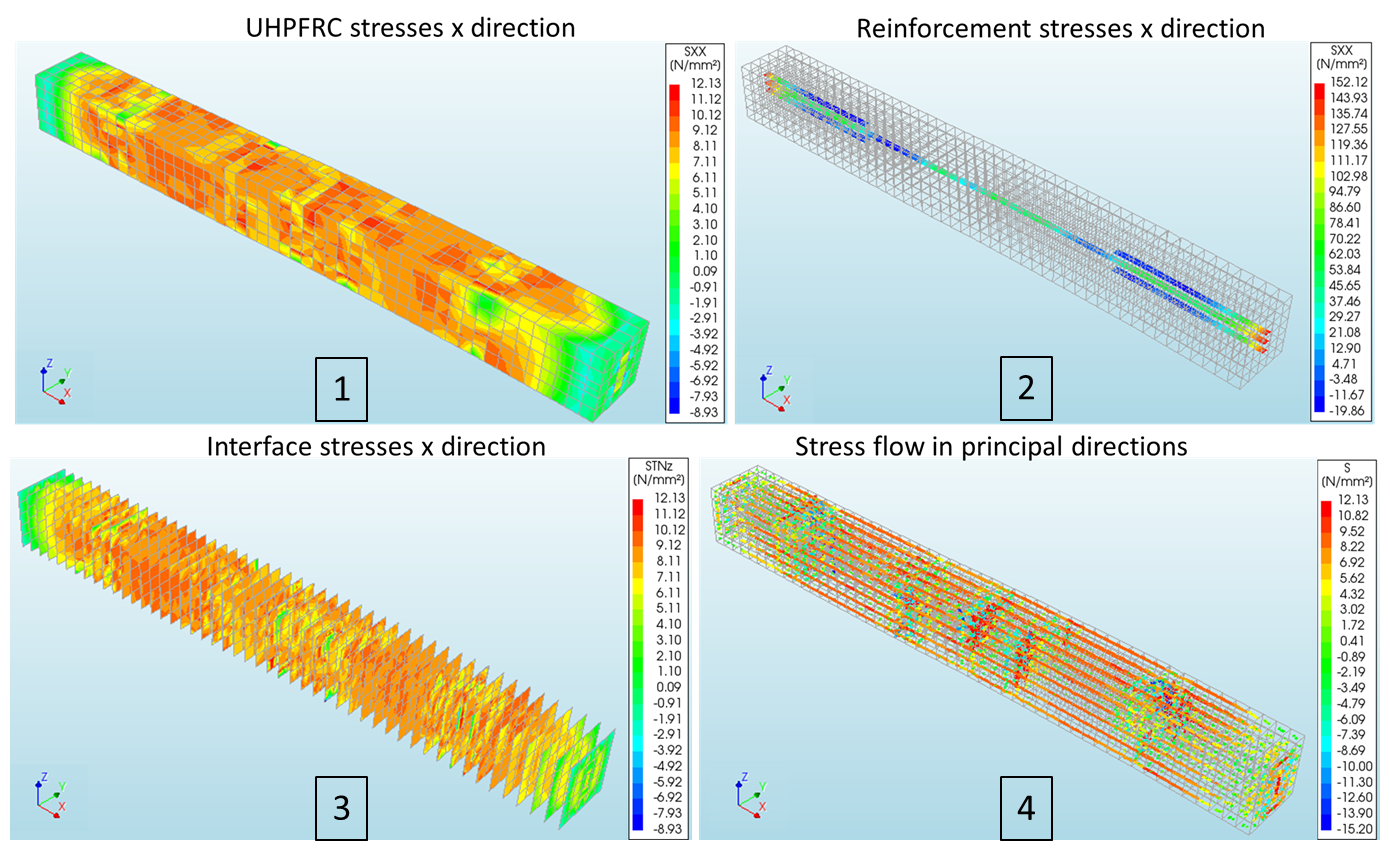
- The model successfully simulated the full tension-stiffening behavior of UHPFRC, including 3D effects and stress concentrations in the reinforcement transition zone compared to the experimental results, which are characteristic of this particular type of tensile test.
- Based on the findings of this study, a comprehensive and robust methodology for numerically modeling UHPFRC—from the material scale up to structural elements—has been developed. This approach aims to bridge the gap between material characterization and structural performance, providing a reliable framework for design.
Author Contributions
Funding
Data Availability Statement
Conflicts of Interest
Nomenclature
| List of abbreviations and acronyms | |
| UHPC | Ultra-High-Performance Concrete |
| UHPFRC | Ultra-High-Performance Fiber-Reinforced Concrete |
| SH | Strain-hardening |
| SS | Strain-softening |
| SH-UHPFRC | Strain-hardening Ultra-High-Performance Fiber-Reinforced Concrete |
| SS-UHPFRC | Strain-softening Ultra-High-Performance Fiber-Reinforced Concrete |
| 4PBT | Four-point bending test |
| NLFEM | Non-linear finite element model |
| CC | Conventional concrete |
| RC | Reinforced concrete |
| FRC | Fiber-reinforced concrete |
| 4P-IA | Simplified four-point inverse analysis |
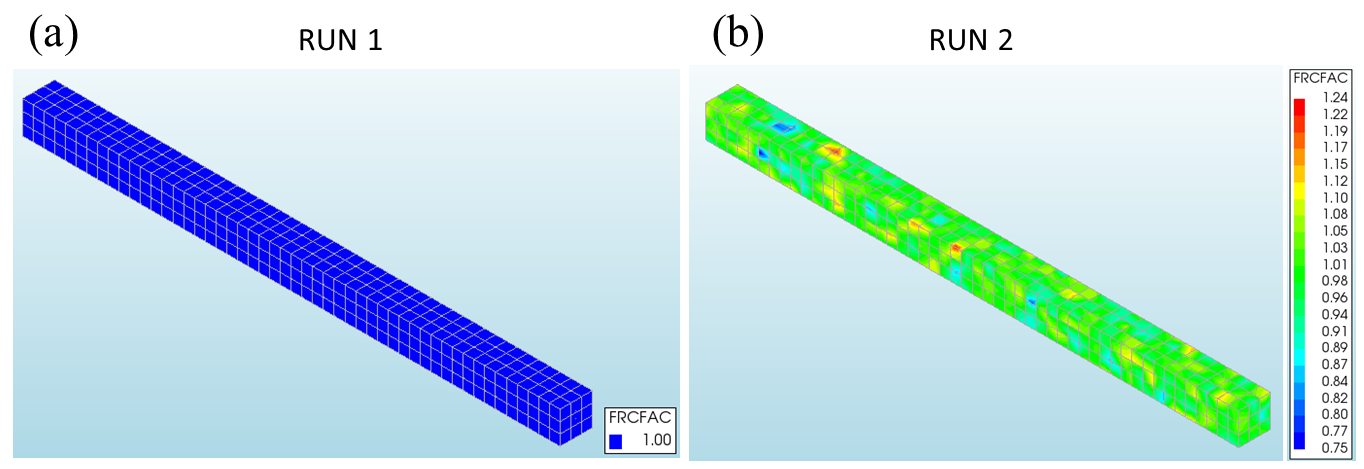
| FRCFAC | Factor that multiplies the values of the UHPFRC tension stress in the constitutive behavior of the NLFEM |
| List of symbols | |
| n | modular ratio (Es/E) |
| ρ | reinforcement ratio (As/Ac) |
| As | cross-sectional area of reinforcement |
| Ac | cross-sectional area of concrete |
| w/c | water/cement ratio |
| w/b | water/binder ratio |
| P | load |
| σ or σfl | equivalent bending stress |
| δ | deflection |
| L | specimen length and also the initial length covered by displacement transducers |
| b | specimen width |
| h | specimen height |
| ϕ | reinforcement bar diameter |
| E and Ec | UHPFRC elastic modulus |
| Es | elastic modulus of reinforcement steel |
| fst | tensile strength of reinforcement steel |
| fstu | ultimate tensile strength of reinforcement steel |
| ft | tensile strength |
| ftu | ultimate tensile strength obtained from the 4P-IA prior to the softening correction application |
| ftuc | corrected ultimate tensile strength |
| γ | hardening ratio: the ultimate tensile strength (ftu) to tensile strength (ft) ratio |
| γc | corrected hardening ratio: the corrected ultimate tensile strength (ftuc) to tensile strength (ft) ratio |
| εst,el | elastic strain of reinforcement steel |
| εst,u | ultimate tensile strain of reinforcement steel |
| εtu | ultimate cracking strain |
| wftuc | crack opening at the corrected ultimate tensile strength (ftuc) |
| w0 | crack opening at the intersection defining the initial slope to the w axis in the σ-w diagram |
| bw | material crack bandwidth or process zone |
| fc | cubic compression strength of UHPFRC |
| εcsUHPFRC | total shrinkage strain of UHPFRC |
| εcs | shrinkage strain obtained on the testing day using Eurocode 2 |
| shinc | percentage of increased UHPFRC shrinkage |
| EAI | elastic stiffness for an uncracked UHPFRC steel-reinforced tensile bar |
| EAII | bare steel reinforcement bar stiffness |
| β | tension-stiffening factor |
| Pcr | load where microcracks appear |
References
- Karmacharya, A.; Gamarra, J.; Chao, S.-H. Use of Ultra-High-Performance Fiber-Reinforced Concrete (UHP-FRC) for Fast and Sustainable Repair of Rigid Pavements. In Airfield and Highway Pavements 2019: Design, Construction, Condition Evaluation, and Management of Pavements; American Society of Civil Engineers: Reston, VA, USA, 2019; pp. 273–285. [Google Scholar]
- Jiang, X.; Yuan, Y.; Wu, C.; Luo, C. Fatigue Life Assessment of Orthotropic Steel Deck with UHPC Pavement. J. Eng. 2017, 2017, 8413607. [Google Scholar] [CrossRef]
- Mühlbauer, C.; Zilch, K. Glued Joints of Ultra High Performance Concrete Structures. In Proceedings of the 3rd fib International Congress, Washington, DC, USA, 29 May–2 June 2010; Volume 29. [Google Scholar]
- Wiese, S.; Schnell, J.; Kurz, W. Innovative Shear Connectors in Ultra High Performance Concrete. Beton-Und Stahlbetonbau 2011, 106, 694-U119. [Google Scholar] [CrossRef]
- Yin, H.; Shirai, K.; Teo, W. Numerical Model for Predicting the Structural Response of Composite UHPC–Concrete Members Considering the Bond Strength at the Interface. Compos. Struct. 2019, 215, 185–197. [Google Scholar] [CrossRef]
- Sakr, M.A.; El-khoriby, S.R.; Khalifa, T.M.; Nagib, M.T. Modeling of RC Shear Walls Strengthened with Ultra-High Performance Fiber Reinforced Concrete (UHPFRC) Jackets. Eng. Struct. 2019, 200, 109696. [Google Scholar] [CrossRef]
- Sadouki, H.; Denarié, E.; Brühwiler, E. Validation of a FEA Model of Structural Response of RC-Cantilever Beams Strengthened with a (R-) UHPFRC Layer. Constr. Build. Mater. 2017, 140, 100–108. [Google Scholar] [CrossRef]
- Lampropoulos, A.P.; Paschalis, S.A.; Tsioulou, O.T.; Dritsos, S.E. Strengthening of Reinforced Concrete Beams Using Ultra High Performance Fibre Reinforced Concrete (UHPFRC). Eng. Struct. 2016, 106, 370–384. [Google Scholar] [CrossRef]
- Zhu, Y.; Zhang, Y.; Hussein, H.H.; Chen, G. Numerical Modeling for Damaged Reinforced Concrete Slab Strengthened by Ultra-High Performance Concrete (UHPC) Layer. Eng. Struct. 2020, 209, 110031. [Google Scholar] [CrossRef]
- Rossi, P.; Daviau-Desnoyers, D.; Tailhan, J.-L. Probabilistic Numerical Model of Cracking in Ultra-High Performance Fibre Reinforced Concrete (UHPFRC) Beams Subjected to Shear Loading. Cem. Concr. Compos. 2018, 90, 119–125. [Google Scholar] [CrossRef]
- Yin, H.; Shirai, K.; Teo, W. Finite Element Modelling to Predict the Flexural Behaviour of Ultra-High Performance Concrete Members. Eng. Struct. 2019, 183, 741–755. [Google Scholar] [CrossRef]
- Singh, M.; Sheikh, A.H.; Mohamed Ali, M.S.; Visintin, P.; Griffith, M.C. Experimental and Numerical Study of the Flexural Behaviour of Ultra-High Performance Fibre Reinforced Concrete Beams. Constr. Build. Mater. 2017, 138, 12–25. [Google Scholar] [CrossRef]
- Hung, C.-C.; Li, H.; Chen, H.-C. High-Strength Steel Reinforced Squat UHPFRC Shear Walls: Cyclic Behavior and Design Implications. Eng. Struct. 2017, 141, 59–74. [Google Scholar] [CrossRef]
- Ali Dadvar, S.; Mostofinejad, D.; Bahmani, H. Strengthening of RC Columns by Ultra-High Performance Fiber Reinforced Concrete (UHPFRC) Jacketing. Constr. Build. Mater. 2020, 235, 117485. [Google Scholar] [CrossRef]
- Aoude, H.; Dagenais, F.P.; Burrell, R.P.; Saatcioglu, M. Behavior of Ultra-High Performance Fiber Reinforced Concrete Columns under Blast Loading. Int. J. Impact Eng. 2015, 80, 185–202. [Google Scholar] [CrossRef]
- Astarlioglu, S.; Krauthammer, T. Response of Normal-Strength and Ultra-High-Performance Fiber-Reinforced Concrete Columns to Idealized Blast Loads. Eng. Struct. 2014, 61, 1–12. [Google Scholar] [CrossRef]
- Li, J.; Wu, C.; Hao, H. An Experimental and Numerical Study of Reinforced Ultra-High Performance Concrete Slabs under Blast Loads. Mater. Des. 2015, 82, 64–76. [Google Scholar] [CrossRef]
- Li, J.; Wu, C.; Hao, H.; Wang, Z.; Su, Y. Experimental Investigation of Ultra-High Performance Concrete Slabs under Contact Explosions. Int. J. Impact Eng. 2016, 93, 62–75. [Google Scholar] [CrossRef]
- Xie, T.; Mohamed Ali, M.S.; Visintin, P. Behaviour and Analysis of Ultra High Performance Fibre Reinforced Concrete (UHPFRC) Skew Slabs. Eng. Struct. 2019, 199, 109588. [Google Scholar] [CrossRef]
- Bastien-Masse, M.; Brühwiler, E. Composite Model for Predicting the Punching Resistance of R-UHPFRC–RC Composite Slabs. Eng. Struct. 2016, 117, 603–616. [Google Scholar] [CrossRef]
- Wu, X.; Yu, S.; Xue, S.; Kang, T.H.-K.; Hwang, H.-J. Punching Shear Strength of UHPFRC-RC Composite Flat Plates. Eng. Struct. 2019, 184, 278–286. [Google Scholar] [CrossRef]
- Abellán-García, J.; Núñez-López, A.M.; Arango-Campo, S.E. Pedestrian Bridge over Las Vegas Avenue in Medellín. First Latin American Infrastructure in UHPFRC. In Proceedings of the RILEM-Fib International Symposium on Fibre Reinforced Concrete; Springer: Berlin/Heidelberg, Germany, 2020; pp. 864–872. [Google Scholar]
- Brühwiler, E. “Structural UHPFRC” to Enhance Bridges. In Proceedings of the 2nd International Conference on UHPC Materials and Structures UHPC 2018-China; RILEM Publications SARL: Champs-sur-Marne, France, 2018; Volume 129, pp. 140–158. [Google Scholar]
- Grunewald, S.; Kohne, H.; Nio, M.; Serafini, M.; Verdonk, A.; van Nalta, R.; Huijben, R.; Mechtcherine, V.; Dudziak, L.; Gielbert, L. Parkbridge: Optimization of a Slender Bridge in UHPFRC. In Proceedings of the International Symposium on Ultra-High Performance Fiber-Reinforced Concrete, Marseille, France, 1–3 October 2013; pp. 379–388. [Google Scholar]
- Gowripalan, N.; Gilbert, R.I. Design Guidelines for Ductal Prestressed Concrete Beams; The University of New South Wales: Sydney, Australia, 2000. [Google Scholar]
- Japan Society of Civil Engineers. Recomendations for Design and Construction of High Performance Fiber Reinforced Composites with Multiple Fine Cracks (HPFRCC). In Concrete Engineering Series 82; Japan Society of Civil Engineers: Tokyo, Japan, 2008. [Google Scholar]
- Russell, H.G.; Graybeal, B.A.; Russell, H.G. Ultra-High Performance Concrete: A State-of-the-Art Report for the Bridge Community; No. FHWA-H; United States; Federal Highway Administration: Washington, DC, USA, 2013; p. 163. [Google Scholar]
- NFP 18 470: 2016; Association Francaise de Normalisation Concrete-Ultra-High Performance Fibre-Reinforced Concrete-Specifications, Performance, Production and Conformity. Association Française de Normalisation: Saint-Denis, France, 2016.
- NFP 18 710: 2016; Association Francaise de Normalisation National Addition to Eurocode 2-Design of Concrete Structures: Specific Rules for Ultra-High Performance Fibre-Reinforced Concrete (UHPFRC). Association Française de Normalisation: Saint-Denis, France, 2016.
- AFGC. Bétons Fibrés à Ultra-Hautes Performances–Recommandations; AFGC: Paris, France, 2013. [Google Scholar]
- Eugen, B. Swiss Society of Engineers and Architects SIA Sia 2052. In Proceedings of the 4th International Symposium on Ultra-High Performance Concrete and High Performance Materials; Kassel University Press GmbH: Kassel, Germany, 2016; p. 48. [Google Scholar]
- Rahdar, H.; Ghalehnovi, M. Post-Cracking Behavior of UHPC on the Concrete Members Reinforced by Steel Rebar. Comput. Concr. 2016, 18, 139–154. [Google Scholar] [CrossRef]
- Yoo, D.-Y.; Banthia, N. Numerical Simulation on Structural Behavior of UHPFRC Beams with Steel and GFRP Bars. Comput. Concr. 2015, 16, 759–774. [Google Scholar] [CrossRef]
- Koh, K.; Ryu, G.; Kang, S.; Park, J.; Kim, S. Shrinkage Properties of Ultra-High Performance Concrete (UHPC). Adv. Sci. Lett. 2011, 4, 948–952. [Google Scholar] [CrossRef]
- Xie, T.; Fang, C.; Mohamad Ali, M.S.; Visintin, P. Characterizations of Autogenous and Drying Shrinkage of Ultra-High Performance Concrete (UHPC): An Experimental Study. Cem. Concr. Compos. 2018, 91, 156–173. [Google Scholar] [CrossRef]
- Fang, C.; Ali, M.; Xie, T.; Visintin, P.; Sheikh, A.H. The Influence of Steel Fibre Properties on the Shrinkage of Ultra-High Performance Fibre Reinforced Concrete. Constr. Build. Mater. 2020, 242, 117993. [Google Scholar] [CrossRef]
- Fehling, E.; Schmidt, M.; Walraven, J.; Leutbecher, T.; Fröhlich, S. Ultra-High Performance Concrete UHPC: Fundamentals, Design, Examples; John Wiley & Sons: Hoboken, NJ, USA, 2014; ISBN 3433604150. [Google Scholar]
- Yoo, D.-Y.; Banthia, N.; Yoon, Y.-S. Effectiveness of Shrinkage-Reducing Admixture in Reducing Autogenous Shrinkage Stress of Ultra-High-Performance Fiber-Reinforced Concrete. Cem. Concr. Compos. 2015, 64, 27–36. [Google Scholar] [CrossRef]
- López, J.Á. Characterisation of the Tensile Behaviour of UHPFRC by Means of Four-Point Bending Tests. Ph.D. Thesis, Universitat Politècnica de València, Valencia, Spain, 2017. [Google Scholar] [CrossRef][Green Version]
- López, J.A.; Serna, P.; Navarro-Gregori, J. Advances in the Development of the First UHPFRC Recommendations in Spain: Material Classification, Design and Characterization. In Proceedings of the UHPFRC 2017 Designing and Building with UHPFRC: New Large-Scale Implementations, Recent Technical Advances, Experience and Standards; Toutlemonde, F., Resplendino, J., Eds.; RILEM Publications SARL: Paris, France, 2017; pp. 565–574. [Google Scholar]
- Mezquida-Alcaraz, E.J.; Navarro-Gregori, J.; Serna-Ros, P. Direct Procedure to Characterize the Tensile Constitutive Behavior of Strain-Softening and Strain-Hardening UHPFRC. Cem. Concr. Compos. 2021, 115, 103854. [Google Scholar] [CrossRef]
- Mezquida-Alcaraz, E.J. Numerical Modelling of UHPFRC: From the Material to the Structural Element. Ph.D. Thesis, Universitat Politècnica de València, Valencia, Spain, 2021. [Google Scholar] [CrossRef]
- Mezquida-Alcaraz, E.J.; Navarro-Gregori, J.; Martí-Vargas, J.R.; Serna-Ros, P. Effects of Tension Stiffening and Shrinkage on the Flexural Behavior of Reinforced UHPFRC Beams. Case Stud. Constr. Mater. 2021, 15, e00746. [Google Scholar] [CrossRef]
- Navarro Laguarda, M.Á. Estudio Del Comportamiento de Tirantes Armados de Hormigón de Muy Alta Resistencia (HMAR). Aplicación al Diseño de Una Pasarela Sobre El Barranco de Las Ovejas de Alicante. Master’s Thesis, Universitat Politècnica de Valencia, 2018. [Google Scholar]
- Khorami, M.; Navarro-Gregori, J.; Serna, P.; Navarro-Laguarda, M.A. A Testing Method for Studying the Serviceability Behavior of Reinforced UHPFRC Tensile Ties. In Proceedings of the IOP Conference Series: Materials Science and Engineering; IOP Publishing: Bristol, UK, 2019; Volume 596, p. 12022. [Google Scholar]
- Khorami, M.; Navarro-Gregori, J.; Serna, P. Experimental Methodology on the Serviceability Behaviour of Reinforced Ultra-high Performance Fibre Reinforced Concrete Tensile Elements. Strain 2020, 56, e12361. [Google Scholar] [CrossRef]
- Leutbecher, T. Rissbildung und Zugtragverhalten von mit Stabstahl und Fasern Bewehrtem Ultrahochfesten Beton (UHPC); Kassel University Press GmbH: Kassel, Germany, 2008; ISBN 3899583744. [Google Scholar]
- Pfyl, T. Tragverhalten von Stahlfaserbeton; vdf Hochschulverlag AG: Zollikon, Switzerland, 2003; Volume 279, ISBN 3728128929. [Google Scholar]
- DIANA (Software) User’s Manual—Release 10.2. Available online: https://manuals.dianafea.com/d102/Diana.html (accessed on 23 February 2026).
- Mezquida-Alcaraz, E.J.; Navarro-Gregori, J.; López, J.A.; Serna-Ros, P. Validat ion of a Non-Linear Hinge Model for Tensile Behavior of UHPFRC Using a Finite Element Model. Comput. Concr. 2019, 23, 11–23. [Google Scholar] [CrossRef]
- Dorr, K. Ein Beitrag zur Berechung von Stahlbetonscheiben Unter Besonderer Berucksichtigung des Verbundverhaltens. Ph.D. Thesis, University of Darmstadt, Darmstadtt, Germany, 1980. [Google Scholar]
- 2004/18/EC EN 1992-1-1: Eurocode 2: Design of Concrete Structures; The European Union Per Regulation 305/2011; Directive 98/34/EC, D; EUROPEAN STANDARD. European Committee for Standardization: Brussels, Belgium, 2004.
- Bischoff, P.H. Discussion of “Tension Stiffening in Lightly Reinforced Concrete Slabs” by R. Ian Gilbert. J. Struct. Eng. 2008, 134, 1259–1260. [Google Scholar] [CrossRef]







| Component | kg/m3 |
|---|---|
| CEM I 42.5 R-SR | 800 |
| Silica Fume | 175 |
| Water | 160 |
| w/c | 0.200 |
| w/b | 0.164 |
| Silica sand—0.8 mm | 565 |
| Silica sand—0.4 mm | 302 |
| Silica flour | 225 |
| Short steel fibers (13/0.2) | 160 |
| Plasticizer Sika 20 HE | 30 |
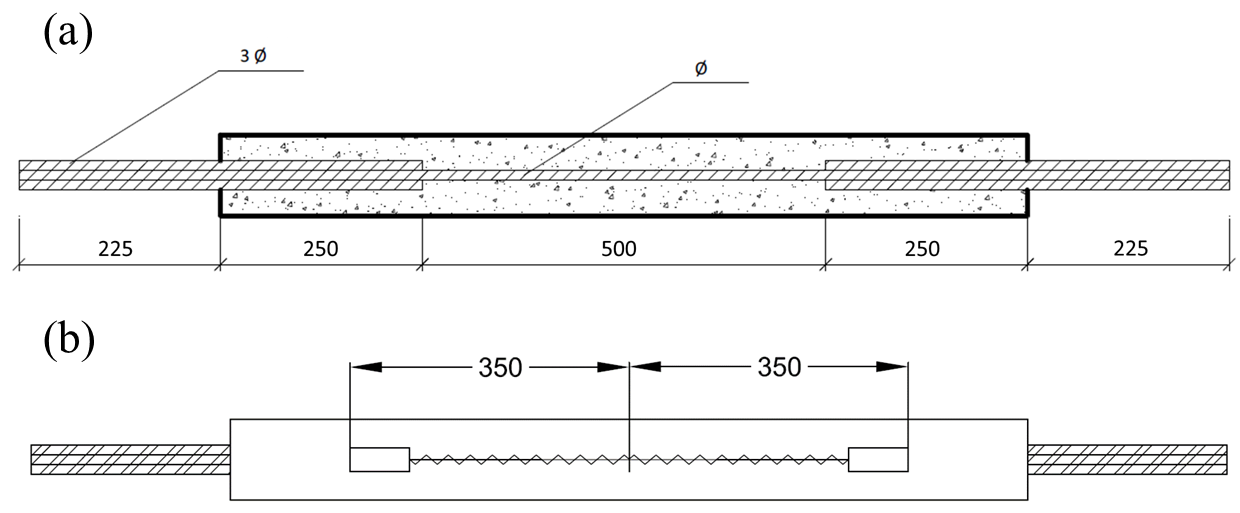
| UHPFRC Section (mm) | Rebars ϕ (mm) | No. of Specimens |
|---|---|---|
| 60 × 60 | 10 | 5 |
| 12 | 3 | |
| 80 × 80 | 10 | 3 |
| 12 | 3 | |
| 16 | 3 | |
| 100 × 100 | 10 | 1 |
| 12 | 3 | |
| 16 | 3 |
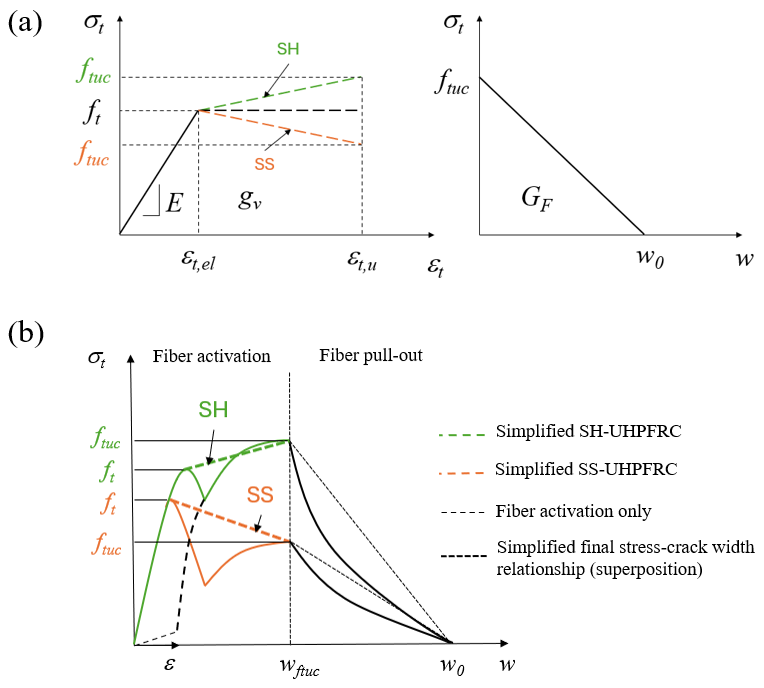
| 160 kg/m3 of Steel Fibers | ||||||
|---|---|---|---|---|---|---|
| Charact. σ-δ | ft (MPa) | ftuc (MPa) | εtu (‰) | E (MPa) | wo (mm) | fc (MPa) |
| 5% | 8.74 | 7.05 | 1.80 | 51400 | 2.92 | 148.86 |
| 50% | 9.62 | 8.44 | 3.31 | 50700 | 3.24 | 153.99 |
| Tensile Bar | 3D-NLFEM-Multicrack | ||
|---|---|---|---|
| id. | εcs (mm/m) | shinc (%) | εcsUHPFRC (mm/m) |
| 60 × 60, ϕ10 | 0.34 | 20 | 0.41 |
| 60 × 60, ϕ12 | 0.34 | 40 | 0.48 |
| 80 × 80, ϕ10 | 0.34 | 20 | 0.41 |
| 80 × 80, ϕ12 | 0.34 | 90 | 0.65 |
| 80 × 80, ϕ16 | 0.34 | 10 | 0.37 |
| 100 × 100, ϕ10 | 0.33 | 120 | 0.73 |
| 100 × 100, ϕ12 | 0.33 | 120 | 0.73 |
| 100 × 100, ϕ16 | 0.33 | 60 | 0.53 |
Disclaimer/Publisher’s Note: The statements, opinions and data contained in all publications are solely those of the individual author(s) and contributor(s) and not of MDPI and/or the editor(s). MDPI and/or the editor(s) disclaim responsibility for any injury to people or property resulting from any ideas, methods, instructions or products referred to in the content. |
© 2026 by the authors. Licensee MDPI, Basel, Switzerland. This article is an open access article distributed under the terms and conditions of the Creative Commons Attribution (CC BY) license.
Share and Cite
Mezquida-Alcaraz, E.J.; Navarro-Gregori, J.; Serna, P. Numerical Simulation of the Behavior of Reinforced UHPFRC Ties Considering Effects of Tension Stiffening and Shrinkage. Fibers 2026, 14, 30. https://doi.org/10.3390/fib14030030
Mezquida-Alcaraz EJ, Navarro-Gregori J, Serna P. Numerical Simulation of the Behavior of Reinforced UHPFRC Ties Considering Effects of Tension Stiffening and Shrinkage. Fibers. 2026; 14(3):30. https://doi.org/10.3390/fib14030030
Chicago/Turabian StyleMezquida-Alcaraz, Eduardo J., Juan Navarro-Gregori, and Pedro Serna. 2026. "Numerical Simulation of the Behavior of Reinforced UHPFRC Ties Considering Effects of Tension Stiffening and Shrinkage" Fibers 14, no. 3: 30. https://doi.org/10.3390/fib14030030
APA StyleMezquida-Alcaraz, E. J., Navarro-Gregori, J., & Serna, P. (2026). Numerical Simulation of the Behavior of Reinforced UHPFRC Ties Considering Effects of Tension Stiffening and Shrinkage. Fibers, 14(3), 30. https://doi.org/10.3390/fib14030030