Review

Fluoro-Edenite from Biancavilla (Sicily, Italy): A Comprehensive Review and New Perspectives on a Fibrous Amphibole of Geological and Health Concern


by
Valeria Indelicato
1,2,3,
Roberto Visalli
2,
Maria Rita Pinizzotto
4,
Carmelo Cantaro
4,
Rosolino Cirrincione
2,
Alberto Pistorio
5,
Claudia Ricchiuti
4 and
Rosalda Punturo
2,3,*
1
Department of Science, Technology and Society, University School for Advanced Studies Pavia, Piazza della Vittoria, 15, 27100 Pavia, Italy
2
Department of Biological, Geological and Environmental Sciences, University of Catania, Corso Italia, 57, 95129 Catania, Italy
3
Institute of Environmental Geology and Geoengineering (IGAG-CNR), Piazzale Aldo Moro, 7, 00185 Roma, Italy
4
Agenzia Regionale per la Protezione dell’Ambiente (ARPA) della Sicilia, UOC Laboratorio L1 Catania, Via Carlo Ardizzone, 35, 95124 Catania, Italy
5
Department of Infrastructure and Mobility, Official of the Sicilian Regional Government, Via Leonardo da Vinci, 161, 90145 Palermo, Italy
*
Author to whom correspondence should be addressed.
Fibers 2026, 14(1), 11; https://doi.org/10.3390/fib14010011
Submission received: 25 November 2025 / Revised: 19 December 2025 / Accepted: 6 January 2026 / Published: 13 January 2026

Highlights

What are the main findings?
  • New petrographic and mineralogical observations from optical microscopy, stereomicroscopy and Scanning Electron Microscopy (SEM) are reported on Fluoro-edenite, an asbestiform mineral (IMA approved in 2000), first identified and in the geological formations at Biancavilla town (Mt. Etna volcano, Italy).
  • The most relevant studies carried out up to now on the “Biancavilla case” (Etna) are here reviewed and critically synthesized.
  • Results based on monitoring activity of airborne fluoroedenite from 2009 up to 2024 highlighted a real improvement of Biancavilla town environmental situation and a gradual reduction of exposure as a consequence of the dust mitigation and remediation measures.
What are the implications of the main findings?
  • Fluoro-edenite occurrence within massive lava samples, beyond previously studied breccias and altered portions, adds a new dimension to risk assessment in the area of Biancavilla town.
  • Fluoro-edenite in massive lava rocks opens new avenues for investigating the mineral’s genesis and growth mechanisms within solid rock
  • Continuous environmental monitoring should be rigorously maintained, particularly during high-risk activities involving fibre release, such as excavations and demolitions, in order to prevent potential adverse health effects on population.

Abstract
The present review paper focuses on the peculiar environmental and health implications of fibrous amphibole “fluoro-edenite”, a new mineral first reported in Biancavilla (Etna Mount, Sicily, Italy). Its presence has been linked to an unusually high incidence of malignant pleural mesothelioma, as seen from national surveys during 1988–1997, marking the first case study of natural occurrence of fibrous amphibole in a volcanic context. Despite remediation efforts since the cessation of quarrying activities at the “Il Calvario” quarry, the risk of fiber exposure may extend beyond urban areas to surrounding soils and volcanic formation, not fully characterized yet. This review synthesizes relevant existing literature on mineralogical and chemical features of fluoro-edenite, while also enriching current understanding with new observations from optical microscopy, stereomicroscopy, and Scanning Electron Microscopy (SEM). Our analyses reveal the presence of fluoro-edenite amphibole not only in the altered samples but, significantly, within the massive rock samples. This finding expands its known distribution and offers initial consideration on public health implications related to massive lava rock, which crops out. This study highlights the importance of ongoing monitoring, detailed geological surveys, and further research into fiber occurrences and distribution in the volcanic systems, of which Mt. Etna represents the first case of natural occurrences, in order to fully assess their impact on public health.

Graphical Abstract

1. Introduction

Over the last years, many studies have dealt with natural occurrences of asbestos in anthropic contexts and highlighted the health concerns related to the release of fibrous minerals in the environment. Currently, only a suite of minerals that develop a fibrous habit are grouped under the term “asbestos” and hence regulated [1,2]; moreover, by considering the geological context, their presence is quite related to metamorphic processes since they mostly occur within serpentinite or altered ultramafic rocks and, to a lesser extent, within some marbles [3,4,5,6].
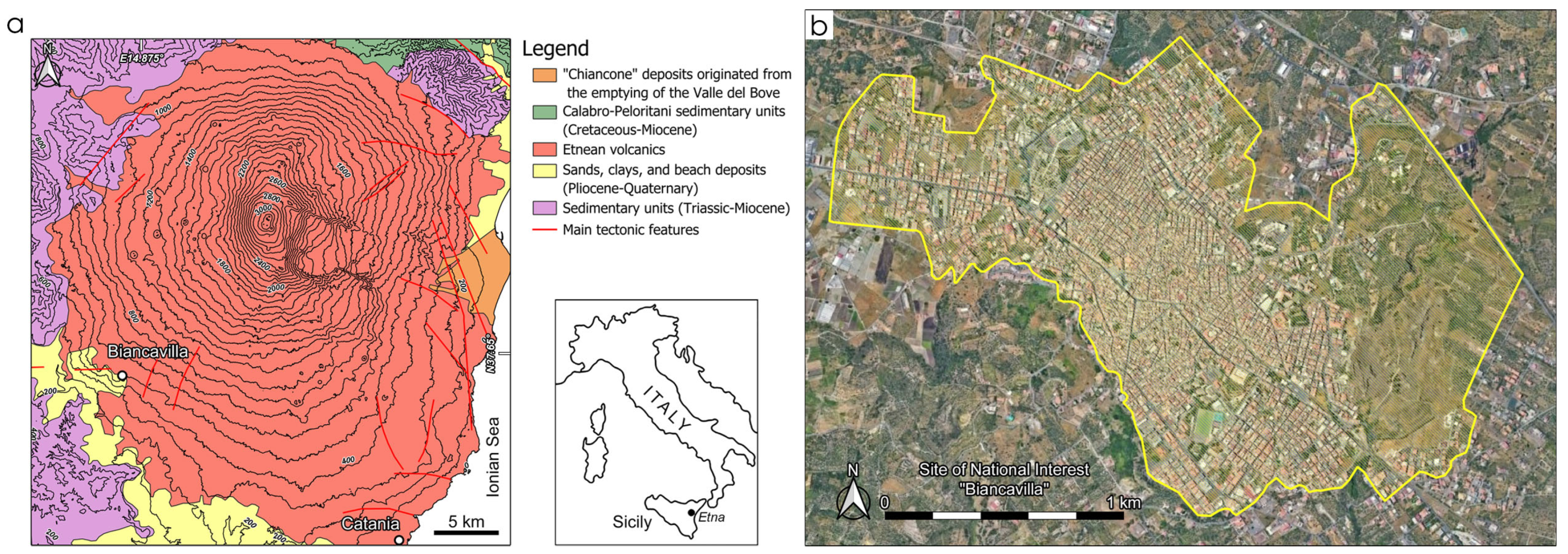
Nevertheless, it is worth noting that some minerals (i.e., amphiboles) have been very rarely reported in geological contexts where magmatic rocks crop out, such as Libby, Montana [7,8] and Mt. Ishigami, Japan [9]. This paper aims to summarize the state of the art on fluoro-edenite, an amphibole that may develop a fibrous habit and that was first discovered within the benmoreitic lavas occurring at the town of Biancavilla (Etnean Volcanic Complex, Catania, Italy). Biancavilla is a small town of 22,929 inhabitants [10] located in the south-western flank of the Etnean volcanic complex (eastern Sicily, Italy) (Figure 1a). The geological setting of the area of Biancavilla is made of volcanic products given by a series of autoclastic lava domes of benmoreitic composition [11,12], which, according to the literature, were altered by hot metasomatic fluids (enriched in F, Cl, and other incompatible elements) during a late-magmatic process [13,14].
The center of the town sits on the Calvario hill, which is now almost completely obliterated due to quarrying activity related to past exploitation of benmoreitic lavas as construction materials and to urban development [15].
It is worth noting that in two national surveys of pleural mesothelioma mortality in Italy for the periods 1988 to 1992 [16] and 1993 to 1997 [17], a cluster of deaths was found in the town. Notably, the increase was relatively higher in (a) women, (b) individuals aged 65 years or younger, and (c) people with no occupational exposure to mineral dust [13]. Environmental and mineralogical studies [13,18] suggested, thus, that exposure to airborne fibers was related to environmental contamination rather than specific work activities. The Monte Calvario quarry site (Figure 1b), which was still active at the time of the survey, was identified as the source of the dispersal because the quarried material contained large amounts of a fibrous amphibole phase eventually identified as fluoro-edenite (ideally NaCa2Mg5Si7AlO22F2), a mineral classified as a new member of the edenite → fluoro-edenite series and confirmed by the Commission on New Minerals and Mineral Names in 2001 [19]. The same year, the Biancavilla urban area was included in the National Program for the Remediation and Environmental Restoration of Contaminated Sites as a Site of National Interest (DM 468/2001) (Figure 1b). Due to its unique geological and mineralogical features, the site was further recognized as a National Geosite on 31 December 2010 [20] and was officially designated as a Geosite of Global Interest (the “Lava brecciated with fluoro-edenite and fluoro-phlogopite from Monte Calvario”) by Decree No. 105 of 15 April 2015 [21].
To date, the hazard of fluoro-edenite fibers has been definitively established by the International Agency for Research on Cancer (IARC), which has classified them as “definitely carcinogenic” [22] through well-documented chemical, epidemiological, in vitro, and in vivo studies. Indeed the Italian law, and specifically the Legislative Decree 257/1992 [23], defines asbestos as six fibrous silicate minerals: chrysotile, amosite, crocidolite, actinolite, tremolite, and anthophyllite, In vitro studies showed that fibers with fluoro-edenitic composition behave similarly to crocidolite, causing human lung cells transformation, comparable to the effect obtained with crocidolite, used as a “positive control”. Accordingly, in vivo studies demonstrated that the fluoro-edenitic composition fiber sample induces mesotheliomas [24].
Therefore, all the activities for remediation inside the contaminated site have been planned and carried out with the same procedures adopted for asbestos.
Nevertheless, due to the compositional variability of the entire mineral series [25,26], the mineral has not been classified as “asbestos” by regulatory agencies.
In order to address the health and environmental risks associated with the contamination of fluoro-edenite, quarrying activities ceased in 1997 [15], and dust mitigation measures were adopted from 2001 and then in 2008–2012, resulting in a reduction in airborne fiber concentrations [27,28]; furthermore, extensive environmental remediation and permanent safety measures are currently being carried out on the site to create a 25-hectare urban park [29]. This project is part of a public initiative described in the regional announcement G00181 [30].
However, some research studies (e.g., [15,25,27,28,31,32,33,34,35]) suggest that contamination might not be limited to the urban area but extends to surrounding soils and different volcanic formations where the state of fiber diffusion is not fully characterized yet. This, coupled with our novel observation in this study of fluoro-edenite presence not only in altered breccia but also within the lava rock, underscores the critical need for comprehensive monitoring and further studies on the surrounding area of Biancavilla town to obtain information on fiber distribution and its impact on public health.
In this context, this review aims to critically reorganize and synthesize the most relevant studies carried out up to now on the “Biancavilla (Etna) case” as well as integrate them with new petrological observations and chemical analyses carried out on benmoreitic lavas and on different fluoro-edenite morphologies, respectively. By addressing the available data across the literature, we do not compare the carcinogenic mechanisms and risk levels of fluoro-edenite fibers to other known carcinogenic minerals. Rather, this work seeks to provide a comprehensive and updated framework, including the petrological, mineralogical, and chemical characteristics, and environmental and health implications related to exposure to fluoro-edenite, as well as to contribute to a better understanding of the geological contexts where these fibrous minerals may crystallize and develop. Indeed, it is worth noting that after its early discovery, fibrous fluoro-edenite was later also fund in other sites, such as in volcanic ejecta at the Mt. Somma and Vesuvio volcanic complex (Southern Italy) (cfr. [36,37]) or on Vulcano island (Aeolian islands, Sicily); moreover, its occurrence was also reported in andesitic lavas of Mt. Ishigami, Kumamoto province, Japan; however in this last case, no literature is available except for an abstract communication [9].
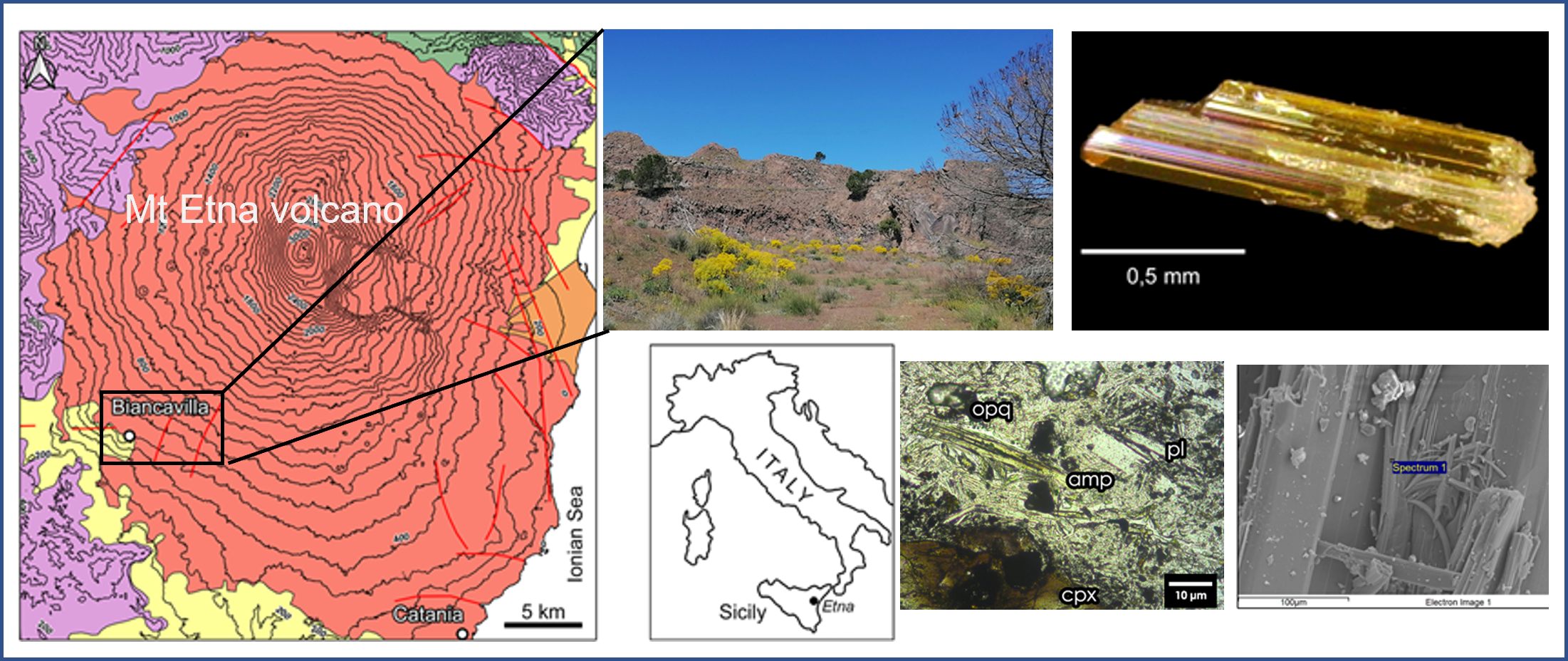
Figure 1. (a) Geological sketch map of Mount Etna volcano (Sicily, Italy), showing the location of Biancavilla town (redrawn and adapted from Bellomo et al. [33]); (b) Satellite imagery (Google Earth™) of the Biancavilla urban area, overlaid with the perimeter of the “Site of National Interest” (SIN), reconstructed based on the Decree by Italian Ministry for the Environment and the Protection of Land and Sea [38].
Fibers 14 00011 g001

2. Geological Background

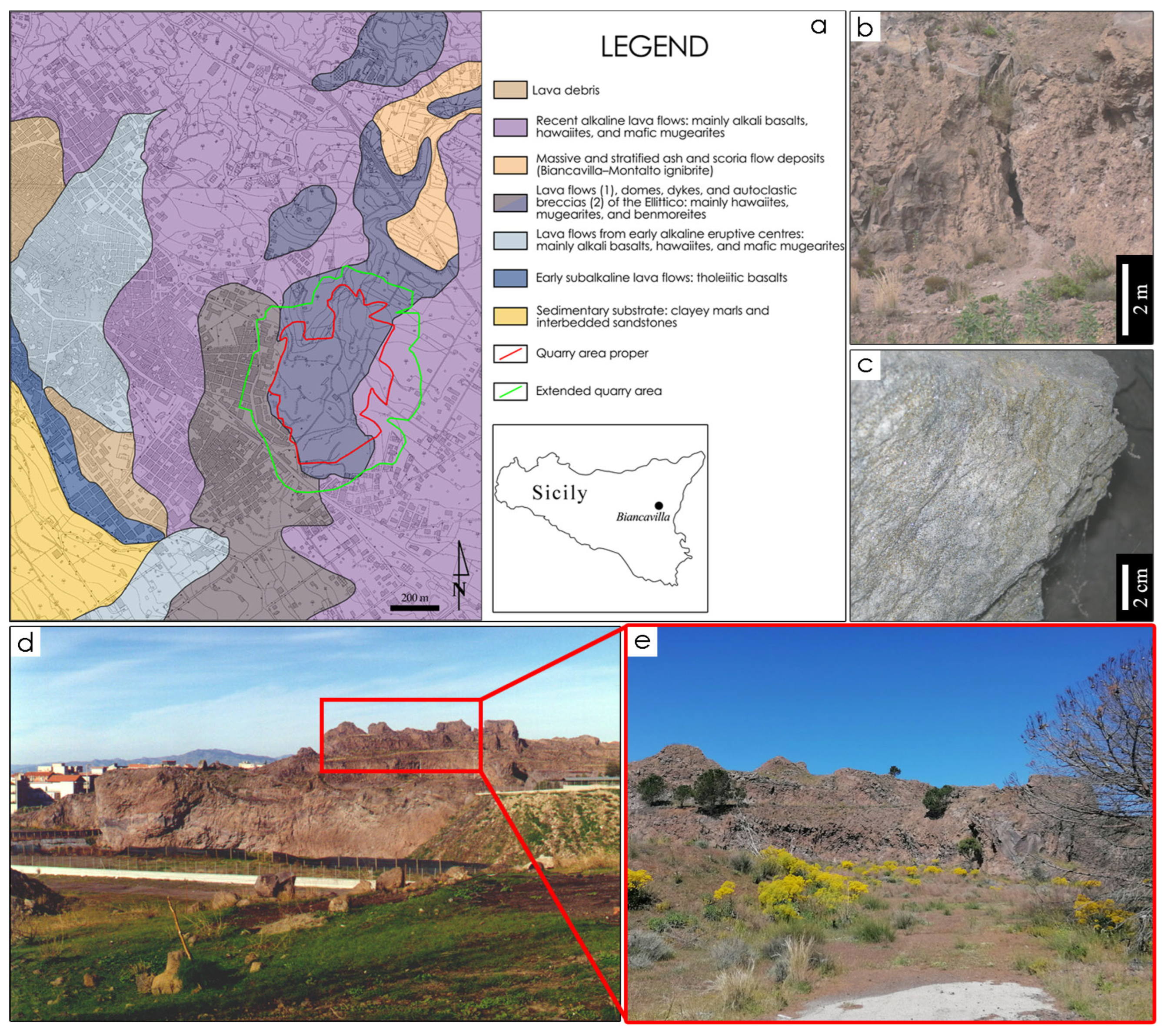
The town of Biancavilla (37°38′43″ N; 14°51′49″ E), located on the lower south-western flank of Mt. Etna volcano, records the first known occurrence of asbestiform amphibole fibers in a volcanic context [14]. The stratigraphic sequence of the Biancavilla area (Figure 2a), detailed by Burragato et al. [15] and updated references [39], reveals a sequence of geological units reflecting complex volcanic and sedimentary processes. These units, from base to top, include the following:
  • Clayish marls and interbedded sandstones of Pliocene–Quaternary age from the pre-Etnean sedimentary rate;
  • Tholeiitic basaltic lava flows from the early Etnean subalkaline eruptions (about 0.6–0.2 Ma) [40];
  • Lava flows mainly alkali basaltic, hawaiitic, and mugearitic in composition, from mafic alkaline activity of small eruptive centers (0.2–0.1 Ma);
  • Ellittico Centre formations (Ancient Mongibello, 40–14 ka), including lava flows, domes, dykes, and autoclastic breccias, predominantly hawaiitic, mugearitic, and benmoreitic in composition, representing one of the most evolved and differentiated products of Mt. Etna [11];
  • Massive and stratified benmoreitic ash and scoria flow deposits of the Biancavilla–Montalto ignimbrite [11,12] from a major explosive event, which are recognized as an important tephra marker in Central Italy and the Mediterranean, dated at 14,500 ± 5000 years [41];
  • Lava flows of recent Mongibello activity (8 ka to present), predominantly alkali basaltic, hawaiitic, and mafic mugearitic in composition [42];
  • Recent and current lava debris.
The asbestiform amphiboles around Mt. Calvario are mainly found in the autoclastic breccias generated by the dome eruptions of the Ellittico Centre activity and in the friable interlayered altered pyroclastic material [14]. Small blocks of altered lava, appearing whitish and friable, as they are visibly metasomatized by fluids, contain fluorine-bearing mineral phases (i.e., fluoro-edenite, fluoro-phlogopite, and fluoro-apatite) and are found at the fracture systems of the lava bodies and within the pyroclastic products (Figure 2b,c) [14,15,18,43,44].
Fluorine-rich mineral phases, such as fluoro-edenite, are unusual for the Etnean complex [14,27]. This, alongside the anhydrous mineral phase association (e.g., feldspar, pyroxene, olivine, fluoroapatite, and iron oxides) of the benmoreitic lavas [13,14,15,18], supports, altogether, the hypothesis on their genesis attributed to the alteration of the original benmoreitic rocks during a late magmatic crystallization process. This process involved high-T fluids with very high concentrations in F, Cl, Fe, As, REE, and other incompatible elements [13,18,27,43,45,46,47,48].
Several hypotheses have been formulated to explain the observed various crystal habits developed by fluoro-edenite: (a) different cooling rates, where larger prismatic crystals form in the central part of the dome with a slower cooling rate [31] and where fibrous forms develop in the more peripheral areas with a faster cooling rate [31,43]; (b) subsequential crystallization stages, with fibers forming later than the prismatic crystals [43]; (c) simultaneous interaction between hot fluids and massive and brecciated lavas with crystallization of prismatic forms in the massive lavas and of fibrous forms in fine-grained materials (by direct condensation from vapors or supercritical fluids), respectively [45]; and (d) crystallization during the syn- and post-eruptive stage [27].
The morphological evolution of the Biancavilla area, reconstructed by Burragato et al. [15] using GIS tools, highlights significant changes over more than a century. It shows that, in 1895, the elevations of Mt. Calvario and Poggio Rosso hill reached 581 m and 546 m above sea level, respectively. Until 1925, the Il Calvario site showed a few morphological changes. However, changes became evident after 1969, when the Il Calvario site was heavily exploited, and its western slope was significantly reshaped by urban expansion as well as quarrying activities. These morphological changes were further accentuated in 1997, after about 30 additional years of intensive activity, which resulted in the total obliteration of the volcanic dome of Il Calvario. Moreover, the presence of unexcavated areas, rock spurs, and piles of stones left untouched or in place suggests that the quarrying target was of the finest and most friable materials because they were immediately usable. However, in addition to excavation, other hazardous activities were carried out, such as transport, its use as building material, in the foundations of roads and squares, and for backfill to level the ground for urbanization [15,49].

3. Mineralogical and Chemical Features

The term asbestos is a generic (commercial) term that encompasses some minerals represented by hydrated silicates that are easily separable into thin, flexible fibers, resistant to traction and heat, and are almost chemically inert. The minerals regulated as asbestos include the asbestiform varieties of minerals ranging in composition and belonging to the amphibole group, such as riebeckite (known by the commercial name of crocidolite), cummingtonite–grunerite series (known by the commercial name of amosite), tremolite, actinolite, and anthophyllite, as well as minerals belonging to the serpentine group (i.e., chrysotile). In addition, the term “asbestiform” refers to a specific feature of mineral fibrosity, with high tensile strength and/or flexibility.
In nature, edenitic compositions (NaCa2Mg5(Si7Al)O22(OH)2) are rare in amphiboles, and their rarity could indicate structural instability; only a few cases had been reported in the literature until 2001 [18]. However, approval by the International Mineral Association Commission on New Minerals and Mineral Names (IMA-CNMMN) was not requested, and only one sample of ferro-edenite NaCa2Fe2+5(Si7Al)O22(OH)2, which also has a significant fluorine content, was listed in the amphibole database of the CNR-Centro di Studio per la Cristallochimica e Cristallografia; in addition, unit cell parameters were only available for a synthetic fluoro-edenite [18].
The fluoro-edenite samples found near the town of Biancavilla have been shown to have a composition close to the ideal stoichiometry (NaCa2Mg5Si7AlO22F2) [18]. The mineral was initially identified as an intermediate phase between tremolite and actinolite [13] and subsequently confirmed as fluoro-edenite by IMA-CNMMN (code 2000-049) [19], a new member of the edenite → fluoro-edenite series.
In this study, massive and breccia representative specimens were collected from within the mineralized fractures occurring at the old quarry front (Figure 2b–e). From them, we retrieved fluoro-edenite crystals (Figure 3).
The petrographic investigation, first presented in this work, was carried out on thin sections obtained from four lava samples, selected from the collected massive lava blocks. Whole-section scans in plane-polarized and cross-polarized light, along with optical microscopy, were performed on the massive samples at the Department of Biological, Geological, and Environmental Sciences—Earth Sciences Section at the University of Catania. For these analyses, an Epson Perfection V750 Pro high-resolution scanner with Epson Perfection V750 Pro Scan software (Seiko Epson Corporation, Suwa, Japan) and appropriate filters was used for scanning, and a Carl Zeiss Axiolab polarizing optical microscope (Oberkochen, Germany) equipped with an Exacta-Optech (E3ISPM) microscope camera (Hangzhou ToupTek Photonics Co., Ltd., Hangzhou, China) was used for microscopy.
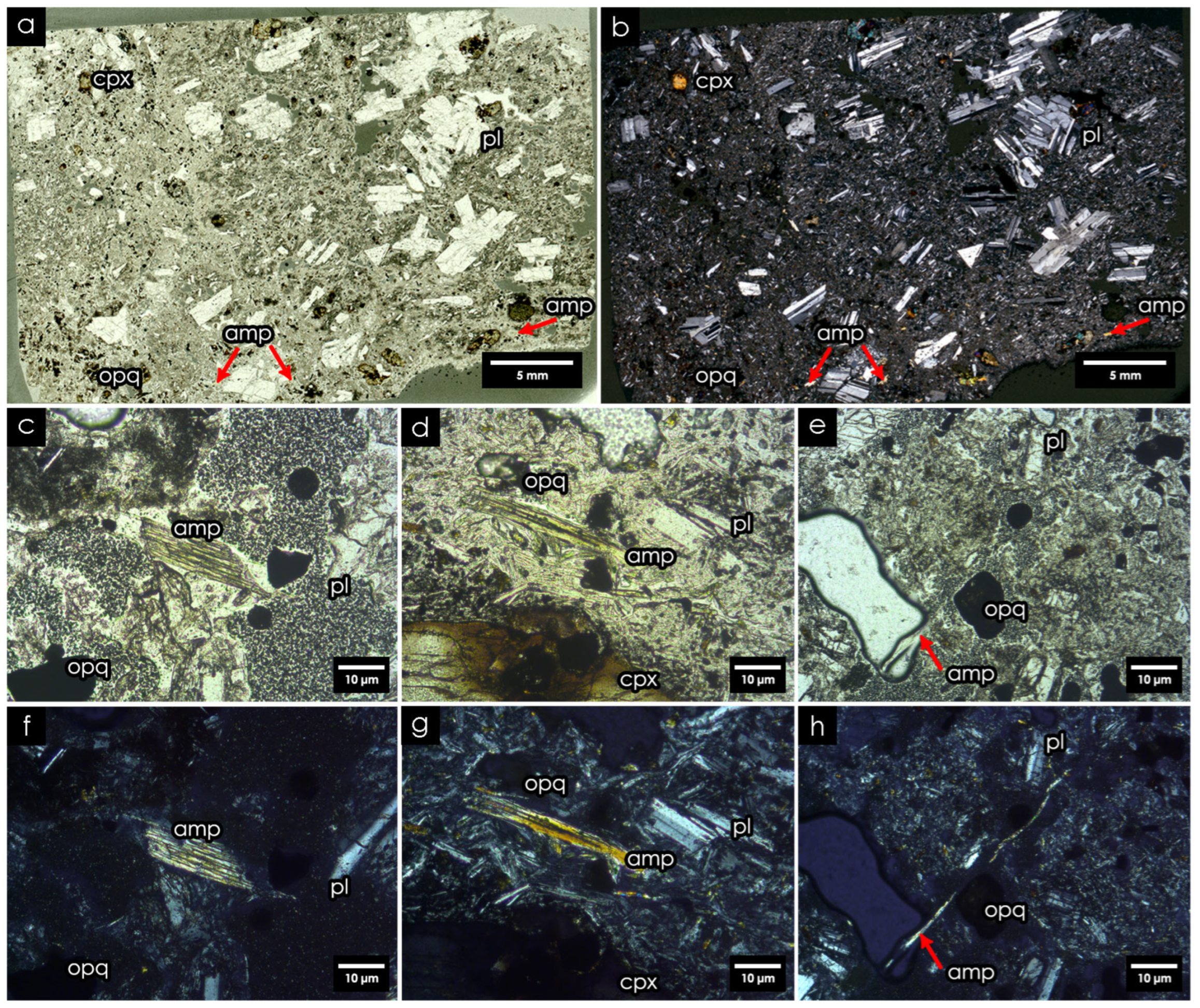
The petrographic observations on lava specimens highlighted in detail the microstructural features as well as the spatial relationship between the occurring minerals (Figure 4a,b). At the scale of the microscope, lavas exhibit a porphyritic-seriate microtexture with a phenocryst size ranging from medium to fine (Figure 4a,b). Lavas also show glomeroporphyritic textures, characterized by clustered mineral aggregates, often of plagioclase (Figure 4a,b). The mesostasis is micro- to cryptocrystalline in some areas (Figure 4a–c). Phenocrysts show from sub-hedral to eu-hedral habit (Figure 4c–e). The identified mineral phases include plagioclase (pl), clinopyroxene (cpx), oxides (opaque minerals; opq), amphibole, and apatite (ap). Finally, fluoro-edenite occurs with various habit features such as prismatic (Figure 4c,f), acicular (Figure 4d,g), and fiber-bundled (Figure 4e,h).
Moreover, fluoro-edenite crystals were retrieved from the breccia samples collected within the fractures still occurring at the quarry front (Figure 2e), from which we subsequently selected about ten specimens for investigation using optical and scanning electron microscopy. Stereomicroscopic observations were performed at the Not-Destructive Analyses Laboratory (L.A.N.D.) at the University of Catania, using a Carl Zeiss stereomicroscope (Oberkochen, Germany), as well as a digital microscope LCD Rievbcau 7′ with LED and 1200× magnification. Microstructural and chemical analyses were carried out at the accredited laboratory for asbestos analysis, ARPA Sicilia, UOC Laboratory L1 in Catania.
Electron microscopy analyses were performed using a Carl ZEISS Field Emission Scanning Electron Microscope (FESEM) MERLIN (Oberkochen, Germany), equipped with a Gemini II column and an X-MaxN EDS detector (150 mm2 window) (Oxford Instruments High Wycombe, Oxford, UK). The SEM was operated in high-resolution mode with an accelerating voltage of 20 kV, a probe current of 300 pA, and a working distance of 8.5 mm. Samples were mounted on 25 mm aluminum stubs and coated with a thin layer of gold to minimize charging effects during analysis.
Energy-dispersive X-ray spectroscopy (EDS) analyses were conducted using SDD X-MAX-N150 OXFORD Microanalysis (Oxford Instruments High Wycombe, UK) and AZTEC/INCA System, Suite Version 5.05. The system was pre-calibrated at the factory with the following reference materials: MgF2, albite, MgO, Al2O3, SiO2, MAD-10 feldspar, wollastonite, Ti, Mn, and Fe. Annual calibration is carried out by the manufacturer Carl Zeiss Company (Oberkochen, Germany). Further six-month checks are performed by ARPA technicians using a certified MAC (St. Ives in Cambridgeshire, UK) calibration block.

3.1. Amphibole Morphologies

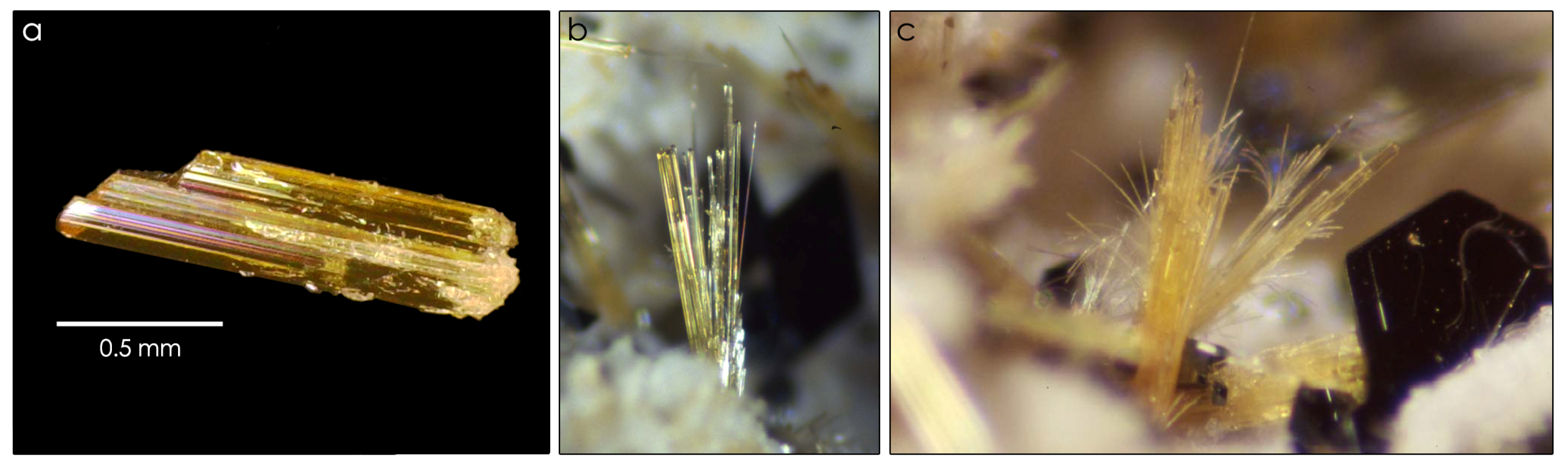
Fluoro-edenite crystals from Biancavilla can be prismatic or acicular in habit (Figure 3a,b) and often occur in parallel bundles. Larger prismatic crystals (≥2 mm) commonly exhibit fibrous and asbestiform terminations [18]. These fibers and/or fibrils (Figure 3c) have a strongly asymmetrical morphology (average width of 0.4–0.5 μm, average length of 30–40 μm) [14,43] and are predominantly rigid and hard when shorter, while the longer ones are tensile, elastic and flexible, which makes them extremely pathogenic upon inhalation because they cannot be phagocytosed [14].
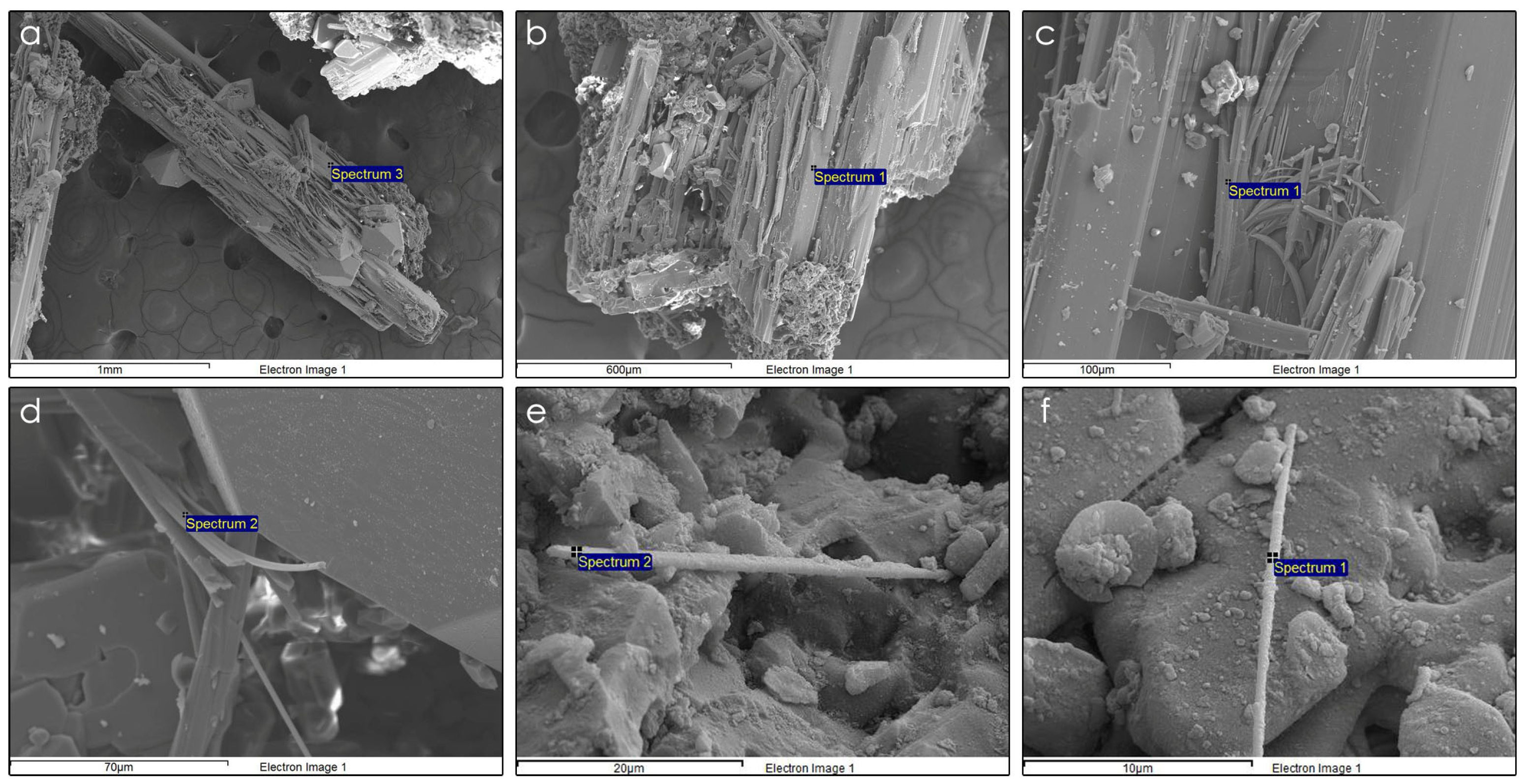
Furthermore, while fluoro-edenite crystals in lava fractures are always well identifiable and separated from other minerals, asbestiform fibers are often intergrown with feldspar, hematite, and pyroxene microlites [14]. Regardless of their types of habit and size, fluoro-edenite crystals do not show any evidence of alteration, nor have secondary mineral phases developed at their expense been observed either at the meso- and micro-scale. Conversely, fluoro-edenite crystals are often prone to comminution (Figure 5a–f).

3.2. Physical and Optical Properties

Gianfagna and Oberti [18] report the main physical and optical properties of prismatic to acicular crystals of fluoro-edenite. The forms are {110}, {010}, and {0kl}, and the mineral is intensely yellow, transparent, with a vitreous to resinous luster and a white-yellow streak parallel to the c-axis. Mohs’ hardness is 5–6, the calculated density is 3.09 g/cm3; there is perfect cleavage on {110} and conchoidal fracture.
In plane-polarized light, fluoro-edenite is birefringent (first order), biaxial negative, with α = 1.6058(5), β = 1.6170(5), γ = 1.6245(5), and 2V = 78.1°, as well as with Y ≡ β ⊥ (010) and γ ⊥ Z = 26°. While no visible pleochroism was previously reported, our observations in plane-polarized light reveal a weak yellowish-green coloration.
Due to the small size of the fibers, precise refractive index measurements could not be determined. However, estimates by Gianfagna et al. [14] use Cargille (ChemTel Inc., Tampa, FL, USA) liquids under sodium light, ranging from 1.60 to 1.63. Moreover, in a liquid where n = 1.62, only associated minerals (feldspar, orthopyroxene, and hematite) were clearly visible, thus suggesting that the refractive indices of the fibers are slightly below this value.

3.3. Chemical Compositions and Variability

A comparison of the compositional ranges of amphibole fibers available from the literature [14,18,33,43] of the holotypic prismatic fluoro-edenite and fibrous fluoro-edenite, with results from this work being summarized in Table 1.
The prismatic and fibrous individuals exhibit wide compositional ranges for SiO2, Al2O3, FeOt, MgO, CaO, and F, while TiO2, MnO, and K2O display restricted variations in both morphologies. These two habit groups differ mainly in Na2O content, which shows a broader range in the fibrous samples. As far as Cl, it was n ot detected in prismatic fluoro-edenite specimens, whereas it is highly variable in the fibers. In terms of average composition, the fibrous samples are characterized by lower content in MgO and CaO and higher in Al2O3, Na2O, F, and Cl than the prismatic ones.
Our results show compositional ranges of SiO2 and FeOt, suggesting a wider compositional heterogeneity than in the previous literature data (Table 1). These findings enhance understanding of the chemical complexity of fluoro-edenite, driven by its solid solution nature and isomorphic substitution mechanisms.
Compositional variability has also been observed both within individual fluoro-edenite fibers and between different fibers, ranging, according to the literature, from edenite to winchite, with variable tremolite and richterite components, which have been attributed to minor variations in formation conditions during crystallization [26,27,43,45]. Further studies based on Mössbauer spectroscopy [26,27,43,45] confirm the predominance of Fe3+ over Fe2+ in edenite fibers, with variations in the distribution of the iron oxides across different sites. Specifically, Gianfagna et al. [43] observed Fe3+ concentrations at the M2 site, with Fe2+ at M2 and M3, while Andreozzi et al. [26] and Bruni et al. [27] reported a more even Fe2+ distribution across M1, M2, M3, and M4.
By combining chemical and cell parameter data, the crystal–chemical formulae of prismatic and fibrous fluoro-edenite amphibole are, respectively,
  • A(Na0.56K0.15) B(Na0.30Ca1.62Mg0.03Mn0.05) C(Mg4.68Fe2+0.19Fe3+0.10Ti4+0.03) T(Si7.42Al0.58) O22O3(F1.98Cl0.02)2 [18].
  • (Na0.307K0.157)Σ0.464 (Ca1.505Na0.495)Σ2.000 (VIAl0.104Fe3+0.333Fe2+0.162Mg4.255Ti0.062Mn0.063)Σ4.980 (Si7.520IVAl0.480)Σ8.000 O22 (F1.970Cl0.020)Σ1.990 [43].
Fourier Transform Infrared (FTIR) and μ-FTIR spectroscopy data for both prismatic [18,49] and fibrous [26] fluoro-edenite do not show any absorption band in the OH-stretching region (3800–3600 cm−1), indicating the complete substitution of the hydroxyl (OH-) with fluorine [13,26,27,35]. This represents the first known natural amphibole to show this complete substitution [50]. Gianfagna and Oberti [18] reported absorption bands at 1066, 991, 791, 738, 667, 517, and 475 cm−1, while Rinaudo et al. [50] provided a more detailed spectrum with additional bands, particularly in the 1300–450 cm−1 region, identifying bands at 1274, 1249, 1220, 1185, 1175, 1137, 1122, 1098, 1067, 1039, 1020, 1009, 920, 898, 876, 849, 834, 820, 792, 763, and 728 cm−1. The typical μ-Raman spectrum of the prismatic fluoro-edenite features a very intense band at 679 cm−1 and less intense, broader bands near 1060, 920, 550, 380, and 240 cm−1 [50].

4. Health and Environmental Concerns

Pleural neoplasm, such as malignant mesothelioma, is a rare and highly fatal disease specifically induced by inhalation of asbestos fibers, due to occupational or environmental exposure ([15,25], and references therein). An unusual cluster of cases was reported in Biancavilla in the epidemiological studies on the mortality of malignant pleural mesothelioma conducted in Italy between 1988 and 1992 [16] and 1993 to 1997 [17]. A total of 17 cases were identified, characterized by relatively low age at diagnosis and higher mortality in women, none of whom had relevant occupational exposure to asbestos [13].
In one specific case, mineral fibers were detected in the autopsy lung tissue of an 86-year-old woman, who had only lived in Biancavilla and was married to a farmworker [15,25]. A general environmental contamination was thus considered, and the stone quarries (“La Cava” and “Di Paola”) located in the Monte Calvario area were identified as the primary sources of fluoro-edenite amphibole fiber diffusion [13,14].
For this reason, several studies have been carried out to verify the presence of fibers in building materials, since the quarry materials extracted for more than 50 years were also widely used in local construction and road paving, especially between 1950 and 60 and 1970, when the municipality of Biancavilla experienced rapid expansion [14,27,51]. Of the examined buildings dating from the 1950s to 1990s, 71–72% were found contaminated by the amphibole fibers, with concentrations ranging from a few thousand to over 4 × 10⁴ fibers/mg of material [13,15,25]. While fibers embedded in plaster or mortar are not considered to release high contents of airborne fibers in the environment, specific activities (e.g., demolition, treatment of walls or ceilings, and plaster surface removal) can result in hazardous fiber dispersal [13,15,28].
To monitor the environmental diffusion occurring in Biancavilla, sentinel animal studies were conducted. De Nardo et al. [32] examined lung samples from 27 culled sheep, at least 3 years old and grazing near Monte Calvario (1–3 km radius). Fluoro-edenite fibers were certainly and probably identified from their chemical composition in six (22.2%) and two (7.4%) samples, respectively, considering the partial cation dissolution (Mg and Ca), which they may have undergone after a long-term exposure in the biological environment. The size and shape of the found fluoro-edenite also align with those measured in human lungs and environmental samples [32].
Further studies identified fluoro-edenite fibers in soils and outcrops outside the Mt. Calvario quarry site, including, for example, the Poggio Mottese site, the rural zone adjacent to the freeway, and the northern perimeter of the quarry [25,31,34,43]. A survey conducted by the University of Catania (2004–2005) confirmed the widespread presence of fluoro-edenite fibers in 930 samples of solid materials (massive and topsoil), suggesting a widespread environmental contamination [13,15], hence not caused by a punctiform source (i.e., non-point) such as the Mount Calvario area [27,52]. The typical prismatic and fibrous morphologies found in these environmental matrices are consistent with those shown in Figure 5.
Experimental studies have been conducted to investigate the possible causal relationship between fluoro-edenite exposure and mesothelioma development. In vitro tests [53,54] demonstrated its carcinogenic potential through functional biochemical parameter (e.g., cell motility) modification, which plays a crucial role in cancer development and progression. Similarly, the in vivo toxicological investigations on rats highlight the amphibole fibers’ high potential to induce mesothelioma, but also the lack of negative health effects of the prismatic forms. The carcinogenic hazard to humans of fluoro-edenite fibrous amphibole also appeared in The Lancet Oncology [55] and was definitively established by the International Agency for Research on Cancer Monographs (IARC), classifying it as a Group 1 carcinogen [22].
With respect to other known oncogenic minerals, these fibers are characterized by a very anomalous composition (high ANa, IVAl, and O3F contents) [14,15]. Mazziotti-Tagliani et al. [33], in fact, assessed the potential remobilization of arsenic (As) and fluorine (F) from fluoro-edenite mineral and concluded that their concentration in soil and groundwater remains below regulatory thresholds, owing to the relatively limited distribution of the host rocks and the relatively limited mobilization by the minerals, despite the high values in metasomatized lava samples.
On the basis of such evidence, in 2001, Biancavilla was included, by Italian Decree No. 468, in the National Priorities List of Contaminated Sites (NPL-CS) [56]. An area of about 3.3 km2 in Biancavilla was defined as a “Contaminated Site”, issued by the Italian Ministry for the Environment and the Protection of Land and Sea and officially published in the Gazzetta Ufficiale della Repubblica Italiana, No. 231 of 2 October 2002 [38].
From then on, Italian institutions have conducted remediation and dust mitigation programs through “reclamation” and “permanent safety measures”, as well as characterization and monitoring operations (Figure 6) [35,52]. The main interventions concerned the removal of quarried stone materials remaining in the quarry after the activities cessation, the removal and disposal of deteriorated plaster on buildings and public buildings, the covering with volcanic crushed stone (free of contamination) of the ground surface of the former quarry (Figure 2d,e), the coating with sprayed concrete (spritz beton) of the outcrop facing the Biancavilla inhabited area, and the asphalting of unpaved roads and public areas.
Environmental airborne sampling surveys were conducted in Biancavilla town in the years 2000, 2004–05, and 2009–17 [27,28,49,52], in addition to 2018–2024 -to evaluate the efficiency of the interventions, taking as reference value the fluoro-edenite concentration ≥ 1 fibre per liter (SEM), assumed for Biancavilla outdoor air quality by the Italian Ministry of Environment.
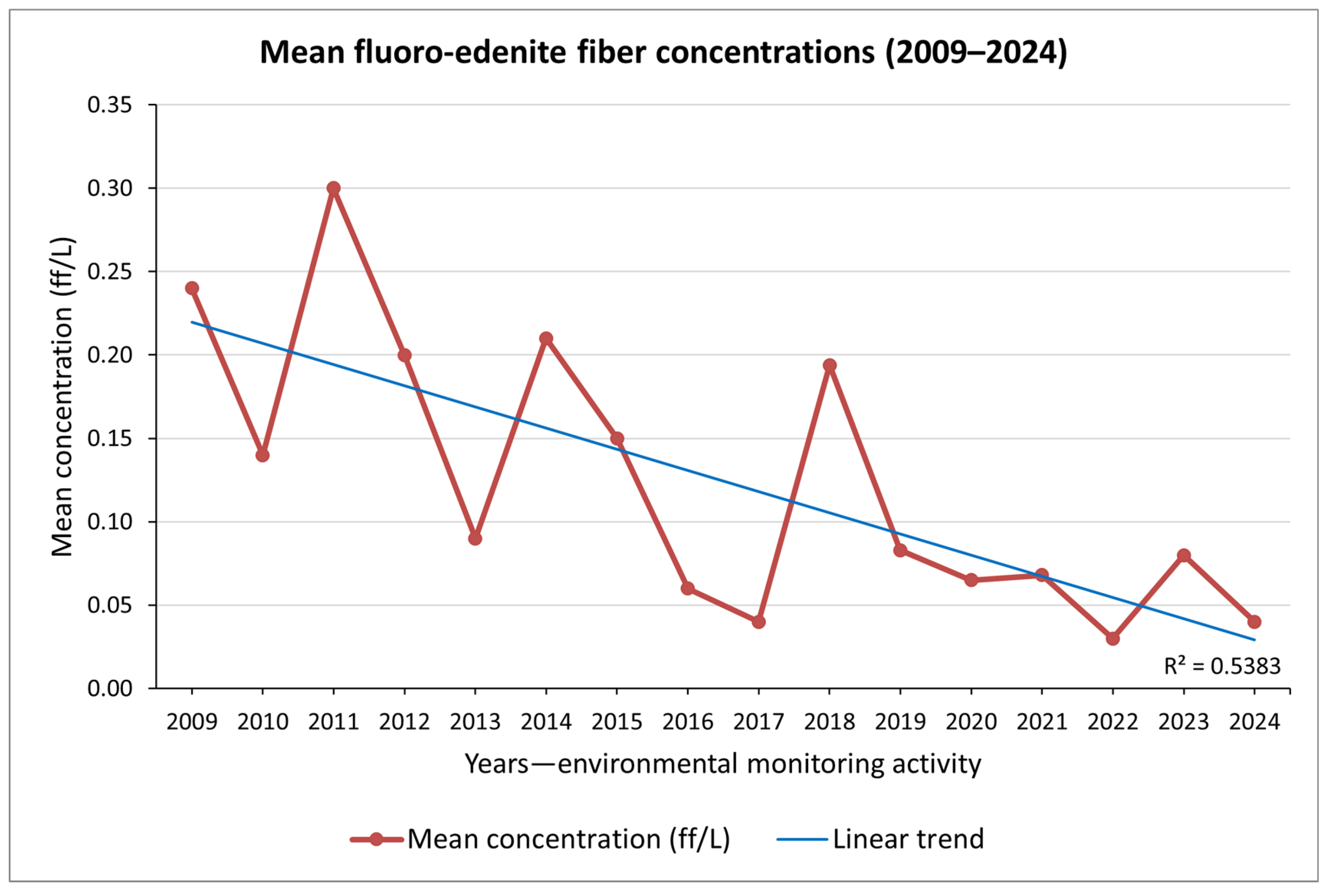
Briefly, samples acquired anti-mitigation measures found an average amphibole contamination level of 1.76 ff/L (ranging from 0.4 to 8.2 ff/L), with the highest concentration on unpaved roads covered with inert material, especially during heavy traffic, which, in 2004–2005, dropped to 0.35 ff/L (ranging from 0.1 and 4.19 ff/L). Since 2009, air quality monitoring in Biancavilla town has been carried out exclusively by the Catania Territorial Structure of ARPA Sicilia, and the data acquired confirm this downward trend up to an average concentration of 0.04 ff/L in 2024 (Figure 6). Sporadic exceedances of the 1 ff/L indication [57] were linked to specific activities (such as excavation/demolition) or meteorological conditions (wind and low humidity) near volcanic rock outcrops devoid of soil and vegetation, emphasizing the need to pay particular and continuous attention to the monitoring of exposures.

5. Discussions

Since the first papers reporting the occurrence of asbestiform amphibole in the area of Biancavilla town, Mt. Etna, as the first case of “asbestos” minerals in a volcanic context, the “fluoro-edenite” case was dealt with by several local authorities, enterprises, and universities. The results of these studies, which cover various topics (e.g., mineralogical, volcanological, environmental, and health implications), are the main contents of several publications.
Even if these studies were carried on over time with different and not homogenous approaches, they put into evidence the common aspect of the need to improve and deepen the knowledge of the examined areas, from a geological, volcanological and petrographic point of view, with the purpose to foresee and model asbestos fibers spreading either from natural and anthropogenic causes in order to detect and relate the source with health, societal and environmental implications.
Fluoro-edenite only occurs naturally; the fluoro-edenite crystals that have been identified in the geological formations of the Biancavilla area may have a prismatic, acicular, or fibrous habit and often occur as parallel bundles. The fibers found in air samples in Biancavilla originate from the quarry materials that have been used in building materials for local structures since at least the 1950s [25]. Unpaved roads made from local quarry products have also been a primary source of airborne fluoro-edenite fibers, giving the town a widespread and non-point contamination condition [58].
On the basis of scientific data currently available, in 2001, Biancavilla was included, by law, in the National Priorities List of Contaminated Sites (NPL-CS) [D.M. 468/2001].
The perimeter of the “Contaminated Site” was quantified in about 3.3 km2 (Figure 1b), as delimited by the Italian Environment Ministry decree of 18 July 2002 for the environmental remediation procedures to be taken [38].
Since 2001, environmental and health authorities have promoted a series of remediation and dust mitigation activities in order to reduce the airborne fiber concentration and population exposure.
All these activities were conducted under strict air quality control by the Regional Environmental Agency of Sicily [28]. All monitoring activities in Biancavilla have been established in a series of ministerial meetings, and airborne diffusion of fibers was studied by using the same analytical procedures for conventional asbestos.
Since no asbestos fiber limit value for the outdoor environment has been defined by law, the Italian Ministry of the Environment and Protection of Land and Sea (MATTM) decided to comply with the indications of the working groups of the World Health Organization (WHO) using the value of 1 ff/L. In fact, since a threshold value is not known to exist and no safe levels can be proposed for the carcinogen asbestos, in 2000, the WHO produced epidemiological estimates considering a lifetime exposure to 1000 F/m3 with a view to providing adequate health protection ranges for the general population [57].
Figure 6 shows the linear regression of airborne fluoroedenite amphiboles calculated from the mean values of fiber concentrations for each year of monitoring activity, from 2009 up to 2024. Results demonstrate a real improvement in Biancavilla’s environmental situation and a gradual reduction in exposure as a consequence of the dust mitigation and remediation measures. Nevertheless, continuous environmental follow-up should be carefully carried out, particularly during high-risk fiber-releasing activities, such as excavations and demolitions, in order to prevent adverse health effects.
From the mineralogical viewpoint, it is worth pointing out that the mineral habit (i.e., the ratio of length/thickness of the fibers) should be identified as more pertinent to its potential hazard rather than its crystal structure and composition [14]. In addition, refs. [14,26] suggested that toxicity is related to the chemical composition; this aspect should be investigated in greater detail since amphiboles form a solid solution that, in this case, explains the observed compositional variability not only among the fluoro-edenite fibers but even within single crystals, especially the prismatic ones (Table 1). The mineral–chemical data collected to date, including those from this work, highlight a lower content of CaO and MgO in the fibrous samples, while SiO2 and FeOt exhibit a broader variability range. These variations are likely due to different fluid emplacements during the metasomatic process, which influence the concentrations over a wide range [33]. Crucially, the novel observation from this study regarding the presence of fluoro-edenite in massive lava rock samples (as identified through thin section analysis; Figure 4) opens new avenues for investigating the mineral’s genesis and growth mechanisms within solid rock. This expands the scope of future mineralogical studies beyond altered or loose materials.
Moreover, the magmatic processes as well as the mechanisms that lead to the genesis of halogen-rich magmas and therefore to the crystallization of an unusual assemblage dominated by fluorine-rich minerals are worth being explored and studied in greater detail in order to better understand the role of halogens in volcanic systems, especially because other occurrences of fluorine-rich minerals (i.e., F-apatite and F-mica) have been recorded at Mt. Etna [46,47,59].
In the town of Biancavilla, the widespread use in construction and the presence in the past of dirt roads, paved with material from quarries, has in fact caused widespread environmental contamination over time [13,15], that is not due to a point source (i.e., non-point); indeed, the dust originating from both unpaved roads and from construction/demolition activities and from the extraction of material from the Monte Calvario quarries was the cause of the inhalation of fluoro-edenite fibers by the resident population ([52] and references therein). These observations, combined with the presence of temporary quarry remains to the north and north-east of Il Calvario (in the Vallone San Filippo area) [15], suggest that the dispersion of amphibole fibers may not have been caused solely by quarrying activities at Mt. Calvario. Additionally, the use of loose materials as backfill may have contributed to the widespread deposition of this material in the surrounding area. The identification of fluoro-edenite within massive lava samples, beyond previously studied breccias and altered portions, adds a critical dimension to risk assessment. It implies that fiber release is not solely linked to the degradation of autoclastic breccias or quarry activities, but also to the weathering and potential human disturbance of intact lava flows. Future comparative studies between loose fibers from autoclastic breccias and those observed within the benmoreitic lava would be essential to better understand both their distinct genesis and their potential for release.
These considerations underline the risk of fiber release in the atmosphere caused by human activities, such as excavation, demolition, or material handling [15,28,35,49]. Additionally, weather conditions, including the dry climate and summer winds that characterize the area, may further contribute to fiber dispersion, particularly in unpaved streets of the urban areas [15,28,35,49]. Therefore, efforts should be made to continuously monitor natural exposure in different geomatrices (e.g., rocks and soils) through mineralogical, geological, and environmental studies to minimize health risks and support further mitigation measures.
Hence, the detailed geological survey becomes the preliminary and unavoidable step to realize public works and to implement working activities in natural asbestos sites, and the first action of prevention of asbestos workers’ and population risk exposure. In Italy, this first prevention action is based on the mandatory natural asbestos mapping, as disciplined by the Italian ministerial decree 101/03 [60]; accordingly, regions have to carry on and update yearly detailed mapped information about these sites to local authorities and to enterprises in order to avoid and prevent asbestos exposure risks. If applied to the Biancavilla area, this can really represent a very operative tool to be used by local authorities and implemented by protagonists with further—when necessary—geological, petrographic, and environmental surveys. To this aim, the GIS platform containing a review of environmental data of the Biancavilla site, developed time ago [34,61], should be improved, supplemented, and even revised.
Moreover, currently, new programs have been developed to produce geospatial representations of geochemical features of geological and petrological interest (e.g., [62]). Furthermore, starting from traditional approaches, modern techniques of digital mapping, such as virtual outcrop models, reconstructed by means of aerial or digital LiDAR surveys, have been recently developed in other geological contexts (e.g., [63]). These approaches, which combine, altogether, multidisciplinary expertise as well as information, can be successfully applied to the Biancavilla and neighboring areas for preparing geostatistics-based lithological/mineralogical maps that facilitate the reconstruction of the field relationships between different volcanic bodies or derived soils, even where the contacts are masked by more recent cover or lava flows cover or where accessibility to exposures is inhibited. These maps could be, in turn, the base for preparing other thematic maps (e.g., risk assessment and soil contamination).
In summary, by considering the health and environmental concerns related to the natural occurrences of fluoro-edenite in the volcanic product cropping out in the area of Biancavilla (Mt. Etna), the new available instruments and methodologies, not applied to the study area yet, would permit the quickly identification of risk situations (even punctual) and the source (either natural or anthropogenic), and therefore could predict the diffusion of hazardous contaminants and would help to adopt specific measures of prevention. To this aim, the development of an interoperable database would facilitate the functionality of information systems to exchange data and to enable the sharing of information, bringing benefit to the involved population.

6. Conclusions and Future Directions

Further mineralogical, geological, petrographic, and environmental investigations may be needed to assess the risks associated with the various scenarios in the Biancavilla area, especially in relation to the natural occurrences of asbestiform minerals and their spreading into the environment as a consequence of anthropogenic activities, either urban or agricultural. These investigations will provide further tools to improve the efficacy of all the mitigation measures adopted since the Mt. Calvario SIN (Site of National Interest: National Priority Contaminated Site, 2002) has been instituted, with particular reference to the environmental protection in addition to the safety of workers and the resident population [35,49,64,65]. Specifically, the novel identification of fluoro-edenite within massive lava rock samples, observed for the first time in thin section, opens a crucial new line of inquiry into their formation and growth mechanism within solid rock. This finding suggests the importance of future studies comparing loose fibers from autoclastic breccias with those found within the benmoreitic lava, which could provide insight into both their distinct genesis and potential for release.
In addition, it is necessary to consider that there are likely other sites, not yet identified, where there are geological occurrences of fluoro-edenite fibers. This emphasizes the importance of carrying out further surveys to identify new contaminated areas, which would be useful to improve risk management in both urban and agricultural contexts. Moreover, since subsequently fluoro-edenite was found in other volcanic contexts such as at the Somma–Vesuvio complex (southern Italy) and on Vulcano island (Eolian islands, Sicily; [66]), as well as in Japan (in this last case, after a brief abstract, no further literature was retrieved), the relatively limited number of reported occurrences makes it difficult to ascertain whether additional instances exist. In the event of similar cases, particularly in volcanic regions, the methodology employed over the years in the Biancavilla (Sicily, Italy) case study could serve as a valuable framework, facilitating investigations into the presence of fibrous minerals, such as fluoro-edenite, in other locations [66]; in addition, it is worth noting that the “Biancavilla case” represents an example of good practices because it has been documented that the partnership of Biancavilla residents with the scientific community, supported by local, regional, and national authorities, contributes to decreasing environmental and domestic exposure and health issues related to fluoro-edenitic fibers [67].
Given its worldwide geological and cultural importance, it is worth noting that Mt. Calvario is a geosite designated by the Sicilian Region as Site of Worldwide Interest (with D.A. n. 105 dated 15 April 2015), where currently work is underway to transform it into an urban park. This represents a unique opportunity to integrate environmental restoration and the enhancement of the geological heritage with the needs of the local community.
Finally, the monitoring data indicate a tangible improvement in the environmental conditions of the town of Biancavilla, along with a gradual reduction in exposure resulting from the implementation of dust mitigation and remediation measures. Nevertheless, continuous environmental monitoring should be rigorously maintained, particularly during high-risk activities involving fiber release, such as excavations and demolitions, in order to prevent potential adverse health effects.
As a result, this review of the current state of knowledge provides a valuable contribution to the improvement of environmental management strategies and to a deeper understanding of this specific case. It also encourages further studies to be extended to the surrounding area and, beyond the local context, to other sites characterized by natural occurrences of asbestiform amphiboles in volcanic settings.

Author Contributions

Conceptualization, R.P.; methodology, V.I. and R.V.; validation, V.I., M.R.P. and R.P.; formal analysis, V.I. and R.V.; investigation, V.I., R.V. and A.P.; resources, M.R.P., C.C., C.R. and R.P.; data curation and visualization, V.I.; writing—original draft preparation, V.I.; writing—review and editing, V.I., M.R.P., R.P. and R.V.; supervision and project administration, R.P., M.R.P. and R.C. All authors have read and agreed to the published version of the manuscript.

Funding

This research was partially funded by the University of Catania, grant name PIACERI, 2020–2022, funding program (Linea 1 chance, grant number 22722132173; Rosalda Punturo is responsible).

Data Availability Statement

On request, the original data can be retrieved by writing to the corresponding author.

Acknowledgments

The authors thank the Municipality of Biancavilla for facilitating access to the site. Constructive review by anonymous reviewers is gratefully acknowledged. Editorial handling is also gratefully acknowledged.

Conflicts of Interest

The authors declare no conflicts of interest.

References

  1. National Institute for Occupational Safety and Health (NIOSH). Asbestos Fibers and Other Elongate Mineral Particles: State of the Science and Roadmap for Research; DHHS (NIOSH) Publication: Atlanta, GA, USA, 2011. [Google Scholar]
  2. International Agency for Research on Cancer. Arsenic, Metals, Fibres, and Dusts; International Agency for Research on Cancer: Lyon, France; World Health Organization: Geneva, Switzerland, 2012. [Google Scholar]
  3. Rizzo, G.; Buccione, R.; Dichicco, M.; Punturo, R.; Mongelli, G. Petrography, Geochemistry and Mineralogy of Serpentinite Rocks Exploited in the Ophiolite Units at the Calabria-Basilicata Boundary, Southern Apennine (Italy). Fibers 2023, 11, 81. [Google Scholar] [CrossRef]
  4. Punturo, R.; Visalli, R.; Cirrincione, R. A Review of the Mineralogy, Petrography, and Geochemistry of Serpentinite from Calabria Regions (Southern Italy): Problem or Georesource? Minerals 2023, 13, 1132. [Google Scholar] [CrossRef]
  5. Punturo, R.; Mineo, S.; Motra, H.B.; Lanzafame, G.; Indelicato, V.; Pappalardo, G.; Cirrincione, R. Greenstone of Calabria: A multi-analytical characterization of heritage metabasite from Southern Italy. Case Stud. Constr. Mater. 2024, 20, e03269. [Google Scholar] [CrossRef]
  6. Punturo, R.; Ricchiuti, C.; Rizzo, M.; Marrocchino, E. Mineralogical and microstructural features of namibia marbles: Insights about tremolite related to natural asbestos occurrences. Fibers 2019, 7, 31. [Google Scholar] [CrossRef]
  7. Whitehouse, A.C.; Black, C.B.; Heppe, M.S.; Ruckdeschel, J.; Levin, S.M. Environmental exposure to Libby Asbestos and mesotheliomas. Am. J. Ind. Med. 2008, 51, 877–880. [Google Scholar] [CrossRef]
  8. Wylie, A.G.; Verkouteren, J.R. Amphibole asbestos from Libby, Montana: Aspects of nomenclature: Table 1. Am. Mineral. 2000, 85, 1540–1542. [Google Scholar] [CrossRef]
  9. Tomita, K.; Makino, K.; Yamaguchi, Y. Fluor-edenite; its occurrence and crystal chemistry. In Proceedings of the 16th General Meeting of the International Mineralogical Association, Pisa, Italy, 3–8 September 1994; p. 410. [Google Scholar]
  10. ISTAT—Istituto Nazionale di Statistica. Popolazione Residente Per Sesso, Età e Stato Civile Al 1° Gennaio. 2024. Available online: https://demo.istat.it/app/?i=POS&l=it (accessed on 10 December 2024).
  11. Duncan, A.M. Pyroclastic flow deposits in the Adrano area of Mount Etna, Sicily. Geol. Mag. 1976, 113, 357–363. [Google Scholar] [CrossRef]
  12. De Rita, D.; Frazzetta, G.; Romano, R. The Biancavilla-Montalto ingnimbrite (Etna, Sicily). Bull. Volcanol. 1991, 53, 121–131. [Google Scholar] [CrossRef]
  13. Paoletti, L.; Batisti, D.; Bruno, C.; Di Paola, M.; Gianfagna, A.; Mastrantonio, M.; Nesti, M.; Comba, P. Unusually high incidence of malignant pleural mesothelioma in a town of eastern Sicily: An epidemiological and environmental study. Arch. Environ. Health 2000, 55, 392–398. [Google Scholar] [CrossRef]
  14. Gianfagna, A.; Ballirano, P.; Bellatreccia, F.; Bruni, B.; Paoletti, L.; Oberti, R. Characterization of amphibole fibres linked to mesothelioma in the area of Biancavilla, Eastern Sicily, Italy. Miner. Mag. 2003, 67, 1221–1229. [Google Scholar] [CrossRef]
  15. Burragato, F.; Comba, P.; Baiocchi, V.; Palladino, D.; Simei, S.; Gianfagna, A.; Paoletti, L.; Pasetto, R. Geo-volcanological, mineralogical and environmental aspects of quarry materials related to pleural neoplasm in the area of Biancavilla, Mount Etna (Eastern Sicily, Italy). Environ. Geol. 2005, 47, 855–868. [Google Scholar] [CrossRef]
  16. Di Paola, M.; Mastrantonio, M.; Carboni, M.; Belli, S.; Grignoli, M.; Comba, P.; Nesti, M. La mortalita per tumore maligno della pleura in Italia negli anni 1988–1992. In Rapporti ISTISAN, 96/40; Istituto Superiore di Sanità: Rome, Italy, 1996. [Google Scholar]
  17. Mastrantonio, M.; Belli, S.; Binazzi, A.; Carboni, M.; Comba, P.; Fusco, P.; Grignoli, M.; Ivarone, I.; Martuzzi, M.; Nesti, M.; et al. La mortalità per tumore maligno della pleura nei comuni italiani (1988–1997). In Rapporti ISTISAN, 02/12; Istituto Superiore di Sanità: Rome, Italy, 2002; Available online: https://www.researchgate.net/publication/235333348 (accessed on 10 September 2025).
  18. Gianfagna, A.; Oberti, R. Fluoro-edenite from Biancavilla (Catania, Sicily, Italy): Crystal chemistry of a new amphibole end-member. Am. Mineral. 2001, 86, 1489–1493. [Google Scholar] [CrossRef]
  19. Grice, J.D.; Ferraris, G. New minerals approved in 2000 by the Commission on New Minerals and Mineral Names International Mineralogical Association. Eur. J. Mineral. 2001, 13, 995–1002. [Google Scholar] [CrossRef]
  20. ISPRA—Inventario Nazionale dei Geositi. Fluoro-Edenite e Fluoro-Flogopite di Biancavilla. Available online: https://www.isprambiente.gov.it/it/progetti/cartella-progetti-in-corso/suolo-e-territorio-1/tutela-del-patrimonio-geologico-parchi-geominerari-geoparchi-e-geositi/il-censimento-nazionale-dei-geositi (accessed on 10 December 2024).
  21. Sicilian Regional Government—Regione Siciliana. Decreto 15 Aprile 2015: Istituzione del Geosito “Lave Brecciate a Fluoro-Edenite e Fluoroflogopite di Monte Calvario”, Ricadente Nel Territorio Comunale di Biancavilla; 2015; pp. 23–25. Available online: http://www.gurs.regione.sicilia.it/Gazzette/g15-21/g15-21.pdf (accessed on 10 December 2024).
  22. International Agency for Research on Cancer (IARC) Monographs Working Group. Some Nanomaterials and Some Fibres; International Agency for Research on Cancer: Lyon, France; World Health Organization: Geneva, Switzerland, 2017; Volume 111. [Google Scholar]
  23. Italian Government—Governo Italiano. Legge 27 Marzo 1992, n. 257: “Norme Relative Alla Cessazione Dell’impiego Dell’amianto”. 1992. Available online: http://www.salute.gov.it/resources/static/primopiano/amianto/normativa/Legge_27_marzo_1992.pdf (accessed on 10 September 2024).
  24. Bruno, C.; Tumino, R.; Fazzo, L.; Cascone, G.; Cernigliaro, A.; De Santis, M.; Giurdanella, M.C.; Nicita, C.; Rollo, P.C.; Scondotto, S.; et al. Incidence of pleural mesothelioma in a community exposed to fibres with fluoro-edenitic composition in Biancavilla (Sicily, Italy). Ann. Ist. Super. Sanità 2014, 50, 111–118. [Google Scholar] [CrossRef] [PubMed]
  25. Bruni, B.M.; Pacella, A.; Mazziotti-Tagliani, S.; Gianfagna, A.; Paoletti, L. Nature and extent of the exposure to fibrous amphiboles in Biancavilla. Sci. Total Environ. 2006, 370, 9–16. [Google Scholar] [CrossRef]
  26. Andreozzi, G.B.; Ballirano, P.; Gianfagna, A.; Mazziotti-Tagliani, S.; Pacella, A. Structural and spectroscopic characterization of a suite of fibrous amphiboles with high environmental and health relevance from Biancavilla (Sicily, Italy). Am. Mineral. 2009, 94, 1333–1340. [Google Scholar] [CrossRef]
  27. Bruni, B.M.; Soggiu, M.E.; Marsili, G.; Brancato, A.; Inglessis, M.; Palumbo, L.; Piccardi, A.; Beccaloni, E.; Falleni, F.; Mazziotti-Tagliani, S.; et al. Environmental concentrations of fibers with fluoro-edenitic composition and population exposure in Biancavilla (Sicily, Italy). Ann. Ist. Super. Sanita 2014, 50, 119–126. [Google Scholar] [CrossRef]
  28. Pinizzotto, M.R.; Cantaro, C.; Caruso, M.; Chiarenza, L.; Petralia, C.; Turrisi, S.; Brancato, A. Environmental monitoring of airborne fluoro-edenite fibrous amphibole in Biancavilla (Sicily, Italy): A nine-years survey. J. Mediterr. Earth Sci. 2018, 10, 89–95. [Google Scholar] [CrossRef]
  29. Celino, M.B. SIN Biancavilla, parte la bonifica alla ex cava di Monte Calvario. Recoverweb. Available online: https://www.recoverweb.it/sin-biancavilla-parte-la-bonifica-alla-ex-cava-di-monte-calvario/ (accessed on 10 December 2024).
  30. Ufficio Regionale per l’espletamento di Gare per l’appalto dei lavori—UREGA. Lavori per la Bonifica e la Messa in Sicurezza Permanente Dell’area di Cava di Monte Calvario, Causa la Presenza Delle Pericolosa Fibra (Fluoro-Edenite). Portale Gare D’appalto. 2024. Available online: https://urega.lavoripubblici.sicilia.it/gare/it/homepage.wp?actionPath=/ExtStr2/do/FrontEnd/Bandi/view.action&currentFrame=6&codice=G00181&_csrf=ELVHHPC4HHA9V1M6KWWW5RWUH277MHO (accessed on 10 December 2024).
  31. Comba, P.; Gianfagna, A.; Paoletti, L. Pleural Mesothelioma Cases in Biancavilla are Related to a New Fluoro-Edenite Fibrous Amphibole. Arch. Environ. Health 2003, 58, 229–232. [Google Scholar] [CrossRef]
  32. DeNardo, P.; Bruni, B.; Paoletti, L.; Pasetto, R.; Sirianni, B. Pulmonary fibre burden in sheep living in the Biancavilla area (Sicily): Preliminary results. Sci. Total Environ. 2004, 325, 51–58. [Google Scholar] [CrossRef]
  33. Mazziotti-Tagliani, S.; Angelone, M.; Armiento, G.; Pacifico, R.; Cremisini, C.; Gianfagna, A. Arsenic and fluorine in the Etnean volcanics from Biancavilla, Sicily, Italy: Environmental implications. Environ. Earth Sci. 2012, 66, 561–572. [Google Scholar] [CrossRef]
  34. Famoso, D.; Mangiameli, M.; Roccaro, P.; Mussumeci, G.; Vagliasindi, F.G.A. Asbestiform fibers in the Biancavilla site of national interest (Sicily, Italy): Review of environmental data via GIS platforms. Rev. Environ. Sci. Biotechnol. 2012, 11, 417–427. [Google Scholar] [CrossRef]
  35. Bellomo, D.; Gargano, C.; Guercio, A.; Punturo, R.; Rimoldi, B. Workers’ risks in asbestos contaminated natural sites. J. Mediterr. Earth Sci. 2018, 10, 97–106. [Google Scholar] [CrossRef]
  36. Russo, M.; Della Ventura, G.; Campostrini, I.; Preite, D. Nuove Specie Minerali al Monte Somma: I. la Fluoro-Edenite. MICRO (Not. Mineral.) 2009, 173–174. Available online: https://www.earth-prints.org/entities/publication/848999a2-06b5-4d67-b1b1-c3e7ea58a0c5 (accessed on 13 May 2025).
  37. Rossi, M.; Nestola, F.; Ghiara, M.R.; Capitelli, F. Fibrous minerals from Somma-Vesuvius volcanic complex. Miner. Pet. 2016, 110, 471–489. [Google Scholar] [CrossRef]
  38. Italian Ministry for the Environment and the Protection of Land and Sea—Ministero dell’Ambiente e della Tutela del Territorio e del Mare. Decreto n.231 del 18 Luglio 2002: “Perimetrazione del Sito di Interesse Nazionale di Biancavilla”. 2002, p. 21. Available online: https://www.gazzettaufficiale.it/atto/vediMenuHTML;jsessionid=NzBWHdn4cm3t+8groY9ipA__.ntc-as2-guri2a?atto.dataPubblicazioneGazzetta=2002-10-02&atto.codiceRedazionale=02A11676&tipoSerie=serie_generale&tipoVigenza=originario (accessed on 10 December 2024).
  39. Branca, S.; Coltelli, M.; Groppelli, G.; Lentini, F. Geological map of Etna volcano, 1:50,000 scale. Ital. J. Geosci. 2011, 130, 265–291. [Google Scholar] [CrossRef]
  40. Giuffrida, M.; Nicotra, E.; Viccaro, M. How an embryonic magma feeding system evolves: Insights from the primordial pulses of Mt. Etna volcano. J. Volcanol. Geotherm. Res. 2024, 451, 108113. [Google Scholar] [CrossRef]
  41. Gillot, P.Y.; Kieffer, G.; Romano, R. The Evolution of Mount Etna in the Light of Potassium-Argon Dating. Acta Vulcanol. 1994, 5, 81–87. [Google Scholar]
  42. Giuffrida, M.; Cardone, M.; Zuccarello, F.; Viccaro, M. Etna 2011–2022: Discoveries from a decade of activity at the volcano. Earth Sci. Rev. 2023, 245, 104563. [Google Scholar] [CrossRef]
  43. Gianfagna, A.; Andreozzi, G.B.; Ballirano, P.; Mazziotti-Tagliani, S.; Bruni, B.M. Structural and chemical contrasts between prismatic and fibrous fluoro-edenite from Biancavilla, Sicily, Italy. Can. Mineral. 2007, 45, 249–262. [Google Scholar] [CrossRef]
  44. Gianfagna, A.; Scordari, F.; Mazziotti-Tagliani, S.; Ventruti, G.; Ottolini, L. Fluorophlogopite from Biancavilla (Mt. Etna, Sicily, Italy): Crystal structure and crystal chemistry of a new F-dominant analog of phlogopite. Am. Mineral. 2007, 92, 1601–1609. [Google Scholar] [CrossRef]
  45. Mazziotti-Tagliani, S.; Andreozzi, G.B.; Bruni, B.M.; Gianfagna, A.; Pacella, A.; Paoletti, L. Quantitative chemistry and compositional variability of fluorine fibrous amphiboles from Biancavilla (Sicily, Italy). Period. Mineral. 2009, 78, 65–74. [Google Scholar] [CrossRef]
  46. Nicotra, E.; Viccaro, M.; Ferlito, C.; Cristofolini, R. Influx of volatiles into shallow reservoirs at Mt. Etna volcano (Italy) responsible for halogen-rich magmas. Eur. J. Mineral. 2010, 22, 121–138. [Google Scholar] [CrossRef]
  47. Mazziotti-Tagliani, S.; Nicotra, E.; Viccaro, M.; Gianfagna, A. Halogen-dominant mineralization at Mt. Calvario dome (Mt. Etna) as a response of volatile flushing into the magma plumbing system. Miner. Pet. 2012, 106, 89–105. [Google Scholar] [CrossRef]
  48. Mauro, D.; Sejkora, J.; Dolníček, Z. Badalovite, NaNaMg(MgFe3+)(AsO4)3, and associated calciojohillerite, NaCaMgMg2(AsO4)3, from Biancavilla, Etna volcanic complex, Sicily, (Italy): Occurrence and crystal chemistry. Mineral. Mag. 2025, 89, 526–534. [Google Scholar] [CrossRef]
  49. Grimaldi, R.; Pinizzotto, M.R. Scavi nel SIN di Biancavilla, l’attività di ARPA Sicilia. Ecoscienza 2018, 1, 44–45. [Google Scholar]
  50. Rinaudo, C.; Cairo, S.; Gastaldi, D.; Gianfagna, A.; Tagliani, S.M.; Tosi, G.; Conti, C. Characterization of fluoro-edenite by μ-Raman and μ-FTIR spectroscopy. Miner. Mag. 2006, 70, 291–298. [Google Scholar] [CrossRef]
  51. Soffritti, M.; Minardi, F.; Bua, L.; Esposti, D.D.; Belpoggi, F. First Experimental Evidence of Peritoneal and Pleural Mesotheliomas Induced by Fluoro-Edenite Fibres Present in Etnean Volcanic Material from Biancavilla (Sicily, Italy). Eur. J. Oncol. 2004, 9, 169–175. Available online: https://hal.science/hal-04359150 (accessed on 20 August 2025).
  52. Brancato, A.; Pinizzotto, M.R.; Valastro, G. La contaminazione da fluoro-edenite ed il modello Biancavilla (CT): L’esperienza di ARPA Sicilia nella gestione delle attività edilizie e di scavo dall’istituzione del SIN ai giorni nostri. In TIC VI-GdL VI/03-SO VI/03-01—Amianto: Linea Guida per lo Scavo, la Movimentazione e il Trasporto Delle Terre e Rocce da Scavo Con Amianto Naturale e per i Relativi Criteri di Monitoraggio; Defilippi, A., Cazzola, C., Ceseri, D., Scotti, E., Beccaris, G., Muto, L., Fercia, M.L., Pinizzotto, M.R., Zannellato, M., Morelli, M., et al., Eds.; Sistema Nazionale per la Protezione dell’Ambiente: Roma, Italy, 2021; pp. 87–112. Available online: https://www.arpa.sicilia.it/wp-content/uploads/2014/06/Il_monitoraggio_ambientale_nel_SIN_di_Biancavilla.pdf (accessed on 13 May 2025).
  53. Cardile, V.; Renis, M.; Scifo, C.; Lombardo, L.; Gulino, R.; Mancari, B.; Panico, A. Behaviour of the new asbestos amphibole fluoro-edenite in different lung cell systems. Int. J. Biochem. Cell Biol. 2004, 36, 849–860. [Google Scholar] [CrossRef]
  54. Pugnaloni, A.; Lucarini, G.; Giantomassi, F.; Lombardo, L.; Capella, S.; Belluso, E.; Zizzi, A.; Panico, A.M.; Biagini, G.; Cardile, V. In vitro study of biofunctional indicators after exposure to asbestos-like fluoro-edenite fibres. Cell Mol. Biol. 2007, 53, 965–980. [Google Scholar] [CrossRef]
  55. Grosse, Y.; Loomis, D.; Guyton, K.Z.; Lauby-Secretan, B.; El Ghissassi, F.; Bouvard, V.; Benbrahim-Tallaa, L.; Guha, N.; Scoccianti, C.; Mattock, H.; et al. Carcinogenicity of fluoro-edenite, silicon carbide fibres and whiskers, and carbon nanotubes. Lancet Oncol. 2014, 15, 1427–1428. [Google Scholar] [CrossRef]
  56. Italian Ministry for the Environment and the Protection of Land and Sea—Ministero dell’Ambiente e della Tutela del Territorio e del Mare. Decreto 18 Settembre 2001, n. 468: Regolamento Recante “Programma Nazionale di Bonifica e Ripristino Ambientale.”. 2002. Available online: https://www.gazzettaufficiale.it/eli/gu/2002/01/16/13/so/10/sg/pdf (accessed on 13 May 2025).
  57. World Healt Organization (WHO) Regional Office for Europe. Air Quality Guidelines for Europe, 2nd ed.; WHO Regional Publications: Copenhagen, Denmark, 2000; Volume European Series 91. [Google Scholar]
  58. Manna, P.; Comba, P. Communicating with health authorities and the public about asbestos risk in Biancavilla (CT). Epidemiol. Prev. 2001, 25, 28–30. [Google Scholar]
  59. Scordari, F.; Schingaro, E.; Ventruti, G.; Nicotra, E.; Viccaro, M.; Mazziotti-Tagliani, S. Fluorophlogopite from Piano delle Concazze (Mt. Etna, Italy): Crystal chemistry and implications for the crystallization conditions. Am. Mineral. 2013, 98, 1017–1025. [Google Scholar] [CrossRef]
  60. Italian Ministry for the Environment and the Protection of Land and Sea—Ministero dell’Ambiente e della Tutela del Territorio e del Mare. Decreto 18 Marzo 2003, n. 101: “Regolamento per la Realizzazione di Una Mappatura Delle Zone del Territorio Nazionale Interessate Dalla Presenza di Amianto”. 2003. Available online: https://www.gazzettaufficiale.it/eli/id/2003/05/09/003G0126/sg (accessed on 10 December 2024).
  61. Bellagamba, S.; Paglietti, F.; Di Molfetta, V.; Damiani, F.; De Simone, P. Gis for data management of environmental surveys, carried out in Biancavilla (CT) superfund experience. Air Pollut. 2011, XIX, 199–209. [Google Scholar] [CrossRef]
  62. Fiannacca, P.; Ortolano, G.; Pagano, M.; Visalli, R.; Cirrincione, R.; Zappalà, L. IG-Mapper: A new ArcGIS® toolbox for the geostatistics-based automated geochemical mapping of igneous rocks. Chem. Geol. 2017, 470, 75–92. [Google Scholar] [CrossRef]
  63. Fazio, E.; Ortolano, G.; Alsop, G.I.; D’Agostino, A.; Visalli, R.; Luzin, V.; Salvemini, F.; Cirrincione, R. Enhanced structural analysis through a hybrid analogue-digital mapping approach: Integrating field and UAV survey with microtomography to characterize metamorphic rocks. J. Struct. Geol. 2024, 187, 105213. [Google Scholar] [CrossRef]
  64. Campostrini, I.; Demartin, F.; Vignola, P.; Pezzotta, F. Ferro-fluoro-edenite, a new amphibole endmember from Vulcano Island (Sicily, Italy). Can. Mineral. 2021, 59, 741–749. [Google Scholar] [CrossRef]
  65. Bruno, C.; Di Stefano, R.; Ricceri, V.; La Rosa, M.; Cernigliaro, A.; Ciranni, P.; Di Maria, G.; Mandrioli, D.; Zona, A.; Comba, P.; et al. Fluoro-edenite non-neoplastic diseases in Biancavilla (Sicily, Italy): Pleural plaques and/or pneumoconiosis? Ann. Ist. Super. Sanita 2023, 59, 187–193. [Google Scholar] [CrossRef]
  66. Gualtieri, A.F.; Leoncini, M. Comparison of the toxicity/carcinogenicity of regulated and unregulated mineral fibres using the Fibre Potential Toxicity Index (FPTI). J. Hazard. Mater. 2025, 496, 139202. [Google Scholar] [CrossRef]
  67. Comba, P.; Bruno, C.; Marsili, D. Partnership between scientists and populations resident in contaminated sites. The case study of Biancavilla, Italy. Eur. J. Oncol. Environ. Health 2024, 29, 1–6. [Google Scholar] [CrossRef]
Figure 2. (a) Geological sketch map of the Biancavilla area and representative stratigraphic log of the exposed volcanic succession (modified after Burragato et al. [15]); (b,c) mineralized fracture (images taken by Pistorio A. on 2007); (d) panoramic view of the Il Calvario quarry area showing the lava dykes and massive bodies and associated autoclastic breccias that host the fluoro-edenite mineralization (image taken by Pistorio A. on 2003); (e) close-up of the portion highlighted in (d), showing the same area in April 2023, where the samples were collected.
Fibers 14 00011 g002
Figure 3. Stereomicroscopic images showing the different fluoro-edenite morphologies: (a) prismatic (this work); (b,c) acicular and fibrous; adapted with permission from Ref. [14]. Copyright 2003 Mineralogical Society.
Fibers 14 00011 g003
Figure 4. (a,b) Whole-section scans of a benmoreitic lava thin section from the Il Calvario quarry site showing plagioclase (pl), clinopyroxene (cpx), opaque minerals (opq), and fluoro-edenite amphibole (amp); images are presented in plane-polarized light and cross-polarized light, respectively. (ch) Detailed optical photomicrographs illustrating the different fluoro-edenite morphologies: (c,f) prismatic, (d,g) acicular, and (e,h) fiber-bundled.
Fibers 14 00011 g004
Figure 5. SEM detailed images showing the following: (a,b) prismatic fluoro-edenite crystals showing irregular outer surfaces, indicative of pervasive development of fibers/fibrils from the crystal faces; (c,d) evidence of incipient splaying or fraying at crystal terminations; and (e,f) isolated amphibole fibers liberated from crystal comminution.
Fibers 14 00011 g005
Figure 6. Temporal trend and linear regression of mean airborne fluoro-edenite fiber concentrations (R2 = 0.5383) within the Biancavilla National Priority Site (SIN) perimeter.
Fibers 14 00011 g006
Table 1. Summary of the compositional means and ranges (between brackets) of prismatic amphibole, obtained by EMP analysis, and fibrous amphibole, obtained by SEM-EDS analysis, of the Biancavilla fluoro-edenite reported in the literature, in addition to comparison with our preliminary results; “n.d.” stands for not detected.
Oxides (wt%)Gianfagna and Oberti, 2001 [18]
(Prismatic)
This Work
(Prismatic)
Gianfagna et al., 2003 [14]
(Fibrous)
Gianfagna et al., 2007 [43]
(Fibrous)
Mazziotti-Tagliani et al., 2009 [45]
(Fibrous)
This Work
(Acicular and Fibrous)
SiO252.31 (50.21–53.70)55.14 (50.53–63.88)55.00 (54.00–56.00)53.85 (51.89–56.84)53.66 (50.61–56.70)54.41 (43.02–65.30)
Al2O33.87 (2.97–5.26)4.45 (1.82–7.87)4.00 (3.80–4.20)3.55 (2.57–4.64)2.60 (1.38–3.81)6.91 (0.99–15.48)
TiO20.28 (0.00–0.76)0.76 (0.39–1.28)n.d.0.59 (0.37–0.88)0.03 (0–0.06)0.51 (0.40–0.76)
FeOt2.66 (2.26–2.93)4.34 (2.04–11.57)2.90 (2.60–3.20)4.25 (3.03–5.85)4.58 (1.88–7.28)4.64 (1.46–12.68)
MnO0.40 (0.29–0.60)0.67 (0.32–1.25)n.d.0.53 (0.33–0.89)0.80 (0.00–1.60)0.60 (0.41–1.58)
MgO22.78 (21.77–23.19)17.83 (9.60–22.43)21.00 (19.00–23.00)20.44 (17.22–23.49)21.63 (19.07–24.19)16.82 (3.31–34.04)
CaO10.86 (10.45–11.55)11.95 (7.99–18.71)7.50 (7.00–8.00)10.06 (8.41–11.8)9.18 (7.03–11.32)8.54 (0.80–18.01)
K2O0.89 (0.75–1.16)1.01 (0.67–3.51)1.30 (1.20–1.40)0.88 (0.65–1.13)0.65 (0.00–1.30)1.62 (0.71–3.97)
Na2O3.1 (2.94–3.27)2.08 (0.98–3.13)4.60 (4.20–5.00)2.96 (2.44–3.67)2.66 (1.49–3.82)3.12 (0.78–5.69)
F4.47 (4.28–4.72)3.96 (1.63–6.69)4.45 (4.20–4.70)4.46 14.40 15.54 (3.08–9.03)
Cl0.08 (0.03–0.29)n.d.n.d.0.08 (0.06–0.12)0.006 10.93 (0.44–1.22)
1 Fixed value.
Disclaimer/Publisher’s Note: The statements, opinions and data contained in all publications are solely those of the individual author(s) and contributor(s) and not of MDPI and/or the editor(s). MDPI and/or the editor(s) disclaim responsibility for any injury to people or property resulting from any ideas, methods, instructions or products referred to in the content.