Article

Diode Laser Processing of 3D-Printed Polymers for Microchannel Fabrication and Surface Modification


Faculty of Chemical Engineering and Technology, University of Zagreb, Trg Marka Marulića 19, 10000 Zagreb, Croatia
*
Authors to whom correspondence should be addressed.
Coatings 2026, 16(9), 1102; https://doi.org/10.3390/coatings16091102
Submission received: 25 August 2026 / Revised: 14 September 2026 / Accepted: 15 September 2026 / Published: 16 September 2026
(This article belongs to the Special Issue Recent Developments in Additive Manufacturing of Functional Coatings)

Highlights

  • Visible diode lasers enabled microchannel fabrication in acrylonitrile butadiene styrene (ABS) and polyethylene terephthalate glycol (PETG).
  • Laser processing increased ABS and PETG water contact angles to 122.3° and 92.2°.
  • Photopolymer resins resisted channel formation but exhibited pronounced surface modification.
  • Polymer chemistry and laser response governed microstructuring and wettability changes.
What are the main findings?
  • ABS and PETG enabled successful diode laser microchannel formation.
  • Photopolymer resins did not yield continuous microchannels under the investigated conditions but showed measurable surface modification.
  • Laser treatment reduced water wettability of the thermoplastic but increased water wettability of the photopolymer resins.
What are the implications of the main findings?
  • Polymer selection is critical for controlling the outcome of diode laser processing.
  • Surface modification can occur even without effective material removal.
  • Low-cost diode lasers offer a versatile tool for polymer surface engineering.

Abstract
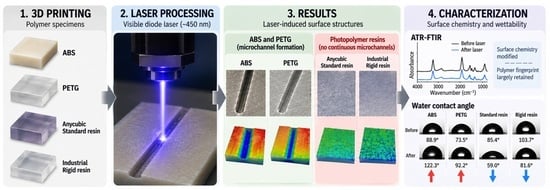
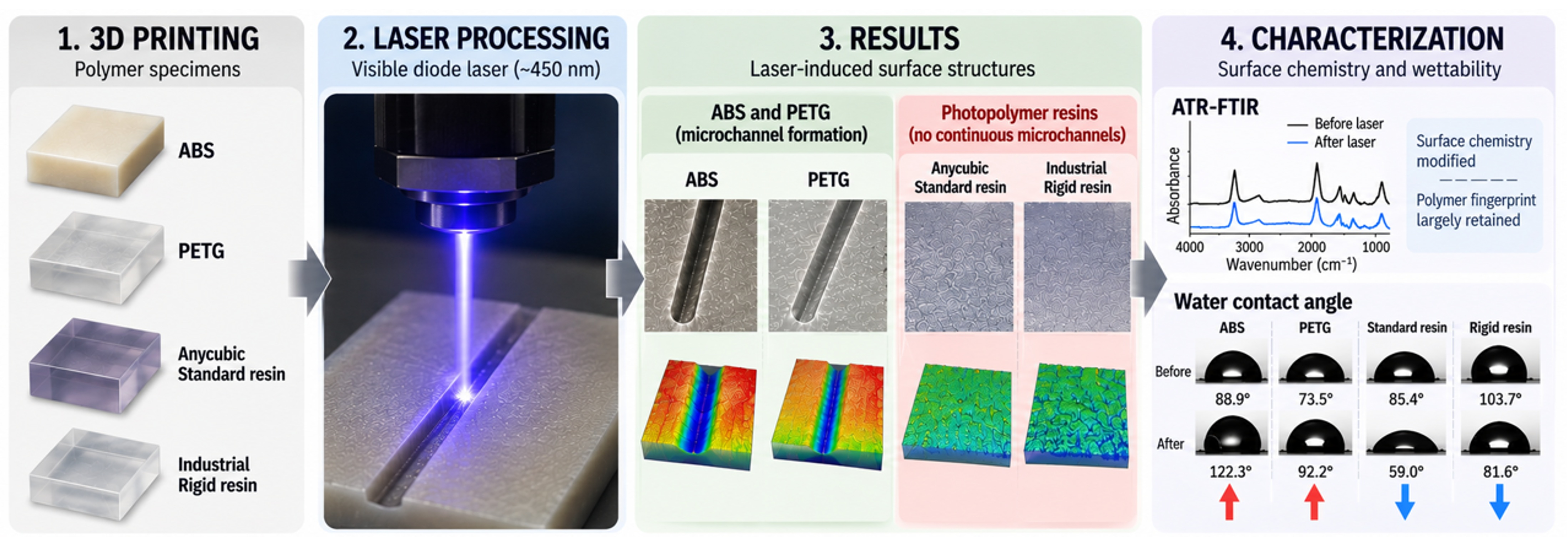
Additive manufacturing enables rapid fabrication of polymer components, but the direct production of well-defined microchannels remains challenging. Laser processing offers an attractive approach for introducing microscale features and modifying polymer surface properties. This study investigates visible diode laser processing of four additively manufactured polymers: acrylonitrile butadiene styrene (ABS), polyethylene terephthalate glycol (PETG), Anycubic Standard resin, and Industrial Rigid resin. Laser-processing conditions were screened and selected for each material, and surface modifications were evaluated using attenuated total reflectance Fourier transform infrared (ATR-FTIR) spectroscopy, contact angle measurements, and surface free energy calculations. ABS and PETG enabled successful microchannel formation, whereas continuous microchannels could not be obtained in the photopolymer resins under the investigated conditions. ATR-FTIR analysis revealed material-dependent surface modifications while largely preserving the characteristic polymer fingerprints. Laser treatment increased the water contact angle of ABS from 88.9° to 122.3° and PETG from 73.5° to 92.2°. In contrast, it decreased from 85.4° to 59.0° for Anycubic Standard resin and from 103.7° to 81.6° for Industrial Rigid resin. These contrasting responses demonstrate that diode laser processing can induce microstructuring, surface modification, or both, depending on the polymer substrate.

Graphical Abstract

1. Introduction

Laser processing has become an important surface engineering technique for tailoring physicochemical properties of polymeric materials. Depending on the laser wavelength, power density, scanning speed, and exposure time, laser irradiation can induce localized melting, ablation, oxidation, and microstructuring of polymer surfaces, thereby modifying their morphology, wettability, surface energy, and chemical functionality. These capabilities have led to widespread applications of laser surface modification in biomedical engineering, microfluidics, sensing technologies, and advanced manufacturing, where precise control of surface characteristics is essential [1,2,3,4].
Among various laser technologies, diode lasers have attracted increasing attention because of their relatively low cost, compact design, and ease of integration into manufacturing systems. Compared with conventional laser systems used for polymer processing, diode lasers provide a simpler and more accessible platform for laser-based fabrication and surface modification. Recent studies have demonstrated their potential for polymer micromachining, microstructuring, and microfluidic fabrication, supporting their use as cost-effective tools for microscale processing [5,6,7]. Nevertheless, the interaction between visible-wavelength diode lasers and polymeric materials is strongly influenced by the optical absorption of the substrate at the irradiation wavelength, which determines the efficiency of laser-energy coupling and the resulting thermal response. Consequently, material selection and optimization of parameters such as laser power, scanning speed, and number of passes are critical for achieving controlled and reproducible laser processing [8,9,10,11].
Microreactors represent one of the most promising applications of precisely engineered polymer surfaces. Owing to their high surface-area-to-volume ratio, enhanced heat and mass transfer, and improved process safety, microreactors have found widespread use in chemical synthesis, analytical chemistry, pharmaceutical manufacturing, and lab-on-a-chip systems [12,13,14,15,16,17]. Conventional fabrication methods including photolithography, micromilling, hot embossing, and injection moulding, generally require specialized equipment, clean-room facilities, or expensive tooling, limiting their accessibility for rapid prototyping and small-batch production [18,19,20,21]. The growing availability of additive manufacturing technologies has provided new opportunities for rapid fabrication of polymer microreactors. Fused filament fabrication (FFF), stereolithography (SLA), and digital light processing (DLP) enable the production of complex geometries with relatively low material consumption and short manufacturing times. However, the direct fabrication of narrow and well-defined microchannels remains challenging, particularly for FFF and low-cost desktop printers, where printing resolution, surface roughness, and dimensional accuracy can limit achievable channel geometry [22,23,24,25,26]. Consequently, hybrid manufacturing approaches that combine additive manufacturing with secondary surface-processing techniques have emerged as an attractive alternative for producing polymer substrates with precisely defined microchannel structures [27,28,29].
Laser engraving offers several advantages as a post-processing technique for additively manufactured polymer components. In addition to enabling the precise formation of microchannels, laser irradiation can modify the physicochemical properties of the processed surface, including roughness, wettability, and chemical composition [30,31,32,33]. These characteristics are particularly important in microfluidic applications, where interfacial interactions between the polymer surface and liquids influence wetting and fluid behavior. Although laser post-processing of additively manufactured polymers has been investigated with respect to surface quality, morphology, and wettability, comparative studies addressing different classes of 3D-printed polymers remain limited. In particular, the combined evaluation of microchannel formation, wettability, and chemical surface modification following diode laser processing has received considerably less attention [34,35]. Furthermore, the response of commonly available engineering polymers to diode laser irradiation can vary substantially because of differences in chemical composition, thermal properties, and optical absorption at the irradiation wavelength. Consequently, processing conditions suitable for one polymer may not be directly transferable to another, emphasizing the importance of evaluating different additive manufacturing materials under comparable laser-processing conditions [36,37].
In this work, polymer substrates produced by FFF, SLA, and DLP additive manufacturing were subjected to diode laser irradiation to investigate their suitability for laser-assisted microchannel fabrication and surface modification. Four commercially available polymer materials, including two thermoplastics and two photopolymer resins, were examined under material-specific processing conditions. The response to laser irradiation was evaluated in terms of microchannel formation, while laser-induced surface modifications were characterized using attenuated total reflectance Fourier transform infrared spectroscopy (ATR-FTIR), contact angle measurements, and surface free energy calculations. By comparing materials produced using different additive manufacturing technologies, this study provides insight into the relationship between polymer type, laser–material interaction, and the resulting surface properties, and evaluates the potential of a low-cost visible diode laser as a post-processing tool for additively manufactured polymer substrates.

2. Materials and Methods

2.1. Materials

Four polymeric materials representing different additive manufacturing technologies were investigated as substrates for diode laser processing. Polyethylene terephthalate glycol (PETG) filament (1.75 mm, black; Devil Design Sp. J., Mikołów, Poland) and acrylonitrile butadiene styrene (ABS) filament (1.75 mm, black, AzureFilm, Sežana, Slovenia) were used for fused filament fabrication (FFF). Vat photopolymerization materials included Anycubic Standard resin (black, Anycubic, Shenzhen, China) and Industrial Rigid resin (black, HARZ Labs, Riga, Latvia), processed using DLP and SLA technologies, respectively. Isopropanol (propan-2-ol, p.a. grade, Gram-mol d.o.o., Zagreb, Croatia) was used for post-processing and cleaning of resin-based specimens.

2.2. Fabrication of Polymer Substrates

Microreactor substrates were designed in Autodesk Fusion (version 1.3.0). Two geometries were prepared: rectangular plates (26 mm × 76 mm × 2 mm) intended for laser microchannel fabrication and flat strips (100 mm × 5 mm × 1.5 mm) intended for surface characterization before and after laser treatment. PETG and ABS specimens were fabricated using a Prusa i3 MK3S+ printer (Prusa Research, Prague, Czech Republic) with a layer height of 0.20 mm and 100% infill. To ensure consistent surface characteristics and eliminate the influence of build orientation on subsequent laser processing and surface characterization, all test substrates were printed in a horizontal orientation, lying flat on the build platform with their longest dimension aligned parallel to the printer x-axis. Photopolymer specimens were manufactured using Formlabs Form 2 (Formlabs Inc., Somerville, MA, USA) and Anycubic Photon M3 (Anycubic, Shenzhen, China) printers. After printing, resin specimens were washed in isopropanol using an Anycubic Wash and Cure 2.0 (Anycubic, Shenzhen, China) unit to remove residual uncured resin before laser processing.

2.3. Laser Engraving

Laser engraving was performed using a Creality CR-Laser Falcon 10 W diode laser engraver (Creality, Shenzhen, China), operating at a wavelength of 455 ± 5 nm. The laser spot size was 0.06 mm × 0.08 mm, and the maximum engraving speed was 10,000 mm min−1. Laser processing was controlled using LightBurn software (version 1.6.00), which enabled adjustment of laser power, scanning speed, and the number of engraving passes. For each polymer, combinations of laser power, scanning speed, and number of passes were investigated to assess the material response and identify conditions suitable for microchannel formation. For ABS and PETG, the processing conditions yielding the most continuous and well-defined channels were selected for subsequent characterization. For the photopolymer resins, for which continuous microchannels could not be obtained, the conditions producing the most pronounced visible laser–material interaction without excessive surface damage were selected. The selected conditions summarized in Table 1 were subsequently used for microchannel fabrication, dimensional characterization, and surface characterization. For ATR-FTIR analysis of ABS and PETG, an additional set of specimens was subjected to two consecutive laser passes under otherwise identical processing conditions, with the second pass performed in the same direction as the first pass. This additional treatment was included to evaluate whether repeated laser exposure produced a cumulative effect on the chemical characteristics of the thermoplastic surfaces. The photopolymer resins were evaluated after one laser pass only.

2.4. Microchannel Profilometry

The dimensions of the laser-engraved microchannels in ABS and PETG were characterized using a Keyence VK-X series 3D laser scanning confocal microscope (Keyence Corporation, Osaka, Japan). Measurements were performed using a 5× objective, and three-dimensional surface profiles were acquired directly from the engraved substrates without additional sample preparation. Channel width and depth were determined from cross-sectional profiles using VK Viewer software (version 3.3.1.85). Measurements were performed at multiple positions distributed along the length of each channel to account for possible dimensional variations along the laser-processing direction, and the results are reported as mean values ± standard deviation.

2.5. Attenuated Total Reflectance Fourier Transform Infrared (ATR-FTIR) Spectroscopy

The chemical structure of untreated and laser-treated polymer surfaces was analyzed by attenuated total reflectance Fourier transform infrared (ATR-FTIR) spectroscopy using an IRTracer-100 ATR-FTIR spectrometer (Shimadzu, Kyoto, Japan). Spectra were collected over the range of 4000–400 cm−1 with a spectral resolution of 4 cm−1 and 32 scans per measurement. Prior to comparison, all ATR-FTIR spectra were subjected to baseline correction. For ABS and PETG, untreated surfaces were compared with surfaces subjected to one and two laser passes, whereas Anycubic Standard and Industrial Rigid resins were compared in the untreated state and after one laser pass. The spectra were evaluated to identify chemical modifications induced by diode laser processing and, for the thermoplastic substrates, to assess the effect of repeated laser exposure.

2.6. Contact Angle Measurement

The wettability of untreated and laser-treated polymer surfaces was evaluated by static contact angle measurements using an OCA 20 goniometer (DataPhysics Instruments, Filderstadt, Germany). Measurements were performed using the sessile drop method with 2 µL droplets of deionized water and diiodomethane as test liquids at room temperature. The contact angle was determined after 60–80 ms using fitting based on the Young–Laplace equation. The measurement was repeated at least three times with each fluid for every test plate. Image acquisition and contact angle analysis were carried out using SCA 20 software (DataPhysics Instruments, Filderstadt, Germany). Surface free energy and its polar and dispersive components were subsequently calculated using the Owens–Wendt and Wu models.

3. Results and Discussion

3.1. Response of Different Polymer Substrates to Diode Laser Processing

The response of the investigated polymer substrates to diode laser irradiation depended strongly on the optical absorption characteristics and thermal behavior. Consequently, laser processing parameters, including laser power, scanning speed, and the number of engraving passes, were adjusted individually for each material. The primary objective was to identify conditions enabling the fabrication of continuous and well-defined microchannels, while simultaneously evaluating the response of the polymer surface to diode laser irradiation. In addition, materials that did not produce visible channels under the investigated conditions were further examined to evaluate laser-induced modifications of their surface characteristics and wettability, thereby providing insight into the interaction between diode laser irradiation and different classes of additively manufactured polymers. The selected laser processing parameters for each investigated material are summarized in Table 1. These conditions were used as the primary processing conditions for subsequent microchannel fabrication and surface characterization (Figure 1). For ATR-FTIR analysis of ABS and PETG, additional specimens treated with two laser passes were included to evaluate the effect of repeated irradiation.
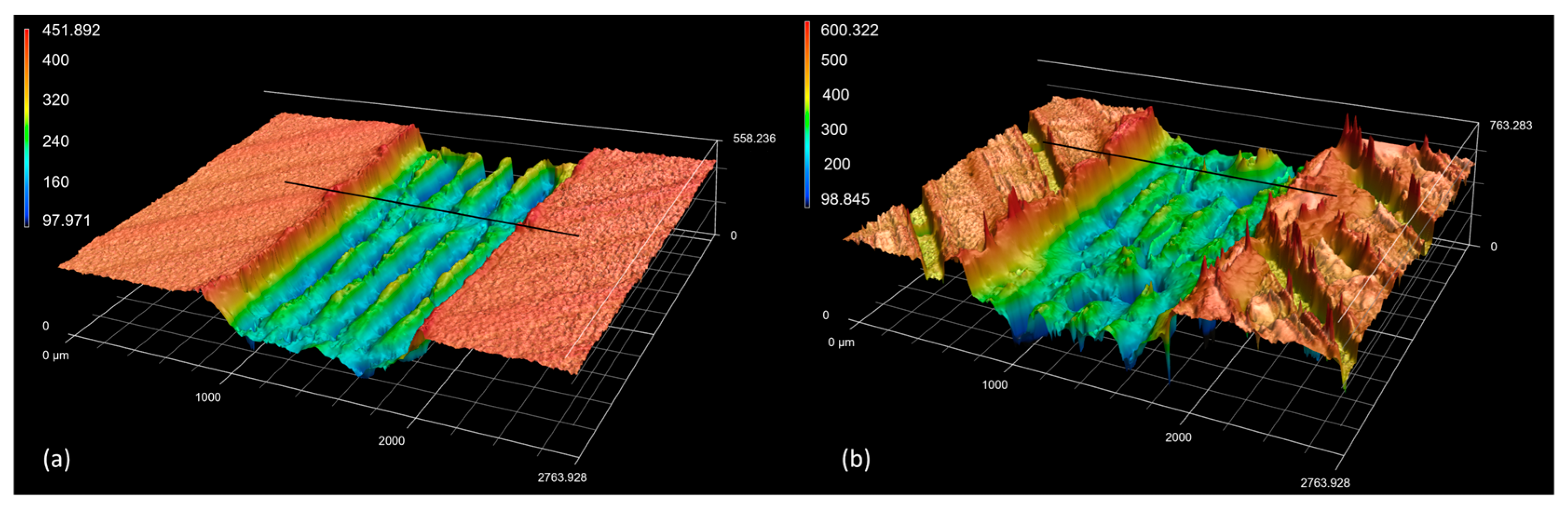
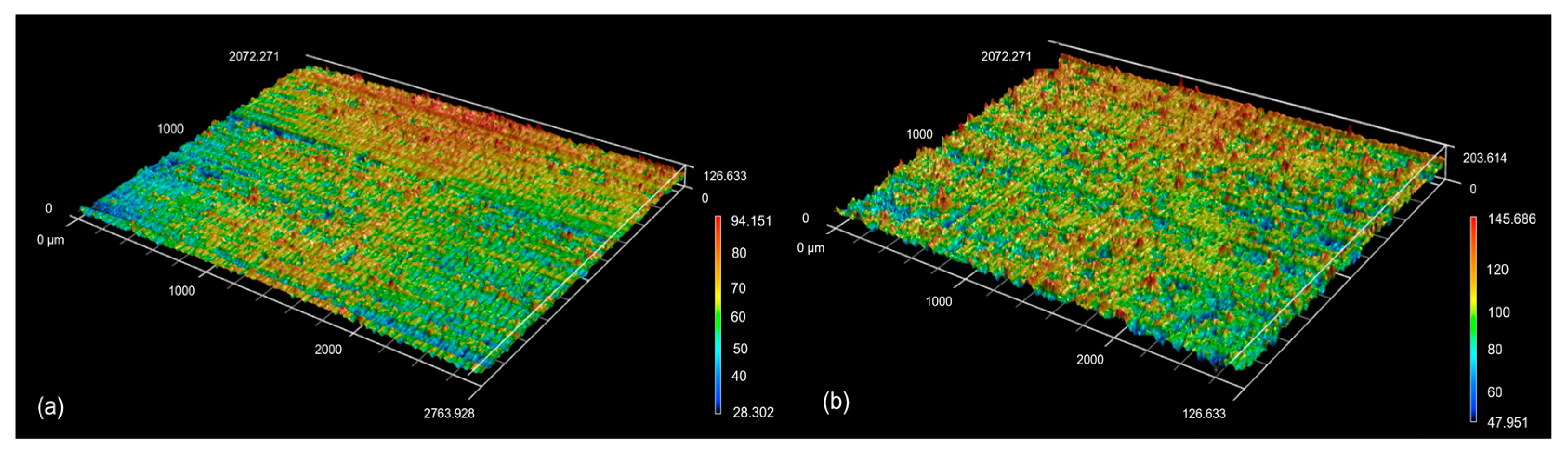
Profilometric measurements confirmed the formation of channels in both thermoplastic substrates. Representative cross-sectional profiles showed a channel width of approximately 1107 ± 3 µm and a depth of 197 ± 5 µm for ABS, whereas PETG exhibited a width of approximately 1166 ± 2 µm and a depth of 284 ± 2 µm (Figure 2). Under the selected processing conditions, PETG therefore exhibited a greater channel depth, while the measured channel widths were comparable. These results quantitatively confirm successful channel formation in both thermoplastic substrates and demonstrate material-dependent differences in the resulting channel geometry. The profilometric images also reveal an irregular internal morphology of the laser-engraved channels, resulting from localized melting, resolidification, and redeposition of the thermoplastic material. For applications requiring a smoother and more regular channel geometry, the laser-processing step would therefore benefit from a subsequent polishing or surface-finishing procedure adapted to the channel dimensions. In the present study, the channels were characterized in the as-laser-treated state to evaluate the direct material response to diode laser processing. In contrast, profilometric analysis of the laser-treated photopolymeric materials (Figure 3) showed no visible material removal or channel formation under the selected processing conditions. This observation highlights the markedly different response of the cross-linked photopolymeric resins to diode laser irradiation compared with the thermoplastic substrates.
Considerable differences in engraving behavior were observed among the investigated materials despite using the same diode laser system. Among the investigated materials, ABS exhibited the highest suitability for diode laser engraving. Continuous and well-defined microchannels were obtained with minimal thermal damage to the surrounding material. In contrast, PETG required more careful adjustment of the processing parameters, as excessive laser energy resulted in localized melting and deformation of the channel edges. These observations indicate that PETG possesses a narrower processing window than ABS for diode laser engraving. Although continuous microchannels were not obtained in the Anycubic Standard and Industrial Rigid photopolymer resins under the investigated processing conditions, subsequent ATR-FTIR spectroscopy and contact-angle measurements revealed that laser irradiation induced measurable changes in their surface properties. These findings suggest that, despite their limited suitability for direct microchannel fabrication using the selected diode laser, both photopolymer resins remain responsive to laser-induced surface modification. The distinct responses observed between the thermoplastic polymers and the photopolymer resins highlight the importance of polymer structure in determining the outcome of diode laser processing. Whereas the thermoplastic materials underwent localized melting and ablation that enabled channel formation, the cross-linked photopolymer resins showed substantially less effective material removal under the selected processing conditions.

3.2. ATR-FTIR Analysis

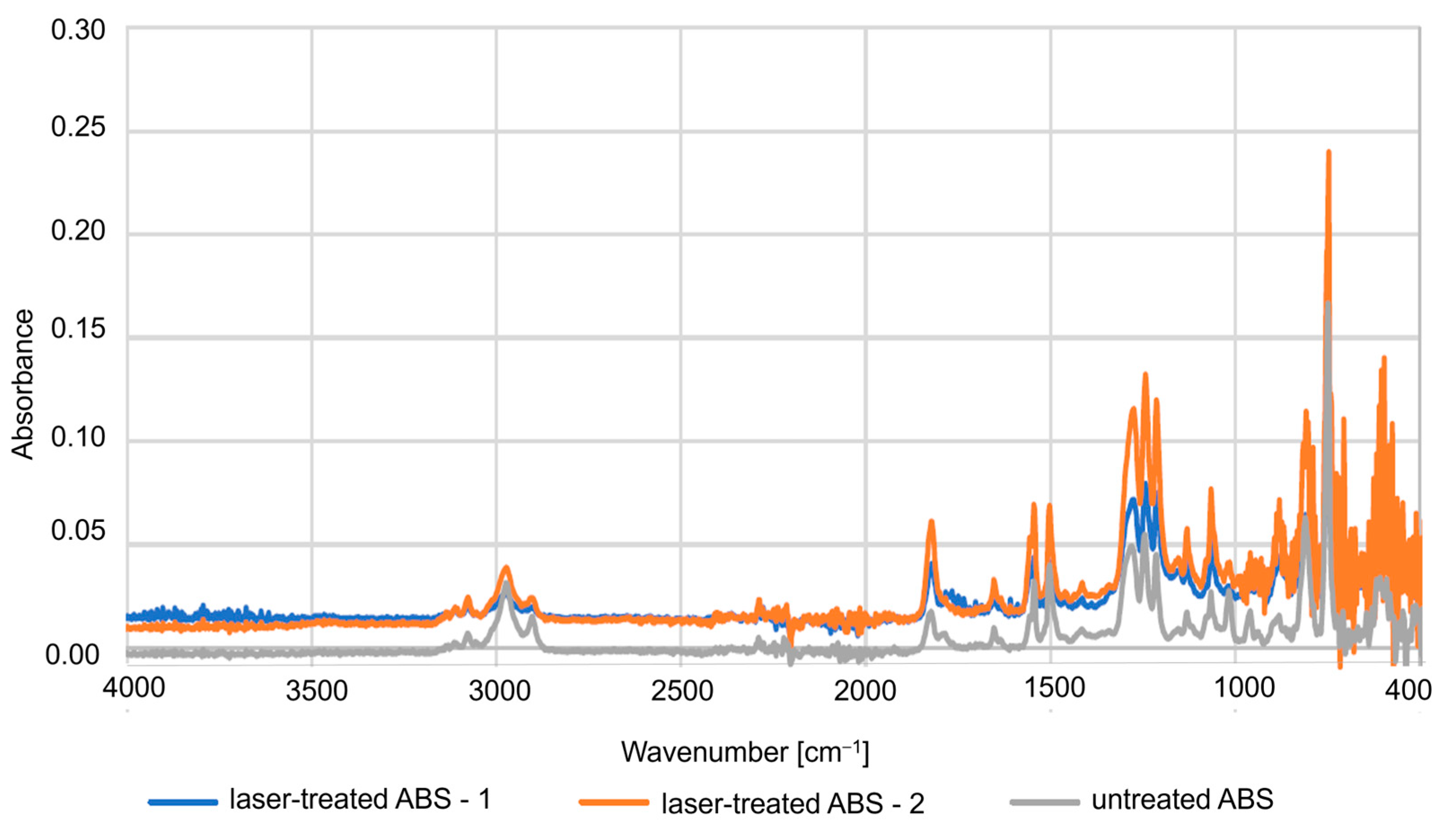
ATR-FTIR spectroscopy was employed to evaluate the effect of diode laser irradiation on the chemical characteristics of the investigated polymer surfaces. Comparison of the spectra acquired before and after laser treatment enabled assessment of laser-induced modifications of the surface layer and provided insight into the interaction between the laser beam and polymers of different chemical compositions. Although continuous microchannels were successfully fabricated only in the thermoplastic materials, ATR-FTIR analysis was performed for all investigated polymers to determine whether laser irradiation produced detectable changes in their chemical structure, irrespective of the extent of material removal. Figure 4 shows the ATR-FTIR spectra of untreated ABS and samples subjected to one and two laser passes. The one-pass condition corresponds to the selected processing parameters reported in Table 1, while the additional two-pass treatment was included to assess the cumulative effect of repeated laser exposure on the ABS surface. The spectra of both treated samples retain the characteristic bands of ABS, indicating that the main polymer structure remains detectable after laser treatment. The bands around 3000–2800 cm−1 are attributed to C–H stretching vibrations, while the characteristic band around 2230–2240 cm−1 corresponds to C≡N stretching of the acrylonitrile component. Bands around 1600–1450 cm−1 are mainly associated with aromatic C=C vibrations of the styrene component and CH2 deformation [38]. Pronounced differences are observed in the fingerprint region below 1500 cm−1, including bands related to the styrene and butadiene components of ABS. Overall, untreated ABS exhibits the lowest absorbance, while both laser-treated samples show increased spectral intensity. ABS-2 generally shows the strongest absorbance, followed by ABS-1, indicating that the additional laser pass produces a greater modification of the ABS surface. The particularly pronounced differences in the fingerprint region suggest that repeated laser exposure has a cumulative effect on the material. It should also be emphasized that changes in ATR-FTIR band intensity cannot be attributed exclusively to chemical transformations, since laser-induced roughening, melting, resolidification, and ablation can modify the contact between the specimen and the ATR crystal and may consequently affect the measured absorbance. Therefore, the results indicate that laser treatment modifies the ABS surface and that this effect becomes more pronounced after two laser passes, while the characteristic chemical fingerprint of ABS remains largely detectable.
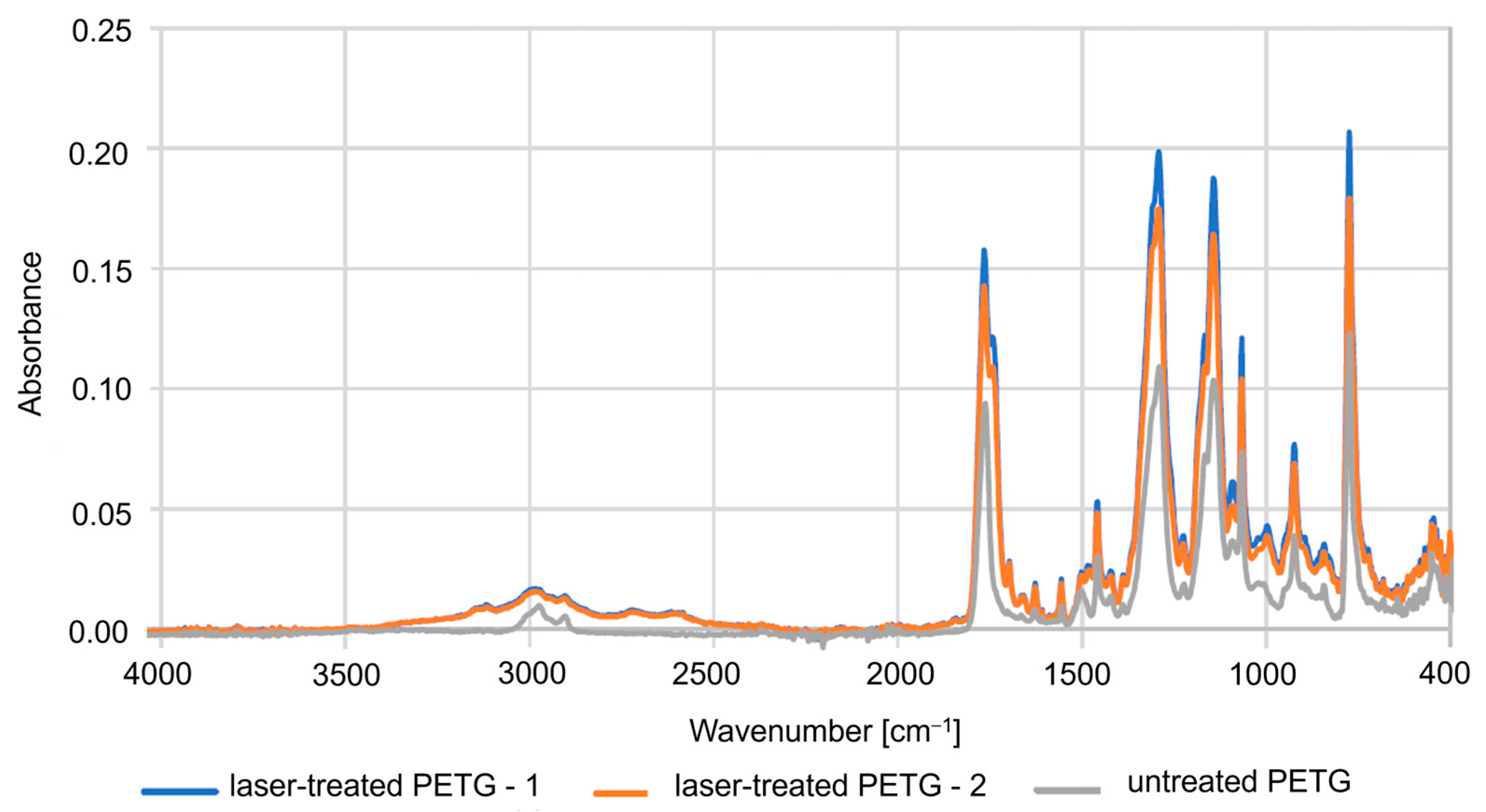
Figure 5 shows the ATR-FTIR spectra of untreated PETG and samples subjected to one and two laser passes. The one-pass condition corresponds to the selected processing parameters reported in Table 1, while the two-pass treatment was additionally investigated to evaluate whether repeated irradiation resulted in more pronounced surface modification. All samples exhibit the characteristic absorption bands of PETG, indicating that the main polymer structure remains detectable after laser treatment. The weak bands in the region from 3000 cm−1 to 2800 cm−1 can be associated with C-H stretching vibrations, while the strong band around 1730–1715 cm−1 corresponds to C=O stretching of ester groups characteristic of PETG. Pronounced bands in the 1250–1000 cm−1 region are mainly associated with C-O-C and C-O stretching vibrations, while the strong band around 750–700 cm−1 is related to aromatic ring vibrations [39,40]. Both laser-treated samples generally show higher absorbance than untreated PETG, particularly in the carbonyl and fingerprint regions. Changes in the relative intensities of the carbonyl and C-O/C-O-C related bands suggest modification of oxygen-containing functionalities in the near-surface region. Under laser irradiation, localized heating may promote competing processes including chain scission, oxidation, and thermal degradation. However, the absence of clearly resolved new absorption bands prevents an unambiguous assignment of the observed changes to a specific reaction pathway. PETG–1 and PETG–2 exhibit relatively similar spectra, with PETG–1 showing slightly higher intensities for several major bands. Therefore, increasing the number of laser passes from one to two did not result in a proportional increase in ATR-FTIR absorbance. The observed differences may result from laser-induced physical and chemical surface modifications, including local heating, melting and resolidification, and changes in surface roughness. Overall, laser treatment at 80% power modifies the PETG surface, while the characteristic ATR-FTIR fingerprint of the polymer remains largely detectable.
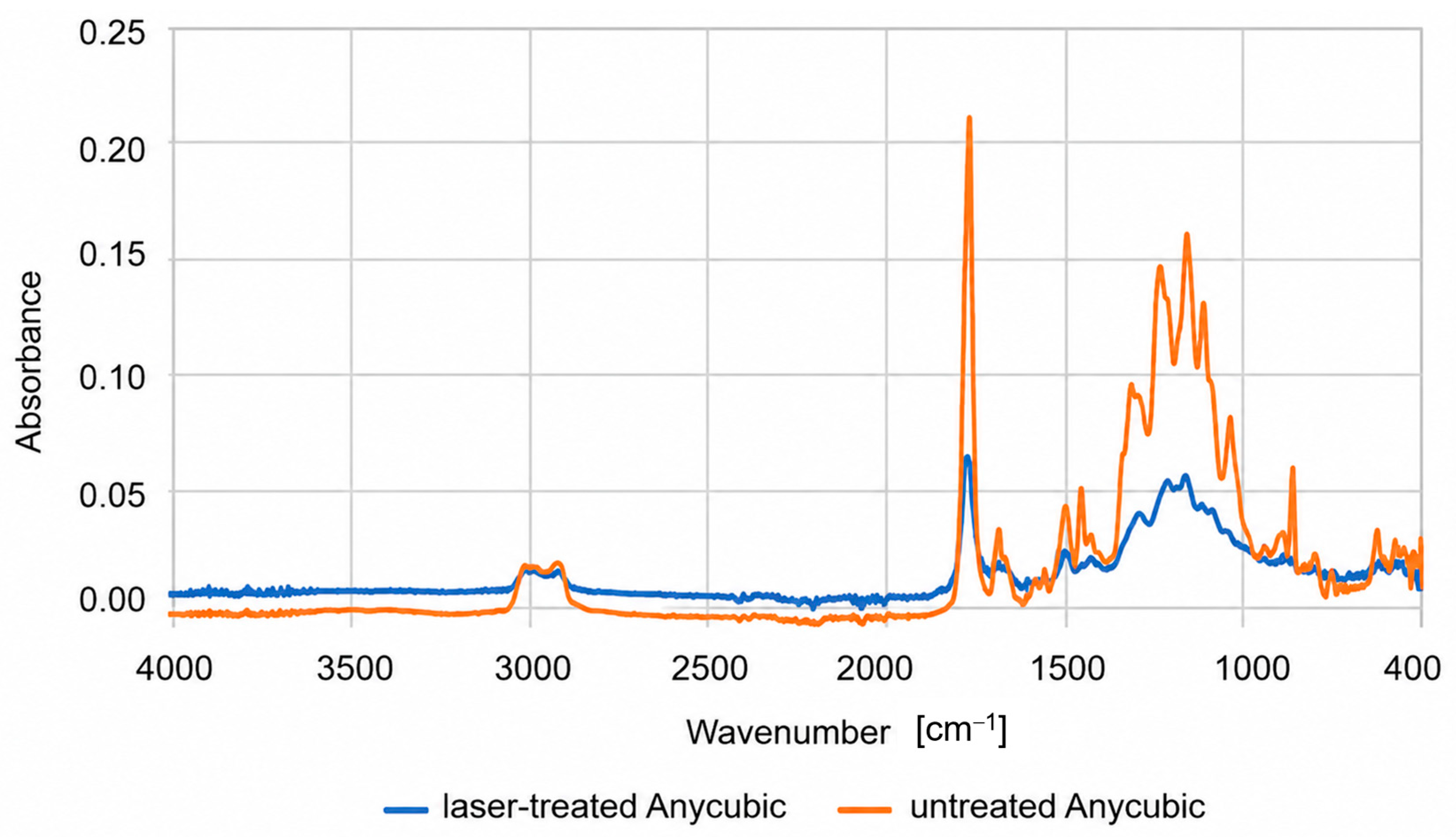
Figure 6 shows the ATR-FTIR spectra of untreated and laser-treated Anycubic Standard resin, where the treated sample was exposed to one laser pass. Both spectra exhibit bands characteristic of an acrylate-based photopolymer resin, but substantial differences in absorbance intensity are observed after laser treatment. The band around 3000–2900 cm−1 is associated mainly with C-H stretching vibrations, while the strong absorption around 1750–1700 cm−1 can be attributed to C=O stretching of ester/acrylate groups. Bands in the 1500–1000 cm−1 fingerprint region are mainly related to C-O, C-O-C and C-C vibrations and other vibrations in the polymer network. Compared with the untreated resin, the laser-treated sample shows a pronounced decrease in absorbance, particularly in the carbonyl region and throughout the fingerprint region. Despite these intensity differences, no major shifts in the positions of the characteristic absorption bands are observed. The results therefore indicate changes in the near-surface response of the resin following laser exposure, although the origin of the reduced absorbance cannot be determined from ATR-FTIR alone. In addition to possible physicochemical changes induced by laser irradiation, changes in surface morphology and sample-ATR crystal contact may contribute to the observed intensity differences. Therefore, the spectral changes should not be interpreted as evidence of a specific chemical transformation.
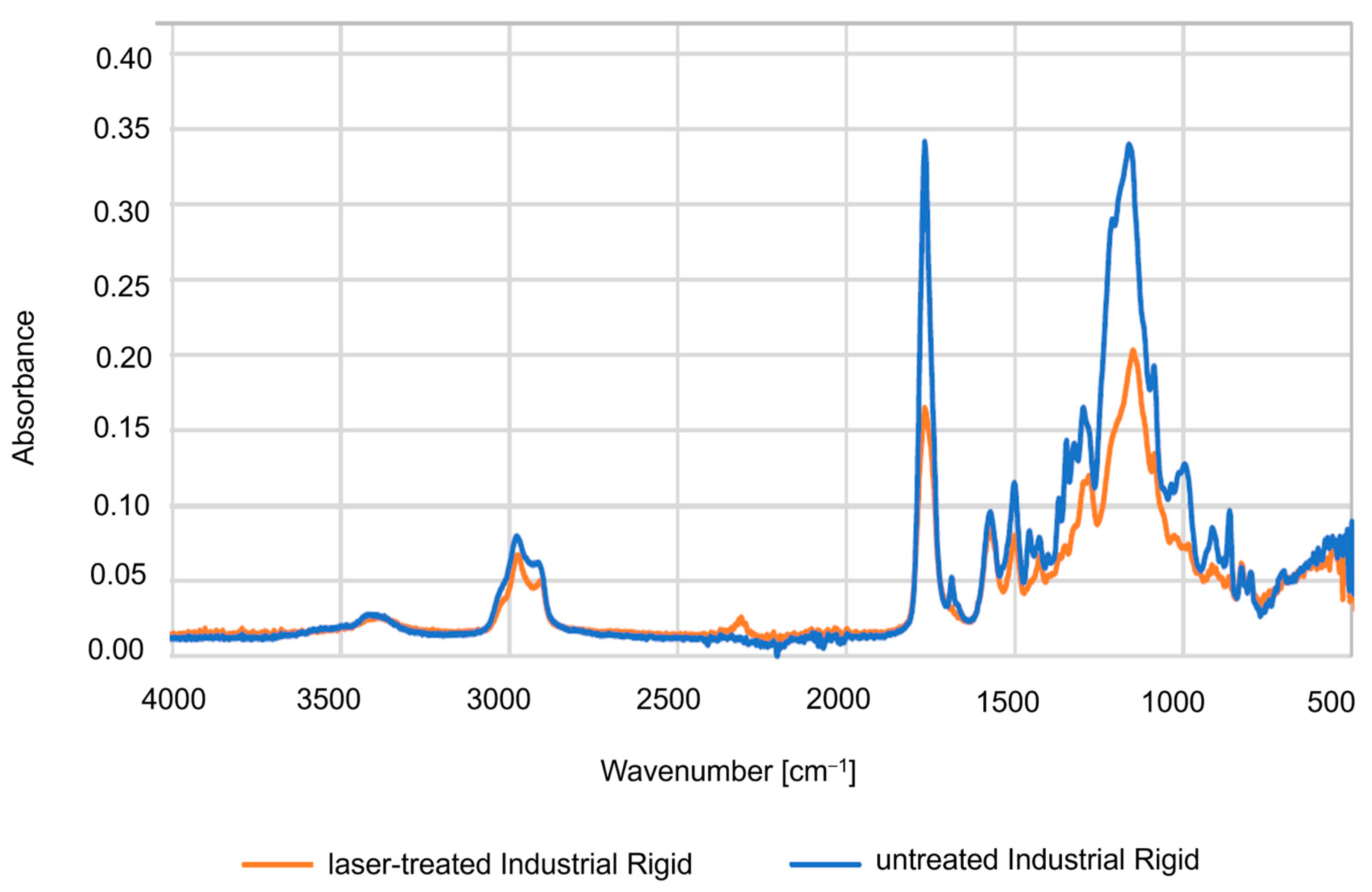
Figure 7 shows the ATR-FTIR spectra of untreated and laser-treated Industrial Rigid resin, with the treated sample subjected to one laser pass. Both spectra exhibit similar characteristic bands, indicating that the characteristic spectral fingerprint of the resin remains detectable after laser treatment. The bands around 3000–2900 cm−1 are associated with C-H stretching vibrations, while the strong peak around 1750–1700 cm−1 is attributed to C=O stretching of ester/acrylate groups. The pronounced bands in the 1500–1000 cm−1 region can mainly be related to C-O, C-O-C and other vibrations of the cross-linked polymer structure. The laser-treated sample generally exhibits lower absorbance than untreated Industrial Rigid resin, with the most pronounced decrease observed around 1750 cm−1 to 1700 cm−1 and in the fingerprint region between 1300 cm−1 and 1000 cm−1 [41]. However, the positions of the main absorption bands remain largely unchanged. The changes in relative band intensities indicate that laser irradiation affects the near-surface region of the resin, but they do not provide sufficient evidence to assign a specific chemical transformation. Possible contributions may include localized thermal effects, changes in the cross-linked polymer network, and changes in surface morphology or roughness. Furthermore, variations in surface morphology can influence the contact between the sample and the ATR crystal and therefore contribute to differences in measured absorbance. Consequently, the ATR-FTIR results indicate a measurable response of the Industrial Rigid resin surface to one laser pass, while its main characteristic spectral fingerprint remains detectable.
Taken together, the spectral changes indicate that diode laser irradiation produces material-dependent physicochemical modification of the polymer surfaces. For ABS and PETG, the observed spectral changes occur concurrently with melting, resolidification, and ablation, indicating that thermal effects play an important role in the laser–material interaction. Thermal degradation, chain scission, and oxidation may therefore contribute to the observed changes in relative band intensities. In contrast, the cross-linked photopolymer resins did not exhibit effective material removal, despite pronounced changes in their ATR-FTIR spectra. Their spectral evolution, particularly in the carbonyl and C–O/C–O–C regions, indicates modification of the near-surface region. However, the specific physicochemical processes responsible for these spectral changes cannot be determined from the present ATR-FTIR data. Specific reaction pathways such as thermolysis, pyrolysis, photolysis, or formation of new chemical bonds cannot be conclusively assigned from the present data.

3.3. Wettability and Surface Free Energy

Contact angle measurements were performed to evaluate changes in surface wettability induced by diode laser treatment. Water and diiodomethane (DIM) were used as polar and predominantly dispersive probe liquids, respectively, and the measured contact angles together with the surface free energy values calculated using the Owens–Wendt (OW) and Wu approaches are summarized in Table 2. Pronounced material-dependent changes were observed following laser treatment, indicating that the effect of diode laser irradiation on wettability strongly depends on the chemical nature and surface response of the polymer substrate.
Laser treatment produced distinct material-dependent changes in wettability and surface free energy. For ABS, the water contact angle increased from 88.9 ± 0.3° to 122.3 ± 2.2°, while the DIM contact angle increased from 61.1 ± 2.1° to 110.0 ± 0.9°. This was accompanied by a substantial decrease in total surface free energy and its polar contribution according to both the OW and Wu models, indicating markedly reduced wettability after laser treatment. The observed response may reflect changes in both surface chemistry and morphology resulting from laser-induced melting, ablation, and resolidification. PETG showed a similar but less pronounced response. The water contact angle increased from 73.5 ± 4.2° to 92.2 ± 1.7°, while the DIM contact angle increased from 57.4 ± 1.6° to 65.5 ± 1.4°. Although the total surface free energy changed only slightly according to the OW model and decreased moderately according to the Wu model, both approaches indicated a substantial reduction in the calculated polar contribution following laser treatment. In contrast, the photopolymer resins became more wettable after irradiation. For Anycubic Standard resin, the water contact angle decreased from 85.4 ± 2.6° to 59.0 ± 2.1°. The DIM droplet spread beyond the measurable range on the laser-treated surface, preventing calculation of the surface free energy but indicating a substantial alteration of its interfacial properties. Industrial Rigid showed a decrease in water contact angle from 103.7 ± 2.8° to 81.6 ± 3.7°, accompanied by an increase in the calculated polar contribution to surface free energy according to both models. Overall, the results reveal contrasting responses of the two polymer classes. ABS and PETG became less wettable and exhibited reduced polar contributions to surface free energy, whereas both photopolymer resins showed enhanced water wettability. These findings complement the ATR-FTIR results and demonstrate that pronounced surface modification can occur even without effective material removal. However, because surface roughness and topography were not quantitatively characterized, the observed wettability changes should be interpreted as the combined response of chemical and morphological surface modifications rather than being attributed exclusively to changes in surface chemistry.
The material-dependent wettability changes observed in the present study are consistent with previous reports demonstrating that laser irradiation can substantially modify polymer wetting behavior, although both the direction and magnitude of the response depend on the polymer, irradiation conditions, and resulting surface morphology. Lavieja et al. [42] demonstrated this particularly clearly for ABS treated with a nanosecond green laser, obtaining either superhydrophilic or superhydrophobic surfaces simply by varying the irradiation conditions. At high fluence, extensive surface heating and material flow produced an almost flat superhydrophilic surface, whereas lower fluence generated a rugged morphology with water contact angles exceeding 150°. Similarly, Rodríguez-Vidal et al. [43] used picosecond and nanosecond laser texturing to modify ABS wettability and reported an increase in the water contact angle from 90° for the untextured surface to values approaching 150° for laser-generated microtextures. These findings are consistent with the pronounced increase observed in the present study and demonstrate that laser-induced morphology can strongly influence the apparent wettability of ABS. However, because surface topography was not quantitatively characterized here, a direct morphological explanation for the observed contact-angle increase cannot be established.
The PETG results show a similar tendency toward reduced wettability. Bharatish et al. [44] examined laser post-processing of 3D-printed PETG and reported water contact angles ranging from 70.7° to 93.4° depending on the laser-processing and printing parameters, with a maximum value of 94° under the investigated conditions. The authors associated the increased hydrophobicity with changes produced during laser polishing and the corresponding reduction in surface free energy. The contact angle obtained for laser-treated PETG in the present study therefore falls within the range reported by Bharatish et al., despite differences in laser-processing conditions. In contrast to the thermoplastic substrates, both photopolymer resins exhibited increased wettability following diode laser irradiation. This contrasting response further demonstrates that increased hydrophobicity is not an inherent consequence of laser treatment. Indeed, Lavieja et al. [43] showed that even within a single polymer system, laser irradiation can produce either strongly hydrophilic or strongly hydrophobic surfaces depending on the irradiation regime and resulting morphology. In the present case, the response of the photopolymer resins was also accompanied by changes in their ATR-FTIR spectra and, for Industrial Rigid, a pronounced increase in the calculated polar component of the surface free energy. Taken together, these observations indicate that the interaction of the visible diode laser with the cross-linked photopolymer surfaces differed fundamentally from that observed for the FFF thermoplastics.
The comparative response of the four materials is particularly relevant because it demonstrates that the effectiveness of diode laser processing cannot be evaluated solely in terms of material removal. ABS and PETG underwent sufficient localized ablation to enable microchannel formation while simultaneously developing less wettable surfaces. Conversely, the photopolymer resins resisted controlled microchannel formation under the investigated conditions but nevertheless exhibited pronounced changes in surface characteristics and wettability. Thus, the same low-cost visible diode laser platform produced fundamentally different outcomes depending on the polymer class, ranging from simultaneous microstructuring and surface modification to predominantly physicochemical surface modification without effective material removal. These findings broaden the potential role of diode lasers as post-processing tools for additively manufactured polymers and provide a basis for selecting materials according to whether the desired outcome is microstructuring, modification of surface properties, or a combination of both.

4. Conclusions

This study demonstrated a strongly material-dependent response of additively manufactured polymers to visible diode laser processing. ABS and PETG enabled successful microchannel formation, with ABS exhibiting the most favorable engraving behavior. The resulting channels had a width of 1107 ± 3 µm and a depth of 197 ± 5 µm for ABS, compared with 1166 ± 2 µm and 284 ± 2 µm for PETG. In contrast, the Anycubic Standard and Industrial Rigid photopolymer resins resisted effective material removal under the investigated conditions. Nevertheless, ATR-FTIR analysis indicated laser-induced modifications of all investigated surfaces while their characteristic spectral fingerprints remained largely detectable. Diode laser treatment also produced distinctly different changes in wettability. The water contact angle increased from 88.9 ± 0.3° to 122.3 ± 2.2° for ABS and from 73.5 ± 4.2° to 92.2 ± 1.7° for PETG, indicating reduced wettability. In contrast, the water contact angle decreased from 85.4 ± 2.6° to 59.0 ± 2.1° for Anycubic Standard resin and from 103.7 ± 2.8° to 81.6 ± 3.7° for Industrial Rigid resin, demonstrating increased water wettability after irradiation. These findings demonstrate that the absence of effective laser ablation does not imply the absence of surface modification. Visible diode lasers therefore represent a versatile and accessible post-processing approach for additively manufactured polymers, with their application ranging from microstructuring to targeted modification of surface properties depending on the polymer substrate.
Based on these findings, the following practical implications and directions for future research can be highlighted:
  • Potential applications: Diode laser processing can be considered as a low-cost post-processing approach for rapid microchannel fabrication in additively manufactured thermoplastic components, with potential applications in microfluidic devices and microreactors.
  • Surface modification: The ability to modify polymer surface properties even without effective material removal may be useful in applications where localized control of surface wettability is required.
  • Process optimization: Further work should focus on optimizing laser power, scanning speed, and number of passes to improve channel geometry, reproducibility, and surface quality.
  • Material and laser selection: Additional polymer materials and laser wavelengths should be investigated to better establish the relationship between polymer properties, optical absorption, and laser-processing performance.
  • Further characterization: Complementary surface characterization techniques should be employed to better distinguish chemical and morphological contributions to the observed changes in surface properties.

Author Contributions

Conceptualization, E.F. and D.V.; methodology, E.F., M.-P.M. and D.V.; validation, E.F., M.-P.M. and D.V.; formal analysis, E.F., M.-P.M., L.Š. and D.V.; investigation, E.F. and L.Š.; data curation, E.F., L.Š.; writing—original draft preparation, E.F.; writing—review and editing, E.F., M.-P.M. and D.V.; visualization, E.F., M.-P.M. and D.V.; supervision, M.-P.M. and D.V.; funding acquisition, D.V. All authors have read and agreed to the published version of the manuscript.

Funding

This work was supported by the Croatian Science Foundation under the project numbers HRZZ-DOK-NPOO-2023-10-1144, HRZZ-DOK-2021-02-5999, HRZZ-DOK-2025-02-4318, and HRZZ-IP-2022-10-8004.

Institutional Review Board Statement

Not applicable.

Informed Consent Statement

Not applicable.

Data Availability Statement

The original contributions presented in this study are included in the article. Further inquiries can be directed to the corresponding authors.

Conflicts of Interest

The authors declare no conflicts of interest.

References

  1. Khan, M.A.; Halil, A.M.; Zainol Abidin, M.S.; Hassan, M.H.; Ab Rahman, A.A. Influence of laser surface texturing on the surface morphology and wettability of metals and non-metals: A review. Mater. Today Chem. 2024, 41, 102316. [Google Scholar] [CrossRef] [Scilit]
  2. Obilor, A.F.; Pacella, M.; Wilson, A.; Silberschmidt, V.V. Micro-texturing of polymer surfaces using lasers: A review. Int. J. Adv. Manuf. Technol. 2022, 120, 103–135. [Google Scholar] [CrossRef] [Scilit]
  3. Chen, Z.; Zhou, J.; Cen, W.; Yan, Y.; Guo, W. Femtosecond laser fabrication of wettability-functional surfaces: A review of materials, structures, processing, and applications. Nanomaterials 2025, 15, 573. [Google Scholar] [CrossRef] [Scilit]
  4. Ciofu, C.-D.; Ostahie, P.-D.R.; Adamiak, M.; Bialas, O.; Tampu, C.; Kyratsis, P.; Tzotzis, A.; Mazurchevici, S.-N.; Nedelcu, A.; Jiang, Z.; et al. Wettability, tribology, degradation, and topography of laser-textured surfaces of biopolymers. Micromachines 2025, 16, 1009. [Google Scholar] [CrossRef] [Scilit]
  5. Niranjana, S.; Vadakke Matham, M.; Suchand Sandeep, C. Cost effective micromanufacturing with low power lasers: A review. Micro Nano Syst. Lett. 2026, 14, 3. [Google Scholar] [CrossRef] [Scilit]
  6. Li, L.; Huang, Y.; Fan, Y. Low-cost irreversible blue diode laser transmission welding of poly(methyl methacrylate)-based microfluidics. Appl. Phys. A 2022, 128, 1098. [Google Scholar] [CrossRef] [Scilit]
  7. Sow, A.C.; Palleau, E.; Fabre-Francke, I.; Ressier, L. UV photosensitive PMMA-based nanocomposites micropatterned by laser for product traceability and anticounterfeiting applications. Adv. Mater. Interfaces 2025, 12, e00805. [Google Scholar] [CrossRef] [Scilit]
  8. Pazokian, H.; Salmani, M.; Jafarfard, M.R.; Soleimani, A. Structural and electrical characterization of laser-induced graphene derived from a 445 nm visible laser source. Surf. Interfaces 2026, 97, 110071. [Google Scholar] [CrossRef] [Scilit]
  9. Ilie, M.; Cicala, E.; Grevey, D.; Mattei, S.; Stoica, V. Diode laser welding of ABS: Experiments and process modeling. Opt. Laser Technol. 2009, 41, 608–614. [Google Scholar] [CrossRef] [Scilit]
  10. Troughton, J.G.; Proctor, C.M. Laser micromachining for bioelectronics: Past, present, and future. Small Methods 2026, 10, e01560. [Google Scholar] [CrossRef] [Scilit]
  11. Ham, S.S.; Lee, H. Surface characteristics of polymers with different absorbance after UV picosecond pulsed laser processing using various repetition rates. Polymers 2020, 12, 2018. [Google Scholar] [CrossRef] [Scilit]
  12. Suryawanshi, P.L.; Gumfekar, S.P.; Bhanvase, B.A.; Sonawane, S.H.; Pimplapure, M.S. A review on microreactors: Reactor fabrication, design, and cutting-edge applications. Chem. Eng. Sci. 2018, 189, 431–448. [Google Scholar] [CrossRef] [Scilit]
  13. Vijaya Bhaskar, K.; Rashed, M.; Subrahmanya Bhat, K.; Lee, J.; Kim, K.-H.; Buruga, K. A continuous flow microreactor as a practical tool for the synthesis of active pharmaceutical ingredients. Process Saf. Environ. Prot. 2024, 192, 437–449. [Google Scholar] [CrossRef] [Scilit]
  14. da Silva, J.L., Jr.; Santana, H.S.; Hodapp, M.J. Microreactor technology applied to catalytic processing of hydrogen: A review. J. Ind. Eng. Chem. 2025, 143, 65–84. [Google Scholar] [CrossRef] [Scilit]
  15. Tan, Z.; Zheng, Y.; Shi, H.; Xu, W.; Jia, X.; Dan, Z.; Liao, J.; Dai, Z.; Xu, C. Research progress and application exploration of typical microreactor technologies for health monitoring and disease diagnosis/treatment. Chem. Eng. J. 2024, 499, 155938. [Google Scholar] [CrossRef] [Scilit]
  16. Capaldo, L.; Wen, Z.; Noël, T. A field guide to flow chemistry for synthetic organic chemists. Chem. Sci. 2023, 14, 4230–4247. [Google Scholar] [CrossRef] [Scilit]
  17. Zhao, X.; Jiang, H.; Wang, S.; Yuan, X.; Feng, Y.; Yang, J.; Li, Y.; Zhu, N.; Zhao, S.; He, W.; et al. Microreactors in chemical process intensification: Chemical reactions, crystallizations, extractions and emulsifications. Chem. Eng. J. 2025, 519, 165223. [Google Scholar] [CrossRef] [Scilit]
  18. Lu, H.; Rakhymzhanov, A.; Buttner, U.; Alsulaiman, D. Making healthcare accessible: A rapid clean-room-free fabrication strategy for microfluidics-driven biosensors based on coupling stereolithography and hot embossing. ACS Omega 2024, 9, 38096–38106. [Google Scholar] [CrossRef] [Scilit]
  19. Liu, X.; Sun, A.; Brodský, J.; Gablech, I.; Lednický, T.; Vopařilová, P.; Zítka, O.; Zeng, W.; Neužil, P. Microfluidics chips fabrication techniques comparison. Sci. Rep. 2024, 14, 28793. [Google Scholar] [CrossRef] [Scilit]
  20. Alexandre-Franco, M.F.; Kouider, R.; Kassir Al-Karany, R.; Cuerda-Correa, E.M.; Al-Kassir, A. Recent advances in polymer science and fabrication processes for enhanced microfluidic applications: An overview. Micromachines 2024, 15, 1137. [Google Scholar] [CrossRef] [Scilit]
  21. Ma, Y.; Sun, X.; Cai, Z.; Tu, M.; Wang, Y.; Ouyang, Q.; Yan, X.; Jing, G.; Yang, G. Transformation gap from research findings to large-scale commercialized products in microfluidic field. Mater. Today Bio 2024, 29, 101373. [Google Scholar] [CrossRef] [Scilit]
  22. López Santiago, J.G.; Rodríguez Martínez, O.M.; Sundaram, P.A. 3D-printed microfluidic and millifluidic devices for cell culture and mechanotransduction studies: A review. J. Micromanuf. 2024, 7, 216–230. [Google Scholar] [CrossRef] [Scilit]
  23. Afridi, A.; Al Rashid, A.; Koç, M. Recent advances in the development of stereolithography-based additive manufacturing processes: A review of applications and challenges. Bioprinting 2024, 43, e00360. [Google Scholar] [CrossRef] [Scilit]
  24. Shafique, H.; Karamzadeh, V.; Kim, G.; Shen, M.L.; Morocz, Y.; Sohrabi-Kashani, A.; Juncker, D. High-resolution low-cost LCD 3D printing for microfluidics and organ-on-a-chip devices. Lab Chip 2024, 24, 2774–2790. [Google Scholar] [CrossRef] [Scilit]
  25. Xu, J.; Harasek, M.; Gföhler, M. From soft lithography to 3D printing: Current status and future of microfluidic device fabrication. Polymers 2025, 17, 455. [Google Scholar] [CrossRef] [Scilit]
  26. Ece, E.; Ölmez, K.; Hacıosmanoğlu, N.; Atabay, M.; Inci, F. Advancing 3D printed microfluidics with computational methods for sweat analysis. Microchim. Acta 2024, 191, 162. [Google Scholar] [CrossRef] [Scilit]
  27. Carnero, B.; Radziunas-Salinas, Y.; Rodiño-Janeiro, B.K.; Varela Ballesta, S.; Flores-Arias, M.T. Versatile hybrid technique for passive straight micromixer manufacturing by combining pulsed laser ablation, stereolithographic 3D printing and computational fluid dynamics. Lab Chip 2024, 24, 2669–2682. [Google Scholar] [CrossRef] [Scilit]
  28. Young, O.M.; Xu, X.; Sarker, S.; Sochol, R.D. Direct laser writing-enabled 3D printing strategies for microfluidic applications. Lab Chip 2024, 24, 2371–2396, Correction in Lab Chip 2024, 24, 2590. https://doi.org/10.1039/d4lc90040e. [Google Scholar] [CrossRef] [Scilit]
  29. Sanasam, S.S.S.; Samuel, G.L. Near-infrared femtosecond laser direct writing of microchannel and controlled surface wettability. Opt. Laser Technol. 2024, 170, 110214. [Google Scholar] [CrossRef] [Scilit]
  30. Prasad, S.; Prakash, S. Experimental investigation of laser texturing on surface roughness and wettability of PAHT CF15 fabricated by fused deposition modeling. Polym. Compos. 2025, 46, 6443–6457. [Google Scholar] [CrossRef] [Scilit]
  31. An, Y.; Zhang, L.; Chang, C.; Zhu, Z.; Xiong, L.; Tang, C.; Chen, X.; Zhang, G.; Gao, W. Research on the surface quality improvement of 3D-printed parts through laser surface treatment. Opt. Laser Technol. 2025, 181, 111711. [Google Scholar] [CrossRef] [Scilit]
  32. Li, W.; Wang, J.; Sang, L.; Zu, Y.; Li, N.; Jian, X.; Wang, F. Effect of IR-laser treatment parameters on surface structure, roughness, wettability and bonding properties of fused deposition modeling-printed PEEK/CF. J. Appl. Polym. Sci. 2021, 138, e51181. [Google Scholar] [CrossRef] [Scilit]
  33. Josyula, T.; Malla, L.K.; Thomas, T.M.; Kalichetty, S.S.; Mahapatra, P.S.; Pattamatta, A. Fundamentals and applications of surface wetting. Langmuir 2024, 40, 8293–8326. [Google Scholar] [CrossRef] [Scilit]
  34. Zeng, Q.; Wang, B.; Guo, Z. Recent advances in microfluidics by tuning wetting behaviors. Mater. Today Phys. 2024, 40, 101324. [Google Scholar] [CrossRef] [Scilit]
  35. Mann, A.K.; Lisboa, L.S.; Tonkin, S.J.; Gascooke, J.R.; Chalker, J.M.; Gibson, C.T. Modification of polysulfide surfaces with low-power lasers. Angew. Chem. Int. Ed. 2024, 63, e202404802. [Google Scholar] [CrossRef] [Scilit]
  36. Acherjee, B. Laser transmission welding of polymers—A review on process fundamentals, material attributes, weldability, and welding techniques. J. Manuf. Process. 2020, 60, 227–246. [Google Scholar] [CrossRef] [Scilit]
  37. Haasbroek, P.D.; Stumpp, A.; Holtz, R.; Kristiansen, P.M. A fundamental approach to high-precision 3D microstructuring of high-performance polymers with femtosecond lasers. Lasers Manuf. Mater. Process. 2025, 12, 704–735. [Google Scholar] [CrossRef] [Scilit]
  38. Bokria, J.G.; Schlick, S. Spatial effects in the photodegradation of poly(acrylonitrile–butadiene–styrene): A study by ATR-FTIR. Polymer 2002, 43, 3239–3246. [Google Scholar] [CrossRef] [Scilit]
  39. Spina, R. Annealing of PET/PETG specimens made with material extrusion. Sci. Rep. 2026, 16, 18592. [Google Scholar] [CrossRef] [Scilit]
  40. Petousis, M.; Michailidis, N.; Saltas, V.; Papadakis, V.; Spiridaki, M.; Mountakis, N.; Argyros, A.; Valsamos, J.; Nasikas, N.K.; Vidakis, N. Mechanical and electrical properties of polyethylene terephthalate glycol/antimony tin oxide nanocomposites in material extrusion 3D printing. Nanomaterials 2024, 14, 761. [Google Scholar] [CrossRef] [Scilit]
  41. Bednarczyk, P.; Mozelewska, K.; Klebeko, J.; Rokicka, J.; Ossowicz-Rupniewska, P. Impact of the chemical structure of photoreactive urethane (meth)acrylates with various (meth)acrylate groups and built-in Diels–Alder reaction adducts on the UV-curing process and self-healing properties. Polymers 2023, 15, 924. [Google Scholar] [CrossRef] [Scilit]
  42. Lavieja, C.; Oriol, L.; Peña, J.-I. Creation of superhydrophobic and superhydrophilic surfaces on ABS employing a nanosecond laser. Materials 2018, 11, 2547. [Google Scholar] [CrossRef] [Scilit]
  43. Rodríguez-Vidal, E.; Sanz, C.; Etxarri, J.; Bejarano, A.; Lebour, Y.; Malet, R. Modification of ABS wetting properties by ultrashort and short pulse lasers. Procedia CIRP 2018, 74, 568–572. [Google Scholar] [CrossRef] [Scilit]
  44. Bharatish, A.; Kumar, A.; Siddhanth, K.S.; Manikant, V.; Jagdish, P.; Sharma, A.; Solaiachari, S. On optimizing wettability, surface roughness and swelling behaviour of laser-polished 3D-printed PETG polymer for bio-medical implants. Polymer 2025, 330, 128482. [Google Scholar] [CrossRef] [Scilit]

Figure 1. Representative laser-engraved microchannels fabricated in (a) ABS and (b) PETG substrates using the selected processing parameters.
Coatings 16 01102 g001
Figure 2. Three-dimensional profilometric images of laser-engraved channels in (a) ABS and (b) PETG obtained by 3D laser scanning confocal microscopy. The color scale represents surface height. The transverse lines indicate representative locations at which cross-sectional profiles were extracted for determination of channel width and depth. Quantitative measurements were performed at multiple positions along the channel length.
Coatings 16 01102 g002
Figure 3. Profilometry images of the laser-treated surfaces of (a) Anycubic Standard resin and (b) Industrial Rigid resin.
Coatings 16 01102 g003
Figure 4. ATR-FTIR spectra of untreated ABS and laser-treated ABS after one (ABS-1) and two (ABS-2) laser passes.
Coatings 16 01102 g004
Figure 5. ATR-FTIR spectra of untreated PETG and laser-treated PETG subjected to one (PETG-1) and two (PETG-2) laser passes.
Coatings 16 01102 g005
Figure 6. ATR-FTIR spectra of untreated and laser-treated Anycubic Standard test plates.
Coatings 16 01102 g006
Figure 7. ATR-FTIR spectra of untreated and laser-treated Industrial Rigid resin test plates.
Coatings 16 01102 g007
Table 1. Selected diode laser processing parameters used for the investigated polymer substrates.
MaterialPower (%)Speed (mm min−1)Passes
ABS10060001
PETG8060001
Anycubic Standard6060001
Industrial Rigid1001501
Table 2. Contact angles of water and diiodomethane and surface free energy of untreated and diode laser-treated polymer substrates calculated using the Owens–Wendt (OW) and Wu models. γ–total surface free energy; γd–dispersive component; γp–polar component.
MaterialTreatmentΘ (°)OW (mJ m−2)Wu (mJ m−2)
WaterDIMγγdγpγγdγp
ABSuntreated88.9 ± 0.361.1 ± 2.137.035.21.839.834.94.9
ABS–11 pass122.3 ± 2.2110.0 ± 0.920.119.50.626.126.10.5
PETGuntreated73.5 ± 4.257.4 ± 1.634.322.511.937.420.117.3
PETG–11 pass92.2 ± 1.765.5 ± 1.434.733.51.332.926.76.2
Anycubic Standarduntreated85.4 ± 2.675.7 ± 1.822.812.810.027.912.914.9
Anycubic Standard1 pass59.0 ± 2.1-------
Industrial Rigiduntreated103.7 ± 2.880.8 ± 7.124.624.20.525.422.33.0
Industrial Rigid1 pass81.6 ± 3.777.6 ± 0.626.22.923.329.310.219.1
Disclaimer/Publisher’s Note: The statements, opinions and data contained in all publications are solely those of the individual author(s) and contributor(s) and not of MDPI and/or the editor(s). MDPI and/or the editor(s) disclaim responsibility for any injury to people or property resulting from any ideas, methods, instructions or products referred to in the content.