Reply

Reply to Pantokratoras, A. Comment on “Saleem et al. Thermal Case Study of Cilia Actuated Transport of Radiated Blood-Based Ternary Nanofluid Under the Action of Tilted Magnetic Field. Coatings 2022, 12, 873”


1
Department of Mathematics and Natural Sciences, Prince Mohammad Bin Fahd University, P.O. Box 1664, Khobar 31952, Saudi Arabia
2
Department of Mathematics, Government College University Faisalabad, Allama Iqbal Road, Faisalabad 38000, Pakistan
3
Department of Quantitative Methods, College of Business Administration, Imam Abdulrahman Bin Faisal University, P.O. Box 1982, Dammam 31441, Saudi Arabia
4
Department of Humanities and Sciences, School of Electrical Engineering and Computer Science, National University of Sciences and Technology Islamabad, Islamabad 44000, Pakistan
5
Department of Mathematics and & Statistics, Rawalpindi Women University, Rawalpindi 46300, Pakistan
*
Author to whom correspondence should be addressed.
Coatings 2026, 16(8), 962; https://doi.org/10.3390/coatings16080962

Submission received: 2 April 2026 / Revised: 30 July 2026 / Accepted: 31 July 2026 / Published: 13 August 2026

Abstract

This reply presents a point-by-point response to the comments received from Pantokratoras in our previously published research article. The comments highlighted that the values of electrical conductivity assigned to alumina (Al2O3), silicon dioxide (SiO2), and titanium dioxide (TiO2) nanoparticles were not appropriate and the experimental value of the Prandtl number for blood should remain within the range of 29–32. In response the electrical conductivity values for each nanoparticle were corrected and revised the Prandtl number values accordingly. The recomputed findings revealed that only small changes appeared in quantitative results while the overall trends and insights remained same.

We sincerely thank the editor for giving us the opportunity to improve the quality and accuracy of our work. Below we provide a detailed point-by-point response to the four specific concerns raised [1].
Point 1: First error: The base fluid in [2] is blood and the nanoparticles are alumina (Al2O3), silicon dioxide (SiO2) and titanium dioxide (TiO2); their thermophysical properties are presented in Table 1 in [2], where the alumina (Al2O3) electrical conductivity is σ = 36.9 × 10⁶ (Ω−1·m−1 = S·m−1). This value is wrong for the following reason: The values presented in references [3,4,5] are experimental and agree with the values 10−10 S·m−1 − 10−12 S·m−1 given by UNIPRETEC, a ceramic company in China which produces alumina. A paper published recently in Chinese Journal of Physics [6] confirms that the value σ = 36.9 × 10⁶ S·m−1 is wrong.
Response: We agree that the previously used value for Al2O3 electrical conductivity did not reflect the established experimental values for pure alumina. Based on literature data and experimental measurements from multiple sources, we have now corrected the electrical conductivity value of pure Al2O3 to the appropriate order of magnitude characteristic of insulating ceramics. The revised value has been incorporated into Table 1 of the manuscript and used consistently in all related nondimensional parameter calculations.
Table 1. Thermophysical properties of the blood-based trimetallic nanoliquid.
Physical EntitiesBase Fluid Solid Nanogranules
(Blood)TiO2SiO2Al2O3
ρ (kgm−3)1063425022003970
σ (S·m−1)0.810−1010−1510−12
Cp (JK−1kg−1)3594686.2754765
k (Wm−1K−1)0.4928.95381.401340
Point 2: In Table 1 in [2], the silicon dioxide (SiO2) electrical conductivity is 3.5 × 10⁶ S·m−1 [7]. This value is wrong for the following reason: Silicon dioxide (SiO2) is an excellent electrical insulator, not a conductor, because it has no mobile electrons or ions to carry an electric current. In Table 1 the silicon dioxide electrical resistivity is 10−15 S·m−1. The electrical conductivity is the inverse of electrical resistivity and is 10 − 15   Ω − 1 · m − 1 . This error is huge.
Response: We have updated the electrical resistivity value for SiO2 in Table 1 using established literature values for insulators. All subsequent results and figures that depend on this parameter have been recalculated accordingly in the revised manuscript.
Point 3: In Table 1 in [1] the titanium dioxide (TiO2) electrical conductivity is 2.4 × 10⁶ (Ω−1·m−1 = S·m−1). This value is wrong for the following reasons: The Fraunhofer Gesellschaft in Germany is reliable leading applied research organization. In its annual report 2020, in section Titanium Oxides-Electrical All-Rounders in Fraunhofer [8] there is a table with electrical resistivity of different titanium oxides (TiO2, Ti9O17, Ti6O11, Ti5O9, etc.). The electrical resistivity of (TiO2) is 1012 (Ωcm) = 1010 (Ωm). The electrical conductivity is the inverse of resistivity and the electrical conductivity of (TiO2) is 10-10 (S·m−1). This value is completely different from that in [2]. AZoM [9] is an online publication for the Materials Science community. The error is huge. A paper with exactly the same error has been criticized, by the present author, in [10].
Response: We have revised the electrical conductivity value used for TiO2 to reflect reliable materials data where TiO2 is known to exhibit high resistivity and thus low conductivity. The updated value appears in the revised Table 1. All subsequent results and figures that depend on this parameter have been recalculated accordingly in the revised manuscript.
Point 4: The blood specific heat and thermal conductivity are presented in Table 1 in [2]. The blood dynamic viscosity is included in reference [11]. These Prandtl numbers agree with that calculated in reference [12]. However, in Figures 5–7 in [2], results are presented for Prandtl numbers Pr = 1, 1.2, 1.4 and 1.6, and in Table 3 in [2], results are presented for Pr = 1. All these results do not correspond to blood and are wrong.
Response: The thermophysical properties of blood have been re-evaluated from the established literature, yielding a physiologically realistic Prandtl number range of Pr = 29–32; Table 2 and all previously plotted figures/tables have been updated accordingly.
Table 2. The heat transfer rate for conventional blood, mono nanofluid, hybrid nanofluid, and tri-hybrid nanofluid with fixed values of Ec = 0.1, Pr = 29 and Rn = 1.
MConventional BloodMono Nanofluid% IncreaseBi-Hybrid Nanofluid% IncreaseTernary Nanofluid% Increase
0.56.340746.513252.726.645944.816.875858.44
17.533377.693172.127.805263.618.069587.12
1.59.511339.650371.469.728602.2810.05015.66
212.261712.37260.9012.40431.1612.80534.33
2.515.769815.81860.3115.84540.4816.32123.50
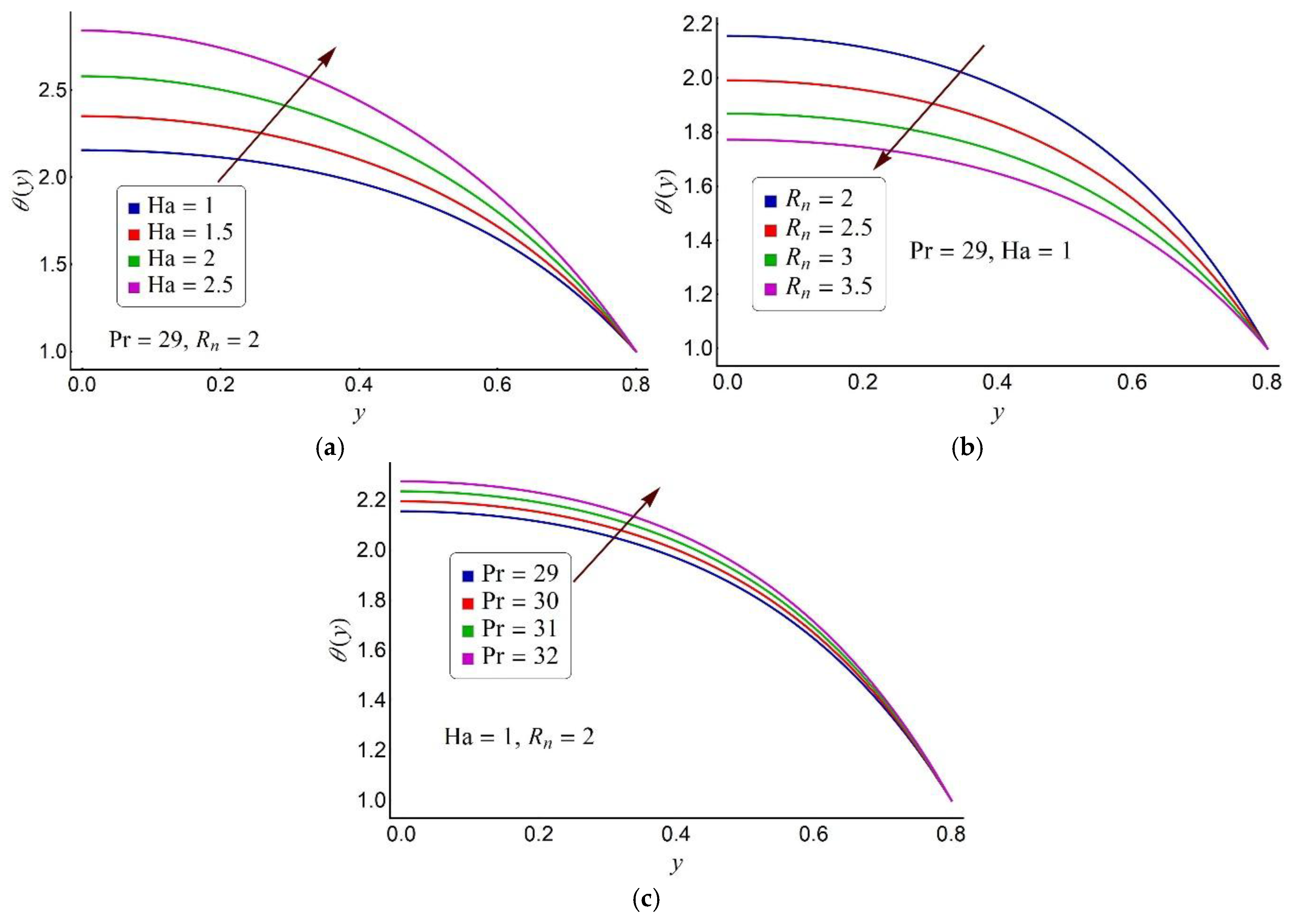
Figure 1a–c (corresponding to Figure 5a–c in [2]) indicate that ternary nanofluid temperature rises when the elevated values of the Hartmann number and the Prandtl number are considered, while the smaller values of radiation number further enhance the temperature distribution.
Figure 1. Alterations in temperature profile of trihybrid nanofluid for distinct values of (a) the Hartmann number Ha, (b) the thermal radiation number Rn, and (c) the Prandtl number Pr.
Coatings 16 00962 g001
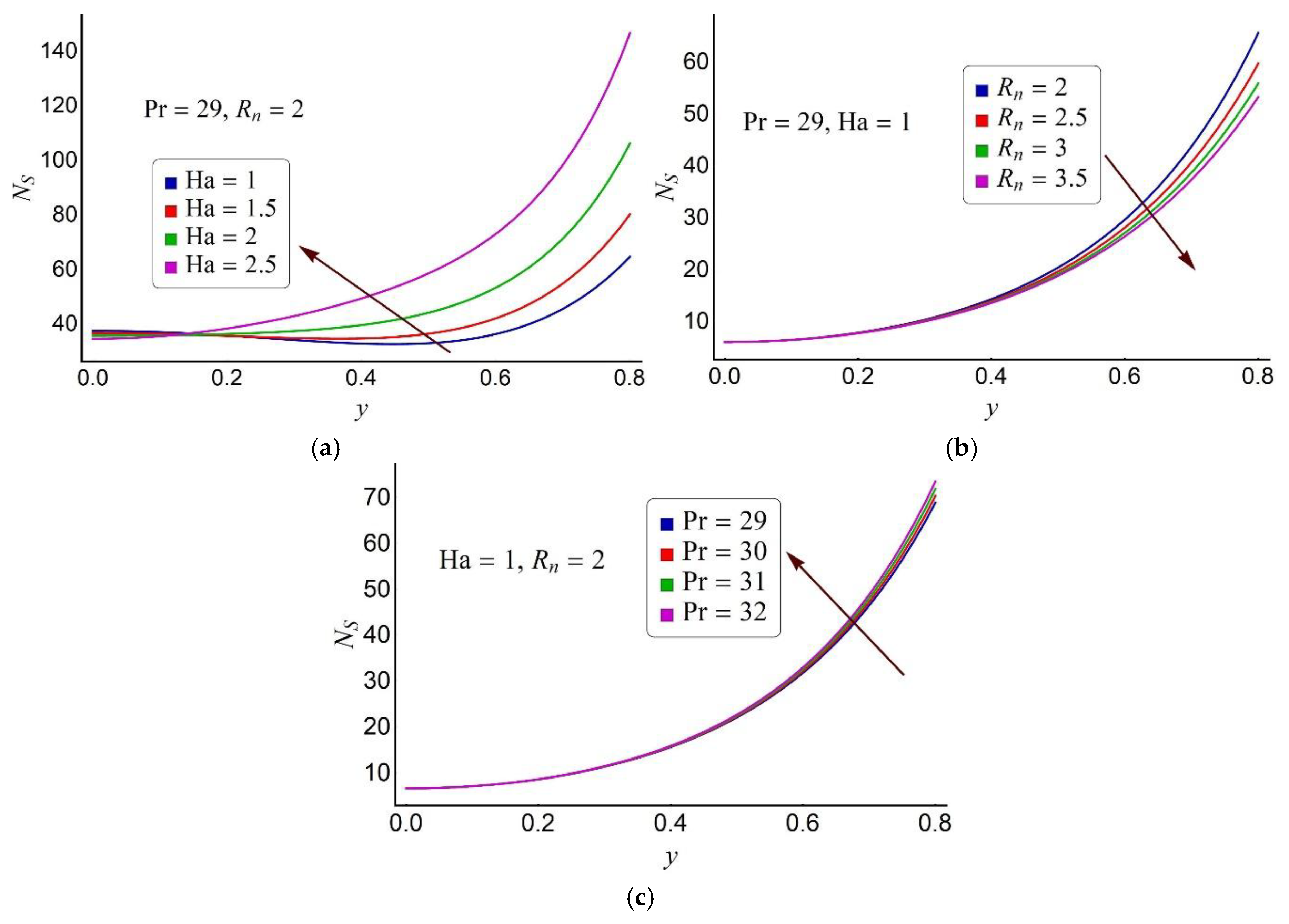
Figure 2a–c (corresponding to Figure 6a–c in [2]) reveal that entropy generation near the peripheral part of the channel can be minimized for smaller values of the Hartmann number and Prandtl number. In contrast, enhancing the radiation parameter substantially lowers entropy generation, implying that thermal radiation effects contribute effectively to curtail irreversibility in the fluid stream.
Figure 2. Variations in entropy generation number distribution for distinct values of (a) the Hartmann number Ha, (b) the thermal radiation number Rn, and (c) the Prandtl number Pr.
Coatings 16 00962 g002
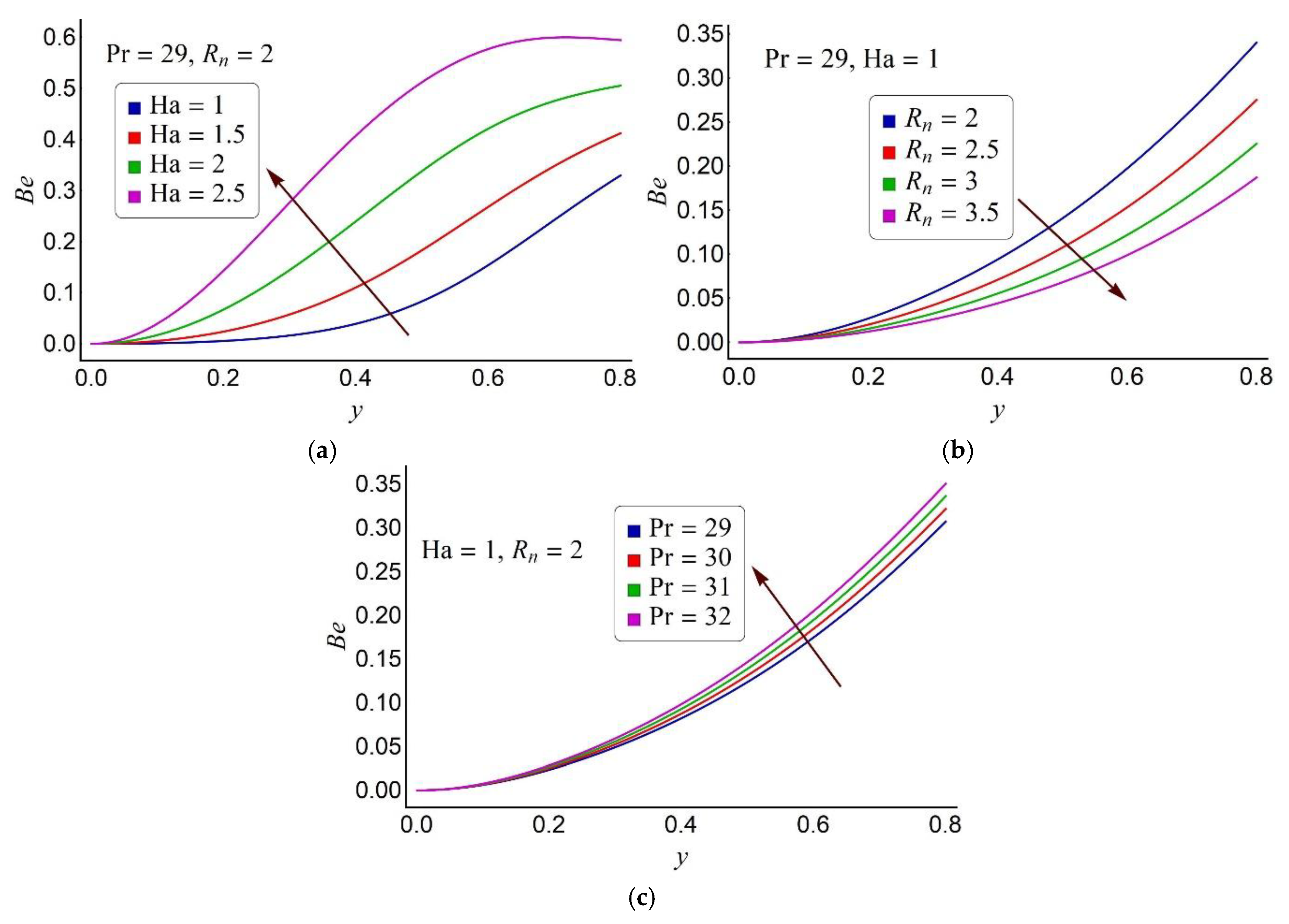
Figure 3a–c (corresponding to Figure 7a–c in [2]) show that the Bejan number increases with rising Hartmann number and Prandtl number values, but it decreases as the radiation parameter increases. It is further observed that, in Figure 3a (corresponding to Figure 7a in [2]), heat transfer irreversibility is the major source of total irreversibility. In contrast, Figure 3b,c (corresponding to Figure 7b,c in [2]) show that the contribution of heat transfer irreversibility reduces, and the system’s overall irreversibility becomes dominant.
Figure 3. Alterations in the Bejan number distribution for distinct values of (a) the Hartmann number Ha, (b) the thermal radiation number Rn, and (c) the Prandtl number Pr.
Coatings 16 00962 g003

Data Availability Statement

No new data were created or analyzed in this study. Data sharing is not applicable to this article.

Conflicts of Interest

The authors declare no conflict of interest.

References

  1. Pantokratoras, A. Comment on Saleem et al. Thermal Case Study of Cilia Actuated Transport of Radiated Blood-Based Ternary Nanofluid Under the Action of Tilted Magnetic Field. Coatings 2022, 12, 873. Coatings 2026, 16, 961. [Google Scholar] [CrossRef] [Scilit]
  2. Saleem, N.; Ashraf, T.; Daqqa, I.; Munawar, S.; Idrees, N.; Afzal, F.; Afzal, D. Thermal Case Study of Cilia Actuated Transport of Radiated Blood-Based Ternary Nanofluid under the Action of Tilted Magnetic Field. Coatings 2022, 12, 873. [Google Scholar] [CrossRef] [Scilit]
  3. Ahmad, K.; Pan, W.; Shi, S.L. Electrical conductivity and dielectric properties of multiwalled carbon nanotube and alumina composites. Appl. Phys. Lett. 2006, 89, 133122. [Google Scholar]
  4. Momohjimoh, I.; Saheb, N.; Hussein, M.A.; Laoui, T.; Al-Aqeeli, N. Electrical conductivity of spark plasma sintered Al2O3–SiC and Al2O3-carbon nanotube nanocomposites. Ceram. Int. 2020, 46, 16008–16019. [Google Scholar] [CrossRef] [Scilit]
  5. Bechteler, C.; Hebendanz, L.M.K.; Rübling, A.; Girmscheid, R.; Kühl, H. Electrical and thermal conductivity of CNT/alumina-nanocomposite ceramics. Int. J. Ceram. Eng. Sci. 2023, 5, e10167. [Google Scholar]
  6. Idris, S.; Jamaludin, A.; Nazar, R.; Das, S.; Pop, I. Erratum to “Joule heating and viscous dissipation impact on MHD-hybrid nanofluid flow over non-isothermal stretching/shrinking surface: Dual solution and stability analysis”. Chin. J. Phys. 2025, 98, 434–436. [Google Scholar] [CrossRef] [Scilit]
  7. El-Kareh, B. Fundamentals of Semiconductor Processing Technologies; Kluwer Academic Publishers: Dordrecht, The Netherlands, 1995. [Google Scholar]
  8. Fraunhofer_IKTS_2020_Annual-Report.pdf. Available online: https://www.ikts.fraunhofer.de/en/downloads/annual_reports/jb2020.html (accessed on 1 April 2026).
  9. AZoM Organization. Available online: https://www.azom.com/ (accessed on 1 April 2026).
  10. Pantokratoras, A. Comment on the paper “Comment on the paper “Optimizing the thermo-fluidic properties of ternary hybrid nanofluid for appliance of solar energy through an artificial intelligence integrated numerical solver technique, Yabin Shao, Amjad Ali Pasha, Muhammad Asif Zahoor Raja, Zohaib Arshad, Zahoor Shah, Imran Abbasi, Waqar Azeem Khan, Md Mottahir Alam, Mohammed Istafaul Haque Ansari, Chaos, Solitons and Fractals 192 (2025) 115961”. Chaos Solitons Fractals 2025, 200, 117142. [Google Scholar] [CrossRef] [Scilit]
  11. Filatova, O.V.; Sidorenko, A.A.; Agarkova, S.A. Effects of Age and Sex on Rheological Properties of Blood. Hum. Physiol. 2015, 41, 437–443. [Google Scholar] [CrossRef] [Scilit]
  12. Pantokratoras, A. Comment on the paper “Biomedical and engineering aspects of nonlinear radiative peristaltic transport in chemically reactive blood flow of Ellis nanofluid in an asymmetric channel with activation energy, Kamel Guedri, Maha M.A. Lashin, A. Abbasi, Sami Ullah Khan, W. Farooq, M. Ijaz Khan, Ahmed M. Galal, Chinese Journal of Physics 83 (2023) 650–663”. Chin. J. Phys. 2023, 97, 1552–1553. [Google Scholar] [CrossRef] [Scilit]
Disclaimer/Publisher’s Note: The statements, opinions and data contained in all publications are solely those of the individual author(s) and contributor(s) and not of MDPI and/or the editor(s). MDPI and/or the editor(s) disclaim responsibility for any injury to people or property resulting from any ideas, methods, instructions or products referred to in the content.