Article

Synergistic Enhancement of Through-Plane Thermal Conductivity in Graphite/PP Composites via Al/GO@AgNPs Hybrid Fillers

1
Aerospace Convergence Materials Center, Korea Institute of Ceramic Engineering and Technology, Jinju 52851, Republic of Korea
2
Graduate School of Convergence Science, Pusan National University, Pusan 46241, Republic of Korea
3
School of Chemical Engineering, Pusan National University, Pusan 46241, Republic of Korea
*
Author to whom correspondence should be addressed.
Coatings 2026, 16(7), 804; https://doi.org/10.3390/coatings16070804 (registering DOI)
Submission received: 9 June 2026 / Revised: 3 July 2026 / Accepted: 4 July 2026 / Published: 6 July 2026

Highlights

  • Al/GO@AgNP hybrid powders were fabricated by GO wrapping of Al particles and subsequent electroless Ag deposition.
  • Graphite/PP composites containing hybrid fillers showed improved through-plane thermal conductivity.
  • An optimal hybrid filler content of 1.0 wt% significantly increased through-plane thermal conductivity with minimal loss of in-plane conductivity and mechanical properties.
  • Spherical hybrid metal particles served as effective secondary fillers to reduce the thermal anisotropy of graphite/PP composites.

Abstract

Graphite-filled polymer composites exhibit high in-plane thermal conductivity but suffer from severe thermal anisotropy, which limits their practical heat dissipation performance in the thickness direction. In this study, hierarchically structured Al/GO@AgNPs hybrid fillers were developed to enhance the through-plane thermal conductivity of polypropylene (PP)/graphite composites. The hybrid fillers were fabricated through GO-assisted surface modification of Al particles followed by electroless deposition of Ag nanoparticles. The GO layer improved the interfacial characteristics of Al and served as a platform for Ag nucleation, resulting in the formation of Ag nanoparticles on the Al/GO surface. When incorporated at a low loading of 1.0 wt%, the Al/GO@AgNPs hybrid filler increased the through-plane thermal conductivity from 11.24 to 48.33 W·m−1·K−1, corresponding to more than a fourfold enhancement compared with the graphite-only composite, while maintaining an in-plane thermal conductivity of 106.87 W·m−1·K−1. This improvement is attributed to the bridging effect of spherical hybrid fillers between adjacent graphite platelets and the resulting reduction in interfacial thermal resistance in the through-plane direction. The proposed hybrid filler system effectively mitigates thermal anisotropy and provides a promising strategy for designing highly filled polymer composites for advanced thermal management applications.

1. Introduction

Heat dissipation is a critical factor that directly affects the efficiency, lifespan, and reliability of electronic devices. With the rapid miniaturization and increasing integration density of electronic components, the amount of heat generated per unit volume has significantly increased, thereby intensifying the demand for efficient thermal management technologies [1,2]. Polymer-based composites have attracted considerable attention as thermal management materials due to their lightweight nature, excellent processability, corrosion resistance, and chemical stability compared to conventional metallic materials. Consequently, polymer composites incorporating thermally conductive fillers have been widely explored for advanced thermal management applications [3,4].
Polypropylene (PP) is a widely used thermoplastic polymer owing to its low cost, good processability, favorable mechanical properties, and thermal stability. However, its intrinsic thermal conductivity is extremely low (approximately 0.2 W·m−1·K−1), which limits its direct application in heat-dissipating components [5,6,7]. To overcome this limitation, various thermally conductive fillers, including metallic materials [8,9,10], inorganic non-metallic materials [11,12,13], and carbon-based materials [2,14,15,16,17], have been incorporated into PP to enhance its thermal conductivity.
Among these fillers, graphite (GR) is particularly promising due to its relatively low cost, low density, and high intrinsic thermal conductivity. Its platelet morphology and high aspect ratio facilitate the formation of effective thermal pathways by increasing the contact area between adjacent fillers within the polymer matrix. In addition, graphite exhibits good compatibility with thermoplastic polymers such as PP and can be readily compounded through melt processing techniques [18,19,20].
Nevertheless, the platelet structure of graphite tends to align preferentially in the in-plane direction during melt-processing operations such as extrusion and injection molding. As a result, while the in-plane thermal conductivity is significantly improved, the through-plane thermal conductivity remains relatively low, leading to pronounced thermal anisotropy. This anisotropic behavior restricts heat dissipation in the thickness direction, which is often critical in practical electronic device applications [21,22,23,24].
Achieving high thermal conductivity in polymer composites requires not only appropriate filler type and loading but also uniform dispersion and the formation of continuous thermal conduction networks [12,25]. In particular, the construction of interconnected filler networks plays a key role in facilitating phonon transport and reducing interfacial thermal resistance between fillers and the polymer matrix. Recently, hybrid filler strategies combining fillers with different shapes and dimensions have emerged as an effective approach to generate synergistic effects and construct three-dimensional thermal networks [26,27,28,29].
In such hybrid systems, platelet graphite can form primary in-plane thermal pathways, while spherical metallic particles or one-dimensional fibrous fillers can serve as bridging components between adjacent graphite platelets, thereby establishing a more three-dimensional heat-transfer network. Metallic particles [30,31,32], characterized by inherently high and relatively isotropic thermal conductivity, are particularly effective in connecting discontinuous thermal pathways in the through-plane direction and mitigating thermal anisotropy in graphite-based composites [33,34,35,36].
In this study, a hybrid filler system consisting of platelet graphite and metallic particles was designed in a PP matrix to alleviate processing-induced thermal anisotropy and enhance through-plane thermal conductivity. To suppress excessive density increase, spherical aluminum particles were employed as the secondary filler to promote the formation of a graphite–aluminum thermal conduction network. Furthermore, the aluminum surface was modified with graphene oxide (GO) followed by electroless deposition of silver nanoparticles to synthesize hybrid metal particles with enhanced interfacial characteristics. PP-based composites containing graphite and metallic fillers were fabricated via injection molding, and their thermal and mechanical properties were systematically evaluated to investigate the effects of metallic particle incorporation.

2. Experimental Procedure

2.1. Materials

Natural graphite (99.5% purity, d50 = 35 μm) was purchased from Samjung C&G (Pohang, Republic of Korea). Spherical aluminum powder (325 mesh, 99.7% purity) was obtained from Wide Range Metals (Rumšiškės, Republic of Lithuania). Graphene oxide (GO), prepared via the modified Hummers’ method, was kindly provided by JMC Fine Chemicals (Ulsan, Republic of Korea). For the electroless plating and surface modification, silver nitrate (AgNO3, 99%, ACS reagent), ammonia solution (NH4OH, 28%–30%, ACS reagent), sodium hydroxide (NaOH pellets, 97%, ACS reagent), and formaldehyde (37 wt% in H2O, ACS reagent) were purchased from Sigma-Aldrich (St. Louis, MO, USA). Polypropylene (PP, M540, injection molding grade), used as the polymer matrix, was supplied by GS Caltex (Seoul, Republic of Korea). All chemical reagents were used as received without further purification.

2.2. Preparation of Al/GO@AgNPs Hybrid Fillers

GO corresponding to 0.3 wt% relative to Al was added to 50 mL of DI water and ultrasonically dispersed to obtain a homogeneous suspension. Subsequently, 10 g of Al powder was introduced into the GO dispersion and mechanically stirred until the solution became transparent, indicating the adsorption of GO sheets onto the Al surface, forming Al/GO particles [37]. For the electroless deposition of silver nanoparticles (AgNPs), 3.0 g of AgNO3 and 0.05 g of NaOH were completely dissolved in 200 mL of DI water. Then, 5 mL of NH4OH solution was added to form a clear silver plating bath. Afterward, 2 mL of formaldehyde was introduced as a reducing agent. The prepared Al/GO powder was immersed in the plating bath and stirred for 5 min, allowing Ag nanoparticles to be deposited onto the Al surface, resulting in Al/GO@AgNPs hybrid fillers.

2.3. Fabrication of Graphite/Metal-Filled PP Composites

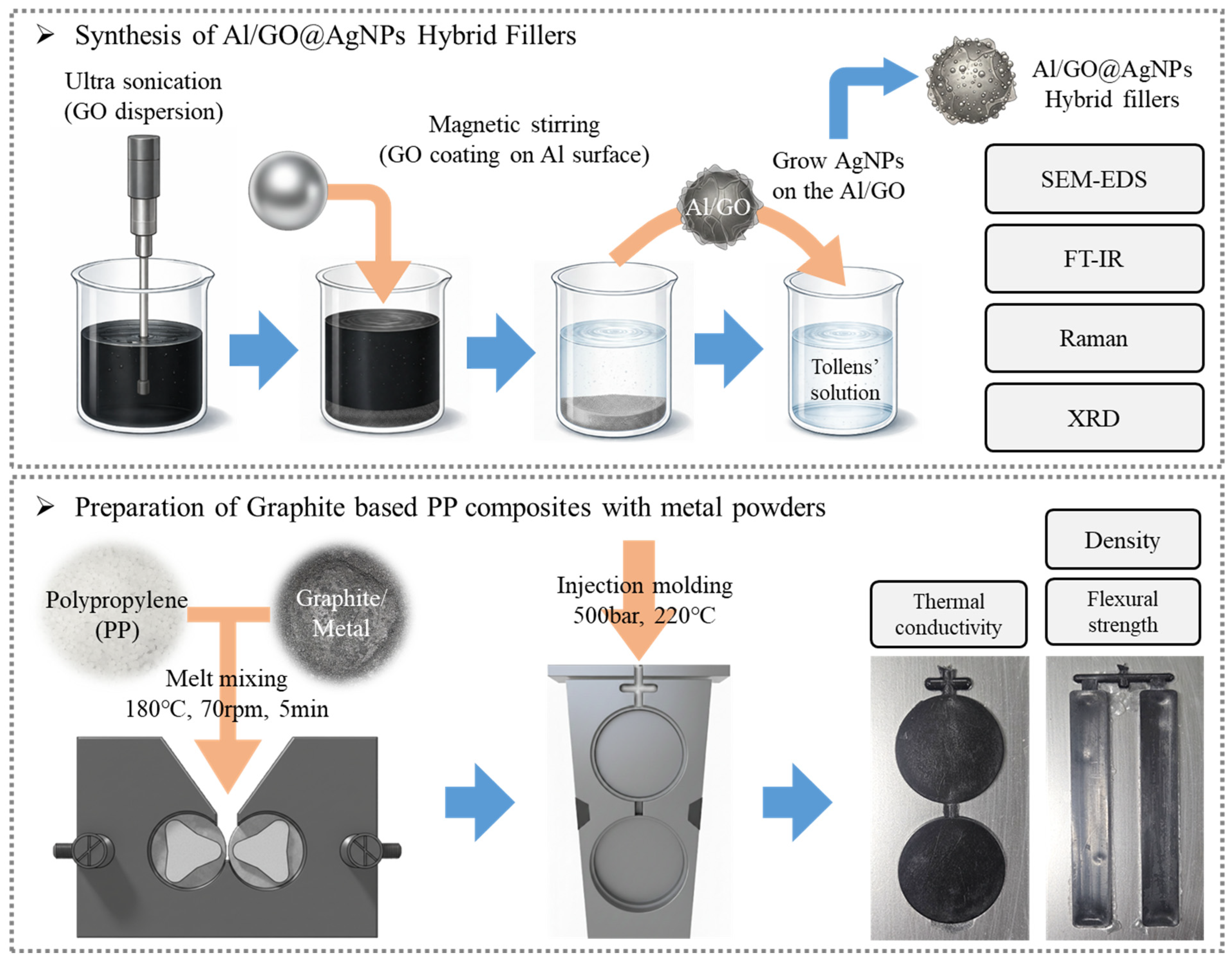
PP, graphite, and metal-based secondary fillers were melt-compounded in an internal mixer preheated to 180 °C at a rotor speed of 70 rpm for 3 min. The PP matrix content was fixed at 25 wt%, and the total filler content was fixed at 75 wt% based on the total composite weight. The secondary filler content, including raw Al or Al/GO@AgNPs particles, was varied from 0 to 2.0 wt% relative to the total composite weight, rather than the total filler weight. Accordingly, the graphite content was adjusted from 75 to 73 wt% as the secondary filler content increased from 0 to 2.0 wt%, while the total filler loading was maintained at 75 wt%. The compounded mixtures were subsequently injection-molded using a molding machine preheated to 200 °C. Two types of specimens were prepared: disk-shaped specimens with a diameter of 25.4 mm and a thickness of 1 mm for in-plane and through-plane thermal conductivity measurements, and rectangular bar specimens with dimensions of 80 mm × 10 mm × 4 mm for density and flexural strength measurements. The molded specimens were polished and cut into the required geometries for thermal, mechanical, and structural analyses. A schematic illustration of the overall experimental procedure is presented in Figure 1.

2.4. Characterizations

The morphology and elemental distribution of the synthesized fillers and composite fracture surfaces were characterized using FE-SEM (CLARA, TESCAN, Brno, Czech Republic) equipped with EDS (Ultimax, Oxford Instruments, Abingdon, UK). For the Al/GO@AgNPs hybrid fillers, EDS elemental mapping was performed for Al, Ag, C, and O to confirm the distribution of Ag nanoparticles and the GO-derived elements on the Al surface. The chemical functional groups and structural characteristics were investigated using FT-IR spectroscopy (Frontier, PerkinElmer, Waltham, MA, USA) and Raman spectroscopy (LabRAM HR Evolution, HORIBA, Kyoto, Japan), respectively. The crystalline structures were identified by XRD (D8 Advance, Bruker, Selb, Germany). The density (ρ) of the composites was measured based on the Archimedes’ principle using rectangular bar specimens with dimensions of 80 mm × 10 mm × 4 mm. Ten specimens were measured for each composition, and the average values with standard deviations were reported. The flexural strength was evaluated by three-point bending tests using a universal testing machine (UTM, 5982, Instron, Norwood, MA, USA). Rectangular bar specimens with dimensions of 80 mm × 10 mm × 4 mm were tested with a support span of 60 mm. Ten specimens were tested for each composition. To evaluate the thermal transport properties, disk-shaped specimens with a diameter of 25.4 mm and a thickness of 1 mm were prepared by injection molding. For in-plane thermal conductivity measurements, the disk-shaped specimens were polished on the surface and measured five times. After the in-plane measurements, the same specimens were cut into 10 mm × 10 mm × 1 mm specimens for through-plane thermal conductivity measurements, which were also repeated five times. The thermal diffusivity (α) and specific heat capacity (Cp) in both the in-plane and through-plane directions were measured using a laser flash analysis system (LFA, LFA 467, NETZSCH, Selb, Germany). The thermal conductivity (κ) was calculated using the following equation:
κ = α · ρ · Cp
where α, ρ, and Cp represent the thermal diffusivity, density, and specific heat capacity, respectively. All characterizations were performed at room temperature unless otherwise specified.

3. Results and Discussion

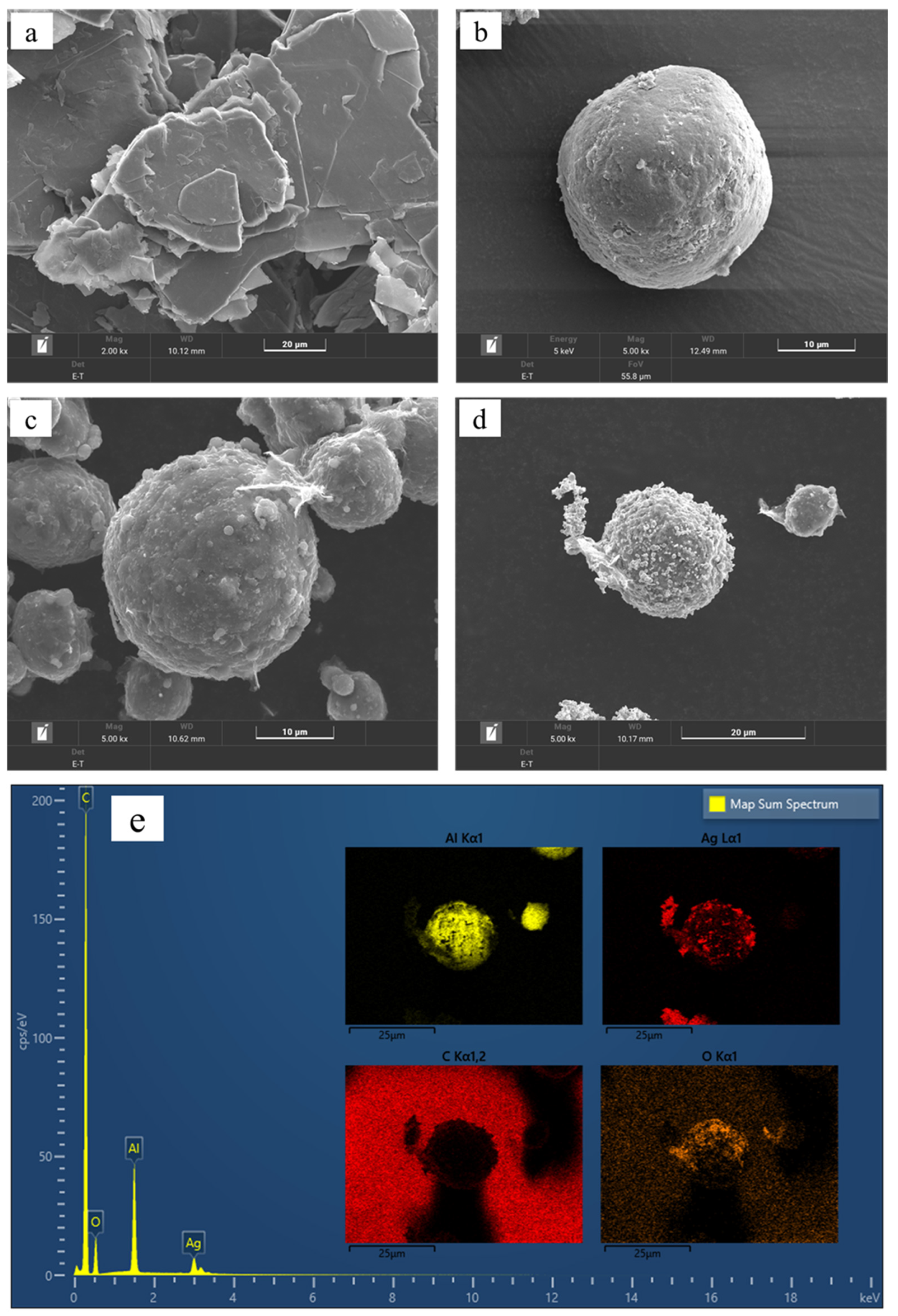
Figure 2 shows the surface morphology and microstructure of the materials used in this study, characterized by SEM–EDS. The natural graphite employed as the primary filler (Figure 2a) exhibits a typical platelet morphology, confirming that the layered structure is well preserved. Figure 2b–d present the surface features of pristine spherical Al particles, GO-coated Al (Al/GO), and Ag-decorated GO-coated Al (Al/GO@AgNPs), respectively. During the GO coating step, the acidic GO dispersion can partially remove the native oxide layer on Al while simultaneously promoting electrostatic attraction and chemical interactions between the positively charged Al surface and oxygen-containing functional groups on GO, enabling effective deposition of GO onto the Al surface. After GO coating, electroless plating led to the formation of Ag nanoparticles on Al/GO, indicating successful synthesis of the Al/GO@AgNPs. Notably, Ag ions possess a large potential difference relative to Al, which can trigger rapid galvanic displacement reactions. Under such kinetically accelerated conditions, Ag+ can be reduced instantaneously, often favoring dendritic growth. In the present system, however, the pre-deposited GO layer likely acts as a kinetic buffer and diffusion barrier, moderating the reaction rate and facilitating the formation of more uniformly distributed, quasi-spherical Ag nanoparticles rather than highly dendritic structures. This buffering effect of GO during metal deposition has also been discussed in related studies [35,36].
Figure 2e shows the EDS elemental maps and spectrum of the final Al/GO@AgNPs. The Al signal corresponds to the spherical metal core, while the Ag signal confirms the deposition of Ag nanoparticles on the particle surface. The C and O signals further support the presence of the GO-derived interfacial layer. Although the carbon signal may partially include a contribution from the carbon tape used during sample mounting, the simultaneous detection of C, O, Al, and Ag is consistent with the successful formation of the Al/GO@AgNPs hybrid structure [38,39].
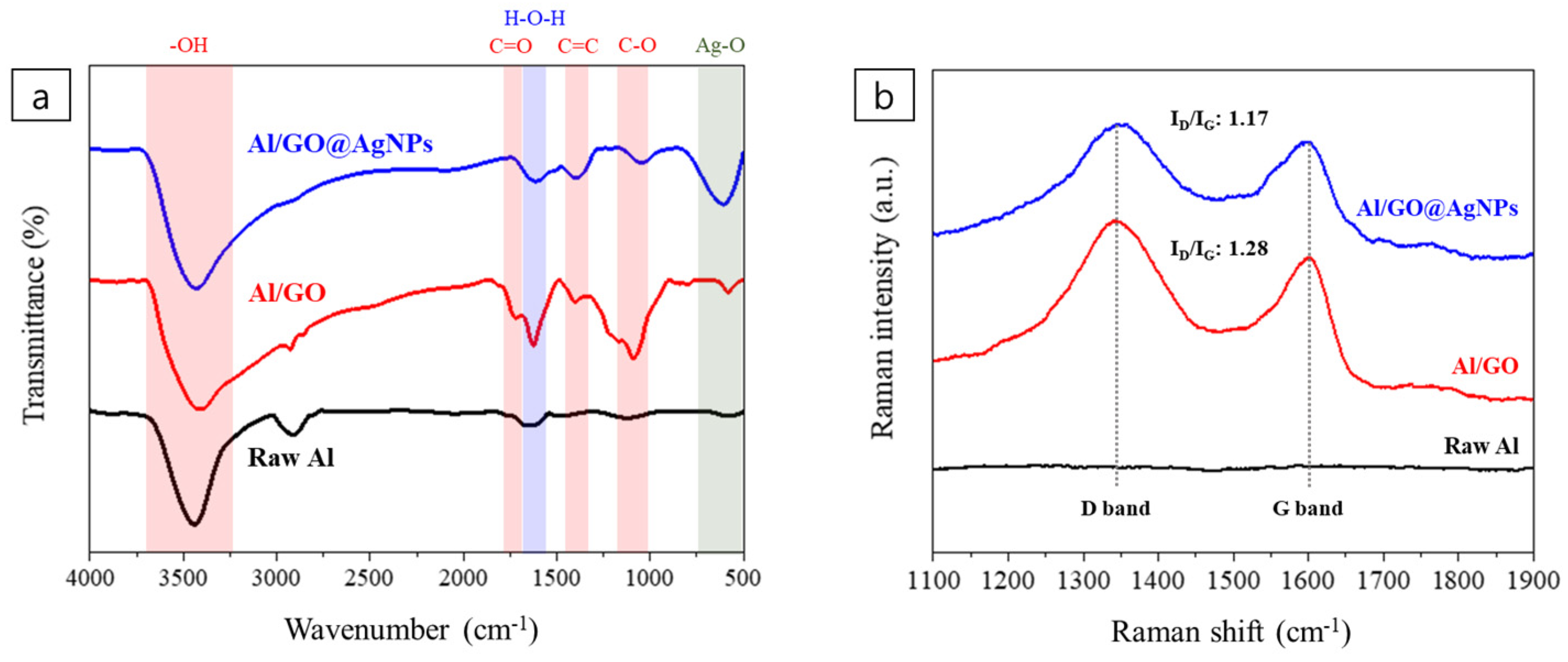
Figure 3a presents the FT-IR spectra of Al, Al/GO, and Al/GO@AgNPs. For pristine Al, a broad –OH stretching band near ~3500 cm−1 and an H–O–H bending band around ~1650 cm−1 were observed, which are commonly associated with adsorbed moisture and the hydrophilic nature of the thin native oxide layer on Al. After GO coating (Al/GO), additional bands corresponding to oxygen-containing functional groups (e.g., C=O, C=C, C–O, and –OH) became evident, confirming successful deposition of GO on the Al surface. These functional groups can also serve as active sites for subsequent interaction with Ag species during plating. For Al/GO@AgNPs, low-wavenumber features associated with Ag–O interactions were observed, suggesting that Ag nanoparticles were formed and anchored via interactions with oxygen functionalities on the GO layer. Raman spectra of the samples are shown in Figure 3b over the 1100–1900 cm−1 region. As expected, pristine Al exhibited no characteristic Raman bands, whereas both Al/GO and Al/GO@AgNPs showed the D band (~1350 cm−1) and G band (~1580 cm−1), originating from the GO coating layer. The ID/IG ratio for Al/GO was 1.28, and it decreased to 1.17 after Ag deposition. This reduction in ID/IG can be attributed to chemical changes in the GO layer during Ag nucleation and growth, where oxygen functional groups participate in Ag ion reduction and nanoparticle formation, resulting in partial restoration/reorganization of graphitic domains.
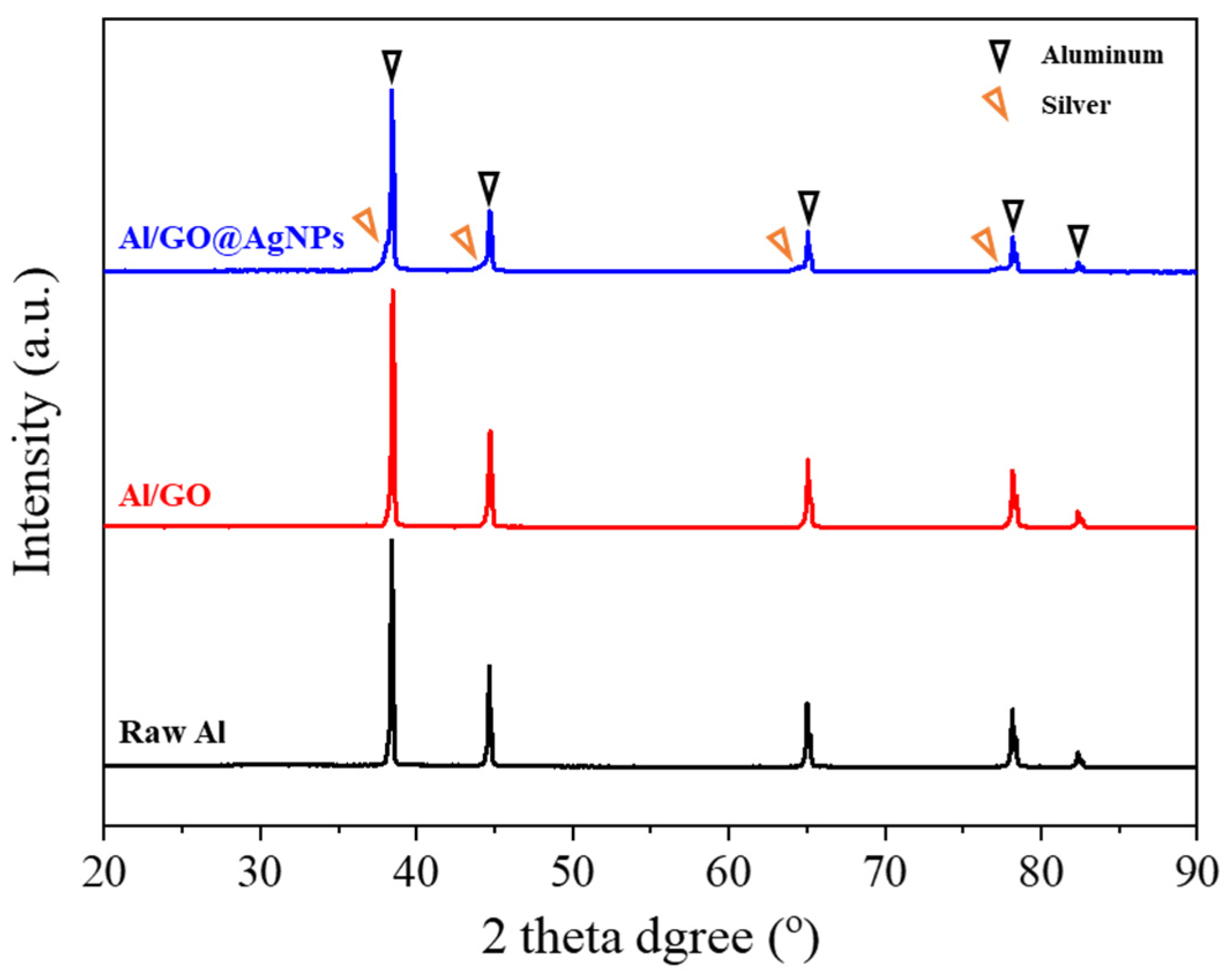
The crystalline structures were further examined by XRD (Figure 4). All samples were measured over 2θ = 20–90° at a scan rate of 5°·min−1. Pristine Al and Al/GO exhibited characteristic FCC Al reflections at 2θ = 38.5°, 44.8°, 65.2°, 78.3°, and 83.0°. In contrast, Al/GO@AgNPs showed additional reflections at 2θ = 38.1°, 44.3°, 64.4°, 77.4°, and 81.5°, corresponding to Ag (111), (200), (220), (311), and (222) planes. Because Al and Ag both crystallize in FCC structures with similar lattice parameters, their diffraction peaks can partially overlap; nevertheless, the observed peak-position differences and the appearance of Ag-specific reflections confirm the successful incorporation of Ag nanoparticles. Overall, the combined FT-IR/Raman/XRD results demonstrate that GO coating and electroless plating effectively produced an Al-based hybrid filler capable of introducing a highly conductive metallic phase while minimizing the density penalty associated with bulk metal loading.
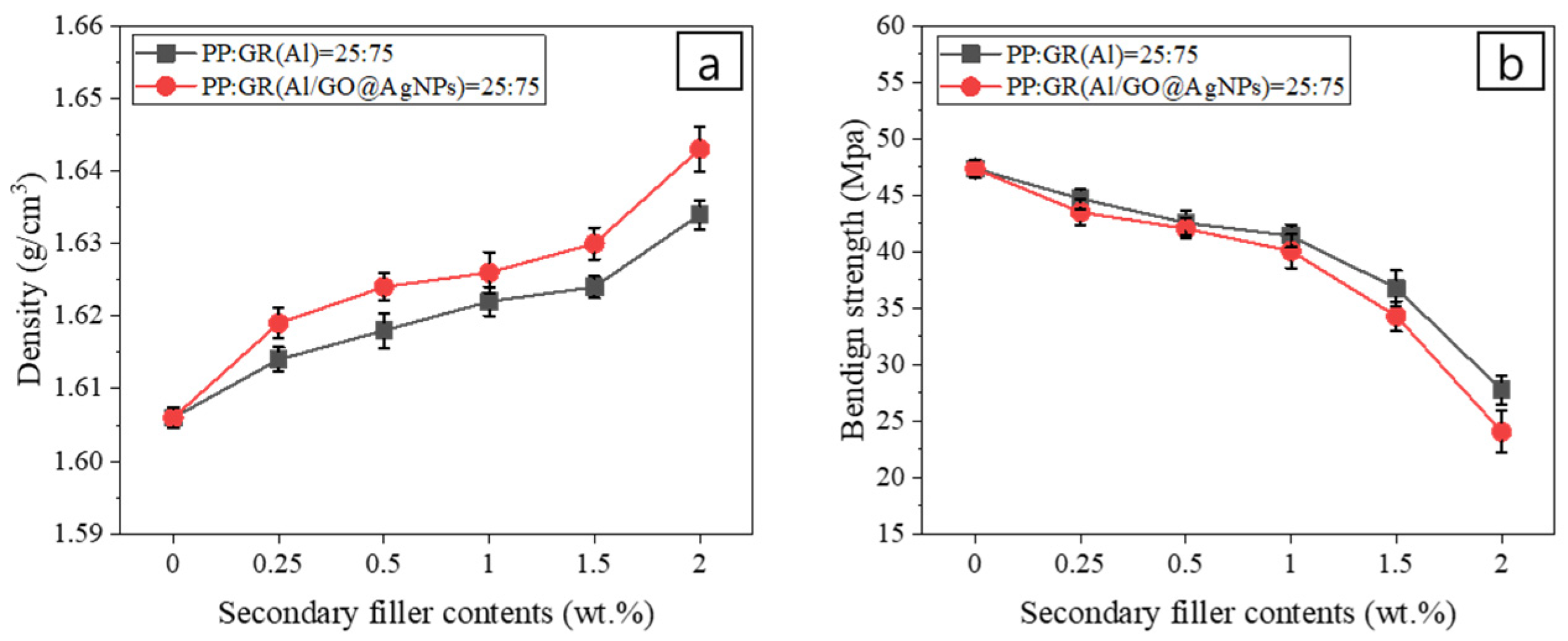
Mechanical properties of the injection-molded composites are summarized in Figure 5. Figure 5a,b show the density and flexural strength as a function of secondary filler content, where the total filler loading (graphite + secondary filler) was fixed at 75 wt%. The PP/graphite composite (without secondary filler) exhibited a density of 1.606 g·cm−3 and a flexural strength of 47.333 MPa. Because PP and graphite have lower densities than Al, the composite density increased gradually with increasing Al content. When Al/GO@AgNPs was used as the secondary filler, the density increase was slightly greater than that of the raw Al case due to the higher density of Ag. However, since Ag was present only as a surface decoration, the density difference remained small; at 2.0 wt% secondary filler loading, the density increase was ~0.009 g·cm−3 (less than 1%). In contrast, flexural strength decreased with increasing metal filler content. A modest reduction was observed up to 1.0 wt% secondary filler, followed by a sharper decrease at higher contents, reaching 24.044 MPa for the Al/GO@AgNPs composite at 2.0 wt%. This trend is consistent with differences in interfacial interaction and stress transfer: platelet graphite provides a relatively large interfacial area and can form stronger mechanical interlocking with the matrix, whereas spherical metal particles typically offer more limited interfacial contact and weaker interfacial load transfer, which can promote stress concentration and facilitate crack initiation under bending.
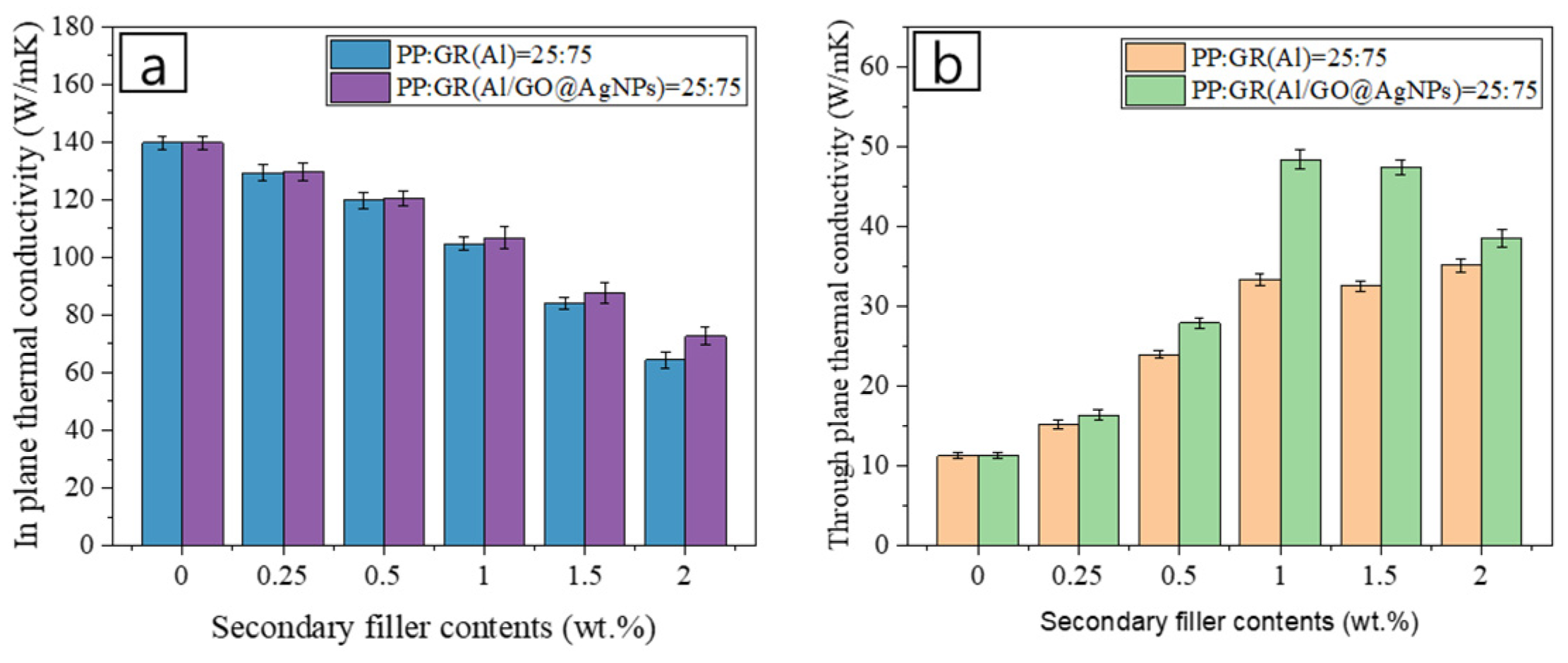
Figure 6 compares the thermal conductivity (κ) of the PP/graphite composites in the through-plane (z) and in-plane (xy) directions as a function of the conductive-filler composition. The thermal conductivity was calculated from the thermal diffusivity (α) measured by LFA, the specific heat capacity (Cp), and the apparent density (ρ) using the equation κ = α·Cp·ρ. For the composite containing 75 wt% natural graphite, κ-z and κ-xy were 11.24 and 139.71 W·m−1·K−1, respectively. The high in-plane conductivity originates from the preferential alignment of platelet graphite along the flow/molding direction and the preservation of π-conjugated graphitic domains that support efficient in-plane heat transport. Although some graphite platelets may be partially oriented in the out-of-plane direction at high filler loading, the composite still exhibited strong thermal anisotropy, with a κ-xy/κ-z ratio of approximately 12.
In the hybrid-filler system, the total filler loading was maintained at 75 wt% by partially replacing graphite with spherical metal-based secondary fillers. As the secondary filler content increased, κ-xy gradually decreased because of the reduced graphite content and the disruption of the in-plane graphite network. In contrast, κ-z increased markedly up to a secondary filler content of 1.0 wt%, indicating that the spherical metal particles contributed to through-plane heat transport. For the raw Al-added composite at 1.0 wt% secondary filler loading, κ-z and κ-xy reached 33.35 and 104.72 W·m−1·K−1, respectively. At higher Al contents, κ-xy continued to decrease, whereas κ-z showed no further substantial improvement, suggesting that excessive replacement of graphite no longer contributed effectively to additional through-plane conduction.
When Al/GO@AgNPs was used at the same secondary filler content of 1.0 wt%, κ-z and κ-xy were 48.33 and 106.87 W·m−1·K−1, respectively. Compared with the graphite-only composite, κ-z increased by more than four times, while a substantial level of in-plane thermal conductivity was retained. This improvement can be attributed to the bridging effect of spherical hybrid particles between adjacent or misaligned graphite platelets, which promotes additional stepped heat-transfer routes in the thickness direction. The GO-assisted Ag nanoparticle decoration may also increase the effective interfacial contact area between the hybrid fillers and neighboring graphite platelets, thereby reducing interfacial thermal resistance.
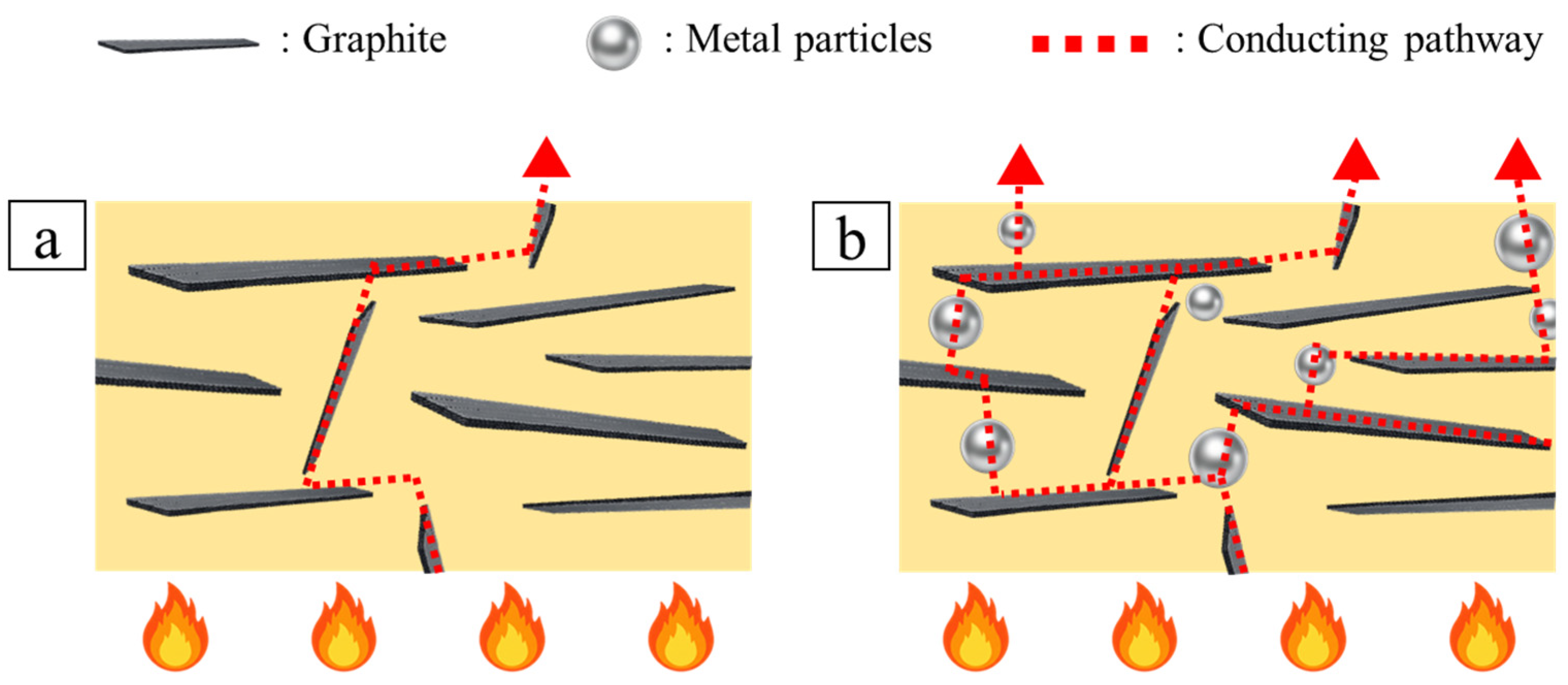
Therefore, the enhanced through-plane thermal conductivity of the Al/GO@AgNPs-containing composite is attributed to the combined effects of graphite–metal–graphite bridging, improved interfacial contact, and partial connection of discontinuous heat-transfer pathways in the through-plane direction. However, the proposed pathway-bridging mechanism should be interpreted as a morphology-assisted heat-transfer model based on the thermal conductivity trends and SEM observations, rather than direct proof of a fully continuous three-dimensional thermal network. These pathway-bridging mechanisms are schematically illustrated in Figure 7.
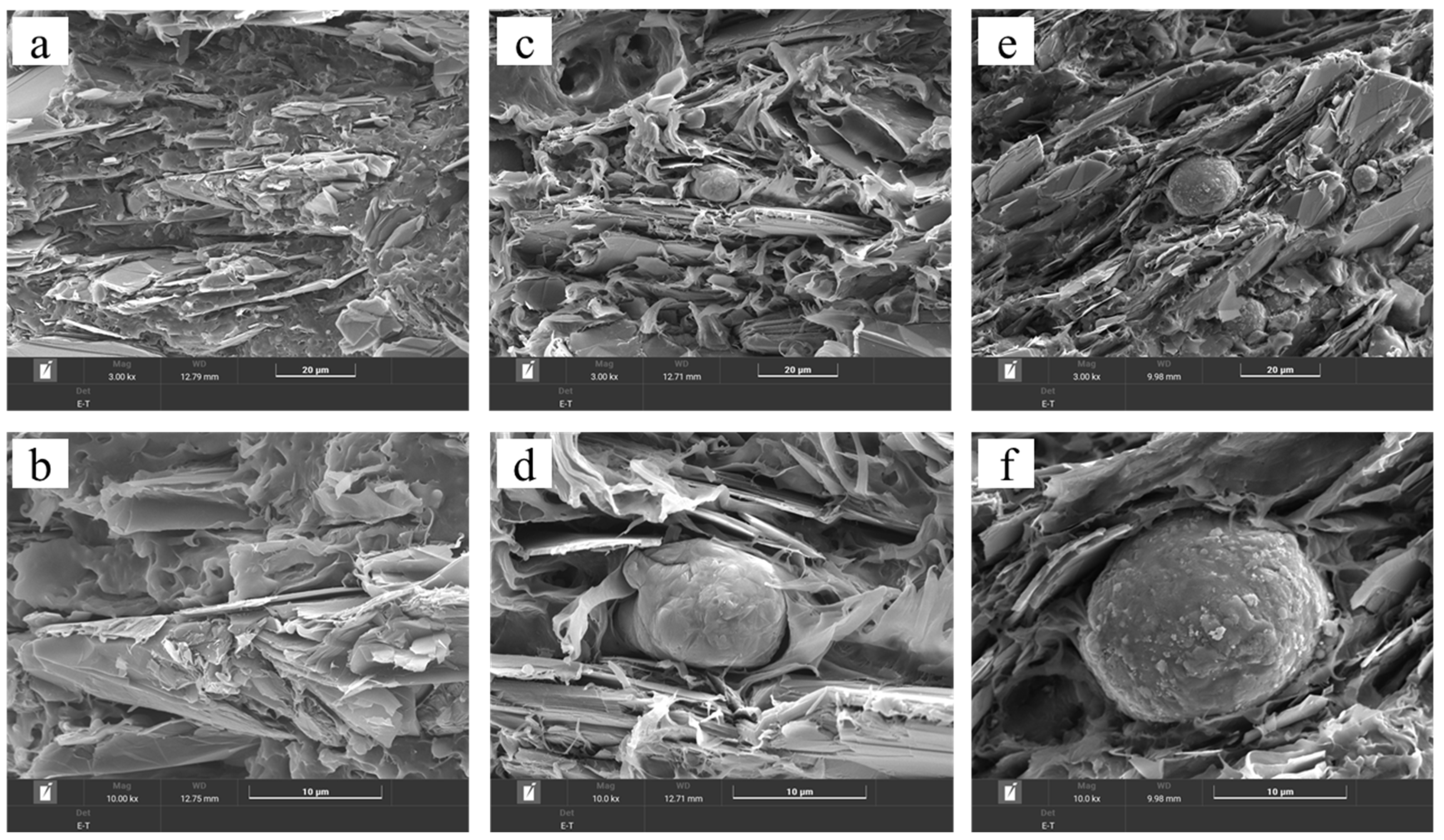
Figure 8 shows the cross-sectional SEM microstructures of the graphite/PP-based composites. In the graphite-only composite (Figure 8a,b), the graphite platelets were predominantly oriented parallel to the in-plane direction. This preferential alignment is mainly attributed to the shear-induced orientation of high-aspect-ratio graphite during melt compounding and injection molding. The horizontally aligned graphite platelets can form continuous thermal pathways along the in-plane direction; however, the limited direct contact between adjacent platelets across the thickness direction restricts heat transfer in the through-plane direction, resulting in pronounced thermal anisotropy. For the composites containing spherical metal-based secondary fillers, the graphite platelets still maintained a mostly horizontal orientation, while spherical particles were observed in the interstitial regions between stacked or adjacent graphite platelets. In the raw Al-containing composite (Figure 8c,d), Al particles were located between graphite-rich regions, suggesting that they can partially bridge discontinuous heat-transfer pathways. Similarly, in the Al/GO@AgNPs-containing composite (Figure 8e,f), hybrid fillers were embedded among the aligned graphite platelets and may increase the probability of graphite–metal–graphite contacts. These contact points can provide additional stepped heat-transfer routes across the thickness direction. The SEM observations are consistent with the proposed pathway-bridging mechanism inferred from the thermal conductivity results, although they do not directly prove the formation of a fully continuous three-dimensional thermal network. The graphite platelets mainly contribute to the in-plane thermal network, whereas the spherical Al-based fillers can assist through-plane heat transport by partially connecting separated graphite platelets. In particular, the roughened surface of the Al/GO@AgNPs, originating from GO coating and Ag nanoparticle decoration, is expected to increase the effective interfacial contact area with neighboring graphite platelets. This microstructural configuration is therefore considered to contribute to the improved through-plane thermal conductivity of the hybrid-filler composites.

4. Conclusions

In this study, hierarchically structured Al/GO@AgNPs hybrid fillers were successfully fabricated via surface activation of Al with graphene oxide (GO) followed by electroless deposition of Ag nanoparticles. SEM–EDS, spectroscopic analyses, and XRD results confirmed the formation of a GO interfacial layer on the Al surface and the successful deposition of Ag nanoparticles. When incorporated as a secondary filler into PP/graphite composites, the hybrid fillers significantly enhanced the through-plane thermal conductivity at a low loading of 1.0 wt%. Specifically, the through-plane thermal conductivity increased from 11.24 to 48.33 W·m−1·K−1, while the in-plane thermal conductivity remained at 106.87 W·m−1·K−1. This improvement is attributed to the spherical hybrid fillers acting as thermal bridges between plate-like graphite particles, thereby promoting additional through-plane heat-transfer routes and reducing interfacial thermal resistance. Furthermore, the Ag nanoparticles on the hybrid particle surface likely increased the effective interfacial contact area with neighboring graphite platelets, contributing to the improved through-plane thermal transport. Overall, the surface-functionalized Al hybrid fillers effectively mitigated thermal anisotropy while retaining a substantial level of in-plane thermal conductivity. These findings demonstrate that the proposed hierarchical hybrid filler provides a viable design strategy for optimizing the thermal performance of highly filled polymer composites for thermal management applications.

Author Contributions

Conceptualization, Y.-K.J. and W.S.K.; methodology, K.K.; validation, W.S.T., K.K., S.Y.M. and J.H.; formal analysis, J.H., W.S.T., K.K. and S.Y.M.; investigation, J.H. and D.H.Y.; data curation, J.H., W.S.T., S.Y.M. and D.H.Y.; writing—original draft preparation, J.H.; writing—review and editing, Y.-K.J. and W.S.K.; visualization, J.H. and W.S.T.; supervision, Y.-K.J. and W.S.K.; project administration, W.S.K.; funding acquisition, W.S.K. All authors have read and agreed to the published version of the manuscript.

Funding

This research was supported by the Nano & Material Technology Development Program through the National Research Foundation of Korea (NRF) funded by the Ministry of Science and ICT (RS-2024-00455314).

Data Availability Statement

The data presented in this study are available in the article.

Conflicts of Interest

The authors declare no conflict of interest.

References

  1. Moore, A.L.; Shi, L. Emerging challenges and materials for thermal management of electronics. Mater. Today 2014, 17, 163–174. [Google Scholar] [CrossRef]
  2. Mu, M.; Wan, C.; McNally, T. Thermal conductivity of 2D nano-structured graphitic materials and their composites with epoxy resins. 2D Mater. 2017, 4, 042001. [Google Scholar] [CrossRef]
  3. Yang, H.; Gong, J.; Wen, X.; Xue, J.; Chen, Q.; Jiang, Z.; Tian, N.; Tang, T. Effect of carbon black on improving thermal stability, flame retardancy and electrical conductivity of polypropylene/carbon fiber composites. Compos. Sci. Technol. 2015, 113, 31–37. [Google Scholar] [CrossRef]
  4. Vadivelu, M.A.; Kumar, C.R.; Joshi, G.M. Polymer composites for thermal management: A review. Compos. Interfaces 2016, 23, 847–872. [Google Scholar] [CrossRef]
  5. Imran, K.A.; Lou, J.; Shivakumar, K.N. Enhancement of electrical and thermal conductivity of polypropylene by graphene nanoplatelets. J. Appl. Polym. Sci. 2018, 135, 45833. [Google Scholar] [CrossRef]
  6. Feng, C.; Ni, H.; Chen, J.; Yang, W. Facile method to Fabricate Highly Thermally Conductive Graphite/PP Composite with Network Structures. ACS Appl. Mater. Interfaces 2016, 8, 19732–19738. [Google Scholar] [CrossRef] [PubMed]
  7. Song, N.; Cao, D.; Luo, X.; Wang, Q.; Ding, P.; Shi, L. Highly thermally conductive polypropylene/graphene composites for thermal management. Compos. Part A Appl. Sci. Manuf. 2020, 135, 105912. [Google Scholar] [CrossRef]
  8. Boudenne, A.; Ibos, L.; Fois, M.; Majesté, J.C.; Géhin, E. Electrical and thermal behavior of polypropylene filled with copper particles. Compos. Part A Appl. Sci. Manuf. 2005, 36, 1545–1554. [Google Scholar] [CrossRef]
  9. Mamunya, Y.P.; Davydenko, V.V.; Pissis, P.; Lebedev, E.V. Electrical and thermal conductivity of polymers filled with metal powders. Eur. Polym. J. 2002, 38, 1887–1897. [Google Scholar] [CrossRef]
  10. Boudenne, A.; Ibos, L.; Fois, M.; Gehin, E.; Majeste, J. Thermophysical properties of polypropylene/aluminum composites. J. Polym. Sci. Part B Polym. Phys. 2004, 42, 722–732. [Google Scholar] [CrossRef]
  11. Wang, L.; Chen, L.; Song, P.; Liang, C.; Lu, Y.; Qiu, H.; Zhang, Y.; Kong, J.; Gu, J. Fabrication on the annealed Ti3C2Tx MXene/Epoxy nanocomposites for electromagnetic interference shielding application. Compos. Part B Eng. 2019, 171, 111–118. [Google Scholar] [CrossRef]
  12. Zhang, X.; Maira, B.; Hashimoto, Y.; Wada, T.; Chammingkwan, P.; Thakur, A.; Taniike, T. Selective localization of aluminum oxide at interface and its effect on thermal conductivity in polypropylene/polyolefin elastomer blends. Compos. Part B Eng. 2019, 162, 662–670. [Google Scholar] [CrossRef]
  13. Muratov, D.S.; Kuznetsov, D.V.; Il’inykh, I.A.; Mazov, I.N.; Stepashkin, A.A.; Tcherdyntsev, V.V. Thermal conductivity of polypropylene filled with inorganic particles. J. Alloys Compd. 2014, 586, S451–S454. [Google Scholar] [CrossRef]
  14. Gong, J.; Liu, Z.; Yu, J.; Dai, D.; Dai, W.; Du, S.; Li, C.; Jiang, N.; Zhan, Z.; Lin, C.-T. Graphene woven fabric-reinforced polyimide films with enhanced and anisotropic thermal conductivity. Compos. Part A Appl. Sci. Manuf. 2016, 87, 290–296. [Google Scholar] [CrossRef]
  15. Gaxiola, D.L.; Keith, J.M.; King, J.A.; Johnson, B.A. Nielsen thermal conductivity model for single filler carbon/polypropylene composites. J. Appl. Polym. Sci. 2009, 114, 3261–3267. [Google Scholar] [CrossRef]
  16. Kada, D.; Koubaa, A.; Tabak, G.; Migneault, S.; Garnier, B.; Boudenne, A. Tensile properties, thermal conductivity, and thermal stability of short carbon fiber reinforced polypropylene composites. Polym. Compos. 2018, 39, E664–E670. [Google Scholar] [CrossRef]
  17. Mazov, I.N.; Ilinykh, I.A.; Kuznetsov, V.L.; Stepashkin, A.A.; Ergin, K.S.; Muratov, D.S.; Tcherdyntsev, V.; Kuznetsov, D.; Issi, J.-P. Thermal conductivity of polypropylene-based composites with multiwall carbon nanotubes with different diameter and morphology. J. Alloys Compd. 2014, 586, S440–S442. [Google Scholar] [CrossRef]
  18. Liu, Z.; Guo, Q.; Liu, L.; Shi, J.; Zhai, G. Influence of filler type on the performance and microstructure of a carbon/graphite material. New Carbon Mater. 2010, 25, 313–316. [Google Scholar] [CrossRef]
  19. Sengupta, R.; Bhattacharya, M.; Bandyopadhyay, S.; Bhowmick, A.K. A review on the mechanical and electrical properties of graphite and modified graphite reinforced polymer composites. Prog. Polym. Sci. 2011, 36, 638–670. [Google Scholar] [CrossRef]
  20. Morgan, D.R. Thermal, Electrical, and Structural Analysis of Graphite Foam; University of North Texas: Denton, TX, USA, 2001. [Google Scholar]
  21. Wu, H.; Drzal, L.T. Effect of graphene nanoplatelets on coefficient of thermal expansion of polyetherimide composite. Mater. Chem. Phys. 2014, 146, 26–36. [Google Scholar] [CrossRef]
  22. Zhou, C.; Bai, Y.; Zou, H.; Zhou, S. Improving Thermal Conductivity of Injection Molded Polycarbonate/Boron Nitride Composites by Incorporating Spherical Alumina Particles: The Influence of Alumina Particle Size. Polymers 2022, 14, 3477. [Google Scholar] [CrossRef] [PubMed]
  23. Zheng, X.; Wen, B. Practical PBT/PC/GNP composites with anisotropic thermal conductivity. RSC Adv. 2019, 9, 36316–36323. [Google Scholar] [CrossRef] [PubMed]
  24. Cao, H.; Ye, L.; Jin, Y.; Wang, J.; Hong, J.; Li, Y. Structural heterogeneity and evolution in ultrahigh-filled polypropylene/flake graphite composites during injection molding. Compos. Sci. Technol. 2022, 227, 109590. [Google Scholar] [CrossRef]
  25. An, F.; Li, X.; Min, P.; Liu, P.; Jiang, Z.-G.; Yu, Z.-Z. Vertically Aligned High-Quality Graphene Foams for Anisotropically Conductive Polymer Composites with Ultrahigh Through-Plane Thermal Conductivities. ACS Appl. Mater. Interfaces 2018, 10, 17383–17392. [Google Scholar] [CrossRef] [PubMed]
  26. Zhao, T.; Zhang, X. Synergistic effect of thermally conductive networks in crystalline polymer composites. Polym. Compos. 2018, 39, 1041–1050. [Google Scholar] [CrossRef]
  27. Owais, M.; Zhao, J.; Imani, A.; Wang, G.; Zhang, H.; Zhang, Z. Synergetic effect of hybrid fillers of boron nitride, graphene nanoplatelets, and short carbon fibers for enhanced thermal conductivity and electrical resistivity of epoxy nanocomposites. Compos. Part A Appl. Sci. Manuf. 2019, 117, 11–22. [Google Scholar] [CrossRef]
  28. Altay, L.; Atagur, M.; Sever, K.; Sen, I.; Uysalman, T.; Seki, Y.; Sarikanat, M. Synergistic effects of graphene nanoplatelets in thermally conductive synthetic graphite filled polypropylene composite. Polym. Compos. 2019, 40, 277–287. [Google Scholar] [CrossRef]
  29. Xu, R.; Chen, M.; Zhang, F.; Huang, X.; Luo, X.; Lei, C.; Lu, S.; Zhang, X. High thermal conductivity and low electrical conductivity tailored in carbon nanotube (carbon black)/polypropylene (alumina) composites. Compos. Sci. Technol. 2016, 133, 111–118. [Google Scholar] [CrossRef]
  30. Yim, Y.-J.; Park, S.-J. Effect of silver-plated expanded graphite addition on thermal and electrical conductivities of epoxy composites in the presence of graphite and copper. Compos. Part A Appl. Sci. Manuf. 2019, 123, 253–259. [Google Scholar] [CrossRef]
  31. Wang, L.; Qiu, H.; Liang, C.; Song, P.; Han, Y.; Han, Y.; Gu, J.; Kong, J.; Pan, D.; Guo, Z. Electromagnetic interference shielding MWCNT-Fe3O4@Ag/epoxy nanocomposites with satisfactory thermal conductivity and high thermal stability. Carbon 2019, 141, 506–514. [Google Scholar] [CrossRef]
  32. Yu, J.; Lin, W.; Cheng, H.; Chen, F. Graphene thick films with ultra-high thermal conductivity and robust stability via seamless nano-silver bonding strategy for extreme thermal management. Carbon 2026, 249, 121256. [Google Scholar] [CrossRef]
  33. Uetani, K.; Ata, S.; Tomonoh, S.; Yamada, T.; Yumura, M.; Hata, K. Elastomeric Thermal Interface Materials with High Through-Plane Thermal Conductivity from Carbon Fiber Fillers Vertically Aligned by Electrostatic Flocking. Adv. Mater. 2014, 26, 5857–5862. [Google Scholar] [CrossRef] [PubMed]
  34. Wu, X.; Tang, B.; Chen, J.; Shan, L.; Gao, Y.; Yang, K.; Wang, Y.; Sun, K.; Fan, R.; Yu, J. Epoxy composites with high cross-plane thermal conductivity by constructing all-carbon multidimensional carbon fiber/graphite networks. Compos. Sci. Technol. 2021, 203, 108610. [Google Scholar] [CrossRef]
  35. Atagur, M.; Akyuz, O.; Sever, K.; Seki, Y.; Seydibeyoglu, O.; Isbilir, A.; Sarikanat, M.; Altay, L. Investigation of thermal and mechanical properties of synthetic graphite and recycled carbon fiber filled polypropylene composites. Mater. Res. Express 2019, 6, 065312. [Google Scholar] [CrossRef]
  36. Wu, K.; Xue, Y.; Yang, W.; Chai, S.; Chen, F.; Fu, Q. Largely enhanced thermal and electrical conductivity via constructing double percolated filler network in polypropylene/expanded graphite—Multi-wall carbon nanotubes ternary composites. Compos. Sci. Technol. 2016, 130, 28–35. [Google Scholar] [CrossRef]
  37. Hwang, J.; Tak, W.-S.; Mun, S.Y.; Nam, S.; Moon, S.Y.; Kim, W.S. Graphene Encapsulated Al Particles for Improvement of Thermal Conductivity in Composites. Materials 2020, 13, 3602. [Google Scholar] [CrossRef] [PubMed]
  38. Wang, X.; Zhu, L.; Qian, J.; Wang, X.; Jiang, J.; Jiang, L.; Cao, Y. Atomic layer deposition assisted fabrication of insertable silver dendrites-based SERS substrates with high adhesion. Appl. Surf. Sci. 2023, 640, 158466. [Google Scholar] [CrossRef]
  39. Ye, W.; Chen, Y.; Zhou, F.; Wang, C.; Li, Y. Fluoride-assisted galvanic replacement synthesis of Ag and Au dendrites on aluminum foil with enhanced SERS and catalytic activities. J. Mater. Chem. 2012, 22, 18327. [Google Scholar] [CrossRef]
Figure 1. Schematic illustration of hybrid secondary filler synthesis and PP/GR composite fabrication at a total filler loading of 75 wt%. The arrows indicate the sequential processing steps from GO coating and Ag nanoparticle deposition to melt mixing, injection molding, and characterization.
Coatings 16 00804 g001
Figure 2. SEM micrographs of (a) natural graphite, (b) pristine spherical Al particles, (c) Al/GO particles, and (d) Al/GO@AgNPs hybrid fillers. (e) EDS elemental maps and spectrum of the Al/GO@AgNPs hybrid fillers, showing the distribution of Al, Ag, C, and O. The colors represent the corresponding elemental signals indicated in each map.
Coatings 16 00804 g002
Figure 3. (a) FT-IR and (b) Raman spectra of Al, Al/GO, and Al/GO@AgNPs hybrid fillers.
Coatings 16 00804 g003
Figure 4. XRD patterns of the pristine Al and synthesized secondary fillers.
Coatings 16 00804 g004
Figure 5. Apparent density and flexural strength of PP/graphite composites as a function of secondary filler content: (a) density and (b) flexural strength.
Coatings 16 00804 g005
Figure 6. Thermal conductivities of PP/graphite composites containing raw Al or Al/GO@AgNPs secondary fillers: (a) in-plane (x-y) thermal conductivity and (b) through-plane (z) thermal conductivity.
Coatings 16 00804 g006
Figure 7. Schematic illustration of through-plane heat-transfer pathways in (a) graphite-only composites and (b) graphite composites containing spherical metal-based secondary fillers with additional through-plane heat-transfer routes. The red dashed arrows indicate the heat-transfer pathways across the thickness direction.
Coatings 16 00804 g007
Figure 8. Cross-sectional SEM micrographs of PP/graphite-based composites: (a,b) graphite-only composite, (c,d) composite containing raw Al secondary fillers, and (e,f) composite containing Al/GO@AgNPs hybrid fillers. The graphite platelets are predominantly aligned in the in-plane direction, while the spherical metal-based fillers are located between adjacent graphite platelets and may provide additional through-plane heat-transfer routes.
Coatings 16 00804 g008
Disclaimer/Publisher’s Note: The statements, opinions and data contained in all publications are solely those of the individual author(s) and contributor(s) and not of MDPI and/or the editor(s). MDPI and/or the editor(s) disclaim responsibility for any injury to people or property resulting from any ideas, methods, instructions or products referred to in the content.