Article

Rheological Properties and Modification Mechanism of Asphalt Modified with Peanut Shell Powder and Waste Cooking Oil

1
School of Aviation Materials and New Energy, Xihang University, Yanliang Campus, Xi’an 710089, China
2
School of Transportation Engineering, Chang’an University, Xi’an 710064, China
3
School of Business, Fuyang Normal University, Fuyang 236041, China
*
Author to whom correspondence should be addressed.
Coatings 2026, 16(7), 801; https://doi.org/10.3390/coatings16070801
Submission received: 19 May 2026 / Revised: 25 June 2026 / Accepted: 29 June 2026 / Published: 6 July 2026
(This article belongs to the Special Issue Surface Protection of Pavements: New Perspectives and Applications)

Abstract

Waste biomass powders and waste oils are promising sustainable modifiers for asphalt binders, but solid-phase biomass powders and oil-phase modifiers often have competing effects on high-temperature stability and low-temperature relaxation. In this study, peanut shell powder (PSP) and waste cooking oil (WCO) were combined at a fixed mass ratio of 1:1 to modify No. 70 base asphalt binder, and the material characteristics, physical properties, rheological responses, and chemical interactions of unaged PSP/WCO-modified asphalt binders with total modifier dosages of 5%, 10%, and 15% were evaluated. The results showed that PSP had a rough, wrinkled, and locally porous lignocellulosic structure and showed no obvious thermal decomposition near the preparation temperature of approximately 150 °C. As the PSP/WCO dosage increased from 0% to 15%, the softening point increased from 50.2 °C to 53.9 °C, while penetration decreased from 66.2 to 62.6 (0.1 mm) and ductility decreased from 74.0 mm to 69.5 mm, indicating increased binder consistency and improved high-temperature flow resistance. DSR and MSCR results showed enhanced high-temperature deformation resistance; at 15% dosage, Jnr at 3.2 kPa decreased from 2.35 to 1.25 kPa−1, while R increased from 0.51% to 1.36%. However, BBR results showed increased creep stiffness and decreased m-value, indicating reduced low-temperature relaxation capacity. FTIR spectra showed no new strong characteristic absorption peaks, suggesting that the modification was mainly associated with physical blending, compositional regulation, and weak intermolecular interactions. The main novelty of this work is that it demonstrates a fixed-ratio PSP/WCO composite modification strategy that combines biomass-powder reinforcement with oil-phase regulation to improve the unaged high-temperature rheological performance of asphalt binders while promoting the resource utilization of peanut shells and waste cooking oil.

1. Introduction

Asphalt pavements are widely used in road engineering because they provide good driving comfort, short construction periods, and convenient maintenance [1,2]. In pavement engineering, the binding phase in asphalt pavement materials is commonly referred to as asphalt binder or binder, whereas asphalt coating generally refers to a coating material used for protection or waterproofing. In this study, the term asphalt binder is used to refer specifically to the petroleum-based binder investigated. Asphalt binder exhibits typical viscoelastic behavior. Its performance can be affected by traffic loading, temperature cycles, and aging, which may lead to pavement distresses such as rutting, low-temperature cracking, and fatigue damage [3,4]. Various additives have been used to improve the service performance of asphalt binders. These additives include polymer modifiers, mineral fillers, fibers, plasticizers, rejuvenators, adhesion promoters, anti-aging agents, and waste-derived secondary materials [5,6]. According to their functions, asphalt additives can be further classified into structural-reinforcement, plasticization-regulation, adhesion-improvement, aging-inhibition, and composite-modification additives [7,8]. Polymers, rubber, mineral fillers, and fibers are commonly used to improve the high-temperature stability, elastic recovery, and permanent deformation resistance of asphalt binders. Plasticizers, rejuvenators, and oil-phase components are mainly used to regulate light components and improve flowability and low-temperature deformability. Adhesion promoters are used to enhance the interfacial bonding between asphalt and aggregates, whereas anti-aging agents are used to reduce performance deterioration caused by oxidative aging. In recent years, bio-oils, bio-asphalt, and agricultural-waste-based materials have attracted increasing attention. They are regarded as potential options for reducing dependence on petroleum resources and expanding sustainable modification strategies for road materials [9,10]. These bio-based modifiers differ greatly in composition and function. Therefore, their effects on the high-temperature stability, low-temperature relaxation behavior, and aging behavior of asphalt binders also vary [11]. In addition to conventional modifiers and waste-derived additives, anti-aging additives such as antioxidants and some natural substances have also been reported to mitigate asphalt binder aging [12]. Therefore, the development of asphalt binder modifiers that can improve performance and promote waste-resource utilization remains an important research direction in sustainable road engineering materials. In this study, peanut shell powder (PSP) is considered a biomass-derived solid filler or reinforcing component, whereas waste cooking oil (WCO) is considered an oil-phase plasticizer or rejuvenating regulator.
Agricultural-waste powders and shell-based biomass materials are widely available and low-cost. They usually have rough surfaces and well-developed pore structures. Therefore, they have increasingly been used as solid-phase modifiers for asphalt binders in recent years. Abdelmagid et al. used peanut shell ash to modify asphalt binder and found that it increased the softening point, complex modulus, and high-temperature deformation resistance. However, the low-temperature performance decreased to some extent [13]. Wang et al. further used PSP for asphalt binder modification. They reported that its porous structure could adsorb light components in asphalt binder and affect the self-healing behavior of the modified binder [14]. Lv et al. prepared asphalt binder modified with waste crayfish shell powder. Their results showed that shell-based powders could improve the high-temperature stability, rheological properties, and stiffness of asphalt binder [15]. Studies by Guo et al. and Fan et al. on waste shell powder-modified asphalt binder also showed that shell-based wastes could act as powder fillers with inorganic–biomass composite characteristics. These fillers improved the high-temperature performance and creep resistance of asphalt binder [16,17]. In addition to shell-based materials, biochar and plant fibers have also been used to regulate the performance of asphalt binders. Ma et al. used biochar to modify asphalt binder and demonstrated that it could improve high-temperature performance [18]. Martínez-Toledo et al. modified PG 64-22 asphalt binder with oat-husk biochar. They found that particle size, pyrolysis temperature, and dosage affected the rheological response of the binder [19]. Chen et al. investigated asphalt binder modified with corn-straw fiber. Their results showed that corn-straw fiber could increase binder viscosity and high-temperature stiffness [20]. Niu et al. modified asphalt binder with pretreated cow-dung fiber and found that biomass fibers could improve high-temperature permanent deformation resistance and fatigue performance [21]. Similarly, studies on cellulose-based fibers, recycled fibers, and other fibers in asphalt binders have shown that fiber materials can enhance structural confinement in the binder. However, their effects on fatigue performance and low-temperature performance remain complex [22,23,24,25]. Overall, solid-phase materials derived from agricultural wastes are generally beneficial for improving the high-temperature stiffness and deformation resistance of asphalt binders. However, different raw materials vary considerably in chemical composition, pore structure, particle size, and surface polarity. Therefore, the low-temperature relaxation behavior and overall performance balance of each specific material system should still be further evaluated.
Waste cooking oil (WCO) and its derived bio-oils are typical oil-phase rejuvenators or modifying components. Because WCO contains abundant light and polar components, it can regulate the colloidal structure and viscoelastic response of asphalt binder. Chen et al. investigated the rejuvenating effect of waste cooking vegetable oil on aged asphalt binder. They found that it effectively softened the aged binder and improved its physical and rheological properties [26]. Sun et al. used WCO-derived bio-oil to modify asphalt binder. Their results showed that this oil-phase component reduced deformation resistance but improved stress relaxation capacity. Fourier transform infrared spectroscopy (FTIR) results showed no obvious chemical reaction [27]. Wang et al. further applied WCO-based bio-oil to base asphalt binder and styrene-butadiene-styrene (SBS)-modified asphalt binder. They found that it changed the chemical composition and rheological response of the binders [28]. In their review, Ahmed et al. noted that WCO, as an asphalt rejuvenator, generally improves cracking resistance but may reduce high-temperature rutting resistance [29]. Luo et al. also reported that an appropriate amount of WCO could improve the low-temperature performance and workability of asphalt binder. However, it may adversely affect rutting resistance and fatigue performance [30]. Oldham et al. evaluated the suitability of WCO as a rejuvenator for aged asphalt binder from the perspective of acidic components. Their results showed that the treatment method of WCO affected its rejuvenation efficiency [31]. In recent years, WCO has often been combined with other materials to compensate for the limited high-temperature performance of single oil-phase modifiers. Xie et al. used a composite rejuvenator composed of WCO and organic montmorillonite (OMMT) to improve the high-temperature performance of recycled asphalt binder [32]. Gao et al. prepared a composite rejuvenator using WCO and waste crumb rubber. This approach achieved a coordinated recovery of the high- and low-temperature performance of aged asphalt binder [33]. In addition, waste cooking oil, waste frying oil, and other vegetable-oil-based rejuvenators have been used to restore the performance of asphalt binders with different aging degrees. Overall, previous studies have shown that oil-phase materials can supplement light components, reduce viscosity, and improve low-temperature relaxation performance. However, excessive dosages often weaken the high-temperature structural stability of asphalt binders [34,35]. Therefore, WCO is more suitable as a compositional regulator than as an independent high-temperature reinforcing material. Combining WCO with solid biomass materials such as PSP may help balance powder reinforcement and oil-phase regulation.
Overall, agricultural-waste powders, shell-based materials, and fibers generally act as solid-phase reinforcing components. They can increase the high-temperature stiffness of asphalt binder and restrict flow deformation. However, they may reduce low-temperature ductility and stress relaxation capacity. WCO and its derived bio-oils mainly function as oil-phase regulators. They can supplement light components, reduce viscosity, and improve low-temperature creep response. However, when used alone, they often weaken high-temperature structural stability. Therefore, single solid-phase modification or single oil-phase regulation is unlikely to satisfy both high-temperature deformation resistance and low-temperature relaxation requirements. Composite modification has been explored to address this conflict. However, most reported systems have focused on WCO–inorganic filler, waste oil–crumb rubber, or waste oil–polymer combinations. In contrast, the combined use of raw agricultural-waste powders and waste oils for asphalt binder modification remains insufficiently understood. Their performance evolution and physical interaction characteristics have not been fully clarified. To address this research gap, PSP and WCO were introduced into No. 70 asphalt binder at a fixed mass ratio. This study aimed to evaluate the rheological regulation effect of this solid–oil composite system at the unaged binder level. The main contribution of this work is to clarify the performance trade-off in a fixed-ratio PSP/WCO system, where biomass-powder reinforcement and oil-phase regulation coexist. This study identifies the potential advantage of this system in improving high-temperature permanent deformation resistance and its limitation in low-temperature stress relaxation, thereby providing a basis for the synergistic use of agricultural-waste powders and waste oils, as well as for future ratio optimization.

2. Materials and Methods

2.1. Test Raw Materials

(1)
Base asphalt binder
In this study, No. 70 paving petroleum asphalt supplied by Hualong Yitong Asphalt Co., Ltd. (Dongying, China), was used as the base asphalt binder. To ensure the comparability of the test results, the base asphalt was stored under sealed conditions before use and heated to a flowable state at the specified temperature before specimen preparation. The basic technical properties of the base asphalt binder are listed in Table 1.
(2)
Modifiers
Peanut shell powder (PSP) was prepared from waste peanut shells. The collected peanut shells were manually cleaned to remove impurities, washed, dried, crushed, and sieved through a 200-mesh sieve to obtain PSP for the modification tests. Peanut shells are lignocellulosic agricultural wastes mainly composed of cellulose, hemicellulose, lignin, and a small amount of ash. Therefore, the obtained powder is referred to as PSP in this study. The air-dried-basis moisture content (M-ad) and ash content (A-ad) of PSP were 4.7% and 8.30%, respectively. Waste cooking oil (WCO) was obtained from recycled vegetable oil generated during food processing. Before use, it was treated by static settling, filtration, and dehydration to remove suspended impurities and residual water. After treatment, the residual water content of WCO was 0.6%.

2.2. Sample Preparation

The PSP/WCO composite modifier was prepared by premixing PSP and WCO at a mass ratio of 1:1. This ratio was selected based on the design concept of combining an oil-phase material with solid particles. Previous studies have shown that direct contact between oil-phase components and solid particles can promote wetting, adsorption, swelling, and dispersion in asphalt binder systems [37]. In addition, solid particles are often introduced into WCO-based composite modification systems to compensate for the loss of high-temperature stability caused by the softening effect of WCO alone [32]. Therefore, the PSP/WCO ratio was determined by considering the functional complementarity between the two components. WCO was used to wet PSP particles with rough surfaces and local pore structures and to improve their dispersion in asphalt binder, whereas PSP was used to provide filler-like reinforcement and structural support.
The equal-mass ratio was used mainly to ensure sufficient wetting by the oil phase while maintaining an adequate solid-phase content in the composite modifier. If the WCO content is insufficient, PSP particles may not be fully wetted and may agglomerate during mixing. If the WCO content is excessive, the oil-phase softening effect may be enhanced, which could reduce the high-temperature stability of the binder. Based on these considerations, PSP and WCO were premixed at a mass ratio of 1:1 and added to the base asphalt binder at total dosages of 5%, 10%, and 15% by mass of the base binder. The dosage refers to the total mass of the premixed PSP/WCO composite modifier, rather than the individual mass of PSP or WCO.
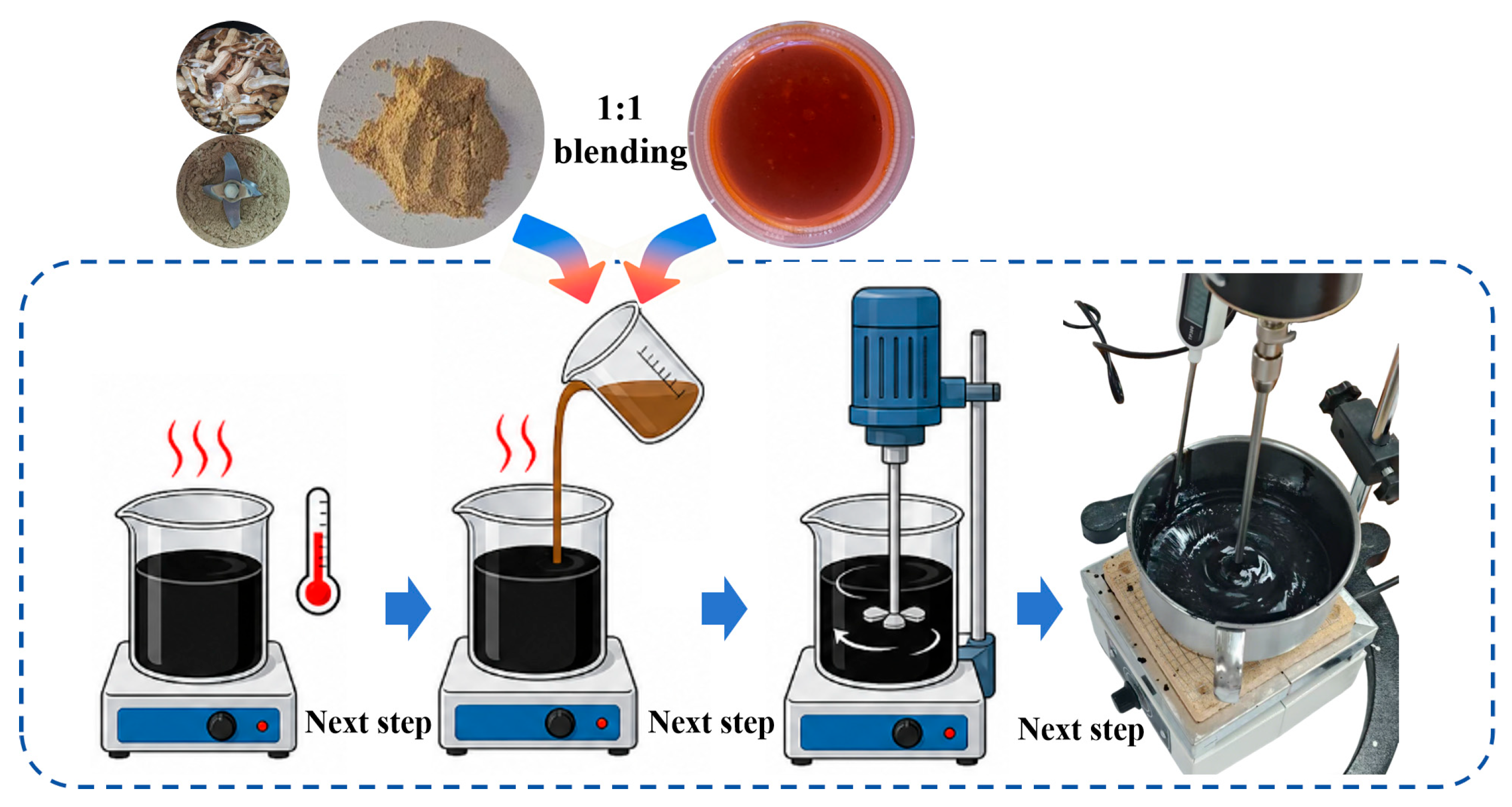
The PSP/WCO-modified asphalt binders were prepared using the melt-blending method. The preparation process is shown in Figure 1. For each specimen group, 250 g of No. 70 base asphalt binder was weighed, placed in a 1000 mL stainless-steel container, and heated at 150 ± 5 °C until it became flowable. The PSP/WCO composite modifier was then added to the base asphalt binder. During modifier addition, the binder was manually stirred for 10 min to prevent local accumulation of PSP and promote preliminary dispersion. The mixture was then mechanically stirred at 2000 r/min for 50 min using a JJ-1A electric stirrer (200 W, Changzhou Surui Instrument Co., Ltd., Changzhou, China), and finally stirred at a low speed of 1000 r/min for 10 min to reduce air bubbles and improve sample homogeneity. The temperature was maintained at 150 ± 5 °C throughout preparation.

2.3. Test Methods

2.3.1. Characterization of Peanut Shell Powder

(1)
Scanning Electron Microscopy (SEM) Test
To observe the micromorphology of PSP, the PSP samples were examined using SEM (JSM-6510A, JEOL Ltd., Akishima, Japan). SEM images were acquired at magnifications of 100×, 200×, 500×, 1000×, 2500×, and 5000× to analyze the particle morphology, surface features, and pore structure of PSP.
(2)
X-ray Diffraction (XRD) Test
To analyze the crystalline structure of PSP, XRD tests were performed using an X-ray diffractometer (D8 Advance, Bruker AXS GmbH, Karlsruhe, Germany). Before testing, the ground PSP samples were uniformly spread on the sample holder and gently pressed into a flat surface. During testing, diffraction patterns were collected in continuous scanning mode over a scanning range of 5–90° at a scanning rate of 2°/min.
(3)
Thermal Stability
To evaluate the thermal stability of peanut shell powder, the PSP samples were tested using thermogravimetric analysis (TG). The test was conducted under a nitrogen atmosphere at a heating rate of 10 °C/min over a temperature range from room temperature to 800 °C. TG curves were recorded simultaneously to analyze the thermal mass-loss behavior and residue content of PSP at different temperature stages.

2.3.2. Characterization of the Physical Properties, Rheological Properties, and Chemical Structure of Modified Asphalt Binders

(1)
Conventional Physical Property Tests
Penetration, softening point, and ductility tests were conducted to evaluate the conventional physical properties of PSP/WCO-modified asphalt binder. The penetration test was conducted at 25 °C under a load of 100 g for 5 s. The softening point was determined using the ring-and-ball method at a heating rate of 5 °C/min. The ductility test was performed at -5 °C with a tensile rate of 5 cm/min. At least three parallel tests were performed for each specimen group, and the average value was reported as the final result. All tests were conducted in accordance with JTG 3410-2025, Standard Test Methods of Bitumen and Bituminous Mixtures for Highway Engineering.
(2)
Dynamic Shear Rheometer (DSR) Test
DSR was used to perform temperature sweep, frequency sweep, and multiple stress creep recovery (MSCR) tests on unaged PSP/WCO-modified asphalt binder. The temperature sweep test was conducted over a temperature range of 40–70 °C at an angular frequency of 10 rad/s, and the complex shear modulus (G*), phase angle (δ), and rutting factor (G*/sinδ) were recorded. These tests were performed on unaged binders to evaluate the high-temperature rheological response before short-term aging. The frequency sweep test was performed at 58 °C, 64 °C, and 70 °C to analyze variations in the viscoelastic parameters of the specimens under different loading frequencies. The MSCR test was conducted at 64 °C under shear stresses of 0.1 and 3.2 kPa, and Jnr and R were calculated. The DSR tests were used to evaluate the effects of the PSP/WCO composite modifier on the high-temperature viscoelastic response and permanent deformation resistance of asphalt binder. The relevant tests were conducted in accordance with JTG 3410-2025, Standard Test Methods of Bitumen and Bituminous Mixtures for Highway Engineering.
(3)
Bending Beam Rheometer (BBR) Test
Bending beam rheometer (BBR) tests were conducted to evaluate the low-temperature creep stiffness and stress relaxation capacity of PSP/WCO-modified asphalt binders using a TE-BBR SD bending beam rheometer (CANNON Instrument Company, State College, PA, USA). The test temperatures were set at −12 °C, −18 °C, and −24 °C, and the creep stiffness (S) and creep rate (m-value) of specimens with different PSP/WCO dosages were measured at the specified loading time. The test was conducted in accordance with JTG 3410-2025, Standard Test Methods of Bitumen and Bituminous Mixtures for Highway Engineering.
(4)
Fourier Transform Infrared Spectroscopy (FTIR)
Fourier transform infrared spectroscopy (FTIR) was used to analyze changes in the functional groups of the base asphalt and PSP/WCO-modified asphalt binder. The wavenumber range was 4000–400 cm−1, the resolution was 4 cm−1, and each specimen was scanned 32 times. By comparing the positions and intensities of the infrared absorption peaks among different specimens, whether significant chemical reactions occurred or new functional groups formed during the PSP/WCO modification process was determined.

2.4. Characterization of Raw Materials

2.4.1. Microscopic Morphological Characteristics

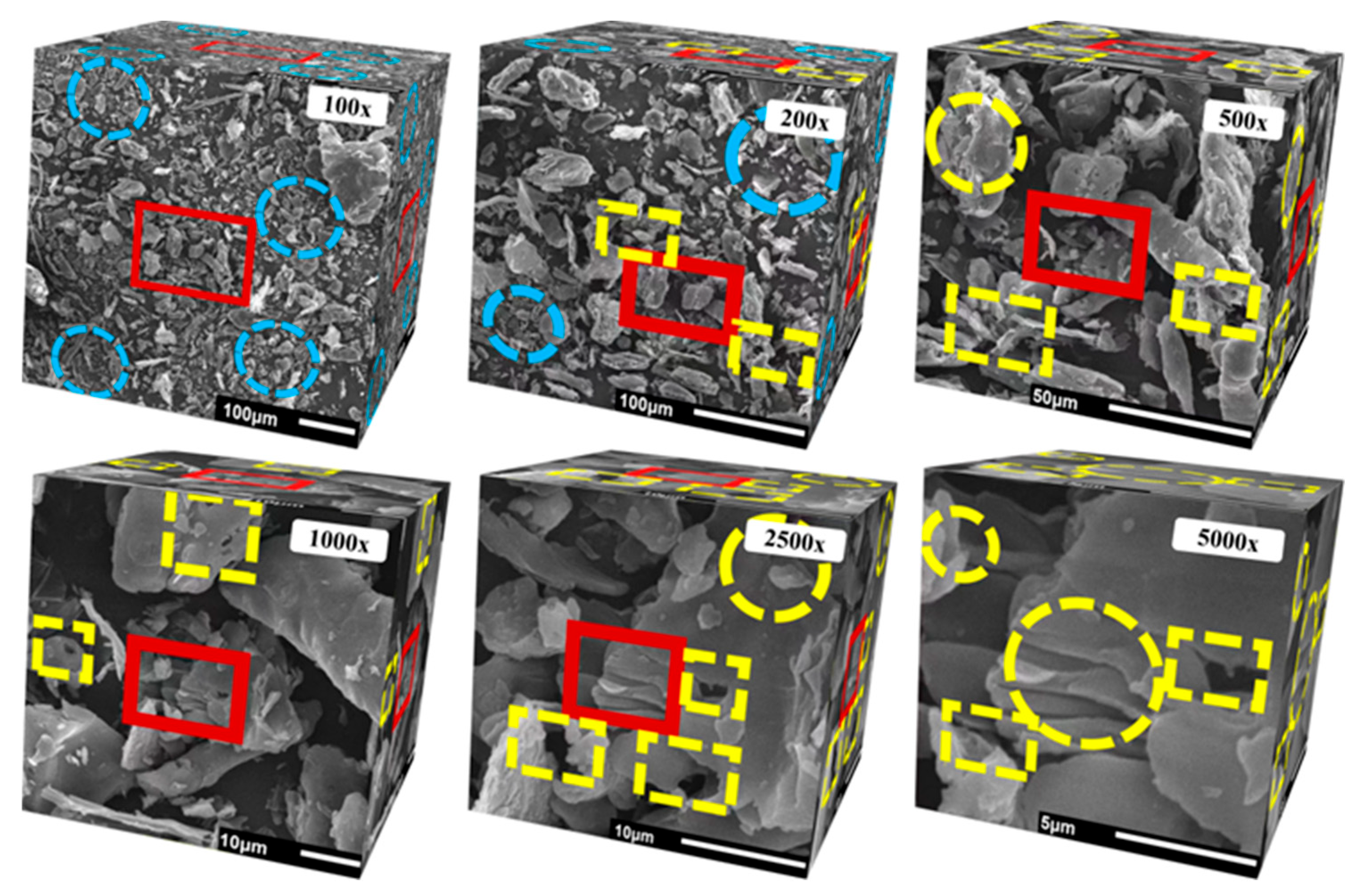
To analyze the micromorphology of PSP, SEM was used to observe the PSP samples at multiple magnifications, and the results are shown in Figure 2. Figure 2 shows the surface morphology of PSP at magnifications of 100×, 200×, 500×, 1000×, 2500×, and 5000×, allowing its particle morphology, surface roughness, and localized pore structure to be identified.
As shown in Figure 2, PSP exhibits a distinctly irregular particle morphology in the low-magnification SEM images. In the 100× and 200× images, the particles are mainly present as flakes, blocks, and fragments, with large variations in particle size. Fine-particle agglomeration is observed in some localized regions, and the areas marked by blue dashed circles indicate the nonuniform aggregation of fine particles after crushing. This morphology indicates that mechanical crushing did not produce a completely homogeneous PSP system; instead, PSP consisted of fiber fragments, flake-like particles, and fine broken particles at different scales. As the magnification increased, the surface roughness and local structural defects of PSP particles became more pronounced. The areas marked by red solid boxes show lamellar exfoliation, wrinkled fracture surfaces, and layered fracture structures, indicating that the lignocellulosic tissues of the peanut shells underwent fracture and exfoliation during crushing. The areas marked by yellow dashed boxes and circles correspond to structural features such as interparticle pores, grooves, cracks, surface depressions, and curled edges. In the 500× to 5000× images, these pores and folded structures became clearer, indicating that PSP had relatively high surface irregularity and localized porous characteristics. From the perspective of asphalt modification, the irregular particle morphology, rough surface, and localized pore structure of PSP can increase its physical contact area with asphalt, thereby providing a morphological basis for light-component adsorption, particle filling, and interfacial adhesion. Therefore, these observations preliminarily suggest that PSP is suitable as the solid-phase component of modified asphalt binder, and its morphological characteristics may provide a structural basis for improving the high-temperature rheological properties of asphalt.

2.4.2. Crystalline Structural Characteristics

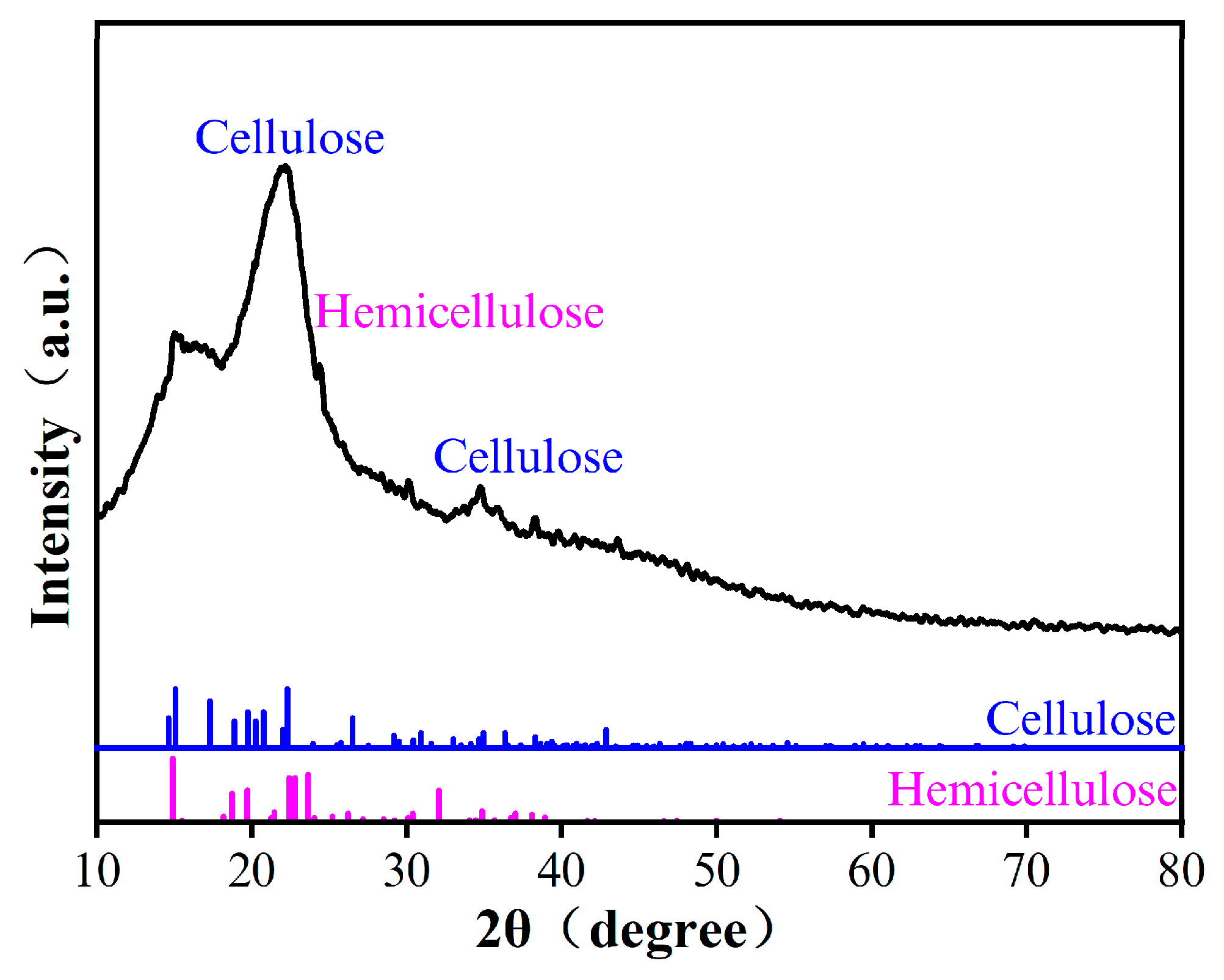
To analyze the crystalline structure of PSP, XRD was performed on the PSP samples, and the results are shown in Figure 3. XRD is commonly used to characterize cellulose crystalline regions in lignocellulosic materials. The crystalline structure and the influence of amorphous components in the samples can be identified from changes in the positions and intensities of characteristic diffraction peaks [38,39]. Because PSP is not a pure cellulose material, its diffraction response is jointly affected by cellulose crystalline regions and amorphous components such as hemicellulose and lignin. Therefore, this study analyzes its structural attributes mainly in terms of characteristic peak positions and peak-shape changes.
The XRD pattern of PSP (Figure 3) shows diffraction peaks near 2θ = 14.98°, 22.24°, and 34.70°. Among these peaks, the peak near 22.24° exhibits the highest intensity, the peak near 14.98° appears as a weak shoulder peak, and the peak near 34.70° shows relatively low intensity. Based on the compositional characteristics of peanut shells, these peaks can mainly be attributed to cellulose I crystalline regions in lignocellulosic materials. Cellulose molecular chains can form relatively ordered crystalline regions through intramolecular and intermolecular hydrogen bonding, thereby producing distinct diffraction responses in the XRD pattern. In contrast, hemicellulose and lignin are mostly amorphous or weakly ordered, which usually weakens peak intensity and causes peak broadening. Therefore, the main peak near 22.24° indicates that cellulose crystalline regions are retained in PSP. However, the relatively broad peak shape also suggests that PSP was not chemically purified and still contained amorphous components such as hemicellulose, lignin, and a small amount of ash. The XRD results for similar shell-based biomass materials are generally consistent with those obtained in this study. Oulidi et al. reported that PSP/polyamide bio composites showed diffraction peaks near 2θ ≈ 15° and 21.86°, which were attributed to cellulose crystalline regions in lignocellulosic materials [40]. Gil-Guillén et al. reported that cellulose materials derived from almond shells exhibited characteristic peaks of cellulose I near 2θ ≈ 16°, 22°, and 34°, and that these crystalline peaks became clearer after the removal of amorphous components [41]. The main peak positions of PSP in this study are close to those reported in previous studies. However, the broader peak shapes indicate that PSP is more consistent with the structural characteristics of unpurified raw lignocellulosic powder than with those of purified cellulose materials.

2.4.3. Thermal Stability Analysis

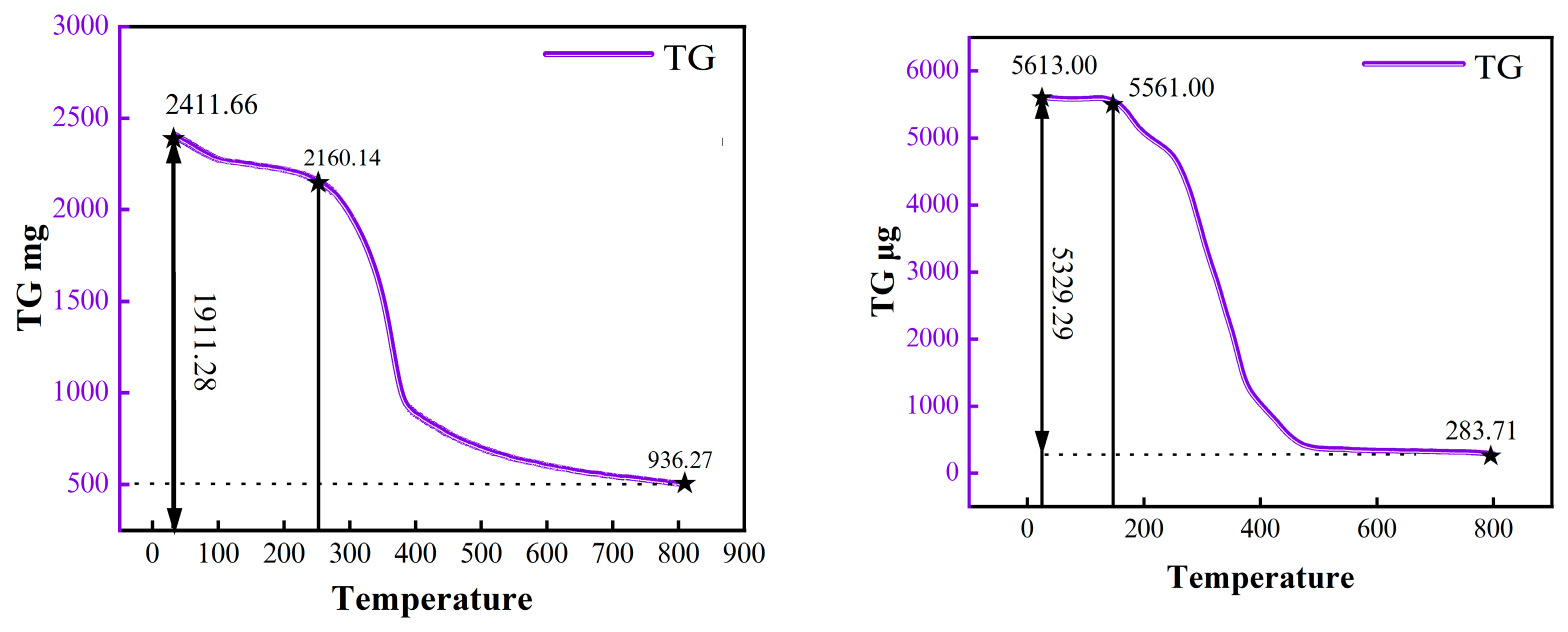
To evaluate the thermal stability of PSP and the PSP/WCO composite modifier during heating, TG curves were obtained under programmed heating conditions, as shown in Figure 4. The analysis focused on the initial mass loss, main thermal decomposition stage, and final residue content, with particular attention to the thermal stability of the materials near the preparation temperature of approximately 150 °C.
As a biomass powder, PSP is subjected to heating and shearing at approximately 150 °C during the preparation of PSP/WCO-modified asphalt binder. Therefore, its thermal stability affects its suitability for asphalt binder modification. The TG curves of PSP and the PSP/WCO composite modifier are shown in Figure 4. From room temperature to 150 °C, the TG curve of PSP decreased slowly, with a mass-loss percentage of approximately 4.17%. This mass loss was mainly associated with the release of adsorbed water and a small amount of low-boiling-point components. In the same temperature range, the mass of the PSP/WCO composite modifier decreased from approximately 5613.00 to 5561.00 μg, corresponding to a mass loss of approximately 52.00 μg and a mass-loss percentage of approximately 0.93%. No obvious thermal decomposition was observed for either material near the preparation temperature, indicating that both PSP and the PSP/WCO composite modifier had sufficient thermal stability for asphalt binder modification. The lower mass-loss percentage of the PSP/WCO composite modifier below 150 °C may be related to the wetting and coating effects of WCO on the PSP particle surface, which could restrict the release of adsorbed water or low-boiling-point components. It also suggests that WCO did not cause obvious volatile mass loss near the preparation temperature.
When the temperature increased to 250–400 °C, the TG curve of PSP decreased rapidly. The sample mass decreased from approximately 2160.14 to 936.27 μg, indicating that PSP entered the main thermal mass-loss stage. This stage was mainly associated with the thermal decomposition of hemicellulose, cellulose, and part of the lignin structure. In contrast, the rapid mass-loss range of the PSP/WCO composite modifier extended to approximately 250–450 °C, suggesting that its thermal mass-loss process was affected by both the decomposition of the lignocellulosic structure of PSP and the volatilization or decomposition of oil-phase components in WCO. Above 500 °C, the TG curves of both materials gradually stabilized, indicating that most volatile components and organic frameworks had decomposed. The remaining residues were mainly carbonized products and a small amount of inorganic ash. The final residue percentage of PSP was approximately 26.09%, whereas the final residual mass of the PSP/WCO composite modifier was approximately 283.71 μg, corresponding to a residue percentage of approximately 5.05%. The lower residue percentage of the composite modifier mainly reflected the higher proportion of decomposable oil-phase components introduced by WCO. Overall, WCO contributed to wetting and dispersion in the PSP/WCO composite modifier and did not weaken its thermal stability near the preparation temperature of 150 °C. Therefore, the PSP/WCO composite modifier showed basic suitability for preparing hot-mix PSP/WCO-modified asphalt binder.
In summary, SEM, XRD, and TG analyses demonstrate that PSP possesses the fundamental material characteristics required for use as the solid-phase component in modified asphalt binder, as evidenced by its morphology, crystalline composition, and thermal stability, respectively. The irregular particle morphology, rough surface, and localized pore structure of PSP may facilitate its interaction with asphalt. XRD results show that cellulose crystalline regions are retained in PSP, while PSP still exhibits the multicomponent characteristics of raw lignocellulosic powder. TG results further indicate that PSP undergoes no obvious thermal decomposition near the modified-asphalt preparation temperature of approximately 150 °C, confirming its thermal stability during preparation. Therefore, PSP shows basic thermal and morphological suitability for use in asphalt binder and can serve as the solid-phase component of the PSP/WCO composite modifier.

3. Results and Discussion

This section discusses the effects of the PSP/WCO composite modifier on the physical, rheological, thermal, and interaction characteristics of unaged No. 70 asphalt binder. The PSP/WCO system was designed to combine the solid-phase reinforcement of PSP with the wetting, dispersion, and oil-phase regulation effects of WCO. Therefore, the following results are organized into two parts: the physical and rheological properties of PSP/WCO-modified asphalt binders, and the thermal stability and physical interaction mechanism of the modified binders.

3.1. Physical and Rheological Properties of Modified Asphalt Binders

3.1.1. Conventional Physical Properties

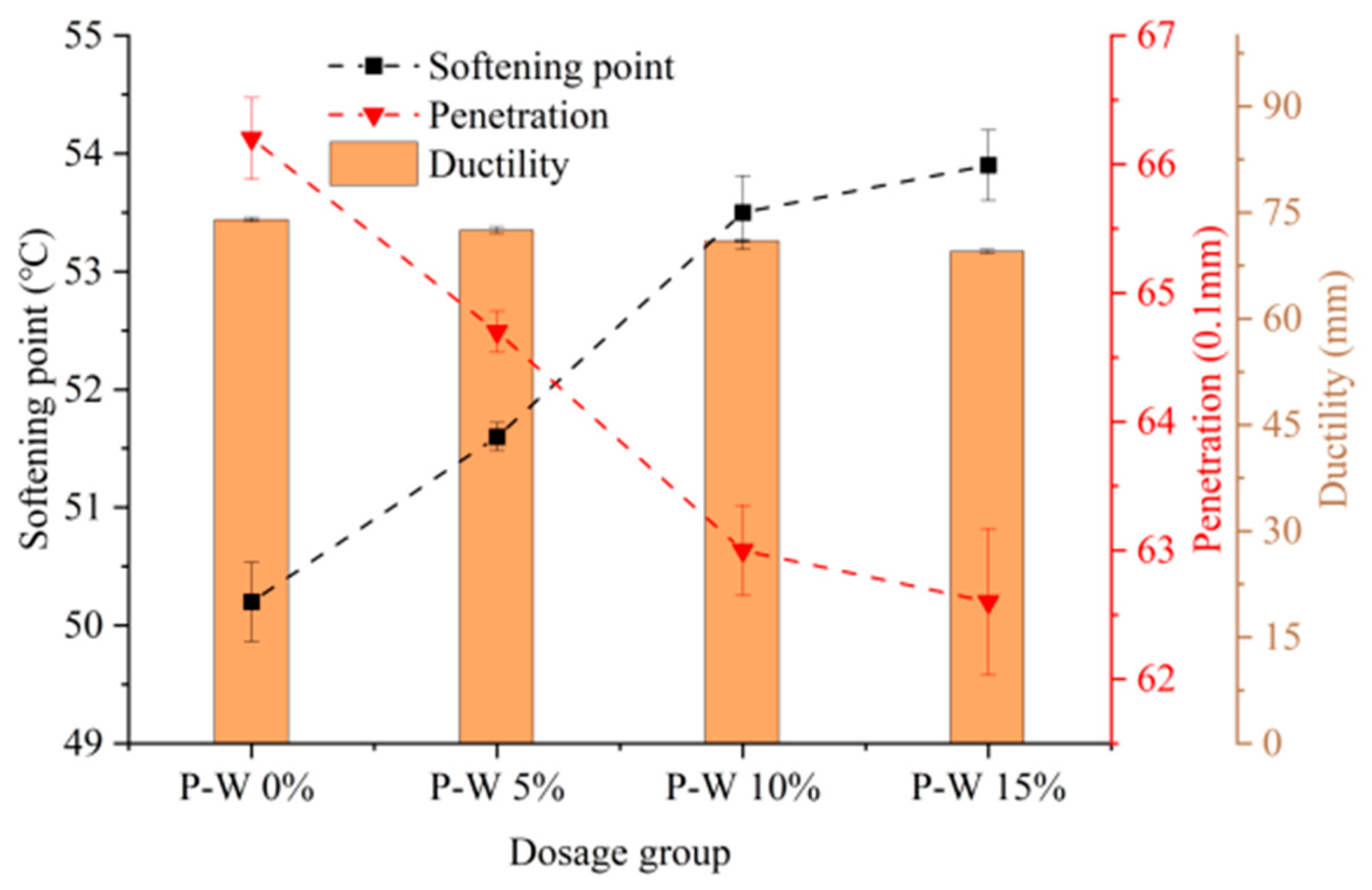
Conventional physical properties can preliminarily reflect the effects of the PSP/WCO composite modifier on the consistency, thermal softening behavior, and low-temperature ductility of asphalt binder. Penetration, softening point, and ductility correspond to the basic responses of asphalt binder under room-temperature loading, high-temperature softening, and low-temperature tensile conditions, respectively, and provide a reference for the subsequent analysis of rheological properties. The conventional physical properties of the P-W specimens with different PSP/WCO dosages are shown in Figure 5.
The conventional physical properties of the P-W specimens are shown in Figure 5. As the dosage of the PSP/WCO composite modifier increased from 0% to 15%, the softening point increased from 50.2 °C to 53.9 °C, indicating that the composite modifier improved the resistance of the asphalt binder to flow at elevated temperatures. In contrast, penetration at 25 °C decreased from 66.2 to 62.6 (0.1 mm), and ductility decreased from 74.0 to 69.5 mm. These results show that PSP/WCO incorporation increased the consistency of the asphalt binder and restricted tensile deformation to some extent. The increase in softening point and the decrease in penetration are generally consistent with the stiffening effect of powder-like modifiers. As a lignocellulosic biomass powder, PSP may contribute to particle filling, adsorption of light components, and local structural support within the asphalt binder. Wang et al. reported that peanut shell powder could absorb light components in asphalt and that increasing PSP content decreased penetration and ductility while increasing softening point and viscosity, indicating an enhancement in binder stiffness and high-temperature stability [42]. In the present PSP/WCO system, although WCO was introduced as an oil-phase component to improve the wetting and dispersion of PSP, the overall changes in softening point and penetration suggest that the solid-phase contribution of PSP played a more dominant role in the conventional physical properties. It can also be observed that the changes in softening point and penetration became less pronounced when the PSP/WCO dosage increased from 10% to 15%. In this dosage range, the softening point increased by only 0.4 °C, and penetration decreased by only 0.4 (0.1 mm). This indicates that further increasing the composite modifier dosage produced a relatively limited additional influence on these two conventional indices. This phenomenon may be related to the reduced additional contribution of PSP to particle filling and light-component adsorption at higher dosages, while the presence of WCO may also have moderated further binder stiffening. Similar oil–solid contrast has been reported for waste vegetable oil/agricultural ash-modified binder, in which the oil phase increased penetration and decreased softening point, whereas the ash phase decreased penetration and increased softening point [14]. Therefore, the relatively limited changes from 10% to 15% may reflect the combined influence of PSP-related solid-phase reinforcement and WCO-related oil-phase regulation, rather than a simple linear stiffening response with increasing modifier dosage. The continuous decrease in ductility indicates that the powder phase still imposed constraints on tensile deformation. However, the reduction in ductility was relatively small, suggesting that WCO may have partly alleviated the stiffening effect of PSP. Since penetration, softening point, and ductility only provide basic physical information, DSR, MSCR, and BBR tests were further conducted to evaluate the high-temperature deformation resistance and low-temperature creep relaxation behavior of the unaged binders.
For a basic comparison with the technical requirements of No. 70 base asphalt binder listed in Table 1, the penetration and softening point results of the P-W specimens were further examined. The penetration values of P-W 0%, P-W 5%, P-W 10%, and P-W 15% were all within the range of 60–80 (0.1 mm), and their softening points were higher than 46 °C. These results indicate that PSP/WCO incorporation did not cause the asphalt binders to fall outside the basic reference requirements for penetration and softening point. Unlike penetration and softening point, the ductility test in this study was conducted at −5 °C, whereas the ductility requirements in Table 1 correspond to 10 °C and 15 °C. Because asphalt ductility is sensitive to test temperature, ductility results obtained at different temperatures should not be evaluated using the same limit. Therefore, the ductility at −5 °C was used mainly to observe the variation in low-temperature tensile deformation capacity at different PSP/WCO dosages. The ductility decreased from 74.0 to 69.5 mm, and the reduction was relatively small, suggesting that PSP/WCO incorporation slightly restricted low-temperature tensile deformation but did not cause a marked decrease in ductility.

3.1.2. Temperature Sweep Test

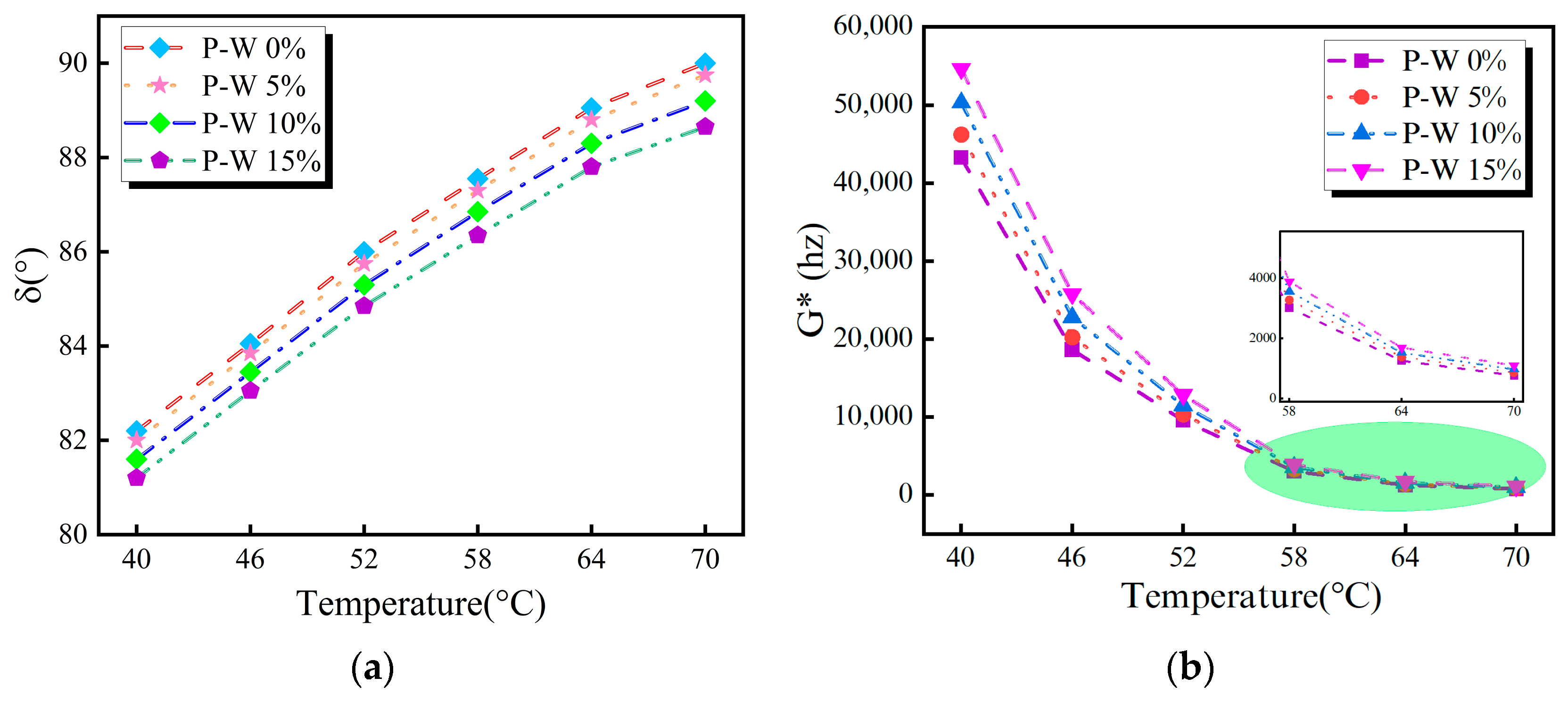
The temperature sweep test was used to characterize the viscoelastic response of the P-W specimens during heating. The test was conducted at 40–70 °C and an angular frequency of 10 rad/s, and the temperature-dependent curves of G*, δ, and G*/sin δ were obtained, as shown in Figure 6. Specifically, G* reflects the ability of asphalt binder to resist shear deformation, δ reflects the relative proportions of elastic and viscous responses, and G*/sin δ is used to evaluate the deformation resistance of unaged asphalt under high-temperature conditions [43].
The temperature sweep results of the P-W specimens are shown in Figure 6. δ generally increased with increasing temperature. This indicates that the viscous response of the asphalt binder gradually increased during heating, whereas the elastic response weakened relatively. For P-W 0%, δ increased from 82.2° at 40 °C to 90.0° at 70 °C. For P-W 15%, δ increased from 81.2° to 88.65°. At the same temperature, δ decreased as the PSP/WCO dosage increased. At 64 °C, the phase angles of P-W 0% and P-W 15% were 89.05° and 87.80°, respectively. At 70 °C, they were 90.00° and 88.65°, respectively. These results indicate that the composite modifier increased the proportion of elastic response in the asphalt system. As a result, the material maintained stronger viscoelastic structural characteristics at high temperatures. G* decreased markedly with increasing temperature. This reflects the weakening effect of high temperature on the shear deformation resistance of asphalt binder. For P-W 0%, G* decreased from 43,260.8 Pa at 40 °C to 771.8 Pa at 70 °C. The reduction was greater than 98%. For P-W 15%, G* decreased from 54,688.3 to 1106.8 Pa. These results indicate that temperature remained the dominant factor controlling the high-temperature viscoelastic response of asphalt binder. Meanwhile, at each test temperature, G* increased as the PSP/WCO dosage increased. At 40 °C, 64 °C, and 70 °C, the G* values of P-W 15% were approximately 26.4%, 35.1%, and 43.4% higher than those of P-W 0%, respectively. This indicates that the PSP/WCO composite modifier enhanced the shear deformation resistance of asphalt binder at high temperatures. This trend differs from that typically observed for asphalt modified with a single oil-phase component. Lei et al. found that WCO-derived bio-oil reduced the softening point, viscosity, complex modulus, and creep stiffness of asphalt binder. It also increased penetration, ductility, phase angle, and m-value. These changes indicated pronounced softening and stress relaxation effects [44]. Zhang et al. also reported that waste bio-oil (WBO) reduced the stiffness and high-temperature deformation resistance of ethylene–vinyl acetate (EVA)-modified asphalt. It also improved its fluidity and tensile performance [45]. Compared with these reported results, the P-W specimens in this study showed increased G* and decreased δ. This suggests that powder reinforcement may have played a more dominant role in the high-temperature rheological response at the fixed PSP/WCO ratio. This difference may be attributed to particle filling, local structural support, and physical interactions between PSP and light components in the asphalt binder. These effects may have improved the shear deformation resistance of the system at high temperatures. In contrast, the oil-phase regulation effect of WCO did not fully offset the structural reinforcement provided by PSP. This interpretation is consistent with the increase in G* and the decrease in δ observed in the temperature sweep test. However, it should be regarded as a reasonable explanation based on rheological responses and material composition, rather than as direct evidence of the mechanism. Together with the increase in softening point, these results indicate that the PSP/WCO composite modifier enhanced the high-temperature viscoelastic response of the unaged asphalt binder to some extent.
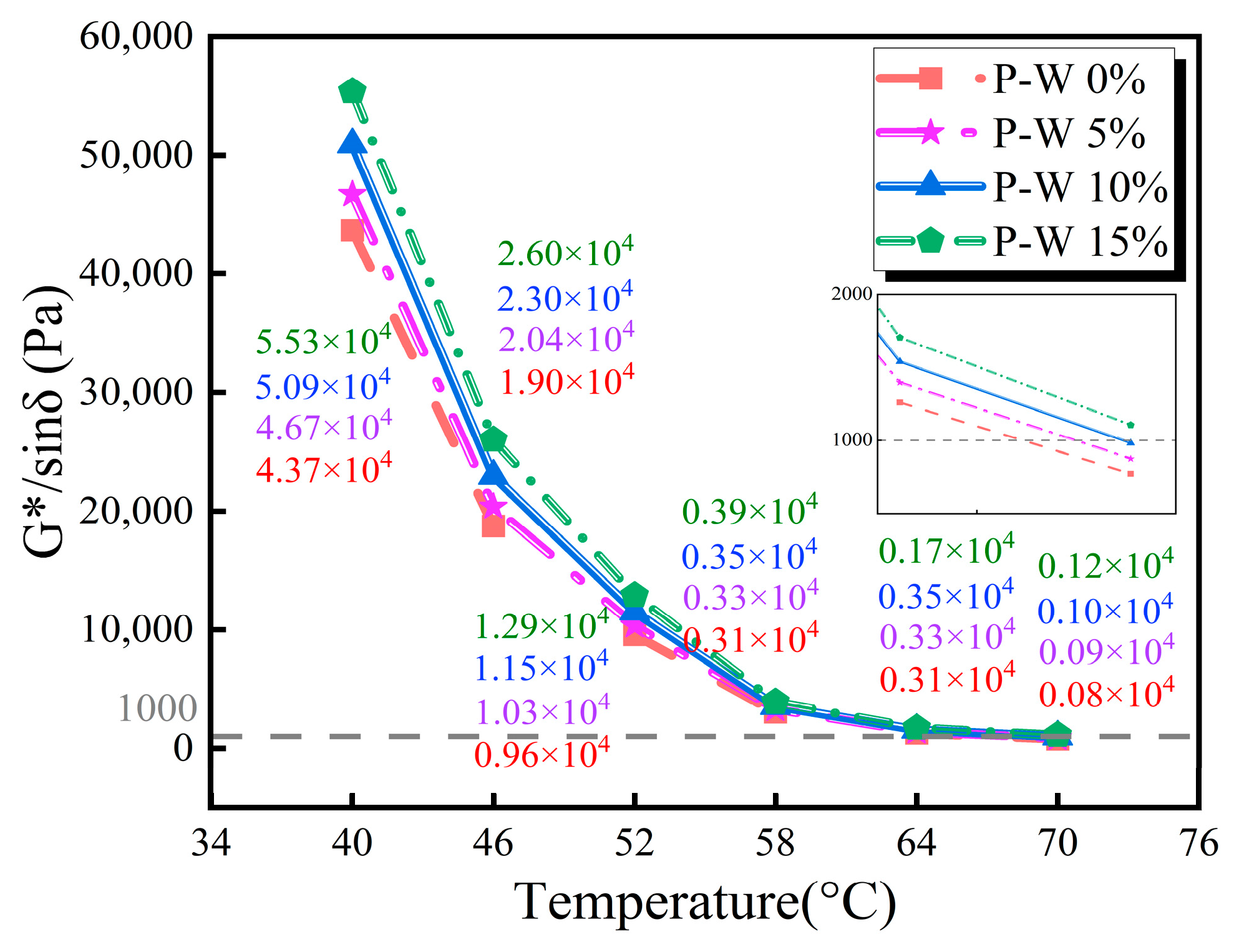
The rutting factor, G*/sin δ, further characterizes the ability of the P-W specimens to resist permanent deformation at high temperatures. It can also serve as a reference index for evaluating the high-temperature rheological level of unaged asphalt binder. According to the Superior Performing Asphalt Pavements (Superpave) criterion for the high-temperature performance of asphalt binder, the G*/sin δ value of unaged asphalt at the corresponding temperature should be at least 1.0 kPa. The rutting factor calculated from the temperature sweep data is shown in Figure 7.
The G*/sinδ values of the P-W specimens are shown in Figure 7. As the temperature increased from 40 °C to 70 °C, the G*/sinδ values of all specimens decreased markedly, indicating that heating weakened the high-temperature deformation resistance of the asphalt binder. For P-W 0%, G*/sinδ decreased from 43,669.16 to 771.80 Pa, while for P-W 15%, it decreased from 55,345.91 to 1107.13 Pa. These results indicate that temperature remained the dominant factor controlling the attenuation of G*/sinδ. At the same temperature, G*/sinδ increased as the PSP/WCO dosage increased. At 40 °C, 64 °C, and 70 °C, the G*/sinδ values of P-W 15% were approximately 26.7%, 35.2%, and 43.4% higher than those of P-W 0%, respectively, indicating that the composite modifier enhanced the shear deformation resistance of asphalt at relatively high temperatures. For the subsequent MSCR test, the unaged G*/sinδ ≥ 1.0 kPa criterion was used to identify a common high-temperature condition suitable for all P-W specimens. At 64 °C, the G*/sinδ values of P-W 0%, P-W 5%, and P-W 10% were 1.261, 1.397, and 1.540 kPa, respectively, all exceeding 1.0 kPa. At 70 °C, these values decreased to 0.772, 0.875, and 0.982 kPa, respectively, while P-W 15% still reached 1.107 kPa. Therefore, 64 °C was selected as the MSCR test temperature because it was the highest temperature at which all P-W specimens met the unaged G*/sinδ ≥ 1.0 kPa criterion. The higher value of P-W 15% at 70 °C further indicates that the 15% PSP/WCO dosage produced the strongest unaged high-temperature rheological response among the tested binders. This trend is consistent with the previously observed increase in G* and decrease in δ. It indicates that the increase in rutting factor was mainly caused by enhanced high-temperature shear stiffness and a higher proportion of elastic response in the asphalt system. Previous studies have shown that WCO or bio-oil used alone usually reduces the complex modulus and rutting factor of asphalt, reflecting a softening effect. In contrast, powder or fiber components are more likely to improve high-temperature deformation resistance through filling, adsorption, and structural support [46,47]. In this study, the rutting factor increased continuously with increasing PSP/WCO dosage, indicating that the solid-phase reinforcement effect of PSP dominated the high-temperature response. The oil-phase regulation effect of WCO did not weaken the overall high-temperature stability.

3.1.3. Frequency Sweep Test

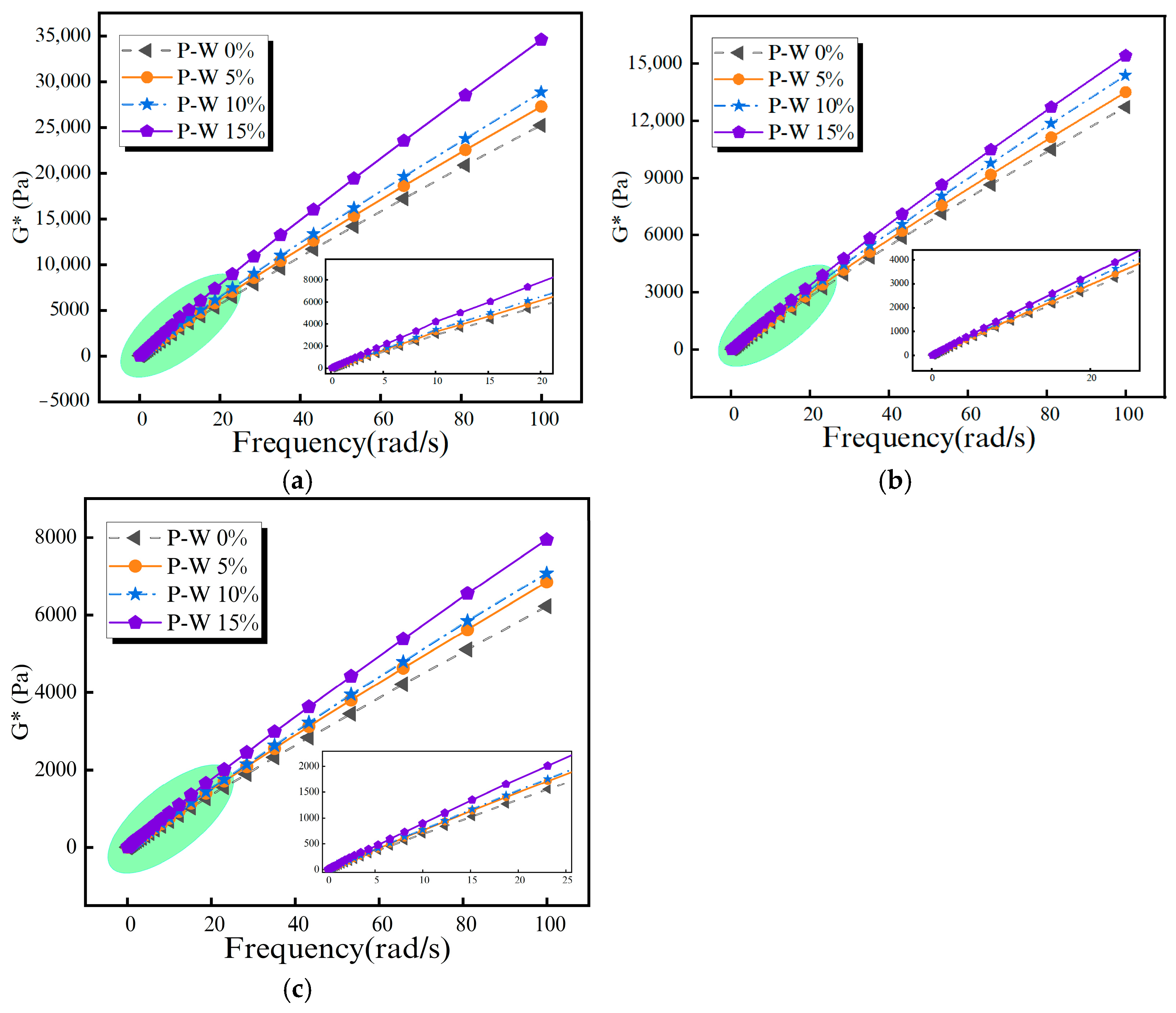
Frequency sweep tests were used to further analyze the viscoelastic response of the P-W specimens under different loading frequencies. Unlike temperature sweep, which mainly reflects performance attenuation during heating, frequency sweep characterizes the dynamic mechanical behavior of asphalt under different loading durations. In this study, frequency sweep tests were conducted on the P-W specimens at 58 °C, 64 °C, and 70 °C. The tests were used to analyze the response of G* to changes in frequency, temperature, and PSP/WCO dosage. The results are shown in Figure 8.
The frequency sweep results of the P-W specimens at 58 °C, 64 °C, and 70 °C are shown in Figure 8. The G* values of all specimens increased with increasing loading frequency. This indicates that shorter loading durations restricted viscous flow within the asphalt. As a result, the material exhibited stronger resistance to shear deformation. As the temperature increased from 58 °C to 70 °C, G* at the same frequency decreased markedly. This indicates that heating weakened the interactions among internal components and reduced the structural confinement capacity of the asphalt system. The material therefore became more prone to viscous flow. Under the same temperature and frequency conditions, G* increased as the PSP/WCO dosage increased. P-W 15% exhibited a higher modulus at all test temperatures. At the upper test angular frequency of 100 rad/s, the G* values of P-W 15% at 58 °C, 64 °C, and 70 °C were 34,592.1, 15,431.3, and 7943.26 Pa, respectively. These values were approximately 38.0%, 21.4%, and 27.9% higher than those of P-W 0%, respectively. This result indicates that the PSP/WCO composite modifier improved the structural stiffness of asphalt binder under dynamic shear loading. This enhancement was still maintained at 70 °C. This phenomenon occurs because an increase in frequency shortens the duration of a single shear loading cycle. The viscous components in asphalt binder therefore have less time to flow and rearrange. As a result, the elastic contribution to the material response increases, leading to an increase in G*. Increasing temperature weakens intermolecular interactions and intercomponent constraints in asphalt. This makes light components more prone to viscous flow. Consequently, G* decreases at the same frequency. In the P-W specimens, PSP/WCO incorporation improved the structural retention capacity of the system under dynamic shear action. This allowed the modified asphalt binder to maintain a relatively high modulus under high-temperature and high-frequency conditions. This result indicates that the composite modifier improved static or quasi-static high-temperature indices. It also regulated the viscoelastic response under different loading durations. Previous studies have shown that incorporating cellulosic materials or biomass powders into asphalt usually increases binder stiffness and improves the high-temperature rheological response. In contrast, WCO components used alone are more likely to produce softening and fluidity-regulating effects [48,49]. In this study, G* increased with increasing PSP/WCO dosage. This result suggests that the PSP-related solid-phase reinforcement may have been more pronounced in the frequency response of the P-W system, whereas WCO may have mainly contributed to compositional regulation and dispersion assistance. This trend is consistent with the results of the temperature sweep test and rutting factor analysis.

3.1.4. Multiple Stress Creep Recovery Performance

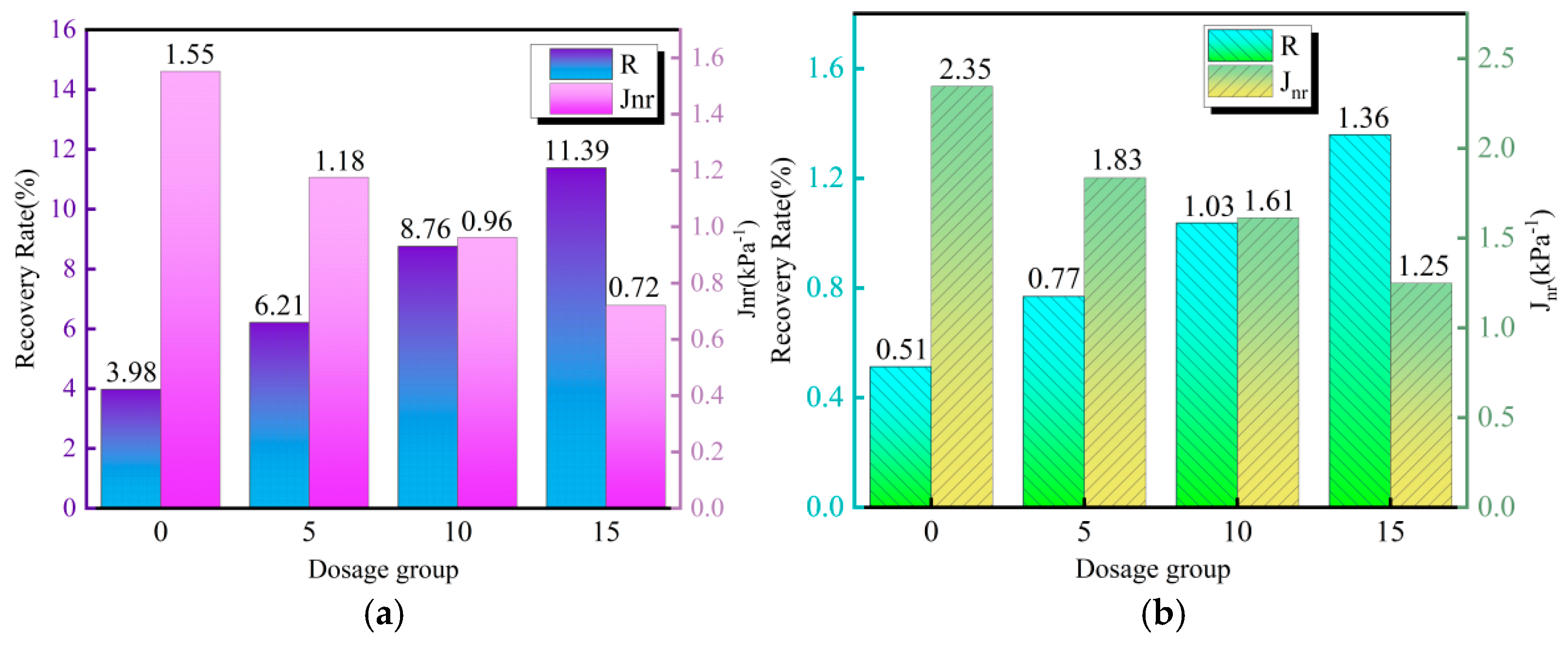
The MSCR test was used to further evaluate the deformation accumulation and recovery capacity of the P-W specimens under high-temperature repeated shear loading. Unlike the rutting factor, which is mainly based on linear viscoelastic parameters, MSCR obtains Jnr and R through loading–unloading cycles. A smaller Jnr indicates less unrecoverable deformation after repeated loading and stronger resistance to permanent deformation. A larger R indicates stronger elastic recovery capacity after unloading. Based on the unaged G*/sinδ criterion used for MSCR temperature selection, 64 °C was selected as the test temperature because it was the highest common temperature at which all P-W specimens satisfied G*/sinδ ≥ 1.0 kPa. It should be noted that this criterion was used only to determine a suitable common test temperature for MSCR analysis of the unaged binders, rather than to assign a formal high temperature at 64 °C. MSCR tests were conducted on the P-W specimens at two stress levels: 0.1 and 3.2 kPa. The results are shown in Figure 9.
The MSCR results are shown in Figure 9. The P-W specimens exhibited a consistent dosage-dependent response at both stress levels of 0.1 and 3.2 kPa. As the PSP/WCO dosage increased, Jnr gradually decreased, whereas R gradually increased. At 0.1 kPa, Jnr decreased from 1.55 kPa−1 for P-W 0% to 0.72 kPa−1 for P-W 15%. This corresponds to a reduction of approximately 53.5%. Meanwhile, R increased from 3.98% to 11.39%. These results indicate that the composite modifier reduced unrecoverable deformation at the low stress level and enhanced elastic recovery after unloading. At 3.2 kPa, Jnr decreased from 2.35 to 1.25 kPa−1. This corresponds to a reduction of approximately 46.8%. R increased from 0.51% to 1.36%. These results indicate that the P-W specimens still showed improved permanent deformation resistance as the PSP/WCO dosage increased, even under higher shear stress. Compared with those at 0.1 kPa, the Jnr values of all specimens at 3.2 kPa were generally higher. In contrast, R decreased markedly. This indicates that the higher stress level amplified viscous flow and unrecoverable deformation in the asphalt binder. It also weakened the elastic recovery capacity of the binder. This phenomenon can be attributed to the reinforcing role of PSP and the regulating role of WCO. As a lignocellulosic powder, PSP can provide particle confinement and interfacial blocking effects under repeated shear loading. These effects reduce the unrecoverable flow of the asphalt system. WCO helps improve the dispersion and compatibility between PSP and asphalt. Thus, the composite system enhances deformation resistance while avoiding excessive stiffening. Similar trends have also been reported in studies on other biomass fiber-modified asphalt binders. Yan et al. used WCO to modify asphalt binder. They found that increasing the WCO dosage improved the low-temperature cracking resistance of modified asphalt binder. This indicates that biomass oil-phase materials can improve the low-temperature rheological properties of asphalt [50]. Mo et al. prepared modified asphalt binder using waste frying oil and waste polyethylene (PE) plastic. They evaluated its high-temperature performance using DSR and MSCR. They also pointed out that Jnr and R can reflect the cumulative deformation and recovery capacity of asphalt [51]. Compared with these studies, the P-W specimens in this study showed decreased Jnr and increased R as the PSP/WCO dosage increased. This result suggests that the improvement in high-temperature performance of the PSP/WCO composite system may be mainly related to the solid-phase reinforcement effect of PSP. The role of WCO may be more closely associated with compositional regulation and dispersion assistance.

3.1.5. Low-Temperature Bending Beam Rheological Performance

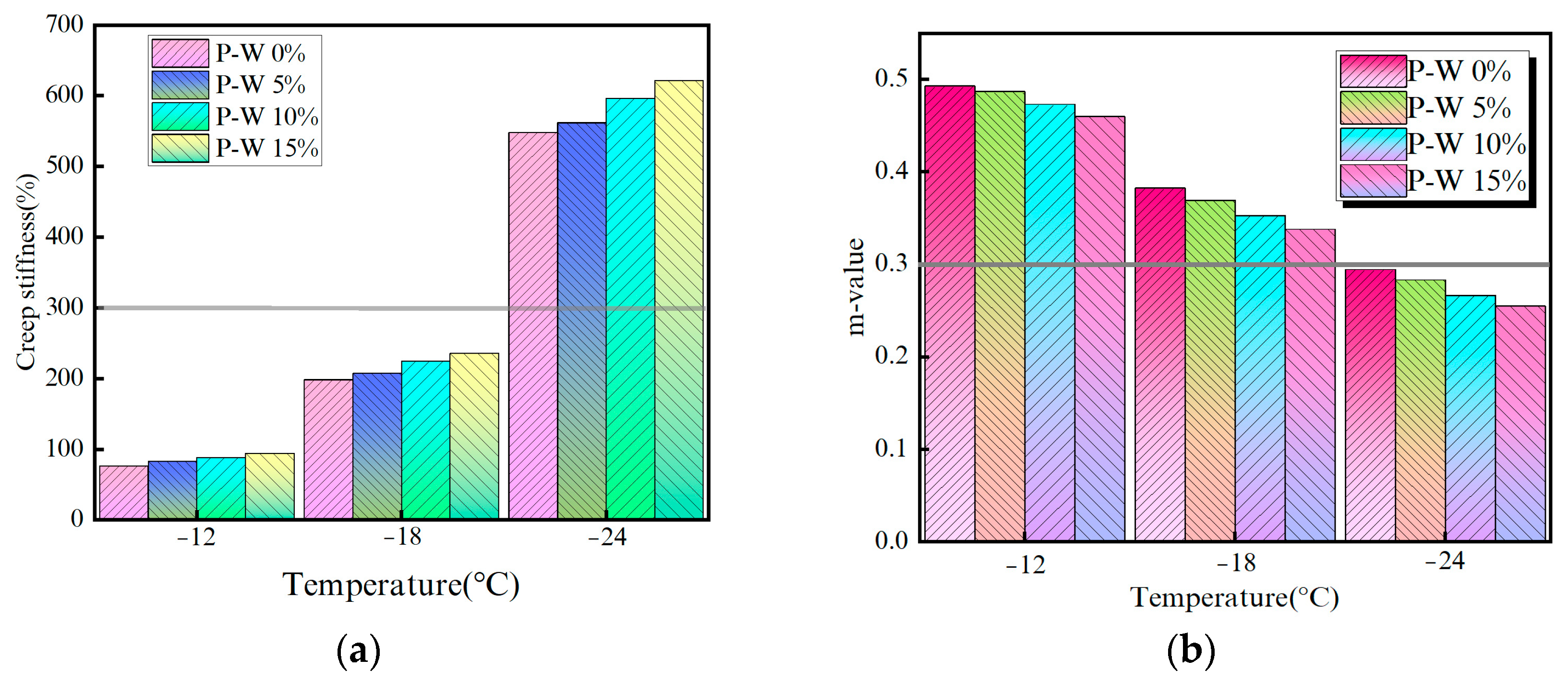
BBR tests were conducted to evaluate the creep stiffness and stress relaxation capacity of the P-W specimens at low temperatures. In this study, three test temperatures were selected: −12 °C, −18 °C, and −24 °C. The S value and m-value of asphalt specimens with different PSP/WCO dosages were measured. The results are shown in Figure 10. In general, a lower S value indicates a lower degree of stiffening in asphalt at low temperatures. It also indicates less accumulation of thermal shrinkage stress. A higher m-value indicates stronger stress relaxation capacity. This is more favorable for reducing the risk of low-temperature cracking. In the Superpave low-temperature performance evaluation, S ≤ 300 MPa and m ≥ 0.300 are commonly used as evaluation criteria.
The BBR results of the P-W specimens are shown in Figure 10. As the temperature decreased from −12 to −24 °C, S increased markedly for all specimens, whereas the m-value continuously decreased. This indicates that low temperature substantially increased binder stiffness and weakened its stress relaxation capacity. For P-W 0%, S increased from 76.4 to 548.2 MPa, whereas the m-value decreased from 0.49 to 0.29. For P-W 15%, S increased from 94.2 to 621.7 MPa, whereas the m-value decreased from 0.46 to 0.25. These variations indicate that decreasing temperature restricted the movement of asphalt molecular chains and promoted the accumulation of low-temperature shrinkage stress. The effect of the PSP/WCO composite modifier on the low-temperature creep response was reflected by increased S and decreased m-value. At −12 °C, S increased from 76.4 MPa for P-W 0% to 94.2 MPa for P-W 15%, while the m-value decreased from 0.49 to 0.46. At −18 °C, S increased from 198.6 to 235.8 MPa, while the m-value decreased from 0.38 to 0.34. At −24 °C, S increased from 548.2 to 621.7 MPa, while the m-value decreased from 0.29 to 0.25. These results indicate that increasing PSP/WCO dosage increased the low-temperature stiffness of asphalt binder and reduced its stress relaxation capacity. Unlike the improvement observed in high-temperature performance, the composite modifier did not simultaneously enhance low-temperature performance. According to the Superpave low-temperature criteria, all specimens satisfied the requirements of S ≤ 300 MPa and m-value ≥ 0.300 at −12 °C and −18 °C. However, none of the specimens satisfied these criteria at −24 °C, because S exceeded 300 MPa and the m-value was lower than 0.300 for all binders. This result indicates that the current PSP/WCO-modified asphalt binders may be more suitable for regions where extremely low-temperature service conditions are not dominant. In colder regions, especially under very low pavement-temperature conditions, the low-temperature stress relaxation capacity of this system may limit its application. Therefore, before this system is considered for cold-climate applications, the PSP/WCO dosage and mass ratio should be further optimized to better balance high-temperature deformation resistance and low-temperature stress relaxation capacity.
This variation may be attributed to the reduced mobility of light components in asphalt at low temperatures, which limits the oil-phase regulation effect of WCO. In contrast, PSP, as a lignocellulosic powder, may enhance the internal structural constraints of the system, leading to higher S values and weaker relaxation capacity under low-temperature bending loads. Similar studies have shown that biomass fibers, such as corn straw fibers, can alter the low-temperature creep response of asphalt binder. Fibrous materials in asphalt mortar may increase low-temperature stiffness and decrease the m-value, thereby increasing susceptibility to low-temperature cracking [52,53]. In this study, the P-W specimens showed increasing S values and decreasing m-values as the modifier dosage increased, indicating that, at the current PSP/WCO ratio of 1:1, the solid-phase constraint effect of PSP was more pronounced in the low-temperature response.
Overall, the physical and rheological tests indicate that PSP/WCO incorporation increased the consistency and high-temperature deformation resistance of the unaged asphalt binder. The softening point, G*, rutting factor, and recovery percentage increased, whereas penetration and Jnr decreased. These results show that the PSP/WCO composite modifier improved the high-temperature rheological response and repeated-load permanent deformation resistance of the binder. However, the BBR results showed that creep stiffness increased and the m-value decreased with increasing PSP/WCO dosage, indicating a reduction in low-temperature stress relaxation capacity. Therefore, the current PSP/WCO formulation presents a performance trade-off: it is favorable for improving high-temperature resistance, but its low-temperature performance should be further balanced through dosage control and component-ratio optimization.

3.2. Thermal Stability and Physical Interaction Mechanism of PSP/WCO-Modified Asphalt Binders

3.2.1. Thermal Stability of P-W Asphalt Binder Specimens

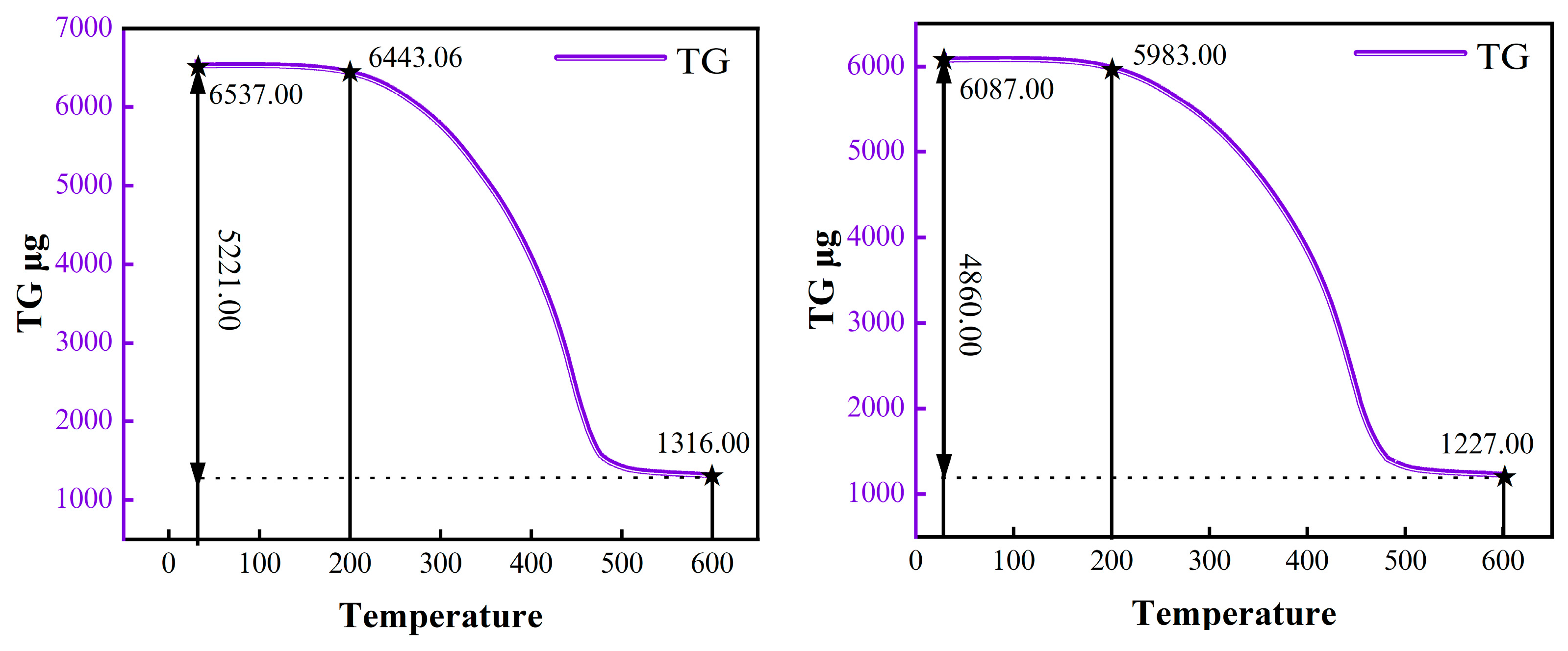
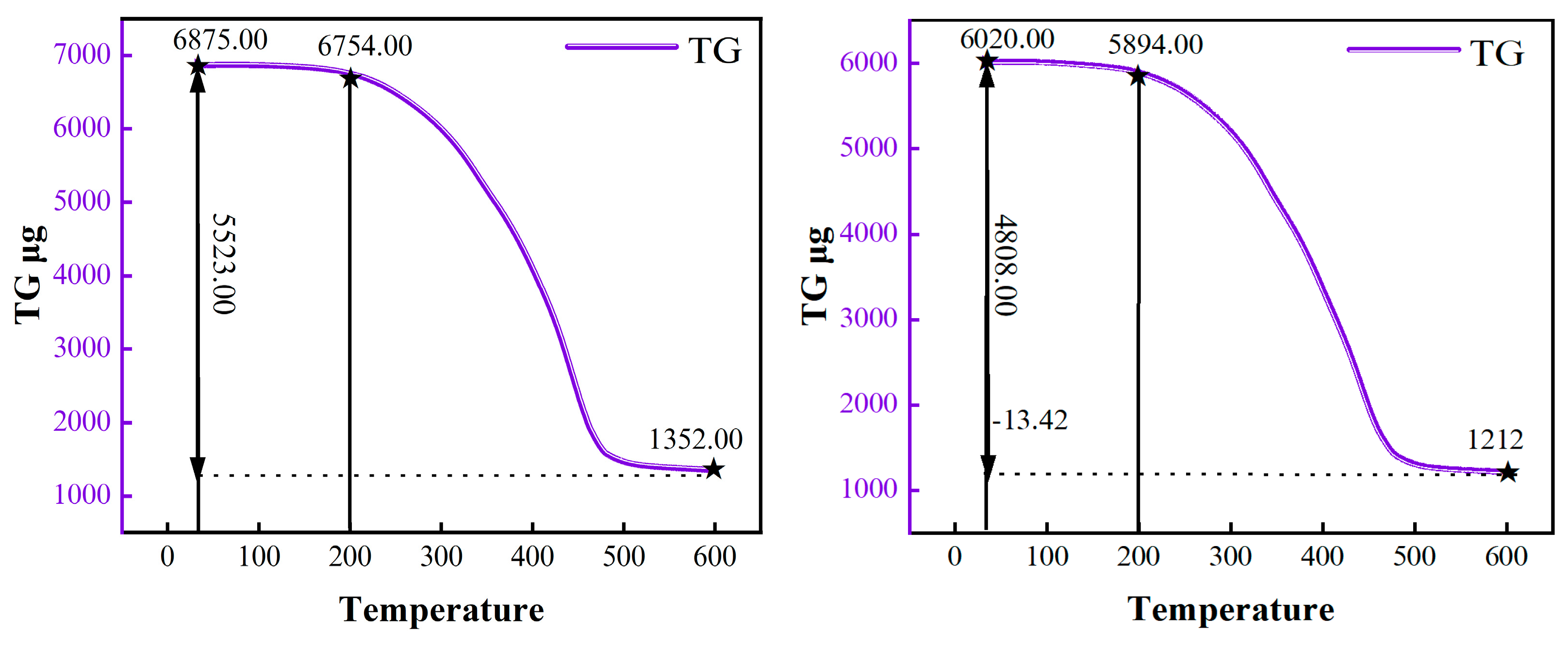
To further investigate the influence of PSP/WCO incorporation on the thermal stability of asphalt binder, TG curves of the P-W asphalt binder specimens with different PSP/WCO dosages were obtained under programmed heating conditions. The results are shown in Figure 11.
As shown in Figure 11, the thermal mass-loss processes of P-W 0%, P-W 5%, P-W 10%, and P-W 15% were similar and could be divided into three stages: initial slow mass loss, main thermal decomposition, and residual stabilization. From room temperature to approximately 200 °C, all specimens showed only slight mass loss. The masses of P-W 0%, P-W 5%, P-W 10%, and P-W 15% decreased from 6537.00, 6087.00, 6875.00, and 6020.00 μg to 6443.06, 5983.00, 6754.00, and 5894.00 μg, respectively, corresponding to mass-loss percentages of approximately 1.44%, 1.71%, 1.76%, and 2.09%. Because this temperature range covers the preparation temperature of approximately 150 °C, the results indicate that no obvious thermal decomposition occurred in either the base asphalt binder or the PSP/WCO-modified asphalt binders during the heated preparation process. As the temperature further increased to approximately 250–500 °C, all specimens entered the main thermal decomposition stage, which was mainly associated with the volatilization and decomposition of organic components in the asphalt binder and the PSP/WCO composite system. The modified asphalt binders showed TG trends similar to that of P-W 0%, indicating that PSP/WCO incorporation did not cause premature decomposition at lower temperatures. Above approximately 500 °C, the TG curves gradually stabilized. The final residual masses of P-W 0%, P-W 5%, P-W 10%, and P-W 15% were 1316.00, 1227.00, 1352.00, and 1212.00 μg, corresponding to residue percentages of approximately 20.13%, 20.16%, 19.67%, and 20.13%, respectively. The similar residue percentages further indicate that PSP/WCO incorporation did not markedly change the overall thermal mass-loss behavior of the asphalt binder. Therefore, the PSP/WCO composite modifier did not significantly reduce the thermal stability of the asphalt binder under the heated preparation conditions.

3.2.2. Fourier Transform Infrared Spectroscopy Analysis

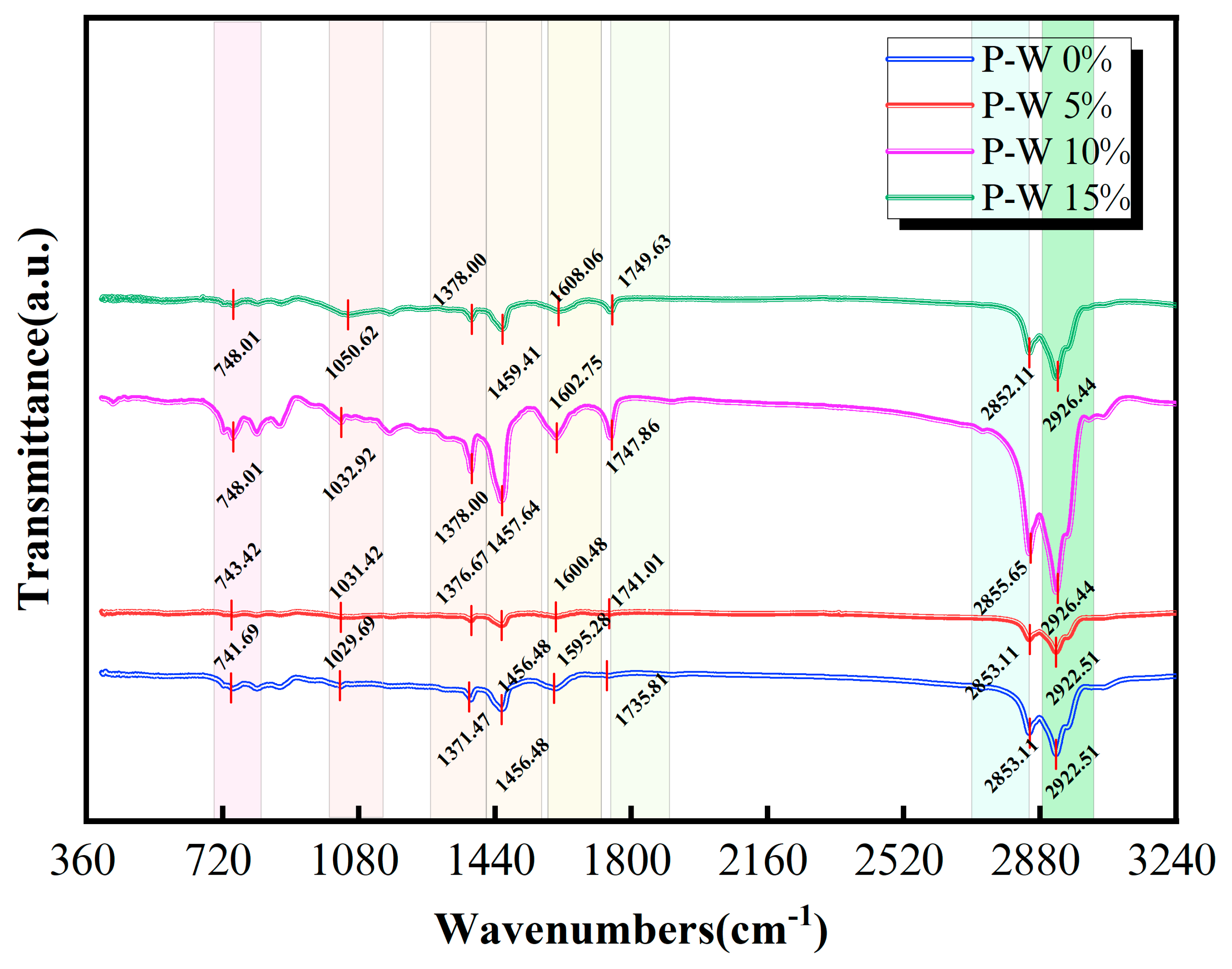
FTIR was used to identify changes in the main functional groups of the P-W specimens. It was also used to examine whether obvious changes in functional groups occurred during PSP/WCO modification. The infrared spectra of the P-W specimens are shown in Figure 12. By comparing the positions and intensities of the absorption peaks among specimens with different PSP/WCO dosages, the possible interaction characteristics among PSP, WCO, and base asphalt binder can be discussed. If no new characteristic absorption peaks appear after modification, and only slight shifts in the original peak positions or changes in peak intensity are observed, the results may suggest that the PSP/WCO modification process is mainly associated with physical blending, compositional regulation, and weak intermolecular interactions, rather than obvious chemical reactions.
The FTIR spectra of the P-W specimens are shown in Figure 12. For P-W 0%, distinct absorption peaks appeared near 2922.51 and 2853.11 cm−1. These peaks corresponded to the asymmetric and symmetric stretching vibrations of aliphatic C–H in asphalt, respectively. The absorption peaks near 1456.48 and 1371.47 cm−1 were mainly associated with the bending vibrations of -CH2- and -CH3 groups. The peak near 1595.28 cm−1 was assigned to the C = C skeletal vibration of aromatic rings. The peak near 1029.69 cm−1 was generally associated with C–O stretching vibrations or vibrations of sulfur-containing oxygen functional groups. The peak near 741.69 cm−1 was associated with the out-of-plane bending vibration of aromatic C–H. These peak positions reflect the combined characteristics of aliphatic structures, aromatic structures, and polar functional groups in the base asphalt. After the incorporation of the PSP/WCO composite modifier, the main absorption peaks of P-W 5%, P-W 10%, and P-W 15% remained within wavenumber ranges similar to those of P-W 0%. No new strong characteristic peaks appeared. The original major absorption peaks did not disappear. As the modifier dosage increased, slight shifts occurred in some peak positions. For example, the carbonyl-related peak shifted from approximately 1735.81 to 1749.63 cm−1. The aromatic C = C-related peak shifted from 1595.28 to approximately 1608.06 cm−1. The C–O or sulfur-containing oxygen functional group-related peak shifted from 1029.69 to approximately 1050.62 cm−1. These changes may be related to peak overlap and weak interactions among different components. These components include hydroxyl groups, ether bonds, and oxygen-containing functional groups in cellulose, hemicellulose, and lignin of PSP. They also include ester groups and long-chain hydrocarbon structures in WCO, as well as polar components in asphalt. In particular, the variation in the peak position near 1735–1750 cm−1 may be jointly affected by ester carbonyl groups in WCO and oxygen-containing structures associated with hemicellulose and lignin in PSP. Therefore, it cannot be simply interpreted as the formation of new chemical bonds.
The FTIR changes in the P-W specimens were mainly reflected by slight shifts in the original peak positions and changes in peak intensity. No new functional groups were formed. This indicates that the PSP/WCO modification process was mainly governed by physical blending, compositional regulation, and weak intermolecular interactions. Similarly, Lai et al. reported that no new absorption peaks appeared in the FTIR spectra of WCO-based bio-asphalt after modification. This indicated that the interaction between WCO and asphalt was mainly physical [54]. Wei et al. also concluded in their review of WCO-modified asphalt binder that the FTIR results of WCO and base asphalt generally showed characteristics of physical blending. No obvious chemical reactions were observed [55]. Compared with these findings, the slight peak shifts observed in the P-W specimens suggest possible hydrogen bonding, dipole interactions, or peak-overlap effects. These effects may occur between PSP/WCO and the polar components of asphalt. Nevertheless, physical modification should still be regarded as the dominant modification mechanism.
In summary, the TG and FTIR results indicate that PSP/WCO modification did not significantly reduce the thermal stability of the asphalt binder near the preparation temperature, nor did it produce new strong characteristic absorption peaks. The main changes were reflected in similar TG mass-loss behavior and slight shifts or intensity variations in the original FTIR peaks. These results suggest that the interaction among PSP, WCO, and asphalt binder may be mainly associated with physical blending, oil-phase regulation, particle wetting and dispersion, and weak intermolecular interactions. Therefore, the improvement in high-temperature performance may be attributed to the combined effects of PSP-related solid-phase support and WCO-related oil-phase regulation. This explanation should be regarded as an interpretation based on TG, FTIR, rheological results, and previous studies, rather than as direct evidence of a specific chemical mechanism.

4. Conclusions

Peanut shell powder (PSP) and waste cooking oil (WCO) were combined as a fixed-ratio composite modifier to evaluate their effects on the properties of unaged No. 70 paving petroleum asphalt binder. This study did not evaluate PSP or WCO as separate single additives. Instead, it investigated a waste-derived composite system in which a lignocellulosic solid-phase component and an oil-phase component were jointly introduced into the asphalt binder. The main conclusions are as follows:
(1)
PSP exhibited irregular particle morphology, a rough surface, lamellar folds, and localized pores. XRD results showed that PSP retained cellulose I crystalline regions. TG results indicated that no obvious thermal decomposition occurred near the preparation temperature of approximately 150 °C. These results demonstrate that PSP is basically suitable as the solid-phase component of the composite modifier.
(2)
FTIR results showed no new strong characteristic absorption peaks in the P-W specimens. Only slight shifts in the main peak positions and changes in peak intensity were observed. This indicates that the interaction between PSP/WCO and asphalt binder was mainly characterized by physical blending, component regulation, and weak intermolecular interactions. No obvious evidence of new chemical structures was detected by FTIR.
(3)
As the PSP/WCO dosage increased from 0% to 15%, the softening point increased from 50.2 °C to 53.9 °C, while penetration decreased from 66.2 to 62.6 (0.1 mm) and ductility decreased from 74.0 to 69.5 mm. These results indicate that the composite modifier increased the consistency and high-temperature flow resistance of the asphalt binder, while imposing certain constraints on tensile deformation. The relatively small changes from 10% to 15% suggest that the additional influence of PSP/WCO on the conventional physical properties became limited at higher dosages.
(4)
The temperature sweep, frequency sweep, and MSCR results showed that the PSP/WCO composite modifier increased G* and the rutting factor, reduced δ and Jnr, and increased R. P-W 15% still satisfied the unaged G*/sinδ ≥ 1.0 kPa criterion at 70 °C, showing the strongest high-temperature rheological response among the tested binders. These results indicate that the composite system enhanced the high-temperature deformation resistance and repeated-load permanent deformation resistance of asphalt binder.
(5)
BBR results showed that increasing the PSP/WCO dosage increased S and decreased the m-value. This indicates enhanced low-temperature stiffening and weakened stress relaxation capacity. All specimens satisfied the low-temperature criteria at −12 °C and −18 °C. However, none satisfied the criteria at −24 °C. Therefore, the PSP/WCO ratio should be further optimized to balance high- and low-temperature performance.
Overall, this study evaluated a fixed-ratio PSP/WCO solid–oil composite modification system at the unaged asphalt binder level. The results clarified a performance trade-off in this system: PSP/WCO improved high-temperature stability and permanent deformation resistance, but reduced low-temperature stress relaxation capacity with increasing dosage. Based on FTIR, TG, and rheological results, the modification process can be interpreted as mainly involving physical blending, particle filling, local structural confinement, and oil-phase component regulation, rather than the formation of new chemical structures. It should be noted that these findings are based on unaged binder-level tests, and potential pavement behavior was not directly verified by mixture-level experiments. Future studies should optimize the PSP/WCO ratio and dosage and further evaluate aged-binder behavior, storage stability, mixture-level performance, and field applicability.

Author Contributions

Conceptualization, Y.G. and L.C.; methodology, Y.G.; software, Z.L. and X.L.; validation, L.C., Z.L., X.L. and Q.F.; formal analysis, L.C., Z.L. and B.T.; investigation, L.C. and Z.L.; resources, Y.G., J.L. and W.Z.; data curation, L.C., Z.L. and X.L.; writing—original draft preparation, L.C., Z.L. and X.L.; writing—review and editing, Y.G., W.Z. and B.T.; visualization, Z.L. and X.L.; supervision, Y.G. and J.L.; project administration, J.L.; funding acquisition, Y.G. All authors have read and agreed to the published version of the manuscript.

Funding

This research was funded by the Scientific Research Program Funded by the Education Department of Shaanxi Provincial Government, grant number 24JK0501.

Institutional Review Board Statement

Not applicable.

Informed Consent Statement

Not applicable.

Data Availability Statement

The raw data supporting the conclusions of this article will be made available by the authors on request.

Acknowledgments

During the preparation of this manuscript, the authors used ChatGPT 5.5 for language polishing and improving the clarity of the text. The authors have reviewed and edited the output and take full responsibility for the content of this publication.

Conflicts of Interest

The authors declare no conflicts of interest. The funders had no role in the design of the study; in the collection, analyses, or interpretation of data; in the writing of the manuscript; or in the decision to publish the results.

Abbreviations

The following abbreviations are used in this manuscript:
PSPPeanut shell powder
WCOWaste cooking oil
PSP/WCOPeanut shell powder/waste cooking oil composite modifier
P-WAsphalt binder modified with PSP/WCO composite modifier
SEMScanning electron microscopy
XRDX-ray diffraction
TGThermogravimetry
DSRDynamic shear rheometer
MSCRMultiple stress creep recovery
BBRBending beam rheometer
FTIRFourier transform infrared spectroscopy

References

  1. Zhang, Z.; Fang, Y.; Yang, J.; Li, X. A comprehensive review of bio-oil, bio-binder and bio-asphalt materials: Their source, composition, preparation and performance. J. Traffic Transp. Eng. Engl. Ed. 2022, 9, 151–166. [Google Scholar] [CrossRef]
  2. Li, Y.; Hao, P.; Zhao, C.; Ling, J.; Wu, T.; Li, D.; Liu, J.; Sun, B. Anti-rutting performance evaluation of modified asphalt binder: A review. J. Traffic Transp. Eng. Engl. Ed. 2021, 8, 339–355. [Google Scholar] [CrossRef]
  3. Airey, G.D. Rheological properties of styrene butadiene styrene polymer modified road binders. Fuel 2003, 82, 1709–1719. [Google Scholar] [CrossRef]
  4. Yildirim, Y. Polymer modified asphalt binder. Constr. Build. Mater. 2007, 21, 66–72. [Google Scholar] [CrossRef]
  5. Guo, Y.; Ji, G.; Wang, X.; Tian, B.; Zhang, Y. Physico-chemical and mechanical properties of asphalt binders blended with waste bio-shell powder. Int. J. Pavement Eng. 2023, 24, 2211213. [Google Scholar] [CrossRef]
  6. Zhu, J.; Birgisson, B.; Kringos, N. Polymer modification of binder: Advances and challenges. Eur. Polym. J. 2014, 54, 18–38. [Google Scholar] [CrossRef]
  7. Donchenko, M.; Grynyshyn, O.; Prysiazhnyi, Y.; Pyshyev, S.; Kohut, A. The problem of road bitumen technological aging and ways to solve it: A review. Chem. Chem. Technol. 2024, 18, 284–294. [Google Scholar] [CrossRef]
  8. Camargo, I.G.N.; Dhia, T.B.; Loulizi, A.; Hofko, B.; Mirwald, J. Anti-aging additives: Proposed evaluation process based on literature review. Road Mater. Pavement Des. 2021, 22, S134–S153. [Google Scholar] [CrossRef]
  9. Behnood, A.; Gharehveran, M.M. Morphology, rheology, and physical properties of polymer-modified asphalt binders. Eur. Polym. J. 2019, 112, 766–791. [Google Scholar] [CrossRef]
  10. Presti, D.L. Recycled tyre rubber modified binders for road asphalt mixtures: A literature review. Constr. Build. Mater. 2013, 49, 863–881. [Google Scholar] [CrossRef]
  11. Guo, M.; Ren, X.; Jiao, Y.; Liang, M. Review on aging and anti-aging of asphalt binders and asphalt mixtures. China J. Highw. Transp. 2022, 35, 41–59. (In Chinese) [Google Scholar]
  12. Guo, Y.; Tian, B.; Zhao, J.; Ji, G.; Wang, X. Study on automatic anti-icing effect and rheological properties of asphalt based on SiO2 nanowires. Case Stud. Constr. Mater. 2024, 21, e03714. [Google Scholar]
  13. Abdelmagid, A.A.A.; Qiu, Y.; Yang, E. Laboratory investigation of the impact of peanut husk ash as an asphalt binders modifier on physical and rheological properties. Constr. Build. Mater. 2023, 401, 132920. [Google Scholar] [CrossRef]
  14. Wang, B.; Shen, J.; Li, S.; Wang, W. Peanut shell powder as a sustainable modifier and its influence on self-healing properties of asphalt. Materials 2023, 16, 6618. [Google Scholar] [CrossRef] [PubMed]
  15. Lv, S.; Xia, C.; Yang, Q.; Guo, S.; You, L.; Guo, Y.; Zheng, J. Improvements on high-temperature stability, rheology, and stiffness of asphalt binder modified with waste crayfish shell powder. J. Clean. Prod. 2020, 264, 121745. [Google Scholar] [CrossRef]
  16. Guo, Y.; Wang, X.; Ji, G.; Zhang, Y.; Su, H.; Luo, Y. Effect of recycled shell waste as a modifier on the high- and low-temperature rheological properties of asphalt. Sustainability 2021, 13, 10271. [Google Scholar] [CrossRef]
  17. Fan, G.; Liu, H.; Liu, C.; Xue, Y.; Yang, X.; Ju, Z.; Ding, S.; Zhang, Y.; Li, Y. Analysis of the influence of waste seashell as modified materials on asphalt pavement performance. Materials 2022, 15, 6788. [Google Scholar] [CrossRef]
  18. Ma, F.; Dai, J.; Fu, Z.; Li, C.; Wen, Y.; Jia, M.; Wang, Y.; Shi, K. Biochar for asphalt modification: A case of high-temperature properties improvement. Sci. Total Environ. 2022, 804, 150194. [Google Scholar] [CrossRef] [PubMed]
  19. Martínez-Toledo, C.; Valdés-Vidal, G.; Calabi-Floody, A.; González, M.E.; Reyes-Ortiz, O. Evaluation of rheological properties of asphalt binder modified with biochar from oat hulls. Materials 2024, 17, 4312. [Google Scholar] [CrossRef] [PubMed]
  20. Chen, Z.; Yi, J.; Chen, Z.; Feng, D. Properties of asphalt binder modified by corn stalk fiber. Constr. Build. Mater. 2019, 212, 225–235. [Google Scholar] [CrossRef]
  21. Niu, D.; Zhang, Z.; Gao, Y.; Li, Y.; Yang, Z.; Niu, Y. Effect of pretreated cow dung fiber on rheological and fatigue properties of asphalt binder. Cellulose 2023, 30, 3773–3791. [Google Scholar] [CrossRef]
  22. Eskandarsefat, S.; Hofko, B.; Rossi, C.O.; Sangiorgi, C. Fundamental properties of binder binders containing novel cellulose-based poly-functional fibres. Compos. Part B Eng. 2019, 163, 339–350. [Google Scholar] [CrossRef]
  23. Li, C.; Liu, H.; Xiao, Y.; Li, J.; Wang, T.; Peng, L. Modification and enhancing contribution of fiber to asphalt binders and their corresponding mixtures: A study of viscoelastic properties. Materials 2023, 16, 5727. [Google Scholar] [CrossRef] [PubMed]
  24. Wu, M.M.; Li, R.; Zhang, Y.; Fan, L.; Lv, Y.C.; Wei, J.M. Stabilizing and reinforcing effects of different fibers on asphalt mortar performance. Pet. Sci. 2015, 12, 189–196. [Google Scholar] [CrossRef]
  25. Wu, X.; Hu, C. Greener solution to waste corn stalks and shortage of asphalt resources: Hydrochar as modifiers in asphalt binder. Materials 2021, 14, 1427. [Google Scholar] [CrossRef] [PubMed]
  26. Chen, M.; Leng, B.; Wu, S.; Sang, Y. Physical, chemical and rheological properties of waste edible vegetable oil rejuvenated asphalt binders. Constr. Build. Mater. 2014, 66, 286–298. [Google Scholar] [CrossRef]
  27. Sun, Z.; Yi, J.; Huang, Y.; Feng, D.; Guo, C. Properties of asphalt binder modified by bio-oil derived from waste cooking oil. Constr. Build. Mater. 2016, 102, 496–504. [Google Scholar] [CrossRef]
  28. Wang, C.; Xue, L.; Xie, W.; You, Z.; Yang, X. Laboratory investigation on chemical and rheological properties of bio-asphalt binders incorporating waste cooking oil. Constr. Build. Mater. 2018, 167, 348–358. [Google Scholar] [CrossRef]
  29. Ahmed, R.B.; Hossain, K. Waste cooking oil as an asphalt rejuvenator: A state-of-the-art review. Constr. Build. Mater. 2020, 230, 116985. [Google Scholar]
  30. Luo, Y.; Zhang, K. Review on performance of asphalt and asphalt mixture with waste cooking oil. Materials 2023, 16, 1341. [Google Scholar] [CrossRef] [PubMed]
  31. Oldham, D.; Rajib, A.; Dandamudi, K.P.R.; Liu, Y.; Deng, S.; Fini, E.H. Transesterification of waste cooking oil to produce a sustainable rejuvenator for aged asphalt. Resour. Conserv. Recycl. 2021, 168, 105297. [Google Scholar] [CrossRef]
  32. Xie, C.; Ye, Q.; Fan, L.; Weng, A.; Liu, H. Study on rheological properties of waste cooking oil and organic montmorillonite composite recycled asphalt. Buildings 2024, 14, 3149. [Google Scholar] [CrossRef]
  33. Gao, J.; Wang, H.; Xu, N.; Li, D.; Leng, Z. Converting waste cooking oil and waste rubber powder into asphalt rejuvenator: Preparation parameters and rejuvenation effect. Constr. Build. Mater. 2025, 477, 141362. [Google Scholar] [CrossRef]
  34. Yan, K.; Liu, W.; You, L.; Ou, J.; Zhang, M. Evaluation of waste cooling oil and European Rock Asphalt modified asphalt with laboratory tests and economic cost comparison. J. Clean. Prod. 2021, 288, 125604. [Google Scholar]
  35. Zhang, X.; Han, C.; Zhou, X.; Otto, F.; Zhang, F. Characterizing the diffusion and rheological properties of aged asphalt binder rejuvenated with bio-oil based on molecular dynamic simulations and laboratory experimentations. Molecules 2021, 26, 7080. [Google Scholar] [CrossRef] [PubMed]
  36. JTG 3410-2025; Standard Test Methods of Bitumen and Bituminous Mixtures for Highway Engineering. China Communications Press: Beijing, China, 2025.
  37. Zhou, T.; Kabir, S.F.; Cao, L.; Luan, H.; Dong, Z.; Fini, E.H. Comparing effects of physisorption and chemisorption of bio-oil onto rubber particles in asphalt. J. Clean. Prod. 2020, 273, 123112. [Google Scholar] [CrossRef]
  38. Xu, F.; Shi, Y.C.; Wang, D. X-ray scattering studies of lignocellulosic biomass: A review. Carbohydr. Polym. 2013, 94, 904–917. [Google Scholar] [CrossRef] [PubMed]
  39. Terea, H.; Selloum, D.; Rebiai, A.; Atia, D.; Kouadri, I.; Ben Seghir, B.; Messaoudi, M. Characterization, biological, and antimicrobial properties of nanocellulose isolated from peanut shells (Arachis hypogaea L.). Biomass Convers. Biorefinery 2024, 14, 30435–30445. [Google Scholar]
  40. Oulidi, O.; Nakkabi, A.; Boukhlifi, F.; Fahim, M.; Lgaz, H.; Alrashdi, A.A.; Elmoualij, N. Peanut shell from agricultural wastes as a sustainable filler for polyamide biocomposites fabrication. J. King Saud Univ. Sci. 2022, 34, 102148. [Google Scholar] [CrossRef]
  41. Gil-Guillén, I.; Freitas, P.A.V.; González-Martínez, C.; Chiralt, A. Obtaining cellulose fibers from almond shell by combining subcritical water extraction and bleaching with hydrogen peroxide. Molecules 2024, 29, 3284. [Google Scholar] [CrossRef] [PubMed]
  42. Çolak, M.A.; Zorlu, E.; Çodur, M.Y.; Baş, F.İ.; Yalçın, Ö.; Kuşkapan, E. Investigation of Physical and Chemical Properties of Binder Modified with Waste Vegetable Oil and Waste Agricultural Ash for Use in Flexible Pavements. Coatings 2023, 13, 1866. [Google Scholar] [CrossRef]
  43. AASHTO T 315-10; AASHTO Standard Method of Test for Determining the Rheological Properties of Asphalt Binder Using a Dynamic Shear Rheometer (DSR). American Association of State Highway and Transportation Officials: Washington, DC, USA, 2010.
  44. Lei, Z.; Bahia, H.; Tan, Y. Effect of bio-based and refined waste oil modifiers on low temperature performance of asphalt binders. Constr. Build. Mater. 2015, 86, 95–100. [Google Scholar] [CrossRef]
  45. Zhang, R.; Wang, J.; Kang, H. Effect of waste cooking oil on the performance of EVA modified asphalt and its mechanism analysis. Sci. Rep. 2024, 14, 14072. [Google Scholar] [CrossRef] [PubMed]
  46. Sun, D.; Lu, T.; Xiao, F.; Zhu, X.; Sun, G.; Lyu, S. Formulation and aging resistance of modified bio-asphalt containing high percentage of waste cooking oil residues. J. Clean. Prod. 2017, 161, 1203–1214. [Google Scholar] [CrossRef]
  47. Sun, D.; Sun, G.; Du, Y.; Zhu, X.; Lu, T.; Pang, Q.; Shi, S. Evaluation of optimized bio-asphalt containing high content waste cooking oil residues. Fuel 2017, 202, 529–540. [Google Scholar] [CrossRef]
  48. Gong, M.; Yang, J.; Zhang, J.; Zhu, H.; Tong, T. Physical–chemical properties of aged asphalt rejuvenated by bio-oil derived from biodiesel residue. Constr. Build. Mater. 2016, 105, 35–45. [Google Scholar] [CrossRef]
  49. Asli, H.; Ahmadinia, E.; Zargar, M.; Karim, M.R. Investigation on physical properties of waste cooking oil-rejuvenated binder binder. Constr. Build. Mater. 2012, 37, 398–405. [Google Scholar] [CrossRef]
  50. Yan, S.; Zhou, C.; Sun, Y. Evaluation of rejuvenated aged-asphalt binder by waste-cooking oil with secondary aging considered. J. Mater. Civ. Eng. 2022, 34, 04022157. [Google Scholar] [CrossRef]
  51. Mo, Q.; Yuan, M.; Yang, D.; Yang, L. Preparation of waste frying oil/waste PE plastic composite-modified asphalt. Highw. Eng. 2022, 47, 161–168. (In Chinese) [Google Scholar]
  52. Tang, B.; Cao, X.; Zhu, H.; Cao, X. Pavement performance analysis of bio-oil rejuvenated asphalt binder. China J. Highw. Transp. 2019, 32, 207–214. (In Chinese) [Google Scholar]
  53. Guo, Y.; Su, H.; Li, J.; Xu, P.; Tian, B.; Xu, P. Hydrophobic and microwave-responsive modified asphalt for enhanced anti-icing and de-icing performance. Constr. Build. Mater. 2025, 484, 141859. [Google Scholar] [CrossRef]
  54. Lai, S.R.; Li, S.J.; Xu, Y.L.; Xu, W.-Y.; Zhang, X.-Q. Preparation, characterization, and performance evaluation of petroleum asphalt modified with bio-asphalt containing furfural residue and waste cooking oil. Polymers 2022, 14, 1683. [Google Scholar] [CrossRef] [PubMed]
  55. Yang, J.; Zhao, M.-Z.; Cai, Y.-X.; Lu, K.-J.; Gao, Y. Rheological properties of asphalt modified with waste-edible-oil pre-desulfurized crumb rubber. J. Highw. Transp. Res. Dev. 2024, 41, 36–44. (In Chinese) [Google Scholar]
Figure 1. Preparation process flowchart of the PSP/WCO composite modifier.
Coatings 16 00801 g001
Figure 2. SEM micromorphology and typical structural characteristics of PSP. Note: Blue dashed circles indicate fine-particle agglomeration regions, red solid boxes indicate lamellar folds or layered fracture structures, yellow dashed boxes indicate grooves, cracks, and interparticle pores, and yellow dashed circles indicate larger pores or surface depression regions.
Coatings 16 00801 g002
Figure 3. XRD pattern of PSP.
Coatings 16 00801 g003
Figure 4. TG curves of PSP and the PSP/WCO composite modifier.
Coatings 16 00801 g004
Figure 5. Conventional physical properties of the P-W specimens at different PSP/WCO dosages.
Coatings 16 00801 g005
Figure 6. Temperature sweep results of the P-W specimens: (a) phase angle; (b) complex shear modulus.
Coatings 16 00801 g006
Figure 7. Rutting factor of the P-W specimens.
Coatings 16 00801 g007
Figure 8. Frequency Sweep Results of the P-W Specimens: (a) 58 °C; (b) 64 °C; (c) 70 °C.
Coatings 16 00801 g008
Figure 9. MSCR test results of the P-W specimens: (a) 0.1 kPa; (b) 3.2 kPa.
Coatings 16 00801 g009
Figure 10. BBR test results of the P-W specimens: (a) creep stiffness; (b) m-value. The gray horizontal lines represent the Superpave limiting criteria for low-temperature performance (S ≤ 300 MPa and m ≥ 0.300).
Coatings 16 00801 g010
Figure 11. TG curves of P-W asphalt binder specimens.
Coatings 16 00801 g011aCoatings 16 00801 g011b
Figure 12. FTIR spectra of the P-W specimens.
Coatings 16 00801 g012
Table 1. Basic technical properties of the base asphalt binder.
ItemsJTG 3410-2025 [36]
Test ResultsRequirements
Penetration at 25 °C, 100 g, 5 s/0.1 mm 7260~80
Softening point/°C47.0Not less than 46
Ductility at 10 °C (5 cm/min)/cm35Not less than 25
Ductility at 15 °C (5 cm/min)/cm>150Not less than 100
Dynamic viscosity at 60 °C/Pa·s215Not less than 180
Flash point, Cleveland open cup (COC)/°C287Not less than 260
Note: The base binder was supplied as 70# A-grade paving asphalt and met the requirements of JTG F40-2004.
Disclaimer/Publisher’s Note: The statements, opinions and data contained in all publications are solely those of the individual author(s) and contributor(s) and not of MDPI and/or the editor(s). MDPI and/or the editor(s) disclaim responsibility for any injury to people or property resulting from any ideas, methods, instructions or products referred to in the content.