1. Introduction
Understanding the relationships between composition, structure, and reactivity in layered double hydroxides (LDHs) is essential for the rational design of multifunctional catalysts and catalytic coating systems [
1,
2,
3]. While conventional catalysts typically promote a single transformation at a specific active site, multifunctionality requires the integration of multiple active sites capable of enabling different catalytic functions and reaction pathways [
4,
5,
6,
7,
8,
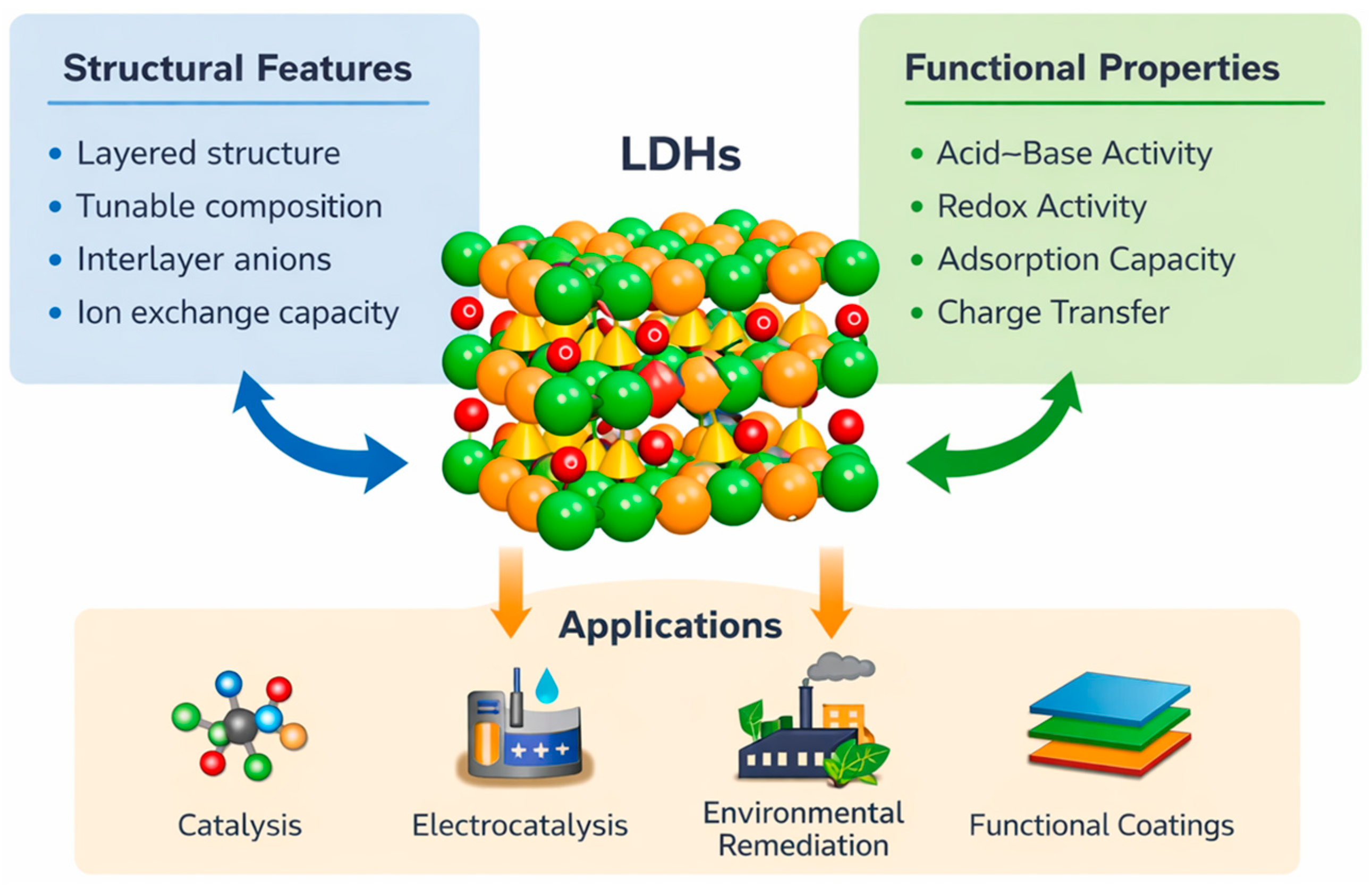
9]. The distinctive properties of LDHs, including their tunable composition, versatile synthesis routes, and relatively low cost, have attracted significant interest for such applications. The structural features, functional properties, and application domains of LDHs are schematically illustrated in
Figure 1. Despite recent progress in the selective design of multifunctional LDH-based systems, important gaps remain in understanding the interdependence between composition, structure, and reactivity.
Multifunctional LDH catalysts can establish discrete acid–base or redox pairings for diverse processes. In addition, their layered architecture allows the coexistence of distinct reactive domains, which can accommodate competing reaction pathways within a single bifunctional system. In this context, multifunctionality refers to the integration of several complementary functions, including catalytic activity, charge transfer, mass transport regulation, adsorption, and interfacial stabilization, within the same coating architecture. The incorporation of foreign cations further expands the catalytic versatility of LDHs by tuning acidity, basicity, interlayer composition, and redox properties. Addressing the current limitations in this field could enable the development of catalysts able to efficiently perform complex reactions under environmentally friendly conditions, thus contributing to improved energy conversion and sustainable resource utilization. Such approaches are also aligned with atom-economy principles and reduced generation of hazardous by-products. In this context, the intrinsic activity, operational stability, and resistance to leaching of LDH-based catalytic coatings are critically discussed, with the aim of clarifying composition–structure–reactivity relationships and guiding the design of robust multifunctional systems.
Beyond their use as bulk catalysts, LDHs have also emerged as versatile building blocks for functional and catalytic coatings [
10,
11,
12,
13,
14]. Their layered structure, tunable composition, and ion-exchange capability make them particularly suitable for deposition on metallic, oxide, and polymeric substrates. LDH-based coatings can be fabricated through in situ growth, dip-coating, spray-coating, electrophoretic deposition, or sol–gel-derived routes, allowing control over film thickness, surface coverage, and layer organization [
15,
16,
17,
18,
19]. When immobilized as coatings, LDHs act not only as catalytic layers but also as protective and reactive interfaces, where mass transfer, durability, and regeneration play a key role.
Importantly, the LDH performances in bulk systems remain highly relevant for coating architectures. Control over cation composition and interlayer chemistry enables the design of coatings with tailored acid–base, redox, and adsorption properties, while structural parameters such as stacking order, exfoliation behavior, and defect density influence the accessibility of active sites and long-term stability. Furthermore, the reversible anion-exchange capacity and reconstruction ability of LDHs support the development of adaptive and regenerable catalytic surfaces. As a result, LDH-based coatings have emerged as a promising class of multifunctional materials for applications ranging from catalytic systems and photoelectrochemical devices to environmentally responsive surfaces.
However, the transition from bulk LDH systems to coating configurations introduces additional challenges that must be carefully addressed. These include achieving strong adhesion to the substrate, maintaining mechanical integrity, controlling film thickness and uniformity, and ensuring long-term chemical stability under operating conditions. In particular, the coating/substrate interface plays a critical role in determining overall performance, as it directly affects the accessibility, stability, and durability of the active sites. The predisposition of LDH coatings to develop different defects (such as cracking, porosity, and leaching) emphasizes the importance of implementing optimized design strategies that consider not only intrinsic material properties but also extrinsic factors. Therefore, a comprehensive understanding of these factors is essential for the rational design and optimization of durable and high-performance LDH-based catalytic coatings.
The aim of this review is to provide a comprehensive and critical perspective on LDH-based coatings for multifunctional catalytic applications, with particular emphasis on the interplay between composition, structural organization, interfacial engineering, and catalytic reactivity. In addition to summarizing recent advances in synthesis and coating-fabrication strategies, this review examines how active sites, transport phenomena, charge-transfer processes, and interfacial interactions collectively govern catalytic performance and long-term operational stability. Particular attention is devoted to hierarchical architectures, hybrid interfaces, and adaptive LDH systems able to integrate catalytic, electrochemical, and protective functionalities within multifunctional coating platforms. Furthermore, current challenges associated with structural stability, mechanistic understanding, and scalable fabrication are critically discussed in order to outline future directions for the development of durable and high-performance LDH-based catalytic coatings.
2. Fundamentals of Layered Double Hydroxides
LDHs are a class of anionic clay materials with the general formula [M
2+(1–x)M
3+x(OH)
2]·[A
n−]
x/n·mH
2O, where M
2+ and M
3+ are divalent and trivalent metal cations, respectively, and A
n− represents interlayer anions [
4,
20,
21,
22,
23]. Structurally, LDHs consist of positively charged brucite-like layers separated by interlayer anions and water molecules, which are held together through electrostatic interactions [
24,
25,
26]. The compositional flexibility of LDHs allows the incorporation of a wide range of metal cations into the octahedral sites, enabling the tuning of acid–base, redox, and adsorption properties that are relevant for coating applications [
27,
28,
29,
30,
31,
32,
33,
34,
35,
36,
37,
38,
39].
These structural characteristics make LDHs particularly attractive as active materials or supports in heterogeneous catalysis. Their ability to host metal nanoparticles or metal oxide clusters further expands the range of accessible catalytic transformations, including redox and degradation reactions [
40,
41,
42,
43,
44]. In the context of coating systems, these features are especially important, as the dispersion of active sites, interlayer accessibility, and interaction with the substrate can significantly influence catalytic performance. Consequently, understanding the fundamental structural and compositional aspects of LDHs is essential for the rational design of efficient LDH-based catalytic coatings.
Owing to their layered architecture and reversible interlayer chemistry, LDHs exhibit unique ion-exchange and structural reconstruction capabilities that are highly relevant for catalytic and electrochemical applications. A characteristic feature of these materials is the so-called “memory effect”, whereby calcined LDHs can partially reconstruct their original layered arrangement upon rehydration. This reversible behavior enables the incorporation of functional anions and contributes to the regeneration of catalytically active interfaces. Furthermore, the coexistence of multiple metal cations within the hydroxide layers promotes cooperative redox interactions and allows modulation of the local electronic environment, thereby influencing catalytic activity, charge-transfer behavior, and adsorption processes in multifunctional coating systems.
3. LDH Design Principles for Catalytic Multifunctionality
The LDH composition can be systematically tuned through the selection of metal cations and interlayer anions, enabling precise control over material functionality. Within this versatile framework, catalytic multifunctionality refers to the ability to promote multiple reactions either simultaneously or in a sequential manner.
Several design strategies have been proposed to achieve catalytic multifunctionality in LDHs through the combined control of composition and structural architecture [
45,
46,
47,
48,
49,
50,
51,
52]. These approaches primarily involve the selection of cationic species and the incorporation of different interlayer anions, including small molecules, polymers, and coordination compounds, within the layered host structure [
3,
53,
54,
55,
56]. As a result, LDHs can generate a variety of reactive sites, typically classified as acid–base, redox, or multifunctional catalytic centers [
57,
58,
59,
60].
In this context, compositional tuning plays a central role, as the nature and ratio of metal cations, together with the identity of interlayer species, directly influence catalytic performance, including acid–base and redox properties [
30,
61,
62,
63,
64,
65]. These design principles are equally relevant for LDH-based coating systems, where the distribution and accessibility of active sites, as well as their interaction with the substrate, can significantly affect catalytic efficiency and stability.
3.1. Structural Architecture
The architectural features of LDHs play a key role in determining their catalytic, adsorption, and transport properties. The structural parameters (such as interlayer spacing, stacking sequence, and layer chemistry), are closely related to the catalytic activity, selectivity, and operational stability [
66,
67,
68]. The layered arrangement of the LDHs generates tunable interlayer galleries containing exchangeable anions and water molecules, enabling efficient ion exchange, molecular transport, and incorporation of functional guest species [
69]. In this context, control over structural parameters such as cation composition, layer charge density, and interlayer anions enables precise tuning of basal spacing and the local chemical environment. These features directly influence catalytic performance by modulating the accessibility, distribution, and strength of active sites. For example, variation of interlayer spacing through anion intercalation can generate size-selective transport pathways, enhancing molecular recognition and selective adsorption processes [
70]. In coating configurations, such structural characteristics become particularly critical, as interlayer accessibility, platelet orientation, and structural organization can significantly affect mass transport, surface reactivity, and interactions at the coating-substrate interface.
Despite the fact that the crystalline structure of bulk LDHs and LDH-based coatings remains essentially the same, coating architectures exhibit distinct structural features, including controlled crystallographic orientation, improved mechanical integrity, and enhanced adhesion to the substrate. In many cases, LDH tend to align with their basal planes parallel to the substrate surface, which contributes to improved barrier properties and influences both transport phenomena and catalytic accessibility. Moreover, in situ growth strategies can lead to strongly adhered films, where interfacial interactions play a decisive role in determining durability and long-term performance.
Beyond the intrinsic layered structure, LDHs can be engineered into hierarchical architectures, including core@shell nanostructures, hybrid nanocomposites, and supported nanosheet assemblies. Such architectures increase surface area, improve mass transport, and enhance charge transfer processes, which are beneficial for catalytic and photoelectrocatalytic applications [
71]. Furthermore, the integration of LDHs into composite membranes or nanostructured supports enables controlled transport pathways and improved structural stability, allowing the combination of catalytic and separation functionalities [
72]. Overall, the tunable architecture of LDHs provides a versatile platform for the design of multifunctional materials, particularly in coating systems where structural organization and interfacial effects are essential for optimizing catalytic performance.
3.2. Functionalization Strategies
To introduce multifunctional catalytic activity in LDHs, various post-synthetic functionalization strategies can be employed, following generally three principal approaches: surface modification, intercalation of active species, and hybridization with nanostructured supports. Surface modification strategies frequently involve the introduction of organic ligands or polymers, including citrate groups, ionic liquids, or polydopamine coatings, enabling additional adsorption or sensing capabilities. Intercalation approaches exploit the anion exchange capacity of LDHs to incorporate catalytically active species or corrosion inhibitors, within the interlayer galleries. Hybridization with nanostructured materials such as graphene, carbon nanotubes, silica nanodots, or biochar generates hierarchical composites with enhanced surface area, conductivity, and catalytic efficiency. These strategies collectively expand the functional landscape of LDHs, enabling their application in catalysis.
3.2.1. Structural and Interfacial Engineering
The interlayer architecture represents one of the most important structural characteristics of LDHs. Variations in basal spacing, governed by the size, orientation, and charge of intercalated species, can significantly influence diffusion processes, adsorption selectivity, and catalytic accessibility. For example, replacement of carbonate anions with larger organic species can substantially expand the interlayer distance, facilitating molecular transport and guest incorporation within the layered framework [
73]. In addition, the so-called “structural memory effect”, namely the ability of calcined LDHs to reconstruct their layered structure in the presence of water and anions, further highlights the dynamic and adaptive nature of LDH architectures [
74].
Beyond their intrinsic layered structure, LDHs can be engineered into hierarchical architectures such as nanosheets, nanoscrolls, core@shell assemblies, and hybrid organic/inorganic systems. Three-dimensional flower-like structures obtained through hydrothermal or solvothermal synthesis typically exhibit high surface area, abundant edge sites, and improved accessibility of interlayer galleries, thereby enhancing catalytic and adsorption performance [
74,
75]. Similarly, bioinspired hybrid architectures combining LDH nanosheets with polymeric phases have demonstrated improved mechanical stability through synergistic “brick-and-mortar” arrangements, where flexible organic interfaces dissipate mechanical stress while inorganic LDH layers provide structural rigidity. Such hierarchical organization is particularly attractive for multifunctional catalytic systems requiring efficient mass transport, charge transfer, and long-term structural stability.
Although the fundamental crystalline structure remains essentially similar in both bulk LDHs and coatings LDHs, coating architectures exhibit distinct structural characteristics associated with substrate confinement and interfacial growth mechanisms. In coating arrangement, parameters such as thin film thickness, platelet orientation, interconnection between crystallites, and adhesion to the substrate become critical for determining material long-term performance. In many cases, LDH platelets preferentially align with their basal planes parallel to the substrate surface, while the c-axis remains perpendicular to the substrate. This oriented arrangement improves surface coverage, barrier properties, and transport control across the coating layer.
The deposition method plays a major role in determining the final architecture and performance of LDH-based coatings materials. Ex situ techniques, such as spin coating and dip coating, generally produce compact films characterized by oriented platelet stacking, while in situ growth approaches promote the direct formation of chemically bonded LDH layers on the substrate surface, leading to improved adhesion and mechanical stability [
76,
77]. Moreover, in situ synthesis enables the development of hierarchical oxide/LDH interfaces, where the substrate oxide layer and the LDH overlayer act synergistically to provide both barrier protection and ion-exchange functionality. Such architectures are particularly attractive for catalytic and anticorrosion applications, as they facilitate charge transfer while reducing the penetration of aggressive species through the coating layer [
76].
Despite their various advantages, the transition from bulk LDH materials to coating configurations introduces additional structural and functional challenges. In contrast to free-standing LDH powders, thin-film architectures are more susceptible to cracking, porosity, delamination, and thickness inhomogeneity, particularly during drying or thermal treatment processes. As a result, the mechanical stability and barrier properties of LDH coatings are strongly influenced by substrate compatibility, interfacial interactions, and deposition conditions. In addition, thick coating layer may restrict mass transport and limit the accessibility of active sites, while very thin films can reduce both protective efficiency and catalytic performance. Therefore, achieving an appropriate balance between structural and coating stability, transport behavior, and catalytic accessibility remains a key challenge in the development of multifunctional LDH-based coatings.
Overall, the structural versatility of LDHs, combined with their compositional tunability and interfacial adaptability, provides a robust platform for the design of multifunctional catalytic coatings. Careful control of structural organization across multiple length scales (from interlayer galleries to hierarchical film architectures), offers significant opportunities for optimizing catalytic reactivity, durability, transport behavior, and long-term operational stability. Although hierarchical architectures improve catalytic accessibility and mass transport, their fabrication often involves complex multistep synthesis routes that may limit their practical use.
3.2.2. Intercalation Strategies
Intercalation is one of the most versatile and widely used modification strategies for LDH-based systems, being able to incorporate a wide range of organic and inorganic guest species within the interlayer galleries, including corrosion inhibitors, catalytic complexes, polymers, biomolecules, and redox-active compounds [
78,
79,
80]. This interlayer engineering approach enables precise tuning of important physicochemical properties, such as basal spacing, surface polarity, diffusion behavior, and accessibility of catalytic sites. Consequently, intercalation strategies have attracted increasing attention for the development of multifunctional catalytic and protective coatings.
The intercalated species strongly influence the structural and functional behavior of LDHs. In particular, the incorporation of large organic anions or functional coordination compounds can significantly increase the interlayer spacing, facilitating molecular transport and improving the accessibility of reactive sites [
73]. At the same time, intercalated species may introduce additional catalytic, adsorption, or ion-exchange functionalities, further enhancing the multifunctional character of LDH-based materials [
81,
82,
83]. However, excessive expansion of the interlayer region may compromise structural stability and increase the coatings susceptibility to delamination or leaching under operating conditions.
Intercalation strategies are attractive especially for catalytic and anticorrosion coatings since they allow the design of adaptive systems with controlled-release capability. In such architectures, LDH layers can function as nanocontainers able to store and gradually release functional species in response to external stimuli, including variations in pH, ion concentration, or local electrochemical conditions. This concept has been extensively explored in smart anticorrosion coatings, where corrosion inhibitors intercalated within LDH galleries are selectively released at damaged regions, while aggressive ions from the surrounding environment are simultaneously trapped through ion-exchange processes [
84,
85]. Such synergistic effects contribute to improved long-term protection and self-healing behavior.
Beyond corrosion protection, intercalation strategies also play a significant role in catalytic and environmental applications. The incorporation of polyoxometalates, redox-active anions, or catalytically active coordination compounds within the LDH interlayer galleries can enhance charge-transfer processes and promote cooperative catalytic pathways [
81,
86]. In a similar manner, the intercalation of functional organic molecules may influence surface wettability, adsorption selectivity, and diffusion kinetics, thereby affecting catalytic accessibility and mass-transport phenomena within the coating layer [
87,
88]. In photoactive systems, intercalated species can additionally facilitate interfacial electron transfer, contributing to improved separation of photogenerated charge carriers and enhanced photocatalytic performance [
89,
90].
Despite their considerable advantages, intercalated LDH systems still face several important limitations that may affect their long-term performance and operational stability. The stability of guest species confined within the interlayer galleries is strongly influenced by environmental factors such as pH variations, hydration degree, temperature, and repeated ion-exchange cycles [
82,
91]. In addition, compact coating architectures may introduce diffusion limitations that restrict both the release kinetics and accessibility of active species, particularly under prolonged operating conditions [
91]. Excessive interlayer expansion can also compromise structural integrity, thus increasing the susceptibility of coatings to delamination or leaching. Consequently, achieving an appropriate balance between interlayer accessibility, structural stability, and controlled-release behavior remains a critical aspect in the rational design and optimization of multifunctional LDH-based coatings [
82,
91].
Overall, intercalation strategies represent an effective approach for tailoring both the structural organization and functional performance of LDHs. Through the careful selection of interlayer species and optimization of interlayer arrangement, LDH-based coatings systems can be designed to integrate catalytic activity, adaptive response, ion-exchange ability, and long-term operational stability within a single multifunctional system.
3.2.3. Hybrid Nanocomposites
Hybrid nanocomposites have emerged as an effective strategy for improving the structural, catalytic, and interfacial properties of LDH-based systems. By integrating LDHs with conductive, polymeric, carbon-based, or inorganic nanostructured materials, it becomes possible to combine the intrinsic advantages of LDHs with the complementary functionalities provided by the secondary phase [
92,
93,
94]. Owing to these synergistic interactions, hybrid architectures have attracted considerable interest for multifunctional catalytic coatings, since they are able to simultaneously improve catalytic activity, charge-transfer efficiency, mechanical stability, and mass-transport behavior.
Among the most extensively studied hybrid systems are LDH/carbon-based nanocomposites. As carbon-based components, graphene, carbon nanotubes or biochar, have been investigated for the development of LDH hybrid nanocomposites [
92,
93]. In these architectures, the carbonaceous component generally enhances electrical conductivity and facilitates electron transport, while the LDH phase provides accessible active sites together with ion-exchange functionality [
92]. In addition, carbon-based supports can reduce nanoparticle agglomeration and promote a more uniform dispersion of catalytically active species, improving the accessibility of reactive sites [
93,
94]. Such synergistic effects are particularly beneficial in electrocatalytic and photoelectrocatalytic applications, where efficient charge separation and rapid electron transfer play a critical role in improving catalytic performance.
Hybridization with inorganic nanostructures also provides additional opportunities for tailoring the functional properties of LDH-based systems. In this context, oxide@LDH systems, silica-decorated LDHs, and magnetic LDH composites have attracted considerable attention due to their improved structural stability, increased surface area, and multifunctional behavior [
95]. In many hybrid architectures, the inorganic component serves not only as a structural support but also as an active phase able to facilitate interfacial charge transfer and to promote cooperative catalytic pathways [
95]. For example, magnetic oxide@LDH composites enable facile catalyst recovery and reuse, while silica-modified LDHs may improve colloidal stability and reduce particle aggregation phenomena [
78].
In coating applications, hybrid nanocomposite architectures are attractive especially because they improve both interfacial compatibility and mechanical durability [
93,
94,
96]. The incorporation of polymeric or carbon-based components into the LDH matrix can reduce crack formation, improve adhesion to the substrate, and increase coating flexibility under thermal or mechanical stress. Furthermore, hybrid interfaces can facilitate mass transport and modulate the diffusion of reactive species across the coating layer, thereby improving catalytic accessibility and enhancing long-term operational stability [
94,
95,
96]. These synergistic effects are particularly important in multifunctional coatings, where catalytic activity, barrier performance, and structural integrity must be simultaneously maintained.
Despite the advantages offered by LDH-based hybrid nanocomposites, several challenges still limit their practical implementation in multifunctional coating systems. Achieving a homogeneous dispersion of the secondary phase within the LDH matrix remains particularly difficult at high loading levels, where aggregation phenomena and local structural heterogeneities frequently become more pronounced [
96,
97,
98]. In coating architectures, such non-uniform distributions may generate localized defects that affect thickness uniformity, mass-transport behavior, and mechanical stability [
16,
84]. In addition, the excessive incorporation of conductive or polymeric components may partially obstruct active sites, reduce ion-exchange efficiency, or limit the accessibility of the interlayer galleries [
98].
The increasing structural complexity of multicomponent hybrid systems may further influence reproducibility and scalability, especially in large-area coatings fabricated through multistep deposition procedures [
16]. Moreover, differences in interfacial compatibility, thermal expansion, and mechanical properties between the individual components can induce internal stresses that promote crack formation, partial delamination, or structural degradation during prolonged operation [
16,
99]. These effects are critical, particularly in catalytic coatings, where long-term stability and interfacial integrity directly affect functional performance. Consequently, careful optimization of composition, deposition strategy, interfacial organization, and structural architecture remains essential for the rational design of durable and high-performance LDH-based hybrid coatings.
Overall, hybrid nanocomposite strategies provide a versatile platform for extending the functional capabilities of LDH-based systems. Through the synergistic combination of LDHs with conductive, inorganic, or polymeric materials, multifunctional coatings can be engineered to exhibit improved catalytic performance, enhanced mechanical stability, controlled transport behavior, and long-term operational durability [
92,
93,
94].
To further illustrate the broad range of functionalization and hybridization approaches explored of the LDH-based systems, representative examples are summarized in
Table 1. These studies highlight how compositional tuning, interlayer engineering, and hybrid nanocomposite design can be used to modulate the structural, catalytic, and interfacial properties of LDHs. The examples presented in
Table 1 emphasize the versatility of the employed strategies in the development of multifunctional LDH-based coatings for applications including catalysis, electrocatalysis, corrosion protection, and environmentally responsive surface systems.
The examples summarized in
Table 1 illustrate the notable versatility of functionalization and hybridization strategies for tailoring the physicochemical properties of LDH-based systems. In particular, compositional engineering, interlayer modification, and hybrid nanocomposite formation enable simultaneous control over catalytic activity, charge-transfer behavior, transport properties, and coating stability. These approaches are especially relevant for multifunctional coating architectures, where interfacial compatibility, mechanical durability, and controlled mass transport play a decisive role in determining long-term operational performance.
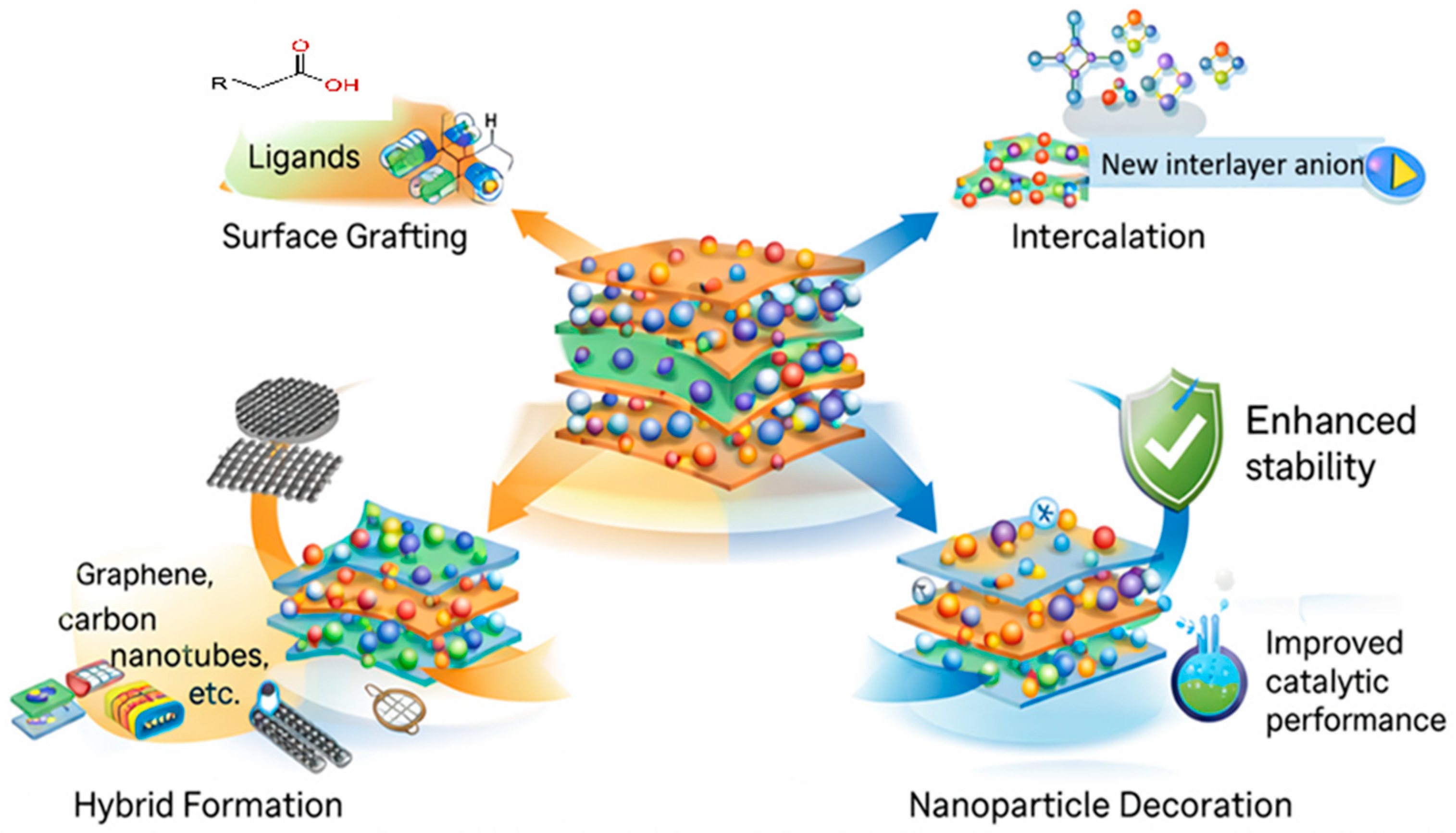
Figure 2 schematically illustrates the principal post-synthetic functionalization strategies discussed in this section, including surface grafting, interlayer intercalation, nanoparticle decoration, and hybrid nanocomposite formation. These approaches provide versatile routes for tailoring the structural, catalytic, and interfacial properties of LDH-based systems. Through the incorporation of functional groups, active nanophases, or conductive supports, the accessibility of catalytic sites, charge-transfer behavior, transport properties, and structural stability can be significantly improved. Consequently, post-synthetic functionalization enables the rational design of multifunctional LDH-based coatings with enhanced catalytic activity, mechanical durability, and long-term operational performance.
4. Catalytic Mechanisms and Structure–Reactivity Relationships in LDH-Based Coatings
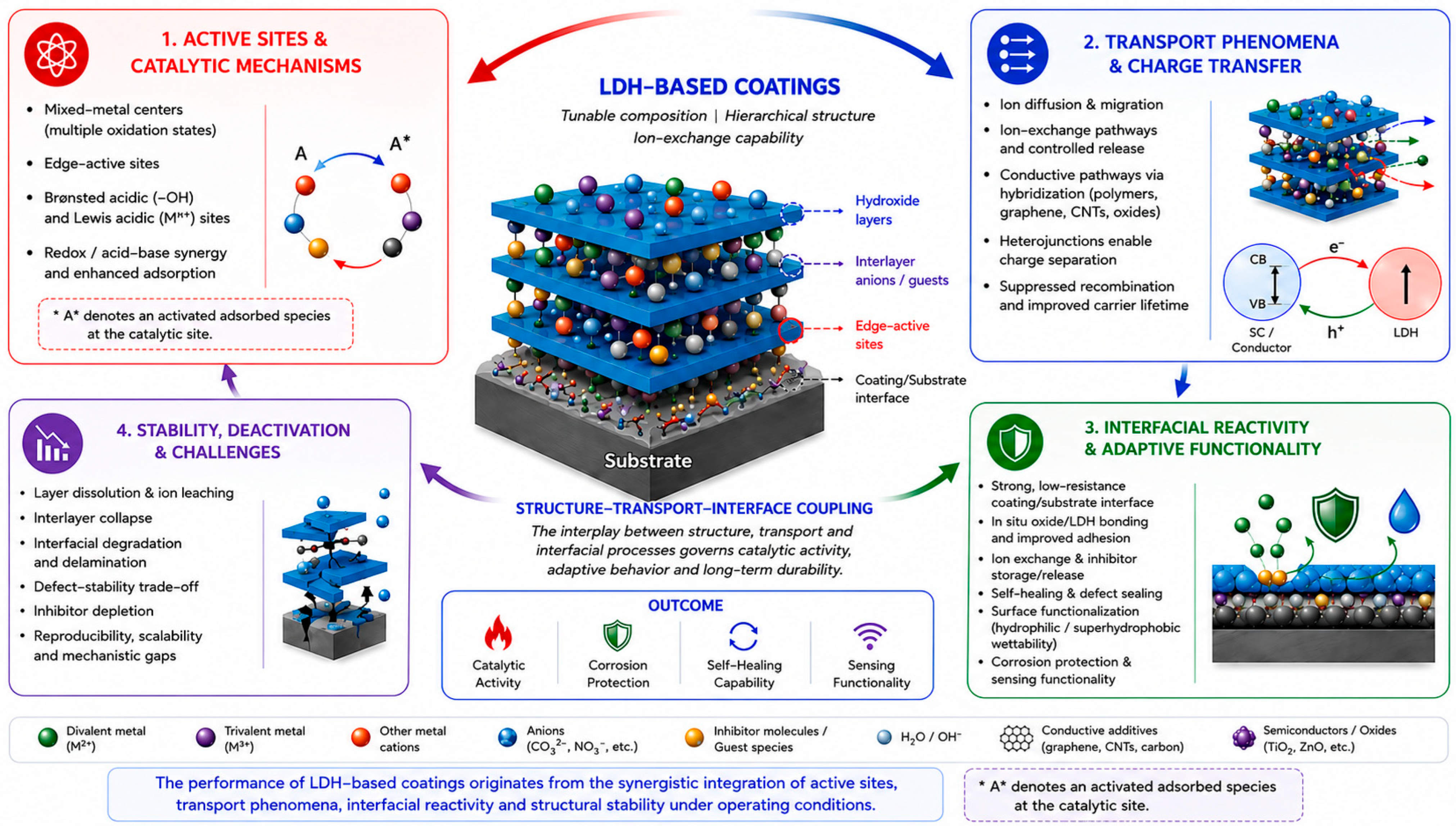
The catalytic and protective performance of layered double hydroxide LDH-based coatings is governed by a complex relationship between active-site chemistry, interfacial reactivity, transport phenomena, and structural stability (
Figure 3). Due to their tunable composition, hierarchical organization, and ion-exchange capability, LDH coatings can simultaneously control catalytic conversion, charge transfer, mass transport, and adaptive protective responses. Consequently, understanding the relationships between structure, transport behavior, interfacial processes, and long-term stability is essential for the rational design of high-performance multifunctional LDH-based coating systems.
4.1. Active Sites, Interfacial Reactivity, and Cooperative Catalytic Mechanisms
The multifunctional behavior of LDH-based coatings (including catalytic behavior) is primarily governed by the nature of the active sites present within the layered structure and by the interfacial interactions established between LDHs and surrounding functional phases. As highlighted in the previous sections, the compositional flexibility and anion-exchange capability of LDHs provide broad opportunities for tuning their redox, acid–base, and adsorption properties through the incorporation of different divalent and trivalent metal cations [
95,
103,
104]. Consequently, the activity of LDH-based coatings arises not only from the intrinsic reactivity of the hydroxide layers, but also from the synergistic interplay between composition, structural organization, and interfacial reactivity.
The catalytic activity of LDHs mainly originates from the mixed-metal hydroxide layers and the presence of accessible edge-active sites. Transition metals such as Ni, Co, Fe, Mn, Mg, and Zn can generate multiple oxidation states able to participate in reversible redox reactions, adsorption phenomena, and catalytic conversion pathways. In many systems, the coexistence of different metal cations modifies the local electronic environment and promotes cooperative catalytic effects that improve adsorption energies and accelerate surface redox reactions [
95,
104]. Such multimetal synergy has been associated with enhanced catalytic kinetics and improved electrochemical activity. For example, molybdate-intercalated NiCo-LDH/PANI nanohybrids exhibited improved oxygen-evolution performance due to simultaneous interlayer expansion and increased active surface area [
104].
Beyond chemical composition, the catalytic performance of LDH-based systems is also strongly influenced by the accessibility and spatial distribution of active sites, which are closely related to the morphology and structural organization of the layered architecture. Conventional LDH platelets tend to aggregate and restack during synthesis or deposition, a phenomenon that may delay reactant diffusion and reduce the exposure of catalytically active edge regions. Consequently, considerable research efforts have been directed toward the development of hierarchical nanostructures designed to increase accessible surface area while simultaneously facilitating mass transport within the material. In LDH/SBA-15 nanocomposites, for example, hierarchical nanostair morphologies shortened internal diffusion pathways, improving the availability of edge-active basic sites, leading to enhanced catalytic transesterification activity [
103,
104]. In compact coating architectures, limited accessibility of edge-active regions may similarly become a rate-limiting factor, particularly under conditions requiring high catalytic turnover.
Interfacial reactivity also plays a key role in determining the catalytic and protective performance of LDH-based coatings. In multifunctional LDH-based systems, the substrate/coating interface represents a highly active region where ion transport, charge-transfer processes, and electrochemical reactions occur simultaneously. In this context, in situ growth strategies are particularly beneficial because they promote the formation of chemically bonded oxide/LDH interfaces with improved adhesion and lower interfacial resistance. Hierarchical oxide/LDH architectures grown directly on metallic substrates have demonstrated enhanced corrosion protection by combining the barrier properties of the oxide layer with the ion-exchange capability of the LDH overlayer [
105]. Similarly, compact LDH conversion coatings developed on Zn-Al-Mg alloy surfaces demonstrated improved long-term stability due to the formation of compact and less permeable oxide/LDH interfacial layers [
106,
107].
In corrosion-protection systems, the functionality of active sites is closely linked to ion-exchange processes and the controlled release of corrosion inhibitors. The interlayer galleries of LDHs can act as nanocontainers able to store and selectively release protective species in response to local electrochemical changes occurring at damaged regions. Mg/Al and Zn/Al LDHs intercalated with vanadate ions demonstrated controlled inhibitor release together with self-healing corrosion protection, enhancing, in the same time, the long-term durability of protective coatings [
78]. Similar behavior was reported for plasma-electrolytic oxidation coatings sealed with in situ grown of ZnAl-LDH nanocontainers loaded with corrosion inhibitors, where the LDH phase simultaneously contributed to defect sealing and localized inhibitor transport toward corroded areas [
108]. In addition, multifunctional LDH coatings intercalated with 8-hydroxyquinoline or fluorescein combined active corrosion inhibition with fluorescence-based sensing ability, highlighting the adaptive and responsive nature of LDH-based coating systems [
109].
Surface functionalization using hydrophobic or superhydrophobic layers can further enhance the cooperative protective behavior of LDH-based coatings by combining hierarchical surface roughness with low-surface-energy interfaces. For instance, siloxane-modified MgAl-LDH coatings demonstrated improved corrosion resistance because the LDH underlayer maintained ion-exchange functionality, while the outer polysiloxane layer formed a superhydrophobic barrier that effectively limited electrolyte penetration [
107]. These synergistic effects illustrate how interfacial engineering and surface modification strategies can simultaneously regulate transport processes, strengthen barrier performance, and improve the long-term stability of protective coatings.
Overall, the catalytic and multifunctional behavior of LDH-based coatings originates from the cooperative interaction between active metal centers, hierarchical structural organization, interfacial reactivity, and adaptive interlayer chemistry. Through careful control of composition, morphology, and interface engineering, LDH coatings can be tailored to exhibit enhanced catalytic activity, adaptive ion-exchange behavior, and improved long-term operational stability.
4.2. Transport Phenomena and Charge Transfer in LDH Coatings
Transport phenomena strongly influence the multifunctional performance of LDH-based coatings, by occurring within the layered structure and across the coating/substrate interface. In catalytic and protective systems, the efficiency of ion migration, reactant diffusion, and charge transport directly affects catalytic activity, corrosion resistance, and long-term operational stability. Unlike bulk LDH powders, coating architectures introduce additional transport limitations associated with film thickness, platelet stacking, pore connectivity, and interfacial resistance. As a result, the design of LDH-based coatings requires careful control over structural organization and transport pathways in order to preserve efficient mass transfer and charge mobility under operating conditions.
The intrinsic layered architecture of LDHs contains interconnected interlayer galleries able to accommodate ions, water molecules, and functional guest species. These galleries can facilitate ion diffusion and ion-exchange processes, particularly in electrochemical and anticorrosion applications. However, the interlayer spacing, hydration degree, platelet orientation, and stacking density strongly influence the transport behavior within LDH coatings. Excessive platelet aggregation or compact film formation may restrict electrolyte penetration and reduce reactant accessibility within the coating interior. By contrast, hierarchical and porous architectures can shorten diffusion pathways and improve mass transport by increasing the accessibility of the interlayer galleries [
103,
104].
Charge-transfer processes in LDH coatings are similarly governed by structural connectivity and interfacial organization. Because pristine LDHs generally exhibit relatively low intrinsic electrical conductivity, different studies have focused on coupling LDHs with conductive secondary phases able to facilitate electron mobility and to accelerate charge-transfer kinetics. In this regard, hybrid architectures incorporating conductive polymers, graphene derivatives, carbon nanotubes, porous carbon frameworks, or semiconductive oxides can generate interconnected conductive pathways that reduce interfacial resistance and improve electrochemical performance [
95,
104].
In photocatalytic systems, semiconductor/LDH heterojunctions play a crucial role in promoting charge-carrier migration while suppressing electron-hole recombination processes. TiO
2@CoAl-LDH core@shell nanospheres, for example, exhibited enhanced photocatalytic efficiency due to the formation of intimate heterojunction interfaces that facilitated directional charge transfer and prolonged the lifetime of photogenerated charge carriers [
110]. Similarly, TiO
2/ZnAl-LDH coatings showed improved photocatalytic degradation efficiency and enhanced surface hydrophilicity, highlighting the beneficial role of the LDH matrix in promoting nanoparticle dispersion and interfacial interactions within the composite coating [
111]. These findings highlight the important role of interfacial engineering in optimizing charge-carrier migration pathways, minimizing recombination losses, and ultimately improving the photocatalytic performance of LDH-based coatings.
Transport phenomena play a particularly important role in corrosion-protection systems, where the migration of aggressive ions, electrolyte penetration, and inhibitor-release kinetics collectively govern the long-term durability of protective coatings. In LDH-based anticorrosion architectures, the interlayer galleries can act as ion-exchange source able to trapped chloride ions while simultaneously release corrosion inhibitors in response to local electrochemical stimuli. The efficiency of these adaptive transport processes is strongly influenced by coating porosity, interlayer accessibility, and diffusion kinetics within the LDH framework. Mg/Al and Zn/Al LDHs intercalated with vanadate ions demonstrated controlled inhibitor release together with improved self-healing corrosion protection as a result of the regulated ion-exchange behavior of the layered structure [
78]. Similarly, plasma-electrolytic oxidation coatings sealed with ZnAl-LDH nanocontainers exhibited enhanced corrosion resistance because the LDH phase contributed both to defect sealing and to localized inhibitor transport toward damaged regions [
108].
Coating morphology and interfacial architecture can additionally influence transport parameter by controlling electrolyte permeability and diffusion resistance. Hierarchical nanosheet assemblies, porous nanostructures, and rough superhydrophobic surfaces may simultaneously control water penetration, gas diffusion, and reactant accessibility. Siloxane-modified MgAl-LDH coatings exhibited enhanced barrier performance due to the superhydrophobic outer layer restricted electrolyte penetration while the LDH underlayer preserved ion-exchange functionality [
107]. Similar effects have been reported for hierarchical LDH coatings combining micro/nano roughness with controlled transport pathways, resulting in reduced water permeability and improved long-term corrosion resistance [
106].
Despite their considerable advantages, transport-related limitations remain among the major challenges affecting the performance of LDH-based coatings. In compact coating architectures, restricted diffusion pathways and limited pore connectivity may hinder ion migration and reduce access to catalytically active regions, particularly under prolonged operating conditions. Excessive coating thickness can further increase interfacial resistance and slow charge-transfer processes, while the nonuniform distribution of conductive additives may generate localized transport barriers and electrochemically heterogeneous domains. Consequently, achieving an appropriate balance between coating compactness, transport accessibility, interfacial conductivity, and long-term mechanical stability remains a critical aspect in the rational design of high-performance LDH-based coatings.
Overall, transport phenomena and charge-transfer processes play a decisive role in determining the catalytic and protective behavior of LDH coatings. Through appropriate control of interlayer chemistry, coating morphology, conductive interfaces, and hierarchical architecture, LDH-based systems can be engineered to combine efficient mass transport, adaptive ion exchange, and improved charge mobility within multifunctional coating platforms.
4.3. Stability, Deactivation, and Current Challenges
Despite the substantial progress achieved in the development of LDH-based coatings, several limitations still affect their long-term operational stability and practical applicability. In catalytic and protective environments, coating performance is strongly influenced by structural integrity, interfacial compatibility, and the surrounding operating conditions. Unlike bulk LDH powders, coating architectures are continuously subjected to thermal fluctuations, electrolyte penetration, mechanical stress, and repeated electrochemical cycling, all of which may progressively compromise catalytic efficiency and protective performance. Therefore, a deeper understanding of the mechanisms responsible for deactivation and structural degradation remains essential for the rational design of durable and high-performance LDH-based coatings.
One of the major challenges associated with LDH-based coatings is their structural instability under aggressive chemical or electrochemical conditions. Depending on local pH, temperature, and electrolyte composition, both the hydroxide layers and the intercalated species may undergo partial dissolution, ion exchange, hydration/dehydration cycles, or structural reconstruction. Although such dynamic processes can contribute to adaptive or self-healing behavior in certain anticorrosion systems, prolonged exposure to harsh operating environments may eventually lead to interlayer collapse, coating delamination, or progressive leaching of functional species [
78,
108]. In inhibitor-loaded coatings, uncontrolled release kinetics may further accelerate depletion of the active reservoir, thereby reducing long-term protective performance.
Another important factor governing coating durability is the interfacial compatibility between LDHs and the secondary functional phases. In hybrid nanocomposites, differences in thermal expansion coefficients, mechanical properties, and surface chemistry between LDHs and conductive polymers, carbon nanostructures, or inorganic nanoparticles may generate localized interfacial stresses. Under cyclic thermal or electrochemical conditions, such stresses can promote crack formation, particle detachment, and partial delamination of the coating layer. Furthermore, heterogeneous distribution of conductive additives may lead to electrochemically nonuniform regions that negatively affect long-term stability. Although hybrid architectures frequently improve the catalytic activity and the electron mobility, excessive incorporation of secondary phases may partially obstruct active sites, reduce ion-exchange accessibility, or compromise coating compactness [
95,
104].
Defect engineering introduces an additional stability/activity compromise in LDH-based systems. Defect-rich structures, oxygen vacancies, and highly exposed edge-active regions can significantly enhance catalytic performance by promoting adsorption processes and facilitating charge transfer. However, an excessive density of structural defects may simultaneously compromise structural integrity and accelerate degradation during prolonged operation. Likewise, enlarged interlayer spacing and highly expanded architectures can improve ion accessibility and transport behavior, but may also increase susceptibility to swelling, leaching, and mechanical destabilization. Consequently, achieving an appropriate balance between catalytic accessibility and structural stability remains one of the key challenges in the development of high-performance LDH-based coatings.
Beyond intrinsic material limitations, several broader challenges continue to hinder the largescale implementation of LDH-based coating technologies. Reproducibility and scalability remain difficult because coating performance is highly sensitive to synthesis conditions, deposition strategy, interlayer composition, and substrate pretreatment. Even small variations in platelet orientation, coating thickness, or hybrid composition may significantly influence interfacial adhesion, catalytic behavior, and operational durability. In addition, the absence of standardized testing protocols and normalization criteria complicates direct comparison of catalytic efficiencies. Differences in substrate morphology, active-site loading, electrolyte composition, or testing configuration frequently make it difficult to distinguish intrinsic catalytic activity from morphology- or interface-induced effects.
Another important limitation is related to the still incomplete mechanistic understanding of LDH behavior under realistic operating conditions. Although considerable progress has been made in elucidating interfacial catalytic pathways and charge-transfer mechanisms, many dynamic processes occurring within LDH-based coatings remain insufficiently clarified. In particular, the evolution of interlayer chemistry, local structural reconstruction, and degradation phenomena during long-term operation still require further investigation through operando and in situ characterization techniques. As a result, the dynamic evolution of LDH interfaces under realistic catalytic and corrosive environments remains difficult to monitor experimentally, limiting the establishment of reliable correlations between structural evolution, catalytic performance, and long-term degradation behavior.
Overall, the long-term performance of LDH-based coatings is governed by the complex interplay between structural organization, interfacial stability, environmental exposure, and degradation processes. Although hierarchical architectures, hybrid interfaces, and interlayer engineering strategies have considerably expanded the functional capabilities of LDH systems, important challenges related to stability, reproducibility, mechanistic understanding, and large-scale implementation still remain. Addressing these limitations through optimized interface engineering, improved coating architectures, and advanced operando characterization approaches will be essential for the future development of durable and high-performance LDH-based coatings.
5. Advanced Synthesis and Interface Engineering of LDH-Based Coatings
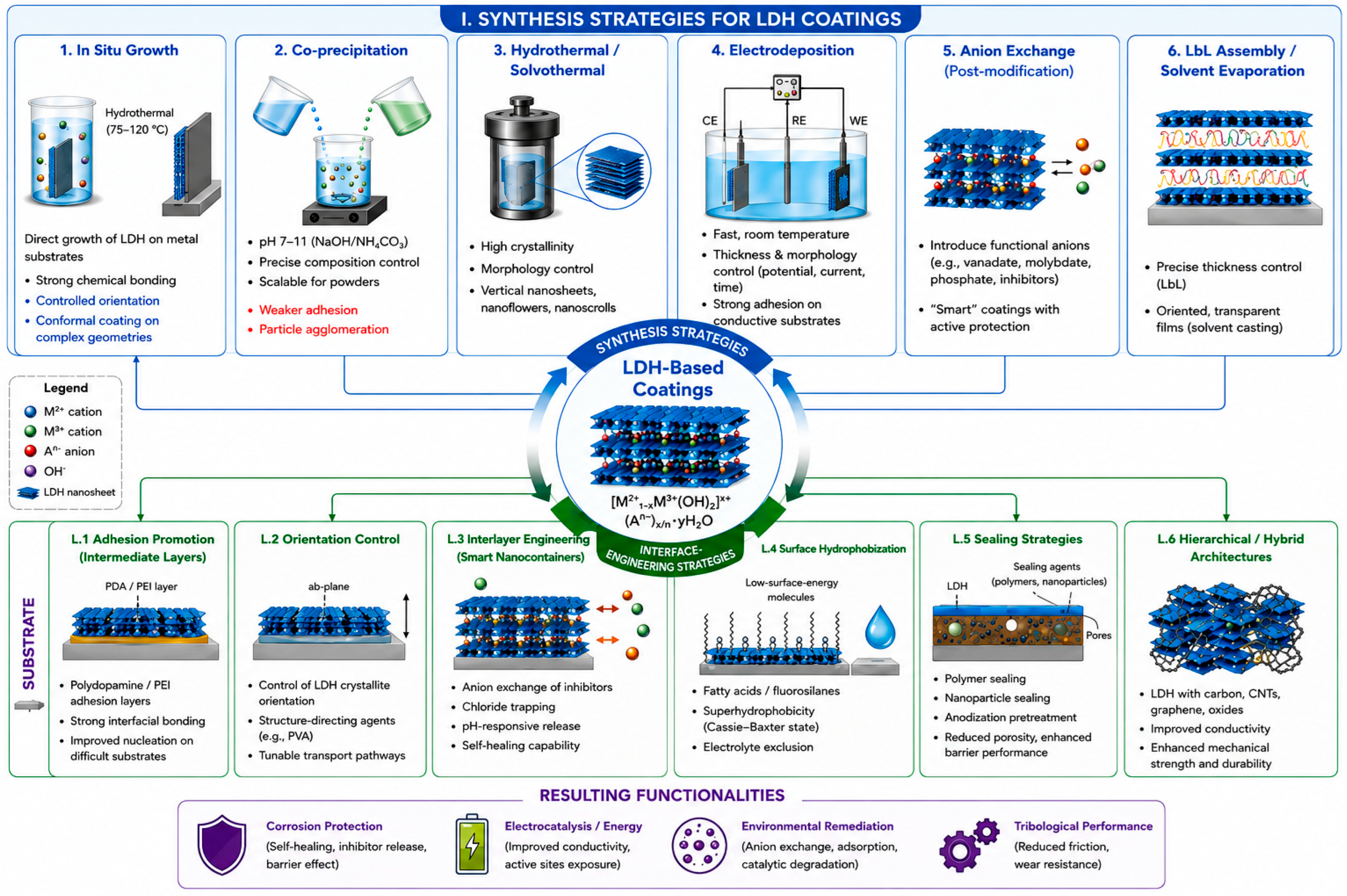
The synthesis strategy plays a fundamental role in determining the structural organization, interfacial properties, and functional performance of LDH-based coatings (
Figure 4). Parameters such as platelet orientation, crystallinity, porosity, defect density, coating thickness, and interfacial adhesion are strongly influenced by the preparation method and directly affect catalytic activity, transport behavior, corrosion resistance, and long-term operational stability. Consequently, recent research has increasingly focused on the development of advanced synthesis and interface-engineering approaches able to tailor LDH architectures for multifunctional coating applications [
77,
112].
5.1. Coprecipitation and Sol–Gel Methods as Benchmark Approaches
Among the conventional preparation approaches, co-precipitation remains one of the most widely employed methods because it allows relatively precise control over cation composition, metal ratio, and interlayer chemistry through adjustment of precursor concentration and solution pH. LDH powders synthesized by co-precipitation are frequently deposited onto conductive substrates, porous supports, or polymeric matrices through techniques such as dip-coating, spin-coating, or electrophoretic deposition to fabricate multifunctional catalytic coatings and hybrid interfaces. Although these ex-situ approaches provide considerable compositional flexibility and facilitate the incorporation of additional catalytic phases, coatings prepared from pre-synthesized LDH powders often suffer from particle agglomeration, weaker adhesion, and limited interfacial compatibility compared with directly grown LDH films. Such limitations may reduce the accessibility of catalytically active sites, hinder charge-transfer processes, and compromise long-term structural stability under operating conditions [
113,
114].
Hydrothermal and solvothermal methods are widely employed to improve the crystallinity, structural ordering, and morphological uniformity of LDH-based coatings. Under hydrothermal conditions, slow hydrolysis agents such as urea or hexamethylenetetramine gradually release OH
− ions, thereby enabling controlled nucleation and crystal growth. These synthesis routes are particularly effective for the fabrication of vertically aligned LDH nanosheet arrays and highly ordered porous architectures on conductive substrates, including nickel foam, carbon fibers, and metallic foils. In addition to structural organization improvement, hydrothermal growth offers precise control over coating morphology, allowing the formation of diverse architectures such as nanosheets, nanoflowers, and nanoscrolls. Lv et al. demonstrated that intermediate polydopamine/polyethylenimine adhesion layers can guide the formation of vertically aligned LDH nanoscrolls on different substrates. This effect arises from electrostatic interactions between the positively charged functional groups of the adhesion layer and the negatively charged LDH precursor species, which promote more controlled nucleation and oriented crystal growth [
115]. Such hierarchical architectures significantly increase the accessible surface area and facilitate mass- and charge-transport processes within compact coating systems [
114,
115].
The orientation of LDH platelets within thin films represents another important parameter that strongly influences transport behavior and coating performance. Depending on the synthesis conditions and substrate functionalization, LDH crystallites may adopt either parallel or perpendicular alignment relative to the substrate surface. Guo et al. demonstrated that the orientation of LDH platelets within thin films strongly influences both surface morphology and ion-accessibility behavior. In particular, coatings composed of perpendicularly aligned LDH platelets exhibited markedly different interfacial characteristics compared with densely stacked parallel architectures. To control the orientation of LDH platelets during film growth, structure-directing agents such as poly(vinyl alcohol) have been employed. The hydroxyl groups of poly(vinyl alcohol) interact through hydrogen bonding with hydroxyl functionalities located on the LDH surface, thereby influencing crystal organization and promoting preferential alignment of the LDH platelets within the coating architecture [
112,
113].
Among advanced deposition approaches, electrodeposition has emerged as a particularly attractive strategy for the fabrication of LDH coatings since it enables rapid film growth under relatively mild conditions while offering precise control over coating thickness, nanosheet orientation, and surface morphology. In this approach, cathodic reduction of nitrate or other oxyanions locally increases the pH near the substrate surface, thereby promoting LDH precipitation directly onto conductive supports. The resulting films are generally compact and strongly adhered due to the intimate contact established during in situ growth. Recent studies have demonstrated that modification of the conductive substrate can strongly influence LDH nucleation behavior, nanosheet organization, and the resulting coating architecture. Zhao et al. reported that nickel-coated carbon cloth substrates promoted the formation of densely packed NiCo-LDH nanosheet networks characterized by an increase in the electrochemically active surface area and improved electron-transport capability [
93]. Similarly, vertically aligned CoAl-LDH nanoplatelet arrays grown on flexible metallic substrates exhibited enhanced charge-transfer kinetics and reduced interfacial resistance as a result of their ordered porous architecture and direct electrical contact with the current collector [
95].
In situ growth and conversion-coating strategies able to generate chemically bonded oxide/LDH hierarchical interfaces directly on metallic substrates, has also attracted increasing attention from the research area. In contrast with conventional two-step deposition methods, in situ growth generally provides improved adhesion, superior structural continuity, and enhanced resistance to coating delamination. Jiang et al. demonstrated that CuZnAl-LDH/oxide hierarchical structures grown directly on copper alloys effectively inhibited the transport of chloride ions, oxygen, and water molecules toward the metallic substrate, thereby significantly improving corrosion resistance after hydrophobic surface modification [
105]. Similarly, Zheludkevich et al. showed that the protective performance of LDH conversion films strongly depends on preparation conditions, including reactant concentration and inhibitor incorporation during film growth. In particular, vanadate-intercalated LDH conversion coatings exhibited improved corrosion protection due to the combined effects of barrier properties and controlled inhibitor release [
108].
Another important post-synthetic modification strategy involves interlayer anion exchange, which takes advantage of the reversible exchangeability of species located within the LDH interlayer galleries. Through these ion-exchange processes, functional anions such as vanadates, molybdates, phosphates, or organic corrosion inhibitors can be incorporated into preformed LDH coatings without altering the integrity of the layered structure. As a consequence, initially passive LDH barrier layers can be converted into adaptive “smart” coatings, able to capture aggressive chloride ions while simultaneously release protective inhibitors in response to local electrochemical changes. The reversible ion-exchange behavior of LDHs represents, therefore, one of the key characteristics underlying the multifunctionality and environmentally responsive nature of advanced LDH-based coating systems [
77,
113].
5.2. Hierarchical Architectures and Interfacial Engineering
Beyond their intrinsic ion-exchange capability, LDHs can function as versatile structural platforms for the integration of conductive carbons, polymers, nanotubes, metal oxides, and other nanostructured components aimed to enhance the catalytic performance. Such hybridization strategies can improve structural organization, suppress platelet aggregation, and promote the formation of multifunctional catalytic interfaces within hierarchical coating architectures. In catalytic systems, these cooperative interactions frequently promote faster charge-transfer kinetics, improved reactant diffusion, and enhanced stabilization of active species at the LDH interface. Consequently, hierarchical LDH-based architectures are increasingly being engineered as multifunctional catalytic interfaces able to simultaneously adjust transport behavior, interfacial reactivity, and long-term operational stability [
112,
113].
Carbon-based hybrid architectures represent some of the most extensively investigated LDH systems because conductive carbon phases can substantially improve physicochemical properties, while preserving the intrinsic ion-exchange functionality of LDHs. Carbon nanotubes, porous carbons, graphene derivatives, and conductive polymers are particularly effective in generating interconnected electron-transport pathways and reducing diffusion limitations within compact catalytic architectures. Such conductive frameworks contribute to the improvement of the interfacial organization and to the enhancement of the electrochemical functionality of LDH-based coatings.
Rezaeifard et al. developed Mo-doped MgAl-LDH/carbon nanotube nanohybrids in which the synergistic interaction between LDH lamellae and functionalized carbon nanotubes improved nanoparticle dispersion, interfacial compatibility, and transport behavior within the hybrid structure [
94]. Similarly, biomass-derived porous carbon scaffolds decorated with flower-like NiMn-LDH microspheres generated conductive hierarchical architectures with enhanced ion accessibility and improved electrochemical performance owing to the combined effects of high surface area, hierarchical porosity, and facilitated electron transport [
92]. Together, these studies demonstrate how conductive carbon frameworks can significantly enhance the catalytic and electrochemical functionality of LDH-based coating systems through improved interfacial organization and transport regulation.
Interfacial engineering has also emerged as a critical strategy for improving coating homogeneity and compatibility between LDH phases and surrounding matrices. Electrostatic self-assembly methods, surface functionalization, and hybrid interface design can significantly improve structural organization and interfacial stability while enabling controlled assembly of multifunctional architectures. Lee et al. demonstrated that highly ordered LDH monolayers can act as multifunctional interfacial platforms able to immobilize inorganic particles, polymer nanobeads, and biomaterials through electrostatic self-assembly processes [
96]. Such approaches highlight the ability of LDHs to function not only as catalytically active materials, but also as programmable interfaces for the fabrication of structurally organized coating systems [
112].
An important interfacial engineering strategy involves the surface functionalization of LDH coatings with hydrophobic or superhydrophobic layers. Through modification with low-surface-energy molecules such as long-chain fatty acids or fluoroalkylsilanes, hydrophilic LDH surfaces can be transformed into hierarchical interfaces characterized by reduced wettability and restricted penetration of aqueous media. In catalytic systems, such surface engineering approaches can additionally improve interfacial stability, regulate local transport behavior, and reduce catalyst degradation under harsh operating conditions.
In many cases, superhydrophobic LDH coatings follow the Cassie-Baxter wetting regime, where air pockets trapped within the hierarchical microstructure minimize liquid-solid contact. Iqbal et al. demonstrated that PFDTS-functionalized ZnAl-LDH coatings grown directly on zinc substrates exhibited significantly improved electrochemical stability due to the combined effects of ion-exchange inhibition and superhydrophobic barrier behavior [
99]. Similarly, Jiang et al. reported that hydrophobic post-treatment of CuZnAl-LDH/oxide hierarchical structures effectively restricted the transport of chloride ions, oxygen, and water molecules toward the substrate interface [
105]. These studies illustrate how hydrophobic interfacial modification can contribute not only to corrosion protection, but also to the stabilization and long-term durability of multifunctional LDH-based catalytic and electrochemical systems.
Hierarchical composite architectures have also been developed through the incorporation of secondary nanophases such as Al
2O
3, graphene oxide, MoS
2, and ZrO
2 into LDH matrices. These additional components can reduce porosity, reinforce structural compactness, and improve both transport behavior and interfacial stability within multifunctional coating systems. In catalytic and electrochemical applications, such hybrid architectures may facilitate charge transfer, improve active-site accessibility, and enhance long-term operational stability. Additionally, LDHs exhibit favorable lubrication properties due to their layered structure, weak interlayer interactions, and tunable interlayer spacing, which facilitate sliding processes and reduce frictional wear [
116]. For example, MgAl-LDH/Al
2O
3 composite coatings produced through combined in situ LDH growth and electrophoretic deposition exhibited improved wear resistance and reduced friction owing to the increased compactness of the hierarchical architecture. Similarly, graphene oxide sheets have been employed to seal porous LDH outer layers, generating hybrid coatings that combine the barrier properties of graphene with the ion-exchange and self-healing functionality of LDHs [
113,
116].
Additional interface-engineering approaches, including rare-earth doping, polymer sealing, anodization pretreatment, and intermediate adhesion layers, have further expanded the versatility of LDH-based coatings. In this regard, rare-earth cations such as Ce
3+ and La
3+ can improve corrosion resistance through cathodic inhibition mechanisms, while polymeric sealing layers reduce coating porosity and improve long-term mechanical stability. Intermediate adhesion layers based on polydopamine/polyethylenimine systems can additionally promote LDH nucleation on difficult substrates through electrostatic and coordination interactions, thereby improving coating continuity and adhesion strength [
115]. Collectively, these strategies demonstrate how hierarchical design and interfacial engineering can be combined to tailor the structural organization, transport properties, and multifunctional behavior of advanced LDH-based coating systems.
5.3. Current Challenges, Scalability, and Future Perspectives
Despite the substantial progress achieved in the synthesis and functionalization of LDH-based coatings, several challenges still limit their large-scale implementation and long-term catalytic stability. Achieving homogeneous large-area deposition while maintaining controlled morphology, strong interfacial adhesion, and structural reproducibility remains particularly difficult, especially in multicomponent hybrid architectures. In compact catalytic coatings, excessive platelet stacking, aggregation phenomena, and nonuniform dispersion of conductive phases may generate localized transport limitations, heterogeneous active regions, and uneven charge-transfer behavior. Such structural heterogeneities can progressively reduce catalytic efficiency and compromise long-term operational stability under realistic working conditions [
112,
113].
Scalability also remains a critical issue for many advanced deposition strategies. Although hydrothermal growth and electrodeposition methods provide excellent control over coating morphology, nanosheet orientation, and interfacial organization, their industrial implementation may still be restricted by processing time, substrate geometry, energy consumption, and difficulties associated with the uniformity of the large-areas. In addition, several synthesis procedures require tightly controlled reaction environments, multiple post-treatment steps, or specialized conductive substrates, which may further complicate scale-up and industrial reproducibility [
113,
114].
Another important challenge concerns the long-term stability of multifunctional LDH-based catalytic coatings under realistic operating conditions. Prolonged exposure to thermal fluctuations, reactive media, mechanical stress, or repeated electrochemical cycling may progressively induce structural degradation, interfacial delamination, pore expansion, or partial loss of catalytically active species. In hierarchical hybrid systems, the coexistence of multiple functional phases can additionally generate differences in thermal expansion, mechanical compatibility, and electrochemical behavior, thereby increasing the likelihood of interfacial instability and defect formation. Maintaining stable interfacial interactions between LDH layers, conductive additives, catalytic phases, and supporting substrates therefore remains essential for preserving long-term catalytic activity and operational durability [
105,
112].
Increasing attention has therefore been directed toward the development of sustainable and scalable synthesis strategies able to reduce processing complexity while improving structural stability and environmental compatibility. Environmentally friendly conversion coatings, low-temperature deposition methods, and biomass-derived conductive scaffolds have emerged as promising alternatives for next-generation LDH systems. In particular, biomass-based porous carbon supports are attractive because they combine low cost, structural sustainability, and high transport accessibility within hierarchical porous architectures [
92]. At the same time, chromate-free conversion coatings and fluorine-free surface modifications are increasingly being explored as environmentally safer approaches for the fabrication of multifunctional LDH-based protective and catalytic coatings [
99,
113].
Future progress in the field will also strongly depend on improving the mechanistic understanding of dynamic interfacial phenomena occurring within LDH-based coatings under real operating conditions. Although substantial advances have been achieved in correlating morphology and composition with electrochemical performance, many transport processes, degradation pathways, and interface-evolution mechanisms remain insufficiently understood. Greater integration of operando characterization techniques, multiscale computational modeling, and data-driven material design will therefore be essential for establishing reliable structure/property relationships in multifunctional LDH systems.
Overall, advanced synthesis and interface-engineering strategies play a central role in determining the structural organization, transport behavior, and long-term catalytic performance of LDH-based coatings. Through the combined optimization of deposition methods, hierarchical architectures, and interfacial interactions, of the multifunctional LDH-based coatings systems can be tailored in order to exhibit enhanced catalytic activity, improved charge-transfer kinetics, increase accessibility of active sites, and increased operational stability under challenging reaction conditions. Nevertheless, further advances in scalable fabrication, operando characterization, interface control, and sustainable processing strategies will remain essential for the future development and industrial implementation of high-performance LDH-based catalytic coatings.
6. Multifunctional Catalytic Applications of LDH-Based Coatings
The unique structural characteristics of LDHs (such as flexible tunability of metal cations in the brucite-like layers, facile exchangeability of intercalated anions, and the ability to form thin films and coatings on various substrates), give rise to a wide spectrum of multifunctional catalytic applications [
117,
118,
119,
120,
121]. Beyond the capabilities of conventional catalysts, LDH-based coatings can integrate multiple functionalities within a single surface architecture, including adsorption, acid–base catalysis, redox activity, charge-transfer mediation, and selective ion exchange [
122,
123]. When deposited on metallic, oxide, carbon-based, or conductive substrates, LDHs benefit of improved stability, enhanced accessibility of active sites, reduced catalyst loss, and easier recovery compared with their powder counterparts [
124,
125,
126,
127]. The multifunctional behavior of LDH coatings originates from the synergistic interaction between the mixed-metal hydroxide layers, interlayer species, incorporated functional phases, and the coating/substrate interface [
128,
129]. Through careful control of cation composition, interlayer chemistry, defect density, and hierarchical organization, LDH coatings can be tailored to promote different catalytic pathways while simultaneously providing additional functionalities such as corrosion protection, pollutant adsorption, sensing, and photoelectrochemical activity [
128,
130,
131]. Furthermore, the possibility of integrating catalytically active nanoparticles, redox mediators, corrosion inhibitors, or plasmonic nanostructures within LDH architectures has considerably expanded the functional scope of these coatings [
132,
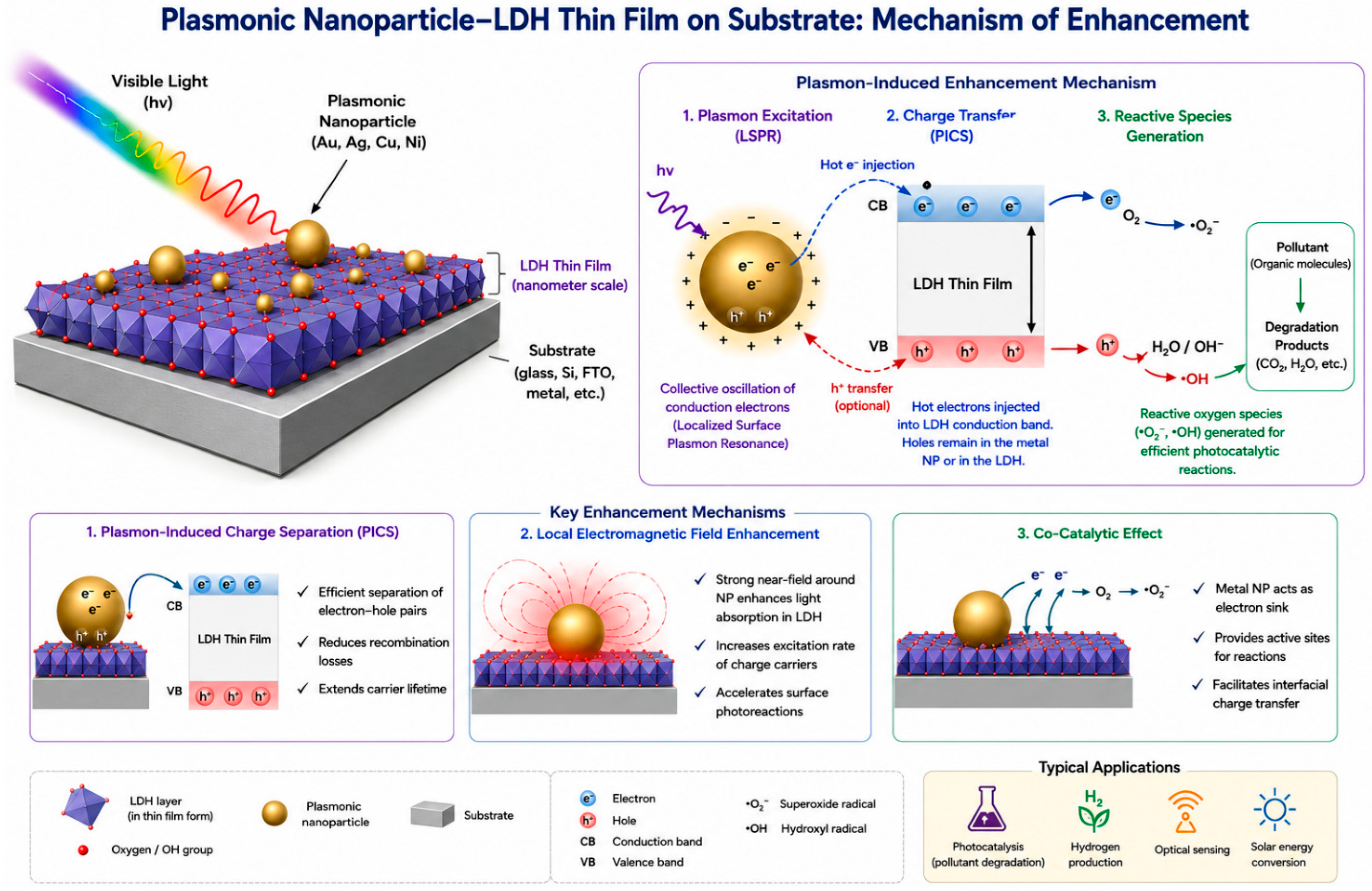
133].
6.1. Electrocatalytic LDH Thin-Film Coatings for the Oxygen Evolution Reaction (OER)
LDH thin films and coatings deposited on conductive substrates have emerged as one of the most promising classes of earth-abundant electrocatalysts for the oxygen evolution reaction (OER), a key half-reaction in alkaline water electrolysis [
123]. Unlike powdered catalysts, LDH coatings provide direct electrical contact with the current collector, improved mechanical stability, enhanced mass transport, and the possibility of engineering well-defined catalyst/substrate interfaces [
117,
118,
120].
Among the various LDH compositions investigated, NiFe-LDH thin films are generally considered the standard non-noble-metal OER catalysts in alkaline water splitting [
114,
116,
120,
127,
129]. Their exceptional catalytic activity originates from the synergistic interaction between nickel and iron active centers, where high-spin d
4 Fe(IV) facilitates efficient formation of active oxygen radicals, while closed-shell d
6 Ni(IV) catalyzes the subsequent O-O coupling [
116]. Operando spectroscopic studies indicate that Fe sites act as the primary catalytic centers during OER, while neighboring Ni atoms regulate the electronic structure and adsorption energetics of oxygenated intermediates [
110,
116,
130]. Under anodic polarization, the initial LDH structure undergoes reconstruction into highly active oxyhydroxide phases, particularly γ-NiFeOOH and β-NiFeOOH, which constitute the true catalytic surface during oxygen evolution [
130,
134,
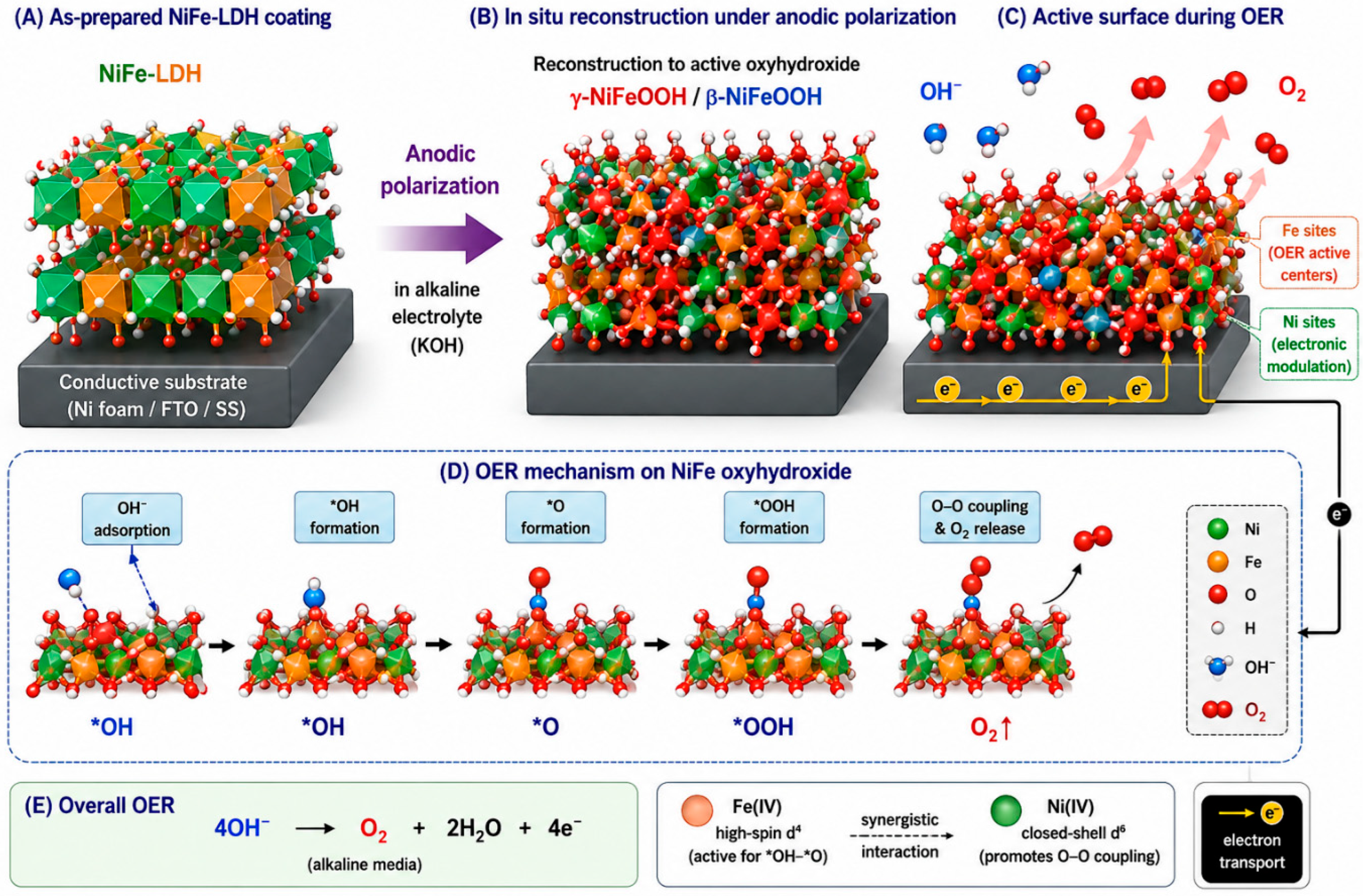
135]. The outstanding OER activity of NiFe-LDH coatings is generally attributed to their dynamic surface evolution under operating conditions. During anodic polarization, the initial LDH structure undergoes an in situ reconstruction into catalytically active oxyhydroxide phases, which act as the true active surface for oxygen evolution. In addition, the synergistic interaction between Ni and Fe species optimizes the adsorption and conversion of oxygen-containing intermediates, thereby enhancing the reaction kinetics. A schematic representation of the activation process and the proposed OER mechanism on NiFe-LDH coatings is presented in
Figure 5.
Although NiFe-LDH coatings exhibit excellent intrinsic OER activity, their performance can be further optimized through structural and compositional engineering. Several strategies have been developed to enhance the OER performance of LDH coatings. Among them, compositional modulation through the incorporation of additional metal cations (e.g., Co, V, Cr, Mn, and Ru) has proven particularly effective in tuning the electronic structure of Ni and Fe active sites, thereby facilitating charge transfer and accelerating the deprotonation steps involved in OER [
116,
134,
136]. For example, Fe
2+-doped NiFe-LDH coatings exhibited an overpotential as low as 249 mV at 10 mA cm
−2, while alkali-treated NiCo-LDH coatings containing cation defects and LDH/β-Ni(OH)
2/β-Co(OH)
2 heterostructures achieved OER overpotentials of only 317 mV at the same current density [
137,
138,
139]. Zn-incorporated NiFe-LDH coatings prepared via spontaneous corrosion of commercial NiFe foam followed by cyclic voltametry activation exhibited outstanding OER activity with an overpotential of only 565 mV at 400 mA cm
−2 and remarkable stability over 112 h at high current densities. In situ Raman spectroscopy confirmed that β-NiFeOOH forms as the true active layer during OER, while Zn dissolution creates cation vacancies that enhance stability [
116]. Vanadium-doped NiFe-LDH coatings have demonstrated enhanced conductivity and accelerated charge transfer due to the generation of electron-rich metal centers [
118]. Moreover, chromium incorporation induces lattice distortion and promotes oxygen vacancy formation, while cobalt substitution increases electrical conductivity and facilitates oxidation-state transitions during catalysis [
116,
119]. Another widely explored approach is vacancy engineering, where oxygen and metal cation vacancies create electron-rich active centers and increase the density of catalytically accessible sites. Plasma-exfoliated CoFe-LDH coatings containing O, Co, and Fe vacancies showed a significant decrease in overpotential from 332 to 290 mV at 10 mA cm
−2, while oxygen-vacancy-rich NiFe-LDH coatings exhibited enhanced OER activity due to modified electronic structures [
140]. The catalytic performance can also be improved through intercalation chemistry, as the incorporation of different anions into the LDH interlayer space modifies the electronic properties of the metal centers and influences the adsorption energies of oxygenated intermediates. In particular, reducing anions such as SO
32− and PO
33− donate electrons to the metal sites, leading to enhanced OER kinetics, with the activity showing a strong correlation with the basicity of the interlayer anions [
141].
6.2. Electrocatalytic Coatings for the Hydrogen Evolution Reaction (HER) and Bifunctional Water Splitting
The hydrogen evolution reaction (HER) constitutes the cathodic half-reaction of water electrolysis and is a key process for sustainable hydrogen production. Although Pt-based catalysts remain the state-of-the-art HER electrocatalysts, their scarcity and high cost have motivated the development of efficient alternatives based on earth-abundant transition-metal compounds. Among these materials, LDHs have attracted considerable attention owing to their compositional tunability, abundance of accessible active sites, and ability to be directly deposited as thin films or coatings on conductive substrates. Compared with conventional powder catalysts, LDH coatings provide improved electrical contact, binder-free operation, enhanced mechanical stability, and easier integration into practical electrolyzer configurations [
142,
143,
144,
145].
However, pristine LDHs generally exhibit limited HER activity because of their relatively low electrical conductivity and unfavorable hydrogen adsorption energetics. To overcome these limitations, extensive research has focused on the design of advanced LDH-based coatings through heterostructure construction, elemental doping, defect engineering, and interfacial electronic modulation. Such strategies have been shown to enhance charge-transfer kinetics, optimize the reaction intermediates adsorption/desorption, and improve both HER and OER performance, enabling the development of highly efficient bifunctional electrodes for overall water splitting [
143,
144,
146].
A major advantage of LDH coatings over powder catalysts is their direct integration with current collectors such as nickel foam, stainless steel mesh, carbon cloth, and metallic foils. Such self-supported architectures eliminate the need for polymeric binders, reduce charge-transfer resistance, improve catalyst adhesion, and facilitate gas bubble release during electrolysis [
145].
One of the most effective strategies for improving HER activity involves constructing LDH-based heterostructures with highly conductive phases. Lan Mu et al. [
147] developed a NiMoS/NiFeMn-LDH heterostructured coating grown in situ on conductive substrates, where cation-anion modulation and heterojunction formation promoted electron redistribution and accelerated interfacial charge transfer. The resulting catalyst exhibited HER and OER overpotentials of 112 and 192 mV, respectively, at 10 mA cm
−2 and required only 1.562 V for overall water splitting, demonstrating the beneficial effect of electronic coupling between the sulfide and LDH phases. On the other hand, phosphide–LDH heterostructures have attracted considerable attention due to excellent HER activity of the transition-metal phosphides, whereas LDHs contribute abundant redox-active sites and improved OER performance. Amanian et al. [
148] synthesized porous Ni-Co-P/Ni-Co-Mn-LDH coatings on nickel foam using a dynamic hydrogen bubble template approach. The incorporation of the LDH layer reduced the HER overpotential from 103 mV for Ni-Co-P to 56 mV at 10 mA cm
−2 while simultaneously enhancing electrochemically active surface area and lowering charge-transfer resistance. Furthermore, replacing OER with urea oxidation reduced the overall cell voltage to 1.45 V, highlighting the versatility of LDH-based coating architectures for energy-saving hydrogen production.
The formation of hierarchical shell@core architectures represents another efficient strategy. M. Zhang et al. [
149] reported coral-like NiFe-LDH@NiCoP nanowire coatings directly grown on nickel foam. The intimate contact between the phosphide core and LDH shell generated P-Fe interfacial active sites that facilitated proton adsorption and oxygen intermediate formation. The resulting electrode exhibited HER and OER overpotentials of 130 and 218 mV, respectively, and achieved overall water splitting at only 1.42 V to reach 10 mA cm
−2. Importantly, the self-supported architecture eliminated the drawbacks associated with binder-containing electrodes and improved long-term stability.
Rare-earth-modified LDHs have recently attracted attention due to the incorporation of lanthanide ions which can alter local electronic density and increase the number of catalytically active sites. Tabibi et al. [
150] reported neodymium-modified NiAl-LDH coatings supported on conductive polyaniline/carbon nanofiber networks. The optimized photoelectrode exhibited HER overpotentials as low as 192 mV under illumination and demonstrated simultaneous HER and OER activity, indicating the potential of multifunctional LDH coatings for integrated photoelectrochemical hydrogen production. The importance of morphology control is illustrated by three-dimensional porous LDH coatings. Asen et al. [
151] synthesized three-dimensional interconnected nanosheet NiCo-LDH network anchored on montmorillonite-modified nickel foam. The hierarchical porous architecture exposed a large number of active sites and facilitated rapid mass transport, resulting in a HER overpotential of only 48 mV at 10 mA cm
−2 and an overall water-splitting voltage of 1.52 V. These results demonstrate that rational microstructural design can be as important as compositional optimization in determining electrocatalytic performance.
Recent studies have also emphasized the importance of industrial-current-density operation. While many LDH catalysts perform well at laboratory-scale current densities (10–20 mA cm
−2), practical electrolyzers require stable operation at several hundred mA cm
−2. Lv et al. [
152] developed amorphous Rh(OH)
3-decorated NiMn-LDH coatings, in which Ni-O-Rh interfacial bonds promoted charge redistribution and accelerated both HER and OER kinetics. The catalyst achieved overpotentials of 245 mV (HER) and 378 mV (OER) at an industrial current density of 500 mA cm
−2 and maintained stable operation for more than 1000 h, outperforming many previously reported bifunctional LDH-based systems.
Overall, the literature indicates that the most effective LDH coatings for HER and bifunctional water splitting are not pristine LDHs but rather heterostructured architectures combining LDHs with phosphides, sulfides, conductive polymers, carbon nanomaterials, or electronically active dopants. Among the reported systems, phosphide-LDH and sulfide-LDH heterostructures generally provide the best balance between HER activity and overall water-splitting performance, whereas rare-earth-modified and noble-metal-decorated LDHs offer additional opportunities for electronic tuning and industrial-scale operation. Future developments should focus on scalable coating deposition methods, optimization of catalyst-substrate interfaces, and long-term durability under realistic operating conditions.
Similar to OER, the HER performance of LDH coatings is closely related to the nature of the active sites, charge-transfer efficiency, and interfacial interactions between the LDH film and the conductive substrate. In alkaline electrolytes, hydrogen generation involves water dissociation and the subsequent formation of molecular hydrogen through Volmer-Heyrovsky or Volmer-Tafel reaction pathways. The conductive substrate facilitates electron transport, while the LDH coating provides abundant active sites and optimized adsorption energetics, promoting efficient hydrogen generation. A schematic representation of the proposed HER mechanism on LDH coatings is presented in
Figure 6.
6.3. Plasmonic Layered Double Hydroxide Thin Films Deposited on Substrates: Recent Advances, Mechanisms, and Applications
The integration of plasmonic nanostructures into LDH-based thin films deposited on conductive or optically active substrates has recently emerged as an effective strategy for overcoming the intrinsic limitations of pristine LDHs, particularly their limited visible-light absorption and rapid recombination of photogenerated charge carriers [
132,
153]. By combining the compositional tunability and ion-exchange capability of LDHs with the localized surface plasmon resonance (LSPR) properties of noble-metal nanoparticles, multifunctional thin-film architectures can be engineered for photocatalysis, photoelectrochemical energy conversion, sensing, and environmental remediation applications [
122,
128,
132,
153].
Compared with powder-based photocatalysts, substrate-supported LDH thin films provide several additional advantages, including enhanced mechanical stability, improved catalyst recovery, efficient charge extraction through conductive supports, and superior interfacial charge-transfer kinetics [
122,
154]. Consequently, substrates such as fluorine-doped tin oxide (FTO), indium tin oxide (ITO), titanium foil, nickel foam, carbon cloth, stainless steel, silicon wafers, and nanostructured plasmonic arrays have been increasingly employed for the fabrication of LDH-based photoactive coatings [
119,
122,
154].
6.3.1. Enhancement Mechanisms
Recent studies have demonstrated that plasmonic enhancement in LDH thin films originates from the synergistic interaction between plasmonic nanoparticles and the layered hydroxide matrix. Three principal mechanisms are generally accepted. The first mechanism involves localized surface plasmon resonance (LSPR), where collective oscillation of conduction electrons in metallic nanoparticles generates intense local electromagnetic fields under visible-light irradiation [
132,
133]. These near-field effects increase light absorption within adjacent LDH layers and broaden the spectral response of the composite system. The second mechanism corresponds to plasmon-induced charge separation through hot-electron injection. Following plasmon excitation, energetic electrons generated within Au or Ag nanoparticles can be transferred into the conduction band of the LDH, thereby suppressing electron-hole recombination and extending carrier lifetimes [
132,
133,
153]. The third mechanism is associated with the co-catalytic role of metallic nanoparticles, which act as electron sinks and catalytically active centers that facilitate interfacial redox reactions and accelerate charge-transfer processes [
128,
153]. A schematic illustration of these plasmon-enhancement pathways in substrate-supported LDH thin films is presented in
Figure 7.
6.3.2. Applications of Plasmonic LDH Thin-Film Coatings
The integration of plasmonic nanoparticles into substrate-supported LDH thin films has significantly expanded the application range of LDH-based coatings, particularly in photocatalysis, photoelectrochemical energy conversion, optical sensing, and multifunctional protective surfaces [
122,
153,
154]. In contrast to powder photocatalysts, thin-film architectures benefit from direct electrical contact with conductive substrates, improved charge extraction, reduced catalyst loss, and enhanced long-term operational stability [
119,
154]. However, the performance strongly depends on the plasmonic material, nanoparticle distribution, film thickness, substrate conductivity, and interfacial charge-transfer efficiency [
132,
153]. Among currently reported applications, photocatalytic degradation of organic pollutants remains the most extensively investigated field.
Ag-decorated LDH thin films deposited on conductive substrates generally exhibit some of the highest photocatalytic enhancement factors because silver combines strong visible-light plasmon resonance with relatively low material cost [
155,
156,
157,
158,
159]. Ag-decorated NiAl-LDH/g-C3N4 thin-film heterostructures have demonstrated significantly enhanced photocatalytic degradation of organic pollutants under visible-light irradiation, owing to the combined effects of plasmonic excitation and efficient charge transfer across Ag-LDH interfaces [
155]. Whang et al. reported Ag-decorated NiAl-LDH films grown on conductive substrates that achieved substantially improved methyl-orange degradation under visible-light irradiation compared with non-plasmonic LDH coatings [
122]. The enhancement was attributed to plasmon-induced charge separation and efficient electron transport through the conductive substrate. Similar behavior was reported for Ag-coated Zn/Ti-LDH films, where the optimal silver loading improved photocatalytic activity by increasing visible-light absorption while suppressing electron-hole recombination [
156,
159]. Nevertheless, excessive Ag loading may lead to nanoparticle aggregation and the formation of recombination centers, ultimately reducing photocatalytic efficiency [
156].
Gold-based plasmonic LDH films have also attracted considerable attention because of the superior chemical stability and tunable optical properties of Au nanoparticles [
131]. Au/NiAl-LDH heterostructures deposited on conductive substrates have shown improved electrocatalytic and photoelectrochemical performance, particularly in reactions involving oxygen evolution and solar-energy conversion [
131]. The efficient transfer of hot electrons across Au-LDH interfaces contributes to enhanced charge separation and accelerated interfacial kinetics. In addition, bimetallic Au-Pd nanoparticles supported on LDH films have demonstrated synergistic photocatalytic effects arising from the combined plasmonic properties of Au and the catalytic activity of Pd, leading to improved degradation rates of organic contaminants [
157].
An alternative strategy involves the deposition of LDH nanosheets directly onto plasmonic substrates. In these architectures, the plasmonic functionality is incorporated into the substrate rather than into dispersed nanoparticles. For example, LDH nanosheets grown on ordered aluminum nanocylinder arrays exhibited enhanced optical sensitivity due to the strong electromagnetic field amplification generated by the plasmonic substrate, while the LDH overlayer provided a chemically active and highly adsorptive interface [
158]. Such configurations enable more efficient electromagnetic coupling across the LDH/substrate interface and offer improved control over optical sensing performance.
A second important application area involves photoelectrochemical hydrogen production. In these systems, plasmonic nanoparticles act as light-harvesting centers and electron reservoirs that facilitate charge separation within the LDH film [
131,
133]. Au-decorated LDH electrodes generally provide superior photocurrent stability, whereas Ag-based coatings frequently exhibit higher initial photocurrent densities but suffer from gradual performance degradation caused by silver oxidation and surface reconstruction [
122,
133]. The choice between Ag and Au therefore depends on the balance between initial activity and long-term operational stability.
The combination of plasmonic nanostructures with LDH coatings has opened new opportunities for advanced technological applications. In photocatalytic water treatment, plasmon-enhanced LDH films promote the generation of reactive oxygen species and improve the degradation efficiency of dyes, pharmaceuticals, and emerging pollutants under visible-light irradiation [
155,
156,
159]. In photoelectrochemical systems, the improved separation and transport of charge carriers contribute to enhanced solar-energy conversion and photocatalytic hydrogen production [
131]. Furthermore, plasmonic LDH coatings have demonstrated significant potential in optical sensing platforms, where the synergistic combination of LSPR sensitivity and LDH adsorption capability enables the detection of ions, biomolecules, and environmental contaminants at low concentrations. Murai et al. demonstrated that LDH nanosheets deposited on aluminum nanocylinder plasmonic arrays generated substantially enhanced optical sensitivity due to strong local electromagnetic-field amplification combined with the adsorption capability of the LDH layer [
158]. Such architectures are particularly attractive because the plasmonic component is integrated into the substrate, producing more efficient electromagnetic coupling than randomly distributed metallic nanoparticles. Furthermore, the high anion-exchange capacity of LDHs provides additional selectivity toward target analytes, making these coatings promising candidates for environmental and biosensing applications [
158].
Despite these advances, several challenges remain. Precise control of nanoparticle size, morphology, distribution, and interfacial contact with the LDH matrix is still required to maximize plasmonic enhancement while minimizing recombination losses [
132,
153]. Long-term photostability, optimization of film thickness, and scalable fabrication of uniform coatings on large-area substrates also remain important issues for practical implementation [
122,
154]. Future developments are expected to focus on engineered hierarchical interfaces, advanced in situ spectroscopic characterization of hot-electron dynamics, and the integration of plasmonic LDH coatings into multifunctional catalytic and photoelectrochemical devices [
132,
133,
153]. To provide a clearer overview of the current state of the art, representative plasmonic LDH thin-film coatings deposited on substrates are compared in
Table 2, together with their principal applications, reported performance improvements, advantages, and limitations.
The literature indicates that Ag-based LDH thin-film coatings currently provide the highest photocatalytic enhancement under visible-light irradiation due to their intense plasmonic response and efficient hot-electron generation. However, long-term operational stability remains a major challenge because silver nanoparticles are susceptible to oxidation, dissolution, and surface restructuring. In contrast, Au-based coatings generally exhibit lower enhancement factors but significantly superior photochemical stability, making them more attractive for long-duration photoelectrochemical applications. Architectures based on plasmonic substrates rather than dispersed nanoparticles offer improved electromagnetic-field control and sensing performance, although their fabrication remains more complex and difficult to scale.
In summary, plasmonic LDH thin films deposited on conductive and plasmonic substrates represent a rapidly expanding research area at the intersection of photocatalysis, surface engineering, and functional coatings. The synergistic coupling of LSPR effects, hot-electron transfer, and substrate-assisted charge transport provides a powerful platform for the design of next-generation multifunctional LDH-based coatings with enhanced catalytic activity, improved energy-conversion efficiency, and advanced sensing capabilities.
7. Conclusions and Future Perspectives
Layered double hydroxide (LDH)-based coatings have emerged as versatile platforms for multifunctional catalysis owing to their tunable composition, layered architecture, adaptable interlayer chemistry, and ability to be integrated onto solid substrates. Their performance is governed not only by the intrinsic activity of the LDH phase but also by coating morphology, substrate interactions, active-site accessibility, mass-transport processes, charge-transfer pathways, and long-term interfacial stability. Consequently, the transition from bulk LDH catalysts to coating architectures introduces additional design parameters that must be considered when developing efficient and durable multifunctional systems.
The studies discussed in this review demonstrate that LDH-based coatings are suitable for a broad range of catalytic, electrochemical, photocatalytic, protective, and environmentally relevant applications. Their multifunctional character originates from the coexistence of acid–base and redox active sites, exchangeable interlayer species, defect-rich structures, conductive or photoactive hybrid components, and engineered coating/substrate interfaces. Furthermore, post-synthetic modification, interlayer engineering, hybrid nanocomposite formation, and calcination–reconstruction approaches significantly expand the functional capabilities of LDH-based coatings. Through these strategies, it becomes possible to simultaneously tailor catalytic activity, adsorption behavior, charge mobility, corrosion resistance, and operational durability.
Despite these advances, several challenges remain to be addressed. Compact or excessively thick coatings may hinder mass transport and limit the utilization of active sites, whereas highly porous or defect-rich architectures often involve a compromise between catalytic performance and structural stability. Similarly, interlayer expansion can facilitate molecular diffusion and ion transport but may also increase susceptibility to swelling, leaching, and delamination. Although hybrid architectures frequently improve charge-transfer efficiency and interfacial functionality, excessive incorporation of secondary phases may obstruct active sites or generate structural heterogeneities. These observations highlight the need for a balanced optimization of activity, transport properties, durability, and scalability.
Although LDH-based coatings possess intrinsic characteristics that make them attractive candidates for multifunctional catalytic processes, their application in tandem and cascade reactions remains largely unexplored. The coexistence of acid–base and redox functionalities, tunable interlayer environments, and engineered interfaces suggests considerable potential for coupling sequential reaction steps within a single coating architecture. Nevertheless, most reported examples of tandem and cascade catalysis still involve bulk LDH materials rather than surface-confined coating systems. Future investigations should therefore focus on elucidating how coating thickness, interfacial interactions, active-site accessibility, transport phenomena, and long-term stability influence the performance of such integrated catalytic platforms.
Future progress in the field will require a more rigorous mechanistic understanding of structure–reactivity relationships under realistic operating conditions. Advanced in situ and operando characterization techniques, combined with electrochemical analysis, spectroscopic investigations, and computational modeling, will be essential for establishing reliable correlations between composition, structure, transport processes, and catalytic performance. In parallel, the development of scalable fabrication methods, improved coating reproducibility, environmentally benign processing routes, and standardized evaluation protocols will be necessary to facilitate meaningful comparison between systems and accelerate technological implementation. Addressing these challenges will support the evolution of LDH-based coatings from promising multifunctional materials toward robust catalytic platforms for sustainable chemical transformations, environmental remediation, and energy-related applications.
Author Contributions
Conceptualization, O.-G.D.-P. and N.C.; methodology, O.-G.D.-P.; investigation, O.-G.D.-P., N.C. and C.M.; resources, N.L. and O.-G.D.-P.; data curation, O.-G.D.-P.; writing—original draft preparation, O.-G.D.-P., D.-D.H., N.C. and C.M.; writing—review and editing, O.-G.D.-P., N.C., C.M., H.C., D.-D.H. and N.L.; visualization, O.-G.D.-P.; supervision, N.L. and O.-G.D.-P.; project administration, N.L.; funding acquisition, N.L. All authors have read and agreed to the published version of the manuscript.
Funding
This research was funded by the Ministry of Education and Research, Nucleu Program (PN 23 11 01 01).
Institutional Review Board Statement
Not applicable.
Informed Consent Statement
Not applicable.
Data Availability Statement
No new data were created or analyzed in this study. Data sharing is not applicable to this article.
Acknowledgments
Financial support from the Ministry of Education and Research, Nucleu Program (PN 23 11 01 01) is highly acknowledged; During the preparation of this manuscript, the authors used ChatGPT Plus (GPT-5.5) for language refinement and text editing. The tool was also used to assist in the preparation of schematic figures. All outputs were carefully reviewed and revised by the authors, who take full responsibility for the content of this publication.
Conflicts of Interest
The authors declare no conflicts of interest.
References
- Ren, F.; Wang, Z.; Luo, L.; Lu, H.; Zhou, G.; Huang, W.; Hong, X.; Wu, Y.; Li, Y. Utilization of Active Ni to Fabricate Pt-Ni Nanoframe/NiAl Layered Double Hydroxide Multifunctional Catalyst Through In Situ Precipitation. Chem.-Eur. J. 2015, 21, 13181–13185. [Google Scholar] [CrossRef] [PubMed]
- Varga, G.; Nguyen, T.; Wang, J.; Tian, D.; Zhang, R.; Li, L.; Xu, Z. Isomorphic Insertion of Ce(III)/Ce(IV) Centers into Layered Double Hydroxide as a Heterogeneous Multifunctional Catalyst for Efficient Meerwein-Ponndorf-Verley Reduction. ACS Appl. Mater. Interfaces 2024, 16, 11453–11466. [Google Scholar] [CrossRef] [PubMed]
- Liu, K.; Xu, Y.; Yao, Z.; Miras, H.; Song, Y. Polyoxometalate-Intercalated Layered Double Hydroxides as Efficient and Recyclable Bifunctional Catalysts for Cascade Reactions. ChemCatChem 2016, 8, 929–937. [Google Scholar] [CrossRef]
- Liu, J.; Zhang, Y.; Bai, Z.; Huang, Z.; Gao, Y.; Yao, Y. A Three-Dimensional ZnO/CdS/NiFe Layered Double Hydroxide Photoanode Coupled with a Cu2O Photocathode in a Tandem Cell for Overall Solar Water Splitting. Nano 2019, 14, 1950146. [Google Scholar] [CrossRef]
- Zhang, X.; Liu, X.; Huang, Z.; Guo, L.; Gan, L.; Zhang, S.; Ajmal, M.; Pan, L.; Shi, C.; Zhang, X.; et al. Tandem Nitrate Electroreduction to Ammonia with Industrial-Level Current Density on Hierarchical Cu Nanowires Shelled with NiCo-Layered Double Hydroxide. ACS Catal. 2023, 13, 14670–14679. [Google Scholar] [CrossRef]
- Peng, C.; Yu, Z.; Wu, W.; Li, J.; Wang, E. CuFe Layered Double Hydroxide as Self-Cascade Nanoreactor for Efficient Antibacterial Therapy. ACS Appl. Mater. Interfaces 2023, 15, 56678–56688. [Google Scholar] [CrossRef] [PubMed]
- He, X.; Zhang, T.; Niu, Y.; Xue, Q.; Ali, E.; Shaheen, S.; Tsang, D.; Rinklebe, J. Impact of catalytic hydrothermal treatment and Ca/Al-modified hydrochar on lability, sorption, and speciation of phosphorus in swine manure: Microscopic and spectroscopic investigations. Environ. Pollut. 2022, 299, 118877. [Google Scholar] [CrossRef] [PubMed]
- Liu, Y.; Ba, K.; Li, P.; Lin, Y.; Xie, T. Cooperative Cobalt-Doped and Carboxylate Anions Modification of NiFe-Layered Double Hydroxides for Improving Oxygen Evolution Reaction. Langmuir 2025, 41, 9256–9263. [Google Scholar] [CrossRef] [PubMed]
- Zhang, W.; Hou, X.; Nie, M.; He, C. Mechanistic insight into phosphorus and iron synergy for improved oxygen evolution reaction in Ni-based LDH electrocatalysts. Appl. Surf. Sci. 2026, 716, 164758. [Google Scholar] [CrossRef]
- Abdollahzadeh, M.; Hosseini, E.; Ahmadi, H.; Lim, S.; Korayem, A.; Razmjou, A.; Asadnia, M. Low humid transport of anions in layered double hydroxides membranes using polydopamine coating. J. Membr. Sci. 2021, 624, 118974. [Google Scholar] [CrossRef]
- Yang, Z.; Shi, K.; Jin, Z.; Liu, Z.; Li, Y.; Huang, Y.; Gao, F.; Han, J. Biodegradable Layered Double Hydroxide/Polymer Films for Efficient Oxygen and Water Vapor Barriers. Ind. Eng. Chem. Res. 2022, 61, 1367–1374. [Google Scholar] [CrossRef]
- Zhang, Y.; Li, H.; Du, N.; Zhang, R.; Hou, W. Large-scale aqueous synthesis of layered double hydroxide single-layer nanosheets. Colloids Surf. A Physicochem. Eng. Asp. 2016, 501, 49–54. [Google Scholar] [CrossRef]
- Dong, Y.; Lin, C.; Gao, S.; Manoranjan, N.; Li, W.; Fang, W.; Jin, J. Single-layered GO/LDH hybrid nanoporous membranes with improved stability for salt and organic molecules rejection. J. Membr. Sci. 2020, 607, 118184. [Google Scholar] [CrossRef]
- Farokhi, S.; Roushani, M.; Hosseini, H. Advanced core-shell nanostructures based on porous NiCo-P nanodiscs shelled with NiCo-LDH nanosheets as a high-performance electrochemical sensing platform. Electrochim. Acta 2020, 362, 137218. [Google Scholar] [CrossRef]
- Du, H.; Zhang, D.; Peng, F.; Yeung, K.; Liu, X. Two-dimensional layered double hydroxides for biomedical applications: From nano-systems to surface- and body-systems. Prog. Mater. Sci. 2024, 142, 101220. [Google Scholar] [CrossRef]
- Guo, L.; Wu, W.; Zhou, Y.; Zhang, F.; Zeng, R.; Zeng, J. Layered double hydroxide coatings on magnesium alloys: A review. J. Mater. Sci. Technol. 2018, 34, 1455–1466. [Google Scholar] [CrossRef]
- Xie, Z.; Zhang, W.; Li, Y.; Yong, Q.; Wu, L.; Fan, X.; Zhong, C. Inhibitor-Sandwiched Polyelectrolyte Film for Micro/Nanopore Sealing to Enable Corrosion-Resistant Self-Healing Capability. ACS Appl. Polym. Mater. 2024, 6, 4037–4049. [Google Scholar] [CrossRef]
- Holzner, T.; Luckeneder, G.; Strauss, B.; Valtiner, M. Corrosion protection of Zn-Al-Mg-coated steel by a layered double hydroxide conversion layer. Mater. Corros.-Werkst. Korros. 2022, 73, 1657–1665. [Google Scholar] [CrossRef]
- Li, Y.; Yang, Y.; Shields, J.; Davis, R. Layered double hydroxide-based fire resistant coatings for flexible polyurethane foam. Polymer 2015, 56, 284–292. [Google Scholar] [CrossRef]
- Li, C.; Wei, M.; Evans, D.; Duan, X. Recent advances for Layered Double Hydroxides (LDHs) materials as catalysts applied in green aqueous media. Catal. Today 2015, 247, 163–169. [Google Scholar] [CrossRef]
- Riaz, S.; Rehman, A.; Akhter, Z.; Najam, T.; Hossain, I.; Karim, M.; Assiri, M.; Shah, S.; Nazir, M. Recent advancement in synthesis and applications of layered double hydroxides (LDHs) composites. Mater. Today Sustain. 2024, 27, 100897. [Google Scholar] [CrossRef]
- Farhan, A.; Khalid, A.; Maqsood, N.; Iftekhar, S.; Sharif, H.; Qi, F.; Sillanpää, M.; Asif, M. Progress in Layered Double Hydroxides (LDHs): Synthesis and application in adsorption, catalysis and photoreduction. Sci. Total Environ. 2024, 912, 169160. [Google Scholar] [CrossRef] [PubMed]
- Karim, A.; Hassani, A.; Eghbali, P.; Nidheesh, P. Nanostructured modified layered double hydroxides (LDHs)-based catalysts: A review on synthesis, characterization, and applications in water remediation by advanced oxidation processes. Curr. Opin. Solid State Mater. Sci. 2022, 26, 100965. [Google Scholar] [CrossRef]
- Yan, K.; Wu, G.; Jin, W. Recent Advances in the Synthesis of Layered, Double-Hydroxide-Based Materials and Their Applications in Hydrogen and Oxygen Evolution. Energy Technol. 2016, 4, 354–368. [Google Scholar] [CrossRef]
- Evans, D.; Slade, R. Structural aspects of layered double hydroxides. Layer. Double Hydroxides 2006, 119, 1–87. [Google Scholar] [CrossRef]
- Zümreoglu-Karan, B.; Ay, A. Layered double hydroxides-multifunctional nanomaterials. Chem. Pap. 2012, 66, 1–10. [Google Scholar] [CrossRef]
- Gao, X.; Han, X.; Sun, J.; Wang, S.; Lu, C.; Zou, H. (Mg-Fe) LDHs decorated 3D reduced graphene oxide nanocomposite for adsorption of ciprofloxacin and norfloxacin. Diam. Relat. Mater. 2025, 153, 112085. [Google Scholar] [CrossRef]
- Pelalak, R.; Hassani, A.; Heidari, Z.; Zhou, M. State-of-the-art recent applications of layered double hydroxides (LDHs) material in Fenton-based oxidation processes for water and wastewater treatment. Chem. Eng. J. 2023, 474, 145511. [Google Scholar] [CrossRef]
- Chen, H.; Chen, M.; Zhang, W.; Yang, L.; Feng, Y.; Jia, Y.; Li, J. Dual regulation mechanisms of LDHs on cadmium and arsenic availability in paddy soils under alternating wet-dry conditions: Chemical immobilization and microbial responses. Chem. Eng. J. 2025, 523, 168484. [Google Scholar] [CrossRef]
- Buema, G.; Minuti, A.; Borhan, A.; Borca, C.; Dirtu, D.; Dirtu, A.; Dobromir, M.; Stoian, G.; Ababei, G.; Chiriac, H.; et al. Unmodified Mg/Al layered double hydroxide clay with versatile and specific adsorption capacity over high spectrum type of harmful contaminants. Mater. Chem. Phys. 2024, 326, 129835. [Google Scholar] [CrossRef]
- Guo, Y.; Ya, W.; Cheng, S.; Ni, Z.; Zhang, R. LDHs Catalysts for CO2 Photocatalytic Reduction (A Review). Russ. J. Gen. Chem. 2025, 95, 1280–1293. [Google Scholar] [CrossRef]
- Tomaso, L.; Bomfim, J.; Carvalho, N.; Senra, J.; Malta, L. Layered double hydroxides in catalytic processes for fine chemistry, pollutant degradation and clean energy generation: A Brief Review. Layered double hydroxides (LDHs) and related materials have been. Quim. Nova 2025, 48, e20250013. [Google Scholar] [CrossRef]
- Fotso, L.; Mehmood, S.; Rani, J.; Dutta, J.; Pal, U. Advances and Outlook of Nickel-Based MOFs-LDHs Materials for Energy Conversion. Adv. Sustain. Syst. 2025, 9, e00483. [Google Scholar] [CrossRef]
- Gao, F.; Luo, X.; Qin, S.; Qu, J.; Zang, Y.; Zheng, S.; Ma, Y. Surface charge density adjustment in LDHs to optimize water states and boost natural evaporation for energy generation. Chem. Eng. J. 2025, 518, 164384. [Google Scholar] [CrossRef]
- Tian, Y.; Yu, J.; Jin, Y.; Hu, X.; Lam, F. Metal cationic defect-enriched ZnMnAl-LDHs for photocatalytic ozonation of Bisphenol A under visible light. J. Environ. Chem. Eng. 2025, 13, 118341. [Google Scholar] [CrossRef]
- Chougale, N.; Gaikwad, M.; Shembade, U.; Bhosale, T.; Magadum, M.; Wategaonkar, S.; Ghatage, S.; Pillai, P.; Khot, J.; Hatshan, M.; et al. Advanced self-supported FeCo-LDHs electrocatalyst for combined energy storage and water oxidation. Colloids Surf. A Physicochem. Eng. Asp. 2025, 711, 136299. [Google Scholar] [CrossRef]
- Luo, X.; Yang, X.; Zhou, Y.; Xu, N.; Yang, N.; Zhang, Q.; Liu, Y.; Kolokolov, D.; Qiao, J. Surface self-assembled multi-level NiFe-LDHs integrated super-hydrophilic diaphragms enabling efficient alkaline water electrolysis for high current density and durability. Chem. Eng. J. 2025, 510, 161697. [Google Scholar] [CrossRef]
- Liu, J.; Zheng, K.; Hua, Y.; Peng, L.; Meng, X.; Zhang, C.; Su, R.; Tao, X.; Hu, H.; Guo, Y.; et al. LDHs and their Derivatives for Electrochemical Energy Storage and Conversion Systems: Design, Insights and Applications. ChemElectroChem 2024, 11, 202400156. [Google Scholar] [CrossRef]
- Zahid, S.; Jamil, W.; Taha, M.; Shaikh, J.; Khan, K. Synthetic Modification and HAPs Generation Activity of Environmental Benign (LDHs) for Biomedical Engineering Applications. J. Chem. Soc. Pak. 2025, 47, 37–49. [Google Scholar]
- Bian, Y.; Wu, M.; Yu, J.; Zhou, S.; Huang, J.; Li, T.; Li, H.; Xie, H. Clustered flower-like Mg/Al/Fe-LDHs-based material for highly efficient Fenton degradation of crystal violet wastewater. Environ. Res. 2025, 275, 121391. [Google Scholar] [CrossRef] [PubMed]
- Janani, F.; Khiar, H.; Taoufik, N.; Sadiq, M.; Favier, L.; Ezzat, A.; Elhalil, A.; Barka, N. Mn3O4/ZnO-Al2O3-CeO2 mixed oxide catalyst derived from Mn-doped Zn-(Al/Ce)-LDHs: Efficient visible light photodegradation of clofibric acid in water. Environ. Sci. Pollut. Res. 2024, 31, 25373–25387. [Google Scholar] [CrossRef] [PubMed]
- Meng, Y.; Jia, Y.; Huang, Z.; Liu, C.; Xie, B.; Xia, S.; Sakurai, T. Preparation and photocatalytic properties of multicomponent Nickel-containing organic-inorganic hybrid materials based on ZnCr-LDHs. J. Phys. Chem. Solids 2023, 183, 111644. [Google Scholar] [CrossRef]
- Chen, Y.; Yu, X.; Zhao, W.; Bao, S.; Wang, Y.; Xu, L. Efficient degradation of antibiotic mixtures by light-assisted Co-NiFe-LDHs activation of peroxymonosulfate: Performance, mechanism, and degradation pathways. J. Solid State Chem. 2025, 350, 125491. [Google Scholar] [CrossRef]
- Wang, R.; Guo, S.; Zhang, J.; Li, X.; Lu, K.; Gu, X.; Wang, Y.; Zheng, Z. Oxygen vacancies promoted hydrogen production from methanol aqueous phase reforming over MgAl-LDHs supported plasmonic Ru nanoparticles catalyst. Appl. Catal. A Gen. 2024, 687, 119964. [Google Scholar] [CrossRef]
- Tsyganok, A.; Inaba, M.; Tsunoda, T.; Uchida, K.; Suzuki, K.; Takehira, K.; Hayakawa, T. Rational design of Mg-Al mixed oxide-supported bimetallic catalysts for dry reforming of methane. Appl. Catal. A Gen. 2005, 292, 328–343. [Google Scholar] [CrossRef]
- Gicha, B.; Tufa, L.; Kang, S.; Goddati, M.; Bekele, E.; Lee, J. Transition Metal-Based 2D Layered Double Hydroxide Nanosheets: Design Strategies and Applications in Oxygen Evolution Reaction. Nanomaterials 2021, 11, 1388. [Google Scholar] [CrossRef] [PubMed]
- Xu, M.; Wei, M. Layered Double Hydroxide-Based Catalysts: Recent Advances in Preparation, Structure, and Applications. Adv. Funct. Mater. 2018, 28, 1802943. [Google Scholar] [CrossRef]
- Vázquez-Fuentes, L.; de Oca, A.; Chavarría-Escamilla, H.; Cortés-Jácome, M.; Cervantes-Arista, J.; Martínez-Ortiz, M.; López-Salinas, E.; Toledo-Antonio, J. Role of Ni/Al Molar Ratio in Ni-Al Mixed Oxide Catalysts for Upgraded Vanillin Hydrodeoxygenation. ChemCatChem 2025, 17, e202500222. [Google Scholar] [CrossRef]
- Yu, J.; Zhang, Y.; Zhang, N.; Li, J.; Sun, H.; Gu, X.; Ye, C.; Liu, T.; Du, Y. The interface engineering strategy assists the 3D core-shell structure Co3S4/CuS@NiFe LDH nanocoral spheres to achieve significant overall water splitting. Chin. Chem. Lett. 2026, 37, 110830. [Google Scholar] [CrossRef]
- Che, C.; Wang, B.; Shan, C.; Chen, H.; Liu, W.; Tang, Y. An Effective Strategy to Prepare Pd-Ag/MgCO3@α-Al2O3 Catalyst for Selective Hydrogenation of Acetylene. Catal. Lett. 2017, 147, 483–490. [Google Scholar] [CrossRef]
- Yin, H.; Su, S.; Yao, D.; Wang, L.; Liu, X.; Isimjan, T.; Yang, X.; Cai, D. Ultrathin 2D-2D NiFe LDH/MOF heterojunction nanosheets: An efficient oxygen evolution reaction catalyst for water oxidation. Inorg. Chem. Front. 2024, 11, 2489–2497. [Google Scholar] [CrossRef]
- Fathi, M.; Shaveisi, Y.; Sharifnia, S. Design and synthesis of Bi5O4I2/Ag3PO4@MgAl-LDH as a visible-light response photocatalyst for degradation methylene blue. Mater. Chem. Phys. 2025, 344, 131171. [Google Scholar] [CrossRef]
- Xie, W.; Liu, Y.; Li, H.; Wei, J. Dual-regulation strategy: Chromium-doped FeCo2O4@CoFe-LDH heterostructures as superior bifunctional catalysts for efficient green hydrogen production. J. Environ. Chem. Eng. 2025, 13, 117864. [Google Scholar] [CrossRef]
- Fang, S.; Jia, X.; Chen, Y.; Hu, H.; Wang, S.; Xia, Y.; Sang, Z.; Zou, Y.; Xiang, C.; Sun, L.; et al. ZIF-67-derived for B-doped NiCoP hollow nanocages as efficient catalysts synergistically promoting NaBH4 hydrolysis. Ceram. Int. 2024, 50, 12472–12480. [Google Scholar] [CrossRef]
- Liu, F.; Han, M.; Li, X.; Zhang, X.; Wang, Y.; Xu, Y.; Zhang, L. Dispersion and Stabilization of Supported Layered Double Hydroxide-Based Nanocomposites on V-Based Catalysts for Nonoxidative Dehydrogenation of Isobutane to Isobutene. Catalysts 2022, 12, 382. [Google Scholar] [CrossRef]
- Dang, C.; Yang, W.; Zhou, J.; Cai, W. Porous Ni-Ca-Al-O bi-functional catalyst derived from layered double hydroxide intercalated with citrate anion for sorption-enhanced steam reforming of glycerol. Appl. Catal. B-Environ. Energy 2021, 298, 120547. [Google Scholar] [CrossRef]
- Yang, Z.; Zhang, C.; Zeng, G.; Tan, X.; Wang, H.; Huang, D.; Yang, K.; Wei, J.; Ma, C.; Nie, K. Design and engineering of layered double hydroxide based catalysts for water depollution by advanced oxidation processes: A review. J. Mater. Chem. A 2020, 8, 4141–4173. [Google Scholar] [CrossRef]
- Li, H.; Zhang, M.; Zhou, K.; Yang, P.; Gan, Z.; Li, Z. Degradation of HEDP and MIT in a heterogeneous electro-Fenton-like system using cobalt-based bimetallic catalysts. Colloids Surf. A-Physicochem. Eng. Asp. 2026, 728, 138469. [Google Scholar] [CrossRef]
- Duan, X.; Yan, S.; Li, Y.; Fang, S.; Tie, X.; Wang, H.; Liu, J.; Zou, C.; Wang, T.; Feng, W. Preparation of chromium-doped ZIFs-8/ZnCo-LDH composite as a acid-base bifunctional catalyst for biodiesel production. Renew. Energy 2025, 238, 121940. [Google Scholar] [CrossRef]
- Xu, L.; Guo, P.; Xu, J.; Shen, B.; Guo, S. Promoting the generation of hydroxyl radicals to improve the photocatalytic toluene oxidation: A combined strategy of morphology regulation and layered double hydroxide assistance. Sep. Purif. Technol. 2025, 354, 128662. [Google Scholar] [CrossRef]
- Deroy, A.; Besse, J. Evolution of protonic conduction in some synthetic anionic clays. Solid State Ion. 1991, 46, 95–101. [Google Scholar] [CrossRef]
- Gherca, D.; Borhan, A.; Mihai, M.; Herea, D.; Stoian, G.; Roman, T.; Chiriac, H.; Lupu, N.; Buema, G. Magnetite-induced topological transformation of 3D hierarchical MgAl layered double hydroxides to highly dispersed 2D magnetic hetero-nanosheets for effective removal of cadmium ions from aqueous solutions. Mater. Chem. Phys. 2022, 284, 126047. [Google Scholar] [CrossRef]
- Liang, K.; Dou, Z.; Zhang, Y.; Zhang, X.; Zhao, Z.; Zhong, N.; Cui, K.; Chen, F. Preparation of one-step organic anion-modified MgAl-LDH films under mild conditions for Mg alloy corrosion protection. J. Mater. Sci. 2023, 58, 16841–16854. [Google Scholar] [CrossRef]
- Hao, Z.; Tian, Z.; Tian, X.; Ma, L.; Gao, Y.; Shao, M.; Zhang, R. Interlayer anions modulated ZnAl-layered double hydroxides for enhanced photocatalytic CO2 reduction. J. Alloys Compd. 2024, 995, 174828. [Google Scholar] [CrossRef]
- Li, F.; Zhang, F.; Evans, D.; Forano, C.; Duan, X. Structure and thermal evolution of Mg-Al layered double hydroxide containing interlayer organic glyphosate anions. Thermochim. Acta 2004, 424, 15–23. [Google Scholar] [CrossRef]
- Wani, A.; Khan, A.; Manea, Y.; Shahadat, M.; Ahammad, S.; Ali, S. Graphene-supported organic-inorganic layered double hydroxides and their environmental applications: A review. J. Clean. Prod. 2020, 273, 122980. [Google Scholar] [CrossRef]
- Zhu, D.; Zhen, Q.; Xin, J.; Ma, H.; Pang, H.; Tan, L.; Wang, X. In situ hierarchical encapsulation of bimetallic selenides into honeycomb-like nitrogen doped porous carbon nanosheets for highly sensitive and selective guanosine detection. J. Colloid Interface Sci. 2021, 598, 181–192. [Google Scholar] [CrossRef] [PubMed]
- Chafiq, M.; Chaouiki, A.; Suhartono, T.; Ko, Y. Albumin protein encapsulation into a ZIF-8 framework with Co-LDH-based hierarchical architectures for robust catalytic reduction. J. Mater. Chem. A 2023, 11, 23984–23998. [Google Scholar] [CrossRef]
- Tang, L.; Xie, X.; Li, C.; Xu, Y.; Zhu, W.; Wang, L. Regulation of Structure and Anion-Exchange Performance of Layered Double Hydroxide: Function of the Metal Cation Composition of a Brucite-like Layer. Materials 2022, 15, 7983. [Google Scholar] [CrossRef] [PubMed]
- Liu, X.; Xiao, M.; Chen, P.; Zhou, Y.; Xie, Y.; Hao, M.; Mao, L.; Yang, H.; Waterhouse, G.; Ma, S.; et al. In-situ synthesis of layered double hydroxides with tunable basal spacing for efficient iodide over iodate adsorption selectivity. Sci. China Chem. 2025, 68, 2424–2432. [Google Scholar] [CrossRef]
- Li, Y.; Bi, H.; Liang, Y.; Mao, X.; Li, H. A magnetic core-shell dodecyl sulfate intercalated layered double hydroxide nanocomposite for the adsorption of cationic and anionic organic dyes. Appl. Clay Sci. 2019, 183, 105309. [Google Scholar] [CrossRef]
- Huang, Z.; Wang, N.; Li, X.; An, Q. Calcination of layered double hydroxide membrane with enhanced nanofiltration performance. J. Ind. Eng. Chem. 2020, 89, 368–374. [Google Scholar] [CrossRef]
- Ellis, J.; Kim, K.; Cvetic, P.; Ohodnicki, P. In Situ Growth and Interlayer Modulation of Layered Double Hydroxide Thin Films from a Transparent Conducting Oxide Precursor. Cryst. Growth Des. 2021, 21, 1518–1526. [Google Scholar] [CrossRef]
- Boccalon, E.; Gorrasi, G.; Nocchetti, M. Layered double hydroxides are still out in the bloom: Syntheses, applications and advantages of three-dimensional flower-like structures. Adv. Colloid Interface Sci. 2020, 285, 102284. [Google Scholar] [CrossRef] [PubMed]
- Szilagyi, I. Layered Double Hydroxide-Based Nanomaterials-From Fundamentals to Applications. Nanomaterials 2019, 9, 1174. [Google Scholar] [CrossRef] [PubMed]
- Zhang, F.; Sun, M.; Xu, S.; Zhao, L.; Zhang, B. Fabrication of oriented layered double hydroxide films by spin coating and their use in corrosion protection. Chem. Eng. J. 2008, 141, 362–367. [Google Scholar] [CrossRef]
- Iqbal, M.; Sun, L.; Barrett, A.; Fedel, M. Layered Double Hydroxide Protective Films Developed on Aluminum and Aluminum Alloys: Synthetic Methods and Anti-Corrosion Mechanisms. Coatings 2020, 10, 428. [Google Scholar] [CrossRef]
- Poznyak, S.; Tedim, J.; Rodrigues, L.; Salak, A.; Zheludkevich, M.; Dick, L.; Ferreira, M. Novel Inorganic Host Layered Double Hydroxides Intercalated with Guest Organic Inhibitors for Anticorrosion Applications. ACS Appl. Mater. Interfaces 2009, 1, 2353–2362. [Google Scholar] [CrossRef] [PubMed]
- Akbari, Y.; Rostami, M.; Sari, M.; Ramezanzadeh, B. pH-responsive anti-corrosion activity of gallic acid-intercalated MgAl LDH in acidic, neutral, and alkaline environments. Mater. Today Commun. 2024, 40, 109258. [Google Scholar] [CrossRef]
- Li, W.; Liu, A.; Tian, H.; Wang, D. Controlled Release of Nitrate and Molybdate Intercalated in Zn-Al-Layered Double Hydroxide Nanocontainers towards Marine Anticorrosion Applications. Colloid Interface Sci. Commun. 2018, 24, 18–23. [Google Scholar] [CrossRef]
- Bi, B.; Xu, L.; Xu, B.; Liu, X. Heteropoly blue-intercalated layered double hydroxides for cationic dye removal from aqueous media. Appl. Clay Sci. 2011, 54, 242–247. [Google Scholar] [CrossRef]
- Rezaeifard, S.; Shahrabi, T.; Ramezanzadeh, B. Trisodium phosphate-loaded magnesium-aluminum layered double hydroxides/oxidized-multiwalled carbon nanotubes self-assembled 2D-nanohybrid for designing a multifunctional smart epoxy nanocomposite. Appl. Clay Sci. 2024, 254, 107376. [Google Scholar] [CrossRef]
- Li, L.; Gu, Z.; Gu, W.; Liu, J.; Xu, Z. Efficient drug delivery using SiO2-layered double hydroxide nanocomposites. J. Colloid Interface Sci. 2016, 470, 47–55. [Google Scholar] [CrossRef] [PubMed]
- Tabish, M.; Yasin, G.; Anjum, M.; Malik, M.; Zhao, J.; Yang, Q.; Manzoor, S.; Murtaza, H.; Khan, W. Reviewing the current status of layered double hydroxide-based smart nanocontainers for corrosion inhibiting applications. J. Mater. Res. Technol.—JMRT 2021, 10, 390–421. [Google Scholar] [CrossRef]
- Xie, Z.; Wu, L. Corrosion inhibition of layered double hydroxide coating for Mg alloy in acidic corrosive environments. Mater. Corros. Werkst. Korros. 2020, 71, 118–124. [Google Scholar] [CrossRef]
- Celaya-Sanfiz, A.; Morales-Vega, N.; De Marco, M.; Iruretagoyena, D.; Mokhtar, M.; Bawaked, S.; Basahel, S.; Al-Thabaiti, S.; Alyoubi, A.; Shaffer, M. Self-condensation of acetone over Mg-Al layered double hydroxide supported on multi-walled carbon nanotube catalysts. J. Mol. Catal. A Chem. 2015, 398, 50–57. [Google Scholar] [CrossRef]
- Cocheci, L.; Lupa, L.; Tolea, N.; Muntean, C.; Negrea, P. Sequential use of ionic liquid functionalized Zn-Al layered double hydroxide as adsorbent and photocatalyst. Sep. Purif. Technol. 2020, 250, 117104. [Google Scholar] [CrossRef]
- Yang, S.; Liu, M.; Deng, F.; Mao, L.; Yu, S.; Huang, H.; Chen, J.; Liu, L.; Zhang, X.; Wei, Y. A novel fluorescent DNA sensor system based on polydopamine modified MgAl-layered double hydroxides. Colloid Interface Sci. Commun. 2020, 37, 100294. [Google Scholar] [CrossRef]
- Wang, Y.; Wang, Z.; Wu, X.; Liu, X.; Li, M. Synergistic effect between strongly coupled CoAl layered double hydroxides and graphene for the electrocatalytic reduction of oxygen. Electrochim. Acta 2016, 192, 196–204. [Google Scholar] [CrossRef]
- Huang, Y.; Xin, Z.; Yao, W.; Hu, Q.; Li, Z.; Xiao, L.; Yang, B.; Zhang, J. A recyclable self-assembled composite catalyst consisting of Fe3O4-rose bengal-layered double hydroxides for highly efficient visible light photocatalysis in water. Chem. Commun. 2018, 54, 13587–13590. [Google Scholar] [CrossRef] [PubMed]
- Yang, Y.; Li, W. Ultrasonic assisted coating of multiwalled carbon nanotubes with NiFe-layered double hydroxide for improved electrocatalytic oxygen reduction. J. Electroanal. Chem. 2018, 823, 499–504. [Google Scholar] [CrossRef]
- Ma, M.; Cai, W.; Chen, Y.; Li, Y.; Tan, F.; Zhou, J. Flower-like NiMn-layered double hydroxide microspheres coated on biomass-derived 3D honeycomb porous carbon for high-energy hybrid supercapacitors. Ind. Crops Prod. 2021, 166, 113472. [Google Scholar] [CrossRef]
- Zhao, N.; Fu, P.; Cui, X.; Luo, M.; Huang, J. Electrodeposition of nickel cobalt layered double hydroxides on conductive nickel-coated carbon cloth: A strategy for boosting flexible supercapacitor electrode performance. J. Energy Storage 2025, 110, 115355. [Google Scholar] [CrossRef]
- Rezaeifard, S.; Shahrabi, T.; Ramezanzadeh, B. Emerging Mo-doped MgAl-LDH lamellar/carbon nanotubes as 3D sustainable nanohybrid for designing a durable smart anti-corrosion composite. Surf. Coat. Technol. 2024, 488, 131013. [Google Scholar] [CrossRef]
- Han, J.; Dou, Y.; Zhao, J.; Wei, M.; Evans, D.; Duan, X. Flexible CoAl LDH@PEDOT Core/Shell Nanoplatelet Array for High-Performance Energy Storage. Small 2013, 9, 98–106. [Google Scholar] [CrossRef] [PubMed]
- Lee, J.; Nam, H.; Rhee, S.; Jung, D. Hybrid Assembly of Layered Double Hydroxide Nanocrystals with Inorganic, Polymeric and Biomaterials from Micro- to Nanometer Scales. Eur. J. Inorg. Chem. 2008, 2008, 5573–5578. [Google Scholar] [CrossRef]
- Troutier-Thuilliez, A.; Hintze-Bruening, H.; Taviot-Guého, C.; Verney, V.; Leroux, F. Exfoliation and liquid crystal phase formation of layered double hydroxide into waterborne polyurethane coatings. Soft Matter 2011, 7, 4242–4251. [Google Scholar] [CrossRef]
- Vasti, C.; Giacomelli, C.; Rojas, R. Pros and cons of coating layered double hydroxide nanoparticles with polyacrylate. Appl. Clay Sci. 2019, 172, 11–18. [Google Scholar] [CrossRef]
- Iqbal, M.; Asghar, H.; Mohedano, M.; Fedel, M. Development of superhydrophobic layered double hydroxide directly on zinc substrate: Structural and corrosion resistance properties. Bull. Mater. Sci. 2023, 46, 215. [Google Scholar] [CrossRef]
- Chen, W.; Xing, J.; Lu, Z.; Wang, J.; Yu, S.; Yao, W.; Asiri, A.; Alamry, K.; Wang, X.; Wang, S. Citrate-modified Mg-Al layered double hydroxides for efficient removal of lead from water. Environ. Chem. Lett. 2018, 16, 561–567. [Google Scholar] [CrossRef]
- Buates, J.; Imai, T. Biochar functionalization with layered double hydroxides composites: Preparation, characterization, and application for effective phosphate removal. J. Water Process Eng. 2020, 37, 101508. [Google Scholar] [CrossRef]
- Kirillova, M.; Pastor, A.; Kirillov, A. Multimetal Layered Double Hydroxides: Synthesis, Characterization, and Synergic Effect in Mild Catalytic Oxidation of Alkanes. Inorg. Chem. 2025, 64, 8668–8677. [Google Scholar] [CrossRef] [PubMed]
- She, Q.; Huang, W.; Talebian-Kiakalaieh, A.; Yang, H.; Zhou, C. Layered double hydroxide uniformly coated on mesoporous silica with tunable morphorlogies for catalytic transesterification of glycerol with dimethyl carbonate. Appl. Clay Sci. 2021, 210, 106135. [Google Scholar] [CrossRef]
- Wang, X.; Zhou, S.; Wu, L. Fabrication of Fe3+ doped Mg/Al layered double hydroxides and their application in UV light-shielding coatings. J. Mater. Chem. C 2014, 2, 5752–5758. [Google Scholar] [CrossRef]
- Jiang, Y.; Zhang, G.; Xing, J.; Fan, H.; Wei, L.; Li, Q.; Gu, H. In situ growth and protectiveness mechanism of layered double hydroxide/oxide hierarchical structure on copper alloy in 3.5 wt% NaCl solution. Surf. Coat. Technol. 2020, 397, 126042. [Google Scholar] [CrossRef]
- Wang, Y.; Gao, Y.; Zhu, Z.; Zhang, L.; Zhao, N.; Fang, Y.; Zhu, Y.; Liu, G. Enhanced Arsenic Removal from Aqueous Solution by Fe/Mn-C Layered Double Hydroxide Composite. Adsorpt. Sci. Technol. 2021, 2021, 8891643. [Google Scholar] [CrossRef]
- Zhang, W.; Zhuo, Z.; Xu, D.; Wu, L.; Xie, Z. Superhydrophobic and corrosion-resistant siloxane-modified MgAl-LDHs coatings on magnesium alloy prepared under mild conditions. Int. J. Miner. Metall. Mater. 2025, 32, 450–463. [Google Scholar] [CrossRef]
- Zheludkevich, M.; Poznyak, S.; Rodrigues, L.; Raps, D.; Hack, T.; Dick, L.; Nunes, T.; Ferreira, M. Active protection coatings with layered double hydroxide nanocontainers of corrosion inhibitor. Corros. Sci. 2010, 52, 602–611. [Google Scholar] [CrossRef]
- Zhang, S.; Sun, Y.; Xu, Z.; He, Y.; He, X.; Zhang, Y. pH-responsive ZIF-8 derived LDH nanocontainers with phosphate intercalation for dual active-passive corrosion protection in coatings. Colloids Surf. A Physicochem. Eng. Asp. 2026, 739, 140117. [Google Scholar] [CrossRef]
- Zhang, R.; Luo, Y.; Fu, X.; Chen, C.; Wang, Y.; Qian, B.; Xu, K.; Komarneni, S.; Zhang, X.; Zhong, G.; et al. Interface-Engineered CeO2/NiFe LDH hierarchical nanoflowers as robust OER catalysts for practical water splitting. Fuel 2026, 423, 139284. [Google Scholar] [CrossRef]
- Vulic, T.; Rudic, O.; Ranogajec, J.; Vucinic-Vasic, M. Photocatalytic activity of TiO2/ZnAl LDH based coating in relation to mechanical treatment of the powder. Rev. Roum. Chim. 2015, 60, 15–23. [Google Scholar]
- Guo, X.; Zhang, F.; Evans, D.; Duan, X. Layered double hydroxide films: Synthesis, properties and applications. Chem. Commun. 2010, 46, 5197–5210. [Google Scholar] [CrossRef] [PubMed]
- Cao, Y.; Zheng, D.; Zhang, F.; Pan, J.; Lin, C. Layered double hydroxide (LDH) for multi-functionalized corrosion protection of metals: A review. J. Mater. Sci. Technol. 2022, 102, 232–263. [Google Scholar] [CrossRef]
- Duan, M.; Liu, S.; Jiang, Q.; Guo, X.; Zhang, J.; Xiong, S. Recent progress on preparation and applications of layered double hydroxides. Chin. Chem. Lett. 2022, 33, 4428–4436. [Google Scholar] [CrossRef]
- Lv, W.; Mei, Q.; Fu, H.; Xiao, J.; Du, M.; Zheng, Q. A general strategy for the synthesis of layered double hydroxide nanoscrolls on arbitrary substrates: Its formation and multifunction. J. Mater. Chem. A 2017, 5, 19079–19090. [Google Scholar] [CrossRef]
- Zhou, C.; Li, Z.; Liu, S.; Zhan, T.; Li, W.; Wang, J. Layered double hydroxides for tribological application: Recent advances and future prospective. Appl. Clay Sci. 2022, 221, 106466. [Google Scholar] [CrossRef]
- Xie, W.; Li, Z.; Shao, M.; Wei, M. Layered double hydroxide-based core-shell nanoarrays for efficient electrochemical water splitting. Front. Chem. Sci. Eng. 2018, 12, 537–554. [Google Scholar] [CrossRef]
- Li, P.; Duan, X.; Kuang, Y.; Li, Y.; Zhang, G.; Liu, W.; Sun, X. Tuning Electronic Structure of NiFe Layered Double Hydroxides with Vanadium Doping toward High Efficient Electrocatalytic Water Oxidation. Adv. Energy Mater. 2018, 8, 1703341. [Google Scholar] [CrossRef]
- Feng, L.; Duan, X. Applications of layered double hydroxides. Layer. Double Hydroxides 2006, 119, 193–223. [Google Scholar] [CrossRef]
- Tan, W.; Qin, M.; Ma, G.; Fan, Z.; Li, X.; Xin, X. Efficient Overall Water Splitting Using NiFe-LDH Nanosheets Modified with CoP-Ni5P4 Heterojunction Nanoarray Electrodes. ACS Sustain. Chem. Eng. 2024, 12, 5139–5149. [Google Scholar] [CrossRef]
- Chavan, G.; Dubal, D.; Morankar, P.; Jeon, C.; An, J.; Song, K. Hierarchical CoMn-LDH and Heterostructured Composites for Advanced Supercapacitors and Electrocatalysis Applications. Materials 2025, 18, 604. [Google Scholar] [CrossRef] [PubMed]
- Wang, Z.; Fang, P.; Kumar, P.; Wang, W.; Liu, B.; Li, J. Controlled Growth of LDH Films with Enhanced Photocatalytic Activity in a Mixed Wastewater Treatment. Nanomaterials 2019, 9, 807. [Google Scholar] [CrossRef] [PubMed]
- Zubair, M.; Kumar, P.; Klingenhof, M.; Subhash, B.; Yuwono, J.; Cheong, S.; Yao, Y.; Thomsen, L.; Strasser, P.; Tilley, R.; et al. Vacancy Promotion in Layered Double Hydroxide Electrocatalysts for Improved Oxygen Evolution Reaction Performance. ACS Catal. 2023, 13, 4799–4810. [Google Scholar] [CrossRef]
- Matsui, I.; Atsuumi, Y.; Ouchi, H.; Fukuhara, K.; Ishizaki, T. Preparation and characterization of layered double hydroxide (LDH) films with varying divalent cation species on Al-Si-Cu alloys by steam coating. RSC Adv. 2026, 16, 19176–19186. [Google Scholar] [CrossRef] [PubMed]
- Zhan, Y.; Wang, L.; Yang, T.; Liu, S.; Yang, L.; Wang, E.; Yu, X.; Wang, H.; Chou, K.; Hou, X. Multimetallic Layered Double Hydroxides as OER Catalysts for High-Performance Water Electrolysis. J. Compos. Sci. 2025, 9, 540. [Google Scholar] [CrossRef]
- Wang, T.; Guo, M.; Zhang, X.; Cao, Y.; Wu, Q.; Zhang, K.; Tu, J. Defect-Rich NiFeAl-Layered Double Hydroxide Nanosheets for Efficient Electrocatalytic Oxygen Evolution Reaction. ACS Appl. Nano Mater. 2023, 6, 6002–6010. [Google Scholar] [CrossRef]
- Nasir, M.; Naseem, M.; Ul Nisa, F.; Ahmad, W.; Tahir, M.; Tang, H.; Lu, D.; Ahmed, M.; Jameel, R.; Ma, Z.; et al. NiFe-LDH electrocatalysts for alkaline water oxidation: Structures, mechanistic pathways, and enhancement strategies. Renew. Sustain. Energy Rev. 2026, 235, 116926. [Google Scholar] [CrossRef]
- Yang, Z.; Wei, J.; Zeng, G.; Zhang, H.; Tan, X.; Ma, C.; Li, X.; Li, Z.; Zhang, C. A review on strategies to LDH-based materials to improve adsorption capacity and photoreduction efficiency for CO2. Coord. Chem. Rev. 2019, 386, 154–182. [Google Scholar] [CrossRef]
- Quiroz, S.; Cartagena, S.; Calderón, J. Enhancement of oxygen evolution performance of water splitting at high current density by novel electrodeposited NiFe-LDH coatings. Electrochim. Acta 2025, 528, 146332. [Google Scholar] [CrossRef]
- López, J.; Vasquez-Montoya, M.; Velásquez, C.; Cartagena, S.; Montoya, J.; Martinez-Puente, M.; Ramírez, D.; Jaramillo, F. Self-Supported Spray-Coated NiFe-LDH Catalyst on a Stainless Steel Substrate for Efficient Oxygen Evolution Reaction. ACS Appl. Mater. Interfaces 2023, 15, 56547–56555. [Google Scholar] [CrossRef] [PubMed]
- Mignani, A.; Ballarin, B.; Giorgetti, M.; Scavetta, E.; Tonelli, D.; Boanini, E.; Prevot, V.; Mousty, C.; Iadecola, A. Heterostructure of Au Nanoparticles-NiAl Layered Double Hydroxide: Electrosynthesis, Characterization, and Electrocatalytic Properties. J. Phys. Chem. C 2013, 117, 16221–16230. [Google Scholar] [CrossRef]
- Gilea, D.; Ciocarlan, R.; Seftel, E.; Cool, P.; Carja, G. Engineering Heterostructures of Layered Double Hydroxides and Metal Nanoparticles for Plasmon-Enhanced Catalysis. Catalysts 2022, 12, 1210. [Google Scholar] [CrossRef]
- Linic, S.; Christopher, P.; Ingram, D. Plasmonic-metal nanostructures for efficient conversion of solar to chemical energy. Nat. Mater. 2011, 10, 911–921. [Google Scholar] [CrossRef] [PubMed]
- Dionigi, F.; Zeng, Z.; Sinev, I.; Merzdorf, T.; Deshpande, S.; Lopez, M.; Kunze, S.; Zegkinoglou, I.; Sarodnik, H.; Fan, D.; et al. In-situ structure and catalytic mechanism of NiFe and CoFe layered double hydroxides during oxygen evolution. Nat. Commun. 2020, 11, 2522. [Google Scholar] [CrossRef] [PubMed]
- Lin, Z.; Bu, P.; Xiao, Y.; Gao, Q.; Diao, P. β- and γ-NiFeOOH electrocatalysts for an efficient oxygen evolution reaction: An electrochemical activation energy aspect. J. Mater. Chem. A 2022, 10, 20847–20855. [Google Scholar] [CrossRef]
- Gong, M.; Dai, H. A mini review of NiFe-based materials as highly active oxygen evolution reaction electrocatalysts. Nano Res. 2015, 8, 23–39. [Google Scholar] [CrossRef]
- Yang, H.; Zhou, Z.; Yu, H.; Wen, H.; Yang, R.; Peng, S.; Sun, M.; Yu, L. Alkali treatment of layered double hydroxide nanosheets as highly efficient bifunctional electrocatalysts for overall water splitting. J. Colloid Interface Sci. 2023, 636, 11–20. [Google Scholar] [CrossRef] [PubMed]
- Cai, Z.; Zhou, D.; Wang, M.; Bak, S.; Wu, Y.; Wu, Z.; Tian, Y.; Xiong, X.; Li, Y.; Liu, W.; et al. Introducing Fe2+ into Nickel-Iron Layered Double Hydroxide: Local Structure Modulated Water Oxidation Activity. Angew. Chem. Int. Ed. 2018, 57, 9392–9396. [Google Scholar] [CrossRef] [PubMed]
- Cai, Z.; Bu, X.; Wang, P.; Ho, J.; Yang, J.; Wang, X. Recent advances in layered double hydroxide electrocatalysts for the oxygen evolution reaction. J. Mater. Chem. A 2019, 7, 5069–5089. [Google Scholar] [CrossRef]
- Liu, R.; Wang, Y.; Liu, D.; Zou, Y.; Wang, S. Water-Plasma-Enabled Exfoliation of Ultrathin Layered Double Hydroxide Nanosheets with Multivacancies for Water Oxidation. Adv. Mater. 2017, 29, 1701546. [Google Scholar] [CrossRef] [PubMed]
- Zhou, D.; Cai, Z.; Bi, Y.; Tian, W.; Luo, M.; Zhang, Q.; Zhang, Q.; Xie, Q.; Wang, J.; Li, Y.; et al. Effects of redox-active interlayer anions on the oxygen evolution reactivity of NiFe-layered double hydroxide nanosheets. Nano Res. 2018, 11, 1358–1368. [Google Scholar] [CrossRef]
- Wang, Q.; O’Hare, D. Recent Advances in the Synthesis and Application of Layered Double Hydroxide (LDH) Nanosheets. Chem. Rev. 2012, 112, 4124–4155. [Google Scholar] [CrossRef] [PubMed]
- Wan, X.; Song, Y.; Zhou, H.; Shao, M. Layered Double Hydroxides for Oxygen Evolution Reaction towards Efficient Hydrogen Generation. Energy Mater. Adv. 2022, 2022, 9842610. [Google Scholar] [CrossRef]
- Yang, Z.; Tian, J.; Yin, Z.; Cui, C.; Qian, W.; Wei, F. Carbon Nanotube- and Graphene-Based Nanocomposites for Photocatalysis and Electrocatalysis. J. Mater. Sci. Technol. 2019, 35, 821–840. [Google Scholar] [CrossRef]
- Ferdous, A.; Hardianto, Y.; Mirghni, A.; Shah, S.; Hossain, M.; Aziz, M. Influence of substrate materials on electrocatalytic water splitting: Mechanisms, engineering strategies, and future perspectives. Int. J. Hydrogen Energy 2026, 241, 155486. [Google Scholar] [CrossRef]
- Xiao, F.; Liu, F.; Xing, Q.; Jiang, R.; Liu, Y.; Ge, J.; Yan, H.; Ren, J.; Wang, H. Effects of intercalated anions on the interfacial oxygen evolution activity and selectivity of NiFe(OH)2 nanosheet array electrodes for seawater electrolysis. Dalton Trans. 2026, 55, 6786–6795. [Google Scholar] [CrossRef] [PubMed]
- Mu, L.; Ying, J.; Ou, Y.; Wang, Z.; Liu, Y.; Zhao, N.; Xue, M.; Dai, Y.; Zhao, G. Cation-anion modification and heterostructure for cooperative regulation of electron distribution in NiMoS/NiFeMn-LDH electrocatalyst to enhance water splitting. J. Colloid Interface Sci. 2025, 688, 106–117. [Google Scholar] [CrossRef] [PubMed]
- Amanian, S.; Darband, G. Dual-functional electrocatalysts based on phosphide/LDH heterostructures for sustainable and energy-saving hydrogen production and urea oxidation. J. Environ. Chem. Eng. 2025, 13, 118788. [Google Scholar] [CrossRef]
- Zhang, M.; Zhang, Y.; Zhang, H.; Han, D.; Wang, J.; Yang, R.; Zuo, C.; Chen, X. Coral-like morphology constructed via 3D hierarchical shell-core nanowires: NiFe LDH-coated nickel cobalt phosphide for efficient overall water splitting. J. Alloys Compd. 2026, 1056, 186626. [Google Scholar] [CrossRef]
- Tabibi, S.; Khataee, A.; Hosseini, M. Carbon nanofiber/conductive polyaniline-supported neodymium-modified NiAl-LDH as a bifunctional photoelectrocatalyst for water splitting. J. Environ. Chem. Eng. 2026, 14, 122393. [Google Scholar] [CrossRef]
- Asen, P.; Magesh, G.; Rakhtiyani, F. Montmorillonite Decorated with 3D Porous Interwoven Spiky NiCo-LDH Structures Anchored on Nickel Foam as an Efficient Electrocatalyst for Overall Water Splitting. Mater. Today Sustain. 2026, 30, 111130. [Google Scholar] [CrossRef]
- Lv, Q.; Li, Z.; Zhai, Y.; Wang, H.; Zhu, T.; Zhu, X.; Li, K.; Li, Z. Electron-modulated amorphous RH(OH)3-decorated NiMn-LDH: A superior bifunctional electrocatalyst for industrial-current-density water splitting. J. Colloid Interface Sci. 2026, 708, 139845. [Google Scholar] [CrossRef] [PubMed]
- Mohanty, U.; Sahoo, D.; Paramanik, L.; Parida, K. A critical review on layered double hydroxide (LDH)-derived functional nanomaterials as potential and sustainable photocatalysts. Sustain. Energy Fuels 2023, 7, 1145–1186. [Google Scholar] [CrossRef]
- Khan, A.; Tahir, M.; Khan, N. Layered double hydroxide for photocatalytic application toward CO2 reduction and water splitting: Recent advances, synthesis, heterojunction formation, challenges, and future directions. Appl. Phys. Rev. 2025, 12, 011313. [Google Scholar] [CrossRef]
- Tonda, S.; Jo, W. Plasmonic Ag nanoparticles decorated NiAl-layered double hydroxide/graphitic carbon nitride nanocomposites for efficient visible-light-driven photocatalytic removal of aqueous organic pollutants. Catal. Today 2018, 315, 213–222. [Google Scholar] [CrossRef]
- Zhu, Y.; Zhu, R.; Zhu, G.; Wang, M.; Chen, Y.; Zhu, J.; Xi, Y.; He, H. Plasmonic Ag coated Zn/Ti-LDH with excellent photocatalytic activity. Appl. Surf. Sci. 2018, 433, 458–467. [Google Scholar] [CrossRef]
- Sobhana, L.; Sarakha, M.; Prevot, V.; Fardim, P. Layered double hydroxides decorated with Au-Pd nanoparticles to photodegradate Orange II from water. Appl. Clay Sci. 2016, 134, 120–127. [Google Scholar] [CrossRef]
- Murai, S.; Tokudome, Y.; Katsura, R.; Sakamoto, H.; Noguchi, K.; Takahashi, M.; Tanaka, K. Layered Double Hydroxide Nanosheets on Plasmonic Arrays of Al Nanocylinders for Optical Sensing. ACS Appl. Nano Mater. 2020, 3, 5838–5845. [Google Scholar] [CrossRef]
- Lestari, P.; Takei, T.; Yanagida, S.; Kumada, N. Facile and controllable synthesis of Zn-Al layered double hydroxide/silver hybrid by exfoliation process and its plasmonic photocatalytic activity of phenol degradation. Mater. Chem. Phys. 2020, 250, 122988. [Google Scholar] [CrossRef]
| Disclaimer/Publisher’s Note: The statements, opinions and data contained in all publications are solely those of the individual author(s) and contributor(s) and not of MDPI and/or the editor(s). MDPI and/or the editor(s) disclaim responsibility for any injury to people or property resulting from any ideas, methods, instructions or products referred to in the content. |




 ,
,