1. Introduction
With the rapid development of highway construction in China, asphalt pavement has become the dominant pavement structure for high-grade highways and urban arterial roads owing to its prominent advantages such as driving comfort, convenient construction and low maintenance cost. Its service performance is directly related to the safety, economy and comfort of highway transportation [
1,
2,
3]. Statistics show that the total mileage of asphalt pavement in China has exceeded 6 million kilometers, accounting for more than 90% of the total high-grade highway mileage, playing a leading role in the highway transportation network [
4]. The core binder material of asphalt pavement, asphalt is a typical viscoelastic material whose rheological properties are highly sensitive to temperature, load and environmental factors. Under external actions, asphalt is prone to physicochemical changes, thereby resulting in the performance degradation of pavement [
5,
6,
7].
In actual service, asphalt is not subjected to a single factor, but exposed to complex multi-coupling effects for a long period. Among them, temperature variation, repeated vehicle load and ultraviolet (UV) aging are the three most dominant factors affecting asphalt performance [
8,
9,
10]. China has a vast territory with remarkable temperature differences across regions. Asphalt pavement suffers from intense high-temperature exposure in summer and severe low-temperature freezing in winter. Periodic temperature fluctuations intensify the thermal motion of asphalt molecules and trigger irreversible deterioration of its viscoelastic properties [
11,
12,
13]. With the continuous growth in highway traffic volume, overloaded and heavy-duty vehicles are increasing. Repeated vehicle loads induce cumulative fatigue damage in asphalt and reduce its resistance to permanent deformation [
14,
15,
16]. In addition, asphalt on the pavement surface is exposed to the natural environment for a long time, and continuous UV radiation triggers oxidation reactions of asphalt molecules and undermines the stability of its molecular structure [
17,
18,
19]. Such multi-coupling effects of temperature variation, load and UV aging synergistically accelerate the rheological deterioration of asphalt, further leading to pavement distresses such as rutting, cracking, raveling and potholes [
20,
21]. Relevant statistics indicate that the annual pavement maintenance cost caused by asphalt performance deterioration in China amounts to tens of billions of yuan, which seriously shortens the service life of pavement, increases maintenance costs and restricts the sustainable development of highway transportation [
22,
23]. Therefore, in-depth investigation into the rheological evolution characteristics and microscopic damage mechanism of asphalt under multi-coupling effects, as well as the revelation of the multi-coupling deterioration mechanism, is of great theoretical value and engineering significance for optimizing asphalt pavement design, improving pavement durability and reducing maintenance costs [
24,
25].
Domestic and foreign scholars have conducted extensive research on asphalt performance deterioration, achieving fruitful results regarding the influence of single factors on asphalt performance. With respect to the temperature effect, studies demonstrate that rising temperature significantly reduces the viscosity and shear resistance of asphalt, leading to softening and flow of asphalt, while decreasing temperature causes embrittlement of asphalt, reduced cracking resistance and even low-temperature cracking of pavement [
26,
27]. For load action, repeated loads induce fatigue damage in asphalt, resulting in degraded resistance to permanent deformation and the formation of pavement rutting under long-term action [
28,
29]. Regarding UV aging, UV radiation triggers oxidation reactions in asphalt molecules, causing cross-linking and polymerization of the molecular structure. Macroscopically, asphalt becomes harder and more brittle, with decreased ductility and increased softening point [
30,
31].
Gel permeation chromatography (GPC) and thin-layer chromatography–flame ionization detection (TLC–FID), common microscopic characterization methods, have been widely employed to investigate the microstructure and component changes of asphalt [
32]. Specifically, GPC can effectively track the evolution of molecular weight distribution during asphalt aging and identify molecular polymerization and degradation behaviors. TLC–FID enables accurate separation and quantification of four components (saturates, aromatics, resins, asphaltenes) in asphalt, providing strong support for revealing the microscopic damage mechanism of asphalt [
33]. Test methods such as dynamic shear rheology (DSR), multiple stress creep recovery (MSCR), linear amplitude sweep (LAS) and bending beam rheology (BBR) have become core approaches for evaluating asphalt rheological properties, which can comprehensively characterize the high- and low-temperature performance, shear resistance, permanent deformation resistance and fatigue resistance of asphalt.
However, in the actual pavement service environment, temperature variation, load and UV aging do not act independently, but present a significant synergistic coupling effect. The impact of this coupling effect on asphalt performance is not a simple superposition of single-factor effects. Existing studies mostly focus on two-factor coupling (e.g., temperature variation–load, temperature variation–aging), while research on multi-coupling effects including three or more factors (temperature variation–load–UV aging) is relatively scarce. Most studies concentrate only on the macroscopic performance changes of asphalt under multi-coupling effects, failing to sufficiently reveal the internal relationship between microstructure evolution and macroscopic rheological deterioration. The quantitative correlation between molecular polymerization, component rearrangement and macroscopic rheological degradation of asphalt under multi-coupling effects has not been clarified, making it difficult to essentially elucidate the damage mechanism of asphalt. In addition, some test conditions in existing studies are inconsistent with the actual pavement service environment and fail to fully integrate the rheological test methods commonly used in engineering, limiting the engineering applicability of research findings.
To address the above research gaps and combine the actual service conditions of asphalt pavement, this study took 70# base asphalt as the research object and adopted a method combining macroscopic performance testing and microscopic structure characterization to systematically explore the rheological evolution characteristics and microscopic damage mechanism of asphalt under temperature variation–load–UV aging multi-coupling effects. Three conventional index tests were used to characterize the macroscopic physical property changes in asphalt. DSR temperature sweep, MSCR, LAS and BBR tests were adopted to comprehensively evaluate the high- and low-temperature rheological properties, permanent deformation resistance and fatigue resistance of asphalt. Combined with GPC and TLC–FID tests, the evolution laws of molecular structure and chemical components of asphalt are revealed. The internal relationship between microstructure evolution and macroscopic performance deterioration of asphalt under multi-coupling effects is clarified, and the multi-coupling synergistic damage mechanism is elucidated. The research results can improve the theoretical system of anti-coupling damage of asphalt and provide important theoretical basis and experimental support for damage-resistant design, material selection and service life prediction of asphalt pavement.
3. Results and Discussion
3.1. Evolution Characteristics of Asphalt Physical Properties
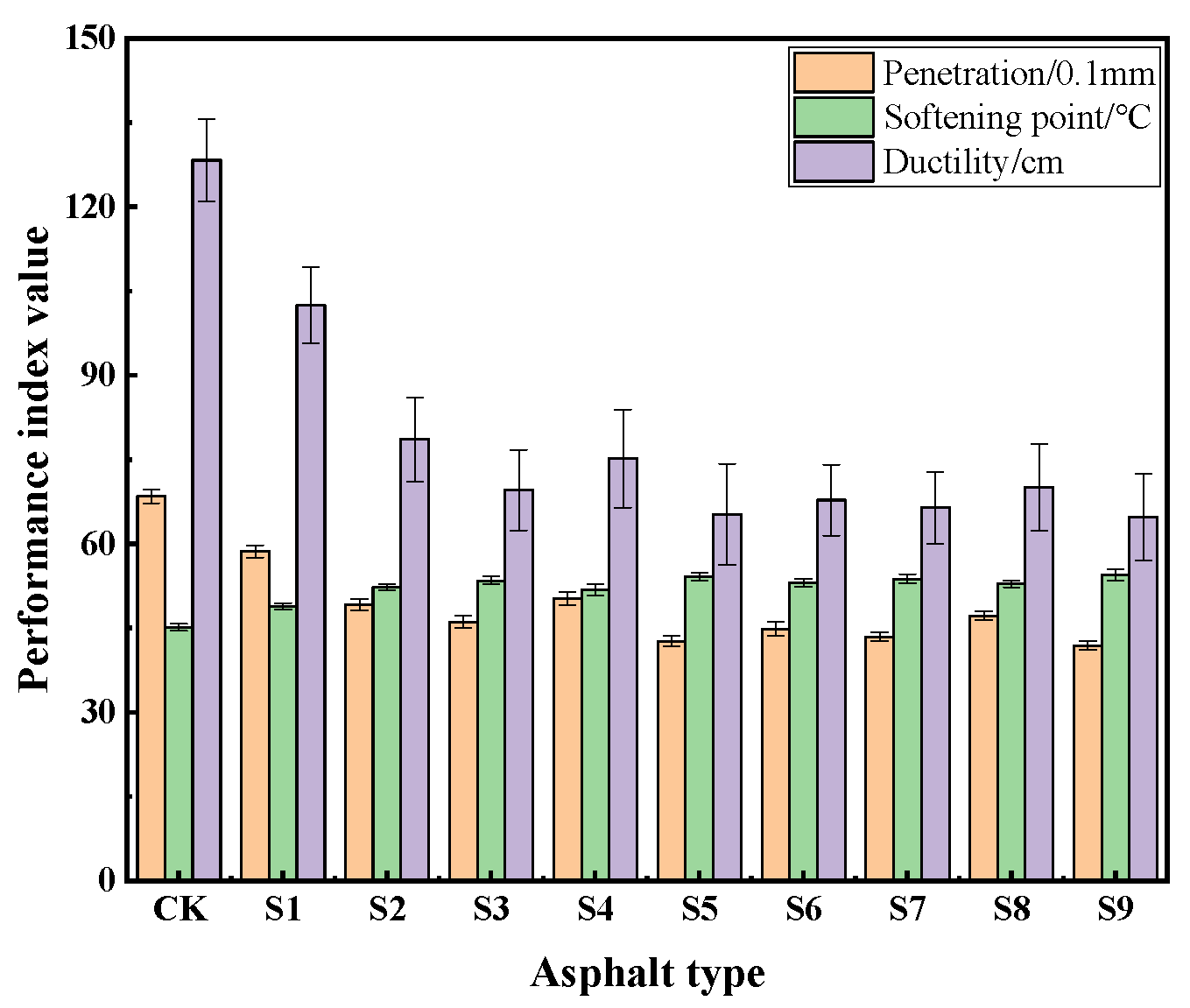
Penetration, softening point and ductility are core indicators characterizing the macroscopic physical properties of asphalt, which can directly reflect the hardness, fluidity and plasticity of asphalt. In this study, CK and 9 multi-coupling groups of asphalt were tested, and the specific test results are shown in
Figure 1.
It can be seen from
Figure 1 that the penetration of all asphalt specimens under multi-coupling effects decreases significantly, the softening point shows an obvious upward trend, and the ductility reduces greatly. This variation trend indicates that the synergistic coupling effects of temperature variation, load and ultraviolet aging significantly aggravate the aging, hardening process of asphalt, resulting in irreversible deterioration of its macroscopic physical properties. The deterioration degrees of the three conventional indexes of asphalt differ greatly under various multi-coupling conditions, which fully reflects the influence degrees of temperature level, load grade and ultraviolet aging duration on asphalt performance deterioration. This further verifies that the synergistic effect of multi-coupling is not a simple superposition of single-factor influences, but the result of interaction and mutual reinforcement among various factors.
A key environmental factor in multi-coupling effects, ultraviolet aging duration exhibits a clear time-dependent evolution trend on the three conventional indexes of asphalt. Under fixed temperature variation and load conditions, the aging degree of asphalt continuously deepens with the prolongation of ultraviolet aging duration, and the deterioration degrees of the corresponding three indexes increase gradually. Specifically, when the aging duration is extended from 24 h to 72 h, the penetration of asphalt decreases from 58.7 to 46.1, with the reduction range expanding gradually and finally reaching 32.6% compared with the initial state. The softening point rises from 48.9 °C to 53.5 °C, with the increase range rising from 8.2% to 18.3%. Ductility drops from 102.5 cm to 69.6 cm, with the reduction range expanding from 20.1% to 45.8%. The core reason for this change is that ultraviolet radiation continuously triggers the oxidation reaction of asphalt molecules and destroys the stability of asphalt molecular structure. With the prolongation of aging, the degree of molecular oxidation and cross-linking intensifies continuously and the viscosity and plasticity of asphalt are gradually lost, which is macroscopically manifested as increased hardness, decreased fluidity and deteriorated plasticity.
The enhancement effect of load grade on multi-coupling deterioration is also significant. Under the same temperature variation and aging duration, the higher the load, the more obvious the deterioration range of the three conventional indexes of asphalt. When the load increases from 0.1 MPa to 0.5 MPa, the penetration of asphalt decreases from 50.3 to 42.7, with the reduction range rising from 26.6% to 37.7% compared with the initial state, the ductility drops from 75.2 cm to 65.3 cm, with the reduction range rising from 41.4% to 49.1%, and the softening point rises from 51.8 °C to 54.2 °C, with the increase range expanding gradually. The enhancement effect of load mainly comes from the damage to the internal structure of asphalt. The repeated action of vehicle load leads to the formation of micropores and cracks inside asphalt, which provide channels for ultraviolet penetration and temperature variation transmission, accelerate the oxidation and structural deterioration of asphalt molecules, and thus further intensify the degradation of asphalt physical properties, forming a synergistic cycle of “load damage–environmental erosion–performance deterioration,” which is in line with the research results of Zhang [
34].
An important environmental factor affecting asphalt performance, the influence of temperature variation level on multi-coupling deterioration is mainly reflected in the enhancement effect of extreme temperature. Under the same load and aging duration, the deterioration degrees of the three conventional indexes of asphalt under extreme low-temperature and extreme high-temperature conditions are significantly greater than those under normal-temperature conditions. Among them, the deterioration of asphalt under low-temperature conditions is the most significant: the penetration drops to 43.5, decreasing by 36.5% compared with the initial state, and the ductility drops to 66.5 cm, with a reduction range of 48.2%. Under high-temperature conditions, the penetration of asphalt is 47.2 and the ductility is 70.1 cm. The deterioration degree is slightly lower than that under low-temperature conditions, but still significantly higher than that under normal-temperature conditions. The enhancement effect of extreme temperature stems from two factors: on the one hand, low temperature weakens the thermal motion of asphalt molecules, enhances the intermolecular force, causes embrittlement of asphalt and significantly reduces plasticity. The coupling of low temperature and load intensifies the initiation and propagation of internal cracks in asphalt. On the other hand, high temperature accelerates the thermal motion of asphalt molecules and reduces the viscosity and shear resistance of asphalt, making asphalt more prone to deformation under load. At the same time, high temperature accelerates the oxidation reaction induced by ultraviolet rays, further aggravating the aging and hardening of asphalt.
3.2. Analysis of High-Temperature Rheological Properties
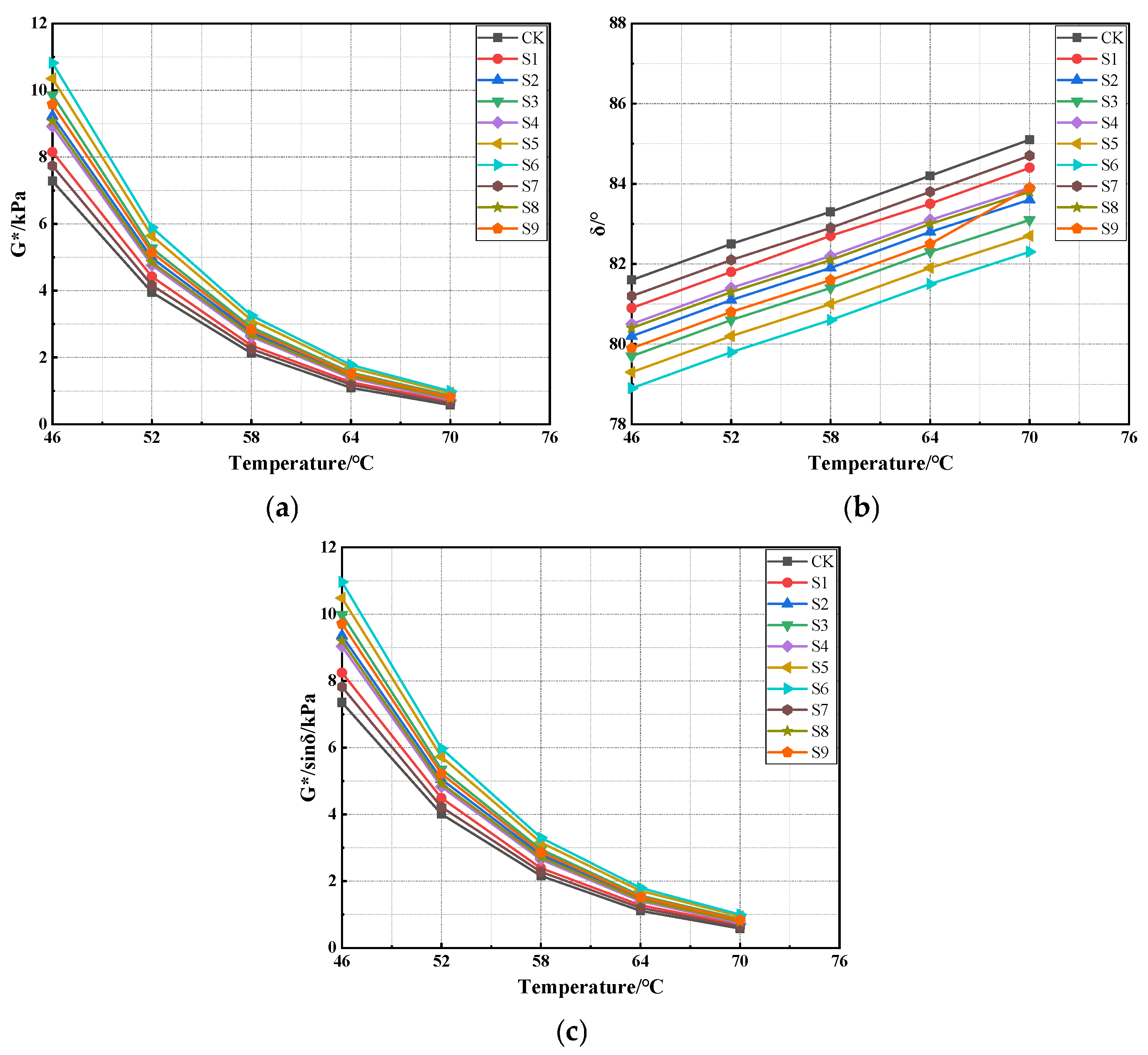
The DSR test is the core method to evaluate the high-temperature rheological properties and rutting resistance of asphalt. By testing the complex modulus (G*) and phase angle (δ) of asphalt at different temperatures, the influence law of multi-coupling effects on the high-temperature viscoelastic structure of asphalt can be systematically characterized, providing a direct basis for the evaluation of high-temperature stability of asphalt pavement. In this test, the temperature sweep mode was adopted with a test temperature range of 46–76 °C. The test results of asphalt under various conditions are shown in
Figure 2.
It can be observed from
Figure 2 that with the gradual increase in test temperature, G* shows an approximate exponential decay characteristic, δ increases monotonically, and G*/sinδ decreases continuously and synchronously. Taking CK as an example, during the temperature rise from 46 °C to 70 °C, G* decreases from 7.28 kPa to 0.57 kPa, and δ increases from 81.6° to 85.1°. The rising temperature significantly intensifies the thermal motion of molecules in the asphalt colloid system, weakens the physical entanglement and intermolecular forces between resins and asphaltenes, and transforms the colloid structure from a dense and stable state to a relaxed and flowing state gradually. Macroscopically, the material rigidity decreases, the proportion of viscous behavior increases, and the ability to resist shear deformation and high-temperature permanent deformation weakens continuously, which is the inherent rheological mechanism by which asphalt pavement in high-temperature sections in summer is more prone to rutting and shoving diseases.
At the same test temperature, G* and G*/sinδ of specimens treated by multi-coupling effects are both higher than those of CK, and δ is generally lower than that of CK. Taking 46 °C as an instance, G* of CK is 7.28 kPa, and the modulus of each coupling group increases to varying degrees, among which S6 reaches 10.82 kPa with a remarkable increase. The combined action of ultraviolet radiation and temperature cycling can induce oxidative polymerization of light components in asphalt, transform small-molecule substances into macromolecular asphaltenes gradually, increase the proportion of heavy components in the colloid system, and enhance the overall hardness and structural compactness of asphalt. Superimposed with the long-term action of cyclic load, the internal micro-defects of asphalt are further compacted and reorganized and the stability of the colloid network structure is enhanced, finally showing the simultaneous improvement in high-temperature shear modulus and rutting resistance.
With temperature and load conditions kept constant, G* and G*/sinδ of asphalt show a steady upward trend with the increase in ultraviolet aging duration. At 46 °C, when the aging duration increases from 24 h to 72 h, G* of corresponding specimens S1, S2 and S3 increases in turn, and δ decreases gradually. The longer the aging, the higher the degree of component reconstruction, and the more stable the colloid skeleton structure. The sensitivity of rheological properties to high-temperature environment is reduced, and the high-temperature service stability is continuously improved.
With aging duration and ambient temperature kept constant, the increase in load level further raises G* and reduces δ. Under the same temperature gradient, the rheological indexes of low-load condition S4 are significantly lower than those of high-load condition S5, indicating that cyclic load can assist in strengthening the arrangement and entanglement of asphalt molecular segments, promote the densification process of colloid structure during aging, form a positive synergistic effect with ultraviolet aging, and jointly improve the high-temperature rheological stability of asphalt.
Under the same load and aging duration, the overall rheological indexes of specimens under extreme temperature variation conditions are lower than those under normal-temperature coupling conditions. After experiencing low-temperature cycling, specimen S7 shows obviously lower G* at each temperature point than the normal-temperature coupling group S3 under the same conditions. Repeated extreme temperature variation tends to cause micro-stress accumulation inside the asphalt colloid, induce the fracture of local molecular segments and local relaxation of colloid structure, and result in a slight weakening of high-temperature shear resistance compared with the normal-temperature coupling condition.
Overall, temperature rise systematically weakens the viscoelastic structure and high-temperature stability of asphalt. The multi-coupling effects of temperature variation–load–ultraviolet aging can significantly improve the high-temperature rigidity and deformation resistance of asphalt through component oxidative polymerization and microstructure reconstruction. Aging duration and load level exert positive strengthening effects, while extreme temperature variation has a certain weakening effect on rheological properties. All factors jointly determine the rheological evolution behavior of asphalt in the actual service temperature field, which is consistent with Guo [
35].
3.3. Analysis of High-Temperature Permanent Deformation Resistance
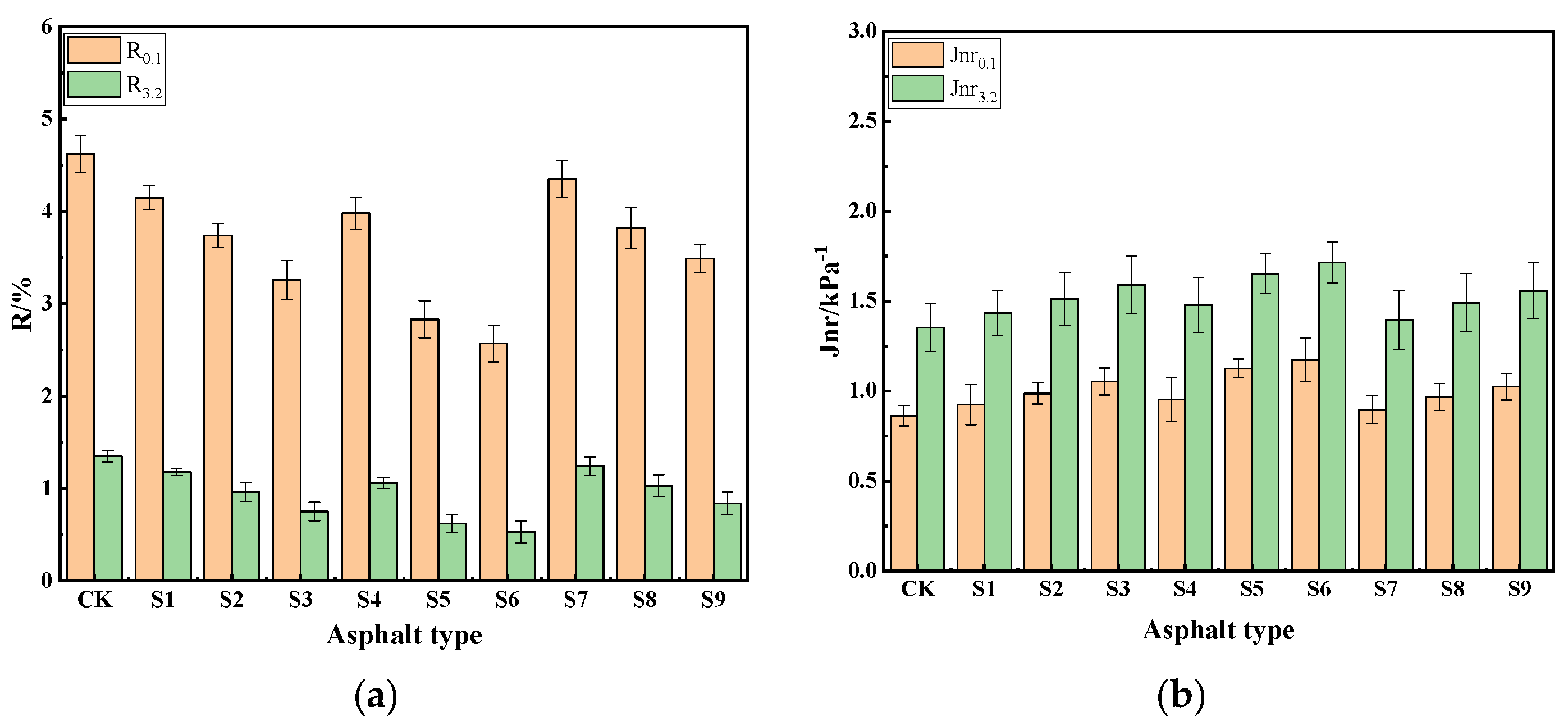
The MSCR test is used to evaluate the creep deformation and elastic recovery characteristics of asphalt under high-temperature cyclic load, which can accurately reflect the potential of permanent deformation resistance and high-temperature rutting resistance of asphalt under actual service conditions. The test temperature was uniformly set at 64 °C, and two shear stress levels of 0.1 kPa and 3.2 kPa were adopted. With R and Jnr as core evaluation indexes, the test results are shown in
Figure 3.
It can be seen from
Figure 3 that all asphalt specimens exhibit uniform variation characteristics. For the same specimen, the elastic recovery rate further decreases and the non-recoverable creep compliance increases significantly with the rise of stress level. Taking CK as an example, when the stress increases from 0.1 kPa to 3.2 kPa, the elastic recovery rate decreases from 4.62% to 1.35%, and the non-recoverable creep compliance rises from 0.864 kPa
−1 to 1.352 kPa
−1. High-stress cyclic loading intensifies the network relaxation inside the asphalt colloid, promotes the slippage and dissociation of asphalt molecular segments, makes the viscous behavior of the system dominant, significantly suppresses the elastic rebound effect, and leads to continuous accumulation of plastic deformation, which is consistent with the engineering law that asphalt pavement in heavy-duty traffic sections is more prone to permanent deformation.
Under the same stress condition, compared with CK without multi-coupling effects, the elastic recovery rate of asphalt after aging, load and temperature variation coupling decreases obviously, and the non-recoverable creep compliance increases synchronously. Under the long-term coupling effects of ultraviolet, temperature variation and cyclic load, the internal light components of asphalt volatilize and crack gradually, and the original equilibrium structure of the colloid is damaged. The macromolecular segments undergo fracture and degradation, the elastic network of the system is continuously weakened, and the proportion of elastic components further reduces, which is macroscopically manifested as poor deformation rebound ability after unloading. Plastic flow gradually becomes dominant, slippage deformation occurs more easily under repeated external forces, and the accumulation rate of non-recoverable deformation accelerates significantly.
With temperature and load conditions kept constant, the elastic recovery rate of asphalt shows a continuous decreasing trend, and the non-recoverable creep compliance rises steadily with the prolongation of ultraviolet aging duration. The longer the aging, the more severe the component cracking and structure deterioration of asphalt: the original cross-linked and entangled molecular network loosens and fractures gradually, and the material transforms from elastic-like to purely viscous rheological behavior. The proportion of recoverable deformation decreases continuously during cyclic shearing, while the proportion of permanent deformation increases continuously, and the high-temperature creep resistance and rutting resistance further degrade.
With aging duration and test temperature kept consistent, the higher the load grade, the more significant the deterioration of MSCR performance. High-load reciprocating shearing continuously pulls and damages the entangled structure of asphalt molecular chains, accelerates the accumulation of microstructure damage, further weakens the elastic response ability of the system, and promotes the development and expansion of internal micro-defects, making asphalt more prone to plastic flow under high-temperature stress, thus increasing the non-recoverable creep compliance.
By comparing specimens under different temperature variation conditions with the same load and aging duration, it can be seen that extreme temperature variation further aggravates the deterioration of asphalt rheological properties. Specimens subjected to repeated temperature rise and fall have lower elastic recovery rate and higher non-recoverable creep compliance. The thermal expansion and contraction effect caused by temperature cycling forms periodic micro-stress inside asphalt, induces the initiation of microcracks and local dissociation of molecular chains, produces superimposed damage effect with ultraviolet aging and load shearing, accelerates the overall instability of colloid structure, and finally results in continuous deterioration of creep recovery characteristics, which is consistent with the engineering law of Kong [
36].
The overall rheological law shows that the increase in stress level directly reduces the elastic recovery ability of asphalt and accelerates the accumulation of permanent deformation. The multi-coupling aging effect of temperature variation–load–ultraviolet destroys the original elastic colloid network of asphalt, leading to continuous attenuation of elastic recovery ability and intensification of high-temperature plastic flow deformation. The increases in aging duration, load grade and extreme temperature variation all produce superimposed damage effects, further deteriorating the high-temperature creep recovery performance and long-term service stability of asphalt, which is completely consistent with the engineering law that the deformation resistance of actual pavement asphalt decreases after long-term aging.
3.4. Fatigue Performance Analysis
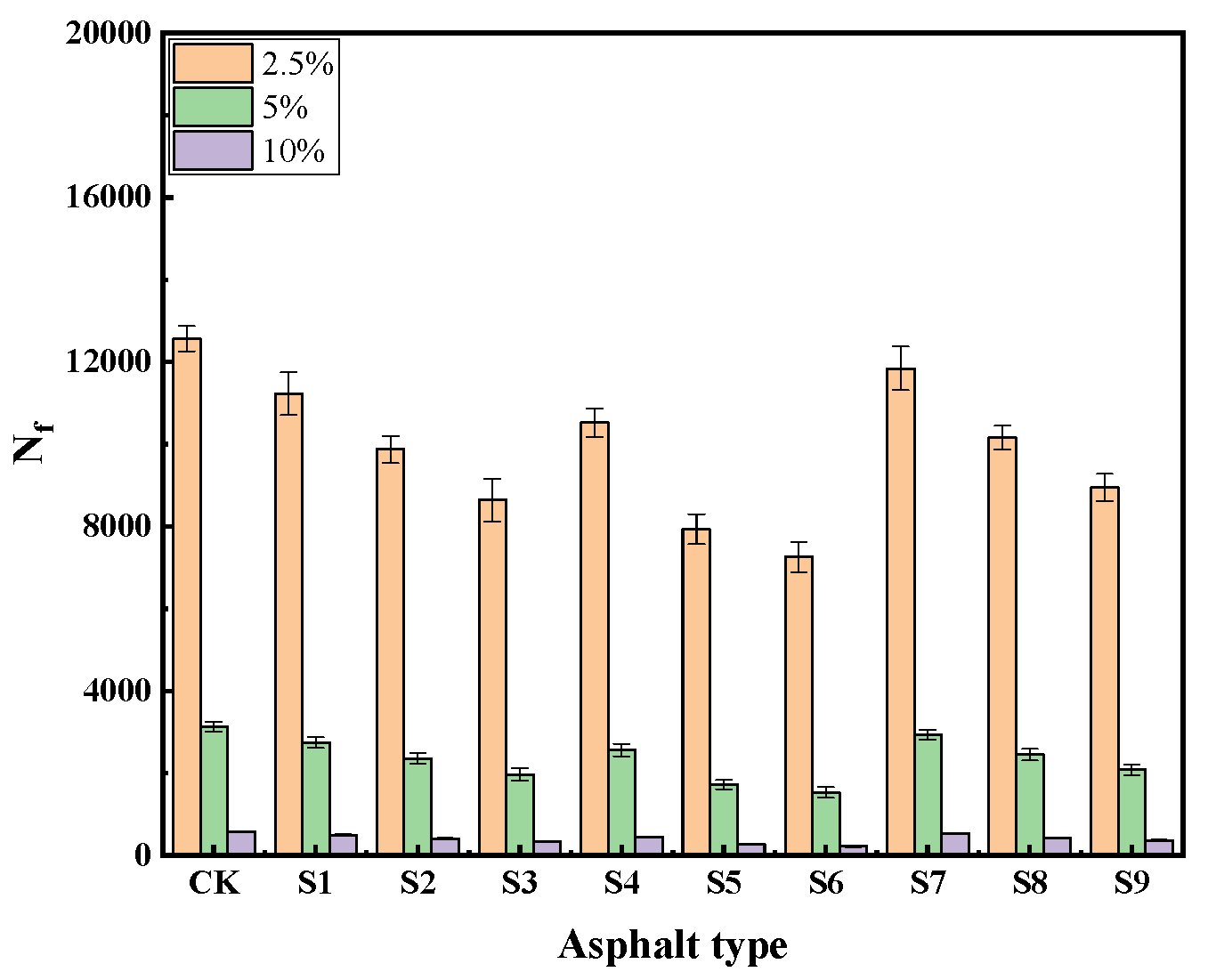
LAS test is mainly used to characterize the fatigue damage evolution law of asphalt under cyclic strain loading, and can quantitatively evaluate the influence characteristics of multi-coupling conditions on the fatigue resistance of asphalt. Three strain levels of 2.5%, 5.0% and 10.0% were set in the test, and the fatigue life corresponding to each strain level was taken as the core evaluation index. The test results are shown in
Figure 4.
It can be seen from
Figure 4 that all specimens present a consistent variation rule: for the same specimen, the N
f decreases sharply with the increase in strain amplitude. Taking CK as an example, when the strain increases from 2.5% to 10.0%, N
f decreases from 12,560 cycles to 580 cycles. High-strain loading significantly accelerates the initiation and propagation of internal microcracks, and the colloid network is rapidly disintegrated and damaged under large-deformation repeated action, resulting in a substantial reduction in N
f.
At the same strain level, the Nf of specimens subjected to multi-coupling effects decreases significantly compared with CK. The long-term combined action of ultraviolet, temperature variation and cyclic load continuously destroys the original colloid equilibrium system of asphalt. Light components are continuously cracked and lost, macromolecular segments are degraded and fractured, and the integrity of the internal cross-linking network is gradually damaged. The ability of the microstructure to resist repeated shear constraints is weakened, the damage accumulation rate is faster under the same strain loading, and the fatigue performance shows an overall deterioration trend.
With strain level and load conditions kept constant, Nf at all strain levels decreases gradually with the increase in aging duration. The longer the aging, the more serious the component deterioration of asphalt, the compactness and integrity of the colloid skeleton continue to decline, and the internal inherent micro-defects increase. Under multi-stage cyclic strain, the stress concentration effect becomes more obvious, the damage evolution process is further accelerated, and Nf continues to decay with aging duration.
With aging duration and test conditions kept constant, the higher the load grade, the more prominent the deterioration degree of fatigue performance. High-amplitude repeated load continuously disturbs the entangled structure of asphalt molecular chains, intensifies the accumulation of micro-damage, weakens the ability of the structure to hinder crack propagation, further shortens the Nf corresponding to each strain level, and degrades gradually the long-term fatigue service stability.
By comparing different temperature variation conditions with the same load and aging duration, it can be seen that extreme temperature alternation further weakens the fatigue resistance. The periodic thermal stress caused by repeated temperature rise and fall easily induces internal structure relaxation and local interface debonding of asphalt, forming irreversible micro-damage. Combined with ultraviolet aging and load shear, a superimposed damage effect is formed, which further destroys the integrity of the colloid network, and the corresponding N
f at each strain level is lower than that of normal-temperature coupling specimens, which is consistent with previous studies of Zhang [
37].
Overall, it is observed that that the increase in strain amplitude has a strong inhibitory effect on asphalt Nf. Multi-coupling environment continuously damages the micro-colloid structure of asphalt and gradually reduces Nf at different strain levels. The increase in aging duration, load grade and extreme temperature alternation all accelerate the fatigue damage evolution process and continuously deteriorate the fatigue resistance of asphalt, which is consistent with the development law of fatigue cracking disease of actual pavement after long-term service.
3.5. Low-Temperature Performance Analysis
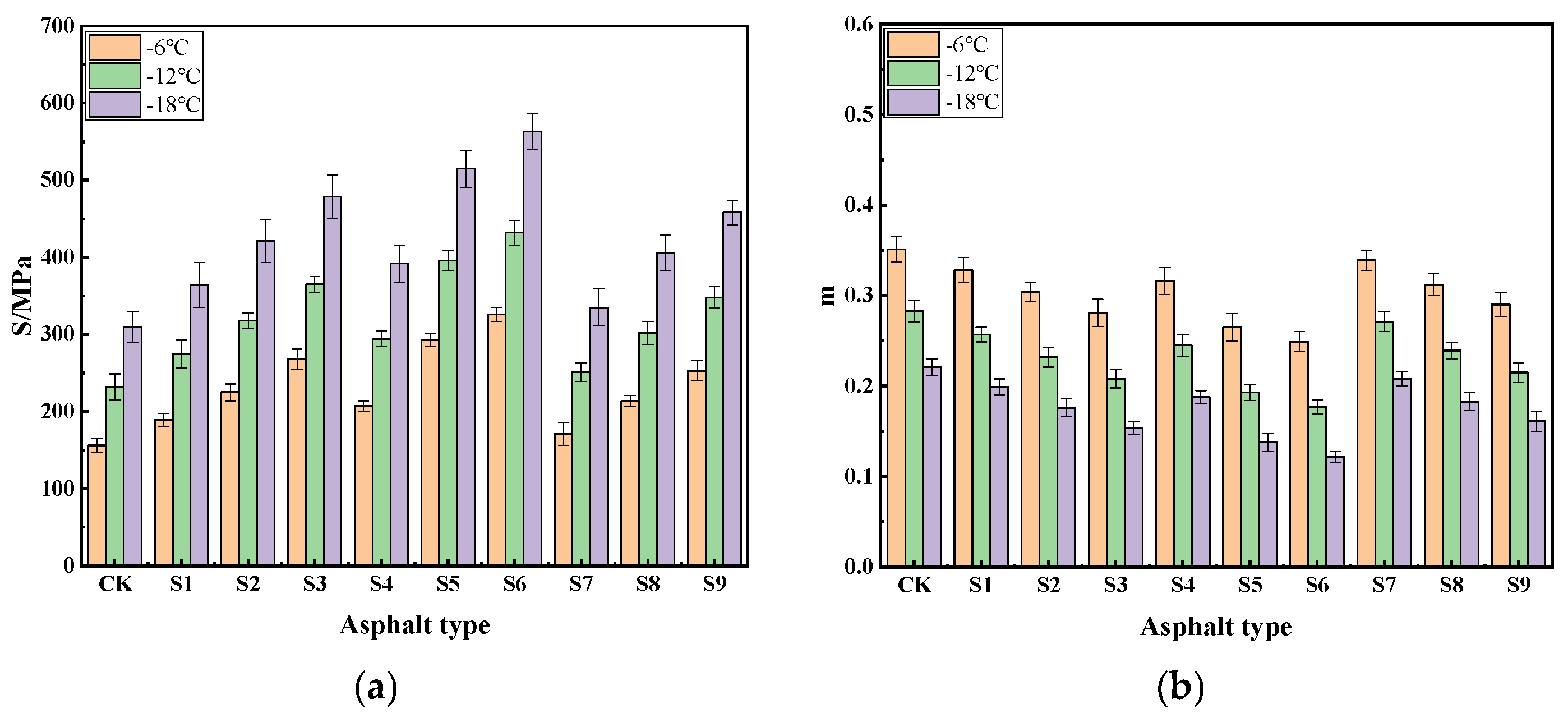
The BBR test is used to evaluate the low-temperature bending creep characteristics and cracking resistance potential of asphalt. By measuring S (creep stiffness) and m (creep rate), the influence law of multi-coupling conditions on the low-temperature viscoelasticity and thermal stress relaxation ability of asphalt can be quantitatively revealed. Three standard low temperatures of −6 °C, −12 °C, −18 °C were set in the test, with S and m as the core evaluation indexes. The BBR test results are shown in
Figure 5.
It can be seen from
Figure 5 that all specimens show consistent variation characteristics. As the test temperature decreases continuously, the S of each group increases significantly and the m decreases synchronously. Taking CK as an example, when the temperature drops from −6 °C to −18 °C, S increases from 156 MPa to 310 MPa and m decreases from 0.351 to 0.221. Low temperature strongly restricts the thermal motion of asphalt molecular segments, limits the intermolecular slippage and stress relaxation ability, and gradually transforms the colloid system into a glassy state. The rigidity and brittleness of the material increase simultaneously. The thermal stress caused by low-temperature contraction cannot be relaxed and released in time, which easily accumulate internally and induce the initiation of microcracks, so the risk of low-temperature cracking increases significantly.
At the same test temperature, compared with CK, the S value of specimens after multi-coupling treatment increases obviously, and the m value decreases as a whole. Under the multi-coupling environment, component deterioration and microstructure reconstruction continuously consume the light and flexible components of asphalt, the proportion of heavy and rigid components is relatively enriched, the flexible entangled structure of molecular chains is damaged, and the overall flexibility of the colloid decreases greatly. Macroscopically, the low-temperature stiffness increases significantly, the stress relaxation ability weakens, and the low-temperature cracking resistance deteriorates obviously.
With temperature and load conditions kept constant, S shows an obvious increasing trend and m continues to decay at all temperature levels with the increase in aging duration. The aging process intensifies the component cracking of asphalt, the flexible components are continuously lost, and the hardening degree of the colloid skeleton is deepened continuously. The brittleness of the material at low temperature becomes more prominent, the deformation accommodation space of the structure decreases, and the stress relaxation efficiency reduces continuously. The longer the aging, the more significant the increase in low-temperature stiffness of asphalt and the higher the cracking risk.
With aging duration and test conditions kept constant, the higher the load grade, the more obvious the deterioration of BBR performance. High cyclic load further compacts and reorganizes the microstructure of asphalt colloid, restricts the slippage of molecular segments, and superimposes the hardening effect of aging, making S higher and m lower at the same temperature.
By comparing different temperature variation conditions with the same load and aging duration, it can be seen that extreme temperature alternation further aggravates the deterioration of low-temperature performance. The alternating thermal stress caused by repeated heating and cooling easily forms residual micro-stress and local structural damage inside the colloid, destroys the original viscoelastic balance, and forms superimposed damage with ultraviolet aging and load shear. The S value is higher and m value lower at all temperatures, and the low-temperature cracking resistance is significantly weaker than that under normal-temperature coupling conditions.
Overall, the decrease in ambient temperature increases the low-temperature stiffness of asphalt and restricts stress relaxation. Multi-coupling aging significantly increases S and decreases m, resulting in hardening of asphalt. The increase in aging duration, load grade and extreme temperature alternation further push up the low-temperature stiffness, weaken the relaxation ability, and increase the risk of low-temperature shrinkage cracking and fatigue cracking, which is completely consistent with the actual law that the low-temperature rigidity of asphalt increases significantly after long-term service, which is in line with the research results of Wu [
38].
3.6. GPC Test
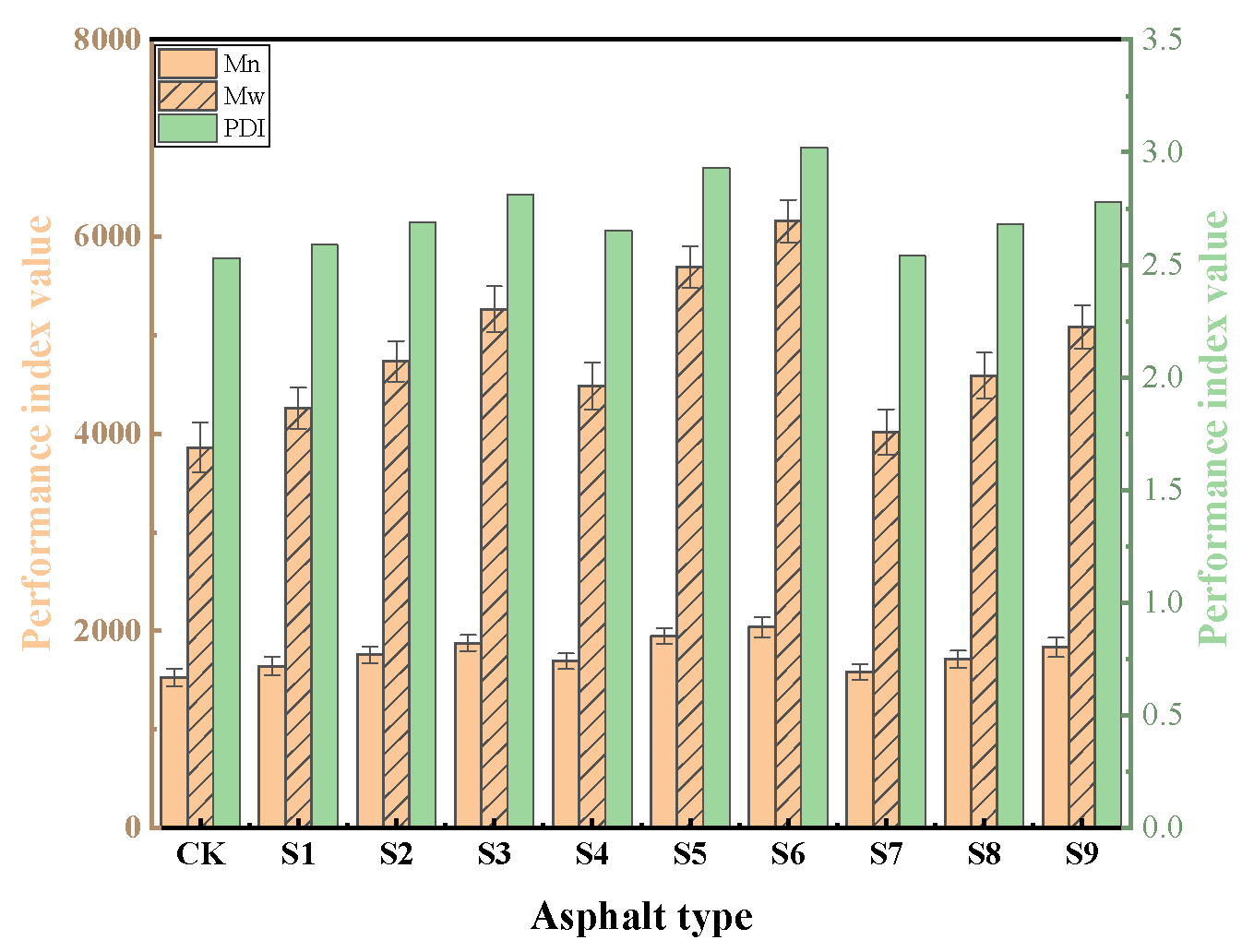
The GPC test can separate and characterize the molecular components of asphalt with different molecular weights based on the difference in hydrodynamic volume. Through characteristic parameters such as number-average molecular weight (Mn), weight-average molecular weight (Mw), and molecular weight polydispersity index (PDI), the degradation of asphalt components under multi-coupling conditions can be revealed at the molecular scale, and the intrinsic mechanism of rheological and service performance evolution can be explained microscopically. The test results are shown in
Figure 6.
It can be seen from
Figure 6 that compared with CK, the Mw and Mn of all specimens under multi-coupling effects are significantly increased, and the PDI is slightly increased synchronously. Under the combined action of ultraviolet oxidation, temperature cycling and repeated load in a multi-coupling environment, the light- and small-molecule components in asphalt are promoted to undergo oxidative polymerization and gradually transform into medium- and large-molecule substances. Some medium-sized molecular chains are cross-linked and entangled, the proportion of large-molecule components in the system continues to increase, and the overall average molecular weight is significantly raised. The component reconstruction at the molecular scale directly leads to the compaction of asphalt colloid structure, which is macroscopically manifested as the increase in high-temperature modulus and low-temperature stiffness, forming a microscopic mechanism confirmation with the performance variation laws of DSR, MSCR and BBR mentioned above.
With temperature variation and load conditions kept constant, Mw and Mn show a continuous increasing trend and PDI gradually broadens with the increase in aging duration. Prolonged aging continuously promotes the small-molecule components constantly consumed and transformed, large-molecule aggregates are continuously generated, and the overall molecular weight level of the system rises steadily. At the same time, the coexistence of new and old molecular chains increases the span of molecular size and improves the dispersion degree of molecular weight distribution. The continuous evolution of molecular structure makes asphalt rigidity increase continuously, flexible deformation ability attenuate gradually, and fatigue and low-temperature cracking resistance weaken continuously.
With aging duration and ambient conditions kept constant, the higher the load grade, the more significant the increase in GPC parameters. High-amplitude cyclic load can promote the oriented arrangement and physical entanglement of asphalt molecular chains, assist in accelerating the process of small-molecule polymerization and macromolecular association, further raise the average molecular weight, broaden the molecular weight distribution, form a synergistic effect with ultraviolet oxidation, and promote the aging process of the asphalt molecular system.
By comparing specimens under different temperature variation conditions with the same load and aging duration, the increase in Mw and Mn of specimens under extreme temperature alternation is lower than that under normal-temperature coupling conditions. Repeated temperature alternation tends to induce the fracture and dissociation of some long-molecule chains, which offsets the macromolecular growth effect caused by oxidative polymerization to a certain extent, limits the overall molecular weight increase, and results in a relatively narrow PDI. This also explains the intrinsic reason why the deterioration degree of rheological and low-temperature properties under extreme temperature conditions is slightly slower than that under normal-temperature high-hardening coupling specimens from a microscopic level, which is in line with the research results of Zhao [
39].
Overall, multi-coupling aging significantly increases the weight-average molecular weight and number-average molecular weight of asphalt, and broadens the molecular weight distribution. The increase in aging duration and load grade promotes the transformation of small molecules to large molecules and intensifies the hardening of molecular structure, which can slightly weaken the molecular weight increase. The GPC molecular characterization results reasonably explain the intrinsic mechanism of the evolution of asphalt high-temperature rheology, fatigue and low-temperature properties with coupling conditions at a microscopic scale, and realize the correlation and unity of macroscopic service properties and microscopic molecular structure.
3.7. TLC–FID Test
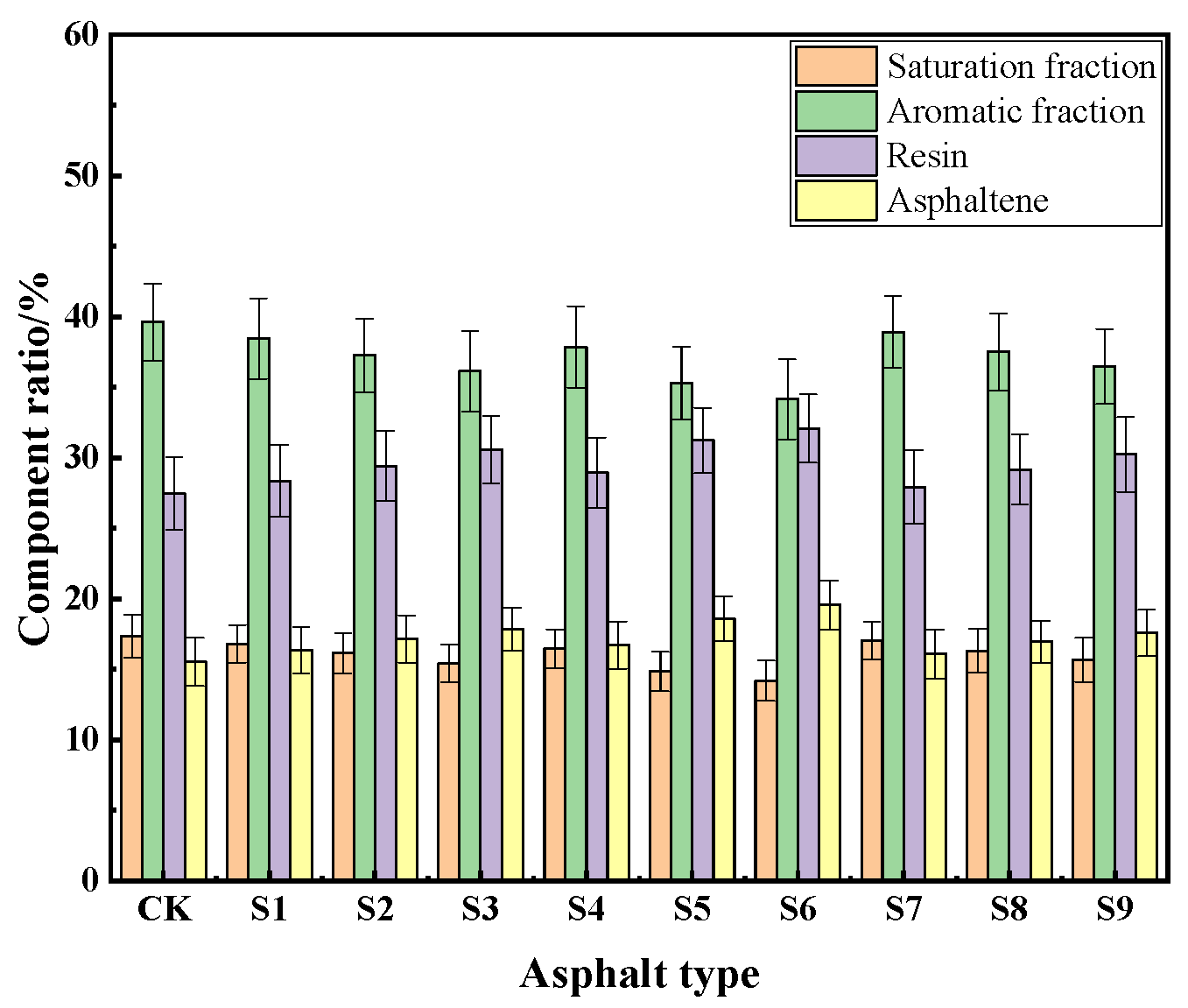
TLC–FID can realize the quantitative separation and testing of four components of asphalt—saturates, aromatics, resins and asphaltenes—and can reveal the evolution characteristics of asphalt chemical composition under multi-coupling effects from the perspective of component composition. The relative contents of four components of each group obtained by TLC–FID are shown in
Figure 7.
It can be seen from
Figure 7 that compared with CK, the specimens under multi-coupling effects all show a consistent variation rule: the contents of saturates and aromatics decrease continuously, while the contents of resins and asphaltenes increase synchronously. Under the synergistic action of ultraviolet radiation, temperature cycling and repeated load in a multi-coupling environment, the light components in asphalt undergo volatilization, oxidation and polymerization reactions. Small-molecule saturates and aromatics are constantly consumed and gradually transformed into resins; resins further undergo condensation reactions to form asphaltenes, and the overall component structure presents an obvious heaviness evolution characteristic.
With temperature variation and load conditions kept constant, the proportion of light components decreases gradually and the proportion of heavy components increases steadily with the increase in aging duration. The longer the aging, the more sufficient the oxidative condensation reaction, the greater the consumption of light components and the continuous increase in asphaltene production. The deepened heaviness of components directly leads to the change in asphalt colloid structure stability, enhanced rigidity and weakened flexible deformation ability, which is highly consistent with the macroscopic performance deterioration laws of DSR and BBR.
With aging duration and ambient conditions kept constant, the higher the load grade, the more significant the evolution amplitude of the four components. High-stress cyclic load can accelerate the oxidative recombination of internal components in asphalt, promote the transformation of light components to resins and asphaltenes, further intensify the process of weight gain, increase the high-temperature stiffness and low-temperature brittleness of asphalt, and continuously reduce the fatigue damage resistance.
By comparing different temperature variation conditions with the same load and aging, it can be found that the decrease in light components and the increase in asphaltenes under extreme temperature alternation are slightly lower than those under normal-temperature coupling specimens. Repeated temperature rise and fall easily cause the fracture and decomposition of some macromolecular chains, inhibit the one-way condensation process of light components to asphaltenes to a certain extent, and weaken the weight-gain rate of components. This also explains the intrinsic reason why the deterioration degree of rheological and low-temperature properties under extreme temperature conditions is relatively mild from the perspective of chemical components, which is in line with the research results of Cai [
40].
Overall, multi-coupling aging promotes the regular evolution of asphalt components: light components are constantly consumed and heavy components are continuously enriched; prolonged aging duration and increased load grade further intensify the heaviness of components; and extreme temperature alternation can slightly inhibit the one-way condensation process of components.