Article

Rare-Earth-Doped Tricalcium Phosphate: From Thin Films and Ceramics to Multifunctional Bone Cements


by
Ivan V. Nikiforov
1,
Evgeniya S. Zhukovskaya
1,
Olga A. Levandnaya
2,
Olga S. Antonova
3,
Polina A. Krokhicheva
3,
Margarita A. Goldberg
3,
Ilde Incarnato
4,
Angela De Bonis
4,
Katia Barbaro
5,
Viktoriya G. Yankova
6,
Bogdan I. Lazoryak
1,
Dina V. Deyneko
1,*,† and
Julietta V. Rau
6,7,*,†
1
Department of Chemistry, Lomonosov Moscow State University, 119991 Moscow, Russia
2
Department of Fundamental Medical Disciplines, Faculty of Medicine, State University of Education, 105005 Moscow, Russia
3
Baikov Institute of Metallurgy and Materials Science, Russian Academy of Sciences, 119334 Moscow, Russia
4
Dipartimento di Scienze di Base e Applicate, Università Della Basilicata, Viale dell′Ateneo Lucano, 10, 85100 Potenza, Italy
5
Istituto Zooprofilattico Sperimentale Lazio e Toscana “M. Aleandri”, Via Appia Nuova 14111, 00178 Rome, Italy
6
Department of Analytical, Physical and Colloid Chemistry, Institute of Pharmacy, Sechenov First Moscow State Medical University, Trubetskaya 8, Build. 2, 119048 Moscow, Russia
7
Istituto di Struttura Della Materia, Consiglio Nazionale Delle Ricerche (ISM-CNR), Via del Fosso del Cavaliere 100, 00133 Rome, Italy
*
Authors to whom correspondence should be addressed.
These authors contributed equally to this work.
Coatings 2026, 16(6), 702; https://doi.org/10.3390/coatings16060702 (registering DOI)
Submission received: 29 April 2026 / Revised: 5 June 2026 / Accepted: 8 June 2026 / Published: 11 June 2026
(This article belongs to the Special Issue Films and Coatings with Biomedical Applications)

Highlights

What are the main findings?
  • Phase-pure Ca9Eu(PO4)7 and Ca9Dy(PO4)7 powders were processed into three distinct biomedical formats: PLD thin films, brushite cements, and PMMA composites.
  • Amorphous, dense, crack-free PLD coatings showed excellent in vitro bioactivity with rapid dissolution followed by carbonated apatite layer formation.
  • Brushite cements showed cell viability, up to 1.53-fold enhanced osteogenic differentiation, and moderate antimicrobial growth inhibition against five pathogens.
What are the implications of the main findings?
  • Rare-earth-doped β-TCP serves as a unified multifunctional precursor that imparts bioactivity, support for in vitro mineralization, antimicrobial properties, and tunable radiopacity without reformulation for each application.
  • PMMA composites achieved clinically relevant radiopacity with homogeneous particle distribution.
  • Brushite cement in vertebrae defects provided superior filling and the highest radiopacity, exceeding cortical bone density.

Abstract

The development of multifunctional biomaterials for bone repair requires precursors that combine bioactivity, moderate antimicrobial growth-inhibitory effect, and imaging. This study demonstrates the multifunctional versatility of a single family of rare-earth-doped β-tricalcium phosphates (β-TCPs), Ca9Eu(PO4)7 and Ca9Dy(PO4)7, across three distinct formats: bioactive thin films (for implant coatings), brushite cements (for injectable bone fillers), and radiopaque PMMA bone composites (for load-bearing applications). This work serves as a proof-of-concept that the same doped phosphate precursors can address different clinical needs while retaining bioactivity, antimicrobial properties, and radiopacity. The phosphate precursors were synthesized via solid-state reaction. Pulsed laser deposition (PLD) was used to form amorphous, dense, and crack-free coatings, which exhibited excellent in vitro bioactivity through the rapid dissolution–reprecipitation of a carbonated apatite layer in simulated body fluid. The brushite-based bone cements were produced from doped β-TCPs. These cements demonstrated high cytocompatibility with mesenchymal stromal cells (>89% viability) and significantly enhanced osteogenic differentiation with antimicrobial activity against common pathogens (S. aureus, E. coli, P. aeruginosa). Furthermore, incorporation of these phosphates as fillers into PMMA bone cement resulted in a homogeneous particle distribution with reduced agglomeration compared to undoped β-TCPs, achieving clinically relevant radiopacity values (913 ± 22.4 HU for Dy-doped sample). Post-mortem studies by the CT method were performed on the vertebrae with PMMA–phosphate composites and brushite cements. It was shown that brushite cement in ovine lumbar vertebrae defects exhibited the highest radiopacity (1450–1550 ± 25 HU). The findings establish rare-earth-doped β-TCP as a unified multifunctional precursor that imparts bioactivity, the ability to support in vitro mineralization, antimicrobial properties, and enhanced radiopacity to thin films, phosphate cements, and polymer composite materials.

1. Introduction

Research into calcium orthophosphates, mainly tricalcium phosphate (Ca3(PO4)2, whitlockite, β-TCP, b-TCP), for bone repair and substitution dates back to the early 20th century [1]. The close similarity between the chemical composition of these materials and the inorganic phase of natural bone typically endows them with excellent biocompatibility [2,3].
TCP exists in three polymorphs: β-TCP, which is stable at low temperatures, and the high-temperature forms α-TCP and α′-TCP [4,5]. The low-temperature β-TCP phase crystallizes in the space group (SG) R3c. Owing to its good solubility and resorbability [6,7], β-TCP is particularly useful in biomedical applications [8].
Among calcium orthophosphates, the β-TCP-type structure has the highest substitution capacity, as the presence of a site with variable occupancy allows extensive heterovalent substitutions. This enables a wide range of doped and co-doped systems via various cationic and anionic substitutions, significantly broadening their application potential [9]. Doping of the β-TCP structure by different types of ions can be classified as antibacterial (Cu2+ [7,10,11], Ag+ [12], Fe3+ [13]), enhancing bone repair (Sr2+ [14,15], Zn2+ [14,15], Mg2+ [16]), angiogenesis (Cr3+ [17]), and ions for imaging by luminescence spectroscopy (Eu3+ [18], Sm3+ [14,15]), CT or MRI (Gd3+ [19,20], Dy3+ [21]), as well as bimodal NIR and CT imaging (Yb3+ [22]). Previously, it was shown that Eu3+, Zn2+, and Sr2+ co-doping improves the bioactive properties of the phosphates and can be used as a bioimaging probe to control the dissolution–precipitation process in new bone formation [14].
β-TCP-type phases can be synthesized via a range of techniques (solid-state reactions [23], precipitation [24], sol–gel [25], mechanoactivation [20]) and can be produced in diverse forms, including powders [11], ceramics [26], scaffolds [27], coatings [28], fillers [29], calcium phosphate cements [30,31,32], mesoporous materials [33], and nanoparticles [18,34]. Taken together, these factors greatly extend the utility of β-TCP across various fields.
The most common form of the β-TCP-type bioactive material is a ceramic form. Biphasic calcium phosphate ceramics consisting of different ratios of hydroxyapatite (HAp) and β-TCP are already used as bone substitutes [26]. Research in this area is mainly focused on improving the mechanical properties of ceramic materials [35]. This also applies to scaffolds, and it has been shown that substitutions in the initial structure can significantly affect the mechanical properties [36]. For the most part, this improvement is associated with the possibility of subjecting the material to higher-temperature heat treatment without transitioning into the α-TCP phase [37].
β-TCP can be successfully fabricated into thin films using the electron beam evaporation technique [28], radiofrequency magnetron sputtering [38], or galvanostatic pulsed electrochemical deposition [39]. Such films exhibit bioactive properties and are applied for the functionalization of metal implants [40,41].
In addition to promoting bioactivity, surface coatings on metallic implants can play a crucial role in protecting the underlying metal from corrosion, especially under inflammatory conditions where the local pH drops and reactive oxygen species are present. For instance, alginate hydrogels loaded with octacalcium phosphate were recently shown to enhance the corrosion resistance of 3D-printed titanium alloys in simulated inflammatory media [42]. Similarly, PMMA-based coatings have been reported to improve the electrochemical performance of implant materials [43].
In addition, β-TCP can be employed in calcium phosphate cements [30,31]. Bone cements are recognized as important and necessary materials in orthopedic surgery [32]. These cements as a rule have complex composition [44] and can serve as a carrier for functionalization [45]. It has also been shown that calcium phosphates can be used for X-ray imaging [46]. However, low mechanical strength imposes restrictions on their use in practice.
At the same time, PMMA cements have high strength. It is known that PMMA is biocompatible; however, it does not show any bioactive properties. To overcome this problem, calcium phosphate fillers are used to improve the bioactivity of these bone cements. In [47], α- and β-TCP were added to PMMA cement. It was noted that increasing the amount of TCP decreases the mechanical properties of polymer cements likely due to the formation of TCP clusters. It was shown that undoped TCP forms a porous network in PMMA cement [29], due to the TCP particles reducing the volume of voids, acting as an array of barriers to the formation of links between any dissolved PMMA phase and the MMA units. In [48], the addition of 40 wt.% of hydroxyapatite (HAp) as a filler in PMMA increases radiopacity and improves bioactive properties. In [49], the polymer/filler interface was investigated; as a result, excellent mechanical properties were obtained, where β-TCP was used. In [50], it was shown that β-TCP with chitosan decreases curing temperature and improves osteoblast cell growth.
In the present research, the multifunctional β-TCP-doped compounds Ca9Dy(PO4)7 and Ca9Eu(PO4)7 were used to prepare phosphate brushite cements, coatings, and PMMA composites. The doping by Dy3+ and Eu3+ into the β-TCP host makes it possible to obtain a bioactive thin film as well as calcium phosphate cements with antibacterial properties. Moreover, the resulting PMMA-based cements with Ca9Dy(PO4)7 and Ca9Eu(PO4)7 phosphates as a filler with good distribution in PMMA exhibited improved radiopacity comparable to commercial products. This approach demonstrates that a doped phosphate precursor can impart bioactivity, moderate antimicrobial growth inhibition, and clinically relevant radiopacity, as well as serve as a precursor for coatings and cements, addressing different clinical needs without reformulation.

2. Materials and Methods

2.1. Sample Preparation

2.1.1. Phosphate Powder Synthesis

The phosphates Ca9Dy(PO4)7 and Ca9Eu(PO4)7 (named CaDy and CaEu, respectively) were synthesized by a high-temperature solid-state method from stoichiometric mixtures of NH4H2PO4 (99.9%), CaCO3 (99.9%), and R2O3 (99.99%, R = Dy, Eu) at 1100 °C for 24 h with several intermediate grindings. The reaction was as follows:
7NH4H2PO4 + 9CaCO3 + 0.5Dy2O3 → Ca9Dy(PO4)7 + 7NH3 + 9CO2 + 10.5H2O
7NH4H2PO4 + 9CaCO3 + 0.5Eu2O3 → Ca9Eu(PO4)7 + 7NH3 + 9CO2 + 10.5H2O
Additionally, undoped β-TCP was synthesized as a control for biological tests by a high-temperature solid-state method from stoichiometric mixtures of NH4H2PO4 (99.9%) and CaCO3 (99.9%) at 1000 °C for 24 h with several intermediate grindings. The reaction was as follows:
2NH4H2PO4 + 3CaCO3 → Ca3(PO4)2 + 2NH3 + 3CO2 + 3H2O
The powder X-ray diffraction (PXRD) patterns of the precursors and the prepared compounds were checked using the JCPDS PDF-2 database. No reflections corresponding to the initial starting materials or intermediate phases were detected in the final compounds.

2.1.2. Coating Preparation/Film Formation

Zn-Cu substrates were mechanically polished using sandpaper of progressively finer grit sizes to remove the native surface oxide layer and subsequently cleaned with acetone. The films (named CaDy-film, CaEu-film) were deposited by pulsed laser deposition (PLD) employing a Q-switched Nd:YAG laser source (Quanta System, Milano, Italy) operating at a wavelength of 532 nm, a pulse duration of 7 ns, a repetition rate of 10 Hz, and a fluence of 10 J/cm2. The depositions were carried out in a stainless steel vacuum chamber evacuated by a scroll-pump-backed turbomolecular pumping system, achieving a base pressure of 10−4 Pa. The laser beam was focused onto the target surface at an angle of incidence of 45° by means of a 350 mm focal length lens. The target was mounted on a rotating holder to minimize cratering effects. A target-to-substrate distance of 2 cm was maintained throughout all depositions. Each deposition run lasted 2 h.

2.1.3. Brushite Cement Preparation

To obtain brushite cement samples from Ca9Dy(PO4)7 and Ca9Eu(PO4)7 powders (further CaDy-cem, CaEu-cem), the synthesized samples were mixed with Ca(H2PO4)2·H2O (MCPM) (99.99%) in a molar ratio of 1:1 [51] by the following reactions:
Ca2.572Dy0.296(PO4)2 + Ca(H2PO4)2∙H2O + 7H2O → 4Ca0.893Dy0.074HPO4∙2H2O
Ca2.572Eu0.296(PO4)2 + Ca(H2PO4)2∙H2O + 7H2O → 4Ca0.893Eu0.074HPO4∙2H2O
The hardening liquid was a wt. 8% aqueous solution of citric acid. Cement samples were prepared by mixing CaDy (or CaEu) and MCPM powders with hardening liquid in a ratio of 2:1. A steel cylindrical mold with a diameter of 6 mm was used to form the samples and to produce the tablets. The tablets were hardened under environmental conditions for 24 h. After hardening, the phase compositions of the cement tablets were investigated by the PXRD method. Additionally, cement samples made from undoped β-TCP were formed by the same technology (further TCP-cem).
Ca3(PO4)2 + Ca(H2PO4)2∙H2O + 7H2O → 4CaHPO4∙2H2O
For PXRD analysis the cement samples were ground.

2.1.4. PMMA Composite Preparation

To prepare the polymer–phosphate composites, methyl methacrylate (MMA) was used as the hardening liquid for PMMA (LG CHEM, LTD, Seoul, Republic of Korea). The ratio of PMMA:MMA was 2:1. The CaDy and CaEu powders were used as fillers to obtain the composites, named CaDy-PMMA and CaEu-PMMA. The ratio of phosphate powder to PMMA was 15 wt.% to simulate a standard formulation of PMMA bone cement with a radiopaque filler. The PMMA and phosphate powder were thoroughly mixed and then MMA liquid was added. A silicone resin mold with width × length × depth of 1 cm × 7.5 cm × 3.3 cm was used to form the samples and to produce the specimens. The setting time and temperature during hardening of the specimens were measured.

2.1.5. Post-Mortem Analysis of PMMA Composites and Phosphate Cements

To assess radiopacity within native bone tissue, an ex vivo post-mortem study was conducted. Three ovine lumbar vertebrae were harvested from a slaughterhouse (no animals were sacrificed specifically for this study). Cylindrical defects (Ø 0.5 cm) were drilled into the vertebral bodies using a low-speed hand drill (Makita DF0300, Anjō, Japan). The prepared cavities were subsequently filled with CaDy-PMMA, CaEu-PMMA, and CaDy-cem.

2.2. Methods

2.2.1. Powder X-Ray Diffraction Study

Powder X-ray diffraction (PXRD) patterns were collected on Rigaku SmartLab SE (3 kW sealed X-ray tube, D/teX Ultra 250 silicon strip detector, vertical type θ-θ geometry, HyPix-400 (2D HPAD) detector). PXRD data were collected at room temperature in the 2θ range between 3° and 110° with a step interval of 0.02°. The LeBail decomposition and structure refinement by the Rietveld method were applied using the JANA2006 software [52].

2.2.2. Surface Morphology of the Films

Surface morphology and elemental composition were investigated by complementary microscopy techniques. Atomic Force Microscopy (AFM) analysis was performed using a Park Systems (Gwacheon, Republic of Korea) XE-120 atomic force microscope operating in contact mode, employing a pyramid-shaped silicon nitride (Si3N4) tip with a nominal apex radius in the range of 2–10 nm. Topographic images were acquired over scan areas ranging from 2 × 2 μm2 to 20 × 20 μm2 and subsequently processed using the XEI 1.8 software package. Scanning electron microscopy (SEM) analysis was performed using a Philips-FEI ESEM XL30 instrument (FEI, Eindhoven, The Netherlands), equipped with an EDAX energy-dispersive x-ray spectroscopy (EDS) system for microanalysis. The microscope features a LaB6 emission source with an accelerating voltage of up to 30 kV. Prior to observation, all samples were coated with a thin gold layer to prevent charging artifacts during imaging.

2.2.3. FT-IR

Fourier Transform Infrared (FT-IR) spectroscopic analysis was performed using a Bruker ALPHA II spectrometer (Bruker, Ettlingen, Germany) with a spectral resolution of 4 cm−1. The CaDy-film and CaEu-film targets were characterized in Attenuated Total Reflectance (ATR) mode, whereas the FT-IR spectra of all coatings were acquired in reflectance mode.

2.2.4. TEM

Transmission Electron Microscopy (TEM) analysis was performed using an FEI Tecnai (FEI, Eindhoven, The Netherlands) G2 20 microscope operating at an accelerating voltage of 200 kV. For TEM sample preparation, films were deposited directly onto Formvar/Carbon-coated copper grids (Agar Scientific, Rotherham, UK) under the same experimental conditions adopted for the CaDy-film deposition, with the exception of the deposition time, which was reduced to 10 min to achieve an appropriate film thickness for electron transparency.

2.2.5. In Vitro Bioactivity in Simulated Body Fluid (SBF)

To assess the bioactivity of the samples in vitro, simulated body fluid (SBF) solution was prepared according to the Kokubo protocol. Coated and uncoated substrates were placed in plastic tubes and immersed in an appropriate volume of SBF. The tubes were maintained at 37 °C for soaking periods of 14 and 28 days, and the SBF solution was refreshed twice a week. Upon completion of each pre-determined immersion time point, the samples were retrieved from the SBF solution, rinsed with bi-distilled water, and allowed to dry under ambient conditions. The surface modifications induced by the SBF treatment were subsequently evaluated by SEM-EDX and FT-IR analysis.

2.2.6. Morphological Characterization and Chemical Composition for Cement Powder

Scanning electron microscopy (SEM) observations were performed using a Tescan VEGA3 scanning electron microscope equipped with an Oxford Instruments X-Max 50 silicon drift energy-dispersive X-ray spectrometry (EDXs; High Wycombe, Buckinghamshire, UK) system with Aztec 6.2 and INCA V7.5 software. SEM images were acquired using a secondary electron (SE) imaging and backscattered electron (BSE) imaging technique. The local cationic composition of disk fragments was determined by SEM-EDX.

2.2.7. Isolation and Culture of Mesenchymal Stromal Cells for Cement Powder

Mesenchymal stromal cells (aMSCs) were isolated from adipose tissue collected from a 2-year-old horse immediately after slaughter under aseptic conditions. The adipose sample was washed repeatedly with sterile phosphate-buffered saline (PBS) to remove blood residues and other contaminants. The tissue was mechanically minced into fragments of approximately 2–3 mm3 using sterile scissors and scalpels. For enzymatic dissociation, tissue fragments were incubated with collagenase type IA (Sigma-Aldrich, Gillingham, UK) at a concentration of 1 mg/mL in PBS, maintained at 37 °C for approximately 60 min under constant agitation in an orbital shaker. Following digestion, the resulting cell suspension was filtered through a 70 μm cell strainer to remove debris and centrifuged at 800× g for 10 min. The resulting cell pellet was resuspended in Dulbecco’s Modified Eagle Medium (DMEM; Life Technologies, Paisley, UK) supplemented with 10% fetal bovine serum (FBS; Life Technologies, Paisley, UK) and a standard antimicrobial solution (penicillin/streptomycin and fungizone; Sigma-Aldrich, Gillingham, UK). Cells were seeded in T75 culture flasks and maintained at 37 °C in a humidified atmosphere with 5% CO2. The culture medium was replaced every 2–3 days until reaching approximately 85% confluence, at which point the cells were subcultured.

2.2.8. MTT Assay for Cell Viability

Second-passage aMSCs were detached using 0.05% trypsin-EDTA (Sigma-Aldrich, Gillingham, UK) and seeded in 24-well plates at a density of 2 × 10⁴ cells/mL. After 24 h of incubation at 37 °C in 5% CO2 to allow cell adhesion, the medium was replaced with complete medium containing one of the three test substrates: CaDy-cem, CaEu-cem, TCP-cem, each at a concentration of 1 mg/mL. All substrates were sterilized by autoclaving (121 °C, 20 min) prior to use. Control cells were maintained in standard complete DMEM with 10% FBS.
After an additional 24 h of incubation, cell viability was assessed using the MTT assay (Sigma-Aldrich, Gillingham, UK). Cells were incubated with a solution of 3-(4,5-dimethylthiazol-2-yl)-2,5-diphenyltetrazolium bromide (0.5 mg/mL in FBS-free DMEM) for 3 h at 37 °C. The resulting formazan crystals, indicative of metabolic activity, were solubilized in isopropanol (Sigma-Aldrich, Gillingham, UK), and absorbance was measured at 600 nm using a BioPhotometer (Eppendorf, Hamburg, Germany).

2.2.9. Osteogenic Differentiation

For osteogenic differentiation, second-passage aMSCs were seeded in 6-well plates at a density of 4 × 10⁴ cells/mL. After 24 h, adherent cells were treated with osteogenic medium consisting of DMEM supplemented with 50 µg/mL ascorbic acid, 10 mM β-glycerophosphate, and 10−7 M dexamethasone (all from Merck, Darmstadt, Germany). Experimental groups included treatment with each of the three substrates (CaDy-cem, CaEu-cem and TCP-cem; 1 mg/mL), maintained throughout the 21-day differentiation period. Controls included a positive control group (osteogenic medium without substrates) and a negative control group (standard DMEM without osteogenic supplements). At day 21, extracellular matrix mineralization was evaluated using Alizarin Red S staining (Sigma-Aldrich, Gillingham, UK). Cells were fixed with 4% paraformaldehyde (Sigma-Aldrich, Gillingham, UK) for 30 min and stained with 3% Alizarin Red S in isopropanol (Sigma-Aldrich, Gillingham, UK) for an additional 30 min. Calcium deposits, indicative of osteogenic differentiation, were quantified by extracting the bound dye with 5% sodium dodecyl sulfate (SDS; Sigma-Aldrich, Gillingham, UK) in 0.5 N HCl (Sigma-Aldrich, Gillingham, UK), followed by spectrophotometric measurement at 490 nm using a BioPhotometer, as previously described [53].

2.2.10. Antimicrobial Activity Assessment

The antimicrobial activity of the substrates was evaluated against five representative opportunistic human pathogens: Escherichia coli, Staphylococcus aureus, Pseudomonas aeruginosa, Enterococcus faecalis, and Candida albicans. Bacterial strains were cultured in Brain Heart Infusion (BHI; DIFCO, Tucker, GA, USA) broth at 37 °C, while C. albicans was cultured at 28 °C. Cultures were incubated for 24 h in the presence of each substrate (CaDy-cem, CaEu-cem and TCP-cem; 1 mg/mL). Microbial growth was quantified by measuring optical density at 600 nm using a BioPhotometer (Eppendorf SE, Hamburg, Germany). Growth inhibition was calculated by comparison with control cultures grown in BHI without substrates.

2.2.11. Statistical Analysis

All experiments were performed in triplicate to ensure reproducibility. Statistical analysis was carried out using Dunnett’s test in JMP v14 Pro software. Significance thresholds were set at p ≤ 0.05 (*), p ≤ 0.01 (**), and p ≤ 0.001 (***).

2.2.12. Tests During Solidification of the Composites

Measurements of exothermic temperatures were performed during solidification of CaDy-PMMA and CaEu-PMMA composites. The temperature change during solidification was measured with a K-type thermocouple. Each mixture was poured into a disposable syringe and then injected into a steel mold (height = 5, length = 75, width = 10 mm). Beginning immediately after injection, temperatures were measured every 5 s for 30 min [54]. The setting time was calculated according to the American Society for Testing and Materials (ASTM) guidelines [55] as the time when setting temperature was detected as defined below:
Setting temperature = (Tamb + Tmax)/2,
where Tamb is the ambient temperature (25 °C), and Tmax is the maximum temperature.

2.2.13. SEM Analysis of PMMA Composites

Scanning electron microscopy (SEM) was performed on gold-sputtered (Q150R ES Quorum Technologies, Laughton, UK) polished samples. The SEM analyses were carried out under a Tescan VegaII microscope (Tescan, Brno, Czech Republic) at an accelerating voltage of 20 kV in BSE mode.

2.2.14. Micro-Computed Tomography (Micro-CT)

The CaDy-PMMA and CaEu-PMMA composites and pure PMMA were studied by means of an X-ray microCT SkyScan 1275 laboratory system (Bruker, Billerica, MA, USA) to implement micro-CT visualization of the materials. The machine was operated at a voltage of 60 kV, a current of 175 μA, and a voxel size of 4.5 µm. After reconstruction using the manufacturer’s dedicated software, the resulting data set was imported into VGStudio MAX 2.1 for the visualization and segmentation of relevant structures. This involved the calculation of volumetric ratios, such as the volume of doped β-TCP (CaDy or CaEu), PMMA and pores relative to the overall structure volume.
In order to determine the volume of each material component (CaDy or CaEu, PMMA, pores), the number of pixels corresponding to the X-ray absorption properties of the material was multiplied by the volume of a single pixel in the tomography image. The overall structure volume was then calculated as the sum of all components in the data set. Finally, the volumetric ratios were obtained by dividing these values by the tomographic resolution and expressing them as percentages.

2.2.15. Radiopacity of Composites and Computed Tomography (CT) Evaluation

The radiopacity of the CaDy-PMMA and CaEu-PMMA composites samples, as well as the defect-containing lumbar vertebrae, was evaluated by means of high-resolution X-ray CT Canon Aquilion Prime (Canon Medical Systems, Otawara, Japan) equipment during scanning by recording the density on a circular field of view (area of 1 cm2). The experiments were performed with scanning parameters: the X-ray tube voltage was 120 kV and the current density was 173 mAs. The attenuation values in Hounsfield units (HUs) were measured and the images were reconstructed using a Vidar Dicom Viewer 3. Analysis of data was performed using Vidar Dicom Viewer 3. The program HU value of the material with an X-ray attenuation coefficient μ is calculated according to [56] by the following equation.
HU = μ μ w a t e r μ w a t e r
where μwater is an X-ray attenuation coefficient of water; all coefficients were calibrated by internal calibration of the equipment.
The final HU value of the materials was calculated as the average value taken from 30 different measurements based on a circular area of 1 cm2. A Dunnett’s test was performed on each sample. The level of significance was set at p ≤ 0.05 (*), making the obtained results statistically significant.

3. Results

3.1. Study of Phosphate Powder

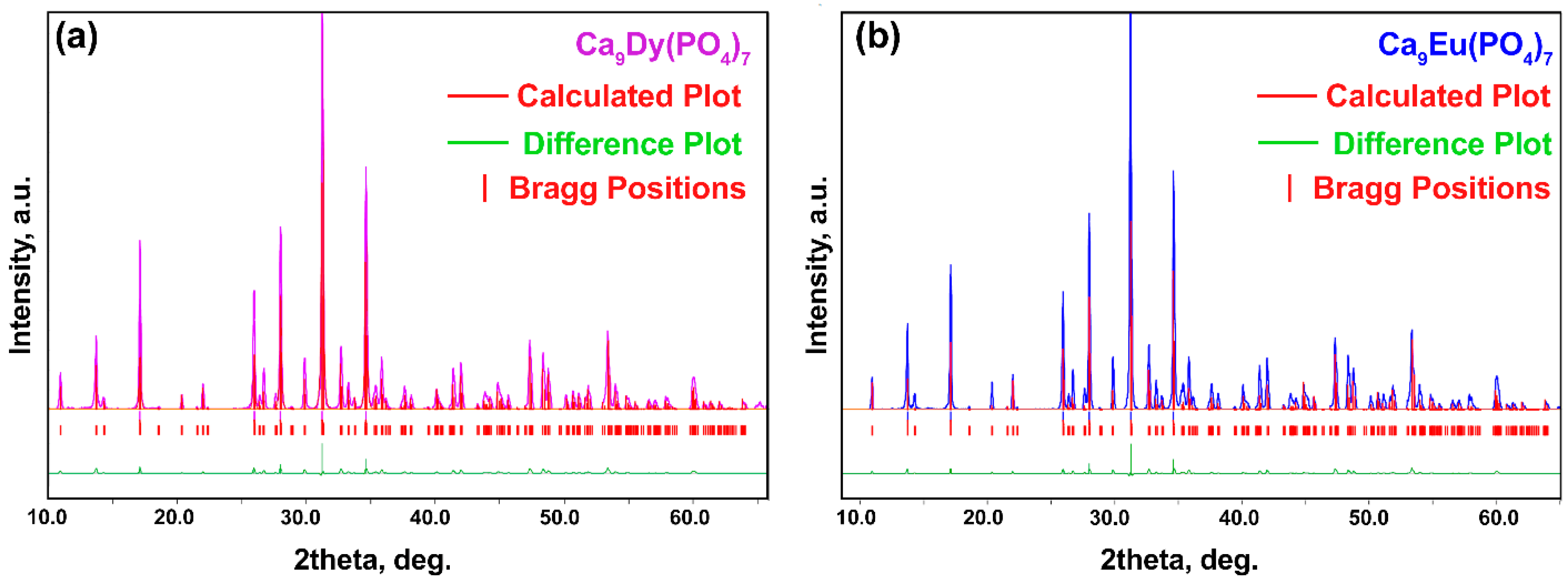
The PXRD patterns of CaDy and CaEu phosphates are shown in Figure 1. All samples were compared with the phosphate with the β-TCP structure from the PDF-2 database (PDF-2 Card No 9-169). No reflections corresponding to impurity phases were detected. Therefore, all as-prepared samples are phase-pure and belong to the β-TCP structure.

3.2. Study of Films

3.2.1. Surface Morphology of Films

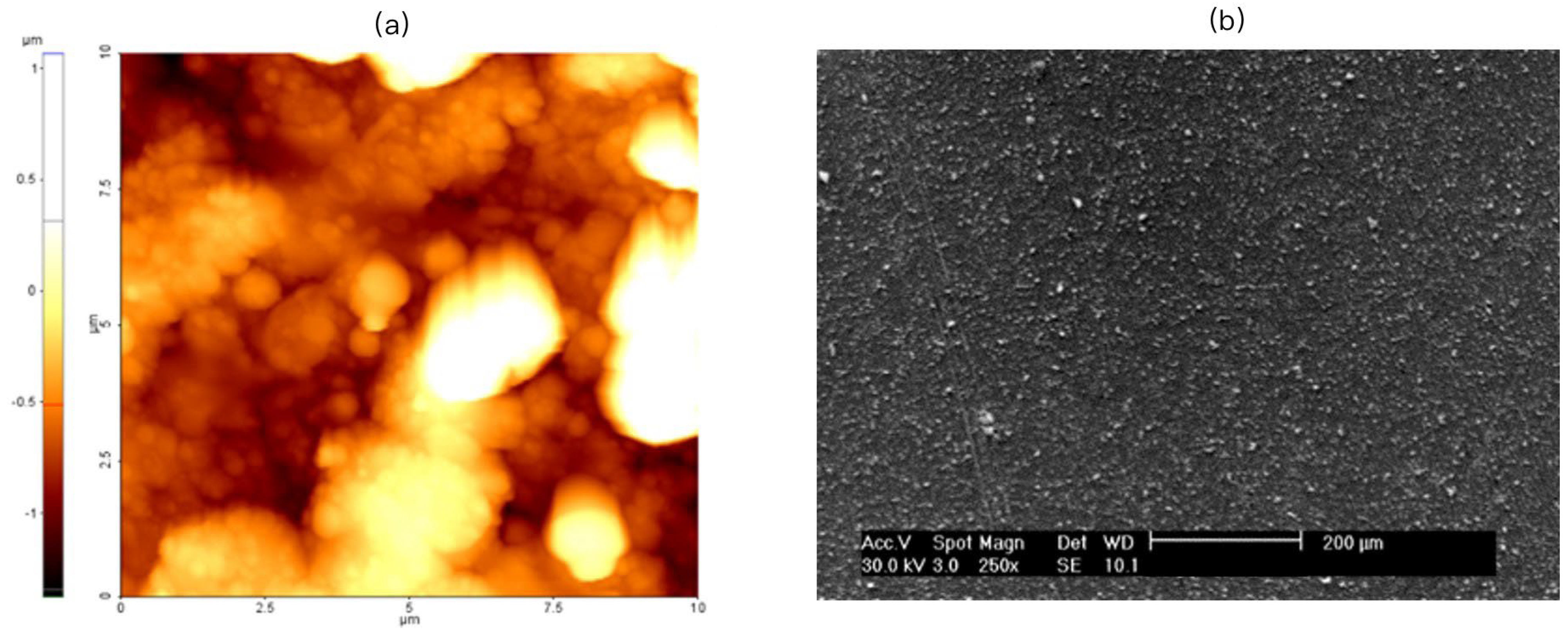
The surface morphology of the CaDy-film and CaEu-film thin films deposited by pulsed laser deposition (PLD) was investigated by AFM and SEM (Figure 2). AFM analyses reveal moderately rough and relatively homogeneous surfaces when small scan areas (2 × 2 µm2) are considered. However, both SAR and Rsm values increase systematically with increasing scan size up to 20 × 20 µm2, indicating the presence of surface features on the micrometric scale that are not detectable at smaller observation lengths. SEM images confirm that the deposited films are continuous, dense, and free of cracks or delamination, even over large areas. The surface exhibits a typical granular morphology, with the presence of micrometric particulates, which is commonly reported for calcium phosphate films deposited by nanosecond PLD. This morphology can be related to the ejection and redeposition of molten droplets and clusters during the laser ablation process (splashing effect).

3.2.2. Chemical Composition of Films

The chemical composition of the targets and the corresponding films was evaluated by EDS analysis (Table 1). For both CaDy-film and CaEu-film, a good compositional transfer from the target to the film was obtained with only minor deviations in the (Ca + RE)/P ratio. These differences can be attributed to the higher volatility of phosphorus during PLD and to possible surface re-sputtering phenomena occurring under the high-energy plasma plume conditions. The resulting Ca/P ratios are significantly lower than that of stoichiometric hydroxyapatite (Ca/P = 1.67), indicating the formation of non-stoichiometric calcium phosphate phases. Such compositions are well known to exhibit enhanced solubility and reactivity, which are considered advantageous for biomedical applications, particularly for bioactive coatings designed to promote interfacial bonding with bone tissue.

3.2.3. Structural Characterization: FT-IR, TEM

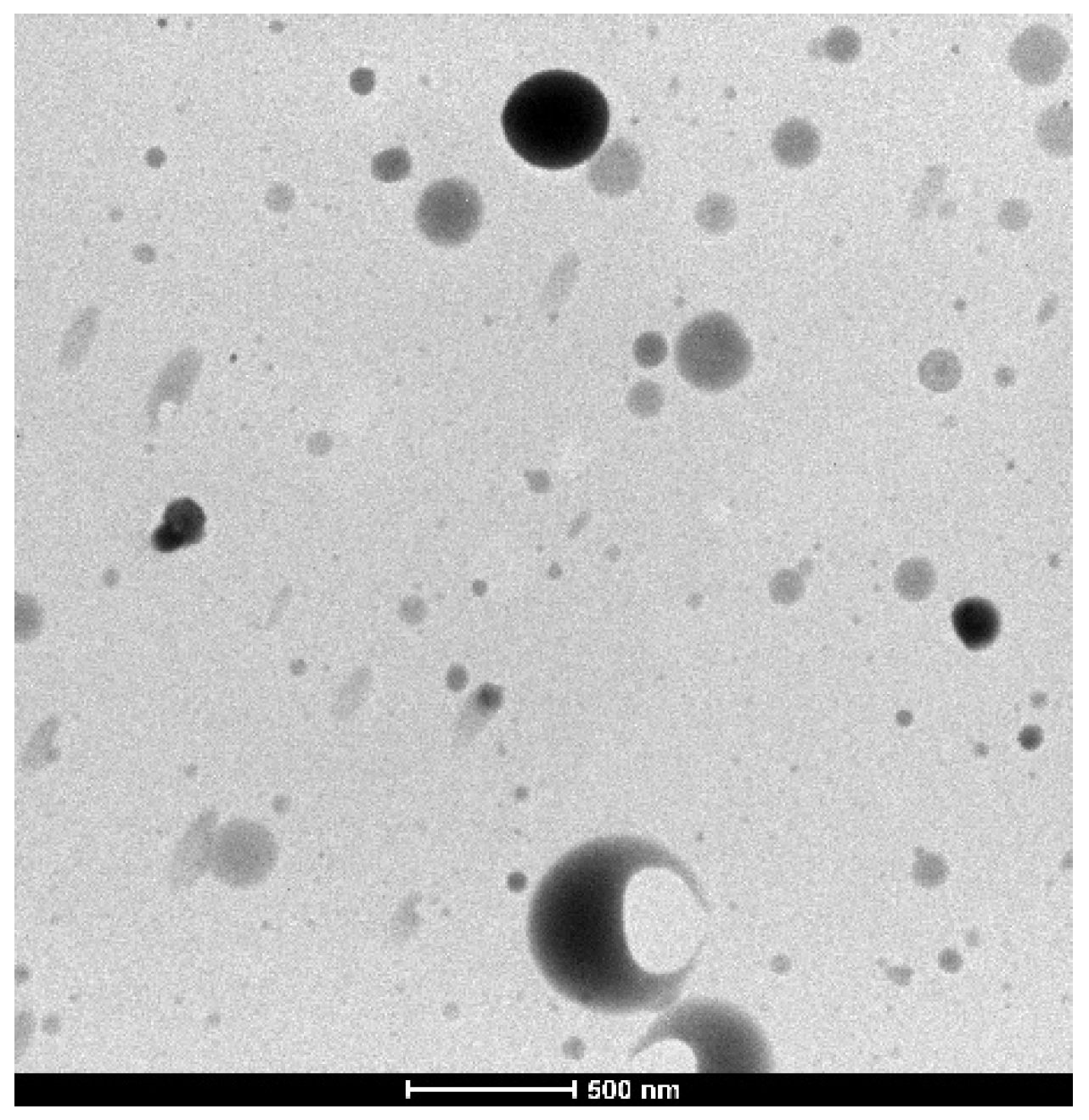
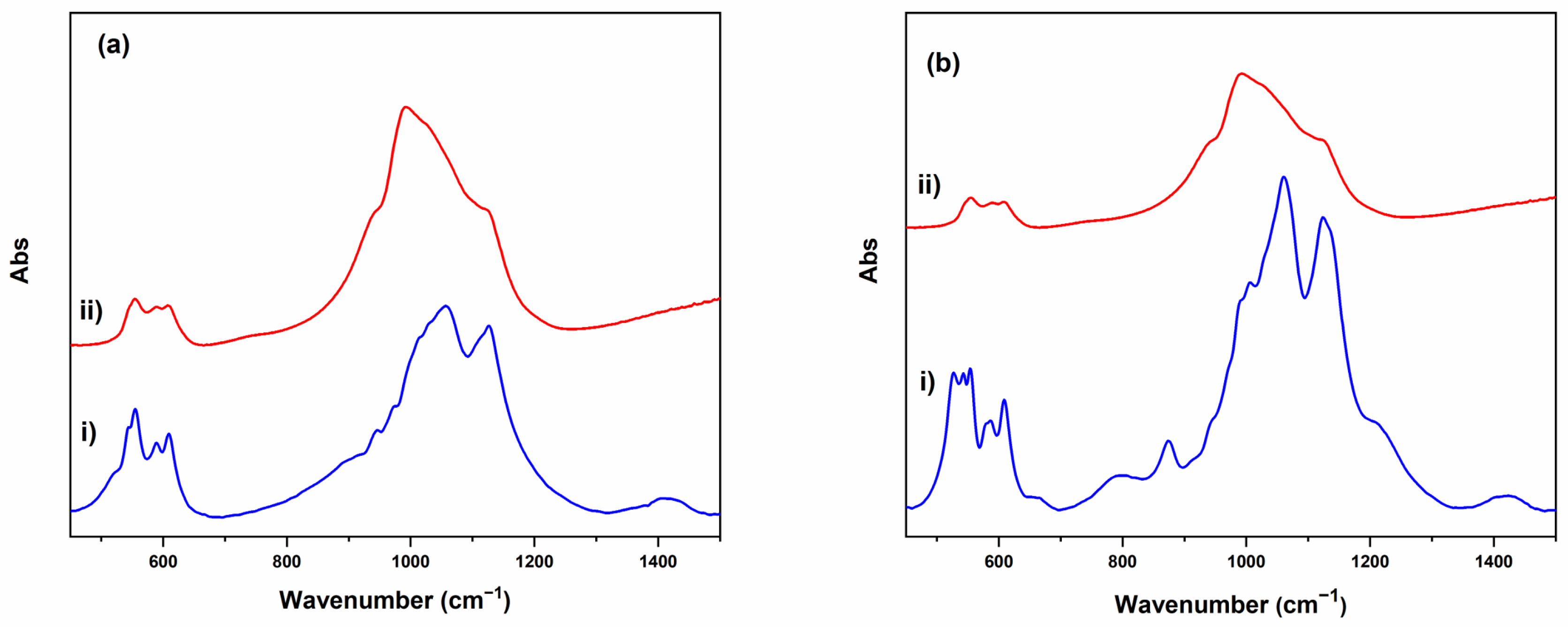
FT-IR spectra (Figure 3) of the as-deposited films display the characteristic vibrational bands of PO43– groups, confirming that the phosphate chemical framework is preserved after PLD. However, compared to the target materials, the phosphate bands appear significantly broadened, suggesting a low degree of structural order and indicating that the films are predominantly amorphous or poorly crystalline. This interpretation is further supported by TEM analysis of the early growth stages of the CaDy-film (Figure 4), which reveals the absence of long-range crystalline order. The formation of an amorphous calcium phosphate phase is commonly observed in PLD-deposited films grown at room temperature and is attributed to the rapid quenching of the ablated species and to substrate-induced stress.

3.2.4. In Vitro Bioactivity in SBF

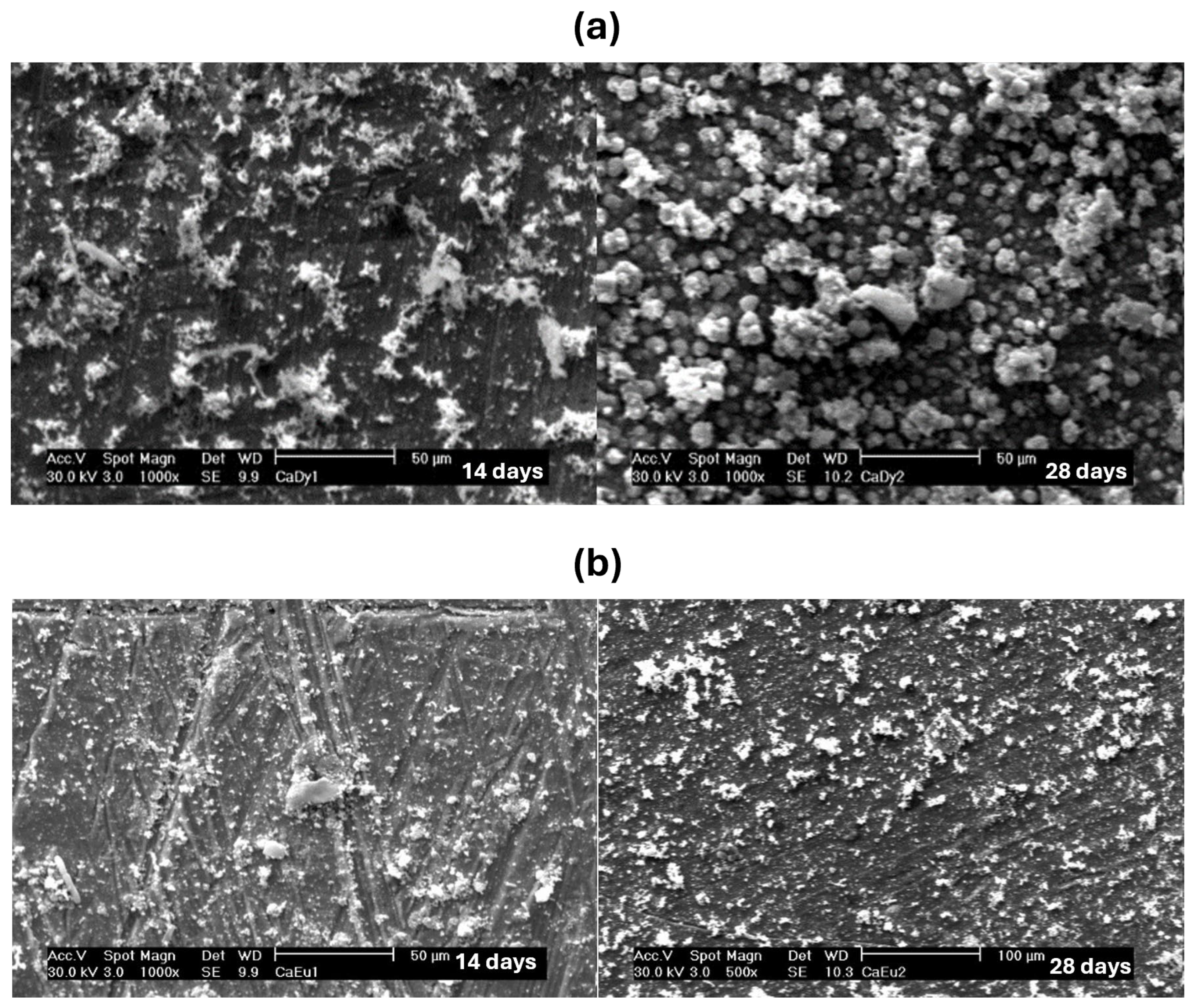
The in vitro bioactivity of the films was evaluated by immersion in SBF for 14 and 28 days (Figure 5). After 14 days of immersion, EDS analyses show the complete disappearance of the Dy and Eu signals, indicating full dissolution of the as-deposited film (Table 2). This rapid dissolution behavior is characteristic of amorphous calcium phosphate coatings and is generally regarded as a prerequisite for a bioactive response. After 28 days of immersion, a clear increase in the Ca/P ratio is observed for both systems, suggesting progressive calcium uptake from the SBF and the formation of a newly precipitated calcium phosphate layer. This compositional evolution is consistent with the nucleation and growth of an apatite-like phase on the film surface.
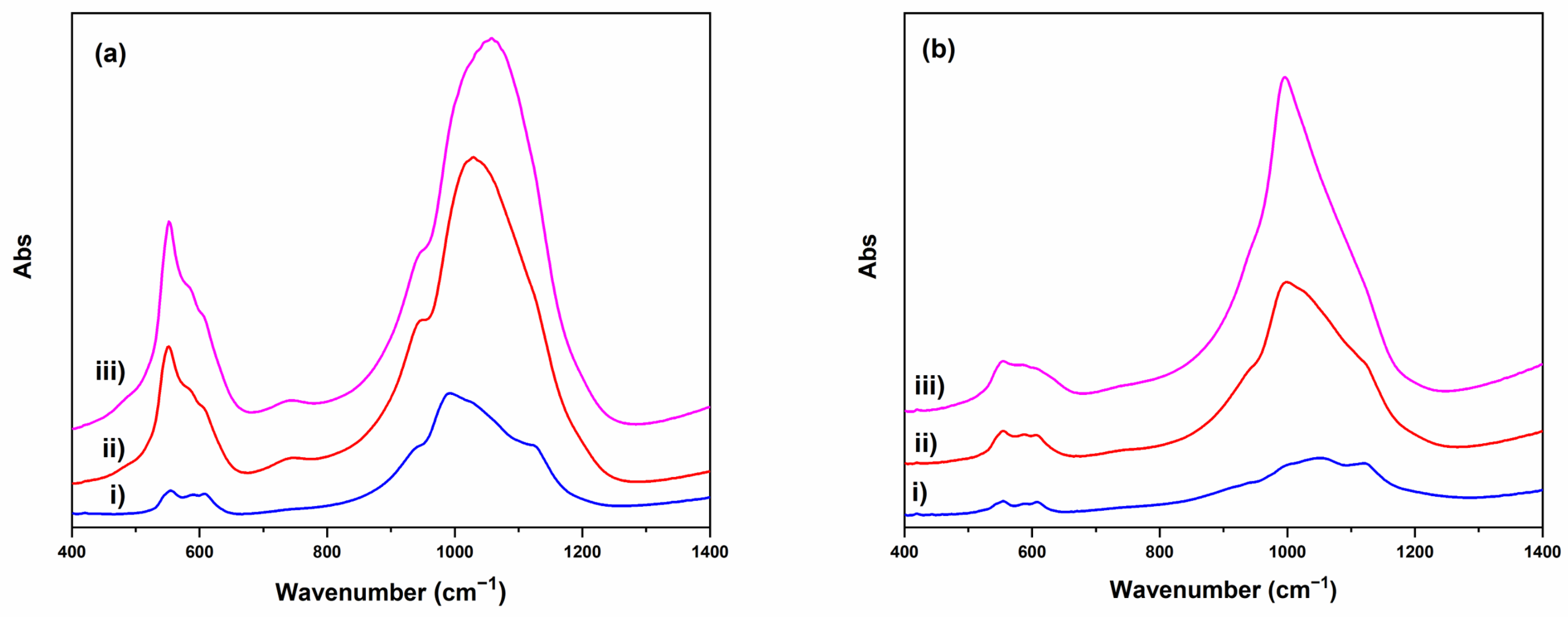
FT-IR spectra (Figure 6) acquired for samples soaked at different times in SBF show a marked increase in the intensity and definition of phosphate bands (ν1, ν3, and ν4 modes), together with the appearance of bands attributed to carbonate groups (CO32−). The presence of carbonate indicates the formation of a carbonated apatite, mainly of B-type, in which carbonate ions are substituted for phosphate groups. This phase closely resembles biological apatite and represents a key indicator of bioactivity. The temporal evolution from 14 to 28 days confirms the progressive growth and maturation of the apatite layer, in agreement with the EDS compositional data.

3.3. Study of Phosphate Cements

3.3.1. PXRD Study of Cements

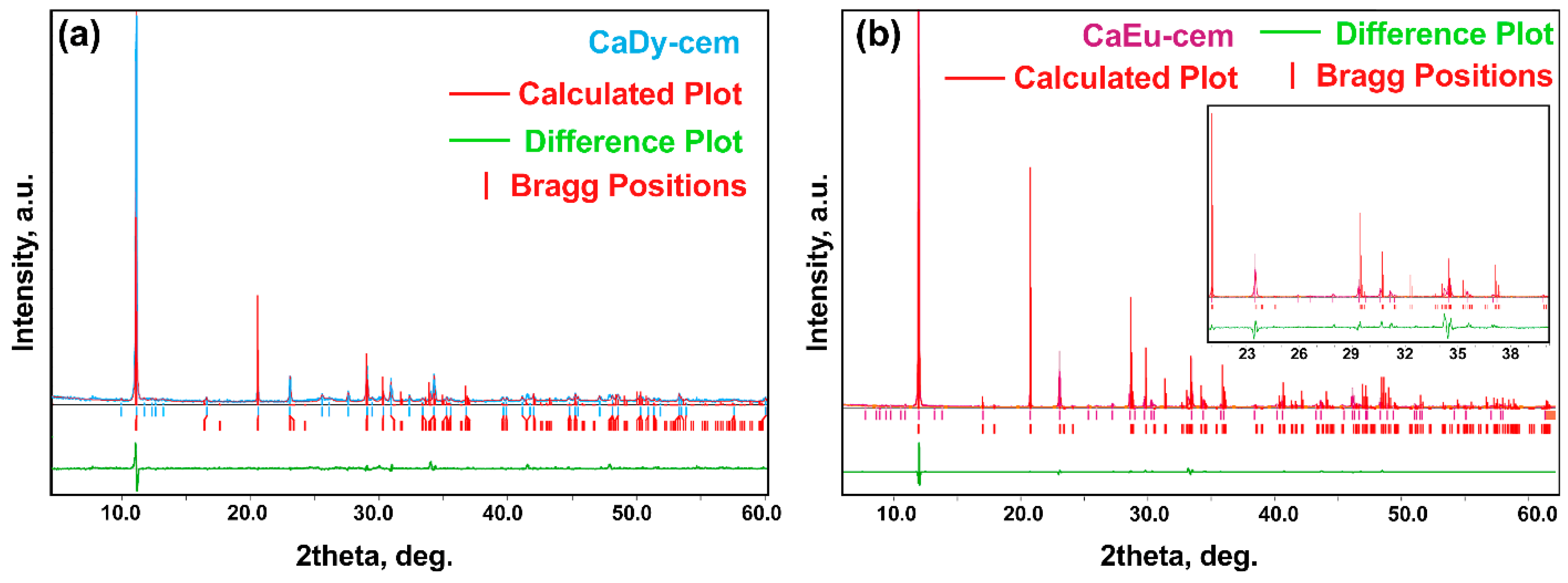
The PXRD patterns of CaDy-cem and CaEu-cem phosphates are shown in Figure 7. All samples were compared with brushite CaHPO4∙2H2O (PDF-2 Card No 72-713). No reflections corresponding to impurity phases were detected. Irregular intensity in PXRD patterns corresponds to texturing during cement formation. The phase composition of the samples is represented by an almost pure brushite phase.

3.3.2. Effects of Functionalized Cement Powders on aMSC Viability

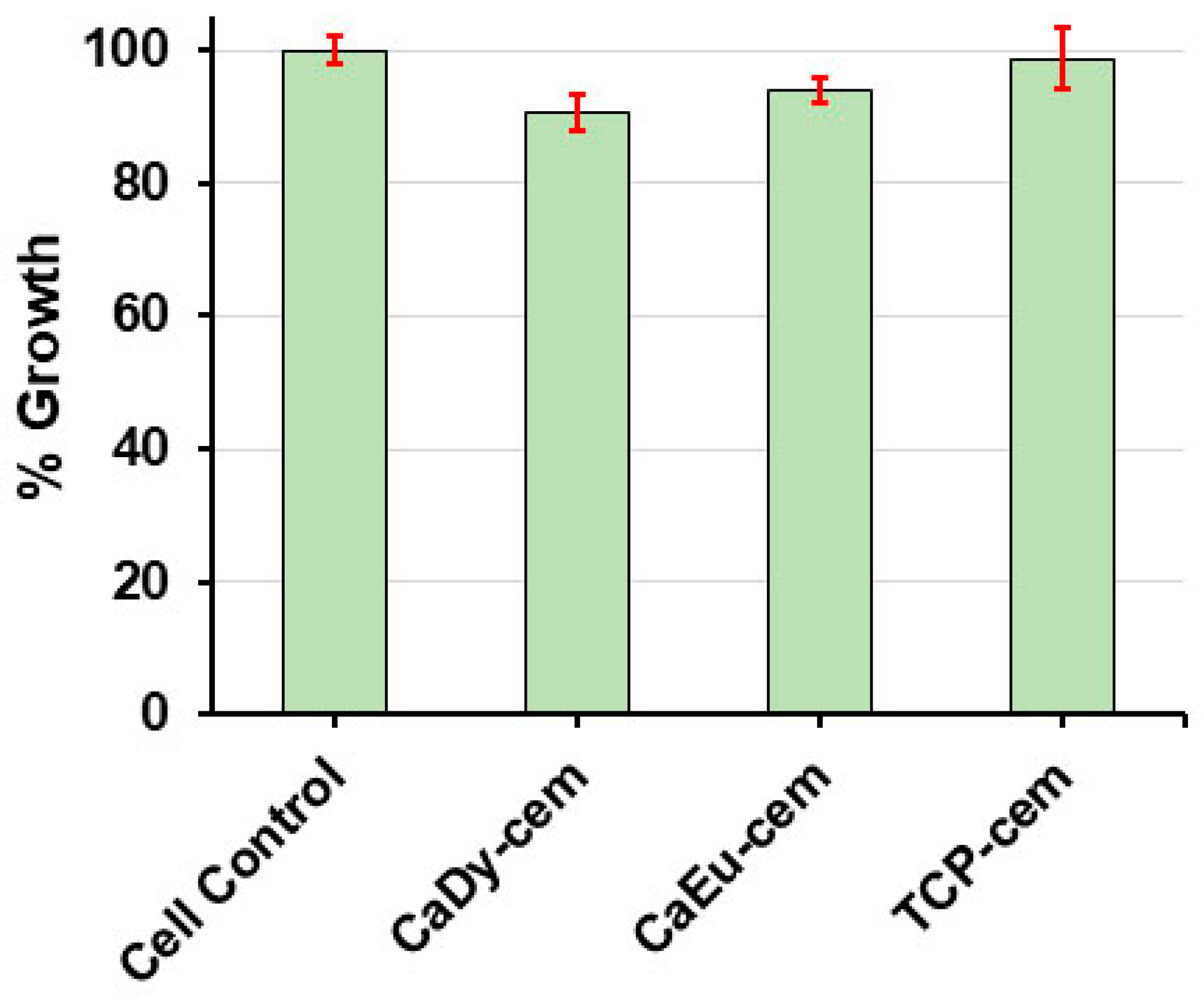
The cytotoxic effect of three different substrate formulations was evaluated by MTT assay on aMSCs after 24 h of exposure. The tested powders included both pure matrices and matrices functionalized with different combinations of elements. Results demonstrated that all experimental conditions maintained cell viability above 89% relative to the untreated control (set as 100%). In particular, the undoped TCP, which lacked active elements, induced a cell viability level of 98.58%, confirming the high biocompatibility of the matrices used. Powders functionalized with CaDy-cem showed a slight reduction in viability, with values of 90.52%. Formulations containing CaEu-cem exhibited intermediate viability values of 93.93%. Standard deviations from triplicate measurements remained within acceptable limits, confirming reproducibility. Data were further analyzed using Dunnett’s statistical test, which showed no significant differences compared with the control group. None of the powders caused a reduction in cell viability below the critical threshold of 89%, confirming the overall biological compatibility of the substrates at 24 h, as illustrated in Figure 8.

3.3.3. Evaluation of Osteoinductive Potential of Phosphate Cements

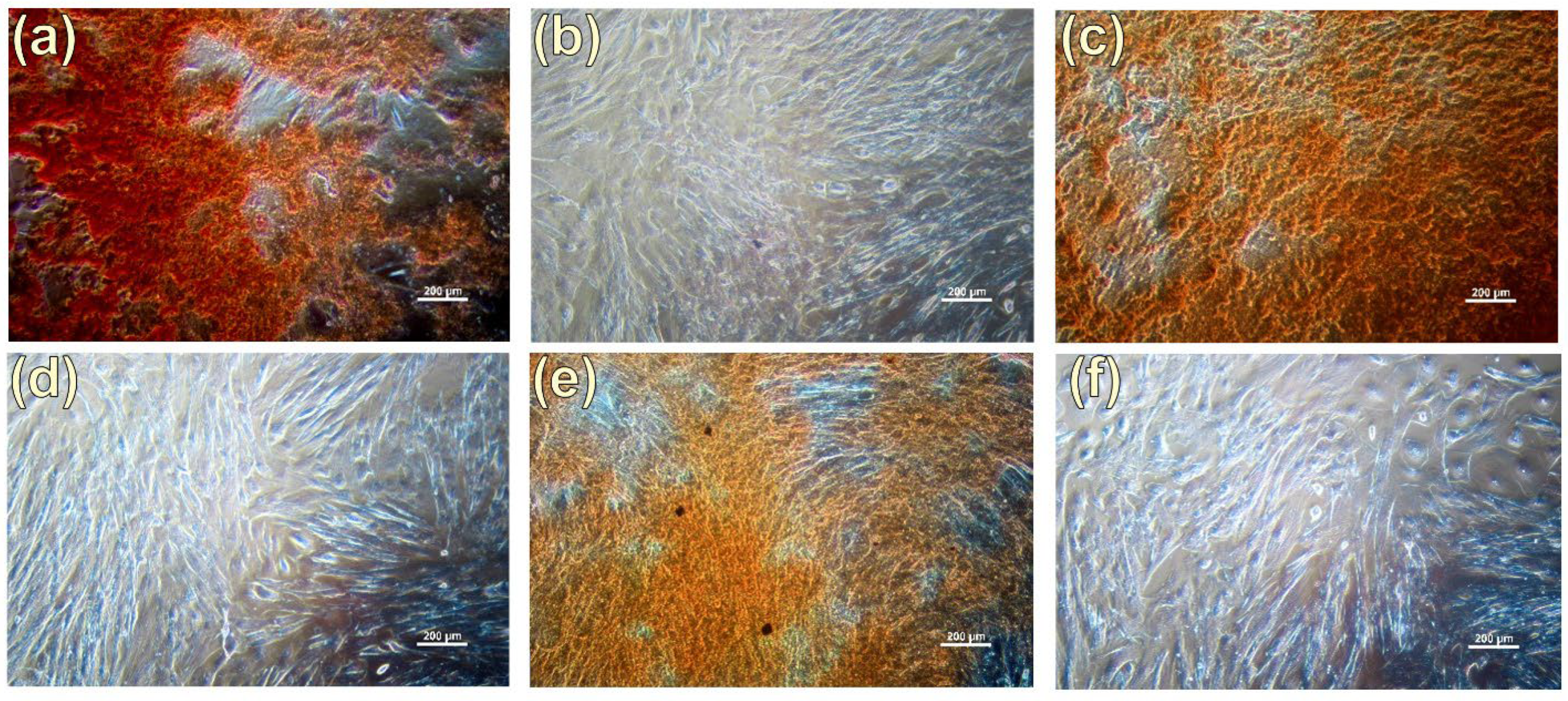
The effects of the three substrate formulations on osteogenic differentiation of aMSCs were assessed after 21 days of culture. For each condition, experiments were conducted with and without the addition of osteogenic differentiation medium, and results were compared with a positive control (osteogenic medium only) and a negative control (no osteogenic stimulus). Representative images of aMSCs under the different experimental conditions are shown in Figure 9 (functionalized substrates with and without osteogenic medium, pure substrates with and without osteogenic medium, and aMSC controls with and without osteogenic medium).
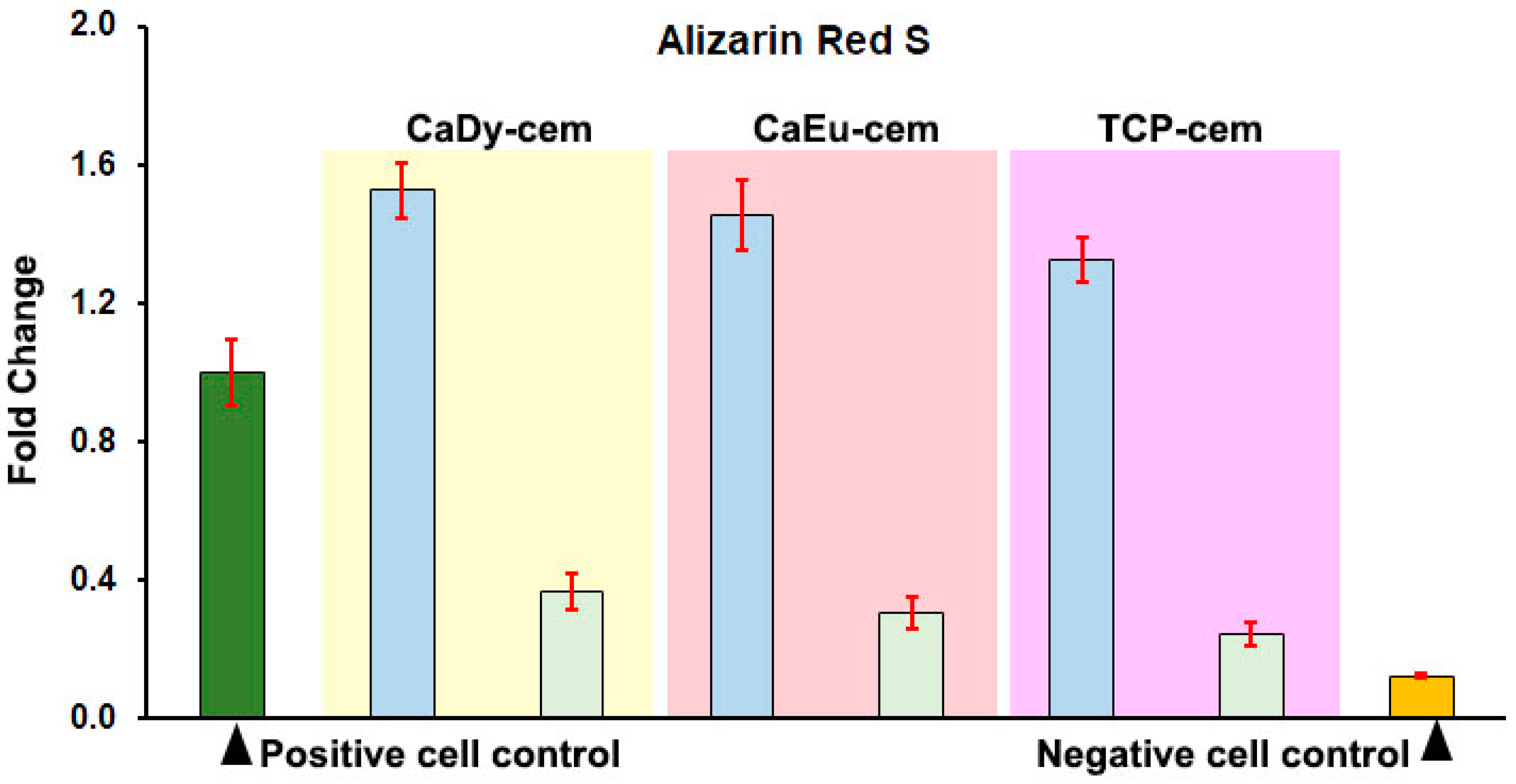
aMSCs exhibited intense Alizarin Red S staining, confirming effective osteogenic differentiation in response to all substrates (Figure 10). Cells treated with powders in combination with osteogenic medium showed increased calcium deposition compared to the positive control, suggesting a synergistic effect between the powders and osteoinductive signals. The CaDy-cem powder combined with osteogenic medium achieved a 1.53-fold increase relative to the positive control, followed by CaEu-cem (1.45-fold), and TCP-cem (1.32-fold). These data suggest that all groups exhibited a high ability to support in vitro mineralization and showed positive responses. Conversely, powders tested without osteogenic medium showed lower calcium deposition: 0.36-fold (CaDy-cem), 0.31-fold (CaEu-cem), and 0.24-fold (TCP-cem). These results indicate that the powders exert an intrinsic pro-differentiation effect that is significantly enhanced in the presence of osteogenic cues. The negative control showed minimal calcium deposition (0.125-fold), confirming the absence of spontaneous differentiation. Alizarin Red S staining revealed an increase in extracellular calcium deposition after 21 days, particularly when the cement powders were combined with osteogenic medium. These findings suggest that the tested cement formulations may support matrix mineralization under osteogenic culture conditions. However, since osteogenic differentiation was assessed exclusively through calcium deposition, these results should be considered preliminary evidence of the ability to support in vitro mineralization.

3.3.4. Antimicrobial Activity of Phosphate Cements

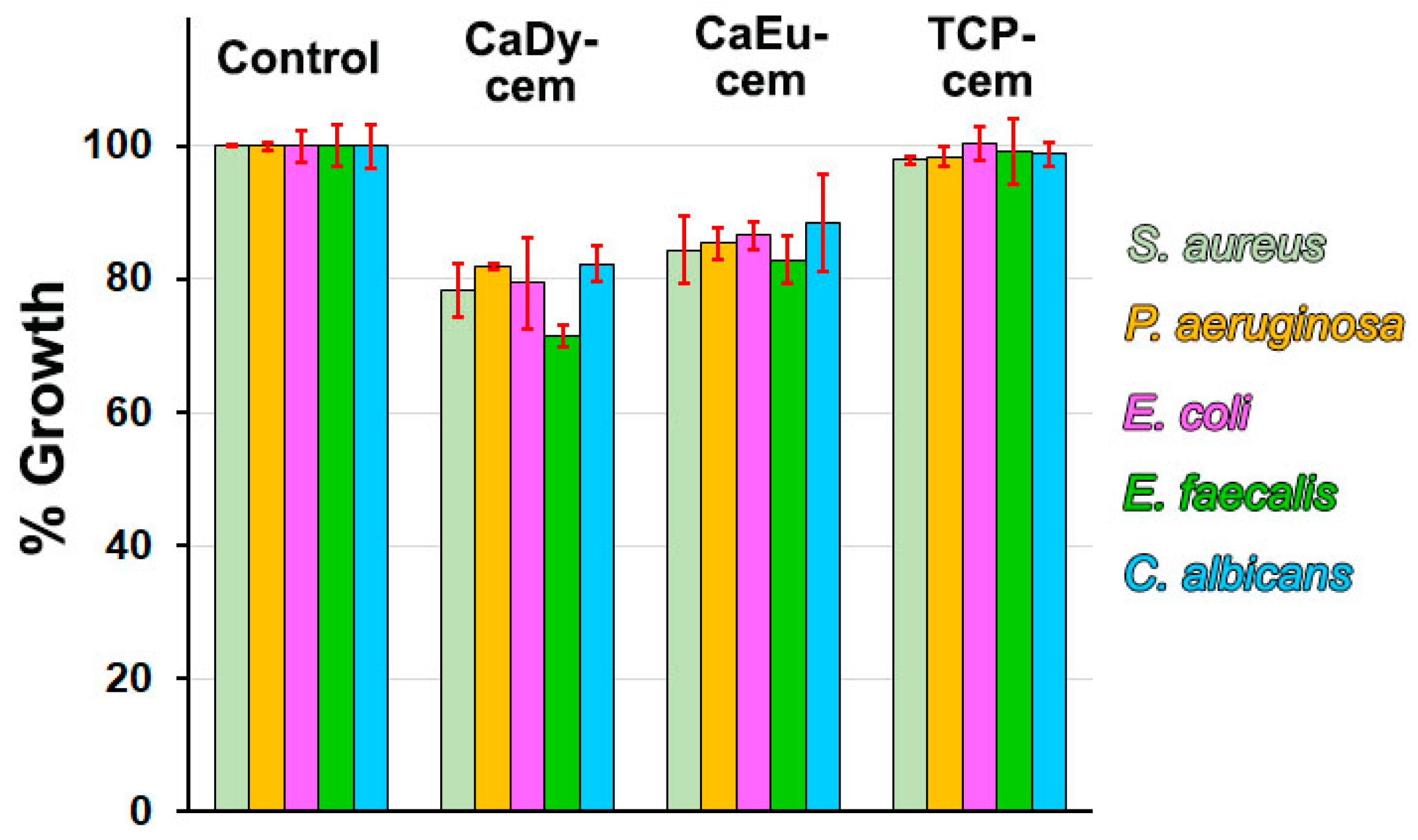
The antimicrobial activity of the substrates was evaluated against five opportunistic microorganisms (S. aureus, P. aeruginosa, E. coli, E. faecalis, and C. albicans) by measuring optical density at 600 nm after 24 h of incubation. Growth levels were compared to untreated controls, and data were analyzed using Dunnett’s test. Substrates showed a significant reduction in microbial growth compared with controls. Against S. aureus, CaDy-cem and CaEu-cem reduced growth by 21.7% and 15.6%, respectively. A similar pattern was noted for P. aeruginosa, with growth reduction up to 18.1% (CaDy-cem) and high statistical significance (p ≤ 0.001).
Antimicrobial effects were particularly pronounced against E. coli and E. faecalis, with reductions of 24.2% (CaDy-cem) and 28.5% (CaDy-cem), respectively. C. albicans also showed reduced growth, though to a lesser extent, with a maximum inhibition of 17.7% using CaEu-cem. Pure substrates displayed minimal antimicrobial activity (<3% inhibition). Overall, cement materials demonstrated superior antimicrobial performance with Dy3+ doping providing the greatest efficacy (Figure 11).

3.4. PMMA Composites

3.4.1. PMMA Formation and SEM Analysis

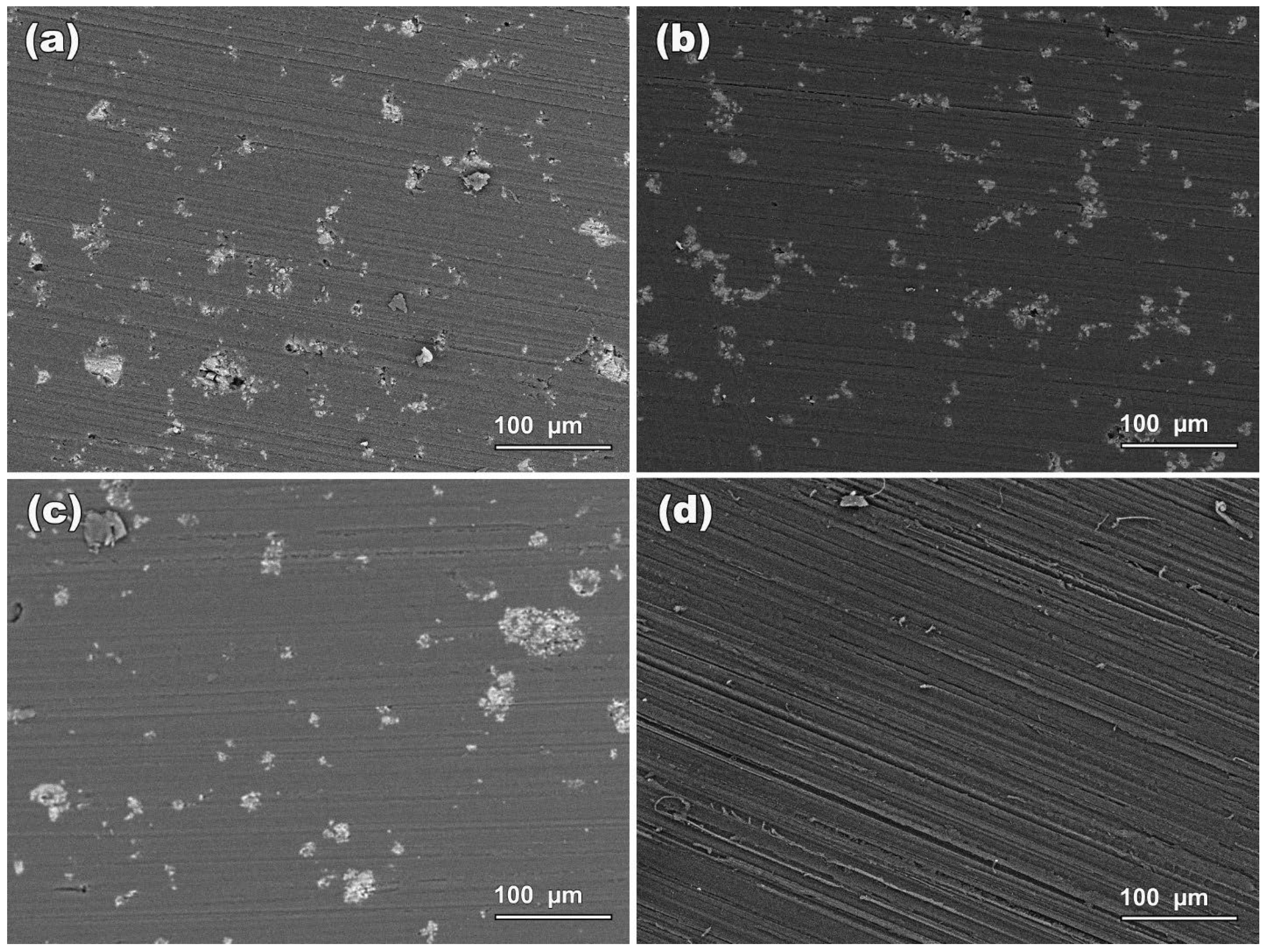
The CaDy-PMMA and CaEu-PMMA composites were produced by adding MMA to the PMMA/phosphate powder mixture. The maximum temperature during hardening did not exceed 32 °C, and the setting temperature was calculated to be 29 °C. These results are promising: the maximum setting temperature is significantly lower than the 70 °C threshold associated with thermal necrosis at the cement–bone interface [57]. The SEM images are presented in Figure 12. The synthesized phosphates, such as CaDy and CaEu, are uniformly distributed throughout the PMMA volume, unlike undoped β-TCP. Additionally, the largest size of coagulated particles for CaDy and CaEu lies in the range of 10–15 µm, whereas for undoped β-TCP, the largest size can reach up to 80 µm; however, there were also areas with grain sizes reaching up to 120 µm.

3.4.2. Micro-CT Study

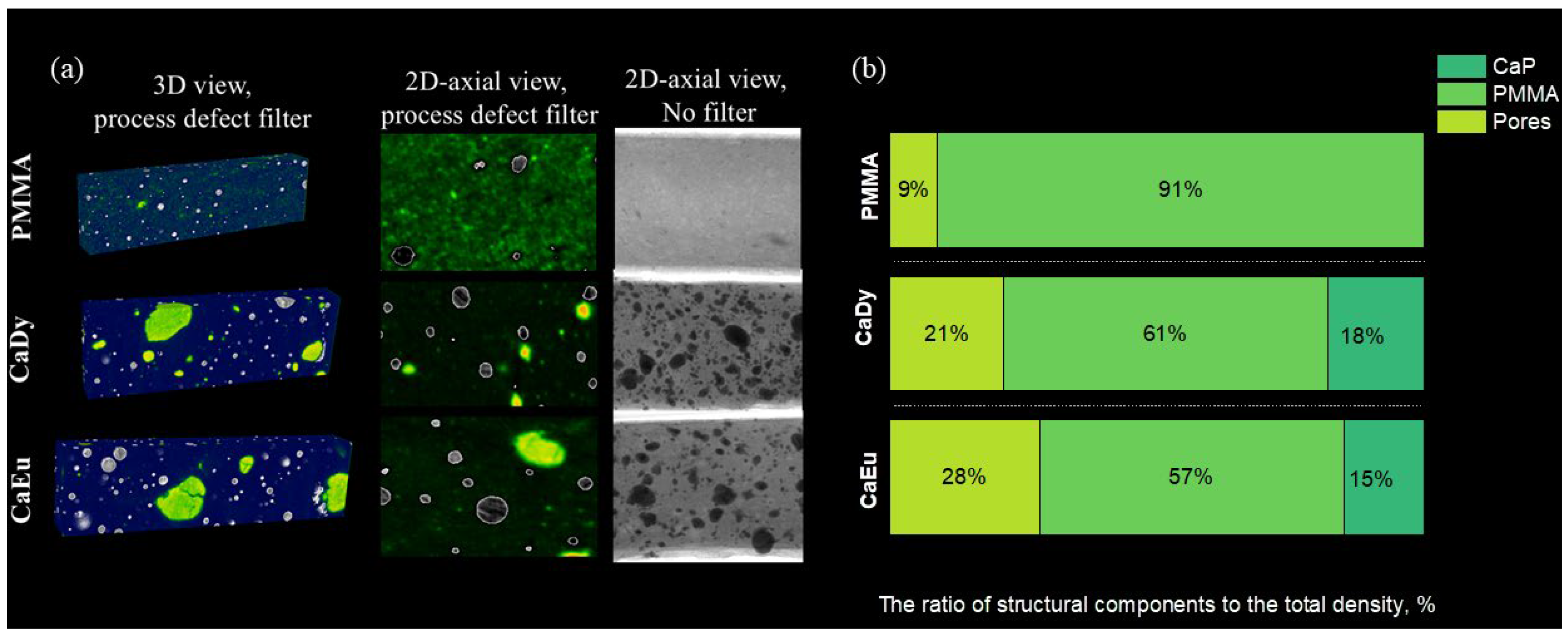
Samples of PMMA-based cements containing CaDy or CaEu particles were studied by micro-CT as shown in Figure 13a. A specialized filter within the software VGStudioMax 2.1 was employed to examine the samples’ structure in detail. Based on the findings, it can be inferred that the particle-free cement matrix exhibits a uniform density and the formation of isolated pores. The density histogram indicates the presence of three distinct features with different densities in the sample. The most prominent feature is the CaDy or CaEu particles, which were added to the PMMA-based cement. The polymer itself is also present, and a pore structure can be observed. Upon the addition of ceramic particle powder, a minor aggregation of particles is observed in the PMMA-based cement and an increase in porosity of up to 28% (CaEu), as indicated by segmentation analysis of the micro-CT density data (Figure 13b). It should be noted that the samples contain pores both on their surface and within their volume, but there are no continuous pores. The filler particle density ratio in cement materials varies between 15% and 18%, which is in line with the mass-based data on the material’s density.

3.4.3. Radiopacity Measurements and CT Study

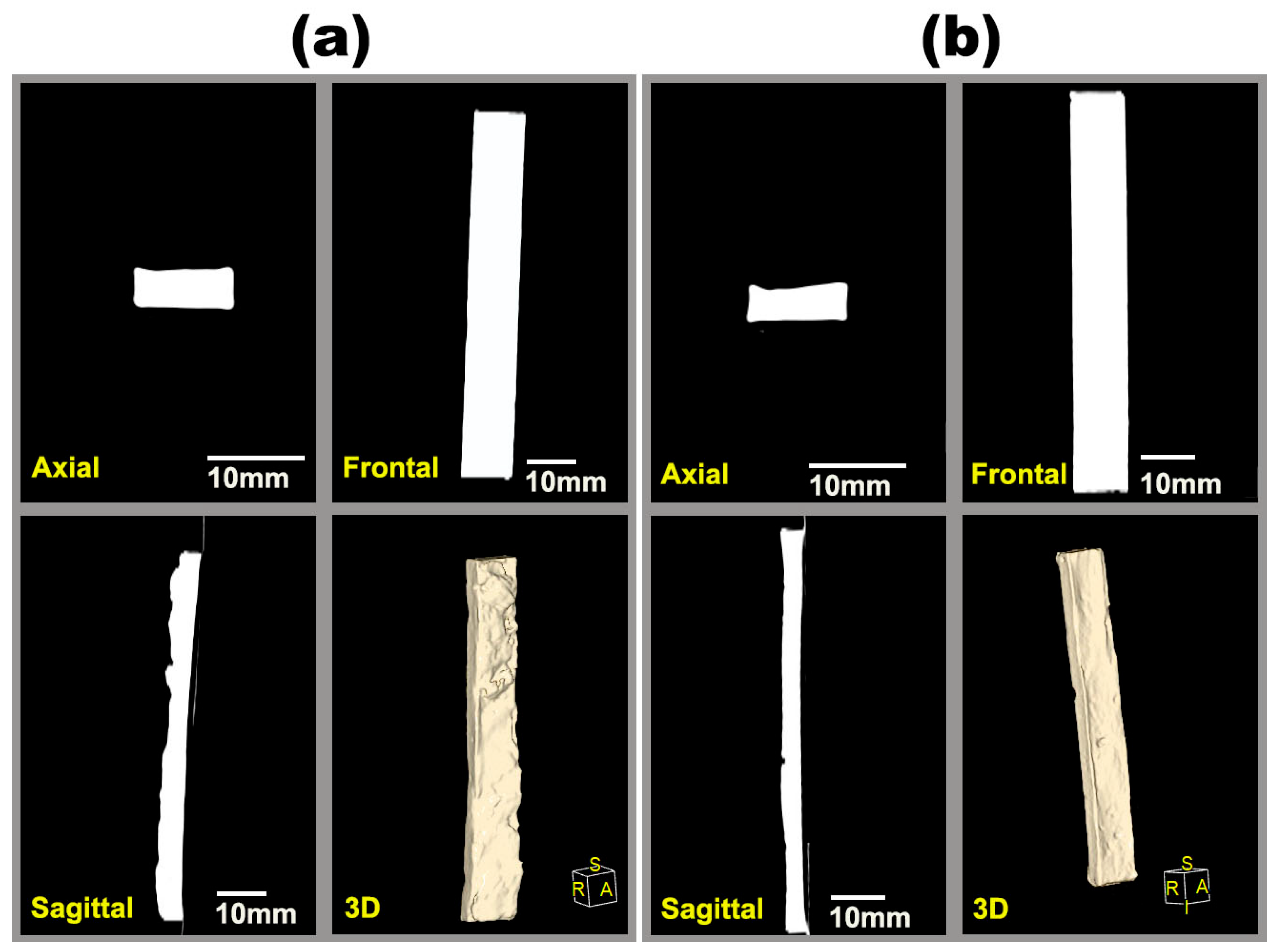
CT images of CaDy-PMMA and CaEu-PMMA specimens are shown in Figure 14. The study revealed that the samples are characterized by a homogeneous structure. The absence of bubble formation inside the bars during their formation is expected to positively influence the mechanical strength of the obtained cements. A strong upsurge in CT signal intensity is observed for both composites. The homogeneous distribution of the CaDy and CaEu phosphate powder throughout the cement volume over the studied specimens can be observed. The obtained X-ray attenuation values were compared at 120 kVp and calculated to be 913 ± 22.4 HU for CaDy-PMMA and 608.5 ± 17.2 HU for CaEu-PMMA.

3.4.4. Post-Mortem Analysis

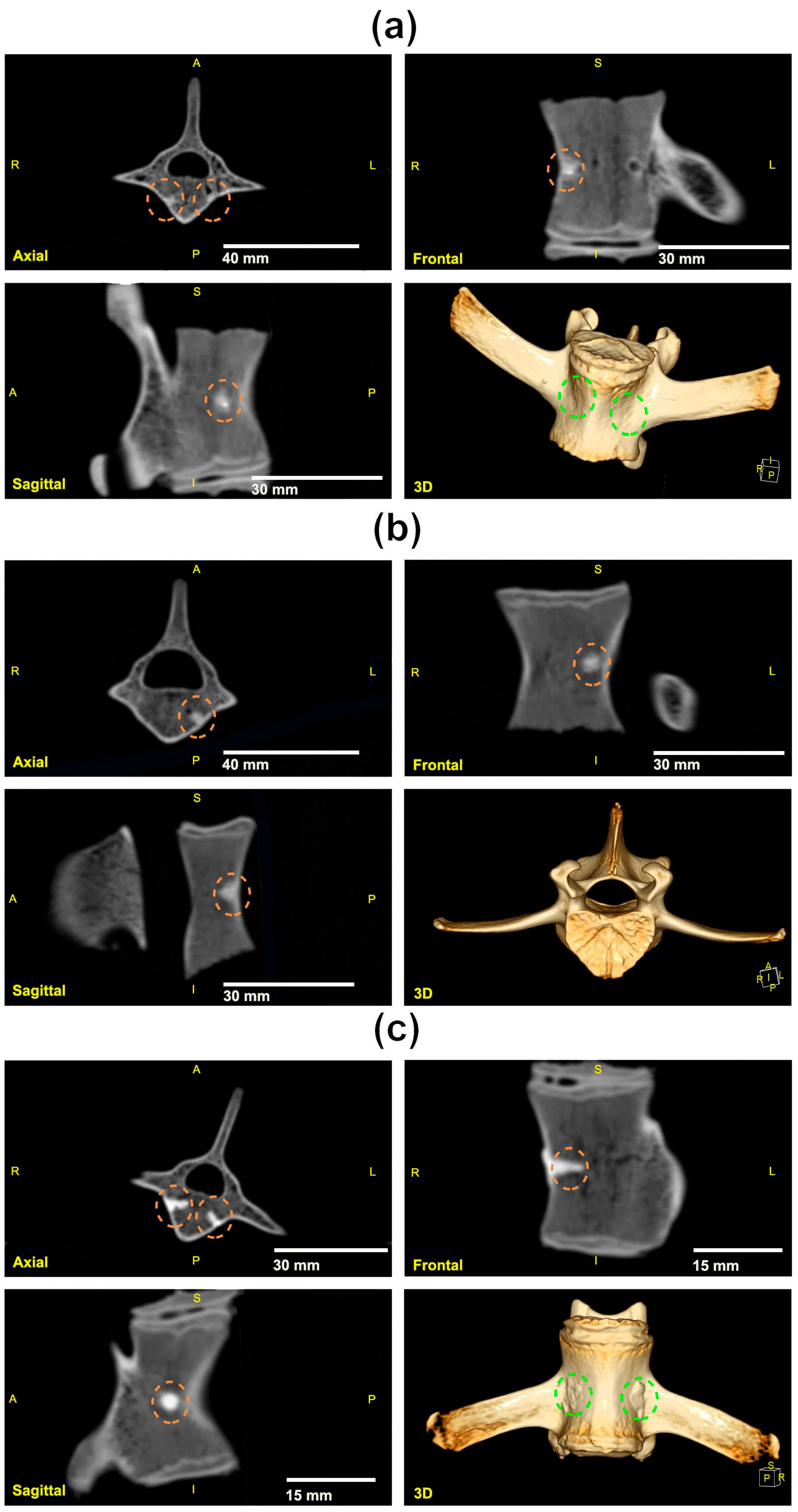
CT images show that all obtained composites exhibited radiopacity compared to bone tissue, including both cortical bone (1000–1100 HU) and cancellous bone (350–700 HU). It should also be noted that the PMMA composites retained their HU values (Figure 15), when transferred to natural bone, with values observed in the range of 900–1000 ± 20 HU for CaDy-PMMA and 600–700 ± 25 HU for CaEu-PMMA. This variation is attributed to the fact that during defect filling, the cavity cannot always be completely filled; as a result, the cement may be unevenly distributed, leading to slight deviations in HU values compared to the bar samples. Since CaDy-PMMA exhibits greater radiopacity, it was decided to use CaDy-cem to fill an additional vertebra. CaDy-cem shows an even distribution within the defect cavity and is characterized by high radiopacity, with calculated values ranging from 1450 to 1550 ± 25 HU.

4. Discussion

The results of this study demonstrate that Eu- and Dy-doped β-TCP phases (Ca9Eu(PO4)7 and Ca9Dy(PO4)7) can be successfully processed into three distinct material formats—bioactive thin films, resorbable brushite cements, and radiopaque PMMA composites—without loss of the key functional properties (bioactivity, antimicrobial activity, and radiopacity). This is not a claim that all three formats are ready for clinical use; rather, it highlights the versatility of the phosphate precursor. The incorporation of REE ions into the β-TCP structure did not disturb phase formation, as confirmed by PXRD analysis.
A comparison between CaDy-film and CaEu-film revealed a very similar behavior, indicating that the incorporation of trivalent rare-earth ions did not inhibit the dissolution–reprecipitation processes leading to apatite-like formation. In particular, the CaDy-film showed a slightly more advanced stage of apatite-like growth after 28 days of SBF immersion compared to CaEu-film, suggesting a subtle influence of the specific rare-earth ion on the kinetics of carbonated calcium phosphate nucleation. These findings are consistent with previous reports demonstrating that rare-earth ions, when present in limited amounts, do not compromise the bioactivity of calcium phosphate materials, while offering the possibility of introducing additional functionalities such as optical or imaging properties.
The results demonstrate that CaDy-film and CaEu-film deposited by PLD exhibited a favorable combination of surface morphology, non-stoichiometric composition, amorphous structure, and pronounced in vitro bioactivity. The formation of a carbonated apatite-like layer upon immersion in SBF confirms their potential as bioactive coatings for biomedical applications. The relatively low Ca/P ratios measured by EDS after SBF immersion should be interpreted with caution since the Zn–Cu alloy substrate employed in this work could actively participate in interfacial reactions during immersion.
It should be noted that the SBF assay provides only a preliminary evaluation of in vitro bioactivity and does not reproduce the complexity of physiological bone regeneration processes, which generally occur over a period of several months. Therefore, the present results mainly demonstrate the ability of the coatings to promote calcium phosphate nucleation. The rapid dissolution observed after 14 days is characteristic of amorphous calcium phosphate coatings and suggests a transient bioactive behavior rather than long-term structural stability. Further investigations are required to assess degradation kinetics over extended periods, rare-earth ion release, and coating performance under biologically relevant conditions. Moreover, the presence of Dy3+ and Eu3+ ions broadens the functional scope of these materials, making them promising candidates for multifunctional biomaterial systems.
Clinically relevant coating properties such as adhesion strength, scratch resistance, wettability, and corrosion behavior on implant-grade substrates were not investigated in the present study and represent important limitations of the current work. Future studies will therefore focus on comprehensive physicochemical and mechanical characterization of the coatings under clinically relevant conditions.
The brushite cements were obtained from synthesized phosphates. These cements, whether pure or functionalized with rare-earth ions, exhibited excellent biocompatibility, ability to support in vitro mineralization, and antimicrobial activity. The MTT assay confirmed that none of the tested formulations significantly reduced aMSC viability after 24 h, with all values remaining above 89%, supporting the suitability of these substrates for interactions with mesenchymal stromal cells. Osteogenic differentiation analysis showed that all powders enhanced calcium deposition in the extracellular matrix, with a clear synergistic effect observed in the presence of osteoinductive stimuli. In particular, CaDy-cem, demonstrated the highest mineralization potential (1.53-fold compared to the positive control), suggesting that the composition and microstructural features positively influence cellular responses. Equine adipose tissue-derived mesenchymal stromal cells were selected as a primary-cell-based model because they are clinically relevant in veterinary musculoskeletal regenerative medicine and better preserve species-specific biological features when used at low culture passages. Therefore, this model should be considered a preliminary in vitro screening tool to assess cytocompatibility and mineralization-related responses, rather than a fully predictive model of in vivo bone repair. The results obtained should be interpreted as evidence of a pro-osteogenic effect or of support for matrix mineralization under the tested in vitro conditions.
Antimicrobial tests of the phosphate cement samples confirmed that doping with Dy3+ confers significant bacteriostatic and fungistatic properties, achieving growth inhibition rates of up to 28.5% against E. faecalis and 24.2% against E. coli. These findings align with the previous literature attributing the antimicrobial activity of metallic ions to interactions with microbial cell membranes, reactive oxygen species (ROS) generation, and interference with essential metabolic processes. Variations in microbial susceptibility are consistent with differences in cell wall composition: Gram-negative bacteria such as P. aeruginosa and E. coli possess an outer membrane that limits molecular diffusion, while Gram-positive bacteria feature a thick peptidoglycan layer that may affect interactions with active surfaces.
The results of antimicrobial tests support the potential of these multifunctional phosphates as innovative biomaterials for tissue engineering and biomedical device applications. The combination of high biocompatibility, osteogenic differentiation enhancement, and growth-inhibitory effect against the tested microbial strains highlights their promise for the development of advanced biomaterials capable of promoting bone regeneration while reducing the risk of postoperative infections. Future in vivo studies and detailed mechanistic analyses will be essential to further optimize ion release properties and cell–material interactions, paving the way for potential clinical translation.
The potential concern regarding the systemic toxicity of released Dy3+ and Eu3+ ions should be considered in the context of the well-established toxicological profile of isostructural phosphates. The doping of Dy3+ and Eu3+ into the β-TCP structure, rather than their introduction as free ions, is expected to substantially limit ionic release compared to the soluble REE salt. This was confirmed in [14,15,21,58,59,60]. This is supported by the high cell viability (>89%) and enhanced osteogenic differentiation observed in the present study, which provide indirect evidence that REE3+ release from the tested cements remains below cytotoxic thresholds under the experimental conditions applied.
Although the antimicrobial assessment was performed by OD600 measurement, correcting each sample with a specific blank consisting of BHI broth and the same amount of cement powder incubated in the absence of microorganisms, the obtained data should be interpreted with caution. The use of cement materials may introduce potential interference related to turbidity, sedimentation, light scattering, or material adsorption. Furthermore, although a highly diluted initial inoculum (1:1000) was used to evaluate active microbial growth during the 24 h incubation period, OD600 measurement does not allow a definitive distinction between bacteriostatic and bactericidal effects. Therefore, the observed inhibition values, which reached a maximum of 28.5% and were mostly within the range of approximately 15%–25%, should be interpreted as a moderate in vitro microbial growth-inhibitory effect, likely bacteriostatic and fungistatic in nature, and not as evidence of pronounced bactericidal or broad-spectrum antimicrobial activity.
Bioactive PMMA composites were obtained by mixing PMMA polymer with synthesized phosphate powder (CaDy, CaEu or β-TCP). A more even distribution, as shown in SEM images, of CaDy and CaEu in the PMMA may be related to the fact that these phosphates crystallize in a more centrosymmetric structure (lower second harmonic generation signal, compared to undoped β-TCP [61], despite having the same SG R3c). That is, they exhibit more pronounced antiferroelectric properties—the phosphates are characterized by a greater nonpolar structure, making them less polarizable. This apparently leads to less coagulation of particles when distributed in the matrix, compared to pure β-TCP.
According to micro-CT results the pure PMMA sample exhibits lower porous density compared to composites because fillers (CaDy and CaEu) form barriers to the formation of links between PMMA and MMA units. Such behavior was previously described in [29]. Moreover, porous density and pore size are lower for CaDy-PMMA. That can can be explained by the lower polarity of CaDy compared to CaEu. Also, the lower formation temperature of CaDy-PMMA and CaEu-PMMA compared to pure PMMA can be explained by the formation of barriers within the PMMA network. So, the homogeneous distribution of CaDy and CaEu in PMMA is confirmed by micro-CT.
The addition of CaDy or CaEu phosphate powders into the PMMA improved the radiopacity of the composite. The radiopacity values reach 950 HU with a phosphate mass content of 15% in the polymer matrix. This value can be increased, and, according to biological tests, the bioactivity of the composites will also be increased. The brushite CaDy-cem exhibits greater radiopacity compared to CaDy-PMMA and CaEu-PMMA. This is due to the fact that the concentration of the doped β-TCP filler in PMMA is only 15 wt.%, whereas in the formation of phosphate cements a 1:1 molar ratio (TCP:MCPM) is used. The radiopacity of PMMA composites can also be increased by raising the phosphate concentration. Commercial analogs with a high content of radiopaque (up to 45 wt%) substance exist. However, CaDy-PMMA exhibits higher radiopacity compared to CaEu-PMMA. Such a value of Dy-doped phosphates in particular can be attributed to the greater K-jump absorption ratio of Dy relative to Eu [62].

5. Conclusions

In this paper, the multifunctional potential of rare-earth-doped β-TCPs, Ca9Eu(PO4)7 and Ca9Dy(PO4)7, was demonstrated across three formats: bioactive thin films, brushite bone cements, and radiopaque bioactive fillers for PMMA bone cements.
The amorphous, dense, and crack-free films were produced and exhibited excellent in vitro bioactivity, with rapid dissolution followed by the formation of a carbonated apatite layer after immersion in simulated body fluid. These films exhibited rapid dissolution behavior typical of amorphous calcium phosphate coatings, promoting early-stage calcium phosphate nucleation and surface mineralization during SBF immersion. Such transient behavior may be advantageous for initial bioactivation processes, although additional studies are required to evaluate long-term coating stability, ion release kinetics, and performance under physiological conditions.
Brushite cements obtained from β-TCP type Eu3+- and Dy3+-doped phosphates demonstrated high cytocompatibility with mesenchymal stromal cells (>89% viability) and significantly enhanced osteogenic differentiation. Moreover, the cements exhibited moderate in vitro microbial growth inhibition against clinically relevant pathogens (S. aureus, E. coli, P. aeruginosa, E. faecalis, and C. albicans), with CaDy-cem showing the highest inhibition rates. These properties position such brushite cements as promising candidates for bone substitutes.
The PMMA composites achieved clinically relevant radiopacity values (913 ± 22.4 HU for CaDy-PMMA and 608.5 ± 17.2 HU for CaEu-PMMA), with CaDy-PMMA outperforming CaEu-PMMA. Post-mortem CT imaging showed that CaDy-cem provided excellent defect filling and the highest radiopacity (1450–1550 ± 25 HU), exceeding that of cortical bone. Moreover, the setting temperature of the PMMA composites is significantly lower than that of commercial PMMA cements, which may help avoid thermal necrosis at the cement–bone interface.
Overall, this research establishes rare-earth-doped β-TCP as a multifunctional material that imparts bioactivity, ability to support in vitro mineralization, antimicrobial efficacy, and tunable radiopacity. The ability to use the same base phosphate in thin films, resorbable cements, and polymer composites offers a unified strategy for developing next-generation multifunctional bone repair materials. Nevertheless, additional long-term biological, mechanical, and degradation studies are required to further validate their suitability for clinical translation.
It is important to emphasize that this study serves as a proof-of-concept for the versatility of rare-earth-doped β-TCP as a unified precursor, not as a full clinical validation. Each format (coatings, brushite cements, and PMMA composites) has its own specific clinical requirements (mechanical, biological, regulatory) that require dedicated long-term studies. The present findings justify such future investigations by showing that the key functional properties (bioactivity, antimicrobial activity, radiopacity) are retained across very different processing routes.

Author Contributions

Conceptualization, D.V.D., I.V.N., J.V.R. and B.I.L.; methodology, I.V.N., E.S.Z., O.A.L., P.A.K., V.G.Y., K.B., M.A.G. and A.D.B.; software, E.S.Z.; validation, D.V.D., J.V.R., B.I.L., I.I. and A.D.B.; formal analysis, E.S.Z., O.A.L., P.A.K., V.G.Y., O.S.A. and K.B.; investigation, E.S.Z., O.A.L., P.A.K., V.G.Y., K.B., O.S.A., M.A.G., I.I. and A.D.B.; resources, D.V.D. and K.B.; data curation, D.V.D. and I.V.N.; writing—original draft preparation, I.V.N., E.S.Z., B.I.L., K.B., I.I. and A.D.B.; writing—review and editing, D.V.D. and I.V.N.; visualization, D.V.D., I.V.N., E.S.Z., O.A.L., P.A.K., V.G.Y., O.S.A. and M.A.G.; supervision, D.V.D., I.V.N., J.V.R. and B.I.L.; project administration, D.V.D.; funding acquisition, D.V.D. and J.V.R. All authors have read and agreed to the published version of the manuscript.

Funding

This research was funded by the State assignment “Substances and materials for ensuring safety, reliability and energy efficiency” (AAAA-A21-121011590086-0).

Institutional Review Board Statement

Not applicable.

Informed Consent Statement

Not applicable.

Data Availability Statement

The original contributions presented in the study are included in the article, and further inquiries can be directed to the corresponding authors.

Conflicts of Interest

The authors declare no conflicts of interest.

References

  1. Dorozhkin, S.V. Calcium orthophosphate cements for biomedical application. J. Mater. Sci. 2008, 43, 3028–3057. [Google Scholar] [CrossRef]
  2. Tronco, M.C.; Cassel, J.B.; dos Santos, L.A. α-TCP-based calcium phosphate cements: A critical review. Acta Biomater. 2022, 151, 70–87. [Google Scholar] [CrossRef] [PubMed]
  3. LeGeros, R.Z.; LeGeros, J.P. Calcium Phosphate Biomaterials: An Update. Int. J. Oral-Med. Sci. 2006, 4, 117–123. [Google Scholar] [CrossRef][Green Version]
  4. Carbajal, L.; Serena, S.; Sainz, M.A.; Caballero, A. Phase and melting relationships of β, α and α′-Ca3(PO4)2 polymorphs in the Ca3(PO4)2-Zn3(PO4)2 system. J. Eur. Ceram. Soc. 2017, 37, 2277–2283. [Google Scholar] [CrossRef]
  5. Sinusaite, L.; Renner, A.M.; Schütz, M.B.; Antuzevics, A.; Rogulis, U.; Grigoraviciute-Puroniene, I.; Mathur, S.; Zarkov, A. Effect of Mn doping on the low-temperature synthesis of tricalcium phosphate (TCP) polymorphs. J. Eur. Ceram. Soc. 2019, 39, 3257–3263. [Google Scholar] [CrossRef]
  6. Le Gars Santoni, B.; Niggli, L.; Dolder, S.; Loeffel, O.; Sblendorio, G.A.; Maazouz, Y.; Alexander, D.T.L.; Heuberger, R.; Stähli, C.; Döbelin, N.; et al. Influence of the sintering atmosphere on the physico-chemical properties and the osteoclastic resorption of β-tricalcium phosphate cylinders. Acta Biomater. 2023, 169, 566–578. [Google Scholar] [CrossRef]
  7. Le Gars Santoni, B.; Döbelin, N.; Dolder, S.; Heuberger, R.; Maazouz, Y.; Stähli, C.; Bowen, P.; Hofstetter, W.; Bohner, M. Copper-doped β-tricalcium phosphate: Synthesis, characterization, and in vitro osteoclastic resorption. Mater. Today Bio 2026, 37, 103019. [Google Scholar] [CrossRef]
  8. Zerbo, I.R.; Bronckers, A.L.; de Lange, G.; Burger, E.H. Localisation of osteogenic and osteoclastic cells in porous beta-tricalcium phosphate particles used for human maxillary sinus floor elevation. Biomaterials 2005, 26, 1445–1451. [Google Scholar] [CrossRef] [PubMed]
  9. Lazoryak, B.I.; Strunenkova, T.V.; Golubev, V.N.; Vovk, E.A.; Ivanov, L.N. Triple phosphates of calcium, sodium and trivalent elements with whitlockite-like structure. Mater. Res. Bull. 1996, 31, 207–216. [Google Scholar] [CrossRef]
  10. Deyneko, D.V.; Zheng, Y.; Barbaro, K.; Lebedev, V.N.; Aksenov, S.M.; Borovikova, E.Y.; Gafurov, M.R.; Fadeeva, I.V.; Lazoryak, B.I.; Di Giacomo, G.; et al. Dependence of antimicrobial properties on site-selective arrangement and concentration of bioactive Cu2+ ions in tricalcium phosphate. Ceram. Int. 2023, 49, 21308–21323. [Google Scholar] [CrossRef]
  11. Nikiforov, I.V.; Iliina, E.V.; Lazoryak, B.I.; Aksenov, S.M.; Slukin, P.V.; Deyneko, D.V. Photoluminescence, structural and antibacterial properties of co-doped β-Ca3(PO4)2-type phosphates Ca8CuRE(PO4)7 (RE = Eu–Er). J. Rare Earths 2024, 42, 1658–1668. [Google Scholar] [CrossRef]
  12. Somers, N.; Jean, F.; Lasgorceix, M.; Urruth, G.; Balvay, S.; Gaillard, C.; Gremillard, L.; Leriche, A. Mg2+, Sr2+, Ag+, and Cu2+ co-doped β-tricalcium phosphate: Improved thermal stability and mechanical and biological properties. J. Am. Ceram. Soc. 2023, 106, 4061–4075. [Google Scholar] [CrossRef]
  13. Batool, S.; Hussain, Z.; Rehman, M.R.; Idrees, M.U. Effect of strontium and iron on the structural integrity and drug delivery of Whitlockite. Open Ceram. 2023, 14, 100347. [Google Scholar] [CrossRef]
  14. Deyneko, D.V.; Lebedev, V.N.; Nikiforov, I.V.; Titkov, V.V.; Shendrik, R.Y.; Barbaro, K.; Caciolo, D.; Aksenov, S.M.; Fosca, M.; Lazoryak, B.I.; et al. Sr2+ and Eu3+ Co-Doped Whitlockite Phosphates Ca8−xSrxZnEu(PO4)7: Bioactivity, Antibacterial Potential, and Luminescence Properties for Biomedical Applications. Coatings 2025, 15, 1453. [Google Scholar] [CrossRef]
  15. Deyneko, D.V.; Lebedev, V.N.; Aksenov, S.M.; Shendrik, R.Y.; Pankratov, V.; Lazoryak, B.I.; Gosteva, A.N.; Barbaro, K.; Rau, J.V. Zn2+, Sr2+, and Sm3+ tri-doped whitlockites: Luminescent materials with improved bioactive and antibacterial properties. Ceram. Int. 2025, 51, 21117–21134. [Google Scholar] [CrossRef]
  16. Gu, Y.; Zhang, J.; Zhang, X.; Liang, G.; Xu, T.; Niu, W. Three-dimensional Printed Mg-Doped β-TCP Bone Tissue Engineering Scaffolds: Effects of Magnesium Ion Concentration on Osteogenesis and Angiogenesis In Vitro. Tissue Eng. Regen. Med. 2019, 16, 415–429. [Google Scholar] [CrossRef]
  17. Rentsch, B.; Bernhardt, A.; Henß, A.; Ray, S.; Rentsch, C.; Schamel, M.; Gbureck, U.; Gelinsky, M.; Rammelt, S.; Lode, A. Trivalent chromium incorporated in a crystalline calcium phosphate matrix accelerates materials degradation and bone formation in vivo. Acta Biomater. 2018, 69, 332–341. [Google Scholar] [CrossRef] [PubMed]
  18. Khayrutdinova, D.R.; Goldberg, M.A.; Krokhicheva, P.A.; Deyneko, D.V.; Fomin, A.S.; Sentcova, A.M.; Antonova, O.S.; Konovalov, A.A.; Donskaya, N.O.; Lebedev, V.N.; et al. Luminescent magnesium bone whitlockite nanopowders doped with europium ions. Opt. Mater. 2025, 160, 116736. [Google Scholar] [CrossRef]
  19. Xiao, F.; Shi, J.; Zhang, X.; Hu, M.; Chen, K.; Shen, C.; Chen, X.; Guo, Y.; Li, Y. Gadolinium-doped whitlockite/chitosan composite scaffolds with osteogenic activity for bone defect treatment: In vitro and in vivo evaluations. Front. Bioeng. Biotechnol. 2023, 11, 1071692. [Google Scholar] [CrossRef]
  20. Fadeeva, I.V.; Deyneko, D.V.; Barbaro, K.; Davydova, G.A.; Sadovnikova, M.A.; Murzakhanov, F.F.; Fomin, A.S.; Yankova, V.G.; Antoniac, I.V.; Barinov, S.M.; et al. Influence of Synthesis Conditions on Gadolinium-Substituted Tricalcium Phosphate Ceramics and Its Physicochemical, Biological, and Antibacterial Properties. Nanomaterials 2022, 12, 852. [Google Scholar] [CrossRef]
  21. Meenambal, R.; Nandha Kumar, P.; Poojar, P.; Geethanath, S.; Kannan, S. Simultaneous substitutions of Gd3+ and Dy3+ in β-Ca3(PO4)2 as a potential multifunctional bio-probe. Mater. Des. 2017, 120, 336–344. [Google Scholar] [CrossRef]
  22. Meenambal, R.; Kannan, S. Design and structural investigations of Yb3+ substituted β-Ca3(PO4)2 contrast agents for bimodal NIR luminescence and X-ray CT imaging. Mater. Sci. Eng. C 2018, 91, 817–823. [Google Scholar] [CrossRef]
  23. Spaeth, K.; Goetz-Neunhoeffer, F.; Hurle, K. Cu2+ doped β-tricalcium phosphate: Solid solution limit and crystallographic characterization by rietveld refinement. J. Solid State Chem. 2020, 285, 121225. [Google Scholar] [CrossRef]
  24. Kizalaite, A.; Grigoraviciute-Puroniene, I.; Asuigui, D.R.C.; Stoll, S.L.; Sekino, T.; Kareiva, A.; Zarkov, A.; Cho, S.H. Dissolution-Precipitation Synthesis and Characterization of Zinc Whitlockite with Variable Metal Content. ACS Biomater. Sci. Eng. 2021, 7, 3586–3593. [Google Scholar] [CrossRef]
  25. Windarti, T.; Darmawan, A.; Marliana, A. Synthesis of β-TCP by sol-gel method: Variation of Ca/P molar ratio. IOP Conf. Ser. Mater. Sci. Eng. 2019, 509, 012147. [Google Scholar] [CrossRef]
  26. Pereira, H.; Rodrigues, F.; Madeira, S.; Miranda, G.; Silva, F.S. High-Density Hydroxyapatite/β-TCP composites for bone substitutes-physicochemical and mechanical properties. Ceram. Int. 2026, 52, 65–72. [Google Scholar] [CrossRef]
  27. Luo, J.; Li, Z.; Zhang, B.; Cheng, B.; Yang, J.; Li, B.; Wang, X. Tantalum-doped β-TCP porous bioceramic scaffolds: In vitro and in vivo evaluation of biodegradation and osteoinductive properties. Biomater. Adv. 2026, 179, 214517. [Google Scholar] [CrossRef] [PubMed]
  28. Elayaraja, K.; Chandra, V.S.; Joshy, M.I.A.; Suganthi, R.V.; Asokan, K.; Kalkura, S.N. Nanocrystalline biphasic resorbable calcium phosphate (HAp/β-TCP) thin film prepared by electron beam evaporation technique. Appl. Surf. Sci. 2013, 274, 203–209. [Google Scholar] [CrossRef]
  29. Beruto, D.T.; Mezzasalma, S.A.; Capurro, M.; Botter, R.; Cirillo, P. Use of α-tricalcium phosphate (TCP) as powders and as an aqueous dispersion to modify processing, microstructure, and mechanical properties of polymethylmethacrylate (PMMA) bone cements and to produce bone-substitute compounds. J. Biomed. Mat. Res. 2000, 49, 498–505. [Google Scholar] [CrossRef]
  30. Han, B.; Ma, P.-W.; Zhang, L.-L.; Yin, Y.-J.; Yao, K.-D.; Zhang, F.-J.; Zhang, Y.-D.; Li, X.-L.; Nie, W. β-TCP/MCPM-based premixed calcium phosphate cements. Acta Biomater. 2009, 5, 3165–3177. [Google Scholar] [CrossRef]
  31. Shu, Y.; Zhou, Y.; Ma, P.; Li, C.; Ge, C.; Wang, Y.; Li, Q.; Yu, K.; Lu, R.; Zou, X.; et al. Degradation in vitro and in vivo of β-TCP/MCPM-based premixed calcium phosphate cement. J. Mech. Behav. Biomed. Mater. 2019, 90, 86–95. [Google Scholar] [CrossRef]
  32. Jahani, A.; Nakhaei, M.; Moradi, A.; Ebrahimzadeh, M.H.; Mirbagheri, M.s.; Gharib, A.; Koohzad, F.; Jirofti, N. Exploring bioactive bone cement pastes: A promising solution for orthopedic surgeries. Biomater. Adv. 2025, 177, 214416. [Google Scholar] [CrossRef]
  33. Sharukh, J.S.; Palati, S.; Sekaran, S.; Ganapathy, D. Mesoporous Whitlockite: Synthesis, characterization, and in vitro biocompatibility for bone tissue engineering applications. J. Oral Biol. Craniofac. Res. 2025, 15, 1433–1439. [Google Scholar] [CrossRef] [PubMed]
  34. Chandramouli, A.; Rajendran, A.K.; Hwang, N.S.; Rangasamy, J. Whitlockite nanoparticles: A multifaceted magnesium calcium phosphate ceramic. Biomater. Adv. 2026, 178, 214476. [Google Scholar] [CrossRef] [PubMed]
  35. Lutpi, H.A.; Zulkifli, S.S.; Rahim, M.A. The role of magnesium oxide (MgO) and titanium dioxide (TiO2) in modifying the physical, mechanical, and bioactivity properties of β-tricalcium phosphate (β-TCP). Ceram. Int. 2025, 51, 13309–13316. [Google Scholar] [CrossRef]
  36. Zhao, C.; Zhou, J.; Liu, D.; Chen, M.; Yao, J.; Yan, H.; Zhang, B. Laser-assisted curing 3D printed Li-TCP scaffolds for cranial repair. Ceram. Int. 2026, 52, 16292–16301. [Google Scholar] [CrossRef]
  37. Sinusaite, L.; Kareiva, A.; Zarkov, A. Thermally Induced Crystallization and Phase Evolution of Amorphous Calcium Phosphate Substituted with Divalent Cations Having Different Sizes. Cryst. Growth Des. 2021, 21, 1242–1248. [Google Scholar] [CrossRef]
  38. Wu, J.; Ueda, K.; Narushima, T. Fabrication of Ag and Ta co-doped amorphous calcium phosphate coating films by radiofrequency magnetron sputtering and their antibacterial activity. Mater. Sci. Eng. C Mater. Biol. Appl. 2020, 109, 110599. [Google Scholar] [CrossRef]
  39. Ungureanu, E.; Vladescu, A.; Parau, A.C.; Mitran, V.; Cimpean, A.; Tarcolea, M.; Vranceanu, D.M.; Cotrut, C.M. In Vitro Evaluation of Ag- and Sr-Doped Hydroxyapatite Coatings for Medical Applications. Materials 2023, 16, 5428. [Google Scholar] [CrossRef]
  40. Kim, H.; Camata, R.P.; Vohra, Y.K.; Lacefield, W.R. Control of phase composition in hydroxyapatite/tetracalcium phosphate biphasic thin coatings for biomedical applications. J. Mater. Sci. Mater. Med. 2005, 16, 961–966. [Google Scholar] [CrossRef] [PubMed]
  41. Dorozhkin, S.V. Calcium orthophosphate coatings, films and layers. Prog. Biomater. 2012, 1, 1. [Google Scholar] [CrossRef]
  42. Bordbar-Khiabani, A.; Kovrlija, I.; Locs, J.; Loca, D.; Gasik, M. Octacalcium Phosphate-Laden Hydrogels on 3D-Printed Titanium Biomaterials Improve Corrosion Resistance in Simulated Biological Media. Int. J. Mol. Sci. 2023, 24, 13135. [Google Scholar] [CrossRef]
  43. Mohammed, N.B.; Daily, Z.A.; Alsharbaty, M.H.; Abullais, S.S.; Arora, S.; Lafta, H.A.; Jalil, A.T.; Almulla, A.F.; Ramírez-Coronel, A.A.; Aravindhan, S.; et al. Effect of PMMA sealing treatment on the corrosion behavior of plasma electrolytic oxidized titanium dental implants in fluoride-containing saliva solution. Mater. Res. Express 2022, 9, 125401. [Google Scholar] [CrossRef]
  44. Lukina, Y.; Kotov, S.; Senyagin, A.; Bionyshev-Abramov, L.; Serejnikova, N.; Chelmodeev, R.; Tavtorkin, A.; Ryndyk, M.; Smolentsev, D.; Sivkov, S.; et al. Composite brushite-monetite-newberyite cements loaded with vancomycin and their efficiency against infections of: In vitro and in vivo research. Open Ceram. 2024, 17, 100548. [Google Scholar] [CrossRef]
  45. Lukina, Y.; Safronova, T.; Smolentsev, D.; Toshev, O. Calcium Phosphate Cements as Carriers of Functional Substances for the Treatment of Bone Tissue. Materials 2023, 16, 4017. [Google Scholar] [CrossRef]
  46. Cosmidis, J.; Benzerara, K.; Nassif, N.; Tyliszczak, T.; Bourdelle, F. Characterization of Ca-phosphate biological materials by scanning transmission X-ray microscopy (STXM) at the Ca L2,3-, P L2,3- and C K-edges. Acta Biomater. 2015, 12, 260–269. [Google Scholar] [CrossRef]
  47. Karpiński, R.; Szabelski, J.; Krakowski, P.; Jonak, J.; Falkowicz, K.; Jojczuk, M.; Nogalski, A.; Przekora, A. Effect of various admixtures on selected mechanical properties of medium viscosity bone cements: Part 1—α/β tricalcium phosphate (TCP). Compos. Struct. 2024, 343, 118306. [Google Scholar] [CrossRef]
  48. Kang, I.-G.; Park, C.-I.; Lee, H.; Kim, H.-E.; Lee, S.-M. Hydroxyapatite Microspheres as an Additive to Enhance Radiopacity, Biocompatibility, and Osteoconductivity of Poly(methyl methacrylate) Bone Cement. Materials 2018, 11, 258. [Google Scholar] [CrossRef]
  49. Vázquez, B.; Ginebra, M.P.; Gil, X.; Planell, J.A.; San Román, J. Acrylic bone cements modified with β-TCP particles encapsulated with poly(ethylene glycol). Biomaterials 2005, 26, 4309–4316. [Google Scholar] [CrossRef] [PubMed]
  50. Ming Kuo, S.; Jen Chang, S.; Lin, L.-C.; Jung Chen, C. Evaluating chitosan/β-tricalcium phosphate/poly(methyl methacrylate) cement composites as bone-repairing materials. J. Appl. Polym. Sci. 2003, 89, 3897–3904. [Google Scholar] [CrossRef]
  51. Fadeeva, I.V.; Goldberg, M.A.; Preobrazhensky, I.I.; Mamin, G.V.; Davidova, G.A.; Agafonova, N.V.; Fosca, M.; Russo, F.; Barinov, S.M.; Cavalu, S.; et al. Improved cytocompatibility and antibacterial properties of zinc-substituted brushite bone cement based on β-tricalcium phosphate. J. Mater. Sci. Mater. Med. 2021, 32, 99. [Google Scholar] [CrossRef]
  52. Petricek, V.; Dusek, M.; Palatinus, L. Jana2006. Structure Determination Software Programs; Institute of Physics: Praha, Czech Republic, 2006. [Google Scholar]
  53. Pang, Y.; Yuan, X.; Guo, J.; Wang, X.; Yang, M.; Zhu, J.; Wang, J. The effect of liraglutide on the proliferation, migration, and osteogenic differentiation of human periodontal ligament cells. J. Periodontal Res. 2019, 54, 106–114. [Google Scholar] [CrossRef]
  54. Nottrott, M.; Mølster, A.O.; Moldestad, I.O.; Walsh, W.R.; Gjerdet, N.R. Performance of bone cements: Are current preclinical specifications adequate? Acta Orthop. 2008, 79, 826–831. [Google Scholar] [CrossRef]
  55. ASTM F451-99a; Standard Specification for Acrylic Bone Cement. ASTM International: West Conshohocken, PA, USA, 1999.
  56. Lusic, H.; Grinstaff, M.W. X-ray-Computed Tomography Contrast Agents. Chem. Rev. 2013, 113, 1641–1666. [Google Scholar] [CrossRef]
  57. Szoradi, G.T.; Feier, A.M.; Zuh, S.G.; Russu, O.M.; Pop, T.S. Polymethyl Methacrylate Bone Cement Polymerization Induced Thermal Necrosis at the Cement–Bone Interface: A Narrative Review. Appl. Sci. 2024, 14, 11651. [Google Scholar] [CrossRef]
  58. He, W.; Xie, Y.; Xing, Q.; Ni, P.; Han, Y.; Dai, H. Sol-gel synthesis of biocompatible Eu3+/Gd3+ co-doped calcium phosphate nanocrystals for cell bioimaging. J. Lumin. 2017, 192, 902–909. [Google Scholar] [CrossRef]
  59. Zienkiewicz, J.A.; Strzep, A.; Jedrzkiewicz, D.; Nowak, N.; Rewak-Soroczynska, J.; Watras, A.; Ejfler, J.; Wiglusz, R.J. Preparation and Characterization of Self-Assembled Poly(l-Lactide) on the Surface of β-Tricalcium Diphosphate(V) for Bone Tissue Theranostics. Nanomaterials 2020, 10, 331. [Google Scholar] [CrossRef]
  60. Ignjatović, N.L.; Mančić, L.; Vuković, M.; Stojanović, Z.; Nikolić, M.G.; Škapin, S.; Jovanović, S.; Veselinović, L.; Uskoković, V.; Lazić, S.; et al. Rare-earth (Gd3+,Yb3+/Tm3+, Eu3+) co-doped hydroxyapatite as magnetic, up-conversion and down-conversion materials for multimodal imaging. Sci. Rep. 2019, 9, 16305. [Google Scholar] [CrossRef]
  61. Nikiforov, I.V.; Deyneko, D.V.; Duskaev, I.F. Structural Features of Phosphates Ca9−xMxDy(PO4)7 (M = Zn2+ or Mg2+). Phys. Solid State 2020, 62, 860–864. [Google Scholar] [CrossRef]
  62. Mallikarjuna, M.L.; Appaji Gowda, S.B.; Gowda, R.; Umesh, T.K. Studies on photon interaction around the K-edge of some rare-earth elements. Radiat. Phys. Chem. 2002, 65, 217–223. [Google Scholar] [CrossRef]
Figure 1. The PXRD patterns for CaDy (a) and CaEu (b) phosphates with Bragg positions for β-Ca3(PO4)2 (PDF-2 No 9-169).
Coatings 16 00702 g001
Figure 2. AFM (a) and SEM (b) images of CaDy-film.
Coatings 16 00702 g002
Figure 3. FT-IR spectra of (a) CaDy and (b) CaEu samples in the form of (i) ceramic target and (ii) deposited film.
Coatings 16 00702 g003
Figure 4. TEM analysis of the initial growth stages of the CaDy-film.
Coatings 16 00702 g004
Figure 5. SEM images for CaDy-film (a) and CaEu-film (b) after soaking for 14 (left) and 28 days (right).
Coatings 16 00702 g005
Figure 6. FT-IR spectra of (a) CaDy-film and (b) CaEu-film: (i) as-deposited, (ii) after 14 days, and (iii) after 28 days of immersion in SBF.
Coatings 16 00702 g006
Figure 7. The PXRD patterns for CaDy-cem (a) and CaEu-cem (b) phosphate cements with Bragg positions for CaHPO4∙2H2O (PDF-2 Card No 72-713). The inset shows enlarged PXRD pattern at 20–40° of 2theta.
Coatings 16 00702 g007
Figure 8. Growth percentage of aMSCs cultured for 24 h in the presence of phosphate cements: CaDy-cem, CaEu-cem and TCP-cem (1 mg/mL) and in their absence (cell control). Data are expressed as mean ± SD from three independent experiments. Cell control values correspond to 100% growth.
Coatings 16 00702 g008
Figure 9. Alizarin Red S staining of aMSCs subjected to osteogenic differentiation. Experimental conditions: (a) functionalized substrates with osteogenic medium, (b) functionalized substrates without osteogenic medium, (c) pure substrates with osteogenic medium, (d) pure substrates without osteogenic medium, (e) aMSCs with osteogenic medium (positive control), and (f) aMSCs without osteogenic medium (negative control). Images captured using an inverted optical microscope at 10× magnification.
Coatings 16 00702 g009
Figure 10. Quantification of Alizarin Red S staining (light green colums) in aMSCs differentiated in the osteogenic lineage after 21 days of culture in the presence of CaDy-cem, CaEu-cem and pure TCP-cem and controls (positive and negative). Values are expressed as fold change relative to the positive control ± SD from three independent experiments. Significance levels (Dunnett’s test): *** p ≤ 0.001 vs. positive control. Blue columns show osteogenic differentiation. Results are expressed as fold change relative to the control group.
Coatings 16 00702 g010
Figure 11. Growth percentage of S. aureus, P. aeruginosa, E. coli, E. faecalis and C. albicans cultured in the presence and absence of cements, CaDy-cem, CaEu-cem, TCP-cem, and controls (1 mg/mL). Data are expressed as mean ± SD relative to untreated controls (set as 100%). Significance levels: p ≤ 0.05 (*), p ≤ 0.01 (**), p ≤ 0.001 (***).
Coatings 16 00702 g011
Figure 12. The SEM images for PMMA composites with phosphates: Ca9Dy(PO4)7 (a), Ca9Eu(PO4)7 (b), and undoped β-TCP (c) and pure PMMA without phosphates (d).
Coatings 16 00702 g012
Figure 13. Micro-CT images for pure PMMA, CaDy-PMMA, and CaEu-PMMA (a), and the ratio of structural components (CaDy or CaEu (named CaP in Figure), PMMA, and pores) to the total density (b).
Coatings 16 00702 g013
Figure 14. CT images of CaDy-PMMA (a) and CaEu-PMMA (b) composite cement specimens in axial, sagittal, frontal and 3D projections.
Coatings 16 00702 g014
Figure 15. CT images of ovine lumbar vertebrae filled with CaDy-PMMA (a), CaEu-PMMA (b), and CaDy-cem (c) specimens in axial, sagittal, frontal and 3D projections. The color circles show cemented zone.
Coatings 16 00702 g015
Table 1. EDS-SEM analysis for CaDy-film and CaEu-film.
CaDy-FilmCa, Mas.%Dy, Mas.%P, Mas.%Ca + Dy/P Ratio
Target46.619.134.31.153
Calculated48.7521.9629.291.43
CaEu-filmCa, mas.%Eu, mas.%P, mas.%Ca + Eu/P ratio
Target46.120.433.51.15
Calculated49.4520.8329.721.43
Table 2. EDS-SEM for films during soaking.
CaDy-Film
Soaking PeriodCa, Mas.%Dy, Mas.%P, Mas.%Ca/P
14 days39-610.49
28 days41.4-58.60.54
CaEu-film
Soaking PeriodCa, mas.%Eu, mas.%P, mas.%Ca/P
14 days36.9-63.10.45
28 days41.2-58.80.54
Disclaimer/Publisher’s Note: The statements, opinions and data contained in all publications are solely those of the individual author(s) and contributor(s) and not of MDPI and/or the editor(s). MDPI and/or the editor(s) disclaim responsibility for any injury to people or property resulting from any ideas, methods, instructions or products referred to in the content.