Article

Selective Corrosion of the α-Al Dendrite in a Hot-Dip Zn–14Al–0.5Mg Coating

1
Key Laboratory of Materials Surface Science and Technology of Jiangsu Province Higher Education Institutes, School of Materials Science and Engineering, Changzhou University, Changzhou 213164, China
2
Jiangsu Collaborative Innovation Center of Photovoltaic Science and Engineering, Changzhou University, Changzhou 213164, China
3
Chongqing CISDI Thermal & Environmental Engineering Co., Ltd., Chongqing 401122, China
*
Author to whom correspondence should be addressed.
Coatings 2026, 16(6), 693; https://doi.org/10.3390/coatings16060693
Submission received: 6 May 2026 / Revised: 5 June 2026 / Accepted: 6 June 2026 / Published: 10 June 2026

Abstract

Zn–Al–Mg coatings are widely used because of their excellent corrosion resistance, in which α-Al dendrites play a crucial role. This study investigated the selective corrosion behavior of α-Al dendrites in a hot-dip Zn–14Al–0.5Mg coating, including the as-received state, after 20 months of indoor exposure, and under salt spray corrosion. The coating consisted of α-Al dendrites, η-Zn phase, and a small amount of eutectic Zn–Al–Mg. Minor black spots were observed on the initial surface. After indoor storage, extensive corrosion occurred in α-Al dendritic regions, while the remaining η-Zn became protruding. Corrosion propagated preferentially along the Al-rich dendritic into the coating, reaching the substrate, rather than progressing layer by layer. Electrochemical testing results indicated spatial heterogeneity in the corrosion resistance of the coating surface after long-term indoor storage. Cl could more readily penetrate into the corroded dendrites, accelerating corrosion and shifting the mode from lateral propagation to vertical penetration. The selective corrosion was attributed to dendrite segregation and surface oxide film breakdown. Controlling dendrite morphology is essential for improving coating performance.

1. Introduction

Hot-dip galvanizing is a widely used technique for protecting steel against corrosion. Alloying is an effective strategy to improve coating performance while reducing zinc consumption [1]. Zn–Al–Mg coatings, produced by adding controlled amounts of Al and Mg into a molten zinc bath, are widely applied in automotive, construction, mechanical, and electrical industries. At least 12 steel manufacturers worldwide have commercialized Zn–Al–Mg-coated products and operate over 20 industrial production lines, with representative products including SuperDyma, ZAM, MagiZinc, PosMAC, and BZM [2,3,4]. Depending on their specific composition, Zn–Al–Mg coatings generally consist of several microstructural constituents, such as the η-Zn phase, α-Al phase, Zn/MgZn2 binary eutectic structure, Zn/Al/MgZn2 ternary eutectic structure, and MgZn2 phase. In the eutectic regions, the η-Zn and MgZn2 phases are arranged in an alternating lamellar structure, whereas fine α-Al phases are uniformly dispersed throughout the matrix [5,6,7]. Numerous studies [8,9,10,11,12,13,14] have demonstrated that refining the eutectic structure accelerates the lateral propagation of corrosion while mitigating its penetration depth. A more homogeneous eutectic morphology strengthens the interactions among alloying elements, thereby facilitating the formation of a stable and compact layer of layered double hydroxide (LDH) corrosion products. This compact LDH layer serves as an effective physical barrier, significantly enhancing the overall corrosion resistance of the coating. It is believed that in the Zn–6Al–3Mg coating, the Mg-containing eutectic structure corroded first, followed by the Zn-rich phase and, finally, the Al-rich phase. Schuere et al. [15] reported that the granular Al phase present in the ternary eutectic structure promotes the formation of stable, Al-rich corrosion products. These corrosion products are crucial for improving the corrosion resistance of Zn–2Al–2Mg (all compositions are given in wt.% unless otherwise noted) coatings. However, the formation of these products is not instantaneous. Han et al. [16] reported that the protective oxide film on Zn–3Al–3Mg coatings initially dissolves and breaks down at localized sites when exposed to corrosive environments. The density of the oxide film determines its dissolution kinetics, and corrosion products form only after this protective layer is disrupted. Furthermore, the properties of the oxide layers vary considerably among the distinct microstructural phases present on the coating surface. Wang et al. [17] investigated the corrosion behavior of Zn–6Al–3Mg coatings and found that the protective oxide layer exhibits a heterogeneous density distribution. They observed that in chloride-containing environments, the ZnO layer preferentially dissolves, whereas the Al2O3 layer exhibits superior resistance to chloride ion attack.
Although most research has concentrated on the eutectic structure of Zn–Al–Mg coatings, the role of Al-rich dendrites requires further investigation. Wang et al. [18] observed a measurable potential difference between the ternary eutectic structure and Al-rich dendrites in Zn–6Al–3Mg coatings. Their study further demonstrated that reducing the dendritic fraction effectively mitigates micro-galvanic corrosion between these phases. Du et al. [19] observed a distinct potential gradient within the Al-rich phase, where the central region exhibits a more negative potential, thereby increasing its susceptibility to corrosion. However, the corrosion behavior of α-Al dendrites at room temperature remains underexplored. Although α-Al dendrites are generally considered to possess higher corrosion resistance than the Zn phase owing to the formation of a protective surface oxide film, preferential corrosion of α-Al dendrites over the Zn phase has been reported in medium-Al Zn–Al–Mg coatings under practical service conditions.
Increasing the Al content leads to a higher density of α-Al dendrites on the coating surface, facilitating a more detailed analysis of their corrosion characteristics. This morphological control suggests that the underlying corrosion mechanisms of these dendrites require further in-depth investigation. To investigate this mechanism, this study examines a Zn–14Al–0.5Mg coating. Compared with conventional Zn–Al–Mg-coated steel sheets, this coating contains well-developed α-Al dendrites on the surface and a lower fraction of eutectic structure, which makes it more suitable for investigating the corrosion behavior of α-Al dendrites. In the present work, the selective corrosion behavior of well-developed α-Al dendrites in a hot-dipped Zn–14Al–0.5Mg coating in different states was investigated using an SEM-EDS and EIS, including the as-received state, after storage in an office environment for 20 months, and under salt spray corrosion. The study aims to investigate the underlying causes of selective corrosion in α-Al dendrites and their degradation mechanisms in chloride-containing environments.

2. Materials and Methods

The Zn–14Al–0.5Mg-coated steel sheets used in the present work were produced in a commercial hot-dip galvanizing line. The continuous hot-dip galvanizing process for steel sheets consists of uncoiling, degreasing, pickling, annealing, hot-dip coating, air-knife wiping, cooling, surface treatment, and recoiling [20,21]. The substrate material is a 0.5 mm commercial cold-rolled carbon steel sheet (SPCC). Its detailed chemical composition is presented in Table 1. During galvanizing, the bath temperature is 475 °C. The coating mass per unit area is 60 g/m2. The coating surface is not passivated and is only protected by oil coating.
The initial surface morphology of the as-received coating was characterized. The coated sheet was cut into sixteen 45 mm × 45 mm specimens, which were individually placed in open sample bags and stored in a dark ambient office environment for 20 months to observe natural microstructural evolution. The electrochemical performance of the coating after 20 months of storage in an office environment was characterized. EIS measurements and potentiodynamic polarization tests were performed in 3.5 wt.% NaCl solution at room temperature using a flat three-electrode corrosion test cell. The exposed working area was 1 cm2. A saturated calomel electrode (SCE) immersed in saturated KCl solution was used as the reference electrode, and a platinum sheet was used as the counter electrode. To accelerate corrosion, the salt spray method was further conducted. The cut samples were sealed with adhesive tape to prevent localized corrosion. The test was conducted with reference to ISO 9227 [22] using a 3.5 wt.% NaCl solution at 35 ± 2 °C. Specimens were removed after 48 h and 130 h, respectively. The specimens were rinsed with circulating distilled water for 5 min to ensure that no NaCl crystal residues remained on the surface and then dried. The corrosion morphology of the samples was examined.
Phase analysis of the coating was performed using X-ray diffraction (Smart Lab, Rigaku, Tokyo, Japan) operating at 40 kV and 150 mA. The scan rate was 10°/min. A JEOL JSM-6510 scanning electron microscope (SEM, JEOL, Tokyo, Japan) and Oxford energy dispersive spectrometer (EDS, Oxford Instruments, Oxford, England) were used to characterize the microstructure and composition of the coating. The acceleration voltage was set to 20 kV, and the working distance was 15 mm. It needs to be pointed out that the O content is the semi-quantitative analysis result for the limited EDS examination. The electrochemical workstation used in this study was a PARSTAT 4000A (Princeton Applied Research, Oak Ridge, TN, USA). Prior to the electrochemical tests, the open-circuit potential (OCP) was monitored for 600 s to ensure that a stable OCP was obtained. The EIS measurements were performed over a frequency range from 100,000 Hz to 0.01 Hz. The potentiodynamic polarization test was carried out from an initial potential of 0.5 V below the OCP to a final potential of 0.5 V above the OCP at a scan rate of 1 mV/s [23,24,25]. The EIS data were analyzed by fitting the impedance spectra to the corresponding equivalent electrical circuit (EEC) using ZsimpWin software (ZSimpWin 3.60, EChem software, Michigan, MI, USA). The salt spray chamber used was an AC60 model manufactured in China (AC60 salt spray tester, Shanghai Aocheng Testing Instrument Co., Ltd., Shanghai, China). The operating pressure was controlled at 98 kPa ± 10 kPa. The specimens were placed with the unprotected surface facing upward and positioned at an angle of 25° from the vertical direction. For all sample preparation steps involving grinding and polishing, anhydrous ethanol was used as the coolant to avoid the adverse effects of water on the coating examination. To analyze the solidification process of the coating, thermodynamic calculations were performed using Pandat software (version 2021, CompuTherm, Middleton, WI, USA) based on the Zn–Al–Mg database.

3. Results

3.1. Surface Morphology of the Original Coated Steel

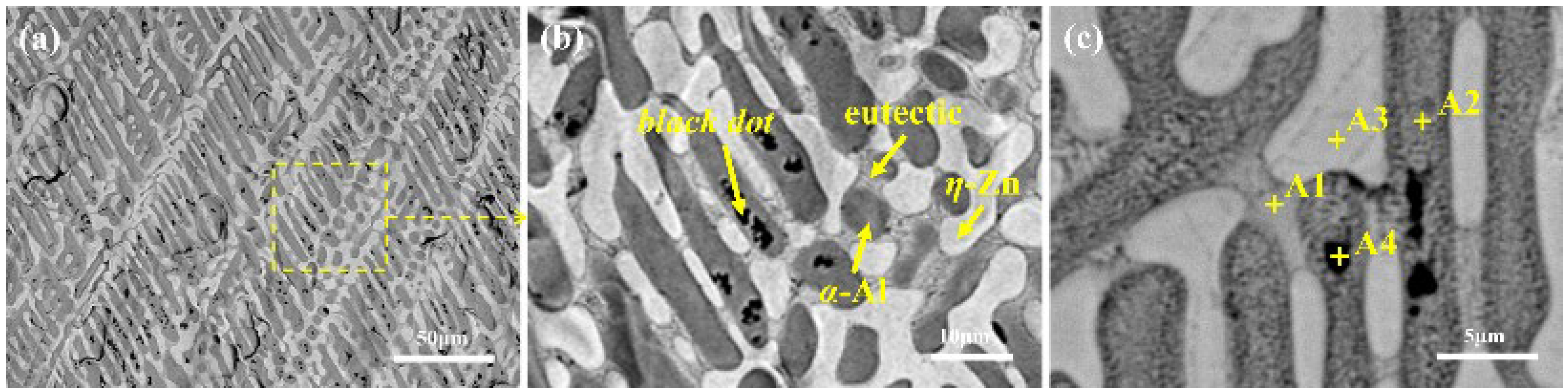
The surface morphology of the initial Zn–14Al–0.5Mg coating is shown in Figure 1. The related EDS results are listed in Table 2. It should be noted that due to the limitations of the EDS, the O content can only be regarded as semi-quantitative. Nevertheless, use of an EDS is widely accepted for the qualitative or semi-quantitative analysis of corrosion products in coatings [26,27]. The gray region, containing 18.63 wt.% Al, is related to the α-Al phase. The light gray phase is η-Zn and contains more than 94% Zn content. Moreover, a small amount of eutectic structure, with a size of around 8 μm, exists between the dendrites of the η-Zn phase. The EDS results in Table 2 indicate that the eutectic region contains 5.7 wt.% Mg. That is to say, the added Mg exists in the coating in the form of a eutectic structure. As clearly shown in Figure 1, the surface structure of the initial Zn–14Al–0.5Mg coating contains densely packed dendritic α-Al phases, the η-Zn phase, and a small amount of eutectic structure. Notably, some black dots are observed in the center of some α-Al phases. It is generally easy to be considered as a dirty substance. The EDS results in Table 2 show that the black dot A4 contains 11.18 wt.% O and 24.94 wt.% Al, which is significantly higher than that in the normal α-Al phase (point A2). This proved that the black dots are the corroded region.
Table 2. EDS results of the points in Figure 1 and Figure 2, which relate to the coating after storing in an office environment for 20 months.
PositionsSamplesDetected Composition (wt.%)
OMg AlFeZn
EDS A1Initial surface1.455.702.742.4487.67
EDS A20.850.7918.632.4177.32
EDS A31.700.241.252.4194.41
EDS A411.180.8024.942.2860.80
EDS B1Coating surface, after 20 months of storage4.344.615.372.4683.22
EDS B21.480.2620.852.9274.50
EDS B33.190.201.962.3092.35
EDS B430.730.2938.411.4629.11
EDS B51.760.770.673.0293.77
EDS C6Cross-sectional area, after 20 months of storage1.13-18.58-80.29
EDS C734.42-36.92-28.66
EDS C83.02-0.41-96.57
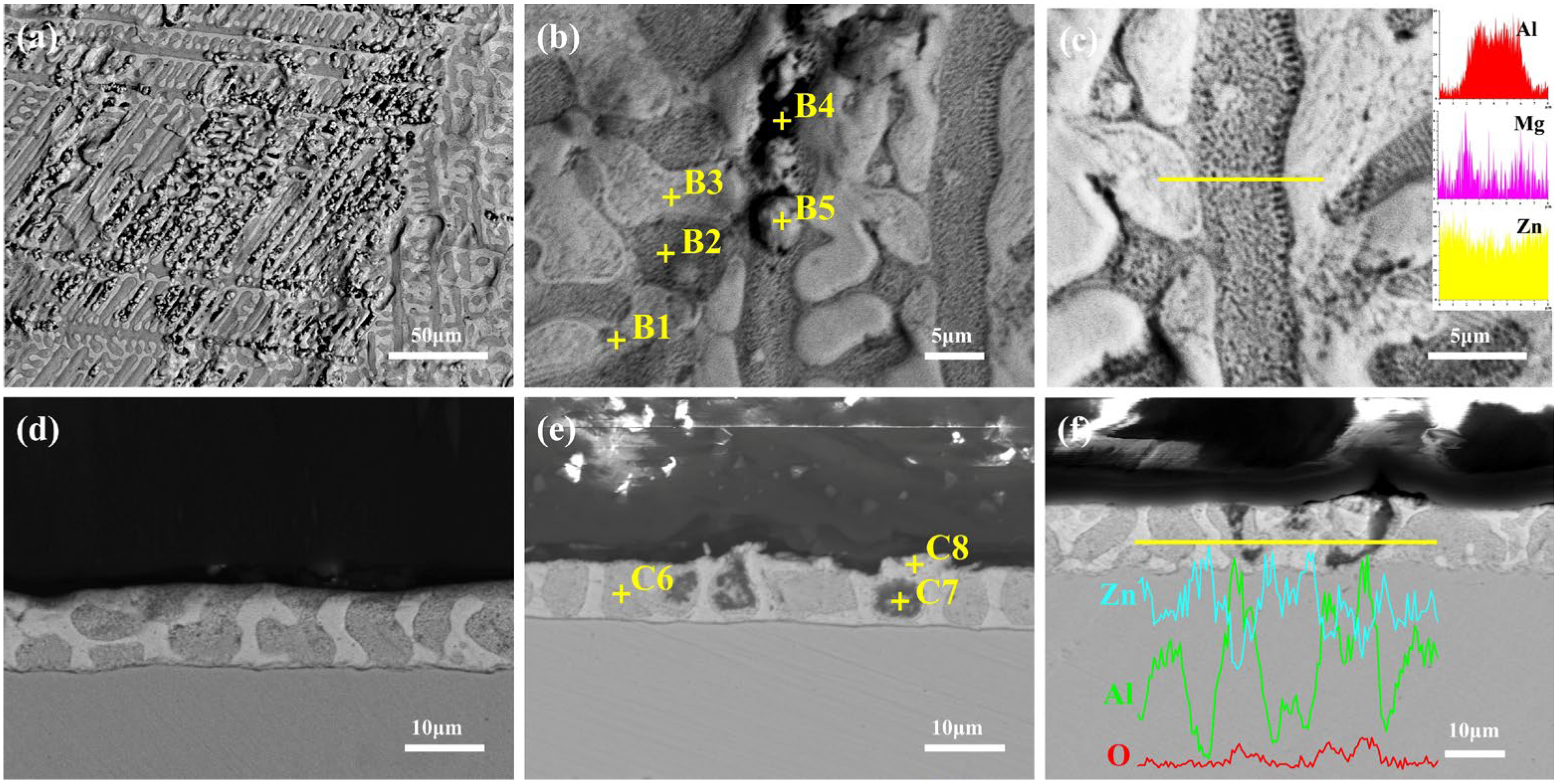
Figure 2. SEM images of the Zn–14Al–0.5Mg coating after storing in an office environment for 20 months. (a) Overall view of the surface; (b) preferentially corroded surface; (c) non-corroded surface; (d) cross-sectional of non-corroded region; (e) cross-sectional of the preferentially corroded region; (f) EDS line scan of the preferentially corroded cross-section.
Coatings 16 00693 g002

3.2. Surface Morphology of the Coating After 20 Months of Storage in an Office Environment

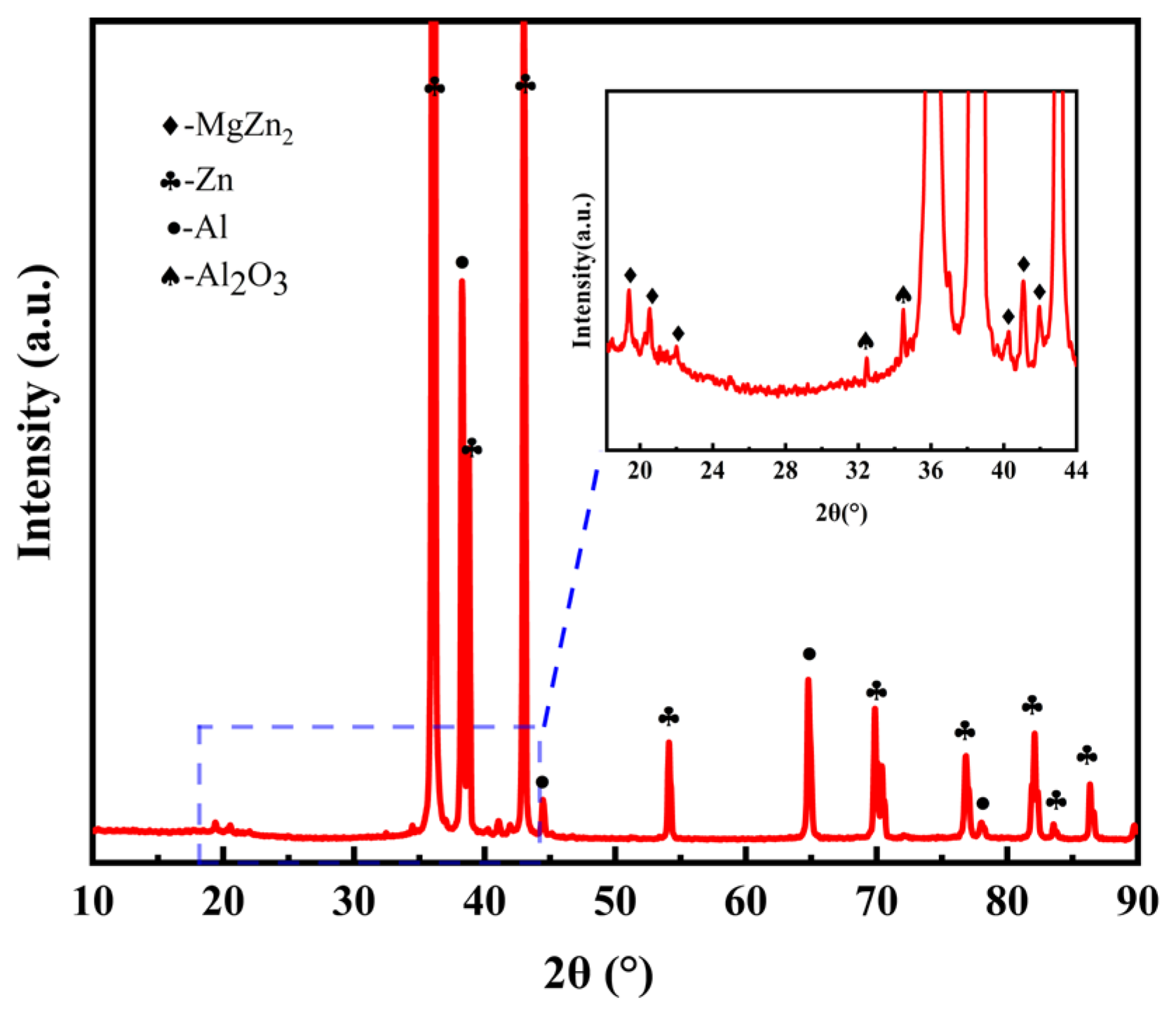
After storing in an office environment for 20 months, it was found that the surface morphology of the coating was greatly changed, as shown in Figure 2. A large area of granular protrusions was observed. The SEM image in Figure 2a reveals that the particulate matter is aggregated at the top of the α-Al phase, and the blackened area at the bottom resembles the black spots in the initial α-Al phase. The EDS result in Table 2 shows that the oxygen content in the blackened area of the α-Al phase reached a relatively high level, which indicates that the coating has been seriously corroded. The Zn content in the granular protrusions (point B5) is 93.77 wt.%. EDS line scanning of the non-corroded α-Al phase in Figure 2d reveals Mg enrichment at the boundary of the η-Zn phase, indicating the presence of a thin eutectic structure in this region. It was also found that the Al content in the center of α-Al dendrites is higher than at the edge region. The XRD pattern in Figure 3 shows that the major phases in the coating are η-Zn and α-Al. Moreover, some weak MgZn2 and Al2O3 peaks can be indexed. It is believed that the corrosion of the α-Al phase is indicated to have preferentially initiated from its central region and gradually spread across the entire phase. During this process, the remaining Zn will aggregate to form granular products. As for the EDS results in the cross-section of the coating, shown in Figure 2e, point C6 is non-corroded α-Al phase, and 1.13 wt.% O was detected in it. It needs to be noted that this small amount of O content is caused by the inaccuracy of the EDS in the quantitative analysis of oxygen. Point C8 is the η-Zn phase near the surface of the coating. Its composition is partly affected by the metallographic mounting resin; therefore, a little higher O content (3.02 wt.% O) was detected. Therefore, the O content in points C6 and C8 can be ignored. As for point C7, its Al content (36.92 wt.%) and O content (34.42 wt.%) are much higher than in points C6 and C8, although it is in the center of the coating. Figure 2f is another cross-section of the coating and the related EDS line scan results. The extending path of the corrosion product and the variation in the composition of the different phase are clear. That is to say, the corrosion of the coating mainly extends from the preferentially corroded regions in the α-Al phase along the α-Al dendrites into the coating.
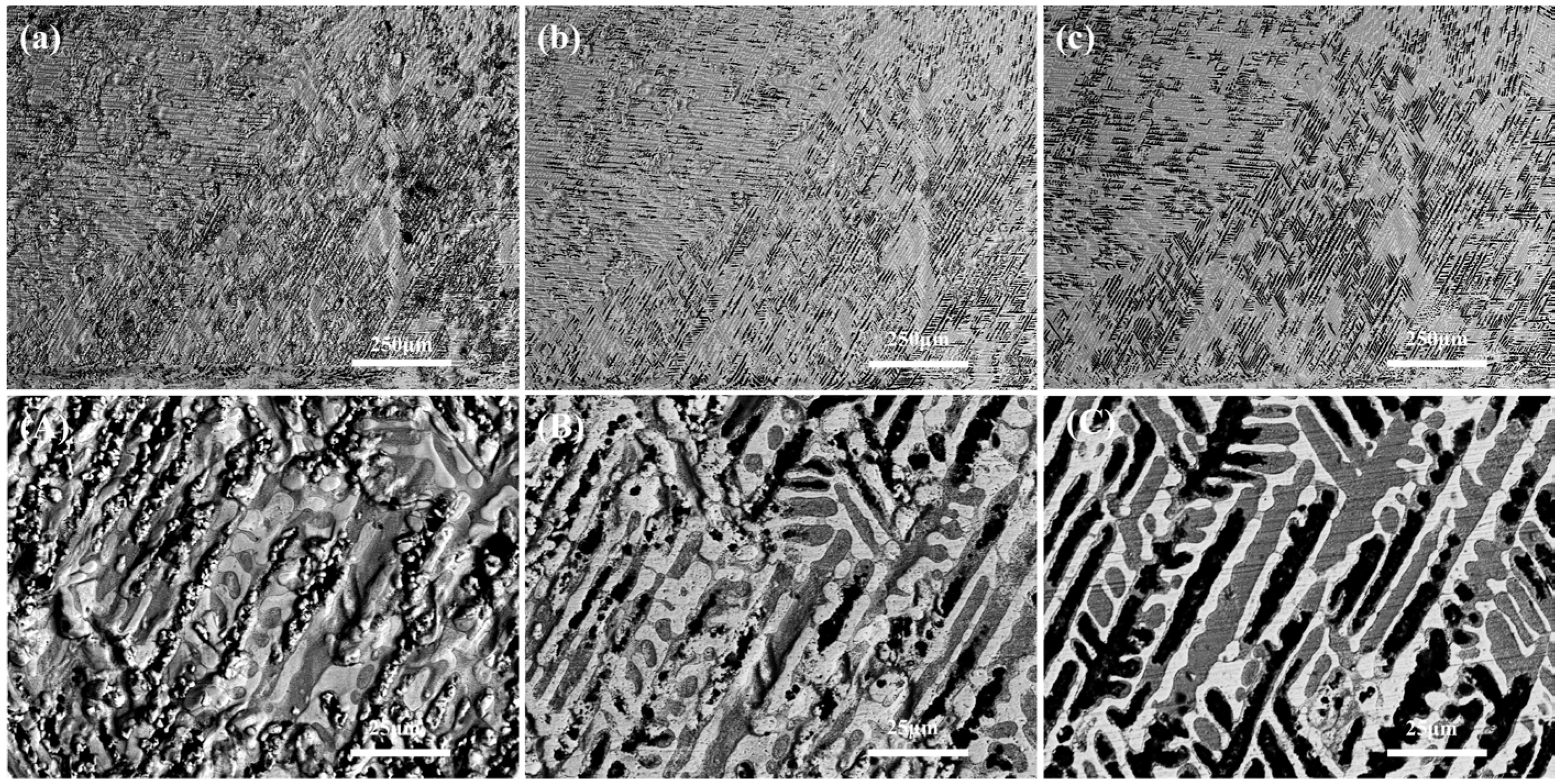
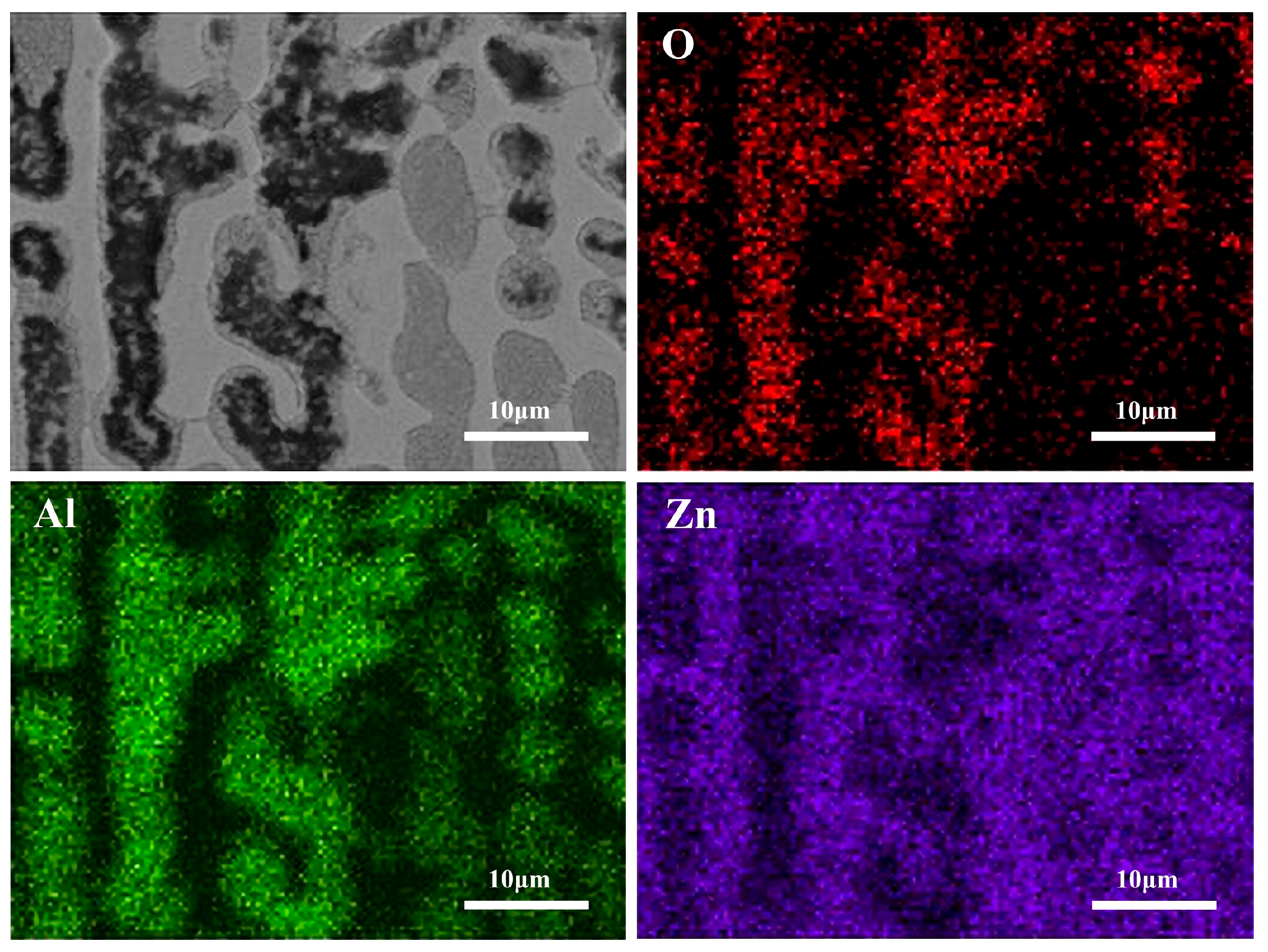
To visualize the corrosion morphology of the coating at different depths, the Zn–14Al–0.5Mg coating after storing in an office environment for 20 months was polished for difference depths and examined using an SEM. Figure 4a–c are related to the morphologies of the unpolished, the first polished, and the second polished surfaces in the same region, respectively. The enlarged images in Figure 4A–C clearly show the coating microstructure. After the first polishing, most of the granular protrusions are removed, and some black corrosion product in the α-Al dendrites can be observed, as shown in Figure 4b,B. With the increase in the polishing depth, the black corrosion product becomes much clear after the second polishing, as shown in Figure 4c,C. This is because the η-Zn phase in the outside of the corrosion product has been removed. These results agree well with the cross-section morphology of the coating in Figure 2e and confirm that the corrosion of the coating extends along the α-Al dendrites into the coating, with corrosion layer by layer. To clearly illustrate the distribution of various elements, an EDS mapping analysis of the first polishing coating was conducted, and the results are presented in Figure 5. It is clear that the corrosion product (black region) is rich in Al and O, and its Al content is much higher than that in the uncorroded α-Al phase. These agree well with the EDS line scan result in Figure 2f. Moreover, in the non-corroded region, there is no O content difference in the α-Al and η-Zn phases.

3.3. Electrochemical Testing of the Coating After 20 Months of Storage in an Office Environment

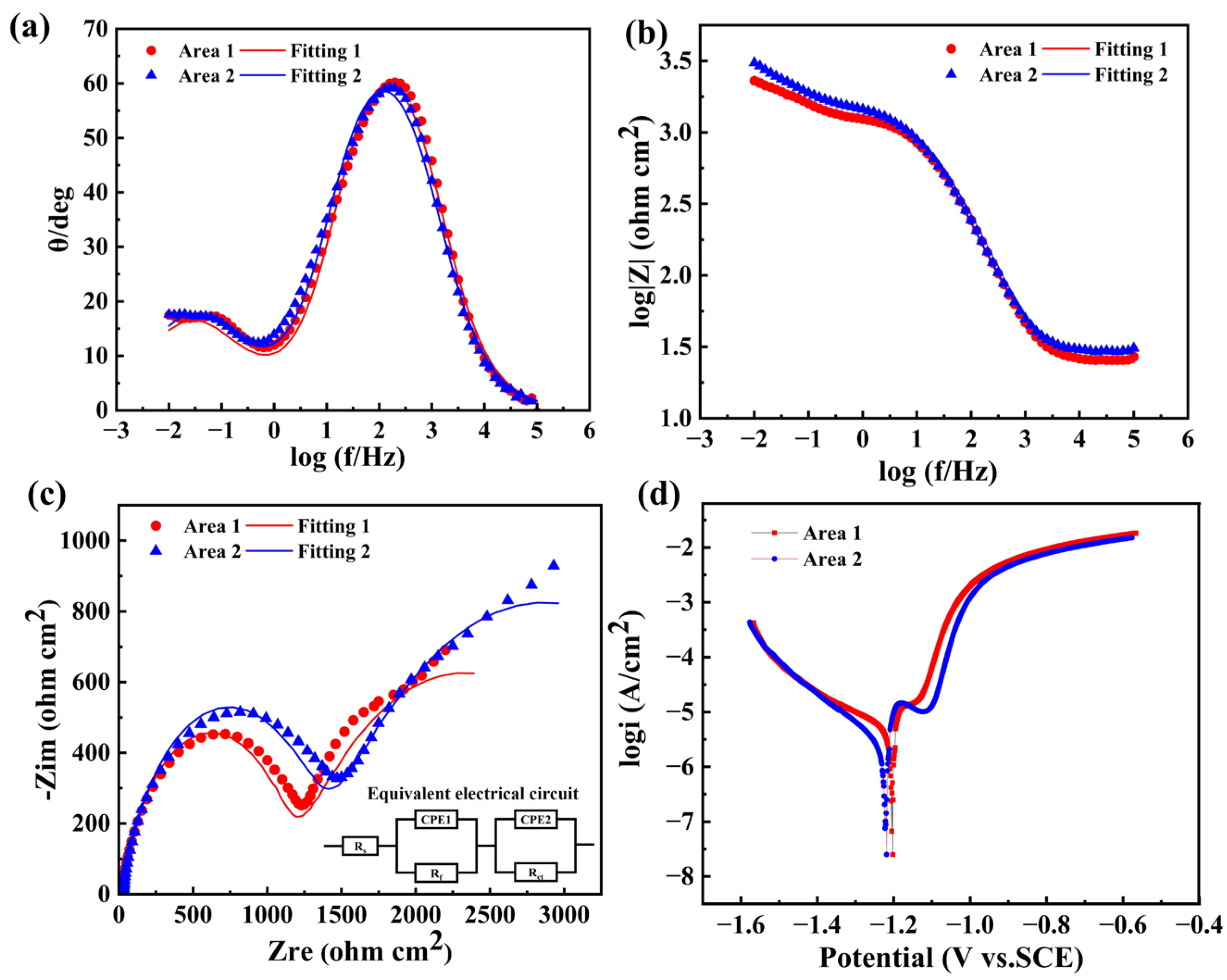
After 20 months of storage in an office environment, the surface of the coated steel sheet underwent significant changes, resulting in different electrochemical responses at different locations on the same specimen. As shown in Figure 6a, the Bode phase-angle plots of Area 1 and Area 2 do not exhibit a single sharp phase-angle peak but instead show broadened phase responses, indicating non-ideal capacitive behavior of the corroded coating surface. Such CPE behavior is generally associated with surface heterogeneity, roughness, and porosity and can essentially be interpreted as a distribution of interfacial time constants [28]. Meanwhile, the overall shapes of the two phase-angle curves are similar, suggesting that Area 1 and Area 2 have similar basic electrochemical reaction characteristics. Therefore, the localized corrosion of the α-Al phase does not fundamentally alter the corrosion system of the Zn–14Al–0.5Mg coating. Similar features have also been reported for zinc-based coatings and Zn–Al–Mg alloys [14,29].
From the viewpoint of impedance modulus, as shown in Figure 6b, the overall impedance moduli of Area 1 and Area 2 are close to each other. In the Nyquist plots shown in Figure 6c, two capacitive responses can be observed, indicating that the corrosion system involves two main electrochemical processes. For the Zn–14Al–0.5Mg coating, these two processes can be assigned to the response of the surface film/corrosion product layer and the charge-transfer process at the coating/electrolyte interface, respectively. Therefore, it is reasonable to use an equivalent electrical circuit in which the film resistance and the interfacial charge-transfer resistance are connected in series with the solution resistance. In this circuit, Rs represents the solution resistance, Rf represents the film resistance or corrosion product resistance, Rct represents the charge-transfer resistance at the coating/electrolyte interface, and CPE1 and CPE2 represent the non-ideal capacitive elements. In the Nyquist plots, Area 2 shows a larger capacitive arc radius. Combined with the fitted electrochemical parameters in Table 3, the Rf value of Area 2 is 3075 Ω·cm2, which is much higher than that of Area 1, at 1117 Ω·cm2. This indicates that the surface film or corrosion product layer in Area 2 provides a stronger barrier effect against electrolyte penetration, suggesting better protective performance of the film layer. The CPE2 value of Area 1 is 213.4 × 10⁻⁵ Ω−1⋅cm−2⋅sn, which is much higher than that of Area 2, at 2.25 × 10⁻⁵ Ω−1⋅cm−2⋅sn. Meanwhile, the n2 value of Area 1 is 0.61, lower than that of Area 2, which is 0.82. These results indicate that Area 1 has a rougher and more heterogeneous corrosion interface [30].
These electrochemical features are consistent with the SEM/EDS observations shown in Figure 2. Area 1 is more likely to correspond to a region with more severe corrosion. The coexistence of the corroded α-Al phase, Zn-rich particles, and uncorroded phases increases the real electrochemically active area and enhances the complexity of the interface, leading to the significant increase in CPE2 and the decrease in n2. In contrast, Area 2 can be regarded as a region with less severe corrosion, where the oxide film or corrosion product layer exhibits a stronger shielding/barrier effect and the coating interface is relatively more uniform. It can also be seen from Table 3 that the charge-transfer resistance Rct of Area 1 is higher than that of Area 2. This may be attributed to the partial blockage of electrolyte transport and charge-transfer pathways by Zn-rich particles generated during preferential corrosion and corrosion products formed during the electrochemical process, resulting in an increased apparent Rct value [31]. Based on the EIS results, the overall protective performance of Area 2 is better than that of Area 1. The polarization curves in Figure 6d also support this interpretation. Although the corrosion potentials of Area 1 and Area 2 are both around −1.2 V, specifically −1.202 V and −1.219 V, respectively, the difference in corrosion potential is small. However, the anodic polarization branch of Area 2 shows more pronounced passivation behavior, indicating a stronger inhibiting/barrier effect of the surface film or corrosion product layer in Area 2. Since the anodic branch in Figure 6d exhibits passivation characteristics, conventional two-branch Tafel extrapolation may introduce considerable errors. Therefore, Icorr was not forcibly fitted in this study [32].
Overall, the electrochemical results indicate that random selective corrosion of the α-Al dendrites on the coated steel surface weakens the protective effect of the oxide film formed on the α-Al dendrites, thereby reducing the corrosion resistance of the coating.

3.4. Surface Morphology of the Coating After the Accelerated Corrosion Test

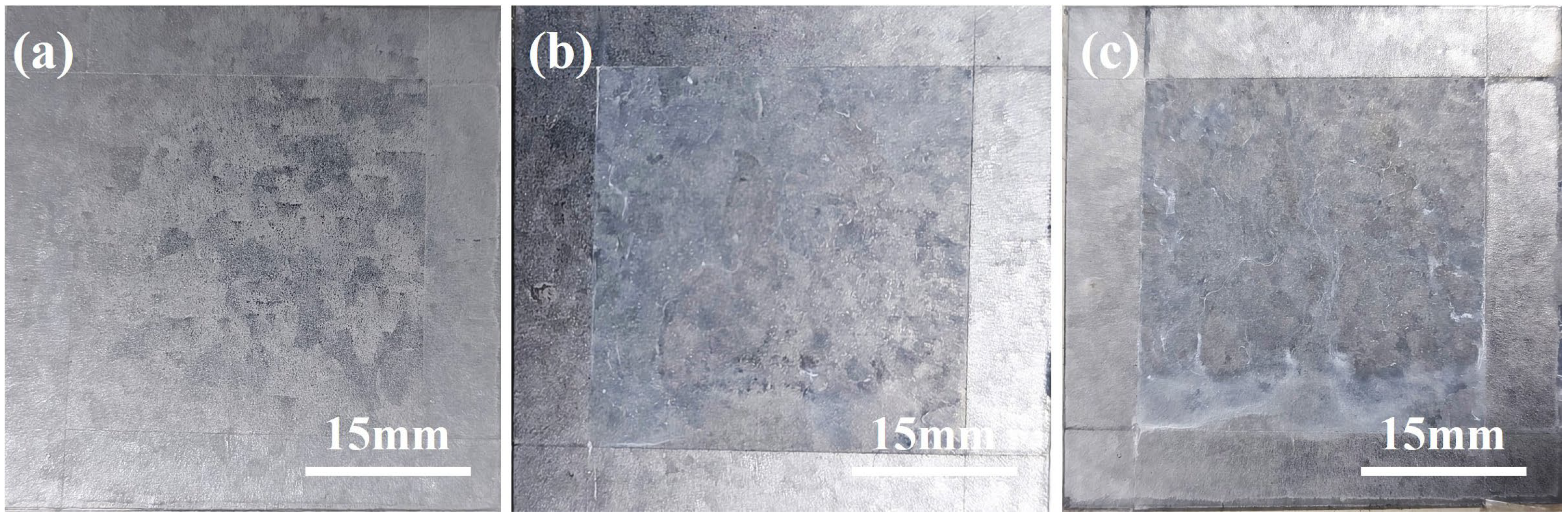
To further investigate the corrosion behavior of the α-Al dendrites, the Zn–14Al–0.5Mg-coated steel sheets, which were stored in an office environment for 20 months, further underwent accelerated corrosion under a salt spray condition. It was found that a thicker corrosion product layer formed on Zn–6Al–3Mg after 120 h of exposure [26], whereas blocky corrosion products were observed on Zn–12Al–5Mg after 168 h of immersion [12]. Since the accelerated corrosion test was intended to investigate corrosion evolution rather than the ultimate corrosion resistance and the Mg content in the present Zn–14Al–0.5Mg coating was relatively low, the exposure times were set to 48 h and 130 h. The macrographs of the coating surface at the origin state, after exposure for 48 h and 130 h, are presented in Figure 7. After exposure for 48 h, alternating bright and dark bands of corrosion products appear on the surface. As the exposure time extends to 130 h, the proportion of dark areas significantly increases.
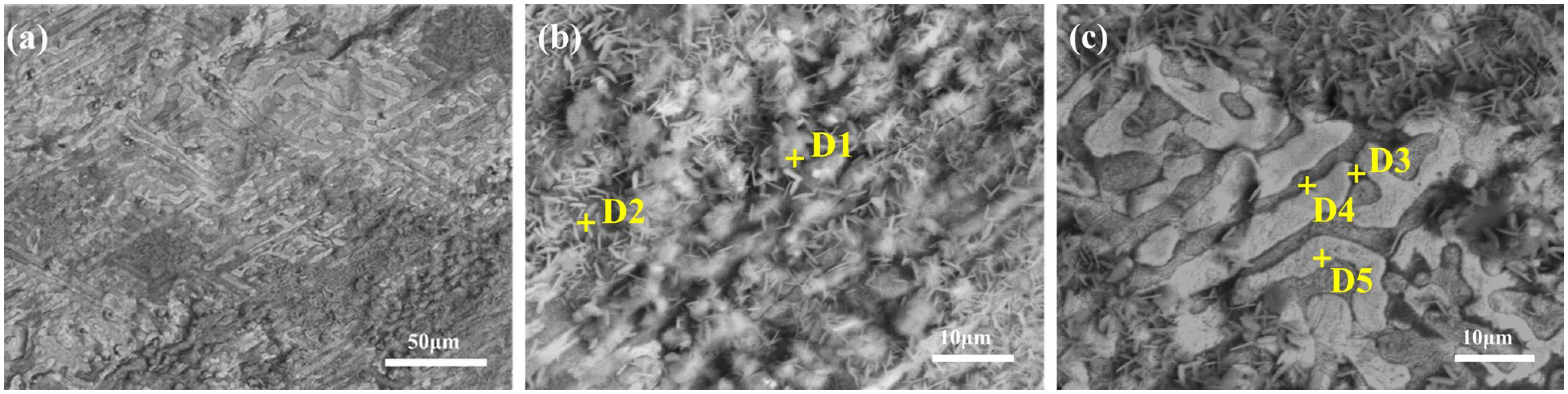
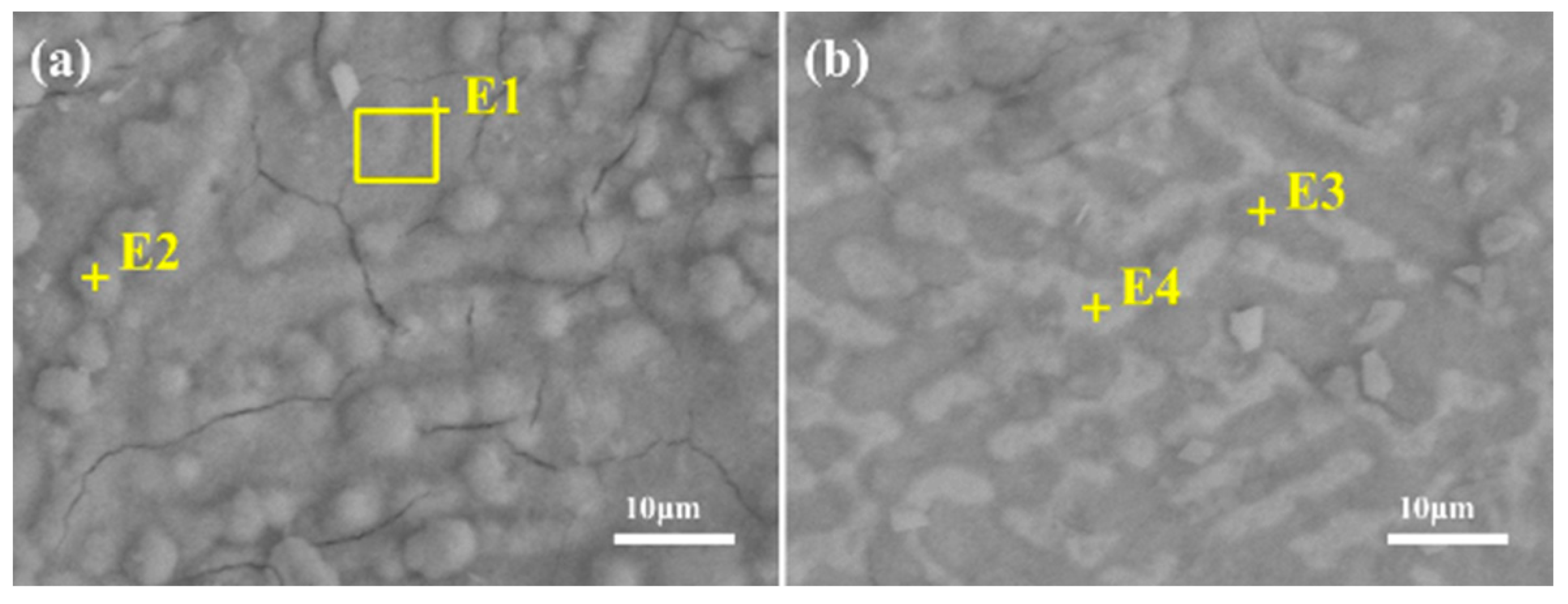
The surface morphology of the coating after exposure for 48 h is shown in Figure 8. The dark regions in Figure 8a correspond to the corroded regions of the α-Al phase, while the bright areas correspond to the slightly corroded regions. The surface morphologies of these two areas are quite different. The preferentially corroded area of the α-Al phase consists of gray granular corrosion products surrounded by flaky salt crystals. The EDS result in Table 4 shows that the O and Cl contents in this region significantly increased to 28.68 wt.% and 9.67 wt.% Cl in point D1, respectively. In contrast, the surface microstructural features of the non-corroded area of the α-Al phase are still discernible. Notably, the boundary region of the α-Al phase in Figure 8c becomes gray, which exhibits higher O, Cl, and Mg contents. The Mg content is highest in point D5, reaching 1.82 wt.%, which suggests that corrosion preferentially occurs at the α-Al phase boundaries, particularly within the eutectic structure.
After exposure to the salt spray test for 130 h, severely corroded areas and relatively less corroded regions coexist on the coating surface. In Figure 9a, densely packed granular protrusions are observed on the corrosion product layer, and cracks are clearly visible. EDS results indicate that the gap has a higher O content than the particle area, suggesting a greater tendency for corrosion. In contrast, the coating microstructure remains visible in the area shown in Figure 9b. The increased O and Cl confirm that corrosion has occurred in this region (Table 5). These results indicate that the selective corroded areas of the α-Al phase tend to form a loose corrosion product layer that retains the original granular protrusion morphology.
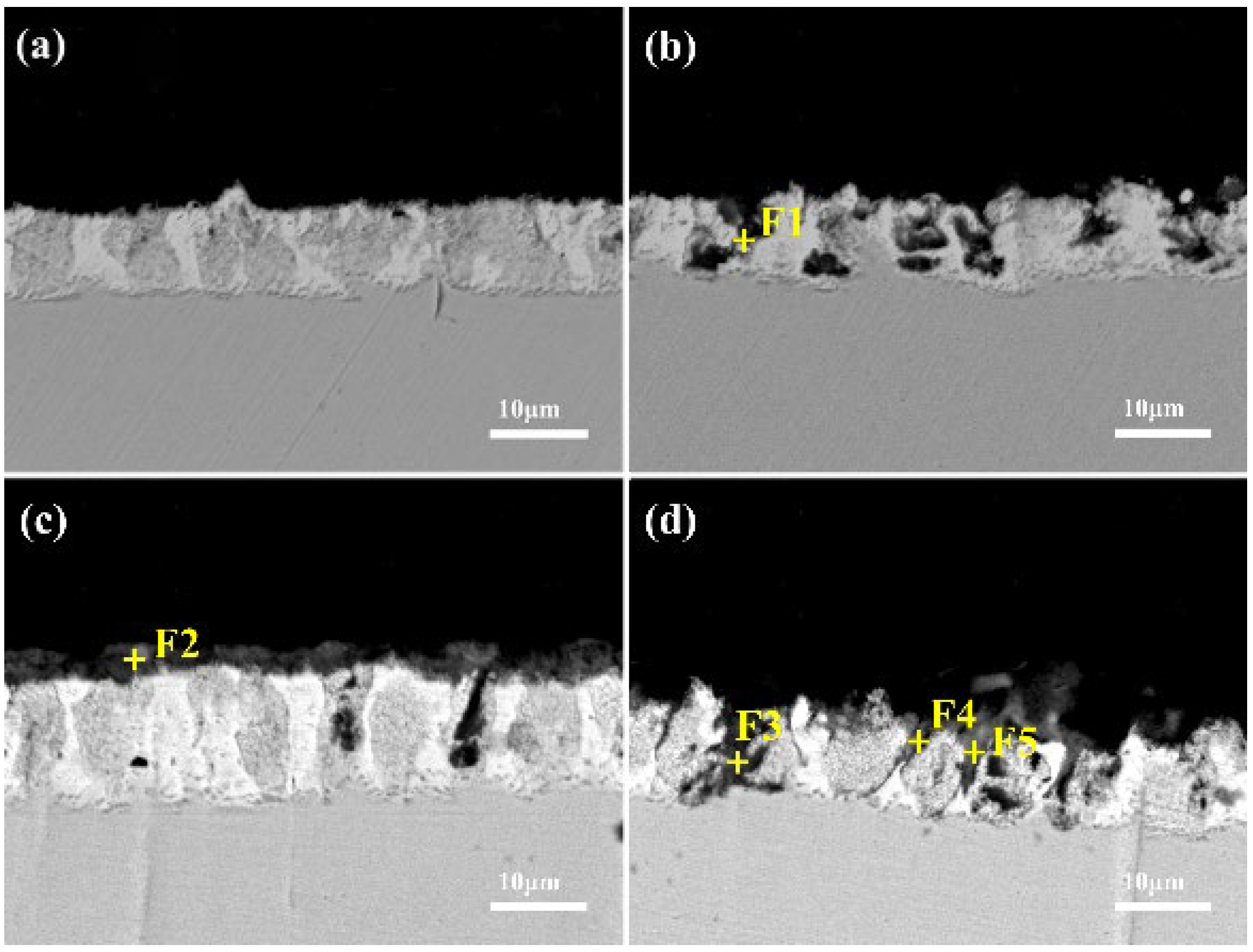
As can be seen from the cross-section of the exposed coating in Figure 10, the α-Al phase is seriously corroded, even extended to the steel substrate. After salt spray for 48 h, the coating microstructure in the non-corroded α-Al phase regions remains intact, and there is no significant corrosion product layer. This may be attributed to the presence of a very thin corrosion product layer or the absence of initial corrosion. In the corroded regions (Figure 10b), the α-Al phase is corroded much more seriously than that before exposure to the salt spray condition (Figure 2e). In point F1, 0.77 wt.% Cl was detected using an SEM-EDS (Table 6). After exposure to the salt spray condition for 130 h, a corrosion product layer formed on the surface of the non-corroded areas, while in the selective corroded areas, corrosion products preferentially accumulate around the α-Al phases. That is to say, in the selective corroded α-Al phase regions, corrosive species penetrate more readily inward, and corrosion products form through vertical accumulation. In contrast, uniform corrosion occurs in the not preferentially corroded α-Al phase regions, where corrosion products grow primarily through lateral spreading.
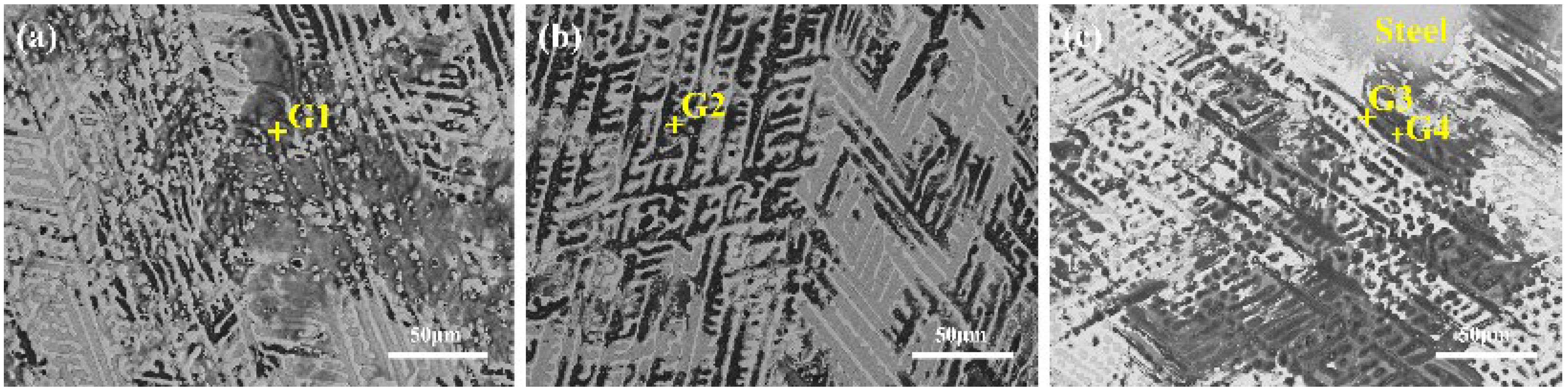
To clearly show the corrosion morphology of the coating at different depths, the Zn–14Al–0.5Mg coatings, which were exposed to the salt spray condition for 48 h, were sloped polished. SEM images of the near-surface region, mid-thickness region, and near-substrate region are presented in Figure 11. Near the coating surface (Figure 11a), there are some granular protrusions. Among these regions, taking point G1 as an example, a relatively high O content and 0.18 wt.% Cl can be detected. That is to say, the areas with granular protrusions can more easily be further corroded. Moreover, some black corrosion products in the α-Al dendrites can also be observed. In the half-thickness section (Figure 11b), the area fraction of the black corrosion products is greatly increased. As pointed out above, this is because the η-Zn phase on the outside of the corrosion products has been removed. The EDS result in Table 7 shows that the dark corrosion products (point G2) contain a relatively high O content and 4.34 wt.% Cl. The high Cl content is caused by congregating Cl along the corrosion path of the α-Al dendrites during salt spraying. Near the steel substrate, as shown in Figure 11c, large areas of the coating have also been corroded. Compared to the coating structure in Figure 4c, the coating near the steel substrate is more severely corroded. And 1.43~3.44 wt.% Cl can be detected in the points G3 and G4.

4. Discussion

4.1. The Reason for Selective Corrosion in the α-Al Dendrites

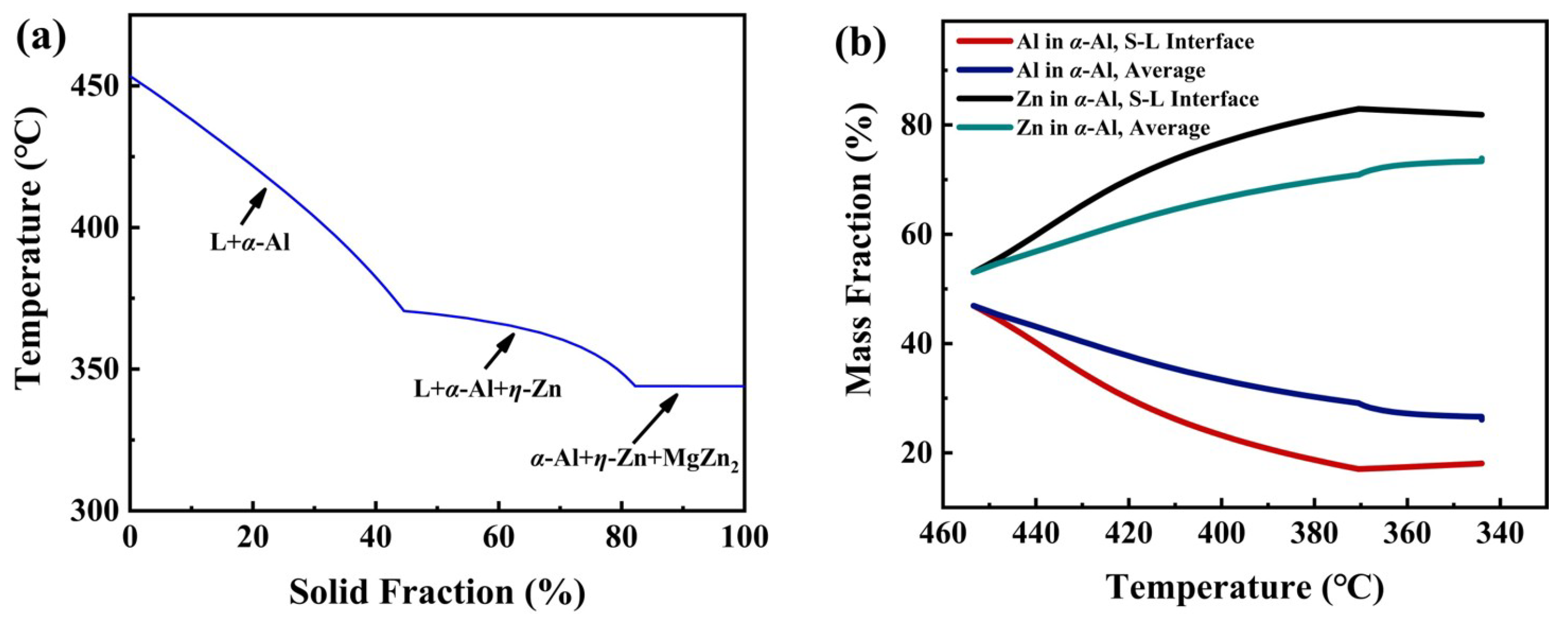
As pointed above, selective corrosion preferentially occurs in the center of the α-Al dendrites in the Zn–14Al–0.5Mg coating. This selective corrosion manifests as dispersed black spots with high oxygen content. Even for the coating stored in an office environment, the corrosion depth gradually increases along the α-Al dendrites. During corrosion progress, the corrosion products primarily consume Al, and the remaining Zn will gather to form Zn particles. It is well known that in the Zn–Al–Mg coating, the Al content in the α-Al dendrites is 18~21 wt.%. During solidification of the moderate-aluminum Zn–Al–Mg coating, the α-Al phase forms preferentially, followed by the precipitation of the η-Zn phase and the formation of the eutectic structure. The thermodynamic calculated results in Figure 12a confirm that this solidification process is also suited for the Zn–14Al–0.5Mg coating. It needs to be pointed out that Mg2Zn11 is suspended in the thermodynamic calculation because the metastable MgZn2, but not Mg2Zn11, exists in the eutectic structure because of the high cooling rate of the coating [33].
The compositional variations in the α-Al phase exert a significant influence on its selective corrosion behavior. Figure 12b shows the thermodynamically calculated variation in the Al and Zn contents in the α-Al phase with the temperature. It is clear that the Al content in the α-Al phase is the highest (47.6 wt.%) when the α-Al phase initially precipitates in the liquid phase at 450 °C. During solidification, Zn and Al segregate within the α-Al phase, which results in a discrepancy between the composition at the solid–liquid interface and the average composition of Zn–14Al–0.5Mg. As the temperature decreases, the α-Al phase continuously precipitates from the liquid phase through a homogenization reaction, and the Al content in the later solidified α-Al phase continuously decreases. As can be seen in Figure 12b, the average Al content in the α-Al phase remains consistently higher than that at the solid–liquid interface. Therefore, a compositional difference exists between the center and the edge of the α-Al phase.
Based on the present experimental results, it can be concluded that the precipitation of η-Zn is suppressed during the growth of the α-Al phase in the Zn–14Al–0.5Mg coating, resulting in a higher Al content in the α-Al dendrite center. Aluminum oxide forms even at very low Al contents. Adding ~0.004% Al to the zinc bath can form a protective film, making the coating surface brighter. But the α-Al dendrite in the Zn–Al–Mg coating is different from that in a liquid bath: the dendrite forms during solidification, and a eutectoid reaction occurs during cooling. In addition, the Al-rich dendrites in Zn–Al–Mg coatings are not chemically homogeneous but usually contain Zn-rich and Al-rich substructures. Under such conditions, the surface film formed on α-Al dendrites is more reasonably regarded as a ZnO/Al2O3 composite oxide film rather than a pure Al2O3 film [17,18], and its local protectiveness may therefore be relatively limited under atmospheric exposure. Moreover, the microstructural constituents may introduce local differences in electrochemical activity, leading to micro-galvanic coupling and increasing the susceptibility to localized corrosion [34]. As shown in Figure 12, the composition of the α-Al phase varied with the temperature. A large electrode potential difference between the two phases will prevent the formation of a protective passivation film in the α-Al dendritic phase. Even in the office condition, the protectiveness of the local surface film may be weakened. When the α-Al dendrites are directly exposed to the atmosphere, Al acts as the anode for its lower electrode potential. The potential difference between the dendrite center and the edges leads to the formation of a micro-galvanic cell. The center of the dendrite, which contains higher Al content, is preferentially corroded and forms tiny black spots. As corrosion intensifies, these black spots gradually expand, while metallic Zn precipitates within the dendrite core. Although previous studies have reported that the initial corrosion product of Zn in atmospheric environments is ZnO [35,36], this study did not observe any evidence of corrosion in the η-Zn phase. In contrast, the α-Al dendrites exhibit higher corrosion susceptibility. This indicates that due to elemental segregation, some Al-rich dendrites are more prone to erosion and damage. At the same time, the corrosion behavior of α-Al dendrites may also be influenced by the internal distribution of Zn and Al within the dendrites, the potential difference between different interdendritic phases, as well as by the local alkaline environment associated with Mg, which may further promote preferential attack at the dendrite area [37,38,39]. Conversely, the absence of obvious selective corrosion in other α-Al dendrites may be attributed to residual oil films on the panel surface, which slow the decomposition of the oxide film.

4.2. Corrosion Behavior of Selective Corroded α-Al Regions in the Zn–14Al–0.5Mg Coating During Salt Spraying

In the accelerated corrosion test, the selective corroded and not preferentially corroded regions have different corrosion rates. This trend is also consistent with the electrochemical results. The selective corroded α-Al dendritic regions showed a more heterogeneous interfacial response, whereas the less-corroded regions exhibited a stronger barrier effect of the surface film or corrosion products, indicating that pre-existing selective corroded regions facilitate Cl penetration and inward corrosion propagation. The corrosion rate markedly increases in the areas where selective corroded points have been existed. Cl could more readily penetrate into the corroded dendrites, where Zn2+ within the α-Al phase continuously combines with Cl [40]. The loss of Zn from the α-Al phase leads to a significant increase in Al content within the dendrites. Consequently, the Al framework fails to protect the coating and instead enhances the compositional difference at the α-Al phase boundaries. This accelerates preferential corrosion of the Zn phase at the boundaries, continuously generating chlorine-rich corrosion products.
In contrast, within the non-corroded regions, the absence of obvious local penetration paths in the non-pitting corroded regions allows for corrosion products to form more uniformly on the coating surface, which may help slow down the overall corrosion process. As a result, these regions exhibit a relatively lower corrosion rate during salt spray exposure. Therefore, for coating development, the formation of coarse and continuous α-Al dendrites should be suppressed, while a more homogeneous microstructure with a higher fraction of fine Zn/Al/MgZn2 ternary eutectic structure should be promoted.

5. Conclusions

(1) The Zn–14Al–0.5Mg coatings are mainly composed of very developed α-Al dendrites. The η-Zn phase and small amount of Zn–Al–Mg ternary eutectic structure exist between the α-Al dendrite. The addition of 0.5% Mg into the coating exists in the form of ternary eutectic structure.
(2) Selective corrosion points are easily formed in the center of the α-Al dendrite in the Zn–14Al–0.5Mg coating, even it is just off the galvanizing line.
(3) Corrosion quickly expends into the coating along the α-Al dendrite after storing in an office environment. The Al phase is greatly consumed during corrosion. The residual η-Zn covered the corrosion products and led to formation of granular protrusions. Electrochemical results revealed spatial heterogeneity in the corrosion resistance of the coating surface, which was associated with the locally different corrosion states of the α-Al dendritic regions.
(4) Under the salt spray condition, the selective corroded α-Al phase provides rapid diffusion channels for Cl and can greatly accelerate the corrosion of the coating.
(5) The selective corrosion of the α-Al dendrite is caused by the composition difference of the α-Al dendrite. The Al content in the center of the α-Al dendrite is around 18%, which is higher than the edge region, and cannot form an effective passivation film. Once selective corrosion occurs, it will gradually worsen and penetrate deeper.

Author Contributions

Y.H.: Writing—original draft, Data curation, Investigation, and Formal analysis. Y.L.: Writing—review and editing and Formal analysis. B.D.: Formal analysis and review and editing; X.Z.: Formal analysis and Data curation; C.W.: Methodology, Formal analysis, Writing—review and editing, Supervision, Project administration, and Funding acquisition. All authors have read and agreed to the published version of the manuscript.

Funding

This study was funded by the National Natural Science Foundation of China (No. 52271005).

Institutional Review Board Statement

Not applicable.

Informed Consent Statement

Not applicable.

Data Availability Statement

Data are available upon request from the authors.

Conflicts of Interest

Author Bin Dong was employed by the company Chongqing CISDI Thermal & Environmental Engineering Co., Ltd. The remaining authors declare that the research was conducted in the absence of any commercial or financial relationships that could be construed as potential conflicts of interest.

References

  1. Shibli, S.M.A.; Meena, B.N.; Remya, R. A review on recent approaches in the field of hot dip zinc galvanizing process. Surf. Coat. Technol. 2015, 262, 210–215. [Google Scholar] [CrossRef]
  2. Zhang, G.Q.; Song, R.B.; Liu, J.Y.; Zhao, S.; Cai, C.H. Effect of Mg content on structure and corrosion behavior of novel hot-dip Al-Zn-Si-Re-Mg coatings. Mater. Lett. 2022, 328, 133098. [Google Scholar] [CrossRef]
  3. Prosek, T.; Nazarov, A.; Goodwin, F.; Šerák, J.; Thierry, D. Improving corrosion stability of Zn–Al–Mg by alloying for protection of car bodies. Surf. Coat. Technol. 2016, 306, 439–447. [Google Scholar] [CrossRef]
  4. Xie, Y.X.; Jin, X.Y.; Wang, L. Development and application of hot-dip galvanized zinc-aluminum-magnesium coating. J. Iron Steel Res. 2017, 29, 167–174. [Google Scholar] [CrossRef]
  5. Yao, S.; Tian, G.; Ma, X.J.; Zhao, H.; Yan, L.; Zhao, A.M. Research status of hot-dip galvanized Zn–Al–Mg sheet. J. Iron Steel Res. 2023, 35, 1451–1462. [Google Scholar] [CrossRef]
  6. Truglas, T.; Duchoslav, J.; Riener, C.; Arndt, M.; Commenda, C.; Stifter, D.; Angeli, G.; Groiss, H. Correlative characterization of Zn–Al–Mg coatings by electron microscopy and FIB tomography. Mater. Charact. 2020, 166, 110407. [Google Scholar] [CrossRef]
  7. Cui, G.B.; Ju, X.H.; Yan, C.L.; Ma, Z.J. Microstructure characterization of hot-dip Zn–Al–Mg coating of low alloy high strength steel. Iron Steel 2023, 58, 153–160. [Google Scholar] [CrossRef]
  8. Salgueiro Azevedo, M.; Allély, C.; Ogle, K.; Volovitch, P. Corrosion mechanisms of Zn(Mg,Al) coated steel: 2. The effect of Mg and Al alloying on the formation and properties of corrosion products in different electrolytes. Corros. Sci. 2015, 90, 482–490. [Google Scholar] [CrossRef]
  9. Yao, C.Z.; Lv, H.B.; Zhu, T.P.; Zheng, W.G.; Yuan, X.D.; Gao, W. Effect of Mg content on microstructure and corrosion behavior of hot dipped Zn–Al–Mg coatings. J. Alloys Compd. 2016, 670, 239–248. [Google Scholar] [CrossRef]
  10. LeBozec, N.; Thierry, D.; Persson, D.; Riener, C.K.; Luckeneder, G. Influence of microstructure of zinc-aluminium-magnesium alloy coated steel on the corrosion behavior in outdoor marine atmosphere. Surf. Coat. Technol. 2019, 374, 897–909. [Google Scholar] [CrossRef]
  11. He, X.; Zhou, X.; Shang, T.; Liu, W.H.; Jiang, G.R.; Liu, C.; Chen, X.Q.; Zhang, X.; Li, X.G. Influence mechanism of different elements and alloy phases on the corrosion resistance of Zn–Al–Mg coated steel in the atmospheric environment: A review. Corros. Commun. 2024, 13, 49–59. [Google Scholar] [CrossRef]
  12. Zou, J.G.; Lu, L. Research progress on relationship between alloy phase and corrosion resistance in Zn–Al–Mg coating. Chin. J. Nonferr. Met. 2022, 32, 1934–1944. [Google Scholar] [CrossRef]
  13. Lee, S.-G.; Park, G.-D.; Kim, H.-J.; Kim, S.-J.; Lee, M.-H. Mechanisms of high corrosion resistance of Zn-12Al-5Mg alloy coatings prepared using Al/MgZn2 eutectic reaction. J. Alloys Compd. 2025, 1025, 180317. [Google Scholar] [CrossRef]
  14. Han, D.; Zheng, Z.Y.; Wang, J.L.; Du, A.; Ma, R.N.; Fan, Y.Z.; Zhao, X.; Cao, X.M. Study on the microstructure and corrosion resistance of Zn-3Al-xMg alloy. Surf. Coat. Technol. 2023, 473, 130011. [Google Scholar] [CrossRef]
  15. Schuerc, S.; Fleischanderl, M.; Luckeneder, G.H.; Preis, K.; Haunschmied, T.; Mori, G.; Kneissl, A.C. Corrosion behaviour of Zn–Al–Mg coated steel sheet in sodium chloride-containing environment. Corros. Sci. 2009, 51, 2355–2363. [Google Scholar] [CrossRef]
  16. Han, D.; Wu, H.Y.; Zheng, Z.Y.; Zhang, H.L.; Du, A.; Ma, R.N.; Fan, Y.Z.; Zhao, X.; Cao, X.M. Interfacial structure and corrosion resistance of Zn-3Al-3Mg coatings by hot-dip with a novel process. J. Alloys Compd. 2024, 1005, 176235. [Google Scholar] [CrossRef]
  17. Wang, S.X.; Zhou, W.L.; Chen, S.L.; Ma, R.N.; Du, A.; Zhao, X.; Fan, Y.Z.; Li, G.L. Study on corrosion behavior II of hot-dipped Zn-6Al-3Mg alloy coating: Surface oxide layer and ternary eutectic corrosion. J. Alloys Compd. 2024, 1008, 176534. [Google Scholar] [CrossRef]
  18. Wang, S.X.; Ma, X.H.; Bai, J.T.; Niu, J.; Ma, R.N.; Du, A.; Zhao, X.; Fan, Y.Z.; Li, G.L. Study on the structure and corrosion behavior of hot-dipped Zn-6Al-3Mg alloy coating in chlorine-containing environment. Corros. Sci. 2024, 231, 112001. [Google Scholar] [CrossRef]
  19. Du, X.; Zhang, M.C.; Duan, S.C.; Xu, R.X.; Zou, M.; Dong, S.W.; Guo, H.J.; Guo, J. Research status of high corrosion-resistant Zn–Al–Mg coating. Chin. J. Eng. 2019, 41, 847–856. [Google Scholar] [CrossRef]
  20. Chaouki, A.; Ben Ali, M.; El Maalam, K.; Aouadi, K.; Benabdallah, I.; El Fatimy, A.; Naamane, S. Optimizing corrosion protection: Performance comparison of Zn and Zn–Al–Mg alloys Hot-Dip galvanized coatings. J. Alloys Compd. 2024, 1007, 176371. [Google Scholar] [CrossRef]
  21. ISO 8353-2024; Steel Sheet, Zinc-Aluminium-Magnesium Alloy-Coated by the Continuous Hot-Dip Process, of Commercial, Drawing and Structural Qualities. The International Organization for Standardization: Geneva, Switzerland, 2024.
  22. ISO 9227-2022; Corrosion Tests in Artificial Atmospheres—Salt Spray Tests. The International Organization for Standardization: Geneva, Switzerland, 2022.
  23. Xu, M.; Han, D.; Zheng, Z.; Ma, R.; Du, A.; Fan, Y.; Zhao, X.; Cao, X. Effects of cooling rate on the microstructure and properties of hot-dipped Zn–Al–Mg coatings. Surf. Coat. Technol. 2022, 444, 128665. [Google Scholar] [CrossRef]
  24. Lee, J.-W.; Son, I.; Kim, S.J. Newly designed surface control using Si addition in trace quantity for Zn-2Al-3Mg alloy coated steel sheet with improved corrosion resistance. Appl. Surf. Sci. 2022, 598, 153868. [Google Scholar] [CrossRef]
  25. Chen, H.; Zhang, S.; Song, R.; Wang, X. Effect of bath temperature on the microstructure and electrochemical properties of (Si, Ti) micro-alloyed Zn-6Al-3Mg hot-dip coatings. Surf. Coat. Technol. 2025, 512, 132402. [Google Scholar] [CrossRef]
  26. Wang, S.X.; Ma, X.H.; Bai, J.T.; Du, T.T.; Ma, R.N.; Du, A.; Zhao, X.; Fan, Y.Z.; Li, G.L. Study of the corrosion behavior and mechanism of a hot-dipping Zn-6Al-3Mg alloy coating in 3.5 wt% neutral NaCl solution. Surf. Coat. Technol. 2023, 464, 129576. [Google Scholar] [CrossRef]
  27. Zhou, J.S.; Wang, Y.B.; Li, Y.K.; Xu, Z.B.; He, K.Z.; Wang, Z.D. Formation and Evolution of Corrosion Products on Eutectic Micro-structures: A Novel Study to Understand Corrosion Protection of Zn–Al–Mg Coatings. Mater. Corros. 2025, 76, 408–423. [Google Scholar] [CrossRef]
  28. Jorcin, J.-B.; Orazem, M.E.; Pébère, N.; Tribollet, B. CPE analysis by local electrochemical impedance spectroscopy. Electrochim. Acta. 2006, 51, 1473–1479. [Google Scholar] [CrossRef]
  29. Barranco, V.; Feliu, S., Jr.; Feliu, S. EIS study of the corrosion behaviour of zinc-based coatings on steel in quiescent 3% NaCl solution. Part 1: Directly exposed coatings. Corros. Sci. 2004, 46, 2203–2220. [Google Scholar] [CrossRef]
  30. Wang, S.; Guo, T.; Xu, G.; Ding, F. Corrosion behavior and mechanism of electric arc-sprayed Al-Mg coating and Zn–Al–Mg pseudo-alloy coatings. Surf. Coat. Technol. 2023, 475, 130126. [Google Scholar] [CrossRef]
  31. Singh, J.K.; Mandal, S.; Adnin, R.J.; Lee, H.-S.; Yang, H.-M. Role of coating processes on the corrosion kinetics and mechanism of zinc in artificial seawater. Materials 2021, 14, 7464. [Google Scholar] [CrossRef]
  32. Flitt, H.J.; Schweinsberg, D.P. Evaluation of corrosion rate from polarisation curves not exhibiting a Tafel region. Corros. Sci. 2005, 47, 3034–3052. [Google Scholar] [CrossRef]
  33. Honda, K.; Yamada, W.; Ushioda, K. Solidification structure of the coating layer on hot-dip Zn-11%Al-3%Mg-0.2%Si coated steel sheet. Mater. Trans. 2008, 49, 1395. [Google Scholar] [CrossRef]
  34. Mahdavi, M.; Bozorg, M. The impact of microstructural constituents on the corrosion performance of an Al-Zn-Mg-Cu aluminum alloy. J. Alloys Compd. 2025, 1042, 184019. [Google Scholar] [CrossRef]
  35. LeBozec, N.; Thierry, D.; Rohwerder, M.; Persson, D.; Luckeneder, G.; Luxem, L. Effect of carbon dioxide on the atmospheric corrosion of Zn-Mg-Al coated steel. Corros. Sci. 2013, 74, 379–386. [Google Scholar] [CrossRef]
  36. Katayama, H.; Kuroda, S. Long-term atmospheric corrosion properties of thermally sprayed Zn, Al and Zn-Al coatings exposed in a coastal area. Corros. Sci. 2013, 76, 35–41. [Google Scholar] [CrossRef]
  37. Laleh, M.; Jurak, T.; Gusieva, K.; Williams, J.; Renshaw, W.; Correnti, S.; Hodges, J.; Gazder, A.A. Corrosion morphology in Al-Zn-Mg-Si alloy coatings: Interdependence of microstructure heterogeneity and microstructure-induced local pH variations. Corros. Sci. 2026, 263, 113711. [Google Scholar] [CrossRef]
  38. Laleh, M.; Jurak, T.; Gusieva, K.; Williams, J.; Renshaw, W.; Correnti, S.; Hodges, J.; Gazder, A.A. New insights into corrosion initiation and propagation in a hot-dip Al-Zn-Mg-Si alloy coating via multiscale analytical microscopy. Corros. Sci. 2025, 245, 112695. [Google Scholar] [CrossRef]
  39. An, G.; Ma, Y.-Y.; Zhang, F.; Wen, C.; Zeng, R.-C. Intergranular corrosion of Zn–0.8 Mg alloy induced by anodic intermetallic compound Mg2Zn11 in 50-day immersion in Hanks’ solution with various glucose concentrations. Smart Mater. Manuf. 2026, 4, 100136. [Google Scholar] [CrossRef]
  40. Lamas, J.S.; Tacq, J.; Teerlinck, B. Assessing the potential of electrochemical techniques for monitoring pitting corrosion in carbon steel for offshore structures. Electrochim. Acta 2026, 563, 148721. [Google Scholar] [CrossRef]
Figure 1. Initial surface of the Zn–14Al–0.5Mg-coated steel sheet. (a) SEM image; (b) an enlarged region; (c) EDS points.
Coatings 16 00693 g001
Figure 3. XRD pattern of the Zn–14Al–0.5Mg coating after storing in an office environment for 20 months.
Coatings 16 00693 g003
Figure 4. SEM images at different depths of the same region after the samples were stored in an office environment for 20 months. (a,A) Before polishing; (b,B) after the first polishing; (c,C) after the second polishing.
Coatings 16 00693 g004
Figure 5. EDS mapping results of the first polished Zn–14Al–0.5Mg coating after storing in an office environment for 20 months.
Coatings 16 00693 g005
Figure 6. EIS results and polarization curve of the coating after 20 months of storage in an office environment. (a) Bode phase plots; (b) Bode magnitude plots; (c) Nyquist plots and EEC; (d) polarization curve plots.
Coatings 16 00693 g006
Figure 7. Macrographs of the coating surface before and after salt spray. (a) Before salt spray; (b) after salt spray for 48 h; (c) after salt spray for 130 h.
Coatings 16 00693 g007
Figure 8. SEM images of the coating surface after 48 h salt spray: (a) overall area; (b) seriously corroded region; (c) slightly corroded region.
Coatings 16 00693 g008
Figure 9. SEM images of the surface after salt spray for 130 h: (a) seriously corroded region; (b) slightly corroded region.
Coatings 16 00693 g009
Figure 10. Cross-sectional SEM images of the Zn–14Al–0.5Mg coating after salt spray. (a) Not preferentially corroded region after salt spray for 48 h; (b) corroded area after salt spray for 48 h; (c) slightly corroded area after salt spray for 130 h; (d) seriously corroded area after salt spray for 130 h.
Coatings 16 00693 g010
Figure 11. SEM images of the sloped polished Zn–14Al–0.5Mg coating after 48 h salt spray. (a) Near-surface region; (b) half-thickness region; (c) near-substrate region.
Coatings 16 00693 g011
Figure 12. Thermodynamic calculation results for the Zn–14Al–0.5Mg coating based on Scheil model. (a) Solidification procedure; (b) the average Zn and Al contents in the α-Al phase and the Zn and Al contents at the boundary of solid–liquid vs. cooling temperature.
Coatings 16 00693 g012
Table 1. Chemical composition of the SPCC substrate steel.
ElementsCSiMnPSAlFe
content0.040.0210.230.0100.0080.022Bal.
Table 3. EIS results of Zn–14Al–0.5Mg coating after 20 months of storage in an office environment in Figure 6.
LocationRs
(Ω·cm2)
CPE1 10−5
−1·cm−2·sn)
n1Rf
(Ω·cm2)
CPE2 10−5
−1·cm−2·sn)
n2Rct
(Ω·cm2)
Area 124.471.950.841117213.40.612387
Area 228.16167.90.6230752.250.821312
Table 4. EDS results of the points in Figure 8, which relate to the coating after salt spray for 48 h.
PositionsSamplesDetected Composition (wt.%)
OMg AlClFeZn
EDS D1Coating surface, after salt spray for 48 h28.680.241.869.672.4657.09
EDS D225.980.388.226.012.8056.61
EDS D312.570.914.584.182.4375.33
EDS D414.801.3017.561.111.8363.40
EDS D59.431.822.550.552.1983.46
Table 5. EDS results of the point in Figure 9, which relate to the surface of the coating after salt spray for 130 h.
PositionsSamplesDetected Composition (wt.%)
OMg AlClFeZn
EDS E1Coating surface, after salt spray for 130 h36.140.517.833.072.6949.76
EDS E225.520.406.812.903.5160.86
EDS E328.770.966.492.351.9659.47
EDS E422.380.474.861.362.2568.69
Table 6. EDS results of the points in Figure 10, which relate to the cross-section of the coating after salt spray.
PositionsSamplesDetected Composition (wt.%)
OMgAlClFeZn
EDS F1cross-sectional,
after salt spray
16.150.5627.500.771.5753.45
EDS F214.370.131.411.721.7680.62
EDS F338.610.3015.152.671.2941.99
EDS F436.071.007.974.141.3649.46
EDS F536.200.803.702.931.1555.23
Table 7. EDS results of the polished surface of the Zn–14Al–0.5Mg coating after 48 h salt spray.
PositionsSamplesDetected Composition (wt.%)
OMg AlClFeZn
EDS G1near surface22.620.617.180.182.9966.43
EDS G2half-thickness section25.240.5114.984.343.1151.82
EDS G3near substrate43.550.5136.551.431.9516.01
EDS G4near substrate29.610.5415.523.444.1246.77
Disclaimer/Publisher’s Note: The statements, opinions and data contained in all publications are solely those of the individual author(s) and contributor(s) and not of MDPI and/or the editor(s). MDPI and/or the editor(s) disclaim responsibility for any injury to people or property resulting from any ideas, methods, instructions or products referred to in the content.