Article

Study on Yttrium-Enhanced Anti-Oxidation and Adhesion Properties of Al2O3 Oxide Scale on AFA Alloy Under Low Oxygen Partial Pressure


1
Key Laboratory of Materials Surface Science and Technology, Jiangsu Province Higher Education Institutes, Changzhou University, Changzhou 213164, China
2
Jiangsu Collaborative Innovation Center of Photovoltaic Science and Engineering, Changzhou University, Changzhou 213164, China
*
Author to whom correspondence should be addressed.
Coatings 2026, 16(5), 620; https://doi.org/10.3390/coatings16050620
Submission received: 25 April 2026 / Revised: 12 May 2026 / Accepted: 14 May 2026 / Published: 20 May 2026

Abstract

This work investigated the effect of yttrium addition on the pre-oxidation behavior of Fe–25Ni–20Cr–4Al–1Nb–1Mn–1.5Si-based alloys at 1000 °C in a 4% H2 + 0.2% CH4 + Ar + 0.25% H2O atmosphere. The oxidation resistance and oxide scale adhesion were evaluated through cyclic oxidation tests and micro-scratch measurements. Results show that the Y-free alloy formed a discontinuous oxide layer, whereas all Y-containing alloys formed a continuous and dense Al2O3 scale. Incorporating 0.2 wt.% Y increased the work of adhesion by approximately 7 to 9 times relative to the Y-free sample, indicating a pronounced interfacial strengthening effect. The role of yttrium content and oxygen partial pressure in promoting alumina-scale formation was discussed based on thermodynamic considerations and microstructural evidence.

1. Introduction

Austenitic heat-resistant steels are used in the petrochemical, power generation, and nuclear industries due to their high-temperature strength, creep and oxidation resistance, and competitive costs [1]. Although conventional heat-resistant stainless steels have protective chromia (Cr2O3) scales, these scales become unstable in high-temperature environments containing S-, C-, or H2O. This instability leads to spallation and a consequent loss of protection against high-temperature oxidation and corrosion [2]. Such conditions are representative of the low-oxygen, hydrocarbon-rich atmospheres inside ethylene cracking furnaces, where tubes face severe degradation. In contrast, alumina (Al2O3) exhibits greater thermodynamic stability and a slower growth rate, giving it better oxidation and corrosion resistance [3]. Commercial Ni-based or high-Ni alloys form a protective Al2O3 layer but are expensive [4]. Ferritic alloys that can form Al2O3 have also achieved commercial viability, but their body-centered cubic (BCC) structure gives them poor high-temperature creep resistance [5]. Of these, Fe-based alumina-forming austenitic (AFA) stainless steels have attracted attention due to their low cost and excellent creep resistance [6,7,8,9,10,11,12].
AFA stainless steels were first developed in the 1970s [7]. Oak Ridge National Laboratory (ORNL) classifies AFA steels into three grades depending on their nickel content (wt.%): 12Ni, 20–25Ni, and 32Ni [8]. In 12Ni grade AFA steels, Ni is replaced with Mn to stabilize the austenitic matrix and reduce costs, with target service temperatures in the range of 650–700 °C [9,10]. The 32Ni AFA grade is strengthened by the L12-ordered γ′-Ni3Al phase, an ordered face-centered cubic intermetallic precipitate that provides high-temperature strengthening through coherent precipitation [11]. The standard AFA grade contains 20–25 wt.% Ni and uses MC and/or M23C6 carbides as strengthening precipitates, and is typically applied at 750–950 °C [8]. However, all of the AFA compositions reported by ORNL undergo a transition from protective Al2O3 scale formation to internal Al oxidation upon increasing the temperature, which ultimately leads to a loss in protective behavior. Consequently, achieving a continuous and stable external Al2O3 scale has become a focus of recent research.
Strategic alloying design is a key approach for addressing this challenge. It was found that AFA steels with a Si content below 0.15 wt.% formed a continuous, dense, and protective alumina scale [13]. The rare earth element Y was added to Ni-Al-based alloys to reduce the activation energy of oxidation and promote the formation of a protective oxide layer, which prevented further oxidation and improved the high-temperature mechanical properties of the alloy [14]. Li et al. reported the initial oxidation behavior of Hf and Y co-doped (Ni, Pt) Al coatings at 1150 °C. Their results showed that Hf and Y refined the grains of the coatings and synchronously deflected at the grain boundaries of Al2O3 oxides, which delayed the phase transformation from θ-Al2O3 to α-Al2O3 [15]. Brady et al. studied the oxidation of Fe–25Ni–12Cr–4Al–1Nb alloy with 0.02% Y and 0.15% Hf and showed that the alloy also formed a complete Al2O3 oxide scale at 800–950 °C and 10% ambient humidity [11]. Liu et al. compared the oxidation behavior of Y-doped, Hf-doped, and Y-Hf co-doped NiCoCrAl alloys and found that Y was more effective at enhancing the oxide spallation resistance [16]. Ren et al. showed that the oxidation mechanism of Y-doped AlCoCrFeNi high-entropy alloy at 1100 °C involved the outward diffusion of Al from an appropriate amount of Y blocks [17]. This simultaneously inhibited lateral oxide growth within the existing scale and suppressed the formation of interfacial pores and wrinkling and enhanced the spallation resistance of the oxide scale. The other studies have also confirmed that Y promotes the oxidation resistance of alloys [18]. However, the mechanism by which Y influences the early-stage growth and high-temperature stability of Al2O3 scale on AFA alloys remains unclear. The optimal Y content for simultaneously enhancing oxide scale adhesion also requires systematic investigation.
Pre-oxidation is a commonly used surface modification method for heat-resistant steel. In AFA alloys, the formation of a continuous and protective Al2O3 scale is hindered by the inherently slow diffusion rate of Al in austenite and necessitates high Al contents. However, both Al and Cr are ferrite stabilizers, where excessive levels promote the formation of α-Fe (bcc) and σ-phases that are detrimental to an alloy’s high-temperature creep resistance [5]. To suppress such phase instability and maintain a cohesive austenite matrix, the Ni content must be correspondingly increased to enhance the austenite stability. In AFA, Al2O3 has the lowest Gibbs free energy and the highest thermodynamic stability. Under a low oxygen partial pressure, Al atoms, which show a high affinity for oxygen, can preferentially combine with O atoms on the surface of the alloy to form Al2O3. Controlling the temperature and oxygen partial pressure allows an alloy to be selectively oxidized to promote the diffusion of elements with a high oxygen affinity to the surface. Under appropriate conditions, only a small amount of Al is needed to form a dense Al2O3 oxide scale, which can significantly reduce the amount of Ni required to maintain the stability of austenite [19,20]. Deng et al. formed a continuous and dense Al2O3 scale on the surface of a Fe–25Ni–20Cr–4Al–based alloy through a two-step pre-oxidation process [20]. However, there have been limited systematic investigations into the high-temperature oxidation behavior and adhesion properties of the protective oxide layer.
From an application perspective, AFA alloys serving in ethylene cracking furnaces are subjected to a low-oxygen-potential hydrocarbon/steam environment during normal operation but may be intermittently exposed to air during start-up or maintenance. To address this, this work investigates how pre-oxidation in a controlled low- P O 2 atmosphere (4% H2 + 0.2% CH4 + Ar + 0.25% H2O) and Y content affect the oxidation behavior, oxide-scale stability, and scale adhesion of a new AFA stainless steel. A controlled low- P O 2 pre-oxidation was first applied to form a protective alumina scale, followed by cyclic oxidation tests in air to assess its spallation resistance under high- P O 2 conditions. The findings guide development of heat-resistant alloys for ethylene cracking furnace tubes, where low- P O 2 hydrocarbon/steam environments and intermittent air exposure occur.

2. Experiments

2.1. Sample Preparation and Oxidation

Fe–25Ni–20Cr–4Al–1Nb–1Mn–1.5Si–xY (x = 0, 0.1, 0.2, and 0.3 wt.%) alloys with different Y contents were prepared by melting high-purity metal particles (99.99%) in a magnetically controlled arc furnace (WK-II) under a high-purity argon (99.99%) atmosphere. The melted samples with mass loss below 1% were sealed in vacuum quartz tubes and annealed in a furnace at 1000 °C for 2 weeks to homogenize their microstructures. The annealed ingots were cut into sheets with dimensions of 10 mm × 5 mm × 2 mm using an electric spark numerical control wire cutting machine. Then, they were sequentially polished with 400#, 1000#, and 2000# SiC sandpaper, ultrasonically cleaned in acetone or ethanol solution for 5 min, and then blown dry for subsequent use. The chemical compositions of the studied alloys are summarized in Table 1. The concentrations of the major alloying elements (Fe, Ni, Cr, Al, Nb, Mn, Si, and Y) were determined by SEM-EDS analysis on polished alloy surfaces. Because EDS is not sufficiently reliable for the quantitative determination of carbon, the C content was measured separately by a combustion infrared absorption method in accordance with HB 5220.3-2008. The measured carbon contents of the 0Y, 0.1Y, 0.2Y, and 0.3Y alloys were 0.24, 0.27, 0.26, and 0.26 wt.%, respectively.
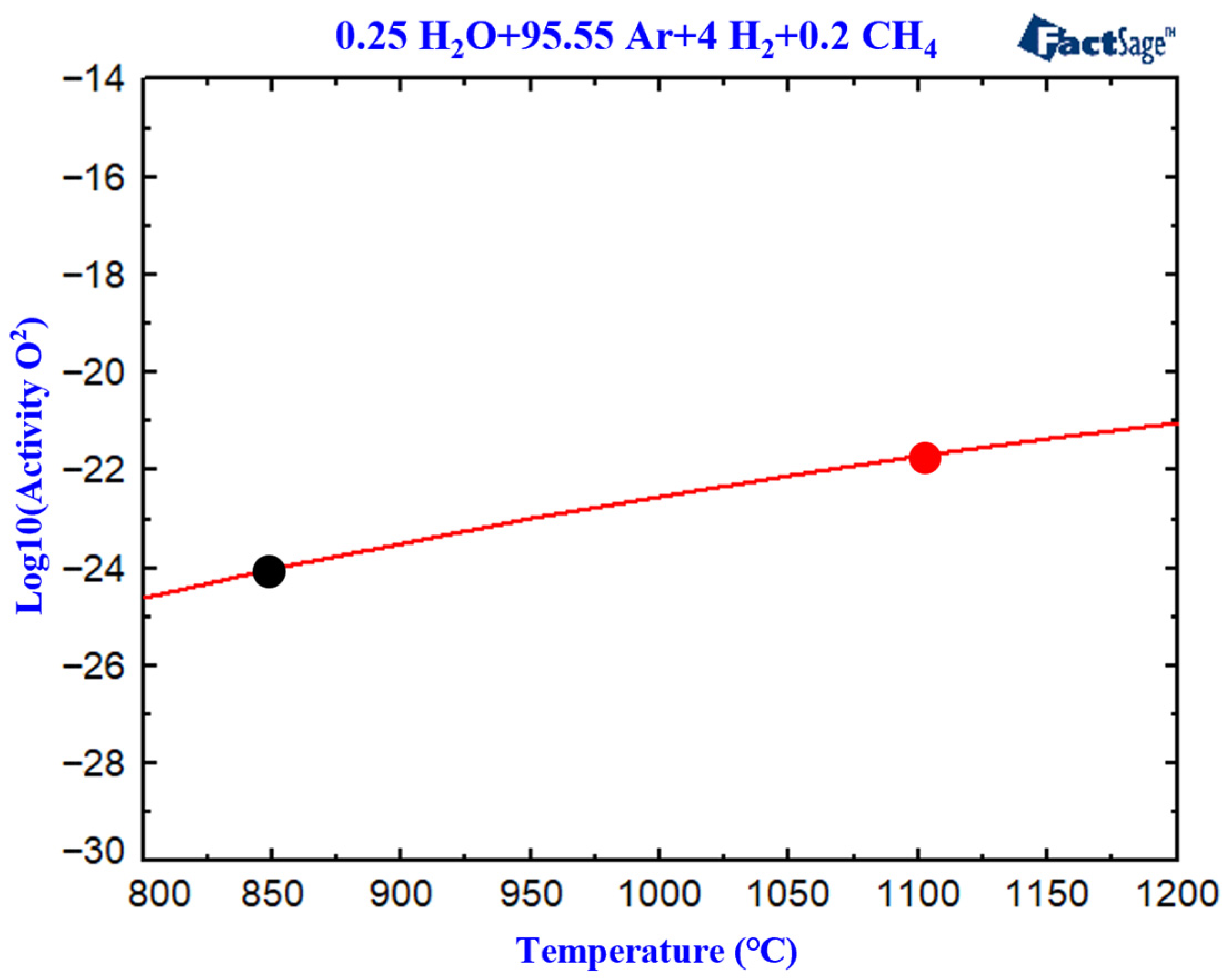
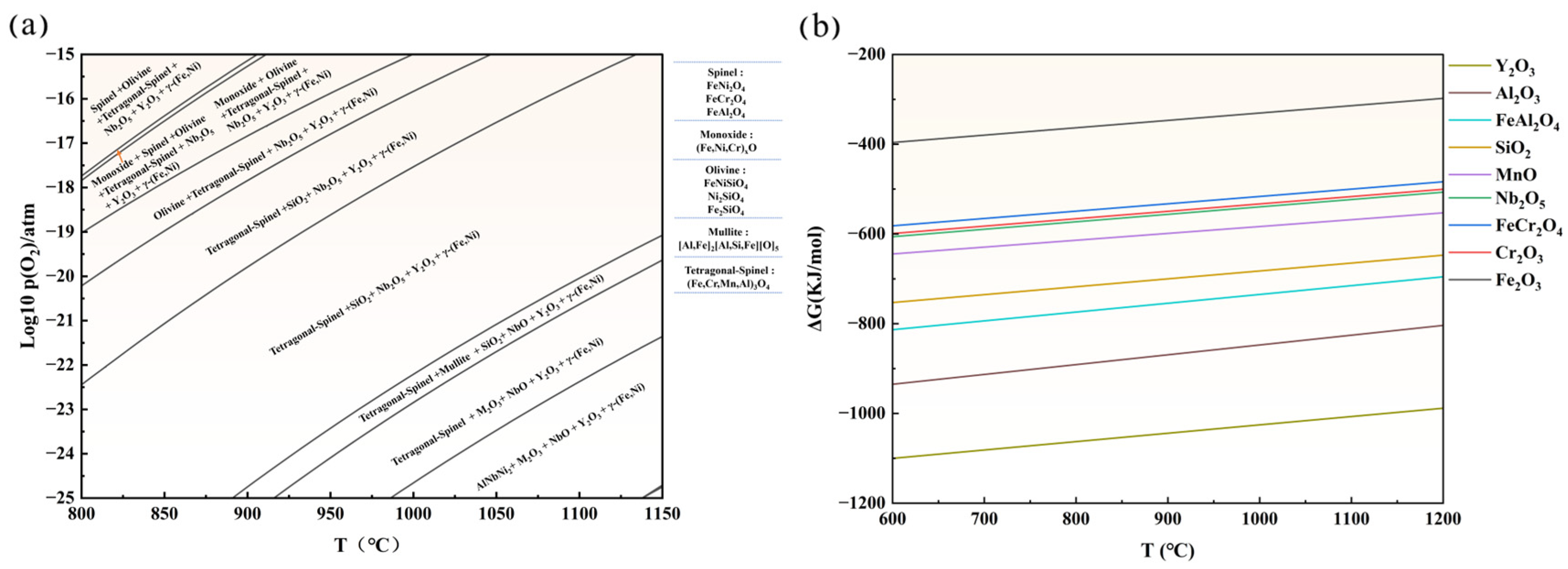
The polished Fe–Ni–Cr–Al-based alloy samples were subjected to a two-step pre-oxidation process in which they were first oxidized at 850 °C for 5 h, and then further oxidized in the furnace at 1100 °C for 10 h. Figure 1 shows a schematic of the experimental oxidation apparatus. Before the oxidation experiment, samples were placed in quartz tubes in a high-temperature tube furnace under a vacuum. The furnace was evacuated and repeatedly purged with high-purity argon, and then a mixed gas of 4% H2 + 0.2% CH4 + Ar was introduced at a flow rate of 30 dm3/h. After purging for 30 min, the furnace was heated to 850 °C, and then the micro-pump was adjusted to flow into distilled water at a flow rate of 0.07 mL h−1. After passing through the vaporization furnace, the distilled water entered the reaction system as water vapor to obtain the required oxygen partial pressure. The corresponding oxidation atmosphere was 4% H2 + 0.2% CH4 + Ar + 0.25% H2O (referred to as 0.25% H2O below). Figure 2 shows the equilibrium phase diagram of the oxidizing atmosphere and oxygen partial pressure at different temperatures calculated using Factsage 8.0 thermodynamic software [21]. Under a 0.25% H2O oxidizing atmosphere, the equilibrium oxygen partial pressures corresponding to 850 °C and 1100 °C were ~10−20 and 10−16 atm, respectively. It should be noted that the equilibrium oxygen partial pressure was not measured directly; instead, the water-vapor partial pressure in the inlet gas was experimentally verified using a dew-point analyzer (0.0025 atm, i.e., 0.25%), and the corresponding oxygen partial pressure was cross-checked by recalculation using the standard H2/H2O equilibrium relation, showing consistency with the FactSage results.
Pre-oxidized Fe–25Ni–20Cr–4Al–1Nb–1Mn–1.5Si–xY samples were placed in dry corundum crucibles and cyclically oxidized in air at 1000 °C for a cumulative dwell time of 460 h. Every 20 h of dwell time, the covered crucible containing the sample was removed from the furnace, naturally cooled in still air to room temperature, and then returned to the furnace for the next cycle. The crucible was loosely covered with a ceramic sheet to retain spalled oxide debris while allowing free gas exchange. Since natural air cooling was adopted and the cooling rate was not independently controlled, the cooling rate was not treated as a quantitative parameter.

2.2. Micro-Scratch Test

To assess the failure critical load of the protective oxide layer after pre-oxidation of the alloy and its adhesion to the substrate, scratch tests were performed using an Anton Paar NHT+ MCT micro-scratch tester (Graz, Styria, Austria) with a Rockwell diamond indenter (load range: 10–3000 mN, sliding speed: 1 mm min−1, scratch length: 1 mm). At least three scratch tests were performed on each oxide layer surface to record the instantaneous friction. The friction generated by each scratch was caused by the interface between the indenter and coating surface. Changes in scratch displacement, indentation depth, and acoustic emission signals were immediately recorded, and then the critical failure load of the oxide layer was determined.
The indenter was a cone with a top angle of 2θ = 120° and a sphere with a tip radius R = 50 μm. The transition zone between sphere and cone occurred at a depth of H = ( 1 sin θ ) R 0.134 R = 6.7   μ m . When the pressure depth (Pd) at which the oxide layer failed is lower than 6.7 μm, the contact during scratching can be treated as sphere-surface contact. In this regime, the transverse projected width dc and area A1 of the scratch track are given by [22]:
d c = 2 2 R d d 2
A 1 = R 2 sin 1 ( d c 2 R ) d c 2 R 2 ( d c 2 ) 2
where R is the radius of the indenter, and d is the penetration depth of the scratch, i.e., the depth of plastic deformation of the oxide layer under the critical load. Under the critical load, failure mainly occurred before the moving indent, where the compressive stress was highest. The adhesion behavior can be modeled in terms of the strain energy released during coating peeling [23]. The elastic strain energy per unit volume was calculated by Equation (3):
U = 1 2 σ 2 E
where E is Young’s modulus, which is taken as 380 GPa for hot-grown alumina [24]; σ is the tensile stress that causes the coating to peel and can be expressed as:
σ = v F t A 1
where v is Poisson’s ratio, which commonly takes a value of 0.24 for oxide scales [24]; Ft is the friction force at which the oxide layer failed. The elastic energy stored (V) in the entire scale’s thickness t is given as:
V = π r 2 t 2 σ 2 E
where r is the radius of the semicircle formed in front of the indenter under the critical road and is equal to one-half of the scratch width; t is the scale thickness.
During scratch tests, when the coating-substrate interface reaches a critical stress σ, interfacial failures such as cracking or spalling occur. To analyze this debonding process from an energy perspective, the Griffith energy balance approach was employed, which relates the released strain energy to the surface energy required to form a new interface [25]. This established a quantitative relationship between the work of adhesion W and stress σ responsible for interfacial failure, and is expressed as:
W = 1 2 σ 2 t E
It should be noted that the above model proposed does not adequately account for the combined effect of shear and normal tensile stresses at the interface, nor does it properly consider potential plastic deformation within the coating itself [25]. Attar and Johannesson [26] modified this model by recognizing that, ahead of the indenter at the critical load, coating spallation occurs mainly through crack formation. Failure is primarily driven by tensile stresses normal to the interface rather than by shear alone. After crack formation, the actual area over which the friction force acts becomes the cross-sectional area ( A 1 ) of the coating, rather than the entire interfacial area. A 1 = d c t , where t is the coating thickness. By redefining the stress σ responsible for coating spallation in this way, Equation (4) can be revised as Equation (7):
σ = v F t A 1 = v μ L d c t
where L is the critical normal load. Linking this stress expression with the work of adhesion W in Equation (6) leads to:
W = 1 2 v 2 F t 2 E t d c 2
Uncertainties in the measurement of Young’s modulus E, Poisson’s ratio ν, and scratch track width d introduce a combined error of approximately 50%–70% in the calculated work of adhesion W. Despite this, the influence of residual stress on the computed W far exceeds the cumulative effect of these uncertainties, as demonstrated by Fedorova et al. [22]. Therefore, residual stress must be regarded as the main factor to accurately evaluate the work of adhesion. Because Al2O3 is the main constituent phase of the thermally grown oxide (TGO), the oxide scale is generally assumed to exhibit elastic and dilatation properties similar to those of α-Al2O3. This allows residual stress σR in the TGO to be estimated based on the thermal expansion mismatch between the thin oxide layer and thick substrate [27]. The thermal stresses ( σ f ) in first approximation:
σ f = E f T α 1 ν f
where ΔT is defined as the oxidation temperature minus the temperature at which the residual stress is measured; α = α s α f is the difference between the coefficient of thermal expansion of the substrate (~13–16 °C−1 ppm) and scale (~8–9 °C−1 ppm). Neglecting the temperature dependence of Ef and α, an average σR is estimated to be in the range of −2.7~−3.8 GPa via Equation (9) [28,29,30]. The residual stresses for Al2O3 formed on MA956 alloys were reported to be 3.59 GPa at 1150 °C and 3.91 GPa at 1250 °C, showing a decrease with temperature. Because the oxidation temperature in this study was 1000 °C, a representative value of σ R = −3.4 GPa was adopted. It should be emphasized that σ R = −3.4 GPa was not directly measured in this study, but was adopted as a representative compressive residual stress estimated from thermal expansion mismatch. Despite the aforementioned uncertainties, the adhesion work acquired using identical experimental conditions and a unified calculation method acts as a helpful parameter for evaluating how yttrium content affects the structural stability of oxide scales.

2.3. Sample Characterization and Phase Diagram Calculation

Phase identification after pre-oxidation and cyclic oxidation was conducted using XRD (D/MAX 2500PC, Rigaku Corporation, Tokyo, Japan) with Cu-Kα radiation (40 kV, 100 mA) over a 2θ range of 10–90° and a scanning rate of 2° min−1. The morphology, composition, and elemental distribution of the alloy and oxide scales were examined by scanning electron microscopy (SEM, JSM-6510, JEOL, Tokyo, Japan) equipped with energy-dispersive X-ray spectroscopy (EDS, OXFORD INCA, Tokyo, Japan) at an accelerating voltage of 20 kV. Oxide phase analysis was carried out by X-ray photoelectron spectroscopy (XPS, Thermo ESCALAB 250Xi, Sydney, Australia) using Al Kα radiation (hν = 1486.6 eV), with a 400 μm spot size and a 40° electron emission angle. Samples were mounted on a conductive holder and electrically grounded (not electrically isolated). No Ar+ sputter etching was performed prior to analysis. The base pressure in the analysis chamber was on the order of 10−9 mbar, and charge neutralization was applied during acquisition to minimize charging effects of the oxide scales. The binding-energy scale was corrected using a work-function-based referencing approach. A literature work function value of ΦSA = 4.6 eV was adopted for the alumina-dominated oxide surface [31], and the corrected C 1 s reference position was calculated as EB = 289.58 − ΦSA = 284.98 eV. Based on the measured C 1 s peak positions, rigid shifts were applied to all core-level spectra accordingly. Transmission electron microscopy (TEM, Thermo Fisher Talos F200X S/TEM, Tokyo, Japan) was performed at 200 kV to characterize the microstructure of the oxide layer. Thermodynamic calculations and phase equilibria of Fe–25Ni–20Cr–4Al–1Nb–1Mn–1.5Si–xY alloys were performed using the Phase Diagram and Equilibrium modules in FactSage (FeStel, Montreal, QC, Canada).

3. Results

3.1. Microstructure of the Annealed Alloys

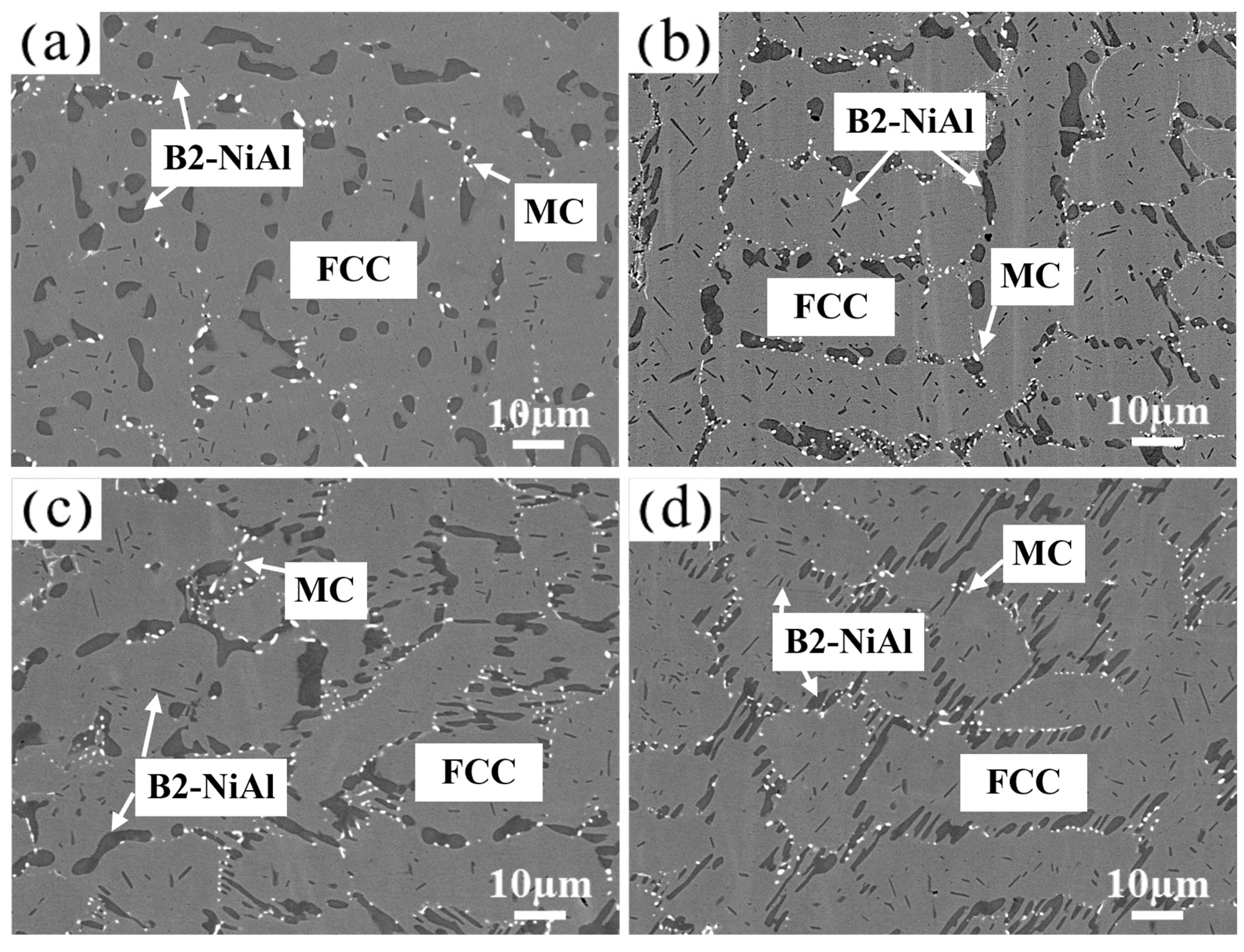
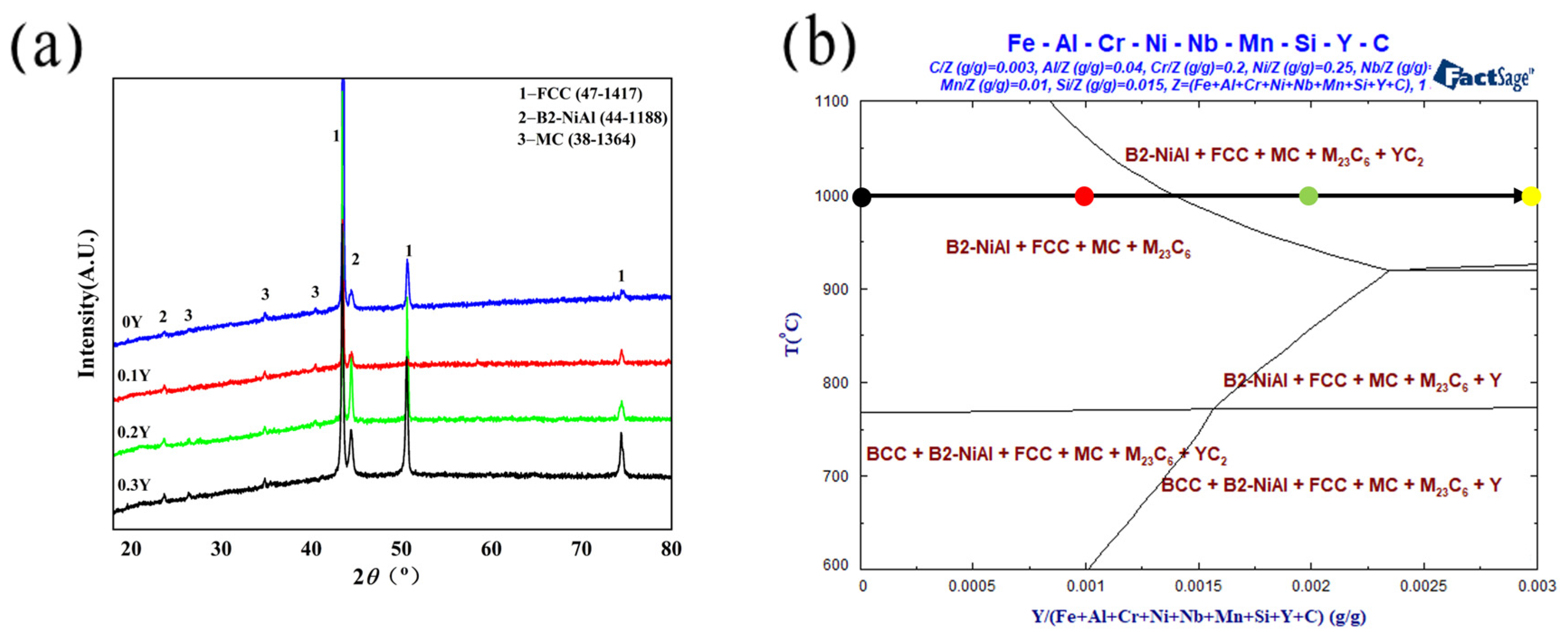
Figure 3 presents the SEM images in backscattered electron (BSE) mode of Fe–25Ni–20Cr–4Al–1Nb–1Mn–1.5Si–xY (x = 0, 0.1, 0.2 and 0.3 wt.%) alloys with different Y contents after annealing at 1000 °C for 2 weeks. Figure 4 shows the XRD patterns of these alloys and their phase diagrams calculated by FactSage8.0 software. The EDS composition of each phase (Table 2) indicated that the gray phase in Figure 3 was γ-Fe (fcc). The grain size of the γ-Fe (fcc) phase in the annealed condition was estimated from the XRD patterns using the Scherrer equation:
D = K λ / ( β c o s θ )
where D is the crystallite size, K is the shape factor, λ is the X-ray wavelength, β is the full width at half maximum (FWHM), and θ is the Bragg angle. Based on the representative diffraction peaks of γ-Fe (fcc), the calculated average grain sizes were 55.5 nm for the 0 Y alloy, 55.2 nm for 0.1 Y, 49.5 nm for 0.2 Y, and 34.6 nm for 0.3 Y, indicating a decreasing trend in the grain size of the γ-Fe (fcc) phase with increasing Y addition. The B2-NiAl phase, with a dark black contrast precipitated along grain boundaries within the alloy, may have enhanced its high-temperature plasticity. It may have also served as an annealing phase to provide the Al required to form Al2O3 during high-temperature oxidation of the alloy to help AFA steel maintain its long-term oxidation resistance [8]. The white and bright precipitates in Figure 3 are Nb-rich carbides that contained a small amount of dissolved Y. According to the phase diagram at 1000 °C in Figure 4b, nanoscale carbides M23C6 (mainly Cr23C6) will precipitate in the alloy. When the Y content exceeds 0.136 wt.%, a YC2 may appear, but due to its small size and low content, it was not detected in the microstructure (Figure 3) or XRD patterns of the alloy (Figure 4).
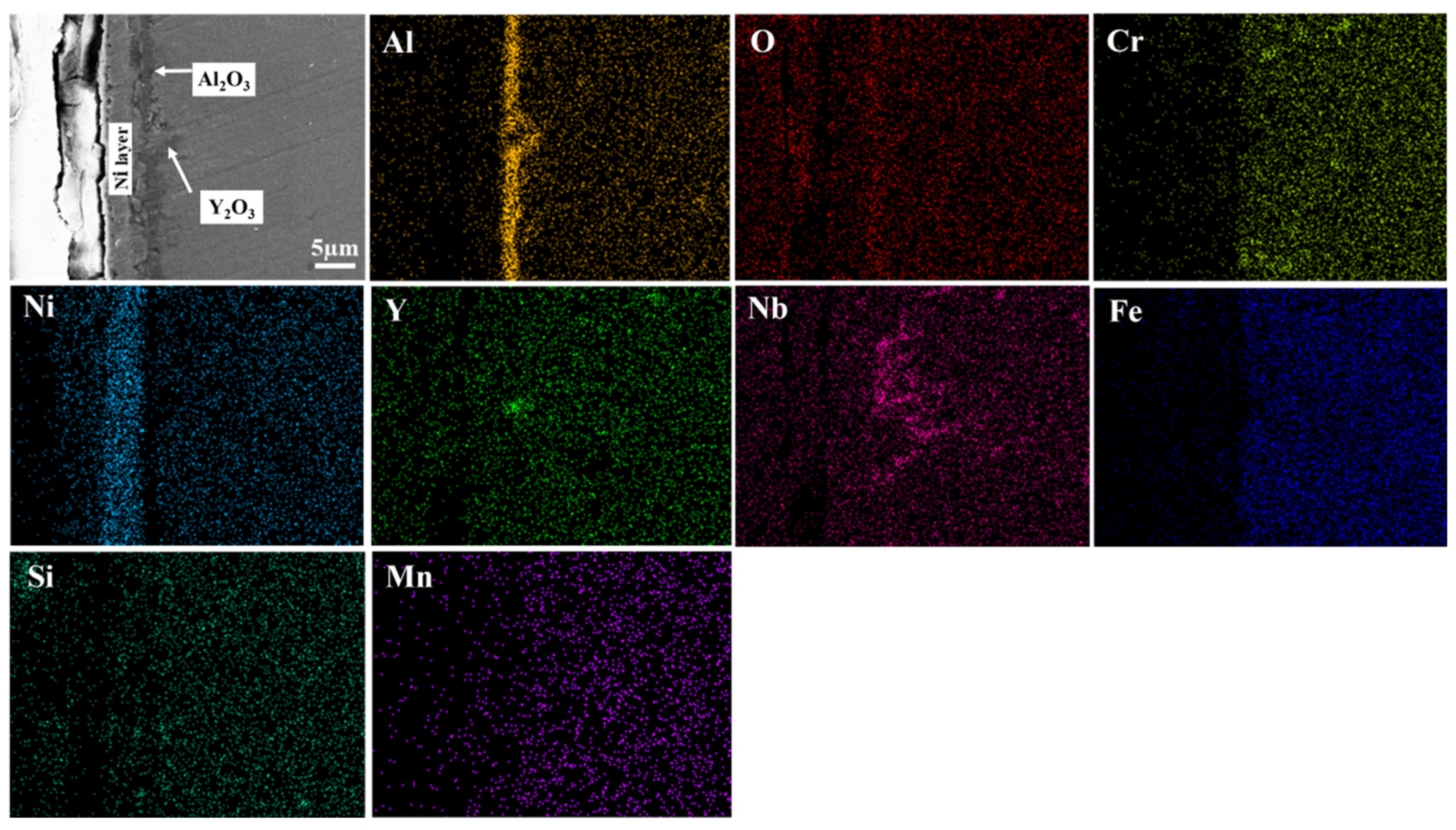
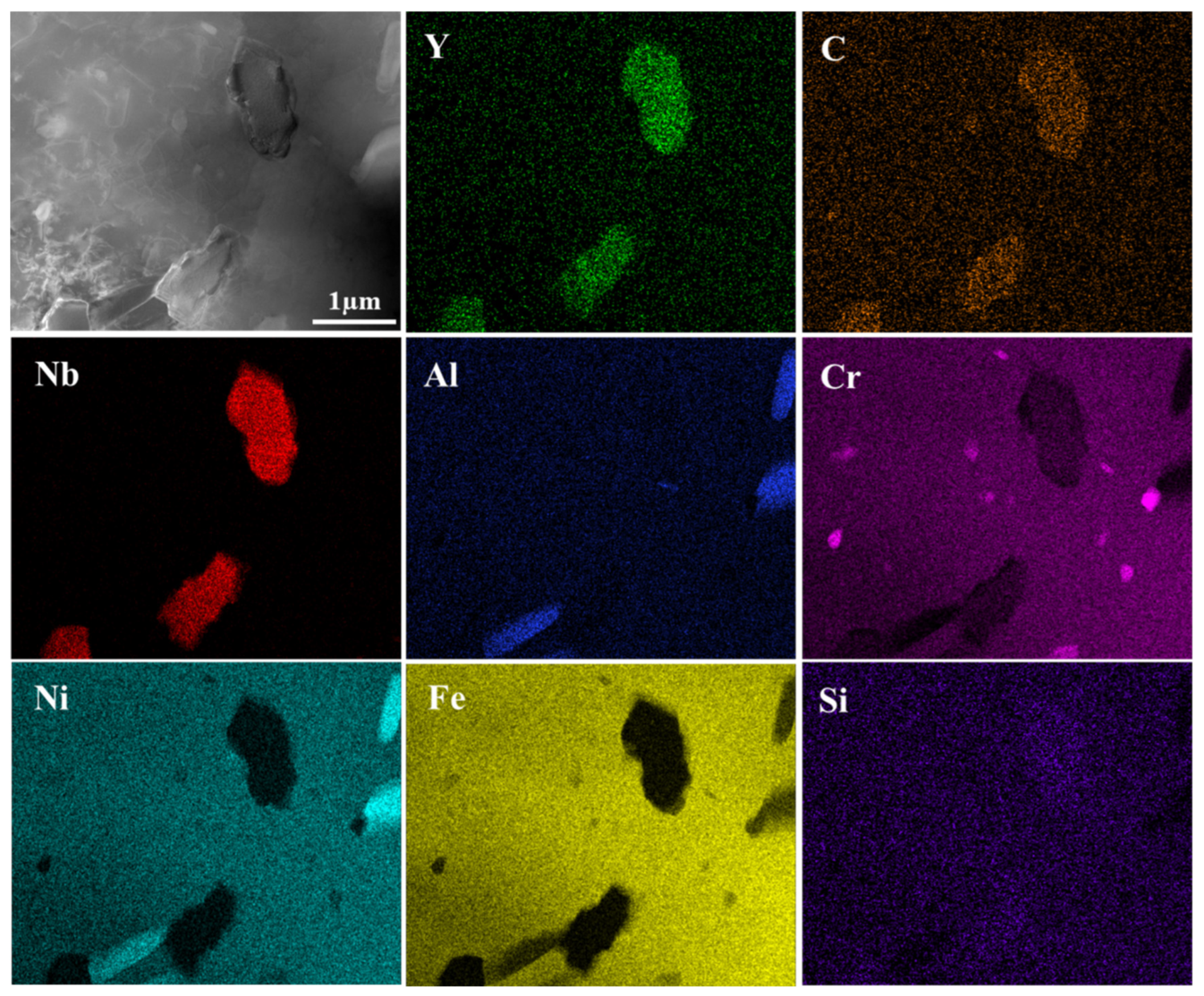
In addition to SEM observation, a detailed TEM microstructure characterization was performed inside the austenite matrix. Figure 5 displays the TEM image and distribution of the alloy elements on the surface. The EDS analysis shows that Fe and Si are evenly distributed in the matrix. The long strip precipitated phase is made up of Ni and Al, and the Cr element is dispersed in the matrix as small carbide particles. Y is detected in Nb-rich carbides, which are mainly found near grain boundaries in the alloy structure. Nunes et al. also found this phenomenon, believing that it is due to the high reactivity between Y and C, so yttrium carbide will be superior to other carbides, which can be used as a heterogeneous nucleation site for carbides and lead to carbide breakage [32].
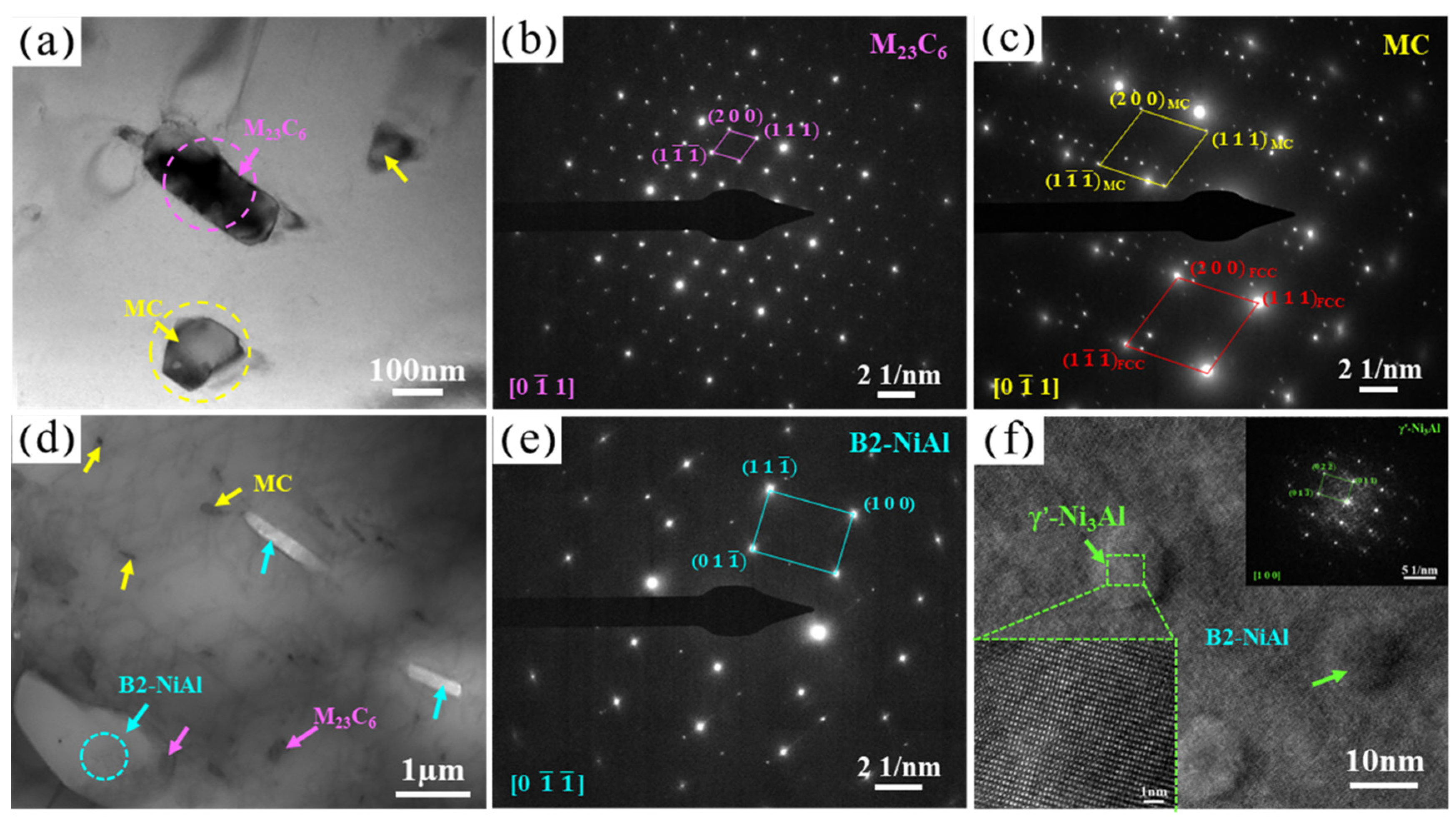
Figure 6 shows the microstructure of the 0.2 Y alloy after annealing at 1000 °C for 2 weeks. The nanoscale carbides M23C6 and MC, with sizes of approximately 100 nm and 50 nm, respectively, were not detected by XRD and SEM, but were observed in the matrix by TEM (Figure 6a). Figure 6b,c show the selected area electron diffraction (SAED) patterns of a selected carbide region, which show that the second-phase precipitates had a face-centered cubic (fcc) structure with lattice constants of 10.66 Å and 4.47 Å, respectively. These values are in line with the structures of Cr23C6 and NbC, respectively. The SAED patterns of the white precipitated phase in Figure 6d are shown in Figure 6e, which indicate a simple cubic crystal system. The lattice constant was 2.88 Å, which was confirmed to be blocks and strips of the B2-NiAl phase distributed near grain boundaries. Figure 6f shows a high-resolution TEM image of the B2-NiAl phase and the SAED pattern of the L12 phase. Spherical L12 particles with an average size of 10 nm were observed in the high-resolution morphology of the B2 phase, which belongs to the tetragonal crystal system with an ordered body-centered lattice structure. Related studies have shown that the L12 ordered γ’-Ni3Al phase is a strengthening phase in Ni-based high-temperature alloys, especially when its diameter is less than 100 nm. However, the L12 phase usually precipitates in alloys with a high Ni content [33]. Although the Ni content was relatively low in this study, this phase was also found, indicating that adding Y promoted the formation of L12.

3.2. Microstructure of the Alloys After Two-Step Pre-Oxidation Under Low Oxygen Partial Pressure

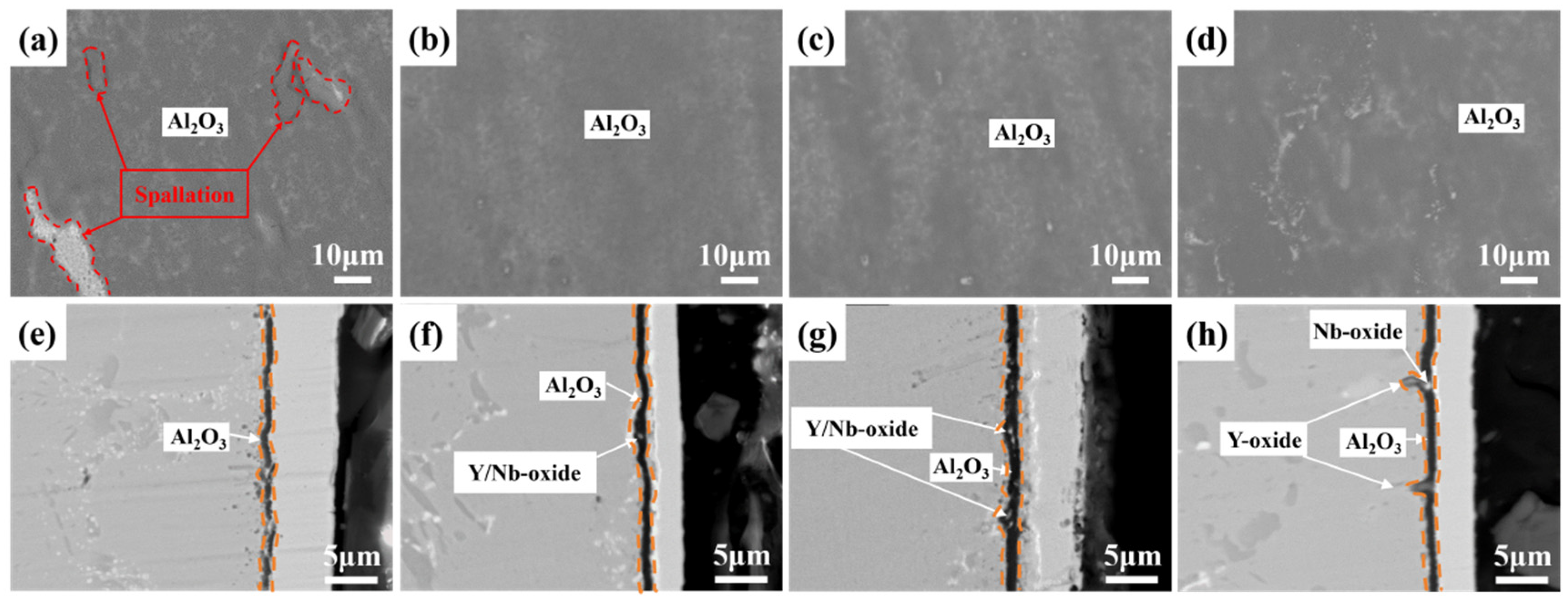
The Fe–25Ni–20Cr–4Al–1Nb–1Mn–1.5Si–xY alloys were pre-oxidized using a two-step process under an atmosphere of 0.25% H2O, and Figure 7 shows the surface and cross-sectional morphologies of the resulting alloys. The XRD patterns of oxides formed on these alloys are shown in Figure 8, and the chemical constituents of their phases at representative positions are summarized in Table 3. Although the limited precision of EDS analysis makes it challenging to definitively identify yttrium or niobium oxides from the composition data, significant enrichment of both elements was evident at these positions.
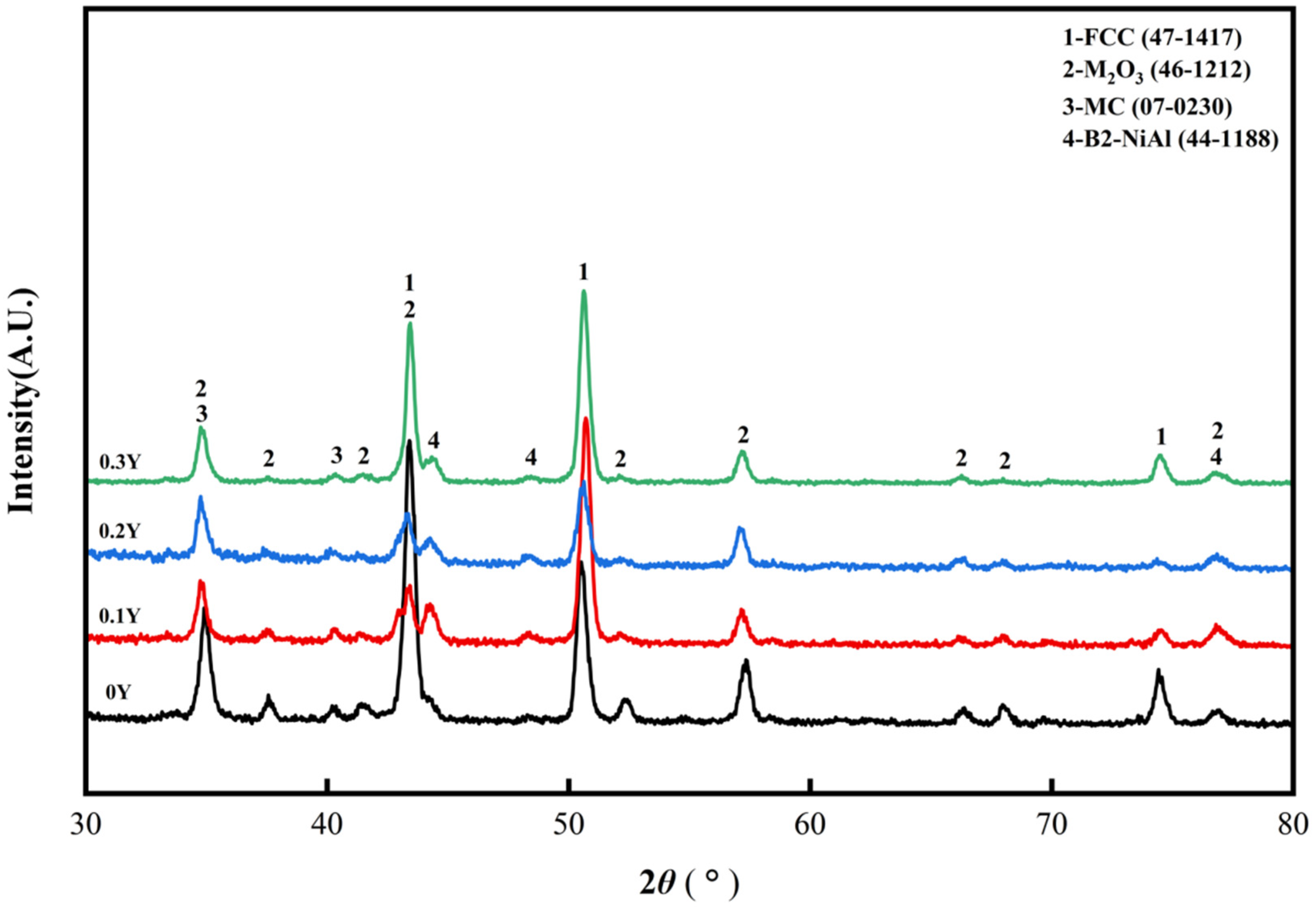
Despite the formation of corundum-type Al2O3 and Cr2O3 on the surface of Y-free alloys, the localized exposure of the substrate in Figure 7a and Figure 8 indicates oxide scale spallation. Weak MC (NbC) peaks in the XRD patterns confirmed the presence of trace amounts of NbC in the matrix. In the alloy containing 0.1 wt.% Y, the surface was covered by a continuous Al2O3 layer, but some white particles were visible in the oxide scale’s cross-section. The corresponding oxide scale thicknesses were measured to be approximately 1.25 μm. When the Y content increased to 0.2 wt.%, the Al2O3 scale thickened to approximately 1.6 μm, accompanied by a higher fraction of Y–Nb mixed oxides. This suggests that adding an appropriate amount of Y promoted the formation of a protective Al2O3 scale on the alloy surface, as evidenced in FeCr, CoCrAl and Ni-Based alloys [34,35,36]. However, when the Y content reached 0.3 wt.%, as shown by the surface and cross-sectional morphologies in Figure 7d,h, the oxide scale thicknesses decreased to 1.25 μm, the number of Y/Nb oxides at the interface increased, and Y2O3 penetrated the substrate. This resulted in local stress accumulation, which may have weakened the adhesion between the oxide scale and substrate, ultimately leading to crack initiation within the substrate or fracture of the oxide scale.

3.3. Microstructure of Pre-Oxidized Alloys After Cyclic Oxidation in Air

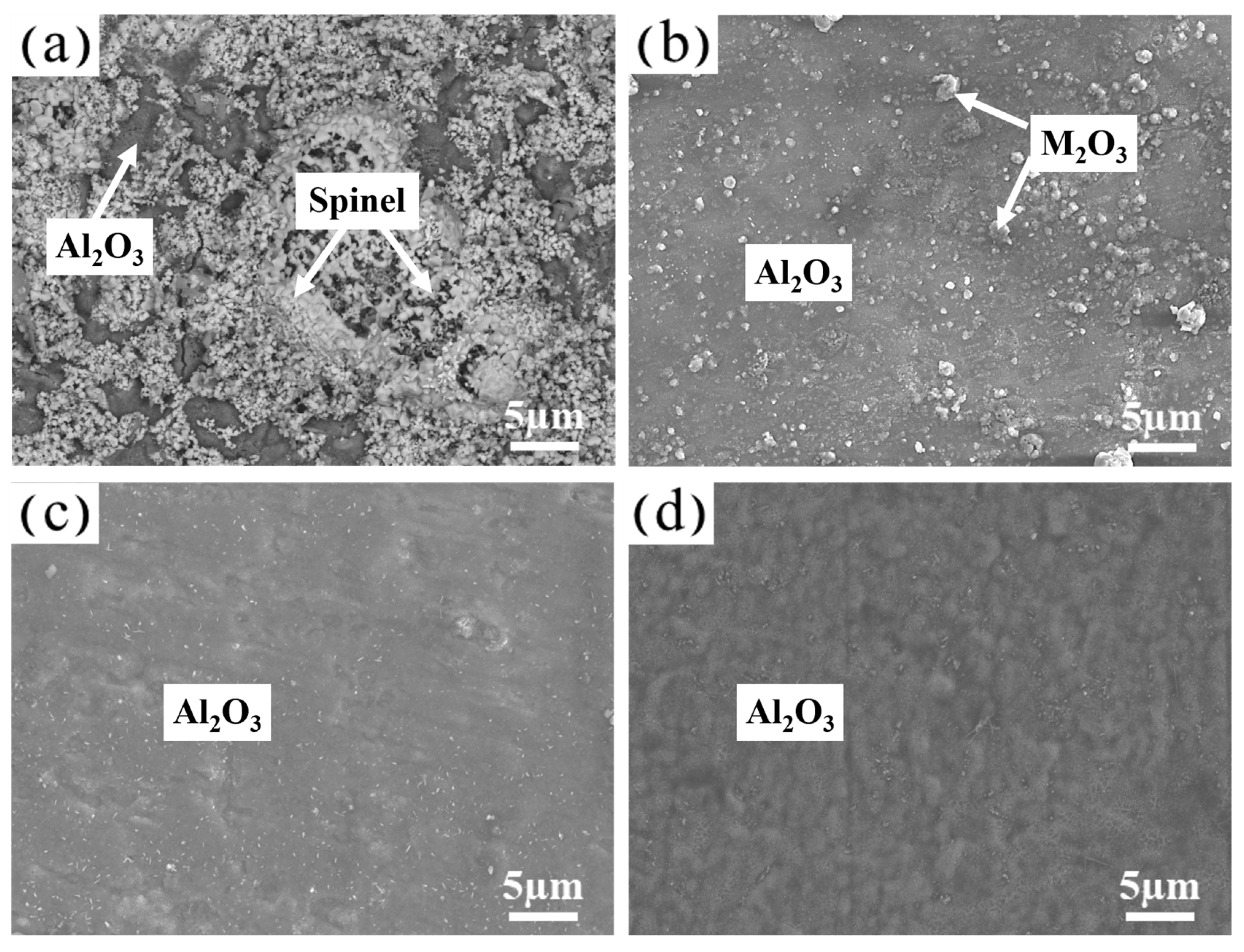
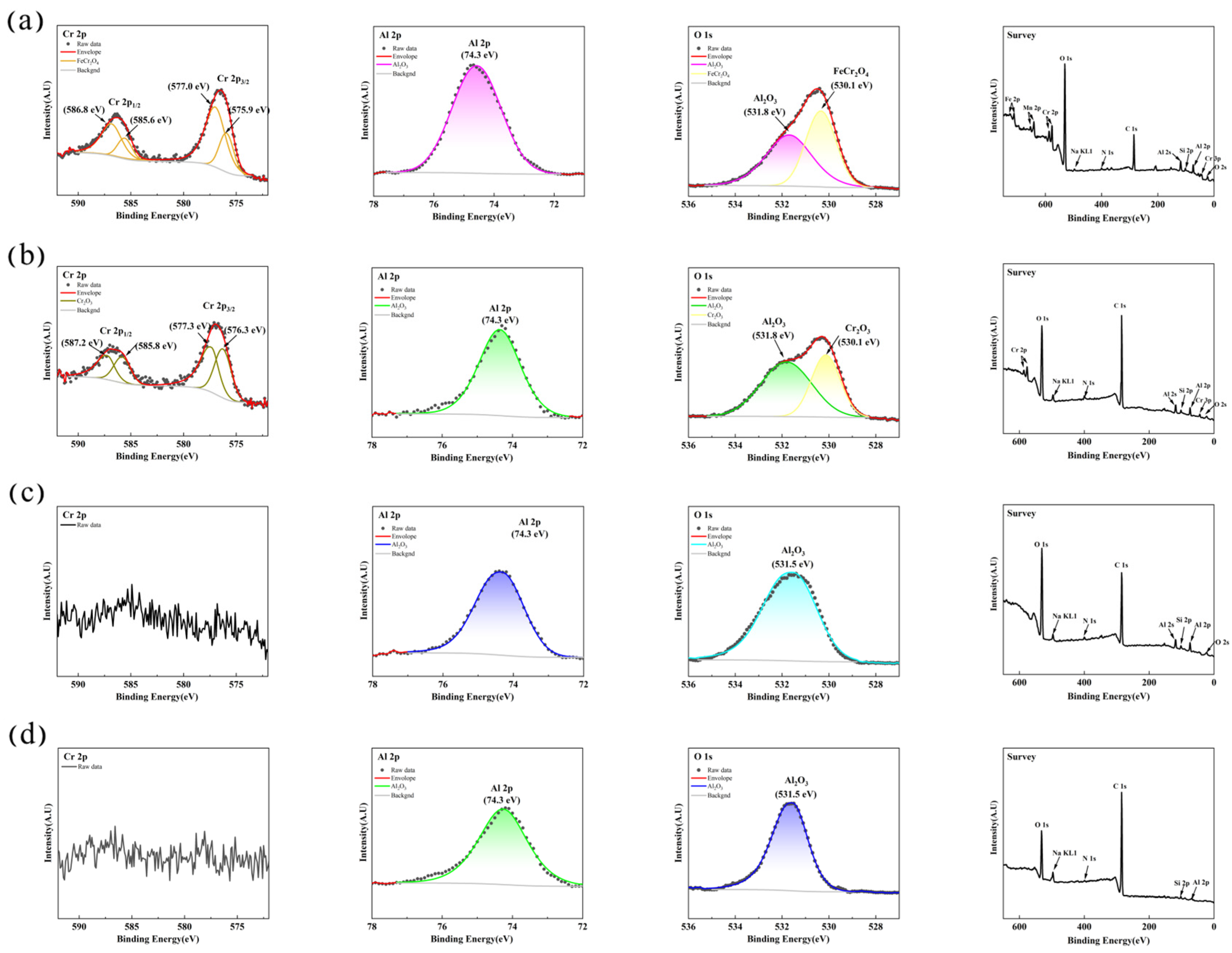
Figure 9 and Figure 10 show the surface morphologies and corresponding XPS phase analysis of the pre-oxidized alloys after cyclic oxidation at 1000 °C for 460 h. The EDS analysis in Table 4 shows that the surface of the Y-free alloy consisted of a loose FeCr2O4 spinel layer, which overlaid a continuous Al2O3 scale. The FeCr2O4 spinel phase likely formed from the reaction of the underlying M2O3 phase (Figure 9a) with iron oxides generated during cyclic oxidation. The surface of the alloy containing 0.1 wt.% Y was covered by a thin corundum layer above the Al2O3 scale. In contrast, the alloys with 0.2 and 0.3 wt.% Y maintained a complete, dense, and monolayer Al2O3 scale that showed no signs of spallation or phase transformation.
EDS element maps of the cross-section of the 0.2 Y alloy after cyclic oxidation (Figure 11) confirmed the stability and integrity of the Al2O3 scale. Y-rich oxide particles persisted as embedded pinning phases at the oxide-matrix interface.

3.4. Scratch Evaluation of Adhesion of the Pre-Oxidized Oxide Scales

Micro-scratch tests were performed on the oxide scales formed by the low- P O 2 two-step pre-oxidation (i.e., before cyclic oxidation in air) to evaluate their failure behavior and scale/substrate adhesion, as shown in Figure 12, Figure 13 and Figure 14.
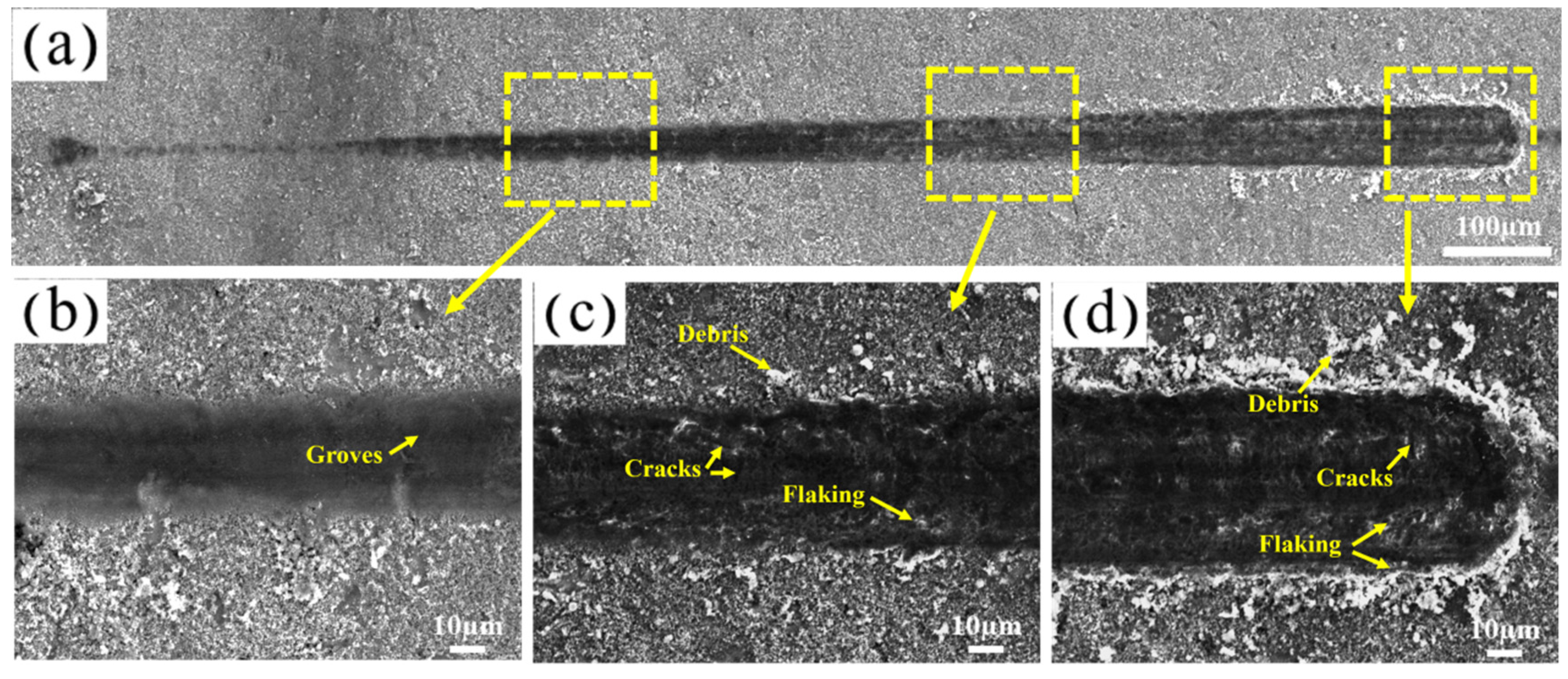
During the scratch tests, interactions between the indenter and oxide layer progress through three stages upon increasing the load: ploughing, cracking, and spalling [37]. The scratch morphology of the 0 Y sample in Figure 12 showed a black oxide layer, a bright exposed matrix along the scratch center, and white oxide debris along the edges. During the ploughing stage (Figure 12b), the scratch was smooth with minimal width and friction under a low load, and was dominated by elastic-plastic deformation of the oxide layer [38]. During the cracking stage (Figure 12c), increasing the load caused the oxide layer to bend and stretch, which formed transverse cracks and localized spalling. The first significant acoustic emission peak occurred here, which marked the critical load for oxide failure, accompanied by a sharp rise in friction. During the final spalling stage (Figure 12d), severe delamination occurred along both sides of the scratch, which generated extensive oxide debris. These phenomena indicate that the oxide layer was only weakly adhered to the 0 Y alloy substrate.
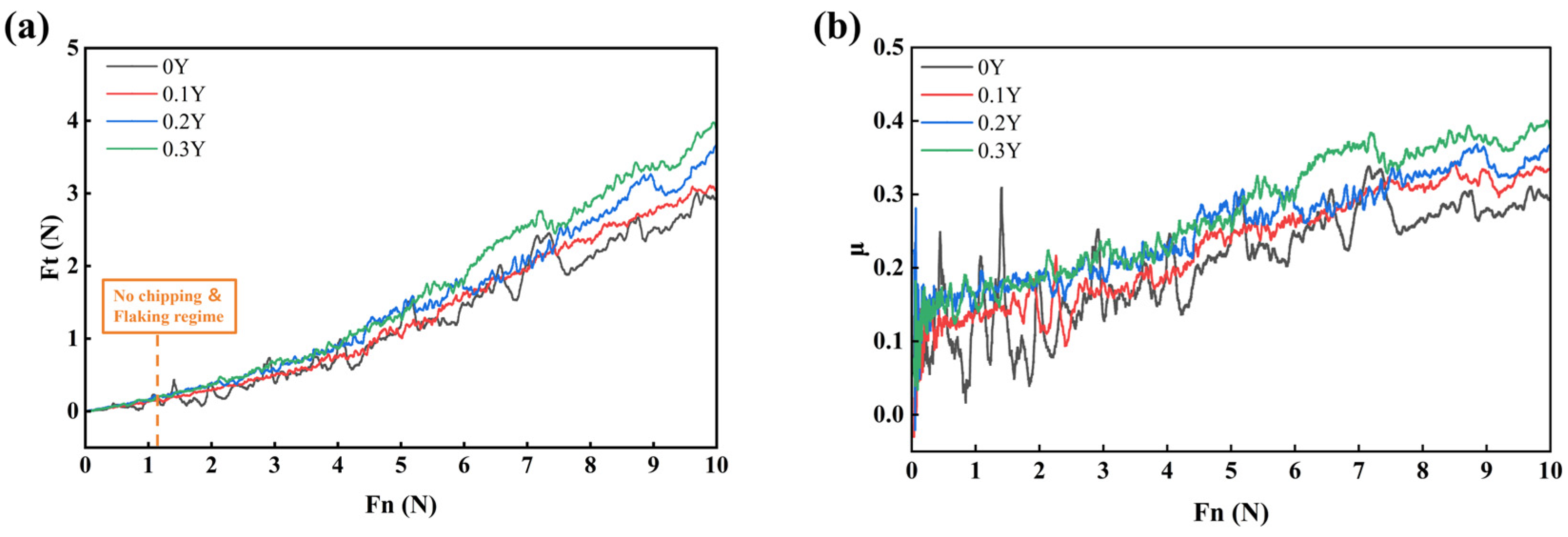
Figure 13a presents the friction curves of the oxide layers on different alloys during progressive-load scratching. The friction coefficient (μ, Figure 13b), defined as the ratio of friction force to normal load, is influenced by load, surface roughness, and oxide layer strength. At low loads (<0.3 N), contact involved elastic/incipient plastic deformation with a limited real contact area. This resulted in weakly load-dependent and scattered μ values. When the load exceeded 0.3 N, the real contact area expanded, leading to a higher and quasi-steady coefficient of friction before initial failure.
Both the friction and coefficient of friction (μ) curves of the 0 Y alloy exhibited pronounced non-stationary fluctuations. Sharp excursions at higher loads (>1.12 N) correspond to spallation and cracking along the scratch track, which indicated repeated stick–slip events and the removal of unstable oxides. Under lower loads (<1.12 N), all alloys showed only gradual abrasive wear of the oxide, with no detectable interfacial failure [39,40]. The addition of Y greatly suppressed the fluctuation amplitudes, and the 0.2 Y and 0.3 Y alloys displayed the smoothest friction curves and a delayed onset of failure, which was consistent with their denser, stronger oxide scales and better interfacial adhesion.
In this study, the critical load (Lc) for oxide failure was determined using a combined criterion that included a sudden change in friction, coupled with an acoustic emission (AE) burst, and the appearance of characteristic failure features in the scratch morphology. This approach ensured consistent comparisons across different alloy compositions.
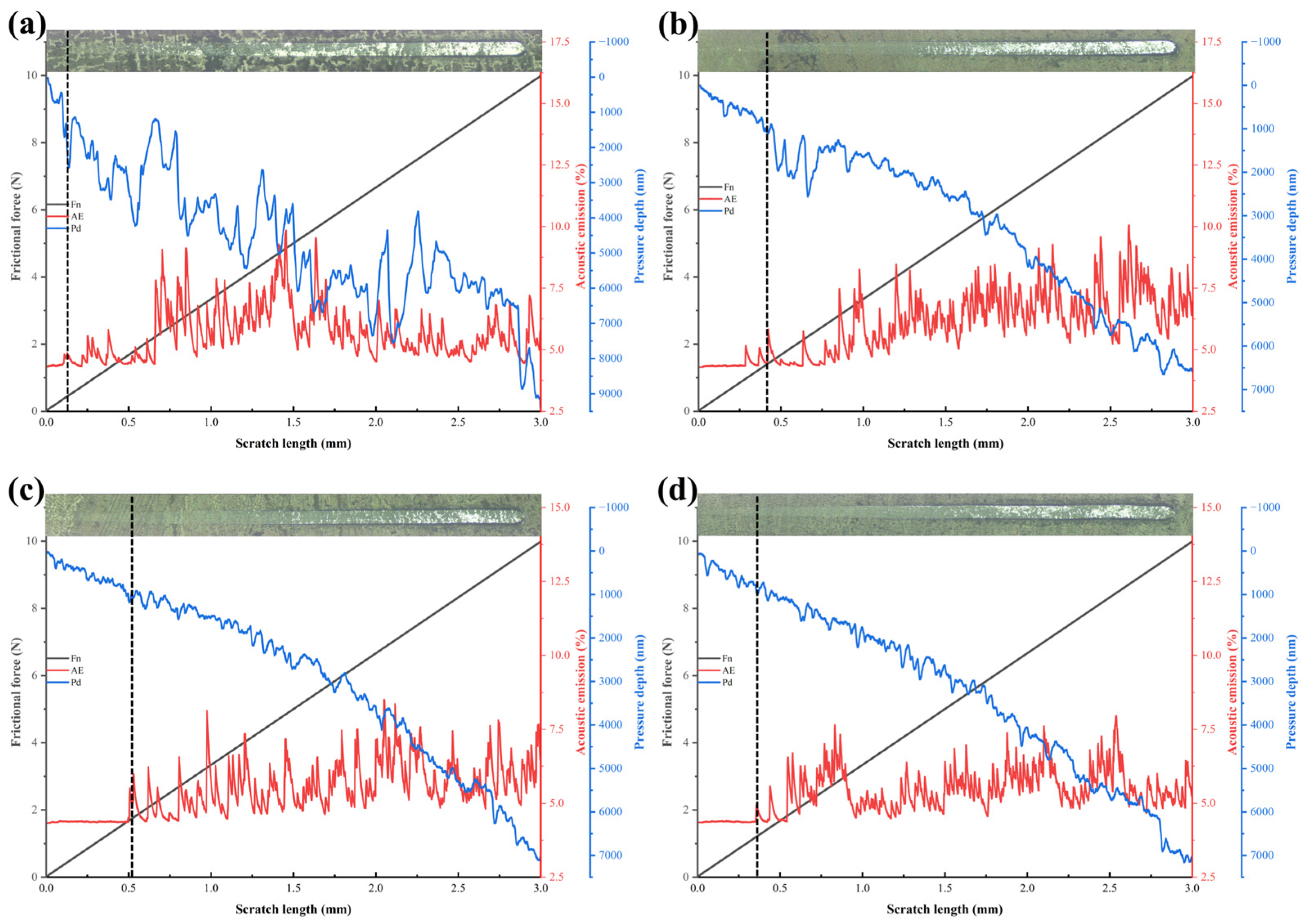
Figure 14 presents the scratch-test parameter curves and photos of the scratch morphologies of each sample. Each parameter curve recorded variations in the penetration depth (Pd), normal load (Fn), and acoustic emission signal (AE) with scratch displacement. The surge in the AE peak corresponded to the critical fracture of the oxide layer and substrate, and the load associated with this peak was defined as the critical load (Lc) of the oxide layer [39]. The slight fluctuations preceding the peak may have been influenced by surface roughness or microcracking of the oxide scale.
The penetration depth Pd was negatively correlated with the scratch displacement and decreased sharply when the indenter penetrated the oxide layer and directly contacted the substrate. Figure 14 shows that the 0 Y alloy exhibited pronounced fluctuations in AE signals and severe variations in the penetration depth, which indicated weak adhesion between the oxide scale and substrate that made the scale prone to fracture. Upon increasing the Y content, the fluctuation range of AE signals gradually decreased, and at 0.2 Y, the AE signal remained relatively low with a smoother penetration depth curve, suggesting a more stable oxide scale.
Throughout the scratch tests, the first AE surge peak and corresponding penetration depth of each sample occurred at displacements of 0.14, 0.29, 0.51, and 0.36 mm for 0 Y, 0.1 Y, 0.2 Y and 0.3 Y added alloys, respectively. Spalled white oxide regions were observed in the corresponding scratch morphologies. Accordingly, the critical loads (Lc) of the oxide layers and substrates were determined to be 0.10, 0.21, 0.31, and 0.22 N, respectively. As measured from cross-sectional images shown in Figure 7, the corresponding oxide scale thicknesses were approximately 1.0 μm, 1.25 μm, 1.6 μm, and 1.25 μm, respectively. Then the interfacial tensile stresses and adhesion energies of the oxide scales can be calculated using Equations (6) and (8), and the results are summarized in Table 5.

4. Discussion

4.1. Thermodynamic Analysis of Y on the Oxide Formation Under a Low Oxygen Partial Pressure

The oxide formation mechanism on AFA alloys during high-temperature oxidation is governed by the oxygen partial pressure and alloy composition (Equations (11) and (12)), with the Gibbs free energy used to predict the oxidation products:
2 x y M + O 2 = 2 y M x O y
Δ G = Δ G 0 + R T ln ( a M x O y 2 y a M 2 x y P O 2 )
where M represents elements such as Fe, Ni, Cr, Al, Mn, Nb, Si, and Y, respectively; x and y range from 1 to 5. ΔG° and T denote the standard Gibbs free energy and reaction temperature, respectively. The thermodynamic phase-diagram analysis in Figure 15 indicates that both the oxygen pressure and temperature significantly influenced the Gibbs free energies of the oxides. At 1000 °C, the Gibbs free energies of the relevant oxides decreased in the order Fe2O3 > FeCr2O4 > Cr2O3 > Nb2O5 > MnO > SiO2 > FeAl2O4 > Al2O3 > Y2O3.
The formation of oxidation products was also influenced by the atomic diffusion kinetics. During high-temperature oxidation, oxygen and metallic elements spontaneously interdiffused, which created a distinction between internal and external oxidation. According to Wagner’s theory of alloy oxidation, this can be summarized as follows [41]:
  N A ( O ) D A < N O ( S ) D O   ( I n t e r n a l   o x i d a t i o n )
N A ( O ) D A > N O ( S ) D O   ( E x t e r n a l   o x i d a t i o n )
where N O ( S ) and D O are the mole fraction and diffusion coefficient of oxygen on the surface of the alloy, respectively. N A ( O ) and DA are the mole fraction diffusion coefficients of solute element A in each alloy. The product of the mole fraction and diffusion coefficient is the diffusion flux of the corresponding element. When the diffusion flux of oxygen exceeds that of metallic elements, selective internal oxidation occurs. Otherwise, selective external oxidation occurs. Thus, the interface reaction and mass-transfer processes in high-temperature oxidation can be classified as either cation migration or anion migration.
During pre-oxidation under a low oxygen partial pressure, the higher high Cr content than Al in the Fe–25Ni–20Cr–4Al–1Nb–1Mn–1.5Si alloy promoted the preferential formation of Cr2O3 because its growth rate exceeded that of Al2O3 during the initial stages. Cr2O3 crystals acted as a structural template for the nucleation of Al2O3 (i.e., the so-called third-element effect), which led to the formation of a (Al,Cr)2O3 solid solution [42]. As oxidation proceeded and the scale thickened, the oxygen activity beneath the surface decreased. According to the Ellingham diagram and the calculated Gibbs energy of formation of oxides in Figure 15, only the oxidation of Al remained thermodynamically favorable under these conditions. Thus, a continuous Al2O3 layer was formed beneath the initial oxide layer (Figure 8). Under a low oxygen partial pressure, the Gibbs free energies of Y2O3 and Nb2O5 were also relatively low, which led to the formation of small amounts of these oxides within the Al2O3 scale. Although FeAl2O4 exhibited a lower Gibbs free energy than Nb2O5, its formation requires a solid-state reaction between Fe and Al2O3:
2Fe(s) + 2Al2O3(s) + O2(g) → 2FeAl2O4(s)
Under a low oxygen partial pressure, Al preferentially reacted with O and suppressed further reactions between Fe and Al2O3. Consequently, FeAl2O4 was not detected in the pre-oxidized oxide scale formed under a low oxygen partial pressure.
During subsequent cyclic oxidation in the air, FeCr2O4 formed on the Y-free alloy pre-oxidized via the following reaction:
2Fe(s) + 2Cr2O3(s) + O2(g) → 2FeCr2O4(s)
After pre-oxidation, the surface of the Y-free alloy was exposed, which supplied Fe and Cr for the above reaction. The high oxygen content in the air facilitated the formation of Cr2O3 and provided sufficient oxygen for the reaction in Equation (16). As a result, the spinel FeCr2O4 phase was observed after cyclic oxidation in the air. In contrast, an external Al2O3 oxide scale formed on the Y-containing alloy during pre-oxidation, which inhibited the outward diffusion of Fe. Consequently, no FeCr2O4 phase was detected on the outer surface after cyclic oxidation in the air.

4.2. Effect of Y on Oxidation Resistance and Adhesion

The integrity of the oxide scale is critical for oxidation resistance. At 1000 °C, the scale may undergo destructive spallation as a result of accumulated internal stress. The Pilling–Bedworth ratio (PBR) is an averaged theoretical parameter derived from the integration of all oxidized metal elements; it does not account for specific oxidation kinetics, local microstructure, or oxidation mechanisms between different phases and defects [43]. Under the assumptions that the substrate crystal structure remains unchanged and that alloying elements diffuse slowly at the oxidation temperature [44], PBR can be employed to predict the type of stress generated during scale growth.
To further elucidate the spallation mechanism, PBR is introduced here to assess the oxide-scale integrity [45]:
P B R = V o x i d e V a l l o y  
where V a l l o y is 7.2 cm3/mol [46], V C r 2 O 3 is 14.6 cm3/mol [47] and V A l 2 O 3 is 25.6 cm3/mol [46]. Then the calculated PBR values for all oxides formed on the AFA alloy surface exceed 1, indicating the presence of compressive stress between the scale and the substrate. This stress continues to accumulate with oxidation time and can eventually cause scale cracking. In addition, the pronounced difference in thermal expansion coefficients among Al2O3, Cr2O3 and Fe2O3 introduces additional internal stresses at multi-phase interfaces, which further promotes scale spallation [19,44,48]. This mechanism aligns well with the localized spallation observed on ground surfaces in Figure 7 and Figure 12. Once the oxide scale spalled, the substrate became directly exposed to the oxidizing atmosphere, resulting in a pronounced increase in mass gain. Therefore, low oxygen partial pressure and the formation of a pure Al2O3 scale are key factors in reducing the oxidation rate.
The adhesion work values obtained from scratch tests in this study were compared with reported data for thermally grown oxide scales measured by scratch tests and other methods (Table 6). The results show good agreement in order of magnitude with literature values [22,28,49]. The cited studies attribute the considerable scatter in adhesion work to the mode mixity of fractures, which increases from Equation (6) (corresponding to mode 1) to Equation (8) (mode 2). Despite differences between the two adhesion models, both reveal a consistent trend: as Y content rises, both the tensile stress and adhesion energy required for scale spallation increase, peaking at 0.2 wt.% Y. These calculations confirm that Y addition improves the adhesion of the oxide scale, as reflected by the formation of a continuous Al2O3 layer and the delayed scale failure during scratch testing [50,51,52]. In addition, Krbaťa et al. reported that yttria-stabilized ZrO2 exhibited high hardness and improved tribological behavior in dry sliding contact with tool steels, further supporting the beneficial role of Y-containing oxide systems in enhancing mechanical stability and wear resistance [53].
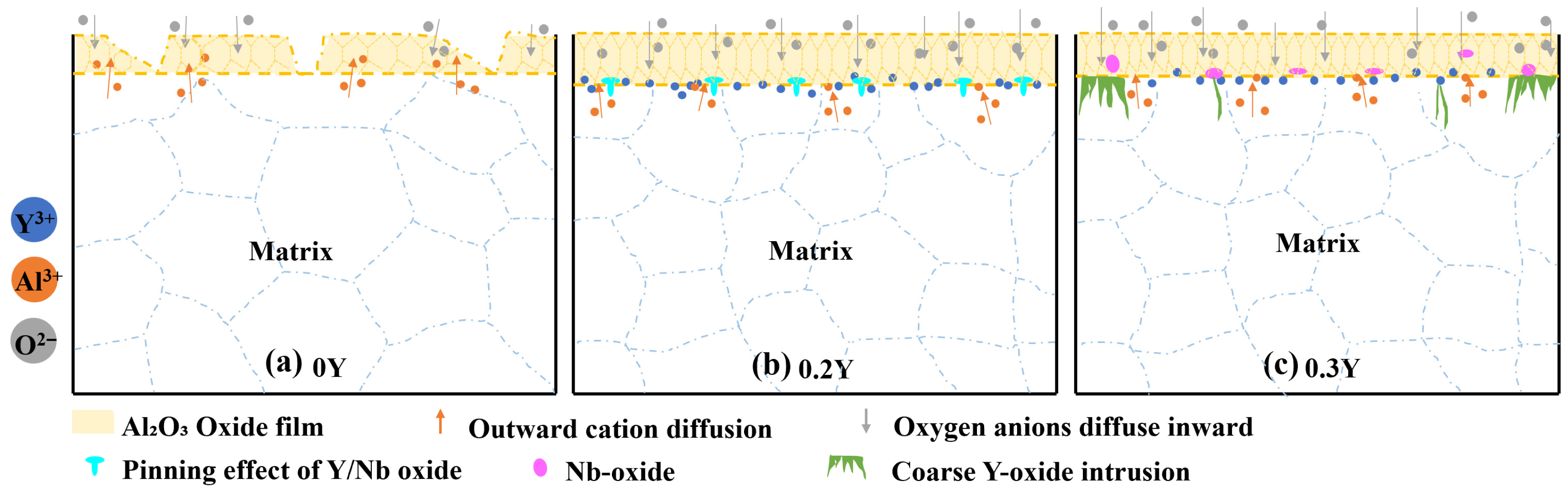
The underlying mechanisms are illustrated in Figure 16. In the Y-free alloy (Figure 16a), oxidation occurs primarily via outward cation diffusion, leading to a porous, poorly adherent scale with high growth stress and a strong tendency to spall. At the optimal content of 0.2 wt.% Y (Figure 16b), two synergistic mechanisms operate: (i) Y segregation at Al2O3 grain boundaries hinders outward cation diffusion, promoting inward oxygen diffusion through a fine, columnar scale with lower growth stress [54]; and (ii) the formation of nanoscale Y-rich oxides at the interface creates a mechanical “pegging” effect, which significantly improves adhesion [55]. Together, these effects yield the highest interfacial bonding and the best cyclic oxidation resistance. However, when Y is excessive (e.g., 0.3 wt.%), coarse Y-rich oxides form (Figure 16c), which disrupt the continuity of the Al2O3 scale. These particles act as stress concentrators, weaken the interface, and ultimately degrade oxidation performance. Therefore, an optimal Y addition (e.g., 0.2 wt.%) promoted the formation of a pure, continuous Al2O3 scale under low oxygen partial pressure and enhanced its adhesion through grain-boundary segregation and interfacial oxide pegging, which together are crucial for significantly improving oxidation resistance.

5. Conclusions

This study investigated how the Y content affected the low oxygen partial pressure pre-oxidation behavior of Fe–25Ni–20Cr–4Al–1Nb–1Mn–1.5Si–xY (x = 0, 0.1, 0.2 and 0.3 wt.%) alloys. The bonding strength with the matrix of each alloy after pre-oxidation was discussed. The results indicated that adding an appropriate amount of Y refined the microstructure of the alloy, and it was enriched in NbC as nucleation sites for carbides. Nanoscale M23C6 and MC creep-strengthening phases precipitated in Fe25Ni20Cr4Al-based AFA steel after annealing at 1000 °C, and a small amount of L12 high-temperature strengthening phase was detected in the B2 phase, which was readily formed in high-Ni alloys.
Pre-oxidation of the Fe–25Ni–20Cr–4Al–1Nb–1Mn–1.5Si–xY alloys in the presence of 0.25% H2O demonstrated that Y played a critical role in scale formation. The Y-free alloy developed a discontinuous and fractured Al2O3 scale. In contrast, adding an appropriate amount of Y (0.1–0.2 wt.%) promoted the growth of a continuous and protective Al2O3 layer, assisted by Y–Nb–Al mixed oxides that acted as interfacial pinning sites. However, excessive Y (0.3 wt.%) led to deep penetration of Y2O3 into the substrate.
Scratch tests demonstrated that adding Y enhanced the oxide scale adhesion in the Fe–25Ni–20Cr–4Al–1Nb–1Mn–1.5Si–xY alloys. The Y-free alloy showed weak scale-substrate adhesion, while 0.2 wt.% Y formed a stable scale with higher interfacial stress and adhesion energy. An excessive Y content did not provide further improvements.
The synergistic role of the Y content and oxygen partial pressure in enhancing alumina scale formation was also discussed. This study provides theoretical insights for developing next-generation heat-resistant alloys with enhanced durability under high-temperature, low- P O 2 conditions.

Author Contributions

J.J.: Investigation, Writing—review & editing. X.D.: Investigation, Writing. C.W.: Investigation. J.C.: Investigation. X.Z.: Investigation. Y.L.: Conceptualization, Methodology, Investigation, Writing—review & editing, Supervision. All authors have read and agreed to the published version of the manuscript.

Funding

This research was funded by the National Natural Science Foundation of China (Grant Nos 52271005) and a project funded by the Priority Academic Program Development of Jiangsu higher education institutions is greatly acknowledged.

Institutional Review Board Statement

Not applicable.

Informed Consent Statement

Not applicable.

Data Availability Statement

The raw/processed data required to reproduce these findings will be available upon request.

Conflicts of Interest

The authors declare no conflict of interest.

References

  1. Taneike, M.; Abe, F.; Sawada, K. Creep-strengthening of steel at high temperatures using nano-sized carbonitride dispersions. Nature 2003, 424, 294–296. [Google Scholar] [CrossRef]
  2. Young, D.J.; Pint, B.A. Chromium volatilization rates from Cr2O3 scales into flowing gases containing water vapor. Oxid. Met. 2006, 66, 137–153. [Google Scholar] [CrossRef]
  3. Liu, T.; Zhang, D.; Wang, Z.; Xiang, L.; Zhao, Y.; Hu, S.; Huang, B.; Xie, Z. Enhanced structural stability and oxidation resistance of NiCoCrAlY bonding layer via Al addition. Vacuum 2023, 207, 111543. [Google Scholar] [CrossRef]
  4. Asteman, H.; Hartnagel, W.; Jakobi, D. The influence of Al content on the high temperature oxidation properties of state-of-the-art cast Ni-base alloys. Oxid. Met. 2013, 80, 3–12. [Google Scholar] [CrossRef]
  5. Yamamoto, Y.; Ren, Q.-Q.; Brady, M.P. Role of Cr content in microstructure, creep, and oxidation resistance of alumina-forming austenitic alloys at 850–900 °C. Metals 2022, 12, 717. [Google Scholar] [CrossRef]
  6. Shi, J.; Meng, F.; Huang, G.; Liu, F.; Zhai, L.; Chen, Y.; Zhang, F.; Lin, J.; Wang, L. Improving the oxidation resistance by forming continuous Al2O3 protective layer in alumina-forming austenitic stainless steel. Surf. Coat. Technol. 2024, 493, 131279. [Google Scholar] [CrossRef]
  7. Masari, F.; Hernández, R.; Serrano, M.; Torralba, J.; Campos, M. Design and characterisation of new low-alloyed alumina forming ferritic/martensitic steels. Mater. Sci. Eng. A 2025, 922, 147598. [Google Scholar] [CrossRef]
  8. Brady, M.P.; Yamamoto, Y.; Santella, M.L.; Maziasz, P.J.; Pint, B.A.; Liu, C.T.; Lu, Z.P.; Bei, H. The development of alumina-forming austenitic stainless steels for high-temperature structural use. JOM 2008, 60, 12–18. [Google Scholar] [CrossRef]
  9. Zhao, Y.; Chen, P.; Wen, W.; Deng, Y.; Peng, K.; Liu, Y. Effect of Mn content on the high-temperature oxidation behaviors of Mn-substituted-for-Ni alumina-forming austenitic stainless steel. J. Mater. Res. Technol. 2023, 26, 7816–7828. [Google Scholar] [CrossRef]
  10. Lu, Z.; Zhao, Y.; Deng, Y.; Chen, P.; Wen, W. Evolution of the oxide layers of an aluminum-forming austenitic heat-resistant steel with high-Mn substitution for Ni: Experiment and first-principle calculations. Mater. Charact. 2023, 205, 113334. [Google Scholar] [CrossRef]
  11. Brady, M.; Magee, J.; Yamamoto, Y.; Helmick, D.; Wang, L. Co-optimization of wrought alumina-forming austenitic stainless steel composition ranges for high-temperature creep and oxidation/corrosion resistance. Mater. Sci. Eng. A 2014, 590, 101–115. [Google Scholar] [CrossRef]
  12. Du, Y.; Zhang, C.; Ma, Q.; Zheng, Y.; Li, H.; Gao, Q. Precipitation behavior and strengthening mechanism of NbC phase in alumina-forming austenitic steel. Mater. Sci. Eng. A 2025, 936, 148421. [Google Scholar] [CrossRef]
  13. Wang, S.; Wu, Y.; Gesmundo, F.; Niu, Y. The effect of Si additions on the high-temperature oxidation of a ternary Ni–10Cr–4Al alloy in 1 atm O2 at 900–1000 °C. Oxid. Met. 2008, 69, 299–315. [Google Scholar] [CrossRef]
  14. Li, M.; Zhu, Y.; Zhou, C. Effect of yttrium on the coking behavior of Fe-based superalloy in heavy hydrocarbon. Corros. Sci. 2015, 98, 81–87. [Google Scholar] [CrossRef]
  15. Li, S.; Xu, M.; Zhang, C.; Niu, Y.; Bao, Z.; Zhu, S.; Wang, F. Co-doping effect of Hf and Y on improving cyclic oxidation behavior of (Ni,Pt)Al coating at 1150 °C. Corros. Sci. 2021, 178, 109093. [Google Scholar] [CrossRef]
  16. Liu, X.; Chen, Y.; Lu, J.; Li, L.; Huang, A.; Zhang, H.; Fan, X.; Zhang, X.; Zhao, X. A comparative study on the oxidation behavior of Y-, Hf- and YHf-doped NiCoCrAl alloys: Effect of reactive elements. Corros. Sci. 2023, 218, 111160. [Google Scholar] [CrossRef]
  17. Ren, H.; Chen, R.; Liu, T.; Gao, X.; Qin, G.; Wu, S.; Guo, J. Unraveling the oxidation mechanism of Y-doped AlCoCrFeNi high-entropy alloy at 1100 °C. Appl. Surf. Sci. 2024, 652, 159316. [Google Scholar] [CrossRef]
  18. Shi, H.; Fetzer, R.; Tang, C.; Szabó, D.V.; Schlabach, S.; Heinzel, A.; Weisenburger, A.; Jianu, A.; Müller, G. The influence of Y and Nb addition on the corrosion resistance of Fe-Cr-Al-Ni model alloys exposed to oxygen-containing molten Pb. Corros. Sci. 2021, 179, 109152. [Google Scholar] [CrossRef]
  19. Chen, L.; Yuan, M.; Liu, Y.; Chen, J.; Wu, C.; Su, X. The influence of Al and Nb on the low oxygen pressure pre-oxidation behavior of Fe-35Ni-20Cr-xAl-yNb alloys at 1000 °C. Materials 2024, 17, 2086. [Google Scholar] [CrossRef] [PubMed]
  20. Deng, X.; Liu, Y.; Guo, Z.; Wu, C.; Peng, H.; Tu, H.; Wang, J.; Su, X. Selective oxidation of FeNiCrAl-based alloys under low oxygen pressure and their coking resistance. Vacuum 2024, 224, 113174. [Google Scholar] [CrossRef]
  21. Bale, C.W.; Bélisle, E.; Chartrand, P.; Decterov, S.A.; Eriksson, G.; Gheribi, A.E.; Hack, K.; Jung, I.-H.; Kang, Y.-B.; Melançon, J.; et al. FactSage thermochemical software and databases, 2010–2016. Calphad 2016, 54, 35–53. [Google Scholar] [CrossRef]
  22. Fedorova, E.; Monceau, D.; Oquab, D. Quantification of growth kinetics and adherence of oxide scales formed on Ni-based superalloys at high temperature. Corros. Sci. 2010, 52, 3932–3942. [Google Scholar] [CrossRef]
  23. Bull, S.; Rickerby, D.; Matthews, A.; Leyland, A.; Pace, A.; Valli, J. The use of scratch adhesion testing for the determination of interfacial adhesion: The importance of frictional drag. Surf. Coat. Technol. 1988, 36, 503–517. [Google Scholar] [CrossRef]
  24. Morrell, R. Handbook of Properties of Technical and Engineering Ceramics; Her Majesty’s Stationery Office: London, UK, 1987. [Google Scholar]
  25. Burnett, P.; Rickerby, D. The scratch adhesion test: An elastic-plastic indentation analysis. Thin Solid Films 1988, 157, 233–254. [Google Scholar] [CrossRef]
  26. Attar, F.; Johannesson, T. Adhesion evaluation of thin ceramic coatings on tool steel using the scratch testing technique. Surf. Coat. Technol. 1996, 78, 87–102. [Google Scholar] [CrossRef]
  27. Tien, J.K.; Davidson, J.M. Oxide spallation mechanisms. In Stress Effects and the Oxidation of Metals; Cathcart, J.V., Ed.; The Metallurgical Society of AIME: New York, NY, USA, 1975; pp. 200–219. [Google Scholar]
  28. Bull, S. Failure mode maps in the thin film scratch adhesion test. Tribol. Int. 1997, 30, 491–498. [Google Scholar] [CrossRef]
  29. Monceau, D.; Pieraggi, B. Determination of parabolic rate constants from a local analysis of mass-gain curves. Oxid. Met. 1998, 50, 477–493. [Google Scholar] [CrossRef]
  30. Schumann, E.; Sarioglu, C.; Blachere, J.R.; Pettit, F.S.; Meier, G.H. High-temperature stress measurements during the oxidation of NiAl. Oxid. Met. 2000, 53, 259–272. [Google Scholar] [CrossRef]
  31. James, M.C.; Cattelan, M.; Fox, N.A.; Silva, R.F.; Silva, R.M.; May, P.W. Experimental studies of electron affinity and work function from aluminium on oxidized diamond (100) and (111) surfaces. Phys. Status Solidi B 2021, 258, 2100027. [Google Scholar] [CrossRef]
  32. Nunes, F.; de Almeida, L.; Dille, J.; Delplancke, J.-L.; Le May, I. Microstructural changes caused by yttrium addition to NbTi-modified centrifugally cast HP-type stainless steels. Mater. Charact. 2007, 58, 132–142. [Google Scholar] [CrossRef]
  33. Peterson, A.; Baker, I. Microstructural evolution of Fe–20Cr–30Ni–2Nb–5Al AFA steel during creep at 760 °C. Mater. Sci. Eng. A 2021, 806, 140602. [Google Scholar] [CrossRef]
  34. Shi, L.; Li, M.; Zhan, Z.; Yuan, Z.; Wang, X. Effect of yttrium on the formation, microstructure and high-temperature oxidation resistance of the oxide film on the surface of FeCr alloy. Surf. Coat. Technol. 2023, 475, 130177. [Google Scholar] [CrossRef]
  35. Allam, I.M.; Whittle, D.P.; Stringer, J. The oxidation behavior of CoCrAI systems containing active element additions. Oxid. Met. 1978, 12, 35–66. [Google Scholar] [CrossRef]
  36. Wang, T.; Liu, W.; Yang, S.; Li, J.; Zhao, P.; Xue, H. Effect of yttrium additions on the high-temperature oxidation behavior of GH4169 Ni-based superalloy. Materials 2024, 17, 2733. [Google Scholar] [CrossRef] [PubMed]
  37. Holmberg, K.; Laukkanen, A.; Ronkainen, H.; Wallin, K.; Varjus, S. A model for stresses, crack generation and fracture toughness calculation in scratched TiN-coated steel surfaces. Wear 2003, 254, 278–291. [Google Scholar] [CrossRef]
  38. Liu, H.; Guo, Y.; Zhao, P.; Li, D.; Sun, S. Anisotropy origins of coefficient of friction and scratch hardness in nano scratching monocrystalline copper. Tribol. Int. 2023, 188, 108808. [Google Scholar] [CrossRef]
  39. Ariharan, S.; Maurya, R. Assessment of plasma sprayed carbon nanotube reinforced Al2O3-based nanocomposite with micro-scratching. Surf. Coat. Technol. 2021, 418, 127216. [Google Scholar] [CrossRef]
  40. Bird, A.; Yang, L.; Wu, G.; Inkson, B. Failure mechanisms of diamond like carbon coatings characterised by in situ SEM scratch testing. Wear 2023, 530, 205034. [Google Scholar] [CrossRef]
  41. Wang, G.; Gleeson, B.; Douglass, D.L. An extension of Wagner’s analysis of competing scale formation. Oxid. Met. 1991, 35, 317–332. [Google Scholar] [CrossRef]
  42. Brady, M.P.; Yamamoto, Y.; Santella, M.L.; Walker, L.R. Composition, microstructure, and water vapor effects on internal/external oxidation of alumina-forming austenitic stainless steels. Oxid. Met. 2009, 72, 311–333. [Google Scholar] [CrossRef]
  43. Zhai, Y.; Chen, Y.; Zhao, Y.; Long, H.; Li, X.; Deng, Q.; Lu, H.; Yang, X.; Yang, G.; Li, W.; et al. Initial oxidation of Ni-based superalloy and its dynamic microscopic mechanisms: The interface junction initiated outwards oxidation. Acta Mater. 2021, 215, 116991. [Google Scholar] [CrossRef]
  44. Yang, D.; Liu, Y.; Han, T.; Zhou, F.; Qu, N.; Liao, M.; Lai, Z.; Zhu, J. High thermal stability and oxidation behavior of FeCrNiAl-based medium-entropy alloys prepared by powder metallurgy. J. Alloys Compd. 2022, 918, 165562. [Google Scholar] [CrossRef]
  45. Pilling, N.B.; Bedworth, R.E. The oxidation of metals at high temperatures. J. Inst. Met. 1923, 29, 529–582. [Google Scholar]
  46. Zhao, Z.; Wang, J.; Chen, M.; Zhang, J.; Wang, F.; Young, D.J. Comparative study on the initial oxidation behavior of conventional and nanocrystalline MCrAlY coatings—Effect of microstructure evolution and dynamic mechanisms. Acta Mater. 2022, 239, 118264. [Google Scholar] [CrossRef]
  47. Essuman, E.; Meier, G.H.; Żurek, J.; Hänsel, M.; Quadakkers, W.J. The effect of water vapor on selective oxidation of Fe–Cr alloys. Oxid. Met. 2008, 69, 143–162. [Google Scholar] [CrossRef]
  48. Ding, Z.; Cao, B.; Luan, J.; Jiao, Z. Synergistic effects of Al and Ti on the oxidation behaviour and mechanical properties of L12-strengthened FeCoCrNi high-entropy alloys. Corros. Sci. 2021, 184, 109365. [Google Scholar] [CrossRef]
  49. Begley, M.; Mumm, D.; Evans, A.; Hutchinson, J. Analysis of a wedge impression test for measuring the interface toughness between films/coatings and ductile substrates. Acta Mater. 2000, 48, 3211–3220. [Google Scholar] [CrossRef]
  50. Xu, K.; Ren, Z.; Li, C. Progress in application of rare metals in superalloys. Rare Met. 2014, 33, 111–126. [Google Scholar] [CrossRef]
  51. Li, W.; Han, K.; Niu, R.; Liang, T.; Lai, C.; Zhang, X. Effect of Si and Y2O3 additions on the oxidation behavior of Ni–xAl (x = 5 or 10 wt%) alloys at 1150 °C. Oxid. Met. 2018, 89, 731–753. [Google Scholar] [CrossRef]
  52. Sun, D.; Liang, C.; Shang, J.; Yin, J.; Song, Y.; Li, W.; Liang, T.; Zhang, X. Effect of Y2O3 contents on oxidation resistance at 1150 °C and mechanical properties at room temperature of ODS Ni-20Cr-5Al alloy. Appl. Surf. Sci. 2016, 385, 587–596. [Google Scholar] [CrossRef]
  53. Krbata, M.; Eckert, M.; Bartosova, L.; Barenyi, I.; Majerik, J.; Mikuš, P.; Rendkova, P. Dry sliding friction of tool steels and their comparison of wear in contact with ZrO2 and X46Cr13. Materials 2020, 13, 2359. [Google Scholar] [CrossRef]
  54. Naumenko, D.; Pint, B.A.; Quadakkers, W.J. Current thoughts on reactive element effects in alumina-forming systems: In memory of John Stringer. Oxid. Met. 2016, 86, 1–43. [Google Scholar] [CrossRef]
  55. Li, J.; Cao, G.; Wang, H.; Zhang, W.; Li, C.; Wang, G.; Liu, Z. Size effects of Y-enriched intermetallic precipitates in Fe-20Cr-5Al-0.25Y alloy on the spallation resistance of thermally grown α-Al2O3 scales. Corros. Sci. 2020, 174, 108796. [Google Scholar] [CrossRef]
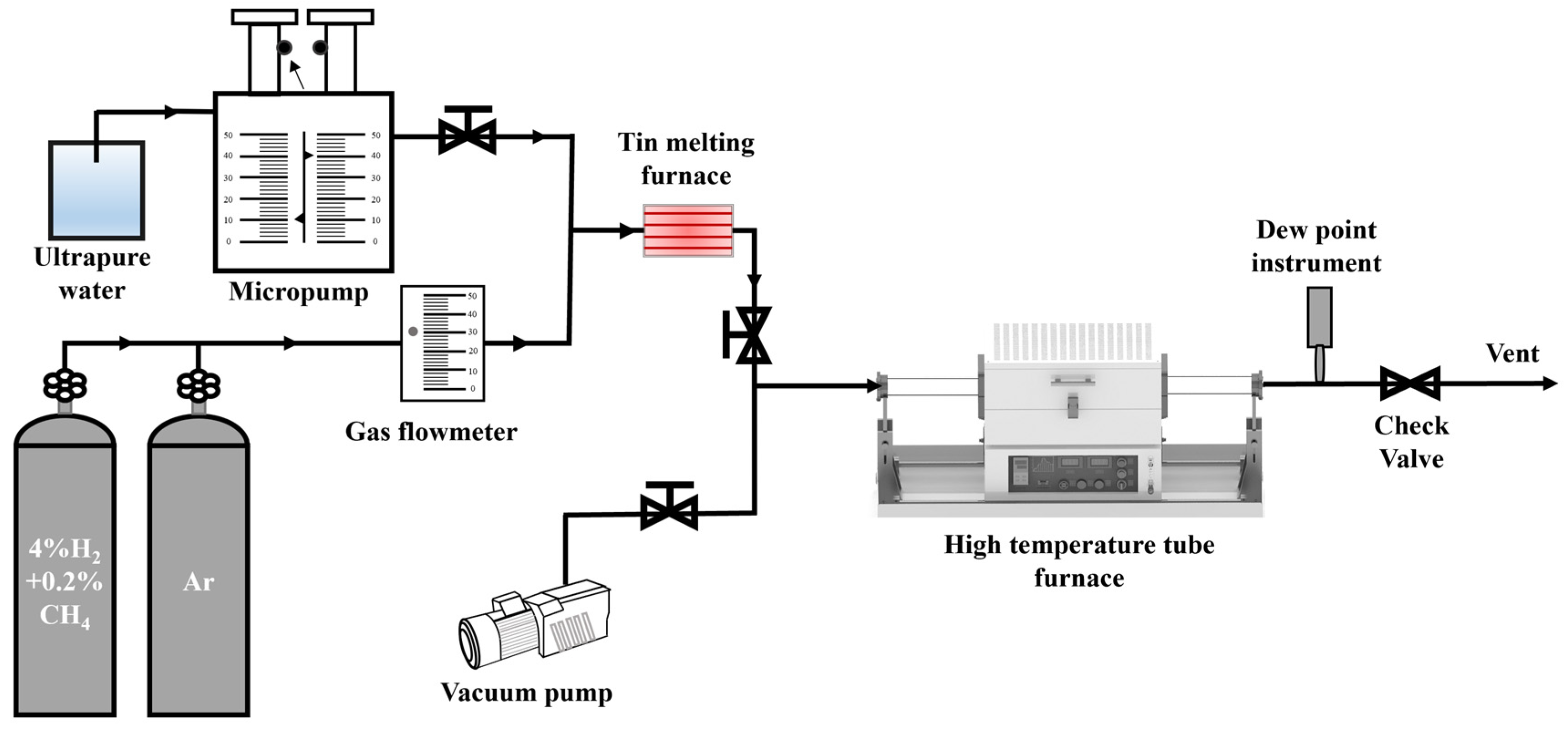
Figure 1. Schematic of oxidation experimental device.
Coatings 16 00620 g001
Figure 2. Relationship between oxygen pressure and oxidizing atmosphere.
Coatings 16 00620 g002
Figure 3. SEM micrograph of annealed Fe–25Ni–20Cr–4Al–1Nb–1Mn–1.5Si–xY alloys: (a) 0 Y; (b) 0.1 Y; (c) 0.2 Y, and (d) 0.3 Y.
Coatings 16 00620 g003
Figure 4. (a) XRD patterns of Fe–25Ni–20Cr–4Al–1Nb–1Mn–1.5Si–xY alloys with different Y contents; (b) the phase diagram of this system.
Coatings 16 00620 g004
Figure 5. STEM-EDS Mapping images of Nb-rich phases in 0.2 Y alloys.
Coatings 16 00620 g005
Figure 6. TEM bright-field images (a,d) the morphology of precipitated phases in 0.2 Y alloy after annealing for 2 weeks; (b,c,e) SAED patterns of selected regions; (f) High-resolution TEM image of B2 phase and electron diffraction of a selected region.
Coatings 16 00620 g006
Figure 7. Surface SEM image and cross-sectional morphologies of Fe–25Ni–20Cr–4Al–1Nb–1Mn–1.5Si–xY alloys after pre-oxidation under a 0.25% H2O atmosphere: (a,e) 0% Y; (b,f) 0.1% Y; (c,g) 0.2% Y; (d,h) 0.3% Y.
Coatings 16 00620 g007
Figure 8. XRD patterns of the surface oxides of Fe–25Ni–20Cr–4Al–1Nb–1Mn–1.5Si–xY alloys after pre-oxidation under a 0.25% H2O atmosphere.
Coatings 16 00620 g008
Figure 9. SEM images of the surface morphology of the pre-oxidized Fe–25Ni–20Cr–4Al–1Nb–1Mn–1.5Si–xY alloys after cyclic oxidation in air at 1000 °C for 460 h: (a) 0 Y; (b) 0.1 Y; (c) 0.2 Y, and (d) 0.3 Y.
Coatings 16 00620 g009
Figure 10. XPS spectra of the surface of each sample in Figure 9: (a) 0% Y; (b) 0.1% Y; (c) 0.2% Y; (d) 0.3% Y.
Coatings 16 00620 g010
Figure 11. Cross-sectional EDS element maps of pre-oxidized Fe–25Ni–20Cr–4Al–1Nb–1Mn–1.5Si–0.2 Y alloy after cyclic oxidation in air at 1000 °C for 460 h.
Coatings 16 00620 g011
Figure 12. (a) Scratch morphology of the oxide layer’s surface on the 0 Y alloy after pre-oxidation: (b) ploughing stage, (c) cracking stage, and (d) spalling stage.
Coatings 16 00620 g012
Figure 13. (a) Friction-load curves and (b) friction coefficient-load curves of the alloy samples.
Coatings 16 00620 g013
Figure 14. Scratch test parameter curves and scratch morphology diagrams of (a) 0 Y; (b) 0.1 Y; (c) 0.2 Y; (d) 0.3 Y.
Coatings 16 00620 g014
Figure 15. (a) Ellingham diagram and (b) standard Gibbs free energies of oxide formation relevant to the AFA alloy system.
Coatings 16 00620 g015
Figure 16. Schematic of the effect of Y on oxide scale formation and adhesion in AFA alloys: (a) 0 Y; (b) 0.2 Y; (c) 0.3 Y.
Coatings 16 00620 g016
Table 1. Chemical composition of the studied alloys (wt.%).
AlloysFeNiCrAlNbMnSiYC
Fe25Ni20Cr4Al1Nb1Mn1.5SiBal25.119.84.071.130.961.42-0.3
Fe25Ni20Cr4Al1Nb1Mn1.5Si-0.1YBal24.720.14.011.070.911.560.080.3
Fe25Ni20Cr4Al1Nb1Mn1.5Si-0.2YBal25.219.93.880.971.031.530.170.3
Fe25Ni20Cr4Al1Nb1Mn1.5Si-0.3YBal24.919.94.131.190.911.480.260.3
Table 2. Chemical constituents of phases in Figure 3 (at%).
AlloysPhasesAlSiCrMnFeNiYNb
0 YGrayFCC4.8321.20.748.721.5-0.1
BlackB2-NiAl31.21.15.40.817.543.9-0.1
WhiteMC20.36.10.283.7-79.7
0.1 YGrayFCC5.34.621.80.14721.100.1
BlackB2-NiAl32.91.67.80.514.242.50.10.4
WhiteMC1.60.47.70.36.64.21.777.5
0.2 YGrayFCC5.22.921.60.848.720.600.2
BlackB2-NiAl30.51.45.30.417.644.60.10.1
WhiteMC31.25.70.25.13.14.577.2
0.3 YGrayFCC4.73.821.10.548.221.30.20.2
BlackB2-NiAl31.42.94.70.714.145.80.30.1
WhiteMC1.10.35.50.34.82.65.380.1
Table 3. Chemical constituents of phases at representative positions in Figure 7 (at%).
AlloysPhaseOAlSiCrMnFeNiNbY
0 YAl2O346.533.30.53.10.26.29.70.5-
0.1 YAl2O353.834.70.33.10.12.45.20.40
Y/Nb-oxide58.431.90.31.502.61.92.41.0
0.2 YAl2O350.037.00.42.705.84.100
Y/Nb-oxide65.322.20.11.00.11.02.37.70.3
53.335.00.31.000.97.70.71.1
0.3 YAl2O339.533.01.06.00.212.87.30.20
Y-oxide36.123.91.210.20.215.46.80.26.0
33.931.01.16.30.414.012.201.1
Nb-oxide53.633.30.10.700.99.51.90
Table 4. Chemical constituents of each phase in Figure 9 (at%).
AlloysPhaseOAlSiCrMnFeNiNbY
0 YAl2O361.634.30.32.20.21.10.30-
Spinel60.82.8020.11.513.20.70.9-
0.1 YM2O365.718.5012.10.11.20.44.00
Al2O361.435.502.20.10.50.10.20
0.2 YAl2O361.334.70.12.800.70.300.1
0.3 YAl2O362.935.401.00.10.40.100.1
Table 5. Work of adhesion (W) between the oxide layer and matrix and tensile stress (σ) at fracture.
SampleL (mm)Ft (N)d (μm)A1 (m2)σ (GPa)W (J m−2)
Equation (4)Equation (7)Equation (6)
( with   σ R )
Equation (8)
( with   σ R )
0 Y0.140.102.55.23 × 10−110.460.390.2819.600.7822.90
0.1 Y0.290.211.11.53 × 10−113.290.6517.7773.556.1546.80
0.2 Y0.510.311.21.75 × 10−114.261.2938.21123.549.6064.50
0.3 Y0.360.221.01.33 × 10−113.980.6025.9589.387.4150.20
Note: L is the displacement at the critical failure point; Ft is the frictional force; d is the penetration depth; A1 is the transverse projected area; σ is the tensile stress at fracture; W is the work of adhesion; σR is the residual stress.
Table 6. Parameters related to the work of adhesion (W) between the oxide layer and substrate.
AlloyOxide SystemEnergy
Release Rate (J m−2)
Oxidation ConditionsQuantification Methods/Mode of FailureResidual Stress
Measurement Method
Ref.
AFA
(0–0.3 wt.% Y)
Al2O319–125
( Equation   ( 6 )   with   σ R );
22–65
( Equation   ( 8 )   with   σ R );
850 °C + 1100 °C
0.25% H2O
Scratch Test/ Interface delamination failureEstimation of thermal expansion mismatchPresent work
AM1
Ni-7.5Cr-5.3Al
Al2O3 + NiAl2O439–113
( Model   1   with   σ R );
60–100
( Model   2   with   σ R );
1000 °C
Lab air
Scratch Test/buckling + wedge spallationEstimation of thermal expansion mismatch[22]
MCNG
Ni-4Cr-6Al
(0.1 wt.% Hf)
NiO + spinel + Al2O30.1–0.5
( Model   1   with   σ R );
33–306
( Model   2   with   σ R );
1100 °C
Lab air
Scratch Test/buckling + wedge spallationEstimation of thermal expansion mismatch[22]
MA956 superalloyAl2O3281150 °C + 1250 °C
Lab air
Scratch Test/wedge spallationXRD[28]
SubstrateAl2O3 in TBC50–80-wedge impression testResidual Thermal Strain Model[49]
Disclaimer/Publisher’s Note: The statements, opinions and data contained in all publications are solely those of the individual author(s) and contributor(s) and not of MDPI and/or the editor(s). MDPI and/or the editor(s) disclaim responsibility for any injury to people or property resulting from any ideas, methods, instructions or products referred to in the content.