Article

Functionalized Graphene and Aramid Fiber Synergistically Enhanced Anti-Corrosion and Toughened Epoxy Coating

National-Local Joint Engineering Laboratory for Energy Conservation in Chemical Process Integration and Resources Utilization, School of Chemical Engineering and Technology, Hebei University of Technology, Tianjin 300130, China
*
Authors to whom correspondence should be addressed.
Coatings 2026, 16(6), 684; https://doi.org/10.3390/coatings16060684 (registering DOI)
Submission received: 17 May 2026 / Revised: 31 May 2026 / Accepted: 1 June 2026 / Published: 7 June 2026
(This article belongs to the Section Corrosion, Wear and Erosion)

Abstract

The corrosion of metal components leads to substantial economic losses and poses serious safety hazards. While organic coatings are regarded as an effective countermeasure, conventional epoxy resins (EPs) often exhibit high brittleness and insufficient corrosion resistance after curing. To overcome these limitations, this study proposes a novel modification strategy. A multilayer graphene-reinforced epoxy composite coating was fabricated via a layer-by-layer spraying process, employing uniformly dispersed modified aramid nanofibers (ANFs) and low-defect graphene as functional fillers. Polydopamine (PDA) was utilized to improve the dispersion of graphene oxide (GO), mitigate defect-associated permeation pathways, and enhance the interfacial bonding between the graphene layer and the epoxy matrix, thereby ensuring coating integrity. Tannic acid (TA) effectively improves the dispersion of ANF within the epoxy, preventing stress concentration. The corrosion resistance and mechanical properties of the composite coating were systematically evaluated. Results demonstrate that the coating achieves a low-frequency impedance of 1.98 × 10¹⁰ Ω·cm2. With the incorporation of 0.05% TA-modified ANFs, the elongation at break increases to 68.79%, and the impact resistance is significantly enhanced, with the impact height reaching 50 cm. The composite coating preparation strategy in this work offers a novel approach for constructing multifunctional composite coatings, demonstrating broad application prospects.

1. Introduction

In recent years, with the vigorous development of deep-sea industries and shipbuilding, metallic structural materials have been widely applied in marine industries such as offshore engineering, transportation sectors including ships, and petrochemical fields. However, metallic materials are prone to corrosion in harsh environments characterized by high humidity, elevated temperatures, and acidic or alkaline media. This corrosion leads to performance degradation, causing significant economic losses and potentially triggering a series of severe challenges including equipment failure, safety incidents, and environmental pollution [1,2]. Therefore, developing highly effective and durable protective technologies to delay the erosion of metal substrates by corrosive media has become a key research focus in corrosion science and protective engineering.
Among various protective measures, organic coatings are widely used due to their easy application, cost-effectiveness, and reliable protection [3,4]. For instance, polyurethane coatings exhibit excellent weather resistance and decorative appeal but are generally less resistant to chemical corrosion than epoxy resins [5]. While inorganic zinc-rich coatings provide cathodic protection and fluorocarbon coatings offer outstanding aging resistance, they often underperform epoxy resins in critical properties such as film formation and adhesion, or are limited by high cost and complex application processes [6]. In contrast, waterborne epoxy (EP) coatings have drawn significant research attention owing to their environmental friendliness, ease of application, strong adhesion, and superior corrosion resistance [7,8]. Upon curing, they form a dense three-dimensionally cross-linked network that effectively blocks the penetration of corrosive agents such as water, oxygen, and chloride ions, thereby providing a robust physical barrier for the metal substrate.
However, conventional epoxy coatings remain prone to cracking upon film formation, as well as the development of micropores and microcracks caused by moisture evaporation and internal stresses during curing. These defects create channels for corrosive media to penetrate [9,10,11], thus shortening the long-term protective service life of the coating [12]. To overcome these limitations, researchers have explored several strategies, such as loading nano-containers with corrosion inhibitors [13], incorporating functionalized nanocomposites like modified graphene [14], and developing specialized functional coatings [15,16]. Nevertheless, existing graphene oxide (GO)-modified systems often fail to address issues related to structural defects and undesirable filler orientation, which can accelerate underlying metal corrosion and hinder broader application [17].
Additionally, epoxy coatings suffer from issues such as high brittleness and poor impact resistance. Aromatic Nylon Nanofibers (ANFs), owing to their high strength and excellent compatibility [18,19,20], have emerged as a key solution for effectively enhancing the mechanical properties of coatings. Moreover, ANF not only exhibits remarkable mechanical properties, thermal stability, chemical resistance, and electrical insulation but also possesses a nano-scale structure characterized by a high aspect ratio and large specific surface area [21]. As a nanoscale material, large specific surface area and high surface energy of ANF predispose it to self-aggregation. When incorporated into epoxy (EP), it introduces microporosity into the matrix, thereby diminishing the coating’s long-term protective performance. Consequently, achieving synergistic enhancement of both corrosion resistance and mechanical properties in graphene-based composite coatings represents a significant technical challenge.
In this study, a layered composite coating was designed and fabricated by alternately spraying an epoxy resin-doped modified aramid fiber (ANF@TA) solution and a modified graphene oxide (GO@PDA) solution, achieving synergistic enhancement of both anti-corrosion and mechanical properties. Polydopamine (PDA), possessing a molecular structure similar to GO, induces π-π conjugation effects that mitigate defect-associated permeation pathways. Additionally, PDA functions as a binder, ensuring coating structural integrity. Tannic acid (TA) serves as a surface modifier for ANF, preventing ANF aggregation during solvent replacement that could cause stress concentration. The layer-by-layer coating method promotes the orientation alignment of GO@PDA, while avoiding electrical connections between GO nanosheets and preventing filler aggregation caused by mixing the two fillers. Results demonstrate that the composite coating (ANF/EP-GO) exhibits significantly superior corrosion resistance compared to the blend coating (AG-EP) and pure epoxy coating. Additionally, the mechanical properties of the ANF/EP-GO coating show marked improvement. This work provides a novel strategy for addressing coating challenges in complex scenarios.

2. Materials and Methods

2.1. Materials

Graphene oxide particles with a particle size of 15–30 μm and a tapped density of 0.7–1.2 g/cm3 were purchased from Sixth Element Materials Technology Co., Ltd. (Changzhou, China); Tris(hydroxymethyl)aminomethane (Tris, 99%) was purchased from Xinsuo Optech Co., Ltd. (Tianjin, China); Dopamine hydrochloride (DA, 98%) was purchased from Merrell Biochemical Technology Co., Ltd. (Tianjin, China); Aramid fiber (Kevlar-29) was purchased from Shuangmu Trading Co., Ltd. (Anyang, China); Dimethyl sulfoxide (DMSO) and ethanol were purchased from Keyuan Biochemical Co., Ltd. (Shandong, China); Potassium hydroxide (KOH) was purchased from Aladdin Biochemical Technology Co., Ltd. (Shanghai, China); Tannic acid (TA, AR) was purchased from E-N Chemical Technology Co., Ltd. (Shanghai, China); Water-based epoxy resin and curing agent were purchased from Yoshida Chemical Co., Ltd. (Shenzhen, China). Deionized water was prepared in the laboratory.

2.2. Preparation of Polydopamine-Modified Graphene

Add 726 mg of Tris and 150 mL of deionized water to a 250 mL round-bottom flask, adjusting the pH to 8.5. Then add 300 mg of graphene oxide and sonicate for 90 min to obtain a uniform suspension. Subsequently, add 1.2 g of DA to the suspension. Stir at 60 °C for 12 h to promote self-aggregation of DA on the graphene flake surface. After the reaction, centrifuge the gray-black solution at 1000 rpm for 15 min. Wash several times with distilled water to remove unreacted material. The resulting product is named GO@PDA.

2.3. Tannic Acid-Modified Aramid Nanofibers

First, dissolve 1 g of tannic acid in 99 g of deionized water to prepare a 10 mg/mL TA aqueous solution. Then dissolve 0.3 g of KOH in water. Add the KOH aqueous solution and 0.2 g of ANFs to 100 mL of DMSO and stir for 4 h. Next, the TA aqueous solution was added dropwise to the ANFs/DMSO dispersion and vigorously stirred for 2 h to achieve uniform dispersion of TA, yielding a ANF@TA mass ratio of 5:1. The mixture was then washed and filtered using filter paper to remove unreacted DMSO, KOH, and TA until the filtrate was neutral. The resulting dispersion was homogenized for 5 min using a homogenizer. The final product was designated as ANF@TA.

2.4. Preparation of Coatings

GO@PDA was ultrasonically diluted with distilled water to obtain a 0.2 mg/mL dispersion. ANF@TA was stirred with water-based epoxy resin for 2 h (ANF@TA content at 0.05% and 0.1%, respectively), followed by addition of a 30 wt% curing agent (relative to epoxy resin) and stirring for 15 min. Before spraying, thoroughly sand the substrate with 200–1000-grit sandpaper to remove the surface oxide layer, then clean it with ethanol and dry it at 60 °C for 5 min. Using a 0.8 mm nozzle at a pressure of 0.6 MPa and a spraying distance of 15 cm from the substrate, the ANF/EP and GO@PDA aqueous solutions were alternately sprayed onto a steel substrate (Q235). The drying time between layers was 40 min, and both the base and top layers were epoxy resin layers. The mass fraction of GO@PDA is approximately 0.5 wt%, and the coating comprises 4 graphene layers and 5 epoxy resin layers. The coatings described above are named according to their ANF@TA content as follows: 0.1ANF/EP-GO and ANF/EP-GO. For comparison, pure epoxy resin coatings and mixed coatings were also prepared. The hybrid coating was designated as AG-EP. It was prepared by uniformly dispersing GO@PDA into ANF/EP via stirring and ultrasonication. Subsequently, 30 wt% of curing agent was added and thoroughly mixed for 15 min, followed by spraying onto the steel substrate. All coatings had a thickness of 50 ± 2 μm.

2.5. Characterization and Performance

In this study, Fourier Transform Infrared Spectroscopy (FTIR) (Tensor 27, Bruker, Karlsruhe, Germany) was employed to infer functional group information within the materials based on characteristic absorption peaks in the spectra. Scanning electron microscopy (SEM, Quanta 450FEG, Thermo Fisher Scientific, Waltham, MA, USA) was employed to examine the microstructures of GO and GO@PDA powders, ANF, TA-ANF, and coated cross-sections. Surface topography of GO, GO@PDA, ANF, and ANF@TA was analyzed using a field emission high-resolution transmission electron microscope (Talos F200S, Thermo Fisher Scientific, Waltham, MA, USA). Dispersibility of ANF, ANF@TA, GO, and GO@PDA in water was evaluated using a nanoparticle size and zeta potential analyzer (BeNano 90, Dandong Bate Instrument Co., Ltd. (Dandong, China)). The anti-corrosion performance of the coating systems was evaluated using an electrochemical workstation (CHI660E, Shanghai Chenhua Instruments Co., Ltd. (Shanghai, China)). Electrochemical impedance spectroscopy (EIS) testing was conducted in a typical three-electrode system in 3.5 wt% NaCl artificial seawater. The coated steel served as the working electrode, a platinum plate as the counter electrode, and a saturated calomel electrode as the reference electrode. The coating was subjected to a salt spray test in accordance with ASTM B117. The working electrode had an exposed area of 1 cm2, and the remaining part was sealed with epoxy resin E-44. The test temperature was 25 °C. Prior to EIS testing, open-circuit potential (OCP) measurements of steel specimens were conducted in 3.5 wt% NaCl solution for 10 min to stabilize the potential. All measurements were performed under the aforementioned ambient conditions, and the open-circuit potential remained stable. For EIS testing, the scanning frequency range was set from 105 to 10−2 Hz. To ensure reproducibility, experiments were performed in triplicate on three parallel specimens. The mechanical properties of the coating were characterized using a paint film impact tester CJQ-II (GB/T 1732), a PS 2658 pull-off adhesion tester (ASTM D4541), and a BY pencil hardness tester (GB/T 6739-2022) (Shanghai Pushi Testing Instrument Co., Ltd. (Shanghai, China)). The test results above are the average of three tests. According to ASTM D638, Type IV specimens were selected and tested using an electronic universal testing machine CMY-6104 (Shenzhen New Thinking Measurement Technology Co., Ltd. (Shenzhen, China)) with a 2 kN load. The tensile test specimen is a film with a thickness of 0.4 mm. The film is cured at 60 °C for 24 h, then removed and cooled to room temperature, after which it is cut using a cutting die in accordance with the ASTM D638 Type IV specification. Tensile tests were conducted at 2 mm/min, and the final results were the average of five experiments.

3. Results

3.1. Preparation and Structural Morphology Characterization of ANF/EP-GO Coatings

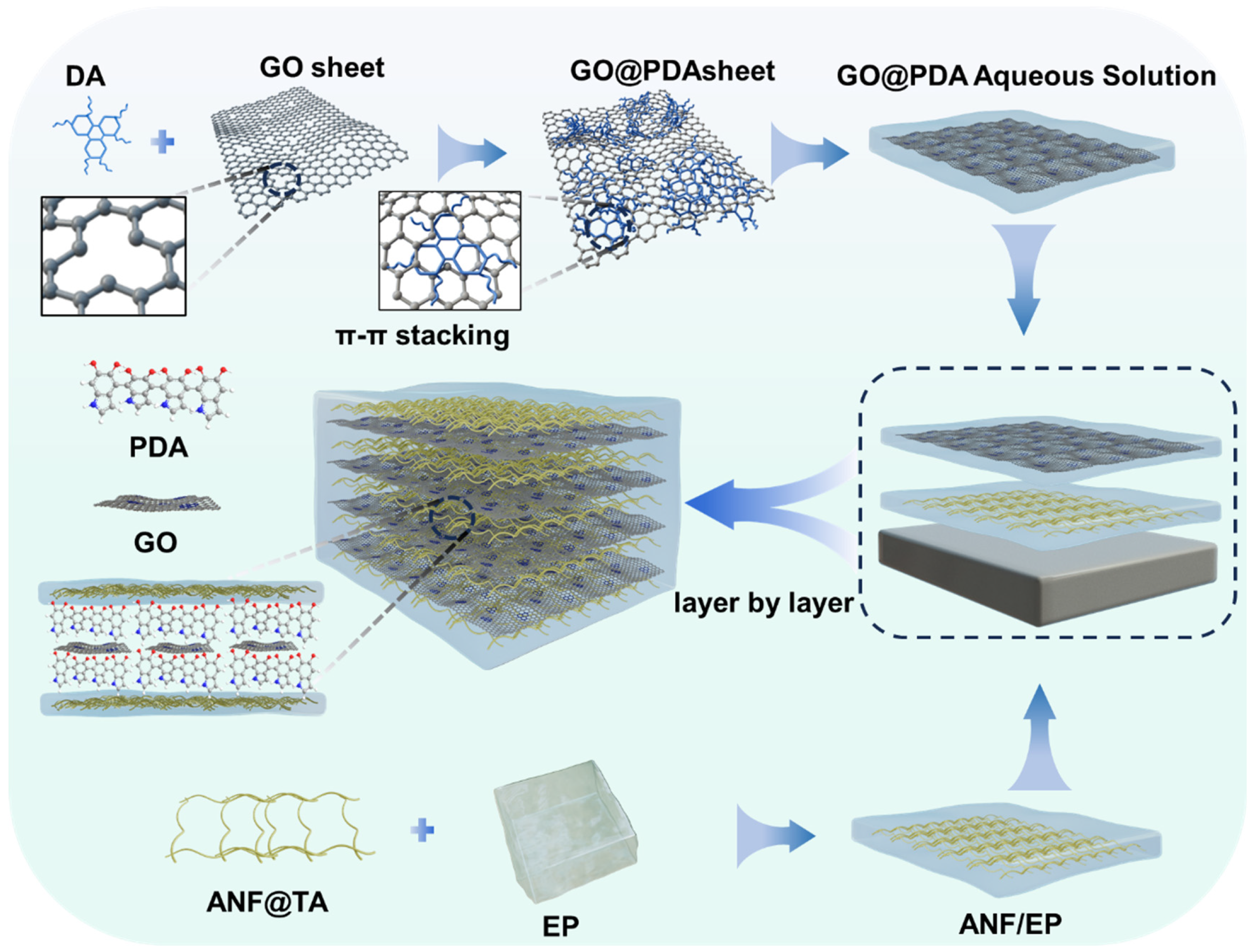
The ANF/EP-GO composite coating shown in Figure 1 was prepared by alternately spraying GO@PDA suspension and ANF@TA doped with EP. PDA-coated GO was dissolved in water, where PDA mitigated defect-associated permeation pathways of GO and improved its dispersion, serving as the graphene functional layer for the coating. TA-modified ANF dispersed in EP improved ANF dispersion, serving as the modified epoxy layer. Layer-by-layer spraying promotes the preferential alignment of high aspect ratio GO with the steel surface during water evaporation. This would prevented electrochemical corrosion caused by GO and avoided filler agglomeration resulting from mixing ANF@TA and GO@PDA, which would create micropores and reduce corrosion resistance.
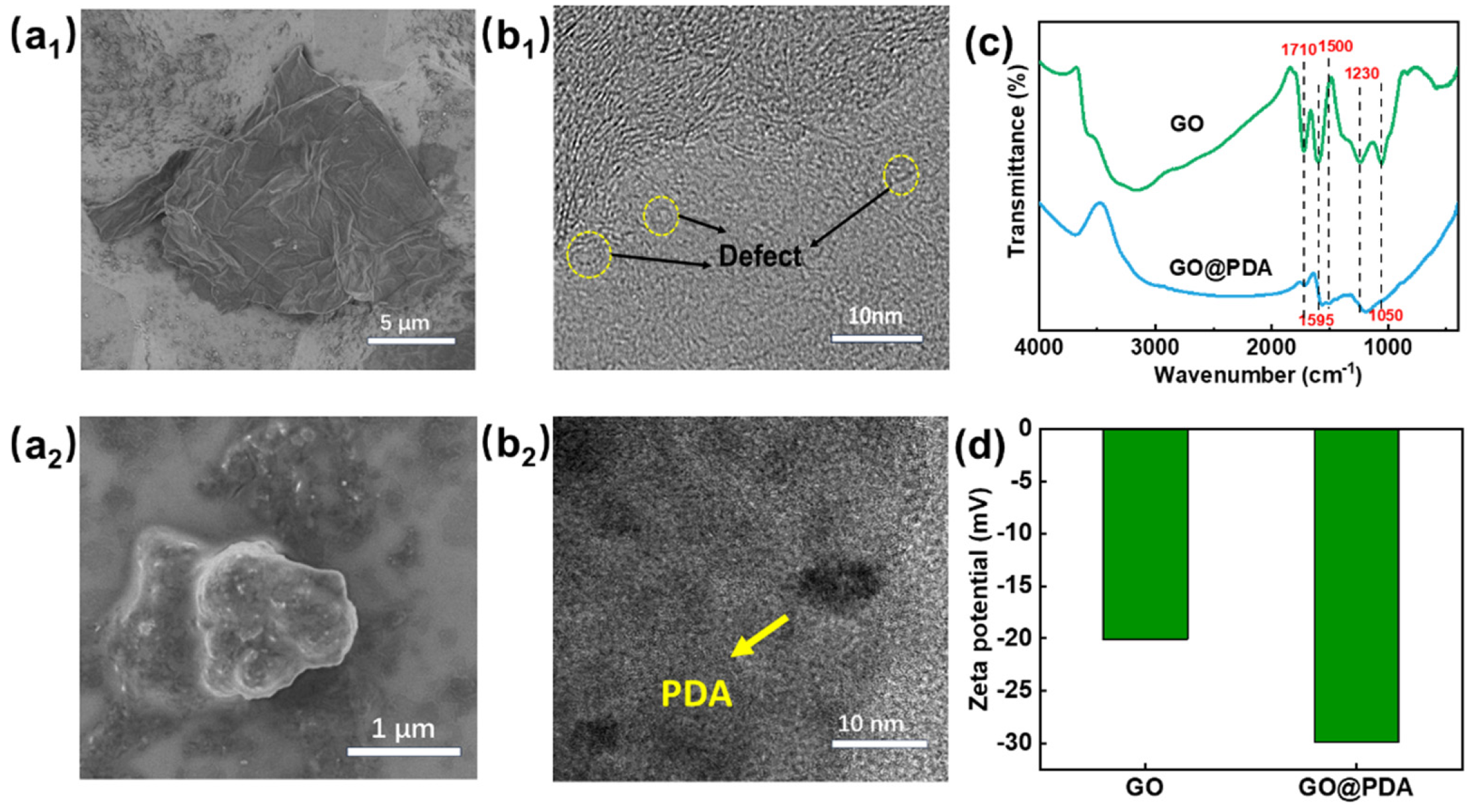
The scanning electron microscopy (SEM) morphology of GO and GO@PDA in Figure 2(a1,a2) showed that, compared with GO, the surface of the PDA-coated nanosheets exhibited a rough, granular appearance. To further confirm the interaction between PDA and GO, FTIR analysis was performed on both GO and GO@PDA, as shown in Figure 2c. The peak at 1710 cm−1 was weaker in GO@PDA than in GO, which was likely attributed to hydrogen bonding between the amino (-NH2) or hydroxyl (-OH) groups of PDA and the carboxyl (-COOH) groups of GO, leading to attenuation of the absorption peak. The broadening of the characteristic peak at 1595 cm−1 in GO@PDA indicated a π–π conjugation effect between the aromatic rings of PDA and GO. This interaction altered the electron density and vibrational mode of the intrinsic C=C bonds of GO, resulting in peak broadening [22]. During GO preparation, structural defects inevitably arose due to ultrasonication or oxidizing agents. High-resolution TEM (HRTEM) images in Figure 2(b1) revealed surface defects on pristine GO, which significantly impaired its impermeability. The π–π conjugation effect enabled PDA to mitigate defect-associated permeation pathways, as demonstrated in Figure 2(b2). Moreover, GO@PDA exhibited a new peak at 1500 cm−1, originating from the N-H bending vibration of the aromatic rings in PDA [23], whereas the peaks at 1230 cm−1 and 1050 cm−1 were weakened. These corresponded to the epoxy group (C-O-C) and C-O peaks of GO, likely due to the reaction between the hydroxyl (-OH) groups in PDA molecules and the C-O-C groups on GO. This reaction consumed the C-O-C signals and caused overlap with C-N peaks, leading to a broader absorption envelope [22]. Furthermore, as indicated by the zeta potential values in Figure 2d, the PDA-modified GO showed an increased negative surface charge, which improved its dispersion stability. The morphological features, together with the FTIR and zeta potential analyses, confirmed the successful synthesis of GO@PDA.
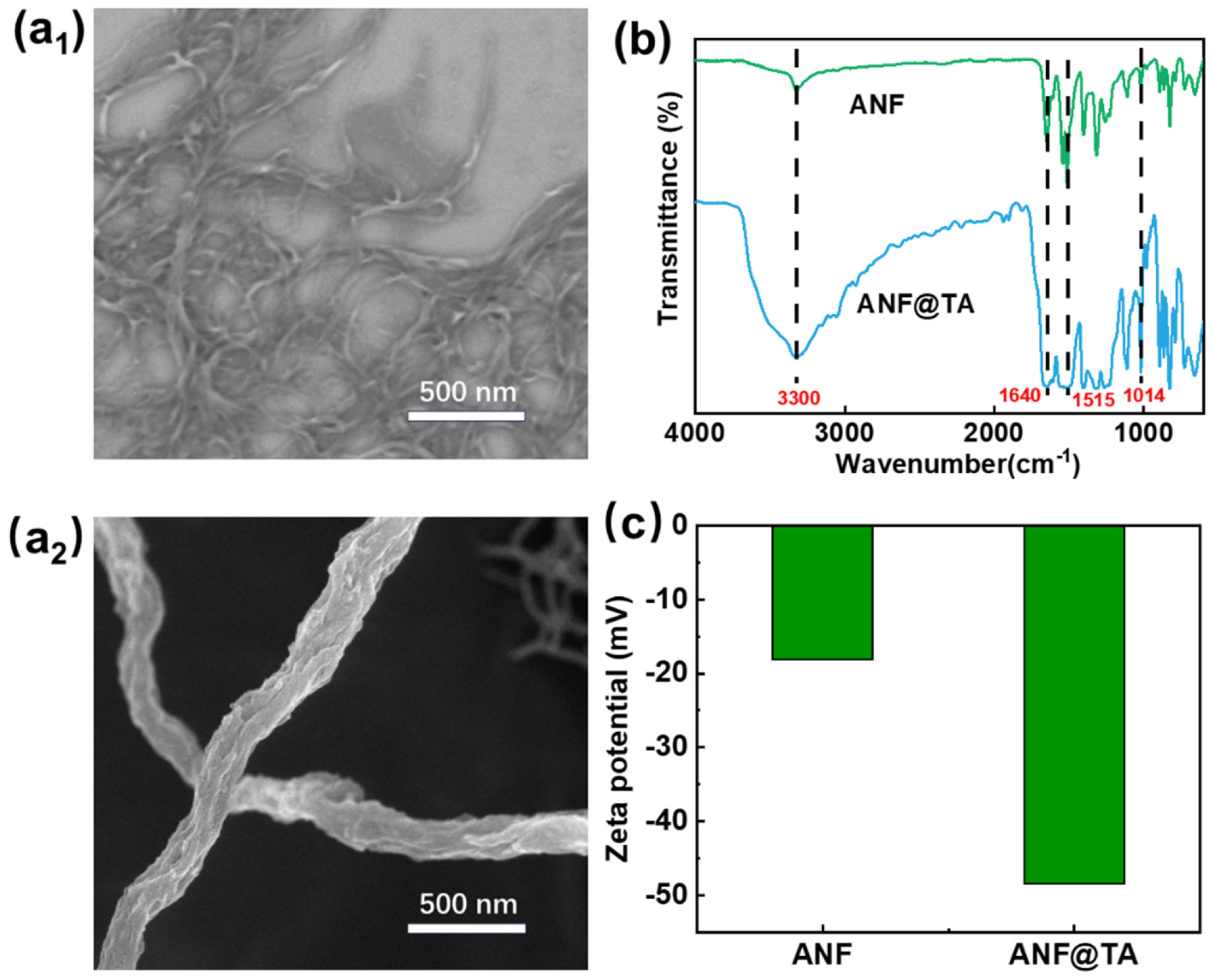
ANF was synthesized through deprotonation and reprotonation processes, yielding a colloidal dispersion of extensively entangled nanofibers (Figure 3(a1)). It is reported that KOH/DMSO-based ANF dispersions are moisture-sensitive, as water ingress accelerates deprotonation and induces aggregation [24,25]. The ANF/KOH/DMSO mixture, initially pale yellow in the absence of TA, transitioned to a brown hue upon introduction of TA solution. This chromogenic shift is attributed to the alkaline environment promoting electron loss from TA, leading to the formation of quinone structures [26]. Concurrently, the pH of the system decreased from 13 to 7.3 (Figure S1), indicating an acid-base neutralization reaction between TA and KOH [27]. As shown in Figure 3(a2), the addition of TA aqueous solution substantially suppressed fiber aggregation, indicating that TA effectively inhibits the reprotonation of ANF. To further corroborate the modification, the physicochemical properties of ANF and ANF@TA were characterized by ATR-FTIR and zeta potential analysis. The FTIR spectra (Figure 3b) of both samples exhibited characteristic ANF absorption bands at 1640 cm−1 (C=O stretch), 1545 cm−1 (N-H bend coupled with C-N stretch), 1515 cm−1 (aromatic C=C stretch), and 1014 cm−1 (in-plane C-H stretch) [24]. Following TA modification, additional spectral features were observed: a broad envelope around 3300 cm−1 assigned to overlapping O-H and N-H stretching vibrations, indicative of the extensive hydrogen-bonding network formed by the phenolic hydroxyl groups of TA [28]. The enhanced intensity and broadening of the 1640 cm−1 band likely arise from the superposition of the aromatic C=C stretch of TA and the carbonyl stretch of ANF. Furthermore, the band at 1515 cm−1 is attributed to coupling between the benzene ring C=C stretch and the in-plane bending vibration of the phenolic O-H group, resulting in peak broadening [29]. The colloidal stability of the dispersions was evaluated by zeta potential measurements (Figure 3c). A zeta potential absolute value greater than 30 mV generally indicates sufficient electrostatic repulsion to maintain colloidal stability [30,31]. The ANF@TA dispersion exhibited a zeta potential exceeding 40 mV in absolute value, confirming its long-term kinetic stability against aggregation. The above morphological characterization, along with infrared and zeta potential analyses, confirms the successful modification of ANF by TA.
TA addition inhibits ANF agglomeration through multiple synergistic mechanisms. The inherent aggregation tendency of ANF arises from the reprotonation of its surface carboxyl groups, which re-forms hydrogen bonds or electrostatic attractions between nanofibers. Introducing TA aqueous solution triggered an acid-base neutralization reaction within the alkaline ANF dispersion, shifting the system pH from strongly to weakly basic. Moreover, as a polyphenolic compound, TA competes with ANF amide groups for protons via its phenolic hydroxyl groups and concurrently establishes hydrogen-bonding interactions. The aromatic moieties of TA also engage in π-π stacking with ANF backbones [32,33]. In aqueous medium, weakly acidic TA molecules dissociate into anionic species, generating electrostatic repulsion between the polyanionic PPTA (p-phenylene terephthalamide, the main chain of aramid fibers) chains of ANF, thereby promoting inter-fiber separation. Ultimately, TA adsorbs onto the ANF surface and, through strong hydrogen bonding with surrounding water molecules, forms a hydrated shielding layer that sterically hinders nanofiber self-aggregation.

3.2. Corrosion Resistance of ANF/EP-GO Coating

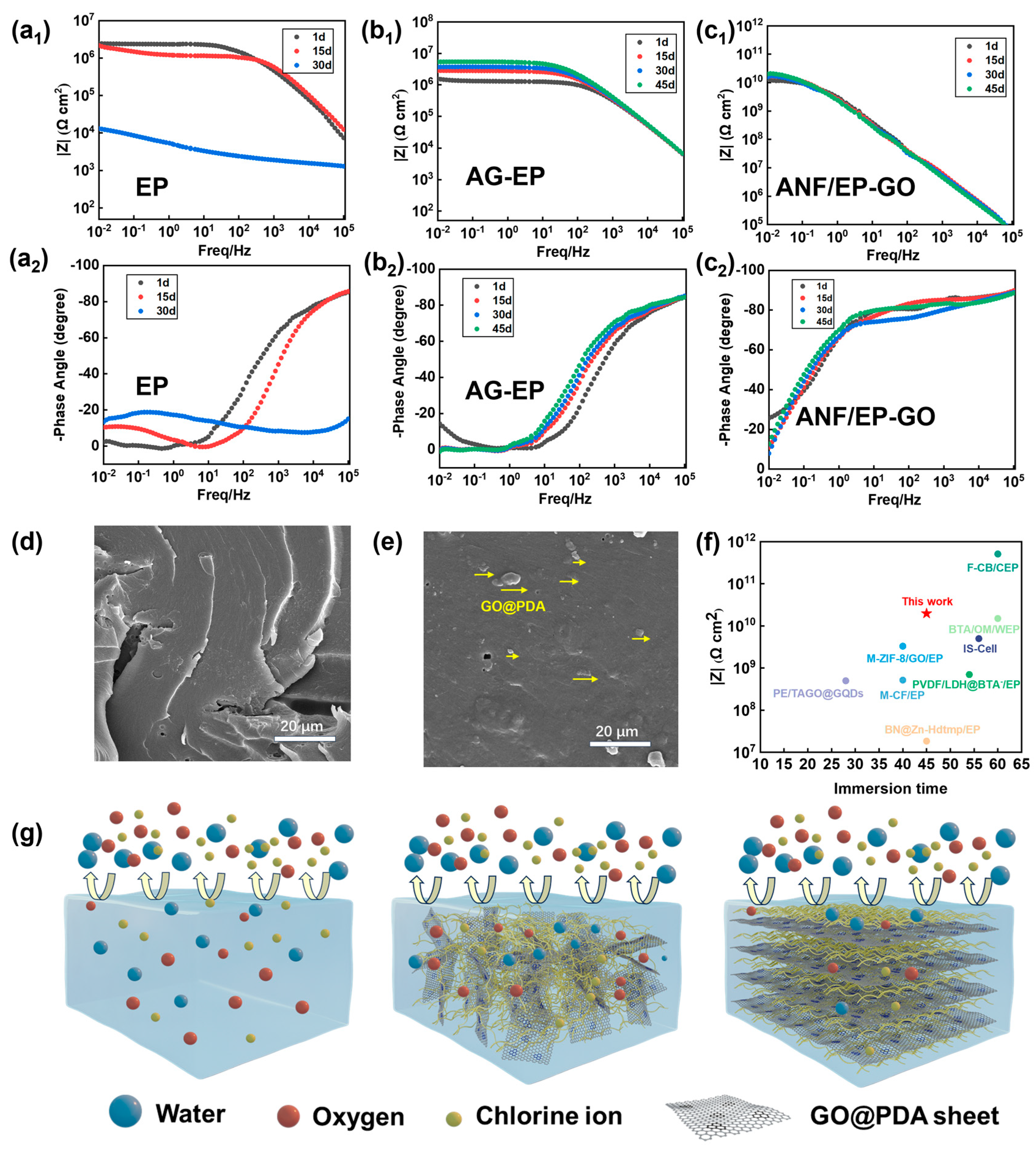
To investigate the corrosion behavior influenced by the coating architecture, electrochemical impedance spectroscopy (EIS) was performed on pure EP, blended AG-EP, and layered ANF/EP-GO coatings. The corrosion protection efficiency was evaluated using the impedance modulus at the lowest frequency (|Z|f = 0.01), which reflects the coating’s barrier property against charge transfer, a higher value corresponds to greater charge-transfer resistance, slower corrosion kinetics, and thus, better protective performance [34]. The Bode plots of the pure EP coating during immersion in 3.5% NaCl solution are shown in Figure 4(a1,a2). The initial |Z|f = 0.01 value was 2.45 × 10⁶ Ω·cm2, which dropped sharply to 1.31 × 10⁴ Ω·cm2 after 30 days of immersion, indicating that corrosive species had penetrated to the substrate through permeable pathways. This was further supported by the phase-angle plot (Figure 4(a2)): only one time constant appeared initially, whereas two distinct time constants emerged after 30 days, confirming the establishment of a corrosion micro-cell at the coating/substrate interface [35]. The cross-sectional morphology of EP (Figure 4d) revealed abundant micropores within the matrix, which serve as diffusion channels for aggressive ions and significantly shorten the coating service life. For the AG-EP coating (Figure 4(b1,b2)), the initial |Z|f = 0.01 was 1.56 × 10⁶ Ω·cm2 and increased to 5.35 × 10⁶ Ω·cm2 after 45 days. In contrast, the layered ANF/EP-GO coating (Figure 4(c1,c2)) exhibited a much higher initial low-frequency impedance of 1.33 × 10¹⁰ Ω·cm2, which further rose to 1.98 × 10¹⁰ Ω·cm2 after the same immersion period, remaining essentially unchanged over 45 days. This indicates that the incorporation of well-dispersed, GO@PDA markedly enhanced the barrier performance of the coating. The significantly higher impedance of the ANF/EP-GO coating compared to pure EP and AG-EP can be explained by its cross-sectional morphology (Figure 4e). During immersion, the GO@PDA nanosheets maintain uniform distribution and exhibit a tendency for preferential alignment with the substrate [36,37], fully exploiting the “labyrinth effect” within the polymer matrix [38]. In contrast, the AG-EP coating showed only limited improvement in |Z|f = 0.01, likely due to filler agglomeration caused by the mixed addition of ANF@TA and GO@PDA, which introduced voids in the epoxy matrix and compromised corrosion resistance.
In the Bode plots of coatings immersed for 45 days (Figure 4(b1,c1)), a rise in low-frequency impedance was observed. This behavior may be explained by the chelating ability of TA, a polar molecule whose surface hydroxyl and carboxyl groups can form stable coordination bonds with the steel substrate, thereby constructing a passivation layer at the coating–steel interface. Even if trace amounts of corrosive species penetrate through coating defects, corrosion is suppressed, leading to an increase in low-frequency impedance. Throughout the immersion period, both the ANF/EP-GO and AG-EP coatings consistently exhibited only one time constant, indicating that ANF@TA and GO@PDA effectively inhibit the ingress of corrosive agents. In contrast, the 0.1 ANF/EP-GO coating showed a slightly lower impedance modulus (Figure S2), likely due to fiber aggregation caused by the higher ANF@TA loading. Such aggregation can introduce minor defects into the coating, resulting in a modest decrease in barrier performance compared to the ANF/EP-GO system. Based on the Bode plot analysis, the ANF/EP-GO coating demonstrated the highest corrosion resistance, whereas the pure EP coating performed the weakest. As summarized in Figure 4f, the |Z|f = 0.01 values over immersion time confirm that the ANF/EP-GO coating offers significantly enhanced corrosion protection compared to previously reported epoxy-based coatings [39,40,41,42,43,44,45,46].
To further evaluate the corrosion resistance of the coating, Nyquist tests were conducted in a 3.5 wt% NaCl solution to analyze its corrosion behavior. The electrochemical impedance spectrum curves were fitted using the equivalent circuit shown in Figure S3, where Rs, Rc, Rct, CPEc, and CPEdl represent the solution resistance, coating resistance, charge transfer resistance, coating capacitance, and double-layer capacitance, respectively. Figure S3a applies when the corrosive agent does not contact the steel substrate, while Figure S3b applies to the opposite scenario. Fitted data are shown in Figure S3 and Table S1. In the EIS curves, a larger radius of the semicircle indicates superior corrosion resistance of the coating system. The EIS curves and Bode plots exhibit consistent trends, indicating that the 0.05 ANF/EP-GO coating exhibits the best corrosion resistance, while the EP coating performs the worst. In addition, salt spray tests were conducted on the EP coating and the ANF/EP-GO coating. As shown in Figure S4, the ANF/EP-GO coating exhibited virtually no severe corrosion during the 240 h salt spray test, whereas the EP coating showed significant corrosion propagation. This indicates that the ANF/EP-GO coating possesses excellent corrosion resistance and the ability to provide long-term protection for metals.
Based on the preceding electrochemical analysis, Figure 4g schematically illustrates the corrosion protection mechanisms of the EP, ANF/EP-GO, and AG-EP coating systems. Coating compactness is critical, as a dense structure provides an effective physical barrier against the ingress of corrosive agents. In the unmodified EP coating, the lack of reinforcement results in inherent barrier deficiencies. Corrosive species such as O2, H2O, and Cl rapidly permeate through micropores, cracks, and defects, reaching the substrate and inducing severe corrosion damage. For the AG-EP coating, the well-dispersed PDA enhances the barrier properties to some extent. It extends the diffusion path of corrosive ions through a “labyrinth effect,” thereby retarding their penetration. The significantly improved corrosion resistance of the ANF/EP-GO coating can be attributed to the following integrated mechanisms: (1) This layered structure, fabricated by layer-by-layer spraying, contains numerous dense GO@PDA nanosheets that tend to align preferentially with the matrix. (2) The PDA on the GO@PDA surface contains benzene rings, -OH, and -NH2 groups, which can form π–π conjugation, hydrogen bonds, and covalent interactions with the -COOH and -OH groups of GO, thereby mitigating defect-associated permeation pathways. Further blocking the diffusion of aggressive agents into the epoxy matrix. The coating maintains its structural integrity even after prolonged exposure, thereby significantly improving its long-term barrier performance. (3) TA molecules are rich in catechol groups, which can undergo coordination and chelation reactions with Fe3+ and iron oxides on the steel substrate surface, forming a passivation film and further inhibiting corrosion behavior.

3.3. Mechanical Properties of ANF/EP-GO Coating

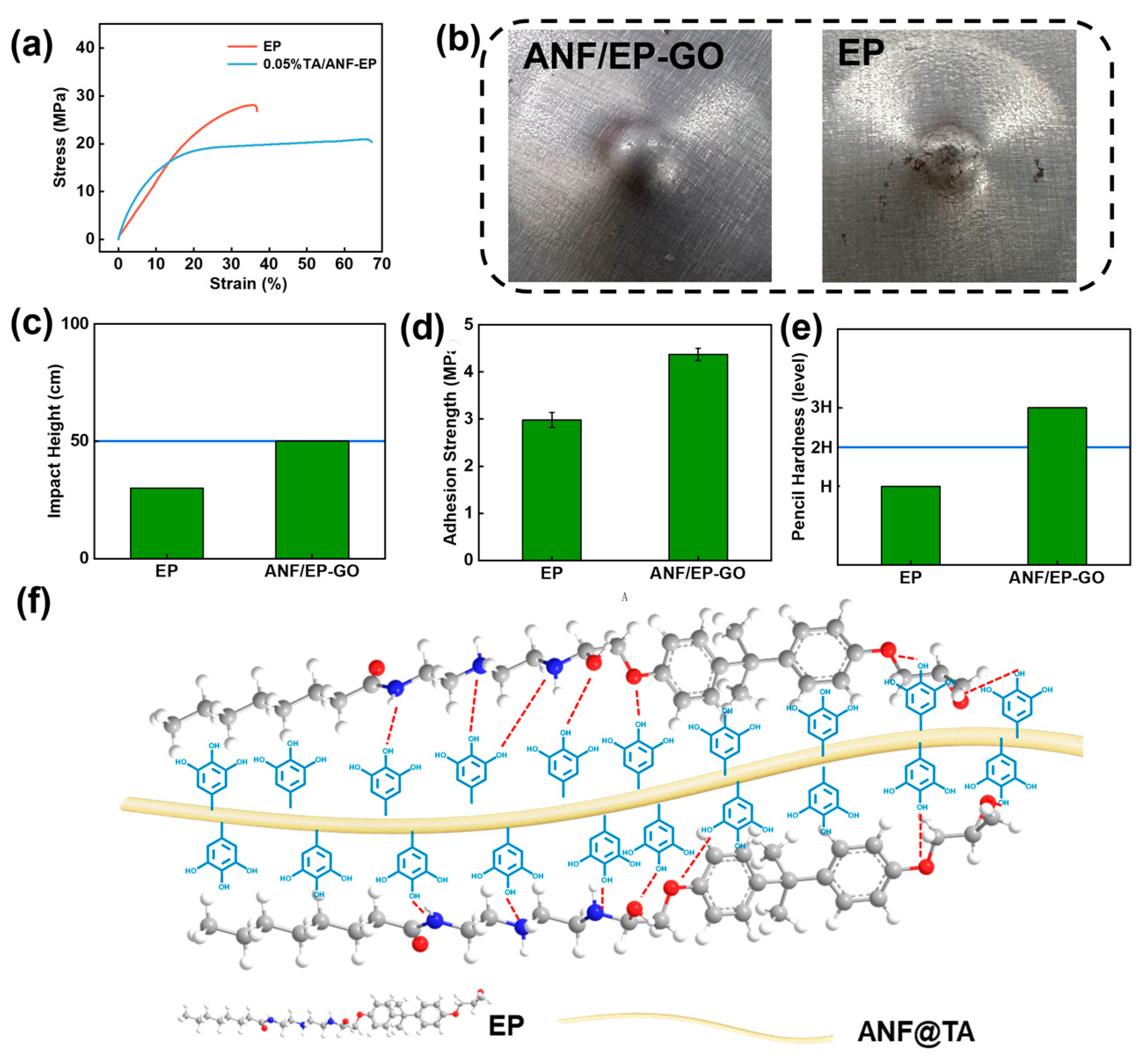
To comprehensively evaluate the protective performance of the coating under real service conditions, a series of mechanical characterizations were performed on EP and 0.05% ANF@TA-EP. As shown in Figure 5a, the EP coating exhibited a tensile strength of 26.95 MPa and an elongation at break of 30.59%. The incorporation of ANF@TA further improved the mechanical performance of the composite. At a loading of 0.05%, the elongation at break increased significantly to 68.79%. Figure 5b compares the surface morphology of the ANF/EP-GO and EP coatings after a 50 cm impact test. The EP coating showed obvious cracking, whereas the ANF/EP-GO coating remained virtually intact. The absence of cracks or delamination at this impact height confirms the excellent impact resistance of the ANF/EP-GO coating [47,48,49]. Pull-off test results (Figure 5d) indicated an adhesion strength of 4.54 MPa for the ANF/EP-GO composite. According to the pencil hardness test (Figure 5e), the ANF/EP-GO coating reached a hardness grade of 3H, substantially higher than the H grade of the pure epoxy coating. All measured mechanical properties of the ANF/EP-GO coating meet industrial coating standards (ISO12944-6, GB/T 6739). The enhancement in mechanical performance can be attributed to the following mechanisms, as illustrated in Figure 5f: (1) ANF exists in an agglomerated state within the epoxy (EP), whereas ANF@TA is uniformly dispersed in the EP, effectively enhancing the mechanical properties of the composite material. (2) Hydroxyl and epoxy groups present in the EP molecular chains can form hydrogen bonds with the amide bonds in ANF. For ANF@TA, the TA also forms hydrogen bonds with ANF, contributing to the improvement of the composite material’s mechanical properties.

4. Discussion

Although the exact thicknesses of individual GO@PDA and ANF/EP layers could not be precisely determined due to slight interdiffusion between adjacent layers and indistinct interfaces during the layer-by-layer spraying process, the total thickness of all coatings was strictly controlled to 50 ± 2 μm to ensure reliable performance comparison. Accurate characterization of the single-layer thickness will be pursued in future work. The focus of this work is on the synergistic enhancement effect arising from the layered structure formed by alternately stacked GO@PDA and ANF@TA/EP layers, rather than on single-component systems. Future comparative experiments using only GO@PDA or only ANF@TA will be conducted to further elucidate their respective contributions. Moreover, the as-prepared ANF/EP-GO composite coating maintained a low-frequency impedance as high as 1.98 × 10¹⁰ Ω·cm2 after immersion in 3.5 wt% NaCl solution for 45 days, and virtually no obvious corrosion products were observed during the 240 h salt spray test. These results demonstrate that the ANF/EP-GO coating possesses long-term stability and reliable anti-corrosion capability, showing excellent applicability and promising potential for long-term marine and industrial anti-corrosion scenarios.

5. Conclusions

In summary, GO@PDA was obtained through π-π conjugation repair using polydopamine, with PDA serving as a binder to ensure coating integrity. ANF@TA was prepared via π-π conjugation and hydrogen bonding interactions mediated by tannic acid, effectively alleviating the aggregation of ANF. The ANF/EP-GO composite coating was fabricated by layer-by-layer spraying of the ANF/EP layer and the GO@PDA layer. This spraying method promotes the preferential alignment of GO@PDA with the substrate, enhancing the anti-corrosion performance of the coating, while avoiding filler agglomeration caused by blending ANF@TA and GO@PDA, which would otherwise reduce corrosion resistance. The ANF/EP-GO composite coating exhibits a low-frequency impedance as high as 1.98 × 10¹⁰ Ω·cm2, an elongation at break of 68.79%, and the impact height is significantly increased to 50 cm. Furthermore, the coating exhibits excellent adhesion and pencil hardness. The ANF/EP-GO coating developed in this work represents a highly promising, multifunctional high-performance protective coating. It synergistically enhances both corrosion resistance and mechanical properties, offering a novel solution for marine anti-corrosion applications.

Supplementary Materials

The following supporting information can be downloaded from https://www.mdpi.com/article/10.3390/coatings16060684/s1, Figure S1: (a) ANF solution; (b) Untreated TA/ANF solution; (c) Comparison of ANF and TA/ANF after 24 h of standing. Figure S2: Bode plots of Q235 steel coated with 0.1% ANF/EP-GO immersed in 3.5% NaCl solution for 1–45 days. Figure S3: EIS plots of Q235 steel coated with different coatings after immersion in a 3.5% NaCl solution for 1–45 days: (a) EP, (b) AG-EP, (c) ANF/EP-GO, and (d,e) equivalent circuit diagrams of the coatings. Figure S4: (a) Salt spray test images of the ANF/EP-GO coating at 24 h (left) and 240 h (right); (b) Salt spray test images of the EP coating at 24 h (left) and 240 h (right). Table S1: The fitted electrochemical parameters of EIS results for the coatings.

Author Contributions

Z.Y. (Zipeng Yin): Investigation, Data Curation, Formal Analysis, Methodology, Software, Visualization, Writing—Original Draft, Writing—Review & Editing; Z.Y. (Zhensheng Yang): Investigation, Methodology, Validation, Software, Formal Analysis; H.L.: Project administration, Resources, Supervision; Z.W.: Conceptualization, Project Administration, Funding Acquisition, Resources, Supervision, Writing—Review & Editing; Z.D.: Conceptualization, Funding Acquisition, Resources, Supervision, Writing—Review & Editing. All authors have read and agreed to the published version of the manuscript.

Funding

This work was supported by the Technology R&D Platform Special Project of Hebei Province (25361502D).

Institutional Review Board Statement

Not applicable.

Informed Consent Statement

Not applicable.

Data Availability Statement

The raw data supporting the conclusions of this article will be made available by the authors on request.

Conflicts of Interest

The authors declare that they have no known competing financial interests or personal relationships that could have appeared to influence the work reported in this paper.

References

  1. Maksimović, M.D.; Mišković-Stanković, V.B. The corrosion behaviour of epoxy-resin electrocoated steel. Corros. Sci. 1992, 33, 271–279. [Google Scholar] [CrossRef]
  2. Li, X.; Zhang, D.; Liu, Z.; Li, Z.; Du, C.; Dong, C. Materials science: Share corrosion data. Nature 2015, 527, 441–442. [Google Scholar] [CrossRef]
  3. Wang, M.; Ming, X.; Wang, Q.; Ding, H.; Dai, Z.; Tian, L.; Zhu, H. Environmentally friendly magnesium potassium phosphate cement-based coating with high anti-corrosion performance on iron. J. Mater. Res. Technol. 2024, 33, 9951–9959. [Google Scholar] [CrossRef]
  4. Zhang, H.; Bao, M.; Xu, C.; Xu, M.; Yuan, Y.; Dong, Y.; Liu, J.; Meng, X.; Jiang, L. Modified organic coating with polypyrrole and ZIF-67 decorated graphene oxide fillers for sustainable corrosion protection. Appl. Surf. Sci. 2026, 715, 164553. [Google Scholar] [CrossRef]
  5. Shahzadeh, N.; Hevus, I.; Bahr, J.; Webster, D.C. Mechanically robust non-isocyanate polyurethane coatings with scale-independent anti-icing performance. Chem. Eng. J. 2025, 524, 169395. [Google Scholar] [CrossRef]
  6. Wu, Y.; Qiao, S.; Wu, J.; Zhou, C.; Zhao, C.; Pan, Z.; Yuan, J.; Han, K.; Pan, M. Fluorosilane emulsifying chlortrifluoroethylene ternary copolymerization design towards strong adhesion, anti-corrosion, fluorescent waterborne fluorocarbon coatings for tinplate substrate. Appl. Surf. Sci. 2024, 663, 160196. [Google Scholar] [CrossRef]
  7. Yuan, B.; Tan, G.; Shen, G.; Zhang, L.; Tian, X.; Yang, Y.; Li, S.; Huang, Y.; Zhu, X.; Guan, Z.; et al. Magnetic MXene-Ni@C-ODD composite filler enhances corrosion protection and self-healing of waterborne epoxy coatings. Appl. Surf. Sci. 2026, 723, 165605. [Google Scholar] [CrossRef]
  8. Liu, B.; Xiong, L.; Fan, X. Anti-corrosion design of layered zirconium-based metal–organic frameworks (Zr-MOF) enhanced epoxy nanocomposite coatings. Appl. Surf. Sci. 2024, 677, 161051. [Google Scholar] [CrossRef]
  9. Randis, R.; Darmadi, D.B.; Gapsari, F.; Sonief, A.A.A.; Anam, K.; Lai, C.W. Cellulose nanofibers of oil palm fronds as a filler in nanocomposite coating for corrosion protection of copper. Int. J. Biol. Macromol. 2024, 279, 135278. [Google Scholar] [CrossRef] [PubMed]
  10. Li, D.; Qing, L.; Li, M.; Cheng, H.; Yang, G.; Fu, Q.; Sun, Y. Ultra-fast self-repairing of anti-corrosive coating based on synergistic effect between cobalt octoate and linseed oil. Prog. Org. Coat. 2022, 166, 106776. [Google Scholar] [CrossRef]
  11. Zhao, X.; Wei, J.; Li, B.; Li, S.; Tian, N.; Jing, L.; Zhang, J. A self-healing superamphiphobic coating for efficient corrosion protection of magnesium alloy. J. Colloid Interface Sci. 2020, 575, 140–149. [Google Scholar] [CrossRef]
  12. Li, H.; Zhang, Q.-H.; Meng, X.-Z.; Liu, P.; Wu, L.-K.; Cao, F.-H. A novel cerium organic network modified graphene oxide prepared multifunctional waterborne epoxy-based coating with excellent mechanical and passive/active anti-corrosion properties. Chem. Eng. J. 2023, 465, 142997. [Google Scholar] [CrossRef]
  13. Ma, L.; Wang, J.; Zhang, D.; Huang, Y.; Huang, L.; Wang, P.; Qian, H.; Li, X.; Terryn, H.A.; Mol, J.M.C. Dual-action self-healing protective coatings with photothermal responsive corrosion inhibitor nanocontainers. Chem. Eng. J. 2021, 404, 127118. [Google Scholar] [CrossRef]
  14. Jiao, Z.; Zhang, Z.; Wu, L.; Wu, M.; Yuan, Y.; Xie, Z.; Ma, Y.; Atrens, A. Design of MgAlLa LDHs/modified graphene oxide composite filler for multiple protective and self-healing epoxy resin coatings. Appl. Surf. Sci. 2026, 728, 166118. [Google Scholar] [CrossRef]
  15. Ali, M.; Shi, H.; Ahmed, S.; Song, Y.; Liu, F.; Han, E.-H.; Iqbal, S. A bi-functional self-healing epoxy composite coating based on coordinated functionalized attapulgite/graphene oxide. Appl. Surf. Sci. 2024, 677, 161015. [Google Scholar] [CrossRef]
  16. Van Lijsebetten, F.; Engelen, S.; Bauters, E.; Van Vooren, W.; Smulders, M.M.J.; Du Prez, F.E. Recyclable vitrimer epoxy coatings for durable protection. Eur. Polym. J. 2022, 176, 111426. [Google Scholar] [CrossRef]
  17. Sun, W.; Wu, T.; Wang, L.; Yang, Z.; Zhu, T.; Dong, C.; Liu, G. The role of graphene loading on the corrosion-promotion activity of graphene/epoxy nanocomposite coatings. Compos. Part B 2019, 173, 106916. [Google Scholar] [CrossRef]
  18. Yang, M.; Cao, K.; Sui, L.; Qi, Y.; Zhu, J.; Waas, A.; Arruda, E.M.; Kieffer, J.; Thouless, M.; Kotov, N.A. Dispersions of aramid nanofibers: A new nanoscale building block. ACS Nano 2011, 5, 6945–6954. [Google Scholar] [CrossRef]
  19. Han, G.; Zhou, B.; Li, Z.; Feng, Y.; Liu, C.; Shen, C. Ultrafine aramid nanofibers prepared by high-efficiency wet ball-milling-assisted deprotonation for high-performance nanopaper. Mater. Horiz. 2023, 10, 3051–3060. [Google Scholar] [CrossRef]
  20. Adak, N.C.; Lee, G.-H.; Tung, H.T.; Lim, S.; Lingappan, N.; Kang, H.W.; Lee, W. Superior high-temperature mechanical and thermal performance of carbon fiber/epoxy composites by incorporating highly dispersed aramid nanofibers. Appl. Mater. Today 2023, 35, 101956. [Google Scholar] [CrossRef]
  21. Kim, H.C.; Sodano, H.A. Ultra-High Toughness Fibers Using Controlled Disorder of Assembled Aramid Nanofibers. Adv. Funct. Mater. 2023, 33, 2208661. [Google Scholar] [CrossRef]
  22. Xie, C.; Zhang, P.; Xue, M.; Yin, Z.; Luo, Y.; Hong, Z.; Li, W.; Zhang, Z. Long-lasting anti-corrosion of superhydrophobic coating by synergistic modification of graphene oxide with polydopamine and cerium oxide. Constr. Build. Mater. 2024, 418, 135283. [Google Scholar] [CrossRef]
  23. Ou, H.; Feng, S.; Liu, Z.; Xiang, X. Polydopamine surface modification facilitates high specific capacitance in reduced graphene oxide aerogel. Chem. Eng. J. 2025, 512, 162361. [Google Scholar] [CrossRef]
  24. Wu, Y.; Wang, F.; Huang, Y. Facile fabrication and performance comparison of aramid-nanofiber membrane formed by water or ethanol. Polym. Compos. 2019, 40, 2534–2538. [Google Scholar] [CrossRef]
  25. Cheng, K.; Gu, X.; Guo, M.; Li, M.; Lu, S.; Fan, H. Preparation of layered aramid nanomembranes by vacuum assisted filtration using water and ethanol as proton donors. Fibers Polym. 2022, 23, 1817–1825. [Google Scholar] [CrossRef]
  26. Chen, Y.-G.; Li, C.-X.; Zhang, Y.; Qi, Y.-D.; Liu, X.-H.; Feng, J.; Zhang, X.-Z. Hybrid suture coating for dual-staged control over antibacterial actions to match well wound healing progression. Mater. Horiz. 2022, 9, 2824–2834. [Google Scholar] [CrossRef]
  27. Cheng, Z.; DeGracia, K.; Schiraldi, D.A. Sustainable, low flammability, mechanically-strong poly (vinyl alcohol) aerogels. Polymers 2018, 10, 1102. [Google Scholar] [CrossRef]
  28. Lu, H.; Wang, Y.; Yin, Y.; Zhang, H.; Han, L.; Liu, X.; Wu, J.; Wang, W. Superelastic, ultralight aramid fibre/tannic acid/graphene nanohybrid aerogel constructed using a cross–scale strengthening strategy for rapid and high–flux oil–water separation. Surf. Interfaces 2024, 51, 104608. [Google Scholar] [CrossRef]
  29. Zhao, Y.; Fu, R.; Hu, F.; Yan, B.; Yang, Q.; Gu, Y.; Lan, J.; Deng, C.; Chen, S. Aqueous Dispersion of Aramid Nanofibers Achieved by Using Tannic Acid for Ultrahigh Strength Films. ACS Appl. Mater. Interfaces 2024, 16, 20896–20907. [Google Scholar] [CrossRef] [PubMed]
  30. Prathapan, R.; Thapa, R.; Garnier, G.; Tabor, R.F. Modulating the zeta potential of cellulose nanocrystals using salts and surfactants. Colloids Surf. A 2016, 509, 11–18. [Google Scholar] [CrossRef]
  31. Anirudhan, T.; Shainy, F.; Jefin, P.T. Effect of dual stimuli responsive dextran/nanocellulose polyelectrolyte complexes for chemophotothermal synergistic cancer therapy. Int. J. Biol. Macromol. 2019, 135, 776–789. [Google Scholar] [CrossRef]
  32. Wang, Y.-X.; Xie, C.-L.; Deng, B.; Zhang, H.-X.; Huo, L.; Wang, Y.; Jin, L.E. Preparation and properties of tannin-histidine metal derivatives at multiple reaction sites. J. Mol. Struct. 2021, 1238, 130385. [Google Scholar] [CrossRef]
  33. Luo, R.; Zhang, W.; Zhou, X.; Ji, H. Tannic Acid as a Polyphenol Material-Assisted Synthesis of Cyclic Carbonates Using CO2 as a Feedstock: Kinetic Characteristic and Mechanism Studies. Chin. J. Chem. 2017, 35, 659–664. [Google Scholar] [CrossRef]
  34. Zhao, H.; Ding, J.; Yu, H. The efficient exfoliation and dispersion of hBN nanoplatelets: Advanced application to waterborne anticorrosion coatings. New J. Chem. 2018, 42, 14433–14443. [Google Scholar] [CrossRef]
  35. Liu, S.; Gu, L.; Zhao, H.; Chen, J.; Yu, H. Corrosion resistance of graphene-reinforced waterborne epoxy coatings. J. Mater. Sci. Technol. 2016, 32, 425–431. [Google Scholar] [CrossRef]
  36. Zhao, H.; Ding, J.; Liu, P.; Yu, H. Boron nitride-epoxy inverse “nacre-like” nanocomposite coatings with superior anticorrosion performance. Corros. Sci. 2021, 183, 109333. [Google Scholar] [CrossRef]
  37. Ding, J.; Zhao, H.; Zhou, M.; Liu, P.; Yu, H. Super-anticorrosive inverse nacre-like graphene-epoxy composite coating. Carbon 2021, 181, 204–211. [Google Scholar] [CrossRef]
  38. Wu, Y.; Wu, Y.; Sun, Y.; Zhao, W.; Wang, L. 2D nanomaterials reinforced organic coatings for marine corrosion protection: State of the art, challenges, and future prospectives. Adv. Mater. 2024, 36, 2312460. [Google Scholar] [CrossRef]
  39. Shen, L.; Miao, L.; Zhang, Y.; Zhao, Y.; Xie, W.; Lu, X.; Wang, K.; Zhao, W. Constructing bioinspired mineralization interface between carbon fiber and epoxy coating with robust anti-corrosion and anti-erosion performances. Carbon 2025, 238, 120302. [Google Scholar] [CrossRef]
  40. Zhou, Z.; Wang, Z.; Niu, R.; Huang, S.; Cairney, J.M.; Fan, X.; Chen, E.Y.-S. Enhancing maritime corrosion resistance of epoxy coating on steels by using rust conversion and graphene-based composites. Compos. Part A 2025, 192, 108793. [Google Scholar] [CrossRef]
  41. Xia, Y.; Gu, W.; Zhang, Q.; Yang, Z.; Lv, X.; Ji, Y.; Deng, W.; Liu, W.; Dong, L.; Feng, P. Enhancing resistance to corrosion and fouling using epoxy coatings with superhydrophobic cells. Adv. Funct. Mater. 2025, 35, 2412379. [Google Scholar] [CrossRef]
  42. Li, H.; Qiang, Y.; Zhao, W.; Zhang, S. 2-Mercaptobenzimidazole-inbuilt metal-organic-frameworks modified graphene oxide towards intelligent and excellent anti-corrosion coating. Corros. Sci. 2021, 191, 109715. [Google Scholar] [CrossRef]
  43. Cao, L.; Piao, J.; Wang, W.; Fan, W.; Han, D.; Pei, Y.; Chen, Y.; Zhang, Y. Co-Al hydrotalcite assembled nanofibers to enhance corrosion inhibition and effective Cl− adsorption for long-term corrosion protection. Chem. Eng. J. 2024, 495, 153052. [Google Scholar] [CrossRef]
  44. Wang, M.; Xiao, G.; Wang, F.; Chen, C.; Cao, J.; Gou, J.; Ma, X.; Yan, H. Research on BN-based waterborne anticorrosive coatings integrating long-lasting anticorrosive, high cross-linking and self-healing properties. Chem. Eng. J. 2024, 497, 154555. [Google Scholar] [CrossRef]
  45. Cui, J.; Bao, Y.; Dai, Q.; Li, F.; Wang, H.; Liu, Y.; Cao, F.; Li, J. Oleogel Microsphere-Based Composite Protective Coatings with Room-Temperature Self-Healing Enabled by a “Soft+ Hard” Hybrid Architecture. Adv. Funct. Mater. 2024, 34, 2405737. [Google Scholar] [CrossRef]
  46. Xu, F.; Ye, P.; Peng, J.; Geng, H.; Cui, Y.; Bao, D.; Lu, R.; Zhu, H.; Zhu, Y.; Wang, H. Cerium Methacrylate Assisted Preparation of Highly Thermally Conductive and Anticorrosive Multifunctional Coatings for Heat Conduction Metals Protection. Nano-Micro Lett. 2023, 15, 201. [Google Scholar] [CrossRef] [PubMed]
  47. Wu, G.-m.; Kong, Z.-w.; Chen, J.; Huo, S.-p.; Liu, G.-f. Preparation and properties of waterborne polyurethane/epoxy resin composite coating from anionic terpene-based polyol dispersion. Prog. Org. Coat. 2014, 77, 315–321. [Google Scholar] [CrossRef]
  48. Ju, J.J.; Wang, Y.; Yu, M.H.; Sun, X.; Li, W.L.; Zhao, Z.B. Anti-corrosion improvement of epoxy coating by the synergistic effect of barrier shielding and slow-release based on phytic acid intercalated hydrotalcite. J. Appl. Polym. Sci. 2023, 15, 54459. [Google Scholar] [CrossRef]
  49. Deng, L.; Wang, Z.; Qu, B.; Liu, Y.; Qiu, W.; Qi, S. A Comparative Study on the Properties of Rosin-Based Epoxy Resins with Different Flexible Chains. Polymers 2023, 15, 4246. [Google Scholar] [CrossRef]
Figure 1. Schematic Diagram of the Layered Spraying Process for Preparing ANF/EP-GO Composite Coatings.
Coatings 16 00684 g001
Figure 2. (a1) SEM images of GO and (a2) GO@PDA. (b1) High-resolution TEM images of GO and (b2) GO@PDA. (c) FTIR spectra of GO and GO@PDA. (d) Zeta potential plots of GO and GO@PDA aqueous dispersions.
Coatings 16 00684 g002
Figure 3. (a1) SEM image of ANF and (a2) ANF@TA. (b) ATR-FTIR spectra of ANF and ANF@TA. (c) Zeta potential plots of ANF and ANF@TA aqueous dispersions.
Coatings 16 00684 g003
Figure 4. Bode plots of Q235 steel coated with different coatings after immersion in 3.5% NaCl solution for 1–45 days. (a1,a2) EP coating. (b1,b2) Hybrid coating with 0.05% ANF@TA and GO@PDA added to EP. (c1,c2) ANF/EP-GO coating. (d) Cross-sectional SEM image of EP coating and (e) ANF/EP-GO coating. (f) Comparison with other studies. (g) Schematic diagram of barrier mechanisms for EP, AG-EP, and ANF/EP-GO coating systems.
Coatings 16 00684 g004
Figure 5. (a) Tensile strength and elongation at break for different ANF@TA loading levels. (b) Surface morphology of ANF/EP-GO and EP coatings under 50 cm impact. (c) Impact resistance of EP and ANF/EP-GO coatings. (d) Adhesion strength. (e) Pencil hardness. (f) Schematic of hydrogen bonding interactions (red dashed line) between EP and ANF@TA.
Coatings 16 00684 g005
Disclaimer/Publisher’s Note: The statements, opinions and data contained in all publications are solely those of the individual author(s) and contributor(s) and not of MDPI and/or the editor(s). MDPI and/or the editor(s) disclaim responsibility for any injury to people or property resulting from any ideas, methods, instructions or products referred to in the content.